Strategy & Corporate Finance
2024 and beyond: Will it be
economic stagnation or the advent
of productivity-driven abundance?
Hoping for a soft landing in 2024 won’t mitigate current risks or raise business
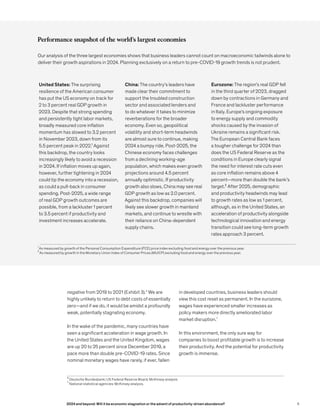
performance and living standards longer term. If companies pursue the three-sided
productivity opportunity, however, they can do both.
January 2024
© Getty Images
by Ezra Greenberg, Asutosh Padhi, and Sven Smit
At the outset of 2023, energy prices were off
their peaks, inflation was no longer accelerating,
economic growth appeared to be holding up, and
geopolitical tensions were easing. We wondered
at the time whether this might signal a break from
the macroeconomic and geopolitical disruptions
that had severely tested management teams
the previous year, ushering in less challenging
business conditions in the coming months.
That emphatically did not happen.
At the outset of 2024, uncertainty has, if anything,
deepened. New geopolitical disruptions; ongoing
shifts in the global economic order; and the
advance of AI, new technology platforms, and the
energy transition are just some of the trends that
signal the potential onset of a new era and keep a
wide range of medium- and long-term economic
scenarios in play.
The sentiment is more positive in the short term,
with rising hopes for a “soft landing” in many
economies, but elevated inflation and interest
rates, frustrated consumers, constrained labor
markets, and domestic political volatility continue
to complicate business and policy decisions. We
cannot rule out a recession in the coming months,
and the potential for a balance sheet reset
continues to hang over the global economy.
In this context, it is understandable that business
leaders are uncertain about the steps to take to
help their companies prosper. Nevertheless, we
believe that these converging forces have the
potential to create the economic conditions for a
much brighter future. From the first successful
fusion experiment that produced more energy
than was used to ignite the process1
to the vast
promise of applied AI, mRNA therapeutics, gene
editing, and other technology trends, we would
argue that there is no better time than today to
invest in a prosperous and sustainable future.
There is a way for business leaders to invest in
that future while managing through the ongoing
1
Jeremy Thomas, “A shot for the ages: Fusion ignition breakthrough hailed as ‘one of the most impressive scientific feats of the 21st
century,’” Lawrence Livermore National Laboratory (LLNL), December 14, 2022.
2
For a summary of this McKinsey Global Institute research, see “The Real New Economy,” Harvard Business Review, 2003. For the full
McKinsey Global Institute report, see “US productivity growth, 1995–2000,” McKinsey Global Institute, October 1, 2001.
uncertainty and boosting their companies’ growth
and profitability: pursuing and capturing the
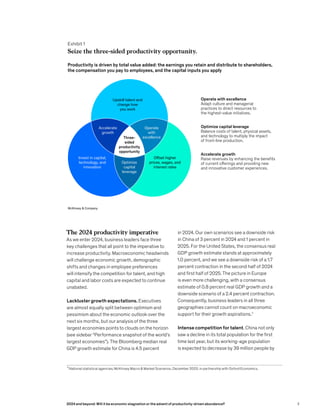
three-sided productivity opportunity (Exhibit
1). By upskilling workers and changing how
their organizations operate; tirelessly striving
to offset higher input prices and interest rates;
and better targeting their investments in capital
and technology, companies can operate more
efficiently, empower workers with tools that
multiply their impact, generate sustainably higher
wages, and accelerate growth.
Business leaders who pursue this productivity
imperative while navigating the mercurial
conditions will not only position their organizations
for outperformance but help make 2024 the
advent of future abundance.
Why do we see abundance—of jobs, corporate
value, technological advances, and economic
growth—as the right aspiration for 2024 and
beyond? The last great productivity acceleration
in the United States, which occurred between
1995 and 2000, flourished on the foundation
of the same three elements.2
When faced
with intensifying international competition,
companies that coupled capital and technology
investments with capability building and changes
in management practices saw their productivity
soar, which in turn lifted the entire economy.
Cost management was part of their productivity
imperative, but the key ingredient was raising top-
line output per worker.
Today the same three-sided productivity formula
is an essential component of successful digital
and AI transformations and underpins the
performance of leading players across sectors.
Productivity can transform entire companies,
industries, and even economies if we can
collectively accelerate progress in months
and years rather than decades—something
companies proved they could do during the
pandemic. Productivity is the imperative that can
deliver business outperformance and a future of
abundance.
2 2024 and beyond: Will it be economic stagnation or the advent of productivity-driven abundance?
The 2024 productivity imperative
As we enter 2024, business leaders face three
key challenges that all point to the imperative to
increase productivity. Macroeconomic headwinds
will challenge economic growth, demographic
shifts and changes in employee preferences
will intensify the competition for talent, and high
capital and labor costs are expected to continue
unabated.
Lackluster growth expectations. Executives
are almost equally split between optimism and
pessimism about the economic outlook over the
next six months, but our analysis of the three
largest economies points to clouds on the horizon
(see sidebar “Performance snapshot of the world’s
largest economies”). The Bloomberg median real
GDP growth estimate for China is 4.5 percent
3
National statistical agencies; McKinsey Macro & Market Scenarios, December 2023, in partnership with Oxford Economics.
in 2024. Our own scenarios see a downside risk
in China of 3 percent in 2024 and 1 percent in
2025. For the United States, the consensus real
GDP growth estimate stands at approximately
1.0 percent, and we see a downside risk of a 1.7
percent contraction in the second half of 2024
and first half of 2025. The picture in Europe
is even more challenging, with a consensus
estimate of 0.8 percent real GDP growth and a
downside scenario of a 2.4 percent contraction.
Consequently, business leaders in all three
geographies cannot count on macroeconomic
support for their growth aspirations.3
Intense competition for talent. China not only
saw a decline in its total population for the first
time last year, but its working-age population
is expected to decrease by 39 million people by
Exhibit 1
Seize the three-sided productivity opportunity.
Productivity is driven by total value added: the earnings you retain and distribute to shareholders,
the compensation you pay to employees, and the capital inputs you apply
Seize the three-sided productivity opportunity.
McKinsey & Company
Operate with excellence
Adapt culture and managerial
practices to direct resources to
the highest-value initiatives.
Accelerate
growth
Invest in capital,
technology, and
innovation
Offset higher
prices, wages, and
interest rates
Operate
with
excellence
Optimize capital leverage
Balance costs of talent, physical assets,
and technology to multiply the impact
of front-line production.
Accelerate growth
Raise revenues by enhancing the benefits
of current offerings and providing new
and innovative customer experiences.
Upskill talent and
change how
you work
Three-
sided
productivity
opportunity
Optimize
capital
leverage
3
2024 and beyond: Will it be economic stagnation or the advent of productivity-driven abundance?
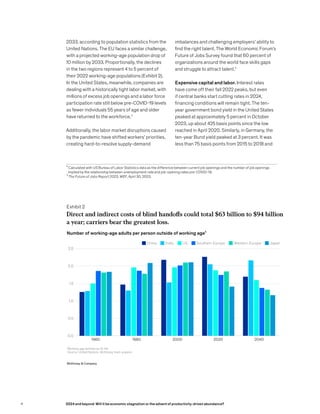
2033, according to population statistics from the
United Nations. The EU faces a similar challenge,
with a projected working-age population drop of
10 million by 2033. Proportionally, the declines
in the two regions represent 4 to 5 percent of
their 2022 working-age populations (Exhibit 2).
In the United States, meanwhile, companies are
dealing with a historically tight labor market, with
millions of excess job openings and a labor force
participation rate still below pre-COVID-19 levels
as fewer individuals 55 years of age and older
have returned to the workforce.4
Additionally, the labor market disruptions caused
by the pandemic have shifted workers’ priorities,
creating hard-to-resolve supply-demand
4
Calculated with US Bureau of Labor Statistics data as the difference between current job openings and the number of job openings
implied by the relationship between unemployment rate and job-opening rates pre-COVID-19.
5
The Future of Jobs Report 2023, WEF, April 30, 2023.
imbalances and challenging employers’ ability to
find the right talent. The World Economic Forum’s
Future of Jobs Survey found that 60 percent of
organizations around the world face skills gaps
and struggle to attract talent.5
Expensive capital and labor. Interest rates
have come off their fall 2022 peaks, but even
if central banks start cutting rates in 2024,
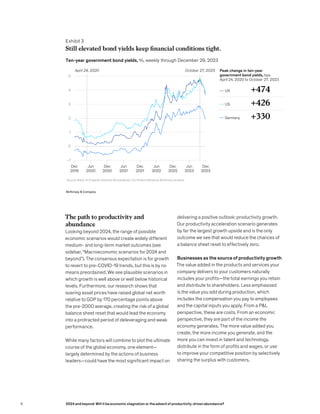
financing conditions will remain tight. The ten-
year government bond yield in the United States
peaked at approximately 5 percent in October
2023, up about 425 basis points since the low
reached in April 2020. Similarly, in Germany, the
ten-year Bund yield peaked at 3 percent. It was
less than 75 basis points from 2015 to 2018 and
Exhibit 2
Direct and indirect costs of blind handoffs could total $63 billion to $94 billion
a year; carriers bear the greatest loss.
Number of working-age adults per person outside of working age¹
1
Working age defined as 15–64.
Source: United Nations, McKinsey team analysis
Declines in working-age populations create headwinds to growth in
many economies.
McKinsey & Company
0.0
0.5
1.0
1.5
2.0
2.5
1960 1980 2000 2020 2040
China India US Southern Europe Western Europe Japan
4 2024 and beyond: Will it be economic stagnation or the advent of productivity-driven abundance?
negative from 2019 to 2021 (Exhibit 3).6
We are
highly unlikely to return to debt costs of essentially
zero—and if we do, it would be amidst a profoundly
weak, potentially stagnating economy.
In the wake of the pandemic, many countries have
seen a significant acceleration in wage growth. In
the United States and the United Kingdom, wages
are up 20 to 25 percent since December 2019, a
pace more than double pre-COVID-19 rates. Since
nominal monetary wages have rarely, if ever, fallen
6
Deutsche Bundesbank; US Federal Reserve Board; McKinsey analysis
7
National statistical agencies; McKinsey analysis.
in developed countries, business leaders should
view this cost reset as permanent. In the eurozone,
wages have experienced smaller increases as
policy makers more directly ameliorated labor
market disruption.7
In this environment, the only sure way for
companies to boost profitable growth is to increase
their productivity. And the potential for productivity
growth is immense.
Performance snapshot of the world’s largest economies
Our analysis of the three largest economies shows that business leaders cannot count on macroeconomic tailwinds alone to
deliver their growth aspirations in 2024. Planning exclusively on a return to pre-COVID-19 growth trends is not prudent.
1
As measured by growth of the Personal Consumption Expenditure (PCE) price index excluding food and energy over the previous year.
2
As measured by growth in the Monetary Union Index of Consumer Prices (MUICP) excluding food and energy over the previous year.
United States: The surprising
resilience of the American consumer
has put the US economy on track for
2 to 3 percent real GDP growth in
2023. Despite that strong spending
and persistently tight labor markets,
broadly measured core inflation
momentum has slowed to 3.2 percent
in November 2023, down from its
5.5 percent peak in 2022.¹ Against
this backdrop, the country looks
increasingly likely to avoid a recession
in 2024. If inflation moves up again,
however, further tightening in 2024
could tip the economy into a recession,
as could a pull-back in consumer
spending. Post-2025, a wide range
of real GDP growth outcomes are
possible, from a lackluster 1 percent
to 3.5 percent if productivity and
investment increases accelerate.
China: The country’s leaders have
made clear their commitment to
support the troubled construction
sector and associated lenders and
to do whatever it takes to minimize
reverberations for the broader
economy. Even so, geopolitical
volatility and short-term headwinds
are almost sure to continue, making
2024 a bumpy ride. Post-2025, the
Chinese economy faces challenges
from a declining working-age
population, which makes even growth
projections around 4.5 percent
annually optimistic. If productivity
growth also slows, China may see real
GDP growth as low as 2.0 percent.
Against this backdrop, companies will
likely see slower growth in mainland
markets, and continue to wrestle with
their reliance on China-dependent
supply chains.
Eurozone: The region’s real GDP fell
in the third quarter of 2023, dragged
down by contractions in Germany and
France and lackluster performance
in Italy. Europe’s ongoing exposure
to energy supply and commodity
shocks caused by the invasion of
Ukraine remains a significant risk.
The European Central Bank faces
a tougher challenge for 2024 than
does the US Federal Reserve as the
conditions in Europe clearly signal
the need for interest rate cuts even
as core inflation remains above 4
percent—more than double the bank’s
target.² After 2025, demographic
and productivity headwinds may lead
to growth rates as low as 1 percent,
although, as in the United States, an
acceleration of productivity alongside
technological innovation and energy
transition could see long-term growth
rates approach 3 percent.
5
2024 and beyond: Will it be economic stagnation or the advent of productivity-driven abundance?
The path to productivity and
abundance
Looking beyond 2024, the range of possible
economic scenarios would create widely different
medium- and long-term market outcomes (see
sidebar, “Macroeconomic scenarios for 2024 and
beyond”). The consensus expectation is for growth
to revert to pre-COVID-19 trends, but this is by no
means preordained. We see plausible scenarios in
which growth is well above or well below historical
levels. Furthermore, our research shows that
soaring asset prices have raised global net worth
relative to GDP by 170 percentage points above
the pre-2000 average, creating the risk of a global
balance sheet reset that would lead the economy
into a protracted period of deleveraging and weak
performance.
While many factors will combine to plot the ultimate
course of the global economy, one element—
largely determined by the actions of business
leaders—could have the most significant impact on
delivering a positive outlook: productivity growth.
Our productivity acceleration scenario generates
by far the largest growth upside and is the only
outcome we see that would reduce the chances of
a balance sheet reset to effectively zero.
Businesses as the source of productivity growth
The value added in the products and services your
company delivers to your customers naturally
includes your profits—the total earnings you retain
and distribute to shareholders. Less emphasized
is the value you add during production, which
includes the compensation you pay to employees
and the capital inputs you apply. From a P&L
perspective, these are costs. From an economic
perspective, they are part of the income the
economy generates. The more value added you
create, the more income you generate, and the
more you can invest in talent and technology,
distribute in the form of profits and wages, or use
to improve your competitive position by selectively
sharing the surplus with customers.
Exhibit 3
Still elevated bond yields keep financial conditions tight.
Ten-year government bond yields, %, weekly through December 29, 2023
Source: Bank of England; Deutche Bundesbank; US Federal Reserve; McKinsey analysis
Still elevated bond yields keep financial conditions tight.
McKinsey & Company
–1
0
1
2
3
4
5
Dec
2023
Jun
2023
Dec
2022
Jun
2022
Dec
2021
Jun
2021
Dec
2020
Jun
2020
Dec
2019
UK
Peak change in ten-year
government bond yields, bps
April 24, 2020 to October 27, 2023
Germany
US
+474
+330
+426
April 24, 2020 October 27, 2023
6 2024 and beyond: Will it be economic stagnation or the advent of productivity-driven abundance?
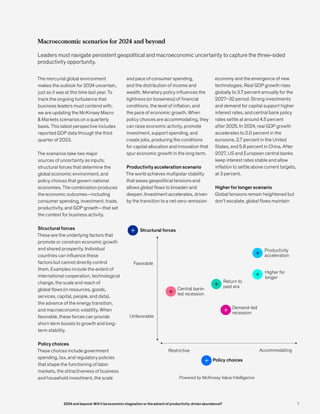
Macroeconomic scenarios for 2024 and beyond
The mercurial global environment
makes the outlook for 2024 uncertain,
just as it was at this time last year. To
track the ongoing turbulence that
business leaders must contend with,
we are updating the McKinsey Macro
& Markets scenarios on a quarterly
basis. This latest perspective includes
reported GDP data through the third
quarter of 2023.
The scenarios take two major
sources of uncertainty as inputs:
structural forces that determine the
global economic environment, and
policy choices that govern national
economies. The combination produces
the economic outcomes—including
consumer spending, investment, trade,
productivity, and GDP growth—that set
the context for business activity.
Structural forces
These are the underlying factors that
promote or constrain economic growth
and shared prosperity. Individual
countries can influence these
factors but cannot directly control
them. Examples include the extent of
international cooperation, technological
change, the scale and reach of
global flows (in resources, goods,
services, capital, people, and data),
the advance of the energy transition,
and macroeconomic volatility. When
favorable, these forces can provide
short-term boosts to growth and long-
term stability.
Policy choices
These choices include government
spending, tax, and regulatory policies
that shape the functioning of labor
markets, the attractiveness of business
and household investment, the scale
and pace of consumer spending,
and the distribution of income and
wealth. Monetary policy influences the
tightness (or looseness) of financial
conditions, the level of inflation, and
the pace of economic growth. When
policy choices are accommodating, they
can raise economic activity, promote
investment, support spending, and
create jobs, producing the conditions
for capital allocation and innovation that
spur economic growth in the long term.
Productivity acceleration scenario
The world achieves multipolar stability
that eases geopolitical tensions and
allows global flows to broaden and
deepen. Investment accelerates, driven
by the transition to a net-zero-emission
economy and the emergence of new
technologies. Real GDP growth rises
globally to 3.7 percent annually for the
2027–32 period. Strong investments
and demand for capital support higher
interest rates, and central bank policy
rates settle at around 4.5 percent
after 2025. In 2024, real GDP growth
accelerates to 2.0 percent in the
eurozone, 2.7 percent in the United
States, and 5.8 percent in China. After
2027, US and European central banks
keep interest rates stable and allow
inflation to settle above current targets,
at 3 percent.
Higher for longer scenario
Global tensions remain heightened but
don’t escalate, global flows maintain
Leaders must navigate persistent geopolitical and macroeconomic uncertainty to capture the three-sided
productivity opportunity.
Structural forces
+
+
+
+
+
+
+
Favorable
Unfavorable
Central bank-
led recession
Return to
past era
Higher for
longer
Demand-led
recession
Productivity
acceleration
Restrictive Accommodating
Policy choices
Powered by McKinsey Value Intelligence
7
2024 and beyond: Will it be economic stagnation or the advent of productivity-driven abundance?
current levels, and government
industrial policies lead to continued
growth in deficits. US and eurozone
central banks lose support for bringing
inflation back to 2 percent targets and
lower policy rates to below 4 percent
by the end of 2024. Real GDP grows
at 1.3 percent in the eurozone and 2.3
percent in the United States in 2024.
Post-2026, inflation stabilizes at a
“new normal” of 3.5 percent; global real
GDP grows at 3.0 percent annually,
supporting an accelerated energy
transition; and interest rates remain
at 3.5 to 4.0 percent in developed
economies.
Return to past era scenario
Global tensions remain heightened.
The productivity promises of new
technologies prove to be exaggerated.
Energy transition stays on the current
trajectory. In 2024, central banks
achieve a “soft landing,” and inflation
continues to decelerate, sliding back
to the 2 percent target in the United
States and Europe by 2025. Growth
drops to 1.2 percent in the United
States, 0.8 percent in the eurozone,
and 4.4 percent in China this year. US
and eurozone central banks cut rates,
which ultimately settle at around 2.5
percent after 2026. Global real GDP
growth sits at 2.5 percent after 2027,
returning to pre-COVID-19 trends.
Central bank–led recession scenario
The geopolitical landscape remains
unsettled. Stubbornly high inflation
causes the US Federal Reserve to
raise rates above 6.0 percent and the
European Central Bank to hold rates
at 4.5 percent, causing a recession.
Real GDP contracts in the United
States by 1.7 percent and by 2.4
percent in the eurozone in the second
half of 2024 and first half of 2025.
As recessionary concerns dominate,
investments in new technologies and
the net-zero transition slow, lowering
real GDP growth to 2 percent globally
after 2026. Inflation settles at central
banks’ 2 percent target across major
economies, and lower investment
demand brings policy rates to below 2
percent across the United States and
Europe.
Demand-led recession scenario
Geopolitical tensions escalate
globally, raising uncertainty and
suppressing consumer spending and
business investment. Even without
further monetary tightening, soft
demand pushes economies around
the world into recession, with real
GDP contracting to 1.8 percent in the
eurozone and 0.6 percent in the US
by the fall of 2024. As a result, real
GDP drops to 1.8 globally percent after
2027, inflation settles below 2 percent
targets and interest rates retreat to
around 1 percent in the US and the
eurozone. Momentum in the energy
transition fades as investments in new
technologies and productivity stall, and
secular stagnation sets in.
Balance sheet reset
Our research shows that global net
worth relative to GDP has grown by
170 percentage points above the pre-
2000 average on the back of soaring
asset prices. Tighter monetary policy,
perceptions of rising risk, or stress and
failures in financial systems around the
world could lead to a sharp correction
in asset values back to historical norms
as well as a prolonged recession. As
households, businesses, and financial
institutions come under stress, the
global economy could face a decade-
long period of deleveraging, causing
GDP growth through 2030 to slow by
0.6 percent globally and household
wealth to decline by more than $30
trillion.
About McKinsey Value Intelligence
The MVI is a self-service platform
providing quick and curated insights
on company, industry, and macro
performance:
— Explore McKinsey’s Macro &
Markets scenarios to inform your
strategy and investment decisions.
— Access industry-level insights
beyond raw data, converting
numbers into value-creation
strategies.
— Benchmark companies via curated
insights on financial, operational,
and organizational performance.
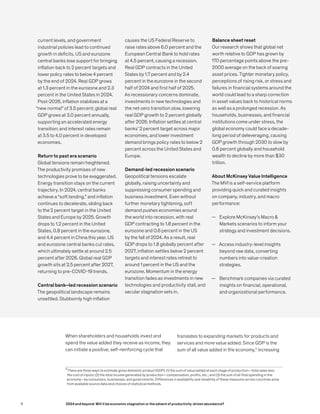
When shareholders and households invest and
spend the value added they receive as income, they
can initiate a positive, self-reinforcing cycle that
8
There are three ways to estimate gross domestic product (GDP): (1) the sum of value added at each stage of production—total sales less
the cost of inputs; (2) the total income generated by production—compensation, profits, etc.; and (3) the sum of all final spending in the
economy—by consumers, businesses, and governments. Differences in availability and reliability of these measures across countries arise
from available source data and choices of statistical methods.
translates to expanding markets for products and
services and more value added. Since GDP is the
sum of all value added in the economy,8
increasing
8 2024 and beyond: Will it be economic stagnation or the advent of productivity-driven abundance?
that value added leads to more GDP and economic
growth and higher living standards. This is why
advancing the productivity frontier is the path to
creating a future of abundance.
Companies at this frontier are reimagining
what it takes to deliver operational excellence;
defining new ways to enhance the return on talent,
physical capital, and software investments; and
leading with innovation to accelerate growth
(see sidebar, “Unleashing your productivity
potential”). Navigating a world that’s rapidly being
transformed by technology is not a new challenge
for companies, but it is an increasingly pressing
one as digital tools and AI reshape how we work
and live. Business leaders who succeed in digital
and AI transformations are completely rewiring
their organizations. They are bringing business,
technology, and operations more closely together,
raising the skills of individual workers, and building
a distributed technology and data environment
that empowers hundreds of teams to digitally
innovate. The capabilities required to deliver on the
three-sided productivity opportunity turn out to be
an essential input to the broader requirements of
such successful transformations.
As in digital transformations, creating productivity
growth across an organization requires
management teams to execute a range of difficult
actions simultaneously. Many of these activities
will feel familiar to business leaders but now
require new twists. Instead of focusing primarily
on P&L line items to free up cash for productive
investments, for example, turn equal energy to
balance sheet discipline. Shift your attention from
the war for talent to measuring the return on talent
investment, emphasizing skills and capabilities
rather than roles, and using analytics to turn
talent acquisition into a science. Recognize that
the next frontier of operational excellence is in
discovering how culture and digital can change the
fundamental assumptions about what operations
can (and should) achieve. Finally, create direct
productivity increases through revenue growth
by efficiently raising the market value of current
offerings and by innovating new offerings and
customer experiences.
Unleashing your productivity potential
The executives we speak with
unanimously agree that increasing
productivity is a key to driving
profitable, sustainable growth. Their
primary focus is typically relentless
cost control, but efficiency is only one
aspect of productivity. Companies that
focus on operating with excellence,
optimizing capital allocation, and
accelerating growth have the greatest
chance of delivering transformative
increases in productivity.
Modernize your operating model:
Adapt management practices to
direct resources to the highest-value
initiatives and business systems
Companies that focus on channeling
the resources required to achieve
their operational goals and develop
new cultural norms and management
practices, rather than thinking about
their operational improvements as cost
cutting, radically improve their ability to
achieve operational excellence
Reset resource allocation. Many
of the fastest growing and most
profitable companies dynamically
allocate financial capital, talent, and
capabilities, nimbly reallocating
these resources in the face of
shifting opportunities and in times
of heightened uncertainty. This
should come as no surprise as our
comprehensive research shows
that companies that reallocate 60
percent of their capital expenditures
across businesses units over ten
years materially improve the odds of
capturing the economic profit available
in their industries.
Even so, most companies continue to
operate on a traditional annual review
and resource-allocation cycle. We are
starting to see more organizations
reallocate their resources in one-,
three-, or six-month cycles, and work
iteratively with investment committees
and working groups to ensure that
allocation decisions closely tie to the
company’s overall strategic goals and
shifting market and operational needs.
Any consideration of operational
excellence must start with resource
allocation.
Change your culture to harness
technology. The introduction of lean
management and agile operating
models transformed how companies
operate by challenging the way leaders
thought about waste, variability,
9
2024 and beyond: Will it be economic stagnation or the advent of productivity-driven abundance?
and flexibility. Leaders at the next
frontier of operational excellence
recognize that shifts in culture and
digital technology have changed
the fundamental assumptions about
what operations can (and should)
achieve. They craft a purpose and
strategy that the entire organization
clearly understands and that links
transparently to what functions do
(and need to stop doing), how they are
organized, and what resources they
require for success. They then build
management systems that reinforce
these operating principles and the
behaviors needed to support them,
and they apply technology where it can
uniquely add value-stream benefits
while augmenting human capabilities.
By adopting these principles, a mining
company changed its culture from one
in which workers rarely felt encouraged
to share their improvement ideas, to
an environment where bottom-up
innovations produced dozens of
process changes. The result was a
production improvement of at least
10 percent annually and significantly
lower water usage that was critical to
the company’s operations in a drought-
prone region.
Multiply the impact of front-line
production and delivery: Strike the
right balance of talent, physical
capital, and software investments
Companies that deliver sustained
increases in productivity intentionally
create a mix of capabilities and tools
that support front-line production and
customer delivery, where the battle for
efficiency and value creation is won
and lost. This requires an intentional
and persistent focus on offsetting the
impact of higher prices, wages, and
interest rates to free up more funds to
invest. While there are numerous ways
that different sectors can optimize
capital leverage, two approaches can
have outsized impact across industries:
embracing balance sheet discipline to
free up cash and maximizing the return
on talent to generate impact from new
investments.
Scrutinize your balance sheet. The
balance sheet is the product of
thousands of decisions made by
hundreds of your employees every day.
To be cash efficient, business leaders
and their teams need to shift away
from the traditional focus on the P&L to
a more comprehensive approach that
also scrutinizes the balance sheet. This
means improving their cash conversion
cycle by optimizing working capital
management, including payment terms,
payment processes, and inventories.
All of this needs to be supported
by instilling a new cash culture in
all employees that emphasizes the
importance of cash discipline, and
identifies and prioritizes metrics for
capital efficiency, including incentives
tied directly to delivery.
Companies that excel at cash
management also strengthen the
balance sheet in other areas, by
divesting underperforming long-term
assets, reviewing cash trapped in
foreign jurisdictions, or determining the
optimal instruments for credit support
needs. By applying these principles,
one global agriculture company
released $1.5 billion in cash from its
balance sheet, providing funding for
capital investments, novel commercial
offerings, and return of capital to
shareholders.
Reimagine how to maximize
“return on talent.” Talent is scarce
and expensive today, which makes
maximizing the return on your talent
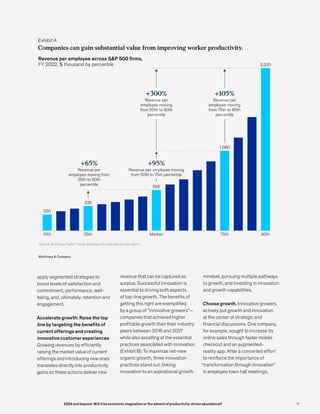
investment critical. Our analysis of S&P
500 companies shows that a company
at the median of revenue per employee
is 65 percent higher on this rough
proxy for productivity than one ranked
in the 25th percentile. Companies
ranked in the 75th percentile deliver
95 percent more revenue per
employee than those at the median,
and companies in the 90th percentile
deliver 300 percent more (Exhibit
A). There are five critical actions to
maximize the return on talent.
First, identify the most critical roles
and skills and establish a hiring engine
that focuses on delivering them. One
global media company, for example,
identified critical roles and talent
pools, built a predictive model to zero
in on future talent needs and gaps,
and developed an action plan to close
those gaps. With the right team in
place, the company was able to raise
its revenue growth targets by more
than one-third.
Next, focus on the highest-return
learning journeys for development,
reskilling workers where you can, and
manage your talent and culture to drive
performance and experience in a way
that allows talent to flourish.
Finally, transform HR into a true
business leader, with visible CEO
support and the resources to invest
in programs required for success. An
international telecom company that
had siloed, reactive, and largely manual
HR operating processes benchmarked
its processes and budgets to best
practices, then designed a new HR
vision, including implementing an agile
HR operating model.
Importantly, to raise productivity,
corporate leaders have to understand
that their workforces are not
monolithic. From the highly dissatisfied
and actively disengaged to the
thriving stars and the vast middle in
between, employees span a broad
spectrum, requiring companies to
10 2024 and beyond: Will it be economic stagnation or the advent of productivity-driven abundance?
Exhibit A
Companies can gain substantial value from improving worker productivity.
Revenue per employee across S&P 500 firms,
FY 2022, $ thousand by percentile
Source: McKinsey Talent Trends database of corporate annual reports
Companies can gain substantial value from improving worker productivity.
McKinsey & Company
220
335
555
1,090
2,220
10th 25th Median 75th 90th
Revenue per
employee moving from
25th to 50th
percentile
+65%
Revenue per employee moving
from 50th to 75th percentile
+95%
Revenue per
employee moving
from 50th to 90th
percentile
+300%
Revenue per
employee moving
from 75th to 90th
percentile
+105%
apply segmented strategies to
boost levels of satisfaction and
commitment, performance, well-
being, and, ultimately, retention and
engagement.
Accelerate growth: Raise the top
line by targeting the benefits of
current offerings and creating
innovative customer experiences
Growing revenues by efficiently
raising the market value of current
offerings and introducing new ones
translates directly into productivity
gains as these actions deliver new
revenue that can be captured as
surplus. Successful innovation is
essential to driving both aspects
of top-line growth. The benefits of
getting this right are exemplified
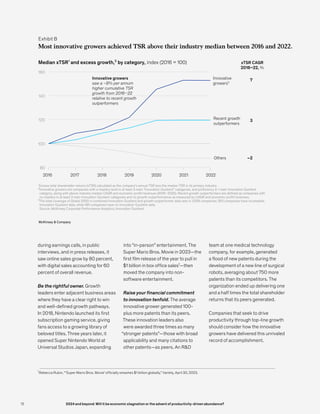
by a group of “innovative growers”—
companies that achieved higher
profitable growth than their industry
peers between 2016 and 2021
while also excelling at the essential
practices associated with innovation
(Exhibit B). To maximize net-new
organic growth, three innovation
practices stand out: linking
innovation to an aspirational growth
mindset, pursuing multiple pathways
to growth, and investing in innovation
and growth capabilities.
Choose growth. Innovative growers
actively put growth and innovation
at the center of strategic and
financial discussions. One company,
for example, sought to increase its
online sales through faster mobile
checkout and an augmented-
reality app. After a concerted effort
to reinforce the importance of
“transformation through innovation”
in employee town hall meetings,
11
2024 and beyond: Will it be economic stagnation or the advent of productivity-driven abundance?
during earnings calls, in public
interviews, and in press releases, it
saw online sales grow by 80 percent,
with digital sales accounting for 60
percent of overall revenue.
Be the rightful owner. Growth
leaders enter adjacent business areas
where they have a clear right to win
and well-defined growth pathways.
In 2018, Nintendo launched its first
subscription gaming service, giving
fans access to a growing library of
beloved titles. Three years later, it
opened Super Nintendo World at
Universal Studios Japan, expanding
into “in-person” entertainment. The
Super Mario Bros. Movie in 2023—the
first film release of the year to pull in
$1 billion in box office sales¹—then
moved the company into non-
software entertainment.
Raise your financial commitment
to innovation tenfold. The average
innovative grower generated 100-
plus more patents than its peers.
These innovation leaders also
were awarded three times as many
“stronger patents”—those with broad
applicability and many citations to
other patents—as peers. An R&D
team at one medical technology
company, for example, generated
a flood of new patents during the
development of a new line of surgical
robots, averaging about 750 more
patents than its competitors. The
organization ended up delivering one
and a half times the total shareholder
returns that its peers generated.
Companies that seek to drive
productivity through top-line growth
should consider how the innovative
growers have delivered this unrivaled
record of accomplishment.
Exhibit B
Most innovative growers achieved TSR above their industry median between 2016 and 2022.
Median xTSR¹ and excess growth,² by category, index (2016 = 100)
1
Excess total shareholder returns (xTSR) calculated as the company’s annual TSR less the median TSR in its primary industry.
²Innovative growers are companies with a mastery level in at least 3 main “Innovation Quotient” categories, and proficiency in 1 main Innovation Quotient
category, along with above-industry median CAGR and economic profit/revenues (2016–2022). Recent growth outperformers are defined as companies with
no mastery in at least 3 main Innovation Quotient categories and no growth outperformance as measured by CAGR and economic profit/revenues.
³The total coverage of Global 2000 in combined Innovation Quotient and growth outperformer data sets is 1,009 companies; 353 companies have incomplete
Innovation Quotient data, while 991 companies have no Innovation Quotient data.
Source: McKinsey Corporate Performance Analytics; Innovation Quotient
Most innovative growers achieved TSR above their industry median
between 2016 and 2022.
McKinsey & Company
80
2016 2017 2018 2019 2020 2021 2022
100
120
140
160
Innovative
growers3
Recent growth
outperformers
Others
7
xTSR CAGR
2016–22, %
3
–2
Innovative growers
saw a ~9% per annum
higher cumulative TSR
growth from 2016–22
relative to recent growth
outperformers
1
Rebecca Rubin, “‘Super Mario Bros. Movie’ officially smashes $1 billion globally,” Variety, April 30, 2023.
12 2024 and beyond: Will it be economic stagnation or the advent of productivity-driven abundance?
The challenge of raising productivity
The success stories—and failures—of the
1995-to-2000 productivity acceleration show why
companies need a comprehensive approach to
productivity.9
Walmart prioritized lowering costs
to offer higher-value-added goods, invested in a
hub-and-spoke distribution model to decrease
logistics costs, and deployed IT systems
specifically designed to improve in-store employee
efficiency. Intel prioritized ongoing development
of next-generation chips, standardized training,
and overhauled production processes to enable
quicker shifts to new higher-value-added products
that would sustain growth. Both companies
delivered significant productivity gains.
On the other hand, retail banking companies
created a more convenient customer experience
with online banking but failed to shift customers
from legacy products to higher-value-added
services. They made significant investments in
technology but not in employee training, ending up
9
McKinsey Global Institute, “US productivity growth, 1995–2000,” 2001.
10
Growth in GDP per capita, productivity and ULC, OECD.Stat; Over the 10 years preceding the [financial] crisis, trend labor productivity
growth declined in all G7 countries, particularly in France, Italy, and the United Kingdom. In the case of Canada, the United Kingdom and the
United States, the decline since the end of the 1990s marked a reversal of growth that coincided with the IT revolution. In other countries,
trend labor productivity growth has shown a gradual decline over the past 40 years [ending 2015] from relatively high rates; “Productivity
trends in G7 countries,” OECD iLibrary, Chapter 5.
with unused computing power that went beyond
the capabilities of the organization to leverage.
Hotels made significant investments in CRM
systems but continued to operate in silos, with
poor data sharing across properties, limiting the
potential benefits from creating better customer
experiences. They missed an opportunity to
extract more value from revenue management
systems because of a lack of employee training
and capability building.
The challenge of creating productivity growth at
the economy level is likewise high, as the record
of G7 countries makes clear. In the 1995–2005
decade, growth in GDP per hour worked across
the G7 countries averaged just above 2 percent
annually (higher at the beginning of this period and
lower at the end). From 2010 to 2019, productivity
growth was just below 1 percent. In 2022,
productivity was negative in four G7 countries,
creating a roughly 0.5 percent decline for the
seven countries combined (Exhibit 4).10
Exhibit 4
Rates of productivity growth have been declining in G7 countries.
Trend GDP per hour worked, constant prices¹
1
Trend productivity growth derived using the Hodrick Prescott filter.
Source: OECD; McKinsey analysis
Rates of productivity growth have been declining in G7 countries.
McKinsey & Company
–2
–1
0
1
2
3
4
5
6
1970 1980 1990 2000 2010 2020
US
UK
Japan
Italy
Germany
France
Canada
13
2024 and beyond: Will it be economic stagnation or the advent of productivity-driven abundance?
Even productivity success can create unintended
consequences as the “creative destruction”
critical to productivity growth displaces existing
jobs, businesses, and industries.11
The last wave
of globalization lifted millions out of poverty but
entailed many consequences that were either
ignored, minimized, or simply missed along the
way. For example, the repercussions of labor
market polarization in the United States and
Europe (where high-education, high-wage and
low-education, low-wage jobs grew but middle-
paying jobs stagnated) are still being felt today.12
Governments, international institutions, and
businesses can choose to intentionally create an
environment conducive to productivity growth
and spend the resources to actively manage the
transition to new jobs, business opportunities,
and entire industries. Collectively this would lead
to prosperity that can be shared by all.
11
Shigeru Fujita, “Creative Destruction and Aggregate Productivity Growth,” Philadelphia Fed Business Review, Q3 2008; As originally
articulated by Joseph Schumpeter: “The fundamental impulse that keeps the capital engine in motion comes from the new consumers’
goods, the new methods of production and transportation, the new markets… [The process] incessantly revolutionizes from within,
incessantly destroying the old one, incessantly creating a new one. This process of Creative Destruction is the essential fact of
capitalism.” Joseph Schumpeter, “Capitalism, Socialism, and Democracy,” Third Edition, 1942.
12
David Autor; “Polanyi’s Paradox and the Shape of Employment Growth”, NBER Working Paper 20485, September 2014
Business productivity gains not only improve
company performance but translate into GDP
growth and higher living standards. Business
leaders who make decisions with this broader
view in mind have a higher chance of raising
shareholder returns while delivering on the
corporate purpose they had set out to achieve.
While delivering sustained productivity growth
is not easy, management teams have repeatedly
surmounted seemingly impossible challenges
over the past four years by taking unprecedented
actions, with exceptional speed, in the face of
enormous uncertainty. Leaders who internalize
these hard-won lessons and incentivize the
behaviors that have helped them weather the
recent period can significantly raise their odds of
outperformance and help make 2024 the advent
of future abundance.
Copyright © 2024 McKinsey & Company. All rights reserved.
Ezra Greenberg is a partner in McKinsey’s Stamford office, Asutosh Padhi is a senior partner in the Chicago office and
the North America managing partner, Sven Smit is chair of the McKinsey Global Institute and a senior partner in the
Amsterdam office.
The authors would like to thank Matt Banholzer, Vincent Bérubé, Rebecca Doherty, Steven Eklund, Arvind Govindarajan,
Sebastian Kohls, Alina Malinauskaite, Jake Matthews, Jake Milner, Nicholas Pingitore, Richard Sellschop, Erik Schaefer,
Zachary Silverman, Scott Schwaitzberg, Sarah Walker, Joris Wijpkema, and Shubo Yin for their contributions to this article.
14 2024 and beyond: Will it be economic stagnation or the advent of productivity-driven abundance?

2024-and-beyond-will-it-be-economic-stagnation-or-the-advent-of-productivity-driven-abundance.pdf

  • 1.
    Strategy & CorporateFinance 2024 and beyond: Will it be economic stagnation or the advent of productivity-driven abundance? Hoping for a soft landing in 2024 won’t mitigate current risks or raise business performance and living standards longer term. If companies pursue the three-sided productivity opportunity, however, they can do both. January 2024 © Getty Images by Ezra Greenberg, Asutosh Padhi, and Sven Smit
  • 2.
    At the outsetof 2023, energy prices were off their peaks, inflation was no longer accelerating, economic growth appeared to be holding up, and geopolitical tensions were easing. We wondered at the time whether this might signal a break from the macroeconomic and geopolitical disruptions that had severely tested management teams the previous year, ushering in less challenging business conditions in the coming months. That emphatically did not happen. At the outset of 2024, uncertainty has, if anything, deepened. New geopolitical disruptions; ongoing shifts in the global economic order; and the advance of AI, new technology platforms, and the energy transition are just some of the trends that signal the potential onset of a new era and keep a wide range of medium- and long-term economic scenarios in play. The sentiment is more positive in the short term, with rising hopes for a “soft landing” in many economies, but elevated inflation and interest rates, frustrated consumers, constrained labor markets, and domestic political volatility continue to complicate business and policy decisions. We cannot rule out a recession in the coming months, and the potential for a balance sheet reset continues to hang over the global economy. In this context, it is understandable that business leaders are uncertain about the steps to take to help their companies prosper. Nevertheless, we believe that these converging forces have the potential to create the economic conditions for a much brighter future. From the first successful fusion experiment that produced more energy than was used to ignite the process1 to the vast promise of applied AI, mRNA therapeutics, gene editing, and other technology trends, we would argue that there is no better time than today to invest in a prosperous and sustainable future. There is a way for business leaders to invest in that future while managing through the ongoing 1 Jeremy Thomas, “A shot for the ages: Fusion ignition breakthrough hailed as ‘one of the most impressive scientific feats of the 21st century,’” Lawrence Livermore National Laboratory (LLNL), December 14, 2022. 2 For a summary of this McKinsey Global Institute research, see “The Real New Economy,” Harvard Business Review, 2003. For the full McKinsey Global Institute report, see “US productivity growth, 1995–2000,” McKinsey Global Institute, October 1, 2001. uncertainty and boosting their companies’ growth and profitability: pursuing and capturing the three-sided productivity opportunity (Exhibit 1). By upskilling workers and changing how their organizations operate; tirelessly striving to offset higher input prices and interest rates; and better targeting their investments in capital and technology, companies can operate more efficiently, empower workers with tools that multiply their impact, generate sustainably higher wages, and accelerate growth. Business leaders who pursue this productivity imperative while navigating the mercurial conditions will not only position their organizations for outperformance but help make 2024 the advent of future abundance. Why do we see abundance—of jobs, corporate value, technological advances, and economic growth—as the right aspiration for 2024 and beyond? The last great productivity acceleration in the United States, which occurred between 1995 and 2000, flourished on the foundation of the same three elements.2 When faced with intensifying international competition, companies that coupled capital and technology investments with capability building and changes in management practices saw their productivity soar, which in turn lifted the entire economy. Cost management was part of their productivity imperative, but the key ingredient was raising top- line output per worker. Today the same three-sided productivity formula is an essential component of successful digital and AI transformations and underpins the performance of leading players across sectors. Productivity can transform entire companies, industries, and even economies if we can collectively accelerate progress in months and years rather than decades—something companies proved they could do during the pandemic. Productivity is the imperative that can deliver business outperformance and a future of abundance. 2 2024 and beyond: Will it be economic stagnation or the advent of productivity-driven abundance?
  • 3.
    The 2024 productivityimperative As we enter 2024, business leaders face three key challenges that all point to the imperative to increase productivity. Macroeconomic headwinds will challenge economic growth, demographic shifts and changes in employee preferences will intensify the competition for talent, and high capital and labor costs are expected to continue unabated. Lackluster growth expectations. Executives are almost equally split between optimism and pessimism about the economic outlook over the next six months, but our analysis of the three largest economies points to clouds on the horizon (see sidebar “Performance snapshot of the world’s largest economies”). The Bloomberg median real GDP growth estimate for China is 4.5 percent 3 National statistical agencies; McKinsey Macro & Market Scenarios, December 2023, in partnership with Oxford Economics. in 2024. Our own scenarios see a downside risk in China of 3 percent in 2024 and 1 percent in 2025. For the United States, the consensus real GDP growth estimate stands at approximately 1.0 percent, and we see a downside risk of a 1.7 percent contraction in the second half of 2024 and first half of 2025. The picture in Europe is even more challenging, with a consensus estimate of 0.8 percent real GDP growth and a downside scenario of a 2.4 percent contraction. Consequently, business leaders in all three geographies cannot count on macroeconomic support for their growth aspirations.3 Intense competition for talent. China not only saw a decline in its total population for the first time last year, but its working-age population is expected to decrease by 39 million people by Exhibit 1 Seize the three-sided productivity opportunity. Productivity is driven by total value added: the earnings you retain and distribute to shareholders, the compensation you pay to employees, and the capital inputs you apply Seize the three-sided productivity opportunity. McKinsey & Company Operate with excellence Adapt culture and managerial practices to direct resources to the highest-value initiatives. Accelerate growth Invest in capital, technology, and innovation Offset higher prices, wages, and interest rates Operate with excellence Optimize capital leverage Balance costs of talent, physical assets, and technology to multiply the impact of front-line production. Accelerate growth Raise revenues by enhancing the benefits of current offerings and providing new and innovative customer experiences. Upskill talent and change how you work Three- sided productivity opportunity Optimize capital leverage 3 2024 and beyond: Will it be economic stagnation or the advent of productivity-driven abundance?
  • 4.
    2033, according topopulation statistics from the United Nations. The EU faces a similar challenge, with a projected working-age population drop of 10 million by 2033. Proportionally, the declines in the two regions represent 4 to 5 percent of their 2022 working-age populations (Exhibit 2). In the United States, meanwhile, companies are dealing with a historically tight labor market, with millions of excess job openings and a labor force participation rate still below pre-COVID-19 levels as fewer individuals 55 years of age and older have returned to the workforce.4 Additionally, the labor market disruptions caused by the pandemic have shifted workers’ priorities, creating hard-to-resolve supply-demand 4 Calculated with US Bureau of Labor Statistics data as the difference between current job openings and the number of job openings implied by the relationship between unemployment rate and job-opening rates pre-COVID-19. 5 The Future of Jobs Report 2023, WEF, April 30, 2023. imbalances and challenging employers’ ability to find the right talent. The World Economic Forum’s Future of Jobs Survey found that 60 percent of organizations around the world face skills gaps and struggle to attract talent.5 Expensive capital and labor. Interest rates have come off their fall 2022 peaks, but even if central banks start cutting rates in 2024, financing conditions will remain tight. The ten- year government bond yield in the United States peaked at approximately 5 percent in October 2023, up about 425 basis points since the low reached in April 2020. Similarly, in Germany, the ten-year Bund yield peaked at 3 percent. It was less than 75 basis points from 2015 to 2018 and Exhibit 2 Direct and indirect costs of blind handoffs could total $63 billion to $94 billion a year; carriers bear the greatest loss. Number of working-age adults per person outside of working age¹ 1 Working age defined as 15–64. Source: United Nations, McKinsey team analysis Declines in working-age populations create headwinds to growth in many economies. McKinsey & Company 0.0 0.5 1.0 1.5 2.0 2.5 1960 1980 2000 2020 2040 China India US Southern Europe Western Europe Japan 4 2024 and beyond: Will it be economic stagnation or the advent of productivity-driven abundance?
  • 5.
    negative from 2019to 2021 (Exhibit 3).6 We are highly unlikely to return to debt costs of essentially zero—and if we do, it would be amidst a profoundly weak, potentially stagnating economy. In the wake of the pandemic, many countries have seen a significant acceleration in wage growth. In the United States and the United Kingdom, wages are up 20 to 25 percent since December 2019, a pace more than double pre-COVID-19 rates. Since nominal monetary wages have rarely, if ever, fallen 6 Deutsche Bundesbank; US Federal Reserve Board; McKinsey analysis 7 National statistical agencies; McKinsey analysis. in developed countries, business leaders should view this cost reset as permanent. In the eurozone, wages have experienced smaller increases as policy makers more directly ameliorated labor market disruption.7 In this environment, the only sure way for companies to boost profitable growth is to increase their productivity. And the potential for productivity growth is immense. Performance snapshot of the world’s largest economies Our analysis of the three largest economies shows that business leaders cannot count on macroeconomic tailwinds alone to deliver their growth aspirations in 2024. Planning exclusively on a return to pre-COVID-19 growth trends is not prudent. 1 As measured by growth of the Personal Consumption Expenditure (PCE) price index excluding food and energy over the previous year. 2 As measured by growth in the Monetary Union Index of Consumer Prices (MUICP) excluding food and energy over the previous year. United States: The surprising resilience of the American consumer has put the US economy on track for 2 to 3 percent real GDP growth in 2023. Despite that strong spending and persistently tight labor markets, broadly measured core inflation momentum has slowed to 3.2 percent in November 2023, down from its 5.5 percent peak in 2022.¹ Against this backdrop, the country looks increasingly likely to avoid a recession in 2024. If inflation moves up again, however, further tightening in 2024 could tip the economy into a recession, as could a pull-back in consumer spending. Post-2025, a wide range of real GDP growth outcomes are possible, from a lackluster 1 percent to 3.5 percent if productivity and investment increases accelerate. China: The country’s leaders have made clear their commitment to support the troubled construction sector and associated lenders and to do whatever it takes to minimize reverberations for the broader economy. Even so, geopolitical volatility and short-term headwinds are almost sure to continue, making 2024 a bumpy ride. Post-2025, the Chinese economy faces challenges from a declining working-age population, which makes even growth projections around 4.5 percent annually optimistic. If productivity growth also slows, China may see real GDP growth as low as 2.0 percent. Against this backdrop, companies will likely see slower growth in mainland markets, and continue to wrestle with their reliance on China-dependent supply chains. Eurozone: The region’s real GDP fell in the third quarter of 2023, dragged down by contractions in Germany and France and lackluster performance in Italy. Europe’s ongoing exposure to energy supply and commodity shocks caused by the invasion of Ukraine remains a significant risk. The European Central Bank faces a tougher challenge for 2024 than does the US Federal Reserve as the conditions in Europe clearly signal the need for interest rate cuts even as core inflation remains above 4 percent—more than double the bank’s target.² After 2025, demographic and productivity headwinds may lead to growth rates as low as 1 percent, although, as in the United States, an acceleration of productivity alongside technological innovation and energy transition could see long-term growth rates approach 3 percent. 5 2024 and beyond: Will it be economic stagnation or the advent of productivity-driven abundance?
  • 6.
    The path toproductivity and abundance Looking beyond 2024, the range of possible economic scenarios would create widely different medium- and long-term market outcomes (see sidebar, “Macroeconomic scenarios for 2024 and beyond”). The consensus expectation is for growth to revert to pre-COVID-19 trends, but this is by no means preordained. We see plausible scenarios in which growth is well above or well below historical levels. Furthermore, our research shows that soaring asset prices have raised global net worth relative to GDP by 170 percentage points above the pre-2000 average, creating the risk of a global balance sheet reset that would lead the economy into a protracted period of deleveraging and weak performance. While many factors will combine to plot the ultimate course of the global economy, one element— largely determined by the actions of business leaders—could have the most significant impact on delivering a positive outlook: productivity growth. Our productivity acceleration scenario generates by far the largest growth upside and is the only outcome we see that would reduce the chances of a balance sheet reset to effectively zero. Businesses as the source of productivity growth The value added in the products and services your company delivers to your customers naturally includes your profits—the total earnings you retain and distribute to shareholders. Less emphasized is the value you add during production, which includes the compensation you pay to employees and the capital inputs you apply. From a P&L perspective, these are costs. From an economic perspective, they are part of the income the economy generates. The more value added you create, the more income you generate, and the more you can invest in talent and technology, distribute in the form of profits and wages, or use to improve your competitive position by selectively sharing the surplus with customers. Exhibit 3 Still elevated bond yields keep financial conditions tight. Ten-year government bond yields, %, weekly through December 29, 2023 Source: Bank of England; Deutche Bundesbank; US Federal Reserve; McKinsey analysis Still elevated bond yields keep financial conditions tight. McKinsey & Company –1 0 1 2 3 4 5 Dec 2023 Jun 2023 Dec 2022 Jun 2022 Dec 2021 Jun 2021 Dec 2020 Jun 2020 Dec 2019 UK Peak change in ten-year government bond yields, bps April 24, 2020 to October 27, 2023 Germany US +474 +330 +426 April 24, 2020 October 27, 2023 6 2024 and beyond: Will it be economic stagnation or the advent of productivity-driven abundance?
  • 7.
    Macroeconomic scenarios for2024 and beyond The mercurial global environment makes the outlook for 2024 uncertain, just as it was at this time last year. To track the ongoing turbulence that business leaders must contend with, we are updating the McKinsey Macro & Markets scenarios on a quarterly basis. This latest perspective includes reported GDP data through the third quarter of 2023. The scenarios take two major sources of uncertainty as inputs: structural forces that determine the global economic environment, and policy choices that govern national economies. The combination produces the economic outcomes—including consumer spending, investment, trade, productivity, and GDP growth—that set the context for business activity. Structural forces These are the underlying factors that promote or constrain economic growth and shared prosperity. Individual countries can influence these factors but cannot directly control them. Examples include the extent of international cooperation, technological change, the scale and reach of global flows (in resources, goods, services, capital, people, and data), the advance of the energy transition, and macroeconomic volatility. When favorable, these forces can provide short-term boosts to growth and long- term stability. Policy choices These choices include government spending, tax, and regulatory policies that shape the functioning of labor markets, the attractiveness of business and household investment, the scale and pace of consumer spending, and the distribution of income and wealth. Monetary policy influences the tightness (or looseness) of financial conditions, the level of inflation, and the pace of economic growth. When policy choices are accommodating, they can raise economic activity, promote investment, support spending, and create jobs, producing the conditions for capital allocation and innovation that spur economic growth in the long term. Productivity acceleration scenario The world achieves multipolar stability that eases geopolitical tensions and allows global flows to broaden and deepen. Investment accelerates, driven by the transition to a net-zero-emission economy and the emergence of new technologies. Real GDP growth rises globally to 3.7 percent annually for the 2027–32 period. Strong investments and demand for capital support higher interest rates, and central bank policy rates settle at around 4.5 percent after 2025. In 2024, real GDP growth accelerates to 2.0 percent in the eurozone, 2.7 percent in the United States, and 5.8 percent in China. After 2027, US and European central banks keep interest rates stable and allow inflation to settle above current targets, at 3 percent. Higher for longer scenario Global tensions remain heightened but don’t escalate, global flows maintain Leaders must navigate persistent geopolitical and macroeconomic uncertainty to capture the three-sided productivity opportunity. Structural forces + + + + + + + Favorable Unfavorable Central bank- led recession Return to past era Higher for longer Demand-led recession Productivity acceleration Restrictive Accommodating Policy choices Powered by McKinsey Value Intelligence 7 2024 and beyond: Will it be economic stagnation or the advent of productivity-driven abundance?
  • 8.
    current levels, andgovernment industrial policies lead to continued growth in deficits. US and eurozone central banks lose support for bringing inflation back to 2 percent targets and lower policy rates to below 4 percent by the end of 2024. Real GDP grows at 1.3 percent in the eurozone and 2.3 percent in the United States in 2024. Post-2026, inflation stabilizes at a “new normal” of 3.5 percent; global real GDP grows at 3.0 percent annually, supporting an accelerated energy transition; and interest rates remain at 3.5 to 4.0 percent in developed economies. Return to past era scenario Global tensions remain heightened. The productivity promises of new technologies prove to be exaggerated. Energy transition stays on the current trajectory. In 2024, central banks achieve a “soft landing,” and inflation continues to decelerate, sliding back to the 2 percent target in the United States and Europe by 2025. Growth drops to 1.2 percent in the United States, 0.8 percent in the eurozone, and 4.4 percent in China this year. US and eurozone central banks cut rates, which ultimately settle at around 2.5 percent after 2026. Global real GDP growth sits at 2.5 percent after 2027, returning to pre-COVID-19 trends. Central bank–led recession scenario The geopolitical landscape remains unsettled. Stubbornly high inflation causes the US Federal Reserve to raise rates above 6.0 percent and the European Central Bank to hold rates at 4.5 percent, causing a recession. Real GDP contracts in the United States by 1.7 percent and by 2.4 percent in the eurozone in the second half of 2024 and first half of 2025. As recessionary concerns dominate, investments in new technologies and the net-zero transition slow, lowering real GDP growth to 2 percent globally after 2026. Inflation settles at central banks’ 2 percent target across major economies, and lower investment demand brings policy rates to below 2 percent across the United States and Europe. Demand-led recession scenario Geopolitical tensions escalate globally, raising uncertainty and suppressing consumer spending and business investment. Even without further monetary tightening, soft demand pushes economies around the world into recession, with real GDP contracting to 1.8 percent in the eurozone and 0.6 percent in the US by the fall of 2024. As a result, real GDP drops to 1.8 globally percent after 2027, inflation settles below 2 percent targets and interest rates retreat to around 1 percent in the US and the eurozone. Momentum in the energy transition fades as investments in new technologies and productivity stall, and secular stagnation sets in. Balance sheet reset Our research shows that global net worth relative to GDP has grown by 170 percentage points above the pre- 2000 average on the back of soaring asset prices. Tighter monetary policy, perceptions of rising risk, or stress and failures in financial systems around the world could lead to a sharp correction in asset values back to historical norms as well as a prolonged recession. As households, businesses, and financial institutions come under stress, the global economy could face a decade- long period of deleveraging, causing GDP growth through 2030 to slow by 0.6 percent globally and household wealth to decline by more than $30 trillion. About McKinsey Value Intelligence The MVI is a self-service platform providing quick and curated insights on company, industry, and macro performance: — Explore McKinsey’s Macro & Markets scenarios to inform your strategy and investment decisions. — Access industry-level insights beyond raw data, converting numbers into value-creation strategies. — Benchmark companies via curated insights on financial, operational, and organizational performance. When shareholders and households invest and spend the value added they receive as income, they can initiate a positive, self-reinforcing cycle that 8 There are three ways to estimate gross domestic product (GDP): (1) the sum of value added at each stage of production—total sales less the cost of inputs; (2) the total income generated by production—compensation, profits, etc.; and (3) the sum of all final spending in the economy—by consumers, businesses, and governments. Differences in availability and reliability of these measures across countries arise from available source data and choices of statistical methods. translates to expanding markets for products and services and more value added. Since GDP is the sum of all value added in the economy,8 increasing 8 2024 and beyond: Will it be economic stagnation or the advent of productivity-driven abundance?
  • 9.
    that value addedleads to more GDP and economic growth and higher living standards. This is why advancing the productivity frontier is the path to creating a future of abundance. Companies at this frontier are reimagining what it takes to deliver operational excellence; defining new ways to enhance the return on talent, physical capital, and software investments; and leading with innovation to accelerate growth (see sidebar, “Unleashing your productivity potential”). Navigating a world that’s rapidly being transformed by technology is not a new challenge for companies, but it is an increasingly pressing one as digital tools and AI reshape how we work and live. Business leaders who succeed in digital and AI transformations are completely rewiring their organizations. They are bringing business, technology, and operations more closely together, raising the skills of individual workers, and building a distributed technology and data environment that empowers hundreds of teams to digitally innovate. The capabilities required to deliver on the three-sided productivity opportunity turn out to be an essential input to the broader requirements of such successful transformations. As in digital transformations, creating productivity growth across an organization requires management teams to execute a range of difficult actions simultaneously. Many of these activities will feel familiar to business leaders but now require new twists. Instead of focusing primarily on P&L line items to free up cash for productive investments, for example, turn equal energy to balance sheet discipline. Shift your attention from the war for talent to measuring the return on talent investment, emphasizing skills and capabilities rather than roles, and using analytics to turn talent acquisition into a science. Recognize that the next frontier of operational excellence is in discovering how culture and digital can change the fundamental assumptions about what operations can (and should) achieve. Finally, create direct productivity increases through revenue growth by efficiently raising the market value of current offerings and by innovating new offerings and customer experiences. Unleashing your productivity potential The executives we speak with unanimously agree that increasing productivity is a key to driving profitable, sustainable growth. Their primary focus is typically relentless cost control, but efficiency is only one aspect of productivity. Companies that focus on operating with excellence, optimizing capital allocation, and accelerating growth have the greatest chance of delivering transformative increases in productivity. Modernize your operating model: Adapt management practices to direct resources to the highest-value initiatives and business systems Companies that focus on channeling the resources required to achieve their operational goals and develop new cultural norms and management practices, rather than thinking about their operational improvements as cost cutting, radically improve their ability to achieve operational excellence Reset resource allocation. Many of the fastest growing and most profitable companies dynamically allocate financial capital, talent, and capabilities, nimbly reallocating these resources in the face of shifting opportunities and in times of heightened uncertainty. This should come as no surprise as our comprehensive research shows that companies that reallocate 60 percent of their capital expenditures across businesses units over ten years materially improve the odds of capturing the economic profit available in their industries. Even so, most companies continue to operate on a traditional annual review and resource-allocation cycle. We are starting to see more organizations reallocate their resources in one-, three-, or six-month cycles, and work iteratively with investment committees and working groups to ensure that allocation decisions closely tie to the company’s overall strategic goals and shifting market and operational needs. Any consideration of operational excellence must start with resource allocation. Change your culture to harness technology. The introduction of lean management and agile operating models transformed how companies operate by challenging the way leaders thought about waste, variability, 9 2024 and beyond: Will it be economic stagnation or the advent of productivity-driven abundance?
  • 10.
    and flexibility. Leadersat the next frontier of operational excellence recognize that shifts in culture and digital technology have changed the fundamental assumptions about what operations can (and should) achieve. They craft a purpose and strategy that the entire organization clearly understands and that links transparently to what functions do (and need to stop doing), how they are organized, and what resources they require for success. They then build management systems that reinforce these operating principles and the behaviors needed to support them, and they apply technology where it can uniquely add value-stream benefits while augmenting human capabilities. By adopting these principles, a mining company changed its culture from one in which workers rarely felt encouraged to share their improvement ideas, to an environment where bottom-up innovations produced dozens of process changes. The result was a production improvement of at least 10 percent annually and significantly lower water usage that was critical to the company’s operations in a drought- prone region. Multiply the impact of front-line production and delivery: Strike the right balance of talent, physical capital, and software investments Companies that deliver sustained increases in productivity intentionally create a mix of capabilities and tools that support front-line production and customer delivery, where the battle for efficiency and value creation is won and lost. This requires an intentional and persistent focus on offsetting the impact of higher prices, wages, and interest rates to free up more funds to invest. While there are numerous ways that different sectors can optimize capital leverage, two approaches can have outsized impact across industries: embracing balance sheet discipline to free up cash and maximizing the return on talent to generate impact from new investments. Scrutinize your balance sheet. The balance sheet is the product of thousands of decisions made by hundreds of your employees every day. To be cash efficient, business leaders and their teams need to shift away from the traditional focus on the P&L to a more comprehensive approach that also scrutinizes the balance sheet. This means improving their cash conversion cycle by optimizing working capital management, including payment terms, payment processes, and inventories. All of this needs to be supported by instilling a new cash culture in all employees that emphasizes the importance of cash discipline, and identifies and prioritizes metrics for capital efficiency, including incentives tied directly to delivery. Companies that excel at cash management also strengthen the balance sheet in other areas, by divesting underperforming long-term assets, reviewing cash trapped in foreign jurisdictions, or determining the optimal instruments for credit support needs. By applying these principles, one global agriculture company released $1.5 billion in cash from its balance sheet, providing funding for capital investments, novel commercial offerings, and return of capital to shareholders. Reimagine how to maximize “return on talent.” Talent is scarce and expensive today, which makes maximizing the return on your talent investment critical. Our analysis of S&P 500 companies shows that a company at the median of revenue per employee is 65 percent higher on this rough proxy for productivity than one ranked in the 25th percentile. Companies ranked in the 75th percentile deliver 95 percent more revenue per employee than those at the median, and companies in the 90th percentile deliver 300 percent more (Exhibit A). There are five critical actions to maximize the return on talent. First, identify the most critical roles and skills and establish a hiring engine that focuses on delivering them. One global media company, for example, identified critical roles and talent pools, built a predictive model to zero in on future talent needs and gaps, and developed an action plan to close those gaps. With the right team in place, the company was able to raise its revenue growth targets by more than one-third. Next, focus on the highest-return learning journeys for development, reskilling workers where you can, and manage your talent and culture to drive performance and experience in a way that allows talent to flourish. Finally, transform HR into a true business leader, with visible CEO support and the resources to invest in programs required for success. An international telecom company that had siloed, reactive, and largely manual HR operating processes benchmarked its processes and budgets to best practices, then designed a new HR vision, including implementing an agile HR operating model. Importantly, to raise productivity, corporate leaders have to understand that their workforces are not monolithic. From the highly dissatisfied and actively disengaged to the thriving stars and the vast middle in between, employees span a broad spectrum, requiring companies to 10 2024 and beyond: Will it be economic stagnation or the advent of productivity-driven abundance?
  • 11.
    Exhibit A Companies cangain substantial value from improving worker productivity. Revenue per employee across S&P 500 firms, FY 2022, $ thousand by percentile Source: McKinsey Talent Trends database of corporate annual reports Companies can gain substantial value from improving worker productivity. McKinsey & Company 220 335 555 1,090 2,220 10th 25th Median 75th 90th Revenue per employee moving from 25th to 50th percentile +65% Revenue per employee moving from 50th to 75th percentile +95% Revenue per employee moving from 50th to 90th percentile +300% Revenue per employee moving from 75th to 90th percentile +105% apply segmented strategies to boost levels of satisfaction and commitment, performance, well- being, and, ultimately, retention and engagement. Accelerate growth: Raise the top line by targeting the benefits of current offerings and creating innovative customer experiences Growing revenues by efficiently raising the market value of current offerings and introducing new ones translates directly into productivity gains as these actions deliver new revenue that can be captured as surplus. Successful innovation is essential to driving both aspects of top-line growth. The benefits of getting this right are exemplified by a group of “innovative growers”— companies that achieved higher profitable growth than their industry peers between 2016 and 2021 while also excelling at the essential practices associated with innovation (Exhibit B). To maximize net-new organic growth, three innovation practices stand out: linking innovation to an aspirational growth mindset, pursuing multiple pathways to growth, and investing in innovation and growth capabilities. Choose growth. Innovative growers actively put growth and innovation at the center of strategic and financial discussions. One company, for example, sought to increase its online sales through faster mobile checkout and an augmented- reality app. After a concerted effort to reinforce the importance of “transformation through innovation” in employee town hall meetings, 11 2024 and beyond: Will it be economic stagnation or the advent of productivity-driven abundance?
  • 12.
    during earnings calls,in public interviews, and in press releases, it saw online sales grow by 80 percent, with digital sales accounting for 60 percent of overall revenue. Be the rightful owner. Growth leaders enter adjacent business areas where they have a clear right to win and well-defined growth pathways. In 2018, Nintendo launched its first subscription gaming service, giving fans access to a growing library of beloved titles. Three years later, it opened Super Nintendo World at Universal Studios Japan, expanding into “in-person” entertainment. The Super Mario Bros. Movie in 2023—the first film release of the year to pull in $1 billion in box office sales¹—then moved the company into non- software entertainment. Raise your financial commitment to innovation tenfold. The average innovative grower generated 100- plus more patents than its peers. These innovation leaders also were awarded three times as many “stronger patents”—those with broad applicability and many citations to other patents—as peers. An R&D team at one medical technology company, for example, generated a flood of new patents during the development of a new line of surgical robots, averaging about 750 more patents than its competitors. The organization ended up delivering one and a half times the total shareholder returns that its peers generated. Companies that seek to drive productivity through top-line growth should consider how the innovative growers have delivered this unrivaled record of accomplishment. Exhibit B Most innovative growers achieved TSR above their industry median between 2016 and 2022. Median xTSR¹ and excess growth,² by category, index (2016 = 100) 1 Excess total shareholder returns (xTSR) calculated as the company’s annual TSR less the median TSR in its primary industry. ²Innovative growers are companies with a mastery level in at least 3 main “Innovation Quotient” categories, and proficiency in 1 main Innovation Quotient category, along with above-industry median CAGR and economic profit/revenues (2016–2022). Recent growth outperformers are defined as companies with no mastery in at least 3 main Innovation Quotient categories and no growth outperformance as measured by CAGR and economic profit/revenues. ³The total coverage of Global 2000 in combined Innovation Quotient and growth outperformer data sets is 1,009 companies; 353 companies have incomplete Innovation Quotient data, while 991 companies have no Innovation Quotient data. Source: McKinsey Corporate Performance Analytics; Innovation Quotient Most innovative growers achieved TSR above their industry median between 2016 and 2022. McKinsey & Company 80 2016 2017 2018 2019 2020 2021 2022 100 120 140 160 Innovative growers3 Recent growth outperformers Others 7 xTSR CAGR 2016–22, % 3 –2 Innovative growers saw a ~9% per annum higher cumulative TSR growth from 2016–22 relative to recent growth outperformers 1 Rebecca Rubin, “‘Super Mario Bros. Movie’ officially smashes $1 billion globally,” Variety, April 30, 2023. 12 2024 and beyond: Will it be economic stagnation or the advent of productivity-driven abundance?
  • 13.
    The challenge ofraising productivity The success stories—and failures—of the 1995-to-2000 productivity acceleration show why companies need a comprehensive approach to productivity.9 Walmart prioritized lowering costs to offer higher-value-added goods, invested in a hub-and-spoke distribution model to decrease logistics costs, and deployed IT systems specifically designed to improve in-store employee efficiency. Intel prioritized ongoing development of next-generation chips, standardized training, and overhauled production processes to enable quicker shifts to new higher-value-added products that would sustain growth. Both companies delivered significant productivity gains. On the other hand, retail banking companies created a more convenient customer experience with online banking but failed to shift customers from legacy products to higher-value-added services. They made significant investments in technology but not in employee training, ending up 9 McKinsey Global Institute, “US productivity growth, 1995–2000,” 2001. 10 Growth in GDP per capita, productivity and ULC, OECD.Stat; Over the 10 years preceding the [financial] crisis, trend labor productivity growth declined in all G7 countries, particularly in France, Italy, and the United Kingdom. In the case of Canada, the United Kingdom and the United States, the decline since the end of the 1990s marked a reversal of growth that coincided with the IT revolution. In other countries, trend labor productivity growth has shown a gradual decline over the past 40 years [ending 2015] from relatively high rates; “Productivity trends in G7 countries,” OECD iLibrary, Chapter 5. with unused computing power that went beyond the capabilities of the organization to leverage. Hotels made significant investments in CRM systems but continued to operate in silos, with poor data sharing across properties, limiting the potential benefits from creating better customer experiences. They missed an opportunity to extract more value from revenue management systems because of a lack of employee training and capability building. The challenge of creating productivity growth at the economy level is likewise high, as the record of G7 countries makes clear. In the 1995–2005 decade, growth in GDP per hour worked across the G7 countries averaged just above 2 percent annually (higher at the beginning of this period and lower at the end). From 2010 to 2019, productivity growth was just below 1 percent. In 2022, productivity was negative in four G7 countries, creating a roughly 0.5 percent decline for the seven countries combined (Exhibit 4).10 Exhibit 4 Rates of productivity growth have been declining in G7 countries. Trend GDP per hour worked, constant prices¹ 1 Trend productivity growth derived using the Hodrick Prescott filter. Source: OECD; McKinsey analysis Rates of productivity growth have been declining in G7 countries. McKinsey & Company –2 –1 0 1 2 3 4 5 6 1970 1980 1990 2000 2010 2020 US UK Japan Italy Germany France Canada 13 2024 and beyond: Will it be economic stagnation or the advent of productivity-driven abundance?
  • 14.
    Even productivity successcan create unintended consequences as the “creative destruction” critical to productivity growth displaces existing jobs, businesses, and industries.11 The last wave of globalization lifted millions out of poverty but entailed many consequences that were either ignored, minimized, or simply missed along the way. For example, the repercussions of labor market polarization in the United States and Europe (where high-education, high-wage and low-education, low-wage jobs grew but middle- paying jobs stagnated) are still being felt today.12 Governments, international institutions, and businesses can choose to intentionally create an environment conducive to productivity growth and spend the resources to actively manage the transition to new jobs, business opportunities, and entire industries. Collectively this would lead to prosperity that can be shared by all. 11 Shigeru Fujita, “Creative Destruction and Aggregate Productivity Growth,” Philadelphia Fed Business Review, Q3 2008; As originally articulated by Joseph Schumpeter: “The fundamental impulse that keeps the capital engine in motion comes from the new consumers’ goods, the new methods of production and transportation, the new markets… [The process] incessantly revolutionizes from within, incessantly destroying the old one, incessantly creating a new one. This process of Creative Destruction is the essential fact of capitalism.” Joseph Schumpeter, “Capitalism, Socialism, and Democracy,” Third Edition, 1942. 12 David Autor; “Polanyi’s Paradox and the Shape of Employment Growth”, NBER Working Paper 20485, September 2014 Business productivity gains not only improve company performance but translate into GDP growth and higher living standards. Business leaders who make decisions with this broader view in mind have a higher chance of raising shareholder returns while delivering on the corporate purpose they had set out to achieve. While delivering sustained productivity growth is not easy, management teams have repeatedly surmounted seemingly impossible challenges over the past four years by taking unprecedented actions, with exceptional speed, in the face of enormous uncertainty. Leaders who internalize these hard-won lessons and incentivize the behaviors that have helped them weather the recent period can significantly raise their odds of outperformance and help make 2024 the advent of future abundance. Copyright © 2024 McKinsey & Company. All rights reserved. Ezra Greenberg is a partner in McKinsey’s Stamford office, Asutosh Padhi is a senior partner in the Chicago office and the North America managing partner, Sven Smit is chair of the McKinsey Global Institute and a senior partner in the Amsterdam office. The authors would like to thank Matt Banholzer, Vincent Bérubé, Rebecca Doherty, Steven Eklund, Arvind Govindarajan, Sebastian Kohls, Alina Malinauskaite, Jake Matthews, Jake Milner, Nicholas Pingitore, Richard Sellschop, Erik Schaefer, Zachary Silverman, Scott Schwaitzberg, Sarah Walker, Joris Wijpkema, and Shubo Yin for their contributions to this article. 14 2024 and beyond: Will it be economic stagnation or the advent of productivity-driven abundance?