1
FM-AA-CIA-13 Rev.01 06-Sep-2022
COURSESYLLABUS IN MATH 114 LINEAR ALGEBRA
COURSE SYLLABUS
1
st
Semester, A.Y. 2024-2025
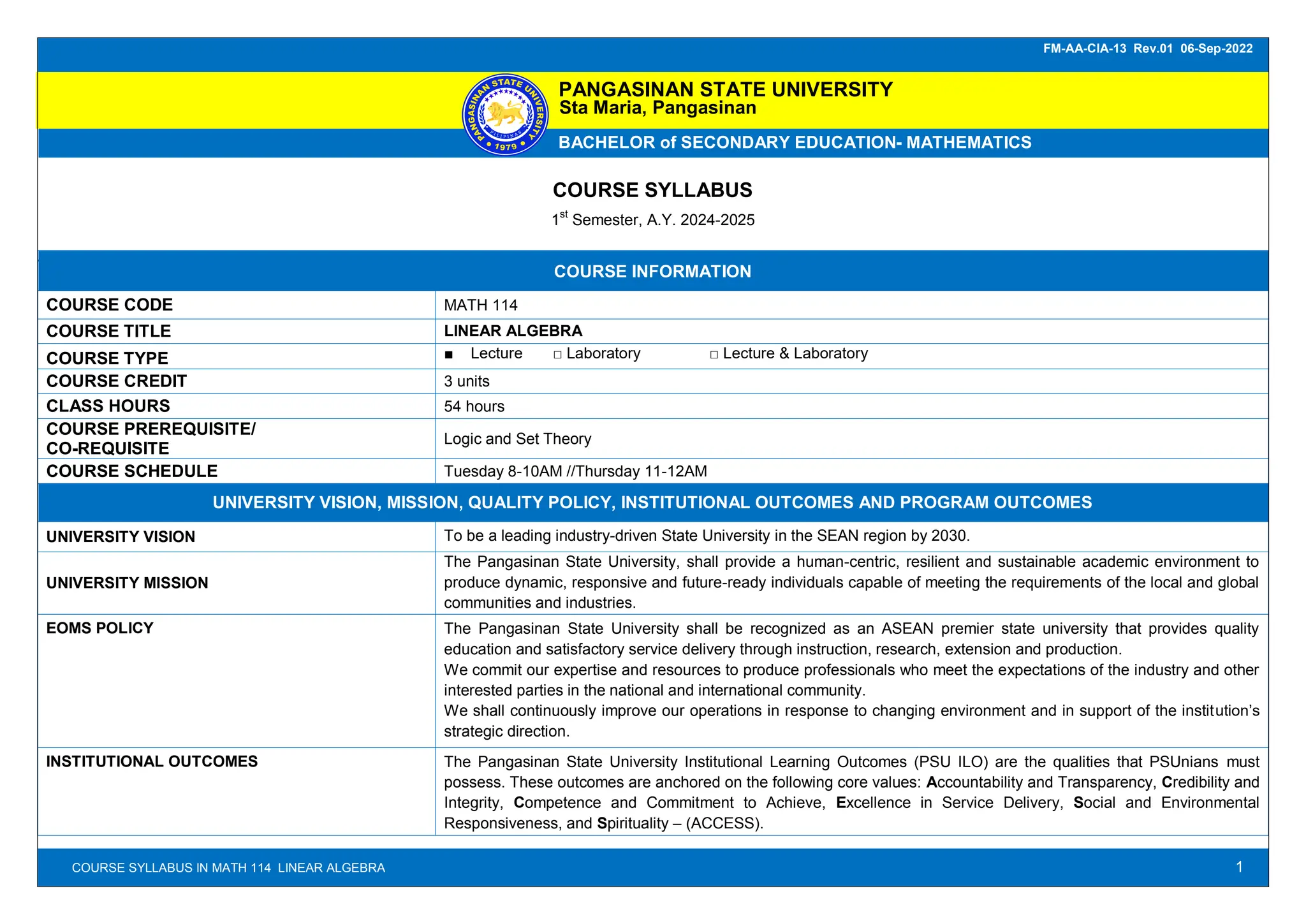
COURSE INFORMATION
COURSE CODE MATH 114
COURSE TITLE LINEAR ALGEBRA
COURSE TYPE ■ Lecture □ Laboratory □ Lecture & Laboratory
COURSE CREDIT 3 units
CLASS HOURS 54 hours
COURSE PREREQUISITE/
CO-REQUISITE
Logic and Set Theory
COURSE SCHEDULE Tuesday 8-10AM //Thursday 11-12AM
UNIVERSITY VISION, MISSION, QUALITY POLICY, INSTITUTIONAL OUTCOMES AND PROGRAM OUTCOMES
UNIVERSITY VISION To be a leading industry-driven State University in the SEAN region by 2030.
UNIVERSITY MISSION
The Pangasinan State University, shall provide a human-centric, resilient and sustainable academic environment to
produce dynamic, responsive and future-ready individuals capable of meeting the requirements of the local and global
communities and industries.
EOMS POLICY The Pangasinan State University shall be recognized as an ASEAN premier state university that provides quality
education and satisfactory service delivery through instruction, research, extension and production.
We commit our expertise and resources to produce professionals who meet the expectations of the industry and other
interested parties in the national and international community.
We shall continuously improve our operations in response to changing environment and in support of the institution’s
strategic direction.
INSTITUTIONAL OUTCOMES The Pangasinan State University Institutional Learning Outcomes (PSU ILO) are the qualities that PSUnians must
possess. These outcomes are anchored on the following core values: Accountability and Transparency, Credibility and
Integrity, Competence and Commitment to Achieve, Excellence in Service Delivery, Social and Environmental
Responsiveness, and Spirituality – (ACCESS).
PANGASINAN STATE UNIVERSITY
BACHELOR of SECONDARY EDUCATION- MATHEMATICS
Sta Maria, Pangasinan
2.
2
FM-AA-CIA-13 Rev.01 06-Sep-2022
COURSESYLLABUS IN MATH 114 LINEAR ALGEBRA
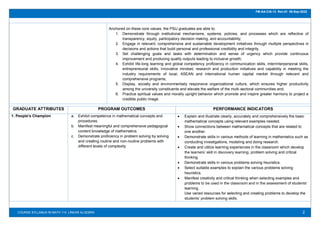
Anchored on these core values, the PSU graduates are able to:
1. Demonstrate through institutional mechanisms, systems, policies, and processes which are reflective of
transparency, equity, participatory decision making, and accountability;
2. Engage in relevant, comprehensive and sustainable development initiatives through multiple perspectives in
decisions and actions that build personal and professional credibility and integrity.
3. Set challenging goals and tasks with determination and sense of urgency which provide continuous
improvement and producing quality outputs leading to inclusive growth;
4. Exhibit life-long learning and global competency proficiency in communication skills, inter/interpersonal skills,
entrepreneurial skills, innovative mindset, research and production initiatives and capability in meeting the
industry requirements of local, ASEAN and international human capital market through relevant and
comprehensive programs;
5. Display, socially and environmentally responsive organizational culture, which ensures higher productivity
among the university constituents and elevate the welfare of the multi-sectoral communities and;
6. Practice spiritual values and morally upright behavior which promote and inspire greater harmony to project a
credible public image.
GRADUATE ATTRIBUTES PROGRAM OUTCOMES PERFORMANCE INDICATORS
1. People’s Champion a. Exhibit competence in mathematical concepts and
procedures.
b. Manifest meaningful and comprehensive pedagogical
content knowledge of mathematics.
c. Demonstrate proficiency in problem solving by solving
and creating routine and non-routine problems with
different levels of complexity
Explain and illustrate clearly, accurately and comprehensively the basic
mathematical concepts using relevant examples needed.
Show connections between mathematical concepts that are related to
one another.
Demonstrate skills in various methods of learning in mathematics such as
conducting investigations, modeling and doing research.
Create and utilize learning experiences in the classroom which develop
the learners’ skill in discovery learning, problem solving and critical
thinking.
Demonstrate skills in various problems solving heuristics.
Select suitable examples to explain the various problems solving
heuristics.
Manifest creativity and critical thinking when selecting examples and
problems to be used in the classroom and in the assessment of students’
learning.
Use varied resources for selecting and creating problems to develop the
students’ problem solving skills.
3.
3
FM-AA-CIA-13 Rev.01 06-Sep-2022
COURSESYLLABUS IN MATH 114 LINEAR ALGEBRA
2. Continuous Innovative
Learner
d. Exhibit proficiency in relating mathematics to other
curricular areas.
e. Demonstrate competence in designing, constructing and
utilizing different forms of assessment in mathematics.
f. Use effectively appropriate approaches, methods and
techniques in teaching mathematics including
technological tools
Identify teaching activities which support the implementation of the
curriculum guide.
Develop and utilize instructional materials that support the integration of
mathematics with other curricular areas.
Design and utilize varied assessment tools in mathematics, including
alternative forms of assessment.
Analyze assessment results and use these to improve learning and
teaching.
Provide timely feedback of assessment and results to students.
Demonstrate knowledge and skills in varied approaches and methods of
teaching mathematics.
Manifest discretion when selecting approaches or methods that would be
effective in teaching particular lessons.
Utilizes a variety of student-centered approaches and methods in the
classroom.
3. Community Developer g. Appreciate mathematics as an opportunity for creative
work, moments of enlightenment, discovery and gaining
insights of the world
Model in class such mathematical attitudes as delight after having found
the solution to a problem or a sense of wonder at how certain
mathematical concepts evolved.
Develop lessons that can help students appreciate the use of
mathematics in daily life.
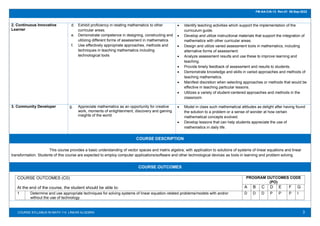
COURSE DESCRIPTION
This course provides a basic understanding of vector spaces and matrix algebra; with application to solutions of systems of linear equations and linear
transformation. Students of this course are expected to employ computer applications/software and other technological devices as tools in learning and problem solving.
COURSE OUTCOMES
COURSE OUTCOMES (C0)
At the end of the course, the student should be able to:
PROGRAM OUTCOMES CODE
(PO)
A B C D E F G
1 Determine and use appropriate techniques for solving systems of linear equation-related problems/models with and/or
without the use of technology
D D D P P P I
4.
4
FM-AA-CIA-13 Rev.01 06-Sep-2022
COURSESYLLABUS IN MATH 114 LINEAR ALGEBRA
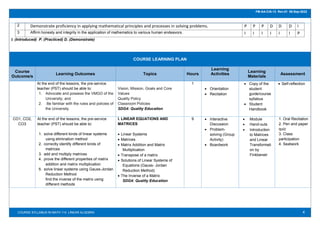
2 Demonstrate proficiency in applying mathematical principles and processes in solving problems. P P P D D D I
3 Affirm honesty and integrity in the application of mathematics to various human endeavors. I I I I I I P
I. (Introduced) P. (Practiced) D. (Demonstrate)
COURSE LEARNING PLAN
Course
Outcome/s
Learning Outcomes Topics Hours
Learning
Activities
Learning
Materials
Assessment
At the end of the lessons, the pre-service
teacher (PST) should be able to:
1. Advocate and possess the VMGO of the
University; and
2. Be familiar with the rules and policies of
the University.
Vision, Mission, Goals and Core
Values
Quality Policy
Classroom Policies
SDG4: Quality Education
1
Orientation
Recitation
Copy of the
student
guide/course
syllabus
Student
Handbook
Self-reflection
CO1, CO2,
CO3
At the end of the lessons, the pre-service
teacher (PST) should be able to:
1. solve different kinds of linear systems
using elimination method
2. correctly identify different kinds of
matrices
3. add and multiply matrices
4. prove the different properties of matrix
addition and matrix multiplication
5. solve linear systems using Gauss-Jordan
Reduction Method
find the inverse of the matrix using
different methods
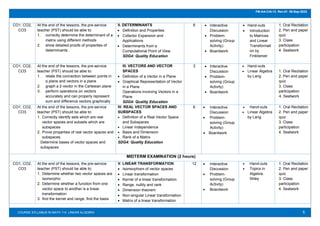
I. LINEAR EQUATIONS AND
MATRICES
Linear Systems
Matrices
Matrix Addition and Matrix
Multiplication
Transpose of a matrix
Solutions of Linear Systems of
Equations (Gauss- Jordan
Reduction Method)
The Inverse of a Matrix
SDG4: Quality Education
9 Interactive
Discussion
Problem-
solving (Group
Activity)
Boardwork
Module
Hand-outs
Introduction
to Matrices
and Linear
Transformati
on by
Finkbeneir
1. Oral Recitation
2. Pen and paper
quiz
3. Class
participation
4. Seatwork
5.
5
FM-AA-CIA-13 Rev.01 06-Sep-2022
COURSESYLLABUS IN MATH 114 LINEAR ALGEBRA
CO1, CO2,
CO3
At the end of the lessons, the pre-service
teacher (PST) should be able to:
1. correctly determine the determinant of a
matrix using different methods
2. show detailed proofs of properties of
determinants .
II. DETERMINANTS
Definition and Properties
Cofactor Expansion and
Applications
Determinants from a
Computational Point of View
SDG4: Quality Education
6 Interactive
Discussion
Problem-
solving (Group
Activity)
Boardwork
Hand-outs
Introduction
to Matrices
and Linear
Transformati
on by
Finkbeneir
1. Oral Recitation
2. Pen and paper
quiz
3. Class
participation
4. Seatwork
CO1, CO2,
CO3
At the end of the lessons, the pre-service
teacher (PST) should be able to:
1. relate the connection between points in
a plane and vectors in a plane
2. graph a 2-vector in the Cartesian plane
3. perform operations on vectors
accurately and can properly represent
sum and difference vectors graphically
III. VECTORS AND VECTOR
SPACES
Definition of a Vector in a Plane
Graphical Representation of Vector
in a Plane
Operations involving Vectors in a
Plane
SDG4: Quality Education
3 Interactive
Discussion
Problem-
solving (Group
Activity)
Boardwork
Hand-outs
Linear Algebra
by Lang
1. Oral Recitation
2. Pen and paper
quiz
3. Class
participation
4. Seatwork
CO1, CO2,
CO3
At the end of the lessons, the pre-service
teacher (PST) should be able to:
1. Correctly identify sets which are real
vector spaces and subsets which are
subspaces
2. Prove properties of real vector spaces and
subspaces
Determine bases of vector spaces and
subspaces
IV. REAL VECTOR SPACES AND
SUBSPACES
Definition of a Real Vector Space
and Subspaces
Linear Independence
Basis and Dimension
Rank of a Matrix
SDG4: Quality Education
6 Interactive
Discussion
Problem-
solving (Group
Activity)
Boardwork
Hand-outs
Linear Algebra
by Lang
1. Oral Recitation
2. Pen and paper
quiz
3. Class
participation
4. Seatwork
MIDTERM EXAMINATION (2 hours)
CO1, CO2,
CO3
At the end of the lessons, the pre-service
teacher (PST) should be able to:
1. Determine whether two vector spaces are
isomorphic
2. Determine whether a function from one
vector space to another is a linear
transformation
3. find the kernel and range, find the basis
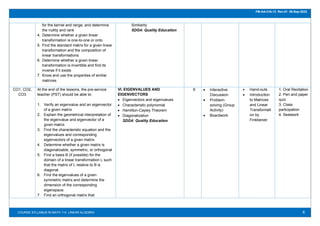
V. LINEAR TRANSFORMATION
Isomorphism of vector spaces
Linear transformation
Kernel of a linear transformation
Range, nullity and rank
Dimension theorem
Non-singular Linear transformation
Matrix of a linear transformation
12 Interactive
Discussion
Problem-
solving (Group
Activity)
Boardwork
Hand-outs
Topics in
Algebra.
Wiley
1. Oral Recitation
2. Pen and paper
quiz
3. Class
participation
4. Seatwork
6.
6
FM-AA-CIA-13 Rev.01 06-Sep-2022
COURSESYLLABUS IN MATH 114 LINEAR ALGEBRA
for the kernel and range, and determine
the nullity and rank
4. Determine whether a given linear
transformation is one-to-one or onto
5. Find the standard matrix for a given linear
transformation and the composition of
linear transformations
6. Determine whether a given linear
transformation is invertible and find its
inverse if it exists
7. Know and use the properties of similar
matrices
Similarity
SDG4: Quality Education
CO1, CO2,
CO3
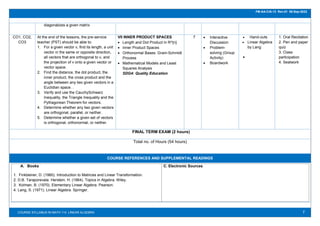
At the end of the lessons, the pre-service
teacher (PST) should be able to:
1. Verify an eigenvalue and an eigenvector
of a given matrix
2. Explain the geometrical interpretation of
the eigenvalue and eigenvector of a
given matrix.
3. Find the characteristic equation and the
eigenvalues and corresponding
eigenvectors of a given matrix.
4. Determine whether a given matrix is
diagonalizable, symmetric, or orthogonal
5. Find a basis B (if possible) for the
domain of a linear transformation L such
that the matrix of L relative to B is
diagonal.
6. Find the eigenvalues of a given
symmetric matrix and determine the
dimension of the corresponding
eigenspace.
7. Find an orthogonal matrix that
VI. EIGENVALUES AND
EIGENVECTORS
Eigenvectors and eigenvalues
Characteristic polynomial
Hamilton-Cayley Theorem
Diagonalization
SDG4: Quality Education
6 Interactive
Discussion
Problem-
solving (Group
Activity)
Boardwork
Hand-outs
Introduction
to Matrices
and Linear
Transformati
on by
Finkbeneir
1. Oral Recitation
2. Pen and paper
quiz
3. Class
participation
4. Seatwork
7.
7
FM-AA-CIA-13 Rev.01 06-Sep-2022
COURSESYLLABUS IN MATH 114 LINEAR ALGEBRA
diagonalizes a given matrix
CO1, CO2,
CO3
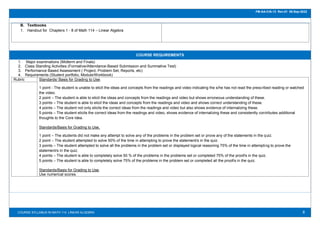
At the end of the lessons, the pre-service
teacher (PST) should be able to:
1. For a given vector v, find its length, a unit
vector in the same or opposite direction,
all vectors that are orthogonal to v, and
the projection of v onto a given vector or
vector space.
2. Find the distance, the dot product, the
inner product, the cross product and the
angle between any two given vectors in a
Euclidian space. .
3. Verify and use the CauchySchwarz
Inequality, the Triangle Inequality and the
Pythagorean Theorem for vectors.
4. Determine whether any two given vectors
are orthogonal, parallel, or neither.
5. Determine whether a given set of vectors
is orthogonal, orthonormal, or neither.
VII INNER PRODUCT SPACES
Length and Dot Product in R^{n}
Inner Product Spaces
Orthonormal Bases: Gram-Schmidt
Process
Mathematical Models and Least
Squares Analysis
SDG4: Quality Education
7 Interactive
Discussion
Problem-
solving (Group
Activity)
Boardwork
Hand-outs
Linear Algebra
by Lang
1. Oral Recitation
2. Pen and paper
quiz
3. Class
participation
4. Seatwork
FINAL TERM EXAM (2 hours)
Total no. of Hours (54 hours)
COURSE REFERENCES AND SUPPLEMENTAL READINGS
A. Books
1. Finkbeiner, D. (1960). Introduction to Matrices and Linear Transformation.
2. D.B. Taraporevala. Herstein, H. (1964). Topics in Algebra. Wiley.
3. Kolman, B. (1970). Elementary Linear Algebra. Pearson.
4. Lang, S. (1971). Linear Algebra. Springer.
C. Electronic Sources
8.
8
FM-AA-CIA-13 Rev.01 06-Sep-2022
COURSESYLLABUS IN MATH 114 LINEAR ALGEBRA
B. Textbooks
1. Handout for Chapters 1 - 8 of Math 114 – Linear Algebra
COURSE REQUIREMENTS
1. Major examinations (Midterm and Finals)
2. Class Standing Activities (Formative/Attendance-Based Submission and Summative Test)
3. Performance Based Assessment ( Project, Problem Set, Reports, etc)
4. Requirements (Student portfolio, Module/Workbook)
Rubric Standards/ Basis for Grading to Use.
1 point - The student is unable to elicit the ideas and concepts from the readings and video indicating the s/he has not read the prescribed reading or watched
the video.
2 point – The student is able to elicit the ideas and concepts from the readings and video but shows erroneous understanding of these.
3 points – The student is able to elicit the ideas and concepts from the readings and video and shows correct understanding of these.
4 points – The student not only elicits the correct ideas from the readings and video but also shows evidence of internalizing these.
5 points – The student elicits the correct ideas from the readings and video, shows evidence of internalizing these and consistently contributes additional
thoughts to the Core Idea.
Standards/Basis for Grading to Use.
1 point – The students did not make any attempt to solve any of the problems in the problem set or prove any of the statements in the quiz.
2 point – The student attempted to solve 50% of the time in attempting to prove the statement/s in the quiz.
3 points – The student attempted to solve all the problems in the problem set or displayed logical reasoning 75% of the time in attempting to prove the
statement/s in the quiz.
4 points – The student is able to completely solve 50 % of the problems in the problems set or completed 75% of the proof/s in the quiz.
5 points – The student is able to completely solve 75% of the problems in the problem set or completed all the proof/s in the quiz.
Standards/Basis for Grading to Use.
Use numerical scores.
9.
9
FM-AA-CIA-13 Rev.01 06-Sep-2022
COURSESYLLABUS IN MATH 114 LINEAR ALGEBRA
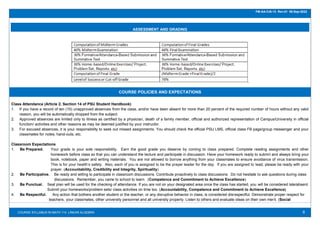
ASSESSMENT AND GRADING
COURSE POLICIES AND EXPECTATIONS
Class Attendance (Article 2, Section 14 of PSU Student Handbook)
1. If you have a record of ten (10) unapproved absences from the class, and/or have been absent for more than 20 percent of the required number of hours without any valid
reason, you will be automatically dropped from the subject.
2. Approved absences are limited only to illness as certified by a physician, death of a family member, official and authorized representation of Campus/University in official
function/ activities and other reasons as may be deemed justified by your instructor.
3. For excused absences, it is your responsibility to seek out missed assignments. You should check the official PSU LMS, official class FB page/group messenger and your
classmates for notes, hand-outs, etc.
Classroom Expectations
1. Be Prepared. Your grade is your sole responsibility. Earn the good grade you deserve by coming to class prepared. Complete reading assignments and other
homework before class so that you can understand the lecture and participate in discussion. Have your homework ready to submit and always bring your
book, notebook, paper and writing materials. You are not allowed to borrow anything from your classmates to ensure avoidance of virus transmission.
This is for your health’s safety. Also, each of you is assigned to be the prayer leader for the day. If you are assigned to lead, please be ready with your
prayer. (Accountability, Credibility and Integrity, Spirituality)
2. Be Participative. Be ready and willing to participate in classroom discussions. Contribute proactively to class discussions. Do not hesitate to ask questions during class
discussions. Remember, you came to school to learn. (Competence and Commitment to Achieve Excellence)
3. Be Punctual. Seat plan will be used for the checking of attendance. If you are not on your designated area once the class has started, you will be considered late/absent.
Submit your homeworks/problem sets/ class activities on time too. (Accountability, Competence and Commitment to Achieve Excellence)
4. Be Respectful. Any action that bothers another student or the teacher, or any disruptive behavior in class, is considered disrespectful. Demonstrate proper respect for
teachers, your classmates, other university personnel and all university property. Listen to others and evaluate ideas on their own merit. (Social
10.
10
FM-AA-CIA-13 Rev.01 06-Sep-2022
COURSESYLLABUS IN MATH 114 LINEAR ALGEBRA
Responsiveness)
5. Be Tidy. Cleanliness is next to Godliness. Wear your complete proper uniform. Likewise, your activities must be clean and properly stapled. Loose leaves are prone to
be misplaced. Your clean work reflects that homeworks/problem sets are well-prepared. Before leaving the classroom, please make sure that your place is
clean. Pick up litters and throw them on the designated trash bins. (Accountability, Credibility and Integrity, Competence and Commitment to Achieve
Excellence, Social and Environmental Responsiveness)
Technology Agreement
1. The use of electronic devices such as laptops, tablets and cell phones inside the classroom is ONLY ALLOWED WITH MY PERMISSION. Charging of your electronic
devices is prohibited inside the class. Please make sure they are fully charged before bringing them to class.
2. Cell phones and other devices need to be set in silent mode. For emergency purposes, please request to take the call/answer the text message outside the classroom.
Academic Honesty and Class Conduct
Cheating in Examination and Quizzes (Article 14, Section 1-n of PSU Handbook):
1
st
Offense : Automatic grade of 5.0 in the particular examination where cheating occurred; referral to guidance counselor.
2
nd
offense : Automatic grade of 5.0 if done on the same subject and/or other subjects and suspension for one semester.
3
rd
offense : Automatic grade of 5.0 in the subject/s and suspension of one semester to dismissal from the institution.
Guidelines on Late Submissions of Requirements and Late Examinations
1. The dates of the submission for all home-based requirements are indicated in the Instructional Delivery Plan. Five points will be deducted for every day of failure to
submit said requirements (except for approved absences).
2. You are only allowed to take missed examinations due to approved absence. Please fill up the Request for Special Examination before taking the missed exam.
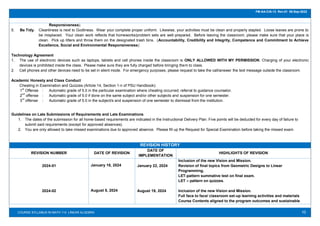
REVISION HISTORY
REVISION NUMBER DATE OF REVISION
DATE OF
IMPLEMENTATION
HIGHLIGHTS OF REVISION
2024-01
2024-02
January 18, 2024
August 5, 2024
January 22, 2024
August 19, 2024
Inclusion of the new Vision and Mission.
Revision of final topics from Geometric Designs to Linear
Programming.
LET-pattern summative test on final exam.
LET – pattern on quizzes.
Inclusion of the new Vision and Mission.
Full face to face/ classroom set-up learning activities and materials
Course Contents aligned to the program outcomes and sustainable
11.
11
FM-AA-CIA-13 Rev.01 06-Sep-2022
COURSESYLLABUS IN MATH 114 LINEAR ALGEBRA
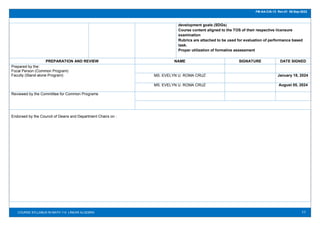
development goals (SDGs)
Course content aligned to the TOS of their respective licensure
examination
Rubrics are attached to be used for evaluation of performance based
task.
Proper utilization of formative assessment
PREPARATION AND REVIEW NAME SIGNATURE DATE SIGNED
Prepared by the:
Focal Person (Common Program)
Faculty (Stand-alone Program) MS. EVELYN U. ROMA CRUZ January 18, 2024
MS. EVELYN U. ROMA CRUZ August 05, 2024
Reviewed by the Committee for Common Programs
Endorsed by the Council of Deans and Department Chairs on :
12.
12
FM-AA-CIA-13 Rev.01 06-Sep-2022
COURSESYLLABUS IN MATH 114 LINEAR ALGEBRA
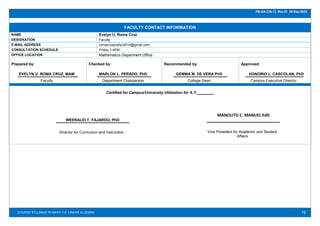
FACULTY CONTACT INFORMATION
NAME Evelyn U. Roma Cruz
DESIGNATION Faculty
E-MAIL ADDRESS romacruzevelyn2014@gmail.com
CONSULTATION SCHEDULE Friday 1-4PM
OFFICE LOCATION Mathematics Department Office
Prepared by:
EVELYN U. ROMA CRUZ, MAM
Faculty
Checked by:
MARLON L. PERADO, PhD
Department Chairperson
Recommended by:
GEMMA M. DE VERA PhD
College Dean
Approved:
HONORIO L. CASCOLAN, PhD
Campus Executive Director
Certified for Campus/University Utilization for A.Y.________
WEENALEI T. FAJARDO, PhD
Director for Curriculum and Instruction
MANOLITO C. MANUEL EdD
Vice President for Academic and Student
Affairs