To encourage young adolescents and
schoolchildren
to build relationships with
no gender prejudices
and make choices
responsibly and unbiasedly.
Challenge
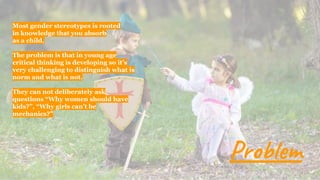
Most gender stereotypes is rooted
in knowledge that you absorb
as a child.
The problem is that in young age
critical thinking is developing so it’s
very challenging to distinguish what is
norm and what is not.
They can not deliberately ask
questions “Why women should have
kids?”, “Why girls can’t be
mechanics?”
Problem
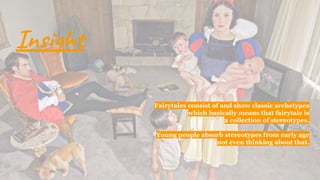
Fairytales consist of and show classic archetypes
which basically means that fairytale is
a collection of stereotypes.
Young people absorb stereotypes from early age
not even thinking about that.
Insight
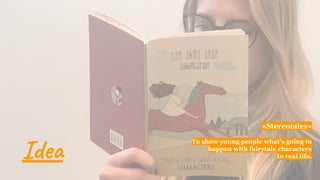
«Stereotales»
To show young people what’s going to
happen with fairytale characters
in real life.Idea
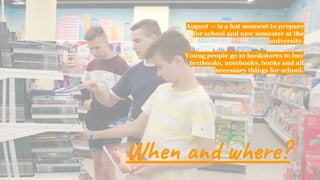
August — is a hot moment to prepare
for school and new semester at the
university.
Young people go to bookstores to buy
textbooks, notebooks, books and all
necessary things for school.
When and where?
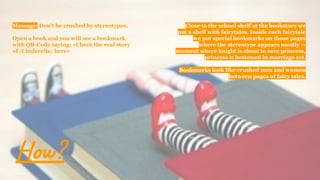
Close to the school shelf at the bookstore we
put a shelf with fairytales. Inside each fairytale
we put special bookmarks on those pages
where the stereotype appears mostly —
moment where knight is about to save princess,
princess is bestowed in marriage ect.
Bookmarks look like crushed men and women
between pages of fairy tales.
How?
Message: Don’t be crushed by stereotypes.
Open a book and you will see a bookmark
with QR-Code saying: «Check the real story
of /Сinderella/ here»
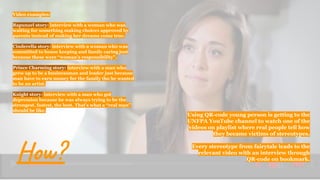
Using QR-code young person is getting to the
UNFPA YouTube channel to watch one of the
videos on playlist where real people tell how
they became victims of stereotypes.
Every stereotype from fairytale leads to the
relevant video with an interview through
QR-code on bookmark.How?
Video examples:
Rapunzel story: interview with a woman who was
waiting for something making choices approved by
parents instead of making her dreams come true.
Cinderella story: interview with a woman who was
committed to house keeping and family caring just
because these were “woman’s responsibility”.
Prince Charming story: interview with a man who
grew up to be a businessman and leader just because
man have to earn money for the family tho he wanted
to be an artist.
Knight story: interview with a man who got
depression because he was always trying to be the
strongest, fastest, the best. That’s what a “real man”
should be like.
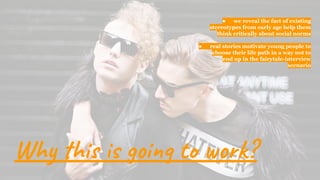
● we reveal the fact of existing
stereotypes from early age help them
think critically about social norms
● real stories motivate young people to
choose their life path in a way not to
end up in the fairytale-interview
scenario
Why this is going to work?
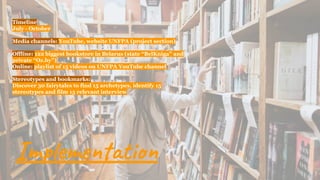
Implementation
Timeline
July - October
Media channels: YouTube, website UNFPA (project section)
Offline: 122 biggest bookstore in Belarus (state “BelKniga” and
private “Oz.by”)
Online: playlist of 15 videos on UNFPA YouTube channel
Stereotypes and bookmarks:
Discover 30 fairytales to find 15 archetypes, identify 15
stereotypes and film 15 relevant interview
Thank you!

Молодые Львы'2020. Media. Команда 3

  • 1.
    To encourage youngadolescents and schoolchildren to build relationships with no gender prejudices and make choices responsibly and unbiasedly. Challenge
  • 2.
    Most gender stereotypesis rooted in knowledge that you absorb as a child. The problem is that in young age critical thinking is developing so it’s very challenging to distinguish what is norm and what is not. They can not deliberately ask questions “Why women should have kids?”, “Why girls can’t be mechanics?” Problem
  • 3.
    Fairytales consist ofand show classic archetypes which basically means that fairytale is a collection of stereotypes. Young people absorb stereotypes from early age not even thinking about that. Insight
  • 4.
    «Stereotales» To show youngpeople what’s going to happen with fairytale characters in real life.Idea
  • 5.
    August — isa hot moment to prepare for school and new semester at the university. Young people go to bookstores to buy textbooks, notebooks, books and all necessary things for school. When and where?
  • 6.
    Close to theschool shelf at the bookstore we put a shelf with fairytales. Inside each fairytale we put special bookmarks on those pages where the stereotype appears mostly — moment where knight is about to save princess, princess is bestowed in marriage ect. Bookmarks look like crushed men and women between pages of fairy tales. How? Message: Don’t be crushed by stereotypes. Open a book and you will see a bookmark with QR-Code saying: «Check the real story of /Сinderella/ here»
  • 7.
    Using QR-code youngperson is getting to the UNFPA YouTube channel to watch one of the videos on playlist where real people tell how they became victims of stereotypes. Every stereotype from fairytale leads to the relevant video with an interview through QR-code on bookmark.How? Video examples: Rapunzel story: interview with a woman who was waiting for something making choices approved by parents instead of making her dreams come true. Cinderella story: interview with a woman who was committed to house keeping and family caring just because these were “woman’s responsibility”. Prince Charming story: interview with a man who grew up to be a businessman and leader just because man have to earn money for the family tho he wanted to be an artist. Knight story: interview with a man who got depression because he was always trying to be the strongest, fastest, the best. That’s what a “real man” should be like.
  • 8.
    ● we revealthe fact of existing stereotypes from early age help them think critically about social norms ● real stories motivate young people to choose their life path in a way not to end up in the fairytale-interview scenario Why this is going to work?
  • 9.
    Implementation Timeline July - October Mediachannels: YouTube, website UNFPA (project section) Offline: 122 biggest bookstore in Belarus (state “BelKniga” and private “Oz.by”) Online: playlist of 15 videos on UNFPA YouTube channel Stereotypes and bookmarks: Discover 30 fairytales to find 15 archetypes, identify 15 stereotypes and film 15 relevant interview
  • 10.