1
Group 3
Shannon Nelson
Sam Gonzales
Paco Lopez
Nicole Hlagren
Carlos Flores
SIX SIGMA
PROJECT
Six Sigma Project - Group 3
2
Reduce VCT-2000/Jack In The Box Warranty
Claims by 50% Using Six Sigma
Executive Summary
BU SINESS CASE
Reducing warranty claims will enhance Jack in the Box’s (JIB) customer service
by eliminating VCT-2000 downtime. This can improve the relationship with JIB
setting the table for continued VCT-2000 sales. Current warranty cost is
$449,024.
R OOT CAU SE ANALYSIS
Utilizing five cascading Pareto Analyses, a majority of the warranty work
focused on the Gear/Motor kit. Further investigation specifically singled out a
pin in the motor was failing.
SOLU TIONS
1. Xxx
Six Sigma Project - Group 3
3
DEFINE
Project Charter
PR OBLEM STATEMENT
Antunesis experiencedwarranty costs of 10.2% of Sales on the VCT-2000
9210307 sold to Jack in the Box, which negatively impacts their bottom line, as
well as their customers business, reflecting negatively on their reputation and
potentially future orders. The goal of this team is to identify a solution that will
reduce the # of warranty claims for the productin question.
G OAL STATEMENT
Improve durability of VCT-2000 Gear/Motor providing a 90% reduction in
warranty claims. Net benefit is an approximate $400,000 increase in profit.
TEAM MEMBERS
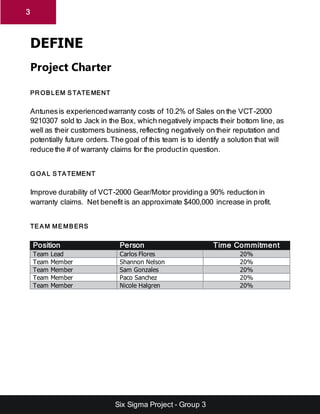
Position Person Time Commitment
Team Lead Carlos Flores 20%
Team Member Shannon Nelson 20%
Team Member Sam Gonzales 20%
Team Member Paco Sanchez 20%
Team Member Nicole Halgren 20%
Six Sigma Project - Group 3
4
SIPOC
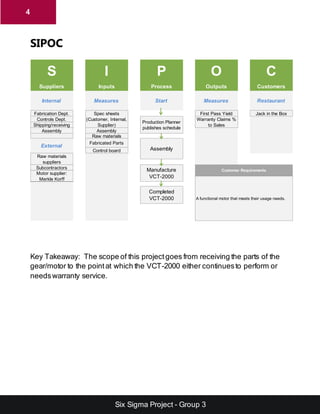
S I P O C
Suppliers Inputs Process Outputs Customers
Fabrication Dept. First Pass Yield Jack in the Box
Controls Dept.
Shipping/receiving
Assembly Assembly
Raw materials
Fabricated Parts
Control board
Subcontractors
Raw materials
suppliers
Motor supplier:
Merkle Korff
Spec sheets
(Customer, Internal,
Supplier)
MeasuresInternal
External
Assembly
Manufacture
VCT-2000
Customer Requirements
A functional motor that meets their usage needs.
Completed
VCT-2000
Restaurant
Warranty Claims %
to Sales
Start
Production Planner
publishes schedule
Measures
Key Takeaway: The scope of this projectgoes from receiving the parts of the
gear/motor to the pointat which the VCT-2000 either continuesto perform or
needswarranty service.
Six Sigma Project - Group 3
5
MEASURE
Root Cause Analysis
Five cascading Pareto Analyses where completed to identify that the
Gear/Motor kit neededto be replaced in a significant numberof warranty claims.
The data included all the warranty claims for the past year. We looked to see
what specific piece of equipmentcaused the most claims. It was the VCT-2000
and there were 1482 claims. Filtering outclaims by customer, the data pointed
to Jack in the Box with 653 claims. The next highestclaim customerhad only 84
claims. We continued ouranalysis and we found that 462 of the claims were due
to a damaged part. We dug deeperto see if we could identify the damaged part
and if it was done during transit. What we found out that 255 of those 462
claims had to do with the motor. We then wanted to see what specifically
neededto be done to service the motors. A final Pareto Analysis illustrated of
462 claims 255 were fixed by a gear motor kit that was broughtto the site and
installed.
Pareto Analysis
Antunes
VCT-2000
[42]
The first 8 Causes cover 81.63% of the Total Defects
VCT
HRT
HCT
ES/ESDZ
HEBT
SS
MT
DFW
MES
MS
RT
HDC
CM
CW
VZN
GST
VS
WD
DCH
CCC
SDC
HDH
UF
UTX
DCV
TBS
CTX
0%
20%
40%
60%
80%
100%
0
200
400
600
800
1000
1200
1400
1600
Cumulative%
Defects
Causes
Product Type
Vital Few Useful Many Cumulative% Cut Off %
Six Sigma Project - Group 3
6
[42]
The first 4 Causes cover 83.92% of the Total Defects
JACKINTHEBOX
Chick-Fil-A
BurgerKing
CHICKFILA
popeyes
Arbys
JOLLIBEE
KFC
ARBY'S
DAIRYQUEEN
WENDYS
checkers
CHICK-FIL-A
Wendy's
Chickfil-A
BOB'S
KFCRestaurant
MCDONALDS
popeyeschicken
SONIC
0%
20%
40%
60%
80%
100%
0
100
200
300
400
500
600
700
Cumulative%
Defects
Causes
Customer
Vital Few Useful Many Cumulative% Cut Off %
[42]
The first 2 Causes cover 81.23% of the Total Defects
DamagedPart
LooseConnection
Defectivepart
Seized
GearsStripped
MaintenanceIssue
NotAdjustedProperly
By-Pass
OpenCircuit
MissingScrews
Worn/Chafed
BurntTerminal
CustomerAbuse
NoTroubleFound
Obstruction/Clogged
Unknown
AirTrapCracked
Broken/Cracked
BurntWire
ImproperInstallation
NotToSpec
Shorted
0%
20%
40%
60%
80%
100%
0
50
100
150
200
250
300
350
400
450
500
Cumulative%
Defects
Causes
Cause
Vital Few Useful Many Cumulative% Cut Off %
Six Sigma Project - Group 3
7
[42]
The first 4 Causes cover 80.96% of the Total Defects
MOTOR
SWITCH,POWER
SWITCH,INTERLOCK
BEARINGS
CHAINANDSPROCKET
SPROCKET
Multiple
FAN
IdlerAssy.
MOTOR/GEAR/DRIVE
MOTORS
CONTROLBOARD
THERMOCOUPLE
BLADE,FAN
CamAssembly
OTHER
SHAFT
BRACKET
CHAIN
DOOR/DOORHINGES
HOUSING
LOCKLEVERWELDMENT
RELAY
SLIDERAIL
TENSIONER
0%
20%
40%
60%
80%
100%
0
50
100
150
200
250
300
Cumulative%
Defects
Causes
Component
Vital Few Useful Many Cumulative% Cut Off %
[42]
The first 1 Causes cover 88.58% of the Total Defects
GEARMOTORKIT230V
3RPM
BALLBEARINGKIT(2-PAK)
REPLACEMENTFANKIT
FOR
GearmotorKit
INTERLOCKSWITCHKIT
POWERSWITCH
REPLACEMENT
GearMotor
IdlerSprocket
CHAINDRIVE112LINKS
DRIVEMOTORKIT120V/9
ENDHOUSINGCOVER
GEARMOTORKIT3RPM
GEARMOTORKIT9RPM
POWERSWITCH
REPLACEMENTKIT
SPROCKET25B201/2BORE
SPROCKET/RETAINER
0%
20%
40%
60%
80%
100%
0
50
100
150
200
250
Cumulative%
Defects
Causes
Part Number
Vital Few Useful Many Cumulative% Cut Off %
Six Sigma Project - Group 3
8
MEASURE (cont.)
Delivery Issue
We continued oursearch into why this was the case even though all the
equipmentmust complete First Pass Yield testing prior to shipping. All the
individual components were being tested, by the suppliers, prior to arriving to
Antunes’ production facility. Antunes uses a checksheet to make sure
components meetcustomer specs. Once the machine is assembled everything
is verified to match the blue print. All parts are inspected to look for any
imperfections. They checkto make sure all the agencyapproval labels are
attached and to spec. The wiring is checked. Then the machine is turned on
and dependingon the modelis heated up to 625 C or 555 F. The checksheet
tells the inspector what procedure needsto be followed for a machine to pass
First Pass Yield testing. We investigated how long the equipmentwas ran
during testing and it was determined to be one hour. The next data set we
analyzed was how long, on average, did it take for the motor to fail once it was
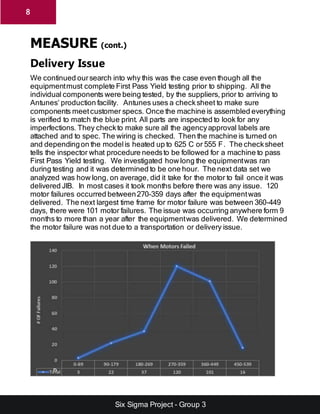
delivered JIB. In most cases it took months before there was any issue. 120
motor failures occurred between270-359 days after the equipmentwas
delivered. The next largest time frame for motor failure was between 360-449
days, there were 101 motor failures. The issue was occurring anywhere form 9
months to more than a year after the equipmentwas delivered. We determined
the motor failure was not due to a transportation or delivery issue.
Six Sigma Project - Group 3
9
ANALYZE
5-Why Analysis
To approach the root cause of why warranty claims were escalating upwardsas
they were, the group used the 5-why approach to try to analyze the situation and
determine the root cause of the problem.When looking at the warranty claims
serviced in a 1-year rolling period,it was noted that one of the more
predominantlyserviced productunderwarranty, was the VCT-2000 unit which is
sold to and used by Jack-In-The-Box restaurants (JIB).
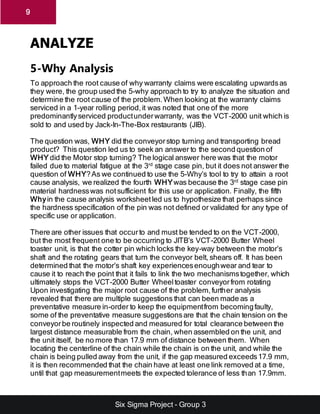
The question was, WHY did the conveyorstop turning and transporting bread
product? This question led us to seek an answer to the second question of
WHY did the Motor stop turning? The logical answer here was that the motor
failed due to material fatigue at the 3rd
stage case pin, but it does not answer the
question of WHY?As we continued to use the 5-Why’s tool to try to attain a root
cause analysis, we realized the fourth WHYwas because the 3rd
stage case pin
material hardnesswas notsufficient for this use or application. Finally, the fifth
Whyin the cause analysis worksheetled us to hypothesize that perhaps since
the hardness specification of the pin was not defined or validated for any type of
specific use or application.
There are other issues that occurto and must be tended to on the VCT-2000,
but the most frequent one to be occurring to JITB’s VCT-2000 Butter Wheel
toaster unit, is that the cotter pin which locks the key-way between the motor’s
shaft and the rotating gears that turn the conveyor belt, shears off. It has been
determined that the motor’s shaft key experiencesenoughwear and tear to
cause it to reach the point that it fails to link the two mechanismstogether, which
ultimately stops the VCT-2000 Butter Wheeltoaster conveyorfrom rotating
Upon investigating the major root cause of the problem,further analysis
revealed that there are multiple suggestions that can been made as a
preventative measure in-order to keep the equipmentfrom becomingfaulty,
some of the preventative measure suggestionsare that the chain tension on the
conveyorbe routinely inspected and measured for total clearance between the
largest distance measurable from the chain, when assembled on the unit, and
the unit itself, be no more than 17.9 mm of distance between them. When
locating the centerline of the chain while the chain is on the unit, and while the
chain is being pulled away from the unit, if the gap measured exceeds17.9 mm,
it is then recommended that the chain have at least one link removed at a time,
until that gap measurementmeets the expected tolerance of less than 17.9mm.
Six Sigma Project - Group 3
10
5-Why Analysis (cont.)
Other prevalent factors which lead to the failure of the VCT-2000 Butter Wheel
toaster’s conveyorsmovementis the lack of preventative maintenance
inspections and lubrication of the unit’s gears and motor. Especially when the
cleaning the unit, the lack of routinely cleaning the unit adds additional “load-
stress” to the motor and ultimately, to the motor’s gears and the gears locking
pin.
This shearing of the pin on the VCT-2000 Butter Wheeltoaster’s rotating
conveyor,leads us to hypothesize that as an improvementmeasure, the grade
of the metal that was used to stamp-out the key should be changed,the key,
has now been replaced with a key which is stamped out of harder-tempered
steel. This improves the weight/load bearing ability of the key in the key-way,
ultimately delivering a more desirable result of lessening the failure rate of the
conveyor.
Hypothesis Statement
Accordingto the data, the team suspects that changing the grade of metal used
to producethe keys for the VCT-2000’s key way on the shaft will resolve the
motor failures.
IMPROVE
Brainstorming
Based on our Hypothesis that the stage case pin was the cause of the motor
failures, we engaged in a brainstorming session with the supplier to develop
solutions that would preventthe pin from failing in the future. Brainstorming
enablesa comprehensive list of potential solutions in a short period of time.
During the brainstorming session, the following ideas were vetted:
Six Sigma Project - Group 3
11
Brainstorming (cont.)
 Change the material of the pin to a higherstrength metal.
 Replace existing motor with a different motor.
 Remove some of the load on the motor to preventwear of the pin by
instructing the customer to perform regular cleaning and maintenance of the
equipment.
 Redesign the unit to remove some of the load on the motor
To vet the list of plausible solutions for their effectiveness, the supplier will use
their engineeringsoftware tools to simulate the performance and outcomes.
This will assist in narrowing down the list to 1 or 2 options for further testing
and/or implementation.
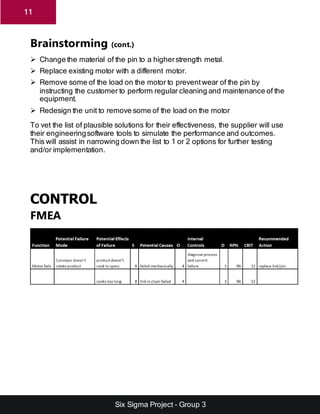
CONTROL
FMEA

2018 6s final draft 2.24

  • 1.
    1 Group 3 Shannon Nelson SamGonzales Paco Lopez Nicole Hlagren Carlos Flores SIX SIGMA PROJECT
  • 2.
    Six Sigma Project- Group 3 2 Reduce VCT-2000/Jack In The Box Warranty Claims by 50% Using Six Sigma Executive Summary BU SINESS CASE Reducing warranty claims will enhance Jack in the Box’s (JIB) customer service by eliminating VCT-2000 downtime. This can improve the relationship with JIB setting the table for continued VCT-2000 sales. Current warranty cost is $449,024. R OOT CAU SE ANALYSIS Utilizing five cascading Pareto Analyses, a majority of the warranty work focused on the Gear/Motor kit. Further investigation specifically singled out a pin in the motor was failing. SOLU TIONS 1. Xxx
  • 3.
    Six Sigma Project- Group 3 3 DEFINE Project Charter PR OBLEM STATEMENT Antunesis experiencedwarranty costs of 10.2% of Sales on the VCT-2000 9210307 sold to Jack in the Box, which negatively impacts their bottom line, as well as their customers business, reflecting negatively on their reputation and potentially future orders. The goal of this team is to identify a solution that will reduce the # of warranty claims for the productin question. G OAL STATEMENT Improve durability of VCT-2000 Gear/Motor providing a 90% reduction in warranty claims. Net benefit is an approximate $400,000 increase in profit. TEAM MEMBERS Position Person Time Commitment Team Lead Carlos Flores 20% Team Member Shannon Nelson 20% Team Member Sam Gonzales 20% Team Member Paco Sanchez 20% Team Member Nicole Halgren 20%
  • 4.
    Six Sigma Project- Group 3 4 SIPOC S I P O C Suppliers Inputs Process Outputs Customers Fabrication Dept. First Pass Yield Jack in the Box Controls Dept. Shipping/receiving Assembly Assembly Raw materials Fabricated Parts Control board Subcontractors Raw materials suppliers Motor supplier: Merkle Korff Spec sheets (Customer, Internal, Supplier) MeasuresInternal External Assembly Manufacture VCT-2000 Customer Requirements A functional motor that meets their usage needs. Completed VCT-2000 Restaurant Warranty Claims % to Sales Start Production Planner publishes schedule Measures Key Takeaway: The scope of this projectgoes from receiving the parts of the gear/motor to the pointat which the VCT-2000 either continuesto perform or needswarranty service.
  • 5.
    Six Sigma Project- Group 3 5 MEASURE Root Cause Analysis Five cascading Pareto Analyses where completed to identify that the Gear/Motor kit neededto be replaced in a significant numberof warranty claims. The data included all the warranty claims for the past year. We looked to see what specific piece of equipmentcaused the most claims. It was the VCT-2000 and there were 1482 claims. Filtering outclaims by customer, the data pointed to Jack in the Box with 653 claims. The next highestclaim customerhad only 84 claims. We continued ouranalysis and we found that 462 of the claims were due to a damaged part. We dug deeperto see if we could identify the damaged part and if it was done during transit. What we found out that 255 of those 462 claims had to do with the motor. We then wanted to see what specifically neededto be done to service the motors. A final Pareto Analysis illustrated of 462 claims 255 were fixed by a gear motor kit that was broughtto the site and installed. Pareto Analysis Antunes VCT-2000 [42] The first 8 Causes cover 81.63% of the Total Defects VCT HRT HCT ES/ESDZ HEBT SS MT DFW MES MS RT HDC CM CW VZN GST VS WD DCH CCC SDC HDH UF UTX DCV TBS CTX 0% 20% 40% 60% 80% 100% 0 200 400 600 800 1000 1200 1400 1600 Cumulative% Defects Causes Product Type Vital Few Useful Many Cumulative% Cut Off %
  • 6.
    Six Sigma Project- Group 3 6 [42] The first 4 Causes cover 83.92% of the Total Defects JACKINTHEBOX Chick-Fil-A BurgerKing CHICKFILA popeyes Arbys JOLLIBEE KFC ARBY'S DAIRYQUEEN WENDYS checkers CHICK-FIL-A Wendy's Chickfil-A BOB'S KFCRestaurant MCDONALDS popeyeschicken SONIC 0% 20% 40% 60% 80% 100% 0 100 200 300 400 500 600 700 Cumulative% Defects Causes Customer Vital Few Useful Many Cumulative% Cut Off % [42] The first 2 Causes cover 81.23% of the Total Defects DamagedPart LooseConnection Defectivepart Seized GearsStripped MaintenanceIssue NotAdjustedProperly By-Pass OpenCircuit MissingScrews Worn/Chafed BurntTerminal CustomerAbuse NoTroubleFound Obstruction/Clogged Unknown AirTrapCracked Broken/Cracked BurntWire ImproperInstallation NotToSpec Shorted 0% 20% 40% 60% 80% 100% 0 50 100 150 200 250 300 350 400 450 500 Cumulative% Defects Causes Cause Vital Few Useful Many Cumulative% Cut Off %
  • 7.
    Six Sigma Project- Group 3 7 [42] The first 4 Causes cover 80.96% of the Total Defects MOTOR SWITCH,POWER SWITCH,INTERLOCK BEARINGS CHAINANDSPROCKET SPROCKET Multiple FAN IdlerAssy. MOTOR/GEAR/DRIVE MOTORS CONTROLBOARD THERMOCOUPLE BLADE,FAN CamAssembly OTHER SHAFT BRACKET CHAIN DOOR/DOORHINGES HOUSING LOCKLEVERWELDMENT RELAY SLIDERAIL TENSIONER 0% 20% 40% 60% 80% 100% 0 50 100 150 200 250 300 Cumulative% Defects Causes Component Vital Few Useful Many Cumulative% Cut Off % [42] The first 1 Causes cover 88.58% of the Total Defects GEARMOTORKIT230V 3RPM BALLBEARINGKIT(2-PAK) REPLACEMENTFANKIT FOR GearmotorKit INTERLOCKSWITCHKIT POWERSWITCH REPLACEMENT GearMotor IdlerSprocket CHAINDRIVE112LINKS DRIVEMOTORKIT120V/9 ENDHOUSINGCOVER GEARMOTORKIT3RPM GEARMOTORKIT9RPM POWERSWITCH REPLACEMENTKIT SPROCKET25B201/2BORE SPROCKET/RETAINER 0% 20% 40% 60% 80% 100% 0 50 100 150 200 250 Cumulative% Defects Causes Part Number Vital Few Useful Many Cumulative% Cut Off %
  • 8.
    Six Sigma Project- Group 3 8 MEASURE (cont.) Delivery Issue We continued oursearch into why this was the case even though all the equipmentmust complete First Pass Yield testing prior to shipping. All the individual components were being tested, by the suppliers, prior to arriving to Antunes’ production facility. Antunes uses a checksheet to make sure components meetcustomer specs. Once the machine is assembled everything is verified to match the blue print. All parts are inspected to look for any imperfections. They checkto make sure all the agencyapproval labels are attached and to spec. The wiring is checked. Then the machine is turned on and dependingon the modelis heated up to 625 C or 555 F. The checksheet tells the inspector what procedure needsto be followed for a machine to pass First Pass Yield testing. We investigated how long the equipmentwas ran during testing and it was determined to be one hour. The next data set we analyzed was how long, on average, did it take for the motor to fail once it was delivered JIB. In most cases it took months before there was any issue. 120 motor failures occurred between270-359 days after the equipmentwas delivered. The next largest time frame for motor failure was between 360-449 days, there were 101 motor failures. The issue was occurring anywhere form 9 months to more than a year after the equipmentwas delivered. We determined the motor failure was not due to a transportation or delivery issue.
  • 9.
    Six Sigma Project- Group 3 9 ANALYZE 5-Why Analysis To approach the root cause of why warranty claims were escalating upwardsas they were, the group used the 5-why approach to try to analyze the situation and determine the root cause of the problem.When looking at the warranty claims serviced in a 1-year rolling period,it was noted that one of the more predominantlyserviced productunderwarranty, was the VCT-2000 unit which is sold to and used by Jack-In-The-Box restaurants (JIB). The question was, WHY did the conveyorstop turning and transporting bread product? This question led us to seek an answer to the second question of WHY did the Motor stop turning? The logical answer here was that the motor failed due to material fatigue at the 3rd stage case pin, but it does not answer the question of WHY?As we continued to use the 5-Why’s tool to try to attain a root cause analysis, we realized the fourth WHYwas because the 3rd stage case pin material hardnesswas notsufficient for this use or application. Finally, the fifth Whyin the cause analysis worksheetled us to hypothesize that perhaps since the hardness specification of the pin was not defined or validated for any type of specific use or application. There are other issues that occurto and must be tended to on the VCT-2000, but the most frequent one to be occurring to JITB’s VCT-2000 Butter Wheel toaster unit, is that the cotter pin which locks the key-way between the motor’s shaft and the rotating gears that turn the conveyor belt, shears off. It has been determined that the motor’s shaft key experiencesenoughwear and tear to cause it to reach the point that it fails to link the two mechanismstogether, which ultimately stops the VCT-2000 Butter Wheeltoaster conveyorfrom rotating Upon investigating the major root cause of the problem,further analysis revealed that there are multiple suggestions that can been made as a preventative measure in-order to keep the equipmentfrom becomingfaulty, some of the preventative measure suggestionsare that the chain tension on the conveyorbe routinely inspected and measured for total clearance between the largest distance measurable from the chain, when assembled on the unit, and the unit itself, be no more than 17.9 mm of distance between them. When locating the centerline of the chain while the chain is on the unit, and while the chain is being pulled away from the unit, if the gap measured exceeds17.9 mm, it is then recommended that the chain have at least one link removed at a time, until that gap measurementmeets the expected tolerance of less than 17.9mm.
  • 10.
    Six Sigma Project- Group 3 10 5-Why Analysis (cont.) Other prevalent factors which lead to the failure of the VCT-2000 Butter Wheel toaster’s conveyorsmovementis the lack of preventative maintenance inspections and lubrication of the unit’s gears and motor. Especially when the cleaning the unit, the lack of routinely cleaning the unit adds additional “load- stress” to the motor and ultimately, to the motor’s gears and the gears locking pin. This shearing of the pin on the VCT-2000 Butter Wheeltoaster’s rotating conveyor,leads us to hypothesize that as an improvementmeasure, the grade of the metal that was used to stamp-out the key should be changed,the key, has now been replaced with a key which is stamped out of harder-tempered steel. This improves the weight/load bearing ability of the key in the key-way, ultimately delivering a more desirable result of lessening the failure rate of the conveyor. Hypothesis Statement Accordingto the data, the team suspects that changing the grade of metal used to producethe keys for the VCT-2000’s key way on the shaft will resolve the motor failures. IMPROVE Brainstorming Based on our Hypothesis that the stage case pin was the cause of the motor failures, we engaged in a brainstorming session with the supplier to develop solutions that would preventthe pin from failing in the future. Brainstorming enablesa comprehensive list of potential solutions in a short period of time. During the brainstorming session, the following ideas were vetted:
  • 11.
    Six Sigma Project- Group 3 11 Brainstorming (cont.)  Change the material of the pin to a higherstrength metal.  Replace existing motor with a different motor.  Remove some of the load on the motor to preventwear of the pin by instructing the customer to perform regular cleaning and maintenance of the equipment.  Redesign the unit to remove some of the load on the motor To vet the list of plausible solutions for their effectiveness, the supplier will use their engineeringsoftware tools to simulate the performance and outcomes. This will assist in narrowing down the list to 1 or 2 options for further testing and/or implementation. CONTROL FMEA