Hosting and Cloud Study 2017
Digital Transformation Opportunity for Service
Providers: Beyond Infrastructure
Survey Data Summary Report
Study Overview
Grand Strategy for Digital Transformation: Partner for Success, is a study Microsoft commissioned through 451
Research. The study is designed to better understand how companies, SMBs, Enterprises etc. are transforming
digitally and identify market opportunities for Microsoft’s infrastructure service provider partners to help their
customers as they progress along their digital transformation journey. Over 1,700 respondents across 10
geographies participated in this survey study that was fielded between January 30, 2017 to February 22, 2017.
Key findings showed:
The Era of Managed Infrastructure Services: Managed is the New Normal – 62% of Cloud/Hosting Infrastructure
Spending Comes Bundled with Value-Added Services
The Next “Beyond Infrastructure” Opportunity: Professional Services for Cloud-Enablement represent 18% of total
hosting/cloud spending and 25% of the “Beyond Infrastructure” Opportunity – But Hurry…The Window is Closing
Fast!
The Multi-Cloud World Is Real, Tightly Linked to Digital Transformation. 41% of Organizations Are Already On-
Board, Driven by Best Execution Venue Considerations, Maximizing On-Premises IT Investments, and Opex-based IT
Resource Extension. However, Implementation and Management Challenges Create Service Provider Opportunity --
89% of Organizations Are Willing to Pay A Hefty Premium For Assistance
2
Study Overview (Cont.)
Key findings showed: (Cont.)
A Majority of Businesses Are Now On-Board the Digital Economy Express, But Skills, Expertise, and Partners Are
Lacking, Resulting in A Key Role for Service Providers in Future Digital Transformation Projects
• 52% of organizations are on-board with the digital revolution as Market Disruptors, Market Makers or Business
Re-inventors (compared to 46% in 2016)
Half of All Organizations Consider Service Providers As Vital For Future Digital Transformation Projects. 60% of
These Look to Service Providers for Sourcing, Implementation and Management and Would Be Willing to Pay a 2X
Premium for a “One Throat to Choke” Trusted Advisor Solution
3
Geographic Scope
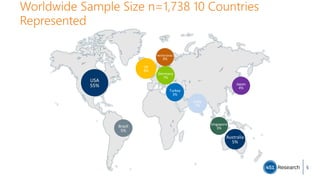
Worldwide Sample Size n=1,738 10 Countries
Represented
USA
55%
UK
8%
Germany
7%
India
7%
Brazil
5%
Netherlands
3%
Turkey
3%
Japan
4%
Singapore
3%
Australia
5%
5
HOSTING/CLOUD SERVICES
SPENDING (H)
Budgets
41%
39%
42%
41%
39%
40%
30%
36%
30%
30%
32%
32%
16%
13%
16%
16%
17%
16%
13%
12%
12%
14%
12%
12%
MEA (n=47)
LA (n=95)
APAC (n=316)
WE (n=330)
NA (n=950)
Total (n=1738)
0% 10% 20% 30% 40% 50% 60% 70% 80% 90% 100%
Average %
2017 IT Budget Allocation by Region
On-Premises
Infrastructure &
Staff
Hosting Services
SaaS
S8b. Using your best guess, approximately what percentage of your total IT budget in 2017 is allocated to: [sum to 100%]
7
Budgets/Spending
8
26%
25%
26%
26%
25%
26%
19%
18%
21%
20%
19%
20%
18%
18%
18%
18%
19%
18%
18%
20%
18%
17%
19%
18%
18%
20%
17%
19%
18%
18%
MEA
(n=47)
LA
(n=95)
APAC
(n=316)
WE
(n=330)
NA
(n=950)
Total
(n=1738)
0% 20% 40% 60% 80% 100%
Average %
2017 Hosting/Cloud Services Budget
Allocation by Region
Infrastructure
Hosting
Application
Hosting
Managed
Services
Security
Services
Professional
Services
28%
29%
26%
27%
26%
27%
22%
19%
22%
21%
20%
21%
18%
16%
18%
17%
19%
18%
18%
20%
19%
18%
19%
19%
15%
16%
15%
17%
16%
16%
MEA
(n=47)
LA (n=95)
APAC
(n=316)
WE
(n=330)
NA
(n=950)
Total
(n=1738)
0% 20% 40% 60% 80% 100%
Average %
2019 Hosting/Cloud Services Budget
Allocation by Region
Infrastructure
Hosting
Application
Hosting
Managed
Services
Security
Services
Professional
Services
H1. Approximately what percent of your HOSTING & CLOUD SERVICES budget in 2016 is allocated to the following services? [Sum to 100%]
H2. Now thinking out two years, approximately what percent of your HOSTING & CLOUD SERVICES budget will be allocated to the following
services? [Sum to 100%]
INFRASTRUCTURE HOSTING
SERVICES AND HYBRID/MULTI-
CLOUD (I)
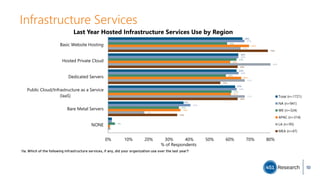
Infrastructure Services
66%
64%
63%
63%
37%
67%
64%
64%
63%
41%
59%
63%
58%
61%
35%
3%
69%
60%
66%
61%
36%
65%
80%
67%
67%
18%
79%
64%
55%
64%
34%
0% 10% 20% 30% 40% 50% 60% 70% 80%
Basic Website Hosting
Hosted Private Cloud
Dedicated Servers
Public Cloud/Infrastructure as a Service
(IaaS)
Bare Metal Servers
NONE
% of Respondents
Last Year Hosted Infrastructure Services Use by Region
Total (n=1721)
NA (n=941)
WE (n=324)
APAC (n=314)
LA (n=95)
MEA (n=47)
I1a. Which of the following infrastructure services, if any, did your organization use over the last year?
10
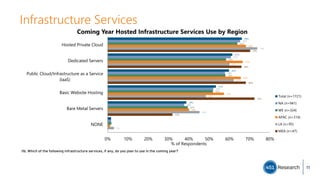
Infrastructure Services
66%
61%
60%
53%
39%
65%
61%
58%
52%
38%
64%
58%
58%
52%
40%
68%
67%
66%
57%
40%
74%
60%
62%
48%
45%
3%
70%
66%
68%
72%
32%
0% 10% 20% 30% 40% 50% 60% 70% 80%
Hosted Private Cloud
Dedicated Servers
Public Cloud/Infrastructure as a Service
(IaaS)
Basic Website Hosting
Bare Metal Servers
NONE
% of Respondents
Coming Year Hosted Infrastructure Services Use by Region
Total (n=1721)
NA (n=941)
WE (n=324)
APAC (n=314)
LA (n=95)
MEA (n=47)
I1b. Which of the following infrastructure services, if any, do you plan to use in the coming year?
11
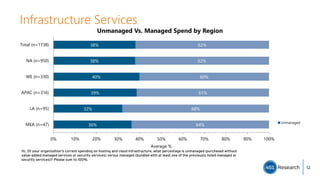
Infrastructure Services
36%
32%
39%
40%
38%
38%
64%
68%
61%
60%
62%
62%
MEA (n=47)
LA (n=95)
APAC (n=316)
WE (n=330)
NA (n=950)
Total (n=1738)
0% 10% 20% 30% 40% 50% 60% 70% 80% 90% 100%
Average %
Unmanaged Vs. Managed Spend by Region
Unmanaged
I1c. Of your organization's current spending on hosting and cloud infrastructure, what percentage is unmanaged (purchased without
value-added managed services or security services) versus managed (bundled with at least one of the previously listed managed or
security services)? Please sum to 100%.
12
Infrastructure Services
48%
43%
47%
47%
45%
46%
52%
57%
53%
53%
55%
54%
MEA (n=47)
LA (n=95)
APAC (n=316)
WE (n=330)
NA (n=950)
Total (n=1738)
0% 10% 20% 30% 40% 50% 60% 70% 80% 90% 100%
Average %
Managed Spend by Region
Basic
infrastructure
Managed
services/security
services
I1d . Thinking about your organization's managed infrastructure spending, what percentage of the spending is allocated to each of the
following? Please sum to 100%. [Sum to 100%]
13
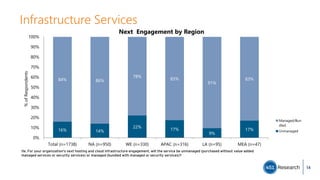
Infrastructure Services
16% 14%
22%
17%
9%
17%
84% 86%
78%
83%
91%
83%
Total (n=1738) NA (n=950) WE (n=330) APAC (n=316) LA (n=95) MEA (n=47)
0%
10%
20%
30%
40%
50%
60%
70%
80%
90%
100%
%ofRespondents
Next Engagement by Region
Managed/Bun
dled
Unmanaged
I1e. For your organization's next hosting and cloud infrastructure engagement, will the service be unmanaged (purchased without value-added
managed services or security services) or managed (bundled with managed or security services)?
14
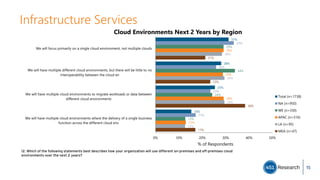
Infrastructure Services
31%
28%
25%
15%
33%
26%
23%
17%
29%
34%
24%
13%
29%
29%
29%
13%
28%
29%
29%
13%
21%
23%
38%
17%
0% 10% 20% 30% 40% 50%
We will focus primarily on a single cloud environment, not multiple clouds
We will have multiple different cloud environments, but there will be little to no
interoperability between the cloud en
We will have multiple cloud environments to migrate workloads or data between
different cloud environments
We will have multiple cloud environments where the delivery of a single business
function across the different cloud env
% of Respondents
Cloud Environments Next 2 Years by Region
Total (n=1738)
NA (n=950)
WE (n=330)
APAC (n=316)
LA (n=95)
MEA (n=47)
I2. Which of the following statements best describes how your organization will use different on-premises and off-premises cloud
environments over the next 2 years?
15
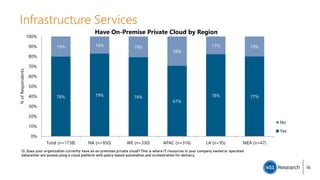
Infrastructure Services
76% 79% 74%
67%
78% 77%
19% 16% 19%
28%
17% 19%
Total (n=1738) NA (n=950) WE (n=330) APAC (n=316) LA (n=95) MEA (n=47)
0%
10%
20%
30%
40%
50%
60%
70%
80%
90%
100%
%ofRespondents
Have On-Premise Private Cloud by Region
No
Yes
I3. Does your organization currently have an on-premises private cloud? This is where IT resources in your company owned or operated
datacenter are pooled using a cloud platform with policy-based automation and orchestration for delivery.
16
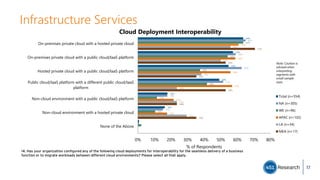
Infrastructure Services
64%
57%
55%
49%
18%
16%
65%
59%
63%
51%
18%
15%
64%
54%
38%
42%
11%
10%
61%
59%
56%
57%
22%
18%
56%
50%
38%
24%
24%
29%
71%
53%
35%
53%
24%
35%
0% 10% 20% 30% 40% 50% 60% 70% 80%
On-premises private cloud with a hosted private cloud
On-premises private cloud with a public cloud/IaaS platform
Hosted private cloud with a public cloud/IaaS platform
Public cloud/IaaS platform with a different public cloud/IaaS
platform
Non-cloud environment with a public cloud/IaaS platform
Non-cloud environment with a hosted private cloud
None of the Above
% of Respondents
Cloud Deployment Interoperability
Total (n=554)
NA (n=305)
WE (n=96)
APAC (n=102)
LA (n=34)
MEA (n=17)
Note: Caution is
advised when
interpreting
segments with
small sample
sizes.
I4. Has your organization configured any of the following cloud deployments for interoperability for the seamless delivery of a business
function or to migrate workloads between different cloud environments? Please select all that apply.
17
Infrastructure Services
64%
56%
56%
49%
49%
47%
44%
40%
63%
58%
52%
48%
48%
47%
42%
41%
70%
50%
57%
44%
49%
48%
40%
35%
68%
57%
64%
55%
55%
41%
56%
44%
47%
56%
71%
50%
47%
53%
32%
32%
53%
47%
35%
65%
29%
53%
65%
47%
0% 10% 20% 30% 40% 50% 60% 70% 80%
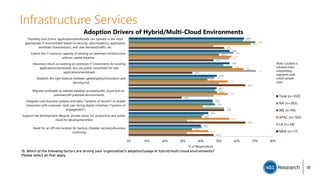
Flexibility and choice: applications/workloads can operate in the most
appropriate IT environment based on security, data residency, application
workload characteristics, end user demand/traffic, etc.
Extend the IT resource capacity of existing on-premises infrastructure
without capital expense
Maximize return on existing on-premises IT investments for existing
applications/workloads, but use public cloud/IaaS for new
applications/workloads
Establish the right balance between speed/agility/innovation and
security/risk
Migrate workloads as needed between private/public cloud and on-
premises/off-premises environments
Integrate core business systems and data ("systems of record") to enable
interaction with customer-/end user-facing digital initiatives ("systems of
engagement")
Support the development lifecycle: private cloud for production and public
cloud for development/test
Need for an off-site location for backup /disaster recovery/business
continuity
% of Respondents
Adoption Drivers of Hybrid/Multi-Cloud Environments
Total (n=550)
NA (n=303)
WE (n=94)
APAC (n=102)
LA (n=34)
MEA (n=17)
I5. Which of the following factors are driving your organization's adoption/usage of hybrid/multi-cloud environments?
Please select all that apply.
Note: Caution is
advised when
interpreting
segments with
small sample
sizes.
18
Infrastructure Services
61%
53%
46%
43%
33%
65%
56%
53%
47%
39%
62%
39%
29%
39%
24%
57%
56%
47%
39%
25%
56%
48%
33%
41%
41%
43%
86%
29%
36%
21%
0% 10% 20% 30% 40% 50% 60% 70% 80% 90% 100%
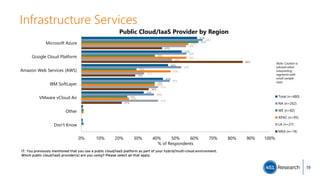
Microsoft Azure
Google Cloud Platform
Amazon Web Services (AWS)
IBM SoftLayer
VMware vCloud Air
Other
Don't Know
% of Respondents
Public Cloud/IaaS Provider by Region
Total (n=480)
NA (n=262)
WE (n=82)
APAC (n=95)
LA (n=27)
MEA (n=14)
I7. You previously mentioned that you use a public cloud/IaaS platform as part of your hybrid/multi-cloud environment.
Which public cloud/IaaS provider(s) are you using? Please select all that apply.
Note: Caution is
advised when
interpreting
segments with
small sample
sizes.
19
Infrastructure Services
41%
30%
16%
13%
44%
28%
16%
11%
34%
35%
10%
20%
28%
36%
19%
16%
56%
19%
26%
64%
7%
14%
14%
0% 10% 20% 30% 40% 50% 60% 70% 80%
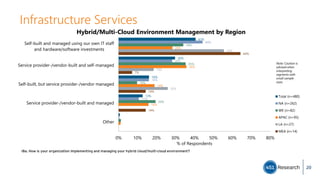
Self-built and managed using our own IT staff
and hardware/software investments
Service provider-/vendor-built and self-managed
Self-built, but service provider-/vendor managed
Service provider-/vendor-built and managed
Other
% of Respondents
Hybrid/Multi-Cloud Environment Management by Region
Total (n=480)
NA (n=262)
WE (n=82)
APAC (n=95)
LA (n=27)
MEA (n=14)
I8a. How is your organization implementing and managing your hybrid cloud/multi-cloud environment?
Note: Caution is
advised when
interpreting
segments with
small sample
sizes.
20
Infrastructure Services
64%
63%
57%
56%
55%
46%
46%
41%
40%
63%
63%
57%
57%
56%
45%
49%
41%
40%
64%
59%
49%
53%
51%
43%
38%
36%
40%
71%
69%
57%
59%
65%
43%
45%
47%
43%
47%
59%
74%
41%
44%
59%
35%
32%
29%
65%
59%
59%
65%
35%
65%
53%
59%
29%
0% 10% 20% 30% 40% 50% 60% 70% 80%
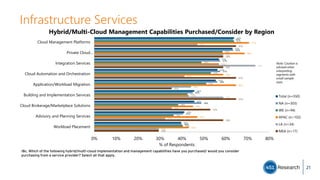
Cloud Management Platforms
Private Cloud…
Integration Services
Cloud Automation and Orchestration
Application/Workload Migration
Building and Implementation Services
Cloud Brokerage/Marketplace Solutions
Advisory and Planning Services
Workload Placement
% of Respondents
Hybrid/Multi-Cloud Management Capabilities Purchased/Consider by Region
Total (n=550)
NA (n=303)
WE (n=94)
APAC (n=102)
LA (n=34)
MEA (n=17)
I8c. Which of the following hybrid/multi-cloud implementation and management capabilities have you purchased/ would you consider
purchasing from a service provider? Select all that apply.
Note: Caution is
advised when
interpreting
segments with
small sample
sizes.
21
Infrastructure Services
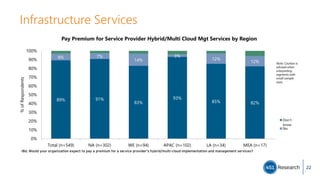
89% 91%
83%
93%
85% 82%
8% 7%
14%
3%
12%
12%
Total (n=549) NA (n=302) WE (n=94) APAC (n=102) LA (n=34) MEA (n=17)
0%
10%
20%
30%
40%
50%
60%
70%
80%
90%
100%
%ofRespondents
Pay Premium for Service Provider Hybrid/Multi Cloud Mgt Services by Region
Don't
know
No
I8d. Would your organization expect to pay a premium for a service provider's hybrid/multi-cloud implementation and management services?
Note: Caution is
advised when
interpreting
segments with
small sample
sizes.
22
Infrastructure Services
57%
55%
53%
51%
51%
41%
39%
36%
33%
31%
53%
54%
54%
53%
50%
43%
39%
36%
35%
33%
56%
49%
37%
40%
41%
33%
35%
24%
35%
23%
65%
65%
65%
58%
57%
42%
43%
44%
29%
31%
59%
45%
45%
45%
52%
24%
34%
34%
24%
34%
71%
64%
50%
64%
71%
71%
43%
43%
21%
21%
0% 10% 20% 30% 40% 50% 60% 70% 80%
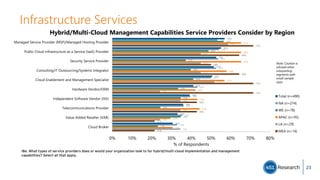
Managed Service Provider (MSP)/Managed Hosting Provider
Public Cloud Infrastructure as a Service (IaaS) Provider
Security Service Provider
Consulting/IT Outsourcing/Systems Integrator
Cloud Enablement and Management Specialist
Hardware Vendor/OEM
Independent Software Vendor (ISV)
Telecommunications Provider
Value Added Reseller (VAR)
Cloud Broker
% of Respondents
Hybrid/Multi-Cloud Management Capabilities Service Providers Consider by Region
Total (n=490)
NA (n=274)
WE (n=78)
APAC (n=95)
LA (n=29)
MEA (n=14)
I8e. What types of service providers does or would your organization look to for hybrid/multi-cloud implementation and management
capabilities? Select all that apply.
Note: Caution is
advised when
interpreting
segments with
small sample
sizes.
23
Infrastructure Services
39%
36%
26%
39%
38%
23%
47%
26%
28%
31%
37%
31%
35%
35%
29%
53%
29%
18%
0% 10% 20% 30% 40% 50% 60% 70%
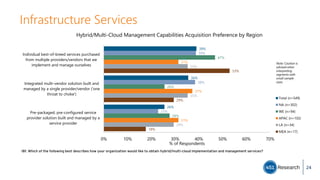
Individual best-of-breed services purchased
from multiple providers/vendors that we
implement and manage ourselves
Integrated multi-vendor solution built and
managed by a single provider/vendor ('one
throat to choke')
Pre-packaged, pre-configured service
provider solution built and managed by a
service provider
% of Respondents
Hybrid/Multi-Cloud Management Capabilities Acquisition Preference by Region
Total (n=549)
NA (n=302)
WE (n=94)
APAC (n=102)
LA (n=34)
MEA (n=17)
I8f. Which of the following best describes how your organization would like to obtain hybrid/multi-cloud implementation and management services?
Note: Caution is
advised when
interpreting
segments with
small sample
sizes.
24
Infrastructure Services
44%
50%
39%
28%
50% 50%
28%
25%
19%
45%
27%
33%
19% 14%
33%
20%
19%
17%4% 4% 6% 3%
5% 6% 4% 5% 4%
Total (n=442) NA (n=247) WE (n=70) APAC (n=87) LA (n=26) MEA (n=12)
0%
10%
20%
30%
40%
50%
60%
70%
80%
90%
100%
%ofRespondents
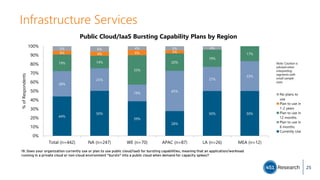
Public Cloud/IaaS Bursting Capability Plans by Region
No plans to
use
Plan to use in
1-2 years
Plan to use in
12 months
Plan to use in
6 months
Currently Use
I9. Does your organization currently use or plan to use public cloud/IaaS for bursting capabilities, meaning that an application/workload
running in a private cloud or non-cloud environment "bursts" into a public cloud when demand for capacity spikes?
Note: Caution is
advised when
interpreting
segments with
small sample
sizes.
25
Infrastructure Services
57% 60%
40%
57%
78%
64%
49% 51%
57%
37%
33%
57%
8% 9%
6% 9%
11%
14% 11%
21% 17%
4% 7%
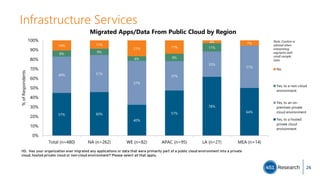
Total (n=480) NA (n=262) WE (n=82) APAC (n=95) LA (n=27) MEA (n=14)
0%
10%
20%
30%
40%
50%
60%
70%
80%
90%
100%
%ofRespondents
Migrated Apps/Data From Public Cloud by Region
No
Yes, to a non-cloud
environment
Yes, to an on-
premises private
cloud environment
Yes, to a hosted
private cloud
environment
I10. Has your organization ever migrated any applications or data that were primarily part of a public cloud environment into a private
cloud, hosted private cloud or non-cloud environment? Please select all that apply.
Note: Caution is
advised when
interpreting
segments with
small sample
sizes.
26
Infrastructure Services
20%
16%
15%
14%
12%
7%
6%
5%
5%
20%
19%
13%
11%
13%
7%
6%
6%
6%
14%
12%
23%
17%
11%
11%
6%
2%
5%
24%
14%
10%
22%
9%
6%
5%
8%
3%
27%
12%
27%
19%
4%
4%
8%
23%
15%
38%
15%
8%
0% 10% 20% 30% 40%
Security
Part of an IT Centralization…
Better Control
Performance
Enhanced Capabilities/Functionality
We Only use Public Cloud/IaaS for…
Lower Cost
Availability
Customer Service Issues
% of Respondents
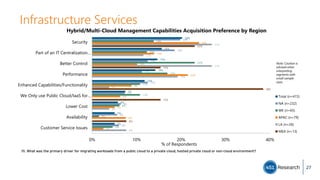
Hybrid/Multi-Cloud Management Capabilities Acquisition Preference by Region
Total (n=415)
NA (n=232)
WE (n=65)
APAC (n=79)
LA (n=26)
MEA (n=13)
I11. What was the primary driver for migrating workloads from a public cloud to a private cloud, hosted private cloud or non-cloud environment?
Note: Caution is
advised when
interpreting
segments with
small sample
sizes.
27
MANAGED SERVICES (M)
Managed Services
69%
55%
52%
51%
50%
49%
49%
45%
45%
43%
42%
2%
56%
49%
46%
54%
48%
47%
50%
45%
47%
45%
44%
2%
0% 10% 20% 30% 40% 50% 60% 70% 80%
Backup and recovery
Archiving
Infrastructure/application monitoring and alerting
Disaster recovery
Networking/CDN
End to end application management, including monitoring and…
Premium 24/7 support services
Incident management and remediation
Enterprise mobility management services
Enhanced service level agreement (covering infrastructure, application…
Capacity planning services
NONE
% of Respondents
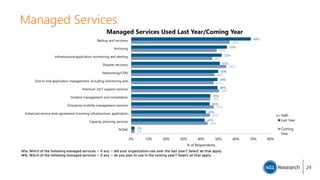
Managed Services Used Last Year/Coming Year
Last Year
Coming
Year
n=1680
M1a. Which of the following managed services -- if any -- did your organization use over the last year? Select all that apply.
M1b. Which of the following managed services -- if any -- do you plan to use in the coming year? Select all that apply.
29
Managed Services
0% 10% 20% 30% 40% 50% 60% 70% 80% 90%
Backup and recovery
Archiving
Infrastructure/application monitoring and alerting
Disaster recovery
Networking/CDN
End to end application management, including…
Premium 24/7 support services
Incident management and remediation
Enterprise mobility management services
Enhanced service level agreement (covering…
Capacity planning services
NONE
% of Respondents
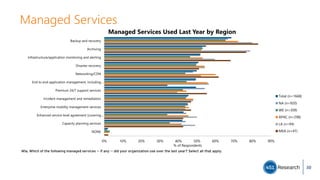
Managed Services Used Last Year by Region
Total (n=1668)
NA (n=920)
WE (n=309)
APAC (n=298)
LA (n=94)
MEA (n=47)
M1a. Which of the following managed services -- if any -- did your organization use over the last year? Select all that apply.
30
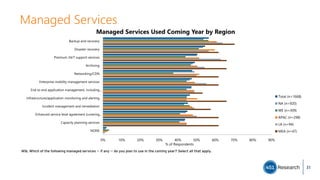
Managed Services
0% 10% 20% 30% 40% 50% 60% 70% 80% 90%
Backup and recovery
Disaster recovery
Premium 24/7 support services
Archiving
Networking/CDN
Enterprise mobility management services
End to end application management, including…
Infrastructure/application monitoring and alerting
Incident management and remediation
Enhanced service level agreement (covering…
Capacity planning services
NONE
% of Respondents
Managed Services Used Coming Year by Region
Total (n=1668)
NA (n=920)
WE (n=309)
APAC (n=298)
LA (n=94)
MEA (n=47)
M1b. Which of the following managed services -- if any -- do you plan to use in the coming year? Select all that apply.
31
PROFESSIONAL SERVICES FOR
CLOUD ENABLEMENT (Z)
Professional Services
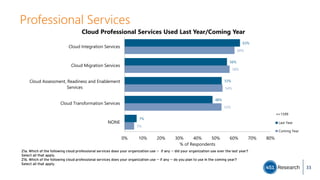
63%
56%
53%
48%
7%
60%
58%
54%
53%
5%
0% 10% 20% 30% 40% 50% 60% 70% 80%
Cloud Integration Services
Cloud Migration Services
Cloud Assessment, Readiness and Enablement
Services
Cloud Transformation Services
NONE
% of Respondents
Cloud Professional Services Used Last Year/Coming Year
Last Year
Coming Year
n=1599
Z1a. Which of the following cloud professional services does your organization use -- if any -- did your organization use over the last year?
Select all that apply.
Z1b. Which of the following cloud professional services does your organization use -- if any -- do you plan to use in the coming year?
Select all that apply.
33
Professional Services
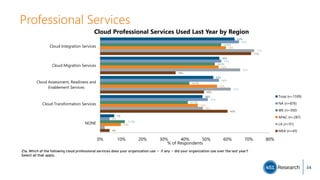
63%
56%
53%
48%
7%
65%
57%
56%
51%
4%
57.0%
54.0%
42.0%
41.3%
11.7%
59%
56%
55%
46%
10%
73%
66%
62%
48%
71%
36%
49%
60%
4%
0% 10% 20% 30% 40% 50% 60% 70% 80%
Cloud Integration Services
Cloud Migration Services
Cloud Assessment, Readiness and
Enablement Services
Cloud Transformation Services
NONE
% of Respondents
Cloud Professional Services Used Last Year by Region
Total (n=1599)
NA (n=876)
WE (n=300)
APAC (n=287)
LA (n=91)
MEA (n=45)
Z1a. Which of the following cloud professional services does your organization use -- if any -- did your organization use over the last year?
Select all that apply.
34
Professional Services
60%
58%
54%
53%
5%
59%
58%
54%
53%
3%
58.3%
53.3%
43.7%
49.0%
8.3%
62%
59%
61%
57%
8%
68%
65%
54%
54%
7%
71%
58%
69%
60%
4%
0% 10% 20% 30% 40% 50% 60% 70% 80%
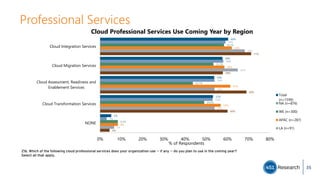
Cloud Integration Services
Cloud Migration Services
Cloud Assessment, Readiness and
Enablement Services
Cloud Transformation Services
NONE
% of Respondents
Cloud Professional Services Use Coming Year by Region
Total
(n=1599)
NA (n=876)
WE (n=300)
APAC (n=287)
LA (n=91)
Z1b. Which of the following cloud professional services does your organization use -- if any -- do you plan to use in the coming year?
Select all that apply.
35
Professional Services
70%
69%
69%
68%
68%
68%
66%
66%
66%
65%
65%
65%
63%
61%
0% 10% 20% 30% 40% 50% 60% 70% 80% 90% 100%
Intgrtn of legacy sys/bus processes w/SaaS fnctnlty
Application modernization
Intgrtn of core bus systems & data w/customer-facing bus prcsses
Compliance and risk assessment
Cloud business strategy
Training on cloud platforms
Ntwrk consulting & integration to accommodate cloud envrnmnts
Migration of legacy appls/wrklds to cloud infrastructure envrnmnts
Cloud advisory and planning
Workload Placement
Cloud orchestration and management
Vendor/service provider procrmnt & relationship mgt
Cloud-native application development
Cloud brokerage/marketplace solutions
% TOP BOX (More Important - ratings 8 thru 10)
Importance To Digital Transformation Goals
n=1513
Z2. How important are each of the following to your organization 's digital transformation goals? Rate on a scale of 0-10 where 0= Not at all
Important and 10 = Extremely Important. [TOP BOX RATING OF 8-10]
Note:
‘Straightline”
responses
removed.
36
Professional Services
0% 10% 20% 30% 40% 50% 60% 70% 80% 90% 100%
Intgrtn of legacy sys/bus processes w/SaaS fnctnlty
Application modernization
Intgrtn of core bus systems & data w/customer-facing bus prcsses
Compliance and risk assessment
Cloud business strategy
Training on cloud platforms
Ntwrk consulting & integration to accommodate cloud envrnmnts
Migration of legacy appls/wrklds to cloud infrastructure envrnmnts
Cloud advisory and planning
Workload Placement
Cloud orchestration and management
Vendor/service provider procrmnt & relationship mgt
Cloud-native application development
Cloud brokerage/marketplace solutions
% TOP BOX (More Important - ratings 8 thru 10)
Importance To Digital Transformation Goals by Region
Total (n=1513)
NA (n=851)
WE (n=274)
APAC (n=262)
LA (n=83)
MEA (n=43)
Z2. How important are each of the following to your organization 's digital transformation goals? Rate on a scale of 0-10 where 0= Not at all
Important and 10 = Extremely Important. [TOP BOX RATING OF 8-10]
Note:
‘Straightline”
responses
removed.
37
Professional Services
12% 15%
9% 10% 7%
3%
14%
15% 24%
4%
12%
13%
16%
16%
23%
9%
4%
38%
19%
19%
19%
19%
22%
21%
17%
18%
13%
16%
30%
13%
11%
10%
7%
16%
10%
8%
11% 8%
4%
28%
13%
5%
Total (n=1282) NA (n=732) WE (n=217) APAC (n=227) LA (n=67) MEA (n=39)
0%
10%
20%
30%
40%
50%
60%
70%
80%
90%
100%
%ofRespondents
Most Recent Professional Services Cloud Project Spend by Region
$2mil+
$500,000-
<$2mil
$100,000-
$499,999
$25,000-
$99,999
$5,000-$24,999
$1,000-$4,999
<$1,000
Z3. How much did your organization spend on your most recent professional services for cloud enablement project? Please enter a US
dollar value. [OPEN NUMERIC]
38
Professional Services
11% 12%
6%
13% 11% 12%
22% 24%
20%
18% 20% 19%
25%
24%
30% 25% 22% 21%
21%
23%
23%
19%
16%
14%
7%
6%
7%
8% 14%
5%
14% 12% 14% 18% 16%
30%
Total (n=1391) NA (n=778) WE (n=236) APAC (n=255) LA (n=79) MEA (n=43)
0%
10%
20%
30%
40%
50%
60%
70%
80%
90%
100%
%ofRespondents
Most Recent Professional Services Cloud Project Duration by Region
More than 24
weeks
17-24 weeks
9-16 weeks
5-8 weeks
3-4 weeks
1-2 weeks
 Average Weeks13 12 12 14 14 20
Z4. What was the duration (WEEKS) of your organization 's most recent professional services for cloud enablement project?
________ Weeks [OPEN NUMERIC]
39
Professional Services
0% 10% 20% 30%
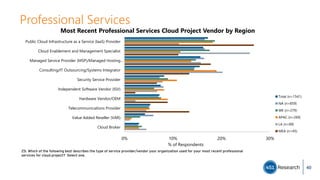
Public Cloud Infrastructure as a Service (IaaS) Provider
Cloud Enablement and Management Specialist
Managed Service Provider (MSP)/Managed Hosting…
Consulting/IT Outsourcing/Systems Integrator
Security Service Provider
Independent Software Vendor (ISV)
Hardware Vendor/OEM
Telecommunications Provider
Value Added Reseller (VAR)
Cloud Broker
% of Respondents
Total (n=1541)
NA (n=859)
WE (n=279)
APAC (n=269)
LA (n=89)
MEA (n=45)
Most Recent Professional Services Cloud Project Vendor by Region
Z5. Which of the following best describes the type of service provider/vendor your organization used for your most recent professional
services for cloud project? Select one.
40
APPLICATION HOSTING (A)
Application Services
58%
55%
53%
51%
48%
45%
45%
44%
43%
42%
42%
41%
39%
38%
32%
52%
49%
47%
45%
45%
44%
44%
43%
43%
45%
40%
45%
40%
42%
37%
0% 10% 20% 30% 40% 50% 60% 70%
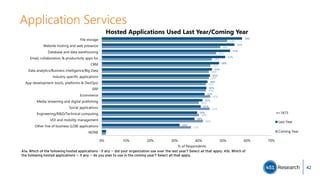
File storage
Website hosting and web presence
Database and data warehousing
Email, collaboration & productivity apps for…
CRM
Data analytics/Business intelligence/Big Data
Industry-specific applications
App development (tools, platforms & DevOps)
ERP
Ecommerce
Media streaming and digital publishing
Social applications
Engineering/R&D/Technical computing
VDI and mobility management
Other line of business (LOB) applications
NONE
% of Respondents
Hosted Applications Used Last Year/Coming Year
Last Year
Coming Year
n=1673
A1a. Which of the following hosted applications - if any -- did your organization use over the last year? Select all that apply. A1b. Which of
the following hosted applications -- if any -- do you plan to use in the coming year? Select all that apply.
42
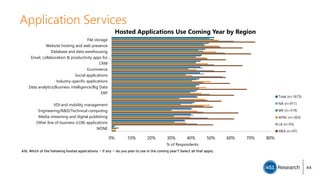
Application Services
0% 10% 20% 30% 40% 50% 60% 70% 80%
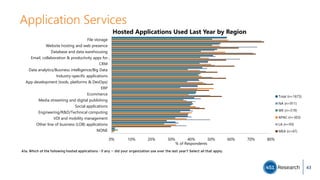
File storage
Website hosting and web presence
Database and data warehousing
Email, collaboration & productivity apps for…
CRM
Data analytics/Business intelligence/Big Data
Industry-specific applications
App development (tools, platforms & DevOps)
ERP
Ecommerce
Media streaming and digital publishing
Social applications
Engineering/R&D/Technical computing
VDI and mobility management
Other line of business (LOB) applications
NONE
% of Respondents
Hosted Applications Used Last Year by Region
Total (n=1673)
NA (n=911)
WE (n=319)
APAC (n=303)
LA (n=93)
MEA (n=47)
A1a. Which of the following hosted applications - if any -- did your organization use over the last year? Select all that apply.
43
Application Services
0% 10% 20% 30% 40% 50% 60% 70% 80%
File storage
Website hosting and web presence
Database and data warehousing
Email, collaboration & productivity apps for…
CRM
Ecommerce
Social applications
Industry-specific applications
Data analytics/Business intelligence/Big Data
ERP
VDI and mobility management
Engineering/R&D/Technical computing
Media streaming and digital publishing
Other line of business (LOB) applications
NONE
% of Respondents
Hosted Applications Use Coming Year by Region
Total (n=1673)
NA (n=911)
WE (n=319)
APAC (n=303)
LA (n=93)
MEA (n=47)
A1b. Which of the following hosted applications -- if any -- do you plan to use in the coming year? Select all that apply.
44
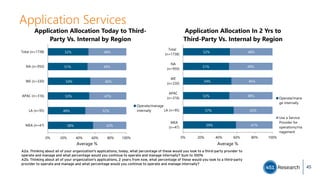
58%
48%
53%
54%
51%
52%
42%
52%
47%
46%
49%
48%
MEA (n=47)
LA (n=95)
APAC (n=316)
WE (n=330)
NA (n=950)
Total (n=1738)
0% 20% 40% 60% 80% 100%
Average %
Application Allocation Today to Third-
Party Vs. Internal by Region
Operate/manage
internally
59%
57%
52%
54%
51%
52%
41%
43%
48%
46%
49%
48%
MEA
(n=47)
LA (n=95)
APAC
(n=316)
WE
(n=330)
NA
(n=950)
Total
(n=1738)
0% 20% 40% 60% 80% 100%
Average %
Application Allocation In 2 Yrs to
Third-Party Vs. Internal by Region
Operate/mana
ge internally
Use a Service
Provider for
operations/ma
nagement
45
A2a. Thinking about all of your organization's applications, today, what percentage of these would you look to a third-party provider to
operate and manage and what percentage would you continue to operate and manage internally? Sum to 100%
A2b. Thinking about all of your organization's applications, 2 years from now, what percentage of these would you look to a third-party
provider to operate and manage and what percentage would you continue to operate and manage internally?
Application Services
SECURITY SERVICES (E)
Security Services
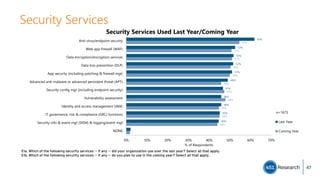
62%
53%
52%
52%
51%
49%
47%
46%
46%
45%
45%
55%
51%
51%
50%
50%
46%
47%
48%
45%
45%
44%
0% 10% 20% 30% 40% 50% 60% 70%
Anti-virus/endpoint security
Web app firewall (WAF)
Data encryption/encryption services
Data loss prevention (DLP)
App security (including patching & firewall mgt)
Advanced anti-malware or advanced persistent threat (APT)…
Security config mgt (including endpoint security)
Vulnerability assessment
Identity and access management (IAM)
IT governance, risk & compliance (GRC) functions
Security info & event mgt (SIEM) & logging/event mgt
NONE
% of Respondents
Security Services Used Last Year/Coming Year
Last Year
Coming Year
n=1673
E1a. Which of the following security services -- if any -- did your organization use over the last year? Select all that apply.
E1b. Which of the following security services -- if any -- do you plan to use in the coming year? Select all that apply.
47
Security Services
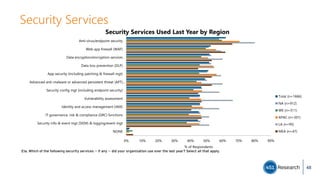
0% 10% 20% 30% 40% 50% 60% 70% 80% 90%
Anti-virus/endpoint security
Web app firewall (WAF)
Data encryption/encryption services
Data loss prevention (DLP)
App security (including patching & firewall mgt)
Advanced anti-malware or advanced persistent threat (APT)…
Security config mgt (including endpoint security)
Vulnerability assessment
Identity and access management (IAM)
IT governance, risk & compliance (GRC) functions
Security info & event mgt (SIEM) & logging/event mgt
NONE
% of Respondents
Security Services Used Last Year by Region
Total (n=1666)
NA (n=912)
WE (n=311)
APAC (n=301)
LA (n=95)
MEA (n=47)
E1a. Which of the following security services -- if any -- did your organization use over the last year? Select all that apply.
48
Security Services
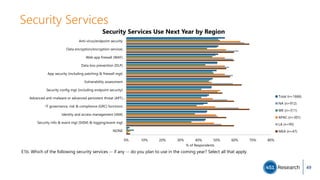
0% 10% 20% 30% 40% 50% 60% 70% 80%
Anti-virus/endpoint security
Data encryption/encryption services
Web app firewall (WAF)
Data loss prevention (DLP)
App security (including patching & firewall mgt)
Vulnerability assessment
Security config mgt (including endpoint security)
Advanced anti-malware or advanced persistent threat (APT)…
IT governance, risk & compliance (GRC) functions
Identity and access management (IAM)
Security info & event mgt (SIEM) & logging/event mgt
NONE
% of Respondents
Security Services Use Next Year by Region
Total (n=1666)
NA (n=912)
WE (n=311)
APAC (n=301)
LA (n=95)
MEA (n=47)
E1b. Which of the following security services -- if any -- do you plan to use in the coming year? Select all that apply.
49
Transformation (C)
Business Transformation
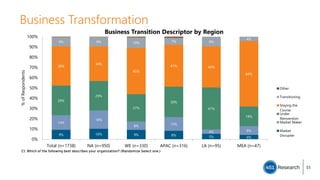
9% 10% 9% 8% 5% 4%
14%
18%
8% 13%
4% 9%
29%
29%
27%
30%
41%
19%
38%
34%
45%
41% 40%
64%
9% 9% 10% 7% 9%
4%
Total (n=1738) NA (n=950) WE (n=330) APAC (n=316) LA (n=95) MEA (n=47)
0%
10%
20%
30%
40%
50%
60%
70%
80%
90%
100%
%ofRespondents
Business Transition Descriptor by Region
Other
Transitioning
Staying the
Course
Under
Reinvention
Market Maker
Market
Disrupter
C1. Which of the following best describes your organization? (Randomize Select one.)
51
Business Transformation
24 24 23 26 27 30
23 22 23
23
25 20
19 19 20 19
19 20
17 18 17 16
16 16
16 17 16 16 13 14
Total (n=1738) NA (n=950) WE (n=330) APAC (n=316) LA (n=95) MEA (n=47)
Relative Company Goals
Increase
revenue
Improve
product or
service quality
Lower costs
C3. Allocate 100 points among the following five goals to their relative importance within your company or organization? [Sum to 100]
52
Business Transformation
27%
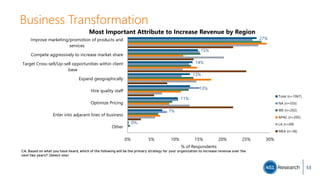
15%
14%
13%
13%
11%
7%
0%
0% 5% 10% 15% 20% 25% 30%
Improve marketing/promotion of products and
services
Compete aggressively to increase market share
Target Cross-sell/Up-sell opportunities within client
base
Expand geographically
Hire quality staff
Optimize Pricing
Enter into adjacent lines of business
Other
% of Respondents
Most Important Attribute to Increase Revenue by Region
Total (n=1067)
NA (n=555)
WE (n=202)
APAC (n=205)
LA (n=69)
MEA (n=36)
C4. Based on what you have heard, which of the following will be the primary strategy for your organization to increase revenue over the
next two years? (Select one)
53
Business Transformation
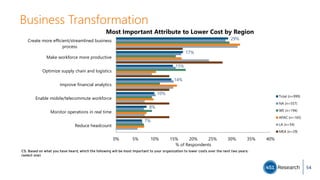
29%
17%
15%
14%
10%
8%
7%
0% 5% 10% 15% 20% 25% 30% 35% 40%
Create more efficient/streamlined business
process
Make workforce more productive
Optimize supply chain and logistics
Improve financial analytics
Enable mobile/telecommute workforce
Monitor operations in real time
Reduce headcount
% of Respondents
Most Important Attribute to Lower Cost by Region
Total (n=999)
NA (n=557)
WE (n=194)
APAC (n=165)
LA (n=54)
MEA (n=29)
C5. Based on what you have heard, which the following will be most important to your organization to lower costs over the next two years:
(select one)
54
Business Transformation
21%
13%
12%
11%
10%
8%
8%
6%
6%
5%
0% 5% 10% 15% 20% 25% 30%
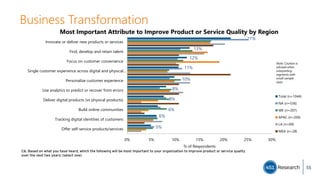
Innovate or deliver new products or services
Find, develop and retain talent
Focus on customer convenience
Single customer experience across digital and physical…
Personalize customer experience
Use analytics to predict or recover from errors
Deliver digital products (vs physical products)
Build online communities
Tracking digital identities of customers
Offer self-service products/services
% of Respondents
Most Important Attribute to Improve Product or Service Quality by Region
Total (n=1044)
NA (n=536)
WE (n=207)
APAC (n=204)
LA (n=69)
MEA (n=28)
C6. Based on what you have heard, which the following will be most important to your organization to improve product or service quality
over the next two years: (select one)
Note: Caution is
advised when
interpreting
segments with
small sample
sizes.
55
Business Transformation
19%
15%
15%
14%
14%
13%
10%
0% 5% 10% 15% 20% 25% 30%
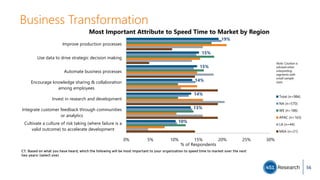
Improve production processes
Use data to drive strategic decision making
Automate business processes
Encourage knowledge sharing & collaboration
among employees
Invest in research and development
Integrate customer feedback through communities
or analytics
Cultivate a culture of risk taking (where failure is a
valid outcome) to accelerate development
% of Respondents
Most Important Attribute to Speed Time to Market by Region
Total (n=984)
NA (n=570)
WE (n=186)
APAC (n=163)
LA (n=44)
MEA (n=21)
C7. Based on what you have heard, which the following will be most important to your organization to speed time to market over the next
two years: (select one)
Note: Caution is
advised when
interpreting
segments with
small sample
sizes.
56
Business Transformation
25%
22%
19%
18%
16%
0% 5% 10% 15% 20% 25% 30% 35% 40%
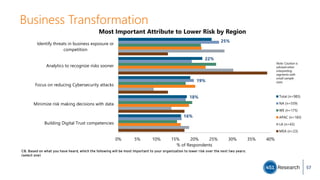
Identify threats in business exposure or
competition
Analytics to recognize risks sooner
Focus on reducing Cybersecurity attacks
Minimize risk making decisions with data
Building Digital Trust competencies
% of Respondents
Most Important Attribute to Lower Risk by Region
Total (n=983)
NA (n=559)
WE (n=175)
APAC (n=183)
LA (n=43)
MEA (n=23)
C8. Based on what you have heard, which the following will be most important to your organization to lower risk over the next two years:
(select one)
Note: Caution is
advised when
interpreting
segments with
small sample
sizes.
57
Digital Investment
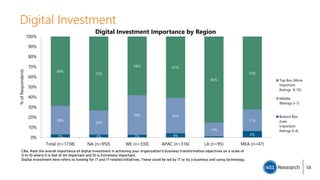
3% 3% 3% 4% 6%
28%
24%
39% 35%
14%
21%
69%
73%
58% 61%
85%
72%
Total (n=1738) NA (n=950) WE (n=330) APAC (n=316) LA (n=95) MEA (n=47)
0%
10%
20%
30%
40%
50%
60%
70%
80%
90%
100%
%ofRespondents
Digital Investment Importance by Region
Top Box (More
Important:
Ratings 8-10)
Middle
(Ratings 5-7)
Bottom Box
(Less
Important:
Ratings 0-4)
C8a. Rate the overall importance of digital investment in achieving your organization's business transformation objectives on a scale of
0 to 10 where 0 is Not at All Important and 10 is Extremely Important.
Digital investment here refers to funding for IT and IT-related initiatives. These could be led by IT or by a business unit using technology.
58
Digital Investment
12%
6%
6%
4%
6%
4%
40%
43%
41%
42%
37%
38%
31%
49%
51%
53%
54%
57%
58%
69%
Enter into adjacent lines of business (n=78)
Target Cross-sell/Up-sell opportunities within client base
(n=146)
Hire quality staff (n=140)
Optimize Pricing (n=113)
Improve marketing/promotion of products and services
(n=290)
Compete aggressively to increase market share (n=158)
Expand geographically (n=140)
0% 20% 40% 60% 80% 100%
% of Respondents
Digital Investment to Increase Revenue
None
Some
Significant
C9a. What is the level of digital investment that your organization will need to make to deliver on these strategies
[Increase Revenue] over the next two years, based either on your own knowledge or impressions?
59
Digital Investment
10%
9%
5%
3%
3%
49%
39%
42%
42%
39%
38%
37%
40%
52%
53%
55%
58%
59%
60%
Reduce headcount (n=67)
Enable mobile/telecommute workforce (n=99)
Monitor operations in real time (n=79)
Optimize supply chain and logistics (n=147)
Make workforce more productive (n=173)
Improve financial analytics (n=143)
Create more efficient/streamlined business process
(n=290)
0% 20% 40% 60% 80% 100%
% of Respondents
Digital Investment to Lower Costs
None
Some
Significant
C9b. What is the level of digital investment that your organization will need to make to deliver on these strategies
[Lower Costs] over the next two years, based either on your own knowledge or impressions?
60
Digital Investment
4%
4%
5%
3%
3%
3%
52%
49%
42%
42%
39%
41%
39%
38%
32%
28%
46%
47%
55%
56%
56%
57%
59%
59%
66%
70%
Tracking digital identities of customers (n=63)
Offer self-service products/services (n=51)
Use analytics to predict or recover from errors (n=84)
Build online communities (n=66)
Find, develop and retain talent (n=135)
Focus on customer convenience (n=129)
Single cstmr exprnce across digital & physical srvcs/devices/pltfrms…
Personalize customer experience (n=102)
Deliver digital products (vs physical products) (n=79)
Innovate or deliver new products or services (n=224)
0% 20% 40% 60% 80% 100%
% of Respondents
Digital Investment to Improve Product or Service Quality
None
Some
Significant
C9c. What is the level of digital investment that your organization will need to make to deliver on these strategies
[Improve Product or Service Quality] over the next two years, based either on your own knowledge or impressions?
61
Digital Investment
6%
4%
39%
41%
40%
39%
38%
34%
37%
55%
56%
58%
59%
60%
62%
63%
Cultivate a culture of risk taking...to accelerate development (n=101)
Encourage knowledge sharing & collaboration among employees
(n=135)
Invest in research and development (n=133)
Integrate customer feedback through communities or analytics
(n=132)
Automate business processes (n=145)
Use data to drive strategic decision making (n=149)
Improve production processes (n=189)
0% 20% 40% 60% 80% 100%
% of Respondents
Digital Investment to Speed Time to Market
None
Some
Significant
C9d. What is the level of digital investment that your organization will need to make to deliver on these strategies
[Speed Time to Market] over the next two years, based either on your own knowledge or impressions?
62
Digital Investment
42%
41%
38%
36%
27%
56%
58%
60%
62%
71%
Minimize risk making decisions with data (n=177)
Analytics to recognize risks sooner (n=217)
Building Digital Trust competencies (n=162)
Identify threats in business exposure or competition
(n=241)
Focus on reducing Cybersecurity attacks (n=186)
0% 20% 40% 60% 80% 100%
% of Respondents
Digital Investment to Lower Risk
None
Some
Significant
C9e. What is the level of digital investment that your organization will need to make to deliver on these strategies [Lower Risk]
over the next two years, based either on your own knowledge or impressions?
63
Digital Investment
3%
3%
4%
4%
25%
24%
20%
26%
25%
26%
19%
51%
42%
50%
44%
44%
45%
45%
24%
28%
26%
24%
27%
26%
29%
4%
4%
3%
Expand geographically (n=140)
Compete aggressively to increase market share (n=158)
Improve marketing/promotion of products and services
(n=290)
Optimize Pricing (n=113)
Target Cross-sell/Up-sell opportunities within client base
(n=146)
Enter into adjacent lines of business (n=78)
Hire quality staff (n=140)
0% 20% 40% 60% 80% 100%
% of Respondents
Proportion of Providers Can Support Digital Investment to Increase Revenue
None
Few
Many
All
C10a. Estimate the PROPORTION of cloud and hosting providers that could deliver services to support the digital investment
required for these strategies [Increase Revenue] , based either on your own knowledge or what you heard?
64
Digital Investment
3%
9%
13%
23%
20%
21%
24%
24%
28%
45%
52%
52%
48%
46%
44%
28%
42%
23%
26%
25%
28%
26%
28%
3%
5%
6%
Improve financial analytics (n=143)
Monitor operations in real time (n=79)
Create more efficient/streamlined business process
(n=290)
Make workforce more productive (n=173)
Optimize supply chain and logistics (n=147)
Enable mobile/telecommute workforce (n=99)
Reduce headcount (n=67)
0% 20% 40% 60% 80% 100%
% of Respondents
Proportion of Providers Can Support Digital Investment to Lower Costs
None
Few
Many
All
Don't know
C10b. Estimate the PROPORTION of cloud and hosting providers that could deliver services to support the digital investment
required for these strategies [Lower Costs], based either on your own knowledge or what you heard?
65
Digital Investment
3%
5%
14%
15%
19%
18%
17%
18%
15%
17%
20%
21%
55%
48%
57%
50%
46%
50%
39%
52%
50%
46%
29%
36%
24%
29%
36%
26%
43%
27%
26%
24%
3%
5%
4%
Offer self-service products/services (n=51)
Build online communities (n=66)
Tracking digital identities of customers (n=63)
Innovate or deliver new products or services (n=224)
Single customer experience across digital and physical services, devices or platforms…
Use analytics to predict or recover from errors (n=84)
Deliver digital products (vs physical products) (n=79)
Personalize customer experience (n=102)
Focus on customer convenience (n=129)
Find, develop and retain talent (n=135)
0% 20% 40% 60% 80% 100%
% of Respondents
Proportion of Providers Can Support Digital Investment to Improve Product or Service
Quality
None
Few
Many
All
C10c. Estimate the PROPORTION of cloud and hosting providers that could deliver services to support the digital investment
required for these strategies [Improve Product or Service Quality] , based either on your own knowledge or what you heard?
66
5%
14%
15%
19%
18%
17%
18%
15%
17%
20%
21%
55%
48%
57%
50%
46%
50%
39%
52%
50%
46%
29%
36%
24%
29%
36%
26%
43%
27%
26%
24%
3%
5%
4%
Offer self-service products/services (n=51)
Build online communities (n=66)
Tracking digital identities of customers (n=63)
Innovate or deliver new products or services (n=224)
Single customer experience across digital and physical services, devices or platforms (n=111)
Use analytics to predict or recover from errors (n=84)
Deliver digital products (vs physical products) (n=79)
Personalize customer experience (n=102)
Focus on customer convenience (n=129)
Find, develop and retain talent (n=135)
0% 20% 40% 60% 80% 100%
% of Respondents
Proportion of Providers Can Support Digital Investment to Improve Product or Service
Quality
None
Few
Many
All
Digital Investment
C10c. Estimate the PROPORTION of cloud and hosting providers that could deliver services to support the digital investment required for
these strategies [Improve Product or Service Quality] , based either on your own knowledge or what you heard?
67
Digital Investment
C10d. Estimate the PROPORTION of cloud and hosting providers that could deliver services to support the digital investment required
for these strategies [Speed Time to Market], based either on your own knowledge or what you heard?
17%
15%
15%
14%
20%
12%
19%
54%
54%
58%
51%
50%
51%
50%
26%
30%
26%
33%
30%
33%
28%
3%Automate business processes (n=145)
Use data to drive strategic decision making (n=149)
Integrate customer feedback through communities or analytics
(n=132)
Invest in research and development (n=133)
Improve production processes (n=189)
Encourage knowledge sharing & collaboration among employees
(n=135)
Cultivate a culture of risk taking...to accelerate development
(n=101)
0% 20% 40% 60% 80% 100%
% of Respondents
Proportion of Providers Can Support Digital Investment to Speed Time to
Market
None
Few
Many
All
68
Digital Investment
C10e. Estimate the PROPORTION of cloud and hosting providers that could deliver services to support the digital investment required for
these strategies [Lower Risk], based either on your own knowledge or what you heard?
11%
15%
19%
15%
14%
47%
42%
40%
42%
41%
38%
40%
36%
38%
43%
3%
4%
5%
Focus on reducing Cybersecurity attacks (n=186)
Identify threats in business exposure or competition
(n=241)
Analytics to recognize risks sooner (n=217)
Minimize risk making decisions with data (n=177)
Building Digital Trust competencies (n=162)
0% 10% 20% 30% 40% 50% 60% 70% 80% 90% 100%
% of Respondents
Proportion of Providers Can Support Digital Investment to Lower Risk
None
Few
Many
All
69
Digital Transformation
5% 5% 7% 5% 4%
41%
37%
49%
47%
33%
49%
54%
58%
44%
48%
65%
47%
Total (n=1738) NA (n=950) WE (n=330) APAC (n=316) LA (n=95) MEA (n=47)
0%
10%
20%
30%
40%
50%
60%
70%
80%
90%
100%
%ofRespondents
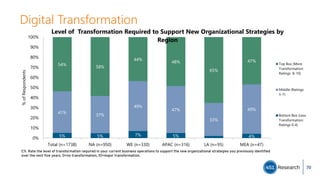
Level of Transformation Required to Support New Organizational Strategies by
Region
Top Box (More
Transformation:
Ratings 8-10)
Middle (Ratings
5-7)
Bottom Box (Less
Transformation:
Ratings 0-4)
C11. Rate the level of transformation required in your current business operations to support the new organizational strategies you previously identified
over the next five years. 0=no transformation, 10=major transformation.
70
Digital Transformation
4% 4% 6% 4%
42%
37%
51%
47%
41%
45%
54%
59%
44%
50%
58%
53%
Total (n=1738) NA (n=950) WE (n=330) APAC (n=316) LA (n=95) MEA (n=47)
0%
10%
20%
30%
40%
50%
60%
70%
80%
90%
100%
%ofRespondents
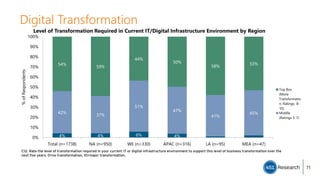
Level of Transformation Required in Current IT/Digital Infrastructure Environment by Region
Top Box
(More
Transformatio
n: Ratings 8-
10)
Middle
(Ratings 5-7)
C12. Rate the level of transformation required in your current IT or digital infrastructure environment to support this level of business transformation over the
next five years. 0=no transformation, 10=major transformation.
71
Digital Transformation
24% 22%
17%
23%
58%
53%
35%
32% 43%
40%
21% 34%
41%
46%
40% 37%
21%
13%
Total (n=1738) NA (n=950) WE (n=330) APAC (n=316) LA (n=95) MEA (n=47)
0%
10%
20%
30%
40%
50%
60%
70%
80%
90%
100%
%ofRespondents
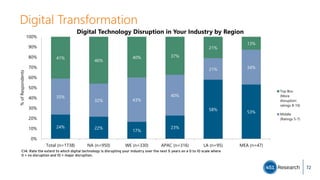
Digital Technology Disruption in Your Industry by Region
Top Box
(More
disruption:
ratings 8-10)
Middle
(Ratings 5-7)
C14. Rate the extent to which digital technology is disrupting your industry over the next 5 years on a 0 to 10 scale where
0 = no disruption and 10 = major disruption.
72
Digital Transformation
C15. What is the level of your organization's commitment to implementing digital/online operations for each of the
following business functions? (Randomize) Rate on a scale of 0-10 where 0 = Not at all Committed and 10 = Completely
Committed. [TOP BOX RATING OF 8-10]
67%
66%
64%
63%
73%
72%
71%
70%
54%
52%
51%
45%
60%
59%
54%
56%
78%
80%
68%
72%
66%
54%
49%
54%
0% 10% 20% 30% 40% 50% 60% 70% 80% 90% 100%
Customer service/support
Sales
Marketing
Automated internal business
workflows
% TOP BOX (More Committed - ratings 8 thru 10)
Commitment to Implementing Digital/Online Operation by Region
Total (n=1502)
NA (n=844)
WE (n=271)
APAC (n=265)
LA (n=81)
MEA (n=41)
Note:
‘Straightline”
responses
removed.
73
Digital Transformation
74
51%
52%
51%
49%
50%
50%
49%
48%
49%
51%
50%
50%
MEA (n=47)
LA (n=95)
APAC (n=316)
WE (n=330)
NA (n=950)
Total
(n=1738)
0% 20% 40% 60% 80% 100%
Average %
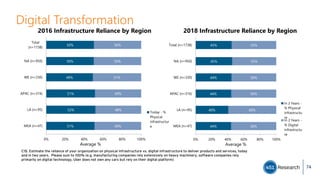
2016 Infrastructure Reliance by Region
Today - %
Physical
infrastructur
e
C15. Estimate the reliance of your organization on physical infrastructure vs. digital infrastructure to deliver products and services, today
and in two years. Please sum to 100% (e.g. manufacturing companies rely extensively on heavy machinery, software companies rely
primarily on digital technology, Uber does not own any cars but rely on their digital platform)
44%
40%
44%
44%
45%
45%
56%
60%
56%
56%
55%
55%
MEA (n=47)
LA (n=95)
APAC (n=316)
WE (n=330)
NA (n=950)
Total (n=1738)
0% 20% 40% 60% 80% 100%
Average %
2018 Infrastructure Reliance by Region
In 2 Years -
% Physical
infrastructu
re
In 2 Years -
% Digital
infrastructu
re
Digital Transformation
C16c. How important are each of the following for your organization's digital innovation strategy over the next five years?
Rate on a 0-10 scale where 0 = Not at all important and 10 = Extremely Important. (Randomize) [TOP BOX RATING OF 8-10]
72%
72%
65%
63%
79%
78%
72%
70%
62%
63%
50%
48%
62%
59%
57%
58%
81%
82%
81%
68%
74%
77%
49%
58%
0% 10% 20% 30% 40% 50% 60% 70% 80% 90% 100%
Engaging Customers
Optimizing Business Operations
Empowering employees
Transforming Products
% TOP BOX (More Important - ratings 8 thru 10)
Importance to Digital Innovation Strategy by Region
Total (n=1573)
NA (n=870)
WE (n=310)
APAC (n=278)
LA (n=72)
MEA (n=43)
Note:
‘Straightline”
responses
removed.
75
Digital Transformation: Optimizing Business Operations
C17. Rate the level of investment in the following technologies needed over the next 5 years to meet your
organization's business goals: 0 = No investment, 10= Significant Investment (Randomize) [TOP BOX RATING OF 8-10]
66%
65%
65%
64%
62%
61%
57%
56%
56%
55%
55%
53%
51%
49%
49%
49%
48%
0% 10% 20% 30% 40% 50% 60% 70%
Cybersecurity protection
Mobile platforms and applications
Customer experience management systems
Data integration across multiple lines of business &…
Data mining and analytics
Agile software development processes for fast feedback
Social-media enabled business process
Sensor-based technology
Governance/regulatory tools
Serverless computing
Machine learning
Artificial intelligence
Robotics
Containers
Wearables
Nanotechnology
3D printing
% TOP BOX (More Investment - ratings 8 thru 10)
Technology Investment Ratings
Note: “Straightline” responses removed.n=1731
76
Digital Transformation: Digital Skills
C18. How capable are staff in the following groups at your organization in understanding how digital technologies could
transform your business? 0=not at all capable, 10=very capable (Randomize) [TOP BOX RATING OF 8-10]
76%
68%
67%
62%
62%
59%
80%
75%
75%
71%
71%
66%
67%
55%
49%
43%
48%
45%
68%
59%
57%
53%
49%
51%
88%
72%
80%
78%
62%
53%
72%
57%
79%
60%
64%
62%
0% 10% 20% 30% 40% 50% 60% 70% 80% 90% 100%
IT
Security
Executive team
Line of Business
Support functions: HR, Finance
Legal
% TOP BOX (More Capable - ratings 8 thru 10)
Staff Capability to Understand Digital Technology Transformation by Region
Total
(n=1639)
NA (n=900)
WE (n=310)
APAC (n=297)
LA (n=85)
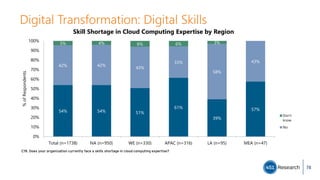
77
Digital Transformation: Digital Skills
54% 54% 51%
61%
39%
57%
42% 42%
43%
33%
58%
43%
5% 4% 6% 6% 3%
Total (n=1738) NA (n=950) WE (n=330) APAC (n=316) LA (n=95) MEA (n=47)
0%
10%
20%
30%
40%
50%
60%
70%
80%
90%
100%
%ofRespondents
Skill Shortage in Cloud Computing Expertise by Region
Don't
know
No
C19. Does your organization currently face a skills shortage in cloud computing expertise?
78
Digital Transformation: Digital Skills
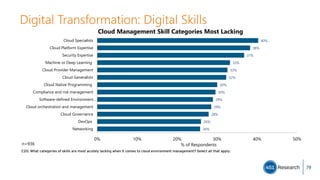
C20. What categories of skills are most acutely lacking when it comes to cloud environment management? Select all that apply.
40%
38%
37%
33%
33%
32%
30%
30%
29%
29%
28%
26%
26%
0% 10% 20% 30% 40% 50%
Cloud Specialists
Cloud Platform Expertise
Security Expertise
Machine or Deep Learning
Cloud Provider Management
Cloud Generalists
Cloud Native Programming
Compliance and risk management
Software-defined Environment…
Cloud orchestration and management
Cloud Governance
DevOps
Networking
% of Respondents
Cloud Management Skill Categories Most Lacking
n=936
79
Digital Transformation: Digital Skills
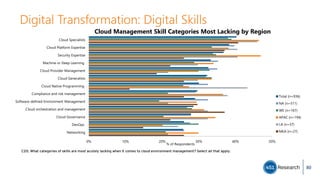
C20. What categories of skills are most acutely lacking when it comes to cloud environment management? Select all that apply.
0% 10% 20% 30% 40% 50%
Cloud Specialists
Cloud Platform Expertise
Security Expertise
Machine or Deep Learning
Cloud Provider Management
Cloud Generalists
Cloud Native Programming
Compliance and risk management
Software-defined Environment Management
Cloud orchestration and management
Cloud Governance
DevOps
Networking
% of Respondents
Cloud Management Skill Categories Most Lacking by Region
Total (n=936)
NA (n=511)
WE (n=167)
APAC (n=194)
LA (n=37)
MEA (n=27)
80
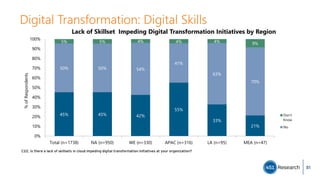
Digital Transformation: Digital Skills
45% 45% 42%
55%
33%
21%
50% 50% 54%
41%
63%
70%
5% 5% 4% 4% 4% 9%
Total (n=1738) NA (n=950) WE (n=330) APAC (n=316) LA (n=95) MEA (n=47)
0%
10%
20%
30%
40%
50%
60%
70%
80%
90%
100%
%ofRespondents
Lack of Skillset Impeding Digital Transformation Initiatives by Region
Don't
Know
No
C22. Is there a lack of skillsets in cloud impeding digital transformation initiatives at your organization?
81
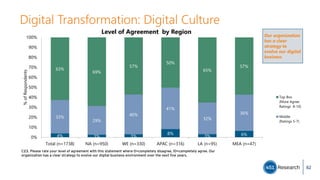
Digital Transformation: Digital Culture
4% 3% 3%
8%
3% 6%
33%
29%
40%
41%
32%
36%
63%
69%
57%
50%
65%
57%
Total (n=1738) NA (n=950) WE (n=330) APAC (n=316) LA (n=95) MEA (n=47)
0%
10%
20%
30%
40%
50%
60%
70%
80%
90%
100%
%ofRespondents
Level of Agreement by Region
Top Box
(More Agree:
Ratings 8-10)
Middle
(Ratings 5-7)
Our organization
has a clear
strategy to
evolve our digital
business
C23. Please rate your level of agreement with this statement where 0=completely disagree, 10=completely agree. Our
organization has a clear strategy to evolve our digital business environment over the next five years.
82
Digital Transformation: Digital Culture
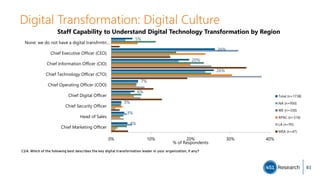
C24. Which of the following best describes the key digital transformation leader in your organization, if any?
5%
26%
20%
26%
7%
6%
3%
3%
4%
0% 10% 20% 30% 40%
None: we do not have a digital transfrmtn…
Chief Executive Officer (CEO)
Chief Information Officer (CIO)
Chief Technology Officer (CTO)
Chief Operating Officer (COO)
Chief Digital Officer
Chief Security Officer
Head of Sales
Chief Marketing Officer
% of Respondents
Staff Capability to Understand Digital Technology Transformation by Region
Total (n=1738)
NA (n=950)
WE (n=330)
APAC (n=316)
LA (n=95)
MEA (n=47)
83
DIGITAL TRANSFORMATION
CASE STUDY (T)
Digital Transformation
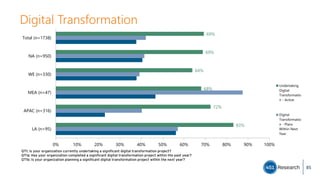
QT1: Is your organization currently undertaking a significant digital transformation project?
QT1a: Has your organization completed a significant digital transformation project within the past year?
QT1b: Is your organization planning a significant digital transformation project within the next year?
83%
72%
68%
64%
69%
69%
0% 10% 20% 30% 40% 50% 60% 70% 80% 90% 100%
LA (n=95)
APAC (n=316)
MEA (n=47)
WE (n=330)
NA (n=950)
Total (n=1738)
Undertaking
Digital
Transformatio
n - Active
Digital
Transformatio
n - Plans
Within Next
Year
85
Digital Transformation
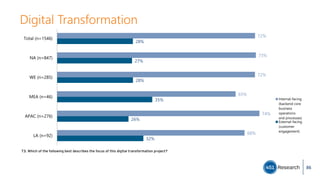
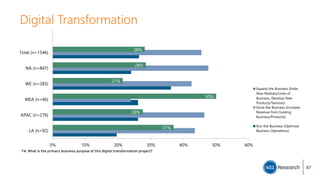
T3. Which of the following best describes the focus of this digital transformation project?
32%
26%
35%
28%
27%
28%
68%
74%
65%
72%
73%
72%
LA (n=92)
APAC (n=276)
MEA (n=46)
WE (n=285)
NA (n=847)
Total (n=1546)
Internal-facing
(backend core
business
operations
and processes)
External-facing
(customer
engagement)
86
Digital Transformation
T4. What is the primary business purpose of this digital transformation project?
37%
28%
50%
21%
28%
28%
0% 10% 20% 30% 40% 50% 60%
LA (n=92)
APAC (n=276)
MEA (n=46)
WE (n=285)
NA (n=847)
Total (n=1546)
Expand the Business (Enter
New Markets/Lines of
Business, Develop New
Products/Services)
Grow the Business (Increase
Revenue from Existing
Business/Products)
Run the Business (Optimize
Business Operations)
87
Digital Transformation
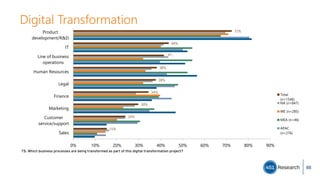
T5. Which business processes are being transformed as part of this digital transformation project?
15%
24%
30%
34%
38%
38%
41…
44%
72%
0% 10% 20% 30% 40% 50% 60% 70% 80% 90%
Sales
Customer
service/support
Marketing
Finance
Legal
Human Resources
Line of business
operations
IT
Product
development/R&D
Total
(n=1546)
NA (n=847)
WE (n=285)
MEA (n=46)
APAC
(n=276)
88
Digital Transformation
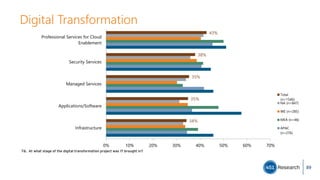
T6. At what stage of the digital transformation project was IT brought in?
34%
35%
35%
38%
43%
0% 10% 20% 30% 40% 50% 60% 70%
Infrastructure
Applications/Software
Managed Services
Security Services
Professional Services for Cloud
Enablement
Total
(n=1546)
NA (n=847)
WE (n=285)
MEA (n=46)
APAC
(n=276)
89
Digital Transformation – IT Service Providers
T7. Please rate the strategic importance of IT service providers for this digital transformation project. [% TOP BOX RATING (More
Strategic 8 thru 10)]
77%
61%
63%
60%
71%
67%
LA (n=92)
APAC
(n=276)
MEA (n=46)
WE (n=285)
NA (n=847)
Total
(n=1546)
90
Digital Transformation – Business Process
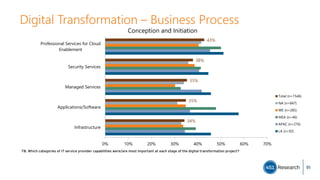
T8. Which categories of IT service provider capabilities were/are most important at each stage of the digital transformation project?
34%
35%
35%
38%
43%
0% 10% 20% 30% 40% 50% 60% 70%
Infrastructure
Applications/Software
Managed Services
Security Services
Professional Services for Cloud
Enablement
Conception and Initiation
Total (n=1546)
NA (n=847)
WE (n=285)
MEA (n=46)
APAC (n=276)
LA (n=92)
91
Digital Transformation – Business Process
T8. Which categories of IT service provider capabilities were/are most important at each stage of the digital transformation project?
33%
34%
36%
37%
38%
0% 10% 20% 30% 40% 50% 60%
Infrastructure
Applications/Software
Managed Services
Security Services
Professional Services for Cloud
Enablement
Scoping and Planning
Total (n=1546)
NA (n=847)
WE (n=285)
MEA (n=46)
APAC (n=276)
LA (n=92)
92
Digital Transformation – Business Process
T8. Which categories of IT service provider capabilities were/are most important at each stage of the digital transformation project?
34%
35%
37%
38%
43%
0% 10% 20% 30% 40% 50% 60%
Infrastructure
Applications/Software
Managed Services
Security Services
Professional Services for Cloud
Enablement
Launch/Execution
Total (n=1546)
NA (n=847)
WE (n=285)
MEA (n=46)
APAC (n=276)
LA (n=92)
93
Digital Transformation – Business Process
T8. Which categories of IT service provider capabilities were/are most important at each stage of the digital transformation project?
32%
33%
34%
37%
39%
0% 10% 20% 30% 40% 50% 60%
Infrastructure
Applications/Software
Managed Services
Security Services
Professional Services for Cloud
Enablement
Evaluation of Results
Total (n=1546)
NA (n=847)
WE (n=285)
MEA (n=46)
APAC (n=276)
LA (n=92)
94
Digital Transformation – Business Process
T8. Which categories of IT service provider capabilities were/are most important at each stage of the digital transformation project?
37%
37%
38%
40%
40%
0% 10% 20% 30% 40% 50% 60% 70%
Infrastructure
Applications/Software
Managed Services
Security Services
Professional Services for Cloud
Enablement
Ongoing Operations and Maintenance
Total (n=1546)
NA (n=847)
WE (n=285)
MEA (n=46)
APAC (n=276)
LA (n=92)
95
Digital Transformation
T9a. Considering all the IT skill sets required for successful completion of this digital transformation project, allocate 100 points among the following
capabilities. [Rating Displayed as MEAN]
64%
79%
80%
81%
94%
52%
59%
59%
60%
70%
0% 10% 20% 30% 40% 50% 60% 70% 80% 90% 100%
Orchestrati
on
Integration
Hardware
Manageme
nt
Software
Total (n=1546)
NA (n=847)
WE (n=285)
MEA (n=46)
APAC (n=276)
LA (n=92)
96
Digital Transformation
T9b. Thinking of your organization's future digital transformation projects, which of the following will be more important?
49% 51%
48%
52%
48%
52%
50% 50%
66%
34%
0%
10%
20%
30%
40%
50%
60%
70%
Developing IT expertise internally Working with service providers to obtain the needed IT
expertise
NA (n=847)
WE (n=285)
MEA (n=46)
APAC (n=276)
LA (n=92)
97
Hosting/Cloud Service Providers
T10. Which of the following best describes your organization's approach to dealing with hosting/cloud service providers
to obtain the IT services needed for digital transformation projects?
27%
34%
36%
0% 10% 20% 30% 40% 50% 60%
Single provider that can offer a broad range of products and
services that it builds and manages
Single provider that can source and manage multiple
products and services from partnerships it has with other
providers/
Individual best-of-breed services purchased from multiple
providers that we implement and manage ourselves
Total (n=773)
NA (n=430)
WE (n=149)
MEA (n=24)
APAC (n=139)
LA (n=31)
98
Primary Hosting / Cloud Service Provider
T12. Does your organization's primary hosting/cloud service provider currently have the partners and partner relationships needed to help your organization
on its digital transformation journey?
13%
13%
8%
17%
14%
14%
77%
82%
75%
75%
80%
79%
0% 10% 20% 30% 40% 50% 60% 70% 80% 90%
LA (n=31)
APAC
(n=139)
MEA (n=24)
WE (n=149)
NA (n=430)
Total (n=773)
Yes
No
99
MANAGED SERVICES
PARTNERING (P)
Hosting / Cloud Service Provider
P1. Do you know if your organization's primary hosting/cloud service provider partners with any other providers to deliver
the services you procure from them?
18%
23%
11%
22%
24%
23%
64%
66%
81%
59%
65%
64%
0% 10% 20% 30% 40% 50% 60% 70% 80% 90%
LA (n=95)
AP$AC$ (n=316)
MEA (n=47)
WE (n=330)
NA (n=950)
Total (n=1738)
Yes
No
101
Types of Partners
P2. Which of the following best describes the type(s) of partner(s) that is your organization's primary hosting/cloud service provider works with?
26%
29%
30%
32%
32%
39%
40%
41%
41%
0% 10% 20% 30% 40% 50% 60% 70%
Cloud Broker
Value $Ad$ded Reseller (VAR)
Consulting/Outsourcing/Systems Integrator
Telecommunications Provider
Independent Software Vendor (ISV)
Infrastructure Hardware Vendor/OEM
Cloud Enablement and Man$Ag$ement Specialist
Infrastructure as a Service (IaaS)/Public Cloud
Provider
Security Service Provider
Total (n=1117)
NA (n=614)
WE (n=195)
MEA (n=38)
AP$AC$
(n=209)
LA (n=61)
102
IaaS/Public Cloud Providers
P3. Which IaaS/Public Cloud provider(s) does your organization's primary hosting/cloud service provider partner with?
34%
53%
54%
54%
0% 10% 20% 30% 40% 50% 60% 70%
Other, please
specify
IBM SoftLayer
Microsoft Azure
VMware vCloud Air
Total (n=453)
NA (n=244)
WE (n=66)
MEA (n=19)
APAC (n=97)
LA (n=27)
103
Services Purchased
P3a. Which of the following services purchased from your primary hosting/cloud service provider does the provider deliver/manage
via partnerships with other providers/vendors?
52%
53%
54%
55%
58%
0% 10% 20% 30% 40% 50% 60% 70% 80%
Managed services
Professional services for cloud
enablement
Infrastructure services
Application services
Security services
Total (n=453)
NA (n=244)
WE (n=66)
MEA (n=19)
APAC (n=97)
LA (n=27)
104
Partner Attributes
P4. In your opinion, which of the following
attributes apply to the partners your
organization's primary hosting/cloud service
provider works with?
21%
24%
24%
26%
27%
27%
28%
30%
32%
32%
35%
36%
38%
38%
41%
41%
43%
0% 10% 20% 30% 40% 50% 60%
Geographic Footprint
Enterprise Agreements
Breadth of offerings
Accessible/Easy to reach
Staff goes above & beyond
Understands my business
Consistently deliver
24x7x365 support
Competitive Products/Services
Economical/low cost
Product performance & reliability
Technical expertise/knowledge
Solutions for my industry
Secure products and services
Innovative
Experience
Trustworthy company
NA (n=244)
WE (n=66)
MEA (n=19)
APAC
(n=97)
n = 453
105
CLOUD/HOSTING SERVICES
AND IMPACT ON BUSINESS
GOALS (X)
Digital Transformation - Managed Services
X1. Thinking about the managed services you are currently using / planning to use, rate the impact of these services on
your organization’s ability to do the following. Use a 0 to 10 scale where 0 = No Impact and 10 = Significant Impact. [% TOP
BOX RATING (Most Impactful 8 thru 10)]
63%
64%
66%
71%
0% 10% 20% 30% 40% 50% 60% 70% 80% 90%
Empower your
employees
Transform your
products
Engage your customers
Optimize your
operations
Total (n=1707)
NA (n=936)
WE (n=321)
MEA (n=47)
APAC (n=309)
LA (n=95)
107
Digital Transformation – Business Goals
X2. Still thinking about the managed services you are currently using or planning to use rate the role of these
services have/had in accomplishing the following business goals, using a 0 to 10 scale where 0 = Not at All
Important and 10 = Extremely Important.[% TOP BOX RATING (Most Important 8 thru 10)]
68%
67…
67%
73%
74%
0% 10% 20% 30% 40% 50% 60% 70% 80% 90%
Lower costs
Speed time to market
Lower risk
Increase revenue
Improve product or service
quality
Total (n=1707)
NA (n=936)
WE (n=321)
MEA (n=47)
APAC (n=309)
LA (n=95)
108
Approaches to Cloud Application Deployment
X4a. How is your organization executing on the following approaches to cloud application deployment?
Lift and Shift. Migrate existing applications unchanged (with no application recoding) from non-cloud environments to cloud infrastructure
23%
26%
51%
0% 10% 20% 30% 40% 50% 60%
Use our own internal IT resources (staff, hardware, software,
etc.)
Work with a third-party service provider or technology
vendor
Combination of internal IT and service provider resources
and skills
Total (n=1257)
NA (n=749)
WE (n=186)
MEA (n=36)
APAC (n=229)
LA (n=57)
109
Approaches to Cloud Application Deployment
X4b. How is your organization executing on the following approaches to cloud application deployment?
Refactor and Shift. Modernize existing applications by moving them to cloud hosted or SaaS
environments (show only if X3b today or 2 years from now > 0%)
22%
29%
50%
0% 10% 20% 30% 40% 50% 60%
Use our own internal IT resources (staff, hardware,
software, etc.)
Work with a third-party service provider or technology
vendor
Combination of internal IT and service provider
resources and skills
Total (n=1255)
NA (n=747)
WE (n=186)
MEA (n=36)
APAC (n=230)
LA (n=56)
110
Approaches to Cloud Application Deployment
X4c. How is your organization executing on the following approaches to cloud application deployment?
Cloud-first for Net New Applications. Deploy new applications we did not have before into cloud environments
24%
28%
48%
0% 10% 20% 30% 40% 50% 60%
Use our own internal IT resources (staff, hardware,
software, etc.)
Work with a third-party service provider or technology
vendor
Combination of internal IT and service provider
resources and skills
Total (n=1254)
NA (n=747)
WE (n=188)
MEA (n=36)
APAC (n=226)
LA (n=57)
111
37%
36%
35%
38%
40%
44%
40%
40%
43%
46%
0% 10% 20% 30% 40% 50% 60% 70%
Cloud Broker
Value Added Reseller (VAR)
Independent Software Vendor (ISV)
Infrastructure Hardware Vendor/OEM
Telecommunications Provider
Security Service Provider
Managed Service Provider (MSP)/Hosting Provider
Infrastructure as a Service (IaaS)/Public Cloud Provider
Consulting/Outsourcing/Systems Integrator
Cloud Enablement and Management Specialist
NA (n=351)
WE (n=85)
MEA (n=22)
APAC (n=140)
LA (n=24)
Service Providers / Technology Vendors
X5a. Which types of service providers/technology vendors would your organization look to for each of the following types of IT transformation projects?
{Lift and Shift. Migrate existing applications unchanged (with no application recoding) from non-cloud environments to cloud infrastructure}
n=622
112
Service Providers / Technology Vendors
X5b. Which types of service providers/technology vendors would your organization look to for each of the following types of IT
transformation projects? {Refactor and Shift. Modernize existing applications by moving them to cloud hosted or SaaS environments}
43%
42%
41%
45%
44%
45%
44%
44%
44%
46%
0% 20% 40% 60% 80%
Infrastructure as a Service (IaaS)/Public Cloud…
Managed Service Provider (MSP)/Hosting Provider
Value Added Reseller (VAR)
Consulting/Outsourcing/Systems Integrator
Cloud Enablement and Management Specialist
Cloud Broker
Infrastructure Hardware Vendor/OEM
Independent Software Vendor (ISV)
Telecommunications Provider
Security Service Provider
NA (n=590)
WE (n=145)
MEA (n=26)
APAC (n=185)
LA (n=69)
n=982
113
36%
39%
38%
39%
39%
38%
40%
41%
45%
47%
0% 10% 20% 30% 40% 50% 60% 70%
Telecommunications Provider
Independent Software Vendor (ISV)
Cloud Broker
Infrastructure Hardware Vendor/OEM
Value Added Reseller (VAR)
Consulting/Outsourcing/Systems Integrator
Security Service Provider
Infrastructure as a Service (IaaS)/Public Cloud Provider
Managed Service Provider (MSP)/Hosting Provider
Cloud Enablement and Management Specialist
NA (n=557)
WE (n=149)
MEA (n=25)
APAC (n=185)
LA (n=40)
Service Providers / Technology Vendors
X5c. Which types of service providers/technology vendors would your organization look to for each of the following types of IT transformation projects?
{Cloud-first for Net New Applications. Deploy new applications we did not have before into cloud environments}
n=557
114
DEPENDENT VARIABLES/CROSS
TAB QUESTIONS (V)
Adoption of Cloud Computing Models
V1. Which of the following best describes your organization's adoption of cloud computing models?
12%
17%
18%
18%
34%
0% 5% 10% 15% 20% 25% 30% 35% 40%
Discovery and Evaluation
Running Trials/Pilot Projects
Application Test and Development
Initial Implementation of Production
Applications
Broad Implementation of Production
Applications
Total (n=1738)
NA (n=950)
WE (n=330)
MEA (n=47)
APAC (n=316)
LA (n=95)
116
DEMOGRAPHICS (D)
Marketing
15%
Application
Development
17%
IT
Operations/A
distration
68%
Respondents by Department
47%
48%
63%
68%
68%
72%
I build or maintain IT systems
I develop or maintain IT software
I manage relationships with 3rd
party IT providers
I make IT purchasing
recommendations
I have significant decision making
authority regarding IT
I am influential in IT decisions and
strategy
Respondents by Role
N=1,188
S2 Which of the following statements is true of your role at work?
Demographics
S1. Which department do you work in at your organization?
N=1,738
118
Demographics
D1. Which of the following primarily describes your organization's business?
32%
32%
36%
Business to Business (B2B)
Equal mix
Business to Consumer
(B2C)
n=1738
119
Demographics
D2. Which of the following best describes your organization's approach to NEW technology adoption?
1%
16%
36%
46%
We are skeptical and are usually late to the game
We are conservative about new technology and take a wait and see
approach
We are early adopters on the leading edge
We are pragmatic about new technology, but will act sooner rather than
later
n=1738
120
Demographics
D3. How long has your company been in business?
3%
16%
29%
34%
19%
1-1.9 years
2-4.9 years
5-9.9 years
10-24.9
years
25+ years
n=1738
121
Demographics
D5. What is your total IT budget for 2017? This includes all capex and opex spend on staffing, hardware, software and IT services and providers?
6%
13%
14%
25%
20%
15%
6%
<$100,000
$100,000 to less than $500,000
$500,000 to less than $1 million
$1 million to less than $5
million
$5 million to less than $10
million
$10 million to less than $50
million
$50 million+
n=1738
122
Demographics
D6a. Please indicate how your total IT budget will change in 2 years.
5%
16%
79%
Decrease
Stay the
Same
Increase
n=1738
123
Demographics
QD8. Which of the following categories best describes your organization's total annual revenue in 2016?
5%
16%
79%
Decrease
Stay the
Same
Increase
n=1738
124
Demographics
QD9. Approximately how much does your organization spend with all of your hosting/cloud providers on a monthly basis?
7%
2%
7%
6%
10%
9%
12%
13%
13%
9%
7%
5%
Don't Know
<$100/month
$100-499/month
$500-999/month
$1,000-1,999/month
$2,000-2,499/month
$2,500-4,999/month
$5,000-9,999/month
$10,000-…
$25000-…
$50,000-…
$100,000+/month
n=1738
125
Demographics
D10. Which of the following best matches your role in the organization?
1%
9%
11%
21%
25%
33%
Other, please
specify
VP
Supervisor
Director
C-Level
Manager
n=1738
126
2017 Microsoft hosting and cloud study

2017 Microsoft hosting and cloud study

  • 1.
    Hosting and CloudStudy 2017 Digital Transformation Opportunity for Service Providers: Beyond Infrastructure Survey Data Summary Report
  • 2.
    Study Overview Grand Strategyfor Digital Transformation: Partner for Success, is a study Microsoft commissioned through 451 Research. The study is designed to better understand how companies, SMBs, Enterprises etc. are transforming digitally and identify market opportunities for Microsoft’s infrastructure service provider partners to help their customers as they progress along their digital transformation journey. Over 1,700 respondents across 10 geographies participated in this survey study that was fielded between January 30, 2017 to February 22, 2017. Key findings showed: The Era of Managed Infrastructure Services: Managed is the New Normal – 62% of Cloud/Hosting Infrastructure Spending Comes Bundled with Value-Added Services The Next “Beyond Infrastructure” Opportunity: Professional Services for Cloud-Enablement represent 18% of total hosting/cloud spending and 25% of the “Beyond Infrastructure” Opportunity – But Hurry…The Window is Closing Fast! The Multi-Cloud World Is Real, Tightly Linked to Digital Transformation. 41% of Organizations Are Already On- Board, Driven by Best Execution Venue Considerations, Maximizing On-Premises IT Investments, and Opex-based IT Resource Extension. However, Implementation and Management Challenges Create Service Provider Opportunity -- 89% of Organizations Are Willing to Pay A Hefty Premium For Assistance 2
  • 3.
    Study Overview (Cont.) Keyfindings showed: (Cont.) A Majority of Businesses Are Now On-Board the Digital Economy Express, But Skills, Expertise, and Partners Are Lacking, Resulting in A Key Role for Service Providers in Future Digital Transformation Projects • 52% of organizations are on-board with the digital revolution as Market Disruptors, Market Makers or Business Re-inventors (compared to 46% in 2016) Half of All Organizations Consider Service Providers As Vital For Future Digital Transformation Projects. 60% of These Look to Service Providers for Sourcing, Implementation and Management and Would Be Willing to Pay a 2X Premium for a “One Throat to Choke” Trusted Advisor Solution 3
  • 4.
  • 5.
    Worldwide Sample Sizen=1,738 10 Countries Represented USA 55% UK 8% Germany 7% India 7% Brazil 5% Netherlands 3% Turkey 3% Japan 4% Singapore 3% Australia 5% 5
  • 6.
  • 7.
    Budgets 41% 39% 42% 41% 39% 40% 30% 36% 30% 30% 32% 32% 16% 13% 16% 16% 17% 16% 13% 12% 12% 14% 12% 12% MEA (n=47) LA (n=95) APAC(n=316) WE (n=330) NA (n=950) Total (n=1738) 0% 10% 20% 30% 40% 50% 60% 70% 80% 90% 100% Average % 2017 IT Budget Allocation by Region On-Premises Infrastructure & Staff Hosting Services SaaS S8b. Using your best guess, approximately what percentage of your total IT budget in 2017 is allocated to: [sum to 100%] 7
  • 8.
    Budgets/Spending 8 26% 25% 26% 26% 25% 26% 19% 18% 21% 20% 19% 20% 18% 18% 18% 18% 19% 18% 18% 20% 18% 17% 19% 18% 18% 20% 17% 19% 18% 18% MEA (n=47) LA (n=95) APAC (n=316) WE (n=330) NA (n=950) Total (n=1738) 0% 20% 40%60% 80% 100% Average % 2017 Hosting/Cloud Services Budget Allocation by Region Infrastructure Hosting Application Hosting Managed Services Security Services Professional Services 28% 29% 26% 27% 26% 27% 22% 19% 22% 21% 20% 21% 18% 16% 18% 17% 19% 18% 18% 20% 19% 18% 19% 19% 15% 16% 15% 17% 16% 16% MEA (n=47) LA (n=95) APAC (n=316) WE (n=330) NA (n=950) Total (n=1738) 0% 20% 40% 60% 80% 100% Average % 2019 Hosting/Cloud Services Budget Allocation by Region Infrastructure Hosting Application Hosting Managed Services Security Services Professional Services H1. Approximately what percent of your HOSTING & CLOUD SERVICES budget in 2016 is allocated to the following services? [Sum to 100%] H2. Now thinking out two years, approximately what percent of your HOSTING & CLOUD SERVICES budget will be allocated to the following services? [Sum to 100%]
  • 9.
    INFRASTRUCTURE HOSTING SERVICES ANDHYBRID/MULTI- CLOUD (I)
  • 10.
    Infrastructure Services 66% 64% 63% 63% 37% 67% 64% 64% 63% 41% 59% 63% 58% 61% 35% 3% 69% 60% 66% 61% 36% 65% 80% 67% 67% 18% 79% 64% 55% 64% 34% 0% 10%20% 30% 40% 50% 60% 70% 80% Basic Website Hosting Hosted Private Cloud Dedicated Servers Public Cloud/Infrastructure as a Service (IaaS) Bare Metal Servers NONE % of Respondents Last Year Hosted Infrastructure Services Use by Region Total (n=1721) NA (n=941) WE (n=324) APAC (n=314) LA (n=95) MEA (n=47) I1a. Which of the following infrastructure services, if any, did your organization use over the last year? 10
  • 11.
    Infrastructure Services 66% 61% 60% 53% 39% 65% 61% 58% 52% 38% 64% 58% 58% 52% 40% 68% 67% 66% 57% 40% 74% 60% 62% 48% 45% 3% 70% 66% 68% 72% 32% 0% 10%20% 30% 40% 50% 60% 70% 80% Hosted Private Cloud Dedicated Servers Public Cloud/Infrastructure as a Service (IaaS) Basic Website Hosting Bare Metal Servers NONE % of Respondents Coming Year Hosted Infrastructure Services Use by Region Total (n=1721) NA (n=941) WE (n=324) APAC (n=314) LA (n=95) MEA (n=47) I1b. Which of the following infrastructure services, if any, do you plan to use in the coming year? 11
  • 12.
    Infrastructure Services 36% 32% 39% 40% 38% 38% 64% 68% 61% 60% 62% 62% MEA (n=47) LA(n=95) APAC (n=316) WE (n=330) NA (n=950) Total (n=1738) 0% 10% 20% 30% 40% 50% 60% 70% 80% 90% 100% Average % Unmanaged Vs. Managed Spend by Region Unmanaged I1c. Of your organization's current spending on hosting and cloud infrastructure, what percentage is unmanaged (purchased without value-added managed services or security services) versus managed (bundled with at least one of the previously listed managed or security services)? Please sum to 100%. 12
  • 13.
    Infrastructure Services 48% 43% 47% 47% 45% 46% 52% 57% 53% 53% 55% 54% MEA (n=47) LA(n=95) APAC (n=316) WE (n=330) NA (n=950) Total (n=1738) 0% 10% 20% 30% 40% 50% 60% 70% 80% 90% 100% Average % Managed Spend by Region Basic infrastructure Managed services/security services I1d . Thinking about your organization's managed infrastructure spending, what percentage of the spending is allocated to each of the following? Please sum to 100%. [Sum to 100%] 13
  • 14.
    Infrastructure Services 16% 14% 22% 17% 9% 17% 84%86% 78% 83% 91% 83% Total (n=1738) NA (n=950) WE (n=330) APAC (n=316) LA (n=95) MEA (n=47) 0% 10% 20% 30% 40% 50% 60% 70% 80% 90% 100% %ofRespondents Next Engagement by Region Managed/Bun dled Unmanaged I1e. For your organization's next hosting and cloud infrastructure engagement, will the service be unmanaged (purchased without value-added managed services or security services) or managed (bundled with managed or security services)? 14
  • 15.
    Infrastructure Services 31% 28% 25% 15% 33% 26% 23% 17% 29% 34% 24% 13% 29% 29% 29% 13% 28% 29% 29% 13% 21% 23% 38% 17% 0% 10%20% 30% 40% 50% We will focus primarily on a single cloud environment, not multiple clouds We will have multiple different cloud environments, but there will be little to no interoperability between the cloud en We will have multiple cloud environments to migrate workloads or data between different cloud environments We will have multiple cloud environments where the delivery of a single business function across the different cloud env % of Respondents Cloud Environments Next 2 Years by Region Total (n=1738) NA (n=950) WE (n=330) APAC (n=316) LA (n=95) MEA (n=47) I2. Which of the following statements best describes how your organization will use different on-premises and off-premises cloud environments over the next 2 years? 15
  • 16.
    Infrastructure Services 76% 79%74% 67% 78% 77% 19% 16% 19% 28% 17% 19% Total (n=1738) NA (n=950) WE (n=330) APAC (n=316) LA (n=95) MEA (n=47) 0% 10% 20% 30% 40% 50% 60% 70% 80% 90% 100% %ofRespondents Have On-Premise Private Cloud by Region No Yes I3. Does your organization currently have an on-premises private cloud? This is where IT resources in your company owned or operated datacenter are pooled using a cloud platform with policy-based automation and orchestration for delivery. 16
  • 17.
    Infrastructure Services 64% 57% 55% 49% 18% 16% 65% 59% 63% 51% 18% 15% 64% 54% 38% 42% 11% 10% 61% 59% 56% 57% 22% 18% 56% 50% 38% 24% 24% 29% 71% 53% 35% 53% 24% 35% 0% 10%20% 30% 40% 50% 60% 70% 80% On-premises private cloud with a hosted private cloud On-premises private cloud with a public cloud/IaaS platform Hosted private cloud with a public cloud/IaaS platform Public cloud/IaaS platform with a different public cloud/IaaS platform Non-cloud environment with a public cloud/IaaS platform Non-cloud environment with a hosted private cloud None of the Above % of Respondents Cloud Deployment Interoperability Total (n=554) NA (n=305) WE (n=96) APAC (n=102) LA (n=34) MEA (n=17) Note: Caution is advised when interpreting segments with small sample sizes. I4. Has your organization configured any of the following cloud deployments for interoperability for the seamless delivery of a business function or to migrate workloads between different cloud environments? Please select all that apply. 17
  • 18.
    Infrastructure Services 64% 56% 56% 49% 49% 47% 44% 40% 63% 58% 52% 48% 48% 47% 42% 41% 70% 50% 57% 44% 49% 48% 40% 35% 68% 57% 64% 55% 55% 41% 56% 44% 47% 56% 71% 50% 47% 53% 32% 32% 53% 47% 35% 65% 29% 53% 65% 47% 0% 10%20% 30% 40% 50% 60% 70% 80% Flexibility and choice: applications/workloads can operate in the most appropriate IT environment based on security, data residency, application workload characteristics, end user demand/traffic, etc. Extend the IT resource capacity of existing on-premises infrastructure without capital expense Maximize return on existing on-premises IT investments for existing applications/workloads, but use public cloud/IaaS for new applications/workloads Establish the right balance between speed/agility/innovation and security/risk Migrate workloads as needed between private/public cloud and on- premises/off-premises environments Integrate core business systems and data ("systems of record") to enable interaction with customer-/end user-facing digital initiatives ("systems of engagement") Support the development lifecycle: private cloud for production and public cloud for development/test Need for an off-site location for backup /disaster recovery/business continuity % of Respondents Adoption Drivers of Hybrid/Multi-Cloud Environments Total (n=550) NA (n=303) WE (n=94) APAC (n=102) LA (n=34) MEA (n=17) I5. Which of the following factors are driving your organization's adoption/usage of hybrid/multi-cloud environments? Please select all that apply. Note: Caution is advised when interpreting segments with small sample sizes. 18
  • 19.
    Infrastructure Services 61% 53% 46% 43% 33% 65% 56% 53% 47% 39% 62% 39% 29% 39% 24% 57% 56% 47% 39% 25% 56% 48% 33% 41% 41% 43% 86% 29% 36% 21% 0% 10%20% 30% 40% 50% 60% 70% 80% 90% 100% Microsoft Azure Google Cloud Platform Amazon Web Services (AWS) IBM SoftLayer VMware vCloud Air Other Don't Know % of Respondents Public Cloud/IaaS Provider by Region Total (n=480) NA (n=262) WE (n=82) APAC (n=95) LA (n=27) MEA (n=14) I7. You previously mentioned that you use a public cloud/IaaS platform as part of your hybrid/multi-cloud environment. Which public cloud/IaaS provider(s) are you using? Please select all that apply. Note: Caution is advised when interpreting segments with small sample sizes. 19
  • 20.
    Infrastructure Services 41% 30% 16% 13% 44% 28% 16% 11% 34% 35% 10% 20% 28% 36% 19% 16% 56% 19% 26% 64% 7% 14% 14% 0% 10%20% 30% 40% 50% 60% 70% 80% Self-built and managed using our own IT staff and hardware/software investments Service provider-/vendor-built and self-managed Self-built, but service provider-/vendor managed Service provider-/vendor-built and managed Other % of Respondents Hybrid/Multi-Cloud Environment Management by Region Total (n=480) NA (n=262) WE (n=82) APAC (n=95) LA (n=27) MEA (n=14) I8a. How is your organization implementing and managing your hybrid cloud/multi-cloud environment? Note: Caution is advised when interpreting segments with small sample sizes. 20
  • 21.
    Infrastructure Services 64% 63% 57% 56% 55% 46% 46% 41% 40% 63% 63% 57% 57% 56% 45% 49% 41% 40% 64% 59% 49% 53% 51% 43% 38% 36% 40% 71% 69% 57% 59% 65% 43% 45% 47% 43% 47% 59% 74% 41% 44% 59% 35% 32% 29% 65% 59% 59% 65% 35% 65% 53% 59% 29% 0% 10%20% 30% 40% 50% 60% 70% 80% Cloud Management Platforms Private Cloud… Integration Services Cloud Automation and Orchestration Application/Workload Migration Building and Implementation Services Cloud Brokerage/Marketplace Solutions Advisory and Planning Services Workload Placement % of Respondents Hybrid/Multi-Cloud Management Capabilities Purchased/Consider by Region Total (n=550) NA (n=303) WE (n=94) APAC (n=102) LA (n=34) MEA (n=17) I8c. Which of the following hybrid/multi-cloud implementation and management capabilities have you purchased/ would you consider purchasing from a service provider? Select all that apply. Note: Caution is advised when interpreting segments with small sample sizes. 21
  • 22.
    Infrastructure Services 89% 91% 83% 93% 85%82% 8% 7% 14% 3% 12% 12% Total (n=549) NA (n=302) WE (n=94) APAC (n=102) LA (n=34) MEA (n=17) 0% 10% 20% 30% 40% 50% 60% 70% 80% 90% 100% %ofRespondents Pay Premium for Service Provider Hybrid/Multi Cloud Mgt Services by Region Don't know No I8d. Would your organization expect to pay a premium for a service provider's hybrid/multi-cloud implementation and management services? Note: Caution is advised when interpreting segments with small sample sizes. 22
  • 23.
    Infrastructure Services 57% 55% 53% 51% 51% 41% 39% 36% 33% 31% 53% 54% 54% 53% 50% 43% 39% 36% 35% 33% 56% 49% 37% 40% 41% 33% 35% 24% 35% 23% 65% 65% 65% 58% 57% 42% 43% 44% 29% 31% 59% 45% 45% 45% 52% 24% 34% 34% 24% 34% 71% 64% 50% 64% 71% 71% 43% 43% 21% 21% 0% 10%20% 30% 40% 50% 60% 70% 80% Managed Service Provider (MSP)/Managed Hosting Provider Public Cloud Infrastructure as a Service (IaaS) Provider Security Service Provider Consulting/IT Outsourcing/Systems Integrator Cloud Enablement and Management Specialist Hardware Vendor/OEM Independent Software Vendor (ISV) Telecommunications Provider Value Added Reseller (VAR) Cloud Broker % of Respondents Hybrid/Multi-Cloud Management Capabilities Service Providers Consider by Region Total (n=490) NA (n=274) WE (n=78) APAC (n=95) LA (n=29) MEA (n=14) I8e. What types of service providers does or would your organization look to for hybrid/multi-cloud implementation and management capabilities? Select all that apply. Note: Caution is advised when interpreting segments with small sample sizes. 23
  • 24.
    Infrastructure Services 39% 36% 26% 39% 38% 23% 47% 26% 28% 31% 37% 31% 35% 35% 29% 53% 29% 18% 0% 10%20% 30% 40% 50% 60% 70% Individual best-of-breed services purchased from multiple providers/vendors that we implement and manage ourselves Integrated multi-vendor solution built and managed by a single provider/vendor ('one throat to choke') Pre-packaged, pre-configured service provider solution built and managed by a service provider % of Respondents Hybrid/Multi-Cloud Management Capabilities Acquisition Preference by Region Total (n=549) NA (n=302) WE (n=94) APAC (n=102) LA (n=34) MEA (n=17) I8f. Which of the following best describes how your organization would like to obtain hybrid/multi-cloud implementation and management services? Note: Caution is advised when interpreting segments with small sample sizes. 24
  • 25.
    Infrastructure Services 44% 50% 39% 28% 50% 50% 28% 25% 19% 45% 27% 33% 19%14% 33% 20% 19% 17%4% 4% 6% 3% 5% 6% 4% 5% 4% Total (n=442) NA (n=247) WE (n=70) APAC (n=87) LA (n=26) MEA (n=12) 0% 10% 20% 30% 40% 50% 60% 70% 80% 90% 100% %ofRespondents Public Cloud/IaaS Bursting Capability Plans by Region No plans to use Plan to use in 1-2 years Plan to use in 12 months Plan to use in 6 months Currently Use I9. Does your organization currently use or plan to use public cloud/IaaS for bursting capabilities, meaning that an application/workload running in a private cloud or non-cloud environment "bursts" into a public cloud when demand for capacity spikes? Note: Caution is advised when interpreting segments with small sample sizes. 25
  • 26.
    Infrastructure Services 57% 60% 40% 57% 78% 64% 49%51% 57% 37% 33% 57% 8% 9% 6% 9% 11% 14% 11% 21% 17% 4% 7% Total (n=480) NA (n=262) WE (n=82) APAC (n=95) LA (n=27) MEA (n=14) 0% 10% 20% 30% 40% 50% 60% 70% 80% 90% 100% %ofRespondents Migrated Apps/Data From Public Cloud by Region No Yes, to a non-cloud environment Yes, to an on- premises private cloud environment Yes, to a hosted private cloud environment I10. Has your organization ever migrated any applications or data that were primarily part of a public cloud environment into a private cloud, hosted private cloud or non-cloud environment? Please select all that apply. Note: Caution is advised when interpreting segments with small sample sizes. 26
  • 27.
    Infrastructure Services 20% 16% 15% 14% 12% 7% 6% 5% 5% 20% 19% 13% 11% 13% 7% 6% 6% 6% 14% 12% 23% 17% 11% 11% 6% 2% 5% 24% 14% 10% 22% 9% 6% 5% 8% 3% 27% 12% 27% 19% 4% 4% 8% 23% 15% 38% 15% 8% 0% 10%20% 30% 40% Security Part of an IT Centralization… Better Control Performance Enhanced Capabilities/Functionality We Only use Public Cloud/IaaS for… Lower Cost Availability Customer Service Issues % of Respondents Hybrid/Multi-Cloud Management Capabilities Acquisition Preference by Region Total (n=415) NA (n=232) WE (n=65) APAC (n=79) LA (n=26) MEA (n=13) I11. What was the primary driver for migrating workloads from a public cloud to a private cloud, hosted private cloud or non-cloud environment? Note: Caution is advised when interpreting segments with small sample sizes. 27
  • 28.
  • 29.
    Managed Services 69% 55% 52% 51% 50% 49% 49% 45% 45% 43% 42% 2% 56% 49% 46% 54% 48% 47% 50% 45% 47% 45% 44% 2% 0% 10%20% 30% 40% 50% 60% 70% 80% Backup and recovery Archiving Infrastructure/application monitoring and alerting Disaster recovery Networking/CDN End to end application management, including monitoring and… Premium 24/7 support services Incident management and remediation Enterprise mobility management services Enhanced service level agreement (covering infrastructure, application… Capacity planning services NONE % of Respondents Managed Services Used Last Year/Coming Year Last Year Coming Year n=1680 M1a. Which of the following managed services -- if any -- did your organization use over the last year? Select all that apply. M1b. Which of the following managed services -- if any -- do you plan to use in the coming year? Select all that apply. 29
  • 30.
    Managed Services 0% 10%20% 30% 40% 50% 60% 70% 80% 90% Backup and recovery Archiving Infrastructure/application monitoring and alerting Disaster recovery Networking/CDN End to end application management, including… Premium 24/7 support services Incident management and remediation Enterprise mobility management services Enhanced service level agreement (covering… Capacity planning services NONE % of Respondents Managed Services Used Last Year by Region Total (n=1668) NA (n=920) WE (n=309) APAC (n=298) LA (n=94) MEA (n=47) M1a. Which of the following managed services -- if any -- did your organization use over the last year? Select all that apply. 30
  • 31.
    Managed Services 0% 10%20% 30% 40% 50% 60% 70% 80% 90% Backup and recovery Disaster recovery Premium 24/7 support services Archiving Networking/CDN Enterprise mobility management services End to end application management, including… Infrastructure/application monitoring and alerting Incident management and remediation Enhanced service level agreement (covering… Capacity planning services NONE % of Respondents Managed Services Used Coming Year by Region Total (n=1668) NA (n=920) WE (n=309) APAC (n=298) LA (n=94) MEA (n=47) M1b. Which of the following managed services -- if any -- do you plan to use in the coming year? Select all that apply. 31
  • 32.
  • 33.
    Professional Services 63% 56% 53% 48% 7% 60% 58% 54% 53% 5% 0% 10%20% 30% 40% 50% 60% 70% 80% Cloud Integration Services Cloud Migration Services Cloud Assessment, Readiness and Enablement Services Cloud Transformation Services NONE % of Respondents Cloud Professional Services Used Last Year/Coming Year Last Year Coming Year n=1599 Z1a. Which of the following cloud professional services does your organization use -- if any -- did your organization use over the last year? Select all that apply. Z1b. Which of the following cloud professional services does your organization use -- if any -- do you plan to use in the coming year? Select all that apply. 33
  • 34.
    Professional Services 63% 56% 53% 48% 7% 65% 57% 56% 51% 4% 57.0% 54.0% 42.0% 41.3% 11.7% 59% 56% 55% 46% 10% 73% 66% 62% 48% 71% 36% 49% 60% 4% 0% 10%20% 30% 40% 50% 60% 70% 80% Cloud Integration Services Cloud Migration Services Cloud Assessment, Readiness and Enablement Services Cloud Transformation Services NONE % of Respondents Cloud Professional Services Used Last Year by Region Total (n=1599) NA (n=876) WE (n=300) APAC (n=287) LA (n=91) MEA (n=45) Z1a. Which of the following cloud professional services does your organization use -- if any -- did your organization use over the last year? Select all that apply. 34
  • 35.
    Professional Services 60% 58% 54% 53% 5% 59% 58% 54% 53% 3% 58.3% 53.3% 43.7% 49.0% 8.3% 62% 59% 61% 57% 8% 68% 65% 54% 54% 7% 71% 58% 69% 60% 4% 0% 10%20% 30% 40% 50% 60% 70% 80% Cloud Integration Services Cloud Migration Services Cloud Assessment, Readiness and Enablement Services Cloud Transformation Services NONE % of Respondents Cloud Professional Services Use Coming Year by Region Total (n=1599) NA (n=876) WE (n=300) APAC (n=287) LA (n=91) Z1b. Which of the following cloud professional services does your organization use -- if any -- do you plan to use in the coming year? Select all that apply. 35
  • 36.
    Professional Services 70% 69% 69% 68% 68% 68% 66% 66% 66% 65% 65% 65% 63% 61% 0% 10%20% 30% 40% 50% 60% 70% 80% 90% 100% Intgrtn of legacy sys/bus processes w/SaaS fnctnlty Application modernization Intgrtn of core bus systems & data w/customer-facing bus prcsses Compliance and risk assessment Cloud business strategy Training on cloud platforms Ntwrk consulting & integration to accommodate cloud envrnmnts Migration of legacy appls/wrklds to cloud infrastructure envrnmnts Cloud advisory and planning Workload Placement Cloud orchestration and management Vendor/service provider procrmnt & relationship mgt Cloud-native application development Cloud brokerage/marketplace solutions % TOP BOX (More Important - ratings 8 thru 10) Importance To Digital Transformation Goals n=1513 Z2. How important are each of the following to your organization 's digital transformation goals? Rate on a scale of 0-10 where 0= Not at all Important and 10 = Extremely Important. [TOP BOX RATING OF 8-10] Note: ‘Straightline” responses removed. 36
  • 37.
    Professional Services 0% 10%20% 30% 40% 50% 60% 70% 80% 90% 100% Intgrtn of legacy sys/bus processes w/SaaS fnctnlty Application modernization Intgrtn of core bus systems & data w/customer-facing bus prcsses Compliance and risk assessment Cloud business strategy Training on cloud platforms Ntwrk consulting & integration to accommodate cloud envrnmnts Migration of legacy appls/wrklds to cloud infrastructure envrnmnts Cloud advisory and planning Workload Placement Cloud orchestration and management Vendor/service provider procrmnt & relationship mgt Cloud-native application development Cloud brokerage/marketplace solutions % TOP BOX (More Important - ratings 8 thru 10) Importance To Digital Transformation Goals by Region Total (n=1513) NA (n=851) WE (n=274) APAC (n=262) LA (n=83) MEA (n=43) Z2. How important are each of the following to your organization 's digital transformation goals? Rate on a scale of 0-10 where 0= Not at all Important and 10 = Extremely Important. [TOP BOX RATING OF 8-10] Note: ‘Straightline” responses removed. 37
  • 38.
    Professional Services 12% 15% 9%10% 7% 3% 14% 15% 24% 4% 12% 13% 16% 16% 23% 9% 4% 38% 19% 19% 19% 19% 22% 21% 17% 18% 13% 16% 30% 13% 11% 10% 7% 16% 10% 8% 11% 8% 4% 28% 13% 5% Total (n=1282) NA (n=732) WE (n=217) APAC (n=227) LA (n=67) MEA (n=39) 0% 10% 20% 30% 40% 50% 60% 70% 80% 90% 100% %ofRespondents Most Recent Professional Services Cloud Project Spend by Region $2mil+ $500,000- <$2mil $100,000- $499,999 $25,000- $99,999 $5,000-$24,999 $1,000-$4,999 <$1,000 Z3. How much did your organization spend on your most recent professional services for cloud enablement project? Please enter a US dollar value. [OPEN NUMERIC] 38
  • 39.
    Professional Services 11% 12% 6% 13%11% 12% 22% 24% 20% 18% 20% 19% 25% 24% 30% 25% 22% 21% 21% 23% 23% 19% 16% 14% 7% 6% 7% 8% 14% 5% 14% 12% 14% 18% 16% 30% Total (n=1391) NA (n=778) WE (n=236) APAC (n=255) LA (n=79) MEA (n=43) 0% 10% 20% 30% 40% 50% 60% 70% 80% 90% 100% %ofRespondents Most Recent Professional Services Cloud Project Duration by Region More than 24 weeks 17-24 weeks 9-16 weeks 5-8 weeks 3-4 weeks 1-2 weeks  Average Weeks13 12 12 14 14 20 Z4. What was the duration (WEEKS) of your organization 's most recent professional services for cloud enablement project? ________ Weeks [OPEN NUMERIC] 39
  • 40.
    Professional Services 0% 10%20% 30% Public Cloud Infrastructure as a Service (IaaS) Provider Cloud Enablement and Management Specialist Managed Service Provider (MSP)/Managed Hosting… Consulting/IT Outsourcing/Systems Integrator Security Service Provider Independent Software Vendor (ISV) Hardware Vendor/OEM Telecommunications Provider Value Added Reseller (VAR) Cloud Broker % of Respondents Total (n=1541) NA (n=859) WE (n=279) APAC (n=269) LA (n=89) MEA (n=45) Most Recent Professional Services Cloud Project Vendor by Region Z5. Which of the following best describes the type of service provider/vendor your organization used for your most recent professional services for cloud project? Select one. 40
  • 41.
  • 42.
    Application Services 58% 55% 53% 51% 48% 45% 45% 44% 43% 42% 42% 41% 39% 38% 32% 52% 49% 47% 45% 45% 44% 44% 43% 43% 45% 40% 45% 40% 42% 37% 0% 10%20% 30% 40% 50% 60% 70% File storage Website hosting and web presence Database and data warehousing Email, collaboration & productivity apps for… CRM Data analytics/Business intelligence/Big Data Industry-specific applications App development (tools, platforms & DevOps) ERP Ecommerce Media streaming and digital publishing Social applications Engineering/R&D/Technical computing VDI and mobility management Other line of business (LOB) applications NONE % of Respondents Hosted Applications Used Last Year/Coming Year Last Year Coming Year n=1673 A1a. Which of the following hosted applications - if any -- did your organization use over the last year? Select all that apply. A1b. Which of the following hosted applications -- if any -- do you plan to use in the coming year? Select all that apply. 42
  • 43.
    Application Services 0% 10%20% 30% 40% 50% 60% 70% 80% File storage Website hosting and web presence Database and data warehousing Email, collaboration & productivity apps for… CRM Data analytics/Business intelligence/Big Data Industry-specific applications App development (tools, platforms & DevOps) ERP Ecommerce Media streaming and digital publishing Social applications Engineering/R&D/Technical computing VDI and mobility management Other line of business (LOB) applications NONE % of Respondents Hosted Applications Used Last Year by Region Total (n=1673) NA (n=911) WE (n=319) APAC (n=303) LA (n=93) MEA (n=47) A1a. Which of the following hosted applications - if any -- did your organization use over the last year? Select all that apply. 43
  • 44.
    Application Services 0% 10%20% 30% 40% 50% 60% 70% 80% File storage Website hosting and web presence Database and data warehousing Email, collaboration & productivity apps for… CRM Ecommerce Social applications Industry-specific applications Data analytics/Business intelligence/Big Data ERP VDI and mobility management Engineering/R&D/Technical computing Media streaming and digital publishing Other line of business (LOB) applications NONE % of Respondents Hosted Applications Use Coming Year by Region Total (n=1673) NA (n=911) WE (n=319) APAC (n=303) LA (n=93) MEA (n=47) A1b. Which of the following hosted applications -- if any -- do you plan to use in the coming year? Select all that apply. 44
  • 45.
    58% 48% 53% 54% 51% 52% 42% 52% 47% 46% 49% 48% MEA (n=47) LA (n=95) APAC(n=316) WE (n=330) NA (n=950) Total (n=1738) 0% 20% 40% 60% 80% 100% Average % Application Allocation Today to Third- Party Vs. Internal by Region Operate/manage internally 59% 57% 52% 54% 51% 52% 41% 43% 48% 46% 49% 48% MEA (n=47) LA (n=95) APAC (n=316) WE (n=330) NA (n=950) Total (n=1738) 0% 20% 40% 60% 80% 100% Average % Application Allocation In 2 Yrs to Third-Party Vs. Internal by Region Operate/mana ge internally Use a Service Provider for operations/ma nagement 45 A2a. Thinking about all of your organization's applications, today, what percentage of these would you look to a third-party provider to operate and manage and what percentage would you continue to operate and manage internally? Sum to 100% A2b. Thinking about all of your organization's applications, 2 years from now, what percentage of these would you look to a third-party provider to operate and manage and what percentage would you continue to operate and manage internally? Application Services
  • 46.
  • 47.
    Security Services 62% 53% 52% 52% 51% 49% 47% 46% 46% 45% 45% 55% 51% 51% 50% 50% 46% 47% 48% 45% 45% 44% 0% 10%20% 30% 40% 50% 60% 70% Anti-virus/endpoint security Web app firewall (WAF) Data encryption/encryption services Data loss prevention (DLP) App security (including patching & firewall mgt) Advanced anti-malware or advanced persistent threat (APT)… Security config mgt (including endpoint security) Vulnerability assessment Identity and access management (IAM) IT governance, risk & compliance (GRC) functions Security info & event mgt (SIEM) & logging/event mgt NONE % of Respondents Security Services Used Last Year/Coming Year Last Year Coming Year n=1673 E1a. Which of the following security services -- if any -- did your organization use over the last year? Select all that apply. E1b. Which of the following security services -- if any -- do you plan to use in the coming year? Select all that apply. 47
  • 48.
    Security Services 0% 10%20% 30% 40% 50% 60% 70% 80% 90% Anti-virus/endpoint security Web app firewall (WAF) Data encryption/encryption services Data loss prevention (DLP) App security (including patching & firewall mgt) Advanced anti-malware or advanced persistent threat (APT)… Security config mgt (including endpoint security) Vulnerability assessment Identity and access management (IAM) IT governance, risk & compliance (GRC) functions Security info & event mgt (SIEM) & logging/event mgt NONE % of Respondents Security Services Used Last Year by Region Total (n=1666) NA (n=912) WE (n=311) APAC (n=301) LA (n=95) MEA (n=47) E1a. Which of the following security services -- if any -- did your organization use over the last year? Select all that apply. 48
  • 49.
    Security Services 0% 10%20% 30% 40% 50% 60% 70% 80% Anti-virus/endpoint security Data encryption/encryption services Web app firewall (WAF) Data loss prevention (DLP) App security (including patching & firewall mgt) Vulnerability assessment Security config mgt (including endpoint security) Advanced anti-malware or advanced persistent threat (APT)… IT governance, risk & compliance (GRC) functions Identity and access management (IAM) Security info & event mgt (SIEM) & logging/event mgt NONE % of Respondents Security Services Use Next Year by Region Total (n=1666) NA (n=912) WE (n=311) APAC (n=301) LA (n=95) MEA (n=47) E1b. Which of the following security services -- if any -- do you plan to use in the coming year? Select all that apply. 49
  • 50.
  • 51.
    Business Transformation 9% 10%9% 8% 5% 4% 14% 18% 8% 13% 4% 9% 29% 29% 27% 30% 41% 19% 38% 34% 45% 41% 40% 64% 9% 9% 10% 7% 9% 4% Total (n=1738) NA (n=950) WE (n=330) APAC (n=316) LA (n=95) MEA (n=47) 0% 10% 20% 30% 40% 50% 60% 70% 80% 90% 100% %ofRespondents Business Transition Descriptor by Region Other Transitioning Staying the Course Under Reinvention Market Maker Market Disrupter C1. Which of the following best describes your organization? (Randomize Select one.) 51
  • 52.
    Business Transformation 24 2423 26 27 30 23 22 23 23 25 20 19 19 20 19 19 20 17 18 17 16 16 16 16 17 16 16 13 14 Total (n=1738) NA (n=950) WE (n=330) APAC (n=316) LA (n=95) MEA (n=47) Relative Company Goals Increase revenue Improve product or service quality Lower costs C3. Allocate 100 points among the following five goals to their relative importance within your company or organization? [Sum to 100] 52
  • 53.
    Business Transformation 27% 15% 14% 13% 13% 11% 7% 0% 0% 5%10% 15% 20% 25% 30% Improve marketing/promotion of products and services Compete aggressively to increase market share Target Cross-sell/Up-sell opportunities within client base Expand geographically Hire quality staff Optimize Pricing Enter into adjacent lines of business Other % of Respondents Most Important Attribute to Increase Revenue by Region Total (n=1067) NA (n=555) WE (n=202) APAC (n=205) LA (n=69) MEA (n=36) C4. Based on what you have heard, which of the following will be the primary strategy for your organization to increase revenue over the next two years? (Select one) 53
  • 54.
    Business Transformation 29% 17% 15% 14% 10% 8% 7% 0% 5%10% 15% 20% 25% 30% 35% 40% Create more efficient/streamlined business process Make workforce more productive Optimize supply chain and logistics Improve financial analytics Enable mobile/telecommute workforce Monitor operations in real time Reduce headcount % of Respondents Most Important Attribute to Lower Cost by Region Total (n=999) NA (n=557) WE (n=194) APAC (n=165) LA (n=54) MEA (n=29) C5. Based on what you have heard, which the following will be most important to your organization to lower costs over the next two years: (select one) 54
  • 55.
    Business Transformation 21% 13% 12% 11% 10% 8% 8% 6% 6% 5% 0% 5%10% 15% 20% 25% 30% Innovate or deliver new products or services Find, develop and retain talent Focus on customer convenience Single customer experience across digital and physical… Personalize customer experience Use analytics to predict or recover from errors Deliver digital products (vs physical products) Build online communities Tracking digital identities of customers Offer self-service products/services % of Respondents Most Important Attribute to Improve Product or Service Quality by Region Total (n=1044) NA (n=536) WE (n=207) APAC (n=204) LA (n=69) MEA (n=28) C6. Based on what you have heard, which the following will be most important to your organization to improve product or service quality over the next two years: (select one) Note: Caution is advised when interpreting segments with small sample sizes. 55
  • 56.
    Business Transformation 19% 15% 15% 14% 14% 13% 10% 0% 5%10% 15% 20% 25% 30% Improve production processes Use data to drive strategic decision making Automate business processes Encourage knowledge sharing & collaboration among employees Invest in research and development Integrate customer feedback through communities or analytics Cultivate a culture of risk taking (where failure is a valid outcome) to accelerate development % of Respondents Most Important Attribute to Speed Time to Market by Region Total (n=984) NA (n=570) WE (n=186) APAC (n=163) LA (n=44) MEA (n=21) C7. Based on what you have heard, which the following will be most important to your organization to speed time to market over the next two years: (select one) Note: Caution is advised when interpreting segments with small sample sizes. 56
  • 57.
    Business Transformation 25% 22% 19% 18% 16% 0% 5%10% 15% 20% 25% 30% 35% 40% Identify threats in business exposure or competition Analytics to recognize risks sooner Focus on reducing Cybersecurity attacks Minimize risk making decisions with data Building Digital Trust competencies % of Respondents Most Important Attribute to Lower Risk by Region Total (n=983) NA (n=559) WE (n=175) APAC (n=183) LA (n=43) MEA (n=23) C8. Based on what you have heard, which the following will be most important to your organization to lower risk over the next two years: (select one) Note: Caution is advised when interpreting segments with small sample sizes. 57
  • 58.
    Digital Investment 3% 3%3% 4% 6% 28% 24% 39% 35% 14% 21% 69% 73% 58% 61% 85% 72% Total (n=1738) NA (n=950) WE (n=330) APAC (n=316) LA (n=95) MEA (n=47) 0% 10% 20% 30% 40% 50% 60% 70% 80% 90% 100% %ofRespondents Digital Investment Importance by Region Top Box (More Important: Ratings 8-10) Middle (Ratings 5-7) Bottom Box (Less Important: Ratings 0-4) C8a. Rate the overall importance of digital investment in achieving your organization's business transformation objectives on a scale of 0 to 10 where 0 is Not at All Important and 10 is Extremely Important. Digital investment here refers to funding for IT and IT-related initiatives. These could be led by IT or by a business unit using technology. 58
  • 59.
    Digital Investment 12% 6% 6% 4% 6% 4% 40% 43% 41% 42% 37% 38% 31% 49% 51% 53% 54% 57% 58% 69% Enter intoadjacent lines of business (n=78) Target Cross-sell/Up-sell opportunities within client base (n=146) Hire quality staff (n=140) Optimize Pricing (n=113) Improve marketing/promotion of products and services (n=290) Compete aggressively to increase market share (n=158) Expand geographically (n=140) 0% 20% 40% 60% 80% 100% % of Respondents Digital Investment to Increase Revenue None Some Significant C9a. What is the level of digital investment that your organization will need to make to deliver on these strategies [Increase Revenue] over the next two years, based either on your own knowledge or impressions? 59
  • 60.
    Digital Investment 10% 9% 5% 3% 3% 49% 39% 42% 42% 39% 38% 37% 40% 52% 53% 55% 58% 59% 60% Reduce headcount(n=67) Enable mobile/telecommute workforce (n=99) Monitor operations in real time (n=79) Optimize supply chain and logistics (n=147) Make workforce more productive (n=173) Improve financial analytics (n=143) Create more efficient/streamlined business process (n=290) 0% 20% 40% 60% 80% 100% % of Respondents Digital Investment to Lower Costs None Some Significant C9b. What is the level of digital investment that your organization will need to make to deliver on these strategies [Lower Costs] over the next two years, based either on your own knowledge or impressions? 60
  • 61.
    Digital Investment 4% 4% 5% 3% 3% 3% 52% 49% 42% 42% 39% 41% 39% 38% 32% 28% 46% 47% 55% 56% 56% 57% 59% 59% 66% 70% Tracking digitalidentities of customers (n=63) Offer self-service products/services (n=51) Use analytics to predict or recover from errors (n=84) Build online communities (n=66) Find, develop and retain talent (n=135) Focus on customer convenience (n=129) Single cstmr exprnce across digital & physical srvcs/devices/pltfrms… Personalize customer experience (n=102) Deliver digital products (vs physical products) (n=79) Innovate or deliver new products or services (n=224) 0% 20% 40% 60% 80% 100% % of Respondents Digital Investment to Improve Product or Service Quality None Some Significant C9c. What is the level of digital investment that your organization will need to make to deliver on these strategies [Improve Product or Service Quality] over the next two years, based either on your own knowledge or impressions? 61
  • 62.
    Digital Investment 6% 4% 39% 41% 40% 39% 38% 34% 37% 55% 56% 58% 59% 60% 62% 63% Cultivate aculture of risk taking...to accelerate development (n=101) Encourage knowledge sharing & collaboration among employees (n=135) Invest in research and development (n=133) Integrate customer feedback through communities or analytics (n=132) Automate business processes (n=145) Use data to drive strategic decision making (n=149) Improve production processes (n=189) 0% 20% 40% 60% 80% 100% % of Respondents Digital Investment to Speed Time to Market None Some Significant C9d. What is the level of digital investment that your organization will need to make to deliver on these strategies [Speed Time to Market] over the next two years, based either on your own knowledge or impressions? 62
  • 63.
    Digital Investment 42% 41% 38% 36% 27% 56% 58% 60% 62% 71% Minimize riskmaking decisions with data (n=177) Analytics to recognize risks sooner (n=217) Building Digital Trust competencies (n=162) Identify threats in business exposure or competition (n=241) Focus on reducing Cybersecurity attacks (n=186) 0% 20% 40% 60% 80% 100% % of Respondents Digital Investment to Lower Risk None Some Significant C9e. What is the level of digital investment that your organization will need to make to deliver on these strategies [Lower Risk] over the next two years, based either on your own knowledge or impressions? 63
  • 64.
    Digital Investment 3% 3% 4% 4% 25% 24% 20% 26% 25% 26% 19% 51% 42% 50% 44% 44% 45% 45% 24% 28% 26% 24% 27% 26% 29% 4% 4% 3% Expand geographically(n=140) Compete aggressively to increase market share (n=158) Improve marketing/promotion of products and services (n=290) Optimize Pricing (n=113) Target Cross-sell/Up-sell opportunities within client base (n=146) Enter into adjacent lines of business (n=78) Hire quality staff (n=140) 0% 20% 40% 60% 80% 100% % of Respondents Proportion of Providers Can Support Digital Investment to Increase Revenue None Few Many All C10a. Estimate the PROPORTION of cloud and hosting providers that could deliver services to support the digital investment required for these strategies [Increase Revenue] , based either on your own knowledge or what you heard? 64
  • 65.
    Digital Investment 3% 9% 13% 23% 20% 21% 24% 24% 28% 45% 52% 52% 48% 46% 44% 28% 42% 23% 26% 25% 28% 26% 28% 3% 5% 6% Improve financialanalytics (n=143) Monitor operations in real time (n=79) Create more efficient/streamlined business process (n=290) Make workforce more productive (n=173) Optimize supply chain and logistics (n=147) Enable mobile/telecommute workforce (n=99) Reduce headcount (n=67) 0% 20% 40% 60% 80% 100% % of Respondents Proportion of Providers Can Support Digital Investment to Lower Costs None Few Many All Don't know C10b. Estimate the PROPORTION of cloud and hosting providers that could deliver services to support the digital investment required for these strategies [Lower Costs], based either on your own knowledge or what you heard? 65
  • 66.
    Digital Investment 3% 5% 14% 15% 19% 18% 17% 18% 15% 17% 20% 21% 55% 48% 57% 50% 46% 50% 39% 52% 50% 46% 29% 36% 24% 29% 36% 26% 43% 27% 26% 24% 3% 5% 4% Offer self-serviceproducts/services (n=51) Build online communities (n=66) Tracking digital identities of customers (n=63) Innovate or deliver new products or services (n=224) Single customer experience across digital and physical services, devices or platforms… Use analytics to predict or recover from errors (n=84) Deliver digital products (vs physical products) (n=79) Personalize customer experience (n=102) Focus on customer convenience (n=129) Find, develop and retain talent (n=135) 0% 20% 40% 60% 80% 100% % of Respondents Proportion of Providers Can Support Digital Investment to Improve Product or Service Quality None Few Many All C10c. Estimate the PROPORTION of cloud and hosting providers that could deliver services to support the digital investment required for these strategies [Improve Product or Service Quality] , based either on your own knowledge or what you heard? 66
  • 67.
    5% 14% 15% 19% 18% 17% 18% 15% 17% 20% 21% 55% 48% 57% 50% 46% 50% 39% 52% 50% 46% 29% 36% 24% 29% 36% 26% 43% 27% 26% 24% 3% 5% 4% Offer self-service products/services(n=51) Build online communities (n=66) Tracking digital identities of customers (n=63) Innovate or deliver new products or services (n=224) Single customer experience across digital and physical services, devices or platforms (n=111) Use analytics to predict or recover from errors (n=84) Deliver digital products (vs physical products) (n=79) Personalize customer experience (n=102) Focus on customer convenience (n=129) Find, develop and retain talent (n=135) 0% 20% 40% 60% 80% 100% % of Respondents Proportion of Providers Can Support Digital Investment to Improve Product or Service Quality None Few Many All Digital Investment C10c. Estimate the PROPORTION of cloud and hosting providers that could deliver services to support the digital investment required for these strategies [Improve Product or Service Quality] , based either on your own knowledge or what you heard? 67
  • 68.
    Digital Investment C10d. Estimatethe PROPORTION of cloud and hosting providers that could deliver services to support the digital investment required for these strategies [Speed Time to Market], based either on your own knowledge or what you heard? 17% 15% 15% 14% 20% 12% 19% 54% 54% 58% 51% 50% 51% 50% 26% 30% 26% 33% 30% 33% 28% 3%Automate business processes (n=145) Use data to drive strategic decision making (n=149) Integrate customer feedback through communities or analytics (n=132) Invest in research and development (n=133) Improve production processes (n=189) Encourage knowledge sharing & collaboration among employees (n=135) Cultivate a culture of risk taking...to accelerate development (n=101) 0% 20% 40% 60% 80% 100% % of Respondents Proportion of Providers Can Support Digital Investment to Speed Time to Market None Few Many All 68
  • 69.
    Digital Investment C10e. Estimatethe PROPORTION of cloud and hosting providers that could deliver services to support the digital investment required for these strategies [Lower Risk], based either on your own knowledge or what you heard? 11% 15% 19% 15% 14% 47% 42% 40% 42% 41% 38% 40% 36% 38% 43% 3% 4% 5% Focus on reducing Cybersecurity attacks (n=186) Identify threats in business exposure or competition (n=241) Analytics to recognize risks sooner (n=217) Minimize risk making decisions with data (n=177) Building Digital Trust competencies (n=162) 0% 10% 20% 30% 40% 50% 60% 70% 80% 90% 100% % of Respondents Proportion of Providers Can Support Digital Investment to Lower Risk None Few Many All 69
  • 70.
    Digital Transformation 5% 5%7% 5% 4% 41% 37% 49% 47% 33% 49% 54% 58% 44% 48% 65% 47% Total (n=1738) NA (n=950) WE (n=330) APAC (n=316) LA (n=95) MEA (n=47) 0% 10% 20% 30% 40% 50% 60% 70% 80% 90% 100% %ofRespondents Level of Transformation Required to Support New Organizational Strategies by Region Top Box (More Transformation: Ratings 8-10) Middle (Ratings 5-7) Bottom Box (Less Transformation: Ratings 0-4) C11. Rate the level of transformation required in your current business operations to support the new organizational strategies you previously identified over the next five years. 0=no transformation, 10=major transformation. 70
  • 71.
    Digital Transformation 4% 4%6% 4% 42% 37% 51% 47% 41% 45% 54% 59% 44% 50% 58% 53% Total (n=1738) NA (n=950) WE (n=330) APAC (n=316) LA (n=95) MEA (n=47) 0% 10% 20% 30% 40% 50% 60% 70% 80% 90% 100% %ofRespondents Level of Transformation Required in Current IT/Digital Infrastructure Environment by Region Top Box (More Transformatio n: Ratings 8- 10) Middle (Ratings 5-7) C12. Rate the level of transformation required in your current IT or digital infrastructure environment to support this level of business transformation over the next five years. 0=no transformation, 10=major transformation. 71
  • 72.
    Digital Transformation 24% 22% 17% 23% 58% 53% 35% 32%43% 40% 21% 34% 41% 46% 40% 37% 21% 13% Total (n=1738) NA (n=950) WE (n=330) APAC (n=316) LA (n=95) MEA (n=47) 0% 10% 20% 30% 40% 50% 60% 70% 80% 90% 100% %ofRespondents Digital Technology Disruption in Your Industry by Region Top Box (More disruption: ratings 8-10) Middle (Ratings 5-7) C14. Rate the extent to which digital technology is disrupting your industry over the next 5 years on a 0 to 10 scale where 0 = no disruption and 10 = major disruption. 72
  • 73.
    Digital Transformation C15. Whatis the level of your organization's commitment to implementing digital/online operations for each of the following business functions? (Randomize) Rate on a scale of 0-10 where 0 = Not at all Committed and 10 = Completely Committed. [TOP BOX RATING OF 8-10] 67% 66% 64% 63% 73% 72% 71% 70% 54% 52% 51% 45% 60% 59% 54% 56% 78% 80% 68% 72% 66% 54% 49% 54% 0% 10% 20% 30% 40% 50% 60% 70% 80% 90% 100% Customer service/support Sales Marketing Automated internal business workflows % TOP BOX (More Committed - ratings 8 thru 10) Commitment to Implementing Digital/Online Operation by Region Total (n=1502) NA (n=844) WE (n=271) APAC (n=265) LA (n=81) MEA (n=41) Note: ‘Straightline” responses removed. 73
  • 74.
    Digital Transformation 74 51% 52% 51% 49% 50% 50% 49% 48% 49% 51% 50% 50% MEA (n=47) LA(n=95) APAC (n=316) WE (n=330) NA (n=950) Total (n=1738) 0% 20% 40% 60% 80% 100% Average % 2016 Infrastructure Reliance by Region Today - % Physical infrastructur e C15. Estimate the reliance of your organization on physical infrastructure vs. digital infrastructure to deliver products and services, today and in two years. Please sum to 100% (e.g. manufacturing companies rely extensively on heavy machinery, software companies rely primarily on digital technology, Uber does not own any cars but rely on their digital platform) 44% 40% 44% 44% 45% 45% 56% 60% 56% 56% 55% 55% MEA (n=47) LA (n=95) APAC (n=316) WE (n=330) NA (n=950) Total (n=1738) 0% 20% 40% 60% 80% 100% Average % 2018 Infrastructure Reliance by Region In 2 Years - % Physical infrastructu re In 2 Years - % Digital infrastructu re
  • 75.
    Digital Transformation C16c. Howimportant are each of the following for your organization's digital innovation strategy over the next five years? Rate on a 0-10 scale where 0 = Not at all important and 10 = Extremely Important. (Randomize) [TOP BOX RATING OF 8-10] 72% 72% 65% 63% 79% 78% 72% 70% 62% 63% 50% 48% 62% 59% 57% 58% 81% 82% 81% 68% 74% 77% 49% 58% 0% 10% 20% 30% 40% 50% 60% 70% 80% 90% 100% Engaging Customers Optimizing Business Operations Empowering employees Transforming Products % TOP BOX (More Important - ratings 8 thru 10) Importance to Digital Innovation Strategy by Region Total (n=1573) NA (n=870) WE (n=310) APAC (n=278) LA (n=72) MEA (n=43) Note: ‘Straightline” responses removed. 75
  • 76.
    Digital Transformation: OptimizingBusiness Operations C17. Rate the level of investment in the following technologies needed over the next 5 years to meet your organization's business goals: 0 = No investment, 10= Significant Investment (Randomize) [TOP BOX RATING OF 8-10] 66% 65% 65% 64% 62% 61% 57% 56% 56% 55% 55% 53% 51% 49% 49% 49% 48% 0% 10% 20% 30% 40% 50% 60% 70% Cybersecurity protection Mobile platforms and applications Customer experience management systems Data integration across multiple lines of business &… Data mining and analytics Agile software development processes for fast feedback Social-media enabled business process Sensor-based technology Governance/regulatory tools Serverless computing Machine learning Artificial intelligence Robotics Containers Wearables Nanotechnology 3D printing % TOP BOX (More Investment - ratings 8 thru 10) Technology Investment Ratings Note: “Straightline” responses removed.n=1731 76
  • 77.
    Digital Transformation: DigitalSkills C18. How capable are staff in the following groups at your organization in understanding how digital technologies could transform your business? 0=not at all capable, 10=very capable (Randomize) [TOP BOX RATING OF 8-10] 76% 68% 67% 62% 62% 59% 80% 75% 75% 71% 71% 66% 67% 55% 49% 43% 48% 45% 68% 59% 57% 53% 49% 51% 88% 72% 80% 78% 62% 53% 72% 57% 79% 60% 64% 62% 0% 10% 20% 30% 40% 50% 60% 70% 80% 90% 100% IT Security Executive team Line of Business Support functions: HR, Finance Legal % TOP BOX (More Capable - ratings 8 thru 10) Staff Capability to Understand Digital Technology Transformation by Region Total (n=1639) NA (n=900) WE (n=310) APAC (n=297) LA (n=85) 77
  • 78.
    Digital Transformation: DigitalSkills 54% 54% 51% 61% 39% 57% 42% 42% 43% 33% 58% 43% 5% 4% 6% 6% 3% Total (n=1738) NA (n=950) WE (n=330) APAC (n=316) LA (n=95) MEA (n=47) 0% 10% 20% 30% 40% 50% 60% 70% 80% 90% 100% %ofRespondents Skill Shortage in Cloud Computing Expertise by Region Don't know No C19. Does your organization currently face a skills shortage in cloud computing expertise? 78
  • 79.
    Digital Transformation: DigitalSkills C20. What categories of skills are most acutely lacking when it comes to cloud environment management? Select all that apply. 40% 38% 37% 33% 33% 32% 30% 30% 29% 29% 28% 26% 26% 0% 10% 20% 30% 40% 50% Cloud Specialists Cloud Platform Expertise Security Expertise Machine or Deep Learning Cloud Provider Management Cloud Generalists Cloud Native Programming Compliance and risk management Software-defined Environment… Cloud orchestration and management Cloud Governance DevOps Networking % of Respondents Cloud Management Skill Categories Most Lacking n=936 79
  • 80.
    Digital Transformation: DigitalSkills C20. What categories of skills are most acutely lacking when it comes to cloud environment management? Select all that apply. 0% 10% 20% 30% 40% 50% Cloud Specialists Cloud Platform Expertise Security Expertise Machine or Deep Learning Cloud Provider Management Cloud Generalists Cloud Native Programming Compliance and risk management Software-defined Environment Management Cloud orchestration and management Cloud Governance DevOps Networking % of Respondents Cloud Management Skill Categories Most Lacking by Region Total (n=936) NA (n=511) WE (n=167) APAC (n=194) LA (n=37) MEA (n=27) 80
  • 81.
    Digital Transformation: DigitalSkills 45% 45% 42% 55% 33% 21% 50% 50% 54% 41% 63% 70% 5% 5% 4% 4% 4% 9% Total (n=1738) NA (n=950) WE (n=330) APAC (n=316) LA (n=95) MEA (n=47) 0% 10% 20% 30% 40% 50% 60% 70% 80% 90% 100% %ofRespondents Lack of Skillset Impeding Digital Transformation Initiatives by Region Don't Know No C22. Is there a lack of skillsets in cloud impeding digital transformation initiatives at your organization? 81
  • 82.
    Digital Transformation: DigitalCulture 4% 3% 3% 8% 3% 6% 33% 29% 40% 41% 32% 36% 63% 69% 57% 50% 65% 57% Total (n=1738) NA (n=950) WE (n=330) APAC (n=316) LA (n=95) MEA (n=47) 0% 10% 20% 30% 40% 50% 60% 70% 80% 90% 100% %ofRespondents Level of Agreement by Region Top Box (More Agree: Ratings 8-10) Middle (Ratings 5-7) Our organization has a clear strategy to evolve our digital business C23. Please rate your level of agreement with this statement where 0=completely disagree, 10=completely agree. Our organization has a clear strategy to evolve our digital business environment over the next five years. 82
  • 83.
    Digital Transformation: DigitalCulture C24. Which of the following best describes the key digital transformation leader in your organization, if any? 5% 26% 20% 26% 7% 6% 3% 3% 4% 0% 10% 20% 30% 40% None: we do not have a digital transfrmtn… Chief Executive Officer (CEO) Chief Information Officer (CIO) Chief Technology Officer (CTO) Chief Operating Officer (COO) Chief Digital Officer Chief Security Officer Head of Sales Chief Marketing Officer % of Respondents Staff Capability to Understand Digital Technology Transformation by Region Total (n=1738) NA (n=950) WE (n=330) APAC (n=316) LA (n=95) MEA (n=47) 83
  • 84.
  • 85.
    Digital Transformation QT1: Isyour organization currently undertaking a significant digital transformation project? QT1a: Has your organization completed a significant digital transformation project within the past year? QT1b: Is your organization planning a significant digital transformation project within the next year? 83% 72% 68% 64% 69% 69% 0% 10% 20% 30% 40% 50% 60% 70% 80% 90% 100% LA (n=95) APAC (n=316) MEA (n=47) WE (n=330) NA (n=950) Total (n=1738) Undertaking Digital Transformatio n - Active Digital Transformatio n - Plans Within Next Year 85
  • 86.
    Digital Transformation T3. Whichof the following best describes the focus of this digital transformation project? 32% 26% 35% 28% 27% 28% 68% 74% 65% 72% 73% 72% LA (n=92) APAC (n=276) MEA (n=46) WE (n=285) NA (n=847) Total (n=1546) Internal-facing (backend core business operations and processes) External-facing (customer engagement) 86
  • 87.
    Digital Transformation T4. Whatis the primary business purpose of this digital transformation project? 37% 28% 50% 21% 28% 28% 0% 10% 20% 30% 40% 50% 60% LA (n=92) APAC (n=276) MEA (n=46) WE (n=285) NA (n=847) Total (n=1546) Expand the Business (Enter New Markets/Lines of Business, Develop New Products/Services) Grow the Business (Increase Revenue from Existing Business/Products) Run the Business (Optimize Business Operations) 87
  • 88.
    Digital Transformation T5. Whichbusiness processes are being transformed as part of this digital transformation project? 15% 24% 30% 34% 38% 38% 41… 44% 72% 0% 10% 20% 30% 40% 50% 60% 70% 80% 90% Sales Customer service/support Marketing Finance Legal Human Resources Line of business operations IT Product development/R&D Total (n=1546) NA (n=847) WE (n=285) MEA (n=46) APAC (n=276) 88
  • 89.
    Digital Transformation T6. Atwhat stage of the digital transformation project was IT brought in? 34% 35% 35% 38% 43% 0% 10% 20% 30% 40% 50% 60% 70% Infrastructure Applications/Software Managed Services Security Services Professional Services for Cloud Enablement Total (n=1546) NA (n=847) WE (n=285) MEA (n=46) APAC (n=276) 89
  • 90.
    Digital Transformation –IT Service Providers T7. Please rate the strategic importance of IT service providers for this digital transformation project. [% TOP BOX RATING (More Strategic 8 thru 10)] 77% 61% 63% 60% 71% 67% LA (n=92) APAC (n=276) MEA (n=46) WE (n=285) NA (n=847) Total (n=1546) 90
  • 91.
    Digital Transformation –Business Process T8. Which categories of IT service provider capabilities were/are most important at each stage of the digital transformation project? 34% 35% 35% 38% 43% 0% 10% 20% 30% 40% 50% 60% 70% Infrastructure Applications/Software Managed Services Security Services Professional Services for Cloud Enablement Conception and Initiation Total (n=1546) NA (n=847) WE (n=285) MEA (n=46) APAC (n=276) LA (n=92) 91
  • 92.
    Digital Transformation –Business Process T8. Which categories of IT service provider capabilities were/are most important at each stage of the digital transformation project? 33% 34% 36% 37% 38% 0% 10% 20% 30% 40% 50% 60% Infrastructure Applications/Software Managed Services Security Services Professional Services for Cloud Enablement Scoping and Planning Total (n=1546) NA (n=847) WE (n=285) MEA (n=46) APAC (n=276) LA (n=92) 92
  • 93.
    Digital Transformation –Business Process T8. Which categories of IT service provider capabilities were/are most important at each stage of the digital transformation project? 34% 35% 37% 38% 43% 0% 10% 20% 30% 40% 50% 60% Infrastructure Applications/Software Managed Services Security Services Professional Services for Cloud Enablement Launch/Execution Total (n=1546) NA (n=847) WE (n=285) MEA (n=46) APAC (n=276) LA (n=92) 93
  • 94.
    Digital Transformation –Business Process T8. Which categories of IT service provider capabilities were/are most important at each stage of the digital transformation project? 32% 33% 34% 37% 39% 0% 10% 20% 30% 40% 50% 60% Infrastructure Applications/Software Managed Services Security Services Professional Services for Cloud Enablement Evaluation of Results Total (n=1546) NA (n=847) WE (n=285) MEA (n=46) APAC (n=276) LA (n=92) 94
  • 95.
    Digital Transformation –Business Process T8. Which categories of IT service provider capabilities were/are most important at each stage of the digital transformation project? 37% 37% 38% 40% 40% 0% 10% 20% 30% 40% 50% 60% 70% Infrastructure Applications/Software Managed Services Security Services Professional Services for Cloud Enablement Ongoing Operations and Maintenance Total (n=1546) NA (n=847) WE (n=285) MEA (n=46) APAC (n=276) LA (n=92) 95
  • 96.
    Digital Transformation T9a. Consideringall the IT skill sets required for successful completion of this digital transformation project, allocate 100 points among the following capabilities. [Rating Displayed as MEAN] 64% 79% 80% 81% 94% 52% 59% 59% 60% 70% 0% 10% 20% 30% 40% 50% 60% 70% 80% 90% 100% Orchestrati on Integration Hardware Manageme nt Software Total (n=1546) NA (n=847) WE (n=285) MEA (n=46) APAC (n=276) LA (n=92) 96
  • 97.
    Digital Transformation T9b. Thinkingof your organization's future digital transformation projects, which of the following will be more important? 49% 51% 48% 52% 48% 52% 50% 50% 66% 34% 0% 10% 20% 30% 40% 50% 60% 70% Developing IT expertise internally Working with service providers to obtain the needed IT expertise NA (n=847) WE (n=285) MEA (n=46) APAC (n=276) LA (n=92) 97
  • 98.
    Hosting/Cloud Service Providers T10.Which of the following best describes your organization's approach to dealing with hosting/cloud service providers to obtain the IT services needed for digital transformation projects? 27% 34% 36% 0% 10% 20% 30% 40% 50% 60% Single provider that can offer a broad range of products and services that it builds and manages Single provider that can source and manage multiple products and services from partnerships it has with other providers/ Individual best-of-breed services purchased from multiple providers that we implement and manage ourselves Total (n=773) NA (n=430) WE (n=149) MEA (n=24) APAC (n=139) LA (n=31) 98
  • 99.
    Primary Hosting /Cloud Service Provider T12. Does your organization's primary hosting/cloud service provider currently have the partners and partner relationships needed to help your organization on its digital transformation journey? 13% 13% 8% 17% 14% 14% 77% 82% 75% 75% 80% 79% 0% 10% 20% 30% 40% 50% 60% 70% 80% 90% LA (n=31) APAC (n=139) MEA (n=24) WE (n=149) NA (n=430) Total (n=773) Yes No 99
  • 100.
  • 101.
    Hosting / CloudService Provider P1. Do you know if your organization's primary hosting/cloud service provider partners with any other providers to deliver the services you procure from them? 18% 23% 11% 22% 24% 23% 64% 66% 81% 59% 65% 64% 0% 10% 20% 30% 40% 50% 60% 70% 80% 90% LA (n=95) AP$AC$ (n=316) MEA (n=47) WE (n=330) NA (n=950) Total (n=1738) Yes No 101
  • 102.
    Types of Partners P2.Which of the following best describes the type(s) of partner(s) that is your organization's primary hosting/cloud service provider works with? 26% 29% 30% 32% 32% 39% 40% 41% 41% 0% 10% 20% 30% 40% 50% 60% 70% Cloud Broker Value $Ad$ded Reseller (VAR) Consulting/Outsourcing/Systems Integrator Telecommunications Provider Independent Software Vendor (ISV) Infrastructure Hardware Vendor/OEM Cloud Enablement and Man$Ag$ement Specialist Infrastructure as a Service (IaaS)/Public Cloud Provider Security Service Provider Total (n=1117) NA (n=614) WE (n=195) MEA (n=38) AP$AC$ (n=209) LA (n=61) 102
  • 103.
    IaaS/Public Cloud Providers P3.Which IaaS/Public Cloud provider(s) does your organization's primary hosting/cloud service provider partner with? 34% 53% 54% 54% 0% 10% 20% 30% 40% 50% 60% 70% Other, please specify IBM SoftLayer Microsoft Azure VMware vCloud Air Total (n=453) NA (n=244) WE (n=66) MEA (n=19) APAC (n=97) LA (n=27) 103
  • 104.
    Services Purchased P3a. Whichof the following services purchased from your primary hosting/cloud service provider does the provider deliver/manage via partnerships with other providers/vendors? 52% 53% 54% 55% 58% 0% 10% 20% 30% 40% 50% 60% 70% 80% Managed services Professional services for cloud enablement Infrastructure services Application services Security services Total (n=453) NA (n=244) WE (n=66) MEA (n=19) APAC (n=97) LA (n=27) 104
  • 105.
    Partner Attributes P4. Inyour opinion, which of the following attributes apply to the partners your organization's primary hosting/cloud service provider works with? 21% 24% 24% 26% 27% 27% 28% 30% 32% 32% 35% 36% 38% 38% 41% 41% 43% 0% 10% 20% 30% 40% 50% 60% Geographic Footprint Enterprise Agreements Breadth of offerings Accessible/Easy to reach Staff goes above & beyond Understands my business Consistently deliver 24x7x365 support Competitive Products/Services Economical/low cost Product performance & reliability Technical expertise/knowledge Solutions for my industry Secure products and services Innovative Experience Trustworthy company NA (n=244) WE (n=66) MEA (n=19) APAC (n=97) n = 453 105
  • 106.
    CLOUD/HOSTING SERVICES AND IMPACTON BUSINESS GOALS (X)
  • 107.
    Digital Transformation -Managed Services X1. Thinking about the managed services you are currently using / planning to use, rate the impact of these services on your organization’s ability to do the following. Use a 0 to 10 scale where 0 = No Impact and 10 = Significant Impact. [% TOP BOX RATING (Most Impactful 8 thru 10)] 63% 64% 66% 71% 0% 10% 20% 30% 40% 50% 60% 70% 80% 90% Empower your employees Transform your products Engage your customers Optimize your operations Total (n=1707) NA (n=936) WE (n=321) MEA (n=47) APAC (n=309) LA (n=95) 107
  • 108.
    Digital Transformation –Business Goals X2. Still thinking about the managed services you are currently using or planning to use rate the role of these services have/had in accomplishing the following business goals, using a 0 to 10 scale where 0 = Not at All Important and 10 = Extremely Important.[% TOP BOX RATING (Most Important 8 thru 10)] 68% 67… 67% 73% 74% 0% 10% 20% 30% 40% 50% 60% 70% 80% 90% Lower costs Speed time to market Lower risk Increase revenue Improve product or service quality Total (n=1707) NA (n=936) WE (n=321) MEA (n=47) APAC (n=309) LA (n=95) 108
  • 109.
    Approaches to CloudApplication Deployment X4a. How is your organization executing on the following approaches to cloud application deployment? Lift and Shift. Migrate existing applications unchanged (with no application recoding) from non-cloud environments to cloud infrastructure 23% 26% 51% 0% 10% 20% 30% 40% 50% 60% Use our own internal IT resources (staff, hardware, software, etc.) Work with a third-party service provider or technology vendor Combination of internal IT and service provider resources and skills Total (n=1257) NA (n=749) WE (n=186) MEA (n=36) APAC (n=229) LA (n=57) 109
  • 110.
    Approaches to CloudApplication Deployment X4b. How is your organization executing on the following approaches to cloud application deployment? Refactor and Shift. Modernize existing applications by moving them to cloud hosted or SaaS environments (show only if X3b today or 2 years from now > 0%) 22% 29% 50% 0% 10% 20% 30% 40% 50% 60% Use our own internal IT resources (staff, hardware, software, etc.) Work with a third-party service provider or technology vendor Combination of internal IT and service provider resources and skills Total (n=1255) NA (n=747) WE (n=186) MEA (n=36) APAC (n=230) LA (n=56) 110
  • 111.
    Approaches to CloudApplication Deployment X4c. How is your organization executing on the following approaches to cloud application deployment? Cloud-first for Net New Applications. Deploy new applications we did not have before into cloud environments 24% 28% 48% 0% 10% 20% 30% 40% 50% 60% Use our own internal IT resources (staff, hardware, software, etc.) Work with a third-party service provider or technology vendor Combination of internal IT and service provider resources and skills Total (n=1254) NA (n=747) WE (n=188) MEA (n=36) APAC (n=226) LA (n=57) 111
  • 112.
    37% 36% 35% 38% 40% 44% 40% 40% 43% 46% 0% 10% 20%30% 40% 50% 60% 70% Cloud Broker Value Added Reseller (VAR) Independent Software Vendor (ISV) Infrastructure Hardware Vendor/OEM Telecommunications Provider Security Service Provider Managed Service Provider (MSP)/Hosting Provider Infrastructure as a Service (IaaS)/Public Cloud Provider Consulting/Outsourcing/Systems Integrator Cloud Enablement and Management Specialist NA (n=351) WE (n=85) MEA (n=22) APAC (n=140) LA (n=24) Service Providers / Technology Vendors X5a. Which types of service providers/technology vendors would your organization look to for each of the following types of IT transformation projects? {Lift and Shift. Migrate existing applications unchanged (with no application recoding) from non-cloud environments to cloud infrastructure} n=622 112
  • 113.
    Service Providers /Technology Vendors X5b. Which types of service providers/technology vendors would your organization look to for each of the following types of IT transformation projects? {Refactor and Shift. Modernize existing applications by moving them to cloud hosted or SaaS environments} 43% 42% 41% 45% 44% 45% 44% 44% 44% 46% 0% 20% 40% 60% 80% Infrastructure as a Service (IaaS)/Public Cloud… Managed Service Provider (MSP)/Hosting Provider Value Added Reseller (VAR) Consulting/Outsourcing/Systems Integrator Cloud Enablement and Management Specialist Cloud Broker Infrastructure Hardware Vendor/OEM Independent Software Vendor (ISV) Telecommunications Provider Security Service Provider NA (n=590) WE (n=145) MEA (n=26) APAC (n=185) LA (n=69) n=982 113
  • 114.
    36% 39% 38% 39% 39% 38% 40% 41% 45% 47% 0% 10% 20%30% 40% 50% 60% 70% Telecommunications Provider Independent Software Vendor (ISV) Cloud Broker Infrastructure Hardware Vendor/OEM Value Added Reseller (VAR) Consulting/Outsourcing/Systems Integrator Security Service Provider Infrastructure as a Service (IaaS)/Public Cloud Provider Managed Service Provider (MSP)/Hosting Provider Cloud Enablement and Management Specialist NA (n=557) WE (n=149) MEA (n=25) APAC (n=185) LA (n=40) Service Providers / Technology Vendors X5c. Which types of service providers/technology vendors would your organization look to for each of the following types of IT transformation projects? {Cloud-first for Net New Applications. Deploy new applications we did not have before into cloud environments} n=557 114
  • 115.
  • 116.
    Adoption of CloudComputing Models V1. Which of the following best describes your organization's adoption of cloud computing models? 12% 17% 18% 18% 34% 0% 5% 10% 15% 20% 25% 30% 35% 40% Discovery and Evaluation Running Trials/Pilot Projects Application Test and Development Initial Implementation of Production Applications Broad Implementation of Production Applications Total (n=1738) NA (n=950) WE (n=330) MEA (n=47) APAC (n=316) LA (n=95) 116
  • 117.
  • 118.
    Marketing 15% Application Development 17% IT Operations/A distration 68% Respondents by Department 47% 48% 63% 68% 68% 72% Ibuild or maintain IT systems I develop or maintain IT software I manage relationships with 3rd party IT providers I make IT purchasing recommendations I have significant decision making authority regarding IT I am influential in IT decisions and strategy Respondents by Role N=1,188 S2 Which of the following statements is true of your role at work? Demographics S1. Which department do you work in at your organization? N=1,738 118
  • 119.
    Demographics D1. Which ofthe following primarily describes your organization's business? 32% 32% 36% Business to Business (B2B) Equal mix Business to Consumer (B2C) n=1738 119
  • 120.
    Demographics D2. Which ofthe following best describes your organization's approach to NEW technology adoption? 1% 16% 36% 46% We are skeptical and are usually late to the game We are conservative about new technology and take a wait and see approach We are early adopters on the leading edge We are pragmatic about new technology, but will act sooner rather than later n=1738 120
  • 121.
    Demographics D3. How longhas your company been in business? 3% 16% 29% 34% 19% 1-1.9 years 2-4.9 years 5-9.9 years 10-24.9 years 25+ years n=1738 121
  • 122.
    Demographics D5. What isyour total IT budget for 2017? This includes all capex and opex spend on staffing, hardware, software and IT services and providers? 6% 13% 14% 25% 20% 15% 6% <$100,000 $100,000 to less than $500,000 $500,000 to less than $1 million $1 million to less than $5 million $5 million to less than $10 million $10 million to less than $50 million $50 million+ n=1738 122
  • 123.
    Demographics D6a. Please indicatehow your total IT budget will change in 2 years. 5% 16% 79% Decrease Stay the Same Increase n=1738 123
  • 124.
    Demographics QD8. Which ofthe following categories best describes your organization's total annual revenue in 2016? 5% 16% 79% Decrease Stay the Same Increase n=1738 124
  • 125.
    Demographics QD9. Approximately howmuch does your organization spend with all of your hosting/cloud providers on a monthly basis? 7% 2% 7% 6% 10% 9% 12% 13% 13% 9% 7% 5% Don't Know <$100/month $100-499/month $500-999/month $1,000-1,999/month $2,000-2,499/month $2,500-4,999/month $5,000-9,999/month $10,000-… $25000-… $50,000-… $100,000+/month n=1738 125
  • 126.
    Demographics D10. Which ofthe following best matches your role in the organization? 1% 9% 11% 21% 25% 33% Other, please specify VP Supervisor Director C-Level Manager n=1738 126