The Liechtenstein
Banking Center
Edition 2012
Business location
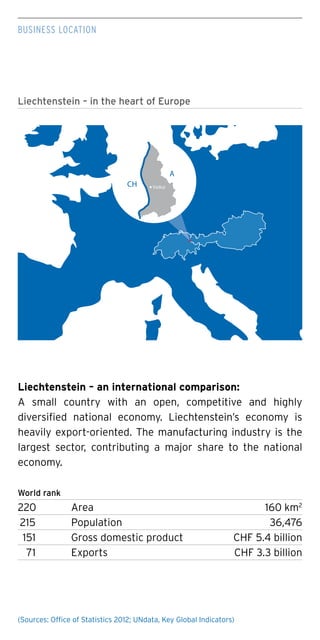
Liechtenstein – in the heart of Europe
Liechtenstein – an international comparison:
A small country with an open, competitive and highly
diversified national economy. Liechtenstein’s economy is
heavily export-oriented. The manufacturing industry is the
largest sector, contributing a major share to the national
economy.
World rank
	220	 Area 	 160 km2
	215	 Population 	 36,476
	 151	 Gross domestic product 	 CHF 5.4 billion
	 71	 Exports	 CHF 3.3 billion
(Sources: Office of Statistics 2012; UNdata, Key Global Indicators)
The Liechtenstein financial center
The Principality of Liechtenstein is a constitutional heredi-
tary monarchy on a democratic and parliamentary basis.
The country is situated in the middle of Europe, embed-
ded between Switzerland and Austria on the Alpine Rhine,
with a population of about 36,000. The official language is
German. The Head of State is Reigning Prince Hans-Adam II,
who transferred the state affairs to his son, Hereditary Prince
Alois, in 2004. Liechtenstein is governed by a grand coalition
headed by Prime Minister Klaus Tschütscher.
With its lean, citizen-oriented political system, Liechtenstein
offers a stable legal and social order as well as a tradition-
ally liberal economic order. The solid financial policy of the
country’s public budgets, short administrative channels and
transparent and predictable fiscal and legal frameworks
contribute to the attractiveness of the business location. The
Liechtenstein private sector benefits from the advantages
of its simultaneous membership in the Swiss economic area
and the European Economic Area (EEA) and its access to
highly trained specialists from its neighbouring countries.
Half of the more than 35,000 employees in Liechtenstein are
cross-border commuters.
Financial services constitute the second largest economic
sector, after industry and manufactring The location advan-
tages of the financial center include political continuity,
stability, legal certainty, the high quality of services, the
traditionally high protection of private property and privacy
and many years of experience in private banking and wealth
management.
FINANCIAL center
Tradition
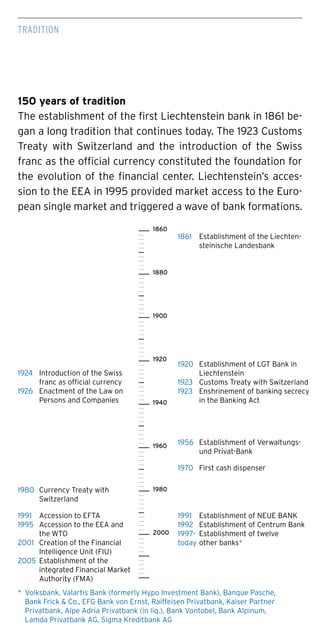
150 years of tradition
The establishment of the first Liechtenstein bank in 1861 be-
gan a long tradition that continues today. The 1923 Customs
Treaty with Switzerland and the introduction of the Swiss
franc as the official currency constituted the foundation for
the evolution of the financial center. Liechtenstein’s acces-
sion to the EEA in 1995 provided market access to the Euro-
pean single market and triggered a wave of bank formations.
1860
1880
1900
1920
1940
1960
1980
2000
1980	 Currency Treaty with
Switzerland
1991	 Establishment of NEUE BANK
1992	 Establishment of Centrum Bank
1997–	 Establishment of twelve
today	other banks*
1991	 Accession to EFTA
1995	 Accession to the EEA and
the WTO
2001	 Creation of the Financial
Intelligence Unit (FIU)
2005	 Establishment of the
integrated Financial Market
Authority (FMA)
1956	 Establishment of Verwaltungs-
und Privat-Bank
1970	 First cash dispenser
1924	 Introduction of the Swiss
franc as official currency
1926	 Enactment of the Law on
Persons and Companies
1920	 Establishment of LGT Bank in
Liechtenstein
1923	 Customs Treaty with Switzerland
1923	 Enshrinement of banking secrecy
in the Banking Act
1861	 Establishment of the Liechten-
steinische Landesbank
*	 Volksbank, Valartis Bank (formerly Hypo Investment Bank), Banque Pasche,
Bank Frick & Co., EFG Bank von Ernst, Raiffeisen Privatbank, Kaiser Partner
Privatbank, Alpe Adria Privatbank (in liq.), Bank Vontobel, Bank Alpinum,
Lamda Privatbank AG, Sigma Kreditbank AG
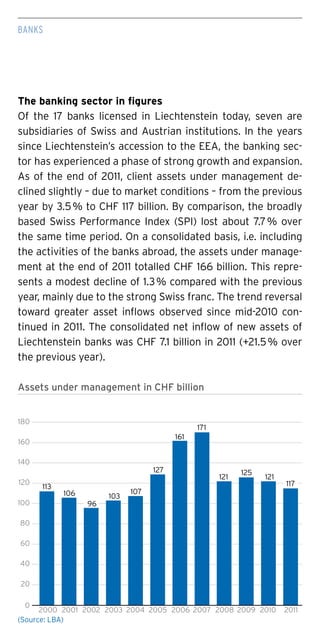
The banking sector in figures
Of the 17 banks licensed in Liechtenstein today, seven are
subsidiaries of Swiss and Austrian institutions. In the years
since Liechtenstein’s accession to the EEA, the banking sec-
tor has experienced a phase of strong growth and expansion.
As of the end of 2011, client assets under management de-
clined slightly – due to market conditions – from the previous
year by 3.5 % to CHF 117 billion. By comparison, the broadly
based Swiss Performance Index (SPI) lost about 7.7 % over
the same time period. On a consolidated basis, i.e. including
the activities of the banks abroad, the assets under manage-
ment at the end of 2011 totalled CHF 166 billion. This repre-
sents a modest decline of 1.3 % compared with the previous
year, mainly due to the strong Swiss franc. The trend reversal
toward greater asset inflows observed since mid-2010 con-
tinued in 2011. The consolidated net inflow of new assets of
Liechtenstein banks was CHF 7.1 billion in 2011 (+21.5 % over
the previous year).
Assets under management in CHF billion
0
20
40
60
80
100
120
140
160
180
2000 2001 2002 2003 2004 2005
113
106 103
107
127
121 121
125
2006 2007 2008 2009 2010
117
2011
161
171
96
Banks
(Source: LBA)
The financial sector – one of the main pillars
of Liechtenstein’s national economy
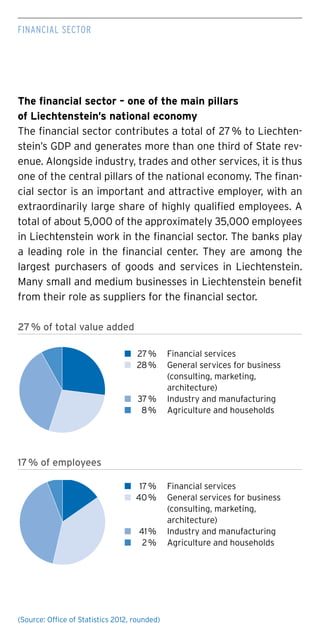
The financial sector contributes a total of 27 % to Liechten-
stein’s GDP and generates more than one third of State rev-
enue. Alongside industry, trades and other services, it is thus
one of the central pillars of the national economy. The finan-
cial sector is an important and attractive employer, with an
extraordinarily large share of highly qualified employees. A
total of about 5,000 of the approximately 35,000 employees
in Liechtenstein work in the financial sector. The banks play
a leading role in the financial center. They are among the
largest purchasers of goods and services in Liechtenstein.
Many small and medium businesses in Liechtenstein benefit
from their role as suppliers for the financial sector.
27 % of total value added
n	 27 %	 Financial services
n	 28 %	 General services for business
(consulting, marketing,
architecture)
n	 37 %	 Industry and manufacturing
n	 8 %	 Agriculture and households
17 % of employees
n	 17 %	 Financial services 	
n	 40 %	 General services for business
(consulting, marketing,
architecture) 	
n	 41 %	 Industry and manufacturing
n	 2 %	 Agriculture and households
Financial sector
(Source: Office of Statistics 2012, rounded)
International comparison of the economic significance
of the financial and banking center
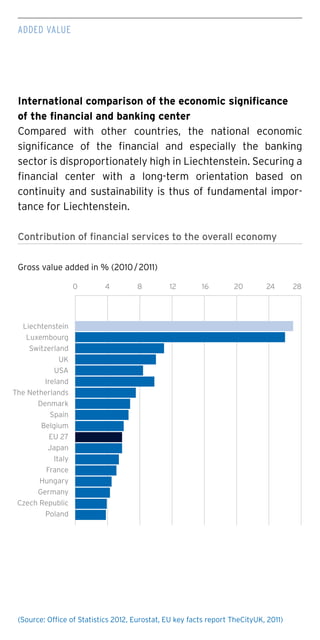
Compared with other countries, the national economic
significance of the financial and especially the banking
sector is disproportionately high in Liechtenstein. Securing a
financial center with a long-term orientation based on
continuity and sustainability is thus of fundamental impor-
tance for Liechtenstein.
Contribution of financial services to the overall economy
Gross value added in % (2010 / 2011)
Liechtenstein
Luxembourg
Switzerland
UK
USA
Ireland
The Netherlands
Denmark
Spain
Belgium
EU 27
Japan
Italy
France
Hungary
Germany
Czech Republic
Poland
0 4 8 12 16 20 24 28
(Source: Office of Statistics 2012, Eurostat, EU key facts report TheCityUK, 2011)
Added value
The Liechtenstein banking center –
niche player in a global market	
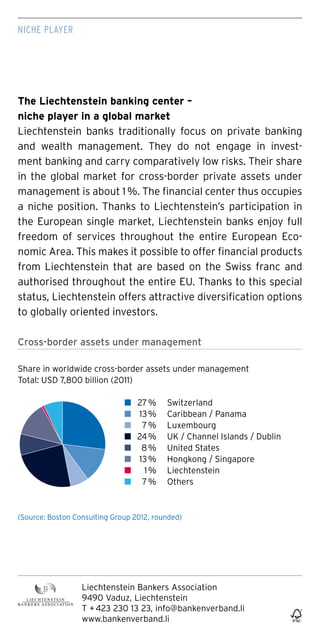
Liechtenstein banks traditionally focus on private banking
and wealth management. They do not engage in invest-
ment banking and carry comparatively low risks. Their share
in the global market for cross-border private assets under
management is about 1%. The financial center thus occupies
a niche position. Thanks to Liechtenstein’s participation in
the European single market, Liechtenstein banks enjoy full
freedom of services throughout the entire European Eco-
nomic Area. This makes it possible to offer financial products
from Liechtenstein that are based on the Swiss franc and
authorised throughout the entire EU. Thanks to this special
status, Liechtenstein offers attractive diversification options
to globally oriented investors.
Cross-border assets under management
Share in worldwide cross-border assets under management
Total: USD 7,800 billion (2011)
n	 27 %	 Switzerland
n	 13 %	 Caribbean / Panama
n	 7 %	 Luxembourg
n	 24 %	 UK / Channel Islands / Dublin
n	 8 %	 United States
n	 13 %	 Hongkong / Singapore
n	 1 %	 Liechtenstein
n	 7 %	 Others
(Source: Boston Consulting Group 2012, rounded)
Niche player
Liechtenstein Bankers Association
9490 Vaduz, Liechtenstein
T + 423 230 13 23, info@bankenverband.li
www.bankenverband.li
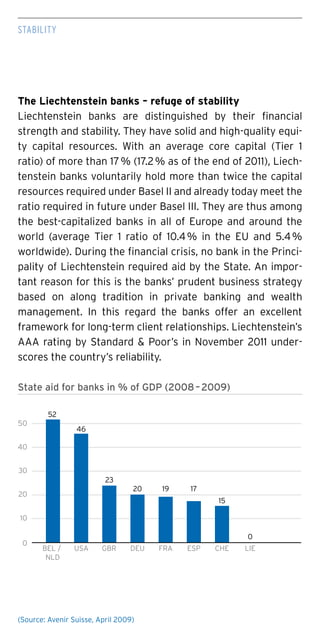
Stability
The Liechtenstein banks – refuge of stability
Liechtenstein banks are distinguished by their financial
strength and stability. They have solid and high-quality equi-
ty capital resources. With an average core capital (Tier 1
ratio) of more than 17 % (17.2 % as of the end of 2011), Liech-
tenstein banks voluntarily hold more than twice the capital
resources required under Basel II and already today meet the
ratio required in future under Basel III. They are thus among
the best-capitalized banks in all of Europe and around the
world (average Tier 1 ratio of 10.4 % in the EU and 5.4 %
worldwide). During the financial crisis, no bank in the Princi-
pality of Liechtenstein required aid by the State. An impor-
tant reason for this is the banks’ prudent business strategy
based on along tradition in private banking and wealth
management. In this regard the banks offer an excellent
framework for long-term client relationships. Liechtenstein’s
AAA rating by Standard & Poor’s in November 2011 under-
scores the country’s reliability.
State aid for banks in % of GDP (2008 – 2009)
(Source: Avenir Suisse, April 2009)
BEL /
NLD
USA GBR DEU FRA
52
46
23
19 17
0
10
20
30
40
50
15
0
ESP CHE LIE
20
QUALITY
Competence, know-how and high quality of services in
the financial sector
As a small, specialized financial center, Liechtenstein com-
bines many years of practical experience with know-how in
private banking and wealth management. Professional ad-
vice and a high quality of services are the traditional
strengths and success factors of Liechtenstein banks. The
banks are able to draw on a pool of specialists from Liechten-
stein and abroad.
Thanks to the vicinity of the University of Liechtenstein and
its Institute for Financial Services as well as close ties with
various foreign providers of basic and continuing training
relevant to banking, the financial center can draw on finan-
cial expertise and high quality offerings in research and
teaching.
In the field of basic and continuing training, the banks invest
substantial effort in the future of highly trained young tal-
ents. At Liechtenstein banks, an average of approximately
100 young women and men receive basic training at any
given time. In 2003, the Swiss Bankers Association estab-
lished the Center for Young Professionals in Banking (CYP),
a competence and training center for young banking talents.
One of these centers was also set up in Liechtenstein in
August 2005. This ensures a high standard of training in the
field of non-academic education as well.
Sustainability
Innovation and responsibility
The Liechtenstein banking center promotes the develop-
ment of future-oriented products and business models that
do justice to clients’ great sense of responsibility toward
society and the environment. Two examples of innovative
ideas in this field are the Microfinance Initiative Liechten-
stein and the LIFE Climate Foundation Liechtenstein.
Microfinance Initiative Liechtenstein (MIL)
The MIL is an association to which the Liechtenstein Govern-
ment, the Bankers Association, and other private and public
promoters belong and which serves to promote Liechten-
stein’s engagement in the field of microcredits. Microfinance
makes an effective and entrepreneurial contribution to the
fight against poverty. Microfinance institutions provide finan-
cial services to people who are not perceived as clients by tra-
ditional financial institutions. The MIL promotes microcredits
and helps to position Liechtenstein as an active and compe-
tent actor in the field of microfinance.	 www.microfinance.li
LIFE Climate Foundation Liechtenstein
LIFE stands for “Liechtenstein Initiative of the Financial
Center in Emissions Trading”. As a charitable foundation, the
initiative has been given clear contours and a face for pre-
senting itself to the outside world. The goal of LIFE is to raise
and strengthen awareness of climate protection and sustain-
ability. This includes promoting market-based climate and
environmental mechanisms for achieving the global climate
protection goals set out in the Kyoto Protocol. With the par-
ticipation of the private sector, academia and policy, the LIFE
Climate Foundation Liechtenstein is a private-public partner-
ship networking the important actors and innovation trig-
gers in the field of sustainability and bringing them to the
same table. 	 www.climatefoundation.li
Regulation and supervision
Modern and EU-compliant financial market regulation
Thanks to Liechtenstein’s EEA membership, the same legal
requirements apply to banks in Liechtenstein as in all EU
countries. As of the end of October 2011, Liechtenstein
achieved an exemplary implementation ratio of 99.6 % of
the EU single market directives according to the EFTA Sur-
veillance Agency (ESA). According to the International Mon-
etary Fund (IMF), Liechtenstein fulfils “high standards in
financial market supervision and anti-money-laundering
measures”. The Liechtenstein financial center is actively
engaged in the fight against money laundering and terrorist
financing and has fully implemented the Third EU Money
Laundering Directive Liechtenstein efficiently offers com-
prehensive and reliable mutual legal assistance in criminal
matters. Banking secrecy offers no protection for criminal
machinations. About 90 % of mutual legal assistance pro-
ceedings were concluded in a period of less than six months.
Liechtenstein thus maintains a leading position in the
defense against criminal acts through compliance with inter-
national obligations.
Recognized financial market supervision
Liechtenstein’s Financial Market Authority has been a regu-
lar member of the International Organization of Securities
Commissions (IOSCO) since April 2011 and has had observer
status in the European Securities and Markets Authority
(ESMA) since May 2011. This shows that Liechtenstein and its
financial center and supervision are recognized as an equal
partner within the international and European community.
At the same time, this further strengthens the integration of
the financial center and facilitates market access for Liech-
tenstein intermediaries in foreign markets.
Cooperation
International cooperation in tax matters
For some time now, Liechtenstein has been on the path
toward stronger international integration and cooperation in
tax matters. Already in 2002, Liechtenstein concluded a mu-
tual legal assistance treaty with the United States. With the
Savings Tax Agreement of 2005, Liechtenstein adopted the
EU Savings Tax Directive. On 12 March 2009, Liechtenstein
issued the “Liechtenstein Declaration”, committing itself to
the OECD standards on cooperation in tax matters. Liechten-
stein thus accepts and implements the internationally valid
rules of transparency and information exchange in tax
matters. Meanwhile, Liechtenstein has concluded OECD-
compatible tax agreements with numerous countries and
has consistently expanded its network of double taxation
agreements (for more information, see www.regierung.li).
On the basis of these agreements, Liechtenstein authorities
can henceforth exchange information upon specific request
and justified suspicion with foreign tax authorities in indi-
vidual cases of tax offences. Information exchange upon re-
quest is not the same as automatic access to client data or
insufficiently specified searches for information or evidence
(so-called “fishing expeditions”). These continue to be ruled
out by Liechtenstein law.
The protection of privacy is compatible with the OECD stand-
ards. Stronger tax cooperation does not contradict banking
secrecy understood as protection of the privacy of clients
and their data from unjustified access by third parties. Bank-
ing secrecy will therefore continue to ensure the protection
of privacy and the control of clients over their own data.
Future-oriented
Sustainable, long-term strategy for the future
In February 2011, the Liechtenstein financial center adopted a
new strategy for the future and will further expand its position
as a professional, stable and sustainable financial center in the
heart of Europe. In this way, the financial center aims at
continuing to provide an attractive environment for clients
and to remain competitive for the long term.
For this purpose, the financial center is building on its al-
ready existing strengths such as legal certainty and stability.
At the same time, it already today has excellent additional
framework conditions that make it unique:
•	 One Stop Shop: The combination and networking of banks,
insurances, funds, company structures and asset manage-
ment make integral, comprehensive and tailor-made
wealth management solutions possible.
•	 Liberal company law: Liechtenstein’s company law is dis-
tinguished by the wide range of company forms and a high
degree of liberalism compared with other countries.
•	 Modern, attractive and competitive tax system.
•	 Market access to Switzerland and the European single
market: The access to two economic areas is unique world-
wide and offers opportunities for Liechtenstein intermedi-
aries as a gateway to Europe and a hub between Switzer-
land and Europe
Thanks to the combination of these framework conditions
and strengths as well as the high degree of innovation and
efficiency, the financial center will continue to be able to
provide tailor-made products and excellent services to de-
manding, internationally oriented clients. In March 2012 the
English magazine Spear’s praised and honored the Liechten-
stein financial center as the “Most Innovative International
Financial Center”.

Liechtenstein Banking Report Edition 2012

  • 1.
  • 2.
    Business location Liechtenstein –in the heart of Europe Liechtenstein – an international comparison: A small country with an open, competitive and highly diversified national economy. Liechtenstein’s economy is heavily export-oriented. The manufacturing industry is the largest sector, contributing a major share to the national economy. World rank 220 Area 160 km2 215 Population 36,476 151 Gross domestic product CHF 5.4 billion 71 Exports CHF 3.3 billion (Sources: Office of Statistics 2012; UNdata, Key Global Indicators)
  • 3.
    The Liechtenstein financialcenter The Principality of Liechtenstein is a constitutional heredi- tary monarchy on a democratic and parliamentary basis. The country is situated in the middle of Europe, embed- ded between Switzerland and Austria on the Alpine Rhine, with a population of about 36,000. The official language is German. The Head of State is Reigning Prince Hans-Adam II, who transferred the state affairs to his son, Hereditary Prince Alois, in 2004. Liechtenstein is governed by a grand coalition headed by Prime Minister Klaus Tschütscher. With its lean, citizen-oriented political system, Liechtenstein offers a stable legal and social order as well as a tradition- ally liberal economic order. The solid financial policy of the country’s public budgets, short administrative channels and transparent and predictable fiscal and legal frameworks contribute to the attractiveness of the business location. The Liechtenstein private sector benefits from the advantages of its simultaneous membership in the Swiss economic area and the European Economic Area (EEA) and its access to highly trained specialists from its neighbouring countries. Half of the more than 35,000 employees in Liechtenstein are cross-border commuters. Financial services constitute the second largest economic sector, after industry and manufactring The location advan- tages of the financial center include political continuity, stability, legal certainty, the high quality of services, the traditionally high protection of private property and privacy and many years of experience in private banking and wealth management. FINANCIAL center
  • 4.
    Tradition 150 years oftradition The establishment of the first Liechtenstein bank in 1861 be- gan a long tradition that continues today. The 1923 Customs Treaty with Switzerland and the introduction of the Swiss franc as the official currency constituted the foundation for the evolution of the financial center. Liechtenstein’s acces- sion to the EEA in 1995 provided market access to the Euro- pean single market and triggered a wave of bank formations. 1860 1880 1900 1920 1940 1960 1980 2000 1980 Currency Treaty with Switzerland 1991 Establishment of NEUE BANK 1992 Establishment of Centrum Bank 1997– Establishment of twelve today other banks* 1991 Accession to EFTA 1995 Accession to the EEA and the WTO 2001 Creation of the Financial Intelligence Unit (FIU) 2005 Establishment of the integrated Financial Market Authority (FMA) 1956 Establishment of Verwaltungs- und Privat-Bank 1970 First cash dispenser 1924 Introduction of the Swiss franc as official currency 1926 Enactment of the Law on Persons and Companies 1920 Establishment of LGT Bank in Liechtenstein 1923 Customs Treaty with Switzerland 1923 Enshrinement of banking secrecy in the Banking Act 1861 Establishment of the Liechten- steinische Landesbank * Volksbank, Valartis Bank (formerly Hypo Investment Bank), Banque Pasche, Bank Frick & Co., EFG Bank von Ernst, Raiffeisen Privatbank, Kaiser Partner Privatbank, Alpe Adria Privatbank (in liq.), Bank Vontobel, Bank Alpinum, Lamda Privatbank AG, Sigma Kreditbank AG
  • 5.
    The banking sectorin figures Of the 17 banks licensed in Liechtenstein today, seven are subsidiaries of Swiss and Austrian institutions. In the years since Liechtenstein’s accession to the EEA, the banking sec- tor has experienced a phase of strong growth and expansion. As of the end of 2011, client assets under management de- clined slightly – due to market conditions – from the previous year by 3.5 % to CHF 117 billion. By comparison, the broadly based Swiss Performance Index (SPI) lost about 7.7 % over the same time period. On a consolidated basis, i.e. including the activities of the banks abroad, the assets under manage- ment at the end of 2011 totalled CHF 166 billion. This repre- sents a modest decline of 1.3 % compared with the previous year, mainly due to the strong Swiss franc. The trend reversal toward greater asset inflows observed since mid-2010 con- tinued in 2011. The consolidated net inflow of new assets of Liechtenstein banks was CHF 7.1 billion in 2011 (+21.5 % over the previous year). Assets under management in CHF billion 0 20 40 60 80 100 120 140 160 180 2000 2001 2002 2003 2004 2005 113 106 103 107 127 121 121 125 2006 2007 2008 2009 2010 117 2011 161 171 96 Banks (Source: LBA)
  • 6.
    The financial sector– one of the main pillars of Liechtenstein’s national economy The financial sector contributes a total of 27 % to Liechten- stein’s GDP and generates more than one third of State rev- enue. Alongside industry, trades and other services, it is thus one of the central pillars of the national economy. The finan- cial sector is an important and attractive employer, with an extraordinarily large share of highly qualified employees. A total of about 5,000 of the approximately 35,000 employees in Liechtenstein work in the financial sector. The banks play a leading role in the financial center. They are among the largest purchasers of goods and services in Liechtenstein. Many small and medium businesses in Liechtenstein benefit from their role as suppliers for the financial sector. 27 % of total value added n 27 % Financial services n 28 % General services for business (consulting, marketing, architecture) n 37 % Industry and manufacturing n 8 % Agriculture and households 17 % of employees n 17 % Financial services n 40 % General services for business (consulting, marketing, architecture) n 41 % Industry and manufacturing n 2 % Agriculture and households Financial sector (Source: Office of Statistics 2012, rounded)
  • 7.
    International comparison ofthe economic significance of the financial and banking center Compared with other countries, the national economic significance of the financial and especially the banking sector is disproportionately high in Liechtenstein. Securing a financial center with a long-term orientation based on continuity and sustainability is thus of fundamental impor- tance for Liechtenstein. Contribution of financial services to the overall economy Gross value added in % (2010 / 2011) Liechtenstein Luxembourg Switzerland UK USA Ireland The Netherlands Denmark Spain Belgium EU 27 Japan Italy France Hungary Germany Czech Republic Poland 0 4 8 12 16 20 24 28 (Source: Office of Statistics 2012, Eurostat, EU key facts report TheCityUK, 2011) Added value
  • 8.
    The Liechtenstein bankingcenter – niche player in a global market Liechtenstein banks traditionally focus on private banking and wealth management. They do not engage in invest- ment banking and carry comparatively low risks. Their share in the global market for cross-border private assets under management is about 1%. The financial center thus occupies a niche position. Thanks to Liechtenstein’s participation in the European single market, Liechtenstein banks enjoy full freedom of services throughout the entire European Eco- nomic Area. This makes it possible to offer financial products from Liechtenstein that are based on the Swiss franc and authorised throughout the entire EU. Thanks to this special status, Liechtenstein offers attractive diversification options to globally oriented investors. Cross-border assets under management Share in worldwide cross-border assets under management Total: USD 7,800 billion (2011) n 27 % Switzerland n 13 % Caribbean / Panama n 7 % Luxembourg n 24 % UK / Channel Islands / Dublin n 8 % United States n 13 % Hongkong / Singapore n 1 % Liechtenstein n 7 % Others (Source: Boston Consulting Group 2012, rounded) Niche player Liechtenstein Bankers Association 9490 Vaduz, Liechtenstein T + 423 230 13 23, info@bankenverband.li www.bankenverband.li
  • 9.
    Stability The Liechtenstein banks– refuge of stability Liechtenstein banks are distinguished by their financial strength and stability. They have solid and high-quality equi- ty capital resources. With an average core capital (Tier 1 ratio) of more than 17 % (17.2 % as of the end of 2011), Liech- tenstein banks voluntarily hold more than twice the capital resources required under Basel II and already today meet the ratio required in future under Basel III. They are thus among the best-capitalized banks in all of Europe and around the world (average Tier 1 ratio of 10.4 % in the EU and 5.4 % worldwide). During the financial crisis, no bank in the Princi- pality of Liechtenstein required aid by the State. An impor- tant reason for this is the banks’ prudent business strategy based on along tradition in private banking and wealth management. In this regard the banks offer an excellent framework for long-term client relationships. Liechtenstein’s AAA rating by Standard & Poor’s in November 2011 under- scores the country’s reliability. State aid for banks in % of GDP (2008 – 2009) (Source: Avenir Suisse, April 2009) BEL / NLD USA GBR DEU FRA 52 46 23 19 17 0 10 20 30 40 50 15 0 ESP CHE LIE 20
  • 10.
    QUALITY Competence, know-how andhigh quality of services in the financial sector As a small, specialized financial center, Liechtenstein com- bines many years of practical experience with know-how in private banking and wealth management. Professional ad- vice and a high quality of services are the traditional strengths and success factors of Liechtenstein banks. The banks are able to draw on a pool of specialists from Liechten- stein and abroad. Thanks to the vicinity of the University of Liechtenstein and its Institute for Financial Services as well as close ties with various foreign providers of basic and continuing training relevant to banking, the financial center can draw on finan- cial expertise and high quality offerings in research and teaching. In the field of basic and continuing training, the banks invest substantial effort in the future of highly trained young tal- ents. At Liechtenstein banks, an average of approximately 100 young women and men receive basic training at any given time. In 2003, the Swiss Bankers Association estab- lished the Center for Young Professionals in Banking (CYP), a competence and training center for young banking talents. One of these centers was also set up in Liechtenstein in August 2005. This ensures a high standard of training in the field of non-academic education as well.
  • 11.
    Sustainability Innovation and responsibility TheLiechtenstein banking center promotes the develop- ment of future-oriented products and business models that do justice to clients’ great sense of responsibility toward society and the environment. Two examples of innovative ideas in this field are the Microfinance Initiative Liechten- stein and the LIFE Climate Foundation Liechtenstein. Microfinance Initiative Liechtenstein (MIL) The MIL is an association to which the Liechtenstein Govern- ment, the Bankers Association, and other private and public promoters belong and which serves to promote Liechten- stein’s engagement in the field of microcredits. Microfinance makes an effective and entrepreneurial contribution to the fight against poverty. Microfinance institutions provide finan- cial services to people who are not perceived as clients by tra- ditional financial institutions. The MIL promotes microcredits and helps to position Liechtenstein as an active and compe- tent actor in the field of microfinance. www.microfinance.li LIFE Climate Foundation Liechtenstein LIFE stands for “Liechtenstein Initiative of the Financial Center in Emissions Trading”. As a charitable foundation, the initiative has been given clear contours and a face for pre- senting itself to the outside world. The goal of LIFE is to raise and strengthen awareness of climate protection and sustain- ability. This includes promoting market-based climate and environmental mechanisms for achieving the global climate protection goals set out in the Kyoto Protocol. With the par- ticipation of the private sector, academia and policy, the LIFE Climate Foundation Liechtenstein is a private-public partner- ship networking the important actors and innovation trig- gers in the field of sustainability and bringing them to the same table. www.climatefoundation.li
  • 12.
    Regulation and supervision Modernand EU-compliant financial market regulation Thanks to Liechtenstein’s EEA membership, the same legal requirements apply to banks in Liechtenstein as in all EU countries. As of the end of October 2011, Liechtenstein achieved an exemplary implementation ratio of 99.6 % of the EU single market directives according to the EFTA Sur- veillance Agency (ESA). According to the International Mon- etary Fund (IMF), Liechtenstein fulfils “high standards in financial market supervision and anti-money-laundering measures”. The Liechtenstein financial center is actively engaged in the fight against money laundering and terrorist financing and has fully implemented the Third EU Money Laundering Directive Liechtenstein efficiently offers com- prehensive and reliable mutual legal assistance in criminal matters. Banking secrecy offers no protection for criminal machinations. About 90 % of mutual legal assistance pro- ceedings were concluded in a period of less than six months. Liechtenstein thus maintains a leading position in the defense against criminal acts through compliance with inter- national obligations. Recognized financial market supervision Liechtenstein’s Financial Market Authority has been a regu- lar member of the International Organization of Securities Commissions (IOSCO) since April 2011 and has had observer status in the European Securities and Markets Authority (ESMA) since May 2011. This shows that Liechtenstein and its financial center and supervision are recognized as an equal partner within the international and European community. At the same time, this further strengthens the integration of the financial center and facilitates market access for Liech- tenstein intermediaries in foreign markets.
  • 13.
    Cooperation International cooperation intax matters For some time now, Liechtenstein has been on the path toward stronger international integration and cooperation in tax matters. Already in 2002, Liechtenstein concluded a mu- tual legal assistance treaty with the United States. With the Savings Tax Agreement of 2005, Liechtenstein adopted the EU Savings Tax Directive. On 12 March 2009, Liechtenstein issued the “Liechtenstein Declaration”, committing itself to the OECD standards on cooperation in tax matters. Liechten- stein thus accepts and implements the internationally valid rules of transparency and information exchange in tax matters. Meanwhile, Liechtenstein has concluded OECD- compatible tax agreements with numerous countries and has consistently expanded its network of double taxation agreements (for more information, see www.regierung.li). On the basis of these agreements, Liechtenstein authorities can henceforth exchange information upon specific request and justified suspicion with foreign tax authorities in indi- vidual cases of tax offences. Information exchange upon re- quest is not the same as automatic access to client data or insufficiently specified searches for information or evidence (so-called “fishing expeditions”). These continue to be ruled out by Liechtenstein law. The protection of privacy is compatible with the OECD stand- ards. Stronger tax cooperation does not contradict banking secrecy understood as protection of the privacy of clients and their data from unjustified access by third parties. Bank- ing secrecy will therefore continue to ensure the protection of privacy and the control of clients over their own data.
  • 14.
    Future-oriented Sustainable, long-term strategyfor the future In February 2011, the Liechtenstein financial center adopted a new strategy for the future and will further expand its position as a professional, stable and sustainable financial center in the heart of Europe. In this way, the financial center aims at continuing to provide an attractive environment for clients and to remain competitive for the long term. For this purpose, the financial center is building on its al- ready existing strengths such as legal certainty and stability. At the same time, it already today has excellent additional framework conditions that make it unique: • One Stop Shop: The combination and networking of banks, insurances, funds, company structures and asset manage- ment make integral, comprehensive and tailor-made wealth management solutions possible. • Liberal company law: Liechtenstein’s company law is dis- tinguished by the wide range of company forms and a high degree of liberalism compared with other countries. • Modern, attractive and competitive tax system. • Market access to Switzerland and the European single market: The access to two economic areas is unique world- wide and offers opportunities for Liechtenstein intermedi- aries as a gateway to Europe and a hub between Switzer- land and Europe Thanks to the combination of these framework conditions and strengths as well as the high degree of innovation and efficiency, the financial center will continue to be able to provide tailor-made products and excellent services to de- manding, internationally oriented clients. In March 2012 the English magazine Spear’s praised and honored the Liechten- stein financial center as the “Most Innovative International Financial Center”.