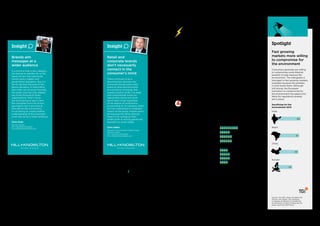
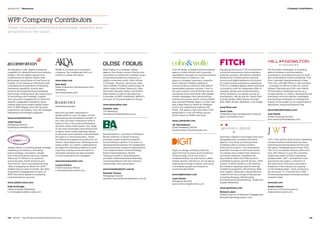
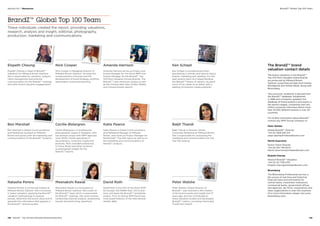
12 percent brand value
increase marks shift from
recovery to growth
Year of transformation, consolidation and disruption
Methodology and valuation by
1 2 3 4 5 6 18 19 20 21 22 23 24 25 26 27 28 29 30
34
545556575859
100
FAST GROWING
MARKETS
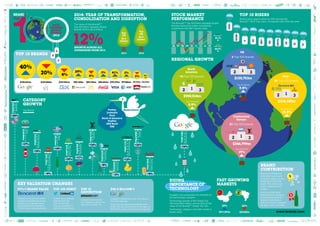
2014: YEAR OF TRANSFORMATION,
CONSOLIDATION AND DISRUPTION
10% 16%
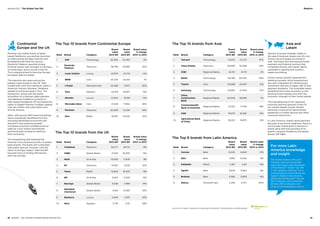
Google’s rise symbolizes the strength of
the technology category.
Technology brands in the Global Top
100 total $827 billion, almost 30% of the
value of the BrandZ™ Global Top 100.
Technology category rose 16% overall in
brand value.
Top Brand
The value of the BrandZ™
Top 100 Most Valuable Global
Brands 2014 is $2.9 trillion.
Top
100
$2.6
trillion
Top
100
$2.9
trillion
20142013
Twitter
LinkedIn
Ford
Bank of America
PayPal
ING Bank
UBS
Newcomers
The BrandZTM
Top 100 Most Valuable Global
Brands share price index consistently
outperform the S&P market index.
Brand value appreciated by 54% among the
BrandZ™ 2014 Top risers, compared with 44% last year.
TENCENT
+97%
+68%
+61% +61%
+58% +56% +56% +55% +53% +51%
06 07 08 09 10 11 12 13 14
81.1%
44.7%
BrandZ™
SPP 500
$271,893m $29,490m
TOP 10 BRANDS
$158,843m $147,880m $107,541m $90,185m $85,706m $80,683m $79,197m $77,883m $67,341m $64,255m
CATEGORY
GROWTH
REGIONAL GROWTH
STOCK MARKET
PERFORMANCE
TOP 10 RISERS
GlobalBanks
Apparel
$99,599m
$123,800m
$251,351m
$72,306m
$171,621m
$66,207m
$111,758m
$330,427m
$111,528m
$280,975m
$841,482m
$109,033m
RegionalBanks
Beer
FastFood
Insurance
Luxury
Telecoms
PersonalCare
Retail
Oil&Gas
SoftDrinks
Technology
Cars
$138,856m
Brand Contribution
indicates how much
of brand value can be
attributed to brand
itself. The index runs
from 1 (low) up to 5
(high).
Luxury is the most
represented category
in the top brands by
Brand Contribution
with 6 brands, followed
by beer with 2 brands.
GROWTH ACROSS ALL
CATEGORIES FROM 2013
8283848586878889909192939495969799 7 8 9 10 11 12 13 15 16 1714 31 32 33
35363738394041424344454647484950515253
6061626364656667686970717273747677787980 7581
98
$330,427m
BRAND
CONTRIBUTION
RISING
IMPORTANCE OF
TECHNOLOGY
KEY VALUATION CHANGES
Google increased the most in $ value in
the 2014 rankings.
It has also increased significantly since
2006, $121.4b, second only to the gain of
$131.9b by Apple during the same period.
$45.2 BILLION
Tencent, the Chinese social
network and Internet portal,
led the list of fastest risers
overtaking China Mobile as
China’s most valuable brand.
97% BRAND VALUE
Twitter and LinkedIn
entered the Top
100 for the first
time, at numbers 71
and 78, respectively.
TOP 100 DEBUT
Amazon became the
first retailer to enter the
Top 10 at number 10.
TOP 10
DISTINCTION
$142,103m
FACEBOOK
BT
IKEA
UNIQLO
FORD
MOVISTAR
NIKE
DHL
CVS
+29%
+17% +16% +16%
+16%
+15%
+6%
+14%
+10%
+11%
+8%
+3% +4%
+12%
www.brandz.com
5%
3% 3%
3% 41%
41%
4%
29%
40%
20%
North
America
5.9%
50 Top 100 brands
$959,514m
Top 10 brands
312
Continental
Europe
19%
23 Top 100 brands
$246,799m
Top 10 brands
312
UK
5.4%
6 Top 100 brands
$155,753m
Top 10 brands
12 3
Asia
15.8%
20 Top 100 brands
$314,188m
Top 10 brands
312
About Millward Brown
Millward Brown is a leading global research
agency specializing in advertising effectiveness,
strategic communication, media and brand
equity research. Millward Brown helps clients
grow great brands through comprehensive
research-based qualitative and quantitative
solutions. Specialist global practices include
Millward Brown Digital (a leader in digital
effectiveness and intelligence), Firefly Millward
Brown (our global qualitative network), a
Neuroscience Practice (using neuroscience
to optimize the value of traditional research
techniques), and Millward Brown Optimor
(a strategy consultancy helping companies
maximize financial returns on brand and
marketing investments). Millward Brown operates
in more than 55 countries and is part of Kantar,
WPP’s data investment management division.
www.millwardbrown.com
Travyn Rhall
CEO
travyn.rhall@millwardbrown.com
If the 9th annual edition of the BrandZ™
Top 100 Most Valuable Global Brands
tells us anything, it is that the recession
is over.
We are delighted to share the latest valuation data gathered by
Millward Brown on behalf of WPP using the proprietary valuation
method of Millward Brown Optimor. It shows that the combined
brand value of the world’s most important brands has risen by 12
percent to $2.9 trillion. This follows a 7 percent improvement the
previous year.
BrandZ™ has cemented itself as an invaluable resource to help
businesses understand how their financial health is intrinsically-
linked to, and enhanced by, brand building. After a few dark years
the evidence is clear that the world’s strongest brands are leading
the global recovery.
We are providing data from 150,000 interviews with consumers
from around the world and the insights, as always, are fascinating.
The 2014 edition reveals that the combined value of the BrandZ™
Global Top 100 has almost doubled in eight years. Since 2006,
the stock market value of the BrandZ™ Strong Brands portfolio,
a sub-set of the main survey, has appreciated by 81 percent
over the same period.
Unique to our approach is the recognition that in all markets
a small number of consumers account for a large proportion
of sales. Loyal consumers are more valuable to a brand than
occasional users, a crucial factor when analyzing brand value.
The Top 100 also confirms that more favorable economic
conditions have helped traditional Western brands improve
their valuations, which means fewer brands from fast-growing
economies are represented. Brands that are in business for
reasons beyond the bottom line are also more likely to have
increased their value.
Not surprisingly technology brands dominate the top positions
and there is a new number one. Google has knocked Apple off its
perch after three years at the top. Apple is performing well but is
it still redefining technology for consumers? What is obvious is
that the value of technology brands reiterates how they are now
an integral part of our lives.
Apparel is the fastest growing category with the Top 10 apparel
brands growing by 29 percent, but all brands must continue to
innovate and excite consumers to drive their businesses forward,
something Google excels at. There is no room for complacency on
quality or customer service as a brand’s reputation can be dented
in seconds through the power of social media.
Looking at some of the brands with greatest future potential,
as well as Apple and Google, Facebook remains an innovative
brand people cannot do without and Amazon is constantly
expanding its ecosystem. IKEA has successfully positioned itself
as different and great value rather than cheap, while MTN is
growing rapidly in African markets buoyed by its mission to help
people. Red Bull is an experiential lifestyle brand defining
differentiation, while there are huge international opportunities
for PingAn Insurance, an entrepreneurial private brand. Two
other brands with great potential in 2014 are Construction Bank
of China and Verizon, which bought out Vodafone.
At Millward Brown, we are proud to produce the BrandZ™
Top 100 and be part of an amazing organisation like WPP, which
exists to help businesses improve their competitiveness and
profitability by devising and implementing effective marketing,
advertising and brand strategies. The insights from around the
world revealed within the latest BrandZ™ Top 100 are valuable
nuggets of consumer understanding that will help businesses
grow the value of their brands in 2014 and beyond.
Warmest regards,
Travyn Rhall
Chief Executive Officer
Millward Brown
Welcome
4  BrandZ™ Top 100 Most Valuable Global Brands 2014 5
Introduction
6  BrandZ™ Top 100 Most Valuable Global Brands 2014 7
Introduction
Contents
	 01 Highlights
10	 Introduction
13	 Key Results
16	 Cross-Category Trends
19	 Take Aways
20	 Thought Leadership
Is Your Brand Ready to be Like Jeeves?
By Nigel Hollis, Chief Global Analyst Millward Brown
22	 Thought Leadership
Diversion: A Route to Disruption
By Eric Duchamp, CEO PeclersParis
	 02 The Global Top 100
26	 The BrandZ™ Global Top 100 Ranking
30	 Overview
32	 Top Risers
34	 Newcomers
35	 Category Changes
38	 Brand Contribution
40	 Regions
46	 Social Media Special Report
The BrandZ™ Verve Index
By Ali Rana, SVP and Head Scientist Emerging Media Lab
50	Thought Leadership
Delivering Seamless Consumer Experience in
an Age of Disruption
By Scott Symonds, Managing Director of Media AKQA
52	 Thought Leadership
The Product Paradox: Why Making Apps Usually Hurts
Brands and How You Can Do Better
By Shane Atchison, CEO and Jason Burby, President,
Americas POSSIBLE
	 03 The Categories
	 Consumer and Retail
56	 Apparel
60	 Cars
64	 Luxury
68	 Personal Care
72	 Retail
76	Thought Leadership
A Seamless Transition Towards Retail Theater
By Ian Gourley, Chief Creative Officer Barrows
78	 Thought Leadership
Seven Principles for a More Useful Brand Valuation
By Joanna Seddon, Global Brand Consulting OgilvyRed,
Ogilvy  Mather
	 Food and Drink
80	 Beer
84	 Fast Food
88	 Soft Drinks
92	Thought Leadership
My Brands. My Self.
By Jonathan Dodd, Global Chief Strategy Officer
Geometry Global
94	 Thought Leadership
The Data-Driven Pursuit of the Inconstant Consumer
By Ali Rana, SVP and Head Scientist Emerging Media Lab
	 Financial
96	 Banks
102	 Insurance
	 Commodities
106	 Oil  Gas
110	 Thought Leadership
Commerce 4.0: Devices, Data and Decision Time
By Sue Pratt, Head of Marketing Salmon
112	 Thought Leadership
Transformation through Technology
By Stephen Pretorius,
President Acceleration
	 Technology
114	 Technology
120	 Telecom Providers
124	Thought Leadership
Rise and Fall: Exploring the Brand Life Cycle
By Aleksandra Iljina, Senior Analyst Developer and
Duncan Stoddard, Account Manager Mindshare
	 04 Resources
128	 BrandZ™ Valuation Methodology
130	 BrandZ™ Reports, Apps and iPad Magazines
132	 WPP Resources
134	 WPP Company Contributors
140	 WPP Brand Building Experts
142	 BrandZ™ Global Top 100 Team
143	 BrandZ™ Valuation Contact Details
Introduction
01Highlights
8  BrandZ™ Top 100 Most Valuable Global Brands 2014 9
Section 01  |  Highlights Introduction
Key Results
Cross-Category Trends
Take Aways
Percentvaluegrowth
10.6%
06 07 08 09 10 11 12 13 14
00
0.5
1.0
USDBillion
1.5
2.0
2.5
3.0
3.5
APR 06 APR 07 APR 08 APR 09 APR 10 APR 11 APR 12 APR 13 APR 14
-60
-40
-20
20
40
60
80
100
BrandZ™ Strong
Brands Portfolio
SP 500
21.2% 0.8%
4.4%
17.1% 0.4%
7.0%
12.0%
Introduction
Introduction
All categories rise in brand value as
Global Top 100 improves 12 percent
In a year of real growth, brands experience
transformation, consolidation and disruption
The BrandZ™ Top 100 Most Valuable
Global Brands 2014 added $310 billion
to reach $2.9 trillion in brand value,
a 12 percent increase.
Prior to the BrandZ™ Global 2014 results,
the Top 100 had increased an average
of about 6 percent, $125 billion, annually
since the financial crisis of 2008
and 2009.
This year, led by apparel, with a 29
percent overall increase, all categories
rose in brand value. And 10 of 14
categories experienced double-digit
growth, indicating that brands across
the economy have moved beyond
recovery into a period of new growth.
Only 18 of the Top 100 brands lost value
compared with an average of 31 brands
in each annual BrandZ™ Global Top 100
report since the financial crisis.
The resurgent economies of North
America and Europe drove brand value
growth as the BRIC markets slowed.
Only 14 brands from fast growing
economies made the 2014 BrandZ™
Global Top 100 ranking compared with
17 brands a year ago.
Despite the BRIC slowdown, Chinese
brands increased their impact. The
number of Chinese brands in the Top 100
declined by one to 11, but that’s up from
only two in 2006. In addition:
— With a 40 percent rise in brand value,
Google claimed the number one rank
from Apple, which held the position
since 2011 when it surpassed Google.
— Twitter, LinkedIn, and PayPal
appeared in the BrandZ™ Top 100
for the first time.
— Tencent, the Internet portal and social
network, led the fastest risers, almost
doubling in brand value. Baidu, the
search engine appreciated 46 percent,
indicating the growing influence of
Chinese brands.
— Facebook was the second fastest riser
with brand value increasing 68 percent.
Amazon entered the BrandZ™ Global
Top 10 for the first time, with a 41
percent brand value increase to
$64.3billion.
— Technology continued to dominate
with nearly a third of the total brand
value and around a fifth of the brands,
including the top four – Google, Apple,
IBM and Microsoft.
Growth brings new
challenges
The two key factors that influenced the
12 percent growth surge – technology
innovations and consumer confidence –
also created some of the challenges
categories experienced.
Consumers were willing to spend money
and they did, even on high-ticket items
like cars and luxury. But chastened by
a period of relative frugality and
empowered by rapidly changing
technology, particularly mobile,
consumers changed how they shopped
and purchased. They waited for the
best prices and purchased more
mindfully, with concerns about health
and the environment.
Retail experienced perhaps the most
dramatic impact, as consumers conflated
the physical and online shopping worlds,
expecting a new kind of convenience that
delivers the wide range available online
with best prices and the immediate
gratification of physical stores.
Clear that retailing would no longer
be about physical stores alone,
retailers scaled back their portfolios
of locations, repurposed existing space
and invested in technology to make
the shopping online and in physical
stores a seamless experience.
In luxury, some brands learned that
they’d become too accessible in an
effort to drive sales during the economic
slowdown. They worked on achieving
the best balance of accessibility and
exclusivity in stores and online.
Carmakers loaded the newest
models with technology for safety
and entertainment. But conditioned
by their mobile devices, car buyers
sometimes expected even more
technology to be available in cars
with the speed of a download.
Categories feel impact of
Millennials, social media
This effort to understand and meet the
demands of customers touched
financial institutions, not always known
for customer centricity. Global banks
increased services and warmed their
messaging, although levels of trust
remained low. Insurers developed
systems to respond to customers
one-to-one in relevant ways rather
than with mass, product driven efforts.
Even categories affected by consumer
health concerns appreciated in brand
value, but at a slower pace. Fast food,
which continued to work through the
pressure of health concerns, improved
10 percent. Soft drinks grew 4 percent
although the consumption of CSDs
(Carbonated Soft Drinks) declined for
the ninth consecutive year in the US.
Telecoms experienced consolidation and
price disruption pressure but brand value
improved 8 percent. The oil and gas
category experienced the lowest brand
value growth, 3 percent, because of
slowed investment in exploration. In
every category, brands increased activity
in social media to engage consumers in
innovative ways. (Please see the BrandZ™
Verve Index, a special report on social
media on page 46).
In addition, the attitudes of Millennials,
individuals born roughly between 1981
and 1999, also touched most categories.
These consumers are more likely to
prefer a craft beer, bank and shop on
a mobile device, choose vitamin water
over cola and eat healthier fast food, but
not exclusively. And they’re less likely to
buy insurance or own a car, either
because they prefer sharing or don’t
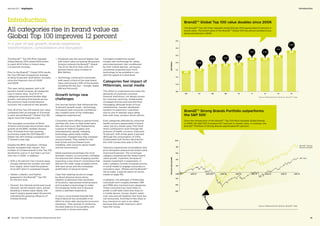
have the money. Source: Millward Brown Optimor, BrandZ™ data
Source: Millward Brown Optimor, BrandZ™ data
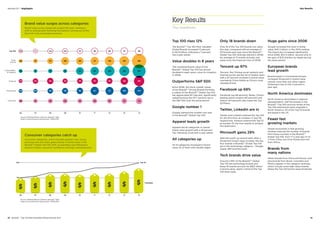
BrandZ™ Strong Brands Portfolio outperforms 	
the SP 500
Since the introduction of the BrandZ™ Top 100 Most Valuable Global Brands
in 2006, the SP 500 increased 44.7 percent in market value. In contrast, the
BrandZ™ Portfolio of Strong Brands appreciated 81.1 percent.
BrandZ™ Global Top 100 value doubles since 2006
The BrandZ™ Top 100 Most Valuable Global Brands 2014 appreciated 12 percent in
brand value. The brand value of the BrandZ™ Global 100 has almost doubled since
being introduced in 2006.
10  BrandZ™ Top 100 Most Valuable Global Brands 2014 11
Section 01  |  Highlights
100
200
06 07 08 09 10 11 12 13 14
Commodities
 Logistics
Financial
Technology
Top 100
Consumer
06 07 08 09 10 11 12 13 14
Top 10
Food
 drink
Consumer
100
100 117 161 208 196 217 249 256 369
100 97 113 102 201 221 264 266 342
100 112 126 129 123 129 128 143 164
100 142 166 133 146 172 155 195 269
100 105 143 158 169 217 211 205 244
111 134 135 141 165 166 177 198
Source: Millward Brown Optimor, BrandZ™ data
Index of annual brand value growth, 2006=100
Key Results
The headlines
Top 100 rises 12%
The BrandZ™ Top 100 Most Valuable
Global Brands increased 12 percent,
to $2.9 trillion, following a 7 percent
rise a year earlier.
Value doubles in 8 years
The combined brand value of the
BrandZ™ Global Top 100 has almost
doubled in eight years, since its inception
in 2006.
Outperforms SP 500
Since 2006, the stock market values
of the BrandZ™ Strong Brands Portfolio,
a subset of the BrandZ™ Global Top 100,
has appreciated 81.1 percent, significantly
outperforming the 44.7 percent rise in
the SP 500 over the same period.
Google number 1
Google claimed the number one rank
in the BrandZ™ Global Top 100.
Apparel leads growth
Apparel led all categories in overall
brand value growth with a 29 percent
rise, following 21 percent a year earlier.
All categories up
All 14 categories increased in brand
value, 10 of them with double-digits.
Only 18 brands down
Only 18 of the Top 100 brands lost value
this year, compared with an average of
30 brands each year since the BrandZ™
Global Top 100 rankings started in 2006.
An average of 31 brands annually lost
value since the financial crisis of 2008.
Tencent up 97%
Tencent, the Chinese social network and
Internet portal, led the list of fastest risers
with a 97 percent increase in brand value,
overtaking China Mobile as China’s most
valuable brand.
Facebook up 68%
Facebook (up 68 percent), Baidu, China’s
leading search engine (46 percent) and
Yahoo! (44 percent) also made the Top
20 Risers.
Twitter, LinkedIn are in
Twitter and LinkedIn entered the Top 100
for the first time, at numbers 71 and 78,
respectively. Amazon entered the Top 10
at number 10, the first retailer to achieve
this distinction.
Microsoft gains 29%
With Microsoft up several slots, after a
29 percent brand value increase, the top
four brands in BrandZ™ Global Top 100
are in the technology category – Google,
Apple, IBM and Microsoft.
Tech brands drive value
Around a fifth of the BrandZ™ Global
Top 100 are technology brands and
these 18 brands account for $827 billion
in brand value, nearly a third of the Top
100 total value.
Huge gains since 2006
Google increased the most in dollar
value, $45.2 billion, in the 2014 ranking.
The brand also increased significantly
since 2006, $121.4 billion, second only to
the gain of $131.9 billion by Apple during
the same period.
European brands 	
lead growth
Brands based in Continental Europe
increased 19 percent in brand value
overall, more than any other region,
following a rise of only 5 percent a
year ago.
North America dominates
North America dominated in regional
representation. Half the brands in the
BrandZ™ Top 100 and two-thirds of the
Top 100 total brand value originate in
North America. All of the Top 10 brands
are based in the US.
Fewer fast 	
growing markets
Slower economies in fast growing
markets reduced the number of brands
from those counties in the BrandZ™
Global Top 100, from 17 a year ago to 14,
11 from China, two from Russia and one
from Africa.
Brands from 	
many nations
Other brands from China and Russia, and
also brands from Brazil, Colombia and
Mexico appear in the category rankings,
which include some high-value brands
below the Top 100 brand value threshold.
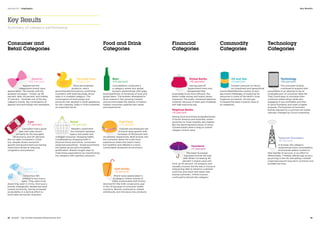
Source: Millward Brown Optimor, BrandZ™ data
Index of annual brand value growth, 2006=100
Brand value surges across categories
Brand value across categories surged this year, marking a
shift to solid growth following fluctuations coming out of the
financial crisis and global recession.
Consumer categories catch up
Consumer categories, which includes apparel, cars, luxury,
personal care and retail, grew sharply in brand value in the
BrandZ™ Global Top 100 2014, as spending rose following a
period of shaky consumer confidence and high unemployment.
Key Results
12  BrandZ™ Top 100 Most Valuable Global Brands 2014 13
Section 01  |  Highlights
Apparel
+29 percent
Apparel led the
categoriesin brand value
appreciation. The brands with the
greatest increases – Uniqlo, up 58
percent; Nike, 55 percent; and Adidas,
47 percent – illustrate one of the key
category trends, the convergence of
apparel and technology into wearables.
Consumer and
Retail Categories
Cars
+17 percent
Carmakers had a good
year with sales driven
primarily by the resurgent
US economy and UK demand.
But car sales increased in China,
too, despite slower economic
growth and government purchasing
restrictions aimed at reducing
congestion and pollution.
Luxury
+16 percent
Consumers felt
entitled to buy luxury
again. They were more
discerning, even in China. And luxury
brands strategically rebalanced back
toward exclusivity, having increased
accessibility in a tactical effort to
build sales during the recession.
Personal Care
+12 percent
More personalized
products, men’s
grooming and innovations combining
cosmetics with pharmacology drove
sales in a crowded category. The
convergence of technology and
personal care resulted in small appliances
for skin cleaning. Sales in China remained
an important factor.
Retail
+16 percent
Retailers confronted
the mismatch between
legacy real estate and
changed consumer shopping habits.
Conditioned by shopping both in
physical stores and online, consumers
expected everything – broad assortment,
the lowest prices and immediate
gratification. Brands sought ways to
meet these expectations by transforming
the category with seamless solutions.
Food and Drink
Categories
Beer
+14 percent
Consolidation continued in
a category where four global
brewers predominate with large
brand portfolios of hundreds of local and
global beers. The brewers attempted to
drive volume in fast growing markets
and accommodate the desires of mature
market consumers seeking new tastes
and experiences.
Fast Food
+10 percent
Chipotle and Starbucks led
in brand value growth with
increases of 48 percent and
44 percent, respectively. Both brands met
the consumer desire for a fast food
experience where the meal is tasty
but healthier and offered in a more
comfortable restaurant environment.
Soft Drinks
+4 percent
Brand value appreciated in
a category where volume of
CSDs (Carbonated Soft Drinks)
declined for the ninth consecutive year
in the US because of consumer health
concerns. Brands continued to market
ambitiously and introduce new products.
Financial
Categories
Global Banks
+15 percent
Having paid off
government loans and
reorganized their
businesses to be more efficient, the
banks made money and brand values
improved. The public remained skeptical,
however, because of bank past misdeeds
and high executive pay.
Regional Banks
+6 percent
Strong local economies propelled banks
in North America and Australia, where
proximity to Asian markets also helped.
But the declining band values of some
Chinese banks were a drag on overall
category brand value.
Insurance
+11 percent
The major European
insurance brands did well,
with Allianz increasing 48
percent in brand value and
AXA up 44 percent. US property and
casualty insurers led the way in trying to
analyze big data to enhance customer
centricity and reach and retain new,
young customers. Online insurers
continued to disrupt the category.
Commodity
Categories
Oil and Gas
+3 percent
Investor pressure on return
on investment and geopolitical
events intensified the routine oil and
gas brand challenges of exploring for
resources in some of the earth’s most
fragile environments. Oil and gas
increased the least in brand value of
all categories.
Technology
Categories
Technology
+16 percent
The consumer brands
continued to expand their
ecosystems in an attempt to be an
invaluable part of consumer daily life.
They found ways to monetize their
customer relationships while also
engaging in less profitable activities
to serve humanity and claim a higher
purpose. The business-to-business
brands adjusted to a commercial model
radically changed by Cloud computing.
Telecom Providers
+8 Percent
In Europe, the category
experienced more consolidation.
And brands added content to
their bundle of services, in an effort to
differentiate. T-Mobile offered pay-as-you-
go pricing in the US, disrupting a market
organized around long-term contracts and
bundled services.
Key Results
Summary of category performance
Key Results
14  BrandZ™ Top 100 Most Valuable Global Brands 2014 15
Section 01  |  Highlights
Cross-Category Trends
The forces building and disrupting brands
and categories
Trust
Consumers expect brands to keep their
promises. Some categories have
disappointed. Coming out of the global
financial crisis, many banks strengthened
capitalization, sharpened their business
focus, revised codes of ethics and
improved communication with
customers. But with the revelation of
new and past misdeeds trust cracked
like a fragile shell.
Lost trust damages brands, as apparel
maker Lululemon discovered when the
stretch fabric of some of its products
performed poorly and the company
initially blamed customers for the fault.
GM and Toyota sustained public
rebuke when they failed to maintain
safety standards.
The price of lost trust varies. Bank
reputations declined, but the difficulty
in switching helped limit the business
impact. Not all categories are so
protected by customer inertia. Strong
brands are better able to sustain
fluctuations in trust.
Share of life
Brands aim to gain greater share of
wallet. But many forward thinking brands
are now looking to achieve that goal by
increasing share of life, being present in
more ways to make a customer’s life
better or simpler.
The major ecosystems – Apple, Google
and Amazon – serve as models for
surrounding consumers with product,
services and content. But brands in
diverse categories are engaged with
customers, in useful and brand relevant
ways, across many aspects of their lives.
The Home Depot and Lowe’s provide
home improvement financing. Walmart
offers financial services. The Chinese
Internet brand leaders, Tencent, Baidu
and Alibaba, are building online banking
centers and mobile payment systems.
Tesco and the Latin American retailer
Falabella are MVNOs (Mobile Virtual
Network Operators), renting capacity
from telecoms and branding a mobile
service to gain a greater customer
share of life.
Share of life helps broaden and deepen
the bond between customer and brand.
This relationship potentially benefits the
customer with improved service and the
brand with additional sales.
Seamlessness
Shopping was multi-channel. Then it
was omni-channel. Now it needs to be
a seamless, consistent experience
whenever and wherever the consumer is
dreaming about purchasing, exploring
possibilities or transacting business.
Accomplishing this goal may be
challenging and complicated. But by
definition, seamlessness means that the
brand makes the transitions between
physical and virtual invisible to the
consumer who’s interested in the results
not the process. And seamlessness
centers on the customer.
Personalization
Too ubiquitous, designer logos no longer
validate how the consumer sees herself
or wants to be seen. Self-expression is in.
In the luxury category, popularity
increased for interesting jewelry, not
simply the traditional precious gems, but
other colorful, distinctive stones that
consumers chose for their uniqueness.
The celebration of uniqueness was
evident in the extensive personal care
product ranges for hair and skin types
serving a more inclusive ideal of beauty. Customization
Grande soy iced vanilla latte may
summarize customization, but the trend
doesn’t end with Starbucks. McDonald’s
plans to simplify and customize its menu
for the mealtime preferences of various
consumer groups, such as Millennials
and families. In soft drinks, a category
driven by CSDs (Carbonated Soft Drinks),
consumption is declining and Coke
is customizing.
It’s going beyond its Freestyle vending
machine that enables customers to mix
ingredients and make about 100 varieties
of soft drink. In an arrangement with
Green Mountain Coffee, the company
that makes single-serve coffee pods,
Coke is developing a machine for
customizing soda at home.
Technology to make driving safer
or more enjoyable adds more
customizing options in a category
known for customization.
Convenience
Conditioned by the economic slowdown
and their experience with in-store and
online shopping, consumers expected
everything – the range available online
with the immediacy of physical stores
and the best possible price.
Many European hypermarkets and other
retailers evolved their click and collect
models for ordering online and picking
up in-store.
In the latest iteration, shoppers order
online and pick up items, often on the
way home from work, at conveniently
located drive-thru warehouses.
Authenticity
Sometimes the most compelling aspect
of a brand is the product itself. To accrue
economies of scale the major brewers
generally produce beer near where it’s
consumed rather than where the brand
originated. But sometimes the brewers
balance this business imperative with the
need for brand authenticity.
The major global brewer SABMiller makes
Peroni, its Italian brand, in Italy, charging
a premium to cover the additional cost.
Heineken sold in the US is brewed in
Denmark. Luxury brands stressed
provenance as part of what makes them
authentic and exclusive.
Multi-functionality
The importance of multi-functionality
reflects the multi-tasking way many
people live their lives. SUVs (Sport Utility
Vehicles) combine basic transportation
with room for cargo. Soft drinks quench
thirst but often while adding a functional
benefit, an energy boost or vitamin
supplement. Apparel provides protection
but it can also monitor metabolism.
Localization
Like the yin-yang of high tech and high
touch, global and local are
complementary influences for brands
to balance. Certain categories, such as
fast food, soft drinks and beer, build
global scale and consistency, adjusting
for local tastes.
Local is gaining in importance. It implies
quality and reliability along with
originality and attention to detail not
associated with mass production. The
rise of craft beer and the resurgence of
ale in the UK reflect this trend. Local
food sourcing is another example.
Cross-Category Trends
16  BrandZ™ Top 100 Most Valuable Global Brands 2014 17
Section 01  |  Highlights
Healthiness
Consumer concern with health both
challenges and propels brands. In soft
drinks, CSD (Carbonated Soft Drink)
consumption continued to decline.
In fast foods, McDonald’s added healthier
items, while Chipotle made higher quality
food its brand positioning and Subway
emphasized freshness.
Chipotle rose 48 percent in brand value.
Since the inception of the BrandZ™ Top
100 Most Valuable Global Brands in
2006, the Subway brand has experienced
the greatest percentage increase in
brand value, 7,338 percent.
Retailer Whole Foods, which stresses
its sourcing of organic and sustainable
products, rose 37 percent in brand
value in the 2014 BrandZ™ Global Top
100. During the national conversation
about health care in the US, the drug
store brand CVS renounced its $2 billion
tobacco business as incompatible with its
brand purpose as a health provider.
Technology
Technology impacted every category
with innovation or disruption or both.
Retailers reduced real estate portfolios
of stores and explored technologies to
make the experience in the physical and
online stores unique, useful and seamless.
Wearables, like Google glasses, signaled
the early days of the convergence of
technology with apparel. Telematic
devices that monitor driving habits
potentially can disrupt the insurance
category. Carmakers loaded cars with
technology to improve safety and driving
enjoyment. Car buyers viewed the latest
technology as standard not luxury.
Technology disrupted the technology
category itself as business-to-business
brands, built around PCs, struggled to
adjust to the intensified competition and
a world of mobile devices.
01
Know each customer
It’s time to revise the adage the
customer comes first. Today, each
customer comes first. Working
to achieve that goal will improve
business. It’s about analyzing
dots of data that together reveal
each customer’s shopping needs.
In the insurance category, many
brands that created one-size-fits-all
products now are trying to be more
customer centric. They analyze data
to understand individual customers
and identify key lifetime events and
insurance opportunities.
04
Be agile
Planning is important. The stakes
are too high and it’s the rare
brand that improvises its way to
success. But the strategy drafted
in the boardroom needs constant
market reality testing. Planning and
flexibility make a good marriage.
08
Stand for a purpose
beyond profit
Given a choice, people want to
associate with brands they feel
good about, brands that “Do no
evil,” as Google asserts. And even
do some good. “Smarter Planet”
works for IBM. But if you’re not
one of the world’s most valuable
brands, it’s OK and more believable
to focus on improving the part
of the planet that you touch.
The purpose needs to be brand
relevant, important to customers
and pursued diligently.
02
Be meaningfully
different
Being different in a meaningful way
means that customers understand
the brand and the advantages that
it offers relative to the competition.
It’s not easy to establish meaningful
difference. But it’s important as
one of the crucial drivers of brand
equity, the influence a brand has
over the inclination to purchase.
05
Stay relevant
There’s an ongoing tension
between respecting a brand’s
heritage and keeping the brand
up to date. Keeping the brand up
to date doesn’t mean presenting
the brand as something it isn’t. It’s
great if a brand story is exciting and
inspiring. But it’s most important
that the story is fact, not fiction.
10
Invest in brands
There’s a quantifiable return on
investment in brands. Some of the
return is felt at the register. Some
of it is in the share price. In the
eight years since we introduced the
BrandZ™ Top 100 Most Valuable
Global Brands, our BrandZ™ Strong
Brand Portfolio has appreciated
81.1 percent compared with a 44.7
improvement in the SP 500.
03
Be mindfully present
In a world noisy with brand
messages it can be difficult
to be seen and heard. Digital
and social media are important
places to represent the brand.
But use discretion. Be present
where it makes sense for the
brand. Intruding uninvited into
conversations risks seeming like a
clueless party guest. The encounter
might be memorable but unhelpful.
Comment when it’s appropriate and
be authentic.
06
Keep your eyes open
Spend time on thought leadership.
As brands navigate through
transformation, consolidation and
disruption, knowledge is vital. It’s
useful to see what’s going on in
other places, particularly in the fast
growing markets where sometimes,
because necessity is greater, so
is invention. The use of mobile for
payments and banking in China is
one important example.
09
Employ technology
for competitive
advantage
In most categories technology
is either a driver or disrupter or
both. The fusion of apparel and
technology into wearables is one
example. Because the impact
of technology is unavoidable
today, brands face a clear choice:
risk finding ways to achieve an
advantage using technology, or
do nothing and risk that your
competitors will do something.
07
Execute
The last few years were good
for planning and putting in place
new strategies, as consumers
caught their breath and regained
confidence following the financial
collapse and recession. Consumers
are back. It’s time to execute.
Take Aways
10 insights for growing brand value
Payment options
Payment in several categories shifted
to a disruptive pay-as-you-use model.
Amazon and other Cloud providers
sold access on an as-needed basis,
replacing the licensing arrangements
that enterprise customers maintained
with business-to-business technology
companies.
In the US, T-Mobile introduced a pay-as-
you-use arrangement to a market where
telecom providers traditionally locked in
customers for two-year contracts.
Among the trends impacting car
ownership is the growing popularity of
pay-as-you-use car sharing schemes
that make vehicles available for hire by
the hour.
Men shoppers
Men had confined their luxury purchases
to watches and cars. Today they’re
interested in well-tailored shirts and
suits. Men’s grooming is one of the
fastest growing segments of the personal
care category.
Retail shelves once devoted to razors and
shave cream in aerosol cans now include
facial creams and other pampering
products. The packaging in dark colors
signifies masculinity and differentiates
from the women’s products. Among the
drivers of this trend are cultural habits
coming from Asia. In Korea, for example,
men are fine with wearing makeup.
Luxury brands such as Gucci, Prada and
Burberry are opening stores devoted
exclusively to men.
Take Aways
18  BrandZ™ Top 100 Most Valuable Global Brands 2014 19
Section 01  |  Highlights
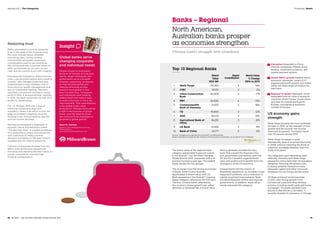
“I endeavor to give satisfaction, Sir.” Jeeves proves
his worth on first meeting Bertie by proffering a
“little preparation” in order to remedy the after-
effects of a night on the town and subsequently
proves not only invaluable but infallible. This is a
tough act to follow. The bigger the role a brand has
in people’s lives the bigger the risk of failure. This
is particularly important when a brand extends its
reach across product or service categories. People
do not separate out different incarnations of the
brand in the same way that a business does. Tesco’s
financial and mobile phone services are just as
much part of the experience of the Tesco brand as
shopping at one of its stores. Do your homework
and make sure your new offering lives up to the
experience of the existing ones or it may undermine
the whole franchise.
“The mood will pass sir.” Jeeves sometimes takes
a dislike to one of Bertie’s latest affectations: a
new mustache, vase or a pair of breeches Jeeves
considers suitable only for the musical hall. When
he does so, Jeeves manages to subtly shape his
master’s whims for the better. He has a clear set of
values and sets in motion a series of actions that
will result in a change of mind and behavior. Many
brands could learn from his example. Rather than
simply exhorting people to buy, they need to step
back and consider exactly what associations and
feelings they need to change in order to get people
to choose their brand.
To imitate Jeeves, marketers will require the same
intimate understanding of people’s requirements
that Jeeves has of his master’s. Brands need to
anticipate people’s needs and desires, not just
respond to direct requests. If successful in doing so
then the brand will have established a meaningful
place in people’s consciousness, one that allows it to
take a bigger share of their lives.
IS YOUR
BRAND
READY TO
BE LIKE
JEEVES?
Reginald Jeeves, valet to the wealthy and
affected Bertie Wooster, is probably author P.
G. Wodehouse’s most iconic character. Jeeves is
imperturbable in the face of a crisis, resourceful and
well-informed. He deals with his master’s needs with
suave confidence and subtly shapes events to save
his employer from embarrassment.
Why are we talking about a fictional character in
the context of brands? Because the many brands
seeking to expand their roles to take a bigger share
of our lives would do well to imitate Jeeves. People
are willing to give brands a greater role in their
lives only if they empower them, and do so without
imposition or undue fanfare.
The brands seeking to increase their influence in
this way are following in the footsteps of giants
like Apple, Amazon or Nike. These brands have
managed to extend their ecosystem so that their
products and services are integrally intertwined
with multiple aspects of our lives. Apple spans our
needs for entertainment, music and productivity.
Amazon fulfills our need for convenience with
effortless one-click shopping and relevant
purchase recommendations for stuff we never
knew we wanted. Nike, with its Nike+ Fuelband, has
transformed itself from a mere apparel brand to a
companion and coach for runners.
The assumption that having a greater share of
consumer’s lives will have positive benefits for the
brand may well prove incorrect if the brand cannot
emulate Jeeves. So, with that in mind here are three
things brands might learn from the venerable valet.
“I was given to understand that you required a
valet.” Jeeves offered his services to Bertie Wooster
in the knowledge that there was a need for them. No
matter how much brands might want to be part of
someone’s life, they need to make sure that there is
a real need for what they have to offer and that the
recipient believes them capable of rendering that
service. A broad positioning that does not limit the
brand to a specific category improves the brand’s
ability to expand its footprint in our lives.
Nigel Hollis
Chief Global Analyst
Millward Brown
Nigel.hollis@millwardbrown.com
Millward Brown is a leading global research agency specializing
in advertising effectiveness, strategic communication, media and
brand equity research. Millward Brown helps clients grow great
brands through comprehensive research-based qualitative and
quantitative solutions.
Specialist global practices include Millward Brown Digital (a
leader in digital effectiveness and intelligence), Firefly Millward
Brown (our global qualitative network), a Neuroscience Practice
(using neuroscience to optimize the value of traditional research
techniques), and Millward Brown Optimor (a strategy consultancy
helping companies maximize financial returns on brand and
marketing investments). Millward Brown operates in more
than 55 countries and is part of Kantar, WPP’s data investment
management division. Learn more at www.millwardbrown.com.
20  BrandZ™ Top 100 Most Valuable Global Brands 2014 21
Section 01  |  Thought Leadership
Our recent trend research highlights that, as a result
of the lengthy economic crisis, defiance and anxiety
about the future are rife. Across Europe, people feel
that they are trapped in a vicious cycle of austerity.
As a result, a new dynamic is emerging: individuals
now aspire to control their own destinies. In their
efforts to do so, they are challenging and reinventing
the codes, norms, stereotypes and rules, which
now feel oppressive and seem a reflection of a
failing system.
This global inclination towards diversion favors a
general wish for disruption, especially among
younger generations. In the behaviors that illustrate
these “diversion tactics” we see a desire to embrace
change in order to rise above the daily routine, or
better yet, reinvent the future. As part of this trend,
absurdity, irony, nonsense and cynicism are being
used as weapons of subversion. Infiltrating all layers
of society and fueled by the viral power of social
networks, these attitudes are transforming the world
into a gigantic disruptive public space.
These tactics also include the display of more
uninhibited behaviors and inner impulses that
explore and push boundaries. There is a growing
fascination for ambiguous genres, and controversial
and imaginary realms that blur the lines between
good and bad. These behaviors have become an
outlet through which individuals can express fears,
dislikes and desires, and as escape mechanisms they
are powerful routes to resilience.
Exploring consumers’ new
attitudes and expectations
Resilient behaviors Resilience is the ability to
overcome difficult times. It is today seen in the
growing promotion and celebration of personal
failings: marital (divorce parties in Japan and the
USA) or professional (the “fun employment”
phenomenon). It aims to break the models imposed
by modern society (the cult of efficiency and
performance at all costs) and expose the inanity of
certain norms, belief systems and preconceptions.
Augmenting the moment There is a strong desire
to make the most of ‘now’. Surprise, fun, happiness,
humor and optimism are powerful ways to disrupt
the routine and fight day-to-day stress.
Engaging in communion In a society long marked
by individualism, the viral power of social networks
is rekindling a desire for collective exchange, freed
of taboos and frontiers. Tapping into this means
creating real or digital places and symbolic
gatherings that serve as outlets for release, as
well as new forms of social cohesion.
Embracing new archetypes The expression of
individual singularity will prompt the remodeling of
traditional archetypes and socio-cultural codes.
Some phenomena are already disrupting old
models: a new dynamic of female empowerment,
a new definition of masculinity, new perceptions
of genders, new relationships with beauty and
the body…
All this raises the question of how brands should
respond to these new attitudes. In part, the answer
is to demonstrate their understanding of the
disruptive trend and interpret and adapt their
messaging accordingly. For example by:
Disrupting Communication
codes
Adopting humoristic or ironic tones to denounce
outdated models, customs, or conventions and
generate “buzz.”
Not being afraid to deliver a radical take on branding
and advertising, inspired by the casual, quirky tone
of Internet culture.
Diverting markets’ conventions
Using absurdity to prompt innovation and creativity,
which result in communications that, beyond the fun,
are truly relevant.
Twisting traditional points of reference to provoke
mystery, curiosity, surprise and desire.
Using new technologies to fictionalize reality and
augment consumer experience by storytelling at
home, in the streets, and in retail.
Breaking free from archetypes
Taking the lead in playing with the boundaries
between traditional categories: masculine/ feminine,
nature/culture, man /machine.
Such a blueprint will be more easily adopted by
some brands than others. Digital brands – Google,
Apple, Nest – are the pacesetters of disruption.
For fashion brands, reinvention is their lifeblood
and so subversion comes as second nature, witness
Burberry’s high tech ‘Brit’ stores and increasingly
edgy, reportage-style campaigns. Brands that are
valued for their heritage and tradition will need to
navigate these trends with more caution, especially
those that have lost consumer trust, for example
financial services brands – but even they may
take comfort from knowing that the raison d’être
of diversion and disruption is to make anything
seem possible.
DIVERSION –
A ROUTE TO
DISRUPTION
Eric Duchamp
CEO
PeclersParis
eric.duchamp@peclersparis.com
PeclersParis is a unique worldwide trend forecasting, brand
strategy and innovation agency that is expert in fashion, beauty
and cosmetics, home and consumer electronics products. Our
unique expertise is to decrypt socio-cultural and aesthetic trends
and translate them not only into innovative brand strategies but
also into new products’ concepts and design. Founded in 1970.
Based in Paris, New York, Los Angeles, Shanghai, Munich and in 15
other countries. To learn more visit www.perclersparis.com
22  BrandZ™ Top 100 Most Valuable Global Brands 2014 23
Section 01  |  Thought Leadership
02The Global Top 100
24  BrandZ™ Top 100 Most Valuable Global Brands 2014 25
Section 02  |  The Global Top 100
Overview
Top Risers
Newcomers
Category Changes
Brand Contribution
Regions
Top 100 Most Valuable Global Brands 2014 Top 100 Most Valuable Global Brands 2014
Brand Category
Brand value	
2014 $M
Brand	
contribution
Brand value %
change 2014 vs 2013
Rank	
change
26 Cars 29,598 3 21% -3
27 Telecoms 28,756 2 20% 0
28 Global Banks 27,051 3 13% -3
29 Technology 25,892 3 21% 1
30 Luxury 25,873 4 14% -1
31 Fast Food 25,779 3 44% 13
32 Cars 25,730 4 7% -8
33 Regional Banks 25,008 2 -7% -11
34 Apparel 24,579 4 55% 22
35 Beer 24,414 4 20% -1
36 Personal Care 23,356 4 30% 6
37 Apparel 23,140 3 15% -2
38 Regional Banks 22,620 4 13% 0
39 Baby Care 22,598 5 10% -7
40 Retail 22,165 2 20% 1
41 Luxury 21,844 5 14% -1
42 Cars 21,535 4 20% 1
43 Fast Food 21,020 4 26% 8
44 Regional Banks 21,001 3 18% 4
45 Technology 20,913 2 4% -9
46 Telecoms 20,809 2 56% 20
47 Regional Banks 19,950 3 12% -1
48 Oil  Gas 19,745 1 3% -9
49 Technology 19,469 2 19% 5
50 Retail 19,367 3 61% 24
The Brand Value of Coca-Cola includes Lights, Diets and Zero
The Brand Value of Budweiser includes Bud Light
Brand Category
Brand value	
2014 $M
Brand	
contribution
Brand value %
change 2014 vs 2013
Rank	
change
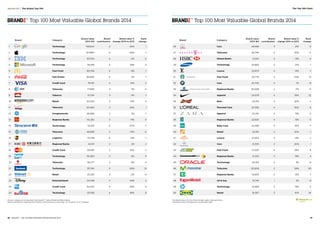
1 Technology 158,843 3 40% 1
2 Technology 147,880 4 -20% -1
3 Technology 107,541 4 -4% 0
4 Technology 90,185 4 29% 3
5 Fast Food 85,706 4 -5% -1
6 Soft Drinks 80,683 4 3% -1
7 Credit Card 79,197 4 41% 2
8 Telecoms 77,883 3 3% -2
9 Tobacco 67,341 3 -3% -1
10 Retail 64,255 3 41% 4
11 Telecoms 63,460 3 20% 1
12 Conglomerate 56,685 2 2% -1
13 Regional Banks 54,262 3 14% 0
14 Technology 53,615 4 97% 7
15 Telecoms 49,899 3 -10% -5
16 Logistics 47,738 4 12% -1
17 Regional Banks 42,101 2 2% -1
18 Credit Card 39,497 3 42% 2
19 Technology 36,390 2 6% 0
20 Telecoms 36,277 3 -9% -3
21 Technology 35,740 4 68% 10
22 Retail 35,325 2 -2% -4
23 Entertainment 34,538 4 44% 3
24 Credit Card 34,430 4 46% 4
25 Technology 29,768 4 46% 8
Source: Valuations include data from BrandZ™, Kantar Retail and Bloomberg.
Brand contribution measures the influence of brand alone on earnings, on a scale of 1 to 5, 5 highest.
China Construction Bank
Starbucks
The Top 100 Chart
26  BrandZ™ Top 100 Most Valuable Global Brands 2014 27
Section 02  |  The Global Top 100
Brand Category
Brand value	
2014 $M
Brand	
contribution
Brand value %
change 2014 vs 2013
Rank	
change
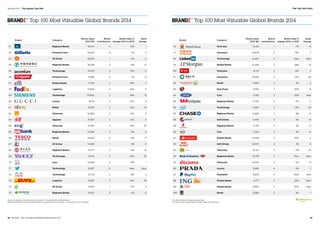
76 Oil  Gas 12,413 1 -7% -11
77 Insurance 12,409 2 18% 7
78 Technology 12,407 4 New New
79 Global Banks 12,356 2 28% 14
80 Telecoms 12,175 3 14% 2
81 Insurance 12,026 2 -21% -24
82 Retail 11,953 3 8% -2
83 Fast Food 11,910 3 20% 8
84 Cars 11,812 3 56% New
85 Regional Banks 11,743 3 17% 3
86 Technology 11,667 2 -15% -25
87 Regional Banks 11,663 3 8% -6
88 Soft Drinks 11,476 3 -5% -13
89 Regional Banks 11,351 2 9% -4
90 Cars 11,104 3 9% -4
91 Global Banks 11,060 3 20% 5
92 Soft Drinks 10,873 4 3% -9
93 Telecoms 10,221 3 -11% -14
94 Regional Banks 10,149 2 New New
95 Telecoms 10,041 2 0% -5
96 Luxury 9,985 4 6% -1
97 Payments 9,833 4 New New
98 Global Banks 9,771 3 29% New
99 Global Banks 9,683 2 30% New
100 Retail 9,584 2 8% -1
The Brand Value of Pepsi includes Diets
The Brand Value of Red Bull includes sugar-free and Cola
Brand Category
Brand value	
2014 $M
Brand	
contribution
Brand value %
change 2014 vs 2013
Rank	
change
51 Regional Banks 19,072 3 15% 1
52 Personal Care 19,025 4 7% -7
53 Oil  Gas 19,005 1 8% -4
54 Regional Banks 18,235 2 -9% -17
55 Technology 18,105 3 10% -2
56 Personal Care 17,668 4 2% -6
57 Global Banks 17,341 2 30% 7
58 Logistics 17,002 4 24% 4
59 Technology 16,800 2 36% 13
60 Luxury 16,131 5 27% 8
61 Retail 15,587 2 -12% -14
62 Telecoms 15,580 3 13% -2
63 Apparel 15,557 2 22% 6
64 Telecoms 15,367 2 61% 30
65 Regional Banks 14,926 3 9% -2
66 Retail 14,842 4 -9% -11
67 Oil  Gas 14,269 1 9% 0
68 Regional Banks 14,177 2 0% -10
69 Technology 14,174 3 44% 23
70 Cars 14,085 3 14% 1
71 Technology 13,837 4 New New
72 Technology 13,710 2 16% 5
73 Logistics 13,687 4 53% 25
74 Oil  Gas 12,871 1 12% 4
75 Regional Banks 12,637 3 0% -5
PetroChina
MTN
Source: Valuations include data from BrandZ™, Kantar Retail and Bloomberg.
Brand contribution measures the influence of brand alone on earnings, on a scale of 1 to 5, 5 highest.
Top 100 Most Valuable Global Brands 2014 Top 100 Most Valuable Global Brands 2014
The Top 100 Chart
28  BrandZ™ Top 100 Most Valuable Global Brands 2014 29
Section 02  |  The Global Top 100
Overview
Value of BrandZ™ Top 100
up 98 percent since 2006
All components of brand equity strengthen,
technology leads in total brands and value
Technology brands dominate the
BrandZ™ Global Top 100
Technology brands have led the	
growth of the BrandZ™ Global Top 100
The 12 percent brand value increase in
the BrandZ™ Top 100 Most Valuable
Global Brands 2014 represents a
resurgence of growth following the
financial downturn in 2008, and a 98
percent increase in value since the
ranking was introduced in 2006.
The technology category, which rose 16
percent in the 2014 BrandZ™ Global 100,
represents nearly a third of the total
brand value and almost a fifth of the
brands. The technology category has
grown 141 percent in brand value since
the ranking began.
Of the Top 10 brands that grew most in
brand value since 2006, five are in the
technology category. During those eight
years, Apple increased in value by $131.9
billion or 826 percent, followed by
Google with a 324 percent or $121.4
billion rise in brand value.
The Top 100 are resilient. Since the
financial crisis, the BrandZ™ Global Top
100 brands have strengthened in each
component of brand equity, which is
the consumer’s predisposition to select
a brand.
The components are: meaningful
(generating appeal or “love”), different
(setting trends that benefit the
consumer) and salient (coming to mind
spontaneously). The BrandZ™ Top 100
Most Valuable Global Brands
significantly outscore other brands
in each component.
Difference and salience
drive and sustain value
In the telecom provider category, where
brands are struggling to differentiate and
be viewed as more than a conduit of
data, UK-based BT rose 61 percent in
brand value and moved up 30 positions
in the ranking.
The brand value rise was driven in part
by acquiring rights to English Premier
Football, adding over two million
new subscribers, a successful
Olympic sponsorship and increasing
revenue. The added value helped justify
premium pricing.
Being different was a key driver for
Amazon, which continued to grow its
consumer share of life, expanding into
food and other businesses, while also
disrupting business-to-business
technology pricing with its Cloud
computing services.
With a 41 percent brand value increase
to $64.3 billion, Amazon entered the
BrandZ™ Global Top 10 for the first time.
Brand salience helped sustain Coca-Cola.
Because of consumer health concerns
the sale of CSDs (Carbonated Soft
Drinks) declined for the ninth consecutive
year in the US. The Coca-Cola brand rose
3 percent, however.
Coca-Cola slipped one spot in the
BrandZ™ Global Top 10, as did
McDonald’s, another salient brand in a
category impacted by consumer health
concerns. At the same time, Microsoft,
a salient technology brand, gained three
places in the ranking on a 29 percent
increase in brand value.
Brands gain in trust and
value metrics
Two other BrandZ™ metrics, TrustR and
ValueD, also help explain brand value
increases. TrustR measures how much
consumers trust a brand (because it
consistently has met its promises in the
past) and the likelihood consumers would
recommend a brand (because it
consistently keeps its promises today).
The three logistics companies ranked in
the BrandZ™ Global Top 100 score high in
TrustR. Each increased significantly in
brand value, led by DHL with a rise of 53
percent, followed by Fedex, 24 percent,
and UPS, 12 percent.
ValueD measures the gap between a
consumer’s desire for a brand and the
consumer’s perception of the price.
The measurement is important because,
coming out of the recession, consumers
are significantly more concerned about
obtaining good value for money.
Responding to this change in consumers
attitude, the BrandZ™ Global Top 100
have improved their desire and price
scores. A high desire score gives a
brand flexibility to be premium priced
or good value.
How brands manage the desire/price
balance depends on the product
category and brand proposition. Some
brands with high desirability, like
Pampers, are able to command a
premium. Consumers view IKEA as
good value for money. IKEA improved
61 percent in brand value.
Category
Brand Value
2014 $M
Brand value %
change 2014
vs 2013
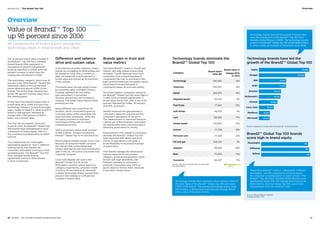
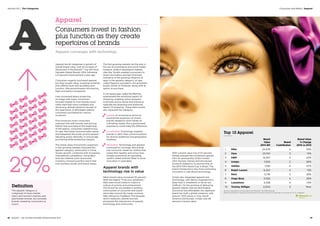
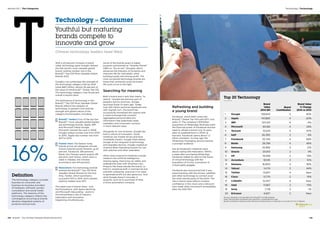
Technology 841,482 16%
Telecoms 330,427 8%
Retail 280,975 16%
Regional banks 251,351 6%
Fast Food 171,621 10%
Soft drinks 142,103 4%
Cars 138,856 17%
Global banks 123,800 15%
Luxury 111,758 16%
Personal care 111,528 12%
Oil and gas 109,033 3%
Apparel 99,599 29%
Beer 72,306 14%
Insurance 66,207 11%
Source: Valuations include data from BrandZ™
and Bloomberg
Apple
Google
IBM
ATT
Amazon
McDonald’s
Verizon
Coca-Cola
Marlboro
Microsoft
Meaningful
Different
Salient
131,904
123
121,398
126
71,457
129
71,203
58,272
56,721
48,552
39,277
28,146
28,831
These three BrandZ™ metrics – Meaningful, Different
and Salient – are the components of brand equity,
the consumer’s predisposition to select a brand. The
BrandZ™ Top 100 Most Valuable Global Brands score
significantly higher than the average brand across all
three metrics. And the Global Top 100 scores have
strengthened since the financial crisis.
Technology brands have led the growth in brand value
since the introduction of the BrandZ™ Top 100 Most
Valuable Global Brands in 2006. The technology brands
ranked in the BrandZ™ Global Top 100 totaled $826.9 billion
in value in 2014, an increase of 141 percent since 2006.
BrandZ™ Global Top 100 brands
score high in brand equity
Technology brands alone represent about almost a third of
the total value of the BrandZ™ Global Top 100 and nearly
a fifth of the brands. The average technology brand value,
$45.9 billion, is 85 percent more than the average $24.9
billion value of the other brands.
Source: Millward Brown Optimor
Average brand = 100
Source: Valuations include data from BrandZ™ and Bloomberg
Overview
30  BrandZ™ Top 100 Most Valuable Global Brands 2014 31
Section 02  |  The Global Top 100
Top Risers
Brand strength, resurgent
economies lift brand values
The resurgent economies of North
America and Europe helped accelerate
brand value growth, especially among
strong,clearly differentiated brands.
The brands that appreciated most in
value, the Top 20 Risers, represent
10 product categories, reflecting the
diversity of strong brands and the
broad impact of economic growth.
With four brands in the Top 20,
technology led the categories, followed
by apparel with three brands. These five
other categories appear in the Top 20
Risers with two brands apiece: credit
cards, fast food, insurance, retail and
telecoms. Cars, entertainment and
logistics are represented with one
brand apiece.
Technology brands – Tencent and
Facebook – occupy the first and second
rank in the Top 20 Risers, reflecting the
influence of the category. The presence
of Tencent, the social network and
Internet portal, and Baidu, the online
search brand, indicates the growing
value and presence of Chinese
technology brands.
Two of the Top 20 Risers also appeared in
the ranking a year ago and just kept
climbing. Tencent almost doubled in
value, with a brand value increase of 97
percent following a 52 percent increase.
Disney, which increased in brand value
44 percent, also appeared a year ago,
when value rose 40 percent. These
other key trends emerged:
Sharper growth
The Top 20 Risers grew an average of 54
percent in brand value compared with 44
percent a year ago.
Growth vs. recovery
The brand value appreciation mostly
represents new growth compared with
a year ago, when some of the increase
was due to rebound from the recession.
Brand strength
A combination of brand strength and
financial performance drives brand value.
For the Top 20 Risers, brand strength
increased in most instances and financial
performance consistently improved.
Technology brands
appreciate in value
The presence of Tencent and Facebook
indicates the global force of social
networking and the speed with which
the world has become connected over
the past 10 years. Both Tencent and
Facebook claim around one billion
members, and many more when their
messaging services are included.
Their rise in brand value reflects not only
this growth and scale, but also how
effectively the brands are monetizing
this stature and also how they’re moving
into new areas. Facebook purchased
WhatsApp, the messaging service similar
to Tencent’s WeChat. Tencent bought
China’s second largest ecommerce
mall, JD.com.
The Chinese online search brand Baidu,
which is similar to Google, also expanded
into related businesses, with the purchase
of Nuomi, a location-based group buying
service. The acquisition drove a strong
revenue increase. Yahoo! owns 24
percent of Alibaba, the Chinese
ecommerce giant. Yahoo! stock
surged in anticipation of Alibaba’s IPO
(Initial Public Offering).
Other brands experience
technology lift
Brands across many product categories
used technology to add consumer
benefits and to differentiate.
Adidas introduced a new shoe cushioning
innovation it calls Boost technology.
Nike’s leadership in wearable technology
included refinements to its FuelBand,
a bracelet that monitors exercise and
fitness activity.
Ford experienced one of its most
profitable years ever, driven in part by
the resurging US economy. But
consumers shopping for cars had
a choice, and Ford’s leadership in offering
mid-market cars with entertainment
and navigation technology provided
a competitive, brand-defining advantage.
Global growth and the strengthening
Japanese economy helped Uniqlo, the
global apparel brand based in Japan. The
brand also benefited from its promotion
of fabrics designed with technology to
maintain comfort regardless of the
temperature, and from its clear focus
on in-style essentials in fashionable
colors at good prices.
Brand clarity remains key
The combination of a strong brand
proposition aided by an economic
tailwind propelled many of the Top 20
Risers. As a global home furnishings
leader, present in 42 countries, IKEA
enjoyed the economic revival in the US
and Europe, where the majority of its 345
stores are located. The brand proposition
of making home furnishing more widely
available suited both the needs of single
Millennials and young families in
developed countries, and the aspirations
of the expanding middle class in fast
growing markets.
With the US in the midst of a national
healthcare conversation, CVS asserted
its brand credentials as a healthcare
provider by phasing out its lucrative
tobacco business in favor of the long-
term benefit of brand clarity.
In the fast food category, as some brand
leaders struggled with changing
consumer expectations, Chipotle and
Starbucks increased in brand value
by satisfying consumer preference for
a more refined décor and quality
menu options.
Disney renewed its brand legacy,
releasing its highest-grossing animated
film ever, Frozen. American Express met
key financial targets and, based on
brand strength, introduced products
that stretched the brand beyond its
relatively affluent core customers to
reach new potential markets. MasterCard
expanded its relationships with several
key large banks.
The combination of brand strength and
global presence lifted the value of large
Europe-based insurance brands Alliance
and AXA. Recovery in Europe helped
Spain’s Movistar telecom and BT, which
strengthened its well-established UK
telecom brand by moving into
entertainment and obtaining exclusive
rights to popular sports content.
Rank Brand Category
Brand
value
2014 $M
Brand
value
2013 $M
Brand value
% change
2014 vs 2013
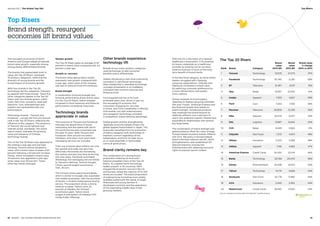
1 Tencent Technology 53,615 27,273 97%
2 Facebook Technology 35,740 21,261 68%
3 BT Telecoms 15,367 9,531 61%
4 Ikea Retail 19,367 12,040 61%
5 Uniqlo Apparel 7,303 4,627 58%
6 Ford Cars 11,812 7,556 56%
7 Movistar Telecoms 20,809 13,336 56%
8 Nike Apparel 24,579 15,817 55%
9 DHL Logistics 13,687 8,940 53%
10 CVS Retail 8,485 5,620 51%
11 Chipotle Fast Food 7,372 4,972 48%
12 Allianz Insurance 5,323 3,596 48%
13 Adidas Apparel 7,192 4,882 47%
14 American Express Credit Cards 34,430 23,514 46%
15 Baidu Technology 29,768 20,443 46%
16 Disney Entertainment 34,538 23,913 44%
17 Yahoo! Technology 14,174 9,826 44%
18 Starbucks Fast Food 25,779 17,892 44%
19 AXA Insurance 5,645 3,934 44%
20 MasterCard Credit Cards 39,497 27,821 42%
Source: Valuations include data from BrandZ™ and Bloomberg
The Top 20 Risers
Top Risers
32  BrandZ™ Top 100 Most Valuable Global Brands 2014 33
Section 02  |  The Global Top 100
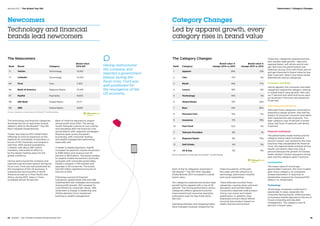
Newcomers
Technology and financial
brands lead newcomers
The technology and financial categories
dominate the list of newcomer brands
added in 2014 to the BrandZ™ Top 100
Most Valuable Global Brands.
Twitter launched an IPO (Initial Public
Offering) to fund its expansion as the
platform for worldwide conversation in
bursts of 140 characters exchanged in
real time. With several acquisitions,
LinkedIn, with about 280 million
members, intensified its effort to
be the digital meeting place for the
global workforce.
Having restructured the company and
rejected a government bailout during the
fiscal crisis, Ford was well positioned for
the resurgence of the US economy. It
experienced record profits in North
America as well as in Asia-Pacific and
Africa, during 2013. Sales in China
increased almost 50 percent.
Bank of America reported its largest
annual profit since 2007. The strong
results followed a period of cost cutting
and rebuilding after the financial crisis
and problems with subprime mortgages.
Revenue grew across the bank’s
businesses, with consumer lending
and wealth management performing
especially well.
A leader in digital payments, PayPal
increased its payment volume 24 percent
to $180 billion and revenue rose 19
percent to $6.6 billion. The brand worked
to expand mobile transactions and build
synergies with corporate parent eBay.
PayPal is present in 193 markets and
operates in 26 currencies. The brand
had 143 million registered accounts at
the end of 2013.
Following a period of financial
turbulence, global banks ING and UBS
implemented new strategies and enjoyed
strong profit growth. ING renewed its
commitment to corporate values. UBS
underwent a change in leadership and
shifted attention from investment
banking to wealth management.
Category Changes
Led by apparel growth, every
category rises in brand value
Each of the 14 categories examined in
the BrandZ™ Top 100 Most Valuable
Global Brands 2014 increased in overall
brand value.
Ten categories experienced double-digit
growth led by apparel with a rise of 29
percent. The strong performance across
categories reflects general economic
improvement and consumer spending
enthusiasm even for big-ticket items
like cars.
Spending attitudes and shopping habits
have changed, however, shaped by the
Rank Brand Category
Brand value
2014 $M
71 Twitter Technology 13,837
77 LinkedIn Technology 12,407
83 Ford Cars 11,812
94 Bank of America Regional Banks 10,149
97 PayPal Payments 9,833
98 ING Bank Global Banks 9,771
99 UBS Global Banks 9,683
Source: Valuations include data from BrandZ™ and Bloomberg
The Newcomers
Rank Category
Brand value %
change 2014 vs 2013
Brand value %
change 2013 vs 2012
1 Apparel 29% 21%
2 Cars 17% 5%
3 Retail 16% 17%
4 Luxury 16% 6%
5 Technology 16% -1%
6 Global Banks 15% 23%
7 Beer 14% 36%
8 Personal Care 12% 11%
9 Insurance 11% 19%
10 Fast Food 10% 5%
11 Telecom Providers 8% 1%
12 Regional Banks 6% 15%
13 Soft Drinks 4% 5%
14 Oil  Gas 3% -4%
Source: Valuations include data from BrandZ™ and Bloomberg
The Category Changes
financial austerity of the past
few years and the influence of
technology, particularly mobility
and social networking.
These attitudes touched many
categories, causing stress and even
disruption and transformation.
Consumers expected wide product
choice, low prices and instant
gratification. In addition, they
expressed concern about ethical
sourcing and product impact on
health and the environment.
These four categories experienced less
than double-digit growth – telecoms,
regional banks, soft drinks and oil and
gas. But even this performance was
relatively strong. Only soft drinks and oil
and gas improved in brand value by less
than 5 percent. Here’s how these trends
affected the various categories:
Consumer and Retail
Led by apparel, the consumer and retail
categories topped the category ranking
in overall brand value growth, with cars
up 17 percent and retail and luxury each
up 16 percent. Personal care advanced
12 percent.
Fast Food and Soft Drinks
Although these categories continued to
experience steady growth, they felt the
impact of consumer concerns and habits
that impacted the rate of growth. The
beer category rose 14 percent in brand
value; fast food, 10 percent; soft drinks,
4 percent.
Financial Institutions
The global banks made money and the
category brand value increased 15
percent overall. Less tainted by the risky
practices that precipitated the financial
crisis, the regional banks enjoyed strong
results, but brand value rose only 6
percent because the growth of Chinese
banks slowed. Insurers enjoyed a strong
year and the category grew 11 percent.
Commodities
The brand value of oil and gas
appreciated 3 percent, the most modest
gain of any category, as companies
slowed exploration in response to
shareholder pressure for improved ROI
(Return on Investment).
Technology
Technology companies continued to
appreciate in value, especially the
consumer-facing brands, while business-
to-business brands adjusted to the era of
Cloud computing and big data
management. The category rose 16
percent in brand value.
Having restructured
the company and
rejected a government
bailout during the
fiscal crisis, Ford was
well positioned for
the resurgence of the
US economy.
Newcomers | Category Changes
34  BrandZ™ Top 100 Most Valuable Global Brands 2014 35
Section 02  |  The Global Top 100
Food and Drink
Consolidation continued in the beer
category. The rate of consumption
slowed in developed markets and
drinking preferences evolved, with
consumers more interested in
distinctive flavors and experiences
rather than volume.
The brewers invested in fast growing
markets to build volume and realize
the potential, especially in China,
which is a large and fragmented
market with relatively low per
person rate of consumption.
Changing consumer attitudes about
health impacted both the fast food
and soft drinks categories. The fast
food brands that appreciated most
in brand value had a clear brand
proposition that addressed the
issue of health and also offered
an ambiance that was more
comfortable than a traditional
take out location.
In soft drinks, people consumed
less CSDs (Carbonated Soft Drinks),
an ongoing trend that especially
impacts the leading cola brands.
The brand leaders expanded their
brand portfolios to include other
beverage options, such as flavored
waters or juices, but even these
drinks weren’t immune to health
scrutiny. Drinks that offered a jolt
of energy or some other functional
benefit continued to do well.
Consumer and Retail
The strong apparel brand gains show
consumers were shopping again,
replenishing wardrobes. But they
purchased in an informed way, looking
for value and waiting for sales. The
most successful brands provided
a value proposition that combined
fashion, speed and price.
Retail also contended with smarter
shoppers. The category is
experiencing a transformation in
response to shoppers who expect
everything all the time: the range
and price available online combined
with the immediate experience
and gratification provided by
physical stores.
Feeling entitled and less constrained
by recession-inspired frugality,
consumers spent money on luxury,
too. The luxury brands reclaimed some
of the exclusivity and margin they
sacrificed to drive volume during
leaner times.
Car brands benefited from consumers
who returned to the dealerships as the
days of cash for clunker incentives
faded in the rear view mirror and the
resurgent US economy drove car
sales. Car sales gained in Europe and
China as well.
Slower economic growth in China, and
the emergence of competitive Chinese
brands, affected personal care brand
value growth, as did problems in the
Brazilian economy, home to one of the
major personal care brands, Natura.
Financial Institutions
Most of the global banks had repaid
government loans issued during the
financial crisis, and had implemented
reforms that reshaped their businesses.
However, the public and government
regulators remained unsatisfied with
some of the changes. Banks experienced
criticism for past practices and high
executive compensation. Although
profits were up, trust was down.
Less tainted by the risky practices that
precipitated the financial crisis, the
regional banks enjoyed strong results and
brand values appreciated, particularly
among bank brands in North America
and Australia. The category brand value
softened because four of the regional
leaders are Chinese banks, which felt the
effects of the country’s slowing economic
growth rate.
Insurance brands experienced a positive
year and brand values increased,
particularly among the major global
carriers. Property and casualty brands
were in the midst of a transformation,
trying to harness big data to understand
individual needs and create ongoing,
lifetime customer engagement.
Technology
Technology companies continued
to appreciate in value, especially the
consumer-facing brands. Google claimed
the number one position as the world’s
most valuable brand in the BrandZ™
Global ranking, followed by Apple.
Like Facebook, which experienced
strong stock appreciation, these
brands continued to acquire or develop
competencies to build ecosystems and
become indispensable.
At the same time, the Chinese Internet
brands, Tencent and Baidu, increased
sharply in value and Chinese technology
brands became more of a presence in the
West, as Alibaba, 24 percent owned by
Yahoo!, prepared for an IPO.
The business-to-business technology
brands benefited from corporate
investment in the storage and analysis
of big data. But the brands also adjusted
to fundamental changes, including the
shift to Cloud computing, pay-as-you-
go business models, the rise of mobile
and decline of the PC. Overall brand
value rose 16 percent compared with a 1
percent drop a year ago.
Similarly, brand value of the telecom
category rose 8 percent following a
1 percent rise a year ago. Developed
market brands grew in brand value
during a period marked by more industry
consolidation and price disruption.
Commodities
Brand value of the oil and gas
category appreciated 3 percent,
the most modest gain of any
category. Compounding the normal
risks of exploring for oil and gas
reserves in fragile environments,
oil and gas brands felt investor
pressure to return more profit to
shareholders. To accommodate
these needs the major brands
sought new efficiencies and
looked to sell assets.
Category Changes | Analysis
Category Changes
36  BrandZ™ Top 100 Most Valuable Global Brands 2014 37
Section 02  |  The Global Top 100
Brand Contribution
Leaders come from many
categories and places
Brand contribution is a metric that
quantifies the strength of a brand
exclusively, without financial or other
elements. It’s a critical component in
the calculation of brand value.
Brands that score high in brand
contribution have distinguished
themselves in the consumer’s mind.
They’ve effectively differentiated from
the competition and generated high
customer loyalty. They’re resilient during
market fluctuations because of their
engagement with the consumer.
To determine brand contribution we
analyze relevant corporate financial data
and strip away everything that doesn’t
pertain to the branded business. Then we
go further, with a step that makes
BrandZ™ unique and definitive among
brand valuation methodologies.
We conduct ongoing, in-depth
quantitative consumer research with
more than 170,000 consumers annually,
across more than 30 countries, to
assess consumer attitudes about
over 10,000 brands. Our database
includes information from over two
million consumers.
This step quantifies the power of the
brand in the mind of the consumer that
creates predisposition to buy and, most
importantly, validates a positive
correlation with better sales performance.
We call this factor brand contribution and
express it as an index of 1 to 5, with 5
being the most positive score.
The 15 brands ranked in the
accompanying chart scored highest in
brand contribution among all of the
brands examined in this report, including
both brands in the BrandZ™ Global Top
100 and the category rankings.
Luxury is the most represented category,
with six brands. But one of the clearest
take-aways is that brands of any size,
and regardless of product category
or place of origin, can achieve high
brand contribution.
The 15 ranked brands represent nine
different product categories. And the
brands range in size from the North
American fast food operator Panera,
with a brand value of $2.9 billion, to the
Coca-Cola brand valued at $67.7 billion in
the soft drinks ranking.
The luxury brands are European. Baidu
is the Chinese search engine and online
portal. From Latin America, Aguila is an
Colombian beer and Falabella is a retailer
based in Chile with department stores
and other outlets throughout the region.
In addition, high brand contribution
provides staying power. These nine
brands that rank in this BrandZ™ Top 100
Most Valuable Global Brands 2014 also
appeared as brand contribution leaders
in 2013: Aguila, Gucci, Panera, Pampers,
Chanel, Coca-Cola, Falabella, Baidu and
Louis Vuitton.
Six of these nine – Pampers, Chanel,
Coca-Cola, Falabella, Baidu and Louis
Vuitton – also appeared in the 2012 brand
contribution ranking. Hermès and Rolex,
which appeared in 2012, returned in 2014.
Of the remaining four brands, Gillette has
appeared in the brand contribution
rankings of earlier BrandZ™ Global Top
100 reports. Audi, Burberry and Stella
Artois have reinvigorated distinguished
brand heritages.
Rank Brand
Brand
Contribution Category
Brand value
2014 $M
Brand value
2013 $M
Brand value %
change 2014 vs 2013
1 Aguila 5 Beer 3,676 3,903 -6%
2 Gucci 5 Luxury 16,131 12,735 27%
3 Panera 5 Fast Food 2,871 3,025 -5%
4 Hermès 5 Luxury 21,844 19,129 14%
5 Pampers 5 Baby Care 22,598 20,594 10%
6 Chanel 5 Luxury 7,810 7,075 10%
7 Coca-Cola 5 Soft Drinks 67,712 64,698 5%
8 Burberry 5 Luxury 5,940 4,194 42%
9 Audi 5 Cars 7,058 5,545 27%
10 Falabella 4 Retail 5,187 5,611 -8%
11 Rolex 4 Luxury 9,083 7,941 14%
12 Baidu 4 Technology 29,768 20,443 46%
13 Stella Artois 4 Beer 8,237 6,319 30%
14 Gillette 4 Personal Care 19,025 17,823 7%
15 Louis Vuitton 4 Luxury 25,873 22,719 14%
Source: Valuations include data from BrandZ™, Kantar Retail, Bloomberg and Brand Analytics.
*Brand contribution measures the influence of brand alone on earnings, on a scale of 1 to 5, 5 highest.
**Includes Top 100 brands and brands included in the category rankings.
Brands of any size,
and regardless of
product category or
place of origin, can
achieve high brand
contribution.
The Top 15 in Brand Contribution
Brand Contribution
38  BrandZ™ Top 100 Most Valuable Global Brands 2014 39
Section 02  |  The Global Top 100
Driven by the region’s economic
recovery, the value of the Top 10 most
valuable brands based in Continental
Europe increased 19 percent overall,
more than any other region, following
a rise of only 5 percent a year ago.
All of the Continental Europe Top 10
brands rose in value. Those brands
included two of the fastest risers in the
BrandZ™ Top 100 Most Valuable Global
Brands 2014, Sweden’s IKEA, which grew
61 percent in brand value, and Movistar,
the Spanish telecom, up 56 percent.
In contrast, the overall value of the Top
10 brands based in North America rose
only 5.9 percent and the UK Top 10
only 5.4 percent. That’s because,
despite resurging economies, some
brands faltered and their brand value
declines held back the level of overall
brand value appreciation.
The reverse phenomenon occurred in
Asia, where the outstanding growth of
two Chinese technology brands offset
the brand value declines of several banks
impacted by the slowdown in China’s rate
of economic growth. Tencent, the social
network and Internet portal, almost
doubled in brand value, while the brand
value of the portal and search engine
Baidu increased 46 percent.
The overall value of brands in Latin
America continued to decline following a
decrease of 13 percent a year ago. Unlike
in Asia, there were not many rising
brands to offset the steep declines
experienced by two Brazilian leaders,
Petrobras, the oil and gas brand, and the
personal care brand Natura. In summary:
North America
America continues to be home for the
world’s most valuable brands.
Continental Europe and the UK
Local economic resurgence and
demand from fast growing markets
drove brand value appreciation,
particularly on the Continent.
Asia and Latam
Individual brands improved in value,
primarily in Asia, offsetting other brand
value declines. Latam lacked this balance.
North America
The Top 10 brands in the BrandZ™ Top
100 Most Valuable Global Brands 2014
are also the Top 10 most valuable North
American brands. The match confirms
that the US continues to be home for the
world’s most valuable brands. Last year
only nine of the Top 10 brands were
American. In 2014, Amazon rose to
number 10 in the BrandZ™ Global 100,
replacing China Mobile, which slipped
a few slots.
It’s even possible to locate the
geographic center of high brand value
more precisely as not simply the US, but
the technology centers of West Coast.
Google and Apple, the number one and
two brands, are based in Northern
California. The Seattle suburbs are home
to Microsoft and Amazon, the fourth
and tenth ranked brands. These four
brands together account for $461.2
billion in brand value, about 16 percent
of the BrandZ™ Global Top 100 total
brand value.
Beyond technology, changes in brand
value reveal a more nuanced view about
US-based brands and how brand
strength enabled some brands to
withstand the vicissitudes of their
categories. Coke rose only 3 percent in
brand value, mostly because of health
issues surrounding soft drinks.
McDonald’s declined 5 percent in part
because menu complication slowed
service. ATT appreciated only 3 percent
because of competitive pressures and
price disruption.
Regions
Continental Europe Top 10
lead in brand value growth
Rank Brand Category
Brand
value
2014 $M
Brand
value
2013 $M
Brand value
% change
2014 vs 2013
1 Google Technology 158,843 113,669 40%
2 Apple Technology 147,880 185,071 -20%
3 IBM Technology 107,541 112,536 -4%
4 Microsoft Technology 90,185 69,814 29%
5 McDonald's Fast Food 85,706 90,256 -5%
6 Coca-Cola Soft Drinks 80,683 78,415 3%
7 Visa Credit Cards 79,197 56,060 41%
8 ATT Telecoms 77,883 75,507 3%
9 Marlboro Tobacco 67,341 69,383 -3%
10 Amazon Retail 64,255 45,727 41%
Source: Valuations include data from BrandZ™ and Bloomberg
The Top 10 brands from North America
41
Regions
40  BrandZ™ Top 100 Most Valuable Global Brands 2014
Section 02  |  The Global Top 100
Continental	
Europe and the UK
Movistar, the mobile brand of Spain-
based Telefónica, successfully launched
an offering that bundled Internet with
broadband and fixed-line service.
Deutsche Telekom reported strong
financial results with strength in Germany,
its home base, and a revival in the US.
The company aimed to become the pan
European telecom leader.
The telecoms also were among the
highest value brands in the UK. Well
funded with cash from selling its stake in
America’s Verizon Wireless, Vodafone
agreed to purchase Spain’s Ono. The
transaction, along with the earlier
acquisition of a German cable operator
strengthened Vodafone’s position in
high-speed broadband. BT purchased the
rights to English Premier Football, adding
over two million new subscribers and
driving revenue.
IKEA, with around 300 home furnishings
stores worldwide, benefited from the
resurging developed economies and
demand in fast growing markets.
Increased consumer confidence drove
sales for Louis Vuitton and Hermès
and the brands worked to reinforce
their exclusivity.
The streamlining that followed the
financial crisis enhanced profits of global
bank brands. The banks still contended
with public distrust, however. Like the
other oil and gas majors, Shell and BP
focused more on finding efficiencies
and cost savings.
Asia and 	
Latam
Tencent acquired strategic stakes in
the search business Sogou and JD.com,
China’s second largest ecommerce
mall. The brand also introduced mobile
payment and financial services that
competed directly with banks. Baidu
expanded in gaming and location-
based purchasing.
China’s slower growth impacted the
banking business, which experienced
less loan origination for infrastructure
investment and also a higher rate of loan
payment problems. The Australian banks
benefitted from their proximity to fast
growing Asian markets and from the
economic strength of their home market.
The strengthening of the Japanese
economy and the rebound of the US
car market helped Toyota. Korea’s
Samsung continued to demonstrate
leadership in mobile devices and other
consumer electronics.
In Latin America, brand values declined
because of economic weakness. Mexico’s
Corona beer brand grew 21 percent in
brand value with the purchase of its
parent company Modelo by the global
brewer AB InBev.
Rank Brand Category
Brand
value
2014 $M
Brand
value
2013 $M
Brand value
% change
2014 vs 2013
1 Tencent Technology 53,615 27,273 97%
2 China Mobile Telecoms 49,899 55,368 -10%
3 ICBC Regional Banks 42,101 41,115 2%
4 Baidu Technology 29,768 20,443 46%
5 Toyota Cars 29,598 24,497 21%
6 Samsung Technology 25,892 21,404 21%
7
China
Construction
Bank
Regional Banks 25,008 26,859 -7%
8
Commonwealth
Bank of Australia
Regional Banks 21,001 17,745 18%
9 ANZ Regional Banks 19,072 16,565 15%
10
Agricultural Bank
of China
Regional Banks 18,235 19,975 -9%
The Top 10 brands from Asia
Rank Brand Category
Brand
value
2014 $M
Brand
value
2013 $M
Brand value
% change
2014 vs 2013
1 Corona Beer 8,025 6,620 21%
2 Skol Beer 7,055 6,520 8%
3 Falabella Retail 5,187 5,611 -8%
4 Aguila Beer 3,676 3,903 -6%
5 Brahma Beer 3,585 3,803 -6%
6 Natura Personal Care 2,236 3,707 -40%
The Top 6 brands from Latin America
Rank Brand Category
Brand
value
2014 $M
Brand
value
2013 $M
Brand value
% change
2014 vs 2013
1 Vodafone Telecoms 36,277 39,712 -9%
2 HSBC Global Banks 27,051 23,970 13%
3 Shell Oil  Gas 19,005 17,678 8%
4 BT Telecoms 15,367 9,531 61%
5 Tesco Retail 14,842 16,303 -9%
6 BP Oil  Gas 12,871 11,520 12%
7 Barclays Global Banks 9,536 7,989 19%
8
Standard
Chartered
Global Banks 9,150 10,160 -10%
9 Burberry Luxury 5,940 4,194 42%
10 Next Apparel 5,716 4,121 39%
The Top 10 brands from the UK
Rank Brand Category
Brand
value
2014 $M
Brand
value
2013 $M
Brand value
% change
2014 vs 2013
1 SAP Technology 36,390 34,365 6%
2
Deutsche
Telekom
Telecoms 28,756 23,893 20%
3 Louis Vuitton Luxury 25,873 22,719 14%
4 BMW Cars 25,730 24,015 7%
5 L'Oréal Personal Care 23,356 17,971 30%
6 Zara Apparel 23,140 20,167 15%
7 Hermès Luxury 21,844 19,129 14%
8 Mercedes-Benz Cars 21,535 17,952 20%
9 Movistar Telecoms 20,809 13,336 56%
10 Ikea Retail 19,367 12,040 61%
The Top 10 brands from Continental Europe
For more Latin
America knowledge
and insight
The brands listed in the Latin
America chart are those that
reach the brand value threshold
of the BrandZ™ Global Top 100
or the category rankings. For a
comprehensive report about the
region’s highest value brands,
please see the BrandZ™ Top 50
Most Valuable Latin American
Brands 2013 at BrandZ.com.
Or go to brandanalytics.com.br
Regions
42  BrandZ™ Top 100 Most Valuable Global Brands 2014 43
Section 02  |  The Global Top 100
Source for all tables: Valuations include data from BrandZ™, BrandAnalytics and Bloomberg.
North America dominates in
number of brands and brand value
Brands based in North America dominate in brand value and in the number of brands
represented in the BrandZ™ Top 100 Most Valuable Global Brands 2014, followed by
Continental Europe.
50%
23%
20%
6%
1%
66%
14%
15%
5%
0%
Top 100 by
brand value
Top 100 by 	
number of brands
During the Chinese New Year, one of
China’s leading Internet brands enabled
people to purchase and exchange online
the red packets of money that Chinese
traditionally exchange face-to-face for
holiday gift giving.
Tencent, an Internet portal and social
network, a mix of Facebook, Twitter and
a blogging site, offered the program on
its mobile messaging service WeChat.
Users deposited money into their WeChat
accounts and supplied the contact details
of gift recipients. In the process, Tencent
enriched its online banking business with
more money and customers.
In addition, Tencent and one of its rivals,
Alibaba, the giant ecommerce site,
similar to Amazon and eBay, competed
with mobile apps for taxi ride payments.
Offering incentives to riders and drivers,
the brands attempted to build their
mobile payment businesses. Determined
to compete in mobile payments, Baidu,
the other brand in the Chinese Internet
triumvirate, a search engine similar
to Google, acquired an app store, 91
Wireless, during 2013.
Tencent, Alibaba and Baidu, also have
created online wealth management
products that offer higher yields than
banks and have quickly diverted billions
of dollars from traditional savings
accounts. Tencent was the fastest riser
in the BrandZ™ Top 100 Most Valuable
Global Brands 2014, almost doubling in
value. Baidu increased in brand value
46 percent. Alibaba, which is 24 percent
owned by Yahoo!, is preparing an IPO
(Initial Public Offering). Yahoo! brand
value increased 44 percent.
The initiatives of these brands illustrate
the power of technology brands in China,
and their ability to grow rapidly, innovate
and leapfrog the West in emerging trends
like mobile payments and online banking.
Their success challenges China’s banking
category to respond with competitive
products. And it tests the government’s
ability to balance its goal of opening
markets with the need to support the
banking industry and its SOEs (State
Owned Enterprises).
It’s not yet certain that online products
can maintain their rapid growth rate amid
fluctuations in China’s economy and
steps taken by regulators and traditional
banks to limit online payments. The
outcome potentially affects not only
the technology brands, but also the
availability of capital to millions of small
entrepreneurs. The leaders of China’s
next wave of economic development,
these entrepreneurs are less likely to
bank with SOEs, whose businesses focus
more on funding large infrastructure
projects and other government needs.
Predominant brand
categories by region
North America: technology
Continental Europe: luxury and
cars Asia: regional banks and
telecoms UK: global banks and
oil and gas Africa: telecoms
Latam: beer
Fewer fast growing market brands
present in the Global Top 100
Brands from fast growing markets declined from 17 to 14 in the BrandZ™
Top 100 Most Valuable Global Brands 2014, with 11 Chinese brands included.
No brands from Latin America are present in the Global Top 100 this year,
although several appear in the category rankings.
2006 2007 2008 2009 2010 2011 2012 2013 2014
China 2 5 5 6 7 12 13 12 11
Russia 1 2 2 2 2 2 2
Brazil 1 2 3 1 – –
India 1 1 2 2 –
Mexico 1 1 1 – –
Africa 1 1 1
Total 2 5 6 9 13 9 20 17 14
2014 global
rank Brand Category
Brand value
2014 $M
Brand value
2013 $M
Brand value %
change 2014 vs 2013
1 14 Tencent Technology 53,615 27,273 97%
2 15 China Mobile Telecoms 49,899 55,368 -10%
3 17 ICBC Regional Banks 42,101 41,115 2%
4 25 Baidu Technology 29,768 20,443 46%
5 33 China Construction Bank Regional Banks 25,008 26,859 -7%
6 54 Agricultural Bank of China Regional Banks 18,235 19,975 -9%
7 67 Sinopec Oil  Gas 14,269 13,127 9%
8 68 Bank of China Regional Banks 14,177 14,236 0%
9 76 Petrochina Oil  Gas 12,413 13,380 -7%
10 77 Ping An Regional Banks 12,409 10,558 18%
  North America 
  Continental Europe (ex. UK) 
  Asia 
  UK 
  Africa
Fast growing market brands in the Top 100
The Top 10 Chinese brands
Source: Valuations include data from BrandZ™ and Bloomberg
Chinese Internet brands focus
on growing mobile payments
Regions
44  BrandZ™ Top 100 Most Valuable Global Brands 2014 45
Section 02  |  The Global Top 100
With contributions from Anne
Czernek, Senior Research Analyst,
Armineh Nourbakhsh, Software
Developer, Maarten Peschier, Senior
Technology Scientist, Emerging
Media Lab, Millard Brown Digital
PART ONE:
OVERVIEW OF BRANDZ™ VERVE
As part of our ongoing efforts to
enhance and improve the BrandZ™
rankings report, we have included a
new data source – our proprietary
Verve Score methodology, which
measures social media data. Using this
Verve score, Millward Brown Digital
has evaluated the social vitality of the
BrandZ™ Top 100 brands.
The core data is taken from the tens of
millions of global Twitter conversations
about these brands. In essence, the Verve
score is a measure of the number of
mentions for a brand combined with the
favorability of those mentions. So, the
higher the score, the more that brand has
been elevated within a social context.
Verve represents the accumulation of
positive brand experiences among the
engaged audience on Twitter. It covers
brand users, peers and influencers, those
exposed to brand communications,
and those responding to news or blog
sites. Verve classifies Twitter data both
topically and attitudinally and reflects
outcomes over time in brand equity,
sales, and TV impact.
Overall, Verve is best understood in
the context of Brand Contribution. It
is a signal of consumer interest and
engagement, and is most closely aligned
with brand strength and power, where
it allows us to see the texture and detail
of the consumer relationship to a brand,
such as how celebrities can impact
lifestyle brands, or where activism can
shape perceptions of commodities.
Before going into more detail, it is
important to highlight a few caveats:
— Scores vary by category. Certain
brands may be very strong relative to
their competitors, but that category
may not be much talked-about. Brand
strength and marketing can help dial
this up (such as American Express and
Visa), but ultimately many people are
less interested in tweeting about their
financial services than they are about,
say, fast food or fast fashion.
People really do tweet
about their lunches.
People like to talk about
what they’re interested
in or what’s in front of
them, whether that’s food
–“Casually ate a ten piece
of KFC in ten minutes” –
or fashion – “Shopping!!
Literally cleaning out
Zara…”
— Verve reflects social audiences. Verve
is an accurate reflection of what is
happening in social media, but activists
may over-amplify certain topics, while
people having positive but ordinary
experiences with a brand may not feel
compelled to speak up at all. This is
why we place social data in the larger
context of the BrandZ™ rankings.
Because we work from a common
understanding of brand equity across
both brand contribution and social media
conversations, we can define a statistical
relationship between the two. In a social
context, anyone talking about a brand by
definition has it at the forefront of their
mind; therefore brands that are
meaningful and different are most likely
to be entwined in brand conversations
on social media.
PART TWO:
BRAND HEALTH IN SOCIAL MEDIA
Meaningful Experiences
When gathering brand equity data,
Millward Brown can require someone to
answer a series of questions related to
meaning and difference. However, in
social, we can only infer from what is
stated – no follow-up questions allowed.
Meaning is the easiest to ascertain from
straightforward statements about the
consumer’s favorability toward the brand
or whether it meets needs.
Brand meaning is brought to the
forefront in social media conversations.
Its expression is most elevated among
brands whose baseline consumer
commentary is experience-driven. Within
the BrandZ™ Top 100, Starbucks, Red
Bull, Nike and eBay are all such brands:
accessible, crave-able and consistent,
they can provide a satisfaction so sweet
it must be shared spontaneously.
Brand Difference
When we look at the brands with the
highest Verve scores among the BrandZ™
Top 100, we also see that third party
commentary can have a significant
impact. For example, technology,
automotive and luxury all feature heavily
because consumer experience is
supplemented by coverage from third-
party sources (news articles, blogs, etc.).
Notably, these categories are also
higher-consideration and more
aspirational, characterized by more
complex features, longer purchase cycles
and lower purchase frequency.
Third-party coverage can often be a key
influence for overall opinions, but these
are frequently driven by the fact that
the brand has demonstrated a point
of difference.
“Door to door
deliveries of the future?
Amazon testing drones
for deliveries”
The Impact of Marketing on Social
Media Conversation
It is important to note that marketing
causes variations over and above the
base level of social conversations, rather
than forming it. Almost universally
among the 2014 BrandZ™ Top 100
brands, consumer experience or third-
party communications, amplified by
brand strength, provides the foundation
for social vitality.
Three types of marketing tend to break
through most strongly: (1) sponsorships
of sports fields and event spaces, like
Citi Field; (2) buzzworthy TV
commercials, such as Budweiser’s
Clydesdale Super Bowl spot; and (3)
catchy social campaigns connecting
branding to experience, like KFC’s fun
#iatethebones campaign.
PART THREE:
CATEGORY COMMENTARY
Technology
Within technology, social platforms are
the clear leaders of brand performance in
social. Unsurprisingly, their users
frequently reference their activity and
communities on the platforms – these
brands are heavily experience-driven.
That said, each platform has a distinctive
pattern of its own: Twitter users tend
to be addressing other Twitter users or
commenting on trends they see on the
platform; LinkedIn commentators are
often sharing content they have seen on
LinkedIn; and people talking about
Facebook use Twitter as a backchannel
to gossip about other people on
Facebook. Our Verve data indicate that
while consumers do follow coverage of
these platforms at a corporate level, they
are primarily interested in the content
and communities housed in social media.
Technology brands are also divided by
those that have strong consumer-facing
brands and businesses versus those that
do not: Google, Apple, and Samsung all
generate a lot of attention, far
overshadowing brands like Cisco or
Siemens. The successful brands are
characterized by a large proportion of
third-party communications, primarily
driven by new product launches and to
a lesser extent, corporate observations
(including investments and litigation).
However, for some brands with a variety
of popular consumer products,
consumer experience plays a role
as well: people register their use of
Google’s large portfolio of products
around the globe (including maps,
translation, voice services, and more).
Brands such as Apple and Samsung
also attract commentary on their
desirable mainstream products,
as well as their more experimental
efforts like wearables.
Financial Services
Financial services are primarily driven by
third-party communications – consumer-
facing experiential commentary is
minimal. However, silence does not
necessarily mean indifference and
comments can hinder as well as help.
Distinct from the rest of the category,
credit card brands American Express
and Visa both had success with
consumer campaigns that reiterated
the “rewarding” promise of the cards.
In particular, American Express led the
way here, with #AmexSync and
#PassionProject. These campaigns
succeeded because they had not only
a clear consumer incentive but also
demonstrated the brand’s forward-
looking approach to changing media
and technology habits. These brands
also have some of the highest brand
contribution scores in their category,
suggesting that their performance
in social media and their overall
brand strength may have a
symbiotic relationship.
Retail  Apparel
These categories are highly
experientially driven, as the spur for
most conversation is an in-store
experience or a coveted item. Because
many people who talk about these
brands have first-hand knowledge, this
familiarity can augment the brands’
profile with other items of interest:
mentioning The Home Depot in a joke
about Miley Cyrus gives it extra comic
zing; or one might feel closer to
Beyoncé through her HM
endorsements. However, first-hand
familiarity can turn into a negative
when the news is bad, for example
when social media picked up the horse
meat contamination story, seriously
compromising otherwise buoyant brand
images amongst consumers.
Oil  Gas
From a social media perspective, oil and
gas companies are an example of where
brands have to work extra hard to make
social into a beneficial influence on their
brands. Consumer interest in “pumping
gas” tends to be relatively low, whilst
criticism can be swift when there are
environmental concerns. Nevertheless,
because energy is a potentially emotive
topic, it can be used to enhance brands
in this sector where there is a positive
story to be told.
Social Media Special Report:
The BrandZ™ Verve Index
Ali Rana
SVP and Head Scientist, Emerging
Media Lab, Millward Brown Digital
Ali.Rana@millwardbrown.com
Linking positive social media with brand power	
A new tool for productive social media investment
46  BrandZ™ Top 100 Most Valuable Global Brands 2014 47
Section 02  |  The Global Top 100 The BrandZ™ Verve Index
BrandZ™	
Verve Rank
	
	
Brand*
	
2014 BrandZ™
Top 100 Rank
1 71
2 1
3 31
4 21
5 23
6 5
7 10
8 61
9 34
10 2
11 29
12 6
13 69
14 22
15 43
16 4
17 84
18 83
19 78
20 92
21 42
22 70
23 32
	
BrandZ™	
Verve Rank
	
	
Brand*
	
2014 BrandZ™
Top 100 Rank
68 100
69 16
70 48
71 82
72 89
73 62
74 73
75 91
76 52
77 80
78 85
79 98
80 65
81 27
82 46
83 47
84 64
85 44
86 75
87 49
88 58
89 74
	
BrandZ™	
Verve Rank
	
	
Brand*
	
2014 BrandZ™
Top 100 Rank
46 20
47 94
48 87
49 37
50 12
51 13
52 79
53 57
54 41
55 55
56 39
57 28
58 18
59 36
60 53
61 99
62 38
63 59
64 40
65 56
66 9
67 95
	
BrandZ™	
Verve Rank
	
	
Brand*
	
2014 BrandZ™
Top 100 Rank
24 30
25 88
26 50
27 26
28 11
29 51
30 3
31 97
32 45
33 86
34 90
35 63
36 8
37 19
38 7
39 60
40 72
41 66
42 24
43 35
44 96
45 93
The BrandZ™ Verve Index
Source: Emerging Media Lab, Millward Brown Digital * English language only. With no Twitter in China, Chinese brands are not included in this ranking.
Starbucks
MTN
48  BrandZ™ Top 100 Most Valuable Global Brands 2014 49
Section 02  |  The Global Top 100 The BrandZ™ Verve Index
AKQA is an ideas and innovation company. We
collaborate with our clients to create the future.
To learn more visit www.akqa.com
DELIVERING
SEAMLESS
CONSUMER
EXPERIENCE
IN AN AGE OF
FRAGMENTATION
– Nest notes the time and temperature when the the
thermostat is turned up or down, notes when you
are home or away, and simply does the work to
deliver a more comfortable home and a lower
utility bill.
– Netflix notes the type and format of content you
watch, how you rate it, who you share it with, when
you start and stop it, and delivers from that data a
set of personalized program recommendations to
keep you best entertained.
Both of these companies are successful primarily
because they can process different sets of
discrete data intelligently to deliver a seamless
consumer experience.
Delivering a Seamless
Experience through Data
So how then do we apply the learnings from these
data-fluent companies and products to the
marketing needs of our client brands?
We have found the best way to consistently navigate
the chaos of available data and multitude of
channels successfully is to focus obsessively on
delivering increased relevance and value for our
consumers. By making our consumer’s interest our
North Star, we can much more easily separate signal
from noise, ignore great swaths of low value data,
and focus on enhancing and optimizing the
application of high-value data into positive
consumer experiences.
In this world, media channels and platforms don’t
make sense as the focus of your planning. Instead,
the consumer’s best interests and the data’s
suggested ‘next best engagement opportunity’
win the moment.
The Way Forward
It’s understandable to be bewildered by the
fragmentation and choice within marketing that has
been caused by the explosion of consumer digital
device usage today. It’s likely to expand yet more
tomorrow with the growth of Internet of things.
Legacy channel-centric marketing approaches won’t
survive the transition from five to 5,000,000
channels. In an era when they’re bombarded with
choice and empowered with control, consumers
must be given increased relevancy and value.
Marketers, in turn, must use the data at their disposal
to determine the best means and places to spend
their money and create consumer engagement.
Data, reduced to its most fundamental elements and
organized effectively, will be the primary currency of
future marketing strategy and will be deployed to
create seamless brand experiences that function
fluidly across all delivery channels.
The Rise of Fragmentation
Marketing has seen an explosion of channel
fragmentation in the last few years. Desktop
advertising, the main digital channel just a few
years ago, has splintered into tablet, mobile,
smart TV, app, video, social, data, programmatic,
native and more.
And the trend continues to
accelerate.
Social media is creating a fire-hose of real-time
consumer sentiment data, mobile is adding
geo-location data, beacons offer intra-store
hyper-location data, activity-tracking wrist bands are
quantifying every personal movement, connected
cars are beaming telemetry data, and the Internet of
things will soon add data from your toothbrush and
coffee pot to your marketing data set.
It’s too late to slow this shift down enough for us
marketers to catch our breath. Pandora’s Box has
been opened. People love Candy Crush, ShopKick,
Nike Fuelbands, Google Maps, Jambox, and Nest
thermostats too much. The pace and consistency
of digital media’s growth is strong enough that it will
surpass television as the number one media channel
by 2018, but it’s possible consumer consumption
patterns have never been so far ahead of
a marketer’s ability to productively address them.
So how does marketing solve
this challenge?
Finding a Common Currency
At AKQA, we believe that finding the solution to this
fragmentation starts with finding a common
currency across all the existing and new channels.
We believe that currency is data.
Data, when distilled into usable information about
our consumer and their interactions with their
devices and environments, is the thread we can pull
through our marketing strategies and across our
consumer’s devices to create consistent and relevant
experiences for them.
Some of the best evidence of this practice in action
is built into successful newer businesses and
products like Google Now, Amazon, Netflix, and
Nest. All of these companies and/or products use
data, working in the background and processed
across channels with intelligent algorithms, to
deliver simple, seamless consumer experiences.
For example:
Scott Symonds
Managing Director of Media
AKQA
Scott.symonds@akqa.com
50  BrandZ™ Top 100 Most Valuable Global Brands 2014 51
Section 02  |  Thought Leadership
POSSIBLE is a creative agency that cares about results. We back
up every idea with real-world insights to create work that makes a
difference – and a measurable impact. On paper, POSSIBLE is 25
offices spanning five continents. In practice, we are 1,100+ people
offering local expertise to some of the world’s most dynamic
brands. These include Microsoft, P  G, Starwood Hotels and
Resorts Worldwide, The Bill  Melinda Gates Foundation, ATT and
Coca-Cola. POSSIBLE is part of WPP Digital; for more information,
visit www.POSSIBLE.com.
The influence of others
A second problem occurs due to the environment
in which an app lives. It used to be that brands
competed mainly within their categories.
McDonald’s tried to make better burgers and market
them more effectively than Burger King. Dunkin’
Donuts tried to outdo Krispy Kreme. By a similar
logic, when one of the chains releases an app, you
might think that the others should merely release
a better one. Unfortunately, this is not the case.
Nowadays, consumer expectations are shaped by
everyone. Google, Apple, Netflix, and Amazon set
the bar for what a digital experience should be –
not Subway or Starbucks.
The company best at grasping this so far has been
the thermostat maker Nest. Prior to its arrival,
thermostat companies competed solely with one
another. Nest built an appliance for an environment
shaped by peoples’ experiences with digital services.
It was smart, connected, saved money, and made
peoples’ lives easier. Google recognized this with
a $3.2 billion purchase of the company.
You might argue that if apps are so dangerous,
brands should avoid them entirely. We don’t think
so. Apps are a great way to connect with your most
passionate customers. No one downloads your app
if they don’t love your brand. And some fast food
brands create terrific apps. For example, American-
based Five Guys recently evolved its app with a
feature that enables you to reorder a recent order.
That fits in neatly with consumer expectations of
a smarter, more connected experience. Hardee’s/
Carl’s Jr. also revised their app with a points system
and rewards you can redeem instantly. Both
currently have 4-star ratings and many positive
reviews from avid fans.
So what is the lesson for brands? You need to
approach an app differently from a campaign.
Begin by budgeting and staffing for the long haul.
Establish a user-centered design approach and
create a product development plan to improve the
experience on an ongoing basis. Then actively listen
to what people are saying and use that feedback to
plan your next steps.
Put simply, an app is a product that lives in a world
of smart, digital products. Treat one right, and you’ll
make your customers happy. Treat one wrong, and
you’ll hurt your brand.
THE PRODUCT
PARADOX: WHY
MAKING APPS
USUALLY HURTS
BRANDS AND
HOW YOU CAN
DO BETTER
How can we tell? Their all-time ratings are higher
than those for the most recent update. In other
words, people are less happy with them now than
they once were. This has happened even though,
paradoxically enough, all of them have improved
over time. Shouldn’t a less buggy app beat a buggier
one? The answer seems to be “no.”
The reason for this phenomenon is fairly
straightforward. Today, we’re seeing brands trying
to become more and more integrated into their
customers’ lives. They have many ways to do this,
and most of them are compatible with traditional
marketing approaches and budgets. But some
things, like apps, are different and require
a different approach. In essence, an app is
a digital product, and that puts it in a specific
mental space for customers.
Most of the apps above were launched like
traditional campaigns: the brands undertook a big
initial push and then made only a few small updates,
mainly bug fixes. To understand the problem this
creates, let’s start with a telling comment on
Subway’s iTunes Store page. A user gave the app a
high rating, but also asked, “Upgrade coming soon?”
She asked this because commercial apps always
evolve to become better and more relevant to their
users’ needs – and she has the same expectations of
a branded app. If you launch and leave your app, you
violate the customer’s sense of what a digital
product should be. Disappointment follows.
Shane Atchison
CEO POSSIBLE
Shane.Atchison@possible.com
Jason Burby
President, Americas POSSIBLE
Jason.Burby@possible.com
Brand
Rating
all time
Rating since
last update
McDonald’s 2.5 2
Chipotle 3.5 2
Subway 3.5 2.5
Dunkin’ Donuts 3 2.5
Starbucks 3.5 2
Have you ever noticed that most branded apps are
disappointing? Customers have. The chart below
shows the iTunes Store ratings of several branded
fast food apps, including one from Starbucks that
gets a lot of praise from marketers. But all seem to
be hurting their brands. The iTunes Store has an app
rating scale of 1-5 with 1 being the lowest and 5
being the highest.
52  BrandZ™ Top 100 Most Valuable Global Brands 2014 53
Section 02  |  Thought Leadership
03The Categories
54  BrandZ™ Top 100 Most Valuable Global Brands 2014 55
Section 03  |  The Categories Consumer and Retail
Apparel
Cars
Luxury
Personal Care
Retail
Food and Drink
Beer
Fast Food
Soft Drinks
Financial
Banks
Insurance
Commodities
Oil  Gas
Technology
Technology
Telecom Providers
Definition
The apparel category is
comprised of mass-market
men’s and women’s fashion and
sportswear brands, but excludes
brands viewed by consumers as
luxury.
Top 10 Apparel
Brand
Value
2014 $M
Brand
Contribution
Brand Value
% Change
2014 vs 2013
1 Nike 24,579 4 55%
2 Zara 23,140 3 15%
3 HM 15,557 2 22%
4 Uniqlo 7,303 2 58%
5 Adidas 7,192 4 47%
6 Ralph Lauren 6,323 4 13%
7 Next 5,716 3 39%
8 Hugo Boss 4,526 4 28%
9 Lululemon 3,258 4 -13%
10 Tommy Hilfiger 2,004 3 New
Source: Valuations include data from BrandZ™ and Bloomberg.
Brand contribution measures the influence of brand alone on earnings on a scale of 1 to 5, 5 highest.
Apparel
Consumers invest in fashion
plus function as they create
repertoires of brands
Apparel converges with technology
Apparel led all categories in growth of
overall brand value, with an increase of
29 percent in the BrandZ™ Top 100 Most
Valuable Global Brands 2014, following
a 21 percent improvement a year ago.
Consumers eagerly purchased apparel,
but they sought value, investing in brands
that offered style with durability plus
function. Mid-priced brands informed by
high-end fashion prospered.
Less concerned about projecting
an image with logos, consumers
focused instead on how brands could
make them feel more confident and
discerning. Brands aimed to be part of
the repertoires of affordable options
consumers purchased for various
occasions.
Post-recession smart consumers
matched wits with brands over pricing.
Rather than purchase at the beginning
of the season, consumers waited to buy
on sale. Merchants launched sales earlier
and deepened discounts as time passed,
adjusting prices rationally, to encourage
purchasing while protecting margins.
The slower pace of economic expansion
in fast growing markets impacted the
apparel category, particularly in China.
Slower growth, combined with increasing
international competition, rising labor
and raw material costs and excess
inventory, formed a perfect storm that
hurt business results and brand values.
The fast growing markets led the way in
the use of ecommerce and social media,
however, while in developed markets,
sites like Tumblr enabled consumers to
share information and feel informed.
Indicative of the growing influence of
apps in the apparel category, an app
called Tapestry provided a virtual bulletin
board, similar to Pinterest, along with an
option to purchase.
A UK-based app, called ShuffleHub,
emphasized the emotional aspect of
shopping, enabling online shoppers
to browse across stores and brands to
replicate the dreaming and exploring
aspect of shopping. These other trends
also impacted the category:
Loyalty As ecommerce drove an
exponential expansion of choice,
brands needed to work harder at
cultivating loyalty. But a good brand
experience could make the difference.
Localization Technology enabled
brands to tailor their communications
for diverse audiences and geographic
locations.
Wearables Technology and apparel
continued to converge, and brands
met consumer needs for clothes that
suited their healthy and active lives.
Google announced an operating
system called Android Wear to drive
innovation in wearables.
Apparel brands with
technology rise in value
Nike’s brand value increased 55 percent.
With the tagline “Find your greatness,”
Nike used social media to inspire a
culture of activity and achievement.
The brand has succeeded in building
communities of consumer and brand
advocates around this larger purpose.
Nike refined its FuelBand. The bracelet,
which measures calories burned,
pioneered the intersection of apparel,
technology and community.
With a brand value rise of 47 percent,
Adidas enjoyed the momentum gained
from its sponsorship of the London
2012 Olympic Games and introduced
products related to its sponsorship of
the 2014 FIFA World Cup in Brazil. The
brand introduced a new shoe cushioning
innovation it calls Boost technology.
Uniqlo also integrated apparel and
technology, with fabrics engineered to
keep heat in (Heattech) or let air out
(AIRism). On the promise of delivering
apparel staples that are fashionable,
functional and affordable, the Japanese
brand has built a global presence, with
around 1,300 stores in Asia, North
America and Europe. Uniqlo rose 58
percent in brand value.
29%
Consumer and Retail | Apparel
56  BrandZ™ Top 100 Most Valuable Global Brands 2014 57
Section 03  |  The Categories
Insights: BrandZ™ BigData
Adapting to a brave new
world earns a premium
The most valuable apparel brands
tend to exhibit leadership, moving from
an omni-channel world to one that is
even more seamless for the shopper.
The brands therefore score highly on
innovation aspects.
The pay-off is that consumers view
these brands as more desirable. And
the brands manage to balance this desire
with more profitable pricing to maintain
a perception of good value.
Heritage and fast fashion
The UK-based brand Next reached its
core customers, women in their 30s or
40s seeking accessible fashion, with
product range, price, service and reliable
and quick delivery. Next operates around
500 stores in the UK and Ireland and
is present with over 170 franchises in
35 countries. It also maintains online
and catalog businesses. The brand
exemplifies how high-end fashion informs
High Street. Brand value rose 39 percent.
Along with its basic HM brand, HM
promoted its  Other Stories and COS
(Collection of Style) brands, which
provided a three-tiered offering. With
the added brands HM widens its appeal
while retaining its base of younger
consumers as their tastes and income
levels evolve. In August 2013, HM
launched ecommerce in the US, where
it operates approximately 300 stores,
its second largest market after Germany.
Zara, rose 15 percent in brand value
based on the success of its fast-fashion
formula, with around 1,900 stores in
87 countries.
Making brands accessible
With evolving attitudes about what
constitutes masculinity, more men feel
comfortable with fashion and color. This
trend, and international growth, helped
propel brands like Ralph Lauren, Hugo
Boss and Tommy Hilfiger, which appears
in the BrandZ™ category ranking for
the first time. Young families fueled the
strength in children’s wear.
Top Shop and J. Crew, competitive
brands that don’t appear in the BrandZ™
ranking, demonstrated clever ways
to make brands accessible. Top Shop
streamed its London Fashion Week
catwalk fashion show and, through
a partnership with Google, made it
interactive. J. Crew preceded its debut in
the UK with a pop-up store in London.
The death of more than 1,100 workers in
the collapse of the Rana Plaza apparel
factory, in Bangladesh, underscored
the challenge for brands attempting to
meet a competitive price point while at
the same time manage supply chains
responsibly. For some brands, like
Patagonia, social responsibility is at
the core of their appeal. All brands felt
pressured, however, to meet growing
consumer concern and interest in
product provenance.
The experience of Lululemon
demonstrated the vulnerability of a brand
that fails to meet its promise in the age of
social media. Having rapidly developed
a brand that stood for fashion and
functionality in clothing for exercising,
the brand stumbled when the stretch
fabric of some of its products performed
poorly and the company initially blamed
customers for the fault.
Spotlight
Consumers say	
ethical practices	
are important
Consumers in all regions of the
world say that it’s important that
companies act ethically. This
concern crosses many categories.
The topic is timely in apparel
where global brands organized
industry groups to investigate
complicated supply chains and
improve safety following the Rana
Plaza factory fire in Bangladesh.
Importance of corporate ethics
Brazil
US
China
Europe
India
Action Points for Brand Building
1. Keep the promise
The convergence of apparel and
technology will expand the possibilities
for product performance. For brands
that means more opportunities to excite
consumers – or disappoint them.
2. Signify quality
Whether the logo is visible or hidden
inside on the label, brand assures
customers that they’re buying a quality
product that makes them feel discerning.
3. Do digital politely
Observe appropriate etiquette in social
and digital. Don’t join a conversation
uninvited, just to be present. You may
generate resentment. Earn the right to
participate. Don’t intrude. Comment
when it’s appropriate and authentic.
Different 118
Creative 108
Leading the way 108
Insight
Online fashion
shows invite more
consumers to
experience the brand
At fashion shows it used to be
the elite who were in the front
row. Now brands are inviting a
much wider audience to watch
these events live and online. Many
may not be able to afford the
brand yet, but they can begin to
emotionally invest in it. The brand
is saying, you’re invited to this
show and please aspire to be part
of this world. You’ll see that it’s as
wonderful as we profess it to be.
Consumers feel that they’re in the
know.
Lauren Smith
Strategist
Digit London
Lauren.Smith@digitlondon.com
Source: TGI 2013 / Percent who agree:
It’s important that a company act ethically.
Europe includes the UK, Spain, Germany
and France.
85
73
72
67
56
Insight
Brands need to
work harder to gain
customer loyalty
People can be cynical and
disappointed by brands.
Today, with ecommerce and
social media, brands need to
work harder to gain shopper
loyalty. But if brands can deliver
consistently good experiences
across channels, while offering
elements of surprise and delight,
people will remain interested and
loyalty will be strong.
Jessica Swinton
Consultant
Brand Union
Jessica.swinton@brandunion.com
Top 10 Apparel
All brands average = 100
Source: BrandZ™ database
Consumer and Retail | Apparel
58  BrandZ™ Top 100 Most Valuable Global Brands 2014 59
Section 03  |  The Categories
Definition
The car category includes mass
market and luxury cars but
excludes trucks. Each car brand
includes all models marketed
under the brand name.
Top 10 Cars
Brand
Value
2014 $M
Brand
Contribution
Brand Value
% Change
2014 vs 2013
1 Toyota 29,598 3 21%
2 BMW 25,730 4 7%
3 Mercedes-Benz 21,535 4 20%
4 Honda 14,085 3 14%
5 Ford 11,812 3 56%
6 Nissan 11,104 3 9%
7 Volkswagen 8,403 3 -4%
8 Audi 7,058 5 27%
9 Chevrolet 4,917 3 New
10 Hyundai 4,615 2 15%
Source: Valuations include data from BrandZ™ and Bloomberg.
Brand contribution measures the influence of brand alone on earnings, on a scale of 1 to 5, 5 highest.
Cars
Sales approach pre-crisis
levels, but overcapacity
hurts margins
US, Europe and China experience growth
Chevrolet sold almost five million vehicles
last year, a record, with a sale of 1.9
million in the US, followed by 650,000 in
China and around the same number in
Brazil and under 200,000 in Mexico and
in Russia. The Cruze small car was
Chevrolet’s top seller worldwide.
These midmarket models were loaded
with the latest technology, as technology
became almost a hygiene factor rather
than an expression of luxury.
In luxury, both BMW and Mercedes
experienced a strong year, with car
models that resonated with buyers.
The stock market reacted positively to
sales results. Audi remained the best-
selling luxury brand in China. Hyundai,
which offers its premium brand Genesis
in South Korea and the US, planned to
introduce it in Europe. These other
trends emerged:
Technology Consumers expected cars
loaded with technology, regardless of
price point. Conditioned by rapid
smartphone apps, they also expected
car technology to improve with the
speed of downloads.
Safety Safety remained an overriding
concern. A key reason people trade in
cars after the third year of ownership
is to upgrade to new safety features.
Luxury brands are moving beyond
crash survival to crash avoidance.
Trust GM conducted two large recalls
and apologized for its slow response
to a critical safety problem, promising
a transparent investigation. Toyota
accepted a $1.2 billion fine from
US regulators for misleading
consumers during its 2009 stuck
accelerator crisis.
17%
Consumer and Retail | Cars
60  BrandZ™ Top 100 Most Valuable Global Brands 2014 61
Section 03  |  The Categories
The brand value of the car category
improved 17 percent after a 5 percent
lift a year ago. Car sales accelerated 8
percent in the US to 15.6 million units,
and are expected to reach pre-crisis
sales levels this year. Western Europe
continued to improve, although
discounts weakened margins. Sales
advanced sharply in China but declined
in the other BRICs.
Overcapacity remained the chief
concern, affecting profits in the US and
Europe. Although some capacity was
removed during the recession, it exceeds
demand, leaving the industry with excess
inventory and perpetual discounting
by dealers, which erodes margins,
cheapens brand equity and limits
capital for future investment.
Consumer preference has moved toward
utility-looking vehicles, smaller, crossover
SUVs built on car frames. These types of
cars are the sweet spot in most of the
world with the exception of Brazil and
India where car size is smaller. The trend
results in part from smaller family size as
boomers becoming empty nesters.
Unlike in some other categories where
consumers gravitated to the value and
premium options, abandoning the broad
middle, the mid-market brands came
back strongly in the car category.
Toyota sold almost 10 million cars,
making it the largest carmaker in total
units for the second consecutive year,
followed closely by GM and Volkswagen.
Exports, and a weakened yen, drove
Toyota’s growth.
Ford enjoyed one of its most profitable
years ever, with record profits in North
America and Asia, and strong results in
the weaker economies of South America
and Europe. Ford re-entered the
BrandZ™ Top 100 Most Valuable
Global Brands. Its brand value
increased 56 percent.
Insight
Contrary to
popular perception,
Millennials aspire to
own cars
There are some Millennials that
don’t care about cars at all. They
live in downtown San Francisco
or New York where you can live
without a car. But there also are
Millennials who would love to
have a car. And, like every other
group, they want to get right to
premium level and show the world
they’ve succeeded. The problem
is that a lot of them don’t have
any money. One of our Millennial
interns said recently, “Everyone
says Millennials are afraid to make
a big purchase. We already have
made a big purchase, our college
education.”
Andrew Ortlieb
SVP, Strategic Services, Brand Strategy
Group Team Detroit
andrew.ortlieb@teamdetroit.comA.
Manago@added-value.com
Fuel efficiency and
emissions shape
preferences
Hybrids continued to do well, with sales
up about 30 percent in the US. It’s not
that shoppers preferred the styling or
performance of those cars, but they
wanted to enjoy the key benefit – fuel
efficiency. Toyota hybrid sales in Europe
grew 43 percent, driving strong profit for
the brand in that region.
The prospect of stricter regulations
encouraged manufacturers to invest in
electric alternatives. Price, limited range
and the lack of recharging infrastructure
remained significant barriers. Nissan Leaf
and Chevy Volt experienced soft sales.
Tesla generated excitement, but did not
sell many units, although it has become a
status symbol. BMW is introducing its i3.
Minivans sales in the US declined with the
rise of SUV crossovers, particularly at the
premium end of the market. Europeans
preferred small utility vehicles that fit into
small parking spaces and emit less
carbon, an important issue in Europe.
The need to reduce carbon emissions is
prompting European luxury brands like
Mercedes and BMW to produce smaller
models. Regulations to improve air
quality in China, expected to be similar to
the European standards, will impact the
Chinese produced cars.
Fast growing markets
China car sales increased 13.9 percent to
22.9 million units in 2013, according to
the China Association of Automobile
Manufacturers. Sales declined in Brazil
and India for the first time in about a
decade. With slowing sales and a
weakened rupee, international carmakers
in India turned to export to deal with
overcapacity.
The European luxury brands sold well in
China, led by Volkswagen’s Audi, which is
the car of choice for official government
transportation. Ford, which introduced
several new models in China, experienced
almost a 50 percent increase in sales to
over 935,000 units. Ford plans to
introduce its Lincoln brand in China to
compete in the luxury sector.
Sales of Toyota and Honda rebounded in
China after tensions subsided between
Japan and China. Honda sales also were
helped by the introduction of an updated
Accord sedan. Nissan sold 1.3 million cars
in China, a 17 percent increase.
Action Points for Brand Building
1. Be safe
Consumers may enjoy slipping into the
driver’s seat and feeling as if they’re
surrounded by cooler technology than
they can access on their smartphone.
But the stakes are much higher behind
the wheel. Ultimately, people want to feel
confident that their families are safe.
2. Be transparent
Even in today’s world of incessant
social media it’s possible to keep a
secret, at least for a while. But keeping
a secret has consequences. As has been
demonstrated repeatedly, the public may
disapprove of the original misdeed but
it’s less likely to forgive the cover-up.
3. Demonstrate leadership
Younger consumers especially are
making product choices driven by
concerns about the environment. Car
brands can react or they can lead with
innovative technology.
Insights: BrandZ™ BigData
Insight
Brands improve
safety and driving
enjoyment
Carmakers are increasingly
focused on loading their
products with the most advanced
technology in the service of driver
comfort and safety. Many of
these advances are now available
in mid-range models, either as
original equipment or affordable
accessories. Technology is
therefore becoming more and
more of an industry table stake.
This tends to make the luxury
brands less about advanced
features and performance and
more about the “badge” and
some creature comforts. As a
result, some luxury brands are
now focusing on the total buying
experience as a significant
opportunity to differentiate
their brand. Over 80% of car
buyers begin their shopping
on-line before ever stepping
into a dealership, yet the basic
dealer experience model hasn’t
fundamentally changed in over
50 years. This could well become
the next battleground in the
industry.
Hayes Roth
Chief Marketing Officer
Landor
Hayes.roth@landor.com
Spotlight
Europeans say life
without a car would
be difficult
Over half of Europeans in a six-
nation study say that life would
be difficult without a car. They
are less likely than in the past
to view a car as an important
measure of success, however.
About a third believe that the
choice of personal technology
says more about an individual
than a car. Cars should have
advanced technology, Europeans
say, especially for eliminating the
environmental impact of driving.
Life difficult without a car
France
UK
Italy
Denmark
Spain
Germany
Making luxury accessible
Technological advances in
manufacturing, related safety
improvements, as well as better emission
controls have increased the availability
of luxury features across more mass-
market brands. However, consumers view
the luxury car brands as having greater
meaningful difference and give the
brands more credit for “leading the way.”
Toyota and BMW, the most valuable
car brands, are equally meaningful.
BMW is more greatly differentiated and
“leading the way,” but Toyota is ahead on
“environmental responsibility.”
Source: BrandZ™ database
All brands average = 100
Luxury (top 4 brands)
Mass (top 6 brands)
Meaningful	118
Meaningful	106
Different 132
Different 103
Leading the way 111
Leading the way 103
Percent who agree; My life would be difficult
without a car.
Source: The Future of Sustainable Transport in
Europe, a report by The Futures Company for
Ford (2012).
62
55
52
49
48
48
Consumer and Retail | Cars
62  BrandZ™ Top 100 Most Valuable Global Brands 2014 63
Section 03  |  The Categories
Definition
The luxury category includes
brands that design, craft and
market high-end clothing, leather
goods, fragrances, accessories
and watches.
Top 10 Luxury
Brand
Value
2014 $M
Brand
Contribution
Brand Value
% Change
2014 vs 2013
1 Louis Vuitton 25,873 4 14%
2 Hermès 21,844 5 14%
3 Gucci 16,131 5 27%
4 Prada 9,985 4 6%
5 Rolex 9,083 4 14%
6 Cartier 8,941 4 40%
7 Chanel 7,810 5 10%
8 Burberry 5,940 5 42%
9 Coach 3,129 2 -4%
10 Fendi 3,023 4 -17%
Source: Valuations include data from BrandZ™ and Bloomberg.
Brand contribution measures the influence of brand alone on earnings, on a scale of 1 to 5, 5 highest.
Luxury
Shoppers feel freer to indulge,
enjoy and express themselves
Tastes and attitudes change
Luxury is back. Consumers purchased
enthusiastically and without apology. The
category brand value rose 16 percent,
following a 6 percent rise a year ago.
The strong performance illustrates both
how luxury consumers have put the
financial crisis behind them and also how
the crisis influenced changing attitudes
and tastes.
During the recession, luxury became
a stealth indulgence after years of
conspicuous consumption. Informed by
that experience, consumers today are
more comfortable with luxury, treating
it as a medium of self-expression.
Even in China, consumers became
more discerning, appreciating luxury for
design and craftsmanship rather than
as ostentatious display to demonstrate
status. At the same time, luxury brands
felt the impact of China’s slower
economy and the government’s
discouragement of extravagant spending.
Adjusting to these market dynamics,
some brands rebalanced in favor of
exclusivity over the accessibility to mass
audiences that drove revenue during
lean financial times. Logo key rings are
out, but fragrance remains an entry
point to the category.
Driven in part by newly wealthy young
people in fast growing markets, the
luxury consumer is becoming younger,
with different tastes and interest in niche
brands. Major luxury brands marketed
to this group both for the immediate
payoff and to cultivate the next
generation of customers.
In a trend also influenced by consumption
in fast growing markets, men’s luxury has
expanded from a narrow focus on
watches and cars to include accessories
and clothing. And brands, including
Gucci, Prada and Burberry, opened
stores devoted exclusively to men.
These other trends emerged:
More consolidation Industry
consolidation continued as LVMH
added Italian clothing designer Loro
Piana to a portfolio that includes
brands such as Givenchy and Fendi
as well as Louis Vuitton and
Moët  Chandon.
Vertical integration Several brands
purchased vendors in order to
vertically integrate, control the
production process, ensure quality
and improve profitability.
Brand experience New ways to
express brand experience included
brand-themed theatrical events
staged in airport duty free shopping
areas. Brand experience in luxury
drives new business, trialing and
brand equity.
Consumer confidence
influences aesthetics
Interest in luxury jewelry increased,
perhaps an indicator that post-recession,
people are ready to purchase items
that are purely decorative rather
than utilitarian.
Consumer interest in jewelry is broader
than traditional precious gems and
includes colorful and unique stones that
express individuality. The interest in
self-expression also shaped attitudes
about the prominence of designer logos.
Louis Vuitton, known for integrating its
iconic logo into the design of its bags and
other merchandise, introduced products
without the LV logo.
The shift away from prominent logos to
more discrete, subtle and less accessible
luxury captures a change in consumer
attitude termed, “in the know” rather
than “in the show.” Louis Vuitton, Gucci
and Fendi took steps to reinforce the
exclusivity of their high-end brands by
cutting back on less expensive
merchandise. Burberry eliminated some
opening price points on rainwear and
leather goods.
Insight
Some brands
rebalance exclusivity,
accessibility
Some of the luxury brands are
pulling back their low-end entry
merchandise. While these brands
may feel a short-term financial
impact, they have a long-term
view. They want the branded
product to be consistent with
the brand’s purpose, what the
brand is about. They believe
that makeup and fragrance
work better than key chains
and other trinkets as an entry
point to luxury.
Elaine Quirke
Worldwide Director
Mindshare Luxury
Elaine.Quirke@Mindshareworld.com
16%
Consumer and Retail | Luxury
64  BrandZ™ Top 100 Most Valuable Global Brands 2014 65
Section 03  |  The Categories
Chanel appealed to younger consumers
by offering cosmetics and makeup
tutorials. In its messages, the brand
attempted to project youth and frivolity
within the context of its heritage.
To protect brand exclusivity, Chanel
limited the products available for online
purchasing. In contrast, Coach made the
brand more accessible, opening more
stores, both flagships and factory outlets.
Slower US store traffic during the
holidays impacted sales.
Social media intensified the ongoing
tension between brand exclusivity and
popular appeal. To maintain a productive
balance, brands often used the web to
express the essence of their brand in
a virtual world. But they limited the
products available through ecommerce.
At home on social media
To control the brand experience,
brands typically created content for
larger screens, like tablets, rather than
apps for smartphones. Fendi and Louis
Vuitton presented content about
backstage at fashion shows, for example,
providing a behind-the-scenes glimpse
of the brand world.
Brands also engaged in sophisticated
online games, which might involve a
consumer posting a photograph with the
brand, connecting younger people with
the brand experience.
Cartier presented its brand in an
elaborate movie fantasy of a leopard on a
worldwide journey that evokes historical
heritage and positions the brand as exotic
and inimitable but contemporary. Hermès
was playful and accessible online, where
it’s possible to purchase from the site. The
brand’s relaxed feeling online contrasted
with the reserved elegance of its stores.
Burberry, which pioneered the presence
of digital luxury and luxury online,
featured a campaign called “Kisses with
Google,” in which a person could seal an
email message with a kiss. The recipient
received the message in an envelope with
the imprint of the sender’s lips.
Burberry also collaborated with Apple,
taking the images for its catwalk with
the latest iPhone. The brand, which
attempts to present a seamless physical
and virtual experience, also opened
concessions, outlets and 14 stores,
including flagships in London, Chicago,
Hong Kong and Milan.
Rolex launched its multimedia “Icon and
Rolex” campaign, featuring the faces and
stories of famous people who wore
Rolex watches, including Dwight
Eisenhower, Winston Churchill, Martin
Luther King, and Elvis Presley, with the
strapline, “Rolex doesn’t just tell time.
It tells history.”
Fast growing markets
The slowdown in the economic growth
rates of the BRICs impacted luxury
sales both in those countries and in
North America and Europe where
sales to tourists from fast growing
markets represent a large portion
of luxury revenue.
Still, the China Outbound Tourism
Research Institute predicts that more
than 100 million tourists from China will
travel overseas this year. Among brand
initiatives to reach these shoppers,
Burberry hired 150 Mandarin speakers as
sales associates in key tourist destinations.
Burberry also created special product
offerings for important Chinese
occasions and holidays. And the brand
entered into a partnership with Tencent,
the Chinese Internet giant, to present the
brand in social media and on Tencent’s
other online platforms.
As luxury sales in China slowed, brands
balanced the immediate desire to drive
sales with the long-term need to
protect brand equity. Gucci reduced its
store openings while rolling out a
refurbishment plan to align the image of
its retail network. With less presence in
China, however, Prada opened locations
in the major inland cities of Chengdu
and Chongqing, bringing its China store
total to 33.
Action Points for Brand Building
1. Be seamless
The brand experience needs to be
strategic, cohesive and seamless.
Any gap between a brand’s identity
in the physical and virtual worlds
needs to be explained.
2. Protect the brand
A few years ago, in the effort to build
sales during hard times, some brands
aimed wide. Today it’s more possible
to narrow the audience and limit
brand dilution.
3. Be daring
Don’t be afraid of mobile or digital. Don’t
be afraid to be first. Digital is not only for
young people. Digital doesn’t mean
ecommerce necessarily. It’s an
opportunity to create a brand world
for a broad audience of both current
and potential customers.
4. Seek customers everywhere
Fast growing markets are important.
But brands need to get the geographical
balance right. As more people return to
luxury, there is enormous untapped
potential in the US and Western Europe.
Insights: BrandZ™ BigData
Spotlight
Link between label
and personal image
varies by region
The importance of a designer
label as an expression of personal
image varies by region. In fast
growing markets with rising
middle classes, consumers are
more likely to view the label
as a reflection of personal
identity. The trend is sharpest in
China. American and European
consumers share similar attitudes.
But within Europe views also vary.
Labels and personal image
China
UAE
Brazil
Italy
Spain
France
Europe
US
UK
Germany
Insight
Attitudes toward
ultra luxury embrace
experience, values
While affordable luxury is
still about status and display,
attitudes to ultra luxury are
changing. People who can
afford ultra luxury are moving
away from physical goods
consumption, often to unique
experiences and sometimes even
to austerity. They’re increasingly
concerned with living responsibly
and the impact of excess on their
children. The model for this
behavior seems to be created
by the tech entrepreneurs, with
their relatively modest displays
of wealth and the values
they espouse.
Anastasia Kourovskaia
Vice President EMEA
Millward Brown Optimor
Anastasia.Kourovskaia@millwardbrown.com
Insight
New social media	
strategies protect	
brand exclusivity
As luxury brands increasingly use
social media they increase the risk
of brand dilution. Many brands
resolve this tension by using their
online initiatives to invite people
to experience and interact with
the world of the brand, its fashion
shows, for example. But they
limit ecommerce. This approach
introduces the brand to new
audiences but drives customers
to physical stores.
Eleanor Sellar
Associate Director Cultural Insight
Added Value
E.Sellar@added-value.com
Different and desirable,
sexy and successful
The luxury category is no less
competitive than everyday price-driven
categories. Successful luxury brands
offer something distinct and different,
most often underpinned by a desirable
and sexy personality that then drives
their premium. Source: BrandZ™ database
All brands average = 100
Top 10 Luxury brands
Desirable 116
Sexy 115
Successful 112
Premium 120
Source: TGI 2013 / Base: All adults 18+
Percent who agree: A designer’s label
improves a person’s image.
Europe includes the UK, Spain, Germany
and France.
50
11
13
13
13
23
29
41
48
9
Consumer and Retail | Luxury
66  BrandZ™ Top 100 Most Valuable Global Brands 2014 67
Section 03  |  The Categories
Definition
The personal care category
includes brands in health and
wellness, beauty, and facial, skin,
hair and oral care.
Top 15 Personal Care
Brand
Value
2014 $M
Brand
Contribution
Brand Value
% Change
2014 vs 2013
1 L'Oréal 23,356 4 30%
2 Gillette 19,025 4 7%
3 Colgate 17,668 4 2%
4 Nivea 7,395 3 17%
5 Lancôme 6,811 4 37%
6 Garnier 6,318 3 16%
7 Clinique 5,429 4 36%
8 Dove 4,815 3 -2%
9 Olay 4,176 4 16%
10 Estée Lauder 3,973 4 12%
11 Crest 3,883 4 6%
12 Oral-B 2,683 3 14%
13 Natura 2,236 4 -40%
14 Pond's 1,972 2 11%
15 Neutrogena 1,788 3 New
Source: Valuations include data from BrandZ™ and Bloomberg.
Brand contribution measures the influence of brand alone on earnings, on a scale of 1 to 5, 5 highest.
Personal Care
More choice in a crowded
category meets needs
and adds excitement
Shelves fill with men’s grooming products
The personal care category improved
12 percent in brand value on the strength
of product innovation, brand marketing,
particularly in social media, and continued
activity in fast growing markets.
Brands added more SKUs (stock keeping
units) and mass retailers increased the
space devoted to personal care. Changes
in attitudes about masculinity drove
men’s care, one of the fastest growing
segments of the personal care category.
The category benefited from the
popularity of products that combine the
properties of cosmetics and
pharmaceuticals to improve personal
appearance without resorting to Botox
or surgery.
Millennials influenced the category as
well with a willingness to experiment that
made products, such as hair removers,
more available and acceptable. In
addition, Millennials tend to use personal
care products at a younger age.
Responding to consumer interest in
personalization, brands segmented skin
and hair products for particular
demographic profiles and ages. Globally,
brands created products to match
cultural sensibilities.
With so much choice, developed market
consumers were more promiscuous
about brands, while consumers in fast
growing markets relied on brands to
signal product safety and efficacy.
These other trends continued:
Diversity The celebration of individual
differences in body size, skin color and
hair texture continued to inform the
category and ideas about beauty.
Asian influence Brands expanded
their product range to serve Asian
needs in Western markets and
because the Asian preferences drive
broader trends that cut across
demographic groups.
Travel One of the fastest growing
markets, what L’Oréal has called “a
sixth continent,” is travel retail at
airports and other transportation
hubs. L’Oréal recently established its
Group Travel Retail Division.
Growth of men’s
grooming
The additional shelf space devoted to
men, filled with products distinctively
packaged in black or another shade
considered masculine, indicates how
interest in male grooming has gone from
metrosexual to mainstream.
The range reflects a change in attitudes
about masculinity and the influence of
Eastern cultures. In South Korea, for
example, men’s grooming can include
applying makeup.
Neutrogena and Nivea were among the
many brands successfully offering
products for men. Sometimes products
developed for men, in shaving, for
example, migrated to nearby shelves with
products shaped and packaged to appeal
to women.
Men’s interest in personal grooming
included an inclination to grow facial hair.
The fashion, a reaction in part to the price
of replenishing razor blades for shaving,
impacted category leader Gillette, which
responded to the increase in beards and
mustaches with a range of trimmers.
Innovation and multiple
benefits
A lot of innovation focused on hybrid
products with multiple benefits and
time saving advantages. Examples
include Nivea’s in-shower moisturizer,
which combined product efficacy
with convenience.
Devices and products to remove facial
and body hair added excitement to the
personal care category. Olay introduced
a line that didn’t rely on waxes and other
usual solutions.
Other product innovations included small
hand-held appliances for cleansing,
a sub-category L’Oréal terms
instrumental cosmetics. The brand
marketed a device called Clarisonic.
Olay and Neutrogena and other brands
have their versions. The devices, available
more at luxury than mass, are priced
from $150 to around $400.
The popularity of the cleansing devices
reflects two other trends: the interest in
anti-aging products and in money-saving,
at-home solutions for treatments
normally available at salons or spas.
12%
Consumer and Retail | Personal Care
68  BrandZ™ Top 100 Most Valuable Global Brands 2014 69
Section 03  |  The Categories
Spotlight
Men’s grooming
grows, influenced
by attitudes about
masculinity
Once a category focused almost
exclusively on women, personal
care now includes an expanding
range of men’s products.
Changing attitudes about
masculinity drive the trend. The
percentage of men purchasing
personal care products varies by
market and local male grooming
traditions. In South Korea, make-
up for men is a thriving business.
Men’s personal care purchasing
Brazil
US
South Korea
Europe
14
14
8
35
Events and brand
building
In a fragmented media landscape, brands
like Cover Girl, Garnier and Gillette
reached audiences using traditional
media selectively, at the Grammys or the
Oscars, events about fashion and beauty,
when people were paying attention and
possibly using a second screen to text
and tweet.
In Seoul, South Korea, Clinique opened
the Clinique Chubby Lounge, an
interactive pop-up shop, with an
appearance by well-known Korean
actress Park Bo Young drawing attention
for the brand’s Chubby Stick Moisturizing
Lip Color Balm.
Dove worked to make a product
ingredient the brand message. It
promoted Nutrium Moisture, a key
ingredient of its moisturizer, and
expanded the ingredient to its deodorant
products. By focusing on one patented
ingredient the brand simplified its claims
across much of its range.
Social responsibility remained important.
Gillette sponsored Movember, an event
that takes place during November when
men refrain from shaving during the
entire month to call attention to a fund
raising effort supporting men’s health.
L’Oréal gained attention for its efforts to
reduce packaging waste.
Fast growing markets
The West continued to be influenced by
the importance of beauty and personal
care in Asian markets, such as South
Korea and China, where natural
ingredients are important and an
alphabet soup of skin care products
covers most needs.
Estée Lauder expanded its skin care
business in China as a prestige brand,
entering lower tier cities and driving
ecommerce and mobile activities.
Estée Lauder launched Osiao,
a skincare formulation designed
for Asian customers.
Action Points for Brand Building
1. Know the brand
Understand what the brand stands for.
Express that meaning in everything from
products on the shelf, to in-store shopper
marketing, social media and advertising.
2. Focus
Don’t try to be everything to everyone.
It’s a temptation some personal care
brands can’t seem to resist, but it dilutes
brand clarity.
3. Innovate
Harness technology to improve product
efficacy and serve evolving consumer
needs and visions of beauty.
4. Communicate
Social media is a good place to cultivate
and sustain consumer trust, to educate
and have a conversation about products
and ingredients.
Insights: BrandZ™ BigData
Insight
Effective Innovation
is strategic, aligned
with brand purpose
Brands innovate to deliver on
unmet consumer needs. The
challenge is that they begin
to innovate for the sake of
innovating and to gain more shelf
space. However, their approach to
innovation is not always strategic
in nature and fails to align with
their brand and what it offers.
Sometimes the stretch is too
far, to where the brand does not
really have permission to stretch.
As a result, the brand portfolio
becomes fragmented and this
in turn dilutes the equity of the
brand.
Nicole Prefer
Associate Director, Strategy
Brand Union
Nicole.Prefer@brandunion.com
Creating and delivering 	
a great experience
The top personal care brands succeed
by setting up and communicating
a positive promise, delivering a
great experience that meets or
exceeds that promise, creating
strong recommendation and leaving
an impression of the brand being
innovative (leading the way). Source: BrandZ™ database
Top 10 (compared to Average)
Top 10 personal care brands
Aware of Promise 34% (+9%)
Would Recommend 56% (+10%)	
Leading the Way 50% (+12%)
Insight
Male grooming trend
reflects changing
gender assumptions
Male grooming has come a long
way in the past few years, fueled
by Millennial attitudes and the
changing gender roles in the
household. There is a more united
approach to the household with
responsibilities divided less
along gender lines and more
along shared interests and time
management. The man isn’t
always the breadwinner in the
family. At the same time, there’s
been resurgence of the idea that
it’s OK for a guy to be manly
or for a woman to be feminine.
So the household broadening
of gender roles has been
accompanied by permission to
be distinctively male or female.
Jim Joseph
Chief Branding Officer
Cohn  Wolfe
jim.joseph@cohnwolfe.com
L’Oréal withdrew its Garnier brand from
China, probably because of pressure on
profits as improved local brands offered
products at lower prices. The move
enables L’Oréal to focus investment on
the L’Oréal brand itself and other brands
it markets in China, such as Lancôme.
Lancôme reinforces its presence in China
with innovative digital marketing that
includes a website, social networks and
a makeup blog.
The economic slowdown in Brazil
affected the brand value of Natura,
a Brazilian brand leader in natural care
products. Natura remains the only
brand in the BrandZ™ personal care
ranking based outside of Europe or
North America.
Source: TGI 2013 / Base: All adults 18+
Percent of male respondents who agree:
I spend a lot of money on toiletries and
cosmetics for personal use
Europe includes the UK, Spain, Germany
and France
Consumer and Retail | Personal Care
70  BrandZ™ Top 100 Most Valuable Global Brands 2014 71
Section 03  |  The Categories
Top 20 Retail
Brand
Value
2014 $M
Brand
Contribution
Brand Value
% Change
2014 vs 2013
1 Amazon 64,255 3 41%
2 Walmart 35,325 2 -2%
3 The Home Depot 22,165 2 20%
4 Ikea 19,367 3 61%
5 eBay 15,587 2 -12%
6 Tesco 14,842 4 -9%
7 Woolworths 11,953 3 8%
8 Aldi 9,584 2 8%
9 Costco 9,454 2 39%
10 Target 9,438 2 -21%
11 Whole Foods 9,200 4 37%
12 Carrefour 9,114 3 24%
13 Lowe's 8,764 2 16%
14 CVS 8,485 3 51%
15 Walgreens 8,344 3 41%
16 MS 5,411 3 16%
17 Falabella 5,187 4 -8%
18 Coles 5,076 3 15%
19 Lidl 4,748 2 5%
20 Asda 4,675 2 1%
Source: Valuations include data from BrandZ™, Kantar Retail, Bloomberg and BrandAnalytics.
Brand contribution measures the influence of brand alone on earnings, on a scale of 1 to 5, 5 highest.
Retail
Consumer expectations
for range and convenience
drive retail reset
Brands invest for a seamless future
Retail is in the midst of major
transformation.
After years of caution following the
financial crisis, shoppers are back. But
they’ve changed. They want everything
– the range of online shopping and the
immediate gratification of physical stores
– and they expect it all the time.
And in developed markets, the legacy of
big stores designed for a weekly grocery
stock-up is mismatched with shopping
behavior shaped by increased urbanization,
more boomer empty nesters and delayed
family formation by Millennials.
Even the retail lexicon of the recent past
– multichannel, omni-channel,
“showrooming” – is inadequate as
retailers attempt to provide seamless,
customer-centric experience and gain
greater customer share of life.
Retailers adjusted to these new realities
as quickly as possible, given that many
are weighted down with big stores, siloed
organizations, narrow skill sets and old IT
systems, the ballast of the business as it
was in the recent past.
The retail category improved 16 percent in
brand value, following a 17 percent rise a
year ago, as developed market economies
strengthened and retailers met the new
realities with actions, including:
New skills Retailers gained new skills
by hiring staff from other disciplines,
an approach taken by Germany’s
Metro, and by learning from
international partners.
New viewpoints Carrefour set up
programs to identify talented women
employees, mentor them, and
accelerate their advancement into
management.
New attitudes The US drug chain CVS
planned to close its $2 billion-a-year
tobacco business because of its
inconsistency with the brand’s
essence as a healthcare destination.
Share of life
Successful brands did not pursue share
of wallet (what can we sell you?) but
rather share of life (how can we help
you?). The outcome may be the same,
more sales, but the mentality is different.
Share of life, insinuating the retail brand
into all aspects of the customer’s routine,
is best illustrated by the brand that
invented the approach – Amazon, the
world’s most valuable retail brand, which
reported a 22 percent increase in sales to
$74.4 billion, in 2013. Launched as an
ecommerce site for the purchase of
books in 1995, Amazon ended 2013 with
over 237 million customers worldwide.
According to some estimates, Amazon
now has over 20 million members of its
Prime program, which connects the
consumer to the brand with free shipping
and a growing amount of online content,
including movies, as Amazon becomes
a media company as well as a retailer.
Around 19 percent of all primary
household shoppers in the US are
Amazon Prime members, according to
Kantar Retail.
Along with hardlines, Amazon also offers
apparel, health and beauty, and grocery.
To aim specifically at the warehouse
clubs, Amazon launched its Pantry
program, in which Prime customers can
receive free shipping for a box load of
household staples, items that would
be unprofitable if ordered individually.
In the physical world
In its Fresh program, which competes
with other online food providers, Amazon
adds the advantage of being able to
deliver non-food from the
same distribution centers, which helps
improve margins and also accelerates
delivery time, burnishing the brand’s
reputation for convenience. Amazon
made ecommerce local by sourcing
from local suppliers.
Definition
The retail category includes
physical and digital distribution
channels in grocery and
department stores and specialists
in drug, electrical, DIY and home
furnishings. Amazon appears
in retail because it achieves
approximately 90 percent of its
sales from online retailing.
With a relentlessly focused brand
proposition, Costco gained share of life
with its roughly 650 warehouse club
stores in eight countries, from customers
who trust the brand for providing
convenience, range, quality and low
prices. Annual turnover surpassed $100
billion for the first time.
The conversation around national
healthcare in the US helped strengthen
the brand presence of drug store leaders
Walgreens and CVS. Walgreens
continued to cultivate share of life,
integrating over 8,100 stores and its
website. The website includes products
from Boots, its UK partner in building
a global business in health and wellness
and what the brand calls “daily living.”
The Walgreens slogan, “at the corner of
happy and health,” articulates the brand’s
combination of convenience, attitude and
purpose. CVS, in promising to eliminate
tobacco sales from its stores by October
2014, affirmed its brand commitment to
improving healthcare, reducing chronic
disease and controlling healthcare costs.
Both Walgreens and CVS enjoyed strong
stock appreciation.
16%
Consumer and Retail | Retail
72  BrandZ™ Top 100 Most Valuable Global Brands 2014 73
Section 03  |  The Categories
Spotlight
More shoppers now
using retailer apps
About half of US shoppers have
smartphones, 77 percent of
Millennials. While social
networking is the most popular
use, almost a quarter of US
shoppers use their smartphones
to visit retailer websites. And 17
percent of shoppers use a retailer
app. The top three retailer apps
accessed are Amazon, Target
and Walmart. Target leads in
the number of shoppers who
access the app while shopping
in the store.
Use of retailer apps
2012
2014
Popular retailer apps
17
25
12
11
6
6
7
Seamlessness and the
new convenience
Retailers experimented with innovations
to create seamlessness for consumers
who, conditioned by the Internet,
increasingly expect infinite choice, good
prices and rapid delivery service, with no
extra charge for convenience.
Auchan and other hypermarket brands
expanded click and collect, an option for
picking up in the physical store groceries
ordered online, which solves a problem
for people not home during delivery
hours. The concept has evolved to
standalone, drive-thru locations that
customers conveniently pass on their
commute home.
In France alone, retailers opened 726
pick-up locations in 2013, many of them
standalone locations with no store
attached, according to Kantar Retail,
which added that today, in France
express “drive” pick up points outnumber
hypermarkets. Kantar Retail calculates
that over 3,000 “drive” points exist
throughout Continental Europe.
Asda, Walmart’s brand in the UK,
tested same-day collection at several
underground stops in London.
Commuters placing orders in the
morning could pick up their packages
on their way home, in the parking area
of their suburban train stations. Tesco
introduced a similar program as well and
also locations near certain libraries and
other public facilities.
The “drive” concept is less advanced in
the US. However, trading space for
speed, Walmart partitioned some of its
3,300 US superstores into smaller stores
with adjacent distribution centers.
The arrangement enables Walmart to
execute local rapid grocery deliver and
to strengthen profit by including
higher margin non-food items with
grocery deliveries.
Brand clarity worked
across categories
Whole Foods expanded its trend-setting
approach to premium organic food in the
US and continued to build the brand in
the UK. The company added 32 new
stores, ending 2013 with a total of 362.
The stock price appreciated 20 percent.
Both Aldi and Lidl, the German-based,
private label hard discounters reported
strong results. Lidl continued adopting
brands on an in-and-out basis for traffic
driving promotions. With physical
locations in 28 countries, it’s the most
pan-European retailer. The Aldi brand
operates a total of almost 10,000 stores
from two divisions. In addition to
Europe, Aldi is present in Australia
and the US where it also operates the
Trader Joe’s supermarkets, a Whole
Foods competitor.
Both The Home Depot and Lowe’s were
well positioned to benefit from the
strengthening of the US housing market.
IKEA also gained business from the
recovery of developed market economies
as well as from the aspirations of the
middle class in fast growing markets.
The strength of the local Australian
market helped Woolworths and Coles. In
contrast, Falabella, the pan Latin America
department store brand, produced
strong results but declined in brand value
because of slower economic growth in
Chile, its home country, and a weakened
stock market.
Action Points for
Brand Building
1. Grow share of life
As growth becomes more challenging,
retail brands need to be about more than
rows of shelves selling products. Value
propositions should embrace helping
people improve and enjoy their lives. That
can mean offering services like banking
or entertainment and other content.
2. Personalize
Knowing the customer well becomes a
competitive advantage in times like these
when it’s difficult to differentiate. Loyalty
data and location based technology
enables retailers to engage customers
individually with communication, product
offering and even price.
3. Be seamless
Retailers need to contend with all the
complicated logistics of presenting
products and fulfilling purchases across all
channels, online and in physical stores. But
to the customer all of that activity should
be invisible so the brand seems seamless.
4. Redefine convenience
Consumers may want the extensive range
offered online but delivered with the speed
of a physical store transaction. Innovative
click and collect and drive-thru locations
help retailers satisfy these expectations.
Insights:
BrandZ™ BigData
Creatively responding	
to consumer needs
In retail, one of the most price-sensitive
categories, the leading brands score
particularly well in terms of value, being
“fair” to consumers. They’re thought to
be considerably more “creative.”
Value 121
Fair 121
Creative	108
Source: BrandZ™ database
All brands average = 100
Insight
Retailers should
think like consumers,
outside the box
A store is a box. A screen is a box.
Consumers don’t think in terms of
these boxes. Retailers need to get
away from that channel thinking,
too. For example, a retailer called
Sneaker Boy has created on
online model with a physical face.
The store, in Melbourne, offers
one of every sku in every size. It’s
a browsing experience, where
customers can try on shoes for
style and size, purchase on an
iPad, and have their merchandise
delivered to their home in a few
days. The store maximizes retail
space and inventory efficiency.
And it can rapidly update the
range to keep pace with seasonal
and fashion changes.
Jessica Swinton
Consultant
Brand Union
Jessica.swinton@brandunion.com
Insight
Increased
fulfillment speed
changes customer
expectations
You need to be a seamless retailer
and work out how the various
channels do different things.
The old rules no longer apply.
Instant gratification, being able to
enjoy merchandise immediately
after purchasing, was one of
the benefits of a physical store.
Bricks and mortar merchants
played that card for years as
a competitive advantage over
online. Now, with variations of
click and collect, online delivery
has become exponentially faster.
Soon there will be little difference
in fulfillment time between
ordering online and walking into a
physical space.
Alasdair Lennox
Creative Director EMEA
FITCH
Alasdair.lennox@fitch.com
Insight
Successful brands
help consumers
improve many
aspects of their lives
Selling products is not enough
anymore. Retailers need to offer
an overall value proposition
that frames their relationship
with customers around gaining
“share of life” rather than
“share of wallet.” To its Prime
customers Amazon is not just a
merchant with free shipping, but
also an entertainment content
provider. Walmart is doing a lot
around financial planning. The
Home Depot and Lowe’s, home
improvement retailers, offer
financial services. Retailers need
to think about “share of life” in
ways that are brand relevant.
Anne Zybowski
Vice President, Retail Insights
Kantar Retail
Anne.Zybowski@kantarretail.com
Source: Kantar Retail ShopperScape®
Millward Brown Digital. Percent of
smartphone owners who accessed retailer
apps in the last six months of 2013.
Consumer and Retail | Retail
74  BrandZ™ Top 100 Most Valuable Global Brands 2014 75
Section 03  |  The Categories
A SEAMLESS
TRANSITION
TOWARDS
RETAIL
THEATER
Barrows has been operating in global retail for over 20 years in
both developing and developed markets. In this time we have
understood what it takes to win in this ever-evolving and dynamic
retail media space.
Our range of services encompasses everything from insights, retail
media planning, design, production, procurement, through to
in-store execution. These are flexed and applied according to our
clients’ retail objectives.
Working across teams within our clients’ organizations, we align
the marketing objectives with customer and key account teams to
develop the best possible in-store experience for shoppers.
www.barrowsonline.com
Here are some key obstacles brands
and retailers need to overcome in order
for more experiential in-store marketing
solutions to be implemented:
Retailers still mandate and reward in-store
stock volume over brand experience.
Brands and retailers need to combine sales
platforms such as online so that they can
maximize the advantages of each.
Within large CPG client brands, the
brand building and sales teams are often
misaligned in terms of KPIs. A more coherent
set of in-store brand-building KPIs would
allow in-store marketing to be as prioritized
as stock volume.
The wealth of ranges and variants has
become counter-productive in that on-shelf
they become difficult to navigate and
take up too much precious shelf space.
SKU rationalization would greatly enhance
the ability to focus on shopper-based
brand experiences.
Many engaging shopper marketing tactics
require a higher investment of merchandizing
time and labor. This needs to be accepted and
factored into the system rather than avoided.
An increased merchandizer presence
requires a new level of training creating the
twofold benefit of a more curated experience
and an informed sales associate who can
help build brand interactions with shoppers –
a key advantage of physical stores.
When we talk about the “future of retail” most are in
basic agreement: the retail environment of the future
will be more humanistic, sensorial and connected.
But if we’re all in agreement, why have we seen so
little progress towards this vision within large format
Consumer Packaged Goods (CPG) retail?
The answer lies with the issue of disruption and
seamlessness. We think of marketing seamlessness
as a result of the technological, social and economic
disruption that has rocked most industries, but
perhaps seamlessness, or indeed lack thereof, is the
reason we’re not seeing enough of the changes we
thought disruption would bring.
What do we mean by the lack of seamlessness?
While marketers and agencies talk of an omni-
channel approach to retail, we at Barrows think that
the key to creating the kinds of in-store retail
experiences that so many have envisioned is to
create seamlessness across brands and retailers’
approach to sales.
Right now within large CPG brands, the sales teams,
not the marketing departments, handle in-store
marketing. As a result, sales take precedence over
brand building. Alone this wouldn’t be a negative
but combined with another factor of retail reality it
highlights why retail experiences aren’t becoming
more experiential. That factor is that large format
CPG retail stores are under pressure to house a
multitude of product ranges. This on-shelf stock
pressure makes brands and retailers reluctant to
relinquish space for a more curated or experiential
shopper marketing solution – the risk is too high,
the reward too low.
So how does seamlessness
overcome this?
Firstly, we need to look at how retailers are defining
stores of the future. The vast majority of capital
investment in the store goes into services areas –
areas on the perimeter rather than among the aisles.
Services bring shoppers in and differentiate one
retailer from another. Less investment is being
funneled into the high-stock volume center store –
exactly where the big name CPG brands play. Those
same brands are the only ones attempting to make
the shopper experience better within the aisles
but they too face the pressure of showcasing
a huge number of Stock Keeping Units (SKUs) –
not conducive to creating more enjoyable
shopper experiences.
Now here’s the thing. Sales from online and sales
from offline are controlled by different departments
with different Key Performance Indicators (KPIs).
Adding to the confusion is that brands are dipping
into direct-to-consumer delivery models – so online
retail is seen as ‘competitor’ to in-store sales. But
there is a way in which business seamlessness could
enrich both parts of the system. Online retail
struggles with the delivery of ‘fresh’ goods. While
they will certainly continue to offer this service and
push delivery logistics to a place of almost instant
delivery, fresh goods are typically the kind that
shoppers want to physically engage with. Online is
great for regular replenishing while in-store is great
for occasion-based shopping – ‘stock-up’ vs.
‘top-up’. The result of this balance is a two-fold
advantage for physical stores – they can continue to
focus on delivering an amazing fresh goods offer as
well as a host of in-store services, but the online
platforms can remove much of the pressure to stock
every CPG product range and variant in-store.
Suddenly, by having a seamless approach to online
and offline sales the key obstacle to having better
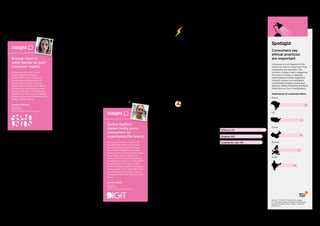
in-store shopper experiences within CPG categories
is removed. The center-store on-shelf stock pressure
eases and opportunities abound to reimagine how
these categories work, prompting a new focus on
curated merchandizing, inspiration and education –
the long awaited retail theater model.
A side effect of this online ‘stock-up’/offline ‘top-up’
model is that channels will have an even greater
difference in shopper mission. Supermarkets will
become destination centers where experience and
enjoyment is key and dwell time increased, whereas
convenience as a channel will face greater pressure
to maximize space and stock, thereby requiring
smarter merchandizing systems.
In summary, while many see seamlessness as
a result, we see it as a necessity that opens the
floodgates to the kinds of shopper-marketing
experiences large format CPG retail needs to deliver
if they are to transform themselves from being
places shoppers have to visit into ones they want to.
Ian Gourley
Chief Creative Officer
Barrows
ian.gourley@barrowsonline.com
£
$
76  BrandZ™ Top 100 Most Valuable Global Brands 2014 77
Section 03  |  Thought Leadership
Ogilvy  Mather is one of the largest marketing communications
companies in the world. The company is comprised of industry
leading units in the following disciplines: advertising; public
relations and public affairs; branding and identity; shopper and
retail marketing; health care communications; direct, digital,
promotion and relationship marketing; consulting, research and
analytics; branded content and entertainment; and specialist
communications. For more information, visit www.ogilvy.com.
SEVEN KEY
PRINCIPLES
FOR A MORE
USEFUL
BRAND
VALUATION
Innovation, once a reliable source of competitive
advantage, is growing less and less secure as markets
become more global and communication becomes
instantaneous and universal. Now, brand has become the
only remaining source of reliable, defendable
differentiation, making it more important than ever before.
And yet, brands are still not taken seriously. Their power is
underestimated and misunderstood, and the failure to put
the case for investment in them on the sound financial
footing expected by CFOs, CEOs and boards is depriving
marketing of credibility, holding brand back from taking
its rightful place in the boardroom.
To change this, a more dynamic approach to brand
valuation is required, one that stands traditional valuation
on its head. This new brand valuation can link marketing
decisions to money, transform the way marketing is
viewed, and catapult it from a corporate communications
role to leadership of growth and innovation.
Unfortunately, brand valuation’s role in marketing today
is largely the same as its role in accounting. Today’s brand
valuation gives only point-in-time values, and as a result
the major use of brand valuation is benchmarking.
For brand valuation to progress beyond benchmarking,
it must finally be considered in conjunction with marketing.
Instead of being just a number, it must become
a diagnostic tool. In order to achieve that, we at Ogilvy
 Mather have strong opinions on the principles that
should be used and the steps that should be followed
when valuing a brand. Here are our seven key principles:
1. Start with how the brand creates value and drive the
methodology from there
The whole point of brand valuation is that brands make
money for their owners. To exploit the full potential of
brand valuation, we must begin by understanding what
brands are and how they make money. Without an
understanding of the sources of value, brand valuation
is limited to being an exercise to produce a point-in-time
number. Brands impact the demand side of the business
(revenues and margins) and the supply side (employees,
suppliers, regulators, and investors). They create value
across the business value chain, to an extent that few
companies fully understand, or leverage. Understanding
how a brand creates value is hugely important – it can
unlock the secret of creating future value.
2.Conduct a robust brand driver analysis
Brand valuations generally have two kinds of inputs –
financial data and brand analysis. As we have seen,
the second input is where most brand valuation
methodologies fall down. The secret to making brand
valuation useful lies in making the brand analysis as robust
as possible. There are statistical methods that can be
used to isolate the financial contribution of the brand.
We recommend using a quantitative brand driver analysis
to determine the brand’s contribution to value.
3. Make it diagnostic
We need to break free from the financial bias that has
afflicted brand valuation. If it is to have practical
application in marketing, brand valuation must be
diagnostic. We are no longer interested in recording
a value to achieve some accounting gain but rather in
identifying what actions we can take to increase the value
of the brand and business. A brand valuation must look
inside the business to identify where brand value is
created, determine how good a job the brand is doing at
each touch point, and identify opportunities to do better.
4. Run scenarios to identify the best opportunities
Brand driver analysis can be used to identify opportunities
for brand improvement. We can identify where the gaps in
brand performance are compared to competitors.
5. Take a holistic approach
Brand valuation needs to take a more holistic approach.
We can measure how a brand creates value across the
whole customer experience, including both tangible touch
points (products, customer service, and the retail
experience) as well as intangible touch points (marketing
communications). This requires more imaginative use of
research data – one that unites the areas usually split
between brand tracking and customer satisfaction studies.
6. Look at many measures
To become strategic, brand valuation must encompass
many measures, not just one. It is easy to become fixated
on “the number,” but this is just the starting point, not the
end point. More meaningful and actionable measures need
to be added. These metrics should be easy to understand,
easily replicated, and forward-looking leading indicators of
brand value creation. They must include a linkage between
brand and share price – the indispensable condition for
getting brand into the boardroom.
7. Look over time – the new brand tracking
To be truly useful, brand valuation must shift from a
point-in-time measurement to measurement over time.
Conducting brand valuation once is a “nice-to-have.” If it
is diagnostic, it can provide important input to strategy
development. But the real ROI on brand valuation comes
when the company’s progress in creating brand value is
tracked, measured, managed and acted upon over time.
Brand valuation can become the foundation for brand and
marketing decisions, which will have a transformative
effect on marketing. Exploiting valuation’s power to link
brand to money can change the corporate perspective on
brand and marketing. A sound financial underpinning for
requests for money puts marketing on the same footing as
other functions in the corporation and gives marketing far
greater credibility. It also improves the quality of brand
and marketing decisions, enhancing the effectiveness of
strategies, driving greater business growth, and pushing
share prices upwards.
BrandZ™ adheres to many of the brand valuation principles
we hold most dear, making it, in our opinion, the best
brand benchmarking practice. BrandZ™ examines these
principles at a high level across many brands. In doing so,
the practice shows each individual brand how crucial these
seven ideas are. BrandZ™ makes an important contribution
to raising the profile of marketing leaders, leaving no one
in doubt that they are managers of one of the
corporation’s most valuable assets – the brand.
Joanna Seddon
President, Global Brand Consulting
OgilvyRed, Ogilvy  Mather
Joanna.Seddon@ogilvy.com
78  BrandZ™ Top 100 Most Valuable Global Brands 2014 79
Section 03  |  Thought Leadership
Definition
The beer category includes global
and regional brands, which, in
an increasingly consolidated
industry, are mostly owned by
four major brewers.
Top 10 Beer
Brand
Value
2014 $M
Brand
Contribution
Brand Value
% Change
2014 vs 2013
1 Bud Light 12,580 3 16%
2 Budweiser 11,834 4 25%
3 Heineken 8,670 4 5%
4 Stella Artois 8,237 4 30%
5 Corona 8,025 4 21%
6 Skol 7,055 4 8%
7 Guinness 5,014 4 12%
8 Aguila 3,676 5 -6%
9 Miller Lite 3,630 3 17%
10 Brahma 3,585 4 -6%
Source: Valuations include data from BrandZ™ and Bloomberg.
Brand contribution measures the influence of brand alone on earnings, on a scale of 1 to 5, 5 highest.
Beer
Drinkers drive volume in fast
growing markets and expect
variety in US and Europe
Major brewers build local and global brands
Expansion in fast growing markets drove
beer volume increases, but changing
social and drinking trends slowed
consumption in North America and
Western Europe. As people, especially
Millennials, socialized more in mixed
groups of men and women, they drank
less and instead focused on experiencing
new tastes and flavors.
To reach new, young beer drinkers in
developed markets, the four major global
brewers – AB InBev, SABMiller, Heineken
and Carlsberg – introduced their own
versions of flavored and craft style beers.
While the craft beer phenomenon is less
pronounced in Europe than in the US,
the growing desire for choice also is
expressed in the resurgence of ale in
the UK.
The major brewers build their global
businesses by balancing the need for
economies of scale with respect for local
beer tastes and traditions. The BrandZ™
ranking of the Top 10 beer brands reflects
this evolution. Four listed brands –
Budweiser, Heineken, Guinness and
Stella Artois – are global beers. The other
brands are regional leaders, with four –
Corona, Skol, Aguila and Brahma – from
Latin America.
Normally, the major brewers produce
their global brands close to the market to
gain the greatest economies. But rising
consumer concern with authenticity has
produced exceptions. SABMiller brews
Peroni, an Italian brand, in Italy. All the
Heineken distributed in the US is brewed
in Amsterdam. To compensate for the
extra production costs, the brewers
market these beers as premium brands.
These other trends continued to unfold:
Pairing with food Brewers promoted
beer as an enjoyable – and affordable
– complement to a good meal, a
premium beer being less expensive
than a modest wine.
Cider Like flavored beer, cider is seen
as an entry option for people who find
the taste of beer too bitter. Of the
major brands, only Stella Artois offers
cider, both apple and pear.
Craft Beer Although the trend is
influential, craft beer represents less
than 8 percent of total beer volume
and around 14 percent of revenue in
the US.
Building global and local
brands
Industry expansion and consolidation
continued, as AB InBev completed its
acquisition of Mexico’s Grupo Modelo,
adding Corona to its portfolio of over
roughly 200 brands. Diageo, the UK-
based spirits giant, relaunched its
Guinness brand in Nigeria, which
consumes more of the brand than Ireland.
Africa lacks beer industry infrastructure
that can be easily acquired. But
expecting strong growth in Africa,
the major brewers have invested in
distribution networks with the goal of
convincing drinkers to trade up to
higher quality beer.
In contrast, the existence of industry
infrastructure facilitated expansion into
Latin American, which now is split, along
a rough “line of demarcation,” between
AB InBev, which holds significant share
in Brazil, for example, while SABMiller
enjoys great success in Columbia. By
acquiring strong local beers, the majors
gained economies of scale and built
diversified brand portfolios that they
crowned with their global brands,
positioned at a premium price.
Brazil is a prime example of this strategy.
AB InBev acquired and invested in local
brands, Brahma and Skol, and introduced
its own global brand, Budweiser, to the
market. AB InBev then reversed the
process, picking one of the local leaders,
Brahma, to build that brand outside
of Brazil.
The world’s largest
market
The majors also continued to compete
for share in the fragmented Asian market.
China, the world’s largest beer market by
consumption, is roughly twice the size of
the US market. Lacking a beer drinking
tradition, consumption per person is
relatively low, which suggests that
opportunity is high.
Although still a market of regional
players, consolidation is happening in
China. Snow, China’s largest brand,
acquired Hong-Kong based Kingway
Brewery at the end of 2013, for example.
China Resources, a State Owned
Enterprise (SOE), and SABMiller jointly
own Snow.
14%
Food and Drink | Beer
80  BrandZ™ Top 100 Most Valuable Global Brands 2014 81
Section 03  |  The Categories
Most of the regional beers are owned by
one of the major global players. Harbin,
which is strong in Northeastern China,
is a subsidiary of AB InBev, which also
markets other brands, including
Budweiser, in China. Yanjing remains
the only Chinese brand without
a foreign partner and with intentions
to remain independent.
Action Points for Brand Building
1. Remain relevant
Tap into the cultural context around
consumers and tell engaging stories that
connect consumers and their aspirations.
2. Celebrate the product
A lot of beer communication is about the
drinking experience rather than about the
beer and its quality and taste. But today,
consumers often are looking for a unique
or distinctive taste.
3. Emphasize the local
Beer is a global industry built on the
legacies of local brewers. Those legacies
are a source of strength, as they signify
authenticity, quality and trustworthiness.
Insights: BrandZ™ BigData
Spotlight
Changing tastes 	
and habits shape
beer consumption
Mature market consumers haven’t
lost a desire for beer, but they’ve
changed their beer drinking
habits. They’re consuming
less and instead looking for
distinctive taste or experience.
This trend is especially true of
younger drinkers, the Millennials.
Consumption remains higher in
fast growing markets where the
interest in a distinctive taste
or experience is present but
less important.
Like to try new drinks
Europe
US
Brazil
LatAm 105
LatAm 110
LatAm 104
MeaningfulGlobally owned,
regionally distinct
The consolidation of beer brand
ownership has not eradicated the
regional preferences and attitudes within
the beer category. Among The BrandZ™
Global Top 10 most valuable beer brands,
four are from Latin America, while
Europe and the US have three each.
The Latin American brands are
meaningful, different and the most
salient (meeting consumers spontaneous
needs and aspirations). European brands
are driven by greater premium and
differentiation, while those in the US
are generally less distinct.
These distinctions also are evident in
the contrasting brand personalities.
Latin American beer brands are “sexy,”
“playful” and “fun.” Those from Europe
are more “desirable” and “brave,”
while the US brands have less
distinctive personalities.
Source: BrandZ™ database
All brands average = 100
Different
Salient
US 99
US 99
US 98
Europe 111
Europe 125
Europe 99
Insight
Brand stories build
customer interest
in both local and
international beers
Knowing where a product has
been produced gives consumers
a sense of confidence around
their choice. However, there
is a tension between the two
sides of this trend – localism
and provenance. On the one
hand, the desire to support and
feel part of a community helps
to drive the interest in beers
brewed locally – such as craft
beer or local national brands. On
the other hand, the aspirational
appeal to tasting something
produced in another part of the
world is boosting premium world
beer portfolios. In both cases,
authenticity around origins is vital
as well as transparency.
Anna Managó
Project Director
Added Value
A.Manago@added-value.com
Insight
Local beers and
global premium
brands shape brewer
portfolios
The major global players are
managing brand portfolios that
are much more diverse. Whereas
before the major global brewers
would acquire local brands
and consolidate them into their
systems, today there is a mix
of the global brands and the
local brands. That’s a change in
strategy as the global brewers
use local brands in local markets.
And the international premium
brands are riding on the back of
these local jewels.
Nick Cooper
Managing Director
Millward Brown Optimor
nick.cooper@millwardbrown.com
Advertising, marketing
and innovation
AB InBev’s Budweiser remained the
King of Beer in title, and its brand value
increased 25 percent, but Bud Light was
the preferred beer in America, one of
the only markets dominated by light
beers, including the MillerCoors brand
Miller Lite.
Marketing and innovation sometimes
came down to the shape of the bottle.
Heineken changed the shape of its
familiar green bottle, adding a long neck
to create a sleeker look and appeal to
younger drinkers, the same group AB
InBev intends to reach with the cobalt
blue bottle of Bud Light Platinum.
Corona continued its “Find Your Beach”
campaign, emphasizing individuality and
featuring the Corona bottle topped with
the ritual slice of lime. In an appeal to
America’s Millennial and Latino drinkers,
Corona offered a draft version of the
beer, an early indication of how AB InBev
intends to grow the brand.
Stella Artois reached Millennials by
focusing on the glass, or chalice, rather
than the bottle. The chalice and the
pouring ritual dramatize the beer’s
premium positioning. Stella created an
app that enabled people to send friends
a virtual chalice of Stella, redeemable for
a real beer at selected locations.
And people who registered through
Facebook for the Stella Artois holiday
promotion had the option of receiving a
surprise gift or passing the gift to a
friend. Passing the gift earned a donation
to a charity and, for those with the
longest gift chains, entry into a
sweepstakes to win a hand-blown crystal
chalice. Stella Artois brand value
improved 30 percent.
Russia’s Baltika, owned by Carlsberg,
found a stealth way to air traditional
commercials despite the national ban on
beer TV advertising. A sponsor of the
Sochi Olympics, the brand promoted its
non-alcoholic Balitika 0 brand. By
inference, the spots also reminded
viewers about the rest of the beer’s
range, which is also branded Balitika
followed by a number that distinguishes
each taste variation.
53
44
21
Source: TGI 2013 / Base: All beer drinkers
Percent who agree: I like to try new drinks.
Europe includes the UK, Spain, Germany and
France.
Beer drinkers age 25 to 34 who are more
likely to try a new drink
Food and Drink | Beer
82  BrandZ™ Top 100 Most Valuable Global Brands 2014 83
Section 03  |  The Categories
Definition
The fast food category includes
Quick Service Restaurant (QSR)
and casual dining brands, which
vary in customer and menu focus,
but mostly compete for the same
day parts.
Top 10 Fast Food
Brand
Value
2014 $M
Brand
Contribution
Brand Value
% Change
2014 vs 2013
1 McDonald's 85,706 4 -5%
2 Starbucks 25,779 3 44%
3 Subway 21,020 4 26%
4 KFC 11,910 3 20%
5 Pizza Hut 7,535 3 25%
6 Chipotle 7,372 4 48%
7 Tim Hortons 4,050 4 20%
8 Panera 2,871 5 -5%
9 Wendy's 2,714 3 New
10 Burger King 2,664 2 9%
Source: Valuations include data from BrandZ™ and Bloomberg.
Brand contribution measures the influence of brand alone on earnings, on a scale of 1 to 5, 5 highest.
Fast Food
Diners pick healthier
options, but customer
traffic remains flat overall
And sometimes a burger will do
Although customer traffic at fast food
restaurants remained flat year-on-year,
sales strengthened for well differentiated
brands and the brand value of the
category improved 10 percent after a 5
percent increase a year ago.
Factors influencing how often consumers
visited a fast food outlet and the brand
they selected included price, occasion,
concern about healthy eating and even
the rise in online shopping, which
affected the number of people lunching
or snacking at shopping malls.
Of all the segments of QSR, or quick
service restaurant business, fast casual
traffic improved most, according to US
research reported by industry journal
Nation’s Restaurant News. This segment,
which includes brands like Chipotle
Mexican Grill and Panera, met the
consumer desire for healthier food and a
comfortable ambiance.
Across the fast food category, brands
continued to upgrade their locations and
leverage the investment by driving
customer traffic at other meal parts of
the day, especially breakfast and mid-
afternoon snacks, with new offerings and
lots of coffee. The quick service segment,
led by McDonald’s, drew the largest share
at breakfast.
The addition of menu items sometimes
diluted the clarity of the brand message,
however. The McDonald’s share price
lagged when service slowed as the
company attempted to introduce many
new menu items. McDonald’s plans to
simplify its offering and invest in kitchen
equipment that enables more meal
customization, a benefit it will market to
customers. These developments
impacted the category:
Menu innovation Wendy’s focused on
its core item, the burger, but
presented it in a new way, on a pretzel
bun that drove sales and received a lot
of social media attention. Wendy’s is
new this year to the BrandZ™ fast
food category ranking.
Benefits of franchising By shifting to
mostly franchise operated restaurants,
Burger King reduced costs and almost
doubled its net income. Its stock price
surged and brand value improved
9 percent.
Improved ambience McDonald’s will
have about half of its roughly 35,400
units remodeled by the end of 2014.
KFC, mostly known for its fried
chicken, opened a fast casual
prototype in Louisville, Kentucky,
headquarters of Yum Brands, the
corporate parent also of Pizza Hut
and Taco Bell.
Expanding the day and
the menu
With traffic flat, brands focused on
building business throughout the day,
especially at breakfast, but also at
potential snack times, reflecting how
daily routines have become less
regimented around three defined meals,
leaving more time for grazing.
Consumers typically select their
breakfast stop based on convenience and
habit, although a well-priced offer can
interrupt ritual. For lunch, people prefer
variety and brands attempt to get into
the consumer’s repertoire. Brand leaders
responded to these dynamics.
Having recently refined its logo to focus
on the image of the siren and eliminate
the reference to coffee, Starbucks
broadened the brand offering around the
core brand experience of affordable
luxury. To fortify breakfast and build its
snack and lunch business it added baked
goods, sandwiches, salads and soups,
leveraging its 2012 acquisition of La
Boulange bakery.
The company also expanded distribution
of its Evolution Fresh juices in its own
stores and in supermarkets. Starbucks is
introducing Yoghurt made by Danone,
under the Evolution Fresh brand. And
Starbucks also featured cold beverages
that it calls “handcrafted sodas,” with
three flavors – ginger ale, lemon ale and
spiced root beer – prepared by baristas.
After testing alcohol and hot food in
several cities, Starbucks plans to roll out
this initiative throughout the US over the
next few years.
McDonald’s added pastries to its
breakfast business, a mealtime that it
dominates in the US with offerings like
its “Egg McMuffin.” Aiming to break
a consumer habit and grab share from
a competitor, Burger King featured
a similar item, priced at a dollar, with
the line, “It’s not that original, but it’s
super affordable.”
The priority of health
Although McDonald’s and Burger King
added salads to their menus, those items
did not drive significant business. When
customers go to the burger segment
leaders, they’ve chosen a particular
experience. The larger health message
from burger restaurants is not only
about menu items but also about the
safety and standards of food sourcing
and preparation.
10%
Food and Drink | Fast Food
84  BrandZ™ Top 100 Most Valuable Global Brands 2014 85
Section 03  |  The Categories
Chains like Chipotle and Panera fit more
squarely in the health trend as they offer
food in a counter-service, fast food
environment, but their value message is
about more than price and includes both
quality and the dining room environment.
Tim Hortons, which dominates the
Canadian market with around 3,470
restaurants, takes a similar approach with
an emphasis on hot meals, like lasagna,
served in a bowl to evoke a home cooked
feeling. Like any fast food chain, Chipotle,
Panera and Tim Hortons deliver taste, but
they emphasize the taste of ingredients
rather than sauces.
Chipotle promoted its “food with
integrity” strapline with a social media
video series called “Farmed and
Dangerous.” In one episode, a friendly
and entrepreneurial scarecrow tours a
nightmarish cartoon depiction of
industrial food production and then
begins its own fresh food business.
With its claim of fresher ingredients,
Subway also benefits from the interest in
health. To underscore freshness, Subway
featured Kermit and Miss Piggy in a video
where the Muppets meet Subway
spokesman Jared Fogel and the Swedish
Chef Muppet prepares a sandwich loaded
with vegetables.
Social and digital
innovation
In a marriage of digital and restaurant
theater, Pizza Hut, a leader in digital
online ordering, experimented with
in-restaurant ordering technology. A
tabletop functions like a giant interactive
screen and customers order by touching
virtual pizzas and toppings.
Wendy’s reached over 85 million
Facebook users with a series of videos in
which a musical group adopted lyrics
submitted by fans into “Pretzel Love
Songs” to promote the chain’s pretzel
bacon cheeseburger. About three-
quarters of participants accessed
Facebook with a mobile device.
Wendy’s subsequently announced that it
would accept mobile payment at roughly
6,500 US locations. Burger King updated
its mobile app to allow smartphone
payments. Around 11 percent of weekly
transactions at Starbucks US locations
are made with a mobile device. The brand
upgraded its iPhone app to enable
customers to add a tip for the barista.
In other social and digital marketing
efforts, Burger King rolled out bkdelivers.
com for home delivery and McDonald’s
tweeted to build traffic during off hours,
when people might feel like snacking.
Fast growing markets
Growth for fast food brands slowed in
China because of the cooling economy
and food-sourcing issues, including a bird
flu scare that impacted KFC. With about
4,600 outlets in China, KFC is recovering
from weakened sales over food safety
concerns related to its supply of poultry.
A campaign to reassure Chinese
consumers began in late 2013.
McDonalds’s has around 2,000
restaurants in China. Starbucks is present
in China with over 1,000 stores and is
expanding in India with Tata as a joint
venture partner. Burger King announced
plans to enter India with the Everstone
Group as a joint venture partner. The
chain controls around 13,600 restaurants
worldwide, mostly franchises, over half
located in North America.
Brands are developing a presence in
Southeast Asia, with McDonald’s and
Starbucks opening in Vietnam. And as if
the usual challenges of global expansion
weren’t sufficient, KFC opened its largest
drive-thru restaurant in Kiev, Ukraine.
Action Points for Brand Building
1. Be healthy
Given a choice, consumers today prefer
to eat healthier. That doesn’t mean they’ll
never indulge. And it doesn’t mean they’ll
restrict their diets to only green and leafy
stuff. It does mean that when people eat
out they want tasty but healthier versions
of their favorite meals.
2. Be consistent
Along with their global success,
McDonald’s and Starbucks share at least
one other common characteristic. Their
restaurants are an important place in the
lives of customers. Customers regularly
return because each brand consistently
delivers on its promise.
3. Be fast
Whether you call it fast food or QSR
(Quick Service Restaurant), the essence
of the category is in the name. Speed
pertains to all aspects of the experience
from ordering to delivery and payment.
In some categories customers may
appreciate the convenience of mobile
wallet transactions, in fast food they’re
likely to expect it.
Insights: BrandZ™ BigData
Spotlight
Snacking between
meals highest in 	
the US
Snacking between meals is
much more prevalent in the US
compared with China and Europe.
This US snacking habit is one of
the reasons that fast food brands
are expanding menus to build
business throughout the day and
not just at traditional meal times.
People worldwide, and especially
in the US, say they consume
treats they know are unhealthy.
Eating snacks between
meals 2013
US
China
Europe
Insight
Value equation
combines price,
quality, experience
Chains like Chipotle and Panera
bridge the gap between fast
food and sit down casual. If
value is about price, quality and
experience, they over deliver
on quality and experience. The
brands might be a little pricier
but their value equation works.
It works because a lot of people
today are looking for tasty and
healthier versions of what they
normally eat.
Doug Poad
Vice President Director of Strategic Planning
JWT Canada
doug.poad@jwt.com
McDonald’s defines 	
value, brand power
McDonald’s defines both value and
brand power in the fast food category.
The McDonald’s brand value is greater
than the total of the next nine most
valuable fast food brands. This
phenomenon reflects consumers’
experience of McDonald’s as the brand
that spontaneously meets their needs
far better than the main competitors
(saliency). McDonald’s also is the
most famous brand, which shows up
in awareness.
Salient (average brand = 100)	
Awareness (average brand = 78%)
Next Top nine 106
Next Top nine 88%
McDonald’s 216
McDonald’s 98%
Source: BrandZ™ database
Insight
Expectations rise for
food that’s healthy
and also fast
The fast food category continues
to be value driven. But we’re
seeing increased consumer
expectations for the healthiness
and quality of the food they
get both at supermarkets and
restaurants. There’s a movement
along the food chain that’s
starting to acknowledge pressure
for better food formulation and
improved treatment of animals.
We also see that the people who
prepare these more considered
menu offerings seem to have a
passion for the brand mission,
which helps build the business.
Philip Herr
Senior Vice President, Client Management
Millward Brown
Philip.Herr@millwardbrown.com
Eating unhealthy
treats 2013
US
China
Europe
Source: TGI 2013 / Base: All adults 18+
Percent who agree: I eat snacks on the move
rather than a proper meal; I treat myself to
foods not good for me. Europe includes the
UK, Spain, Germany and France.
64
42
41
35
22
31
Food and Drink | Fast Food
86  BrandZ™ Top 100 Most Valuable Global Brands 2014 87
Section 03  |  The Categories
Definition
The soft drink category includes
these non-alcoholic ready-to-
drink beverages: carbonated
soft drinks (CSDs), juice, bottled
water, functional drinks (sport
and energy), coffee and tea (hot
and iced).
Top 15 Soft Drinks
Brand
Value
2014 $M
Brand
Contribution
Brand Value
% Change
2014 vs 2013
1 Coca-Cola 67,712 5 5%
2 Diet Coke 12,972 3 -5%
3 Red Bull 10,873 4 3%
4 Pepsi 9,318 3 -5%
5 Nescafé 6,676 4 18%
6 Tropicana 5,178 4 8%
7 Nespresso 4,970 4 11%
8 Fanta 4,879 2 23%
9 Sprite 4,545 3 10%
10 Gatorade 4,115 3 10%
11 Minute Maid 2,483 3 8%
12 Mountain Dew 2,331 3 -7%
13 Diet Pepsi 2,158 3 -3%
14 Dr. Pepper 2,115 3 -5%
15 Aquafina 1,778 2 New
Source: Valuations include data from BrandZ™ and Bloomberg.
Note: Diet Coke includes Diet Coke, Coca-Cola Light and Coca-Cola Zero.
Brand contribution measures the influence of brand alone on earnings on a scale of 1 to 5, five highest.
Soft Drinks
Perfect storm of challenges
siphons category strength
Brands respond with marketing and innovation
Consumers still reached for carbonated
beverages, but not as often.
Demographics, health issues and
changing tastes continued to pressure
the sector, even in fast growing markets.
The category rose in brand value, but
only by 4 percent.
The population that traditionally drove
cola sales, young people, is smaller in
mature markets. Consuming fewer
carbonated beverages, young people
turned to alternatives like energy drinks
and waters enhanced with vitamins.
Coconut water was especially popular in
the US, falling under the general rubric of
healthy, enhanced hydration. But even
alternatives can raise issues. To counter
the concern with sugar level, Tropicana,
the orange juice brand owned by
PepsiCo, added a line extension called
Tropicana 50, which contains half the
amount of sugar.
Consumption of CSDs (Carbonated Soft
Drinks) declined for the ninth straight
year in the US, with a 3 percent drop
in 2013, according to Beverage Digest.
The industry publication reported that
CSD volume in the US retreated to its
1995 level.
Main brands, such as Coke, Pepsi,
Mountain Dew and Dr. Pepper
outperformed their diet versions because
of consumer concern with artificial
sweeteners, according to Beverage
Digest. These other trends emerged:
Regulations Because of health issues
some national and local jurisdictions
limited where brands could sell
products (not near schools) and in
what sizes (no giant drinks).
Choice Although the category is the
target of regulations and health
concerns it keeps expanding and
fragmenting.
Occasion remains key Colas continue
to market their brands for treats or
indulgence, understanding that for the
consumer ordering a slice of pizza and
a beverage, immediate pleasure is the
primary concern.
Innovation and
experience
To achieve a level of personalization and
unique experience, Coke partnered with
Green Mountain Coffee, the company
that makes single-serve coffee pods that
include a selection from Starbucks. Coke
intends to offer a range beverages
prepared at home by the consumer.
The innovation is aimed especially at
Millennials. It assures having the beverage
when and where you want it. It also
personalizes the product and delivers it
with a unique experience in an at-home
variation of Coke’s Freestyle vending
machine, which enables consumers to
mix about 100 flavors.
The approach is also based on the
success enjoyed by Nespresso, which has
created an experience around coffee
drinking at home. With all its flavor
options, Nespresso has made coffee into
more of a treat.
In a separate innovation aimed at reviving
the soft drinks category and remaining
relevant, Coke launched Coca-Cola Life
in Latin America, with cans that look like
Coke but are green to emphasize both
sustainability and health. The drink
uses a combination of real sugar and
artificial sweetener.
Betting that there’s still a growing market
of young people who will drink
carbonated beverages that are made
without corn syrup and preservatives,
and offered with some sense of
personalization and authenticity,
Starbucks is introducing a line of sodas
prepared by baristas in its cafés.
4%
Food and Drink | Soft Drinks
88  BrandZ™ Top 100 Most Valuable Global Brands 2014 89
Section 03  |  The Categories
Spotlight
Cola crosses all age
groups, as energy
drinks draw young
Cola drinkers span all age groups,
especially in the US. Energy
drinks are popular with young
people. In the Brazil, the US and
Europe about a third of people
age 25 to 34 said they had an
energy beverage in the past year.
Cola drink consumption 2013
Brazil
US
Europe
Energy drink consumption 2013
Brazil
US
Europe
Marketing the brands
Pepsi refocused on the Pepsi brand and
invested heavily in marketing, particularly
on traditional media, having focused
earlier on social media. It aimed at
reaching young cola drinkers with
its “Live for Now” campaign and with
the use of celebrity spokespersons,
including Beyonce.
Pepsi also attempted to reach a young
audience with the variety of flavors
available from its Aquafina bottled water
brand. Its Gatorade continued to
dominate the sport beverages. After
public concern over a Gatorade ingredient
called BVO, brominated vegetable oil,
the brand agreed to remove it.
In its focus on events and youth, Pepsi
resembled the approach of Red Bull, the
energy drink, with its sponsorship of
music events along with extreme sports
and other high-energy adventures.
Sprite, a Coca-Cola lemon-lime drink,
continued to benefit from being a clear
beverage, which adds to the perception
that it’s a healthier carbonated option.
The Coke “Open Happiness” campaign
connected with people in an emotional
way that emphasized the appeal and
universality of the brand rather than the
properties of the product. In an ad shown
during the Super Bowl, Americans of
various backgrounds performed
“American the Beautiful,” each phrase
sung in a different language, connected
seamlessly into a musical quilt
representing America’s diversity. To build
on the traditional connection between
cola and food, Coke marketing attempted
to associate the brand with the home
mealtime occasion.
Fast growing markets
Marketing cola as a drink for mealtime
traditionally has been a way to cultivate
cola drinking in fast growing markets.
However, the standard assumption that
rising wealth will drive steady soft drink
growth in those markets is less true today
because more products compete for the
spending of the rising middle class.
In expanding in fast growing markets,
brands faced multiple challenges
including the taste appeal and health
concerns. Health and childhood obesity
are factors in China. Chinese generally
don’t like the sensation of carbonation
and prefer other drinks, like tea.
Tea is also popular in India. Indians are
more disposed to drink carbonated
beverages, and they have options to
choose from, including Coke, Pepsi
and Thums Up, a local brand acquired
by Coke.
In another version of spreading
happiness, Coke featured people in India
and Pakistan in front of Coke vending
machines designed so that the people
from each nation could see each other,
communicate and exchange the gift of
a Coke.
Action Points for Brand Building
1. Innovate
Health concerns about CSDs
(Carbonated Soft Drinks) aren’t going to
disappear. But the category is broader
than CSDs and it’s possible to grow in
areas that satisfy both the consumer
desire for a satisfying beverage and
health concerns.
2. Create new experiences
Drinking involves more than quenching
thirst and enjoying taste. The experience
consumers have as they drink a beverage
also influences their feelings about
the brand.
3. Support the brand
Integrated media campaigns can
strengthen the consumer’s emotional
connection to the brand when the
stories evoke positive memories
and connections.
Insights: BrandZ™ BigData
Insight
Changing habits
drive shift away 	
from cola
In developed markets,
consumption of carbonated
drinks has been virtually flat for
several years. Demographics
in part drive this trend, but so
do changing tastes and health
concerns. Young people remain
the primary consumers of
carbonated drinks, but they are
drinking less soda than past
generations did. In Europe that
population segment is shrinking
while in the States, the Millennial
group is growing slightly, but
they have less money and
more choices than previous
generations. Driven by health
concerns and changing lifestyles
and tastes, young people
are turning to other soft drink
options like enhanced waters
and energy drinks.
Lloyd Burdett
Head of Global Clients and Strategy
The Futures Company
lloyd.burdett@thefuturescompany.com
Insight
Has the soda decline
finally fizzed out?
Carbonated Soft Drink (CSD)
consumption has declined over
the past 25 years. The recent
backlash from critics regarding
high calorie and sugar content
accelerated this trend. In addition,
diet soda has faced criticism
about artificial sweeteners.
Historically, 85 percent of the US
population consumed CSDs. Now,
less than two-thirds drink in the
average week. However, in the
past two years the category has
stabilized; still attracting more
consumers than any category
excluding tap water and owning
the need for a “fun treat.” With
the innovative surge of lower
calorie and natural variants, can
the category attract consumers
back to CSDs?
Lauren Masotti
Client Executive – US Beverages
Kantar Worldpanel
Lauren.Masotti@kantarworldpanel.com
Category goes flat 	
as attitudes change
The health and obesity debate,
government pressure and consumer
awareness of ingredients are
all contributing to a decline in
“meaningfulness” (generates ‘”love,”
meets needs) of the carbonated soft
drinks category. Although the leading
brands, and Coca-Cola in particular,
continue to be extremely successful and
engage their consumers, we see a decline
in “meaningfulness” and “trust” as
consumer needs and attitudes change.
Soft Drinks Top 10 brands
2008
2014
Source: BrandZ™ database
All brands average = 100
Meaningful	110
Meaningful	101
Trust 97
Trust 93
Source: TGI 2013 / Percent of consumers
who drank beverages within the past year.
Europe includes the UK, Spain, Germany
and France.
75
25
61
23
74
17
Food and Drink | Soft Drinks
90  BrandZ™ Top 100 Most Valuable Global Brands 2014 91
Section 03  |  The Categories
Geometry Global is the largest and most geographically complete
activation agency of its kind, providing brand marketers with
a unique solution for an unmet need: Precision Activation. This
proprietary approach focuses on the exact blend of context and
content that combine to influence consumer behavior, transforming
proven communication techniques and big creative ideas into
effective and profitable business growth drivers. With a team of
4000 experts in 56 markets, the global network develops highly
compelling marketing programs – informed by data and insights
– connecting people with brands at precisely the right times, in
the right places, and right ways – making a measurable difference
to clients’ businesses. Launched in June 2013, Geometry Global
delivers award-winning creativity and integrated talent across a
range of disciplines including Shopper, Relationship, Promotional
and Experiential, Trade and Digital Marketing.
For more information, visit www.geometry.com
As humans, we constantly seek to define and
evaluate ourselves, using social interactions,
experiences and personal inventory to project our
own identity. Community and participation are
powerful influencers: we crave connections with
people whose beliefs and values we share. And with
digital as the mighty enabler, our connections are
widening alongside our collective experiences.
People’s relationships with brands have changed.
A recent survey [GlobalWebIndex] asked
consumers how they would want a brand to act
towards them: 50 percent of 25-34 year olds
reported their favorite brand plays an integral
part in their online life and experience, while 38
percent would buy a product or service simply to
be part of the community around it.
Add to this the Convergence Economy [LS:N Global]
where boundaries between brands, sectors,
economy and emotion are dissolving. Look to retail
spaces, products, hospitality and entertainment and
there’s one distinctive theme: it’s difficult to tell one
thing from the other.
Consequently, we need a fresh way to activate
brands, to find new ways to engage with people and
gain a greater share of life and “share of self.”
Today’s smart winners are imaginative, reaching
outside of their historical boundaries to create new
experiences and solutions. Nike, Samsung, Sony and
others, are moving from purely product offers to
services and lifestyle enhancement. For the time
poor, Google’s Future Home has launched life-
enhancing apps from voice-activated cooking to
tablet-operated smart TV.
Such brands are going wide and creating
partnerships to take an increased share of life.
Clothing retailer Banana Republic has collaborated
with Condé Nast Bon Appetit and online reservation
service Open Table to create a Desk to Dinner
collection – an innovative solution for the working
woman while making the brand relevant to a much
larger market. Through a collaborative movement,
Shop Elsewhere in Hong Kong enabled independent
fashion retailers to recommend each other’s
products, allowing shoppers browsing in one
designer’s store to activate the QR code on an item,
leading to a web site with recommendations for
other designers’ products pre-selected to match.
Designers increased reach and attracted new clients
while creating a unique in-store experience.
Critical to brand success in this digital age is the
ability to create precise and relevant connections
and experiences, with communications that engage
people at the right time, in the right place and in the
right way. Mastery of big data has replaced
supposition to extract real time consumer insights,
enhancing a sense of self. In Korea, retailer Emart
created a mobile, Wi-Fi flying store. High footfall
rivals were visited by the drones encouraging
consumers to connect to the flying store via
smartphones. Once connected, consumers were
directed to the Emart online shopping portal to
access discounts. The result: satisfied, value
conscious shoppers and soaring sales for Emart.
The human brand
Technology and data are merely brand conduits and
enablers. The reality is that brands are transitioning
from acquaintance to become life influencers in real
and valuable ways.
Smart brands are inviting people to share an
experience, rather than product. Apple changed the
retail landscape forever to become the supreme
shopper experience where people could learn, seek
help and socialize. In tandem with its aspirational
product it became an iconic global brand with the
best brand retention in the industry [source: WDS].
And this engagement goes beyond the physical,
with 10 percent of Internet users having talked about
Apple online (GlobalWebIndex). In Latin America,
Huggies moved the hearts and minds of parents
when, to celebrate Friendship Day, it delivered a
special crib for two new born babies to a maternity
ward. Bringing two boys together meant each had
their first friend. And Huggies created a moment
parents would never forget.
Apple and Google’s brand-lifestyle ecosystems are an
elegant attempt by both brands to refocus themselves
around an arresting experience; demonstrating
reliability, innovation, design and a defined personality
across every customer touch point.
Participatory brands are here
and now
The past is another country for brands, as they
journey towards a social role within a much broader
community. People are now invited to view brands
as they do their friends, colleagues and partners –
offering products and services the opportunity to
embrace change and help people to think smarter,
lead healthier lives, and enjoy richer experiences.
To succeed, a brand simply has to be clear about its
own values, and the places, spaces and occasions
where it has both role and purpose.
1. People are seekers, searching for solutions
– functional or emotional – to support both them
and their identity. Brands must understand these
needs and their associated behaviors.
2.	In doing this, brands can move away from industry
definitions of category to identify opportunities
by observing consumer and shopper behavior
relating to consumption, usage occasions and
solutions that enhance people’s lives.
3.	For example, in Asia, Cadburys incentivized
shoppers to give chocolate at key gifting
occasions with its “Say it with chocolate”
campaign. Allowing shoppers to create
personalized messages in store, this innovative
approach created a crucial social connection
with the brand, sharing joy and changing
purchase behavior.
MY
BRANDS.
MY
SELF.Jonathan Dodd
Global Chief Strategy Officer
Geometry Global
Jonathan.Dodd@geometry.com
92  BrandZ™ Top 100 Most Valuable Global Brands 2014 9392  BrandZ™ Top 100 Most Valuable Global Brands 2014
Section 03  |  Thought Leadership
In the U.S., Millward Brown Digital delivers comprehensive digital
solutions to help advertisers, agencies and publishers increase
marketing effectiveness and drive brand growth. The unit
combines Compete’s consumer, channel and market intelligence
solutions – supported by the industry’s largest behavioral panel
– with Dynamic Logic’s advertising and campaign effectiveness
offering. Insights from the division help marketers increase media
efficiency and optimize campaign effectiveness, expand sales and
market share for their brands across all channels, and enhance total
brand performance. To find out more visit
www.millwardbrown.com/digital.
Consumer attitudes can be shifted with a single
tweet, and entire categories are being disrupted by
the technologies we carry in our pockets. As the
media industry has gone through massive upheavals
in the past decade, our attitudes as consumers are
more fickle than ever. Social media, in particular, can
trigger flash points for brands, such as the horse
meat scandal from 2013. Even for brands not directly
involved in such controversies, they may also
experience a slower and broader escalation of
shifting consumer preference – consider the growing
consumer and corporate interest in sustainable
meat, including Chipotle and McDonald’s.
To succeed commercially, brands must be dynamic
and innovative. Some innovation is a routine part of
business: Moore’s law driving down the cost of
technology and raising the bar for capacity, or
evolving an existing product to deliver on changing
consumer preferences (e.g. gluten-free cereal). But
other innovations seemingly come out of left field,
whether it’s from a new entrant to the market (such
as Airbnb’s disruption of hospitality) or a radical
re-imagining of an industry (like Amazon’s takeover
of digital media content). Ultimately, both types of
innovation must be supported by consumer demand
(however latent), whether that is an incremental
desire for a slightly better product or a rapid
adoption of a transformative technology.
Savvy brands will need to tap into research to better
understand how that consumer demand is shifting
as well as to anticipate the potential for their own
brand and category to proactively connect with and
shape the consumer mindset. Marketers are anxious
to anticipate the consumer-driven shifts, and they
specifically crave access to the robust cloud of data
we each generate.
In the age of “Data of Now,” there is a persistent
sense that the next trend will leap off the page (or
out of the database) just in time for a brand to pivot
and capture a newly defined market. So as
purveyors of consumer trends and insights, it is our
own industry that is most ripe for disruption – if
brands are looking to make data-driven decisions,
they will be leaning more heavily on market
research. Yet as researchers, we are caught in a
paradox: consumer profiles, augmented by social,
behavioral, and transaction data, can be richer than
ever. But the same media ecosystem that helps
foster this depth is also a quagmire.
There are not only technological barriers to building
these profiles (such as tracking a single consumer’s
behavior across a computer, a tablet, and a mobile
phone), but also serious ethical concerns around
consumer privacy and consent. We anticipate that
innovation could help ease some technological
impediments, but that regulatory action as well
as consumer concerns will constrain the full use
of this data.
Finding meaning in mass data
Moving forward, it will be increasingly difficult to
obtain comprehensive single-source data on a single
individual. We may not know what Jane Doe saw on
TV, how often she tweeted, or what she bought at
which store. But by taking seemingly disparate
datasets that reflect niche patterns of consumer
behavior, and identifying their common patterns,
we can generalize with more accuracy and meaning.
Online behavioral data can give us a sense of search
patterns and overall levels of product demand;
social data can tell us what stands out about a brand
over time; sales data can give us concrete outcomes;
and survey data can help us calibrate each of these
habits, attitudes, and actions in relation to one
another. Some of the data may not even be direct
consumer data, but broader market influences.
Advancements in analytics allow us to be able
to infer and simulate meaningful trends using
a different set of data points than we’ve worked
from previously. Enabling this diversity in the
research ecosystem makes our instruments more
sensitive to both consumer and market shifts
originating from unexpected corners.
As disruption creates competition from unexpected
sources, brands will need to do more than achieve
parity with their category; it may no longer be
enough to simply meet consumer expectations.
Especially for companies whose branding is the
primary source of differentiation, it becomes more
important than ever to have a deep understanding
of the consumer in order to connect the brand to the
meaningful desires and values motivating our
choices. Ultimately, the forward movement of
industry disruption comes from a business – and not
consumers – but integrating stronger consumer data
into market projections can help companies better
identify unexploited opportunities, and position their
brands for growth among the consumers who
support them.
Ali Rana
SVP and Head Scientist,
Emerging Media Lab
Millward Brown Digital
Ali.Rana@millwardbrown.com
T
THE DATA-
DRIVEN
PURSUI
OF THE
INCONSTANT
CONSUMER
Section 03  |  Thought Leadership
94  BrandZ™ Top 100 Most Valuable Global Brands 2014 95
Definition
The bank category, which
includes both retail and
investment institutions, is split
into two tables, with the brands
classified as either global or
regional. Global banks are
defined as deriving at least 40
percent of revenue from business
outside their home country.
As many banks narrowed their
geographic reach and business focus,
France’s BNP Paribas took the opposite
approach, deciding to remain in diverse
lines of banking and accelerate expansion
outside of Europe, particularly to North
America and Asia Pacific. BNP Paribas
appears in the BrandZ™ Global banking
category ranking for the first time
this year.
Investment Bank Goldman Sachs
rebounded with its highest profit in
three years, which drove an increase
in stock price. Standard Chartered,
heavily invested in fast growing markets,
experienced its first profit decline in
a decade. Most of its income is generated
by business in Asia, Africa and the
Middle East.
Top 10 Global Banks
Brand
Value
2014 $M
Brand
Contribution
Brand Value
% Change
2014 vs 2013
1 HSBC 27,051 3 13%
2 Citi 17,341 2 30%
3 J.P. Morgan 12,356 2 28%
4 Santander 11,060 3 20%
5 ING Bank 9,771 3 29%
6 UBS 9,683 2 30%
7 Barclays 9,536 2 19%
8 BNP Paribas 9,453 2 New
9 Standard Chartered 9,150 2 -10%
10 Goldman Sachs 8,400 3 14%
Source: Valuations include data from BrandZ™ and Bloomberg.
Note: Global Banks are defined as those who generate more than 40% of revenues outside their home.
Brand contribution measures the influence of brand alone on earnings, on a scale of 1 to 5, 5 highest.
Banks – Global
US and European resurgence
drives growth as BRICs slow
More revelations erode trust
It felt like Ground Hog Day for banks.
Global banks benefited from improving
economic conditions in North America
and Europe. Overall brand value for the
category rose 15 percent. But even as
financial results improved and banks
strengthened their organizations,
problems surfaced that slowed renewal
of trust.
Consumers expected that coming out of
the financial crisis, and accepting
government rescue, banks would change.
And many did, restructuring their mix of
consumer, commercial and investment
banking, reforming internal culture and
improving customer communication.
But even banks that conscientiously
attempted to reform were hurt by
revelations of past misdeeds and the
public rebuke that followed when
announcements of quarterly results came
with new warnings attached. The public
also expressed anger at banks over high
levels of executive compensation.
When US regulators reviewed the stress
test results that assess a bank’s ability to
withstand crisis, it failed the US
operations of several European banks
and Citi, even as the bank reported its
highest annual net income since the
financial crisis. These other trends also
impacted the category:
Regulations The growth of post-crisis
regulations continued to shape the
banking industry, with banks
struggling to predict and organize
for the implications.
Regionalization After being stalled by
the Euro crisis, the regulatory reform
necessary for the formation of pan
European banks may now resume.
Disruption Banks faced disruptive
technological changes, like mobile
payments and the entry of non-
banking entities into the category.
Reorganizing 	
and rebuilding
Geography was an important
consideration as banks considered
how to restructure and strengthen
their businesses. The Dutch-based
ING separated its insurance and
banking businesses and reduced its
presence in the US and South America
to focus on its operations in Europe and
on certain opportunities in fast growing
Asian markets.
ING’s underlying net earnings improved
22.2 percent in 2013. Having repaid most
of the bailout received from the Dutch
government, and nearing completion of
a restructuring strategy, the bank shifted
to a posture it termed, “Think Forward.”
HSBC also streamlined. After trimming
63 businesses over the past few years,
the bank was well positioned in the fast
growing markets and in Europe. HSBC
improved profits, dividends and
capitalization. Net profit increased 16
percent in 2013.
With the strengthening of Spain’s
economy, Santander planned to expand
its loans to small and medium-size
businesses. Based on the improved
economy in Spain and other core
markets, including Brazil, Mexico,
the US and UK and Continental Europe,
Santander reported a 90.5 percent profit
increase in 2013.
15%
Section 03  |  The Categories
96  BrandZ™ Top 100 Most Valuable Global Brands 2014 97
Financial | Banks
Top 10 Regional Banks
Brand
Value
2014 $M
Brand
Contribution
Brand Value
% Change
2014 vs 2013
1 Wells Fargo 54,262 3 14%
2 ICBC 42,101 2 2%
3 China Construction
Bank
25,008 2 -7%
4 RBC 22,620 4 13%
5 Commonwealth
Bank of Australia
21,001 3 18%
6 TD 19,950 3 12%
7 ANZ 19,072 3 15%
8 Agricultural Bank of
China
18,235 2 -9%
9 US Bank 14,926 3 9%
10 Bank of China 14,177 2 0%
Source: Valuations include data from BrandZ™ and Bloomberg.
Brand contribution measures the influence of brand alone on earnings, on a scale of 1 to 5, 5 highest.
The brand value of the regional bank
category appreciated 6 percent overall
in the BrandZ™ Top 100 Most Valuable
Global Brands 2014, compared with a 15
percent increase a year ago. The ranked
banks divide into two groups.
The six banks from the strong economies
of North America and Australia
appreciated in brand value, with US
Bank appearing in the BrandZ™ regional
banks category ranking for the first time.
The four Chinese banks, affected by
the country’s slower growth rate, either
declined or remained flat in brand value.
Restoring trust
Banks attempted to restore consumer
trust in the wake of the financial crisis,
the Libor scandal about interbank
borrowing rates, various trading
improprieties and public anger over
compensation paid to key executives.
ING introduced new corporate values in
2013, summarized as: we care, we are
clear and we commit to act with integrity.
Following the turbulence of the financial
crisis, a government bailout and a trading
scandal, UBS changed leadership and
implemented a major strategic shift to
focus more on wealth management and
less on investment banking. The bank
reported a 44 percent increase in pretax
profit in 2013. It announced that, starting
in 2014, the bank would pay out half of its
profits to shareholders.
For J.P. Morgan, 2013 was a year of
resolving outstanding legal and
regulatory issues in an effort to turn the
page on problems lingering since the
financial crisis. Overall revenue was flat
and net income declined.
Barclays promulgated a statement of
purpose, values and behaviors called
“The Barclays Way.” It created guidelines
for conducting business and interacting
with customers to make sure that
decisions are based on the best wisdom
available and not internal pressures.
Criticism of corporate bonuses hurt this
effort, even as the bank argued that
recruiting and retaining the best talent, to
remain competitive, required high
financial compensation.
Banks – Regional
North American,
Australian banks prosper
as economies strengthen
Chinese banks struggle with slowdown
Having generally avoided the risky
loans that caused the financial crisis
and government intervention, both the
US and the Canadian regional banks
were well positioned to benefit from the
resurgence of the US economy.
Chinese banks felt the impact of
liberalized regulations, an increase in loan
repayment problems, and a reduction in
capital investment borrowing by State
Owned Enterprises (SOEs) and regional
governments. In addition, these other
trends impacted the category:
Disruption Especially in China,
Internet companies offered online
lending, investment products, and
mobile payment options.
Slower BRICs growth Despite India’s
economic slowdown, India’s ICICI
experienced profit growth, but Indian
banks set aside larger provisions for
bad loans.
Regional to global Sberbank, which
expanded from its roots in Russia to
countries of the Former Soviet Union
and then to Central and Eastern
Europe, considered acquisitions
outside of Europe.
US economy gains
strength
Wells Fargo became the most profitable
US bank in 2013, on the strength of loan
growth and fee income. Net income
improved 16 percent. The bank’s stock
rose 33 percent during 2013.
Wells Fargo increased in scale
dramatically when it acquired Wachovia,
in 2008, without inheriting the kinds of
subprime mortgage liabilities that hurt
many of its peers.
The integration and rebranding went
relatively smoothly and Wells Fargo
passed the stress tests that US regulators
designed, following the global crisis,
to assess whether institutions have
adequate capital and other resources
necessary for surviving a similar event.
US Bank achieved record earnings
in 2013, with strong growth from
commercial loans and other lending
activity, including credit cards and home
mortgages. The bank operates from
around 3,080 offices in 25 states. It
recently doubled its presence in Chicago.
Insight
Global banks serve
changing corporate
and individual needs
People moved to local banks
because of the lack of trust they
had for larger institutions. But
global banks serve a broader
purpose, supporting companies
as they become global and
helping individuals as they
become more global in how
they live their lives. Companies
and individuals want banking
relationships that make it easy
to build a business or live a life
internationally. That seamlessness
is the global banks value
proposition. Perhaps there will be
a shift in the purpose of global
banks, and the need for them
will continue to be important to
generating global growth.
Sana M. Carlton
Head of Client Management, Services
Millward Brown
sana.carlton@millwardbrown.com
98  BrandZ™ Top 100 Most Valuable Global Brands 2014 99
Section 03  |  The Categories Financial | Banks
Insights: BrandZ™ BigData
Brands suffer from lack
of trust and love
Global bank brands, even the Top 10,
attracted negative sentiment before
the recession, and this dilemma has
increased dramatically.
2014 (2008)
Banks may be performing well financially,
but trust has shown dramatic erosion.
Regional banks are rated significantly
better by their customers, however we
still see an erosion of trust.
The contrast between the Top 10 regional
and Top 10 global brands is stark.
Regional banks are more “meaningful”
(meeting the needs of their customers
with greater affinity) than global banks.
Meaningful
Canada and Australia
show strength
Canada’s two largest banks, TD Bank
and Royal Bank of Canada (RBC),
experienced healthy business in 2013.
TD Bank grew net income despite
pressure on its insurance business. RBC
produced strong results, with its net
income up 12 percent.
The banks benefited from their significant
operations outside of Canada. TD is one
of the largest banks in the US, based
on assets. It services more than eight
million customers through its network
of approximately 1,300 locations across
the US. RBC operates in 46 countries.
A weakened Canadian dollar made the
banks’ strong US results even better.
The Australian banks prospered because
of the stability of Australia’s economy
and the proximity to the fast growing
markets of Asia. ANZ, Australia’s third-
largest bank by market capitalization,
has grown through acquisition, having
purchased the operations of Royal Bank
of Scotland in six Asian countries.
Commonwealth Bank of Australia
enjoyed positive results based on rising
home prices and a robust mortgage
business. It has over one million home
loan customers. The bank’s range of
businesses includes retail, corporate and
institutional clients. The bank operates
in Australia, New Zealand, Asia-Pacific
and Europe.
Slower growth impacts
China’s banks
Slower growth in China and other BRIC
markets impacted the Chinese banks,
which also contended with market
reforms that pressured profits made from
loans and pushed banks to look for fee-
based products.
Several Internet companies, including
Tencent, Baidu, and Alibaba disrupted
banking with applications that made it
easy for consumers to keep some of their
savings in online accounts for higher
yields and make financial transactions
with their mobile devices. China Mobile
bought a stake in Shanghai Pudong
Development Bank to facilitate its entry
into financial services.
ICBC, China’s largest lender, continued
its traditional role of funding the projects
of State Owned Enterprises (SOEs),
focusing a lot of activity in Western and
Northeastern China. It also cultivated
business among new, small business
clients.
Driven by slower growth at home, China
Construction Bank, the nation’s second
largest state-owned bank, looked abroad
for business, opening six overseas
branches, in Taipei, New Zealand, Russia,
Dubai, Osaka and Luxembourg. In China,
it moved into retail, opening an online
shopping platform.
Agricultural Bank of China accelerated its
transition to a modern commercial bank
by improving the coordination between
its growing urban and international
business and its base in China’s rural
communities. Already present in Asia,
North America, and Australia, the bank
received permission to open in Dubai.
The state-owned Bank of China is the
country’s most international bank, with
operations in 37 overseas countries.
Determined to build a global commercial
banking business, Bank of China
developed relationships with currency
trading exchanges in Asia and London.
Action Points for Brand Building
1. Set the bar high
Formulate high standards and inspire the
organization to meet or exceed them.
Customers appreciate performance more
than apologies.
2. Be ready when the bar falls
Anticipate that problems from the past
will come back to impact the present.
Hold your nerve. Be open. Make it right.
The past will pass and fade from the
public’s memory. Until another issue
serves as a reminder. So no excuse
for complacency.
3. Know your place
It could be global, regional or local.
There’s a place for the global bank
that meets the needs of international
corporations and cosmopolitan
customers. And there’s a need for more
narrowly focused operations. But it’s
difficult to be all things.
4. Be agile
Competition has increased from outside
the category. A lot of other organizations
are looking to eat your lunch. Prepare for
the new ways people will interact with
their banks. Use technology effectively to
meet customer needs.
Arrogant 117 (109)
Dishonest 114 (105)
Global 92
Uncaring 111 (104)
Spotlight
Global bank brand
value growth lags
Top 100 increase
Since the inception of the
BrandZ™ Top 100 Most Valuable
Global Brands in 2006, regional
banks have experienced strong
brand value appreciation. In
contrast, brand value growth of
the global banks has lagged the
growth of the Global Top 100
overall. Following the financial
crisis of 2008, as the Global Top
100 steadily improved in brand
value and the regional banks
experienced a sharp recovery,
the brand values of global banks
fluctuated. Both regional and
global banks experienced an
erosion of trust following the
financial crisis, with trust in global
banks declining sharply, below
the average score for all brands.
Global bank brand value
fluctuates
Trust and recommendation suffer
Insight
Brands need to fix
core issues before
talking about values
Six years after the crisis,
many major banks still have to
announce multi-billion dollar
provisions for the mistakes made
in that period. The key question
is when will banks become truly
sustainable again? The customer-
facing part is important, but
banks need to deal with their
capital base and other structural
issues first. Until a bank is
fundamentally sound, it can’t
solve its long-term problems. The
transition to sustainable finance
is difficult because it means
slower growth, lower profits and
is perceived as bad news for
shareholders in the short term.
Geoff Beattie
Global Practice Leader Corporate Affairs
Cohn  Wolfe
geoff.beattie@cohnwolfe.com
Trustworthy 94 (101)
Trustworthy 104 (109)
Regional 130
Source: BrandZ™ data.
The brand value growth chart is based on an
index of 2006=100. The TrustR score is based
on an index of average brand score=100.
TrustR measures trust (how well a brand kept
its promise in the past) and recommendation
(how well the brand keeps its promise today).
— Regional  — Global  — Top 100
20142006
100
200
300
400
2008 2010 2012
2014
101
110
92
104
2008 2010 2012
Source: BrandZ™ database
All brands average = 100
100  BrandZ™ Top 100 Most Valuable Global Brands 2014 101
Financial | BanksSection 03  |  The Categories
Definition
The insurance category includes
brands in both the business-to-
consumer – life, property and
casualty – and the business-
to-business sectors. Health
insurance is excluded.
Top 10 Insurance
Brand
Value
2014 $M
Brand
Contribution
Brand Value
% Change
2014 vs 2013
1 Ping An 12,409 2 18%
2 China Life 12,026 2 -21%
3 AIA 8,344 2 22%
4 State Farm 8,314 2 6%
5 AXA 5,645 2 44%
6 Allianz 5,323 3 48%
7 Geico 4,128 2 27%
8 CPIC 3,747 2 1%
9 MetLife 3,290 2 New
10 Travelers 2,981 3 24%
Source: Valuations include data from BrandZ™ and Bloomberg.
Brand contribution measures the influence of brand alone on earnings, on a scale of 1 to 5, 5 highest.
Insurance
Insurers shift focus from
selling products to building
customer relationships
US brands lead the global trend
For insurance brands, it was the year of
personalized customer engagement.
Many of the major US property and
casualty carriers, and some life insurers,
started to organize their big data to
provide a 360-consumer view. European
companies worked to simplify and speed
up their systems to respond in real time
and facilitate customer centricity.
Traditionally, only two transactions have
connected insurers with their customers
– closing a sale and processing a claim.
Neither event produced the kind of
relationships that can pay off over time,
building a base of loyal customers with
continuous and changing needs for
a range of products.
There’s often been a mismatch between
the competencies that would best serve
customers – speed, ease of use and
innovation – and the legacy baggage of
insurers – disaggregated big data,
secure and complicated systems,
siloed organizations and businesses
designed to push products rather than
retain customers.
Although tension sometimes remains
between the priorities of the risk
managers and those responsible for
cultivating customer relationships, closer
coordination exists. Recent initiatives
haven’t eliminated organizational siloes,
but they’ve funneled them through new
functions responsible for the customer
experience. State Farm created a
company-wide taskforce to reorient
around the customer. These other
trends also unfolded:
Ad spending Property and casualty
insurers spent heavily on advertising
to enter new markets and grow share.
Balancing channels Brands looked
at ways to expand their direct
business while maintaining their
agent networks.
Data protection The industry
experienced rising concern about
protecting the personal information
of its customers.
Need to rebuild 	
trust drives change
Several factors drove the customer
centric initiatives. First, especially during
the financial crisis, carriers struggled with
customer retention and recognized the
importance of developing a customer
relationship beyond the point of sale.
Insurers still struggle to rebuild trust
eroded during the crisis.
The second factor is demographic.
Insurers want to reach younger
consumers and retain them over
the course of a lifetime. Like earlier
generations, Millennials consider
insurance only when a life need
arises. But with marriage, children
and homeownership happening
later, insurance opportunity points
are postponed.
The challenge impacts both US
companies, which have traditionally
presented their brands with more
emotion, and European-based insurers
with consumer and enterprise businesses,
whose more steady, institutional
approach often worked well during
the recession.
The German-based Allianz expanded
its business and reported strong results,
driven by property and casualty, with
brand value rising 48 percent. AXA,
headquartered in France, improved
earning substantially, based on
efficiencies gained in mature markets and
expansion into fast growing markets. The
brand has over 100 million customers in
56 countries, a presence that helps
recruit additional customers, talent and
partners, particularly in new markets.
AXA’s brand value increased 44 percent.
Reaching Millennial
consumers
Even life insurers, which lag property
and casualty companies in the use of
social media, are looking at ways to
reach Millennials. They’re introducing
easy-to-buy products with low benefit
amounts. MetLife offers an entry-level
life insurance product that’s packaged
in a box and priced for retail sale off
a shelf or peg hook.
Allstate acquired Esurance, an online
direct-to-consumer business, in 2013.
Esurance purchased TV ad space
immediately after the Super Bowl.
A Millennial celebrity spokesperson
explained that the post-game placement
saved $1.5 million, or 30 percent, the
brand’s typical discount. He invited
viewers to tweet for a chance to win
this jackpot. Over five million people
responded, connecting Esurance to
a youthful audience less accessible to
its parent brand.
11%	
102  BrandZ™ Top 100 Most Valuable Global Brands 2014 103
Financial | InsuranceSection 03  |  The Categories
Insight
Customer
engagement needs
to be relevant and
ongoing
You need to engage customers
in the channels they’re in and
with messages that are relevant
to them. And you need to follow
customers through the entire
lifecycle. Too many carriers
suspend communication at
the point of sale until renewal,
except for things such as claims
information and bill payment
reminders. Relationships beyond
the point of sale require an
investment. But if successful, the
rewards abound: additional sales,
improved retention, advocacy
and referrals. In addition, your
customers will be able to tolerate
higher rate renewal increases,
thus decreasing renewal
shopping. It’s truly about knowing
and serving each customer in a
one-to-one manner, throughout
his or her lifecycle.
Karen Imbrogno
Vice President
Insurance PC and Life Strategies
KBM Group
karen.imbrogno@kbmg.com
Spotlight
Better customer
engagement helps
improve sales
Insurers are attempting to
improve customer relationships,
as 46 percent of consumers say
the relationship with their insurer
is non-existent, adversarial or
minimal. Positive customer
engagement improves KPIs
(Key Performance Indicators)
including: initial purchase,
tolerance of rate increases,
customer retention and additional
sales. Customers who have
a strong relationship with
their insurer are 56 percent
more likely to buy additional
products than are customers
with no relationship.
Impact of customer relationship
on additional sales
AXA announced a partnership with
Facebook to develop social and mobile
marketing initiatives. In the UK, where
direct online sales dominate auto
insurance, the largest auto insurance
aggregators are relatively young brands
that were created by major traditional
brands aiming to reach new audiences
and avoid channel conflict with their
agent networks.
More disruption expected
More market disruption is on the horizon.
Google introduced an insurance price
comparison site in the UK. The brand
offers a potentially powerful proposition
because of the vast amount of data
Google collects and analyzes, including
photos of homes, which can be relevant
for insurance assessments.
And Google is not the only technology
company entering the category. The
Chinese insurance company Ping An
partnered with ecommerce giant Alibaba
and with Tencent, the social network, to
launch an online insurance company
called Zhong An. In an effort to grow
customer share of life, and sell direct,
retailers including Costco and Walmart
offer insurance products.
In another potentially disruptive move,
more companies provided discounts to
customers who agreed to participate in
their telematics programs, where a
device installed in a car records driving
habits. By identifying safe and unsafe
drivers, telematics potentially can
revolutionize the car insurance pricing
model by aligning premiums more closely
with driving habits.
Mobile, social media and
sponsorships
Direct mail, the traditional insurer
marketing tool, doesn’t resonate
with customers looking for more
personalized communication. Many
advertisers have produced clever
multichannel advertising. The irreverence
of Geico’s gecko lizard spokesperson
cuts against the expected solemnity of
car insurance messaging.
Property and casualty brands have
developed apps to quote insurance
prices, pay bills and use GPS to locate
accident locations and obtain roadside
help. A Traveler’s smartphone app helps
users document car accident reports and
begin filing a claim.
Allianz is a major sponsor of Formula One
racing, which ties into its safe driving
initiatives. The brand is attempting to
reach its over 83 million customers in
ways that are relevant to their lives. It has
a weather app that warns people when
bad weather could damage property.
Zurich sponsors an app that locates the
fitness courses that the brand sponsors
and provides exercise advice.
Fast growing markets
The leading global players, like AXA,
Allianz and Zurich, continued expanding
in fast-growing markets. AXA acquired
companies in China and Columbia. AIA
enjoyed strong financial results based on
the increasing life insurance needs in its
17 Asia-Pacific markets. It introduced new
brand positioning as “The Real Life
Company.”
The global brands are expanding their
presence in China, an enormous market
where the insurance category is
dominated by SOEs (State Owned
Enterprises), such as China Life, CPIC
(China Pacific Insurance Company) and
Ping An, which is diversifying into a full
service financial services company.
China’s slower rate of economic growth
impacted both premium and investment
income. The major insurers increased
their online presence and targeted the
wealth management needs of the
expanding middle class. Regulatory
changes are opening the market to
increased competition.
Action Points for Brand Building
1. Make the case
Establish the need for insurance,
particularly among Millennials who
may not think about insurance before
a triggering life event, such as marriage,
which is happening later.
2. Be nimble
In a category known for being traditional,
balance the need to be solid and reliable
with the imperative to keep up with
the changing consumer and the agility
of competitors.
3. Harness data
Use proprietary and outside data to
predict who will need what kind of
insurance product and when they’ll need
it. This approach helps identify profitable
customers.
4. Market one-to-one
Apply one-to-one marketing across all
stages of the customer lifecycle, from
awareness through engagement,
conversion, retention and even
remarketing to those you can’t convert.
Insights: BrandZ™ BigData
Insight
Brands seek to
engage, increasingly
with mobile
There’s a once-a-year cycle of
negativity. The consumer gets an
annual letter that says give me
more money because your rate
has gone up. Brands are trying
to find as many relevant ways
as possible to engage with the
customers and provide a useful
dialogue with them, and also
provide transparent, useful help
or interesting content. Mobile is
an opportunity to demonstrate
usefulness. Mobile apps can
tell you when a storm is about
to hit so you need to put your
convertible safely away, or
connectivity systems built into
the car can call for help in the
case of an accident. Simplification
of the process is another benefit
of mobile from getting faster
quotes to faster claim processes
– that even include uploading a
photo of the damage and getting
instant approval to repair.
Jeremy Nathan
Global Brand Director
Team Allianz WPP
JNathan@wpp.com
In a low engagement
category China’s brands
seem different
Insurance as a category is famously
recessive. Consumers in many cases
decide on price (with the aid of
aggregators) or leave it to a third party
or simply renew without consideration.
Brand therefore tends to play a smaller
part in driving value. China’s leading
brands, however, are far more engaging.
Chinese insurance brands are meaningful
(meet expectations), different (unique in
a positive way) and salient (come to mind
spontaneously).
Meaningful
Different
Salient
Corporate Reputation
147 China
163 China
146 China
120 China
102 Rest of World
106 Rest of World
101 Rest of World
101 Rest of World
Source: BrandZ™ database
All brands average = 100
Source: KBM Group national survey.
Likelihood to purchase additional insurance
products compared with attitude about
relationship with insurer.
Mean likelyhood
1.9 Adversairal
4.6 no
5.0 Minimal
6.6 Developing
7.2 Strong
Likelihood to purchase
additional products from your
insurer. 56% difference
104  BrandZ™ Top 100 Most Valuable Global Brands 2014 105
Financial | InsuranceSection 03  |  The Categories
Definition
The oil and gas category includes
both private International Oil
Companies (IOCs) and state-
owned National Oil Companies
(NOCs).
Top 10 Oil and Gas
Brand
Value
2014 $M
Brand
Contribution
Brand Value
% Change
2014 vs 2013
1 ExxonMobil 19,745 1 3%
2 Shell 19,005 1 8%
3 Sinopec 14,269 1 9%
4 BP 12,871 1 12%
5 Petrochina 12,413 1 -7%
6 Chevron 8,738 1 -3%
7 Gazprom 6,234 1 1%
8 Rosneft 5,549 1 New
9 Total 5,437 1 New
10 Lukoil 4,772 1 -5%
Source: Valuations include data from BrandZ™ and Bloomberg.
Brand contribution measures the influence of brand alone on earnings, on a scale of 1 to 5, 5 highest.
Oil and Gas
Focus shifts to efficiency
and return on investment
Geopolitics adds complication
The oil and gas category slowed
exploration and focused on efficiency.
Investor impatience and geopolitical
tensions compounded the normal
challenges of exploring in some
of the earth’s most difficult and
fragile environments.
With share prices underperforming, oil
and gas companies felt pressured to
return more profit to shareholders and
invest less in risky, long-term exploration
for oil reserves. In response, the majors
looked for productivity gains and ways
to cut capital spending.
These actions may trigger a new cycle of
divesting assets that entrepreneurs
acquire to create oil and gas start-ups.
Ironically, one of the companies best
positioned for this cycle is BP, which sold
assets following the Deepwater Horizon
disaster in 2010. In an agreement with the
US Environmental Protection Agency, the
company can again bid for drilling rights
in the Gulf of Mexico.
To explore in the arctic, which holds
around 20 percent of the earth’s
recoverable oil and gas reserves, major
independent oil companies (IOCs)
partnered with Russian companies:
ExxonMobil with Rosneft; Shell with
Gazprom; Total with Lukoil. Russia’s
actions in Crimea complicated these
relationships. European dependence on
natural gas supplied by Gazprom also
factored into the geopolitical calculus.
At the same time, Chinese national oil
companies (NOCs) were acquisitive last
year, with transactions in Canada and the
North Sea and the purchase of the
Peruvian holdings of Petrobras, Brazil’s
NOC. Chinese NOCs are especially active
in Latin America and Western Africa.
Debates about the benefits and dangers
of hydraulic fracturing, or fracking,
continued in Europe and the US, where
the government deliberated about the
Canadian-US Keystone pipeline,
balancing environmental risks against
the benefits of increasing energy security
and reducing transportation congestion
by flowing oil through the pipeline from
the Canadian tar sands to the Gulf
of Mexico.
These other trends and developments
also impacted the category:
Climate change Oil and gas
companies modified their tone
regarding climate change. The debate
now is about how to remediate the
problem, not whether or not climate
change is real and results in part from
burning fossil fuels.
Natural gas From the industry point
of view, one of the most positive
stories is natural gas. While fracking,
the hydraulic process of fracturing
rock to extract gas from shale,
remains controversial, environmental
concerns have been balanced
somewhat by the impact of natural
gas on reviving the US economy.
The public voice Although oil and gas
companies shape their messages to
reach the officials who control licenses
to operate, social media amplifies the
public’s influence.
New opportunities 	
in the Americas
In a remarkable, but relatively unheralded
development, the US enjoyed energy
self-sufficiency. This change potentially
will influence global politics and change
industry economics, as oil companies can
in one market, North America, both
source energy and deliver it to the
world’s largest economy.
The availability of natural gas is expected
to draw companies that process it into
the chemicals used in the manufacture of
many products, a development that
would widen the customer base for oil
and gas companies in North America.
At the same time, oil and gas companies
faced US regulatory restrictions in the
form of limitations on liquefied natural
gas (LNG) export. Export would bring
new customers into the market and
increase demand, lifting the price of
gas, a good result for the oil and gas
companies but possibly a drag on the
resurging US economy, which benefits
from the low price of gas.
New opportunities developed in Latin
America with Mexico’s reform of its oil
and gas sector, enabling investment in
the state oil and gas company, Petroleos
Mexicanos (Pemex) from outside Mexico.
The change opens the possibility of
strengthening the Pemex brand to
attract partners.
3%
106  BrandZ™ Top 100 Most Valuable Global Brands 2014 107
Commodities | Oil and GasSection 03  |  The Categories
Argentina reached a financial settlement
with Repsol, paying the Spanish oil and
gas company $5 billion in compensation
for government’s 2012 expropriation of
Repsol’s majority stake in the Argentine
national oil and gas company YPF.
Chevron entered an agreement with YPF
to invest in shale gas production.
Brazil attempted to control inflation with
measures that included regulating the
price of gas at the pump. The price
controls impacted the profits of
Petrobras, the national oil company.
Protecting reputation
While the majors continued to aim their
brand messages at the public officials
and others who make or influence
decisions about granting licenses for
exploration, brand strength also was
important for recruiting the best
engineers and for attracting investment.
To help shape the public conversation,
the oil and gas brands also invested in
nuanced marketing campaigns that
avoided the debate about environmental
risk and emphasized the benefits people
derive from energy production.
The messages are to a degree directed at
the large audience of undecided people
trying to balance the need for an
adequate energy supply against the risk
of environmental damage to delicate
areas like the arctic.
ExxonMobil continued to build its brand
around technical excellence, being the
go-to company for the world’s most
difficult and risky exploration, the added
value partner when national oil
companies need outside assistance. But
even ExxonMobil used a less technical,
more consumer friendly voice.
Shell’s ‘Let’s Go,’ campaign dramatizes
the human benefits of energy and invites
people to come together to help build a
better energy future. Chevron put a
human face on the energy business in the
campaign called “I Agree” where
individuals testified about how energy
improved their lives.
State owned companies
The state owned companies have not
traditionally focused on brand building or
cultivating trust. They are more
impervious to pressure. That situation
could change as the state owned oil
companies expand globally.
Although Chinese oil and gas companies
are relatively less familiar with brand
building, the need for brand strength
increases as the Chinese companies face
heightened public concern about the
environmental impact of their activities.
Action Points for Brand Building
1. Be vigilant
Demonstrate and deliver on the brand
promise. The space between promise
and performance is risk.
2. Be positive
Focus on the benefits you provide to
society. Help people understand the
value you bring to their lives. Get out
in front with a positive story rather
than spending so much time countering
the negatives.
3. Be proactive
Invest in the communities where you
operate. When something happens, first
fix the business problem as quickly as
possible. Then turn to reputation repair.
4. Cooperate
The issues are too big for any one
company. There is good reason
for brands to cooperate more on
communication to the public.
Insights: BrandZ™ BigData
Spotlight
Fast growing
markets more willing
to compromise for
the environment
Consumers generally are willing
to compromise some lifestyle
benefits to help improve the
environment. The willingness is
strongest in fast growing markets,
probably because the problem
is most acute there. Although
still strong, the European
inclination to compromise for
the environment has eased a bit.
Many EU regulations already
are in place.
Sacrificing for the
environment 2013
India
Brazil
China
Europe
Public opinion divides
over IOCs and NOCs
There is a huge divide in public opinion
between the top International Oil
Companies (IOCs), the independent
operators, and National Oil Companies
(NOCs), which are state owned. NOCs are
seen to be more supportive and essential
to their country of origin, while IOCs are
generally vilified. However, IOCs score
at average levels for trust and corporate
reputation, which are important for
obtaining the licences and securing the
partnerships needed for exploration.
Source: BrandZ™ database
All brands average = 100
Top 5 NOCs	
Top 5 IOCs
Love (affinity) 196
Love (affinity) 78
Arrogant 102
Arrogant 112
Successful 124
Successful 102
Premium 124
Premium 99
Both the Chinese government and public
have reacted strongly to dangerous levels
of air pollution. China consumes around
10 million barrels of crude oil daily,
second only to the US.
Insight
Brands aim
messages at a 	
wider audience
It is still true that in this category
the license to operate sits in the
hands of very few individuals,
mostly policy makers and
government regulators. But it is
fair to say that, because of the
democratization of information
and wider use of social channels,
the public now has a far greater
say in the fortunes of these
organizations. That’s not to
say we’re going to see a Coke-
like campaign from the oil and
gas majors, but if you look at
their above-the-line activity,
it’s all aiming to create a better
understanding of the important
work they do by a wider audience.
Chris Pratt
Director, Energy
Hill + Knowlton Strategies
Chris.Pratt@hkstrategies.com
Insight
Retail and 	
corporate brands
don’t necessarily
connect in the
consumer’s mind
There continues to be a
disconnection between the
consumer-facing motor fuels
brand at retail and the brand
as a producer of energy that
sustains quality of life. I’ve dealt
with controversial issues for
high profile clients and what
we’ve seen is that regardless
of the degree of controversy
surrounding an oil company, there
isn’t any substantial or sustained
impact at the pump. People aren’t
driving past the filling stations.
They’re not cutting up their
credit cards or driving grassroots
boycotts on social media.
Chris Gidez
Executive Vice President Global Energy
Practice Leader
Hill + Knowlton Strategies
Chris.Gidez@hkstrategies.com
Source: TGI 2013 / Base: All adults 18+
Percent who agree: I am prepared
to change my lifestyle to benefit the
environment. Europe includes the UK,
Spain, Germany and France.
43
65
59
61
108  BrandZ™ Top 100 Most Valuable Global Brands 2014 109
Commodities | Oil and GasSection 03  |  The Categories
Salmon is a highly innovative eCommerce digital agency whose
commitment to on-time, on-budget project delivery is increasingly
embraced by the leading names in retail, wholesale and
manufacturing. Major brands turn to Salmon for its ability to define,
deliver and exploit enterprise scale eCommerce, multichannel
operations and digital marketing solutions. Salmon quickly
understands the business vision, creates realistic project plans and
efficiently delivers solutions to plan; based around a management
process that removes risk from successful project roll-outs. For
more details visit www.salmon.com.
Devices
Empowered, demanding and digitally savvy
consumers expect to research and buy goods
anywhere, anytime using any device or touch point
and to have a seamless experience. Brands need
to be confident they can meet their customers’
expectations of convenience, recognition, service
and immediacy.
Successful brands will be those that manage to tie
all of this together seamlessly, connect with their
customers at a physical place or in the virtual world
and get the products quickly to wherever they
want to receive them. And the range of devices is
increasing fast. Brands will need to consider the
impact of the ‘Internet of things’ (the network of
physical objects with embedded technology, like
in-car sensors and wearable technology). Gartner
predicts that there will be 26 billion such devices in
2020 compared with 7.3 billion smartphones, tablets
and PCs in use at that time.
We’re at the early stages of this but it’s easy to see
what some of the commerce applications might be.
Volvo, for example, is testing a smart car that can
give delivery firms access to the trunk, via a single
use digital key.
I have a Fitbit wristband that tracks the distance I
walk each day, calories eaten and used, weight and
sleep patterns. I’d be very happy if this could be
seamlessly linked to my chosen supermarket to easily
re-order food and to be reminded when I’m likely
to run out of an item. Some days, I’d even like to be
alerted if I try to order the double chocolate chip
cookies when I’m shopping, instead of the fruit salad.
Other days I might choose to switch off such alerts.
Data
One of the keys to enabling a seamless experience
is effective exploitation of data. However, with
2.5 billion gigabytes created each day , the
challenge for brands is using it to derive insight
and most importantly, acting on that insight. With a
burgeoning list of data sources (back-office systems,
stores, call centers, value chain partners, email,
mobile, rich media, user-generated content, social
media) many businesses are overwhelmed by the
scale of the challenge.
Effective use of data can give brands a competitive
advantage. Analysis of data will, for example, show
how customers are using which devices and at what
stages in their shopping journey, and will highlight
barriers to purchase. Building a single customer view
and using that to develop customer segments and
to tailor communications will help brands offer a
seamless experience. And if done right, will shorten
sales cycles, and increase consumer engagement,
loyalty and revenue.
And just think what additional data will be
available from my Fitbit wristband, other wearable
technology and all the new devices with embedded
sensors. As long as I receive useful and enjoyable
communications and have the option to opt
out at any time, then I’d be happy to link this to
specific applications and receive personalized
communications.
Decision Time
2014 is a turning point in the struggle between
Amazon, retailers and FMCG/CPG manufacturers
for control of the consumers’ shopping basket as
Amazon continues to expand its offering, particularly
in grocery. Outside footwear and apparel, FMCG/
CPG manufacturers have been trialing ecommerce
but have yet to make big inroads into the direct to
consumer market. Amazon’s continued expansion of
its grocery offering should be a massive wake-up call
to any supermarket or FMCG/CPG manufacturer not
selling online. It’s decision time.
Manufacturers can embrace direct to consumer
commerce without alienating retail partners, by for
example, offering exclusives, subscription services,
niche or customized products, different pack sizes
etc. While there are many ways to get to market
quickly, it’s also important to think strategically so
that new offerings link up to existing ones seamlessly,
that data and intellectual property is retained within
the company and that strong foundations are in
place for future growth.
Technology has always been disruptive and
transformative. Now we are 25 years on from the
birth of the web, brands need to harness the power
of technology to offer consumers the seamless
experience we all crave.
COMMERCE
4.0 – DEVICES,
DATA AND
DECISION
TIME
2014 marks the 25th anniversary of the invention of
the World Wide Web. The web has disrupted the
way we carry out many aspects of our lives, from
socializing, to watching TV, banking and shopping,
and has led to the demise of some brands, the rise
of others. The creative use of web technology has
shaped commerce; online commerce sales are set
to increase by 20 percent this year to reach $1.5
trillion globally. As we stand at the start of a fourth
wave of online commerce, the challenge for today’s
brands is to ensure their customers have a seamless
experience. Consider the journey so far:
– Commerce 1.0 saw the first generation of web
shops that were based on the real world and
extended the product range through virtual
shelves. Brands took their traditional sales model
and ported it to the web.
– Commerce 2.0 incorporated rich content – such
as video and user generated content, social
networking and web applications – into the selling
process. Brands started to link physical assets like
stores with their digital assets.
– Commerce 3.0 is all about the proliferation of
non-PC devices and globalization. Brands are
integrating digital fully into their physical stores.
– Commerce 4.0 will be driven by the ‘Internet of
things,’ advanced use of data and analytics and a
battle for control of the shopping basket between
retailers and branded manufacturers.
Sue Pratt
Global Head of Marketing
Salmon
marketing@salmon.com
To deliver a seamless
commerce experience,
brands need to think about:
End-to-end experience – it’s easy just
to focus on the customer experience at
the different touch points, however this
overlooks the end-to-end experience, which
can be different. Brands should nominate a
member of staff to ‘own’ a particular end-
to-end journey, aiming to reduce customer
struggle and improve the whole experience.
Data and analytics – it’s increasingly
important that brands bring data sources
together to develop a single customer view.
This can provide an in-depth understanding
of shoppers; whether it be the reason for
their last purchase, personal preferences
or which devices they use for which stage
of their shopping journey. And most
importantly, it can be used to develop
customer segments, tailor their experience,
promotion or content and to improve future
business processes.
Infrastructure – to deliver a consistent
and personalized experience and track
interaction in order to react in real-time,
brands need to choose platforms and
technology components that can be
centrally configured and managed to
support all channels and devices.
110  BrandZ™ Top 100 Most Valuable Global Brands 2014 111
Section 03  | Thought Leadership
Innovation and fragmentation
Over the past 15 years brands have adopted digital
marketing technology in a fragmented, tactical way
creating massive inefficiencies and preventing them
from future optimization and innovation.
“Effective management
of technology has become
a competitive advantage
for marketers.”
Some marketing technologies such as ad serving
and search campaign management were outsourced
to agencies, while others such as email marketing,
web analytics and social listening were often
managed by specialist internal business units. Rarely
did anyone pause to map out the entire range of
consumer touch points and brand engagements in
order to design a truly customer-centric technology
strategy and operating model.
But today, leading marketing organisations are
realizing that the ability to curate a consistent and
relevant brand experience across all touch points
relies heavily on the ability to manage all the tools,
platforms, and data sets that deliver those
experiences in an integrated whole. Customers
expect to be recognized and presented with highly
relevant offers and experiences across multiple
different channels, but this requires the integration
and coordinated use of a large number of disparate
tools. And each time a new media platform becomes
popular with consumers, or a new VC-backed
software platform provides new features and
functionality, the complexity is exacerbated.
In order to combat the fragmentation that can result
from ad hoc adoption of new technologies, brands
need a strong technology strategy and an operating
model to support it.
Transformation in action
The process of creating a marketing technology
strategy and then driving change throughout a
complex global organization with multiple divisions,
brands and suppliers can be time-consuming and
expensive. It is therefore imperative to secure a
strong executive mandate from the start, backed by
a solid, measureable business case. It is also critical
that marketing strategy leads technology and not
the other way round.
Always start with the brand engagement strategy:
What does our current customer experience look
and feel like and how do we want to improve it? Are
we artificially limiting the customer experience as a
result of our own organizational structure or silos?
Next, define the operating model that will best
support the delivery of your brand engagement
strategy. Which functions are managed internally
and which ones are outsourced? Do we need to
operate across brands and markets? How do we
integrate processes with stakeholders in IS,
corporate affairs and insights?
Once the target operating model has been defined
the data and technology strategy can be developed.
In conjunction with your IS colleagues, build
a data framework and technology architecture
that supports your brand engagement strategy
and operating model and make sure you have the
right people in place to manage the new tools
and data sets.
Lastly, ensure that a thorough and ongoing
adoption program is put in place to drive home
the transformation. Training and education is vital,
but equally important is measurement and
comparability through the use of common KPIs
and business benefits.
The limits of technology
Through the smart and structured adoption of
technology brands can achieve better customer
visibility, more meaningful engagement, better
attribution of success and an agile platform for
ongoing marketing innovation.
But it is vital to remember that technology is simply
an enabler. Without the required adjustments to
business process, without properly trained staff in
clearly defined roles, without a strong vision for how
you want to improve your marketing practice, and,
crucially, without the cultural willpower to change
your organization, no transformation program can
be a success.
TRANSFORMATION
THROUGH
TECHNOLOGY
“It is not the strongest of the
species that survive, nor the
most intelligent, but the one
most responsive to change.”
Charles Darwin
Marketing has evolved at an unprecedented pace
during the last five years. Brands are bigger than
ever, competition is global, and consumer behavior
is changing faster than most businesses can
accommodate. In response, there has been an
explosion in the development of software tools to
manage virtually every aspect of marketing practice
and in recent years these tools are being
incorporated into ever-more-comprehensive
platforms of business software by companies such
as Adobe, Google, IBM, Oracle and Salesforce.
Marketing has changed, and at its core is a
technological revolution.
Imperatives for
Success
1.	Secure a strong executive mandate –
Transformation is fundamentally about
culture and vision, not simply tools and
processes, and that has to come from
the top.
2.	Build a strong partnership with IS –
Technology strategy, procurement,
architecture, program and service
management are tasks IS teams are much
better placed to deliver on.
3.	Develop a strong business case – Business
benefits should focus on quantifiable
improvements in marketing effectiveness
as well as cost efficiencies realized through
technology standardization, scale and de-
duplication.
4.	Be customer-centric, not technology-
centric – Technology can be a highly
effective enabler for improved brand
engagements and customer insights, but it
mustn’t lead the process.
Stephan Pretorious
President
Acceleration
stephan@acceleration.biz
Acceleration crafts digital marketing capability for global
brands and industry leaders. We are digital natives who early on
understood the radical impact that technology would have on the
future of brands. A rare breed of individuals with comprehensive
experience of building marketing capability, driving best practice
and implementing marketing technology.
Operating at the intersection of technology and strategy, insights
and consumer engagement to build the specific capabilities
needed to grow market share and expand global reach. We have a
reputation for accelerating value-delivery for brands on the road
to digital transformation. Part of WPP Digital, and with 14 years’
experience, we employ over 150 strategic marketing technologists
globally. For more details visit www.acceleration.biz
112  BrandZ™ Top 100 Most Valuable Global Brands 2014 113
Section 03  | Thought Leadership
Definition
The technology category includes
business-to-consumer and
business-to-business providers
of hardware, software, portals,
consultation and social media
platforms. The diversity of the
technology category reflects the
convergence occurring as brands
develop integrated systems of
products and services.
Top 20 Technology
Brand
Value
2014 $M
Brand
Contribution
Brand Value
% Change
2014 vs 2013
1 Google 158,843 3 40%
2 Apple 147,880 4 -20%
3 IBM 107,541 4 -4%
4 Microsoft 90,185 4 29%
5 Tencent 53,615 4 97%
6 SAP 36,390 2 6%
7 Facebook 35,740 4 68%
8 Baidu 29,768 4 46%
9 Samsung 25,892 3 21%
10 Oracle 20,913 2 4%
11 HP 19,469 2 19%
12 Accenture 18,105 3 10%
13 Siemens 16,800 2 36%
14 Yahoo! 14,174 3 44%
15 Twitter 13,837 4 New
16 Cisco 13,710 2 16%
17 LinkedIn 12,407 4 New
18 Intel 11,667 2 -15%
19 Sony 7,718 3 -1%
20 Ericsson 6,827 2 New
Source: Valuations include data from BrandZ™ and Bloomberg.
Note: Dell has been privatised and valuation is suspended this year.
Brand contribution measures the influence of brand alone on earnings, on a scale of 1 to 5, 5 highest.
With a 40 percent increase in brand
value, technology giant Google claimed
the title world’s most valuable global
brand, ranking number one in the
BrandZ™ Top 100 Most Valuable Global
Brands 2014.
Google’s rise symbolizes the strength of
the technology category that by itself
totals $827 billion, almost 30 percent of
the value of the BrandZ™ Global Top 100.
The technology category rose 16 percent
overall in brand value.
The dominance of technology in the
BrandZ™ Top 100 Most Valuable Global
Brands reflects the ubiquity of
technology in people’s lives and the
strength and global nature of the
category brand leaders, including:
BrandZ™ leaders Four of the top five
BrandZ™ most valuable global leaders
are technology brands. Apple, IBM
and Microsoft follow Google.
Microsoft claimed the spot in 2006.
Google ranked number one from 2007
to 2010. Apple was number one from
2011 to 2013.
Fastest risers The fastest rising
brands across all categories include:
China’s Internet portal Tencent, up 97
percent, Facebook, (68 percent),
Baidu, the Chinese search engine (46
percent), and Yahoo!, which owns a
stake in Alibaba, the Chinese
ecommerce site (44 percent).
Newcomers Two technology brands
entered the BrandZ™ Top 100 Most
Valuable Global Brands for the first
time, Twitter, which launched a
successful IPO in 2013, and LinkedIn,
publicly traded since 2011.
The rapid rises in brand value – and
the fluctuations, with Apple declining
and Microsoft rebounding – point to
the extraordinary rate of industry
maturation and innovation
happening simultaneously.
Some of the brands assert a higher
purpose summarized as “Smarter Planet”
(IBM) or “Do no evil” (Google), which
advances the interests of humanity and
improves life for individuals, while
building loyalty and driving profit. The
most successful technology brands are
those that constantly push the brand
life cycle curve to the right.
Searching for meaning
Both a brand and a verb that means “to
search,” Google has become part of
people’s lexicon and lives. Google
launched Gmail 10 years ago. Today,
over 425 million personal signatures end
with @gmail.com. The brand has
successfully monetized this stature with
a value exchange that converts
aggregated personal data into
information that potentially helps
marketers and consumers connect
in more relevant ways.
Alongside its core business, Google has
built a culture of innovation. Some
initiatives are market driven and have
immediate impact. Google Glass places
Google at the vanguard of technology
and wearable devices. Google created an
Android Wear Operating System for use
with watches and other wearables.
Other more long-term initiatives include
research into artificial intelligence,
slowing aging, improving car safety and
redesigning cities with driverless cars.
Projects like these elevate the brand, so
that it’s viewed as both a commercial and
scientific enterprise, practical in its need
to generate profit but also generous. And
what Google doesn’t innovate, it
acquires, such as its purchase of Nest,
a home automation company.
Refreshing and building 	
a young brand
Facebook, which didn’t enter the
BrandZ™ Global Top 100 until 2011, now
ranks 21. The company’s $19 billion
acquisition of WhatsApp illustrates both
the financial power of Facebook and the
need to refresh a brand only 10 years
after its establishment in 2004, at
Harvard. Facebook claims about 1.2
billion members. As they age, the
WhatsApp messaging service reaches
a younger audience.
Not all Facebook’s initiatives were
about coping with maturation. Within
a week after purchasing WhatsApp,
Facebook staked its claim to the future
of virtual technology with the
acquisition of Oculus, a producer of
virtual reality goggles.
Facebook also announced that it was
experimenting with the drones, satellites
and other technology to connect even
the most remote parts of the earth. The
rise in brand value reflects investor
confidence in this vision and a rebound
from weak share movement immediately
after the 2012 IPO.
16%
Technology – Consumer
Youthful but maturing
brands compete to
innovate and grow
Chinese technology leaders head West
114  BrandZ™ Top 100 Most Valuable Global Brands 2014 115
Technology | TechnologySection 03  |  The Categories
Having anticipated the
future, Apple tries to
catch it
The decline in Apple’s brand value
reflects softening of the share price
because of investor concern about
the future of the company after
founder Steve Jobs, and the recent
lack of breakthrough products that
differentiate Apple.
That said, Apple’s share price
performance over time suggests that
confidence remains strong in a
technology brand that makes products,
retails them around the world, provides
content and is renowned for combining
technology prowess, design and service.
In BrandZ™ research, consumers rate the
Apple brand extremely high on being
different, innovative and meaningful.
This may be the year that Apple
introduces another major innovation –
iPhone 6 or Apple TV. The company
entered talks with Comcast, the largest
cable company in the US.
To drive volume, Apple introduced a new
line of more popularly priced phones and
it signed an agreement with China
Mobile, the world’s largest telecom
provider with over 750 million customers.
Like a luxury brand, Apple faces the
dilemma of balancing exclusivity to
protect the brand and command a price
premium, while expanding to mass to
gain volume at the risk of brand dilution.
Samsung challenged Apple with its
Galaxy smartphones. Operating on the
Android platform, the phones have a
larger screen than the iPhone and other
features that Samsung successfully
promotes. The company preempted
Apple with the launch of wearable
technology, the Samsung Galaxy Gear
smartwatch that coordinates with
Samsung phones and tablets.
Chinese brand leaders
Along with Google, Facebook and Apple,
Amazon also created an ecosystem of
products and services that have become
fundamental to how people live their
lives. (Please see Amazon in the retail
category on page 72). And at the same
time these Western brands developed,
a separate group of brands served the
enormous Chinese market of 1.3
billion people.
Some of the market dynamics mirrored
those in the West as various Chinese
brands initially occupied particular
market niches: Baidu in search, similar to
Google; and Tencent in social media like
Facebook. As in the West, those initially
discrete designations converged. Driven
by consumer interaction and
determination to secure a competitive
edge, the brands developed ecosystems
of products and services.
Baidu strengthened its mobile presence
through acquisitions and other activities,
including expanding in China’s rapid
growth gaming business. It purchased 91
Wireless, a mobile app store and it
acquired Nuomi, a location-based group
buying service. Baidu’s revenue increased
43 percent in 2013.
Tencent, with just over 800 million
monthly active users (MAUs) on its social
network at the end of 2013, is somewhat
smaller as a social network than
Facebook, which reported 1.2 billion
MAUs. With its messaging app, WeChat,
included in the member count, Tencent
had been larger overall until Facebook
acquired WhatsApp.
Like Facebook, Tencent is adding
members and looking ahead for the next
opportunity. Tencent purchased a stake
in JD.com, China’s second largest
ecommerce mall, which positions it to
compete with Alibaba, the ecommerce
giant. Its strategic partnership with the
search engine Sogou puts Tencent
head-to-head with Baidu.
Tencent strengthened its mobile payment
ability and developed online gaming, with
its popular mobile messaging app,
WeChat, which has about 355 active
monthly users. Facebook’s WhatsApp
claims about 450 million users. Both
Tencent and Alibaba introduced mobile
payment and financial services options
that compete with traditional banks.
Twitter, LinkedIn and
global competition
The Western and Chinese technology
brands, which have for the most part
developed separately, are about to face
each other competitively. This
development is best symbolized by the
pending IPO of Alibaba, which is 24
percent owned by Yahoo!. In addition,
LinkedIn, the professional social
networking site, introduced a Chinese
language version of its website.
LinkedIn currently has four million
members in China. The Chinese language
site is part of the brand’s stated strategic
mission to become a global network
creating economic opportunity for a
worldwide workforce of three billion
people. The integration with leading
Chinese portals, including Tencent and
Sina, into its Chinese language platform
enables users to access their contacts.
LinkedIn intends to map all workers,
companies and available jobs and also
establish a digital presence for the
institutions that offer the education and
skills necessary for career success.
LinkedIn currently has almost 280 million
members, about two-thirds located
outside of the US.
Founded in 2006, Twitter launched a
successful IPO in late 2013. The funds are
intended to accelerate the growth of the
site, which describes itself as the only
online platform that’s both public and
real time, democratizing content creation
and distribution.
It regularly receives attention as the
venue for global conversations that take
place around political events in text
bursts of 140 characters. The brand is
working to improve the organization of
the conversations, making Twitter more
useful by organizing conversations
topically and not simply chronologically.
Insight
The valuable brands
attempt to solve big
human problems
Some companies/brands create
products to sell to people; others
try to solve consumers’ problems
or big problems that people face.
For example, Google announced
that it wants to explore ways to
slow aging, something cosmetics
companies have been trying to
do for years. Facebook is creating
a global community through
allowing people to connect. If
you look at how Google and
Facebook operate, they start with
a digital platform and then build
a business around consumers’
needs and interactions.
Obi Ike
Vice President, ecommerce
Rockfish
obi.ike@rockfishinteractive.com
Insight
Consumers treat
tech brands like
friends, up to a point
You take a technology that fulfills
a basic human need, you build
an ecosystem around it, and that
becomes the environment where
the brand is built, where the
money is made. Our relationship
with the brand grows into
something like friendship and
we have loyalty enough to see
them through the occasional hard
time. However, with a brand, if
something fundamentally better
comes along we don’t feel guilty
about moving on. That said, our
loyalty, or at least our inertia, may
increase with age.
Gabe Dorosz
VP, Strategy
Blast Radius
Gabe.Dorosz@blastradius.com
Insight
With high mobile
penetration, 	
Asia is the future 	
of the market
Asia is now the center of gravity
of the mobile market, and its
future. Around 60 percent of the
world’s consumers live in Asia,
and half of all new connections
globally now come from
Asia. The fact that a Chinese
company now owns Motorola
is an interesting sign of the way
things are changing. I expect
Asian companies, whether
Chinese, Japanese, South
Korean, or Indian, to prosper by
understanding Asian consumers
best and being more responsive
to them.
Andrew Curry
Director
The Futures Company
andrew.curry@thefuturescompany.com
116  BrandZ™ Top 100 Most Valuable Global Brands 2014 117
Technology | TechnologySection 03  |  The Categories
Meaningfully different
brands drive financial
success
Technology brands dominate the Top 100
by value. On average they’re worth nearly
double the other brands in the ranking.
The Top 10 technology brands are
particularly strong in meeting consumer
and business needs. They’re more
differentiated and generate more affinity
because of their brand power (ability to
drive market share).
Action Points for Brand Building
1. Be flexible
Change happens quickly in technology.
The most elegantly designed boardroom
strategy will not work unless it allows
the company to be nimble and make
decisions quickly.
2. Exhibit thought leadership
With transformation happening in many
industries, it’s important to demonstrate
knowledge and to provide the
technological solutions your clients need
to navigate though disruption.
3. Nurture innovation
Technology companies are distinguished
by their people. Build a culture of
innovation. Throughout the organization
incentivize people to seek out new ideas
and take risks.
4. Celebrate success and move on
Success should signal urgency to change.
You can’t stop, especially in technology.
Success requires conviction, being all in.
Make the business obsolete before the
competition does.
Insights: BrandZ™ BigData
Source: BrandZ™ database
All brands average = 100
Brand Power
Top 10 Technology brands
(average) 348
Top 100 Brands (average) 202
Spotlight
US consumers lead
in smartphone,
tablet ownership
With the rise of mobility and
multiple screens, consumers
increasingly shop or watch
entertainment or an
advertisement on one screen
while engaging with a social
network on another screen.
This phenomenon is more
prevalent in developed markets
where over half of adults own a
smartphone and many have
tablets. In the US, over half of
adults own a smartphone, one
quarter own a tablet and 13
percent own both devices.
Mobile device ownership
US
UK
Europe
China
Latam
Source: TGI 2013 / Base: All adults 18+
Percent answering: Do you own a smartphone,
tablet? Latam includes Argentina, Brazil,
Chile, Colombia, Ecuador, Mexico, Peru and
Venezuela.
Own Smartphone
Own Tablet
Own Both
53
25
13
53
14
11
55
18
11
32
13
7
14
2
1
Technology – Business
Brands see through the Cloud
and turn planning into action
Businesses adjust and reinvent
Business-to-business technology brands
adjusted to new computing realities,
especially the Cloud. And they advanced
initiatives for corporate clients that
invested again in IT and sought ways to
organize and analyze big data.
If one development summarizes this
movement it’s the announcement by
Microsoft that the company is changing
leadership, with founder and technology
visionary Bill Gates returning in an active
advisory role.
The brand continues to thrive based on
the Gates legacy of products, including
Microsoft Office, the suite of computer
software installed on the majority of
devices for personal and enterprise use.
The company enjoyed some success with
the launch of Windows 8. And the Xbox
business remains strong.
These legacy achievements drove
revenue and profit, which pushed up
brand value 29 percent, lifting Microsoft
several places to number four, after IBM,
in the BrandZ™ Top 100 Most Valuable
Global Brands 2014.
But Microsoft hasn’t developed other
breakthrough products and the advent
of the Cloud threatens the ubiquity of its
Office suite. Microsoft is not alone in
struggling to remain relevant in a world
based on Cloud and mobile computing,
where people switch constantly and
seamlessly between their work and
private lives.
The Cloud pay-as-you-go model
disrupted the business of some of the
most respected technology brands,
which built businesses around long-term
contracts and client relationships. With
pay-as-you-go, costs are reduced from
major capital expenditures to running
costs. And unlike with an investment in
mainframes, need always matches
capacity. Other related trends and
developments include:
Brand strength Brand is critical during
a period of transformation. The
strength of the IBM brand, its
association with solving big global
problems, provides flexibility even
during periods of business transition
and flat financial results.
Going private Facing the challenge of
being a leading PC maker at a time of
declining PC sales, Dell founder
Michael Dell took the company private
to make the necessary fixes without
the scrutiny of Wall Street and the
pressure of quarterly results, and to
take control of the brand story.
Amazon One of the largest
competitors for enterprise Cloud
business is a retailer named Amazon.
Investing in Cloud
Every technology leader invested in
Cloud in ways that are most relevant to
its core brand proposition. Cisco, known
for building and maintaining switches and
routers that run the Internet, announced
in early 2014 that it plans to invest $1
billion over two years to enter the Cloud
computing service business, linking the
mainframes that together form the Cloud.
Cisco calls this work the Intercloud.
IBM continues to develop its Cloud
capabilities. It’s also building its big data
and analytics teams, looking to expand
into various industries, including marketing
consultation. Siemens, an industrial
technology company, continues to undergo
restructuring and organizes its business into
four sectors: energy, healthcare, industry
and infrastructure and cities.
Strengthening the core
SAP and Oracle accelerated their shift to
the Cloud, even as they strengthened
existing business. SAP continued to
record sales growth and experience
success with Hana, its in-memory system
for analyzing big data quickly in ways
that make it accessible and relevant
throughout an organization.
At the same time, the company shifted
rapidly toward Cloud computing, which
changes the business model from the
software license business where payment
is received up front.
Oracle’s Cloud business improved
significantly, but the brand still faces
competition, much of it from pure online
businesses. As Oracle adjusts its business
for the changing technology, it’s helping
its enterprise customers do the same
thing, by providing Cloud applications,
like Oracle’s Exalytic in-memory and
software. Oracle says one of its key
benefits is simplification.
Recovering from 	
the PC focus
HP turned a modest profit and its stock
price rebounded as a turnaround seemed
to gain traction with a revised strategy
that includes providing complex
technology systems to corporate clients
and selling PCs and printers to
consumers. The company has streamlined
and added efficiencies with Internet-
based programs, such as Salesforce.
By combining its computing hardware
expertise with the Cloud capabilities of
Clouderia, Intel worked to evolve from a
business associated with memory chips
for PCs into a brand with a Cloud platform
for enterprise solutions. With the growth
of wearable technology, Intel investigated
acquisitions for entering that business.
118  BrandZ™ Top 100 Most Valuable Global Brands 2014 119
Section 03  |  The Categories Technology | Technology
Definition
The telecom provider category
includes brands that primarily
develop, maintain and
market hardwire or wireless
infrastructure networks for voice
and data transmission.
Top 10 Telecom Providers
Brand
Value
2014 $M
Brand
Contribution
Brand Value
% Change
2014 vs 2013
1 ATT 77,883 3 3%
2 Verizon 63,460 3 20%
3 China Mobile 49,899 3 -10%
4 Vodafone 36,277 3 -9%
5 Deutsche Telekom 28,756 2 20%
6 Movistar 20,809 2 56%
7 Orange 15,580 3 13%
8 BT 15,367 2 61%
9 MTS 12,175 3 14%
10 MTN 10,221 3 -11%
Source: Valuations include data from BrandZ™ and Bloomberg.
Brand contribution measures the influence of brand alone on earnings, on a scale of 1 to 5, 5 highest.
Telecom Providers
Economic recovery drives
market consolidation
and disruption
Brands focus on differentiation
European and North American telecom
providers faced consolidation and
disruption as the markets recovered
economically and major players
sought to strengthen their networks,
advance convergence and improve
customer experience.
Flush with cash following the sale of its
stake in America’s Verizon Wireless,
UK-based Vodafone agreed to purchase
Spain’s Ono. The transaction, along with
the earlier acquisition of Kabel
Deutschland, a German cable operator,
strengthened Vodafone as a provider
of high-speed broadband. These deals
cooled speculation about a major
trans-Atlantic hook up in which the
American telecom ATT would
acquire Vodafone.
Meanwhile, challenger strategies
disrupted the pricing model of the
telecom category in the US, which is
dominated by Verizon and ATT. Not
long after US regulators rejected the
merger of T-Mobile and ATT, T-Mobile
introduced pay as-you-go pricing in
a market where providers traditionally
lock in customers to multi-year contracts
sweetened with deep discounts on
smartphones.
T-Mobile, the fourth largest US telecom,
also offered early phone upgrades and
free international roaming. The brand,
which is majority-owned by Deutsche
Telekom, added about two million
customers in 2013, reversing a decline.
Japan’s Softbank, which acquired Sprint,
the number three US telecom brand,
announced its desire to purchase
T-Mobile. Combining Sprint with T-Mobile
would create a telecom with over 100
million customers, roughly the size of the
market leaders ATT and Verizon. Other
potential category disruptors include:
Virtual operators Chinese regulators
approved the applications of two
electronics retailers, Suning and
Gome, to offer telecom services.
They have joined other non-telecom
brands, such as Virgin, Tesco, and
Falabella, the Latin American
department store. These brands serve
as Mobile Virtual Network Operators
(MVNOs), renting capacity from
telecoms and branding a service to
gain a greater customer share of life.
Over-the-top Facebook’s acquisition
of WhatsApp may shift more voice
and text to free, over-the-top Internet
alternatives. Data, more than
voice and text, produces revenue
for the carriers. In addition, the
increased availability of free Wi-Fi
in public places may divert more
data transmission.
On-demand streaming Recent
developments threaten the pay-for-
view model that drives revenue
for telecoms. Comcast, America’s
largest cable network closed a deal
with Netflix and entered talks with
Apple. These arrangements
potentially offer content less
expensively, with subscriptions, and
without the delivery problems that
impact streaming quality during
high-use periods.
Building capacity
Brands addressed the key and ongoing
challenges of the category: providing
enough bandwidth to smoothly handle
rising data consumption; and becoming
more than a commodity delivery system
ignored by consumers – until something
goes wrong.
Both challenges continued to become
more difficult for telecoms worldwide.
Data usage increased with improvements
in mobile device processing power
and the option of multi-tasking on
a single screen.
Vodafone planned to spend some of its
Verizon proceeds on capital investment
to strengthen its European network.
Telecoms sought advantage of scale,
investing in 4G infrastructure and
amortizing the costs over large
customer bases.
The high costs of these investments
resulted in more infrastructure
cooperation among carriers. With
pressure on revenues because of
Europe’s economic slowdown, telecoms
requested an easing of rules to permit
more consolidation and 4G rollout.
Regulators have prevented further
consolidation in the US.
8%
120  BrandZ™ Top 100 Most Valuable Global Brands 2014 121
Technology | Telecom ProvidersSection 03  |  The Categories 
Differentiating brands
To strengthen differentiation, BT added
content. The UK-based telecom
purchased the rights to English Premier
Football, adding over two million new
subscribers and driving up revenue.
The added value helped justify
premium pricing.
Vodafone offered customers a pricing
package with content that included either
Sky Sports or Spotify. Vodafone’s
balance sheet strengthened with the
$130 billion sale of its 45 percent stake
in Verizon.
In a category noisy with competitive
claims, the challenge to differentiate is
compounded because consumers can be
skeptical about what they hear. In the US,
Verizon promoted its technical expertise
in a series of full-page newspaper ads
extolling its first place finish on a variety
of technical metrics.
ATT made similar points in an
approachable style with a TV campaign
titled “It’s not complicated,” in which a
man in a suit sits at a low table with
school children and listens to their
humorous, but logical, explanations of
why “big is better” or “now is better.”
Fast growing markets
European brands, looking to diversify out
of the commodity constraints in their
home markets, looked for profitable
volume growth in fast growing markets.
By purchasing the stake of its local
minority partner, Vodafone took control
of its business in India. It continued to
develop business in Africa through
Vodacom, a subsidiary.
Meanwhile, South Africa’s MTN continued
to expand in the Middle East and in
Africa. The Indian telecom Bharti Airtel is
among the competitors also providing
mobile services in Africa, an area with
over a billion people underserved by
fixed-line infrastructure and Internet.
Movistar benefited from the improvement
in Spain’s economy and the brands
extensive presence in Latin America. A
combination of financial performance
and brand strength drove its 56 percent
increase in brand value.
China Mobile remained the world’s
largest telecom by far, with over 750
million subscribers. After launching 4G, it
rapidly expanded its network and
introduced the iPhone. It also offered two
low-price handsets under its own brand
to increase its share of the 3G market,
where it competes with China Unicom
and China Telecom, which also are
building 4G networks.
Competition heated up in Russia, with the
merger of state-owned Rostelekom and
Sweden’s Tele2 to create a fourth
telecom in a market dominated by MTS
along with Megafon and VimpelCom.
MTS continued to leverage its brand and
network to develop a bank offering
extensive financial services.
Action Points for Brand Building
1. Be clear
Communicate a clear proposition about
the brand’s technical competence,
but deliver it in a memorable way that
explains the benefits of the network to
the consumer.
2. Tailor the message
Market the brand to a range of customers
from technically savvy trendsetters to
high-value customers who simply want
something that works reliably.
3. Focus on households
A major question for telecoms is who’s
going to own the household. Gaining
a family with 10 devices is more of an
acquisition than a user switch.
4. Think global
For the major telecom providers that are
now local, regional or even international,
the next move is to become global, one
brand serving customers worldwide.
Spotlight
Fast growing market
consumers select pay-
as-you-go options
Consumers in developed
markets usually pay for mobile
phone service with contract
arrangements that may include
subsidies covering the price of
the phone. With less predictable
income, consumers in fast
growing markets are more likely
to buy an affordable phone
and pay for telecom service as
they use it. India has the highest
percent of mobile pay-as-you go
customers. The US has the lowest,
but the market is experiencing
a period of disruption with
challenger brands offering pay-
as-you-go options.
India
Brazil
Russia
Germany
UK
Europe
Spain
US
Insight
Contract-free pricing
disrupts US market,
pressuring brands
This year’s challenge, at least
in the US, is the availability
of telecom service without a
contract. It will resonate with
consumers who, as a general
rule, dislike being locked into
anything. You hate it, but you
do it. Once a brand breaks that
paradigm and says, you can get
good connection without signing
your life away, the consumer will
pay attention. The big players will
feel enormous pressure. They’ve
become comfortable with the
category’s stability. Contracts
were seen as normal. But in the
future, more consumers will ask,
“If I can’t see the difference, why
pay the difference?”
Allen Adamson
Chairman, North America
Landor
allen.adamson@landor.com
Powerful brands risk	
Seeming too arrogant
The Top 10 telecoms are some of
the world’s most powerful brands.
Consumers rate them high as being
extremely successful and “in control.”
However, this status comes with a
warning because consumers also see
the brands as “arrogant” (only second in
degree to the banks).
Insights: BrandZ™ BigData
Success
118
In Control
118
Arrogant
112
Source: BrandZ™ database
All brands average = 100
Source: TGI 2013 / Base: All adults 18+
Percentages don’t total 100 because of other
responses or no response. Europe includes the
UK, Spain, Germany and France.
Prepaid/Pay-as-you-go
Contract – Monthly/Annual/Multi-year
80
5
64
22
55
11
41
38
41
48
32
56
28
71
12
62
122  BrandZ™ Top 100 Most Valuable Global Brands 2014 123
Technology | Telecom ProvidersSection 03  |  The Categories
Founded in 1997, Mindshare was set up to pioneer and innovate
in order to give our clients a competitive advantage. In the
intervening decade, we have been the world’s fastest-growing
media agency – and we have witnessed a true communications
revolution. Traditional notions of what marketing agencies can do
have been ripped up and the lines between digital, creative, media,
direct and consultancy have blurred. For right now and for the
future our ambition is to lead the definition of what a media agency
can do and should do.
Further information can be found at:
http://www.mindshare.co.uk/
Figure 1: The Brand Life Cycle: years to move
between quadrants. The transitions are estimated
based on the moving brands (41% of brands
included in the analysis)
Mindshare’s BrandZ™ brand transition analysis has
identified the life cycle of a typical brand (Figure 1).
We’ve estimated the average growth rates of
growing brands and calculated journey times
between quadrants.
Brands begin life in the bottom left quadrant, with
low Presence and low Voltage*. It takes at least five
years to travel up to the top left quadrant, during
which time brands begin to develop a following.
To grow to a strong dominant position in the top
right quadrant, with high Presence and high Voltage
takes a further 12+ years. For those with momentum,
the full brand lifecycle is on average approximately
50+ years.
But this is just the movers. Of the brands we looked
at, 59 percent don’t move significantly over the
15-year period studied, either in terms of Voltage or
Presence. They remain in either healthy or frail stasis,
or else crawl along imperceptibly slowly.
The standard story of diminishing returns to
advertising suggests that smaller brands with
momentum should grow faster than their larger
counterparts. Conversely larger brands may be able
to leverage their scale to protect themselves from
decline. If we split the journey into two phases of
growth and shrinkage we can see that the growth
phase takes around 17+ years, whereas the
shrinkage phase around 33+ years. This apparent
asymmetry between rise and fall lends support to
this hypothesis.
Figure 2 illustrates how growth rates vary by the
sector for Voltage and Presence. Across both
metrics we see the highest growth rates are in
Electronics  IT**, which may reflect wider shifts
in technological progress.
The brand life cycle also varies by continent (Figure
3). Average growth rates in Asia are significantly***
higher than in Europe for example, which may be
driven by wider economic and social changes. If this
is the case we may expect to see brand growth rates
in Africa increase over the coming decade. While
South America has the highest average growth
rate this figure has been in slow decline over the
last decade.
This is a preliminary analysis of BrandZ™ data.
We have identified a typical brand lifecycle in which
brands rise and fall over a period of a half a century.
Clearly there are many outliers and the dynamics of
this cycle will vary considerably by market. Most
brands remain stationary, at least over the period
we’re looking at. We’ve found an asymmetry
between the growth and shrinkage phases, implying
dominance is to some extent self-reinforcing, which
fits with what we see elsewhere e.g. PIMS database.
Smaller brands that are growing tend to move
faster than their larger counterparts, implying
convergence, however many will fall out along
the way and become sedentary.
What is yet to be fully determined is what impact
digital and social media marketing will have on the
typical brand life cycle. It’s reasonable to speculate
that newer brands may reach the top left quadrant
in less than five years, their trajectory being
propelled by the disruptive forces of connected
consumers and the transcendence of geographic
boundaries. However, unlike brands that have
strategically invested in the development and
nurturing of their values and consumer relevance,
those that rely on the fickleness of consumer favour
may find they fall further, faster.
*Brand Voltage is a one-number summary of the growth potential of
a brand. It takes into account how many people are very loyal to the
brand (the brand’s bonding score) and claimed purchasing data for
the category to produce a single Brand Voltage number.
** The category covers IT Hardware and Software, Gaming, Mobile
devices and Televisions.
*** We have rejected the hypothesis that there is no significant
difference between the growth rates by different continent at
probability level lower than 5%. It is worth mentioning that voltage is
a slowly moving metric, therefore even 0.1% difference in growth may
be significant.
RISE ANDFALL:
EXPLORING
THE
BRAND
LIFE
CYCLE
Google ‘brand life cycle’ and you’ll get: some charts,
a dusty academic article, many assertive blog posts
and a set of lecture notes. From each emerges a
common theme of rise, maturity and stagnation or
decline. Innovations and changing consumer tastes
bring into being new contenders with new stories to
tell; the old adapt or else fade away.
But how much motion is there in the brand space?
What does a successful brand look like, and how
long does it take to grow one? Do brands die out,
or is dominance self-perpetuating? How do these
elements vary across markets?
It is with these questions in mind that we set about
analyzing the BrandZ™ study database. Our core
hypotheses are that:
– There exists a typical brand life cycle.
– It takes a long time to grow a brand and new
brands tend to grow faster than established
brands.
– Those that do grow are able to retain their superior
position more easily than others.
– The causes of motion, namely technological
and social disruptions, imply varying degrees
of dynamism across markets (geographical
and product).
Aleksandra Iljina	
Senior Analyst Developer
Mindshare
Aleksandra.Iljina@mindshareworld.com
Duncan Stoddard 	
Account Manager
Mindshare
Duncan.Stoddard@mindshareworld.com
Building
Meaningfulness
Alcohol
FMCG
Automotives
Finance
Electronics
Death
Decline
Begins
Voltage
Presence
Dominance
Birth
5+yrs
5+yrs
28+ yrs
Stayers
59%
Movers
41%
12+ yrs
Voltage
0.2
0.0
1.0 2.0 3.0 4.0 5.0
0.4
0.6
0.8
1.0
1.2
1.4
Presence
124  BrandZ™ Top 100 Most Valuable Global Brands 2014 125
Section 03  |  Thought Leadership
04Resources
BrandZ™ Valuation Methodology
BrandZ™ Reports, Apps and iPad Magazines
WPP Resources
WPP Company Contributors
WPP Brand Building Experts
BrandZ™ Global Top 100 Team
BrandZ™ Valuation Contact Details
126  BrandZ™ Top 100 Most Valuable Global Brands 2014 127
Section 04  |  Resources
The brands that appear in this report are
the most valuable in the world. They were
selected for inclusion in the BrandZ™
Most Valuable Global Brands Top 100 and
category rankings based on the unique
and objective BrandZ™ brand valuation
methodology that combines extensive
and on-going consumer research with
rigorous financial analysis.
The BrandZ™ valuation methodology
can be uniquely distinguished from its
competitors by the way we obtain
consumer viewpoints. We conduct
worldwide, on-going, in-depth
quantitative consumer research, and
build up a global picture of brands on
a category-by-category and country-by-
country basis.
Our research covers two million
consumers and more than 10,000
different brands in over 30 countries.
This intensive, in-market consumer
research differentiates the BrandZ™
methodology from competitors that rely
only on a panel of “experts” or purely
financial and market desk research.
Before reviewing the details of this
methodology, consider these three
fundamental questions: why is brand
important; why is brand valuation
important; and what makes BrandZ™
the definitive brand valuation tool?
Importance of brand
Brands embody a core promise of values
and benefits consistently delivered.
Brands provide clarity and guidance
for choices made by companies,
consumers, investors and others
stakeholders. Brands provide the
signposts we need to navigate the
consumer and B2B landscapes.
At the heart of a brand’s value is its
ability to appeal to relevant customers
and potential customers. BrandZ™
uniquely measures this appeal and
validates it against actual sales
performance. Brands that succeed in
creating the greatest attraction power
are those that are:
Meaningful
In any category, these brands appeal
more, generate greater “love” and meet
the individual’s expectations and needs.
Different
These brands are unique in a positive way
and “set the trends,” staying ahead of the
curve for the benefit of the consumer.
Salient
They come spontaneously to mind as the
brand of choice for key needs.
Importance of brand valuation
Brand valuation is a metric that quantifies
the worth of these powerful but
intangible corporate assets. It enables
brand owners, the investment community
and others to evaluate and compare
brands and make faster and better-
informed decisions.
Distinction of BrandZ™
BrandZ™ is the only brand valuation tool
that peels away all of the financial and
other components of brand value and
gets to the core – how much brand alone
contributes to corporate value. This core,
what we call Brand Contribution,
differentiates BrandZ™.
The valuation process
Step 1: Calculating
Financial Value
Part A We start with the corporation. In
some cases, a corporation owns only one
brand. All Corporate Earnings come from
that brand. In other cases, a corporation
owns many brands. And we need to
apportion the earnings of the corporation
across a portfolio of brands.
To make sure we attribute the correct
portion of Corporate Earnings to each
brand, we analyze financial information
from annual reports and other sources,
such as Kantar Worldpanel and Kantar
Retail. This analysis yields a metric we call
the Attribution Rate.
We multiply Corporate Earnings by the
Attribution Rate to arrive at Branded
Earnings, the amount of Corporate
Earnings attributed to a particular brand.
If the Attribution Rate of a brand is 50
percent, for example, then half the
Corporate Earnings are identified as
coming from that brand.
Part B What happened in the past or
even what’s happening today is less
important than the prospects for future
earnings. Predicting future earnings
requires adding another component to
our BrandZ™ formula. This component
assesses future earnings prospects as a
multiple of current earnings. We call this
component the Brand Multiple. It’s similar
to the calculation used by financial
analysts to determine the market value of
stocks (Example: 6X earnings or 12X
earnings). Information supplied by
Bloomberg data helps us calculate a
Brand Multiple. We take the Branded
Earnings and multiply that number by the
Brand Multiple to arrive at what we call
Financial Value.
Step 2: Calculating 	
Brand Contribution
We now have the value of the branded
business as a proportion of the total
value of the corporation. But this
branded business value is still not quite
the core that we are after. To arrive at
Brand Value, we need to peel away a few
more layers, such as the rational factors
that influence the value of the branded
business, for example: price, convenience,
availability and distribution.
Because a brand exists in the mind of the
consumer, we have to assess the brand’s
uniqueness and its ability to stand out
from the crowd, generate desire and
cultivate loyalty. We call this unique role
played by brand, Brand Contribution.
Here’s what makes BrandZ™ so unique
and important. BrandZ™ is the only brand
valuation methodology that obtains this
customer viewpoint by conducting
worldwide on-going, in-depth
quantitative consumer research, online
and face-to-face, building up a global
picture of brands on a category-by-
category and country-by-country basis.
Our research now covers over two million
consumers and more than 10,000
different brands in over 30 countries.
Step 3: Calculating 	
Brand Value
Now we take the Financial Value and
multiply it by Brand Contribution, which
is expressed as a percentage of Financial
Value. The result is Brand Value. Brand
Value is the dollar amount a brand
contributes to the overall value of a
corporation. Isolating and measuring this
intangible asset reveals an additional
source of shareholder value that
otherwise would not exist.
Why BrandZ™ is the
definitive Brand
valuation methodology
All brand valuation methodologies are similar –
up to a point.
All methodologies use financial research and
sophisticated mathematical formulas to calculate
current and future earnings that can be attributed
directly to a brand rather than to the corporation. This
exercise produces an important but incomplete picture.
What’s missing? The picture of the brand at this point
lacks input from the people whose opinions are most
important – the consumer. This is where the BrandZ™
methodology and the methodologies of our competitors
part company.
How does the competition
determine the consumer view?
Interbrand derives the consumer point of view from
panels of experts who contribute their opinions. The
Brand Finance methodology employees a complicated
accounting method called Royalty Relief Valuation.
Why is the BrandZ™ 	
methodology superior?
BrandZ™ goes much further. Once we have the
important, but incomplete, financial picture of the
brand, we communicate with consumers – constantly.
Our on-going, in-depth quantitative research includes
two million consumers and more than 10,000 brands in
over 30 countries.
What’s the BrandZ™ benefit?
The BrandZ™ methodology produces important benefits
for two broad audiences.
– Members of the financial community – including
analysts, shareholders, investors and CEOs – depend
on BrandZ™ for the most reliable and accurate brand
value information available.
– Brand owners turn to BrandZ™ to more deeply
understand the causal links between brand strength,
sales and profits and to translate those insights into
strategies for building brand equity.
BrandZ™ Brand Valuation
Methodology
Consumer research and financial rigor make BrandZ™
the definitive valuation tool
128  BrandZ™ Top 100 Most Valuable Global Brands 2014 129
Valuation MethodologySection 04  |  Resources
Get the BrandZ™ Top 100 Most Valuable
Global Brands, the Latin America Top
50, the China Top 100 and many more
insightful reports on your smartphone
or tablet.
To download the apps for the BrandZ™
rankings go to www.brandz.com/
mobile (for iPhone and Android). The
iPad interactive magazine BrandZ™ Top
100, packed with exclusive content,
is available from the Apple App store
(search for BrandZ™ 100).
BrandZ™ is the world’s largest and most
reliable customer-focused source of
brand equity knowledge and insight.
To learn more about BrandZ™ data or
studies, please visit www.brandz.com,
or contact any WPP Group company.
BrandZ™ is the definitive resource for
brand equity knowledge and insight
Reports, apps and iPad magazines powered by BrandZ™
BrandZ™ Top 50 Most
Valuable Latin American
Brands 2013
The report profiles the most valuable
brands of Argentina, Brazil, Chile,
Colombia and Mexico and explores
the socio-economic context for brand
growth in the region. For the iPad
magazine search BrandZ™ Latin
America on iTunes.
BrandZ™ Top 100 	
Most Valuable Chinese
Brands 2014
The report profiles Chinese brands,
outlines major trends driving brand
growth and includes commentary on
the growing influence of Chinese brands
at home and abroad. Go to www.brandz.
com/mobile.
Beyond Trust: Engaging
Consumers in the Post-
Recession World
An Index based on BrandZ™, TrustR
measures the extent to which consumers
trust and are willing to recommend
individual brands. High TrustR correlates
with bonding, sales and brand value.
Complete information is available from
WPP companies.
ValueD: Balancing 	
Desire and Price for
Brand Success
An index based on BrandZ™, ValueD
measures the gap between the
consumer’s desire for a brand and
perception of the brand’s price. It
helps brands optimize sales, profit and
positioning. Complete information is
available from WPP companies.
The Chinese Golden
Weeks in Fast 	
Growth Cities
With research and case studies the
report examines the shopping attitudes
and habits of China’s rising middle class
and explores opportunities for brands in
many categories. For the iPad magazine
search Golden Weeks on iTunes.
The Chinese New Year 	
in Next Growth Cities
The report explores how Chinese
families celebrate this ancient festival
and describes how the holiday unlocks
year-round opportunities for brands and
retailers, especially in China’s Lower Tier
cities. For the iPad magazine search for
Chinese New Year on iTunes.
The Power and Potential
of the Chinese Dream
The Power and Potential of the Chinese
Dream is rich with knowledge and insight
and forms part of a growing library of
WPP reports about China. It explores the
meaning and significance of the Chinese
Dream for Chinese consumers and its
potential impact on brands.
BrandZ™ Reports, Apps and iPad Magazines
130  BrandZ™ Top 100 Most Valuable Global Brands 2014 131
Section 04  |  Resources
Acceleration crafts digital marketing
capability for global brands and industry
leaders. We are digital natives who
understood the radical impact that
technology would have on the future of
brands. A rare breed of individuals with
comprehensive experience of building
marketing capability, driving best
practice and implementing marketing
technology. Operating at the intersection
of technology and strategy, insights
and consumer engagement to build the
specific capabilities needed to grow
market share and expand global reach.
Part of WPP Digital, and with 15 years’
experience, we employ over 150 strategic
marketing technologists globally.
www.acceleration.biz
Juliet Hazell
Marketing Director
jhazell@acceleration.biz


Added Value is a leading global strategic
marketing consultancy providing
brand strategy, innovation, insight
and communications services. Added
Value has 17 offices in 11 countries
across Europe, North America and
Asia-Pacific, and is accredited among
“Best Companies to Work For 2014”.
Added Value is part of Kantar, the data
investment management division of
WPP, the world leader in marketing
communications services.
www.added-value.com
Kate McDougle
Head of Global Marketing
k.mcdougle@added-value.com


AKQA is an ideas and innovation
company. We collaborate with our
clients to create the future.
www.akqa.com
Sam Kelly
Head of Business Development and
Marketing
sam.kelly@akqa.com


Barrows has been operating in
global retail for over 20 years in both
developing and developed markets. In
this time we have understood what it
takes to win in this ever-evolving and
dynamic retail media space. Our range
of services encompass everything from
insights, retail media planning, design,
production, procurement, and ultimately
through to in-store execution. These
are flexed and applied according to our
clients’ retail objectives. Working across
teams within our clients’ organizations,
we align the marketing objectives with
customer and key account teams to
ultimately develop the best possible
in-store experience for shoppers.
www.barrowsonline.com
Lucien D’Avice
Chief Executive Officer
Lucien@barrowsonline.com


Blast Radius is a strategic digital
agency that helps connect brands and
consumers to tackle the complex issues
of growing brands and revenue in a
highly connected world. With offices
in Chicago, Toronto, Vancouver, New
York, Seattle, Portland, and Europe, its
client roster includes Starbucks, Nike,
Microsoft, Bacardi, Nokia, and NIVEA.
Blast Radius is part of Wunderman,
a member of WPP (NASDAQ: WPPGY)
and part of Young  Rubicam Group.
www.blastradius.com
Danielle John
VP Marketing
danielle.john@blastradius.com


BrandAnalytics, a Division of Millward
Brown Optimor in South America,
provides expert analytical support
for branding programs. It focuses on
developing frameworks for established
client/consumer oriented organizations,
from Segmentation, Brand Strategy,
Brand Implementation, Brand
Valuation and ROI. BrandAnalytics
provides evidenced-based branding
recommendations that are linked to
shareholder value generation.
www.brandanalytics.com.br
Eduardo Tomiya
Managing Director
eduardo.tomiya@brandanalytics.com.br


Cohn  Wolfe, a global communications
agency, builds brands and corporate
reputations through an uncompromising
commitment to creativity. The
agency’s strategic approach unearths
fresh, relevant insights leading to
communications solutions that deliver
measurable business success. Over its
40-year history, Cohn  Wolfe’s brand
marketing work and world-class digital
media campaigns have attracted top
brands around the world. Cohn  Wolfe
was named PRWeek Agency of the Year
and a Best Place to Work by PRWeek,
Crain’s NY, Advertising Age and PR
News. The agency has more than 1,100
employees in over 50 offices across
North America, EMEA and Asia.
www.cohnwolfe.com
Jill Tannenbaum
Chief Marketing Officer
jill.tannenbaum@cohnwolfe.com


Digit is a design company that has
spent the last 15 years at the forefront
of technology. All of our work is
underpinned by our philosophy called
Simple Human Interaction. It’s all about
making technology invisible, and using
it to enable people and brands to
communicate better.
www.digitlondon.com
Laura Simon
Managing Director
laura.simon@digitlondon.com


Designing the future. FITCH transforms
consumer experience and accelerates
business success. We deliver seamless
solutions by combining the physical,
human and digital elements of a brand
to create unique experience signatures.
FITCH is a leading global retail and brand
consultancy with an integrated offer of
strategy, design and implementation,
which enables us to deliver across all
touchpoints. We do this for clients that
include adidas, BQ, Brown-Forman,
Dell, HM, Philips, Sberbank, and Target.
www.fitch.com
Gavin Clark
Global Business Development Director
gavin.clark@fitch.com


Geometry Global is the largest and most
geographically complete activation
agency of its kind, providing brand
marketers with a unique solution:
Precision Activation. This proprietary
approach focuses on the exact blend
of context and content that influence
consumer behavior, transforming
big creative ideas into effective and
profitable business growth drivers. With
a team of 4000 experts in 56 markets,
the network develops award-winning
marketing programs, informed by data
and insights. Geometry Global delivers
creativity across a range of disciplines
including Shopper, Relationship,
Promotional and Experiential, Trade and
Digital Marketing.
www.geometry.com
Richard Labot
Global Director of Network Engagement
Richard.labot@geometry.com


Hill+Knowlton Strategies is a leading
global strategic communications
consultancy, providing services to local
and multinational clients worldwide. The
firm is globally headquartered in New
York City, with 88 offices in 49 countries
– including 13 offices in the US. Led by
Global Chairman and CEO Jack Martin,
Hill+Knowlton Strategies serves as a
trusted advisor to clients, developing and
executing communications campaigns
and business strategies to manage the
impact of the public on an organization’s
reputation, brand and bottom line.
www.hillandknowlton.com
Jack Martin
Global Chairman  CEO
jack.martin@hkstrategies.com 


JWT is the world’s best-known marketing
communications brand that has been
inventing pioneering ideas for the past
150 years. Headquartered in New York,
JWT is a true global network with more
than 200 offices in over 90 countries,
employing nearly 10,000 marketing
professionals. JWT consistently ranks
among the top agency networks in
the world and continues a dominant
presence in the industry by staying
on the leading edge – from producing
the first-ever TV commercial in 1939
to developing award-winning branded
content today.
www.jwt.com
Anaka Kobzev
Director of Communications
anaka.kobzev@jwt.com
WPP Company Contributors
These companies contributed knowledge, expertise and
perspective to the report.
134  BrandZ™ Top 100 Most Valuable Global Brands 2014 135
Company ContributorsSection 04  |  Resources
Kantar Retail is the world’s leading retail
and shopper insights and consulting
business and is part of Kantar, the data
investment management division of
WPP. The company works with leading
branded manufacturers and retailers
to transform the purchase behaviour of
consumers and shoppers through the use
of retail and shopper insights, purchase
data analytics, consulting, organizational
development and retail virtual reality
services. Kantar Retail tracks and
forecasts over 1000 retailers globally, has
purchase data on over 200m shoppers
and among its market leading reports
are the annual PoweRanking survey (USA
and China), and Industry Shopper Study
Across Retailers. Kantar Retail works with
over 400 clients and has 20 offices in
15 markets around the globe.
www.kantarretail.com
Steve Pattinson
CEO Americas
steve.pattinson@kantarretail.com


Kantar Worldpanel is the leading provider
of consumer panels worldwide and has
been specializing in the U.S. beverage
market for over thirty years. We provide
ongoing tracking of 40,000 individuals
who report their actual beverage
consumption behavior over the course of
a week. Using this wealth of data and our
category and market expertise, we can
provide beverage market information
from an end consumer perspective.
The ability to understand the who, what,
where, why and how for all brands, all
categories and all consumers allows us
to provide actionable and potentially
game-changing insight relevant to
your business.
www.kantarworldpanel.com
Lauren Masotti
Client Executive
Lauren.Masotti@Kantarworldpanel.com


KBM Group transforms customer
experience by providing data-driven
insights, personalization and relevance
to create mutual value for brands
and their customers. Expert in offline
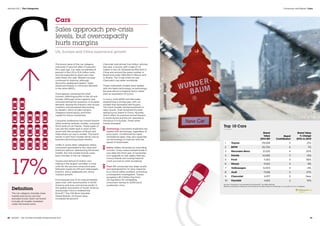
and online data, KBM Group owns
behavioral, demographic, lifestyle
and transactional data and has the
largest data management capability
of any agency holding company. KBM
Group helps companies assess, collect,
manage, connect and interpret data to
create continuous, resonant consumer
interactions throughout the customer
journey. The company’s data-driven
Consumer Engagement Platform drives
informed interactions across channels in
real-time, allowing marketers to adapt
and refine marketing in the moment
to reach an audience of one.
www.kbmg.com
Gary S. Laben
CEO
gary.laben@kbmg.com


Lambie-Nairn is an international branding
agency with over 38 years’ experience
and nine offices across Europe, the
Middle East and Latin America. With
specialist knowledge in broadcast,
sport, travel and entertainment, and
technology, Lambie-Nairn employs
a cross-functional team of strategists,
creatives, client services and producers,
enabling it to build flexible and
nimble teams to meet their clients’
needs. Our particular experience in brand
guardianship allows us to develop brands
that can evolve and develop in fresh,
consistent and engaging ways.
www.lambie-nairn.com
Lisa Hill
Managing Director London
l.hill@lambie-nairn.com


Landor Associates is one of the world’s
leading strategic brand consulting and
design firms. Landor’s holistic approach
to branding balances rigorous, business-
driven thinking and exceptional creativity.
Its work spans the breadth of branding
services, including research, positioning,
strategy, architecture, naming and
writing, corporate identity, consumer
package design, environments, equity
management, engagement, and digital
branding. With 26 offices in 20 countries,
Landor’s current and past clients include:
Barclays, BP, FedEx, Diageo, GE, Kraft
Foods, Microsoft, Nestlé, Procter 
Gamble, Russian Copper Company,
Singapore Airlines, and Taj Hotels Resorts
and Palaces. Landor is a member of the
Young  Rubicam Group network within
WPP, one of the world’s largest marketing
and communications firms.
www.landor.com
Allen Adamson
Chairman, North America
allen.adamson@landor.com


Millward Brown is a leading global
research agency specializing in
advertising effectiveness, strategic
communication, media and brand
equity research. Millward Brown helps
clients grow great brands through
comprehensive research-based
qualitative and quantitative solutions.
Specialist global practices include
Millward Brown Digital (a leader in digital
effectiveness and intelligence), Firefly
Millward Brown (our global qualitative
network), a Neuroscience Practice (using
neuroscience to optimize the value of
traditional research techniques), and
Millward Brown Optimor (a strategy
consultancy helping companies maximize
financial returns on brand and marketing
investments). Millward Brown operates
in more than 55 countries and is part
of Kantar, WPP’s data investment
management division
www.millwardbrown.com.
Travyn Rhall
CEO
travyn.rhall@millwardbrown.com


Millward Brown Optimor is the brand
and business consultancy of Millward
Brown, dedicated to igniting business
growth through transformative brand
and market strategies. Millward Brown
Optimor provides strategic corporate and
brand consulting, rooting its approach
in consumer research, stakeholder
understanding and financial analysis.
www.millwardbrown.com/mboptimor
Nick Cooper
Managing Director
nick.cooper@millwardbrown.com


Mindshare is a global media agency
network with billings in excess of US$31.4
billion (source: RECMA). The network
consists of more than 7,000 employees,
in 116 offices across 86 countries spread
throughout North America, Latin
America, Europe, Middle East, Africa and
Asia Pacific. Each office is dedicated to
forging competitive marketing advantage
for businesses and their brands based
on the values of speed, teamwork
and provocation. Mindshare is part of
GroupM, which oversees the media
investment management sector for WPP,
the world’s leading communications
services group.
www.mindshareworld.com
Greg Brooks
Global Marketing Director
greg.brooks@mindshareworld.com


Ogilvy  Mather is one of the largest
marketing communications companies in
the world. It was named both the Cannes
Lions Network of the Year and the
EFFIEs World’s Most Effective Agency
Network for two consecutive years, 2012
and 2013. The company is comprised of
industry leading units in the following
disciplines: advertising; public relations
and public affairs; branding and identity;
shopper and retail marketing; health
care communications; direct, digital,
promotion and relationship marketing;
consulting, research and analytics;
branded content and entertainment; and
specialist communications. OM services
Fortune Global 500 companies as well as
local businesses through its network of
more than 500 offices in 126 countries.
www.ogilvy.com
Miles Young
Global CEO
miles.young@ogilvy.com


PeclersParis is a unique worldwide
trend forecasting, brand strategy
and innovation agency that is expert in
fashion, beauty and cosmetics, home
and consumer electronics products.
Our unique expertise is to decrypt
socio-cultural and aesthetic trends
and translate them not only into
innovative brand strategies but also
into new products’ concepts and design.
Founded in 1970. A WPP company since
2003. Based in Paris, New York, Los
Angeles, Shanghai, Munich and in 15
other countries.
www.peclersparis.com
Eric DuChamp
CEO
Chief Executive Officer


POSSIBLE is a creative agency that cares
about results. We back up every idea
with real-world insights to create work
that makes a difference, and makes a
measurable impact. On paper, POSSIBLE
is 25 offices spanning five continents. In
practice, we are 1,100+ people offering
local expertise to some of the world’s
most dynamic brands. These include
Microsoft, P  G, Starwood Hotels and
Resorts Worldwide, The Bill  Melinda
Gates Foundation, ATT and Coca-Cola.
www.POSSIBLE.com
Lauren Lieberman
Corporate Communications Manager
laure.lieberman@possible.com


Rockfish is a full-service digital
innovation partner that drives business
for some of the world’s largest brands.
We build groundbreaking digital
solutions through expert integration
of strategy, creative and technology.
Founded in 2006, Rockfish has offices
in Dallas, Austin, Cincinnati, Atlanta,
Northwest Arkansas, New York, Portland
and Chicago. Rockfish is part of WPP, the
world leader in communications services
with 170,000 employees in 110 countries.
www.rockfishdigital.com
Kari Wethington
Associate Director, Marketing  PR
kari.wethington@rockfishdigital.com
136  BrandZ™ Top 100 Most Valuable Global Brands 2014 137
Company ContributorsSection 04  |  Resources
Salmon is a highly innovative eCommerce
digital agency whose commitment to
on-time, on-budget project delivery
is increasingly embraced by the
leading names in retail, wholesale and
manufacturing. Major brands turn to
Salmon for its ability to define, deliver
and exploit enterprise scale eCommerce,
multichannel operations and digital
marketing solutions. Salmon quickly
understands the business vision, creates
realistic project plans and efficiently
delivers solutions to plan; based around
a management process that removes
risk from successful project roll-outs.
Customers include Akzo Nobel, Argos,
Audi, DFS, Game, Halfords, Kiddicare,
Premier Farnell and Selfridges. Salmon is
headquartered in the UK and has offices
in the US, China and Australia.
www.salmon.com
Sue Pratt
Head of Marketing
spratt@salmon.com


Team Detroit brings together five of
WPP’s largest marketing agencies in one
location, Dearborn, Michigan, to provide
its clients access to best practises and
talent. Team Detroit is the 21st century
equivalent to the full-service agency,
acting as a portal to provide a single
point of contact and accountability.
www.teamdetroit.com
Geri Donahoe
Business Planning Director
business.development@teamdetroit.com


The Kantar Media TGI studies sit at the
forefront of the media and marketing
industries, providing comprehensive
insight into the online and offline
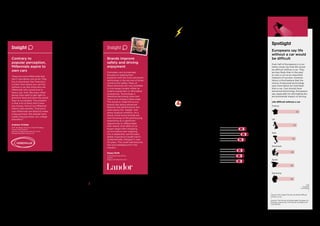
behaviour of consumers: who they are,
why they behave and make choices
the way they do and how best to reach
them. Used by communications and
digital agencies, media and advertisers,
TGI measures brand consumption,
reasons behind behaviours and media
usage, including passively-collected
online browsing behaviour. Drawing vital
information from 70 countries worldwide,
TGI is the most trusted source of national
and international planning insights.
TGI fulfils a wide range of strategic
and tactical purposes, including the
identification of target audiences, digital
and traditional communication planning
and buying, consumer profiling and
brand positioning. TGI is integrated
with many other studies specific to
particular markets, driving even deeper
consumer insights.
www.globaltgi.com
Geoff Wicken
Head of TGI International
Geoff.Wicken@kantarmedia.com


The Brand Union is a global brand
agency with over 500 people in 23
offices in 16 countries. As the leaders’
choice for brand-related insight, advice
and activation, The Brand Union delivers
knowledge, inspiration and expertise
from across the globe to build brands
that thrive in the real world, using
a balance of brand strategy, creativity
and execution.
www.thebrandunion.com
Tim Hill
Worldwide Development Director
tim.hill@brandunion.com


The Futures Company is a unique
strategic insight and innovation
consultancy, dedicated to a mission of
unlocking new sources of growth for
our clients. We bring a unique forward-
looking, outward-looking and people-
centric perspective to everything we
do, helping businesses and brands drive
more powerful connections with people
and culture with our expertise in human
and cultural insight, and unlocking
opportunities that can drive a step-
change in your business through more
foresight-driven growth and innovation
strategy. Our work combines our unique
proprietary knowledge assets alongside
a range of research methodologies and
consultancy tools and techniques.
www.thefuturescompany.com
Lloyd Burdett
Head of Global Clients and Strategy
lloyd.burdett@thefuturescompany.com


TNS advises clients on specific growth
strategies around new market entry,
innovation, brand switching and
customer and employee relationships,
based on long-established expertise
and market-leading solutions. With a
presence in over 80 countries, TNS
has more conversations with the
world’s consumers than anyone else
and understands individual human
behaviours and attitudes across every
cultural, economic and political region of
the world. TNS is part of Kantar, the data
investment management division of WPP
and one of the world’s largest insight,
information and consultancy groups.
www.tnsglobal.com
Tim Isaac
Global Marketing Director
tim.isaac@tnsglobal.com


VML is a global marketing agency
that delivers forward-thinking ideas
and solutions for the world’s most
influential brands, including: MillerCoors
brands Coors and Coors Light, Charter
Communications, Colgate-Palmolive,
COBRA PUMA GOLF, Dell, Gatorade,
the Kellogg Company, Microsoft, NAPA
AUTO PARTS, PepsiCo, Southwest
Airlines, U.S. Soccer, Tennessee Tourism,
Wendy’s and Xerox. Founded in 1992
and headquartered in Kansas City,
Mo., VML joined the world’s largest
communications services group WPP
in 2001. VML has more than 1,900
employees with principal offices in 24
locations across six continents.
www.vml.com
Lynsay Montour
Communications Manager
lmontour@vml.com


YR is one of the leading global
marketing communications companies,
comprising the iconic YR Advertising
agency; VML, one of the world’s most
highly regarded and fastest-growing
digital agencies; as well as premier
mobile marketing company iconmobile.
YR Advertising has 186 offices in 90
countries around the world. Its clients
include Campbell’s Soup Company,
Colgate-Palmolive, Danone, Dell, Virgin
Atlantic, Xerox, Revlon, GAP, Land Rover,
LG and Telefónica.
www.yr.com
David M Sable
CEO
david.sable@yr.com	
	
	
WPP is the world’s largest
communications services group
with billings of US$72.3 billion
and revenues of US$17.3 billion.
Through its operating companies,
the Group provides a comprehensive
range of advertising and marketing
services including advertising 
media investment management;
data investment management;
public relations  public affairs;
branding  identity; healthcare
communications; direct, digital,
promotion  relationship marketing
and specialist communications. The
company employs nearly 175,000
people (including associates) in over
3,000 offices across 110 countries.
For more information, visit www.
wpp.com. WPP was named Holding
Company of the Year at the 2013
Cannes Lions International Festival of
Creativity for the third year running.
WPP was also named, for the second
consecutive year, the World’s Most
Effective Holding Company in the
2013 Effie Effectiveness Index, which
recognizes the effectiveness of
marketing communications.
www.wpp.com
WPP is the world’s largest
communications services group
with billings of US$72.3 billion
and revenues of US$17.3 billion.
Through its operating companies,
the Group provides a comprehensive
range of advertising and marketing
services including advertising 
media investment management;
data investment management;
public relations  public affairs;
branding  identity; healthcare
communications; direct, digital,
promotion  relationship marketing
and specialist communications. The
company employs nearly 175,000
people (including associates)
in over 3,000 offices across 110
countries. For more information,
visit www.wpp.com. WPP was
named Holding Company of the
Year at the 2013 Cannes Lions
International Festival of Creativity
for the third year running. WPP
was also named, for the second
consecutive year, the World’s Most
Effective Holding Company in the
2013 Effie Effectiveness Index, which
recognizes the effectiveness of
marketing communications.
www.wpp.com
138  BrandZ™ Top 100 Most Valuable Global Brands 2014 139
Company ContributorsSection 04  |  Resources
Brand experts who
contributed to the report
These individuals, from WPP companies,
provide additional thought leadership,
research, analysis and insight to the report.
Alasdair Lennox
Fitch
Lauren Smith
Digit
Eleanor Sellar
Added Value
Ali Rana
Millward Brown Digital
Obi Ike
Rockfish Interactive
Jamie Jones
Millward Brown
Albert Sim
Milward Brown
Lloyd Burdett
The Futures Company
Charles Duncan
VML
Robin Sherk
Kantar Retail
Gabe Dorosz
Blast Radius
Shane Atchison
Possible
Aleksandra Iljina
Mindshare
Anna Manago
Added Value
Parnika Mehta
Millward Brown
Spencer Osborn
Ogilvy
Allen Adamson
Landor
Mayank Agarwal
Millward Brown
Chris Gidez
HK Strategies
Ron Caroll
YR
Geoff Beattie
Cohn  Wolfe
Muralidhar Salvateeswaran
Millward Brown
Duncan Stoddard
Mindshare
Anna Shaw
Mindshare
Philip Herr
Millward Brown
Diane Epstein
Brand Union
Surekha Poddar
Millward Brown
Anastasia Kourovskaia
Milward Brown Optimor
Mike Raleigh
Geometry
Chris Pratt
HK Strategies
Sana Carlton
Millward Brown
Scott Symonds
AKQA
Doug Poad
JWT
Vatsala Rathore
TNS
Amy Li
TGI
Saurabh Sharma
Ogilvy
Hayes Roth
Landor
Nigel Hollis
Millward Brown
Sue Pratt
Salmon
Anne Zybowski
Kantar Retail
Ray Gaul
Kantar Retail
Eduardo Tomiya
Brand Analytics
Andrew Curry
The Futures Company
Nicole Prefer
Brand Union
Clark Wooten
KBM Group
Shelley Diamond
YR
Haze He
Millward Brown
Stephan Pretorius
Acceleration
Aurora Yasuda
Millward Brown
Rob McCave
Mindshare
Elaine Quirke
Mindshare Luxury
Mark Edwards
TGI
Eric Duchamp
PeclersParis
Ian Gourley
Barrows
Jessica Swinton
Brand Union
Jim Joseph
Cohn  Wolfe
Karen Imbrogno
KBM Group
Joanna Seddon
Ogilvy
Jason Burby
Possible
Jonathan Dodd
Geometry
Hugh McGilligan
Millward Brown Optimor
Jeremy Nathan
WPP
Brand Experts
140  BrandZ™ Top 100 Most Valuable Global Brands 2014 141
Section 04  |  Resources
BrandZ™ Global Top 100 Team
These individuals created the report, providing valuations,
research, analysis and insight, editorial, photography,
production, marketing and communications.
Elspeth Cheung
Elspeth Cheung is Head of BrandZ™
Valuation for Millward Brown Optimor.
She is responsible for valuation, analysis,
client management and external
communication for the BrandZ™ rankings
and other brand valuation engagements.
Nick Cooper
Nick Cooper is Managing Director of
Millward Brown Optimor. He leads the
overall practice in Europe and the
development of brand strategy, portfolio
optimization and brand planning.
Amanda Harrison
Amanda Harrison serves as Project and
Events Manager for The Store WPP and
Project Manager for the BrandZ™ Top
100 Most Valuable Chinese Brands, The
BrandZ™ Latin American studies as well
as the Chinese New Year, Golden Weeks
and Chinese Dream reports.
Natasha Perera
Natasha Perera is a Financial Analyst at
Millward Brown Optimor. She is involved
in brand valuation, applying the BrandZ™
valuation methodology to analyze
brands, determine the brand value and to
generate the information that appears in
the BrandZ™ ranking studies.
Meenakshi Rawat
Meenakshi Rawat is a Consultant at
Millward Brown Optimor. She is part of
the BrandZ™ team which is responsible
for BrandZ™ rankings. Her work involves
conducting financial analysis, researching
brands and performing valuations.
David Roth
David Roth is the CEO of the Store WPP
for Europe, the Middle East, Africa and
Asia, and leads the BrandZ™ worldwide
project. Prior to joining WPP David was
main board Director of the international
retailer, BQ.
Ben Marshall
Ben Marshall is Global Communications
and Marketing Assistant at Millward
Brown and assists with the marketing and
communications of the BrandZ™ projects.
Cecilie Østergren
Cecilie Østergren is a professional
photographer, based in Shanghai, who
has worked closely with WPP agencies
since 2009. Cecilie specializes in
documentary, consumer insight and
portraits. She’s travelled extensively
in China, Brazil and other locations
to photograph images for the
BrandZ™ reports.
Katie Pearce
Katie Pearce is Global Communications
and Marketing Manager at Millward
Brown, and works as Project Manager for
the BrandZ™ Top 100 report as well as on
the marketing and communications of
BrandZ™ projects.
Ken Schept
Ken Schept is a professional writer
specializing in articles and reports about
brands, marketing and retailing. For the
past several years he’s helped develop
the BrandZ™ library of reports. He spent
much of his career as an editor with a
leading US business media publisher.
Baljit Thandi
Baljit Thandi is Director, Global
Corporate Marketing at Millward Brown.
She is responsible for overseeing the
marketing and communications for the
Top 100 ranking.
Peter Walshe
Peter Walshe, Global Director of
BrandZ™, was involved in the creation
of this brand equity and insight tool 15
years ago, and has contributed to
many valuation studies and developed
BrandZ™ metrics, including CharacterZ,
TrustR and ValueD.
The BrandZ™ brand
valuation contact details
The brand valuations in the BrandZ™
Top 100 Most Valuable Global Brands
are produced by Millward Brown
Optimor using financial data from Kantar
Worldpanel and Kantar Retail, along with
Bloomberg.
The consumer viewpoint is derived from
the BrandZ™ database. Established
in 1998 and constantly updated, this
database of brand analytics and equity is
the world’s largest, containing over two
million consumer interviews about more
than 10,000 different brands in over 30
countries.
For further information about BrandZ™
contact any WPP Group company or:
Peter Walshe
Global BrandZ™ Director
+44 (0) 1926 826 213
peter.walshe@millwardbrown.com
Martin Guerrieria
Senior Client Director
+44 (0) 207 126 5073
Martin.Guerrieria@millwardbrown.com
Elspeth Cheung
Head of BrandZ™ Valuation
+44 (0) 20 7126 5174
Elspeth.cheung@millwardbrown.com
Bloomberg
The Bloomberg Professional service is
the source of real-time and historical
financial news and information for
central banks, investment institutions,
commercial banks, government offices
and agencies, law firms, corporations and
news organizations in over 150 countries.
(For more information, please visit www.
bloomberg.com)
142  BrandZ™ Top 100 Most Valuable Global Brands 2014 143
BrandZ™ Global Top 100 TeamSection 04  |  Resources

2014_BrandZ_Top100_Report

  • 1.
    12 percent brandvalue increase marks shift from recovery to growth Year of transformation, consolidation and disruption Methodology and valuation by
  • 2.
    1 2 34 5 6 18 19 20 21 22 23 24 25 26 27 28 29 30 34 545556575859 100 FAST GROWING MARKETS 2014: YEAR OF TRANSFORMATION, CONSOLIDATION AND DISRUPTION 10% 16% Google’s rise symbolizes the strength of the technology category. Technology brands in the Global Top 100 total $827 billion, almost 30% of the value of the BrandZ™ Global Top 100. Technology category rose 16% overall in brand value. Top Brand The value of the BrandZ™ Top 100 Most Valuable Global Brands 2014 is $2.9 trillion. Top 100 $2.6 trillion Top 100 $2.9 trillion 20142013 Twitter LinkedIn Ford Bank of America PayPal ING Bank UBS Newcomers The BrandZTM Top 100 Most Valuable Global Brands share price index consistently outperform the S&P market index. Brand value appreciated by 54% among the BrandZ™ 2014 Top risers, compared with 44% last year. TENCENT +97% +68% +61% +61% +58% +56% +56% +55% +53% +51% 06 07 08 09 10 11 12 13 14 81.1% 44.7% BrandZ™ SPP 500 $271,893m $29,490m TOP 10 BRANDS $158,843m $147,880m $107,541m $90,185m $85,706m $80,683m $79,197m $77,883m $67,341m $64,255m CATEGORY GROWTH REGIONAL GROWTH STOCK MARKET PERFORMANCE TOP 10 RISERS GlobalBanks Apparel $99,599m $123,800m $251,351m $72,306m $171,621m $66,207m $111,758m $330,427m $111,528m $280,975m $841,482m $109,033m RegionalBanks Beer FastFood Insurance Luxury Telecoms PersonalCare Retail Oil&Gas SoftDrinks Technology Cars $138,856m Brand Contribution indicates how much of brand value can be attributed to brand itself. The index runs from 1 (low) up to 5 (high). Luxury is the most represented category in the top brands by Brand Contribution with 6 brands, followed by beer with 2 brands. GROWTH ACROSS ALL CATEGORIES FROM 2013 8283848586878889909192939495969799 7 8 9 10 11 12 13 15 16 1714 31 32 33 35363738394041424344454647484950515253 6061626364656667686970717273747677787980 7581 98 $330,427m BRAND CONTRIBUTION RISING IMPORTANCE OF TECHNOLOGY KEY VALUATION CHANGES Google increased the most in $ value in the 2014 rankings. It has also increased significantly since 2006, $121.4b, second only to the gain of $131.9b by Apple during the same period. $45.2 BILLION Tencent, the Chinese social network and Internet portal, led the list of fastest risers overtaking China Mobile as China’s most valuable brand. 97% BRAND VALUE Twitter and LinkedIn entered the Top 100 for the first time, at numbers 71 and 78, respectively. TOP 100 DEBUT Amazon became the first retailer to enter the Top 10 at number 10. TOP 10 DISTINCTION $142,103m FACEBOOK BT IKEA UNIQLO FORD MOVISTAR NIKE DHL CVS +29% +17% +16% +16% +16% +15% +6% +14% +10% +11% +8% +3% +4% +12% www.brandz.com 5% 3% 3% 3% 41% 41% 4% 29% 40% 20% North America 5.9% 50 Top 100 brands $959,514m Top 10 brands 312 Continental Europe 19% 23 Top 100 brands $246,799m Top 10 brands 312 UK 5.4% 6 Top 100 brands $155,753m Top 10 brands 12 3 Asia 15.8% 20 Top 100 brands $314,188m Top 10 brands 312
  • 3.
    About Millward Brown MillwardBrown is a leading global research agency specializing in advertising effectiveness, strategic communication, media and brand equity research. Millward Brown helps clients grow great brands through comprehensive research-based qualitative and quantitative solutions. Specialist global practices include Millward Brown Digital (a leader in digital effectiveness and intelligence), Firefly Millward Brown (our global qualitative network), a Neuroscience Practice (using neuroscience to optimize the value of traditional research techniques), and Millward Brown Optimor (a strategy consultancy helping companies maximize financial returns on brand and marketing investments). Millward Brown operates in more than 55 countries and is part of Kantar, WPP’s data investment management division. www.millwardbrown.com Travyn Rhall CEO travyn.rhall@millwardbrown.com If the 9th annual edition of the BrandZ™ Top 100 Most Valuable Global Brands tells us anything, it is that the recession is over. We are delighted to share the latest valuation data gathered by Millward Brown on behalf of WPP using the proprietary valuation method of Millward Brown Optimor. It shows that the combined brand value of the world’s most important brands has risen by 12 percent to $2.9 trillion. This follows a 7 percent improvement the previous year. BrandZ™ has cemented itself as an invaluable resource to help businesses understand how their financial health is intrinsically- linked to, and enhanced by, brand building. After a few dark years the evidence is clear that the world’s strongest brands are leading the global recovery. We are providing data from 150,000 interviews with consumers from around the world and the insights, as always, are fascinating. The 2014 edition reveals that the combined value of the BrandZ™ Global Top 100 has almost doubled in eight years. Since 2006, the stock market value of the BrandZ™ Strong Brands portfolio, a sub-set of the main survey, has appreciated by 81 percent over the same period. Unique to our approach is the recognition that in all markets a small number of consumers account for a large proportion of sales. Loyal consumers are more valuable to a brand than occasional users, a crucial factor when analyzing brand value. The Top 100 also confirms that more favorable economic conditions have helped traditional Western brands improve their valuations, which means fewer brands from fast-growing economies are represented. Brands that are in business for reasons beyond the bottom line are also more likely to have increased their value. Not surprisingly technology brands dominate the top positions and there is a new number one. Google has knocked Apple off its perch after three years at the top. Apple is performing well but is it still redefining technology for consumers? What is obvious is that the value of technology brands reiterates how they are now an integral part of our lives. Apparel is the fastest growing category with the Top 10 apparel brands growing by 29 percent, but all brands must continue to innovate and excite consumers to drive their businesses forward, something Google excels at. There is no room for complacency on quality or customer service as a brand’s reputation can be dented in seconds through the power of social media. Looking at some of the brands with greatest future potential, as well as Apple and Google, Facebook remains an innovative brand people cannot do without and Amazon is constantly expanding its ecosystem. IKEA has successfully positioned itself as different and great value rather than cheap, while MTN is growing rapidly in African markets buoyed by its mission to help people. Red Bull is an experiential lifestyle brand defining differentiation, while there are huge international opportunities for PingAn Insurance, an entrepreneurial private brand. Two other brands with great potential in 2014 are Construction Bank of China and Verizon, which bought out Vodafone. At Millward Brown, we are proud to produce the BrandZ™ Top 100 and be part of an amazing organisation like WPP, which exists to help businesses improve their competitiveness and profitability by devising and implementing effective marketing, advertising and brand strategies. The insights from around the world revealed within the latest BrandZ™ Top 100 are valuable nuggets of consumer understanding that will help businesses grow the value of their brands in 2014 and beyond. Warmest regards, Travyn Rhall Chief Executive Officer Millward Brown Welcome 4  BrandZ™ Top 100 Most Valuable Global Brands 2014 5 Introduction
  • 4.
    6  BrandZ™ Top100 Most Valuable Global Brands 2014 7 Introduction Contents 01 Highlights 10 Introduction 13 Key Results 16 Cross-Category Trends 19 Take Aways 20 Thought Leadership Is Your Brand Ready to be Like Jeeves? By Nigel Hollis, Chief Global Analyst Millward Brown 22 Thought Leadership Diversion: A Route to Disruption By Eric Duchamp, CEO PeclersParis 02 The Global Top 100 26 The BrandZ™ Global Top 100 Ranking 30 Overview 32 Top Risers 34 Newcomers 35 Category Changes 38 Brand Contribution 40 Regions 46 Social Media Special Report The BrandZ™ Verve Index By Ali Rana, SVP and Head Scientist Emerging Media Lab 50 Thought Leadership Delivering Seamless Consumer Experience in an Age of Disruption By Scott Symonds, Managing Director of Media AKQA 52 Thought Leadership The Product Paradox: Why Making Apps Usually Hurts Brands and How You Can Do Better By Shane Atchison, CEO and Jason Burby, President, Americas POSSIBLE 03 The Categories Consumer and Retail 56 Apparel 60 Cars 64 Luxury 68 Personal Care 72 Retail 76 Thought Leadership A Seamless Transition Towards Retail Theater By Ian Gourley, Chief Creative Officer Barrows 78 Thought Leadership Seven Principles for a More Useful Brand Valuation By Joanna Seddon, Global Brand Consulting OgilvyRed, Ogilvy Mather Food and Drink 80 Beer 84 Fast Food 88 Soft Drinks 92 Thought Leadership My Brands. My Self. By Jonathan Dodd, Global Chief Strategy Officer Geometry Global 94 Thought Leadership The Data-Driven Pursuit of the Inconstant Consumer By Ali Rana, SVP and Head Scientist Emerging Media Lab Financial 96 Banks 102 Insurance Commodities 106 Oil Gas 110 Thought Leadership Commerce 4.0: Devices, Data and Decision Time By Sue Pratt, Head of Marketing Salmon 112 Thought Leadership Transformation through Technology By Stephen Pretorius, President Acceleration Technology 114 Technology 120 Telecom Providers 124 Thought Leadership Rise and Fall: Exploring the Brand Life Cycle By Aleksandra Iljina, Senior Analyst Developer and Duncan Stoddard, Account Manager Mindshare 04 Resources 128 BrandZ™ Valuation Methodology 130 BrandZ™ Reports, Apps and iPad Magazines 132 WPP Resources 134 WPP Company Contributors 140 WPP Brand Building Experts 142 BrandZ™ Global Top 100 Team 143 BrandZ™ Valuation Contact Details
  • 5.
    Introduction 01Highlights 8  BrandZ™ Top100 Most Valuable Global Brands 2014 9 Section 01  |  Highlights Introduction Key Results Cross-Category Trends Take Aways
  • 6.
    Percentvaluegrowth 10.6% 06 07 0809 10 11 12 13 14 00 0.5 1.0 USDBillion 1.5 2.0 2.5 3.0 3.5 APR 06 APR 07 APR 08 APR 09 APR 10 APR 11 APR 12 APR 13 APR 14 -60 -40 -20 20 40 60 80 100 BrandZ™ Strong Brands Portfolio SP 500 21.2% 0.8% 4.4% 17.1% 0.4% 7.0% 12.0% Introduction Introduction All categories rise in brand value as Global Top 100 improves 12 percent In a year of real growth, brands experience transformation, consolidation and disruption The BrandZ™ Top 100 Most Valuable Global Brands 2014 added $310 billion to reach $2.9 trillion in brand value, a 12 percent increase. Prior to the BrandZ™ Global 2014 results, the Top 100 had increased an average of about 6 percent, $125 billion, annually since the financial crisis of 2008 and 2009. This year, led by apparel, with a 29 percent overall increase, all categories rose in brand value. And 10 of 14 categories experienced double-digit growth, indicating that brands across the economy have moved beyond recovery into a period of new growth. Only 18 of the Top 100 brands lost value compared with an average of 31 brands in each annual BrandZ™ Global Top 100 report since the financial crisis. The resurgent economies of North America and Europe drove brand value growth as the BRIC markets slowed. Only 14 brands from fast growing economies made the 2014 BrandZ™ Global Top 100 ranking compared with 17 brands a year ago. Despite the BRIC slowdown, Chinese brands increased their impact. The number of Chinese brands in the Top 100 declined by one to 11, but that’s up from only two in 2006. In addition: — With a 40 percent rise in brand value, Google claimed the number one rank from Apple, which held the position since 2011 when it surpassed Google. — Twitter, LinkedIn, and PayPal appeared in the BrandZ™ Top 100 for the first time. — Tencent, the Internet portal and social network, led the fastest risers, almost doubling in brand value. Baidu, the search engine appreciated 46 percent, indicating the growing influence of Chinese brands. — Facebook was the second fastest riser with brand value increasing 68 percent. Amazon entered the BrandZ™ Global Top 10 for the first time, with a 41 percent brand value increase to $64.3billion. — Technology continued to dominate with nearly a third of the total brand value and around a fifth of the brands, including the top four – Google, Apple, IBM and Microsoft. Growth brings new challenges The two key factors that influenced the 12 percent growth surge – technology innovations and consumer confidence – also created some of the challenges categories experienced. Consumers were willing to spend money and they did, even on high-ticket items like cars and luxury. But chastened by a period of relative frugality and empowered by rapidly changing technology, particularly mobile, consumers changed how they shopped and purchased. They waited for the best prices and purchased more mindfully, with concerns about health and the environment. Retail experienced perhaps the most dramatic impact, as consumers conflated the physical and online shopping worlds, expecting a new kind of convenience that delivers the wide range available online with best prices and the immediate gratification of physical stores. Clear that retailing would no longer be about physical stores alone, retailers scaled back their portfolios of locations, repurposed existing space and invested in technology to make the shopping online and in physical stores a seamless experience. In luxury, some brands learned that they’d become too accessible in an effort to drive sales during the economic slowdown. They worked on achieving the best balance of accessibility and exclusivity in stores and online. Carmakers loaded the newest models with technology for safety and entertainment. But conditioned by their mobile devices, car buyers sometimes expected even more technology to be available in cars with the speed of a download. Categories feel impact of Millennials, social media This effort to understand and meet the demands of customers touched financial institutions, not always known for customer centricity. Global banks increased services and warmed their messaging, although levels of trust remained low. Insurers developed systems to respond to customers one-to-one in relevant ways rather than with mass, product driven efforts. Even categories affected by consumer health concerns appreciated in brand value, but at a slower pace. Fast food, which continued to work through the pressure of health concerns, improved 10 percent. Soft drinks grew 4 percent although the consumption of CSDs (Carbonated Soft Drinks) declined for the ninth consecutive year in the US. Telecoms experienced consolidation and price disruption pressure but brand value improved 8 percent. The oil and gas category experienced the lowest brand value growth, 3 percent, because of slowed investment in exploration. In every category, brands increased activity in social media to engage consumers in innovative ways. (Please see the BrandZ™ Verve Index, a special report on social media on page 46). In addition, the attitudes of Millennials, individuals born roughly between 1981 and 1999, also touched most categories. These consumers are more likely to prefer a craft beer, bank and shop on a mobile device, choose vitamin water over cola and eat healthier fast food, but not exclusively. And they’re less likely to buy insurance or own a car, either because they prefer sharing or don’t have the money. Source: Millward Brown Optimor, BrandZ™ data Source: Millward Brown Optimor, BrandZ™ data BrandZ™ Strong Brands Portfolio outperforms the SP 500 Since the introduction of the BrandZ™ Top 100 Most Valuable Global Brands in 2006, the SP 500 increased 44.7 percent in market value. In contrast, the BrandZ™ Portfolio of Strong Brands appreciated 81.1 percent. BrandZ™ Global Top 100 value doubles since 2006 The BrandZ™ Top 100 Most Valuable Global Brands 2014 appreciated 12 percent in brand value. The brand value of the BrandZ™ Global 100 has almost doubled since being introduced in 2006. 10  BrandZ™ Top 100 Most Valuable Global Brands 2014 11 Section 01  |  Highlights
  • 7.
    100 200 06 07 0809 10 11 12 13 14 Commodities Logistics Financial Technology Top 100 Consumer 06 07 08 09 10 11 12 13 14 Top 10 Food drink Consumer 100 100 117 161 208 196 217 249 256 369 100 97 113 102 201 221 264 266 342 100 112 126 129 123 129 128 143 164 100 142 166 133 146 172 155 195 269 100 105 143 158 169 217 211 205 244 111 134 135 141 165 166 177 198 Source: Millward Brown Optimor, BrandZ™ data Index of annual brand value growth, 2006=100 Key Results The headlines Top 100 rises 12% The BrandZ™ Top 100 Most Valuable Global Brands increased 12 percent, to $2.9 trillion, following a 7 percent rise a year earlier. Value doubles in 8 years The combined brand value of the BrandZ™ Global Top 100 has almost doubled in eight years, since its inception in 2006. Outperforms SP 500 Since 2006, the stock market values of the BrandZ™ Strong Brands Portfolio, a subset of the BrandZ™ Global Top 100, has appreciated 81.1 percent, significantly outperforming the 44.7 percent rise in the SP 500 over the same period. Google number 1 Google claimed the number one rank in the BrandZ™ Global Top 100. Apparel leads growth Apparel led all categories in overall brand value growth with a 29 percent rise, following 21 percent a year earlier. All categories up All 14 categories increased in brand value, 10 of them with double-digits. Only 18 brands down Only 18 of the Top 100 brands lost value this year, compared with an average of 30 brands each year since the BrandZ™ Global Top 100 rankings started in 2006. An average of 31 brands annually lost value since the financial crisis of 2008. Tencent up 97% Tencent, the Chinese social network and Internet portal, led the list of fastest risers with a 97 percent increase in brand value, overtaking China Mobile as China’s most valuable brand. Facebook up 68% Facebook (up 68 percent), Baidu, China’s leading search engine (46 percent) and Yahoo! (44 percent) also made the Top 20 Risers. Twitter, LinkedIn are in Twitter and LinkedIn entered the Top 100 for the first time, at numbers 71 and 78, respectively. Amazon entered the Top 10 at number 10, the first retailer to achieve this distinction. Microsoft gains 29% With Microsoft up several slots, after a 29 percent brand value increase, the top four brands in BrandZ™ Global Top 100 are in the technology category – Google, Apple, IBM and Microsoft. Tech brands drive value Around a fifth of the BrandZ™ Global Top 100 are technology brands and these 18 brands account for $827 billion in brand value, nearly a third of the Top 100 total value. Huge gains since 2006 Google increased the most in dollar value, $45.2 billion, in the 2014 ranking. The brand also increased significantly since 2006, $121.4 billion, second only to the gain of $131.9 billion by Apple during the same period. European brands lead growth Brands based in Continental Europe increased 19 percent in brand value overall, more than any other region, following a rise of only 5 percent a year ago. North America dominates North America dominated in regional representation. Half the brands in the BrandZ™ Top 100 and two-thirds of the Top 100 total brand value originate in North America. All of the Top 10 brands are based in the US. Fewer fast growing markets Slower economies in fast growing markets reduced the number of brands from those counties in the BrandZ™ Global Top 100, from 17 a year ago to 14, 11 from China, two from Russia and one from Africa. Brands from many nations Other brands from China and Russia, and also brands from Brazil, Colombia and Mexico appear in the category rankings, which include some high-value brands below the Top 100 brand value threshold. Source: Millward Brown Optimor, BrandZ™ data Index of annual brand value growth, 2006=100 Brand value surges across categories Brand value across categories surged this year, marking a shift to solid growth following fluctuations coming out of the financial crisis and global recession. Consumer categories catch up Consumer categories, which includes apparel, cars, luxury, personal care and retail, grew sharply in brand value in the BrandZ™ Global Top 100 2014, as spending rose following a period of shaky consumer confidence and high unemployment. Key Results 12  BrandZ™ Top 100 Most Valuable Global Brands 2014 13 Section 01  |  Highlights
  • 8.
    Apparel +29 percent Apparel ledthe categoriesin brand value appreciation. The brands with the greatest increases – Uniqlo, up 58 percent; Nike, 55 percent; and Adidas, 47 percent – illustrate one of the key category trends, the convergence of apparel and technology into wearables. Consumer and Retail Categories Cars +17 percent Carmakers had a good year with sales driven primarily by the resurgent US economy and UK demand. But car sales increased in China, too, despite slower economic growth and government purchasing restrictions aimed at reducing congestion and pollution. Luxury +16 percent Consumers felt entitled to buy luxury again. They were more discerning, even in China. And luxury brands strategically rebalanced back toward exclusivity, having increased accessibility in a tactical effort to build sales during the recession. Personal Care +12 percent More personalized products, men’s grooming and innovations combining cosmetics with pharmacology drove sales in a crowded category. The convergence of technology and personal care resulted in small appliances for skin cleaning. Sales in China remained an important factor. Retail +16 percent Retailers confronted the mismatch between legacy real estate and changed consumer shopping habits. Conditioned by shopping both in physical stores and online, consumers expected everything – broad assortment, the lowest prices and immediate gratification. Brands sought ways to meet these expectations by transforming the category with seamless solutions. Food and Drink Categories Beer +14 percent Consolidation continued in a category where four global brewers predominate with large brand portfolios of hundreds of local and global beers. The brewers attempted to drive volume in fast growing markets and accommodate the desires of mature market consumers seeking new tastes and experiences. Fast Food +10 percent Chipotle and Starbucks led in brand value growth with increases of 48 percent and 44 percent, respectively. Both brands met the consumer desire for a fast food experience where the meal is tasty but healthier and offered in a more comfortable restaurant environment. Soft Drinks +4 percent Brand value appreciated in a category where volume of CSDs (Carbonated Soft Drinks) declined for the ninth consecutive year in the US because of consumer health concerns. Brands continued to market ambitiously and introduce new products. Financial Categories Global Banks +15 percent Having paid off government loans and reorganized their businesses to be more efficient, the banks made money and brand values improved. The public remained skeptical, however, because of bank past misdeeds and high executive pay. Regional Banks +6 percent Strong local economies propelled banks in North America and Australia, where proximity to Asian markets also helped. But the declining band values of some Chinese banks were a drag on overall category brand value. Insurance +11 percent The major European insurance brands did well, with Allianz increasing 48 percent in brand value and AXA up 44 percent. US property and casualty insurers led the way in trying to analyze big data to enhance customer centricity and reach and retain new, young customers. Online insurers continued to disrupt the category. Commodity Categories Oil and Gas +3 percent Investor pressure on return on investment and geopolitical events intensified the routine oil and gas brand challenges of exploring for resources in some of the earth’s most fragile environments. Oil and gas increased the least in brand value of all categories. Technology Categories Technology +16 percent The consumer brands continued to expand their ecosystems in an attempt to be an invaluable part of consumer daily life. They found ways to monetize their customer relationships while also engaging in less profitable activities to serve humanity and claim a higher purpose. The business-to-business brands adjusted to a commercial model radically changed by Cloud computing. Telecom Providers +8 Percent In Europe, the category experienced more consolidation. And brands added content to their bundle of services, in an effort to differentiate. T-Mobile offered pay-as-you- go pricing in the US, disrupting a market organized around long-term contracts and bundled services. Key Results Summary of category performance Key Results 14  BrandZ™ Top 100 Most Valuable Global Brands 2014 15 Section 01  |  Highlights
  • 9.
    Cross-Category Trends The forcesbuilding and disrupting brands and categories Trust Consumers expect brands to keep their promises. Some categories have disappointed. Coming out of the global financial crisis, many banks strengthened capitalization, sharpened their business focus, revised codes of ethics and improved communication with customers. But with the revelation of new and past misdeeds trust cracked like a fragile shell. Lost trust damages brands, as apparel maker Lululemon discovered when the stretch fabric of some of its products performed poorly and the company initially blamed customers for the fault. GM and Toyota sustained public rebuke when they failed to maintain safety standards. The price of lost trust varies. Bank reputations declined, but the difficulty in switching helped limit the business impact. Not all categories are so protected by customer inertia. Strong brands are better able to sustain fluctuations in trust. Share of life Brands aim to gain greater share of wallet. But many forward thinking brands are now looking to achieve that goal by increasing share of life, being present in more ways to make a customer’s life better or simpler. The major ecosystems – Apple, Google and Amazon – serve as models for surrounding consumers with product, services and content. But brands in diverse categories are engaged with customers, in useful and brand relevant ways, across many aspects of their lives. The Home Depot and Lowe’s provide home improvement financing. Walmart offers financial services. The Chinese Internet brand leaders, Tencent, Baidu and Alibaba, are building online banking centers and mobile payment systems. Tesco and the Latin American retailer Falabella are MVNOs (Mobile Virtual Network Operators), renting capacity from telecoms and branding a mobile service to gain a greater customer share of life. Share of life helps broaden and deepen the bond between customer and brand. This relationship potentially benefits the customer with improved service and the brand with additional sales. Seamlessness Shopping was multi-channel. Then it was omni-channel. Now it needs to be a seamless, consistent experience whenever and wherever the consumer is dreaming about purchasing, exploring possibilities or transacting business. Accomplishing this goal may be challenging and complicated. But by definition, seamlessness means that the brand makes the transitions between physical and virtual invisible to the consumer who’s interested in the results not the process. And seamlessness centers on the customer. Personalization Too ubiquitous, designer logos no longer validate how the consumer sees herself or wants to be seen. Self-expression is in. In the luxury category, popularity increased for interesting jewelry, not simply the traditional precious gems, but other colorful, distinctive stones that consumers chose for their uniqueness. The celebration of uniqueness was evident in the extensive personal care product ranges for hair and skin types serving a more inclusive ideal of beauty. Customization Grande soy iced vanilla latte may summarize customization, but the trend doesn’t end with Starbucks. McDonald’s plans to simplify and customize its menu for the mealtime preferences of various consumer groups, such as Millennials and families. In soft drinks, a category driven by CSDs (Carbonated Soft Drinks), consumption is declining and Coke is customizing. It’s going beyond its Freestyle vending machine that enables customers to mix ingredients and make about 100 varieties of soft drink. In an arrangement with Green Mountain Coffee, the company that makes single-serve coffee pods, Coke is developing a machine for customizing soda at home. Technology to make driving safer or more enjoyable adds more customizing options in a category known for customization. Convenience Conditioned by the economic slowdown and their experience with in-store and online shopping, consumers expected everything – the range available online with the immediacy of physical stores and the best possible price. Many European hypermarkets and other retailers evolved their click and collect models for ordering online and picking up in-store. In the latest iteration, shoppers order online and pick up items, often on the way home from work, at conveniently located drive-thru warehouses. Authenticity Sometimes the most compelling aspect of a brand is the product itself. To accrue economies of scale the major brewers generally produce beer near where it’s consumed rather than where the brand originated. But sometimes the brewers balance this business imperative with the need for brand authenticity. The major global brewer SABMiller makes Peroni, its Italian brand, in Italy, charging a premium to cover the additional cost. Heineken sold in the US is brewed in Denmark. Luxury brands stressed provenance as part of what makes them authentic and exclusive. Multi-functionality The importance of multi-functionality reflects the multi-tasking way many people live their lives. SUVs (Sport Utility Vehicles) combine basic transportation with room for cargo. Soft drinks quench thirst but often while adding a functional benefit, an energy boost or vitamin supplement. Apparel provides protection but it can also monitor metabolism. Localization Like the yin-yang of high tech and high touch, global and local are complementary influences for brands to balance. Certain categories, such as fast food, soft drinks and beer, build global scale and consistency, adjusting for local tastes. Local is gaining in importance. It implies quality and reliability along with originality and attention to detail not associated with mass production. The rise of craft beer and the resurgence of ale in the UK reflect this trend. Local food sourcing is another example. Cross-Category Trends 16  BrandZ™ Top 100 Most Valuable Global Brands 2014 17 Section 01  |  Highlights
  • 10.
    Healthiness Consumer concern withhealth both challenges and propels brands. In soft drinks, CSD (Carbonated Soft Drink) consumption continued to decline. In fast foods, McDonald’s added healthier items, while Chipotle made higher quality food its brand positioning and Subway emphasized freshness. Chipotle rose 48 percent in brand value. Since the inception of the BrandZ™ Top 100 Most Valuable Global Brands in 2006, the Subway brand has experienced the greatest percentage increase in brand value, 7,338 percent. Retailer Whole Foods, which stresses its sourcing of organic and sustainable products, rose 37 percent in brand value in the 2014 BrandZ™ Global Top 100. During the national conversation about health care in the US, the drug store brand CVS renounced its $2 billion tobacco business as incompatible with its brand purpose as a health provider. Technology Technology impacted every category with innovation or disruption or both. Retailers reduced real estate portfolios of stores and explored technologies to make the experience in the physical and online stores unique, useful and seamless. Wearables, like Google glasses, signaled the early days of the convergence of technology with apparel. Telematic devices that monitor driving habits potentially can disrupt the insurance category. Carmakers loaded cars with technology to improve safety and driving enjoyment. Car buyers viewed the latest technology as standard not luxury. Technology disrupted the technology category itself as business-to-business brands, built around PCs, struggled to adjust to the intensified competition and a world of mobile devices. 01 Know each customer It’s time to revise the adage the customer comes first. Today, each customer comes first. Working to achieve that goal will improve business. It’s about analyzing dots of data that together reveal each customer’s shopping needs. In the insurance category, many brands that created one-size-fits-all products now are trying to be more customer centric. They analyze data to understand individual customers and identify key lifetime events and insurance opportunities. 04 Be agile Planning is important. The stakes are too high and it’s the rare brand that improvises its way to success. But the strategy drafted in the boardroom needs constant market reality testing. Planning and flexibility make a good marriage. 08 Stand for a purpose beyond profit Given a choice, people want to associate with brands they feel good about, brands that “Do no evil,” as Google asserts. And even do some good. “Smarter Planet” works for IBM. But if you’re not one of the world’s most valuable brands, it’s OK and more believable to focus on improving the part of the planet that you touch. The purpose needs to be brand relevant, important to customers and pursued diligently. 02 Be meaningfully different Being different in a meaningful way means that customers understand the brand and the advantages that it offers relative to the competition. It’s not easy to establish meaningful difference. But it’s important as one of the crucial drivers of brand equity, the influence a brand has over the inclination to purchase. 05 Stay relevant There’s an ongoing tension between respecting a brand’s heritage and keeping the brand up to date. Keeping the brand up to date doesn’t mean presenting the brand as something it isn’t. It’s great if a brand story is exciting and inspiring. But it’s most important that the story is fact, not fiction. 10 Invest in brands There’s a quantifiable return on investment in brands. Some of the return is felt at the register. Some of it is in the share price. In the eight years since we introduced the BrandZ™ Top 100 Most Valuable Global Brands, our BrandZ™ Strong Brand Portfolio has appreciated 81.1 percent compared with a 44.7 improvement in the SP 500. 03 Be mindfully present In a world noisy with brand messages it can be difficult to be seen and heard. Digital and social media are important places to represent the brand. But use discretion. Be present where it makes sense for the brand. Intruding uninvited into conversations risks seeming like a clueless party guest. The encounter might be memorable but unhelpful. Comment when it’s appropriate and be authentic. 06 Keep your eyes open Spend time on thought leadership. As brands navigate through transformation, consolidation and disruption, knowledge is vital. It’s useful to see what’s going on in other places, particularly in the fast growing markets where sometimes, because necessity is greater, so is invention. The use of mobile for payments and banking in China is one important example. 09 Employ technology for competitive advantage In most categories technology is either a driver or disrupter or both. The fusion of apparel and technology into wearables is one example. Because the impact of technology is unavoidable today, brands face a clear choice: risk finding ways to achieve an advantage using technology, or do nothing and risk that your competitors will do something. 07 Execute The last few years were good for planning and putting in place new strategies, as consumers caught their breath and regained confidence following the financial collapse and recession. Consumers are back. It’s time to execute. Take Aways 10 insights for growing brand value Payment options Payment in several categories shifted to a disruptive pay-as-you-use model. Amazon and other Cloud providers sold access on an as-needed basis, replacing the licensing arrangements that enterprise customers maintained with business-to-business technology companies. In the US, T-Mobile introduced a pay-as- you-use arrangement to a market where telecom providers traditionally locked in customers for two-year contracts. Among the trends impacting car ownership is the growing popularity of pay-as-you-use car sharing schemes that make vehicles available for hire by the hour. Men shoppers Men had confined their luxury purchases to watches and cars. Today they’re interested in well-tailored shirts and suits. Men’s grooming is one of the fastest growing segments of the personal care category. Retail shelves once devoted to razors and shave cream in aerosol cans now include facial creams and other pampering products. The packaging in dark colors signifies masculinity and differentiates from the women’s products. Among the drivers of this trend are cultural habits coming from Asia. In Korea, for example, men are fine with wearing makeup. Luxury brands such as Gucci, Prada and Burberry are opening stores devoted exclusively to men. Take Aways 18  BrandZ™ Top 100 Most Valuable Global Brands 2014 19 Section 01  |  Highlights
  • 11.
    “I endeavor togive satisfaction, Sir.” Jeeves proves his worth on first meeting Bertie by proffering a “little preparation” in order to remedy the after- effects of a night on the town and subsequently proves not only invaluable but infallible. This is a tough act to follow. The bigger the role a brand has in people’s lives the bigger the risk of failure. This is particularly important when a brand extends its reach across product or service categories. People do not separate out different incarnations of the brand in the same way that a business does. Tesco’s financial and mobile phone services are just as much part of the experience of the Tesco brand as shopping at one of its stores. Do your homework and make sure your new offering lives up to the experience of the existing ones or it may undermine the whole franchise. “The mood will pass sir.” Jeeves sometimes takes a dislike to one of Bertie’s latest affectations: a new mustache, vase or a pair of breeches Jeeves considers suitable only for the musical hall. When he does so, Jeeves manages to subtly shape his master’s whims for the better. He has a clear set of values and sets in motion a series of actions that will result in a change of mind and behavior. Many brands could learn from his example. Rather than simply exhorting people to buy, they need to step back and consider exactly what associations and feelings they need to change in order to get people to choose their brand. To imitate Jeeves, marketers will require the same intimate understanding of people’s requirements that Jeeves has of his master’s. Brands need to anticipate people’s needs and desires, not just respond to direct requests. If successful in doing so then the brand will have established a meaningful place in people’s consciousness, one that allows it to take a bigger share of their lives. IS YOUR BRAND READY TO BE LIKE JEEVES? Reginald Jeeves, valet to the wealthy and affected Bertie Wooster, is probably author P. G. Wodehouse’s most iconic character. Jeeves is imperturbable in the face of a crisis, resourceful and well-informed. He deals with his master’s needs with suave confidence and subtly shapes events to save his employer from embarrassment. Why are we talking about a fictional character in the context of brands? Because the many brands seeking to expand their roles to take a bigger share of our lives would do well to imitate Jeeves. People are willing to give brands a greater role in their lives only if they empower them, and do so without imposition or undue fanfare. The brands seeking to increase their influence in this way are following in the footsteps of giants like Apple, Amazon or Nike. These brands have managed to extend their ecosystem so that their products and services are integrally intertwined with multiple aspects of our lives. Apple spans our needs for entertainment, music and productivity. Amazon fulfills our need for convenience with effortless one-click shopping and relevant purchase recommendations for stuff we never knew we wanted. Nike, with its Nike+ Fuelband, has transformed itself from a mere apparel brand to a companion and coach for runners. The assumption that having a greater share of consumer’s lives will have positive benefits for the brand may well prove incorrect if the brand cannot emulate Jeeves. So, with that in mind here are three things brands might learn from the venerable valet. “I was given to understand that you required a valet.” Jeeves offered his services to Bertie Wooster in the knowledge that there was a need for them. No matter how much brands might want to be part of someone’s life, they need to make sure that there is a real need for what they have to offer and that the recipient believes them capable of rendering that service. A broad positioning that does not limit the brand to a specific category improves the brand’s ability to expand its footprint in our lives. Nigel Hollis Chief Global Analyst Millward Brown Nigel.hollis@millwardbrown.com Millward Brown is a leading global research agency specializing in advertising effectiveness, strategic communication, media and brand equity research. Millward Brown helps clients grow great brands through comprehensive research-based qualitative and quantitative solutions. Specialist global practices include Millward Brown Digital (a leader in digital effectiveness and intelligence), Firefly Millward Brown (our global qualitative network), a Neuroscience Practice (using neuroscience to optimize the value of traditional research techniques), and Millward Brown Optimor (a strategy consultancy helping companies maximize financial returns on brand and marketing investments). Millward Brown operates in more than 55 countries and is part of Kantar, WPP’s data investment management division. Learn more at www.millwardbrown.com. 20  BrandZ™ Top 100 Most Valuable Global Brands 2014 21 Section 01  |  Thought Leadership
  • 12.
    Our recent trendresearch highlights that, as a result of the lengthy economic crisis, defiance and anxiety about the future are rife. Across Europe, people feel that they are trapped in a vicious cycle of austerity. As a result, a new dynamic is emerging: individuals now aspire to control their own destinies. In their efforts to do so, they are challenging and reinventing the codes, norms, stereotypes and rules, which now feel oppressive and seem a reflection of a failing system. This global inclination towards diversion favors a general wish for disruption, especially among younger generations. In the behaviors that illustrate these “diversion tactics” we see a desire to embrace change in order to rise above the daily routine, or better yet, reinvent the future. As part of this trend, absurdity, irony, nonsense and cynicism are being used as weapons of subversion. Infiltrating all layers of society and fueled by the viral power of social networks, these attitudes are transforming the world into a gigantic disruptive public space. These tactics also include the display of more uninhibited behaviors and inner impulses that explore and push boundaries. There is a growing fascination for ambiguous genres, and controversial and imaginary realms that blur the lines between good and bad. These behaviors have become an outlet through which individuals can express fears, dislikes and desires, and as escape mechanisms they are powerful routes to resilience. Exploring consumers’ new attitudes and expectations Resilient behaviors Resilience is the ability to overcome difficult times. It is today seen in the growing promotion and celebration of personal failings: marital (divorce parties in Japan and the USA) or professional (the “fun employment” phenomenon). It aims to break the models imposed by modern society (the cult of efficiency and performance at all costs) and expose the inanity of certain norms, belief systems and preconceptions. Augmenting the moment There is a strong desire to make the most of ‘now’. Surprise, fun, happiness, humor and optimism are powerful ways to disrupt the routine and fight day-to-day stress. Engaging in communion In a society long marked by individualism, the viral power of social networks is rekindling a desire for collective exchange, freed of taboos and frontiers. Tapping into this means creating real or digital places and symbolic gatherings that serve as outlets for release, as well as new forms of social cohesion. Embracing new archetypes The expression of individual singularity will prompt the remodeling of traditional archetypes and socio-cultural codes. Some phenomena are already disrupting old models: a new dynamic of female empowerment, a new definition of masculinity, new perceptions of genders, new relationships with beauty and the body… All this raises the question of how brands should respond to these new attitudes. In part, the answer is to demonstrate their understanding of the disruptive trend and interpret and adapt their messaging accordingly. For example by: Disrupting Communication codes Adopting humoristic or ironic tones to denounce outdated models, customs, or conventions and generate “buzz.” Not being afraid to deliver a radical take on branding and advertising, inspired by the casual, quirky tone of Internet culture. Diverting markets’ conventions Using absurdity to prompt innovation and creativity, which result in communications that, beyond the fun, are truly relevant. Twisting traditional points of reference to provoke mystery, curiosity, surprise and desire. Using new technologies to fictionalize reality and augment consumer experience by storytelling at home, in the streets, and in retail. Breaking free from archetypes Taking the lead in playing with the boundaries between traditional categories: masculine/ feminine, nature/culture, man /machine. Such a blueprint will be more easily adopted by some brands than others. Digital brands – Google, Apple, Nest – are the pacesetters of disruption. For fashion brands, reinvention is their lifeblood and so subversion comes as second nature, witness Burberry’s high tech ‘Brit’ stores and increasingly edgy, reportage-style campaigns. Brands that are valued for their heritage and tradition will need to navigate these trends with more caution, especially those that have lost consumer trust, for example financial services brands – but even they may take comfort from knowing that the raison d’être of diversion and disruption is to make anything seem possible. DIVERSION – A ROUTE TO DISRUPTION Eric Duchamp CEO PeclersParis eric.duchamp@peclersparis.com PeclersParis is a unique worldwide trend forecasting, brand strategy and innovation agency that is expert in fashion, beauty and cosmetics, home and consumer electronics products. Our unique expertise is to decrypt socio-cultural and aesthetic trends and translate them not only into innovative brand strategies but also into new products’ concepts and design. Founded in 1970. Based in Paris, New York, Los Angeles, Shanghai, Munich and in 15 other countries. To learn more visit www.perclersparis.com 22  BrandZ™ Top 100 Most Valuable Global Brands 2014 23 Section 01  |  Thought Leadership
  • 13.
    02The Global Top100 24  BrandZ™ Top 100 Most Valuable Global Brands 2014 25 Section 02  |  The Global Top 100 Overview Top Risers Newcomers Category Changes Brand Contribution Regions
  • 14.
    Top 100 MostValuable Global Brands 2014 Top 100 Most Valuable Global Brands 2014 Brand Category Brand value 2014 $M Brand contribution Brand value % change 2014 vs 2013 Rank change 26 Cars 29,598 3 21% -3 27 Telecoms 28,756 2 20% 0 28 Global Banks 27,051 3 13% -3 29 Technology 25,892 3 21% 1 30 Luxury 25,873 4 14% -1 31 Fast Food 25,779 3 44% 13 32 Cars 25,730 4 7% -8 33 Regional Banks 25,008 2 -7% -11 34 Apparel 24,579 4 55% 22 35 Beer 24,414 4 20% -1 36 Personal Care 23,356 4 30% 6 37 Apparel 23,140 3 15% -2 38 Regional Banks 22,620 4 13% 0 39 Baby Care 22,598 5 10% -7 40 Retail 22,165 2 20% 1 41 Luxury 21,844 5 14% -1 42 Cars 21,535 4 20% 1 43 Fast Food 21,020 4 26% 8 44 Regional Banks 21,001 3 18% 4 45 Technology 20,913 2 4% -9 46 Telecoms 20,809 2 56% 20 47 Regional Banks 19,950 3 12% -1 48 Oil Gas 19,745 1 3% -9 49 Technology 19,469 2 19% 5 50 Retail 19,367 3 61% 24 The Brand Value of Coca-Cola includes Lights, Diets and Zero The Brand Value of Budweiser includes Bud Light Brand Category Brand value 2014 $M Brand contribution Brand value % change 2014 vs 2013 Rank change 1 Technology 158,843 3 40% 1 2 Technology 147,880 4 -20% -1 3 Technology 107,541 4 -4% 0 4 Technology 90,185 4 29% 3 5 Fast Food 85,706 4 -5% -1 6 Soft Drinks 80,683 4 3% -1 7 Credit Card 79,197 4 41% 2 8 Telecoms 77,883 3 3% -2 9 Tobacco 67,341 3 -3% -1 10 Retail 64,255 3 41% 4 11 Telecoms 63,460 3 20% 1 12 Conglomerate 56,685 2 2% -1 13 Regional Banks 54,262 3 14% 0 14 Technology 53,615 4 97% 7 15 Telecoms 49,899 3 -10% -5 16 Logistics 47,738 4 12% -1 17 Regional Banks 42,101 2 2% -1 18 Credit Card 39,497 3 42% 2 19 Technology 36,390 2 6% 0 20 Telecoms 36,277 3 -9% -3 21 Technology 35,740 4 68% 10 22 Retail 35,325 2 -2% -4 23 Entertainment 34,538 4 44% 3 24 Credit Card 34,430 4 46% 4 25 Technology 29,768 4 46% 8 Source: Valuations include data from BrandZ™, Kantar Retail and Bloomberg. Brand contribution measures the influence of brand alone on earnings, on a scale of 1 to 5, 5 highest. China Construction Bank Starbucks The Top 100 Chart 26  BrandZ™ Top 100 Most Valuable Global Brands 2014 27 Section 02  |  The Global Top 100
  • 15.
    Brand Category Brand value 2014$M Brand contribution Brand value % change 2014 vs 2013 Rank change 76 Oil Gas 12,413 1 -7% -11 77 Insurance 12,409 2 18% 7 78 Technology 12,407 4 New New 79 Global Banks 12,356 2 28% 14 80 Telecoms 12,175 3 14% 2 81 Insurance 12,026 2 -21% -24 82 Retail 11,953 3 8% -2 83 Fast Food 11,910 3 20% 8 84 Cars 11,812 3 56% New 85 Regional Banks 11,743 3 17% 3 86 Technology 11,667 2 -15% -25 87 Regional Banks 11,663 3 8% -6 88 Soft Drinks 11,476 3 -5% -13 89 Regional Banks 11,351 2 9% -4 90 Cars 11,104 3 9% -4 91 Global Banks 11,060 3 20% 5 92 Soft Drinks 10,873 4 3% -9 93 Telecoms 10,221 3 -11% -14 94 Regional Banks 10,149 2 New New 95 Telecoms 10,041 2 0% -5 96 Luxury 9,985 4 6% -1 97 Payments 9,833 4 New New 98 Global Banks 9,771 3 29% New 99 Global Banks 9,683 2 30% New 100 Retail 9,584 2 8% -1 The Brand Value of Pepsi includes Diets The Brand Value of Red Bull includes sugar-free and Cola Brand Category Brand value 2014 $M Brand contribution Brand value % change 2014 vs 2013 Rank change 51 Regional Banks 19,072 3 15% 1 52 Personal Care 19,025 4 7% -7 53 Oil Gas 19,005 1 8% -4 54 Regional Banks 18,235 2 -9% -17 55 Technology 18,105 3 10% -2 56 Personal Care 17,668 4 2% -6 57 Global Banks 17,341 2 30% 7 58 Logistics 17,002 4 24% 4 59 Technology 16,800 2 36% 13 60 Luxury 16,131 5 27% 8 61 Retail 15,587 2 -12% -14 62 Telecoms 15,580 3 13% -2 63 Apparel 15,557 2 22% 6 64 Telecoms 15,367 2 61% 30 65 Regional Banks 14,926 3 9% -2 66 Retail 14,842 4 -9% -11 67 Oil Gas 14,269 1 9% 0 68 Regional Banks 14,177 2 0% -10 69 Technology 14,174 3 44% 23 70 Cars 14,085 3 14% 1 71 Technology 13,837 4 New New 72 Technology 13,710 2 16% 5 73 Logistics 13,687 4 53% 25 74 Oil Gas 12,871 1 12% 4 75 Regional Banks 12,637 3 0% -5 PetroChina MTN Source: Valuations include data from BrandZ™, Kantar Retail and Bloomberg. Brand contribution measures the influence of brand alone on earnings, on a scale of 1 to 5, 5 highest. Top 100 Most Valuable Global Brands 2014 Top 100 Most Valuable Global Brands 2014 The Top 100 Chart 28  BrandZ™ Top 100 Most Valuable Global Brands 2014 29 Section 02  |  The Global Top 100
  • 16.
    Overview Value of BrandZ™Top 100 up 98 percent since 2006 All components of brand equity strengthen, technology leads in total brands and value Technology brands dominate the BrandZ™ Global Top 100 Technology brands have led the growth of the BrandZ™ Global Top 100 The 12 percent brand value increase in the BrandZ™ Top 100 Most Valuable Global Brands 2014 represents a resurgence of growth following the financial downturn in 2008, and a 98 percent increase in value since the ranking was introduced in 2006. The technology category, which rose 16 percent in the 2014 BrandZ™ Global 100, represents nearly a third of the total brand value and almost a fifth of the brands. The technology category has grown 141 percent in brand value since the ranking began. Of the Top 10 brands that grew most in brand value since 2006, five are in the technology category. During those eight years, Apple increased in value by $131.9 billion or 826 percent, followed by Google with a 324 percent or $121.4 billion rise in brand value. The Top 100 are resilient. Since the financial crisis, the BrandZ™ Global Top 100 brands have strengthened in each component of brand equity, which is the consumer’s predisposition to select a brand. The components are: meaningful (generating appeal or “love”), different (setting trends that benefit the consumer) and salient (coming to mind spontaneously). The BrandZ™ Top 100 Most Valuable Global Brands significantly outscore other brands in each component. Difference and salience drive and sustain value In the telecom provider category, where brands are struggling to differentiate and be viewed as more than a conduit of data, UK-based BT rose 61 percent in brand value and moved up 30 positions in the ranking. The brand value rise was driven in part by acquiring rights to English Premier Football, adding over two million new subscribers, a successful Olympic sponsorship and increasing revenue. The added value helped justify premium pricing. Being different was a key driver for Amazon, which continued to grow its consumer share of life, expanding into food and other businesses, while also disrupting business-to-business technology pricing with its Cloud computing services. With a 41 percent brand value increase to $64.3 billion, Amazon entered the BrandZ™ Global Top 10 for the first time. Brand salience helped sustain Coca-Cola. Because of consumer health concerns the sale of CSDs (Carbonated Soft Drinks) declined for the ninth consecutive year in the US. The Coca-Cola brand rose 3 percent, however. Coca-Cola slipped one spot in the BrandZ™ Global Top 10, as did McDonald’s, another salient brand in a category impacted by consumer health concerns. At the same time, Microsoft, a salient technology brand, gained three places in the ranking on a 29 percent increase in brand value. Brands gain in trust and value metrics Two other BrandZ™ metrics, TrustR and ValueD, also help explain brand value increases. TrustR measures how much consumers trust a brand (because it consistently has met its promises in the past) and the likelihood consumers would recommend a brand (because it consistently keeps its promises today). The three logistics companies ranked in the BrandZ™ Global Top 100 score high in TrustR. Each increased significantly in brand value, led by DHL with a rise of 53 percent, followed by Fedex, 24 percent, and UPS, 12 percent. ValueD measures the gap between a consumer’s desire for a brand and the consumer’s perception of the price. The measurement is important because, coming out of the recession, consumers are significantly more concerned about obtaining good value for money. Responding to this change in consumers attitude, the BrandZ™ Global Top 100 have improved their desire and price scores. A high desire score gives a brand flexibility to be premium priced or good value. How brands manage the desire/price balance depends on the product category and brand proposition. Some brands with high desirability, like Pampers, are able to command a premium. Consumers view IKEA as good value for money. IKEA improved 61 percent in brand value. Category Brand Value 2014 $M Brand value % change 2014 vs 2013 Technology 841,482 16% Telecoms 330,427 8% Retail 280,975 16% Regional banks 251,351 6% Fast Food 171,621 10% Soft drinks 142,103 4% Cars 138,856 17% Global banks 123,800 15% Luxury 111,758 16% Personal care 111,528 12% Oil and gas 109,033 3% Apparel 99,599 29% Beer 72,306 14% Insurance 66,207 11% Source: Valuations include data from BrandZ™ and Bloomberg Apple Google IBM ATT Amazon McDonald’s Verizon Coca-Cola Marlboro Microsoft Meaningful Different Salient 131,904 123 121,398 126 71,457 129 71,203 58,272 56,721 48,552 39,277 28,146 28,831 These three BrandZ™ metrics – Meaningful, Different and Salient – are the components of brand equity, the consumer’s predisposition to select a brand. The BrandZ™ Top 100 Most Valuable Global Brands score significantly higher than the average brand across all three metrics. And the Global Top 100 scores have strengthened since the financial crisis. Technology brands have led the growth in brand value since the introduction of the BrandZ™ Top 100 Most Valuable Global Brands in 2006. The technology brands ranked in the BrandZ™ Global Top 100 totaled $826.9 billion in value in 2014, an increase of 141 percent since 2006. BrandZ™ Global Top 100 brands score high in brand equity Technology brands alone represent about almost a third of the total value of the BrandZ™ Global Top 100 and nearly a fifth of the brands. The average technology brand value, $45.9 billion, is 85 percent more than the average $24.9 billion value of the other brands. Source: Millward Brown Optimor Average brand = 100 Source: Valuations include data from BrandZ™ and Bloomberg Overview 30  BrandZ™ Top 100 Most Valuable Global Brands 2014 31 Section 02  |  The Global Top 100
  • 17.
    Top Risers Brand strength,resurgent economies lift brand values The resurgent economies of North America and Europe helped accelerate brand value growth, especially among strong,clearly differentiated brands. The brands that appreciated most in value, the Top 20 Risers, represent 10 product categories, reflecting the diversity of strong brands and the broad impact of economic growth. With four brands in the Top 20, technology led the categories, followed by apparel with three brands. These five other categories appear in the Top 20 Risers with two brands apiece: credit cards, fast food, insurance, retail and telecoms. Cars, entertainment and logistics are represented with one brand apiece. Technology brands – Tencent and Facebook – occupy the first and second rank in the Top 20 Risers, reflecting the influence of the category. The presence of Tencent, the social network and Internet portal, and Baidu, the online search brand, indicates the growing value and presence of Chinese technology brands. Two of the Top 20 Risers also appeared in the ranking a year ago and just kept climbing. Tencent almost doubled in value, with a brand value increase of 97 percent following a 52 percent increase. Disney, which increased in brand value 44 percent, also appeared a year ago, when value rose 40 percent. These other key trends emerged: Sharper growth The Top 20 Risers grew an average of 54 percent in brand value compared with 44 percent a year ago. Growth vs. recovery The brand value appreciation mostly represents new growth compared with a year ago, when some of the increase was due to rebound from the recession. Brand strength A combination of brand strength and financial performance drives brand value. For the Top 20 Risers, brand strength increased in most instances and financial performance consistently improved. Technology brands appreciate in value The presence of Tencent and Facebook indicates the global force of social networking and the speed with which the world has become connected over the past 10 years. Both Tencent and Facebook claim around one billion members, and many more when their messaging services are included. Their rise in brand value reflects not only this growth and scale, but also how effectively the brands are monetizing this stature and also how they’re moving into new areas. Facebook purchased WhatsApp, the messaging service similar to Tencent’s WeChat. Tencent bought China’s second largest ecommerce mall, JD.com. The Chinese online search brand Baidu, which is similar to Google, also expanded into related businesses, with the purchase of Nuomi, a location-based group buying service. The acquisition drove a strong revenue increase. Yahoo! owns 24 percent of Alibaba, the Chinese ecommerce giant. Yahoo! stock surged in anticipation of Alibaba’s IPO (Initial Public Offering). Other brands experience technology lift Brands across many product categories used technology to add consumer benefits and to differentiate. Adidas introduced a new shoe cushioning innovation it calls Boost technology. Nike’s leadership in wearable technology included refinements to its FuelBand, a bracelet that monitors exercise and fitness activity. Ford experienced one of its most profitable years ever, driven in part by the resurging US economy. But consumers shopping for cars had a choice, and Ford’s leadership in offering mid-market cars with entertainment and navigation technology provided a competitive, brand-defining advantage. Global growth and the strengthening Japanese economy helped Uniqlo, the global apparel brand based in Japan. The brand also benefited from its promotion of fabrics designed with technology to maintain comfort regardless of the temperature, and from its clear focus on in-style essentials in fashionable colors at good prices. Brand clarity remains key The combination of a strong brand proposition aided by an economic tailwind propelled many of the Top 20 Risers. As a global home furnishings leader, present in 42 countries, IKEA enjoyed the economic revival in the US and Europe, where the majority of its 345 stores are located. The brand proposition of making home furnishing more widely available suited both the needs of single Millennials and young families in developed countries, and the aspirations of the expanding middle class in fast growing markets. With the US in the midst of a national healthcare conversation, CVS asserted its brand credentials as a healthcare provider by phasing out its lucrative tobacco business in favor of the long- term benefit of brand clarity. In the fast food category, as some brand leaders struggled with changing consumer expectations, Chipotle and Starbucks increased in brand value by satisfying consumer preference for a more refined décor and quality menu options. Disney renewed its brand legacy, releasing its highest-grossing animated film ever, Frozen. American Express met key financial targets and, based on brand strength, introduced products that stretched the brand beyond its relatively affluent core customers to reach new potential markets. MasterCard expanded its relationships with several key large banks. The combination of brand strength and global presence lifted the value of large Europe-based insurance brands Alliance and AXA. Recovery in Europe helped Spain’s Movistar telecom and BT, which strengthened its well-established UK telecom brand by moving into entertainment and obtaining exclusive rights to popular sports content. Rank Brand Category Brand value 2014 $M Brand value 2013 $M Brand value % change 2014 vs 2013 1 Tencent Technology 53,615 27,273 97% 2 Facebook Technology 35,740 21,261 68% 3 BT Telecoms 15,367 9,531 61% 4 Ikea Retail 19,367 12,040 61% 5 Uniqlo Apparel 7,303 4,627 58% 6 Ford Cars 11,812 7,556 56% 7 Movistar Telecoms 20,809 13,336 56% 8 Nike Apparel 24,579 15,817 55% 9 DHL Logistics 13,687 8,940 53% 10 CVS Retail 8,485 5,620 51% 11 Chipotle Fast Food 7,372 4,972 48% 12 Allianz Insurance 5,323 3,596 48% 13 Adidas Apparel 7,192 4,882 47% 14 American Express Credit Cards 34,430 23,514 46% 15 Baidu Technology 29,768 20,443 46% 16 Disney Entertainment 34,538 23,913 44% 17 Yahoo! Technology 14,174 9,826 44% 18 Starbucks Fast Food 25,779 17,892 44% 19 AXA Insurance 5,645 3,934 44% 20 MasterCard Credit Cards 39,497 27,821 42% Source: Valuations include data from BrandZ™ and Bloomberg The Top 20 Risers Top Risers 32  BrandZ™ Top 100 Most Valuable Global Brands 2014 33 Section 02  |  The Global Top 100
  • 18.
    Newcomers Technology and financial brandslead newcomers The technology and financial categories dominate the list of newcomer brands added in 2014 to the BrandZ™ Top 100 Most Valuable Global Brands. Twitter launched an IPO (Initial Public Offering) to fund its expansion as the platform for worldwide conversation in bursts of 140 characters exchanged in real time. With several acquisitions, LinkedIn, with about 280 million members, intensified its effort to be the digital meeting place for the global workforce. Having restructured the company and rejected a government bailout during the fiscal crisis, Ford was well positioned for the resurgence of the US economy. It experienced record profits in North America as well as in Asia-Pacific and Africa, during 2013. Sales in China increased almost 50 percent. Bank of America reported its largest annual profit since 2007. The strong results followed a period of cost cutting and rebuilding after the financial crisis and problems with subprime mortgages. Revenue grew across the bank’s businesses, with consumer lending and wealth management performing especially well. A leader in digital payments, PayPal increased its payment volume 24 percent to $180 billion and revenue rose 19 percent to $6.6 billion. The brand worked to expand mobile transactions and build synergies with corporate parent eBay. PayPal is present in 193 markets and operates in 26 currencies. The brand had 143 million registered accounts at the end of 2013. Following a period of financial turbulence, global banks ING and UBS implemented new strategies and enjoyed strong profit growth. ING renewed its commitment to corporate values. UBS underwent a change in leadership and shifted attention from investment banking to wealth management. Category Changes Led by apparel growth, every category rises in brand value Each of the 14 categories examined in the BrandZ™ Top 100 Most Valuable Global Brands 2014 increased in overall brand value. Ten categories experienced double-digit growth led by apparel with a rise of 29 percent. The strong performance across categories reflects general economic improvement and consumer spending enthusiasm even for big-ticket items like cars. Spending attitudes and shopping habits have changed, however, shaped by the Rank Brand Category Brand value 2014 $M 71 Twitter Technology 13,837 77 LinkedIn Technology 12,407 83 Ford Cars 11,812 94 Bank of America Regional Banks 10,149 97 PayPal Payments 9,833 98 ING Bank Global Banks 9,771 99 UBS Global Banks 9,683 Source: Valuations include data from BrandZ™ and Bloomberg The Newcomers Rank Category Brand value % change 2014 vs 2013 Brand value % change 2013 vs 2012 1 Apparel 29% 21% 2 Cars 17% 5% 3 Retail 16% 17% 4 Luxury 16% 6% 5 Technology 16% -1% 6 Global Banks 15% 23% 7 Beer 14% 36% 8 Personal Care 12% 11% 9 Insurance 11% 19% 10 Fast Food 10% 5% 11 Telecom Providers 8% 1% 12 Regional Banks 6% 15% 13 Soft Drinks 4% 5% 14 Oil Gas 3% -4% Source: Valuations include data from BrandZ™ and Bloomberg The Category Changes financial austerity of the past few years and the influence of technology, particularly mobility and social networking. These attitudes touched many categories, causing stress and even disruption and transformation. Consumers expected wide product choice, low prices and instant gratification. In addition, they expressed concern about ethical sourcing and product impact on health and the environment. These four categories experienced less than double-digit growth – telecoms, regional banks, soft drinks and oil and gas. But even this performance was relatively strong. Only soft drinks and oil and gas improved in brand value by less than 5 percent. Here’s how these trends affected the various categories: Consumer and Retail Led by apparel, the consumer and retail categories topped the category ranking in overall brand value growth, with cars up 17 percent and retail and luxury each up 16 percent. Personal care advanced 12 percent. Fast Food and Soft Drinks Although these categories continued to experience steady growth, they felt the impact of consumer concerns and habits that impacted the rate of growth. The beer category rose 14 percent in brand value; fast food, 10 percent; soft drinks, 4 percent. Financial Institutions The global banks made money and the category brand value increased 15 percent overall. Less tainted by the risky practices that precipitated the financial crisis, the regional banks enjoyed strong results, but brand value rose only 6 percent because the growth of Chinese banks slowed. Insurers enjoyed a strong year and the category grew 11 percent. Commodities The brand value of oil and gas appreciated 3 percent, the most modest gain of any category, as companies slowed exploration in response to shareholder pressure for improved ROI (Return on Investment). Technology Technology companies continued to appreciate in value, especially the consumer-facing brands, while business- to-business brands adjusted to the era of Cloud computing and big data management. The category rose 16 percent in brand value. Having restructured the company and rejected a government bailout during the fiscal crisis, Ford was well positioned for the resurgence of the US economy. Newcomers | Category Changes 34  BrandZ™ Top 100 Most Valuable Global Brands 2014 35 Section 02  |  The Global Top 100
  • 19.
    Food and Drink Consolidationcontinued in the beer category. The rate of consumption slowed in developed markets and drinking preferences evolved, with consumers more interested in distinctive flavors and experiences rather than volume. The brewers invested in fast growing markets to build volume and realize the potential, especially in China, which is a large and fragmented market with relatively low per person rate of consumption. Changing consumer attitudes about health impacted both the fast food and soft drinks categories. The fast food brands that appreciated most in brand value had a clear brand proposition that addressed the issue of health and also offered an ambiance that was more comfortable than a traditional take out location. In soft drinks, people consumed less CSDs (Carbonated Soft Drinks), an ongoing trend that especially impacts the leading cola brands. The brand leaders expanded their brand portfolios to include other beverage options, such as flavored waters or juices, but even these drinks weren’t immune to health scrutiny. Drinks that offered a jolt of energy or some other functional benefit continued to do well. Consumer and Retail The strong apparel brand gains show consumers were shopping again, replenishing wardrobes. But they purchased in an informed way, looking for value and waiting for sales. The most successful brands provided a value proposition that combined fashion, speed and price. Retail also contended with smarter shoppers. The category is experiencing a transformation in response to shoppers who expect everything all the time: the range and price available online combined with the immediate experience and gratification provided by physical stores. Feeling entitled and less constrained by recession-inspired frugality, consumers spent money on luxury, too. The luxury brands reclaimed some of the exclusivity and margin they sacrificed to drive volume during leaner times. Car brands benefited from consumers who returned to the dealerships as the days of cash for clunker incentives faded in the rear view mirror and the resurgent US economy drove car sales. Car sales gained in Europe and China as well. Slower economic growth in China, and the emergence of competitive Chinese brands, affected personal care brand value growth, as did problems in the Brazilian economy, home to one of the major personal care brands, Natura. Financial Institutions Most of the global banks had repaid government loans issued during the financial crisis, and had implemented reforms that reshaped their businesses. However, the public and government regulators remained unsatisfied with some of the changes. Banks experienced criticism for past practices and high executive compensation. Although profits were up, trust was down. Less tainted by the risky practices that precipitated the financial crisis, the regional banks enjoyed strong results and brand values appreciated, particularly among bank brands in North America and Australia. The category brand value softened because four of the regional leaders are Chinese banks, which felt the effects of the country’s slowing economic growth rate. Insurance brands experienced a positive year and brand values increased, particularly among the major global carriers. Property and casualty brands were in the midst of a transformation, trying to harness big data to understand individual needs and create ongoing, lifetime customer engagement. Technology Technology companies continued to appreciate in value, especially the consumer-facing brands. Google claimed the number one position as the world’s most valuable brand in the BrandZ™ Global ranking, followed by Apple. Like Facebook, which experienced strong stock appreciation, these brands continued to acquire or develop competencies to build ecosystems and become indispensable. At the same time, the Chinese Internet brands, Tencent and Baidu, increased sharply in value and Chinese technology brands became more of a presence in the West, as Alibaba, 24 percent owned by Yahoo!, prepared for an IPO. The business-to-business technology brands benefited from corporate investment in the storage and analysis of big data. But the brands also adjusted to fundamental changes, including the shift to Cloud computing, pay-as-you- go business models, the rise of mobile and decline of the PC. Overall brand value rose 16 percent compared with a 1 percent drop a year ago. Similarly, brand value of the telecom category rose 8 percent following a 1 percent rise a year ago. Developed market brands grew in brand value during a period marked by more industry consolidation and price disruption. Commodities Brand value of the oil and gas category appreciated 3 percent, the most modest gain of any category. Compounding the normal risks of exploring for oil and gas reserves in fragile environments, oil and gas brands felt investor pressure to return more profit to shareholders. To accommodate these needs the major brands sought new efficiencies and looked to sell assets. Category Changes | Analysis Category Changes 36  BrandZ™ Top 100 Most Valuable Global Brands 2014 37 Section 02  |  The Global Top 100
  • 20.
    Brand Contribution Leaders comefrom many categories and places Brand contribution is a metric that quantifies the strength of a brand exclusively, without financial or other elements. It’s a critical component in the calculation of brand value. Brands that score high in brand contribution have distinguished themselves in the consumer’s mind. They’ve effectively differentiated from the competition and generated high customer loyalty. They’re resilient during market fluctuations because of their engagement with the consumer. To determine brand contribution we analyze relevant corporate financial data and strip away everything that doesn’t pertain to the branded business. Then we go further, with a step that makes BrandZ™ unique and definitive among brand valuation methodologies. We conduct ongoing, in-depth quantitative consumer research with more than 170,000 consumers annually, across more than 30 countries, to assess consumer attitudes about over 10,000 brands. Our database includes information from over two million consumers. This step quantifies the power of the brand in the mind of the consumer that creates predisposition to buy and, most importantly, validates a positive correlation with better sales performance. We call this factor brand contribution and express it as an index of 1 to 5, with 5 being the most positive score. The 15 brands ranked in the accompanying chart scored highest in brand contribution among all of the brands examined in this report, including both brands in the BrandZ™ Global Top 100 and the category rankings. Luxury is the most represented category, with six brands. But one of the clearest take-aways is that brands of any size, and regardless of product category or place of origin, can achieve high brand contribution. The 15 ranked brands represent nine different product categories. And the brands range in size from the North American fast food operator Panera, with a brand value of $2.9 billion, to the Coca-Cola brand valued at $67.7 billion in the soft drinks ranking. The luxury brands are European. Baidu is the Chinese search engine and online portal. From Latin America, Aguila is an Colombian beer and Falabella is a retailer based in Chile with department stores and other outlets throughout the region. In addition, high brand contribution provides staying power. These nine brands that rank in this BrandZ™ Top 100 Most Valuable Global Brands 2014 also appeared as brand contribution leaders in 2013: Aguila, Gucci, Panera, Pampers, Chanel, Coca-Cola, Falabella, Baidu and Louis Vuitton. Six of these nine – Pampers, Chanel, Coca-Cola, Falabella, Baidu and Louis Vuitton – also appeared in the 2012 brand contribution ranking. Hermès and Rolex, which appeared in 2012, returned in 2014. Of the remaining four brands, Gillette has appeared in the brand contribution rankings of earlier BrandZ™ Global Top 100 reports. Audi, Burberry and Stella Artois have reinvigorated distinguished brand heritages. Rank Brand Brand Contribution Category Brand value 2014 $M Brand value 2013 $M Brand value % change 2014 vs 2013 1 Aguila 5 Beer 3,676 3,903 -6% 2 Gucci 5 Luxury 16,131 12,735 27% 3 Panera 5 Fast Food 2,871 3,025 -5% 4 Hermès 5 Luxury 21,844 19,129 14% 5 Pampers 5 Baby Care 22,598 20,594 10% 6 Chanel 5 Luxury 7,810 7,075 10% 7 Coca-Cola 5 Soft Drinks 67,712 64,698 5% 8 Burberry 5 Luxury 5,940 4,194 42% 9 Audi 5 Cars 7,058 5,545 27% 10 Falabella 4 Retail 5,187 5,611 -8% 11 Rolex 4 Luxury 9,083 7,941 14% 12 Baidu 4 Technology 29,768 20,443 46% 13 Stella Artois 4 Beer 8,237 6,319 30% 14 Gillette 4 Personal Care 19,025 17,823 7% 15 Louis Vuitton 4 Luxury 25,873 22,719 14% Source: Valuations include data from BrandZ™, Kantar Retail, Bloomberg and Brand Analytics. *Brand contribution measures the influence of brand alone on earnings, on a scale of 1 to 5, 5 highest. **Includes Top 100 brands and brands included in the category rankings. Brands of any size, and regardless of product category or place of origin, can achieve high brand contribution. The Top 15 in Brand Contribution Brand Contribution 38  BrandZ™ Top 100 Most Valuable Global Brands 2014 39 Section 02  |  The Global Top 100
  • 21.
    Driven by theregion’s economic recovery, the value of the Top 10 most valuable brands based in Continental Europe increased 19 percent overall, more than any other region, following a rise of only 5 percent a year ago. All of the Continental Europe Top 10 brands rose in value. Those brands included two of the fastest risers in the BrandZ™ Top 100 Most Valuable Global Brands 2014, Sweden’s IKEA, which grew 61 percent in brand value, and Movistar, the Spanish telecom, up 56 percent. In contrast, the overall value of the Top 10 brands based in North America rose only 5.9 percent and the UK Top 10 only 5.4 percent. That’s because, despite resurging economies, some brands faltered and their brand value declines held back the level of overall brand value appreciation. The reverse phenomenon occurred in Asia, where the outstanding growth of two Chinese technology brands offset the brand value declines of several banks impacted by the slowdown in China’s rate of economic growth. Tencent, the social network and Internet portal, almost doubled in brand value, while the brand value of the portal and search engine Baidu increased 46 percent. The overall value of brands in Latin America continued to decline following a decrease of 13 percent a year ago. Unlike in Asia, there were not many rising brands to offset the steep declines experienced by two Brazilian leaders, Petrobras, the oil and gas brand, and the personal care brand Natura. In summary: North America America continues to be home for the world’s most valuable brands. Continental Europe and the UK Local economic resurgence and demand from fast growing markets drove brand value appreciation, particularly on the Continent. Asia and Latam Individual brands improved in value, primarily in Asia, offsetting other brand value declines. Latam lacked this balance. North America The Top 10 brands in the BrandZ™ Top 100 Most Valuable Global Brands 2014 are also the Top 10 most valuable North American brands. The match confirms that the US continues to be home for the world’s most valuable brands. Last year only nine of the Top 10 brands were American. In 2014, Amazon rose to number 10 in the BrandZ™ Global 100, replacing China Mobile, which slipped a few slots. It’s even possible to locate the geographic center of high brand value more precisely as not simply the US, but the technology centers of West Coast. Google and Apple, the number one and two brands, are based in Northern California. The Seattle suburbs are home to Microsoft and Amazon, the fourth and tenth ranked brands. These four brands together account for $461.2 billion in brand value, about 16 percent of the BrandZ™ Global Top 100 total brand value. Beyond technology, changes in brand value reveal a more nuanced view about US-based brands and how brand strength enabled some brands to withstand the vicissitudes of their categories. Coke rose only 3 percent in brand value, mostly because of health issues surrounding soft drinks. McDonald’s declined 5 percent in part because menu complication slowed service. ATT appreciated only 3 percent because of competitive pressures and price disruption. Regions Continental Europe Top 10 lead in brand value growth Rank Brand Category Brand value 2014 $M Brand value 2013 $M Brand value % change 2014 vs 2013 1 Google Technology 158,843 113,669 40% 2 Apple Technology 147,880 185,071 -20% 3 IBM Technology 107,541 112,536 -4% 4 Microsoft Technology 90,185 69,814 29% 5 McDonald's Fast Food 85,706 90,256 -5% 6 Coca-Cola Soft Drinks 80,683 78,415 3% 7 Visa Credit Cards 79,197 56,060 41% 8 ATT Telecoms 77,883 75,507 3% 9 Marlboro Tobacco 67,341 69,383 -3% 10 Amazon Retail 64,255 45,727 41% Source: Valuations include data from BrandZ™ and Bloomberg The Top 10 brands from North America 41 Regions 40  BrandZ™ Top 100 Most Valuable Global Brands 2014 Section 02  |  The Global Top 100
  • 22.
    Continental Europe and theUK Movistar, the mobile brand of Spain- based Telefónica, successfully launched an offering that bundled Internet with broadband and fixed-line service. Deutsche Telekom reported strong financial results with strength in Germany, its home base, and a revival in the US. The company aimed to become the pan European telecom leader. The telecoms also were among the highest value brands in the UK. Well funded with cash from selling its stake in America’s Verizon Wireless, Vodafone agreed to purchase Spain’s Ono. The transaction, along with the earlier acquisition of a German cable operator strengthened Vodafone’s position in high-speed broadband. BT purchased the rights to English Premier Football, adding over two million new subscribers and driving revenue. IKEA, with around 300 home furnishings stores worldwide, benefited from the resurging developed economies and demand in fast growing markets. Increased consumer confidence drove sales for Louis Vuitton and Hermès and the brands worked to reinforce their exclusivity. The streamlining that followed the financial crisis enhanced profits of global bank brands. The banks still contended with public distrust, however. Like the other oil and gas majors, Shell and BP focused more on finding efficiencies and cost savings. Asia and Latam Tencent acquired strategic stakes in the search business Sogou and JD.com, China’s second largest ecommerce mall. The brand also introduced mobile payment and financial services that competed directly with banks. Baidu expanded in gaming and location- based purchasing. China’s slower growth impacted the banking business, which experienced less loan origination for infrastructure investment and also a higher rate of loan payment problems. The Australian banks benefitted from their proximity to fast growing Asian markets and from the economic strength of their home market. The strengthening of the Japanese economy and the rebound of the US car market helped Toyota. Korea’s Samsung continued to demonstrate leadership in mobile devices and other consumer electronics. In Latin America, brand values declined because of economic weakness. Mexico’s Corona beer brand grew 21 percent in brand value with the purchase of its parent company Modelo by the global brewer AB InBev. Rank Brand Category Brand value 2014 $M Brand value 2013 $M Brand value % change 2014 vs 2013 1 Tencent Technology 53,615 27,273 97% 2 China Mobile Telecoms 49,899 55,368 -10% 3 ICBC Regional Banks 42,101 41,115 2% 4 Baidu Technology 29,768 20,443 46% 5 Toyota Cars 29,598 24,497 21% 6 Samsung Technology 25,892 21,404 21% 7 China Construction Bank Regional Banks 25,008 26,859 -7% 8 Commonwealth Bank of Australia Regional Banks 21,001 17,745 18% 9 ANZ Regional Banks 19,072 16,565 15% 10 Agricultural Bank of China Regional Banks 18,235 19,975 -9% The Top 10 brands from Asia Rank Brand Category Brand value 2014 $M Brand value 2013 $M Brand value % change 2014 vs 2013 1 Corona Beer 8,025 6,620 21% 2 Skol Beer 7,055 6,520 8% 3 Falabella Retail 5,187 5,611 -8% 4 Aguila Beer 3,676 3,903 -6% 5 Brahma Beer 3,585 3,803 -6% 6 Natura Personal Care 2,236 3,707 -40% The Top 6 brands from Latin America Rank Brand Category Brand value 2014 $M Brand value 2013 $M Brand value % change 2014 vs 2013 1 Vodafone Telecoms 36,277 39,712 -9% 2 HSBC Global Banks 27,051 23,970 13% 3 Shell Oil Gas 19,005 17,678 8% 4 BT Telecoms 15,367 9,531 61% 5 Tesco Retail 14,842 16,303 -9% 6 BP Oil Gas 12,871 11,520 12% 7 Barclays Global Banks 9,536 7,989 19% 8 Standard Chartered Global Banks 9,150 10,160 -10% 9 Burberry Luxury 5,940 4,194 42% 10 Next Apparel 5,716 4,121 39% The Top 10 brands from the UK Rank Brand Category Brand value 2014 $M Brand value 2013 $M Brand value % change 2014 vs 2013 1 SAP Technology 36,390 34,365 6% 2 Deutsche Telekom Telecoms 28,756 23,893 20% 3 Louis Vuitton Luxury 25,873 22,719 14% 4 BMW Cars 25,730 24,015 7% 5 L'Oréal Personal Care 23,356 17,971 30% 6 Zara Apparel 23,140 20,167 15% 7 Hermès Luxury 21,844 19,129 14% 8 Mercedes-Benz Cars 21,535 17,952 20% 9 Movistar Telecoms 20,809 13,336 56% 10 Ikea Retail 19,367 12,040 61% The Top 10 brands from Continental Europe For more Latin America knowledge and insight The brands listed in the Latin America chart are those that reach the brand value threshold of the BrandZ™ Global Top 100 or the category rankings. For a comprehensive report about the region’s highest value brands, please see the BrandZ™ Top 50 Most Valuable Latin American Brands 2013 at BrandZ.com. Or go to brandanalytics.com.br Regions 42  BrandZ™ Top 100 Most Valuable Global Brands 2014 43 Section 02  |  The Global Top 100 Source for all tables: Valuations include data from BrandZ™, BrandAnalytics and Bloomberg.
  • 23.
    North America dominatesin number of brands and brand value Brands based in North America dominate in brand value and in the number of brands represented in the BrandZ™ Top 100 Most Valuable Global Brands 2014, followed by Continental Europe. 50% 23% 20% 6% 1% 66% 14% 15% 5% 0% Top 100 by brand value Top 100 by number of brands During the Chinese New Year, one of China’s leading Internet brands enabled people to purchase and exchange online the red packets of money that Chinese traditionally exchange face-to-face for holiday gift giving. Tencent, an Internet portal and social network, a mix of Facebook, Twitter and a blogging site, offered the program on its mobile messaging service WeChat. Users deposited money into their WeChat accounts and supplied the contact details of gift recipients. In the process, Tencent enriched its online banking business with more money and customers. In addition, Tencent and one of its rivals, Alibaba, the giant ecommerce site, similar to Amazon and eBay, competed with mobile apps for taxi ride payments. Offering incentives to riders and drivers, the brands attempted to build their mobile payment businesses. Determined to compete in mobile payments, Baidu, the other brand in the Chinese Internet triumvirate, a search engine similar to Google, acquired an app store, 91 Wireless, during 2013. Tencent, Alibaba and Baidu, also have created online wealth management products that offer higher yields than banks and have quickly diverted billions of dollars from traditional savings accounts. Tencent was the fastest riser in the BrandZ™ Top 100 Most Valuable Global Brands 2014, almost doubling in value. Baidu increased in brand value 46 percent. Alibaba, which is 24 percent owned by Yahoo!, is preparing an IPO (Initial Public Offering). Yahoo! brand value increased 44 percent. The initiatives of these brands illustrate the power of technology brands in China, and their ability to grow rapidly, innovate and leapfrog the West in emerging trends like mobile payments and online banking. Their success challenges China’s banking category to respond with competitive products. And it tests the government’s ability to balance its goal of opening markets with the need to support the banking industry and its SOEs (State Owned Enterprises). It’s not yet certain that online products can maintain their rapid growth rate amid fluctuations in China’s economy and steps taken by regulators and traditional banks to limit online payments. The outcome potentially affects not only the technology brands, but also the availability of capital to millions of small entrepreneurs. The leaders of China’s next wave of economic development, these entrepreneurs are less likely to bank with SOEs, whose businesses focus more on funding large infrastructure projects and other government needs. Predominant brand categories by region North America: technology Continental Europe: luxury and cars Asia: regional banks and telecoms UK: global banks and oil and gas Africa: telecoms Latam: beer Fewer fast growing market brands present in the Global Top 100 Brands from fast growing markets declined from 17 to 14 in the BrandZ™ Top 100 Most Valuable Global Brands 2014, with 11 Chinese brands included. No brands from Latin America are present in the Global Top 100 this year, although several appear in the category rankings. 2006 2007 2008 2009 2010 2011 2012 2013 2014 China 2 5 5 6 7 12 13 12 11 Russia 1 2 2 2 2 2 2 Brazil 1 2 3 1 – – India 1 1 2 2 – Mexico 1 1 1 – – Africa 1 1 1 Total 2 5 6 9 13 9 20 17 14 2014 global rank Brand Category Brand value 2014 $M Brand value 2013 $M Brand value % change 2014 vs 2013 1 14 Tencent Technology 53,615 27,273 97% 2 15 China Mobile Telecoms 49,899 55,368 -10% 3 17 ICBC Regional Banks 42,101 41,115 2% 4 25 Baidu Technology 29,768 20,443 46% 5 33 China Construction Bank Regional Banks 25,008 26,859 -7% 6 54 Agricultural Bank of China Regional Banks 18,235 19,975 -9% 7 67 Sinopec Oil Gas 14,269 13,127 9% 8 68 Bank of China Regional Banks 14,177 14,236 0% 9 76 Petrochina Oil Gas 12,413 13,380 -7% 10 77 Ping An Regional Banks 12,409 10,558 18%   North America    Continental Europe (ex. UK)    Asia    UK    Africa Fast growing market brands in the Top 100 The Top 10 Chinese brands Source: Valuations include data from BrandZ™ and Bloomberg Source: Valuations include data from BrandZ™ and Bloomberg Chinese Internet brands focus on growing mobile payments Regions 44  BrandZ™ Top 100 Most Valuable Global Brands 2014 45 Section 02  |  The Global Top 100
  • 24.
    With contributions fromAnne Czernek, Senior Research Analyst, Armineh Nourbakhsh, Software Developer, Maarten Peschier, Senior Technology Scientist, Emerging Media Lab, Millard Brown Digital PART ONE: OVERVIEW OF BRANDZ™ VERVE As part of our ongoing efforts to enhance and improve the BrandZ™ rankings report, we have included a new data source – our proprietary Verve Score methodology, which measures social media data. Using this Verve score, Millward Brown Digital has evaluated the social vitality of the BrandZ™ Top 100 brands. The core data is taken from the tens of millions of global Twitter conversations about these brands. In essence, the Verve score is a measure of the number of mentions for a brand combined with the favorability of those mentions. So, the higher the score, the more that brand has been elevated within a social context. Verve represents the accumulation of positive brand experiences among the engaged audience on Twitter. It covers brand users, peers and influencers, those exposed to brand communications, and those responding to news or blog sites. Verve classifies Twitter data both topically and attitudinally and reflects outcomes over time in brand equity, sales, and TV impact. Overall, Verve is best understood in the context of Brand Contribution. It is a signal of consumer interest and engagement, and is most closely aligned with brand strength and power, where it allows us to see the texture and detail of the consumer relationship to a brand, such as how celebrities can impact lifestyle brands, or where activism can shape perceptions of commodities. Before going into more detail, it is important to highlight a few caveats: — Scores vary by category. Certain brands may be very strong relative to their competitors, but that category may not be much talked-about. Brand strength and marketing can help dial this up (such as American Express and Visa), but ultimately many people are less interested in tweeting about their financial services than they are about, say, fast food or fast fashion. People really do tweet about their lunches. People like to talk about what they’re interested in or what’s in front of them, whether that’s food –“Casually ate a ten piece of KFC in ten minutes” – or fashion – “Shopping!! Literally cleaning out Zara…” — Verve reflects social audiences. Verve is an accurate reflection of what is happening in social media, but activists may over-amplify certain topics, while people having positive but ordinary experiences with a brand may not feel compelled to speak up at all. This is why we place social data in the larger context of the BrandZ™ rankings. Because we work from a common understanding of brand equity across both brand contribution and social media conversations, we can define a statistical relationship between the two. In a social context, anyone talking about a brand by definition has it at the forefront of their mind; therefore brands that are meaningful and different are most likely to be entwined in brand conversations on social media. PART TWO: BRAND HEALTH IN SOCIAL MEDIA Meaningful Experiences When gathering brand equity data, Millward Brown can require someone to answer a series of questions related to meaning and difference. However, in social, we can only infer from what is stated – no follow-up questions allowed. Meaning is the easiest to ascertain from straightforward statements about the consumer’s favorability toward the brand or whether it meets needs. Brand meaning is brought to the forefront in social media conversations. Its expression is most elevated among brands whose baseline consumer commentary is experience-driven. Within the BrandZ™ Top 100, Starbucks, Red Bull, Nike and eBay are all such brands: accessible, crave-able and consistent, they can provide a satisfaction so sweet it must be shared spontaneously. Brand Difference When we look at the brands with the highest Verve scores among the BrandZ™ Top 100, we also see that third party commentary can have a significant impact. For example, technology, automotive and luxury all feature heavily because consumer experience is supplemented by coverage from third- party sources (news articles, blogs, etc.). Notably, these categories are also higher-consideration and more aspirational, characterized by more complex features, longer purchase cycles and lower purchase frequency. Third-party coverage can often be a key influence for overall opinions, but these are frequently driven by the fact that the brand has demonstrated a point of difference. “Door to door deliveries of the future? Amazon testing drones for deliveries” The Impact of Marketing on Social Media Conversation It is important to note that marketing causes variations over and above the base level of social conversations, rather than forming it. Almost universally among the 2014 BrandZ™ Top 100 brands, consumer experience or third- party communications, amplified by brand strength, provides the foundation for social vitality. Three types of marketing tend to break through most strongly: (1) sponsorships of sports fields and event spaces, like Citi Field; (2) buzzworthy TV commercials, such as Budweiser’s Clydesdale Super Bowl spot; and (3) catchy social campaigns connecting branding to experience, like KFC’s fun #iatethebones campaign. PART THREE: CATEGORY COMMENTARY Technology Within technology, social platforms are the clear leaders of brand performance in social. Unsurprisingly, their users frequently reference their activity and communities on the platforms – these brands are heavily experience-driven. That said, each platform has a distinctive pattern of its own: Twitter users tend to be addressing other Twitter users or commenting on trends they see on the platform; LinkedIn commentators are often sharing content they have seen on LinkedIn; and people talking about Facebook use Twitter as a backchannel to gossip about other people on Facebook. Our Verve data indicate that while consumers do follow coverage of these platforms at a corporate level, they are primarily interested in the content and communities housed in social media. Technology brands are also divided by those that have strong consumer-facing brands and businesses versus those that do not: Google, Apple, and Samsung all generate a lot of attention, far overshadowing brands like Cisco or Siemens. The successful brands are characterized by a large proportion of third-party communications, primarily driven by new product launches and to a lesser extent, corporate observations (including investments and litigation). However, for some brands with a variety of popular consumer products, consumer experience plays a role as well: people register their use of Google’s large portfolio of products around the globe (including maps, translation, voice services, and more). Brands such as Apple and Samsung also attract commentary on their desirable mainstream products, as well as their more experimental efforts like wearables. Financial Services Financial services are primarily driven by third-party communications – consumer- facing experiential commentary is minimal. However, silence does not necessarily mean indifference and comments can hinder as well as help. Distinct from the rest of the category, credit card brands American Express and Visa both had success with consumer campaigns that reiterated the “rewarding” promise of the cards. In particular, American Express led the way here, with #AmexSync and #PassionProject. These campaigns succeeded because they had not only a clear consumer incentive but also demonstrated the brand’s forward- looking approach to changing media and technology habits. These brands also have some of the highest brand contribution scores in their category, suggesting that their performance in social media and their overall brand strength may have a symbiotic relationship. Retail Apparel These categories are highly experientially driven, as the spur for most conversation is an in-store experience or a coveted item. Because many people who talk about these brands have first-hand knowledge, this familiarity can augment the brands’ profile with other items of interest: mentioning The Home Depot in a joke about Miley Cyrus gives it extra comic zing; or one might feel closer to Beyoncé through her HM endorsements. However, first-hand familiarity can turn into a negative when the news is bad, for example when social media picked up the horse meat contamination story, seriously compromising otherwise buoyant brand images amongst consumers. Oil Gas From a social media perspective, oil and gas companies are an example of where brands have to work extra hard to make social into a beneficial influence on their brands. Consumer interest in “pumping gas” tends to be relatively low, whilst criticism can be swift when there are environmental concerns. Nevertheless, because energy is a potentially emotive topic, it can be used to enhance brands in this sector where there is a positive story to be told. Social Media Special Report: The BrandZ™ Verve Index Ali Rana SVP and Head Scientist, Emerging Media Lab, Millward Brown Digital Ali.Rana@millwardbrown.com Linking positive social media with brand power A new tool for productive social media investment 46  BrandZ™ Top 100 Most Valuable Global Brands 2014 47 Section 02  |  The Global Top 100 The BrandZ™ Verve Index
  • 25.
    BrandZ™ Verve Rank Brand* 2014 BrandZ™ Top100 Rank 1 71 2 1 3 31 4 21 5 23 6 5 7 10 8 61 9 34 10 2 11 29 12 6 13 69 14 22 15 43 16 4 17 84 18 83 19 78 20 92 21 42 22 70 23 32 BrandZ™ Verve Rank Brand* 2014 BrandZ™ Top 100 Rank 68 100 69 16 70 48 71 82 72 89 73 62 74 73 75 91 76 52 77 80 78 85 79 98 80 65 81 27 82 46 83 47 84 64 85 44 86 75 87 49 88 58 89 74 BrandZ™ Verve Rank Brand* 2014 BrandZ™ Top 100 Rank 46 20 47 94 48 87 49 37 50 12 51 13 52 79 53 57 54 41 55 55 56 39 57 28 58 18 59 36 60 53 61 99 62 38 63 59 64 40 65 56 66 9 67 95 BrandZ™ Verve Rank Brand* 2014 BrandZ™ Top 100 Rank 24 30 25 88 26 50 27 26 28 11 29 51 30 3 31 97 32 45 33 86 34 90 35 63 36 8 37 19 38 7 39 60 40 72 41 66 42 24 43 35 44 96 45 93 The BrandZ™ Verve Index Source: Emerging Media Lab, Millward Brown Digital * English language only. With no Twitter in China, Chinese brands are not included in this ranking. Starbucks MTN 48  BrandZ™ Top 100 Most Valuable Global Brands 2014 49 Section 02  |  The Global Top 100 The BrandZ™ Verve Index
  • 26.
    AKQA is anideas and innovation company. We collaborate with our clients to create the future. To learn more visit www.akqa.com DELIVERING SEAMLESS CONSUMER EXPERIENCE IN AN AGE OF FRAGMENTATION – Nest notes the time and temperature when the the thermostat is turned up or down, notes when you are home or away, and simply does the work to deliver a more comfortable home and a lower utility bill. – Netflix notes the type and format of content you watch, how you rate it, who you share it with, when you start and stop it, and delivers from that data a set of personalized program recommendations to keep you best entertained. Both of these companies are successful primarily because they can process different sets of discrete data intelligently to deliver a seamless consumer experience. Delivering a Seamless Experience through Data So how then do we apply the learnings from these data-fluent companies and products to the marketing needs of our client brands? We have found the best way to consistently navigate the chaos of available data and multitude of channels successfully is to focus obsessively on delivering increased relevance and value for our consumers. By making our consumer’s interest our North Star, we can much more easily separate signal from noise, ignore great swaths of low value data, and focus on enhancing and optimizing the application of high-value data into positive consumer experiences. In this world, media channels and platforms don’t make sense as the focus of your planning. Instead, the consumer’s best interests and the data’s suggested ‘next best engagement opportunity’ win the moment. The Way Forward It’s understandable to be bewildered by the fragmentation and choice within marketing that has been caused by the explosion of consumer digital device usage today. It’s likely to expand yet more tomorrow with the growth of Internet of things. Legacy channel-centric marketing approaches won’t survive the transition from five to 5,000,000 channels. In an era when they’re bombarded with choice and empowered with control, consumers must be given increased relevancy and value. Marketers, in turn, must use the data at their disposal to determine the best means and places to spend their money and create consumer engagement. Data, reduced to its most fundamental elements and organized effectively, will be the primary currency of future marketing strategy and will be deployed to create seamless brand experiences that function fluidly across all delivery channels. The Rise of Fragmentation Marketing has seen an explosion of channel fragmentation in the last few years. Desktop advertising, the main digital channel just a few years ago, has splintered into tablet, mobile, smart TV, app, video, social, data, programmatic, native and more. And the trend continues to accelerate. Social media is creating a fire-hose of real-time consumer sentiment data, mobile is adding geo-location data, beacons offer intra-store hyper-location data, activity-tracking wrist bands are quantifying every personal movement, connected cars are beaming telemetry data, and the Internet of things will soon add data from your toothbrush and coffee pot to your marketing data set. It’s too late to slow this shift down enough for us marketers to catch our breath. Pandora’s Box has been opened. People love Candy Crush, ShopKick, Nike Fuelbands, Google Maps, Jambox, and Nest thermostats too much. The pace and consistency of digital media’s growth is strong enough that it will surpass television as the number one media channel by 2018, but it’s possible consumer consumption patterns have never been so far ahead of a marketer’s ability to productively address them. So how does marketing solve this challenge? Finding a Common Currency At AKQA, we believe that finding the solution to this fragmentation starts with finding a common currency across all the existing and new channels. We believe that currency is data. Data, when distilled into usable information about our consumer and their interactions with their devices and environments, is the thread we can pull through our marketing strategies and across our consumer’s devices to create consistent and relevant experiences for them. Some of the best evidence of this practice in action is built into successful newer businesses and products like Google Now, Amazon, Netflix, and Nest. All of these companies and/or products use data, working in the background and processed across channels with intelligent algorithms, to deliver simple, seamless consumer experiences. For example: Scott Symonds Managing Director of Media AKQA Scott.symonds@akqa.com 50  BrandZ™ Top 100 Most Valuable Global Brands 2014 51 Section 02  |  Thought Leadership
  • 27.
    POSSIBLE is acreative agency that cares about results. We back up every idea with real-world insights to create work that makes a difference – and a measurable impact. On paper, POSSIBLE is 25 offices spanning five continents. In practice, we are 1,100+ people offering local expertise to some of the world’s most dynamic brands. These include Microsoft, P G, Starwood Hotels and Resorts Worldwide, The Bill Melinda Gates Foundation, ATT and Coca-Cola. POSSIBLE is part of WPP Digital; for more information, visit www.POSSIBLE.com. The influence of others A second problem occurs due to the environment in which an app lives. It used to be that brands competed mainly within their categories. McDonald’s tried to make better burgers and market them more effectively than Burger King. Dunkin’ Donuts tried to outdo Krispy Kreme. By a similar logic, when one of the chains releases an app, you might think that the others should merely release a better one. Unfortunately, this is not the case. Nowadays, consumer expectations are shaped by everyone. Google, Apple, Netflix, and Amazon set the bar for what a digital experience should be – not Subway or Starbucks. The company best at grasping this so far has been the thermostat maker Nest. Prior to its arrival, thermostat companies competed solely with one another. Nest built an appliance for an environment shaped by peoples’ experiences with digital services. It was smart, connected, saved money, and made peoples’ lives easier. Google recognized this with a $3.2 billion purchase of the company. You might argue that if apps are so dangerous, brands should avoid them entirely. We don’t think so. Apps are a great way to connect with your most passionate customers. No one downloads your app if they don’t love your brand. And some fast food brands create terrific apps. For example, American- based Five Guys recently evolved its app with a feature that enables you to reorder a recent order. That fits in neatly with consumer expectations of a smarter, more connected experience. Hardee’s/ Carl’s Jr. also revised their app with a points system and rewards you can redeem instantly. Both currently have 4-star ratings and many positive reviews from avid fans. So what is the lesson for brands? You need to approach an app differently from a campaign. Begin by budgeting and staffing for the long haul. Establish a user-centered design approach and create a product development plan to improve the experience on an ongoing basis. Then actively listen to what people are saying and use that feedback to plan your next steps. Put simply, an app is a product that lives in a world of smart, digital products. Treat one right, and you’ll make your customers happy. Treat one wrong, and you’ll hurt your brand. THE PRODUCT PARADOX: WHY MAKING APPS USUALLY HURTS BRANDS AND HOW YOU CAN DO BETTER How can we tell? Their all-time ratings are higher than those for the most recent update. In other words, people are less happy with them now than they once were. This has happened even though, paradoxically enough, all of them have improved over time. Shouldn’t a less buggy app beat a buggier one? The answer seems to be “no.” The reason for this phenomenon is fairly straightforward. Today, we’re seeing brands trying to become more and more integrated into their customers’ lives. They have many ways to do this, and most of them are compatible with traditional marketing approaches and budgets. But some things, like apps, are different and require a different approach. In essence, an app is a digital product, and that puts it in a specific mental space for customers. Most of the apps above were launched like traditional campaigns: the brands undertook a big initial push and then made only a few small updates, mainly bug fixes. To understand the problem this creates, let’s start with a telling comment on Subway’s iTunes Store page. A user gave the app a high rating, but also asked, “Upgrade coming soon?” She asked this because commercial apps always evolve to become better and more relevant to their users’ needs – and she has the same expectations of a branded app. If you launch and leave your app, you violate the customer’s sense of what a digital product should be. Disappointment follows. Shane Atchison CEO POSSIBLE Shane.Atchison@possible.com Jason Burby President, Americas POSSIBLE Jason.Burby@possible.com Brand Rating all time Rating since last update McDonald’s 2.5 2 Chipotle 3.5 2 Subway 3.5 2.5 Dunkin’ Donuts 3 2.5 Starbucks 3.5 2 Have you ever noticed that most branded apps are disappointing? Customers have. The chart below shows the iTunes Store ratings of several branded fast food apps, including one from Starbucks that gets a lot of praise from marketers. But all seem to be hurting their brands. The iTunes Store has an app rating scale of 1-5 with 1 being the lowest and 5 being the highest. 52  BrandZ™ Top 100 Most Valuable Global Brands 2014 53 Section 02  |  Thought Leadership
  • 28.
    03The Categories 54  BrandZ™Top 100 Most Valuable Global Brands 2014 55 Section 03  |  The Categories Consumer and Retail Apparel Cars Luxury Personal Care Retail Food and Drink Beer Fast Food Soft Drinks Financial Banks Insurance Commodities Oil Gas Technology Technology Telecom Providers
  • 29.
    Definition The apparel categoryis comprised of mass-market men’s and women’s fashion and sportswear brands, but excludes brands viewed by consumers as luxury. Top 10 Apparel Brand Value 2014 $M Brand Contribution Brand Value % Change 2014 vs 2013 1 Nike 24,579 4 55% 2 Zara 23,140 3 15% 3 HM 15,557 2 22% 4 Uniqlo 7,303 2 58% 5 Adidas 7,192 4 47% 6 Ralph Lauren 6,323 4 13% 7 Next 5,716 3 39% 8 Hugo Boss 4,526 4 28% 9 Lululemon 3,258 4 -13% 10 Tommy Hilfiger 2,004 3 New Source: Valuations include data from BrandZ™ and Bloomberg. Brand contribution measures the influence of brand alone on earnings on a scale of 1 to 5, 5 highest. Apparel Consumers invest in fashion plus function as they create repertoires of brands Apparel converges with technology Apparel led all categories in growth of overall brand value, with an increase of 29 percent in the BrandZ™ Top 100 Most Valuable Global Brands 2014, following a 21 percent improvement a year ago. Consumers eagerly purchased apparel, but they sought value, investing in brands that offered style with durability plus function. Mid-priced brands informed by high-end fashion prospered. Less concerned about projecting an image with logos, consumers focused instead on how brands could make them feel more confident and discerning. Brands aimed to be part of the repertoires of affordable options consumers purchased for various occasions. Post-recession smart consumers matched wits with brands over pricing. Rather than purchase at the beginning of the season, consumers waited to buy on sale. Merchants launched sales earlier and deepened discounts as time passed, adjusting prices rationally, to encourage purchasing while protecting margins. The slower pace of economic expansion in fast growing markets impacted the apparel category, particularly in China. Slower growth, combined with increasing international competition, rising labor and raw material costs and excess inventory, formed a perfect storm that hurt business results and brand values. The fast growing markets led the way in the use of ecommerce and social media, however, while in developed markets, sites like Tumblr enabled consumers to share information and feel informed. Indicative of the growing influence of apps in the apparel category, an app called Tapestry provided a virtual bulletin board, similar to Pinterest, along with an option to purchase. A UK-based app, called ShuffleHub, emphasized the emotional aspect of shopping, enabling online shoppers to browse across stores and brands to replicate the dreaming and exploring aspect of shopping. These other trends also impacted the category: Loyalty As ecommerce drove an exponential expansion of choice, brands needed to work harder at cultivating loyalty. But a good brand experience could make the difference. Localization Technology enabled brands to tailor their communications for diverse audiences and geographic locations. Wearables Technology and apparel continued to converge, and brands met consumer needs for clothes that suited their healthy and active lives. Google announced an operating system called Android Wear to drive innovation in wearables. Apparel brands with technology rise in value Nike’s brand value increased 55 percent. With the tagline “Find your greatness,” Nike used social media to inspire a culture of activity and achievement. The brand has succeeded in building communities of consumer and brand advocates around this larger purpose. Nike refined its FuelBand. The bracelet, which measures calories burned, pioneered the intersection of apparel, technology and community. With a brand value rise of 47 percent, Adidas enjoyed the momentum gained from its sponsorship of the London 2012 Olympic Games and introduced products related to its sponsorship of the 2014 FIFA World Cup in Brazil. The brand introduced a new shoe cushioning innovation it calls Boost technology. Uniqlo also integrated apparel and technology, with fabrics engineered to keep heat in (Heattech) or let air out (AIRism). On the promise of delivering apparel staples that are fashionable, functional and affordable, the Japanese brand has built a global presence, with around 1,300 stores in Asia, North America and Europe. Uniqlo rose 58 percent in brand value. 29% Consumer and Retail | Apparel 56  BrandZ™ Top 100 Most Valuable Global Brands 2014 57 Section 03  |  The Categories
  • 30.
    Insights: BrandZ™ BigData Adaptingto a brave new world earns a premium The most valuable apparel brands tend to exhibit leadership, moving from an omni-channel world to one that is even more seamless for the shopper. The brands therefore score highly on innovation aspects. The pay-off is that consumers view these brands as more desirable. And the brands manage to balance this desire with more profitable pricing to maintain a perception of good value. Heritage and fast fashion The UK-based brand Next reached its core customers, women in their 30s or 40s seeking accessible fashion, with product range, price, service and reliable and quick delivery. Next operates around 500 stores in the UK and Ireland and is present with over 170 franchises in 35 countries. It also maintains online and catalog businesses. The brand exemplifies how high-end fashion informs High Street. Brand value rose 39 percent. Along with its basic HM brand, HM promoted its Other Stories and COS (Collection of Style) brands, which provided a three-tiered offering. With the added brands HM widens its appeal while retaining its base of younger consumers as their tastes and income levels evolve. In August 2013, HM launched ecommerce in the US, where it operates approximately 300 stores, its second largest market after Germany. Zara, rose 15 percent in brand value based on the success of its fast-fashion formula, with around 1,900 stores in 87 countries. Making brands accessible With evolving attitudes about what constitutes masculinity, more men feel comfortable with fashion and color. This trend, and international growth, helped propel brands like Ralph Lauren, Hugo Boss and Tommy Hilfiger, which appears in the BrandZ™ category ranking for the first time. Young families fueled the strength in children’s wear. Top Shop and J. Crew, competitive brands that don’t appear in the BrandZ™ ranking, demonstrated clever ways to make brands accessible. Top Shop streamed its London Fashion Week catwalk fashion show and, through a partnership with Google, made it interactive. J. Crew preceded its debut in the UK with a pop-up store in London. The death of more than 1,100 workers in the collapse of the Rana Plaza apparel factory, in Bangladesh, underscored the challenge for brands attempting to meet a competitive price point while at the same time manage supply chains responsibly. For some brands, like Patagonia, social responsibility is at the core of their appeal. All brands felt pressured, however, to meet growing consumer concern and interest in product provenance. The experience of Lululemon demonstrated the vulnerability of a brand that fails to meet its promise in the age of social media. Having rapidly developed a brand that stood for fashion and functionality in clothing for exercising, the brand stumbled when the stretch fabric of some of its products performed poorly and the company initially blamed customers for the fault. Spotlight Consumers say ethical practices are important Consumers in all regions of the world say that it’s important that companies act ethically. This concern crosses many categories. The topic is timely in apparel where global brands organized industry groups to investigate complicated supply chains and improve safety following the Rana Plaza factory fire in Bangladesh. Importance of corporate ethics Brazil US China Europe India Action Points for Brand Building 1. Keep the promise The convergence of apparel and technology will expand the possibilities for product performance. For brands that means more opportunities to excite consumers – or disappoint them. 2. Signify quality Whether the logo is visible or hidden inside on the label, brand assures customers that they’re buying a quality product that makes them feel discerning. 3. Do digital politely Observe appropriate etiquette in social and digital. Don’t join a conversation uninvited, just to be present. You may generate resentment. Earn the right to participate. Don’t intrude. Comment when it’s appropriate and authentic. Different 118 Creative 108 Leading the way 108 Insight Online fashion shows invite more consumers to experience the brand At fashion shows it used to be the elite who were in the front row. Now brands are inviting a much wider audience to watch these events live and online. Many may not be able to afford the brand yet, but they can begin to emotionally invest in it. The brand is saying, you’re invited to this show and please aspire to be part of this world. You’ll see that it’s as wonderful as we profess it to be. Consumers feel that they’re in the know. Lauren Smith Strategist Digit London Lauren.Smith@digitlondon.com Source: TGI 2013 / Percent who agree: It’s important that a company act ethically. Europe includes the UK, Spain, Germany and France. 85 73 72 67 56 Insight Brands need to work harder to gain customer loyalty People can be cynical and disappointed by brands. Today, with ecommerce and social media, brands need to work harder to gain shopper loyalty. But if brands can deliver consistently good experiences across channels, while offering elements of surprise and delight, people will remain interested and loyalty will be strong. Jessica Swinton Consultant Brand Union Jessica.swinton@brandunion.com Top 10 Apparel All brands average = 100 Source: BrandZ™ database Consumer and Retail | Apparel 58  BrandZ™ Top 100 Most Valuable Global Brands 2014 59 Section 03  |  The Categories
  • 31.
    Definition The car categoryincludes mass market and luxury cars but excludes trucks. Each car brand includes all models marketed under the brand name. Top 10 Cars Brand Value 2014 $M Brand Contribution Brand Value % Change 2014 vs 2013 1 Toyota 29,598 3 21% 2 BMW 25,730 4 7% 3 Mercedes-Benz 21,535 4 20% 4 Honda 14,085 3 14% 5 Ford 11,812 3 56% 6 Nissan 11,104 3 9% 7 Volkswagen 8,403 3 -4% 8 Audi 7,058 5 27% 9 Chevrolet 4,917 3 New 10 Hyundai 4,615 2 15% Source: Valuations include data from BrandZ™ and Bloomberg. Brand contribution measures the influence of brand alone on earnings, on a scale of 1 to 5, 5 highest. Cars Sales approach pre-crisis levels, but overcapacity hurts margins US, Europe and China experience growth Chevrolet sold almost five million vehicles last year, a record, with a sale of 1.9 million in the US, followed by 650,000 in China and around the same number in Brazil and under 200,000 in Mexico and in Russia. The Cruze small car was Chevrolet’s top seller worldwide. These midmarket models were loaded with the latest technology, as technology became almost a hygiene factor rather than an expression of luxury. In luxury, both BMW and Mercedes experienced a strong year, with car models that resonated with buyers. The stock market reacted positively to sales results. Audi remained the best- selling luxury brand in China. Hyundai, which offers its premium brand Genesis in South Korea and the US, planned to introduce it in Europe. These other trends emerged: Technology Consumers expected cars loaded with technology, regardless of price point. Conditioned by rapid smartphone apps, they also expected car technology to improve with the speed of downloads. Safety Safety remained an overriding concern. A key reason people trade in cars after the third year of ownership is to upgrade to new safety features. Luxury brands are moving beyond crash survival to crash avoidance. Trust GM conducted two large recalls and apologized for its slow response to a critical safety problem, promising a transparent investigation. Toyota accepted a $1.2 billion fine from US regulators for misleading consumers during its 2009 stuck accelerator crisis. 17% Consumer and Retail | Cars 60  BrandZ™ Top 100 Most Valuable Global Brands 2014 61 Section 03  |  The Categories The brand value of the car category improved 17 percent after a 5 percent lift a year ago. Car sales accelerated 8 percent in the US to 15.6 million units, and are expected to reach pre-crisis sales levels this year. Western Europe continued to improve, although discounts weakened margins. Sales advanced sharply in China but declined in the other BRICs. Overcapacity remained the chief concern, affecting profits in the US and Europe. Although some capacity was removed during the recession, it exceeds demand, leaving the industry with excess inventory and perpetual discounting by dealers, which erodes margins, cheapens brand equity and limits capital for future investment. Consumer preference has moved toward utility-looking vehicles, smaller, crossover SUVs built on car frames. These types of cars are the sweet spot in most of the world with the exception of Brazil and India where car size is smaller. The trend results in part from smaller family size as boomers becoming empty nesters. Unlike in some other categories where consumers gravitated to the value and premium options, abandoning the broad middle, the mid-market brands came back strongly in the car category. Toyota sold almost 10 million cars, making it the largest carmaker in total units for the second consecutive year, followed closely by GM and Volkswagen. Exports, and a weakened yen, drove Toyota’s growth. Ford enjoyed one of its most profitable years ever, with record profits in North America and Asia, and strong results in the weaker economies of South America and Europe. Ford re-entered the BrandZ™ Top 100 Most Valuable Global Brands. Its brand value increased 56 percent.
  • 32.
    Insight Contrary to popular perception, Millennialsaspire to own cars There are some Millennials that don’t care about cars at all. They live in downtown San Francisco or New York where you can live without a car. But there also are Millennials who would love to have a car. And, like every other group, they want to get right to premium level and show the world they’ve succeeded. The problem is that a lot of them don’t have any money. One of our Millennial interns said recently, “Everyone says Millennials are afraid to make a big purchase. We already have made a big purchase, our college education.” Andrew Ortlieb SVP, Strategic Services, Brand Strategy Group Team Detroit andrew.ortlieb@teamdetroit.comA. Manago@added-value.com Fuel efficiency and emissions shape preferences Hybrids continued to do well, with sales up about 30 percent in the US. It’s not that shoppers preferred the styling or performance of those cars, but they wanted to enjoy the key benefit – fuel efficiency. Toyota hybrid sales in Europe grew 43 percent, driving strong profit for the brand in that region. The prospect of stricter regulations encouraged manufacturers to invest in electric alternatives. Price, limited range and the lack of recharging infrastructure remained significant barriers. Nissan Leaf and Chevy Volt experienced soft sales. Tesla generated excitement, but did not sell many units, although it has become a status symbol. BMW is introducing its i3. Minivans sales in the US declined with the rise of SUV crossovers, particularly at the premium end of the market. Europeans preferred small utility vehicles that fit into small parking spaces and emit less carbon, an important issue in Europe. The need to reduce carbon emissions is prompting European luxury brands like Mercedes and BMW to produce smaller models. Regulations to improve air quality in China, expected to be similar to the European standards, will impact the Chinese produced cars. Fast growing markets China car sales increased 13.9 percent to 22.9 million units in 2013, according to the China Association of Automobile Manufacturers. Sales declined in Brazil and India for the first time in about a decade. With slowing sales and a weakened rupee, international carmakers in India turned to export to deal with overcapacity. The European luxury brands sold well in China, led by Volkswagen’s Audi, which is the car of choice for official government transportation. Ford, which introduced several new models in China, experienced almost a 50 percent increase in sales to over 935,000 units. Ford plans to introduce its Lincoln brand in China to compete in the luxury sector. Sales of Toyota and Honda rebounded in China after tensions subsided between Japan and China. Honda sales also were helped by the introduction of an updated Accord sedan. Nissan sold 1.3 million cars in China, a 17 percent increase. Action Points for Brand Building 1. Be safe Consumers may enjoy slipping into the driver’s seat and feeling as if they’re surrounded by cooler technology than they can access on their smartphone. But the stakes are much higher behind the wheel. Ultimately, people want to feel confident that their families are safe. 2. Be transparent Even in today’s world of incessant social media it’s possible to keep a secret, at least for a while. But keeping a secret has consequences. As has been demonstrated repeatedly, the public may disapprove of the original misdeed but it’s less likely to forgive the cover-up. 3. Demonstrate leadership Younger consumers especially are making product choices driven by concerns about the environment. Car brands can react or they can lead with innovative technology. Insights: BrandZ™ BigData Insight Brands improve safety and driving enjoyment Carmakers are increasingly focused on loading their products with the most advanced technology in the service of driver comfort and safety. Many of these advances are now available in mid-range models, either as original equipment or affordable accessories. Technology is therefore becoming more and more of an industry table stake. This tends to make the luxury brands less about advanced features and performance and more about the “badge” and some creature comforts. As a result, some luxury brands are now focusing on the total buying experience as a significant opportunity to differentiate their brand. Over 80% of car buyers begin their shopping on-line before ever stepping into a dealership, yet the basic dealer experience model hasn’t fundamentally changed in over 50 years. This could well become the next battleground in the industry. Hayes Roth Chief Marketing Officer Landor Hayes.roth@landor.com Spotlight Europeans say life without a car would be difficult Over half of Europeans in a six- nation study say that life would be difficult without a car. They are less likely than in the past to view a car as an important measure of success, however. About a third believe that the choice of personal technology says more about an individual than a car. Cars should have advanced technology, Europeans say, especially for eliminating the environmental impact of driving. Life difficult without a car France UK Italy Denmark Spain Germany Making luxury accessible Technological advances in manufacturing, related safety improvements, as well as better emission controls have increased the availability of luxury features across more mass- market brands. However, consumers view the luxury car brands as having greater meaningful difference and give the brands more credit for “leading the way.” Toyota and BMW, the most valuable car brands, are equally meaningful. BMW is more greatly differentiated and “leading the way,” but Toyota is ahead on “environmental responsibility.” Source: BrandZ™ database All brands average = 100 Luxury (top 4 brands) Mass (top 6 brands) Meaningful 118 Meaningful 106 Different 132 Different 103 Leading the way 111 Leading the way 103 Percent who agree; My life would be difficult without a car. Source: The Future of Sustainable Transport in Europe, a report by The Futures Company for Ford (2012). 62 55 52 49 48 48 Consumer and Retail | Cars 62  BrandZ™ Top 100 Most Valuable Global Brands 2014 63 Section 03  |  The Categories
  • 33.
    Definition The luxury categoryincludes brands that design, craft and market high-end clothing, leather goods, fragrances, accessories and watches. Top 10 Luxury Brand Value 2014 $M Brand Contribution Brand Value % Change 2014 vs 2013 1 Louis Vuitton 25,873 4 14% 2 Hermès 21,844 5 14% 3 Gucci 16,131 5 27% 4 Prada 9,985 4 6% 5 Rolex 9,083 4 14% 6 Cartier 8,941 4 40% 7 Chanel 7,810 5 10% 8 Burberry 5,940 5 42% 9 Coach 3,129 2 -4% 10 Fendi 3,023 4 -17% Source: Valuations include data from BrandZ™ and Bloomberg. Brand contribution measures the influence of brand alone on earnings, on a scale of 1 to 5, 5 highest. Luxury Shoppers feel freer to indulge, enjoy and express themselves Tastes and attitudes change Luxury is back. Consumers purchased enthusiastically and without apology. The category brand value rose 16 percent, following a 6 percent rise a year ago. The strong performance illustrates both how luxury consumers have put the financial crisis behind them and also how the crisis influenced changing attitudes and tastes. During the recession, luxury became a stealth indulgence after years of conspicuous consumption. Informed by that experience, consumers today are more comfortable with luxury, treating it as a medium of self-expression. Even in China, consumers became more discerning, appreciating luxury for design and craftsmanship rather than as ostentatious display to demonstrate status. At the same time, luxury brands felt the impact of China’s slower economy and the government’s discouragement of extravagant spending. Adjusting to these market dynamics, some brands rebalanced in favor of exclusivity over the accessibility to mass audiences that drove revenue during lean financial times. Logo key rings are out, but fragrance remains an entry point to the category. Driven in part by newly wealthy young people in fast growing markets, the luxury consumer is becoming younger, with different tastes and interest in niche brands. Major luxury brands marketed to this group both for the immediate payoff and to cultivate the next generation of customers. In a trend also influenced by consumption in fast growing markets, men’s luxury has expanded from a narrow focus on watches and cars to include accessories and clothing. And brands, including Gucci, Prada and Burberry, opened stores devoted exclusively to men. These other trends emerged: More consolidation Industry consolidation continued as LVMH added Italian clothing designer Loro Piana to a portfolio that includes brands such as Givenchy and Fendi as well as Louis Vuitton and Moët Chandon. Vertical integration Several brands purchased vendors in order to vertically integrate, control the production process, ensure quality and improve profitability. Brand experience New ways to express brand experience included brand-themed theatrical events staged in airport duty free shopping areas. Brand experience in luxury drives new business, trialing and brand equity. Consumer confidence influences aesthetics Interest in luxury jewelry increased, perhaps an indicator that post-recession, people are ready to purchase items that are purely decorative rather than utilitarian. Consumer interest in jewelry is broader than traditional precious gems and includes colorful and unique stones that express individuality. The interest in self-expression also shaped attitudes about the prominence of designer logos. Louis Vuitton, known for integrating its iconic logo into the design of its bags and other merchandise, introduced products without the LV logo. The shift away from prominent logos to more discrete, subtle and less accessible luxury captures a change in consumer attitude termed, “in the know” rather than “in the show.” Louis Vuitton, Gucci and Fendi took steps to reinforce the exclusivity of their high-end brands by cutting back on less expensive merchandise. Burberry eliminated some opening price points on rainwear and leather goods. Insight Some brands rebalance exclusivity, accessibility Some of the luxury brands are pulling back their low-end entry merchandise. While these brands may feel a short-term financial impact, they have a long-term view. They want the branded product to be consistent with the brand’s purpose, what the brand is about. They believe that makeup and fragrance work better than key chains and other trinkets as an entry point to luxury. Elaine Quirke Worldwide Director Mindshare Luxury Elaine.Quirke@Mindshareworld.com 16% Consumer and Retail | Luxury 64  BrandZ™ Top 100 Most Valuable Global Brands 2014 65 Section 03  |  The Categories
  • 34.
    Chanel appealed toyounger consumers by offering cosmetics and makeup tutorials. In its messages, the brand attempted to project youth and frivolity within the context of its heritage. To protect brand exclusivity, Chanel limited the products available for online purchasing. In contrast, Coach made the brand more accessible, opening more stores, both flagships and factory outlets. Slower US store traffic during the holidays impacted sales. Social media intensified the ongoing tension between brand exclusivity and popular appeal. To maintain a productive balance, brands often used the web to express the essence of their brand in a virtual world. But they limited the products available through ecommerce. At home on social media To control the brand experience, brands typically created content for larger screens, like tablets, rather than apps for smartphones. Fendi and Louis Vuitton presented content about backstage at fashion shows, for example, providing a behind-the-scenes glimpse of the brand world. Brands also engaged in sophisticated online games, which might involve a consumer posting a photograph with the brand, connecting younger people with the brand experience. Cartier presented its brand in an elaborate movie fantasy of a leopard on a worldwide journey that evokes historical heritage and positions the brand as exotic and inimitable but contemporary. Hermès was playful and accessible online, where it’s possible to purchase from the site. The brand’s relaxed feeling online contrasted with the reserved elegance of its stores. Burberry, which pioneered the presence of digital luxury and luxury online, featured a campaign called “Kisses with Google,” in which a person could seal an email message with a kiss. The recipient received the message in an envelope with the imprint of the sender’s lips. Burberry also collaborated with Apple, taking the images for its catwalk with the latest iPhone. The brand, which attempts to present a seamless physical and virtual experience, also opened concessions, outlets and 14 stores, including flagships in London, Chicago, Hong Kong and Milan. Rolex launched its multimedia “Icon and Rolex” campaign, featuring the faces and stories of famous people who wore Rolex watches, including Dwight Eisenhower, Winston Churchill, Martin Luther King, and Elvis Presley, with the strapline, “Rolex doesn’t just tell time. It tells history.” Fast growing markets The slowdown in the economic growth rates of the BRICs impacted luxury sales both in those countries and in North America and Europe where sales to tourists from fast growing markets represent a large portion of luxury revenue. Still, the China Outbound Tourism Research Institute predicts that more than 100 million tourists from China will travel overseas this year. Among brand initiatives to reach these shoppers, Burberry hired 150 Mandarin speakers as sales associates in key tourist destinations. Burberry also created special product offerings for important Chinese occasions and holidays. And the brand entered into a partnership with Tencent, the Chinese Internet giant, to present the brand in social media and on Tencent’s other online platforms. As luxury sales in China slowed, brands balanced the immediate desire to drive sales with the long-term need to protect brand equity. Gucci reduced its store openings while rolling out a refurbishment plan to align the image of its retail network. With less presence in China, however, Prada opened locations in the major inland cities of Chengdu and Chongqing, bringing its China store total to 33. Action Points for Brand Building 1. Be seamless The brand experience needs to be strategic, cohesive and seamless. Any gap between a brand’s identity in the physical and virtual worlds needs to be explained. 2. Protect the brand A few years ago, in the effort to build sales during hard times, some brands aimed wide. Today it’s more possible to narrow the audience and limit brand dilution. 3. Be daring Don’t be afraid of mobile or digital. Don’t be afraid to be first. Digital is not only for young people. Digital doesn’t mean ecommerce necessarily. It’s an opportunity to create a brand world for a broad audience of both current and potential customers. 4. Seek customers everywhere Fast growing markets are important. But brands need to get the geographical balance right. As more people return to luxury, there is enormous untapped potential in the US and Western Europe. Insights: BrandZ™ BigData Spotlight Link between label and personal image varies by region The importance of a designer label as an expression of personal image varies by region. In fast growing markets with rising middle classes, consumers are more likely to view the label as a reflection of personal identity. The trend is sharpest in China. American and European consumers share similar attitudes. But within Europe views also vary. Labels and personal image China UAE Brazil Italy Spain France Europe US UK Germany Insight Attitudes toward ultra luxury embrace experience, values While affordable luxury is still about status and display, attitudes to ultra luxury are changing. People who can afford ultra luxury are moving away from physical goods consumption, often to unique experiences and sometimes even to austerity. They’re increasingly concerned with living responsibly and the impact of excess on their children. The model for this behavior seems to be created by the tech entrepreneurs, with their relatively modest displays of wealth and the values they espouse. Anastasia Kourovskaia Vice President EMEA Millward Brown Optimor Anastasia.Kourovskaia@millwardbrown.com Insight New social media strategies protect brand exclusivity As luxury brands increasingly use social media they increase the risk of brand dilution. Many brands resolve this tension by using their online initiatives to invite people to experience and interact with the world of the brand, its fashion shows, for example. But they limit ecommerce. This approach introduces the brand to new audiences but drives customers to physical stores. Eleanor Sellar Associate Director Cultural Insight Added Value E.Sellar@added-value.com Different and desirable, sexy and successful The luxury category is no less competitive than everyday price-driven categories. Successful luxury brands offer something distinct and different, most often underpinned by a desirable and sexy personality that then drives their premium. Source: BrandZ™ database All brands average = 100 Top 10 Luxury brands Desirable 116 Sexy 115 Successful 112 Premium 120 Source: TGI 2013 / Base: All adults 18+ Percent who agree: A designer’s label improves a person’s image. Europe includes the UK, Spain, Germany and France. 50 11 13 13 13 23 29 41 48 9 Consumer and Retail | Luxury 66  BrandZ™ Top 100 Most Valuable Global Brands 2014 67 Section 03  |  The Categories
  • 35.
    Definition The personal carecategory includes brands in health and wellness, beauty, and facial, skin, hair and oral care. Top 15 Personal Care Brand Value 2014 $M Brand Contribution Brand Value % Change 2014 vs 2013 1 L'Oréal 23,356 4 30% 2 Gillette 19,025 4 7% 3 Colgate 17,668 4 2% 4 Nivea 7,395 3 17% 5 Lancôme 6,811 4 37% 6 Garnier 6,318 3 16% 7 Clinique 5,429 4 36% 8 Dove 4,815 3 -2% 9 Olay 4,176 4 16% 10 Estée Lauder 3,973 4 12% 11 Crest 3,883 4 6% 12 Oral-B 2,683 3 14% 13 Natura 2,236 4 -40% 14 Pond's 1,972 2 11% 15 Neutrogena 1,788 3 New Source: Valuations include data from BrandZ™ and Bloomberg. Brand contribution measures the influence of brand alone on earnings, on a scale of 1 to 5, 5 highest. Personal Care More choice in a crowded category meets needs and adds excitement Shelves fill with men’s grooming products The personal care category improved 12 percent in brand value on the strength of product innovation, brand marketing, particularly in social media, and continued activity in fast growing markets. Brands added more SKUs (stock keeping units) and mass retailers increased the space devoted to personal care. Changes in attitudes about masculinity drove men’s care, one of the fastest growing segments of the personal care category. The category benefited from the popularity of products that combine the properties of cosmetics and pharmaceuticals to improve personal appearance without resorting to Botox or surgery. Millennials influenced the category as well with a willingness to experiment that made products, such as hair removers, more available and acceptable. In addition, Millennials tend to use personal care products at a younger age. Responding to consumer interest in personalization, brands segmented skin and hair products for particular demographic profiles and ages. Globally, brands created products to match cultural sensibilities. With so much choice, developed market consumers were more promiscuous about brands, while consumers in fast growing markets relied on brands to signal product safety and efficacy. These other trends continued: Diversity The celebration of individual differences in body size, skin color and hair texture continued to inform the category and ideas about beauty. Asian influence Brands expanded their product range to serve Asian needs in Western markets and because the Asian preferences drive broader trends that cut across demographic groups. Travel One of the fastest growing markets, what L’Oréal has called “a sixth continent,” is travel retail at airports and other transportation hubs. L’Oréal recently established its Group Travel Retail Division. Growth of men’s grooming The additional shelf space devoted to men, filled with products distinctively packaged in black or another shade considered masculine, indicates how interest in male grooming has gone from metrosexual to mainstream. The range reflects a change in attitudes about masculinity and the influence of Eastern cultures. In South Korea, for example, men’s grooming can include applying makeup. Neutrogena and Nivea were among the many brands successfully offering products for men. Sometimes products developed for men, in shaving, for example, migrated to nearby shelves with products shaped and packaged to appeal to women. Men’s interest in personal grooming included an inclination to grow facial hair. The fashion, a reaction in part to the price of replenishing razor blades for shaving, impacted category leader Gillette, which responded to the increase in beards and mustaches with a range of trimmers. Innovation and multiple benefits A lot of innovation focused on hybrid products with multiple benefits and time saving advantages. Examples include Nivea’s in-shower moisturizer, which combined product efficacy with convenience. Devices and products to remove facial and body hair added excitement to the personal care category. Olay introduced a line that didn’t rely on waxes and other usual solutions. Other product innovations included small hand-held appliances for cleansing, a sub-category L’Oréal terms instrumental cosmetics. The brand marketed a device called Clarisonic. Olay and Neutrogena and other brands have their versions. The devices, available more at luxury than mass, are priced from $150 to around $400. The popularity of the cleansing devices reflects two other trends: the interest in anti-aging products and in money-saving, at-home solutions for treatments normally available at salons or spas. 12% Consumer and Retail | Personal Care 68  BrandZ™ Top 100 Most Valuable Global Brands 2014 69 Section 03  |  The Categories
  • 36.
    Spotlight Men’s grooming grows, influenced byattitudes about masculinity Once a category focused almost exclusively on women, personal care now includes an expanding range of men’s products. Changing attitudes about masculinity drive the trend. The percentage of men purchasing personal care products varies by market and local male grooming traditions. In South Korea, make- up for men is a thriving business. Men’s personal care purchasing Brazil US South Korea Europe 14 14 8 35 Events and brand building In a fragmented media landscape, brands like Cover Girl, Garnier and Gillette reached audiences using traditional media selectively, at the Grammys or the Oscars, events about fashion and beauty, when people were paying attention and possibly using a second screen to text and tweet. In Seoul, South Korea, Clinique opened the Clinique Chubby Lounge, an interactive pop-up shop, with an appearance by well-known Korean actress Park Bo Young drawing attention for the brand’s Chubby Stick Moisturizing Lip Color Balm. Dove worked to make a product ingredient the brand message. It promoted Nutrium Moisture, a key ingredient of its moisturizer, and expanded the ingredient to its deodorant products. By focusing on one patented ingredient the brand simplified its claims across much of its range. Social responsibility remained important. Gillette sponsored Movember, an event that takes place during November when men refrain from shaving during the entire month to call attention to a fund raising effort supporting men’s health. L’Oréal gained attention for its efforts to reduce packaging waste. Fast growing markets The West continued to be influenced by the importance of beauty and personal care in Asian markets, such as South Korea and China, where natural ingredients are important and an alphabet soup of skin care products covers most needs. Estée Lauder expanded its skin care business in China as a prestige brand, entering lower tier cities and driving ecommerce and mobile activities. Estée Lauder launched Osiao, a skincare formulation designed for Asian customers. Action Points for Brand Building 1. Know the brand Understand what the brand stands for. Express that meaning in everything from products on the shelf, to in-store shopper marketing, social media and advertising. 2. Focus Don’t try to be everything to everyone. It’s a temptation some personal care brands can’t seem to resist, but it dilutes brand clarity. 3. Innovate Harness technology to improve product efficacy and serve evolving consumer needs and visions of beauty. 4. Communicate Social media is a good place to cultivate and sustain consumer trust, to educate and have a conversation about products and ingredients. Insights: BrandZ™ BigData Insight Effective Innovation is strategic, aligned with brand purpose Brands innovate to deliver on unmet consumer needs. The challenge is that they begin to innovate for the sake of innovating and to gain more shelf space. However, their approach to innovation is not always strategic in nature and fails to align with their brand and what it offers. Sometimes the stretch is too far, to where the brand does not really have permission to stretch. As a result, the brand portfolio becomes fragmented and this in turn dilutes the equity of the brand. Nicole Prefer Associate Director, Strategy Brand Union Nicole.Prefer@brandunion.com Creating and delivering a great experience The top personal care brands succeed by setting up and communicating a positive promise, delivering a great experience that meets or exceeds that promise, creating strong recommendation and leaving an impression of the brand being innovative (leading the way). Source: BrandZ™ database Top 10 (compared to Average) Top 10 personal care brands Aware of Promise 34% (+9%) Would Recommend 56% (+10%) Leading the Way 50% (+12%) Insight Male grooming trend reflects changing gender assumptions Male grooming has come a long way in the past few years, fueled by Millennial attitudes and the changing gender roles in the household. There is a more united approach to the household with responsibilities divided less along gender lines and more along shared interests and time management. The man isn’t always the breadwinner in the family. At the same time, there’s been resurgence of the idea that it’s OK for a guy to be manly or for a woman to be feminine. So the household broadening of gender roles has been accompanied by permission to be distinctively male or female. Jim Joseph Chief Branding Officer Cohn Wolfe jim.joseph@cohnwolfe.com L’Oréal withdrew its Garnier brand from China, probably because of pressure on profits as improved local brands offered products at lower prices. The move enables L’Oréal to focus investment on the L’Oréal brand itself and other brands it markets in China, such as Lancôme. Lancôme reinforces its presence in China with innovative digital marketing that includes a website, social networks and a makeup blog. The economic slowdown in Brazil affected the brand value of Natura, a Brazilian brand leader in natural care products. Natura remains the only brand in the BrandZ™ personal care ranking based outside of Europe or North America. Source: TGI 2013 / Base: All adults 18+ Percent of male respondents who agree: I spend a lot of money on toiletries and cosmetics for personal use Europe includes the UK, Spain, Germany and France Consumer and Retail | Personal Care 70  BrandZ™ Top 100 Most Valuable Global Brands 2014 71 Section 03  |  The Categories
  • 37.
    Top 20 Retail Brand Value 2014$M Brand Contribution Brand Value % Change 2014 vs 2013 1 Amazon 64,255 3 41% 2 Walmart 35,325 2 -2% 3 The Home Depot 22,165 2 20% 4 Ikea 19,367 3 61% 5 eBay 15,587 2 -12% 6 Tesco 14,842 4 -9% 7 Woolworths 11,953 3 8% 8 Aldi 9,584 2 8% 9 Costco 9,454 2 39% 10 Target 9,438 2 -21% 11 Whole Foods 9,200 4 37% 12 Carrefour 9,114 3 24% 13 Lowe's 8,764 2 16% 14 CVS 8,485 3 51% 15 Walgreens 8,344 3 41% 16 MS 5,411 3 16% 17 Falabella 5,187 4 -8% 18 Coles 5,076 3 15% 19 Lidl 4,748 2 5% 20 Asda 4,675 2 1% Source: Valuations include data from BrandZ™, Kantar Retail, Bloomberg and BrandAnalytics. Brand contribution measures the influence of brand alone on earnings, on a scale of 1 to 5, 5 highest. Retail Consumer expectations for range and convenience drive retail reset Brands invest for a seamless future Retail is in the midst of major transformation. After years of caution following the financial crisis, shoppers are back. But they’ve changed. They want everything – the range of online shopping and the immediate gratification of physical stores – and they expect it all the time. And in developed markets, the legacy of big stores designed for a weekly grocery stock-up is mismatched with shopping behavior shaped by increased urbanization, more boomer empty nesters and delayed family formation by Millennials. Even the retail lexicon of the recent past – multichannel, omni-channel, “showrooming” – is inadequate as retailers attempt to provide seamless, customer-centric experience and gain greater customer share of life. Retailers adjusted to these new realities as quickly as possible, given that many are weighted down with big stores, siloed organizations, narrow skill sets and old IT systems, the ballast of the business as it was in the recent past. The retail category improved 16 percent in brand value, following a 17 percent rise a year ago, as developed market economies strengthened and retailers met the new realities with actions, including: New skills Retailers gained new skills by hiring staff from other disciplines, an approach taken by Germany’s Metro, and by learning from international partners. New viewpoints Carrefour set up programs to identify talented women employees, mentor them, and accelerate their advancement into management. New attitudes The US drug chain CVS planned to close its $2 billion-a-year tobacco business because of its inconsistency with the brand’s essence as a healthcare destination. Share of life Successful brands did not pursue share of wallet (what can we sell you?) but rather share of life (how can we help you?). The outcome may be the same, more sales, but the mentality is different. Share of life, insinuating the retail brand into all aspects of the customer’s routine, is best illustrated by the brand that invented the approach – Amazon, the world’s most valuable retail brand, which reported a 22 percent increase in sales to $74.4 billion, in 2013. Launched as an ecommerce site for the purchase of books in 1995, Amazon ended 2013 with over 237 million customers worldwide. According to some estimates, Amazon now has over 20 million members of its Prime program, which connects the consumer to the brand with free shipping and a growing amount of online content, including movies, as Amazon becomes a media company as well as a retailer. Around 19 percent of all primary household shoppers in the US are Amazon Prime members, according to Kantar Retail. Along with hardlines, Amazon also offers apparel, health and beauty, and grocery. To aim specifically at the warehouse clubs, Amazon launched its Pantry program, in which Prime customers can receive free shipping for a box load of household staples, items that would be unprofitable if ordered individually. In the physical world In its Fresh program, which competes with other online food providers, Amazon adds the advantage of being able to deliver non-food from the same distribution centers, which helps improve margins and also accelerates delivery time, burnishing the brand’s reputation for convenience. Amazon made ecommerce local by sourcing from local suppliers. Definition The retail category includes physical and digital distribution channels in grocery and department stores and specialists in drug, electrical, DIY and home furnishings. Amazon appears in retail because it achieves approximately 90 percent of its sales from online retailing. With a relentlessly focused brand proposition, Costco gained share of life with its roughly 650 warehouse club stores in eight countries, from customers who trust the brand for providing convenience, range, quality and low prices. Annual turnover surpassed $100 billion for the first time. The conversation around national healthcare in the US helped strengthen the brand presence of drug store leaders Walgreens and CVS. Walgreens continued to cultivate share of life, integrating over 8,100 stores and its website. The website includes products from Boots, its UK partner in building a global business in health and wellness and what the brand calls “daily living.” The Walgreens slogan, “at the corner of happy and health,” articulates the brand’s combination of convenience, attitude and purpose. CVS, in promising to eliminate tobacco sales from its stores by October 2014, affirmed its brand commitment to improving healthcare, reducing chronic disease and controlling healthcare costs. Both Walgreens and CVS enjoyed strong stock appreciation. 16% Consumer and Retail | Retail 72  BrandZ™ Top 100 Most Valuable Global Brands 2014 73 Section 03  |  The Categories
  • 38.
    Spotlight More shoppers now usingretailer apps About half of US shoppers have smartphones, 77 percent of Millennials. While social networking is the most popular use, almost a quarter of US shoppers use their smartphones to visit retailer websites. And 17 percent of shoppers use a retailer app. The top three retailer apps accessed are Amazon, Target and Walmart. Target leads in the number of shoppers who access the app while shopping in the store. Use of retailer apps 2012 2014 Popular retailer apps 17 25 12 11 6 6 7 Seamlessness and the new convenience Retailers experimented with innovations to create seamlessness for consumers who, conditioned by the Internet, increasingly expect infinite choice, good prices and rapid delivery service, with no extra charge for convenience. Auchan and other hypermarket brands expanded click and collect, an option for picking up in the physical store groceries ordered online, which solves a problem for people not home during delivery hours. The concept has evolved to standalone, drive-thru locations that customers conveniently pass on their commute home. In France alone, retailers opened 726 pick-up locations in 2013, many of them standalone locations with no store attached, according to Kantar Retail, which added that today, in France express “drive” pick up points outnumber hypermarkets. Kantar Retail calculates that over 3,000 “drive” points exist throughout Continental Europe. Asda, Walmart’s brand in the UK, tested same-day collection at several underground stops in London. Commuters placing orders in the morning could pick up their packages on their way home, in the parking area of their suburban train stations. Tesco introduced a similar program as well and also locations near certain libraries and other public facilities. The “drive” concept is less advanced in the US. However, trading space for speed, Walmart partitioned some of its 3,300 US superstores into smaller stores with adjacent distribution centers. The arrangement enables Walmart to execute local rapid grocery deliver and to strengthen profit by including higher margin non-food items with grocery deliveries. Brand clarity worked across categories Whole Foods expanded its trend-setting approach to premium organic food in the US and continued to build the brand in the UK. The company added 32 new stores, ending 2013 with a total of 362. The stock price appreciated 20 percent. Both Aldi and Lidl, the German-based, private label hard discounters reported strong results. Lidl continued adopting brands on an in-and-out basis for traffic driving promotions. With physical locations in 28 countries, it’s the most pan-European retailer. The Aldi brand operates a total of almost 10,000 stores from two divisions. In addition to Europe, Aldi is present in Australia and the US where it also operates the Trader Joe’s supermarkets, a Whole Foods competitor. Both The Home Depot and Lowe’s were well positioned to benefit from the strengthening of the US housing market. IKEA also gained business from the recovery of developed market economies as well as from the aspirations of the middle class in fast growing markets. The strength of the local Australian market helped Woolworths and Coles. In contrast, Falabella, the pan Latin America department store brand, produced strong results but declined in brand value because of slower economic growth in Chile, its home country, and a weakened stock market. Action Points for Brand Building 1. Grow share of life As growth becomes more challenging, retail brands need to be about more than rows of shelves selling products. Value propositions should embrace helping people improve and enjoy their lives. That can mean offering services like banking or entertainment and other content. 2. Personalize Knowing the customer well becomes a competitive advantage in times like these when it’s difficult to differentiate. Loyalty data and location based technology enables retailers to engage customers individually with communication, product offering and even price. 3. Be seamless Retailers need to contend with all the complicated logistics of presenting products and fulfilling purchases across all channels, online and in physical stores. But to the customer all of that activity should be invisible so the brand seems seamless. 4. Redefine convenience Consumers may want the extensive range offered online but delivered with the speed of a physical store transaction. Innovative click and collect and drive-thru locations help retailers satisfy these expectations. Insights: BrandZ™ BigData Creatively responding to consumer needs In retail, one of the most price-sensitive categories, the leading brands score particularly well in terms of value, being “fair” to consumers. They’re thought to be considerably more “creative.” Value 121 Fair 121 Creative 108 Source: BrandZ™ database All brands average = 100 Insight Retailers should think like consumers, outside the box A store is a box. A screen is a box. Consumers don’t think in terms of these boxes. Retailers need to get away from that channel thinking, too. For example, a retailer called Sneaker Boy has created on online model with a physical face. The store, in Melbourne, offers one of every sku in every size. It’s a browsing experience, where customers can try on shoes for style and size, purchase on an iPad, and have their merchandise delivered to their home in a few days. The store maximizes retail space and inventory efficiency. And it can rapidly update the range to keep pace with seasonal and fashion changes. Jessica Swinton Consultant Brand Union Jessica.swinton@brandunion.com Insight Increased fulfillment speed changes customer expectations You need to be a seamless retailer and work out how the various channels do different things. The old rules no longer apply. Instant gratification, being able to enjoy merchandise immediately after purchasing, was one of the benefits of a physical store. Bricks and mortar merchants played that card for years as a competitive advantage over online. Now, with variations of click and collect, online delivery has become exponentially faster. Soon there will be little difference in fulfillment time between ordering online and walking into a physical space. Alasdair Lennox Creative Director EMEA FITCH Alasdair.lennox@fitch.com Insight Successful brands help consumers improve many aspects of their lives Selling products is not enough anymore. Retailers need to offer an overall value proposition that frames their relationship with customers around gaining “share of life” rather than “share of wallet.” To its Prime customers Amazon is not just a merchant with free shipping, but also an entertainment content provider. Walmart is doing a lot around financial planning. The Home Depot and Lowe’s, home improvement retailers, offer financial services. Retailers need to think about “share of life” in ways that are brand relevant. Anne Zybowski Vice President, Retail Insights Kantar Retail Anne.Zybowski@kantarretail.com Source: Kantar Retail ShopperScape® Millward Brown Digital. Percent of smartphone owners who accessed retailer apps in the last six months of 2013. Consumer and Retail | Retail 74  BrandZ™ Top 100 Most Valuable Global Brands 2014 75 Section 03  |  The Categories
  • 39.
    A SEAMLESS TRANSITION TOWARDS RETAIL THEATER Barrows hasbeen operating in global retail for over 20 years in both developing and developed markets. In this time we have understood what it takes to win in this ever-evolving and dynamic retail media space. Our range of services encompasses everything from insights, retail media planning, design, production, procurement, through to in-store execution. These are flexed and applied according to our clients’ retail objectives. Working across teams within our clients’ organizations, we align the marketing objectives with customer and key account teams to develop the best possible in-store experience for shoppers. www.barrowsonline.com Here are some key obstacles brands and retailers need to overcome in order for more experiential in-store marketing solutions to be implemented: Retailers still mandate and reward in-store stock volume over brand experience. Brands and retailers need to combine sales platforms such as online so that they can maximize the advantages of each. Within large CPG client brands, the brand building and sales teams are often misaligned in terms of KPIs. A more coherent set of in-store brand-building KPIs would allow in-store marketing to be as prioritized as stock volume. The wealth of ranges and variants has become counter-productive in that on-shelf they become difficult to navigate and take up too much precious shelf space. SKU rationalization would greatly enhance the ability to focus on shopper-based brand experiences. Many engaging shopper marketing tactics require a higher investment of merchandizing time and labor. This needs to be accepted and factored into the system rather than avoided. An increased merchandizer presence requires a new level of training creating the twofold benefit of a more curated experience and an informed sales associate who can help build brand interactions with shoppers – a key advantage of physical stores. When we talk about the “future of retail” most are in basic agreement: the retail environment of the future will be more humanistic, sensorial and connected. But if we’re all in agreement, why have we seen so little progress towards this vision within large format Consumer Packaged Goods (CPG) retail? The answer lies with the issue of disruption and seamlessness. We think of marketing seamlessness as a result of the technological, social and economic disruption that has rocked most industries, but perhaps seamlessness, or indeed lack thereof, is the reason we’re not seeing enough of the changes we thought disruption would bring. What do we mean by the lack of seamlessness? While marketers and agencies talk of an omni- channel approach to retail, we at Barrows think that the key to creating the kinds of in-store retail experiences that so many have envisioned is to create seamlessness across brands and retailers’ approach to sales. Right now within large CPG brands, the sales teams, not the marketing departments, handle in-store marketing. As a result, sales take precedence over brand building. Alone this wouldn’t be a negative but combined with another factor of retail reality it highlights why retail experiences aren’t becoming more experiential. That factor is that large format CPG retail stores are under pressure to house a multitude of product ranges. This on-shelf stock pressure makes brands and retailers reluctant to relinquish space for a more curated or experiential shopper marketing solution – the risk is too high, the reward too low. So how does seamlessness overcome this? Firstly, we need to look at how retailers are defining stores of the future. The vast majority of capital investment in the store goes into services areas – areas on the perimeter rather than among the aisles. Services bring shoppers in and differentiate one retailer from another. Less investment is being funneled into the high-stock volume center store – exactly where the big name CPG brands play. Those same brands are the only ones attempting to make the shopper experience better within the aisles but they too face the pressure of showcasing a huge number of Stock Keeping Units (SKUs) – not conducive to creating more enjoyable shopper experiences. Now here’s the thing. Sales from online and sales from offline are controlled by different departments with different Key Performance Indicators (KPIs). Adding to the confusion is that brands are dipping into direct-to-consumer delivery models – so online retail is seen as ‘competitor’ to in-store sales. But there is a way in which business seamlessness could enrich both parts of the system. Online retail struggles with the delivery of ‘fresh’ goods. While they will certainly continue to offer this service and push delivery logistics to a place of almost instant delivery, fresh goods are typically the kind that shoppers want to physically engage with. Online is great for regular replenishing while in-store is great for occasion-based shopping – ‘stock-up’ vs. ‘top-up’. The result of this balance is a two-fold advantage for physical stores – they can continue to focus on delivering an amazing fresh goods offer as well as a host of in-store services, but the online platforms can remove much of the pressure to stock every CPG product range and variant in-store. Suddenly, by having a seamless approach to online and offline sales the key obstacle to having better in-store shopper experiences within CPG categories is removed. The center-store on-shelf stock pressure eases and opportunities abound to reimagine how these categories work, prompting a new focus on curated merchandizing, inspiration and education – the long awaited retail theater model. A side effect of this online ‘stock-up’/offline ‘top-up’ model is that channels will have an even greater difference in shopper mission. Supermarkets will become destination centers where experience and enjoyment is key and dwell time increased, whereas convenience as a channel will face greater pressure to maximize space and stock, thereby requiring smarter merchandizing systems. In summary, while many see seamlessness as a result, we see it as a necessity that opens the floodgates to the kinds of shopper-marketing experiences large format CPG retail needs to deliver if they are to transform themselves from being places shoppers have to visit into ones they want to. Ian Gourley Chief Creative Officer Barrows ian.gourley@barrowsonline.com £ $ 76  BrandZ™ Top 100 Most Valuable Global Brands 2014 77 Section 03  |  Thought Leadership
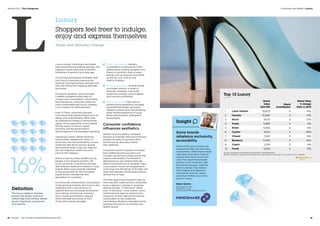

  • 40.
    Ogilvy Matheris one of the largest marketing communications companies in the world. The company is comprised of industry leading units in the following disciplines: advertising; public relations and public affairs; branding and identity; shopper and retail marketing; health care communications; direct, digital, promotion and relationship marketing; consulting, research and analytics; branded content and entertainment; and specialist communications. For more information, visit www.ogilvy.com. SEVEN KEY PRINCIPLES FOR A MORE USEFUL BRAND VALUATION Innovation, once a reliable source of competitive advantage, is growing less and less secure as markets become more global and communication becomes instantaneous and universal. Now, brand has become the only remaining source of reliable, defendable differentiation, making it more important than ever before. And yet, brands are still not taken seriously. Their power is underestimated and misunderstood, and the failure to put the case for investment in them on the sound financial footing expected by CFOs, CEOs and boards is depriving marketing of credibility, holding brand back from taking its rightful place in the boardroom. To change this, a more dynamic approach to brand valuation is required, one that stands traditional valuation on its head. This new brand valuation can link marketing decisions to money, transform the way marketing is viewed, and catapult it from a corporate communications role to leadership of growth and innovation. Unfortunately, brand valuation’s role in marketing today is largely the same as its role in accounting. Today’s brand valuation gives only point-in-time values, and as a result the major use of brand valuation is benchmarking. For brand valuation to progress beyond benchmarking, it must finally be considered in conjunction with marketing. Instead of being just a number, it must become a diagnostic tool. In order to achieve that, we at Ogilvy Mather have strong opinions on the principles that should be used and the steps that should be followed when valuing a brand. Here are our seven key principles: 1. Start with how the brand creates value and drive the methodology from there The whole point of brand valuation is that brands make money for their owners. To exploit the full potential of brand valuation, we must begin by understanding what brands are and how they make money. Without an understanding of the sources of value, brand valuation is limited to being an exercise to produce a point-in-time number. Brands impact the demand side of the business (revenues and margins) and the supply side (employees, suppliers, regulators, and investors). They create value across the business value chain, to an extent that few companies fully understand, or leverage. Understanding how a brand creates value is hugely important – it can unlock the secret of creating future value. 2.Conduct a robust brand driver analysis Brand valuations generally have two kinds of inputs – financial data and brand analysis. As we have seen, the second input is where most brand valuation methodologies fall down. The secret to making brand valuation useful lies in making the brand analysis as robust as possible. There are statistical methods that can be used to isolate the financial contribution of the brand. We recommend using a quantitative brand driver analysis to determine the brand’s contribution to value. 3. Make it diagnostic We need to break free from the financial bias that has afflicted brand valuation. If it is to have practical application in marketing, brand valuation must be diagnostic. We are no longer interested in recording a value to achieve some accounting gain but rather in identifying what actions we can take to increase the value of the brand and business. A brand valuation must look inside the business to identify where brand value is created, determine how good a job the brand is doing at each touch point, and identify opportunities to do better. 4. Run scenarios to identify the best opportunities Brand driver analysis can be used to identify opportunities for brand improvement. We can identify where the gaps in brand performance are compared to competitors. 5. Take a holistic approach Brand valuation needs to take a more holistic approach. We can measure how a brand creates value across the whole customer experience, including both tangible touch points (products, customer service, and the retail experience) as well as intangible touch points (marketing communications). This requires more imaginative use of research data – one that unites the areas usually split between brand tracking and customer satisfaction studies. 6. Look at many measures To become strategic, brand valuation must encompass many measures, not just one. It is easy to become fixated on “the number,” but this is just the starting point, not the end point. More meaningful and actionable measures need to be added. These metrics should be easy to understand, easily replicated, and forward-looking leading indicators of brand value creation. They must include a linkage between brand and share price – the indispensable condition for getting brand into the boardroom. 7. Look over time – the new brand tracking To be truly useful, brand valuation must shift from a point-in-time measurement to measurement over time. Conducting brand valuation once is a “nice-to-have.” If it is diagnostic, it can provide important input to strategy development. But the real ROI on brand valuation comes when the company’s progress in creating brand value is tracked, measured, managed and acted upon over time. Brand valuation can become the foundation for brand and marketing decisions, which will have a transformative effect on marketing. Exploiting valuation’s power to link brand to money can change the corporate perspective on brand and marketing. A sound financial underpinning for requests for money puts marketing on the same footing as other functions in the corporation and gives marketing far greater credibility. It also improves the quality of brand and marketing decisions, enhancing the effectiveness of strategies, driving greater business growth, and pushing share prices upwards. BrandZ™ adheres to many of the brand valuation principles we hold most dear, making it, in our opinion, the best brand benchmarking practice. BrandZ™ examines these principles at a high level across many brands. In doing so, the practice shows each individual brand how crucial these seven ideas are. BrandZ™ makes an important contribution to raising the profile of marketing leaders, leaving no one in doubt that they are managers of one of the corporation’s most valuable assets – the brand. Joanna Seddon President, Global Brand Consulting OgilvyRed, Ogilvy Mather Joanna.Seddon@ogilvy.com 78  BrandZ™ Top 100 Most Valuable Global Brands 2014 79 Section 03  |  Thought Leadership

  • 41.
    Definition The beer categoryincludes global and regional brands, which, in an increasingly consolidated industry, are mostly owned by four major brewers. Top 10 Beer Brand Value 2014 $M Brand Contribution Brand Value % Change 2014 vs 2013 1 Bud Light 12,580 3 16% 2 Budweiser 11,834 4 25% 3 Heineken 8,670 4 5% 4 Stella Artois 8,237 4 30% 5 Corona 8,025 4 21% 6 Skol 7,055 4 8% 7 Guinness 5,014 4 12% 8 Aguila 3,676 5 -6% 9 Miller Lite 3,630 3 17% 10 Brahma 3,585 4 -6% Source: Valuations include data from BrandZ™ and Bloomberg. Brand contribution measures the influence of brand alone on earnings, on a scale of 1 to 5, 5 highest. Beer Drinkers drive volume in fast growing markets and expect variety in US and Europe Major brewers build local and global brands Expansion in fast growing markets drove beer volume increases, but changing social and drinking trends slowed consumption in North America and Western Europe. As people, especially Millennials, socialized more in mixed groups of men and women, they drank less and instead focused on experiencing new tastes and flavors. To reach new, young beer drinkers in developed markets, the four major global brewers – AB InBev, SABMiller, Heineken and Carlsberg – introduced their own versions of flavored and craft style beers. While the craft beer phenomenon is less pronounced in Europe than in the US, the growing desire for choice also is expressed in the resurgence of ale in the UK. The major brewers build their global businesses by balancing the need for economies of scale with respect for local beer tastes and traditions. The BrandZ™ ranking of the Top 10 beer brands reflects this evolution. Four listed brands – Budweiser, Heineken, Guinness and Stella Artois – are global beers. The other brands are regional leaders, with four – Corona, Skol, Aguila and Brahma – from Latin America. Normally, the major brewers produce their global brands close to the market to gain the greatest economies. But rising consumer concern with authenticity has produced exceptions. SABMiller brews Peroni, an Italian brand, in Italy. All the Heineken distributed in the US is brewed in Amsterdam. To compensate for the extra production costs, the brewers market these beers as premium brands. These other trends continued to unfold: Pairing with food Brewers promoted beer as an enjoyable – and affordable – complement to a good meal, a premium beer being less expensive than a modest wine. Cider Like flavored beer, cider is seen as an entry option for people who find the taste of beer too bitter. Of the major brands, only Stella Artois offers cider, both apple and pear. Craft Beer Although the trend is influential, craft beer represents less than 8 percent of total beer volume and around 14 percent of revenue in the US. Building global and local brands Industry expansion and consolidation continued, as AB InBev completed its acquisition of Mexico’s Grupo Modelo, adding Corona to its portfolio of over roughly 200 brands. Diageo, the UK- based spirits giant, relaunched its Guinness brand in Nigeria, which consumes more of the brand than Ireland. Africa lacks beer industry infrastructure that can be easily acquired. But expecting strong growth in Africa, the major brewers have invested in distribution networks with the goal of convincing drinkers to trade up to higher quality beer. In contrast, the existence of industry infrastructure facilitated expansion into Latin American, which now is split, along a rough “line of demarcation,” between AB InBev, which holds significant share in Brazil, for example, while SABMiller enjoys great success in Columbia. By acquiring strong local beers, the majors gained economies of scale and built diversified brand portfolios that they crowned with their global brands, positioned at a premium price. Brazil is a prime example of this strategy. AB InBev acquired and invested in local brands, Brahma and Skol, and introduced its own global brand, Budweiser, to the market. AB InBev then reversed the process, picking one of the local leaders, Brahma, to build that brand outside of Brazil. The world’s largest market The majors also continued to compete for share in the fragmented Asian market. China, the world’s largest beer market by consumption, is roughly twice the size of the US market. Lacking a beer drinking tradition, consumption per person is relatively low, which suggests that opportunity is high. Although still a market of regional players, consolidation is happening in China. Snow, China’s largest brand, acquired Hong-Kong based Kingway Brewery at the end of 2013, for example. China Resources, a State Owned Enterprise (SOE), and SABMiller jointly own Snow. 14% Food and Drink | Beer 80  BrandZ™ Top 100 Most Valuable Global Brands 2014 81 Section 03  |  The Categories
  • 42.
    Most of theregional beers are owned by one of the major global players. Harbin, which is strong in Northeastern China, is a subsidiary of AB InBev, which also markets other brands, including Budweiser, in China. Yanjing remains the only Chinese brand without a foreign partner and with intentions to remain independent. Action Points for Brand Building 1. Remain relevant Tap into the cultural context around consumers and tell engaging stories that connect consumers and their aspirations. 2. Celebrate the product A lot of beer communication is about the drinking experience rather than about the beer and its quality and taste. But today, consumers often are looking for a unique or distinctive taste. 3. Emphasize the local Beer is a global industry built on the legacies of local brewers. Those legacies are a source of strength, as they signify authenticity, quality and trustworthiness. Insights: BrandZ™ BigData Spotlight Changing tastes and habits shape beer consumption Mature market consumers haven’t lost a desire for beer, but they’ve changed their beer drinking habits. They’re consuming less and instead looking for distinctive taste or experience. This trend is especially true of younger drinkers, the Millennials. Consumption remains higher in fast growing markets where the interest in a distinctive taste or experience is present but less important. Like to try new drinks Europe US Brazil LatAm 105 LatAm 110 LatAm 104 MeaningfulGlobally owned, regionally distinct The consolidation of beer brand ownership has not eradicated the regional preferences and attitudes within the beer category. Among The BrandZ™ Global Top 10 most valuable beer brands, four are from Latin America, while Europe and the US have three each. The Latin American brands are meaningful, different and the most salient (meeting consumers spontaneous needs and aspirations). European brands are driven by greater premium and differentiation, while those in the US are generally less distinct. These distinctions also are evident in the contrasting brand personalities. Latin American beer brands are “sexy,” “playful” and “fun.” Those from Europe are more “desirable” and “brave,” while the US brands have less distinctive personalities. Source: BrandZ™ database All brands average = 100 Different Salient US 99 US 99 US 98 Europe 111 Europe 125 Europe 99 Insight Brand stories build customer interest in both local and international beers Knowing where a product has been produced gives consumers a sense of confidence around their choice. However, there is a tension between the two sides of this trend – localism and provenance. On the one hand, the desire to support and feel part of a community helps to drive the interest in beers brewed locally – such as craft beer or local national brands. On the other hand, the aspirational appeal to tasting something produced in another part of the world is boosting premium world beer portfolios. In both cases, authenticity around origins is vital as well as transparency. Anna Managó Project Director Added Value A.Manago@added-value.com Insight Local beers and global premium brands shape brewer portfolios The major global players are managing brand portfolios that are much more diverse. Whereas before the major global brewers would acquire local brands and consolidate them into their systems, today there is a mix of the global brands and the local brands. That’s a change in strategy as the global brewers use local brands in local markets. And the international premium brands are riding on the back of these local jewels. Nick Cooper Managing Director Millward Brown Optimor nick.cooper@millwardbrown.com Advertising, marketing and innovation AB InBev’s Budweiser remained the King of Beer in title, and its brand value increased 25 percent, but Bud Light was the preferred beer in America, one of the only markets dominated by light beers, including the MillerCoors brand Miller Lite. Marketing and innovation sometimes came down to the shape of the bottle. Heineken changed the shape of its familiar green bottle, adding a long neck to create a sleeker look and appeal to younger drinkers, the same group AB InBev intends to reach with the cobalt blue bottle of Bud Light Platinum. Corona continued its “Find Your Beach” campaign, emphasizing individuality and featuring the Corona bottle topped with the ritual slice of lime. In an appeal to America’s Millennial and Latino drinkers, Corona offered a draft version of the beer, an early indication of how AB InBev intends to grow the brand. Stella Artois reached Millennials by focusing on the glass, or chalice, rather than the bottle. The chalice and the pouring ritual dramatize the beer’s premium positioning. Stella created an app that enabled people to send friends a virtual chalice of Stella, redeemable for a real beer at selected locations. And people who registered through Facebook for the Stella Artois holiday promotion had the option of receiving a surprise gift or passing the gift to a friend. Passing the gift earned a donation to a charity and, for those with the longest gift chains, entry into a sweepstakes to win a hand-blown crystal chalice. Stella Artois brand value improved 30 percent. Russia’s Baltika, owned by Carlsberg, found a stealth way to air traditional commercials despite the national ban on beer TV advertising. A sponsor of the Sochi Olympics, the brand promoted its non-alcoholic Balitika 0 brand. By inference, the spots also reminded viewers about the rest of the beer’s range, which is also branded Balitika followed by a number that distinguishes each taste variation. 53 44 21 Source: TGI 2013 / Base: All beer drinkers Percent who agree: I like to try new drinks. Europe includes the UK, Spain, Germany and France. Beer drinkers age 25 to 34 who are more likely to try a new drink Food and Drink | Beer 82  BrandZ™ Top 100 Most Valuable Global Brands 2014 83 Section 03  |  The Categories
  • 43.
    Definition The fast foodcategory includes Quick Service Restaurant (QSR) and casual dining brands, which vary in customer and menu focus, but mostly compete for the same day parts. Top 10 Fast Food Brand Value 2014 $M Brand Contribution Brand Value % Change 2014 vs 2013 1 McDonald's 85,706 4 -5% 2 Starbucks 25,779 3 44% 3 Subway 21,020 4 26% 4 KFC 11,910 3 20% 5 Pizza Hut 7,535 3 25% 6 Chipotle 7,372 4 48% 7 Tim Hortons 4,050 4 20% 8 Panera 2,871 5 -5% 9 Wendy's 2,714 3 New 10 Burger King 2,664 2 9% Source: Valuations include data from BrandZ™ and Bloomberg. Brand contribution measures the influence of brand alone on earnings, on a scale of 1 to 5, 5 highest. Fast Food Diners pick healthier options, but customer traffic remains flat overall And sometimes a burger will do Although customer traffic at fast food restaurants remained flat year-on-year, sales strengthened for well differentiated brands and the brand value of the category improved 10 percent after a 5 percent increase a year ago. Factors influencing how often consumers visited a fast food outlet and the brand they selected included price, occasion, concern about healthy eating and even the rise in online shopping, which affected the number of people lunching or snacking at shopping malls. Of all the segments of QSR, or quick service restaurant business, fast casual traffic improved most, according to US research reported by industry journal Nation’s Restaurant News. This segment, which includes brands like Chipotle Mexican Grill and Panera, met the consumer desire for healthier food and a comfortable ambiance. Across the fast food category, brands continued to upgrade their locations and leverage the investment by driving customer traffic at other meal parts of the day, especially breakfast and mid- afternoon snacks, with new offerings and lots of coffee. The quick service segment, led by McDonald’s, drew the largest share at breakfast. The addition of menu items sometimes diluted the clarity of the brand message, however. The McDonald’s share price lagged when service slowed as the company attempted to introduce many new menu items. McDonald’s plans to simplify its offering and invest in kitchen equipment that enables more meal customization, a benefit it will market to customers. These developments impacted the category: Menu innovation Wendy’s focused on its core item, the burger, but presented it in a new way, on a pretzel bun that drove sales and received a lot of social media attention. Wendy’s is new this year to the BrandZ™ fast food category ranking. Benefits of franchising By shifting to mostly franchise operated restaurants, Burger King reduced costs and almost doubled its net income. Its stock price surged and brand value improved 9 percent. Improved ambience McDonald’s will have about half of its roughly 35,400 units remodeled by the end of 2014. KFC, mostly known for its fried chicken, opened a fast casual prototype in Louisville, Kentucky, headquarters of Yum Brands, the corporate parent also of Pizza Hut and Taco Bell. Expanding the day and the menu With traffic flat, brands focused on building business throughout the day, especially at breakfast, but also at potential snack times, reflecting how daily routines have become less regimented around three defined meals, leaving more time for grazing. Consumers typically select their breakfast stop based on convenience and habit, although a well-priced offer can interrupt ritual. For lunch, people prefer variety and brands attempt to get into the consumer’s repertoire. Brand leaders responded to these dynamics. Having recently refined its logo to focus on the image of the siren and eliminate the reference to coffee, Starbucks broadened the brand offering around the core brand experience of affordable luxury. To fortify breakfast and build its snack and lunch business it added baked goods, sandwiches, salads and soups, leveraging its 2012 acquisition of La Boulange bakery. The company also expanded distribution of its Evolution Fresh juices in its own stores and in supermarkets. Starbucks is introducing Yoghurt made by Danone, under the Evolution Fresh brand. And Starbucks also featured cold beverages that it calls “handcrafted sodas,” with three flavors – ginger ale, lemon ale and spiced root beer – prepared by baristas. After testing alcohol and hot food in several cities, Starbucks plans to roll out this initiative throughout the US over the next few years. McDonald’s added pastries to its breakfast business, a mealtime that it dominates in the US with offerings like its “Egg McMuffin.” Aiming to break a consumer habit and grab share from a competitor, Burger King featured a similar item, priced at a dollar, with the line, “It’s not that original, but it’s super affordable.” The priority of health Although McDonald’s and Burger King added salads to their menus, those items did not drive significant business. When customers go to the burger segment leaders, they’ve chosen a particular experience. The larger health message from burger restaurants is not only about menu items but also about the safety and standards of food sourcing and preparation. 10% Food and Drink | Fast Food 84  BrandZ™ Top 100 Most Valuable Global Brands 2014 85 Section 03  |  The Categories
  • 44.
    Chains like Chipotleand Panera fit more squarely in the health trend as they offer food in a counter-service, fast food environment, but their value message is about more than price and includes both quality and the dining room environment. Tim Hortons, which dominates the Canadian market with around 3,470 restaurants, takes a similar approach with an emphasis on hot meals, like lasagna, served in a bowl to evoke a home cooked feeling. Like any fast food chain, Chipotle, Panera and Tim Hortons deliver taste, but they emphasize the taste of ingredients rather than sauces. Chipotle promoted its “food with integrity” strapline with a social media video series called “Farmed and Dangerous.” In one episode, a friendly and entrepreneurial scarecrow tours a nightmarish cartoon depiction of industrial food production and then begins its own fresh food business. With its claim of fresher ingredients, Subway also benefits from the interest in health. To underscore freshness, Subway featured Kermit and Miss Piggy in a video where the Muppets meet Subway spokesman Jared Fogel and the Swedish Chef Muppet prepares a sandwich loaded with vegetables. Social and digital innovation In a marriage of digital and restaurant theater, Pizza Hut, a leader in digital online ordering, experimented with in-restaurant ordering technology. A tabletop functions like a giant interactive screen and customers order by touching virtual pizzas and toppings. Wendy’s reached over 85 million Facebook users with a series of videos in which a musical group adopted lyrics submitted by fans into “Pretzel Love Songs” to promote the chain’s pretzel bacon cheeseburger. About three- quarters of participants accessed Facebook with a mobile device. Wendy’s subsequently announced that it would accept mobile payment at roughly 6,500 US locations. Burger King updated its mobile app to allow smartphone payments. Around 11 percent of weekly transactions at Starbucks US locations are made with a mobile device. The brand upgraded its iPhone app to enable customers to add a tip for the barista. In other social and digital marketing efforts, Burger King rolled out bkdelivers. com for home delivery and McDonald’s tweeted to build traffic during off hours, when people might feel like snacking. Fast growing markets Growth for fast food brands slowed in China because of the cooling economy and food-sourcing issues, including a bird flu scare that impacted KFC. With about 4,600 outlets in China, KFC is recovering from weakened sales over food safety concerns related to its supply of poultry. A campaign to reassure Chinese consumers began in late 2013. McDonalds’s has around 2,000 restaurants in China. Starbucks is present in China with over 1,000 stores and is expanding in India with Tata as a joint venture partner. Burger King announced plans to enter India with the Everstone Group as a joint venture partner. The chain controls around 13,600 restaurants worldwide, mostly franchises, over half located in North America. Brands are developing a presence in Southeast Asia, with McDonald’s and Starbucks opening in Vietnam. And as if the usual challenges of global expansion weren’t sufficient, KFC opened its largest drive-thru restaurant in Kiev, Ukraine. Action Points for Brand Building 1. Be healthy Given a choice, consumers today prefer to eat healthier. That doesn’t mean they’ll never indulge. And it doesn’t mean they’ll restrict their diets to only green and leafy stuff. It does mean that when people eat out they want tasty but healthier versions of their favorite meals. 2. Be consistent Along with their global success, McDonald’s and Starbucks share at least one other common characteristic. Their restaurants are an important place in the lives of customers. Customers regularly return because each brand consistently delivers on its promise. 3. Be fast Whether you call it fast food or QSR (Quick Service Restaurant), the essence of the category is in the name. Speed pertains to all aspects of the experience from ordering to delivery and payment. In some categories customers may appreciate the convenience of mobile wallet transactions, in fast food they’re likely to expect it. Insights: BrandZ™ BigData Spotlight Snacking between meals highest in the US Snacking between meals is much more prevalent in the US compared with China and Europe. This US snacking habit is one of the reasons that fast food brands are expanding menus to build business throughout the day and not just at traditional meal times. People worldwide, and especially in the US, say they consume treats they know are unhealthy. Eating snacks between meals 2013 US China Europe Insight Value equation combines price, quality, experience Chains like Chipotle and Panera bridge the gap between fast food and sit down casual. If value is about price, quality and experience, they over deliver on quality and experience. The brands might be a little pricier but their value equation works. It works because a lot of people today are looking for tasty and healthier versions of what they normally eat. Doug Poad Vice President Director of Strategic Planning JWT Canada doug.poad@jwt.com McDonald’s defines value, brand power McDonald’s defines both value and brand power in the fast food category. The McDonald’s brand value is greater than the total of the next nine most valuable fast food brands. This phenomenon reflects consumers’ experience of McDonald’s as the brand that spontaneously meets their needs far better than the main competitors (saliency). McDonald’s also is the most famous brand, which shows up in awareness. Salient (average brand = 100) Awareness (average brand = 78%) Next Top nine 106 Next Top nine 88% McDonald’s 216 McDonald’s 98% Source: BrandZ™ database Insight Expectations rise for food that’s healthy and also fast The fast food category continues to be value driven. But we’re seeing increased consumer expectations for the healthiness and quality of the food they get both at supermarkets and restaurants. There’s a movement along the food chain that’s starting to acknowledge pressure for better food formulation and improved treatment of animals. We also see that the people who prepare these more considered menu offerings seem to have a passion for the brand mission, which helps build the business. Philip Herr Senior Vice President, Client Management Millward Brown Philip.Herr@millwardbrown.com Eating unhealthy treats 2013 US China Europe Source: TGI 2013 / Base: All adults 18+ Percent who agree: I eat snacks on the move rather than a proper meal; I treat myself to foods not good for me. Europe includes the UK, Spain, Germany and France. 64 42 41 35 22 31 Food and Drink | Fast Food 86  BrandZ™ Top 100 Most Valuable Global Brands 2014 87 Section 03  |  The Categories
  • 45.
    Definition The soft drinkcategory includes these non-alcoholic ready-to- drink beverages: carbonated soft drinks (CSDs), juice, bottled water, functional drinks (sport and energy), coffee and tea (hot and iced). Top 15 Soft Drinks Brand Value 2014 $M Brand Contribution Brand Value % Change 2014 vs 2013 1 Coca-Cola 67,712 5 5% 2 Diet Coke 12,972 3 -5% 3 Red Bull 10,873 4 3% 4 Pepsi 9,318 3 -5% 5 Nescafé 6,676 4 18% 6 Tropicana 5,178 4 8% 7 Nespresso 4,970 4 11% 8 Fanta 4,879 2 23% 9 Sprite 4,545 3 10% 10 Gatorade 4,115 3 10% 11 Minute Maid 2,483 3 8% 12 Mountain Dew 2,331 3 -7% 13 Diet Pepsi 2,158 3 -3% 14 Dr. Pepper 2,115 3 -5% 15 Aquafina 1,778 2 New Source: Valuations include data from BrandZ™ and Bloomberg. Note: Diet Coke includes Diet Coke, Coca-Cola Light and Coca-Cola Zero. Brand contribution measures the influence of brand alone on earnings on a scale of 1 to 5, five highest. Soft Drinks Perfect storm of challenges siphons category strength Brands respond with marketing and innovation Consumers still reached for carbonated beverages, but not as often. Demographics, health issues and changing tastes continued to pressure the sector, even in fast growing markets. The category rose in brand value, but only by 4 percent. The population that traditionally drove cola sales, young people, is smaller in mature markets. Consuming fewer carbonated beverages, young people turned to alternatives like energy drinks and waters enhanced with vitamins. Coconut water was especially popular in the US, falling under the general rubric of healthy, enhanced hydration. But even alternatives can raise issues. To counter the concern with sugar level, Tropicana, the orange juice brand owned by PepsiCo, added a line extension called Tropicana 50, which contains half the amount of sugar. Consumption of CSDs (Carbonated Soft Drinks) declined for the ninth straight year in the US, with a 3 percent drop in 2013, according to Beverage Digest. The industry publication reported that CSD volume in the US retreated to its 1995 level. Main brands, such as Coke, Pepsi, Mountain Dew and Dr. Pepper outperformed their diet versions because of consumer concern with artificial sweeteners, according to Beverage Digest. These other trends emerged: Regulations Because of health issues some national and local jurisdictions limited where brands could sell products (not near schools) and in what sizes (no giant drinks). Choice Although the category is the target of regulations and health concerns it keeps expanding and fragmenting. Occasion remains key Colas continue to market their brands for treats or indulgence, understanding that for the consumer ordering a slice of pizza and a beverage, immediate pleasure is the primary concern. Innovation and experience To achieve a level of personalization and unique experience, Coke partnered with Green Mountain Coffee, the company that makes single-serve coffee pods that include a selection from Starbucks. Coke intends to offer a range beverages prepared at home by the consumer. The innovation is aimed especially at Millennials. It assures having the beverage when and where you want it. It also personalizes the product and delivers it with a unique experience in an at-home variation of Coke’s Freestyle vending machine, which enables consumers to mix about 100 flavors. The approach is also based on the success enjoyed by Nespresso, which has created an experience around coffee drinking at home. With all its flavor options, Nespresso has made coffee into more of a treat. In a separate innovation aimed at reviving the soft drinks category and remaining relevant, Coke launched Coca-Cola Life in Latin America, with cans that look like Coke but are green to emphasize both sustainability and health. The drink uses a combination of real sugar and artificial sweetener. Betting that there’s still a growing market of young people who will drink carbonated beverages that are made without corn syrup and preservatives, and offered with some sense of personalization and authenticity, Starbucks is introducing a line of sodas prepared by baristas in its cafés. 4% Food and Drink | Soft Drinks 88  BrandZ™ Top 100 Most Valuable Global Brands 2014 89 Section 03  |  The Categories
  • 46.
    Spotlight Cola crosses allage groups, as energy drinks draw young Cola drinkers span all age groups, especially in the US. Energy drinks are popular with young people. In the Brazil, the US and Europe about a third of people age 25 to 34 said they had an energy beverage in the past year. Cola drink consumption 2013 Brazil US Europe Energy drink consumption 2013 Brazil US Europe Marketing the brands Pepsi refocused on the Pepsi brand and invested heavily in marketing, particularly on traditional media, having focused earlier on social media. It aimed at reaching young cola drinkers with its “Live for Now” campaign and with the use of celebrity spokespersons, including Beyonce. Pepsi also attempted to reach a young audience with the variety of flavors available from its Aquafina bottled water brand. Its Gatorade continued to dominate the sport beverages. After public concern over a Gatorade ingredient called BVO, brominated vegetable oil, the brand agreed to remove it. In its focus on events and youth, Pepsi resembled the approach of Red Bull, the energy drink, with its sponsorship of music events along with extreme sports and other high-energy adventures. Sprite, a Coca-Cola lemon-lime drink, continued to benefit from being a clear beverage, which adds to the perception that it’s a healthier carbonated option. The Coke “Open Happiness” campaign connected with people in an emotional way that emphasized the appeal and universality of the brand rather than the properties of the product. In an ad shown during the Super Bowl, Americans of various backgrounds performed “American the Beautiful,” each phrase sung in a different language, connected seamlessly into a musical quilt representing America’s diversity. To build on the traditional connection between cola and food, Coke marketing attempted to associate the brand with the home mealtime occasion. Fast growing markets Marketing cola as a drink for mealtime traditionally has been a way to cultivate cola drinking in fast growing markets. However, the standard assumption that rising wealth will drive steady soft drink growth in those markets is less true today because more products compete for the spending of the rising middle class. In expanding in fast growing markets, brands faced multiple challenges including the taste appeal and health concerns. Health and childhood obesity are factors in China. Chinese generally don’t like the sensation of carbonation and prefer other drinks, like tea. Tea is also popular in India. Indians are more disposed to drink carbonated beverages, and they have options to choose from, including Coke, Pepsi and Thums Up, a local brand acquired by Coke. In another version of spreading happiness, Coke featured people in India and Pakistan in front of Coke vending machines designed so that the people from each nation could see each other, communicate and exchange the gift of a Coke. Action Points for Brand Building 1. Innovate Health concerns about CSDs (Carbonated Soft Drinks) aren’t going to disappear. But the category is broader than CSDs and it’s possible to grow in areas that satisfy both the consumer desire for a satisfying beverage and health concerns. 2. Create new experiences Drinking involves more than quenching thirst and enjoying taste. The experience consumers have as they drink a beverage also influences their feelings about the brand. 3. Support the brand Integrated media campaigns can strengthen the consumer’s emotional connection to the brand when the stories evoke positive memories and connections. Insights: BrandZ™ BigData Insight Changing habits drive shift away from cola In developed markets, consumption of carbonated drinks has been virtually flat for several years. Demographics in part drive this trend, but so do changing tastes and health concerns. Young people remain the primary consumers of carbonated drinks, but they are drinking less soda than past generations did. In Europe that population segment is shrinking while in the States, the Millennial group is growing slightly, but they have less money and more choices than previous generations. Driven by health concerns and changing lifestyles and tastes, young people are turning to other soft drink options like enhanced waters and energy drinks. Lloyd Burdett Head of Global Clients and Strategy The Futures Company lloyd.burdett@thefuturescompany.com Insight Has the soda decline finally fizzed out? Carbonated Soft Drink (CSD) consumption has declined over the past 25 years. The recent backlash from critics regarding high calorie and sugar content accelerated this trend. In addition, diet soda has faced criticism about artificial sweeteners. Historically, 85 percent of the US population consumed CSDs. Now, less than two-thirds drink in the average week. However, in the past two years the category has stabilized; still attracting more consumers than any category excluding tap water and owning the need for a “fun treat.” With the innovative surge of lower calorie and natural variants, can the category attract consumers back to CSDs? Lauren Masotti Client Executive – US Beverages Kantar Worldpanel Lauren.Masotti@kantarworldpanel.com Category goes flat as attitudes change The health and obesity debate, government pressure and consumer awareness of ingredients are all contributing to a decline in “meaningfulness” (generates ‘”love,” meets needs) of the carbonated soft drinks category. Although the leading brands, and Coca-Cola in particular, continue to be extremely successful and engage their consumers, we see a decline in “meaningfulness” and “trust” as consumer needs and attitudes change. Soft Drinks Top 10 brands 2008 2014 Source: BrandZ™ database All brands average = 100 Meaningful 110 Meaningful 101 Trust 97 Trust 93 Source: TGI 2013 / Percent of consumers who drank beverages within the past year. Europe includes the UK, Spain, Germany and France. 75 25 61 23 74 17 Food and Drink | Soft Drinks 90  BrandZ™ Top 100 Most Valuable Global Brands 2014 91 Section 03  |  The Categories
  • 47.
    Geometry Global isthe largest and most geographically complete activation agency of its kind, providing brand marketers with a unique solution for an unmet need: Precision Activation. This proprietary approach focuses on the exact blend of context and content that combine to influence consumer behavior, transforming proven communication techniques and big creative ideas into effective and profitable business growth drivers. With a team of 4000 experts in 56 markets, the global network develops highly compelling marketing programs – informed by data and insights – connecting people with brands at precisely the right times, in the right places, and right ways – making a measurable difference to clients’ businesses. Launched in June 2013, Geometry Global delivers award-winning creativity and integrated talent across a range of disciplines including Shopper, Relationship, Promotional and Experiential, Trade and Digital Marketing. For more information, visit www.geometry.com As humans, we constantly seek to define and evaluate ourselves, using social interactions, experiences and personal inventory to project our own identity. Community and participation are powerful influencers: we crave connections with people whose beliefs and values we share. And with digital as the mighty enabler, our connections are widening alongside our collective experiences. People’s relationships with brands have changed. A recent survey [GlobalWebIndex] asked consumers how they would want a brand to act towards them: 50 percent of 25-34 year olds reported their favorite brand plays an integral part in their online life and experience, while 38 percent would buy a product or service simply to be part of the community around it. Add to this the Convergence Economy [LS:N Global] where boundaries between brands, sectors, economy and emotion are dissolving. Look to retail spaces, products, hospitality and entertainment and there’s one distinctive theme: it’s difficult to tell one thing from the other. Consequently, we need a fresh way to activate brands, to find new ways to engage with people and gain a greater share of life and “share of self.” Today’s smart winners are imaginative, reaching outside of their historical boundaries to create new experiences and solutions. Nike, Samsung, Sony and others, are moving from purely product offers to services and lifestyle enhancement. For the time poor, Google’s Future Home has launched life- enhancing apps from voice-activated cooking to tablet-operated smart TV. Such brands are going wide and creating partnerships to take an increased share of life. Clothing retailer Banana Republic has collaborated with Condé Nast Bon Appetit and online reservation service Open Table to create a Desk to Dinner collection – an innovative solution for the working woman while making the brand relevant to a much larger market. Through a collaborative movement, Shop Elsewhere in Hong Kong enabled independent fashion retailers to recommend each other’s products, allowing shoppers browsing in one designer’s store to activate the QR code on an item, leading to a web site with recommendations for other designers’ products pre-selected to match. Designers increased reach and attracted new clients while creating a unique in-store experience. Critical to brand success in this digital age is the ability to create precise and relevant connections and experiences, with communications that engage people at the right time, in the right place and in the right way. Mastery of big data has replaced supposition to extract real time consumer insights, enhancing a sense of self. In Korea, retailer Emart created a mobile, Wi-Fi flying store. High footfall rivals were visited by the drones encouraging consumers to connect to the flying store via smartphones. Once connected, consumers were directed to the Emart online shopping portal to access discounts. The result: satisfied, value conscious shoppers and soaring sales for Emart. The human brand Technology and data are merely brand conduits and enablers. The reality is that brands are transitioning from acquaintance to become life influencers in real and valuable ways. Smart brands are inviting people to share an experience, rather than product. Apple changed the retail landscape forever to become the supreme shopper experience where people could learn, seek help and socialize. In tandem with its aspirational product it became an iconic global brand with the best brand retention in the industry [source: WDS]. And this engagement goes beyond the physical, with 10 percent of Internet users having talked about Apple online (GlobalWebIndex). In Latin America, Huggies moved the hearts and minds of parents when, to celebrate Friendship Day, it delivered a special crib for two new born babies to a maternity ward. Bringing two boys together meant each had their first friend. And Huggies created a moment parents would never forget. Apple and Google’s brand-lifestyle ecosystems are an elegant attempt by both brands to refocus themselves around an arresting experience; demonstrating reliability, innovation, design and a defined personality across every customer touch point. Participatory brands are here and now The past is another country for brands, as they journey towards a social role within a much broader community. People are now invited to view brands as they do their friends, colleagues and partners – offering products and services the opportunity to embrace change and help people to think smarter, lead healthier lives, and enjoy richer experiences. To succeed, a brand simply has to be clear about its own values, and the places, spaces and occasions where it has both role and purpose. 1. People are seekers, searching for solutions – functional or emotional – to support both them and their identity. Brands must understand these needs and their associated behaviors. 2. In doing this, brands can move away from industry definitions of category to identify opportunities by observing consumer and shopper behavior relating to consumption, usage occasions and solutions that enhance people’s lives. 3. For example, in Asia, Cadburys incentivized shoppers to give chocolate at key gifting occasions with its “Say it with chocolate” campaign. Allowing shoppers to create personalized messages in store, this innovative approach created a crucial social connection with the brand, sharing joy and changing purchase behavior. MY BRANDS. MY SELF.Jonathan Dodd Global Chief Strategy Officer Geometry Global Jonathan.Dodd@geometry.com 92  BrandZ™ Top 100 Most Valuable Global Brands 2014 9392  BrandZ™ Top 100 Most Valuable Global Brands 2014 Section 03  |  Thought Leadership
  • 48.
    In the U.S.,Millward Brown Digital delivers comprehensive digital solutions to help advertisers, agencies and publishers increase marketing effectiveness and drive brand growth. The unit combines Compete’s consumer, channel and market intelligence solutions – supported by the industry’s largest behavioral panel – with Dynamic Logic’s advertising and campaign effectiveness offering. Insights from the division help marketers increase media efficiency and optimize campaign effectiveness, expand sales and market share for their brands across all channels, and enhance total brand performance. To find out more visit www.millwardbrown.com/digital. Consumer attitudes can be shifted with a single tweet, and entire categories are being disrupted by the technologies we carry in our pockets. As the media industry has gone through massive upheavals in the past decade, our attitudes as consumers are more fickle than ever. Social media, in particular, can trigger flash points for brands, such as the horse meat scandal from 2013. Even for brands not directly involved in such controversies, they may also experience a slower and broader escalation of shifting consumer preference – consider the growing consumer and corporate interest in sustainable meat, including Chipotle and McDonald’s. To succeed commercially, brands must be dynamic and innovative. Some innovation is a routine part of business: Moore’s law driving down the cost of technology and raising the bar for capacity, or evolving an existing product to deliver on changing consumer preferences (e.g. gluten-free cereal). But other innovations seemingly come out of left field, whether it’s from a new entrant to the market (such as Airbnb’s disruption of hospitality) or a radical re-imagining of an industry (like Amazon’s takeover of digital media content). Ultimately, both types of innovation must be supported by consumer demand (however latent), whether that is an incremental desire for a slightly better product or a rapid adoption of a transformative technology. Savvy brands will need to tap into research to better understand how that consumer demand is shifting as well as to anticipate the potential for their own brand and category to proactively connect with and shape the consumer mindset. Marketers are anxious to anticipate the consumer-driven shifts, and they specifically crave access to the robust cloud of data we each generate. In the age of “Data of Now,” there is a persistent sense that the next trend will leap off the page (or out of the database) just in time for a brand to pivot and capture a newly defined market. So as purveyors of consumer trends and insights, it is our own industry that is most ripe for disruption – if brands are looking to make data-driven decisions, they will be leaning more heavily on market research. Yet as researchers, we are caught in a paradox: consumer profiles, augmented by social, behavioral, and transaction data, can be richer than ever. But the same media ecosystem that helps foster this depth is also a quagmire. There are not only technological barriers to building these profiles (such as tracking a single consumer’s behavior across a computer, a tablet, and a mobile phone), but also serious ethical concerns around consumer privacy and consent. We anticipate that innovation could help ease some technological impediments, but that regulatory action as well as consumer concerns will constrain the full use of this data. Finding meaning in mass data Moving forward, it will be increasingly difficult to obtain comprehensive single-source data on a single individual. We may not know what Jane Doe saw on TV, how often she tweeted, or what she bought at which store. But by taking seemingly disparate datasets that reflect niche patterns of consumer behavior, and identifying their common patterns, we can generalize with more accuracy and meaning. Online behavioral data can give us a sense of search patterns and overall levels of product demand; social data can tell us what stands out about a brand over time; sales data can give us concrete outcomes; and survey data can help us calibrate each of these habits, attitudes, and actions in relation to one another. Some of the data may not even be direct consumer data, but broader market influences. Advancements in analytics allow us to be able to infer and simulate meaningful trends using a different set of data points than we’ve worked from previously. Enabling this diversity in the research ecosystem makes our instruments more sensitive to both consumer and market shifts originating from unexpected corners. As disruption creates competition from unexpected sources, brands will need to do more than achieve parity with their category; it may no longer be enough to simply meet consumer expectations. Especially for companies whose branding is the primary source of differentiation, it becomes more important than ever to have a deep understanding of the consumer in order to connect the brand to the meaningful desires and values motivating our choices. Ultimately, the forward movement of industry disruption comes from a business – and not consumers – but integrating stronger consumer data into market projections can help companies better identify unexploited opportunities, and position their brands for growth among the consumers who support them. Ali Rana SVP and Head Scientist, Emerging Media Lab Millward Brown Digital Ali.Rana@millwardbrown.com T THE DATA- DRIVEN PURSUI OF THE INCONSTANT CONSUMER Section 03  |  Thought Leadership 94  BrandZ™ Top 100 Most Valuable Global Brands 2014 95
  • 49.
    Definition The bank category,which includes both retail and investment institutions, is split into two tables, with the brands classified as either global or regional. Global banks are defined as deriving at least 40 percent of revenue from business outside their home country. As many banks narrowed their geographic reach and business focus, France’s BNP Paribas took the opposite approach, deciding to remain in diverse lines of banking and accelerate expansion outside of Europe, particularly to North America and Asia Pacific. BNP Paribas appears in the BrandZ™ Global banking category ranking for the first time this year. Investment Bank Goldman Sachs rebounded with its highest profit in three years, which drove an increase in stock price. Standard Chartered, heavily invested in fast growing markets, experienced its first profit decline in a decade. Most of its income is generated by business in Asia, Africa and the Middle East. Top 10 Global Banks Brand Value 2014 $M Brand Contribution Brand Value % Change 2014 vs 2013 1 HSBC 27,051 3 13% 2 Citi 17,341 2 30% 3 J.P. Morgan 12,356 2 28% 4 Santander 11,060 3 20% 5 ING Bank 9,771 3 29% 6 UBS 9,683 2 30% 7 Barclays 9,536 2 19% 8 BNP Paribas 9,453 2 New 9 Standard Chartered 9,150 2 -10% 10 Goldman Sachs 8,400 3 14% Source: Valuations include data from BrandZ™ and Bloomberg. Note: Global Banks are defined as those who generate more than 40% of revenues outside their home. Brand contribution measures the influence of brand alone on earnings, on a scale of 1 to 5, 5 highest. Banks – Global US and European resurgence drives growth as BRICs slow More revelations erode trust It felt like Ground Hog Day for banks. Global banks benefited from improving economic conditions in North America and Europe. Overall brand value for the category rose 15 percent. But even as financial results improved and banks strengthened their organizations, problems surfaced that slowed renewal of trust. Consumers expected that coming out of the financial crisis, and accepting government rescue, banks would change. And many did, restructuring their mix of consumer, commercial and investment banking, reforming internal culture and improving customer communication. But even banks that conscientiously attempted to reform were hurt by revelations of past misdeeds and the public rebuke that followed when announcements of quarterly results came with new warnings attached. The public also expressed anger at banks over high levels of executive compensation. When US regulators reviewed the stress test results that assess a bank’s ability to withstand crisis, it failed the US operations of several European banks and Citi, even as the bank reported its highest annual net income since the financial crisis. These other trends also impacted the category: Regulations The growth of post-crisis regulations continued to shape the banking industry, with banks struggling to predict and organize for the implications. Regionalization After being stalled by the Euro crisis, the regulatory reform necessary for the formation of pan European banks may now resume. Disruption Banks faced disruptive technological changes, like mobile payments and the entry of non- banking entities into the category. Reorganizing and rebuilding Geography was an important consideration as banks considered how to restructure and strengthen their businesses. The Dutch-based ING separated its insurance and banking businesses and reduced its presence in the US and South America to focus on its operations in Europe and on certain opportunities in fast growing Asian markets. ING’s underlying net earnings improved 22.2 percent in 2013. Having repaid most of the bailout received from the Dutch government, and nearing completion of a restructuring strategy, the bank shifted to a posture it termed, “Think Forward.” HSBC also streamlined. After trimming 63 businesses over the past few years, the bank was well positioned in the fast growing markets and in Europe. HSBC improved profits, dividends and capitalization. Net profit increased 16 percent in 2013. With the strengthening of Spain’s economy, Santander planned to expand its loans to small and medium-size businesses. Based on the improved economy in Spain and other core markets, including Brazil, Mexico, the US and UK and Continental Europe, Santander reported a 90.5 percent profit increase in 2013. 15% Section 03  |  The Categories 96  BrandZ™ Top 100 Most Valuable Global Brands 2014 97 Financial | Banks
  • 50.
    Top 10 RegionalBanks Brand Value 2014 $M Brand Contribution Brand Value % Change 2014 vs 2013 1 Wells Fargo 54,262 3 14% 2 ICBC 42,101 2 2% 3 China Construction Bank 25,008 2 -7% 4 RBC 22,620 4 13% 5 Commonwealth Bank of Australia 21,001 3 18% 6 TD 19,950 3 12% 7 ANZ 19,072 3 15% 8 Agricultural Bank of China 18,235 2 -9% 9 US Bank 14,926 3 9% 10 Bank of China 14,177 2 0% Source: Valuations include data from BrandZ™ and Bloomberg. Brand contribution measures the influence of brand alone on earnings, on a scale of 1 to 5, 5 highest. The brand value of the regional bank category appreciated 6 percent overall in the BrandZ™ Top 100 Most Valuable Global Brands 2014, compared with a 15 percent increase a year ago. The ranked banks divide into two groups. The six banks from the strong economies of North America and Australia appreciated in brand value, with US Bank appearing in the BrandZ™ regional banks category ranking for the first time. The four Chinese banks, affected by the country’s slower growth rate, either declined or remained flat in brand value. Restoring trust Banks attempted to restore consumer trust in the wake of the financial crisis, the Libor scandal about interbank borrowing rates, various trading improprieties and public anger over compensation paid to key executives. ING introduced new corporate values in 2013, summarized as: we care, we are clear and we commit to act with integrity. Following the turbulence of the financial crisis, a government bailout and a trading scandal, UBS changed leadership and implemented a major strategic shift to focus more on wealth management and less on investment banking. The bank reported a 44 percent increase in pretax profit in 2013. It announced that, starting in 2014, the bank would pay out half of its profits to shareholders. For J.P. Morgan, 2013 was a year of resolving outstanding legal and regulatory issues in an effort to turn the page on problems lingering since the financial crisis. Overall revenue was flat and net income declined. Barclays promulgated a statement of purpose, values and behaviors called “The Barclays Way.” It created guidelines for conducting business and interacting with customers to make sure that decisions are based on the best wisdom available and not internal pressures. Criticism of corporate bonuses hurt this effort, even as the bank argued that recruiting and retaining the best talent, to remain competitive, required high financial compensation. Banks – Regional North American, Australian banks prosper as economies strengthen Chinese banks struggle with slowdown Having generally avoided the risky loans that caused the financial crisis and government intervention, both the US and the Canadian regional banks were well positioned to benefit from the resurgence of the US economy. Chinese banks felt the impact of liberalized regulations, an increase in loan repayment problems, and a reduction in capital investment borrowing by State Owned Enterprises (SOEs) and regional governments. In addition, these other trends impacted the category: Disruption Especially in China, Internet companies offered online lending, investment products, and mobile payment options. Slower BRICs growth Despite India’s economic slowdown, India’s ICICI experienced profit growth, but Indian banks set aside larger provisions for bad loans. Regional to global Sberbank, which expanded from its roots in Russia to countries of the Former Soviet Union and then to Central and Eastern Europe, considered acquisitions outside of Europe. US economy gains strength Wells Fargo became the most profitable US bank in 2013, on the strength of loan growth and fee income. Net income improved 16 percent. The bank’s stock rose 33 percent during 2013. Wells Fargo increased in scale dramatically when it acquired Wachovia, in 2008, without inheriting the kinds of subprime mortgage liabilities that hurt many of its peers. The integration and rebranding went relatively smoothly and Wells Fargo passed the stress tests that US regulators designed, following the global crisis, to assess whether institutions have adequate capital and other resources necessary for surviving a similar event. US Bank achieved record earnings in 2013, with strong growth from commercial loans and other lending activity, including credit cards and home mortgages. The bank operates from around 3,080 offices in 25 states. It recently doubled its presence in Chicago. Insight Global banks serve changing corporate and individual needs People moved to local banks because of the lack of trust they had for larger institutions. But global banks serve a broader purpose, supporting companies as they become global and helping individuals as they become more global in how they live their lives. Companies and individuals want banking relationships that make it easy to build a business or live a life internationally. That seamlessness is the global banks value proposition. Perhaps there will be a shift in the purpose of global banks, and the need for them will continue to be important to generating global growth. Sana M. Carlton Head of Client Management, Services Millward Brown sana.carlton@millwardbrown.com 98  BrandZ™ Top 100 Most Valuable Global Brands 2014 99 Section 03  |  The Categories Financial | Banks
  • 51.
    Insights: BrandZ™ BigData Brandssuffer from lack of trust and love Global bank brands, even the Top 10, attracted negative sentiment before the recession, and this dilemma has increased dramatically. 2014 (2008) Banks may be performing well financially, but trust has shown dramatic erosion. Regional banks are rated significantly better by their customers, however we still see an erosion of trust. The contrast between the Top 10 regional and Top 10 global brands is stark. Regional banks are more “meaningful” (meeting the needs of their customers with greater affinity) than global banks. Meaningful Canada and Australia show strength Canada’s two largest banks, TD Bank and Royal Bank of Canada (RBC), experienced healthy business in 2013. TD Bank grew net income despite pressure on its insurance business. RBC produced strong results, with its net income up 12 percent. The banks benefited from their significant operations outside of Canada. TD is one of the largest banks in the US, based on assets. It services more than eight million customers through its network of approximately 1,300 locations across the US. RBC operates in 46 countries. A weakened Canadian dollar made the banks’ strong US results even better. The Australian banks prospered because of the stability of Australia’s economy and the proximity to the fast growing markets of Asia. ANZ, Australia’s third- largest bank by market capitalization, has grown through acquisition, having purchased the operations of Royal Bank of Scotland in six Asian countries. Commonwealth Bank of Australia enjoyed positive results based on rising home prices and a robust mortgage business. It has over one million home loan customers. The bank’s range of businesses includes retail, corporate and institutional clients. The bank operates in Australia, New Zealand, Asia-Pacific and Europe. Slower growth impacts China’s banks Slower growth in China and other BRIC markets impacted the Chinese banks, which also contended with market reforms that pressured profits made from loans and pushed banks to look for fee- based products. Several Internet companies, including Tencent, Baidu, and Alibaba disrupted banking with applications that made it easy for consumers to keep some of their savings in online accounts for higher yields and make financial transactions with their mobile devices. China Mobile bought a stake in Shanghai Pudong Development Bank to facilitate its entry into financial services. ICBC, China’s largest lender, continued its traditional role of funding the projects of State Owned Enterprises (SOEs), focusing a lot of activity in Western and Northeastern China. It also cultivated business among new, small business clients. Driven by slower growth at home, China Construction Bank, the nation’s second largest state-owned bank, looked abroad for business, opening six overseas branches, in Taipei, New Zealand, Russia, Dubai, Osaka and Luxembourg. In China, it moved into retail, opening an online shopping platform. Agricultural Bank of China accelerated its transition to a modern commercial bank by improving the coordination between its growing urban and international business and its base in China’s rural communities. Already present in Asia, North America, and Australia, the bank received permission to open in Dubai. The state-owned Bank of China is the country’s most international bank, with operations in 37 overseas countries. Determined to build a global commercial banking business, Bank of China developed relationships with currency trading exchanges in Asia and London. Action Points for Brand Building 1. Set the bar high Formulate high standards and inspire the organization to meet or exceed them. Customers appreciate performance more than apologies. 2. Be ready when the bar falls Anticipate that problems from the past will come back to impact the present. Hold your nerve. Be open. Make it right. The past will pass and fade from the public’s memory. Until another issue serves as a reminder. So no excuse for complacency. 3. Know your place It could be global, regional or local. There’s a place for the global bank that meets the needs of international corporations and cosmopolitan customers. And there’s a need for more narrowly focused operations. But it’s difficult to be all things. 4. Be agile Competition has increased from outside the category. A lot of other organizations are looking to eat your lunch. Prepare for the new ways people will interact with their banks. Use technology effectively to meet customer needs. Arrogant 117 (109) Dishonest 114 (105) Global 92 Uncaring 111 (104) Spotlight Global bank brand value growth lags Top 100 increase Since the inception of the BrandZ™ Top 100 Most Valuable Global Brands in 2006, regional banks have experienced strong brand value appreciation. In contrast, brand value growth of the global banks has lagged the growth of the Global Top 100 overall. Following the financial crisis of 2008, as the Global Top 100 steadily improved in brand value and the regional banks experienced a sharp recovery, the brand values of global banks fluctuated. Both regional and global banks experienced an erosion of trust following the financial crisis, with trust in global banks declining sharply, below the average score for all brands. Global bank brand value fluctuates Trust and recommendation suffer Insight Brands need to fix core issues before talking about values Six years after the crisis, many major banks still have to announce multi-billion dollar provisions for the mistakes made in that period. The key question is when will banks become truly sustainable again? The customer- facing part is important, but banks need to deal with their capital base and other structural issues first. Until a bank is fundamentally sound, it can’t solve its long-term problems. The transition to sustainable finance is difficult because it means slower growth, lower profits and is perceived as bad news for shareholders in the short term. Geoff Beattie Global Practice Leader Corporate Affairs Cohn Wolfe geoff.beattie@cohnwolfe.com Trustworthy 94 (101) Trustworthy 104 (109) Regional 130 Source: BrandZ™ data. The brand value growth chart is based on an index of 2006=100. The TrustR score is based on an index of average brand score=100. TrustR measures trust (how well a brand kept its promise in the past) and recommendation (how well the brand keeps its promise today). — Regional  — Global  — Top 100 20142006 100 200 300 400 2008 2010 2012 2014 101 110 92 104 2008 2010 2012 Source: BrandZ™ database All brands average = 100 100  BrandZ™ Top 100 Most Valuable Global Brands 2014 101 Financial | BanksSection 03  |  The Categories
  • 52.
    Definition The insurance categoryincludes brands in both the business-to- consumer – life, property and casualty – and the business- to-business sectors. Health insurance is excluded. Top 10 Insurance Brand Value 2014 $M Brand Contribution Brand Value % Change 2014 vs 2013 1 Ping An 12,409 2 18% 2 China Life 12,026 2 -21% 3 AIA 8,344 2 22% 4 State Farm 8,314 2 6% 5 AXA 5,645 2 44% 6 Allianz 5,323 3 48% 7 Geico 4,128 2 27% 8 CPIC 3,747 2 1% 9 MetLife 3,290 2 New 10 Travelers 2,981 3 24% Source: Valuations include data from BrandZ™ and Bloomberg. Brand contribution measures the influence of brand alone on earnings, on a scale of 1 to 5, 5 highest. Insurance Insurers shift focus from selling products to building customer relationships US brands lead the global trend For insurance brands, it was the year of personalized customer engagement. Many of the major US property and casualty carriers, and some life insurers, started to organize their big data to provide a 360-consumer view. European companies worked to simplify and speed up their systems to respond in real time and facilitate customer centricity. Traditionally, only two transactions have connected insurers with their customers – closing a sale and processing a claim. Neither event produced the kind of relationships that can pay off over time, building a base of loyal customers with continuous and changing needs for a range of products. There’s often been a mismatch between the competencies that would best serve customers – speed, ease of use and innovation – and the legacy baggage of insurers – disaggregated big data, secure and complicated systems, siloed organizations and businesses designed to push products rather than retain customers. Although tension sometimes remains between the priorities of the risk managers and those responsible for cultivating customer relationships, closer coordination exists. Recent initiatives haven’t eliminated organizational siloes, but they’ve funneled them through new functions responsible for the customer experience. State Farm created a company-wide taskforce to reorient around the customer. These other trends also unfolded: Ad spending Property and casualty insurers spent heavily on advertising to enter new markets and grow share. Balancing channels Brands looked at ways to expand their direct business while maintaining their agent networks. Data protection The industry experienced rising concern about protecting the personal information of its customers. Need to rebuild trust drives change Several factors drove the customer centric initiatives. First, especially during the financial crisis, carriers struggled with customer retention and recognized the importance of developing a customer relationship beyond the point of sale. Insurers still struggle to rebuild trust eroded during the crisis. The second factor is demographic. Insurers want to reach younger consumers and retain them over the course of a lifetime. Like earlier generations, Millennials consider insurance only when a life need arises. But with marriage, children and homeownership happening later, insurance opportunity points are postponed. The challenge impacts both US companies, which have traditionally presented their brands with more emotion, and European-based insurers with consumer and enterprise businesses, whose more steady, institutional approach often worked well during the recession. The German-based Allianz expanded its business and reported strong results, driven by property and casualty, with brand value rising 48 percent. AXA, headquartered in France, improved earning substantially, based on efficiencies gained in mature markets and expansion into fast growing markets. The brand has over 100 million customers in 56 countries, a presence that helps recruit additional customers, talent and partners, particularly in new markets. AXA’s brand value increased 44 percent. Reaching Millennial consumers Even life insurers, which lag property and casualty companies in the use of social media, are looking at ways to reach Millennials. They’re introducing easy-to-buy products with low benefit amounts. MetLife offers an entry-level life insurance product that’s packaged in a box and priced for retail sale off a shelf or peg hook. Allstate acquired Esurance, an online direct-to-consumer business, in 2013. Esurance purchased TV ad space immediately after the Super Bowl. A Millennial celebrity spokesperson explained that the post-game placement saved $1.5 million, or 30 percent, the brand’s typical discount. He invited viewers to tweet for a chance to win this jackpot. Over five million people responded, connecting Esurance to a youthful audience less accessible to its parent brand. 11% 102  BrandZ™ Top 100 Most Valuable Global Brands 2014 103 Financial | InsuranceSection 03  |  The Categories
  • 53.
    Insight Customer engagement needs to berelevant and ongoing You need to engage customers in the channels they’re in and with messages that are relevant to them. And you need to follow customers through the entire lifecycle. Too many carriers suspend communication at the point of sale until renewal, except for things such as claims information and bill payment reminders. Relationships beyond the point of sale require an investment. But if successful, the rewards abound: additional sales, improved retention, advocacy and referrals. In addition, your customers will be able to tolerate higher rate renewal increases, thus decreasing renewal shopping. It’s truly about knowing and serving each customer in a one-to-one manner, throughout his or her lifecycle. Karen Imbrogno Vice President Insurance PC and Life Strategies KBM Group karen.imbrogno@kbmg.com Spotlight Better customer engagement helps improve sales Insurers are attempting to improve customer relationships, as 46 percent of consumers say the relationship with their insurer is non-existent, adversarial or minimal. Positive customer engagement improves KPIs (Key Performance Indicators) including: initial purchase, tolerance of rate increases, customer retention and additional sales. Customers who have a strong relationship with their insurer are 56 percent more likely to buy additional products than are customers with no relationship. Impact of customer relationship on additional sales AXA announced a partnership with Facebook to develop social and mobile marketing initiatives. In the UK, where direct online sales dominate auto insurance, the largest auto insurance aggregators are relatively young brands that were created by major traditional brands aiming to reach new audiences and avoid channel conflict with their agent networks. More disruption expected More market disruption is on the horizon. Google introduced an insurance price comparison site in the UK. The brand offers a potentially powerful proposition because of the vast amount of data Google collects and analyzes, including photos of homes, which can be relevant for insurance assessments. And Google is not the only technology company entering the category. The Chinese insurance company Ping An partnered with ecommerce giant Alibaba and with Tencent, the social network, to launch an online insurance company called Zhong An. In an effort to grow customer share of life, and sell direct, retailers including Costco and Walmart offer insurance products. In another potentially disruptive move, more companies provided discounts to customers who agreed to participate in their telematics programs, where a device installed in a car records driving habits. By identifying safe and unsafe drivers, telematics potentially can revolutionize the car insurance pricing model by aligning premiums more closely with driving habits. Mobile, social media and sponsorships Direct mail, the traditional insurer marketing tool, doesn’t resonate with customers looking for more personalized communication. Many advertisers have produced clever multichannel advertising. The irreverence of Geico’s gecko lizard spokesperson cuts against the expected solemnity of car insurance messaging. Property and casualty brands have developed apps to quote insurance prices, pay bills and use GPS to locate accident locations and obtain roadside help. A Traveler’s smartphone app helps users document car accident reports and begin filing a claim. Allianz is a major sponsor of Formula One racing, which ties into its safe driving initiatives. The brand is attempting to reach its over 83 million customers in ways that are relevant to their lives. It has a weather app that warns people when bad weather could damage property. Zurich sponsors an app that locates the fitness courses that the brand sponsors and provides exercise advice. Fast growing markets The leading global players, like AXA, Allianz and Zurich, continued expanding in fast-growing markets. AXA acquired companies in China and Columbia. AIA enjoyed strong financial results based on the increasing life insurance needs in its 17 Asia-Pacific markets. It introduced new brand positioning as “The Real Life Company.” The global brands are expanding their presence in China, an enormous market where the insurance category is dominated by SOEs (State Owned Enterprises), such as China Life, CPIC (China Pacific Insurance Company) and Ping An, which is diversifying into a full service financial services company. China’s slower rate of economic growth impacted both premium and investment income. The major insurers increased their online presence and targeted the wealth management needs of the expanding middle class. Regulatory changes are opening the market to increased competition. Action Points for Brand Building 1. Make the case Establish the need for insurance, particularly among Millennials who may not think about insurance before a triggering life event, such as marriage, which is happening later. 2. Be nimble In a category known for being traditional, balance the need to be solid and reliable with the imperative to keep up with the changing consumer and the agility of competitors. 3. Harness data Use proprietary and outside data to predict who will need what kind of insurance product and when they’ll need it. This approach helps identify profitable customers. 4. Market one-to-one Apply one-to-one marketing across all stages of the customer lifecycle, from awareness through engagement, conversion, retention and even remarketing to those you can’t convert. Insights: BrandZ™ BigData Insight Brands seek to engage, increasingly with mobile There’s a once-a-year cycle of negativity. The consumer gets an annual letter that says give me more money because your rate has gone up. Brands are trying to find as many relevant ways as possible to engage with the customers and provide a useful dialogue with them, and also provide transparent, useful help or interesting content. Mobile is an opportunity to demonstrate usefulness. Mobile apps can tell you when a storm is about to hit so you need to put your convertible safely away, or connectivity systems built into the car can call for help in the case of an accident. Simplification of the process is another benefit of mobile from getting faster quotes to faster claim processes – that even include uploading a photo of the damage and getting instant approval to repair. Jeremy Nathan Global Brand Director Team Allianz WPP JNathan@wpp.com In a low engagement category China’s brands seem different Insurance as a category is famously recessive. Consumers in many cases decide on price (with the aid of aggregators) or leave it to a third party or simply renew without consideration. Brand therefore tends to play a smaller part in driving value. China’s leading brands, however, are far more engaging. Chinese insurance brands are meaningful (meet expectations), different (unique in a positive way) and salient (come to mind spontaneously). Meaningful Different Salient Corporate Reputation 147 China 163 China 146 China 120 China 102 Rest of World 106 Rest of World 101 Rest of World 101 Rest of World Source: BrandZ™ database All brands average = 100 Source: KBM Group national survey. Likelihood to purchase additional insurance products compared with attitude about relationship with insurer. Mean likelyhood 1.9 Adversairal 4.6 no 5.0 Minimal 6.6 Developing 7.2 Strong Likelihood to purchase additional products from your insurer. 56% difference 104  BrandZ™ Top 100 Most Valuable Global Brands 2014 105 Financial | InsuranceSection 03  |  The Categories
  • 54.
    Definition The oil andgas category includes both private International Oil Companies (IOCs) and state- owned National Oil Companies (NOCs). Top 10 Oil and Gas Brand Value 2014 $M Brand Contribution Brand Value % Change 2014 vs 2013 1 ExxonMobil 19,745 1 3% 2 Shell 19,005 1 8% 3 Sinopec 14,269 1 9% 4 BP 12,871 1 12% 5 Petrochina 12,413 1 -7% 6 Chevron 8,738 1 -3% 7 Gazprom 6,234 1 1% 8 Rosneft 5,549 1 New 9 Total 5,437 1 New 10 Lukoil 4,772 1 -5% Source: Valuations include data from BrandZ™ and Bloomberg. Brand contribution measures the influence of brand alone on earnings, on a scale of 1 to 5, 5 highest. Oil and Gas Focus shifts to efficiency and return on investment Geopolitics adds complication The oil and gas category slowed exploration and focused on efficiency. Investor impatience and geopolitical tensions compounded the normal challenges of exploring in some of the earth’s most difficult and fragile environments. With share prices underperforming, oil and gas companies felt pressured to return more profit to shareholders and invest less in risky, long-term exploration for oil reserves. In response, the majors looked for productivity gains and ways to cut capital spending. These actions may trigger a new cycle of divesting assets that entrepreneurs acquire to create oil and gas start-ups. Ironically, one of the companies best positioned for this cycle is BP, which sold assets following the Deepwater Horizon disaster in 2010. In an agreement with the US Environmental Protection Agency, the company can again bid for drilling rights in the Gulf of Mexico. To explore in the arctic, which holds around 20 percent of the earth’s recoverable oil and gas reserves, major independent oil companies (IOCs) partnered with Russian companies: ExxonMobil with Rosneft; Shell with Gazprom; Total with Lukoil. Russia’s actions in Crimea complicated these relationships. European dependence on natural gas supplied by Gazprom also factored into the geopolitical calculus. At the same time, Chinese national oil companies (NOCs) were acquisitive last year, with transactions in Canada and the North Sea and the purchase of the Peruvian holdings of Petrobras, Brazil’s NOC. Chinese NOCs are especially active in Latin America and Western Africa. Debates about the benefits and dangers of hydraulic fracturing, or fracking, continued in Europe and the US, where the government deliberated about the Canadian-US Keystone pipeline, balancing environmental risks against the benefits of increasing energy security and reducing transportation congestion by flowing oil through the pipeline from the Canadian tar sands to the Gulf of Mexico. These other trends and developments also impacted the category: Climate change Oil and gas companies modified their tone regarding climate change. The debate now is about how to remediate the problem, not whether or not climate change is real and results in part from burning fossil fuels. Natural gas From the industry point of view, one of the most positive stories is natural gas. While fracking, the hydraulic process of fracturing rock to extract gas from shale, remains controversial, environmental concerns have been balanced somewhat by the impact of natural gas on reviving the US economy. The public voice Although oil and gas companies shape their messages to reach the officials who control licenses to operate, social media amplifies the public’s influence. New opportunities in the Americas In a remarkable, but relatively unheralded development, the US enjoyed energy self-sufficiency. This change potentially will influence global politics and change industry economics, as oil companies can in one market, North America, both source energy and deliver it to the world’s largest economy. The availability of natural gas is expected to draw companies that process it into the chemicals used in the manufacture of many products, a development that would widen the customer base for oil and gas companies in North America. At the same time, oil and gas companies faced US regulatory restrictions in the form of limitations on liquefied natural gas (LNG) export. Export would bring new customers into the market and increase demand, lifting the price of gas, a good result for the oil and gas companies but possibly a drag on the resurging US economy, which benefits from the low price of gas. New opportunities developed in Latin America with Mexico’s reform of its oil and gas sector, enabling investment in the state oil and gas company, Petroleos Mexicanos (Pemex) from outside Mexico. The change opens the possibility of strengthening the Pemex brand to attract partners. 3% 106  BrandZ™ Top 100 Most Valuable Global Brands 2014 107 Commodities | Oil and GasSection 03  |  The Categories
  • 55.
    Argentina reached afinancial settlement with Repsol, paying the Spanish oil and gas company $5 billion in compensation for government’s 2012 expropriation of Repsol’s majority stake in the Argentine national oil and gas company YPF. Chevron entered an agreement with YPF to invest in shale gas production. Brazil attempted to control inflation with measures that included regulating the price of gas at the pump. The price controls impacted the profits of Petrobras, the national oil company. Protecting reputation While the majors continued to aim their brand messages at the public officials and others who make or influence decisions about granting licenses for exploration, brand strength also was important for recruiting the best engineers and for attracting investment. To help shape the public conversation, the oil and gas brands also invested in nuanced marketing campaigns that avoided the debate about environmental risk and emphasized the benefits people derive from energy production. The messages are to a degree directed at the large audience of undecided people trying to balance the need for an adequate energy supply against the risk of environmental damage to delicate areas like the arctic. ExxonMobil continued to build its brand around technical excellence, being the go-to company for the world’s most difficult and risky exploration, the added value partner when national oil companies need outside assistance. But even ExxonMobil used a less technical, more consumer friendly voice. Shell’s ‘Let’s Go,’ campaign dramatizes the human benefits of energy and invites people to come together to help build a better energy future. Chevron put a human face on the energy business in the campaign called “I Agree” where individuals testified about how energy improved their lives. State owned companies The state owned companies have not traditionally focused on brand building or cultivating trust. They are more impervious to pressure. That situation could change as the state owned oil companies expand globally. Although Chinese oil and gas companies are relatively less familiar with brand building, the need for brand strength increases as the Chinese companies face heightened public concern about the environmental impact of their activities. Action Points for Brand Building 1. Be vigilant Demonstrate and deliver on the brand promise. The space between promise and performance is risk. 2. Be positive Focus on the benefits you provide to society. Help people understand the value you bring to their lives. Get out in front with a positive story rather than spending so much time countering the negatives. 3. Be proactive Invest in the communities where you operate. When something happens, first fix the business problem as quickly as possible. Then turn to reputation repair. 4. Cooperate The issues are too big for any one company. There is good reason for brands to cooperate more on communication to the public. Insights: BrandZ™ BigData Spotlight Fast growing markets more willing to compromise for the environment Consumers generally are willing to compromise some lifestyle benefits to help improve the environment. The willingness is strongest in fast growing markets, probably because the problem is most acute there. Although still strong, the European inclination to compromise for the environment has eased a bit. Many EU regulations already are in place. Sacrificing for the environment 2013 India Brazil China Europe Public opinion divides over IOCs and NOCs There is a huge divide in public opinion between the top International Oil Companies (IOCs), the independent operators, and National Oil Companies (NOCs), which are state owned. NOCs are seen to be more supportive and essential to their country of origin, while IOCs are generally vilified. However, IOCs score at average levels for trust and corporate reputation, which are important for obtaining the licences and securing the partnerships needed for exploration. Source: BrandZ™ database All brands average = 100 Top 5 NOCs Top 5 IOCs Love (affinity) 196 Love (affinity) 78 Arrogant 102 Arrogant 112 Successful 124 Successful 102 Premium 124 Premium 99 Both the Chinese government and public have reacted strongly to dangerous levels of air pollution. China consumes around 10 million barrels of crude oil daily, second only to the US. Insight Brands aim messages at a wider audience It is still true that in this category the license to operate sits in the hands of very few individuals, mostly policy makers and government regulators. But it is fair to say that, because of the democratization of information and wider use of social channels, the public now has a far greater say in the fortunes of these organizations. That’s not to say we’re going to see a Coke- like campaign from the oil and gas majors, but if you look at their above-the-line activity, it’s all aiming to create a better understanding of the important work they do by a wider audience. Chris Pratt Director, Energy Hill + Knowlton Strategies Chris.Pratt@hkstrategies.com Insight Retail and corporate brands don’t necessarily connect in the consumer’s mind There continues to be a disconnection between the consumer-facing motor fuels brand at retail and the brand as a producer of energy that sustains quality of life. I’ve dealt with controversial issues for high profile clients and what we’ve seen is that regardless of the degree of controversy surrounding an oil company, there isn’t any substantial or sustained impact at the pump. People aren’t driving past the filling stations. They’re not cutting up their credit cards or driving grassroots boycotts on social media. Chris Gidez Executive Vice President Global Energy Practice Leader Hill + Knowlton Strategies Chris.Gidez@hkstrategies.com Source: TGI 2013 / Base: All adults 18+ Percent who agree: I am prepared to change my lifestyle to benefit the environment. Europe includes the UK, Spain, Germany and France. 43 65 59 61 108  BrandZ™ Top 100 Most Valuable Global Brands 2014 109 Commodities | Oil and GasSection 03  |  The Categories
  • 56.
    Salmon is ahighly innovative eCommerce digital agency whose commitment to on-time, on-budget project delivery is increasingly embraced by the leading names in retail, wholesale and manufacturing. Major brands turn to Salmon for its ability to define, deliver and exploit enterprise scale eCommerce, multichannel operations and digital marketing solutions. Salmon quickly understands the business vision, creates realistic project plans and efficiently delivers solutions to plan; based around a management process that removes risk from successful project roll-outs. For more details visit www.salmon.com. Devices Empowered, demanding and digitally savvy consumers expect to research and buy goods anywhere, anytime using any device or touch point and to have a seamless experience. Brands need to be confident they can meet their customers’ expectations of convenience, recognition, service and immediacy. Successful brands will be those that manage to tie all of this together seamlessly, connect with their customers at a physical place or in the virtual world and get the products quickly to wherever they want to receive them. And the range of devices is increasing fast. Brands will need to consider the impact of the ‘Internet of things’ (the network of physical objects with embedded technology, like in-car sensors and wearable technology). Gartner predicts that there will be 26 billion such devices in 2020 compared with 7.3 billion smartphones, tablets and PCs in use at that time. We’re at the early stages of this but it’s easy to see what some of the commerce applications might be. Volvo, for example, is testing a smart car that can give delivery firms access to the trunk, via a single use digital key. I have a Fitbit wristband that tracks the distance I walk each day, calories eaten and used, weight and sleep patterns. I’d be very happy if this could be seamlessly linked to my chosen supermarket to easily re-order food and to be reminded when I’m likely to run out of an item. Some days, I’d even like to be alerted if I try to order the double chocolate chip cookies when I’m shopping, instead of the fruit salad. Other days I might choose to switch off such alerts. Data One of the keys to enabling a seamless experience is effective exploitation of data. However, with 2.5 billion gigabytes created each day , the challenge for brands is using it to derive insight and most importantly, acting on that insight. With a burgeoning list of data sources (back-office systems, stores, call centers, value chain partners, email, mobile, rich media, user-generated content, social media) many businesses are overwhelmed by the scale of the challenge. Effective use of data can give brands a competitive advantage. Analysis of data will, for example, show how customers are using which devices and at what stages in their shopping journey, and will highlight barriers to purchase. Building a single customer view and using that to develop customer segments and to tailor communications will help brands offer a seamless experience. And if done right, will shorten sales cycles, and increase consumer engagement, loyalty and revenue. And just think what additional data will be available from my Fitbit wristband, other wearable technology and all the new devices with embedded sensors. As long as I receive useful and enjoyable communications and have the option to opt out at any time, then I’d be happy to link this to specific applications and receive personalized communications. Decision Time 2014 is a turning point in the struggle between Amazon, retailers and FMCG/CPG manufacturers for control of the consumers’ shopping basket as Amazon continues to expand its offering, particularly in grocery. Outside footwear and apparel, FMCG/ CPG manufacturers have been trialing ecommerce but have yet to make big inroads into the direct to consumer market. Amazon’s continued expansion of its grocery offering should be a massive wake-up call to any supermarket or FMCG/CPG manufacturer not selling online. It’s decision time. Manufacturers can embrace direct to consumer commerce without alienating retail partners, by for example, offering exclusives, subscription services, niche or customized products, different pack sizes etc. While there are many ways to get to market quickly, it’s also important to think strategically so that new offerings link up to existing ones seamlessly, that data and intellectual property is retained within the company and that strong foundations are in place for future growth. Technology has always been disruptive and transformative. Now we are 25 years on from the birth of the web, brands need to harness the power of technology to offer consumers the seamless experience we all crave. COMMERCE 4.0 – DEVICES, DATA AND DECISION TIME 2014 marks the 25th anniversary of the invention of the World Wide Web. The web has disrupted the way we carry out many aspects of our lives, from socializing, to watching TV, banking and shopping, and has led to the demise of some brands, the rise of others. The creative use of web technology has shaped commerce; online commerce sales are set to increase by 20 percent this year to reach $1.5 trillion globally. As we stand at the start of a fourth wave of online commerce, the challenge for today’s brands is to ensure their customers have a seamless experience. Consider the journey so far: – Commerce 1.0 saw the first generation of web shops that were based on the real world and extended the product range through virtual shelves. Brands took their traditional sales model and ported it to the web. – Commerce 2.0 incorporated rich content – such as video and user generated content, social networking and web applications – into the selling process. Brands started to link physical assets like stores with their digital assets. – Commerce 3.0 is all about the proliferation of non-PC devices and globalization. Brands are integrating digital fully into their physical stores. – Commerce 4.0 will be driven by the ‘Internet of things,’ advanced use of data and analytics and a battle for control of the shopping basket between retailers and branded manufacturers. Sue Pratt Global Head of Marketing Salmon marketing@salmon.com To deliver a seamless commerce experience, brands need to think about: End-to-end experience – it’s easy just to focus on the customer experience at the different touch points, however this overlooks the end-to-end experience, which can be different. Brands should nominate a member of staff to ‘own’ a particular end- to-end journey, aiming to reduce customer struggle and improve the whole experience. Data and analytics – it’s increasingly important that brands bring data sources together to develop a single customer view. This can provide an in-depth understanding of shoppers; whether it be the reason for their last purchase, personal preferences or which devices they use for which stage of their shopping journey. And most importantly, it can be used to develop customer segments, tailor their experience, promotion or content and to improve future business processes. Infrastructure – to deliver a consistent and personalized experience and track interaction in order to react in real-time, brands need to choose platforms and technology components that can be centrally configured and managed to support all channels and devices. 110  BrandZ™ Top 100 Most Valuable Global Brands 2014 111 Section 03  | Thought Leadership
  • 57.
    Innovation and fragmentation Overthe past 15 years brands have adopted digital marketing technology in a fragmented, tactical way creating massive inefficiencies and preventing them from future optimization and innovation. “Effective management of technology has become a competitive advantage for marketers.” Some marketing technologies such as ad serving and search campaign management were outsourced to agencies, while others such as email marketing, web analytics and social listening were often managed by specialist internal business units. Rarely did anyone pause to map out the entire range of consumer touch points and brand engagements in order to design a truly customer-centric technology strategy and operating model. But today, leading marketing organisations are realizing that the ability to curate a consistent and relevant brand experience across all touch points relies heavily on the ability to manage all the tools, platforms, and data sets that deliver those experiences in an integrated whole. Customers expect to be recognized and presented with highly relevant offers and experiences across multiple different channels, but this requires the integration and coordinated use of a large number of disparate tools. And each time a new media platform becomes popular with consumers, or a new VC-backed software platform provides new features and functionality, the complexity is exacerbated. In order to combat the fragmentation that can result from ad hoc adoption of new technologies, brands need a strong technology strategy and an operating model to support it. Transformation in action The process of creating a marketing technology strategy and then driving change throughout a complex global organization with multiple divisions, brands and suppliers can be time-consuming and expensive. It is therefore imperative to secure a strong executive mandate from the start, backed by a solid, measureable business case. It is also critical that marketing strategy leads technology and not the other way round. Always start with the brand engagement strategy: What does our current customer experience look and feel like and how do we want to improve it? Are we artificially limiting the customer experience as a result of our own organizational structure or silos? Next, define the operating model that will best support the delivery of your brand engagement strategy. Which functions are managed internally and which ones are outsourced? Do we need to operate across brands and markets? How do we integrate processes with stakeholders in IS, corporate affairs and insights? Once the target operating model has been defined the data and technology strategy can be developed. In conjunction with your IS colleagues, build a data framework and technology architecture that supports your brand engagement strategy and operating model and make sure you have the right people in place to manage the new tools and data sets. Lastly, ensure that a thorough and ongoing adoption program is put in place to drive home the transformation. Training and education is vital, but equally important is measurement and comparability through the use of common KPIs and business benefits. The limits of technology Through the smart and structured adoption of technology brands can achieve better customer visibility, more meaningful engagement, better attribution of success and an agile platform for ongoing marketing innovation. But it is vital to remember that technology is simply an enabler. Without the required adjustments to business process, without properly trained staff in clearly defined roles, without a strong vision for how you want to improve your marketing practice, and, crucially, without the cultural willpower to change your organization, no transformation program can be a success. TRANSFORMATION THROUGH TECHNOLOGY “It is not the strongest of the species that survive, nor the most intelligent, but the one most responsive to change.” Charles Darwin Marketing has evolved at an unprecedented pace during the last five years. Brands are bigger than ever, competition is global, and consumer behavior is changing faster than most businesses can accommodate. In response, there has been an explosion in the development of software tools to manage virtually every aspect of marketing practice and in recent years these tools are being incorporated into ever-more-comprehensive platforms of business software by companies such as Adobe, Google, IBM, Oracle and Salesforce. Marketing has changed, and at its core is a technological revolution. Imperatives for Success 1. Secure a strong executive mandate – Transformation is fundamentally about culture and vision, not simply tools and processes, and that has to come from the top. 2. Build a strong partnership with IS – Technology strategy, procurement, architecture, program and service management are tasks IS teams are much better placed to deliver on. 3. Develop a strong business case – Business benefits should focus on quantifiable improvements in marketing effectiveness as well as cost efficiencies realized through technology standardization, scale and de- duplication. 4. Be customer-centric, not technology- centric – Technology can be a highly effective enabler for improved brand engagements and customer insights, but it mustn’t lead the process. Stephan Pretorious President Acceleration stephan@acceleration.biz Acceleration crafts digital marketing capability for global brands and industry leaders. We are digital natives who early on understood the radical impact that technology would have on the future of brands. A rare breed of individuals with comprehensive experience of building marketing capability, driving best practice and implementing marketing technology. Operating at the intersection of technology and strategy, insights and consumer engagement to build the specific capabilities needed to grow market share and expand global reach. We have a reputation for accelerating value-delivery for brands on the road to digital transformation. Part of WPP Digital, and with 14 years’ experience, we employ over 150 strategic marketing technologists globally. For more details visit www.acceleration.biz 112  BrandZ™ Top 100 Most Valuable Global Brands 2014 113 Section 03  | Thought Leadership
  • 58.
    Definition The technology categoryincludes business-to-consumer and business-to-business providers of hardware, software, portals, consultation and social media platforms. The diversity of the technology category reflects the convergence occurring as brands develop integrated systems of products and services. Top 20 Technology Brand Value 2014 $M Brand Contribution Brand Value % Change 2014 vs 2013 1 Google 158,843 3 40% 2 Apple 147,880 4 -20% 3 IBM 107,541 4 -4% 4 Microsoft 90,185 4 29% 5 Tencent 53,615 4 97% 6 SAP 36,390 2 6% 7 Facebook 35,740 4 68% 8 Baidu 29,768 4 46% 9 Samsung 25,892 3 21% 10 Oracle 20,913 2 4% 11 HP 19,469 2 19% 12 Accenture 18,105 3 10% 13 Siemens 16,800 2 36% 14 Yahoo! 14,174 3 44% 15 Twitter 13,837 4 New 16 Cisco 13,710 2 16% 17 LinkedIn 12,407 4 New 18 Intel 11,667 2 -15% 19 Sony 7,718 3 -1% 20 Ericsson 6,827 2 New Source: Valuations include data from BrandZ™ and Bloomberg. Note: Dell has been privatised and valuation is suspended this year. Brand contribution measures the influence of brand alone on earnings, on a scale of 1 to 5, 5 highest. With a 40 percent increase in brand value, technology giant Google claimed the title world’s most valuable global brand, ranking number one in the BrandZ™ Top 100 Most Valuable Global Brands 2014. Google’s rise symbolizes the strength of the technology category that by itself totals $827 billion, almost 30 percent of the value of the BrandZ™ Global Top 100. The technology category rose 16 percent overall in brand value. The dominance of technology in the BrandZ™ Top 100 Most Valuable Global Brands reflects the ubiquity of technology in people’s lives and the strength and global nature of the category brand leaders, including: BrandZ™ leaders Four of the top five BrandZ™ most valuable global leaders are technology brands. Apple, IBM and Microsoft follow Google. Microsoft claimed the spot in 2006. Google ranked number one from 2007 to 2010. Apple was number one from 2011 to 2013. Fastest risers The fastest rising brands across all categories include: China’s Internet portal Tencent, up 97 percent, Facebook, (68 percent), Baidu, the Chinese search engine (46 percent), and Yahoo!, which owns a stake in Alibaba, the Chinese ecommerce site (44 percent). Newcomers Two technology brands entered the BrandZ™ Top 100 Most Valuable Global Brands for the first time, Twitter, which launched a successful IPO in 2013, and LinkedIn, publicly traded since 2011. The rapid rises in brand value – and the fluctuations, with Apple declining and Microsoft rebounding – point to the extraordinary rate of industry maturation and innovation happening simultaneously. Some of the brands assert a higher purpose summarized as “Smarter Planet” (IBM) or “Do no evil” (Google), which advances the interests of humanity and improves life for individuals, while building loyalty and driving profit. The most successful technology brands are those that constantly push the brand life cycle curve to the right. Searching for meaning Both a brand and a verb that means “to search,” Google has become part of people’s lexicon and lives. Google launched Gmail 10 years ago. Today, over 425 million personal signatures end with @gmail.com. The brand has successfully monetized this stature with a value exchange that converts aggregated personal data into information that potentially helps marketers and consumers connect in more relevant ways. Alongside its core business, Google has built a culture of innovation. Some initiatives are market driven and have immediate impact. Google Glass places Google at the vanguard of technology and wearable devices. Google created an Android Wear Operating System for use with watches and other wearables. Other more long-term initiatives include research into artificial intelligence, slowing aging, improving car safety and redesigning cities with driverless cars. Projects like these elevate the brand, so that it’s viewed as both a commercial and scientific enterprise, practical in its need to generate profit but also generous. And what Google doesn’t innovate, it acquires, such as its purchase of Nest, a home automation company. Refreshing and building a young brand Facebook, which didn’t enter the BrandZ™ Global Top 100 until 2011, now ranks 21. The company’s $19 billion acquisition of WhatsApp illustrates both the financial power of Facebook and the need to refresh a brand only 10 years after its establishment in 2004, at Harvard. Facebook claims about 1.2 billion members. As they age, the WhatsApp messaging service reaches a younger audience. Not all Facebook’s initiatives were about coping with maturation. Within a week after purchasing WhatsApp, Facebook staked its claim to the future of virtual technology with the acquisition of Oculus, a producer of virtual reality goggles. Facebook also announced that it was experimenting with the drones, satellites and other technology to connect even the most remote parts of the earth. The rise in brand value reflects investor confidence in this vision and a rebound from weak share movement immediately after the 2012 IPO. 16% Technology – Consumer Youthful but maturing brands compete to innovate and grow Chinese technology leaders head West 114  BrandZ™ Top 100 Most Valuable Global Brands 2014 115 Technology | TechnologySection 03  |  The Categories
  • 59.
    Having anticipated the future,Apple tries to catch it The decline in Apple’s brand value reflects softening of the share price because of investor concern about the future of the company after founder Steve Jobs, and the recent lack of breakthrough products that differentiate Apple. That said, Apple’s share price performance over time suggests that confidence remains strong in a technology brand that makes products, retails them around the world, provides content and is renowned for combining technology prowess, design and service. In BrandZ™ research, consumers rate the Apple brand extremely high on being different, innovative and meaningful. This may be the year that Apple introduces another major innovation – iPhone 6 or Apple TV. The company entered talks with Comcast, the largest cable company in the US. To drive volume, Apple introduced a new line of more popularly priced phones and it signed an agreement with China Mobile, the world’s largest telecom provider with over 750 million customers. Like a luxury brand, Apple faces the dilemma of balancing exclusivity to protect the brand and command a price premium, while expanding to mass to gain volume at the risk of brand dilution. Samsung challenged Apple with its Galaxy smartphones. Operating on the Android platform, the phones have a larger screen than the iPhone and other features that Samsung successfully promotes. The company preempted Apple with the launch of wearable technology, the Samsung Galaxy Gear smartwatch that coordinates with Samsung phones and tablets. Chinese brand leaders Along with Google, Facebook and Apple, Amazon also created an ecosystem of products and services that have become fundamental to how people live their lives. (Please see Amazon in the retail category on page 72). And at the same time these Western brands developed, a separate group of brands served the enormous Chinese market of 1.3 billion people. Some of the market dynamics mirrored those in the West as various Chinese brands initially occupied particular market niches: Baidu in search, similar to Google; and Tencent in social media like Facebook. As in the West, those initially discrete designations converged. Driven by consumer interaction and determination to secure a competitive edge, the brands developed ecosystems of products and services. Baidu strengthened its mobile presence through acquisitions and other activities, including expanding in China’s rapid growth gaming business. It purchased 91 Wireless, a mobile app store and it acquired Nuomi, a location-based group buying service. Baidu’s revenue increased 43 percent in 2013. Tencent, with just over 800 million monthly active users (MAUs) on its social network at the end of 2013, is somewhat smaller as a social network than Facebook, which reported 1.2 billion MAUs. With its messaging app, WeChat, included in the member count, Tencent had been larger overall until Facebook acquired WhatsApp. Like Facebook, Tencent is adding members and looking ahead for the next opportunity. Tencent purchased a stake in JD.com, China’s second largest ecommerce mall, which positions it to compete with Alibaba, the ecommerce giant. Its strategic partnership with the search engine Sogou puts Tencent head-to-head with Baidu. Tencent strengthened its mobile payment ability and developed online gaming, with its popular mobile messaging app, WeChat, which has about 355 active monthly users. Facebook’s WhatsApp claims about 450 million users. Both Tencent and Alibaba introduced mobile payment and financial services options that compete with traditional banks. Twitter, LinkedIn and global competition The Western and Chinese technology brands, which have for the most part developed separately, are about to face each other competitively. This development is best symbolized by the pending IPO of Alibaba, which is 24 percent owned by Yahoo!. In addition, LinkedIn, the professional social networking site, introduced a Chinese language version of its website. LinkedIn currently has four million members in China. The Chinese language site is part of the brand’s stated strategic mission to become a global network creating economic opportunity for a worldwide workforce of three billion people. The integration with leading Chinese portals, including Tencent and Sina, into its Chinese language platform enables users to access their contacts. LinkedIn intends to map all workers, companies and available jobs and also establish a digital presence for the institutions that offer the education and skills necessary for career success. LinkedIn currently has almost 280 million members, about two-thirds located outside of the US. Founded in 2006, Twitter launched a successful IPO in late 2013. The funds are intended to accelerate the growth of the site, which describes itself as the only online platform that’s both public and real time, democratizing content creation and distribution. It regularly receives attention as the venue for global conversations that take place around political events in text bursts of 140 characters. The brand is working to improve the organization of the conversations, making Twitter more useful by organizing conversations topically and not simply chronologically. Insight The valuable brands attempt to solve big human problems Some companies/brands create products to sell to people; others try to solve consumers’ problems or big problems that people face. For example, Google announced that it wants to explore ways to slow aging, something cosmetics companies have been trying to do for years. Facebook is creating a global community through allowing people to connect. If you look at how Google and Facebook operate, they start with a digital platform and then build a business around consumers’ needs and interactions. Obi Ike Vice President, ecommerce Rockfish obi.ike@rockfishinteractive.com Insight Consumers treat tech brands like friends, up to a point You take a technology that fulfills a basic human need, you build an ecosystem around it, and that becomes the environment where the brand is built, where the money is made. Our relationship with the brand grows into something like friendship and we have loyalty enough to see them through the occasional hard time. However, with a brand, if something fundamentally better comes along we don’t feel guilty about moving on. That said, our loyalty, or at least our inertia, may increase with age. Gabe Dorosz VP, Strategy Blast Radius Gabe.Dorosz@blastradius.com Insight With high mobile penetration, Asia is the future of the market Asia is now the center of gravity of the mobile market, and its future. Around 60 percent of the world’s consumers live in Asia, and half of all new connections globally now come from Asia. The fact that a Chinese company now owns Motorola is an interesting sign of the way things are changing. I expect Asian companies, whether Chinese, Japanese, South Korean, or Indian, to prosper by understanding Asian consumers best and being more responsive to them. Andrew Curry Director The Futures Company andrew.curry@thefuturescompany.com 116  BrandZ™ Top 100 Most Valuable Global Brands 2014 117 Technology | TechnologySection 03  |  The Categories
  • 60.
    Meaningfully different brands drivefinancial success Technology brands dominate the Top 100 by value. On average they’re worth nearly double the other brands in the ranking. The Top 10 technology brands are particularly strong in meeting consumer and business needs. They’re more differentiated and generate more affinity because of their brand power (ability to drive market share). Action Points for Brand Building 1. Be flexible Change happens quickly in technology. The most elegantly designed boardroom strategy will not work unless it allows the company to be nimble and make decisions quickly. 2. Exhibit thought leadership With transformation happening in many industries, it’s important to demonstrate knowledge and to provide the technological solutions your clients need to navigate though disruption. 3. Nurture innovation Technology companies are distinguished by their people. Build a culture of innovation. Throughout the organization incentivize people to seek out new ideas and take risks. 4. Celebrate success and move on Success should signal urgency to change. You can’t stop, especially in technology. Success requires conviction, being all in. Make the business obsolete before the competition does. Insights: BrandZ™ BigData Source: BrandZ™ database All brands average = 100 Brand Power Top 10 Technology brands (average) 348 Top 100 Brands (average) 202 Spotlight US consumers lead in smartphone, tablet ownership With the rise of mobility and multiple screens, consumers increasingly shop or watch entertainment or an advertisement on one screen while engaging with a social network on another screen. This phenomenon is more prevalent in developed markets where over half of adults own a smartphone and many have tablets. In the US, over half of adults own a smartphone, one quarter own a tablet and 13 percent own both devices. Mobile device ownership US UK Europe China Latam Source: TGI 2013 / Base: All adults 18+ Percent answering: Do you own a smartphone, tablet? Latam includes Argentina, Brazil, Chile, Colombia, Ecuador, Mexico, Peru and Venezuela. Own Smartphone Own Tablet Own Both 53 25 13 53 14 11 55 18 11 32 13 7 14 2 1 Technology – Business Brands see through the Cloud and turn planning into action Businesses adjust and reinvent Business-to-business technology brands adjusted to new computing realities, especially the Cloud. And they advanced initiatives for corporate clients that invested again in IT and sought ways to organize and analyze big data. If one development summarizes this movement it’s the announcement by Microsoft that the company is changing leadership, with founder and technology visionary Bill Gates returning in an active advisory role. The brand continues to thrive based on the Gates legacy of products, including Microsoft Office, the suite of computer software installed on the majority of devices for personal and enterprise use. The company enjoyed some success with the launch of Windows 8. And the Xbox business remains strong. These legacy achievements drove revenue and profit, which pushed up brand value 29 percent, lifting Microsoft several places to number four, after IBM, in the BrandZ™ Top 100 Most Valuable Global Brands 2014. But Microsoft hasn’t developed other breakthrough products and the advent of the Cloud threatens the ubiquity of its Office suite. Microsoft is not alone in struggling to remain relevant in a world based on Cloud and mobile computing, where people switch constantly and seamlessly between their work and private lives. The Cloud pay-as-you-go model disrupted the business of some of the most respected technology brands, which built businesses around long-term contracts and client relationships. With pay-as-you-go, costs are reduced from major capital expenditures to running costs. And unlike with an investment in mainframes, need always matches capacity. Other related trends and developments include: Brand strength Brand is critical during a period of transformation. The strength of the IBM brand, its association with solving big global problems, provides flexibility even during periods of business transition and flat financial results. Going private Facing the challenge of being a leading PC maker at a time of declining PC sales, Dell founder Michael Dell took the company private to make the necessary fixes without the scrutiny of Wall Street and the pressure of quarterly results, and to take control of the brand story. Amazon One of the largest competitors for enterprise Cloud business is a retailer named Amazon. Investing in Cloud Every technology leader invested in Cloud in ways that are most relevant to its core brand proposition. Cisco, known for building and maintaining switches and routers that run the Internet, announced in early 2014 that it plans to invest $1 billion over two years to enter the Cloud computing service business, linking the mainframes that together form the Cloud. Cisco calls this work the Intercloud. IBM continues to develop its Cloud capabilities. It’s also building its big data and analytics teams, looking to expand into various industries, including marketing consultation. Siemens, an industrial technology company, continues to undergo restructuring and organizes its business into four sectors: energy, healthcare, industry and infrastructure and cities. Strengthening the core SAP and Oracle accelerated their shift to the Cloud, even as they strengthened existing business. SAP continued to record sales growth and experience success with Hana, its in-memory system for analyzing big data quickly in ways that make it accessible and relevant throughout an organization. At the same time, the company shifted rapidly toward Cloud computing, which changes the business model from the software license business where payment is received up front. Oracle’s Cloud business improved significantly, but the brand still faces competition, much of it from pure online businesses. As Oracle adjusts its business for the changing technology, it’s helping its enterprise customers do the same thing, by providing Cloud applications, like Oracle’s Exalytic in-memory and software. Oracle says one of its key benefits is simplification. Recovering from the PC focus HP turned a modest profit and its stock price rebounded as a turnaround seemed to gain traction with a revised strategy that includes providing complex technology systems to corporate clients and selling PCs and printers to consumers. The company has streamlined and added efficiencies with Internet- based programs, such as Salesforce. By combining its computing hardware expertise with the Cloud capabilities of Clouderia, Intel worked to evolve from a business associated with memory chips for PCs into a brand with a Cloud platform for enterprise solutions. With the growth of wearable technology, Intel investigated acquisitions for entering that business. 118  BrandZ™ Top 100 Most Valuable Global Brands 2014 119 Section 03  |  The Categories Technology | Technology
  • 61.
    Definition The telecom providercategory includes brands that primarily develop, maintain and market hardwire or wireless infrastructure networks for voice and data transmission. Top 10 Telecom Providers Brand Value 2014 $M Brand Contribution Brand Value % Change 2014 vs 2013 1 ATT 77,883 3 3% 2 Verizon 63,460 3 20% 3 China Mobile 49,899 3 -10% 4 Vodafone 36,277 3 -9% 5 Deutsche Telekom 28,756 2 20% 6 Movistar 20,809 2 56% 7 Orange 15,580 3 13% 8 BT 15,367 2 61% 9 MTS 12,175 3 14% 10 MTN 10,221 3 -11% Source: Valuations include data from BrandZ™ and Bloomberg. Brand contribution measures the influence of brand alone on earnings, on a scale of 1 to 5, 5 highest. Telecom Providers Economic recovery drives market consolidation and disruption Brands focus on differentiation European and North American telecom providers faced consolidation and disruption as the markets recovered economically and major players sought to strengthen their networks, advance convergence and improve customer experience. Flush with cash following the sale of its stake in America’s Verizon Wireless, UK-based Vodafone agreed to purchase Spain’s Ono. The transaction, along with the earlier acquisition of Kabel Deutschland, a German cable operator, strengthened Vodafone as a provider of high-speed broadband. These deals cooled speculation about a major trans-Atlantic hook up in which the American telecom ATT would acquire Vodafone. Meanwhile, challenger strategies disrupted the pricing model of the telecom category in the US, which is dominated by Verizon and ATT. Not long after US regulators rejected the merger of T-Mobile and ATT, T-Mobile introduced pay as-you-go pricing in a market where providers traditionally lock in customers to multi-year contracts sweetened with deep discounts on smartphones. T-Mobile, the fourth largest US telecom, also offered early phone upgrades and free international roaming. The brand, which is majority-owned by Deutsche Telekom, added about two million customers in 2013, reversing a decline. Japan’s Softbank, which acquired Sprint, the number three US telecom brand, announced its desire to purchase T-Mobile. Combining Sprint with T-Mobile would create a telecom with over 100 million customers, roughly the size of the market leaders ATT and Verizon. Other potential category disruptors include: Virtual operators Chinese regulators approved the applications of two electronics retailers, Suning and Gome, to offer telecom services. They have joined other non-telecom brands, such as Virgin, Tesco, and Falabella, the Latin American department store. These brands serve as Mobile Virtual Network Operators (MVNOs), renting capacity from telecoms and branding a service to gain a greater customer share of life. Over-the-top Facebook’s acquisition of WhatsApp may shift more voice and text to free, over-the-top Internet alternatives. Data, more than voice and text, produces revenue for the carriers. In addition, the increased availability of free Wi-Fi in public places may divert more data transmission. On-demand streaming Recent developments threaten the pay-for- view model that drives revenue for telecoms. Comcast, America’s largest cable network closed a deal with Netflix and entered talks with Apple. These arrangements potentially offer content less expensively, with subscriptions, and without the delivery problems that impact streaming quality during high-use periods. Building capacity Brands addressed the key and ongoing challenges of the category: providing enough bandwidth to smoothly handle rising data consumption; and becoming more than a commodity delivery system ignored by consumers – until something goes wrong. Both challenges continued to become more difficult for telecoms worldwide. Data usage increased with improvements in mobile device processing power and the option of multi-tasking on a single screen. Vodafone planned to spend some of its Verizon proceeds on capital investment to strengthen its European network. Telecoms sought advantage of scale, investing in 4G infrastructure and amortizing the costs over large customer bases. The high costs of these investments resulted in more infrastructure cooperation among carriers. With pressure on revenues because of Europe’s economic slowdown, telecoms requested an easing of rules to permit more consolidation and 4G rollout. Regulators have prevented further consolidation in the US. 8% 120  BrandZ™ Top 100 Most Valuable Global Brands 2014 121 Technology | Telecom ProvidersSection 03  |  The Categories 
  • 62.
    Differentiating brands To strengthendifferentiation, BT added content. The UK-based telecom purchased the rights to English Premier Football, adding over two million new subscribers and driving up revenue. The added value helped justify premium pricing. Vodafone offered customers a pricing package with content that included either Sky Sports or Spotify. Vodafone’s balance sheet strengthened with the $130 billion sale of its 45 percent stake in Verizon. In a category noisy with competitive claims, the challenge to differentiate is compounded because consumers can be skeptical about what they hear. In the US, Verizon promoted its technical expertise in a series of full-page newspaper ads extolling its first place finish on a variety of technical metrics. ATT made similar points in an approachable style with a TV campaign titled “It’s not complicated,” in which a man in a suit sits at a low table with school children and listens to their humorous, but logical, explanations of why “big is better” or “now is better.” Fast growing markets European brands, looking to diversify out of the commodity constraints in their home markets, looked for profitable volume growth in fast growing markets. By purchasing the stake of its local minority partner, Vodafone took control of its business in India. It continued to develop business in Africa through Vodacom, a subsidiary. Meanwhile, South Africa’s MTN continued to expand in the Middle East and in Africa. The Indian telecom Bharti Airtel is among the competitors also providing mobile services in Africa, an area with over a billion people underserved by fixed-line infrastructure and Internet. Movistar benefited from the improvement in Spain’s economy and the brands extensive presence in Latin America. A combination of financial performance and brand strength drove its 56 percent increase in brand value. China Mobile remained the world’s largest telecom by far, with over 750 million subscribers. After launching 4G, it rapidly expanded its network and introduced the iPhone. It also offered two low-price handsets under its own brand to increase its share of the 3G market, where it competes with China Unicom and China Telecom, which also are building 4G networks. Competition heated up in Russia, with the merger of state-owned Rostelekom and Sweden’s Tele2 to create a fourth telecom in a market dominated by MTS along with Megafon and VimpelCom. MTS continued to leverage its brand and network to develop a bank offering extensive financial services. Action Points for Brand Building 1. Be clear Communicate a clear proposition about the brand’s technical competence, but deliver it in a memorable way that explains the benefits of the network to the consumer. 2. Tailor the message Market the brand to a range of customers from technically savvy trendsetters to high-value customers who simply want something that works reliably. 3. Focus on households A major question for telecoms is who’s going to own the household. Gaining a family with 10 devices is more of an acquisition than a user switch. 4. Think global For the major telecom providers that are now local, regional or even international, the next move is to become global, one brand serving customers worldwide. Spotlight Fast growing market consumers select pay- as-you-go options Consumers in developed markets usually pay for mobile phone service with contract arrangements that may include subsidies covering the price of the phone. With less predictable income, consumers in fast growing markets are more likely to buy an affordable phone and pay for telecom service as they use it. India has the highest percent of mobile pay-as-you go customers. The US has the lowest, but the market is experiencing a period of disruption with challenger brands offering pay- as-you-go options. India Brazil Russia Germany UK Europe Spain US Insight Contract-free pricing disrupts US market, pressuring brands This year’s challenge, at least in the US, is the availability of telecom service without a contract. It will resonate with consumers who, as a general rule, dislike being locked into anything. You hate it, but you do it. Once a brand breaks that paradigm and says, you can get good connection without signing your life away, the consumer will pay attention. The big players will feel enormous pressure. They’ve become comfortable with the category’s stability. Contracts were seen as normal. But in the future, more consumers will ask, “If I can’t see the difference, why pay the difference?” Allen Adamson Chairman, North America Landor allen.adamson@landor.com Powerful brands risk Seeming too arrogant The Top 10 telecoms are some of the world’s most powerful brands. Consumers rate them high as being extremely successful and “in control.” However, this status comes with a warning because consumers also see the brands as “arrogant” (only second in degree to the banks). Insights: BrandZ™ BigData Success 118 In Control 118 Arrogant 112 Source: BrandZ™ database All brands average = 100 Source: TGI 2013 / Base: All adults 18+ Percentages don’t total 100 because of other responses or no response. Europe includes the UK, Spain, Germany and France. Prepaid/Pay-as-you-go Contract – Monthly/Annual/Multi-year 80 5 64 22 55 11 41 38 41 48 32 56 28 71 12 62 122  BrandZ™ Top 100 Most Valuable Global Brands 2014 123 Technology | Telecom ProvidersSection 03  |  The Categories
  • 63.
    Founded in 1997,Mindshare was set up to pioneer and innovate in order to give our clients a competitive advantage. In the intervening decade, we have been the world’s fastest-growing media agency – and we have witnessed a true communications revolution. Traditional notions of what marketing agencies can do have been ripped up and the lines between digital, creative, media, direct and consultancy have blurred. For right now and for the future our ambition is to lead the definition of what a media agency can do and should do. Further information can be found at: http://www.mindshare.co.uk/ Figure 1: The Brand Life Cycle: years to move between quadrants. The transitions are estimated based on the moving brands (41% of brands included in the analysis) Mindshare’s BrandZ™ brand transition analysis has identified the life cycle of a typical brand (Figure 1). We’ve estimated the average growth rates of growing brands and calculated journey times between quadrants. Brands begin life in the bottom left quadrant, with low Presence and low Voltage*. It takes at least five years to travel up to the top left quadrant, during which time brands begin to develop a following. To grow to a strong dominant position in the top right quadrant, with high Presence and high Voltage takes a further 12+ years. For those with momentum, the full brand lifecycle is on average approximately 50+ years. But this is just the movers. Of the brands we looked at, 59 percent don’t move significantly over the 15-year period studied, either in terms of Voltage or Presence. They remain in either healthy or frail stasis, or else crawl along imperceptibly slowly. The standard story of diminishing returns to advertising suggests that smaller brands with momentum should grow faster than their larger counterparts. Conversely larger brands may be able to leverage their scale to protect themselves from decline. If we split the journey into two phases of growth and shrinkage we can see that the growth phase takes around 17+ years, whereas the shrinkage phase around 33+ years. This apparent asymmetry between rise and fall lends support to this hypothesis. Figure 2 illustrates how growth rates vary by the sector for Voltage and Presence. Across both metrics we see the highest growth rates are in Electronics IT**, which may reflect wider shifts in technological progress. The brand life cycle also varies by continent (Figure 3). Average growth rates in Asia are significantly*** higher than in Europe for example, which may be driven by wider economic and social changes. If this is the case we may expect to see brand growth rates in Africa increase over the coming decade. While South America has the highest average growth rate this figure has been in slow decline over the last decade. This is a preliminary analysis of BrandZ™ data. We have identified a typical brand lifecycle in which brands rise and fall over a period of a half a century. Clearly there are many outliers and the dynamics of this cycle will vary considerably by market. Most brands remain stationary, at least over the period we’re looking at. We’ve found an asymmetry between the growth and shrinkage phases, implying dominance is to some extent self-reinforcing, which fits with what we see elsewhere e.g. PIMS database. Smaller brands that are growing tend to move faster than their larger counterparts, implying convergence, however many will fall out along the way and become sedentary. What is yet to be fully determined is what impact digital and social media marketing will have on the typical brand life cycle. It’s reasonable to speculate that newer brands may reach the top left quadrant in less than five years, their trajectory being propelled by the disruptive forces of connected consumers and the transcendence of geographic boundaries. However, unlike brands that have strategically invested in the development and nurturing of their values and consumer relevance, those that rely on the fickleness of consumer favour may find they fall further, faster. *Brand Voltage is a one-number summary of the growth potential of a brand. It takes into account how many people are very loyal to the brand (the brand’s bonding score) and claimed purchasing data for the category to produce a single Brand Voltage number. ** The category covers IT Hardware and Software, Gaming, Mobile devices and Televisions. *** We have rejected the hypothesis that there is no significant difference between the growth rates by different continent at probability level lower than 5%. It is worth mentioning that voltage is a slowly moving metric, therefore even 0.1% difference in growth may be significant. RISE ANDFALL: EXPLORING THE BRAND LIFE CYCLE Google ‘brand life cycle’ and you’ll get: some charts, a dusty academic article, many assertive blog posts and a set of lecture notes. From each emerges a common theme of rise, maturity and stagnation or decline. Innovations and changing consumer tastes bring into being new contenders with new stories to tell; the old adapt or else fade away. But how much motion is there in the brand space? What does a successful brand look like, and how long does it take to grow one? Do brands die out, or is dominance self-perpetuating? How do these elements vary across markets? It is with these questions in mind that we set about analyzing the BrandZ™ study database. Our core hypotheses are that: – There exists a typical brand life cycle. – It takes a long time to grow a brand and new brands tend to grow faster than established brands. – Those that do grow are able to retain their superior position more easily than others. – The causes of motion, namely technological and social disruptions, imply varying degrees of dynamism across markets (geographical and product). Aleksandra Iljina Senior Analyst Developer Mindshare Aleksandra.Iljina@mindshareworld.com Duncan Stoddard Account Manager Mindshare Duncan.Stoddard@mindshareworld.com Building Meaningfulness Alcohol FMCG Automotives Finance Electronics Death Decline Begins Voltage Presence Dominance Birth 5+yrs 5+yrs 28+ yrs Stayers 59% Movers 41% 12+ yrs Voltage 0.2 0.0 1.0 2.0 3.0 4.0 5.0 0.4 0.6 0.8 1.0 1.2 1.4 Presence 124  BrandZ™ Top 100 Most Valuable Global Brands 2014 125 Section 03  |  Thought Leadership
  • 64.
    04Resources BrandZ™ Valuation Methodology BrandZ™Reports, Apps and iPad Magazines WPP Resources WPP Company Contributors WPP Brand Building Experts BrandZ™ Global Top 100 Team BrandZ™ Valuation Contact Details 126  BrandZ™ Top 100 Most Valuable Global Brands 2014 127 Section 04  |  Resources
  • 65.
    The brands thatappear in this report are the most valuable in the world. They were selected for inclusion in the BrandZ™ Most Valuable Global Brands Top 100 and category rankings based on the unique and objective BrandZ™ brand valuation methodology that combines extensive and on-going consumer research with rigorous financial analysis. The BrandZ™ valuation methodology can be uniquely distinguished from its competitors by the way we obtain consumer viewpoints. We conduct worldwide, on-going, in-depth quantitative consumer research, and build up a global picture of brands on a category-by-category and country-by- country basis. Our research covers two million consumers and more than 10,000 different brands in over 30 countries. This intensive, in-market consumer research differentiates the BrandZ™ methodology from competitors that rely only on a panel of “experts” or purely financial and market desk research. Before reviewing the details of this methodology, consider these three fundamental questions: why is brand important; why is brand valuation important; and what makes BrandZ™ the definitive brand valuation tool? Importance of brand Brands embody a core promise of values and benefits consistently delivered. Brands provide clarity and guidance for choices made by companies, consumers, investors and others stakeholders. Brands provide the signposts we need to navigate the consumer and B2B landscapes. At the heart of a brand’s value is its ability to appeal to relevant customers and potential customers. BrandZ™ uniquely measures this appeal and validates it against actual sales performance. Brands that succeed in creating the greatest attraction power are those that are: Meaningful In any category, these brands appeal more, generate greater “love” and meet the individual’s expectations and needs. Different These brands are unique in a positive way and “set the trends,” staying ahead of the curve for the benefit of the consumer. Salient They come spontaneously to mind as the brand of choice for key needs. Importance of brand valuation Brand valuation is a metric that quantifies the worth of these powerful but intangible corporate assets. It enables brand owners, the investment community and others to evaluate and compare brands and make faster and better- informed decisions. Distinction of BrandZ™ BrandZ™ is the only brand valuation tool that peels away all of the financial and other components of brand value and gets to the core – how much brand alone contributes to corporate value. This core, what we call Brand Contribution, differentiates BrandZ™. The valuation process Step 1: Calculating Financial Value Part A We start with the corporation. In some cases, a corporation owns only one brand. All Corporate Earnings come from that brand. In other cases, a corporation owns many brands. And we need to apportion the earnings of the corporation across a portfolio of brands. To make sure we attribute the correct portion of Corporate Earnings to each brand, we analyze financial information from annual reports and other sources, such as Kantar Worldpanel and Kantar Retail. This analysis yields a metric we call the Attribution Rate. We multiply Corporate Earnings by the Attribution Rate to arrive at Branded Earnings, the amount of Corporate Earnings attributed to a particular brand. If the Attribution Rate of a brand is 50 percent, for example, then half the Corporate Earnings are identified as coming from that brand. Part B What happened in the past or even what’s happening today is less important than the prospects for future earnings. Predicting future earnings requires adding another component to our BrandZ™ formula. This component assesses future earnings prospects as a multiple of current earnings. We call this component the Brand Multiple. It’s similar to the calculation used by financial analysts to determine the market value of stocks (Example: 6X earnings or 12X earnings). Information supplied by Bloomberg data helps us calculate a Brand Multiple. We take the Branded Earnings and multiply that number by the Brand Multiple to arrive at what we call Financial Value. Step 2: Calculating Brand Contribution We now have the value of the branded business as a proportion of the total value of the corporation. But this branded business value is still not quite the core that we are after. To arrive at Brand Value, we need to peel away a few more layers, such as the rational factors that influence the value of the branded business, for example: price, convenience, availability and distribution. Because a brand exists in the mind of the consumer, we have to assess the brand’s uniqueness and its ability to stand out from the crowd, generate desire and cultivate loyalty. We call this unique role played by brand, Brand Contribution. Here’s what makes BrandZ™ so unique and important. BrandZ™ is the only brand valuation methodology that obtains this customer viewpoint by conducting worldwide on-going, in-depth quantitative consumer research, online and face-to-face, building up a global picture of brands on a category-by- category and country-by-country basis. Our research now covers over two million consumers and more than 10,000 different brands in over 30 countries. Step 3: Calculating Brand Value Now we take the Financial Value and multiply it by Brand Contribution, which is expressed as a percentage of Financial Value. The result is Brand Value. Brand Value is the dollar amount a brand contributes to the overall value of a corporation. Isolating and measuring this intangible asset reveals an additional source of shareholder value that otherwise would not exist. Why BrandZ™ is the definitive Brand valuation methodology All brand valuation methodologies are similar – up to a point. All methodologies use financial research and sophisticated mathematical formulas to calculate current and future earnings that can be attributed directly to a brand rather than to the corporation. This exercise produces an important but incomplete picture. What’s missing? The picture of the brand at this point lacks input from the people whose opinions are most important – the consumer. This is where the BrandZ™ methodology and the methodologies of our competitors part company. How does the competition determine the consumer view? Interbrand derives the consumer point of view from panels of experts who contribute their opinions. The Brand Finance methodology employees a complicated accounting method called Royalty Relief Valuation. Why is the BrandZ™ methodology superior? BrandZ™ goes much further. Once we have the important, but incomplete, financial picture of the brand, we communicate with consumers – constantly. Our on-going, in-depth quantitative research includes two million consumers and more than 10,000 brands in over 30 countries. What’s the BrandZ™ benefit? The BrandZ™ methodology produces important benefits for two broad audiences. – Members of the financial community – including analysts, shareholders, investors and CEOs – depend on BrandZ™ for the most reliable and accurate brand value information available. – Brand owners turn to BrandZ™ to more deeply understand the causal links between brand strength, sales and profits and to translate those insights into strategies for building brand equity. BrandZ™ Brand Valuation Methodology Consumer research and financial rigor make BrandZ™ the definitive valuation tool 128  BrandZ™ Top 100 Most Valuable Global Brands 2014 129 Valuation MethodologySection 04  |  Resources
  • 66.
    Get the BrandZ™Top 100 Most Valuable Global Brands, the Latin America Top 50, the China Top 100 and many more insightful reports on your smartphone or tablet. To download the apps for the BrandZ™ rankings go to www.brandz.com/ mobile (for iPhone and Android). The iPad interactive magazine BrandZ™ Top 100, packed with exclusive content, is available from the Apple App store (search for BrandZ™ 100). BrandZ™ is the world’s largest and most reliable customer-focused source of brand equity knowledge and insight. To learn more about BrandZ™ data or studies, please visit www.brandz.com, or contact any WPP Group company. BrandZ™ is the definitive resource for brand equity knowledge and insight Reports, apps and iPad magazines powered by BrandZ™ BrandZ™ Top 50 Most Valuable Latin American Brands 2013 The report profiles the most valuable brands of Argentina, Brazil, Chile, Colombia and Mexico and explores the socio-economic context for brand growth in the region. For the iPad magazine search BrandZ™ Latin America on iTunes. BrandZ™ Top 100 Most Valuable Chinese Brands 2014 The report profiles Chinese brands, outlines major trends driving brand growth and includes commentary on the growing influence of Chinese brands at home and abroad. Go to www.brandz. com/mobile. Beyond Trust: Engaging Consumers in the Post- Recession World An Index based on BrandZ™, TrustR measures the extent to which consumers trust and are willing to recommend individual brands. High TrustR correlates with bonding, sales and brand value. Complete information is available from WPP companies. ValueD: Balancing Desire and Price for Brand Success An index based on BrandZ™, ValueD measures the gap between the consumer’s desire for a brand and perception of the brand’s price. It helps brands optimize sales, profit and positioning. Complete information is available from WPP companies. The Chinese Golden Weeks in Fast Growth Cities With research and case studies the report examines the shopping attitudes and habits of China’s rising middle class and explores opportunities for brands in many categories. For the iPad magazine search Golden Weeks on iTunes. The Chinese New Year in Next Growth Cities The report explores how Chinese families celebrate this ancient festival and describes how the holiday unlocks year-round opportunities for brands and retailers, especially in China’s Lower Tier cities. For the iPad magazine search for Chinese New Year on iTunes. The Power and Potential of the Chinese Dream The Power and Potential of the Chinese Dream is rich with knowledge and insight and forms part of a growing library of WPP reports about China. It explores the meaning and significance of the Chinese Dream for Chinese consumers and its potential impact on brands. BrandZ™ Reports, Apps and iPad Magazines 130  BrandZ™ Top 100 Most Valuable Global Brands 2014 131 Section 04  |  Resources
  • 68.
    Acceleration crafts digitalmarketing capability for global brands and industry leaders. We are digital natives who understood the radical impact that technology would have on the future of brands. A rare breed of individuals with comprehensive experience of building marketing capability, driving best practice and implementing marketing technology. Operating at the intersection of technology and strategy, insights and consumer engagement to build the specific capabilities needed to grow market share and expand global reach. Part of WPP Digital, and with 15 years’ experience, we employ over 150 strategic marketing technologists globally. www.acceleration.biz Juliet Hazell Marketing Director jhazell@acceleration.biz Added Value is a leading global strategic marketing consultancy providing brand strategy, innovation, insight and communications services. Added Value has 17 offices in 11 countries across Europe, North America and Asia-Pacific, and is accredited among “Best Companies to Work For 2014”. Added Value is part of Kantar, the data investment management division of WPP, the world leader in marketing communications services. www.added-value.com Kate McDougle Head of Global Marketing k.mcdougle@added-value.com AKQA is an ideas and innovation company. We collaborate with our clients to create the future. www.akqa.com Sam Kelly Head of Business Development and Marketing sam.kelly@akqa.com Barrows has been operating in global retail for over 20 years in both developing and developed markets. In this time we have understood what it takes to win in this ever-evolving and dynamic retail media space. Our range of services encompass everything from insights, retail media planning, design, production, procurement, and ultimately through to in-store execution. These are flexed and applied according to our clients’ retail objectives. Working across teams within our clients’ organizations, we align the marketing objectives with customer and key account teams to ultimately develop the best possible in-store experience for shoppers. www.barrowsonline.com Lucien D’Avice Chief Executive Officer Lucien@barrowsonline.com Blast Radius is a strategic digital agency that helps connect brands and consumers to tackle the complex issues of growing brands and revenue in a highly connected world. With offices in Chicago, Toronto, Vancouver, New York, Seattle, Portland, and Europe, its client roster includes Starbucks, Nike, Microsoft, Bacardi, Nokia, and NIVEA. Blast Radius is part of Wunderman, a member of WPP (NASDAQ: WPPGY) and part of Young Rubicam Group. www.blastradius.com Danielle John VP Marketing danielle.john@blastradius.com BrandAnalytics, a Division of Millward Brown Optimor in South America, provides expert analytical support for branding programs. It focuses on developing frameworks for established client/consumer oriented organizations, from Segmentation, Brand Strategy, Brand Implementation, Brand Valuation and ROI. BrandAnalytics provides evidenced-based branding recommendations that are linked to shareholder value generation. www.brandanalytics.com.br Eduardo Tomiya Managing Director eduardo.tomiya@brandanalytics.com.br Cohn Wolfe, a global communications agency, builds brands and corporate reputations through an uncompromising commitment to creativity. The agency’s strategic approach unearths fresh, relevant insights leading to communications solutions that deliver measurable business success. Over its 40-year history, Cohn Wolfe’s brand marketing work and world-class digital media campaigns have attracted top brands around the world. Cohn Wolfe was named PRWeek Agency of the Year and a Best Place to Work by PRWeek, Crain’s NY, Advertising Age and PR News. The agency has more than 1,100 employees in over 50 offices across North America, EMEA and Asia. www.cohnwolfe.com Jill Tannenbaum Chief Marketing Officer jill.tannenbaum@cohnwolfe.com Digit is a design company that has spent the last 15 years at the forefront of technology. All of our work is underpinned by our philosophy called Simple Human Interaction. It’s all about making technology invisible, and using it to enable people and brands to communicate better. www.digitlondon.com Laura Simon Managing Director laura.simon@digitlondon.com Designing the future. FITCH transforms consumer experience and accelerates business success. We deliver seamless solutions by combining the physical, human and digital elements of a brand to create unique experience signatures. FITCH is a leading global retail and brand consultancy with an integrated offer of strategy, design and implementation, which enables us to deliver across all touchpoints. We do this for clients that include adidas, BQ, Brown-Forman, Dell, HM, Philips, Sberbank, and Target. www.fitch.com Gavin Clark Global Business Development Director gavin.clark@fitch.com Geometry Global is the largest and most geographically complete activation agency of its kind, providing brand marketers with a unique solution: Precision Activation. This proprietary approach focuses on the exact blend of context and content that influence consumer behavior, transforming big creative ideas into effective and profitable business growth drivers. With a team of 4000 experts in 56 markets, the network develops award-winning marketing programs, informed by data and insights. Geometry Global delivers creativity across a range of disciplines including Shopper, Relationship, Promotional and Experiential, Trade and Digital Marketing. www.geometry.com Richard Labot Global Director of Network Engagement Richard.labot@geometry.com Hill+Knowlton Strategies is a leading global strategic communications consultancy, providing services to local and multinational clients worldwide. The firm is globally headquartered in New York City, with 88 offices in 49 countries – including 13 offices in the US. Led by Global Chairman and CEO Jack Martin, Hill+Knowlton Strategies serves as a trusted advisor to clients, developing and executing communications campaigns and business strategies to manage the impact of the public on an organization’s reputation, brand and bottom line. www.hillandknowlton.com Jack Martin Global Chairman CEO jack.martin@hkstrategies.com  JWT is the world’s best-known marketing communications brand that has been inventing pioneering ideas for the past 150 years. Headquartered in New York, JWT is a true global network with more than 200 offices in over 90 countries, employing nearly 10,000 marketing professionals. JWT consistently ranks among the top agency networks in the world and continues a dominant presence in the industry by staying on the leading edge – from producing the first-ever TV commercial in 1939 to developing award-winning branded content today. www.jwt.com Anaka Kobzev Director of Communications anaka.kobzev@jwt.com WPP Company Contributors These companies contributed knowledge, expertise and perspective to the report. 134  BrandZ™ Top 100 Most Valuable Global Brands 2014 135 Company ContributorsSection 04  |  Resources
  • 69.
    Kantar Retail isthe world’s leading retail and shopper insights and consulting business and is part of Kantar, the data investment management division of WPP. The company works with leading branded manufacturers and retailers to transform the purchase behaviour of consumers and shoppers through the use of retail and shopper insights, purchase data analytics, consulting, organizational development and retail virtual reality services. Kantar Retail tracks and forecasts over 1000 retailers globally, has purchase data on over 200m shoppers and among its market leading reports are the annual PoweRanking survey (USA and China), and Industry Shopper Study Across Retailers. Kantar Retail works with over 400 clients and has 20 offices in 15 markets around the globe. www.kantarretail.com Steve Pattinson CEO Americas steve.pattinson@kantarretail.com Kantar Worldpanel is the leading provider of consumer panels worldwide and has been specializing in the U.S. beverage market for over thirty years. We provide ongoing tracking of 40,000 individuals who report their actual beverage consumption behavior over the course of a week. Using this wealth of data and our category and market expertise, we can provide beverage market information from an end consumer perspective. The ability to understand the who, what, where, why and how for all brands, all categories and all consumers allows us to provide actionable and potentially game-changing insight relevant to your business. www.kantarworldpanel.com Lauren Masotti Client Executive Lauren.Masotti@Kantarworldpanel.com KBM Group transforms customer experience by providing data-driven insights, personalization and relevance to create mutual value for brands and their customers. Expert in offline and online data, KBM Group owns behavioral, demographic, lifestyle and transactional data and has the largest data management capability of any agency holding company. KBM Group helps companies assess, collect, manage, connect and interpret data to create continuous, resonant consumer interactions throughout the customer journey. The company’s data-driven Consumer Engagement Platform drives informed interactions across channels in real-time, allowing marketers to adapt and refine marketing in the moment to reach an audience of one. www.kbmg.com Gary S. Laben CEO gary.laben@kbmg.com Lambie-Nairn is an international branding agency with over 38 years’ experience and nine offices across Europe, the Middle East and Latin America. With specialist knowledge in broadcast, sport, travel and entertainment, and technology, Lambie-Nairn employs a cross-functional team of strategists, creatives, client services and producers, enabling it to build flexible and nimble teams to meet their clients’ needs. Our particular experience in brand guardianship allows us to develop brands that can evolve and develop in fresh, consistent and engaging ways. www.lambie-nairn.com Lisa Hill Managing Director London l.hill@lambie-nairn.com Landor Associates is one of the world’s leading strategic brand consulting and design firms. Landor’s holistic approach to branding balances rigorous, business- driven thinking and exceptional creativity. Its work spans the breadth of branding services, including research, positioning, strategy, architecture, naming and writing, corporate identity, consumer package design, environments, equity management, engagement, and digital branding. With 26 offices in 20 countries, Landor’s current and past clients include: Barclays, BP, FedEx, Diageo, GE, Kraft Foods, Microsoft, Nestlé, Procter Gamble, Russian Copper Company, Singapore Airlines, and Taj Hotels Resorts and Palaces. Landor is a member of the Young Rubicam Group network within WPP, one of the world’s largest marketing and communications firms. www.landor.com Allen Adamson Chairman, North America allen.adamson@landor.com Millward Brown is a leading global research agency specializing in advertising effectiveness, strategic communication, media and brand equity research. Millward Brown helps clients grow great brands through comprehensive research-based qualitative and quantitative solutions. Specialist global practices include Millward Brown Digital (a leader in digital effectiveness and intelligence), Firefly Millward Brown (our global qualitative network), a Neuroscience Practice (using neuroscience to optimize the value of traditional research techniques), and Millward Brown Optimor (a strategy consultancy helping companies maximize financial returns on brand and marketing investments). Millward Brown operates in more than 55 countries and is part of Kantar, WPP’s data investment management division www.millwardbrown.com. Travyn Rhall CEO travyn.rhall@millwardbrown.com Millward Brown Optimor is the brand and business consultancy of Millward Brown, dedicated to igniting business growth through transformative brand and market strategies. Millward Brown Optimor provides strategic corporate and brand consulting, rooting its approach in consumer research, stakeholder understanding and financial analysis. www.millwardbrown.com/mboptimor Nick Cooper Managing Director nick.cooper@millwardbrown.com Mindshare is a global media agency network with billings in excess of US$31.4 billion (source: RECMA). The network consists of more than 7,000 employees, in 116 offices across 86 countries spread throughout North America, Latin America, Europe, Middle East, Africa and Asia Pacific. Each office is dedicated to forging competitive marketing advantage for businesses and their brands based on the values of speed, teamwork and provocation. Mindshare is part of GroupM, which oversees the media investment management sector for WPP, the world’s leading communications services group. www.mindshareworld.com Greg Brooks Global Marketing Director greg.brooks@mindshareworld.com Ogilvy Mather is one of the largest marketing communications companies in the world. It was named both the Cannes Lions Network of the Year and the EFFIEs World’s Most Effective Agency Network for two consecutive years, 2012 and 2013. The company is comprised of industry leading units in the following disciplines: advertising; public relations and public affairs; branding and identity; shopper and retail marketing; health care communications; direct, digital, promotion and relationship marketing; consulting, research and analytics; branded content and entertainment; and specialist communications. OM services Fortune Global 500 companies as well as local businesses through its network of more than 500 offices in 126 countries. www.ogilvy.com Miles Young Global CEO miles.young@ogilvy.com PeclersParis is a unique worldwide trend forecasting, brand strategy and innovation agency that is expert in fashion, beauty and cosmetics, home and consumer electronics products. Our unique expertise is to decrypt socio-cultural and aesthetic trends and translate them not only into innovative brand strategies but also into new products’ concepts and design. Founded in 1970. A WPP company since 2003. Based in Paris, New York, Los Angeles, Shanghai, Munich and in 15 other countries. www.peclersparis.com Eric DuChamp CEO Chief Executive Officer POSSIBLE is a creative agency that cares about results. We back up every idea with real-world insights to create work that makes a difference, and makes a measurable impact. On paper, POSSIBLE is 25 offices spanning five continents. In practice, we are 1,100+ people offering local expertise to some of the world’s most dynamic brands. These include Microsoft, P G, Starwood Hotels and Resorts Worldwide, The Bill Melinda Gates Foundation, ATT and Coca-Cola. www.POSSIBLE.com Lauren Lieberman Corporate Communications Manager laure.lieberman@possible.com Rockfish is a full-service digital innovation partner that drives business for some of the world’s largest brands. We build groundbreaking digital solutions through expert integration of strategy, creative and technology. Founded in 2006, Rockfish has offices in Dallas, Austin, Cincinnati, Atlanta, Northwest Arkansas, New York, Portland and Chicago. Rockfish is part of WPP, the world leader in communications services with 170,000 employees in 110 countries. www.rockfishdigital.com Kari Wethington Associate Director, Marketing PR kari.wethington@rockfishdigital.com 136  BrandZ™ Top 100 Most Valuable Global Brands 2014 137 Company ContributorsSection 04  |  Resources
  • 70.
    Salmon is ahighly innovative eCommerce digital agency whose commitment to on-time, on-budget project delivery is increasingly embraced by the leading names in retail, wholesale and manufacturing. Major brands turn to Salmon for its ability to define, deliver and exploit enterprise scale eCommerce, multichannel operations and digital marketing solutions. Salmon quickly understands the business vision, creates realistic project plans and efficiently delivers solutions to plan; based around a management process that removes risk from successful project roll-outs. Customers include Akzo Nobel, Argos, Audi, DFS, Game, Halfords, Kiddicare, Premier Farnell and Selfridges. Salmon is headquartered in the UK and has offices in the US, China and Australia. www.salmon.com Sue Pratt Head of Marketing spratt@salmon.com Team Detroit brings together five of WPP’s largest marketing agencies in one location, Dearborn, Michigan, to provide its clients access to best practises and talent. Team Detroit is the 21st century equivalent to the full-service agency, acting as a portal to provide a single point of contact and accountability. www.teamdetroit.com Geri Donahoe Business Planning Director business.development@teamdetroit.com The Kantar Media TGI studies sit at the forefront of the media and marketing industries, providing comprehensive insight into the online and offline behaviour of consumers: who they are, why they behave and make choices the way they do and how best to reach them. Used by communications and digital agencies, media and advertisers, TGI measures brand consumption, reasons behind behaviours and media usage, including passively-collected online browsing behaviour. Drawing vital information from 70 countries worldwide, TGI is the most trusted source of national and international planning insights. TGI fulfils a wide range of strategic and tactical purposes, including the identification of target audiences, digital and traditional communication planning and buying, consumer profiling and brand positioning. TGI is integrated with many other studies specific to particular markets, driving even deeper consumer insights. www.globaltgi.com Geoff Wicken Head of TGI International Geoff.Wicken@kantarmedia.com The Brand Union is a global brand agency with over 500 people in 23 offices in 16 countries. As the leaders’ choice for brand-related insight, advice and activation, The Brand Union delivers knowledge, inspiration and expertise from across the globe to build brands that thrive in the real world, using a balance of brand strategy, creativity and execution. www.thebrandunion.com Tim Hill Worldwide Development Director tim.hill@brandunion.com The Futures Company is a unique strategic insight and innovation consultancy, dedicated to a mission of unlocking new sources of growth for our clients. We bring a unique forward- looking, outward-looking and people- centric perspective to everything we do, helping businesses and brands drive more powerful connections with people and culture with our expertise in human and cultural insight, and unlocking opportunities that can drive a step- change in your business through more foresight-driven growth and innovation strategy. Our work combines our unique proprietary knowledge assets alongside a range of research methodologies and consultancy tools and techniques. www.thefuturescompany.com Lloyd Burdett Head of Global Clients and Strategy lloyd.burdett@thefuturescompany.com TNS advises clients on specific growth strategies around new market entry, innovation, brand switching and customer and employee relationships, based on long-established expertise and market-leading solutions. With a presence in over 80 countries, TNS has more conversations with the world’s consumers than anyone else and understands individual human behaviours and attitudes across every cultural, economic and political region of the world. TNS is part of Kantar, the data investment management division of WPP and one of the world’s largest insight, information and consultancy groups. www.tnsglobal.com Tim Isaac Global Marketing Director tim.isaac@tnsglobal.com VML is a global marketing agency that delivers forward-thinking ideas and solutions for the world’s most influential brands, including: MillerCoors brands Coors and Coors Light, Charter Communications, Colgate-Palmolive, COBRA PUMA GOLF, Dell, Gatorade, the Kellogg Company, Microsoft, NAPA AUTO PARTS, PepsiCo, Southwest Airlines, U.S. Soccer, Tennessee Tourism, Wendy’s and Xerox. Founded in 1992 and headquartered in Kansas City, Mo., VML joined the world’s largest communications services group WPP in 2001. VML has more than 1,900 employees with principal offices in 24 locations across six continents. www.vml.com Lynsay Montour Communications Manager lmontour@vml.com YR is one of the leading global marketing communications companies, comprising the iconic YR Advertising agency; VML, one of the world’s most highly regarded and fastest-growing digital agencies; as well as premier mobile marketing company iconmobile. YR Advertising has 186 offices in 90 countries around the world. Its clients include Campbell’s Soup Company, Colgate-Palmolive, Danone, Dell, Virgin Atlantic, Xerox, Revlon, GAP, Land Rover, LG and Telefónica. www.yr.com David M Sable CEO david.sable@yr.com WPP is the world’s largest communications services group with billings of US$72.3 billion and revenues of US$17.3 billion. Through its operating companies, the Group provides a comprehensive range of advertising and marketing services including advertising media investment management; data investment management; public relations public affairs; branding identity; healthcare communications; direct, digital, promotion relationship marketing and specialist communications. The company employs nearly 175,000 people (including associates) in over 3,000 offices across 110 countries. For more information, visit www. wpp.com. WPP was named Holding Company of the Year at the 2013 Cannes Lions International Festival of Creativity for the third year running. WPP was also named, for the second consecutive year, the World’s Most Effective Holding Company in the 2013 Effie Effectiveness Index, which recognizes the effectiveness of marketing communications. www.wpp.com WPP is the world’s largest communications services group with billings of US$72.3 billion and revenues of US$17.3 billion. Through its operating companies, the Group provides a comprehensive range of advertising and marketing services including advertising media investment management; data investment management; public relations public affairs; branding identity; healthcare communications; direct, digital, promotion relationship marketing and specialist communications. The company employs nearly 175,000 people (including associates) in over 3,000 offices across 110 countries. For more information, visit www.wpp.com. WPP was named Holding Company of the Year at the 2013 Cannes Lions International Festival of Creativity for the third year running. WPP was also named, for the second consecutive year, the World’s Most Effective Holding Company in the 2013 Effie Effectiveness Index, which recognizes the effectiveness of marketing communications. www.wpp.com 138  BrandZ™ Top 100 Most Valuable Global Brands 2014 139 Company ContributorsSection 04  |  Resources
  • 71.
    Brand experts who contributedto the report These individuals, from WPP companies, provide additional thought leadership, research, analysis and insight to the report. Alasdair Lennox Fitch Lauren Smith Digit Eleanor Sellar Added Value Ali Rana Millward Brown Digital Obi Ike Rockfish Interactive Jamie Jones Millward Brown Albert Sim Milward Brown Lloyd Burdett The Futures Company Charles Duncan VML Robin Sherk Kantar Retail Gabe Dorosz Blast Radius Shane Atchison Possible Aleksandra Iljina Mindshare Anna Manago Added Value Parnika Mehta Millward Brown Spencer Osborn Ogilvy Allen Adamson Landor Mayank Agarwal Millward Brown Chris Gidez HK Strategies Ron Caroll YR Geoff Beattie Cohn Wolfe Muralidhar Salvateeswaran Millward Brown Duncan Stoddard Mindshare Anna Shaw Mindshare Philip Herr Millward Brown Diane Epstein Brand Union Surekha Poddar Millward Brown Anastasia Kourovskaia Milward Brown Optimor Mike Raleigh Geometry Chris Pratt HK Strategies Sana Carlton Millward Brown Scott Symonds AKQA Doug Poad JWT Vatsala Rathore TNS Amy Li TGI Saurabh Sharma Ogilvy Hayes Roth Landor Nigel Hollis Millward Brown Sue Pratt Salmon Anne Zybowski Kantar Retail Ray Gaul Kantar Retail Eduardo Tomiya Brand Analytics Andrew Curry The Futures Company Nicole Prefer Brand Union Clark Wooten KBM Group Shelley Diamond YR Haze He Millward Brown Stephan Pretorius Acceleration Aurora Yasuda Millward Brown Rob McCave Mindshare Elaine Quirke Mindshare Luxury Mark Edwards TGI Eric Duchamp PeclersParis Ian Gourley Barrows Jessica Swinton Brand Union Jim Joseph Cohn Wolfe Karen Imbrogno KBM Group Joanna Seddon Ogilvy Jason Burby Possible Jonathan Dodd Geometry Hugh McGilligan Millward Brown Optimor Jeremy Nathan WPP Brand Experts 140  BrandZ™ Top 100 Most Valuable Global Brands 2014 141 Section 04  |  Resources
  • 72.
    BrandZ™ Global Top100 Team These individuals created the report, providing valuations, research, analysis and insight, editorial, photography, production, marketing and communications. Elspeth Cheung Elspeth Cheung is Head of BrandZ™ Valuation for Millward Brown Optimor. She is responsible for valuation, analysis, client management and external communication for the BrandZ™ rankings and other brand valuation engagements. Nick Cooper Nick Cooper is Managing Director of Millward Brown Optimor. He leads the overall practice in Europe and the development of brand strategy, portfolio optimization and brand planning. Amanda Harrison Amanda Harrison serves as Project and Events Manager for The Store WPP and Project Manager for the BrandZ™ Top 100 Most Valuable Chinese Brands, The BrandZ™ Latin American studies as well as the Chinese New Year, Golden Weeks and Chinese Dream reports. Natasha Perera Natasha Perera is a Financial Analyst at Millward Brown Optimor. She is involved in brand valuation, applying the BrandZ™ valuation methodology to analyze brands, determine the brand value and to generate the information that appears in the BrandZ™ ranking studies. Meenakshi Rawat Meenakshi Rawat is a Consultant at Millward Brown Optimor. She is part of the BrandZ™ team which is responsible for BrandZ™ rankings. Her work involves conducting financial analysis, researching brands and performing valuations. David Roth David Roth is the CEO of the Store WPP for Europe, the Middle East, Africa and Asia, and leads the BrandZ™ worldwide project. Prior to joining WPP David was main board Director of the international retailer, BQ. Ben Marshall Ben Marshall is Global Communications and Marketing Assistant at Millward Brown and assists with the marketing and communications of the BrandZ™ projects. Cecilie Østergren Cecilie Østergren is a professional photographer, based in Shanghai, who has worked closely with WPP agencies since 2009. Cecilie specializes in documentary, consumer insight and portraits. She’s travelled extensively in China, Brazil and other locations to photograph images for the BrandZ™ reports. Katie Pearce Katie Pearce is Global Communications and Marketing Manager at Millward Brown, and works as Project Manager for the BrandZ™ Top 100 report as well as on the marketing and communications of BrandZ™ projects. Ken Schept Ken Schept is a professional writer specializing in articles and reports about brands, marketing and retailing. For the past several years he’s helped develop the BrandZ™ library of reports. He spent much of his career as an editor with a leading US business media publisher. Baljit Thandi Baljit Thandi is Director, Global Corporate Marketing at Millward Brown. She is responsible for overseeing the marketing and communications for the Top 100 ranking. Peter Walshe Peter Walshe, Global Director of BrandZ™, was involved in the creation of this brand equity and insight tool 15 years ago, and has contributed to many valuation studies and developed BrandZ™ metrics, including CharacterZ, TrustR and ValueD. The BrandZ™ brand valuation contact details The brand valuations in the BrandZ™ Top 100 Most Valuable Global Brands are produced by Millward Brown Optimor using financial data from Kantar Worldpanel and Kantar Retail, along with Bloomberg. The consumer viewpoint is derived from the BrandZ™ database. Established in 1998 and constantly updated, this database of brand analytics and equity is the world’s largest, containing over two million consumer interviews about more than 10,000 different brands in over 30 countries. For further information about BrandZ™ contact any WPP Group company or: Peter Walshe Global BrandZ™ Director +44 (0) 1926 826 213 peter.walshe@millwardbrown.com Martin Guerrieria Senior Client Director +44 (0) 207 126 5073 Martin.Guerrieria@millwardbrown.com Elspeth Cheung Head of BrandZ™ Valuation +44 (0) 20 7126 5174 Elspeth.cheung@millwardbrown.com Bloomberg The Bloomberg Professional service is the source of real-time and historical financial news and information for central banks, investment institutions, commercial banks, government offices and agencies, law firms, corporations and news organizations in over 150 countries. (For more information, please visit www. bloomberg.com) 142  BrandZ™ Top 100 Most Valuable Global Brands 2014 143 BrandZ™ Global Top 100 TeamSection 04  |  Resources