
















Brand value increases 8%
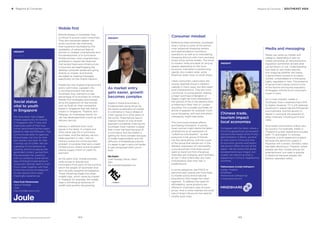
to $3.6 trillion, led by tech
in year of disruptive change
Photograph by Paul Reiffer
NEW YORK - US
Value of all US brands
in Global Top 100
$2.6 Trillion
TOP
100 54321 6 7 8 9 10 11 12 13 14 15 16 17 18 19 20 21 22 23 24 25 26 27 28
2930313233343536373839404142434445464748
49505152535455565758596061626364656667686970717273747576
7778798081828384858687888990919293949596979899100
Beer
Baby Care
Soft Drinks
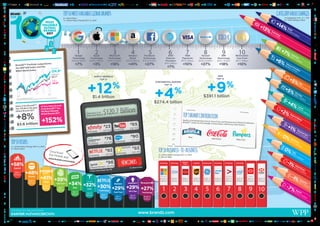
TOP3BRANDCONTRIBUTIONAguila, a Colombian beer brand, Coca-Cola, and Pampers led in Brand Contribution.BrandZ™ metric for the strength of brand alone without any other factors.
Download
the Mobile appwww.brandz.com/mobile
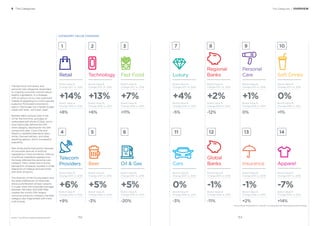
CATEGORYVALUECHANGESTOP10MOSTVALUABLEGLOBALBRANDS
14 Categories: 9 , 2 , 3
$ = Total Category Value
$ = Brand Value
% = Brand Value Change 2017 vs. 2016
TOP10BUSINESS-TO-BUSINESS
% = Brand Value Change 2017 vs. 2016
$ = Brand Value
Google
Technology
$245.6 Billion
+7%
Apple
Technology
$234.7 Billion
+3%
Microsoft
Technology
$143.2 Billion
+18%
Amazon
Retail
$139.3 Billion
+41%
Facebook
Technology
$129.8 Billion
+27%
AT&T
Telecom
Providers
$115.1 Billion
+7%
VISA
Payments
$111.0 Billion
+10%
Tencent
Technology
$108.3 Billion
+27%
IBM
Technology
$102.1 Billion
+18%
McDonald’s
Fast Food
$97.7 Billion
+10%
Insurance
$81.0 billion
-1%
Soft Drinks
$155.2 billion
0%
Cars$139.2 billion
0%
Lorem ipsum
Regional Banks
$227.5 billion
+2%
Global Banks
$106.6 billion
Personal Care
$115.5 billion
+1%
Apparel
$106.0 billion
-7%
Beer$80.0 billion
+5%
Telecom
Providers
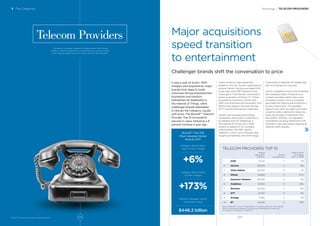
$448.2 billion
+6%
Luxury$104.0 billion
+4%
Oil & Gas
$96.7 billion
+5%
Fast Food
$213.7 billion
+7%
Technology
$1.2 trillion
+13%
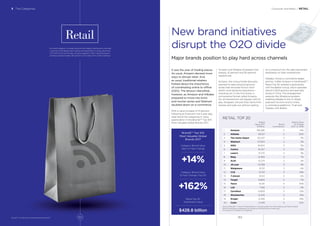
Retail$428.8 billion
+14%
-1%
$143.2
billion
$102.1
billion
$58.4
billion
$58.3
billion
$50.2
billion
$45.2
billion
$27.3
billion
$21.9
billion
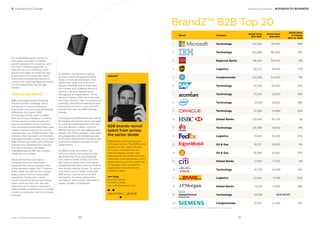
Technology
Microsoft Accenture
$21.4
billion
$20.5
billion
Oracle
Technology
Regional
Banks
Logistics Conglomerate Technology Technology Technology
Technology $41.8 Bil.
#
23
Technology $12.1 Bil.
#
92
Telecom Providers
# Rank in the Global Top 100
$ = Brand Value$11.8 Bil.
#
96
Technology $12.0 Bil.
#
93
Technology $14.0 Bil.
#
76
Technology $12.2 Bil.
#
90
Technology $16.8 Bil.
#
65
SNAPCHAT
NEWCOMERS
$120.7 BillionTotal Value of all
Newcomer Brands
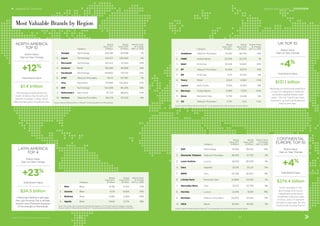
NORTH AMERICA
TOP 10
$1.4 trillion
+12%
CONTINENTAL EUROPE
TOP 10
$274.4 billion
+4%
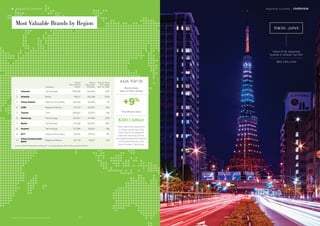
ASIA
TOP 10
$391.1 billion
+9%
Technology
$108.3
billion
+27%Oil & Gas
$4.9
billion
+29%
Fast Food
$6.3
billion
+29%Technology
$12.1
billion
+30%Cars
$5.9
billion
+32%Beer
$4.4
billion
+34%Fast Food
$5.1
billion
+39%Retail
$139.3
billion
+41%Alcohol
+48%
$16.9
billion
Apparel
+58%
$8.3
billion
TOP10RISERS
% = Brand Value Change 2017 vs. 2016
$ = Brand Value
Source: Kantar Millward Brown / BrandZ™
The BrandZ™ Strong Brands Portfolio is a subset of the BrandZ™ Top 100 Most Valuable Global Brands.
2007
2017
BrandZ™ Portfolio outperforms
the S&P 500 Index and the
MSCI World Index
Value of the BrandZ™
Top 100 Most Valuable
Global Brands 2017
+8%
BrandZ™
124.9%
S&P500
82.1%
MSCI
34.9%
$3.6 trillion
12-Year Value Growth
of the BrandZ™ Top
100 Most Valuable
Global Brands 2017
+152%
www.brandz.com
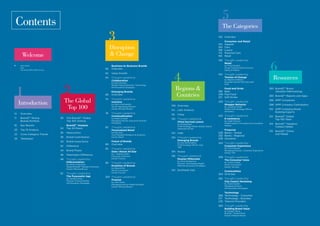
Contents
14 Overview
17 BrandZ™ Strong
Brands Portfolio
18 Key Results
20 Top 10 Analysis
22 Cross-Category Trends
26 Takeaways
30 The BrandZ™ Global
Top 100 ranking
BrandZ™ Analysis
34 Top 20 Risers
36 Newcomers
38 Brand Contribution
40 Brand Importance
42 Difference
44 Brand Power
46 Meaningful Difference
48 Thought Leadership
Differentiation
by Martin Guerrieria
Global BrandZ™ Research Director
Kantar Millward Brown
52 Thought Leadership
The Purposeful Age
by Candace Kuss
Director of Social Media
Hill+Knowlton Strategies
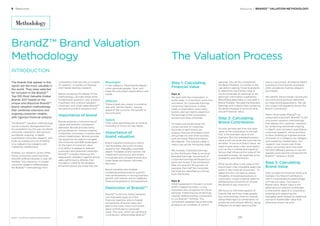
290 BrandZ™ Brand
Valuation Methodology
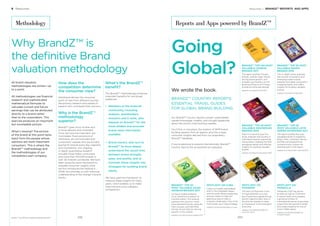
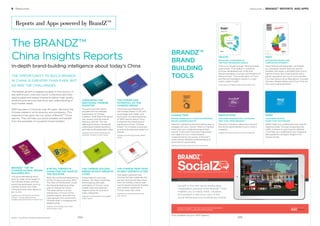
293 BrandZ™ Reports and Apps
296 WPP Companies
298 WPP Company Contributors
310 WPP Company Brand
Building Experts
312 BrandZ™ Global
Top 100 Team
314 BrandZ™ Valuation
Contact Details
315 BrandZ™ Online
and Mobile
Business-to-Business Brands
58 Overview
62 Value Growth
64 Thought Leadership
Collaboration
by Sara Gourlay
Global Practice Director, Technology
Hill+Knowlton Strategies
Emerging Brands
68 Overview
74 Thought Leadership
Unicorns
by Mark Chamberlain
Sector Managing Director
Kantar Millward Brown
78 Thought Leadership
Commoditization
by Katerina Sudit
Managing Partner, Executive Director
Mindshare
82 Thought Leadership
Personalized Retail
by Ray Gaul
Vice President Research & Analytics
Kantar Retail
Future of Brands
86 Overview
92 Thought Leadership
Data—Above All Else
by J. Walker Smith
Executive Chairman
Kantar Futures
96 Thought Leadership
Evolution of Brands
by Wayne Pan
Senior Consultant
Kantar Futures
100 Thought Leadership
Purpose
by Jane Ostler
Managing Director Media & Digital
Kantar Millward Brown
150 Overview
Consumer and Retail
154 Apparel
160 Cars
168 Luxury
174 Personal Care
182 Retail
190 Thought Leadership
Retail
by Fiona Gordon
Group Transformation Director
Ogilvy & Mather
194 Thought Leadership
Tension of Change
by Stephen Wallace
European Brand Planning Lead
GTB
Food and Drink
198 Beer
206 Fast Food
212 Soft Drinks
220 Thought Leadership
Shopper Behavior
by Jonathan Dodd
Global Chief Strategy Officer
Geometry
224 Thought Leadership
E-commerce
by Hugh Fletcher
Global Head of Consultancy & Innovation
Salmon
Financial
228 Banks – Global
232 Banks – Regional
238 Insurance
244 Thought Leadership
Consumer Experience
by Tim Pritchard
Managing Director, Customer Experience
Kantar TNS
248 Thought Leadership
The Consumer Voice
by Victoria Sakal
Senior Consultant
Kantar Vermeer
Commodities
254 Oil & Gas
262 Thought Leadership
City-Centric Marketing
by Claire Holden
Managing Director
Hill+Knowlton Strategies
Technology
266 Technology – Consumer
271 Technology – Business
276 Telecom Providers
284 Thought Leadership
Building Brand Value
by Doreen Wang
BrandZ™ Global Head
Kantar Millward Brown
106 Overview
114 Latin America
116 China
120 Thought Leadership
China Survival Lesson
by Aisling Ryan
Chief Strategy Officer Global Clients
Valenstein & Fatt
124 India
130 Thought Leadership
Emerging Brands
by Hari Ramanathan
Chief Strategy Officer, Asia
Y&R
134 Russia
138 Thought Leadership
Russian Millennials
by Arina Khodyreva
Director Technology+Digital
PBN Hill+Knowlton Strategies
142 Southeast Asia
8 David Roth
CEO
The Store WPP, EMEA & Asia
Introduction
Welcome
The Categories
Regions &
Countries
Disruption
& Change
The Global
Top 100
Resources
Each time I write a welcome column for our annual
BrandZ™ Global Top 100 Most Valuable Brands report,
the year’s highlights typically fall into logical order. Not
this time. In such an unusual year, where do you begin?
First, we Brits surprised the world
with Brexit. (Don’t blame me—I did
not vote for it.) Then the Americans
surprised themselves with Trump.
Meanwhile, Prime Minister Narendra
Modi surprised Indians with
demonetization, and soon after won
a landslide election in Uttar Pradesh,
home to about 200 million people,
triple the population of the UK.
The political drama that roiled major
Latin American economies was less
shocking, as was China’s ongoing
implementation of its “One Belt,
One Road” vision for expanding
economic presence abroad to balance
slower growth at home. But all these
developments raised the temperature
for brand builders.
BrandZ™ Top 100 Most Valuable Global Brands 2017
Welcome
Global Top 100
value rises 8%,
despite the year’s
turbulence
Ranking increases
152% over 12 years
DAVID ROTH
David Roth
CEO, The Store WPP, EMEA and Asia
David.Roth@wpp.com
Twitter: davidrothlondon
Blog: www.davidroth.com
Since these are topsy-turvy times, I’ll
begin with the bottom line:
The value of the Global Top 100
increased 8 percent year-on-year.
That’s a big deal any year. But
especially in the year we had; and
Over the past 12 years—since just
before the global recession, and
during the economic climb since
then—the value of the BrandZ™
Global Top 100 increased 152
percent in value; also
The value of the BrandZ™ Strong
Brands Portfolio increased
124.9 percent over those 12
years, outperforming both the
S&P 500 and the MSCI World
Index, demonstrating that
valuable brands deliver superior
shareholders returns.
All these results illustrate that
although market volatility is inevitable,
the impact on brands is not.
That’s why this report is so
important. We tell you what
happened, why it happened,
and how the lessons of this
disruptive year can help build
and sustain brand value.
Think of this report as the definitive
brand yearbook. It examines both
consumer-facing and business-facing
brands across 14 product categories,
with the analysis of five geographic
regions, and additional details about
brands and consumer attitudes in
China, India, Russia, Latin America,
and Southeast Asia.
WELCOME
98
BrandZ™ Top 100 Most Valuable Global Brands 2017
The report focuses primarily on the
world’s most valuable brands, but not
exclusively on those brands. Emerging
brands are disrupting categories,
challenging established brands,
and enticing consumers in both the
world’s mature and fast-growing
markets. The report studies this
phenomenon.
Building strong brands
You will not find this combination of
market information, financial analysis,
and insight anywhere else. Not to
bore you with process, but I want to
share the lengths we go to create and
assemble this information, and make
it useful.
We begin with data, our secret sauce,
WPP’s proprietary BrandZ™ database,
which includes information from
over 3 million consumers about their
attitudes about (and relationships
with) 120,000 brands in 414
categories across 51 country markets.
Using the BrandZ™ brand valuation
methodology of Kantar Millward
Brown, this all produces 4.6 billion
data points.
This data reveals the power of
brand in the mind of the consumer
to create a disposition to buy
and, most importantly, validates
a positive correlation with sales
performance. We combine this data
with financial research to make
BrandZ™ unique among brand
valuation methodologies. (Please
see Methodology at the end of this
report.)
And we’re just getting started. Since
we’re producing a global report, this
is where it is advantageous to be
WPP, with offices in 112 countries,
and over 205,000 colleagues. We
convene WPP operating company
brand experts for two weeks of focus
groups in London and New York,
with extensive video conferencing
to connect with our brand experts
worldwide.
They come from all communications
disciplines: market research, media
management, futures, advertising,
digital, promotion, public relations,
public affairs, shopper marketing,
content creation, and activation. Their
analysis of the WPP proprietary data,
in the context of diverse categories
and country markets, leads to original
insights that are only possible with
this level of cross-cultural and cross-
discipline exchange.
We call this leveraging of WPP brain
power “horizontality.” I share these
details about our intense research
and analysis to pull back the curtain a
bit on our passion for brands at WPP.
Our passion knows no bounds. We
have assembled an extensive library
of brand reports and I invite you to
access them with our compliments
at BrandZ.com. Here are just some
of the reports you will find there:
the BrandZ™ Top 100 Most Valuable
Chinese Brands; the BrandZ™ Top
50 Most Valuable Indian Brands; the
BrandZ™ Top 50 Most Valuable Latin
American Brands; the BrandZ™
Top 50 Most Valuable Indonesian
Brands; and the BrandZ™ Top 20 Most
Valuable Saudi Arabian Brands. In
addition, I recommend these recently
published titles: Spotlight on Cuba,
Spotlight on Myanmar, Spotlight on
Mongolia, and Leaders in the Hot Seat:
Behind the brands that shape lives and
build value.
I fervently believe we have the data,
knowledge, experience, insight,
determination, and single-minded
purpose to help you build valuable
brands. To learn more about how to
harness our passion to work for your
brand, please contact any of the WPP
companies that contributed expertise
to this report. Turn to the resource
section at the end of this report for
summaries of each company and the
contact details of key executives. Or
feel free to contact me directly.
Sincerely,
David Roth
WPP
David.Roth@wpp.com
Twitter: davidrothlondon
Blog: www.davidroth.com
WELCOME
Photograph by Paul Reiffer
1110
HAVANA - CUBA
Introduction
1 Introduction Introduction / OVERVIEW
What an unusual year.
Geopolitics, which typically
hums in the background of
daily life, became its loud
soundtrack. The surprises of
Brexit and the US election
demonstrated the power of
people to shape the destinies
of nations—and potentially
brands, which could not avoid
the reverberations. Still, decisive
brand-building activities took
place across categories.
Brands act
decisively,
despite year
of geopolitical
disruption
Value of BrandZ™ Global Top 100 increases 8%
Some consumers, especially young
people, expected brands to take a
stand. Although most brands avoided
becoming directly embroiled in
controversy, the scrutiny prompted
discussion of Brand Purpose. Leading
technology brands—including Apple,
Google, Facebook, and Microsoft—
publicly opposed the Trump
administration’s immigration policy,
saying it contradicted their values and
their need for a diverse workforce.
Other brands, such as Coca-Cola,
Starbucks, Nike, and Ford also spoke
up for inclusion.
BrandZ™ Top 100 Most Valuable Global Brands 2017
Overview
Despite the disruption, the BrandZ™
Top 100 brands performed well,
increasing 8 percent in brand value
to $3.6 trillion, following a 3 percent
rise a year ago. Seven categories
rose moderately in value, and five
categories declined or registered no
change in value. Two categories—
retail (driven by Amazon and Alibaba)
and technology—increased by
double-digits.
The fastest-rising
brand, Adidas,
increased 58 percent
in value, because
its retro sneakers
connected perfectly
with the fashion moment and the
brand made operational and marketing
changes to strengthen its US business.
The fastest-rising
category, retail,
rose 14 percent. But
beyond the numbers,
the category faced
new turbulence, as
both Amazon and Alibaba prepared to
open extensive networks of physical
stores, and Walmart acquired an
e-commerce startup.
Twenty years after
its IPO, Amazon
grew 41 percent in
value, and rose three
ranks to enter the
Global Top 5 at No.
4, after Google, Apple, and Microsoft,
and ahead of Facebook. Tencent, the
Chinese internet portal, also rose three
ranks to enter the Top 10 at No. 8.
1514
The North American
Top 10 brands led the
Top 10 of all regions
in value growth, with
a 12 percent increase,
driven by technology.
The Top 10 brands in most regions
improved, except for the UK, where
global bank performance slowed value
growth. Partly because of technology,
the US continued to dominate the
Global Top 100, with 54 brands
contributing 71 percent of the value.
BrandZ™ Top 100 Most Valuable Global Brands 2017
1 Introduction Introduction / OVERVIEW
Year of action
Besides being an unusual year, it was
also a year of decisive action. Across
several categories—including retail,
telecom providers and beer, brands
launched transformative initiatives to
cause or ameliorate disruption and to
accelerate growth.
In retail, massively disrupted because
of e-commerce, brands for years
have attempted to coordinate online
and offline (O2O) experiences.
Progress has been mostly
incremental—until now. Amazon
planned to open a chain of physical
grocery stores. And Amazon, being
Amazon, expected to differentiate its
stores with sophisticated technology.
Its app automatically keeps track
of purchases and handles payment,
eliminating retail’s most dreaded
friction point—the checkout.
With over 11,000 physical locations in
28 countries, Walmart doubled down
on its online efforts to compete
with Amazon by acquiring Jet.com,
a strong e-commerce challenger.
Walmart already collaborates
with JD.com, the No. 2 Chinese
e-commerce brand after Alibaba.
To become more physical, Alibaba
entered a partnership with the Bailian
Group, which operates almost 5,000
grocery and specialty stores in China.
Like retail, the telecom providers
category also has been moving
through a steady transformation,
as brands attempt to escape their
commodity roles as voice and data
providers and become consumer-
facing content and entertainment
brands. Major brands took significant
initiatives to advance this goal and
to position themselves for leadership
in the Internet of Things. Verizon
negotiated to acquire Yahoo!, having
purchased AOL two years ago, and
AT&T agreed to buy media giant Time
Warner, following its earlier acquisition
of DirecTV.
In the beer category, the much
anticipated corporate marriage
between AB InBev and SAB Miller
created the world’s fifth-largest
consumer products company (after
Nestlé, P&G, PepsiCo and Unilever,
and ahead of Coca-Cola). It took
place as major brands contended
with changing drinking habits and
preferences in key markets, with
young people drinking less and
preferring craft beers with distinctive
tastes.
Reaction to turmoil
All this activity took place in the
context of the year’s geopolitics. The
technology category especially was
drawn into the turmoil because of
its vital role as data custodian and
its centrality in connectivity and
digital communications. Social media
brands were at the center of the
public debate when postings inflamed
opinions about decency and free
speech.
Google advertisers complained
that programmatic technology,
intended to align ads with relevant
content, sometimes placed ads near
controversial, even objectionable,
material. YouTube and Facebook also
were affected. The brands adjusted
their practices. With over 1.2 billion
daily active users, Facebook reaches
more viewers than any traditional
media outlet, and the torrent of news
surrounding the year’s geopolitical
events caused the brand to examine
its publishing role and responsibilities.
In perhaps a counterpoint to the
year’s unrest, the apparel brands
stressed comfortable fit and retro
style. Fast food went back to basics.
McDonald’s and Burger King made
better burgers. KFC upgraded its
kitchens and returned to its original
recipe for fried chicken. Luxury
brands captured the spirit of the times
differently, as logos returned and
designs became bolder. The major
fashion shows embraced themes of
diversity and inclusiveness.
In the cars, and oil and gas categories,
brands embraced reality. Having
focused much attention on preparing
for a future with car sharing and other
mobility solutions, the car brands
balanced their future focus with
the need to sustain their businesses
today, and the category sold a record
number of cars worldwide. Similarly,
oil and gas brands understood the
need to move away from fossil fuel
over the next few decades, but also
the imperative to drive business in the
meantime. The category rose slightly
in value as the price for crude oil
stabilized.
The oil and gas brands, which
typically focus more on their
upstream exploration businesses,
also communicated with consumers
about their Brand Purpose, which
ExxonMobil summarized as,
“Powering the World.” The critical
actions taken by brands across
categories reflected the power of
strong brands to sustain businesses
during geopolitical drama or other
disruptions. The BrandZ™ Global Top
100 not only grew 8 percent in value
this year, but since 2006, through the
global recession, the value of the Top
100 ranking steadily increased, rising
152 percent.
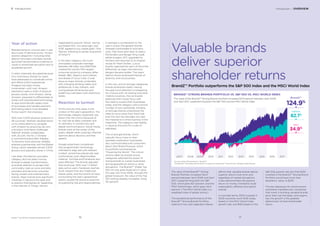
The value of the BrandZ™ Strong
Brands Portfolio increased 124.9
percent between April 2006 and April
2017, outperforming both the S&P
500, which grew 82.1 percent, and the
MSCI World Index, which grew 34.9
percent. (The MSCI World Index is a
weighted index of global stocks.)
The exceptional performance of the
BrandZ™ Strong Brands Portfolio
relative to two well-regarded indexes
BrandZ™ Portfolio outperforms the S&P 500 Index and the MSCI World Index
affirms that valuable brands deliver
superior returns over time, and
regardless of market disruptions.
It also demonstrates the positive
return on money invested to build
meaningfully different and salient
brands.
In concrete terms, $100 invested in
2006 would be worth $135 today
based on the MSCI World Index
growth rate, and $182 based on the
S&P 500 growth rate. But that $100
invested in the BrandZ™ Strong Brand
Portfolio would have more than
doubled in value, to $225.
The key takeaways for brand owners
and brand marketers are: companies
that invest in building valuable brands
grow their top line faster, and organic
top-line growth is the greatest
determinant of total shareholder
return.
Valuable brands
deliver superior
shareholder returns
Source: Kantar Millward Brown / BrandZ™
The BrandZ™ Strong Brands Portfolio is a subset of the BrandZ™ Top 100 Most Valuable Global Brands.
BrandZ™
124.9%
S&P500
82.1%
MSCI
34.9%
BRANDZ™ STRONG BRANDS PORTFOLIO VS. S&P 500 VS. MSCI WORLD INDEX
The value of the BrandZ™ Strong Brands Portfolio increased 124.9 percent between April 2006
and April 2017, outperforming both the S&P 500 and the MSCI World Index.
2007 2008 2009 2010 2011 2012 2013 2014 2015 2016 2017
1716
1 Introduction Introduction / KEY RESULTS
Technology brands drive value growth
BrandZ™ Top 100 Most Valuable Global Brands 2017
Key Results
Global Top 100
rises 8%, 152%
over 12 years
TOP-LINE, YEAR-ON-YEAR CHANGES
TECHNOLOGY DOMINATES
US LEADS AND
CHINA RISES
The 2017 BrandZ™ Top 100 Most
Valuable Global Brands increased
8 percent in brand value year-on-
year, to $3.6 trillion, following a 3
percent increase a year ago.
Retail led the ranking in category
value growth, increasing 14
percent, driven by e-commerce,
with Amazon and Alibaba up 41
percent and 20 percent in value.
Aguila, a Colombian beer brand,
Coca-Cola, and Pampers led in
Brand Contribution, a BrandZ™
metric for the strength of brand
alone without any other factors.
The BrandZ™ Business-to-
Business Top 20 increased 11
percent in value, led by Shell,
which rose 23 percent, and DHL
and FedEx, each up 20 percent.
The value of the BrandZ™ Strong
Brands Portfolio increased 124.9
percent between April 2006 and
April 2017, outperforming both
the S&P 500 and the MSCI World
Index.
Adidas led the ranking in brand
value growth, increasing 58
percent on the strength of its on-
trend fashion and its initiatives to
raise brand popularity in the US.
Apple and Google remained the
No. 1 and 2 brands in the Global
Top 100, each valued at almost
$250 billion (combined, about
the GDP of Sweden).
Amazon entered the Global Top
10 at No. 4, with a 41 percent
increase in brand value, to $139
billion.
37 technology brands
comprised 54 percent of the
2017 BrandZ™ Global Top 100
value. In 2006, 30 technology
brands comprised 37 percent
of value. (“Technology” includes
technology, telecom providers,
and e-commerce brands.)
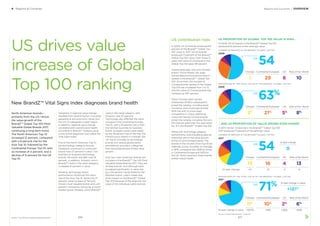
54 of the Global Top 100 brands
are based in the US, and US
brands now comprise 71 percent
of the Global Top 100 value.
US brands rose 181 percent
in brand value over 12 years,
compared with 102 percent for
brands from other countries.
US brands rose 12 percent in
value year-on-year, and other
brands declined 1 percent,
except Chinese brands, which
grew 1 percent.
13 of the Global Top 100 brands
are based in China, up from only
1 brand 12 years ago.
Chinese brands rose 937 percent
in brand value over 12 years,
and now comprise 11 percent of
Global Top 100 value.
BRANDS GET YOUNGER
The average age of a Newcomer
is 20 (started in 1997).
The average age of a Global Top
100 brand is 67 (started in 1950).
In 2006, the average age was 83
(started in 1934).
Technology brands in the Global
Top 100 increased 16 percent
year-on-year, compared with a 4
percent increase for other brands.
The seven Newcomer brands in
this year’s Global Top 100 are
technology-related: YouTube,
HPE, Salesforce, Netflix,
Snapchat, and telecom providers
Xfinity and Sprint.
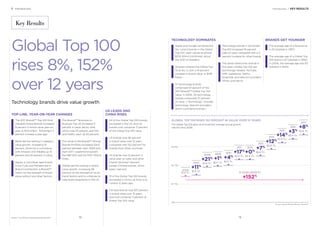
GLOBAL TOP 100 RISES 152 PERCENT IN VALUE OVER 12 YEARS
The Global Top 100 grew at an 8 percent average annual growth
rate the since 2006.
$3TRIL.
$2 TRIL.
$1 TRIL.
0%
2007
+11%
$1.6 Tri.
2008
+21%
$1.9 Tri.
2009
+1%
$2.0 Tri.
2010
+4%
$2.0 Tri.
2011
+17%
$2.4 Tri.
2013
+7%
$2.6 Tri.
2014
+12%
$2.9 Tri.
2015
+14%
$3.3 Tri.
2016
+3%
$3.4 Tri.
2017
+8%
$3.6 Tri.
2012
+0%
$2.4 Tri.
12-YEAR GROWTH
+152%
2006
$1.4 Tri.
Source: Kantar Millward Brown/ BrandZ™
1918
1 Introduction Introduction / TOP 10 ANALYSIS
The evolution of the BrandZ™
Global Top 10 over the past 12
years reflects the dominance of
technology and the disruptive
impact of the global financial
crisis, technological innovation,
and changing consumer
attitudes about health.
Only three brands that appeared in
the Global Top 10 in 2006—Google,
Microsoft, and IBM—remain in the
Top 10 in 2017. These technology
leaders demonstrate the ability of
relatively young brands, like Google
and Microsoft, and heritage brands,
like IBM, to be relevant, each in its own
way: Google primarily with search and
constant innovation; Microsoft with
the versatility of its Surface devices
and its expanding cloud business; and
IBM with its reinvention, cloud focus,
and cognitive computing.
Equally revealing is the presence of
three brands in the Top 5 that were
not even in the Top 10 just 12 years
ago. The innovative technology
of these brands—Apple, Amazon,
and Facebook—has disrupted
The strong get even stronger
categories and improved people’s
lives worldwide. The presence of the
Chinese internet portal Tencent, and
the disappearance of state-owned
China Mobile, also indicates the power
of technology, along with China’s
evolution to a more competition-
driven economy.
AT&T’s rise reflects its scale and the
transformation of telecom providers
from voice and data transmitters to
content and entertainment brands.
The strength of payments brands
relative to other financial services
sectors, along with the ability of
Visa to communicate its benefit to
consumers, explain that brand’s value
rise.
The presence of Amazon, and the
disappearance of Walmart (now No.
31), reflect the massive disruption of
the retail category by e-commerce.
The financial crisis and the slower
value growth of the financial services
categories explain the value decline
of Citi (now No. 59). Coca-Cola (No.
13) and Marlboro (No. 12) felt the
impact of consumer health concerns.
In addition:
BrandZ™ Top 100 Most Valuable Global Brands 2017
Top 10 Analysis
Finally, 12 years ago, a Global Top
10 brand scored an average of 216
in Brand Power, compared with an
average of 142 for a brand ranked
below the Top 10. Today a Top 10
brand scores 266, on average, in
Brand Power, compared with 175 for
other Top 100 brands. (An average
score in Brand Power, the BrandZ™
measurement of brand equity, is 100.)
Over the past 12 years, the value of
the Top 10 increased 249 percent,
while the Top 100 increased a
healthy 152 percent.
Over the past 12 years, the value
of the Top 10 as a proportion of
the total Global Top 100 value
increased from 28 percent to 39
percent.
The Top 10 in 2017 are worth
around the same as the entire Top
100 12 years ago—$1.4 trillion.
The No. 1 and No. 2 brands—
Google and Apple—are worth
more than the Top 10 combined 12
years ago—$480 billion vs. $409
billion.
Nine of the Global Top 10 are
worth over $100 billion, compared
with six brands last year.
In 2017, the average age of a Top
10 brand was 42 (started in 1975).
That is less than half the average
age of a Top 10 brand 12 years ago,
which was 88 (started in 1929).
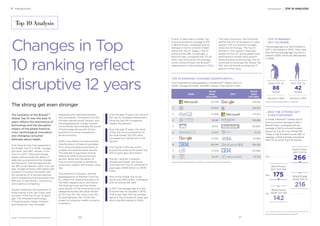
Changes in Top
10 ranking reflect
disruptive 12 years
…AND THE STRONG GET
EVEN STRONGER
In 2006, a BrandZ™ Global Top 10
brand scored an average of 216 in
Brand Power, compared with an
average of 142 for a brand ranked
below the Top 10 in the Global 100.
Today, a Top 10 brand scores 266, on
average, in Brand Power, compared
with 175 for other Top 100 brands.
2006
Brand
Value
2006 $Mil.
2017
Brand
Value
2017 $Mil.
1 62,039 245,581
2 55,834 234,671
3 41,406 143,222
4 39,168 139,286
5 38,510 129,800
6 37,567 115,112
7 37,445 110,999
8 36,084 108,292
9 31,028 102,088
10 30,201 97,723
TOP 10 RANKING CHANGES SIGNIFICANTLY…
Only three brands that appeared in the BrandZ™ Global Top 10 in
2006—Google, Microsoft, and IBM—remain in the Top 10 in 2017.
Source: Kantar Millward Brown / BrandZ™ (including data from Bloomberg)
…TOP 10 BRANDS
GET YOUNGER…
The average age of a Top 10 brand in
2017 is 42 (started in 1975). That is less
than half the average age of a Top 10
brand in 2006, which was 88 (started
in 1929).
2006 TOP 10
88
YEARS
Started in 1929
2017 TOP 10
42
YEARS
Started in 1975
300
200
100
0
Brand Power
2006 TOP 100
142
Brand Power
2006 TOP 10
216
Brand Power
2017 TOP 100
175
Brand Power
2017 TOP 10
266
The North American Top 10 brands
led the Top 10’s of all regions in value
growth, with a 12 percent increase,
driven by technology. The Top 10
brands in most regions improved,
except for the UK, where global bank
performance slowed value growth.
Partly because of technology, the US
continued to dominate the Global Top
100, with 54 brands contributing 71
percent of the value.
Source: Kantar Millward Brown / BrandZ™
2120
1 Introduction Introduction / CROSS-CATEGORY TRENDS
BrandZ™ Top 100 Most Valuable Global Brands 2017
Cross-Category Trends
RETURN TO
REALITY
Planning for tomorrow
but making sales today
TAKING
A STAND
Geopolitical upheaval
leaves no place to hide
PURPOSE
Faster value growth
depends on Purpose
COLLABORATION
Brands combine competencies
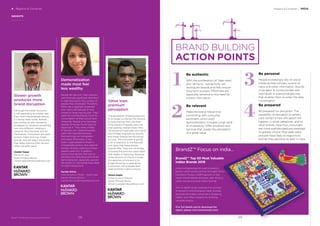
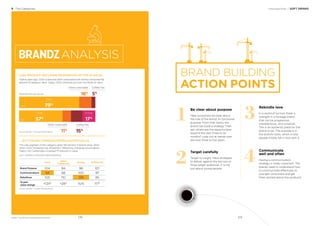
10 trends that
impacted
category
value change
Car brands, which a year ago peered into a
crystal ball in search of a future about mobility,
looked closer to home and responded to
the immediate needs of consumers, many of
whom bought large, gas-consuming SUVs,
even as they proclaimed their concern about
climate change. Similarly, the oil and gas
brands continued drilling, while shifting to
gas and renewables. Both cars, and oil and
gas brands operate in the same tension:
sustaining a business based on supplying
customer needs today, while anticipating, and
helping to create, the world that customers say they want
to live in tomorrow. And both industries require long-
term strategic planning, heavy forward investment, and
complicated bets that rely on consumer research, climate
science, and unknowable geopolitical factors.
Until last year, most brands could avoid cultural discord. The
surprise outcomes of the UK Brexit vote and the US election
made avoidance more difficult. Because people in the UK,
US, and elsewhere were evenly split, brands potentially risked
pleasing half of their customers and alienating the other half.
Niche brands that shared the values of their customers had less
of a dilemma. Mass brands with clearly articulated purpose and
values had more permission to speak out. Even then, however,
it was safer to frame a point of view in a larger societal context,
rather than in divisive politics. Brands across categories could
not ignore the power of people to express
themselves in the voting booth—or at the
cash register. Even oil and gas brands, which
typically communicate primarily to a narrow
group of influencers, thought more about
their consumer-facing brands and the power
of consumers to influence public policy.
Geopolitical discord, and the question
of whether brands needed to take a
stand, made Purpose more important.
Consumers, especially young people,
expected brands to have a clear Purpose,
often a higher Purpose about not only improving consumers’ lives, but
even improving the world—or at least not harming it. Purpose needed
to be the foundation for future growth, not a retrofitted explanation
for past growth. BrandZ™ Vital Signs, a new brand health assessment
tool, found that Brand Purpose serves as the foundation for four other
Vital Signs: Innovation, Communication, Brand Experience, and Love.
Brand with a clear Brand Purpose (seen as making lives better) grew
three times faster in value, on average, over the past 12 years.
The emergence of
technologies such as
the Internet of Things
and autonomous
cars accelerated
collaboration between business-to-business and business-to-consumer
technology brands. Car and technology brands linked to improve
connectivity, using smartphone data to personalize cars with adjustments
to seats, steering wheels, and entertainment systems. Sometimes category
disruption or brand ambition required more than collaboration, as when
e-commerce giant Alibaba partnered with Bailian Group, a Chinese retailer
that operates over 5,000 stores. After many collaborations to build up its
e-commerce strength, Walmart, with over 11,000 physical stores, took the
next step and acquired the e-commerce startup Jet.com.
2322
1 Introduction Introduction / CROSS-CATEGORY TRENDS
BrandZ™ Top 100 Most Valuable Global Brands 2017
Cross-Category Trends
CITY CENTRIC
Mutual interests define markets
CONSOLIDATION/
FRAGMENTATION
Categories defy laws of physics
RETURN OF
THE STORE
Interactive and smaller,
stores are back in style
LOYALTY
Brands seek
sellable moments
PREMIUM/
LUXURY
Commoditization drives
brands to premiumization
NEW/OLD
Young pursue retro
as antidote to modern
Global and local combined
in a new way. As evidenced
by the Brexit vote and the US
national elections, political
opinions that divide nations
also reveal cross-national affinities. Similarly, when
shopping for products or services in categories as diverse
as apparel, banks, beer, cars, and insurance, young
people living in Brooklyn, Shanghai, or the Shoreditch
section of London share more in common with each other
than they do with people living in rural areas of their own
countries. These cross-national affinities represent large
potential brand opportunities. Brands looked at their
markets through this new demographic lens.
Opposite market forces
pulled on categories that
consolidated at the same
time they fragmented.
In beer, AB InBev and
SABMiller combined, while
more craft beers appeared. In insurance, Ace purchased Chubb at
the same time that new InsurTech brands proliferated. In oil and
gas, Shell digested recently acquired BG, but smaller operations
developed fracking technology to drive down the threshold for
profitability, which was critical with historically low oil prices.
E-commerce still rules. Retailers in mature markets continue to close
excess real estate. But stores are back. Physical stores—smaller,
convenient, interactive, and loaded
with technology—became an important
expression of brand experience, especially
in categories like apparel and luxury. Adidas
launched a women’s studio with fitness
classes in London. A Lululemon Lab store
opened in New York. The online eyeglass
brand Warby Parker opened more physical
locations. Despite the rise in FinTech, bank
branches remained an important way to
personalize the consumer relationship and
build trust. Shell gas stations continued to
become a place for shopping on the way home or for dropping off or
picking up parcels. Even Hermès experimented with pop-up stores.
And the ultimate confirmation that physical stores are important came
from their nemesis, Amazon, which opened a book store and prepared
to open Amazon Go, its chain of automatic-checkout grocery stores.
Proliferation of choice, price
promotion, and the entrance
of niche disruptor brands
are among the reasons
that loyalty was difficult to
cultivate. In addition, loyalty was not always fashionable.
For self-expression, apparel customers preferred to mix
and match, curating a personal style rather than wearing
the same brand or designer head to toe. Similarly, personal
care shoppers looking for the newest products chose from
a wide selection of brands. Responding to this purchasing
promiscuity, brands tried to reach consumers at the exact
right moment to trigger a sale, increasingly on mobile.
Brands shifted to the premium—even luxury—end of the market
to avoid category commoditization and build margin. Beer and
personal care brands introduced premium products globally. Mass
brands in the car category featured safety and entertainment
technology that a few years ago would have been available only
in luxury models. In 2017, luxury brands comprise over half the
BrandZ™ Car Top 10 ranking, compared with just
over a third in 2006. During those 12 years, the
proportion of luxury brands in the Personal Care
Top 15 shifted from around a third to almost half.
Even luxury became more luxurious. Hermès, one
of the most exclusive luxury brands, increased
18 percent in value year-on-year, significantly
surpassing overall 4 percent category growth.
At the same time young people sought the newest,
fastest app, they also expressed a need to slow things
down. As young people listened to digital music
with earbuds, they bought more vinyl records. While
taking photos with smartphones, millennials desired
a cool vintage SLR camera. Craft beer and craft cola
represented this retro style. Clothing from the 90s
was “in.” And high-top
sneakers were popular.
Adidas increased in
value 58 percent, more
than any other brand, in
part because its classic
sneakers were perfectly
on-trend.
2524
1
2
3
4
5
Be purposeful
Purpose is not new for brands.
But it is now more important. In
an uncertain and unsettling world,
people are looking for answers
and security. Purpose makes
a difference to people—and to
brands. Brands with a clear Purpose
grew in value at three times the
rate of other brands, on average,
over the past 12 years according to
BrandZ™ research. Purpose can be
completely utilitarian. Or it can be
about helping improve the world in
some way. Increasingly, consumers,
especially young people, are
attracted to brands that, in an
authentic way, are about making
money, but are also about more
than making money.
Be different
Difference gives the brands their
competitive advantage. It is one
of three components (along
with Meaning and Salience) that
comprise Brand Power, the BrandZ™
measurement of Brand Equity. Over
the past 12 years, the BrandZ™ Global
Top 100 brands viewed as most
Different grew 258 percent in brand
value. Those viewed as least Different
grew only 21 percent. Consumers
usually view technology brands as
Different. Achieving Difference is
more challenging for brands with
long heritage. But buried in every
successful brand that has survived for
decades is the Difference that drove
its success initially. It is important to
rediscover that Difference and make
it relevant today.
Be elastic
Category is not destiny. Certain
brands, particularly technology
ecosystems, benefit from elasticity.
It is easier for those brands to
extend across categories. Think
like a disruptor brand, and focus
on the needs of the consumer
rather than the boundaries of
the category. Categories help
organize and define markets, but
they are less useful when they
become arbitrary definitions and
constraints on innovation.
Be responsible
Words like “authenticity” and
“transparency” have been part
of the brand lexicon for a while,
almost long enough to lose their
meaning. However, they have
become even more important.
As major institutions continue to
disappoint the public, brands have
an opportunity to face growing
skepticism, even cynicism, with
honesty, by doing what brands are
supposed to do—provide people
with good products and services—
and by reminding people that the
brand is there to help.
Be prepared
Brands have invested a lot of effort
to cultivate personalized customer
relationships, sometimes based
on shared values. To consumers,
that closer connection makes
some brands seem more like
friends than strangers. And people
have different expectations for
their friends. They expect friends
to speak up when important
shared values are violated. Amid
the current geopolitical turmoil
around immigration, inclusion,
climate change, and other issues,
consumers often expect brands
to take a stand. Taking a stand
can be risky, especially for mass
market brands that reach a broad
constituency. Niche brands and
brands with clearly articulated
values may have more permission
to take a stand. Usually, it is better
to take a stand on principle, not
politics. But the decision to take a
stand—or not—is not always left to
the brand. In these agitated times
brands are called out all the time.
Brands need to be prepared. Have
the earthquake kit ready.
1 Introduction Introduction / TAKEAWAYS
BrandZ™ Top 100 Most Valuable Global Brands 2017
Takeaways
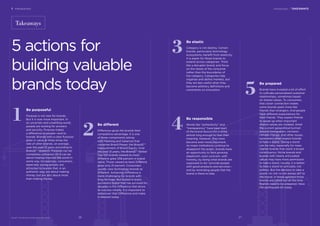
5 actions for
building valuable
brands today
2726
The
Global
Top 100
Source: Kantar Millward Brown / BrandZ™ (including data from Bloomberg)
Brand contribution measures the influence of brand alone on financial value, on a scale of 1 to 5, 5 highest
Brand Category
Brand Value
2017 $Mil.
Brand
Contribution
Brand Value
% Change
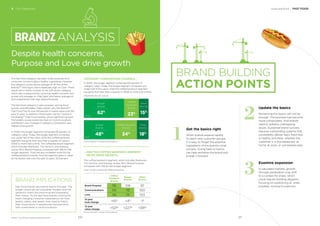
2017 vs. 2016
Rank
Change
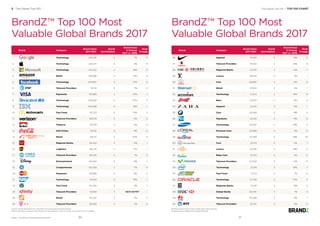
1 Technology 245,581 4 7% 0
2 Technology 234,671 4 3% 0
3 Technology 143,222 4 18% 0
4 Retail 139,286 4 41% 3
5 Technology 129,800 4 27% 0
6 Telecom Providers 115,112 3 7% -2
7 Payments 110,999 4 10% -1
8 Technology 108,292 5 27% 3
9 Technology 102,088 4 18% 1
10 Fast Food 97,723 4 10% -1
11 Telecom Providers 89,279 3 -4% -3
12 Tobacco 87,519 3 4% 0
13 Soft Drinks 78,142 5 -3% 0
14 Retail 59,127 2 20% 4
15 Regional Banks 58,424 3 0% -1
16 Logistics 58,275 4 17% 1
17 Telecom Providers 56,535 4 1% -2
18 Entertainment 52,040 4 6% 1
19 Conglomerate 50,208 2 -7% -3
20 Payments 49,928 4 8% 0
21 Technology 45,194 3 16% 1
22 Fast Food 44,230 4 2% -1
23 Telecom Providers 41,808 3 NEW ENTRY
24 Retail 40,327 3 11% 2
25 Telecom Providers 38,493 3 2% -2
Brand Category
Brand Value
2017 $Mil.
Brand
Contribution
Brand Value
% Change
2017 vs. 2016
Rank
Change
26 Apparel 34,185 4 -9% -2
27 Telecom Providers 31,602 3 -14% -2
28 Regional Banks 31,570 2 -6% -1
29 Luxury 29,242 4 3% 1
30 Cars 28,660 4 -3% -2
31 Retail 27,934 2 2% 1
32 Technology 27,243 3 19% 6
33 Beer 27,037 4 -3% -2
34 Apparel 25,135 3 0% 1
35 Cars 24,559 4 -8% -2
36 Payments 24,150 4 -9% -2
37 Technology 24,007 4 23% 11
38 Personal Care 23,899 4 2% -2
39 Technology 23,559 5 -19% -10
40 Cars 23,513 4 4% -1
41 Luxury 23,416 5 18% 3
42 Baby Care 22,312 5 -3% -5
43 Telecom Providers 22,002 3 0% -3
44 Technology 21,919 2 18% 7
45 Fast Food 21,713 4 1% -4
46 Technology 21,359 2 10% 3
47 Regional Banks 21,145 4 8% -2
48 Global Banks 20,536 3 1% -5
49 Technology 20,388 3 9% 1
50 Telecom Providers 20,197 2 3% -3
BrandZ™ Top 100 Most
Valuable Global Brands 2017
BrandZ™ Top 100 Most
Valuable Global Brands 2017
2 The Global Top 100
The Brand Value of Coca-Cola includes Lights, Diets and Zero
The Brand Value of Budweiser includes Bud Light
The Global Top 100 / TOP 100 CHART
BrandZ™ Top 100 Most Valuable Global Brands 2017 3130
Brand Category
Brand Value
2017 $Mil.
Brand
Contribution
Brand Value
% Change
2017 vs. 2016
Rank
Change
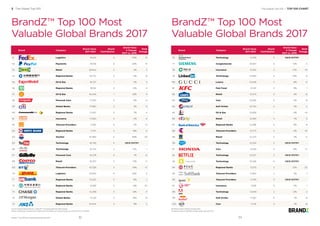
51 Logistics 19,441 4 20% 12
52 Payments 19,156 4 20% 13
53 Retail 18,944 3 5% 2
54 Regional Banks 18,770 2 -4% -8
55 Oil & Gas 18,727 1 11% 3
56 Regional Banks 18,551 3 12% 4
57 Oil & Gas 18,346 1 23% 9
58 Personal Care 17,740 4 -3% -4
59 Global Banks 17,580 2 3% -3
60 Regional Banks 17,437 3 7% 4
61 Insurance 17,260 3 2% -4
62 Telecom Providers 17,180 3 -7% -9
63 Regional Banks 17,137 4 19% 6
64 Alcohol 16.983 4 48% 29
65 Technology 16,785 4 NEW ENTRY
66 Technology 16,725 2 15% 1
67 Personal Care 16,278 5 -1% -6
68 Retail 16,257 2 12% 0
69 Telecom Providers 16,026 3 -14% -17
70 Logistics 15,844 4 20% 3
71 Regional Banks 15,202 3 8% -1
72 Regional Banks 14,981 2 -8% -10
73 Regional Banks 14,289 3 16% 11
74 Global Banks 14,129 3 18% 15
75 Regional Banks 14,044 3 9% 2
BrandZ™ Top 100 Most
Valuable Global Brands 2017
2 The Global Top 100
Source: Kantar Millward Brown / BrandZ™ (including data from Bloomberg)
Brand contribution measures the influence of brand alone on financial value, on a scale of 1 to 5, 5 highest
Brand Category
Brand Value
2017 $Mil.
Brand
Contribution
Brand Value
% Change
2017 vs. 2016
Rank
Change
76 Technology 14,018 3 NEW ENTRY
77 Conglomerate 13,947 2 12% 4
78 Insurance 13,910 3 -17% -19
79 Technology 13,594 4 10% 6
80 Luxury 13,548 5 8% 0
81 Fast Food 13,521 3 9% 1
82 Retail 13,375 2 3% -6
83 Cars 13,065 3 0% -8
84 Soft Drinks 12,730 4 4% 2
85 Oil & Gas 12,639 1 -4% -13
86 Retail 12,365 3 7% 5
87 Regional Banks 12,286 2 9% 8
88 Telecom Providers 12,273 4 -4% -10
89 Retail 12,273 2 2% -2
90 Technology 12,234 2 NEW ENTRY
91 Cars 12,163 4 -8% -17
92 Technology 12,057 2 NEW ENTRY
93 Snapchat Technology 12,026 4 NEW ENTRY
94 Regional Banks 12,013 2 -13% -23
95 Telecom Providers 11,964 2 5% -1
96 Telecom Providers 11,795 3 NEW ENTRY
97 Insurance 11,691 3 11% 1
98 Technology 11,649 2 12% 2
99 Soft Drinks 11,567 4 -1% -9
100 Cars 11,341 3 -1% -8
BrandZ™ Top 100 Most
Valuable Global Brands 2017
The Brand Value of Pepsi includes Diets
The Brand Value of Red Bull includes sugar-free and Cola
The Global Top 100 / TOP 100 CHART
BrandZ™ Top 100 Most Valuable Global Brands 2017 3332
2 The Global Top 100 BrandZ™ Analysis / TOP RISERS
Adidas rose 58 percent in
value year-on-year, more than
any other brand in the 2017
BrandZ™ Top 100 Most Valuable
Brands. The German-owned
apparel brand was followed
by Moutai, the Chinese white
alcohol, which increased 48
percent, and e-commerce giant
Amazon, with a 41 percent rise.
Value performance
reflects dynamics
of challenging year
Brands disrupt, rebound, or sustain value
Included among the Top 20 Risers—
the brands with the greatest year-
on-year value increase—are five
brands that also appeared in the
2016 Top Risers list: Amazon, Burger
King, Domino’s Pizza, Facebook, and
PayPal. This is the fourth consecutive
year Facebook has made the Top
Risers list, a considerable
achievement.
The 2017 Top 20 Risers, from 11
categories, reflect a key theme
of the 2017 BrandZ™ Global Top
100 report: This was a period of
geopolitical, economic, and social
disruption that crossed all categories
and spared few brands.
To comprehend the success of the
Top Risers, it is useful to divide them
roughly into three groups of brands:
disruptors that fomented change;
rebounders that successfully
responded to change; and sustainers
that endured despite change.
Disruptors
Amazon, the brand that virtually
invented e-commerce and disrupted
retail, is aiming to disrupt other
categories, including cars and
technologies associated with the
cloud or the Internet of Things. The
41 percent brand value increase is
especially impressive because of
Amazon’s $139.3 billion brand value.
Although Tesla did not report profits,
it rose 32 percent in value, twice
the rate of any other car brand,
as its combination of electric car
technology leadership and luxury
marketing continued to set the pace
for carmakers, who worried about
the anticipated introduction of Tesla’s
more mass market Model 3. Tesla
surpassed Ford and GM in market
value.
The 30 percent value rise for Netflix
reflects the market strength of a
brand that redefined how consumers
access film and other entertainment
content. Facebook appeared again
because it continued to grow
steadily, ending 2016 with over 1.8
billion monthly active users (MAUs),
and advancing its three priorities:
monetizing video, adding advertisers,
and making ads more relevant.
Salesforce continued to drive its
leadership in cloud customer-
management tools, even collaborating
with established brands like IBM
that worked hard to transition their
legacy businesses into the cloud.
With the rising concern about online
security, PayPal benefited from its
dominance as an online payment
pioneer. Tencent, the internet portal
and China’s most valuable brand,
benefited from advertising growth
on its vast ecosystem, which includes
almost 890 million MAUs on its social
media apps, including WeChat.
Tencent also benefited from its online
gaming business and payment-related
and cloud services.
Rebounders
The 58 percent brand value rise by
Adidas followed a 14 percent increase
a year ago and a 36 percent decline
in 2015. The brand caught the fashion
wave exactly right, with its classic
high-top sneakers becoming a favorite
of millennials looking for a retro look.
Adidas improved its weakness in the
US with operational and marketing
initiatives. Adidas opened a US
factory, raised its profile in basketball,
and signed US celebrity brand
ambassadors.
Moutai continued to rebound from
the sales slowdown that followed
the Chinese government’s limits on
extravagant official entertainment
and gifting. Moutai adjusted pricing,
expanded distribution, and cultivated
export markets. Continuing some
of the strategies in place since their
acquisition by the Brazilian investment
firm 3G, the fast food brands Burger
King and Tim Hortons focused on
their core customers and added
franchise locations.
Shell and Rosneft increased sharply
in value despite continuing pressures
on the oil and gas category. Shell’s
assimilation of BG Group, acquired
early in 2016, strengthened its position
in liquid natural gas, a fast-growing
industry segment. Russia’s Rosneft
grew in brand value despite sanctions
that restricted activity with Western
companies. Rosneft sold just under 20
percent of the company to Glencore, a
Swiss commodities trader, and Qatar
in a 50/50 joint venture, thereby
expanding its presence in the Middle
East, signing agreements with Iraq,
Libya, and other countries.
Morgan Stanley reported strong
profit gains based on its wealth
management services and other
businesses. The bank invested in
10 FinTech companies during 2016
to better serve its high-wealth
customers, expand its digital investing
options, and raise margins.
Sustainers
The 29 percent rise in value for
Domino’s Pizza followed a 30 percent
increase a year ago. The brand
continued to do a lot of things right,
starting with the product, having
improved the taste of its pizza several
years ago. A fast food leader in digital
innovation, Domino’s Pizza introduced
an app to simplify pizza ordering and
improve customer experience, from
ordering to delivery. Many Domino’s
Pizza delivery trucks now include
warming ovens.
The Samsung brand proved
resilient after the recall of its Note
7 smartphone. Its next smartphone
iteration, Galaxy S8, received
positive initial reviews for its design,
especially the large curved screen.
And Samsung’s finances remained
strong because of its diverse
product portfolio. DHL continued its
leadership in business-to-business
logistics and added capacity in the
US and Asia to handle the growing
e-commerce volume. The three Latin
American beer brands—Brahma
and Skol from Brazil, and Mexico’s
Corona—are owned by AB InBev.
Constellation Brands distributes
Corona in the US. Each brand excelled
at marketing communication that,
with variations, associated the brands
with joyful living.
TOP 20 RISERS
Rank Brand Category
Brand
Value
2017
$ Mil.
Brand
Value
2016
$ Mil.
Brand Value
% Change
2017 vs.
2016
1 Adidas Apparel 8,296 5,257 58%
2 Moutai Alcohol 16,983 11,465 48%
3 Amazon Retail 139,286 98,988 41%
4 Burger King Fast Food 5,116 3,685 39%
5 Brahma Beer 4,385 3,269 34%
6 Tesla Cars 5,876 4,436 32%
7 Netflix Technology 12,057 9,289 30%
8 Domino’s Pizza Fast Food 6,289 4,869 29%
9 Rosneft Oil & Gas 4,937 3,833 29%
10 Tencent Technology 108,292 84,945 27%
11 Facebook Technology 129,800 102,551 27%
12 Tim Hortons Fast Food 5,893 4,673 26%
13 Salesforce Technology 12,234 9,914 23%
14 Samsung Technology 24,007 19,490 23%
15 Shell Oil & Gas 18,346 14,940 23%
16 Corona Beer 8,119 6,626 23%
17 Morgan Stanley Global Banks 8,920 7,304 22%
18 Skol Beer 8,146 6,743 21%
19 PayPal Payments 19,156 15,910 20%
20 DHL Logistics 15,844 13,199 20%
Source: Kantar Millward Brown/ BrandZ™ (including data from Bloomberg)
BrandZ™ Top 100 Most Valuable Global Brands 2017
Top 20 Risers
3534
THE NEWCOMERS
BrandZ™ Analysis / NEWCOMERS
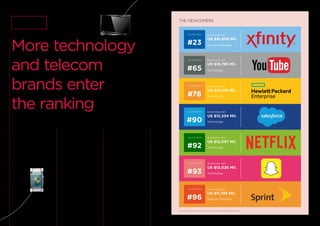
Five of the newcomers to the
BrandZ™ Global Top 100 are
technology brands, spanning
both business-to-consumer
(B2C) and business-to-business
(B2B) sectors, and two brands
are telecom providers. These
categories drive the growth of
Global Top 100.
More technology
and telecom
brands enter
the ranking
Categories reflect Global 100 growth trend
Xfinity, the highest-value Newcomer,
entered the BrandZ™ Global Top 100
at No. 23. A brand of Comcast, the
US telecommunications giant, Xfinity
provides TV, internet, and telephone
service, and is about to introduce
mobile. It expanded its X1 cloud-based
video platform and drove viewership
during the Rio Olympics.
YouTube expanded its offering of
original content for viewers as well as
its advertising options for customers.
It updated its TrueView ads, which
include videos of varying length with
content designed specifically to appeal
to the targeted audiences. And while
watching a video on mobile, the viewer
can also scroll through related product
offerings.
HPE (Hewlett Packard Enterprise)
appeared in the Global Top 100 for
the first time, having completed its
first year as a corporate entity created
when HP split the company into two
parts, spinning off HPE to focus on
servers, storage, networking, and
consultation, enabling it to better
confront the disruptive changes in
information technology.
Soon after Snap Inc. completed its
IPO, it signed an agreement with
NBC Universal to have the Snapchat
photo-messaging app carry content
from the 2018 Winter Olympics. It also
began to redefine itself as a camera
company, introducing a product called
Spectacles, sunglasses with a camera.
Netflix grew revenue as it expanded its
audience of global viewers interested
in on-demand movies or TV, and
introduced more original content.
Salesforce appears on the list because
the brand that challenged some of the
legacy business technology companies
is rising in brand value. Salesforce
continued to expand its cloud-based
customer relations platform, designed
for collaborative working with up-
to-the-minute information. Sprint, a
challenger telecom providers brand,
appealed to millennials with a price-
driven, contract-free proposition, and
irreverent messaging that pokes fun at
the category leaders.
2 The Global Top 100
Top 100 Rank
#65
Top 100 Rank
#23
Top 100 Rank
#76
Top 100 Rank
#90
Top 100 Rank
#92
Top 100 Rank
#93
Top 100 Rank
#96
Source: Kantar Millward Brown / BrandZ™ (including data from Bloomberg)
BrandZ™ Top 100 Most Valuable Global Brands 2017
Brand Value 2017
US $41,808 Mil.
Brand Value 2017
US $16,785 Mil.
Brand Value 2017
US $14,018 Mil.
Brand Value 2017
US $12,234 Mil.
Brand Value 2017
US $12,057 Mil.
Brand Value 2017
US $12,026 Mil.
Brand Value 2017
US $11,795 Mil.
Technology
Technology
Technology
Technology
Telecom Providers
Technology
Telecom Providers
Newcomers
3736
2 The Global Top 100 BrandZ™ Analysis / BRAND CONTRIBUTION
Brand Contribution is the
BrandZ™ metric that assesses
the extent to which brand
alone, independent of financial
or market factors, drives
purchasing volume and enables
a brand to command a price
premium. Brands that score
well in Brand Contribution are
viewed positively by consumers.
(Please see the Methodology section at the
end of this report for more details.)
High Brand
Contribution drives
volume, premium
And adds stability in disruptive markets
High Brand Contribution can take time
to build, but it is a sustaining force.
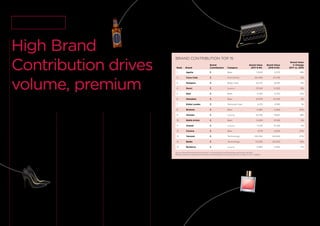
Of this year’s Brand Contribution Top
15, all but two appeared in the Brand
Contribution ranking a year ago. The
newcomers are Stella Artois, a global
premium beer owned by AB InBev, and
Tencent, the Chinese internet portal
that is No.1 in the BrandZ™ Top 100
Most Valuable Chinese Brands.
Six of the Brand Contribution Top 15
are beer brands and four are luxury
brands. These two categories would
seem quite different—beer focused
more on a mass market and luxury
dependent on exclusivity. However,
brands in both categories rely heavily
on the consumer’s perception of value.
And brands in both categories invest
heavily in brand building and brand
communication.
The return on investment can be
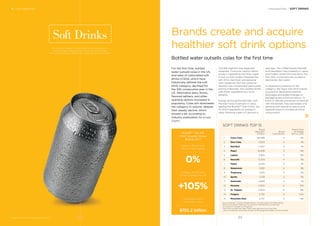
significant. The soft drinks category
has been under pressure for years
because of consumer health concerns.
Consumption of carbonated soft
drinks in the US declined for the 12th
consecutive year. The soft drinks
category remained unchanged in
value. Yet Coca-Cola remains the
world’s second-highest scorer in Brand
Contribution, after Aguila, a local
Colombian beer.
Similar circumstances surround the
third-highest Brand Contribution
scorer, Pampers. In some of the brand’s
global markets, China, for example,
e-commerce is turning diapers into a
commoditized, price-driven category.
The investment Pampers makes in
differentiating the brand as a source of
knowledge and consultation for young
parents broadens its appeal, creates an
emotional connection with consumers,
and helps produce its high Brand
Contribution score.
Personal care brand Estée Lauder also
establishes a consultative relationship
with its customers, which helps
sustain it against smaller disruptor
brands. Baidu and Tencent, the two
Chinese technology brands in the
Brand Contribution Top 15, illustrate
a correlation between high Brand
Contribution and the ability to become
important in the life of the customer,
in these cases being constantly
available to fulfill needs for information,
shopping, and payment.
BRAND CONTRIBUTION TOP 15
Rank Brand
Brand
Contribution Category
Brand Value
2017 $ Mil.
Brand Value
2016 $ Mil.
Brand Value
% Change
2017 vs. 2016
1 Aguila 5 Beer 3,843 3,270 18%
2 Coca-Cola 5 Soft Drinks 66,489 67,749 -2%
3 Pampers 5 Baby Care 22,312 22,911 -3%
4 Gucci 5 Luxury 13,548 12,592 8%
5 Skol 5 Beer 8,146 6,743 21%
6 Heineken 5 Beer 10,878 10,549 3%
7 Estée Lauder 5 Personal Care 4,215 4,190 1%
8 Brahma 5 Beer 4,385 3,269 34%
9 Hermès 5 Luxury 23,416 19,821 18%
10 Stella Artois 5 Beer 9,949 9,546 4%
11 Chanel 5 Luxury 11,019 10,316 7%
12 Corona 5 Beer 8,119 6,626 23%
13 Tencent 5 Technology 108,292 84,945 27%
14 Baidu 5 Technology 23,559 29,030 -19%
15 Burberry 5 Luxury 4,285 4,594 -7%
Source: Kantar Millward Brown/ BrandZ™ (including data from Bloomberg) and Kantar Vermeer
Brand contribution measures the influence of brand alone on financial value, on a scale of 1 to 5, 5 highest
BrandZ™ Top 100 Most Valuable Global Brands 2017
Brand Contribution
3938
BrandZ™ Analysis / BRAND IMPORTANCE
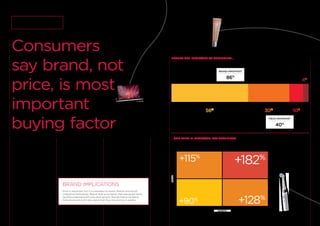
Brands are important to
consumers. To find out how
important, we analyzed almost
5,350 brands across 85 product
categories in 32 countries. When
making a purchase, brand was
important to 86 percent of
consumers, according to our
BrandZ™ research.
Over half of all consumers—56
percent—said that brand, not
price, is the most important
determinative factor when they
make a purchase, and 30 percent
said that they consider both
brand and price.
Consumers
say brand, not
price, is most
important
buying factor
To understand how brand and price
influence brand value growth, we
compared the 85 brands that appear
both in the 2006 and 2017 BrandZ™
Global Top 100 rankings. We divided
the brands into four quadrants based
on whether consumers perceived the
brands to be high or low priced, and
whether consumers believed that the
brand was worth more or less than
they were paying for it.
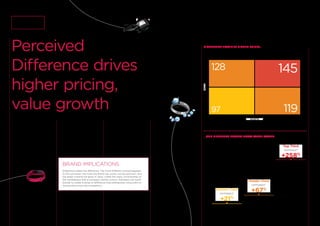
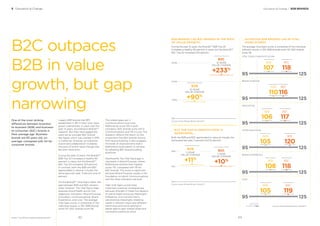
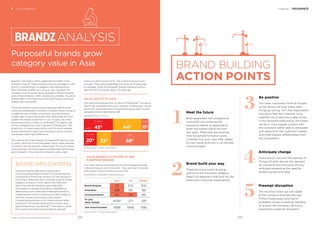
Brands that priced high, in line with consumer perceptions of their worth, led in brand value appreciation.
2 The Global Top 100
BrandZ™ Top 100 Most Valuable Global Brands 2017
BRAND IMPLICATIONS
Price is important, but it is subsidiary to brand. Brands should not
underprice themselves. Brands that price below their perceived worth
sacrifice potential profit and value growth. Brands that price below
their perceived worth also signal that they may be low in quality.
The connection between the price
of a brand and the consumer’s
perception of what it is worth is
crucial. Brands that got it right
increased 182 percent in brand value
over the past 12 years. In comparison,
brands priced lower than the
consumer perception of the brand’s
worth increased only 128 percent in
brand value.
BRANDS ARE IMPORTANT TO CONSUMERS…
...AND PRICE IS IMPORTANT, BUT SUBSIDIARY
When making a purchase, brand was important to 86 percent of consumers.
12-year brand value
growth (2006 to 2017)
85 brands that appear in
2006 and 2017 rankings,
divided into quadrants.
Brand Importance
Brand NOT Price
56%
Brand AND Price
30%
Neither
4%
BRAND IMPORTANT
86%
PRICE IMPORTANT
40%
Price NOT Brand
10%
Source: Kantar Millward Brown/ BrandZ™
HIGH
HIGH
LOW
+182%+115%
+90%
+128%
WORTH
PRICE
Source: Kantar Millward Brown/ BrandZ™
4140
BrandZ™ Analysis / DIFFERENCE
The connection between
maximizing price potential
and accelerating value growth
raised an obvious question:
What causes consumers to view
a brand as being worth a higher
price? We again analyzed the 85
brands that appeared in both
the 2006 and 2017 rankings.
Perceived
Difference drives
higher pricing,
value growth
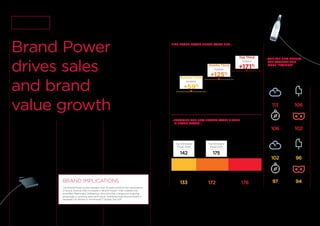
We found that the brands that
consumers saw as both higher priced
and worth their higher price scored
145 in Difference. In contrast, brands
that consumers saw as lower priced
and not worth a higher price scored
only 97 in Difference. Difference is
a component of Brand Power, the
BrandZ™ metric of brand equity. An
average score is 100.
2 The Global Top 100
BrandZ™ Top 100 Most Valuable Global Brands 2017
Difference
We then took the same 85 brands
and divided them into three groups,
according to their Difference scores,
to measure the effect of Difference
on brand value growth. We found
that over 12 years, the top third in
Difference grew 258 percent in brand
value, while the bottom third grew
only 21 percent.
BRAND IMPLICATIONS
Difference makes the difference. The more Different a brand appears
to the consumer, the more the brand can justify a price premium, and
the faster a brand will grow in value. Unlike the many uncertainties of
the marketplace that a company cannot control, marketers can build
brands to create a sense of difference that predisposes consumers to
choose them over the competition.
The brands that consumers see as both higher priced and worth their higher price
scored 145 in Difference.
DIFFERENCE JUSTIFIES HIGHER PRICES…
Difference scores for the 85 brands that appear in 2006 and 2017 rankings.
Brand value growth for the 85 brands that appear in 2006
and 2017 rankings, based on their Difference scores.
HIGH
HIGH
LOW
300%
200%
100%
0%
145128
97 119
WORTH
PRICE
Of the 85 brands analyzed, the top third in Difference grew 258
percent in brand value over 12 years, while the bottom third
grew only 21 percent.
...AND DIFFERENT BRANDS GROW VALUE FASTER
Middle Third
DIFFERENT
+67%Bottom Third
DIFFERENT
+21%
Top Third
DIFFERENT
+258%
Source: Kantar Millward Brown/ BrandZ™
4342
BrandZ™ Analysis / BRAND POWER
Brand Power is the BrandZ™
equity metric that describes the
predisposition of consumers to
choose a brand. It correlates
with both sales and brand value
growth. To measure the impact
of Brand Power on brand value,
we divided the 85 brands that
appear in the 2006 and 2017
BrandZ™ Global Top 100 ranking
into three equal-sized groups,
according to their Brand Power
scores.
Brand Power
drives sales
and brand
value growth
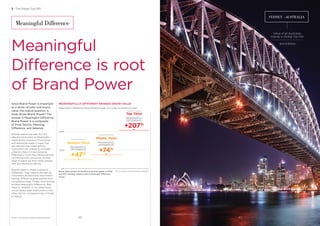
The group with the highest Brand
Power scores grew 171 percent in
brand value over the past 12 years.
The middle group increased 125
percent, which was twice the rate of
the lowest group, which increased in
value only 59 percent.
Brands that appeared in the 2006
Global Top 100 but dropped out
of subsequent rankings scored
reasonably well in Brand Power, 133.
(An average score is 100.) However,
brands that appeared in both the
2006 and 2017 ranking scored much
higher (172), as did brands that joined
the ranking in 2017 (178).
When we tried to understand why
some brands dropped from the
ranking and other brands joined it,
we found one striking distinction:
age. Brands new to the ranking, on
average, started 20 years ago, in
1997, while brands that dropped from
the ranking started 64 years ago, in
1953. Because of their relative youth,
the newcomer brands made an
impression on consumers who viewed
them as much more Creative, Fun,
Adventurous, and Brave.
2 The Global Top 100
BrandZ™ Top 100 Most Valuable Global Brands 2017
Brand Power
Brand value growth for the 85 brands that appear in 2006
and 2017 rankings, based on their Brand Power scores
200%
100%
0%
Brands with the highest Brand Power scores grew the most in brand
value—171 percent—over the past 12 years.
Brands new to the Global Top 100
were generally much younger and
more exciting than the brands that
dropped out.
HIGH BRAND POWER DRIVES VALUE RISE…
…AND THE NEW BRANDS
ARE YOUNGER AND
MORE “EXCITING”Middle Third
POWER
+125%
Bottom Third
POWER
+59%
Top Third
POWER
+171%
Source: Kantar Millward Brown/ BrandZ™
BRAND IMPLICATIONS
The Brand Power score changes over 12 years confirm the importance
of brand. Brands that increased in Brand Power—that created and
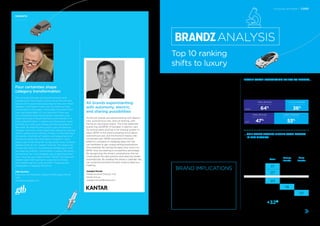
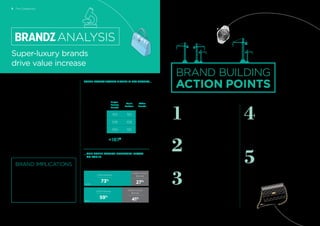
amplified Meaningful Difference—should enjoy a large and ongoing
advantage in growing sales and value. Sustained high Brand Power is
necessary to remain in the BrandZ™ Global Top 100.
…SURVIVING AND NEW BRANDS SCORE HIGHER
IN BRAND POWER…
Compared with brands that dropped out of the Global Top 100, those that
appeared in both the 2006 and 2017 ranking, as well as those that joined the
ranking in 2017, scored much higher in Brand Power.
Dropout Brands
(2006 ONLY)
133
Surviving Brands
(Both 2006 and 2017)
172
Top 100 Brand
Power 2006
142
Top 100 Brand
Power 2017
175
Newcomer Brands
(2017 ONLY)
178
Source: Kantar Millward Brown/ BrandZ™ Source: Kantar Millward Brown/ BrandZ™
Newcomer Brands
Dropout Brands
Creative
113
Creative
102
Fun
106
Fun
96
Adventurous
106
Adventurous
97
Brave
102
Brave
94
Brand Power scores
4544
Meaningful
Difference is root
of Brand Power
Since Brand Power is important
as a driver of sales and brand
value, the logical question is,
what drives Brand Power? The
answer is Meaningful Difference.
Brand Power is a composite
of three factors: Meaning,
Difference, and Salience.
Brands need to be seen by their
relevant consumers as Meaningful—
meeting the consumer’s functional
and emotional needs in ways that
are relevant and create affinity.
Consumers are unlikely to consider
a brand unless it is perceived as
Meaningful. Once they have positively
connected with consumers, brands
need to stand out from other brands
that also have built affinity.
Brands need to create a sense of
Difference. They need to be seen by
consumers as distinctive, even trend-
setting. Difference gives brands their
competitive edge. Finally, once brands
achieve Meaningful Difference, they
need to “amplify” it—by advertising,
social media, retail shelf position, and
other tactics—to become top of mind,
or Salient.
2 The Global Top 100
BrandZ™ Top 100 Most Valuable Global Brands 2017
Meaningful Difference
Brand value growth for the 85 brands that appear in 2006
and 2017 rankings, based on their Meaningful Difference
scores
200%
100%
0%
Meaningful Difference drives Brand Power. It is a key to brand success.
MEANINGFULLY DIFFERENT BRANDS GROW VALUE
Middle Third
MEANINGFUL
DIFFERENCE
+74%
Bottom Third
MEANINGFUL
DIFFERENCE
+47%
Top Third
MEANINGFUL
DIFFERENCE
+207%
Source: Kantar Millward Brown/ BrandZ™
Photograph by Paul Reiffer
SYDNEY - AUSTRALIA
Value of all Australian
brands in Global Top 100
$43.8 Billion
4746
“Think different” remains one of Apple’s most memorable
slogans and neatly distills the purpose of the brand simply
and brilliantly for consumers all over the world. Never has
this vision been delivered more emphatically than with the
launch of the iPhone in 2007. With the 10-year anniversary
in June this year, now is an opportune moment to assess
its impact and to examine the brand’s current and future
challenges as it moves into its second decade.
Apple has enjoyed unprecedented
financial success over this period,
and the contribution of the
iPhone has been a major factor.
According to BrandZ™, Apple’s
global brand leapt in value by
$210 billion during this time, to
reach an eye-watering $234.7
billion in 2017—an increase of 850
percent.
The iPhone delivered ”disruption”
in the truest sense, establishing
an entirely new category within
a category—the smartphone—
and beginning a seismic shift in
consumer expectations. For the
BrandZ™ Top 100 Most Valuable Global Brands 2017
Differentiation
Can Apple repeat
“Think Different”
on 10th iPhone
anniversary?
Clearly stated purpose sets high bar
for innovation and market disruption
Kantar Millward Brown is a leading
global research agency specializing
in advertising effectiveness,
strategic communication, media and
digital, and brand equity research.
www.millwardbrown.com
MARTIN GUERRIERIA
Global BrandZ™ Research Director
Kantar Millward Brown
Martin.Guerrieria@
kantarmillwardbrown.com
first time, people had the internet
in the palms of their hands.
The iPhone had an important
weapon in its arsenal from the
start—the Apple brand. Looking
at global analysis combining
several key markets (USA, UK,
Brazil, Mexico, Germany, France,
Italy, Spain, China, India, Japan,
Korea) back in 2007, iPhone was
already perceived as extremely
different, with an average
Difference Index of 175 versus an
average of 100. But the brand
was not well known versus the
competition; its average Salience
Index was only 60.
THOUGHT LEADERSHIP
Thought Leadership / DIFFERENTIATION
4948
BrandZ™ Top 100 Most Valuable Global Brands 2017
Over the next 10 years, the
brand extended its lead on
differentiation even further by
delivering on the promise of
a game-changing—even life-
changing—experience for users.
Perceived difference grew by 40
percent to reach an index of 245.
The effect of this was twofold:
In contrast, the impact on
many competitors and Nokia
in particular was devastating.
Nokia’s long-established
global point of difference was
decimated; dropping from
a Difference Index of 145 in
2007 and spiraling to just 84 in
2016. Nokia suffered not only
diminished demand—Power fell
60 percent, from a whopping
374 in 2007 to 151 in 2016 (and in
the US from 248 to just 66), but
the brand’s ability to charge a
price premium collapsed entirely.
Nokia’s Premium index dropped
from a global average of 133 to
only 102—a decline of 23 percent.
A Galaxy of challenge
However, as happens in any
category, challengers have
emerged to threaten iPhone’s
dominance, the largest of these
being the Samsung Galaxy series.
First launched in 2010, the
Samsung Galaxy sparked huge
growth in the global marketplace
for Samsung, as evidenced by
a global Power score increasing
from 155 to 300 over the decade.
The initial challenge was around
the perceived price difference
between the two brands, with
Samsung perceived to offer
a similar product at a more
acceptable price for many.
A strong offer has enabled
Samsung to slowly premiumize,
while iPhone’s perceived premium
is falling.
Taking the US as an example,
there have been some clear
changes in the perceived pricing
of the two brands over the
decade. Between 2008 and 2016:
• Samsung’s Perceived Price
Index rose from 90 to 116
• iPhone’s Perceived Price
Index fell from 185 to 145
The challenge for iPhone is to
continue to deliver a clear point
of difference in order to justify a
circa 30 percent premium over
Samsung.
Samsung’s recent travails with
the recall of the Note 7 do not
seem to have caused long-term
damage to the brand’s financial
performance, suggesting a strong
brand with a loyal following.
1Huge demand
iPhone’s global Power score
(consumer demand based
on strength of brand equity)
improved from a global index of
just 69 in 2007 to 236 in 2016.
2A justified premium
iPhone’s global Premium Index
peaked at 130 globally in 2016—
the brand’s equity was able to
support a price point 30 percent
above the average in a typical
market.
Make way for China
The challenge to the iPhone has
not been limited to Samsung,
however. A new group of
Chinese brands now offer similar
functionality at a much lower
price. Brands like Huawei, Xiaomi,
Vivo, and Oppo have entered the
market and quickly gained share.
According to BrandZ™ data in
2016, the average perceived price
across markets for these brands
ranged from 80 to 103, though
demand remains relatively low
outside of China. Within China,
however, both Xiaomi and Huawei
are now very well established
offerings at comparatively
low price points. Huawei is
also investing heavily in global
marketing, boosting the brand’s
presence and influence.
These relatively new players have
also impacted the price premium
that both iPhone and Samsung
can justify based on their existing
equity in China. This has fallen
between 10 percent and 15
percent for both brands since
2013.
Apple’s response was to launch
the iPhone SE in early 2016; this
was the brand’s first attempt
to deliver a “budget” offer in a
smaller size (still at a comparative
premium, but available for 40
percent lower than the 6s for the
same tariff). This allowed iPhone
to reach further down the budget
spectrum to prevent users
from being tempted to move
elsewhere for their next handset.
The battle
for the future
The next six months are likely
to be the most important and
interesting in the smartphone
market for years. The recent
launch of the Samsung Galaxy S8
in March is likely to be followed
by the iPhone 8 in September
(though there are whispers of a
delay) and both releases come
at a time when the market has a
general feeling of stagnation for
many. Incremental improvements
to screen sizes and cameras
just don’t generate a high level
of curiosity and certainly don’t
offer the same opportunity for
differentiation that they once did.
In an era where consumers are
becoming more embedded in a
brand’s “ecosystem,” many are
likely to take the path of least
resistance when upgrading their
devices. If I have an iPad, iMac
and iPhone, access my music
through iTunes, and store and
access my photos via iCloud, am I
really likely to choose a Galaxy S8
over the iPhone 8 when I upgrade
my handset? Hardly, unless
there is a very good reason to
do so—the next game-changing
innovation, the next “iPhone-level
event” (iLE).
An intensified focus on
software will likely be the lead
battleground, with artificial
intelligence the likely route to ever
greater and increasingly effortless
user interaction. Augmented
reality offers another tantalizing
opportunity, as evidenced by the
global hysteria surrounding the
success of Pokémon Go! last year.
“Think Different?” As we
approach iPhone’s 10-year
anniversary, there’s never been a
better time for the brand to re-
apply that particular mantra and
truly disrupt once more. The race
for the next iLE is on; the question
is, who will deliver it?
Thought Leadership / DIFFERENTIATION3 Thought Leadership
5150
We live in troubled times.
Despite the tremendous
advancements in
technology, the world faces
climate crisis, violence,
poverty, discrimination, and
hatred.
Should brands
take a stand?
Multiple studies state that people
expect corporations to contribute
to society. A report by Unilever
shows a third of consumers
buying from brands based on
their social and environmental
impact.
Brave stands by brands with
a clear purpose can produce
favorable financial performance.
Unilever observed brands that
“have integrated sustainability
into both their purpose and
products growing 30 percent
faster than the rest of the
business.”
Harvard Business Review
published “The Business Case
For Purpose,” which showed that
companies with “a strong sense
of purpose are able to transform
and innovate better, while it
also helps to improve employee
satisfaction.”
BrandZ™ Top 100 Most Valuable Global Brands 2017
The Purposeful Age
As activism goes
mainstream,
brands must take
their place in
culture and society
Purpose-led brands resonate with
their audiences, including employees
CANDACE KUSS
Director of Social Media
Hill+Knowlton Strategies
Candace.Kuss@hkstrategies.com
Key stakeholders:
Employees
Smart companies know that their
own employees are especially
attuned to what that brand
stands for in the public eye. Some
of the top ads that ran during the
2017 Super Bowl—like the brilliant
Budweiser immigrant story of
founder Adolphus Busch—were
a way to signal to employees that
the corporation they work for
values the multicultural nature
of their workforce. (In spite of
the current US administration’s
regressive attitude, almost all
families in the US cherish their
own immigrant stories. My
grandmother went through Ellis
Island on her own as a teenager
from Poland and married a first-
generation Irish American; I’m a
direct result of this melting pot.)
Corporate social
lobbying
Even before the recent election,
immigration issues were a
major concern for tech giants
like Google and Facebook that
employ high-skilled foreign
workers. Indeed, some such as
Google and Yahoo! were co-
founded by immigrants.
THOUGHT LEADERSHIP
Hill+Knowlton Strategies is a leading
global strategic communications
consultancy, providing services
to local and multinational clients
worldwide.
www.hkstrategies.com
Thought Leadership / THE PURPOSEFUL AGE
5352
BrandZ™ Top 100 Most Valuable Global Brands 2017
People who think brands have
no place in anything political
forget that for decades major
corporations have hired public
affairs professionals to represent
their interests. As part of our
specialist services, H+K has a
bipartisan team of legislative and
regulatory strategists that help
clients navigate this space.
What’s different now is that
brands driven by purpose are
following the same north star in
their marketing communications
as they do in public affairs.
Activism has entered mainstream
culture. Going beyond the
corporate social responsibility
(CSR) programs of the past,
purpose-led companies are
merging these efforts into the
spotlight of their advertising and
PR programs.
Purpose as a creative
platform
Airbnb didn’t have to agonize
about taking a stand in their own
Super Bowl ad, “We Accept.”
Their stated mission of helping
people “belong anywhere”
naturally leads to creative
expressions of this commitment.
And they prove this promise
via actions like fighting any
discrimination by hosts and
providing donations and housing
for refugees.
What’s interesting is that
more established travel
brands are getting on board.
Expedia launched an ad about
connecting across cultures
during CNN’s coverage of the
US presidential inauguration,
and Hyatt ran a message of
acceptance during the Oscars.
Being a part of a bigger
community is a hallmark of
socially conscious brands, but
it can be expressed in small
everyday actions as well as
costly TV adverts. A team from
my agency worked with local
mall client Westfield on an
Easter weekend activation called
“Revamp Camp: Customise your
Closet.” In collaboration with the
charity Save the Children, the
workshops showed kids creative
ways to dress up old clothes and
keep them out of the landfill.
A higher purpose
vs. the bottom line
“It’s not a principle until it costs
you money,” said Bill Bernbach
back in the day.
Now in its second year, outdoor
recreation retailer REI’s much-
awarded #OptOutside program
is more of a movement than a
marketing campaign. By closing
all its stores on Black Friday,
America’s biggest shopping
day of the year, REI proved
its commitment to outdoor
adventure was more than an ad
slogan.
TAKES A
STAND
I was never more proud to work for WPP than
when Sir Martin Sorrell went on stage at Cannes
Lions with the other major holding companies and
then-UN Secretary General Ban Ki-moon to launch
Common Ground in support of the UN Sustainable
Development Goals (SDGs). As Goal 17 states: “A
successful sustainable development agenda requires
partnerships between governments, the private
sector and civil society.”
WPP chose Goal 5: Gender Equality.
As the H+K liaison for Common Ground, this gave
me the privilege of meeting with UN Women, the
United Nations Entity for Gender Equality and the
Empowerment of Women.
A first step to support UN Women is to sign on to
their Women’s Empowerment Principles, which
“offer practical guidance to business and the private
sector on how to empower women in the workplace,
marketplace and community.” Close to 1500 CEOs
have taken this stand for gender equality to date.
What I especially like was the
benefit to REI staff, who are
outdoor enthusiasts themselves.
For the first time, they got the
day off.
REI’s CEO reports that “after
#OptOutside we saw a 100%
increase in applications for jobs
in Q4 and our retention is double
our retail competitors.” More
proof that people want to work
for a company who respects
them and acts on their values.
Empathy and respect
For 2017, REI launched a new
public effort called “Force of
Nature,” a program designed
to bring gender equality to the
outdoors.
Sixty percent of women say
that men’s interests in outdoor
activities are taken more seriously
than women’s, according to REI’s
2017 National Study on Women
and the Outdoors. So REI will
focus their marketing efforts on
women in 2017 to combat current
male-dominated imagery of
people in the outdoors.
This empathy and respect for
their female customers reminds
me of the equally empowering
“This Girl Can” movement from
Sport England, which encourages
all women to be active.
Fighting back
There is no doubt we are in a
cultural shift or course correction
that seeks to end decades of tired
clichés and stereotypes about
women.
A personal favorite comes from
ANZ Bank in Australia. “Pocket
Money,” which shows girls getting
paid less for chores than their
brothers, is the most charming
argument against the wage
pay gap I’ve ever seen. And it’s
part of a bigger program called
#EqualFuture, designed to help
achieve financial gender equity.
ANZ is a shining example of a
brand being active in an area
where they have a clear right
to play. This is a key factor in
successful brand activism.
To combat neo-Nazi graffiti
polluting Berlin neighborhoods, a
paint store enlisted street artists
to “#PaintBack” by transforming
the swastikas into flowers,
bunnies, and other happy images.
They took a visible stand against
hate in a creative way—and won
the 2016 Eurobest Design Grand
Prix as a bonus.
Be bold for change
That was the theme for the most
recent International Women’s
Day. And it is great advice for any
brand built around a purpose.
We live in troubled times. Brands
can and should be part of the
solution.
Thought Leadership / THE PURPOSEFUL AGE3 Thought Leadership
5554
Disruption
& Change
3 Disruption & Change Disruption & Change / BUSINESS-TO-BUSINESS
The distinction between
business-to-business (B2B)
and business-to-consumer
(B2C) brands continues to
blur because of increased
collaboration and disruption.
The emergence of technologies
such as the Internet of Things
and autonomous cars has
accelerated collaboration.
Cloud computing has
disrupted the IT structure of
the workplace, decentralizing
purchasing and introducing
more consumer devices.
Brands continue
to blur border
dividing B2B, B2C
Business brands adopt consumer brand-building skills
The BrandZ™ B2B Top 20 ranking
reflects this blurring. The ranking
includes the highest-value brands
in the BrandZ™ Global Top 100 that
generate over half their revenues from
business clients. Nine of the B2B Top
20 are technology brands, four are
banks, and seven are divided among
these categories: logistics, oil and gas,
and conglomerates.
Few brands are purely B2B. Microsoft
and IBM, ranked first and second in
the B2B Top 20, are primarily business
brands, but they also have consumer-
facing operations, particularly
Microsoft, and they collaborate with
B2C brands. Conversely, the first- and
second-ranked brands in the Global
Top 100, Google and Apple, are
primarily B2C brands, but they also
gain revenue from business clients.
Amazon, No. 4 after Microsoft in
the BrandZ™ Global Top 100, is the
paradigmatic disruptor. Its consumer-
facing e-commerce business has
transformed retail, while its delivery
service challenges logistics brands
and its replenishment technology
threatens fast-moving consumer-
product brands.
Catching up
The B2B brands have some catching
up to do. Over the past 12 years, the
BrandZ™ B2C Top 20 increased in
brand value 233 percent, more than
twice the rate of the BrandZ™ B2B
Top 20 brands, which increased 90
percent. And the B2B brands lagged
the B2C brands in each of the five
BrandZ™ Vital Signs: Innovation,
Communications, Brand Experience,
Brand Purpose, and Love. High scores
in these indicators mean that a brand
is perceived as Meaningfully Different
and has a better chance of growing
market share and commanding a price
premium.
Recent results suggest that B2B
brands may be narrowing the gap
in the rate of value growth. Over
the past year, both the Top 20 B2B
and B2C brands increased in value
at virtually the same rate, 11 percent
and 10 percent. Several factors
may account for this phenomenon,
including the disruptive nature of the
year, which touched all categories,
and the fact that the annual value
growth of some of the large B2C
technology brands slowed. However,
the comparable value growth
rates may also reflect the increase
in crossover collaboration and
aggressive efforts by B2B brands to
adopt B2C skills in communications
and customer cultivation and
management.
Adopting a B2C
mentality
To narrow the gap, more B2B brands
may need to emulate the way in which
B2C brands segment their markets
and interact with customers. The
default B2B market segmentations
that group together small, medium,
and large companies are not always
most effective, especially when B2B
brands serve their small customers
with technology, their large customers
with human interaction, and the
medium-sized customers with a
combined approach.
Similarly, some large organizations
with both consumer and commercial
businesses market the same products
one way to corporate clients and a
different way to consumers. They
emphasize the corporate name with
commercial clients, as a service
reassurance, while they promote
their individual brands to consumers.
Ultimately, brands need to cultivate
communication and brand-building
skills to serve both business and
consumer customers.
The logistics brands in the BrandZ™
B2B Top 20—UPS, FedEx, and
DHL—have adopted some B2C
lessons, perhaps because the rise of
e-commerce has placed them face to
face with consumers. UPS added new
dimensions to the brand with a richer
story about being a problem solver,
especially for small businesses that
lack expertise and resources.
BrandZ™ Top 100 Most Valuable Global Brands 2017
Business-to-Business
INSIGHT
Brands attempt
to develop B2B
side of business
We’re seeing that a lot of brands
that already straddle consumer
and business are putting more
emphasis on the business sector.
They see opportunity there and,
because they’ve focused on the
consumer market so far, they’re
finding it more difficult to grow
share just slugging it out with the
competition. B2B is potentially
an underdeveloped part of their
business.
Gareth Richards
Group Partner
OgilvyOne Business
Gareth.Richards@ogilvy.com
INSIGHT
Disruptors force
traditional B2Bs
to be more agile
B2B brands need to prove their
credentials in ways that consumer
brands don’t have to. In B2B, the
advertiser cannot portray a false
illusion, because the experience of
the product makes the brand.
B2B advertisers need to be
more multidimensional. That
poses a challenge to many of
the established brands that have
built their reputation around
reliability or seriousness. They
now need to be more agile and
adapt to changes in the industry.
It’s becoming more and more
difficult to be credible. In contrast,
a disruptor brand comes in and is
immediately, and believably, much
more agile, which builds credibility.
Anna Gilmour
Account Director
Maxus
Anna.Gilmour@maxusglobal.com
5958
Source: Kantar Millward Brown / BrandZ™ (including data from Bloomberg)
BrandZ™ Top 100 Most Valuable Global Brands 2017
For some B2B brands, access to
consumers provides unrealized
growth potential. For example, with
the right marketing approach, a
financial services company could
become the bank of choice for the
employees of its corporate clients.
Unlocking this potential requires a
culture shift, and that depends largely
on hiring and retaining the right
people.
Attracting talent
B2B technology brands illustrate
the recruitment challenge. Since
the advent of cloud computing,
businesses now purchase technology
differently. As a result, B2B
technology brands need to adapt
their recruiting strategies. It used to
be that decision-making authority
was concentrated in the IT director,
who reviewed complicated specs and
made a rational choice from a small
consideration set of B2B brands. That
decision often resulted in a long-term
marriage between a client and a major
B2B technology brand; with products
and services integrated throughout
the client company, the deep
interdependence that was created
made divorce unlikely.
Because that decision was so
consequential, and potentially
impacted the career advancement
of the decision maker, the IT director
often made the safe choice, a large
legacy brand with an impeccable
reputation. Today, with nimble
cloud-computing brands promising
lower costs and less risk, the safe
choice for an IT director wanting to
demonstrate competence is to review
a wide consideration set that includes
startups.
In addition, the decision-making
process in technology purchasing
today is more decentralized. And
rather than meet only with the IT
director, the B2B brand more likely
will interact with potential decision
makers in diverse departments
throughout an organization. These
decision makers often are millennials
who have recently risen to positions of
authority, and whose experience with
technology brands is more with B2C
brands than with the B2B heritage
brands.
Consequently, B2B brands are looking
for people who know how to navigate
a corporate organizational chart and
find the decision makers. And the
B2B brands are not just seeking sales
people with these qualities—they want
knowledgeable and relatable people
at all levels, because the interface with
customers happens throughout the
organization.
As B2B brands do a better job
communicating their purpose, they
are attracting more young people
who want to make money, but who
also want to spend their time doing
something that feels more worthwhile
than simply making money. To recruit
and retain more of these millennials,
B2B brands need to become their
destination of choice, rather than
the default “safe school” alternate to
Apple, Google, or Facebook.
INSIGHT
B2B brands recruit
talent from across
the sector divide
B2B brands are bringing more
B2C talent across. The B2B brands
realize that they need that level
of human understanding. As
their businesses change, they
need people who understand the
individuals and relationships within
organizations, and who know how
to navigate within a customer
organization and among the
decision makers.
Karl Turley
Business Director
Geometry Global
Karl.Turley@geometry.com
BrandZ™ B2B Top 20
Brand Category
Brand Value
2017 $Mil.
Brand Value
2016 $Mil.
Brand Value
% Change
2017 vs. 2016
1 Technology 143,222 121,824 18%
2 Technology 102,088 86,206 18%
3 Regional Banks 58,424 58,540 0%
4 Logistics 58,275 49,816 17%
5 Conglomerate 50,208 54,093 -7%
6 Technology 45,194 39,023 16%
7 Technology 27,243 22,813 19%
8 Technology 21,919 18,632 18%
9 Technology 21,359 19,489 10%
10 Global Banks 20,536 20,276 1%
11 Technology 20,388 18,652 9%
12 Logistics 19,441 16,236 20%
13 Oil & Gas 18,727 16,838 11%
14 Oil & Gas 18,346 14,940 23%
15 Global Banks 17,580 17,055 3%
16 Technology 16,725 14,508 15%
17 Logistics 15,844 13,199 20%
18 Global Banks 14,129 11,943 18%
19 Technology 14,018 NEW ENTRY
20 Conglomerate 13,947 12,485 12%
3 Disruption & Change
6160
Disruption & Change / BUSINESS-TO-BUSINESS
One of the most striking
differences between business-
to-business (B2B) and business-
to-consumer (B2C) brands is
their average age. Business
brands are 83 years old, on
average, compared with 44 for
consumer brands.
B2C outpaces
B2B in value
growth, but gap
narrowing
Legacy B2B brands like IBM,
established in 1911 in New York, have
grown substantially in value over the
past 12 years, according to BrandZ™
research. But they have lagged the
pace set by younger B2C brands
like Apple, which was started in 1976
in California. However, as industries
evolve and collaboration increases,
the pace of brand value change may
become more even.
During the past 12 years, the BrandZ™
B2B Top 20 increased a healthy 90
percent in value, but the BrandZ™
B2C Top 20 increased 233 percent.
In contrast, both the B2B and B2C
appreciated in value at virtually the
same pace last year, 11 percent and 10
percent.
On the BrandZ™ Vital Signs Index, the
gap between B2B and B2C remains
wide, however. The Vital Signs Index
assesses brand health across five
diagnostic indicators—Brand Purpose,
Innovation, Communications, Brand
Experience, and Love. The average
Vital Signs score, a composite of the
individual scores, is 100. B2B brands
score 107. B2C brands score 118.
The widest gaps are in
Communications and Love.
B2B brands score 105 in both
indicators. B2C brands score 120 in
Communications and 119 in Love. The
disparity reflects the return on the
investment that B2C brands receive
from brand building. It also suggests
the kinds of improvements that a
B2B brand could expect to achieve
by adopting B2C brand-building
practices.
Significantly, the Vital Signs gap is
narrowest in Brand Purpose, where
B2B brands achieve their highest
score: 110, compared with 116 for
B2C brands. This score is significant
because Brand Purpose usually is the
foundation on which Communications
and the other indicators are built.
High Vital Signs scores have
important practical consequences,
because strength in these five aspects
of brand health produces Meaningful
Difference. And a brand that is
perceived as meaningful (meeting
needs in relevant ways) and different
(distinctive and trend-setting) is
better able to gain market share and
command a premium price.
BrandZ™ Top 100 Most Valuable Global Brands 2017
3 Disruption & Change Disruption & Change / B2B BRANDS
B2B BRANDS LAG B2C BRANDS IN THE RATE
OF VALUE GROWTH…
… ALTHOUGH B2B BRANDS LAG IN VITAL
SIGNS SCORES
… BUT THE GAP IN GROWTH RATE IS
NARROWING…
During the past 12 years, the BrandZ™ B2B Top 20
increased a healthy 90 percent in value, but the BrandZ™
B2C Top 20 increased 233 percent.
The average Vital Signs score, a composite of the individual
indicator scores, is 100. B2B brands score 107. B2C brands
score 118.
Both the B2B and B2C appreciated in value at virtually the
same pace last year, 11 percent and 10 percent.
300%
200%
100%
10%
20%
0%
0%
B2C
12-YEAR
VALUE CHANGE
+233%
B2C
1-YEAR
VALUE CHANGE
+10%
B2B
12-YEAR
VALUE CHANGE
+90%
B2B
1-YEAR
VALUE CHANGE
+11%
Source: Kantar Millward Brown/ BrandZ™
AVERAGE
SCORE IS 100
VITAL SIGNS COMPOSITE SCORE
95 125
B2B
107
B2C
118
INNOVATION
95 125
B2B
106
B2C
117
COMMUNICATIONS
95 125
B2B
105
B2C
120
BRAND EXPERIENCE
95 125
B2B
108
B2C
118
BRAND PURPOSE
95 125
B2B
110
B2C
116
LOVE
95 125
B2B
105
B2C
119
6362
For the past five years the trend
getting the most attention has
been the Internet of Things. The
Internet of Things is a much
friendlier way of talking about
machine-to-machine (M2M)
communications, a paradigm
where the car speaks to the
garage door and the washing
machine has a daily chat with
the weather service. At its most
simplistic level, the Internet of
Things allows sensors within
devices to communicate
seamlessly with one another
without human interaction.
This isn’t a new concept. RFID
was hailed as a transformative
solution for the logistics and
CPG businesses, allowing fast
and reliable tracking of goods as
they moved from warehouse to
store. In many ways that was the
starting point for the Internet of
Things as described today.
So what is the promise of the
Internet of Things? At the
Consumer Electronics Show this
year, LG Electronics showcased
a smarthome concept that
brings it to life. Based around an
automated device or home hub
(in this case a robotic one), the
kitchen of the near future links all
the devices we have in our home
together. And we are using the
term “devices” in the widest sense
possible—your refrigerator, your
coffeepot, your stove, and your
washing machine—any electronic
device you own can and will be
linked to the Internet of Things in
time.
The scenario depicted by LG is
one of ease, where devices’ ability
to automate life’s small decisions
makes for a relaxed and healthier
individual. You return from your
morning run wearing your fitness
tracker, which communicates
with your hot water system and
ensures the shower is ready for
you. Now hungry, you move to
the kitchen, which tells you what
you have available for breakfast
and suggests a recipe, steering
you towards the healthier choices
indicated by your health data.
BrandZ™ Top 100 Most Valuable Global Brands 2017
Collaboration
More collaboration
needed to realize
Internet of Things
complete potential
Marketers must be prepared
for expected brand disruption
SARA GOURLAY
Global Practice Director, Technology
Hill+Knowlton Strategies
Sara.Gourlay@hkstrategies.com
Hill+Knowlton Strategies is a leading
global strategic communications
consultancy, providing services
to local and multinational clients
worldwide.
www.hkstrategies.com
THOUGHT LEADERSHIP
If we had a dollar for every time a new technology was
hailed as a game-changing, life-enhancing, swing-from-
the-moon breakthrough, then it’s safe to say we’d be
writing this from a luxurious tax haven. The IT industry is
incredibly good at hyping itself to the point where terms
become commonplace well before any real impact is felt
by the masses.
Thought Leadership / COLLABORATION
6564
BrandZ™ Top 100 Most Valuable Global Brands 2017
You put that sweaty running gear
into the washing machine, and
it calculates the best time to run
the load based on weather, the
right amount of detergent based
on water quality, and starts the
program while you go about your
day. When you come home, it
shows you recipes for dinner, and
once one is selected, turns on the
oven for you and adds the items
used to your next shopping list, all
while playing your favorite tracks.
Internet of Things
The Internet of Things is at
a tipping point. We have the
infrastructure now, and with 5G
on its way,
we will have
unparalleled
amounts of
connectivity
to make this
work. The
second piece
of the puzzle
is the success
of vocal
computing.
Today vocal
recognition
software is as close to parity with
human vocal recognition as it
could ever be. That means that
we no longer need screens or
keyboards to tell our devices what
to do. It means that Amazon’s
Alexa and Google’s Home, along
with the 5 million other home-
hub robots that will be deployed
in the US by 2020, will play a
fundamental role in shaping how
we live our lives in the future.
However, it won’t happen without
a change in attitude. Companies
marketing to consumers,
whether in the packaged foods
or the dishwasher business, are
going to have to collaborate. If
we look outside the home, the
potential for really smart cars,
even autonomous cars, shows
this reality perfectly. In April,
Honda launched its Innovation
Group, a new company that
aims to seek transformative
collaborations. Nick Sugimoto,
CEO, Honda Innovations believes
that we are in the middle of a
technology convergence, saying
that “by looking broadly across
technology areas and partnering
with innovators across the globe,
we can create products and
services that enhance the lives
of our customers.” It is estimated
that 82 percent of cars will be
connected to, and a part of the
Internet of Things by 2021.
Each device—again taking
“device” to its broadest
meaning—will have to
communicate with other devices,
regardless of manufacturer or
technology. This is where the
home hub is so essential, and
potentially where Amazon Alexa,
with its 10,000+ established
skills, and Google Home, with its
growing range of capabilities,
can steal competitive advantage.
Given the need for collaboration
at every level, it is perhaps
inevitable that the real drivers of
the Internet of Things won’t be
the hardware manufacturers but
the software and services people.
Different thinking
It also means that marketers
will have to think differently and
collaboratively about how we
access their products. If we reach
a point where our refrigerator
is selecting what brand of beer
to buy, how do purveyors of
such products ensure that
we consumers continue to be
engaged
enough to
defy our
devices? When
we willingly
automate
life’s smaller
actions and
decisions, what
will emerging
brands have
to do to break
our default
setting? Will
marketing messages reach us
through new channels—extending
the reach of social media right
to the dashboards of our cars,
for example? Will the content of
those messages have to change
to ensure we re-engage with
decisions that we have now
outsourced?
Collaborating with new and
different partners is going to be
essential. Content—more than
ever—will be king. And Google
and Amazon just got a whole lot
more important for marketing
departments across the world.
Photograph by Paul Reiffer
LONDON - UK
Value of all UK brands
in Global Top 100
$86.5 Billion
Thought Leadership / COLLABORATION3 Thought Leadership
Companies marketing to
consumers, whether in the
packaged foods or the
dishwasher business, are
going to have to collaborate.
6766
BrandZ™ Top 100 Most Valuable Global Brands 2017
3 Disruption & Change Disruption & Change / EMERGING BRANDS
Emerging Brands
The BrandZ™ Top 100 Most
Valuable Global Brands
examined in this report often
face fierce competition from
brands that do not appear
in the ranking because they
are too small or not publically
traded. Characterized as
disruptor or emerging brands,
these competitors exert
increasing influence worldwide
and across categories.
New competitors
cause disruption
worldwide
Young and purpose driven, they reshape categories
True disruptor brands do not fit
neatly in established categories. More
typically, a category forms around a
disruptor brand as it attracts followers
and, inevitably, imitators. Amazon and
the evolution of e-commerce is a clear
example. Disruptor brands are not
necessarily the first movers, but they
are the best movers. Fortunately for
established brands, disruptors do not
appear often.
Emerging brands are a more common
phenomenon today. They share many
characteristics with disruptor brands,
but they do fit into established
categories. Emerging brands are
relatively young, started during the
explosive growth of the internet, and
even since the introduction of the
iPhone 10 years ago.
Less driven by usual business
needs to report quarterly on rising
sales and profits, emerging brands
typically begin with a different set
of priorities, asking: What does the
consumer need? How can the brand
fill that need without causing harm to
individuals or the environment? They
attempt to improve the consumer’s
life by removing friction.
They are about making money, but
they are also about more than making
money. Some measure success not
by achievement of scale, but by
fulfillment of brand purpose. Even
with limited distribution, some gain
fame and manage to punch above
their weight. Like luxury brands,
they set market trends and inspire
imitation. For example, without selling
a lot of cars or making a profit, Tesla
demonstrated a future for electric
vehicles and recently surpassed Ford
and GM in market value.
Variations on emerging brands are
appearing worldwide in categories as
diverse as technology and consumer
products. In fast-growing markets
like China, India, and Indonesia,
entrepreneurs have paired marketing
expertise and higher quality standards
with deep local market knowledge
and insight. This combination has
enabled them to create products and
communication that resonate with
authenticity and purpose.
Purpose-driven
characteristics
Purpose is fundamental for emerging
brands, which often are founder
led. And purpose can provide an
advantage relative to large established
brands. Some established brands
may enshrine purpose in a founder’s
vision from decades ago, but unless
that purpose is refreshed and made
relevant, it can sound inauthentic and
seem retrofitted onto the business.
In contrast, emerging and disruptor
brands generally start with purpose
and connect it with a related social
issue or trend. They develop relevant
products and services that fit into
an existing category (or into no
category). Uber introduced a different
approach for transporting people—or
things—from one place to another.
The existence of Uber—and brands
such as Ola in India, and BlaBlaCar,
a Paris-based global carpooling
service—persuaded car pioneer
brands, like Ford, to experiment with
other mobility businesses.
Purpose and passion can sometimes
attract a community around the
brand. For some brands, community
is so basic that it empowers the
business model. Waze, the mapping
app, relies on its users for crowd
sourcing real-time traffic information.
Tesla knows who owns its cars,
and Tesla owners can connect with
each other. Airbnb works because
a community of owner and renters
interact.
These brands operate nimbly.
Snapchat originated as an app for
images that disappeared quickly,
enabling people to share information
and protect privacy. Following its
IPO, Snap declared itself a camera
company and released is first product,
Spectacles (sunglasses that take
photos). To become more agile,
some established brands are creating
internal investment groups expected
to act with greater speed. Some are
acquiring their disruptive competitors
to preempt disruption.
INSIGHT
Purpose-led
brands build
legacy + profits
I firmly believe that brands need
to define their purpose, and they
need to build their marketing
and communications out from
that heart. We’ve seen how new
generation founder-led brands,
like Airbnb, do this naturally. Many
of these brands are profitable.
They want to make money, but
they want to do more than make
money. They want to solve an
issue and contribute to society.
Candace Kuss
Director of Social Media
Hill+Knowlton Strategies
Candace.Kuss@hkstrategies.com
@CandaceKuss
INSIGHT
Brands emerged
since the dawn
of the internet
There is an age aspect to defining
emerging brands that broadly
corresponds with two inflection
points: the internet achieving
scale in the late 90’s, and the
launch of smartphones in 2007.
These two milestones help define
emerging brands, especially
those in technology. A 20-year-
old brand, like Google, achieved
scale as a large global business
about 10 years ago. This is the
stage smartphone-era brands are
getting to and they are now the
ones to watch. They are bubbling
under and will start to break into
the BrandZ™ Global Top 100 in
the next few years, as their scale
matches their ambition.
Mark Chamberlain
Sector Managing Director - UK
Kantar Millward Brown
Mark.Chamberlain@millwardbrown.com
6968
INSIGHTS
Disruptive brands
build success
beyond scale
Many of the most disruptive
brands today are being built
around expanded definitions
of success. Instead of building
brands that can last 100 years,
with a myopic focus on return on
investment and scale for scale’s
sake, they are including things
like their social or environmental
impact or community investment
as measures of success. In the
process they are inventing new
disruptive business models.
Wayne Pan
Senior Consultant
Kantar Futures
Wayne.Pan@thefuturescompany.com
Early-adopter
millennials drive
brand growth
Millennials are not the only market
for emerging brands, but they
may be the early adopters. And
the scaling of a brand may come
after millennials talk about it. That
may be the way these brands
have managed to succeed in
creating a unique experience and
adapting well to local markets.
Anda Tita
Client Director
Kantar Millward Brown
Anda.Tita@millwardbrown.com
Purpose attracts
communities,
which yield data
Emerging brands attract
communities because of their
purpose, but data enables
the brands to monetize the
community. For example, Warby
Parker attracts a community.
It can identify the members of
that community who purchase
the most pairs of glasses, and it
can invite them to special events.
If Warby Parker attracted a
community but sold its eyeglasses
through another retailer, it would
not be able to identify and reward
its best customers.
Tom Kelshaw
Director of Innovation
Maxus
Tom.Kelshaw@maxusglobal.com
Emerging and disruptor brands
usually have a positive attitude and a
high tolerance for risk. They accept
failure as a learning experience
rather than something to minimize
in a quarterly earnings report. The
brands also are talent magnets. Funds
sometimes are available through
crowdsourcing. And many funders
want to be part of the startup scene.
The brands rely on data and, if they
are not actually in the technology
category, they often are technology-
enabled, as exemplified by Blue
Apron, the online service that
changed the way people think about
shopping and meal preparation. The
brand curates menus and delivers pre-
portioned ingredients, a subscription-
model Birchbox for the palate.
These characteristics describe a
wide assortment of brands that are
in various stages in their life cycles.
Some have already achieved great
scale and are brands that could
soon appear in the BrandZ™ Global
Top 100. Other less well-known
brands still lack significant scale but
have abundant ambition. As these
brands achieve notoriety, building
a brand becomes important for
communicating the company’s
differentiating advantages and
building loyalty.
A global phenomenon
In a global economy, disruption can
come from anywhere. Increasingly,
established brands in Asia are
becoming emerging brands in the
West. Huawei, ranked No. 6 in the
2017 BrandZ™ Top 100 Most Valuable
Chinese Brands, is well known
outside of China as a business-
to-business telecommunications
technology provider. However, it is
just becoming well known as a maker
of smartphones to rival those of Apple
and Samsung. Chinese smartphone
brands Xiaomi and Oppo are also
gaining attention outside of China.
BrandZ™ Top 100 Most Valuable Global Brands 2017
3 Disruption & Change Disruption & Change / EMERGING BRANDS
INSIGHT
Disruptive brands
eliminate friction
in a consumer’s life
Disruption begins with a “just
imagine” mindset, as in “just
imagine a world in which….” That’s
because for us, disruption is about
eliminating friction. Streaming
by Netflix removed the friction
of waiting three days for a movie
you wanted to watch immediately.
Rent the Runway ensured that
a limited wallet didn’t limit the
expansion or choice in your
wardrobe. Communities form
naturally around these brands—
and that’s a necessity. Because if
you don’t have enough riders and
drivers, Uber doesn’t work. It’s the
same for businesses like Airbnb or
Waze.
Katerina Sudit
Managing Director,
Communications Planning
MindShare
Katerina.Sudit@mindshareworld.com
Similarly, Indian smartphone brands
like Micromax and Lava, or the
digital payment system Paytm,
potentially can increase their presence
internationally with a competitive
value proposition. India’s Patanjali,
established just over a decade ago,
markets a wide range of fast-moving
consumer goods that emphasize
their ayurvedic heritage and have
effectively challenged major
multinational consumer products
brands in India. Brands like these can
emerge in the West.
The Indonesian cosmetic brand
Wardāh specializes in products with
a holistic view of inner and outer
beauty. Asian brands with this notion
of beauty are increasingly appearing
on Western cosmetics shelves. The
Chinese traditional medicine brand
Tong Ren Tang was established in
1669, during the early years of the
Qing Dynasty, which hardly defines
it as emerging. However, the brand is
aggressively opening stores outside
of China.
Emerging and disruptor brands will
continue to appear across categories.
Some will be unfamiliar, others not.
Twenty years after its IPO, Amazon is
an enormous company with a market
capitalization of over $460 billion.
Having disrupted traditional retail with
e-commerce, business-to-business
technology with cloud storage,
and logistics with its own delivery
business, Amazon now is aiming to
disrupt fast-moving consumer goods
with automatic replenishment, and
grocery retail by eliminating its key
pain point, checkout.
7170
BrandZ™ Top 100 Most Valuable Global Brands 2017
5
They are usually about
technology, but not
always. Many are
technology-enabled.
4
They are about making
a profit, but not only
about making a profit.
3
They may not be the
first movers, but they are
usually the best movers.
2
They attempt to
improve the consumer’s
life by removing friction.
1They often are founder-
led and purpose-driven.
8They put customer
experience first.
6
They measure success
by the scale they
build, but also by the
difference they make.
9They punch above
their weight.
7
They attract communities;
community is almost part
of the business model.
10 They are magnets
for talent.
3 Disruption & Change Disruption & Change / EMERGING BRANDS
10 Characteristics
of Emerging
Brands
Brands that are truly original and disruptive—
that cause a business model paradigm shift—are
understandably rare. Such brands do not fit into
traditional product categories. Instead, when
their success inspires imitators, categories form
around them. Examples of disruptor brands
include: Amazon, Google, and Facebook.
Increasingly brands are emerging that meet
most of the defining characteristics of disruptor
brands and have tremendous impact on the
categories in which they compete. Among the
characteristics defining emerging brands are:
7372
Unicorns are privately owned business valued at $1 billion
or more. The billion-dollar tech startup, the stuff of which
myths were made, may now be more of a reality. A quick
look at the BrandZ™ Top 100 Most Valuable Global Brands
ranking tells the story of how Google, Facebook, Amazon,
Tencent, and Alibaba built successful brands and floated
them for billions of dollars in a period of two years or less.
The billion-dollar tech startups
are here to stay. Snap went public
this year valued at $3 billion, and
any one of Uber, Xiaomi, Airbnb
or Pinterest could be next. So
how are these unicorn brands
born—how does one go from an
embryonic idea to floating for
billions of dollars to creating a
valuable brand?
The most successful unicorns
rarely begin life as money-making
machines. They often start as a
brilliant technology solution to an
unmet consumer need, or they
purposefully or inadvertently tap
into a changing consumer trend.
Take BlaBlaCar as an example.
Valued at $1.6 billion, BlaBlaCar is
the world’s largest long-distance
carpooling community. It was
founded on the understanding
that millennials value access
more than ownership, and it uses
technology to connect drivers
willing to take on passengers to
share the cost of the journey.
BrandZ™ Top 100 Most Valuable Global Brands 2017
Unicorns
Disruptive product
ideas transform
into high-value
global brands
Sustaining scale over time
depends on brand building
MARK CHAMBERLAIN
Sector Managing Director
Kantar Millward Brown
Mark.Chamberlain@
millwardbrown.com
Contrast BlaBlaCar to ChaCha,
which was a free mobile answer
service for people on the go.
It was a human-based search
engine formed just before the
smartphone era, when internet
search engines could match
keywords but were not so
good at answering questions.
Advancements in technology
destroyed the consumer need
the service was meeting, and as
a result, ChaCha failed. So, the
first step on the road to being a
global and financially viable brand
is to ensure consumers think
your brilliant solution for meeting
an unmet need is different. This
creates potential for value share
growth.
Kantar Millward Brown is a leading
global research agency specializing
in advertising effectiveness,
strategic communication, media and
digital, and brand equity research.
www.millwardbrown.com
THOUGHT LEADERSHIP
Thought Leadership / UNICORNS
7574
BrandZ™ Top 100 Most Valuable Global Brands 2017
Rapid scaling
Once a unique idea is proven
to work, an emerging brand
with the right funding and
commercial strategy may
begin to go through a period
of rapid growth and scaling.
This is the point where building
Salience is key, a tough task
when you need to do so against
competitors with bigger budgets.
An interesting example here is
Instagram. In a two-year period
from 2013 to 2015, Instagram
significantly increased its level
of spontaneous awareness in
both the UK and US. However, in
both markets, its Salience Index,
which describes the intensity of
awareness relative to competitors,
was largely unchanged. This
demonstrates that competitors
were also increasing their
awareness levels. An emerging
brand can and should maximize
marketing budgets by running
effective advertising so that
it builds Salience efficiently. A
good example is Bukalapak, an
e-commerce brand in Indonesia
that managed to close the
Google search gap on its more
established competitor Lazada in
this way.
The Ehrenberg Bass “laws of
growth” suggest that success
from this point forward is
now purely dependent on
continuing to drive physical
availability (distribution) and
mental availability (Salience).
This may be true to a point,
but it is not the entire truth.
First, overemphasizing salience
ignores the contribution that high
margins make to brand growth.
BrandZ™ data shows that the
ability to command a premium
price is driven not by Salience
but by Meaningful Difference.
This can be an important route
to growth for an emerging brand.
In the music-streaming business,
margins are very thin, requiring
a business to have high volume
to be viable. This is a race that
few can win, and the success
of brands like Spotify is at the
expense of competitors such as
Rdio.
Second, although Salience is
the biggest driver of growth
in categories with short-term
purchase cycles, BrandZ™ data
shows that being Meaningful
is a bigger driver of volume
growth in categories with
longer-term purchase cycles.
Being Meaningful is about
meeting consumer needs, either
functionally or emotionally. In
this respect, product or service
experience plays a crucial role.
If done well, experience drives
conversion, turning Salience into
sales. Amazon Prime is a fantastic
example of the importance of
experience. Sixty-three percent of
Amazon Prime members convert
on the site in the same session—
five times the rate of non-Prime
members.
Importance of brand
Inevitably, an emerging brand
reaches a stage where growth
stalls, when technology moves on
or is copied as larger competitors
with more resources figure out
how they can respond to meeting
the same consumer need. It
could also be that increasing
scale brings new challenges
that a business struggles to
manage. It’s at this stage that
building a brand becomes even
more important. An emerging
business must make a transition
from being product and Salience
focused to building a Meaningful,
consumer-driven brand that
appeals to more consumers.
In addition, building a brand
improves staff engagement,
keeps a business focused and
drives consistency. Aligning a
business around serving a single-
minded purpose, beyond making
money, can be a nice way of
shifting to a more consumer- and
brand-centric business model.
Of course, this has to be done
credibly and would ideally link to
the consumer need that drove
the business to begin with.
Airbnb’s online marketplace
and hospitality service has built
rapidly around the purpose
of helping people belong and
feel at home anywhere. The
challenge as Airbnb expands into
“experiences” and “places” is to
not lose sight of this purpose.
The final challenge as a brand
grows is to build understanding
of different consumer and market
contexts so that a brand can
subtly flex itself to local needs
that are critical growth barriers
or facilitators. It may require a
fundamentally different business
model, a tailored product
offering, or more nuanced
advertising. For example,
e-commerce retailers in India
have to adapt to cash-on-delivery
payment models driven by the
financial infrastructure in the
country. A non-tech example is
the failure of Subway in Indonesia,
where the brand didn’t recognize
that any meal without rice is
considered a snack. Subway was
unable to translate its bread-
based product proposition,
eventually closing. KFC did
recognize the expectations of
Indonesian consumers and offers
rice on its menu to this day.
Which unicorn businesses can
navigate these challenges and
enter the BrandZ™ Global Top
100 Most Valuable Global Brands
list in the next five to ten years by
building a brand worth billions?
Check the list out here and
decide: https://techcrunch.com/
unicorn-leaderboard
1
2
4
3
Build awareness smartly by maximizing
advertising ROI.
Balance Salience along with Meaningful
Difference, especially to sustain long-term margin.
Do not wait too long to adopt a consumer-
centric, brand-building model.
Build meaning and drive conversion with great
product and service experiences.
BRAND BUILDING
ACTION POINTS
Thought Leadership / UNICORNS3 Thought Leadership
DISRUPTIVE BRANDS DIFFERENTIATE
Disruptive brands are differentiating themselves and redefining traditional category
models, creating potential for value share growth through smart utilization of
technology.
DIFFERENCE INDEX POTENTIAL FOR GROWTH
China
France
Indonesia
India
UK
Saudi
Arabia
192 53%
182 66%
165 64%
137 73%
132 69%
AVERAGE IS 100 AVERAGE IS 50
258 78%
Source: Kantar Millward Brown/ BrandZ™
7776
So how do brands and marketers
respond? First, you have to
understand how and why this is
happening.
While many major categories are
witnessing softening or declines
in sales, what’s especially telling is
the lower adoption rates of major
heritage brands by a younger
generation of consumers who
are seeking something quite
different in terms of the brands
they purchase and associate
themselves with. For example,
you’ve got craft beer stealing
dollars away from the main
stalwarts, as well as gourmet
burger restaurants driving
business away from fast food
giants.
What once were the most
positive associations with big
brands—heritage, efficacy,
and long-standing trust with
customers—have evolved into
more negative associations. Now
“big” means commoditized, mass-
produced, faceless, and to some
degree, less trusted. For many
consumers, the big brands are
now highly interchangeable, all
providing the same or at least
similar functional benefits and
offers. Thus consumers have
become a bit promiscuous across
their big brand choices.
Niche brands
capitalize
Today’s social media and
commerce climate enables
niche brands to capitalize on this
consumer sentiment. These niche
brands are not handcuffed with
the same rigor and protocols
for production, distribution,
or marketing. They typically
enjoy lower production costs,
an efficient direct-to-consumer
distribution model, and ease of
marketing awareness through
social media channels—which are
effective as a major discovery
engine for millennials.
Some larger brands have
attempted to buy into the niche
segment through dedicated
acquisition strategies. But the
volume contributions of these
smaller offerings won’t replace
the eroding share of the core or
foundational brands.
BrandZ™ Top 100 Most Valuable Global Brands 2017
Commoditization
Across categories,
emerging brands
are challenging
established
brands
Young consumers seek brands
that make them feel special
KATERINA SUDIT
Managing Partner, Executive Director
Mindshare
Katerina.Sudit@mindshareworld.com
Mindshare is a global media agency
network dedicated to forging
competitive marketing advantage
for businesses and their brands
based on the values of speed,
teamwork and provocation.
www.mindshareworld.com
One of the largest challenges impacting marketers today
is the fundamental commoditization of established brands.
Heritage brands are being surpassed by emerging brands,
affecting almost every category, from luxury to spirits to
auto and more. What consumers want, what they value,
and where they choose to spend their dollars have all
meaningfully evolved.
Thought Leadership / COMMODITIZATION
THOUGHT LEADERSHIP
7978
BrandZ™ Top 100 Most Valuable Global Brands 2017
The special in the small
The trend toward niche and
artisanal brands is not just about
the power of “newness.” New has
been around forever—think line
extensions, formulations, models,
etc. Instead, the migration that
marketers are seeing is less
about chasing the shiny object
and more about walking away
from “big” brands that are
viewed as “not for me.” And this
phenomenon is driven by two
main consumer factors:
• The heightened expectations
consumers have of brands,
• The values that consumers
want to be associated with.
Today’s consumers are a time-
starved, multi-tasking generation
with high expectations for instant
gratification. They expect a
problem with an airline to be
solved immediately through a
dialogue on social media. They
expect to be able to purchase
a brand when and where they
want to. They expect brands,
in exchange for the broad data
exhaust they emit, to understand
them at a personal level and cater
to their personal needs.
What consumers want and what they expect
Humanization
Open-source your brand.
Open a dialogue with
your consumers, in social
media and in person.
Invite them to give their
thoughts, wants, and
wishes to you, and have
your brand respond with
humanity and personality.
Consumers want to be
heard, and brands need
to allow consumers to
help shape who they are
and who they become.
Frictionless
experience
Find the friction points
consumers experience in
the category and solve
them. If consumers hate
the wait—eliminate the
line. If consumers want
content on demand—
syndicate your offering.
Consider any potential
frustration points and
build solutions for
friction instead of better,
faster, smaller. Lastly,
ensure you can be
found, experienced, and
purchased anywhere
and everywhere
possible—don’t create
friction.
Personalization
Leverage data to
understand your
consumer at an
individual level, and
use that understanding
to personalize your
message and your
offering. Consumers
have given us all the
data breadcrumbs to
know their preferences,
habits, and purchasing
patterns. Follow the
breadcrumbs and
ensure you serve them
the right message, at
the right time, in the
right moment.
Agility
Adapt and react to the
changing landscape,
culture, and consumer
sentiment. Don’t fight
the tide—instead, find
your place in the swell.
And like many things,
the mechanics of agility
can actually be planned.
Put a process in place
for how your brand can
react to and leverage
moments in culture.
Value
Find your service
and purpose for
consumers—what
can you do for them,
not what you sell to
them. Embrace a
service mentality; help
consumers curate,
discover, navigate,
and balance their lives
in a meaningful and
impactful way, instead
of just serving up your
product or offer. In a
world of ad blocking
and limited attention
spans, the brands
that earn consumers’
attention are the ones
that provide value to
their lives.
Consumers today don’t just want
bigger, smaller, better, faster—
they want the intangibles, the
things brands never had to give
them before. They want to feel
heard, they want their lives to be
easier, and they want something
made just for them.
Most importantly, they want to
feel special.
Niche brands feel small-batch,
curated, unique, careful, and,
importantly, special. These are all
qualities consumers feel entitled
to—they don’t feel that they need
to go for “mass” when they can
have “special.”
What brands can do
You don’t have to be small to
win. Instead, consider what the
disruptor brands do that drives
success. Their ultimate goal is to
create a category of one: special
and unique. Brands like Netflix,
Uber, Spotify—these are brands
that have broken the mould,
and have essentially created
their own categories based on
contemporary principles that
map to what consumers want
and what they expect.
1 2 3 4 5
Thought Leadership / COMMODITIZATION3 Thought Leadership
8180
The grocery retail industry
is facing a monumental
shift. This shift can best be
described as a shift from
a “self-service” grocery
industry to a “personalized”
grocery industry. The age
of driving a car to a big
supermarket, taking a
shopping cart around acres
of retail shelves, filling the
cart, and then filling the car
is fading. The early stages
of “personalized” retail are
emerging to replace it.
Whenever an industry emerges
quickly, satellite business
channels grow alongside that
industry. The companies that
are satellites often work in
tandem or partnership with the
original industry. For example,
in the 20th century, when the
consumer automobile industry
emerged, a variety of companies
changed their original direction
to meet new opportunities. The
range of industries that arrived
to support the car industry
ranged from manufacturing (tire
companies), to retail (gas stations
and autoparts superstores). Very
few people know that Michelin’s
original tire business was
designed to service the bicycle
industry. A few more know that
Shell began as an import-export
trading business, specializing
in obtaining rare seashells for
interior home designs that were
popular at the time, and later
switched to petroleum. Without
the emergence of satellite
industries, the core industry never
can or will develop. Can you
imagine Ford Motor Company
surviving without partnerships
with tire manufacturers or motor
fuel stations?
From where we sit today, we
know that the shift of the grocery
retail industry includes the use
of technology to help retailers
and shoppers communicate in
real time. What does this look
like? Instead of waving at a shelf-
stocker to come help you, you
can instant-message for help, like
pressing the assistance button on
an airplane. We also know that
some items will be available in
stores for browsing, while others
will only be made available if you
ask for a chance to see them
before buying. In addition, we
know that consumers will be less
predictable—one week they will
visit the market, the next they will
shop from home, and the next
they’ll simply order meal solutions
in a delivery box. But this is
boring stuff—everyone is talking
about these things. So let’s talk
about what very few people
are talking about: the satellite
business channels growing
rapidly to support this future.
In the age of unicorn companies,
the number of startup companies
emerging to support a
personalized grocery industry
should not be underestimated.
Dozens of companies get
launched each month, specialized
in working with personalized
grocery giants to make the
consumer shopping experience
“frictionless.” These companies
are emerging at four stages on
the path to grocery purchase.
BrandZ™ Top 100 Most Valuable Global Brands 2017
Personalized Retail
Grocery retail
business shifting
from self-service
to personalized
model, spawning
new channels
Changes will affect how consumers
shop and interact with brands
RAY GAUL
Vice President, Research & Analytics
Kantar Retail
Ray.Gaul@kantarretail.com
THOUGHT LEADERSHIP
Thought Leadership / PERSONALIZED RETAIL
We are a leading retail and shopper
insight, consulting and analytics
and technology business. We work
with leading brand manufacturers
and retailers to help them sell more
effectively and profitably.
www.kantarretail.com
8382
BrandZ™ Top 100 Most Valuable Global Brands 2017
Thought Leadership / PERSONALIZED RETAIL3 Thought Leadership
STAGE STAGESTAGE STAGE
Product discovery
In the age of self-service grocery there were two
ways consumers would try new products. First,
they would see it or try it via a friend, family
member, or colleague. Second, they would see
it or try it at the supermarket, decide to buy a
sample, and then try it at home. In the age of
personalized-service grocery, we can imagine
new ways emerging. The “send samples in a
box” industry has already seen some widespread
success. Companies like Birchbox and Graze
would not have existed prior to the age of
personalized grocery. Pop-up grocery stores,
sample vans, and other solutions are emerging.
Payment
Most people under the age of 40 can imagine a
cashless future. Canada may soon be the first
country to officially stop printing cash. Kenya and
Thailand are not there yet but not due to lack of
trying. Only one in eight financial transactions
in Sweden involves cash. As we enter the age of
personalized grocery, we can imagine a day where
technology, product scanning, and payment
merge. Amazon Go is the example that has gone
viral, where, using a phone, you can scan and pay
for your goods. However, a number of companies
are launching digital wallets and blockchain
financial solutions. The banks and credit card
companies are likely to lead the way in this area.
Alibaba’s investments in Alipay have in a short
time made it the No. 1 form of payment in China.
Surely more innovation is on the way.
Replenishment
The old way of buying groceries has been to
check the supplies at home, make a list, go to the
store, fill the basket, get home, and realize you
forgot two items. In a personalized grocery future,
companies will lock you into a subscription and the
Internet of Things will begin to help you manage
what is expiring soon and what is in short-supply,
and even how to save money on your next order.
Solutions such as Amazon Dash, which allows
brands to supply reorder buttons to households, or
Samsung’s Family Hub Refrigerator, which allows
families to receive a spoilage update, are just some
of the many solutions arriving.
Delivery
In the past, grocery shopping was linear. You
would start at home or work, go to the store, and
then bring your items home. If you had frozen
food, you would have to go home quickly or
borrow a neighbor’s freezer. The future will be
the opposite of linear. You fancy ice cream for the
weekend barbecue? Why not order it now, ask for
it to be put in a locker, and then pick it up at your
kid’s sports game on Saturday morning? Would
that ruin the surprise? Why not have the balloon
artist you hired pick it up for you, using the unique
code you provided with his pre-booked Uber ride?
Companies like DHL are already innovating in ways
that may surprise you, and they are working in
concert with leading retailers to bring the ideas to
market.
1 32 4
As we think about the future of brands
and branding, one thing is sure: As the
grocery industry transforms, we are
bound to see a wide range of satellite
industries emerge, and the brands that
carry these industries are bound to
change from what they are today into
something potentially quite different.
This will only work in partnership.
8584
Importance of
purpose rises in
a difficult year
But disintermediation sits on the horizon
Divining the future of brands,
always an imprecise exercise,
became especially challenging
this year, because breathless
political debate clouded the
crystal ball. Incessant tweeting
and posting around Brexit
and Trump forced brands
to examine their purpose.
Meanwhile, technology-enabled
disintermediation portended
an uncertain future, potentially
altering brand relevance and
purpose.
As the culture convulsed, many
brands faced a choice: proactively
voice an opinion on issues like
refugees and immigration, or
unwillingly be dragged into the
conversation. Avoidance no longer
seemed an option. People had
demonstrated power with their votes
and could do the same with their
spending.
BrandZ™ Top 100 Most Valuable Global Brands 2017
3 Disruption & Change Disruption & Change / FUTURE OF BRANDS
Future of Brands
Intense public scrutiny required
brands to change some of their
practices. In the UK, people pressured
brands to stop advertising in the Daily
Mail, objecting to some of the tabloid’s
headlines about immigrants. Google
and YouTube modified ad placement
policies after advertisers complained
about their messages appearing
adjacent to extremist content.
Most brands avoided political
comment, unless events directly
impacted their businesses or
conflicted with their values. US-
based Google opposed the Trump
administration’s immigration
restrictions because the company
relies on a diverse workforce. In one
of its stores in Norway, the Swedish
brand IKEA constructed a small, grim
room with cement walls, replicating
the living space of a mother and four
children in the Syrian war zone.
Inevitably, some attempts to link with
current events stirred controversy.
Coca-Cola received criticism
for a Super Bowl ad created to
celebrate inclusion and diversity.
After complaints of insensitivity,
Pepsi immediately withdrew a TV
commercial intended to illustrate the
possibility of mutual understanding,
even at a protest demonstration.
These circumstances revived
discussions about the meaning and
importance of brand purpose.
Purpose was not intended to be an
attractive shell added to unify and
protect the brand. Rather, purpose
was organic, the spine that gave
the brand sturdiness and upright
appeal. The question was, what else
will consumers expect, and how will
those expectations change the role of
purpose, and of brands themselves?
Technology and
disintermediation
What will consumers expect
in a future where technology
disintermediates them from brands—
where consumers choose a detergent
brand once, and then depend on
technology to keep the laundry
room stocked? In that future, the
consumer’s primary relationship will
be not with the detergent brand,
but rather with the e-commerce and
logistics provider.
What is the purpose of a brand in
that world? The outcome depends on
how the Internet of Things evolves,
and how many products come to be
replenished automatically. In many
cases, the brand consideration set
will disappear, challenging a brand
to find a creative way to reenter the
mix. This prospect challenges brand
purpose and changes the purpose of
marketing.
Persuading the consumer to add
a brand to her consideration set
would not be useful, because the
consideration set no longer would be
relevant to the way she purchases. At
some point, the consumer will need to
choose a brand, and that is where the
engagement with the consumer will
happen. It may be that the entry point
will differ by category, and marketing
will adjust as required.
Regardless of the engagement point,
differentiating may come down to
service. The cost of entry for a brand
in a production-driven economy was
that the product needed to work.
In a knowledge economy, where
technology makes it easy to replicate
the product, the cost of entry is to do
good.
INSIGHT
Taking a stand
reflects a brand’s
purpose and values
Taking a stand is critical. How
brands take a stand is another
question. I would advise
companies to consider issues
that are connected to their
core purpose. Taking a stand
doesn’t mean you must jump
on everything that might be
happening politically, but rather
let that north-star purpose define
the causes that connect with
your values. Outdoor companies
could take a stand about climate
change or hospitality brands
could assist with the refugee
crisis. Brands have the right and
the obligation to be active about
issues that affect their audiences,
and they have the power to do this
when they share their values. For
example, WPP agencies support
the UN Sustainable Development
Goals through their work with
NGOs active in areas such as
health, education, equality and
the environment. In addition, WPP
has launched its Common Ground
project which aims to encourage
and promote gender equality.
Candace Kuss
Director of Social Media
Hill+Knowlton Strategies
Candace.Kuss@hkstrategies.com
@CandaceKuss
INSIGHT
One name defines
the future facing
brands: Amazon
The future of all brands looks
like Amazon. Amazon is an
aggressive, well-capitalized
company, very profitable in
its own way. And it intends to
disintermediate every brand from
every consumer. Increasingly, the
sort of technology dominance
that Amazon has—one that is fast-
becoming the norm of success in
a digital era—will play out in ways
that make Amazon the only brand
that matters to people. With all
that Amazon has going for it,
including all the forms of Alexa,
we should not underestimate its
impact on brands.
J Walker Smith
Executive Chairman
Kantar Futures
JWalker.Smith@thefuturescompany.com
8786
INSIGHTS
Consumers want
both authenticity
and immediacy
The theme of authenticity keeps
coming up. There is an interesting
tension between the desire for
authenticity and people’s desire
for things immediately. There is
a sense of: I want it to be real,
but I want it now. For brands,
reconciling the fundamental
tension between authenticity and
immediacy is an ongoing quest.
With technology, the tension
keeps shifting.
William Landell Mills
Group Director
Kantar TNS
William.Landellmills@tnsglobal.com
Purpose must
be authentic
and consistent
Twenty years ago, brand purpose
was about publicly stating or
correcting your stance—on
child labor in Southeast Asia, for
example—and then publicizing it.
Now purpose needs to be more
authentic and meaningful, and
apply even further throughout
the supply chain, including having
an opinion about appropriate
places for ads to appear online,
for example. The brand needs a
direct line of sight to every aspect
of its business. The better the
brand knows itself, the easier it is
for a brand to determine its point
of view.
Jane Ostler
Managing Director, Media & Digital
Kantar Millward Brown
Jane.Ostler@kantarmillwardbrown.com
Global brands
need nuanced
view of purpose
Some Western brands are either
putting their heads in the sand
or being too analogue in their
view of purpose. Brands need
a much more nuanced view, as
we see being demonstrated by
some Chinese brands. Eighteen
months ago we might have seen,
or even advised, a client to focus
around a single issue globally, for
example a UN goal; I now think
that can be culturally polarizing. If
you advocate for women’s rights,
it will mean completely different
things in London than it does in
Shanghai. If you’re a global brand,
you should take a nuanced view
of purpose or you may alienate
half of your community.
Simon Shaw
Chief Creative Strategist
Hill+Knowlton Strategies
Simon.Shaw@hkstrategies.com
Change and choice
In a future of automatic
replenishment, the multinational
consumer products companies may
become more engaged in marketing
than the individual brands they
own. This possibility goes back
to the future, to a time before the
proliferation of choice, when brand
selection was simpler and more
limited. It is as if the ever-expanding
brand universe will begin to contract
into just a few brand-dense galaxies.
But even a future of automatic
replenishment should not reverse
the “big bang” that generated brand
proliferation—human beings and our
desire for choice. We like to shop. We
usually want to make the purchasing
decision. We also rely on brands
to simplify choice and to help us
make rational decisions, or to get an
emotional lift from irrational decisions.
Even with brand disintermediation,
there is likely to be a balance between
how much choice people will want
to surrender and how much they will
want to retain. In the instances where
the consumer makes a choice, brand
purpose may be a more important
determinant.
The nature of purpose will depend on
the individual consumer, the product
category, and the brand. Brands will
need to ask what the brand means to
the customer, to the employees, to
shareholders. Heritage brands may
need to return to the past, to the idea
or purpose that originally animated
the brand.
BrandZ™ Top 100 Most Valuable Global Brands 2017
3 Disruption & Change Disruption & Change / FUTURE OF BRANDS
Brand purpose
Responding to the expectations of
millennials, more brands communicate
their offering in the context of how
it makes life better or benefits the
world in some way. Emerging brands
typically start with the premise that,
while they are about making money,
they are not only about making
money. This association with purpose
put many brands in a difficult spot
during this period of overheated
geopolitics.
People expected brands to take a
stand. The question for brands was
what stand to take. The answer
for niche brands, with a narrow,
somewhat homogenous customer
base, was easier. For mass brands,
however, the divisive nature of public
debate meant that by taking any
stand, a brand risked alienating half
its customers. The prudent approach
was to remain true to purpose, but
to express the purpose in ways that
stayed clear of the partisan divide.
In the future, questions around brand
purpose are likely to continue and
become more fundamental, probing
the responsibilities of a company and
its brands to society. For example,
the robotics and artificial intelligence
that enable automatic replenishment
will likely increase joblessness.
Who is responsible for remediating
that dislocation? The government?
The brands whose innovations
transformed society? The answer is
not clear. But an answer is necessary
for the future of healthy societies
with growing economies and valuable
brands.
INSIGHT
Not every brand
needs a purpose
to draw customers
Recently, brands have become
confused about purpose. They just
think, “I must have one of those.” I
don’t buy that every brand needs
to have purpose. Some brands
give people a feeling of being
part of something. Brands are like
gangs. In a production economy,
you could create a brand and it
would appeal to a big group of
people. In a knowledge economy,
you need a far more refined thing
to stand for. And sometimes
legacy matters. In fashion, now
that people are not so overt about
wearing badges, history signifies
quality.
David Gaines
Chief Planning Officer, Americas
Maxus Global
David.Gaines@maxusglobal.com
8988
INSIGHTS
Purpose aligns
with a brand’s
functional utility
Purpose is sometimes misused.
It’s about aligning everything with
something beyond the functional
utility of the brand. However, the
utility of a brand is incredibly
important, because the less the
thing is in use, the less it’s making
my life easier in some way. Brand
purpose is built on that utility. It’s
possible that a more niche brand
might have an opportunity to
take a more controversial stand
because the audience is narrower
and maybe more aligned with the
values of the brand.
Chris Hunton
Global Client Team Leader
WPP
Chris.Hunton@wpp.com
Purpose flows
from how brands
help, not sell
Two issues face brands today,
across almost every category.
The first is the commoditization
of the big brands. The second
is the role of the brand. The key
question is: What does a brand
do for a consumer? rather than
what does it sell to a consumer?
Brand purpose was originally
a retro justification for why
advertisers were selling goods
and services to consumers.
Millennials see through that
charade and demand that brands
put their money where their
mouth is and actually do things
for people.
Katerina Sudit
Managing Director,
Executive Director
MindShare
Katerina.Sudit@mindshareworld.com
BrandZ™ Top 100 Most Valuable Global Brands 2017
3 Disruption & Change Disruption & Change / FUTURE OF BRANDS
Purpose helps
brands that lack
rich stories to tell
When the idea of purpose
originally gained currency, brands
would simply say they had a
purpose. Today, brands must
prove they have purpose through
their actions. We believe that an
authentic purpose needs to be
aligned with future energies, not
just an extension of the past. Of
course, not every brand needs a
purpose. Brands that lack a rich
story to tell should explore finding
a purpose to create higher human
engagement.
Craig McAnsh
Senior Vice President
Kantar Futures
Craig.Mcansh@kantarfutures.com
BRAND BUILDING
ACTION POINTS
1
Be responsible
Authenticity. Transparency.
These words have been part
of the marketing lexicon for a
while. The difference today is
urgency. Public statements need
to match actions. Inconsistency
or hypocrisy will be outed.
2
Think forward
Think five or ten years out about
what the brand will stand for, and
begin to build a road map for
getting there. When the brand is
anchored in heritage, express it
in ways that resonate today.
4
Follow the brand’s
North Star
The brand may be about curating
options and making choice simpler.
Or the brand may help the customer
with a laser-focus on one product or
service. Pick an approach and stick
with it. It is better to be consistent
than wishy-washy.
3
Anticipate
disintermediation
Before technology disintermediates
the brand from the consumer, figure
out the point where the consumer
will need to choose a brand, and
engage there.
5
Expect rising expectations
Not long ago, consumers expected
a brand to produce a product or
service that worked. Consumer
expectations have increased, and
functionality is only a starting point.
There is no reason to believe the
consumers will reduce expectations.
Rather, they will expect more.
6
Measure
Ask the right questions. Ask how the
brand can improve. Brand building
entails risk. A good way to manage
risk while growing a brand is to
measure how people feel about it.
9190
Touchpoints are where
and how brands make an
impression on consumers.
Touchpoints define what
brands mean to consumers
because these are the ways
in which consumers come
into contact with brands. So
the best way to anticipate
what brands will mean in
the future is to understand
the future of touchpoints.
Looking ahead in this way,
the future of branding can
be characterized in one
word—Amazon. Certainly
the company itself, but
more importantly, all of
the new things for which
Amazon is leading the way.
BrandZ™ Top 100 Most Valuable Global Brands 2017
Data–Above All Else
In a world
where Amazon
dominates, brands
must master data
or be irrelevant
Even more than the digital experience, control the
data to keep and control the customer relationship
J. WALKER SMITH
Executive Chairman
Kantar Futures
JWalker.Smith@kantarfutures.com
In other words, the future of
branding is about technology.
Of course, technologies have
always shaped brands and the
relationships they forge with
consumers. But the nature of
what’s happening nowadays is
different.
In the past, technologies have
brought consumers and brands
closer together. Going forward,
technologies will push consumers
and brands further apart. This
is not to say that consumers
will have no relationships in
the marketplace of the future.
Rather, it is to emphasize that
these relationships won’t be with
brands. Instead, technology-
based intermediaries—Amazon
chief among them—will be the
counter-party to consumers in
marketplace relationships.
Digital shopping platforms
like Amazon not only want
to dominate transactional
touchpoints, they want to
dominate all touchpoints at every
step along the way. Amazon
wants to be more than a retailer.
It wants to become a seamlessly
integrated consumption
experience, and in doing so, it
wants to occupy a position in the
chain of consumer engagement
that would disintermediate
brands.
Thought Leadership / DATA–ABOVE ALL ELSE
THOUGHT LEADERSHIP
Kantar Futures is the leading global
strategic insights and innovation
consultancy with unparalleled global
expertise in foresights, trends and
futures.
www.thefuturescompany.com
9392
BrandZ™ Top 100 Most Valuable Global Brands 2017
Amazon isn’t just about selling to
consumers. It’s about completely
“owning the relationship,” to use
that bit of jargon. Every aspect
of the Amazon ecosystem is
fit to this purpose. Amazon’s
operation is much more
enveloping than that of traditional
retailers. Amazon has built
an infrastructure that mimics
traditional retail but which also
wraps in search, video, delivery,
unrestricted returns, AI, third-
party sellers, smart devices, email
alerts and more. And Amazon is
just getting started.
Owning the relationship
Competition for owning the
relationship is nothing new.
Retailers and manufacturers have
long competed to be uppermost
in the minds of consumers, with
retailers pushing their brands and
manufacturers pushing theirs.
Retailers have always exercised
a lot of control over the ways
in which consumers encounter
brands, from shelf placement to
store brands to promotions to
pricing. But manufacturers have
had a lot of influence in all of
these things. More importantly,
manufacturers have had
other channels, independent
of retailers, to connect with
consumers and to build the
primacy of their brands. What’s
different with Amazon is a shift in
the role of channels.
Traditionally, brands have built
relationships through channels.
Brands wanted to dominate
channels in order to funnel
consumers to transactions
at retail. Amazon represents
a change in thinking about
where value lies in consumer
relationships. Amazon wants
to build relationships through
the data unlocked by new
technologies. By using
technologies to create a position
of dominance in data, Amazon
can create an integrated,
frictionless customer experience
that draws consumers towards
it. Amazon doesn’t need to
dominate in channels as long as it
dominates in data.
Controlling with data
Once consumers come into the
Amazon ecosphere, brands take
a back seat. Data is used on
behalf of consumers, not brands.
Amazon systematically assesses
every aspect of the customer
experience, trimming things
that diminish it and including
only those things that improve
it. Brands matter only to the
extent that the data show brands
adding value for consumers. Only
Amazon has the data needed to
make everything work together
for consumers, and even if brands
had these data, brands don’t
control the panoply of things
necessary to act on what the
data reveal. Only Amazon has
command of all of these things,
and along with it, the data that
make it possible for Amazon to
exercise that control in the best
way possible.
This Amazon approach to
managing customer relationships
is growing. As a result, brands
are at significant risk of being
completely cut off from
consumers. Consider Amazon’s
new Dash Replenishment
Service (DSR). Consumers
link their smart appliances to
Amazon so that supplies can
be reordered automatically
whenever they run low. Whether
laundry detergent or printer
ink or water filters, consumers
Avoiding irrelevance
With something like DSR, the
relationship is wholly with
Amazon. Because Amazon
has control over the data, only
Amazon will see if consumers
are satisfied. Amazon will share
that data with brands only when
brands need to make a change.
Otherwise, Amazon will keep
consumers happy without ever
consulting or using brands.
For brands, disintermediation by
Amazon means getting a smaller
piece of the value pie. Whoever
owns the relationship controls the
experience. Consumers pay for
the experience, so that’s where
value is created and realized.
The touchpoints on digital
platforms work against brands,
so the imperative going forward
is for brands to forge more
powerful ways of mattering in
the digital shopping experience.
What’s worked in the past won’t
preserve value for brands in the
future, which underlines the kind
of innovation that brands must
master to avoid irrelevance—data,
above all else.
Thought Leadership / DATA–ABOVE ALL ELSE3 Thought Leadership
What’s worked in the past won’t
preserve value for brands in
the future, which underlines the
kind of innovation that brands
must master to avoid irrelevance—
data, above all else.
never have to think about brands
again. There’s no shopping at
the store required. There’s no
selection from the shelf required.
There’s no in-store or point-of-
purchase engagement. There’s
no consideration set or share
of requirements. Consumers
don’t have to bother with ads
or coupons. Consumers can
simply put it out of mind without
worrying about getting what they
need.
9594
Companies must rethink the
role and value of brands.
The age of being outwardly
focused—that is, centered
around marketing—is over.
To succeed in the future,
companies must recognize
that how they operate will
be as important as what
they communicate. We are
already seeing people being
less responsive to brands
that are all marketing and
no substance.
The emphasis on things
like narrative, novelty, local
connections, and experience
highlights how people are
demanding more from their
brands than just a product
or a value proposition. In the
future this shift in emphasis
will accelerate, as people turn
to companies to help facilitate
meaning in their lives, and search
for companies that have values
they can proudly be connected
to, whether as consumers,
BrandZ™ Top 100 Most Valuable Global Brands 2017
Evolution of Brands
Brand role and
purpose reach
a turning point,
as stakeholders
look for values
consistency
Purpose will guide organizations,
with diversity fully expressed
WAYNE PAN
Senior Consultant
Kantar Futures
Wayne.Pan@thefuturescompany.com
employees, investors, or partners.
Three converging trends have
brought us to this turning point
today: consumption-based
activism, the rise of social
networks and micro-influencers,
and the demand for authenticity.
ACTIVISM
Companies are being dragged
into the political fray through
boycotts and counter-boycotts
that train public attention and
opinion on the actions and beliefs
of companies. When crises arise,
many get caught flat-footed and
unprepared, a result of trying to
stay quiet and out of the limelight.
However, people are making it
clear that the era of corporate
neutrality is ending; they want
to know what companies stand
for and support. Data show
that people today—especially
millennials—believe that their
consumption choices are one
of the key ways that they can
make an impact on the world.
When every buying choice is a
statement, it is not surprising that
people want to make sure they
are making statements they can
agree with.
Kantar Futures is the leading global
strategic insights and innovation
consultancy with unparalleled global
expertise in foresights, trends and
futures.
www.thefuturescompany.com
Thought Leadership / EVOLUTION OF BRANDS
THOUGHT LEADERSHIP
9796
BrandZ™ Top 100 Most Valuable Global Brands 2017
Live the brand values
It is important to look beyond
these three trends though, and to
look toward the bigger coming
changes that have the potential
to radically alter the business
environment. Among the ones
we are exploring: the changing
nature of work and employment,
algorithms and deep learning,
and the coming of fluid and
complex identities. How these
deep shifts play out will influence
exactly what roles brands might
play in the future. However,
it seems clear that no matter
what, brands and companies will
increasingly be judged on not
just how they communicate their
values, but how well they live
them throughout every aspect of
their business.
If companies want to build brands
that resonate with people in the
long term, they need to have a
future-forward vision—one that
leans into the changes on the
horizon. Two major opportunities
exist where old concepts can
be redefined in order to have
success with new audiences:
purpose and diversity.
SOCIAL NETWORKS
The rise of social networking
and micro-influencers has also
shifted interactions. Able to speak
directly with virtually anyone,
companies now have greater
opportunities to engender deeper
customer loyalty than ever
before. This also brings potential
pitfalls though. The speed at
which information, visual and
visceral—think United Airlines—
can be disseminated means
that at any given moment, some
big revelation or embarrassing
mistake can go viral, damaging
the brand as well as company
morale.
Purpose and diversity
Purpose must permeate as a
guiding principle throughout an
organization. Purpose-driven
marketing will give way to values-
driven culture. Having a set of
core values that all stakeholders—
from consumers to employees to
shareholders—can recognize and
see in action will be a prerequisite
for success. Just as today, these
values need not be political in
nature; in fact, preaching or
parading values around will likely
be poorly received.
While the purpose bandwagon
has been crowded in recent
years, much of the focus has
been on grand purposes that
can be promoted. This is a ploy
that people are increasingly
rejecting. Instead, companies
must be thoughtful about what
values they truly wish to stand
behind—these need not be
socially focused—and then stand
behind them throughout all they
do. The emphasis will shift to how
companies operate, rather than
what they say. Those that do
this most successfully will build
real brand-equity advantages
that will allow them to be more
competitive in all aspects of their
business.
Diversity needs to evolve
beyond demographics to
reflect the real diversity within
groups. The importance of
having diverse workforces
will increase, especially as
changing demographics in many
countries, and more globalized
customer bases, demand that
companies be more conscious
and representative. The way
that diversity is defined though,
should change—from being
about having representation
from different populations
to having representation
within different populations.
Recognizing that there is a wide
array of perspectives, beliefs, and
backgrounds in every group will
be key; checking off boxes, for so
many an end point today, will be
just the beginning tomorrow.
As we have often seen—Pepsi’s
very public misstep being
just one of the most recent
examples—attempts to speak
in culturally relevant ways, if
poorly executed, can do more
harm than good. The price
paid for being insensitive or
offensive will increase, and the
punishment that stakeholders
mete out will be more severe.
Truly diversifying the stakeholder
base, from employees to partners
to shareholders, is necessary in
order to embed diverse opinions
and viewpoints into every
decision, strategy, and tactic. The
companies that do this will be
best positioned to not only avoid
stumbles, but to build broad-
based, long-term brand equity.
At a turning point
Brands are at a turning point,
facing a future in which an
expanded audience of diverse
stakeholders expects companies
to live their values consistently.
Those that lead in reimagining
how to embody purpose and
embed diversity throughout an
organization—looking in just as
much as broadcasting out—will
build the brands that are best
positioned for success, and they
will shape the very role that
brands will play in the future.
AUTHENTICITY
Finally, in recent years people
have increasingly demanded
authenticity. Our Global
MONITOR data shows that over
70 percent of people surveyed
appreciate it when companies
make clear what they stand for
and stay true to their values. They
want to trade marketing-speak
and public relations for candor,
transparency, and consistency.
While there is opportunity
here, the danger is that both
consumers and employees are
now much more willing (and
able) to punish those who are less
than sincere—think of the trouble
Uber and Thinx have gotten
into recently because of the
disconnect between their images
and their practices.
Thought Leadership / EVOLUTION OF BRANDS3 Thought Leadership
9998
Purpose used to be
about having a cause,
and brands delivered that
through corporate social
responsibility (CSR)
initiatives. But the world
has moved on. Social
media has made all
brand activity more risky,
so purpose isn’t enough
anymore; brands need to
have a clear and publicly
stated point of view on
many things, including
media and marketing.
As a result of worker welfare
scandals around 20 years ago,
brands like Nike had to take
defensive action to ensure that
subcontractors in their supply
chains were behaving honorably.
Corporate social responsibility
(CSR) departments were set
BrandZ™ Top 100 Most Valuable Global Brands 2017
Purpose
Brand purpose
moves from cause
and CSR to stating
a POV about
many issues
Initiatives can be risky and controversial,
but social media leaves no place to hide
up to manage and oversee
the new contracts and write
reports. Brands began to define
themselves not just on their
intrinsic merits but also on their
approach to broader global
matters such as carbon neutrality,
local communities, child labor,
diversity, and sustainability. CSR
is now actively woven into brand
marketing programs; for example,
Unilever’s global sustainable living
initiatives are firmly attached to
individual brands like Knorr and
Sunlight.
We know from BrandZ™ that
brands with purpose—those
that are “trying to make people’s
lives better”—outperform those
without. We measured brand
value for the same 87 brands in
2006 and 2017, and the top third
(high-purpose brands) grew
nearly three times more over
that period than the bottom third
(low-purpose brands).
Kantar Millward Brown is a leading
global research agency specializing
in advertising effectiveness,
strategic communication, media and
digital, and brand equity research.
www.millwardbrown.com
JANE OSTLER
Managing Director, Media & Digital
Kantar Millward Brown
Jane.Ostler@
kantarmillwardbrown.com
Thought Leadership / PURPOSE
THOUGHT LEADERSHIP
101100
BrandZ™ Top 100 Most Valuable Global Brands 2017
But a vague sense of purpose
isn’t enough anymore. It needs
to be specific, authentic, and
intrinsic to every brand action and
behavior. There are so many more
places where brands can take a
wrong step. Social media enables
consumers to harness collective
power, sign petitions, respond,
publicly humiliate, and protest
about almost any corporate
activity. Public backlashes are
becoming more frequent, and
these grab social media attention
and then spiral out of control. It’s
clear that brands are taking more
risks than they should, particularly
in media and marketing. This is a
very delicate situation which can
destroy brand growth overnight.
Brands should take ownership of
all their actions by minimizing risk,
and, ideally, making it positive.
Brands like KIND, the healthy
snack food company founded
in 2004 by Daniel Lubetsky,
have a purpose that is at the
very heart of their business, their
products, and their marketing.
But more than that, they define
responsibility: not only do they
use all natural ingredients,
but they also encourage their
consumers to be kind. Their aim
is “make the world kinder, one
snack and one act at a time,” and
with their global expansion, this
purpose is spreading.
Recently it’s become even
more obvious that brands need
to take responsibility for their
actions in marketing and media.
The withdrawal of advertising
from YouTube by brands whose
ads have appeared alongside
unacceptable content has
resulted in a big debate about
who is responsible.
And campaigns like
#stopfundinghate mean that
brands are now obliged, more
than ever before, to have a view
on the contexts in which they
appear. Brands need to have a
point of view, a policy; they can’t
just leave it to media agencies
and publishers to decide what
happens to their ads, or they
could damage or even contradict
their stated purpose.
POINT OF VIEW ON CONTEXT
With the rise of ad tech and
programmatic media, the
digital media supply chain is
complex and unwieldy, with
myriad creative options. The
recent furor about brand
advertising appearing alongside
inappropriate content on
YouTube means that brands have
to develop checks and balances
for their programmatic activity,
where context is completely
stripped away in favor of
following the target audience.
And media owners need to
develop algorithms and human
intervention to prevent the
content from appearing on the
wrong platforms in the first place.
This brand purpose is about
protecting a brand from harm.
POINT OF VIEW
ON AD FORMATS
Kantar Millward Brown’s
AdReaction research shows that
receptivity in all generations is
highly negative for ad formats
which irritate consumers.
The members of Gen Z are
particularly sensitive to this;
they like control and interaction.
Using formats that people dislike
only serves to undermine the
industry long term. A great
example of what brands can do
is to become part of the Coalition
for Better Ads, which was set
up to discourage advertisers
and publishers from using highly
irritating ad formats like pop-ups.
This part of a brand’s purpose is
about not annoying consumers.
POINT OF VIEW ON
POLITICAL ASSOCIATIONS
We’ve all seen those charts that
define Brexiters/Remainers
by the supermarket where
they shop and the brands
they buy. The Uber CEO
stepped down from Trump’s
Economic Advisory Council
after employees protested that
it was inappropriate in the light
of the travel bans. Frankly, it
would be a bold brand that came
out publicly on either side of a
political debate. However, it may
benefit some brands. This part of
a brand’s purpose is about taking
care not to alienate its audience.
Thought Leadership / PURPOSE3 Thought Leadership
POINT OF VIEW ON
HOW TO TAKE CONTROL
You could argue that brands
have outsourced too much
responsibility to agencies and
suppliers. If something’s not
explicitly stated in an agency
contract, it’s not going to happen,
so brand points of view on
viewability, brand safety, and
measuring the real effectiveness
of advertising will need to
become more prevalent. This
brand purpose is about making
sure brands don’t abdicate
responsibilities which should be
theirs to manage.
We are beginning to see brands take leadership positions
on complex media and marketing matters. Tesco and
Airbnb are now hiring their own media experts in-house,
for example. We need to re-purpose purpose from its
current nebulous definition to be all-encompassing and
credible: at heart, brands should take responsibility. In a
marketing and media environment that’s fundamentally
entropic, with consumers not behaving as they used to,
marketers need to seize the opportunity to have a point
of view and take control if they want to minimize risk and
maximize their growth opportunities.
103102
Regions &
Countries
4 Regions & Countries
BrandZ™ Top 100 Most Valuable Global Brands 2017
US drives value
increase of Global
Top 100 ranking
New BrandZ™ Vital Signs Index diagnoses brand health
North American brands—
primarily from the US—drove
the value growth of the
BrandZ™ Global Top 100 Most
Valuable Global Brands 2017,
continuing a long-term trend.
The North American Top 10
increased 12 percent, compared
with a 9 percent rise for the
Asia Top 10, followed by the
Continental Europe Top 10, with
an increase of 4 percent, and a
decline of 4 percent for the UK
Top 10.
ranks in the retail category with
Amazon, rose 20 percent.
Technology also affected the value
increase in the Continental Europe
Top 10, with a 16 percent rise in SAP,
the German business-to-business
brand. Europe’s results were aided
by the 18 percent rise of Hermès, the
French luxury brand. In contrast, the
UK Top 10 includes no technology
brands, but several global banks
and telecom providers, categories
that have experienced limited value
growth.
Only four Latin American brands are
included in the BrandZ™ Top 100 Most
Valuable Global Brands 2017. They are
all beer brands. And although each
increased significantly in value, led
by a 34 percent rise by Brahma, the
Brazilian brand, Latam makes less
of an impact on the BrandZ™ Global
Top 100 because of the relatively low
value of the individual Latam brands.
Variations in regional value change
resulted from several factors, including
geopolitical and economic issues and
the mix of categories in each region.
In addition, regional value change
correlated with overall brand health,
according to BrandZ™ analysis using
a new brand diagnostic tool called the
Vital Signs Index.
Five of the North American Top 10
are technology category brands.
Facebook, a business-to-consumer
brand, rose 27 percent in value. Two
business-to-business technology
brands, Microsoft and IBM, rose 18
percent. In addition, Amazon, which
BrandZ™ ranks in the retail category,
increased 41 percent in value.
Similarly, technology brand
performance influenced the value
rise of the Asia Top 10, led by the 27
percent value increase of Tencent,
China’s most valuable brand, and a 23
percent increase by Samsung, a South
Korean brand. Alibaba, which BrandZ™
US contribution rises
In 2006, 54 US brands produced 63
percent of the BrandZ™ Global Top
100 value. In 2017, 54 US brands
produced 71 percent of the BrandZ™
Global Top 100 value. Over those 12
years, the value of US brands in the
Global Top 100 grew 181 percent.
Twelve years ago, only one Chinese
brand—China Mobile, the state-
owned telecommunications brand—
ranked in the BrandZ™ Global Top
100. Since then, the number of
Chinese brands ranked in the Global
Top 100 has increased from 1 to 13,
and the value of Chinese brands has
rocketed up 937 percent.
Other Chinese state-owned
enterprises (SOEs) subsequently
joined the ranking, including bank,
insurance, and oil and gas brands.
With the shift to more open
competition in China, additional
consumer-facing Chinese brands
joined the ranking, including Tencent,
the internet giant that this year ranks
No. 8 in the BrandZ™ Global Top 100.
Along with technology category
performance, brand building plays an
important part in the value growth
of the US and Chinese brands. The
brands in the US and China Top 10 are
relatively young, founded, on average,
in 1976, compared with 1928 for those
in Continental Europe and 1935 for
the UK. Most important, these brands
exhibit robust health.
US PROPORTION OF GLOBAL TOP 100 VALUE IS HIGH...
In 2006, 54 US brands in the BrandZ™ Global Top 100
produced 63 percent of the ranking’s value.
54
54
71%
63%
Chinese
1
Chinese
3%
Chinese
13
+12
Chinese
11%
+937%
Continental European
29
Continental European
21%
Continental European
16
-13
Continental European
10%
+18%
UK
6
UK
5%
UK
4
-2
UK
2%
+26%
Rest of the World
10
Rest of the World
8%
Rest of the World
13
+3
Rest of the World
6%
+83%
...AND US PROPORTION OF VALUE GROWS EVEN HIGHER
In 2017, the 54 US brands in the BrandZ™ Global Top 100
2017 produced 71 percent of the ranking’s value.
NUMBER OF BRANDS IN THE BRANDZ™ GLOBAL TOP 100
PERCENTAGE OF THE TOTAL VALUE OF THE BRANDZ™ GLOBAL TOP 100
NUMBER OF BRANDS IN THE BRANDZ™ GLOBAL TOP 100
US
US
US
US
12-year change
12-year change
0
12-year change in value
+181%
12-year change in value
Source: Kantar Millward Brown / BrandZ™
Regions and Countries / OVERVIEW
2006
2006
2017
2017
107106
4 Regions & Countries
BrandZ™ Top 100 Most Valuable Global Brands 2017
US LEADS IN VITAL SIGNS AND VALUE GROWTH… … THE HIGH US VITAL SIGNS SCORE LEADS TO COMPETITIVE ADVANTAGE
… AND THE US LEADS IN ALL VITAL SIGNS COMPONENTS…
Across all regions, brands in the BrandZ™ Global Top 10 score above average in BrandZ™ Vital Signs, an indicator of brand
health. But the US brands score exceptionally high. And a high Vital Signs score correlates with brand value growth.
Brands that score high in Vital Signs achieve Meaningful Difference, a competitive advantage. Brands viewed by consumers
as Meaningful (filling rational and emotional needs in relevant ways) achieve greater market share, and brands perceived as
Different (trend-setting and distinctive) can command a higher price premium.
The US far outscores other regions in the five components of Vital Signs. It achieves an especially high score of 123 in Brand
Purpose, Brand Experience, and Love.
The large numbers show the Vital Signs scores for the BrandZ™ Global Top 10 in each region.
VITAL SIGNS
MEANINGFUL DIFFERENCE
ASPECTS OF VITAL SIGNS
AVERAGE VITAL
SIGNS SCORE IS 100
AVERAGE VITAL
SIGNS SCORE IS 100
Source: Kantar Millward Brown / BrandZ™
US
122 US
146
125
150
95
90
12%1
255%2
China
112 China
127
Continental
Europe
126
UK
103 UK
104
Rest
of the
World
1128%1
-4%1
838%2
58%2
Continental
Europe
109
4%1
60%2
Asia
(Excluding China)
105
Asia
(Excluding China)
1074%1
27%2
Rest of
the World
110
6%1
83%2
Meaningful Difference
The US far outscores all regions
in brand health, according to the
new BrandZ™ Vital Signs Index. A
measurement of brand health, BrandZ™
Vital Signs assigns a composite score to
brands based on their scores in these
aspects: Brand Purpose, Innovation,
Communications, Brand Experience,
and Love. An average score is 100.
The BrandZ™ US Top 10 score 122 in
BrandZ™ Vital Signs, compared with
the Vital Signs scores for the BrandZ™
Top 10 in these countries and regions:
China, 112; Asia (excluding China), 105;
Continental Europe, 109; and the UK,
103. The US outscores each of these
countries and regions in each of the
five aspects of the BrandZ™ Vital
Signs.
These aspects work together most
effectively on a foundation of
Brand Purpose. Innovation, built
on a foundation of Brand Purpose
and effectively communicated, can
produce great Brand Experience
and result in consumer Love of the
brand. Most important, a high Vital
Signs score also produces Meaningful
Difference, an important competitive
advantage.
Brands viewed by consumers as
Meaningful (filling rational and
emotional needs in relevant ways)
achieve greater market share, and
brands perceived as Different (trend-
setting and distinctive) can command
a higher price premium. The BrandZ™
US Top 10 score 146 in Meaningful
Difference.
GLOBAL TOP 10 US China
Asia
(Excluding
China)
Continental
Europe
UK
Rest of the
World
Brand Purpose 123 110 107 110 103 108
Innovation 121 110 104 110 101 105
Communications 120 111 107 109 104 110
Brand Experience 123 113 103 110 102 106
Love 123 114 102 106 102 104
Regions and Countries / OVERVIEW
1 = 1-Year Value Growth
2 = 12-Year Value Growth
109108
4 Regions & Countries
BrandZ™ Top 100 Most Valuable Global Brands 2017
Regions and Countries / OVERVIEW
NORTH AMERICA
TOP 10
Brand Value
Year-on-Year Change
+12%
Total Brand Value
$1.4 trillion
Technology brands drove the
North America Top 10 with a 12
percent increase in value, which
followed last year’s 10 percent rise.
CONTINENTAL
EUROPE TOP 10
Brand Value
Year-on-Year Change
+4%
Total Brand Value
$274.4 billion
Some strength in the
technology and luxury
categories produced a
moderate 4 percent gain
in value, over a 5 percent
increase a year ago, for the
Continental Europe Top 10.
UK TOP 10
Brand Value
Year-on-Year Change
-4%
Total Brand Value
$131.1 billion
Because of continuing weakness
in key UK categories—telecom
providers, global banks, and
retail—The UK Top 10 declined
4 percent, up from an 8 percent
drop a year ago.
Category
Brand
Value 2017
$ Million
Brand
Value 2016
$ Million
Brand Value
% Change
2017 vs. 2016
1 Google Technology 245,581 229,198 7%
2 Apple Technology 234,671 228,460 3%
3 Microsoft Technology 143,222 121,824 18%
4 Amazon Retail 139,286 98,988 41%
5 Facebook Technology 129,800 102,551 27%
6 AT&T Telecom Providers 115,112 107,387 7%
7 Visa Payments 110,999 100,800 10%
8 IBM Technology 102,088 86,206 18%
9 McDonald's Fast Food 97,723 88,654 10%
10 Verizon Telecom Providers 89,279 93,220 -4%
Category
Brand
Value 2017
$ Million
Brand
Value 2016
$ Million
Brand Value
% Change
2017 vs. 2016
1 SAP Technology 45,194 39,023 16%
2 Deutsche Telekom Telecom Providers 38,493 37,733 2%
3 Louis Vuitton Luxury 29,242 28,508 3%
4 Zara Apparel 25,135 25,221 0%
5 BMW Cars 24,559 26,837 -8%
6 L'Oréal Paris Personal Care 23,899 23,524 2%
7 Mercedes-Benz Cars 23,513 22,708 4%
8 Hermès Luxury 23,416 19,821 18%
9 Movistar Telecom Providers 22,002 21,945 0%
10 IKEA Retail 18,944 18,082 5%
Category
Brand
Value 2017
$ Million
Brand
Value 2016
$ Million
Brand Value
% Change
2017 vs. 2016
1 Vodafone Telecom Providers 31,602 36,750 -14%
2 HSBC Global Banks 20,536 20,276 1%
3 Shell Oil & Gas 18,346 14,940 23%
4 BT Telecom Providers 16,026 18,575 -14%
5 BP Oil & Gas 11,131 10,552 5%
6 Tesco Retail 8,041 8,923 -10%
7 Lipton Soft Drinks 7,905 8,554 -8%
8 Barclays Global Banks 5,999 7,509 -20%
9 Dove Personal Care 5,792 5,448 6%
10 O2 Telecom Providers 5,701 N/A N/A
Category
Brand
Value 2017
$ Million
Brand
Value 2016
$ Million
Brand Value
% Change
2017 vs. 2016
1 Skol Beer 8,146 6,743 21%
2 Corona Beer 8,119 6,626 23%
3 Brahma Beer 4,385 3,269 34%
4 Aguila Beer 3,843 3,270 18%
LATIN AMERICA
TOP 4
Brand Value
Year-on-Year Change
+23%
Total Brand Value
$24.5 billion
Following a decline a year ago,
the Latin America Top 4, all beer
brands, rose 23 percent because
of the strength of the brands.
Source: Kantar Millward Brown / BrandZ™ (including data from Bloomberg)
Source: Kantar Millward Brown/ BrandZ™ (including data from Bloomberg and Kantar Retail)
Note: The Latam Top 4 consist of brands that appear in the Top 100 and the category rankings.
Source: Kantar Millward Brown/ BrandZ™ (including data from Bloomberg) and Kantar Vermeer
Most Valuable Brands by Region
111110
4 Regions & Countries
BrandZ™ Top 100 Most Valuable Global Brands 2017
Regions & Countries / OVERVIEW
ASIA TOP 10
Brand Value
Year-on-Year Change
+9%
Total Brand Value
$391.1 billion
After declining 8 percent
in value a year ago, the
Asia Top 10 increased 9
percent because of the
strengthening performance
of Chinese brands, and
South Korea’s Samsung.
Category
Brand
Value 2017 $
Million
Brand
Value 2016
$ Million
Brand Value
% Change
2017 vs. 2016
1 Tencent Technology 108,292 84,945 27%
2 Alibaba Retail 59,127 49,298 20%
3 China Mobile Telecom Providers 56,535 55,923 1%
4 ICBC Regional Banks 31,570 33,637 -6%
5 Toyota Cars 28,660 29,501 -3%
6 Samsung Technology 24,007 19,490 23%
7 Baidu Technology 23,559 29,030 -19%
8 Huawei Technology 20,388 18,652 9%
9 NTT Telecom Providers 20,197 19,552 3%
10
China Construction
Bank
Regional Banks 18,770 19,617 -4%
Source: Kantar Millward Brown/ BrandZ™ (including data from Bloomberg and Kantar Retail)
Photograph by Paul Reiffer
TOKYO - JAPAN
Value of all Japanese
brands in Global Top 100
$84.3 BILLION
Most Valuable Brands by Region
113112
4 Regions & Countries
BrandZ™ Top 100 Most Valuable Global Brands 2017
Economic and
political forces
hurt brand value
Mexico increases contribution to Latam Top 50
The economic and political
turbulence that has wracked
Latin America and produced an
average 29 percent currency
devaluation impacted the
performance of the BrandZ™
Top 50 Most Valuable Latin
American Brands 2017, which
declined in value 22 percent to
$103.4 billion.
Only six brands increased in value.
Eight brands appeared for the first
time. And 36 brands lost value.
The Latam Top 10 also declined,
but by a more modest 14 percent,
demonstrating the relative stability of
strong brands even during periods of
economic crisis.
Six of the Latam Top 10 brands were
Mexican, two were Brazilian, with
one Colombian and one Chilean
brand. Of the categories represented,
beer brands comprised half of
the Top 10, and three retailers and
two communications providers
comprised the other half.
The beers in the Latam Top 10
included: the Brazilian beer Skol,
No. 1 in the Latam Top 100 ranking;
largest economy, producing around
one-third of regional GDP, Brazilian
brands contributed less than a quarter
of the value to the BrandZ™ Latam
Top 50 because of economic and
political instability, which produced
unfavorable exchange rates and
falling stock prices.
Chile, the third-largest value
contributor to Latam Top 50 value,
after Brazil, increased its contribution
slightly, to 17 percent, on the strength
of the beer, food and dairy, personal
care, and services categories.
Colombia, the fourth-largest brand
value contributor, reduced its value
share dramatically to only 8 percent
because of weakness in the banks
category.
The weakness of Colombia’s banks,
down 76 percent in value, drove an
overall 56 percent decline in the value
of the banks category in the BrandZ™
Latam Top 50, making it the ranking’s
poorest performing category. Retail,
the only category that did not decline,
recorded no change. Beer, food and
dairy, and personal care declined only
5 percent. These sectors together
comprise the largest proportion of
value in the Latam Top 50, over a
third.
Mexico’s Corona; the Brazilian beer
Brahma; Aguila, from Colombia;
and Mexico’s Modelo. The two
communications providers in the Top
10 were Telcel and Televisia, both
Mexican brands.
The retail brands in the Latam Top
10 included the Chilean-based
department store Falabella and two
Mexican chains, Bodega Aurrora and
Liverpool. Both Bodega Aurrora,
a discount store chain owned by
Walmart, and Liverpool, a department
store operation, increased in value, 16
percent and 28 percent, respectively.
Mexico
contributes value
Mexico again led the BrandZ™ Latam
Top 50 in contribution of brand
value, rising from 37 to 43 percent,
followed by Brazil, Chile, Colombia,
Peru, and Argentina. Overall brand
value declined in each country, with
Chile down the least, 9 percent, and
Colombia down the most, 59 percent.
Three sectors primarily drove the
growth of Mexico’s brand value: beer,
food and dairy, and personal care.
Although Brazil is Latin America’s
Regions & Countries / LATIN AMERICA
Latin America
1
Emotional connection
Consumers are shopping more often, but
spending less on each trip. Convincing
a cautious consumer to spend requires
a fair price and good value, for sure, but
also an emotional connection beyond
the functional benefit.
2
Transparency
Even in strong economies,
consumers today expect honesty
and transparency from their brands.
These expectations are even greater
among consumers experiencing
economic instability and uncertainty.
3
Optimism
Even in some of the most difficult
economic circumstances, life
goes on. Consumers desire some
normality and consistency. They
will buy their favorite brands, even
if they buy them less frequently.
4
Mobile
High mobile penetration in this region
provides brands with an important
opportunity to reach consumers with
creative, personalized, data-driven
communications.
Several themes emerged for building valuable brands
despite this difficult economic context:
The Latam Top 50 brands do not control external events
that affect their valuations, including the local political
turmoil. Regional GDP growth spiked briefly after the global
financial crisis, but has declined since 2010. In an instance
where the BrandZ™ Latam Top 50 brands can control
results, they have performed well; Brand Contribution of
the Latam Top 50 has steadily risen over the past five years.
Brand Contribution is the BrandZ™ metric that assesses the
extent to which brand alone drives purchasing volume and
enables a brand to command a price premium.
BRANDZ™ LATAM TOP 10
Six of the Latam Top 10 brands were Mexican, two were Brazilian, one Colombian, and one Chilean.
Brand Category
Brand Value
2017 $Mil.
Brand
Contribution
Brand Value
% Change
2017 vs. 2015
Country
1 Beer 7,782 5 -8% Brazil
2 Beer 7,647 4 -10% Mexico
3 Communication Providers 4,598 3 -26% Mexico
4 Retail 4,257 5 -10% Chile
5 Communication Providers 4,035 2 -9% Mexico
6 Beer 3,772 5 -10% Brazil
7 Retail 3,593 2 16% Mexico
8 Beer 3,486 5 -5% Colombia
9 Beer 3,316 4 -8% Mexico
10 Retail 3,269 3 28% Mexico
Source: Kantar Millward Brown / BrandZ™ (including data from Bloomberg) Brand contribution measures the influence of brand alone on earnings,
on a 1-to-5 scale, 5 being highest.
Brand Building
115114
4 Regions & Countries
BrandZ™ Top 100 Most Valuable Global Brands 2017
China increasingly
looks abroad,
brands find greater
acceptance
Government balances change with need for stability
Brands and consumers felt the
consequences of China’s shifting
priorities. Having driven record
economic growth and lifted
hundreds of millions of people
from poverty, the Chinese
government is now focused on
managing its success: guiding
the transformation to a more
competitive economy, while
carefully balancing the rate
of change with the need for
stability.
Efforts to remove surplus and match
production with demand in the new
consumption-driven era impacted
various categories, generally favoring
market-driven brands over state-
owned enterprises (SOEs). The banks,
insurance, and oil and gas categories,
still dependent on the old economy,
faced challenges.
products desired by the middle class
experienced premiumization. Kantar
Worldpanel called this phenomenon
“Two Speed China.”
In addition to these factors, brands
contended with media fragmentation,
which required insight about how
to effectively shift investment to
emerging digital options. No media
channel dominated. Individual
consumers relied on multiple media
channels, especially in the cities. Plus,
the kind of information consumed
is changing, with a rise in content
marketing that is more informational
than promotional.
E-commerce and social media are
rapidly evolving and converging in
China, where digital ecosystems are
more comprehensive than in the West,
and more central to people’s lives.
Video is rising in importance, with
new niche platforms complementing
the more traditional sites, and live
streaming and self-broadcasting rising
rapidly in popularity.
There were exceptions. Alcohol
and food and dairy, categories with
substantial SOE presence, increased in
value, usually because of the marketing
activities of individual brands. Several
brands of Baijiu, China’s traditional
white alcohol, continued to rebound in
value, for example, after repositioning
to grow despite the government’s
discouragement of extravagant official
entertainment. Moutai is the second-
fastest riser in the BrandZ™ Top 100
Most Valuable Global Brands 2017, with
brand value increasing 48 percent.
Economic rebalancing affected
consumers disproportionately, hurting
those dislocated from industries in
the production-driven economy while
helping others in the urban middle
class associated with the service
sector. This division affected diverse
product categories and brands,
and was especially evident in fast-
moving consumer goods (FMCG).
While sales slowed for mass products
aimed at less affluent consumers,
Regions & Countries / CHINA
China
117116
Regions & Countries / CHINA
Photograph by Paul Reiffer
4 Regions & Countries
BrandZ™ Top 100 Most Valuable Global Brands 2017
Going global
Meanwhile, in a May 2017 international
conference held in Beijing, the Chinese
government committed an additional
$14.5 billion to fund “One Belt, One
Road,” its strategic vision, articulated in
2014, to encourage global expansion
and cultivate overseas markets for
its excess industrial capacity.
The presence of Chinese brands in the
BrandZ™ Global Top 100 has grown
steadily since the first brand, the SOE
China Mobile, appeared in 2006.
Today, the 13 Chinese brands in the
Global Top 100 comprise 11 percent
of the ranking’s value. And over the
12 years since 2006, the brand value
of Chinese brands in the Global Top
100 has increased 937 percent. The
Chinese brands come mostly from
categories dominated by SOEs: alcohol
(including brands like Moutai), banks,
insurance, oil and gas, and telecom
providers like China Mobile.
But as the Chinese economy
liberalizes, more entrepreneurial
brands are represented in the
BrandZ™ Global Top 100, including
e-commerce giants Alibaba, which
ranks No. 2, after Amazon, in the
retail category, and JD.Com. More
technology brands have appeared in
the ranking, including China’s most
valuable brand, Tencent, the internet
portal, and these other technology
brands: Baidu, the search giant, and
Huawei, the telecommunications giant
with a thriving consumer mobile device
business.
The concentration of technology
brands illustrates a shift in the overseas
consumer view of Brand China. Recent
BrandZ™ global research, conducted in
collaboration with Google, found that
emerging entrepreneurial, internet-
driven Chinese brands are finding
acceptance overseas. These smaller,
nimbler brands, with increasing access
to capital, are rapidly establishing
overseas, in some cases before they
develop in China.
The change in perception is most
pronounced among young people.
BrandZ™ research across 18 countries
in 2015 found that 40 percent of
people aged 18 to 35, thought of
Chinese brands as creative, compared
with only 31 percent of people aged
51 to 65. The change in perception is
likely to continue as Chinese brands
increase the pace of overseas growth.
Chinese entrepreneurial brands are rapidly
emerging. Although small, they are large enough to
make an impression on consumers, even overseas.
BrandZ™ examined overseas consumer attitudes
toward both emerging and established Chinese
brands.
The research considered nine product categories
in seven developed markets, including three
continental European countries, the UK, the US,
Australia, and Japan. It compared how consumers
view Chinese brands with how they view non-
Chinese brands—both global brands and local
country brands. The research concluded:
- Entrepreneurial, internet-driven Chinese brands
are finding acceptance overseas, and consumer
electronics brands dominate the ranks of
Chinese exporters; however,
- Consumers worldwide are still less likely to
choose a Chinese brand in most categories; and
- As Chinese companies continue to expand
beyond nearby Asian countries, export success
will require extensive market insight and brand
building.
These findings are contained the BrandZ™ Top 30 Chinese
Global Brand Builders, a report produced by BrandZ™ and
Kantar Millward Brown in collaboration with Google. The
report identifies and ranks Chinese brands based on the
strength of their BrandZ™ Brand Power outside of China.
Brand Power is a BrandZ™ metric of brand equity that
describes consumers’ inclination to select a brand.
(For full details, methodology, and to download the report
please visit www.brandz.com)
Emerging Chinese brands
impress overseas consumers
SHANGHAI - CHINA
Value of all Chinese
brands in Global Top 100
$406.0 BILLION
119118
BrandZ™ Top 100 Most Valuable Global Brands 2017
China Survival Lesson
Chinese brands
provide a model
for competing
in uncertain times
Adaptation and innovation frees
brands from old business models
We live in increasingly
challenging times.
Military strategists refer
to this climate as VUCA.
Volatile, Uncertain,
Complex and Ambiguous.
They use these axes to plot a
practical code for awareness
and readiness.
It seems the perfect acronym
for the challenges we face as
marketers.
Markets are definitely volatile
and uncertain, while consumers
have never been more complex
or ambiguous.
How do we navigate our
brands through such hostile
and uncharted territory?
Are we ready to manage
risks, foster change, and
solve problems?
How will we win in this
hypercompetitive world?
“It is not the strongest of the species
that survives, nor the most intelligent,
but the one most responsive to change.”
Charles Darwin
China is surging ahead of the
West. It is a preview of the future
that our brands will face.
We would be wise to absorb
China’s lessons to give our
own brands the best chance of
survival.
China’s phenomenal
transformation from imitators
to innovators has been much
lauded. We are in awe of
the scale, popularity and
commerciality of BAT (Baidu,
Alibaba, and Tencent). We
marvel at the transformation of
Lenovo into the world’s biggest
PC maker by volume. What can
we learn from China and how can
we absorb its innovation lessons?
Let us focus on three key themes:
the cult of the new, cultural
leadership, and consumer
complexity.
AISLING RYAN
Chief Strategy Officer Global Clients
Valenstein & Fatt
Aisling.Ryan@greyeu.com
Valenstein & Fatt is a creative company
on a mission to make a different shape
of work.
valensteinandfatt.com
Thought Leadership / CHINA SURVIVAL LESSON
THOUGHT LEADERSHIP
121120
BrandZ™ Top 100 Most Valuable Global Brands 2017
The cult of the new
China is one of the fastest
adopting countries in the
world for new products and
applications. It embraces
newness and novelty like no
other nation on earth. It takes the
embryo of an idea, sometimes a
pre-existing one, and iteratively
evolves it until it is transformed.
China’s innovation philosophy is
a brilliant blend of reiteration and
reinvention. It liberates itself from
outdated business models.
THE GROWTH OF SUPER APPS
This is Chinese innovation on
steroids. WeChat is WhatsApp,
Facebook, Twitter, PayPal,
Amazon, Skype, Uber and
Facetime all rolled into one. It
had 768 million daily users in
2016. Thanks to WeChat, QR
Codes (which barely made a
dent in the West) have become
essential to mobile commerce in
China. It is now a CRM platform
that controls the intermediation
between business and consumers
through owning and managing
user profiles. Its big-brother
data capabilities are disquieting.
It is light years ahead of any
competitor in functionality and
reach.
NOVELTY NEVER GROWS OLD
Novelty can come from
anywhere. In personal care, we
have seen the rapid adoption of
personalization, such as Skin Inc’s
bespoke blend of 10 different
serums. YSL’s beauty engraving
service is so popular, it now
accounts for 80 percent of their
3 Thought Leadership
orders. The craze for Korean
and Japanese beauty and hair
products seems insatiable. The
“Korean face mask selfie” craze
has now spread to Hollywood.
The Chinese mindset always
seeks newness, whether by
inventing new products, services
or categories or disrupting
existing ones. Brands and
marketers need to manifest and
behave in more unexpected
and agile ways. We need bolder
experimentation and rapid
iteration.
China has taught us that it is
better to experiment, fail fast, and
learn than to procrastinate and
risk extinction.
Cultural Leadership
STICKINESS IS KEY
Brands that succeed in China are
culturally sticky. They understand
how to both leverage and lead
culture. They champion “slow
culture,” celebrating traditional
festivals such as Chinese New
Year, and they feed “fast culture.”
Singles’ Day is an Alibaba-created
festival to celebrate singles on
11/11 every year. With sales on
Tmall and Taobao of US $17.8
billion in 2016, it is now the largest
online shopping day in the world.
Great brands harness the hottest
key opinion leaders (KOLs) with
powerfully placed endorsements
and product demos in top shows
and online dramas. Cultural
currency is so valued that brands
have reportedly paid up to $50
million for sponsorship rights for
Thought Leadership / CHINA SURVIVAL LESSON
shows like The Voice. Famous
KOL’s have the reach of the gods.
This makes word of mouth, in the
right context from the right KOL,
priceless.
TAKE A CULTURAL STANCE
Chinese consumers, like most
people, are full of beautiful
contradictions. They are both
materialistic and idealistic. Great
brands capture this idealism by
harnessing an issue or challenging
a point of view that resonates
with their audience. P&G’s SK-II
brand did this brilliantly when it
took on the stigma of “leftover
women” and the Chinese
”marriage market” with its
#changedestiny campaign. SK-II’s
sensitive and moving exploration
of the issue hit a nerve with the
over-25s.
Further afield, cultural leadership
triumphed when 50 brands
took on Fox News and refused
to sponsor Bill O’Reilly’s The
O’Reilly Factor, resulting in his
dismissal for sexual misconduct.
Companies understand that
consumers expect brands to have
shared values and to use their
power for good.
It is not enough for brands to
have their finger on the pulse of
culture; they need to know how
to influence and lead it.
Consumer Complexity
China is the world’s biggest
economy, with an incredible
spectrum of consumer needs.
Navigating this complexity is
crucial.
INNOVATING FOR EXTREME
ENDS OF THE SOCIAL PYRAMID
In 2015, Chinese consumers
accounted for over one-third
of all global luxury spending.
Fuerdai (second-generation
rich) millennials are driven by
ostentatious displays of wealth
and status. Infamously, one of the
richest men in China bought two
gold Apple watches for his dog
and took a picture of him wearing
them for Instagram.
The growing middle class,
with their love of luxury, has
led to the trend for “extreme
premiumization.” The increasing
rejection of mass or supermarket
brands in favor of more niche
or aspirational ones could prove
problematic for big global brands.
Competition is becoming fiercer
as more Chinese consumers
upgrade their choices. Brands
must prove that they are worth
upgrading to.
At the other end of the social
pyramid, “lean value” is required
for lower tiers. Chinese brands
have creatively adapted to
meet this need with a nuanced
understanding of local culture.
People want convenience,
functionality, and an easy user
experience. Utility is key. “Feature
inflation” is rejected—they eschew
bells and whistles for streamlined,
simple, value-led products that
target a specific need. George
Yip and Bruce McKern term this
phenomenon “fit for purpose” in
their book, China’s Next Strategic
Advantage. It is a valuable lesson
for brands targeting the emerging
consumer class globally. People
do not want to pay for over-
featured products and services.
China is the leader in how to
make innovation commercially
viable. We would be wise to learn
from Haier or Lenovo.
BRAND EXPERIENCE IS THE
NEW BATTLEGROUND
Although brands need an
e-commerce mindset to win in
China, they also need to creatively
bridge the gap between physical
and virtual shopping across all
channels. Online retailers are
now making big investments in
physical space. Retail experience
has evolved way beyond
sampling and discounting.
Novelty plays, such as augmented
reality displays, are now relatively
commonplace.
Brands will need to cultivate
direct relationships with
their consumers. Their brand
experiences will need to
build their story, deliver more
targeted messaging and
provide personalized shopping
experiences. Nike and Under
Armour are leading the charge on
Direct-to-Consumer.
HOMEGROWN BRANDS ARE
TAKING ON THE WORLD
Chinese consumers are both
nationalistic and international.
The aggressive growth of
domestic brands is testament
to this. It is increasingly China’s
turn to become the breeding
ground of world-beating
competitors. The best of these
brands cleverly achieve cultural
stickiness while delivering
quality credentials. Huawei
harnesses A-list celebrities
such as Scarlett Johansson to
promote its top smartphone,
the P9. It successfully projects
both aspiration and quality
on a local and global stage.
Domestic brands have mastered
brand talkability and media
manipulation with concentrated
spend on branded content and
big show sponsorships. China
has fully embraced a non-
traditional media model with big
blockbuster plays in culture that
build brand fame in an ocean of
competitive noise.
SURVIVAL TACTICS
China has thrown down the
gauntlet. While the world has
watched, it has evolved at a
feverish pace, from iterative
imitator to ingenious innovator.
As Steve Jobs said, “Innovation
distinguishes between a leader
and a follower.” In this volatile,
uncertain, complex, and
ambiguous environment, brands
must lead by embracing faster
experimentation and more
disruptive business models.
Brands need to find ways to
creatively navigate consumer
complexity and rise above the
fray to lead culture. Only then will
they survive and thrive.
123122
4 Regions & Countries
BrandZ™ Top 100 Most Valuable Global Brands 2017
Globalization,
localization impact
how Indians shop
Government vision jolts the economy
Two opposite forces—
globalization and localization—
influenced how Indians shopped.
To accelerate transition to a
digital global economy, the
Indian government implemented
demonetization, cutting off
the dependence on cash
transactions. At the same time,
Indian consumers continued
gravitating toward local brands.
Demonetization came abruptly. During
the evening of November 8, 2016, the
same day Americans elected Donald
Trump, Prime Minister Narendra Modi
informed Indians that the government
would immediately remove from
circulation key denominations of bank
notes, making them worthless unless
exchanged for new currency.
The goals of demonetization were to
reduce corruption, increase taxable
revenue, and shift India from reliance
on cash to a digital-payment society.
In the early days of demonetization,
people waited in long queues at
banks that had limited supplies of the
new money. Some who chose not to
declare a stash of black-market cash
lost considerable wealth. Others found
ways to redeem ill-gotten gains.
Many complained about
demonetization and criticized it for
being poorly planned and widening
the digital divide between the poor
and the middle class. But there was
limited public unrest. And just a few
months later, when Modi’s ruling BJP
party won an overwhelming election
victory in Uttar Pradesh, India’s largest
state, it seemed as if Indians had
accepted demonetization as foul-
tasting medicine that could improve
their lives.
Young people adapted quickly.
Women initially changed their
shopping patterns and moved from
traditional stores to modern outlets
that accepted credit cards. The
rapid rise in mobile payments, with
apps like Paytm, suggested that
India was rapidly transitioning to a
digital economy and fulfilling the
government’s vision of a financial
revolution.
Regions & Countries / INDIA
India
INSIGHT
Indians view the
future with hope
The long-term confidence of
Indian consumers does not seem
to be affected by demonetization.
People worry about spend
outpacing income, and feel that
their current situation is not as
good as it has been over the past
two years. However, they look
towards the future with hope.
Sunil Shetty
Senior Vice President, Strategic Planning
Contract Advertising
Sunil.Shetty@contractindia.co.in
125124
INSIGHTS
Uncertainty
is a pain point
for consumers
The learning for brands—whether
Indian or multinational, value or
premium—is that there is a lot
of uncertainty worldwide, and
especially in India. Who would
have talked about demonetization
just a year ago? Uncertainty is a
pain point. Identifying and tapping
into this uncertainty will help
brands win the market. Giving
the consumer a better wash for
clothing, or better mileage, is
no longer enough. To win in any
category, brands need to answer
the consumer’s main questions:
How do you fit in my life? How do
you help me solve this uncertainty
in my life?
Aditya Kilpady
Senior Vice President, Strategic
Planning
Contract Advertising
Aditya.Kilpady@contractindia.co.in
Brand stories
must connect
with aspirations
The brands that have had a
significant impact in the past few
years are those like Patanjali. They
began in ayurvedics, developed
a large consumer following, and
have a narrative that extends
beyond the functional. The
brand narrative needs to look
at the market through the lens
of changing India and connect
with the aspirations of people.
Consumers will experiment with
brands that have both a good
story and related functional
benefits.
Puneet Avasthi
Senior Executive Director
Kantar IMRB
Puneet.Avasthi@imrbint.com
Regions & Countries / INDIA4 Regions & Countries
BrandZ™ Top 100 Most Valuable Global Brands 2017
Brands and categories
Financial services brands may be the
biggest winners. Now that consumers
have deposited their cash savings in
bank accounts, the financial services
brands have an opportunity to educate
them about investments and other
financial products. Telecom providers
face a great opportunity, because
better infrastructure is needed to make
the vision of digital India a reality.
FMCG in India is strongly impacted
by rural demand, which is driven by
the agricultural economy, whether
farmers raise a healthy crop and sell
it to wholesalers. Demonetization
happened between crop cycles, which
minimized the impact. Some disruption
occurred among wholesalers whose
ability to purchase crops was limited
by the reduction of cash in the supply
chain.
Prior to demonetization, an official
channel existed side-by-side with
an underground cash-only channel,
where prices were lower because
transactions did not include tax
payments. Categories that depended
more on the underground channel
may feel the impact of rising prices.
The real estate market slowed after
demonetization because of its
dependence on cash. Auto sales
decreased initially, but soon began to
recover.
A few months prior to demonetization,
on August 15, India celebrated its
70th anniversary as an independent
state. Centuries of existing within the
strictures of the Mughal or British rule
have produced a nation of smart and
practical consumers, open to global
brands but increasingly receptive to an
expanding offering of local products
and services.
Consumers
and shopping
Among the local choices were more
ayurvedic-influenced brands, like
Pantanjali. The rise of ayurvedic-based
brands reflects a desire for the familiar.
The Maggie noodle brand regained
popularity after experiencing a food
safety episode a few years ago, for
example. The brand appeals to Indians
because it is familiar and seems Indian.
In fact, it is a Hindustan Unilever brand.
The interest in Indian brands
also may be related to the rise
of Hindu nationalism, a form of
populism that resembles Brexit and
President Trump’s “America First”
pronouncements, but is expressed
with Indian particularity. For Indian
consumers, whether a brand is global
or local usually is less important than
whether it delivers a true value.
Typically, members of India’s urban
middle class buy premium products
if justified by functionality and value,
but not simply for the badge. In the
smartphone category, for example,
Apple and Samsung face formidable
competition from Chinese brands, like
Huawei, and the local Indian brands,
including Lava and Micromax.
Some suggest that demonetization
will slow India’s robust annual GDP
growth to below 7 percent. With
slower growth, brands would feel
more pressured to develop disruptive
strategies and stimulate consumer
spending with innovative offerings. The
strong interest in local Indian brands
will likely continue, but for Indian
consumers the key determinant for
choosing a brand will be that it meets
their needs at the right price.
Digital dawn brings
new opportunities
for Indian brands
The predominant consumer
sentiments have undergone a
metamorphosis because of
changes in consumer life induced
by government initiatives, such
as those regulating driving and
waste recycling. However, only a
few brands have expressed their
empathy towards the consumer
challenges or even tried to connect
to consumers on these challenges.
The demonetization is perhaps an
exception with a few companies,
particularly the e-commerce
players, using it to help consumers
springboard from the cash
economy to a digital economy.
Traditional brands must reexamine
their proposition to meaningfully
connect to consumers, as their
predominant sentiments have
undergone a clear metamorphosis,
and brand propositions have not.
Rajesh S Kurup
Executive Director, North
Kantar Millward Brown
Rajesh.Kurup@millwardbrown.com
INSIGHT
Millennials
look for value
in brand choice
The Gen X consumers are
influencing the market. There
used to be a sense of premium
associated with foreign brands.
Young people have a different
perspective. Having grown up
since liberalization, they are not
influenced by whether the brand is
Indian or non-Indian. For them it’s
all about value.
Ashish Karnad
Head of Media and Digital Solutions,
South Asia
Kantar Millward Brown
Ashish.Karnad@millwardbrown.com
127126
INSIGHTS
Slower growth
produces more
brand disruption
Although the Indian economy
is still expanding at a faster rate
than most industrialized nations,
it’s facing head winds. Brands
are coming up with disruptive
strategies to introduce something
new and different, creating a
value for the consumer and for
themselves. Consumers are open
to both Indian and non-Indian
brands, and will select the brand
that helps improve their life and
offers the best value.
Vishikh Talwar
MD South Asia
Kantar Millward Brown
Vishikh.Talwar@millwardbrown.com
Value tops
premium
perception
The perception of being premium
is no longer a criterion for a brand
to be picked up from the shelf.
If the premium brands were the
ones gaining market share, then
we would not have seen the rise of
the Chinese smartphone brands
and Indian brands like Micromax
or Lava. The consumer is giving
a lot of attention to the features
and value that these phone
brands offer. They are not simply
choosing the premium associated
with Apple or Samsung. Because
of the amount of choice in India,
the selection of a brand is no
longer driven by a need alone.
Consumers can evaluate their
need and then make a choice.
Vikram Gupta
Group Account Director
Kantar Millward Brown
Vikram.Gupta@millwardbrown.com
129
Regions & Countries / INDIA4 Regions & Countries
BrandZ™ Top 100 Most Valuable Global Brands 2017
Demonetization
made most feel
less wealthy
People felt less rich. Many sectors
went through significant downturn
in cash flow and in the number of
people they employed. Therefore,
there was a segment of people
who were unemployed or who
moved to lower-paying jobs. They
were not contributing as much to
consumption as they would have
otherwise. People who had large
stashes of money found ways to
legitimize it. They were unlikely
to feel less rich. Salaried people
were not impacted because
their earnings are transparent
and taxed. Effectively, it was
lower-wage people or those in
unorganized sectors who were hit
hardest. Brands catering to these
people were hurt. In addition,
some of the sectors that rely on
discretionary spending were hit by
demonetization, especially sectors
like jewelry or real estate that relied
on cash transactions.
Parnika Mehta
Chief Solutions Officer – South Asia
Kantar Millward Brown
Parnika.Shrimali@millwardbrown.com
1
Be authentic
With the proliferation of “fake news”
and “alt facts,” authenticity will
distinguish brands and help ensure
long-term success. Millennials are
especially sensitive to the need for
honest information.
2
Be relevant
Make the brand relevant by
connecting with consumer
sentiment, which post-
demonetization includes a high level
of uncertainty. Offer products and
services that create the perception
of a great value.
3
Be personal
People increasingly rely on social
media as their primary source of
news and other information. Brands
must learn to communicate with
individuals in a personalized way
that enables them to enter the daily
conversation.
4
Be prepared
Be prepared for disruption. The
possibility of disruption is certain.
Less certain is how disruption will
happen, in what categories, and to
what brands. Now that consumers
are more sophisticated and exposed
to greater choice, they seek value
and are most likely to respond to
brands they perceive as best in class.
BRAND BUILDING
ACTION POINTS
BrandZ™ Top 50 Most Valuable
Indian Brands 2016
Indian entrepreneurism and innovation,
factors which produced the strongest Gross
Domestic Product (GDP) growth of any
major industrialized economy, also drove a
value rise among local Indian brands.
This in-depth study analyzes the success
of powerful and emerging Indian brands,
explores the Indian consumer’s shopping
habits, and offers insights for building
valuable brands.
BrandZ™ Focus on india...
(For full details and to download the
report, please visit www.brandz.com)
129128
Didi, Ola, Baidu, Birla,
Flipkart, Dalian Wanda...
the list is long and varied
of large and valuable
brands in China, India, and
other emerging markets
and yet they firmly remain
homebound despite some
efforts to become global
brands.
The leap from East to West
seems to be as implausible
as it’s been for the past few
decades. Why is it that brands
from the East are not able to
make that transition? Are they
not interested, or simply not
doing it right? And will we see
any of them soon ranked in the
BrandZ™ Top 100 Most Valuable
Global Brands? The answers to
these questions are as varied as
what these brands represent.
Taking the shortcut
Companies from China seem
to have taken a different lesson
from the journey of Japanese and
more recently Korean brands.
Instead of trying to fight and
overcome the perception issue of
quality and reliability with millions
of dollars, they have decided that
it’s much simpler to just use that
investment to acquire brands that
don’t have these issues and get
on with the job of selling product.
This has led to brands like TCL
acquiring Thomson and Alcatel
in Europe, and Haier acquiring
the GE appliance division and
Fisher & Paykel. And real estate
brand Wanda has added a
diversification element to this
by taking over AMC cinemas,
Legendary Pictures and Dick
Clark Productions.
This behavior is not so much a
business approach as one that’s
a cultural response. Whenever
you meet someone in China, they
will tell you their name is Tom,
or Kelvin, or Joe—all made up
names for the easy consumption
of foreigners. They view it as
misspent energy trying to teach
a hundred people that X is
pronounced as “Ksh” or that Q is
pronounced with a “Sh” sound.
It’s simpler to present themselves
in your own syntax and cultural
context and get down to
business. The approach hasn’t
paid rich dividends yet, but it’s
too early to tell.
BrandZ™ Top 100 Most Valuable Global Brands 2017
Emerging Brands
Chinese, Indian
brands expand
with differing
global strategies
HARI RAMANATHAN
Chief Strategy Officer, Asia
Y&R
Hari.Ramanathan@yr.com
Thought Leadership / EMERGING BRANDS
THOUGHT LEADERSHIP
Their success is critical to drive
brand value and world vitality
Y&R is one of the world’s most
iconic ad agencies. We operate as a
Global Boutique, connecting deep
insights from local business needs
and consumers with strategies and
objectives that travel across borders.
www.yr.com
131130
133
Photograph by Paul Reiffer
BrandZ™ Top 100 Most Valuable Global Brands 2017
“We are like this only”
A phrase made popular, ironically,
by MTV in India, it refers to the
eccentricities of Indians and their
unchanging nature. While it was
a satirical sketch, the underlying
cultural truth is very strong and
again emerges in business. Indian
brands, with the exception of
Tata’s now famous acquisition
of Jaguar Land Rover, do not
favor being invisible and behind
the scenes. Expansion to them
is a conquest and it needs to
be under their flag; this is more
reminiscent of the Japanese and
Korean way.
A lot of success has been
achieved in the sphere of IT
services by the likes of Infosys,
Wipro, TCS and many other
brands, but when it comes to
consumer-centric brands it’s a
different story altogether. No
Indian brand has been able to
make much of an impact. Auto
brands have been leading in
attempting forays abroad, with
Mahindra launching tractors
in the US and even acquiring
a Chinese company. Tata has
tried launching their pickups and
trucks everywhere from Africa to
Thailand. But none of the brands
have made the same impact that
is par for Western brands in India.
Given Indian companies would be
hard-pressed to fund aggressive
expansion on the scale of Sony
or Samsung, it might be prudent
for them to consider the China
method of acquisition. But
Mahindra is trying a new route.
They have acquired the storied
Italian design house Pininfarina,
and they are hoping to design
and originate products for the
European market from scratch.
Value Perspective
There’s a school of thought
that says that these moves at
expansion are nothing more than
ego-driven. After all, why hanker
to get into a market where you
have to navigate the differences
of 28 countries to reach a
combined market of only 743
million when you have a market
exceeding 1.2 billion at home.
3 Thought Leadership Thought Leadership / EMERGING BRANDS
But it’s more nuanced. It’s not
a question of ego or indeed
even the size of the market; it’s
important for brands to get to
the West because for the next
decade, and perhaps more, the
consumer spending money is still
going to be in that part of the
world. And when brands expand
into markets with higher affluence
and higher price elasticity, they
increase their brand value and
ultimately their enterprise value.
There may be no one answer on
how to do it, but the interposable
nature of brands can’t be only
one way. While the attention
today is toward emerging
markets, because of the decline in
growth in developed economies,
that shouldn’t distract brands
from the fact that the opportunity
to turn Asian brands into real
global powerhouses is real and
one that should be pursued. It
is critical for brand value and
also for a more balanced world
where we don’t end up being
homogenized to the point of
losing cultural differences.
GUILIN - CHINA
133132
Value of all Chinese
brands in Global Top 100
$406.0 BILLION
4 Regions & Countries
BrandZ™ Top 100 Most Valuable Global Brands 2017
Consumers adjust
shopping strategies
Russian brands benefit from frugal behavior
Russian consumers adjusted to
the impact of low oil prices and
Western sanctions with survival
strategies learned during prior
economic downturns. Many
managed their finances by
limiting purchasing mostly to
necessities and shopping on
price. But the troubled economy
did not affect consumers equally.
While few were immune to the
country’s economic difficulty,
consumers’ behavior depended
on their income, aspirations, and
other socioeconomic factors.
In an extensive research survey,
Mediacom divided Russian consumers
into three classifications: Tier 1,
wealthier people, driven by the
need for self-realization, who can
afford premium products and even
overseas travel; Tier 2, solidly middle-
class people, who spend money
pragmatically and can afford some
durable goods and an annual vacation
within Russia; and Tier 3, people with
limited budgets, who spend frugally
and worry about unforeseen expenses.
Middle-class and less wealthy
consumers shopped more often at
discount stores and were disciplined
in how they spent their money, often
using coupons and making shopping
lists to limit impulse purchasing. They
also shopped for bargains online, both
on Russian sites and on AliExpress, the
business-to-consumer site that makes
Chinese products available abroad.
As consumers spent on fast-moving
consumer goods (FMCG) and other
basic merchandise, Russian brands
continued to develop, serving
customers at all income levels and
even offering some premium brands.
Because consumers deferred major
purchases, real estate prices declined
and car sales weakened.
To stimulate spending, retailers priced
aggressively and devised various
special offers, marking down certain
merchandise for a limited time.
The promiscuous price shopping
stimulated by these deals motivated
retailers to strengthen their loyalty
programs.
Russian brands benefit
Some Russian brands benefited from
the changes in consumer demand
and other conditions that followed the
imposition of sanctions. As consumers,
particularly in Tiers 2 and 3, limited
their shopping to basic products, they
often found more Russian brands,
because following the imposition
of sanctions, grocery shelves were
filled with Russian-branded food
commodities like sugar, bread, milk,
cooking oil, tea, and coffee.
Regions & Countries / RUSSIA
INSIGHT
Shoppers turn
to couponing
for savings
Our research shows that
consumers are using several
strategies to make their money
go further. Around 30 percent of
consumers are using coupons or
special offers based on a previous
purchase. And almost half use
shopping lists when they go to
a food store to focus on their
needs and not spend on impulse
purchases.
Tatiana Eliseeva
P&G Planning AOR EECAR Leader
MediaCom
Tatiana.Eliseeva@mediacom.com
Russia
Russian brands found opportunities
even at the premium level, where they
served the needs of Tier 1 consumers.
Two Russian meat brands, Miratorg
and Primebeef, expanded over the
last few years, replacing some of
the imported beef supplied mostly
by Germany and Poland prior to
sanctions.
Imported beef from Brazil and Mexico
also entered the Russian market after
sanctions, but not enough to fully
satisfy demand. Similarly, Russian
brands now supply more fish, which
prior to sanctions came mostly from
Nordic and Mediterranean countries.
Food safety concerns about chemicals
used in agriculture mitigated demand
for less expensive food imported from
China, including fruits and vegetables.
The Tier 1 and 2 consumers spent
more time reading product ingredients
to choose the best product and the
fairest prices.
The difficult economy also produced
opportunities for Russian brands in
non-food categories like apparel.
Middle-class consumers who wanted
to maintain their quality of life
while spending less money found
the products of Russian designers
promoted on social media sites like
Instagram.
Affordability and luxury
Affordable apparel was available online
at WildBerries, a large Russian multi-
brand apparel e-commerce market, or
at Lamoda, an online fashion retailer. In
addition, major shopping malls created
temporary marketplaces where small
vendors sold a variety of merchandise,
including clothing, accessories, and
custom jewelry. The marketplaces
provided the malls with additional rent
and offered consumers less expensive
alternatives to multinational brands.
In Russia’s price-driven telecom
provider category, a challenger
brand, Tele2, disrupted the Moscow
telecom provider market, adding
further pressure on the three majors—
MTS, Beeline, and MegaFon—and
instigating a price war. Compounding
the pressure, a recent national security
law changed the rules about customer
data retention and government access
to data, which increased expenses and
squeezed profits.
INSIGHT
Russian brands
able to grow
in slowdown
Consumers have gotten used
to the pressure on the economy
from Western sanctions, and
many viewed the Trump election
as positive news. They budget
carefully, purchasing only what
they need to. Russian brands
continue to develop, particularly
in FinTech. Among the brands to
mention in this regard is Tinkoff
Bank, online financial services
business, which has been showing
great results.
Maria Kuzkina
Head of Moscow
PBN Hill+Knowlton Strategies
Maria.Kuzkina@hkstrategies.com
The ultra-wealthy still had money to
spend. Although car sales sagged
for mass-market models, sales grew
for Western (usually German) luxury
brands. The weakened ruble made
cars a less expensive purchase and
a worthwhile investment. The ruble
also drew international shoppers to
Moscow in search of luxury “bargains.”
INSIGHT
Discount chains
add more stores
to meet demand
We saw a slight recovery with
a small increase in consumer
income. Still, consumers changed
their behavior and are adjusting
by shopping at price discounters.
We see these Russian discounters,
Magnit and Pyaterochka, growing
quickly, opening many new
stores each week. Price drives
sales in most categories. Loyalty
programs have become more
important to prevent customers
from switching because of price.
Eugeny Trebunsky
Head of Strategy
Maxus
Eugeny.Trebunsky@maxusglobal.com
135134
Regions & Countries / RUSSIA4 Regions & Countries
BrandZ™ Top 100 Most Valuable Global Brands 2017
INSIGHT
More relaxed,
shoppers spend
on key items
People are used to challenging
economic conditions. The currency
rates are stable now, more or
less, and people know what to
expect. They have relaxed a
bit and feel comfortable with
everyday shopping for FMCG
products or apparel. At the same
time, real estate prices and car
sales weakened because people
postponed expensive purchases.
Natalia Koroleva
Director of Corporate Communication
PBN Hill+Knowlton Strategies
Natalia.Koroleva@hkstrategies.com
1
Cultivate love
Especially in today’s difficult economy, it is
important for brands to be in dialogue with
their customers. The brand offering must go
beyond the product to include services that
can help improve the customer’s life. When so
many purchase decisions are price-driven, this
kind of interaction can help build loyalty.
2
Be online
Being online is another way to build loyalty.
But online presence requires more than
selling products. All brands, regardless of size,
need to be online, and the most successful
will engage in conversation with consumers.
3
Share values
It is important to share the customer’s
values and to communicate about those
shared values. A personal care brand, for
example, can provide beauty services
that improve quality of life and make the
customer feel closer to the brand.
4
Show insight
Communicate messages that resonate
locally. Create locally relevant events.
Russian brands understand the market
and can express themselves in ways that
demonstrate deep customer insight.
BRAND BUILDING
ACTION POINTS
Photograph by Paul Reiffer
MOSCOW - RUSSIA
137136
Russian millennials are essentially the country’s first proper
“consumers.” Back in the USSR, there were no brands. But
when the Soviet Union collapsed, Russia was suddenly
exposed to full-blown capitalism. International brands
flooded the Russian market in the late 80’s and 90’s, right
around the time Russian millennials were born. While
they never experienced the deprivations of the Soviet era
themselves, Russian millennials are nevertheless influenced
by an older generation that is very keen to consume after
years of empty shelves. As a result, the Russian millennials
are quite a unique species compared to their global peers,
and brands need to keep their history in mind.
BrandZ™ Top 100 Most Valuable Global Brands 2017
Russian Millennials
ARINA KHODYREVA
Director, Technology+Digital
PBN Hill+Knowlton Strategies
Arina.Khodyreva@hkstrategies.com
Russian millennials
behave differently
than their peers
in other countries
Brands must understand these
tech-savvy, eager consumers
Attitudes
LOVE INTERNATIONAL
BRANDS, BUT HAPPY TO
SWITCH
Russian consumers on the whole
adore international brands, as
they are associated with a level
of quality domestic brands
historically have been unable to
provide. For a long time following
the collapse of the Soviet Union,
foreign brands offered a way
for people to stand out from
the crowd and demonstrate
their social status. Nevertheless,
Russian millennials’ love for
foreign brands is not as strong as
that of older generations, given
that domestic brands offering
similar levels of quality have
begun to appear, particularly
in sectors that appeal to
younger people. On the whole,
brand loyalty is not strong and
millennials will happily switch
between brands—as long as the
quality is high and the price is
right.
Thought Leadership / RUSSIAN MILLENNIALS
THOUGHT LEADERSHIP
TECH-SAVVY
Hacker jokes aside, Russians
love their tech and really
know how to use it. Mobile is
everything in Russia, and not just
in the big cities. Apple/Samsung
Pay, contactless technology,
messengers, online services—
millennials have embraced
and mastered it all. Russia has
produced some of the greatest
tech leaders of today’s online
world, from Google’s Sergey
Brin through to Telegram’s Pavel
Durov, and Russians take pride in
their tech prowess.
“I WANT IT ALL AND I WANT
IT NOW. AND I STILL KIND OF
WANT TO OWN IT.”
Accustomed to economic
uncertainty and volatility, many
Russian millennials value short-
term enjoyment, achievement,
and products over potential
gains down the line. Why work
half your life for something when
you don’t know what will happen
tomorrow?
PBN Hill+Knowlton Strategies
is the preeminent strategic
communications and public affairs
consultancy specializing in Russia,
Ukraine, Kazakhstan and the CIS.
www.pbn-hkstrategies.comc
139138
BrandZ™ Top 100 Most Valuable Global Brands 2017
1
2
3
4
5
Think local
Celebrate your brand’s international
heritage and stress the quality of
products and services, but don’t forget
the local angle—how do you fit in?
When choosing the “face” of your brand,
opt for local influencers over global ones.
To win even more points, go hyperlocal;
every region or city likes to feel unique
(and, especially, different from Moscow).
For digital campaigns, do not rely on just
Twitter and Facebook. Embrace local
networks like VK and OK. And yes—
YouTube!
Don’t limit yourself to digital; TV is still a
big deal in Russia.
Reward Loyalty
Russian millennials tend to
switch easily between brands,
so reward any loyalty and work
hard to retain clients.
Be bold and honest
Russian millennials appreciate
honesty and are very tolerant of
even very provocative marketing.
Sell the experience,
not the product
Engage with your
consumers and let them be
part of something bigger.
Think mobile
Russians love mobile, and in
many areas of the country it
is the only way to get online.
BRAND BUILDING
ACTION POINTS
However, not all Russian
millennials are convinced; material
possessions such as cars and
apartments still matter, as they
represent stability and social
status.
PRAGMATIC, BUT
PERSONALITY MATTERS
Russians love brands but are not
convinced by brand “missions”
and “promises” and are not keen
to allow an emotional connection.
More down-to-earth brands
might find it easier to earn trust.
A key factor in gaining that trust
is the personal touch. Millennials
like to see successful brands that
have inspiring leaders with strong
personalities and human faces.
Just look at Oleg Tinkov, head
of the highly successful Tinkoff
Bank, which works exclusively
online, or Eugene Kaspersky, who
started cybersecurity business
Kaspersky Lab.
Behavior
E-COMMERCE IS KING
Russia is the biggest country in
the world (in land size), which
makes it hard for brands and
stores to maintain a physical
presence everywhere. Therefore
e-commerce is a godsend for
many millennials, allowing access
to products and services they
could previously only dream of.
This is one reason behind the
tremendous success of Chinese
online marketplace AliExpress,
which offers a huge variety of
goods at cheap prices that can
be easily ordered online and from
mobile.
INTERNET IS LOCAL, TV IS
STILL STRONG, AND YOUTUBE
IS GROWING LIKE CRAZY
While Facebook is the largest
social network in many European
countries, its local rival VK.com
is much bigger in Russia.
Nevertheless, for want of a
domestic alternative, Russians
love Instagram, which actually
has a bigger audience in Russia
than its parent Facebook. As
for the other global giants:
Twitter is losing its audience,
and LinkedIn has been banned
for not complying with Russian
legislation. While millennials
consume more information online
than their parents, TV still plays
a strong role, thanks to 20 free-
to-air channels and cheap pay
TV. As for video, YouTube has
highlighted the size of the Russian
market (the biggest in Europe),
and Russian millennials (backed
up by the younger Generation
Z) are watching more and more
content there every year. This
trend looks set to continue.
TRUST ISSUES HOLDING BACK
THE SHARING ECONOMY
Trust is a key element in any
sharing economy, but wary of
past experience in Russia from
the days of communism and the
volatility of the 1990s, Russians
are not fully willing to trust
each other. This is holding back
the development and spread
of innovative sharing services.
Individualism is still holding strong
over the benefits of the sharing
experience.
HEALTH AND COMMUNITY
ARE RISING TRENDS
As in the rest of the world,
millennials living in big cities
are overwhelmed by their
daily routines and stress at
work, which disrupts work/life
balance. Russian millennials have
embraced the trends of healthy
lifestyle and community building,
and they have started looking
for activities that will help them
stay healthy and connect them
with like-minded people but
which don’t require too much
effort. One of the most apparent
manifestations of this is the rise of
running clubs in big cities, which
have become an essential part
of many millennial’s sporting and
social lives
Thought Leadership / RUSSIAN MILLENNIALS3 Thought Leadership
141140
Marketers view Southeast Asia
as an enormous opportunity to
build brands in a fast-growing
region where national GDP often
exceeds 5 percent annually.
Most countries in the region are
members of the Association
of Southeast Asian Nations
(ASEAN), a trade organization
established in 1967, prior to the
European Union.
Member states include: Brunei,
Cambodia, Indonesia, Laos, Malaysia,
Myanmar, Singapore, Philippines,
Thailand, and Vietnam. While each
country is distinctive, they share
certain characteristics that are useful
for marketers to anticipate:
BrandZ™ Top 100 Most Valuable Global Brands 2017
Proliferation of mobile
facilitates market entry
But local competition, media fragmentation add complexity
Opportunity for local and
multinational brands in Southeast
Asia exists in many categories.
Cosmetics and fast-moving consumer
goods (FMCG) brands especially are
finding a growing customer base.
Telecom providers also are expanding
rapidly with the growth of mobile
communication and internet use,
although carriers vary by country and
Singtel is the only brand with regional
presence.
In certain categories, the urban
consumers of the major Southeast
Asian cities, like Bangkok or Saigon,
are comparable in their tastes and
interests to their peers in the West,
sharing an interest in health and
wellness, for example. Cultural
differences apply in other categories,
such as cosmetics, where local
practices, including greater attention
to male grooming, influence Western
trends.
E-commerce has facilitated market
entry in Southeast Asia, but market
penetration has become more
competitive and complex, and media
more fragmented. Geographic
location can be an important market-
entry consideration. The politics and
economies of Myanmar, Laos, and
Cambodia differ, but the countries
share some cultural commonalities—
most inhabitants practice Buddhism,
for example. And shared national
borders facilitate marketing and
distribution.
Southeast Asia
Mobile first
Many countries bypassed
stages of telecom development,
and consumers rely on mobile
devices, certainly in the cities and
increasingly in more rural areas.
E-commerce
Online purchasing is well
developed, but different in
payment and delivery from
Western models.
Competition
Local brands are strengthening
and China is the region’s largest
trading partner and foreign
investor.
INSIGHT
Messaging apps
popularity critical
for brand builders
Even in markets like Myanmar you
find a lot of feature phones, where
the growth of messaging apps
is quite substantial. Singapore,
Thailand, and Vietnam are all
similar, with large increases in
the use of WhatsApp, Facebook
Messenger, LINE and the like. This
development is important for
brands.
Andrew Robinson
Managing Partner, ASEAN
GTB
Andrew.Robinson@gtb.com
Regions & Countries / SOUTHEAST ASIA4 Regions & Countries
143142
BrandZ™ Top 100 Most Valuable Global Brands 2017
INSIGHT
Social status
vital to youth
in Singapore
We have never had a bigger
mobile opportunity for brands
in Singapore. Gen Y track and
share every part of their lives
online, benchmarking their peers
based on likes and followers. They
communicate daily for approval
of purchases, not only for their
new trainers, but even for their
morning cup of coffee. We can
capitalize on this behavior by
tracking, and encouraging user-
generated content, giving them
the parameters for creativity
with our products. Gone are the
days of brands broadcasting to
consumers. Brands need to work
much closer together with their
consumers across all categories
to stay relevant and create
meaningful experiences.
Klara Krok-Paszkowska
Head of Strategy
Joule
Klara.Krok@jouleww.com
INSIGHT
As market entry
gets easier, growth
becomes complex
Digital in these economies is
fundamentally being driven by
the hyper-acceleration of mobile.
E-commerce in Asia is ahead of
what’s going on in other parts of
the world. These factors have a
massive impact on how brands
approach marketing. Entering the
Southeast Asian markets is easier
than it ever has been because of
e-commerce. But the market is
getting far more complex because
of media fragmentation and the
difficulty of establishing a brand.
It’s easier to get in and a lot harder
to get recognized when you’re
here.
Raj Gupta
Chief Strategy Officer, APAC
MEC
Raj.Gupta@mecglobal.com
Consumer mindset
Reflecting these extremes, Southeast
Asia is home to some of the world’s
most advanced shopping centers
and sophisticated e-commerce
operations, as well as to meandering
shopping districts with mom-and-pop
shops lining narrow streets. The move
to modern retail proceeds at varying
speeds depending on the local
economy. Indonesia is transitioning
rapidly into modern retail, while
Myanmar relies more on small shops.
Urban consumers, particularly the
young, resemble those in Western
capitals in many ways, but also retain
local characteristics. They are more
communal. A young person making
a major purchase in Bangkok or
Saigon might be more interested in
the opinion of his or her parents than
a millennial in New York or London
would be. For a smaller purchase, an
article of apparel, for example, more
social shopping, with text and photo
messaging, might take place.
The communal mindset affects
purchasing motivation. A young
Asian woman might desire the latest
smartphone as an expression of
“collective individualism,” so that
everyone in her group of friends
has the same phone, and she is part
of the group that stands out. In the
Western expression of individuality,
a young woman more likely would
want to stand out from the group.
Attitudes are changing, and members
of Gen Y (the millennials), are more
individualistic than their Gen X
predecessors.
In some categories, like FMCG or
personal care, brands are more likely
to market across entire national
populations than target the urban
segment. To address the need for
affordability, some products are
offered in small pack sizes at lower
prices. And in some markets the small
size of shops influences the need for
smaller pack sizes.
Mobile first
Brands already in Southeast Asia
continue to pursue urban consumers.
They also penetrate deeper into
some countries, like Indonesia,
their expansion facilitated by the
availability of advanced feature
phones or cheaper smartphones and
the development of e-commerce.
Mobile phones—even smartphones—
proliferate in places like Myanmar
that lacked fixed-wire infrastructure.
Consumers are leapfrogging the
desktop computer phase and going
directly to mobile. And brands
are adept at creating messages
specifically for the mobile medium.
Mobile has also shaped entertainment
and e-commerce. Lazadam, the
e-commerce brand that serves
Southeast Asia, transacts a high
percentage of its business on mobile.
Mobile-first strategies have helped
drive the expansion of new brands
such as Grab, an Uber competitor
based in Singapore that has had an
impact in Singapore, Thailand, and
Malaysia. An Indonesian brand, Go
Jet, has developed both a pick-up and
delivery service.
Delivery is different from most
places in the West. It is faster and
often same-day for e-commerce
purchases. And the delivery service
takes payment in cash. Cash on
Delivery solves the online payment
problem in societies that lack a credit
infrastructure, where online shoppers
cannot supply a form of credit for
payment.
At the same time, mobile provides
wide access to brands and
information from parts of the world to
which the people of Southeast Asia
are culturally receptive and adaptive.
These influences shape the urban
middle class, which varies by market.
In Thailand, for example, the middle
class is shrinking as extremes of
wealth and poverty are growing.
Media and messaging
Media use varies by market and
category, depending in part on
media ownership, as censorship and
regulation sometimes dictate what
can be done—or not. Understanding
how best to use media requires
first mapping whether the media
is government-owned or privately
owned, consolidated or a monopoly,
highly regulated or free. The presence
of government media control is one
of the factors driving the popularity
of bloggers and the trust consumers
invest in them.
As in most markets, media in
Southeast Asia is experiencing a shift
to digital. However, TV is still relatively
expensive in places like the Philippines
and Indonesia, and the growth in
digital is coming at the expense of
other channels, including print and
radio.
And media consumption habits vary
by country. For example, media in
Thailand is screen-based and includes
both TV and digital. In contrast,
Myanmar is print-based and outdoor
because the electricity supply in
Myanmar still is erratic. Similarly, radio
has been declining in Thailand, where
people use their mobile phones for
entertainment, but radio is popular
in Myanmar because people use
battery-operated radios.
INSIGHT
Chinese trade,
tourism impact
local economies
Compared with the West, where a
lot of the geopolitical conversation
concerns the impact of the Trump
administration or Brexit, we tend
to look more to China and how
its economic growth and factors
like tourism affect the rest of the
region. We are aware that global
developments have impact, but
usually not a direct as what is
happening in China or neighboring
countries.
Pathamawan (Linda) Sathaporn
Leader, Thailand
MindShare
Pathamawan.Sathaporn@
mindshareworld.com
4 Regions & Countries Regions & Countries / SOUTHEAST ASIA
145144
BrandZ™ Top 100 Most Valuable Global Brands 2017
BRAND BUILDING
ACTION POINTS
1
2
4
5
3
Acknowledge differences
Southeast Asia is a convenient
shorthand to describe a group
of countries that are relatively
close geographically and share
some cultural similarities. But each
country is distinct and requires
individual marketing attention.
Expect competition
Forget one-size-fits-all. Not only
is each market different, but most
include strong local competitors.
And being Western, by itself, is not
a compelling brand story. Brands
need market-specific strategies,
particularly for social media.
Partner with
e-commerce leaders
Local partners are set up to
conduct e-commerce Southeast
Asia-style, which is cash on
delivery. Because most consumers
lack credit, they order online but
they cannot pay online. Prepare to
deal with this hybrid approach—
clicking to order but paying COD.
Modify mobile
Modify mobile to meet local
expectations. Consumers are
price conscious. They pay for
mobile phone data as they use it,
not on contract. Consequently,
they are not going to watch long
videos on their phones. Rethink
video content. Short, front-
loaded messages best match the
consumer’s frugality and limited
attention span. Design videos to
be viewed vertically, saving time
by eliminating the need to turn the
phone to landscape orientation.
Build relationships
Do not rely only on existing
relationships with global social
media or messaging services. Build
relationships with the local social
media players, the media channels,
and the telecom providers.
4 Regions & Countries Regions & Countries / SOUTHEAST ASIA
BrandZ™ Focus on Southeast Asia...
BrandZ™
Spotlight on Myanmar
BrandZ™ Top 50 Most Valuable
Indonesian Brands 2016
Now in its second year, this
study analyzes the success
of Indonesian brands,
examining the dynamics
shaping this fast-emerging
market and offering insights
for building valuable brands.
The country has been transforming
its economy, liberalizing markets and
stimulating growth in ways that have
brought about extraordinary changes to
the lives of Indonesian people and the role
of brands.
As Indonesia steps forward,
regional and global possiblities
open for domestic brands
The ‘Leapfrog’
Nation
The story of Myanmar is one of huge
potential, as a new era of openness
signals strong growth opportunity.
Now is the time for brands to make an
impression in this emergent economy.
(For full details and to download these report, please visit www.brandz.com)
147146
The
Categories
The Categories / OVERVIEW5 The Categories
BrandZ™ Top 100 Most Valuable Global Brands 2017
Each of the 14 categories
analyzed in the BrandZ™ Global
Top 100 report experienced
disruption from geopolitical and
economic forces, changes in
consumer attitudes and values,
and technology. Only two
categories increased in double
digits, retail and technology,
which rose 14 and 13 percent.
Seven categories improved modestly
in value, from 1 to 7 percent. Soft
drinks and cars registered no change.
And three categories declined:
global banks, insurance, and apparel.
Illustrating the turbulence, apparel
declined 7 percent, the most of any
category, after leading the categories
in value growth last year, with a rise of
14 percent.
Ironically, apparel brand Adidas, from
the category with the greatest decline,
caught the nostalgia fashion wave with
its classic sneakers and increased 58
As disruption
spans categories,
some brands
counter the trend
Retail and technology rise most in value
percent in brand value to become the
Global Top 100’s fastest-rising brand.
Similarly, Tesla was among the Global
Top 100’s fastest risers, increasing
32 percent in value, while the cars
category stayed flat.
Even as technology disrupted most
categories, retail led all categories in
value growth because of technology.
Amazon, the colossus of disruption,
increased 41 percent in value, as
it continued transforming life with
innovations such as checkout-free
physical stores. And Walmart acquired
an online start-up to complement
its physical stores with stronger
e-commerce.
Car brands planned for a future
of mobility alternatives, including
electronic and autonomous cars, but
focused immediate attention on driving
sales of SUVs, and lifting margins with
technology that improved safety and
added connectivity, personalizing
entertainment and other aspects of the
driving experience.
Banks and insurance brands acquired
technology startups both to become
more customer-responsive and to
compete with smaller organizations
aimed at attracting customers,
millennials in particular, to online sites
for services like mortgage lending and
car insurance. Both global banks and
insurance brands declined 1 percent
in value, while the regional banks
increased 2 percent.
The telecom providers disrupted
themselves with technology. Through
a series of major acquisitions, category
leaders AT&T and Verizon continued
to transition from transmitters of voice
and data to providers of rich content
and branded entertainment. Fast food
brands, especially Domino’s Pizza and
Starbucks, expanded use of digital
technology to speed online ordering
and improve customer experience.
151150
Technology leads in the Vital Signs Index score
Of the 14 categories studied in this report, the Technology Top 10 scored highest in Vital Signs, 116.
Average = 100
120
115
110
105
100
95
90
116
113
108108108
107
106
105 105
104
103
102 102
101
100
Technology
R
etail
A
pparel
O
il&
G
as
B
2B
FastFood
Luxury
PersonalC
are
Insurance
C
ars
B
eerR
egionalB
anks
SoftD
rinks
G
lobalB
anks
Telecom
Providers
Vital Signs
A new BrandZ™ Index called
Vital Signs assesses brand
health across five diagnostic
indicators—Brand Purpose,
Innovation, Communications,
Brand Experience, and Love.
The average Vital Signs score,
a composite of the individual
indicator scores, is 100.
The healthiest brands start
with a clear Brand Purpose and
related Innovation, according to
BrandZ™ research. Effective use
of Communications to explain
Brand Purpose and Innovation
leads to positive Brand Experience,
which helps solidify the customer
relationship. Love, an outcome
of this process, helps sustain the
customer relationship.
People see brands with strong
Vital Signs as Meaningful (meeting
needs in relevant ways) and
Different (distinctive and trend-
setting). Meaningful brands
successfully grow market share,
and Different brands are more
able to command a higher price
premium.
Most important, Meaningful
Difference is a key driver of brand
value. Of the 86 brands valued
both in the 2006 BrandZ™ Global
Top 100 and the current report, the
top third in Meaningful Difference
increased 207 percent in brand
value. In contrast, the bottom third
in Meaningful Difference increased
only 47 percent over those 12
years.
Vital Signs and Meaningful
Difference scores reflect category
health. Of the 14 categories studied
in this report, the Technology Top
10 scored highest in Vital Signs,
116, and increased 292 percent
in brand value over the past 12
years. The Global Banks Top 10
scored average in Vital Signs, 100,
and declined 16 percent over the
past 12 years. The analysis that
follows will expand on the presence
of Vital Signs and Meaningful
Difference across categories and
the implications for brands.
New Vital Signs Index
measures brand health
BrandZ™ analyzes implications for categories
The Categories / OVERVIEW5 The Categories
BrandZ™ Top 100 Most Valuable Global Brands 2017
Source: Kantar Millward Brown / BrandZ™ (including data from Bloomberg and Kantar Retail)
Luxury
Brand Value %
Change 2016 vs. 2015
-5%
Brand Value %
Change 2017 vs. 2016
+4%
Brand Value %
Change 2016 vs. 2015
-12%
Regional
Banks
Brand Value %
Change 2017 vs. 2016
+2%
Brand Value %
Change 2016 vs. 2015
0%
Personal
Care
Brand Value %
Change 2017 vs. 2016
+1%
Brand Value %
Change 2016 vs. 2015
+1%
Soft Drinks
Brand Value %
Change 2017 vs. 2016
0%
Brand Value %
Change 2016 vs. 2015
-3%
Brand Value %
Change 2017 vs. 2016
0%
Cars
Brand Value %
Change 2016 vs. 2015
-11%
Brand Value %
Change 2017 vs. 2016
-1%
Global
Banks
Brand Value %
Change 2016 vs. 2015
+2%
Insurance
Brand Value %
Change 2017 vs. 2016
-1%
Brand Value %
Change 2016 vs. 2015
+14%
Apparel
Brand Value %
Change 2017 vs. 2016
-7%
7 8 9 10
11 12 13 14
153152
Telecom
Providers
Brand Value %
Change 2016 vs. 2015
+9%
Brand Value %
Change 2017 vs. 2016
+6%
Brand Value %
Change 2016 vs. 2015
-3%
Beer
Brand Value %
Change 2017 vs. 2016
+5%
Brand Value %
Change 2016 vs. 2015
-20%
Oil & Gas
Brand Value %
Change 2017 vs. 2016
+5%
4 5
Retail
Brand Value %
Change 2016 vs. 2015
+8%
Brand Value %
Change 2017 vs. 2016
+14%
1
Brand Value %
Change 2016 vs. 2015
+6%
Technology
Brand Value %
Change 2017 vs. 2016
+13%
2
Brand Value %
Change 2016 vs. 2015
+11%
Fast Food
Brand Value %
Change 2017 vs. 2016
+7%
3
6
CATEGORY VALUE CHANGES
The fast food, soft drinks, and
personal care categories responded
to ongoing consumer concern about
healthy ingredients. In a strategic
shift to refocus on its core customers
instead of appealing to a more upscale
audience, McDonald’s returned to
basics—the burger, but a better burger
made with fresh, not frozen, beef.
Bottled water outsold colas in the
US for the first time, and sales of
carbonated soft drinks (CSDs), which
have historically defined the soft
drink category, declined for the 12th
consecutive year. Coca-Cola and
PepsiCo marketed alternative dairy
drinks, flavored seltzers, and other
sparkling options, which increased in
popularity.
Diet drinks performed poorly because
of consumer distrust of artificial
ingredients in food and drinks. Distrust
of artificial ingredients applied onto
the body affected the personal care
category. More varied and inclusive
perceptions of beauty resulted in wider
selections of makeup skincare tones
and other products.
The diversity of the US population and
the taste preferences of millennials
drove a proliferation of beer variants.
In a year when the corporate marriage
between AB InBev and SAB Miller
created the world’s fifth-largest
consumer products company, the beer
category also fragmented with more
craft brands.
The apparel category is comprised of mass-market
men’s and women’s fashion and sportswear brands.
Two category growth drivers,
sportswear and fast fashion,
struggled last year. The BrandZ™
Apparel Top 10 declined 7
percent in value, following a
14 percent rise a year ago, as
shoppers purchased with more
discretion, looking for durability
and value, and favoring brands
that were on trend, such as
Adidas, which rose 58 percent in
value.
and vintage high-top sneakers
became the fashion counterpoint
to technological accessories like
smartphones and earbuds.
Two other trends—globalization
and urbanization—also influenced
the category, as apparel marketers
focused on a cross-national audience
of young people from Shanghai,
New York, London and other world
capitals who share similar tastes,
values, and brand preferences.
And more options enabled women
to dress modestly but with style,
whether for religious reasons or their
own comfort.
Consumer and Retail / APPAREL
BrandZ™ Top 100
Most Valuable Global
Brands 2017
Category Brand Value
Year-on-Year Change
-7%
Category Brand Value
12-Year Change
+154%
Apparel Top 10
Total Brand Value
$105.9 billion
Apparel
5 The Categories
BrandZ™ Top 100 Most Valuable Global Brands 2017
Competition,
shopping changes
hinder growth
Brands revise retail strategies and distribution models
APPAREL TOP 10
Brand
Value 2017
$ Million
Brand
Contribution
Brand Value
% Change
2017 vs. 2016
1 Nike 34,185 4 -9%
2 Zara 25,135 3 0%
3 H&M 10,482 2 -17%
4 Adidas 8,296 3 58%
5 Uniqlo 7,570 3 -12%
6 Under Armour 5,875 3 -12%
7 Victoria's Secret 5,028 3 -19%
8 Lululemon 3,570 4 17%
9 Ralph Lauren 2,992 4 -14%
10 Massimo Dutti 2,831 3 N/A
Source: BrandZ™ / Kantar Millward Brown (including data from Bloomberg)
Brand Contribution measures the influence of brand alone on earnings,
on a scale of 1 (lowest) to 5 (highest).
Having filled their closets with
performance clothing and seasonal
designs over the past few years,
consumers slowed their purchasing
and looked for items that were
not only comfortable, but also
appropriate across occasions—for
work days that might begin at the
gym and end with an evening out
with friends.
Millennial shoppers fit their apparel
purchases into limited budgets that
included other priorities, such as
travel and other experiences. They
selected items carefully, mixing and
matching them into personalized
combinations. A retro trend emerged,
155154
Consumer and Retail / APPAREL5 The Categories
BrandZ™ Top 100 Most Valuable Global Brands 2017
INSIGHT
Consumers expect
socially responsible
brand points of view
Brands in all categories need to
have a point of view on the world,
and, importantly, they need to act
on it. That message is more urgent
than ever in apparel. People’s
emotions are heightened and
their personal values stronger.
Against today’s political and social
backdrop, companies are stepping
forward to share in the causes of
their consumers, demonstrating
they care about the things their
customers care about. Adidas
celebrates cultural diversity with
its Pharrell Williams sneaker line,
Hu, and partners with Parley
to repurpose ocean waste as
innovative performance wear. H&M
has expanded its H&M Conscious
brand and is committed to in-store
recycling. Much like we are seeing
with politicians, brands that have a
clear point of view are more likely
to connect with their customers
and gain their loyalty.
Claire Holden
Managing Director, Retail and Leisure
Hill+Knowlton Strategies
Claire.Holden@hillandknowlton.com
INSIGHT
Life priorities
of millennials
challenge brands
Having grown up during the Great
Recession and witnessed their
parents struggling, many young
people would prefer to buy a shirt
or sweater that’s not designer
branded and premium priced.
They are happier with comparable
quality at a lower price. Millennials
often prefer just the essentials.
They purchase carefully because
they have limited funds and make
decisions based on comfort and
utility rather than brand prestige.
Rather than having a closet full of
stuff, they prefer to spend what
they have on other priorities like
travel or life experiences.
Lisa Parente
Vice President,
Global Content Marketing
Kantar Millward Brown
Lisa.Parente@millwardbrown.com
INSIGHT
Young generation
tastes are eclectic
and fast-changing
The younger generation is very
eclectic and not afraid of mixing
and matching. They are less
interested in brands that create
a full, somewhat monochromatic
ensemble. They are more inclined
to say, “I’d love to wear that navy
blue blazer, but I’m going to pair it
with high-top sneakers and ripped
jeans.” It’s an urban influence, but
people living in places outside
of the fashion hubs are picking
pieces from it. In the US, trends
that begin on the coasts might
be over by the time they reach
the Midwest, except that today,
with social media, trends travel
much faster. Trends can change
so quickly, even the brands
themselves are challenged to keep
up.
Cindy Hoffmann
Senior Vice President
Kantar TNS
Cindy.Hoffmann@tnsglobal.com
Competition from Nike and others
hurt Under Armour sales and its share
price. To widen its reach and drive US
sales, particularly to women, Under
Armour distributed the brand at
Kohl’s, a discount department store.
Looking for new opportunities, it also
took its wearables to a new place—
the bedroom. Having developed a
technology story about compression
wear, Under Armour extended the
brand into what it termed “Athlete
Recovery Sleepwear.” The brand
introduced these pajamas, made with
a specially engineered fabric, at the
Consumer Electronics Show.
Lululemon sales increased as it
attempted to expand its appeal to
men, and the brand commanded
loyalty despite strong competition.
However, the stock price dropped
after shoppers reacted negatively
to the dark colors of its early spring
collection.
Fast fashion slows
The fast-fashion brands experienced
a challenging year for several reasons,
including heightened competition,
slower sales in parts of Europe and
the US, and exchange rate pressure.
Zara, with strong sales results,
continued to expand worldwide, but
changed its distribution strategy.
Zara will close smaller stores and open
flagship locations, while expanding
its e-commerce presence. The
arrangement coordinates online and
offline, with large stores better able to
express the brand and display more
merchandise. The brand will facilitate
e-commerce with website launches
planned throughout Southeast Asia
and in India.
Zara represents about two-thirds
of the sales of its corporate parent
Inditex, the Spanish fashion group.
Inditex operates around 7,300 stores
globally under eight brands, including
Massimo Dutti, which joined the
BrandZ™ Apparel Top 10 this year.
Massimo Dutti also entered India.
Brands adjusted retail strategies
because of competitive pressure
and to better express the brand
experience. Zara closed some small
stores and opened larger flagships
instead. The athletic performance
brands—Nike, Adidas, and Under
Armour—expanded fitness studios.
Lululemon opened a new concept
store called Lululemon Lab, in New
York. And Amazon was expected to
develop a private label activewear
brand.
Performance
underperforms
Adidas was especially effective in
being on trend, with classic-styled
sneakers that met the fashion
moment. The brand’s popularity had
lagged in the US, in part because the
German-based company focused
more on soccer than American
football. Recently it increased its
association with basketball and
entered partnerships with American
style leaders, like rapper Kanye West.
Adidas celebrated diversity and
humanity with its Pharrell Williams
sneaker line alternatively called
“Hu,” or “Human Race.” It created
its “Parley” shoe made from plastics
recycled from the ocean. Adidas
also planned to open its first US
factory, a location in Atlanta that it
is calling Speedfactory, as part of its
commitment to expand in the US,
be close to customers, and respond
quickly to fashion trends.
Nike remained the most valuable
brand in the BrandZ™ Apparel Top
10. While retaining its authority in
performance, Nike faced stronger
competition in fashion, particularly
from brands targeting women
customers. Reflecting a more
diverse and global view of apparel,
Nike introduced a lightweight hijab
designed to be comfortable during
sports.
H&M, which ended the year with
around 4,000 H&M stores (and 4,350
stores in 64 markets for the H&M
Group), experienced slower growth
and price markdowns in some of its
larger markets, like the US and China.
It decided to slow the rate of store
growth and shift some attention to
e-commerce. The brand felt price
pressure from discounters like UK-
based Primark.
H&M focused on supply chain
improvements and developments of
sub-brands, such as & Other Stories,
which are more protected from price
competition. It planned to open its
eighth brand, Arket, in the fall. And
H&M developed its Conscious line,
which promises production that is
ethical and sustainable. Meanwhile,
H&M continued to expand globally,
opening its first stores in Vietnam.
Wearable technology remained a
trend. Uniqlo, with over 3,100 stores
worldwide, stressed its Japanese
provenance and its brand story as a
leader in wearable technology. The
brand continued to focus on apparel
basics and emphasize color choice.
A price promotion to drive sales hurt
profits, however. Uniqlo also planned
to revise its distribution model and
expand the online portion of total
sales from 5 percent to 30 percent.
Meanwhile, competition and changing
tastes impacted Victoria’s Secret, as
foot traffic declined at shopping malls
and Amazon challenged the brand
online by introducing its own-label
bras, branded as Iris & Lilly and priced
at $10. Still, Victoria’s Secret featured
Lady Gaga at its Paris catwalk show,
which was a major social media event.
Declining mall traffic also hurt Ralph
Lauren, which planned to close its
flagship Fifth Avenue store as part
of its effort to revive the brand and
increase its online presence.
157156
Innovative sportswear
brands drive value rise
Consumer and Retail / APPAREL
ANALYSIS
BRAND IMPLICATIONS
The value rise of sportswear brands illustrates
the impact of basing a brand around a relevant
brand purpose and expressing it with product
and communications to produce a memorable
brand experience. Brands need to do more of
the same. But it will become harder. Consumer
purchasing priorities and shopping habits
are changing. Going forward, brands need to
concentrate on how to make people’s lives better
in different and necessary ways.
5 The Categories
BrandZ™ Top 100 Most Valuable Global Brands 2017
Sportswear brands drove BrandZ™ Apparel Top 10 value
growth over the past 12 years. The sportswear brands
increased 162 percent in value, while other brands rose
135 percent, netting an overall increase of 154 percent.
Sportswear brand Nike, the Apparel Top 10 ranking
leader, increased 217 percent during that period. And
Adidas, another sportswear brand, and the top riser
in the 2017 BrandZ™ Global Top 100, increased 259
percent.
Consumer interest in personal health and comfort
drove the growth of sportswear brands. Sportswear
brands responded to this interest by creating
Meaningful Difference with innovative products and
communications, both online and in physical stores. The
apparel category scores 108 on the five BrandZ™ Vital
Signs. Nike and Adidas score 124 and 117, respectively.
An average score is 100.
The sportswear brands significantly outscored other
apparel brands on three key BrandZ™ Vital Signs: Brand
Purpose, Innovation, and Brand Experience. Because
of sportswear brand strength, apparel category
brand value shifted significantly between 2006, when
sportswear brands comprised just over one-third of
BrandZ™ Apparel Top 10 value, to 2017, when they
comprise almost half of Top 10 value.
BRAND BUILDING
ACTION POINTS
1
2
3
4
5
Have a clear purpose
It does not need to be a higher
purpose, but the purpose should
express the brand’s contribution
to the customer’s life, and
explain what drives the brand
and distinguishes it.
Deliver experience
Do not neglect e-commerce and
the convenience and range it offers.
But coordinate and balance online
and offline, finding innovative ways
to present the brand in physical
locations where the customer can
experience it directly.
See beyond millennials
It is important to reach
millennials worldwide—but
not only millennials. The aging
populations of many countries
offer brands a major opportunity
to market across age groups.
Respect changing values
One size does not fit all.
Increasingly, women dress to
please themselves, not men,
usually because of self-confidence
and independence, and sometimes
for religious reasons—or both.
Be versatile
Offer products that can be used for
multiple occasions. People have more
events packed into the day and less
time to change clothes between them.
They want items that justify spending
money and making room in the closet.
1.
SPORTSWEAR BRANDS DRIVE CATEGORY
GROWTH…
Sportswear brands appreciated faster in value than other
brands: 162 percent compared with 135 percent. And they
outscored other apparel brands on three BrandZ™ Vital
Signs: Brand Purpose, Innovation, and Brand Experience.
…AND CATEGORY VALUE COMPOSITION SHIFTS
Category composition changed significantly between
2006, when sports brands comprised 36 percent of
BrandZ™ Apparel Top 10 value, to 2017, when they
comprise almost half of Top 10 value.
BRAND
PURPOSE
95 125
103 111
INNOVATION
95 125
104 113
BRAND
EXPERIENCE
95 125
107 114
Sportswear Brands
Other Brands
Sportswear Brands
+162%
Other Brands
+135%
12-year value change
Source: BrandZ™ / Kantar Millward Brown
Other Brands
64%
Other Brands
51%
Sportswear Brands
36%
Sportswear Brands
49%
2006
2017
PROPORTION OF VALUE
Source: BrandZ™ / Kantar Millward Brown
APPAREL CATEGORY PERFORMANCE
159158
The car category includes mass-market and luxury
cars but excludes trucks. Each car brand includes
all models marketed under the brand name.
Carmakers faced reality.
Consumers preferred SUVs.
The new US administration
considered rolling back emission
standards. In this context, car
brands continued to plan for
a vaguely defined future of
mobility, but they also invested
in sustaining their current
combustion engine businesses.
Ford best illustrated this tension. In
New York, the automotive pioneer
percent, having outsold BMW for the
first time in a decade after BMW’s US
sales slowed. Toyota remained No. 1.
The value of the BrandZ™ Car Top
10 stayed flat overall, compared
with a 3 percent decline a year
ago, as sales increased globally
while margins remained thin. China
experienced another record year,
with 22 million cars sold. The US also
reached a record, selling 17.6 million
light vehicles. Sales rose for the third
consecutive year in Continental
Europe, and UK sales hit a record of
2.7 million cars.
Consumer and Retail / CARS
BrandZ™ Top 100
Most Valuable Global
Brands 2017
Category Brand Value
Year-on-Year Change
0%
Category Brand Value
12-Year Change
-6%
Cars Top 10
Total Brand Value
$139.2 billion
Cars
5 The Categories
BrandZ™ Top 100 Most Valuable Global Brands 2017
Selling cars remains
priority, as brands
invest in change
Experiments include all aspects of future mobility
opened Ford Hub, a World’s Fair-like
exhibition of the future of mobility,
while in Detroit, the company
announced that it would resume
producing its popular off-road
Bronco. Electric carmaker Tesla,
founded a century after Ford, recently
surpassed Ford and GM in market
value.
Tesla led the BrandZ™ Car Top 10
in value increase, rising 32 percent,
followed by Land Rover, the iconic
standard of off-road vehicles, with
an increase of 17 percent. Only two
other brands rose in value, Porsche by
16 percent, and Mercedes-Benz by 4
CARS TOP 10
Brand
Value 2017
$ Million
Brand
Contribution
Brand Value
% Change
2017 vs. 2016
1 Toyota 28,660 4 -3%
2 BMW 24,559 4 -8%
3 Mercedes-Benz 23,513 4 4%
4 Ford 13,065 3 0%
5 Honda 12,163 4 -8%
6 Nissan 11,341 3 -1%
7 Audi 9,393 4 -1%
8 Tesla 5,876 4 32%
9 Land Rover 5,534 3 17%
10 Porsche 5,141 4 16%
Source: BrandZ™ / Kantar Millward Brown (including data from Bloomberg)
Brand Contribution measures the influence of brand alone on earnings,
on a scale of 1 (lowest) to 5 (highest).
161160
Consumer and Retail / CARS
163
5 The Categories
BrandZ™ Top 100 Most Valuable Global Brands 2017
INSIGHT
Brands navigate
steep mobility
learning curve
The focus on the future of mobility
hasn’t turned into a race yet. I
expect that the major car brands
are thinking there isn’t any clarity
today about how to turn new
mobility solutions into a workable
economic model. The Ubers of
this world are trying, but burning
cash. It seems to me that that a lot
of brands are looking at mobility
businesses, but at the moment
there is massive uncertainty about
how anyone is going to get there.
What is admirable is that these
are old industrial businesses - they
invented the machines that burn
oil. They don’t necessarily have
the answers today, but they are
learning. They understand that
they need to be in many of these
new areas because one of them is
going to be the way to the future.
Matt Woodhams
Director
Kantar Added Value
Matt.Woodhams@kantaraddedvalue.com
INSIGHT
Car ownership
yields emotional
satisfaction beyond
transportation
In the 15 years that I’ve spent in
the automotive industry, working
for several brands, we’ve always
debated whether a car is just
transportation or something
more. We asked, are people
connected to their cars like they
are to their refrigerators, or are
they emotionally connected as
they are to their favorite pet? This
debate will continue. The mobility
versus ownership conversation is
about people as either passengers
or drivers. Autonomy will include
both comfort and safety features,
which is what we see today. And
people may select to turn the
features on or off depending on
the driving circumstances. The
premium brands will continue to
push for ownership and the fun
aspects of driving. Most people
would still prefer to own their
house rather than spend every day
of the week in an Airbnb rental
apartment.
Andreas Sigl
Managing Director, Geneva
Burson-Marsteller
Andreas.Sigl@bm.com
INSIGHT
Brands must build
greater difference,
but it takes time
A lot of the mass market brands,
and even some of the premium
brands, have become quite
interchangeable in the consumer’s
mind. The distinctiveness of the
luxury brands is limited. There
are exceptions. There’s often a
national hero brand. And there
are degrees of loyalty. But most of
the brands are doing just OK. Yet
being distinctive is fundamental to
effective branding. The customer
care experience provides a way
for brands to differentiate. The
brands are waking up to this
opportunity with apps. And the
retail experience is another place
to be different. But in the car
industry change takes a long time.
The brands need to become a
lot more agile in the way they’re
structured, think, and behave.
Stephen Wallace
European Brand Planning Lead
GTB
Stephen.Wallace@gtb.com
Competition and
collaboration
Many car brands already have made
substantial investment in autonomous
cars and have significant capability,
especially at the levels of “hands-
off” or “feet-off” driving, with related
features already available, including
lane-keeping technology. The “brain-
off” driving level is more challenging.
In theory, the automatic pilot
function could put the driver in the
passenger seat reading a magazine
or otherwise engaged, but ready to
respond instantly if necessary. The
first applications may happen with
commercial vehicles. And legislation,
rather than technological capability,
may determine when full autonomy
enters the market.
In the meantime, car brands are
making strides in connectivity, with
systems to communicate smartphone
data and personalize cars with
adjustments to seats, steering wheel,
and the entertainment system. And
brands are forming partnerships to
combine industrial manufacturing
expertise and capacity with
technological wizardry.
Both BMW and Nissan have
arrangements to integrate digital
assistant technology from Microsoft’s
Connected Vehicle Platform. Toyota
licensed patents from Microsoft for
its Azure cloud computing. BMW and
Ford are working with Amazon. Using
Amazon’s Alexa, drivers of some
BMW models can conduct certain
engine checks using voice controls,
even from home. Ford plans to enable
its Sync system to respond to voice
commands from Amazon’s Echo on
its Sync hands-free system, developed
with Microsoft over 10 years ago.
Financing arrangements improved
affordability and drove the UK sales.
Discounts squeezed margins in the US
and in China, where buyers rushed to
purchase energy-efficient cars before
the end of the year, anticipating the
expiration of a government incentive
program.
Meanwhile, carmakers invested in
the development of electric and
autonomous cars, and in connectivity
to integrate cars into the Internet of
Things. Technology brands entered
the category both as competitors and
collaborators. Alphabet renamed its
autonomous car enterprise Waymo,
and defined its mission as making it
safe and easy for people and things to
move around. Apple received a permit
enabling it to test autonomous cars in
California.
Technology
changes mobility
Technology challenged the very
conception of mobility as a system of
vehicles and infrastructure designed
to move people from place to
place. With the rise of e-commerce,
people increasingly stay in place
and receive the delivery of goods,
from clothing to ready-made meals.
When people need to move, rising
global urbanization suggests that
they will be more likely to use public
transportation or a ride-sharing
option.
Today, however, most consumers
in the developed parts of the world
reside in less dense areas, and are still
dependent on networks of roads and
highways. For them, the fastest way to
get from place to place—with family,
friends, shopping bundles, or vacation
luggage—is to climb behind the wheel
of a car, and probably one with some
cargo space, like an SUV.
Brands in the capital-intensive car
business face this difficult challenge
of meeting the needs of today’s
consumers, while placing big bets
on an uncertain future. The potential
return on investment is long term and
based on fluid assumptions around
rapidly changing customer needs and
societal trends.
Other solutions
The major car brands are also
experimenting with new mobility
solutions for when consumers desire
access rather than ownership, or
a vehicle matched to an occasion.
Mercedes-Benz launched an Airbnb-
type network that enables members
to rent their Mercedes-Benz. Audi
is testing a rental program called
“Audi on Demand.” Members choose
the Audi model that matches the
occasion—shopping, schlepping, or
going to dinner—and a concierge
delivers and picks up the vehicle.
Ford purchased a rideshare shuttle
service called Chariot. In Amsterdam,
car-share service companies are
picking up people in Tesla cars. Dubai
has agreed to purchase Tesla cars
to use as taxis. BYD, China’s electric
car brand, is exporting electric buses
worldwide. The Chinese internet
company Baidu plans to open-source
its self-driving software.
Tesla’s sharp increase in brand value
in part reflects the success of the
car’s positioning as a stylish luxury
brand offering the performance of a
high-octane, carbon-burning engine
without the guilt. Although Tesla
introduced a car without a dealer
network, placing its cars in high-end
malls and other high-traffic locations,
most brands still rely on dealerships.
Meanwhile, Amazon has talked about
selling cars. And cars are available
on Alibaba, usually in flash sales. The
Ford Hub retail outlet purposely does
not sell cars but rather attempts to
reframe the Ford brand as different
from the expected experience, and
puts the manufacturer, rather than
the dealer, in direct contact with the
consumer.
163162
Consumer and Retail / CARS5 The Categories
BrandZ™ Top 100 Most Valuable Global Brands 2017
INSIGHTS
Four certainties shape
category transformation
The contrast between funding the present and
preparing for the mobility future will be the primary
tension of the automotive business for the next three
decades. Carmakers invest now for products they
will produce in five years. Historically, five years from
now was predictable. It’s not anymore. There are
four certainties shaping the tension between core
automotive and a future that has some mobility in it.
One is electrification. It seems sure that power trains
will shift, but when and where and the penetration is
less clear. As electrification grows, gas will become
cheaper. Second is what people are calling car sharing.
Third is autonomous vehicles. Finally, it’s the definition
of mobility. We think of mobility as transportation of
the human body. But what about Amazon? I don’t
need to go to the shop for my groceries when Amazon
delivers them to me. I haven’t moved. The object has
moved. So, there is a fundamental reshaping of what
we mean by mobility. And mobility is about efficiency
and price so far—the cheapest way of getting across
town. How do you make money? What’s the premium
added value that’s going to cause me to choose
one mobility service over another? These are the
challenges in mapping the future.
Mike Bentley
Executive Vice President, Global Chief Strategy Officer
GTB
Mike.Bentley@gtb.com
All brands experimenting
with autonomy, electric,
and sharing possibilities
All the car brands are experimenting with electric
cars, autonomous cars, and car sharing, with
the focus varying by brand. The most balanced
brand may be BMW. It has been in electric cars
for several years and has a car-sharing system in
place. BMW is not communicating much about
autonomous cars, but the brand is heavily into
connected cars. BMW acquired a Microsoft
platform company to integrate apps into the
car hardware to get unique selling propositions.
One example: By having the apps only work in a
BMW, they are seeking a competitive advantage.
By recognizing the driver’s smartphone, the car
could adjust the seat position and steering wheel
automatically. By reading the driver’s calendar, the
car could recommend the best route to take to a
meeting.
Juergen Korzer
Global Account Director, VW
Kantar Group
Juergen.Korzer@kantar.com
Top 10 ranking
shifts to luxury
ANALYSIS
BRAND IMPLICATIONS
Tesla illustrates how the power of clear Brand
Purpose drives brand value. Two other brands
that recorded this kind of excitement prior
to entering the mass market were Apple and
Facebook, according to BrandZ™ research.
Tesla mostly threatens the luxury brands, but it
potentially impacts mass as it introduces more
popularly priced models. The mass brands need
to better differentiate and communicate their
Brand Purpose, and the steps they are taking to
keep up to date and improve people’s lives.
Over the past 12 years, the brand value of the
BrandZ™ Cars Top 10 declined 6 percent. The brands
struggled with declining demand coming out of the
recession. Margins weakened because of extensive
price discounting to drive volume. During this period,
the composition of the BrandZ™ Cars Top 10 shifted
substantially.
Six brands remain consistent, but the four newcomers all
are luxury brands: Audi, Tesla, Land Rover, and Porsche.
In 2017, luxury brands comprise over half the brands in
the ranking, compared with just over a third in 2006.
But differentiation flattened, as the luxury brands added
more popularly priced models and the mass brands
added more technology and other luxury features.
Consumers view both luxury and mass brands as
average in Creativity. Consumers continue to see luxury
brands as much sexier than mass brands, however.
The most differentiated brand is Tesla, which increased
32 percent year-on-year in value, while the car category
remained unchanged. A disruptive brand that entered
the BrandZ™ Cars Top 10 for the first time a year ago,
Tesla far outscores both luxury and mass brands on
Brand Purpose, Innovation, and being Creative.
BRAND VALUE PROPORTION SHIFTS TO LUXURY…
During the past 12 years, the composition of the BrandZ™
Cars Top 10 shifted substantially. In 2017, luxury brands
comprise over half the brands in the ranking, compared
with just over a third in 2006.
… AND TESLA SCORES HIGHER THAN LUXURY
IN KEY METRICS
The most differentiated brand is Tesla, which increased
32 percent in value year-on-year, while the category
stayed flat.
Mass Brands
64%
Mass Brands
47%
Luxury Brands
36%
Luxury Brands
53%
2006
2017
PROPORTION OF VALUE
Tesla
Luxury
Brands
Mass
Brands
Brand Purpose 117 104 104
Innovation 127 105 101
Creative 123 100 100
Sexy 110 116 98
Friendly 80 83 101
1-year
value change +32% +1%
-3%
Source: BrandZ™ / Kantar Millward Brown
CARS CATEGORY PERFORMANCE
165164
Photograph by Paul Reiffer
COLOGNE - GERMANY
Value of all German
brands in Global Top 100
$173.8 Billion
Consumer and Retail / CARS5 The Categories
BrandZ™ Top 100 Most Valuable Global Brands 2017
BRAND BUILDING
ACTION POINTS
1
2
3
4
Balance priorities
Balance the investment of time and
attention between the immediate
requirements of succeeding in
today’s market and the visionary
possibilities of business in the future.
Express a point of view
Most brands say they are in mobility,
connectivity, and autonomy. But
“me too” does not work, even if it
is futuristic. A brand needs to have
a point of view, meaning it not only
will be present in the future, it will
also help shape it.
Be more agile
As technology companies enter
the car business, partnering can
be awkward. Tech brands dance
fast, while car brands typically
foxtrot. Carmakers need to work
on their moves and become
more agile in the way they are
structured, think, and behave.
Reimagine the
dealer role
The need to know the customer,
and the role of physical locations,
will change with the evolution of
mobility, including car sharing.
Reimagined dealer networks could
become important assets.
167166
With the steady improvement
of the global economy following
the financial crisis almost 10
years ago, luxury continued to
become more assertive, and, in
some cases, brasher in design.
The BrandZ™ Luxury Top 10
rose 4 percent in value, with the
same brands that appeared as
in last year’s ranking, when value
declined 5 percent.
Each brand that pursued millennials
faced a similar challenge. The
characteristics usually associated with
traditional luxury badges—wealth and
taste—do not always match values
millennials want to project, which,
according to MindShare research,
are: being friendly, social, and good
citizens.
Some brands adopted positions that
have been called “progressive luxury,”
in which the characteristics usually
associated with luxury, like craft and
exclusivity, are expanded to include
contributing positively to the world.
Consumer and Retail / LUXURY
BrandZ™ Top 100
Most Valuable Global
Brands 2017
Category Brand Value
Year-on-Year Change
+4%
Category Brand Value
12-Year Change
+72%
Luxury Top 10
Total Brand Value
$104.0 billion
5 The Categories
BrandZ™ Top 100 Most Valuable Global Brands 2017
Now bolder and
brasher, brands seek
wider audience
Messages communicate availability and inclusiveness
Brands navigated the tension between
widening their audiences, including
the possibility of renting luxury items
for special occasions, with the need
to protect exclusivity. Makeup and
fragrance, often the on-ramps to
luxury, presented the greatest risk.
But even Hermès, renowned for its
exclusivity, expanded further into
fragrance marketing. It led the ranking
in value growth with an increase
of 18 percent. In apparel, brands
designed mix-and-match separates,
and customers found cultural
currency in discovering quality
items and assembling them in ways
that expressed personal taste and
individuality.
LUXURY TOP 10
Brand
Value 2017
$ Million
Brand
Contribution
Brand Value
% Change
2017 vs. 2016
1 Louis Vuitton 29,242 4 3%
2 Hermès 23,416 5 18%
3 Gucci 13,548 5 8%
4 Chanel 11,019 5 7%
5 Rolex 8,053 5 -1%
6 Cartier 5,843 4 -13%
7 Burberry 4,285 5 -7%
8 Prada 3,950 4 -10%
9 Dior 2,352 3 14%
10 Tiffany & Co 2,318 3 -6%
Source: BrandZ™ / Kantar Millward Brown (including data from Bloomberg)
Brand Contribution measures the influence of brand alone on earnings,
on a scale of 1 (lowest) to 5 (highest).
Luxury
The luxury category includes brands that design,
craft, and market high-end clothing, leather goods,
fragrances, accessories and watches.
169168
INSIGHTS
Consumer and Retail / LUXURY
171
5 The Categories
BrandZ™ Top 100 Most Valuable Global Brands 2017
Luxury message
may disconnect
from youth values
Amidst the broader challenges
that the luxury market faces,
particularly with millennials, my
sense is that there is a disconnect,
or an undercurrent of tension,
between the values important to
millennials and those of luxury
brands.
Luxury brands, as the original
badge brand category, have
always connoted wealth, prestige,
and to some degree, materialism
to their users. Our research
shows that millennials want to be
perceived as social, friendly, and
altruistic. What strikes me is that
if luxury brands are displaying the
badges or traits that millennials
are trying to distance themselves
from, it stands to reason there
would be a softening of adoption
of those types of brands with
millennial consumers. To combat
this dissonance, luxury brands
need to adapt to the changing
value structure of the younger
generation, and consider how
to present the brand in line with
those values.
Katerina Sudit
US CEO
PLUS
Katerina.Sudit@mindshare.com
Themes of diversity and inclusiveness
characterized the major fashion
shows. As luxury is always sensitive
to geopolitical events, London
benefited from the weakening pound
following Brexit. The threat of terror in
Europe impacted tourism and luxury
spending.
Expanding the
audience
The luxury brands continued to
advertise conventionally, attempting
to expand their audience while
retaining core customers. Under the
guidance of a new design director,
Gucci successfully revived a brand
established in 1921 with an extensive
collection featuring bold color and
confident, playful designs.
In an example of populist and
attention-grabbing user-generated
content, the brand produced the
GucciGhost collection, incorporating
into the brand the street designs of a
Brooklyn artist. Gucci rose 8 percent
in brand value.
Similarly, Louis Vuitton collaborated
with Supreme, a New York streetwear
brand, creating clothing, accessories,
and travel items crafted in Supreme’s
bold red color and featuring both the
red and white Supreme logo and the
Louis Vuitton logo.
Louis Vuitton also introduced a
new line of seven perfumes. Chanel
introduced L’eau fragrance, a variation
of the classic Chanel No. 5 that is clear
and lighter, to attract millennials, who
are less likely to wear fragrance.
Along with making its fragrances more
available at mass outlets, Hermès
opened pop-up shops in major cities,
including Tokyo and New York. And,
to celebrate the 80th anniversary of
its iconic silk scarves, Hermès also
opened locations called Hermèsmatic,
where people can have their vintage
scarves renewed free of charge, and
buy new ones.
In fine jewelry, Chanel designed the
Coco Fresh collection to be more
accessible. Chanel also announced
plans to launch a new perfume, called
Gabrielle, in homage to Gabrielle
“Coco” Chanel, the brand’s founder.
For Chanel, reinterpreting the brand
for new generations meant retaining
the magic by not making the brand
totally accessible.
Rolex resisted the trend to greater
accessibility, even as the watch
subcategory continued to be
impacted with the pressure on
extravagant gifting in China, as well a
decline in relevance with the ubiquity
of smartphones. Rolex continued
to capture the role of watches for
signifying milestone life events, with
the line, “It doesn’t just tell time. It tells
history.”
Telling stories
in new ways
Often on the cutting edge of
messaging, Burberry took product
placement in a different direction
using a series of films that aired
during the holiday period. In one
example, Burberry produced a three-
minute biopic about founder Thomas
Burberry, who rooted the brand’s
origins in fabric functionality rather
than fashion.
The film opens with a young Thomas
Burberry inventing gabardine, and
goes on to demonstrate the material’s
ruggedness in the trenches of World
War I, early aviation, and the Antarctic
exploration of Ernest Shackleton. The
film featured acclaimed young British
actors and directors.
Burberry typically experiments with
digital communication. Burberry and
Dior are among the brands with their
own smartTV channels. In association
with Apple TV, Burberry broadcast its
runway show live, and followed it with
“shoppable” moments.
Tiffany & Co. worked on redefining
love and love moments, and expanding
gifting. Geopolitics intruded directly,
as the New York Fifth Avenue Flagship
store, located next to Trump Tower,
was cordoned behind security barriers
during the holiday shopping season.
When the Trumps arrived at the White
House on Inauguration Day, however,
Melania Trump greeted Michelle
Obama with a distinctive blue Tiffany
& Co. box. Gifting does not get much
more high profile.
INSIGHT
Brands balance
scarcity with need
to reach millennials
The luxury market overall is
chasing millennials. Some suggest
that millennials are more likely
to buy technology brands.
But to me, tech is functional;
luxury is a necessity. We are in
danger of neglecting the Gen X
shoppers, those who can educate
their children about luxury,
and get them on the road to
appreciating real quality. Scarcity
is a related topic. Even Hermès,
which has always been very
exclusive, sometimes unavailable
and focused on high-level
craftsmanship, recognizes the
need to reach new audiences.
Hermès seems to have gone
more into fragrance. How does
the scarcity model change if
brands like Hermès become more
accessible?
Susannah Outfin
Partner
Mindshare
Susannah.Outfin@mindshareworld.com
Changing views
of ownership open
access to luxury
The sharing economy is well
established in the luxury sector,
where highly affluent people
understand the costs and benefits
of owning an asset vs. simply
using one when they like. To add
to the rational financial arguments,
there are other reasons behind
changing attitudes to ownership,
such as the desire for luxury
experiences that are unique and
shareable, over possessions. For
the luxury automotive sector,
leasing and financing offer
better flexibility than owning
the vehicle and allow high-net-
worth individuals to invest capital
elsewhere. Financing also expands
access to luxury models, beyond
premium, and certain automotive
brands cover both segments
within the same model range with
substantially different price points.
Frances Wain
Account Director
PRISM
FWain@prismteam.com
Brands use data
to personalize
luxury experience
Personalized experience is key for
reaching consumers, especially
millennials. The data available to
luxury brands enables them to
personalize. The message may
not need to be personalized to
the customer as an individual,
but it needs to be personalized
to the customer as a mindset.
And without personalization,
the experience won’t resonate,
especially with millennials. Many
brands are entering travel, and
personalizing the experience, in
part to appeal to millennials.
Rubi Pabani
Managing Partner
Mindshare
Rubi.Pabani@mindshareworld.com
171170
Super-luxury brands
drive value increase
Consumer and Retail / LUXURY
ANALYSIS
BRAND IMPLICATIONS
Luxury brands need to be clear about their
identity within the category, whether they are
super-luxury with well-guarded exclusivity, or
luxury with a touch of mass. Deciding on this
designation will help brands regulate the balance
between exclusivity to protect premium and
accessibility to drive volume. Brands then need
to communicate their brand story in ways that
resonate with consumers today, which usually
involves a digital component.
5 The Categories
BrandZ™ Top 100 Most Valuable Global Brands 2017
The BrandZ™ Luxury Top 10 increased 72 percent
in value over the past 12 years, which is a good
performance, but around half the growth rate of the
BrandZ™ Global Top 100. The category contains many
strong traditional brands, but they are not all perceived
the same way.
The most exclusive super-luxury brands increased
161 percent in value between 2006 and 2017. Hermès
rose 385 percent. In comparison, Louis Vuitton, the
No. 1 brand in the Luxury Top 10, rose 50 percent,
and the value of other luxury brands rose 29 percent.
As a proportion of Top 10 value, super-luxury brands
increased from 27 percent in 2006 to 41 percent in 2017.
Being perceived as Different (distinctive and trend-
setting) was the key to commanding a premium. The
super-luxury brands and Louis Vuitton score virtually
the same in Difference, 123 and 122, while other luxury
brands score 103. A score of 100 is average. The
category scores well in the BrandZ™ Vital Signs, and is
strongest in Brand Experience, scoring 107.
BRAND BUILDING
ACTION POINTS
1
2
3
4
5
Update thinking
The value exchange is evolving.
Brands need to think about
what value they offer consumers
rather than what else they can
sell consumers.
Leverage the story
Tell the brand’s story, and make it
experiential. Embrace technology
to express the brand mythology in
new ways.
Be in the moment
Every moment the consumer is
engaged with a brand’s message is
a sales opportunity. The moment
is fleeting and the consumer may
go somewhere else. Brands that do
not provide the “Buy now” button
are leaving money on the table.
Think speed dating
Luxury purchasing traditions
imitate a courtship model of
inspiring and seducing the
customer. They require the right
setting and perfect lighting. Life
moves faster today, and some of
those traditions will impede rather
than generate sales.
Stay ageless
Luxury brands live in a constant
tension of needing to represent the
best of the past while simultaneously
connecting with today’s concerns
and values. The challenge for luxury
brands is to remain ageless while also
being provocative.
SUPER-LUXURY SCORES HIGHER IN KEY METRICS…
The super-luxury brands and Louis Vuitton score virtually
the same in Difference, 123 and 122, while other luxury
brands score 103.
… AND SUPER LUXURY INCREASES IMPACT
ON TOP 10
As a proportion of Top 10 value, super-luxury brands
increased from 27 percent in 2006, to 41 percent in 2017.
Super-
Luxury
Brands
Louis
Vuitton
Other
Brands
Different 123 122 103
Communications 109 108 104
Brand Experience 109 110 105
12-year
value change +161% +50%
+29%
Source: BrandZ™ / Kantar Millward Brown
Other Brands
73%
Other Brands
59%
Super-Luxury
Brands
27%
Super-Luxury
Brands
41%
2006
2017
PROPORTION OF VALUE
Source: BrandZ™ / Kantar Millward Brown
LUXURY CATEGORY PERFORMANCE
173172
The personal care category includes brands in health
and wellness, beauty, and facial, skin, hair and oral care.
In a commoditized category
filled with choices, brands
attempted to differentiate and
adjust to changing consumer
expectations. They responded
to need states and states of
mind, and attempted to align
with customer values. To help
women feel and look their best,
brands promised to help bolster
health and inner beauty.
Changing styles affected personal
care regimes. Subcategories such as
active beauty expanded to meet the
needs of time-constrained women
who might shampoo less and look for
quick, practical solutions, such as dry
shampoos, sweatproof makeup, and
makeup and shampoos that feature
pollution protection.
Consumer and Retail / PERSONAL CARE
BrandZ™ Top 100
Most Valuable Global
Brands 2017
Category Brand Value
Year-on-Year Change
+1%
Category Brand Value
12-Year Change (Top 10)
+84%
Personal Care Top 15
Total Brand Value
$115.5 billion
Personal Care
5 The Categories
BrandZ™ Top 100 Most Valuable Global Brands 2017
Brands personalize to
serve more diverse
ideas of beauty
Mobile ads push customers from shopping to buying
PERSONAL CARE TOP 15
Brand
Value 2017
$ Million
Brand
Contribution
Brand Value
% Change
2017 vs. 2016
1 L'Oréal Paris 23,899 4 2%
2 Colgate 17,740 4 -3%
3 Gillette 16,278 5 -1%
4 Lancôme 9,401 4 10%
5 Nivea 6,799 3 1%
6 Garnier 6,461 3 1%
7 Clinique 5,969 5 -4%
8 Dove 5,792 3 6%
9 Estée Lauder 4,215 5 1%
10 Pantene Pro-V 4,090 3 5%
11 Olay 3,752 4 -4%
12 Crest 3,341 4 -8%
13 Shiseido 2,691 4 10%
14 Oral-B 2,670 4 -3%
15 Head & Shoulders 2,423 3 N/A
Source: BrandZ™ / Kantar Millward Brown (including data from Bloomberg)
Brand Contribution measures the influence of brand alone on earnings,
on a scale of 1 (lowest) to 5 (highest).
The number of facial foundation SKUs
increased, for example, not only to
aggrandize shelf space, but to match
a wider variety of skin tones. Brands
created more personalized products
that communicated respect for
diversity and attempted to be both
aspirational and accessible.
175174
INSIGHT
Mobile enables
personalization
at significant scale
Personalization at scale is critical
today. It requires being able to
use consumer data to target
communications at particular
needs or purchase habits. It’s an
opportunity to drive growth and,
more importantly, to increase
loyalty. It’s difficult to accomplish
with traditional media, but the
proliferation of mobile makes
personalization more possible.
Instead of communicating a few
broad messages in a traditional
campaign, personalization at scale
would deliver 10 to 15 targeted
messages to specific groups
identified by behaviors, attitudes,
or demographics. The message
becomes more relevant.
James Vancho
Senior Vice President
Kantar Millward Brown
James.Vancho@millwardbrown.com
Consumer and Retail / PERSONAL CARE5 The Categories
BrandZ™ Top 100 Most Valuable Global Brands 2017
INSIGHT
Brands connect
to the consumer’s
states of mind
Brands are shifting from
responding to the consumer’s
need states to also understanding
her mind states. What you put
on your skin or in your hair is a
reflection of you. And you want
the brand to come talk to you
in a personal way. It’s a matter
of brands talking to individuals.
People want brands to talk about
relevant topics and be meaningful
to them, and to be understood as
not just a consumer, but a human
being.
Vicki Watson
Business Director, Media Planning
Mindshare
Vicki.Watson@mindshareworld.com
INSIGHT
Category responds
as people modify
lives and values
In a world where every product we
use is a reflection of “Brand Me,”
we expect more of our personal
care products; functional benefits
just don’t cut it. The category
understands this and we are
seeing changes to reflect shifts
in behaviors, such as creating
products for an always-on, super-
busy lifestyle—think the rise of dry
shampoo. However, some of the
more interesting changes reflect
shifts in values; we see this in the
rise of eco paper products (fem
care, diapers, etc.) and organic
ingredients in beauty products.
The question remains if these
shifts will be enough to protect
brands against the subscription
model that is severely disrupting
the category.
Avra Lorrimer
Managing Director, Consumer
Packaged Goods
Hilll+Knowlton Strategies
Avra.Lorrimer@hkstrategies.com
consumers and the brand. At the
Golden Globe Awards, L’Oréal Paris
celebrated the diversity of beauty
with the launch of its True Match
range of 33 skincare variations
Breaking through
After years reacting to Dollar Shave
Club, the online subscription razor
blade brand, Gillette reverted to its
brand heritage in ads that stressed
its leadership in men’s grooming,
an implicit value-added message.
The brand reduced prices on
some of its shaving products and
developed products linked to a
growing demographic group, the
aging consumer. Meanwhile, Unilever
purchased Dollar Shave Club, a five-
year-old startup, in a transaction that
followed by 11 years P&G’s acquisition
of Gillette.
Brands also explored different ways
to present their products, especially
because the proliferation of products
made it difficult to break through.
Rather than focus on an individual
product, Olay clustered its eye-care
products and combined its marketing
resources to sell the brand, rather
than individual products.
Similarly, Pantene Pro-V did an
effective job of taking a stand and
communicating the idea that “Strong
is Beautiful” with a campaign that
included martial artist Ronda Rousey.
The spots, celebrating diversity, also
featured Selena Gomez, Indian actress
Priyanka Chopra, and several women
of African descent treating their hair
as an expression of personal identity.
Dove, which opened the category
to a more inclusive view of beauty
over a decade ago, promoted
deodorant using irreverence to take
a stand aligned with the values of
its customer. A campaign called
“Alt Facts” parodied US politics,
listing several “alt facts” about Dove
deodorant, such as its ability to
increase the user’s IQ or strengthen
her WiFi signal.
Brands experienced disruption from
new niche brands. Innovation in
cosmetics typically originated in the
US, and in fragrance, from Europe.
Particularly in skin care, brands faced
innovative startups from Asia, based
on its cultural notion that beauty
radiates from inside.
These pressures, along with currency
fluctuations, resulted in an increase
of only 1 percent in the value of the
BrandZ™ Personal Care Top 15, a
modest improvement from a year ago
when the value remained unchanged,
and down slightly from 2015, when the
category increased 2 percent.
Ticking all the boxes
Brands attempted to tick all the right
boxes: value, innovation, technology,
performance, and social media. Faced
with short consumer attention spans
and consideration windows, brands
tried to reach the consumer at the
exact right moment to trigger a sale,
increasingly on mobile.
Couponing and price promotion
pressured margins. To generate
loyalty, brands used technology and
data to understand and respond to
the customer. Mobile and changing
shopping habits also influenced how
personal care brands went to market.
L’Oréal Paris and Lancôme, for
example, developed ways for
consumers to short-circuit the
shopping journey and purchase
directly from the mobile ad. Brands
personalized at scale by sending
consumers messages based on their
behaviors, attitudes, or demography,
including ethnicity and life needs,
which, for example, could be a
working mom pressed for time or
someone in middle age concerned
about aging skin.
In a shift to become more consumer-
centric, L’Oréal Paris teamed with five
online beauty bloggers in the UK to
form the L’Oréal Paris Beauty Squad,
which was intended to connect with
consumers in more ways than possible
with an individual spokeswoman. The
squad was expected to both influence
Disrupting a
crowded category
Garnier, the international haircare and
skincare brand, introduced Garnier
Micellar Cleansing Water for makeup
removal. Lancôme, a classic brand
generally preferred by an older
audience, introduced its Juicy Shaker
lip oil to appeal to younger women,
not their mothers.
Despite crowding in the personal
care category, there was room for
disruptor brands because consumers
were sometimes purposefully brand-
promiscuous. Shiseido benefited from
the inclination to look for something
different, to be less brand-loyal, to
try new things. The Japanese brand
also reflects the influence from Asia
on product ingredients and beauty
regimes. Both Lancôme and Shiseido
rose 10 percent, leading the BrandZ™
Personal Care Top 15.
Disruptor brands typically moved
more nimbly than major brands
because they sold through fewer
channels—sometimes only online—
while for the multinational brands,
adding a new SKU could require
removing an existing one. Some
disruptor brands went beyond the
functional message. The makeup
brand “Too Faced” disrupted the
mascara category by ignoring the
usual benefits—longer lashes, more
volume, and all-day wear.
Instead, the brand emphasized the
emotional benefits of the lashes—how
they can add fun to the wearer’s
life and open opportunities to be
flirtatious. The product is called
“Better than Sex.” Estée Lauder
purchased Too Faced at the end of
2016. Estée Lauder is investing in
brands as part of its “Leading Beauty
Forward” initiative.
177176
Strong Brand Purpose
shapes personal care
ANALYSIS
BRAND IMPLICATIONS
In a category where brands work hard to
stand out from competing SKUs, it is not only
important for brands to innovate, but also to
connect their innovations with Brand Purpose.
Brand Purpose may come more naturally to mass
brands because they provide functional benefits
to improve people’s lives. But luxury brands can
achieve strong purpose in a different way, as a
welcomed indulgence. Brand Purpose leads to
innovations rather than iterations that crowd the
retail shelf.
Of the five BrandZ™ Vital Signs, the Personal Care
Top 15 score highest on Brand Purpose and lowest on
Innovation and Brand Experience. These results reflect
both the strength of the category—that it provides
consumers with real functional benefits to make their
lives better—and its weakness, which has been a
tendency to crowd shelves with iterative products.
But the category is not static. Dividing the Top 15 into
luxury and mass brands reveals a strong shift to luxury.
The luxury group comprises 46 percent of the Top 15
today, up from about a third in 2006. The luxury group
increased 87 percent in brand value over the past 12
years, while the mass brands increased only 17 percent.
The shift to luxury reflects an effort to innovate and
avoid category commoditization.
Varying brand characteristics drive luxury and mass
growth. Consumers view mass brands as more
Meaningful (being brands they like and that meet their
needs), and higher in Brand Purpose. In contrast, they
view luxury brands as Different (distinctive and trend-
setting). Consistent with their Brand Purpose, mass
brands are viewed as Caring and Straightforward, and
the luxury brands as Sexy and Desirable.
Consumer and Retail / PERSONAL CARE5 The Categories
BrandZ™ Top 100 Most Valuable Global Brands 2017
INSIGHTS
Like appearance, feeling good
inside is part of beauty
The steady trend towards health and wellness is
significantly impacting personal care and beauty and
hair care in particular. The belief that beauty comes
from the inside is gaining traction. This is manifesting
in a growth in tonics, superfood ingredients, friendly
bacteria and a focus on probiotic or hydration
properties. Consumers are embracing healthier
and more active lifestyles. The rise of active beauty
and “athleisure” cosmetic brands such as Tarte
Cosmetics are fueling innovation in the “no-makeup
makeup” look. These brands solve rough edges for
active women such as sweatproof make up (Sweat
Cosmetics) or gym-proofing your hair. Products that
save time or solve problems will always be valued.
Aisling Ryan
Chief Strategy Officer - Global Clients
Valenstein & Fatt
Aisling.Ryan@greyeu.com
Multinationals seek
to buy small brands
and fast-track them
The multinational companies are constantly
looking out for emerging brands to acquire.
There are two sides to this phenomenon. First
is these big businesses buying up the smaller
brands and then being able to absolutely fast-
track them. Second, and on the flip side, the
challenge is that the big businesses have stricter
regulations about the products they market, so
some of the smaller brands will fly because of
this ownership opportunity, but others will fail.
Anna Hickey
Managing Director
Maxus
Anna.Hickey@maxusglobal.com
LUXURY GAINS GROWING VALUE SHARE…
Dividing the BrandZ™ Luxury Top 15 into luxury and mass
brands reveals a strong shift to luxury. The luxury group
comprises 46 percent of the Top 15 today, up from about a
third in 2006.
Mass Brands
66%
Luxury Brands
34%
2006
Mass Brands
54%
Luxury Brands
46%
2017
PROPORTION OF VALUE
Source: BrandZ™ / Kantar Millward Brown
… AND LUXURY SCORES HIGH IN BEING
DIFFERENT
Consumers view mass brands as more Meaningful and
higher in Brand Purpose. In contrast, they view luxury
brands as Different.
Source: BrandZ™ / Kantar Millward Brown
Luxury Brands Mass Brands
Meaningful 95 120
Different 121 111
Brand Purpose 103 111
Sexy 116 101
Desirable 112 102
Caring 100 112
Straightforward 94 106
12-year value change +87%
+17%
PERSONAL CARE CATEGORY PERFORMANCE
179178
Consumer and Retail / PERSONAL CARE5 The Categories
BrandZ™ Top 100 Most Valuable Global Brands 2017
INSIGHTS
Increase in variants
adds personalization
and inclusiveness
There is a definite trend around the idea of brands
serving individuals. Technology and innovation
enables the brands to be much more personalized.
The number of variants is increasing. For example, a
brand may offer 50 different shades of foundation
to make sure it’s catering to every type of skin tone.
From a targeting point of view, brands can reach
women in a personalized way. We’ll see more of this
inclusiveness, with brands attempting to be close
to me as an individual, rather than creating a brand
image that I aspire to become.
Louise Edwards
Director FMCG & Retail
Kantar TNS
Louise.Edwards@tnsglobal.com
Brands shorten
journey from initial
interest to purchase
In personal care, the amount of time people
spend in active purchase consideration is quite
short, sometimes less than a day. To that end,
we often counsel clients to short-circuit the
traditional purchase journey. Mobile makes it
possible to trigger people with a piece of relevant
communication, allowing them to easily transact
and purchase directly from that communication.
For the beauty category in particular, it’s
important to make everything shoppable, so if a
customer is triggered by a mobile ad that sparks
her interest, she can swipe and be diverted to the
brand’s website—or to Sephora or Ulta, where she
may prefer to transact to gain loyalty points.
Mason Franklin
Managing Partner, Executive Director
Strategic and Communications Planning
MEC
Mason.Franklin@mecglobal.com
BRAND BUILDING
ACTION POINTS
1
2
3Think mobile first
Brands that think mobile first
are more likely to succeed.
Consumers, especially young
people, are constantly connected
by smartphone or tablet. Content
needs to be specifically for mobile
and enable the consumer to
transact anytime.
Build the brand
Don’t underestimate the power
of branding. Create a proposition
that resonates. In this time of brand
proliferation and price shopping,
it is critical to create a distinct
proposition and deliver it in creative,
relevant ways.
Make loyalty the default
Sharpen activation. Use data and
technology to communicate the right
message at the right time. Understand
the replenishment cycle, and contact
consumers with incentives to come
back at the time of need. Have the
consumer default to the brand and
replenish when the toothpaste tube is
squeezed to the end.
181180
The retail category includes physical and digital distribution channels
in grocery and department stores and specialists in drug, electrical,
DIY and home furnishings. Amazon appears within retail because it
achieves approximately 90 percent of its sales from online retailing.
It was the year of trading places.
As usual, Amazon devised more
ways to disrupt retail. And,
as usual, traditional retailers
fretted about the importance
of coordinating online to offline
(O2O). The tension intensified,
however, as Amazon and Alibaba
prepared to move into brick-
and-mortar stores and Walmart
doubled down on e-commerce.
With a value increase of 14 percent,
following an 8 percent rise a year ago,
retail led all the categories in value
appreciation in the BrandZ™ Top 100
Most Valuable Global Brands 2017.
on a checkout line, the sale transacted
seamlessly on their smartphone.
Alibaba, China’s e-commerce leader,
and No. 2 after Amazon in the BrandZ™
Retail Top 20, entered a partnership
with the Bailian Group, which operates
almost 5,000 grocery and specialty
stores in China. The arrangement
expands the Alibaba ecosystem,
enabling Alibaba to link its Alipay
payment function and its online
e-commerce platforms, Tmall and
Taobao, with Bailian.
Consumer and Retail / RETAIL
BrandZ™ Top 100
Most Valuable Global
Brands 2017
Category Brand Value
Year-on-Year Change
+14%
Category Brand Value
12-Year Change (Top 10)
+162%
Retail Top 20
Total Brand Value
$428.8 billion
Retail
5 The Categories
BrandZ™ Top 100 Most Valuable Global Brands 2017
New brand initiatives
disrupt the O2O divide
Major brands position to play hard across channels
Amazon and Alibaba increased most
sharply, 41 percent and 20 percent,
respectively.
Amazon, the consummate disruptor,
planned to open physical grocery
stores that removed friction from
retail’s most abrasive experience—
checking out. In the first stores, a
convenience format called Amazon
Go, all transactions will happen with an
app. Shoppers will pick their items from
shelves and walk out without waiting
RETAIL TOP 20
Brand
Value 2017
$ Million
Brand
Contribution
Brand Value
% Change
2017 vs. 2016
1 Amazon 139,286 4 41%
2 Alibaba 59,127 2 20%
3 The Home Depot 40,327 3 11%
4 Walmart 27,934 2 2%
5 IKEA 18,944 3 5%
6 Costco 16,257 2 12%
7 Lowe's 13,375 2 3%
8 Ebay 12,365 3 7%
9 ALDI 12,273 2 2%
10 JD.com 10,768 3 3%
11 Walgreens 10,121 3 -2%
12 CVS 9,733 3 -19%
13 7-eleven 9,144 4 -2%
14 Target 8,660 2 -7%
15 Tesco 8,041 4 -10%
16 Lidl 7,193 2 5%
17 Carrefour 6,809 3 -12%
18 Woolworths 6,549 3 -12%
19 Kroger 6,493 3 -18%
20 Coles 5,449 4 N/A
Source: BrandZ™ / Kantar Millward Brown (including data from Bloomberg and Kantar Retail)
Brand Contribution measures the influence of brand alone on earnings,
on a scale of 1 (lowest) to 5 (highest).
183182
Consumer and Retail / RETAIL5 The Categories
BrandZ™ Top 100 Most Valuable Global Brands 2017
INSIGHT
Amazon, Alibaba invest in new
ways to engage shoppers
Retail has always been a capital-intensive business, dependent on real
estate investment, and slow to change. What we’re seeing with Alibaba
and Amazon is that those rules no longer apply. These brands have the
momentum and are able to spend their capital on new ways to engage
shoppers rather than on building stores. Agile partnerships are what’s
important today. For Amazon, third-party marketplace transactions
have grown rapidly and now represent more than Fulfilled-by-Amazon
transactions (FBA). Amazon remains at its heart a technology
company. Its people don’t receive training for physical retail skills
such as shelf management or selling from the pallet. What they want
to know is the algorithm that makes shopper personalization and
product filtering result in a sale. You could debate this idea, but once
Amazon develops the software for Amazon Go, the self-check-out
physical locations it’s planning to open, Amazon can sell this software
and hardware to physical-world retail partners. That approach is likely
to be faster and more profitable than building its own stores all over
the world. Amazon is focused on getting into your home. Alibaba is
focused on helping small businesses access the world.
Ray Gaul
Vice President, Research and Analysis
Kantar Retail
Ray.Gaul@kantarretail.com
INSIGHT
Redefining
customer service is
key for retail brand
expression
A great tension is surfacing
for retailers. Brands cannot
be invisible, but the consumer
wants a seamless and efficient
interaction, which doesn’t leave a
lot of space for the brand. Some
of the best retail experiences are
when the retail brand is as thin a
part of the interaction as possible.
Part of the reason we’ve seen
great strides online is that it’s
removed some of the distractions
of the shopping process. I see a lot
of retailers looking to improve the
service component. The product
could eventually be the catalyst
that gets the customer to service.
In consumer electronics, for
example, movement toward the
Internet of Things has resulted in
smart products that don’t always
talk to each other because they
are made by different suppliers.
The retailer could become the
consultant that crosses these
walled gardens and helps the
consumer make all the smart
gadgets talk to each other.
EJ McNulty
Executive Creative Director
Wunderman
EJ.Mcnulty@wunderman.com
In addition, Walmart is developing
drive-through locations. This
convenience phenomenon, well-
developed in Europe, particularly in
France, enables shoppers to purchase
without entering a physical store. They
buy online and pick up their orders at
a drive-through location, often along
their work commute.
Amazon initiatives like Amazon Prime
Pantry and Amazon Prime Now also
aimed to make shopping faster and
more convenient with easy online
ordering and rapid delivery. Amazon
Dash replenished certain household
commodities automatically. Amazon
also added benefits for members of
Amazon Prime, to strengthen loyalty
and keep customers satisfied within
an ecosystem filled with products and
services delivered seamlessly.
One of the new benefits, Prime
Reading, provided free access to a
changing selection of 1,000 e-books
and magazine articles. As the bundle
of Prime benefits enlarges, it seems
more valuable, and the value of each
component becomes more difficult
to compute. Almost one-third of
American households were Prime
members as of December 2015,
according to Kantar Retail.
Alibaba sustains loyalty with a
comprehensive ecosystem that moves
customers through various shopping
sites to transactions on Alipay. The
Ali Express site provides access to
products from China. It enables owners
of certain businesses to source directly,
lower costs, and increase profit.
Alibaba is the leading automotive seller
in Russia, according to Kantar Retail,
and it is investigating the establishment
of a logistics center in Sophia, Bulgaria,
and a distribution center in Zagar,
Croatia.
Meanwhile, having primarily focused
on maximizing the productivity of over
11,000 physical locations in 28 countries,
Walmart shifted attention to the virtual
world, acquiring Jet.com, a strong
e-commerce challenger to Amazon in
certain categories. The purchase builds
on Walmart’s existing e-commerce
business, estimated at around $12 billion
in annual sales, according to Kantar
Retail.
Because Jet.com shoppers are
younger and more urban than the
average Walmart shopper, the
acquisition potentially broadens
Walmart’s reach, according to Kantar
Retail. Walmart also acquired several
small e-commerce niche apparel
retailers with urban appeal, and
planned to integrate e-commerce
more closely into its operation.
Walmart rose slightly in brand value
after a steep decline a year ago.
New initiatives
build loyalty
Walmart also has a partnership with
JD.com, China’s second-largest
e-commerce brand and No. 10 on
the BrandZ™ Retail Top 20. JD.com
owns its own logistics network
and invests significantly in related
technology, including drones. These
acquisitions combine the mentalities
and capabilities of technology start-
ups with those of a traditional big-box
retailer. The acquisition of Jet.com
also brings a level of “gamification”
of retail that should help Walmart
appeal to younger shoppers. Jet.com
notifies shoppers of the savings they
are accruing and the potential savings
that could be earned with additional
purchases.
Mass merchants
and grocery
E-commerce and changing shopping
habits affected brands across retail.
The German-based food deep
discounters, ALDI and Lidl, felt pressure
in their home market from rival Rewe,
which offered a payback card that
enabled members to spend loyalty
points flexibly at other retailers or
entertainment centers.
In an unprecedented step, the
ALDI brand, which operates as two
autonomous companies, ALDI North
and ALDI South, conducted joint
marketing. Lidl planned to enter the US,
with 20 to 30 stores expected to open
this summer in the east coast states of
Virginia and the Carolinas.
Meanwhile, Costco, a membership
warehouse with around 600 of its
approximately 720 stores in North
America, planned to open in its
first store in France. The chain also
expected to add more private label,
expand its focus on organic food,
and open more business centers.
Regulations had slowed expansion in
Europe, but the chain continued to do
well in Asia, according to Kantar Retail.
The chain raised its membership fee to
boost profits.
To stimulate its lagging like-for-like
store sales growth, Target implemented
a store remodeling program. The
new store format provides two main
entrances that correspond to the
purpose of the shopping trip. One
entrance is for a more extensive
experience that the chain calls
inspirational browsing. The other
entrance accommodates convenience
trips, including grocery shopping and
order pick-up. The chain also added
more own-label items to differentiate
and build margins.
185184
Despite technological disruption,
retail scores high in key metrics
ANALYSIS
BRAND IMPLICATIONS
Technology-related structural issues, including changing
consumer shopping habits and the need to adjust the
size and locations of physical stores, continue to impact
the retail category. As retailers confront these issues,
reimagining the physical store, it is important to sustain
the Brand Experience. And as retailers struggle with the
financial implications of finding the right online and offline
balance, they need to protect the brand, the intangible
asset that will help sustain them through a difficult
transition and give them more time to get it right.
Retail is the canary in the coal mine for categories, an indicator
of the disruptive power of technology. The numbers tell the
story. Over the past 12 years, the BrandZ™ Retail Top 20
increased 162 percent in value, a strong performance, except
when compared to the No. 1 brand in the category, Amazon,
which increased 2,228 percent in value over the same period.
Of all the categories studied in this BrandZ™ report, retail
restructured most dramatically over the past 12 years.
E-commerce today represents 54 percent of the BrandZ™
Retail Top 20 brand value, compared with only 14 percent
in 2006. Squeezed between e-commerce brands, which
increased in value 388 percent, and retail specialists, which
increased modestly, are the traditional food merchants and
hypermarkets, which declined 23 percent in value.
Still, retail was the second-highest scoring category, after
technology, in the BrandZ™ Vital Signs of brand health: Brand
Purpose, Innovation, Communications, Brand Experience,
and Love. The retail category scored 113. Amazon scored
126. An average score is 100. Retail is about connecting with
consumers, and the Retail Top 20 set a high bar.
The traditional retailers score above average in being Different
(distinctive and trend-setting, Meaningful (meeting needs in
relevant ways), and providing a positive Brand Experience.
Specialists score high in being Meaningful, because a home
improvement or drug store brand meets well-defined needs.
The e-commerce brands score exceptionally high in being
Different, 147.
Consumer and Retail / RETAIL5 The Categories
BrandZ™ Top 100 Most Valuable Global Brands 2017
With over 6,300 stores worldwide, Tesco focused on its UK
home market. The chain simplified its product range and
attempted to make shopping easier, while deemphasizing
its loyalty card. Tesco also prepared for the acquisition of
Booker, a wholesaler that would add convenience locations
and entry into a new business for Tesco—food service.
In the US, the grocery chain Kroger also emphasized its
own-label products, while adding new store elements, such
as medical clinics, that drive traffic and extend in-store
shopper time, according to Kantar Retail.
Carrefour continued to implement a strategic shift, reducing
its presence in some international markets and deploying
a portfolio of smaller convenience stores to complement
its hypermarkets, which continued to feel pressure from
e-commerce competitors and price discounting, especially
in France, its home market. Competition and a slower
economy impacted Carrefour sales in China.
Category specialists
The home improvement specialist The Home Depot
increased 11 percent in value following a 32 percent increase
a year ago. The company effectively invested in digital,
leveraging the size and product range of its warehouse
stores to offer customers several shopping convenience
options, including click and collect.
For both The Home Depot and its rival Lowe’s, brand
proposition remained a key strength. The brands promised
informative service to help customers complete home
improvement projects, a proposition that produces big-
ticket sales and is difficult for product-focused retailers to
imitate. The Home Depot and Lowe’s also gained significant
business-to-business revenue from sales to contractors.
In several stores, Lowe’s introduced a virtual reality
capability called “Holoroom How To.” It takes do-it-
yourself training a step beyond books and videos, enabling
customers to experience each step of a project while
wearing an Oculus Rift visor. Lowe’s began using robots for
sales assistance in its stores several years ago.
IKEA continued to open large out-of-town stores that
perform well as destination locations where shoppers
often leave with their planned purchase plus impulse items.
Translating the unique IKEA physical store to an online
experience proved difficult, but the blue and yellow brand
colors remained distinctive assets, important for sustaining
the brand.
US-based drug chains CVS and Walgreens were well
positioned to meet healthcare needs in the US. Walgreen’s
continued to work through regulatory issues in its plan to
purchase Rite Aid, which would create a chain of about
13,000 drug stores in the US. Rival CVS operates around
7,800 stores in the US. With over 60,000 stores worldwide,
7-Eleven continued to fill the convenience store space,
and planned to acquire an additional 1,110 locations from
Sunoco, the oil and gas brand.
INSIGHT
Reframe mobile
shopping behaviors as
in-store opportunities
The shifting media consumption habits of millennials
are having a radical impact on the purchase journeys
they undertake. No longer do retailers have complete
control of the touchpoints influencing purchase once
a shopper has entered their store. With the mobile
phone established as an ever-present shopping
assistant, consumers are increasingly likely to be
researching products and comparison shopping
online while in a physical store. For some categories
it is now easy for retailers to lose sales to competitors
through in-store mobile transactions. However, it is
important to view these behaviors as opportunities
rather than threats: from competitive conquesting
through geo-fenced mobile ads to maximizing
conversion with push notifications. The retail brands
that will succeed in the future will be those that
integrate the mobile screen into the retail experience,
utilizing technology like augmented reality to provide
genuine utility and value, giving consumers reasons
to stay in store, purchase and visit again.
David White
Partner, Director Strategy and Communications Planning
MEC
David.White@mecglobal.com
RETAIL RESTRUCTURES DRAMATICALLY…
Retail restructured dramatically over the past 12 years.
E-commerce today represents 54 percent of the BrandZ™ Retail
Top 20 brand value, compared with only 14 percent in 2006.
Specialist
Retailers
26%
Traditional
Retailers
60%
E-commerce Retailers
14%
2006
PROPORTION OF VALUE
Source: BrandZ™ / Kantar Millward Brown
… AND BRANDS SCORE HIGH IN KEY METRICS
Traditional, specialist, and e-commerce brands all score well
above average on being seen by consumers as Different and
Meaningful and providing a positive Brand Experience.
Source: BrandZ™ / Kantar Millward Brown
RETAIL CATEGORY PERFORMANCE
Traditional
Retailers
Specialist
Retailers
E-commerce
Retailers
Different 111 118 147
Meaningful 122 129 117
Brand Experience 110 117 118
12-year
value change -23% +7%
+388%
Year brand
founded 1944 1948 1989
2017
Specialist
Retailers
22%
Traditional
Retailers
24%
E-commer
Retailers
54%
187186
5 The Categories
BrandZ™ Top 100 Most Valuable Global Brands 2017
BRAND BUILDING
ACTION POINTS
1
2
3
4
Leverage the store
The physical store can be a great
competitive advantage. It is the
brand’s best billboard. And it keeps
retail brands dynamic. With every
visit to the store, customers refresh
their impression of the brand.
Engage shoppers
Shoppers increasingly move through
physical stores while holding a mobile
device to check competitors or gain
more product information. Turn
this behavior into an advantage by
providing product information and
other relevant content in a compelling
way that keeps the shopper in the
store, both physically and mentally.
Be consistent
Sustain omni-channel consistency
that supports and complements
the brand experience across
physical and virtual spaces without
contradiction or disappointment.
Decrease friction
As the consumer journey becomes
more convoluted, look for ways
to simplify and accelerate it. Be
responsive to customers whose
journey will change with the
occasion. It is not all about the
commercial calendar.
Photograph by Paul Reiffer
KUALA LUMPUR
- MALAYSIA
Consumer and Retail / RETAIL
189188
Value of all
Asian brands
(excluding China)
in Global Top 100
$137.2 BILLION
BrandZ™ Top 100 Most Valuable Global Brands 2017
Retail
As retail changes,
consumers seek
more convenient
and calm
shopping
Brands need to consider better
store layout and packaging design
FIONA GORDON
Group Transformation Director
Ogilvy & Mather
Fiona.Gordon@ogilvy.com
Despite the many changes
happening in retail, you could
ask: Have the fundamentals
of shopping really changed?
People still buy most of the
things they did five years
ago, they still go shopping
frequently—averaging over 250
visits to supermarkets each year
in the UK, for example—and
the average FMCG basket size
is much as it was five years
ago. So why are brands not
feeling comfortable? There are
several changes in retail that are
impacting the way brands reach
consumers and engage them.
I’d summarize them in three
“C’s”: context, convenience, and
calm.
Setting the context
The first thing to note is that
the context of retail impacts
the choices consumers make,
and when the context changes,
people’s choices change. What
may seem great value in a sale
at an upscale department store
might be seen as wildly expensive
at a discount store.
As discounters have taken hold
in the UK over the last four
years, they have focused on
consumer perceptions of pricing
and what constitutes value. The
significant advertising budgets
of Aldi and Lidl have focused on
price messaging; Lidl has run an
advertising campaign in Ireland
stating “full shop, half price” with
a slogan “beat the brands with
Lidl prices,” in which it promotes
its own-label version. This puts
significant pressure on CPG
brands to consider how they
project value to consumers who
are shopping in a very “savvy
shop” context. Brands need to
create the bragging rights of a
smart buy for their consumers.
Thought Leadership / RETAIL
THOUGHT LEADERSHIP
Ogilvy is one of the largest
marketing communications
companies in the world. It was
named the Cannes Lions Network of
the Year 2012- 2016 and the EFFIEs
World’s Most Effective Agency
Network in 2012, 2013 and 2016.
www.ogilvy.com
191190
BrandZ™ Top 100 Most Valuable Global Brands 2017
Ikea has leveraged contextual
pricing in a different way to
highlight its affordability in Saudi
Arabia. They ran a campaign
called “It’s that affordable,”
which compared the cost of the
furniture to everyday items such
as pizzas or coffee. Ikea used
framing, with contextual pricing,
to help consumers see how
affordable their items are.
Other behavioral heuristics can
also help brands to stand out in
the value equation. The Journal
of Consumer Research highlights
how important it is for brands to
create the “endowment effect,”
which causes you to place more
value on things you own.
In the context of a physical
shop, people expect to be
able to touch and discover the
products. Brands that enable this
can smartly create the feeling
of “ownership” pre-purchase.
Just watch the excitement of
consumers in Apple’s Genius Bars
to see this engagement in action.
This trend is now moving offline
too with the growth of virtual
sampling. This allows you to
virtually “try on” products before
you buy, and Toni and Guy, the
Thought Leadership / RETAIL3 Thought Leadership
beauty salon brand, is using it
to allow people to test colors
before they buy their nail varnish
or hair dye. This “virtual trying
on” removes one of the big
concerns about buying online, as
consumers can check that it suits
them before they buy.
Online drives
convenience
The growth of online is of course
in part driven by convenience,
as you can increasingly browse
for anything from your sofa.
Amazon has created a new
type of shopping that has
no checkout line, and where
the power of the reviewer—
purchaser or independent—is
king. This is driving brands
to focus on increasing their
specialist category reviews. In
the smartphone world, the tech
reviewer is a now critical part of
the communications mix, and
brands invite all of the reviewers
and bloggers to major preview
events.
In physical retail there is also an
increasing focus on convenience,
with self-checkout growing. As
there is less human interaction at
the checkout, and so less chance
to offer last-minute promotions,
brands have to reach people
in other ways as they move
through the store. This could be
through using technology, with
mobile couponing, active brand
placement on the retailer app,
and brand rewards programs for
loyalty all coming more to the
fore.
While Amazon has changed the
way we shop, and when we shop,
we see that most people still
go for a frequent “quick shop”
to physical stores, and often
then the nearest shop is what
constitutes convenience.
With growing urbanization, the
number of “mini” supermarkets
has increased, and with more
single-person households, the
ranges these stores stock is also
changing. Brands are having to
adjust, as they need to reach the
urban single-dweller, who may
range in age from 18 to 80. These
shoppers often pop in most
days, and so the need for brands
to have a more varied range to
stay relevant, while maintaining
constant availability and the right
portable pack size, all become
part of the brands “convenience”
offer.
Retailers are also innovating
their convenience offer with the
growth of “order and collect” at
their stores. This service allows
the consumer to shop the whole
range of the online store, but
have it delivered to their local
store at a time that suits them to
collect. Again, this forces brands
to have to be front-of-mind for
the consumer as they go online.
Brands must be really smart in
their use of programmatic buying,
and must know their consumers’
previous shopping habits to
predict their next purchases.
Increasingly, brands are spending
more of their marketing budgets
on programmatic advertising to
reach their customer base.
Keep calm
and carry on
The final “C” could of course
be curation, and it is true that
personal curation enabled
by brands and retailers is
now becoming a consumer
expectation. But instead, I have
chosen a different “C.” With the
hectic environment people live in,
and the sometimes overwhelming
amount of choice on display, one
gift a brand can offer a consumer
is a moment of calm.
Kantar Retail ShopperScape in
2015 noted that 43 percent of
US consumers describe a stress-
free shop as one in which they
are “easily able to locate the
items I need.” While much of this
ease can be enabled by retail
design, brands can also help by
having packaging that is easy to
identify and navigate. To an aging
population, constant packaging
changes can be disorienting.
My elderly father was a prime
example of this, as he recently
arrived home with loose tea
instead of his favorite tea bags,
and it was like a “spot the
difference” competition to work
Brands must be really smart in
their use of programmatic buying,
and must know their consumers’
previous shopping habits to
predict their next purchases.
Increasingly, brands are spending
more of their marketing budgets
on programmatic advertising to
reach their customer base.
out which pack was which. A
small gesture by a brand—having
clear packaging and coding—
can make all the difference to a
harried shopper, and give that
brand a little more emotional
credit in the bank.
Ultimately consumers’ shopping
habits are going to continue to
evolve. The brands that best
understand the context of
where their consumers are as
they shop, what convenience
means to them in that moment,
and uses that understanding to
reward shoppers with a stress-
free experience may continue to
thrive.
193192
BrandZ™ Top 100 Most Valuable Global Brands 2017
Tension of Change
Navigate
disruption by
focusing on brand
and developing
new products,
businesses
Strong values can endure
severe market change
STEPHEN WALLACE
European Brand Planning Lead
GTB
Stephen.Wallace@gtb.com
As the old adage goes, change is the only constant, but
change happens at different speeds, and technology is
making that speed faster and faster. So we have another
word for high-speed change: disruption. Perhaps the
modern adage should be “disruption is the only constant.”
Disruption can strike fear into
businesses—think Kodak and
Olivetti—the fear that your
business model is rapidly
undermined by discontinuous
innovation. This is especially
painful when you consider
that Olivetti is credited with
launching the first commercial
programmable desktop personal
computer in 1964, and Kodak
technologists created the
foundations of digital imaging.
So perhaps the way for
businesses to navigate disruption
is to spend as much time focused
on managing their brands as on
developing new products and
new business models.
A Harvard Business Review article
titled “Surviving Disruption”
declares that disruptors and
legacy businesses should focus
on defining new business models
by asking: “What jobs do people
need done and how could they
be done more easily, conveniently,
or affordably?” This seems to
me a pretty good business
model, equivalent to what brand
managers should be asking
themselves: “What purpose do
consumers really value my brand
for, and how can I express that in
a contemporary context?”
My client, Ford Motor Company,
is facing disruption in the form
of autonomous vehicles, on-
demand rides, and car-sharing
from some of the most fearsome
competitors on the planet:
Google, Apple, Uber, Tesla and
Zipcar.
We were born different, founded
to create an entirely new model of
collaboration... The result? An agency
that truly works at the intersection of
business and everything imaginable.
Welcome to GTB.
www.gtb.com
Thought Leadership / TENSION OF CHANGE
THOUGHT LEADERSHIP
195194
BrandZ™ Top 100 Most Valuable Global Brands 2017
But Ford has asked itself this
question and remembered that
Henry Ford’s success was not
just built on the invention of cost-
efficient manufacturing through
the production line and the
division of labor. What Ford did
for masses of people was to give
them personal mobility at a time
when motor cars were expensive
playthings for the wealthy. And
mobility for the masses meant
getting produce to markets,
people making connections with
distant people, and expanding
their horizons. It made people
more productive; it allowed
people to have holidays.
The roots of the Ford brand are
in mobility, and in helping people
move freely. This is why, just
over a year ago, Ford created
Ford Smart Mobility LLC, a new
subsidiary to the company,
formed to design, build, grow,
and invest in emerging mobility
services.
The first consumer-facing launch
from Ford Smart Mobility was
the introduction of FordPass, an
app-based service built around
point-to-point journey planning
Thought Leadership / TENSION OF CHANGE3 Thought Leadership
and marketplace services, such
as parking and ride-sharing. Ford
has also opened a Ford Hub in
New York City to display their
vision of a transportation future
beyond cars. It doesn’t sell cars.
Instead, large screens highlight
different ways to reach New York
City landmarks by bike, subway
etc. A giant “marble run” model
illustrates the idea of traffic
congestion, plus other future-
of-transportation concepts, like
self-repairing roads.
Focus on purpose
Ford understands that what
consumers have always valued
the brand for is being able
to move freely, and Ford is
building new technology and
new business models to help
consumers do that.
In fact, acknowledging my
own bias as a brand manager,
I would go so far as to say that
companies should focus more
effort on understanding and
living true to their brand purpose
in order to safeguard themselves
from being disrupted out of
business.
Great brands focus single-
mindedly on purpose. Ask
anyone in Nike what their
purpose is and they’ll tell you
they’re out to make athletes
perform better. They happen
to make profit from being in
businesses like sports shoes. So
my advice to businesses across
product categories facing the
tension of change is to focus on
their brands and the purposes
consumers value those brands
for.
Some categories face health
concerns and regulatory pressure
on sugar. But taking time to
understand the value and the
symbolism of your brands will
help compensate for offering a
product with less sugar. Fossil
fuel businesses are not just
energy providers, but owners
of brands which are about
pioneering and exploration,
surety, convenience—symbols of
national pride and inventiveness.
STRONG VALUES CAN ENDURE
CHANGE. YOU JUST NEED TO
UNEARTH THEM.
Photograph by Paul Reiffer
HAVANA - CUBA
I would go so far as to say that companies should
focus more effort on understanding and living
true to their brand purpose in order to safeguard
themselves from being disrupted out of business.
197196
The beer category includes global and regional
brands, which in an increasingly consolidated
industry are mostly owned by a few major brewers.
It was the year of the much-
anticipated corporate marriage
between AB InBev and
SABMiller, creating the world’s
fifth-largest consumer products
company after Nestlé, P&G,
PepsiCo and Unilever, and ahead
of Coca-Cola. The blended
family owns seven of the
BrandZ™ Beer Top 10 brands,
and all but one of them rose
in value, as the Top 10 rose 5
percent in total value, following
a 3 percent decline a year ago.
Food and Drink / BEER
BrandZ™ Top 100
Most Valuable Global
Brands 2017
Category Brand Value
Year-on-Year Change
+5%
Category Brand Value
12-Year Change
+188%
Beer Top 10
Total Brand Value
$80.0 billion
Beer
5 The Categories
BrandZ™ Top 100 Most Valuable Global Brands 2017
Merger of global leaders
forms 500-brand portfolio
As the category consolidates, it
also fragments with craft brewers
The combined company matched
complementary geographic and
business strengths. AB InBev brought
market dominance in Brazil and
financial and production expertise.
SABMiller added dominance in
Colombia and, based in South Africa,
provided strength on a continent with
a fast-growing beer market, as well
as its marketing prowess for linking
brands to drinking occasions.
AB InBev, as the new entity is
called, faces the daunting task of
rationalizing and maximally leveraging
a portfolio of over 500 brands, with
global, regional, or local reach. These
include its global premium group—
BEER TOP 10
Brand
Value 2017
$ Million
Brand
Contribution
Brand Value
% Change
2017 vs. 2016
1 Budweiser 15,093 4 2%
2 Bud Light 11,945 3 -9%
3 Heineken 10,878 5 3%
4 Stella Artois 9,949 5 4%
5 Skol 8,146 5 21%
6 Corona 8,119 5 23%
7 Brahma 4,385 5 34%
8 Guinness 4,080 5 -11%
9 Aguila 3,843 5 18%
10 Coors Light 3,589 3 -1%
Source: BrandZ™ / Kantar Millward Brown (including data from Bloomberg)
Brand Contribution measures the influence of brand alone on earnings,
on a scale of 1 (lowest) to 5 (highest).
Budweiser, Stella Artois, and Corona.
Many country markets, including
China, are moving to premium. The
other AB InBev brands in the BrandZ™
Top 10 are Bud Light, Skol, Brahma,
and Aguila.
Budweiser remained No. 1 in the
ranking, based on its wide distribution
in the US, its global presence, and
promotion that generated volume
gains in the UK, where an introduction
of Bud Light is planned. As the
official beer of the FIFA World Cup,
Budweiser faces a major global
sponsorship opportunity with the
2018 Moscow games.
199198
Food and Drink / BEER5 The Categories
BrandZ™ Top 100 Most Valuable Global Brands 2017
INSIGHT
Consumers build
brand repertoires
to match occasions
We’ve been looking at the growth
of brand repertoires. Within a
repertoire, you might have 10 or
12 brands. And the repertoire will
be divided into sub-repertoires for
various occasions. A person might
have two or three beer brands
for drinking every day, several
beers when premium is desired,
and a few brands for drinking with
mates. The challenge for brands
is lack of distinctiveness, which is
needed to get into the repertoire.
We may see more media
investment going from above the
line to the point of sale, because
without a strong preference, the
purchasing decision is made at the
moment of truth.
Chris Knibbs
Director, FMCG and Retail
Kantar TNS
Chris.Knibbs@tnsglobal.com
INSIGHT
As craft matures,
majors will drive
its consolidation
The major brewers have been
quite smart about how they’ve
entered the craft business.
They’ve acquired craft brands,
but they’ve left them to do what
they do. In the US, where craft
is maturing, we’re getting to the
point where we may see some
consolidation. In five years,
perhaps, the craft sector will still
be sizable, but it could be largely
controlled by the majors.
Ian Elmer
Global Account Director
Kantar
Ian.Elmer@kantar.com
Four of the BrandZ™ Beer Top 10 are
AB InBev Latin American brands: Skol
and Brahma are Brazilian, Corona
is Mexican (Constellation Brands
distributes Corona in the US.), and
Aguila is from Colombia. Economic
slowdown impacted financial results
from some Latin American markets.
But the concentration prompted
other competitive acquisition
INSIGHT
Majors respond
as craft disrupts
premium sector
A few years ago, the big breweries
weren’t paying very much
attention to craft beer. Now they
understand both the threat and
potential craft plays, so they are
giving the sector a lot of attention.
Craft has disrupted premium
around taste, and it’s quite
dangerous from that point of view.
The big brewers are looking at
how craft fits into their portfolios
and asking, what is the role of
craft? How do we make the most
of the craft opportunity? We’ll see
more companies acquiring craft
brands rather than just innovating
themselves.
Nigel Birch
Senior Client Director
Kantar Millward Brown
Nigel.Birch@millwardbrown.com
INSIGHT
Distinctive brand
positioning now
vitally important
The craft movement, accelerating
product innovation, and a trend
towards premiumization, means
it is harder than ever for brands
to stand out and get consistently
chosen over others. As a result,
it is more important than ever
for brands to differentiate via
a distinctive brand essence—
amplifying a clear positioning
that is unique and relevant to
consumers to get noticed and win.
Chris Pick
Client Director
Kantar Millward Brown
Chris.Pick@kantarmillwardbrown.com
activity. Heineken announced plans
to purchase the Brazilian holdings of
Japan’s Kirin beer. Heineken, along
with Guinness and Coors Light, are
BrandZ™ Beer Top 10 brands not
owned by AB InBev. SABMiller sold its
stake in MillerCoors in the merger.
Majors acquire
craft brands
As the industry consolidated, it also
fragmented with the growth of craft
brands. While craft beer was still a
relatively small part of the market, it
continued to grow, especially in the
US, but also beyond, shaping the taste
expectations of consumers, especially
young people. Influenced by the taste
preferences of America’s multicultural
population and the nation’s young
people, US beers evolved in opposite
directions, becoming both stronger,
and more refreshing and sweeter.
This move to taste extremes,
sometimes called the “vodkafication”
of beer, challenged brands to keep
up with the pace of change. The
extensive range, referred to as the
“wineification” of beer, increased
selection, but weakened brand as a
determinant of choice. Consumers
developed repertoires of brands
depending on the occasion.
To compete with craft beers,
Heineken launched a brand called
H41, which is made with a yeast from
Patagonia. Heineken purchased a
major stake in Lagunitas, a US craft
beer producer, several years ago.
Carlsberg also reinforced its position
in craft by expanding its distribution
of Brooklyn Brewery beers to the
UK. It already distributes in some of
continental Europe.
AB InBev planned to open a chain of
pubs worldwide named Goose Island,
after the renowned Chicago craft
beer brewery and pub it acquired five
years ago. Along with Las Vegas and
Philadelphia, other cities named in the
expansion include Seoul, Shanghai,
Toronto, and London. And to satisfy
young drinkers who desire the social
experience of beer drinking, but not
the effect of alcohol, Budweiser test
marketed an alcohol-free beer called
Prohibition in Canada.
With increasing competition from
craft, and an inclination of consumers
to select from a repertoire of brands,
brands invested to differentiate
in both on-trade and off-trade,
attempting to create some clear
benefit around the brand, such as
taste or thirst-quenching.
Communication
builds brands
Major brands have worked on-trade
to create a premium impression,
with glassware, for example,
but also at retail with packaging
innovations. In certain markets,
Corona, a beer associated with fun,
was merchandised with a free ice
bucket. The brand launched a new
campaign called “This is Living,”
which associates the brand with
experiencing life fully outdoors.
Stella Artois, which has ritualized the
drinking experience with its chalice,
also entered partnerships such
as Wimbledon tennis to reinforce
its premium positioning. It added
an element of corporate social
responsibility by advocating for access
to clean water. In partnership with actor
Matt Damon, Stella Artois donated
money to the NGO Water.org for each
chalice purchased. The campaign,
called “Buy a lady a drink,” references
the fact that, in developing regions
of the world, women and young girls
typically have the chore of collecting
water, which often is contaminated.
In initiatives that help with global
marketing consistency and exposure,
Heineken renewed its sponsorship
of Championship League soccer and
entered a partnership with Formula
One. With H41, the brewer told a
story around ingredients. In contrast,
Budweiser focused on heritage,
particularly in its Super Bowl ad,
which celebrated the emigration
of founder Adolphus Busch from
Germany to America.
Skol, which ranks No. 1 in the BrandZ™
Top 50 Most Valuable Latin American
Brands, sponsored concerts and
emphasized enjoyment. Brahma
connected the brand with Carnival,
soccer, and sex appeal. Coors Light,
associated with the Rocky Mountains,
launched a campaign called “Climb
On.” Aimed at both men and women,
the ads encourage people to climb
their personal mountains and
celebrate reaching the peak with a
Coors Light.
Brands also added purpose to their
brands with campaigns devoted to
responsible drinking. Actor Helen
Mirren delivered a memorable rebuke
to excess in a Budweiser Super Bowl
ad. Heineken launched a campaign in
which millennial women sing about the
qualities they look for in the men they
prefer. Sobriety was high on their list.
201200
Communications drive
brand value increase
ANALYSIS
BRAND IMPLICATIONS
In the US and Europe, the beers viewed by
consumers as Fun and Sexy tend to come from
the craft brewers. The major brewers need to
increase their Innovation scores, and continue
to communicate effectively, but with refreshed
stories. AB InBev, and other majors, have an
opportunity to build exciting, differentiated
brand portfolios as they continue to expand
in both mature markets and the fast-growing
markets of Africa and Asia.
The BrandZ™ Beer Top 10 grew 188 percent in value
over the past 12 years. The ability of the brewers to
communicate about their brands helped drive that growth.
The Beer Top 10 score well in Communications, but receive
average scores in the four other BrandZ™ Vital Signs: Brand
Purpose, Innovation, Brand Experience, and Love.
Over the past 12 years, The BrandZ™ No. 1 beer, Budweiser,
grew 118 percent in value, a significant increase, but much
less than the 669 percent increase by the Latin American
brand Skol, which experienced the greatest value rise of
the Beer Top 10 during that period.
The disparity illustrates the possibility of achieving sharper
value growth, and competing more effectively against a
key category disruptor, craft brands. The consolidation of
the major global brewers, AB InBev and SABMiller, creates
a portfolio of 500 brands, adds financial power and reach,
but it does not remove the threat of craft.
Part of the solution may be found in Latin America, home
to four of the BrandZ™ Beer Top 10: Skol, Corona, Brahma,
and Aguila, which are also Latin America’s most valuable
brands. Consumers view Latin American beers as Fun,
Sexy, and Trustworthy, while European and US beers score
only average on those characteristics.
Food and Drink / BEER5 The Categories
BrandZ™ Top 100 Most Valuable Global Brands 2017
INSIGHTS
Packaging changes
will signal brand
moves to premium
Large brewers have focused on
delivering a great brand experience
in the on-trade, with impactful,
premium glasses as just one
example. We will start to see more
and more brands putting greater
focus on their packaging to improve
brand experience off-trade, which
represents a major source of growth.
These are among the initiatives
brands need to take on the journey
to becoming more premium in the
eyes of consumers.
David Graham
Kantar Millward Brown
Senior Client Director
David.Graham@kantarmillwardbrown.com
Wineification of beer
presents challenges
for major brands
We have heard a lot about
the “vodkafication” and the
“wineification” of beer. With
“vodkafication” we see all the
different flavor trends, which
can cycle in and out quickly. The
flavor inspiration comes from
many sources. Particularly in the
US, it reflects the increasingly
multicultural and polycultural
nature of the society, which is
changing the American palate
and shifting preference for beer to
something with a bit more spice
and dimension. “Wineification”
suggests that consumers look
for a type of beer, not a brand.
Both these phenomena challenge
brands.
Lindsay Kunkle
Senior Consultant
Kantar Futures
Lindsay.Kunkle@thefuturescompany.com
Extensive choice
makes Salience
critical for brands
Go into a bar or bodega in most
mature beer markets now and
you’ll be confronted with an
ever-expanding choice of beers.
Choice can be good for us, but
it does pose some challenges.
More choice demands additional
time and effort from the human
decision-making process,
with many beer drinkers likely
finding themselves in a state of
“choice paralysis.” In this context,
Salience—being top of mind at
the moment of purchase—could
become even more critical for
brands.
Daniel Brown
Partner, Global Strategy Director
MediaCom
Daniel.Brown@mediacom.com
110
AVERAGE SCORE
100
INNOVATION
101
PURPOSE
101
LOVE
102
COMMUNICATIONS
105
Source: Kantar Millward Brown/ BrandZ™
BRAND
EXPERIENCE
102
COMMUNICATIONS DRIVE VALUE GROWTH…
The Beer Top 10 score 105 in Communications, but receive
average scores in the four other BrandZ™ Vital Signs: Purpose,
Innovation, Brand Experience, and Love.
BEER TOP 10 BRANDZ™ VITAL SIGNS
… BUT THE IMPACT OF COMMUNICATIONS
VARIES BY REGION
Brand personality and characteristics vary by region. Latin
American brands score well in being seen by consumers as
fun, sexy, and trustworthy, while European and US brands
score only average.
Source: BrandZ™ / Kantar Millward Brown
BEER CATEGORY PERFORMANCE
LatAm Europe US
Fun 116 100 100
Sexy 109 106 102
Trustworthy 104 99 97
1-year
value change +23% +1%
-3%
203202
Photograph by Paul Reiffer
Food and Drink / BEER5 The Categories
BrandZ™ Top 100 Most Valuable Global Brands 2017
BRAND BUILDING
ACTION POINTS
1
2
3
4
5
Command leadership
Rather than reacting to craft, set the
pace, improving taste and the on-
trade and off-trade experience.
Be consistent
It is fine to have several marketing
initiatives at the same time, as is
often the case, but not coordinating
them leads to confusion.
Reach millennials,
but not only millennials
Brands know best how to reach
young to middle-aged male
drinkers, but reaching those drinkers
alone leaves a lot of opportunity on
the table. Potential consumers also
include older drinkers who have
more time and money, and curiosity
about new experiences.
Beware of potential
disruptors
These include alcoholic sodas and,
in the US, even legalized marijuana.
Grow the category
Success will depend not only on
the appeal of individual brands but
also on the health of the category.
Develop innovations and strategies
to grow the market.
205204
BEIJING - CHINA
Value of all Chinese
brands in Global Top 100
$406.0 BILLION
The fast food category includes Quick Service Restaurants
(QSR) and casual dining brands, which vary in customer and
menu focus, but mostly compete for the same dayparts.
Fast food brands returned to
basics, improving taste and
experience. In a shift in focus,
brands aimed to please their
core customers rather than try
to attract consumers from the
more upmarket casual dining
segment. Fast food companies
also initiated brand-building
and digital innovations and
expanded franchise networks.
ingredients. KFC joined other fast
food brands, including McDonald’s
and Subway, in eliminating the
use of chickens raised with certain
antibiotics.
Burger King revised its franchise
system, remodeled locations,
expanded internationally, and devoted
more attention to advertising and
marketing. The changes reflect the
influence of 3G Capital, the Brazilian
investment company that acquired
the chain in 2010 and later merged it
with Tim Hortons to create Restaurant
Brands International.
Food and Drink / FAST FOOD
BrandZ™ Top 100
Most Valuable Global
Brands 2017
Category Brand Value
Year-on-Year Change
+7%
Category Brand Value
12-Year Change
+319%
Fast Food Top 10
Total Brand Value
$213.7 billion
5 The Categories
BrandZ™ Top 100 Most Valuable Global Brands 2017
Return to basics
focuses on pleasing
core customers
But digital innovation powers new initiatives
FAST FOOD TOP 10
Brand
Value 2017
$ Million
Brand
Contribution
Brand Value
% Change
2017 vs. 2016
1 McDonald's 97,723 4 10%
2 Starbucks 44,230 4 2%
3 Subway 21,713 4 1%
4 KFC 13,521 3 9%
5 Pizza Hut 8,133 3 -2%
6 Domino's Pizza 6,289 3 29%
7 Tim Hortons 5,893 4 26%
8 Chipotle 5,722 3 -29%
9 Taco Bell 5,388 3 N/A
10 Burger King 5,116 2 39%
Source: BrandZ™ / Kantar Millward Brown (including data from Bloomberg)
Brand Contribution measures the influence of brand alone on earnings,
on a scale of 1 (lowest) to 5 (highest).
For McDonald’s and Burger King,
the return to basics meant making
a better burger to meet growing
competition from smaller burger
chains and changing consumer
expectations. KFC upgraded its
kitchens and returned to its original
recipe for fried chicken. Starbucks
went back to basics in a different way,
taking its core product, coffee, to
another level—premium.
McDonald’s first back-to-basics
step, switching from frozen to fresh
meat for its Quarter Pounders,
also reflected the larger trend of
upgrading to fresher and healthier
Fast Food
207206
Food and Drink / FAST FOOD5 The Categories
BrandZ™ Top 100 Most Valuable Global Brands 2017
INSIGHT
Competition
sends brands
back to basics
There’s been a return to basics.
McDonald’s is the bellwether. Its
competition is coming from chains
like In-N-Out, Smash Burger, Five
Guys, or Shake Shack that offer a
superior product without going to
the level of family dining. At the
same time, Starbucks is evolving
and focusing on its premium
Roasters cafes. Also, like Amazon,
the fast food brands are trying
to remove friction from the order
and delivery process. Amazon has
set the bar for delivery. Clearing
the bar will be a greater challenge
for chains with menus that offer
combinations of ingredients.
Philip Herr
Senior Vice President, Client Service
Kantar Millward Brown
Philip.Herr@millwardbrown.com
INSIGHT
Brands flex to meet
the expectations of
millennial customers
Brands in the category have
worked to flex their offerings
around millennial customers. They
are assessing all dimensions of
the experience, including the look
and feel of their sites, while also
addressing millennials’ different
expectations about the quality of
ingredients. They need to know
not only that ingredients are safe
and healthy, fresh and organic,
but even their provenance—to
understand where they come
from!
Fraser Riddell
Chief Client Officer
MediaCom
Fraser.Riddell@mediacom.com
known actors. Upon entering inside
a giant foil-wrapped burrito, each
character sits on a sofa in a piano
lounge and engages with a sonorous
disembodied voice that encourages
them to “get real.”
Subway, the category’s largest
chain in number of outlets (44,000
worldwide), attempted to reset and
improve all aspects of the brand
experience. It also established a digital
team. And it introduced a new store
format and logo, and an ad campaign
that continued to promote price and
items, but also noted food quality
improvements, including the lack of
artificial ingredients.
In a program called “Experience of
the Future,” McDonald’s planned to
include self-order kiosks and table
service in about 2,500 locations
by the end of 2017. It also planned
to introduce mobile ordering and
payment to 20,000 of its 36,000
locations. To address people’s desire
to order in rather than eat out,
McDonald’s partnered with Uber in
the US to offer delivery, a service
already available in some of its
restaurants in Asia.
The McDonald’s initiatives followed
the CEO change made two years
ago, and began with simplifying the
menu to make fast food faster and
bring the chain closer to its roots and
core customers. Along with retaining
existing customers and regaining lost
customers, the chain hoped to attract
new customers with its offerings of
coffee and snacks.
Burger King rose 39 percent in value,
more than any other brand in the
BrandZ™ Fast Food Top 10. Tim
Horton’s rose 26 percent. McDonald’s
improved 10 percent. Domino’s
Pizza increased 29 percent, as it
implemented and communicated
digital innovations. Taco Bell appeared
in the ranking for the first time.
Along with KFC and Pizza Hut, Taco
Bell is owned by Yum! Brands, which
last year spun off its China business.
With the China business separated,
Yum! Brands intends to accelerate the
international franchising of its three
fast food brands.
Ironically, as many traditional fast food
brands improved food freshness and
increased in value, Chipotle, the chain
that became the fast food symbol
of fresh and healthy ingredients,
declined in value. Consumer trust
still lagged, despite many safeguards
implemented since supply chain
problems caused a food poisoning
outbreak in 2015. The BrandZ™ Fast
Food Top 10 rose 7 percent in value,
compared with an 11 percent rise a
year ago.
Healthy and fresh
Chipotle continued to make changes
in its operations to protect food
security. It reduced the number of
ingredients, removed preservatives,
and even altered its kitchen ventilation
systems to keep food fresh. To
communicate its menu and operations
overhaul, Chipotle introduced an ad
campaign called “As Real as it Gets,”
which features a variety of well-
Brand experience
and digital
To expand its food business,
Starbucks experimented with an
expanded lunch offering of fresh
salads and sandwiches. Called
“Mercato,” the experiment began
in around 100 Chicago locations.
Starbucks is also developing a more
premium experience. After overseeing
the 25-year growth of Starbucks,
founder Howard Shultz assumed
the post of executive chairman and
planned to expand the Starbucks
Reserve Roastery, initially opening in
New York, Shanghai, and Tokyo.
The Starbucks Reserve Roastery
prototype in Seattle is an experiential
center, a kind of coffee museum
and gift shop, where customers can
become immersed in details of coffee
harvesting and production and buy
Starbucks branded merchandise.
Starbucks also plans to open smaller
premium locations called Starbucks
Reserve.
A pioneer in retail digital applications,
Starbucks expanded its mobile order
and payment platform, integrating it
with Amazon Alexa and Ford vehicles.
It also began rolling out a voice-
ordering function for its mobile app.
In China, Starbucks partnered with
Tencent, the giant internet platform,
on a social gifting initiative that
enables users of the WeChat/Weixin
messaging service to easily gift a
Starbucks beverage or gift card.
Domino’s Pizza has transformed its
business with digital. In fast food, as
in most businesses, success starts
with the product. After Domino’s
Pizza improved the taste of its pizza
several years ago, the brand began
implementing digital innovations to
improve customer experience. Same-
stores sales have improved steadily
since 2009.
Today, most customers order
from Domino’s Pizza using an app,
sometimes with a voice command, or
even by sending a pizza emoji. And
Domino’s Pizza continues to innovate.
Because pizza comes with so many
topping variations, digital ordering
can be complicated. Domino’s Pizza
introduced Easy Order to simplify
and speed the ordering process. With
one click, customers can reorder their
favorite menu items.
Domino’s Pizza communicates its
digital leadership to differentiate the
brand. A recent commercial parodies
the movie Ferris Bueller’s Day Off,
with a young man racing through
suburban backyards, tracking his
pizza delivery on his smartwatch, and
reaching his front door just as the
Domino’s Pizza delivery car pulls into
the driveway. Although not obvious
in the ad, the delivery car is also an
innovation; it contains a warming
oven.
209208
Despite health concerns,
Purpose and Love drive growth
Food and Drink / FAST FOOD
ANALYSIS
BRAND IMPLICATIONS
Fast food brands returned to basics this year. The
burger chains are serving better burgers and the
sandwich chains are improving and expanding
their menus. As the fast food brands continue to
meet changing consumer expectations for food
quality, safety, and speed, they need to match
their investments in operational improvements
with investments in communications.
5 The Categories
BrandZ™ Top 100 Most Valuable Global Brands 2017
The fast food category has been under pressure from
consumer concerns about healthy ingredients. However,
the category scores above average on all five of the
BrandZ™ Vital Signs, and is especially high on Love. These
results are in sharp contrast to the soft drinks category,
which also is pressured by consumer health concerns, but
scores only average on Vital Signs, and below average on
the fundamental Vital Sign, Brand Purpose.
The fast food category’s clear purpose, serving food
quickly and affordably, helps explain why the BrandZ™
Fast Food Top 10 rose 319 percent in brand value over the
past 12 years. In addition, McDonald’s, the No. 1 brand in
the BrandZ™ Fast Food ranking, drove significant growth.
McDonald’s scores extremely high on Communications
and Brand Love. Changes in category composition also
helped drive growth.
In 2006, the burger segment comprised 62 percent of
category value. Today, the burger segment comprises
just under half of the value, while the coffee/sandwich
segment has gone from less than a quarter of value in
2006 to more than a third. The coffee/sandwich segment,
which includes Starbucks, Tim Hortons, and Subway,
scores 116 in Brand Purpose, compared with 108 for the
burger segment. Trust has also increased more for the
coffee/sandwich brands. And the segment grew in value
at the fastest rate over the past 12 years, 521 percent.
BRAND BUILDING
ACTION POINTS
1
2
3
Get the basics right
When brands expand rapidly
to reach new customer groups,
it is easy to forget the essential
ingredients of the brand’s initial
success. Going back to basics
can help revitalize the brand and
propel it forward.
Update the basics
Reclaiming the basics will not be
enough. The business has become
more complicated. And brands
need to address overlapping
issues. Sustained brand success
requires outstanding systems that
consistently deliver tasty food that
is healthy and fresh, whether the
customer is in the restaurant, at
home, at work, or somewhere else.
Examine expansion
In saturated markets, growth
through penetration may shift
to a contest for share, which
could require building dayparts,
focusing on positioning or, when
possible, moving to premium.
1.
CATEGORY COMPOSITION CHANGES…
In 2006, the burger segment comprised 62 percent of
category value. Today, the burger segment comprises just
under half of the value, while the coffee/sandwich segment
has gone from less than a quarter in 2006 to more than a third.
Coffee/
Sandwich
Brands
23%
Burger
Brands
62%
Other
Brands
15%
2006
PROPORTION OF VALUE
Source: BrandZ™ / Kantar Millward Brown
…AND THE COFFEE/SANDWICH SEGMENT
HELPS DRIVE GROWTH
The coffee/sandwich segment, which includes Starbucks,
Tim Hortons, and Subway, scores 116 in Brand Purpose,
compared with 108 for the burger segment.
Source: BrandZ™ / Kantar Millward Brown
FAST FOOD CATEGORY PERFORMANCE
Coffee/
Sandwich
Brands
Burger
Brands
Other
Brands
Brand Purpose 116 108 97
Communications 110 113 100
Love 112 111 103
12-year
trust change +15%
+4%
-1%
12-year
value change +521%
+227%
+391%
2017
Coffee/Sandwich
Brands
34%
Burger
Brands
48%
Other
Brands
18%
211210
The soft drink category includes these non-alcoholic ready-to-
drink beverages: carbonated soft drinks, juice, bottled water,
functional drinks (sport and energy), coffee and tea (hot and iced).
For the first time, bottled
water outsold colas in the US,
and sales of carbonated soft
drinks (CSDs), which have
historically defined the soft
drink category, declined for
the 12th consecutive year in the
US. Alternative dairy drinks,
flavored seltzers, and other
sparking options increased in
popularity. Colas still dominated
the category in volume, despite
their steady decline, which
slowed a bit, according to
industry publication Beverage
Digest.
year ago. The coffee brands Nescafé
and Nespresso rose modestly in value,
and Folgers joined the ranking for the
first time. Consumers also turned to
tea brands, like Lipton.
In response to pressure on the
category, the major soft drink brands
acquired or developed healthier
beverages and added changes to
packaging and communications. To
build, or rebuild, emotional connection
with the brands, they associated cola
drinking with special occasions and
explored ways to increase at-home
consumption.
Food and Drink / SOFT DRINKS
BrandZ™ Top 100
Most Valuable Global
Brands 2017
Category Brand Value
Year-on-Year Change
0%
Category Brand Value
12-Year Change (Top 10)
+105%
Soft Drinks Top 15
Total Brand Value
$155.2 billion
Soft Drinks
5 The Categories
BrandZ™ Top 100 Most Valuable Global Brands 2017
Brands create and acquire
healthier soft drink options
Bottled water outsells colas for the first time
The diet segment was especially
impacted. Consumer caution about
product ingredients that they ingest
or put on their bodies impacted the
soft drink, fast food, and personal
care categories. But the consumer
reaction was complicated, particularly
among millennials, who wanted drinks
with fewer ingredients but more
benefits.
Energy drinks performed well, with
Monster rising 15 percent in value,
leading the BrandZ™ Soft Drinks Top
15, which registered no change in
value following a gain of 1 percent a
SOFT DRINKS TOP 15
Brand
Value 2017
$ Million
Brand
Contribution
Brand Value
% Change
2017 vs. 2016
1 Coca-Cola 66,489 5 -2%
2 Diet Coke 11,653 4 -7%
3 Red Bull 11,567 4 -1%
4 Pepsi 10,638 4 6%
5 Lipton 7,905 4 -8%
6 Nescafé 6,303 4 3%
7 Fanta 6,032 3 7%
8 Nespresso 5,861 4 5%
9 Tropicana 5,651 4 2%
10 Sprite 5,518 3 5%
11 Gatorade 4,669 4 1%
12 Monster 4,502 4 15%
13 Dr. Pepper 2,904 4 8%
14 Folgers 2,797 4 N/A
15 Mountain Dew 2,737 4 6%
Source: BrandZ™ / Kantar Millward Brown (including data from Bloomberg)
Brand Contribution measures the influence of brand alone on earnings,
on a scale of 1 (lowest) to 5 (highest).
Diet Coke includes Diet Coke, Coca-Cola Light and Coca-Cola Zero
Lipton includes the businesses of both hot beverages and ready-to-drink iced tea
213212
Food and Drink / SOFT DRINKS5 The Categories
BrandZ™ Top 100 Most Valuable Global Brands 2017
INSIGHT
Under pressure,
category still sells
enormous volume
In understanding the category,
marketers are looking at colas,
then CSDs, then the overall
category, which includes other
drinks such as juices. We’re
seeing consumers continue to
fall out of love with colas and
with other sparkling drinks, but
having said that, we need to be
clear—the brands are still selling
a lot of soda. It’s a big job to
change people’s perceptions of
these categories and change the
messaging to bring people back in
love with the product. Soft drink
manufacturers are additionally
looking where else to innovate to
make sure they are winning overall
in the category.
Nigel Birch
Senior Client Director
Kantar Millward Brown
Nigel.Birch@millwardbrown.com
INSIGHT
Many factors shape
consumer choices
and brand responses
The soft drinks people choose
are influenced by lots of different
factors, some of which brand
owners can control—like the
brand. Other factors they have
some control over, like the
corporate reputation. And some
they have little control over, like
attitudes toward the category. All
the brands face these challenges.
Pepsi, and perhaps some of the
other brands, are more suited
for this competitive environment
because of a history as a
challenger brand. And PepsiCo
has a more balanced portfolio and
is in numerous categories at scale.
Graham Staplehurst
Global Content Director
Kantar
Graham.Staplehurst@kantar.com
Pepsi created Pepsi 1893,
commemorating the brand’s birth
year. Called “a bold spin on an original
cola,” the craft cola is made with
real sugar and is positioned to be
consumed as a mixer or on other
occasions that call for a cola. Pepsi
also added new flavors, Citrus and
Black Currant. Coke reintroduced
two craft brands formerly owned by
Monster: Blue Sky and Hansen’s.
Rekindling love
To better understand the factors
driving consumer love for the Coca-
Cola brand, the company conducted
extensive market-by-market analysis
to explore how love was influenced
by each of three dimensions: the
consumer perception of the brand;
the dynamics of the category; and the
reputation of the corporation.
Early in the year, Coke launched its
“One Brand” marketing strategy,
unifying four variants—Classic, Diet,
Life, and Zero—under the Coca-
Cola brand and adopting a global
campaign focused around the
experience of drinking a Coke, called
“Taste the feeling.”
The Coca-Cola Super Bowl ad
attempted to strengthen emotional
connection by pairing the brand
with eating occasions. Flashing the
headlines “Coke and Food” and “A
classic love story,” the 30-second
spot showed people preparing and
sharing food and enjoying friendship.
It featured Coke Classic, Life, and Zero
available in small cans, glass bottles,
and logo glasses.
Consistent with its association with
pop music, Pepsi sponsored the Super
Bowl halftime show featuring Lady
Gaga. And reflecting its emphasis
on digital rather than traditional
advertising, it ran no Pepsi spots,
and instead aired a commercial, with
music by John Legend, to launch Life
Water, its new premium water.
Brands also promoted smaller portion
sizes to both reduce calories and
lift margins. Although the leading
brands were not assaulted by craft
alternatives, as in the beer category,
many startup craft brands attempted
to fulfill the desire of millennials for
soft drinks with taste and health
credentials. The major brands
countered with their own offerings.
Getting healthier
As part of what the company calls
its commitment to “Performance
with Purpose,” PepsiCo purchased
a line of sparkling probiotic drinks
called KeVita. It also distributed
IZZE Fusions, a variation of juice
and sparkling water that it acquired
several years ago. These more natural
low-calorie drinks, aimed at younger
consumers, were intended to meet
their objections to diet beverages and
artificial ingredients.
Tropicana, a PepsiCo brand, launched
Tropicana Essentials Probiotics, a line
of juices with probiotics. PepsiCo also
launched LIFEWTR, a bottled water
that will depend on artistic packaging
to earn a premium price and compete
with Smartwater, Coke’s premium
water entry.
Coke’s Venturing and Emerging
Brands (VEB) group continued to
identify disruptive brands and help
them achieve scale. The VEB group
includes brands such as Honest Tea,
Peace Tea, and Zico Coconut Water.
Coke acquired some of the brands
from Monster in 2015, when Coke
transferred its energy brands to
Monster and Monster shifted its non-
energy drinks to Coke.
Dr. Pepper Snapple Group purchased
Bai Brands, a natural drink startup. It
marketed a sparkling flavored water
call Bai Bai, made from the fruit that
surrounds coffee beans. The drink
is marketed as healthy because it
contains antioxidants, and socially
responsible because it supports
the livelihoods of Indonesian coffee
farmers. A Super Bowl commercial
featured Justin Timberlake, an original
Bai investor, and Christopher Walken.
The “Break out a Pepsi” campaign
emphasized drinking occasions
and featured vignettes of small
life triumphs, like fixing an office
copy machine, that call for modest
celebration. Illustrating the risk brands
face when they take a stand on
sensitive social issues, Pepsi released,
and then immediately retracted, an
ad intended to celebrate diversity. In
the ad, the mood of demonstrators
turns from protest to celebration
when Kendall Jenner hands a Pepsi to
a police officer. Critics argued that the
ad mirrored, and trivialized, the Black
Lives Matter movement.
High energy
Several of the brands with fruit
flavoring, like Sprite and Fanta, owned
by Coca-Cola, increased in value,
despite health concerns. Consumption
of both brands increased in the
US, according to Beverage Digest.
Similarly, the energy drinks remained
strong. Pepsi continued to position
Gatorade as the brand for serious
athletes, and it launched an organic
version of the drink.
Celebrating its 30th anniversary,
and available in 171 countries, Red
Bull continued to build the leading
energy drink brand with strategic
sponsorships and relevant content.
It broadcast, on its own TV channel,
programs featuring extreme sports
and feats of daring aimed at a
community drawn to adventure.
The energy drink Monster entered
China and planned to enter India, with
aggressive international expansion
plans hinged on its distribution
arrangement with Coca-Cola. That
relationship may help Monster also
expand its shelf presence in the
US, where it competes with brands
like the PepsiCo-owned Mountain
Dew, which does a good job of
communicating with its core audience
of high-energy male millennials.
INSIGHT
Consumers love
the brands, not
the health effects
The category remains under
pressure, certainly in developed
markets. Marketers continue to
balance the impact of category
health concerns and erosion
of brand affinity in younger
generations. The food category
(e.g. Dolmio) has started to directly
acknowledge health concerns with
moderation messaging, and soft
drinks manufacturers are paying
close attention, as finding the
right balance between addressing
concerns and brand building is the
key to managing future growth. As
in many other categories, there is
also a degree of fragmentation as
the range of functional beverages
and niche offerings proliferate—
so a challenge for the category
giants is to get the relationship
between their masterbrands and
their expanding portfolios right.
Rob Vance
Vice President
Penn Schoen Berland
RVance@ps-b.com
215214
Health concerns weaken
category’s Vital Signs
ANALYSIS
BRAND IMPLICATIONS
Despite a structural shift in the soft drinks category,
as health concerns reduce consumption of
carbonated soft drinks, the brand strength of the
leaders—Coke and Pepsi—drove significant value
growth. The structural shift in the category will
continue because the transition to healthier options
is inexorable. But it takes time to build these new
businesses and brands. Brand strength buys time,
and is a sustaining force in the face of a considerable
threat.
The BrandZ™ Vital Signs of the soft drinks category are
weak. The category scores average in Innovation and Brand
Experience, slightly above average in Communications and
Love, and below average in Brand Purpose. Brand Purpose
is the foundation for Innovation and other Vital Signs, and
weak Brand Purpose makes brand building more difficult.
These results are not surprising, since carbonated
soft drinks (CSDs) consumption declined for the 12th
consecutive year in the US. Over that period, however,
category leader Coca-Cola increased 103 percent in value
and its Vital Signs average 123 compared with 101 for the
BrandZ™ Soft Drinks Top 15. Coca-Cola also scored 121 on
Love. An average score is 100.
Twelve years ago, CSDs (colas and other carbonated soft
drinks) comprised 95 percent of category value. Today,
CSDs comprise just over two-thirds of value, as the
category addresses consumer health concerns and shifts
to non-carbonated beverages like coffee and tea. However,
reflecting a tension within the category, the healthier
options increased more slowly as a proportion of Top 10
value than did energy drinks, which provide a functional
benefit to an audience less concerned with ingredients.
Food and Drink / SOFT DRINKS5 The Categories
BrandZ™ Top 100 Most Valuable Global Brands 2017
INSIGHTS
New natural drinks
become popular,
as artificial declines
We talk about the end of artificial. We’re seeing
alternatives gradually becoming the norm.
Alternative dairy is booming. It’s small but
growing. Sparkling, apart from soda, is doing
well. People are moving away from soda, but
they still want some kind of interesting beverage.
Iced teas are doing well. They have a health halo,
so we’re seeing a lot more tea brands emerge.
We’re talking about healthier beverages, better
options. Although plant-based beverages can be
quite fatty, they’re natural. It’s similar to the way
people see avocado as healthy, even though it is
fatty. Millennials are a tough crowd. They want
fewer ingredients, but they want more from their
beverage. They want to know what the beverage
is going to do for them.
Harriet Taylor
Consumer Insight Director
Kantar Worldpanel
Harriet.Taylor@kantarworldpanel.com
Young reject diet
options, but accept
energy drinks
The diet drinks are the least acceptable,
especially to young people, because
of the artificial ingredients. Millennials
are much more interested in craft
alternatives, and even energy drinks
are interesting. While some energy
drinks have artificial ingredients the
functional benefits they provide seem
to offset concerns, and people see
them as perfectly appropriate for
certain occasions. The largest growth
opportunities are in water and tea.
To grow, brands need to understand
how best to communicate effectively
to younger consumers and get them
excited about the products.
Michele McDonald
Vice President, Client Management
Kantar Millward Brown
Michele.Mcdonald@millwardbrown.com
On the strength of the Coca-Cola and Pepsi-Cola brands
and their communications, the cola segment of the
category grew 124 percent in brand value over 12 years,
while other CSDs increased only 28 percent. Because of
changing consumption habits, non-carbonates increased
117 percent in value.
Brands across the category segments have mostly
sustained Meaningful Difference over time, but they have
not improved it. Coca-Cola still scores 136, but that is down
from 146 10 years ago. Nespresso scores 114, about the
same as 10 years ago. Red Bull has declined to 101, about
average, probably because it faces more competition.
217216
Food and Drink / SOFT DRINKS5 The Categories
BrandZ™ Top 100 Most Valuable Global Brands 2017
BRAND BUILDING
ACTION POINTS
1
2
3
4
Be clear about purpose
Help consumers be clear about
the role of the brand, its functional
purpose. From that clarity, the
brand can build a strategy. Then
ask, where are the opportunities
beyond the next three to six
months? Look out at trends over
the next three to five years.
Target carefully
Target to insight. Have strategies
to deliver against the top two or
three target audiences. It is not
just about young people.
Rekindle love
In a world of turmoil, there is
strength in a heritage brand
that can be progressive,
unpretentious, and universal.
This is an authentic place for the
brand to be. The purpose is in
the brand’s roots, which is why
people initially fell in love with it.
Communicate
well and often
Having a communication
strategy is vitally important. The
brands need to understand how
to communicate effectively to
younger consumers and get
them excited about the products.
ANALYSIS
CSDs PRODUCE DECLINING PROPORTION OF TOP 10 VALUE…
Twelve years ago, CSDs (colas and other carbonated soft drinks) comprised 95
percent of category value. Today, CSDs comprise just over two thirds of value.
Other Carbonates
16%
Other Carbonates
11%
Coffee/Tea
5%
Coffee/Tea
5%
Colas
79%
2006
PROPORTION OF VALUE
Source: BrandZ™ / Kantar Millward Brown
… BUT STRONG COMMUNICATIONS SUSTAIN COLAS
The cola segment of the category grew 124 percent in brand value, while
other CSDs increased only 28 percent. Reflecting changing consumption
habits, non-carbonates increased 117 percent in value.
Source: BrandZ™ / Kantar Millward Brown
SOFT DRINKS CATEGORY PERFORMANCE
Colas
Other
Carbonates
Energy Coffee/Tea
Brand Purpose 104 94 96 101
Communications 114 98 100 97
Rebellious 105 110 139 95
12-year
value change +124%
+28%
N/A 117%
2017
Colas
57%
Energy
17%
219218
BrandZ™ Top 100 Most Valuable Global Brands 2017
Shopper Behavior
Shopper options
multiply, with retailer
and brand innovation
enhancing
experience
Changing landscape requires
harnessing data, technology
JONATHAN DODD
Global Chief Strategy Officer
Geometry
Jonathan.Dodd@geometry.com
How we shop has changed dramatically. Online shopping
is now an established global practice and the likes of
Alibaba and Amazon are reaping the rewards. (Amazon’s
market cap of almost $440 billion is more than US
retailers Walmart, Target, Costco, Kohls, and Macy’s
combined.) The omni-channel shopper is an everyday
reality, with BOPIS (Buy Online, Pick up In Store), BORIS
(Buy Online Return In Store) and ROPO (Research Offline
Purchase Online) behaviors commonplace. Remarkable
as this change has been, all the signs are that, far from
abating, the rate of change is set to accelerate.
Greater acceptance among
shoppers, combined with
ongoing retailer and brand-owner
innovation, is driving e-commerce
sales across all categories,
including those where growth
has been slower to date, such as
grocery. In fact, grocery sales are
expected to be the biggest driver
of growth in e-commerce over
the next five years.
Options for shoppers are
multiplying, making it easier for
them to try and ultimately adopt
online shopping. Shoppers no
longer go online. They live online,
and mobile is the online device
of choice, allowing the shopper
to be “always on” and connected
along their journey. Facilitating
the drive to ever-greater
convenience, mobile payments
are set to multiply dramatically
in the next five years across the
seven major EU economies.
Personalization, through greater
understanding of shoppers
and application of technology,
is enhancing the shopper
experience, providing more
relevant solutions, whether that is
based upon convenience, tailored
products and pricing, coaching
on how to use the product, time
of day, weather or location.
Geometry Global is an award-
winning brand activation agency that
changes people’s behavior and drives
conversion in 56 markets around the
world.
www.geometry.com
Thought Leadership / SHOPPER BEHAVIOR
THOUGHT LEADERSHIP
221220
BrandZ™ Top 100 Most Valuable Global Brands 2017
Amazon and Alibaba
drive change
These developments are set to
further reshape our shopping
experience as a new retailer
landscape emerges, driven by
innovative and sometimes unlikely
partnerships. Amazon is often
cited as the primary indicator
of e-commerce growth, but it’s
China where we can see growth
on an unprecedented scale: Sales
are expected to exceed $900
billion this year, representing
almost half of all such sales
worldwide, and it is China’s local
operators that are the major
disruptors, as evidenced by
Alibaba’s partnership with Bailian
Group, one of China’s leading
retail groups.
Alibaba’s ambition goes way
beyond having a significant
presence in on- and offline
channels, to a complete
reinvention of retail—utilizing
its technical, data, and logistics
knowledge to impact the entire
shopper journey, redesigning
And as is the case in all times of
change, smaller innovators are
exploring and exploiting new
opportunities; goPuff in North
America offers the impulse
shopper a convenience store
proposition online, with an
average delivery time of under 30
minutes, all for a flat fee of $1.95
(free for orders over $49).
The central role that social
media and the smartphone
play in our lives is evidenced by
BongoBox’s staff-free store in
China, facilitated by the country’s
biggest messaging platform,
WeChat, through which shoppers
can gain access to the store and
pay from their WeChat mobile
wallet.
B8ta sells consumer electronics,
but owns no inventory,
showcasing products in an
enhanced customer-service
space. In a physical manifestation
of the third-party online
marketplace model, vendors
Thought Leadership / SHOPPER BEHAVIOR3 Thought Leadership
physical stores, incorporating
digital engagement (including
the Internet of Things, artificial
intelligence, virtual reality, and
payment via its Alipay system).
But the partnership goes
beyond the immediate shopper
experience; by monitoring
transactions in real time, data
will influence the supply chain,
fulfillment and more,
According to Alibaba CEO Daniel
Zhang, “Our partnership with
Bailian is an important milestone
in the evolution of Chinese retail,
where the distinction between
physical and virtual commerce
is becoming obsolete.” This
partnership sees Alibaba move
from e-commerce player to true
retail solutions provider, a move
that is mirrored by Amazon
with initiatives such as Amazon
Go: physical stores that replace
the checkout queue with the
smartphone, introducing “just
walk out” shopping.
Bricks and
mortar react
In the battle for the omni-
shopper, traditional brick-and-
mortar retailers are no longer
standing idly by. Walmart’s $3
billion acquisition of e-commerce
operator Jet.com has similar
ambitions as Alibaba’s Bailian
partnership, seeking to leverage
technology to develop innovative
new offerings to help shoppers
save time and money.
To make things even more
interesting, as the borders
between on- and offline dissolve,
brand manufacturers are
breaking down the boundaries
between making and selling, as
is evidenced by Unilever’s billion-
dollar acquisition of the direct-
to-consumer male grooming
business, Dollar Shave Club, and
Whirlpool’s incorporation of
Amazon’s Dash technology into
its washing machines to enable
detergent auto-replenishment.
lease space and receive shopper
data to improve future selling.
New technology has the ability
to make a dramatic, immediate,
and widespread impact on
how people shop. The way that
shoppers move seamlessly across
channels, and the blurring of the
line between living and shopping,
with triggers occurring anywhere,
anytime, requires a more holistic
view of those behaviors and a
more frequent reassessment than
ever before.
Large or small, the most successful
retailers will be those who innovate
most effectively to understand
and meet shoppers’ needs while
harnessing data and technology.
223222
BrandZ™ Top 100 Most Valuable Global Brands 2017
E-commerce
Brands face threat
from e-commerce
sites controlling
the important
data
Brand managers must act like retailers
and own the customer relationship
HUGH FLETCHER
Global Head of Consultancy &
Innovation
Salmon
HFletcher@salmon.com
Up until now, your average
brand manager has had his
or her hands full thinking
about brand equity, reach,
and awareness. But brand
managers beware; there
has never been a greater
threat to brands than
that currently posed by
e-commerce and the retail
revolutionaries like Amazon.
Brands that react may just
have enough time to save
their relationships with their
customers. Those that do
not react face the dilution
of decades’ worth of brand
equity, the loss of data, and
even the demise of their
brands altogether.
Brands are at risk because, while
brands have been pontificating
about their e-commerce futures,
the retail innovators, tech giants,
and startups have been getting
on with building the new retail
future—a future that is pushing
the brands further and further
away from customers and their
data.
These businesses have innovated
with customer experience,
technology, data, and logistics,
and they have done what many
brands have not done: put the
customer at the heart of the
experience and their decision
making. This has resulted in a
world where just a small number
of organizations are defining the
direction of e-commerce.
And if you control e-commerce,
you control future commerce.
According to some estimates,
95 percent of purchases will be
facilitated by e-commerce by
2040. Ignoring e-commerce is no
longer an option if you want your
brand to survive in the future.
Thought Leadership / E-COMMERCE
THOUGHT LEADERSHIP
Salmon is a global digital commerce
consultancy that defines and delivers
market-changing ecommerce solutions
and customer journeys for the world’s
leading brands.
www.salmon.com
225224
BrandZ™ Top 100 Most Valuable Global Brands 2017
Age of the “interface
imperialists”
The landscape of commerce
has changed. And with this new
landscape comes a redefinition
of competitors. Competition
for brands is coming from
every angle, as this new breed
of hungry competitor looks to
aggressively expand into new
products and service categories.
Being an online retailer or a social
media site is not enough for
them. These new competitors
have instigated a land grab,
one whose aim is to own the
interfaces with the customer. The
age of the “interface imperialist”
is now.
This aggressive horizontal
expansion strategy is what is
pushing the acquisition and
expansion growth strategies
of the likes of Amazon and
Facebook. This expansion has
as its aim the ownership of the
customer: “He who owns the
interface owns the customer. He
who owns the customer owns
the data. And he who owns
the data owns the future.” This
is the mantra of the interface
imperialists like Amazon, Apple
and Facebook.
At every touchpoint, these
organizations are looking at the
products and services that they
could and should be providing,
not just what they are providing
now. This constant reassessment
of their offering allows them to
critically judge their current offer
and identify new products and
services that their customers
want.
This constant reassessment is
not something that happens
enough in brands. This thinking is
fresh—take Netflix founder Reed
Hastings’ assessment of Netflix’s
competition. He said that Netflix’s
competition wasn’t other content
providers, but sleep itself. Such
out-of-the-box thinking enables
an organization to redefine its
offer and approach, and define its
expansion.
Thought Leadership / E-COMMERCE
Brands that can think like this will
increase their chances of survival;
those that cannot will lose out to
the “interface imperialists” and
their aggressive expansion.
“Owning” the
customer
This new commerce landscape is
also changing traditional views of
loyalty, which are too emotional
and too fragile. Loyalty is no
longer the holy grail. Rather,
what is required is customer
ownership. Most customers
aren’t loyal to Amazon. But most
shop through Amazon. Why?
It’s a no-brainer. The shoppable
products in one place are almost
endless. The traditional friction
points have been addressed
with advances like one-click
purchasing. And the service,
through Amazon Prime, is second
to none.
So customers are “loyal” to
Amazon out of love for the
service. Amazon probably doesn’t
put it like this, but they aren’t
after customer loyalty, they’re
after customer ownership.
Jeff Bezos himself famously
said “When people ask me if
our customers are loyal, I say
‘Absolutely, right up to the point
that somebody else offers them a
better service.’” With this type of
mentality, brand loyalty is dead,
and service loyalty is king.
This is an interesting challenge
for brands. The equity in the
brand and the product itself has
been and will continue to be
eroded by interface imperialists
offering better service and an
ecosystem providing more wide-
ranging services and benefits.
How can brands look to own the
customer?
Brands must think
like retailers
Brands need to think like retailers.
They now need to invest in
owning their customers, their
data, and the customer-brand
relationship, and not allow this
interaction to be diluted by a third
party like Amazon. This could be
accomplished through direct-to-
consumer sales, loyalty schemes,
or more simply by making their
existing data work harder for
them through digital intelligence.
Brands need to increase the
number of customer touchpoints
to maximize the amount of time,
energy, and share of wallet spent
with them. They need to do
this by creating an ecosystem
of complementary products
and services that will keep their
customers close and grow a
mutually beneficial relationship. In
addition:
• Brands need to
understand the core
service of their offering
in order to identify
horizontal expansion
opportunities.
• Brands need to take
long-term strategic
decisions to prepare
themselves for the
future, not just think
about their equity and
sales results of this year.
• Brands need to wrestle
back control of the
customer interface.
After all, he who owns
the interface owns the
customer. He who owns
the customer owns the
data. He who owns the
data owns the future.
The future of brands will be
defined by those that take
on the challenges of the new
commerce landscape. For those
that pretend it isn’t happening,
the future is bleak
3 Thought Leadership
This new commerce landscape is
also changing traditional views of
loyalty, which are too emotional
and too fragile. Loyalty is no
longer the holy grail. Rather, what
is required is customer ownership.
227226
The banks category, which includes both retail and investment
institutions, is split into two segments, with the brands classified as
either global or regional. Global banks are defined as deriving at least
40 percent of revenue from business outside their home market.
Strong stock market
performance and rising
investment returns lifted trust
in global banks, at least among
high-wealth individuals and
those feeling confident about
their financial futures. A lot
of people felt left behind,
however, as revealed by the US
election, Brexit, and the populist
sentiment in continental Europe.
could retain lessons learned and act
with restraint, protect consumers,
continue social responsibility
programs, and cultivate trust. Several
factors suggest that banks will
continue to behave better.
First, banks have changed. Many
have trimmed businesses, learned
to make money in a low-interest-
rate environment, focused internal
structures on improving customer
service, and digitized their
operations to increase efficiency and
competitiveness.
Financial / BANKS – GLOBAL
BrandZ™ Top 100
Most Valuable Global
Brands 2017
Category Brand Value
Year-on-Year Change
-1%
Category Brand Value
12-Year Change
-16%
Global Banks Top 10
Total Brand Value
$106.6 billion
Banks
5 The Categories
BrandZ™ Top 100 Most Valuable Global Brands 2017
Geopolitical change
influences improved
bank performance
FinTech competition, consumer
expectations will shape the future
The BrandZ™ Global Top 10 declined 1
percent in value, compared with an 11
percent decline a year ago. However,
it was not certain if banks could
sustain this positive direction, almost
a decade past the global financial
crisis that threatened bank survival,
resulted in complex regulations, and
decimated consumer trust.
The strengthened US economy, rising
interest rates, and plans to roll back
the Dodd-Frank post-crisis financial
regulations could tempt banks to
resume their riskier behavior. Or banks
GLOBAL BANKS TOP 10
Brand
Value 2017
$ Million
Brand
Contribution
Brand Value
% Change
2017 vs. 2016
1 HSBC 20,536 3 1%
2 Citi 17,580 2 3%
3 J.P. Morgan 14,129 3 18%
4 ING Bank 9,374 3 -9%
5 Morgan Stanley 8,920 2 22%
6 Santander 8,756 3 -11%
7 BBVA 7,897 4 -14%
8 Goldman Sachs 7,299 3 -2%
9 UBS 6,142 3 -12%
10 Barclays 5,999 2 -20%
Source: BrandZ™ / Kantar Millward Brown (including data from Bloomberg)
Brand Contribution measures the influence of brand alone on earnings,
on a scale of 1 (lowest) to 5 (highest).
Global Banks
229228
INSIGHT
Build loyalty
through a new form
of personalization
Younger, more digitally engaged
customers are more likely than
others to be advocates for their
banks. In a world where banks
are under increased pressure
to reduce costs and strip out
personal touchpoints, there is
an untapped opportunity to
substitute personal relationship
moments (once the bedrock of
the consumers’ connection with
their banks) with a more digital
approach. Banks must learn
from brands like Amazon that
authentically deliver value based
on the data they capture.
Alex Wright
Group Director,
Financial Services & Technology
Kantar TNS
Alex.Wright@tns.global.com
Financial / BANKS – GLOBAL5 The Categories
BrandZ™ Top 100 Most Valuable Global Brands 2017
INSIGHT
Communications
need to be more
engaging, inclusive
While many UK banks continue
to try to use communications to
build stronger emotional ties with
consumers through trust and
reassurance, others are trying to
differentiate through positioning
themselves as partners in exciting
personal financial growth.
The danger here is that many
consumers often do not relate to
this as a reality of their current
circumstances. They struggle to
see themselves reflected in an
advertising montage that shows
the excitement of buying a first
car or new home—particularly
in consumer segments that are
struggling economically. Banks
need to continue to differentiate in
how they speak to consumers but
be careful to do this in the most
inclusive way possible.
Mark Webster
Client Director
Kantar Millward Brown
Mark.Webster@millwardbrown.com
INSIGHT
As governments
step back from
social action, bank
brands can step in
At a time when some governments
are seen by many to be pulling
back from supporting social
causes, is now a time for brands
to step up and play that role? Will
consumers be expecting more of
brands, especially banking brands,
with their economic and political
muscle? ANZ’s ongoing support
of the Sydney Mardi Gras stands
out as a genuinely insightful and
authentic example of this in action.
It feels like the time is ripe for
banking brands to stand up and be
counted.
Dan Cameron
Senior Strategist
J. Walter Thompson
Dan.Cameron@jwt.com
Second, the industry has changed.
Relaxed regulations may make it
easier for banks to grant home
mortgages and other consumer loans,
but consumer choice has increased
dramatically with the explosion
of financial technology (FinTech)
companies. People who have lost
trust in traditional banking brands
have a wide range of options, many of
them easily accessed online.
Third, consumers have changed.
They are more skeptical of large
institutions, more willing to assert
control of their lives and finances,
and conditioned as shoppers to
seek the best value. Empowered by
technology, consumers are more likely
to look beyond traditional brands for
savings and investment products.
Increased accessibility
These characteristics apply especially
to millennials. Now moving into their
household formation years, millennials
represent an expanding market for
mortgages and other loans. But their
relationships usually are not with
traditional banks, but with technology
companies that are moving into
financial products.
Many of the global banks have
taken steps to be more accessible
to millennials and other consumer
groups by expanding their online
technology capabilities, either
organically or through acquisition,
and by transforming the availability,
appearance, and service mission of
their physical branch locations.
Bank brands traditionally expressed
their core characteristics—security
and reliability—with mausoleum-like
flagship locations featuring soaring
coffered ceilings and marble walls
lined with teller cages. But for gaining
the trust and patronage of today’s
consumer, imposing architecture does
not substitute for good behavior.
Consumers expect banks to act with
the speed, efficiency, and convenience
they find in other categories. Banks
responded with pop-up locations to
service limited needs, “nano” branches
with reduced staff, and the next
generation of ATM locations, where
a camera and screen enable face-to-
face contact. Increasingly, the bank
branch is the hand-held smart device.
Partnering
with FinTechs
Partnerships between major financial
brands and financial technology
(FinTech) companies increased,
matching “big bank” capabilities,
such as risk management, with the
speed and innovation supplied by
the FinTechs. By expanding into
FinTech, banks not only improved
service to existing customers, they
also differentiated and expanded their
reach to new customers.
To increase loans to small business,
the venerable JP Morgan Chase &
Co. partnered with OnDeck Capital,
less than a decade old. Smaller and
nimbler than a major bank, OnDeck
Capital can review loan applications
more expeditiously than a large bank.
Morgan Stanley invested in 10 FinTech
companies during 2016, to better
serve its high-wealth customers,
expand its digital investing options,
and raise margins.
As part of its Citi FinTech initiative,
Citi introduced an integrated financial
app for its Citigold customers,
combining functions for banking,
wealth management services, and
transferring money. In a commercial
application of FinTech, Citi partnered
with major technology companies,
such as IBM, Microsoft, and Facebook,
in an initiative aimed at helping
governments increase accountability
and transparency worldwide.
HSBC formed a partnership with
Tradeshift, a FinTech company that
can help the bank burnish its brand
as a leader in global commercial
banking. Tradeshift is a cloud platform
that helps companies manage
complicated supply chain networks.
The companies served are potential
HSBC loan customers. Santander also
invested in Tradeshift.
Communication
programs
As the banks category changed, the
global bank brands took a variety of
approaches to expressing purpose,
building trust, and communicating
increased customer-centricity. In a
campaign called “Make it Here,” Citi
invoked a phrase made famous by
Frank Sinatra to affirm its New York
roots and position the bank as a
partner helping people succeed. Its
Citibike program also linked the bank
to New York, a financial capital.
Santander expressed a similar
purpose but took a different
approach, using user-generated
content that mixed humor and
emotion to explain that the bank
helps customers prosper, whether
their definition of prosperity is about
increasing wealth or finding time to
enjoy life.
In a purpose-oriented campaign
called “Let’s go forward,” a series of
Barclays ads illustrated how the bank
helps people achieve their life goals.
Some of the ads featured the Barclays
LifeSkills program, a corporate social
responsibility initiative that provides
coaching to prepare young people
with the skills they need to succeed in
the workforce.
Communication effectiveness, along
with competitive pressures and
geopolitical factors, influenced year-
on-year valuation changes. HSBC,
with offices in 70 countries, retained
its No. 1 rank in the BrandZ™ Global
Banks Top 10. US-based Morgan
Stanley and JP Morgan rose 22
percent and 18 percent, respectively,
while Santander and BBVA, Spanish
banks more dependent on slower
growing markets in South America,
declined in value. Brexit impacted the
value of Barclays.
231230
In a strong comeback, the
BrandZ™ Regional Banks Top 10
increased 2 percent, compared
with a 12 percent decline a
year ago. The variations of
local market economies drove
some of the change, with all
the Chinese banks declining in
value, but none of the North
American, although Wells Fargo
remained flat.
commercial accounts at a time when
some state-owned banks struggled
with underperforming loan portfolios.
The brand extended to the Indian
countryside with products like HDFC
Reach and Rural Housing Finance.
It also offered loans to facilitate
opportunities for women.
Canadian banks produced strong
earnings partly because of the
strength of the country’s economy.
RBC gained 62 percent of its revenue
Financial / BANKS – REGIONAL
BrandZ™ Top 100
Most Valuable Global
Brands 2017
Category Brand Value
Year-on-Year Change
+2%
Category Brand Value
11-Year Change
+67%
Regional Banks Top 10
Total Brand Value
$227.5 billion
5 The Categories
BrandZ™ Top 100 Most Valuable Global Brands 2017
Brand value rebounds
as economies strengthen
Marketing and technology initiatives aim at millennials
With a 19 percent increase, the
private-sector Indian bank HDFC led
the Regional Banks Top 10 in value
growth. No. 1 in the BrandZ™ Top 50
Most Valuable Indian Brands ranking,
HDFC was well positioned to serve
India’s rising middle class, primarily
focusing on loans to individuals,
especially home mortgages. The
bank benefited from strong demand,
favorable interest rates, and
government home-buying incentives.
HDFC also expanded its loans to
REGIONAL BANKS TOP 10
Brand
Value 2017
$ Million
Brand
Contribution
Brand Value
% Change
2017 vs. 2016
1 Wells Fargo 58,424 3 0%
2 ICBC 31,570 2 -6%
3 RBC 21,145 4 8%
4 China Construction Bank 18,770 2 -4%
5 TD 18,551 3 12%
6
Commonwealth Bank
of Australia
17,437 3 7%
7 HDFC 17,137 4 19%
8 US Bank 15,202 3 8%
9 Agricultural Bank of China 14,981 2 -8%
10 Chase 14,289 3 16%
Source: BrandZ™ / Kantar Millward Brown (including data from Bloomberg)
Brand Contribution measures the influence of brand alone on earnings,
on a scale of 1 (lowest) to 5 (highest).
from Canada, 22 percent from the
US, and 16 percent from the rest of
the world. Its US operation focused
on corporate, institutional, and
high-wealth clients. City National, a
recently acquired Los Angeles bank,
contributed to the growth of RBC’s
wealth management business. The
bank continued to develop its digital
capabilities, performing 60 percent of
financial transactions on digital and
mobile.
Based in Toronto, TD Bank derived
60 percent of its net income from its
Canadian retail business, although it
continued to expand rapidly in the US
where it operated 1,300 locations. The
strengthening US economy helped
drive results. Among initiatives to
position TD Bank as “America’s Most
Convenient Bank,” it made banking
available on Facebook Messenger.
Chase, the retail brand of JP
Morgan Chase, operated almost
5,260 branches, and continued
to grow its market share to 60
million US households. By offering a
100,000-point bonus for accepting
its Chase Sapphire Reserve card, the
bank caught the wave of millennial
interest in earning reward points to
fund vacations and other adventures.
The card accomplished the important
strategic goal of introducing Chase to
millennials, a large demographic with
expanding banking needs.
INSIGHT
Cultivate emotional
trust to attract
more millennials
Our research suggests that
banks rely on two types of
trust. Functional trust is linked
to everyday banking. When
we’re moving money around
our accounts, making payments
or being paid, all we care about
is that it works, and works so
brilliantly it almost isn’t there.
The emotional trust piece is very
different. If you’re making big
financial decisions—mortgages,
investments, retirement, anything
long-term—that’s where the
emotional trust comes in. If you’re
a millennial moving into a new
phase of life, and you’re not sure
about what you’re doing, you’re
probably not confident to do the
whole thing online. You want to
talk with someone.
Rosi McMurray
Strategic Lead /
Planning Director - Finance
Kantar TNS
Rosi.Mcmurray@tnsglobal.com
US Bank, based in Minneapolis,
continued its shift to a consumer-
centric business, and partnered with
organizations to build its FinTech
capabilities. Customers conducted
about 60 percent of their banking
transactions digitally. Although the
bank continued to operate over 3,200
branches, the locations were smaller
than in the past.
Wells Fargo became the cautionary
tale. Known for the stagecoach logo
referencing its long history, the bank
lost customer trust after revelations
of aggressive sales practices that
incentivized some of its workforce to
open fraudulent accounts using the
names of bank customers. The bank
received heavy fines, and brand value
remained unchanged in a year when
the value of other North American
bank brands appreciated.
Slower economic growth left
Chinese banks with too many under-
performing loans. And government
attempts to stimulate growth lowered
interest rates and reduced fees,
impacting bank profitability. Chinese
banks focused on new priorities, such
as building retail businesses, offering
wealth management services, and
expanding online.
Regional Banks
233232
5 The Categories
BrandZ™ Top 100 Most Valuable Global Brands 2017
INSIGHTS
Corporate reputation
critical, as rules relax
and competition grows
The proposed rollback of regulations by the Trump
administration, along with increased competition for
the wallets of American consumers, will place pressure
on traditional financial institutions to cultivate their
brand and tightly manage reputational risk to a degree
that we have not seen before. We’ve all witnessed
how easily minor issues can escalate to become the
catalyst for long-term reputational damage. Consider
that against the backdrop of choice—the vast array
of options available to consumers today from FinTech
alternatives—and it’s clear that banks will have to
hold themselves and their services to a much higher
standard just to remain status quo.
Lisa Cradit
Senior Vice President / Head of New York Corporate
Advisory Practice
Hill+Knowlton Strategies
Lisa.Cradit@hkstrategies.com
To build trust,
resist tempting
gains, act smart
Banks need to act smart as regulations ease and
the possibility of charging more fees increases.
That’s where consumers will react immediately.
The consumer attitude is: If you’re keeping my
money safe, I don’t love you, but I don’t hate
you, and I’ll stay with you. If you start hitting my
pocketbook, like you did back in the day—five
dollars here, ten dollars there—then I will start
looking for alternatives. And with the rise of
FinTech, there are many more alternatives. In
addition, consumers are now more inclined to take
control of their money and look beyond traditional
savings and investment products.
Eric Peerless
Senior Vice President
Kantar Millward Brown
Eric.Peerless@kantarmillwardbrown.com
Financial services disruptions
alter distribution of value
ANALYSIS
Changes to the financial services
industry over the past 12 years
dramatically altered the proportion
of brand value contributed by the
various financial sectors analyzed in the
BrandZ™ Global Top 100 ranking.
In 2006, global banks dominated,
comprising 61 percent of the financial
services brand value in the BrandZ™
Global Top 100. Twelve years later,
the proportion of value from global
banks has declined to only 9 percent.
During that period, the regional banks
proportion of value rose from less
than a quarter to almost a half. The
proportion of value driven by payments
brands increased from 8 percent to
36 percent. The insurance sector
proportion remained even at 8 percent.
These changes resulted in part from
external forces, including the global
financial crisis and category disruption
by FinTech companies. But brand
factors also played an important role.
The global banks score only average
on the five BrandZ™ Vital Signs. They
score below average in Innovation
and Brand Love, reflecting slowness
to adopt new technology and trust
erosion after the economic crisis.
Regional banks and insurance brands
score somewhat better in these
metrics, and the payments brands are
distinctively higher.
The payments brands score 119 on
Love and 115 on Meaningful Difference.
(An average score is 100.) These high
scores indicate that consumers see
payments brands as helping to improve
their lives in relevant and distinctive
Financial / BANKS
ways. The credit cards communicate
that message in their advertising.
PayPal helps remove a pain point from
online transactions.
Regional banks score 112 in being
Meaningfully Different, which is
relatively high and indicative of their
closer association with consumers
compared with global banks, which
score 103. Like the global banks, the
regional banks also score average
on the BrandZ™ Vital Signs, with the
exception of Brand Purpose, on which
FINANCIAL SERVICES SHUFFLES VALUE PROPORTIONS…
Changes to the financial services industry over the past 12 years dramatically
altered the proportion of brand value contributed by the various financial sectors.
Payments
8%
Global Banks
9%
Insurance
8%
Insurance
8%
Regional Banks
23%
Global Banks
61%
2006
PROPORTION OF VALUE
Source: BrandZ™ / Kantar Millward Brown
2017
Payments
36%
they score somewhat higher, which
may indicate their relative closeness to
the geographic markets they serve.
For regional banks, the scores on
Brand Purpose, Brand Experience,
and Love are highest outside of North
America and China. They are driven by
Commonwealth Bank of Australia and
HDFC, the Indian bank with a stated
purpose of extending home mortgages
to members of India’s middle class and
providing financial products to help
people in rural India.
Regional Banks
47%
Payments
Regional
Banks
Global
Banks
Insurance
12-year
value change +988%
+408%
-62%
+133%
235234
BRAND IMPLICATIONS
The regional banks score better than global banks on BrandZ™
Vital Signs, but both sectors are rebuilding trust almost a decade
after the global financial crisis. The high Meaningfully Different
scores by the payments brands correlate with their brand value
increase of almost 1,000 percent over the past 12 years, compared
with a 62 percent decline by global banks. The clear implication for
global banks, and regional banks, is that it is possible to be seen
by consumers as Meaningfully Different in the financial sector. But
banks have more work to do in rebuilding trust, strengthening Brand
Purpose, harnessing technology, and communicating these changes
to consumers. However, the payoff of strong Brand Purpose, Brand
Experience, and Love can be substantial.
5 The Categories
BrandZ™ Top 100 Most Valuable Global Brands 2017
INSIGHT
Having improved
behavior, banks
face a crossroads
Banks have been trying to
keep up with the many new
competitors that are entering
the market with better, quicker,
easier, and cheaper solutions.
And due in part to banks’ recent
efforts to reset reputations and
enhance the overall experience,
consumer sentiment toward these
institutions is becoming more
positive. But banks now have an
opportunity to raise interest rates
and retreat from some of their
customer-focused improvements.
Will banks revert to bad practices
and remind consumers of the
reasons to distrust them? Or will
banks continue to improve? Those
are the important questions.
Victoria Sakal
Senior Consultant
Kantar Vermeer
Victoria.Sakal@kantarvermeer.com
ANALYSIS
Financial / BANKS
BRAND BUILDING
ACTION POINTS
1
Do the basics well
Help people grow and protect
their money, and provide useful
guidance as they take risky
financial steps. Getting the
basics right is fundamental to
rebuilding trust.
2
Deliver positive
customer experience
In a world where consumers expect
to be treated impersonally in
person, diverted into a long queue
when engaging on the phone,
exceeding customer expectations
should not be difficult, and it will be
memorable.
3
Act with restraint
Unless banks act too aggressively
with fees, the consumer attitude
may remain: We don’t love you we
don’t hate you; we’ll stay with you.
That tolerance could change with
the addition of fees.
4
Sustain trust
Even as regulations relax,
particularly in the US, internalize
the lessons of past mistakes.
Behave in ways that grow profits
while meeting customer needs.
5
Serve the underbanked
Many banks have focused on wealth
management businesses. But,
as revealed by Brexit and the US
election, many people feel left behind
by the global economy. Banks have
an opportunity to speak to these
consumers and meet their needs.
6
Take a stand
Own an issue that is relevant to the
bank, improves a community or the
world, and resonates with customers
without alienating them.
… GLOBAL BANKS SCORE LOW ON KEY METRICS…
... REGIONAL SCORES VARY BY REGION
Global banks score below average on Innovation and Love, reflecting
slowness to adopt new technology and trust erosion after the
economic crisis.
The regional bank Brand Purpose, Brand Experience, and Love scores
are highest outside of North America and China.
Source: BrandZ™ / Kantar Millward Brown
FINANCIAL SERVICES PERFORMANCE
Payments
Regional
Banks
Global
Banks
Insurance
Meaningfully
Different 115 112 103 110
Innovation 107 100 94 102
Love 119 102 98 100
North
America
China
Australia/
India
Brand Purpose 101 103 111
Brand Experience 98 103 110
Love 96 106 109
11-year
value change +74%
+60%
+170%
237236
The insurance category includes brands in both the
business-to consumer (life, property, and casualty), and
business-to-business sectors. Health insurance is excluded.
Insurance brands attempted to
become trusted advisors in a
category known for providing
products that consumers know
they need but resist buying
and dread using. Demographic
changes, societal trends, and
geopolitical uncertainty created
opportunities for brands
to expand in life insurance,
property and casualty, and
emerging insurance businesses.
Now entering their family formation
years, millennials presented the
greatest opportunity, as they began
based sales because they potentially
incentivize agents to serve their own
interests rather than consumers’
needs. Many insurance companies
favored a proposed fee-based
approach, because it supported their
attempts to become more customer-
centric, while it eliminated agent sales
commissions, thus lowering costs and
improving profits.
It was also a year of consolidation
and disruption, with Ace acquiring
Chubb, as more insurance technology
(InsurTech) brands entered the
market. At the same time, a potential
disruptor disappeared when Google
decided to end its online auto
insurance comparison site.
Financial / INSURANCE
BrandZ™ Top 100
Most Valuable Global
Brands 2017
Category Brand Value
Year-on-Year Change
-1%
Category Brand Value
9-Year Change
+174%
Insurance Top 10
Total Brand Value
$81.0 billion
5 The Categories
BrandZ™ Top 100 Most Valuable Global Brands 2017
Societal changes create
opportunity, disruption
Brands seek new ways to build consumer trust
INSURANCE TOP 10
Brand
Value 2017
$ Million
Brand
Contribution
Brand Value
% Change
2017 vs. 2016
1 Ping An 17,260 3 2%
2 China Life 13,910 3 -17%
3 AIA 11,691 3 11%
4 State Farm 9,251 3 2%
5 Allianz 6,356 3 -1%
6 AXA 6,208 2 -3%
7 Geico 5,584 2 16%
8 CPIC 4,247 2 -9%
9 Zurich 3,256 2 N/A
10 MetLife 3,240 2 0%
Source: BrandZ™ / Kantar Millward Brown (including data from Bloomberg)
Brand Contribution measures the influence of brand alone on earnings,
on a scale of 1 (lowest) to 5 (highest).
to consider insurance and investment
products. And many Gen-Xers, now in
the sandwich generation and paying
for kids’ college while caring for
elderly parents, looked for income-
producing products like annuities.
The growth of the sharing economy
created a need for car and home
insurance products based on access
rather than ownership. Cyberthreats,
which dominated news around the
US presidential election, generated
opportunities, especially for large
commercial brands, like Allianz or
Zurich, to insure against data hacking
and business disruption.
Geopolitical changes created
uncertainties, including the fate
of pending rule changes in the US
that would prohibit commission-
Insurance
239238
Financial / INSURANCE5 The Categories
BrandZ™ Top 100 Most Valuable Global Brands 2017
In this context of brand opportunities
and challenges, the value of the
BrandZ™ Insurance Top 10 declined 1
percent, following a 2 percent gain a
year ago. The performance of Chinese
insurance brands contributed most
to the decrease. A couple of brands
based in Europe fell slightly in value,
while the US-based brands improved.
comparison site, thus removing one
of the biggest potential industry
disruptors. At the same time, the
peer-to-peer sector continued
developing with the launch of the
Lemonade brand, operated by a team
that includes former executives from
AIG and ACE. Other startup disruptor
brands include Friendsurance in
Germany and Brolly in the UK.
The effort to connect with consumers
and strengthen relationships took
many forms. Geico, which sells
direct, continued to advertise
extensively with the Geico gecko, its
well-recognized and cheeky brand
representative. The brand focused on
price with the tagline, “Geico could
save you 15 percent or more.” The
brand led the BrandZ™ Insurance
Top 10 in value appreciation with an
increase of 16 percent.
MetLife dropped the Peanuts cartoon
characters that helped make the
brand feel warmer and friendlier
during an association lasting over 30
years. The decision came as MetLife
prepared to spin off its consumer life
insurance business to focus instead on
its corporate business.
Asian influence
Activity in Asia largely shaped the
value fluctuation of the BrandZ™
Insurance Top 10. AIA, which began in
Shanghai in 1919, benefited from the
economic growth of the Asia-Pacific
region where it serves 18 markets. AIA
also increased its stake in an Indian
joint venture with Tata.
In China, the insurers generated
interest among millennials, according
to BrandZ™ research, but the
insurance category declined in value
in the BrandZ™ Top 100 Most Valuable
Chinese Brands report, as government
regulations cooled market growth that
had been driven in part by products
that, to the regulators, resembled
gambling more than insurance. Ping
An increased modestly in value
because of its size, its enormous
network of agents, and its extensive
product offering of financial services.
INSIGHT
Regulation puts
customer first
in life insurance
The playing field is getting more
level for life insurers in the US
because of regulations inhibiting
companies from rewarding sales
agents with high commissions.
Because of regulatory pressures,
pricing is increasingly transparent,
allowing consumers to choose
a brand based on a better
understanding not only of the
product features but also of the
sales fees. The wild card, however,
is the changing regulatory climate
in Washington, but insurers
are not uniformly opposed to
regulation. Not having to pay
high commissions to sales people
allows for better profit margins
without necessarily giving up
volume—especially on a playing
field that remains level with all
players subject to the same
regulations regarding fees and
disclosures. Regardless of whether
regulations are formally tightened,
brands already are abandoning
the agent commission model
and taking the opportunity to
communicate that they are doing
so as part of a commitment to put
the customer’s best interests first.
Chris Winans
Executive Vice President,
US Financial Services Communications
Hill+Knowlton Strategies
Chris.Winans@hkstrategies.com
INSIGHT
Data can help form
emotional bonds
with customers
Many motor insurers now use
telematics, the “black box”
technology that records driving
habits. Insurers generally use the
data to calculate motor insurance
premiums based on actual driving
habits, rather than demographics
and other information, especially
for young drivers. Some insurers
in the UK are now looking to use
the telematics data to create a
more emotional connection with
the customer. By interpreting the
telematics data for the driver, they
can serve as a consultant and
help them to drive more safely.
Helping people become safer
drivers, sends a powerful message
about the insurer’s concern for its
customers and its commitment to
avoiding injury and saving lives.
Claire Salkeld
Director, Qualitative
Kantar TNS
Claire.Salkeld@tnsglobal.com
INSIGHT
Societal disruptions
create opportunities
for insurance brands
Businesses and individuals face
many new threats, life events, and
disruptions that are creating new
opportunities for insurance brands
to consider. These include the
need for greater cybersecurity,
for example. In addition, the
emergence of new entrepreneurial
ventures expands the need for
small business insurance. Societal
and technological trends like
the sharing economy, smart
homes, and the Internet of Things
also produce new insurance
possibilities. Insurance brands
should also consider peer-to-peer
insurance and on-demand options
—rather than buying an annual
policy, consumers are looking
for ways to buy insurance on an
as-needed basis or for a specific
occasion.
Victoria Sakal
Senior Consultant
Kantar Vermeer
Victoria.Sakal@kantarvermeer.com
INSIGHT
Brand building
strategies vary
among insurers
Unlike many categories, where
brands tell similar stories, there
are a variety of ways for insurance
companies to create Brand
Power, which is the BrandZ™
measurement of brand equity. It’s
possible to have a transactional
offer around price, a differentiated
brand image created via credible
and persuasive advertising, or to
build trust in the brand over the
long term. Meanwhile, insurance
may be a category where local
brands can build strong Brand
Power in an individual market. In
the UK, for example, NFU Mutual
(National Farmers Union) has
used TV advertising to support
an offer built on the premise that
consumers can trust a brand that
has been insuring farmers for
over 100 years. Who wouldn’t
trust an organization that’s been
offering insurance to the farming
community for over a century?
Allan Hyde
Senior Account Director
Kantar Millward Brown
Allan.Hyde@millwardbrown.com
Big data refinements
Insurance brands continued to
improve their use of big data to
anticipate customer insurance
needs and to respond with
relevant and timely messages. The
connection between customer and
brand remained relatively weak,
however, as data and digitization
also commoditized the category.
Online aggregators continued to
disintermediate brands and focus on
price, particularly in the UK.
Big data also enabled brands to
personalize pricing, but not without
actuarial complications. Using
telematics (the “black box” that
records driving habits), some insurers
priced policies according to actual
driving history, rather than age,
gender, and other demographics.
But offering safer drivers lower
rates threatened to undermine the
fundamentals of insurance pricing by
limiting a company’s ability to spread
risk across a wide pool of drivers.
A UK insurer used telematics data not
only for pricing, but also as a brand-
building tool, analyzing the data to
position the brand as a safe-driving
advocate and consultant. The need
for safer driving became apparent as
payouts for US insurers rose. Although
sophisticated electronics make cars
safer, they also increase repair costs.
In addition, lower gas prices resulted
in increased driving, and digital
devices contributed to more driver
distraction.
Reaching consumers
State Farm, which markets through
a network of agents that work
exclusively for State Farm, took its
ongoing advocacy of safe driving
in a new direction. As a partner
in the University of Michigan’s
Mobility Transformation Center, the
insurer derived insights about the
development of autonomous vehicles,
which are expected to improve driving
safety and reduce demand for auto
insurance.
Sales through agents remained
stronger in the US compared with
some other markets, and that may
be one reason that Google decided
to end its online auto insurance
Of the European-based brands,
Germany-based Allianz and France-
based AXA declined slightly in brand
value, impacted by low interest
rates and geopolitical uncertainty,
including Brexit. And Zurich, based in
Switzerland, returned to the BrandZ™
Insurance Top 10, as operating profits
rose, in part because of an aggressive
effort to streamline the business.
Of the European-based brands,
Germany-based Allianz and France-
based AXA declined slightly in brand
value, impacted by low interest
rates and geopolitical uncertainty,
including Brexit. And Zurich, based in
Switzerland, returned to the BrandZ™
Insurance Top 10, as operating profits
rose, in part because of an aggressive
effort to streamline the business.
241240
Purposeful brands grow
category value in Asia
Financial / INSURANCE
ANALYSIS
BRAND IMPLICATIONS
Insurance brands have done a good job in
communicating Brand Purpose. In Asia, brands are
successfully introducing insurance to new groups of
consumers. Reaching new customers is key to future
category success in most regions, as millennials
reach their family formation years and enter
the market for insurance products. Establishing
relationships with millennials challenges brands to
create relevant communications and offer products
with the insurance technology they expect.
Competing beyond price, for millennials and other
customers, will require improving Innovation and
Brand Experience, two BrandZ™ Vital Signs in which
the insurance brands score just above average.
5 The Categories
BrandZ™ Top 100 Most Valuable Global Brands 2017
BrandZ™ Vital Signs clearly diagnose the health of the
Insurance Top 10. These brands score only average in Love,
which is unsurprising in a category that sells products
that consumers prefer not to buy or use. However, the
Insurance Top 10 scores above average in Brand Purpose
and Communications. With variations by market, insurance
brands have convinced consumers that having insurance
makes their lives better.
The Asian brands have done an especially effective job
communicating Brand Purpose in markets where insurance
is relatively new to many consumers, and the growing
middle class is acquiring assets that need protection and
wealth that needs investment. In just 12 years, the Asian
brand proportion of value in the BrandZ™ Insurance Top
10 has increased from only 11 percent to 58 percent. The
proportion of value produced by both US and European
brands declined by half, in part because a focus on price
has eroded Meaningful Difference.
The value of the Asian brands increased 676 percent over
10 years, while the US and European brand value declined
27 percent and 38 percent, respectively. The Asian brands
outscored the US and European brands in Brand Purpose
and Innovation. They tied the US brands with a high
BRAND BUILDING
ACTION POINTS
1
Meet the future
Build awareness with prospective
customers now entering the
insurance market or expected to
enter the market within the next
few years. Millennials are reaching
their household formation years.
Consider how your core offer relates
to their needs and how it can be best
communicated.
4
Anticipate change
Autonomous cars and the Internet of
Things will both disrupt the demand
for insurance and insurance pricing,
while also expanding the need for
protecting personal data.
5
Preempt disruption
The InsurTech start-ups will nibble
at the insurance business the way
FinTech businesses have found
profitable niches in banking. Develop
or acquire the necessary technical
expertise to preempt disruption.
2
Brand-build your way
There are many brand-building
options in the insurance category.
Select the approach that best fits the
brand and consumer expectations.
3
Be positive
Too often consumers think of insurers
as the phone call they make when
things go wrong. Turn that expectation
around to help the customer live a
healthier life or become a safer driver.
In this renewed relationship, the brand
will be in more regular contact with
the customer, better able to anticipate
and respond to the customer’s needs,
and more sharply differentiated from
the competition.
Communications score of 115. The Asia brands are much
younger. They were established only around 20 years ago,
on average, while the European brands started a century
ago and the US brands, about 70 years ago.
VALUE SHIFTS TO ASIA…
The Asian brand proportion of value in the BrandZ™ Insurance
Top 10 has increased from only 11 percent to 58 percent. At the
same time, the proportion of value produced by both US and
European brands declined by half.
US
44%
US
22%
Europe
45%
Europe
20%
2008
2017
PROPORTION OF VALUE
Source: BrandZ™ / Kantar Millward Brown
… ASIAN BRANDS OUTSCORE US AND
EUROPEAN BRANDS
The Asian brands outscored the US and European brands
in Brand Purpose, and Innovation. They tied the US brands
with a high Communications score of 115.
Source: BrandZ™ / Kantar Millward Brown
INSURANCE CATEGORY PERFORMANCE
Asia US Europe
Brand Purpose 112 100 100
Innovation 108 99 98
Communications 115 115 99
10-year
value change +676%
-27%
-38%
Year brand founded 1998 1946 1916
Asia
11%
Asia
58%
243242
BrandZ™ Top 100 Most Valuable Global Brands 2017
Consumer Experience
With consumer
expectations high,
more challenger
brands raise
service bar
Brands must shift from customer-
centricity to customer obsession
TIM PRITCHARD
Managing Director,
Customer Experience
Kantar TNS
Tim.Pritchard@tnsglobal.com
It should be easy, right?
1. Win a customer
2. Start on the right foot
3. Keep your promises
4. Create lasting memories
The customers come back
for more; they tell their
colleagues, friends and
families to do likewise.
In turn, they all come
your way to buy your
products or services. And
so to the perfect business
ecosystem, with happy
customers and a thriving
company. Customer
satisfaction 101, job done!
So why in practice is it never this
straightforward? Why do many
companies fail to deliver, even
those who pride themselves on
being customer-centric?
The truth is that many companies
do things right most of the time.
They know it makes commercial
sense—better to retain profitable
customers than to constantly
chase new ones.
They invest heavily and often
intelligently, empowering
everyone from the front line
through to the CEO to ensure
that customers are treated well.
They have the right people, the
right technology and the right
processes to achieve great
things. And with everyone
aligned to their “North Star”
brand promise to deliver
an authentic experience for
customers, what could possibly
go wrong?
Undoubtedly, part of the trouble
is that customers are more
demanding. They expect more
and they’re increasingly hard to
please. They’re more powerful
and savvy, less willing to stay
loyal in the face of shoddy
treatment. And with the rise
of social media and, with it, an
added confidence to amplify
their feelings, many argue that
it’s the customer who is now in
control rather than the companies
they buy from.
Thought Leadership / CONSUMER EXPERIENCE
THOUGHT LEADERSHIP
Kantar TNS helps our clients identify,
optimise and activate the moments
that matter to drive growth for their
business.
www.tnsglobal.com
245244
BrandZ™ Top 100 Most Valuable Global Brands 2017
Welcome to
Generation CX!
They pay less attention but with
a sharper and hyper-informed
eye. They are constantly
connected yet only partially
attentive. Opinionated and
digitally influential, they’re expert
messaging filterers, looking for
great experiences with mutual
rewards. They are savvy cynics
who trust their peers more
than marketers, who won’t pay
more for ownership if they can
pay less for access. They move
fluidly between the digital and
physical worlds without making
a conscious distinction between
them.
While some argue that the
expectation level of Generation
CX (Customer Experience) has
grown unrealistic—given the
amount paid for the products
or services acquired—it is a
necessary evil that cannot be
ignored.
Today’s customers are more
open than ever to give feedback.
But, in return, they expect short,
snappy, and effective resolution.
It’s a fast-paced world of instant
gratification—customers are
quick to make decisions and
expect the organizations they
buy from to pivot to their needs
quickly. Otherwise they will simply
move on.
But for many businesses, it’s
hard to keep up. The faster
they paddle to stay ahead of
customer expectations, the more
water they take on board. And
when leaks appear, they’re so
busy applying short-term fixes
to stay afloat that they miss the
broader customer sentiment
that demands a more strategic,
enduring remedy.
Responding in the moment to
resolve sub-optimal customer
experiences is non-negotiable.
But doing so with the right tone is
increasingly important.
A speedy tactical fix to appease
a disgruntled customer can still
fail to hit the right chord among
Generation CX. They’re typically
more interested in how you made
them feel during an interaction
than they are in your ability to
resolve their query.
Every “touch” matters. Which
is why, as anyone involved
in delivering great customer
experience will attest, CX is an
exhausting business. Akin to
painting Scotland’s Forth Road
Bridge—it’s a job that’s never
actually done! And while very
few employees go to work intent
on delivering a lousy experience
for their hard-won customers,
delivering near-perfect
interactions on a consistent basis,
across all channels and customer
segments, is far from easy.
Thought Leadership / CONSUMER EXPERIENCE3 Thought Leadership
Exploding
brand choice
As if rising expectations weren’t
enough, brand choice has also
exploded. New challenger
brands are often the aggressors.
Set up to succeed (born out
of initial customer angst with
existing category players),
they’ve identified an opportunity
to compete on CX rather than
products or services alone.
They’re customer obsessed. As
such, they’re adept at delivering
right first time and, in so doing,
raising the bar of expectation to
new peaks.
Anticipating those peaks of
expectation and re-aligning a
business to deliver has become
table-stakes. As ice hockey
legend Wayne Gretzky famously
said, “A good hockey player plays
where the puck is. A great hockey
player plays where the puck is
going to be.”
While every customer interaction
should matter, the reality is that
some moments matter more
than others—carrying more
weight, both in terms of the
impact they have on CX, but
also the company’s likely ROI.
When allocating investment
and deciding which moments
to respond to first, these are the
moments to prioritize.
Identifying such moments is no
longer about a reliance on ratings
or scores. Instead the focus has
swung towards unstructured
data—unlocking the golden
nuggets of insight that reside
(often undetected) in verbatim
responses to open questions,
or in the content provided
by customers via unsolicited
feedback in emails, social media
dialogue, web chat, etc. We need
to become more adept at making
sense of “dirty” data, be that
voice/speech, pictures, video—
even emoji!
Alas, too many companies fall into
the trap of listening to customer
feedback but failing to either
learn from it, or act on it. And
that’s a cardinal sin. Activation is
king—the ability of a company to
operationalize and institutionalize
CX learnings and best practices
to drive change. Done well, it
generates enhanced customer
experiences and ensures ROI for
the company.
So whether you’re part of the
C-Suite, the CX Director, Head
of Customer Service, Contact
Centre boss, Insights lead,
Complaints Manager or Social
Media response lead, now, more
than ever, it’s time to identify,
optimize and activate the
moments that matter most to
your customers.
Activation is king—the ability of
a company to operationalize and
institutionalize CX learnings and
best practices to drive change.
Done well, it generates enhanced
customer experiences and ensures
ROI for the company.
247246
BrandZ™ Top 100 Most Valuable Global Brands 2017
The Consumer Voice
Knowing consumer
concerns, challenges,
and causes will help
elevate marketing
prowess
Today’s consumers vote their mind
with politics, society, and brands
VICTORIA SAKAL
Senior Consultant
Kantar Vermeer
Victoria.Sakal@kantarvermeer.com
In a world of proliferating
technologies, platforms,
automated solutions,
artificial intelligence, the
Internet of Things, and
machine learning, today’s
brands risk drowning out
the voice of the human—
the ultimate consumer. If
the one thing companies
cannot lose if they want to
stay economically relevant
is consumers, then the one
thing brands cannot lose
sight of is the voice of those
consumers.
Marketing continues to evolve
at an exponential pace: new
solutions are constantly emerging
as technologies develop, brands’
responsibilities are expanding as
consumers demand a point of
view on today’s biggest cultural
and societal issues, and distinct
generations are challenging
marketers to meet different
needs and expectations for
engagement. Yet consumers are
feeling the pressure of an evolved
role too. The increasingly wide
range of channels and product
choices available means today’s
consumers not only have to
more adeptly and efficiently
navigate a complex and cluttered
environment, but also have an
opportunity to “vote with their
wallets.” Their consumption
choices translate to supporting
those brands and offers that best
meet their needs, align with their
points of view on broader issues,
and conduct business in a fair,
respectable manner.
In the last year alone, we’ve
seen countless examples of
populations around the world
realizing their voice—and
raising it on issues that matter
to them. From Brexit to the US
presidential election and even
humanitarian causes, people are
harnessing the power of their
voice to express new desires and
expectations of the institutions
influencing society, and brands
are no exception. A portion of
consumers will always remain
motivated by the more traditional
factors (e.g. price), but the 2017
consumer is more discerning than
ever on more complex measures.
Thought Leadership / THE CONSUMER VOICE
THOUGHT LEADERSHIP
Kantar Vermeer is the only global
marketing consultancy focused on
unleashing purpose-led growth
through the development and
embedding of consumer insight-led
marketing strategy, structure and
capability.
www.kantarvermeer.com
249248
BrandZ™ Top 100 Most Valuable Global Brands 2017
Understand
consumers’ concerns
Because this phenomenon is
happening across categories
and geographies, brands
have no choice but to pay
attention to this voice. As we’re
already seeing in many leading
companies, this imperative is
transforming the role of internal
marketing teams and external
partners, agencies included.
From a business perspective,
ROI and effectiveness of
decisions stand to benefit
significantly from a greater sense
of who the customer is, where
they spend their time, what
they need (or don’t need!) and
how they want to be engaged
and communicated with. From
a relevance perspective, this
information informs business
strategy as companies orient
around meeting an actual need.
And—perhaps most importantly
given the dialogues we’ve seen
in the last year alone—from a
cultural perspective, this insight
can guide bringing purpose to
life. Understanding the causes
consumers care about and the
concerns complicating their
everyday lives equips brands
to take a stand and add value
where it matters—socially,
culturally, and even politically.
Since its onset, “big data”
has offered the potential to
leverage the myriad sources of
information available to not only
grasp a better understanding
of consumers, but also to
better deliver on their needs.
From the Internet of Things
to artificial intelligence and
machine learning, powerful
technologies are now eclipsing
traditional sources of customer
3 Thought Leadership Thought Leadership / THE CONSUMER VOICE
insight. However, with big
data and emerging smart
technologies transforming the
insight we have on consumers
comes an interesting dynamic.
While many consumers find
their voice through activism,
communicating directly with
brands digitally, or voting via
wallets, other voices are not
expressed quite so loudly. This
makes these novel solutions and
the indirect information they
collect especially integral to
insights functions.
Listen closely
Yet just as this new universe
of data is welcomed by
practitioners, consumers are
fully aware of the information
they’re sharing about themselves
and consequently have adapted
heightened expectations of
immediacy and personalization.
And, although still in the
early stages of delivering all-
encompassing information,
the immense potential of these
technologies to quantify every
action an individual takes creates
equally immense potential for
misstep. Aside from (warranted)
concerns around privacy, flawed
execution of predictive behaviors
or inaccurate attempts at
personalization pose significant
risk of permanently damaging
customer relationships and
destroying precious trust.
So, if the voice of the consumer
is essential and today’s
technologies offer only part
of the solution, how can
brands be successful with truly
understanding consumers? By
knowing what to listen for and
which parts of your business
these voices are most likely
to affect, you can equip your
teams to listen closely—and your
technologies to listen smartly—
to make magic out of all the
madness.
Combine art
and science
As emerging technologies
become “smarter” and more
seamless in the coming years,
they will transform marketing
and revolutionize the way
brands engage with consumers.
They are closing gaps in
understanding and magnifying
consumer data available.
However, disputed research
results, inaccurate polling,
and ineffective advertising
have demonstrated that the
technologies available to today’s
marketers are not a fault-
proof solution to longstanding
challenges. The risks that come
with overzealous adoption of
any new solution cannot be
ignored.
A combination of art and science
is essential: when it comes to
consumers, more behavioral
data is undeniably creating new
opportunities for brands and
businesses, but the ultimate
success of all these solutions
lies in their effectiveness with
the actual consumer. Brands
need to remain focused on the
key insights within this sea of
information to keep the end
consumer and their experience
in full view. Understanding
the most pivotal parts of the
brand-consumer relationship
to the consumer not only
contextualizes the “what” of
this behavioral data with the
“why,” but also reveals those
“how” areas most sensitive to
potential damage from awkward
integration of new solutions.
By remaining in touch with the
human side of these increasingly
savvy decision-makers, brands
gain not only a much clearer
sense of where to focus their
efforts, but also more confidence
in decisions, better execution, and
elevated marketing effectiveness.
By remaining in touch with the
human side of these increasingly
savvy decision-makers, brands
gain not only a much clearer sense
of where to focus their efforts, but
also more confidence in decisions,
better execution, and elevated
marketing effectiveness.
251250
4
Listen for dissatisfaction
Consumers are savvy—they know
what they want, and they are more
willing than ever to exchange your
brand for another better able
to do the job. Listen for signs of
dissatisfaction, opportunities for
innovation, and even points of
delight with other in- and cross-
category players to ensure your
offer is delivering on relevant needs.
5
Keeping it real
The utopian seamlessness and
perfect personalization promised by
these new solutions does not always
translate to the real-life experience
for end users. Consumers will surely
be assessing your ability to balance
the efficiency of new solutions
with the authenticity of meaningful
interactions and experiences.
6
Identify useful content
Content is king of the free
market. Numerous channels for
engagement, with both brands
and users contributing, mean that
consumers are inundated with
content. For greater relevance, and
relationships that are more than
purely transactional, determine
what content consumers consider
useful. As opposed to blatantly
pitching a product or prioritizing
quantity over quality, offering truly
effective content builds long-term
brand affinity by delivering tangible
value to the consumer, fostering
two-way conversation and even a
sense of personability and trust.
BrandZ™ Top 100 Most Valuable Global Brands 2017
1
Orient your offer
Whether directly related to your
business’s offer or to the broader
space you’re playing in, look for
where the consumer need really
lies. What pain points persist today?
How is your offer distinctly meeting
a stated need? How are others—
both within your category and cross-
category—pushing the thinking on
delivering meaningful products or
services to meet these needs?
2
Evaluate the experience
Assess the audience’s reaction to the
consumer experience you deliver—
especially where formerly human
interactions have been replaced
with tech-forward alternatives—
to diagnose disconnects and
opportunities for refinement. How
can the decision journey and overall
experience be simplified? Where are
inconsistencies occurring? What can
you learn from other players delivering
seamless, well-received experiences?
3
Add to the conversation
Pursue a genuine understanding of
the consumer and follow ongoing
conversations (cultural, social,
etc.) to inform more meaningful
communications that offer concrete
benefits: entertainment, knowledge,
or otherwise. How is your content
adding value to consumers’ lives? Are
your communications sales-focused or
relationship-focused? What consumer
need is your content meeting to help
ensure that it’s not purely transactional,
but adding to the conversation in a
relevant, constructive way?
BRAND BUILDING
ACTION POINTS
3 Thought Leadership Thought Leadership / THE CONSUMER VOICE
253252
The oil and gas category includes both private International Oil
Companies (IOCs) and state-owned National Oil Companies (NOCs).
Even in normal times, oil and
gas is the most geopolitically
sensitive of all the categories
examined in the BrandZ™
Top 100 Most Valuable
Global Brands. The brands
manage long-term investment
risk, technical expertise,
international diplomacy, and the
tension between commercial
and environmental imperatives.
In this year’s report, the
calculus is even more complex.
would help exports, appointed a
climate-change skeptic to head the
Environmental Protection Agency, and
named ExxonMobil CEO Rex Tillerson
secretary of state.
The Tillerson appointment
coincided with early speculation
that the US would ease sanctions
against Russia, potentially making
it easier for Western oil and gas
companies to partner with their
Russian counterparts. Meanwhile,
Saudi Arabia, the world’s largest
oil producer, planned an IPO for 5
percent of Aramco, the national oil
company as well as the world’s largest
commercial enterprise.
Commodities / OIL & GAS
BrandZ™ Top 100
Most Valuable Global
Brands 2017
Category Brand Value
Year-on-Year Change
+5%
Category Brand Value
8-Year Change
-5%
Oil & Gas Top 10
Total Brand Value
$96.7 billion
5 The Categories
BrandZ™ Top 100 Most Valuable Global Brands 2017
Geopolitical
developments add to
category complexity
Brands engineer some profits, despite low oil prices
OIL & GAS TOP 10
Brand
Value 2017
$ Million
Brand
Contribution
Brand Value
% Change
2017 vs. 2016
1 ExxonMobil 18,727 1 11%
2 Shell 18,346 1 23%
3 Sinopec 12,639 1 -4%
4 BP 11,131 1 5%
5 Petrochina 10,412 1 -16%
6 Chevron 8,414 1 19%
7 Total 4,973 1 4%
8 Rosneft 4,937 1 29%
9 Gazprom 3,857 1 13%
10 Lukoil 3,224 1 N/A
Source: BrandZ™ / Kantar Millward Brown (including data from Bloomberg)
Brand Contribution measures the influence of brand alone on earnings,
on a scale of 1 (lowest) to 5 (highest).
The year began soon after over
140 countries adopted the Paris
Agreement creating a blueprint for
addressing climate change, and the
Obama administration had rejected
both the Keystone and the Dakota
Access pipelines to move oil from
Canada to ports on the Gulf of
Mexico. The year ended with the
unexpected election of Donald Trump
as US president.
The new president threatened US
withdrawal from the Paris Agreement,
signed executive orders to permit
construction of the two pipelines and
ease coal mining rules, considered
a border adjustment tax that
Oil & Gas
255254
Commodities / OIL & GAS5 The Categories
BrandZ™ Top 100 Most Valuable Global Brands 2017
INSIGHT
Brands have a
chance to influence
the changing energy
conversation
In many ways, this is a great time
for energy brands that have been
investing in new technology and
rebalancing their businesses to be
profitable at lower crude prices,
and who have been developing
gas and other energy alternatives.
Rising demand and the transition
to a new administration in
Washington have rekindled a
global conversation about energy,
and those brands that hold true
to their vision and values have an
opportunity to be on the forefront
of these discussions and help
advance new energy solutions.
Malia Supe
Senior Partner,
Global Managing Director
Ogilvy & Mather
Malia.Supe@ogilvy.com
The oil and gas brands moderated
their public reaction to the year’s
geopolitical developments and
focused instead on streamlining their
businesses to meet immediate needs
and develop long-term strategies,
which included investment in natural
gas. The historically low crude prices
forced companies, particularly
ExxonMobil, to remove uneconomical
oil reserves from their balance sheets.
By adding efficiencies, cutting costs,
and digitizing operations, many
of the major oil and gas brands
operated profitably at a lower oil
price threshold. Stock prices rose,
and even the Russian brands, limited
by sanctions, found ways to develop
their businesses. Except for the two
Chinese brands, every brand in the
BrandZ™ Oil and Gas Top 10 rose in
value, and the value of the Top 10
increased 5 percent compared with a
20 percent decline a year ago.
Shifting to gas
With the growing volume of oil
produced by hydraulic fracturing in
the US, the congress removed export
restrictions imposed in the 1970s,
when America was oil dependent
and faced shortages. These changed
circumstances, along with the lower
price of crude oil, contributed to
decisions by ExxonMobil and Chevron
to invest significantly in refineries and
petrochemical facilities located along
the Gulf coast.
In a letter to President Trump,
ExxonMobil urged the US to stay in
the Paris Agreement to help ensure
open market competition. Fracking
makes the US well positioned as a
supplier of natural gas, which emits
less carbon than oil. Having built its
reputation on complicated and risky
deepwater drilling with long-term
returns, ExxonMobil announced plans
to invest significantly in US fracking
operations that can potentially
produce profits faster and at a lower
price threshold. Shell, Chevron, and
Total also adjusted their businesses
to move more nimbly and accelerate
profitability.
And companies shifted attention
to liquid natural gas (LNG), which,
because it can be shipped long
distances, changes gas from a local
to a global market. Shell’s assimilation
of BG Group, acquired early in 2016,
strengthened its position in LNG.
Reflecting the company’s shift to
LNG and deepwater exploration,
the company also raised its stake in
Brazilian offshore operations and sold
its interest in Canadian tar sands,
Seven years after the Deepwater
Horizon disaster in the Gulf of
Mexico, BP collaborated with GE
to develop a diagnostic system
of sensors that monitor offshore
platform performance and safety,
making all the data instantly available
on a dashboard, and signaling any
need for replacement or repair. This
technology, a fitness tracker for
offshore rigs, enables preventative
maintenance to improve safety,
reduce downtime, and avoid disasters.
Reframing the
conversation
Oil and gas brands remained
cautious, despite the initial Trump
administration signals about relaxing
environmental controls and Russian
sanctions. Although such changes
might drive business and lift stock
prices, at least for the short term,
they also could animate NGOs and
consumers concerned with climate
change. Brands balanced pressure to
produce strong quarterly results for
stockholders with the need for longer-
term strategies to sustain brand
equity and shift away from fossil fuels.
Because of these concerns, and
the rising influence of the public,
in part because of social media,
brands reexamined communications
strategies to reach a wider audience
beyond academics, analysts,
journalists, legislators, and other
influencers and decision makers.
Brands attempted to reach millennials,
who are inclined to select brands
aligned with their values.
The brands reframed the climate-
change conversation and centered
the disagreement on timing, asserting
that the move to new energy sources
is inevitable but will take decades.
An ExxonMobil ad explained that the
company’s investment in Gulf Coast
natural gas facilities will help both
produce jobs and reduce emissions.
Public opinion could accelerate the
introduction of new metrics, other
than annual production and reserves,
for valuing oil and gas companies.
Such metrics might include a
company’s investments in low- or
zero-carbon fuels or other activities
that advance the transition to new
energy sources.
INSIGHT
Brands must
engage with new
consumers about
transition plans
The energy transition continues
apace. Yes, hydrocarbons will
continue to have a crucial role for
the global economy for decades to
come, but oil and gas companies
make decisions about their
investments over a 20-to-30 year
horizon, and they are having to
consider what investments they
will make now to see them survive
through that transition. The brand
challenge is that many of these
brands have either no relevance
to consumers, because they have
no fuel retail business, or they
are synonymous with oil and gas.
As replacement technologies
grow and develop new brands,
the oil and gas companies need
to consider how their business
will respond and their brands
are going to need to develop a
relevance to new generations of
consumers. The competition for
mind space will be with Google
and Tesla, so brands are going to
have to take on new talent and
new thinking, and boards are going
to have to consider investment in
brand in a way that they haven’t
had to before.
Chris Pratt
Strategy Director
Hill+Knowlton Strategies
Chris.Pratt@hkstrategies.com
State-owned
initiatives
Even Saudi Arabia acknowledged
the need to shift away from oil. The
planned Aramco IPO, which could
create the world’s largest publicly
traded oil and gas company, will
provide access to capital markets and
funding as the country attempts to
transition its economy and society
away from oil dependence.
Despite sanctions imposed by the
West on Russia after its invasion
of Ukraine in 2014, the Russian
state-owned brands Rosneft and
Gazprom increased in value, and
another Russian brand, Lukoil, joined
the BrandZ™ Oil and Gas Top 10.
Rosneft sold just under 20 percent
of the company to Glencore, a Swiss
commodities trader, and expanded its
presence in the Middle East, signing
agreements with Iraq, Libya, and
other countries.
In addition, Russia and Turkey
agreed to cooperate on construction
of pipelines under the Black Sea.
Operated by Gazprom, the pipelines
would supply gas to Turkey and
parts of Europe while circumventing
existing routes through Ukraine. Lukoil
profits improved and its stock price
increased with the rise in oil prices and
a weak ruble that favored exports.
Primarily because of China’s slower
economic growth and the low global
price for crude oil, the valuations of
Sinopec and PetroChina declined.
Because of China’s slowing economy,
the state oil companies pursued
overseas growth opportunities,
including Sinopec’s purchase of
Chevron’s South African refinery and
retail businesses.
257256
Multinationals drive value,
but nationals inspire Love
ANALYSIS
BRAND IMPLICATIONS
Until now, most multinationals focused on
burnishing brand reputation with heads of
state, legislators, analysts, journalists, and other
influencers and decision makers who could help
secure government contracts and shape key
legislation. The multinationals paid less attention
to the consumer-facing brand, but that may
change now that consumers have loudly asserted
their voice with Brexit, populism across Europe,
and the election of Donald Trump.
The oil and gas brands score well on all five aspects of
BrandZ™ Vital Signs, especially Love, with a score of 111.
A score of 100 is average. Who would have thought? The
high Love score reflects the division of the category into
two groups: the multinational oil companies, which live in
the tension between supplying the earth’s energy needs
and justifying the resulting impact on the earth, and the
national oil companies, which are state-owned and loved as
country brands that drive local wealth.
The multinationals produce just over three-quarters of
the BrandZ™ Oil and Gas Top 10 value, a proportion that
rose slightly since 2010 because of the scale of these
companies, their technical expertise, and their diplomatic
prowess in being able to partner with national companies
that often have access to oil reservoirs. They score only
average in Brand Purpose, Love, and Meaningful Difference
compared to the national companies. The scores do not
fluctuate much over time.
Commodities / OIL & GAS5 The Categories
BrandZ™ Top 100 Most Valuable Global Brands 2017
INSIGHTS
Brands are helping
millennials appreciate the
span of energy transition
Oil and gas companies have begun to focus on
the millennial generation much more cleverly and
rigorously. They are learning about the millennial
voice and appreciating it will only get stronger
as millennials get older. These brands are
communicating with millennials now so that in 15
to 20 years’ time they will be acknowledged as
having played their part in the energy transition.
The issue is that millennials want change more
quickly—in fact, they want it today. But to their
dismay, more carbon-free technologies like solar
do not yet have the scale and capacity to deliver
the immediate change required. Oil and gas
brands urgently need to persuade millennials
that they are changing in a responsible and swift
way. The fact is that many of these brands are
changing, and changing quickly. It’s just that
quick change is still seen as glacial change by the
millennial generation—and therein lies the rub.
Simon Whitehead
Managing Director
Hill+Knowlton Strategies
Simon.Whitehead@hkstrategies.com
Digital investments
position brands
for price rebound
The smartest oil and gas companies made
effective use of the period of price decline to
examine things that they did not address during
the go-go days of $100-a-barrel oil. As prices
began to rebound, these oil and gas brands
were the first to reach a level where production
became profitable. They’d cut costs and looked
at innovations that enabled them to compete at a
much lower price threshold and get the last drop
of value up and down the supply chain. These
improvements included digitization of the oil fields,
better predictive maintenance, better imaging
of the subsurface, and better technologies for
getting the most out of reservoirs. The way top
operators function now is a step change better
in the use of technology than it was before the
downturn. These are no longer wildcatters; they’re
the cheetahs of the oil field.
Michael Kehs
EVP, Global Energy Practice Leader &
General Manager
Hill+Knowlton Strategies
Michael.Kehs@hkstrategies.com
NATIONAL OIL COMPANIES ARE LOVED…
The national oil companies are state-owned and loved as
country brands that drive local economies.
Source: BrandZ™ / Kantar Millward Brown
OIL & GAS CATEGORY PERFORMANCE
*Oil & Gas first valued in 2010
Multinationals Nationals
Brand Purpose 101 115
Love 102 121
Meaningful Difference 100 124
8-year value change* -8%
-1%
Year brand founded 1960 1994
… BUT MULTINATIONALS DRIVE VALUE
The multinationals produce just over three-quarters of the
BrandZ™ Oil and Gas Top 10 value, a proportion that rose
slightly since 2010.
Nationals
29%
Nationals
23%
Multinationals
71%
Multinationals
77%
2010
2017
PROPORTION OF VALUE
Source: BrandZ™ / Kantar Millward Brown
259258
Photograph by Paul Reiffer
Commodities / OIL & GAS5 The Categories
BrandZ™ Top 100 Most Valuable Global Brands 2017
BRAND BUILDING
ACTION POINTS
1 2 3Stay the course
For the major brands that have
shifted their long-term strategies
to lower carbon impact, it would
be a mistake to read the potential
rollback of regulations in the
US as a free pass to pollute,
although it may result in some
relief from the level of paperwork
required for compliance. Being
responsible will deliver greater
shareholder value.
Speak up
It became obvious that a wide
gap separates elite opinion
shapers and decision makers
from less well-connected
people who nevertheless have
strong opinions and can effect
change. Oil and gas brands
historically have directed
their messages mostly to the
legislators, lobbyists, journalists,
and others who influence
regulations and contracts
and help shape corporate
reputation. Today, it is important
to reach a wider audience.
Shape the story
Double down on
communications about the
progress in new technologies
and innovations that are good for
the environment. The relaxation
of regulations by the Trump
administration may animate
the segment of environmental
activists that wants to portray
the industry as inherently bad
for the health of people and the
planet. Brands need to advance
the counternarrative, that people
cannot live without the products
of this industry.
MUMBAI - INDIA
Value of all Indian brands
in Global Top 100
$17.1 Billion
261260
BrandZ™ Top 100 Most Valuable Global Brands 2017
City-Centric Marketing
Key audiences
share common
beliefs, trends
across cities
Countries seem like a broad,
outdated marketing lens
CLAIRE HOLDEN
Managing Director
Hill+Knowlton Strategies
Claire.Holden@hkstrategies.com
Within the apparel sector, and where the ambition remains
on securing the attention of the millennial mass or the
increasingly powerful Gen Z, it has never been more
important to have a city-focused business strategy.
As a comms agency, we continue
to receive briefs that cite the US,
Germany, France, and China as
focus markets, lumping together
people that could be residing
up to 3,000 miles apart. We are
asked to provide a local rollout,
and consider how to adapt the
global creative and story for the
UK, Brazil, or Russia. However, to
consider key markets through the
lens of countries feels increasingly
outdated. Instead we need to
relocate our outlook to critical
cities.
Back in 2015, Adidas declared a
key city focus as part of its 2020
business plan, citing “the fate of
global brands is decided in global
cities. If we want to be successful
in the future, we need to win in
key cities.” They said: “Across
these cities, the adidas Group
will disproportionately invest in
marketing and retail experiences
with the goal of maximizing
brand experiences.” And it’s
been a decision that so far has
proven a good one. The year 2016
became an exceptional year for
the company financially, with it
reporting a significant increase
in revenues and a record net
income. Adidas led the BrandZ™
Global Top 100 in annual rate of
brand value increase with its 58
percent gain.
There are a number of reasons
why a critical-city focus makes
strategic sense. First, the
disproportionate influence larger
or capital cities have over global
trends; second, the increasing
disconnect between these cities
and the rest of their countries, as
proven repeatedly through the
recent political agenda; and third,
that members of this younger
audience view themselves as
global, not national, citizens. They
care about a better world, not a
better country, and they live in
an international society online.
A laser focus on the city can
quickly become globally relevant
and drive global success, thanks
to the power and connectivity
of this cross-national urban
audience.
Thought Leadership / CITY-CENTRIC MARKETING
THOUGHT LEADERSHIP
Hill+Knowlton Strategies is a leading
global strategic communications
consultancy, providing services
to local and multinational clients
worldwide.
www.hkstrategies.com
263262
BrandZ™ Top 100 Most Valuable Global Brands 2017
For example, someone from New
York is likely to have far more
in common with someone from
Shanghai than with someone
from Idaho, both in outlook and
motivation, as well as clothes
lusted after. There are tribes in
Brooklyn connecting with crews
in Botafogo, together creating
the new trends that will hit high
streets across the globe.
Authentic to the city
As part of a city-centered
business and marketing strategy,
brands need to increasingly
consider how they can become
a part of the fabric of these
cities and an authentic part of
their habitants’ daily lives. This
audience is seeking long-term
(and hence valuable) relationships
with brands, but only with those
brands that share their belief
systems and that meet their
increasingly high expectations.
They are demanding both
transparency from companies,
and for companies to add notable
value to their communities and
lives. The pressure is on to be a
”civic brand.”
3 Thought Leadership
There are many roles a brand
can play within a community.
An increasingly powerful
option is “educator,” helping
quench this ever-ambitious
audience’s thirst for information
and self-improvement. Apple
was probably the champion of
this, with its in-store lectures in
purpose-built mini-auditoriums,
but we’ve since seen other
brands adopt this role in their
quest to build loyal relationships
with customers and future
employees. Levi’s developed a
series of educational programs
in the UK and US to support the
brand’s association with music.
It offered courses in sound
engineering, song writing, and
audio-visual production.
Another valuable role a city brand
can take is ”connector,” helping
build communities and uniting
people with similar mindsets
or ambitions. Earlier this year,
Adidas launched its women’s
studio in Brick Lane, London, a
space dedicated to fitness and
well-being that people could
be a part of for free. The studio
has quickly become a hub and
Thought Leadership / CITY-CENTRIC MARKETING
community for runners, yogis,
and fitness fans. It connects
them to both experts and each
other, giving them company and
encouragement for their weekly
training.
As well as adding value to a
community, transparency and
openness are important for
building a connection with the
urban audience. Consequently,
brands are looking at ways
they can invite people in and
collaborate with the city.
City collaboration
One way to achieve this is
through a more open, flexible
retail environment, letting the
city curate its own experience or
products. Levi’s and Gap are both
brands that have encouraged
customers to tailor their products
in-store, adding their personal
flair and identity to otherwise
standard silhouettes. Topshop
handed the reigns over to city
influencers, inviting them to
curate sections of the store in a
way they believed was fit for their
urban neighbors.
H&M-owned & Other Stories has
committed to three city design
hubs—its “ateliers”—in Paris,
Stockholm, and Los Angeles.
Every season, stores will include
collections by each atelier, all
inspired by that city and its
residents. At the recent launch
of the Los Angeles Atelier, the
brand’s MD commented: “That’s
why we’re living in the city we are
designing for. We’re not trying
to design for Europe. We’re
designing for LA”. The designs for
LA quickly then flew off shelves
around the world. City-driven,
globally relevant.
Brands are also increasingly
collaborating with the city’s
freshest creative talent to
help tell their stories. They are
looking for ways to invite these
influential voices in and bring
their relevance to the brand.
Adidas partners with a diverse
collection of city creators to
deliver an authentic local edge
to the global brand. Whether
it’s London’s sneaker-obsessed
graphic designer KickPosters
creating Snapchat geo-filters
for new store openings, French
hip-hop artists Kaaris and Kalash
Criminel bringing their own sound
to the brand’s Paris street football
tournament, or fitness coach
Robin NYC creating content to
showcase the new collection,
each partner helps bring the
global brand further into the
fabric of the city.
As I write this I’m hugely aware
that I am sitting in my central
London office before heading
back to my Zone 2 flat, and
we often wonder if in agency-
land we’re in a “city bubble.” In
As well as adding value to a
community, transparency and
openness are important for
building a connection with the
urban audience. Consequently,
brands are looking at ways
they can invite people in and
collaborate with the city.
addition, I’m also mindful that for
other sectors and audiences the
value of the more rural audience
is extremely important, and
in fact the opportunity from
connecting with them and their
values is arguably greater than
ever. However, as proven by this
report, and indeed stock markets,
for global brands looking to
attract a younger audience, a
city strategy is needed: to rethink
marketing teams, approach,
and creative through the lens of
cities, and to consider how to
collaborate with the city.
265264
The technology category includes business-to-consumer and business-to-
business providers of hardware, software, portals, consultation and social media
platforms. The diversity of the technology category reflects the convergence
occurring as brands develop integrated systems of products and services.
A 13 percent rise in value made
technology the second-fastest
growing category, after retail,
in the BrandZ™ Top 100 Most
Valuable Global Brands 2017.
No single brand or product
breakthrough drove this
increase. Business-to-consumer
(B2C) brands improved how
they monetized their content.
Of the 20 brands included in the
ranking, only one brand declined in
value, and several were among the
fastest value risers in the BrandZ™
Top 100 Most Valuable Global Brands
2017, including Netflix, which rose 30
percent in value, and Facebook and
Tencent, which each increased 27
percent. Both Salesforce and Samsung
rose 23 percent.
Technology / TECHNOLOGY - CONSUMER
BrandZ™ Top 100
Most Valuable Global
Brands 2017
Category Brand Value
Year-on-Year Change
+13%
Category Brand Value
12-Year Change (Top 10)
+292%
Technology Top 20
Total Brand Value
$1,244.8 billion
5 The Categories
BrandZ™ Top 100 Most Valuable Global Brands 2017
Ad revenue, incremental
changes drive value rise
B2C and B2B brands collaborate to deliver the future
Technology
And both B2C and business-
to-business (B2B) brands
made incremental progress
in preparing for a future of
artificial intelligence (AI), virtual
reality (VR) augmented reality
(AR), the Internet of Things
(IoT), voice recognition, and
autonomous vehicles.
TECHNOLOGY TOP 20
Brand
Value 2017
$ Million
Brand
Contribution
Brand Value
% Change
2017 vs. 2016
1 Google 245,581 4 7%
2 Apple 234,671 4 3%
3 Microsoft 143,222 4 18%
4 Facebook 129,800 4 27%
5 Tencent 108,292 5 27%
6 IBM 102,088 4 18%
7 SAP 45,194 3 16%
8 Accenture 27,243 3 19%
9 Samsung 24,007 4 23%
10 Baidu 23,559 5 -19%
11 Intel 21,919 2 18%
12 Oracle 21,359 2 10%
13 Huawei 20,388 3 9%
14 YouTube 16,785 4 N/A
15 Cisco 16,725 2 15%
16 HPE 14,018 3 N/A
17 LinkedIn 13,594 4 10%
18 Salesforce 12,234 2 23%
19 Netflix 12,057 2 30%
20 Snapchat 12,026 4 N/A
Source: BrandZ™ / Kantar Millward Brown (including data from Bloomberg)
Brand Contribution measures the influence of brand alone on earnings,
on a scale of 1 (lowest) to 5 (highest).
Consumer
267266
INSIGHT
Disruptors bring
affordable tech,
while leaders
humanize their
communications
Ease of use has been a strong
competitive advantage for
Apple that is now challenged by
disruptor brands that offer strong
functionality and design, but at a
much lower price. These disruptors,
like Huawei, may not come with
an Apple-like ecosystem, but that
is less of an issue for younger
tech-savvy consumers who select
devices on their individual merits,
regardless of operating system and
switch between them seamlessly.
At the same time, leading brands
have got better at simpler, more
human communication. Leading
brands talk less about features,
but instead focus on user benefits
in a more human way. Apple just
shows beautiful photographs
taken with an iPhone; it doesn’t talk
about megapixels or autofocus.
Similarly, Samsung used a more
human tone in its Olympics and
Paralympics sponsorship. And
when it encountered problems
with the Galaxy Note 7 phone, it
apologized in an open, humble, and
human way.
Alastair Bannerman
Global Director / Client Lead
MediaCom
Alastair.Bannerman@mediacom.com
Technology / TECHNOLOGY - CONSUMER5 The Categories
BrandZ™ Top 100 Most Valuable Global Brands 2017
In addition, Microsoft, IBM, and
Intel each appreciated 18 percent.
Three brands entered the BrandZ™
Technology Top 20 for the first
time: YouTube, HPE (formerly part
of Hewlett-Packard), and Snapchat.
Google and Apple retained category
leadership with modest value growth.
(Amazon, listed in the retail category
of this BrandZ™ Global Top 100 report,
rose 41 percent.)
The sharp value rises for the B2B
brands indicated that years of
investment to transform legacy brands
into contemporary cloud-based
operations began to pay off. The even
distribution of value growth between
the B2C and B2B brands reflected in
part how brands increasingly compete
and collaborate across the consumer-
business boundary.
In fact, few brands stayed in their lane.
Even Facebook, a primarily consumer-
facing brand, noted that 65 million
businesses use its Facebook Pages,
and many also use Instagram Business
profiles and Workplace, a business
collaboration tool. With its expanding
influence, Facebook was one of several
brands examining its responsibility
to monitor content and protect the
privacy of users.
Because of its vital role as data
custodian and its centrality
in connectivity and digital
communications, the technology
category was drawn into the whirlwind
of geopolitical drama. Social media
brands especially were at the center
of the public debate when postings
inflamed opinions about decency and
free speech.
Maintaining the lead
Google and Apple retained the
BrandZ™ technology ranking
leadership with brand values of almost
a quarter trillion dollars. Google’s
search business and related advertising
placement continued to drive revenue
and fund long-term ventures, like
autonomous cars, included in the
finances of Alphabet (the holding
company established in 2015).
Google accelerated its use of machine
learning to improve core products,
such as Google Search, Google
Maps, and Google Translation. The
brand introduced Google Home, a
voice-controlled, home automation
assistant capable of playing music
and executing certain tasks, such as
providing calendar reminders, news
and weather updates, controlling
lighting, and adjusting Nest
thermostats.
Google also advanced work on its
cloud capability and grew its G Suite,
which it developed as a collaboration
tool, especially for enterprise clients.
Google revenues, including YouTube,
grew 20 percent to $89.5 billion,
providing virtually all the $90.3 billion
reported by Alphabet.
The year’s geopolitical turmoil
threatened Google financially
when advertisers complained
that programmatic technology,
intended to align ads with relevant
content, sometimes placed ads near
controversial, even objectionable,
material. The problem affected
other technology brands, including
YouTube and Facebook. To address
the problem, YouTube modified its
advertising policy and accepted ads
only for sites with audiences of over
10,000 viewers.
Apple stock appreciated based on
anticipation of the 10th anniversary
edition of its iPhone, expected in
autumn of 2017, and recent device
introductions, including the next
generation MacBook Pro laptop and
cordless earbuds. Both products
reinforced compatibility within the
Apple ecosystem. To make the
MacBook Pro thinner than earlier
editions, Apple substituted a smaller
USB port. To encourage use of the
cordless earbuds, recent iPhone
models lacked a headphone port.
In a development related to defining
the Apple brand, the latest prototype
of its physical store, located in San
Francisco, is no longer called the Apple
Store. Instead, it is called Apple Union
Square, as these locations now will
take the name of their surrounding
communities. The stores are intended
to be local gathering places, and at
least some will include conference
rooms for meetings.
Brand importance
The strength of the Apple brand
helped sustain Apple as it faced
competitors producing quality, well-
designed devices, but at lower prices.
Facing a similar challenge, Samsung
stumbled with the introduction of its
Note 7 smartphone, which it quickly
recalled because of problems with
exploding batteries.
The Samsung brand proved resilient,
and its next smartphone iteration,
Galaxy S8, received positive initial
reviews for its design, especially the
large curved screen. And Samsung’s
finances remained strong, primarily
because of strong performances in
other parts of its diverse product
portfolio.
Challenges to Apple and Samsung
came from Google, which makes
the Android operating system that
runs Samsung phones, and which
introduced its own smartphone,
named Pixel. In addition, Chinese
smartphone brands, especially Huawei,
found enthusiastic customers outside
of China. Primarily a B2B technology
leader in telecom infrastructure,
Huawei made smartphones that
sold well in many parts of the world,
including Europe, although consumer
trust lagged relative to Apple and
Samsung, according to BrandZ™
research.
Microsoft, another company primarily
focused on B2B business, also
challenged Apple, Samsung, and other
device makers with the versatility of
its Surface devices, which can be used
as tablets or laptops. Designed for
business users, Surface devices also
appealed to consumers. Their flexibility
seemed an apt metaphor for Microsoft,
as it moved through its third year of
new leadership and evolving culture,
attempting to develop products with
greater customer-centricity while
still enjoying an annuity from legacy
products like Microsoft Office.
Social media
and content
The technology brands involved
in social media or entertainment
increased significantly in value last
year; these included Facebook,
Tencent, YouTube, and Netflix.
And Snapchat joined the BrandZ™
Global Top 100. The reasons for the
value increases varied by brand, but
overall the phenomenon indicated
growing industry sophistication in
understanding audiences and being
able to provide—and monetize—
relevant content.
Celebrating its fifth year as a public
company, Facebook continued to
grow its influence, ending 2016 with
over 1.2 billion daily active users
(DAUs). Monthly active users (MAUs)
surpassed 1.8 billion, and most daily
or monthly users accessed Facebook
on their mobile devices. The company
articulated three priorities: monetizing
video, adding advertisers, and making
ads more relevant.
Facebook focused on making it easier
for people to load and access video
and on developing its own video
content. The brand gained $26.9
billion in advertising revenue in 2016,
and by early 2017 it announced that it
had reached a total of 5 million active
advertisers, mostly small and medium-
sized businesses.
INSIGHT
Retro countertrend
balances movement
to Internet of Things
In the past year, as we’ve heard a
lot about the Internet of Things,
I’ve also noticed a retro movement.
I did a project for a client about
vinyl records, and people still really
love vinyl. My birthday present
from my parents 10 years ago
was an iPod, but this year it was a
record player. One influence is a
younger generation pushing back
against the older generation, but
the trend also reveals an attitude
of people saying they don’t
want their houses saturated with
technology.
Ed Nash
Managing Consultant
Kantar TNS
Ed.Nash@tnsglobal.com
269268
Technology / TECHNOLOGY - BUSINESS5 The Categories
BrandZ™ Top 100 Most Valuable Global Brands 2017
Recognizing that how people interact
on Facebook depends on their age
and other demographic factors, the
brand continued to add improvements
to Instagram, Messenger, and What’s
App—in effect, developing sub-
communities within Facebook. It
also increased its use of VR and AI.
And it introduced new functions, like
Marketplace, that facilitated buying
and selling items on Facebook.
Tencent, China’s leading internet
portal, remained China’s most valuable
brand, based on the strength of its
social media apps, including QQ
(aimed at younger users), and WeChat
(Weixin in Chinese). The social media
apps combined reached almost 890
million MAUs, a year-on-year increase
of 27.6 percent. These platforms
helped drive advertising revenue with
options including WeChat Moments,
which connected ad content with
relevant users and occasions.
The payment functions of these
platforms increased in popularity.
The number of MAUs of Tencent
mobile payments exceeded 600
million, demonstrating the strength
of the brand’s ecosystem. Starbucks
announced plans to accept Weixin
Pay in its 2,500 China stores as part
of a partnership with Tencent based
around social gifting. Although the
insular nature of China’s internet
limited Tencent’s global expansion
as a communication platform, the
brand successfully exported its games
worldwide.
YouTube expanded its original
content and the advertising options.
It expanded TrueView ads, videos of
varying length with content designed
to attract targeted audiences. YouTube
also introduced the possibility of
scrolling through related product
offerings while watching the video on a
mobile device.
Soon after Snap Inc. completed its
IPO, it signed an agreement with
NBC Universal to have the Snapchat
photo-messaging app carry content
from the 2018 Winter Olympics. It also
began to redefine itself as a camera
company, introducing a product called
Spectacles, eyeglasses with a camera.
Netflix grew revenue as it expanded
the number of global viewers
interested in on-demand movies or TV,
and introduced more original content.
Business-to-Business (B2B)
brands contended for leadership
in the cloud, artificial intelligence
(AI), and the Internet of Things.
Making iterative advances, they
competed (and increasingly
collaborated) with business-to-
consumer (B2C) technology
brands. Lessons learned
from these encounters with
consumer-driven brands may
have helped B2B brands
sharpen their marketing agility.
Although the B2B technology
brands have not completed their
transformation to cloud-based
operations, and the large legacy
brands continue to be challenged by
nimble, narrowly focused startups,
years of strategic redirection and
major investment began to pay off. In
contrast to last year, every B2B brand
ranked in the BrandZ™ Technology
Top 20 increased in value, some of
them substantially.
HPE (Hewlett Packard Enterprise)
appears in the ranking for the first
time, having completed its first year
as a corporate entity created when
Hewlett-Packard split the company
into two parts, with HP Inc. set up to
handle the legacy businesses of PCs
and printers, while HPE was spun off
to focus more narrowly on servers,
storage, networking, and consultation.
Acquisitions and
collaborations
In an example of collaboration, IBM
and Salesforce planned to share
their AI technologies, increasing the
effectiveness of both companies by
joining the learning abilities of IBM’s
Watson with the cloud customer-
management tools of Salesforce.
IBM also formed a partnership with
Cisco to create workplace tools that
combine the cognitive computing
of Watson with Cisco’s cloud-based
workplace tools like WebEx. Cisco,
the brand best known for supplying
all the routers and switches that make
the internet work, is investing heavily
on the Internet of Things, purchasing
Jasper Technologies, a company
that creates software for managing
connected devices.
Although Intel still depended on
its traditional chip business for
much of its revenue, the brand also
focused attention on four other
growth areas: 5G, AI, driverless cars,
and VR, specifically in sports and
entertainment. Intel bet heavily on
driverless cars with the purchase of
Mobileye, an Israeli maker of sensors
and cameras used for navigating
driverless cars. Intel also has a
relationship with BMW.
Cloud transition progresses
and brand values increase
Acquisition and collaboration pools expertise
The change positions HPE to better
confront the disruptive changes in
information technology.
Brands attempted to expand their
reach or expertise though acquisition
and collaboration. In the largest
acquisition in its 42-year history,
Microsoft bought LinkedIn, the
business networking brand. Its
acquisition of LinkedIn strengthens
both brands in B2B, enabling
Microsoft to include LinkedIn social
network features in some of its
products, such as Microsoft Outlook
and Office.
Under its new management, Microsoft
has improved its technology with
a versatile group of devices like
its Surface Pro, a laptop with a
touchscreen that detaches to become
a freestanding tablet. The device
includes a stylus for taking notes or
sketching.
INSIGHT
Social media must
address new ethics
and credibility risks
Because of the rising risk of fake
news, derogatory comments,
unregulated access to personal
data and unscrupulous or even
illegal content, social networks
need a greater degree of self-
governance. There’s so much
digital conversation taking place,
social networks face a challenge
mediating it. This issue is not
simply about the risk to privacy
as brands push for greater
personalization, it’s also about
what’s being said in a public
forum and what content is shown
alongside or before paid ads.
Facebook, Twitter, and Google/
YouTube are starting to get a
sense of the danger that exists,
but they must get a handle on it
quickly. Because of the scale of
the threat there’s understandable
eagerness to use automated
solutions, but at least in the short
term, there will be a limit about
how much AI will be able address
these problems.
Nick Snowdon
Director, Financial Services and
Technology
Kantar TNS
Nick.Snowdon@tnsglobal.com
INSIGHT
Internet of Things
may draw brands
into collaboration
We hear a lot of talk about the
Internet of Things, but consumers
don’t really understand it—how
it’s going to benefit them or how
it can help them in their everyday
lives. But IoT is so much bigger
than just consumers. It’s a global
infrastructure—from autonomous
driving to city planning, from
health to day-to-day living. Until
now IoT devices have tended to
work separately—across lots of
incompatible platforms. From
a consumer perspective, they
should work together—giving
real human benefits. This year it’s
likely we’ll see an unprecedented
collaboration between the major
brands to work cooperatively
or perhaps to allow more
interoperability between devices.
Charlie Morgan
Managing Director,
UK Technology Practice
Hill+Knowlton Strategies
Charlie.Morgan@hkstrategies.com
Business
271270
5 The Categories
BrandZ™ Top 100 Most Valuable Global Brands 2017
INSIGHTS
As innovation slows,
service becomes key
brand differentiator
A lot of the new products we’re seeing are not driven
by innovation, but rather by brands looking for the
next dollar. Providers like Facebook and Google have
grown very rapidly. But the pace of growth is slowing.
New consumers aren’t coming in. And Moore’s Law is
history now; we no longer have the regular doubling of
computing power against price. In its place, we have a
lot of large companies with high growth expectations
and, in some cases, impatient shareholders. We think
there are parallels with the history of the aviation
business with where the smartphone is at the moment.
In the late ‘60s, when Boeing developed the 747, the
team that built it was actually the second team. The A
team was working on supersonic planes to compete
on speed. But the airlines we fly on today are not
much different than the 747s built in the ‘70s. The
airline business has stopped competing on technology
and speed. Instead, they’re competing on service.
And I think we’re at that point with the smartphone
business. Even Apple, which is most likely to innovate
in this space, seems to be moving into service.
Andrew Curry
Director
Kantar Futures
Andrew.Curry@thefuturescompany.com
Technology leads every
category in Vital Signs
ANALYSIS
The BrandZ™ Vital Signs results should settle any argument
about the relative health of the technology category, at
least until now. The BrandZ™ Technology Top 20 achieves
a phenomenal average score of 116 across all five Vital
Signs, scoring highest in Brand Purpose and Innovation. (An
average score is 100.)
Business-to-consumer (B2C) brands like Google, which
increased 556 percent in brand value over the past 12 years,
reshaped the category. In 2006, the BrandZ™ Technology
Top 20 was evenly split between B2C and Business-to-
business (B2B) brands. Today, the split is two-thirds B2C
and one-third B2B. The average B2C brand value increased
408 percent in the past 12 years, while B2B brands
increased an average of 84 percent.
Although the B2B brands score above average on key
BrandZ™ metrics, they are no match for the B2C brands
with these average scores: Meaningful Difference, 140;
Innovation,119; Brand Experience, 118; and Love, 120. With
some fluctuations, Apple, Google, and Microsoft have
sustained their Meaningful Difference over the past 12 years.
There is also this metric— “Excited by what they might
do next”—where B2C scores 122 compared with 108 for
B2B. All these numbers measure past performance, and
Technology / TECHNOLOGY
the future may unfold differently, because the next phase
of technology, including the Internet of Things (IoT),
autonomous cars, smart homes and smart cities, will require
more collaboration between B2B and B2C brands.
BRAND IMPLICATIONS
The BrandZ™ metrics for the technology
category are strong, especially for B2C brands.
But the data measures history. It is possible that
technology, the category that has disrupted
every other category, will itself be disrupted as
brands work separately and in collaboration on
the IoT and other society-altering projects. As
technology companies move into new areas, with
the B2B players developing cloud businesses,
for example, brands need to keep the Vital Signs
strong. They especially need to maintain clear
Brand Purpose and link it to Innovation.
B2C BRANDS RESHAPE CATEGORY…
In 2006, the BrandZ™ Top Technology Top 20 was evenly
split between B2C and B2B brands. Today, the split is two-
thirds B2C and one-third B2B.
Source: BrandZ™ / Kantar Millward Brown
TECHNOLOGY CATEGORY PERFORMANCE
B2C B2B
Meaningful Difference 140 106
Innovation 119 108
Brand Experience 118 105
Love 120 103
Excited by what they
might do next 122 108
12-year value change +408%
+84%
… AND OUTSCORE B2B IN KEY METRICS
The B2B brands score above average on key BrandZ™
metrics, but they are no match for the B2C brands.
B2B
51%
B2B
34%
B2C
49%
B2C
66%
2006
2010
PROPORTION OF VALUE
Source: BrandZ™ / Kantar Millward Brown
273272
Intel’s focus on IoT is helping create a
connected and secure environment for
consumers and businesses across many
segments including Transportation, Medical,
Energy, Industrial and Retail. Intel’s Retail
Solutions division launched its new Responsive
Retail Platform bringing together hardware,
software API’s and sensors in a standardized
way. It is investing some $100 million in this
underlining that technology will continue to
redefine the consumer shopping experience.
Having been dominant in PCs, Intel raised its
voice in other technology sectors, for example
by providing the technical wizardry behind a
memorable Super Bowl halftime performance.
In that instance, Intel demonstrated its drone
technology with a glittering image of an
American flag hovering in the sky as Lady
Gaga arrived on stage.
With the acquisition of NetSuite, Oracle, a
leader in financial databases, strengthened
its cloud computing offer. NetSuite primarily
focuses on small business and is expected
to provide Oracle with greater access to
that market, where it faces rival Salesforce.
NetSuite should benefit from Oracle’s scale.
SAP aligned with Microsoft. The arrangement
enables the SAP HANA databases to run on
Microsoft’s Azure cloud and SAP software to
incorporate Microsoft Office 365. The SAP
HANA databases use in-memory computing
that enables users to access data more quickly
than on relational databases.
Photograph by Paul Reiffer
VENICE - ITALY
Value of all Italian brands
in Global Top 100
$13.5 Billion
Technology / TECHNOLOGY5 The Categories
BrandZ™ Top 100 Most Valuable Global Brands 2017
BRAND BUILDING
ACTION POINTS
1
2
3
4
5
Make it simpler
Progress means that each
generation of a device or software
needs to be simpler to use than
the earlier version.
Sound human
Consumers expect technology
brands to communicate in the
language of engineers. That
professional tone may build
confidence, but it also confuses.
Surprise people. Sound human.
Talk less about the technology and
more about the benefits. That is
what Apple has done and what
consumers now expect.
Own the conversation
Many brands are competing in
the development of the Internet
of Things (IoT), but none has
assumed the role of “category
captain”—that is, setting the
standards of IoT and being
its public face. It is a large
opportunity.
Make media immersive
TV advertising is changing
because people are watching TV
in different ways. Move beyond
feature-driven advertising. Be
more immersive. Virtual reality
will help.
Take a stand
Consumers are politicized today,
and technology brands, in
particularly, are often part of the
conversation. It is risky for brands
to insert themselves into the public
debate. But sometimes, when
brand core values are threatened,
silence can be deafening.
275274
The telecom providers category includes brands that provide
mobile or fixed line telephone or internet services as stand-alone
or bundled packages (along with other services, like television).
It was a year of action. With
mergers and acquisitions, major
brands took steps to build
consumer-facing entertainment
businesses and position
themselves for leadership in
the Internet of Things, while
challenger brands attempted
to disrupt the category, usually
with price. The BrandZ™ Telecom
Provider Top 10 increased 6
percent in value, following a 9
percent increase a year ago.
companies to establish IoT leadership,
with an emphasis on security.
And in a legislative move that endorsed
the changing status of telecoms as
content providers rather than voice
and data conduits, the US congress
rescinded the Obama administration’s
privacy restrictions. This enabled
telecom providers to collect and share
customer data, treating the telecoms
more like Google or Facebook than
like utilities. Similarly, US regulators
considered changing Obama-era net
neutrality rules that require treating all
internet traffic equally.
Technology / TELECOM PROVIDERS
BrandZ™ Top 100
Most Valuable Global
Brands 2017
Category Brand Value
Year-on-Year Change
+6%
Category Brand Value
12-Year Change
+173%
Telecom Providers Top 10
Total Brand Value
$448.2 billion
Telecom Providers
5 The Categories
BrandZ™ Top 100 Most Valuable Global Brands 2017
Major acquisitions
speed transition
to entertainment
Challenger brands shift the conversation to price
These dynamics were especially
evident in the US. Verizon negotiated to
acquire Yahoo!, having purchased AOL
a year ago, and AT&T agreed to buy
media giant Time Warner, following its
earlier acquisition of Direct TV. These
acquisitions transform Verizon and
AT&T into entertainment providers, and
fortify them against the over-the-top
(OTT) options favored by millennials.
Verizon also acquired technology
companies, particularly in telematics,
to prepare itself for leadership in
the Internet of Things (IoT). AT&T
actions to expand in IoT included
a partnership with IBM. Spain’s
Telefónica, which owns Movistar, also
sought partnerships with technology
TELECOM PROVIDERS TOP 10
Brand
Value 2017
$ Million
Brand
Contribution
Brand Value
% Change
2017 vs. 2016
1 AT&T 115,112 3 7%
2 Verizon 89,279 3 -4%
3 China Mobile 56,535 4 1%
4 Xfinity 41,808 3 N/A
5 Deutsche Telekom 38,493 3 2%
6 Vodafone 31,602 3 -14%
7 Movistar 22,002 3 0%
8 NTT 20,197 2 3%
9 Orange 17,180 3 -7%
10 BT 16,026 3 -14%
Source: BrandZ™ / Kantar Millward Brown (including data from Bloomberg)
Brand Contribution measures the influence of brand alone on earnings,
on a scale of 1 (lowest) to 5 (highest).
277276
Technology / TELECOM PROVIDERS5 The Categories
BrandZ™ Top 100 Most Valuable Global Brands 2017
INSIGHT
IoT represents
a major opportunity
for many brands
Telcos are talking about “digital life
style.” They are all working in this
space and believe they’ve got the
differentiator, but it is clear that
their offers aren’t differentiated
enough. Telefónica is trying to be
more specific. It operates with
three commercial brands: Movistar
in Spain and parts of Latin
America; Vivo in Brazil; and O2 in
Germany and the UK. Telefónica
has a focus on the Internet of
Things. As a telco, Telefónica can
connect everybody. It’s looking
at partnerships with technology
companies. One of Telefónica’s
strongest areas of focus is security,
a critical IoT issue. Having gone
from full pelt around content and
entertainment and owning the
home, Telefónica has moved on to
managing and owning the space
of IoT.
Nicky Nicolls
President of Spain and Latin America
Lambie-Nairn
N.Nicolls@lambie-nairn.com
INSIGHT
US brands invest
heavily in media to
fight pricing wars
In the US, telecom marketing
tactics change quickly, consumer
communication spending is higher
than most categories, and the
tone is combative. Even as brands
try to elevate their messages
and become more emotional in
their communication, they are
still playing the price game. And
that’s what consumers hear. It’s a
fast-moving category for a slow-
moving service. Promotions of new
contracts or plans can happen
within a week. For example, only
about four days after Verizon
introduced an unlimited data plan,
AT&T followed by expanding its
unlimited plan. There is probably
more brand loyalty than in FMCG
categories, not out of emotional
connection, but because switching
can be difficult.
Alexandra Dziuma
Vice President
Kantar Millward Brown
Alexandra.Dziuma@milllwardbrown.com
INSIGHT
Middle Eastern
brands attempt to
strengthen margins
with innovation
Ten years ago the world was a
simpler place. There was lots
of copper. And telco brands
provided a connection. Then
suddenly the world got smart
and all these content and app
providers appeared. In the Middle
East, until recently, the category
was about a race to the bottom,
giving data away. This year, as
margins decline, there’s been
a realization that that’s not a
sustainable business model.
Suddenly, lifestyle groups are
appearing within the major telcos,
wondering what they can invest
in. It’s almost like a venture capital
play, hoping that something is
going to work. They are looking at
being leaders in smart cities and
the Internet of Things. Once they
define who they are and where
they want to go, customers are
going to need confidence in the
brand to join them on the journey.
No one knows the destination.
Now it’s jump on the bus and join
the “Magical Mystery Tour.”
Andrew Bone
Chief Strategy Officer - MENA
Hill+Knowlton Strategies
Andrew.Bone@hkstrategies.com
T-mobile, owned by Deutsche Telecom,
aggressively attacked on price, offering
contract-free options that appealed
to the practical, value-conscious,
nomadic spirit of millennials. Sprint
ads humorously mocked Verizon’s
coverage claims. Because the coverage
of all networks has greatly improved
since Verizon first claimed network
superiority, a Sprint ad advised, “Don’t
let a 1 percent difference cost you twice
as much.”
The Verizon brand also faced
challengers to its fixed-line business
that in certain markets includes FiOS
(fiber optic wiring). While the wireless
business includes only three other
national players, the fixed-line business
is organized regionally and includes
cable providers and competitors such
as Xfinity, which joined the BrandZ™
Telecom Providers Top 10. Xfinity
recently introduced mobile service.
In India, a new telecom challenger
called Jio entered the market with
a promotion offering limited data
at a low price. It was not clear how
loyal the customers will be when the
introductory pricing ends, since Indian
mobile users often switch their SIM
cards, depending on which telecom—
Airtel, Vodafone, or Idea—has the best
deal.
Similarly, a challenger, Tele2, entered
the Russian market, pressuring the
three majors—MTS, Beeline, and
MegaFon. Compounding the pressure,
a recent national security law changed
the rules about customer data
retention and government access to
data, which increased expenses and
squeezed profits.
UK-based Vodafone, which sold its
stake in Verizon several years ago,
announced plans to merge its India
operation with Idea Cellular. Combining
India’s second- and third-largest
telecom providers would create a
brand surpassing Bharti Airtel as the
country’s leading telecom provider,
with around 400 million wireless
subscribers.
Even in China, where the category
is dominated by three state-owned
enterprises, brands were not immune
from competitive pressures. China
Telecom and China Unicom, the
nation’s Nos. 2 and 3 carriers, agreed
to share resources to match the
4G capability of China Mobile, the
category leader, which served 849
million customers, including 535 million
on 4G, at the end of 2016.
In addition, the Chinese government
issued a new telecommunications
license to the China Broadcasting
Network (CBN). The new challenger
could accelerate the expansion of
“triple play” service, including phone,
internet, and TV. And, as in all markets,
the Chinese telecom providers faced
fierce competition from the OTT
entities that provide free voice and
data communication over the internet.
More challengers
The AT&T and Verizon transactions
potentially add new revenue streams
and increase brand differentiation.
They also expand the competitive set
to include media and entertainment
businesses like Netflix, or even
Amazon. With its ownership of AOL,
and potentially Yahoo!, Verizon gains
expertise in managing consumer data
and creating targeted advertising.
Meanwhile, challengers Sprint and
Global branding
Vodafone, which operates in 26
countries, more than any other telecom
provider, completed its Project Spring
initiative, investing in infrastructure
with the proceeds from the 2014 sale
of its stake in Verizon. The brand
also focused on building consumer
relationships, strengthening loyalty, and
expanding ease of access.
Vodafone focused on four key
performance indicators: strengthening
connectivity, helping customers
manage their budgets, building loyalty,
and providing ease of access. In several
markets, including the UK and Italy,
Vodafone promoted this orientation
with an offering that allowed
dissatisfied customers to drop their
contract after 30 days.
Movistar’s positioning and offering
varied somewhat by country. The
brand is a quad-play provider in Spain,
offering fixed line, wireless, broadband,
and TV services. The mix varies in
Latin America, where the brand may
be a leader or a challenger, depending
on the country. Movistar is owned by
Telefónica, which is branded Movistar
in Spain and many other markets, but
also operates as Vivo in Brazil, and O2
in Germany and the UK.
In the UK, BT incorporated a recent
acquisition, along with an earlier one,
into a portfolio of three brands—BT, EE,
and PlusNet. BT focused on creating
clear and complementary brand
positions, and coordinating the lines
of business, which include fixed line,
broadband, sports, and other content.
Major Middle Eastern telecom
providers also attempted to move
beyond the low-margin voice and data
business. They investigated diverse
possibilities under the broad rubric of
digital lifestyle, and invested in startups
to assert leadership in smart cities
infrastructure and IoT.
279278
Size matters in transition
from pipe to content brand
ANALYSIS
BRAND IMPLICATIONS
The major telecom providers have made
significant acquisitions to transition into
content and entertainment. This transition
widens the competitive set. The consumer
is being asked to make a more complicated
choice that requires more than deciding which
carrier has the most reliable network for the
best price. Being Meaningfully Different will be
especially important, because the consumer
also is considering Amazon, Netflix, and other
entertainment and content providers.
Size matters in the telecom provider category. AT&T, the
No. 1 brand in the BrandZ™ telecom providers ranking,
increased 1,623 percent in value over 12 years, compared
with a 173 percent rise for the Telecom Providers Top 10.
Both AT&T and the Top 10 declined in being viewed as
Meaningful (meeting needs in relevant ways) during that
period, when gaining scale required building infrastructure
to expand networks and promoting multi-year contracts to
gain customers.
The Telecom Providers Top 5 comprise around three-
quarters of the Top 10 brand value, much the same as 12
years ago. And because of their scale, the larger telecom
providers have the resources to invest in transforming from
voice-and-data conduits to entertainment and content
providers. The Top 5 telecom providers exceed the Bottom
5 in the key BrandZ™ metrics of Brand Purpose, Brand
Experience, and Meaningful Difference.
But the focus on building functionality had other
consequences. Although consumers see the three most
valuable Telecom Providers—AT&T, Verizon, and China
Mobile—as Meaningfully Different, they declined in
that metric over the past 12 years, probably because of
increased competition, including challenger brands that
appealed to young consumers using price-driven, pay-as-
you-go options and more edgy communications.
Technology / TELECOM PROVIDERS5 The Categories
BrandZ™ Top 100 Most Valuable Global Brands 2017
INSIGHTS
Category searches for ways
to use its rich data troves
The telco category is massively in search of
meaning. This has been the case for a long time.
They continue to try to redefine the business that
they’re in. Most brands are exploring banking
and entertainment, with modest success, but
strong, focused brands already occupy those
spaces with great credibility. Further industry
consolidation is inevitable as margins get
squeezed. Most of the players have a lot of
customer and other data but find it difficult to
organize, curate, and use. They tend to focus on
customer acquisition rather than retention. There
is an obvious opportunity for brands to develop
greater customer-centricity as this is mostly
lacking. The brands need to seriously reconsider
their value propositions to consumers and decide
where they can be unique. This will also ensure
a stronger customer focus. With this as base,
there are opportunities for expanded ecosystems
(including other brands, products, and services)
that offer the consumer a wider and more
integrated brand experience and that enables
telco’s better commercializing opportunities for
their customers and their data. This relies upon
having the consumer at the center, enabled
through connected data and technology.
Thomas Oosthuizen
Global Consulting Director
Acceleration
TOosthuizen@acceleration.biz
Brands need to talk
about consumer needs
beyond functionality
Telecom providers have had a tendency to
focus on communicating their functional claims,
whether it’s core claims like network coverage/
speed or add-on services like money transfer. But
it’s a technological treadmill with all providers
competing on the same functional territories
and consequently not a source of lasting
differentiation, and as brands aim to take a lead in
a world of connected devices, there is potential for
this focus on functionality to increase even further
and grow more complex. Few communication
brands succeed in accessing the emotional
consumer benefit, beyond pure functionality, to
create a brand experience that truly connects with
consumers. As the world of technology becomes
ever more sophisticated, there is growing space
for brands to resolve how new functionalities
deliver benefits for consumers. But keep it simple;
focus on one angle that holds real consumer
meaning. Once you have the consumer’s attention,
you can expand the conversation and reveal more.
Laura MacFarlane
Senior Client Director, Retail and Services
Kantar Millward Brown
Laura.Macfarlane@millwardbrown.com
The decline in being viewed as Meaningfully Different
has leveled, however, suggesting that the strategic shift
of telecom providers from voice-and-data pipes to
entertainment and content brands may be gaining traction.
TOP 5 COMPRISE TWO-THIRDS OF VALUE…
The Telecom Providers Top 5 comprise around two-thirds
of the Top 10 brand value, much the same as 12 years ago.
Source: BrandZ™ / Kantar Millward Brown
TELECOM PROVIDERS CATEGORY PERFORMANCE
Top 5 Bottom 5
Brand Purpose 109 103
Brand Experience 111 104
Meaningful Difference 125 101
12-year value change +190%
+129%
… AND TOP 5 LEAD IN KEY METRICS
The Top 5 telecom providers exceed the Bottom 5 in the
key BrandZ™ metrics of Brand Purpose, Brand Experience
and Meaningful Difference.
Bottom 5
28%
Bottom 5
24%
Top 5
72%
Top 5
76%
PROPORTION OF VALUE
Source: BrandZ™ / Kantar Millward Brown
2006
2017
281280
Technology / TELECOM PROVIDERS5 The Categories
BrandZ™ Top 100 Most Valuable Global Brands 2017
BRAND BUILDING
ACTION POINTS
1
2
3
4
Reposition for the future
The mismatch between the term
“telecom” and actual telecom
brand offerings crystalizes the
category challenge. Define the
business based on how it is likely
to evolve over the next 5 or 10
years, and organize strategies
around that future.
Articulate the benefit
Every telecom provider wants to be
different. Many would say that their
shift—from pipe transmitting data
to digital lifestyle provider—makes
them different. But what does that
mean, and how is it differentiating?
Give customers a reason why they
should be with you. Articulate the
benefit. It probably is not technical.
Protect data
Make the security of the
customer’s data a priority. That
requires a cultural commitment to
implementing all the technology
innovations needed to secure
data, and communicating, in a
straightforward and honest way, to
make the promise believable.
Simplify
Telecommunications is a
complicated business at a time
when consumers seek simplicity.
Create propositions that are
easily understood, not confusing.
Photograph by Paul Reiffer
CHICAGO - US
Value of all US brands
in Global Top 100
$2.6 Trillion
283282
BrandZ™ Top 100 Most Valuable Global Brands 2017
Building Brand Value
Leverage digital
to accelerate
growth of brand
equity and value
Getting it right requires
integrated strategy,
research, and measurement
DOREEN WANG
Global Head of BrandZ™
Kantar Millward Brown
Doreen.Wang@
kantarmillwardbrown.com
Brand is the most powerful intangible asset. Understanding
a brand’s worth to the business in financial terms is
therefore an essential part of managing, protecting and
measuring it. Identifying exactly how the brand contributes
to revenues means it can be strengthened and improved
to keep the business relevant and competitive. Kantar
Millward Brown research shows that more than 30 percent
of shareholder value is driven by brands.
A valuable brand helps a business
command a price premium,
survive a crisis, and grow
faster than its competitors. A
measurement of the strongest
brands from the BrandZ™ Global
Top 100 as a “stock portfolio”
over the last 12 years shows their
share price has risen over three
and one-half times more than the
Modern Index Strategy Indexes
(MSCI) World Index, and two-
thirds more than the S&P 500.
Some 60 percent of the financial
value of a brand is made up of
its equity—in other words, the
consumer’s predisposition to
select it. Strong earnings and
financial management by the
parent company are key, of
course, but the opinions of the
people who buy the brand are the
most important driver of value.
New and emerging digital
technologies, channels, and
formats offer opportunities to
boost equity. Digital channels
have a huge role to play in
strengthening engagement by
making a brand more present
and active in consumers’ lives.
Fully leveraged, digital channels
can be used to develop and
amplify brand attributes through
a consistent, relevant, and
compelling 360-degree customer
experience. This will create the
associations and perceptions in
consumers’ minds that predispose
them to choose a brand. The
opportunity is enormous, but it
must be pursued correctly.
Integrate all strategies
Multiple digital touchpoints and
interactions offer opportunities to
capture data on how consumers
interact with and perceive the
brand. This allows marketing
activities to be optimized at
exactly the right points in the
customer journey to build
relationships in the short term,
and loyalty for the long term.
Immediate feedback can be
used to personalize the customer
experience and communications.
Thought Leadership / BUILDING BRAND VALUE
THOUGHT LEADERSHIP
Kantar Millward Brown is a leading
global research agency specialising
in advertising effectiveness,
strategic communication, media and
digital, and brand equity research.
www.millwardbrown.com
285284
BrandZ™ Top 100 Most Valuable Global Brands 2017
Consumers expect a seamless
experience across all channels,
and every interaction should
reflect the brand’s values and
work towards a collective
purpose. First, the digital
strategy needs to be aligned
across all channels. This may
sound obvious, but nearly one-
third of marketers aren’t setting
integrated digital strategies
across desktops, laptops, mobile
devices, and social platforms
(Kantar Millward Brown’s Getting
Digital Right, 2016).
Digital channels must also be
aligned with traditional channels,
so that brand experiences can
be connected. Most importantly,
everything must be linked to the
brand proposition. The brand,
marketing, and digital strategies
also need to interlock with
the overall business strategy,
so all activities feed a core
set of objectives and serve
the overarching vision. Data
from multiple sources can be
combined to reveal rich insights
into consumers’ behavior and
preferences.
Another challenge created by the
proliferation of digital channels
is building a brand experience
that is completely consistent
across all touchpoints. If data is
not joined up, or one part of the
experience “jars” with the rest—
for instance, great advertising
drives customers to the website,
but the items appearing in the ad
are not in stock—this can have a
negative impact on perceptions
and, therefore, brand value.
3 Thought Leadership
Improve research
and measurement
There’s a growing need for quality
insight to inform strategic brand
management decisions—both
around the role each digital
channel plays in achieving
objectives, and on consumer
behavior, which is constantly
shifting. Only 45 percent of
marketers feel confident their
organization understands the
consumer journey (Getting Digital
Right), indicating that more
than half of businesses are not
reaching and influencing people
at the right time, in the right way,
with the right content.
According to Getting Digital Right,
59 percent of marketers are still
not confident in their use of big
data. All the information a brand
needs to grow its value is already
available; it is the marketing and
brand departments’ responsibility
to challenge their agency and
media partners to help them
derive actionable insights.
Measuring the ROI of digital
marketing and branding activities
along the customer journey
against KPIs is also essential, as is
evaluation of the effectiveness of
advertising, to link brand activity
directly to sales.
Thought Leadership / BUILDING BRAND VALUE
Don’t treat digital
like a “free ride”
There is a general misperception
that digital channels are “free”—
and some businesses have cut
their marketing and branding
budgets accordingly. Investment
is still necessary to establish
brand equity in the digital space.
A brand proposition that
consumers see as distinctive and
unique has the potential to drive
value, but this proposition needs
to be amplified with advertising
and marketing. Those brands in
the BrandZ™ Global Top 100 that
have both a strong proposition
and excellent advertising—
which include IBM, FedEx, Ikea,
Nike, BMW, Colgate, Google,
Samsung, Chanel, McDonald’s,
and Coca-Cola—have grown
their value three times faster in
the last decade than those with
a strong proposition but weaker
advertising.
Brands are valuable, and
they drive revenues. Business
should be unafraid to embrace
digital formats to build their
brands’ presence and engage
consumers. By being the first to
try something new, and investing
to keep up with dramatic
developments in technology,
companies can increase the
contribution the brand makes
to the bottom line. Most of
all, the digital strategy should
not be considered simply as a
roadmap for leveraging digital
formats. Digital is a way of life
for consumers, and it should be
the same for the businesses that
serve them.
It’s also imperative that the
security strategy is integrated
with the digital strategy. For
the sake of effective data
protection and information
management, security controls
need to evolve as the business
adopts new technologies
and ways of working, and as
customer journeys develop.
As a business becomes more
customer-centric, data should
be sufficiently protected at
every point it is collected,
shared, used, and stored.
Silos are being broken down,
systems and databases are
being linked up, and data is
flowing through cloud-based
applications and mobile
devices. Loss of confidential
customer details at any
weak point in a business’s
infrastructure or processes can
damage a brand’s reputation
overnight to an extent that
may never be completely
repaired. The transparency of
digital business makes it easy
for a customer to see if a brand
has misused its data or has not
followed the rules. There is no
hiding place.
Integrate
security
with digital
strategy
287286
Resources
Resources / BRANDZ™ VALUATION METHODOLOGY
Step 1: Calculating
Financial Value
Part A
We start with the corporation. In
some cases, a corporation owns only
one brand. All Corporate Earnings
come from that brand. In other
cases, a corporation owns many
brands, and we need to apportion
the earnings of the corporation
across a portfolio of brands.
To make sure we attribute the
correct portion of Corporate
Earnings to each brand, we
analyze financial information from
annual reports and other sources,
such as Kantar Retail and Kantar
Worldpanel. This analysis yields a
metric we call the Attribution Rate.
We multiply Corporate Earnings
by the Attribution Rate to arrive at
Branded Earnings, the amount of
Corporate Earnings attributed to a
particular brand. If the Attribution
Rate of a brand is 50 percent, for
example, then half the Corporate
Earnings are identified as coming
from that brand.
Part B
What happened in the past—or even
what’s happening today—is less
important than prospects for future
earnings. Predicting future earnings
requires adding another component
to our BrandZ™ formula. This
component assesses future earnings
prospects as a multiple of current
earnings. We call this component
the Brand Multiple. It’s similar to the
calculation used by financial analysts
to determine the market value of
stocks (Example: 6x earnings or 12x
earnings). Information supplied by
Bloomberg data helps us calculate a
Brand Multiple. We take the Branded
Earnings and multiply that number by
the Brand Multiple to arrive at what
we call Financial Value.
Step 2: Calculating
Brand Contribution
So now we have got from the total
value of the corporation to the part
that is the branded value of the
business. But this branded business
value is still not quite the core that we
are after. To arrive at Brand Value, we
need to peel away a few more layers,
such as the in-market and logistical
factors that influence the value of the
branded business, for example: price,
availability and distribution.
What we are after is the value of the
brand itself—that intangible asset that
exists in the minds of consumers. To
determine this, we have to assess
the ability of brand associations in
consumers’ minds to deliver sales by
predisposing consumers to choose
the brand or pay more for it.
We focus on the three aspects of
brands that we know make people
buy more and pay more for brands:
being Meaningful (a combination of
emotional and rational affinity), being
Different (or at least seeming that
way to consumers), and being Salient
(coming to mind quickly and easily
when people are making category
purchases).
We identify the purchase volume and
any extra price premium delivered
by these brand associations. We call
this unique role played by brand, the
Brand Contribution.
Here’s what makes BrandZ™ so
unique and important. BrandZ™ is the
only brand valuation methodology
that obtains this customer viewpoint
by conducting worldwide ongoing,
in-depth, and consistent quantitative
consumer research, online and face-
to-face, building up a global picture
of brands on a category-by-category
and market-by-market basis. Our
research now covers over three
million consumers and more than
100,000 different brands in over 50
markets since we first introduced the
BrandZ™ ranking in 2006.
Step 3: Calculating
Brand Value
Now we take the Financial Value and
multiply it by Brand Contribution,
which is expressed as a percentage
of Financial Value. The result is
Brand Value. Brand Value is the
dollar amount a brand contributes
to the overall value of a corporation.
Isolating and measuring this
intangible asset reveals an additional
source of shareholder value that
otherwise would not exist.
The Valuation Process
BrandZ™ Top 100 Most Valuable Global Brands 2017
6 Resources
BrandZ™ Brand Valuation
Methodology
INTRODUCTION
Methodology
competitors that rely only on a panel
of “experts,” or purely on financial
and market desktop research.
Before reviewing the details of this
methodology, consider these three
fundamental questions: why is brand
important; why is brand valuation
important; and what makes BrandZ™
the definitive brand valuation tool?
Importance of brand
Brands embody a core promise of
values and benefits consistently
delivered. Brands provide clarity
and guidance for choices made by
companies, consumers, investors and
others stakeholders. Brands provide
the signposts we need to navigate
the consumer and B2B landscapes.
At the heart of a brand’s value
is its ability to appeal to relevant
customers and potential customers.
BrandZ™ uniquely measures this
appeal and validates it against actual
sales performance. Brands that
succeed in creating the greatest
attraction power are those that are:
The brands that appear in this
report are the most valuable in
the world. They were selected
for inclusion in the BrandZ™
Top 100 Most Valuable Global
Brands 2017 based on the
unique and objective BrandZ™
brand valuation methodology
that combines extensive and
ongoing consumer insights
with rigorous financial analysis.
The BrandZ™ valuation methodology
can be uniquely distinguished from
its competitors by the way we obtain
consumer viewpoints. We conduct
worldwide, ongoing, in-depth
quantitative consumer research, and
build up a global picture of brands
on a category-by-category and
market-by-market basis.
Globally, our research covers three
million consumers and more than
100,000 different brands in over 50
markets. This intensive, in-market
consumer research differentiates
the BrandZ™ methodology from
Meaningful
In any category, these brands appeal
more, generate greater “love” and
meet the individual’s expectations and
needs.
Different
These brands are unique in a positive
way and “set the trends,” staying
ahead of the curve for the benefit of
the consumer.
Salient
They come spontaneously to mind as
the brand of choice for key needs.
Importance of
brand valuation
Brand valuation produces a metric
that quantifies the worth of these
powerful but intangible corporate
assets. It enables brand owners, the
investment community and others
to evaluate and compare brands and
make faster and better-informed
decisions.
Brand valuation also enables
marketing professionals to quantify
their achievements in driving business
growth with brands, and to celebrate
these achievements in the boardroom.
Distinction of BrandZ™
BrandZ™ is the only brand valuation
tool that peels away all of the
financial, logistical, and in-market
components of brand value and
gets to the core—how much brand
alone contributes to corporate
value. This core, which we call Brand
Contribution, differentiates BrandZ™.
291290
Reports and Apps powered by BrandZ™
BRANDZ™ TOP 20
MOST VALUABLE SAUDI
ARABIAN BRANDS 2017
As Saudi Arabia embarks
on an ambitious program of
transformation, this ranking
explores the country’s most
accomplished brands, analyzes
their success, and identifies
the key forces that are driving
growth in this market.
wppbaz.com/report/saudi-arabia/2017
Resources /  BRANDZ™ REPORTS AND APPS
BRANDZ™ TOP 100 MOST
VALUABLE CHINESE
BRANDS 2017
The report profiles Chinese
brands, outlines major trends
driving brand growth, and
includes commentary on the
growing influence of Chinese
brands at home and abroad.
wppbaz.com/report/china/2017
BRANDZ™ TOP 50 MOST
VALUABLE INDIAN
BRANDS 2016
This in-depth study analyzes
the success of powerful and
emerging Indian brands,
explores the Indian consumer’s
shopping habits, and offers
insights for building valuable
brands.
wppbaz.com/report/india/2016
BRANDZ™ TOP 50 MOST
VALUABLE INDONESIAN
BRANDS 2016
Now in its second year, this
study analyzes the success of
Indonesian brands, examining
the dynamics shaping this fast-
emerging market and offering
insights for building valuable
brands.
wppbaz.com/report/indonesian/2016
BRANDZ™ TOP 50
MOST VALUABLE LATIN
AMERICAN BRANDS 2017
The report profiles the most
valuable brands of Argentina,
Brazil, Chile, Colombia, Mexico,
and Peru and explores the
socioeconomic context for
brand growth in the region.
wppbaz.com/report/latin-america/2017
SPOTLIGHT ON CUBA
Cuba is a market unparalleled
both in the Caribbean region
and the world. Brand awareness
among Cubans is high, but
gaining access to them is
uniquely challenging. Now is the
time to plan your Cuba strategy.
wppbaz.com/article/spotlight-on-cuba
SPOTLIGHT ON
MYANMAR
The story of Myanmar is one
of huge potential, as a new
era of openness signals strong
growth opportunities. Now is
the time for brands to make
an impression in this emergent
economy.
wppbaz.com/article/spotlight-on-
myanmar-report
SPOTLIGHT ON
MONGOLIA
Mongolia’s GDP has grown
at rates as high as 17 percent
in recent years, encouraging
a growing number of
international brands to gravitate
toward this fast-growth market
and make a beeline for one of
Asia’s hidden gems.
wppbaz.com/article/spotlight-on-
mongolia-report
Going
Global?
BRANDZ™ COUNTRY REPORTS:
ESSENTIAL TRAVEL GUIDES
FOR GLOBAL BRAND BUILDING
Our BrandZ™ country reports contain unparalleled
market knowledge, insights, and thought leadership
about the world’s most exciting markets.
You’ll find, in one place, the wisdom of WPP brand
building experts from all regions, plus the unique
consumer insights derived from our proprietary
BrandZ™ database.
If you’re planning to expand internationally, BrandZ™
country reports are as essential as a passport.
We wrote the book.
BrandZ™ Top 100 Most Valuable Global Brands 2017
6 Resources
Why BrandZ™ is
the definitive Brand
valuation methodology
Methodology
How does the
competition determine
the consumer view?
Interbrand derives the consumer
point of view from different sources
like primary research and panels of
experts who contribute their opinions.
Why is the BrandZ™
methodology
superior?
BrandZ™ goes much further and
is more relevant and consistent.
Once we have the important, but
incomplete, financial picture of
the brand, we communicate with
consumers—people who are actually
paying for brands every day, regularly
and consistently. Our ongoing,
in-depth quantitative research
includes three million consumers
and more than 100,000 brands in
over 50 markets worldwide. We have
been using the same framework to
evaluate consumer insights since
we first introduced the ranking in
2006; this provides us with historical
understanding of the change in brand
equity.
All brand valuation
methodologies are similar—up
to a point.
All methodologies use financial
research and sophisticated
mathematical formulas to
calculate current and future
earnings that can be attributed
directly to a brand rather
than to the corporation. This
exercise produces an important
but incomplete picture.
What’s missing? The picture
of the brand at this point lacks
input from the people whose
opinions are most important:
consumers. This is where the
BrandZ™ methodology and
the methodologies of our
competitors part company.
What’s the BrandZ™
benefit?
The BrandZ™ methodology produces
important benefits for two broad
audiences:
• Members of the financial
community, including
analysts, shareholders,
investors and C-suite, who
depend on BrandZ™ for the
most reliable and accurate
brand value information
available.
• Brand owners, who turn to
BrandZ™ to more deeply
understand the causal links
between brand strength,
sales, and profits, and to
translate those insights into
strategies for building brand
equity.
We have used this framework to
measure these insights for many
years, which enables us to make
historical and cross-category
comparisons.
293292
Resources / BRANDZ™ REPORTS AND APPS
TRUSTR
ENGAGING CONSUMERS IN
THE POST-RECESSION WORLD
Trust is no longer enough. Strong brands
inspire both Trust (belief in a brand’s
promise developed over time) and
Recommendation (current confirmation of
that promise). This combination of Trust
and Recommendation results in a new
metric called TrustR.
www.wpp.com/wpp/marketing/brandz/trustr
REPZ
MAXIMIZING BRAND AND
CORPORATE INTEGRITY
Major brands are especially vulnerable
to unforeseen events that can quickly
threaten the equity cultivated over a long
period of time. But those brands with a
better reputation are much more resilient.
Four key factors drive Reputation: Success,
Fairness, Responsibility and Trust. Find out
how your brand performs.
CHARACTERZ
BRAND PERSONALITY ANALYSIS DEEPENS
BRAND UNDERSTANDING
Need an interesting and stimulating way to
engage with your clients? Want to impress
them with your understanding of their
brand? A new and improved CharacterZ
can help! It is a fun visual analysis,
underpinned by the power of BrandZ™,
which allows detailed understanding of
your brand’s personality.
wppbaz.com/wpp-resources-and-companies
INNOVATIONZ
DISCOVER INNOVATIONZ, A DYNAMIC
NEW TOOL FROM BRANDZ™
Discover innovation ideas from around
the world, personalized to your client’s
category.
wppbaz.com/wpp-resources-and-companies
SocialZ is the new social media data
visualization product from BrandZ™ that
enables you to easily track, visualize,
and present a real-time view of the
social landscape surrounding any brand.
Only available via your WPP Agency
WEBZ
YOUR WEB TRAFFIC
STORY FOR YOUR BRAND
WebZ helps you understand your brand’s
digital journey! Through analyzing how
traffic is driven to your brand’s website,
it will help you understand your audience
demographics and gain insights into
viewer trends.
WebZ
USA | Banking/Financial
Transactions | 2016
Prepared May 2017
BRANDZ™
BRAND
BUILDING
TOOLS
6 Resources
Reports and Apps powered by BrandZ™
BrandZ™ Top 100 Most Valuable Global Brands 2017
THE OPPORTUNITY TO BUILD BRANDS
IN CHINA IS GREATER THAN EVER. BUT
SO ARE THE CHALLENGES.
The fastest growth is happening deep in the country, in
less well-known cities and towns. Consumers are more
sophisticated and expect brands to deliver high-quality
products and services that show real understanding of
local market needs.
WPP has been in China for over 40 years. We know the
Chinese market in all its diversity and complexity. This
experience has gone into our series of BrandZ™ China
reports. They will help you avoid mistakes and benefit
from the examples of successful brand builders.
The BRANDZ™
China Insights Reports
In-depth brand-building intelligence about today’s China
THE POWER AND
POTENTIAL OF THE
CHINESE DREAM
The Power and Potential of
the Chinese Dream is rich with
knowledge and insight, and
forms part of a growing library
of WPP reports about China.
It explores the meaning and
significance of the “Chinese
Dream” for Chinese consumers,
as well as its potential impact on
brands.
wppbaz.com/article/chinese-dream-
report
UNMASKING THE
INDIVIDUAL CHINESE
INVESTOR
This exclusive new report
provides the first detailed
examination of Chinese
investors: what they think about
risk, reward, and the brands
they buy and sell. This will
help brand owners worldwide
understand market dynamics
and help build sustainable value.
wppbaz.com/article/unmasking-the-
individual-chinese-investor-report
THE CHINESE NEW YEAR
IN NEXT-GROWTH CITIES
The report explores how
Chinese families celebrate this
ancient festival and describes
how the holiday unlocks year-
round opportunities for brands
and retailers, especially in
China’s lower-tier cities.
wppbaz.com/article/chinese-new-
year-report
THE CHINESE GOLDEN
WEEKS IN FAST-GROWTH
CITIES
Using research and case
studies, the report examines
the shopping attitudes
and habits of China’s rising
middle class and explores
opportunities for brands in
many categories.
wppbaz.com/article/chinese-golden-
weeks-report
8 RETAIL TRENDS IN
CHINA FOR THE YEAR OF
THE ROOSTER
With the continued rebalancing
of the Chinese economy, 2017,
The Year of the Rooster, could
be characterized as another
year of change for China.
The retail sector is at the
intersection of much of this
transformation, and with the
rapid growth of e-commerce,
Chinese retail is changing and
adapting fast.
wppbaz.com/article/china-retail-
trends-report-2017
BRANDZ™ TOP 30
CHINESE GLOBAL BRAND
BUILDERS 2017
This groundbreaking study
aims its radar at the edge of
the Chinese brand universe,
exploring developed country
markets where only a few
Chinese brands have dared to
go—so far.
wppbaz.com/article/just-launched-
brandz--chinese-global-brand-
builders-download-the-full-report-now
295294
297296
Resources / WPP COMPANY CONTRIBUTORS
DKSH
DKSH is the leading Market
Expansion Services Group
with a focus on Asia. We
help companies to grow their
business in new and existing
markets.
For this, we offer a
comprehensive package
of services that includes
organizing and running the
entire value chain for any
product: from sourcing,
market analysis, research and
analysis, marketing and sales
to distribution and logistics
and after-sales services.
Headquartered in Zurich,
we blend Swiss reliability,
professionalism and
best practice corporate
governance with 150 years
of uninterrupted business
presence in Asia.
We provide our business
partners with sound expertise,
on-the-ground logistics and
tailor-made services based on
a comprehensive network of
unique size and depth.
www.dksh.com
Stefan Butz
Chief Executive Officer
Michael.Juste@dksh.com
GEOMETRY GLOBAL
Geometry Global, the world’s
largest and most international
brand activation agency,
drives conversion, action and
purchase through award-
winning programs that change
behavior and inspire people
to buy well. With teams in 56
markets, Geometry Global has
expertise in shopper, digital,
experiential, relationship,
promotional and trade
marketing. Geometry Global is
a WPP company.  
www.geometry.com
Steve Harding
Global CEO
Steve.Harding@geometry.com
GROUP XP
Group XP is a unique
consulting model formed
through the partnership
between Brand Union,
FITCH, SET & SET Live. We
believe that great customer
experience is the key driver of
business growth today.
Together, we are over 1000
strategic and creative thinkers
located across 40 studios
worldwide. By connecting
diverse perspectives and skills
in our network, we bring a
holistic view of experience
to create transformative
interactions between brands
and people.
www.group-xp.com
Simon Bolton
Group CEO
Simon.Bolton@group-xp.com
GREY
Grey ranks among the world’s
top advertising and marketing
organizations. Grey operates
in 96 countries and serves
one-fifth of the FORTUNE
500. Its parent company is
WPP. Under the banner of
“Grey Famously Effective
Since 1917,” the agency serves
a blue-chip client roster of
many of the world’s best
known companies: Procter
& Gamble, GlaxoSmithKline,
Darden Restaurants, Pfizer,
Canon, NFL, Boehringer-
Ingelheim, Marriott Hotels &
Resorts, Eli Lilly, Walgreens
Boots, Ally Financial and
Kellogg’s. Grey was recently
named Adweek’s “Global
Agency of the Year” and Ad
Age’s “Agency of the Year.”
www.grey.com
James R. Heekin
Chairman and CEO
James.Heekin@grey.com
6 Resources
These companies contributed
knowledge, expertise, and
perspective to the report
WPP Company Contributors
ACCELERATION
Acceleration crafts modern
marketing capability for
global brands and industry
leaders. Early on Acceleration
understood the radical impact
that technology would have
on the future of brands. A
rare breed of individuals with
comprehensive experience in
building marketing capability,
driving best practice and
implementing marketing
technology.
Operating at the intersection
of technology and strategy,
consumer engagement
and insights to build the
specific programs needed
to grow market share and
expand global reach. Since
our inception we have
established a reputation in
accelerating value-delivery
for brands on the road to
digital transformation. Part of
Wunderman Data, we employ
over 150 strategic marketing
technologists.
www.acceleration.biz
Richard Mullins
Managing Director of MEA
Richard@acceleration.biz
BURSON-MARSTELLER
Burson-Marsteller, established
in 1953, is a leading strategic
communications and global
public relations firm. It
provides clients with strategic
thinking and program
execution across a full range
of public relations, public
affairs, reputation and crisis
management, advertising and
digital strategies. The firm’s
seamless worldwide network
consists of 77 offices and
85 affiliate offices, together
operating in 110 countries
across six continents.
Burson-Marsteller is a unit
of WPP, the world’s leading
communications services
network.
www.burson-marsteller.com
Donald A Baer
Worldwide Chair and CEO
Don.Baer@bm.com
CONTRACT
Setting a scorching pace since
its inception in 1986, Contract
Advertising in the last 30
years has built a reputation for
igniting the flames of passion
that have created trailblazing
brands across industries.
A passion for insights, an
obsession with out-of-the-
box ideas, strategic thinking
that breaks the traditional
mould, a fanatical pursuit of
creativity and a commitment
to driving business results;
these resolves sum up the
Contract difference and have
made us India’s firebrand
agency. Besides mass media
advertising, Contract offers
truly integrated marketing
and communication solutions
through its specialist divisions
namely iContract (Digital),
Designsutra (Design) and
Core (Consulting).
www.contractindia.co.in
Rana Barua
Chief Executive Officer
Rana.Barua@contractindia.
co.in
BrandZ™ Top 100 Most Valuable Global Brands 2017
COLEY PORTER BELL
Coley Porter Bell creates
extraordinary brands,
packaging, experiences
and communications.
Extraordinary because they
are intuitive, beautiful and
effective.
Too often brands make logical
sense but fail to intuitively
connect. To address that we
combine System 2 strategic
rigour with design flair,
building in intuitive System
1 thinking to unlock the
extraordinary in your brand.
We call this Visual Planning.
It’s agile and collaborative,
blending intuitive and
projective techniques
with visual storytelling,
revealing a compelling brand
purpose and personality, the
foundation for extraordinary
design.
The result is visual, verbal
and sensory identities,
instantly recognisable, highly
stimulating; identities which
“seduce the subconscious and
convince the conscious,” and
deliver real-world success.
www.coleyporterbell.com
Vicky Bullen
Chief Executive Officer
Vicky.Bullen@cpb.co.uk
299298
Resources / WPP COMPANY CONTRIBUTORS
KANTAR
Kantar is the data investment
management arm of WPP
and one of the world’s leading
data, insight and consultancy
companies. Working together
across the whole spectrum
of research and consulting
disciplines, its specialist
brands, employing 30,000
people, provide inspirational
insights and business
strategies for clients in 100
countries. Kantar is part of
WPP and its services are
employed by over half of the
Fortune Top 500 companies.
www.kantar.com
Eric Salama
CEO
Eric.Salama@kantar.com
KANTAR ADDED VALUE
Kantar Added Value is
a creative marketing
consultancy. We are one of
the founding partners of
Kantar Consulting, the sales
and marketing consultancy
at the heart of WPP. We
challenge our clients to build
brands that shift categories
and shape culture because
we recognise that at a time
when people are way more
interested in their lives than
in the brands we are charged
with marketing, we need to
develop brands that deliver
experiences and champion
issues that people genuinely
want to engage with. It’s
how we add value. Today
we operate globally from 10
locations in 9 countries.
www.added-value.com
Bart Michels
Global Chief Executive Officer
Bart.Michels@kantar.com
KANTAR FUTURES
As the leading global strategic
insights and innovation
consultancy, with unparalleled
global expertise in foresights,
trends and futures, Kantar
Futures offers a complete
range of subscription services
and consulting solutions
to help clients “profit from
change” by understanding
and anticipating change and
shaping future strategies
accordingly. Kantar Futures
was formed through the
integration of The Henley
Centre, HeadlightVision,
Yankelovich and TRU. Kantar
Futures is a company within
WPP, with offices located in
Europe, North America, Latin
America and Asia-Pacific.
www.thefuturescompany
.com
Lloyd Burdett
Head of Global Clients
and Strategy
Lloyd.Burdett@
thefuturescompany.com
6 Resources
These companies contributed
knowledge, expertise, and
perspective to the report
GROUPM
GroupM is the leading
global media investment
management group, serving
as the parent to WPP media
agencies including Mindshare,
MEC, MediaCom, Maxus,
Essence, and m/SIX, as well
as the programmatic digital
media platform Xaxis—each
global operations in their own
right with leading market
positions. GroupM’s primary
purpose is to maximize the
performance of WPP’s media
agencies by operating as
leader and collaborator in
trading, content creation,
sports, digital, finance, and
proprietary tool development.
GroupM’s focus is to deliver
unrivaled marketplace
advantage to its clients,
stakeholders, and people, and
is increasingly working closely
for the benefit of clients
with WPP’s data investment
management group, Kantar.
Together GroupM and Kantar
account for over 50% of
WPP’s group revenues of
more than $20 billion.
www.groupm.com
Irwin Gotlieb
Chairman
Irwin.Gotlieb@groupm.com
GTB
Introducing GTB! You
probably remember us as
either Team Detroit, Retail
First or Blue Hive. But
those names are not really
representative of who we are.
Today, we’re like no other. We
combine everything under
one global roof to create
some of the most memorable
and effective advertising
anywhere.
We were born different,
founded to create an entirely
new model of collaboration
and give marketers access to
the breadth of WPP’s talent,
ideas and tools. The result?
An agency that truly works at
the intersection of business
and everything imaginable.
Welcome to GTB.
www.gtb.com
Kim Brink
Chief Operating Officer
Kim.Brink@gtb.com
J. WALTER THOMPSON
J. Walter Thompson
Worldwide, the world’s
best-known marketing
communications brand, has
been pioneering brands that
connect people, change
culture, and drive commerce
for more than 150 years.
Headquartered in New York,
J. Walter Thompson is a true
global network with more
than 200 offices in over
90 countries, employing
nearly 12,000 marketing
professionals. The agency
consistently ranks among the
top networks in the world
and continues a dominant
presence in the industry by
staying on the leading edge—
from hiring the industry’s
first female copywriter to
developing award-winning
branded content. For more
information, follow us
@JWT_Worldwide.
www.jwt.com
Tamara Ingram
CEO
Tamara.Ingram@jwt.com
BrandZ™ Top 100 Most Valuable Global Brands 2017
HILL+KNOWLTON
STRATEGIES
Hill+Knowlton Strategies,
Inc. is an international
communications consultancy,
providing services to
local, multinational and
global clients. The firm
is headquartered in New
York, with 87 offices in 49
countries, as well as an
extensive associate network.
The agency is part of WPP,
one of the world’s largest
communications services
groups.
www.hkstrategies.com
Sam Lythgoe
Global Head,
Business Development
Sam.Lythgoe@
hkstrategies.com
JOULE
Joule is WPP’s mobile-first
marketing agency. Providing
an end to end service that
cuts through media and
creative silos, Joule works with
brands and partner agencies
to ensure excellent mobile first
connected experiences. With
a team consisting of friendly
mobile strategists, creatives,
designers and media planners,
Joule use some of the most
sophisticated proprietary
tools to deliver campaigns
across multiple screens that
resonate and perform. Joule
is a global agency, and counts
some of the world’s most
eminent brands amongst
our client base, including
Unilever’s global mobile
strategy across the 15 of their
one billion dollar brands.
www.jouleww.com
Francesca Bateman
Global CEO
Francesca.Bateman@
jouleww.com
301300
Resources / WPP COMPANY CONTRIBUTORS
KANTAR WORLDPANEL
Kantar Worldpanel is the
global expert in shoppers’
behavior. Through continuous
monitoring, advanced
analytics and tailored
solutions, Kantar Worldpanel
inspires successful decisions
by brand owners, retailers,
market analysts and
government organisations
globally.
With over 60 years’
experience, a team of 3,500,
and services covering 60
countries directly or through
partners, Kantar Worldpanel
turns purchase behaviour
into competitive advantage in
markets as diverse as FMCG,
impulse products, fashion,
baby, telecommunications
and entertainment, among
many others.
www.kantarworldpanel.com
Josep Montserrat
Global CEO
Josep.Montserrat@
kantarworldpanel.com
LAMBIE-NAIRN
Lambie-Nairn has been
creating Dynamic Brands for
over 40 years—brands built
for a multi-screen, digital
world with the ability to
coherently evolve in real time
and reshape categories.
Beginning with our pioneering
work in broadcast identity;
our unique approach to
brand building today extends
to industry leading brand
management known as Brand
Optimisation™.
As part of WPP we serve
clients across the globe and
manage 9 offices in Europe,
the Middle East and Latin
America.
www.lambie-nairn.com
Jim Prior
CEO
J.Prior@lambie-nairn.com
LANDOR
A global leader in brand
consulting and design,
Landor helps clients
create agile brands that
thrive in today’s dynamic,
disruptive marketplace.
Landor’s services include
strategy and positioning,
identity and design,
motion graphics, brand
architecture, prototyping,
innovation, naming and
verbal identity, research and
analytics, environments and
experiences, engagement
and activation, interactive
and media design. Landor
has 25 offices in 19 countries,
working with a broad
spectrum of world-famous
brands, including Alitalia,
Barclays, Bayer, BBC, BMW,
BP, FedEx, GE, Kraft Heinz,
Huawei Technologies, Marriott
International, Nike, Pernod
Ricard, Procter & Gamble, S&P
Global, Samsung, Sony, and
Taj Group.
www.landor.com
Trevor Wade
Global Marketing Director
Trevor.Wade@landor.com
6 Resources
These companies contributed
knowledge, expertise, and
perspective to the report
BrandZ™ Top 100 Most Valuable Global Brands 2017
KANTAR MILLWARD
BROWN
Kantar Millward Brown is
a leading global research
agency specialising in
advertising effectiveness,
strategic communication,
media and digital, and
brand equity research.
The company helps clients
grow great brands through
comprehensive research-
based qualitative and
quantitative solutions. Kantar
Millward Brown operates in
more than 55 countries and is
part of WPP’s Kantar group,
one of the world’s leading
data, insight and consultancy
companies.
www.millwardbrown.com
Doreen Wang
Global Head of BrandZ™
Doreen.Wang@
kantarmillwardbrown.com
KANTAR RETAIL
We are the retail and shopper
specialists. We are a leading
retail and shopper insight,
consulting and analytics and
technology business, part
of Kantar Group, the data
investment management
division of WPP. We work with
leading brand manufacturers
and retailers to help them
sell more effectively and
profitably. At Kantar Retail we
track and forecast over 1000
retailers globally and have
purchase data on over 200
million shoppers. Amongst
our market leading reports
are the annual PoweRanking®
survey and the Digital Power
Study. Kantar Retail works
with over 400 clients and
has 26 offices in 15 markets
around the globe.
www.kantarretail.com
Philip Smiley
CEO
Philip.Smiley@
kantarretail.com
KANTAR VERMEER
Kantar Vermeer is the only
global marketing consultancy
focused on unleashing
purpose-led growth through
the development and
embedding of consumer
insight-led marketing strategy,
structure and capability. They
provide solutions to strategic
marketing challenges, rooting
their approach in consumer
research, stakeholder
understanding and financial
analysis. Kantar Vermeer’s
whole-brain thinking brings
an intrinsically multi-lens and
practical approach to their
work.
Beyond their cutting-edge
client work, they deliver
thought leadership to change
the conversation in business:
Their Marketing2020 study
is the most global and
comprehensive CMO research
program in the market and
was featured as the cover
story of Harvard Business
Review’s 2014 summer issue.
kantarvermeer.com
Beth Ann Kaminkow
CEO
BethAnn.Kaminkow@
kantarvermeer.com
KANTAR TNS
Kantar TNS is one of the
world’s largest research
agencies with experts in over
90 countries. With expertise
in innovation, brand and
communication, shopper
activation and customer
relationships, we help our
clients identify, optimise and
activate the moments that
matter to drive growth for
their business. We are part
of Kantar, one of the world’s
leading data, insight and
consultancy companies.
www.tnsglobal.com
Rosie Hawkins
Global Director of Client
Solutions
Rosie.Hawkins@tnsglobal.com
303302
KANTAR IMRB
Kantar IMRB is a pioneer of
market research services
in Asia. With over 40 years
of expertise in emerging
markets, Kantar IMRB builds
customised solutions to create
powerful growth paths for its
clients. Kantar IMRB offers
unparalleled depth and width
of services across sectors and
categories. The company also
has rich data assets in its large
array of syndicated studies
and data alliance partnerships.
With its multidisciplinary
and multi-cultural workforce,
Kantar IMRB is at the cutting
edge of market research
and consulting services. It
operates in 49 offices and 67
countries across the world.
www.imrbint.com
Preeti Reddy
CEO
Preeti.Reddy@imrbint.com
Resources / WPP COMPANY CONTRIBUTORS
NEO@OGILVY
Neo@Ogilvy is Ogilvy &
Mather’s global media
agency and performance
marketing network. It is
our mission to never get
distracted from helping our
clients leverage the latest
digital and performance
media techniques to connect
with their customers and
grow their businesses. Our
team consists of more than
1000 employees across
40 worldwide offices
working to put innovation
and accountability at the
heart of every engagement.
With a mandate to drive
measurable results, Neo
applies a data-driven strategic
approach and cutting edge
technologies across digital
disciplines (including paid and
organic search, display, video,
mobile, social media, affiliate
marketing) and traditional
channels.
www.neoogilvy.com
Nasreen Madhany
Global CEO
Nasreen.Madhany@
ogilvy.com
OGILVY & MATHER
Ogilvy is one of the largest
marketing communications
companies in the world. It
was named the Cannes Lions
Network of the Year for five
consecutive years, 2012, 2013,
2014, 2015 and 2016; the
EFFIEs World’s Most Effective
Agency Network in 2012,
2013 and 2016; and Adweek’s
Global Agency of the Year
in 2016. The company is
comprised of industry
leading units in the following
disciplines: advertising;
public relations and public
affairs; branding and identity;
shopper and retail marketing;
health care communications;
direct, digital, promotion
and relationship marketing;
consulting, research and
analytics; branded content
and entertainment; and
specialist communications.
www.ogilvy.com
Lauren Crampsie
Worldwide Chief
Marketing Officer
Lauren.Crampsie@ogilvy.com
OGILVYONE BUSINESS
OgilvyOne Business: B2B
Agency of the Year
We are the largest global B2B
agency in the UK and 100%
dedicated to the B2B sector.
Our work spans sectors from
technology, to consulting and
finance, from manufacturing
to property and logistics.
In our experience, B2B
marketing challenges nearly
always revolve around the
business rather than the
brand. We therefore start with
the client’s business problem
and then set about creating
real Customer Engagement,
at both an organisational and
an individual level.
We offer a broad range of
skills including: Strategy and
planning, branding, dynamic
content creation, campaign
management and marketing
automation.
www.ogilvyonebusiness
.com
Sam Williams-Thomas
CEO
Anna-Stone@ogilvy.com
6 Resources
These companies contributed
knowledge, expertise, and
perspective to the report
BrandZ™ Top 100 Most Valuable Global Brands 2017
MEC
We unashamedly set out to
support our clients Make The
Future; bringing together
data, creativity and rigour
to help the best brands in
the world make the futures
they want. All of our people,
processes and technologies
are united through our focus
on understanding, improving,
accelerating and optimizing
marketing purchase journeys;
making them more satisfying
for consumers and more
effective for our clients. With
5,400 experts collaborating
globally every day, we
connect every ounce of
our skill, tech and creativity
to ensure clients get the
maximum effectiveness from
their marketing spend. MEC
works with category leading
advertisers in 90 countries
and we are a founding partner
of GroupM.
www.mecglobal.com
Timothy Castree
Global CEO
Tim.Castree@mecglobal.com
MEDIACOM
MediaCom is ‘The Content +
Connections Agency’.
It works on behalf of its
clients to leverage their entire
systems of communications
across paid, owned and
earned channels and deliver a
step change in their business
outcomes.
MediaCom is one of the
world’s leading media
communications specialists,
with billings exceeding US$33
billion (Source: RECMA June
2016). It employs 7,000
people in 125 offices across
100 countries and works with
global brands, including Dell,
P&G, Shell and Universal.
MediaCom was named Global
Agency Network of the Year
at the 2017 Festival of Media
Global Awards, and Global
Agency of the Year at the
2016 M&M Awards.
www.mediacom.com
Toby Jenner
Worldwide Chief
Operations Officer
Toby.Jenner@mediacom.com
MIRUM
Mirum is a global digital
agency that creates
experiences that people
want and businesses need.
Named a Visionary in the
2016 Gartner Magic Quadrant,
Mirum helps guide brands
in business transformation,
experience development, and
commerce and activation.
The agency operates in
22 countries, with more
than 46 offices and 2,400
professionals. Mirum is part
of the J. Walter Thompson
Company and WPP Network.
www.mirumagency.com
Daniel Khabie
Global & North America CEO
Daniel.Khabie@
mirumagency.com
MINDSHARE
Mindshare is a global media
agency network with billings
in excess of US$34.5 billion
(source: RECMA). The
network consists of more
than 7,000 employees, in 116
offices across 86 countries
spread throughout North
America, Latin America,
Europe, Middle East, Africa
and Asia Pacific. Each office
is dedicated to forging
competitive marketing
advantage for businesses
and their brands based
on the values of speed,
teamwork and provocation.
Mindshare is part of GroupM,
which oversees the media
investment management
sector for WPP, the world’s
leading communications
services group.
www.mindshareworld.com
Greg Brooks
Global Marketing Director
Greg.Brooks@
mindshareworld.com
305304
MAXUS
Maxus Global is a global
network of local media
agencies that embraces
technology and innovation
to deliver tangible business
benefits for clients. Maxus
has a clear vision: to lead
clients into change and the
brilliant opportunity that
change creates. Maxus
delivers meaningful business
results through a mix of
smart organic growth and by
strengthening and expanding
its specialist services. Clients
include NBCU, L’Oréal, Church
& Dwight, BT, Huawei and Aldi.
Maxus is part of GroupM,
the world’s largest media
investment management
group, responsible for
nearly one-third of all media
investment worldwide and
serving as parent company
for all of WPP’s media
agencies. Founded in 2008,
Maxus employs around 3,000
people across 55 countries in
70 offices and has been the
world’s fastest growing media
network for six consecutive
years, according to RECMA.
www.maxusglobal.com
Lindsay Pattison
Worldwide CEO
Lindsay.Pattison@
maxusglobal.com
Resources / WPP COMPANY CONTRIBUTORS
ROCKFISH DIGITAL
Rockfish is a full-service
Digital Innovation agency
- born of Technology,
embedded in Start-ups,
and fueled by Strategy.
At Rockfish, we define
“”Innovation”” as Radical,
Ownable, and Meaningful
solutions fueled by productive
disruption. Key Strengths:
• Marketing &
Transformation – Apply
a holistic view of the
customer & the re-oriented
value chain
• Customer Experience
– Bringing valuable,
relevant, & revenue-driving
experiences to market
• Innovation in Digital –
Strategically extending
brands into new, native
digital revenue-streams
• Commerce & Shopper –
Growing revenue online via
online platforms (Amazon,
etc.) & pure plays
• Platforms & Enterprise –
Activating technology in
support (and enablement)
of what’s next
rockfishdigital.com
Tim Rumpler
Executive Vice President -
Marketing, Communications,
and Revenue
Tim.Rumpler@
rockfishdigital.com
SALMON
Salmon is a global digital
commerce consultancy
that defines and delivers
market-changing ecommerce
solutions and customer
journeys for the world’s
leading brands.
Founded in 1989, with
operations in London,
Amsterdam, New Delhi,
Beijing and Melbourne, we
have over 700 experts in
multichannel commerce,
shaping client platforms
that drive €7.4 billion in
revenue annually across retail,
distribution, manufacturing,
FMCG and financial services.
Our clients include Argos,
Asian Paints, Audi UK,
DFS, Halfords, Jumbo,
LloydsPharmacy, Premier
Farnell, Sainsbury’s,
Selfridges, Ted Baker and
Sligro Food Group.
www.salmon.com
Neil Stewart
CEO
NStewart@salmon.com
SMOLLAN
Founded in 1931, Smollan is
a retail solutions company,
delivering growth for
retailers and brand owners
across five continents. We
cover every aspect of how
brands are managed in retail
environments through the
creation and execution of
leading solutions in field sales,
retail execution, activation,
information and technology.
Internationally recognised
for our exceptional human
platform of over 60 000
people and our sophisticated
systems, we drive sales
and create brilliant shopper
experiences for some of the
world’s most loved brands.
www.smollan.com
David Smollan
CEO
David.Smollan@smollan.com
6 Resources
These companies contributed
knowledge, expertise, and
perspective to the report
BrandZ™ Top 100 Most Valuable Global Brands 2017
PBN HILL+KNOWLTON
STRATEGIES
PBN Hill+Knowlton Strategies
is the preeminent strategic
communications, public
relations and government
affairs firm specializing in
Russia, Ukraine, Kazakhstan
and the CIS. We have had a
presence on the ground in the
region since 1991. We offer our
clients unmatched synergies
in experience, wisdom
and creativity and are fully
integrated with Hill+Knowlton
Strategies worldwide. Nearly
half of all Fortune 500 global
companies have chosen to
work with Hill+Knowlton
Strategies, which offers senior
counsel, insightful research
and strategic communications
from over 80 offices in 50
countries.
pbn-hkstrategies.com
Myron Wasylyk
Chief Executive Officer
Myron.Wasylyk@
hkstrategies.com
PLUS
L’agence Plus is a global
integrated WPP agency
bespoke to Chanel.
Katerina Sudit
US CEO
Katerina.Sudit@
lagenceplus.com
PRISM
PRISM delivers high quality
work in sports marketing,
sponsorship, content creation,
PR and event activation.
Working with great brands,
including Aston Martin, IHG,
Ford, JP Morgan Private
Bank, Mazda, SUBWAY®,
INFINITI and Tata, PRISM
is recognised for both its
individual delivery and for
working collaboratively with
WPP agencies and Teams.
In 2016, PRISM was awarded
top honours in the WPP
Worldwide Partnership
Awards for its work with
Aston Martin.
With our global network,
PRISM is committed to
building strong, effective
relationships by delivering
industry-leading sponsorship
insight and communications
strategies, engaging content,
and innovative digital, social
media and experiential
campaigns.
www.prismteam.com
Jamie Copas
Group General Manager
JCopas@prismteam.com
PSB
PSB, a member of Young &
Rubicam Group and the WPP
Group, is a global research
consultancy that delivers
custom, prescriptive strategy
for blue-chip corporate,
political and entertainment
clients. PSB’s operations
include over 200 consultants
and a sophisticated in-house
market research infrastructure
with global capabilities. PSB
is headquarted in Washington
D.C., with offices in New York,
Seattle, Los Angeles, Denver,
London, and Madrid. PSB
gets To the Point, backing
actionable strategy with
scientific-grade data to give
you competitive edge, no
matter the business problem.
www.psbresearch.com
Curtis Freet
CEO
CFreet@ps-b.com
307306
OGILVYRED
At OgilvyRED we tackle the
toughest brand, business and
innovation challenges our
clients face in a constantly
disrupted world. Our
consulting solutions help
clients navigate complexity
with a unique combination
of rigor and creativity. Our
integration with the larger
Ogilvy Group offers clients full
implementation capabilities.
www.ogilvyred.com
Carla Hendra
Global Chairman
Carla.Hendra@ogilvy.com
Resources / WPP COMPANY CONTRIBUTORS
WPP is the world’s largest communications
services group, with billings of US $74 billion
and revenues of US$19 billion. Through its
operating companies, the Group provides
a comprehensive range of advertising and
marketing services including advertising
& media investment management; data
investment management; public relations &
public affairs; branding & identity; healthcare
communications; direct, digital, promotion
& relationship marketing and specialist
communications. The company employs over
205,000 people (including associates and
investments) in over 3,000 offices across 112
countries.
WPP was named Holding Company of the
Year at the 2016 Cannes Lions International
Festival of Creativity for the sixth year running.
WPP was also named, for the fifth consecutive
year, the World’s Most Effective Holding
Company in the 2016 Effie Effectiveness
Index, which recognizes the effectiveness of
marketing communications. In 2016 WPP was
recognised by Warc 100 as the World’s Top
Holding Company (second year running).
For more information, visit www.wpp.com.
6 Resources
These companies contributed
knowledge, expertise, and
perspective to the report
BrandZ™ Top 100 Most Valuable Global Brands 2017
VALENSTEIN & FATT
Valenstein & Fatt is the
creative agency formerly
known as Grey London. A
small name change, but a
big deal. Founded in 1917,
in a world of division and
discrimination. Our founders
unable to put their names
above their door. Fast-
forward to 2017. Everything
has changed, yet nothing
has changed. Too much in
this world remains ugly. Yet
the more diverse we are, the
more powerful our ideas
become. So we continue to
celebrate difference. To break
down barriers to opportunity.
Because everyone has the
right to put their name above
their door - whoever you are,
wherever you come from.
valensteinandfatt.com
Leo Rayman
CEO
Leo.Rayman@greyeu.com
WUNDERMAN
Wunderman is Creatively
Driven. Data Inspired. A
leading global digital agency,
Wunderman combines
creativity and data into work
that inspires people to take
action and delivers results
for brands. In 2015, industry
analysts named Wunderman
a leader in marketing
database operations as
well as a strong performer
in customer engagement
strategy. Headquartered in
New York, the agency brings
together 7,000 creatives,
data scientists, strategists and
technologists in 175 offices in
60 markets. Wunderman is
a WPP company (NASDAQ:
WPPGY). For more
information, please follow us
@Wunderman.
www.wunderman.com
Mark Read
Global CEO
Mark.Read@wunderman.com
Y&R
Y&R is one of the world’s
most iconic ad agencies. We
operate as a Global Boutique,
connecting deep insights
from local business needs and
consumers with strategies and
objectives that travel across
borders. United by a global
infrastructure and common
tools and technology, all
our clients have access to
people and resources from
everywhere in our network.
Y&R has 189 offices in 93
countries around the world,
with clients that include Bel
Brands, Campbell’s Soup
Company, Colgate-Palmolive,
Danone, Dell, Telefonica
and Xerox, among many
others. Y&R is part of WPP
(NASDAQ: WPPGY).
www.yr.com
David Sable
Global CEO
David.Sable@yr.com
309308
THE INNOVATION GROUP
The Innovation Group is
J. Walter Thompson’s in-
house creative think tank
for the future. The practice
produces groundbreaking
thought leadership, consumer
insight and sector innovation
content.
It offers a range of
consultancy services that help
clients not only understand
what’s happening now and
next, but how to action this in
the framework of their brand.
The Innovation Group also
offers creative innovation
labs, ideating and rapid
prototyping concepts based
on future change with its team
of futurists, creative directors,
strategists and researchers.
For more information,
contact us at innovation@
jwtintelligence.com.
jwtintelligence.com/the-
innovation-group
Lucie Greene
Worldwide Director
Lucie.Greene@jwt.com
Resources / WPP COMPANY BRAND BUILDING EXPERTS
Omar Sahi
Kantar Futures
Parnika Shrimali
Kantar Millward Brown
Debbie Shuttlewood
Kantar TNS
Helen Rowe
Kantar TNS - More
London Place
Jo Ryman
Kantar Vermeer
Eduardo Safi
J. Walter Thompson
Lyubov Reshetilo
PBN Hill+Knowlton
Strategies
Harriet Richardson
Kantar TNS
Elspeth Ross
OgilvyRED
Nana Nielsen
Kantar Millward Brown
Firefly Practice
Jeremy Pounder
MindShare
David Recaldin
Kantar Retail
Marie Stafford
The Innovation Group
Phil Sutcliffe
Kantar TNS
Nimai Swain
Kantar Millward Brown
Jenny Skelly
Kantar TNS
Emily Smith
Kantar Added Value
Morag Spencer
Kantar Millward Brown
Hannah Walley
Kantar Millward Brown
Parag Wasnik
DKSH | Smollan
Eric Wiley
Rockfish
Guilhem Tamisier
MediaCom
Andy Turton
Kantar TNS
Veronika Vdacna
MindShare
Simon Wood
Kantar TNS
6 Resources
These individuals from WPP companies
provided additional thought leadership,
analysis and insight to the report
WPP Company Brand Building Experts
BrandZ™ Top 100 Most Valuable Global Brands 2017
Nick Annetts
Wunderman & Agenda
Carolyn Armstrong
Kantar TNS
Beth Balsam
Hill+Knowlton Strategies
Laima Bendziunaite
MediaCom
Nick Bull
Kantar Millward Brown
Vicky Bullen
Coley Porter Bell
David Butt
Acceleration
Callum Cheatle
Group XP
Eleonora Calio
Kantar Millward Brown
Amy Cashman
Kantar TNS
Casey Caufield-Grabinski
Kantar Millward Brown
Mimi Chakravorti
Landor Associates
Simon Horner
Kantar Worldpanel
Winnie Cheng
Kantar TNS
Edward Chiaramonte
Kantar Millward Brown
Pietromaria Costamagna
Wunderman
Anais Dupuy
Kantar Worldpanel
Daniel Guo
Kantar TNS
James Huckle
Mirum Agency
Laura Hurst
Kantar Added Value
Arvind Kapavarapu
MindShare
Shepherd Laughlin
J. Walter Thompson
Rosie Laurence
Mindshare
Agathe Laurent
Kantar Added Value
Nina Mynk
OgilvyOne Business
Veronique Le Therisien
Kantar TNS - More
London Place
Jodi Neuhauser
Maxus
Cecile Lefevre
Kantar Worldpanel
Anna McAvoy
Kantar Millward Brown
Corporate
Mark Miller
Wunderman
311310
Resources / BRANDZ™ GLOBAL TOP 100 TEAM
Igor Tolkachev
Igor Tolkachev is a part of The Store
WPP’s EMEA and Asia team. He leads
and coordinates BrandZ™ worldwide
projects and partnerships.
Paul Reiffer
Paul is a multi-award winning British
photographer, who has travelled the
world capturing people, commercial
images and limited edition fine art
landscape photography
www.paulreiffer.com
Peter Walshe
Peter Walshe is Global Strategy
Director of BrandZ™ and was
involved in the creation of this
brand equity and insight tool 19
years ago, and has contributed to all
the valuation studies and developed
BrandZ™ metrics, including
CharacterZ, TrustR, and RepZ.
David Roth
David Roth is the CEO of the Store
WPP for Europe, the Middle East,
Africa and Asia, and leads the BrandZ™
worldwide project. Prior to joining
WPP David was main Board Director of
the international retailer, B&Q.
Ken Schept
Ken Schept is a professional writer
and editor specializing in reports and
books about brands and marketing.
He helped develop WPP’s extensive
library of global publications and has
reported on the international retail
sector as an editor with a leading US
business media publisher.
Raam Tarat
Raam Tarat is the Global Project
Manager for BrandZ™, at Kantar
Millward Brown. He project managed
the production of the BrandZ™ Top
100 Most Valuable Global Brands
2017 report, as well as marketing
communications for other BrandZ™
projects.
Doreen Wang
Doreen Wang is the Global Head
of BrandZ™, Kantar Millward Brown
and a seasoned executive with over
17 years experience in providing
outstanding market research and
strategic consulting for senior
executives in Fortune 500 companies
in both the US and China.
With thanks and appreciation to:
Richard Ballard, Deepak Chhabra,
Jo Bowman, Sarah Cousins,
Tuhin Dasgupta, Dede Fitch,
Kim Fitzsimmons, Chris Luckens,
Nikhil Mall, Anthony Marris
and Megan Schmid
6 Resources
BrandZ™ Global Top 100 Team
These individuals created the report,
providing research, valuations, analysis and
insight, editorial, photography, production,
marketing and communications
Amandine Bavent
Amandine Bavent is a BrandZ™
Valuation Manager for Kantar Millward
Brown. She manages the brand
valuation projects for BrandZ™ Her
role involves conducting financial
analysis, researching brands and
performing valuations.
Nikhil Banga
Nikhil Banga is a BrandZ™ Valuation
Manager for Kantar Millward Brown.
He looks after brand valuation
projects in BrandZ™ for various
countries.
Martin Guerrieria
Martin Guerrieria is Global BrandZ™
Research Director at Kantar Millward
Brown and heads the consumer
research component of BrandZ™. He
is involved in delivering the full suite of
BrandZ™ research tools.
Lucy Edgar
Lucy Edgar is the Global Marketing
Manager at Kantar Millward Brown
where she is responsible for the PR,
marketing and communications on
the BrandZ™ projects.
India Hovenden
India Hovenden is Personal Assistant
to David Roth, at WPP. She also
supports the team with BrandZ™
valuations and administration.
Elspeth Cheung
Elspeth Cheung is the Global BrandZ™
Valuation Director for Kantar Millward
Brown. She is responsible for
valuation, analysis, client management
and external communication for the
BrandZ™ rankings and other ad hoc
brand valuation projects.
Jessika Duggal
Jessika Duggal is a Marketing
Executive at WPP The Store assisting
with communication, microsite and
application creation for global events.
She also supports marketing logistics
for the BrandZ™ valuations.
BrandZ™ Top 100 Most Valuable Global Brands 2017 313312
Resources / BRANDZ™
GET THE FREE APP
If you are interested in brands, you need this
app to get valuation data and a lot more at
your fingertips. It enables you to:
• Access the latest brand news in real time
• View individual brand profiles and videos
• Obtain unique content and Insights
• Share articles and data across social media
• Save your favorite articles
You can access on and offline on any Android
and Apple device—just search for BrandZ.
...OR VISIT US ONLINE!
• View the latest BrandZ™ valuation
rankings from across the world
• Read the latest thought leadership,
research and insights on brands
• Create your own ranking tables,
and sort by value or brand
• Create interactive graphs for
brands you want to compare
• Access the new media and AV
gallery
• Create and print your own reports
• Test your brand knowledge with
our BrandZ™ Quiz
Visit us at www.brandz.com
Online &
Mobile
Experience the NEW
BrandZ™ app and website
6 Resources
BrandZ™ Top 100 Most Valuable Global Brands 2017
The BrandZ™
brand valuation
contact details
The brand valuations in the BrandZ™ Top 100 Most
Valuable Global Brands 2017 are produced by Kantar
Millward Brown using market data from Kantar Retail
and Kantar Worldpanel, along with Bloomberg.
The consumer viewpoint is derived from the BrandZ™
database. Established in 1998 and constantly updated, this
database of brand analytics and equity is the world’s largest,
containing over three million consumer interviews about
more than 100,000 different brands in over 50 markets.
For further information about BrandZ™
contact any WPP Group company or:
Doreen Wang
Global Head of BrandZ™
Kantar Millward Brown
+1 212 548 7231
Doreen.Wang@millwardbrown.com
Elspeth Cheung
Global BrandZ™ Valuation Director
Kantar Millward Brown
+44 (0) 207 126 5174
Elspeth.Cheung@millwardbrown.com
Martin Guerrieria
Global BrandZ™ Research Director
Kantar Millward Brown
+44 (0) 207 126 5073
Martin.Guerrieria@millwardbrown.com
Bloomberg
The Bloomberg Professional service is the
source of real-time and historical financial news
and information for central banks, investment
institutions, commercial banks, government offices
and agencies, law firms, corporations and news
organizations in over 150 countries. (For more
information, please visit www.bloomberg.com)
314
Writing Ken Schept
Photography Paul Reiffer
www.brandz.com

Brandz most valuable global brands 2017

  • 1.
    Brand value increases8% to $3.6 trillion, led by tech in year of disruptive change
  • 2.
    Photograph by PaulReiffer NEW YORK - US Value of all US brands in Global Top 100 $2.6 Trillion
  • 3.
    TOP 100 54321 67 8 9 10 11 12 13 14 15 16 17 18 19 20 21 22 23 24 25 26 27 28 2930313233343536373839404142434445464748 49505152535455565758596061626364656667686970717273747576 7778798081828384858687888990919293949596979899100 Beer Baby Care Soft Drinks TOP3BRANDCONTRIBUTIONAguila, a Colombian beer brand, Coca-Cola, and Pampers led in Brand Contribution.BrandZ™ metric for the strength of brand alone without any other factors. Download the Mobile appwww.brandz.com/mobile CATEGORYVALUECHANGESTOP10MOSTVALUABLEGLOBALBRANDS 14 Categories: 9 , 2 , 3 $ = Total Category Value $ = Brand Value % = Brand Value Change 2017 vs. 2016 TOP10BUSINESS-TO-BUSINESS % = Brand Value Change 2017 vs. 2016 $ = Brand Value Google Technology $245.6 Billion +7% Apple Technology $234.7 Billion +3% Microsoft Technology $143.2 Billion +18% Amazon Retail $139.3 Billion +41% Facebook Technology $129.8 Billion +27% AT&T Telecom Providers $115.1 Billion +7% VISA Payments $111.0 Billion +10% Tencent Technology $108.3 Billion +27% IBM Technology $102.1 Billion +18% McDonald’s Fast Food $97.7 Billion +10% Insurance $81.0 billion -1% Soft Drinks $155.2 billion 0% Cars$139.2 billion 0% Lorem ipsum Regional Banks $227.5 billion +2% Global Banks $106.6 billion Personal Care $115.5 billion +1% Apparel $106.0 billion -7% Beer$80.0 billion +5% Telecom Providers $448.2 billion +6% Luxury$104.0 billion +4% Oil & Gas $96.7 billion +5% Fast Food $213.7 billion +7% Technology $1.2 trillion +13% Retail$428.8 billion +14% -1% $143.2 billion $102.1 billion $58.4 billion $58.3 billion $50.2 billion $45.2 billion $27.3 billion $21.9 billion Technology Microsoft Accenture $21.4 billion $20.5 billion Oracle Technology Regional Banks Logistics Conglomerate Technology Technology Technology Technology $41.8 Bil. # 23 Technology $12.1 Bil. # 92 Telecom Providers # Rank in the Global Top 100 $ = Brand Value$11.8 Bil. # 96 Technology $12.0 Bil. # 93 Technology $14.0 Bil. # 76 Technology $12.2 Bil. # 90 Technology $16.8 Bil. # 65 SNAPCHAT NEWCOMERS $120.7 BillionTotal Value of all Newcomer Brands NORTH AMERICA TOP 10 $1.4 trillion +12% CONTINENTAL EUROPE TOP 10 $274.4 billion +4% ASIA TOP 10 $391.1 billion +9% Technology $108.3 billion +27%Oil & Gas $4.9 billion +29% Fast Food $6.3 billion +29%Technology $12.1 billion +30%Cars $5.9 billion +32%Beer $4.4 billion +34%Fast Food $5.1 billion +39%Retail $139.3 billion +41%Alcohol +48% $16.9 billion Apparel +58% $8.3 billion TOP10RISERS % = Brand Value Change 2017 vs. 2016 $ = Brand Value Source: Kantar Millward Brown / BrandZ™ The BrandZ™ Strong Brands Portfolio is a subset of the BrandZ™ Top 100 Most Valuable Global Brands. 2007 2017 BrandZ™ Portfolio outperforms the S&P 500 Index and the MSCI World Index Value of the BrandZ™ Top 100 Most Valuable Global Brands 2017 +8% BrandZ™ 124.9% S&P500 82.1% MSCI 34.9% $3.6 trillion 12-Year Value Growth of the BrandZ™ Top 100 Most Valuable Global Brands 2017 +152% www.brandz.com
  • 4.
    Contents 14 Overview 17 BrandZ™Strong Brands Portfolio 18 Key Results 20 Top 10 Analysis 22 Cross-Category Trends 26 Takeaways 30 The BrandZ™ Global Top 100 ranking BrandZ™ Analysis 34 Top 20 Risers 36 Newcomers 38 Brand Contribution 40 Brand Importance 42 Difference 44 Brand Power 46 Meaningful Difference 48 Thought Leadership Differentiation by Martin Guerrieria Global BrandZ™ Research Director Kantar Millward Brown 52 Thought Leadership The Purposeful Age by Candace Kuss Director of Social Media Hill+Knowlton Strategies 290 BrandZ™ Brand Valuation Methodology 293 BrandZ™ Reports and Apps 296 WPP Companies 298 WPP Company Contributors 310 WPP Company Brand Building Experts 312 BrandZ™ Global Top 100 Team 314 BrandZ™ Valuation Contact Details 315 BrandZ™ Online and Mobile Business-to-Business Brands 58 Overview 62 Value Growth 64 Thought Leadership Collaboration by Sara Gourlay Global Practice Director, Technology Hill+Knowlton Strategies Emerging Brands 68 Overview 74 Thought Leadership Unicorns by Mark Chamberlain Sector Managing Director Kantar Millward Brown 78 Thought Leadership Commoditization by Katerina Sudit Managing Partner, Executive Director Mindshare 82 Thought Leadership Personalized Retail by Ray Gaul Vice President Research & Analytics Kantar Retail Future of Brands 86 Overview 92 Thought Leadership Data—Above All Else by J. Walker Smith Executive Chairman Kantar Futures 96 Thought Leadership Evolution of Brands by Wayne Pan Senior Consultant Kantar Futures 100 Thought Leadership Purpose by Jane Ostler Managing Director Media & Digital Kantar Millward Brown 150 Overview Consumer and Retail 154 Apparel 160 Cars 168 Luxury 174 Personal Care 182 Retail 190 Thought Leadership Retail by Fiona Gordon Group Transformation Director Ogilvy & Mather 194 Thought Leadership Tension of Change by Stephen Wallace European Brand Planning Lead GTB Food and Drink 198 Beer 206 Fast Food 212 Soft Drinks 220 Thought Leadership Shopper Behavior by Jonathan Dodd Global Chief Strategy Officer Geometry 224 Thought Leadership E-commerce by Hugh Fletcher Global Head of Consultancy & Innovation Salmon Financial 228 Banks – Global 232 Banks – Regional 238 Insurance 244 Thought Leadership Consumer Experience by Tim Pritchard Managing Director, Customer Experience Kantar TNS 248 Thought Leadership The Consumer Voice by Victoria Sakal Senior Consultant Kantar Vermeer Commodities 254 Oil & Gas 262 Thought Leadership City-Centric Marketing by Claire Holden Managing Director Hill+Knowlton Strategies Technology 266 Technology – Consumer 271 Technology – Business 276 Telecom Providers 284 Thought Leadership Building Brand Value by Doreen Wang BrandZ™ Global Head Kantar Millward Brown 106 Overview 114 Latin America 116 China 120 Thought Leadership China Survival Lesson by Aisling Ryan Chief Strategy Officer Global Clients Valenstein & Fatt 124 India 130 Thought Leadership Emerging Brands by Hari Ramanathan Chief Strategy Officer, Asia Y&R 134 Russia 138 Thought Leadership Russian Millennials by Arina Khodyreva Director Technology+Digital PBN Hill+Knowlton Strategies 142 Southeast Asia 8 David Roth CEO The Store WPP, EMEA & Asia Introduction Welcome The Categories Regions & Countries Disruption & Change The Global Top 100 Resources
  • 5.
    Each time Iwrite a welcome column for our annual BrandZ™ Global Top 100 Most Valuable Brands report, the year’s highlights typically fall into logical order. Not this time. In such an unusual year, where do you begin? First, we Brits surprised the world with Brexit. (Don’t blame me—I did not vote for it.) Then the Americans surprised themselves with Trump. Meanwhile, Prime Minister Narendra Modi surprised Indians with demonetization, and soon after won a landslide election in Uttar Pradesh, home to about 200 million people, triple the population of the UK. The political drama that roiled major Latin American economies was less shocking, as was China’s ongoing implementation of its “One Belt, One Road” vision for expanding economic presence abroad to balance slower growth at home. But all these developments raised the temperature for brand builders. BrandZ™ Top 100 Most Valuable Global Brands 2017 Welcome Global Top 100 value rises 8%, despite the year’s turbulence Ranking increases 152% over 12 years DAVID ROTH David Roth CEO, The Store WPP, EMEA and Asia David.Roth@wpp.com Twitter: davidrothlondon Blog: www.davidroth.com Since these are topsy-turvy times, I’ll begin with the bottom line: The value of the Global Top 100 increased 8 percent year-on-year. That’s a big deal any year. But especially in the year we had; and Over the past 12 years—since just before the global recession, and during the economic climb since then—the value of the BrandZ™ Global Top 100 increased 152 percent in value; also The value of the BrandZ™ Strong Brands Portfolio increased 124.9 percent over those 12 years, outperforming both the S&P 500 and the MSCI World Index, demonstrating that valuable brands deliver superior shareholders returns. All these results illustrate that although market volatility is inevitable, the impact on brands is not. That’s why this report is so important. We tell you what happened, why it happened, and how the lessons of this disruptive year can help build and sustain brand value. Think of this report as the definitive brand yearbook. It examines both consumer-facing and business-facing brands across 14 product categories, with the analysis of five geographic regions, and additional details about brands and consumer attitudes in China, India, Russia, Latin America, and Southeast Asia. WELCOME 98
  • 6.
    BrandZ™ Top 100Most Valuable Global Brands 2017 The report focuses primarily on the world’s most valuable brands, but not exclusively on those brands. Emerging brands are disrupting categories, challenging established brands, and enticing consumers in both the world’s mature and fast-growing markets. The report studies this phenomenon. Building strong brands You will not find this combination of market information, financial analysis, and insight anywhere else. Not to bore you with process, but I want to share the lengths we go to create and assemble this information, and make it useful. We begin with data, our secret sauce, WPP’s proprietary BrandZ™ database, which includes information from over 3 million consumers about their attitudes about (and relationships with) 120,000 brands in 414 categories across 51 country markets. Using the BrandZ™ brand valuation methodology of Kantar Millward Brown, this all produces 4.6 billion data points. This data reveals the power of brand in the mind of the consumer to create a disposition to buy and, most importantly, validates a positive correlation with sales performance. We combine this data with financial research to make BrandZ™ unique among brand valuation methodologies. (Please see Methodology at the end of this report.) And we’re just getting started. Since we’re producing a global report, this is where it is advantageous to be WPP, with offices in 112 countries, and over 205,000 colleagues. We convene WPP operating company brand experts for two weeks of focus groups in London and New York, with extensive video conferencing to connect with our brand experts worldwide. They come from all communications disciplines: market research, media management, futures, advertising, digital, promotion, public relations, public affairs, shopper marketing, content creation, and activation. Their analysis of the WPP proprietary data, in the context of diverse categories and country markets, leads to original insights that are only possible with this level of cross-cultural and cross- discipline exchange. We call this leveraging of WPP brain power “horizontality.” I share these details about our intense research and analysis to pull back the curtain a bit on our passion for brands at WPP. Our passion knows no bounds. We have assembled an extensive library of brand reports and I invite you to access them with our compliments at BrandZ.com. Here are just some of the reports you will find there: the BrandZ™ Top 100 Most Valuable Chinese Brands; the BrandZ™ Top 50 Most Valuable Indian Brands; the BrandZ™ Top 50 Most Valuable Latin American Brands; the BrandZ™ Top 50 Most Valuable Indonesian Brands; and the BrandZ™ Top 20 Most Valuable Saudi Arabian Brands. In addition, I recommend these recently published titles: Spotlight on Cuba, Spotlight on Myanmar, Spotlight on Mongolia, and Leaders in the Hot Seat: Behind the brands that shape lives and build value. I fervently believe we have the data, knowledge, experience, insight, determination, and single-minded purpose to help you build valuable brands. To learn more about how to harness our passion to work for your brand, please contact any of the WPP companies that contributed expertise to this report. Turn to the resource section at the end of this report for summaries of each company and the contact details of key executives. Or feel free to contact me directly. Sincerely, David Roth WPP David.Roth@wpp.com Twitter: davidrothlondon Blog: www.davidroth.com WELCOME Photograph by Paul Reiffer 1110 HAVANA - CUBA
  • 7.
  • 8.
    1 Introduction Introduction / OVERVIEW Whatan unusual year. Geopolitics, which typically hums in the background of daily life, became its loud soundtrack. The surprises of Brexit and the US election demonstrated the power of people to shape the destinies of nations—and potentially brands, which could not avoid the reverberations. Still, decisive brand-building activities took place across categories. Brands act decisively, despite year of geopolitical disruption Value of BrandZ™ Global Top 100 increases 8% Some consumers, especially young people, expected brands to take a stand. Although most brands avoided becoming directly embroiled in controversy, the scrutiny prompted discussion of Brand Purpose. Leading technology brands—including Apple, Google, Facebook, and Microsoft— publicly opposed the Trump administration’s immigration policy, saying it contradicted their values and their need for a diverse workforce. Other brands, such as Coca-Cola, Starbucks, Nike, and Ford also spoke up for inclusion. BrandZ™ Top 100 Most Valuable Global Brands 2017 Overview Despite the disruption, the BrandZ™ Top 100 brands performed well, increasing 8 percent in brand value to $3.6 trillion, following a 3 percent rise a year ago. Seven categories rose moderately in value, and five categories declined or registered no change in value. Two categories— retail (driven by Amazon and Alibaba) and technology—increased by double-digits. The fastest-rising brand, Adidas, increased 58 percent in value, because its retro sneakers connected perfectly with the fashion moment and the brand made operational and marketing changes to strengthen its US business. The fastest-rising category, retail, rose 14 percent. But beyond the numbers, the category faced new turbulence, as both Amazon and Alibaba prepared to open extensive networks of physical stores, and Walmart acquired an e-commerce startup. Twenty years after its IPO, Amazon grew 41 percent in value, and rose three ranks to enter the Global Top 5 at No. 4, after Google, Apple, and Microsoft, and ahead of Facebook. Tencent, the Chinese internet portal, also rose three ranks to enter the Top 10 at No. 8. 1514 The North American Top 10 brands led the Top 10 of all regions in value growth, with a 12 percent increase, driven by technology. The Top 10 brands in most regions improved, except for the UK, where global bank performance slowed value growth. Partly because of technology, the US continued to dominate the Global Top 100, with 54 brands contributing 71 percent of the value.
  • 9.
    BrandZ™ Top 100Most Valuable Global Brands 2017 1 Introduction Introduction / OVERVIEW Year of action Besides being an unusual year, it was also a year of decisive action. Across several categories—including retail, telecom providers and beer, brands launched transformative initiatives to cause or ameliorate disruption and to accelerate growth. In retail, massively disrupted because of e-commerce, brands for years have attempted to coordinate online and offline (O2O) experiences. Progress has been mostly incremental—until now. Amazon planned to open a chain of physical grocery stores. And Amazon, being Amazon, expected to differentiate its stores with sophisticated technology. Its app automatically keeps track of purchases and handles payment, eliminating retail’s most dreaded friction point—the checkout. With over 11,000 physical locations in 28 countries, Walmart doubled down on its online efforts to compete with Amazon by acquiring Jet.com, a strong e-commerce challenger. Walmart already collaborates with JD.com, the No. 2 Chinese e-commerce brand after Alibaba. To become more physical, Alibaba entered a partnership with the Bailian Group, which operates almost 5,000 grocery and specialty stores in China. Like retail, the telecom providers category also has been moving through a steady transformation, as brands attempt to escape their commodity roles as voice and data providers and become consumer- facing content and entertainment brands. Major brands took significant initiatives to advance this goal and to position themselves for leadership in the Internet of Things. Verizon negotiated to acquire Yahoo!, having purchased AOL two years ago, and AT&T agreed to buy media giant Time Warner, following its earlier acquisition of DirecTV. In the beer category, the much anticipated corporate marriage between AB InBev and SAB Miller created the world’s fifth-largest consumer products company (after Nestlé, P&G, PepsiCo and Unilever, and ahead of Coca-Cola). It took place as major brands contended with changing drinking habits and preferences in key markets, with young people drinking less and preferring craft beers with distinctive tastes. Reaction to turmoil All this activity took place in the context of the year’s geopolitics. The technology category especially was drawn into the turmoil because of its vital role as data custodian and its centrality in connectivity and digital communications. Social media brands were at the center of the public debate when postings inflamed opinions about decency and free speech. Google advertisers complained that programmatic technology, intended to align ads with relevant content, sometimes placed ads near controversial, even objectionable, material. YouTube and Facebook also were affected. The brands adjusted their practices. With over 1.2 billion daily active users, Facebook reaches more viewers than any traditional media outlet, and the torrent of news surrounding the year’s geopolitical events caused the brand to examine its publishing role and responsibilities. In perhaps a counterpoint to the year’s unrest, the apparel brands stressed comfortable fit and retro style. Fast food went back to basics. McDonald’s and Burger King made better burgers. KFC upgraded its kitchens and returned to its original recipe for fried chicken. Luxury brands captured the spirit of the times differently, as logos returned and designs became bolder. The major fashion shows embraced themes of diversity and inclusiveness. In the cars, and oil and gas categories, brands embraced reality. Having focused much attention on preparing for a future with car sharing and other mobility solutions, the car brands balanced their future focus with the need to sustain their businesses today, and the category sold a record number of cars worldwide. Similarly, oil and gas brands understood the need to move away from fossil fuel over the next few decades, but also the imperative to drive business in the meantime. The category rose slightly in value as the price for crude oil stabilized. The oil and gas brands, which typically focus more on their upstream exploration businesses, also communicated with consumers about their Brand Purpose, which ExxonMobil summarized as, “Powering the World.” The critical actions taken by brands across categories reflected the power of strong brands to sustain businesses during geopolitical drama or other disruptions. The BrandZ™ Global Top 100 not only grew 8 percent in value this year, but since 2006, through the global recession, the value of the Top 100 ranking steadily increased, rising 152 percent. The value of the BrandZ™ Strong Brands Portfolio increased 124.9 percent between April 2006 and April 2017, outperforming both the S&P 500, which grew 82.1 percent, and the MSCI World Index, which grew 34.9 percent. (The MSCI World Index is a weighted index of global stocks.) The exceptional performance of the BrandZ™ Strong Brands Portfolio relative to two well-regarded indexes BrandZ™ Portfolio outperforms the S&P 500 Index and the MSCI World Index affirms that valuable brands deliver superior returns over time, and regardless of market disruptions. It also demonstrates the positive return on money invested to build meaningfully different and salient brands. In concrete terms, $100 invested in 2006 would be worth $135 today based on the MSCI World Index growth rate, and $182 based on the S&P 500 growth rate. But that $100 invested in the BrandZ™ Strong Brand Portfolio would have more than doubled in value, to $225. The key takeaways for brand owners and brand marketers are: companies that invest in building valuable brands grow their top line faster, and organic top-line growth is the greatest determinant of total shareholder return. Valuable brands deliver superior shareholder returns Source: Kantar Millward Brown / BrandZ™ The BrandZ™ Strong Brands Portfolio is a subset of the BrandZ™ Top 100 Most Valuable Global Brands. BrandZ™ 124.9% S&P500 82.1% MSCI 34.9% BRANDZ™ STRONG BRANDS PORTFOLIO VS. S&P 500 VS. MSCI WORLD INDEX The value of the BrandZ™ Strong Brands Portfolio increased 124.9 percent between April 2006 and April 2017, outperforming both the S&P 500 and the MSCI World Index. 2007 2008 2009 2010 2011 2012 2013 2014 2015 2016 2017 1716
  • 10.
    1 Introduction Introduction / KEYRESULTS Technology brands drive value growth BrandZ™ Top 100 Most Valuable Global Brands 2017 Key Results Global Top 100 rises 8%, 152% over 12 years TOP-LINE, YEAR-ON-YEAR CHANGES TECHNOLOGY DOMINATES US LEADS AND CHINA RISES The 2017 BrandZ™ Top 100 Most Valuable Global Brands increased 8 percent in brand value year-on- year, to $3.6 trillion, following a 3 percent increase a year ago. Retail led the ranking in category value growth, increasing 14 percent, driven by e-commerce, with Amazon and Alibaba up 41 percent and 20 percent in value. Aguila, a Colombian beer brand, Coca-Cola, and Pampers led in Brand Contribution, a BrandZ™ metric for the strength of brand alone without any other factors. The BrandZ™ Business-to- Business Top 20 increased 11 percent in value, led by Shell, which rose 23 percent, and DHL and FedEx, each up 20 percent. The value of the BrandZ™ Strong Brands Portfolio increased 124.9 percent between April 2006 and April 2017, outperforming both the S&P 500 and the MSCI World Index. Adidas led the ranking in brand value growth, increasing 58 percent on the strength of its on- trend fashion and its initiatives to raise brand popularity in the US. Apple and Google remained the No. 1 and 2 brands in the Global Top 100, each valued at almost $250 billion (combined, about the GDP of Sweden). Amazon entered the Global Top 10 at No. 4, with a 41 percent increase in brand value, to $139 billion. 37 technology brands comprised 54 percent of the 2017 BrandZ™ Global Top 100 value. In 2006, 30 technology brands comprised 37 percent of value. (“Technology” includes technology, telecom providers, and e-commerce brands.) 54 of the Global Top 100 brands are based in the US, and US brands now comprise 71 percent of the Global Top 100 value. US brands rose 181 percent in brand value over 12 years, compared with 102 percent for brands from other countries. US brands rose 12 percent in value year-on-year, and other brands declined 1 percent, except Chinese brands, which grew 1 percent. 13 of the Global Top 100 brands are based in China, up from only 1 brand 12 years ago. Chinese brands rose 937 percent in brand value over 12 years, and now comprise 11 percent of Global Top 100 value. BRANDS GET YOUNGER The average age of a Newcomer is 20 (started in 1997). The average age of a Global Top 100 brand is 67 (started in 1950). In 2006, the average age was 83 (started in 1934). Technology brands in the Global Top 100 increased 16 percent year-on-year, compared with a 4 percent increase for other brands. The seven Newcomer brands in this year’s Global Top 100 are technology-related: YouTube, HPE, Salesforce, Netflix, Snapchat, and telecom providers Xfinity and Sprint. GLOBAL TOP 100 RISES 152 PERCENT IN VALUE OVER 12 YEARS The Global Top 100 grew at an 8 percent average annual growth rate the since 2006. $3TRIL. $2 TRIL. $1 TRIL. 0% 2007 +11% $1.6 Tri. 2008 +21% $1.9 Tri. 2009 +1% $2.0 Tri. 2010 +4% $2.0 Tri. 2011 +17% $2.4 Tri. 2013 +7% $2.6 Tri. 2014 +12% $2.9 Tri. 2015 +14% $3.3 Tri. 2016 +3% $3.4 Tri. 2017 +8% $3.6 Tri. 2012 +0% $2.4 Tri. 12-YEAR GROWTH +152% 2006 $1.4 Tri. Source: Kantar Millward Brown/ BrandZ™ 1918
  • 11.
    1 Introduction Introduction / TOP10 ANALYSIS The evolution of the BrandZ™ Global Top 10 over the past 12 years reflects the dominance of technology and the disruptive impact of the global financial crisis, technological innovation, and changing consumer attitudes about health. Only three brands that appeared in the Global Top 10 in 2006—Google, Microsoft, and IBM—remain in the Top 10 in 2017. These technology leaders demonstrate the ability of relatively young brands, like Google and Microsoft, and heritage brands, like IBM, to be relevant, each in its own way: Google primarily with search and constant innovation; Microsoft with the versatility of its Surface devices and its expanding cloud business; and IBM with its reinvention, cloud focus, and cognitive computing. Equally revealing is the presence of three brands in the Top 5 that were not even in the Top 10 just 12 years ago. The innovative technology of these brands—Apple, Amazon, and Facebook—has disrupted The strong get even stronger categories and improved people’s lives worldwide. The presence of the Chinese internet portal Tencent, and the disappearance of state-owned China Mobile, also indicates the power of technology, along with China’s evolution to a more competition- driven economy. AT&T’s rise reflects its scale and the transformation of telecom providers from voice and data transmitters to content and entertainment brands. The strength of payments brands relative to other financial services sectors, along with the ability of Visa to communicate its benefit to consumers, explain that brand’s value rise. The presence of Amazon, and the disappearance of Walmart (now No. 31), reflect the massive disruption of the retail category by e-commerce. The financial crisis and the slower value growth of the financial services categories explain the value decline of Citi (now No. 59). Coca-Cola (No. 13) and Marlboro (No. 12) felt the impact of consumer health concerns. In addition: BrandZ™ Top 100 Most Valuable Global Brands 2017 Top 10 Analysis Finally, 12 years ago, a Global Top 10 brand scored an average of 216 in Brand Power, compared with an average of 142 for a brand ranked below the Top 10. Today a Top 10 brand scores 266, on average, in Brand Power, compared with 175 for other Top 100 brands. (An average score in Brand Power, the BrandZ™ measurement of brand equity, is 100.) Over the past 12 years, the value of the Top 10 increased 249 percent, while the Top 100 increased a healthy 152 percent. Over the past 12 years, the value of the Top 10 as a proportion of the total Global Top 100 value increased from 28 percent to 39 percent. The Top 10 in 2017 are worth around the same as the entire Top 100 12 years ago—$1.4 trillion. The No. 1 and No. 2 brands— Google and Apple—are worth more than the Top 10 combined 12 years ago—$480 billion vs. $409 billion. Nine of the Global Top 10 are worth over $100 billion, compared with six brands last year. In 2017, the average age of a Top 10 brand was 42 (started in 1975). That is less than half the average age of a Top 10 brand 12 years ago, which was 88 (started in 1929). Changes in Top 10 ranking reflect disruptive 12 years …AND THE STRONG GET EVEN STRONGER In 2006, a BrandZ™ Global Top 10 brand scored an average of 216 in Brand Power, compared with an average of 142 for a brand ranked below the Top 10 in the Global 100. Today, a Top 10 brand scores 266, on average, in Brand Power, compared with 175 for other Top 100 brands. 2006 Brand Value 2006 $Mil. 2017 Brand Value 2017 $Mil. 1 62,039 245,581 2 55,834 234,671 3 41,406 143,222 4 39,168 139,286 5 38,510 129,800 6 37,567 115,112 7 37,445 110,999 8 36,084 108,292 9 31,028 102,088 10 30,201 97,723 TOP 10 RANKING CHANGES SIGNIFICANTLY… Only three brands that appeared in the BrandZ™ Global Top 10 in 2006—Google, Microsoft, and IBM—remain in the Top 10 in 2017. Source: Kantar Millward Brown / BrandZ™ (including data from Bloomberg) …TOP 10 BRANDS GET YOUNGER… The average age of a Top 10 brand in 2017 is 42 (started in 1975). That is less than half the average age of a Top 10 brand in 2006, which was 88 (started in 1929). 2006 TOP 10 88 YEARS Started in 1929 2017 TOP 10 42 YEARS Started in 1975 300 200 100 0 Brand Power 2006 TOP 100 142 Brand Power 2006 TOP 10 216 Brand Power 2017 TOP 100 175 Brand Power 2017 TOP 10 266 The North American Top 10 brands led the Top 10’s of all regions in value growth, with a 12 percent increase, driven by technology. The Top 10 brands in most regions improved, except for the UK, where global bank performance slowed value growth. Partly because of technology, the US continued to dominate the Global Top 100, with 54 brands contributing 71 percent of the value. Source: Kantar Millward Brown / BrandZ™ Source: Kantar Millward Brown / BrandZ™ 2120
  • 12.
    1 Introduction Introduction / CROSS-CATEGORYTRENDS BrandZ™ Top 100 Most Valuable Global Brands 2017 Cross-Category Trends RETURN TO REALITY Planning for tomorrow but making sales today TAKING A STAND Geopolitical upheaval leaves no place to hide PURPOSE Faster value growth depends on Purpose COLLABORATION Brands combine competencies 10 trends that impacted category value change Car brands, which a year ago peered into a crystal ball in search of a future about mobility, looked closer to home and responded to the immediate needs of consumers, many of whom bought large, gas-consuming SUVs, even as they proclaimed their concern about climate change. Similarly, the oil and gas brands continued drilling, while shifting to gas and renewables. Both cars, and oil and gas brands operate in the same tension: sustaining a business based on supplying customer needs today, while anticipating, and helping to create, the world that customers say they want to live in tomorrow. And both industries require long- term strategic planning, heavy forward investment, and complicated bets that rely on consumer research, climate science, and unknowable geopolitical factors. Until last year, most brands could avoid cultural discord. The surprise outcomes of the UK Brexit vote and the US election made avoidance more difficult. Because people in the UK, US, and elsewhere were evenly split, brands potentially risked pleasing half of their customers and alienating the other half. Niche brands that shared the values of their customers had less of a dilemma. Mass brands with clearly articulated purpose and values had more permission to speak out. Even then, however, it was safer to frame a point of view in a larger societal context, rather than in divisive politics. Brands across categories could not ignore the power of people to express themselves in the voting booth—or at the cash register. Even oil and gas brands, which typically communicate primarily to a narrow group of influencers, thought more about their consumer-facing brands and the power of consumers to influence public policy. Geopolitical discord, and the question of whether brands needed to take a stand, made Purpose more important. Consumers, especially young people, expected brands to have a clear Purpose, often a higher Purpose about not only improving consumers’ lives, but even improving the world—or at least not harming it. Purpose needed to be the foundation for future growth, not a retrofitted explanation for past growth. BrandZ™ Vital Signs, a new brand health assessment tool, found that Brand Purpose serves as the foundation for four other Vital Signs: Innovation, Communication, Brand Experience, and Love. Brand with a clear Brand Purpose (seen as making lives better) grew three times faster in value, on average, over the past 12 years. The emergence of technologies such as the Internet of Things and autonomous cars accelerated collaboration between business-to-business and business-to-consumer technology brands. Car and technology brands linked to improve connectivity, using smartphone data to personalize cars with adjustments to seats, steering wheels, and entertainment systems. Sometimes category disruption or brand ambition required more than collaboration, as when e-commerce giant Alibaba partnered with Bailian Group, a Chinese retailer that operates over 5,000 stores. After many collaborations to build up its e-commerce strength, Walmart, with over 11,000 physical stores, took the next step and acquired the e-commerce startup Jet.com. 2322
  • 13.
    1 Introduction Introduction / CROSS-CATEGORYTRENDS BrandZ™ Top 100 Most Valuable Global Brands 2017 Cross-Category Trends CITY CENTRIC Mutual interests define markets CONSOLIDATION/ FRAGMENTATION Categories defy laws of physics RETURN OF THE STORE Interactive and smaller, stores are back in style LOYALTY Brands seek sellable moments PREMIUM/ LUXURY Commoditization drives brands to premiumization NEW/OLD Young pursue retro as antidote to modern Global and local combined in a new way. As evidenced by the Brexit vote and the US national elections, political opinions that divide nations also reveal cross-national affinities. Similarly, when shopping for products or services in categories as diverse as apparel, banks, beer, cars, and insurance, young people living in Brooklyn, Shanghai, or the Shoreditch section of London share more in common with each other than they do with people living in rural areas of their own countries. These cross-national affinities represent large potential brand opportunities. Brands looked at their markets through this new demographic lens. Opposite market forces pulled on categories that consolidated at the same time they fragmented. In beer, AB InBev and SABMiller combined, while more craft beers appeared. In insurance, Ace purchased Chubb at the same time that new InsurTech brands proliferated. In oil and gas, Shell digested recently acquired BG, but smaller operations developed fracking technology to drive down the threshold for profitability, which was critical with historically low oil prices. E-commerce still rules. Retailers in mature markets continue to close excess real estate. But stores are back. Physical stores—smaller, convenient, interactive, and loaded with technology—became an important expression of brand experience, especially in categories like apparel and luxury. Adidas launched a women’s studio with fitness classes in London. A Lululemon Lab store opened in New York. The online eyeglass brand Warby Parker opened more physical locations. Despite the rise in FinTech, bank branches remained an important way to personalize the consumer relationship and build trust. Shell gas stations continued to become a place for shopping on the way home or for dropping off or picking up parcels. Even Hermès experimented with pop-up stores. And the ultimate confirmation that physical stores are important came from their nemesis, Amazon, which opened a book store and prepared to open Amazon Go, its chain of automatic-checkout grocery stores. Proliferation of choice, price promotion, and the entrance of niche disruptor brands are among the reasons that loyalty was difficult to cultivate. In addition, loyalty was not always fashionable. For self-expression, apparel customers preferred to mix and match, curating a personal style rather than wearing the same brand or designer head to toe. Similarly, personal care shoppers looking for the newest products chose from a wide selection of brands. Responding to this purchasing promiscuity, brands tried to reach consumers at the exact right moment to trigger a sale, increasingly on mobile. Brands shifted to the premium—even luxury—end of the market to avoid category commoditization and build margin. Beer and personal care brands introduced premium products globally. Mass brands in the car category featured safety and entertainment technology that a few years ago would have been available only in luxury models. In 2017, luxury brands comprise over half the BrandZ™ Car Top 10 ranking, compared with just over a third in 2006. During those 12 years, the proportion of luxury brands in the Personal Care Top 15 shifted from around a third to almost half. Even luxury became more luxurious. Hermès, one of the most exclusive luxury brands, increased 18 percent in value year-on-year, significantly surpassing overall 4 percent category growth. At the same time young people sought the newest, fastest app, they also expressed a need to slow things down. As young people listened to digital music with earbuds, they bought more vinyl records. While taking photos with smartphones, millennials desired a cool vintage SLR camera. Craft beer and craft cola represented this retro style. Clothing from the 90s was “in.” And high-top sneakers were popular. Adidas increased in value 58 percent, more than any other brand, in part because its classic sneakers were perfectly on-trend. 2524
  • 14.
    1 2 3 4 5 Be purposeful Purpose isnot new for brands. But it is now more important. In an uncertain and unsettling world, people are looking for answers and security. Purpose makes a difference to people—and to brands. Brands with a clear Purpose grew in value at three times the rate of other brands, on average, over the past 12 years according to BrandZ™ research. Purpose can be completely utilitarian. Or it can be about helping improve the world in some way. Increasingly, consumers, especially young people, are attracted to brands that, in an authentic way, are about making money, but are also about more than making money. Be different Difference gives the brands their competitive advantage. It is one of three components (along with Meaning and Salience) that comprise Brand Power, the BrandZ™ measurement of Brand Equity. Over the past 12 years, the BrandZ™ Global Top 100 brands viewed as most Different grew 258 percent in brand value. Those viewed as least Different grew only 21 percent. Consumers usually view technology brands as Different. Achieving Difference is more challenging for brands with long heritage. But buried in every successful brand that has survived for decades is the Difference that drove its success initially. It is important to rediscover that Difference and make it relevant today. Be elastic Category is not destiny. Certain brands, particularly technology ecosystems, benefit from elasticity. It is easier for those brands to extend across categories. Think like a disruptor brand, and focus on the needs of the consumer rather than the boundaries of the category. Categories help organize and define markets, but they are less useful when they become arbitrary definitions and constraints on innovation. Be responsible Words like “authenticity” and “transparency” have been part of the brand lexicon for a while, almost long enough to lose their meaning. However, they have become even more important. As major institutions continue to disappoint the public, brands have an opportunity to face growing skepticism, even cynicism, with honesty, by doing what brands are supposed to do—provide people with good products and services— and by reminding people that the brand is there to help. Be prepared Brands have invested a lot of effort to cultivate personalized customer relationships, sometimes based on shared values. To consumers, that closer connection makes some brands seem more like friends than strangers. And people have different expectations for their friends. They expect friends to speak up when important shared values are violated. Amid the current geopolitical turmoil around immigration, inclusion, climate change, and other issues, consumers often expect brands to take a stand. Taking a stand can be risky, especially for mass market brands that reach a broad constituency. Niche brands and brands with clearly articulated values may have more permission to take a stand. Usually, it is better to take a stand on principle, not politics. But the decision to take a stand—or not—is not always left to the brand. In these agitated times brands are called out all the time. Brands need to be prepared. Have the earthquake kit ready. 1 Introduction Introduction / TAKEAWAYS BrandZ™ Top 100 Most Valuable Global Brands 2017 Takeaways 5 actions for building valuable brands today 2726
  • 15.
  • 16.
    Source: Kantar MillwardBrown / BrandZ™ (including data from Bloomberg) Brand contribution measures the influence of brand alone on financial value, on a scale of 1 to 5, 5 highest Brand Category Brand Value 2017 $Mil. Brand Contribution Brand Value % Change 2017 vs. 2016 Rank Change 1 Technology 245,581 4 7% 0 2 Technology 234,671 4 3% 0 3 Technology 143,222 4 18% 0 4 Retail 139,286 4 41% 3 5 Technology 129,800 4 27% 0 6 Telecom Providers 115,112 3 7% -2 7 Payments 110,999 4 10% -1 8 Technology 108,292 5 27% 3 9 Technology 102,088 4 18% 1 10 Fast Food 97,723 4 10% -1 11 Telecom Providers 89,279 3 -4% -3 12 Tobacco 87,519 3 4% 0 13 Soft Drinks 78,142 5 -3% 0 14 Retail 59,127 2 20% 4 15 Regional Banks 58,424 3 0% -1 16 Logistics 58,275 4 17% 1 17 Telecom Providers 56,535 4 1% -2 18 Entertainment 52,040 4 6% 1 19 Conglomerate 50,208 2 -7% -3 20 Payments 49,928 4 8% 0 21 Technology 45,194 3 16% 1 22 Fast Food 44,230 4 2% -1 23 Telecom Providers 41,808 3 NEW ENTRY 24 Retail 40,327 3 11% 2 25 Telecom Providers 38,493 3 2% -2 Brand Category Brand Value 2017 $Mil. Brand Contribution Brand Value % Change 2017 vs. 2016 Rank Change 26 Apparel 34,185 4 -9% -2 27 Telecom Providers 31,602 3 -14% -2 28 Regional Banks 31,570 2 -6% -1 29 Luxury 29,242 4 3% 1 30 Cars 28,660 4 -3% -2 31 Retail 27,934 2 2% 1 32 Technology 27,243 3 19% 6 33 Beer 27,037 4 -3% -2 34 Apparel 25,135 3 0% 1 35 Cars 24,559 4 -8% -2 36 Payments 24,150 4 -9% -2 37 Technology 24,007 4 23% 11 38 Personal Care 23,899 4 2% -2 39 Technology 23,559 5 -19% -10 40 Cars 23,513 4 4% -1 41 Luxury 23,416 5 18% 3 42 Baby Care 22,312 5 -3% -5 43 Telecom Providers 22,002 3 0% -3 44 Technology 21,919 2 18% 7 45 Fast Food 21,713 4 1% -4 46 Technology 21,359 2 10% 3 47 Regional Banks 21,145 4 8% -2 48 Global Banks 20,536 3 1% -5 49 Technology 20,388 3 9% 1 50 Telecom Providers 20,197 2 3% -3 BrandZ™ Top 100 Most Valuable Global Brands 2017 BrandZ™ Top 100 Most Valuable Global Brands 2017 2 The Global Top 100 The Brand Value of Coca-Cola includes Lights, Diets and Zero The Brand Value of Budweiser includes Bud Light The Global Top 100 / TOP 100 CHART BrandZ™ Top 100 Most Valuable Global Brands 2017 3130
  • 17.
    Brand Category Brand Value 2017$Mil. Brand Contribution Brand Value % Change 2017 vs. 2016 Rank Change 51 Logistics 19,441 4 20% 12 52 Payments 19,156 4 20% 13 53 Retail 18,944 3 5% 2 54 Regional Banks 18,770 2 -4% -8 55 Oil & Gas 18,727 1 11% 3 56 Regional Banks 18,551 3 12% 4 57 Oil & Gas 18,346 1 23% 9 58 Personal Care 17,740 4 -3% -4 59 Global Banks 17,580 2 3% -3 60 Regional Banks 17,437 3 7% 4 61 Insurance 17,260 3 2% -4 62 Telecom Providers 17,180 3 -7% -9 63 Regional Banks 17,137 4 19% 6 64 Alcohol 16.983 4 48% 29 65 Technology 16,785 4 NEW ENTRY 66 Technology 16,725 2 15% 1 67 Personal Care 16,278 5 -1% -6 68 Retail 16,257 2 12% 0 69 Telecom Providers 16,026 3 -14% -17 70 Logistics 15,844 4 20% 3 71 Regional Banks 15,202 3 8% -1 72 Regional Banks 14,981 2 -8% -10 73 Regional Banks 14,289 3 16% 11 74 Global Banks 14,129 3 18% 15 75 Regional Banks 14,044 3 9% 2 BrandZ™ Top 100 Most Valuable Global Brands 2017 2 The Global Top 100 Source: Kantar Millward Brown / BrandZ™ (including data from Bloomberg) Brand contribution measures the influence of brand alone on financial value, on a scale of 1 to 5, 5 highest Brand Category Brand Value 2017 $Mil. Brand Contribution Brand Value % Change 2017 vs. 2016 Rank Change 76 Technology 14,018 3 NEW ENTRY 77 Conglomerate 13,947 2 12% 4 78 Insurance 13,910 3 -17% -19 79 Technology 13,594 4 10% 6 80 Luxury 13,548 5 8% 0 81 Fast Food 13,521 3 9% 1 82 Retail 13,375 2 3% -6 83 Cars 13,065 3 0% -8 84 Soft Drinks 12,730 4 4% 2 85 Oil & Gas 12,639 1 -4% -13 86 Retail 12,365 3 7% 5 87 Regional Banks 12,286 2 9% 8 88 Telecom Providers 12,273 4 -4% -10 89 Retail 12,273 2 2% -2 90 Technology 12,234 2 NEW ENTRY 91 Cars 12,163 4 -8% -17 92 Technology 12,057 2 NEW ENTRY 93 Snapchat Technology 12,026 4 NEW ENTRY 94 Regional Banks 12,013 2 -13% -23 95 Telecom Providers 11,964 2 5% -1 96 Telecom Providers 11,795 3 NEW ENTRY 97 Insurance 11,691 3 11% 1 98 Technology 11,649 2 12% 2 99 Soft Drinks 11,567 4 -1% -9 100 Cars 11,341 3 -1% -8 BrandZ™ Top 100 Most Valuable Global Brands 2017 The Brand Value of Pepsi includes Diets The Brand Value of Red Bull includes sugar-free and Cola The Global Top 100 / TOP 100 CHART BrandZ™ Top 100 Most Valuable Global Brands 2017 3332
  • 18.
    2 The GlobalTop 100 BrandZ™ Analysis / TOP RISERS Adidas rose 58 percent in value year-on-year, more than any other brand in the 2017 BrandZ™ Top 100 Most Valuable Brands. The German-owned apparel brand was followed by Moutai, the Chinese white alcohol, which increased 48 percent, and e-commerce giant Amazon, with a 41 percent rise. Value performance reflects dynamics of challenging year Brands disrupt, rebound, or sustain value Included among the Top 20 Risers— the brands with the greatest year- on-year value increase—are five brands that also appeared in the 2016 Top Risers list: Amazon, Burger King, Domino’s Pizza, Facebook, and PayPal. This is the fourth consecutive year Facebook has made the Top Risers list, a considerable achievement. The 2017 Top 20 Risers, from 11 categories, reflect a key theme of the 2017 BrandZ™ Global Top 100 report: This was a period of geopolitical, economic, and social disruption that crossed all categories and spared few brands. To comprehend the success of the Top Risers, it is useful to divide them roughly into three groups of brands: disruptors that fomented change; rebounders that successfully responded to change; and sustainers that endured despite change. Disruptors Amazon, the brand that virtually invented e-commerce and disrupted retail, is aiming to disrupt other categories, including cars and technologies associated with the cloud or the Internet of Things. The 41 percent brand value increase is especially impressive because of Amazon’s $139.3 billion brand value. Although Tesla did not report profits, it rose 32 percent in value, twice the rate of any other car brand, as its combination of electric car technology leadership and luxury marketing continued to set the pace for carmakers, who worried about the anticipated introduction of Tesla’s more mass market Model 3. Tesla surpassed Ford and GM in market value. The 30 percent value rise for Netflix reflects the market strength of a brand that redefined how consumers access film and other entertainment content. Facebook appeared again because it continued to grow steadily, ending 2016 with over 1.8 billion monthly active users (MAUs), and advancing its three priorities: monetizing video, adding advertisers, and making ads more relevant. Salesforce continued to drive its leadership in cloud customer- management tools, even collaborating with established brands like IBM that worked hard to transition their legacy businesses into the cloud. With the rising concern about online security, PayPal benefited from its dominance as an online payment pioneer. Tencent, the internet portal and China’s most valuable brand, benefited from advertising growth on its vast ecosystem, which includes almost 890 million MAUs on its social media apps, including WeChat. Tencent also benefited from its online gaming business and payment-related and cloud services. Rebounders The 58 percent brand value rise by Adidas followed a 14 percent increase a year ago and a 36 percent decline in 2015. The brand caught the fashion wave exactly right, with its classic high-top sneakers becoming a favorite of millennials looking for a retro look. Adidas improved its weakness in the US with operational and marketing initiatives. Adidas opened a US factory, raised its profile in basketball, and signed US celebrity brand ambassadors. Moutai continued to rebound from the sales slowdown that followed the Chinese government’s limits on extravagant official entertainment and gifting. Moutai adjusted pricing, expanded distribution, and cultivated export markets. Continuing some of the strategies in place since their acquisition by the Brazilian investment firm 3G, the fast food brands Burger King and Tim Hortons focused on their core customers and added franchise locations. Shell and Rosneft increased sharply in value despite continuing pressures on the oil and gas category. Shell’s assimilation of BG Group, acquired early in 2016, strengthened its position in liquid natural gas, a fast-growing industry segment. Russia’s Rosneft grew in brand value despite sanctions that restricted activity with Western companies. Rosneft sold just under 20 percent of the company to Glencore, a Swiss commodities trader, and Qatar in a 50/50 joint venture, thereby expanding its presence in the Middle East, signing agreements with Iraq, Libya, and other countries. Morgan Stanley reported strong profit gains based on its wealth management services and other businesses. The bank invested in 10 FinTech companies during 2016 to better serve its high-wealth customers, expand its digital investing options, and raise margins. Sustainers The 29 percent rise in value for Domino’s Pizza followed a 30 percent increase a year ago. The brand continued to do a lot of things right, starting with the product, having improved the taste of its pizza several years ago. A fast food leader in digital innovation, Domino’s Pizza introduced an app to simplify pizza ordering and improve customer experience, from ordering to delivery. Many Domino’s Pizza delivery trucks now include warming ovens. The Samsung brand proved resilient after the recall of its Note 7 smartphone. Its next smartphone iteration, Galaxy S8, received positive initial reviews for its design, especially the large curved screen. And Samsung’s finances remained strong because of its diverse product portfolio. DHL continued its leadership in business-to-business logistics and added capacity in the US and Asia to handle the growing e-commerce volume. The three Latin American beer brands—Brahma and Skol from Brazil, and Mexico’s Corona—are owned by AB InBev. Constellation Brands distributes Corona in the US. Each brand excelled at marketing communication that, with variations, associated the brands with joyful living. TOP 20 RISERS Rank Brand Category Brand Value 2017 $ Mil. Brand Value 2016 $ Mil. Brand Value % Change 2017 vs. 2016 1 Adidas Apparel 8,296 5,257 58% 2 Moutai Alcohol 16,983 11,465 48% 3 Amazon Retail 139,286 98,988 41% 4 Burger King Fast Food 5,116 3,685 39% 5 Brahma Beer 4,385 3,269 34% 6 Tesla Cars 5,876 4,436 32% 7 Netflix Technology 12,057 9,289 30% 8 Domino’s Pizza Fast Food 6,289 4,869 29% 9 Rosneft Oil & Gas 4,937 3,833 29% 10 Tencent Technology 108,292 84,945 27% 11 Facebook Technology 129,800 102,551 27% 12 Tim Hortons Fast Food 5,893 4,673 26% 13 Salesforce Technology 12,234 9,914 23% 14 Samsung Technology 24,007 19,490 23% 15 Shell Oil & Gas 18,346 14,940 23% 16 Corona Beer 8,119 6,626 23% 17 Morgan Stanley Global Banks 8,920 7,304 22% 18 Skol Beer 8,146 6,743 21% 19 PayPal Payments 19,156 15,910 20% 20 DHL Logistics 15,844 13,199 20% Source: Kantar Millward Brown/ BrandZ™ (including data from Bloomberg) BrandZ™ Top 100 Most Valuable Global Brands 2017 Top 20 Risers 3534
  • 19.
    THE NEWCOMERS BrandZ™ Analysis / NEWCOMERS Fiveof the newcomers to the BrandZ™ Global Top 100 are technology brands, spanning both business-to-consumer (B2C) and business-to-business (B2B) sectors, and two brands are telecom providers. These categories drive the growth of Global Top 100. More technology and telecom brands enter the ranking Categories reflect Global 100 growth trend Xfinity, the highest-value Newcomer, entered the BrandZ™ Global Top 100 at No. 23. A brand of Comcast, the US telecommunications giant, Xfinity provides TV, internet, and telephone service, and is about to introduce mobile. It expanded its X1 cloud-based video platform and drove viewership during the Rio Olympics. YouTube expanded its offering of original content for viewers as well as its advertising options for customers. It updated its TrueView ads, which include videos of varying length with content designed specifically to appeal to the targeted audiences. And while watching a video on mobile, the viewer can also scroll through related product offerings. HPE (Hewlett Packard Enterprise) appeared in the Global Top 100 for the first time, having completed its first year as a corporate entity created when HP split the company into two parts, spinning off HPE to focus on servers, storage, networking, and consultation, enabling it to better confront the disruptive changes in information technology. Soon after Snap Inc. completed its IPO, it signed an agreement with NBC Universal to have the Snapchat photo-messaging app carry content from the 2018 Winter Olympics. It also began to redefine itself as a camera company, introducing a product called Spectacles, sunglasses with a camera. Netflix grew revenue as it expanded its audience of global viewers interested in on-demand movies or TV, and introduced more original content. Salesforce appears on the list because the brand that challenged some of the legacy business technology companies is rising in brand value. Salesforce continued to expand its cloud-based customer relations platform, designed for collaborative working with up- to-the-minute information. Sprint, a challenger telecom providers brand, appealed to millennials with a price- driven, contract-free proposition, and irreverent messaging that pokes fun at the category leaders. 2 The Global Top 100 Top 100 Rank #65 Top 100 Rank #23 Top 100 Rank #76 Top 100 Rank #90 Top 100 Rank #92 Top 100 Rank #93 Top 100 Rank #96 Source: Kantar Millward Brown / BrandZ™ (including data from Bloomberg) BrandZ™ Top 100 Most Valuable Global Brands 2017 Brand Value 2017 US $41,808 Mil. Brand Value 2017 US $16,785 Mil. Brand Value 2017 US $14,018 Mil. Brand Value 2017 US $12,234 Mil. Brand Value 2017 US $12,057 Mil. Brand Value 2017 US $12,026 Mil. Brand Value 2017 US $11,795 Mil. Technology Technology Technology Technology Telecom Providers Technology Telecom Providers Newcomers 3736
  • 20.
    2 The GlobalTop 100 BrandZ™ Analysis / BRAND CONTRIBUTION Brand Contribution is the BrandZ™ metric that assesses the extent to which brand alone, independent of financial or market factors, drives purchasing volume and enables a brand to command a price premium. Brands that score well in Brand Contribution are viewed positively by consumers. (Please see the Methodology section at the end of this report for more details.) High Brand Contribution drives volume, premium And adds stability in disruptive markets High Brand Contribution can take time to build, but it is a sustaining force. Of this year’s Brand Contribution Top 15, all but two appeared in the Brand Contribution ranking a year ago. The newcomers are Stella Artois, a global premium beer owned by AB InBev, and Tencent, the Chinese internet portal that is No.1 in the BrandZ™ Top 100 Most Valuable Chinese Brands. Six of the Brand Contribution Top 15 are beer brands and four are luxury brands. These two categories would seem quite different—beer focused more on a mass market and luxury dependent on exclusivity. However, brands in both categories rely heavily on the consumer’s perception of value. And brands in both categories invest heavily in brand building and brand communication. The return on investment can be significant. The soft drinks category has been under pressure for years because of consumer health concerns. Consumption of carbonated soft drinks in the US declined for the 12th consecutive year. The soft drinks category remained unchanged in value. Yet Coca-Cola remains the world’s second-highest scorer in Brand Contribution, after Aguila, a local Colombian beer. Similar circumstances surround the third-highest Brand Contribution scorer, Pampers. In some of the brand’s global markets, China, for example, e-commerce is turning diapers into a commoditized, price-driven category. The investment Pampers makes in differentiating the brand as a source of knowledge and consultation for young parents broadens its appeal, creates an emotional connection with consumers, and helps produce its high Brand Contribution score. Personal care brand Estée Lauder also establishes a consultative relationship with its customers, which helps sustain it against smaller disruptor brands. Baidu and Tencent, the two Chinese technology brands in the Brand Contribution Top 15, illustrate a correlation between high Brand Contribution and the ability to become important in the life of the customer, in these cases being constantly available to fulfill needs for information, shopping, and payment. BRAND CONTRIBUTION TOP 15 Rank Brand Brand Contribution Category Brand Value 2017 $ Mil. Brand Value 2016 $ Mil. Brand Value % Change 2017 vs. 2016 1 Aguila 5 Beer 3,843 3,270 18% 2 Coca-Cola 5 Soft Drinks 66,489 67,749 -2% 3 Pampers 5 Baby Care 22,312 22,911 -3% 4 Gucci 5 Luxury 13,548 12,592 8% 5 Skol 5 Beer 8,146 6,743 21% 6 Heineken 5 Beer 10,878 10,549 3% 7 Estée Lauder 5 Personal Care 4,215 4,190 1% 8 Brahma 5 Beer 4,385 3,269 34% 9 Hermès 5 Luxury 23,416 19,821 18% 10 Stella Artois 5 Beer 9,949 9,546 4% 11 Chanel 5 Luxury 11,019 10,316 7% 12 Corona 5 Beer 8,119 6,626 23% 13 Tencent 5 Technology 108,292 84,945 27% 14 Baidu 5 Technology 23,559 29,030 -19% 15 Burberry 5 Luxury 4,285 4,594 -7% Source: Kantar Millward Brown/ BrandZ™ (including data from Bloomberg) and Kantar Vermeer Brand contribution measures the influence of brand alone on financial value, on a scale of 1 to 5, 5 highest BrandZ™ Top 100 Most Valuable Global Brands 2017 Brand Contribution 3938
  • 21.
    BrandZ™ Analysis / BRAND IMPORTANCE Brandsare important to consumers. To find out how important, we analyzed almost 5,350 brands across 85 product categories in 32 countries. When making a purchase, brand was important to 86 percent of consumers, according to our BrandZ™ research. Over half of all consumers—56 percent—said that brand, not price, is the most important determinative factor when they make a purchase, and 30 percent said that they consider both brand and price. Consumers say brand, not price, is most important buying factor To understand how brand and price influence brand value growth, we compared the 85 brands that appear both in the 2006 and 2017 BrandZ™ Global Top 100 rankings. We divided the brands into four quadrants based on whether consumers perceived the brands to be high or low priced, and whether consumers believed that the brand was worth more or less than they were paying for it. Brands that priced high, in line with consumer perceptions of their worth, led in brand value appreciation. 2 The Global Top 100 BrandZ™ Top 100 Most Valuable Global Brands 2017 BRAND IMPLICATIONS Price is important, but it is subsidiary to brand. Brands should not underprice themselves. Brands that price below their perceived worth sacrifice potential profit and value growth. Brands that price below their perceived worth also signal that they may be low in quality. The connection between the price of a brand and the consumer’s perception of what it is worth is crucial. Brands that got it right increased 182 percent in brand value over the past 12 years. In comparison, brands priced lower than the consumer perception of the brand’s worth increased only 128 percent in brand value. BRANDS ARE IMPORTANT TO CONSUMERS… ...AND PRICE IS IMPORTANT, BUT SUBSIDIARY When making a purchase, brand was important to 86 percent of consumers. 12-year brand value growth (2006 to 2017) 85 brands that appear in 2006 and 2017 rankings, divided into quadrants. Brand Importance Brand NOT Price 56% Brand AND Price 30% Neither 4% BRAND IMPORTANT 86% PRICE IMPORTANT 40% Price NOT Brand 10% Source: Kantar Millward Brown/ BrandZ™ HIGH HIGH LOW +182%+115% +90% +128% WORTH PRICE Source: Kantar Millward Brown/ BrandZ™ 4140
  • 22.
    BrandZ™ Analysis / DIFFERENCE The connectionbetween maximizing price potential and accelerating value growth raised an obvious question: What causes consumers to view a brand as being worth a higher price? We again analyzed the 85 brands that appeared in both the 2006 and 2017 rankings. Perceived Difference drives higher pricing, value growth We found that the brands that consumers saw as both higher priced and worth their higher price scored 145 in Difference. In contrast, brands that consumers saw as lower priced and not worth a higher price scored only 97 in Difference. Difference is a component of Brand Power, the BrandZ™ metric of brand equity. An average score is 100. 2 The Global Top 100 BrandZ™ Top 100 Most Valuable Global Brands 2017 Difference We then took the same 85 brands and divided them into three groups, according to their Difference scores, to measure the effect of Difference on brand value growth. We found that over 12 years, the top third in Difference grew 258 percent in brand value, while the bottom third grew only 21 percent. BRAND IMPLICATIONS Difference makes the difference. The more Different a brand appears to the consumer, the more the brand can justify a price premium, and the faster a brand will grow in value. Unlike the many uncertainties of the marketplace that a company cannot control, marketers can build brands to create a sense of difference that predisposes consumers to choose them over the competition. The brands that consumers see as both higher priced and worth their higher price scored 145 in Difference. DIFFERENCE JUSTIFIES HIGHER PRICES… Difference scores for the 85 brands that appear in 2006 and 2017 rankings. Brand value growth for the 85 brands that appear in 2006 and 2017 rankings, based on their Difference scores. HIGH HIGH LOW 300% 200% 100% 0% 145128 97 119 WORTH PRICE Of the 85 brands analyzed, the top third in Difference grew 258 percent in brand value over 12 years, while the bottom third grew only 21 percent. ...AND DIFFERENT BRANDS GROW VALUE FASTER Middle Third DIFFERENT +67%Bottom Third DIFFERENT +21% Top Third DIFFERENT +258% Source: Kantar Millward Brown/ BrandZ™ Source: Kantar Millward Brown/ BrandZ™ 4342
  • 23.
    BrandZ™ Analysis / BRAND POWER BrandPower is the BrandZ™ equity metric that describes the predisposition of consumers to choose a brand. It correlates with both sales and brand value growth. To measure the impact of Brand Power on brand value, we divided the 85 brands that appear in the 2006 and 2017 BrandZ™ Global Top 100 ranking into three equal-sized groups, according to their Brand Power scores. Brand Power drives sales and brand value growth The group with the highest Brand Power scores grew 171 percent in brand value over the past 12 years. The middle group increased 125 percent, which was twice the rate of the lowest group, which increased in value only 59 percent. Brands that appeared in the 2006 Global Top 100 but dropped out of subsequent rankings scored reasonably well in Brand Power, 133. (An average score is 100.) However, brands that appeared in both the 2006 and 2017 ranking scored much higher (172), as did brands that joined the ranking in 2017 (178). When we tried to understand why some brands dropped from the ranking and other brands joined it, we found one striking distinction: age. Brands new to the ranking, on average, started 20 years ago, in 1997, while brands that dropped from the ranking started 64 years ago, in 1953. Because of their relative youth, the newcomer brands made an impression on consumers who viewed them as much more Creative, Fun, Adventurous, and Brave. 2 The Global Top 100 BrandZ™ Top 100 Most Valuable Global Brands 2017 Brand Power Brand value growth for the 85 brands that appear in 2006 and 2017 rankings, based on their Brand Power scores 200% 100% 0% Brands with the highest Brand Power scores grew the most in brand value—171 percent—over the past 12 years. Brands new to the Global Top 100 were generally much younger and more exciting than the brands that dropped out. HIGH BRAND POWER DRIVES VALUE RISE… …AND THE NEW BRANDS ARE YOUNGER AND MORE “EXCITING”Middle Third POWER +125% Bottom Third POWER +59% Top Third POWER +171% Source: Kantar Millward Brown/ BrandZ™ BRAND IMPLICATIONS The Brand Power score changes over 12 years confirm the importance of brand. Brands that increased in Brand Power—that created and amplified Meaningful Difference—should enjoy a large and ongoing advantage in growing sales and value. Sustained high Brand Power is necessary to remain in the BrandZ™ Global Top 100. …SURVIVING AND NEW BRANDS SCORE HIGHER IN BRAND POWER… Compared with brands that dropped out of the Global Top 100, those that appeared in both the 2006 and 2017 ranking, as well as those that joined the ranking in 2017, scored much higher in Brand Power. Dropout Brands (2006 ONLY) 133 Surviving Brands (Both 2006 and 2017) 172 Top 100 Brand Power 2006 142 Top 100 Brand Power 2017 175 Newcomer Brands (2017 ONLY) 178 Source: Kantar Millward Brown/ BrandZ™ Source: Kantar Millward Brown/ BrandZ™ Newcomer Brands Dropout Brands Creative 113 Creative 102 Fun 106 Fun 96 Adventurous 106 Adventurous 97 Brave 102 Brave 94 Brand Power scores 4544
  • 24.
    Meaningful Difference is root ofBrand Power Since Brand Power is important as a driver of sales and brand value, the logical question is, what drives Brand Power? The answer is Meaningful Difference. Brand Power is a composite of three factors: Meaning, Difference, and Salience. Brands need to be seen by their relevant consumers as Meaningful— meeting the consumer’s functional and emotional needs in ways that are relevant and create affinity. Consumers are unlikely to consider a brand unless it is perceived as Meaningful. Once they have positively connected with consumers, brands need to stand out from other brands that also have built affinity. Brands need to create a sense of Difference. They need to be seen by consumers as distinctive, even trend- setting. Difference gives brands their competitive edge. Finally, once brands achieve Meaningful Difference, they need to “amplify” it—by advertising, social media, retail shelf position, and other tactics—to become top of mind, or Salient. 2 The Global Top 100 BrandZ™ Top 100 Most Valuable Global Brands 2017 Meaningful Difference Brand value growth for the 85 brands that appear in 2006 and 2017 rankings, based on their Meaningful Difference scores 200% 100% 0% Meaningful Difference drives Brand Power. It is a key to brand success. MEANINGFULLY DIFFERENT BRANDS GROW VALUE Middle Third MEANINGFUL DIFFERENCE +74% Bottom Third MEANINGFUL DIFFERENCE +47% Top Third MEANINGFUL DIFFERENCE +207% Source: Kantar Millward Brown/ BrandZ™ Photograph by Paul Reiffer SYDNEY - AUSTRALIA Value of all Australian brands in Global Top 100 $43.8 Billion 4746
  • 25.
    “Think different” remainsone of Apple’s most memorable slogans and neatly distills the purpose of the brand simply and brilliantly for consumers all over the world. Never has this vision been delivered more emphatically than with the launch of the iPhone in 2007. With the 10-year anniversary in June this year, now is an opportune moment to assess its impact and to examine the brand’s current and future challenges as it moves into its second decade. Apple has enjoyed unprecedented financial success over this period, and the contribution of the iPhone has been a major factor. According to BrandZ™, Apple’s global brand leapt in value by $210 billion during this time, to reach an eye-watering $234.7 billion in 2017—an increase of 850 percent. The iPhone delivered ”disruption” in the truest sense, establishing an entirely new category within a category—the smartphone— and beginning a seismic shift in consumer expectations. For the BrandZ™ Top 100 Most Valuable Global Brands 2017 Differentiation Can Apple repeat “Think Different” on 10th iPhone anniversary? Clearly stated purpose sets high bar for innovation and market disruption Kantar Millward Brown is a leading global research agency specializing in advertising effectiveness, strategic communication, media and digital, and brand equity research. www.millwardbrown.com MARTIN GUERRIERIA Global BrandZ™ Research Director Kantar Millward Brown Martin.Guerrieria@ kantarmillwardbrown.com first time, people had the internet in the palms of their hands. The iPhone had an important weapon in its arsenal from the start—the Apple brand. Looking at global analysis combining several key markets (USA, UK, Brazil, Mexico, Germany, France, Italy, Spain, China, India, Japan, Korea) back in 2007, iPhone was already perceived as extremely different, with an average Difference Index of 175 versus an average of 100. But the brand was not well known versus the competition; its average Salience Index was only 60. THOUGHT LEADERSHIP Thought Leadership / DIFFERENTIATION 4948
  • 26.
    BrandZ™ Top 100Most Valuable Global Brands 2017 Over the next 10 years, the brand extended its lead on differentiation even further by delivering on the promise of a game-changing—even life- changing—experience for users. Perceived difference grew by 40 percent to reach an index of 245. The effect of this was twofold: In contrast, the impact on many competitors and Nokia in particular was devastating. Nokia’s long-established global point of difference was decimated; dropping from a Difference Index of 145 in 2007 and spiraling to just 84 in 2016. Nokia suffered not only diminished demand—Power fell 60 percent, from a whopping 374 in 2007 to 151 in 2016 (and in the US from 248 to just 66), but the brand’s ability to charge a price premium collapsed entirely. Nokia’s Premium index dropped from a global average of 133 to only 102—a decline of 23 percent. A Galaxy of challenge However, as happens in any category, challengers have emerged to threaten iPhone’s dominance, the largest of these being the Samsung Galaxy series. First launched in 2010, the Samsung Galaxy sparked huge growth in the global marketplace for Samsung, as evidenced by a global Power score increasing from 155 to 300 over the decade. The initial challenge was around the perceived price difference between the two brands, with Samsung perceived to offer a similar product at a more acceptable price for many. A strong offer has enabled Samsung to slowly premiumize, while iPhone’s perceived premium is falling. Taking the US as an example, there have been some clear changes in the perceived pricing of the two brands over the decade. Between 2008 and 2016: • Samsung’s Perceived Price Index rose from 90 to 116 • iPhone’s Perceived Price Index fell from 185 to 145 The challenge for iPhone is to continue to deliver a clear point of difference in order to justify a circa 30 percent premium over Samsung. Samsung’s recent travails with the recall of the Note 7 do not seem to have caused long-term damage to the brand’s financial performance, suggesting a strong brand with a loyal following. 1Huge demand iPhone’s global Power score (consumer demand based on strength of brand equity) improved from a global index of just 69 in 2007 to 236 in 2016. 2A justified premium iPhone’s global Premium Index peaked at 130 globally in 2016— the brand’s equity was able to support a price point 30 percent above the average in a typical market. Make way for China The challenge to the iPhone has not been limited to Samsung, however. A new group of Chinese brands now offer similar functionality at a much lower price. Brands like Huawei, Xiaomi, Vivo, and Oppo have entered the market and quickly gained share. According to BrandZ™ data in 2016, the average perceived price across markets for these brands ranged from 80 to 103, though demand remains relatively low outside of China. Within China, however, both Xiaomi and Huawei are now very well established offerings at comparatively low price points. Huawei is also investing heavily in global marketing, boosting the brand’s presence and influence. These relatively new players have also impacted the price premium that both iPhone and Samsung can justify based on their existing equity in China. This has fallen between 10 percent and 15 percent for both brands since 2013. Apple’s response was to launch the iPhone SE in early 2016; this was the brand’s first attempt to deliver a “budget” offer in a smaller size (still at a comparative premium, but available for 40 percent lower than the 6s for the same tariff). This allowed iPhone to reach further down the budget spectrum to prevent users from being tempted to move elsewhere for their next handset. The battle for the future The next six months are likely to be the most important and interesting in the smartphone market for years. The recent launch of the Samsung Galaxy S8 in March is likely to be followed by the iPhone 8 in September (though there are whispers of a delay) and both releases come at a time when the market has a general feeling of stagnation for many. Incremental improvements to screen sizes and cameras just don’t generate a high level of curiosity and certainly don’t offer the same opportunity for differentiation that they once did. In an era where consumers are becoming more embedded in a brand’s “ecosystem,” many are likely to take the path of least resistance when upgrading their devices. If I have an iPad, iMac and iPhone, access my music through iTunes, and store and access my photos via iCloud, am I really likely to choose a Galaxy S8 over the iPhone 8 when I upgrade my handset? Hardly, unless there is a very good reason to do so—the next game-changing innovation, the next “iPhone-level event” (iLE). An intensified focus on software will likely be the lead battleground, with artificial intelligence the likely route to ever greater and increasingly effortless user interaction. Augmented reality offers another tantalizing opportunity, as evidenced by the global hysteria surrounding the success of Pokémon Go! last year. “Think Different?” As we approach iPhone’s 10-year anniversary, there’s never been a better time for the brand to re- apply that particular mantra and truly disrupt once more. The race for the next iLE is on; the question is, who will deliver it? Thought Leadership / DIFFERENTIATION3 Thought Leadership 5150
  • 27.
    We live introubled times. Despite the tremendous advancements in technology, the world faces climate crisis, violence, poverty, discrimination, and hatred. Should brands take a stand? Multiple studies state that people expect corporations to contribute to society. A report by Unilever shows a third of consumers buying from brands based on their social and environmental impact. Brave stands by brands with a clear purpose can produce favorable financial performance. Unilever observed brands that “have integrated sustainability into both their purpose and products growing 30 percent faster than the rest of the business.” Harvard Business Review published “The Business Case For Purpose,” which showed that companies with “a strong sense of purpose are able to transform and innovate better, while it also helps to improve employee satisfaction.” BrandZ™ Top 100 Most Valuable Global Brands 2017 The Purposeful Age As activism goes mainstream, brands must take their place in culture and society Purpose-led brands resonate with their audiences, including employees CANDACE KUSS Director of Social Media Hill+Knowlton Strategies Candace.Kuss@hkstrategies.com Key stakeholders: Employees Smart companies know that their own employees are especially attuned to what that brand stands for in the public eye. Some of the top ads that ran during the 2017 Super Bowl—like the brilliant Budweiser immigrant story of founder Adolphus Busch—were a way to signal to employees that the corporation they work for values the multicultural nature of their workforce. (In spite of the current US administration’s regressive attitude, almost all families in the US cherish their own immigrant stories. My grandmother went through Ellis Island on her own as a teenager from Poland and married a first- generation Irish American; I’m a direct result of this melting pot.) Corporate social lobbying Even before the recent election, immigration issues were a major concern for tech giants like Google and Facebook that employ high-skilled foreign workers. Indeed, some such as Google and Yahoo! were co- founded by immigrants. THOUGHT LEADERSHIP Hill+Knowlton Strategies is a leading global strategic communications consultancy, providing services to local and multinational clients worldwide. www.hkstrategies.com Thought Leadership / THE PURPOSEFUL AGE 5352
  • 28.
    BrandZ™ Top 100Most Valuable Global Brands 2017 People who think brands have no place in anything political forget that for decades major corporations have hired public affairs professionals to represent their interests. As part of our specialist services, H+K has a bipartisan team of legislative and regulatory strategists that help clients navigate this space. What’s different now is that brands driven by purpose are following the same north star in their marketing communications as they do in public affairs. Activism has entered mainstream culture. Going beyond the corporate social responsibility (CSR) programs of the past, purpose-led companies are merging these efforts into the spotlight of their advertising and PR programs. Purpose as a creative platform Airbnb didn’t have to agonize about taking a stand in their own Super Bowl ad, “We Accept.” Their stated mission of helping people “belong anywhere” naturally leads to creative expressions of this commitment. And they prove this promise via actions like fighting any discrimination by hosts and providing donations and housing for refugees. What’s interesting is that more established travel brands are getting on board. Expedia launched an ad about connecting across cultures during CNN’s coverage of the US presidential inauguration, and Hyatt ran a message of acceptance during the Oscars. Being a part of a bigger community is a hallmark of socially conscious brands, but it can be expressed in small everyday actions as well as costly TV adverts. A team from my agency worked with local mall client Westfield on an Easter weekend activation called “Revamp Camp: Customise your Closet.” In collaboration with the charity Save the Children, the workshops showed kids creative ways to dress up old clothes and keep them out of the landfill. A higher purpose vs. the bottom line “It’s not a principle until it costs you money,” said Bill Bernbach back in the day. Now in its second year, outdoor recreation retailer REI’s much- awarded #OptOutside program is more of a movement than a marketing campaign. By closing all its stores on Black Friday, America’s biggest shopping day of the year, REI proved its commitment to outdoor adventure was more than an ad slogan. TAKES A STAND I was never more proud to work for WPP than when Sir Martin Sorrell went on stage at Cannes Lions with the other major holding companies and then-UN Secretary General Ban Ki-moon to launch Common Ground in support of the UN Sustainable Development Goals (SDGs). As Goal 17 states: “A successful sustainable development agenda requires partnerships between governments, the private sector and civil society.” WPP chose Goal 5: Gender Equality. As the H+K liaison for Common Ground, this gave me the privilege of meeting with UN Women, the United Nations Entity for Gender Equality and the Empowerment of Women. A first step to support UN Women is to sign on to their Women’s Empowerment Principles, which “offer practical guidance to business and the private sector on how to empower women in the workplace, marketplace and community.” Close to 1500 CEOs have taken this stand for gender equality to date. What I especially like was the benefit to REI staff, who are outdoor enthusiasts themselves. For the first time, they got the day off. REI’s CEO reports that “after #OptOutside we saw a 100% increase in applications for jobs in Q4 and our retention is double our retail competitors.” More proof that people want to work for a company who respects them and acts on their values. Empathy and respect For 2017, REI launched a new public effort called “Force of Nature,” a program designed to bring gender equality to the outdoors. Sixty percent of women say that men’s interests in outdoor activities are taken more seriously than women’s, according to REI’s 2017 National Study on Women and the Outdoors. So REI will focus their marketing efforts on women in 2017 to combat current male-dominated imagery of people in the outdoors. This empathy and respect for their female customers reminds me of the equally empowering “This Girl Can” movement from Sport England, which encourages all women to be active. Fighting back There is no doubt we are in a cultural shift or course correction that seeks to end decades of tired clichés and stereotypes about women. A personal favorite comes from ANZ Bank in Australia. “Pocket Money,” which shows girls getting paid less for chores than their brothers, is the most charming argument against the wage pay gap I’ve ever seen. And it’s part of a bigger program called #EqualFuture, designed to help achieve financial gender equity. ANZ is a shining example of a brand being active in an area where they have a clear right to play. This is a key factor in successful brand activism. To combat neo-Nazi graffiti polluting Berlin neighborhoods, a paint store enlisted street artists to “#PaintBack” by transforming the swastikas into flowers, bunnies, and other happy images. They took a visible stand against hate in a creative way—and won the 2016 Eurobest Design Grand Prix as a bonus. Be bold for change That was the theme for the most recent International Women’s Day. And it is great advice for any brand built around a purpose. We live in troubled times. Brands can and should be part of the solution. Thought Leadership / THE PURPOSEFUL AGE3 Thought Leadership 5554
  • 29.
  • 30.
    3 Disruption &Change Disruption & Change / BUSINESS-TO-BUSINESS The distinction between business-to-business (B2B) and business-to-consumer (B2C) brands continues to blur because of increased collaboration and disruption. The emergence of technologies such as the Internet of Things and autonomous cars has accelerated collaboration. Cloud computing has disrupted the IT structure of the workplace, decentralizing purchasing and introducing more consumer devices. Brands continue to blur border dividing B2B, B2C Business brands adopt consumer brand-building skills The BrandZ™ B2B Top 20 ranking reflects this blurring. The ranking includes the highest-value brands in the BrandZ™ Global Top 100 that generate over half their revenues from business clients. Nine of the B2B Top 20 are technology brands, four are banks, and seven are divided among these categories: logistics, oil and gas, and conglomerates. Few brands are purely B2B. Microsoft and IBM, ranked first and second in the B2B Top 20, are primarily business brands, but they also have consumer- facing operations, particularly Microsoft, and they collaborate with B2C brands. Conversely, the first- and second-ranked brands in the Global Top 100, Google and Apple, are primarily B2C brands, but they also gain revenue from business clients. Amazon, No. 4 after Microsoft in the BrandZ™ Global Top 100, is the paradigmatic disruptor. Its consumer- facing e-commerce business has transformed retail, while its delivery service challenges logistics brands and its replenishment technology threatens fast-moving consumer- product brands. Catching up The B2B brands have some catching up to do. Over the past 12 years, the BrandZ™ B2C Top 20 increased in brand value 233 percent, more than twice the rate of the BrandZ™ B2B Top 20 brands, which increased 90 percent. And the B2B brands lagged the B2C brands in each of the five BrandZ™ Vital Signs: Innovation, Communications, Brand Experience, Brand Purpose, and Love. High scores in these indicators mean that a brand is perceived as Meaningfully Different and has a better chance of growing market share and commanding a price premium. Recent results suggest that B2B brands may be narrowing the gap in the rate of value growth. Over the past year, both the Top 20 B2B and B2C brands increased in value at virtually the same rate, 11 percent and 10 percent. Several factors may account for this phenomenon, including the disruptive nature of the year, which touched all categories, and the fact that the annual value growth of some of the large B2C technology brands slowed. However, the comparable value growth rates may also reflect the increase in crossover collaboration and aggressive efforts by B2B brands to adopt B2C skills in communications and customer cultivation and management. Adopting a B2C mentality To narrow the gap, more B2B brands may need to emulate the way in which B2C brands segment their markets and interact with customers. The default B2B market segmentations that group together small, medium, and large companies are not always most effective, especially when B2B brands serve their small customers with technology, their large customers with human interaction, and the medium-sized customers with a combined approach. Similarly, some large organizations with both consumer and commercial businesses market the same products one way to corporate clients and a different way to consumers. They emphasize the corporate name with commercial clients, as a service reassurance, while they promote their individual brands to consumers. Ultimately, brands need to cultivate communication and brand-building skills to serve both business and consumer customers. The logistics brands in the BrandZ™ B2B Top 20—UPS, FedEx, and DHL—have adopted some B2C lessons, perhaps because the rise of e-commerce has placed them face to face with consumers. UPS added new dimensions to the brand with a richer story about being a problem solver, especially for small businesses that lack expertise and resources. BrandZ™ Top 100 Most Valuable Global Brands 2017 Business-to-Business INSIGHT Brands attempt to develop B2B side of business We’re seeing that a lot of brands that already straddle consumer and business are putting more emphasis on the business sector. They see opportunity there and, because they’ve focused on the consumer market so far, they’re finding it more difficult to grow share just slugging it out with the competition. B2B is potentially an underdeveloped part of their business. Gareth Richards Group Partner OgilvyOne Business Gareth.Richards@ogilvy.com INSIGHT Disruptors force traditional B2Bs to be more agile B2B brands need to prove their credentials in ways that consumer brands don’t have to. In B2B, the advertiser cannot portray a false illusion, because the experience of the product makes the brand. B2B advertisers need to be more multidimensional. That poses a challenge to many of the established brands that have built their reputation around reliability or seriousness. They now need to be more agile and adapt to changes in the industry. It’s becoming more and more difficult to be credible. In contrast, a disruptor brand comes in and is immediately, and believably, much more agile, which builds credibility. Anna Gilmour Account Director Maxus Anna.Gilmour@maxusglobal.com 5958
  • 31.
    Source: Kantar MillwardBrown / BrandZ™ (including data from Bloomberg) BrandZ™ Top 100 Most Valuable Global Brands 2017 For some B2B brands, access to consumers provides unrealized growth potential. For example, with the right marketing approach, a financial services company could become the bank of choice for the employees of its corporate clients. Unlocking this potential requires a culture shift, and that depends largely on hiring and retaining the right people. Attracting talent B2B technology brands illustrate the recruitment challenge. Since the advent of cloud computing, businesses now purchase technology differently. As a result, B2B technology brands need to adapt their recruiting strategies. It used to be that decision-making authority was concentrated in the IT director, who reviewed complicated specs and made a rational choice from a small consideration set of B2B brands. That decision often resulted in a long-term marriage between a client and a major B2B technology brand; with products and services integrated throughout the client company, the deep interdependence that was created made divorce unlikely. Because that decision was so consequential, and potentially impacted the career advancement of the decision maker, the IT director often made the safe choice, a large legacy brand with an impeccable reputation. Today, with nimble cloud-computing brands promising lower costs and less risk, the safe choice for an IT director wanting to demonstrate competence is to review a wide consideration set that includes startups. In addition, the decision-making process in technology purchasing today is more decentralized. And rather than meet only with the IT director, the B2B brand more likely will interact with potential decision makers in diverse departments throughout an organization. These decision makers often are millennials who have recently risen to positions of authority, and whose experience with technology brands is more with B2C brands than with the B2B heritage brands. Consequently, B2B brands are looking for people who know how to navigate a corporate organizational chart and find the decision makers. And the B2B brands are not just seeking sales people with these qualities—they want knowledgeable and relatable people at all levels, because the interface with customers happens throughout the organization. As B2B brands do a better job communicating their purpose, they are attracting more young people who want to make money, but who also want to spend their time doing something that feels more worthwhile than simply making money. To recruit and retain more of these millennials, B2B brands need to become their destination of choice, rather than the default “safe school” alternate to Apple, Google, or Facebook. INSIGHT B2B brands recruit talent from across the sector divide B2B brands are bringing more B2C talent across. The B2B brands realize that they need that level of human understanding. As their businesses change, they need people who understand the individuals and relationships within organizations, and who know how to navigate within a customer organization and among the decision makers. Karl Turley Business Director Geometry Global Karl.Turley@geometry.com BrandZ™ B2B Top 20 Brand Category Brand Value 2017 $Mil. Brand Value 2016 $Mil. Brand Value % Change 2017 vs. 2016 1 Technology 143,222 121,824 18% 2 Technology 102,088 86,206 18% 3 Regional Banks 58,424 58,540 0% 4 Logistics 58,275 49,816 17% 5 Conglomerate 50,208 54,093 -7% 6 Technology 45,194 39,023 16% 7 Technology 27,243 22,813 19% 8 Technology 21,919 18,632 18% 9 Technology 21,359 19,489 10% 10 Global Banks 20,536 20,276 1% 11 Technology 20,388 18,652 9% 12 Logistics 19,441 16,236 20% 13 Oil & Gas 18,727 16,838 11% 14 Oil & Gas 18,346 14,940 23% 15 Global Banks 17,580 17,055 3% 16 Technology 16,725 14,508 15% 17 Logistics 15,844 13,199 20% 18 Global Banks 14,129 11,943 18% 19 Technology 14,018 NEW ENTRY 20 Conglomerate 13,947 12,485 12% 3 Disruption & Change 6160 Disruption & Change / BUSINESS-TO-BUSINESS
  • 32.
    One of themost striking differences between business- to-business (B2B) and business- to-consumer (B2C) brands is their average age. Business brands are 83 years old, on average, compared with 44 for consumer brands. B2C outpaces B2B in value growth, but gap narrowing Legacy B2B brands like IBM, established in 1911 in New York, have grown substantially in value over the past 12 years, according to BrandZ™ research. But they have lagged the pace set by younger B2C brands like Apple, which was started in 1976 in California. However, as industries evolve and collaboration increases, the pace of brand value change may become more even. During the past 12 years, the BrandZ™ B2B Top 20 increased a healthy 90 percent in value, but the BrandZ™ B2C Top 20 increased 233 percent. In contrast, both the B2B and B2C appreciated in value at virtually the same pace last year, 11 percent and 10 percent. On the BrandZ™ Vital Signs Index, the gap between B2B and B2C remains wide, however. The Vital Signs Index assesses brand health across five diagnostic indicators—Brand Purpose, Innovation, Communications, Brand Experience, and Love. The average Vital Signs score, a composite of the individual scores, is 100. B2B brands score 107. B2C brands score 118. The widest gaps are in Communications and Love. B2B brands score 105 in both indicators. B2C brands score 120 in Communications and 119 in Love. The disparity reflects the return on the investment that B2C brands receive from brand building. It also suggests the kinds of improvements that a B2B brand could expect to achieve by adopting B2C brand-building practices. Significantly, the Vital Signs gap is narrowest in Brand Purpose, where B2B brands achieve their highest score: 110, compared with 116 for B2C brands. This score is significant because Brand Purpose usually is the foundation on which Communications and the other indicators are built. High Vital Signs scores have important practical consequences, because strength in these five aspects of brand health produces Meaningful Difference. And a brand that is perceived as meaningful (meeting needs in relevant ways) and different (distinctive and trend-setting) is better able to gain market share and command a premium price. BrandZ™ Top 100 Most Valuable Global Brands 2017 3 Disruption & Change Disruption & Change / B2B BRANDS B2B BRANDS LAG B2C BRANDS IN THE RATE OF VALUE GROWTH… … ALTHOUGH B2B BRANDS LAG IN VITAL SIGNS SCORES … BUT THE GAP IN GROWTH RATE IS NARROWING… During the past 12 years, the BrandZ™ B2B Top 20 increased a healthy 90 percent in value, but the BrandZ™ B2C Top 20 increased 233 percent. The average Vital Signs score, a composite of the individual indicator scores, is 100. B2B brands score 107. B2C brands score 118. Both the B2B and B2C appreciated in value at virtually the same pace last year, 11 percent and 10 percent. 300% 200% 100% 10% 20% 0% 0% B2C 12-YEAR VALUE CHANGE +233% B2C 1-YEAR VALUE CHANGE +10% B2B 12-YEAR VALUE CHANGE +90% B2B 1-YEAR VALUE CHANGE +11% Source: Kantar Millward Brown/ BrandZ™ Source: Kantar Millward Brown/ BrandZ™ Source: Kantar Millward Brown/ BrandZ™ AVERAGE SCORE IS 100 VITAL SIGNS COMPOSITE SCORE 95 125 B2B 107 B2C 118 INNOVATION 95 125 B2B 106 B2C 117 COMMUNICATIONS 95 125 B2B 105 B2C 120 BRAND EXPERIENCE 95 125 B2B 108 B2C 118 BRAND PURPOSE 95 125 B2B 110 B2C 116 LOVE 95 125 B2B 105 B2C 119 6362
  • 33.
    For the pastfive years the trend getting the most attention has been the Internet of Things. The Internet of Things is a much friendlier way of talking about machine-to-machine (M2M) communications, a paradigm where the car speaks to the garage door and the washing machine has a daily chat with the weather service. At its most simplistic level, the Internet of Things allows sensors within devices to communicate seamlessly with one another without human interaction. This isn’t a new concept. RFID was hailed as a transformative solution for the logistics and CPG businesses, allowing fast and reliable tracking of goods as they moved from warehouse to store. In many ways that was the starting point for the Internet of Things as described today. So what is the promise of the Internet of Things? At the Consumer Electronics Show this year, LG Electronics showcased a smarthome concept that brings it to life. Based around an automated device or home hub (in this case a robotic one), the kitchen of the near future links all the devices we have in our home together. And we are using the term “devices” in the widest sense possible—your refrigerator, your coffeepot, your stove, and your washing machine—any electronic device you own can and will be linked to the Internet of Things in time. The scenario depicted by LG is one of ease, where devices’ ability to automate life’s small decisions makes for a relaxed and healthier individual. You return from your morning run wearing your fitness tracker, which communicates with your hot water system and ensures the shower is ready for you. Now hungry, you move to the kitchen, which tells you what you have available for breakfast and suggests a recipe, steering you towards the healthier choices indicated by your health data. BrandZ™ Top 100 Most Valuable Global Brands 2017 Collaboration More collaboration needed to realize Internet of Things complete potential Marketers must be prepared for expected brand disruption SARA GOURLAY Global Practice Director, Technology Hill+Knowlton Strategies Sara.Gourlay@hkstrategies.com Hill+Knowlton Strategies is a leading global strategic communications consultancy, providing services to local and multinational clients worldwide. www.hkstrategies.com THOUGHT LEADERSHIP If we had a dollar for every time a new technology was hailed as a game-changing, life-enhancing, swing-from- the-moon breakthrough, then it’s safe to say we’d be writing this from a luxurious tax haven. The IT industry is incredibly good at hyping itself to the point where terms become commonplace well before any real impact is felt by the masses. Thought Leadership / COLLABORATION 6564
  • 34.
    BrandZ™ Top 100Most Valuable Global Brands 2017 You put that sweaty running gear into the washing machine, and it calculates the best time to run the load based on weather, the right amount of detergent based on water quality, and starts the program while you go about your day. When you come home, it shows you recipes for dinner, and once one is selected, turns on the oven for you and adds the items used to your next shopping list, all while playing your favorite tracks. Internet of Things The Internet of Things is at a tipping point. We have the infrastructure now, and with 5G on its way, we will have unparalleled amounts of connectivity to make this work. The second piece of the puzzle is the success of vocal computing. Today vocal recognition software is as close to parity with human vocal recognition as it could ever be. That means that we no longer need screens or keyboards to tell our devices what to do. It means that Amazon’s Alexa and Google’s Home, along with the 5 million other home- hub robots that will be deployed in the US by 2020, will play a fundamental role in shaping how we live our lives in the future. However, it won’t happen without a change in attitude. Companies marketing to consumers, whether in the packaged foods or the dishwasher business, are going to have to collaborate. If we look outside the home, the potential for really smart cars, even autonomous cars, shows this reality perfectly. In April, Honda launched its Innovation Group, a new company that aims to seek transformative collaborations. Nick Sugimoto, CEO, Honda Innovations believes that we are in the middle of a technology convergence, saying that “by looking broadly across technology areas and partnering with innovators across the globe, we can create products and services that enhance the lives of our customers.” It is estimated that 82 percent of cars will be connected to, and a part of the Internet of Things by 2021. Each device—again taking “device” to its broadest meaning—will have to communicate with other devices, regardless of manufacturer or technology. This is where the home hub is so essential, and potentially where Amazon Alexa, with its 10,000+ established skills, and Google Home, with its growing range of capabilities, can steal competitive advantage. Given the need for collaboration at every level, it is perhaps inevitable that the real drivers of the Internet of Things won’t be the hardware manufacturers but the software and services people. Different thinking It also means that marketers will have to think differently and collaboratively about how we access their products. If we reach a point where our refrigerator is selecting what brand of beer to buy, how do purveyors of such products ensure that we consumers continue to be engaged enough to defy our devices? When we willingly automate life’s smaller actions and decisions, what will emerging brands have to do to break our default setting? Will marketing messages reach us through new channels—extending the reach of social media right to the dashboards of our cars, for example? Will the content of those messages have to change to ensure we re-engage with decisions that we have now outsourced? Collaborating with new and different partners is going to be essential. Content—more than ever—will be king. And Google and Amazon just got a whole lot more important for marketing departments across the world. Photograph by Paul Reiffer LONDON - UK Value of all UK brands in Global Top 100 $86.5 Billion Thought Leadership / COLLABORATION3 Thought Leadership Companies marketing to consumers, whether in the packaged foods or the dishwasher business, are going to have to collaborate. 6766
  • 35.
    BrandZ™ Top 100Most Valuable Global Brands 2017 3 Disruption & Change Disruption & Change / EMERGING BRANDS Emerging Brands The BrandZ™ Top 100 Most Valuable Global Brands examined in this report often face fierce competition from brands that do not appear in the ranking because they are too small or not publically traded. Characterized as disruptor or emerging brands, these competitors exert increasing influence worldwide and across categories. New competitors cause disruption worldwide Young and purpose driven, they reshape categories True disruptor brands do not fit neatly in established categories. More typically, a category forms around a disruptor brand as it attracts followers and, inevitably, imitators. Amazon and the evolution of e-commerce is a clear example. Disruptor brands are not necessarily the first movers, but they are the best movers. Fortunately for established brands, disruptors do not appear often. Emerging brands are a more common phenomenon today. They share many characteristics with disruptor brands, but they do fit into established categories. Emerging brands are relatively young, started during the explosive growth of the internet, and even since the introduction of the iPhone 10 years ago. Less driven by usual business needs to report quarterly on rising sales and profits, emerging brands typically begin with a different set of priorities, asking: What does the consumer need? How can the brand fill that need without causing harm to individuals or the environment? They attempt to improve the consumer’s life by removing friction. They are about making money, but they are also about more than making money. Some measure success not by achievement of scale, but by fulfillment of brand purpose. Even with limited distribution, some gain fame and manage to punch above their weight. Like luxury brands, they set market trends and inspire imitation. For example, without selling a lot of cars or making a profit, Tesla demonstrated a future for electric vehicles and recently surpassed Ford and GM in market value. Variations on emerging brands are appearing worldwide in categories as diverse as technology and consumer products. In fast-growing markets like China, India, and Indonesia, entrepreneurs have paired marketing expertise and higher quality standards with deep local market knowledge and insight. This combination has enabled them to create products and communication that resonate with authenticity and purpose. Purpose-driven characteristics Purpose is fundamental for emerging brands, which often are founder led. And purpose can provide an advantage relative to large established brands. Some established brands may enshrine purpose in a founder’s vision from decades ago, but unless that purpose is refreshed and made relevant, it can sound inauthentic and seem retrofitted onto the business. In contrast, emerging and disruptor brands generally start with purpose and connect it with a related social issue or trend. They develop relevant products and services that fit into an existing category (or into no category). Uber introduced a different approach for transporting people—or things—from one place to another. The existence of Uber—and brands such as Ola in India, and BlaBlaCar, a Paris-based global carpooling service—persuaded car pioneer brands, like Ford, to experiment with other mobility businesses. Purpose and passion can sometimes attract a community around the brand. For some brands, community is so basic that it empowers the business model. Waze, the mapping app, relies on its users for crowd sourcing real-time traffic information. Tesla knows who owns its cars, and Tesla owners can connect with each other. Airbnb works because a community of owner and renters interact. These brands operate nimbly. Snapchat originated as an app for images that disappeared quickly, enabling people to share information and protect privacy. Following its IPO, Snap declared itself a camera company and released is first product, Spectacles (sunglasses that take photos). To become more agile, some established brands are creating internal investment groups expected to act with greater speed. Some are acquiring their disruptive competitors to preempt disruption. INSIGHT Purpose-led brands build legacy + profits I firmly believe that brands need to define their purpose, and they need to build their marketing and communications out from that heart. We’ve seen how new generation founder-led brands, like Airbnb, do this naturally. Many of these brands are profitable. They want to make money, but they want to do more than make money. They want to solve an issue and contribute to society. Candace Kuss Director of Social Media Hill+Knowlton Strategies Candace.Kuss@hkstrategies.com @CandaceKuss INSIGHT Brands emerged since the dawn of the internet There is an age aspect to defining emerging brands that broadly corresponds with two inflection points: the internet achieving scale in the late 90’s, and the launch of smartphones in 2007. These two milestones help define emerging brands, especially those in technology. A 20-year- old brand, like Google, achieved scale as a large global business about 10 years ago. This is the stage smartphone-era brands are getting to and they are now the ones to watch. They are bubbling under and will start to break into the BrandZ™ Global Top 100 in the next few years, as their scale matches their ambition. Mark Chamberlain Sector Managing Director - UK Kantar Millward Brown Mark.Chamberlain@millwardbrown.com 6968
  • 36.
    INSIGHTS Disruptive brands build success beyondscale Many of the most disruptive brands today are being built around expanded definitions of success. Instead of building brands that can last 100 years, with a myopic focus on return on investment and scale for scale’s sake, they are including things like their social or environmental impact or community investment as measures of success. In the process they are inventing new disruptive business models. Wayne Pan Senior Consultant Kantar Futures Wayne.Pan@thefuturescompany.com Early-adopter millennials drive brand growth Millennials are not the only market for emerging brands, but they may be the early adopters. And the scaling of a brand may come after millennials talk about it. That may be the way these brands have managed to succeed in creating a unique experience and adapting well to local markets. Anda Tita Client Director Kantar Millward Brown Anda.Tita@millwardbrown.com Purpose attracts communities, which yield data Emerging brands attract communities because of their purpose, but data enables the brands to monetize the community. For example, Warby Parker attracts a community. It can identify the members of that community who purchase the most pairs of glasses, and it can invite them to special events. If Warby Parker attracted a community but sold its eyeglasses through another retailer, it would not be able to identify and reward its best customers. Tom Kelshaw Director of Innovation Maxus Tom.Kelshaw@maxusglobal.com Emerging and disruptor brands usually have a positive attitude and a high tolerance for risk. They accept failure as a learning experience rather than something to minimize in a quarterly earnings report. The brands also are talent magnets. Funds sometimes are available through crowdsourcing. And many funders want to be part of the startup scene. The brands rely on data and, if they are not actually in the technology category, they often are technology- enabled, as exemplified by Blue Apron, the online service that changed the way people think about shopping and meal preparation. The brand curates menus and delivers pre- portioned ingredients, a subscription- model Birchbox for the palate. These characteristics describe a wide assortment of brands that are in various stages in their life cycles. Some have already achieved great scale and are brands that could soon appear in the BrandZ™ Global Top 100. Other less well-known brands still lack significant scale but have abundant ambition. As these brands achieve notoriety, building a brand becomes important for communicating the company’s differentiating advantages and building loyalty. A global phenomenon In a global economy, disruption can come from anywhere. Increasingly, established brands in Asia are becoming emerging brands in the West. Huawei, ranked No. 6 in the 2017 BrandZ™ Top 100 Most Valuable Chinese Brands, is well known outside of China as a business- to-business telecommunications technology provider. However, it is just becoming well known as a maker of smartphones to rival those of Apple and Samsung. Chinese smartphone brands Xiaomi and Oppo are also gaining attention outside of China. BrandZ™ Top 100 Most Valuable Global Brands 2017 3 Disruption & Change Disruption & Change / EMERGING BRANDS INSIGHT Disruptive brands eliminate friction in a consumer’s life Disruption begins with a “just imagine” mindset, as in “just imagine a world in which….” That’s because for us, disruption is about eliminating friction. Streaming by Netflix removed the friction of waiting three days for a movie you wanted to watch immediately. Rent the Runway ensured that a limited wallet didn’t limit the expansion or choice in your wardrobe. Communities form naturally around these brands— and that’s a necessity. Because if you don’t have enough riders and drivers, Uber doesn’t work. It’s the same for businesses like Airbnb or Waze. Katerina Sudit Managing Director, Communications Planning MindShare Katerina.Sudit@mindshareworld.com Similarly, Indian smartphone brands like Micromax and Lava, or the digital payment system Paytm, potentially can increase their presence internationally with a competitive value proposition. India’s Patanjali, established just over a decade ago, markets a wide range of fast-moving consumer goods that emphasize their ayurvedic heritage and have effectively challenged major multinational consumer products brands in India. Brands like these can emerge in the West. The Indonesian cosmetic brand Wardāh specializes in products with a holistic view of inner and outer beauty. Asian brands with this notion of beauty are increasingly appearing on Western cosmetics shelves. The Chinese traditional medicine brand Tong Ren Tang was established in 1669, during the early years of the Qing Dynasty, which hardly defines it as emerging. However, the brand is aggressively opening stores outside of China. Emerging and disruptor brands will continue to appear across categories. Some will be unfamiliar, others not. Twenty years after its IPO, Amazon is an enormous company with a market capitalization of over $460 billion. Having disrupted traditional retail with e-commerce, business-to-business technology with cloud storage, and logistics with its own delivery business, Amazon now is aiming to disrupt fast-moving consumer goods with automatic replenishment, and grocery retail by eliminating its key pain point, checkout. 7170
  • 37.
    BrandZ™ Top 100Most Valuable Global Brands 2017 5 They are usually about technology, but not always. Many are technology-enabled. 4 They are about making a profit, but not only about making a profit. 3 They may not be the first movers, but they are usually the best movers. 2 They attempt to improve the consumer’s life by removing friction. 1They often are founder- led and purpose-driven. 8They put customer experience first. 6 They measure success by the scale they build, but also by the difference they make. 9They punch above their weight. 7 They attract communities; community is almost part of the business model. 10 They are magnets for talent. 3 Disruption & Change Disruption & Change / EMERGING BRANDS 10 Characteristics of Emerging Brands Brands that are truly original and disruptive— that cause a business model paradigm shift—are understandably rare. Such brands do not fit into traditional product categories. Instead, when their success inspires imitators, categories form around them. Examples of disruptor brands include: Amazon, Google, and Facebook. Increasingly brands are emerging that meet most of the defining characteristics of disruptor brands and have tremendous impact on the categories in which they compete. Among the characteristics defining emerging brands are: 7372
  • 38.
    Unicorns are privatelyowned business valued at $1 billion or more. The billion-dollar tech startup, the stuff of which myths were made, may now be more of a reality. A quick look at the BrandZ™ Top 100 Most Valuable Global Brands ranking tells the story of how Google, Facebook, Amazon, Tencent, and Alibaba built successful brands and floated them for billions of dollars in a period of two years or less. The billion-dollar tech startups are here to stay. Snap went public this year valued at $3 billion, and any one of Uber, Xiaomi, Airbnb or Pinterest could be next. So how are these unicorn brands born—how does one go from an embryonic idea to floating for billions of dollars to creating a valuable brand? The most successful unicorns rarely begin life as money-making machines. They often start as a brilliant technology solution to an unmet consumer need, or they purposefully or inadvertently tap into a changing consumer trend. Take BlaBlaCar as an example. Valued at $1.6 billion, BlaBlaCar is the world’s largest long-distance carpooling community. It was founded on the understanding that millennials value access more than ownership, and it uses technology to connect drivers willing to take on passengers to share the cost of the journey. BrandZ™ Top 100 Most Valuable Global Brands 2017 Unicorns Disruptive product ideas transform into high-value global brands Sustaining scale over time depends on brand building MARK CHAMBERLAIN Sector Managing Director Kantar Millward Brown Mark.Chamberlain@ millwardbrown.com Contrast BlaBlaCar to ChaCha, which was a free mobile answer service for people on the go. It was a human-based search engine formed just before the smartphone era, when internet search engines could match keywords but were not so good at answering questions. Advancements in technology destroyed the consumer need the service was meeting, and as a result, ChaCha failed. So, the first step on the road to being a global and financially viable brand is to ensure consumers think your brilliant solution for meeting an unmet need is different. This creates potential for value share growth. Kantar Millward Brown is a leading global research agency specializing in advertising effectiveness, strategic communication, media and digital, and brand equity research. www.millwardbrown.com THOUGHT LEADERSHIP Thought Leadership / UNICORNS 7574
  • 39.
    BrandZ™ Top 100Most Valuable Global Brands 2017 Rapid scaling Once a unique idea is proven to work, an emerging brand with the right funding and commercial strategy may begin to go through a period of rapid growth and scaling. This is the point where building Salience is key, a tough task when you need to do so against competitors with bigger budgets. An interesting example here is Instagram. In a two-year period from 2013 to 2015, Instagram significantly increased its level of spontaneous awareness in both the UK and US. However, in both markets, its Salience Index, which describes the intensity of awareness relative to competitors, was largely unchanged. This demonstrates that competitors were also increasing their awareness levels. An emerging brand can and should maximize marketing budgets by running effective advertising so that it builds Salience efficiently. A good example is Bukalapak, an e-commerce brand in Indonesia that managed to close the Google search gap on its more established competitor Lazada in this way. The Ehrenberg Bass “laws of growth” suggest that success from this point forward is now purely dependent on continuing to drive physical availability (distribution) and mental availability (Salience). This may be true to a point, but it is not the entire truth. First, overemphasizing salience ignores the contribution that high margins make to brand growth. BrandZ™ data shows that the ability to command a premium price is driven not by Salience but by Meaningful Difference. This can be an important route to growth for an emerging brand. In the music-streaming business, margins are very thin, requiring a business to have high volume to be viable. This is a race that few can win, and the success of brands like Spotify is at the expense of competitors such as Rdio. Second, although Salience is the biggest driver of growth in categories with short-term purchase cycles, BrandZ™ data shows that being Meaningful is a bigger driver of volume growth in categories with longer-term purchase cycles. Being Meaningful is about meeting consumer needs, either functionally or emotionally. In this respect, product or service experience plays a crucial role. If done well, experience drives conversion, turning Salience into sales. Amazon Prime is a fantastic example of the importance of experience. Sixty-three percent of Amazon Prime members convert on the site in the same session— five times the rate of non-Prime members. Importance of brand Inevitably, an emerging brand reaches a stage where growth stalls, when technology moves on or is copied as larger competitors with more resources figure out how they can respond to meeting the same consumer need. It could also be that increasing scale brings new challenges that a business struggles to manage. It’s at this stage that building a brand becomes even more important. An emerging business must make a transition from being product and Salience focused to building a Meaningful, consumer-driven brand that appeals to more consumers. In addition, building a brand improves staff engagement, keeps a business focused and drives consistency. Aligning a business around serving a single- minded purpose, beyond making money, can be a nice way of shifting to a more consumer- and brand-centric business model. Of course, this has to be done credibly and would ideally link to the consumer need that drove the business to begin with. Airbnb’s online marketplace and hospitality service has built rapidly around the purpose of helping people belong and feel at home anywhere. The challenge as Airbnb expands into “experiences” and “places” is to not lose sight of this purpose. The final challenge as a brand grows is to build understanding of different consumer and market contexts so that a brand can subtly flex itself to local needs that are critical growth barriers or facilitators. It may require a fundamentally different business model, a tailored product offering, or more nuanced advertising. For example, e-commerce retailers in India have to adapt to cash-on-delivery payment models driven by the financial infrastructure in the country. A non-tech example is the failure of Subway in Indonesia, where the brand didn’t recognize that any meal without rice is considered a snack. Subway was unable to translate its bread- based product proposition, eventually closing. KFC did recognize the expectations of Indonesian consumers and offers rice on its menu to this day. Which unicorn businesses can navigate these challenges and enter the BrandZ™ Global Top 100 Most Valuable Global Brands list in the next five to ten years by building a brand worth billions? Check the list out here and decide: https://techcrunch.com/ unicorn-leaderboard 1 2 4 3 Build awareness smartly by maximizing advertising ROI. Balance Salience along with Meaningful Difference, especially to sustain long-term margin. Do not wait too long to adopt a consumer- centric, brand-building model. Build meaning and drive conversion with great product and service experiences. BRAND BUILDING ACTION POINTS Thought Leadership / UNICORNS3 Thought Leadership DISRUPTIVE BRANDS DIFFERENTIATE Disruptive brands are differentiating themselves and redefining traditional category models, creating potential for value share growth through smart utilization of technology. DIFFERENCE INDEX POTENTIAL FOR GROWTH China France Indonesia India UK Saudi Arabia 192 53% 182 66% 165 64% 137 73% 132 69% AVERAGE IS 100 AVERAGE IS 50 258 78% Source: Kantar Millward Brown/ BrandZ™ 7776
  • 40.
    So how dobrands and marketers respond? First, you have to understand how and why this is happening. While many major categories are witnessing softening or declines in sales, what’s especially telling is the lower adoption rates of major heritage brands by a younger generation of consumers who are seeking something quite different in terms of the brands they purchase and associate themselves with. For example, you’ve got craft beer stealing dollars away from the main stalwarts, as well as gourmet burger restaurants driving business away from fast food giants. What once were the most positive associations with big brands—heritage, efficacy, and long-standing trust with customers—have evolved into more negative associations. Now “big” means commoditized, mass- produced, faceless, and to some degree, less trusted. For many consumers, the big brands are now highly interchangeable, all providing the same or at least similar functional benefits and offers. Thus consumers have become a bit promiscuous across their big brand choices. Niche brands capitalize Today’s social media and commerce climate enables niche brands to capitalize on this consumer sentiment. These niche brands are not handcuffed with the same rigor and protocols for production, distribution, or marketing. They typically enjoy lower production costs, an efficient direct-to-consumer distribution model, and ease of marketing awareness through social media channels—which are effective as a major discovery engine for millennials. Some larger brands have attempted to buy into the niche segment through dedicated acquisition strategies. But the volume contributions of these smaller offerings won’t replace the eroding share of the core or foundational brands. BrandZ™ Top 100 Most Valuable Global Brands 2017 Commoditization Across categories, emerging brands are challenging established brands Young consumers seek brands that make them feel special KATERINA SUDIT Managing Partner, Executive Director Mindshare Katerina.Sudit@mindshareworld.com Mindshare is a global media agency network dedicated to forging competitive marketing advantage for businesses and their brands based on the values of speed, teamwork and provocation. www.mindshareworld.com One of the largest challenges impacting marketers today is the fundamental commoditization of established brands. Heritage brands are being surpassed by emerging brands, affecting almost every category, from luxury to spirits to auto and more. What consumers want, what they value, and where they choose to spend their dollars have all meaningfully evolved. Thought Leadership / COMMODITIZATION THOUGHT LEADERSHIP 7978
  • 41.
    BrandZ™ Top 100Most Valuable Global Brands 2017 The special in the small The trend toward niche and artisanal brands is not just about the power of “newness.” New has been around forever—think line extensions, formulations, models, etc. Instead, the migration that marketers are seeing is less about chasing the shiny object and more about walking away from “big” brands that are viewed as “not for me.” And this phenomenon is driven by two main consumer factors: • The heightened expectations consumers have of brands, • The values that consumers want to be associated with. Today’s consumers are a time- starved, multi-tasking generation with high expectations for instant gratification. They expect a problem with an airline to be solved immediately through a dialogue on social media. They expect to be able to purchase a brand when and where they want to. They expect brands, in exchange for the broad data exhaust they emit, to understand them at a personal level and cater to their personal needs. What consumers want and what they expect Humanization Open-source your brand. Open a dialogue with your consumers, in social media and in person. Invite them to give their thoughts, wants, and wishes to you, and have your brand respond with humanity and personality. Consumers want to be heard, and brands need to allow consumers to help shape who they are and who they become. Frictionless experience Find the friction points consumers experience in the category and solve them. If consumers hate the wait—eliminate the line. If consumers want content on demand— syndicate your offering. Consider any potential frustration points and build solutions for friction instead of better, faster, smaller. Lastly, ensure you can be found, experienced, and purchased anywhere and everywhere possible—don’t create friction. Personalization Leverage data to understand your consumer at an individual level, and use that understanding to personalize your message and your offering. Consumers have given us all the data breadcrumbs to know their preferences, habits, and purchasing patterns. Follow the breadcrumbs and ensure you serve them the right message, at the right time, in the right moment. Agility Adapt and react to the changing landscape, culture, and consumer sentiment. Don’t fight the tide—instead, find your place in the swell. And like many things, the mechanics of agility can actually be planned. Put a process in place for how your brand can react to and leverage moments in culture. Value Find your service and purpose for consumers—what can you do for them, not what you sell to them. Embrace a service mentality; help consumers curate, discover, navigate, and balance their lives in a meaningful and impactful way, instead of just serving up your product or offer. In a world of ad blocking and limited attention spans, the brands that earn consumers’ attention are the ones that provide value to their lives. Consumers today don’t just want bigger, smaller, better, faster— they want the intangibles, the things brands never had to give them before. They want to feel heard, they want their lives to be easier, and they want something made just for them. Most importantly, they want to feel special. Niche brands feel small-batch, curated, unique, careful, and, importantly, special. These are all qualities consumers feel entitled to—they don’t feel that they need to go for “mass” when they can have “special.” What brands can do You don’t have to be small to win. Instead, consider what the disruptor brands do that drives success. Their ultimate goal is to create a category of one: special and unique. Brands like Netflix, Uber, Spotify—these are brands that have broken the mould, and have essentially created their own categories based on contemporary principles that map to what consumers want and what they expect. 1 2 3 4 5 Thought Leadership / COMMODITIZATION3 Thought Leadership 8180
  • 42.
    The grocery retailindustry is facing a monumental shift. This shift can best be described as a shift from a “self-service” grocery industry to a “personalized” grocery industry. The age of driving a car to a big supermarket, taking a shopping cart around acres of retail shelves, filling the cart, and then filling the car is fading. The early stages of “personalized” retail are emerging to replace it. Whenever an industry emerges quickly, satellite business channels grow alongside that industry. The companies that are satellites often work in tandem or partnership with the original industry. For example, in the 20th century, when the consumer automobile industry emerged, a variety of companies changed their original direction to meet new opportunities. The range of industries that arrived to support the car industry ranged from manufacturing (tire companies), to retail (gas stations and autoparts superstores). Very few people know that Michelin’s original tire business was designed to service the bicycle industry. A few more know that Shell began as an import-export trading business, specializing in obtaining rare seashells for interior home designs that were popular at the time, and later switched to petroleum. Without the emergence of satellite industries, the core industry never can or will develop. Can you imagine Ford Motor Company surviving without partnerships with tire manufacturers or motor fuel stations? From where we sit today, we know that the shift of the grocery retail industry includes the use of technology to help retailers and shoppers communicate in real time. What does this look like? Instead of waving at a shelf- stocker to come help you, you can instant-message for help, like pressing the assistance button on an airplane. We also know that some items will be available in stores for browsing, while others will only be made available if you ask for a chance to see them before buying. In addition, we know that consumers will be less predictable—one week they will visit the market, the next they will shop from home, and the next they’ll simply order meal solutions in a delivery box. But this is boring stuff—everyone is talking about these things. So let’s talk about what very few people are talking about: the satellite business channels growing rapidly to support this future. In the age of unicorn companies, the number of startup companies emerging to support a personalized grocery industry should not be underestimated. Dozens of companies get launched each month, specialized in working with personalized grocery giants to make the consumer shopping experience “frictionless.” These companies are emerging at four stages on the path to grocery purchase. BrandZ™ Top 100 Most Valuable Global Brands 2017 Personalized Retail Grocery retail business shifting from self-service to personalized model, spawning new channels Changes will affect how consumers shop and interact with brands RAY GAUL Vice President, Research & Analytics Kantar Retail Ray.Gaul@kantarretail.com THOUGHT LEADERSHIP Thought Leadership / PERSONALIZED RETAIL We are a leading retail and shopper insight, consulting and analytics and technology business. We work with leading brand manufacturers and retailers to help them sell more effectively and profitably. www.kantarretail.com 8382
  • 43.
    BrandZ™ Top 100Most Valuable Global Brands 2017 Thought Leadership / PERSONALIZED RETAIL3 Thought Leadership STAGE STAGESTAGE STAGE Product discovery In the age of self-service grocery there were two ways consumers would try new products. First, they would see it or try it via a friend, family member, or colleague. Second, they would see it or try it at the supermarket, decide to buy a sample, and then try it at home. In the age of personalized-service grocery, we can imagine new ways emerging. The “send samples in a box” industry has already seen some widespread success. Companies like Birchbox and Graze would not have existed prior to the age of personalized grocery. Pop-up grocery stores, sample vans, and other solutions are emerging. Payment Most people under the age of 40 can imagine a cashless future. Canada may soon be the first country to officially stop printing cash. Kenya and Thailand are not there yet but not due to lack of trying. Only one in eight financial transactions in Sweden involves cash. As we enter the age of personalized grocery, we can imagine a day where technology, product scanning, and payment merge. Amazon Go is the example that has gone viral, where, using a phone, you can scan and pay for your goods. However, a number of companies are launching digital wallets and blockchain financial solutions. The banks and credit card companies are likely to lead the way in this area. Alibaba’s investments in Alipay have in a short time made it the No. 1 form of payment in China. Surely more innovation is on the way. Replenishment The old way of buying groceries has been to check the supplies at home, make a list, go to the store, fill the basket, get home, and realize you forgot two items. In a personalized grocery future, companies will lock you into a subscription and the Internet of Things will begin to help you manage what is expiring soon and what is in short-supply, and even how to save money on your next order. Solutions such as Amazon Dash, which allows brands to supply reorder buttons to households, or Samsung’s Family Hub Refrigerator, which allows families to receive a spoilage update, are just some of the many solutions arriving. Delivery In the past, grocery shopping was linear. You would start at home or work, go to the store, and then bring your items home. If you had frozen food, you would have to go home quickly or borrow a neighbor’s freezer. The future will be the opposite of linear. You fancy ice cream for the weekend barbecue? Why not order it now, ask for it to be put in a locker, and then pick it up at your kid’s sports game on Saturday morning? Would that ruin the surprise? Why not have the balloon artist you hired pick it up for you, using the unique code you provided with his pre-booked Uber ride? Companies like DHL are already innovating in ways that may surprise you, and they are working in concert with leading retailers to bring the ideas to market. 1 32 4 As we think about the future of brands and branding, one thing is sure: As the grocery industry transforms, we are bound to see a wide range of satellite industries emerge, and the brands that carry these industries are bound to change from what they are today into something potentially quite different. This will only work in partnership. 8584
  • 44.
    Importance of purpose risesin a difficult year But disintermediation sits on the horizon Divining the future of brands, always an imprecise exercise, became especially challenging this year, because breathless political debate clouded the crystal ball. Incessant tweeting and posting around Brexit and Trump forced brands to examine their purpose. Meanwhile, technology-enabled disintermediation portended an uncertain future, potentially altering brand relevance and purpose. As the culture convulsed, many brands faced a choice: proactively voice an opinion on issues like refugees and immigration, or unwillingly be dragged into the conversation. Avoidance no longer seemed an option. People had demonstrated power with their votes and could do the same with their spending. BrandZ™ Top 100 Most Valuable Global Brands 2017 3 Disruption & Change Disruption & Change / FUTURE OF BRANDS Future of Brands Intense public scrutiny required brands to change some of their practices. In the UK, people pressured brands to stop advertising in the Daily Mail, objecting to some of the tabloid’s headlines about immigrants. Google and YouTube modified ad placement policies after advertisers complained about their messages appearing adjacent to extremist content. Most brands avoided political comment, unless events directly impacted their businesses or conflicted with their values. US- based Google opposed the Trump administration’s immigration restrictions because the company relies on a diverse workforce. In one of its stores in Norway, the Swedish brand IKEA constructed a small, grim room with cement walls, replicating the living space of a mother and four children in the Syrian war zone. Inevitably, some attempts to link with current events stirred controversy. Coca-Cola received criticism for a Super Bowl ad created to celebrate inclusion and diversity. After complaints of insensitivity, Pepsi immediately withdrew a TV commercial intended to illustrate the possibility of mutual understanding, even at a protest demonstration. These circumstances revived discussions about the meaning and importance of brand purpose. Purpose was not intended to be an attractive shell added to unify and protect the brand. Rather, purpose was organic, the spine that gave the brand sturdiness and upright appeal. The question was, what else will consumers expect, and how will those expectations change the role of purpose, and of brands themselves? Technology and disintermediation What will consumers expect in a future where technology disintermediates them from brands— where consumers choose a detergent brand once, and then depend on technology to keep the laundry room stocked? In that future, the consumer’s primary relationship will be not with the detergent brand, but rather with the e-commerce and logistics provider. What is the purpose of a brand in that world? The outcome depends on how the Internet of Things evolves, and how many products come to be replenished automatically. In many cases, the brand consideration set will disappear, challenging a brand to find a creative way to reenter the mix. This prospect challenges brand purpose and changes the purpose of marketing. Persuading the consumer to add a brand to her consideration set would not be useful, because the consideration set no longer would be relevant to the way she purchases. At some point, the consumer will need to choose a brand, and that is where the engagement with the consumer will happen. It may be that the entry point will differ by category, and marketing will adjust as required. Regardless of the engagement point, differentiating may come down to service. The cost of entry for a brand in a production-driven economy was that the product needed to work. In a knowledge economy, where technology makes it easy to replicate the product, the cost of entry is to do good. INSIGHT Taking a stand reflects a brand’s purpose and values Taking a stand is critical. How brands take a stand is another question. I would advise companies to consider issues that are connected to their core purpose. Taking a stand doesn’t mean you must jump on everything that might be happening politically, but rather let that north-star purpose define the causes that connect with your values. Outdoor companies could take a stand about climate change or hospitality brands could assist with the refugee crisis. Brands have the right and the obligation to be active about issues that affect their audiences, and they have the power to do this when they share their values. For example, WPP agencies support the UN Sustainable Development Goals through their work with NGOs active in areas such as health, education, equality and the environment. In addition, WPP has launched its Common Ground project which aims to encourage and promote gender equality. Candace Kuss Director of Social Media Hill+Knowlton Strategies Candace.Kuss@hkstrategies.com @CandaceKuss INSIGHT One name defines the future facing brands: Amazon The future of all brands looks like Amazon. Amazon is an aggressive, well-capitalized company, very profitable in its own way. And it intends to disintermediate every brand from every consumer. Increasingly, the sort of technology dominance that Amazon has—one that is fast- becoming the norm of success in a digital era—will play out in ways that make Amazon the only brand that matters to people. With all that Amazon has going for it, including all the forms of Alexa, we should not underestimate its impact on brands. J Walker Smith Executive Chairman Kantar Futures JWalker.Smith@thefuturescompany.com 8786
  • 45.
    INSIGHTS Consumers want both authenticity andimmediacy The theme of authenticity keeps coming up. There is an interesting tension between the desire for authenticity and people’s desire for things immediately. There is a sense of: I want it to be real, but I want it now. For brands, reconciling the fundamental tension between authenticity and immediacy is an ongoing quest. With technology, the tension keeps shifting. William Landell Mills Group Director Kantar TNS William.Landellmills@tnsglobal.com Purpose must be authentic and consistent Twenty years ago, brand purpose was about publicly stating or correcting your stance—on child labor in Southeast Asia, for example—and then publicizing it. Now purpose needs to be more authentic and meaningful, and apply even further throughout the supply chain, including having an opinion about appropriate places for ads to appear online, for example. The brand needs a direct line of sight to every aspect of its business. The better the brand knows itself, the easier it is for a brand to determine its point of view. Jane Ostler Managing Director, Media & Digital Kantar Millward Brown Jane.Ostler@kantarmillwardbrown.com Global brands need nuanced view of purpose Some Western brands are either putting their heads in the sand or being too analogue in their view of purpose. Brands need a much more nuanced view, as we see being demonstrated by some Chinese brands. Eighteen months ago we might have seen, or even advised, a client to focus around a single issue globally, for example a UN goal; I now think that can be culturally polarizing. If you advocate for women’s rights, it will mean completely different things in London than it does in Shanghai. If you’re a global brand, you should take a nuanced view of purpose or you may alienate half of your community. Simon Shaw Chief Creative Strategist Hill+Knowlton Strategies Simon.Shaw@hkstrategies.com Change and choice In a future of automatic replenishment, the multinational consumer products companies may become more engaged in marketing than the individual brands they own. This possibility goes back to the future, to a time before the proliferation of choice, when brand selection was simpler and more limited. It is as if the ever-expanding brand universe will begin to contract into just a few brand-dense galaxies. But even a future of automatic replenishment should not reverse the “big bang” that generated brand proliferation—human beings and our desire for choice. We like to shop. We usually want to make the purchasing decision. We also rely on brands to simplify choice and to help us make rational decisions, or to get an emotional lift from irrational decisions. Even with brand disintermediation, there is likely to be a balance between how much choice people will want to surrender and how much they will want to retain. In the instances where the consumer makes a choice, brand purpose may be a more important determinant. The nature of purpose will depend on the individual consumer, the product category, and the brand. Brands will need to ask what the brand means to the customer, to the employees, to shareholders. Heritage brands may need to return to the past, to the idea or purpose that originally animated the brand. BrandZ™ Top 100 Most Valuable Global Brands 2017 3 Disruption & Change Disruption & Change / FUTURE OF BRANDS Brand purpose Responding to the expectations of millennials, more brands communicate their offering in the context of how it makes life better or benefits the world in some way. Emerging brands typically start with the premise that, while they are about making money, they are not only about making money. This association with purpose put many brands in a difficult spot during this period of overheated geopolitics. People expected brands to take a stand. The question for brands was what stand to take. The answer for niche brands, with a narrow, somewhat homogenous customer base, was easier. For mass brands, however, the divisive nature of public debate meant that by taking any stand, a brand risked alienating half its customers. The prudent approach was to remain true to purpose, but to express the purpose in ways that stayed clear of the partisan divide. In the future, questions around brand purpose are likely to continue and become more fundamental, probing the responsibilities of a company and its brands to society. For example, the robotics and artificial intelligence that enable automatic replenishment will likely increase joblessness. Who is responsible for remediating that dislocation? The government? The brands whose innovations transformed society? The answer is not clear. But an answer is necessary for the future of healthy societies with growing economies and valuable brands. INSIGHT Not every brand needs a purpose to draw customers Recently, brands have become confused about purpose. They just think, “I must have one of those.” I don’t buy that every brand needs to have purpose. Some brands give people a feeling of being part of something. Brands are like gangs. In a production economy, you could create a brand and it would appeal to a big group of people. In a knowledge economy, you need a far more refined thing to stand for. And sometimes legacy matters. In fashion, now that people are not so overt about wearing badges, history signifies quality. David Gaines Chief Planning Officer, Americas Maxus Global David.Gaines@maxusglobal.com 8988
  • 46.
    INSIGHTS Purpose aligns with abrand’s functional utility Purpose is sometimes misused. It’s about aligning everything with something beyond the functional utility of the brand. However, the utility of a brand is incredibly important, because the less the thing is in use, the less it’s making my life easier in some way. Brand purpose is built on that utility. It’s possible that a more niche brand might have an opportunity to take a more controversial stand because the audience is narrower and maybe more aligned with the values of the brand. Chris Hunton Global Client Team Leader WPP Chris.Hunton@wpp.com Purpose flows from how brands help, not sell Two issues face brands today, across almost every category. The first is the commoditization of the big brands. The second is the role of the brand. The key question is: What does a brand do for a consumer? rather than what does it sell to a consumer? Brand purpose was originally a retro justification for why advertisers were selling goods and services to consumers. Millennials see through that charade and demand that brands put their money where their mouth is and actually do things for people. Katerina Sudit Managing Director, Executive Director MindShare Katerina.Sudit@mindshareworld.com BrandZ™ Top 100 Most Valuable Global Brands 2017 3 Disruption & Change Disruption & Change / FUTURE OF BRANDS Purpose helps brands that lack rich stories to tell When the idea of purpose originally gained currency, brands would simply say they had a purpose. Today, brands must prove they have purpose through their actions. We believe that an authentic purpose needs to be aligned with future energies, not just an extension of the past. Of course, not every brand needs a purpose. Brands that lack a rich story to tell should explore finding a purpose to create higher human engagement. Craig McAnsh Senior Vice President Kantar Futures Craig.Mcansh@kantarfutures.com BRAND BUILDING ACTION POINTS 1 Be responsible Authenticity. Transparency. These words have been part of the marketing lexicon for a while. The difference today is urgency. Public statements need to match actions. Inconsistency or hypocrisy will be outed. 2 Think forward Think five or ten years out about what the brand will stand for, and begin to build a road map for getting there. When the brand is anchored in heritage, express it in ways that resonate today. 4 Follow the brand’s North Star The brand may be about curating options and making choice simpler. Or the brand may help the customer with a laser-focus on one product or service. Pick an approach and stick with it. It is better to be consistent than wishy-washy. 3 Anticipate disintermediation Before technology disintermediates the brand from the consumer, figure out the point where the consumer will need to choose a brand, and engage there. 5 Expect rising expectations Not long ago, consumers expected a brand to produce a product or service that worked. Consumer expectations have increased, and functionality is only a starting point. There is no reason to believe the consumers will reduce expectations. Rather, they will expect more. 6 Measure Ask the right questions. Ask how the brand can improve. Brand building entails risk. A good way to manage risk while growing a brand is to measure how people feel about it. 9190
  • 47.
    Touchpoints are where andhow brands make an impression on consumers. Touchpoints define what brands mean to consumers because these are the ways in which consumers come into contact with brands. So the best way to anticipate what brands will mean in the future is to understand the future of touchpoints. Looking ahead in this way, the future of branding can be characterized in one word—Amazon. Certainly the company itself, but more importantly, all of the new things for which Amazon is leading the way. BrandZ™ Top 100 Most Valuable Global Brands 2017 Data–Above All Else In a world where Amazon dominates, brands must master data or be irrelevant Even more than the digital experience, control the data to keep and control the customer relationship J. WALKER SMITH Executive Chairman Kantar Futures JWalker.Smith@kantarfutures.com In other words, the future of branding is about technology. Of course, technologies have always shaped brands and the relationships they forge with consumers. But the nature of what’s happening nowadays is different. In the past, technologies have brought consumers and brands closer together. Going forward, technologies will push consumers and brands further apart. This is not to say that consumers will have no relationships in the marketplace of the future. Rather, it is to emphasize that these relationships won’t be with brands. Instead, technology- based intermediaries—Amazon chief among them—will be the counter-party to consumers in marketplace relationships. Digital shopping platforms like Amazon not only want to dominate transactional touchpoints, they want to dominate all touchpoints at every step along the way. Amazon wants to be more than a retailer. It wants to become a seamlessly integrated consumption experience, and in doing so, it wants to occupy a position in the chain of consumer engagement that would disintermediate brands. Thought Leadership / DATA–ABOVE ALL ELSE THOUGHT LEADERSHIP Kantar Futures is the leading global strategic insights and innovation consultancy with unparalleled global expertise in foresights, trends and futures. www.thefuturescompany.com 9392
  • 48.
    BrandZ™ Top 100Most Valuable Global Brands 2017 Amazon isn’t just about selling to consumers. It’s about completely “owning the relationship,” to use that bit of jargon. Every aspect of the Amazon ecosystem is fit to this purpose. Amazon’s operation is much more enveloping than that of traditional retailers. Amazon has built an infrastructure that mimics traditional retail but which also wraps in search, video, delivery, unrestricted returns, AI, third- party sellers, smart devices, email alerts and more. And Amazon is just getting started. Owning the relationship Competition for owning the relationship is nothing new. Retailers and manufacturers have long competed to be uppermost in the minds of consumers, with retailers pushing their brands and manufacturers pushing theirs. Retailers have always exercised a lot of control over the ways in which consumers encounter brands, from shelf placement to store brands to promotions to pricing. But manufacturers have had a lot of influence in all of these things. More importantly, manufacturers have had other channels, independent of retailers, to connect with consumers and to build the primacy of their brands. What’s different with Amazon is a shift in the role of channels. Traditionally, brands have built relationships through channels. Brands wanted to dominate channels in order to funnel consumers to transactions at retail. Amazon represents a change in thinking about where value lies in consumer relationships. Amazon wants to build relationships through the data unlocked by new technologies. By using technologies to create a position of dominance in data, Amazon can create an integrated, frictionless customer experience that draws consumers towards it. Amazon doesn’t need to dominate in channels as long as it dominates in data. Controlling with data Once consumers come into the Amazon ecosphere, brands take a back seat. Data is used on behalf of consumers, not brands. Amazon systematically assesses every aspect of the customer experience, trimming things that diminish it and including only those things that improve it. Brands matter only to the extent that the data show brands adding value for consumers. Only Amazon has the data needed to make everything work together for consumers, and even if brands had these data, brands don’t control the panoply of things necessary to act on what the data reveal. Only Amazon has command of all of these things, and along with it, the data that make it possible for Amazon to exercise that control in the best way possible. This Amazon approach to managing customer relationships is growing. As a result, brands are at significant risk of being completely cut off from consumers. Consider Amazon’s new Dash Replenishment Service (DSR). Consumers link their smart appliances to Amazon so that supplies can be reordered automatically whenever they run low. Whether laundry detergent or printer ink or water filters, consumers Avoiding irrelevance With something like DSR, the relationship is wholly with Amazon. Because Amazon has control over the data, only Amazon will see if consumers are satisfied. Amazon will share that data with brands only when brands need to make a change. Otherwise, Amazon will keep consumers happy without ever consulting or using brands. For brands, disintermediation by Amazon means getting a smaller piece of the value pie. Whoever owns the relationship controls the experience. Consumers pay for the experience, so that’s where value is created and realized. The touchpoints on digital platforms work against brands, so the imperative going forward is for brands to forge more powerful ways of mattering in the digital shopping experience. What’s worked in the past won’t preserve value for brands in the future, which underlines the kind of innovation that brands must master to avoid irrelevance—data, above all else. Thought Leadership / DATA–ABOVE ALL ELSE3 Thought Leadership What’s worked in the past won’t preserve value for brands in the future, which underlines the kind of innovation that brands must master to avoid irrelevance— data, above all else. never have to think about brands again. There’s no shopping at the store required. There’s no selection from the shelf required. There’s no in-store or point-of- purchase engagement. There’s no consideration set or share of requirements. Consumers don’t have to bother with ads or coupons. Consumers can simply put it out of mind without worrying about getting what they need. 9594
  • 49.
    Companies must rethinkthe role and value of brands. The age of being outwardly focused—that is, centered around marketing—is over. To succeed in the future, companies must recognize that how they operate will be as important as what they communicate. We are already seeing people being less responsive to brands that are all marketing and no substance. The emphasis on things like narrative, novelty, local connections, and experience highlights how people are demanding more from their brands than just a product or a value proposition. In the future this shift in emphasis will accelerate, as people turn to companies to help facilitate meaning in their lives, and search for companies that have values they can proudly be connected to, whether as consumers, BrandZ™ Top 100 Most Valuable Global Brands 2017 Evolution of Brands Brand role and purpose reach a turning point, as stakeholders look for values consistency Purpose will guide organizations, with diversity fully expressed WAYNE PAN Senior Consultant Kantar Futures Wayne.Pan@thefuturescompany.com employees, investors, or partners. Three converging trends have brought us to this turning point today: consumption-based activism, the rise of social networks and micro-influencers, and the demand for authenticity. ACTIVISM Companies are being dragged into the political fray through boycotts and counter-boycotts that train public attention and opinion on the actions and beliefs of companies. When crises arise, many get caught flat-footed and unprepared, a result of trying to stay quiet and out of the limelight. However, people are making it clear that the era of corporate neutrality is ending; they want to know what companies stand for and support. Data show that people today—especially millennials—believe that their consumption choices are one of the key ways that they can make an impact on the world. When every buying choice is a statement, it is not surprising that people want to make sure they are making statements they can agree with. Kantar Futures is the leading global strategic insights and innovation consultancy with unparalleled global expertise in foresights, trends and futures. www.thefuturescompany.com Thought Leadership / EVOLUTION OF BRANDS THOUGHT LEADERSHIP 9796
  • 50.
    BrandZ™ Top 100Most Valuable Global Brands 2017 Live the brand values It is important to look beyond these three trends though, and to look toward the bigger coming changes that have the potential to radically alter the business environment. Among the ones we are exploring: the changing nature of work and employment, algorithms and deep learning, and the coming of fluid and complex identities. How these deep shifts play out will influence exactly what roles brands might play in the future. However, it seems clear that no matter what, brands and companies will increasingly be judged on not just how they communicate their values, but how well they live them throughout every aspect of their business. If companies want to build brands that resonate with people in the long term, they need to have a future-forward vision—one that leans into the changes on the horizon. Two major opportunities exist where old concepts can be redefined in order to have success with new audiences: purpose and diversity. SOCIAL NETWORKS The rise of social networking and micro-influencers has also shifted interactions. Able to speak directly with virtually anyone, companies now have greater opportunities to engender deeper customer loyalty than ever before. This also brings potential pitfalls though. The speed at which information, visual and visceral—think United Airlines— can be disseminated means that at any given moment, some big revelation or embarrassing mistake can go viral, damaging the brand as well as company morale. Purpose and diversity Purpose must permeate as a guiding principle throughout an organization. Purpose-driven marketing will give way to values- driven culture. Having a set of core values that all stakeholders— from consumers to employees to shareholders—can recognize and see in action will be a prerequisite for success. Just as today, these values need not be political in nature; in fact, preaching or parading values around will likely be poorly received. While the purpose bandwagon has been crowded in recent years, much of the focus has been on grand purposes that can be promoted. This is a ploy that people are increasingly rejecting. Instead, companies must be thoughtful about what values they truly wish to stand behind—these need not be socially focused—and then stand behind them throughout all they do. The emphasis will shift to how companies operate, rather than what they say. Those that do this most successfully will build real brand-equity advantages that will allow them to be more competitive in all aspects of their business. Diversity needs to evolve beyond demographics to reflect the real diversity within groups. The importance of having diverse workforces will increase, especially as changing demographics in many countries, and more globalized customer bases, demand that companies be more conscious and representative. The way that diversity is defined though, should change—from being about having representation from different populations to having representation within different populations. Recognizing that there is a wide array of perspectives, beliefs, and backgrounds in every group will be key; checking off boxes, for so many an end point today, will be just the beginning tomorrow. As we have often seen—Pepsi’s very public misstep being just one of the most recent examples—attempts to speak in culturally relevant ways, if poorly executed, can do more harm than good. The price paid for being insensitive or offensive will increase, and the punishment that stakeholders mete out will be more severe. Truly diversifying the stakeholder base, from employees to partners to shareholders, is necessary in order to embed diverse opinions and viewpoints into every decision, strategy, and tactic. The companies that do this will be best positioned to not only avoid stumbles, but to build broad- based, long-term brand equity. At a turning point Brands are at a turning point, facing a future in which an expanded audience of diverse stakeholders expects companies to live their values consistently. Those that lead in reimagining how to embody purpose and embed diversity throughout an organization—looking in just as much as broadcasting out—will build the brands that are best positioned for success, and they will shape the very role that brands will play in the future. AUTHENTICITY Finally, in recent years people have increasingly demanded authenticity. Our Global MONITOR data shows that over 70 percent of people surveyed appreciate it when companies make clear what they stand for and stay true to their values. They want to trade marketing-speak and public relations for candor, transparency, and consistency. While there is opportunity here, the danger is that both consumers and employees are now much more willing (and able) to punish those who are less than sincere—think of the trouble Uber and Thinx have gotten into recently because of the disconnect between their images and their practices. Thought Leadership / EVOLUTION OF BRANDS3 Thought Leadership 9998
  • 51.
    Purpose used tobe about having a cause, and brands delivered that through corporate social responsibility (CSR) initiatives. But the world has moved on. Social media has made all brand activity more risky, so purpose isn’t enough anymore; brands need to have a clear and publicly stated point of view on many things, including media and marketing. As a result of worker welfare scandals around 20 years ago, brands like Nike had to take defensive action to ensure that subcontractors in their supply chains were behaving honorably. Corporate social responsibility (CSR) departments were set BrandZ™ Top 100 Most Valuable Global Brands 2017 Purpose Brand purpose moves from cause and CSR to stating a POV about many issues Initiatives can be risky and controversial, but social media leaves no place to hide up to manage and oversee the new contracts and write reports. Brands began to define themselves not just on their intrinsic merits but also on their approach to broader global matters such as carbon neutrality, local communities, child labor, diversity, and sustainability. CSR is now actively woven into brand marketing programs; for example, Unilever’s global sustainable living initiatives are firmly attached to individual brands like Knorr and Sunlight. We know from BrandZ™ that brands with purpose—those that are “trying to make people’s lives better”—outperform those without. We measured brand value for the same 87 brands in 2006 and 2017, and the top third (high-purpose brands) grew nearly three times more over that period than the bottom third (low-purpose brands). Kantar Millward Brown is a leading global research agency specializing in advertising effectiveness, strategic communication, media and digital, and brand equity research. www.millwardbrown.com JANE OSTLER Managing Director, Media & Digital Kantar Millward Brown Jane.Ostler@ kantarmillwardbrown.com Thought Leadership / PURPOSE THOUGHT LEADERSHIP 101100
  • 52.
    BrandZ™ Top 100Most Valuable Global Brands 2017 But a vague sense of purpose isn’t enough anymore. It needs to be specific, authentic, and intrinsic to every brand action and behavior. There are so many more places where brands can take a wrong step. Social media enables consumers to harness collective power, sign petitions, respond, publicly humiliate, and protest about almost any corporate activity. Public backlashes are becoming more frequent, and these grab social media attention and then spiral out of control. It’s clear that brands are taking more risks than they should, particularly in media and marketing. This is a very delicate situation which can destroy brand growth overnight. Brands should take ownership of all their actions by minimizing risk, and, ideally, making it positive. Brands like KIND, the healthy snack food company founded in 2004 by Daniel Lubetsky, have a purpose that is at the very heart of their business, their products, and their marketing. But more than that, they define responsibility: not only do they use all natural ingredients, but they also encourage their consumers to be kind. Their aim is “make the world kinder, one snack and one act at a time,” and with their global expansion, this purpose is spreading. Recently it’s become even more obvious that brands need to take responsibility for their actions in marketing and media. The withdrawal of advertising from YouTube by brands whose ads have appeared alongside unacceptable content has resulted in a big debate about who is responsible. And campaigns like #stopfundinghate mean that brands are now obliged, more than ever before, to have a view on the contexts in which they appear. Brands need to have a point of view, a policy; they can’t just leave it to media agencies and publishers to decide what happens to their ads, or they could damage or even contradict their stated purpose. POINT OF VIEW ON CONTEXT With the rise of ad tech and programmatic media, the digital media supply chain is complex and unwieldy, with myriad creative options. The recent furor about brand advertising appearing alongside inappropriate content on YouTube means that brands have to develop checks and balances for their programmatic activity, where context is completely stripped away in favor of following the target audience. And media owners need to develop algorithms and human intervention to prevent the content from appearing on the wrong platforms in the first place. This brand purpose is about protecting a brand from harm. POINT OF VIEW ON AD FORMATS Kantar Millward Brown’s AdReaction research shows that receptivity in all generations is highly negative for ad formats which irritate consumers. The members of Gen Z are particularly sensitive to this; they like control and interaction. Using formats that people dislike only serves to undermine the industry long term. A great example of what brands can do is to become part of the Coalition for Better Ads, which was set up to discourage advertisers and publishers from using highly irritating ad formats like pop-ups. This part of a brand’s purpose is about not annoying consumers. POINT OF VIEW ON POLITICAL ASSOCIATIONS We’ve all seen those charts that define Brexiters/Remainers by the supermarket where they shop and the brands they buy. The Uber CEO stepped down from Trump’s Economic Advisory Council after employees protested that it was inappropriate in the light of the travel bans. Frankly, it would be a bold brand that came out publicly on either side of a political debate. However, it may benefit some brands. This part of a brand’s purpose is about taking care not to alienate its audience. Thought Leadership / PURPOSE3 Thought Leadership POINT OF VIEW ON HOW TO TAKE CONTROL You could argue that brands have outsourced too much responsibility to agencies and suppliers. If something’s not explicitly stated in an agency contract, it’s not going to happen, so brand points of view on viewability, brand safety, and measuring the real effectiveness of advertising will need to become more prevalent. This brand purpose is about making sure brands don’t abdicate responsibilities which should be theirs to manage. We are beginning to see brands take leadership positions on complex media and marketing matters. Tesco and Airbnb are now hiring their own media experts in-house, for example. We need to re-purpose purpose from its current nebulous definition to be all-encompassing and credible: at heart, brands should take responsibility. In a marketing and media environment that’s fundamentally entropic, with consumers not behaving as they used to, marketers need to seize the opportunity to have a point of view and take control if they want to minimize risk and maximize their growth opportunities. 103102
  • 53.
  • 54.
    4 Regions &Countries BrandZ™ Top 100 Most Valuable Global Brands 2017 US drives value increase of Global Top 100 ranking New BrandZ™ Vital Signs Index diagnoses brand health North American brands— primarily from the US—drove the value growth of the BrandZ™ Global Top 100 Most Valuable Global Brands 2017, continuing a long-term trend. The North American Top 10 increased 12 percent, compared with a 9 percent rise for the Asia Top 10, followed by the Continental Europe Top 10, with an increase of 4 percent, and a decline of 4 percent for the UK Top 10. ranks in the retail category with Amazon, rose 20 percent. Technology also affected the value increase in the Continental Europe Top 10, with a 16 percent rise in SAP, the German business-to-business brand. Europe’s results were aided by the 18 percent rise of Hermès, the French luxury brand. In contrast, the UK Top 10 includes no technology brands, but several global banks and telecom providers, categories that have experienced limited value growth. Only four Latin American brands are included in the BrandZ™ Top 100 Most Valuable Global Brands 2017. They are all beer brands. And although each increased significantly in value, led by a 34 percent rise by Brahma, the Brazilian brand, Latam makes less of an impact on the BrandZ™ Global Top 100 because of the relatively low value of the individual Latam brands. Variations in regional value change resulted from several factors, including geopolitical and economic issues and the mix of categories in each region. In addition, regional value change correlated with overall brand health, according to BrandZ™ analysis using a new brand diagnostic tool called the Vital Signs Index. Five of the North American Top 10 are technology category brands. Facebook, a business-to-consumer brand, rose 27 percent in value. Two business-to-business technology brands, Microsoft and IBM, rose 18 percent. In addition, Amazon, which BrandZ™ ranks in the retail category, increased 41 percent in value. Similarly, technology brand performance influenced the value rise of the Asia Top 10, led by the 27 percent value increase of Tencent, China’s most valuable brand, and a 23 percent increase by Samsung, a South Korean brand. Alibaba, which BrandZ™ US contribution rises In 2006, 54 US brands produced 63 percent of the BrandZ™ Global Top 100 value. In 2017, 54 US brands produced 71 percent of the BrandZ™ Global Top 100 value. Over those 12 years, the value of US brands in the Global Top 100 grew 181 percent. Twelve years ago, only one Chinese brand—China Mobile, the state- owned telecommunications brand— ranked in the BrandZ™ Global Top 100. Since then, the number of Chinese brands ranked in the Global Top 100 has increased from 1 to 13, and the value of Chinese brands has rocketed up 937 percent. Other Chinese state-owned enterprises (SOEs) subsequently joined the ranking, including bank, insurance, and oil and gas brands. With the shift to more open competition in China, additional consumer-facing Chinese brands joined the ranking, including Tencent, the internet giant that this year ranks No. 8 in the BrandZ™ Global Top 100. Along with technology category performance, brand building plays an important part in the value growth of the US and Chinese brands. The brands in the US and China Top 10 are relatively young, founded, on average, in 1976, compared with 1928 for those in Continental Europe and 1935 for the UK. Most important, these brands exhibit robust health. US PROPORTION OF GLOBAL TOP 100 VALUE IS HIGH... In 2006, 54 US brands in the BrandZ™ Global Top 100 produced 63 percent of the ranking’s value. 54 54 71% 63% Chinese 1 Chinese 3% Chinese 13 +12 Chinese 11% +937% Continental European 29 Continental European 21% Continental European 16 -13 Continental European 10% +18% UK 6 UK 5% UK 4 -2 UK 2% +26% Rest of the World 10 Rest of the World 8% Rest of the World 13 +3 Rest of the World 6% +83% ...AND US PROPORTION OF VALUE GROWS EVEN HIGHER In 2017, the 54 US brands in the BrandZ™ Global Top 100 2017 produced 71 percent of the ranking’s value. NUMBER OF BRANDS IN THE BRANDZ™ GLOBAL TOP 100 PERCENTAGE OF THE TOTAL VALUE OF THE BRANDZ™ GLOBAL TOP 100 PERCENTAGE OF THE TOTAL VALUE OF THE BRANDZ™ GLOBAL TOP 100 NUMBER OF BRANDS IN THE BRANDZ™ GLOBAL TOP 100 US US US US 12-year change 12-year change 0 12-year change in value +181% 12-year change in value Source: Kantar Millward Brown / BrandZ™ Regions and Countries / OVERVIEW 2006 2006 2017 2017 107106
  • 55.
    4 Regions &Countries BrandZ™ Top 100 Most Valuable Global Brands 2017 US LEADS IN VITAL SIGNS AND VALUE GROWTH… … THE HIGH US VITAL SIGNS SCORE LEADS TO COMPETITIVE ADVANTAGE … AND THE US LEADS IN ALL VITAL SIGNS COMPONENTS… Across all regions, brands in the BrandZ™ Global Top 10 score above average in BrandZ™ Vital Signs, an indicator of brand health. But the US brands score exceptionally high. And a high Vital Signs score correlates with brand value growth. Brands that score high in Vital Signs achieve Meaningful Difference, a competitive advantage. Brands viewed by consumers as Meaningful (filling rational and emotional needs in relevant ways) achieve greater market share, and brands perceived as Different (trend-setting and distinctive) can command a higher price premium. The US far outscores other regions in the five components of Vital Signs. It achieves an especially high score of 123 in Brand Purpose, Brand Experience, and Love. The large numbers show the Vital Signs scores for the BrandZ™ Global Top 10 in each region. VITAL SIGNS MEANINGFUL DIFFERENCE ASPECTS OF VITAL SIGNS AVERAGE VITAL SIGNS SCORE IS 100 AVERAGE VITAL SIGNS SCORE IS 100 Source: Kantar Millward Brown / BrandZ™ Source: Kantar Millward Brown / BrandZ™ Source: Kantar Millward Brown / BrandZ™ US 122 US 146 125 150 95 90 12%1 255%2 China 112 China 127 Continental Europe 126 UK 103 UK 104 Rest of the World 1128%1 -4%1 838%2 58%2 Continental Europe 109 4%1 60%2 Asia (Excluding China) 105 Asia (Excluding China) 1074%1 27%2 Rest of the World 110 6%1 83%2 Meaningful Difference The US far outscores all regions in brand health, according to the new BrandZ™ Vital Signs Index. A measurement of brand health, BrandZ™ Vital Signs assigns a composite score to brands based on their scores in these aspects: Brand Purpose, Innovation, Communications, Brand Experience, and Love. An average score is 100. The BrandZ™ US Top 10 score 122 in BrandZ™ Vital Signs, compared with the Vital Signs scores for the BrandZ™ Top 10 in these countries and regions: China, 112; Asia (excluding China), 105; Continental Europe, 109; and the UK, 103. The US outscores each of these countries and regions in each of the five aspects of the BrandZ™ Vital Signs. These aspects work together most effectively on a foundation of Brand Purpose. Innovation, built on a foundation of Brand Purpose and effectively communicated, can produce great Brand Experience and result in consumer Love of the brand. Most important, a high Vital Signs score also produces Meaningful Difference, an important competitive advantage. Brands viewed by consumers as Meaningful (filling rational and emotional needs in relevant ways) achieve greater market share, and brands perceived as Different (trend- setting and distinctive) can command a higher price premium. The BrandZ™ US Top 10 score 146 in Meaningful Difference. GLOBAL TOP 10 US China Asia (Excluding China) Continental Europe UK Rest of the World Brand Purpose 123 110 107 110 103 108 Innovation 121 110 104 110 101 105 Communications 120 111 107 109 104 110 Brand Experience 123 113 103 110 102 106 Love 123 114 102 106 102 104 Regions and Countries / OVERVIEW 1 = 1-Year Value Growth 2 = 12-Year Value Growth 109108
  • 56.
    4 Regions &Countries BrandZ™ Top 100 Most Valuable Global Brands 2017 Regions and Countries / OVERVIEW NORTH AMERICA TOP 10 Brand Value Year-on-Year Change +12% Total Brand Value $1.4 trillion Technology brands drove the North America Top 10 with a 12 percent increase in value, which followed last year’s 10 percent rise. CONTINENTAL EUROPE TOP 10 Brand Value Year-on-Year Change +4% Total Brand Value $274.4 billion Some strength in the technology and luxury categories produced a moderate 4 percent gain in value, over a 5 percent increase a year ago, for the Continental Europe Top 10. UK TOP 10 Brand Value Year-on-Year Change -4% Total Brand Value $131.1 billion Because of continuing weakness in key UK categories—telecom providers, global banks, and retail—The UK Top 10 declined 4 percent, up from an 8 percent drop a year ago. Category Brand Value 2017 $ Million Brand Value 2016 $ Million Brand Value % Change 2017 vs. 2016 1 Google Technology 245,581 229,198 7% 2 Apple Technology 234,671 228,460 3% 3 Microsoft Technology 143,222 121,824 18% 4 Amazon Retail 139,286 98,988 41% 5 Facebook Technology 129,800 102,551 27% 6 AT&T Telecom Providers 115,112 107,387 7% 7 Visa Payments 110,999 100,800 10% 8 IBM Technology 102,088 86,206 18% 9 McDonald's Fast Food 97,723 88,654 10% 10 Verizon Telecom Providers 89,279 93,220 -4% Category Brand Value 2017 $ Million Brand Value 2016 $ Million Brand Value % Change 2017 vs. 2016 1 SAP Technology 45,194 39,023 16% 2 Deutsche Telekom Telecom Providers 38,493 37,733 2% 3 Louis Vuitton Luxury 29,242 28,508 3% 4 Zara Apparel 25,135 25,221 0% 5 BMW Cars 24,559 26,837 -8% 6 L'Oréal Paris Personal Care 23,899 23,524 2% 7 Mercedes-Benz Cars 23,513 22,708 4% 8 Hermès Luxury 23,416 19,821 18% 9 Movistar Telecom Providers 22,002 21,945 0% 10 IKEA Retail 18,944 18,082 5% Category Brand Value 2017 $ Million Brand Value 2016 $ Million Brand Value % Change 2017 vs. 2016 1 Vodafone Telecom Providers 31,602 36,750 -14% 2 HSBC Global Banks 20,536 20,276 1% 3 Shell Oil & Gas 18,346 14,940 23% 4 BT Telecom Providers 16,026 18,575 -14% 5 BP Oil & Gas 11,131 10,552 5% 6 Tesco Retail 8,041 8,923 -10% 7 Lipton Soft Drinks 7,905 8,554 -8% 8 Barclays Global Banks 5,999 7,509 -20% 9 Dove Personal Care 5,792 5,448 6% 10 O2 Telecom Providers 5,701 N/A N/A Category Brand Value 2017 $ Million Brand Value 2016 $ Million Brand Value % Change 2017 vs. 2016 1 Skol Beer 8,146 6,743 21% 2 Corona Beer 8,119 6,626 23% 3 Brahma Beer 4,385 3,269 34% 4 Aguila Beer 3,843 3,270 18% LATIN AMERICA TOP 4 Brand Value Year-on-Year Change +23% Total Brand Value $24.5 billion Following a decline a year ago, the Latin America Top 4, all beer brands, rose 23 percent because of the strength of the brands. Source: Kantar Millward Brown / BrandZ™ (including data from Bloomberg) Source: Kantar Millward Brown/ BrandZ™ (including data from Bloomberg and Kantar Retail) Source: Kantar Millward Brown/ BrandZ™ (including data from Bloomberg and Kantar Retail) Note: The Latam Top 4 consist of brands that appear in the Top 100 and the category rankings. Source: Kantar Millward Brown/ BrandZ™ (including data from Bloomberg) and Kantar Vermeer Most Valuable Brands by Region 111110
  • 57.
    4 Regions &Countries BrandZ™ Top 100 Most Valuable Global Brands 2017 Regions & Countries / OVERVIEW ASIA TOP 10 Brand Value Year-on-Year Change +9% Total Brand Value $391.1 billion After declining 8 percent in value a year ago, the Asia Top 10 increased 9 percent because of the strengthening performance of Chinese brands, and South Korea’s Samsung. Category Brand Value 2017 $ Million Brand Value 2016 $ Million Brand Value % Change 2017 vs. 2016 1 Tencent Technology 108,292 84,945 27% 2 Alibaba Retail 59,127 49,298 20% 3 China Mobile Telecom Providers 56,535 55,923 1% 4 ICBC Regional Banks 31,570 33,637 -6% 5 Toyota Cars 28,660 29,501 -3% 6 Samsung Technology 24,007 19,490 23% 7 Baidu Technology 23,559 29,030 -19% 8 Huawei Technology 20,388 18,652 9% 9 NTT Telecom Providers 20,197 19,552 3% 10 China Construction Bank Regional Banks 18,770 19,617 -4% Source: Kantar Millward Brown/ BrandZ™ (including data from Bloomberg and Kantar Retail) Photograph by Paul Reiffer TOKYO - JAPAN Value of all Japanese brands in Global Top 100 $84.3 BILLION Most Valuable Brands by Region 113112
  • 58.
    4 Regions &Countries BrandZ™ Top 100 Most Valuable Global Brands 2017 Economic and political forces hurt brand value Mexico increases contribution to Latam Top 50 The economic and political turbulence that has wracked Latin America and produced an average 29 percent currency devaluation impacted the performance of the BrandZ™ Top 50 Most Valuable Latin American Brands 2017, which declined in value 22 percent to $103.4 billion. Only six brands increased in value. Eight brands appeared for the first time. And 36 brands lost value. The Latam Top 10 also declined, but by a more modest 14 percent, demonstrating the relative stability of strong brands even during periods of economic crisis. Six of the Latam Top 10 brands were Mexican, two were Brazilian, with one Colombian and one Chilean brand. Of the categories represented, beer brands comprised half of the Top 10, and three retailers and two communications providers comprised the other half. The beers in the Latam Top 10 included: the Brazilian beer Skol, No. 1 in the Latam Top 100 ranking; largest economy, producing around one-third of regional GDP, Brazilian brands contributed less than a quarter of the value to the BrandZ™ Latam Top 50 because of economic and political instability, which produced unfavorable exchange rates and falling stock prices. Chile, the third-largest value contributor to Latam Top 50 value, after Brazil, increased its contribution slightly, to 17 percent, on the strength of the beer, food and dairy, personal care, and services categories. Colombia, the fourth-largest brand value contributor, reduced its value share dramatically to only 8 percent because of weakness in the banks category. The weakness of Colombia’s banks, down 76 percent in value, drove an overall 56 percent decline in the value of the banks category in the BrandZ™ Latam Top 50, making it the ranking’s poorest performing category. Retail, the only category that did not decline, recorded no change. Beer, food and dairy, and personal care declined only 5 percent. These sectors together comprise the largest proportion of value in the Latam Top 50, over a third. Mexico’s Corona; the Brazilian beer Brahma; Aguila, from Colombia; and Mexico’s Modelo. The two communications providers in the Top 10 were Telcel and Televisia, both Mexican brands. The retail brands in the Latam Top 10 included the Chilean-based department store Falabella and two Mexican chains, Bodega Aurrora and Liverpool. Both Bodega Aurrora, a discount store chain owned by Walmart, and Liverpool, a department store operation, increased in value, 16 percent and 28 percent, respectively. Mexico contributes value Mexico again led the BrandZ™ Latam Top 50 in contribution of brand value, rising from 37 to 43 percent, followed by Brazil, Chile, Colombia, Peru, and Argentina. Overall brand value declined in each country, with Chile down the least, 9 percent, and Colombia down the most, 59 percent. Three sectors primarily drove the growth of Mexico’s brand value: beer, food and dairy, and personal care. Although Brazil is Latin America’s Regions & Countries / LATIN AMERICA Latin America 1 Emotional connection Consumers are shopping more often, but spending less on each trip. Convincing a cautious consumer to spend requires a fair price and good value, for sure, but also an emotional connection beyond the functional benefit. 2 Transparency Even in strong economies, consumers today expect honesty and transparency from their brands. These expectations are even greater among consumers experiencing economic instability and uncertainty. 3 Optimism Even in some of the most difficult economic circumstances, life goes on. Consumers desire some normality and consistency. They will buy their favorite brands, even if they buy them less frequently. 4 Mobile High mobile penetration in this region provides brands with an important opportunity to reach consumers with creative, personalized, data-driven communications. Several themes emerged for building valuable brands despite this difficult economic context: The Latam Top 50 brands do not control external events that affect their valuations, including the local political turmoil. Regional GDP growth spiked briefly after the global financial crisis, but has declined since 2010. In an instance where the BrandZ™ Latam Top 50 brands can control results, they have performed well; Brand Contribution of the Latam Top 50 has steadily risen over the past five years. Brand Contribution is the BrandZ™ metric that assesses the extent to which brand alone drives purchasing volume and enables a brand to command a price premium. BRANDZ™ LATAM TOP 10 Six of the Latam Top 10 brands were Mexican, two were Brazilian, one Colombian, and one Chilean. Brand Category Brand Value 2017 $Mil. Brand Contribution Brand Value % Change 2017 vs. 2015 Country 1 Beer 7,782 5 -8% Brazil 2 Beer 7,647 4 -10% Mexico 3 Communication Providers 4,598 3 -26% Mexico 4 Retail 4,257 5 -10% Chile 5 Communication Providers 4,035 2 -9% Mexico 6 Beer 3,772 5 -10% Brazil 7 Retail 3,593 2 16% Mexico 8 Beer 3,486 5 -5% Colombia 9 Beer 3,316 4 -8% Mexico 10 Retail 3,269 3 28% Mexico Source: Kantar Millward Brown / BrandZ™ (including data from Bloomberg) Brand contribution measures the influence of brand alone on earnings, on a 1-to-5 scale, 5 being highest. Brand Building 115114
  • 59.
    4 Regions &Countries BrandZ™ Top 100 Most Valuable Global Brands 2017 China increasingly looks abroad, brands find greater acceptance Government balances change with need for stability Brands and consumers felt the consequences of China’s shifting priorities. Having driven record economic growth and lifted hundreds of millions of people from poverty, the Chinese government is now focused on managing its success: guiding the transformation to a more competitive economy, while carefully balancing the rate of change with the need for stability. Efforts to remove surplus and match production with demand in the new consumption-driven era impacted various categories, generally favoring market-driven brands over state- owned enterprises (SOEs). The banks, insurance, and oil and gas categories, still dependent on the old economy, faced challenges. products desired by the middle class experienced premiumization. Kantar Worldpanel called this phenomenon “Two Speed China.” In addition to these factors, brands contended with media fragmentation, which required insight about how to effectively shift investment to emerging digital options. No media channel dominated. Individual consumers relied on multiple media channels, especially in the cities. Plus, the kind of information consumed is changing, with a rise in content marketing that is more informational than promotional. E-commerce and social media are rapidly evolving and converging in China, where digital ecosystems are more comprehensive than in the West, and more central to people’s lives. Video is rising in importance, with new niche platforms complementing the more traditional sites, and live streaming and self-broadcasting rising rapidly in popularity. There were exceptions. Alcohol and food and dairy, categories with substantial SOE presence, increased in value, usually because of the marketing activities of individual brands. Several brands of Baijiu, China’s traditional white alcohol, continued to rebound in value, for example, after repositioning to grow despite the government’s discouragement of extravagant official entertainment. Moutai is the second- fastest riser in the BrandZ™ Top 100 Most Valuable Global Brands 2017, with brand value increasing 48 percent. Economic rebalancing affected consumers disproportionately, hurting those dislocated from industries in the production-driven economy while helping others in the urban middle class associated with the service sector. This division affected diverse product categories and brands, and was especially evident in fast- moving consumer goods (FMCG). While sales slowed for mass products aimed at less affluent consumers, Regions & Countries / CHINA China 117116
  • 60.
    Regions & Countries / CHINA Photographby Paul Reiffer 4 Regions & Countries BrandZ™ Top 100 Most Valuable Global Brands 2017 Going global Meanwhile, in a May 2017 international conference held in Beijing, the Chinese government committed an additional $14.5 billion to fund “One Belt, One Road,” its strategic vision, articulated in 2014, to encourage global expansion and cultivate overseas markets for its excess industrial capacity. The presence of Chinese brands in the BrandZ™ Global Top 100 has grown steadily since the first brand, the SOE China Mobile, appeared in 2006. Today, the 13 Chinese brands in the Global Top 100 comprise 11 percent of the ranking’s value. And over the 12 years since 2006, the brand value of Chinese brands in the Global Top 100 has increased 937 percent. The Chinese brands come mostly from categories dominated by SOEs: alcohol (including brands like Moutai), banks, insurance, oil and gas, and telecom providers like China Mobile. But as the Chinese economy liberalizes, more entrepreneurial brands are represented in the BrandZ™ Global Top 100, including e-commerce giants Alibaba, which ranks No. 2, after Amazon, in the retail category, and JD.Com. More technology brands have appeared in the ranking, including China’s most valuable brand, Tencent, the internet portal, and these other technology brands: Baidu, the search giant, and Huawei, the telecommunications giant with a thriving consumer mobile device business. The concentration of technology brands illustrates a shift in the overseas consumer view of Brand China. Recent BrandZ™ global research, conducted in collaboration with Google, found that emerging entrepreneurial, internet- driven Chinese brands are finding acceptance overseas. These smaller, nimbler brands, with increasing access to capital, are rapidly establishing overseas, in some cases before they develop in China. The change in perception is most pronounced among young people. BrandZ™ research across 18 countries in 2015 found that 40 percent of people aged 18 to 35, thought of Chinese brands as creative, compared with only 31 percent of people aged 51 to 65. The change in perception is likely to continue as Chinese brands increase the pace of overseas growth. Chinese entrepreneurial brands are rapidly emerging. Although small, they are large enough to make an impression on consumers, even overseas. BrandZ™ examined overseas consumer attitudes toward both emerging and established Chinese brands. The research considered nine product categories in seven developed markets, including three continental European countries, the UK, the US, Australia, and Japan. It compared how consumers view Chinese brands with how they view non- Chinese brands—both global brands and local country brands. The research concluded: - Entrepreneurial, internet-driven Chinese brands are finding acceptance overseas, and consumer electronics brands dominate the ranks of Chinese exporters; however, - Consumers worldwide are still less likely to choose a Chinese brand in most categories; and - As Chinese companies continue to expand beyond nearby Asian countries, export success will require extensive market insight and brand building. These findings are contained the BrandZ™ Top 30 Chinese Global Brand Builders, a report produced by BrandZ™ and Kantar Millward Brown in collaboration with Google. The report identifies and ranks Chinese brands based on the strength of their BrandZ™ Brand Power outside of China. Brand Power is a BrandZ™ metric of brand equity that describes consumers’ inclination to select a brand. (For full details, methodology, and to download the report please visit www.brandz.com) Emerging Chinese brands impress overseas consumers SHANGHAI - CHINA Value of all Chinese brands in Global Top 100 $406.0 BILLION 119118
  • 61.
    BrandZ™ Top 100Most Valuable Global Brands 2017 China Survival Lesson Chinese brands provide a model for competing in uncertain times Adaptation and innovation frees brands from old business models We live in increasingly challenging times. Military strategists refer to this climate as VUCA. Volatile, Uncertain, Complex and Ambiguous. They use these axes to plot a practical code for awareness and readiness. It seems the perfect acronym for the challenges we face as marketers. Markets are definitely volatile and uncertain, while consumers have never been more complex or ambiguous. How do we navigate our brands through such hostile and uncharted territory? Are we ready to manage risks, foster change, and solve problems? How will we win in this hypercompetitive world? “It is not the strongest of the species that survives, nor the most intelligent, but the one most responsive to change.” Charles Darwin China is surging ahead of the West. It is a preview of the future that our brands will face. We would be wise to absorb China’s lessons to give our own brands the best chance of survival. China’s phenomenal transformation from imitators to innovators has been much lauded. We are in awe of the scale, popularity and commerciality of BAT (Baidu, Alibaba, and Tencent). We marvel at the transformation of Lenovo into the world’s biggest PC maker by volume. What can we learn from China and how can we absorb its innovation lessons? Let us focus on three key themes: the cult of the new, cultural leadership, and consumer complexity. AISLING RYAN Chief Strategy Officer Global Clients Valenstein & Fatt Aisling.Ryan@greyeu.com Valenstein & Fatt is a creative company on a mission to make a different shape of work. valensteinandfatt.com Thought Leadership / CHINA SURVIVAL LESSON THOUGHT LEADERSHIP 121120
  • 62.
    BrandZ™ Top 100Most Valuable Global Brands 2017 The cult of the new China is one of the fastest adopting countries in the world for new products and applications. It embraces newness and novelty like no other nation on earth. It takes the embryo of an idea, sometimes a pre-existing one, and iteratively evolves it until it is transformed. China’s innovation philosophy is a brilliant blend of reiteration and reinvention. It liberates itself from outdated business models. THE GROWTH OF SUPER APPS This is Chinese innovation on steroids. WeChat is WhatsApp, Facebook, Twitter, PayPal, Amazon, Skype, Uber and Facetime all rolled into one. It had 768 million daily users in 2016. Thanks to WeChat, QR Codes (which barely made a dent in the West) have become essential to mobile commerce in China. It is now a CRM platform that controls the intermediation between business and consumers through owning and managing user profiles. Its big-brother data capabilities are disquieting. It is light years ahead of any competitor in functionality and reach. NOVELTY NEVER GROWS OLD Novelty can come from anywhere. In personal care, we have seen the rapid adoption of personalization, such as Skin Inc’s bespoke blend of 10 different serums. YSL’s beauty engraving service is so popular, it now accounts for 80 percent of their 3 Thought Leadership orders. The craze for Korean and Japanese beauty and hair products seems insatiable. The “Korean face mask selfie” craze has now spread to Hollywood. The Chinese mindset always seeks newness, whether by inventing new products, services or categories or disrupting existing ones. Brands and marketers need to manifest and behave in more unexpected and agile ways. We need bolder experimentation and rapid iteration. China has taught us that it is better to experiment, fail fast, and learn than to procrastinate and risk extinction. Cultural Leadership STICKINESS IS KEY Brands that succeed in China are culturally sticky. They understand how to both leverage and lead culture. They champion “slow culture,” celebrating traditional festivals such as Chinese New Year, and they feed “fast culture.” Singles’ Day is an Alibaba-created festival to celebrate singles on 11/11 every year. With sales on Tmall and Taobao of US $17.8 billion in 2016, it is now the largest online shopping day in the world. Great brands harness the hottest key opinion leaders (KOLs) with powerfully placed endorsements and product demos in top shows and online dramas. Cultural currency is so valued that brands have reportedly paid up to $50 million for sponsorship rights for Thought Leadership / CHINA SURVIVAL LESSON shows like The Voice. Famous KOL’s have the reach of the gods. This makes word of mouth, in the right context from the right KOL, priceless. TAKE A CULTURAL STANCE Chinese consumers, like most people, are full of beautiful contradictions. They are both materialistic and idealistic. Great brands capture this idealism by harnessing an issue or challenging a point of view that resonates with their audience. P&G’s SK-II brand did this brilliantly when it took on the stigma of “leftover women” and the Chinese ”marriage market” with its #changedestiny campaign. SK-II’s sensitive and moving exploration of the issue hit a nerve with the over-25s. Further afield, cultural leadership triumphed when 50 brands took on Fox News and refused to sponsor Bill O’Reilly’s The O’Reilly Factor, resulting in his dismissal for sexual misconduct. Companies understand that consumers expect brands to have shared values and to use their power for good. It is not enough for brands to have their finger on the pulse of culture; they need to know how to influence and lead it. Consumer Complexity China is the world’s biggest economy, with an incredible spectrum of consumer needs. Navigating this complexity is crucial. INNOVATING FOR EXTREME ENDS OF THE SOCIAL PYRAMID In 2015, Chinese consumers accounted for over one-third of all global luxury spending. Fuerdai (second-generation rich) millennials are driven by ostentatious displays of wealth and status. Infamously, one of the richest men in China bought two gold Apple watches for his dog and took a picture of him wearing them for Instagram. The growing middle class, with their love of luxury, has led to the trend for “extreme premiumization.” The increasing rejection of mass or supermarket brands in favor of more niche or aspirational ones could prove problematic for big global brands. Competition is becoming fiercer as more Chinese consumers upgrade their choices. Brands must prove that they are worth upgrading to. At the other end of the social pyramid, “lean value” is required for lower tiers. Chinese brands have creatively adapted to meet this need with a nuanced understanding of local culture. People want convenience, functionality, and an easy user experience. Utility is key. “Feature inflation” is rejected—they eschew bells and whistles for streamlined, simple, value-led products that target a specific need. George Yip and Bruce McKern term this phenomenon “fit for purpose” in their book, China’s Next Strategic Advantage. It is a valuable lesson for brands targeting the emerging consumer class globally. People do not want to pay for over- featured products and services. China is the leader in how to make innovation commercially viable. We would be wise to learn from Haier or Lenovo. BRAND EXPERIENCE IS THE NEW BATTLEGROUND Although brands need an e-commerce mindset to win in China, they also need to creatively bridge the gap between physical and virtual shopping across all channels. Online retailers are now making big investments in physical space. Retail experience has evolved way beyond sampling and discounting. Novelty plays, such as augmented reality displays, are now relatively commonplace. Brands will need to cultivate direct relationships with their consumers. Their brand experiences will need to build their story, deliver more targeted messaging and provide personalized shopping experiences. Nike and Under Armour are leading the charge on Direct-to-Consumer. HOMEGROWN BRANDS ARE TAKING ON THE WORLD Chinese consumers are both nationalistic and international. The aggressive growth of domestic brands is testament to this. It is increasingly China’s turn to become the breeding ground of world-beating competitors. The best of these brands cleverly achieve cultural stickiness while delivering quality credentials. Huawei harnesses A-list celebrities such as Scarlett Johansson to promote its top smartphone, the P9. It successfully projects both aspiration and quality on a local and global stage. Domestic brands have mastered brand talkability and media manipulation with concentrated spend on branded content and big show sponsorships. China has fully embraced a non- traditional media model with big blockbuster plays in culture that build brand fame in an ocean of competitive noise. SURVIVAL TACTICS China has thrown down the gauntlet. While the world has watched, it has evolved at a feverish pace, from iterative imitator to ingenious innovator. As Steve Jobs said, “Innovation distinguishes between a leader and a follower.” In this volatile, uncertain, complex, and ambiguous environment, brands must lead by embracing faster experimentation and more disruptive business models. Brands need to find ways to creatively navigate consumer complexity and rise above the fray to lead culture. Only then will they survive and thrive. 123122
  • 63.
    4 Regions &Countries BrandZ™ Top 100 Most Valuable Global Brands 2017 Globalization, localization impact how Indians shop Government vision jolts the economy Two opposite forces— globalization and localization— influenced how Indians shopped. To accelerate transition to a digital global economy, the Indian government implemented demonetization, cutting off the dependence on cash transactions. At the same time, Indian consumers continued gravitating toward local brands. Demonetization came abruptly. During the evening of November 8, 2016, the same day Americans elected Donald Trump, Prime Minister Narendra Modi informed Indians that the government would immediately remove from circulation key denominations of bank notes, making them worthless unless exchanged for new currency. The goals of demonetization were to reduce corruption, increase taxable revenue, and shift India from reliance on cash to a digital-payment society. In the early days of demonetization, people waited in long queues at banks that had limited supplies of the new money. Some who chose not to declare a stash of black-market cash lost considerable wealth. Others found ways to redeem ill-gotten gains. Many complained about demonetization and criticized it for being poorly planned and widening the digital divide between the poor and the middle class. But there was limited public unrest. And just a few months later, when Modi’s ruling BJP party won an overwhelming election victory in Uttar Pradesh, India’s largest state, it seemed as if Indians had accepted demonetization as foul- tasting medicine that could improve their lives. Young people adapted quickly. Women initially changed their shopping patterns and moved from traditional stores to modern outlets that accepted credit cards. The rapid rise in mobile payments, with apps like Paytm, suggested that India was rapidly transitioning to a digital economy and fulfilling the government’s vision of a financial revolution. Regions & Countries / INDIA India INSIGHT Indians view the future with hope The long-term confidence of Indian consumers does not seem to be affected by demonetization. People worry about spend outpacing income, and feel that their current situation is not as good as it has been over the past two years. However, they look towards the future with hope. Sunil Shetty Senior Vice President, Strategic Planning Contract Advertising Sunil.Shetty@contractindia.co.in 125124
  • 64.
    INSIGHTS Uncertainty is a painpoint for consumers The learning for brands—whether Indian or multinational, value or premium—is that there is a lot of uncertainty worldwide, and especially in India. Who would have talked about demonetization just a year ago? Uncertainty is a pain point. Identifying and tapping into this uncertainty will help brands win the market. Giving the consumer a better wash for clothing, or better mileage, is no longer enough. To win in any category, brands need to answer the consumer’s main questions: How do you fit in my life? How do you help me solve this uncertainty in my life? Aditya Kilpady Senior Vice President, Strategic Planning Contract Advertising Aditya.Kilpady@contractindia.co.in Brand stories must connect with aspirations The brands that have had a significant impact in the past few years are those like Patanjali. They began in ayurvedics, developed a large consumer following, and have a narrative that extends beyond the functional. The brand narrative needs to look at the market through the lens of changing India and connect with the aspirations of people. Consumers will experiment with brands that have both a good story and related functional benefits. Puneet Avasthi Senior Executive Director Kantar IMRB Puneet.Avasthi@imrbint.com Regions & Countries / INDIA4 Regions & Countries BrandZ™ Top 100 Most Valuable Global Brands 2017 Brands and categories Financial services brands may be the biggest winners. Now that consumers have deposited their cash savings in bank accounts, the financial services brands have an opportunity to educate them about investments and other financial products. Telecom providers face a great opportunity, because better infrastructure is needed to make the vision of digital India a reality. FMCG in India is strongly impacted by rural demand, which is driven by the agricultural economy, whether farmers raise a healthy crop and sell it to wholesalers. Demonetization happened between crop cycles, which minimized the impact. Some disruption occurred among wholesalers whose ability to purchase crops was limited by the reduction of cash in the supply chain. Prior to demonetization, an official channel existed side-by-side with an underground cash-only channel, where prices were lower because transactions did not include tax payments. Categories that depended more on the underground channel may feel the impact of rising prices. The real estate market slowed after demonetization because of its dependence on cash. Auto sales decreased initially, but soon began to recover. A few months prior to demonetization, on August 15, India celebrated its 70th anniversary as an independent state. Centuries of existing within the strictures of the Mughal or British rule have produced a nation of smart and practical consumers, open to global brands but increasingly receptive to an expanding offering of local products and services. Consumers and shopping Among the local choices were more ayurvedic-influenced brands, like Pantanjali. The rise of ayurvedic-based brands reflects a desire for the familiar. The Maggie noodle brand regained popularity after experiencing a food safety episode a few years ago, for example. The brand appeals to Indians because it is familiar and seems Indian. In fact, it is a Hindustan Unilever brand. The interest in Indian brands also may be related to the rise of Hindu nationalism, a form of populism that resembles Brexit and President Trump’s “America First” pronouncements, but is expressed with Indian particularity. For Indian consumers, whether a brand is global or local usually is less important than whether it delivers a true value. Typically, members of India’s urban middle class buy premium products if justified by functionality and value, but not simply for the badge. In the smartphone category, for example, Apple and Samsung face formidable competition from Chinese brands, like Huawei, and the local Indian brands, including Lava and Micromax. Some suggest that demonetization will slow India’s robust annual GDP growth to below 7 percent. With slower growth, brands would feel more pressured to develop disruptive strategies and stimulate consumer spending with innovative offerings. The strong interest in local Indian brands will likely continue, but for Indian consumers the key determinant for choosing a brand will be that it meets their needs at the right price. Digital dawn brings new opportunities for Indian brands The predominant consumer sentiments have undergone a metamorphosis because of changes in consumer life induced by government initiatives, such as those regulating driving and waste recycling. However, only a few brands have expressed their empathy towards the consumer challenges or even tried to connect to consumers on these challenges. The demonetization is perhaps an exception with a few companies, particularly the e-commerce players, using it to help consumers springboard from the cash economy to a digital economy. Traditional brands must reexamine their proposition to meaningfully connect to consumers, as their predominant sentiments have undergone a clear metamorphosis, and brand propositions have not. Rajesh S Kurup Executive Director, North Kantar Millward Brown Rajesh.Kurup@millwardbrown.com INSIGHT Millennials look for value in brand choice The Gen X consumers are influencing the market. There used to be a sense of premium associated with foreign brands. Young people have a different perspective. Having grown up since liberalization, they are not influenced by whether the brand is Indian or non-Indian. For them it’s all about value. Ashish Karnad Head of Media and Digital Solutions, South Asia Kantar Millward Brown Ashish.Karnad@millwardbrown.com 127126
  • 65.
    INSIGHTS Slower growth produces more branddisruption Although the Indian economy is still expanding at a faster rate than most industrialized nations, it’s facing head winds. Brands are coming up with disruptive strategies to introduce something new and different, creating a value for the consumer and for themselves. Consumers are open to both Indian and non-Indian brands, and will select the brand that helps improve their life and offers the best value. Vishikh Talwar MD South Asia Kantar Millward Brown Vishikh.Talwar@millwardbrown.com Value tops premium perception The perception of being premium is no longer a criterion for a brand to be picked up from the shelf. If the premium brands were the ones gaining market share, then we would not have seen the rise of the Chinese smartphone brands and Indian brands like Micromax or Lava. The consumer is giving a lot of attention to the features and value that these phone brands offer. They are not simply choosing the premium associated with Apple or Samsung. Because of the amount of choice in India, the selection of a brand is no longer driven by a need alone. Consumers can evaluate their need and then make a choice. Vikram Gupta Group Account Director Kantar Millward Brown Vikram.Gupta@millwardbrown.com 129 Regions & Countries / INDIA4 Regions & Countries BrandZ™ Top 100 Most Valuable Global Brands 2017 Demonetization made most feel less wealthy People felt less rich. Many sectors went through significant downturn in cash flow and in the number of people they employed. Therefore, there was a segment of people who were unemployed or who moved to lower-paying jobs. They were not contributing as much to consumption as they would have otherwise. People who had large stashes of money found ways to legitimize it. They were unlikely to feel less rich. Salaried people were not impacted because their earnings are transparent and taxed. Effectively, it was lower-wage people or those in unorganized sectors who were hit hardest. Brands catering to these people were hurt. In addition, some of the sectors that rely on discretionary spending were hit by demonetization, especially sectors like jewelry or real estate that relied on cash transactions. Parnika Mehta Chief Solutions Officer – South Asia Kantar Millward Brown Parnika.Shrimali@millwardbrown.com 1 Be authentic With the proliferation of “fake news” and “alt facts,” authenticity will distinguish brands and help ensure long-term success. Millennials are especially sensitive to the need for honest information. 2 Be relevant Make the brand relevant by connecting with consumer sentiment, which post- demonetization includes a high level of uncertainty. Offer products and services that create the perception of a great value. 3 Be personal People increasingly rely on social media as their primary source of news and other information. Brands must learn to communicate with individuals in a personalized way that enables them to enter the daily conversation. 4 Be prepared Be prepared for disruption. The possibility of disruption is certain. Less certain is how disruption will happen, in what categories, and to what brands. Now that consumers are more sophisticated and exposed to greater choice, they seek value and are most likely to respond to brands they perceive as best in class. BRAND BUILDING ACTION POINTS BrandZ™ Top 50 Most Valuable Indian Brands 2016 Indian entrepreneurism and innovation, factors which produced the strongest Gross Domestic Product (GDP) growth of any major industrialized economy, also drove a value rise among local Indian brands. This in-depth study analyzes the success of powerful and emerging Indian brands, explores the Indian consumer’s shopping habits, and offers insights for building valuable brands. BrandZ™ Focus on india... (For full details and to download the report, please visit www.brandz.com) 129128
  • 66.
    Didi, Ola, Baidu,Birla, Flipkart, Dalian Wanda... the list is long and varied of large and valuable brands in China, India, and other emerging markets and yet they firmly remain homebound despite some efforts to become global brands. The leap from East to West seems to be as implausible as it’s been for the past few decades. Why is it that brands from the East are not able to make that transition? Are they not interested, or simply not doing it right? And will we see any of them soon ranked in the BrandZ™ Top 100 Most Valuable Global Brands? The answers to these questions are as varied as what these brands represent. Taking the shortcut Companies from China seem to have taken a different lesson from the journey of Japanese and more recently Korean brands. Instead of trying to fight and overcome the perception issue of quality and reliability with millions of dollars, they have decided that it’s much simpler to just use that investment to acquire brands that don’t have these issues and get on with the job of selling product. This has led to brands like TCL acquiring Thomson and Alcatel in Europe, and Haier acquiring the GE appliance division and Fisher & Paykel. And real estate brand Wanda has added a diversification element to this by taking over AMC cinemas, Legendary Pictures and Dick Clark Productions. This behavior is not so much a business approach as one that’s a cultural response. Whenever you meet someone in China, they will tell you their name is Tom, or Kelvin, or Joe—all made up names for the easy consumption of foreigners. They view it as misspent energy trying to teach a hundred people that X is pronounced as “Ksh” or that Q is pronounced with a “Sh” sound. It’s simpler to present themselves in your own syntax and cultural context and get down to business. The approach hasn’t paid rich dividends yet, but it’s too early to tell. BrandZ™ Top 100 Most Valuable Global Brands 2017 Emerging Brands Chinese, Indian brands expand with differing global strategies HARI RAMANATHAN Chief Strategy Officer, Asia Y&R Hari.Ramanathan@yr.com Thought Leadership / EMERGING BRANDS THOUGHT LEADERSHIP Their success is critical to drive brand value and world vitality Y&R is one of the world’s most iconic ad agencies. We operate as a Global Boutique, connecting deep insights from local business needs and consumers with strategies and objectives that travel across borders. www.yr.com 131130
  • 67.
    133 Photograph by PaulReiffer BrandZ™ Top 100 Most Valuable Global Brands 2017 “We are like this only” A phrase made popular, ironically, by MTV in India, it refers to the eccentricities of Indians and their unchanging nature. While it was a satirical sketch, the underlying cultural truth is very strong and again emerges in business. Indian brands, with the exception of Tata’s now famous acquisition of Jaguar Land Rover, do not favor being invisible and behind the scenes. Expansion to them is a conquest and it needs to be under their flag; this is more reminiscent of the Japanese and Korean way. A lot of success has been achieved in the sphere of IT services by the likes of Infosys, Wipro, TCS and many other brands, but when it comes to consumer-centric brands it’s a different story altogether. No Indian brand has been able to make much of an impact. Auto brands have been leading in attempting forays abroad, with Mahindra launching tractors in the US and even acquiring a Chinese company. Tata has tried launching their pickups and trucks everywhere from Africa to Thailand. But none of the brands have made the same impact that is par for Western brands in India. Given Indian companies would be hard-pressed to fund aggressive expansion on the scale of Sony or Samsung, it might be prudent for them to consider the China method of acquisition. But Mahindra is trying a new route. They have acquired the storied Italian design house Pininfarina, and they are hoping to design and originate products for the European market from scratch. Value Perspective There’s a school of thought that says that these moves at expansion are nothing more than ego-driven. After all, why hanker to get into a market where you have to navigate the differences of 28 countries to reach a combined market of only 743 million when you have a market exceeding 1.2 billion at home. 3 Thought Leadership Thought Leadership / EMERGING BRANDS But it’s more nuanced. It’s not a question of ego or indeed even the size of the market; it’s important for brands to get to the West because for the next decade, and perhaps more, the consumer spending money is still going to be in that part of the world. And when brands expand into markets with higher affluence and higher price elasticity, they increase their brand value and ultimately their enterprise value. There may be no one answer on how to do it, but the interposable nature of brands can’t be only one way. While the attention today is toward emerging markets, because of the decline in growth in developed economies, that shouldn’t distract brands from the fact that the opportunity to turn Asian brands into real global powerhouses is real and one that should be pursued. It is critical for brand value and also for a more balanced world where we don’t end up being homogenized to the point of losing cultural differences. GUILIN - CHINA 133132 Value of all Chinese brands in Global Top 100 $406.0 BILLION
  • 68.
    4 Regions &Countries BrandZ™ Top 100 Most Valuable Global Brands 2017 Consumers adjust shopping strategies Russian brands benefit from frugal behavior Russian consumers adjusted to the impact of low oil prices and Western sanctions with survival strategies learned during prior economic downturns. Many managed their finances by limiting purchasing mostly to necessities and shopping on price. But the troubled economy did not affect consumers equally. While few were immune to the country’s economic difficulty, consumers’ behavior depended on their income, aspirations, and other socioeconomic factors. In an extensive research survey, Mediacom divided Russian consumers into three classifications: Tier 1, wealthier people, driven by the need for self-realization, who can afford premium products and even overseas travel; Tier 2, solidly middle- class people, who spend money pragmatically and can afford some durable goods and an annual vacation within Russia; and Tier 3, people with limited budgets, who spend frugally and worry about unforeseen expenses. Middle-class and less wealthy consumers shopped more often at discount stores and were disciplined in how they spent their money, often using coupons and making shopping lists to limit impulse purchasing. They also shopped for bargains online, both on Russian sites and on AliExpress, the business-to-consumer site that makes Chinese products available abroad. As consumers spent on fast-moving consumer goods (FMCG) and other basic merchandise, Russian brands continued to develop, serving customers at all income levels and even offering some premium brands. Because consumers deferred major purchases, real estate prices declined and car sales weakened. To stimulate spending, retailers priced aggressively and devised various special offers, marking down certain merchandise for a limited time. The promiscuous price shopping stimulated by these deals motivated retailers to strengthen their loyalty programs. Russian brands benefit Some Russian brands benefited from the changes in consumer demand and other conditions that followed the imposition of sanctions. As consumers, particularly in Tiers 2 and 3, limited their shopping to basic products, they often found more Russian brands, because following the imposition of sanctions, grocery shelves were filled with Russian-branded food commodities like sugar, bread, milk, cooking oil, tea, and coffee. Regions & Countries / RUSSIA INSIGHT Shoppers turn to couponing for savings Our research shows that consumers are using several strategies to make their money go further. Around 30 percent of consumers are using coupons or special offers based on a previous purchase. And almost half use shopping lists when they go to a food store to focus on their needs and not spend on impulse purchases. Tatiana Eliseeva P&G Planning AOR EECAR Leader MediaCom Tatiana.Eliseeva@mediacom.com Russia Russian brands found opportunities even at the premium level, where they served the needs of Tier 1 consumers. Two Russian meat brands, Miratorg and Primebeef, expanded over the last few years, replacing some of the imported beef supplied mostly by Germany and Poland prior to sanctions. Imported beef from Brazil and Mexico also entered the Russian market after sanctions, but not enough to fully satisfy demand. Similarly, Russian brands now supply more fish, which prior to sanctions came mostly from Nordic and Mediterranean countries. Food safety concerns about chemicals used in agriculture mitigated demand for less expensive food imported from China, including fruits and vegetables. The Tier 1 and 2 consumers spent more time reading product ingredients to choose the best product and the fairest prices. The difficult economy also produced opportunities for Russian brands in non-food categories like apparel. Middle-class consumers who wanted to maintain their quality of life while spending less money found the products of Russian designers promoted on social media sites like Instagram. Affordability and luxury Affordable apparel was available online at WildBerries, a large Russian multi- brand apparel e-commerce market, or at Lamoda, an online fashion retailer. In addition, major shopping malls created temporary marketplaces where small vendors sold a variety of merchandise, including clothing, accessories, and custom jewelry. The marketplaces provided the malls with additional rent and offered consumers less expensive alternatives to multinational brands. In Russia’s price-driven telecom provider category, a challenger brand, Tele2, disrupted the Moscow telecom provider market, adding further pressure on the three majors— MTS, Beeline, and MegaFon—and instigating a price war. Compounding the pressure, a recent national security law changed the rules about customer data retention and government access to data, which increased expenses and squeezed profits. INSIGHT Russian brands able to grow in slowdown Consumers have gotten used to the pressure on the economy from Western sanctions, and many viewed the Trump election as positive news. They budget carefully, purchasing only what they need to. Russian brands continue to develop, particularly in FinTech. Among the brands to mention in this regard is Tinkoff Bank, online financial services business, which has been showing great results. Maria Kuzkina Head of Moscow PBN Hill+Knowlton Strategies Maria.Kuzkina@hkstrategies.com The ultra-wealthy still had money to spend. Although car sales sagged for mass-market models, sales grew for Western (usually German) luxury brands. The weakened ruble made cars a less expensive purchase and a worthwhile investment. The ruble also drew international shoppers to Moscow in search of luxury “bargains.” INSIGHT Discount chains add more stores to meet demand We saw a slight recovery with a small increase in consumer income. Still, consumers changed their behavior and are adjusting by shopping at price discounters. We see these Russian discounters, Magnit and Pyaterochka, growing quickly, opening many new stores each week. Price drives sales in most categories. Loyalty programs have become more important to prevent customers from switching because of price. Eugeny Trebunsky Head of Strategy Maxus Eugeny.Trebunsky@maxusglobal.com 135134
  • 69.
    Regions & Countries / RUSSIA4Regions & Countries BrandZ™ Top 100 Most Valuable Global Brands 2017 INSIGHT More relaxed, shoppers spend on key items People are used to challenging economic conditions. The currency rates are stable now, more or less, and people know what to expect. They have relaxed a bit and feel comfortable with everyday shopping for FMCG products or apparel. At the same time, real estate prices and car sales weakened because people postponed expensive purchases. Natalia Koroleva Director of Corporate Communication PBN Hill+Knowlton Strategies Natalia.Koroleva@hkstrategies.com 1 Cultivate love Especially in today’s difficult economy, it is important for brands to be in dialogue with their customers. The brand offering must go beyond the product to include services that can help improve the customer’s life. When so many purchase decisions are price-driven, this kind of interaction can help build loyalty. 2 Be online Being online is another way to build loyalty. But online presence requires more than selling products. All brands, regardless of size, need to be online, and the most successful will engage in conversation with consumers. 3 Share values It is important to share the customer’s values and to communicate about those shared values. A personal care brand, for example, can provide beauty services that improve quality of life and make the customer feel closer to the brand. 4 Show insight Communicate messages that resonate locally. Create locally relevant events. Russian brands understand the market and can express themselves in ways that demonstrate deep customer insight. BRAND BUILDING ACTION POINTS Photograph by Paul Reiffer MOSCOW - RUSSIA 137136
  • 70.
    Russian millennials areessentially the country’s first proper “consumers.” Back in the USSR, there were no brands. But when the Soviet Union collapsed, Russia was suddenly exposed to full-blown capitalism. International brands flooded the Russian market in the late 80’s and 90’s, right around the time Russian millennials were born. While they never experienced the deprivations of the Soviet era themselves, Russian millennials are nevertheless influenced by an older generation that is very keen to consume after years of empty shelves. As a result, the Russian millennials are quite a unique species compared to their global peers, and brands need to keep their history in mind. BrandZ™ Top 100 Most Valuable Global Brands 2017 Russian Millennials ARINA KHODYREVA Director, Technology+Digital PBN Hill+Knowlton Strategies Arina.Khodyreva@hkstrategies.com Russian millennials behave differently than their peers in other countries Brands must understand these tech-savvy, eager consumers Attitudes LOVE INTERNATIONAL BRANDS, BUT HAPPY TO SWITCH Russian consumers on the whole adore international brands, as they are associated with a level of quality domestic brands historically have been unable to provide. For a long time following the collapse of the Soviet Union, foreign brands offered a way for people to stand out from the crowd and demonstrate their social status. Nevertheless, Russian millennials’ love for foreign brands is not as strong as that of older generations, given that domestic brands offering similar levels of quality have begun to appear, particularly in sectors that appeal to younger people. On the whole, brand loyalty is not strong and millennials will happily switch between brands—as long as the quality is high and the price is right. Thought Leadership / RUSSIAN MILLENNIALS THOUGHT LEADERSHIP TECH-SAVVY Hacker jokes aside, Russians love their tech and really know how to use it. Mobile is everything in Russia, and not just in the big cities. Apple/Samsung Pay, contactless technology, messengers, online services— millennials have embraced and mastered it all. Russia has produced some of the greatest tech leaders of today’s online world, from Google’s Sergey Brin through to Telegram’s Pavel Durov, and Russians take pride in their tech prowess. “I WANT IT ALL AND I WANT IT NOW. AND I STILL KIND OF WANT TO OWN IT.” Accustomed to economic uncertainty and volatility, many Russian millennials value short- term enjoyment, achievement, and products over potential gains down the line. Why work half your life for something when you don’t know what will happen tomorrow? PBN Hill+Knowlton Strategies is the preeminent strategic communications and public affairs consultancy specializing in Russia, Ukraine, Kazakhstan and the CIS. www.pbn-hkstrategies.comc 139138
  • 71.
    BrandZ™ Top 100Most Valuable Global Brands 2017 1 2 3 4 5 Think local Celebrate your brand’s international heritage and stress the quality of products and services, but don’t forget the local angle—how do you fit in? When choosing the “face” of your brand, opt for local influencers over global ones. To win even more points, go hyperlocal; every region or city likes to feel unique (and, especially, different from Moscow). For digital campaigns, do not rely on just Twitter and Facebook. Embrace local networks like VK and OK. And yes— YouTube! Don’t limit yourself to digital; TV is still a big deal in Russia. Reward Loyalty Russian millennials tend to switch easily between brands, so reward any loyalty and work hard to retain clients. Be bold and honest Russian millennials appreciate honesty and are very tolerant of even very provocative marketing. Sell the experience, not the product Engage with your consumers and let them be part of something bigger. Think mobile Russians love mobile, and in many areas of the country it is the only way to get online. BRAND BUILDING ACTION POINTS However, not all Russian millennials are convinced; material possessions such as cars and apartments still matter, as they represent stability and social status. PRAGMATIC, BUT PERSONALITY MATTERS Russians love brands but are not convinced by brand “missions” and “promises” and are not keen to allow an emotional connection. More down-to-earth brands might find it easier to earn trust. A key factor in gaining that trust is the personal touch. Millennials like to see successful brands that have inspiring leaders with strong personalities and human faces. Just look at Oleg Tinkov, head of the highly successful Tinkoff Bank, which works exclusively online, or Eugene Kaspersky, who started cybersecurity business Kaspersky Lab. Behavior E-COMMERCE IS KING Russia is the biggest country in the world (in land size), which makes it hard for brands and stores to maintain a physical presence everywhere. Therefore e-commerce is a godsend for many millennials, allowing access to products and services they could previously only dream of. This is one reason behind the tremendous success of Chinese online marketplace AliExpress, which offers a huge variety of goods at cheap prices that can be easily ordered online and from mobile. INTERNET IS LOCAL, TV IS STILL STRONG, AND YOUTUBE IS GROWING LIKE CRAZY While Facebook is the largest social network in many European countries, its local rival VK.com is much bigger in Russia. Nevertheless, for want of a domestic alternative, Russians love Instagram, which actually has a bigger audience in Russia than its parent Facebook. As for the other global giants: Twitter is losing its audience, and LinkedIn has been banned for not complying with Russian legislation. While millennials consume more information online than their parents, TV still plays a strong role, thanks to 20 free- to-air channels and cheap pay TV. As for video, YouTube has highlighted the size of the Russian market (the biggest in Europe), and Russian millennials (backed up by the younger Generation Z) are watching more and more content there every year. This trend looks set to continue. TRUST ISSUES HOLDING BACK THE SHARING ECONOMY Trust is a key element in any sharing economy, but wary of past experience in Russia from the days of communism and the volatility of the 1990s, Russians are not fully willing to trust each other. This is holding back the development and spread of innovative sharing services. Individualism is still holding strong over the benefits of the sharing experience. HEALTH AND COMMUNITY ARE RISING TRENDS As in the rest of the world, millennials living in big cities are overwhelmed by their daily routines and stress at work, which disrupts work/life balance. Russian millennials have embraced the trends of healthy lifestyle and community building, and they have started looking for activities that will help them stay healthy and connect them with like-minded people but which don’t require too much effort. One of the most apparent manifestations of this is the rise of running clubs in big cities, which have become an essential part of many millennial’s sporting and social lives Thought Leadership / RUSSIAN MILLENNIALS3 Thought Leadership 141140
  • 72.
    Marketers view SoutheastAsia as an enormous opportunity to build brands in a fast-growing region where national GDP often exceeds 5 percent annually. Most countries in the region are members of the Association of Southeast Asian Nations (ASEAN), a trade organization established in 1967, prior to the European Union. Member states include: Brunei, Cambodia, Indonesia, Laos, Malaysia, Myanmar, Singapore, Philippines, Thailand, and Vietnam. While each country is distinctive, they share certain characteristics that are useful for marketers to anticipate: BrandZ™ Top 100 Most Valuable Global Brands 2017 Proliferation of mobile facilitates market entry But local competition, media fragmentation add complexity Opportunity for local and multinational brands in Southeast Asia exists in many categories. Cosmetics and fast-moving consumer goods (FMCG) brands especially are finding a growing customer base. Telecom providers also are expanding rapidly with the growth of mobile communication and internet use, although carriers vary by country and Singtel is the only brand with regional presence. In certain categories, the urban consumers of the major Southeast Asian cities, like Bangkok or Saigon, are comparable in their tastes and interests to their peers in the West, sharing an interest in health and wellness, for example. Cultural differences apply in other categories, such as cosmetics, where local practices, including greater attention to male grooming, influence Western trends. E-commerce has facilitated market entry in Southeast Asia, but market penetration has become more competitive and complex, and media more fragmented. Geographic location can be an important market- entry consideration. The politics and economies of Myanmar, Laos, and Cambodia differ, but the countries share some cultural commonalities— most inhabitants practice Buddhism, for example. And shared national borders facilitate marketing and distribution. Southeast Asia Mobile first Many countries bypassed stages of telecom development, and consumers rely on mobile devices, certainly in the cities and increasingly in more rural areas. E-commerce Online purchasing is well developed, but different in payment and delivery from Western models. Competition Local brands are strengthening and China is the region’s largest trading partner and foreign investor. INSIGHT Messaging apps popularity critical for brand builders Even in markets like Myanmar you find a lot of feature phones, where the growth of messaging apps is quite substantial. Singapore, Thailand, and Vietnam are all similar, with large increases in the use of WhatsApp, Facebook Messenger, LINE and the like. This development is important for brands. Andrew Robinson Managing Partner, ASEAN GTB Andrew.Robinson@gtb.com Regions & Countries / SOUTHEAST ASIA4 Regions & Countries 143142
  • 73.
    BrandZ™ Top 100Most Valuable Global Brands 2017 INSIGHT Social status vital to youth in Singapore We have never had a bigger mobile opportunity for brands in Singapore. Gen Y track and share every part of their lives online, benchmarking their peers based on likes and followers. They communicate daily for approval of purchases, not only for their new trainers, but even for their morning cup of coffee. We can capitalize on this behavior by tracking, and encouraging user- generated content, giving them the parameters for creativity with our products. Gone are the days of brands broadcasting to consumers. Brands need to work much closer together with their consumers across all categories to stay relevant and create meaningful experiences. Klara Krok-Paszkowska Head of Strategy Joule Klara.Krok@jouleww.com INSIGHT As market entry gets easier, growth becomes complex Digital in these economies is fundamentally being driven by the hyper-acceleration of mobile. E-commerce in Asia is ahead of what’s going on in other parts of the world. These factors have a massive impact on how brands approach marketing. Entering the Southeast Asian markets is easier than it ever has been because of e-commerce. But the market is getting far more complex because of media fragmentation and the difficulty of establishing a brand. It’s easier to get in and a lot harder to get recognized when you’re here. Raj Gupta Chief Strategy Officer, APAC MEC Raj.Gupta@mecglobal.com Consumer mindset Reflecting these extremes, Southeast Asia is home to some of the world’s most advanced shopping centers and sophisticated e-commerce operations, as well as to meandering shopping districts with mom-and-pop shops lining narrow streets. The move to modern retail proceeds at varying speeds depending on the local economy. Indonesia is transitioning rapidly into modern retail, while Myanmar relies more on small shops. Urban consumers, particularly the young, resemble those in Western capitals in many ways, but also retain local characteristics. They are more communal. A young person making a major purchase in Bangkok or Saigon might be more interested in the opinion of his or her parents than a millennial in New York or London would be. For a smaller purchase, an article of apparel, for example, more social shopping, with text and photo messaging, might take place. The communal mindset affects purchasing motivation. A young Asian woman might desire the latest smartphone as an expression of “collective individualism,” so that everyone in her group of friends has the same phone, and she is part of the group that stands out. In the Western expression of individuality, a young woman more likely would want to stand out from the group. Attitudes are changing, and members of Gen Y (the millennials), are more individualistic than their Gen X predecessors. In some categories, like FMCG or personal care, brands are more likely to market across entire national populations than target the urban segment. To address the need for affordability, some products are offered in small pack sizes at lower prices. And in some markets the small size of shops influences the need for smaller pack sizes. Mobile first Brands already in Southeast Asia continue to pursue urban consumers. They also penetrate deeper into some countries, like Indonesia, their expansion facilitated by the availability of advanced feature phones or cheaper smartphones and the development of e-commerce. Mobile phones—even smartphones— proliferate in places like Myanmar that lacked fixed-wire infrastructure. Consumers are leapfrogging the desktop computer phase and going directly to mobile. And brands are adept at creating messages specifically for the mobile medium. Mobile has also shaped entertainment and e-commerce. Lazadam, the e-commerce brand that serves Southeast Asia, transacts a high percentage of its business on mobile. Mobile-first strategies have helped drive the expansion of new brands such as Grab, an Uber competitor based in Singapore that has had an impact in Singapore, Thailand, and Malaysia. An Indonesian brand, Go Jet, has developed both a pick-up and delivery service. Delivery is different from most places in the West. It is faster and often same-day for e-commerce purchases. And the delivery service takes payment in cash. Cash on Delivery solves the online payment problem in societies that lack a credit infrastructure, where online shoppers cannot supply a form of credit for payment. At the same time, mobile provides wide access to brands and information from parts of the world to which the people of Southeast Asia are culturally receptive and adaptive. These influences shape the urban middle class, which varies by market. In Thailand, for example, the middle class is shrinking as extremes of wealth and poverty are growing. Media and messaging Media use varies by market and category, depending in part on media ownership, as censorship and regulation sometimes dictate what can be done—or not. Understanding how best to use media requires first mapping whether the media is government-owned or privately owned, consolidated or a monopoly, highly regulated or free. The presence of government media control is one of the factors driving the popularity of bloggers and the trust consumers invest in them. As in most markets, media in Southeast Asia is experiencing a shift to digital. However, TV is still relatively expensive in places like the Philippines and Indonesia, and the growth in digital is coming at the expense of other channels, including print and radio. And media consumption habits vary by country. For example, media in Thailand is screen-based and includes both TV and digital. In contrast, Myanmar is print-based and outdoor because the electricity supply in Myanmar still is erratic. Similarly, radio has been declining in Thailand, where people use their mobile phones for entertainment, but radio is popular in Myanmar because people use battery-operated radios. INSIGHT Chinese trade, tourism impact local economies Compared with the West, where a lot of the geopolitical conversation concerns the impact of the Trump administration or Brexit, we tend to look more to China and how its economic growth and factors like tourism affect the rest of the region. We are aware that global developments have impact, but usually not a direct as what is happening in China or neighboring countries. Pathamawan (Linda) Sathaporn Leader, Thailand MindShare Pathamawan.Sathaporn@ mindshareworld.com 4 Regions & Countries Regions & Countries / SOUTHEAST ASIA 145144
  • 74.
    BrandZ™ Top 100Most Valuable Global Brands 2017 BRAND BUILDING ACTION POINTS 1 2 4 5 3 Acknowledge differences Southeast Asia is a convenient shorthand to describe a group of countries that are relatively close geographically and share some cultural similarities. But each country is distinct and requires individual marketing attention. Expect competition Forget one-size-fits-all. Not only is each market different, but most include strong local competitors. And being Western, by itself, is not a compelling brand story. Brands need market-specific strategies, particularly for social media. Partner with e-commerce leaders Local partners are set up to conduct e-commerce Southeast Asia-style, which is cash on delivery. Because most consumers lack credit, they order online but they cannot pay online. Prepare to deal with this hybrid approach— clicking to order but paying COD. Modify mobile Modify mobile to meet local expectations. Consumers are price conscious. They pay for mobile phone data as they use it, not on contract. Consequently, they are not going to watch long videos on their phones. Rethink video content. Short, front- loaded messages best match the consumer’s frugality and limited attention span. Design videos to be viewed vertically, saving time by eliminating the need to turn the phone to landscape orientation. Build relationships Do not rely only on existing relationships with global social media or messaging services. Build relationships with the local social media players, the media channels, and the telecom providers. 4 Regions & Countries Regions & Countries / SOUTHEAST ASIA BrandZ™ Focus on Southeast Asia... BrandZ™ Spotlight on Myanmar BrandZ™ Top 50 Most Valuable Indonesian Brands 2016 Now in its second year, this study analyzes the success of Indonesian brands, examining the dynamics shaping this fast-emerging market and offering insights for building valuable brands. The country has been transforming its economy, liberalizing markets and stimulating growth in ways that have brought about extraordinary changes to the lives of Indonesian people and the role of brands. As Indonesia steps forward, regional and global possiblities open for domestic brands The ‘Leapfrog’ Nation The story of Myanmar is one of huge potential, as a new era of openness signals strong growth opportunity. Now is the time for brands to make an impression in this emergent economy. (For full details and to download these report, please visit www.brandz.com) 147146
  • 75.
  • 76.
    The Categories / OVERVIEW5 TheCategories BrandZ™ Top 100 Most Valuable Global Brands 2017 Each of the 14 categories analyzed in the BrandZ™ Global Top 100 report experienced disruption from geopolitical and economic forces, changes in consumer attitudes and values, and technology. Only two categories increased in double digits, retail and technology, which rose 14 and 13 percent. Seven categories improved modestly in value, from 1 to 7 percent. Soft drinks and cars registered no change. And three categories declined: global banks, insurance, and apparel. Illustrating the turbulence, apparel declined 7 percent, the most of any category, after leading the categories in value growth last year, with a rise of 14 percent. Ironically, apparel brand Adidas, from the category with the greatest decline, caught the nostalgia fashion wave with its classic sneakers and increased 58 As disruption spans categories, some brands counter the trend Retail and technology rise most in value percent in brand value to become the Global Top 100’s fastest-rising brand. Similarly, Tesla was among the Global Top 100’s fastest risers, increasing 32 percent in value, while the cars category stayed flat. Even as technology disrupted most categories, retail led all categories in value growth because of technology. Amazon, the colossus of disruption, increased 41 percent in value, as it continued transforming life with innovations such as checkout-free physical stores. And Walmart acquired an online start-up to complement its physical stores with stronger e-commerce. Car brands planned for a future of mobility alternatives, including electronic and autonomous cars, but focused immediate attention on driving sales of SUVs, and lifting margins with technology that improved safety and added connectivity, personalizing entertainment and other aspects of the driving experience. Banks and insurance brands acquired technology startups both to become more customer-responsive and to compete with smaller organizations aimed at attracting customers, millennials in particular, to online sites for services like mortgage lending and car insurance. Both global banks and insurance brands declined 1 percent in value, while the regional banks increased 2 percent. The telecom providers disrupted themselves with technology. Through a series of major acquisitions, category leaders AT&T and Verizon continued to transition from transmitters of voice and data to providers of rich content and branded entertainment. Fast food brands, especially Domino’s Pizza and Starbucks, expanded use of digital technology to speed online ordering and improve customer experience. 151150 Technology leads in the Vital Signs Index score Of the 14 categories studied in this report, the Technology Top 10 scored highest in Vital Signs, 116. Average = 100 120 115 110 105 100 95 90 116 113 108108108 107 106 105 105 104 103 102 102 101 100 Technology R etail A pparel O il& G as B 2B FastFood Luxury PersonalC are Insurance C ars B eerR egionalB anks SoftD rinks G lobalB anks Telecom Providers Vital Signs A new BrandZ™ Index called Vital Signs assesses brand health across five diagnostic indicators—Brand Purpose, Innovation, Communications, Brand Experience, and Love. The average Vital Signs score, a composite of the individual indicator scores, is 100. The healthiest brands start with a clear Brand Purpose and related Innovation, according to BrandZ™ research. Effective use of Communications to explain Brand Purpose and Innovation leads to positive Brand Experience, which helps solidify the customer relationship. Love, an outcome of this process, helps sustain the customer relationship. People see brands with strong Vital Signs as Meaningful (meeting needs in relevant ways) and Different (distinctive and trend- setting). Meaningful brands successfully grow market share, and Different brands are more able to command a higher price premium. Most important, Meaningful Difference is a key driver of brand value. Of the 86 brands valued both in the 2006 BrandZ™ Global Top 100 and the current report, the top third in Meaningful Difference increased 207 percent in brand value. In contrast, the bottom third in Meaningful Difference increased only 47 percent over those 12 years. Vital Signs and Meaningful Difference scores reflect category health. Of the 14 categories studied in this report, the Technology Top 10 scored highest in Vital Signs, 116, and increased 292 percent in brand value over the past 12 years. The Global Banks Top 10 scored average in Vital Signs, 100, and declined 16 percent over the past 12 years. The analysis that follows will expand on the presence of Vital Signs and Meaningful Difference across categories and the implications for brands. New Vital Signs Index measures brand health BrandZ™ analyzes implications for categories
  • 77.
    The Categories / OVERVIEW5 TheCategories BrandZ™ Top 100 Most Valuable Global Brands 2017 Source: Kantar Millward Brown / BrandZ™ (including data from Bloomberg and Kantar Retail) Luxury Brand Value % Change 2016 vs. 2015 -5% Brand Value % Change 2017 vs. 2016 +4% Brand Value % Change 2016 vs. 2015 -12% Regional Banks Brand Value % Change 2017 vs. 2016 +2% Brand Value % Change 2016 vs. 2015 0% Personal Care Brand Value % Change 2017 vs. 2016 +1% Brand Value % Change 2016 vs. 2015 +1% Soft Drinks Brand Value % Change 2017 vs. 2016 0% Brand Value % Change 2016 vs. 2015 -3% Brand Value % Change 2017 vs. 2016 0% Cars Brand Value % Change 2016 vs. 2015 -11% Brand Value % Change 2017 vs. 2016 -1% Global Banks Brand Value % Change 2016 vs. 2015 +2% Insurance Brand Value % Change 2017 vs. 2016 -1% Brand Value % Change 2016 vs. 2015 +14% Apparel Brand Value % Change 2017 vs. 2016 -7% 7 8 9 10 11 12 13 14 153152 Telecom Providers Brand Value % Change 2016 vs. 2015 +9% Brand Value % Change 2017 vs. 2016 +6% Brand Value % Change 2016 vs. 2015 -3% Beer Brand Value % Change 2017 vs. 2016 +5% Brand Value % Change 2016 vs. 2015 -20% Oil & Gas Brand Value % Change 2017 vs. 2016 +5% 4 5 Retail Brand Value % Change 2016 vs. 2015 +8% Brand Value % Change 2017 vs. 2016 +14% 1 Brand Value % Change 2016 vs. 2015 +6% Technology Brand Value % Change 2017 vs. 2016 +13% 2 Brand Value % Change 2016 vs. 2015 +11% Fast Food Brand Value % Change 2017 vs. 2016 +7% 3 6 CATEGORY VALUE CHANGES The fast food, soft drinks, and personal care categories responded to ongoing consumer concern about healthy ingredients. In a strategic shift to refocus on its core customers instead of appealing to a more upscale audience, McDonald’s returned to basics—the burger, but a better burger made with fresh, not frozen, beef. Bottled water outsold colas in the US for the first time, and sales of carbonated soft drinks (CSDs), which have historically defined the soft drink category, declined for the 12th consecutive year. Coca-Cola and PepsiCo marketed alternative dairy drinks, flavored seltzers, and other sparkling options, which increased in popularity. Diet drinks performed poorly because of consumer distrust of artificial ingredients in food and drinks. Distrust of artificial ingredients applied onto the body affected the personal care category. More varied and inclusive perceptions of beauty resulted in wider selections of makeup skincare tones and other products. The diversity of the US population and the taste preferences of millennials drove a proliferation of beer variants. In a year when the corporate marriage between AB InBev and SAB Miller created the world’s fifth-largest consumer products company, the beer category also fragmented with more craft brands.
  • 78.
    The apparel categoryis comprised of mass-market men’s and women’s fashion and sportswear brands. Two category growth drivers, sportswear and fast fashion, struggled last year. The BrandZ™ Apparel Top 10 declined 7 percent in value, following a 14 percent rise a year ago, as shoppers purchased with more discretion, looking for durability and value, and favoring brands that were on trend, such as Adidas, which rose 58 percent in value. and vintage high-top sneakers became the fashion counterpoint to technological accessories like smartphones and earbuds. Two other trends—globalization and urbanization—also influenced the category, as apparel marketers focused on a cross-national audience of young people from Shanghai, New York, London and other world capitals who share similar tastes, values, and brand preferences. And more options enabled women to dress modestly but with style, whether for religious reasons or their own comfort. Consumer and Retail / APPAREL BrandZ™ Top 100 Most Valuable Global Brands 2017 Category Brand Value Year-on-Year Change -7% Category Brand Value 12-Year Change +154% Apparel Top 10 Total Brand Value $105.9 billion Apparel 5 The Categories BrandZ™ Top 100 Most Valuable Global Brands 2017 Competition, shopping changes hinder growth Brands revise retail strategies and distribution models APPAREL TOP 10 Brand Value 2017 $ Million Brand Contribution Brand Value % Change 2017 vs. 2016 1 Nike 34,185 4 -9% 2 Zara 25,135 3 0% 3 H&M 10,482 2 -17% 4 Adidas 8,296 3 58% 5 Uniqlo 7,570 3 -12% 6 Under Armour 5,875 3 -12% 7 Victoria's Secret 5,028 3 -19% 8 Lululemon 3,570 4 17% 9 Ralph Lauren 2,992 4 -14% 10 Massimo Dutti 2,831 3 N/A Source: BrandZ™ / Kantar Millward Brown (including data from Bloomberg) Brand Contribution measures the influence of brand alone on earnings, on a scale of 1 (lowest) to 5 (highest). Having filled their closets with performance clothing and seasonal designs over the past few years, consumers slowed their purchasing and looked for items that were not only comfortable, but also appropriate across occasions—for work days that might begin at the gym and end with an evening out with friends. Millennial shoppers fit their apparel purchases into limited budgets that included other priorities, such as travel and other experiences. They selected items carefully, mixing and matching them into personalized combinations. A retro trend emerged, 155154
  • 79.
    Consumer and Retail / APPAREL5The Categories BrandZ™ Top 100 Most Valuable Global Brands 2017 INSIGHT Consumers expect socially responsible brand points of view Brands in all categories need to have a point of view on the world, and, importantly, they need to act on it. That message is more urgent than ever in apparel. People’s emotions are heightened and their personal values stronger. Against today’s political and social backdrop, companies are stepping forward to share in the causes of their consumers, demonstrating they care about the things their customers care about. Adidas celebrates cultural diversity with its Pharrell Williams sneaker line, Hu, and partners with Parley to repurpose ocean waste as innovative performance wear. H&M has expanded its H&M Conscious brand and is committed to in-store recycling. Much like we are seeing with politicians, brands that have a clear point of view are more likely to connect with their customers and gain their loyalty. Claire Holden Managing Director, Retail and Leisure Hill+Knowlton Strategies Claire.Holden@hillandknowlton.com INSIGHT Life priorities of millennials challenge brands Having grown up during the Great Recession and witnessed their parents struggling, many young people would prefer to buy a shirt or sweater that’s not designer branded and premium priced. They are happier with comparable quality at a lower price. Millennials often prefer just the essentials. They purchase carefully because they have limited funds and make decisions based on comfort and utility rather than brand prestige. Rather than having a closet full of stuff, they prefer to spend what they have on other priorities like travel or life experiences. Lisa Parente Vice President, Global Content Marketing Kantar Millward Brown Lisa.Parente@millwardbrown.com INSIGHT Young generation tastes are eclectic and fast-changing The younger generation is very eclectic and not afraid of mixing and matching. They are less interested in brands that create a full, somewhat monochromatic ensemble. They are more inclined to say, “I’d love to wear that navy blue blazer, but I’m going to pair it with high-top sneakers and ripped jeans.” It’s an urban influence, but people living in places outside of the fashion hubs are picking pieces from it. In the US, trends that begin on the coasts might be over by the time they reach the Midwest, except that today, with social media, trends travel much faster. Trends can change so quickly, even the brands themselves are challenged to keep up. Cindy Hoffmann Senior Vice President Kantar TNS Cindy.Hoffmann@tnsglobal.com Competition from Nike and others hurt Under Armour sales and its share price. To widen its reach and drive US sales, particularly to women, Under Armour distributed the brand at Kohl’s, a discount department store. Looking for new opportunities, it also took its wearables to a new place— the bedroom. Having developed a technology story about compression wear, Under Armour extended the brand into what it termed “Athlete Recovery Sleepwear.” The brand introduced these pajamas, made with a specially engineered fabric, at the Consumer Electronics Show. Lululemon sales increased as it attempted to expand its appeal to men, and the brand commanded loyalty despite strong competition. However, the stock price dropped after shoppers reacted negatively to the dark colors of its early spring collection. Fast fashion slows The fast-fashion brands experienced a challenging year for several reasons, including heightened competition, slower sales in parts of Europe and the US, and exchange rate pressure. Zara, with strong sales results, continued to expand worldwide, but changed its distribution strategy. Zara will close smaller stores and open flagship locations, while expanding its e-commerce presence. The arrangement coordinates online and offline, with large stores better able to express the brand and display more merchandise. The brand will facilitate e-commerce with website launches planned throughout Southeast Asia and in India. Zara represents about two-thirds of the sales of its corporate parent Inditex, the Spanish fashion group. Inditex operates around 7,300 stores globally under eight brands, including Massimo Dutti, which joined the BrandZ™ Apparel Top 10 this year. Massimo Dutti also entered India. Brands adjusted retail strategies because of competitive pressure and to better express the brand experience. Zara closed some small stores and opened larger flagships instead. The athletic performance brands—Nike, Adidas, and Under Armour—expanded fitness studios. Lululemon opened a new concept store called Lululemon Lab, in New York. And Amazon was expected to develop a private label activewear brand. Performance underperforms Adidas was especially effective in being on trend, with classic-styled sneakers that met the fashion moment. The brand’s popularity had lagged in the US, in part because the German-based company focused more on soccer than American football. Recently it increased its association with basketball and entered partnerships with American style leaders, like rapper Kanye West. Adidas celebrated diversity and humanity with its Pharrell Williams sneaker line alternatively called “Hu,” or “Human Race.” It created its “Parley” shoe made from plastics recycled from the ocean. Adidas also planned to open its first US factory, a location in Atlanta that it is calling Speedfactory, as part of its commitment to expand in the US, be close to customers, and respond quickly to fashion trends. Nike remained the most valuable brand in the BrandZ™ Apparel Top 10. While retaining its authority in performance, Nike faced stronger competition in fashion, particularly from brands targeting women customers. Reflecting a more diverse and global view of apparel, Nike introduced a lightweight hijab designed to be comfortable during sports. H&M, which ended the year with around 4,000 H&M stores (and 4,350 stores in 64 markets for the H&M Group), experienced slower growth and price markdowns in some of its larger markets, like the US and China. It decided to slow the rate of store growth and shift some attention to e-commerce. The brand felt price pressure from discounters like UK- based Primark. H&M focused on supply chain improvements and developments of sub-brands, such as & Other Stories, which are more protected from price competition. It planned to open its eighth brand, Arket, in the fall. And H&M developed its Conscious line, which promises production that is ethical and sustainable. Meanwhile, H&M continued to expand globally, opening its first stores in Vietnam. Wearable technology remained a trend. Uniqlo, with over 3,100 stores worldwide, stressed its Japanese provenance and its brand story as a leader in wearable technology. The brand continued to focus on apparel basics and emphasize color choice. A price promotion to drive sales hurt profits, however. Uniqlo also planned to revise its distribution model and expand the online portion of total sales from 5 percent to 30 percent. Meanwhile, competition and changing tastes impacted Victoria’s Secret, as foot traffic declined at shopping malls and Amazon challenged the brand online by introducing its own-label bras, branded as Iris & Lilly and priced at $10. Still, Victoria’s Secret featured Lady Gaga at its Paris catwalk show, which was a major social media event. Declining mall traffic also hurt Ralph Lauren, which planned to close its flagship Fifth Avenue store as part of its effort to revive the brand and increase its online presence. 157156
  • 80.
    Innovative sportswear brands drivevalue rise Consumer and Retail / APPAREL ANALYSIS BRAND IMPLICATIONS The value rise of sportswear brands illustrates the impact of basing a brand around a relevant brand purpose and expressing it with product and communications to produce a memorable brand experience. Brands need to do more of the same. But it will become harder. Consumer purchasing priorities and shopping habits are changing. Going forward, brands need to concentrate on how to make people’s lives better in different and necessary ways. 5 The Categories BrandZ™ Top 100 Most Valuable Global Brands 2017 Sportswear brands drove BrandZ™ Apparel Top 10 value growth over the past 12 years. The sportswear brands increased 162 percent in value, while other brands rose 135 percent, netting an overall increase of 154 percent. Sportswear brand Nike, the Apparel Top 10 ranking leader, increased 217 percent during that period. And Adidas, another sportswear brand, and the top riser in the 2017 BrandZ™ Global Top 100, increased 259 percent. Consumer interest in personal health and comfort drove the growth of sportswear brands. Sportswear brands responded to this interest by creating Meaningful Difference with innovative products and communications, both online and in physical stores. The apparel category scores 108 on the five BrandZ™ Vital Signs. Nike and Adidas score 124 and 117, respectively. An average score is 100. The sportswear brands significantly outscored other apparel brands on three key BrandZ™ Vital Signs: Brand Purpose, Innovation, and Brand Experience. Because of sportswear brand strength, apparel category brand value shifted significantly between 2006, when sportswear brands comprised just over one-third of BrandZ™ Apparel Top 10 value, to 2017, when they comprise almost half of Top 10 value. BRAND BUILDING ACTION POINTS 1 2 3 4 5 Have a clear purpose It does not need to be a higher purpose, but the purpose should express the brand’s contribution to the customer’s life, and explain what drives the brand and distinguishes it. Deliver experience Do not neglect e-commerce and the convenience and range it offers. But coordinate and balance online and offline, finding innovative ways to present the brand in physical locations where the customer can experience it directly. See beyond millennials It is important to reach millennials worldwide—but not only millennials. The aging populations of many countries offer brands a major opportunity to market across age groups. Respect changing values One size does not fit all. Increasingly, women dress to please themselves, not men, usually because of self-confidence and independence, and sometimes for religious reasons—or both. Be versatile Offer products that can be used for multiple occasions. People have more events packed into the day and less time to change clothes between them. They want items that justify spending money and making room in the closet. 1. SPORTSWEAR BRANDS DRIVE CATEGORY GROWTH… Sportswear brands appreciated faster in value than other brands: 162 percent compared with 135 percent. And they outscored other apparel brands on three BrandZ™ Vital Signs: Brand Purpose, Innovation, and Brand Experience. …AND CATEGORY VALUE COMPOSITION SHIFTS Category composition changed significantly between 2006, when sports brands comprised 36 percent of BrandZ™ Apparel Top 10 value, to 2017, when they comprise almost half of Top 10 value. BRAND PURPOSE 95 125 103 111 INNOVATION 95 125 104 113 BRAND EXPERIENCE 95 125 107 114 Sportswear Brands Other Brands Sportswear Brands +162% Other Brands +135% 12-year value change Source: BrandZ™ / Kantar Millward Brown Other Brands 64% Other Brands 51% Sportswear Brands 36% Sportswear Brands 49% 2006 2017 PROPORTION OF VALUE Source: BrandZ™ / Kantar Millward Brown APPAREL CATEGORY PERFORMANCE 159158
  • 81.
    The car categoryincludes mass-market and luxury cars but excludes trucks. Each car brand includes all models marketed under the brand name. Carmakers faced reality. Consumers preferred SUVs. The new US administration considered rolling back emission standards. In this context, car brands continued to plan for a vaguely defined future of mobility, but they also invested in sustaining their current combustion engine businesses. Ford best illustrated this tension. In New York, the automotive pioneer percent, having outsold BMW for the first time in a decade after BMW’s US sales slowed. Toyota remained No. 1. The value of the BrandZ™ Car Top 10 stayed flat overall, compared with a 3 percent decline a year ago, as sales increased globally while margins remained thin. China experienced another record year, with 22 million cars sold. The US also reached a record, selling 17.6 million light vehicles. Sales rose for the third consecutive year in Continental Europe, and UK sales hit a record of 2.7 million cars. Consumer and Retail / CARS BrandZ™ Top 100 Most Valuable Global Brands 2017 Category Brand Value Year-on-Year Change 0% Category Brand Value 12-Year Change -6% Cars Top 10 Total Brand Value $139.2 billion Cars 5 The Categories BrandZ™ Top 100 Most Valuable Global Brands 2017 Selling cars remains priority, as brands invest in change Experiments include all aspects of future mobility opened Ford Hub, a World’s Fair-like exhibition of the future of mobility, while in Detroit, the company announced that it would resume producing its popular off-road Bronco. Electric carmaker Tesla, founded a century after Ford, recently surpassed Ford and GM in market value. Tesla led the BrandZ™ Car Top 10 in value increase, rising 32 percent, followed by Land Rover, the iconic standard of off-road vehicles, with an increase of 17 percent. Only two other brands rose in value, Porsche by 16 percent, and Mercedes-Benz by 4 CARS TOP 10 Brand Value 2017 $ Million Brand Contribution Brand Value % Change 2017 vs. 2016 1 Toyota 28,660 4 -3% 2 BMW 24,559 4 -8% 3 Mercedes-Benz 23,513 4 4% 4 Ford 13,065 3 0% 5 Honda 12,163 4 -8% 6 Nissan 11,341 3 -1% 7 Audi 9,393 4 -1% 8 Tesla 5,876 4 32% 9 Land Rover 5,534 3 17% 10 Porsche 5,141 4 16% Source: BrandZ™ / Kantar Millward Brown (including data from Bloomberg) Brand Contribution measures the influence of brand alone on earnings, on a scale of 1 (lowest) to 5 (highest). 161160
  • 82.
    Consumer and Retail / CARS 163 5The Categories BrandZ™ Top 100 Most Valuable Global Brands 2017 INSIGHT Brands navigate steep mobility learning curve The focus on the future of mobility hasn’t turned into a race yet. I expect that the major car brands are thinking there isn’t any clarity today about how to turn new mobility solutions into a workable economic model. The Ubers of this world are trying, but burning cash. It seems to me that that a lot of brands are looking at mobility businesses, but at the moment there is massive uncertainty about how anyone is going to get there. What is admirable is that these are old industrial businesses - they invented the machines that burn oil. They don’t necessarily have the answers today, but they are learning. They understand that they need to be in many of these new areas because one of them is going to be the way to the future. Matt Woodhams Director Kantar Added Value Matt.Woodhams@kantaraddedvalue.com INSIGHT Car ownership yields emotional satisfaction beyond transportation In the 15 years that I’ve spent in the automotive industry, working for several brands, we’ve always debated whether a car is just transportation or something more. We asked, are people connected to their cars like they are to their refrigerators, or are they emotionally connected as they are to their favorite pet? This debate will continue. The mobility versus ownership conversation is about people as either passengers or drivers. Autonomy will include both comfort and safety features, which is what we see today. And people may select to turn the features on or off depending on the driving circumstances. The premium brands will continue to push for ownership and the fun aspects of driving. Most people would still prefer to own their house rather than spend every day of the week in an Airbnb rental apartment. Andreas Sigl Managing Director, Geneva Burson-Marsteller Andreas.Sigl@bm.com INSIGHT Brands must build greater difference, but it takes time A lot of the mass market brands, and even some of the premium brands, have become quite interchangeable in the consumer’s mind. The distinctiveness of the luxury brands is limited. There are exceptions. There’s often a national hero brand. And there are degrees of loyalty. But most of the brands are doing just OK. Yet being distinctive is fundamental to effective branding. The customer care experience provides a way for brands to differentiate. The brands are waking up to this opportunity with apps. And the retail experience is another place to be different. But in the car industry change takes a long time. The brands need to become a lot more agile in the way they’re structured, think, and behave. Stephen Wallace European Brand Planning Lead GTB Stephen.Wallace@gtb.com Competition and collaboration Many car brands already have made substantial investment in autonomous cars and have significant capability, especially at the levels of “hands- off” or “feet-off” driving, with related features already available, including lane-keeping technology. The “brain- off” driving level is more challenging. In theory, the automatic pilot function could put the driver in the passenger seat reading a magazine or otherwise engaged, but ready to respond instantly if necessary. The first applications may happen with commercial vehicles. And legislation, rather than technological capability, may determine when full autonomy enters the market. In the meantime, car brands are making strides in connectivity, with systems to communicate smartphone data and personalize cars with adjustments to seats, steering wheel, and the entertainment system. And brands are forming partnerships to combine industrial manufacturing expertise and capacity with technological wizardry. Both BMW and Nissan have arrangements to integrate digital assistant technology from Microsoft’s Connected Vehicle Platform. Toyota licensed patents from Microsoft for its Azure cloud computing. BMW and Ford are working with Amazon. Using Amazon’s Alexa, drivers of some BMW models can conduct certain engine checks using voice controls, even from home. Ford plans to enable its Sync system to respond to voice commands from Amazon’s Echo on its Sync hands-free system, developed with Microsoft over 10 years ago. Financing arrangements improved affordability and drove the UK sales. Discounts squeezed margins in the US and in China, where buyers rushed to purchase energy-efficient cars before the end of the year, anticipating the expiration of a government incentive program. Meanwhile, carmakers invested in the development of electric and autonomous cars, and in connectivity to integrate cars into the Internet of Things. Technology brands entered the category both as competitors and collaborators. Alphabet renamed its autonomous car enterprise Waymo, and defined its mission as making it safe and easy for people and things to move around. Apple received a permit enabling it to test autonomous cars in California. Technology changes mobility Technology challenged the very conception of mobility as a system of vehicles and infrastructure designed to move people from place to place. With the rise of e-commerce, people increasingly stay in place and receive the delivery of goods, from clothing to ready-made meals. When people need to move, rising global urbanization suggests that they will be more likely to use public transportation or a ride-sharing option. Today, however, most consumers in the developed parts of the world reside in less dense areas, and are still dependent on networks of roads and highways. For them, the fastest way to get from place to place—with family, friends, shopping bundles, or vacation luggage—is to climb behind the wheel of a car, and probably one with some cargo space, like an SUV. Brands in the capital-intensive car business face this difficult challenge of meeting the needs of today’s consumers, while placing big bets on an uncertain future. The potential return on investment is long term and based on fluid assumptions around rapidly changing customer needs and societal trends. Other solutions The major car brands are also experimenting with new mobility solutions for when consumers desire access rather than ownership, or a vehicle matched to an occasion. Mercedes-Benz launched an Airbnb- type network that enables members to rent their Mercedes-Benz. Audi is testing a rental program called “Audi on Demand.” Members choose the Audi model that matches the occasion—shopping, schlepping, or going to dinner—and a concierge delivers and picks up the vehicle. Ford purchased a rideshare shuttle service called Chariot. In Amsterdam, car-share service companies are picking up people in Tesla cars. Dubai has agreed to purchase Tesla cars to use as taxis. BYD, China’s electric car brand, is exporting electric buses worldwide. The Chinese internet company Baidu plans to open-source its self-driving software. Tesla’s sharp increase in brand value in part reflects the success of the car’s positioning as a stylish luxury brand offering the performance of a high-octane, carbon-burning engine without the guilt. Although Tesla introduced a car without a dealer network, placing its cars in high-end malls and other high-traffic locations, most brands still rely on dealerships. Meanwhile, Amazon has talked about selling cars. And cars are available on Alibaba, usually in flash sales. The Ford Hub retail outlet purposely does not sell cars but rather attempts to reframe the Ford brand as different from the expected experience, and puts the manufacturer, rather than the dealer, in direct contact with the consumer. 163162
  • 83.
    Consumer and Retail / CARS5The Categories BrandZ™ Top 100 Most Valuable Global Brands 2017 INSIGHTS Four certainties shape category transformation The contrast between funding the present and preparing for the mobility future will be the primary tension of the automotive business for the next three decades. Carmakers invest now for products they will produce in five years. Historically, five years from now was predictable. It’s not anymore. There are four certainties shaping the tension between core automotive and a future that has some mobility in it. One is electrification. It seems sure that power trains will shift, but when and where and the penetration is less clear. As electrification grows, gas will become cheaper. Second is what people are calling car sharing. Third is autonomous vehicles. Finally, it’s the definition of mobility. We think of mobility as transportation of the human body. But what about Amazon? I don’t need to go to the shop for my groceries when Amazon delivers them to me. I haven’t moved. The object has moved. So, there is a fundamental reshaping of what we mean by mobility. And mobility is about efficiency and price so far—the cheapest way of getting across town. How do you make money? What’s the premium added value that’s going to cause me to choose one mobility service over another? These are the challenges in mapping the future. Mike Bentley Executive Vice President, Global Chief Strategy Officer GTB Mike.Bentley@gtb.com All brands experimenting with autonomy, electric, and sharing possibilities All the car brands are experimenting with electric cars, autonomous cars, and car sharing, with the focus varying by brand. The most balanced brand may be BMW. It has been in electric cars for several years and has a car-sharing system in place. BMW is not communicating much about autonomous cars, but the brand is heavily into connected cars. BMW acquired a Microsoft platform company to integrate apps into the car hardware to get unique selling propositions. One example: By having the apps only work in a BMW, they are seeking a competitive advantage. By recognizing the driver’s smartphone, the car could adjust the seat position and steering wheel automatically. By reading the driver’s calendar, the car could recommend the best route to take to a meeting. Juergen Korzer Global Account Director, VW Kantar Group Juergen.Korzer@kantar.com Top 10 ranking shifts to luxury ANALYSIS BRAND IMPLICATIONS Tesla illustrates how the power of clear Brand Purpose drives brand value. Two other brands that recorded this kind of excitement prior to entering the mass market were Apple and Facebook, according to BrandZ™ research. Tesla mostly threatens the luxury brands, but it potentially impacts mass as it introduces more popularly priced models. The mass brands need to better differentiate and communicate their Brand Purpose, and the steps they are taking to keep up to date and improve people’s lives. Over the past 12 years, the brand value of the BrandZ™ Cars Top 10 declined 6 percent. The brands struggled with declining demand coming out of the recession. Margins weakened because of extensive price discounting to drive volume. During this period, the composition of the BrandZ™ Cars Top 10 shifted substantially. Six brands remain consistent, but the four newcomers all are luxury brands: Audi, Tesla, Land Rover, and Porsche. In 2017, luxury brands comprise over half the brands in the ranking, compared with just over a third in 2006. But differentiation flattened, as the luxury brands added more popularly priced models and the mass brands added more technology and other luxury features. Consumers view both luxury and mass brands as average in Creativity. Consumers continue to see luxury brands as much sexier than mass brands, however. The most differentiated brand is Tesla, which increased 32 percent year-on-year in value, while the car category remained unchanged. A disruptive brand that entered the BrandZ™ Cars Top 10 for the first time a year ago, Tesla far outscores both luxury and mass brands on Brand Purpose, Innovation, and being Creative. BRAND VALUE PROPORTION SHIFTS TO LUXURY… During the past 12 years, the composition of the BrandZ™ Cars Top 10 shifted substantially. In 2017, luxury brands comprise over half the brands in the ranking, compared with just over a third in 2006. … AND TESLA SCORES HIGHER THAN LUXURY IN KEY METRICS The most differentiated brand is Tesla, which increased 32 percent in value year-on-year, while the category stayed flat. Mass Brands 64% Mass Brands 47% Luxury Brands 36% Luxury Brands 53% 2006 2017 PROPORTION OF VALUE Tesla Luxury Brands Mass Brands Brand Purpose 117 104 104 Innovation 127 105 101 Creative 123 100 100 Sexy 110 116 98 Friendly 80 83 101 1-year value change +32% +1% -3% Source: BrandZ™ / Kantar Millward Brown Source: BrandZ™ / Kantar Millward Brown CARS CATEGORY PERFORMANCE 165164
  • 84.
    Photograph by PaulReiffer COLOGNE - GERMANY Value of all German brands in Global Top 100 $173.8 Billion Consumer and Retail / CARS5 The Categories BrandZ™ Top 100 Most Valuable Global Brands 2017 BRAND BUILDING ACTION POINTS 1 2 3 4 Balance priorities Balance the investment of time and attention between the immediate requirements of succeeding in today’s market and the visionary possibilities of business in the future. Express a point of view Most brands say they are in mobility, connectivity, and autonomy. But “me too” does not work, even if it is futuristic. A brand needs to have a point of view, meaning it not only will be present in the future, it will also help shape it. Be more agile As technology companies enter the car business, partnering can be awkward. Tech brands dance fast, while car brands typically foxtrot. Carmakers need to work on their moves and become more agile in the way they are structured, think, and behave. Reimagine the dealer role The need to know the customer, and the role of physical locations, will change with the evolution of mobility, including car sharing. Reimagined dealer networks could become important assets. 167166
  • 85.
    With the steadyimprovement of the global economy following the financial crisis almost 10 years ago, luxury continued to become more assertive, and, in some cases, brasher in design. The BrandZ™ Luxury Top 10 rose 4 percent in value, with the same brands that appeared as in last year’s ranking, when value declined 5 percent. Each brand that pursued millennials faced a similar challenge. The characteristics usually associated with traditional luxury badges—wealth and taste—do not always match values millennials want to project, which, according to MindShare research, are: being friendly, social, and good citizens. Some brands adopted positions that have been called “progressive luxury,” in which the characteristics usually associated with luxury, like craft and exclusivity, are expanded to include contributing positively to the world. Consumer and Retail / LUXURY BrandZ™ Top 100 Most Valuable Global Brands 2017 Category Brand Value Year-on-Year Change +4% Category Brand Value 12-Year Change +72% Luxury Top 10 Total Brand Value $104.0 billion 5 The Categories BrandZ™ Top 100 Most Valuable Global Brands 2017 Now bolder and brasher, brands seek wider audience Messages communicate availability and inclusiveness Brands navigated the tension between widening their audiences, including the possibility of renting luxury items for special occasions, with the need to protect exclusivity. Makeup and fragrance, often the on-ramps to luxury, presented the greatest risk. But even Hermès, renowned for its exclusivity, expanded further into fragrance marketing. It led the ranking in value growth with an increase of 18 percent. In apparel, brands designed mix-and-match separates, and customers found cultural currency in discovering quality items and assembling them in ways that expressed personal taste and individuality. LUXURY TOP 10 Brand Value 2017 $ Million Brand Contribution Brand Value % Change 2017 vs. 2016 1 Louis Vuitton 29,242 4 3% 2 Hermès 23,416 5 18% 3 Gucci 13,548 5 8% 4 Chanel 11,019 5 7% 5 Rolex 8,053 5 -1% 6 Cartier 5,843 4 -13% 7 Burberry 4,285 5 -7% 8 Prada 3,950 4 -10% 9 Dior 2,352 3 14% 10 Tiffany & Co 2,318 3 -6% Source: BrandZ™ / Kantar Millward Brown (including data from Bloomberg) Brand Contribution measures the influence of brand alone on earnings, on a scale of 1 (lowest) to 5 (highest). Luxury The luxury category includes brands that design, craft, and market high-end clothing, leather goods, fragrances, accessories and watches. 169168
  • 86.
    INSIGHTS Consumer and Retail / LUXURY 171 5The Categories BrandZ™ Top 100 Most Valuable Global Brands 2017 Luxury message may disconnect from youth values Amidst the broader challenges that the luxury market faces, particularly with millennials, my sense is that there is a disconnect, or an undercurrent of tension, between the values important to millennials and those of luxury brands. Luxury brands, as the original badge brand category, have always connoted wealth, prestige, and to some degree, materialism to their users. Our research shows that millennials want to be perceived as social, friendly, and altruistic. What strikes me is that if luxury brands are displaying the badges or traits that millennials are trying to distance themselves from, it stands to reason there would be a softening of adoption of those types of brands with millennial consumers. To combat this dissonance, luxury brands need to adapt to the changing value structure of the younger generation, and consider how to present the brand in line with those values. Katerina Sudit US CEO PLUS Katerina.Sudit@mindshare.com Themes of diversity and inclusiveness characterized the major fashion shows. As luxury is always sensitive to geopolitical events, London benefited from the weakening pound following Brexit. The threat of terror in Europe impacted tourism and luxury spending. Expanding the audience The luxury brands continued to advertise conventionally, attempting to expand their audience while retaining core customers. Under the guidance of a new design director, Gucci successfully revived a brand established in 1921 with an extensive collection featuring bold color and confident, playful designs. In an example of populist and attention-grabbing user-generated content, the brand produced the GucciGhost collection, incorporating into the brand the street designs of a Brooklyn artist. Gucci rose 8 percent in brand value. Similarly, Louis Vuitton collaborated with Supreme, a New York streetwear brand, creating clothing, accessories, and travel items crafted in Supreme’s bold red color and featuring both the red and white Supreme logo and the Louis Vuitton logo. Louis Vuitton also introduced a new line of seven perfumes. Chanel introduced L’eau fragrance, a variation of the classic Chanel No. 5 that is clear and lighter, to attract millennials, who are less likely to wear fragrance. Along with making its fragrances more available at mass outlets, Hermès opened pop-up shops in major cities, including Tokyo and New York. And, to celebrate the 80th anniversary of its iconic silk scarves, Hermès also opened locations called Hermèsmatic, where people can have their vintage scarves renewed free of charge, and buy new ones. In fine jewelry, Chanel designed the Coco Fresh collection to be more accessible. Chanel also announced plans to launch a new perfume, called Gabrielle, in homage to Gabrielle “Coco” Chanel, the brand’s founder. For Chanel, reinterpreting the brand for new generations meant retaining the magic by not making the brand totally accessible. Rolex resisted the trend to greater accessibility, even as the watch subcategory continued to be impacted with the pressure on extravagant gifting in China, as well a decline in relevance with the ubiquity of smartphones. Rolex continued to capture the role of watches for signifying milestone life events, with the line, “It doesn’t just tell time. It tells history.” Telling stories in new ways Often on the cutting edge of messaging, Burberry took product placement in a different direction using a series of films that aired during the holiday period. In one example, Burberry produced a three- minute biopic about founder Thomas Burberry, who rooted the brand’s origins in fabric functionality rather than fashion. The film opens with a young Thomas Burberry inventing gabardine, and goes on to demonstrate the material’s ruggedness in the trenches of World War I, early aviation, and the Antarctic exploration of Ernest Shackleton. The film featured acclaimed young British actors and directors. Burberry typically experiments with digital communication. Burberry and Dior are among the brands with their own smartTV channels. In association with Apple TV, Burberry broadcast its runway show live, and followed it with “shoppable” moments. Tiffany & Co. worked on redefining love and love moments, and expanding gifting. Geopolitics intruded directly, as the New York Fifth Avenue Flagship store, located next to Trump Tower, was cordoned behind security barriers during the holiday shopping season. When the Trumps arrived at the White House on Inauguration Day, however, Melania Trump greeted Michelle Obama with a distinctive blue Tiffany & Co. box. Gifting does not get much more high profile. INSIGHT Brands balance scarcity with need to reach millennials The luxury market overall is chasing millennials. Some suggest that millennials are more likely to buy technology brands. But to me, tech is functional; luxury is a necessity. We are in danger of neglecting the Gen X shoppers, those who can educate their children about luxury, and get them on the road to appreciating real quality. Scarcity is a related topic. Even Hermès, which has always been very exclusive, sometimes unavailable and focused on high-level craftsmanship, recognizes the need to reach new audiences. Hermès seems to have gone more into fragrance. How does the scarcity model change if brands like Hermès become more accessible? Susannah Outfin Partner Mindshare Susannah.Outfin@mindshareworld.com Changing views of ownership open access to luxury The sharing economy is well established in the luxury sector, where highly affluent people understand the costs and benefits of owning an asset vs. simply using one when they like. To add to the rational financial arguments, there are other reasons behind changing attitudes to ownership, such as the desire for luxury experiences that are unique and shareable, over possessions. For the luxury automotive sector, leasing and financing offer better flexibility than owning the vehicle and allow high-net- worth individuals to invest capital elsewhere. Financing also expands access to luxury models, beyond premium, and certain automotive brands cover both segments within the same model range with substantially different price points. Frances Wain Account Director PRISM FWain@prismteam.com Brands use data to personalize luxury experience Personalized experience is key for reaching consumers, especially millennials. The data available to luxury brands enables them to personalize. The message may not need to be personalized to the customer as an individual, but it needs to be personalized to the customer as a mindset. And without personalization, the experience won’t resonate, especially with millennials. Many brands are entering travel, and personalizing the experience, in part to appeal to millennials. Rubi Pabani Managing Partner Mindshare Rubi.Pabani@mindshareworld.com 171170
  • 87.
    Super-luxury brands drive valueincrease Consumer and Retail / LUXURY ANALYSIS BRAND IMPLICATIONS Luxury brands need to be clear about their identity within the category, whether they are super-luxury with well-guarded exclusivity, or luxury with a touch of mass. Deciding on this designation will help brands regulate the balance between exclusivity to protect premium and accessibility to drive volume. Brands then need to communicate their brand story in ways that resonate with consumers today, which usually involves a digital component. 5 The Categories BrandZ™ Top 100 Most Valuable Global Brands 2017 The BrandZ™ Luxury Top 10 increased 72 percent in value over the past 12 years, which is a good performance, but around half the growth rate of the BrandZ™ Global Top 100. The category contains many strong traditional brands, but they are not all perceived the same way. The most exclusive super-luxury brands increased 161 percent in value between 2006 and 2017. Hermès rose 385 percent. In comparison, Louis Vuitton, the No. 1 brand in the Luxury Top 10, rose 50 percent, and the value of other luxury brands rose 29 percent. As a proportion of Top 10 value, super-luxury brands increased from 27 percent in 2006 to 41 percent in 2017. Being perceived as Different (distinctive and trend- setting) was the key to commanding a premium. The super-luxury brands and Louis Vuitton score virtually the same in Difference, 123 and 122, while other luxury brands score 103. A score of 100 is average. The category scores well in the BrandZ™ Vital Signs, and is strongest in Brand Experience, scoring 107. BRAND BUILDING ACTION POINTS 1 2 3 4 5 Update thinking The value exchange is evolving. Brands need to think about what value they offer consumers rather than what else they can sell consumers. Leverage the story Tell the brand’s story, and make it experiential. Embrace technology to express the brand mythology in new ways. Be in the moment Every moment the consumer is engaged with a brand’s message is a sales opportunity. The moment is fleeting and the consumer may go somewhere else. Brands that do not provide the “Buy now” button are leaving money on the table. Think speed dating Luxury purchasing traditions imitate a courtship model of inspiring and seducing the customer. They require the right setting and perfect lighting. Life moves faster today, and some of those traditions will impede rather than generate sales. Stay ageless Luxury brands live in a constant tension of needing to represent the best of the past while simultaneously connecting with today’s concerns and values. The challenge for luxury brands is to remain ageless while also being provocative. SUPER-LUXURY SCORES HIGHER IN KEY METRICS… The super-luxury brands and Louis Vuitton score virtually the same in Difference, 123 and 122, while other luxury brands score 103. … AND SUPER LUXURY INCREASES IMPACT ON TOP 10 As a proportion of Top 10 value, super-luxury brands increased from 27 percent in 2006, to 41 percent in 2017. Super- Luxury Brands Louis Vuitton Other Brands Different 123 122 103 Communications 109 108 104 Brand Experience 109 110 105 12-year value change +161% +50% +29% Source: BrandZ™ / Kantar Millward Brown Other Brands 73% Other Brands 59% Super-Luxury Brands 27% Super-Luxury Brands 41% 2006 2017 PROPORTION OF VALUE Source: BrandZ™ / Kantar Millward Brown LUXURY CATEGORY PERFORMANCE 173172
  • 88.
    The personal carecategory includes brands in health and wellness, beauty, and facial, skin, hair and oral care. In a commoditized category filled with choices, brands attempted to differentiate and adjust to changing consumer expectations. They responded to need states and states of mind, and attempted to align with customer values. To help women feel and look their best, brands promised to help bolster health and inner beauty. Changing styles affected personal care regimes. Subcategories such as active beauty expanded to meet the needs of time-constrained women who might shampoo less and look for quick, practical solutions, such as dry shampoos, sweatproof makeup, and makeup and shampoos that feature pollution protection. Consumer and Retail / PERSONAL CARE BrandZ™ Top 100 Most Valuable Global Brands 2017 Category Brand Value Year-on-Year Change +1% Category Brand Value 12-Year Change (Top 10) +84% Personal Care Top 15 Total Brand Value $115.5 billion Personal Care 5 The Categories BrandZ™ Top 100 Most Valuable Global Brands 2017 Brands personalize to serve more diverse ideas of beauty Mobile ads push customers from shopping to buying PERSONAL CARE TOP 15 Brand Value 2017 $ Million Brand Contribution Brand Value % Change 2017 vs. 2016 1 L'Oréal Paris 23,899 4 2% 2 Colgate 17,740 4 -3% 3 Gillette 16,278 5 -1% 4 Lancôme 9,401 4 10% 5 Nivea 6,799 3 1% 6 Garnier 6,461 3 1% 7 Clinique 5,969 5 -4% 8 Dove 5,792 3 6% 9 Estée Lauder 4,215 5 1% 10 Pantene Pro-V 4,090 3 5% 11 Olay 3,752 4 -4% 12 Crest 3,341 4 -8% 13 Shiseido 2,691 4 10% 14 Oral-B 2,670 4 -3% 15 Head & Shoulders 2,423 3 N/A Source: BrandZ™ / Kantar Millward Brown (including data from Bloomberg) Brand Contribution measures the influence of brand alone on earnings, on a scale of 1 (lowest) to 5 (highest). The number of facial foundation SKUs increased, for example, not only to aggrandize shelf space, but to match a wider variety of skin tones. Brands created more personalized products that communicated respect for diversity and attempted to be both aspirational and accessible. 175174
  • 89.
    INSIGHT Mobile enables personalization at significantscale Personalization at scale is critical today. It requires being able to use consumer data to target communications at particular needs or purchase habits. It’s an opportunity to drive growth and, more importantly, to increase loyalty. It’s difficult to accomplish with traditional media, but the proliferation of mobile makes personalization more possible. Instead of communicating a few broad messages in a traditional campaign, personalization at scale would deliver 10 to 15 targeted messages to specific groups identified by behaviors, attitudes, or demographics. The message becomes more relevant. James Vancho Senior Vice President Kantar Millward Brown James.Vancho@millwardbrown.com Consumer and Retail / PERSONAL CARE5 The Categories BrandZ™ Top 100 Most Valuable Global Brands 2017 INSIGHT Brands connect to the consumer’s states of mind Brands are shifting from responding to the consumer’s need states to also understanding her mind states. What you put on your skin or in your hair is a reflection of you. And you want the brand to come talk to you in a personal way. It’s a matter of brands talking to individuals. People want brands to talk about relevant topics and be meaningful to them, and to be understood as not just a consumer, but a human being. Vicki Watson Business Director, Media Planning Mindshare Vicki.Watson@mindshareworld.com INSIGHT Category responds as people modify lives and values In a world where every product we use is a reflection of “Brand Me,” we expect more of our personal care products; functional benefits just don’t cut it. The category understands this and we are seeing changes to reflect shifts in behaviors, such as creating products for an always-on, super- busy lifestyle—think the rise of dry shampoo. However, some of the more interesting changes reflect shifts in values; we see this in the rise of eco paper products (fem care, diapers, etc.) and organic ingredients in beauty products. The question remains if these shifts will be enough to protect brands against the subscription model that is severely disrupting the category. Avra Lorrimer Managing Director, Consumer Packaged Goods Hilll+Knowlton Strategies Avra.Lorrimer@hkstrategies.com consumers and the brand. At the Golden Globe Awards, L’Oréal Paris celebrated the diversity of beauty with the launch of its True Match range of 33 skincare variations Breaking through After years reacting to Dollar Shave Club, the online subscription razor blade brand, Gillette reverted to its brand heritage in ads that stressed its leadership in men’s grooming, an implicit value-added message. The brand reduced prices on some of its shaving products and developed products linked to a growing demographic group, the aging consumer. Meanwhile, Unilever purchased Dollar Shave Club, a five- year-old startup, in a transaction that followed by 11 years P&G’s acquisition of Gillette. Brands also explored different ways to present their products, especially because the proliferation of products made it difficult to break through. Rather than focus on an individual product, Olay clustered its eye-care products and combined its marketing resources to sell the brand, rather than individual products. Similarly, Pantene Pro-V did an effective job of taking a stand and communicating the idea that “Strong is Beautiful” with a campaign that included martial artist Ronda Rousey. The spots, celebrating diversity, also featured Selena Gomez, Indian actress Priyanka Chopra, and several women of African descent treating their hair as an expression of personal identity. Dove, which opened the category to a more inclusive view of beauty over a decade ago, promoted deodorant using irreverence to take a stand aligned with the values of its customer. A campaign called “Alt Facts” parodied US politics, listing several “alt facts” about Dove deodorant, such as its ability to increase the user’s IQ or strengthen her WiFi signal. Brands experienced disruption from new niche brands. Innovation in cosmetics typically originated in the US, and in fragrance, from Europe. Particularly in skin care, brands faced innovative startups from Asia, based on its cultural notion that beauty radiates from inside. These pressures, along with currency fluctuations, resulted in an increase of only 1 percent in the value of the BrandZ™ Personal Care Top 15, a modest improvement from a year ago when the value remained unchanged, and down slightly from 2015, when the category increased 2 percent. Ticking all the boxes Brands attempted to tick all the right boxes: value, innovation, technology, performance, and social media. Faced with short consumer attention spans and consideration windows, brands tried to reach the consumer at the exact right moment to trigger a sale, increasingly on mobile. Couponing and price promotion pressured margins. To generate loyalty, brands used technology and data to understand and respond to the customer. Mobile and changing shopping habits also influenced how personal care brands went to market. L’Oréal Paris and Lancôme, for example, developed ways for consumers to short-circuit the shopping journey and purchase directly from the mobile ad. Brands personalized at scale by sending consumers messages based on their behaviors, attitudes, or demography, including ethnicity and life needs, which, for example, could be a working mom pressed for time or someone in middle age concerned about aging skin. In a shift to become more consumer- centric, L’Oréal Paris teamed with five online beauty bloggers in the UK to form the L’Oréal Paris Beauty Squad, which was intended to connect with consumers in more ways than possible with an individual spokeswoman. The squad was expected to both influence Disrupting a crowded category Garnier, the international haircare and skincare brand, introduced Garnier Micellar Cleansing Water for makeup removal. Lancôme, a classic brand generally preferred by an older audience, introduced its Juicy Shaker lip oil to appeal to younger women, not their mothers. Despite crowding in the personal care category, there was room for disruptor brands because consumers were sometimes purposefully brand- promiscuous. Shiseido benefited from the inclination to look for something different, to be less brand-loyal, to try new things. The Japanese brand also reflects the influence from Asia on product ingredients and beauty regimes. Both Lancôme and Shiseido rose 10 percent, leading the BrandZ™ Personal Care Top 15. Disruptor brands typically moved more nimbly than major brands because they sold through fewer channels—sometimes only online— while for the multinational brands, adding a new SKU could require removing an existing one. Some disruptor brands went beyond the functional message. The makeup brand “Too Faced” disrupted the mascara category by ignoring the usual benefits—longer lashes, more volume, and all-day wear. Instead, the brand emphasized the emotional benefits of the lashes—how they can add fun to the wearer’s life and open opportunities to be flirtatious. The product is called “Better than Sex.” Estée Lauder purchased Too Faced at the end of 2016. Estée Lauder is investing in brands as part of its “Leading Beauty Forward” initiative. 177176
  • 90.
    Strong Brand Purpose shapespersonal care ANALYSIS BRAND IMPLICATIONS In a category where brands work hard to stand out from competing SKUs, it is not only important for brands to innovate, but also to connect their innovations with Brand Purpose. Brand Purpose may come more naturally to mass brands because they provide functional benefits to improve people’s lives. But luxury brands can achieve strong purpose in a different way, as a welcomed indulgence. Brand Purpose leads to innovations rather than iterations that crowd the retail shelf. Of the five BrandZ™ Vital Signs, the Personal Care Top 15 score highest on Brand Purpose and lowest on Innovation and Brand Experience. These results reflect both the strength of the category—that it provides consumers with real functional benefits to make their lives better—and its weakness, which has been a tendency to crowd shelves with iterative products. But the category is not static. Dividing the Top 15 into luxury and mass brands reveals a strong shift to luxury. The luxury group comprises 46 percent of the Top 15 today, up from about a third in 2006. The luxury group increased 87 percent in brand value over the past 12 years, while the mass brands increased only 17 percent. The shift to luxury reflects an effort to innovate and avoid category commoditization. Varying brand characteristics drive luxury and mass growth. Consumers view mass brands as more Meaningful (being brands they like and that meet their needs), and higher in Brand Purpose. In contrast, they view luxury brands as Different (distinctive and trend- setting). Consistent with their Brand Purpose, mass brands are viewed as Caring and Straightforward, and the luxury brands as Sexy and Desirable. Consumer and Retail / PERSONAL CARE5 The Categories BrandZ™ Top 100 Most Valuable Global Brands 2017 INSIGHTS Like appearance, feeling good inside is part of beauty The steady trend towards health and wellness is significantly impacting personal care and beauty and hair care in particular. The belief that beauty comes from the inside is gaining traction. This is manifesting in a growth in tonics, superfood ingredients, friendly bacteria and a focus on probiotic or hydration properties. Consumers are embracing healthier and more active lifestyles. The rise of active beauty and “athleisure” cosmetic brands such as Tarte Cosmetics are fueling innovation in the “no-makeup makeup” look. These brands solve rough edges for active women such as sweatproof make up (Sweat Cosmetics) or gym-proofing your hair. Products that save time or solve problems will always be valued. Aisling Ryan Chief Strategy Officer - Global Clients Valenstein & Fatt Aisling.Ryan@greyeu.com Multinationals seek to buy small brands and fast-track them The multinational companies are constantly looking out for emerging brands to acquire. There are two sides to this phenomenon. First is these big businesses buying up the smaller brands and then being able to absolutely fast- track them. Second, and on the flip side, the challenge is that the big businesses have stricter regulations about the products they market, so some of the smaller brands will fly because of this ownership opportunity, but others will fail. Anna Hickey Managing Director Maxus Anna.Hickey@maxusglobal.com LUXURY GAINS GROWING VALUE SHARE… Dividing the BrandZ™ Luxury Top 15 into luxury and mass brands reveals a strong shift to luxury. The luxury group comprises 46 percent of the Top 15 today, up from about a third in 2006. Mass Brands 66% Luxury Brands 34% 2006 Mass Brands 54% Luxury Brands 46% 2017 PROPORTION OF VALUE Source: BrandZ™ / Kantar Millward Brown … AND LUXURY SCORES HIGH IN BEING DIFFERENT Consumers view mass brands as more Meaningful and higher in Brand Purpose. In contrast, they view luxury brands as Different. Source: BrandZ™ / Kantar Millward Brown Luxury Brands Mass Brands Meaningful 95 120 Different 121 111 Brand Purpose 103 111 Sexy 116 101 Desirable 112 102 Caring 100 112 Straightforward 94 106 12-year value change +87% +17% PERSONAL CARE CATEGORY PERFORMANCE 179178
  • 91.
    Consumer and Retail / PERSONALCARE5 The Categories BrandZ™ Top 100 Most Valuable Global Brands 2017 INSIGHTS Increase in variants adds personalization and inclusiveness There is a definite trend around the idea of brands serving individuals. Technology and innovation enables the brands to be much more personalized. The number of variants is increasing. For example, a brand may offer 50 different shades of foundation to make sure it’s catering to every type of skin tone. From a targeting point of view, brands can reach women in a personalized way. We’ll see more of this inclusiveness, with brands attempting to be close to me as an individual, rather than creating a brand image that I aspire to become. Louise Edwards Director FMCG & Retail Kantar TNS Louise.Edwards@tnsglobal.com Brands shorten journey from initial interest to purchase In personal care, the amount of time people spend in active purchase consideration is quite short, sometimes less than a day. To that end, we often counsel clients to short-circuit the traditional purchase journey. Mobile makes it possible to trigger people with a piece of relevant communication, allowing them to easily transact and purchase directly from that communication. For the beauty category in particular, it’s important to make everything shoppable, so if a customer is triggered by a mobile ad that sparks her interest, she can swipe and be diverted to the brand’s website—or to Sephora or Ulta, where she may prefer to transact to gain loyalty points. Mason Franklin Managing Partner, Executive Director Strategic and Communications Planning MEC Mason.Franklin@mecglobal.com BRAND BUILDING ACTION POINTS 1 2 3Think mobile first Brands that think mobile first are more likely to succeed. Consumers, especially young people, are constantly connected by smartphone or tablet. Content needs to be specifically for mobile and enable the consumer to transact anytime. Build the brand Don’t underestimate the power of branding. Create a proposition that resonates. In this time of brand proliferation and price shopping, it is critical to create a distinct proposition and deliver it in creative, relevant ways. Make loyalty the default Sharpen activation. Use data and technology to communicate the right message at the right time. Understand the replenishment cycle, and contact consumers with incentives to come back at the time of need. Have the consumer default to the brand and replenish when the toothpaste tube is squeezed to the end. 181180
  • 92.
    The retail categoryincludes physical and digital distribution channels in grocery and department stores and specialists in drug, electrical, DIY and home furnishings. Amazon appears within retail because it achieves approximately 90 percent of its sales from online retailing. It was the year of trading places. As usual, Amazon devised more ways to disrupt retail. And, as usual, traditional retailers fretted about the importance of coordinating online to offline (O2O). The tension intensified, however, as Amazon and Alibaba prepared to move into brick- and-mortar stores and Walmart doubled down on e-commerce. With a value increase of 14 percent, following an 8 percent rise a year ago, retail led all the categories in value appreciation in the BrandZ™ Top 100 Most Valuable Global Brands 2017. on a checkout line, the sale transacted seamlessly on their smartphone. Alibaba, China’s e-commerce leader, and No. 2 after Amazon in the BrandZ™ Retail Top 20, entered a partnership with the Bailian Group, which operates almost 5,000 grocery and specialty stores in China. The arrangement expands the Alibaba ecosystem, enabling Alibaba to link its Alipay payment function and its online e-commerce platforms, Tmall and Taobao, with Bailian. Consumer and Retail / RETAIL BrandZ™ Top 100 Most Valuable Global Brands 2017 Category Brand Value Year-on-Year Change +14% Category Brand Value 12-Year Change (Top 10) +162% Retail Top 20 Total Brand Value $428.8 billion Retail 5 The Categories BrandZ™ Top 100 Most Valuable Global Brands 2017 New brand initiatives disrupt the O2O divide Major brands position to play hard across channels Amazon and Alibaba increased most sharply, 41 percent and 20 percent, respectively. Amazon, the consummate disruptor, planned to open physical grocery stores that removed friction from retail’s most abrasive experience— checking out. In the first stores, a convenience format called Amazon Go, all transactions will happen with an app. Shoppers will pick their items from shelves and walk out without waiting RETAIL TOP 20 Brand Value 2017 $ Million Brand Contribution Brand Value % Change 2017 vs. 2016 1 Amazon 139,286 4 41% 2 Alibaba 59,127 2 20% 3 The Home Depot 40,327 3 11% 4 Walmart 27,934 2 2% 5 IKEA 18,944 3 5% 6 Costco 16,257 2 12% 7 Lowe's 13,375 2 3% 8 Ebay 12,365 3 7% 9 ALDI 12,273 2 2% 10 JD.com 10,768 3 3% 11 Walgreens 10,121 3 -2% 12 CVS 9,733 3 -19% 13 7-eleven 9,144 4 -2% 14 Target 8,660 2 -7% 15 Tesco 8,041 4 -10% 16 Lidl 7,193 2 5% 17 Carrefour 6,809 3 -12% 18 Woolworths 6,549 3 -12% 19 Kroger 6,493 3 -18% 20 Coles 5,449 4 N/A Source: BrandZ™ / Kantar Millward Brown (including data from Bloomberg and Kantar Retail) Brand Contribution measures the influence of brand alone on earnings, on a scale of 1 (lowest) to 5 (highest). 183182
  • 93.
    Consumer and Retail / RETAIL5The Categories BrandZ™ Top 100 Most Valuable Global Brands 2017 INSIGHT Amazon, Alibaba invest in new ways to engage shoppers Retail has always been a capital-intensive business, dependent on real estate investment, and slow to change. What we’re seeing with Alibaba and Amazon is that those rules no longer apply. These brands have the momentum and are able to spend their capital on new ways to engage shoppers rather than on building stores. Agile partnerships are what’s important today. For Amazon, third-party marketplace transactions have grown rapidly and now represent more than Fulfilled-by-Amazon transactions (FBA). Amazon remains at its heart a technology company. Its people don’t receive training for physical retail skills such as shelf management or selling from the pallet. What they want to know is the algorithm that makes shopper personalization and product filtering result in a sale. You could debate this idea, but once Amazon develops the software for Amazon Go, the self-check-out physical locations it’s planning to open, Amazon can sell this software and hardware to physical-world retail partners. That approach is likely to be faster and more profitable than building its own stores all over the world. Amazon is focused on getting into your home. Alibaba is focused on helping small businesses access the world. Ray Gaul Vice President, Research and Analysis Kantar Retail Ray.Gaul@kantarretail.com INSIGHT Redefining customer service is key for retail brand expression A great tension is surfacing for retailers. Brands cannot be invisible, but the consumer wants a seamless and efficient interaction, which doesn’t leave a lot of space for the brand. Some of the best retail experiences are when the retail brand is as thin a part of the interaction as possible. Part of the reason we’ve seen great strides online is that it’s removed some of the distractions of the shopping process. I see a lot of retailers looking to improve the service component. The product could eventually be the catalyst that gets the customer to service. In consumer electronics, for example, movement toward the Internet of Things has resulted in smart products that don’t always talk to each other because they are made by different suppliers. The retailer could become the consultant that crosses these walled gardens and helps the consumer make all the smart gadgets talk to each other. EJ McNulty Executive Creative Director Wunderman EJ.Mcnulty@wunderman.com In addition, Walmart is developing drive-through locations. This convenience phenomenon, well- developed in Europe, particularly in France, enables shoppers to purchase without entering a physical store. They buy online and pick up their orders at a drive-through location, often along their work commute. Amazon initiatives like Amazon Prime Pantry and Amazon Prime Now also aimed to make shopping faster and more convenient with easy online ordering and rapid delivery. Amazon Dash replenished certain household commodities automatically. Amazon also added benefits for members of Amazon Prime, to strengthen loyalty and keep customers satisfied within an ecosystem filled with products and services delivered seamlessly. One of the new benefits, Prime Reading, provided free access to a changing selection of 1,000 e-books and magazine articles. As the bundle of Prime benefits enlarges, it seems more valuable, and the value of each component becomes more difficult to compute. Almost one-third of American households were Prime members as of December 2015, according to Kantar Retail. Alibaba sustains loyalty with a comprehensive ecosystem that moves customers through various shopping sites to transactions on Alipay. The Ali Express site provides access to products from China. It enables owners of certain businesses to source directly, lower costs, and increase profit. Alibaba is the leading automotive seller in Russia, according to Kantar Retail, and it is investigating the establishment of a logistics center in Sophia, Bulgaria, and a distribution center in Zagar, Croatia. Meanwhile, having primarily focused on maximizing the productivity of over 11,000 physical locations in 28 countries, Walmart shifted attention to the virtual world, acquiring Jet.com, a strong e-commerce challenger to Amazon in certain categories. The purchase builds on Walmart’s existing e-commerce business, estimated at around $12 billion in annual sales, according to Kantar Retail. Because Jet.com shoppers are younger and more urban than the average Walmart shopper, the acquisition potentially broadens Walmart’s reach, according to Kantar Retail. Walmart also acquired several small e-commerce niche apparel retailers with urban appeal, and planned to integrate e-commerce more closely into its operation. Walmart rose slightly in brand value after a steep decline a year ago. New initiatives build loyalty Walmart also has a partnership with JD.com, China’s second-largest e-commerce brand and No. 10 on the BrandZ™ Retail Top 20. JD.com owns its own logistics network and invests significantly in related technology, including drones. These acquisitions combine the mentalities and capabilities of technology start- ups with those of a traditional big-box retailer. The acquisition of Jet.com also brings a level of “gamification” of retail that should help Walmart appeal to younger shoppers. Jet.com notifies shoppers of the savings they are accruing and the potential savings that could be earned with additional purchases. Mass merchants and grocery E-commerce and changing shopping habits affected brands across retail. The German-based food deep discounters, ALDI and Lidl, felt pressure in their home market from rival Rewe, which offered a payback card that enabled members to spend loyalty points flexibly at other retailers or entertainment centers. In an unprecedented step, the ALDI brand, which operates as two autonomous companies, ALDI North and ALDI South, conducted joint marketing. Lidl planned to enter the US, with 20 to 30 stores expected to open this summer in the east coast states of Virginia and the Carolinas. Meanwhile, Costco, a membership warehouse with around 600 of its approximately 720 stores in North America, planned to open in its first store in France. The chain also expected to add more private label, expand its focus on organic food, and open more business centers. Regulations had slowed expansion in Europe, but the chain continued to do well in Asia, according to Kantar Retail. The chain raised its membership fee to boost profits. To stimulate its lagging like-for-like store sales growth, Target implemented a store remodeling program. The new store format provides two main entrances that correspond to the purpose of the shopping trip. One entrance is for a more extensive experience that the chain calls inspirational browsing. The other entrance accommodates convenience trips, including grocery shopping and order pick-up. The chain also added more own-label items to differentiate and build margins. 185184
  • 94.
    Despite technological disruption, retailscores high in key metrics ANALYSIS BRAND IMPLICATIONS Technology-related structural issues, including changing consumer shopping habits and the need to adjust the size and locations of physical stores, continue to impact the retail category. As retailers confront these issues, reimagining the physical store, it is important to sustain the Brand Experience. And as retailers struggle with the financial implications of finding the right online and offline balance, they need to protect the brand, the intangible asset that will help sustain them through a difficult transition and give them more time to get it right. Retail is the canary in the coal mine for categories, an indicator of the disruptive power of technology. The numbers tell the story. Over the past 12 years, the BrandZ™ Retail Top 20 increased 162 percent in value, a strong performance, except when compared to the No. 1 brand in the category, Amazon, which increased 2,228 percent in value over the same period. Of all the categories studied in this BrandZ™ report, retail restructured most dramatically over the past 12 years. E-commerce today represents 54 percent of the BrandZ™ Retail Top 20 brand value, compared with only 14 percent in 2006. Squeezed between e-commerce brands, which increased in value 388 percent, and retail specialists, which increased modestly, are the traditional food merchants and hypermarkets, which declined 23 percent in value. Still, retail was the second-highest scoring category, after technology, in the BrandZ™ Vital Signs of brand health: Brand Purpose, Innovation, Communications, Brand Experience, and Love. The retail category scored 113. Amazon scored 126. An average score is 100. Retail is about connecting with consumers, and the Retail Top 20 set a high bar. The traditional retailers score above average in being Different (distinctive and trend-setting, Meaningful (meeting needs in relevant ways), and providing a positive Brand Experience. Specialists score high in being Meaningful, because a home improvement or drug store brand meets well-defined needs. The e-commerce brands score exceptionally high in being Different, 147. Consumer and Retail / RETAIL5 The Categories BrandZ™ Top 100 Most Valuable Global Brands 2017 With over 6,300 stores worldwide, Tesco focused on its UK home market. The chain simplified its product range and attempted to make shopping easier, while deemphasizing its loyalty card. Tesco also prepared for the acquisition of Booker, a wholesaler that would add convenience locations and entry into a new business for Tesco—food service. In the US, the grocery chain Kroger also emphasized its own-label products, while adding new store elements, such as medical clinics, that drive traffic and extend in-store shopper time, according to Kantar Retail. Carrefour continued to implement a strategic shift, reducing its presence in some international markets and deploying a portfolio of smaller convenience stores to complement its hypermarkets, which continued to feel pressure from e-commerce competitors and price discounting, especially in France, its home market. Competition and a slower economy impacted Carrefour sales in China. Category specialists The home improvement specialist The Home Depot increased 11 percent in value following a 32 percent increase a year ago. The company effectively invested in digital, leveraging the size and product range of its warehouse stores to offer customers several shopping convenience options, including click and collect. For both The Home Depot and its rival Lowe’s, brand proposition remained a key strength. The brands promised informative service to help customers complete home improvement projects, a proposition that produces big- ticket sales and is difficult for product-focused retailers to imitate. The Home Depot and Lowe’s also gained significant business-to-business revenue from sales to contractors. In several stores, Lowe’s introduced a virtual reality capability called “Holoroom How To.” It takes do-it- yourself training a step beyond books and videos, enabling customers to experience each step of a project while wearing an Oculus Rift visor. Lowe’s began using robots for sales assistance in its stores several years ago. IKEA continued to open large out-of-town stores that perform well as destination locations where shoppers often leave with their planned purchase plus impulse items. Translating the unique IKEA physical store to an online experience proved difficult, but the blue and yellow brand colors remained distinctive assets, important for sustaining the brand. US-based drug chains CVS and Walgreens were well positioned to meet healthcare needs in the US. Walgreen’s continued to work through regulatory issues in its plan to purchase Rite Aid, which would create a chain of about 13,000 drug stores in the US. Rival CVS operates around 7,800 stores in the US. With over 60,000 stores worldwide, 7-Eleven continued to fill the convenience store space, and planned to acquire an additional 1,110 locations from Sunoco, the oil and gas brand. INSIGHT Reframe mobile shopping behaviors as in-store opportunities The shifting media consumption habits of millennials are having a radical impact on the purchase journeys they undertake. No longer do retailers have complete control of the touchpoints influencing purchase once a shopper has entered their store. With the mobile phone established as an ever-present shopping assistant, consumers are increasingly likely to be researching products and comparison shopping online while in a physical store. For some categories it is now easy for retailers to lose sales to competitors through in-store mobile transactions. However, it is important to view these behaviors as opportunities rather than threats: from competitive conquesting through geo-fenced mobile ads to maximizing conversion with push notifications. The retail brands that will succeed in the future will be those that integrate the mobile screen into the retail experience, utilizing technology like augmented reality to provide genuine utility and value, giving consumers reasons to stay in store, purchase and visit again. David White Partner, Director Strategy and Communications Planning MEC David.White@mecglobal.com RETAIL RESTRUCTURES DRAMATICALLY… Retail restructured dramatically over the past 12 years. E-commerce today represents 54 percent of the BrandZ™ Retail Top 20 brand value, compared with only 14 percent in 2006. Specialist Retailers 26% Traditional Retailers 60% E-commerce Retailers 14% 2006 PROPORTION OF VALUE Source: BrandZ™ / Kantar Millward Brown … AND BRANDS SCORE HIGH IN KEY METRICS Traditional, specialist, and e-commerce brands all score well above average on being seen by consumers as Different and Meaningful and providing a positive Brand Experience. Source: BrandZ™ / Kantar Millward Brown RETAIL CATEGORY PERFORMANCE Traditional Retailers Specialist Retailers E-commerce Retailers Different 111 118 147 Meaningful 122 129 117 Brand Experience 110 117 118 12-year value change -23% +7% +388% Year brand founded 1944 1948 1989 2017 Specialist Retailers 22% Traditional Retailers 24% E-commer Retailers 54% 187186
  • 95.
    5 The Categories BrandZ™Top 100 Most Valuable Global Brands 2017 BRAND BUILDING ACTION POINTS 1 2 3 4 Leverage the store The physical store can be a great competitive advantage. It is the brand’s best billboard. And it keeps retail brands dynamic. With every visit to the store, customers refresh their impression of the brand. Engage shoppers Shoppers increasingly move through physical stores while holding a mobile device to check competitors or gain more product information. Turn this behavior into an advantage by providing product information and other relevant content in a compelling way that keeps the shopper in the store, both physically and mentally. Be consistent Sustain omni-channel consistency that supports and complements the brand experience across physical and virtual spaces without contradiction or disappointment. Decrease friction As the consumer journey becomes more convoluted, look for ways to simplify and accelerate it. Be responsive to customers whose journey will change with the occasion. It is not all about the commercial calendar. Photograph by Paul Reiffer KUALA LUMPUR - MALAYSIA Consumer and Retail / RETAIL 189188 Value of all Asian brands (excluding China) in Global Top 100 $137.2 BILLION
  • 96.
    BrandZ™ Top 100Most Valuable Global Brands 2017 Retail As retail changes, consumers seek more convenient and calm shopping Brands need to consider better store layout and packaging design FIONA GORDON Group Transformation Director Ogilvy & Mather Fiona.Gordon@ogilvy.com Despite the many changes happening in retail, you could ask: Have the fundamentals of shopping really changed? People still buy most of the things they did five years ago, they still go shopping frequently—averaging over 250 visits to supermarkets each year in the UK, for example—and the average FMCG basket size is much as it was five years ago. So why are brands not feeling comfortable? There are several changes in retail that are impacting the way brands reach consumers and engage them. I’d summarize them in three “C’s”: context, convenience, and calm. Setting the context The first thing to note is that the context of retail impacts the choices consumers make, and when the context changes, people’s choices change. What may seem great value in a sale at an upscale department store might be seen as wildly expensive at a discount store. As discounters have taken hold in the UK over the last four years, they have focused on consumer perceptions of pricing and what constitutes value. The significant advertising budgets of Aldi and Lidl have focused on price messaging; Lidl has run an advertising campaign in Ireland stating “full shop, half price” with a slogan “beat the brands with Lidl prices,” in which it promotes its own-label version. This puts significant pressure on CPG brands to consider how they project value to consumers who are shopping in a very “savvy shop” context. Brands need to create the bragging rights of a smart buy for their consumers. Thought Leadership / RETAIL THOUGHT LEADERSHIP Ogilvy is one of the largest marketing communications companies in the world. It was named the Cannes Lions Network of the Year 2012- 2016 and the EFFIEs World’s Most Effective Agency Network in 2012, 2013 and 2016. www.ogilvy.com 191190
  • 97.
    BrandZ™ Top 100Most Valuable Global Brands 2017 Ikea has leveraged contextual pricing in a different way to highlight its affordability in Saudi Arabia. They ran a campaign called “It’s that affordable,” which compared the cost of the furniture to everyday items such as pizzas or coffee. Ikea used framing, with contextual pricing, to help consumers see how affordable their items are. Other behavioral heuristics can also help brands to stand out in the value equation. The Journal of Consumer Research highlights how important it is for brands to create the “endowment effect,” which causes you to place more value on things you own. In the context of a physical shop, people expect to be able to touch and discover the products. Brands that enable this can smartly create the feeling of “ownership” pre-purchase. Just watch the excitement of consumers in Apple’s Genius Bars to see this engagement in action. This trend is now moving offline too with the growth of virtual sampling. This allows you to virtually “try on” products before you buy, and Toni and Guy, the Thought Leadership / RETAIL3 Thought Leadership beauty salon brand, is using it to allow people to test colors before they buy their nail varnish or hair dye. This “virtual trying on” removes one of the big concerns about buying online, as consumers can check that it suits them before they buy. Online drives convenience The growth of online is of course in part driven by convenience, as you can increasingly browse for anything from your sofa. Amazon has created a new type of shopping that has no checkout line, and where the power of the reviewer— purchaser or independent—is king. This is driving brands to focus on increasing their specialist category reviews. In the smartphone world, the tech reviewer is a now critical part of the communications mix, and brands invite all of the reviewers and bloggers to major preview events. In physical retail there is also an increasing focus on convenience, with self-checkout growing. As there is less human interaction at the checkout, and so less chance to offer last-minute promotions, brands have to reach people in other ways as they move through the store. This could be through using technology, with mobile couponing, active brand placement on the retailer app, and brand rewards programs for loyalty all coming more to the fore. While Amazon has changed the way we shop, and when we shop, we see that most people still go for a frequent “quick shop” to physical stores, and often then the nearest shop is what constitutes convenience. With growing urbanization, the number of “mini” supermarkets has increased, and with more single-person households, the ranges these stores stock is also changing. Brands are having to adjust, as they need to reach the urban single-dweller, who may range in age from 18 to 80. These shoppers often pop in most days, and so the need for brands to have a more varied range to stay relevant, while maintaining constant availability and the right portable pack size, all become part of the brands “convenience” offer. Retailers are also innovating their convenience offer with the growth of “order and collect” at their stores. This service allows the consumer to shop the whole range of the online store, but have it delivered to their local store at a time that suits them to collect. Again, this forces brands to have to be front-of-mind for the consumer as they go online. Brands must be really smart in their use of programmatic buying, and must know their consumers’ previous shopping habits to predict their next purchases. Increasingly, brands are spending more of their marketing budgets on programmatic advertising to reach their customer base. Keep calm and carry on The final “C” could of course be curation, and it is true that personal curation enabled by brands and retailers is now becoming a consumer expectation. But instead, I have chosen a different “C.” With the hectic environment people live in, and the sometimes overwhelming amount of choice on display, one gift a brand can offer a consumer is a moment of calm. Kantar Retail ShopperScape in 2015 noted that 43 percent of US consumers describe a stress- free shop as one in which they are “easily able to locate the items I need.” While much of this ease can be enabled by retail design, brands can also help by having packaging that is easy to identify and navigate. To an aging population, constant packaging changes can be disorienting. My elderly father was a prime example of this, as he recently arrived home with loose tea instead of his favorite tea bags, and it was like a “spot the difference” competition to work Brands must be really smart in their use of programmatic buying, and must know their consumers’ previous shopping habits to predict their next purchases. Increasingly, brands are spending more of their marketing budgets on programmatic advertising to reach their customer base. out which pack was which. A small gesture by a brand—having clear packaging and coding— can make all the difference to a harried shopper, and give that brand a little more emotional credit in the bank. Ultimately consumers’ shopping habits are going to continue to evolve. The brands that best understand the context of where their consumers are as they shop, what convenience means to them in that moment, and uses that understanding to reward shoppers with a stress- free experience may continue to thrive. 193192
  • 98.
    BrandZ™ Top 100Most Valuable Global Brands 2017 Tension of Change Navigate disruption by focusing on brand and developing new products, businesses Strong values can endure severe market change STEPHEN WALLACE European Brand Planning Lead GTB Stephen.Wallace@gtb.com As the old adage goes, change is the only constant, but change happens at different speeds, and technology is making that speed faster and faster. So we have another word for high-speed change: disruption. Perhaps the modern adage should be “disruption is the only constant.” Disruption can strike fear into businesses—think Kodak and Olivetti—the fear that your business model is rapidly undermined by discontinuous innovation. This is especially painful when you consider that Olivetti is credited with launching the first commercial programmable desktop personal computer in 1964, and Kodak technologists created the foundations of digital imaging. So perhaps the way for businesses to navigate disruption is to spend as much time focused on managing their brands as on developing new products and new business models. A Harvard Business Review article titled “Surviving Disruption” declares that disruptors and legacy businesses should focus on defining new business models by asking: “What jobs do people need done and how could they be done more easily, conveniently, or affordably?” This seems to me a pretty good business model, equivalent to what brand managers should be asking themselves: “What purpose do consumers really value my brand for, and how can I express that in a contemporary context?” My client, Ford Motor Company, is facing disruption in the form of autonomous vehicles, on- demand rides, and car-sharing from some of the most fearsome competitors on the planet: Google, Apple, Uber, Tesla and Zipcar. We were born different, founded to create an entirely new model of collaboration... The result? An agency that truly works at the intersection of business and everything imaginable. Welcome to GTB. www.gtb.com Thought Leadership / TENSION OF CHANGE THOUGHT LEADERSHIP 195194
  • 99.
    BrandZ™ Top 100Most Valuable Global Brands 2017 But Ford has asked itself this question and remembered that Henry Ford’s success was not just built on the invention of cost- efficient manufacturing through the production line and the division of labor. What Ford did for masses of people was to give them personal mobility at a time when motor cars were expensive playthings for the wealthy. And mobility for the masses meant getting produce to markets, people making connections with distant people, and expanding their horizons. It made people more productive; it allowed people to have holidays. The roots of the Ford brand are in mobility, and in helping people move freely. This is why, just over a year ago, Ford created Ford Smart Mobility LLC, a new subsidiary to the company, formed to design, build, grow, and invest in emerging mobility services. The first consumer-facing launch from Ford Smart Mobility was the introduction of FordPass, an app-based service built around point-to-point journey planning Thought Leadership / TENSION OF CHANGE3 Thought Leadership and marketplace services, such as parking and ride-sharing. Ford has also opened a Ford Hub in New York City to display their vision of a transportation future beyond cars. It doesn’t sell cars. Instead, large screens highlight different ways to reach New York City landmarks by bike, subway etc. A giant “marble run” model illustrates the idea of traffic congestion, plus other future- of-transportation concepts, like self-repairing roads. Focus on purpose Ford understands that what consumers have always valued the brand for is being able to move freely, and Ford is building new technology and new business models to help consumers do that. In fact, acknowledging my own bias as a brand manager, I would go so far as to say that companies should focus more effort on understanding and living true to their brand purpose in order to safeguard themselves from being disrupted out of business. Great brands focus single- mindedly on purpose. Ask anyone in Nike what their purpose is and they’ll tell you they’re out to make athletes perform better. They happen to make profit from being in businesses like sports shoes. So my advice to businesses across product categories facing the tension of change is to focus on their brands and the purposes consumers value those brands for. Some categories face health concerns and regulatory pressure on sugar. But taking time to understand the value and the symbolism of your brands will help compensate for offering a product with less sugar. Fossil fuel businesses are not just energy providers, but owners of brands which are about pioneering and exploration, surety, convenience—symbols of national pride and inventiveness. STRONG VALUES CAN ENDURE CHANGE. YOU JUST NEED TO UNEARTH THEM. Photograph by Paul Reiffer HAVANA - CUBA I would go so far as to say that companies should focus more effort on understanding and living true to their brand purpose in order to safeguard themselves from being disrupted out of business. 197196
  • 100.
    The beer categoryincludes global and regional brands, which in an increasingly consolidated industry are mostly owned by a few major brewers. It was the year of the much- anticipated corporate marriage between AB InBev and SABMiller, creating the world’s fifth-largest consumer products company after Nestlé, P&G, PepsiCo and Unilever, and ahead of Coca-Cola. The blended family owns seven of the BrandZ™ Beer Top 10 brands, and all but one of them rose in value, as the Top 10 rose 5 percent in total value, following a 3 percent decline a year ago. Food and Drink / BEER BrandZ™ Top 100 Most Valuable Global Brands 2017 Category Brand Value Year-on-Year Change +5% Category Brand Value 12-Year Change +188% Beer Top 10 Total Brand Value $80.0 billion Beer 5 The Categories BrandZ™ Top 100 Most Valuable Global Brands 2017 Merger of global leaders forms 500-brand portfolio As the category consolidates, it also fragments with craft brewers The combined company matched complementary geographic and business strengths. AB InBev brought market dominance in Brazil and financial and production expertise. SABMiller added dominance in Colombia and, based in South Africa, provided strength on a continent with a fast-growing beer market, as well as its marketing prowess for linking brands to drinking occasions. AB InBev, as the new entity is called, faces the daunting task of rationalizing and maximally leveraging a portfolio of over 500 brands, with global, regional, or local reach. These include its global premium group— BEER TOP 10 Brand Value 2017 $ Million Brand Contribution Brand Value % Change 2017 vs. 2016 1 Budweiser 15,093 4 2% 2 Bud Light 11,945 3 -9% 3 Heineken 10,878 5 3% 4 Stella Artois 9,949 5 4% 5 Skol 8,146 5 21% 6 Corona 8,119 5 23% 7 Brahma 4,385 5 34% 8 Guinness 4,080 5 -11% 9 Aguila 3,843 5 18% 10 Coors Light 3,589 3 -1% Source: BrandZ™ / Kantar Millward Brown (including data from Bloomberg) Brand Contribution measures the influence of brand alone on earnings, on a scale of 1 (lowest) to 5 (highest). Budweiser, Stella Artois, and Corona. Many country markets, including China, are moving to premium. The other AB InBev brands in the BrandZ™ Top 10 are Bud Light, Skol, Brahma, and Aguila. Budweiser remained No. 1 in the ranking, based on its wide distribution in the US, its global presence, and promotion that generated volume gains in the UK, where an introduction of Bud Light is planned. As the official beer of the FIFA World Cup, Budweiser faces a major global sponsorship opportunity with the 2018 Moscow games. 199198
  • 101.
    Food and Drink / BEER5The Categories BrandZ™ Top 100 Most Valuable Global Brands 2017 INSIGHT Consumers build brand repertoires to match occasions We’ve been looking at the growth of brand repertoires. Within a repertoire, you might have 10 or 12 brands. And the repertoire will be divided into sub-repertoires for various occasions. A person might have two or three beer brands for drinking every day, several beers when premium is desired, and a few brands for drinking with mates. The challenge for brands is lack of distinctiveness, which is needed to get into the repertoire. We may see more media investment going from above the line to the point of sale, because without a strong preference, the purchasing decision is made at the moment of truth. Chris Knibbs Director, FMCG and Retail Kantar TNS Chris.Knibbs@tnsglobal.com INSIGHT As craft matures, majors will drive its consolidation The major brewers have been quite smart about how they’ve entered the craft business. They’ve acquired craft brands, but they’ve left them to do what they do. In the US, where craft is maturing, we’re getting to the point where we may see some consolidation. In five years, perhaps, the craft sector will still be sizable, but it could be largely controlled by the majors. Ian Elmer Global Account Director Kantar Ian.Elmer@kantar.com Four of the BrandZ™ Beer Top 10 are AB InBev Latin American brands: Skol and Brahma are Brazilian, Corona is Mexican (Constellation Brands distributes Corona in the US.), and Aguila is from Colombia. Economic slowdown impacted financial results from some Latin American markets. But the concentration prompted other competitive acquisition INSIGHT Majors respond as craft disrupts premium sector A few years ago, the big breweries weren’t paying very much attention to craft beer. Now they understand both the threat and potential craft plays, so they are giving the sector a lot of attention. Craft has disrupted premium around taste, and it’s quite dangerous from that point of view. The big brewers are looking at how craft fits into their portfolios and asking, what is the role of craft? How do we make the most of the craft opportunity? We’ll see more companies acquiring craft brands rather than just innovating themselves. Nigel Birch Senior Client Director Kantar Millward Brown Nigel.Birch@millwardbrown.com INSIGHT Distinctive brand positioning now vitally important The craft movement, accelerating product innovation, and a trend towards premiumization, means it is harder than ever for brands to stand out and get consistently chosen over others. As a result, it is more important than ever for brands to differentiate via a distinctive brand essence— amplifying a clear positioning that is unique and relevant to consumers to get noticed and win. Chris Pick Client Director Kantar Millward Brown Chris.Pick@kantarmillwardbrown.com activity. Heineken announced plans to purchase the Brazilian holdings of Japan’s Kirin beer. Heineken, along with Guinness and Coors Light, are BrandZ™ Beer Top 10 brands not owned by AB InBev. SABMiller sold its stake in MillerCoors in the merger. Majors acquire craft brands As the industry consolidated, it also fragmented with the growth of craft brands. While craft beer was still a relatively small part of the market, it continued to grow, especially in the US, but also beyond, shaping the taste expectations of consumers, especially young people. Influenced by the taste preferences of America’s multicultural population and the nation’s young people, US beers evolved in opposite directions, becoming both stronger, and more refreshing and sweeter. This move to taste extremes, sometimes called the “vodkafication” of beer, challenged brands to keep up with the pace of change. The extensive range, referred to as the “wineification” of beer, increased selection, but weakened brand as a determinant of choice. Consumers developed repertoires of brands depending on the occasion. To compete with craft beers, Heineken launched a brand called H41, which is made with a yeast from Patagonia. Heineken purchased a major stake in Lagunitas, a US craft beer producer, several years ago. Carlsberg also reinforced its position in craft by expanding its distribution of Brooklyn Brewery beers to the UK. It already distributes in some of continental Europe. AB InBev planned to open a chain of pubs worldwide named Goose Island, after the renowned Chicago craft beer brewery and pub it acquired five years ago. Along with Las Vegas and Philadelphia, other cities named in the expansion include Seoul, Shanghai, Toronto, and London. And to satisfy young drinkers who desire the social experience of beer drinking, but not the effect of alcohol, Budweiser test marketed an alcohol-free beer called Prohibition in Canada. With increasing competition from craft, and an inclination of consumers to select from a repertoire of brands, brands invested to differentiate in both on-trade and off-trade, attempting to create some clear benefit around the brand, such as taste or thirst-quenching. Communication builds brands Major brands have worked on-trade to create a premium impression, with glassware, for example, but also at retail with packaging innovations. In certain markets, Corona, a beer associated with fun, was merchandised with a free ice bucket. The brand launched a new campaign called “This is Living,” which associates the brand with experiencing life fully outdoors. Stella Artois, which has ritualized the drinking experience with its chalice, also entered partnerships such as Wimbledon tennis to reinforce its premium positioning. It added an element of corporate social responsibility by advocating for access to clean water. In partnership with actor Matt Damon, Stella Artois donated money to the NGO Water.org for each chalice purchased. The campaign, called “Buy a lady a drink,” references the fact that, in developing regions of the world, women and young girls typically have the chore of collecting water, which often is contaminated. In initiatives that help with global marketing consistency and exposure, Heineken renewed its sponsorship of Championship League soccer and entered a partnership with Formula One. With H41, the brewer told a story around ingredients. In contrast, Budweiser focused on heritage, particularly in its Super Bowl ad, which celebrated the emigration of founder Adolphus Busch from Germany to America. Skol, which ranks No. 1 in the BrandZ™ Top 50 Most Valuable Latin American Brands, sponsored concerts and emphasized enjoyment. Brahma connected the brand with Carnival, soccer, and sex appeal. Coors Light, associated with the Rocky Mountains, launched a campaign called “Climb On.” Aimed at both men and women, the ads encourage people to climb their personal mountains and celebrate reaching the peak with a Coors Light. Brands also added purpose to their brands with campaigns devoted to responsible drinking. Actor Helen Mirren delivered a memorable rebuke to excess in a Budweiser Super Bowl ad. Heineken launched a campaign in which millennial women sing about the qualities they look for in the men they prefer. Sobriety was high on their list. 201200
  • 102.
    Communications drive brand valueincrease ANALYSIS BRAND IMPLICATIONS In the US and Europe, the beers viewed by consumers as Fun and Sexy tend to come from the craft brewers. The major brewers need to increase their Innovation scores, and continue to communicate effectively, but with refreshed stories. AB InBev, and other majors, have an opportunity to build exciting, differentiated brand portfolios as they continue to expand in both mature markets and the fast-growing markets of Africa and Asia. The BrandZ™ Beer Top 10 grew 188 percent in value over the past 12 years. The ability of the brewers to communicate about their brands helped drive that growth. The Beer Top 10 score well in Communications, but receive average scores in the four other BrandZ™ Vital Signs: Brand Purpose, Innovation, Brand Experience, and Love. Over the past 12 years, The BrandZ™ No. 1 beer, Budweiser, grew 118 percent in value, a significant increase, but much less than the 669 percent increase by the Latin American brand Skol, which experienced the greatest value rise of the Beer Top 10 during that period. The disparity illustrates the possibility of achieving sharper value growth, and competing more effectively against a key category disruptor, craft brands. The consolidation of the major global brewers, AB InBev and SABMiller, creates a portfolio of 500 brands, adds financial power and reach, but it does not remove the threat of craft. Part of the solution may be found in Latin America, home to four of the BrandZ™ Beer Top 10: Skol, Corona, Brahma, and Aguila, which are also Latin America’s most valuable brands. Consumers view Latin American beers as Fun, Sexy, and Trustworthy, while European and US beers score only average on those characteristics. Food and Drink / BEER5 The Categories BrandZ™ Top 100 Most Valuable Global Brands 2017 INSIGHTS Packaging changes will signal brand moves to premium Large brewers have focused on delivering a great brand experience in the on-trade, with impactful, premium glasses as just one example. We will start to see more and more brands putting greater focus on their packaging to improve brand experience off-trade, which represents a major source of growth. These are among the initiatives brands need to take on the journey to becoming more premium in the eyes of consumers. David Graham Kantar Millward Brown Senior Client Director David.Graham@kantarmillwardbrown.com Wineification of beer presents challenges for major brands We have heard a lot about the “vodkafication” and the “wineification” of beer. With “vodkafication” we see all the different flavor trends, which can cycle in and out quickly. The flavor inspiration comes from many sources. Particularly in the US, it reflects the increasingly multicultural and polycultural nature of the society, which is changing the American palate and shifting preference for beer to something with a bit more spice and dimension. “Wineification” suggests that consumers look for a type of beer, not a brand. Both these phenomena challenge brands. Lindsay Kunkle Senior Consultant Kantar Futures Lindsay.Kunkle@thefuturescompany.com Extensive choice makes Salience critical for brands Go into a bar or bodega in most mature beer markets now and you’ll be confronted with an ever-expanding choice of beers. Choice can be good for us, but it does pose some challenges. More choice demands additional time and effort from the human decision-making process, with many beer drinkers likely finding themselves in a state of “choice paralysis.” In this context, Salience—being top of mind at the moment of purchase—could become even more critical for brands. Daniel Brown Partner, Global Strategy Director MediaCom Daniel.Brown@mediacom.com 110 AVERAGE SCORE 100 INNOVATION 101 PURPOSE 101 LOVE 102 COMMUNICATIONS 105 Source: Kantar Millward Brown/ BrandZ™ BRAND EXPERIENCE 102 COMMUNICATIONS DRIVE VALUE GROWTH… The Beer Top 10 score 105 in Communications, but receive average scores in the four other BrandZ™ Vital Signs: Purpose, Innovation, Brand Experience, and Love. BEER TOP 10 BRANDZ™ VITAL SIGNS … BUT THE IMPACT OF COMMUNICATIONS VARIES BY REGION Brand personality and characteristics vary by region. Latin American brands score well in being seen by consumers as fun, sexy, and trustworthy, while European and US brands score only average. Source: BrandZ™ / Kantar Millward Brown BEER CATEGORY PERFORMANCE LatAm Europe US Fun 116 100 100 Sexy 109 106 102 Trustworthy 104 99 97 1-year value change +23% +1% -3% 203202
  • 103.
    Photograph by PaulReiffer Food and Drink / BEER5 The Categories BrandZ™ Top 100 Most Valuable Global Brands 2017 BRAND BUILDING ACTION POINTS 1 2 3 4 5 Command leadership Rather than reacting to craft, set the pace, improving taste and the on- trade and off-trade experience. Be consistent It is fine to have several marketing initiatives at the same time, as is often the case, but not coordinating them leads to confusion. Reach millennials, but not only millennials Brands know best how to reach young to middle-aged male drinkers, but reaching those drinkers alone leaves a lot of opportunity on the table. Potential consumers also include older drinkers who have more time and money, and curiosity about new experiences. Beware of potential disruptors These include alcoholic sodas and, in the US, even legalized marijuana. Grow the category Success will depend not only on the appeal of individual brands but also on the health of the category. Develop innovations and strategies to grow the market. 205204 BEIJING - CHINA Value of all Chinese brands in Global Top 100 $406.0 BILLION
  • 104.
    The fast foodcategory includes Quick Service Restaurants (QSR) and casual dining brands, which vary in customer and menu focus, but mostly compete for the same dayparts. Fast food brands returned to basics, improving taste and experience. In a shift in focus, brands aimed to please their core customers rather than try to attract consumers from the more upmarket casual dining segment. Fast food companies also initiated brand-building and digital innovations and expanded franchise networks. ingredients. KFC joined other fast food brands, including McDonald’s and Subway, in eliminating the use of chickens raised with certain antibiotics. Burger King revised its franchise system, remodeled locations, expanded internationally, and devoted more attention to advertising and marketing. The changes reflect the influence of 3G Capital, the Brazilian investment company that acquired the chain in 2010 and later merged it with Tim Hortons to create Restaurant Brands International. Food and Drink / FAST FOOD BrandZ™ Top 100 Most Valuable Global Brands 2017 Category Brand Value Year-on-Year Change +7% Category Brand Value 12-Year Change +319% Fast Food Top 10 Total Brand Value $213.7 billion 5 The Categories BrandZ™ Top 100 Most Valuable Global Brands 2017 Return to basics focuses on pleasing core customers But digital innovation powers new initiatives FAST FOOD TOP 10 Brand Value 2017 $ Million Brand Contribution Brand Value % Change 2017 vs. 2016 1 McDonald's 97,723 4 10% 2 Starbucks 44,230 4 2% 3 Subway 21,713 4 1% 4 KFC 13,521 3 9% 5 Pizza Hut 8,133 3 -2% 6 Domino's Pizza 6,289 3 29% 7 Tim Hortons 5,893 4 26% 8 Chipotle 5,722 3 -29% 9 Taco Bell 5,388 3 N/A 10 Burger King 5,116 2 39% Source: BrandZ™ / Kantar Millward Brown (including data from Bloomberg) Brand Contribution measures the influence of brand alone on earnings, on a scale of 1 (lowest) to 5 (highest). For McDonald’s and Burger King, the return to basics meant making a better burger to meet growing competition from smaller burger chains and changing consumer expectations. KFC upgraded its kitchens and returned to its original recipe for fried chicken. Starbucks went back to basics in a different way, taking its core product, coffee, to another level—premium. McDonald’s first back-to-basics step, switching from frozen to fresh meat for its Quarter Pounders, also reflected the larger trend of upgrading to fresher and healthier Fast Food 207206
  • 105.
    Food and Drink / FASTFOOD5 The Categories BrandZ™ Top 100 Most Valuable Global Brands 2017 INSIGHT Competition sends brands back to basics There’s been a return to basics. McDonald’s is the bellwether. Its competition is coming from chains like In-N-Out, Smash Burger, Five Guys, or Shake Shack that offer a superior product without going to the level of family dining. At the same time, Starbucks is evolving and focusing on its premium Roasters cafes. Also, like Amazon, the fast food brands are trying to remove friction from the order and delivery process. Amazon has set the bar for delivery. Clearing the bar will be a greater challenge for chains with menus that offer combinations of ingredients. Philip Herr Senior Vice President, Client Service Kantar Millward Brown Philip.Herr@millwardbrown.com INSIGHT Brands flex to meet the expectations of millennial customers Brands in the category have worked to flex their offerings around millennial customers. They are assessing all dimensions of the experience, including the look and feel of their sites, while also addressing millennials’ different expectations about the quality of ingredients. They need to know not only that ingredients are safe and healthy, fresh and organic, but even their provenance—to understand where they come from! Fraser Riddell Chief Client Officer MediaCom Fraser.Riddell@mediacom.com known actors. Upon entering inside a giant foil-wrapped burrito, each character sits on a sofa in a piano lounge and engages with a sonorous disembodied voice that encourages them to “get real.” Subway, the category’s largest chain in number of outlets (44,000 worldwide), attempted to reset and improve all aspects of the brand experience. It also established a digital team. And it introduced a new store format and logo, and an ad campaign that continued to promote price and items, but also noted food quality improvements, including the lack of artificial ingredients. In a program called “Experience of the Future,” McDonald’s planned to include self-order kiosks and table service in about 2,500 locations by the end of 2017. It also planned to introduce mobile ordering and payment to 20,000 of its 36,000 locations. To address people’s desire to order in rather than eat out, McDonald’s partnered with Uber in the US to offer delivery, a service already available in some of its restaurants in Asia. The McDonald’s initiatives followed the CEO change made two years ago, and began with simplifying the menu to make fast food faster and bring the chain closer to its roots and core customers. Along with retaining existing customers and regaining lost customers, the chain hoped to attract new customers with its offerings of coffee and snacks. Burger King rose 39 percent in value, more than any other brand in the BrandZ™ Fast Food Top 10. Tim Horton’s rose 26 percent. McDonald’s improved 10 percent. Domino’s Pizza increased 29 percent, as it implemented and communicated digital innovations. Taco Bell appeared in the ranking for the first time. Along with KFC and Pizza Hut, Taco Bell is owned by Yum! Brands, which last year spun off its China business. With the China business separated, Yum! Brands intends to accelerate the international franchising of its three fast food brands. Ironically, as many traditional fast food brands improved food freshness and increased in value, Chipotle, the chain that became the fast food symbol of fresh and healthy ingredients, declined in value. Consumer trust still lagged, despite many safeguards implemented since supply chain problems caused a food poisoning outbreak in 2015. The BrandZ™ Fast Food Top 10 rose 7 percent in value, compared with an 11 percent rise a year ago. Healthy and fresh Chipotle continued to make changes in its operations to protect food security. It reduced the number of ingredients, removed preservatives, and even altered its kitchen ventilation systems to keep food fresh. To communicate its menu and operations overhaul, Chipotle introduced an ad campaign called “As Real as it Gets,” which features a variety of well- Brand experience and digital To expand its food business, Starbucks experimented with an expanded lunch offering of fresh salads and sandwiches. Called “Mercato,” the experiment began in around 100 Chicago locations. Starbucks is also developing a more premium experience. After overseeing the 25-year growth of Starbucks, founder Howard Shultz assumed the post of executive chairman and planned to expand the Starbucks Reserve Roastery, initially opening in New York, Shanghai, and Tokyo. The Starbucks Reserve Roastery prototype in Seattle is an experiential center, a kind of coffee museum and gift shop, where customers can become immersed in details of coffee harvesting and production and buy Starbucks branded merchandise. Starbucks also plans to open smaller premium locations called Starbucks Reserve. A pioneer in retail digital applications, Starbucks expanded its mobile order and payment platform, integrating it with Amazon Alexa and Ford vehicles. It also began rolling out a voice- ordering function for its mobile app. In China, Starbucks partnered with Tencent, the giant internet platform, on a social gifting initiative that enables users of the WeChat/Weixin messaging service to easily gift a Starbucks beverage or gift card. Domino’s Pizza has transformed its business with digital. In fast food, as in most businesses, success starts with the product. After Domino’s Pizza improved the taste of its pizza several years ago, the brand began implementing digital innovations to improve customer experience. Same- stores sales have improved steadily since 2009. Today, most customers order from Domino’s Pizza using an app, sometimes with a voice command, or even by sending a pizza emoji. And Domino’s Pizza continues to innovate. Because pizza comes with so many topping variations, digital ordering can be complicated. Domino’s Pizza introduced Easy Order to simplify and speed the ordering process. With one click, customers can reorder their favorite menu items. Domino’s Pizza communicates its digital leadership to differentiate the brand. A recent commercial parodies the movie Ferris Bueller’s Day Off, with a young man racing through suburban backyards, tracking his pizza delivery on his smartwatch, and reaching his front door just as the Domino’s Pizza delivery car pulls into the driveway. Although not obvious in the ad, the delivery car is also an innovation; it contains a warming oven. 209208
  • 106.
    Despite health concerns, Purposeand Love drive growth Food and Drink / FAST FOOD ANALYSIS BRAND IMPLICATIONS Fast food brands returned to basics this year. The burger chains are serving better burgers and the sandwich chains are improving and expanding their menus. As the fast food brands continue to meet changing consumer expectations for food quality, safety, and speed, they need to match their investments in operational improvements with investments in communications. 5 The Categories BrandZ™ Top 100 Most Valuable Global Brands 2017 The fast food category has been under pressure from consumer concerns about healthy ingredients. However, the category scores above average on all five of the BrandZ™ Vital Signs, and is especially high on Love. These results are in sharp contrast to the soft drinks category, which also is pressured by consumer health concerns, but scores only average on Vital Signs, and below average on the fundamental Vital Sign, Brand Purpose. The fast food category’s clear purpose, serving food quickly and affordably, helps explain why the BrandZ™ Fast Food Top 10 rose 319 percent in brand value over the past 12 years. In addition, McDonald’s, the No. 1 brand in the BrandZ™ Fast Food ranking, drove significant growth. McDonald’s scores extremely high on Communications and Brand Love. Changes in category composition also helped drive growth. In 2006, the burger segment comprised 62 percent of category value. Today, the burger segment comprises just under half of the value, while the coffee/sandwich segment has gone from less than a quarter of value in 2006 to more than a third. The coffee/sandwich segment, which includes Starbucks, Tim Hortons, and Subway, scores 116 in Brand Purpose, compared with 108 for the burger segment. Trust has also increased more for the coffee/sandwich brands. And the segment grew in value at the fastest rate over the past 12 years, 521 percent. BRAND BUILDING ACTION POINTS 1 2 3 Get the basics right When brands expand rapidly to reach new customer groups, it is easy to forget the essential ingredients of the brand’s initial success. Going back to basics can help revitalize the brand and propel it forward. Update the basics Reclaiming the basics will not be enough. The business has become more complicated. And brands need to address overlapping issues. Sustained brand success requires outstanding systems that consistently deliver tasty food that is healthy and fresh, whether the customer is in the restaurant, at home, at work, or somewhere else. Examine expansion In saturated markets, growth through penetration may shift to a contest for share, which could require building dayparts, focusing on positioning or, when possible, moving to premium. 1. CATEGORY COMPOSITION CHANGES… In 2006, the burger segment comprised 62 percent of category value. Today, the burger segment comprises just under half of the value, while the coffee/sandwich segment has gone from less than a quarter in 2006 to more than a third. Coffee/ Sandwich Brands 23% Burger Brands 62% Other Brands 15% 2006 PROPORTION OF VALUE Source: BrandZ™ / Kantar Millward Brown …AND THE COFFEE/SANDWICH SEGMENT HELPS DRIVE GROWTH The coffee/sandwich segment, which includes Starbucks, Tim Hortons, and Subway, scores 116 in Brand Purpose, compared with 108 for the burger segment. Source: BrandZ™ / Kantar Millward Brown FAST FOOD CATEGORY PERFORMANCE Coffee/ Sandwich Brands Burger Brands Other Brands Brand Purpose 116 108 97 Communications 110 113 100 Love 112 111 103 12-year trust change +15% +4% -1% 12-year value change +521% +227% +391% 2017 Coffee/Sandwich Brands 34% Burger Brands 48% Other Brands 18% 211210
  • 107.
    The soft drinkcategory includes these non-alcoholic ready-to- drink beverages: carbonated soft drinks, juice, bottled water, functional drinks (sport and energy), coffee and tea (hot and iced). For the first time, bottled water outsold colas in the US, and sales of carbonated soft drinks (CSDs), which have historically defined the soft drink category, declined for the 12th consecutive year in the US. Alternative dairy drinks, flavored seltzers, and other sparking options increased in popularity. Colas still dominated the category in volume, despite their steady decline, which slowed a bit, according to industry publication Beverage Digest. year ago. The coffee brands Nescafé and Nespresso rose modestly in value, and Folgers joined the ranking for the first time. Consumers also turned to tea brands, like Lipton. In response to pressure on the category, the major soft drink brands acquired or developed healthier beverages and added changes to packaging and communications. To build, or rebuild, emotional connection with the brands, they associated cola drinking with special occasions and explored ways to increase at-home consumption. Food and Drink / SOFT DRINKS BrandZ™ Top 100 Most Valuable Global Brands 2017 Category Brand Value Year-on-Year Change 0% Category Brand Value 12-Year Change (Top 10) +105% Soft Drinks Top 15 Total Brand Value $155.2 billion Soft Drinks 5 The Categories BrandZ™ Top 100 Most Valuable Global Brands 2017 Brands create and acquire healthier soft drink options Bottled water outsells colas for the first time The diet segment was especially impacted. Consumer caution about product ingredients that they ingest or put on their bodies impacted the soft drink, fast food, and personal care categories. But the consumer reaction was complicated, particularly among millennials, who wanted drinks with fewer ingredients but more benefits. Energy drinks performed well, with Monster rising 15 percent in value, leading the BrandZ™ Soft Drinks Top 15, which registered no change in value following a gain of 1 percent a SOFT DRINKS TOP 15 Brand Value 2017 $ Million Brand Contribution Brand Value % Change 2017 vs. 2016 1 Coca-Cola 66,489 5 -2% 2 Diet Coke 11,653 4 -7% 3 Red Bull 11,567 4 -1% 4 Pepsi 10,638 4 6% 5 Lipton 7,905 4 -8% 6 Nescafé 6,303 4 3% 7 Fanta 6,032 3 7% 8 Nespresso 5,861 4 5% 9 Tropicana 5,651 4 2% 10 Sprite 5,518 3 5% 11 Gatorade 4,669 4 1% 12 Monster 4,502 4 15% 13 Dr. Pepper 2,904 4 8% 14 Folgers 2,797 4 N/A 15 Mountain Dew 2,737 4 6% Source: BrandZ™ / Kantar Millward Brown (including data from Bloomberg) Brand Contribution measures the influence of brand alone on earnings, on a scale of 1 (lowest) to 5 (highest). Diet Coke includes Diet Coke, Coca-Cola Light and Coca-Cola Zero Lipton includes the businesses of both hot beverages and ready-to-drink iced tea 213212
  • 108.
    Food and Drink / SOFTDRINKS5 The Categories BrandZ™ Top 100 Most Valuable Global Brands 2017 INSIGHT Under pressure, category still sells enormous volume In understanding the category, marketers are looking at colas, then CSDs, then the overall category, which includes other drinks such as juices. We’re seeing consumers continue to fall out of love with colas and with other sparkling drinks, but having said that, we need to be clear—the brands are still selling a lot of soda. It’s a big job to change people’s perceptions of these categories and change the messaging to bring people back in love with the product. Soft drink manufacturers are additionally looking where else to innovate to make sure they are winning overall in the category. Nigel Birch Senior Client Director Kantar Millward Brown Nigel.Birch@millwardbrown.com INSIGHT Many factors shape consumer choices and brand responses The soft drinks people choose are influenced by lots of different factors, some of which brand owners can control—like the brand. Other factors they have some control over, like the corporate reputation. And some they have little control over, like attitudes toward the category. All the brands face these challenges. Pepsi, and perhaps some of the other brands, are more suited for this competitive environment because of a history as a challenger brand. And PepsiCo has a more balanced portfolio and is in numerous categories at scale. Graham Staplehurst Global Content Director Kantar Graham.Staplehurst@kantar.com Pepsi created Pepsi 1893, commemorating the brand’s birth year. Called “a bold spin on an original cola,” the craft cola is made with real sugar and is positioned to be consumed as a mixer or on other occasions that call for a cola. Pepsi also added new flavors, Citrus and Black Currant. Coke reintroduced two craft brands formerly owned by Monster: Blue Sky and Hansen’s. Rekindling love To better understand the factors driving consumer love for the Coca- Cola brand, the company conducted extensive market-by-market analysis to explore how love was influenced by each of three dimensions: the consumer perception of the brand; the dynamics of the category; and the reputation of the corporation. Early in the year, Coke launched its “One Brand” marketing strategy, unifying four variants—Classic, Diet, Life, and Zero—under the Coca- Cola brand and adopting a global campaign focused around the experience of drinking a Coke, called “Taste the feeling.” The Coca-Cola Super Bowl ad attempted to strengthen emotional connection by pairing the brand with eating occasions. Flashing the headlines “Coke and Food” and “A classic love story,” the 30-second spot showed people preparing and sharing food and enjoying friendship. It featured Coke Classic, Life, and Zero available in small cans, glass bottles, and logo glasses. Consistent with its association with pop music, Pepsi sponsored the Super Bowl halftime show featuring Lady Gaga. And reflecting its emphasis on digital rather than traditional advertising, it ran no Pepsi spots, and instead aired a commercial, with music by John Legend, to launch Life Water, its new premium water. Brands also promoted smaller portion sizes to both reduce calories and lift margins. Although the leading brands were not assaulted by craft alternatives, as in the beer category, many startup craft brands attempted to fulfill the desire of millennials for soft drinks with taste and health credentials. The major brands countered with their own offerings. Getting healthier As part of what the company calls its commitment to “Performance with Purpose,” PepsiCo purchased a line of sparkling probiotic drinks called KeVita. It also distributed IZZE Fusions, a variation of juice and sparkling water that it acquired several years ago. These more natural low-calorie drinks, aimed at younger consumers, were intended to meet their objections to diet beverages and artificial ingredients. Tropicana, a PepsiCo brand, launched Tropicana Essentials Probiotics, a line of juices with probiotics. PepsiCo also launched LIFEWTR, a bottled water that will depend on artistic packaging to earn a premium price and compete with Smartwater, Coke’s premium water entry. Coke’s Venturing and Emerging Brands (VEB) group continued to identify disruptive brands and help them achieve scale. The VEB group includes brands such as Honest Tea, Peace Tea, and Zico Coconut Water. Coke acquired some of the brands from Monster in 2015, when Coke transferred its energy brands to Monster and Monster shifted its non- energy drinks to Coke. Dr. Pepper Snapple Group purchased Bai Brands, a natural drink startup. It marketed a sparkling flavored water call Bai Bai, made from the fruit that surrounds coffee beans. The drink is marketed as healthy because it contains antioxidants, and socially responsible because it supports the livelihoods of Indonesian coffee farmers. A Super Bowl commercial featured Justin Timberlake, an original Bai investor, and Christopher Walken. The “Break out a Pepsi” campaign emphasized drinking occasions and featured vignettes of small life triumphs, like fixing an office copy machine, that call for modest celebration. Illustrating the risk brands face when they take a stand on sensitive social issues, Pepsi released, and then immediately retracted, an ad intended to celebrate diversity. In the ad, the mood of demonstrators turns from protest to celebration when Kendall Jenner hands a Pepsi to a police officer. Critics argued that the ad mirrored, and trivialized, the Black Lives Matter movement. High energy Several of the brands with fruit flavoring, like Sprite and Fanta, owned by Coca-Cola, increased in value, despite health concerns. Consumption of both brands increased in the US, according to Beverage Digest. Similarly, the energy drinks remained strong. Pepsi continued to position Gatorade as the brand for serious athletes, and it launched an organic version of the drink. Celebrating its 30th anniversary, and available in 171 countries, Red Bull continued to build the leading energy drink brand with strategic sponsorships and relevant content. It broadcast, on its own TV channel, programs featuring extreme sports and feats of daring aimed at a community drawn to adventure. The energy drink Monster entered China and planned to enter India, with aggressive international expansion plans hinged on its distribution arrangement with Coca-Cola. That relationship may help Monster also expand its shelf presence in the US, where it competes with brands like the PepsiCo-owned Mountain Dew, which does a good job of communicating with its core audience of high-energy male millennials. INSIGHT Consumers love the brands, not the health effects The category remains under pressure, certainly in developed markets. Marketers continue to balance the impact of category health concerns and erosion of brand affinity in younger generations. The food category (e.g. Dolmio) has started to directly acknowledge health concerns with moderation messaging, and soft drinks manufacturers are paying close attention, as finding the right balance between addressing concerns and brand building is the key to managing future growth. As in many other categories, there is also a degree of fragmentation as the range of functional beverages and niche offerings proliferate— so a challenge for the category giants is to get the relationship between their masterbrands and their expanding portfolios right. Rob Vance Vice President Penn Schoen Berland RVance@ps-b.com 215214
  • 109.
    Health concerns weaken category’sVital Signs ANALYSIS BRAND IMPLICATIONS Despite a structural shift in the soft drinks category, as health concerns reduce consumption of carbonated soft drinks, the brand strength of the leaders—Coke and Pepsi—drove significant value growth. The structural shift in the category will continue because the transition to healthier options is inexorable. But it takes time to build these new businesses and brands. Brand strength buys time, and is a sustaining force in the face of a considerable threat. The BrandZ™ Vital Signs of the soft drinks category are weak. The category scores average in Innovation and Brand Experience, slightly above average in Communications and Love, and below average in Brand Purpose. Brand Purpose is the foundation for Innovation and other Vital Signs, and weak Brand Purpose makes brand building more difficult. These results are not surprising, since carbonated soft drinks (CSDs) consumption declined for the 12th consecutive year in the US. Over that period, however, category leader Coca-Cola increased 103 percent in value and its Vital Signs average 123 compared with 101 for the BrandZ™ Soft Drinks Top 15. Coca-Cola also scored 121 on Love. An average score is 100. Twelve years ago, CSDs (colas and other carbonated soft drinks) comprised 95 percent of category value. Today, CSDs comprise just over two-thirds of value, as the category addresses consumer health concerns and shifts to non-carbonated beverages like coffee and tea. However, reflecting a tension within the category, the healthier options increased more slowly as a proportion of Top 10 value than did energy drinks, which provide a functional benefit to an audience less concerned with ingredients. Food and Drink / SOFT DRINKS5 The Categories BrandZ™ Top 100 Most Valuable Global Brands 2017 INSIGHTS New natural drinks become popular, as artificial declines We talk about the end of artificial. We’re seeing alternatives gradually becoming the norm. Alternative dairy is booming. It’s small but growing. Sparkling, apart from soda, is doing well. People are moving away from soda, but they still want some kind of interesting beverage. Iced teas are doing well. They have a health halo, so we’re seeing a lot more tea brands emerge. We’re talking about healthier beverages, better options. Although plant-based beverages can be quite fatty, they’re natural. It’s similar to the way people see avocado as healthy, even though it is fatty. Millennials are a tough crowd. They want fewer ingredients, but they want more from their beverage. They want to know what the beverage is going to do for them. Harriet Taylor Consumer Insight Director Kantar Worldpanel Harriet.Taylor@kantarworldpanel.com Young reject diet options, but accept energy drinks The diet drinks are the least acceptable, especially to young people, because of the artificial ingredients. Millennials are much more interested in craft alternatives, and even energy drinks are interesting. While some energy drinks have artificial ingredients the functional benefits they provide seem to offset concerns, and people see them as perfectly appropriate for certain occasions. The largest growth opportunities are in water and tea. To grow, brands need to understand how best to communicate effectively to younger consumers and get them excited about the products. Michele McDonald Vice President, Client Management Kantar Millward Brown Michele.Mcdonald@millwardbrown.com On the strength of the Coca-Cola and Pepsi-Cola brands and their communications, the cola segment of the category grew 124 percent in brand value over 12 years, while other CSDs increased only 28 percent. Because of changing consumption habits, non-carbonates increased 117 percent in value. Brands across the category segments have mostly sustained Meaningful Difference over time, but they have not improved it. Coca-Cola still scores 136, but that is down from 146 10 years ago. Nespresso scores 114, about the same as 10 years ago. Red Bull has declined to 101, about average, probably because it faces more competition. 217216
  • 110.
    Food and Drink / SOFTDRINKS5 The Categories BrandZ™ Top 100 Most Valuable Global Brands 2017 BRAND BUILDING ACTION POINTS 1 2 3 4 Be clear about purpose Help consumers be clear about the role of the brand, its functional purpose. From that clarity, the brand can build a strategy. Then ask, where are the opportunities beyond the next three to six months? Look out at trends over the next three to five years. Target carefully Target to insight. Have strategies to deliver against the top two or three target audiences. It is not just about young people. Rekindle love In a world of turmoil, there is strength in a heritage brand that can be progressive, unpretentious, and universal. This is an authentic place for the brand to be. The purpose is in the brand’s roots, which is why people initially fell in love with it. Communicate well and often Having a communication strategy is vitally important. The brands need to understand how to communicate effectively to younger consumers and get them excited about the products. ANALYSIS CSDs PRODUCE DECLINING PROPORTION OF TOP 10 VALUE… Twelve years ago, CSDs (colas and other carbonated soft drinks) comprised 95 percent of category value. Today, CSDs comprise just over two thirds of value. Other Carbonates 16% Other Carbonates 11% Coffee/Tea 5% Coffee/Tea 5% Colas 79% 2006 PROPORTION OF VALUE Source: BrandZ™ / Kantar Millward Brown … BUT STRONG COMMUNICATIONS SUSTAIN COLAS The cola segment of the category grew 124 percent in brand value, while other CSDs increased only 28 percent. Reflecting changing consumption habits, non-carbonates increased 117 percent in value. Source: BrandZ™ / Kantar Millward Brown SOFT DRINKS CATEGORY PERFORMANCE Colas Other Carbonates Energy Coffee/Tea Brand Purpose 104 94 96 101 Communications 114 98 100 97 Rebellious 105 110 139 95 12-year value change +124% +28% N/A 117% 2017 Colas 57% Energy 17% 219218
  • 111.
    BrandZ™ Top 100Most Valuable Global Brands 2017 Shopper Behavior Shopper options multiply, with retailer and brand innovation enhancing experience Changing landscape requires harnessing data, technology JONATHAN DODD Global Chief Strategy Officer Geometry Jonathan.Dodd@geometry.com How we shop has changed dramatically. Online shopping is now an established global practice and the likes of Alibaba and Amazon are reaping the rewards. (Amazon’s market cap of almost $440 billion is more than US retailers Walmart, Target, Costco, Kohls, and Macy’s combined.) The omni-channel shopper is an everyday reality, with BOPIS (Buy Online, Pick up In Store), BORIS (Buy Online Return In Store) and ROPO (Research Offline Purchase Online) behaviors commonplace. Remarkable as this change has been, all the signs are that, far from abating, the rate of change is set to accelerate. Greater acceptance among shoppers, combined with ongoing retailer and brand-owner innovation, is driving e-commerce sales across all categories, including those where growth has been slower to date, such as grocery. In fact, grocery sales are expected to be the biggest driver of growth in e-commerce over the next five years. Options for shoppers are multiplying, making it easier for them to try and ultimately adopt online shopping. Shoppers no longer go online. They live online, and mobile is the online device of choice, allowing the shopper to be “always on” and connected along their journey. Facilitating the drive to ever-greater convenience, mobile payments are set to multiply dramatically in the next five years across the seven major EU economies. Personalization, through greater understanding of shoppers and application of technology, is enhancing the shopper experience, providing more relevant solutions, whether that is based upon convenience, tailored products and pricing, coaching on how to use the product, time of day, weather or location. Geometry Global is an award- winning brand activation agency that changes people’s behavior and drives conversion in 56 markets around the world. www.geometry.com Thought Leadership / SHOPPER BEHAVIOR THOUGHT LEADERSHIP 221220
  • 112.
    BrandZ™ Top 100Most Valuable Global Brands 2017 Amazon and Alibaba drive change These developments are set to further reshape our shopping experience as a new retailer landscape emerges, driven by innovative and sometimes unlikely partnerships. Amazon is often cited as the primary indicator of e-commerce growth, but it’s China where we can see growth on an unprecedented scale: Sales are expected to exceed $900 billion this year, representing almost half of all such sales worldwide, and it is China’s local operators that are the major disruptors, as evidenced by Alibaba’s partnership with Bailian Group, one of China’s leading retail groups. Alibaba’s ambition goes way beyond having a significant presence in on- and offline channels, to a complete reinvention of retail—utilizing its technical, data, and logistics knowledge to impact the entire shopper journey, redesigning And as is the case in all times of change, smaller innovators are exploring and exploiting new opportunities; goPuff in North America offers the impulse shopper a convenience store proposition online, with an average delivery time of under 30 minutes, all for a flat fee of $1.95 (free for orders over $49). The central role that social media and the smartphone play in our lives is evidenced by BongoBox’s staff-free store in China, facilitated by the country’s biggest messaging platform, WeChat, through which shoppers can gain access to the store and pay from their WeChat mobile wallet. B8ta sells consumer electronics, but owns no inventory, showcasing products in an enhanced customer-service space. In a physical manifestation of the third-party online marketplace model, vendors Thought Leadership / SHOPPER BEHAVIOR3 Thought Leadership physical stores, incorporating digital engagement (including the Internet of Things, artificial intelligence, virtual reality, and payment via its Alipay system). But the partnership goes beyond the immediate shopper experience; by monitoring transactions in real time, data will influence the supply chain, fulfillment and more, According to Alibaba CEO Daniel Zhang, “Our partnership with Bailian is an important milestone in the evolution of Chinese retail, where the distinction between physical and virtual commerce is becoming obsolete.” This partnership sees Alibaba move from e-commerce player to true retail solutions provider, a move that is mirrored by Amazon with initiatives such as Amazon Go: physical stores that replace the checkout queue with the smartphone, introducing “just walk out” shopping. Bricks and mortar react In the battle for the omni- shopper, traditional brick-and- mortar retailers are no longer standing idly by. Walmart’s $3 billion acquisition of e-commerce operator Jet.com has similar ambitions as Alibaba’s Bailian partnership, seeking to leverage technology to develop innovative new offerings to help shoppers save time and money. To make things even more interesting, as the borders between on- and offline dissolve, brand manufacturers are breaking down the boundaries between making and selling, as is evidenced by Unilever’s billion- dollar acquisition of the direct- to-consumer male grooming business, Dollar Shave Club, and Whirlpool’s incorporation of Amazon’s Dash technology into its washing machines to enable detergent auto-replenishment. lease space and receive shopper data to improve future selling. New technology has the ability to make a dramatic, immediate, and widespread impact on how people shop. The way that shoppers move seamlessly across channels, and the blurring of the line between living and shopping, with triggers occurring anywhere, anytime, requires a more holistic view of those behaviors and a more frequent reassessment than ever before. Large or small, the most successful retailers will be those who innovate most effectively to understand and meet shoppers’ needs while harnessing data and technology. 223222
  • 113.
    BrandZ™ Top 100Most Valuable Global Brands 2017 E-commerce Brands face threat from e-commerce sites controlling the important data Brand managers must act like retailers and own the customer relationship HUGH FLETCHER Global Head of Consultancy & Innovation Salmon HFletcher@salmon.com Up until now, your average brand manager has had his or her hands full thinking about brand equity, reach, and awareness. But brand managers beware; there has never been a greater threat to brands than that currently posed by e-commerce and the retail revolutionaries like Amazon. Brands that react may just have enough time to save their relationships with their customers. Those that do not react face the dilution of decades’ worth of brand equity, the loss of data, and even the demise of their brands altogether. Brands are at risk because, while brands have been pontificating about their e-commerce futures, the retail innovators, tech giants, and startups have been getting on with building the new retail future—a future that is pushing the brands further and further away from customers and their data. These businesses have innovated with customer experience, technology, data, and logistics, and they have done what many brands have not done: put the customer at the heart of the experience and their decision making. This has resulted in a world where just a small number of organizations are defining the direction of e-commerce. And if you control e-commerce, you control future commerce. According to some estimates, 95 percent of purchases will be facilitated by e-commerce by 2040. Ignoring e-commerce is no longer an option if you want your brand to survive in the future. Thought Leadership / E-COMMERCE THOUGHT LEADERSHIP Salmon is a global digital commerce consultancy that defines and delivers market-changing ecommerce solutions and customer journeys for the world’s leading brands. www.salmon.com 225224
  • 114.
    BrandZ™ Top 100Most Valuable Global Brands 2017 Age of the “interface imperialists” The landscape of commerce has changed. And with this new landscape comes a redefinition of competitors. Competition for brands is coming from every angle, as this new breed of hungry competitor looks to aggressively expand into new products and service categories. Being an online retailer or a social media site is not enough for them. These new competitors have instigated a land grab, one whose aim is to own the interfaces with the customer. The age of the “interface imperialist” is now. This aggressive horizontal expansion strategy is what is pushing the acquisition and expansion growth strategies of the likes of Amazon and Facebook. This expansion has as its aim the ownership of the customer: “He who owns the interface owns the customer. He who owns the customer owns the data. And he who owns the data owns the future.” This is the mantra of the interface imperialists like Amazon, Apple and Facebook. At every touchpoint, these organizations are looking at the products and services that they could and should be providing, not just what they are providing now. This constant reassessment of their offering allows them to critically judge their current offer and identify new products and services that their customers want. This constant reassessment is not something that happens enough in brands. This thinking is fresh—take Netflix founder Reed Hastings’ assessment of Netflix’s competition. He said that Netflix’s competition wasn’t other content providers, but sleep itself. Such out-of-the-box thinking enables an organization to redefine its offer and approach, and define its expansion. Thought Leadership / E-COMMERCE Brands that can think like this will increase their chances of survival; those that cannot will lose out to the “interface imperialists” and their aggressive expansion. “Owning” the customer This new commerce landscape is also changing traditional views of loyalty, which are too emotional and too fragile. Loyalty is no longer the holy grail. Rather, what is required is customer ownership. Most customers aren’t loyal to Amazon. But most shop through Amazon. Why? It’s a no-brainer. The shoppable products in one place are almost endless. The traditional friction points have been addressed with advances like one-click purchasing. And the service, through Amazon Prime, is second to none. So customers are “loyal” to Amazon out of love for the service. Amazon probably doesn’t put it like this, but they aren’t after customer loyalty, they’re after customer ownership. Jeff Bezos himself famously said “When people ask me if our customers are loyal, I say ‘Absolutely, right up to the point that somebody else offers them a better service.’” With this type of mentality, brand loyalty is dead, and service loyalty is king. This is an interesting challenge for brands. The equity in the brand and the product itself has been and will continue to be eroded by interface imperialists offering better service and an ecosystem providing more wide- ranging services and benefits. How can brands look to own the customer? Brands must think like retailers Brands need to think like retailers. They now need to invest in owning their customers, their data, and the customer-brand relationship, and not allow this interaction to be diluted by a third party like Amazon. This could be accomplished through direct-to- consumer sales, loyalty schemes, or more simply by making their existing data work harder for them through digital intelligence. Brands need to increase the number of customer touchpoints to maximize the amount of time, energy, and share of wallet spent with them. They need to do this by creating an ecosystem of complementary products and services that will keep their customers close and grow a mutually beneficial relationship. In addition: • Brands need to understand the core service of their offering in order to identify horizontal expansion opportunities. • Brands need to take long-term strategic decisions to prepare themselves for the future, not just think about their equity and sales results of this year. • Brands need to wrestle back control of the customer interface. After all, he who owns the interface owns the customer. He who owns the customer owns the data. He who owns the data owns the future. The future of brands will be defined by those that take on the challenges of the new commerce landscape. For those that pretend it isn’t happening, the future is bleak 3 Thought Leadership This new commerce landscape is also changing traditional views of loyalty, which are too emotional and too fragile. Loyalty is no longer the holy grail. Rather, what is required is customer ownership. 227226
  • 115.
    The banks category,which includes both retail and investment institutions, is split into two segments, with the brands classified as either global or regional. Global banks are defined as deriving at least 40 percent of revenue from business outside their home market. Strong stock market performance and rising investment returns lifted trust in global banks, at least among high-wealth individuals and those feeling confident about their financial futures. A lot of people felt left behind, however, as revealed by the US election, Brexit, and the populist sentiment in continental Europe. could retain lessons learned and act with restraint, protect consumers, continue social responsibility programs, and cultivate trust. Several factors suggest that banks will continue to behave better. First, banks have changed. Many have trimmed businesses, learned to make money in a low-interest- rate environment, focused internal structures on improving customer service, and digitized their operations to increase efficiency and competitiveness. Financial / BANKS – GLOBAL BrandZ™ Top 100 Most Valuable Global Brands 2017 Category Brand Value Year-on-Year Change -1% Category Brand Value 12-Year Change -16% Global Banks Top 10 Total Brand Value $106.6 billion Banks 5 The Categories BrandZ™ Top 100 Most Valuable Global Brands 2017 Geopolitical change influences improved bank performance FinTech competition, consumer expectations will shape the future The BrandZ™ Global Top 10 declined 1 percent in value, compared with an 11 percent decline a year ago. However, it was not certain if banks could sustain this positive direction, almost a decade past the global financial crisis that threatened bank survival, resulted in complex regulations, and decimated consumer trust. The strengthened US economy, rising interest rates, and plans to roll back the Dodd-Frank post-crisis financial regulations could tempt banks to resume their riskier behavior. Or banks GLOBAL BANKS TOP 10 Brand Value 2017 $ Million Brand Contribution Brand Value % Change 2017 vs. 2016 1 HSBC 20,536 3 1% 2 Citi 17,580 2 3% 3 J.P. Morgan 14,129 3 18% 4 ING Bank 9,374 3 -9% 5 Morgan Stanley 8,920 2 22% 6 Santander 8,756 3 -11% 7 BBVA 7,897 4 -14% 8 Goldman Sachs 7,299 3 -2% 9 UBS 6,142 3 -12% 10 Barclays 5,999 2 -20% Source: BrandZ™ / Kantar Millward Brown (including data from Bloomberg) Brand Contribution measures the influence of brand alone on earnings, on a scale of 1 (lowest) to 5 (highest). Global Banks 229228
  • 116.
    INSIGHT Build loyalty through anew form of personalization Younger, more digitally engaged customers are more likely than others to be advocates for their banks. In a world where banks are under increased pressure to reduce costs and strip out personal touchpoints, there is an untapped opportunity to substitute personal relationship moments (once the bedrock of the consumers’ connection with their banks) with a more digital approach. Banks must learn from brands like Amazon that authentically deliver value based on the data they capture. Alex Wright Group Director, Financial Services & Technology Kantar TNS Alex.Wright@tns.global.com Financial / BANKS – GLOBAL5 The Categories BrandZ™ Top 100 Most Valuable Global Brands 2017 INSIGHT Communications need to be more engaging, inclusive While many UK banks continue to try to use communications to build stronger emotional ties with consumers through trust and reassurance, others are trying to differentiate through positioning themselves as partners in exciting personal financial growth. The danger here is that many consumers often do not relate to this as a reality of their current circumstances. They struggle to see themselves reflected in an advertising montage that shows the excitement of buying a first car or new home—particularly in consumer segments that are struggling economically. Banks need to continue to differentiate in how they speak to consumers but be careful to do this in the most inclusive way possible. Mark Webster Client Director Kantar Millward Brown Mark.Webster@millwardbrown.com INSIGHT As governments step back from social action, bank brands can step in At a time when some governments are seen by many to be pulling back from supporting social causes, is now a time for brands to step up and play that role? Will consumers be expecting more of brands, especially banking brands, with their economic and political muscle? ANZ’s ongoing support of the Sydney Mardi Gras stands out as a genuinely insightful and authentic example of this in action. It feels like the time is ripe for banking brands to stand up and be counted. Dan Cameron Senior Strategist J. Walter Thompson Dan.Cameron@jwt.com Second, the industry has changed. Relaxed regulations may make it easier for banks to grant home mortgages and other consumer loans, but consumer choice has increased dramatically with the explosion of financial technology (FinTech) companies. People who have lost trust in traditional banking brands have a wide range of options, many of them easily accessed online. Third, consumers have changed. They are more skeptical of large institutions, more willing to assert control of their lives and finances, and conditioned as shoppers to seek the best value. Empowered by technology, consumers are more likely to look beyond traditional brands for savings and investment products. Increased accessibility These characteristics apply especially to millennials. Now moving into their household formation years, millennials represent an expanding market for mortgages and other loans. But their relationships usually are not with traditional banks, but with technology companies that are moving into financial products. Many of the global banks have taken steps to be more accessible to millennials and other consumer groups by expanding their online technology capabilities, either organically or through acquisition, and by transforming the availability, appearance, and service mission of their physical branch locations. Bank brands traditionally expressed their core characteristics—security and reliability—with mausoleum-like flagship locations featuring soaring coffered ceilings and marble walls lined with teller cages. But for gaining the trust and patronage of today’s consumer, imposing architecture does not substitute for good behavior. Consumers expect banks to act with the speed, efficiency, and convenience they find in other categories. Banks responded with pop-up locations to service limited needs, “nano” branches with reduced staff, and the next generation of ATM locations, where a camera and screen enable face-to- face contact. Increasingly, the bank branch is the hand-held smart device. Partnering with FinTechs Partnerships between major financial brands and financial technology (FinTech) companies increased, matching “big bank” capabilities, such as risk management, with the speed and innovation supplied by the FinTechs. By expanding into FinTech, banks not only improved service to existing customers, they also differentiated and expanded their reach to new customers. To increase loans to small business, the venerable JP Morgan Chase & Co. partnered with OnDeck Capital, less than a decade old. Smaller and nimbler than a major bank, OnDeck Capital can review loan applications more expeditiously than a large bank. Morgan Stanley invested in 10 FinTech companies during 2016, to better serve its high-wealth customers, expand its digital investing options, and raise margins. As part of its Citi FinTech initiative, Citi introduced an integrated financial app for its Citigold customers, combining functions for banking, wealth management services, and transferring money. In a commercial application of FinTech, Citi partnered with major technology companies, such as IBM, Microsoft, and Facebook, in an initiative aimed at helping governments increase accountability and transparency worldwide. HSBC formed a partnership with Tradeshift, a FinTech company that can help the bank burnish its brand as a leader in global commercial banking. Tradeshift is a cloud platform that helps companies manage complicated supply chain networks. The companies served are potential HSBC loan customers. Santander also invested in Tradeshift. Communication programs As the banks category changed, the global bank brands took a variety of approaches to expressing purpose, building trust, and communicating increased customer-centricity. In a campaign called “Make it Here,” Citi invoked a phrase made famous by Frank Sinatra to affirm its New York roots and position the bank as a partner helping people succeed. Its Citibike program also linked the bank to New York, a financial capital. Santander expressed a similar purpose but took a different approach, using user-generated content that mixed humor and emotion to explain that the bank helps customers prosper, whether their definition of prosperity is about increasing wealth or finding time to enjoy life. In a purpose-oriented campaign called “Let’s go forward,” a series of Barclays ads illustrated how the bank helps people achieve their life goals. Some of the ads featured the Barclays LifeSkills program, a corporate social responsibility initiative that provides coaching to prepare young people with the skills they need to succeed in the workforce. Communication effectiveness, along with competitive pressures and geopolitical factors, influenced year- on-year valuation changes. HSBC, with offices in 70 countries, retained its No. 1 rank in the BrandZ™ Global Banks Top 10. US-based Morgan Stanley and JP Morgan rose 22 percent and 18 percent, respectively, while Santander and BBVA, Spanish banks more dependent on slower growing markets in South America, declined in value. Brexit impacted the value of Barclays. 231230
  • 117.
    In a strongcomeback, the BrandZ™ Regional Banks Top 10 increased 2 percent, compared with a 12 percent decline a year ago. The variations of local market economies drove some of the change, with all the Chinese banks declining in value, but none of the North American, although Wells Fargo remained flat. commercial accounts at a time when some state-owned banks struggled with underperforming loan portfolios. The brand extended to the Indian countryside with products like HDFC Reach and Rural Housing Finance. It also offered loans to facilitate opportunities for women. Canadian banks produced strong earnings partly because of the strength of the country’s economy. RBC gained 62 percent of its revenue Financial / BANKS – REGIONAL BrandZ™ Top 100 Most Valuable Global Brands 2017 Category Brand Value Year-on-Year Change +2% Category Brand Value 11-Year Change +67% Regional Banks Top 10 Total Brand Value $227.5 billion 5 The Categories BrandZ™ Top 100 Most Valuable Global Brands 2017 Brand value rebounds as economies strengthen Marketing and technology initiatives aim at millennials With a 19 percent increase, the private-sector Indian bank HDFC led the Regional Banks Top 10 in value growth. No. 1 in the BrandZ™ Top 50 Most Valuable Indian Brands ranking, HDFC was well positioned to serve India’s rising middle class, primarily focusing on loans to individuals, especially home mortgages. The bank benefited from strong demand, favorable interest rates, and government home-buying incentives. HDFC also expanded its loans to REGIONAL BANKS TOP 10 Brand Value 2017 $ Million Brand Contribution Brand Value % Change 2017 vs. 2016 1 Wells Fargo 58,424 3 0% 2 ICBC 31,570 2 -6% 3 RBC 21,145 4 8% 4 China Construction Bank 18,770 2 -4% 5 TD 18,551 3 12% 6 Commonwealth Bank of Australia 17,437 3 7% 7 HDFC 17,137 4 19% 8 US Bank 15,202 3 8% 9 Agricultural Bank of China 14,981 2 -8% 10 Chase 14,289 3 16% Source: BrandZ™ / Kantar Millward Brown (including data from Bloomberg) Brand Contribution measures the influence of brand alone on earnings, on a scale of 1 (lowest) to 5 (highest). from Canada, 22 percent from the US, and 16 percent from the rest of the world. Its US operation focused on corporate, institutional, and high-wealth clients. City National, a recently acquired Los Angeles bank, contributed to the growth of RBC’s wealth management business. The bank continued to develop its digital capabilities, performing 60 percent of financial transactions on digital and mobile. Based in Toronto, TD Bank derived 60 percent of its net income from its Canadian retail business, although it continued to expand rapidly in the US where it operated 1,300 locations. The strengthening US economy helped drive results. Among initiatives to position TD Bank as “America’s Most Convenient Bank,” it made banking available on Facebook Messenger. Chase, the retail brand of JP Morgan Chase, operated almost 5,260 branches, and continued to grow its market share to 60 million US households. By offering a 100,000-point bonus for accepting its Chase Sapphire Reserve card, the bank caught the wave of millennial interest in earning reward points to fund vacations and other adventures. The card accomplished the important strategic goal of introducing Chase to millennials, a large demographic with expanding banking needs. INSIGHT Cultivate emotional trust to attract more millennials Our research suggests that banks rely on two types of trust. Functional trust is linked to everyday banking. When we’re moving money around our accounts, making payments or being paid, all we care about is that it works, and works so brilliantly it almost isn’t there. The emotional trust piece is very different. If you’re making big financial decisions—mortgages, investments, retirement, anything long-term—that’s where the emotional trust comes in. If you’re a millennial moving into a new phase of life, and you’re not sure about what you’re doing, you’re probably not confident to do the whole thing online. You want to talk with someone. Rosi McMurray Strategic Lead / Planning Director - Finance Kantar TNS Rosi.Mcmurray@tnsglobal.com US Bank, based in Minneapolis, continued its shift to a consumer- centric business, and partnered with organizations to build its FinTech capabilities. Customers conducted about 60 percent of their banking transactions digitally. Although the bank continued to operate over 3,200 branches, the locations were smaller than in the past. Wells Fargo became the cautionary tale. Known for the stagecoach logo referencing its long history, the bank lost customer trust after revelations of aggressive sales practices that incentivized some of its workforce to open fraudulent accounts using the names of bank customers. The bank received heavy fines, and brand value remained unchanged in a year when the value of other North American bank brands appreciated. Slower economic growth left Chinese banks with too many under- performing loans. And government attempts to stimulate growth lowered interest rates and reduced fees, impacting bank profitability. Chinese banks focused on new priorities, such as building retail businesses, offering wealth management services, and expanding online. Regional Banks 233232
  • 118.
    5 The Categories BrandZ™Top 100 Most Valuable Global Brands 2017 INSIGHTS Corporate reputation critical, as rules relax and competition grows The proposed rollback of regulations by the Trump administration, along with increased competition for the wallets of American consumers, will place pressure on traditional financial institutions to cultivate their brand and tightly manage reputational risk to a degree that we have not seen before. We’ve all witnessed how easily minor issues can escalate to become the catalyst for long-term reputational damage. Consider that against the backdrop of choice—the vast array of options available to consumers today from FinTech alternatives—and it’s clear that banks will have to hold themselves and their services to a much higher standard just to remain status quo. Lisa Cradit Senior Vice President / Head of New York Corporate Advisory Practice Hill+Knowlton Strategies Lisa.Cradit@hkstrategies.com To build trust, resist tempting gains, act smart Banks need to act smart as regulations ease and the possibility of charging more fees increases. That’s where consumers will react immediately. The consumer attitude is: If you’re keeping my money safe, I don’t love you, but I don’t hate you, and I’ll stay with you. If you start hitting my pocketbook, like you did back in the day—five dollars here, ten dollars there—then I will start looking for alternatives. And with the rise of FinTech, there are many more alternatives. In addition, consumers are now more inclined to take control of their money and look beyond traditional savings and investment products. Eric Peerless Senior Vice President Kantar Millward Brown Eric.Peerless@kantarmillwardbrown.com Financial services disruptions alter distribution of value ANALYSIS Changes to the financial services industry over the past 12 years dramatically altered the proportion of brand value contributed by the various financial sectors analyzed in the BrandZ™ Global Top 100 ranking. In 2006, global banks dominated, comprising 61 percent of the financial services brand value in the BrandZ™ Global Top 100. Twelve years later, the proportion of value from global banks has declined to only 9 percent. During that period, the regional banks proportion of value rose from less than a quarter to almost a half. The proportion of value driven by payments brands increased from 8 percent to 36 percent. The insurance sector proportion remained even at 8 percent. These changes resulted in part from external forces, including the global financial crisis and category disruption by FinTech companies. But brand factors also played an important role. The global banks score only average on the five BrandZ™ Vital Signs. They score below average in Innovation and Brand Love, reflecting slowness to adopt new technology and trust erosion after the economic crisis. Regional banks and insurance brands score somewhat better in these metrics, and the payments brands are distinctively higher. The payments brands score 119 on Love and 115 on Meaningful Difference. (An average score is 100.) These high scores indicate that consumers see payments brands as helping to improve their lives in relevant and distinctive Financial / BANKS ways. The credit cards communicate that message in their advertising. PayPal helps remove a pain point from online transactions. Regional banks score 112 in being Meaningfully Different, which is relatively high and indicative of their closer association with consumers compared with global banks, which score 103. Like the global banks, the regional banks also score average on the BrandZ™ Vital Signs, with the exception of Brand Purpose, on which FINANCIAL SERVICES SHUFFLES VALUE PROPORTIONS… Changes to the financial services industry over the past 12 years dramatically altered the proportion of brand value contributed by the various financial sectors. Payments 8% Global Banks 9% Insurance 8% Insurance 8% Regional Banks 23% Global Banks 61% 2006 PROPORTION OF VALUE Source: BrandZ™ / Kantar Millward Brown 2017 Payments 36% they score somewhat higher, which may indicate their relative closeness to the geographic markets they serve. For regional banks, the scores on Brand Purpose, Brand Experience, and Love are highest outside of North America and China. They are driven by Commonwealth Bank of Australia and HDFC, the Indian bank with a stated purpose of extending home mortgages to members of India’s middle class and providing financial products to help people in rural India. Regional Banks 47% Payments Regional Banks Global Banks Insurance 12-year value change +988% +408% -62% +133% 235234
  • 119.
    BRAND IMPLICATIONS The regionalbanks score better than global banks on BrandZ™ Vital Signs, but both sectors are rebuilding trust almost a decade after the global financial crisis. The high Meaningfully Different scores by the payments brands correlate with their brand value increase of almost 1,000 percent over the past 12 years, compared with a 62 percent decline by global banks. The clear implication for global banks, and regional banks, is that it is possible to be seen by consumers as Meaningfully Different in the financial sector. But banks have more work to do in rebuilding trust, strengthening Brand Purpose, harnessing technology, and communicating these changes to consumers. However, the payoff of strong Brand Purpose, Brand Experience, and Love can be substantial. 5 The Categories BrandZ™ Top 100 Most Valuable Global Brands 2017 INSIGHT Having improved behavior, banks face a crossroads Banks have been trying to keep up with the many new competitors that are entering the market with better, quicker, easier, and cheaper solutions. And due in part to banks’ recent efforts to reset reputations and enhance the overall experience, consumer sentiment toward these institutions is becoming more positive. But banks now have an opportunity to raise interest rates and retreat from some of their customer-focused improvements. Will banks revert to bad practices and remind consumers of the reasons to distrust them? Or will banks continue to improve? Those are the important questions. Victoria Sakal Senior Consultant Kantar Vermeer Victoria.Sakal@kantarvermeer.com ANALYSIS Financial / BANKS BRAND BUILDING ACTION POINTS 1 Do the basics well Help people grow and protect their money, and provide useful guidance as they take risky financial steps. Getting the basics right is fundamental to rebuilding trust. 2 Deliver positive customer experience In a world where consumers expect to be treated impersonally in person, diverted into a long queue when engaging on the phone, exceeding customer expectations should not be difficult, and it will be memorable. 3 Act with restraint Unless banks act too aggressively with fees, the consumer attitude may remain: We don’t love you we don’t hate you; we’ll stay with you. That tolerance could change with the addition of fees. 4 Sustain trust Even as regulations relax, particularly in the US, internalize the lessons of past mistakes. Behave in ways that grow profits while meeting customer needs. 5 Serve the underbanked Many banks have focused on wealth management businesses. But, as revealed by Brexit and the US election, many people feel left behind by the global economy. Banks have an opportunity to speak to these consumers and meet their needs. 6 Take a stand Own an issue that is relevant to the bank, improves a community or the world, and resonates with customers without alienating them. … GLOBAL BANKS SCORE LOW ON KEY METRICS… ... REGIONAL SCORES VARY BY REGION Global banks score below average on Innovation and Love, reflecting slowness to adopt new technology and trust erosion after the economic crisis. The regional bank Brand Purpose, Brand Experience, and Love scores are highest outside of North America and China. Source: BrandZ™ / Kantar Millward Brown Source: BrandZ™ / Kantar Millward Brown FINANCIAL SERVICES PERFORMANCE FINANCIAL SERVICES PERFORMANCE Payments Regional Banks Global Banks Insurance Meaningfully Different 115 112 103 110 Innovation 107 100 94 102 Love 119 102 98 100 North America China Australia/ India Brand Purpose 101 103 111 Brand Experience 98 103 110 Love 96 106 109 11-year value change +74% +60% +170% 237236
  • 120.
    The insurance categoryincludes brands in both the business-to consumer (life, property, and casualty), and business-to-business sectors. Health insurance is excluded. Insurance brands attempted to become trusted advisors in a category known for providing products that consumers know they need but resist buying and dread using. Demographic changes, societal trends, and geopolitical uncertainty created opportunities for brands to expand in life insurance, property and casualty, and emerging insurance businesses. Now entering their family formation years, millennials presented the greatest opportunity, as they began based sales because they potentially incentivize agents to serve their own interests rather than consumers’ needs. Many insurance companies favored a proposed fee-based approach, because it supported their attempts to become more customer- centric, while it eliminated agent sales commissions, thus lowering costs and improving profits. It was also a year of consolidation and disruption, with Ace acquiring Chubb, as more insurance technology (InsurTech) brands entered the market. At the same time, a potential disruptor disappeared when Google decided to end its online auto insurance comparison site. Financial / INSURANCE BrandZ™ Top 100 Most Valuable Global Brands 2017 Category Brand Value Year-on-Year Change -1% Category Brand Value 9-Year Change +174% Insurance Top 10 Total Brand Value $81.0 billion 5 The Categories BrandZ™ Top 100 Most Valuable Global Brands 2017 Societal changes create opportunity, disruption Brands seek new ways to build consumer trust INSURANCE TOP 10 Brand Value 2017 $ Million Brand Contribution Brand Value % Change 2017 vs. 2016 1 Ping An 17,260 3 2% 2 China Life 13,910 3 -17% 3 AIA 11,691 3 11% 4 State Farm 9,251 3 2% 5 Allianz 6,356 3 -1% 6 AXA 6,208 2 -3% 7 Geico 5,584 2 16% 8 CPIC 4,247 2 -9% 9 Zurich 3,256 2 N/A 10 MetLife 3,240 2 0% Source: BrandZ™ / Kantar Millward Brown (including data from Bloomberg) Brand Contribution measures the influence of brand alone on earnings, on a scale of 1 (lowest) to 5 (highest). to consider insurance and investment products. And many Gen-Xers, now in the sandwich generation and paying for kids’ college while caring for elderly parents, looked for income- producing products like annuities. The growth of the sharing economy created a need for car and home insurance products based on access rather than ownership. Cyberthreats, which dominated news around the US presidential election, generated opportunities, especially for large commercial brands, like Allianz or Zurich, to insure against data hacking and business disruption. Geopolitical changes created uncertainties, including the fate of pending rule changes in the US that would prohibit commission- Insurance 239238
  • 121.
    Financial / INSURANCE5 The Categories BrandZ™Top 100 Most Valuable Global Brands 2017 In this context of brand opportunities and challenges, the value of the BrandZ™ Insurance Top 10 declined 1 percent, following a 2 percent gain a year ago. The performance of Chinese insurance brands contributed most to the decrease. A couple of brands based in Europe fell slightly in value, while the US-based brands improved. comparison site, thus removing one of the biggest potential industry disruptors. At the same time, the peer-to-peer sector continued developing with the launch of the Lemonade brand, operated by a team that includes former executives from AIG and ACE. Other startup disruptor brands include Friendsurance in Germany and Brolly in the UK. The effort to connect with consumers and strengthen relationships took many forms. Geico, which sells direct, continued to advertise extensively with the Geico gecko, its well-recognized and cheeky brand representative. The brand focused on price with the tagline, “Geico could save you 15 percent or more.” The brand led the BrandZ™ Insurance Top 10 in value appreciation with an increase of 16 percent. MetLife dropped the Peanuts cartoon characters that helped make the brand feel warmer and friendlier during an association lasting over 30 years. The decision came as MetLife prepared to spin off its consumer life insurance business to focus instead on its corporate business. Asian influence Activity in Asia largely shaped the value fluctuation of the BrandZ™ Insurance Top 10. AIA, which began in Shanghai in 1919, benefited from the economic growth of the Asia-Pacific region where it serves 18 markets. AIA also increased its stake in an Indian joint venture with Tata. In China, the insurers generated interest among millennials, according to BrandZ™ research, but the insurance category declined in value in the BrandZ™ Top 100 Most Valuable Chinese Brands report, as government regulations cooled market growth that had been driven in part by products that, to the regulators, resembled gambling more than insurance. Ping An increased modestly in value because of its size, its enormous network of agents, and its extensive product offering of financial services. INSIGHT Regulation puts customer first in life insurance The playing field is getting more level for life insurers in the US because of regulations inhibiting companies from rewarding sales agents with high commissions. Because of regulatory pressures, pricing is increasingly transparent, allowing consumers to choose a brand based on a better understanding not only of the product features but also of the sales fees. The wild card, however, is the changing regulatory climate in Washington, but insurers are not uniformly opposed to regulation. Not having to pay high commissions to sales people allows for better profit margins without necessarily giving up volume—especially on a playing field that remains level with all players subject to the same regulations regarding fees and disclosures. Regardless of whether regulations are formally tightened, brands already are abandoning the agent commission model and taking the opportunity to communicate that they are doing so as part of a commitment to put the customer’s best interests first. Chris Winans Executive Vice President, US Financial Services Communications Hill+Knowlton Strategies Chris.Winans@hkstrategies.com INSIGHT Data can help form emotional bonds with customers Many motor insurers now use telematics, the “black box” technology that records driving habits. Insurers generally use the data to calculate motor insurance premiums based on actual driving habits, rather than demographics and other information, especially for young drivers. Some insurers in the UK are now looking to use the telematics data to create a more emotional connection with the customer. By interpreting the telematics data for the driver, they can serve as a consultant and help them to drive more safely. Helping people become safer drivers, sends a powerful message about the insurer’s concern for its customers and its commitment to avoiding injury and saving lives. Claire Salkeld Director, Qualitative Kantar TNS Claire.Salkeld@tnsglobal.com INSIGHT Societal disruptions create opportunities for insurance brands Businesses and individuals face many new threats, life events, and disruptions that are creating new opportunities for insurance brands to consider. These include the need for greater cybersecurity, for example. In addition, the emergence of new entrepreneurial ventures expands the need for small business insurance. Societal and technological trends like the sharing economy, smart homes, and the Internet of Things also produce new insurance possibilities. Insurance brands should also consider peer-to-peer insurance and on-demand options —rather than buying an annual policy, consumers are looking for ways to buy insurance on an as-needed basis or for a specific occasion. Victoria Sakal Senior Consultant Kantar Vermeer Victoria.Sakal@kantarvermeer.com INSIGHT Brand building strategies vary among insurers Unlike many categories, where brands tell similar stories, there are a variety of ways for insurance companies to create Brand Power, which is the BrandZ™ measurement of brand equity. It’s possible to have a transactional offer around price, a differentiated brand image created via credible and persuasive advertising, or to build trust in the brand over the long term. Meanwhile, insurance may be a category where local brands can build strong Brand Power in an individual market. In the UK, for example, NFU Mutual (National Farmers Union) has used TV advertising to support an offer built on the premise that consumers can trust a brand that has been insuring farmers for over 100 years. Who wouldn’t trust an organization that’s been offering insurance to the farming community for over a century? Allan Hyde Senior Account Director Kantar Millward Brown Allan.Hyde@millwardbrown.com Big data refinements Insurance brands continued to improve their use of big data to anticipate customer insurance needs and to respond with relevant and timely messages. The connection between customer and brand remained relatively weak, however, as data and digitization also commoditized the category. Online aggregators continued to disintermediate brands and focus on price, particularly in the UK. Big data also enabled brands to personalize pricing, but not without actuarial complications. Using telematics (the “black box” that records driving habits), some insurers priced policies according to actual driving history, rather than age, gender, and other demographics. But offering safer drivers lower rates threatened to undermine the fundamentals of insurance pricing by limiting a company’s ability to spread risk across a wide pool of drivers. A UK insurer used telematics data not only for pricing, but also as a brand- building tool, analyzing the data to position the brand as a safe-driving advocate and consultant. The need for safer driving became apparent as payouts for US insurers rose. Although sophisticated electronics make cars safer, they also increase repair costs. In addition, lower gas prices resulted in increased driving, and digital devices contributed to more driver distraction. Reaching consumers State Farm, which markets through a network of agents that work exclusively for State Farm, took its ongoing advocacy of safe driving in a new direction. As a partner in the University of Michigan’s Mobility Transformation Center, the insurer derived insights about the development of autonomous vehicles, which are expected to improve driving safety and reduce demand for auto insurance. Sales through agents remained stronger in the US compared with some other markets, and that may be one reason that Google decided to end its online auto insurance Of the European-based brands, Germany-based Allianz and France- based AXA declined slightly in brand value, impacted by low interest rates and geopolitical uncertainty, including Brexit. And Zurich, based in Switzerland, returned to the BrandZ™ Insurance Top 10, as operating profits rose, in part because of an aggressive effort to streamline the business. Of the European-based brands, Germany-based Allianz and France- based AXA declined slightly in brand value, impacted by low interest rates and geopolitical uncertainty, including Brexit. And Zurich, based in Switzerland, returned to the BrandZ™ Insurance Top 10, as operating profits rose, in part because of an aggressive effort to streamline the business. 241240
  • 122.
    Purposeful brands grow categoryvalue in Asia Financial / INSURANCE ANALYSIS BRAND IMPLICATIONS Insurance brands have done a good job in communicating Brand Purpose. In Asia, brands are successfully introducing insurance to new groups of consumers. Reaching new customers is key to future category success in most regions, as millennials reach their family formation years and enter the market for insurance products. Establishing relationships with millennials challenges brands to create relevant communications and offer products with the insurance technology they expect. Competing beyond price, for millennials and other customers, will require improving Innovation and Brand Experience, two BrandZ™ Vital Signs in which the insurance brands score just above average. 5 The Categories BrandZ™ Top 100 Most Valuable Global Brands 2017 BrandZ™ Vital Signs clearly diagnose the health of the Insurance Top 10. These brands score only average in Love, which is unsurprising in a category that sells products that consumers prefer not to buy or use. However, the Insurance Top 10 scores above average in Brand Purpose and Communications. With variations by market, insurance brands have convinced consumers that having insurance makes their lives better. The Asian brands have done an especially effective job communicating Brand Purpose in markets where insurance is relatively new to many consumers, and the growing middle class is acquiring assets that need protection and wealth that needs investment. In just 12 years, the Asian brand proportion of value in the BrandZ™ Insurance Top 10 has increased from only 11 percent to 58 percent. The proportion of value produced by both US and European brands declined by half, in part because a focus on price has eroded Meaningful Difference. The value of the Asian brands increased 676 percent over 10 years, while the US and European brand value declined 27 percent and 38 percent, respectively. The Asian brands outscored the US and European brands in Brand Purpose and Innovation. They tied the US brands with a high BRAND BUILDING ACTION POINTS 1 Meet the future Build awareness with prospective customers now entering the insurance market or expected to enter the market within the next few years. Millennials are reaching their household formation years. Consider how your core offer relates to their needs and how it can be best communicated. 4 Anticipate change Autonomous cars and the Internet of Things will both disrupt the demand for insurance and insurance pricing, while also expanding the need for protecting personal data. 5 Preempt disruption The InsurTech start-ups will nibble at the insurance business the way FinTech businesses have found profitable niches in banking. Develop or acquire the necessary technical expertise to preempt disruption. 2 Brand-build your way There are many brand-building options in the insurance category. Select the approach that best fits the brand and consumer expectations. 3 Be positive Too often consumers think of insurers as the phone call they make when things go wrong. Turn that expectation around to help the customer live a healthier life or become a safer driver. In this renewed relationship, the brand will be in more regular contact with the customer, better able to anticipate and respond to the customer’s needs, and more sharply differentiated from the competition. Communications score of 115. The Asia brands are much younger. They were established only around 20 years ago, on average, while the European brands started a century ago and the US brands, about 70 years ago. VALUE SHIFTS TO ASIA… The Asian brand proportion of value in the BrandZ™ Insurance Top 10 has increased from only 11 percent to 58 percent. At the same time, the proportion of value produced by both US and European brands declined by half. US 44% US 22% Europe 45% Europe 20% 2008 2017 PROPORTION OF VALUE Source: BrandZ™ / Kantar Millward Brown … ASIAN BRANDS OUTSCORE US AND EUROPEAN BRANDS The Asian brands outscored the US and European brands in Brand Purpose, and Innovation. They tied the US brands with a high Communications score of 115. Source: BrandZ™ / Kantar Millward Brown INSURANCE CATEGORY PERFORMANCE Asia US Europe Brand Purpose 112 100 100 Innovation 108 99 98 Communications 115 115 99 10-year value change +676% -27% -38% Year brand founded 1998 1946 1916 Asia 11% Asia 58% 243242
  • 123.
    BrandZ™ Top 100Most Valuable Global Brands 2017 Consumer Experience With consumer expectations high, more challenger brands raise service bar Brands must shift from customer- centricity to customer obsession TIM PRITCHARD Managing Director, Customer Experience Kantar TNS Tim.Pritchard@tnsglobal.com It should be easy, right? 1. Win a customer 2. Start on the right foot 3. Keep your promises 4. Create lasting memories The customers come back for more; they tell their colleagues, friends and families to do likewise. In turn, they all come your way to buy your products or services. And so to the perfect business ecosystem, with happy customers and a thriving company. Customer satisfaction 101, job done! So why in practice is it never this straightforward? Why do many companies fail to deliver, even those who pride themselves on being customer-centric? The truth is that many companies do things right most of the time. They know it makes commercial sense—better to retain profitable customers than to constantly chase new ones. They invest heavily and often intelligently, empowering everyone from the front line through to the CEO to ensure that customers are treated well. They have the right people, the right technology and the right processes to achieve great things. And with everyone aligned to their “North Star” brand promise to deliver an authentic experience for customers, what could possibly go wrong? Undoubtedly, part of the trouble is that customers are more demanding. They expect more and they’re increasingly hard to please. They’re more powerful and savvy, less willing to stay loyal in the face of shoddy treatment. And with the rise of social media and, with it, an added confidence to amplify their feelings, many argue that it’s the customer who is now in control rather than the companies they buy from. Thought Leadership / CONSUMER EXPERIENCE THOUGHT LEADERSHIP Kantar TNS helps our clients identify, optimise and activate the moments that matter to drive growth for their business. www.tnsglobal.com 245244
  • 124.
    BrandZ™ Top 100Most Valuable Global Brands 2017 Welcome to Generation CX! They pay less attention but with a sharper and hyper-informed eye. They are constantly connected yet only partially attentive. Opinionated and digitally influential, they’re expert messaging filterers, looking for great experiences with mutual rewards. They are savvy cynics who trust their peers more than marketers, who won’t pay more for ownership if they can pay less for access. They move fluidly between the digital and physical worlds without making a conscious distinction between them. While some argue that the expectation level of Generation CX (Customer Experience) has grown unrealistic—given the amount paid for the products or services acquired—it is a necessary evil that cannot be ignored. Today’s customers are more open than ever to give feedback. But, in return, they expect short, snappy, and effective resolution. It’s a fast-paced world of instant gratification—customers are quick to make decisions and expect the organizations they buy from to pivot to their needs quickly. Otherwise they will simply move on. But for many businesses, it’s hard to keep up. The faster they paddle to stay ahead of customer expectations, the more water they take on board. And when leaks appear, they’re so busy applying short-term fixes to stay afloat that they miss the broader customer sentiment that demands a more strategic, enduring remedy. Responding in the moment to resolve sub-optimal customer experiences is non-negotiable. But doing so with the right tone is increasingly important. A speedy tactical fix to appease a disgruntled customer can still fail to hit the right chord among Generation CX. They’re typically more interested in how you made them feel during an interaction than they are in your ability to resolve their query. Every “touch” matters. Which is why, as anyone involved in delivering great customer experience will attest, CX is an exhausting business. Akin to painting Scotland’s Forth Road Bridge—it’s a job that’s never actually done! And while very few employees go to work intent on delivering a lousy experience for their hard-won customers, delivering near-perfect interactions on a consistent basis, across all channels and customer segments, is far from easy. Thought Leadership / CONSUMER EXPERIENCE3 Thought Leadership Exploding brand choice As if rising expectations weren’t enough, brand choice has also exploded. New challenger brands are often the aggressors. Set up to succeed (born out of initial customer angst with existing category players), they’ve identified an opportunity to compete on CX rather than products or services alone. They’re customer obsessed. As such, they’re adept at delivering right first time and, in so doing, raising the bar of expectation to new peaks. Anticipating those peaks of expectation and re-aligning a business to deliver has become table-stakes. As ice hockey legend Wayne Gretzky famously said, “A good hockey player plays where the puck is. A great hockey player plays where the puck is going to be.” While every customer interaction should matter, the reality is that some moments matter more than others—carrying more weight, both in terms of the impact they have on CX, but also the company’s likely ROI. When allocating investment and deciding which moments to respond to first, these are the moments to prioritize. Identifying such moments is no longer about a reliance on ratings or scores. Instead the focus has swung towards unstructured data—unlocking the golden nuggets of insight that reside (often undetected) in verbatim responses to open questions, or in the content provided by customers via unsolicited feedback in emails, social media dialogue, web chat, etc. We need to become more adept at making sense of “dirty” data, be that voice/speech, pictures, video— even emoji! Alas, too many companies fall into the trap of listening to customer feedback but failing to either learn from it, or act on it. And that’s a cardinal sin. Activation is king—the ability of a company to operationalize and institutionalize CX learnings and best practices to drive change. Done well, it generates enhanced customer experiences and ensures ROI for the company. So whether you’re part of the C-Suite, the CX Director, Head of Customer Service, Contact Centre boss, Insights lead, Complaints Manager or Social Media response lead, now, more than ever, it’s time to identify, optimize and activate the moments that matter most to your customers. Activation is king—the ability of a company to operationalize and institutionalize CX learnings and best practices to drive change. Done well, it generates enhanced customer experiences and ensures ROI for the company. 247246
  • 125.
    BrandZ™ Top 100Most Valuable Global Brands 2017 The Consumer Voice Knowing consumer concerns, challenges, and causes will help elevate marketing prowess Today’s consumers vote their mind with politics, society, and brands VICTORIA SAKAL Senior Consultant Kantar Vermeer Victoria.Sakal@kantarvermeer.com In a world of proliferating technologies, platforms, automated solutions, artificial intelligence, the Internet of Things, and machine learning, today’s brands risk drowning out the voice of the human— the ultimate consumer. If the one thing companies cannot lose if they want to stay economically relevant is consumers, then the one thing brands cannot lose sight of is the voice of those consumers. Marketing continues to evolve at an exponential pace: new solutions are constantly emerging as technologies develop, brands’ responsibilities are expanding as consumers demand a point of view on today’s biggest cultural and societal issues, and distinct generations are challenging marketers to meet different needs and expectations for engagement. Yet consumers are feeling the pressure of an evolved role too. The increasingly wide range of channels and product choices available means today’s consumers not only have to more adeptly and efficiently navigate a complex and cluttered environment, but also have an opportunity to “vote with their wallets.” Their consumption choices translate to supporting those brands and offers that best meet their needs, align with their points of view on broader issues, and conduct business in a fair, respectable manner. In the last year alone, we’ve seen countless examples of populations around the world realizing their voice—and raising it on issues that matter to them. From Brexit to the US presidential election and even humanitarian causes, people are harnessing the power of their voice to express new desires and expectations of the institutions influencing society, and brands are no exception. A portion of consumers will always remain motivated by the more traditional factors (e.g. price), but the 2017 consumer is more discerning than ever on more complex measures. Thought Leadership / THE CONSUMER VOICE THOUGHT LEADERSHIP Kantar Vermeer is the only global marketing consultancy focused on unleashing purpose-led growth through the development and embedding of consumer insight-led marketing strategy, structure and capability. www.kantarvermeer.com 249248
  • 126.
    BrandZ™ Top 100Most Valuable Global Brands 2017 Understand consumers’ concerns Because this phenomenon is happening across categories and geographies, brands have no choice but to pay attention to this voice. As we’re already seeing in many leading companies, this imperative is transforming the role of internal marketing teams and external partners, agencies included. From a business perspective, ROI and effectiveness of decisions stand to benefit significantly from a greater sense of who the customer is, where they spend their time, what they need (or don’t need!) and how they want to be engaged and communicated with. From a relevance perspective, this information informs business strategy as companies orient around meeting an actual need. And—perhaps most importantly given the dialogues we’ve seen in the last year alone—from a cultural perspective, this insight can guide bringing purpose to life. Understanding the causes consumers care about and the concerns complicating their everyday lives equips brands to take a stand and add value where it matters—socially, culturally, and even politically. Since its onset, “big data” has offered the potential to leverage the myriad sources of information available to not only grasp a better understanding of consumers, but also to better deliver on their needs. From the Internet of Things to artificial intelligence and machine learning, powerful technologies are now eclipsing traditional sources of customer 3 Thought Leadership Thought Leadership / THE CONSUMER VOICE insight. However, with big data and emerging smart technologies transforming the insight we have on consumers comes an interesting dynamic. While many consumers find their voice through activism, communicating directly with brands digitally, or voting via wallets, other voices are not expressed quite so loudly. This makes these novel solutions and the indirect information they collect especially integral to insights functions. Listen closely Yet just as this new universe of data is welcomed by practitioners, consumers are fully aware of the information they’re sharing about themselves and consequently have adapted heightened expectations of immediacy and personalization. And, although still in the early stages of delivering all- encompassing information, the immense potential of these technologies to quantify every action an individual takes creates equally immense potential for misstep. Aside from (warranted) concerns around privacy, flawed execution of predictive behaviors or inaccurate attempts at personalization pose significant risk of permanently damaging customer relationships and destroying precious trust. So, if the voice of the consumer is essential and today’s technologies offer only part of the solution, how can brands be successful with truly understanding consumers? By knowing what to listen for and which parts of your business these voices are most likely to affect, you can equip your teams to listen closely—and your technologies to listen smartly— to make magic out of all the madness. Combine art and science As emerging technologies become “smarter” and more seamless in the coming years, they will transform marketing and revolutionize the way brands engage with consumers. They are closing gaps in understanding and magnifying consumer data available. However, disputed research results, inaccurate polling, and ineffective advertising have demonstrated that the technologies available to today’s marketers are not a fault- proof solution to longstanding challenges. The risks that come with overzealous adoption of any new solution cannot be ignored. A combination of art and science is essential: when it comes to consumers, more behavioral data is undeniably creating new opportunities for brands and businesses, but the ultimate success of all these solutions lies in their effectiveness with the actual consumer. Brands need to remain focused on the key insights within this sea of information to keep the end consumer and their experience in full view. Understanding the most pivotal parts of the brand-consumer relationship to the consumer not only contextualizes the “what” of this behavioral data with the “why,” but also reveals those “how” areas most sensitive to potential damage from awkward integration of new solutions. By remaining in touch with the human side of these increasingly savvy decision-makers, brands gain not only a much clearer sense of where to focus their efforts, but also more confidence in decisions, better execution, and elevated marketing effectiveness. By remaining in touch with the human side of these increasingly savvy decision-makers, brands gain not only a much clearer sense of where to focus their efforts, but also more confidence in decisions, better execution, and elevated marketing effectiveness. 251250
  • 127.
    4 Listen for dissatisfaction Consumersare savvy—they know what they want, and they are more willing than ever to exchange your brand for another better able to do the job. Listen for signs of dissatisfaction, opportunities for innovation, and even points of delight with other in- and cross- category players to ensure your offer is delivering on relevant needs. 5 Keeping it real The utopian seamlessness and perfect personalization promised by these new solutions does not always translate to the real-life experience for end users. Consumers will surely be assessing your ability to balance the efficiency of new solutions with the authenticity of meaningful interactions and experiences. 6 Identify useful content Content is king of the free market. Numerous channels for engagement, with both brands and users contributing, mean that consumers are inundated with content. For greater relevance, and relationships that are more than purely transactional, determine what content consumers consider useful. As opposed to blatantly pitching a product or prioritizing quantity over quality, offering truly effective content builds long-term brand affinity by delivering tangible value to the consumer, fostering two-way conversation and even a sense of personability and trust. BrandZ™ Top 100 Most Valuable Global Brands 2017 1 Orient your offer Whether directly related to your business’s offer or to the broader space you’re playing in, look for where the consumer need really lies. What pain points persist today? How is your offer distinctly meeting a stated need? How are others— both within your category and cross- category—pushing the thinking on delivering meaningful products or services to meet these needs? 2 Evaluate the experience Assess the audience’s reaction to the consumer experience you deliver— especially where formerly human interactions have been replaced with tech-forward alternatives— to diagnose disconnects and opportunities for refinement. How can the decision journey and overall experience be simplified? Where are inconsistencies occurring? What can you learn from other players delivering seamless, well-received experiences? 3 Add to the conversation Pursue a genuine understanding of the consumer and follow ongoing conversations (cultural, social, etc.) to inform more meaningful communications that offer concrete benefits: entertainment, knowledge, or otherwise. How is your content adding value to consumers’ lives? Are your communications sales-focused or relationship-focused? What consumer need is your content meeting to help ensure that it’s not purely transactional, but adding to the conversation in a relevant, constructive way? BRAND BUILDING ACTION POINTS 3 Thought Leadership Thought Leadership / THE CONSUMER VOICE 253252
  • 128.
    The oil andgas category includes both private International Oil Companies (IOCs) and state-owned National Oil Companies (NOCs). Even in normal times, oil and gas is the most geopolitically sensitive of all the categories examined in the BrandZ™ Top 100 Most Valuable Global Brands. The brands manage long-term investment risk, technical expertise, international diplomacy, and the tension between commercial and environmental imperatives. In this year’s report, the calculus is even more complex. would help exports, appointed a climate-change skeptic to head the Environmental Protection Agency, and named ExxonMobil CEO Rex Tillerson secretary of state. The Tillerson appointment coincided with early speculation that the US would ease sanctions against Russia, potentially making it easier for Western oil and gas companies to partner with their Russian counterparts. Meanwhile, Saudi Arabia, the world’s largest oil producer, planned an IPO for 5 percent of Aramco, the national oil company as well as the world’s largest commercial enterprise. Commodities / OIL & GAS BrandZ™ Top 100 Most Valuable Global Brands 2017 Category Brand Value Year-on-Year Change +5% Category Brand Value 8-Year Change -5% Oil & Gas Top 10 Total Brand Value $96.7 billion 5 The Categories BrandZ™ Top 100 Most Valuable Global Brands 2017 Geopolitical developments add to category complexity Brands engineer some profits, despite low oil prices OIL & GAS TOP 10 Brand Value 2017 $ Million Brand Contribution Brand Value % Change 2017 vs. 2016 1 ExxonMobil 18,727 1 11% 2 Shell 18,346 1 23% 3 Sinopec 12,639 1 -4% 4 BP 11,131 1 5% 5 Petrochina 10,412 1 -16% 6 Chevron 8,414 1 19% 7 Total 4,973 1 4% 8 Rosneft 4,937 1 29% 9 Gazprom 3,857 1 13% 10 Lukoil 3,224 1 N/A Source: BrandZ™ / Kantar Millward Brown (including data from Bloomberg) Brand Contribution measures the influence of brand alone on earnings, on a scale of 1 (lowest) to 5 (highest). The year began soon after over 140 countries adopted the Paris Agreement creating a blueprint for addressing climate change, and the Obama administration had rejected both the Keystone and the Dakota Access pipelines to move oil from Canada to ports on the Gulf of Mexico. The year ended with the unexpected election of Donald Trump as US president. The new president threatened US withdrawal from the Paris Agreement, signed executive orders to permit construction of the two pipelines and ease coal mining rules, considered a border adjustment tax that Oil & Gas 255254
  • 129.
    Commodities / OIL & GAS5The Categories BrandZ™ Top 100 Most Valuable Global Brands 2017 INSIGHT Brands have a chance to influence the changing energy conversation In many ways, this is a great time for energy brands that have been investing in new technology and rebalancing their businesses to be profitable at lower crude prices, and who have been developing gas and other energy alternatives. Rising demand and the transition to a new administration in Washington have rekindled a global conversation about energy, and those brands that hold true to their vision and values have an opportunity to be on the forefront of these discussions and help advance new energy solutions. Malia Supe Senior Partner, Global Managing Director Ogilvy & Mather Malia.Supe@ogilvy.com The oil and gas brands moderated their public reaction to the year’s geopolitical developments and focused instead on streamlining their businesses to meet immediate needs and develop long-term strategies, which included investment in natural gas. The historically low crude prices forced companies, particularly ExxonMobil, to remove uneconomical oil reserves from their balance sheets. By adding efficiencies, cutting costs, and digitizing operations, many of the major oil and gas brands operated profitably at a lower oil price threshold. Stock prices rose, and even the Russian brands, limited by sanctions, found ways to develop their businesses. Except for the two Chinese brands, every brand in the BrandZ™ Oil and Gas Top 10 rose in value, and the value of the Top 10 increased 5 percent compared with a 20 percent decline a year ago. Shifting to gas With the growing volume of oil produced by hydraulic fracturing in the US, the congress removed export restrictions imposed in the 1970s, when America was oil dependent and faced shortages. These changed circumstances, along with the lower price of crude oil, contributed to decisions by ExxonMobil and Chevron to invest significantly in refineries and petrochemical facilities located along the Gulf coast. In a letter to President Trump, ExxonMobil urged the US to stay in the Paris Agreement to help ensure open market competition. Fracking makes the US well positioned as a supplier of natural gas, which emits less carbon than oil. Having built its reputation on complicated and risky deepwater drilling with long-term returns, ExxonMobil announced plans to invest significantly in US fracking operations that can potentially produce profits faster and at a lower price threshold. Shell, Chevron, and Total also adjusted their businesses to move more nimbly and accelerate profitability. And companies shifted attention to liquid natural gas (LNG), which, because it can be shipped long distances, changes gas from a local to a global market. Shell’s assimilation of BG Group, acquired early in 2016, strengthened its position in LNG. Reflecting the company’s shift to LNG and deepwater exploration, the company also raised its stake in Brazilian offshore operations and sold its interest in Canadian tar sands, Seven years after the Deepwater Horizon disaster in the Gulf of Mexico, BP collaborated with GE to develop a diagnostic system of sensors that monitor offshore platform performance and safety, making all the data instantly available on a dashboard, and signaling any need for replacement or repair. This technology, a fitness tracker for offshore rigs, enables preventative maintenance to improve safety, reduce downtime, and avoid disasters. Reframing the conversation Oil and gas brands remained cautious, despite the initial Trump administration signals about relaxing environmental controls and Russian sanctions. Although such changes might drive business and lift stock prices, at least for the short term, they also could animate NGOs and consumers concerned with climate change. Brands balanced pressure to produce strong quarterly results for stockholders with the need for longer- term strategies to sustain brand equity and shift away from fossil fuels. Because of these concerns, and the rising influence of the public, in part because of social media, brands reexamined communications strategies to reach a wider audience beyond academics, analysts, journalists, legislators, and other influencers and decision makers. Brands attempted to reach millennials, who are inclined to select brands aligned with their values. The brands reframed the climate- change conversation and centered the disagreement on timing, asserting that the move to new energy sources is inevitable but will take decades. An ExxonMobil ad explained that the company’s investment in Gulf Coast natural gas facilities will help both produce jobs and reduce emissions. Public opinion could accelerate the introduction of new metrics, other than annual production and reserves, for valuing oil and gas companies. Such metrics might include a company’s investments in low- or zero-carbon fuels or other activities that advance the transition to new energy sources. INSIGHT Brands must engage with new consumers about transition plans The energy transition continues apace. Yes, hydrocarbons will continue to have a crucial role for the global economy for decades to come, but oil and gas companies make decisions about their investments over a 20-to-30 year horizon, and they are having to consider what investments they will make now to see them survive through that transition. The brand challenge is that many of these brands have either no relevance to consumers, because they have no fuel retail business, or they are synonymous with oil and gas. As replacement technologies grow and develop new brands, the oil and gas companies need to consider how their business will respond and their brands are going to need to develop a relevance to new generations of consumers. The competition for mind space will be with Google and Tesla, so brands are going to have to take on new talent and new thinking, and boards are going to have to consider investment in brand in a way that they haven’t had to before. Chris Pratt Strategy Director Hill+Knowlton Strategies Chris.Pratt@hkstrategies.com State-owned initiatives Even Saudi Arabia acknowledged the need to shift away from oil. The planned Aramco IPO, which could create the world’s largest publicly traded oil and gas company, will provide access to capital markets and funding as the country attempts to transition its economy and society away from oil dependence. Despite sanctions imposed by the West on Russia after its invasion of Ukraine in 2014, the Russian state-owned brands Rosneft and Gazprom increased in value, and another Russian brand, Lukoil, joined the BrandZ™ Oil and Gas Top 10. Rosneft sold just under 20 percent of the company to Glencore, a Swiss commodities trader, and expanded its presence in the Middle East, signing agreements with Iraq, Libya, and other countries. In addition, Russia and Turkey agreed to cooperate on construction of pipelines under the Black Sea. Operated by Gazprom, the pipelines would supply gas to Turkey and parts of Europe while circumventing existing routes through Ukraine. Lukoil profits improved and its stock price increased with the rise in oil prices and a weak ruble that favored exports. Primarily because of China’s slower economic growth and the low global price for crude oil, the valuations of Sinopec and PetroChina declined. Because of China’s slowing economy, the state oil companies pursued overseas growth opportunities, including Sinopec’s purchase of Chevron’s South African refinery and retail businesses. 257256
  • 130.
    Multinationals drive value, butnationals inspire Love ANALYSIS BRAND IMPLICATIONS Until now, most multinationals focused on burnishing brand reputation with heads of state, legislators, analysts, journalists, and other influencers and decision makers who could help secure government contracts and shape key legislation. The multinationals paid less attention to the consumer-facing brand, but that may change now that consumers have loudly asserted their voice with Brexit, populism across Europe, and the election of Donald Trump. The oil and gas brands score well on all five aspects of BrandZ™ Vital Signs, especially Love, with a score of 111. A score of 100 is average. Who would have thought? The high Love score reflects the division of the category into two groups: the multinational oil companies, which live in the tension between supplying the earth’s energy needs and justifying the resulting impact on the earth, and the national oil companies, which are state-owned and loved as country brands that drive local wealth. The multinationals produce just over three-quarters of the BrandZ™ Oil and Gas Top 10 value, a proportion that rose slightly since 2010 because of the scale of these companies, their technical expertise, and their diplomatic prowess in being able to partner with national companies that often have access to oil reservoirs. They score only average in Brand Purpose, Love, and Meaningful Difference compared to the national companies. The scores do not fluctuate much over time. Commodities / OIL & GAS5 The Categories BrandZ™ Top 100 Most Valuable Global Brands 2017 INSIGHTS Brands are helping millennials appreciate the span of energy transition Oil and gas companies have begun to focus on the millennial generation much more cleverly and rigorously. They are learning about the millennial voice and appreciating it will only get stronger as millennials get older. These brands are communicating with millennials now so that in 15 to 20 years’ time they will be acknowledged as having played their part in the energy transition. The issue is that millennials want change more quickly—in fact, they want it today. But to their dismay, more carbon-free technologies like solar do not yet have the scale and capacity to deliver the immediate change required. Oil and gas brands urgently need to persuade millennials that they are changing in a responsible and swift way. The fact is that many of these brands are changing, and changing quickly. It’s just that quick change is still seen as glacial change by the millennial generation—and therein lies the rub. Simon Whitehead Managing Director Hill+Knowlton Strategies Simon.Whitehead@hkstrategies.com Digital investments position brands for price rebound The smartest oil and gas companies made effective use of the period of price decline to examine things that they did not address during the go-go days of $100-a-barrel oil. As prices began to rebound, these oil and gas brands were the first to reach a level where production became profitable. They’d cut costs and looked at innovations that enabled them to compete at a much lower price threshold and get the last drop of value up and down the supply chain. These improvements included digitization of the oil fields, better predictive maintenance, better imaging of the subsurface, and better technologies for getting the most out of reservoirs. The way top operators function now is a step change better in the use of technology than it was before the downturn. These are no longer wildcatters; they’re the cheetahs of the oil field. Michael Kehs EVP, Global Energy Practice Leader & General Manager Hill+Knowlton Strategies Michael.Kehs@hkstrategies.com NATIONAL OIL COMPANIES ARE LOVED… The national oil companies are state-owned and loved as country brands that drive local economies. Source: BrandZ™ / Kantar Millward Brown OIL & GAS CATEGORY PERFORMANCE *Oil & Gas first valued in 2010 Multinationals Nationals Brand Purpose 101 115 Love 102 121 Meaningful Difference 100 124 8-year value change* -8% -1% Year brand founded 1960 1994 … BUT MULTINATIONALS DRIVE VALUE The multinationals produce just over three-quarters of the BrandZ™ Oil and Gas Top 10 value, a proportion that rose slightly since 2010. Nationals 29% Nationals 23% Multinationals 71% Multinationals 77% 2010 2017 PROPORTION OF VALUE Source: BrandZ™ / Kantar Millward Brown 259258
  • 131.
    Photograph by PaulReiffer Commodities / OIL & GAS5 The Categories BrandZ™ Top 100 Most Valuable Global Brands 2017 BRAND BUILDING ACTION POINTS 1 2 3Stay the course For the major brands that have shifted their long-term strategies to lower carbon impact, it would be a mistake to read the potential rollback of regulations in the US as a free pass to pollute, although it may result in some relief from the level of paperwork required for compliance. Being responsible will deliver greater shareholder value. Speak up It became obvious that a wide gap separates elite opinion shapers and decision makers from less well-connected people who nevertheless have strong opinions and can effect change. Oil and gas brands historically have directed their messages mostly to the legislators, lobbyists, journalists, and others who influence regulations and contracts and help shape corporate reputation. Today, it is important to reach a wider audience. Shape the story Double down on communications about the progress in new technologies and innovations that are good for the environment. The relaxation of regulations by the Trump administration may animate the segment of environmental activists that wants to portray the industry as inherently bad for the health of people and the planet. Brands need to advance the counternarrative, that people cannot live without the products of this industry. MUMBAI - INDIA Value of all Indian brands in Global Top 100 $17.1 Billion 261260
  • 132.
    BrandZ™ Top 100Most Valuable Global Brands 2017 City-Centric Marketing Key audiences share common beliefs, trends across cities Countries seem like a broad, outdated marketing lens CLAIRE HOLDEN Managing Director Hill+Knowlton Strategies Claire.Holden@hkstrategies.com Within the apparel sector, and where the ambition remains on securing the attention of the millennial mass or the increasingly powerful Gen Z, it has never been more important to have a city-focused business strategy. As a comms agency, we continue to receive briefs that cite the US, Germany, France, and China as focus markets, lumping together people that could be residing up to 3,000 miles apart. We are asked to provide a local rollout, and consider how to adapt the global creative and story for the UK, Brazil, or Russia. However, to consider key markets through the lens of countries feels increasingly outdated. Instead we need to relocate our outlook to critical cities. Back in 2015, Adidas declared a key city focus as part of its 2020 business plan, citing “the fate of global brands is decided in global cities. If we want to be successful in the future, we need to win in key cities.” They said: “Across these cities, the adidas Group will disproportionately invest in marketing and retail experiences with the goal of maximizing brand experiences.” And it’s been a decision that so far has proven a good one. The year 2016 became an exceptional year for the company financially, with it reporting a significant increase in revenues and a record net income. Adidas led the BrandZ™ Global Top 100 in annual rate of brand value increase with its 58 percent gain. There are a number of reasons why a critical-city focus makes strategic sense. First, the disproportionate influence larger or capital cities have over global trends; second, the increasing disconnect between these cities and the rest of their countries, as proven repeatedly through the recent political agenda; and third, that members of this younger audience view themselves as global, not national, citizens. They care about a better world, not a better country, and they live in an international society online. A laser focus on the city can quickly become globally relevant and drive global success, thanks to the power and connectivity of this cross-national urban audience. Thought Leadership / CITY-CENTRIC MARKETING THOUGHT LEADERSHIP Hill+Knowlton Strategies is a leading global strategic communications consultancy, providing services to local and multinational clients worldwide. www.hkstrategies.com 263262
  • 133.
    BrandZ™ Top 100Most Valuable Global Brands 2017 For example, someone from New York is likely to have far more in common with someone from Shanghai than with someone from Idaho, both in outlook and motivation, as well as clothes lusted after. There are tribes in Brooklyn connecting with crews in Botafogo, together creating the new trends that will hit high streets across the globe. Authentic to the city As part of a city-centered business and marketing strategy, brands need to increasingly consider how they can become a part of the fabric of these cities and an authentic part of their habitants’ daily lives. This audience is seeking long-term (and hence valuable) relationships with brands, but only with those brands that share their belief systems and that meet their increasingly high expectations. They are demanding both transparency from companies, and for companies to add notable value to their communities and lives. The pressure is on to be a ”civic brand.” 3 Thought Leadership There are many roles a brand can play within a community. An increasingly powerful option is “educator,” helping quench this ever-ambitious audience’s thirst for information and self-improvement. Apple was probably the champion of this, with its in-store lectures in purpose-built mini-auditoriums, but we’ve since seen other brands adopt this role in their quest to build loyal relationships with customers and future employees. Levi’s developed a series of educational programs in the UK and US to support the brand’s association with music. It offered courses in sound engineering, song writing, and audio-visual production. Another valuable role a city brand can take is ”connector,” helping build communities and uniting people with similar mindsets or ambitions. Earlier this year, Adidas launched its women’s studio in Brick Lane, London, a space dedicated to fitness and well-being that people could be a part of for free. The studio has quickly become a hub and Thought Leadership / CITY-CENTRIC MARKETING community for runners, yogis, and fitness fans. It connects them to both experts and each other, giving them company and encouragement for their weekly training. As well as adding value to a community, transparency and openness are important for building a connection with the urban audience. Consequently, brands are looking at ways they can invite people in and collaborate with the city. City collaboration One way to achieve this is through a more open, flexible retail environment, letting the city curate its own experience or products. Levi’s and Gap are both brands that have encouraged customers to tailor their products in-store, adding their personal flair and identity to otherwise standard silhouettes. Topshop handed the reigns over to city influencers, inviting them to curate sections of the store in a way they believed was fit for their urban neighbors. H&M-owned & Other Stories has committed to three city design hubs—its “ateliers”—in Paris, Stockholm, and Los Angeles. Every season, stores will include collections by each atelier, all inspired by that city and its residents. At the recent launch of the Los Angeles Atelier, the brand’s MD commented: “That’s why we’re living in the city we are designing for. We’re not trying to design for Europe. We’re designing for LA”. The designs for LA quickly then flew off shelves around the world. City-driven, globally relevant. Brands are also increasingly collaborating with the city’s freshest creative talent to help tell their stories. They are looking for ways to invite these influential voices in and bring their relevance to the brand. Adidas partners with a diverse collection of city creators to deliver an authentic local edge to the global brand. Whether it’s London’s sneaker-obsessed graphic designer KickPosters creating Snapchat geo-filters for new store openings, French hip-hop artists Kaaris and Kalash Criminel bringing their own sound to the brand’s Paris street football tournament, or fitness coach Robin NYC creating content to showcase the new collection, each partner helps bring the global brand further into the fabric of the city. As I write this I’m hugely aware that I am sitting in my central London office before heading back to my Zone 2 flat, and we often wonder if in agency- land we’re in a “city bubble.” In As well as adding value to a community, transparency and openness are important for building a connection with the urban audience. Consequently, brands are looking at ways they can invite people in and collaborate with the city. addition, I’m also mindful that for other sectors and audiences the value of the more rural audience is extremely important, and in fact the opportunity from connecting with them and their values is arguably greater than ever. However, as proven by this report, and indeed stock markets, for global brands looking to attract a younger audience, a city strategy is needed: to rethink marketing teams, approach, and creative through the lens of cities, and to consider how to collaborate with the city. 265264
  • 134.
    The technology categoryincludes business-to-consumer and business-to- business providers of hardware, software, portals, consultation and social media platforms. The diversity of the technology category reflects the convergence occurring as brands develop integrated systems of products and services. A 13 percent rise in value made technology the second-fastest growing category, after retail, in the BrandZ™ Top 100 Most Valuable Global Brands 2017. No single brand or product breakthrough drove this increase. Business-to-consumer (B2C) brands improved how they monetized their content. Of the 20 brands included in the ranking, only one brand declined in value, and several were among the fastest value risers in the BrandZ™ Top 100 Most Valuable Global Brands 2017, including Netflix, which rose 30 percent in value, and Facebook and Tencent, which each increased 27 percent. Both Salesforce and Samsung rose 23 percent. Technology / TECHNOLOGY - CONSUMER BrandZ™ Top 100 Most Valuable Global Brands 2017 Category Brand Value Year-on-Year Change +13% Category Brand Value 12-Year Change (Top 10) +292% Technology Top 20 Total Brand Value $1,244.8 billion 5 The Categories BrandZ™ Top 100 Most Valuable Global Brands 2017 Ad revenue, incremental changes drive value rise B2C and B2B brands collaborate to deliver the future Technology And both B2C and business- to-business (B2B) brands made incremental progress in preparing for a future of artificial intelligence (AI), virtual reality (VR) augmented reality (AR), the Internet of Things (IoT), voice recognition, and autonomous vehicles. TECHNOLOGY TOP 20 Brand Value 2017 $ Million Brand Contribution Brand Value % Change 2017 vs. 2016 1 Google 245,581 4 7% 2 Apple 234,671 4 3% 3 Microsoft 143,222 4 18% 4 Facebook 129,800 4 27% 5 Tencent 108,292 5 27% 6 IBM 102,088 4 18% 7 SAP 45,194 3 16% 8 Accenture 27,243 3 19% 9 Samsung 24,007 4 23% 10 Baidu 23,559 5 -19% 11 Intel 21,919 2 18% 12 Oracle 21,359 2 10% 13 Huawei 20,388 3 9% 14 YouTube 16,785 4 N/A 15 Cisco 16,725 2 15% 16 HPE 14,018 3 N/A 17 LinkedIn 13,594 4 10% 18 Salesforce 12,234 2 23% 19 Netflix 12,057 2 30% 20 Snapchat 12,026 4 N/A Source: BrandZ™ / Kantar Millward Brown (including data from Bloomberg) Brand Contribution measures the influence of brand alone on earnings, on a scale of 1 (lowest) to 5 (highest). Consumer 267266
  • 135.
    INSIGHT Disruptors bring affordable tech, whileleaders humanize their communications Ease of use has been a strong competitive advantage for Apple that is now challenged by disruptor brands that offer strong functionality and design, but at a much lower price. These disruptors, like Huawei, may not come with an Apple-like ecosystem, but that is less of an issue for younger tech-savvy consumers who select devices on their individual merits, regardless of operating system and switch between them seamlessly. At the same time, leading brands have got better at simpler, more human communication. Leading brands talk less about features, but instead focus on user benefits in a more human way. Apple just shows beautiful photographs taken with an iPhone; it doesn’t talk about megapixels or autofocus. Similarly, Samsung used a more human tone in its Olympics and Paralympics sponsorship. And when it encountered problems with the Galaxy Note 7 phone, it apologized in an open, humble, and human way. Alastair Bannerman Global Director / Client Lead MediaCom Alastair.Bannerman@mediacom.com Technology / TECHNOLOGY - CONSUMER5 The Categories BrandZ™ Top 100 Most Valuable Global Brands 2017 In addition, Microsoft, IBM, and Intel each appreciated 18 percent. Three brands entered the BrandZ™ Technology Top 20 for the first time: YouTube, HPE (formerly part of Hewlett-Packard), and Snapchat. Google and Apple retained category leadership with modest value growth. (Amazon, listed in the retail category of this BrandZ™ Global Top 100 report, rose 41 percent.) The sharp value rises for the B2B brands indicated that years of investment to transform legacy brands into contemporary cloud-based operations began to pay off. The even distribution of value growth between the B2C and B2B brands reflected in part how brands increasingly compete and collaborate across the consumer- business boundary. In fact, few brands stayed in their lane. Even Facebook, a primarily consumer- facing brand, noted that 65 million businesses use its Facebook Pages, and many also use Instagram Business profiles and Workplace, a business collaboration tool. With its expanding influence, Facebook was one of several brands examining its responsibility to monitor content and protect the privacy of users. Because of its vital role as data custodian and its centrality in connectivity and digital communications, the technology category was drawn into the whirlwind of geopolitical drama. Social media brands especially were at the center of the public debate when postings inflamed opinions about decency and free speech. Maintaining the lead Google and Apple retained the BrandZ™ technology ranking leadership with brand values of almost a quarter trillion dollars. Google’s search business and related advertising placement continued to drive revenue and fund long-term ventures, like autonomous cars, included in the finances of Alphabet (the holding company established in 2015). Google accelerated its use of machine learning to improve core products, such as Google Search, Google Maps, and Google Translation. The brand introduced Google Home, a voice-controlled, home automation assistant capable of playing music and executing certain tasks, such as providing calendar reminders, news and weather updates, controlling lighting, and adjusting Nest thermostats. Google also advanced work on its cloud capability and grew its G Suite, which it developed as a collaboration tool, especially for enterprise clients. Google revenues, including YouTube, grew 20 percent to $89.5 billion, providing virtually all the $90.3 billion reported by Alphabet. The year’s geopolitical turmoil threatened Google financially when advertisers complained that programmatic technology, intended to align ads with relevant content, sometimes placed ads near controversial, even objectionable, material. The problem affected other technology brands, including YouTube and Facebook. To address the problem, YouTube modified its advertising policy and accepted ads only for sites with audiences of over 10,000 viewers. Apple stock appreciated based on anticipation of the 10th anniversary edition of its iPhone, expected in autumn of 2017, and recent device introductions, including the next generation MacBook Pro laptop and cordless earbuds. Both products reinforced compatibility within the Apple ecosystem. To make the MacBook Pro thinner than earlier editions, Apple substituted a smaller USB port. To encourage use of the cordless earbuds, recent iPhone models lacked a headphone port. In a development related to defining the Apple brand, the latest prototype of its physical store, located in San Francisco, is no longer called the Apple Store. Instead, it is called Apple Union Square, as these locations now will take the name of their surrounding communities. The stores are intended to be local gathering places, and at least some will include conference rooms for meetings. Brand importance The strength of the Apple brand helped sustain Apple as it faced competitors producing quality, well- designed devices, but at lower prices. Facing a similar challenge, Samsung stumbled with the introduction of its Note 7 smartphone, which it quickly recalled because of problems with exploding batteries. The Samsung brand proved resilient, and its next smartphone iteration, Galaxy S8, received positive initial reviews for its design, especially the large curved screen. And Samsung’s finances remained strong, primarily because of strong performances in other parts of its diverse product portfolio. Challenges to Apple and Samsung came from Google, which makes the Android operating system that runs Samsung phones, and which introduced its own smartphone, named Pixel. In addition, Chinese smartphone brands, especially Huawei, found enthusiastic customers outside of China. Primarily a B2B technology leader in telecom infrastructure, Huawei made smartphones that sold well in many parts of the world, including Europe, although consumer trust lagged relative to Apple and Samsung, according to BrandZ™ research. Microsoft, another company primarily focused on B2B business, also challenged Apple, Samsung, and other device makers with the versatility of its Surface devices, which can be used as tablets or laptops. Designed for business users, Surface devices also appealed to consumers. Their flexibility seemed an apt metaphor for Microsoft, as it moved through its third year of new leadership and evolving culture, attempting to develop products with greater customer-centricity while still enjoying an annuity from legacy products like Microsoft Office. Social media and content The technology brands involved in social media or entertainment increased significantly in value last year; these included Facebook, Tencent, YouTube, and Netflix. And Snapchat joined the BrandZ™ Global Top 100. The reasons for the value increases varied by brand, but overall the phenomenon indicated growing industry sophistication in understanding audiences and being able to provide—and monetize— relevant content. Celebrating its fifth year as a public company, Facebook continued to grow its influence, ending 2016 with over 1.2 billion daily active users (DAUs). Monthly active users (MAUs) surpassed 1.8 billion, and most daily or monthly users accessed Facebook on their mobile devices. The company articulated three priorities: monetizing video, adding advertisers, and making ads more relevant. Facebook focused on making it easier for people to load and access video and on developing its own video content. The brand gained $26.9 billion in advertising revenue in 2016, and by early 2017 it announced that it had reached a total of 5 million active advertisers, mostly small and medium- sized businesses. INSIGHT Retro countertrend balances movement to Internet of Things In the past year, as we’ve heard a lot about the Internet of Things, I’ve also noticed a retro movement. I did a project for a client about vinyl records, and people still really love vinyl. My birthday present from my parents 10 years ago was an iPod, but this year it was a record player. One influence is a younger generation pushing back against the older generation, but the trend also reveals an attitude of people saying they don’t want their houses saturated with technology. Ed Nash Managing Consultant Kantar TNS Ed.Nash@tnsglobal.com 269268
  • 136.
    Technology / TECHNOLOGY - BUSINESS5The Categories BrandZ™ Top 100 Most Valuable Global Brands 2017 Recognizing that how people interact on Facebook depends on their age and other demographic factors, the brand continued to add improvements to Instagram, Messenger, and What’s App—in effect, developing sub- communities within Facebook. It also increased its use of VR and AI. And it introduced new functions, like Marketplace, that facilitated buying and selling items on Facebook. Tencent, China’s leading internet portal, remained China’s most valuable brand, based on the strength of its social media apps, including QQ (aimed at younger users), and WeChat (Weixin in Chinese). The social media apps combined reached almost 890 million MAUs, a year-on-year increase of 27.6 percent. These platforms helped drive advertising revenue with options including WeChat Moments, which connected ad content with relevant users and occasions. The payment functions of these platforms increased in popularity. The number of MAUs of Tencent mobile payments exceeded 600 million, demonstrating the strength of the brand’s ecosystem. Starbucks announced plans to accept Weixin Pay in its 2,500 China stores as part of a partnership with Tencent based around social gifting. Although the insular nature of China’s internet limited Tencent’s global expansion as a communication platform, the brand successfully exported its games worldwide. YouTube expanded its original content and the advertising options. It expanded TrueView ads, videos of varying length with content designed to attract targeted audiences. YouTube also introduced the possibility of scrolling through related product offerings while watching the video on a mobile device. Soon after Snap Inc. completed its IPO, it signed an agreement with NBC Universal to have the Snapchat photo-messaging app carry content from the 2018 Winter Olympics. It also began to redefine itself as a camera company, introducing a product called Spectacles, eyeglasses with a camera. Netflix grew revenue as it expanded the number of global viewers interested in on-demand movies or TV, and introduced more original content. Business-to-Business (B2B) brands contended for leadership in the cloud, artificial intelligence (AI), and the Internet of Things. Making iterative advances, they competed (and increasingly collaborated) with business-to- consumer (B2C) technology brands. Lessons learned from these encounters with consumer-driven brands may have helped B2B brands sharpen their marketing agility. Although the B2B technology brands have not completed their transformation to cloud-based operations, and the large legacy brands continue to be challenged by nimble, narrowly focused startups, years of strategic redirection and major investment began to pay off. In contrast to last year, every B2B brand ranked in the BrandZ™ Technology Top 20 increased in value, some of them substantially. HPE (Hewlett Packard Enterprise) appears in the ranking for the first time, having completed its first year as a corporate entity created when Hewlett-Packard split the company into two parts, with HP Inc. set up to handle the legacy businesses of PCs and printers, while HPE was spun off to focus more narrowly on servers, storage, networking, and consultation. Acquisitions and collaborations In an example of collaboration, IBM and Salesforce planned to share their AI technologies, increasing the effectiveness of both companies by joining the learning abilities of IBM’s Watson with the cloud customer- management tools of Salesforce. IBM also formed a partnership with Cisco to create workplace tools that combine the cognitive computing of Watson with Cisco’s cloud-based workplace tools like WebEx. Cisco, the brand best known for supplying all the routers and switches that make the internet work, is investing heavily on the Internet of Things, purchasing Jasper Technologies, a company that creates software for managing connected devices. Although Intel still depended on its traditional chip business for much of its revenue, the brand also focused attention on four other growth areas: 5G, AI, driverless cars, and VR, specifically in sports and entertainment. Intel bet heavily on driverless cars with the purchase of Mobileye, an Israeli maker of sensors and cameras used for navigating driverless cars. Intel also has a relationship with BMW. Cloud transition progresses and brand values increase Acquisition and collaboration pools expertise The change positions HPE to better confront the disruptive changes in information technology. Brands attempted to expand their reach or expertise though acquisition and collaboration. In the largest acquisition in its 42-year history, Microsoft bought LinkedIn, the business networking brand. Its acquisition of LinkedIn strengthens both brands in B2B, enabling Microsoft to include LinkedIn social network features in some of its products, such as Microsoft Outlook and Office. Under its new management, Microsoft has improved its technology with a versatile group of devices like its Surface Pro, a laptop with a touchscreen that detaches to become a freestanding tablet. The device includes a stylus for taking notes or sketching. INSIGHT Social media must address new ethics and credibility risks Because of the rising risk of fake news, derogatory comments, unregulated access to personal data and unscrupulous or even illegal content, social networks need a greater degree of self- governance. There’s so much digital conversation taking place, social networks face a challenge mediating it. This issue is not simply about the risk to privacy as brands push for greater personalization, it’s also about what’s being said in a public forum and what content is shown alongside or before paid ads. Facebook, Twitter, and Google/ YouTube are starting to get a sense of the danger that exists, but they must get a handle on it quickly. Because of the scale of the threat there’s understandable eagerness to use automated solutions, but at least in the short term, there will be a limit about how much AI will be able address these problems. Nick Snowdon Director, Financial Services and Technology Kantar TNS Nick.Snowdon@tnsglobal.com INSIGHT Internet of Things may draw brands into collaboration We hear a lot of talk about the Internet of Things, but consumers don’t really understand it—how it’s going to benefit them or how it can help them in their everyday lives. But IoT is so much bigger than just consumers. It’s a global infrastructure—from autonomous driving to city planning, from health to day-to-day living. Until now IoT devices have tended to work separately—across lots of incompatible platforms. From a consumer perspective, they should work together—giving real human benefits. This year it’s likely we’ll see an unprecedented collaboration between the major brands to work cooperatively or perhaps to allow more interoperability between devices. Charlie Morgan Managing Director, UK Technology Practice Hill+Knowlton Strategies Charlie.Morgan@hkstrategies.com Business 271270
  • 137.
    5 The Categories BrandZ™Top 100 Most Valuable Global Brands 2017 INSIGHTS As innovation slows, service becomes key brand differentiator A lot of the new products we’re seeing are not driven by innovation, but rather by brands looking for the next dollar. Providers like Facebook and Google have grown very rapidly. But the pace of growth is slowing. New consumers aren’t coming in. And Moore’s Law is history now; we no longer have the regular doubling of computing power against price. In its place, we have a lot of large companies with high growth expectations and, in some cases, impatient shareholders. We think there are parallels with the history of the aviation business with where the smartphone is at the moment. In the late ‘60s, when Boeing developed the 747, the team that built it was actually the second team. The A team was working on supersonic planes to compete on speed. But the airlines we fly on today are not much different than the 747s built in the ‘70s. The airline business has stopped competing on technology and speed. Instead, they’re competing on service. And I think we’re at that point with the smartphone business. Even Apple, which is most likely to innovate in this space, seems to be moving into service. Andrew Curry Director Kantar Futures Andrew.Curry@thefuturescompany.com Technology leads every category in Vital Signs ANALYSIS The BrandZ™ Vital Signs results should settle any argument about the relative health of the technology category, at least until now. The BrandZ™ Technology Top 20 achieves a phenomenal average score of 116 across all five Vital Signs, scoring highest in Brand Purpose and Innovation. (An average score is 100.) Business-to-consumer (B2C) brands like Google, which increased 556 percent in brand value over the past 12 years, reshaped the category. In 2006, the BrandZ™ Technology Top 20 was evenly split between B2C and Business-to- business (B2B) brands. Today, the split is two-thirds B2C and one-third B2B. The average B2C brand value increased 408 percent in the past 12 years, while B2B brands increased an average of 84 percent. Although the B2B brands score above average on key BrandZ™ metrics, they are no match for the B2C brands with these average scores: Meaningful Difference, 140; Innovation,119; Brand Experience, 118; and Love, 120. With some fluctuations, Apple, Google, and Microsoft have sustained their Meaningful Difference over the past 12 years. There is also this metric— “Excited by what they might do next”—where B2C scores 122 compared with 108 for B2B. All these numbers measure past performance, and Technology / TECHNOLOGY the future may unfold differently, because the next phase of technology, including the Internet of Things (IoT), autonomous cars, smart homes and smart cities, will require more collaboration between B2B and B2C brands. BRAND IMPLICATIONS The BrandZ™ metrics for the technology category are strong, especially for B2C brands. But the data measures history. It is possible that technology, the category that has disrupted every other category, will itself be disrupted as brands work separately and in collaboration on the IoT and other society-altering projects. As technology companies move into new areas, with the B2B players developing cloud businesses, for example, brands need to keep the Vital Signs strong. They especially need to maintain clear Brand Purpose and link it to Innovation. B2C BRANDS RESHAPE CATEGORY… In 2006, the BrandZ™ Top Technology Top 20 was evenly split between B2C and B2B brands. Today, the split is two- thirds B2C and one-third B2B. Source: BrandZ™ / Kantar Millward Brown TECHNOLOGY CATEGORY PERFORMANCE B2C B2B Meaningful Difference 140 106 Innovation 119 108 Brand Experience 118 105 Love 120 103 Excited by what they might do next 122 108 12-year value change +408% +84% … AND OUTSCORE B2B IN KEY METRICS The B2B brands score above average on key BrandZ™ metrics, but they are no match for the B2C brands. B2B 51% B2B 34% B2C 49% B2C 66% 2006 2010 PROPORTION OF VALUE Source: BrandZ™ / Kantar Millward Brown 273272 Intel’s focus on IoT is helping create a connected and secure environment for consumers and businesses across many segments including Transportation, Medical, Energy, Industrial and Retail. Intel’s Retail Solutions division launched its new Responsive Retail Platform bringing together hardware, software API’s and sensors in a standardized way. It is investing some $100 million in this underlining that technology will continue to redefine the consumer shopping experience. Having been dominant in PCs, Intel raised its voice in other technology sectors, for example by providing the technical wizardry behind a memorable Super Bowl halftime performance. In that instance, Intel demonstrated its drone technology with a glittering image of an American flag hovering in the sky as Lady Gaga arrived on stage. With the acquisition of NetSuite, Oracle, a leader in financial databases, strengthened its cloud computing offer. NetSuite primarily focuses on small business and is expected to provide Oracle with greater access to that market, where it faces rival Salesforce. NetSuite should benefit from Oracle’s scale. SAP aligned with Microsoft. The arrangement enables the SAP HANA databases to run on Microsoft’s Azure cloud and SAP software to incorporate Microsoft Office 365. The SAP HANA databases use in-memory computing that enables users to access data more quickly than on relational databases.
  • 138.
    Photograph by PaulReiffer VENICE - ITALY Value of all Italian brands in Global Top 100 $13.5 Billion Technology / TECHNOLOGY5 The Categories BrandZ™ Top 100 Most Valuable Global Brands 2017 BRAND BUILDING ACTION POINTS 1 2 3 4 5 Make it simpler Progress means that each generation of a device or software needs to be simpler to use than the earlier version. Sound human Consumers expect technology brands to communicate in the language of engineers. That professional tone may build confidence, but it also confuses. Surprise people. Sound human. Talk less about the technology and more about the benefits. That is what Apple has done and what consumers now expect. Own the conversation Many brands are competing in the development of the Internet of Things (IoT), but none has assumed the role of “category captain”—that is, setting the standards of IoT and being its public face. It is a large opportunity. Make media immersive TV advertising is changing because people are watching TV in different ways. Move beyond feature-driven advertising. Be more immersive. Virtual reality will help. Take a stand Consumers are politicized today, and technology brands, in particularly, are often part of the conversation. It is risky for brands to insert themselves into the public debate. But sometimes, when brand core values are threatened, silence can be deafening. 275274
  • 139.
    The telecom providerscategory includes brands that provide mobile or fixed line telephone or internet services as stand-alone or bundled packages (along with other services, like television). It was a year of action. With mergers and acquisitions, major brands took steps to build consumer-facing entertainment businesses and position themselves for leadership in the Internet of Things, while challenger brands attempted to disrupt the category, usually with price. The BrandZ™ Telecom Provider Top 10 increased 6 percent in value, following a 9 percent increase a year ago. companies to establish IoT leadership, with an emphasis on security. And in a legislative move that endorsed the changing status of telecoms as content providers rather than voice and data conduits, the US congress rescinded the Obama administration’s privacy restrictions. This enabled telecom providers to collect and share customer data, treating the telecoms more like Google or Facebook than like utilities. Similarly, US regulators considered changing Obama-era net neutrality rules that require treating all internet traffic equally. Technology / TELECOM PROVIDERS BrandZ™ Top 100 Most Valuable Global Brands 2017 Category Brand Value Year-on-Year Change +6% Category Brand Value 12-Year Change +173% Telecom Providers Top 10 Total Brand Value $448.2 billion Telecom Providers 5 The Categories BrandZ™ Top 100 Most Valuable Global Brands 2017 Major acquisitions speed transition to entertainment Challenger brands shift the conversation to price These dynamics were especially evident in the US. Verizon negotiated to acquire Yahoo!, having purchased AOL a year ago, and AT&T agreed to buy media giant Time Warner, following its earlier acquisition of Direct TV. These acquisitions transform Verizon and AT&T into entertainment providers, and fortify them against the over-the-top (OTT) options favored by millennials. Verizon also acquired technology companies, particularly in telematics, to prepare itself for leadership in the Internet of Things (IoT). AT&T actions to expand in IoT included a partnership with IBM. Spain’s Telefónica, which owns Movistar, also sought partnerships with technology TELECOM PROVIDERS TOP 10 Brand Value 2017 $ Million Brand Contribution Brand Value % Change 2017 vs. 2016 1 AT&T 115,112 3 7% 2 Verizon 89,279 3 -4% 3 China Mobile 56,535 4 1% 4 Xfinity 41,808 3 N/A 5 Deutsche Telekom 38,493 3 2% 6 Vodafone 31,602 3 -14% 7 Movistar 22,002 3 0% 8 NTT 20,197 2 3% 9 Orange 17,180 3 -7% 10 BT 16,026 3 -14% Source: BrandZ™ / Kantar Millward Brown (including data from Bloomberg) Brand Contribution measures the influence of brand alone on earnings, on a scale of 1 (lowest) to 5 (highest). 277276
  • 140.
    Technology / TELECOM PROVIDERS5 TheCategories BrandZ™ Top 100 Most Valuable Global Brands 2017 INSIGHT IoT represents a major opportunity for many brands Telcos are talking about “digital life style.” They are all working in this space and believe they’ve got the differentiator, but it is clear that their offers aren’t differentiated enough. Telefónica is trying to be more specific. It operates with three commercial brands: Movistar in Spain and parts of Latin America; Vivo in Brazil; and O2 in Germany and the UK. Telefónica has a focus on the Internet of Things. As a telco, Telefónica can connect everybody. It’s looking at partnerships with technology companies. One of Telefónica’s strongest areas of focus is security, a critical IoT issue. Having gone from full pelt around content and entertainment and owning the home, Telefónica has moved on to managing and owning the space of IoT. Nicky Nicolls President of Spain and Latin America Lambie-Nairn N.Nicolls@lambie-nairn.com INSIGHT US brands invest heavily in media to fight pricing wars In the US, telecom marketing tactics change quickly, consumer communication spending is higher than most categories, and the tone is combative. Even as brands try to elevate their messages and become more emotional in their communication, they are still playing the price game. And that’s what consumers hear. It’s a fast-moving category for a slow- moving service. Promotions of new contracts or plans can happen within a week. For example, only about four days after Verizon introduced an unlimited data plan, AT&T followed by expanding its unlimited plan. There is probably more brand loyalty than in FMCG categories, not out of emotional connection, but because switching can be difficult. Alexandra Dziuma Vice President Kantar Millward Brown Alexandra.Dziuma@milllwardbrown.com INSIGHT Middle Eastern brands attempt to strengthen margins with innovation Ten years ago the world was a simpler place. There was lots of copper. And telco brands provided a connection. Then suddenly the world got smart and all these content and app providers appeared. In the Middle East, until recently, the category was about a race to the bottom, giving data away. This year, as margins decline, there’s been a realization that that’s not a sustainable business model. Suddenly, lifestyle groups are appearing within the major telcos, wondering what they can invest in. It’s almost like a venture capital play, hoping that something is going to work. They are looking at being leaders in smart cities and the Internet of Things. Once they define who they are and where they want to go, customers are going to need confidence in the brand to join them on the journey. No one knows the destination. Now it’s jump on the bus and join the “Magical Mystery Tour.” Andrew Bone Chief Strategy Officer - MENA Hill+Knowlton Strategies Andrew.Bone@hkstrategies.com T-mobile, owned by Deutsche Telecom, aggressively attacked on price, offering contract-free options that appealed to the practical, value-conscious, nomadic spirit of millennials. Sprint ads humorously mocked Verizon’s coverage claims. Because the coverage of all networks has greatly improved since Verizon first claimed network superiority, a Sprint ad advised, “Don’t let a 1 percent difference cost you twice as much.” The Verizon brand also faced challengers to its fixed-line business that in certain markets includes FiOS (fiber optic wiring). While the wireless business includes only three other national players, the fixed-line business is organized regionally and includes cable providers and competitors such as Xfinity, which joined the BrandZ™ Telecom Providers Top 10. Xfinity recently introduced mobile service. In India, a new telecom challenger called Jio entered the market with a promotion offering limited data at a low price. It was not clear how loyal the customers will be when the introductory pricing ends, since Indian mobile users often switch their SIM cards, depending on which telecom— Airtel, Vodafone, or Idea—has the best deal. Similarly, a challenger, Tele2, entered the Russian market, pressuring the three majors—MTS, Beeline, and MegaFon. Compounding the pressure, a recent national security law changed the rules about customer data retention and government access to data, which increased expenses and squeezed profits. UK-based Vodafone, which sold its stake in Verizon several years ago, announced plans to merge its India operation with Idea Cellular. Combining India’s second- and third-largest telecom providers would create a brand surpassing Bharti Airtel as the country’s leading telecom provider, with around 400 million wireless subscribers. Even in China, where the category is dominated by three state-owned enterprises, brands were not immune from competitive pressures. China Telecom and China Unicom, the nation’s Nos. 2 and 3 carriers, agreed to share resources to match the 4G capability of China Mobile, the category leader, which served 849 million customers, including 535 million on 4G, at the end of 2016. In addition, the Chinese government issued a new telecommunications license to the China Broadcasting Network (CBN). The new challenger could accelerate the expansion of “triple play” service, including phone, internet, and TV. And, as in all markets, the Chinese telecom providers faced fierce competition from the OTT entities that provide free voice and data communication over the internet. More challengers The AT&T and Verizon transactions potentially add new revenue streams and increase brand differentiation. They also expand the competitive set to include media and entertainment businesses like Netflix, or even Amazon. With its ownership of AOL, and potentially Yahoo!, Verizon gains expertise in managing consumer data and creating targeted advertising. Meanwhile, challengers Sprint and Global branding Vodafone, which operates in 26 countries, more than any other telecom provider, completed its Project Spring initiative, investing in infrastructure with the proceeds from the 2014 sale of its stake in Verizon. The brand also focused on building consumer relationships, strengthening loyalty, and expanding ease of access. Vodafone focused on four key performance indicators: strengthening connectivity, helping customers manage their budgets, building loyalty, and providing ease of access. In several markets, including the UK and Italy, Vodafone promoted this orientation with an offering that allowed dissatisfied customers to drop their contract after 30 days. Movistar’s positioning and offering varied somewhat by country. The brand is a quad-play provider in Spain, offering fixed line, wireless, broadband, and TV services. The mix varies in Latin America, where the brand may be a leader or a challenger, depending on the country. Movistar is owned by Telefónica, which is branded Movistar in Spain and many other markets, but also operates as Vivo in Brazil, and O2 in Germany and the UK. In the UK, BT incorporated a recent acquisition, along with an earlier one, into a portfolio of three brands—BT, EE, and PlusNet. BT focused on creating clear and complementary brand positions, and coordinating the lines of business, which include fixed line, broadband, sports, and other content. Major Middle Eastern telecom providers also attempted to move beyond the low-margin voice and data business. They investigated diverse possibilities under the broad rubric of digital lifestyle, and invested in startups to assert leadership in smart cities infrastructure and IoT. 279278
  • 141.
    Size matters intransition from pipe to content brand ANALYSIS BRAND IMPLICATIONS The major telecom providers have made significant acquisitions to transition into content and entertainment. This transition widens the competitive set. The consumer is being asked to make a more complicated choice that requires more than deciding which carrier has the most reliable network for the best price. Being Meaningfully Different will be especially important, because the consumer also is considering Amazon, Netflix, and other entertainment and content providers. Size matters in the telecom provider category. AT&T, the No. 1 brand in the BrandZ™ telecom providers ranking, increased 1,623 percent in value over 12 years, compared with a 173 percent rise for the Telecom Providers Top 10. Both AT&T and the Top 10 declined in being viewed as Meaningful (meeting needs in relevant ways) during that period, when gaining scale required building infrastructure to expand networks and promoting multi-year contracts to gain customers. The Telecom Providers Top 5 comprise around three- quarters of the Top 10 brand value, much the same as 12 years ago. And because of their scale, the larger telecom providers have the resources to invest in transforming from voice-and-data conduits to entertainment and content providers. The Top 5 telecom providers exceed the Bottom 5 in the key BrandZ™ metrics of Brand Purpose, Brand Experience, and Meaningful Difference. But the focus on building functionality had other consequences. Although consumers see the three most valuable Telecom Providers—AT&T, Verizon, and China Mobile—as Meaningfully Different, they declined in that metric over the past 12 years, probably because of increased competition, including challenger brands that appealed to young consumers using price-driven, pay-as- you-go options and more edgy communications. Technology / TELECOM PROVIDERS5 The Categories BrandZ™ Top 100 Most Valuable Global Brands 2017 INSIGHTS Category searches for ways to use its rich data troves The telco category is massively in search of meaning. This has been the case for a long time. They continue to try to redefine the business that they’re in. Most brands are exploring banking and entertainment, with modest success, but strong, focused brands already occupy those spaces with great credibility. Further industry consolidation is inevitable as margins get squeezed. Most of the players have a lot of customer and other data but find it difficult to organize, curate, and use. They tend to focus on customer acquisition rather than retention. There is an obvious opportunity for brands to develop greater customer-centricity as this is mostly lacking. The brands need to seriously reconsider their value propositions to consumers and decide where they can be unique. This will also ensure a stronger customer focus. With this as base, there are opportunities for expanded ecosystems (including other brands, products, and services) that offer the consumer a wider and more integrated brand experience and that enables telco’s better commercializing opportunities for their customers and their data. This relies upon having the consumer at the center, enabled through connected data and technology. Thomas Oosthuizen Global Consulting Director Acceleration TOosthuizen@acceleration.biz Brands need to talk about consumer needs beyond functionality Telecom providers have had a tendency to focus on communicating their functional claims, whether it’s core claims like network coverage/ speed or add-on services like money transfer. But it’s a technological treadmill with all providers competing on the same functional territories and consequently not a source of lasting differentiation, and as brands aim to take a lead in a world of connected devices, there is potential for this focus on functionality to increase even further and grow more complex. Few communication brands succeed in accessing the emotional consumer benefit, beyond pure functionality, to create a brand experience that truly connects with consumers. As the world of technology becomes ever more sophisticated, there is growing space for brands to resolve how new functionalities deliver benefits for consumers. But keep it simple; focus on one angle that holds real consumer meaning. Once you have the consumer’s attention, you can expand the conversation and reveal more. Laura MacFarlane Senior Client Director, Retail and Services Kantar Millward Brown Laura.Macfarlane@millwardbrown.com The decline in being viewed as Meaningfully Different has leveled, however, suggesting that the strategic shift of telecom providers from voice-and-data pipes to entertainment and content brands may be gaining traction. TOP 5 COMPRISE TWO-THIRDS OF VALUE… The Telecom Providers Top 5 comprise around two-thirds of the Top 10 brand value, much the same as 12 years ago. Source: BrandZ™ / Kantar Millward Brown TELECOM PROVIDERS CATEGORY PERFORMANCE Top 5 Bottom 5 Brand Purpose 109 103 Brand Experience 111 104 Meaningful Difference 125 101 12-year value change +190% +129% … AND TOP 5 LEAD IN KEY METRICS The Top 5 telecom providers exceed the Bottom 5 in the key BrandZ™ metrics of Brand Purpose, Brand Experience and Meaningful Difference. Bottom 5 28% Bottom 5 24% Top 5 72% Top 5 76% PROPORTION OF VALUE Source: BrandZ™ / Kantar Millward Brown 2006 2017 281280
  • 142.
    Technology / TELECOM PROVIDERS5 TheCategories BrandZ™ Top 100 Most Valuable Global Brands 2017 BRAND BUILDING ACTION POINTS 1 2 3 4 Reposition for the future The mismatch between the term “telecom” and actual telecom brand offerings crystalizes the category challenge. Define the business based on how it is likely to evolve over the next 5 or 10 years, and organize strategies around that future. Articulate the benefit Every telecom provider wants to be different. Many would say that their shift—from pipe transmitting data to digital lifestyle provider—makes them different. But what does that mean, and how is it differentiating? Give customers a reason why they should be with you. Articulate the benefit. It probably is not technical. Protect data Make the security of the customer’s data a priority. That requires a cultural commitment to implementing all the technology innovations needed to secure data, and communicating, in a straightforward and honest way, to make the promise believable. Simplify Telecommunications is a complicated business at a time when consumers seek simplicity. Create propositions that are easily understood, not confusing. Photograph by Paul Reiffer CHICAGO - US Value of all US brands in Global Top 100 $2.6 Trillion 283282
  • 143.
    BrandZ™ Top 100Most Valuable Global Brands 2017 Building Brand Value Leverage digital to accelerate growth of brand equity and value Getting it right requires integrated strategy, research, and measurement DOREEN WANG Global Head of BrandZ™ Kantar Millward Brown Doreen.Wang@ kantarmillwardbrown.com Brand is the most powerful intangible asset. Understanding a brand’s worth to the business in financial terms is therefore an essential part of managing, protecting and measuring it. Identifying exactly how the brand contributes to revenues means it can be strengthened and improved to keep the business relevant and competitive. Kantar Millward Brown research shows that more than 30 percent of shareholder value is driven by brands. A valuable brand helps a business command a price premium, survive a crisis, and grow faster than its competitors. A measurement of the strongest brands from the BrandZ™ Global Top 100 as a “stock portfolio” over the last 12 years shows their share price has risen over three and one-half times more than the Modern Index Strategy Indexes (MSCI) World Index, and two- thirds more than the S&P 500. Some 60 percent of the financial value of a brand is made up of its equity—in other words, the consumer’s predisposition to select it. Strong earnings and financial management by the parent company are key, of course, but the opinions of the people who buy the brand are the most important driver of value. New and emerging digital technologies, channels, and formats offer opportunities to boost equity. Digital channels have a huge role to play in strengthening engagement by making a brand more present and active in consumers’ lives. Fully leveraged, digital channels can be used to develop and amplify brand attributes through a consistent, relevant, and compelling 360-degree customer experience. This will create the associations and perceptions in consumers’ minds that predispose them to choose a brand. The opportunity is enormous, but it must be pursued correctly. Integrate all strategies Multiple digital touchpoints and interactions offer opportunities to capture data on how consumers interact with and perceive the brand. This allows marketing activities to be optimized at exactly the right points in the customer journey to build relationships in the short term, and loyalty for the long term. Immediate feedback can be used to personalize the customer experience and communications. Thought Leadership / BUILDING BRAND VALUE THOUGHT LEADERSHIP Kantar Millward Brown is a leading global research agency specialising in advertising effectiveness, strategic communication, media and digital, and brand equity research. www.millwardbrown.com 285284
  • 144.
    BrandZ™ Top 100Most Valuable Global Brands 2017 Consumers expect a seamless experience across all channels, and every interaction should reflect the brand’s values and work towards a collective purpose. First, the digital strategy needs to be aligned across all channels. This may sound obvious, but nearly one- third of marketers aren’t setting integrated digital strategies across desktops, laptops, mobile devices, and social platforms (Kantar Millward Brown’s Getting Digital Right, 2016). Digital channels must also be aligned with traditional channels, so that brand experiences can be connected. Most importantly, everything must be linked to the brand proposition. The brand, marketing, and digital strategies also need to interlock with the overall business strategy, so all activities feed a core set of objectives and serve the overarching vision. Data from multiple sources can be combined to reveal rich insights into consumers’ behavior and preferences. Another challenge created by the proliferation of digital channels is building a brand experience that is completely consistent across all touchpoints. If data is not joined up, or one part of the experience “jars” with the rest— for instance, great advertising drives customers to the website, but the items appearing in the ad are not in stock—this can have a negative impact on perceptions and, therefore, brand value. 3 Thought Leadership Improve research and measurement There’s a growing need for quality insight to inform strategic brand management decisions—both around the role each digital channel plays in achieving objectives, and on consumer behavior, which is constantly shifting. Only 45 percent of marketers feel confident their organization understands the consumer journey (Getting Digital Right), indicating that more than half of businesses are not reaching and influencing people at the right time, in the right way, with the right content. According to Getting Digital Right, 59 percent of marketers are still not confident in their use of big data. All the information a brand needs to grow its value is already available; it is the marketing and brand departments’ responsibility to challenge their agency and media partners to help them derive actionable insights. Measuring the ROI of digital marketing and branding activities along the customer journey against KPIs is also essential, as is evaluation of the effectiveness of advertising, to link brand activity directly to sales. Thought Leadership / BUILDING BRAND VALUE Don’t treat digital like a “free ride” There is a general misperception that digital channels are “free”— and some businesses have cut their marketing and branding budgets accordingly. Investment is still necessary to establish brand equity in the digital space. A brand proposition that consumers see as distinctive and unique has the potential to drive value, but this proposition needs to be amplified with advertising and marketing. Those brands in the BrandZ™ Global Top 100 that have both a strong proposition and excellent advertising— which include IBM, FedEx, Ikea, Nike, BMW, Colgate, Google, Samsung, Chanel, McDonald’s, and Coca-Cola—have grown their value three times faster in the last decade than those with a strong proposition but weaker advertising. Brands are valuable, and they drive revenues. Business should be unafraid to embrace digital formats to build their brands’ presence and engage consumers. By being the first to try something new, and investing to keep up with dramatic developments in technology, companies can increase the contribution the brand makes to the bottom line. Most of all, the digital strategy should not be considered simply as a roadmap for leveraging digital formats. Digital is a way of life for consumers, and it should be the same for the businesses that serve them. It’s also imperative that the security strategy is integrated with the digital strategy. For the sake of effective data protection and information management, security controls need to evolve as the business adopts new technologies and ways of working, and as customer journeys develop. As a business becomes more customer-centric, data should be sufficiently protected at every point it is collected, shared, used, and stored. Silos are being broken down, systems and databases are being linked up, and data is flowing through cloud-based applications and mobile devices. Loss of confidential customer details at any weak point in a business’s infrastructure or processes can damage a brand’s reputation overnight to an extent that may never be completely repaired. The transparency of digital business makes it easy for a customer to see if a brand has misused its data or has not followed the rules. There is no hiding place. Integrate security with digital strategy 287286
  • 145.
  • 146.
    Resources / BRANDZ™ VALUATION METHODOLOGY Step1: Calculating Financial Value Part A We start with the corporation. In some cases, a corporation owns only one brand. All Corporate Earnings come from that brand. In other cases, a corporation owns many brands, and we need to apportion the earnings of the corporation across a portfolio of brands. To make sure we attribute the correct portion of Corporate Earnings to each brand, we analyze financial information from annual reports and other sources, such as Kantar Retail and Kantar Worldpanel. This analysis yields a metric we call the Attribution Rate. We multiply Corporate Earnings by the Attribution Rate to arrive at Branded Earnings, the amount of Corporate Earnings attributed to a particular brand. If the Attribution Rate of a brand is 50 percent, for example, then half the Corporate Earnings are identified as coming from that brand. Part B What happened in the past—or even what’s happening today—is less important than prospects for future earnings. Predicting future earnings requires adding another component to our BrandZ™ formula. This component assesses future earnings prospects as a multiple of current earnings. We call this component the Brand Multiple. It’s similar to the calculation used by financial analysts to determine the market value of stocks (Example: 6x earnings or 12x earnings). Information supplied by Bloomberg data helps us calculate a Brand Multiple. We take the Branded Earnings and multiply that number by the Brand Multiple to arrive at what we call Financial Value. Step 2: Calculating Brand Contribution So now we have got from the total value of the corporation to the part that is the branded value of the business. But this branded business value is still not quite the core that we are after. To arrive at Brand Value, we need to peel away a few more layers, such as the in-market and logistical factors that influence the value of the branded business, for example: price, availability and distribution. What we are after is the value of the brand itself—that intangible asset that exists in the minds of consumers. To determine this, we have to assess the ability of brand associations in consumers’ minds to deliver sales by predisposing consumers to choose the brand or pay more for it. We focus on the three aspects of brands that we know make people buy more and pay more for brands: being Meaningful (a combination of emotional and rational affinity), being Different (or at least seeming that way to consumers), and being Salient (coming to mind quickly and easily when people are making category purchases). We identify the purchase volume and any extra price premium delivered by these brand associations. We call this unique role played by brand, the Brand Contribution. Here’s what makes BrandZ™ so unique and important. BrandZ™ is the only brand valuation methodology that obtains this customer viewpoint by conducting worldwide ongoing, in-depth, and consistent quantitative consumer research, online and face- to-face, building up a global picture of brands on a category-by-category and market-by-market basis. Our research now covers over three million consumers and more than 100,000 different brands in over 50 markets since we first introduced the BrandZ™ ranking in 2006. Step 3: Calculating Brand Value Now we take the Financial Value and multiply it by Brand Contribution, which is expressed as a percentage of Financial Value. The result is Brand Value. Brand Value is the dollar amount a brand contributes to the overall value of a corporation. Isolating and measuring this intangible asset reveals an additional source of shareholder value that otherwise would not exist. The Valuation Process BrandZ™ Top 100 Most Valuable Global Brands 2017 6 Resources BrandZ™ Brand Valuation Methodology INTRODUCTION Methodology competitors that rely only on a panel of “experts,” or purely on financial and market desktop research. Before reviewing the details of this methodology, consider these three fundamental questions: why is brand important; why is brand valuation important; and what makes BrandZ™ the definitive brand valuation tool? Importance of brand Brands embody a core promise of values and benefits consistently delivered. Brands provide clarity and guidance for choices made by companies, consumers, investors and others stakeholders. Brands provide the signposts we need to navigate the consumer and B2B landscapes. At the heart of a brand’s value is its ability to appeal to relevant customers and potential customers. BrandZ™ uniquely measures this appeal and validates it against actual sales performance. Brands that succeed in creating the greatest attraction power are those that are: The brands that appear in this report are the most valuable in the world. They were selected for inclusion in the BrandZ™ Top 100 Most Valuable Global Brands 2017 based on the unique and objective BrandZ™ brand valuation methodology that combines extensive and ongoing consumer insights with rigorous financial analysis. The BrandZ™ valuation methodology can be uniquely distinguished from its competitors by the way we obtain consumer viewpoints. We conduct worldwide, ongoing, in-depth quantitative consumer research, and build up a global picture of brands on a category-by-category and market-by-market basis. Globally, our research covers three million consumers and more than 100,000 different brands in over 50 markets. This intensive, in-market consumer research differentiates the BrandZ™ methodology from Meaningful In any category, these brands appeal more, generate greater “love” and meet the individual’s expectations and needs. Different These brands are unique in a positive way and “set the trends,” staying ahead of the curve for the benefit of the consumer. Salient They come spontaneously to mind as the brand of choice for key needs. Importance of brand valuation Brand valuation produces a metric that quantifies the worth of these powerful but intangible corporate assets. It enables brand owners, the investment community and others to evaluate and compare brands and make faster and better-informed decisions. Brand valuation also enables marketing professionals to quantify their achievements in driving business growth with brands, and to celebrate these achievements in the boardroom. Distinction of BrandZ™ BrandZ™ is the only brand valuation tool that peels away all of the financial, logistical, and in-market components of brand value and gets to the core—how much brand alone contributes to corporate value. This core, which we call Brand Contribution, differentiates BrandZ™. 291290
  • 147.
    Reports and Appspowered by BrandZ™ BRANDZ™ TOP 20 MOST VALUABLE SAUDI ARABIAN BRANDS 2017 As Saudi Arabia embarks on an ambitious program of transformation, this ranking explores the country’s most accomplished brands, analyzes their success, and identifies the key forces that are driving growth in this market. wppbaz.com/report/saudi-arabia/2017 Resources /  BRANDZ™ REPORTS AND APPS BRANDZ™ TOP 100 MOST VALUABLE CHINESE BRANDS 2017 The report profiles Chinese brands, outlines major trends driving brand growth, and includes commentary on the growing influence of Chinese brands at home and abroad. wppbaz.com/report/china/2017 BRANDZ™ TOP 50 MOST VALUABLE INDIAN BRANDS 2016 This in-depth study analyzes the success of powerful and emerging Indian brands, explores the Indian consumer’s shopping habits, and offers insights for building valuable brands. wppbaz.com/report/india/2016 BRANDZ™ TOP 50 MOST VALUABLE INDONESIAN BRANDS 2016 Now in its second year, this study analyzes the success of Indonesian brands, examining the dynamics shaping this fast- emerging market and offering insights for building valuable brands. wppbaz.com/report/indonesian/2016 BRANDZ™ TOP 50 MOST VALUABLE LATIN AMERICAN BRANDS 2017 The report profiles the most valuable brands of Argentina, Brazil, Chile, Colombia, Mexico, and Peru and explores the socioeconomic context for brand growth in the region. wppbaz.com/report/latin-america/2017 SPOTLIGHT ON CUBA Cuba is a market unparalleled both in the Caribbean region and the world. Brand awareness among Cubans is high, but gaining access to them is uniquely challenging. Now is the time to plan your Cuba strategy. wppbaz.com/article/spotlight-on-cuba SPOTLIGHT ON MYANMAR The story of Myanmar is one of huge potential, as a new era of openness signals strong growth opportunities. Now is the time for brands to make an impression in this emergent economy. wppbaz.com/article/spotlight-on- myanmar-report SPOTLIGHT ON MONGOLIA Mongolia’s GDP has grown at rates as high as 17 percent in recent years, encouraging a growing number of international brands to gravitate toward this fast-growth market and make a beeline for one of Asia’s hidden gems. wppbaz.com/article/spotlight-on- mongolia-report Going Global? BRANDZ™ COUNTRY REPORTS: ESSENTIAL TRAVEL GUIDES FOR GLOBAL BRAND BUILDING Our BrandZ™ country reports contain unparalleled market knowledge, insights, and thought leadership about the world’s most exciting markets. You’ll find, in one place, the wisdom of WPP brand building experts from all regions, plus the unique consumer insights derived from our proprietary BrandZ™ database. If you’re planning to expand internationally, BrandZ™ country reports are as essential as a passport. We wrote the book. BrandZ™ Top 100 Most Valuable Global Brands 2017 6 Resources Why BrandZ™ is the definitive Brand valuation methodology Methodology How does the competition determine the consumer view? Interbrand derives the consumer point of view from different sources like primary research and panels of experts who contribute their opinions. Why is the BrandZ™ methodology superior? BrandZ™ goes much further and is more relevant and consistent. Once we have the important, but incomplete, financial picture of the brand, we communicate with consumers—people who are actually paying for brands every day, regularly and consistently. Our ongoing, in-depth quantitative research includes three million consumers and more than 100,000 brands in over 50 markets worldwide. We have been using the same framework to evaluate consumer insights since we first introduced the ranking in 2006; this provides us with historical understanding of the change in brand equity. All brand valuation methodologies are similar—up to a point. All methodologies use financial research and sophisticated mathematical formulas to calculate current and future earnings that can be attributed directly to a brand rather than to the corporation. This exercise produces an important but incomplete picture. What’s missing? The picture of the brand at this point lacks input from the people whose opinions are most important: consumers. This is where the BrandZ™ methodology and the methodologies of our competitors part company. What’s the BrandZ™ benefit? The BrandZ™ methodology produces important benefits for two broad audiences: • Members of the financial community, including analysts, shareholders, investors and C-suite, who depend on BrandZ™ for the most reliable and accurate brand value information available. • Brand owners, who turn to BrandZ™ to more deeply understand the causal links between brand strength, sales, and profits, and to translate those insights into strategies for building brand equity. We have used this framework to measure these insights for many years, which enables us to make historical and cross-category comparisons. 293292
  • 148.
    Resources / BRANDZ™ REPORTS ANDAPPS TRUSTR ENGAGING CONSUMERS IN THE POST-RECESSION WORLD Trust is no longer enough. Strong brands inspire both Trust (belief in a brand’s promise developed over time) and Recommendation (current confirmation of that promise). This combination of Trust and Recommendation results in a new metric called TrustR. www.wpp.com/wpp/marketing/brandz/trustr REPZ MAXIMIZING BRAND AND CORPORATE INTEGRITY Major brands are especially vulnerable to unforeseen events that can quickly threaten the equity cultivated over a long period of time. But those brands with a better reputation are much more resilient. Four key factors drive Reputation: Success, Fairness, Responsibility and Trust. Find out how your brand performs. CHARACTERZ BRAND PERSONALITY ANALYSIS DEEPENS BRAND UNDERSTANDING Need an interesting and stimulating way to engage with your clients? Want to impress them with your understanding of their brand? A new and improved CharacterZ can help! It is a fun visual analysis, underpinned by the power of BrandZ™, which allows detailed understanding of your brand’s personality. wppbaz.com/wpp-resources-and-companies INNOVATIONZ DISCOVER INNOVATIONZ, A DYNAMIC NEW TOOL FROM BRANDZ™ Discover innovation ideas from around the world, personalized to your client’s category. wppbaz.com/wpp-resources-and-companies SocialZ is the new social media data visualization product from BrandZ™ that enables you to easily track, visualize, and present a real-time view of the social landscape surrounding any brand. Only available via your WPP Agency WEBZ YOUR WEB TRAFFIC STORY FOR YOUR BRAND WebZ helps you understand your brand’s digital journey! Through analyzing how traffic is driven to your brand’s website, it will help you understand your audience demographics and gain insights into viewer trends. WebZ USA | Banking/Financial Transactions | 2016 Prepared May 2017 BRANDZ™ BRAND BUILDING TOOLS 6 Resources Reports and Apps powered by BrandZ™ BrandZ™ Top 100 Most Valuable Global Brands 2017 THE OPPORTUNITY TO BUILD BRANDS IN CHINA IS GREATER THAN EVER. BUT SO ARE THE CHALLENGES. The fastest growth is happening deep in the country, in less well-known cities and towns. Consumers are more sophisticated and expect brands to deliver high-quality products and services that show real understanding of local market needs. WPP has been in China for over 40 years. We know the Chinese market in all its diversity and complexity. This experience has gone into our series of BrandZ™ China reports. They will help you avoid mistakes and benefit from the examples of successful brand builders. The BRANDZ™ China Insights Reports In-depth brand-building intelligence about today’s China THE POWER AND POTENTIAL OF THE CHINESE DREAM The Power and Potential of the Chinese Dream is rich with knowledge and insight, and forms part of a growing library of WPP reports about China. It explores the meaning and significance of the “Chinese Dream” for Chinese consumers, as well as its potential impact on brands. wppbaz.com/article/chinese-dream- report UNMASKING THE INDIVIDUAL CHINESE INVESTOR This exclusive new report provides the first detailed examination of Chinese investors: what they think about risk, reward, and the brands they buy and sell. This will help brand owners worldwide understand market dynamics and help build sustainable value. wppbaz.com/article/unmasking-the- individual-chinese-investor-report THE CHINESE NEW YEAR IN NEXT-GROWTH CITIES The report explores how Chinese families celebrate this ancient festival and describes how the holiday unlocks year- round opportunities for brands and retailers, especially in China’s lower-tier cities. wppbaz.com/article/chinese-new- year-report THE CHINESE GOLDEN WEEKS IN FAST-GROWTH CITIES Using research and case studies, the report examines the shopping attitudes and habits of China’s rising middle class and explores opportunities for brands in many categories. wppbaz.com/article/chinese-golden- weeks-report 8 RETAIL TRENDS IN CHINA FOR THE YEAR OF THE ROOSTER With the continued rebalancing of the Chinese economy, 2017, The Year of the Rooster, could be characterized as another year of change for China. The retail sector is at the intersection of much of this transformation, and with the rapid growth of e-commerce, Chinese retail is changing and adapting fast. wppbaz.com/article/china-retail- trends-report-2017 BRANDZ™ TOP 30 CHINESE GLOBAL BRAND BUILDERS 2017 This groundbreaking study aims its radar at the edge of the Chinese brand universe, exploring developed country markets where only a few Chinese brands have dared to go—so far. wppbaz.com/article/just-launched- brandz--chinese-global-brand- builders-download-the-full-report-now 295294
  • 149.
  • 150.
    Resources / WPP COMPANY CONTRIBUTORS DKSH DKSHis the leading Market Expansion Services Group with a focus on Asia. We help companies to grow their business in new and existing markets. For this, we offer a comprehensive package of services that includes organizing and running the entire value chain for any product: from sourcing, market analysis, research and analysis, marketing and sales to distribution and logistics and after-sales services. Headquartered in Zurich, we blend Swiss reliability, professionalism and best practice corporate governance with 150 years of uninterrupted business presence in Asia. We provide our business partners with sound expertise, on-the-ground logistics and tailor-made services based on a comprehensive network of unique size and depth. www.dksh.com Stefan Butz Chief Executive Officer Michael.Juste@dksh.com GEOMETRY GLOBAL Geometry Global, the world’s largest and most international brand activation agency, drives conversion, action and purchase through award- winning programs that change behavior and inspire people to buy well. With teams in 56 markets, Geometry Global has expertise in shopper, digital, experiential, relationship, promotional and trade marketing. Geometry Global is a WPP company.   www.geometry.com Steve Harding Global CEO Steve.Harding@geometry.com GROUP XP Group XP is a unique consulting model formed through the partnership between Brand Union, FITCH, SET & SET Live. We believe that great customer experience is the key driver of business growth today. Together, we are over 1000 strategic and creative thinkers located across 40 studios worldwide. By connecting diverse perspectives and skills in our network, we bring a holistic view of experience to create transformative interactions between brands and people. www.group-xp.com Simon Bolton Group CEO Simon.Bolton@group-xp.com GREY Grey ranks among the world’s top advertising and marketing organizations. Grey operates in 96 countries and serves one-fifth of the FORTUNE 500. Its parent company is WPP. Under the banner of “Grey Famously Effective Since 1917,” the agency serves a blue-chip client roster of many of the world’s best known companies: Procter & Gamble, GlaxoSmithKline, Darden Restaurants, Pfizer, Canon, NFL, Boehringer- Ingelheim, Marriott Hotels & Resorts, Eli Lilly, Walgreens Boots, Ally Financial and Kellogg’s. Grey was recently named Adweek’s “Global Agency of the Year” and Ad Age’s “Agency of the Year.” www.grey.com James R. Heekin Chairman and CEO James.Heekin@grey.com 6 Resources These companies contributed knowledge, expertise, and perspective to the report WPP Company Contributors ACCELERATION Acceleration crafts modern marketing capability for global brands and industry leaders. Early on Acceleration understood the radical impact that technology would have on the future of brands. A rare breed of individuals with comprehensive experience in building marketing capability, driving best practice and implementing marketing technology. Operating at the intersection of technology and strategy, consumer engagement and insights to build the specific programs needed to grow market share and expand global reach. Since our inception we have established a reputation in accelerating value-delivery for brands on the road to digital transformation. Part of Wunderman Data, we employ over 150 strategic marketing technologists. www.acceleration.biz Richard Mullins Managing Director of MEA Richard@acceleration.biz BURSON-MARSTELLER Burson-Marsteller, established in 1953, is a leading strategic communications and global public relations firm. It provides clients with strategic thinking and program execution across a full range of public relations, public affairs, reputation and crisis management, advertising and digital strategies. The firm’s seamless worldwide network consists of 77 offices and 85 affiliate offices, together operating in 110 countries across six continents. Burson-Marsteller is a unit of WPP, the world’s leading communications services network. www.burson-marsteller.com Donald A Baer Worldwide Chair and CEO Don.Baer@bm.com CONTRACT Setting a scorching pace since its inception in 1986, Contract Advertising in the last 30 years has built a reputation for igniting the flames of passion that have created trailblazing brands across industries. A passion for insights, an obsession with out-of-the- box ideas, strategic thinking that breaks the traditional mould, a fanatical pursuit of creativity and a commitment to driving business results; these resolves sum up the Contract difference and have made us India’s firebrand agency. Besides mass media advertising, Contract offers truly integrated marketing and communication solutions through its specialist divisions namely iContract (Digital), Designsutra (Design) and Core (Consulting). www.contractindia.co.in Rana Barua Chief Executive Officer Rana.Barua@contractindia. co.in BrandZ™ Top 100 Most Valuable Global Brands 2017 COLEY PORTER BELL Coley Porter Bell creates extraordinary brands, packaging, experiences and communications. Extraordinary because they are intuitive, beautiful and effective. Too often brands make logical sense but fail to intuitively connect. To address that we combine System 2 strategic rigour with design flair, building in intuitive System 1 thinking to unlock the extraordinary in your brand. We call this Visual Planning. It’s agile and collaborative, blending intuitive and projective techniques with visual storytelling, revealing a compelling brand purpose and personality, the foundation for extraordinary design. The result is visual, verbal and sensory identities, instantly recognisable, highly stimulating; identities which “seduce the subconscious and convince the conscious,” and deliver real-world success. www.coleyporterbell.com Vicky Bullen Chief Executive Officer Vicky.Bullen@cpb.co.uk 299298
  • 151.
    Resources / WPP COMPANY CONTRIBUTORS KANTAR Kantaris the data investment management arm of WPP and one of the world’s leading data, insight and consultancy companies. Working together across the whole spectrum of research and consulting disciplines, its specialist brands, employing 30,000 people, provide inspirational insights and business strategies for clients in 100 countries. Kantar is part of WPP and its services are employed by over half of the Fortune Top 500 companies. www.kantar.com Eric Salama CEO Eric.Salama@kantar.com KANTAR ADDED VALUE Kantar Added Value is a creative marketing consultancy. We are one of the founding partners of Kantar Consulting, the sales and marketing consultancy at the heart of WPP. We challenge our clients to build brands that shift categories and shape culture because we recognise that at a time when people are way more interested in their lives than in the brands we are charged with marketing, we need to develop brands that deliver experiences and champion issues that people genuinely want to engage with. It’s how we add value. Today we operate globally from 10 locations in 9 countries. www.added-value.com Bart Michels Global Chief Executive Officer Bart.Michels@kantar.com KANTAR FUTURES As the leading global strategic insights and innovation consultancy, with unparalleled global expertise in foresights, trends and futures, Kantar Futures offers a complete range of subscription services and consulting solutions to help clients “profit from change” by understanding and anticipating change and shaping future strategies accordingly. Kantar Futures was formed through the integration of The Henley Centre, HeadlightVision, Yankelovich and TRU. Kantar Futures is a company within WPP, with offices located in Europe, North America, Latin America and Asia-Pacific. www.thefuturescompany .com Lloyd Burdett Head of Global Clients and Strategy Lloyd.Burdett@ thefuturescompany.com 6 Resources These companies contributed knowledge, expertise, and perspective to the report GROUPM GroupM is the leading global media investment management group, serving as the parent to WPP media agencies including Mindshare, MEC, MediaCom, Maxus, Essence, and m/SIX, as well as the programmatic digital media platform Xaxis—each global operations in their own right with leading market positions. GroupM’s primary purpose is to maximize the performance of WPP’s media agencies by operating as leader and collaborator in trading, content creation, sports, digital, finance, and proprietary tool development. GroupM’s focus is to deliver unrivaled marketplace advantage to its clients, stakeholders, and people, and is increasingly working closely for the benefit of clients with WPP’s data investment management group, Kantar. Together GroupM and Kantar account for over 50% of WPP’s group revenues of more than $20 billion. www.groupm.com Irwin Gotlieb Chairman Irwin.Gotlieb@groupm.com GTB Introducing GTB! You probably remember us as either Team Detroit, Retail First or Blue Hive. But those names are not really representative of who we are. Today, we’re like no other. We combine everything under one global roof to create some of the most memorable and effective advertising anywhere. We were born different, founded to create an entirely new model of collaboration and give marketers access to the breadth of WPP’s talent, ideas and tools. The result? An agency that truly works at the intersection of business and everything imaginable. Welcome to GTB. www.gtb.com Kim Brink Chief Operating Officer Kim.Brink@gtb.com J. WALTER THOMPSON J. Walter Thompson Worldwide, the world’s best-known marketing communications brand, has been pioneering brands that connect people, change culture, and drive commerce for more than 150 years. Headquartered in New York, J. Walter Thompson is a true global network with more than 200 offices in over 90 countries, employing nearly 12,000 marketing professionals. The agency consistently ranks among the top networks in the world and continues a dominant presence in the industry by staying on the leading edge— from hiring the industry’s first female copywriter to developing award-winning branded content. For more information, follow us @JWT_Worldwide. www.jwt.com Tamara Ingram CEO Tamara.Ingram@jwt.com BrandZ™ Top 100 Most Valuable Global Brands 2017 HILL+KNOWLTON STRATEGIES Hill+Knowlton Strategies, Inc. is an international communications consultancy, providing services to local, multinational and global clients. The firm is headquartered in New York, with 87 offices in 49 countries, as well as an extensive associate network. The agency is part of WPP, one of the world’s largest communications services groups. www.hkstrategies.com Sam Lythgoe Global Head, Business Development Sam.Lythgoe@ hkstrategies.com JOULE Joule is WPP’s mobile-first marketing agency. Providing an end to end service that cuts through media and creative silos, Joule works with brands and partner agencies to ensure excellent mobile first connected experiences. With a team consisting of friendly mobile strategists, creatives, designers and media planners, Joule use some of the most sophisticated proprietary tools to deliver campaigns across multiple screens that resonate and perform. Joule is a global agency, and counts some of the world’s most eminent brands amongst our client base, including Unilever’s global mobile strategy across the 15 of their one billion dollar brands. www.jouleww.com Francesca Bateman Global CEO Francesca.Bateman@ jouleww.com 301300
  • 152.
    Resources / WPP COMPANY CONTRIBUTORS KANTARWORLDPANEL Kantar Worldpanel is the global expert in shoppers’ behavior. Through continuous monitoring, advanced analytics and tailored solutions, Kantar Worldpanel inspires successful decisions by brand owners, retailers, market analysts and government organisations globally. With over 60 years’ experience, a team of 3,500, and services covering 60 countries directly or through partners, Kantar Worldpanel turns purchase behaviour into competitive advantage in markets as diverse as FMCG, impulse products, fashion, baby, telecommunications and entertainment, among many others. www.kantarworldpanel.com Josep Montserrat Global CEO Josep.Montserrat@ kantarworldpanel.com LAMBIE-NAIRN Lambie-Nairn has been creating Dynamic Brands for over 40 years—brands built for a multi-screen, digital world with the ability to coherently evolve in real time and reshape categories. Beginning with our pioneering work in broadcast identity; our unique approach to brand building today extends to industry leading brand management known as Brand Optimisation™. As part of WPP we serve clients across the globe and manage 9 offices in Europe, the Middle East and Latin America. www.lambie-nairn.com Jim Prior CEO J.Prior@lambie-nairn.com LANDOR A global leader in brand consulting and design, Landor helps clients create agile brands that thrive in today’s dynamic, disruptive marketplace. Landor’s services include strategy and positioning, identity and design, motion graphics, brand architecture, prototyping, innovation, naming and verbal identity, research and analytics, environments and experiences, engagement and activation, interactive and media design. Landor has 25 offices in 19 countries, working with a broad spectrum of world-famous brands, including Alitalia, Barclays, Bayer, BBC, BMW, BP, FedEx, GE, Kraft Heinz, Huawei Technologies, Marriott International, Nike, Pernod Ricard, Procter & Gamble, S&P Global, Samsung, Sony, and Taj Group. www.landor.com Trevor Wade Global Marketing Director Trevor.Wade@landor.com 6 Resources These companies contributed knowledge, expertise, and perspective to the report BrandZ™ Top 100 Most Valuable Global Brands 2017 KANTAR MILLWARD BROWN Kantar Millward Brown is a leading global research agency specialising in advertising effectiveness, strategic communication, media and digital, and brand equity research. The company helps clients grow great brands through comprehensive research- based qualitative and quantitative solutions. Kantar Millward Brown operates in more than 55 countries and is part of WPP’s Kantar group, one of the world’s leading data, insight and consultancy companies. www.millwardbrown.com Doreen Wang Global Head of BrandZ™ Doreen.Wang@ kantarmillwardbrown.com KANTAR RETAIL We are the retail and shopper specialists. We are a leading retail and shopper insight, consulting and analytics and technology business, part of Kantar Group, the data investment management division of WPP. We work with leading brand manufacturers and retailers to help them sell more effectively and profitably. At Kantar Retail we track and forecast over 1000 retailers globally and have purchase data on over 200 million shoppers. Amongst our market leading reports are the annual PoweRanking® survey and the Digital Power Study. Kantar Retail works with over 400 clients and has 26 offices in 15 markets around the globe. www.kantarretail.com Philip Smiley CEO Philip.Smiley@ kantarretail.com KANTAR VERMEER Kantar Vermeer is the only global marketing consultancy focused on unleashing purpose-led growth through the development and embedding of consumer insight-led marketing strategy, structure and capability. They provide solutions to strategic marketing challenges, rooting their approach in consumer research, stakeholder understanding and financial analysis. Kantar Vermeer’s whole-brain thinking brings an intrinsically multi-lens and practical approach to their work. Beyond their cutting-edge client work, they deliver thought leadership to change the conversation in business: Their Marketing2020 study is the most global and comprehensive CMO research program in the market and was featured as the cover story of Harvard Business Review’s 2014 summer issue. kantarvermeer.com Beth Ann Kaminkow CEO BethAnn.Kaminkow@ kantarvermeer.com KANTAR TNS Kantar TNS is one of the world’s largest research agencies with experts in over 90 countries. With expertise in innovation, brand and communication, shopper activation and customer relationships, we help our clients identify, optimise and activate the moments that matter to drive growth for their business. We are part of Kantar, one of the world’s leading data, insight and consultancy companies. www.tnsglobal.com Rosie Hawkins Global Director of Client Solutions Rosie.Hawkins@tnsglobal.com 303302 KANTAR IMRB Kantar IMRB is a pioneer of market research services in Asia. With over 40 years of expertise in emerging markets, Kantar IMRB builds customised solutions to create powerful growth paths for its clients. Kantar IMRB offers unparalleled depth and width of services across sectors and categories. The company also has rich data assets in its large array of syndicated studies and data alliance partnerships. With its multidisciplinary and multi-cultural workforce, Kantar IMRB is at the cutting edge of market research and consulting services. It operates in 49 offices and 67 countries across the world. www.imrbint.com Preeti Reddy CEO Preeti.Reddy@imrbint.com
  • 153.
    Resources / WPP COMPANY CONTRIBUTORS NEO@OGILVY Neo@Ogilvyis Ogilvy & Mather’s global media agency and performance marketing network. It is our mission to never get distracted from helping our clients leverage the latest digital and performance media techniques to connect with their customers and grow their businesses. Our team consists of more than 1000 employees across 40 worldwide offices working to put innovation and accountability at the heart of every engagement. With a mandate to drive measurable results, Neo applies a data-driven strategic approach and cutting edge technologies across digital disciplines (including paid and organic search, display, video, mobile, social media, affiliate marketing) and traditional channels. www.neoogilvy.com Nasreen Madhany Global CEO Nasreen.Madhany@ ogilvy.com OGILVY & MATHER Ogilvy is one of the largest marketing communications companies in the world. It was named the Cannes Lions Network of the Year for five consecutive years, 2012, 2013, 2014, 2015 and 2016; the EFFIEs World’s Most Effective Agency Network in 2012, 2013 and 2016; and Adweek’s Global Agency of the Year in 2016. The company is comprised of industry leading units in the following disciplines: advertising; public relations and public affairs; branding and identity; shopper and retail marketing; health care communications; direct, digital, promotion and relationship marketing; consulting, research and analytics; branded content and entertainment; and specialist communications. www.ogilvy.com Lauren Crampsie Worldwide Chief Marketing Officer Lauren.Crampsie@ogilvy.com OGILVYONE BUSINESS OgilvyOne Business: B2B Agency of the Year We are the largest global B2B agency in the UK and 100% dedicated to the B2B sector. Our work spans sectors from technology, to consulting and finance, from manufacturing to property and logistics. In our experience, B2B marketing challenges nearly always revolve around the business rather than the brand. We therefore start with the client’s business problem and then set about creating real Customer Engagement, at both an organisational and an individual level. We offer a broad range of skills including: Strategy and planning, branding, dynamic content creation, campaign management and marketing automation. www.ogilvyonebusiness .com Sam Williams-Thomas CEO Anna-Stone@ogilvy.com 6 Resources These companies contributed knowledge, expertise, and perspective to the report BrandZ™ Top 100 Most Valuable Global Brands 2017 MEC We unashamedly set out to support our clients Make The Future; bringing together data, creativity and rigour to help the best brands in the world make the futures they want. All of our people, processes and technologies are united through our focus on understanding, improving, accelerating and optimizing marketing purchase journeys; making them more satisfying for consumers and more effective for our clients. With 5,400 experts collaborating globally every day, we connect every ounce of our skill, tech and creativity to ensure clients get the maximum effectiveness from their marketing spend. MEC works with category leading advertisers in 90 countries and we are a founding partner of GroupM. www.mecglobal.com Timothy Castree Global CEO Tim.Castree@mecglobal.com MEDIACOM MediaCom is ‘The Content + Connections Agency’. It works on behalf of its clients to leverage their entire systems of communications across paid, owned and earned channels and deliver a step change in their business outcomes. MediaCom is one of the world’s leading media communications specialists, with billings exceeding US$33 billion (Source: RECMA June 2016). It employs 7,000 people in 125 offices across 100 countries and works with global brands, including Dell, P&G, Shell and Universal. MediaCom was named Global Agency Network of the Year at the 2017 Festival of Media Global Awards, and Global Agency of the Year at the 2016 M&M Awards. www.mediacom.com Toby Jenner Worldwide Chief Operations Officer Toby.Jenner@mediacom.com MIRUM Mirum is a global digital agency that creates experiences that people want and businesses need. Named a Visionary in the 2016 Gartner Magic Quadrant, Mirum helps guide brands in business transformation, experience development, and commerce and activation. The agency operates in 22 countries, with more than 46 offices and 2,400 professionals. Mirum is part of the J. Walter Thompson Company and WPP Network. www.mirumagency.com Daniel Khabie Global & North America CEO Daniel.Khabie@ mirumagency.com MINDSHARE Mindshare is a global media agency network with billings in excess of US$34.5 billion (source: RECMA). The network consists of more than 7,000 employees, in 116 offices across 86 countries spread throughout North America, Latin America, Europe, Middle East, Africa and Asia Pacific. Each office is dedicated to forging competitive marketing advantage for businesses and their brands based on the values of speed, teamwork and provocation. Mindshare is part of GroupM, which oversees the media investment management sector for WPP, the world’s leading communications services group. www.mindshareworld.com Greg Brooks Global Marketing Director Greg.Brooks@ mindshareworld.com 305304 MAXUS Maxus Global is a global network of local media agencies that embraces technology and innovation to deliver tangible business benefits for clients. Maxus has a clear vision: to lead clients into change and the brilliant opportunity that change creates. Maxus delivers meaningful business results through a mix of smart organic growth and by strengthening and expanding its specialist services. Clients include NBCU, L’Oréal, Church & Dwight, BT, Huawei and Aldi. Maxus is part of GroupM, the world’s largest media investment management group, responsible for nearly one-third of all media investment worldwide and serving as parent company for all of WPP’s media agencies. Founded in 2008, Maxus employs around 3,000 people across 55 countries in 70 offices and has been the world’s fastest growing media network for six consecutive years, according to RECMA. www.maxusglobal.com Lindsay Pattison Worldwide CEO Lindsay.Pattison@ maxusglobal.com
  • 154.
    Resources / WPP COMPANY CONTRIBUTORS ROCKFISHDIGITAL Rockfish is a full-service Digital Innovation agency - born of Technology, embedded in Start-ups, and fueled by Strategy. At Rockfish, we define “”Innovation”” as Radical, Ownable, and Meaningful solutions fueled by productive disruption. Key Strengths: • Marketing & Transformation – Apply a holistic view of the customer & the re-oriented value chain • Customer Experience – Bringing valuable, relevant, & revenue-driving experiences to market • Innovation in Digital – Strategically extending brands into new, native digital revenue-streams • Commerce & Shopper – Growing revenue online via online platforms (Amazon, etc.) & pure plays • Platforms & Enterprise – Activating technology in support (and enablement) of what’s next rockfishdigital.com Tim Rumpler Executive Vice President - Marketing, Communications, and Revenue Tim.Rumpler@ rockfishdigital.com SALMON Salmon is a global digital commerce consultancy that defines and delivers market-changing ecommerce solutions and customer journeys for the world’s leading brands. Founded in 1989, with operations in London, Amsterdam, New Delhi, Beijing and Melbourne, we have over 700 experts in multichannel commerce, shaping client platforms that drive €7.4 billion in revenue annually across retail, distribution, manufacturing, FMCG and financial services. Our clients include Argos, Asian Paints, Audi UK, DFS, Halfords, Jumbo, LloydsPharmacy, Premier Farnell, Sainsbury’s, Selfridges, Ted Baker and Sligro Food Group. www.salmon.com Neil Stewart CEO NStewart@salmon.com SMOLLAN Founded in 1931, Smollan is a retail solutions company, delivering growth for retailers and brand owners across five continents. We cover every aspect of how brands are managed in retail environments through the creation and execution of leading solutions in field sales, retail execution, activation, information and technology. Internationally recognised for our exceptional human platform of over 60 000 people and our sophisticated systems, we drive sales and create brilliant shopper experiences for some of the world’s most loved brands. www.smollan.com David Smollan CEO David.Smollan@smollan.com 6 Resources These companies contributed knowledge, expertise, and perspective to the report BrandZ™ Top 100 Most Valuable Global Brands 2017 PBN HILL+KNOWLTON STRATEGIES PBN Hill+Knowlton Strategies is the preeminent strategic communications, public relations and government affairs firm specializing in Russia, Ukraine, Kazakhstan and the CIS. We have had a presence on the ground in the region since 1991. We offer our clients unmatched synergies in experience, wisdom and creativity and are fully integrated with Hill+Knowlton Strategies worldwide. Nearly half of all Fortune 500 global companies have chosen to work with Hill+Knowlton Strategies, which offers senior counsel, insightful research and strategic communications from over 80 offices in 50 countries. pbn-hkstrategies.com Myron Wasylyk Chief Executive Officer Myron.Wasylyk@ hkstrategies.com PLUS L’agence Plus is a global integrated WPP agency bespoke to Chanel. Katerina Sudit US CEO Katerina.Sudit@ lagenceplus.com PRISM PRISM delivers high quality work in sports marketing, sponsorship, content creation, PR and event activation. Working with great brands, including Aston Martin, IHG, Ford, JP Morgan Private Bank, Mazda, SUBWAY®, INFINITI and Tata, PRISM is recognised for both its individual delivery and for working collaboratively with WPP agencies and Teams. In 2016, PRISM was awarded top honours in the WPP Worldwide Partnership Awards for its work with Aston Martin. With our global network, PRISM is committed to building strong, effective relationships by delivering industry-leading sponsorship insight and communications strategies, engaging content, and innovative digital, social media and experiential campaigns. www.prismteam.com Jamie Copas Group General Manager JCopas@prismteam.com PSB PSB, a member of Young & Rubicam Group and the WPP Group, is a global research consultancy that delivers custom, prescriptive strategy for blue-chip corporate, political and entertainment clients. PSB’s operations include over 200 consultants and a sophisticated in-house market research infrastructure with global capabilities. PSB is headquarted in Washington D.C., with offices in New York, Seattle, Los Angeles, Denver, London, and Madrid. PSB gets To the Point, backing actionable strategy with scientific-grade data to give you competitive edge, no matter the business problem. www.psbresearch.com Curtis Freet CEO CFreet@ps-b.com 307306 OGILVYRED At OgilvyRED we tackle the toughest brand, business and innovation challenges our clients face in a constantly disrupted world. Our consulting solutions help clients navigate complexity with a unique combination of rigor and creativity. Our integration with the larger Ogilvy Group offers clients full implementation capabilities. www.ogilvyred.com Carla Hendra Global Chairman Carla.Hendra@ogilvy.com
  • 155.
    Resources / WPP COMPANYCONTRIBUTORS WPP is the world’s largest communications services group, with billings of US $74 billion and revenues of US$19 billion. Through its operating companies, the Group provides a comprehensive range of advertising and marketing services including advertising & media investment management; data investment management; public relations & public affairs; branding & identity; healthcare communications; direct, digital, promotion & relationship marketing and specialist communications. The company employs over 205,000 people (including associates and investments) in over 3,000 offices across 112 countries. WPP was named Holding Company of the Year at the 2016 Cannes Lions International Festival of Creativity for the sixth year running. WPP was also named, for the fifth consecutive year, the World’s Most Effective Holding Company in the 2016 Effie Effectiveness Index, which recognizes the effectiveness of marketing communications. In 2016 WPP was recognised by Warc 100 as the World’s Top Holding Company (second year running). For more information, visit www.wpp.com. 6 Resources These companies contributed knowledge, expertise, and perspective to the report BrandZ™ Top 100 Most Valuable Global Brands 2017 VALENSTEIN & FATT Valenstein & Fatt is the creative agency formerly known as Grey London. A small name change, but a big deal. Founded in 1917, in a world of division and discrimination. Our founders unable to put their names above their door. Fast- forward to 2017. Everything has changed, yet nothing has changed. Too much in this world remains ugly. Yet the more diverse we are, the more powerful our ideas become. So we continue to celebrate difference. To break down barriers to opportunity. Because everyone has the right to put their name above their door - whoever you are, wherever you come from. valensteinandfatt.com Leo Rayman CEO Leo.Rayman@greyeu.com WUNDERMAN Wunderman is Creatively Driven. Data Inspired. A leading global digital agency, Wunderman combines creativity and data into work that inspires people to take action and delivers results for brands. In 2015, industry analysts named Wunderman a leader in marketing database operations as well as a strong performer in customer engagement strategy. Headquartered in New York, the agency brings together 7,000 creatives, data scientists, strategists and technologists in 175 offices in 60 markets. Wunderman is a WPP company (NASDAQ: WPPGY). For more information, please follow us @Wunderman. www.wunderman.com Mark Read Global CEO Mark.Read@wunderman.com Y&R Y&R is one of the world’s most iconic ad agencies. We operate as a Global Boutique, connecting deep insights from local business needs and consumers with strategies and objectives that travel across borders. United by a global infrastructure and common tools and technology, all our clients have access to people and resources from everywhere in our network. Y&R has 189 offices in 93 countries around the world, with clients that include Bel Brands, Campbell’s Soup Company, Colgate-Palmolive, Danone, Dell, Telefonica and Xerox, among many others. Y&R is part of WPP (NASDAQ: WPPGY). www.yr.com David Sable Global CEO David.Sable@yr.com 309308 THE INNOVATION GROUP The Innovation Group is J. Walter Thompson’s in- house creative think tank for the future. The practice produces groundbreaking thought leadership, consumer insight and sector innovation content. It offers a range of consultancy services that help clients not only understand what’s happening now and next, but how to action this in the framework of their brand. The Innovation Group also offers creative innovation labs, ideating and rapid prototyping concepts based on future change with its team of futurists, creative directors, strategists and researchers. For more information, contact us at innovation@ jwtintelligence.com. jwtintelligence.com/the- innovation-group Lucie Greene Worldwide Director Lucie.Greene@jwt.com
  • 156.
    Resources / WPP COMPANY BRANDBUILDING EXPERTS Omar Sahi Kantar Futures Parnika Shrimali Kantar Millward Brown Debbie Shuttlewood Kantar TNS Helen Rowe Kantar TNS - More London Place Jo Ryman Kantar Vermeer Eduardo Safi J. Walter Thompson Lyubov Reshetilo PBN Hill+Knowlton Strategies Harriet Richardson Kantar TNS Elspeth Ross OgilvyRED Nana Nielsen Kantar Millward Brown Firefly Practice Jeremy Pounder MindShare David Recaldin Kantar Retail Marie Stafford The Innovation Group Phil Sutcliffe Kantar TNS Nimai Swain Kantar Millward Brown Jenny Skelly Kantar TNS Emily Smith Kantar Added Value Morag Spencer Kantar Millward Brown Hannah Walley Kantar Millward Brown Parag Wasnik DKSH | Smollan Eric Wiley Rockfish Guilhem Tamisier MediaCom Andy Turton Kantar TNS Veronika Vdacna MindShare Simon Wood Kantar TNS 6 Resources These individuals from WPP companies provided additional thought leadership, analysis and insight to the report WPP Company Brand Building Experts BrandZ™ Top 100 Most Valuable Global Brands 2017 Nick Annetts Wunderman & Agenda Carolyn Armstrong Kantar TNS Beth Balsam Hill+Knowlton Strategies Laima Bendziunaite MediaCom Nick Bull Kantar Millward Brown Vicky Bullen Coley Porter Bell David Butt Acceleration Callum Cheatle Group XP Eleonora Calio Kantar Millward Brown Amy Cashman Kantar TNS Casey Caufield-Grabinski Kantar Millward Brown Mimi Chakravorti Landor Associates Simon Horner Kantar Worldpanel Winnie Cheng Kantar TNS Edward Chiaramonte Kantar Millward Brown Pietromaria Costamagna Wunderman Anais Dupuy Kantar Worldpanel Daniel Guo Kantar TNS James Huckle Mirum Agency Laura Hurst Kantar Added Value Arvind Kapavarapu MindShare Shepherd Laughlin J. Walter Thompson Rosie Laurence Mindshare Agathe Laurent Kantar Added Value Nina Mynk OgilvyOne Business Veronique Le Therisien Kantar TNS - More London Place Jodi Neuhauser Maxus Cecile Lefevre Kantar Worldpanel Anna McAvoy Kantar Millward Brown Corporate Mark Miller Wunderman 311310
  • 157.
    Resources / BRANDZ™ GLOBAL TOP100 TEAM Igor Tolkachev Igor Tolkachev is a part of The Store WPP’s EMEA and Asia team. He leads and coordinates BrandZ™ worldwide projects and partnerships. Paul Reiffer Paul is a multi-award winning British photographer, who has travelled the world capturing people, commercial images and limited edition fine art landscape photography www.paulreiffer.com Peter Walshe Peter Walshe is Global Strategy Director of BrandZ™ and was involved in the creation of this brand equity and insight tool 19 years ago, and has contributed to all the valuation studies and developed BrandZ™ metrics, including CharacterZ, TrustR, and RepZ. David Roth David Roth is the CEO of the Store WPP for Europe, the Middle East, Africa and Asia, and leads the BrandZ™ worldwide project. Prior to joining WPP David was main Board Director of the international retailer, B&Q. Ken Schept Ken Schept is a professional writer and editor specializing in reports and books about brands and marketing. He helped develop WPP’s extensive library of global publications and has reported on the international retail sector as an editor with a leading US business media publisher. Raam Tarat Raam Tarat is the Global Project Manager for BrandZ™, at Kantar Millward Brown. He project managed the production of the BrandZ™ Top 100 Most Valuable Global Brands 2017 report, as well as marketing communications for other BrandZ™ projects. Doreen Wang Doreen Wang is the Global Head of BrandZ™, Kantar Millward Brown and a seasoned executive with over 17 years experience in providing outstanding market research and strategic consulting for senior executives in Fortune 500 companies in both the US and China. With thanks and appreciation to: Richard Ballard, Deepak Chhabra, Jo Bowman, Sarah Cousins, Tuhin Dasgupta, Dede Fitch, Kim Fitzsimmons, Chris Luckens, Nikhil Mall, Anthony Marris and Megan Schmid 6 Resources BrandZ™ Global Top 100 Team These individuals created the report, providing research, valuations, analysis and insight, editorial, photography, production, marketing and communications Amandine Bavent Amandine Bavent is a BrandZ™ Valuation Manager for Kantar Millward Brown. She manages the brand valuation projects for BrandZ™ Her role involves conducting financial analysis, researching brands and performing valuations. Nikhil Banga Nikhil Banga is a BrandZ™ Valuation Manager for Kantar Millward Brown. He looks after brand valuation projects in BrandZ™ for various countries. Martin Guerrieria Martin Guerrieria is Global BrandZ™ Research Director at Kantar Millward Brown and heads the consumer research component of BrandZ™. He is involved in delivering the full suite of BrandZ™ research tools. Lucy Edgar Lucy Edgar is the Global Marketing Manager at Kantar Millward Brown where she is responsible for the PR, marketing and communications on the BrandZ™ projects. India Hovenden India Hovenden is Personal Assistant to David Roth, at WPP. She also supports the team with BrandZ™ valuations and administration. Elspeth Cheung Elspeth Cheung is the Global BrandZ™ Valuation Director for Kantar Millward Brown. She is responsible for valuation, analysis, client management and external communication for the BrandZ™ rankings and other ad hoc brand valuation projects. Jessika Duggal Jessika Duggal is a Marketing Executive at WPP The Store assisting with communication, microsite and application creation for global events. She also supports marketing logistics for the BrandZ™ valuations. BrandZ™ Top 100 Most Valuable Global Brands 2017 313312
  • 158.
    Resources / BRANDZ™ GET THE FREEAPP If you are interested in brands, you need this app to get valuation data and a lot more at your fingertips. It enables you to: • Access the latest brand news in real time • View individual brand profiles and videos • Obtain unique content and Insights • Share articles and data across social media • Save your favorite articles You can access on and offline on any Android and Apple device—just search for BrandZ. ...OR VISIT US ONLINE! • View the latest BrandZ™ valuation rankings from across the world • Read the latest thought leadership, research and insights on brands • Create your own ranking tables, and sort by value or brand • Create interactive graphs for brands you want to compare • Access the new media and AV gallery • Create and print your own reports • Test your brand knowledge with our BrandZ™ Quiz Visit us at www.brandz.com Online & Mobile Experience the NEW BrandZ™ app and website 6 Resources BrandZ™ Top 100 Most Valuable Global Brands 2017 The BrandZ™ brand valuation contact details The brand valuations in the BrandZ™ Top 100 Most Valuable Global Brands 2017 are produced by Kantar Millward Brown using market data from Kantar Retail and Kantar Worldpanel, along with Bloomberg. The consumer viewpoint is derived from the BrandZ™ database. Established in 1998 and constantly updated, this database of brand analytics and equity is the world’s largest, containing over three million consumer interviews about more than 100,000 different brands in over 50 markets. For further information about BrandZ™ contact any WPP Group company or: Doreen Wang Global Head of BrandZ™ Kantar Millward Brown +1 212 548 7231 Doreen.Wang@millwardbrown.com Elspeth Cheung Global BrandZ™ Valuation Director Kantar Millward Brown +44 (0) 207 126 5174 Elspeth.Cheung@millwardbrown.com Martin Guerrieria Global BrandZ™ Research Director Kantar Millward Brown +44 (0) 207 126 5073 Martin.Guerrieria@millwardbrown.com Bloomberg The Bloomberg Professional service is the source of real-time and historical financial news and information for central banks, investment institutions, commercial banks, government offices and agencies, law firms, corporations and news organizations in over 150 countries. (For more information, please visit www.bloomberg.com) 314
  • 159.
    Writing Ken Schept PhotographyPaul Reiffer www.brandz.com