WEC Inside


15–31 January 2014 

HAPPY NEW YEAR!

Welcome to WEC Inside, your exclusive
briefing from your WEC network

News 

World Energy Leaders’ Dialogue to start in Abu Dhabi

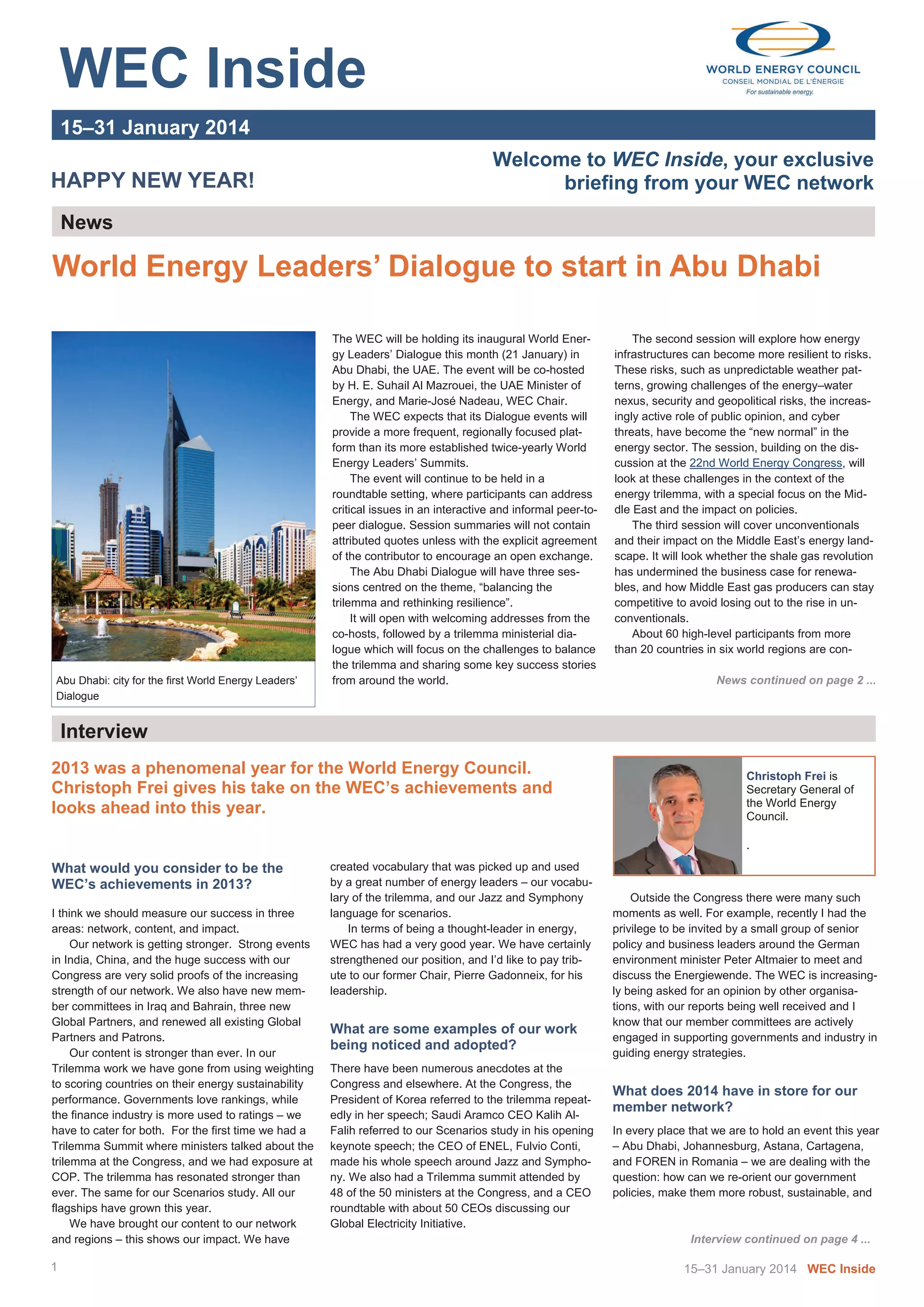
Abu Dhabi: city for the first World Energy Leaders’
Dialogue

The WEC will be holding its inaugural World Energy Leaders’ Dialogue this month (21 January) in
Abu Dhabi, the UAE. The event will be co-hosted
by H. E. Suhail Al Mazrouei, the UAE Minister of
Energy, and Marie-José Nadeau, WEC Chair.
The WEC expects that its Dialogue events will
provide a more frequent, regionally focused platform than its more established twice-yearly World
Energy Leaders’ Summits.
The event will continue to be held in a
roundtable setting, where participants can address
critical issues in an interactive and informal peer-topeer dialogue. Session summaries will not contain
attributed quotes unless with the explicit agreement
of the contributor to encourage an open exchange.
The Abu Dhabi Dialogue will have three sessions centred on the theme, “balancing the
trilemma and rethinking resilience”.
It will open with welcoming addresses from the
co-hosts, followed by a trilemma ministerial dialogue which will focus on the challenges to balance
the trilemma and sharing some key success stories
from around the world.

The second session will explore how energy
infrastructures can become more resilient to risks.
These risks, such as unpredictable weather patterns, growing challenges of the energy–water
nexus, security and geopolitical risks, the increasingly active role of public opinion, and cyber
threats, have become the “new normal” in the
energy sector. The session, building on the discussion at the 22nd World Energy Congress, will
look at these challenges in the context of the
energy trilemma, with a special focus on the Middle East and the impact on policies.
The third session will cover unconventionals
and their impact on the Middle East’s energy landscape. It will look whether the shale gas revolution
has undermined the business case for renewables, and how Middle East gas producers can stay
competitive to avoid losing out to the rise in unconventionals.
About 60 high-level participants from more
than 20 countries in six world regions are conNews continued on page 2 ...

Interview 
2013 was a phenomenal year for the World Energy Council.
Christoph Frei gives his take on the WEC’s achievements and
looks ahead into this year.

Christoph Frei is
Secretary General of
the World Energy
Council.
.

What would you consider to be the
WEC’s achievements in 2013?
I think we should measure our success in three
areas: network, content, and impact.
Our network is getting stronger. Strong events
in India, China, and the huge success with our
Congress are very solid proofs of the increasing
strength of our network. We also have new member committees in Iraq and Bahrain, three new
Global Partners, and renewed all existing Global
Partners and Patrons.
Our content is stronger than ever. In our
Trilemma work we have gone from using weighting
to scoring countries on their energy sustainability
performance. Governments love rankings, while
the finance industry is more used to ratings – we
have to cater for both. For the first time we had a
Trilemma Summit where ministers talked about the
trilemma at the Congress, and we had exposure at
COP. The trilemma has resonated stronger than
ever. The same for our Scenarios study. All our
flagships have grown this year.
We have brought our content to our network
and regions – this shows our impact. We have

1


created vocabulary that was picked up and used
by a great number of energy leaders – our vocabulary of the trilemma, and our Jazz and Symphony
language for scenarios.
In terms of being a thought-leader in energy,
WEC has had a very good year. We have certainly
strengthened our position, and I’d like to pay tribute to our former Chair, Pierre Gadonneix, for his
leadership.

What are some examples of our work
being noticed and adopted?
There have been numerous anecdotes at the
Congress and elsewhere. At the Congress, the
President of Korea referred to the trilemma repeatedly in her speech; Saudi Aramco CEO Kalih AlFalih referred to our Scenarios study in his opening
keynote speech; the CEO of ENEL, Fulvio Conti,
made his whole speech around Jazz and Symphony. We also had a Trilemma summit attended by
48 of the 50 ministers at the Congress, and a CEO
roundtable with about 50 CEOs discussing our
Global Electricity Initiative.

Outside the Congress there were many such
moments as well. For example, recently I had the
privilege to be invited by a small group of senior
policy and business leaders around the German
environment minister Peter Altmaier to meet and
discuss the Energiewende. The WEC is increasingly being asked for an opinion by other organisations, with our reports being well received and I
know that our member committees are actively
engaged in supporting governments and industry in
guiding energy strategies.

What does 2014 have in store for our
member network?
In every place that we are to hold an event this year
– Abu Dhabi, Johannesburg, Astana, Cartagena,
and FOREN in Romania – we are dealing with the
question: how can we re-orient our government
policies, make them more robust, sustainable, and

Interview continued on page 4 ...

15–31 January 2014 WEC Inside

Anteprima WEC Inside - 15 Gennaio 2014

  • 1.
    WEC Inside         15–31 January2014  HAPPY NEW YEAR! Welcome to WEC Inside, your exclusive briefing from your WEC network News  World Energy Leaders’ Dialogue to start in Abu Dhabi Abu Dhabi: city for the first World Energy Leaders’ Dialogue The WEC will be holding its inaugural World Energy Leaders’ Dialogue this month (21 January) in Abu Dhabi, the UAE. The event will be co-hosted by H. E. Suhail Al Mazrouei, the UAE Minister of Energy, and Marie-José Nadeau, WEC Chair. The WEC expects that its Dialogue events will provide a more frequent, regionally focused platform than its more established twice-yearly World Energy Leaders’ Summits. The event will continue to be held in a roundtable setting, where participants can address critical issues in an interactive and informal peer-topeer dialogue. Session summaries will not contain attributed quotes unless with the explicit agreement of the contributor to encourage an open exchange. The Abu Dhabi Dialogue will have three sessions centred on the theme, “balancing the trilemma and rethinking resilience”. It will open with welcoming addresses from the co-hosts, followed by a trilemma ministerial dialogue which will focus on the challenges to balance the trilemma and sharing some key success stories from around the world. The second session will explore how energy infrastructures can become more resilient to risks. These risks, such as unpredictable weather patterns, growing challenges of the energy–water nexus, security and geopolitical risks, the increasingly active role of public opinion, and cyber threats, have become the “new normal” in the energy sector. The session, building on the discussion at the 22nd World Energy Congress, will look at these challenges in the context of the energy trilemma, with a special focus on the Middle East and the impact on policies. The third session will cover unconventionals and their impact on the Middle East’s energy landscape. It will look whether the shale gas revolution has undermined the business case for renewables, and how Middle East gas producers can stay competitive to avoid losing out to the rise in unconventionals. About 60 high-level participants from more than 20 countries in six world regions are conNews continued on page 2 ... Interview  2013 was a phenomenal year for the World Energy Council. Christoph Frei gives his take on the WEC’s achievements and looks ahead into this year. Christoph Frei is Secretary General of the World Energy Council. . What would you consider to be the WEC’s achievements in 2013? I think we should measure our success in three areas: network, content, and impact. Our network is getting stronger. Strong events in India, China, and the huge success with our Congress are very solid proofs of the increasing strength of our network. We also have new member committees in Iraq and Bahrain, three new Global Partners, and renewed all existing Global Partners and Patrons. Our content is stronger than ever. In our Trilemma work we have gone from using weighting to scoring countries on their energy sustainability performance. Governments love rankings, while the finance industry is more used to ratings – we have to cater for both. For the first time we had a Trilemma Summit where ministers talked about the trilemma at the Congress, and we had exposure at COP. The trilemma has resonated stronger than ever. The same for our Scenarios study. All our flagships have grown this year. We have brought our content to our network and regions – this shows our impact. We have 1   created vocabulary that was picked up and used by a great number of energy leaders – our vocabulary of the trilemma, and our Jazz and Symphony language for scenarios. In terms of being a thought-leader in energy, WEC has had a very good year. We have certainly strengthened our position, and I’d like to pay tribute to our former Chair, Pierre Gadonneix, for his leadership. What are some examples of our work being noticed and adopted? There have been numerous anecdotes at the Congress and elsewhere. At the Congress, the President of Korea referred to the trilemma repeatedly in her speech; Saudi Aramco CEO Kalih AlFalih referred to our Scenarios study in his opening keynote speech; the CEO of ENEL, Fulvio Conti, made his whole speech around Jazz and Symphony. We also had a Trilemma summit attended by 48 of the 50 ministers at the Congress, and a CEO roundtable with about 50 CEOs discussing our Global Electricity Initiative. Outside the Congress there were many such moments as well. For example, recently I had the privilege to be invited by a small group of senior policy and business leaders around the German environment minister Peter Altmaier to meet and discuss the Energiewende. The WEC is increasingly being asked for an opinion by other organisations, with our reports being well received and I know that our member committees are actively engaged in supporting governments and industry in guiding energy strategies. What does 2014 have in store for our member network? In every place that we are to hold an event this year – Abu Dhabi, Johannesburg, Astana, Cartagena, and FOREN in Romania – we are dealing with the question: how can we re-orient our government policies, make them more robust, sustainable, and Interview continued on page 4 ... 15–31 January 2014 WEC Inside