Sarah’s Promise
Genesis 17:15-17; 18:9-15; 21:1-7
Context
When God originally called Abram (as he was then known) to leave his
home in Ur of the Chaldeans, he summarized the blessings that would
follow (Genesis 12:1-3).
Abram was 75 years old at the time. He and his family went to Canaan
and from there to Egypt to secure food during a famine. He and his
nephew Lot separated upon their return to the Promised Land.
Context
Once more God reaffirmed his covenant with Abram (Genesis 15:1-5).
Sarai, Abram’s wife, still had borne no children. She encouraged her husband
to marry her Egyptian maidservant, Hagar (16:1-4). Hagar conceived and
had a son (Ishmael), but Sarai mistreated her and she fled.
God appeared to Abram once again when he was 99 years old (17:1).
He told him that his name would now be Abraham, ―a father of many
nations.‖ Canaan would be his inheritance. The Lord commanded him to
keep the covenant of circumcision with every male among the people.
Context
The lesson examines the Promise to Sarah.
The study's aim is to see God at work with people of faith in seemingly
impossible situations.
The study's application is to trust God's Word and His character in our
daily walk and worship despite our doubts.
Genesis 17:15
God said to Abraham, “As for Sarai your wife, you shall not call her
Sarai, but Sarah shall be her name.
Genesis 17:15
Just as God changed Abraham’s name from Abram meaning
―exalted ancestor‖ to Abraham meaning ―ancestor of a multitude‖ so
God changed Sarai to Sarah.
Although both names mean ―Princess‖ as far as we know, the name
change indicated a new beginning for her coming nation.
Genesis 17:15
As their heavenly Father, God changed the names of both of them,
and God promised to care for both of them as their heavenly Father
when He made them parents.
Because Abraham was her husband and would be the father of her
child, God spoke directly to Abraham when He commanded that
Sarah’s name be changed.
Genesis 17:16
I will bless her, and moreover I will give you a son by her. I will bless
her, and she shall give rise to nations; kings of peoples shall come from
her.”
Genesis 17:16
When God changed Sarah’s name, God promised to give her true joy
and happiness: ―blessed‖ can be translated as ―happy‖ (as in the
Beatitudes of Jesus in Mathew chapter 5). God would act and the

result would be happiness for Sarah and her descendants.
History has shown that kings did come from her; for example, King
David, King Solomon, and King Jesus of Nazareth (who came as the

Messiah or the Christ).
Eve was called the mother of all living. Sarah was defined by being
the princess of nations.
Genesis 17:17
Then Abraham fell on his face and laughed, and said to himself, “Can
a child be born to a man who is a hundred years old? Can Sarah, who
is ninety years old, bear a child?”
Genesis 17:17
Abraham’s laughter did not necessarily express doubt about what
God could or would do, because earlier God had made a sacred
covenant (contract or promise) with Abraham that He would give

Abraham land and descendants to fill the land.
Abraham laughed with joy that a couple the age of Sarah and himself
would have a child through an act of God. Abraham didn’t expect

that one.
Genesis 17:17
Lesson: Neither time nor natural laws can keep God from
accomplishing His plans (Gen. 17:15-17)
Reflection: Everyday God performs the miraculous. He heals broken
bodies of cancer and restores ill children from disease. That He
doesn’t do this with everyone causes us to question even the
miraculous. We should not doubt His power but recognize His right to

exercise it as He chooses.
Genesis 18:9-15
The Lord appeared to Abraham six times in Genesis; this is the fifth. He
is now about 100 years of age while Sarah is 90. In the opening section
of this chapter, three visitors came to them. It appears that two were

angels while the other was the Lord himself. The Lord told him that he
would return in about one year, and that Sarah would have a son.
Standing outside the tent door, Sarah overheard their conversation.

She laughed to herself in disbelief.
Genesis 18:9-10
They said to him, “Where is your wife Sarah?” And he said, “There, in
the tent.” Then one said, „I will surely return to you in due season, and
your wife Sarah shall have a son.‟ And Sarah was listening at the tent
entrance behind him.
Genesis 18:9-10
The LORD (the Father, the Son, and the Holy Spirit, or One or Two of the
Three Persons of the Trinity with one or two angels: Genesis 18:1-10)
came to Abraham on their way to investigate Sodom and Gomorrah.
Abraham prepared a feast for them under a tree while Sarah waited
within the tent (having helped with the meal preparations). She was
listening to the conversation (as the LORD knew) when ―They‖ brought

the conversation around to Sarah and her having a child in spite of her
old age.
Genesis 18:9-10
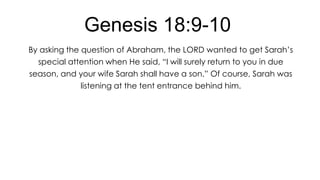
By asking the question of Abraham, the LORD wanted to get Sarah’s
special attention when He said, ―I will surely return to you in due
season, and your wife Sarah shall have a son.‖ Of course, Sarah was

listening at the tent entrance behind him.
Genesis 18:9-10
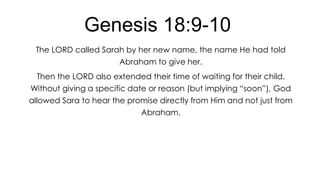
The LORD called Sarah by her new name, the name He had told
Abraham to give her.
Then the LORD also extended their time of waiting for their child.
Without giving a specific date or reason (but implying ―soon‖), God
allowed Sara to hear the promise directly from Him and not just from
Abraham.
Genesis 18:9-10
Notice: Sarah was behind the LORD, but He knew of her presence and
He would hear her laugh to herself.
The Bible does not tell us if the LORD had ever spoken to Sarah before
this time, but He may have done so.
Genesis 18:11
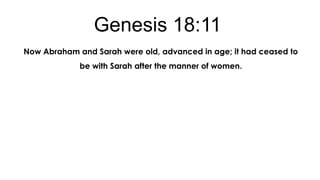
Now Abraham and Sarah were old, advanced in age; it had ceased to
be with Sarah after the manner of women.
Genesis 18:11
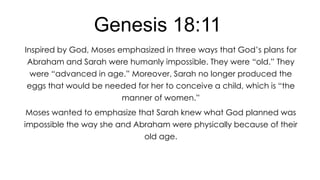
Inspired by God, Moses emphasized in three ways that God’s plans for
Abraham and Sarah were humanly impossible. They were ―old.‖ They
were ―advanced in age.‖ Moreover, Sarah no longer produced the

eggs that would be needed for her to conceive a child, which is ―the
manner of women.‖
Moses wanted to emphasize that Sarah knew what God planned was

impossible the way she and Abraham were physically because of their
old age.
Genesis 18:11
Lesson: God's timing is always perfect (Gen. 18:9-10; cf. 17:16; 21:2)
Reflection: Perhaps our real struggle with understanding God is
accepting His timing. God doesn’t think like we think and years matter
little to Him. His timing serves His will and not our own. God can
accomplish what He wants in our lives if we are willing to leave the
timing to Him.
Genesis 18:12
So Sarah laughed to herself, saying, “After I have grown old, and my
husband is old, shall I have pleasure?”
Genesis 18:12
God could hear her and read her mind. Sarah knew that physically
speaking, without God’s intervention, it would be impossible for either
Abraham or her to conceive a child.

She had already felt the sting of Hagar’s contempt, so she knew the
situation was impossible humanly speaking – the Bible repeatedly
emphasizes this fact.
After suffering Hagar’s scorn, could she now have the pleasure of
giving birth to and raising her own child? The child would be
conceived naturally, but with God supernaturally making them able to
conceive.
Genesis 18:12
Lesson: Our truest responses often come when we think no one is
listening (Gen. 18:11-12; Luke 6:45)
Reflection: What would happen if your hidden thoughts were suddenly
given voice? The results could not only be embarrassing but harmful.
How foolish that we do not remember that God hears all those
thoughts and their motives. Maybe we should be listening to our

thoughts more. He is.
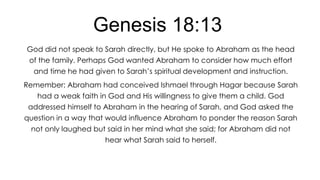
Genesis 18:13
The LORD said to Abraham, “Why did Sarah laugh, and say, „Shall I
indeed bear a child, now that I am old?‟
Genesis 18:13
God did not speak to Sarah directly, but He spoke to Abraham as the head
of the family. Perhaps God wanted Abraham to consider how much effort
and time he had given to Sarah’s spiritual development and instruction.

Remember: Abraham had conceived Ishmael through Hagar because Sarah
had a weak faith in God and His willingness to give them a child. God
addressed himself to Abraham in the hearing of Sarah, and God asked the
question in a way that would influence Abraham to ponder the reason Sarah
not only laughed but said in her mind what she said; for Abraham did not
hear what Sarah said to herself.
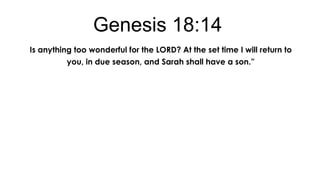
Genesis 18:14
Is anything too wonderful for the LORD? At the set time I will return to
you, in due season, and Sarah shall have a son.”
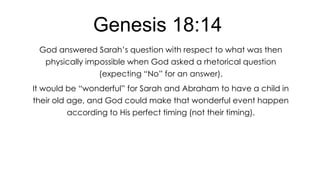
Genesis 18:14
God answered Sarah’s question with respect to what was then
physically impossible when God asked a rhetorical question
(expecting ―No‖ for an answer).
It would be ―wonderful‖ for Sarah and Abraham to have a child in
their old age, and God could make that wonderful event happen
according to His perfect timing (not their timing).
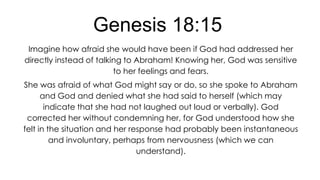
Genesis 18:15
But Sarah denied, saying, “I did not laugh”; for she was afraid. He said,
“Oh yes, you did laugh.”
Genesis 18:15
Imagine how afraid she would have been if God had addressed her
directly instead of talking to Abraham! Knowing her, God was sensitive
to her feelings and fears.

She was afraid of what God might say or do, so she spoke to Abraham
and God and denied what she had said to herself (which may
indicate that she had not laughed out loud or verbally). God
corrected her without condemning her, for God understood how she
felt in the situation and her response had probably been instantaneous
and involuntary, perhaps from nervousness (which we can
understand).
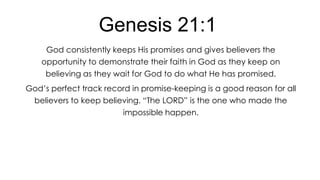
Genesis 21:1
The LORD dealt with Sarah as he had said, and the LORD did for Sarah
as he had promised.
Genesis 21:1
God consistently keeps His promises and gives believers the
opportunity to demonstrate their faith in God as they keep on
believing as they wait for God to do what He has promised.
God’s perfect track record in promise-keeping is a good reason for all
believers to keep believing. ―The LORD‖ is the one who made the
impossible happen.
Genesis 21:1
Lesson: Because God is faithful, He can and will do what He promises
(21:1-3)
Reflection: We often confuse God’s promises with our efforts as if they
will not occur if we don’t do our part. God can and will do what He
plans regardless of our efforts. That we have the privilege of sharing in
the fulfillment of that plan, should create thanksgiving in us and not

apprehension.
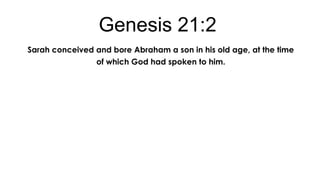
Genesis 21:2
Sarah conceived and bore Abraham a son in his old age, at the time
of which God had spoken to him.
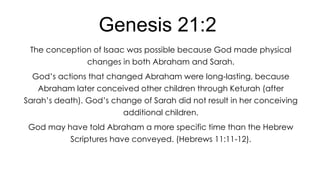
Genesis 21:2
The conception of Isaac was possible because God made physical
changes in both Abraham and Sarah.
God’s actions that changed Abraham were long-lasting, because
Abraham later conceived other children through Keturah (after
Sarah’s death). God’s change of Sarah did not result in her conceiving
additional children.

God may have told Abraham a more specific time than the Hebrew
Scriptures have conveyed. (Hebrews 11:11-12).
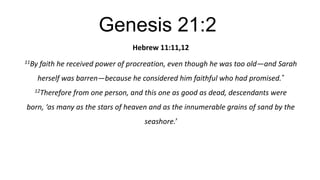
Genesis 21:2
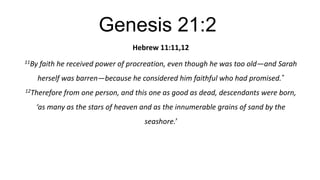
Hebrew 11:11,12
11By

faith he received power of procreation, even though he was too old—and Sarah

herself was barren—because he considered him faithful who had promised.*
12Therefore

from one person, and this one as good as dead, descendants were

born, ‘as many as the stars of heaven and as the innumerable grains of sand by the
seashore.’
Genesis 21:2
Hebrew 11:11,12
11By

faith he received power of procreation, even though he was too old—and Sarah

herself was barren—because he considered him faithful who had promised.*
12Therefore

from one person, and this one as good as dead, descendants were born,

‘as many as the stars of heaven and as the innumerable grains of sand by the
seashore.’
Genesis 21:3
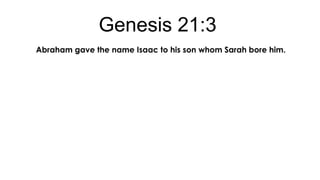
Abraham gave the name Isaac to his son whom Sarah bore him.
Genesis 21:3
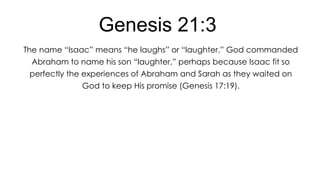
The name ―Isaac‖ means ―he laughs‖ or ―laughter.‖ God commanded
Abraham to name his son ―laughter,‖ perhaps because Isaac fit so
perfectly the experiences of Abraham and Sarah as they waited on

God to keep His promise (Genesis 17:19).
Genesis 21:4
And Abraham circumcised his son Isaac when he was eight days old,
as God had commanded him.
Genesis 21:4
Abraham circumcised Isaac according to the command of God.
Circumcision was the sign of the covenant that God made with
Abraham (Genesis 17:9-14).
Earlier, Abraham was circumcised at the age of 99, and also his son
Ishmael at the age of 13 (Genesis 17:23-25). God’s covenant was to be
an everlasting covenant with Isaac and his offspring (Genesis 17:19).

So, all of Abraham’s descendants were to be circumcised.
Genesis 21:5
Abraham was a hundred years old when his son Isaac was born to
him.
Genesis 21:5
Abraham had obeyed God in faith when he had himself and his
household circumcised, and God fulfilled His part of the covenant
when Abraham conceived Isaac and Isaac was born and

circumcised at eight days of age.
Likewise, Jesus was circumcised at eight days of age (Luke 2:21).
Now, the New Testament emphasizes our spiritual circumcision: ―In him

[Christ] also you were circumcised with a spiritual circumcision, by
putting off the body of the flesh in the circumcision of Christ‖
(Colossians 2:11).
Genesis 21:6
Now Sarah said, “God has brought laughter for me; everyone who
hears will laugh with me.”
Genesis 21:6
Sarah and Abraham experienced joy that expresses itself in laughter.
Laughter is not bad, and laughter can express faith and thanksgiving
when a person receives from God what God has promised.
Not only would Sarah laugh, she would also experience joy and others
would laugh also.
Genesis 21:6
Lesson: Only God can turn the laughter of unbelief into the laughter of
joy (vss. 4-7)
Reflection: History is filled with the taunts of doubters who became
great believers. That one questions and mocks should draw our
prayers and not our anger. They simply don’t realize who is pursuing
them. We should pray for them and watch God at His best.
Genesis 21:7
And she said, “Who would ever have said to Abraham that Sarah
would nurse children? Yet I have borne him a son in his old age.”
Genesis 21:7
Sarah emphasized the fact that having a son born to them was
humanly impossible because of their age.
Later, the Messiah, the Son of God, would be conceived when the
Holy Spirit overshadowed a virgin, Mary, another humanly impossible
and wonderful thing for God to do for her and all who would believe in
Jesus as their Lord and Savior.
Conclusion
Sarah died at the age of 127 years. She is the only woman in the Bible
whose age at death is recorded.
Edith Deen summed up her life by saying, ―The fact that Sarah is
mentioned in three other places in the New Testament (1 Peter 3:6;
Romans 4:19 and 9:9), as well as in Isaiah 51:2, is evidence of the
revered place she held in Hebrew history.‖
Conclusion
Some people make promises to God that are intended to manipulate
God into doing what they want. The phrase foxhole religion describes
another category of suspect promises.
The one making this type of promise commits his or her future, with all
sincerity, to God if God will only spare the person from imminent
danger. But the promise may fade from memory once the danger has

passed.
Conclusion
Today's lesson was about promises that God made to Sarah about her
having a son. God's promises are not like ours—he never manipulates;
his memory doesn't fade.
When God promises, he keeps his word, and we receive the benefits.

Sarah's Promise

  • 1.
  • 2.
    Context When God originallycalled Abram (as he was then known) to leave his home in Ur of the Chaldeans, he summarized the blessings that would follow (Genesis 12:1-3). Abram was 75 years old at the time. He and his family went to Canaan and from there to Egypt to secure food during a famine. He and his nephew Lot separated upon their return to the Promised Land.
  • 3.
    Context Once more Godreaffirmed his covenant with Abram (Genesis 15:1-5). Sarai, Abram’s wife, still had borne no children. She encouraged her husband to marry her Egyptian maidservant, Hagar (16:1-4). Hagar conceived and had a son (Ishmael), but Sarai mistreated her and she fled. God appeared to Abram once again when he was 99 years old (17:1). He told him that his name would now be Abraham, ―a father of many nations.‖ Canaan would be his inheritance. The Lord commanded him to keep the covenant of circumcision with every male among the people.
  • 4.
    Context The lesson examinesthe Promise to Sarah. The study's aim is to see God at work with people of faith in seemingly impossible situations. The study's application is to trust God's Word and His character in our daily walk and worship despite our doubts.
  • 5.
    Genesis 17:15 God saidto Abraham, “As for Sarai your wife, you shall not call her Sarai, but Sarah shall be her name.
  • 6.
    Genesis 17:15 Just asGod changed Abraham’s name from Abram meaning ―exalted ancestor‖ to Abraham meaning ―ancestor of a multitude‖ so God changed Sarai to Sarah. Although both names mean ―Princess‖ as far as we know, the name change indicated a new beginning for her coming nation.
  • 7.
    Genesis 17:15 As theirheavenly Father, God changed the names of both of them, and God promised to care for both of them as their heavenly Father when He made them parents. Because Abraham was her husband and would be the father of her child, God spoke directly to Abraham when He commanded that Sarah’s name be changed.
  • 8.
    Genesis 17:16 I willbless her, and moreover I will give you a son by her. I will bless her, and she shall give rise to nations; kings of peoples shall come from her.”
  • 9.
    Genesis 17:16 When Godchanged Sarah’s name, God promised to give her true joy and happiness: ―blessed‖ can be translated as ―happy‖ (as in the Beatitudes of Jesus in Mathew chapter 5). God would act and the result would be happiness for Sarah and her descendants. History has shown that kings did come from her; for example, King David, King Solomon, and King Jesus of Nazareth (who came as the Messiah or the Christ). Eve was called the mother of all living. Sarah was defined by being the princess of nations.
  • 10.
    Genesis 17:17 Then Abrahamfell on his face and laughed, and said to himself, “Can a child be born to a man who is a hundred years old? Can Sarah, who is ninety years old, bear a child?”
  • 11.
    Genesis 17:17 Abraham’s laughterdid not necessarily express doubt about what God could or would do, because earlier God had made a sacred covenant (contract or promise) with Abraham that He would give Abraham land and descendants to fill the land. Abraham laughed with joy that a couple the age of Sarah and himself would have a child through an act of God. Abraham didn’t expect that one.
  • 12.
    Genesis 17:17 Lesson: Neithertime nor natural laws can keep God from accomplishing His plans (Gen. 17:15-17) Reflection: Everyday God performs the miraculous. He heals broken bodies of cancer and restores ill children from disease. That He doesn’t do this with everyone causes us to question even the miraculous. We should not doubt His power but recognize His right to exercise it as He chooses.
  • 13.
    Genesis 18:9-15 The Lordappeared to Abraham six times in Genesis; this is the fifth. He is now about 100 years of age while Sarah is 90. In the opening section of this chapter, three visitors came to them. It appears that two were angels while the other was the Lord himself. The Lord told him that he would return in about one year, and that Sarah would have a son. Standing outside the tent door, Sarah overheard their conversation. She laughed to herself in disbelief.
  • 14.
    Genesis 18:9-10 They saidto him, “Where is your wife Sarah?” And he said, “There, in the tent.” Then one said, „I will surely return to you in due season, and your wife Sarah shall have a son.‟ And Sarah was listening at the tent entrance behind him.
  • 15.
    Genesis 18:9-10 The LORD(the Father, the Son, and the Holy Spirit, or One or Two of the Three Persons of the Trinity with one or two angels: Genesis 18:1-10) came to Abraham on their way to investigate Sodom and Gomorrah. Abraham prepared a feast for them under a tree while Sarah waited within the tent (having helped with the meal preparations). She was listening to the conversation (as the LORD knew) when ―They‖ brought the conversation around to Sarah and her having a child in spite of her old age.
  • 16.
    Genesis 18:9-10 By askingthe question of Abraham, the LORD wanted to get Sarah’s special attention when He said, ―I will surely return to you in due season, and your wife Sarah shall have a son.‖ Of course, Sarah was listening at the tent entrance behind him.
  • 17.
    Genesis 18:9-10 The LORDcalled Sarah by her new name, the name He had told Abraham to give her. Then the LORD also extended their time of waiting for their child. Without giving a specific date or reason (but implying ―soon‖), God allowed Sara to hear the promise directly from Him and not just from Abraham.
  • 18.
    Genesis 18:9-10 Notice: Sarahwas behind the LORD, but He knew of her presence and He would hear her laugh to herself. The Bible does not tell us if the LORD had ever spoken to Sarah before this time, but He may have done so.
  • 19.
    Genesis 18:11 Now Abrahamand Sarah were old, advanced in age; it had ceased to be with Sarah after the manner of women.
  • 20.
    Genesis 18:11 Inspired byGod, Moses emphasized in three ways that God’s plans for Abraham and Sarah were humanly impossible. They were ―old.‖ They were ―advanced in age.‖ Moreover, Sarah no longer produced the eggs that would be needed for her to conceive a child, which is ―the manner of women.‖ Moses wanted to emphasize that Sarah knew what God planned was impossible the way she and Abraham were physically because of their old age.
  • 21.
    Genesis 18:11 Lesson: God'stiming is always perfect (Gen. 18:9-10; cf. 17:16; 21:2) Reflection: Perhaps our real struggle with understanding God is accepting His timing. God doesn’t think like we think and years matter little to Him. His timing serves His will and not our own. God can accomplish what He wants in our lives if we are willing to leave the timing to Him.
  • 22.
    Genesis 18:12 So Sarahlaughed to herself, saying, “After I have grown old, and my husband is old, shall I have pleasure?”
  • 23.
    Genesis 18:12 God couldhear her and read her mind. Sarah knew that physically speaking, without God’s intervention, it would be impossible for either Abraham or her to conceive a child. She had already felt the sting of Hagar’s contempt, so she knew the situation was impossible humanly speaking – the Bible repeatedly emphasizes this fact. After suffering Hagar’s scorn, could she now have the pleasure of giving birth to and raising her own child? The child would be conceived naturally, but with God supernaturally making them able to conceive.
  • 24.
    Genesis 18:12 Lesson: Ourtruest responses often come when we think no one is listening (Gen. 18:11-12; Luke 6:45) Reflection: What would happen if your hidden thoughts were suddenly given voice? The results could not only be embarrassing but harmful. How foolish that we do not remember that God hears all those thoughts and their motives. Maybe we should be listening to our thoughts more. He is.
  • 25.
    Genesis 18:13 The LORDsaid to Abraham, “Why did Sarah laugh, and say, „Shall I indeed bear a child, now that I am old?‟
  • 26.
    Genesis 18:13 God didnot speak to Sarah directly, but He spoke to Abraham as the head of the family. Perhaps God wanted Abraham to consider how much effort and time he had given to Sarah’s spiritual development and instruction. Remember: Abraham had conceived Ishmael through Hagar because Sarah had a weak faith in God and His willingness to give them a child. God addressed himself to Abraham in the hearing of Sarah, and God asked the question in a way that would influence Abraham to ponder the reason Sarah not only laughed but said in her mind what she said; for Abraham did not hear what Sarah said to herself.
  • 27.
    Genesis 18:14 Is anythingtoo wonderful for the LORD? At the set time I will return to you, in due season, and Sarah shall have a son.”
  • 28.
    Genesis 18:14 God answeredSarah’s question with respect to what was then physically impossible when God asked a rhetorical question (expecting ―No‖ for an answer). It would be ―wonderful‖ for Sarah and Abraham to have a child in their old age, and God could make that wonderful event happen according to His perfect timing (not their timing).
  • 29.
    Genesis 18:15 But Sarahdenied, saying, “I did not laugh”; for she was afraid. He said, “Oh yes, you did laugh.”
  • 30.
    Genesis 18:15 Imagine howafraid she would have been if God had addressed her directly instead of talking to Abraham! Knowing her, God was sensitive to her feelings and fears. She was afraid of what God might say or do, so she spoke to Abraham and God and denied what she had said to herself (which may indicate that she had not laughed out loud or verbally). God corrected her without condemning her, for God understood how she felt in the situation and her response had probably been instantaneous and involuntary, perhaps from nervousness (which we can understand).
  • 31.
    Genesis 21:1 The LORDdealt with Sarah as he had said, and the LORD did for Sarah as he had promised.
  • 32.
    Genesis 21:1 God consistentlykeeps His promises and gives believers the opportunity to demonstrate their faith in God as they keep on believing as they wait for God to do what He has promised. God’s perfect track record in promise-keeping is a good reason for all believers to keep believing. ―The LORD‖ is the one who made the impossible happen.
  • 33.
    Genesis 21:1 Lesson: BecauseGod is faithful, He can and will do what He promises (21:1-3) Reflection: We often confuse God’s promises with our efforts as if they will not occur if we don’t do our part. God can and will do what He plans regardless of our efforts. That we have the privilege of sharing in the fulfillment of that plan, should create thanksgiving in us and not apprehension.
  • 34.
    Genesis 21:2 Sarah conceivedand bore Abraham a son in his old age, at the time of which God had spoken to him.
  • 35.
    Genesis 21:2 The conceptionof Isaac was possible because God made physical changes in both Abraham and Sarah. God’s actions that changed Abraham were long-lasting, because Abraham later conceived other children through Keturah (after Sarah’s death). God’s change of Sarah did not result in her conceiving additional children. God may have told Abraham a more specific time than the Hebrew Scriptures have conveyed. (Hebrews 11:11-12).
  • 36.
    Genesis 21:2 Hebrew 11:11,12 11By faithhe received power of procreation, even though he was too old—and Sarah herself was barren—because he considered him faithful who had promised.* 12Therefore from one person, and this one as good as dead, descendants were born, ‘as many as the stars of heaven and as the innumerable grains of sand by the seashore.’
  • 37.
    Genesis 21:2 Hebrew 11:11,12 11By faithhe received power of procreation, even though he was too old—and Sarah herself was barren—because he considered him faithful who had promised.* 12Therefore from one person, and this one as good as dead, descendants were born, ‘as many as the stars of heaven and as the innumerable grains of sand by the seashore.’
  • 38.
    Genesis 21:3 Abraham gavethe name Isaac to his son whom Sarah bore him.
  • 39.
    Genesis 21:3 The name―Isaac‖ means ―he laughs‖ or ―laughter.‖ God commanded Abraham to name his son ―laughter,‖ perhaps because Isaac fit so perfectly the experiences of Abraham and Sarah as they waited on God to keep His promise (Genesis 17:19).
  • 40.
    Genesis 21:4 And Abrahamcircumcised his son Isaac when he was eight days old, as God had commanded him.
  • 41.
    Genesis 21:4 Abraham circumcisedIsaac according to the command of God. Circumcision was the sign of the covenant that God made with Abraham (Genesis 17:9-14). Earlier, Abraham was circumcised at the age of 99, and also his son Ishmael at the age of 13 (Genesis 17:23-25). God’s covenant was to be an everlasting covenant with Isaac and his offspring (Genesis 17:19). So, all of Abraham’s descendants were to be circumcised.
  • 42.
    Genesis 21:5 Abraham wasa hundred years old when his son Isaac was born to him.
  • 43.
    Genesis 21:5 Abraham hadobeyed God in faith when he had himself and his household circumcised, and God fulfilled His part of the covenant when Abraham conceived Isaac and Isaac was born and circumcised at eight days of age. Likewise, Jesus was circumcised at eight days of age (Luke 2:21). Now, the New Testament emphasizes our spiritual circumcision: ―In him [Christ] also you were circumcised with a spiritual circumcision, by putting off the body of the flesh in the circumcision of Christ‖ (Colossians 2:11).
  • 44.
    Genesis 21:6 Now Sarahsaid, “God has brought laughter for me; everyone who hears will laugh with me.”
  • 45.
    Genesis 21:6 Sarah andAbraham experienced joy that expresses itself in laughter. Laughter is not bad, and laughter can express faith and thanksgiving when a person receives from God what God has promised. Not only would Sarah laugh, she would also experience joy and others would laugh also.
  • 46.
    Genesis 21:6 Lesson: OnlyGod can turn the laughter of unbelief into the laughter of joy (vss. 4-7) Reflection: History is filled with the taunts of doubters who became great believers. That one questions and mocks should draw our prayers and not our anger. They simply don’t realize who is pursuing them. We should pray for them and watch God at His best.
  • 47.
    Genesis 21:7 And shesaid, “Who would ever have said to Abraham that Sarah would nurse children? Yet I have borne him a son in his old age.”
  • 48.
    Genesis 21:7 Sarah emphasizedthe fact that having a son born to them was humanly impossible because of their age. Later, the Messiah, the Son of God, would be conceived when the Holy Spirit overshadowed a virgin, Mary, another humanly impossible and wonderful thing for God to do for her and all who would believe in Jesus as their Lord and Savior.
  • 49.
    Conclusion Sarah died atthe age of 127 years. She is the only woman in the Bible whose age at death is recorded. Edith Deen summed up her life by saying, ―The fact that Sarah is mentioned in three other places in the New Testament (1 Peter 3:6; Romans 4:19 and 9:9), as well as in Isaiah 51:2, is evidence of the revered place she held in Hebrew history.‖
  • 50.
    Conclusion Some people makepromises to God that are intended to manipulate God into doing what they want. The phrase foxhole religion describes another category of suspect promises. The one making this type of promise commits his or her future, with all sincerity, to God if God will only spare the person from imminent danger. But the promise may fade from memory once the danger has passed.
  • 51.
    Conclusion Today's lesson wasabout promises that God made to Sarah about her having a son. God's promises are not like ours—he never manipulates; his memory doesn't fade. When God promises, he keeps his word, and we receive the benefits.