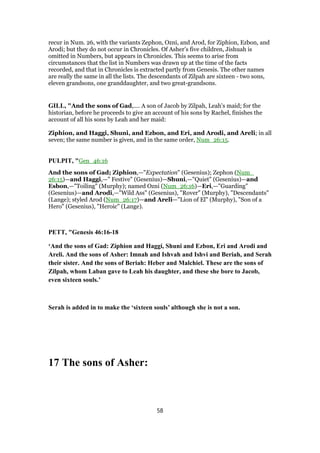
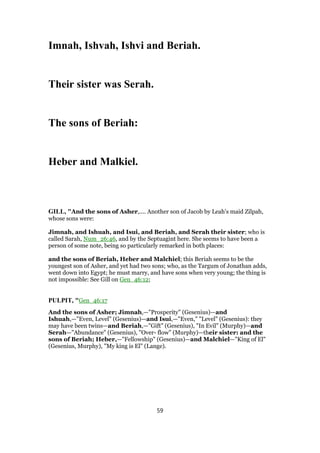
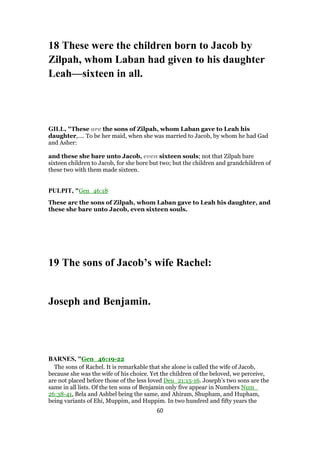
GENESIS 46 COMMENTARY
EDITED BY GLENN PEASE
Jacob Goes to Egypt
1 So Israel set out with all that was his, and
when he reached Beersheba, he offered
sacrifices to the God of his father Isaac.
BARNES, "Gen_46:1-4
Jacob arriving at Beer-sheba is encouraged by a revelation from God. Beer-sheba
may be regarded as the fourth scene of Abraham’s abode in the land of promise.
“Offered sacrifices.” He had gathered from the words of the Lord to Abraham Gen_
15:13, and the way in which the dreams of Joseph were realized in the events of
Providence, that his family were to descend into Egypt. He felt therefore, that in
taking this step he was obeying the will of Heaven. Hence, he approaches God in
sacrifices at an old abode of Abraham and Isaac, before he crosses the border to pass
into Egypt. On this solemn occasion God appears to him in the visions of the night.
He designates himself EL the Mighty, and the God of his father. The former name
cheers him with the thought of an all-sufficient Protector. The latter identifies the
speaker with the God of his father, and therefore, with the God of eternity, of
creation, and of covenant. “Fear not to go down into Mizraim.” This implies both that
it was the will of God that he should go down to Egypt, and that he would be
protected there. “A great nation.”
Jacob had now a numerous family, of whom no longer one was selected, but all
were included in the chosen seed. He had received the special blessing and injunction
to be fruitful and multiply Gen_28:3; Gen_35:11. The chosen family is to be the
beginning of the chosen nation. “I will go down with thee.” The “I” is here emphatic,
as it is also in the assurance that he will bring him up in the fullness of time from
Egypt. If Israel in the process of growth from a family to a nation had remained
among the Kenaanites, he would have been amalgamated with the nation by
intermarriage, and conformed to its vices. By his removal to Egypt he is kept apart
from the demoralizing influence of a nation, whose iniquity became so great as to
demand a judicial extirpation Gen_15:16. He is also kept from sinking into an
Egyptian by the fact that a shepherd, as he was, is an abomination to Egypt; by his
1
location in the comparatively high land of Goshen, which is a border land, not
naturally, but only politically, belonging to Egypt; and by the reduction of his race to
a body of serfs, with whom that nation would not condescend to intermingle. “Joseph
shall put his hand upon thine eyes.” His long-lost son shall be present to perform the
last offices to him when deceased.
CLARKE, "And came to Beer-sheba - This place appears to be mentioned,
not only because it was the way from Hebron, where Jacob resided, to Egypt, whither
he was going, but because it was a consecrated place, a place where God had
appeared to Abraham, Gen_21:33, and to Isaac, Gen_26:23, and where Jacob is
encouraged to expect a manifestation of the same goodness: he chooses therefore to
begin his journey with a visit to God’s house; and as he was going into a strange land,
he feels it right to renew his covenant with God by sacrifice. There is an old proverb
which applies strongly to this case: “Prayers and provender never hinder any man’s
journey. He who would travel safely must take God with him.
GILL, "And Israel took his journey with all that he had,.... Set forward in it
immediately, as soon as possible after he had resolved to take it, and with him he
took all his children and grandchildren, and all his cattle and goods; which shows
that he took his journey not only to see his son Joseph, but to continue in Egypt, at
least during the years of famine, as his son desired he would, otherwise there would
have been no occasion of taking all along with him:
and came to Beersheba: where he and his ancestors Abraham and Isaac had
formerly lived; a place where sacrifices had often been offered up, and the worship of
God performed, and much communion enjoyed with him. This is said to be sixteen
miles from Hebron (n), where Jacob dwelt, and according to Musculus was six
German miles from it:
and offered sacrifices to the God of his father Isaac; which were attended
with prayer and praise; with praise for hearing that his son Joseph was alive, and
with prayer that he might have a good, safe, and prosperous journey.
HENRY, "The divine precept is, In all thy ways acknowledge God; and the
promise annexed to it is, He shall direct thy paths. Jacob has here a very great
concern before him, not only a journey, but a removal, to settle in another country, a
change which was very surprising to him (for he never had any other thoughts than
to live and die in Canaan), and which would be of great consequence to his family for
a long time to come. Now here we are told,
I. How he acknowledged God in this way. He came to Beersheba, from Hebron,
where he now dwelt; and there he offered sacrifices to the God of his father Isaac,
Gen_46:1. He chose that place, in remembrance of the communion which his father
and grandfather had with God in that place. Abraham called on God there (Gen_
21:33), so did Isaac (Gen_26:25), and therefore Jacob made it the place of his
devotion, the rather because it lay in his way. In his devotion, 1. He had an eye to God
as the God of his father Isaac, that is, a God in covenant with him; for by Isaac the
covenant was entailed upon him. God had forbidden Isaac to go down to Egypt when
2
there was a famine in Canaan (Gen_26:2), which perhaps Jacob calls to mind when
he consults God as the God of his father Isaac, with this thought, “Lord, though I am
very desirous to see Joseph, yet if thou forbid me to go down to Egypt, as thou didst
my father Isaac, I will submit, and very contentedly stay where I am.” 2. He offered
sacrifices, extraordinary sacrifices, besides those at his stated times; these sacrifices
were offered, (1.) By way of thanksgiving for the late blessed change of the face of his
family, for the good news he had received concerning Joseph, and for the hopes he
had of seeing him. Note, We should give God thanks for the beginnings of mercy,
though they are not yet perfected; and this is a decent way of begging further mercy.
(2.) By way of petition for the presence of God with him in his intended journey; he
desired by these sacrifices to make his peace with God, to obtain the forgiveness of
sin, that he might take no guilt along with him in this journey, for that is a bad
companion. By Christ, the great sacrifice, we must reconcile ourselves to God, and
offer up our requests to him. (3.) By way of consultation. The heathen consulted their
oracles by sacrifice. Jacob would not go till he had asked God's leave: “Shall I go
down to Egypt, or back to Hebron?” Such must be our enquiries in doubtful cases;
and, though we cannot expect immediate answers from heaven, yet, if we diligently
attend to the directions of the word, conscience, and providence, we shall find it is
not in vain to ask counsel of God.
JAMISON, "Gen_46:1-4. Sacrifice at Beer-sheba.
Israel took his journey with all that he had — that is, his household; for in
compliance with Pharaoh’s recommendation, he left his heavy furniture behind. In
contemplating a step so important as that of leaving Canaan, which at his time of life
he might never revisit, so pious a patriarch would ask the guidance and counsel of
God. With all his anxiety to see Joseph, he would rather have died in Canaan without
that highest of earthly gratifications than leave it without the consciousness of
carrying the divine blessing along with him.
came to Beer-sheba — That place, which was in his direct route to Egypt, had
been a favorite encampment of Abraham (Gen_21:33) and Isaac (Gen_26:25), and
was memorable for their experience of the divine goodness; and Jacob seems to have
deferred his public devotions till he had reached a spot so consecrated by covenant to
his own God and the God of his fathers.
K&D, "“So Israel took his journey (from Hebron, Gen_37:14) with all who
belonged to him, and came to Beersheba.” There, on the border of Canaan, where
Abraham and Isaac had called upon the name of the Lord (Gen_21:33; Gen_26:25),
he offered sacrifices to the God of his father Isaac, ut sibi firmum et ratum esse
testetur faedus, quod Deus ipse cum Patribus pepigerat (Calvin). Even though Jacob
might see the ways of God in the wonderful course of his son Joseph, and discern in
the friendly invitation of Joseph and Pharaoh, combined with the famine prevailing
in Canaan, a divine direction to go into Egypt; yet this departure from the land of
promise, in which his fathers had lived as pilgrims, was a step which necessarily
excited serious thoughts in his mind as to his own future and that of his family, and
led him to commend himself and his followers to the care of the faithful covenant
God, whether in so doing he thought of the revelation which Abram had received
(Gen_15:13-16), or not.
CALVIN, "1.And Israel took his journey. Because the holy man is compelled to
3
leave the land of Canaan and to go elsewhere, he offers, on his departure, a
sacrifice to the Lord, for the purpose of testifying that the covenant which God
had made with his fathers was confirmed and ratified to himself. For, though he
was accustomed to exercise himself in the external worship of God, there was yet
a special reason for this sacrifice. And, doubtless, he had then peculiar need of
support, lest his faith should fail: for he was about to be deprived of the
inheritance promised to him, and of the sight of that land which was the type and
the pledge of the heavenly country. Might it not come into his mind that he had
hitherto been deluded with a vain hope? Therefore, by renewing the memory of
the divine covenant, he applies a suitable remedy against falling from the faith.
For this reason, he offers a sacrifice on the very boundaries of that land, as I
have just said; that we might know it to be something more than usual. And he
presents this worship to the God of his fathers, to testify that, although he is
departing from that land, into which Abraham had been called; yet he does not
thereby cut himself off from the God in whose worship he had been educated. It
was truly a remarkable proof of constancy, that when cast out by famine into
another region, so that he might not even be permitted to sojourn in the land of
which he was the lawful lord; he yet retains, deeply impressed on his mind, the
hope of his hidden right. It was not without subjecting himself to odium that he
differed openly from other nations, by worshipping the God of his fathers. But
what profit was there in having a religion different from all others? Seeing, then,
that he does not repent of having worshipped the God of his fathers, and that he
now also perseveres in fear and reverence towards him; we hence infer how
deeply he was rooted in true piety. By offering a sacrifice, he both increases his
own strength, and makes profession of his faith; because, although piety is not
bound to external symbols, yet he will not neglect those helps, the use of which he
has found to be, by no means, superfluous.
BENSON, "Genesis 46:1. Israel came to Beer-sheba — Which place he chose in
remembrance of the communion which his father and grandfather had had with
God in that place. And offered sacrifices — That is, extraordinary sacrifices,
besides those he was wont to offer at stated times; and this he did, as well to
express his gratitude for the preservation of Joseph’s life, and the many other
blessings which he had received, as by way of supplication to God for his
direction in this important affair, whether he might leave the promised land of
Canaan, and remove into the idolatrous country of Egypt; and if so, for the
divine protection and blessing to be vouchsafed toward himself and family, both
in his journey and in Egypt.
Unto the God of his father Isaac — Whom Isaac had honoured and served, and
4
who had constantly provided for and confirmed his covenant with him. He
mentions Isaac rather than Abraham, to show that though Isaac was much
inferior to Abraham in gifts and grace, yet God was no less Isaac’s than
Abraham’s God, and therefore would be his God also, notwithstanding his
unworthiness.
COFFMN, "Introduction
This is a pivotal chapter in the history of the Chosen People. It relates the
transfer of the entire nation into Egypt, fulfilling, in part, the prophecy of God to
Abraham:
"Know of a surety that thy seed shall be sojourners in a land that is not theirs,
and shall serve them; and they shall afflict them four hundred years; and also
that nation whom they shall serve, will I judge: and afterward shall they come
out with great substance." (Genesis 15:13,14)
We have already noted the dangers which threatened the destruction of Israel
had God permitted them to remain in Canaan. And this entire last section of
Genesis, called the [~toledowth] of Jacob, relates in the most thrilling and
exciting manner imaginable just how God brought about the removal of Israel to
Egypt, where, with an environment providentially prescribed, they would
become in time the mighty nation that God had promised Abraham. Of course,
the story of Joseph was a primary element in the chain of events culminating
right here in the migration of Israel into Egypt.
THE MIGRATION OF ISRAEL INTO EGYPT
There is a spiritual glory in the Holy Bible which bears its own witness of truth
and inspiration, but it is a profound fact that the carnal man is as blind as an owl
at noon to that glorious illumination which radiates the soul of the humblest
believer in Christ. As an apostle said, "The natural man receiveth not the things
of the Spirit of God, for they are foolishness unto him; and he cannot know them,
because they are spiritually judged" (1 Corinthians 2:14). What does the
"natural man" see in this chapter? He sees a hodge-podge of several elements
5
put together haphazardly without any particular design, such various elements
being "analyzed" by Simpson as "E, J, EJ, P, R, Jr, Er, Pr, and Rje ... !"[1]
Many of the most brilliant scholars of our age have sounded the warning that,
"There are no adequate grounds (for supposing multiple sources); there are no
essential conflicts or repetitions here, and consequently there is no substantial
basis for the assignment of the material to multiple sources."[2] Also, Leupold
said:
"Critics claim that overlapping of J and P at this point can be proved, but we
assert that nobody can prove anything of the sort. There is no overlapping;
criticism is making unwarranted assertions which a straightforward
interpretation of the text proves entirely untenable."[3]
The shining light that always emanates from the Word of God is especially
visible in this chapter, in the theophany appearing to Israel at Beersheba, the
miracle of God's protecting the covenant people from death, the provision made
for them in Goshen, and in the matter of Judah becoming a forerunner for God's
people upon their entry into Egypt, suggesting the fact that the Great
Forerunner, even Jesus Christ our Lord, performs a similar, but far more
glorious service for the Greater Israel of which the Old Israel was only a type.
"Whither as a forerunner Jesus entered for us" (Hebrews 6:20). These facts, not
alleged multiple sources, are the burden of this chapter. Thoses alleged sources
do not exist. This chapter (and all the Bible) was preserved by Almighty God and
handed down through history, not the alleged "sources." The Bible exists; they
do not. It is absolutely immaterial, incompetent, and irrelevant as to whether or
not Moses, the sacred author of Genesis, ever saw or even heard of any of the
imaginary documents that so vividly appear in the hallucinations of critics. All
such things are of no importance whatever. The Son of God referred to the Holy
Scriptures as "The Word of God" (John 10:35). Therefore, as the Word of God,
we receive it, and we believe it!
Verses 1-4
"And Israel took his journey with all that he had, and came to Beersheba, and
offered sacrifices unto the God of his father Isaac. And God spake unto Israel in
the visions of the night, and said, Jacob. And he said, Here am I. And God said, I
am God, the God of thy father: fear not to go down into Egypt; for I will there
make of thee a great nation: I will go down with thee into Egypt; and I will also
surely bring thee up again: and Joseph shall put his hand upon thine eyes."
6
"And came to Beersheba ..." In a sense, this outpost, was somewhat a "point of
no return" on the way to Egypt, lying at the southern extremity of the land of
Canaan, being also the place where Isaac, the father of Jacob, had lived, and had
erected an altar unto God, possibly the same altar upon which Jacob offered the
sacrifices mentioned here. As for the reasons why Jacob should have paused here
to offer sacrifices, there are many. He might have remembered the occasion
when Abraham went into Egypt fleeing from famine, and the difficulties and
disastrous consequences that came as a result. Jacob's father, Isaac, never dared
to go into Egypt. Thus, Jacob might have paused for prayers and sacrifices
before doing so. At any rate, God appeared to him in a vision, thus removing all
doubt.
"And God spake unto him ..." As far as the record goes, this was the last
appearance of God to Jacob, there being eight appearances in all: (1) Genesis
28:13; (2) Genesis 31:3; (3) Genesis 31:11; (4) Genesis 32:1; (5) Genesis 32:30; (6)
Genesis 35:1; (7) Genesis 35:9; (8) Genesis 46:2. It is of interest that the
appearance of God to Jacob came not for the personal benefit of the patriarch
but upon occasions pertinent to the welfare of the covenant nation. God did not
appear to Jacob and comfort him with regard to the fact that Joseph was indeed
alive during those years when Jacob thought he was dead.
"And God spake unto Israel in the visions of the night and said, Jacob ..." Note
that the terms "Israel" and "Jacob" are here used interchangeably. "In the rest
of the Book of Genesis, these names are used indiscriminately and
interchangeably."[4] As we have repeatedly noticed, there is also good reason to
believe that in many instances such names as the Fear of Isaac, [~'Elohiym],
Jehovah, etc., are used exactly like people use synonyms today.
But let it be particularly noticed what God said to Jacob: He told him not to be
afraid, but to go on down into Egypt. He promised to be with Jacob and his
posterity in Egypt. He promised to bring them up again out of Egypt. He foretold
the death of Jacob in Egypt. Now the unqualified miracle here is the unequivocal
truth of what God promised. Such a revelation is totally beyond the power of
natural man. God indeed was the source of this promise. How strange it is that
the critics have not one word to say about this! Was this glorious revelation
actually conveyed to Jacob? Absolutely, YES. Long afterward, when Joseph
himself came to die, he spoke of it, and how God would take up the people out of
7
Egypt and deliver them into the land of Canaan, requesting that the children of
Israel would carry along his bones when the promise was fulfilled! Oh yes, this is
the Word of God!
"And Joseph shall put his hand upon thine eyes ..." This is an idiomatic
expression which Yates declared has the following meaning. "It is a prophecy
that the illustrious son (Joseph) shall perform the last rites at his father's
death."[5] The closing of the eyes in death was a rite anciently performed by the
hands of a loved one. In colonial America, after loving hands had closed the eyes,
coins (usually nickels) were placed upon the eyes until rigor mortis ensued. From
this came the proverb for a petty thief: "He would steal a nickel off a dead man's
eyes!"
COKE, "Genesis 46:1. And Israel came to Beer-sheba, &c.— Though this was in
his way from Hebron, as it lay in the most southerly parts of Canaan; yet he
probably made choice of it, the rather, as both Abraham and Isaac had
consecrated the place, and there received favourable answers from God. See ch.
Genesis 21:33. Genesis 26:23, &c. In his devotion he had an eye to God as "the
God of his father Isaac," that is, a God in covenant with him; for by Isaac the
covenant was entailed upon him. He "offered sacrifices," extraordinary
sacrifices, besides those at his stated times. These sacrifices were offered, 1. By
way of thanksgiving for the last blessed change of the face of his family, for the
good news he had received concerning Joseph, and for the hopes he had of seeing
him. 2. By way of petition for the presence of God with him in his intended
journey. 3. By way of consultation. Jacob would not go, till he had asked
permission of Jehovah.
CONSTABLE, "God"s encouragement to move46:1-7
The structure of chapters46,47 is also chiastic. [Note: Wenham, Genesis 16-50 ,
p439.]
A God appears to Jacob ( Genesis 46:1-4)
8
B Jacob journeys to Egypt ( Genesis 46:5-27)
C Joseph meets Jacob ( Genesis 46:28-34)
D Joseph"s brothers meet Pharaoh ( Genesis 47:1-6)
C" Jacob meets Pharaoh ( Genesis 47:7-10)
B" Joseph cares for his family and Egypt ( Genesis 47:11-26)
A" Jacob prepares to die ( Genesis 47:27-31)
Beersheba lay on the southern border of Canaan ( Genesis 46:1). Jacob and his
caravan stopped there to offer sacrifices to Yahweh. Earlier Abraham had
planted a tamarisk tree there and called on the name of the Lord ( Genesis
21:33). Isaac had also built an altar there and called on the Lord after God had
appeared to him ( Genesis 26:24-25). It was perhaps at this altar that Jacob now
presented his sacrifices. Jacob must have had mixed feelings as he looked
forward to seeing Joseph again. At the same time he realized he was leaving the
land promised to his family by God. This move was as momentous for Jacob as
Abram"s journey from Ur ( Genesis 12:1-3), Jacob"s flight to Paddan-aram
( Genesis 28:1-22), or his return to Canaan ( Genesis 31:3-54), all of which God
encouraged with visions.
"In addressing God as God of his father he was acknowledging the family
calling, and implicitly seeking leave to move out of Canaan. His attitude was very
different from that of Abram in Genesis 12:10 ff." [Note: Kidner, p208. Cf.
Genesis 26:24; 28:13-15; 32:9.]
Jacob was probably aware of the prophecy that Abraham"s descendants would
experience slavery in a foreign land for400 years ( Genesis 15:13). Consequently
he must have found it even more difficult to cross into Egypt ( Genesis 46:2-4).
God revealed Himself to Jacob (the sixth time) here to assure Jacob that this
9
move was in harmony with His will for Jacob and his family. This is one of four
"do not be afraid" consolations that God gave in Genesis ( Genesis 46:3; cf.
Genesis 15:1; Genesis 21:17; Genesis 26:24).
God promised to make Jacob"s family a great nation in Egypt (cf. Genesis 12:2;
Genesis 15:13-14; Genesis 17:6; Genesis 17:20; Genesis 18:18; Genesis 21:13-18).
Because of the Egyptians" disdain for Hebrew shepherds Jacob"s family was not
in danger of suffering amalgamation into Egyptian life as they had been in
danger of being absorbed into Canaanite life. The Israelites" removal to Egypt
was also a divine discipline. Jacob"s sons had failed to stay separate from the
Canaanites so God temporarily removed them from the land He had promised
them. Note the parallels with Esau"s migration to Seir (cf. Genesis 36:2-8 and
Genesis 46:8 to Genesis 47:27).
God promised to go with Jacob into Egypt ( Genesis 46:4). Egypt was the womb
God used to form His nation. [Note: Waltke, Genesis , p574.] Though Jacob was
leaving God"s land he was not leaving God behind. God further promised to
bring Jacob back into the land. He did this by bringing his descendants back400
years later and by bringing Jacob personally back for burial in the land
( Genesis 50:1-21). Moreover God promised that Jacob would not die until he
had seen Joseph, implying that Joseph would be present when Jacob died
( Genesis 49:29-33). "Joseph will close your eyes" ( Genesis 46:4) refers to a
custom that Jews still practice. The eldest son or closest relative would gently
close the eyes of the deceased. [Note: Sarna, Understanding Genesis , p313.]
"Jacob"s decidedly dysfunctional family is on the verge of coming together again
in genuine community." [Note: Hamilton, The Book . . . Chapters18-50 , p593.]
TRAPP, "Genesis 46:1 And Israel took his journey with all that he had, and
came to Beersheba, and offered sacrifices unto the God of his father Isaac.
Ver. 1. And came to Beersheba.] A place, (1.) Consecrated to God’s worship; (2.)
Where he and his fathers had met God, and received many mercies; (3.) That lay
in his way from Hebron to Egypt. But say it had been out of his way; yet it had
been nothing out of his way to go thither and seek God. A whet is no let; a bait
by the way no hindrance; the oiling of the wheel furthers the journey. As it is,
10
Tithe, and be rich; so, Pray, and be prosperous. But say it should be some
prejudice; Is it not wisdom to make God’s service costly to us? Cannot he make
us amends? "give us much more than the hundred talents?" [2 Chronicles 25:9]
Is anything lost by his service? Prayer furthers thrift. The night of Popery will
shame many of us; who in their superstitious zeal had this proverb, Mass and
meat hindereth no man’s thrift. The very heathen offered sacrifices when they
took journeys, as Festus witnesseth. (a)
PETT, "Introduction
JOSEPH
The Life of Joseph (Genesis 37:2 to Genesis 50:26)
In this section we have the life of Joseph from beginning to end. It quite clearly
bears within it the stamp of a deep knowledge of Egypt, its customs and its
background, and could not have been written by anyone who did not have that
deep knowledge, and who was not familiar with things at court. The correct
technical terms are used for court officials. And the whole of Joseph’s stay in
Egypt is clearly written against an Egyptian background without the artificiality
which would appear if it was written by an outsider.
Jacob Goes to Egypt (Genesis 46:1-7)
Genesis 46:1
‘And Israel took his journey with all that he had, and came to Beersheba and
offered sacrifices to the God of his father Isaac.’
It is probable, although not stated, that Jacob started off from Hebron (Genesis
37:14). The area of Hebron was one often dwelt in by the patriarchs (Genesis
13:18 to Genesis 20:1; Genesis 23:2; Genesis 35:27). Beersheba was another
(Genesis 20:1 to Genesis 22:19; Genesis 26:1 to Genesis 28:10). So as Jacob
11
makes his way to see his son he calls in at Beersheba where his father had built
an altar to Yahweh (Genesis 26:25).
The famine was severe and was prophesied to continue and the move seemed a
sensible one to make, especially as he would see his son. But the fact that he calls
in at Beersheba may suggest he is seeking God’s assurance that his move is the
right one. It was there that Yahweh had appeared to Isaac. For he ‘offered
sacrifices to the God of his father Isaac’.
BI 1-7, "And Israel took his Journey with all that he had
Israel’s journey into Egypt
I. A JOURNEY WHICH THE PATRIARCH HAD NEVER EXPECTED TO TAKE,
AND WHICH WAS FRAUGHT WITH CONSEQUENCES WHICH HE HAD NEVER
HOPED TO SEE.
II. THE RELIGIOUS SPIRIT IN WHICH THE PATRIARCH ENTERED UPON THIS
JOURNEY.
III. WHEN THE PATRIARCH SOUGHT THE LORD AT BEER-SHEBA, HE
APPEARED TO HIM AND BLESSED HIM.
1. The Lord appeared to His servant, when he had offered up his sacrifices to
Him.
2. The very gracious manner in which the Lord addressed His servant in this
vision.
3. The Lord gave to His servant words of wise and kindly counsel, just what was
suitable in the circumstances in which he was placed.
IV. THE FULFILMENT OF THE PROMISE WHICH THE LORD GAVE TO ISRAEL
IN THIS VISION CONCERNING HIS JOURNEY INTO EGYPT. (H. T. Holmes.)
The migration of Jacob’s house to Egypt
I. IT WAS THE SECOND STAGE IN THE COVENANT HISTORY.
II. IT WAS THE FULFILMENT OF THE DIVINE PLAN.
III. IT WAS ENTERED UPON WITH DUE SOLEMNITY.
IV. IT HAD THE APPROVAL OF GOD. God has always appeared in some special act
or word in every great crisis of His people’s history. As to Jacob—
1. He found God as he had sought Him. “I am God, the God of thy father.” The
Name used reveals the Omnipotent God, the Mighty One who is able to fulfil His
covenant engagements, and who could bring Jacob safely through all his
difficulties, present and future. Israel had found his God faithful in all His
gracious dealings, and he believed that he should still see the same loving
kindness and truth for the time to come.
12
2. The will of God is clearly made known. “Fear not to go down to Egypt.” He was
distinctly assured that it was God’s will that he should go there.
3. The protection of God is promised. “Fear not—I will go down with thee into
Egypt.”
4. The purpose of God is declared. “I will there make of thee a great nation.” “I
will surely bring thee up again.” (T. H. Leale.)
The family migration
I. THE DEPARTURE FROM CANAAN.
1. Jacob offers sacrifice.
2. God renews the promise.
II. THE REUNION IN EGYPT.
III. THE ABODE IN GOSHEN. Why was Joseph so anxious to establish his father’s
family in Goshen? Joseph felt that there were many dangers incident to the sojourn
of the “Hebrews,” his kinsfolk, in Egypt.
1. The danger of quarrels. The Egyptians might become jealous of the foreigners
in their land. The Hebrews might, perhaps, presume too much on the favour
shown by Pharaoh to Joseph and Jacob.
2. The danger from heathenism. There was much idolatry and animal worship in
Egypt. The “ magicians” and their arts might corrupt the minds of the children of
Israel, and prevent them from the worship of the one true God.
3. The danger of his kin kinsmen forgetting Canaan as the land where their lot as
a nation was fixed by God. He did not want them to be Egyptianized. They must,
as far as possible, be kept a “separate” people. (W. S. Smith, B. D.)
Emigrate, but not without God
History repeats itself, and this old story fits into multitudinous modern instances.
But not always is sufficient heed given to the sacrificing at Beer-sheba; and the point
I make now is, that in all such changes we should seek, above all things else, the
companionship of God. Nothing will harm us anywhere if God is with us, and we
cannot have the highest good if we go even into the fairest Goshen on the continent
without Him. Horace Greely, long ago, set the fashion of saying, “Go West, young
man, go West”; and there is wisdom in the advice, provided it be conjoined with the
admonition, “But don’t go without your God.” Perhaps some here are meditating on
the propriety of their pushing away into the places where the labour market is not
overstocked, and the opportunities are far better than they are in a comparatively
crowded city such as this. Nor do we say a word against the project. Go, by all means,
if you are not afraid to work; but remember the sacrifice at Beer-sheba, and don’t go
without your God. Too many have done that, and have gone to ruin. But take Him
with you, and He will be “your shield and your exceeding great reward.” (W. M.
Taylor, D. D.)
WHEDON, "Verse 1
13
1. Israel took his journey — “The writer uses here, at the opening, the covenant name,
from the sense of the national significance of this journey; yet afterward directs his
attention to the personal experiences and movements of Jacob. He came down from
Hebron to Beer-sheba, the camping place by the wells in the edge of the desert, where
Abraham had called on JEHOVAH, the EVERLASTING GOD and where Isaac his
father had sojourned so long; and here, amid the scenes of his childhood, looking
down upon the desert, which like a sea separated his new home and new life from the
old, he offered sacrifices unto the God of his father Isaac, who there had first taught
him the name of that God.” — Newhall.
Verses 1-7
THE JOURNEY TO EGYPT, Genesis 46:1-7.
“Here begins a new stage in the history of the covenant people. The chosen family is
to be developed into a chosen nation. A permanent religious state, a great divinely
organized commonwealth, with institutions fixed for ages, is to be evolved from the
patriarchal nomadism, in order that all nations may be blessed in the seed of
Abraham. The sublime revelations and spiritual experiences which distinguished the
great patriarchs from all other men were not to vanish with them from the world, but
were to be embodied in institutions, in a literature, in a national consciousness,
which were to be immortal as the race itself. For more than two centuries Abraham
and his children had walked and talked with Jehovah as they moved from one
pasture to another between Sychem and Beer-sheba. Amid the hostile and idolatrous
Canaanitish tribes there was no opportunity for leisurely national growth, while they
were in constant danger of absorption; but in the Egyptian sojourn they had the
contact with the world’s highest civilization, which gave culture, and yet the isolation
and antagonism which saved their religion and their national life from extinction.
Egypt’s fat soil made Israel teem with fruitful generations even under oppression;
and her wisdom, art, social and religious institutions, deeply tinged the national
character, and even shaped some of the religious rites of Israel. Jacob knew that this
period of Egyptian sojourn was to come, for it had been predicted to Abraham,
(Genesis 15:13-15,) and so he recognised now the call of Providence. The rhetoric
rises in tone at the opening of this chapter, as if the writer felt the inspiration of this
crisis.” — Newhall.
2 And God spoke to Israel in a vision at night
and said, “Jacob! Jacob!”
“Here I am,” he replied.
14
GILL, "And God spake unto Israel in the visions of the night,.... He
appeared to Jacob as he lay upon his bed in the night season, and with an articulate
voice spoke to him as follows:
and said, Jacob, Jacob: not "Israel", the more honourable name he had given
him, but Jacob, putting him in mind of his former low estate; and doubling this
name, either out of love and affection to him, as Jarchi intimates; or rather in order
to awake him, at least to stir up his attention to what he was about to say to him:
and he said, here am I; signifying his readiness to hearken to him in what he
should say to him, and to obey him in whatsoever he should command him.
HENRY, " How God directed his paths: In the visions of the night (probably the
very next night after he had offered his sacrifices, as 2Ch_1:7) God spoke unto him,
Gen_46:2. Note, Those who desire to keep up communion with God shall find that it
never fails on his side. If we speak to him as we ought, he will not fail to speak to us.
God called him by name, by his old name, Jacob, Jacob, to remind him of his low
estate; his present fears did scarcely become an Israel. Jacob, like one well
acquainted with the visions of the Almighty, and ready to obey them, answers, “Here
I am, ready to receive orders:” and what has God to say to him?
JAMISON, "God spake unto Israel — Here is a virtual renewal of the covenant
and an assurance of its blessings. Moreover, here is an answer on the chief subject of
Jacob’s prayer and a removal of any doubt as to the course he was meditating. At first
the prospect of paying a personal visit to Joseph had been viewed with unmingled
joy. But, on calmer consideration, many difficulties appeared to lie in the way. He
may have remembered the prophecy to Abraham that his posterity was to be afflicted
in Egypt and also that his father had been expressly told not to go [Gen_15:13; Gen_
26:2]; he may have feared the contamination of idolatry to his family and their
forgetfulness of the land of promise. These doubts were removed by the answer of the
oracle, and an assurance given him of great and increasing prosperity.
K&D, "Gen_46:2-4
Here God appeared to him in a vision of the night (‫ּת‬‫א‬ ְ‫ר‬ ַ‫,מ‬ an intensive plural), and
gave him, as once before on his flight from Canaan (Gen_28:12.), the comforting
promise, “I am ‫ל‬ ֵ‫א‬ ָ‫ה‬ (the Mighty One), the God of thy father: fear not to go down into
Egypt (‫ה‬ ָ‫ד‬ ְ‫ר‬ ֵ‫מ‬ for ‫ת‬ ֶ‫ד‬ ֶ‫ר‬ ֵ‫,מ‬ as in Exo_2:4 ‫ה‬ ָ‫ע‬ ֵ for ‫ת‬ ַ‫ע‬ ַ , cf. Ges. §69, 3, Anm. 1); for I will
there make thee a great nation. I will go down with thee into Egypt, and I - bring
thee up again also will I, and Joseph shall close thine eyes.” ‫ּה‬‫ל‬ ָ‫ם־ע‬ַ an inf. abs.
appended emphatically (as in Gen_31:15); according to Ges. inf. Kal.
15
CALVIN, "2.And God spake unto Israel. In this manner, God proves that the
sacrifice of Jacob was acceptable to him, and again stretches out his hand to
ratify anew his covenant. The vision by night availed for the purpose of giving
greater dignity to the oracle. Jacob indeed, inasmuch as he was docile and ready
to yield obedience to God, did not need to be impelled by force and terror; yet,
because he was a man encompassed with flesh, it was profitable for him that he
should be affected as with the glory of a present God, in order that the word
might penetrate more effectually into his heart. It is, however, proper to recall to
memory what I have said before, that the word was joined with it; because a
silent vision would have profited little or nothing. We know that superstition
eagerly snatches at mere spectres; by which means it presents God in a form of
its own. But since no living image of God can exist without the word, whenever
God has appeared to his servants, he has also spoken to them. Wherefore, in all
outward signs, let us be ever attentive to his voice, if we would not be deluded by
the wiles of Satan. But if those visions, in which the majesty of God shines,
require to be animated by the word, then they who obtrude signs, invented at the
will of men, upon the Church, exhibit nothing else than the empty pomps of a
profane theater. Just as in the Papacy, those things which are called sacraments,
are lifeless phantoms which draw away deluded souls from the true God. Let this
mutual connection, then, be observed, that the vision which gives greater dignity
to the word, precedes it; and that the word follows immediately, as if it were the
soul of the vision. And there is no question that this was an appearance of the
visible glory of God, which did not leave Jacob in suspense and hesitation; but
which, by removing his doubt, firmly sustained him, so that he confidently
embraced the oracle.
BENSON. "Genesis 46:2. God spake unto Israel in the visions of the night —
Probably the next night after he had offered his sacrifices. Those who desire to
keep up communion with God, shall find that it never fails on his side. If we
speak to him as we ought, he will not fail to speak to us.
COKE, "Genesis 46:2. And God spake unto Israel in the visions of the night—
Probably the next night after he had offered his sacrifices. Those who desire to
keep up communion with God, shall find that it never fails on his side. If we
speak to him as we ought, he will certainly answer us. God called him by his
name, by his old name, "Jacob, Jacob," to remind him of his low estate. Jacob,
like one well acquainted with the visions of the Almighty, answers, "Here am
I"—ready to receive orders.
16
WHEDON, " 2. God spake unto Israel — “Jacob thought himself led by the
hand of Providence, yet we may imagine him oppressed by sadness as he turns
his back upon the land of promise — the land of his childhood and manhood, the
land where were the graves of Abraham, and Isaac, and of his beloved Rachel —
and sets his face towards the dreary desert. Is it thus that God is to make Canaan
his inheritance? But in his trial God appears to him, as he did to Abraham in a
similar crisis, (Genesis 15:1,) and to Isaac, when the same doubt oppressed him,
(Genesis 25:24,) and the same cheering words come to Jacob that came to
them.” — Newhall.
PETT, "Genesis 46:2-4
‘And God spoke to Israel in visions of the night and said, “Jacob, Jacob.” And he
said, “I am here.” And he said, “I am God, the God of your father. Do not be
afraid to go down into Egypt for there I will make of you a great nation. I will go
down with you into Egypt, and I will surely bring you up again, and Joseph shall
put his hand on your eyes.”
God graciously responds to his prayers. He comes as ‘God, the God of his
father’, demonstrating that He knows Jacob’s thoughts. He assures him that the
visit to Egypt is not to be shunned and that He will go with him. Indeed there he
will become a great nation. But He also confirms that one day he will return.
This refers partly to the return of his body to the land, which he considered
important (Genesis 50:5), but also to the return of his descendants. The land is
his and theirs and he will ‘return’ in them in accordance with the covenant.
Egypt is but a temporary resting place.
“And Joseph will put his hand on your eyes.” That is Joseph will close his eyes
when he has died. Thus he can be assured that at the time of his death Joseph
will be with him to carry out his wishes.
TRAPP, "Genesis 46:2 And God spake unto Israel in the visions of the night, and
said, Jacob, Jacob. And he said, Here [am] I.
17
Ver. 2. Here am I.] Josephus tells us, (a) he said, Who is there? He seems never
seriously to have read the Bible; but only in transcursu, et quasi aliud agens. Is
not that then a proper excuse for the Church of Rome’s sacrilege, in robbing the
common people of the Holy Scriptures, that she allows them to read Josephus,
where they may find the history of the Old Testament more plainly and
plentifully set forth than in the Bible! But Barclay, (b) that made this apology,
was of the mind, belike, of Walter Mapes, sometime archdeacon of Oxford, who,
relating the gross simony (traffic in sacred things) of the Pope, for confirming the
election of Reginald, bastard son to Jocelin, bishop of Sarum into the see of Bath,
concludes his narration thus: Sit tamen domina materque nostra Roma baculus
in aqua fractus, et absit credere quae vidimus; { c} howbeit, far be it from us to
believe our own eyes.
3 “I am God, the God of your father,” he said.
“Do not be afraid to go down to Egypt, for I will
make you into a great nation there.
CLARKE, "Fear not to go down into Egypt - It appears that there had been
some doubts in the patriarch’s mind relative to the propriety of this journey; he
found, from the confession of his own sons, how little they were to be trusted. But
every doubt is dispelled by this Divine manifestation. 1. He may go down confidently,
no evil shall befall him. 2. Even in Egypt the covenant shall be fulfilled, God will
make of him there a great nation. 3. God himself will accompany him on his journey,
be with him in the strange land, and even bring back his bones to rest with those of
his fathers. 4. He shall see Joseph, and this same beloved son shall be with him in his
last hours, and do the last kind office for him. Joseph shall put his hand upon thine
eyes. It is not likely that Jacob would have at all attempted to go down to Egypt, had
he not received these assurances from God; and it is very likely that he offered his
sacrifice merely to obtain this information. It was now a time of famine in Egypt, and
God had forbidden his father Isaac to go down to Egypt when there was a famine
there, Gen_26:1-3; besides, he may have had some general intimation of the
prophecy delivered to his grandfather Abraham, that his seed should be afflicted in
Egypt, Gen_15:13, Gen_15:14; and he also knew that Canaan, not Egypt, was to be
the inheritance of his family, Genesis 12, etc. On all these accounts it was necessary to
have the most explicit directions from God, before he should take such a journey.
18
GILL, "And he said, I am God, the God of thy father,.... His father Isaac, who
was now dead, and who is the rather mentioned, because in him Abraham's seed was
to be called, and in his line the promise both of the land of Canaan, and of the
Messiah, ran, and from him Jacob received the blessing; and this might be a
confirmation of it to him, in that Jehovah calls himself his God; he first declares
himself to be his God, and so able to perform whatever he should promise him, and
his father's God, who would show him favour, as he had to him:
fear not to go down into Egypt; Jacob might have many fears arise in his mind
about this journey, as interpreters generally observe; as lest it should not be
agreeable to the will of God, since his father Isaac was forbidden to go into Egypt,
when in like circumstances with him, Gen_26:1; as well as he, might fear it would be
too great a journey for him in his old age, some evil would befall him, or he die by the
way and not see his son; or lest going with his family thither, and there continuing
for some time, they might be tempted with the pleasantness and fruitfulness of the
land, and settle there, and forget and neglect the promised land of Canaan; and
especially lest they should be drawn into the idolatry of the Egyptians, and forsake
the worship of the true God; and very probably he might call to mind the prophecy
delivered to Abraham, of his seed being strangers and servants, and afflicted in a land
not theirs for the space of four hundred years, Gen_15:13; and Jacob might fear this
step he was now taking would bring on, as indeed it did, the completion of this
prediction, by which his offspring would be oppressed and diminished. The Targum
of Jonathan makes this to be Jacob's principal fear;"fear not to go down into Egypt,
because of the business of the servitude decreed with Abraham;''as also he might fear
his going thither might seem to be a giving up his title to, and expectation of the
promised land: to remove which fears the following is said:
for I will there make of thee a great nation: as he did; for though in process of
time his seed were greatly afflicted here, yet the more they were afflicted, the more
they multiplied; and their increase in Egypt was vastly greater than it had been in a
like space of time before; for in the space of two hundred fifteen years before their
descent into Egypt, they were become no more than seventy persons, whereas in the
like number of years in Egypt, they became 600,000, besides children; see Gen_
46:27 Exo_12:37.
HENRY, ". He renews the covenant with him: I am God, the God of thy father
(Gen_46:3); that is, “I am what thou ownest me to be: thou shalt find me a God, a
divine wisdom and power engaged for thee; and thou shalt find me the God of thy
father, true to the covenant made with him.”
2. He encourages him to make this removal of his family: Fear not to go down into
Egypt. It seems, though Jacob, upon the first intelligence of Joseph's life and glory in
Egypt, resolved, without any hesitation, I will go and see him; yet, upon second
thoughts, he saw some difficulties in it, which he knew not well how to get over.
Note, Even those changes that seem to have in them the greatest joys and hopes, yet
have an alloy of cares and fears, Nulla est sincera voluptas - There is no unmingled
pleasure. We must always rejoice with trembling. Jacob had many careful thoughts
about this journey, which God took notice of. (1.) He was old, 130 years old; and it is
mentioned as one of the infirmities of old people that they are afraid of that which is
high, and fears are in the way, Ecc_12:5. It was a long journey, and Jacob was unfit
19
for travel, and perhaps remembered that his beloved Rachel died in a journey. (2.)
He feared lest his sons should be tainted with the idolatry of Egypt, and forget the
God of their fathers, or enamoured with the pleasures of Egypt, and forget the land of
promise. (3.) Probably he thought of what God had said to Abraham concerning the
bondage and affliction of his seed (Gen_15:13), and was apprehensive that his
removal to Egypt would issue in that. Present satisfactions should not take us off
from the consideration and prospect of future inconveniences, which possibly may
arise from what now appears most promising. (4.) He could not think of laying his
bones in Egypt. But, whatever his discouragements were, this was enough to answer
them all, Fear not to go down into Egypt.
JAMISON, "I will there make of thee a great nation — How truly this
promise was fulfilled, appears in the fact that the seventy souls who went down into
Egypt increased [Exo_1:5-7], in the space of two hundred fifteen years, to one
hundred eighty thousand.
CALVIN, "3.Jacob, Jacob. The design of the repetition was to render him more
attentive. For, by thus familiarly addressing him, God more gently insinuates
himself into his mind: as, in the Scripture, he kindly allures us, that he may
prepare us to become his disciples. The docility of the holy man appears hence,
that as soon as he is persuaded that God speaks, he replies that he is ready to
receive with reverence whatever may be spoken, to follow wheresoever he may
be called, and to undertake whatever may be commanded. Afterwards, a
promise is added, by which God confirms and revives the faith of his servant.
Whereas, the descent into Egypt was to him a sad event, he is bidden to be of
good and cheerful mind; inasmuch as the Lord would always be his keeper, and
after having increased him there to a great nation, would bring him back again
to the place, whence he now compelled him to depart. And, indeed, Jacob’s chief
consolation turned on this point; that he should not perpetually wander up and
down as an exile, but should, at length, enjoy the expected inheritance. For, since
the possession of the land of Canaan was the token of the Divine favor, of
spiritual blessings, and of eternal felicity; if holy Jacob was defrauded of this, it
would have availed him little or nothing to have riches, and all kinds of wealth
and power heaped upon him, in Egypt. The return promised him is not, however,
to be understood of his own person, but refers to his posterity. Now, as Jacob,
relying on the promise, is commanded boldly to go down into Egypt; so it is the
duty of all the pious, after his example, to derive such strength from the grace of
God, that they may gird themselves to obey his commands. The title by which
God here distinguishes himself, is attached to the former oracles which Jacob
had received by tradition from his fathers. For why does he not rather call
himself the Creator of heaven and earth, than the God of Isaac or of Abraham,
except for this reason, that the dominion over the land of Canaan depends on the
previous covenant, which he now ratifies anew? At the same time also, he
encourages his servant by examples drawn from his own family, lest he should
20
cease to proceed with constancy in his calling. For, when he had seen that his
father Isaac, and had heard that his grandfather Abraham, though long
surrounded by great troubles, never gave way to any temptations, it ill became
him to be overcome by weariness in the same course; especially since, in the act
of dying, they handed their lamp to their posterity, and took diligent care to
leave the light of their faith to survive them in their family. In short, Jacob is
taught that he must not seek, in crooked and diverse paths, that God whom he
had learned, from his childhood, to regard as the Ruler of the family of
Abraham; provided it did not degenerate from his piety. Moreover, we have
elsewhere stated how far, in this respect, the authority of the Fathers ought to
prevail. For it was not the design of God, either that Jacob should subject himself
to men, or should approve, without discrimination, whatever was handed down
from his ancestors, — seeing that he so often condemns in the Jews, a foolish
imitation of their fathers, — but his design was to keep Jacob in the true
knowledge of himself.
BENSON, "Genesis 46:3. I am God, the God of thy father — True to the
covenant made with him. Fear not to go down into Egypt — It seems though
Jacob, upon the first intelligence of Joseph’s life and glory in Egypt, resolved,
without any hesitation, I will go and see him, yet, upon second thoughts, he saw
difficulties in Genesis 2:1 st, He was one hundred and thirty years old; it was a
long journey, and he was unfit to travel. 2d, He feared lest his sons should be
tainted with the idolatry of Egypt, and forget the God of their fathers. 3d,
Probably he thought of what God had said to Abraham concerning the bondage
and affliction of his seed. 4th, He could not think of laying his bones in Egypt.
But whatever his discouragements were, this was enough to answer them all,
Fear not to go down into Egypt.
COKE, "Genesis 46:3. I am God, the God of thy father— That is, I am what
thou ownest me to be: thou shalt find me a God of divine wisdom and power
engaged for thee; and thou shalt find me "the God of thy father," true to the
covenant made with him.
Fear not to go down into AEgypt— Which he might well have done, without this
encouragement; not only because his forefathers Abraham and Isaac had in
some degree been injured there, but because it had been foretold that their seed
should be afflicted by the AEgyptians; an event which he might conceive would
probably happen, if Joseph, their protector, should die before their return. He
might also fear that, by this means, his posterity would be deprived of the land of
21
Canaan; and, indeed, the encouragement which God gives him seems principally
calculated to obviate this apprehension. I will there make of thee a great nation;
I will go down with thee, to preserve and protect thee and thy family; and I will
surely bring thee up again; that is, in thy posterity; for the Scripture frequently
speaks of parents and children as one person
TRAPP, "Genesis 46:3 And he said, I [am] God, the God of thy father: fear not
to go down into Egypt; for I will there make of thee a great nation:
Ver. 3. Fear not to go down into Egypt.] Cause of fear he might see sufficient;
but God would have him not to look downward on the rushing and roaring
streams of miseries that ran so swiftly under him and his posterity, but
steadfastly fasten on his power and providence, who was his God, and the God of
his father. He loves to perfect his strength in our weakness; as Elijah would have
the sacrifice covered with water, that God’s power might the more appear in the
fire from heaven.
4 I will go down to Egypt with you, and I will
surely bring you back again. And Joseph’s own
hand will close your eyes.”
GILL, "I will go down with thee into Egypt,.... Which was enough to silence all
his fears; for if the presence of God went with him to protect and defend hide, to
bless and prosper him, and to direct, support, and comfort, he had nothing to fear
from any quarter:
and I will also surely bring thee up again: Jarchi takes this to be a promise
that he should be buried in the land of Canaan, which had its fulfilment, when his
corpse was carried out of Egypt to Machpelah, and there interred; but rather this
refers to the bringing up of his posterity from thence in due time, for which Jacob
22
might be most solicitous, and so the Targum of Jonathan,"and I will bring up thy
children from thence:"
and Joseph shall put his hand upon thine eyes: and so close them when he
was dead; this, as Aben Ezra says, was a custom of the living to the dead, and it used
to be done by the nearest relations and friends, though now with us commonly by
strangers, or those that are not akin: this was a custom among the Greeks and
Romans, as appears from Homer (o), Virgil (p), Ovid (q), and other writers (r); and
so, among the Jews, Tobias is said to shut the eyes of his wife's father and mother,
and to bury them honourably,"Where he became old with honour, and he buried his
father and mother in law honourably, and he inherited their substance, and his father
Tobit's.'' (Tobit 14:13)Of the Vulgate Latin version: Maimonides (s) reckons this of
closing the eyes of the dead, among the rites used towards them, and so in the
Talmud (t): now by this expression Jacob was assured that Joseph was alive, and that
he should live to see him, and that Joseph would outlive him, and do this last office
for him; and, as Ben Melech observes, by this he had the good news told him that
Joseph should remain behind him, to sustain and support his sons, and his sons'
sons, all the years that he should live after him.
HENRY, "He promises him comfort in the removal. (1.) That he should multiply
in Egypt: “I will there, where thou fearest that thy family will sink and be lost, make
it a great nation. That is the place Infinite Wisdom has chosen for the
accomplishment of that promise.” (2.) That he should have God's presence with him:
I will go down with thee into Egypt. Note, Those that go whither God sends them
shall certainly have God with them, and that is enough to secure them wherever they
are and to silence their fears; we may safely venture even into Egypt if God go down
with us. (3.) That neither he nor his should be lost in Egypt: I will surely bring thee
up again. Though Jacob died in Egypt, yet this promise was fulfilled, [1.] In the
bringing up of his body, to be buried in Canaan, about which, it appears, he was very
solicitous, Gen_49:29, Gen_49:32. [2.] In the bringing up of his seed to be settled in
Canaan. Whatever low or darksome valley we are called into at any time, we may be
confident, if God go down with us into it, that he will surely bring us up again. If he
go with us down to death, he will surely bring us up again to glory. (4.) That living
and dying, his beloved Joseph should be a comfort to him: Joseph shall put his hand
upon thine eyes. This is a promise that Joseph should live as long as he lived, that he
should be with him at his death, and close his eyes with all possible tenderness and
respect, as the dearest relations used to do. Probably Jacob, in the multitude of this
thought within him, had been wishing that Joseph might do this last office of love for
him: Ille meos oculos comprimat - Let him close my eyes; and God thus answered
him in the letter of his desire. Thus God sometimes gratifies the innocent wishes of
his people, and makes not only their death happy, but the very circumstances of it
agreeable.
JAMISON, "I will also surely bring thee up again — As Jacob could not
expect to live till the former promise was realized, he must have seen that the latter
was to be accomplished only to his posterity. To himself it was literally verified in the
removal of his remains to Canaan; but, in the large and liberal sense of the words, it
was made good only on the establishment of Israel in the land of promise.
Joseph shall put his hand upon thine eyes — shall perform the last office of
23
filial piety; and this implied that he should henceforth enjoy, without interruption,
the society of that favorite son.
CALVIN, "4.And Joseph shall put his hand upon thine eyes. This clause was
added for the sake of showing greater indulgence. For though Jacob, in desiring
that, when he died, his eyes should be closed by the hand of Joseph, showed that
some infirmity of the flesh was involved in the wish; yet God is willing to comply
with it, for the sake of moderating the grief of a fresh banishment. Moreover, we
know that the custom of closing the eyes was of the greatest antiquity; and that
this office was discharged by one most closely connected with the deceased either
by blood or affection.
BENSON, "Genesis 46:4. I will go down with thee into Egypt — Those that go
where God sends them shall certainly have God with them. And I will surely
bring thee up again — Though Jacob died in Egypt, yet this promise was
fulfilled. 1st, In the bringing up of his body to be buried in Canaan. 2d, In the
bringing up of his seed to be settled in Canaan. Whatever low and darksome
valley we are called into, we may be confident, if God go down with us, he will
surely bring us up again. If he go with us down to death, he will surely bring us
up again to glory. And Joseph shall put his hand upon thine eyes — This is a
promise that Joseph should live as long as he lived, that he should be with him at
his death, and close his eyes with all possible tenderness. Probably Jacob, in the
multitude of his thoughts within him, had been wishing that Joseph might do this
last office of love for him; and God thus answered him in the letter of his desire.
Thus God sometimes gratifies the innocent wishes of his people, and makes not
only their death happy, but the very circumstances of it agreeable.
COKE, "Genesis 46:4. I will go down with thee into AEgypt— Those who go
where God sends them, shall certainly have God with them. And I will also
surely bring thee up again.—Whatever low and darksome valley we are called
into, we may be confident, if God go down with us, he will surely bring us up
again to glory.
Joseph shall put his hand upon thine eyes— Shall do the last tender office for
thee of closing thine eyes; he shall survive thee; and thou shalt die in peace in his
arms. The custom of closing the eyes of persons departed is very ancient; and
they were usually the nearest and dearest friends who performed this last office.
This descent into AEgypt was in the one hundred and thirty-seventh year of
24
Jacob's life, two hundred and fifteen years after the promise made to Abraham,
ch. Genesis 12:2-3. and in the year of the world two thousand two hundred and
ninety-eight.
REFLECTIONS.—We have here Jacob removing to AEgypt, with some singular
events in the way.
1st. His solemn sacrifice offered at Beer-sheba. It was a place where his fathers
had enjoyed sweet communion with God; and he hoped there to enjoy the
pretence of the God of his fathers. With thankfulness thus he acknowledges the
past, and particularly his late mercies, and begs the continuance of Jehovah's
blessing on his removal. Note; (1.) We must not neglect to worship God on a
journey; as we need then peculiarly his care, we have a new cause to entreat his
protection. (2.) Thanks for past mercies are an earnest of greater in store for us.
2nd. God graciously meets him there. Observe, If our communion with God be
interrupted, we must lay it at the door of our sloth and negligence. He calls him
by his name, with the most gracious condescension, and speaks to him in terms of
heart-reviving confidence. He is his Covenant-God, and will take care of him. 1.
He silences his fears. Many fears might be expected to attend such a change: fear
for himself, an old man, and little able to bear the journey; fear for his family,
lest they should be so well pleased with AEgypt as to forget Canaan; or,
remembering Abraham's vision, fearing this land of plenty might become a
house of bondage. But one word from God quiets all. Note; If God says, Fear not,
we may well be at rest, whatever our difficulties are. 2. He encourages him with
promises. His family shall increase; God's presence shall be with him; and he
will surely bring him back again; his bones shall lie in Canaan, his seed return to
this land of their possession, and Joseph shall close his dying eyes. Note; (1.) It is
an unspeakable comfort to a servant of Jesus going down to the grave to have his
promises to preserve him there, and bring him up thence on the resurrection-
day. (2.) It is pleasing even in death, when filial piety is at hand to pay the last
kind office to the beloved departing parent. It is a wish as natural as innocent,
Ille meos oculos comprimat, Let him close my dying eyes.
WHEDON, " 4. I will go down with thee into Egypt — And if God be with us,
who can be against us?
25
And I will also surely bring thee up — “Wonderfully worded promise!
Personally, he was then bidding those scenes an everlasting farewell; but in the
mediatorial nation which was to spring from him, and with which, as heir of
God’s covenant, he was identified, he would return again. In this hope, by faith,
he was to be glad though he die in Egypt, for it is added immediately, Joseph
shall put his hand upon thine eyes, to close them in death; the last sad duty of
love. Ancient writers of other nations frequently make pathetic allusion to this
last ministration of affection. (Compare Homer’s Iliad, 11:453; Odyssey, 11:426;
24:296; Ovid, Heroides, 1:102, etc.”) — Newhall.
TRAPP, "Verse 4
Genesis 46:4 I will go down with thee into Egypt; and I will also surely bring thee
up [again]: and Joseph shall put his hand upon thine eyes.
Ver. 4. I will go down with thee.] That was as good security as could be. For if
Caesar could say to the fearful ferryman, in a terrible storm, Be of good cheer,
thou carriest Caesar, and therefore canst not miscarry; (a) how much more may
he presume to be safe that hath God in his company! A child in the dark fears
nothing while he hath his father by the hand.
And I will also surely bring thee up again.] So saith God to his dying people
when they are to enter into the grave. He will surely bring them back from the
jaws of death to the joys of eternal life. Yea, by rotting, he will refine their frail
bodies; as the goldsmith melts a picture of gold, or bruised piece of plate that is
out of fashion, to make it up better.
And Joseph shall put his hand upon thine eyes.] An ancient and an honourable
custom, in use among the Romans also, as Pliny tells us. The eyes are commonly
open, lift up to heaven, when men are dying; unless they be such as that pope
was, who, breathing out his last, said, Now I shall know whether the soul be
immortal, or not. (b) Or that desperate advocate in the court of Rome, mentioned
by Bellarmine, who, dying, used these words, Ego propero ad inferos, neque est,
ut aliquid pro me agat Deus. But Jacob had hope in his death; and Joseph had
the honour of closing up those eyes, that shall shortly "see God" again "in the
26
flesh." [Job 19:26]
NISBET, "FATHER AND SON
‘Joseph shall put his hand upon thine eyes.’
Genesis 46:4
I. ‘Precious in the sight of the Lord is the death of His saints.’ Nothing in by-gone
years would have given Jacob more pleasure than the knowledge that at the end
of his sad and weary pilgrimage, Joseph should close his eyes in death. When
Rachel was taken from him, he turned naturally to Joseph to perform the last
sad offices; but at one time nothing seemed more unlikely than that this would be
the case; yet now the impossible had suddenly become possible, and Joseph was
to receive his last instructions (Genesis 47:29).
II. It is pleasant to think that God takes delight in gratifying the innocent and
natural wishes of His saints, where it is possible. ‘The steps of a good man are
ordered by the Lord,’ and surely the last ones. He who loved to receive at Mary’s
hands the anointing for His burying, will see that the body which has served
Him, and been His temple, shall be rightly honoured. I like to believe that God’s
love-idylls end joyfully; that those who have loved find each other, and enclasp in
an embrace that can never be unloosed; that days of weeping clear towards
evensong, and that Josephs put their hands upon our eyes. But even if that
cannot be, our risen Lord will stand beside us then.
‘Thou shalt see,
Steadfastly gazing towards eternity,
The heavens opened, and at God’s right hand,
27
With the same smile as once, thy Master stand;
Nor only so, but come down from His place,
And stand beside thee, and His arms embrace,
Nor ever let thy hand go, holding fast,
Till all the tyranny be overpast.’
Illustration
‘It is very good that an old man’s years, last years, should be illumined by
messages and tokens of love from his children and his grandchildren, that he
should enter when he is past seventy into the pleasant stir of new lives and new
friends, into a world of wider interests. Those, I imagine, are the lives that best
deserve to be called happy, those lives in which all that has been given in the
anxious days comes back tenfold in the days of peace, and where the end is a
golden sunset.’
5 Then Jacob left Beersheba, and Israel’s sons
took their father Jacob and their children and
their wives in the carts that Pharaoh had sent to
transport him.
28
BARNES, "Gen_46:5-7
The descent into Egypt is now described. “His daughters, and his sons’ daughters.”
In the following list only one daughter of Jacob is mentioned, Dinah, and only one
son’s daughter, Serah. It is possible, but not probable, that there were more
daughters than these at the time in his family. But even if there were no others, the
plural is adopted in order to correspond with the general form of classification, from
which the one daughter and the one granddaughter are merely accidental deviations.
The same principle applies to the sons of Dan Gen_46:23, and to other instances in
Scripture 1Ch_2:8, 1Ch_2:42.
GILL, "And Jacob rose up from Beersheba,.... In high spirits, and proceeded
on in his journey, being encouraged and animated by the promises of God now made
unto him:
and the sons of Israel carried Jacob their father, and their little ones,
and their wives, in the wagons which Pharaoh had sent to carry him; it
may be wondered at that Joseph did not send his chariot to fetch his father; it could
not be for want of due respect and honour to him, but it may be such a carriage was
not fit for so long a journey, and especially to travel in, in some parts of the road
through which they went: no mention being made of Jacob's wives, it may be
presumed they were all now dead; it is certain Rachel was, see Gen_35:19; and it is
more than probable that Leah died before this time, since Jacob says he buried her
himself in Machpelah in Canaan, Gen_49:31; and it is very likely also that his two
concubine wives Bilhah and Zilpah were also dead, since no notice is taken of them.
HENRY 5-27, "Old Jacob is here flitting. Little did he think of ever leaving
Canaan; he expected, no doubt, to die in his nest, and to leave his seed in actual
possession of the promised land: but Providence orders it otherwise. Note, Those
that think themselves well settled may yet be unsettled in a little time. Even old
people, who think of no other removal than that to the grave (which Jacob had much
upon his heart, Gen_37:35; Gen_42:38), sometimes live to see great changes in their
family. It is good to be ready, not only for the grave, but for whatever may happen
betwixt us and the grave. Observe, 1. How Jacob was conveyed; not in a chariot,
though chariots were then used, but in a wagon, Gen_46:5. Jacob had the character
of a plain man, who did not affect any thing stately or magnificent; his son rode in a
chariot (Gen_41:43), but a wagon would serve him. 2. The removal of what he had
with him. (1.) His effects (Gen_46:6), cattle and goods; these he took with him that
he might not wholly be beholden to Pharaoh for a livelihood, and that it might not
afterwards be said of them, “that they came beggars to Egypt.” (2.) His family, all his
seed, Gen_46:7. It is probable that they had continued to live together in common
with their father; and therefore when he went they all went, which perhaps they were
the more willing to do, because, though they had heard that the land of Canaan was
promised them, yet, to this day, they had none of it in possession. We have here a
particular account of the names of Jacob's family, his sons' sons, most of whom are
afterwards mentioned as heads of houses in the several tribes. See Num_26:5, etc.
Bishop Patrick observes that Issachar called his eldest son Tola, which signifies a
worm, probably because when he was born he was a very little weak child, a worm,
and no man, not likely to live; and yet there sprang from him a very numerous
offspring, 1Ch_7:2. Note, Living and dying do not go by probability. The whole
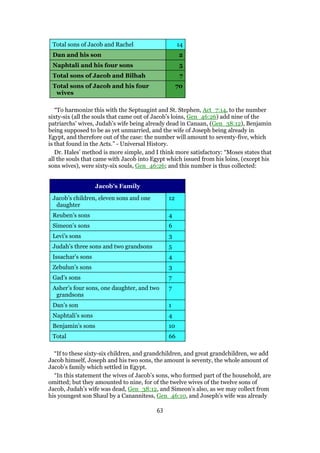
number that went down into Egypt was sixty-six (Gen_46:26), to which add Joseph
29
and his two sons, who were there before, and Jacob himself, the head of the family,
and you have the number of seventy, Gen_46:27. The Septuagint makes them
seventy-five, and Stephen follows them (Act_7:14), the reason of which we leave to
the conjecture of the critics; but let us observe, [1.] Masters of families ought to take
care of all under their charge, and to provide for those of their own house food
convenient both for body and soul. When Jacob himself removed to a land of plenty,
he would not leave any of his children behind him to starve in a barren land. [2.]
Though the accomplishment of promises is always sure, yet it is often slow. It was
now 215 years since God had promised Abraham to make of him a great nation
(Gen_12:2); and yet that branch of his seed on which the promise was entailed had
increased only to seventy, of which this particular account is kept, that the power of
God in multiplying these seventy to so vast a multitude, even in Egypt, may appear
the more illustrious. When God pleases, a little one shall become a thousand, Isa_
60:22.
JAMISON, "Gen_46:5-27. Immigration to Egypt.
And Jacob rose up from Beer-sheba — to cross the border and settle in
Egypt. However refreshed and invigorated in spirit by the religious services at Beer-
sheba, he was now borne down by the infirmities of advanced age; and, therefore, his
sons undertook all the trouble and toil of the arrangements, while the enfeebled old
patriarch, with the wives and children, was conveyed by slow and leisurely stages in
the Egyptian vehicles sent for their accommodation.
WHEDON, "Verse 5
5. In the wagons which Pharaoh had sent to carry him — “Instead of transporting
them upon camels and asses, as was usual in Palestine. The use of the Egyptian
wagons, and the fact that they were sent by Pharaoh himself, evidently made a deep
impression, and is emphasized by the writer. See note on Genesis 14:27. On the direct
route from Hebron to Beer-sheba the hills are too steep and sharp, and the surface is
too rocky, to allow of travel on wheeled vehicles. Artificial wagon roads have never
been constructed through that country. But wheels could pass from Beer-sheba east
of the direct route, through the great Wady el-Khulil, and thence through the valleys
to Hebron. (Robinson, 1:215.)” — Newhall.
CALVIN, "5.And Jacob rose up. By using the words “rose up,” Moses seems to
denote that Jacob received new vigor from the vision. For although the former
promises were not forgotten, yet the addition of the recent memorial came most
opportunely, in order that he, bearing the land of Canaan in his heart, might
endure his absence from it with equanimity. When it is said that he took with
him all that he had acquired, or possessed in the land of Canaan, it is probable
that his servants and handmaids came together with his cattle. (178) But, on his
departure, no mention is made of them: nay, a little afterwards, when Moses
enumerates the separate heads of each tribe, he says that only seventy souls came
with him. Should any one say that Jacob had been compelled to liberate his
slaves, on account of the famine, or that he lost them through some misfortune to
30
us unknown, the conjecture is unsatisfactory; for it is most incredible that he,
who had been an industrious master of a family, and had abounded in the
earthly blessings of God, should have become so entirely destitute, that not even
one little servant remained to him. It is more probable that, when the children of
Israel were themselves employed in servile works, they were then deprived of
their servants in Egypt; or, at least, a sufficient number was not left them, to
inspire them with confidence in any enterprise. And although, in the account of
their deliverance, Moses is silent respecting their servants, yet it may be easily
gathered from other passages, that they did not depart without servants.
COFFMAN, "Verses 5-7
"And Jacob rose up from Beersheba: and the sons of Israel carried Jacob their
father, and their little ones, and their wives, in the wagons which Pharaoh had
sent to carry him. And they took their cattle, and their goods, which they had
gotten in the land of Canaan, and came into Egypt, Jacob, and all his seed with
him: his sons, and his sons' sons with him, his daughters, and his sons'
daughters, and all his seed brought he with him into Egypt."
One purpose in these lines is to show that all of Israel actually went down into
Egypt, just as all of them later were delivered. This purpose is also apparent in
the list of Jacob's posterity in the following verses.
It is to be noted that, despite the suggestion by Pharaoh that they would not need
to bring their possessions with them, since plenty was available in Egypt, they
nevertheless brought all that it was possible to carry. This was obviously for the
purpose of not being any greater burden to the Egyptians than was unavoidable.
Note also in these verses that nothing whatever is said of the wives of Jacob's
sons and grandsons, nor is there any reference to their servants or employees.
From this, it is evident that the company which went down into Egypt was far
larger than the list of barely seventy persons next recorded.
TRAPP, "Verse 5
Genesis 46:5 And Jacob rose up from Beersheba: and the sons of Israel carried
31
Jacob their father, and their little ones, and their wives, in the wagons which
Pharaoh had sent to carry him.
Ver. 5. And Jacob rose up from Beersheba.] The word "rose up" is emphatical,
and imports that his heart was lightened, and his joints oiled and nimbled, as it
were, with the heavenly vision. As when he had seen God at Bethel, he "lift up
his feet," and went on his way lustily; [Genesis 29:1] so here, as fast as his old
legs would carry him; as Father Latimer said to Ridley, when they were going to
the stake. (a) And as it is recorded of good old Rawlins White, martyr; that
whereas before he was wont to go stooping, or rather crooked, through infirmity
of age, having a sad countenance and very feeble complexion, and, with it, very
soft in speech and gesture; now he went and stretched up himself, not only bolt
upright, as he went to the stake, but also bare, with it, a most pleasant and
comfortable countenance, not without great courage and audacity, both in
speech and behaviour. (b) In like sort, Jacob here, having sought God, and
received a gracious promise of his presence and protection, rose up merrily from
Beersheba, and doubts not to follow God whithersoever he shall lead him.
PETT, "Genesis 46:5-7
‘And Jacob rose up from Beersheba, and the sons of Israel carried Jacob their
father, and their little ones, and their wives, in the wagons which Pharaoh had
sent to carry him. And they took their cattle and their goods which they had
obtained in the land of Canaan, and came into Egypt, Jacob and all his seed with
him, his sons and his daughters, and his sons’ daughters and all his seed he
brought with him into Egypt.’
So at God’s assurance Jacob now takes all he has into Egypt. It is clear that
much of his herds have survived the famine up to this point, probably helped by
the corn from Egypt, but water was getting scarcer and they may not have
survived much longer. They also took their goods (in spite of what Pharaoh had
said, but that was a gesture and was probably not intended to be taken literally).
But most importantly his whole family went with him, together with their
‘households’ (Exodus 1:1). Jacob’s wives are not mentioned. It may be that they
were all dead.
32
“His sons and his daughters and his sons” daughters.’ His sons’ sons are not
mentioned although we know that Reuben had two sons (Genesis 42:37), but this
was because they were considered as included in ‘sons’. Daughters were slightly
different as his ‘daughters’ were mainly his daughters-in-law, his sons’ wives,
whereas presumably his sons’ daughters were daughters of the blood (although
only one is named, but that was because to name more would have taken the
number over seventy).
6 So Jacob and all his offspring went to Egypt,
taking with them their livestock and the
possessions they had acquired in Canaan.
GILL, "And they took their cattle, and their goods, which they had gotten
in the land of Canaan,.... Some interpreters add, by way of explanation, and in
Mesopotamia; much of Jacob's substance being yet there, though the greatest part
was got in Canaan, and so that is put for the whole; and Jarchi supposes that Jacob
gave all that he got in Padanaram to Esau for his part in the cave of Machpelah, and
therefore mention is only made of his substance in Canaan; but there is no need of
any such additions or suppositions, since the text only speaks of the substance of
Jacob's sons, and what they had was only gotten in Canaan, into which they came
very young; all which they brought with them as being their property, and not
obliged to leave it behind to strangers; though they were bid not to regard their stuff,
yet they were not willing to live upon others, but upon their own, and as much as
they could independent of others; and that they might not be upbraided hereafter
that they came into Egypt poor and destitute of everything:
and came into Egypt, Jacob, and all his seed with him; safe and well.
JAMISON, "goods, which they had gotten in the land — not furniture, but
substance - precious things.
TRAPP, "Verse 6
33
Genesis 46:6 And they took their cattle, and their goods, which they had gotten in the
land of Canaan, and came into Egypt, Jacob, and all his seed with him:
Ver. 6. And they took their cattle, and their goods.] Though Pharaoh sent to them
they should not, yet, not willing to be much chargeable, they brought that they had. It
is a happiness so to live with others as not to be much beholden; but rather helpful,
than burdensome. He that receives a courtesy, we say, sells his liberty: and "the
borrower is servant to the lender." [Proverbs 22:7] St Paul glories in this to the
liberal Corinthians, that when he was present with them he was "chargeable to no
man." [2 Corinthians 11:9] Oυ κατεναρκησα ουδενος; (a) dunned no man, I was no
man’s parasite. He was not of those that "served not the Lord Jesus Christ, but their
own bellies." [Romans 16:18] The Duke of Bavaria’s house is so pestered with friars
and Jesuits that, notwithstanding the greatness of his revenue, he is very poor; as
spending all his estate upon these Popish parasites. Such among the Turks are the
Dervislars and Imailers, that under pretence of religion, live, like body lice, upon
other men’s sweat and labours. (b)
7 Jacob brought with him to Egypt his sons and
grandsons and his daughters and
granddaughters—all his offspring.
CLARKE, "All his seed brought he with him into Egypt - When Jacob went
down into Egypt he was in the one hundred and thirtieth year of his age, two
hundred and fifteen years after the promise was made to Abraham, Gen_12:1-4, in
the year of the world 2298, and before Christ.
GILL, "His sons, and his sons' sons with him,.... His eleven sons, and their
sons, his grandchildren:
and his daughters; his own daughter Dinah, and his daughters in law, the wives of
his sons; for these came with him into Egypt, as appears from Gen_46:5; though the
plural may be put for the singular, as in Gen_46:23,
34
and his sons' daughters; and mention is made of Sarah the daughter of Asher,
Gen_46:17; Jarchi adds, Jochebed, the daughter of Levi, but it is certain she was
born in Egypt, Num_26:59,
and all his seed brought he with him into Egypt; left none behind him in
Canaan, son or daughter; no mention is made of servants, though no doubt many
came along with him: the design of the historian is to give an account of Jacob's
children, who they were, and their number, when they came into Egypt, that the
increase of them might be observed.
JAMISON, "daughters — As Dinah was his only daughter, this must mean
daughters-in-law.
all his seed brought he with him — Though disabled by age from active
superintendence, yet, as the venerable sheik of the tribe, he was looked upon as their
common head and consulted in every step.
BENSON, "Genesis 46:7. All his seed — It is probable they continued to live
together in common with their father, and therefore when he went, they all went;
which, perhaps, they were the more willing to do, because, though they had
heard that the land of Canaan was promised them, yet, to this day, they had
none of it in possession. We have here a particular account of the names of
Jacob’s family; his sons’ sons, most of whom are afterward mentioned as heads
of houses in the several tribes. See Numbers 26:5, &c, The daughters mentioned
seem to have been daughters-in-law. The whole number that went down into
Egypt were sixty-six, to which add Joseph and his two sons, who were there
before, and Jacob himself, the head of the family, and you have the number of
seventy. It was now two hundred and fifteen years since God had promised
Abraham to make of him a great nation, Genesis 41:2; and yet that branch of his
seed, on which the promise was entailed, was as yet increased but to seventy, of
which this particular account is kept, that the power of God in multiplying these
seventy to so vast a multitude, even in Egypt, may be more illustrious. When he
pleases, a little one shall become a thousand.
COKE, "Genesis 46:7. His daughters— As he had only one daughter, we must
suppose that his daughters-in-law are here meant; see ch. Genesis 37:35. Bishop
Warburton, according to his usual manner, observes, that "the promise God had
made to Abraham, to give his posterity the land of Canaan, could not be
performed till that family was grown strong enough to take and keep possession
of it. In the mean time, therefore, they were necessitated to reside among
idolaters, and to reside unmixed: but whoever examines their history will see
that the Israelites ever had a violent propensity to join themselves to Gentile
35
nations, and to practise their manners. God, therefore, in his infinite wisdom,
brought them into AEgypt, and kept them there during this period, the only
place where they could remain for so long a time safe, and unconfounded with
the natives; the ancient AEgyptians being, by numerous institutions, forbidden
all fellowship with strangers, and bearing, besides, a particular aversion to the
profession of the Israelites, who were shepherds. Thus the natural dispositions of
the Israelites, which in AEgypt occasioned their superstitions, and in
consequence the necessity of a burdensome ritual, would, in any other country,
have absorbed them into Gentilism, and confounded them with idolaters. From
the Israelites going into AEgypt, arises a new occasion to adore the footsteps of
Eternal Wisdom, in his dispensations to his chosen people." Divine Legation, vol.
3: p. 415.
8 These are the names of the sons of Israel
(Jacob and his descendants) who went to Egypt:
Reuben the firstborn of Jacob.
BARNES, "Verse 8-27
The list given here of the family of Jacob as it came down into Egypt is not to be
identified with a list of their descendants two hundred and fifty years after, contained
in Num. 26, or with another list constructed after the captivity, and referring to
certain of their descendants in and after the times of the monarchy. Nor is this the
place to mark out or investigate the grounds of the diversities from the present which
these later lists exhibit. Our proper business here is to examine into the nature and
import of this ancient and original list of the family of Jacob. It purports to be a list
of the names of the sons of Israel, “who went into Mizraim.” This phrase implies that
the sons of Israel actually went down into Egypt; and this is accordingly historically
true of all his immediate sons, Joseph having gone thither about twenty-two years
before the others. And the word “sons” is to be understood here in its strict sense, as
we find it in the immediate context Gen_46:7 distinguished from sons’ sons and
other descendants.
“Jacob and his sons.” From this expression we perceive the progenitor is to be
36
included with the sons among those who descended to Egypt. This also is historically
exact. For the sake of clearness it is proper here to state the approximate ages of
these heads of Israel at the time of the descent. Jacob himself was 130 years of age
Gen_47:9. Joseph was in his thirtieth year when he stood before Pharaoh to interpret
his dreams and receive his commission as governor-general of Egypt, Gen_41:46. At
the end of the second year of the famine nine full years were added to his life. He was
therefore, we may suppose, 39 years old when Jacob arrived in Egypt, and born when
his father was 91. As we conceive that he was born in the fifteenth year of Jacob’s
sojourn in Padan-aram, and Reuben in the eighth, we infer that Reuben was at the
time of the descent into Egypt seven years older than Joseph, or 46, Simon 45, Levi
44, Judah 43, Dan about 43, Naphtali about 42, Gad about 42, Asher about 41,
Issakar about 41, Zebulun about 40, Dinah about 39, Benjamin about 26. “Jacob’s
first-born Reuben.” This refers to the order of nature, without implying that the
rights of first-birth were to be secured to Reuben 1Ch_5:1-2.
CLARKE, "These are the names of the children of Israel - It may be
necessary to observe here, First, that several of these names are expressed differently
elsewhere, Jemuel for Nemuel, Jachin for Jarib, Gershon for Gershom, etc.; compare
Num_26:12; 1Ch_4:24. But it is no uncommon case for the same person to have
different names, or the same name to be differently pronounced; See Clarke on Gen_
25:18 (note). Secondly, that it is probable that some names in this list are brought in
by prolepsis or anticipation, as the persons were born (probably) during the
seventeen years which Jacob sojourned in Egypt, see Gen_46:12. Thirdly, that the
families of some are entered more at large than others because of their peculiar
respectability, as in the case of Judah, Joseph, and Benjamin; but see the tables
under Gen_46:20.
GILL, "And these are the names of the children of Israel which came into
Egypt,.... Not meaning precisely Jacob's seed and offspring, but the body of the
people of Israel, as they were when they went into Egypt, including Jacob himself:
Jacob and his sons; for he went with them to Egypt, and was the head and
principal of them:
Reuben, Jacob's firstborn; see Gen_29:32.
JAMISON 8-27, "all the souls of the house of Jacob, which came into
Egypt, were threescore and ten — Strictly speaking, there were only sixty-six
went to Egypt; but to these add Joseph and his two sons, and Jacob the head of the
clan, and the whole number amounts to seventy. In the speech of Stephen (Act_7:14)
the number is stated to be seventy-five; but as that estimate includes five sons of
Ephraim and Manasseh (1Ch_7:14-20), born in Egypt, the two accounts coincide.
K&D 8-27, "The size of Jacob's family, which was to grow into a great nation, is
given here, with evident allusion to the fulfilment of the divine promise with which
he went into Egypt. The list of names includes not merely the “sons of Israel” in the
stricter sense; but, as is added immediately afterwards, “Jacob and his sons,” or, as
the closing formula expresses it (Gen_46:27), “all the souls of the house of Jacob,
37
who came into Egypt” (‫ה‬ፎ ָ ַ‫ה‬ for ‫ה‬ፎ ָ ‫ר‬ ֶ‫שׁ‬ ֲ‫,א‬ Ges. §109), including the patriarch himself,
and Joseph with his two sons, who were born before Jacob's arrival in Egypt. If we
reckon these, the house of Jacob consisted of 70 souls; and apart from these, of 66,
besides his sons' wives. The sons are arranged according to the four mothers. Of
Leah there are given 6 sons, 23 grandsons, 2 great-grandsons (sons of Pharez,
whereas Er and Onan, the sons of Judah who died in Canaan, are not reckoned), and
1 daughter, Dinah, who remained unmarried, and was therefore an independent
member of the house of Jacob; in all, therefore, 6 + 23 + 2 + 1 = 32, or with Jacob, 33
souls. Of Zilpah, Leah's handmaid, there are mentioned 2 sons, 11 grandsons, 2
great-grandsons, and 1 daughter (who is reckoned like Dinah, both here and Num_
26:46, for some special reason, which is not particularly described); in all, 2 + 11 + 2
+ 1 = 16 souls. Of Rachel, “Jacob's (favourite) wife,” 2 sons and 12 grandsons are
named, of whom, according to Num_26:40, two were great-grandsons, = 14 souls;
and of Rachel's maid Bilhah, 2 sons and 5 grandsons = 7 souls. The whole number
therefore was 33 + 16 + 14 + 7 = 70.
(Note: Instead of the number 70 given here, Exo_1:5, and Deu_10:22, Stephen
speaks of 75 (Act_7:14), according to the lxx, which has the number 75 both here
and Exo_1:5, on account of the words which follow the names of Manasseh and
Ephraim in Gen_46:20 : ᅚγένοντο δᆯ οᅷοᆳ Μανασσᇿ, οཋς ᅞτεκεν αᆒτሬ ᅧ παλλακᇿ ᅧ
Σύρα, τοᆷ Μαχίρ· Μαχᆳρ δᆯ ᅚγέννησε τᆵν Γαλαάδ, υίοᆳ δᆯ ᅠφραιʷ́µ ᅊδελφοሞ Μανασσᇿ.
Σουταλαᆭµ καᆳ Ταάµ. υίοᆳ δᆯ Σουταλαάµ. ᅠδώµ: and which are interpolated by
conjecture from Gen_1:23, and Num_26:29, Num_26:35, and Num_26:36 (33, 39, and
40), these three grandsons and two great-grandsons of Joseph being reckoned in.)
The wives of Jacob's sons are neither mentioned by name nor reckoned, because
the families of Israel were not founded by them, but by their husbands alone. Nor is
their parentage given either here or anywhere else. It is merely casually that one of
the sons of Simeon is called the son of a Canaanitish woman (Gen_46:10); from
which it may be inferred that it was quite an exceptional thing for the sons of Jacob
to take their wives from among the Canaanites, and that as a rule they were chosen
from their paternal relations in Mesopotamia; besides whom, there were also their
other relations, the families of Ishmael, Keturah, and Edom. Of the “daughters of
Jacob” also, and the “daughters of his sons,” none are mentioned except Dinah and
Serah the daughter of Asher, because they were not the founders of separate houses.
If we look more closely into the list itself, the first thing which strikes us is that
Pharez, one of the twin-sons of Judah, who were not born till after the sale of Joseph,
should already have had two sons. Supposing that Judah's marriage to the daughter
of Shuah the Canaanite occurred, notwithstanding the reasons advanced to the
contrary in Gen 38, before the sale of Joseph, and shortly after the return of Jacob to
Canaan, during the time of his sojourn at Shechem (Gen_33:18), it cannot have taken
place more than five, or at the most six, years before Joseph was sold; for Judah was
only three years older than Joseph, and was not more than 20 years old, therefore, at
the time of his sale. But even then there would not be more than 28 years between
Judah's marriage and Jacob's removal to Egypt; so that Pharez would only be about
11 years old, since he could not have been born till about 17 years after Judah's
marriage, and at that age he could not have had two sons. Judah, again, could not
have taken four sons with him into Egypt, since he had at the most only two sons a
year before their removal (Gen_42:37); unless indeed we adopt the extremely
improbable hypothesis, that two other sons were born within the space of 11 or 12
months, either as twins, or one after the other. Still less could Benjamin, who was
only 23 or 24 years old at the time (vid., pp. 200f. and 204f.), have had 10 sons
38
already, or, as Num_26:38-40 shows, eight sons and two grandsons. From all this it
necessarily follows, that in the list before us grandsons and great-grandsons of Jacob
are named who were born afterwards in Egypt, and who, therefore, according to a
view which we frequently meet with in the Old Testament, though strange to our
modes of thought, came into Egypt in lumbis patrum. That the list is really intended
to be so understood, is undoubtedly evident from a comparison of the “sons of Israel”
(Gen_46:8), whose names it gives, with the description given in Num 26 of the whole
community of the sons of Israel according to their fathers' houses, or their tribes and
families. In the account of the families of Israel at the time of Moses, which is given
there, we find, with slight deviations, all the grandsons and great-grandsons of Jacob
whose names occur in this chapter, mentioned as the founders of the families, into
which the twelve tribes of Israel were subdivided in Moses' days. The deviations are
partly in form, partly in substance. To the former belong the differences in particular
names, which are sometimes only different forms of the same name; e.g., Jemuel and
Zohar (Gen_46:10), for Nemuel and Zerah (Num_26:12-13); Ziphion and Arodi
(Gen_46:16), for Zephon and Arod (Num_26:15 and Num_26:17); Huppim (Gen_
46:21) for Hupham (Num_26:39); Ehi (Gen_46:21), an abbreviation of Ahiram
(Num_26:38); sometimes different names of the same person; viz., Ezbon (Gen_
46:16) and Ozni (Num_26:16); Muppim (Gen_46:21) and Shupham (Num_26:39);
Hushim (Gen_46:23) and Shuham (Num_26:42). Among the differences in
substance, the first to be noticed is the fact, that in Num 26 Simeon's son Ohad,
Asher's son Ishuah, and three of Benjamin's sons, Becher, Gera, and Rosh, are
missing from the founders of families, probably for no other reason than that they
either died childless, or did not leave a sufficient number of children to form
independent families. With the exception of these, according to Num 26, all the
grandsons and great-grandsons of Jacob mentioned in this chapter were founders of
families in existence in Moses' time. From this it is obvious that our list is intended to
contain, not merely the sons and grandsons of Jacob, who were already born when he
went down to Egypt, but in addition to the sons, who were the heads of the twelve
tribes of the nation, all the grandsons and great-grandsons who became the founders
of mishpachoth, i.e., of independent families, and who on that account took the place
or were advanced into the position of the grandsons of Jacob, so far as the national
organization was concerned.
On no other hypothesis can we explain the fact, that in the time of Moses there was
not one of the twelve tribes, except the double tribe of Joseph, in which there were
families existing, that had descended from either grandsons or great-grandsons of
Jacob who are not already mentioned in this list. As it is quite inconceivable that no
more sons should have been born to Jacob's sons after their removal into Egypt, so is
it equally inconceivable, that all the sons born in Egypt either died childless, or
founded no families. The rule by which the nation descending from the sons of Jacob
was divided into tribes and families (mishpachoth) according to the order of birth
was this, that as the twelve sons founded the twelve tribes, so their sons, i.e., Jacob's
grandsons, were the founders of the families into which the tribes were subdivided,
unless these grandsons died without leaving children, or did not leave a sufficient
number of male descendants to form independent families, or the natural rule for the
formation of tribes and families was set aside by other events or causes. On this
hypothesis we can also explain the other real differences between this list and Num
26; viz., the fact that, according to Num_26:40, two of the sons of Benjamin
mentioned in Gen_46:21, Naaman and Ard, were his grandsons, sons of Belah; and
also the circumstance, that in Gen_46:20 only the two sons of Joseph, who were
already born when Jacob arrived in Egypt, are mentioned, viz., Manasseh and
Ephraim, and none of the sons who were born to him afterwards (Gen_48:6). The
two grandsons of Benjamin could be reckoned among his sons in our list, because
39
they founded independent families just like the sons. And of the sons of Joseph,
Manasseh and Ephraim alone could be admitted into our list, because they were
elevated above the sons born to Joseph afterwards, by the fact that shortly before
Jacob's death he adopted them as his own sons and thus raised them to the rank of
heads of tribes; so that wherever Joseph's descendants are reckoned as one tribe
(e.g., Jos_16:1, Jos_16:4), Manasseh and Ephraim form the main divisions, or
leading families of the tribe of Joseph, the subdivisions of which were founded partly
by their brothers who were born afterwards, and partly by their sons and grandsons.
Consequently the omission of the sons born afterwards, and the grandsons of
Joseph, from whom the families of the two sons, Manasseh and Ephraim, who were
elevated into tribes, descended, forms only an apparent and not a real exception to
the general rule, that this list mentions all the grandsons of Jacob who founded the
families of the twelve tribes, without regard to the question whether they were born
before or after the removal of Jacob's house to Egypt, since this distinction was of no
importance to the main purpose of our list. That this was the design of our list, is still
further confirmed by a comparison of Exo_1:5 and Deu_10:22, where the seventy
souls of the house of Jacob which went into Egypt are said to constitute the seed
which, under the blessing of the Lord, had grown into the numerous people that
Moses led out of Egypt, to take possession of the land of promise. From this point of
view it was a natural thing to describe the seed of the nation, which grew up in tribes
and families, in such a way as to give the germs and roots of all the tribes and families
of the whole nation; i.e., not merely the grandsons who were born before the
migration, but also the grandsons and great-grandsons who were born in Egypt, and
became founders of independent families. By thus embracing all the founders of
tribes and families, the significant number 70 was obtained, in which the number 7
(formed of the divine number 3, and the world number 4, as the seal of the covenant
relation between God and Israel) is multiplied by the number 10, as the seal of
completeness, so as to express the fact that these 70 souls comprehended the whole
of the nation of God.
(Note: This was the manner in which the earlier theologians solved the actual
difficulties connected with our list; and this solution has been adopted and
defended against the objections offered to it by Hengstenberg (Dissertations) and
Kurtz (History of the Old Covenant).)
CALVIN, "8.These are the names of the children of Israel. He recounts the sons
and grandsons of Jacob, till he arrives at their full number. The statement that
there were but seventy souls, while Stephen (Acts 7:14) adds five more, is made, I
doubt not, by an error of the transcribers. For the solution of Augustine is weak,
that Stephen, by a prolepsis, enumerates also three who afterwards were born in
Egypt; for he must then have formed a far longer catalogue. Again, this
interpretation is repugnant to the design of the Holy Spirit, as we shall hereafter
see: because the subject here treated of, is not respecting the number of children
Jacob left behind him at his death, but respecting the number of his family on
the day when he went down into Egypt. He is said to have brought with him, or
to have found there, seventy souls born unto him, in order that the comparison of
this very small number, with that immense multitude which the Lord afterwards
led forth, might the more fully illustrate His wonderful benediction. But that the
error is to be imputed to the transcribers, is hence apparent, that with the Greek
40
interpreters, it has crept only into one passage, while, elsewhere, they agree with
the Hebrew reckoning. And it was easy when numerals were signified by marks,
for one passage to be corrupted. I suspect also that this happened from the
following cause, that those who had to deal with the Scripture were generally
ignorant of the Hebrew language; so that, conceiving the passage in the Acts to
be vitiated, they rashly changed the true number. If any one, however, chooses
rather to suppose that Luke in this instance accommodated himself to the rude
and illiterate, who were accustomed to the Greek version, I do not contend with
them. (179) In the words of Moses there is, indeed, no ambiguity, nor is there any
reason why so small a matter, in which there is no absurdity, should give us any
trouble; for it is not wonderful, that, in this mode of notation, one letter should
have been put in the place of another. It is more to the purpose, to examine
wherefore this small number of persons is recorded by Moses. For, the more
improbable it appears, that seventy men, in no lengthened space of time, should
have grown to such a multitude; so much the more clearly does the grace of God
shine forth. And this is also the reason why he so frequently mentions this
number. For it was, by no means, according to human apprehension, a likely
method of propagating the Church, that Abraham should live childless even to
old age; that, after the death of Isaac, Jacob alone should remain; that he, being
increased with a moderate family, should be shut up in a corner of Egypt, and
that there an incredible number of people should spring up from this dry
fountain. (180) When Moses declares that Shaul, one of the sons of Simon, was
born of a Canaanitish woman, while he does not even mention the mothers of the
other sons, his intention, I doubt not, is to fix a mark of dishonor on his race. For
the holy Fathers were on their guard, not to mix in marriage with that nation,
from which they were separated by the decree of heaven. When Moses, having
put down the names of Leah’s sons, says there were thirty-three souls, whereas
he has only mentioned thirty-two; I understand that Jacob himself is to be
reckoned the first in order. The statement that he had so many sons or daughters
by Leah does not oppose this conclusion. For although, strictly speaking, his
discourse is concerning sons, yet he commences with the head of the family. I
reject the interpretation of the Hebrews, who suppose Jochebed the mother of
Moses to be included, as being overstrained. A question suggests itself
concerning the daughters, whether there were more than two. If Dinah alone
were named, it might be said that express mention was made of her, because of
the notorious fact which had happened to her. But since Moses enumerates
another female in the progeny of Aser, I rather conjecture that these had
remained unmarried, or single; for no mention is made of those who were wives.
COFFMAN, "Verses 8-27
41
THE SEVENTY
Here we shall vary our usual procedure of recording the sacred text and present
the list of names in outline form for greater clarity:
THE NAMES OF THE FAMILY OF LEAH
REUBEN SIMEON LEVI JUDAH ISSACHAR ZEBULUN
Hanoch, Pallu, Hezron,Carmi Jemuel, Jamin, Ohad, Jachin, Zohar and
Shaul Gershon, Kohath and Merari Er, Onan, Shelah, Perez and Zerah
Tola, Puvah, Iob and Shimron. Sered, Elon and Jahleel
Note also that two sons of Pharez, Hezron and Hamul are given in Genesis 46:12.
Therefore, we add Heron, Hamul, and Dinah (Genesis 46:15) for a total of 34
names. From these we subtract Er and Onan (who died in Canaan) for a total of
32 names, but the text says the number of Leah's family totaled 33 names
(Genesis 46:15). The total, if Jacob is included, was 33, if Jacob was not included,
the other was an unnamed daughter of Leah.
It really makes no difference at all, for this whole list is a "round number"
anyway.
Jacob had both a grandson (by Reuben) and a great-grandson (by Pharez)
named Hezron, but it was the great-grandson by Pharez who was in the ancestry
of Jesus (Luke 3:33). Kohath was in the ancestry of Moses (Exodus 6:16,20).
THE NAMES OF THE FAMILY OF ZILPAH; LEAH'S MAID
GAD ASHER
Ziphion. Haggi, Shuni, Ezbon, Eri, Arodi and Areli Imnah, Ishvah, Ishvi,
42
Beriah and their sister Serah. And the sons of Beriah: Heber and Malchiel
The total of these names is 16 (Genesis 46:18).
THE NAMES OF THE FAMILY OF RACHEL
JOSEPH BENJAMIN
Manasseh and Ephraim Bela, Becher, Ashbel, Gera, Naaman, Ehi, Rosh,
Muppim, Huppim and Ard
The total of these is given as 14 souls in Genesis 46:22.
THE NAMES OF THE FAMILY OF BILHAH; RACHEL'S MAID
DAN NAPHTALI
Hushim Jahzeel, Guni, Jezer and Shillem
The total of seven is given in Genesis 46:25. The grand total is SEVENTY.
Several things need to be said about this list. It does not include any of the
daughters, except Dinah and Serah, despite the mention of Jacob's daughters,
and his sons' daughters in Genesis 46:7. The whole list is therefore contrived by
the sacred narrator as a round number. It is quite obvious also that some of the
names in this list are of persons born AFTER the entry into Egypt, as we may
not suppose that Benjamin, described repeatedly as a "lad" at this time, was
suddenly a patriarch with ten children before the move to Egypt could be
effected. The same appears to be true of Pharez. Thus, this enumeration of "The
Seventy" serves the purposes of emphasizing that number considered to be a
sacred number by the Jews, and apparently so honored by Jesus himself.
43
SEVENTY
"The number seventy seems to have been associated in a peculiar way with the
nation of Israel ever since the time when seventy apparently became the founders
of the nation."[6]
Seventy nations of the world are listed in Genesis 10.[7]
Seventy elders are mentioned in Numbers 11:16.
Seventy years of captivity in Babylon were the punishment of Judah (2
Chronicles 36:21).
Seventy weeks were determined for Israel in which to finish the transgression
(Daniel 9:24).
Seventy translators produced the Septuagint.
The Sanhedrin was composed of seventy members.
Jesus Christ himself sent out the "seventy" witnesses of his kingdom.
"The days of our years are threescore and ten" (Psalms 90:10).
The great intention, therefore, of this list is to show that there were seventy
founders of the nation of Israel who went into Egypt.
Perhaps we should also notice the quibble often raised regarding the statement of
Stephen in Acts 7:14, that "Seventy-five souls went down into Egypt." As a
44
matter of fact, the total number probably ran well over a hundred or so. Just
how Stephen figured it, we do not know, but it is generally thought that he was
merely quoting from the LXX, which gives five sons of Joseph not mentioned in
our version. He might have been counting the wives, or the wives who consented
to go to Egypt, or some of the unmentioned daughters. The quibble is
inconsequential. What is intended by the use of the number "seventy" in this
passage is to show that, "God had done a complete divine work upon Israel, in
taking them down into Egypt."[8]
CONSTABLE, "Verses 8-27
Israel"s household"s move to Egypt46:8-27
This section contains a list of the individuals in Jacob"s family about the time he
moved to Egypt. As in chapter31 , when he left Paddan-aram, this move was also
difficult for Jacob. Moses recorded a total of70 persons ( Genesis 46:27; cf.
Exodus 1:5). The66 referred to in Genesis 46:26 excluded Jacob, Joseph,
Ephraim, and Prayer of Manasseh , or perhaps Er and Onan ( Genesis 46:12)
and Ephraim and Manasseh. Stephen said there were75 , but he must have
added Joseph"s three grandsons and two great-grandsons ( Acts 7:14). These
five were born later, as were some or all of Benjamin"s10 sons ( Genesis 46:21),
in all probability.
". . . according to a view which we frequently meet with in the Old Testament,
though strange to our modes of thought, [they] came into Egypt in lumbus
patrum [i.e, in the loins of their father]." [Note: Keil and Delitzsch, 1:371.]
"It [ Genesis 46:8] means: shortly after the children of Israel had come to Egypt
there were to be found those seventy fathers from whom were derived the
seventy clans that were the prevailing clans throughout Israel"s early history."
[Note: Leupold, 2:1115.]
This was the humble beginning of the great nation of Israel.
45
"It can hardly go without notice that the number of nations in Genesis 10 is also
"seventy." Just as the "seventy nations" represent all the descendants of Adam,
so now the "seventy sons" represent all the descendants of Abraham, Isaac, and
Jacob-the children of Israel. Here in narrative form is a demonstration of the
theme in Deuteronomy 32:8 that God apportioned the boundaries of the nations
( Genesis 10) according to the number of the children of Israel. Thus the writer
has gone to great lengths to portray the new nation of Israel as a new humanity
and Abraham as a second Adam. The blessing that is to come through Abraham
and his seed is a restoration of the original blessing of Adam, a blessing which
was lost in the Fall." [Note: Sailhamer, The Pentateuch . . ., p225.]
PETT 8-27, "Verses 8-27
Those Who Went Down Into Egypt (Genesis 46:8-27).
There now follows a catalogue of ‘all the souls who came into Egypt.’ At first
sight this is rather an understatement. It excludes his sons’ wives (Genesis 46:26)
and ignores retainers and camp followers. The number who actually went down
into Egypt may well have numbered a few thousand for we have the households
of each of the sons as well as Jacob’s household. (And we must remember that
from his household Abraham was able to raise three hundred and eighteen
fighting men (Genesis 14:14)). The numbers may have diminished because of the
effect of the famine making them surplus to requirements, and some may have
been left in Canaan for other reasons, but there would still be a goodly number.
But this passage is a good example of the early use of numbers. The ‘seventy’,
which is the divine number seven intensified, included everyone by implication
and indicated the divine completeness of the number who went down to Egypt. It
said in effect that not one was missing. They were ‘seventy’. They were God’s
divinely complete band. No early reader would take the number literally. They
would know exactly what it indicated.
However, in accordance with ancient practise this number is now applied, and it
is done by manipulation of what is known, including or excluding as necessary.
This is immediately apparent from the names given. It is very questionable
whether the sons of Perez, Hezron and Hamul, could yet have been born (see on
46
Genesis 38:6-10), or even more so that at this stage the young man Benjamin
would have ten sons (Genesis 46:21). These were rather seen as going down ‘in
the loins’ of their fathers. And the number is made up by including Dinah, but
excluding his sons’ daughters, and including the sons of Joseph who were born in
Egypt but had ‘gone down to Egypt’ in the loins of their father.
This table of names therefore was written by the writer in Egypt at a later date.
He looks at the extended family as it was then and names them in his list. By then
these sons had been born and were acknowledged as being part of ‘the seventy’,
the divinely complete band. We do not think like this but it is quite in accord
with ancient thinking. It is probable that he had a genealogical list and amended
it to suit his purpose. This would explain why he mentions Er and Onan, and
then excludes them, and brought Jacob and Dinah in to replace them. Also why
he introduced Zilpah’s daughter Serah (Genesis 46:17).
The original list had thirty three ‘sons’ of Leah. He specifically excluded Er and
Onan and brought in Dinah and Jacob to make up the thirty three, the thirty
three signifying a complete number (intensified three, compare Genesis 4:24).
The second part of the list included Joseph and his two sons, but he excludes
them in making up his sixty six, although retaining them in the text. He also now
excludes Jacob and introduces Serah. This was necessary to make up the sixty
and six (twice thirty and three) and finally the seventy.
Thus for the purpose of the record the number is split into two main groups, one
of thirty and three, (intensified three - compare the contrast of seven with
seventy and seven in Genesis 4:24), depicting completeness, and one to make up
the number sixty six (but see below). Both these groups are therefore ‘complete’
in themselves, being made up, by inference in the second case, of intensified
three. And there were ‘three’ in Egypt, Joseph and his two sons. Together with
Jacob they make up seventy. Thus the divine completeness of the whole group is
made apparent and emphasised to the ancient mind.
PETT, "Genesis 46:8
‘And these are the names of the children of Israel who came into Egypt, Jacob
and his sons. Reuben, Jacob’s firstborn, and the sons of Reuben: Hanoch and
Pallu and Hezron and Carmi.’
47
We know from Genesis 42:37 that Reuben had two sons at that stage (he would
be about 46). Therefore two of these must be recent births, possibly twins, or else
they may have ‘gone down to Egypt’ in the loins of their father.
BI 8-27, "And these are the names of the children of Israel, which came into Egypt
The catalogue of the children of Israel
I. IT MARKS THE COMMENCEMENT, AND GIVES THE OUTLINE OF, THE
NATION’S HISTORY.
II. IT MARKS THE TRIBE OF THE MESSIAH.
III. THE NAMES ARE SIGNIFICANT. Thus the names of Reuben’s sons signify:
“teacher,” “distinguished,” “beautiful one,” “noble one.” These express a sanguine
hope. Also the names of Levi’s sons signify: “expulsion of the profane,” “congregation
of the consecrated,” “practiser of discipline.” These are the leading principles and
proper characteristics of priestly rule. We hasten rapidly over Biblical names, but
much instruction may be gathered from them.
IV. THE FACTS CONNECTED WITH SOME OF THE NAMES ARE SUGGESTIVE.
Thus Dinah, though condemned to a single life, is yet reckoned among the founders
of the house of Israel in Egypt. This points to the elevation of woman, and to the idea
of female inheritance. Again, Judah was the father’s minister to Joseph. By his
faithfulness, strength, and wisdom he rises in the opinion of his father. His
distinguished place in the annals of the nation comes out, at length, in the grandeur
of that prophetic word which declares God’s loving purpose in this great history
(Gen_49:10).
V. THE NUMBER OF THE NAMES IS ALSO SUGGESTIVE. “It is remarkable that it
is the product of seven, the number of holiness; and ten, the number of
completeness. It is still more remarkable that it is the number of the names of those
who were the heads of the primitive nations. The Church is the counterpart of the
world, and it is to be the instrument by which the kingdom of the world is to become
the kingdom of Christ. When the Most High bestowed the inheritance on the nations,
“when He separated the sons of Adam, He set the bounds of the people according to
the number of the sons of Israel” (Deu_32:8). This curious sentence may have an
immediate reference to the providential distribution of the human family over the
habitable parts of the earth, according to the number of His church and of His
dispensation of grace: but, at all events, it conveys the great and obvious principle,
that all things whatsoever, in the affairs of men, are antecedently adapted with the
most perfect exactitude to the benign reign of grace already realized in the children of
God, and yet to be extended to all the sons and daughters of Adam. (T. H. Leale.)
CONSTABLE, "Verses 28-30
Israel"s reunion with Joseph46:28-30
48
This reunion recalls Jacob"s former meeting with Esau ( Genesis 32:3). In both
situations after a long period of separation Jacob sent a party ahead to meet his
relative.
"The land of Goshen, where the Hebrews lived, adjoined Avaris-now known to have
been sited at Tell el-Dab"a (not at Tanis, as so many textbooks wrongly aver)." [Note:
Kitchen, The Bible . . ., p76. ]
This opinion rests on belief in a late date for the Exodus in the thirteenth century
B.C, however, and may not be correct.
Jacob had said that the loss of his sons would bring him to his grave in mourning
( Genesis 37:35; Genesis 42:38). Joseph"s "resurrection" had enabled his father to
die in peace. Similarly the resurrection of a greater Joseph has allowed many to face
death with courage and hope (cf. Philippians 1:21-26; 1 Peter 1:3).
Joseph encouraged his family to be completely honest with Pharaoh ( Genesis
46:34). Dishonesty long plagued Jacob"s family, but now Joseph led them out of this
destructive behavior.
Believers should respond to divine providence by making their decisions in response
to the initiative of His wise leaders. They should do so with confidence in His
promises and dependent on His continuing guidance and provision.
WHEDON, "Verses 8-27
THE MUSTER-ROLL OF ISRAEL, Genesis 46:8-27.
“There is a painstaking minuteness in the dates and statistics of this history, which
stands in wonderful contrast with the round numbers and vague statements of
mythical narratives. The numerical and statistical difficulties so much dwelt on by
Colenso and others, mostly arise from an ignorant or perverse misapprehension of
the antique style of the author, which must present real difficulties even to candour
and learning. This list of names is not a full census of the whole family of Israel, since
none of the wives are mentioned anywhere; nor of Israel’s descendants, since only
two female descendants occur in it; nor is it intended to give simply all the grandsons
of Jacob who were born in Canaan, for, as his sons migrated in the prime of life, it is
wholly improbable that no children were born to them in Egypt, where it is said that
Israel was ‘fruitful and increased abundantly;’ while the list of Numbers xxvi, gives us
no new names. This is simply a list of the heads of tribes, and of the grandsons and
great-grandsons who became heads of independent tribal families, whether born in
Canaan or in Egypt. Five of the grandsons here mentioned are missing from the list
in Numbers, probably because their families became extinct; two of the grandsons of
this list appear there as great-grandsons, an unimportant variation, when it is seen
that they appear only as heads of families, and not in their personal relation; while
the two women had some special historical importance — Dinah, as Jacob’s daughter
49
who was connected with the slaughter of the Shechemites, (Genesis 34,) although he
may have had other daughters, (Genesis 46:9,) and Sarah, or Serah, daughter of
Asher, as historically conspicuous alone among all the granddaughters, for reasons
that are unrecorded. Only the two sons of Joseph who became heads of tribes are
mentioned, although he probably had other children. Genesis 48:5-6. The sacred
number seventy was thus made up from sixty-seven male descendants, who were
heads of tribes and of tribal families, two female descendants, and Jacob himself. The
author groups them in four lists: thirty-two descendants of Leah, to whom he adds
Jacob himself, without mentioning it, (although implied in the expression of Genesis
46:8, ‘Jacob and his sons,’) making thirty-three; fourteen descendants of Rachel;
sixteen of Zilpah; and seven of Bilhah — making seventy in all. They are again
grouped as sixty-six of the Canaan family, three of the Egyptian, and Jacob himself.
Genesis 46:26-27. Yet inattention to the Hebrew idiom will lead the careless or
captious reader to suspect discrepancies in the narrative, as when it is said (Genesis
46:27) that ‘all the souls of the house of Jacob, which came into Egypt,’ were
threescore and ten, although Joseph and his two sons had just been mentioned as
necessary to complete the number. See the same statement in Deuteronomy 10:22.
Also it is said in Genesis 46:15, ‘all the souls of his sons and his daughters,’ although
only one daughter is mentioned, and Jacob himself must be included with the
descendants of Leah to make the number thirty-three. So it is no discrepancy when it
is made probable from the ages of Joseph and Benjamin, that some of their sons were
born after the descent into Egypt. St. Stephen, following the Septuagint Old
Testament, calls the number seventy-five, which number the Septuagint makes up by
reckoning in five other heads of families not mentioned in the Hebrew.” — Newhall.
A comparison of this family record of Jacob and his sons with that of the census in
the time of Moses (Numbers 26) will help illustrate the peculiarities of Hebrew
genealogies. For the convenience of the reader, we present these lists in parallel
columns, and also select from the genealogies of 1 Chronicles 2-8 the corresponding
names, so far as they appear there. For convenience of reference, we have placed the
corresponding names opposite each other, but the student will note the different
order in which the names stand in the different lists as they appear in the several
chapters.
9 The sons of Reuben:
Hanok, Pallu, Hezron and Karmi.
50
BARNES, "Gen_46:9-15
The sons of Leah and their descendants are here enumerated. Reuben has four
sons, who appear without variation in the other two lists Num_26:5-6; 1Ch_5:3. Of
the six sons of Simon, Ohad appears in the other lists, and Nemuel and Zerah appear
as colloquial variations of Jemuel and Zohar. Such diversities in oral language are
usual to this day in the East and elsewhere. “Son of a Kenaanitess.” This implies that
intermarriage with the Kenaanites was the exception to the rule in the family of
Jacob. Wives might have been obtained from Hebrew, Aramaic, or at all events
Shemite tribes who were living in their vicinity. The three sons of Levi are common
to all the lists, with the slight variation of Gershom for Gershon. The sons of Judah
are also unvaried. We are here reminded that Er and Onon died in the land of Kenaan
Gen_46:12, and of course did not come down into Egypt. The extraordinary
circumstances of Judah’s family are recorded in Gen. 38: In order that Hezron and
Hamul may have been born at the arrival of Jacob’s household in Egypt, Judah’s and
Perez’s first sons must have been born in the fourteenth year of their respective
fathers. For the discussion of this matter see the remarks on that chapter. The four
sons of Issakar occur in the other lists, with the variation of Jashub for Job. The
three sons of Zebulun recur in the book of Numbers; but in the list of Chronicles no
mention is made of his posterity. Dinah does not appear in the other lists. The
descendants of Leah are in all thirty-two; six sons, one daughter, twenty-three
grandsons, and two great grandsons. “All the souls, his sons and his daughters, were
thirty and three.” Here “all the souls” include Jacob himself, and “his sons and his
daughters” are to be understood as a specification of what is included besides
himself.
GILL, "And the sons of Reuben, Hanoch, and Phallu, and Hezron, and
Carmi. From whom came the families named after them, of which they were the
heads, Num_26:5.
PETT, "Genesis 46:9-12
‘And the sons of Simeon: Jemuel and Jamin and Ohad and Jachin and Zohar,
and Shaul, the son of a Canaanite woman. And the sons of Levi: Gershon,
Kohath and Merari. And the sons of Judah: Er and Onan and Shelah and Perez
and Zerah. But Er and Onan died in the land of Canaan. And the sons of Perez
were Hezron and Hamul.’
Joseph was about eighteen when he was sold into slavery (Genesis 37:2) making
Judah about twenty two when he married Shua. He was possibly twenty three
51
when he bore Er and Er grew up and married. If Er married at eighteen that
would make Judah forty one. Shelah was too young to marry when Er died.
Thus when Shelah came of age Judah was at least forty three. So unless Er
married very young Judah must have been at the very least forty four when he
bore Perez. Thus Perez could not have two children before he moved to Egypt
(when Judah was about forty four - Genesis 41:46 plus seven good years plus two
bad years plus say five years older than Joseph).
It is clear therefore that Hezron and Hamul were seen as ‘in the loins of Perez’.
PULPIT, "Gen_46:9
And the sons of Reuben; Hanoch,—"Initiated or Dedicated;" the name also of
Cain’s firstborn (Gen_4:17), and of the son of Jared (Gen_5:19)—and
Phallu,—"Distingushed" (Gesenius)—and Hezron,—"Enclosed" (Gesenius), "Of
the Court or Village" (Murphy), "Blooming One" (Furst)—and Carmi,—"Vine-
dresser" (Gesenius, Murphy), "Noble One" (Furst).
10 The sons of Simeon:
Jemuel, Jamin, Ohad, Jakin, Zohar and Shaul
the son of a Canaanite woman.
GILL, "And the sons of Simeon,.... Who was the second son of Jacob:
Jemuel, and Jamin, and Ohad, and Jachin, and Zohar; the first of these is
called Nemuel, Num_26:12; the third, Ohad, is omitted in the places referred to, he
dying without children, as may be supposed, and so was not the head of any family;
and the fourth, Jachin, is called Jarib, 1Ch_4:24; and the fifth is called Zerah, in the
above place, by a transposition of letters:
and Shaul the son of a Canaanitish woman; whom Simeon married, very
probably after the death of his first wife, by whom he had the above five sons, or she
was his concubine: many Jewish writers (u) say, this was Dinah, married to a
Canaanite, but this is impossible: according to the Targum of Jonathan, this Shaul
was Zimri, who did the work of the Canaanites at Shittim, Num_25:14, which is not
at all likely, the distance of time will not admit of it.
52
COKE, "Genesis 46:10. Jachin—, 1 Chronicles 4:24 he is called Jarib. The same
is to be observed of several others here named, it being common to give different
names to the same person, and to pronounce the same name differently.
PULPIT, "Gen_46:10
And the sons of Simeon; Jemuel,—"Day of El" (Gesenius, Murphy); in 1Ch_
4:24, Nemuel—and Jamin,—"Right Hand" (Gesenius, Murphy)—and
Ohad,—"Joined together" (Gesenius, Murphy)—and Jachin,—"Whom God
strengthens" (Gesenius), "He shall establish" (Murphy), or Jarib (1Ch_4:24)—and
Zohar,—"Whiteness" (Gesenius, Murphy); named Zerah (1Ch_4:24)—and
Shaul,—"Asked for" (Gesenius)—the son of a Canaanitish woman. The wives of
the other sons, except Judah, were probably from Mesopotamia.
11 The sons of Levi:
Gershon, Kohath and Merari.
GILL, "And the sons of Levi, Gershon, Kohath, and Merari. From these
sprung the priests and Levites, see Num_3:1.
PULPIT, "Gen_46:11
And the sons of Levi; Gershon,—or Gershom,—"Expulsion" (Gesenins),—
Kohath, or Kehath,—"Assembly" (Gesenius)—and Merari,—"Bitter," "Unhappy"
(Gesenius), Flowing" (Murphy), Harsh One" (Lange).
12 The sons of Judah:
53
Er, Onan, Shelah, Perez and Zerah (but Er and
Onan had died in the land of Canaan).
COKE, "Genesis 46:12. The sons of Pharez were Hezron, &c.— As Pharez could
not be above ten years old when Jacob went into AEgypt, I approve of St.
Augustine's interpretation of the words came into AEgypt, Genesis 46:8 which he
supposes to include the whole time that Jacob lived in AEgypt, which was
seventeen years; during which time Pharez may well be supposed to have had
these two sons.
PULPIT, "Gen_46:12
And the sons of Judah; Er, and Onan, and Shelah (vide Gen_38:3), and
Pharos, and Zarah (Gen_38:29; 1Ch_2:4): but Er and Onan died in the land
of Canaan (Gen_8:7, Gen_8:10). And the sons of Pharez were Hezron (vide
on Gen_46:9) and Hamul,—"One who has experienced mercy" (Gesenius).
The sons of Perez:
Hezron and Hamul.
WHEDON, "Verse 12
12. Hezron and Hamul — The probable reason for reckoning these among the
seventy (Genesis 46:27) was, that they were adopted by Judah in place of the
deceased Er and Onan, who died in the land of Canaan. This appears from the
fact that in the later registers (Numbers xxvi and 1 Chronicles ii) they appear as
permanent heads of families in Judah. Heber and Malchiel, grandsons of Asher,
(Genesis 46:17,) are also reckoned among the seventy, and probably for the
reason that they were born before the migration into Egypt. They also appear in
the later lists as heads of families in Israel.
54
13 The sons of Issachar:
Tola, Puah,[a] Jashub[b] and Shimron.
GILL, "And the sons of Issachar, Tola, and Phuvah; and Job, and
Shimron. The first of these was the father of a numerous race in the days of David,
their number was 22,600; See Gill on 1Ch_7:2; the second is called Puah, and the
third Jashub, and the fourth Shimrom, 1Ch_7:1; and were all the heads of families, as
appears from the places referred to.
PULPIT, "Gen_46:13
And the sons of Issachar; Tola,—"Worm, Scarlet" (Gesenius)—and
Phuvah,—"Mouth"? (Gesenius)—and Job,—perhaps an incorrect reading for
Jashub ("Turning Oneself"), as in Num_26:24; 1Ch_7:1 (Gesenius), which the LXX.
adopts—and Shimron,—"Watch" (Gesenius).
PETT, "Genesis 46:13-15
‘And the sons of Issachar: Tola and Puvah and Iob and Shimron. And the sons
of Zebulun: Sered and Elon and Jahleel. These are the sons of Leah whom she
bore to Jacob in Paddan-aram, with his daughter Dinah. All the souls of his sons
and his daughters were thirty three.’
A count of ‘the sons and daughters’ produces thirty three if we include Er and
Onan, who died in Canaan, and exclude Dinah, but they are clearly intended to
be excluded. If we exclude them and include Dinah there are only thirty two.
Note that the plural is used for ‘daughters’, but we can compare Genesis 46:23
where ‘sons’ is followed by only one son. They were technical descriptions. To
make the thirty third Jacob was counted in. But the important thing for the
writer was to reach thirty three to demonstrate completeness. He did not mind
too much of what it consisted.
This ‘artificiality’ is confirmed by the fact that the final sixty six includes thirty
55
four names in the second part, making sixty six including Dinah but excluding
Jacob. This is to indicate double thirty three. Jacob then comes in with Joseph
and his sons to make the seventy. , "
14 The sons of Zebulun:
Sered, Elon and Jahleel.
GILL, "And the sons of Zebulun, Sered, and Elon, and Jahleel. Whose
names are the same in Num_26:26.
PULPIT, "Gen_46:14
And the sons of Zebulun; Sered,—"Fear" (Gesenius)—and Elon, "Oak"—and
Jahleel,—"Whom God has made sick" (Gesenius).
15 These were the sons Leah bore to Jacob in
Paddan Aram,[c] besides his daughter Dinah.
These sons and daughters of his were thirty-
three in all.
GILL, "These are the sons of Leah, which she bare unto Jacob in
Padanaram,.... Which must be restrained to the six sons only, who were properly
Leah's, and not to their sons' sons, for they were not born in Padanaram, but in
56
Canaan:
with his daughter Dinah; who also was by Leah:
all the souls of his sons and daughters were thirty and three; that is,
together with himself, or otherwise it will be difficult to give the exact number; if all
before mentioned are to be reckoned there will be thirty four, wherefore some are for
excluding Dinah; but she is not only expressly mentioned, but is the only one
intended by his daughters here, the plural being put for the singular; and there is as
much reason for retaining her here, as Sarah the daughter of Asher hereafter: some
think Er and Onan are to be excluded, as indeed they are, because they died in the
land of Canaan, and then there will be but thirty two; wherefore some are for adding
Jochebed the daughter of Levi, but she is neither mentioned in the genealogy, nor did
she go with Jacob into Egypt, but was born in Egypt long after: it seems best
therefore to take Jacob himself into the account, as several Jewish writers do (w),
and who is expressly named and set at the head of this account, Gen_46:8, which will
make thirty three.
COKE, "Genesis 46:15. These be the sons of Leah, &c.— That is, the sons,
together with their offspring, as the context plainly shews. When it is said, all the
souls were thirty-three, Jacob is plainly reckoned among the number.
PULPIT, "Gen_46:15
These be the sons of Leah, which she bare unto Jacob in Parian-dram (i.e.
the descendants of Leah’s sons which were born in Padan-aram), with his
daughter Dinah (who probably had continued unmarried after her misfortune in
Shechem, and is here mentioned as an independent member of Jacob’s family): all
the souls of his sons and his daughters (reckoning him- self, and excluding Er
and Onan) were thirty and three.
16 The sons of Gad:
Zephon,[d] Haggi, Shuni, Ezbon, Eri, Arodi and
Areli.
BARNES, "Gen_46:16-18
Next are enumerated the sons of Zilpah, Leah’s handmaid. The seven sons of Gad
57
recur in Num. 26, with the variants Zephon, Ozni, and Arod, for Ziphion, Ezbon, and
Arodi; but they do not occur in Chronicles. Of Asher’s five children, Jishuah is
omitted in Numbers, but appears in Chronicles. This seems to arise from
circumstances that the list in Numbers was drawn up at the time of the facts
recorded, and that in Chronicles is extracted partly from Genesis. The other names
are really the same in all the lists. The descendants of Zilpah are sixteen - two sons,
eleven grandsons, one granddaughter, and two great-grandsons.
GILL, "And the sons of Gad,.... A son of Jacob by Zilpah, Leah's maid; for the
historian, before he proceeds to give an account of his sons by Rachel, finishes the
account of all his sons by Leah and her maid:
Ziphion, and Haggi, Shuni, and Ezbon, and Eri, and Arodi, and Areli; in all
seven; the same number is given, and in the same order, Num_26:15.
PULPIT, "Gen_46:16
And the sons of Gad; Ziphion,—"Expectation" (Gesenius); Zephon (Num_
26:15)—and Haggi,—" Festive" (Gesenius)—Shuni,—"Quiet" (Gesenius)—and
Esbon,—"Toiling" (Murphy); named Ozni (Num_26:16)—Eri,—"Guarding"
(Gesenius)—and Arodi,—"Wild Ass" (Gesenius), "Rover" (Murphy), "Descendants"
(Lange); styled Arod (Num_26:17)—and Areli—"Lion of El" (Murphy), "Son of a
Hero" (Gesenius), "Heroic" (Lange).
PETT, "Genesis 46:16-18
‘And the sons of Gad: Ziphion and Haggi, Shuni and Ezbon, Eri and Arodi and
Areli. And the sons of Asher: Imnah and Ishvah and Ishvi and Beriah, and Serah
their sister. And the sons of Beriah: Heber and Malchiel. These are the sons of
Zilpah, whom Laban gave to Leah his daughter, and these she bore to Jacob,
even sixteen souls.’
Serah is added in to make the ‘sixteen souls’ although she is not a son.
17 The sons of Asher:
58
Imnah, Ishvah, Ishvi and Beriah.
Their sister was Serah.
The sons of Beriah:
Heber and Malkiel.
GILL, "And the sons of Asher,.... Another son of Jacob by Leah's maid Zilpah,
whose sons were:
Jimnah, and Ishuah, and Isui, and Beriah, and Serah their sister; who is
called Sarah, Num_26:46, and by the Septuagint here. She seems to have been a
person of some note, being so particularly remarked in both places:
and the sons of Beriah, Heber and Malchiel; this Beriah seems to be the
youngest son of Asher, and yet had two sons; who, as the Targum of Jonathan adds,
went down into Egypt; he must marry, and have sons when very young; the thing is
not impossible: See Gill on Gen_46:12;
PULPIT, "Gen_46:17
And the sons of Asher; Jimnah,—"Prosperity" (Gesenius)—and
Ishuah,—"Even, Level" (Gesenius)—and Isui,—"Even," "Level" (Gesenius): they
may have been twins—and Beriah,—"Gift" (Gesenius), "In Evil" (Murphy)—and
Serah—"Abundance" (Gesenius), "Over- flow" (Murphy)—their sister: and the
sons of Beriah; Heber,—"Fellowship" (Gesenius)—and Malchiel—"King of El"
(Gesenius, Murphy), "My king is El" (Lange).
59
18 These were the children born to Jacob by
Zilpah, whom Laban had given to his daughter
Leah—sixteen in all.
GILL, "These are the sons of Zilpah, whom Laban gave to Leah his
daughter,.... To be her maid, when she was married to Jacob, by whom he had Gad
and Asher:
and these she bare unto Jacob, even sixteen souls; not that Zilpah bare
sixteen children to Jacob, for she bore but two; but the children and grandchildren of
these two with them made sixteen.
PULPIT, "Gen_46:18
These arc the sons of Zilpah, whom Laban gave to Leah his daughter, and
these she bare unto Jacob, even sixteen souls.
19 The sons of Jacob’s wife Rachel:
Joseph and Benjamin.
BARNES, "Gen_46:19-22
The sons of Rachel. It is remarkable that she alone is called the wife of Jacob,
because she was the wife of his choice. Yet the children of the beloved, we perceive,
are not placed before those of the less loved Deu_21:15-16. Joseph’s two sons are the
same in all lists. Of the ten sons of Benjamin only five appear in Numbers Num_
26:38-41, Bela and Ashbel being the same, and Ahiram, Shupham, and Hupham,
being variants of Ehi, Muppim, and Huppim. In two hundred and fifty years the
60
other five have become extinct. Naaman and Ard seem to have died early, as two sons
of Bela, named after them, take their places as heads of families or clans. In
Chronicles 1Ch_7:6-12 we have two lists of his descendants which do not seem to be
primary, as they do not agree with either of the former lists, or with one another,
though some of the names recur. The descendants of Rachel are fourteen - two sons
and twelve grandsons.
GILL, "The sons Rachel, Jacob's wife,.... The wife of his affection and choice,
his principal wife, yea, his only lawful wife; Zilpah and Bilhah were his concubines,
and as for Leah, she was imposed and forced upon him:
Joseph and Benjamin; the first was in Egypt already, the other now went down
with Jacob.
PULPIT, "Gen_46:19
The sons of Rachel Jacob’s wife (cf. Gen_44:27); Joseph and Benjamin.
PETT, "Genesis 46:19-25
‘The sons of Rachel, Jacob’s wife, Joseph and Benjamin. And to Joseph in the
land of Egypt were born Manasseh and Ephraim, whom Asenath, daughter of
the priest of On bore to him. And the sons of Benjamin: Bela and Becher and
Ashbel, Gera and Naaman, Ehi and Rosh, Muppim and Huppim and Ard. These
are the sons of Rachel who were born to Jacob. All the souls were fourteen. And
the sons of Dan: Hushim. And the sons of Naphtali: Jahzeel and Guni and Jezer
and Shillem. These are the sons of Bilhah whom Laban gave to Rachel his
daughter, and these she bore to Jacob. All the souls were seven.
Benjamin has ten sons, but we must question whether he has had all ten by this
stage. Certainly the impression we have of him as a ‘young man’ does not tie in
with this. They are probably seen as going down to Egypt ‘in his loins’, but by
the time of the writer they are there to be seen walking about. The writer is
careful to number all the groups. In all there are sixteen plus fourteen plus seven
making thirty seven. This with the previous thirty three makes seventy.
20 In Egypt, Manasseh and Ephraim were born
61
to Joseph by Asenath daughter of Potiphera,
priest of On.[e]
CLARKE, "Unto Joseph - were born Manasseh and Ephraim - There is a
remarkable addition here in the Septuagint, which must be noticed: Εγενοντο δε υᅷοι
Μανασση, οᆓς ετεκεν αυτሩ ᅧ παλλακη ᅧ Συρα, τον Μαχιρ· Μαχιρ δε εγεννησε τον Γαλααδ.
Υᅷοι δε Εφραιµ αδελφου Μανασσᇽ, Σουταλααµ και Τααµ. Υᅷοι δε Σουταλααµ, Εδεµ· These
were the sons of Manasseh whom his Syrian concubine bore unto him: Machir; and
Machir begat Galaad. The sons of Ephraim, Manasseh’s brother, were Sutalaam and
Taam; and the sons of Sutalaam, Edem. These add five persons to the list, and make
out the number given by Stephen, Act_7:14, which it seems he had taken from the
text of the Septuagint, unless we could suppose that the text of Stephen had been
altered to make it correspond to the Septuagint, of which there is not the slightest
evidence from ancient MSS. or versions. The addition in the Septuagint is not found
in either the Hebrew or the Samaritan at present; and some suppose that it was taken
either from Num_26:29, Num_26:35, or 1Ch_7:14-20, but in none of these places
does the addition appear as it stands in the Septuagint, thought some of the names
are found interspersed. Various means have been proposed to find the seventy
persons in the text, and to reconcile the Hebrew with the Septuagint and the New
Testament. A table given by Scheuchzer, extracted from the Memoires de Trevoux,
gives the following general view:
The Twelve Sons of Jacob with Their
Children and Grandchildren.
Reuben and his four sons 5
Simeon and his six sons 7
Levi and his three sons 4
Judah and his seven sons and grandsons 8
Issachar and his four sons 5
Zebulun and his three sons 4
Total sons of Jacob and Leah 33
Gad and his seven sons 8
Asher and his seven sons and
grandsons
8
Total sons of Jacob and Zilpah 16
Joseph and his two sons 3
Benjamin and his ten sons 11
62
Total sons of Jacob and Rachel 14
Dan and his son 2
Naphtali and his four sons 5
Total sons of Jacob and Bilhah 7
Total sons of Jacob and his four
wives
70
“To harmonize this with the Septuagint and St. Stephen, Act_7:14, to the number
sixty-six (all the souls that came out of Jacob’s loins, Gen_46:26) add nine of the
patriarchs’ wives, Judah’s wife being already dead in Canaan, (Gen_38:12), Benjamin
being supposed to be as yet unmarried, and the wife of Joseph being already in
Egypt, and therefore out of the case: the number will amount to seventy-five, which
is that found in the Acts.” - Universal History.
Dr. Hales’ method is more simple, and I think more satisfactory: “Moses states that
all the souls that came with Jacob into Egypt which issued from his loins, (except his
sons wives), were sixty-six souls, Gen_46:26; and this number is thus collected:
Jacob’s Family
Jacob’s children, eleven sons and one
daughter
12
Reuben’s sons 4
Simeon’s sons 6
Levi’s sons 3
Judah’s three sons and two grandsons 5
Issachar’s sons 4
Zebulun’s sons 3
Gad’s sons 7
Asher’s four sons, one daughter, and two
grandsons
7
Dan’s son 1
Naphtali’s sons 4
Benjamin’s sons 10
Total 66
“If to these sixty-six children, and grandchildren, and great grandchildren, we add
Jacob himself, Joseph and his two sons, the amount is seventy, the whole amount of
Jacob’s family which settled in Egypt.
“In this statement the wives of Jacob’s sons, who formed part of the household, are
omitted; but they amounted to nine, for of the twelve wives of the twelve sons of
Jacob, Judah’s wife was dead, Gen_38:12, and Simeon’s also, as we may collect from
his youngest son Shaul by a Canannitess, Gen_46:10, and Joseph’s wife was already
63
in Egypt. These nine wives, therefore, added to the sixty-six, give seventy-five souls
the whole amount of Jacob’s household that went down with him to Egypt; critically
corresponding with the statement in the New Testament, that ‘Joseph sent for his
father Jacob and all his kindred, amounting to seventy-five souls.’ The expression all
his kindred, including the wives which were Joseph’s kindred, not only by affinity,
but also by consanguinity, being probably of the families of Esau, Ishmael, or
Keturah. Thus does the New Testament furnish an admirable comment on the Old.” -
Analysis, vol. ii., p. 159.
It is necessary to observe that this statement, which appears on the whole the most
consistent, supposes that Judah was married when about fourteen years of age, his
son Er at the same age, Pharez at the same, Asher and his fourth son Beriah under
twenty, Benjamin about fifteen, and Joseph’s sons and grandsons about twenty. But
this is not improbable, as the children of Israel must all have married at a very early
age, to have produced in about two hundred and fifteen years no less than six
hundred thousand persons above twenty years old, besides women and children.
GILL, "And unto Joseph in the land of Egypt were born Manasseh and
Ephraim,.... And therefore not to be reckoned with those that went down with
Jacob thither; for which reason the clause, "in the land of Egypt", is inserted, see
Gen_41:50,
which Asenath the daughter of Potipherah, priest of On, bare unto him;
here again the Targum of Jonathan makes Asenath to be the daughter of Dinah, who
it says was educated in the house of Potipherah prince of Tanis; See Gill on Gen_
41:50.
PULPIT, "Gen_46:20
And unto Joseph in the land of Eygpt were born Manasseh and Ephraim,
which Asenath the daughter of Potipherah priest of On bare unto him
(vide Gen_41:50). The LXX; having probably transferred them from 1Ch_7:14,
append the words, Ε γένοντο δε υι οὶ Μανασση ου ́ς ε ́τεκεν αυ τω
η παλλακὴ η Συρα τὸν Μαχίρ Μαχὶρ δὲ ε γὲννησε τὸν Γαλαάδ Υι οὶ
δὲ Ε φραι μ α δελφου Μανασση Σουταλαα μ και Ταάμ Υι οὶ δε
Σουταλαὰμ Ε δώμ. Since they are not to be found in the Samaritan text,
Rosenmόller thinks they may have been originally written on the margin, and thence
by some subsequent copyist transferred to the text.
COKE "Genesis 46:20. Unto Joseph in the land of AEgypt were born Manasseh
and Ephraim, &c.— Here the LXX adds: "Manasseh had sons, whom his
concubine, a Syrian, bore: Machir. And Machir begat Gilead. The sons of
Ephraim, Manasseh's brother: Sutalaam and Taam, and the sons of Sutalaam,
Edom." None of this is in the Hebrew or Samaritan Pentateuch; and the putting
it in here must have been an interpolation; for Moses is here reckoning up the
names and the number of the persons who went down at this time to AEgypt, or
were in being then in AEgypt. Now Joseph himself was then in AEgypt, and his
64
two sons, Manasseh and Ephraim; but their children, or grandchildren, here
named in the LXX, could not be then born; for Joseph was at this time thirty-
nine years old, as was shewn before; and it was after the age of thirty that he
married. In nine years time he had two sons, Manasseh and Ephraim, as in the
Hebrew; but no grandsons by them, much less a great-grandson, as in the LXX.
Somebody, in very early times, found these grandchildren of Joseph mentioned
in 1 Chronicles 7:14-20. (where they are mentioned as the chief of the tribes of
Manasseh and Ephraim in their several times, but not as having been in being at
the going down into AEgypt,) and inserted that mention of them in the margin of
some copies of Genesis in the Septuagint, which afterwards came into the text.
This insertion was either the cause or the consequence of another difference at 1
Chronicles 7:27 of the number of the souls of Jacob's family: either somebody,
finding the number in the LXX, added these five to make up that number; or
else, somebody finding these five, increased the number, which is in Hebrew
seventy, to seventy-five. Wall.
21 The sons of Benjamin:
Bela, Beker, Ashbel, Gera, Naaman, Ehi, Rosh,
Muppim, Huppim and Ard.
GILL, "And the sons of Benjamin,.... The second son of Jacob by his wife
Rachel; whose sons
were Belah, and Becher, and Ashbel, Gera, and Naaman, Ehi, and Rosh,
Muppim, and Huppim, and Ard; in all one hundred and ten. It is a difficulty to
account for it, that Benjamin, Jacob's youngest son, often called a lad at this time,
and generally supposed to be about twenty three or four years of age, should have so
many sons: some think he had more wives than one, which is not likely, since we
never read of any of Jacob's sons that had more than one at a time; and others, that
his sons were born twins, and so had them in a little time, which is a much better
solution of the difficulty: but others are of opinion, that though the greater part of
them might be born in Canaan, yet others might be born in Egypt; and being
denominated from the greater part, and that being put for the whole, may be
reckoned among the descendants into Egypt; and even those that were in Egypt,
65
being born while Jacob was alive, might be said to descend there in his loins; which
may be the best of the ways proposed for removing this difficulty: though I should
rather think they were all born before the descent into Egypt, the whole narrative
seems to require this of them all; for otherwise many more might be, said to descend
in the loins of Jacob, or in the loins of his sons, which would greatly increase the
number of those said to go down with him, after mentioned: to which it may be
added, that Benjamin was at least thirty two years of age, and so may very well be
thought to have had these children before he went to Egypt.
PULPIT, "Gen_46:21
And the sons of Benjamin were Belah,—"Devouring (Gesenius); the ancient
name of Zoar, one of the cities in the Jordan circle (Gen_14:2)—and Becher,—"a
Young Camel" (Gesenius)—and Ashbol,—"Opinion of God" (Gesenius), "Sprout"
(Lange), "Short?" (Murphy)—Gera, "a Grain" (Gesenius), "Fighter"? (Lange)—and
Naaman,—"Pleasantness" (Gesenius)—Ehi,—"Brotherly" (Lange, Murphy); =
Ehud, "Joining together" (Gesenius), 1Ch_8:6; styled Ahiram (Num_26:38)—and
Rosh,—"Head" (Gesenius)—Muppim,—"Adorned One" (Lange); = Shupham
(Num_26:38) and Shephupham (1Ch_8:5), "Serpent"? (Gesenius)—and
Huppim,—"Coverings" (Gesenius), or Hupham (Num_26:39)—and
Ard—"Fugitive," "Rover" (Murphy), "Ruler"? (Lange). In Num_26:40 Naaman and
Ard are given as the sons of Bela, and the grandsons of Benjamin; a plausible
explanation of which is that Benjamin’s sons died early, and were replaced in the list
of heads of families by two of Bela’s sons who had been named after them (Keil,
Murphy, Inglis, et alii). In the same table of mishpachoth the names of Becher, Gem,
and Rosh have been omitted, and that probably for a similar reason—that they died
either without issue, or without a number of descendants large enough to form
independent families.
WHEDON, "21. Naaman… Ard — In Numbers 26:40, these appear as sons of
Bela. The most probable explanation of this discrepancy is, the Naaman and Ard
here mentioned as sons of Benjamin died in Egypt without issue, and two of their
brother Bela’s sons were named after them and substituted in their place,
according to levirate law, to perpetuate intact the families of Benjamin.
22 These were the sons of Rachel who were born
to Jacob—fourteen in all.
66
GILL, "These are the sons of Rachel, which were born to Jacob,.... That is,
sons and grandsons:
all the souls were fourteen; two sons, Joseph and Benjamin; twelve grandsons,
two of Joseph's, and ten of Benjamin's.
PULPIT, "Gen_46:22
These are the sons of Rachel, which were born to Jacob: all the souls
were fourteen.
23 The son of Dan:
Hushim.
BARNES, "Gen_46:23-25
The sons of Bilhah, Rachel’s handmaid, come last. Hushim, the son of Dan,
appears in Numbers Num_26:42 as Shuham, and perhaps in Chronicles 1Ch_7:12 in
an obscure connection. The four sons of Naphtali occur in all the lists, Shallum being
the variant in Chronicles 1Ch_7:13 for Shillem. The descendants of Bilhah are seven -
two sons and five grandsons
GILL, "And the sons of Dan, Hushim. He had but one son, wherefore the plural
is put for the singular, see Gen_46:7; Aben Ezra thinks he had two sons, and that one
of them was dead, and therefore not mentioned; but the other way best accounts for
the expression; though, as Schmidt observes, the plural may be indefinitely put, and
the sense be this, as for the sons of Dan, there was only one, whose name was
Hushim. Dan was a son of Jacob by Bilhah, Rachel's maid, as the following was
another.
PULPIT, "Gen_46:23
And the sons of Dan; Hushim—"Those who make haste" (Gesenius); designated
67
Shuham in Num_26:42.
24 The sons of Naphtali:
Jahziel, Guni, Jezer and Shillem.
GILL, "And the sons of Naphtali, Jahzeel, and Guni, and Jezer, and
Shillem. The last is called Shallum in 1Ch_7:13.
PULPIT, "Gen_46:24
And the sons of Naphtali; Jahzeel,—"Allotted by God" (Gesenius)—and
Guni,—"Painted" (Gesenius), "Dyed" (Murphy), "Protected" (Lange)—and
Jezer,—"Image," "Form" (Gesenius, Lange, Murphy)—and Shillem—"Retribution"
(Gesenius), "Avenger" (Lange).
25 These were the sons born to Jacob by Bilhah,
whom Laban had given to his daughter
Rachel—seven in all.
GILL, "These are the sons of Bilhah, which Laban gave unto Rachel his
daughter,.... To be her maid, when she was married to Jacob:
and she bare these unto Jacob, all the souls were seven; not that she bare
seven sons to Jacob, she bore but two, Dan and Naphtali; but the children of these
with them made seven, one of Dan's, and four of Naphtali's, who went down with
Jacob into Egypt.
PULPIT, "Gen_46:25
68
These are the sons of Bilhah, which Laban gave unto Rachel his
daughter, and she bare these unto Jacob: all the souls were seven.
26 All those who went to Egypt with Jacob—
those who were his direct descendants, not
counting his sons’ wives—numbered sixty-six
persons.
BARNES, "Gen_46:26-27
All the souls that went with Jacob into Egypt, “that came out of his loins,” were
eleven sons, one daughter, fifty grandchildren, and four great-grandsons; in all, sixty-
six. Jacob, Joseph and his two sons, are four; and thus, all the souls belonging to the
family of Jacob which went into Egypt were seventy. This account, with its somewhat
intricate details, is expressed with remarkable brevity and simplicity.
The Septuagint gives seventy-five as the sum-total, which is made out by inserting
Makir the son, and Gilead the grandson of Menasseh, Shuthelah and Tahan, sons,
and Edom or Eran, a grandson of Ephraim Num. 26. This version has also the
incorrect statement that the sons of Joseph born to him in Egypt were nine; whereas
by its own showing they were seven, and Jacob and Joseph are to be added to make
up the nine. Some suppose that Stephen’s statement - ᅊποστείλας δᆯ Ιωσᆱφ
µετεκαλέσατο τᆵν πατέρα αᆓτοሞ Ιακᆹβ καᆳ πᇰσαν τᆱν συγγένειαν ᅚν ψυχαሏς ᅚβδοµήκοντα
πέντε aposteilas de Iōsēph ton patera autou Iakōb kai tēn sungeneian en psuchais
hebdomēkonta pente - is founded on this version. If Stephen here quoted the
Septuagint as a well-known version, he was accountable only for the correctness of
his quotation, and not for the error which had crept into his authority. This was
immaterial to his present purpose, and it was not the manner of the sacred speakers
to turn aside from their grand task to the pedantry of criticism. But it is much more
likely that the text of the Septuagint has here been conformed in a bungling way to
the number given by Stephen. For it is to be observed that his number refers,
according to the text, to Jacob and all his kindred, “exclusive of Joseph and his sons.”
They could not therefore, amount to seventy-five, but only to sixty-seven, if we count
merely Jacob and his proper descendants. It is probable, therefore, that in the idea of
Stephen the “kindred” of Jacob included the eight or nine surviving wives that
69
accompanied the children of Israel. Judah’s wife was dead, and it is probable that
Reuben’s was also deceased before he committed incest with Bilhah. If there were
two or three more widowers the number of surviving wives would be eight or nine.
The number of the children of Israel is very particularly noted. But the Scripture
lays no stress upon the number itself, and makes no particular application of it. It
stands forth, therefore, on the record merely as a historical fact. It is remarkable that
it is the product of seven, the number of holiness; and ten, the number of
completeness. It is still more remarkable that it is the number of the names of those
who are the heads of the primitive nations. This is in accordance with the fact that
the church is the counterpart of the world, not only in diversity of character and
destiny, but also in the adaptation of the former to work out the restitution of all
things to God in the latter. The covenant with Abraham is a special means by which
the seed may come, who is to give legal and vital effect to the old and general
covenant with Noah the representative of the nations. The church of God in the
world is to be the instrument by which the kingdom of the world is to become the
kingdom of Christ. “When the Most High bestowed the inheritance on the nations,
when he separated the sons of Adam, he set the bounds of the peoples according to
the number of the sons of Israel” Deu_32:8. This curious sentence may have an
immediate reference to the providential distribution of the human family over the
habitable parts of the earth, according to the number of his church, and of his
dispensation of grace; but at all events it conveys the great and obvious principle that
all things whatsoever in the affairs of men are antecedently adapted with the most
perfect exactitude to the benign reign of grace already realized in the children of God,
and yet to be extended to all the sons and daughters of Adam.
GILL, "All the souls that came with Jacob into Egypt,.... These are in parcels
before mentioned, but here they are brought to a sum total; and by this phrase are
excluded those that died before, as Er and Onan, and those that were in Egypt before,
as Joseph and his two sons; and I should think also all that were born in Egypt
afterwards, even while Jacob was living: those reckoned are only such:
which came out of his loins: such as were his seed and offspring. This is observed
for the sake of what follows, and to exclude them:
besides Jacob's sons' wives; these do not come into the account, because they did
not spring from him:
all the souls were threescore and six; thirty two of Leah's, leaving out Er and
Onan, sixteen of Zilpah's, fourteen of Rachel's, and seven of Bilhah's, make sixty
nine; take out of them Joseph and his two sons, who were in Egypt before, and you
have the exact number of sixty six.
PULPIT,"Gen_46:26, Gen_46:27
All the souls that came with Jacob into Egypt, which came out of his
loins, besides Jacob’s sons’ wives, all the souls were threescore and six;
and the sons of Joseph, which were born him in Egypt, were two souls:
all the souls of the house of Jacob, which came into Egypt, were
threescore and ten. According to the LXX. the number of Joseph’s sons was nine;
and the number of those who came with Jacob into Egypt seventy five, a number
adopted by Stephen (Act_7:14). The apparent confusion in these different numbers,
70
sixty-six, seventy, seventy-five, will disappear if it be observed that the first takes no
account of Jacob, Joseph, Manasseh, and Ephraim, while they are as palpably
included in the second computation, and that Stephen simply adds to the seventy of
verse 27 the five grandsons of Joseph who are mentioned in the Septuagint version,
from which he quoted, or to the sixty-six of verse 26 the nine mentioned above,
consisting of Jacob, Joseph, Manasseh, Ephraim, and Joseph’s five grandsons, thus
making seventy five in all. There is thus no irreconcilable contradiction between the
Hebrew historian and the Christian orator.
PETT, "Genesis 46:26-27
‘All the souls who came with Jacob into Egypt, which came out of his loins,
besides Jacob’s sons’ wives, all the souls were sixty and six. And the sons of
Joseph who were born to him in Egypt were two souls. All the souls of the house
of Jacob who came into Egypt were seventy.
The writer is careful with his wording. Having made up thirty and three for the
first group by including Jacob, he then says all who came ‘with Jacob’ were sixty
and six, because there were thirty four in the second group excluding Joseph and
his two sons. But he carefully points out that he has not included the sons’ wives.
These would have taken the number above seventy and therefore had to be
excluded. Reaching the number seventy was the important thing, not because of
some attempt to fit in with other writings but because the number seventy was so
significant. It signified that the group was divinely complete. But the group as a
whole was actually composed of a much larger number because of their
households. And they were included in the divine completeness.
27 With the two sons[f] who had been born to
Joseph in Egypt, the members of Jacob’s family,
which went to Egypt, were seventy[g] in all.
GILL, "And the sons of Joseph, which were born in Egypt, were two
71
souls,.... Ephraim and Manasseh; which is observed to show that they do not come
into the above reckoning, but are to be taken into another that follows:
all the souls of the house of Jacob, which came into Egypt, were
threescore and ten; here it may be observed, the phrase is varied; it is not said,
"all the souls which came out of the loins of Jacob", but "all the souls of the house" or
family of Jacob; all that that consisted of, and takes in Jacob himself, the head of his
house or family; nor is it said, "which came with Jacob into Egypt", as before, but
"which came into Egypt"; not which came with him thither, but yet were there by
some means or another, as Joseph and his two sons; Joseph by being brought down,
and sold there, and his two sons by being born there; if therefore Jacob, Joseph, and
his two sons, are added to the above number of sixty six, it will make seventy; as for
the account of Stephen, making the number seventy five; see Gill on Act_7:14.
COKE, "Genesis 46:27. All the souls—which came into AEgypt, were threescore
and ten— In the former verse, all the souls which came with Jacob into AEgypt,
and out of his loins, we are told, were threescore and six; add to these Jacob
himself, Joseph and his two sons, and you have the number of threescore and
ten. Concerning the difference in calculation in this verse and in Acts 7:14 the
authors of the Universal History observe, "That it may be accounted for in this
manner:—St. Stephen follows the first number of Moses, viz. sixty-six, out of
which he excludes Jacob and Joseph and his two sons; to which he adds nine of
their wives; for Judah's wife was already dead; and Benjamin is supposed to be
still unmarried, and Joseph's wife out of the case: so that if we add these nine
wives, who, though not of Jacob's blood, yet belonged to his family and to
Joseph's kindred, (which is the expression St. Stephen makes use of,) to the
number of sixty-six, it will amount to seventy-five."
WHEDON, "27. All the souls… threescore and ten — It accorded with Hebrew
spirit and custom to so frame a register of honoured names as to have them sum
up a definite and significant number. So Matthew’s genealogy of our Lord is
arranged into three groups of fourteen names each, (Matthew 1:17,) and yet this
could be done only by omitting several important names. The compiler of this list
of Jacob’s sons might, by another process equally correct, have made it number
sixty-nine by omitting Jacob himself, or a lesser number by omitting some of the
grandchildren, or have made it exceed seventy by adding the names of Jacob’s
wives: he purposely arranged it so as to make it number seventy souls. The
descendants of Noah, as registered in chap. 10, amount to seventy. The seventy
elders of Israel (Numbers 11:16) and the seventy disciples chosen by Jesus (Luke
10:1) show a peculiar regard for this mystic number. It is not improbable that
the arrangement of genealogical lists was made up to round numbers, and, where
possible, to a sacred number, that the whole might be the more easily and
correctly transmitted by oral tradition.
72
TRAPP, "Genesis 46:27 And the sons of Joseph, which were born him in Egypt,
[were] two souls: all the souls of the house of Jacob, which came into Egypt,
[were] threescore and ten.
Ver. 27. Threescore and ten.] St Stephen reckons seventy-five. [Acts 7:14] And so
the Greek translateth here, which Stephen seemeth to follow; as doth likewise St
Luke for Cainan; [Luke 3:36] that translation being then received, and they not
willing to alter it. The Jews say, that these seventy souls were as much as all the
seventy nations of the world. And Moses tells them, that whereas their fathers
went down into Egypt with seventy souls, now Jehovah had made them "as the
stars of heaven for multitude." [Deuteronomy 10:22]
28 Now Jacob sent Judah ahead of him to
Joseph to get directions to Goshen. When they
arrived in the region of Goshen,
BARNES, "Gen_46:28-34
The settlement in Goshen is now narrated. “Judah he sent before him.” We have
already seen why the three older sons of Jacob were disqualified for taking the lead in
important matters relating to the family. “To lead the way before him into Goshen” -
to get the requisite directions from Joseph, and then conduct the immigrants to their
destined resting-place. “And went up.” Egypt was the valley of the Nile, and
therefore, a low country. Goshen was comparatively high, and therefore, at some
distance from the Nile and the sea. “And he appeared unto him.” A phrase usually
applied to the appearance of God to men, and intended to intimate the
unexpectedness of the sight, which now came before the eyes of Jacob. “I will go up.”
In a courtly sense, to approach the residence of the sovereign is to go up. Joseph
intends to make the “occupation” of his kindred a prominent part of his
communication to Pharaoh, in order to secure their settlement in Goshen. This he
considers desirable, on two grounds: first, because Goshen was best suited for
pasture; and secondly, because the chosen family would thus be comparatively
isolated from Egyptian society.
73
The two nations were in some important respects mutually repulsive. The
idolatrous and superstitious customs of the Egyptians were abhorrent to a
worshipper of the true God; and “every shepherd was the abomination of Egypt.” The
expression here employed is very strong, and rises even to a religious aversion.
Herodotus makes the cowherds the third of the seven classes into which the
Egyptians were divided (Herodotus ii. 164). Others include them in the lowest class
of the community. This, however, is not sufficient to account for the national
antipathy. About seventeen or eighteen centuries before the Christian era it is
probable that the Hyksos, or shepherd kings, were masters of the southern part of
the country, while a native dynasty still prevailed in lower Egypt. The religion of
these shepherd intruders was different from that of the Egyptians which they treated
with disrespect. They were addicted to the barbarities which are usually incident to a
foreign rule. It is not surprising, therefore, that the shepherd became the
abomination of Egypt.
CLARKE, "He sent Judah before him unto Joseph - Judah was certainly a
man of sense, and also an eloquent man; and of him Joseph must have had a very
favorable opinion from the speech he delivered before him, Gen_44:18, etc.; he was
therefore chosen as the most proper person to go before and announce Jacob’s
arrival to his son Joseph.
To direct his face unto Goshen - The land of Goshen is the same, according to
the Septuagint, as the land of Rameses, and Goshen itself the same as Heroopolis,
‘ᅯρωων πολις Heroonpolis, the city of heroes, a name by which it went in the days of
the Septuagint, and which it still retained in the time of Josephus, for he makes use
of the same term in speaking of this place. See Clarke on Gen_46:34 (note).
GILL, "And he sent Judah before him unto Joseph,.... Who was the more
honourable of his sons, and in greater esteem with Jacob than his elder brethren
were, Reuben, Simeon, and Levi, who by their conduct had greatly displeased him:
moreover, he was a man of a polite address, and had endeared himself to Joseph by
his speech to him, in which he discovered so much affection both to his father, and
his brother Benjamin, and was upon all accounts the fittest person to be sent to
Joseph:
to direct his face unto Goshen; to inform Joseph of his father's coming, that a
place might be prepared for him to dwell in, as both the Targums of Jonathan and
Jerusalem paraphrase it; and particularly to direct what place in Goshen he would
have him come to, and meet him at:
and they came into the land of Goshen; which was the first part of the land of
Egypt that lay nearest to Canaan: the Greek version of the whole verse is,"he sent
Judah before him to Joseph, to meet him at Heroopolis, or the city of the heroes, in
the land of Rameses,''which is confirmed by Josephus (x); See Gill on Gen_45:10.
HENRY 28-34, "We have here, I. The joyful meeting between Jacob and his son
Joseph, in which observe,
74
1. Jacob's prudence in sending Judah before him to Joseph, to give him notice of
his arrival in Goshen. This was a piece of respect owing to the government, under the
protection of which these strangers had come to put themselves, Gen_46:28. We
should be very careful not to give offence to any, especially not to the higher powers.
2. Joseph's filial respect to him. He went in his chariot to met him, and, in the
interview, showed, (1.) How much he honoured him: He presented himself unto him.
Note, It is the duty of children to reverence their parents, yea, though Providence, as
to outward condition, has advanced them above their parents. (2.) How much he
loved him. Time did not wear out the sense of his obligations, but his tears which he
shed abundantly upon his father's neck, for joy to see him, were real indications of
the sincere and strong affection he had for him. See how near sorrow and joy are to
each other in this world, when tears serve for the expression of both. In the other
world weeping will be restrained to sorrow only; in heaven there is perfect joy, but no
tears of joy: all tears, even those, shall there be wiped away, because the joys there
are, as no joys are here, without any alloy. When Joseph embraced Benjamin he wept
upon his neck, but when he embraced his father he wept upon his neck a good while;
his brother Benjamin was dear, but his father Jacob must be dearer.
3. Jacob's great satisfaction in this meeting: Now let me die, Gen_46:30. Not but
that it was further desirable to live with Joseph, and to see his honour and
usefulness; but he had so much pleasure and satisfaction in this first meeting that he
thought it too much to desire or expect any more in this world, where our comforts
must always be imperfect. Jacob wished to die immediately, and lived seventeen
years longer, which, as our lives go now, is a considerable part of a man's age. Note,
Death will not always come just when we call for it, whether in a passion of sorrow or
in a passion of joy. Our times are in God's hand, and not in our own; we must die just
when God pleases, and not either just when we are surfeited with the pleasures of life
or just when we are overwhelmed with its griefs.
II. Joseph's prudent care concerning his brethren's settlement. It was justice to
Pharaoh to let him know that such a colony had come to settle in his dominions.
Note, If others repose a confidence in us, we must not be so base and disingenuous as
to abuse it by imposing upon them. If Jacob and his family should come to be a
charge to the Egyptians, yet it should never be said that they came among them
clandestinely and by stealth. Thus Joseph took care to pay his respects to Pharaoh,
Gen_46:31. But how shall he dispose of his brethren? Time was when they were
contriving to get rid of him; now he is contriving to settle them to their satisfaction
and advantage: This is rendering good for evil. Now, 1. He would have them to live by
themselves, separate as much as might be from the Egyptians, in the land of Goshen,
which lay nearest to Canaan, and which perhaps was more thinly peopled by the
Egyptians, and well furnished with pastures for cattle. He desired they might live
separately, that they might be in the less danger both of being infected by the vices of
the Egyptians and of being insulted by the malice of the Egyptians. Shepherds, it
seems, were an abomination to the Egyptians, that is, they looked upon them with
contempt, and scorned to converse with them; and he would not send for his
brethren to Egypt to be tramped upon. And yet, 2. He would have them to continue
shepherds, and not to be ashamed to own that as their occupation before Pharaoh.
He could have employed them under himself in the corn-trade, or perhaps, by his
interest in the king, might have procured places for them at court or in the army, and
some of them, at least, were deserving enough; but such preferments would have
exposed them to the envy of the Egyptians, and would have tempted them to forget
Canaan and the promise made unto their fathers; therefore he contrives to continue
them in their old employment. Note, (1.) An honest calling is no disparagement, nor
ought we to account it so either in ourselves or in our relations, but rather reckon it a
shame to be idle, or to have nothing to do. (2.) It is generally best for people to abide
75
in the callings that they have been bred to, and used to, 1Co_7:24. Whatever
employment or condition God, in his providence, has allotted for us, let us
accommodate ourselves to it, and satisfy ourselves with it, and not mind high things.
It is better to be the credit of a mean post than the shame of a high one.
JAMISON, "Gen_46:28-34. Arrival to Egypt.
he sent Judah before him unto Joseph — This precautionary measure was
obviously proper for apprising the king of the entrance of so large a company within
his territories; moreover, it was necessary in order to receive instruction from Joseph
as to the locale of their future settlement.
COFFMAN, "Verse 28
"And he sent Judah before him unto Joseph, to show the way before him into
Goshen."
Judah, in this "going before Israel" is a type of Jesus Christ our "forerunner"
(Hebrews 6:20). And this verse does not stand in the sacred text at this particular
place, exactly upon the occasion of Jacob's entry into Egypt, by the carelessness
or caprice of some nameless "redactor." It appears exactly at this place by the
inspiration of God!
COKE, "Genesis 46:28. Sent Judah—to direct his face unto Goshen— Judah,
having acted a principal part in this transaction, was dismissed to Joseph, to
inform him of his father's arrival, and, as it is in the Hebrew, to prepare before
him Goshen, or in Goshen, i.e.. according to Onkelos, to prepare a place for his
residence in Goshen, to receive directions from Joseph in what part of Goshen he
should dwell. The LXX has it, Unto Joseph, to meet him at Heroopolis [' Ηρωων
πολις ] in the land of Rameses. And Joseph made ready his chariots, and went up
to meet Israel his father at ' Ηρωων πολις (Heroopolis). "The land of Rameses,"
says Wall, "seems to be another name for the land of Goshen; (ch. Genesis 47:6;
Genesis 47:11) and the city to be some city in that land, of which the translators,
at Alexandria, knew the name. Josephus, reciting this passage, says, that Joseph
met his father καθ' 'Ηρωων πολιν at Heroopolis, as it is in the LXX. And this, by
the way, shews that he drew his abridgment of the Sacred History, in many
places, from the LXX, and not from the Hebrew; for the name in Hebrew would
not have been a Greek name, as this plainly is. It is much more likely that they
should appoint the place of meeting at some city, or particular place, than in a
76
country at large."
PULPIT, "Gen_46:28
And he sent Judah before him unto Joseph (the noble qualities displayed by
Judah had manifestly secured, as they had Certainly merited, the affectionate
admiration and hearty confidence of the aged patriarch), to direct his face unto
Goshen;—i.e. that Joseph might supply him with the necessary instructions for
conducting the pilgrims to their appointed settlement (Dathius, Rosenmόller, Keil,
Lange, Ainsworth, Murphy, ’Speaker’s Commentary’), rather than that Joseph might
meet him in Goshen (LXX; Vulgate, Samaritan, Kalisch)—and (having received the
necessary directions) they came into the land of Goshen. The LXX. read ει ́ς
γη ν Ρ αμεσση , as in Gen_47:11.
WHEDON, "Verse 28
ISRAEL IN EGYPT, Genesis 46:28-34.
28. And he sent Judah before him — “Judah appears as a leader among his
brethren, having taken the responsibility for the return of Benjamin, and having
conducted the negotiation with Joseph (chap. xliv) with such pathetic eloquence
as to bring matters at once to a crisis, and compel Joseph to throw off his
disguise.” — Newhall.
TRAPP, "Genesis 46:28 And he sent Judah before him unto Joseph, to direct his
face unto Goshen; and they came into the land of Goshen.
Ver. 28. And he sent Judah before him.] "A good man guides his affairs with
discretion"; [Psalms 112:5] doth all things decently, and in order. It was great
"joy" to the apostle to behold the Colossians’ "order." [Colossians 2:5]
PETT, " Jacob and His Family Tribe Arrive and Settle in Egypt (Genesis 46:28
to Genesis 47:12)
77
Genesis 46:28
‘And he sent Judah before him to Joseph to show the way before him in Goshen,
and they came into the land of Goshen.’
Jacob sent Judah ahead to ask Joseph to meet him to show them where they
should settle in Goshen. Judah is now clearly seen as the leader of the brothers.
The LXX here has ‘to appear before him’ which requires two further letters in
the Hebrew, but it also gives the name of a city and therefore must be considered
doubtful.
BI 28-34, They came into the land of Goshen
The settlement of the children of Israel in Goshen
I. THE WISE POLICY OF THIS STEP.
II. THE BEHAVIOUR OF JOSEPH.
1. He determines to announce their arrival to Pharaoh (Gen_46:31).
2. He gives instructions to his brethren (Gen_46:32; Gen_46:34). (T. H. Leale.)
Jacob and Joseph
I. A DIVINE PROMISE.
1. The occasion on which it was given. Jacob having heard that Joseph was alive,
was anxious to see his son once more. Felt he could hardly leave the promised
land except he had Divine permission. He went as far as he dared—to Beer-sheba,
in the extreme south, and there offered sacrifice unto the God of his father. Then
it was, in a vision, that the promise was spoken. Divine mercy and condescension,
responding to the father’s desire. “Like as a father pitieth his children,” &c.
2. The nature of it.
(1) Confirmation of old promise (Gen_46:3.) Jacob had not forgotten it. But
might not going down to Egypt prevent its fulfilment?
(2) Promise of Divine presence and protection. “I will go,” &c. (Gen_46:4).
(3) Promise that the father shall see his long-lost son.
3. Practical effect of it. In the strength of the encouragement it imparted, Jacob,
130 years old, sets out for Egypt.
II. A FATHER’S MESSENGER. Judah. He had taken a chief part in the separating of
father and son, and we now see him most active in bringing about the meeting. Those
who have done wrong may not be able to undo the wrong they have done, but should,
if possible, make reparation. Recall the activity of Judah all through the history. His
78
intercession for Benjamin, &c. There seems to have been a radical change in him.
III. A HAPPY MEETING. Jacob and Joseph. Some twenty-two years had passed
since they had seen each other. It was no prodigal’s return. Jacob would have been
glad to see Joseph under any circumstances, but how great his pride at finding him
thus exalted. Jacob, as a God-fearing man, had no need to be ashamed of the
progress of his son.
IV. AN HONEST COUNCILLOR. Joseph to his brethren. They were not to disguise
their calling; although the Egyptians abandoned it. They were to begin in their new
home on the right principles, were to be true and honest. How many resort to
unmanly concealments of humble extraction and lowly avocations when away from
home. Honesty always right, and therefore the best policy. In this case the effect is
evident. The Israelites were located by themselves. Their exodus the more easy and
practicable when the time came. Had they been spread through the country, their
collection and departure had been most difficult. Learn:
1. To seek God’s guidance in all our movements.
2. To look for the fulfilment of promise in an honest obedience.
3. Endeavour to repair results of past sins. Restitution and reparation.
4. Let conduct in absence of parents be such as to render the meeting happy.
5. Begin life on right principles. Honour, truth, honesty. (J. G. Gray.)
Duty and filial piety combined
A beautiful combination of official duty and filial piety! The whole land of Egypt is
suffering from famine. Joseph is the controller and administrator of the resources of
the land. He does not abandon his position and go away to Canaan; but he gets the
chariot out and he must go part of the road. “I know I am father to Pharaoh and all
his great people. I shall not be away long; I shall soon be back again to my duties. I
must go a little way to meet the old man from home.” Yes, I don’t care what our
duties are, we can add a little pathos to them if we like; whatever we be in life, we can
add a little sentiment to our life. And what is life without sentiment? What are the
flowers without an occasional sprinkling of dew? It may be a grand thing to sit on
high stool and wait till the old man comes upstairs. But it is an infinitely grander
thing, a “lordlier chivalry,” to come off the stool and go away to meet him a mile or
two on the road. Your home will be a better home—I don’t care how poor the cot—if
you will have a little sentiment in you, a little tenderness and nice feeling. These are
things that sweeten life. I don’t want a man to wait until there is an earthquake in
order that he may call and say, “How do you do?” I don’t want a man to do
earthquakes for me. Sometimes I want a chair handed, and a door opened, and a kind
pressure of the hand, and a gentle word. And as for the earthquakes, why—wait until
they come. (J. Parker, D. D.)
Kindness to parents
The biographers of Abraham Lincoln, say: “He never, in all his prosperity lost sight of
his parents. He continued to aid and befriend them in every way, even when he could
ill-afford it, and when his benefactions were imprudently used.” (One Thousand New
Illustrations.)
79
Not ashamed of parentage
Joseph, a prince, was no whir ashamed of the poor old shepherd, before so many of
his compeers and other courtiers, that accompanied him, and abominated such kind
of persons. Colonel Edwards is much commended for his ingenuous reply to a
countryman of his, newly come to him, into the low countries, out of Scotland. This
fellow, desiring entertainment of him, told him, my lord his father and such knights
and gentlemen, his cousins and kinsmen, were in good health. “Gentlemen,” quoth
Colonel Edwards to his friends by, “believe not one word he says; my father is but a
poor banker, whom this knave would make a lord, to curry favour with me, and make
you believe I am a great man born.” The truly virtuous and valorous are no whir
ashamed of their mean parentage. (J. Trapp.).
29 Joseph had his chariot made ready and went
to Goshen to meet his father Israel. As soon as
Joseph appeared before him, he threw his arms
around his father[h] and wept for a long time.
CLARKE, "And Joseph made ready his chariot - ‫מרכבתו‬ mercabto. In Gen_
41:43, we have the first mention of a chariot, and if the translation be correct, it is a
proof that the arts were not in a rude state in Egypt even at this early time. When we
find wagons used to transport goods from place to place, we need not wonder that
these suggested the idea of forming chariots for carrying persons, and especially
those of high rank and authority. Necessity produces arts, and arts and science
produce not only an increase of the conveniences but also of the refinements and
luxuries of life. It has been supposed that a chariot is not intended here; for as the
word ‫מרכבה‬ mercabah, which we and most of the ancient versions translate chariot,
comes from ‫רכב‬ rachab, he rode, saddling his horse may be all that is intended. But it
is more likely to signify a chariot, as the verb ‫אסר‬ asar, which signifies to bind, tie, or
yoke, is used; and not ‫חבש‬ chabash, which signifies to saddle.
Fell on his neck - See Gen_45:14.
GILL, "And Joseph made ready his chariot,.... Or "bound" (y) it, fastened the
horses to it, harnessed them, and put them to; this he did not himself, as Jarchi
80
thinks, for the honour of his father; but rather, as Aben Ezra, by ordering his
servants to do it:
and went up to meet Israel his father in Goshen; that being higher than the
other part of Egypt, as it must be, if it was in Thebes, or upper Egypt, as some Jewish
writers say (z); and Fium, supposed to be the place the Israelites dwelt in, see Gen_
47:11, stood very high (a):
and presented himself unto him; alighted from his chariot, and came up to his
father, and stood before him, and showed himself to him, declaring who he was:
and he fell on his neck, and wept on his neck a good while: either Jacob fell
on the neck of Joseph, and wept over him a good while before he could speak to him,
as the father of the prodigal son fell on his neck and kissed him, Luk_15:20; or, as
Jarchi, Joseph fell on his father's neck, as he had done upon his brethren before, but
wept over him longer; their embraces were no doubt mutual and extremely
affectionate, that for a while they were not able to speak a word to each other.
JAMISON, "Joseph made ready his chariot — The difference between
chariot and wagon was not only in the lighter and more elegant construction of the
former, but in the one being drawn by horses and the other by oxen. Being a public
man in Egypt, Joseph was required to appear everywhere in an equipage suitable to
his dignity; and, therefore, it was not owing either to pride or ostentatious parade
that he drove his carriage, while his father’s family were accommodated only in rude
and humble wagons.
presented himself unto him — in an attitude of filial reverence (compare Exo_
22:17). The interview was a most affecting one - the happiness of the delighted father
was now at its height; and life having no higher charms, he could, in the very spirit of
the aged Simeon, have departed in peace [Luk_2:25, Luk_2:29].
COFFMAN, "Verse 29-30
"And Joseph made ready his chariot, and went up to meet Israel his father, to
Goshen; and he presented himself unto him, and fell on his neck, and wept on his
neck a great while. And Israel said unto Joseph, Now let me die, since I have seen
thy face, that thou art yet alive."
What a remarkable picture the procession of Joseph in the Second Chariot of
Egypt must have provided as Joseph with full honors of the nation went up to
greet his father and welcome him into the land of Goshen!
"To Goshen ..." It was not accidental that Israel came to Goshen; from the very
first, Joseph had foreseen that Goshen was the correct place for his father's
81
people. It was primarily pasture land with scant, if any population. And it
provided exactly the isolation that the Hebrews needed if conflict with the
populations of Egypt was to be avoided. Joseph had already cleared this with
Pharaoh, even before he had finished testing his brothers, and Pharaoh had
already confirmed the place as the location of Israel, but Joseph apparently
feared that after Pharaoh's meeting with Joseph, Pharaoh might, as a special
favor to Joseph's father, locate his posterity in what the Egyptians might
consider a more favorable location. Joseph knew that if the matter of the
occupation of his kindred was clearly understood by Pharaoh, such a change in
the plans would not occur. That accounts for what is next related here.
"And wept on his neck a great while ..." This tearful reunion between Jacob and
Joseph was intensely emotional. It is not recorded that either of them said
anything for a long time. The long and tearful embrace lasted, and lasted. It was
Jacob who broke the posture with words:
"Now let me die, since I have seen thy face ..." Jacob may indeed have thought
that his death was near, but God spared him for many more years to behold the
glory of his son Joseph, and to see his posterity settled in Goshen.
TRAPP, "Genesis 46:29 And Joseph made ready his chariot, and went up to
meet Israel his father, to Goshen, and presented himself unto him; and he fell on
his neck, and wept on his neck a good while.
Ver. 29. Presented himself unto him.] Joseph, a prince, was no whit ashamed of
the poor old shepherd his father, before so many his peers, and other courtiers,
that accompanied him and loathed such kind of persons. Colonel Edmonds is
much commended for his ingenuous reply to a countryman of his, recently come
to him, into the Low Countries, out of Scotland. This fellow desiring
entertaimnent of him, told him, my lord his father, and such knights and
gentlemen his cousins and kinsmen, were in good health. Quoth Colonel
Edmonds, Gentlemen (to his friends by), believe not one word he says; my father
is but a poor baker; whom this knave would make a lord, to curry favour with
me, and make you believe I am a great man born. (a) {See Trapp on "Genesis
22:10"}
82
And he fell on his neck, and wept, &c.] For exceeding joy. What then shall be the
meeting of saints in heaven! Christ shall say, "Come, ye blessed of my Father."
As if he should say, Where have ye been all this while, my dear brethren? It was
a part of his joy, when he was on earth, "that we should be with him where he is,
to behold his glory." [John 17:24] And this he now prays not, but, "Father I will
that they be with me"; as that which he had merited for them. And now, what
joy will there be, to see them and suaviate them, for whose sake he shed his most
precious blood; through which they may safely sail into the bosom of the Father!
Surely, if Plotinus the philosopher could say, Let us make haste to our heavenly
country; there is our Father, there are all our friends; (b) how much more
triumphantly may Christians say so! If Cicero could say, O praeclarum diem,
cure ad illum animorum concilium caetumque proficiscar! &c.; Oh, what a
brave day will that be, when I shall go to that council and company of happy
souls! to my Cato, and other Roman worthies, dead before me; - how (c) much
more may Christians exult, to think of that glorious "nightless day" ( ανεσπερον
ημεραν), as Nazianzen calls it, when they shall be admitted into the congregation
house ( πανηγυριν) of the firstborn, [Hebrews 12:23] as the apostle calls heaven;
and joyfully welcomed by Abraham, David, Paul, &c., who shall be no less glad
of their, than of their own happiness! Who can conceive the comfort of Jacob
and Joseph, - or of those two cousins, Mary and Elizabeth, - at their first
meeting? But for the joys of heaven, it is as impossible to comprehend them, as to
compass heaven itself with a span, or contain the ocean in a nut shell. They are
such, saith Augustine, ut quicquid homo dixerit, quasi gutta de mari, quasi
scintilla de foco. (d) If the presence of Christ, though but in the womb, made
John to spring, and dance a galliard, as the word imports ( εσκιρτησεν εν
αγαλλιασει, Luke 1:44); what shall it do when we come to heaven! Sermo non
valet exprimere experimento opus est, saith Chrysostom. It is more fit to be
believed, than possible to be discoursed, saith Prosper. Nec Christus nec caelum
patitur hyperbolen, saith another. The apostle, after he had spoken of
glorification, breaks forth by way of admiration, into these words; "What shall
we say to these things?," [Romans 8:31] these "wordless words!" as he phraseth
it ( αρρηστα ρηματα, 2 Corinthians 12:4); and ever uttereth himself, in a
transcendent expression, as 2 Corinthians 4:17, where he calleth it "a weight of
glory"; such as, if the body were not by the power of God upheld, it were not
able to bear. Jacob could hardly hear the news of Joseph, and live: but when
once he saw him; "Now let me die," saith he.
PETT, "Genesis 46:29-30
‘And Joseph made ready his chariot and went up to meet Israel his father, to
Goshen, and he presented himself to him and fell on his shoulder (Hebrew
‘neck’) and wept on his shoulder a good while. And Israel said to Joseph, “Now
83
let me die since I have seen your face that you are still alive.” ’
Joseph comes up in his chariot. If this is before the Hyksos the chariot would be
a rare sight in Egypt and would cause something of a sensation on its way. But
he wants to reach his father quickly. And when they meet he weeps on his
shoulder for some good long while. We are not told if Joseph is accompanied by
his retinue but it seems probable that he would have at least some of his
bodyguard with him.
Jacob’s happiness and great joy is brought out by his words. Now that he has
seen his son is still alive he can die content.
PULPIT, "Gen_46:29
And Joseph made ready his chariot, and went up to meet Israel his
father, to Goshen, and presented himself unto him;—literally, he (i.e.
Joseph) appeared (the niph. form of the verb, which is commonly used of the
appearance of God or his angels, being here employed to indicate the glory in which
Joseph came to meet his father: Keil) unto him, vie; Jacob—and he fell on his
neck,—i.e. Joseph fell upon Jacob’s neck (LXX; Vulgate, Calvin, Dathe, Keil, and
commentators generally), though Maimonides regards Jacob as the subject of the
verb fell—and wept on his neck a good while—in undoubted transports of joy,
feeling his soul by those delicious moments abundantly recompensed for all the tears
he had shed since he parted from his father in Hebron, upwards of twenty years
before.
30 Israel said to Joseph, “Now I am ready to die,
since I have seen for myself that you are still
alive.”
CLARKE, "Now let me die, since I have seen thy face - Perhaps old Simeon
had this place in view when, seeing the salvation of Israel, he said, Lord, now lettest
thou thy servant depart in peace, etc., Luk_2:29.
84
GILL, "And Israel said unto Joseph,.... He broke silence first:
now let me die, since I have seen thy face; not that he was impatient to die, and
not desirous to live any longer; for it could not but yield pleasure to him, and make
the remainder of his life more comfortable to live with such a son, his darling, and
now in so much honour and grandeur; but this he said to express his great
satisfaction at the sight of him, that he could now be content to die, having all his
heart could wish for, an interview with his beloved son:
because thou art yet alive; whom he had looked upon as dead, and the receiving
him now was as life from the dead, and could not but fill him with the greatest joy,
see Luk_15:23; Jacob lived after this seventeen years, Gen_47:28.
TRAPP, "Genesis 46:30 And Israel said unto Joseph, Now let me die, since I
have seen thy face, because thou [art] yet alive.
Ver. 30. Vow let me die.] What would this good old man have said, had he seen
Christ in the flesh, which was one of Augustine’s three wishes? (a) How merrily
would he have sung out his soul, as Simeon did, [Luke 2:29-30] who had long
looked for the consolation of Israel; and having now laid in his heart what he
lapt in his arms, cries, "Nunc dimittis Domine": I fear no sin, I dread no death
(as one Englisheth it): I have lived enough, I have my life: I have longed enough,
I have my love: I have seen enough, I have my light: I have served enough, I have
my saint: I have sorrowed enough, I have my joy. Sweet babe! let this song serve
for a lullaby to thee, and a funeral for me. Oh, sleep in my arms; and let me sleep
in thy peace.
Because thou art yet alive.] If this were so great a matter to Jacob, what should it
be to us, that Christ was dead, and is alive; yea, that he ever lives to make
request for us; and that he stands at the right hand of his Father, when any
Stephen of his is stoned, [Acts 7:56] as ready prest to interpose between them
and any harm that may thereby come unto them! If Seneca could say to his
Polybius, Fas tibi non est, salvo Caesare de fortuna tun queri; how much less
cause have we to complain, so long as Christ is alive! Can our hearts die within
us, while our head is the Lord of life, yea, "our life," as St Paul calls him?
[Colossians 3:4]
PULPIT, "Gen_46:30
And Israel (realizing something of the same holy satisfaction as he trembled in his
85
son’s embrace) said unto Joseph, Now let me die, since I have seen thy face,
because thou art still alive—literally, I will die this time, after I have seen thy
face, that (Keil, Kalisch), or since, thou art still alive; the meaning of the patriarch
being that, since with his own eyes he was now assured of Joseph’s happiness, he had
nothing more to live for, the last earthly longing of his heart having been completely
satisfied, and was perfectly prepared for the last scene of all—ready, whenever God
willed, to be gathered to his fathers.
31 Then Joseph said to his brothers and to his
father’s household, “I will go up and speak to
Pharaoh and will say to him, ‘My brothers and
my father’s household, who were living in the
land of Canaan, have come to me.
GILL, "And Joseph said unto his brethren, and to his father's house,.... To
them and their families, after he had paid his filial respects to his father, in honour,
reverence, and affection:
I will go up and shew Pharaoh; acquaint him that his father and all his family
were come to Egypt; he says, "I will go up"; which same phrase is used of him, Gen_
46:29; when he came, and carries some difficulty in it how to account for it, that he
should be said to go up when he came, and to go up when he returned. Some have
thought of upper Egypt, others of the upper part of the Nile, and others, that
Pharaoh's palace was situated on an eminence; but then, as it is to be supposed he
went the same road he came, it would have been said, that when he came, he came
down; what Ben Melech suggests seems most agreeable, I will go up to my chariot,
mount that, and return to Pharaoh, and give him an account of his father's arrival,
which it was very proper, prudent, and politic to do:
and say unto him, my brethren, and my father's house, which were in the
land of Canaan, are come unto me; not merely to pay him a visit, but to
continue there.
JAMISON, "Joseph said, ... I will go up, and show Pharaoh — It was a
tribute of respect due to the king to inform him of their arrival. And the instructions
which he gave them were worthy of his character alike as an affectionate brother and
86
a religious man.
CONSTABLE, "12. Joseph"s wise leadership46:31-47:27
As a result of Joseph presenting his family members to Pharaoh, they received
the best of Egypt"s land. Jacob blessed Pharaoh in return for his goodness. In
the years that followed, Joseph bought almost all of Egypt for Pharaoh, saved the
Egyptians" lives, and furthered Israel"s prosperity and blessing. Through him
all the nations near Egypt also received blessing (cf. Genesis 12:3).
COFFMAN "Verses 31-34
"And Joseph said unto his brethren, and unto his father's house, I will go up and
tell Pharaoh, and will say unto him, My brethren, and my father's house, who
were in the land of Canaan, are come unto me; and the men are shepherds, for
they have been keepers of cattle; and they have brought their flocks, and their
herds, and all that they have. And it shall come to pass when Pharaoh shall call
you, and shall say, What is your occupation? that ye shall say, Thy servants have
been keepers of cattle from our youth, even until now, both we and our fathers:
that ye may dwell in the land of Goshen; for every shepherd is an abomination
unto the Egyptians."
"I will go and tell Pharaoh ..." This cannot mean that the coming of Israel was in
any manner news to Pharaoh. What was new lay in the fact of their having
brought all their properties, consisting largely of great flocks and herds of cattle.
That indeed was a new development, for Pharaoh had invited them to come
without regard to possessions left behind (Genesis 45:20). Joseph also knew that
by stressing their occupation as SHEPHERDS, there would be eliminated the
possibility that Pharaoh might seek an amalgamation of the people with the
Egyptians by settling them in the cities. The incompetent manner in which some
of the critics try to make this some kind of trick by which Joseph secured the
favored land of Goshen for his brethren is totally unacceptable!
"Thy servants have been keepers of cattle ..." (Genesis 46:34). This should be
rendered, "Thy servants are shepherds," for that is what the expression
"keepers of cattle" meant. The Good News Bible and other translations have so
87
rendered it. Besides, in Joseph's projection of what he would do (Genesis 46:32),
Pharaoh would already have been informed by Joseph himself that his brethren
were shepherds. What Joseph guarded against here was any move on the part of
his brethren to hide or soften this fact. Joseph himself was certainly not ashamed
of it, but he might have feared that some of his brethren might be timid because
of it.
ON BEING ASHAMED OF HUMBLE WORK
"Every shepherd is an abomination unto Egyptians ..." This is a sad comment
upon their civilization, that those who produced the principle supply of their
food should have been despised. There indeed must be discovered one of the
reasons why their highly sophisticated and proud civilization eventually perished
from the earth. Our Lord Jesus Christ was an apprentice carpenter. Even Jesus'
church is reminded that, "We are workers ...!" In the next chapter, the old
shepherd, Israel, blessed the monarch himself, a blessing which was to
perpetuate that society for nearly a millennium into the future. And it was only
after they reversed their policies and began their oppression of Israel that the
blessing of God was withdrawn and their nation was eventually destroyed.
"Although this disdain for cattle-raisers is mentioned nowhere else in the Bible,
it is described vividly in Egyptian literature."[9] This matter of the Hebrews
being unacceptable to Egyptians socially, due to their occupation, must be seen
as precisely one of the reasons why God moved them into that situation. Simeon
and Judah, perhaps others, of the Twelve Sons had already broken over the
boundary in the marriage of Canaanite wives (pagans). And God's answer to
that was simply the placement of them in a situation where intermarriage with
the Egyptians would have been very difficult.
CONSTABLE, "Verse 31
God"s provision of land and food for Israel46:31-47:12
The major purpose of this section is probably to show how God sustained and
blessed Jacob"s family in Egypt during the remaining five years of the famine
(cf. Genesis 46:12-13). It is also to demonstrate how He partially fulfilled His
promises to the patriarchs to make them a blessing to the whole world ( Genesis
88
46:25) as well as fruitful and numerous ( Genesis 46:27).
PETT, "Genesis 46:31-34
‘And Joseph said to his brothers and to his father’s house, “I will go up and tell
Pharaoh, and will say to him, ‘My brothers and my father’s house, who were in
the land of Canaan have come up to me, and the men are shepherds for they
have been keepers of cattle, and they have brought their flocks and their herds
and all that they have.’ And it shall happen that when Pharaoh shall call you and
shall say, ‘What is your occupation?’, you will say, ‘Your servants have been
keepers of cattle from our youth, even until now, both we and our fathers’, that
you may dwell in the land of Goshen, for every shepherd is an abomination to
the Egyptians.” ’
Joseph is clearly very concerned that they should settle in Goshen. That was his
purpose from the beginning (Genesis 45:10). He knows that it will be better for
them there. It is good pasture and they will meet their own kind. They might be
very miserable elsewhere in Egypt because of the general attitude to shepherds
and foreigners. Pharaoh has, however, said that they can live anywhere and he is
a little afraid that Pharaoh might, with the best of intentions, insist on
somewhere else. So with his knowledge of affairs he briefs them on what to say so
as to get his way.
“I will go up and tell Pharaoh.” Pharaoh had told him to bring them to Egypt.
Now he must report back on his accomplishment of the task. He knows then that
Pharaoh will call them into his presence. This is a great privilege indeed, but it
will be because they are his kinsfolk. Then they must know what to say.
“Your servants have been keepers of cattle--.” This will turn Pharaoh’s mind
towards Goshen.
“Every shepherd is an abomination to the Egyptians.” They were probably
looked on as uncivilised and irreligious.
89
PULPIT, "Gen_46:31, Gen_46:32
And Joseph said unto his brethren, and unto his father’s house, I will go
up (employed in Gen_46:29 to describe a journey from the interior of the country to
the desert, or Canaan, the verb ‫ה‬ַ‫ל‬ָ‫ﬠ‬ is here used in a courtly sense to signify a visit to
a sovereign or superior), and show Pharaoh (literally, relate, or tell, to Pharaoh),
and say unto him, My brethren, and my father’s house, which were in the
land of Canaan, are come unto me; and the men are shepherds (literally,
keepers of flocks), for their trade hath been to feed cattle (literally, they are
men of cattle); and they have brought their flocks, and their herds, and all
that they have.
32 The men are shepherds; they tend livestock,
and they have brought along their flocks and
herds and everything they own.’
GILL, "And the men are shepherds,.... That was their occupation and
employment, by which they got their livelihood. Joseph was not ashamed of the
business his father and brethren followed, even though mean; and besides, such men
were an abomination to the Egyptians: this he thought proper to tell Pharaoh, lest he
should think of putting them into some offices of the court or army, which would
expose them to the envy of the Egyptians, and might endanger the corruption of their
religion and manners, as well as be the means of separating them one from another,
which he was careful to guard against, as Josephus (b) the historian suggests:
for their trade hath been to feed cattle; this was what they were brought up to
from their youth, and were always employed in, and for which only they were fit:
and they have brought their flocks and their herds, and all that they
have; in order to carry on the same business, and lead the same course of life.
WHEDON, " 32. The men are shepherds — “In spite of the fact that shepherds
were ‘an abomination to the Egyptians,’ Joseph introduces his brethren as
shepherds; yea, for that reason he does so. This fact would secure them the
isolation demanded by their providential mission. Compare the note at the
beginning of this chapter, and see note on Genesis 47:3.” — Newhall.
90
TRAPP, "Genesis 46:32 And the men [are] shepherds, for their trade hath been
to feed cattle; and they have brought their flocks, and their herds, and all that
they have.
Ver. 32. The men are shepherds.] The truly virtuous or valorous are no whit
ashamed of their lowly parentage, but rather glory in themselves, that their merit
hath advanced them above so many thousands far better descended. Dr Cox,
almoner, and Sir John Cheek, tutor, to King Edward VI, were men of lowly
birth, but so well esteemed, saith the historian, (a) for virtue and learning, that
they might well be said to be born of themselves. So were Iphicrates, that brave
Athenian, the son of a cobbler; Eumenes, one of Alexander’s best captains, the
son of a carter; Agathocles king of Sicily, of a potter, &c. And these would many
times freely discourse of their beginning, and plainly relate their bringing up,
and what their parents were.
And they have brought their flocks.] As choosing rather a poor shepherd’s life in
God’s service, than to ruffle it as courtiers, out of the Church. So did Moses
afterwards; and David; [Psalms 84:10] and the poor prophet that died so deep in
debt; and Micaiah; and those that "wandered about in sheep skins and goat
skins," [Hebrews 11:37] who haply might have rustled in silks and velvets, if
they would have strained their consciences. Origen was contented to be a poor
catechist at Alexandria, every day in fear of death, when he might have been
with his fellow pupil Plotinus, in great authority and favour, if not a Christian.
Luther was offered a cardinalship, to have held his tongue; Galeacius
Caracciohs, a great sum of gold, to have returned to his marquesdom in Italy,
&c. God takes it kindly when men will go "after him in the wilderness, in a land
not sown"; [Jeremiah 2:2] that is, choose him and his ways in affliction, and with
self-denial.
33 When Pharaoh calls you in and asks, ‘What
is your occupation?’
91
GILL, "And it shall come to pass, when Pharaoh shall call you,.... Order
them to come before him, to see them, and have some conversation with them:
and shall say, what is your occupation? or your works (c), their business and
employment, whether they exercised any manufacture or handicraft, and what it was.
TRAPP, "Genesis 46:33 And it shall come to pass, when Pharaoh shall call you,
and shall say, What [is] your occupation?
Ver. 33. When Pharaoh shall call you.] At Athens every man gave a yearly
account to the magistrate, by what trade, or course of life, he maintained
himself; which if he could not do, he was banished. (a) By the law, Mahomet, the
great Turk, himself is bound to exercise some manual trade or occupation, for
none must be idle: as Solyman the Magnificent’s trade was making of arrow
heads; Achmat the Last’s, horn rings for archers, &c.
PULPIT, "Gen_46:33, Gen_46:34
And it shall come to pass, when Pharaoh shall call you, and shall say,
What is your occupation? Pharaoh’s inquiry was characteristically Egyptian,
being rendered necessary by the strict distinction of castes that then prevailed.
According to a law promulgated by Amasis, a monarch of the 26th dynasty, every
Egyptian was obliged to give a yearly account to the monarch or State governor of
how he lived, with the certification that if he failed to show that he possessed an
honorable calling (δικαίην ζόην) he should be put to death (Herod; 2.177). That ye
shall say, Thy servants’ trade hath been about cattle (literally, men of cattle
arc thy servants) from our youth even until now, both we, and also our
fathers: that ye may dwell in the land of Goshen. Joseph probably desired his
brethren to settle in Goshen for three reasons.
(1) It was suitable for their flocks and herds;
(2) it would secure their isolation from the Egyptians; and
(3) it was contiguous to Canaan, and would be easier vacated when the time arrived
for their return.
For every shepherd is an abomination unto the Egyptians. These are
obviously the words not of Joseph, but of the historian, and their accuracy is
strikingly corroborated by Herodotus, who affirms that the swine-herds, one of the
92
seven castes, classes, or guilds into which the Egyptians were divided, were regarded
with such abhorrence that they were not allowed to enter a temple or contract
marriage with any others of their countrymen; and by existing monuments, which
show that though the statement of Josephus (’Ant.,’ 2.7, 5) is incorrect that "the
Egyptians were prohibited from meddling with the keeping of sheep,’ yet those, who
tended cattle were greatly despised, Egyptian artists evincing the contempt in which
they were held by frequently representing them as either lame or deformed, dirty and
unshaven, and sometimes of a most ludicrous appearance. It has been thought that
the disrepute in which the shepherd guild was held by the Egyptians was attributable
partly to the nature of their occupation, and partly to the feeling excited against them
by the domination of the shepherd kings (Wilkinson, Wordsworth, Murphy, and
others); but
(1) while this might account for their dislike to foreign shepherds, it would not
explain their antipathy to native shepherds;
(2) if, as some think, Joseph’s Pharaoh was one of the shepherd kings, it is not likely
that this rooted prejudice against shepherds would then be publicly expressed,
however violently it might afterwards explode;
(3) there is good reason for believing that the descent into Egypt occurred at a period
much earlier than the shepherd kings. Hence the explanation of this singular
antipathy to shepherds or wandering nomads has been sought in the fact that the
Egyptians were essentially an agricultural people, who associated ideas of rudeness
and barbarism with the very name of a shepherd (Hengstenberg, Keil, Kurtz),
perhaps because from a very early period they had been exposed on their Eastern
boundary to incursions from such nomadic shepherds (Rosenmόller), and perhaps
also because from their occupation shepherds were accustomed to kill the animals
held sacred by the other classes of the community (Kalisch).
34 you should answer, ‘Your servants have
tended livestock from our boyhood on, just as
our fathers did.’ Then you will be allowed to
settle in the region of Goshen, for all shepherds
are detestable to the Egyptians.”
CLARKE, "Thy servants trade hath been about cattle - “The land of
Goshen, called also the land of Rameses, lay east of the Nile, by which it was never
overflowed, and was bounded by the mountains of the Thebaid on the south, by the
93
Nile and Mediterranean on the west and north, and by the Red Sea and desert of
Arabia on the east. It was the Heliopolitan nome or district, and its capital was called
On. Its proper name was Geshen, the country of grass or pasturage, or of the
shepherds, in opposition to the rest of the land which was sown after having been
overflowed by the Nile.” - Bruce. As this land was both fruitful and pleasant, Joseph
wished to fix his family in that part of Egypt; hence he advises them to tell Pharaoh
that their trade had been in cattle from their youth: and because every shepherd is an
abomination to the Egyptians, hence he concluded that there would be less difficulty
to get them quiet settlement in Goshen, as they would then be separated from the
Egyptians, and consequently have the free use of all their religious customs. This
scheme succeeded, and the consequence was the preservation both of their religion
and their lives, though some of their posterity did afterwards corrupt themselves; see
Eze_20:8; Amo_5:26. As it is well known that the Egyptians had cattle and flocks
themselves, and that Pharaoh even requested that some of Joseph’s brethren should
be made rulers over his cattle, how could it be said, as in Gen_46:34, Every shepherd
is an abomination unto the Egyptians? Three reasons may be assigned for this:
1. Shepherds and feeders of cattle were usually a sort of lawless, free-booting
bandits, frequently making inroads on villages, etc., carrying off cattle, and
whatever spoils they could find. This might probably have been the case
formerly, for it is well known it has often been the case since. On this account
such persons must have been universally detested.
2. They must have abhorred shepherds if Manetho’s account of the hycsos or
king-shepherds can be credited. Hordes of marauders under this name, from
Arabia, Syria, and Ethiopia, (whose chief occupation, like the Bedouin Arabs of
the present day, was to keep flocks), made a powerful irruption into Egypt,
which they subdued and ruled with great tyranny for 259 years. Now, though
they had been expelled from that land some considerable time before this, yet
their name, and all persons of a similar occupation, were execrated by the
Egyptians, on account of the depredations and long-continued ravages they
had committed in the country.
3. The last and probably the best reason why the Egyptians abhorred such
shepherds as the Israelites were, was, they sacrificed those very animals, the ox
particularly, and the Sheep, which the Egyptians held sacred. Hence the
Roman historian Tacitus, speaking of the Jews, says: “Caeso Ariete velut in
contumelia Ammonis; Bos quoque immolatur, quem Aegyptii Apim colunt.”
“They sacrifice the ram in order to insult Jupiter Ammon, and they sacrifice the
ox, which the Egyptians worship under the name of Apis.” Though some
contend that this idolatry was not as yet established in Egypt, and that the
king-shepherds were either after the time of Joseph, or that Manetho by them
intends the Israelites themselves; yet, as the arguments by which these
conjectures are supported are not sufficient to overthrow those which are
brought for the support of the contrary opinions, and as there was evidently an
established religion and priesthood in Egypt before Joseph’s time, (for we find
the priests had a certain portion of the land of Egypt which was held so sacred
that Joseph did not attempt to buy it in the time of the famine, when he bought
all the land which belonged to the people, Gen_47:20-22), and as that
established priesthood was in all likelihood idolatrous, and as the worship of
Apis under the form of an ox was one of the most ancient forms of worship in
Egypt, we may rest tolerably certain that it was chiefly on this account that the
shepherds, or those who fed on and sacrificed these objects of their worship,
were an abomination to the Egyptians. Calmet has entered into this subject at
large, and to his notes I must refer those readers who wish for farther
94
information. See Clarke on Gen_43:32 (note).
On the principal subject of this chapter, the going down of Jacob and his family
into Egypt, Bishop Warburton, in his Divine Legation of Moses, makes the following
judicious reflections: “The promise God made to Abraham, to give his posterity the
land of Canaan, could not be performed till that family was grown strong enough to
take and keep possession of it. In the meantime, therefore, they were necessitated to
reside among idolaters, and to reside unmixed; but whoever examines their history
will see that the Israelites had ever a violent propensity to join themselves to Gentile
nations, and practice their manners. God therefore, in his infinite wisdom, brought
them into Egypt, and kept them there during this period, the only place where they
could remain for so long a time safe and unconfounded with the natives, the ancient
Egyptians being by numerous institutions forbidden all fellowship with strangers,
and bearing besides a particular aversion to the profession of the Israelites, who were
shepherds. Thus the natural dispositions of the Israelites, which in Egypt occasioned
their superstitions, and in consequence the necessity of a burdensome ritual, would
in any other country have absorbed them into Gentilism, and confounded them with
idolaters. From the Israelites going into Egypt arises a new occasion to adore the
footsteps of Eternal Wisdom in his dispensations to his chosen people.”
GILL, "That ye shall say, thy servants' trade hath been about cattle,....
Breeding, feeding, and selling them:
from our youth, even until now: this had been their constant employment, they
never followed any other:
both we, and also our fathers; their father, grandfather, and great grandfather,
Abraham, Isaac, and Jacob, were all of the same occupation:
that ye may dwell in the land of Goshen; Joseph instructed his brethren to be
very particular in the account of their occupation to Pharaoh, that it might be a
direction to him how to dispose of them, and where to settle them, namely, in the
land of Goshen; which was a country that abounded with good pasture, and so the
fittest place for them to be fixed in: and besides this, Joseph had some other reasons
for placing them there, as that they might be near to him, who might dwell at On or
Heliopolis, to which place, or province, Goshen belonged; and that being also the
nearest part of the land to Canaan, they might the more easily and sooner get away
when there was an occasion for it; as well as he was desirous they should not be
brought into the heart of the land, lest they should be corrupted with the
superstition, and idolatry, and vices of the people; and being afar off, both from the
court, and the body of the people, might be less subject to their contempt and insults,
since it follows:
for every shepherd is an abomination unto the Egyptians; not because
shepherds ate of the milk and flesh of the creatures they fed, which the Egyptians
abstained from; for the Egyptians in those times did eat the flesh of slain beasts, see
Gen_43:16; nor because they fed, and slew, and ate those creatures, which the
Egyptians worshipped as gods, as Jarchi; for it does not appear that the Egyptians
were so early worshippers of such creatures; nor is this phrase, "every shepherd", to
be understood of any other than foreign shepherds; for one of the three sorts of the
people of Egypt, as distinct from, and under the king, priests, and soldiers, according
95
to Diodorus Siculus (d), were shepherds, and were not despised on that account; for,
as the same writer says, all the Egyptians were reckoned equally noble and
honourable (e); and such it is plain there were in Egypt, in the times of Joseph, see
Gen_47:6; and goat herds were had in esteem and honour by those about Mendes,
though swine herds were not (f): wherefore this must be understood of foreign
shepherds, the Egyptians having been greatly distressed by such, who either came
out of Ethiopia, and lived by plunder and robbery (g), or out of Phoenicia or Arabia;
for, according to Manetho (h), it was said that they were Arabians or Phoenicians
who entered into Egypt, burnt their cities, &c. and set up kings of their own, called
their Hycsi, or pastor kings: and therefore Joseph might the rather fear his brethren
and father's family would be the more contemptible in that they came from Canaan,
which was near to Arabia and Phoenicia; but Dr. Lightfoot (i) is of opinion, that the
Egyptians, being plagued for Abraham's and Sarah's sake, made a law, that for the
future none should converse with Hebrews, nor with foreign shepherds, so familiarly
as to eat or drink with them.
COKE, "Genesis 46:34. Every shepherd is an abomination, &c.— Various
reasons have been assigned by the learned why shepherds were held in
abomination by the AEgyptians. There are so many proofs that shepherds, in
general, were not abominable to the AEgyptians, that the expression, it is
thought by some, should be taken in a limited sense, and the words of Moses
confined only to foreign shepherds. See ch. Genesis 47:6; Genesis 47:17. "The
AEgyptians," Herodotus tells us, "were divided into seven classes, one of which
consisted of shepherds." But it is as difficult to account for the reason why
foreign shepherds were thus abominable. It has been frequently supposed by
commentators, that this abomination arose from the irruption of some
Phoenician shepherds into AEgypt, who committed horrid devastations in the
country, set up a kingdom called the pastoral kingdom, and kept the AEgyptians
long in a state of abject slavery. But it appears very doubtful whether this
pastoral kingdom was erected till after the time of Joseph. Many of our ablest
chronologers are of opinion that this irruption of the shepherds happened not till
long after Moses had brought Israel out of AEgypt. Many, with greater reason,
have supposed that this abomination of shepherds, or keepers of herds and
flocks, arose from their feeding upon their flocks and cattle, and offering them in
sacrifice, which was contrary to the religion of AEgypt. Hence these animal
sacrifices are called the abomination of the AEgyptians, Exodus 8:26. This
appears the most probable solution; though, after all, possibly the word
abomination need not be taken in its strictest sense, as if they held them impious
or profane; for it sometimes signifies no more than to loath, heartily to contemn;
Job 19:19.; see ch. Genesis 43:32.; and therefore the whole meaning may be, that
the AEgyptian people, and particularly those who lived about the court,
disdained to converse with shepherds, as they held their employment to be mean
and despicable. The expression being so general seems to confirm this opinion,
every shepherd, as well of their own nation as foreigners: for though the
96
AEgyptians might abominate foreign shepherds, either from a remembrance of
former servitude, or from superstition because they fed of their flocks, or offered
them in sacrifice, it is not very probable that they could have the same reason for
abominating their own shepherds, nor that Pharaoh would suffer any of his
subjects, far less the keepers of his flocks, to offer in sacrifice, or eat, the flesh of
those animals, which were the objects of religious worship. Herodotus tells us,
that swine herds (one species of those who kept cattle) were so abominable in the
eyes of their countrymen in AEgypt, that they were not allowed to enter their
temples: none would either give them their daughters or take theirs in marriage;
but they were obliged to marry among themselves. Houbigant renders this
passage, Nam aversantur AEgyptii omnes gregum pastores, "for the AEgyptians
disdain or have an aversion to all keepers of flocks." Besides these opinions,
some have advanced, that this aversion to shepherds arose from their being
generally addicted in those parts to robbery; they were a kind of outlaws, who
lived upon the borders of their country, and there were guilty of constant
incursions and thefts, which way of life made them abominable. Whatever
opinion we embrace, it has the appearance of great generosity in Joseph, as
Bishop Patrick remarks, not to conceal from Pharaoh the quality of his family,
though such kind of men were under a very ill character. He hoped they would
distinguish themselves from such vile shepherds as had made the name odious;
and if they did not gain the love of the AEgyptians, they would be the more
secure of the love of God, by not learning their evil manners and superstitions,
from which they would be preserved by having no conversation with them.
REFLECTIONS.—We have in this chapter, 1. The happy meeting of Jacob and
Joseph. Judah having informed him of his father's arrival, Joseph's chariot is
made ready, and he goes to meet him. Joseph's filial reverence and love equal
Jacob's exultation: they embrace and weep for joy, while now the aged patriarch
thinks he has lived long enough, since he has seen this happy day, and is content
to die. Note; (1.) However the son may be advanced, it is his duty to reverence his
parents, and not to grow above his own house. (2.) No joys here are without
allay: when we embrace in heaven, the joy being perfect, every tear will be wiped
from our eyes. (3.) He is a happy man who can say with comfort, When God
pleases, let me die.
2. His instructions how to behave before Pharaoh. He wished them to settle near
Canaan, because they must return there again. He desires not to introduce them
at court, lest they be infected with the idols of AEgypt, or exposed to the envy of
the natives; besides, he would keep them united in a family, and employed in
their own profession. Goshen, in all respects, suited this design. Note; (1.) High
97
places are slippery; we should rather keep at a distance from advancement than
court it. (2.) An honest calling is no disparagement to ourselves or our relations.
TRAPP, "Verse 34
Genesis 46:34 That ye shall say, Thy servants’ trade hath been about cattle from
our youth even until now, both we, [and] also our fathers: that ye may dwell in
the land of Goshen; for every shepherd [is] an abomination unto the Egyptians.
Ver. 34. Thy servants’ trade hath been, &c.] They were not ashamed of their
trade, though low and despicable. Malo miserandum quam erubescendum, saith
Tertullian. (a) No lawful calling, but hath an honour put upon it by God;
unlawful only are shameful. Ask a poor scavenger what his occupation is, he will
answer, I am a scavenger; water bearer, &c. Ask a usurer, gamester, &c., that
question; and he will not say, I am a usurer, &c.
That ye may dwell in the land of Goshen.] Which, as it was next to the land of
Canaan, so it was most fat, fertile, and fit for their cattle. Sumen totius regionis,
the like to Egypt, that Campania was to Italy; of which Florus thus writeth: Nihil
mollius caelo, nihil uberius solo, nihil hospitalius mari, &c. Liberi, Cererisque
certamen dicitur. (b)
For every shepherd is an abomination, &c.] An Israelite is still an abomination to
an Egyptian, the righteous to the wicked, [Proverbs 29:27] and will be to the
world’s end. And there is no love lost between them. The shepherds of Israel
especially, are by profane great ones thought scarce worthy to wait upon their
trenchers; the baser sort make songs of them, and the abjeets vilify them. Papists
make more of hedge priests, than most among us do of powerful preachers: a sad
forerunner of the departure of the gospel. If dishonour kept Christ from
Nazareth, [John 4:44] much more will it it drive him thence when he is come.
98
APPENDIX
From pulpit commentary
HOMILETICS
Gen_46:1-34
The descent of Jacob and his family into Egypt.
I. THE DEPARTURE FROM CANAAN (Gen_46:1-7).
1. The journey to Beersheba. Distant from Hebron somewhere over twenty miles,
Beersheba lay directly in the way to Egypt. Yet doubtless the chief motive for halting
at "the well of the oath" consisted in the fact that it had been, so to speak,
consecrated by the previous encampments of Abraham and Isaac, by the altars they
had there erected, and the revelations they had there enjoyed. It is both pleasurable
and profitable to visit scenes and places that have been hallowed by the saints of
former days; and though now under the Christian dispensation it is true that every
place is holy ground, yet few there are who do not feel their religious emotions
quickened when they stand upon some sacred spot where holy men have walked and
prayed, or saintly martyrs bled and died.
2. The stoppage at Beersheba.
(1) The solemn act of worship—"Jacob offered sacrifices unto the God of his father
Isaac." This he did in obedience to Divine prescription, which had appointed the
presentation of offerings as the only acceptable mode of worship, in imitation of the
piety of his ancestors, in presence of his assembled household, in supplication of
Divine direction with regard to his contemplated journey:
(2) The midnight revelation. "I said not unto the seed of Jacob, Seek ye me m vain,"
was Jehovah’s word to Israel in a later day (Isa_45:19); and certainly he never said so
either to Jacob’s ancestors or to Jacob himself. As formerly he had appeared to
Abraham and to Isaac on this very spot, so now he appeared to their descendant;
solemnly, in the visions of the night; audibly, speaking to him in a voice articulate
and clear; earnestly, saying, Jacob, Jacob, to which Jacob answered, Here am I; and
graciously, discovering himself as the covenant God of his father Isaac.
(3) The encouraging exhortation—"Fear not to go down to Egypt." Abraham had
been formerly reproved for going into Egypt, and Isaac prevented from following his
example; but here Jacob is both permitted and advised to go. No saint can safely
guide himself by following the example of another. What is God’s will concerning one
man may be the opposite concerning another. It is best to imitate the patriarch, and
after asking God’s counsel follow where he, his Spirit, word, or providence, may lead.
(4) The fourfold promise: "I will there make of thee a great nation"—"I will surely go
down with thee"—"I will also surely bring thee up again"—and Joseph shall put his
hand upon thine eyes; "a promise of enlargement, protection, restoration,
consolation; a promise, like all God’s promises in the gospel, suited to the wants of
his servant."
3. The advance from Beersheba. This took place with alacrity, for Jacob "rose up;
with unanimity, for they all went, carrying with them their wives and little ones; and
with comfort, since they rode in Pharaoh’s wagons; and with safety, for it is added
99
that they "came into Egypt."
II. THE COMPANY OF THE TRAVELLERS (Gen_46:8-27).
1. Their character.
(1) Descendants of Jacob. They came out of Jacob’s loins. In the entire catalogue
there is no name that cannot be traced down in a direct line from Jacob.
(2) Immigrants into Egypt. The expression of course is used with a certain amount of
latitude, since Joseph’s sons were born in Egypt, and probably all the family of
Benjamin. But the accuracy of the language may be defended on the principle that
the historian represents the entire family as having done what was done by its head.
(3) Ancestors of Israel. Jacob’s sons were the heads of the tribes, and Jacob’s
grandsons of the families, that subsequently formed the nation.
2. Their number.
(1) "All the souls were threescore and six;"
(2) "all the souls of the house of Jacob were threescore and ten;"
(3) according to Stephen the total of Jacob’s kindred was "threescore and fifteen
souls." For the reconciliation of these different accounts, see the Exposition.
III. THE ARRIVAL AT EGYPT (Gen_46:28-34).
1. The mission of Judah. "And he sent Judah before him unto Joseph," that he
(Joseph)" might direct his face unto Goshen."
2. The coming of Joseph.
(1) Joseph and his father. Learning of Jacob’s arrival, Joseph "made ready his
chariot and went up to meet Israel his father to Goshen." It was not ostentation, but
the impatience of love that caused Joseph to drive to Goshen in the royal chariot.
Presenting himself before his aged parent, he falls upon his neck and weeps, unable
for a good while to control his tears; while the old man is so overcome at having his
long-lost Joseph once more in his embrace, that he is quite willing to depart: "Now
let me die, since I have seen thy face, because thou art yet alive."
(2) Joseph and his brethren. Informing them of his intention to report their arrival
to Pharaoh, he explains to them that Pharaoh will inquire about their occupation,
and directs them how to answer so as to secure their residence in Goshen; a mark of
duplicity in Joseph according to some, but rather a proof of the kindly and fraternal
interest he took in his brothers’ welfare.
HOMILIES BY W. ROBERTS
Gen_46:1-4; Gen_46:28-30; Gen_47:7-10
The three meetings.
I. BETWEEN JACOB AND GOD.
1. A gracious meeting. In the visions of the night, at Beersheba, Jehovah, after a
lapse of upwards of a quarter of a century, again makes known his presence to his
servant. It was a signal act of gracious condescension on the part of God.
100
2. A promised meeting. As the God of Abraham and of Isaac, Jehovah had solemnly
taken Jacob into covenant with himself, and engaged to be with him for guidance and
succor wherever he might wander and whensoever he might need assistance; and
such an occasion had manifestly arisen then in the experience of the patriarch.
3. A solicited meeting. It is more than likely this was the explanation of Jacob’s
sacrifices at Beersheba. He was asking God to come to him with counsel and help at
the important crisis which had come upon him. 4. An encouraging meeting. Jacob
got all that he desired and more—words of cheer and promises of love, that sufficed
at once to dispel his fears and animate his hopes.
II. BETWEEN JACOB AND JOSEPH.
1. A longed-for meeting. How earnestly father and son had yearned to behold one
another we can imagine better than express.
2. An expected meeting. No doubt Joseph instructed Judah to inform Jacob that he
(Joseph) would visit him at Goshen.
3. A happy meeting. Those who have passed through experiences in any degree
similar to thin of Joseph and Jacob meeting after many years, when each perhaps
thought the other dead, will not be surprised at their emotion.
III. BETWEEN JACOB AND PHARAOH.
1. An interesting, meeting. Of age with (probable) youth, of poverty with wealth, of
lowly birth (at least, comparatively) with regal dignity, of piety with superstition.
2. An instructive meeting. No doubt the monarch would learn something of Jacob’s
by-past history, and let us hope too of Jacob’s God; and perhaps Jacob would
discover something in what he heard from Pharaoh concerning Joseph that would
lead him to recognize the Divine hand even mere clearly than he did.
3. A profitable meeting. Pharaoh got a good man’s blessing, and Jacob won a great
man’s smile.—W.
HOMILIES BY J.F. MONTGOMERY
Gen_46:1-7
God speaking in the visions of the night.
While there were providential intimations which were clear enough, still the direct
revelation of God was necessary for Jacob’s assurance. At Beersheba, the consecrated
spot, Jacob offers sacrifices in the covenant spirit, and receives in return the message
of the covenant God: "I will make of thee a great nation." "I will also surely bring thee
up again," i.e. in thy descendants. The vision is not a mere personal matter for
Jacob’s consolation, it is another in the series of Divine revelations which are
connected with the development of the covenant.—R.
Gen_46:8-27
The beginning of the nation.
"The souls of the house of Jacob which came into Egypt were threescore and ten."
The number seventy became afterwards a symbolic number among the Israelites- as
in the seventy elders of Moses, the seventy of the Sanhedrim, the seventy of the
Alexandrian version of the Scriptures, the seventy disciples of the Lord, the seventy
101
heathen nations of the world according to the Jews. There may be something in the
combination of numbers. Seventy is 7 Χ 10. Ten is the symbol of the complete
development of humanity. Seven of perfection. Therefore seventy may symbolize the
elect people of God as the hope of humanity—Israel in Egypt. In the twelve patriarchs
and seventy souls we certainly see the foreshadowing of the Savior’s appointments in
the beginning of the Christian Church. The small number of Israel in the midst of the
great multitude of Egypt is a great encouragement to faith. "Who hath despised the
day of small things?"—R.
Gen_46:28-34
The meeting of the aged Jacob and his lost son Joseph.
I. FULFILMENT OF DIVINE PROMISES. Both father and son examples of
grace. Reminding us of Simeon, "Now lettest thou thy servant depart in peace," etc.
(Judah is sent forward to Joseph—again a distinction placed upon the royal tribe).’
The meeting of father and son takes place in Goshen. For the people of God, although
in Egypt must not be of it.
II. SEPARATION AND DISTINCTION from the heathen world- enforced from
the beginning. The policy of Joseph again is a mingling together of—
III. SIMPLICITY AND WISDOM. He does not attempt to conceal from Pharaoh
the low caste of the shepherds, but he trusts in God that what was an abomination
unto the Egyptians will be made by his grace acceptable. It was a preservation at the
same time from intermarriage with Egyptians, and a security to the Israelites of the
pastoral country of Goshen. It was better to suffer reproach with the people of God
than to be received among the highest in the heathen land, at the cost of losing the
sacredness of the chosen people. A lesson this on the importance of preserving
ourselves "unspotted from the world."—R.
HOMILIES BY J.F. MONTGOMERY
Gen_46:3, Gen_46:4
Guidance.
Convinced that Joseph really lived, Jacob’s first impulse was to hasten to him. But at
Beersheba, ere he left the land of Canaan, he sought guidance of God. The promise
made him reminds of that at Bethel. Each on the occasion of leaving the land; each
revealing God’s protecting care. His presence is the only pledge of safety (cf. Exo_
33:14, Exo_33:15). It was not a word for Jacob only. Had it been so it would have
failed, for Jacob never returned to Canaan. It was like the promise to Abraham (Gen_
17:8; cf. Heb_11:9, Heb_11:10). It was the assurance that God’s word would not fail.
Though he seemed to be leaving his inheritance, he was being led in the way
appointed for its more complete possession. God was with him in all This fully made
known to us in Immanuel, without whom we can do nothing, but who by the Holy
Spirit abides in his people (Joh_15:4; Joh_16:14).
I. JACOB’S EXAMPLE. Before taking a step of importance he solemnly drew near
to God (cf. Neh_2:4; 2Co_12:8). Not even to see Joseph would he go without
inquiring of the Lord. Christ by his Holy Spirit is to his people wisdom (1Co_1:30).
The habit of prayer for guidance, or for wisdom to discern the right way, rests on sure
promises (
Isa_30:21; Luk_11:13), and is a thoroughly practical resource. We look not for
visions or direct manifestations. But guidance is given through channels infinitely
102
varied, though our way may seem strange; and it may be long ere we find that our
prayer has been all along answered in the course of events. Why so much neglect of
this? so much uncertainty? Because often men do not really seek to be guided by
God. Their real wish is to be led as they themselves wish.
II. They who would be sure of God’s promises MUST LEAN ON HIS GUIDANCE.
They may seem to be led far from what they hoped for. They would fain have great
spiritual elevation, and are kept low. They would like to do great work, and are led
through homely duties; to have great powers for God’s service, and are made weak.
The cross must be borne (Rev_3:19), and it is sure to take a form they do not like.
Otherwise it would not be really a cross. Many would willingly endure pain or poverty
if they might thereby gain fame.
III. GOD’S CARE FOR INDIVIDUALS. "I will go down with thee." The universe
in its laws shows power, wisdom, and love. But what inspires trust is the confidence
that each one is remembered and cared for by God, a confidence called forth by the
human sympathy of Christ (Mat_9:36; Luk_7:13; Joh_11:35).—M.
Footnotes:
Genesis 46:13 Samaritan Pentateuch and Syriac (see also 1 Chron. 7:1);
Masoretic Text Puvah
Genesis 46:13 Samaritan Pentateuch and some Septuagint manuscripts (see also
Num. 26:24 and 1 Chron. 7:1); Masoretic Text Iob
Genesis 46:15 That is, Northwest Mesopotamia
Genesis 46:16 Samaritan Pentateuch and Septuagint (see also Num. 26:15);
Masoretic Text Ziphion
Genesis 46:20 That is, Heliopolis
Genesis 46:27 Hebrew; Septuagint the nine children
Genesis 46:27 Hebrew (see also Exodus 1:5 and note); Septuagint (see also Acts
7:14) seventy-five
Genesis 46:29 Hebrew around him
103

Genesis 46 commentary

  • 1.
    GENESIS 46 COMMENTARY EDITEDBY GLENN PEASE Jacob Goes to Egypt 1 So Israel set out with all that was his, and when he reached Beersheba, he offered sacrifices to the God of his father Isaac. BARNES, "Gen_46:1-4 Jacob arriving at Beer-sheba is encouraged by a revelation from God. Beer-sheba may be regarded as the fourth scene of Abraham’s abode in the land of promise. “Offered sacrifices.” He had gathered from the words of the Lord to Abraham Gen_ 15:13, and the way in which the dreams of Joseph were realized in the events of Providence, that his family were to descend into Egypt. He felt therefore, that in taking this step he was obeying the will of Heaven. Hence, he approaches God in sacrifices at an old abode of Abraham and Isaac, before he crosses the border to pass into Egypt. On this solemn occasion God appears to him in the visions of the night. He designates himself EL the Mighty, and the God of his father. The former name cheers him with the thought of an all-sufficient Protector. The latter identifies the speaker with the God of his father, and therefore, with the God of eternity, of creation, and of covenant. “Fear not to go down into Mizraim.” This implies both that it was the will of God that he should go down to Egypt, and that he would be protected there. “A great nation.” Jacob had now a numerous family, of whom no longer one was selected, but all were included in the chosen seed. He had received the special blessing and injunction to be fruitful and multiply Gen_28:3; Gen_35:11. The chosen family is to be the beginning of the chosen nation. “I will go down with thee.” The “I” is here emphatic, as it is also in the assurance that he will bring him up in the fullness of time from Egypt. If Israel in the process of growth from a family to a nation had remained among the Kenaanites, he would have been amalgamated with the nation by intermarriage, and conformed to its vices. By his removal to Egypt he is kept apart from the demoralizing influence of a nation, whose iniquity became so great as to demand a judicial extirpation Gen_15:16. He is also kept from sinking into an Egyptian by the fact that a shepherd, as he was, is an abomination to Egypt; by his 1
  • 2.
    location in thecomparatively high land of Goshen, which is a border land, not naturally, but only politically, belonging to Egypt; and by the reduction of his race to a body of serfs, with whom that nation would not condescend to intermingle. “Joseph shall put his hand upon thine eyes.” His long-lost son shall be present to perform the last offices to him when deceased. CLARKE, "And came to Beer-sheba - This place appears to be mentioned, not only because it was the way from Hebron, where Jacob resided, to Egypt, whither he was going, but because it was a consecrated place, a place where God had appeared to Abraham, Gen_21:33, and to Isaac, Gen_26:23, and where Jacob is encouraged to expect a manifestation of the same goodness: he chooses therefore to begin his journey with a visit to God’s house; and as he was going into a strange land, he feels it right to renew his covenant with God by sacrifice. There is an old proverb which applies strongly to this case: “Prayers and provender never hinder any man’s journey. He who would travel safely must take God with him. GILL, "And Israel took his journey with all that he had,.... Set forward in it immediately, as soon as possible after he had resolved to take it, and with him he took all his children and grandchildren, and all his cattle and goods; which shows that he took his journey not only to see his son Joseph, but to continue in Egypt, at least during the years of famine, as his son desired he would, otherwise there would have been no occasion of taking all along with him: and came to Beersheba: where he and his ancestors Abraham and Isaac had formerly lived; a place where sacrifices had often been offered up, and the worship of God performed, and much communion enjoyed with him. This is said to be sixteen miles from Hebron (n), where Jacob dwelt, and according to Musculus was six German miles from it: and offered sacrifices to the God of his father Isaac; which were attended with prayer and praise; with praise for hearing that his son Joseph was alive, and with prayer that he might have a good, safe, and prosperous journey. HENRY, "The divine precept is, In all thy ways acknowledge God; and the promise annexed to it is, He shall direct thy paths. Jacob has here a very great concern before him, not only a journey, but a removal, to settle in another country, a change which was very surprising to him (for he never had any other thoughts than to live and die in Canaan), and which would be of great consequence to his family for a long time to come. Now here we are told, I. How he acknowledged God in this way. He came to Beersheba, from Hebron, where he now dwelt; and there he offered sacrifices to the God of his father Isaac, Gen_46:1. He chose that place, in remembrance of the communion which his father and grandfather had with God in that place. Abraham called on God there (Gen_ 21:33), so did Isaac (Gen_26:25), and therefore Jacob made it the place of his devotion, the rather because it lay in his way. In his devotion, 1. He had an eye to God as the God of his father Isaac, that is, a God in covenant with him; for by Isaac the covenant was entailed upon him. God had forbidden Isaac to go down to Egypt when 2
  • 3.
    there was afamine in Canaan (Gen_26:2), which perhaps Jacob calls to mind when he consults God as the God of his father Isaac, with this thought, “Lord, though I am very desirous to see Joseph, yet if thou forbid me to go down to Egypt, as thou didst my father Isaac, I will submit, and very contentedly stay where I am.” 2. He offered sacrifices, extraordinary sacrifices, besides those at his stated times; these sacrifices were offered, (1.) By way of thanksgiving for the late blessed change of the face of his family, for the good news he had received concerning Joseph, and for the hopes he had of seeing him. Note, We should give God thanks for the beginnings of mercy, though they are not yet perfected; and this is a decent way of begging further mercy. (2.) By way of petition for the presence of God with him in his intended journey; he desired by these sacrifices to make his peace with God, to obtain the forgiveness of sin, that he might take no guilt along with him in this journey, for that is a bad companion. By Christ, the great sacrifice, we must reconcile ourselves to God, and offer up our requests to him. (3.) By way of consultation. The heathen consulted their oracles by sacrifice. Jacob would not go till he had asked God's leave: “Shall I go down to Egypt, or back to Hebron?” Such must be our enquiries in doubtful cases; and, though we cannot expect immediate answers from heaven, yet, if we diligently attend to the directions of the word, conscience, and providence, we shall find it is not in vain to ask counsel of God. JAMISON, "Gen_46:1-4. Sacrifice at Beer-sheba. Israel took his journey with all that he had — that is, his household; for in compliance with Pharaoh’s recommendation, he left his heavy furniture behind. In contemplating a step so important as that of leaving Canaan, which at his time of life he might never revisit, so pious a patriarch would ask the guidance and counsel of God. With all his anxiety to see Joseph, he would rather have died in Canaan without that highest of earthly gratifications than leave it without the consciousness of carrying the divine blessing along with him. came to Beer-sheba — That place, which was in his direct route to Egypt, had been a favorite encampment of Abraham (Gen_21:33) and Isaac (Gen_26:25), and was memorable for their experience of the divine goodness; and Jacob seems to have deferred his public devotions till he had reached a spot so consecrated by covenant to his own God and the God of his fathers. K&D, "“So Israel took his journey (from Hebron, Gen_37:14) with all who belonged to him, and came to Beersheba.” There, on the border of Canaan, where Abraham and Isaac had called upon the name of the Lord (Gen_21:33; Gen_26:25), he offered sacrifices to the God of his father Isaac, ut sibi firmum et ratum esse testetur faedus, quod Deus ipse cum Patribus pepigerat (Calvin). Even though Jacob might see the ways of God in the wonderful course of his son Joseph, and discern in the friendly invitation of Joseph and Pharaoh, combined with the famine prevailing in Canaan, a divine direction to go into Egypt; yet this departure from the land of promise, in which his fathers had lived as pilgrims, was a step which necessarily excited serious thoughts in his mind as to his own future and that of his family, and led him to commend himself and his followers to the care of the faithful covenant God, whether in so doing he thought of the revelation which Abram had received (Gen_15:13-16), or not. CALVIN, "1.And Israel took his journey. Because the holy man is compelled to 3
  • 4.
    leave the landof Canaan and to go elsewhere, he offers, on his departure, a sacrifice to the Lord, for the purpose of testifying that the covenant which God had made with his fathers was confirmed and ratified to himself. For, though he was accustomed to exercise himself in the external worship of God, there was yet a special reason for this sacrifice. And, doubtless, he had then peculiar need of support, lest his faith should fail: for he was about to be deprived of the inheritance promised to him, and of the sight of that land which was the type and the pledge of the heavenly country. Might it not come into his mind that he had hitherto been deluded with a vain hope? Therefore, by renewing the memory of the divine covenant, he applies a suitable remedy against falling from the faith. For this reason, he offers a sacrifice on the very boundaries of that land, as I have just said; that we might know it to be something more than usual. And he presents this worship to the God of his fathers, to testify that, although he is departing from that land, into which Abraham had been called; yet he does not thereby cut himself off from the God in whose worship he had been educated. It was truly a remarkable proof of constancy, that when cast out by famine into another region, so that he might not even be permitted to sojourn in the land of which he was the lawful lord; he yet retains, deeply impressed on his mind, the hope of his hidden right. It was not without subjecting himself to odium that he differed openly from other nations, by worshipping the God of his fathers. But what profit was there in having a religion different from all others? Seeing, then, that he does not repent of having worshipped the God of his fathers, and that he now also perseveres in fear and reverence towards him; we hence infer how deeply he was rooted in true piety. By offering a sacrifice, he both increases his own strength, and makes profession of his faith; because, although piety is not bound to external symbols, yet he will not neglect those helps, the use of which he has found to be, by no means, superfluous. BENSON, "Genesis 46:1. Israel came to Beer-sheba — Which place he chose in remembrance of the communion which his father and grandfather had had with God in that place. And offered sacrifices — That is, extraordinary sacrifices, besides those he was wont to offer at stated times; and this he did, as well to express his gratitude for the preservation of Joseph’s life, and the many other blessings which he had received, as by way of supplication to God for his direction in this important affair, whether he might leave the promised land of Canaan, and remove into the idolatrous country of Egypt; and if so, for the divine protection and blessing to be vouchsafed toward himself and family, both in his journey and in Egypt. Unto the God of his father Isaac — Whom Isaac had honoured and served, and 4
  • 5.
    who had constantlyprovided for and confirmed his covenant with him. He mentions Isaac rather than Abraham, to show that though Isaac was much inferior to Abraham in gifts and grace, yet God was no less Isaac’s than Abraham’s God, and therefore would be his God also, notwithstanding his unworthiness. COFFMN, "Introduction This is a pivotal chapter in the history of the Chosen People. It relates the transfer of the entire nation into Egypt, fulfilling, in part, the prophecy of God to Abraham: "Know of a surety that thy seed shall be sojourners in a land that is not theirs, and shall serve them; and they shall afflict them four hundred years; and also that nation whom they shall serve, will I judge: and afterward shall they come out with great substance." (Genesis 15:13,14) We have already noted the dangers which threatened the destruction of Israel had God permitted them to remain in Canaan. And this entire last section of Genesis, called the [~toledowth] of Jacob, relates in the most thrilling and exciting manner imaginable just how God brought about the removal of Israel to Egypt, where, with an environment providentially prescribed, they would become in time the mighty nation that God had promised Abraham. Of course, the story of Joseph was a primary element in the chain of events culminating right here in the migration of Israel into Egypt. THE MIGRATION OF ISRAEL INTO EGYPT There is a spiritual glory in the Holy Bible which bears its own witness of truth and inspiration, but it is a profound fact that the carnal man is as blind as an owl at noon to that glorious illumination which radiates the soul of the humblest believer in Christ. As an apostle said, "The natural man receiveth not the things of the Spirit of God, for they are foolishness unto him; and he cannot know them, because they are spiritually judged" (1 Corinthians 2:14). What does the "natural man" see in this chapter? He sees a hodge-podge of several elements 5
  • 6.
    put together haphazardlywithout any particular design, such various elements being "analyzed" by Simpson as "E, J, EJ, P, R, Jr, Er, Pr, and Rje ... !"[1] Many of the most brilliant scholars of our age have sounded the warning that, "There are no adequate grounds (for supposing multiple sources); there are no essential conflicts or repetitions here, and consequently there is no substantial basis for the assignment of the material to multiple sources."[2] Also, Leupold said: "Critics claim that overlapping of J and P at this point can be proved, but we assert that nobody can prove anything of the sort. There is no overlapping; criticism is making unwarranted assertions which a straightforward interpretation of the text proves entirely untenable."[3] The shining light that always emanates from the Word of God is especially visible in this chapter, in the theophany appearing to Israel at Beersheba, the miracle of God's protecting the covenant people from death, the provision made for them in Goshen, and in the matter of Judah becoming a forerunner for God's people upon their entry into Egypt, suggesting the fact that the Great Forerunner, even Jesus Christ our Lord, performs a similar, but far more glorious service for the Greater Israel of which the Old Israel was only a type. "Whither as a forerunner Jesus entered for us" (Hebrews 6:20). These facts, not alleged multiple sources, are the burden of this chapter. Thoses alleged sources do not exist. This chapter (and all the Bible) was preserved by Almighty God and handed down through history, not the alleged "sources." The Bible exists; they do not. It is absolutely immaterial, incompetent, and irrelevant as to whether or not Moses, the sacred author of Genesis, ever saw or even heard of any of the imaginary documents that so vividly appear in the hallucinations of critics. All such things are of no importance whatever. The Son of God referred to the Holy Scriptures as "The Word of God" (John 10:35). Therefore, as the Word of God, we receive it, and we believe it! Verses 1-4 "And Israel took his journey with all that he had, and came to Beersheba, and offered sacrifices unto the God of his father Isaac. And God spake unto Israel in the visions of the night, and said, Jacob. And he said, Here am I. And God said, I am God, the God of thy father: fear not to go down into Egypt; for I will there make of thee a great nation: I will go down with thee into Egypt; and I will also surely bring thee up again: and Joseph shall put his hand upon thine eyes." 6
  • 7.
    "And came toBeersheba ..." In a sense, this outpost, was somewhat a "point of no return" on the way to Egypt, lying at the southern extremity of the land of Canaan, being also the place where Isaac, the father of Jacob, had lived, and had erected an altar unto God, possibly the same altar upon which Jacob offered the sacrifices mentioned here. As for the reasons why Jacob should have paused here to offer sacrifices, there are many. He might have remembered the occasion when Abraham went into Egypt fleeing from famine, and the difficulties and disastrous consequences that came as a result. Jacob's father, Isaac, never dared to go into Egypt. Thus, Jacob might have paused for prayers and sacrifices before doing so. At any rate, God appeared to him in a vision, thus removing all doubt. "And God spake unto him ..." As far as the record goes, this was the last appearance of God to Jacob, there being eight appearances in all: (1) Genesis 28:13; (2) Genesis 31:3; (3) Genesis 31:11; (4) Genesis 32:1; (5) Genesis 32:30; (6) Genesis 35:1; (7) Genesis 35:9; (8) Genesis 46:2. It is of interest that the appearance of God to Jacob came not for the personal benefit of the patriarch but upon occasions pertinent to the welfare of the covenant nation. God did not appear to Jacob and comfort him with regard to the fact that Joseph was indeed alive during those years when Jacob thought he was dead. "And God spake unto Israel in the visions of the night and said, Jacob ..." Note that the terms "Israel" and "Jacob" are here used interchangeably. "In the rest of the Book of Genesis, these names are used indiscriminately and interchangeably."[4] As we have repeatedly noticed, there is also good reason to believe that in many instances such names as the Fear of Isaac, [~'Elohiym], Jehovah, etc., are used exactly like people use synonyms today. But let it be particularly noticed what God said to Jacob: He told him not to be afraid, but to go on down into Egypt. He promised to be with Jacob and his posterity in Egypt. He promised to bring them up again out of Egypt. He foretold the death of Jacob in Egypt. Now the unqualified miracle here is the unequivocal truth of what God promised. Such a revelation is totally beyond the power of natural man. God indeed was the source of this promise. How strange it is that the critics have not one word to say about this! Was this glorious revelation actually conveyed to Jacob? Absolutely, YES. Long afterward, when Joseph himself came to die, he spoke of it, and how God would take up the people out of 7
  • 8.
    Egypt and deliverthem into the land of Canaan, requesting that the children of Israel would carry along his bones when the promise was fulfilled! Oh yes, this is the Word of God! "And Joseph shall put his hand upon thine eyes ..." This is an idiomatic expression which Yates declared has the following meaning. "It is a prophecy that the illustrious son (Joseph) shall perform the last rites at his father's death."[5] The closing of the eyes in death was a rite anciently performed by the hands of a loved one. In colonial America, after loving hands had closed the eyes, coins (usually nickels) were placed upon the eyes until rigor mortis ensued. From this came the proverb for a petty thief: "He would steal a nickel off a dead man's eyes!" COKE, "Genesis 46:1. And Israel came to Beer-sheba, &c.— Though this was in his way from Hebron, as it lay in the most southerly parts of Canaan; yet he probably made choice of it, the rather, as both Abraham and Isaac had consecrated the place, and there received favourable answers from God. See ch. Genesis 21:33. Genesis 26:23, &c. In his devotion he had an eye to God as "the God of his father Isaac," that is, a God in covenant with him; for by Isaac the covenant was entailed upon him. He "offered sacrifices," extraordinary sacrifices, besides those at his stated times. These sacrifices were offered, 1. By way of thanksgiving for the last blessed change of the face of his family, for the good news he had received concerning Joseph, and for the hopes he had of seeing him. 2. By way of petition for the presence of God with him in his intended journey. 3. By way of consultation. Jacob would not go, till he had asked permission of Jehovah. CONSTABLE, "God"s encouragement to move46:1-7 The structure of chapters46,47 is also chiastic. [Note: Wenham, Genesis 16-50 , p439.] A God appears to Jacob ( Genesis 46:1-4) 8
  • 9.
    B Jacob journeysto Egypt ( Genesis 46:5-27) C Joseph meets Jacob ( Genesis 46:28-34) D Joseph"s brothers meet Pharaoh ( Genesis 47:1-6) C" Jacob meets Pharaoh ( Genesis 47:7-10) B" Joseph cares for his family and Egypt ( Genesis 47:11-26) A" Jacob prepares to die ( Genesis 47:27-31) Beersheba lay on the southern border of Canaan ( Genesis 46:1). Jacob and his caravan stopped there to offer sacrifices to Yahweh. Earlier Abraham had planted a tamarisk tree there and called on the name of the Lord ( Genesis 21:33). Isaac had also built an altar there and called on the Lord after God had appeared to him ( Genesis 26:24-25). It was perhaps at this altar that Jacob now presented his sacrifices. Jacob must have had mixed feelings as he looked forward to seeing Joseph again. At the same time he realized he was leaving the land promised to his family by God. This move was as momentous for Jacob as Abram"s journey from Ur ( Genesis 12:1-3), Jacob"s flight to Paddan-aram ( Genesis 28:1-22), or his return to Canaan ( Genesis 31:3-54), all of which God encouraged with visions. "In addressing God as God of his father he was acknowledging the family calling, and implicitly seeking leave to move out of Canaan. His attitude was very different from that of Abram in Genesis 12:10 ff." [Note: Kidner, p208. Cf. Genesis 26:24; 28:13-15; 32:9.] Jacob was probably aware of the prophecy that Abraham"s descendants would experience slavery in a foreign land for400 years ( Genesis 15:13). Consequently he must have found it even more difficult to cross into Egypt ( Genesis 46:2-4). God revealed Himself to Jacob (the sixth time) here to assure Jacob that this 9
  • 10.
    move was inharmony with His will for Jacob and his family. This is one of four "do not be afraid" consolations that God gave in Genesis ( Genesis 46:3; cf. Genesis 15:1; Genesis 21:17; Genesis 26:24). God promised to make Jacob"s family a great nation in Egypt (cf. Genesis 12:2; Genesis 15:13-14; Genesis 17:6; Genesis 17:20; Genesis 18:18; Genesis 21:13-18). Because of the Egyptians" disdain for Hebrew shepherds Jacob"s family was not in danger of suffering amalgamation into Egyptian life as they had been in danger of being absorbed into Canaanite life. The Israelites" removal to Egypt was also a divine discipline. Jacob"s sons had failed to stay separate from the Canaanites so God temporarily removed them from the land He had promised them. Note the parallels with Esau"s migration to Seir (cf. Genesis 36:2-8 and Genesis 46:8 to Genesis 47:27). God promised to go with Jacob into Egypt ( Genesis 46:4). Egypt was the womb God used to form His nation. [Note: Waltke, Genesis , p574.] Though Jacob was leaving God"s land he was not leaving God behind. God further promised to bring Jacob back into the land. He did this by bringing his descendants back400 years later and by bringing Jacob personally back for burial in the land ( Genesis 50:1-21). Moreover God promised that Jacob would not die until he had seen Joseph, implying that Joseph would be present when Jacob died ( Genesis 49:29-33). "Joseph will close your eyes" ( Genesis 46:4) refers to a custom that Jews still practice. The eldest son or closest relative would gently close the eyes of the deceased. [Note: Sarna, Understanding Genesis , p313.] "Jacob"s decidedly dysfunctional family is on the verge of coming together again in genuine community." [Note: Hamilton, The Book . . . Chapters18-50 , p593.] TRAPP, "Genesis 46:1 And Israel took his journey with all that he had, and came to Beersheba, and offered sacrifices unto the God of his father Isaac. Ver. 1. And came to Beersheba.] A place, (1.) Consecrated to God’s worship; (2.) Where he and his fathers had met God, and received many mercies; (3.) That lay in his way from Hebron to Egypt. But say it had been out of his way; yet it had been nothing out of his way to go thither and seek God. A whet is no let; a bait by the way no hindrance; the oiling of the wheel furthers the journey. As it is, 10
  • 11.
    Tithe, and berich; so, Pray, and be prosperous. But say it should be some prejudice; Is it not wisdom to make God’s service costly to us? Cannot he make us amends? "give us much more than the hundred talents?" [2 Chronicles 25:9] Is anything lost by his service? Prayer furthers thrift. The night of Popery will shame many of us; who in their superstitious zeal had this proverb, Mass and meat hindereth no man’s thrift. The very heathen offered sacrifices when they took journeys, as Festus witnesseth. (a) PETT, "Introduction JOSEPH The Life of Joseph (Genesis 37:2 to Genesis 50:26) In this section we have the life of Joseph from beginning to end. It quite clearly bears within it the stamp of a deep knowledge of Egypt, its customs and its background, and could not have been written by anyone who did not have that deep knowledge, and who was not familiar with things at court. The correct technical terms are used for court officials. And the whole of Joseph’s stay in Egypt is clearly written against an Egyptian background without the artificiality which would appear if it was written by an outsider. Jacob Goes to Egypt (Genesis 46:1-7) Genesis 46:1 ‘And Israel took his journey with all that he had, and came to Beersheba and offered sacrifices to the God of his father Isaac.’ It is probable, although not stated, that Jacob started off from Hebron (Genesis 37:14). The area of Hebron was one often dwelt in by the patriarchs (Genesis 13:18 to Genesis 20:1; Genesis 23:2; Genesis 35:27). Beersheba was another (Genesis 20:1 to Genesis 22:19; Genesis 26:1 to Genesis 28:10). So as Jacob 11
  • 12.
    makes his wayto see his son he calls in at Beersheba where his father had built an altar to Yahweh (Genesis 26:25). The famine was severe and was prophesied to continue and the move seemed a sensible one to make, especially as he would see his son. But the fact that he calls in at Beersheba may suggest he is seeking God’s assurance that his move is the right one. It was there that Yahweh had appeared to Isaac. For he ‘offered sacrifices to the God of his father Isaac’. BI 1-7, "And Israel took his Journey with all that he had Israel’s journey into Egypt I. A JOURNEY WHICH THE PATRIARCH HAD NEVER EXPECTED TO TAKE, AND WHICH WAS FRAUGHT WITH CONSEQUENCES WHICH HE HAD NEVER HOPED TO SEE. II. THE RELIGIOUS SPIRIT IN WHICH THE PATRIARCH ENTERED UPON THIS JOURNEY. III. WHEN THE PATRIARCH SOUGHT THE LORD AT BEER-SHEBA, HE APPEARED TO HIM AND BLESSED HIM. 1. The Lord appeared to His servant, when he had offered up his sacrifices to Him. 2. The very gracious manner in which the Lord addressed His servant in this vision. 3. The Lord gave to His servant words of wise and kindly counsel, just what was suitable in the circumstances in which he was placed. IV. THE FULFILMENT OF THE PROMISE WHICH THE LORD GAVE TO ISRAEL IN THIS VISION CONCERNING HIS JOURNEY INTO EGYPT. (H. T. Holmes.) The migration of Jacob’s house to Egypt I. IT WAS THE SECOND STAGE IN THE COVENANT HISTORY. II. IT WAS THE FULFILMENT OF THE DIVINE PLAN. III. IT WAS ENTERED UPON WITH DUE SOLEMNITY. IV. IT HAD THE APPROVAL OF GOD. God has always appeared in some special act or word in every great crisis of His people’s history. As to Jacob— 1. He found God as he had sought Him. “I am God, the God of thy father.” The Name used reveals the Omnipotent God, the Mighty One who is able to fulfil His covenant engagements, and who could bring Jacob safely through all his difficulties, present and future. Israel had found his God faithful in all His gracious dealings, and he believed that he should still see the same loving kindness and truth for the time to come. 12
  • 13.
    2. The willof God is clearly made known. “Fear not to go down to Egypt.” He was distinctly assured that it was God’s will that he should go there. 3. The protection of God is promised. “Fear not—I will go down with thee into Egypt.” 4. The purpose of God is declared. “I will there make of thee a great nation.” “I will surely bring thee up again.” (T. H. Leale.) The family migration I. THE DEPARTURE FROM CANAAN. 1. Jacob offers sacrifice. 2. God renews the promise. II. THE REUNION IN EGYPT. III. THE ABODE IN GOSHEN. Why was Joseph so anxious to establish his father’s family in Goshen? Joseph felt that there were many dangers incident to the sojourn of the “Hebrews,” his kinsfolk, in Egypt. 1. The danger of quarrels. The Egyptians might become jealous of the foreigners in their land. The Hebrews might, perhaps, presume too much on the favour shown by Pharaoh to Joseph and Jacob. 2. The danger from heathenism. There was much idolatry and animal worship in Egypt. The “ magicians” and their arts might corrupt the minds of the children of Israel, and prevent them from the worship of the one true God. 3. The danger of his kin kinsmen forgetting Canaan as the land where their lot as a nation was fixed by God. He did not want them to be Egyptianized. They must, as far as possible, be kept a “separate” people. (W. S. Smith, B. D.) Emigrate, but not without God History repeats itself, and this old story fits into multitudinous modern instances. But not always is sufficient heed given to the sacrificing at Beer-sheba; and the point I make now is, that in all such changes we should seek, above all things else, the companionship of God. Nothing will harm us anywhere if God is with us, and we cannot have the highest good if we go even into the fairest Goshen on the continent without Him. Horace Greely, long ago, set the fashion of saying, “Go West, young man, go West”; and there is wisdom in the advice, provided it be conjoined with the admonition, “But don’t go without your God.” Perhaps some here are meditating on the propriety of their pushing away into the places where the labour market is not overstocked, and the opportunities are far better than they are in a comparatively crowded city such as this. Nor do we say a word against the project. Go, by all means, if you are not afraid to work; but remember the sacrifice at Beer-sheba, and don’t go without your God. Too many have done that, and have gone to ruin. But take Him with you, and He will be “your shield and your exceeding great reward.” (W. M. Taylor, D. D.) WHEDON, "Verse 1 13
  • 14.
    1. Israel tookhis journey — “The writer uses here, at the opening, the covenant name, from the sense of the national significance of this journey; yet afterward directs his attention to the personal experiences and movements of Jacob. He came down from Hebron to Beer-sheba, the camping place by the wells in the edge of the desert, where Abraham had called on JEHOVAH, the EVERLASTING GOD and where Isaac his father had sojourned so long; and here, amid the scenes of his childhood, looking down upon the desert, which like a sea separated his new home and new life from the old, he offered sacrifices unto the God of his father Isaac, who there had first taught him the name of that God.” — Newhall. Verses 1-7 THE JOURNEY TO EGYPT, Genesis 46:1-7. “Here begins a new stage in the history of the covenant people. The chosen family is to be developed into a chosen nation. A permanent religious state, a great divinely organized commonwealth, with institutions fixed for ages, is to be evolved from the patriarchal nomadism, in order that all nations may be blessed in the seed of Abraham. The sublime revelations and spiritual experiences which distinguished the great patriarchs from all other men were not to vanish with them from the world, but were to be embodied in institutions, in a literature, in a national consciousness, which were to be immortal as the race itself. For more than two centuries Abraham and his children had walked and talked with Jehovah as they moved from one pasture to another between Sychem and Beer-sheba. Amid the hostile and idolatrous Canaanitish tribes there was no opportunity for leisurely national growth, while they were in constant danger of absorption; but in the Egyptian sojourn they had the contact with the world’s highest civilization, which gave culture, and yet the isolation and antagonism which saved their religion and their national life from extinction. Egypt’s fat soil made Israel teem with fruitful generations even under oppression; and her wisdom, art, social and religious institutions, deeply tinged the national character, and even shaped some of the religious rites of Israel. Jacob knew that this period of Egyptian sojourn was to come, for it had been predicted to Abraham, (Genesis 15:13-15,) and so he recognised now the call of Providence. The rhetoric rises in tone at the opening of this chapter, as if the writer felt the inspiration of this crisis.” — Newhall. 2 And God spoke to Israel in a vision at night and said, “Jacob! Jacob!” “Here I am,” he replied. 14
  • 15.
    GILL, "And Godspake unto Israel in the visions of the night,.... He appeared to Jacob as he lay upon his bed in the night season, and with an articulate voice spoke to him as follows: and said, Jacob, Jacob: not "Israel", the more honourable name he had given him, but Jacob, putting him in mind of his former low estate; and doubling this name, either out of love and affection to him, as Jarchi intimates; or rather in order to awake him, at least to stir up his attention to what he was about to say to him: and he said, here am I; signifying his readiness to hearken to him in what he should say to him, and to obey him in whatsoever he should command him. HENRY, " How God directed his paths: In the visions of the night (probably the very next night after he had offered his sacrifices, as 2Ch_1:7) God spoke unto him, Gen_46:2. Note, Those who desire to keep up communion with God shall find that it never fails on his side. If we speak to him as we ought, he will not fail to speak to us. God called him by name, by his old name, Jacob, Jacob, to remind him of his low estate; his present fears did scarcely become an Israel. Jacob, like one well acquainted with the visions of the Almighty, and ready to obey them, answers, “Here I am, ready to receive orders:” and what has God to say to him? JAMISON, "God spake unto Israel — Here is a virtual renewal of the covenant and an assurance of its blessings. Moreover, here is an answer on the chief subject of Jacob’s prayer and a removal of any doubt as to the course he was meditating. At first the prospect of paying a personal visit to Joseph had been viewed with unmingled joy. But, on calmer consideration, many difficulties appeared to lie in the way. He may have remembered the prophecy to Abraham that his posterity was to be afflicted in Egypt and also that his father had been expressly told not to go [Gen_15:13; Gen_ 26:2]; he may have feared the contamination of idolatry to his family and their forgetfulness of the land of promise. These doubts were removed by the answer of the oracle, and an assurance given him of great and increasing prosperity. K&D, "Gen_46:2-4 Here God appeared to him in a vision of the night (‫ּת‬‫א‬ ְ‫ר‬ ַ‫,מ‬ an intensive plural), and gave him, as once before on his flight from Canaan (Gen_28:12.), the comforting promise, “I am ‫ל‬ ֵ‫א‬ ָ‫ה‬ (the Mighty One), the God of thy father: fear not to go down into Egypt (‫ה‬ ָ‫ד‬ ְ‫ר‬ ֵ‫מ‬ for ‫ת‬ ֶ‫ד‬ ֶ‫ר‬ ֵ‫,מ‬ as in Exo_2:4 ‫ה‬ ָ‫ע‬ ֵ for ‫ת‬ ַ‫ע‬ ַ , cf. Ges. §69, 3, Anm. 1); for I will there make thee a great nation. I will go down with thee into Egypt, and I - bring thee up again also will I, and Joseph shall close thine eyes.” ‫ּה‬‫ל‬ ָ‫ם־ע‬ַ an inf. abs. appended emphatically (as in Gen_31:15); according to Ges. inf. Kal. 15
  • 16.
    CALVIN, "2.And Godspake unto Israel. In this manner, God proves that the sacrifice of Jacob was acceptable to him, and again stretches out his hand to ratify anew his covenant. The vision by night availed for the purpose of giving greater dignity to the oracle. Jacob indeed, inasmuch as he was docile and ready to yield obedience to God, did not need to be impelled by force and terror; yet, because he was a man encompassed with flesh, it was profitable for him that he should be affected as with the glory of a present God, in order that the word might penetrate more effectually into his heart. It is, however, proper to recall to memory what I have said before, that the word was joined with it; because a silent vision would have profited little or nothing. We know that superstition eagerly snatches at mere spectres; by which means it presents God in a form of its own. But since no living image of God can exist without the word, whenever God has appeared to his servants, he has also spoken to them. Wherefore, in all outward signs, let us be ever attentive to his voice, if we would not be deluded by the wiles of Satan. But if those visions, in which the majesty of God shines, require to be animated by the word, then they who obtrude signs, invented at the will of men, upon the Church, exhibit nothing else than the empty pomps of a profane theater. Just as in the Papacy, those things which are called sacraments, are lifeless phantoms which draw away deluded souls from the true God. Let this mutual connection, then, be observed, that the vision which gives greater dignity to the word, precedes it; and that the word follows immediately, as if it were the soul of the vision. And there is no question that this was an appearance of the visible glory of God, which did not leave Jacob in suspense and hesitation; but which, by removing his doubt, firmly sustained him, so that he confidently embraced the oracle. BENSON. "Genesis 46:2. God spake unto Israel in the visions of the night — Probably the next night after he had offered his sacrifices. Those who desire to keep up communion with God, shall find that it never fails on his side. If we speak to him as we ought, he will not fail to speak to us. COKE, "Genesis 46:2. And God spake unto Israel in the visions of the night— Probably the next night after he had offered his sacrifices. Those who desire to keep up communion with God, shall find that it never fails on his side. If we speak to him as we ought, he will certainly answer us. God called him by his name, by his old name, "Jacob, Jacob," to remind him of his low estate. Jacob, like one well acquainted with the visions of the Almighty, answers, "Here am I"—ready to receive orders. 16
  • 17.
    WHEDON, " 2.God spake unto Israel — “Jacob thought himself led by the hand of Providence, yet we may imagine him oppressed by sadness as he turns his back upon the land of promise — the land of his childhood and manhood, the land where were the graves of Abraham, and Isaac, and of his beloved Rachel — and sets his face towards the dreary desert. Is it thus that God is to make Canaan his inheritance? But in his trial God appears to him, as he did to Abraham in a similar crisis, (Genesis 15:1,) and to Isaac, when the same doubt oppressed him, (Genesis 25:24,) and the same cheering words come to Jacob that came to them.” — Newhall. PETT, "Genesis 46:2-4 ‘And God spoke to Israel in visions of the night and said, “Jacob, Jacob.” And he said, “I am here.” And he said, “I am God, the God of your father. Do not be afraid to go down into Egypt for there I will make of you a great nation. I will go down with you into Egypt, and I will surely bring you up again, and Joseph shall put his hand on your eyes.” God graciously responds to his prayers. He comes as ‘God, the God of his father’, demonstrating that He knows Jacob’s thoughts. He assures him that the visit to Egypt is not to be shunned and that He will go with him. Indeed there he will become a great nation. But He also confirms that one day he will return. This refers partly to the return of his body to the land, which he considered important (Genesis 50:5), but also to the return of his descendants. The land is his and theirs and he will ‘return’ in them in accordance with the covenant. Egypt is but a temporary resting place. “And Joseph will put his hand on your eyes.” That is Joseph will close his eyes when he has died. Thus he can be assured that at the time of his death Joseph will be with him to carry out his wishes. TRAPP, "Genesis 46:2 And God spake unto Israel in the visions of the night, and said, Jacob, Jacob. And he said, Here [am] I. 17
  • 18.
    Ver. 2. Heream I.] Josephus tells us, (a) he said, Who is there? He seems never seriously to have read the Bible; but only in transcursu, et quasi aliud agens. Is not that then a proper excuse for the Church of Rome’s sacrilege, in robbing the common people of the Holy Scriptures, that she allows them to read Josephus, where they may find the history of the Old Testament more plainly and plentifully set forth than in the Bible! But Barclay, (b) that made this apology, was of the mind, belike, of Walter Mapes, sometime archdeacon of Oxford, who, relating the gross simony (traffic in sacred things) of the Pope, for confirming the election of Reginald, bastard son to Jocelin, bishop of Sarum into the see of Bath, concludes his narration thus: Sit tamen domina materque nostra Roma baculus in aqua fractus, et absit credere quae vidimus; { c} howbeit, far be it from us to believe our own eyes. 3 “I am God, the God of your father,” he said. “Do not be afraid to go down to Egypt, for I will make you into a great nation there. CLARKE, "Fear not to go down into Egypt - It appears that there had been some doubts in the patriarch’s mind relative to the propriety of this journey; he found, from the confession of his own sons, how little they were to be trusted. But every doubt is dispelled by this Divine manifestation. 1. He may go down confidently, no evil shall befall him. 2. Even in Egypt the covenant shall be fulfilled, God will make of him there a great nation. 3. God himself will accompany him on his journey, be with him in the strange land, and even bring back his bones to rest with those of his fathers. 4. He shall see Joseph, and this same beloved son shall be with him in his last hours, and do the last kind office for him. Joseph shall put his hand upon thine eyes. It is not likely that Jacob would have at all attempted to go down to Egypt, had he not received these assurances from God; and it is very likely that he offered his sacrifice merely to obtain this information. It was now a time of famine in Egypt, and God had forbidden his father Isaac to go down to Egypt when there was a famine there, Gen_26:1-3; besides, he may have had some general intimation of the prophecy delivered to his grandfather Abraham, that his seed should be afflicted in Egypt, Gen_15:13, Gen_15:14; and he also knew that Canaan, not Egypt, was to be the inheritance of his family, Genesis 12, etc. On all these accounts it was necessary to have the most explicit directions from God, before he should take such a journey. 18
  • 19.
    GILL, "And hesaid, I am God, the God of thy father,.... His father Isaac, who was now dead, and who is the rather mentioned, because in him Abraham's seed was to be called, and in his line the promise both of the land of Canaan, and of the Messiah, ran, and from him Jacob received the blessing; and this might be a confirmation of it to him, in that Jehovah calls himself his God; he first declares himself to be his God, and so able to perform whatever he should promise him, and his father's God, who would show him favour, as he had to him: fear not to go down into Egypt; Jacob might have many fears arise in his mind about this journey, as interpreters generally observe; as lest it should not be agreeable to the will of God, since his father Isaac was forbidden to go into Egypt, when in like circumstances with him, Gen_26:1; as well as he, might fear it would be too great a journey for him in his old age, some evil would befall him, or he die by the way and not see his son; or lest going with his family thither, and there continuing for some time, they might be tempted with the pleasantness and fruitfulness of the land, and settle there, and forget and neglect the promised land of Canaan; and especially lest they should be drawn into the idolatry of the Egyptians, and forsake the worship of the true God; and very probably he might call to mind the prophecy delivered to Abraham, of his seed being strangers and servants, and afflicted in a land not theirs for the space of four hundred years, Gen_15:13; and Jacob might fear this step he was now taking would bring on, as indeed it did, the completion of this prediction, by which his offspring would be oppressed and diminished. The Targum of Jonathan makes this to be Jacob's principal fear;"fear not to go down into Egypt, because of the business of the servitude decreed with Abraham;''as also he might fear his going thither might seem to be a giving up his title to, and expectation of the promised land: to remove which fears the following is said: for I will there make of thee a great nation: as he did; for though in process of time his seed were greatly afflicted here, yet the more they were afflicted, the more they multiplied; and their increase in Egypt was vastly greater than it had been in a like space of time before; for in the space of two hundred fifteen years before their descent into Egypt, they were become no more than seventy persons, whereas in the like number of years in Egypt, they became 600,000, besides children; see Gen_ 46:27 Exo_12:37. HENRY, ". He renews the covenant with him: I am God, the God of thy father (Gen_46:3); that is, “I am what thou ownest me to be: thou shalt find me a God, a divine wisdom and power engaged for thee; and thou shalt find me the God of thy father, true to the covenant made with him.” 2. He encourages him to make this removal of his family: Fear not to go down into Egypt. It seems, though Jacob, upon the first intelligence of Joseph's life and glory in Egypt, resolved, without any hesitation, I will go and see him; yet, upon second thoughts, he saw some difficulties in it, which he knew not well how to get over. Note, Even those changes that seem to have in them the greatest joys and hopes, yet have an alloy of cares and fears, Nulla est sincera voluptas - There is no unmingled pleasure. We must always rejoice with trembling. Jacob had many careful thoughts about this journey, which God took notice of. (1.) He was old, 130 years old; and it is mentioned as one of the infirmities of old people that they are afraid of that which is high, and fears are in the way, Ecc_12:5. It was a long journey, and Jacob was unfit 19
  • 20.
    for travel, andperhaps remembered that his beloved Rachel died in a journey. (2.) He feared lest his sons should be tainted with the idolatry of Egypt, and forget the God of their fathers, or enamoured with the pleasures of Egypt, and forget the land of promise. (3.) Probably he thought of what God had said to Abraham concerning the bondage and affliction of his seed (Gen_15:13), and was apprehensive that his removal to Egypt would issue in that. Present satisfactions should not take us off from the consideration and prospect of future inconveniences, which possibly may arise from what now appears most promising. (4.) He could not think of laying his bones in Egypt. But, whatever his discouragements were, this was enough to answer them all, Fear not to go down into Egypt. JAMISON, "I will there make of thee a great nation — How truly this promise was fulfilled, appears in the fact that the seventy souls who went down into Egypt increased [Exo_1:5-7], in the space of two hundred fifteen years, to one hundred eighty thousand. CALVIN, "3.Jacob, Jacob. The design of the repetition was to render him more attentive. For, by thus familiarly addressing him, God more gently insinuates himself into his mind: as, in the Scripture, he kindly allures us, that he may prepare us to become his disciples. The docility of the holy man appears hence, that as soon as he is persuaded that God speaks, he replies that he is ready to receive with reverence whatever may be spoken, to follow wheresoever he may be called, and to undertake whatever may be commanded. Afterwards, a promise is added, by which God confirms and revives the faith of his servant. Whereas, the descent into Egypt was to him a sad event, he is bidden to be of good and cheerful mind; inasmuch as the Lord would always be his keeper, and after having increased him there to a great nation, would bring him back again to the place, whence he now compelled him to depart. And, indeed, Jacob’s chief consolation turned on this point; that he should not perpetually wander up and down as an exile, but should, at length, enjoy the expected inheritance. For, since the possession of the land of Canaan was the token of the Divine favor, of spiritual blessings, and of eternal felicity; if holy Jacob was defrauded of this, it would have availed him little or nothing to have riches, and all kinds of wealth and power heaped upon him, in Egypt. The return promised him is not, however, to be understood of his own person, but refers to his posterity. Now, as Jacob, relying on the promise, is commanded boldly to go down into Egypt; so it is the duty of all the pious, after his example, to derive such strength from the grace of God, that they may gird themselves to obey his commands. The title by which God here distinguishes himself, is attached to the former oracles which Jacob had received by tradition from his fathers. For why does he not rather call himself the Creator of heaven and earth, than the God of Isaac or of Abraham, except for this reason, that the dominion over the land of Canaan depends on the previous covenant, which he now ratifies anew? At the same time also, he encourages his servant by examples drawn from his own family, lest he should 20
  • 21.
    cease to proceedwith constancy in his calling. For, when he had seen that his father Isaac, and had heard that his grandfather Abraham, though long surrounded by great troubles, never gave way to any temptations, it ill became him to be overcome by weariness in the same course; especially since, in the act of dying, they handed their lamp to their posterity, and took diligent care to leave the light of their faith to survive them in their family. In short, Jacob is taught that he must not seek, in crooked and diverse paths, that God whom he had learned, from his childhood, to regard as the Ruler of the family of Abraham; provided it did not degenerate from his piety. Moreover, we have elsewhere stated how far, in this respect, the authority of the Fathers ought to prevail. For it was not the design of God, either that Jacob should subject himself to men, or should approve, without discrimination, whatever was handed down from his ancestors, — seeing that he so often condemns in the Jews, a foolish imitation of their fathers, — but his design was to keep Jacob in the true knowledge of himself. BENSON, "Genesis 46:3. I am God, the God of thy father — True to the covenant made with him. Fear not to go down into Egypt — It seems though Jacob, upon the first intelligence of Joseph’s life and glory in Egypt, resolved, without any hesitation, I will go and see him, yet, upon second thoughts, he saw difficulties in Genesis 2:1 st, He was one hundred and thirty years old; it was a long journey, and he was unfit to travel. 2d, He feared lest his sons should be tainted with the idolatry of Egypt, and forget the God of their fathers. 3d, Probably he thought of what God had said to Abraham concerning the bondage and affliction of his seed. 4th, He could not think of laying his bones in Egypt. But whatever his discouragements were, this was enough to answer them all, Fear not to go down into Egypt. COKE, "Genesis 46:3. I am God, the God of thy father— That is, I am what thou ownest me to be: thou shalt find me a God of divine wisdom and power engaged for thee; and thou shalt find me "the God of thy father," true to the covenant made with him. Fear not to go down into AEgypt— Which he might well have done, without this encouragement; not only because his forefathers Abraham and Isaac had in some degree been injured there, but because it had been foretold that their seed should be afflicted by the AEgyptians; an event which he might conceive would probably happen, if Joseph, their protector, should die before their return. He might also fear that, by this means, his posterity would be deprived of the land of 21
  • 22.
    Canaan; and, indeed,the encouragement which God gives him seems principally calculated to obviate this apprehension. I will there make of thee a great nation; I will go down with thee, to preserve and protect thee and thy family; and I will surely bring thee up again; that is, in thy posterity; for the Scripture frequently speaks of parents and children as one person TRAPP, "Genesis 46:3 And he said, I [am] God, the God of thy father: fear not to go down into Egypt; for I will there make of thee a great nation: Ver. 3. Fear not to go down into Egypt.] Cause of fear he might see sufficient; but God would have him not to look downward on the rushing and roaring streams of miseries that ran so swiftly under him and his posterity, but steadfastly fasten on his power and providence, who was his God, and the God of his father. He loves to perfect his strength in our weakness; as Elijah would have the sacrifice covered with water, that God’s power might the more appear in the fire from heaven. 4 I will go down to Egypt with you, and I will surely bring you back again. And Joseph’s own hand will close your eyes.” GILL, "I will go down with thee into Egypt,.... Which was enough to silence all his fears; for if the presence of God went with him to protect and defend hide, to bless and prosper him, and to direct, support, and comfort, he had nothing to fear from any quarter: and I will also surely bring thee up again: Jarchi takes this to be a promise that he should be buried in the land of Canaan, which had its fulfilment, when his corpse was carried out of Egypt to Machpelah, and there interred; but rather this refers to the bringing up of his posterity from thence in due time, for which Jacob 22
  • 23.
    might be mostsolicitous, and so the Targum of Jonathan,"and I will bring up thy children from thence:" and Joseph shall put his hand upon thine eyes: and so close them when he was dead; this, as Aben Ezra says, was a custom of the living to the dead, and it used to be done by the nearest relations and friends, though now with us commonly by strangers, or those that are not akin: this was a custom among the Greeks and Romans, as appears from Homer (o), Virgil (p), Ovid (q), and other writers (r); and so, among the Jews, Tobias is said to shut the eyes of his wife's father and mother, and to bury them honourably,"Where he became old with honour, and he buried his father and mother in law honourably, and he inherited their substance, and his father Tobit's.'' (Tobit 14:13)Of the Vulgate Latin version: Maimonides (s) reckons this of closing the eyes of the dead, among the rites used towards them, and so in the Talmud (t): now by this expression Jacob was assured that Joseph was alive, and that he should live to see him, and that Joseph would outlive him, and do this last office for him; and, as Ben Melech observes, by this he had the good news told him that Joseph should remain behind him, to sustain and support his sons, and his sons' sons, all the years that he should live after him. HENRY, "He promises him comfort in the removal. (1.) That he should multiply in Egypt: “I will there, where thou fearest that thy family will sink and be lost, make it a great nation. That is the place Infinite Wisdom has chosen for the accomplishment of that promise.” (2.) That he should have God's presence with him: I will go down with thee into Egypt. Note, Those that go whither God sends them shall certainly have God with them, and that is enough to secure them wherever they are and to silence their fears; we may safely venture even into Egypt if God go down with us. (3.) That neither he nor his should be lost in Egypt: I will surely bring thee up again. Though Jacob died in Egypt, yet this promise was fulfilled, [1.] In the bringing up of his body, to be buried in Canaan, about which, it appears, he was very solicitous, Gen_49:29, Gen_49:32. [2.] In the bringing up of his seed to be settled in Canaan. Whatever low or darksome valley we are called into at any time, we may be confident, if God go down with us into it, that he will surely bring us up again. If he go with us down to death, he will surely bring us up again to glory. (4.) That living and dying, his beloved Joseph should be a comfort to him: Joseph shall put his hand upon thine eyes. This is a promise that Joseph should live as long as he lived, that he should be with him at his death, and close his eyes with all possible tenderness and respect, as the dearest relations used to do. Probably Jacob, in the multitude of this thought within him, had been wishing that Joseph might do this last office of love for him: Ille meos oculos comprimat - Let him close my eyes; and God thus answered him in the letter of his desire. Thus God sometimes gratifies the innocent wishes of his people, and makes not only their death happy, but the very circumstances of it agreeable. JAMISON, "I will also surely bring thee up again — As Jacob could not expect to live till the former promise was realized, he must have seen that the latter was to be accomplished only to his posterity. To himself it was literally verified in the removal of his remains to Canaan; but, in the large and liberal sense of the words, it was made good only on the establishment of Israel in the land of promise. Joseph shall put his hand upon thine eyes — shall perform the last office of 23
  • 24.
    filial piety; andthis implied that he should henceforth enjoy, without interruption, the society of that favorite son. CALVIN, "4.And Joseph shall put his hand upon thine eyes. This clause was added for the sake of showing greater indulgence. For though Jacob, in desiring that, when he died, his eyes should be closed by the hand of Joseph, showed that some infirmity of the flesh was involved in the wish; yet God is willing to comply with it, for the sake of moderating the grief of a fresh banishment. Moreover, we know that the custom of closing the eyes was of the greatest antiquity; and that this office was discharged by one most closely connected with the deceased either by blood or affection. BENSON, "Genesis 46:4. I will go down with thee into Egypt — Those that go where God sends them shall certainly have God with them. And I will surely bring thee up again — Though Jacob died in Egypt, yet this promise was fulfilled. 1st, In the bringing up of his body to be buried in Canaan. 2d, In the bringing up of his seed to be settled in Canaan. Whatever low and darksome valley we are called into, we may be confident, if God go down with us, he will surely bring us up again. If he go with us down to death, he will surely bring us up again to glory. And Joseph shall put his hand upon thine eyes — This is a promise that Joseph should live as long as he lived, that he should be with him at his death, and close his eyes with all possible tenderness. Probably Jacob, in the multitude of his thoughts within him, had been wishing that Joseph might do this last office of love for him; and God thus answered him in the letter of his desire. Thus God sometimes gratifies the innocent wishes of his people, and makes not only their death happy, but the very circumstances of it agreeable. COKE, "Genesis 46:4. I will go down with thee into AEgypt— Those who go where God sends them, shall certainly have God with them. And I will also surely bring thee up again.—Whatever low and darksome valley we are called into, we may be confident, if God go down with us, he will surely bring us up again to glory. Joseph shall put his hand upon thine eyes— Shall do the last tender office for thee of closing thine eyes; he shall survive thee; and thou shalt die in peace in his arms. The custom of closing the eyes of persons departed is very ancient; and they were usually the nearest and dearest friends who performed this last office. This descent into AEgypt was in the one hundred and thirty-seventh year of 24
  • 25.
    Jacob's life, twohundred and fifteen years after the promise made to Abraham, ch. Genesis 12:2-3. and in the year of the world two thousand two hundred and ninety-eight. REFLECTIONS.—We have here Jacob removing to AEgypt, with some singular events in the way. 1st. His solemn sacrifice offered at Beer-sheba. It was a place where his fathers had enjoyed sweet communion with God; and he hoped there to enjoy the pretence of the God of his fathers. With thankfulness thus he acknowledges the past, and particularly his late mercies, and begs the continuance of Jehovah's blessing on his removal. Note; (1.) We must not neglect to worship God on a journey; as we need then peculiarly his care, we have a new cause to entreat his protection. (2.) Thanks for past mercies are an earnest of greater in store for us. 2nd. God graciously meets him there. Observe, If our communion with God be interrupted, we must lay it at the door of our sloth and negligence. He calls him by his name, with the most gracious condescension, and speaks to him in terms of heart-reviving confidence. He is his Covenant-God, and will take care of him. 1. He silences his fears. Many fears might be expected to attend such a change: fear for himself, an old man, and little able to bear the journey; fear for his family, lest they should be so well pleased with AEgypt as to forget Canaan; or, remembering Abraham's vision, fearing this land of plenty might become a house of bondage. But one word from God quiets all. Note; If God says, Fear not, we may well be at rest, whatever our difficulties are. 2. He encourages him with promises. His family shall increase; God's presence shall be with him; and he will surely bring him back again; his bones shall lie in Canaan, his seed return to this land of their possession, and Joseph shall close his dying eyes. Note; (1.) It is an unspeakable comfort to a servant of Jesus going down to the grave to have his promises to preserve him there, and bring him up thence on the resurrection- day. (2.) It is pleasing even in death, when filial piety is at hand to pay the last kind office to the beloved departing parent. It is a wish as natural as innocent, Ille meos oculos comprimat, Let him close my dying eyes. WHEDON, " 4. I will go down with thee into Egypt — And if God be with us, who can be against us? 25
  • 26.
    And I willalso surely bring thee up — “Wonderfully worded promise! Personally, he was then bidding those scenes an everlasting farewell; but in the mediatorial nation which was to spring from him, and with which, as heir of God’s covenant, he was identified, he would return again. In this hope, by faith, he was to be glad though he die in Egypt, for it is added immediately, Joseph shall put his hand upon thine eyes, to close them in death; the last sad duty of love. Ancient writers of other nations frequently make pathetic allusion to this last ministration of affection. (Compare Homer’s Iliad, 11:453; Odyssey, 11:426; 24:296; Ovid, Heroides, 1:102, etc.”) — Newhall. TRAPP, "Verse 4 Genesis 46:4 I will go down with thee into Egypt; and I will also surely bring thee up [again]: and Joseph shall put his hand upon thine eyes. Ver. 4. I will go down with thee.] That was as good security as could be. For if Caesar could say to the fearful ferryman, in a terrible storm, Be of good cheer, thou carriest Caesar, and therefore canst not miscarry; (a) how much more may he presume to be safe that hath God in his company! A child in the dark fears nothing while he hath his father by the hand. And I will also surely bring thee up again.] So saith God to his dying people when they are to enter into the grave. He will surely bring them back from the jaws of death to the joys of eternal life. Yea, by rotting, he will refine their frail bodies; as the goldsmith melts a picture of gold, or bruised piece of plate that is out of fashion, to make it up better. And Joseph shall put his hand upon thine eyes.] An ancient and an honourable custom, in use among the Romans also, as Pliny tells us. The eyes are commonly open, lift up to heaven, when men are dying; unless they be such as that pope was, who, breathing out his last, said, Now I shall know whether the soul be immortal, or not. (b) Or that desperate advocate in the court of Rome, mentioned by Bellarmine, who, dying, used these words, Ego propero ad inferos, neque est, ut aliquid pro me agat Deus. But Jacob had hope in his death; and Joseph had the honour of closing up those eyes, that shall shortly "see God" again "in the 26
  • 27.
    flesh." [Job 19:26] NISBET,"FATHER AND SON ‘Joseph shall put his hand upon thine eyes.’ Genesis 46:4 I. ‘Precious in the sight of the Lord is the death of His saints.’ Nothing in by-gone years would have given Jacob more pleasure than the knowledge that at the end of his sad and weary pilgrimage, Joseph should close his eyes in death. When Rachel was taken from him, he turned naturally to Joseph to perform the last sad offices; but at one time nothing seemed more unlikely than that this would be the case; yet now the impossible had suddenly become possible, and Joseph was to receive his last instructions (Genesis 47:29). II. It is pleasant to think that God takes delight in gratifying the innocent and natural wishes of His saints, where it is possible. ‘The steps of a good man are ordered by the Lord,’ and surely the last ones. He who loved to receive at Mary’s hands the anointing for His burying, will see that the body which has served Him, and been His temple, shall be rightly honoured. I like to believe that God’s love-idylls end joyfully; that those who have loved find each other, and enclasp in an embrace that can never be unloosed; that days of weeping clear towards evensong, and that Josephs put their hands upon our eyes. But even if that cannot be, our risen Lord will stand beside us then. ‘Thou shalt see, Steadfastly gazing towards eternity, The heavens opened, and at God’s right hand, 27
  • 28.
    With the samesmile as once, thy Master stand; Nor only so, but come down from His place, And stand beside thee, and His arms embrace, Nor ever let thy hand go, holding fast, Till all the tyranny be overpast.’ Illustration ‘It is very good that an old man’s years, last years, should be illumined by messages and tokens of love from his children and his grandchildren, that he should enter when he is past seventy into the pleasant stir of new lives and new friends, into a world of wider interests. Those, I imagine, are the lives that best deserve to be called happy, those lives in which all that has been given in the anxious days comes back tenfold in the days of peace, and where the end is a golden sunset.’ 5 Then Jacob left Beersheba, and Israel’s sons took their father Jacob and their children and their wives in the carts that Pharaoh had sent to transport him. 28
  • 29.
    BARNES, "Gen_46:5-7 The descentinto Egypt is now described. “His daughters, and his sons’ daughters.” In the following list only one daughter of Jacob is mentioned, Dinah, and only one son’s daughter, Serah. It is possible, but not probable, that there were more daughters than these at the time in his family. But even if there were no others, the plural is adopted in order to correspond with the general form of classification, from which the one daughter and the one granddaughter are merely accidental deviations. The same principle applies to the sons of Dan Gen_46:23, and to other instances in Scripture 1Ch_2:8, 1Ch_2:42. GILL, "And Jacob rose up from Beersheba,.... In high spirits, and proceeded on in his journey, being encouraged and animated by the promises of God now made unto him: and the sons of Israel carried Jacob their father, and their little ones, and their wives, in the wagons which Pharaoh had sent to carry him; it may be wondered at that Joseph did not send his chariot to fetch his father; it could not be for want of due respect and honour to him, but it may be such a carriage was not fit for so long a journey, and especially to travel in, in some parts of the road through which they went: no mention being made of Jacob's wives, it may be presumed they were all now dead; it is certain Rachel was, see Gen_35:19; and it is more than probable that Leah died before this time, since Jacob says he buried her himself in Machpelah in Canaan, Gen_49:31; and it is very likely also that his two concubine wives Bilhah and Zilpah were also dead, since no notice is taken of them. HENRY 5-27, "Old Jacob is here flitting. Little did he think of ever leaving Canaan; he expected, no doubt, to die in his nest, and to leave his seed in actual possession of the promised land: but Providence orders it otherwise. Note, Those that think themselves well settled may yet be unsettled in a little time. Even old people, who think of no other removal than that to the grave (which Jacob had much upon his heart, Gen_37:35; Gen_42:38), sometimes live to see great changes in their family. It is good to be ready, not only for the grave, but for whatever may happen betwixt us and the grave. Observe, 1. How Jacob was conveyed; not in a chariot, though chariots were then used, but in a wagon, Gen_46:5. Jacob had the character of a plain man, who did not affect any thing stately or magnificent; his son rode in a chariot (Gen_41:43), but a wagon would serve him. 2. The removal of what he had with him. (1.) His effects (Gen_46:6), cattle and goods; these he took with him that he might not wholly be beholden to Pharaoh for a livelihood, and that it might not afterwards be said of them, “that they came beggars to Egypt.” (2.) His family, all his seed, Gen_46:7. It is probable that they had continued to live together in common with their father; and therefore when he went they all went, which perhaps they were the more willing to do, because, though they had heard that the land of Canaan was promised them, yet, to this day, they had none of it in possession. We have here a particular account of the names of Jacob's family, his sons' sons, most of whom are afterwards mentioned as heads of houses in the several tribes. See Num_26:5, etc. Bishop Patrick observes that Issachar called his eldest son Tola, which signifies a worm, probably because when he was born he was a very little weak child, a worm, and no man, not likely to live; and yet there sprang from him a very numerous offspring, 1Ch_7:2. Note, Living and dying do not go by probability. The whole number that went down into Egypt was sixty-six (Gen_46:26), to which add Joseph 29
  • 30.
    and his twosons, who were there before, and Jacob himself, the head of the family, and you have the number of seventy, Gen_46:27. The Septuagint makes them seventy-five, and Stephen follows them (Act_7:14), the reason of which we leave to the conjecture of the critics; but let us observe, [1.] Masters of families ought to take care of all under their charge, and to provide for those of their own house food convenient both for body and soul. When Jacob himself removed to a land of plenty, he would not leave any of his children behind him to starve in a barren land. [2.] Though the accomplishment of promises is always sure, yet it is often slow. It was now 215 years since God had promised Abraham to make of him a great nation (Gen_12:2); and yet that branch of his seed on which the promise was entailed had increased only to seventy, of which this particular account is kept, that the power of God in multiplying these seventy to so vast a multitude, even in Egypt, may appear the more illustrious. When God pleases, a little one shall become a thousand, Isa_ 60:22. JAMISON, "Gen_46:5-27. Immigration to Egypt. And Jacob rose up from Beer-sheba — to cross the border and settle in Egypt. However refreshed and invigorated in spirit by the religious services at Beer- sheba, he was now borne down by the infirmities of advanced age; and, therefore, his sons undertook all the trouble and toil of the arrangements, while the enfeebled old patriarch, with the wives and children, was conveyed by slow and leisurely stages in the Egyptian vehicles sent for their accommodation. WHEDON, "Verse 5 5. In the wagons which Pharaoh had sent to carry him — “Instead of transporting them upon camels and asses, as was usual in Palestine. The use of the Egyptian wagons, and the fact that they were sent by Pharaoh himself, evidently made a deep impression, and is emphasized by the writer. See note on Genesis 14:27. On the direct route from Hebron to Beer-sheba the hills are too steep and sharp, and the surface is too rocky, to allow of travel on wheeled vehicles. Artificial wagon roads have never been constructed through that country. But wheels could pass from Beer-sheba east of the direct route, through the great Wady el-Khulil, and thence through the valleys to Hebron. (Robinson, 1:215.)” — Newhall. CALVIN, "5.And Jacob rose up. By using the words “rose up,” Moses seems to denote that Jacob received new vigor from the vision. For although the former promises were not forgotten, yet the addition of the recent memorial came most opportunely, in order that he, bearing the land of Canaan in his heart, might endure his absence from it with equanimity. When it is said that he took with him all that he had acquired, or possessed in the land of Canaan, it is probable that his servants and handmaids came together with his cattle. (178) But, on his departure, no mention is made of them: nay, a little afterwards, when Moses enumerates the separate heads of each tribe, he says that only seventy souls came with him. Should any one say that Jacob had been compelled to liberate his slaves, on account of the famine, or that he lost them through some misfortune to 30
  • 31.
    us unknown, theconjecture is unsatisfactory; for it is most incredible that he, who had been an industrious master of a family, and had abounded in the earthly blessings of God, should have become so entirely destitute, that not even one little servant remained to him. It is more probable that, when the children of Israel were themselves employed in servile works, they were then deprived of their servants in Egypt; or, at least, a sufficient number was not left them, to inspire them with confidence in any enterprise. And although, in the account of their deliverance, Moses is silent respecting their servants, yet it may be easily gathered from other passages, that they did not depart without servants. COFFMAN, "Verses 5-7 "And Jacob rose up from Beersheba: and the sons of Israel carried Jacob their father, and their little ones, and their wives, in the wagons which Pharaoh had sent to carry him. And they took their cattle, and their goods, which they had gotten in the land of Canaan, and came into Egypt, Jacob, and all his seed with him: his sons, and his sons' sons with him, his daughters, and his sons' daughters, and all his seed brought he with him into Egypt." One purpose in these lines is to show that all of Israel actually went down into Egypt, just as all of them later were delivered. This purpose is also apparent in the list of Jacob's posterity in the following verses. It is to be noted that, despite the suggestion by Pharaoh that they would not need to bring their possessions with them, since plenty was available in Egypt, they nevertheless brought all that it was possible to carry. This was obviously for the purpose of not being any greater burden to the Egyptians than was unavoidable. Note also in these verses that nothing whatever is said of the wives of Jacob's sons and grandsons, nor is there any reference to their servants or employees. From this, it is evident that the company which went down into Egypt was far larger than the list of barely seventy persons next recorded. TRAPP, "Verse 5 Genesis 46:5 And Jacob rose up from Beersheba: and the sons of Israel carried 31
  • 32.
    Jacob their father,and their little ones, and their wives, in the wagons which Pharaoh had sent to carry him. Ver. 5. And Jacob rose up from Beersheba.] The word "rose up" is emphatical, and imports that his heart was lightened, and his joints oiled and nimbled, as it were, with the heavenly vision. As when he had seen God at Bethel, he "lift up his feet," and went on his way lustily; [Genesis 29:1] so here, as fast as his old legs would carry him; as Father Latimer said to Ridley, when they were going to the stake. (a) And as it is recorded of good old Rawlins White, martyr; that whereas before he was wont to go stooping, or rather crooked, through infirmity of age, having a sad countenance and very feeble complexion, and, with it, very soft in speech and gesture; now he went and stretched up himself, not only bolt upright, as he went to the stake, but also bare, with it, a most pleasant and comfortable countenance, not without great courage and audacity, both in speech and behaviour. (b) In like sort, Jacob here, having sought God, and received a gracious promise of his presence and protection, rose up merrily from Beersheba, and doubts not to follow God whithersoever he shall lead him. PETT, "Genesis 46:5-7 ‘And Jacob rose up from Beersheba, and the sons of Israel carried Jacob their father, and their little ones, and their wives, in the wagons which Pharaoh had sent to carry him. And they took their cattle and their goods which they had obtained in the land of Canaan, and came into Egypt, Jacob and all his seed with him, his sons and his daughters, and his sons’ daughters and all his seed he brought with him into Egypt.’ So at God’s assurance Jacob now takes all he has into Egypt. It is clear that much of his herds have survived the famine up to this point, probably helped by the corn from Egypt, but water was getting scarcer and they may not have survived much longer. They also took their goods (in spite of what Pharaoh had said, but that was a gesture and was probably not intended to be taken literally). But most importantly his whole family went with him, together with their ‘households’ (Exodus 1:1). Jacob’s wives are not mentioned. It may be that they were all dead. 32
  • 33.
    “His sons andhis daughters and his sons” daughters.’ His sons’ sons are not mentioned although we know that Reuben had two sons (Genesis 42:37), but this was because they were considered as included in ‘sons’. Daughters were slightly different as his ‘daughters’ were mainly his daughters-in-law, his sons’ wives, whereas presumably his sons’ daughters were daughters of the blood (although only one is named, but that was because to name more would have taken the number over seventy). 6 So Jacob and all his offspring went to Egypt, taking with them their livestock and the possessions they had acquired in Canaan. GILL, "And they took their cattle, and their goods, which they had gotten in the land of Canaan,.... Some interpreters add, by way of explanation, and in Mesopotamia; much of Jacob's substance being yet there, though the greatest part was got in Canaan, and so that is put for the whole; and Jarchi supposes that Jacob gave all that he got in Padanaram to Esau for his part in the cave of Machpelah, and therefore mention is only made of his substance in Canaan; but there is no need of any such additions or suppositions, since the text only speaks of the substance of Jacob's sons, and what they had was only gotten in Canaan, into which they came very young; all which they brought with them as being their property, and not obliged to leave it behind to strangers; though they were bid not to regard their stuff, yet they were not willing to live upon others, but upon their own, and as much as they could independent of others; and that they might not be upbraided hereafter that they came into Egypt poor and destitute of everything: and came into Egypt, Jacob, and all his seed with him; safe and well. JAMISON, "goods, which they had gotten in the land — not furniture, but substance - precious things. TRAPP, "Verse 6 33
  • 34.
    Genesis 46:6 Andthey took their cattle, and their goods, which they had gotten in the land of Canaan, and came into Egypt, Jacob, and all his seed with him: Ver. 6. And they took their cattle, and their goods.] Though Pharaoh sent to them they should not, yet, not willing to be much chargeable, they brought that they had. It is a happiness so to live with others as not to be much beholden; but rather helpful, than burdensome. He that receives a courtesy, we say, sells his liberty: and "the borrower is servant to the lender." [Proverbs 22:7] St Paul glories in this to the liberal Corinthians, that when he was present with them he was "chargeable to no man." [2 Corinthians 11:9] Oυ κατεναρκησα ουδενος; (a) dunned no man, I was no man’s parasite. He was not of those that "served not the Lord Jesus Christ, but their own bellies." [Romans 16:18] The Duke of Bavaria’s house is so pestered with friars and Jesuits that, notwithstanding the greatness of his revenue, he is very poor; as spending all his estate upon these Popish parasites. Such among the Turks are the Dervislars and Imailers, that under pretence of religion, live, like body lice, upon other men’s sweat and labours. (b) 7 Jacob brought with him to Egypt his sons and grandsons and his daughters and granddaughters—all his offspring. CLARKE, "All his seed brought he with him into Egypt - When Jacob went down into Egypt he was in the one hundred and thirtieth year of his age, two hundred and fifteen years after the promise was made to Abraham, Gen_12:1-4, in the year of the world 2298, and before Christ. GILL, "His sons, and his sons' sons with him,.... His eleven sons, and their sons, his grandchildren: and his daughters; his own daughter Dinah, and his daughters in law, the wives of his sons; for these came with him into Egypt, as appears from Gen_46:5; though the plural may be put for the singular, as in Gen_46:23, 34
  • 35.
    and his sons'daughters; and mention is made of Sarah the daughter of Asher, Gen_46:17; Jarchi adds, Jochebed, the daughter of Levi, but it is certain she was born in Egypt, Num_26:59, and all his seed brought he with him into Egypt; left none behind him in Canaan, son or daughter; no mention is made of servants, though no doubt many came along with him: the design of the historian is to give an account of Jacob's children, who they were, and their number, when they came into Egypt, that the increase of them might be observed. JAMISON, "daughters — As Dinah was his only daughter, this must mean daughters-in-law. all his seed brought he with him — Though disabled by age from active superintendence, yet, as the venerable sheik of the tribe, he was looked upon as their common head and consulted in every step. BENSON, "Genesis 46:7. All his seed — It is probable they continued to live together in common with their father, and therefore when he went, they all went; which, perhaps, they were the more willing to do, because, though they had heard that the land of Canaan was promised them, yet, to this day, they had none of it in possession. We have here a particular account of the names of Jacob’s family; his sons’ sons, most of whom are afterward mentioned as heads of houses in the several tribes. See Numbers 26:5, &c, The daughters mentioned seem to have been daughters-in-law. The whole number that went down into Egypt were sixty-six, to which add Joseph and his two sons, who were there before, and Jacob himself, the head of the family, and you have the number of seventy. It was now two hundred and fifteen years since God had promised Abraham to make of him a great nation, Genesis 41:2; and yet that branch of his seed, on which the promise was entailed, was as yet increased but to seventy, of which this particular account is kept, that the power of God in multiplying these seventy to so vast a multitude, even in Egypt, may be more illustrious. When he pleases, a little one shall become a thousand. COKE, "Genesis 46:7. His daughters— As he had only one daughter, we must suppose that his daughters-in-law are here meant; see ch. Genesis 37:35. Bishop Warburton, according to his usual manner, observes, that "the promise God had made to Abraham, to give his posterity the land of Canaan, could not be performed till that family was grown strong enough to take and keep possession of it. In the mean time, therefore, they were necessitated to reside among idolaters, and to reside unmixed: but whoever examines their history will see that the Israelites ever had a violent propensity to join themselves to Gentile 35
  • 36.
    nations, and topractise their manners. God, therefore, in his infinite wisdom, brought them into AEgypt, and kept them there during this period, the only place where they could remain for so long a time safe, and unconfounded with the natives; the ancient AEgyptians being, by numerous institutions, forbidden all fellowship with strangers, and bearing, besides, a particular aversion to the profession of the Israelites, who were shepherds. Thus the natural dispositions of the Israelites, which in AEgypt occasioned their superstitions, and in consequence the necessity of a burdensome ritual, would, in any other country, have absorbed them into Gentilism, and confounded them with idolaters. From the Israelites going into AEgypt, arises a new occasion to adore the footsteps of Eternal Wisdom, in his dispensations to his chosen people." Divine Legation, vol. 3: p. 415. 8 These are the names of the sons of Israel (Jacob and his descendants) who went to Egypt: Reuben the firstborn of Jacob. BARNES, "Verse 8-27 The list given here of the family of Jacob as it came down into Egypt is not to be identified with a list of their descendants two hundred and fifty years after, contained in Num. 26, or with another list constructed after the captivity, and referring to certain of their descendants in and after the times of the monarchy. Nor is this the place to mark out or investigate the grounds of the diversities from the present which these later lists exhibit. Our proper business here is to examine into the nature and import of this ancient and original list of the family of Jacob. It purports to be a list of the names of the sons of Israel, “who went into Mizraim.” This phrase implies that the sons of Israel actually went down into Egypt; and this is accordingly historically true of all his immediate sons, Joseph having gone thither about twenty-two years before the others. And the word “sons” is to be understood here in its strict sense, as we find it in the immediate context Gen_46:7 distinguished from sons’ sons and other descendants. “Jacob and his sons.” From this expression we perceive the progenitor is to be 36
  • 37.
    included with thesons among those who descended to Egypt. This also is historically exact. For the sake of clearness it is proper here to state the approximate ages of these heads of Israel at the time of the descent. Jacob himself was 130 years of age Gen_47:9. Joseph was in his thirtieth year when he stood before Pharaoh to interpret his dreams and receive his commission as governor-general of Egypt, Gen_41:46. At the end of the second year of the famine nine full years were added to his life. He was therefore, we may suppose, 39 years old when Jacob arrived in Egypt, and born when his father was 91. As we conceive that he was born in the fifteenth year of Jacob’s sojourn in Padan-aram, and Reuben in the eighth, we infer that Reuben was at the time of the descent into Egypt seven years older than Joseph, or 46, Simon 45, Levi 44, Judah 43, Dan about 43, Naphtali about 42, Gad about 42, Asher about 41, Issakar about 41, Zebulun about 40, Dinah about 39, Benjamin about 26. “Jacob’s first-born Reuben.” This refers to the order of nature, without implying that the rights of first-birth were to be secured to Reuben 1Ch_5:1-2. CLARKE, "These are the names of the children of Israel - It may be necessary to observe here, First, that several of these names are expressed differently elsewhere, Jemuel for Nemuel, Jachin for Jarib, Gershon for Gershom, etc.; compare Num_26:12; 1Ch_4:24. But it is no uncommon case for the same person to have different names, or the same name to be differently pronounced; See Clarke on Gen_ 25:18 (note). Secondly, that it is probable that some names in this list are brought in by prolepsis or anticipation, as the persons were born (probably) during the seventeen years which Jacob sojourned in Egypt, see Gen_46:12. Thirdly, that the families of some are entered more at large than others because of their peculiar respectability, as in the case of Judah, Joseph, and Benjamin; but see the tables under Gen_46:20. GILL, "And these are the names of the children of Israel which came into Egypt,.... Not meaning precisely Jacob's seed and offspring, but the body of the people of Israel, as they were when they went into Egypt, including Jacob himself: Jacob and his sons; for he went with them to Egypt, and was the head and principal of them: Reuben, Jacob's firstborn; see Gen_29:32. JAMISON 8-27, "all the souls of the house of Jacob, which came into Egypt, were threescore and ten — Strictly speaking, there were only sixty-six went to Egypt; but to these add Joseph and his two sons, and Jacob the head of the clan, and the whole number amounts to seventy. In the speech of Stephen (Act_7:14) the number is stated to be seventy-five; but as that estimate includes five sons of Ephraim and Manasseh (1Ch_7:14-20), born in Egypt, the two accounts coincide. K&D 8-27, "The size of Jacob's family, which was to grow into a great nation, is given here, with evident allusion to the fulfilment of the divine promise with which he went into Egypt. The list of names includes not merely the “sons of Israel” in the stricter sense; but, as is added immediately afterwards, “Jacob and his sons,” or, as the closing formula expresses it (Gen_46:27), “all the souls of the house of Jacob, 37
  • 38.
    who came intoEgypt” (‫ה‬ፎ ָ ַ‫ה‬ for ‫ה‬ፎ ָ ‫ר‬ ֶ‫שׁ‬ ֲ‫,א‬ Ges. §109), including the patriarch himself, and Joseph with his two sons, who were born before Jacob's arrival in Egypt. If we reckon these, the house of Jacob consisted of 70 souls; and apart from these, of 66, besides his sons' wives. The sons are arranged according to the four mothers. Of Leah there are given 6 sons, 23 grandsons, 2 great-grandsons (sons of Pharez, whereas Er and Onan, the sons of Judah who died in Canaan, are not reckoned), and 1 daughter, Dinah, who remained unmarried, and was therefore an independent member of the house of Jacob; in all, therefore, 6 + 23 + 2 + 1 = 32, or with Jacob, 33 souls. Of Zilpah, Leah's handmaid, there are mentioned 2 sons, 11 grandsons, 2 great-grandsons, and 1 daughter (who is reckoned like Dinah, both here and Num_ 26:46, for some special reason, which is not particularly described); in all, 2 + 11 + 2 + 1 = 16 souls. Of Rachel, “Jacob's (favourite) wife,” 2 sons and 12 grandsons are named, of whom, according to Num_26:40, two were great-grandsons, = 14 souls; and of Rachel's maid Bilhah, 2 sons and 5 grandsons = 7 souls. The whole number therefore was 33 + 16 + 14 + 7 = 70. (Note: Instead of the number 70 given here, Exo_1:5, and Deu_10:22, Stephen speaks of 75 (Act_7:14), according to the lxx, which has the number 75 both here and Exo_1:5, on account of the words which follow the names of Manasseh and Ephraim in Gen_46:20 : ᅚγένοντο δᆯ οᅷοᆳ Μανασσᇿ, οཋς ᅞτεκεν αᆒτሬ ᅧ παλλακᇿ ᅧ Σύρα, τοᆷ Μαχίρ· Μαχᆳρ δᆯ ᅚγέννησε τᆵν Γαλαάδ, υίοᆳ δᆯ ᅠφραιʷ́µ ᅊδελφοሞ Μανασσᇿ. Σουταλαᆭµ καᆳ Ταάµ. υίοᆳ δᆯ Σουταλαάµ. ᅠδώµ: and which are interpolated by conjecture from Gen_1:23, and Num_26:29, Num_26:35, and Num_26:36 (33, 39, and 40), these three grandsons and two great-grandsons of Joseph being reckoned in.) The wives of Jacob's sons are neither mentioned by name nor reckoned, because the families of Israel were not founded by them, but by their husbands alone. Nor is their parentage given either here or anywhere else. It is merely casually that one of the sons of Simeon is called the son of a Canaanitish woman (Gen_46:10); from which it may be inferred that it was quite an exceptional thing for the sons of Jacob to take their wives from among the Canaanites, and that as a rule they were chosen from their paternal relations in Mesopotamia; besides whom, there were also their other relations, the families of Ishmael, Keturah, and Edom. Of the “daughters of Jacob” also, and the “daughters of his sons,” none are mentioned except Dinah and Serah the daughter of Asher, because they were not the founders of separate houses. If we look more closely into the list itself, the first thing which strikes us is that Pharez, one of the twin-sons of Judah, who were not born till after the sale of Joseph, should already have had two sons. Supposing that Judah's marriage to the daughter of Shuah the Canaanite occurred, notwithstanding the reasons advanced to the contrary in Gen 38, before the sale of Joseph, and shortly after the return of Jacob to Canaan, during the time of his sojourn at Shechem (Gen_33:18), it cannot have taken place more than five, or at the most six, years before Joseph was sold; for Judah was only three years older than Joseph, and was not more than 20 years old, therefore, at the time of his sale. But even then there would not be more than 28 years between Judah's marriage and Jacob's removal to Egypt; so that Pharez would only be about 11 years old, since he could not have been born till about 17 years after Judah's marriage, and at that age he could not have had two sons. Judah, again, could not have taken four sons with him into Egypt, since he had at the most only two sons a year before their removal (Gen_42:37); unless indeed we adopt the extremely improbable hypothesis, that two other sons were born within the space of 11 or 12 months, either as twins, or one after the other. Still less could Benjamin, who was only 23 or 24 years old at the time (vid., pp. 200f. and 204f.), have had 10 sons 38
  • 39.
    already, or, asNum_26:38-40 shows, eight sons and two grandsons. From all this it necessarily follows, that in the list before us grandsons and great-grandsons of Jacob are named who were born afterwards in Egypt, and who, therefore, according to a view which we frequently meet with in the Old Testament, though strange to our modes of thought, came into Egypt in lumbis patrum. That the list is really intended to be so understood, is undoubtedly evident from a comparison of the “sons of Israel” (Gen_46:8), whose names it gives, with the description given in Num 26 of the whole community of the sons of Israel according to their fathers' houses, or their tribes and families. In the account of the families of Israel at the time of Moses, which is given there, we find, with slight deviations, all the grandsons and great-grandsons of Jacob whose names occur in this chapter, mentioned as the founders of the families, into which the twelve tribes of Israel were subdivided in Moses' days. The deviations are partly in form, partly in substance. To the former belong the differences in particular names, which are sometimes only different forms of the same name; e.g., Jemuel and Zohar (Gen_46:10), for Nemuel and Zerah (Num_26:12-13); Ziphion and Arodi (Gen_46:16), for Zephon and Arod (Num_26:15 and Num_26:17); Huppim (Gen_ 46:21) for Hupham (Num_26:39); Ehi (Gen_46:21), an abbreviation of Ahiram (Num_26:38); sometimes different names of the same person; viz., Ezbon (Gen_ 46:16) and Ozni (Num_26:16); Muppim (Gen_46:21) and Shupham (Num_26:39); Hushim (Gen_46:23) and Shuham (Num_26:42). Among the differences in substance, the first to be noticed is the fact, that in Num 26 Simeon's son Ohad, Asher's son Ishuah, and three of Benjamin's sons, Becher, Gera, and Rosh, are missing from the founders of families, probably for no other reason than that they either died childless, or did not leave a sufficient number of children to form independent families. With the exception of these, according to Num 26, all the grandsons and great-grandsons of Jacob mentioned in this chapter were founders of families in existence in Moses' time. From this it is obvious that our list is intended to contain, not merely the sons and grandsons of Jacob, who were already born when he went down to Egypt, but in addition to the sons, who were the heads of the twelve tribes of the nation, all the grandsons and great-grandsons who became the founders of mishpachoth, i.e., of independent families, and who on that account took the place or were advanced into the position of the grandsons of Jacob, so far as the national organization was concerned. On no other hypothesis can we explain the fact, that in the time of Moses there was not one of the twelve tribes, except the double tribe of Joseph, in which there were families existing, that had descended from either grandsons or great-grandsons of Jacob who are not already mentioned in this list. As it is quite inconceivable that no more sons should have been born to Jacob's sons after their removal into Egypt, so is it equally inconceivable, that all the sons born in Egypt either died childless, or founded no families. The rule by which the nation descending from the sons of Jacob was divided into tribes and families (mishpachoth) according to the order of birth was this, that as the twelve sons founded the twelve tribes, so their sons, i.e., Jacob's grandsons, were the founders of the families into which the tribes were subdivided, unless these grandsons died without leaving children, or did not leave a sufficient number of male descendants to form independent families, or the natural rule for the formation of tribes and families was set aside by other events or causes. On this hypothesis we can also explain the other real differences between this list and Num 26; viz., the fact that, according to Num_26:40, two of the sons of Benjamin mentioned in Gen_46:21, Naaman and Ard, were his grandsons, sons of Belah; and also the circumstance, that in Gen_46:20 only the two sons of Joseph, who were already born when Jacob arrived in Egypt, are mentioned, viz., Manasseh and Ephraim, and none of the sons who were born to him afterwards (Gen_48:6). The two grandsons of Benjamin could be reckoned among his sons in our list, because 39
  • 40.
    they founded independentfamilies just like the sons. And of the sons of Joseph, Manasseh and Ephraim alone could be admitted into our list, because they were elevated above the sons born to Joseph afterwards, by the fact that shortly before Jacob's death he adopted them as his own sons and thus raised them to the rank of heads of tribes; so that wherever Joseph's descendants are reckoned as one tribe (e.g., Jos_16:1, Jos_16:4), Manasseh and Ephraim form the main divisions, or leading families of the tribe of Joseph, the subdivisions of which were founded partly by their brothers who were born afterwards, and partly by their sons and grandsons. Consequently the omission of the sons born afterwards, and the grandsons of Joseph, from whom the families of the two sons, Manasseh and Ephraim, who were elevated into tribes, descended, forms only an apparent and not a real exception to the general rule, that this list mentions all the grandsons of Jacob who founded the families of the twelve tribes, without regard to the question whether they were born before or after the removal of Jacob's house to Egypt, since this distinction was of no importance to the main purpose of our list. That this was the design of our list, is still further confirmed by a comparison of Exo_1:5 and Deu_10:22, where the seventy souls of the house of Jacob which went into Egypt are said to constitute the seed which, under the blessing of the Lord, had grown into the numerous people that Moses led out of Egypt, to take possession of the land of promise. From this point of view it was a natural thing to describe the seed of the nation, which grew up in tribes and families, in such a way as to give the germs and roots of all the tribes and families of the whole nation; i.e., not merely the grandsons who were born before the migration, but also the grandsons and great-grandsons who were born in Egypt, and became founders of independent families. By thus embracing all the founders of tribes and families, the significant number 70 was obtained, in which the number 7 (formed of the divine number 3, and the world number 4, as the seal of the covenant relation between God and Israel) is multiplied by the number 10, as the seal of completeness, so as to express the fact that these 70 souls comprehended the whole of the nation of God. (Note: This was the manner in which the earlier theologians solved the actual difficulties connected with our list; and this solution has been adopted and defended against the objections offered to it by Hengstenberg (Dissertations) and Kurtz (History of the Old Covenant).) CALVIN, "8.These are the names of the children of Israel. He recounts the sons and grandsons of Jacob, till he arrives at their full number. The statement that there were but seventy souls, while Stephen (Acts 7:14) adds five more, is made, I doubt not, by an error of the transcribers. For the solution of Augustine is weak, that Stephen, by a prolepsis, enumerates also three who afterwards were born in Egypt; for he must then have formed a far longer catalogue. Again, this interpretation is repugnant to the design of the Holy Spirit, as we shall hereafter see: because the subject here treated of, is not respecting the number of children Jacob left behind him at his death, but respecting the number of his family on the day when he went down into Egypt. He is said to have brought with him, or to have found there, seventy souls born unto him, in order that the comparison of this very small number, with that immense multitude which the Lord afterwards led forth, might the more fully illustrate His wonderful benediction. But that the error is to be imputed to the transcribers, is hence apparent, that with the Greek 40
  • 41.
    interpreters, it hascrept only into one passage, while, elsewhere, they agree with the Hebrew reckoning. And it was easy when numerals were signified by marks, for one passage to be corrupted. I suspect also that this happened from the following cause, that those who had to deal with the Scripture were generally ignorant of the Hebrew language; so that, conceiving the passage in the Acts to be vitiated, they rashly changed the true number. If any one, however, chooses rather to suppose that Luke in this instance accommodated himself to the rude and illiterate, who were accustomed to the Greek version, I do not contend with them. (179) In the words of Moses there is, indeed, no ambiguity, nor is there any reason why so small a matter, in which there is no absurdity, should give us any trouble; for it is not wonderful, that, in this mode of notation, one letter should have been put in the place of another. It is more to the purpose, to examine wherefore this small number of persons is recorded by Moses. For, the more improbable it appears, that seventy men, in no lengthened space of time, should have grown to such a multitude; so much the more clearly does the grace of God shine forth. And this is also the reason why he so frequently mentions this number. For it was, by no means, according to human apprehension, a likely method of propagating the Church, that Abraham should live childless even to old age; that, after the death of Isaac, Jacob alone should remain; that he, being increased with a moderate family, should be shut up in a corner of Egypt, and that there an incredible number of people should spring up from this dry fountain. (180) When Moses declares that Shaul, one of the sons of Simon, was born of a Canaanitish woman, while he does not even mention the mothers of the other sons, his intention, I doubt not, is to fix a mark of dishonor on his race. For the holy Fathers were on their guard, not to mix in marriage with that nation, from which they were separated by the decree of heaven. When Moses, having put down the names of Leah’s sons, says there were thirty-three souls, whereas he has only mentioned thirty-two; I understand that Jacob himself is to be reckoned the first in order. The statement that he had so many sons or daughters by Leah does not oppose this conclusion. For although, strictly speaking, his discourse is concerning sons, yet he commences with the head of the family. I reject the interpretation of the Hebrews, who suppose Jochebed the mother of Moses to be included, as being overstrained. A question suggests itself concerning the daughters, whether there were more than two. If Dinah alone were named, it might be said that express mention was made of her, because of the notorious fact which had happened to her. But since Moses enumerates another female in the progeny of Aser, I rather conjecture that these had remained unmarried, or single; for no mention is made of those who were wives. COFFMAN, "Verses 8-27 41
  • 42.
    THE SEVENTY Here weshall vary our usual procedure of recording the sacred text and present the list of names in outline form for greater clarity: THE NAMES OF THE FAMILY OF LEAH REUBEN SIMEON LEVI JUDAH ISSACHAR ZEBULUN Hanoch, Pallu, Hezron,Carmi Jemuel, Jamin, Ohad, Jachin, Zohar and Shaul Gershon, Kohath and Merari Er, Onan, Shelah, Perez and Zerah Tola, Puvah, Iob and Shimron. Sered, Elon and Jahleel Note also that two sons of Pharez, Hezron and Hamul are given in Genesis 46:12. Therefore, we add Heron, Hamul, and Dinah (Genesis 46:15) for a total of 34 names. From these we subtract Er and Onan (who died in Canaan) for a total of 32 names, but the text says the number of Leah's family totaled 33 names (Genesis 46:15). The total, if Jacob is included, was 33, if Jacob was not included, the other was an unnamed daughter of Leah. It really makes no difference at all, for this whole list is a "round number" anyway. Jacob had both a grandson (by Reuben) and a great-grandson (by Pharez) named Hezron, but it was the great-grandson by Pharez who was in the ancestry of Jesus (Luke 3:33). Kohath was in the ancestry of Moses (Exodus 6:16,20). THE NAMES OF THE FAMILY OF ZILPAH; LEAH'S MAID GAD ASHER Ziphion. Haggi, Shuni, Ezbon, Eri, Arodi and Areli Imnah, Ishvah, Ishvi, 42
  • 43.
    Beriah and theirsister Serah. And the sons of Beriah: Heber and Malchiel The total of these names is 16 (Genesis 46:18). THE NAMES OF THE FAMILY OF RACHEL JOSEPH BENJAMIN Manasseh and Ephraim Bela, Becher, Ashbel, Gera, Naaman, Ehi, Rosh, Muppim, Huppim and Ard The total of these is given as 14 souls in Genesis 46:22. THE NAMES OF THE FAMILY OF BILHAH; RACHEL'S MAID DAN NAPHTALI Hushim Jahzeel, Guni, Jezer and Shillem The total of seven is given in Genesis 46:25. The grand total is SEVENTY. Several things need to be said about this list. It does not include any of the daughters, except Dinah and Serah, despite the mention of Jacob's daughters, and his sons' daughters in Genesis 46:7. The whole list is therefore contrived by the sacred narrator as a round number. It is quite obvious also that some of the names in this list are of persons born AFTER the entry into Egypt, as we may not suppose that Benjamin, described repeatedly as a "lad" at this time, was suddenly a patriarch with ten children before the move to Egypt could be effected. The same appears to be true of Pharez. Thus, this enumeration of "The Seventy" serves the purposes of emphasizing that number considered to be a sacred number by the Jews, and apparently so honored by Jesus himself. 43
  • 44.
    SEVENTY "The number seventyseems to have been associated in a peculiar way with the nation of Israel ever since the time when seventy apparently became the founders of the nation."[6] Seventy nations of the world are listed in Genesis 10.[7] Seventy elders are mentioned in Numbers 11:16. Seventy years of captivity in Babylon were the punishment of Judah (2 Chronicles 36:21). Seventy weeks were determined for Israel in which to finish the transgression (Daniel 9:24). Seventy translators produced the Septuagint. The Sanhedrin was composed of seventy members. Jesus Christ himself sent out the "seventy" witnesses of his kingdom. "The days of our years are threescore and ten" (Psalms 90:10). The great intention, therefore, of this list is to show that there were seventy founders of the nation of Israel who went into Egypt. Perhaps we should also notice the quibble often raised regarding the statement of Stephen in Acts 7:14, that "Seventy-five souls went down into Egypt." As a 44
  • 45.
    matter of fact,the total number probably ran well over a hundred or so. Just how Stephen figured it, we do not know, but it is generally thought that he was merely quoting from the LXX, which gives five sons of Joseph not mentioned in our version. He might have been counting the wives, or the wives who consented to go to Egypt, or some of the unmentioned daughters. The quibble is inconsequential. What is intended by the use of the number "seventy" in this passage is to show that, "God had done a complete divine work upon Israel, in taking them down into Egypt."[8] CONSTABLE, "Verses 8-27 Israel"s household"s move to Egypt46:8-27 This section contains a list of the individuals in Jacob"s family about the time he moved to Egypt. As in chapter31 , when he left Paddan-aram, this move was also difficult for Jacob. Moses recorded a total of70 persons ( Genesis 46:27; cf. Exodus 1:5). The66 referred to in Genesis 46:26 excluded Jacob, Joseph, Ephraim, and Prayer of Manasseh , or perhaps Er and Onan ( Genesis 46:12) and Ephraim and Manasseh. Stephen said there were75 , but he must have added Joseph"s three grandsons and two great-grandsons ( Acts 7:14). These five were born later, as were some or all of Benjamin"s10 sons ( Genesis 46:21), in all probability. ". . . according to a view which we frequently meet with in the Old Testament, though strange to our modes of thought, [they] came into Egypt in lumbus patrum [i.e, in the loins of their father]." [Note: Keil and Delitzsch, 1:371.] "It [ Genesis 46:8] means: shortly after the children of Israel had come to Egypt there were to be found those seventy fathers from whom were derived the seventy clans that were the prevailing clans throughout Israel"s early history." [Note: Leupold, 2:1115.] This was the humble beginning of the great nation of Israel. 45
  • 46.
    "It can hardlygo without notice that the number of nations in Genesis 10 is also "seventy." Just as the "seventy nations" represent all the descendants of Adam, so now the "seventy sons" represent all the descendants of Abraham, Isaac, and Jacob-the children of Israel. Here in narrative form is a demonstration of the theme in Deuteronomy 32:8 that God apportioned the boundaries of the nations ( Genesis 10) according to the number of the children of Israel. Thus the writer has gone to great lengths to portray the new nation of Israel as a new humanity and Abraham as a second Adam. The blessing that is to come through Abraham and his seed is a restoration of the original blessing of Adam, a blessing which was lost in the Fall." [Note: Sailhamer, The Pentateuch . . ., p225.] PETT 8-27, "Verses 8-27 Those Who Went Down Into Egypt (Genesis 46:8-27). There now follows a catalogue of ‘all the souls who came into Egypt.’ At first sight this is rather an understatement. It excludes his sons’ wives (Genesis 46:26) and ignores retainers and camp followers. The number who actually went down into Egypt may well have numbered a few thousand for we have the households of each of the sons as well as Jacob’s household. (And we must remember that from his household Abraham was able to raise three hundred and eighteen fighting men (Genesis 14:14)). The numbers may have diminished because of the effect of the famine making them surplus to requirements, and some may have been left in Canaan for other reasons, but there would still be a goodly number. But this passage is a good example of the early use of numbers. The ‘seventy’, which is the divine number seven intensified, included everyone by implication and indicated the divine completeness of the number who went down to Egypt. It said in effect that not one was missing. They were ‘seventy’. They were God’s divinely complete band. No early reader would take the number literally. They would know exactly what it indicated. However, in accordance with ancient practise this number is now applied, and it is done by manipulation of what is known, including or excluding as necessary. This is immediately apparent from the names given. It is very questionable whether the sons of Perez, Hezron and Hamul, could yet have been born (see on 46
  • 47.
    Genesis 38:6-10), oreven more so that at this stage the young man Benjamin would have ten sons (Genesis 46:21). These were rather seen as going down ‘in the loins’ of their fathers. And the number is made up by including Dinah, but excluding his sons’ daughters, and including the sons of Joseph who were born in Egypt but had ‘gone down to Egypt’ in the loins of their father. This table of names therefore was written by the writer in Egypt at a later date. He looks at the extended family as it was then and names them in his list. By then these sons had been born and were acknowledged as being part of ‘the seventy’, the divinely complete band. We do not think like this but it is quite in accord with ancient thinking. It is probable that he had a genealogical list and amended it to suit his purpose. This would explain why he mentions Er and Onan, and then excludes them, and brought Jacob and Dinah in to replace them. Also why he introduced Zilpah’s daughter Serah (Genesis 46:17). The original list had thirty three ‘sons’ of Leah. He specifically excluded Er and Onan and brought in Dinah and Jacob to make up the thirty three, the thirty three signifying a complete number (intensified three, compare Genesis 4:24). The second part of the list included Joseph and his two sons, but he excludes them in making up his sixty six, although retaining them in the text. He also now excludes Jacob and introduces Serah. This was necessary to make up the sixty and six (twice thirty and three) and finally the seventy. Thus for the purpose of the record the number is split into two main groups, one of thirty and three, (intensified three - compare the contrast of seven with seventy and seven in Genesis 4:24), depicting completeness, and one to make up the number sixty six (but see below). Both these groups are therefore ‘complete’ in themselves, being made up, by inference in the second case, of intensified three. And there were ‘three’ in Egypt, Joseph and his two sons. Together with Jacob they make up seventy. Thus the divine completeness of the whole group is made apparent and emphasised to the ancient mind. PETT, "Genesis 46:8 ‘And these are the names of the children of Israel who came into Egypt, Jacob and his sons. Reuben, Jacob’s firstborn, and the sons of Reuben: Hanoch and Pallu and Hezron and Carmi.’ 47
  • 48.
    We know fromGenesis 42:37 that Reuben had two sons at that stage (he would be about 46). Therefore two of these must be recent births, possibly twins, or else they may have ‘gone down to Egypt’ in the loins of their father. BI 8-27, "And these are the names of the children of Israel, which came into Egypt The catalogue of the children of Israel I. IT MARKS THE COMMENCEMENT, AND GIVES THE OUTLINE OF, THE NATION’S HISTORY. II. IT MARKS THE TRIBE OF THE MESSIAH. III. THE NAMES ARE SIGNIFICANT. Thus the names of Reuben’s sons signify: “teacher,” “distinguished,” “beautiful one,” “noble one.” These express a sanguine hope. Also the names of Levi’s sons signify: “expulsion of the profane,” “congregation of the consecrated,” “practiser of discipline.” These are the leading principles and proper characteristics of priestly rule. We hasten rapidly over Biblical names, but much instruction may be gathered from them. IV. THE FACTS CONNECTED WITH SOME OF THE NAMES ARE SUGGESTIVE. Thus Dinah, though condemned to a single life, is yet reckoned among the founders of the house of Israel in Egypt. This points to the elevation of woman, and to the idea of female inheritance. Again, Judah was the father’s minister to Joseph. By his faithfulness, strength, and wisdom he rises in the opinion of his father. His distinguished place in the annals of the nation comes out, at length, in the grandeur of that prophetic word which declares God’s loving purpose in this great history (Gen_49:10). V. THE NUMBER OF THE NAMES IS ALSO SUGGESTIVE. “It is remarkable that it is the product of seven, the number of holiness; and ten, the number of completeness. It is still more remarkable that it is the number of the names of those who were the heads of the primitive nations. The Church is the counterpart of the world, and it is to be the instrument by which the kingdom of the world is to become the kingdom of Christ. When the Most High bestowed the inheritance on the nations, “when He separated the sons of Adam, He set the bounds of the people according to the number of the sons of Israel” (Deu_32:8). This curious sentence may have an immediate reference to the providential distribution of the human family over the habitable parts of the earth, according to the number of His church and of His dispensation of grace: but, at all events, it conveys the great and obvious principle, that all things whatsoever, in the affairs of men, are antecedently adapted with the most perfect exactitude to the benign reign of grace already realized in the children of God, and yet to be extended to all the sons and daughters of Adam. (T. H. Leale.) CONSTABLE, "Verses 28-30 Israel"s reunion with Joseph46:28-30 48
  • 49.
    This reunion recallsJacob"s former meeting with Esau ( Genesis 32:3). In both situations after a long period of separation Jacob sent a party ahead to meet his relative. "The land of Goshen, where the Hebrews lived, adjoined Avaris-now known to have been sited at Tell el-Dab"a (not at Tanis, as so many textbooks wrongly aver)." [Note: Kitchen, The Bible . . ., p76. ] This opinion rests on belief in a late date for the Exodus in the thirteenth century B.C, however, and may not be correct. Jacob had said that the loss of his sons would bring him to his grave in mourning ( Genesis 37:35; Genesis 42:38). Joseph"s "resurrection" had enabled his father to die in peace. Similarly the resurrection of a greater Joseph has allowed many to face death with courage and hope (cf. Philippians 1:21-26; 1 Peter 1:3). Joseph encouraged his family to be completely honest with Pharaoh ( Genesis 46:34). Dishonesty long plagued Jacob"s family, but now Joseph led them out of this destructive behavior. Believers should respond to divine providence by making their decisions in response to the initiative of His wise leaders. They should do so with confidence in His promises and dependent on His continuing guidance and provision. WHEDON, "Verses 8-27 THE MUSTER-ROLL OF ISRAEL, Genesis 46:8-27. “There is a painstaking minuteness in the dates and statistics of this history, which stands in wonderful contrast with the round numbers and vague statements of mythical narratives. The numerical and statistical difficulties so much dwelt on by Colenso and others, mostly arise from an ignorant or perverse misapprehension of the antique style of the author, which must present real difficulties even to candour and learning. This list of names is not a full census of the whole family of Israel, since none of the wives are mentioned anywhere; nor of Israel’s descendants, since only two female descendants occur in it; nor is it intended to give simply all the grandsons of Jacob who were born in Canaan, for, as his sons migrated in the prime of life, it is wholly improbable that no children were born to them in Egypt, where it is said that Israel was ‘fruitful and increased abundantly;’ while the list of Numbers xxvi, gives us no new names. This is simply a list of the heads of tribes, and of the grandsons and great-grandsons who became heads of independent tribal families, whether born in Canaan or in Egypt. Five of the grandsons here mentioned are missing from the list in Numbers, probably because their families became extinct; two of the grandsons of this list appear there as great-grandsons, an unimportant variation, when it is seen that they appear only as heads of families, and not in their personal relation; while the two women had some special historical importance — Dinah, as Jacob’s daughter 49
  • 50.
    who was connectedwith the slaughter of the Shechemites, (Genesis 34,) although he may have had other daughters, (Genesis 46:9,) and Sarah, or Serah, daughter of Asher, as historically conspicuous alone among all the granddaughters, for reasons that are unrecorded. Only the two sons of Joseph who became heads of tribes are mentioned, although he probably had other children. Genesis 48:5-6. The sacred number seventy was thus made up from sixty-seven male descendants, who were heads of tribes and of tribal families, two female descendants, and Jacob himself. The author groups them in four lists: thirty-two descendants of Leah, to whom he adds Jacob himself, without mentioning it, (although implied in the expression of Genesis 46:8, ‘Jacob and his sons,’) making thirty-three; fourteen descendants of Rachel; sixteen of Zilpah; and seven of Bilhah — making seventy in all. They are again grouped as sixty-six of the Canaan family, three of the Egyptian, and Jacob himself. Genesis 46:26-27. Yet inattention to the Hebrew idiom will lead the careless or captious reader to suspect discrepancies in the narrative, as when it is said (Genesis 46:27) that ‘all the souls of the house of Jacob, which came into Egypt,’ were threescore and ten, although Joseph and his two sons had just been mentioned as necessary to complete the number. See the same statement in Deuteronomy 10:22. Also it is said in Genesis 46:15, ‘all the souls of his sons and his daughters,’ although only one daughter is mentioned, and Jacob himself must be included with the descendants of Leah to make the number thirty-three. So it is no discrepancy when it is made probable from the ages of Joseph and Benjamin, that some of their sons were born after the descent into Egypt. St. Stephen, following the Septuagint Old Testament, calls the number seventy-five, which number the Septuagint makes up by reckoning in five other heads of families not mentioned in the Hebrew.” — Newhall. A comparison of this family record of Jacob and his sons with that of the census in the time of Moses (Numbers 26) will help illustrate the peculiarities of Hebrew genealogies. For the convenience of the reader, we present these lists in parallel columns, and also select from the genealogies of 1 Chronicles 2-8 the corresponding names, so far as they appear there. For convenience of reference, we have placed the corresponding names opposite each other, but the student will note the different order in which the names stand in the different lists as they appear in the several chapters. 9 The sons of Reuben: Hanok, Pallu, Hezron and Karmi. 50
  • 51.
    BARNES, "Gen_46:9-15 The sonsof Leah and their descendants are here enumerated. Reuben has four sons, who appear without variation in the other two lists Num_26:5-6; 1Ch_5:3. Of the six sons of Simon, Ohad appears in the other lists, and Nemuel and Zerah appear as colloquial variations of Jemuel and Zohar. Such diversities in oral language are usual to this day in the East and elsewhere. “Son of a Kenaanitess.” This implies that intermarriage with the Kenaanites was the exception to the rule in the family of Jacob. Wives might have been obtained from Hebrew, Aramaic, or at all events Shemite tribes who were living in their vicinity. The three sons of Levi are common to all the lists, with the slight variation of Gershom for Gershon. The sons of Judah are also unvaried. We are here reminded that Er and Onon died in the land of Kenaan Gen_46:12, and of course did not come down into Egypt. The extraordinary circumstances of Judah’s family are recorded in Gen. 38: In order that Hezron and Hamul may have been born at the arrival of Jacob’s household in Egypt, Judah’s and Perez’s first sons must have been born in the fourteenth year of their respective fathers. For the discussion of this matter see the remarks on that chapter. The four sons of Issakar occur in the other lists, with the variation of Jashub for Job. The three sons of Zebulun recur in the book of Numbers; but in the list of Chronicles no mention is made of his posterity. Dinah does not appear in the other lists. The descendants of Leah are in all thirty-two; six sons, one daughter, twenty-three grandsons, and two great grandsons. “All the souls, his sons and his daughters, were thirty and three.” Here “all the souls” include Jacob himself, and “his sons and his daughters” are to be understood as a specification of what is included besides himself. GILL, "And the sons of Reuben, Hanoch, and Phallu, and Hezron, and Carmi. From whom came the families named after them, of which they were the heads, Num_26:5. PETT, "Genesis 46:9-12 ‘And the sons of Simeon: Jemuel and Jamin and Ohad and Jachin and Zohar, and Shaul, the son of a Canaanite woman. And the sons of Levi: Gershon, Kohath and Merari. And the sons of Judah: Er and Onan and Shelah and Perez and Zerah. But Er and Onan died in the land of Canaan. And the sons of Perez were Hezron and Hamul.’ Joseph was about eighteen when he was sold into slavery (Genesis 37:2) making Judah about twenty two when he married Shua. He was possibly twenty three 51
  • 52.
    when he boreEr and Er grew up and married. If Er married at eighteen that would make Judah forty one. Shelah was too young to marry when Er died. Thus when Shelah came of age Judah was at least forty three. So unless Er married very young Judah must have been at the very least forty four when he bore Perez. Thus Perez could not have two children before he moved to Egypt (when Judah was about forty four - Genesis 41:46 plus seven good years plus two bad years plus say five years older than Joseph). It is clear therefore that Hezron and Hamul were seen as ‘in the loins of Perez’. PULPIT, "Gen_46:9 And the sons of Reuben; Hanoch,—"Initiated or Dedicated;" the name also of Cain’s firstborn (Gen_4:17), and of the son of Jared (Gen_5:19)—and Phallu,—"Distingushed" (Gesenius)—and Hezron,—"Enclosed" (Gesenius), "Of the Court or Village" (Murphy), "Blooming One" (Furst)—and Carmi,—"Vine- dresser" (Gesenius, Murphy), "Noble One" (Furst). 10 The sons of Simeon: Jemuel, Jamin, Ohad, Jakin, Zohar and Shaul the son of a Canaanite woman. GILL, "And the sons of Simeon,.... Who was the second son of Jacob: Jemuel, and Jamin, and Ohad, and Jachin, and Zohar; the first of these is called Nemuel, Num_26:12; the third, Ohad, is omitted in the places referred to, he dying without children, as may be supposed, and so was not the head of any family; and the fourth, Jachin, is called Jarib, 1Ch_4:24; and the fifth is called Zerah, in the above place, by a transposition of letters: and Shaul the son of a Canaanitish woman; whom Simeon married, very probably after the death of his first wife, by whom he had the above five sons, or she was his concubine: many Jewish writers (u) say, this was Dinah, married to a Canaanite, but this is impossible: according to the Targum of Jonathan, this Shaul was Zimri, who did the work of the Canaanites at Shittim, Num_25:14, which is not at all likely, the distance of time will not admit of it. 52
  • 53.
    COKE, "Genesis 46:10.Jachin—, 1 Chronicles 4:24 he is called Jarib. The same is to be observed of several others here named, it being common to give different names to the same person, and to pronounce the same name differently. PULPIT, "Gen_46:10 And the sons of Simeon; Jemuel,—"Day of El" (Gesenius, Murphy); in 1Ch_ 4:24, Nemuel—and Jamin,—"Right Hand" (Gesenius, Murphy)—and Ohad,—"Joined together" (Gesenius, Murphy)—and Jachin,—"Whom God strengthens" (Gesenius), "He shall establish" (Murphy), or Jarib (1Ch_4:24)—and Zohar,—"Whiteness" (Gesenius, Murphy); named Zerah (1Ch_4:24)—and Shaul,—"Asked for" (Gesenius)—the son of a Canaanitish woman. The wives of the other sons, except Judah, were probably from Mesopotamia. 11 The sons of Levi: Gershon, Kohath and Merari. GILL, "And the sons of Levi, Gershon, Kohath, and Merari. From these sprung the priests and Levites, see Num_3:1. PULPIT, "Gen_46:11 And the sons of Levi; Gershon,—or Gershom,—"Expulsion" (Gesenins),— Kohath, or Kehath,—"Assembly" (Gesenius)—and Merari,—"Bitter," "Unhappy" (Gesenius), Flowing" (Murphy), Harsh One" (Lange). 12 The sons of Judah: 53
  • 54.
    Er, Onan, Shelah,Perez and Zerah (but Er and Onan had died in the land of Canaan). COKE, "Genesis 46:12. The sons of Pharez were Hezron, &c.— As Pharez could not be above ten years old when Jacob went into AEgypt, I approve of St. Augustine's interpretation of the words came into AEgypt, Genesis 46:8 which he supposes to include the whole time that Jacob lived in AEgypt, which was seventeen years; during which time Pharez may well be supposed to have had these two sons. PULPIT, "Gen_46:12 And the sons of Judah; Er, and Onan, and Shelah (vide Gen_38:3), and Pharos, and Zarah (Gen_38:29; 1Ch_2:4): but Er and Onan died in the land of Canaan (Gen_8:7, Gen_8:10). And the sons of Pharez were Hezron (vide on Gen_46:9) and Hamul,—"One who has experienced mercy" (Gesenius). The sons of Perez: Hezron and Hamul. WHEDON, "Verse 12 12. Hezron and Hamul — The probable reason for reckoning these among the seventy (Genesis 46:27) was, that they were adopted by Judah in place of the deceased Er and Onan, who died in the land of Canaan. This appears from the fact that in the later registers (Numbers xxvi and 1 Chronicles ii) they appear as permanent heads of families in Judah. Heber and Malchiel, grandsons of Asher, (Genesis 46:17,) are also reckoned among the seventy, and probably for the reason that they were born before the migration into Egypt. They also appear in the later lists as heads of families in Israel. 54
  • 55.
    13 The sonsof Issachar: Tola, Puah,[a] Jashub[b] and Shimron. GILL, "And the sons of Issachar, Tola, and Phuvah; and Job, and Shimron. The first of these was the father of a numerous race in the days of David, their number was 22,600; See Gill on 1Ch_7:2; the second is called Puah, and the third Jashub, and the fourth Shimrom, 1Ch_7:1; and were all the heads of families, as appears from the places referred to. PULPIT, "Gen_46:13 And the sons of Issachar; Tola,—"Worm, Scarlet" (Gesenius)—and Phuvah,—"Mouth"? (Gesenius)—and Job,—perhaps an incorrect reading for Jashub ("Turning Oneself"), as in Num_26:24; 1Ch_7:1 (Gesenius), which the LXX. adopts—and Shimron,—"Watch" (Gesenius). PETT, "Genesis 46:13-15 ‘And the sons of Issachar: Tola and Puvah and Iob and Shimron. And the sons of Zebulun: Sered and Elon and Jahleel. These are the sons of Leah whom she bore to Jacob in Paddan-aram, with his daughter Dinah. All the souls of his sons and his daughters were thirty three.’ A count of ‘the sons and daughters’ produces thirty three if we include Er and Onan, who died in Canaan, and exclude Dinah, but they are clearly intended to be excluded. If we exclude them and include Dinah there are only thirty two. Note that the plural is used for ‘daughters’, but we can compare Genesis 46:23 where ‘sons’ is followed by only one son. They were technical descriptions. To make the thirty third Jacob was counted in. But the important thing for the writer was to reach thirty three to demonstrate completeness. He did not mind too much of what it consisted. This ‘artificiality’ is confirmed by the fact that the final sixty six includes thirty 55
  • 56.
    four names inthe second part, making sixty six including Dinah but excluding Jacob. This is to indicate double thirty three. Jacob then comes in with Joseph and his sons to make the seventy. , " 14 The sons of Zebulun: Sered, Elon and Jahleel. GILL, "And the sons of Zebulun, Sered, and Elon, and Jahleel. Whose names are the same in Num_26:26. PULPIT, "Gen_46:14 And the sons of Zebulun; Sered,—"Fear" (Gesenius)—and Elon, "Oak"—and Jahleel,—"Whom God has made sick" (Gesenius). 15 These were the sons Leah bore to Jacob in Paddan Aram,[c] besides his daughter Dinah. These sons and daughters of his were thirty- three in all. GILL, "These are the sons of Leah, which she bare unto Jacob in Padanaram,.... Which must be restrained to the six sons only, who were properly Leah's, and not to their sons' sons, for they were not born in Padanaram, but in 56
  • 57.
    Canaan: with his daughterDinah; who also was by Leah: all the souls of his sons and daughters were thirty and three; that is, together with himself, or otherwise it will be difficult to give the exact number; if all before mentioned are to be reckoned there will be thirty four, wherefore some are for excluding Dinah; but she is not only expressly mentioned, but is the only one intended by his daughters here, the plural being put for the singular; and there is as much reason for retaining her here, as Sarah the daughter of Asher hereafter: some think Er and Onan are to be excluded, as indeed they are, because they died in the land of Canaan, and then there will be but thirty two; wherefore some are for adding Jochebed the daughter of Levi, but she is neither mentioned in the genealogy, nor did she go with Jacob into Egypt, but was born in Egypt long after: it seems best therefore to take Jacob himself into the account, as several Jewish writers do (w), and who is expressly named and set at the head of this account, Gen_46:8, which will make thirty three. COKE, "Genesis 46:15. These be the sons of Leah, &c.— That is, the sons, together with their offspring, as the context plainly shews. When it is said, all the souls were thirty-three, Jacob is plainly reckoned among the number. PULPIT, "Gen_46:15 These be the sons of Leah, which she bare unto Jacob in Parian-dram (i.e. the descendants of Leah’s sons which were born in Padan-aram), with his daughter Dinah (who probably had continued unmarried after her misfortune in Shechem, and is here mentioned as an independent member of Jacob’s family): all the souls of his sons and his daughters (reckoning him- self, and excluding Er and Onan) were thirty and three. 16 The sons of Gad: Zephon,[d] Haggi, Shuni, Ezbon, Eri, Arodi and Areli. BARNES, "Gen_46:16-18 Next are enumerated the sons of Zilpah, Leah’s handmaid. The seven sons of Gad 57
  • 58.
    recur in Num.26, with the variants Zephon, Ozni, and Arod, for Ziphion, Ezbon, and Arodi; but they do not occur in Chronicles. Of Asher’s five children, Jishuah is omitted in Numbers, but appears in Chronicles. This seems to arise from circumstances that the list in Numbers was drawn up at the time of the facts recorded, and that in Chronicles is extracted partly from Genesis. The other names are really the same in all the lists. The descendants of Zilpah are sixteen - two sons, eleven grandsons, one granddaughter, and two great-grandsons. GILL, "And the sons of Gad,.... A son of Jacob by Zilpah, Leah's maid; for the historian, before he proceeds to give an account of his sons by Rachel, finishes the account of all his sons by Leah and her maid: Ziphion, and Haggi, Shuni, and Ezbon, and Eri, and Arodi, and Areli; in all seven; the same number is given, and in the same order, Num_26:15. PULPIT, "Gen_46:16 And the sons of Gad; Ziphion,—"Expectation" (Gesenius); Zephon (Num_ 26:15)—and Haggi,—" Festive" (Gesenius)—Shuni,—"Quiet" (Gesenius)—and Esbon,—"Toiling" (Murphy); named Ozni (Num_26:16)—Eri,—"Guarding" (Gesenius)—and Arodi,—"Wild Ass" (Gesenius), "Rover" (Murphy), "Descendants" (Lange); styled Arod (Num_26:17)—and Areli—"Lion of El" (Murphy), "Son of a Hero" (Gesenius), "Heroic" (Lange). PETT, "Genesis 46:16-18 ‘And the sons of Gad: Ziphion and Haggi, Shuni and Ezbon, Eri and Arodi and Areli. And the sons of Asher: Imnah and Ishvah and Ishvi and Beriah, and Serah their sister. And the sons of Beriah: Heber and Malchiel. These are the sons of Zilpah, whom Laban gave to Leah his daughter, and these she bore to Jacob, even sixteen souls.’ Serah is added in to make the ‘sixteen souls’ although she is not a son. 17 The sons of Asher: 58
  • 59.
    Imnah, Ishvah, Ishviand Beriah. Their sister was Serah. The sons of Beriah: Heber and Malkiel. GILL, "And the sons of Asher,.... Another son of Jacob by Leah's maid Zilpah, whose sons were: Jimnah, and Ishuah, and Isui, and Beriah, and Serah their sister; who is called Sarah, Num_26:46, and by the Septuagint here. She seems to have been a person of some note, being so particularly remarked in both places: and the sons of Beriah, Heber and Malchiel; this Beriah seems to be the youngest son of Asher, and yet had two sons; who, as the Targum of Jonathan adds, went down into Egypt; he must marry, and have sons when very young; the thing is not impossible: See Gill on Gen_46:12; PULPIT, "Gen_46:17 And the sons of Asher; Jimnah,—"Prosperity" (Gesenius)—and Ishuah,—"Even, Level" (Gesenius)—and Isui,—"Even," "Level" (Gesenius): they may have been twins—and Beriah,—"Gift" (Gesenius), "In Evil" (Murphy)—and Serah—"Abundance" (Gesenius), "Over- flow" (Murphy)—their sister: and the sons of Beriah; Heber,—"Fellowship" (Gesenius)—and Malchiel—"King of El" (Gesenius, Murphy), "My king is El" (Lange). 59
  • 60.
    18 These werethe children born to Jacob by Zilpah, whom Laban had given to his daughter Leah—sixteen in all. GILL, "These are the sons of Zilpah, whom Laban gave to Leah his daughter,.... To be her maid, when she was married to Jacob, by whom he had Gad and Asher: and these she bare unto Jacob, even sixteen souls; not that Zilpah bare sixteen children to Jacob, for she bore but two; but the children and grandchildren of these two with them made sixteen. PULPIT, "Gen_46:18 These arc the sons of Zilpah, whom Laban gave to Leah his daughter, and these she bare unto Jacob, even sixteen souls. 19 The sons of Jacob’s wife Rachel: Joseph and Benjamin. BARNES, "Gen_46:19-22 The sons of Rachel. It is remarkable that she alone is called the wife of Jacob, because she was the wife of his choice. Yet the children of the beloved, we perceive, are not placed before those of the less loved Deu_21:15-16. Joseph’s two sons are the same in all lists. Of the ten sons of Benjamin only five appear in Numbers Num_ 26:38-41, Bela and Ashbel being the same, and Ahiram, Shupham, and Hupham, being variants of Ehi, Muppim, and Huppim. In two hundred and fifty years the 60
  • 61.
    other five havebecome extinct. Naaman and Ard seem to have died early, as two sons of Bela, named after them, take their places as heads of families or clans. In Chronicles 1Ch_7:6-12 we have two lists of his descendants which do not seem to be primary, as they do not agree with either of the former lists, or with one another, though some of the names recur. The descendants of Rachel are fourteen - two sons and twelve grandsons. GILL, "The sons Rachel, Jacob's wife,.... The wife of his affection and choice, his principal wife, yea, his only lawful wife; Zilpah and Bilhah were his concubines, and as for Leah, she was imposed and forced upon him: Joseph and Benjamin; the first was in Egypt already, the other now went down with Jacob. PULPIT, "Gen_46:19 The sons of Rachel Jacob’s wife (cf. Gen_44:27); Joseph and Benjamin. PETT, "Genesis 46:19-25 ‘The sons of Rachel, Jacob’s wife, Joseph and Benjamin. And to Joseph in the land of Egypt were born Manasseh and Ephraim, whom Asenath, daughter of the priest of On bore to him. And the sons of Benjamin: Bela and Becher and Ashbel, Gera and Naaman, Ehi and Rosh, Muppim and Huppim and Ard. These are the sons of Rachel who were born to Jacob. All the souls were fourteen. And the sons of Dan: Hushim. And the sons of Naphtali: Jahzeel and Guni and Jezer and Shillem. These are the sons of Bilhah whom Laban gave to Rachel his daughter, and these she bore to Jacob. All the souls were seven. Benjamin has ten sons, but we must question whether he has had all ten by this stage. Certainly the impression we have of him as a ‘young man’ does not tie in with this. They are probably seen as going down to Egypt ‘in his loins’, but by the time of the writer they are there to be seen walking about. The writer is careful to number all the groups. In all there are sixteen plus fourteen plus seven making thirty seven. This with the previous thirty three makes seventy. 20 In Egypt, Manasseh and Ephraim were born 61
  • 62.
    to Joseph byAsenath daughter of Potiphera, priest of On.[e] CLARKE, "Unto Joseph - were born Manasseh and Ephraim - There is a remarkable addition here in the Septuagint, which must be noticed: Εγενοντο δε υᅷοι Μανασση, οᆓς ετεκεν αυτሩ ᅧ παλλακη ᅧ Συρα, τον Μαχιρ· Μαχιρ δε εγεννησε τον Γαλααδ. Υᅷοι δε Εφραιµ αδελφου Μανασσᇽ, Σουταλααµ και Τααµ. Υᅷοι δε Σουταλααµ, Εδεµ· These were the sons of Manasseh whom his Syrian concubine bore unto him: Machir; and Machir begat Galaad. The sons of Ephraim, Manasseh’s brother, were Sutalaam and Taam; and the sons of Sutalaam, Edem. These add five persons to the list, and make out the number given by Stephen, Act_7:14, which it seems he had taken from the text of the Septuagint, unless we could suppose that the text of Stephen had been altered to make it correspond to the Septuagint, of which there is not the slightest evidence from ancient MSS. or versions. The addition in the Septuagint is not found in either the Hebrew or the Samaritan at present; and some suppose that it was taken either from Num_26:29, Num_26:35, or 1Ch_7:14-20, but in none of these places does the addition appear as it stands in the Septuagint, thought some of the names are found interspersed. Various means have been proposed to find the seventy persons in the text, and to reconcile the Hebrew with the Septuagint and the New Testament. A table given by Scheuchzer, extracted from the Memoires de Trevoux, gives the following general view: The Twelve Sons of Jacob with Their Children and Grandchildren. Reuben and his four sons 5 Simeon and his six sons 7 Levi and his three sons 4 Judah and his seven sons and grandsons 8 Issachar and his four sons 5 Zebulun and his three sons 4 Total sons of Jacob and Leah 33 Gad and his seven sons 8 Asher and his seven sons and grandsons 8 Total sons of Jacob and Zilpah 16 Joseph and his two sons 3 Benjamin and his ten sons 11 62
  • 63.
    Total sons ofJacob and Rachel 14 Dan and his son 2 Naphtali and his four sons 5 Total sons of Jacob and Bilhah 7 Total sons of Jacob and his four wives 70 “To harmonize this with the Septuagint and St. Stephen, Act_7:14, to the number sixty-six (all the souls that came out of Jacob’s loins, Gen_46:26) add nine of the patriarchs’ wives, Judah’s wife being already dead in Canaan, (Gen_38:12), Benjamin being supposed to be as yet unmarried, and the wife of Joseph being already in Egypt, and therefore out of the case: the number will amount to seventy-five, which is that found in the Acts.” - Universal History. Dr. Hales’ method is more simple, and I think more satisfactory: “Moses states that all the souls that came with Jacob into Egypt which issued from his loins, (except his sons wives), were sixty-six souls, Gen_46:26; and this number is thus collected: Jacob’s Family Jacob’s children, eleven sons and one daughter 12 Reuben’s sons 4 Simeon’s sons 6 Levi’s sons 3 Judah’s three sons and two grandsons 5 Issachar’s sons 4 Zebulun’s sons 3 Gad’s sons 7 Asher’s four sons, one daughter, and two grandsons 7 Dan’s son 1 Naphtali’s sons 4 Benjamin’s sons 10 Total 66 “If to these sixty-six children, and grandchildren, and great grandchildren, we add Jacob himself, Joseph and his two sons, the amount is seventy, the whole amount of Jacob’s family which settled in Egypt. “In this statement the wives of Jacob’s sons, who formed part of the household, are omitted; but they amounted to nine, for of the twelve wives of the twelve sons of Jacob, Judah’s wife was dead, Gen_38:12, and Simeon’s also, as we may collect from his youngest son Shaul by a Canannitess, Gen_46:10, and Joseph’s wife was already 63
  • 64.
    in Egypt. Thesenine wives, therefore, added to the sixty-six, give seventy-five souls the whole amount of Jacob’s household that went down with him to Egypt; critically corresponding with the statement in the New Testament, that ‘Joseph sent for his father Jacob and all his kindred, amounting to seventy-five souls.’ The expression all his kindred, including the wives which were Joseph’s kindred, not only by affinity, but also by consanguinity, being probably of the families of Esau, Ishmael, or Keturah. Thus does the New Testament furnish an admirable comment on the Old.” - Analysis, vol. ii., p. 159. It is necessary to observe that this statement, which appears on the whole the most consistent, supposes that Judah was married when about fourteen years of age, his son Er at the same age, Pharez at the same, Asher and his fourth son Beriah under twenty, Benjamin about fifteen, and Joseph’s sons and grandsons about twenty. But this is not improbable, as the children of Israel must all have married at a very early age, to have produced in about two hundred and fifteen years no less than six hundred thousand persons above twenty years old, besides women and children. GILL, "And unto Joseph in the land of Egypt were born Manasseh and Ephraim,.... And therefore not to be reckoned with those that went down with Jacob thither; for which reason the clause, "in the land of Egypt", is inserted, see Gen_41:50, which Asenath the daughter of Potipherah, priest of On, bare unto him; here again the Targum of Jonathan makes Asenath to be the daughter of Dinah, who it says was educated in the house of Potipherah prince of Tanis; See Gill on Gen_ 41:50. PULPIT, "Gen_46:20 And unto Joseph in the land of Eygpt were born Manasseh and Ephraim, which Asenath the daughter of Potipherah priest of On bare unto him (vide Gen_41:50). The LXX; having probably transferred them from 1Ch_7:14, append the words, Ε γένοντο δε υι οὶ Μανασση ου ́ς ε ́τεκεν αυ τω η παλλακὴ η Συρα τὸν Μαχίρ Μαχὶρ δὲ ε γὲννησε τὸν Γαλαάδ Υι οὶ δὲ Ε φραι μ α δελφου Μανασση Σουταλαα μ και Ταάμ Υι οὶ δε Σουταλαὰμ Ε δώμ. Since they are not to be found in the Samaritan text, Rosenmόller thinks they may have been originally written on the margin, and thence by some subsequent copyist transferred to the text. COKE "Genesis 46:20. Unto Joseph in the land of AEgypt were born Manasseh and Ephraim, &c.— Here the LXX adds: "Manasseh had sons, whom his concubine, a Syrian, bore: Machir. And Machir begat Gilead. The sons of Ephraim, Manasseh's brother: Sutalaam and Taam, and the sons of Sutalaam, Edom." None of this is in the Hebrew or Samaritan Pentateuch; and the putting it in here must have been an interpolation; for Moses is here reckoning up the names and the number of the persons who went down at this time to AEgypt, or were in being then in AEgypt. Now Joseph himself was then in AEgypt, and his 64
  • 65.
    two sons, Manassehand Ephraim; but their children, or grandchildren, here named in the LXX, could not be then born; for Joseph was at this time thirty- nine years old, as was shewn before; and it was after the age of thirty that he married. In nine years time he had two sons, Manasseh and Ephraim, as in the Hebrew; but no grandsons by them, much less a great-grandson, as in the LXX. Somebody, in very early times, found these grandchildren of Joseph mentioned in 1 Chronicles 7:14-20. (where they are mentioned as the chief of the tribes of Manasseh and Ephraim in their several times, but not as having been in being at the going down into AEgypt,) and inserted that mention of them in the margin of some copies of Genesis in the Septuagint, which afterwards came into the text. This insertion was either the cause or the consequence of another difference at 1 Chronicles 7:27 of the number of the souls of Jacob's family: either somebody, finding the number in the LXX, added these five to make up that number; or else, somebody finding these five, increased the number, which is in Hebrew seventy, to seventy-five. Wall. 21 The sons of Benjamin: Bela, Beker, Ashbel, Gera, Naaman, Ehi, Rosh, Muppim, Huppim and Ard. GILL, "And the sons of Benjamin,.... The second son of Jacob by his wife Rachel; whose sons were Belah, and Becher, and Ashbel, Gera, and Naaman, Ehi, and Rosh, Muppim, and Huppim, and Ard; in all one hundred and ten. It is a difficulty to account for it, that Benjamin, Jacob's youngest son, often called a lad at this time, and generally supposed to be about twenty three or four years of age, should have so many sons: some think he had more wives than one, which is not likely, since we never read of any of Jacob's sons that had more than one at a time; and others, that his sons were born twins, and so had them in a little time, which is a much better solution of the difficulty: but others are of opinion, that though the greater part of them might be born in Canaan, yet others might be born in Egypt; and being denominated from the greater part, and that being put for the whole, may be reckoned among the descendants into Egypt; and even those that were in Egypt, 65
  • 66.
    being born whileJacob was alive, might be said to descend there in his loins; which may be the best of the ways proposed for removing this difficulty: though I should rather think they were all born before the descent into Egypt, the whole narrative seems to require this of them all; for otherwise many more might be, said to descend in the loins of Jacob, or in the loins of his sons, which would greatly increase the number of those said to go down with him, after mentioned: to which it may be added, that Benjamin was at least thirty two years of age, and so may very well be thought to have had these children before he went to Egypt. PULPIT, "Gen_46:21 And the sons of Benjamin were Belah,—"Devouring (Gesenius); the ancient name of Zoar, one of the cities in the Jordan circle (Gen_14:2)—and Becher,—"a Young Camel" (Gesenius)—and Ashbol,—"Opinion of God" (Gesenius), "Sprout" (Lange), "Short?" (Murphy)—Gera, "a Grain" (Gesenius), "Fighter"? (Lange)—and Naaman,—"Pleasantness" (Gesenius)—Ehi,—"Brotherly" (Lange, Murphy); = Ehud, "Joining together" (Gesenius), 1Ch_8:6; styled Ahiram (Num_26:38)—and Rosh,—"Head" (Gesenius)—Muppim,—"Adorned One" (Lange); = Shupham (Num_26:38) and Shephupham (1Ch_8:5), "Serpent"? (Gesenius)—and Huppim,—"Coverings" (Gesenius), or Hupham (Num_26:39)—and Ard—"Fugitive," "Rover" (Murphy), "Ruler"? (Lange). In Num_26:40 Naaman and Ard are given as the sons of Bela, and the grandsons of Benjamin; a plausible explanation of which is that Benjamin’s sons died early, and were replaced in the list of heads of families by two of Bela’s sons who had been named after them (Keil, Murphy, Inglis, et alii). In the same table of mishpachoth the names of Becher, Gem, and Rosh have been omitted, and that probably for a similar reason—that they died either without issue, or without a number of descendants large enough to form independent families. WHEDON, "21. Naaman… Ard — In Numbers 26:40, these appear as sons of Bela. The most probable explanation of this discrepancy is, the Naaman and Ard here mentioned as sons of Benjamin died in Egypt without issue, and two of their brother Bela’s sons were named after them and substituted in their place, according to levirate law, to perpetuate intact the families of Benjamin. 22 These were the sons of Rachel who were born to Jacob—fourteen in all. 66
  • 67.
    GILL, "These arethe sons of Rachel, which were born to Jacob,.... That is, sons and grandsons: all the souls were fourteen; two sons, Joseph and Benjamin; twelve grandsons, two of Joseph's, and ten of Benjamin's. PULPIT, "Gen_46:22 These are the sons of Rachel, which were born to Jacob: all the souls were fourteen. 23 The son of Dan: Hushim. BARNES, "Gen_46:23-25 The sons of Bilhah, Rachel’s handmaid, come last. Hushim, the son of Dan, appears in Numbers Num_26:42 as Shuham, and perhaps in Chronicles 1Ch_7:12 in an obscure connection. The four sons of Naphtali occur in all the lists, Shallum being the variant in Chronicles 1Ch_7:13 for Shillem. The descendants of Bilhah are seven - two sons and five grandsons GILL, "And the sons of Dan, Hushim. He had but one son, wherefore the plural is put for the singular, see Gen_46:7; Aben Ezra thinks he had two sons, and that one of them was dead, and therefore not mentioned; but the other way best accounts for the expression; though, as Schmidt observes, the plural may be indefinitely put, and the sense be this, as for the sons of Dan, there was only one, whose name was Hushim. Dan was a son of Jacob by Bilhah, Rachel's maid, as the following was another. PULPIT, "Gen_46:23 And the sons of Dan; Hushim—"Those who make haste" (Gesenius); designated 67
  • 68.
    Shuham in Num_26:42. 24The sons of Naphtali: Jahziel, Guni, Jezer and Shillem. GILL, "And the sons of Naphtali, Jahzeel, and Guni, and Jezer, and Shillem. The last is called Shallum in 1Ch_7:13. PULPIT, "Gen_46:24 And the sons of Naphtali; Jahzeel,—"Allotted by God" (Gesenius)—and Guni,—"Painted" (Gesenius), "Dyed" (Murphy), "Protected" (Lange)—and Jezer,—"Image," "Form" (Gesenius, Lange, Murphy)—and Shillem—"Retribution" (Gesenius), "Avenger" (Lange). 25 These were the sons born to Jacob by Bilhah, whom Laban had given to his daughter Rachel—seven in all. GILL, "These are the sons of Bilhah, which Laban gave unto Rachel his daughter,.... To be her maid, when she was married to Jacob: and she bare these unto Jacob, all the souls were seven; not that she bare seven sons to Jacob, she bore but two, Dan and Naphtali; but the children of these with them made seven, one of Dan's, and four of Naphtali's, who went down with Jacob into Egypt. PULPIT, "Gen_46:25 68
  • 69.
    These are thesons of Bilhah, which Laban gave unto Rachel his daughter, and she bare these unto Jacob: all the souls were seven. 26 All those who went to Egypt with Jacob— those who were his direct descendants, not counting his sons’ wives—numbered sixty-six persons. BARNES, "Gen_46:26-27 All the souls that went with Jacob into Egypt, “that came out of his loins,” were eleven sons, one daughter, fifty grandchildren, and four great-grandsons; in all, sixty- six. Jacob, Joseph and his two sons, are four; and thus, all the souls belonging to the family of Jacob which went into Egypt were seventy. This account, with its somewhat intricate details, is expressed with remarkable brevity and simplicity. The Septuagint gives seventy-five as the sum-total, which is made out by inserting Makir the son, and Gilead the grandson of Menasseh, Shuthelah and Tahan, sons, and Edom or Eran, a grandson of Ephraim Num. 26. This version has also the incorrect statement that the sons of Joseph born to him in Egypt were nine; whereas by its own showing they were seven, and Jacob and Joseph are to be added to make up the nine. Some suppose that Stephen’s statement - ᅊποστείλας δᆯ Ιωσᆱφ µετεκαλέσατο τᆵν πατέρα αᆓτοሞ Ιακᆹβ καᆳ πᇰσαν τᆱν συγγένειαν ᅚν ψυχαሏς ᅚβδοµήκοντα πέντε aposteilas de Iōsēph ton patera autou Iakōb kai tēn sungeneian en psuchais hebdomēkonta pente - is founded on this version. If Stephen here quoted the Septuagint as a well-known version, he was accountable only for the correctness of his quotation, and not for the error which had crept into his authority. This was immaterial to his present purpose, and it was not the manner of the sacred speakers to turn aside from their grand task to the pedantry of criticism. But it is much more likely that the text of the Septuagint has here been conformed in a bungling way to the number given by Stephen. For it is to be observed that his number refers, according to the text, to Jacob and all his kindred, “exclusive of Joseph and his sons.” They could not therefore, amount to seventy-five, but only to sixty-seven, if we count merely Jacob and his proper descendants. It is probable, therefore, that in the idea of Stephen the “kindred” of Jacob included the eight or nine surviving wives that 69
  • 70.
    accompanied the childrenof Israel. Judah’s wife was dead, and it is probable that Reuben’s was also deceased before he committed incest with Bilhah. If there were two or three more widowers the number of surviving wives would be eight or nine. The number of the children of Israel is very particularly noted. But the Scripture lays no stress upon the number itself, and makes no particular application of it. It stands forth, therefore, on the record merely as a historical fact. It is remarkable that it is the product of seven, the number of holiness; and ten, the number of completeness. It is still more remarkable that it is the number of the names of those who are the heads of the primitive nations. This is in accordance with the fact that the church is the counterpart of the world, not only in diversity of character and destiny, but also in the adaptation of the former to work out the restitution of all things to God in the latter. The covenant with Abraham is a special means by which the seed may come, who is to give legal and vital effect to the old and general covenant with Noah the representative of the nations. The church of God in the world is to be the instrument by which the kingdom of the world is to become the kingdom of Christ. “When the Most High bestowed the inheritance on the nations, when he separated the sons of Adam, he set the bounds of the peoples according to the number of the sons of Israel” Deu_32:8. This curious sentence may have an immediate reference to the providential distribution of the human family over the habitable parts of the earth, according to the number of his church, and of his dispensation of grace; but at all events it conveys the great and obvious principle that all things whatsoever in the affairs of men are antecedently adapted with the most perfect exactitude to the benign reign of grace already realized in the children of God, and yet to be extended to all the sons and daughters of Adam. GILL, "All the souls that came with Jacob into Egypt,.... These are in parcels before mentioned, but here they are brought to a sum total; and by this phrase are excluded those that died before, as Er and Onan, and those that were in Egypt before, as Joseph and his two sons; and I should think also all that were born in Egypt afterwards, even while Jacob was living: those reckoned are only such: which came out of his loins: such as were his seed and offspring. This is observed for the sake of what follows, and to exclude them: besides Jacob's sons' wives; these do not come into the account, because they did not spring from him: all the souls were threescore and six; thirty two of Leah's, leaving out Er and Onan, sixteen of Zilpah's, fourteen of Rachel's, and seven of Bilhah's, make sixty nine; take out of them Joseph and his two sons, who were in Egypt before, and you have the exact number of sixty six. PULPIT,"Gen_46:26, Gen_46:27 All the souls that came with Jacob into Egypt, which came out of his loins, besides Jacob’s sons’ wives, all the souls were threescore and six; and the sons of Joseph, which were born him in Egypt, were two souls: all the souls of the house of Jacob, which came into Egypt, were threescore and ten. According to the LXX. the number of Joseph’s sons was nine; and the number of those who came with Jacob into Egypt seventy five, a number adopted by Stephen (Act_7:14). The apparent confusion in these different numbers, 70
  • 71.
    sixty-six, seventy, seventy-five,will disappear if it be observed that the first takes no account of Jacob, Joseph, Manasseh, and Ephraim, while they are as palpably included in the second computation, and that Stephen simply adds to the seventy of verse 27 the five grandsons of Joseph who are mentioned in the Septuagint version, from which he quoted, or to the sixty-six of verse 26 the nine mentioned above, consisting of Jacob, Joseph, Manasseh, Ephraim, and Joseph’s five grandsons, thus making seventy five in all. There is thus no irreconcilable contradiction between the Hebrew historian and the Christian orator. PETT, "Genesis 46:26-27 ‘All the souls who came with Jacob into Egypt, which came out of his loins, besides Jacob’s sons’ wives, all the souls were sixty and six. And the sons of Joseph who were born to him in Egypt were two souls. All the souls of the house of Jacob who came into Egypt were seventy. The writer is careful with his wording. Having made up thirty and three for the first group by including Jacob, he then says all who came ‘with Jacob’ were sixty and six, because there were thirty four in the second group excluding Joseph and his two sons. But he carefully points out that he has not included the sons’ wives. These would have taken the number above seventy and therefore had to be excluded. Reaching the number seventy was the important thing, not because of some attempt to fit in with other writings but because the number seventy was so significant. It signified that the group was divinely complete. But the group as a whole was actually composed of a much larger number because of their households. And they were included in the divine completeness. 27 With the two sons[f] who had been born to Joseph in Egypt, the members of Jacob’s family, which went to Egypt, were seventy[g] in all. GILL, "And the sons of Joseph, which were born in Egypt, were two 71
  • 72.
    souls,.... Ephraim andManasseh; which is observed to show that they do not come into the above reckoning, but are to be taken into another that follows: all the souls of the house of Jacob, which came into Egypt, were threescore and ten; here it may be observed, the phrase is varied; it is not said, "all the souls which came out of the loins of Jacob", but "all the souls of the house" or family of Jacob; all that that consisted of, and takes in Jacob himself, the head of his house or family; nor is it said, "which came with Jacob into Egypt", as before, but "which came into Egypt"; not which came with him thither, but yet were there by some means or another, as Joseph and his two sons; Joseph by being brought down, and sold there, and his two sons by being born there; if therefore Jacob, Joseph, and his two sons, are added to the above number of sixty six, it will make seventy; as for the account of Stephen, making the number seventy five; see Gill on Act_7:14. COKE, "Genesis 46:27. All the souls—which came into AEgypt, were threescore and ten— In the former verse, all the souls which came with Jacob into AEgypt, and out of his loins, we are told, were threescore and six; add to these Jacob himself, Joseph and his two sons, and you have the number of threescore and ten. Concerning the difference in calculation in this verse and in Acts 7:14 the authors of the Universal History observe, "That it may be accounted for in this manner:—St. Stephen follows the first number of Moses, viz. sixty-six, out of which he excludes Jacob and Joseph and his two sons; to which he adds nine of their wives; for Judah's wife was already dead; and Benjamin is supposed to be still unmarried, and Joseph's wife out of the case: so that if we add these nine wives, who, though not of Jacob's blood, yet belonged to his family and to Joseph's kindred, (which is the expression St. Stephen makes use of,) to the number of sixty-six, it will amount to seventy-five." WHEDON, "27. All the souls… threescore and ten — It accorded with Hebrew spirit and custom to so frame a register of honoured names as to have them sum up a definite and significant number. So Matthew’s genealogy of our Lord is arranged into three groups of fourteen names each, (Matthew 1:17,) and yet this could be done only by omitting several important names. The compiler of this list of Jacob’s sons might, by another process equally correct, have made it number sixty-nine by omitting Jacob himself, or a lesser number by omitting some of the grandchildren, or have made it exceed seventy by adding the names of Jacob’s wives: he purposely arranged it so as to make it number seventy souls. The descendants of Noah, as registered in chap. 10, amount to seventy. The seventy elders of Israel (Numbers 11:16) and the seventy disciples chosen by Jesus (Luke 10:1) show a peculiar regard for this mystic number. It is not improbable that the arrangement of genealogical lists was made up to round numbers, and, where possible, to a sacred number, that the whole might be the more easily and correctly transmitted by oral tradition. 72
  • 73.
    TRAPP, "Genesis 46:27And the sons of Joseph, which were born him in Egypt, [were] two souls: all the souls of the house of Jacob, which came into Egypt, [were] threescore and ten. Ver. 27. Threescore and ten.] St Stephen reckons seventy-five. [Acts 7:14] And so the Greek translateth here, which Stephen seemeth to follow; as doth likewise St Luke for Cainan; [Luke 3:36] that translation being then received, and they not willing to alter it. The Jews say, that these seventy souls were as much as all the seventy nations of the world. And Moses tells them, that whereas their fathers went down into Egypt with seventy souls, now Jehovah had made them "as the stars of heaven for multitude." [Deuteronomy 10:22] 28 Now Jacob sent Judah ahead of him to Joseph to get directions to Goshen. When they arrived in the region of Goshen, BARNES, "Gen_46:28-34 The settlement in Goshen is now narrated. “Judah he sent before him.” We have already seen why the three older sons of Jacob were disqualified for taking the lead in important matters relating to the family. “To lead the way before him into Goshen” - to get the requisite directions from Joseph, and then conduct the immigrants to their destined resting-place. “And went up.” Egypt was the valley of the Nile, and therefore, a low country. Goshen was comparatively high, and therefore, at some distance from the Nile and the sea. “And he appeared unto him.” A phrase usually applied to the appearance of God to men, and intended to intimate the unexpectedness of the sight, which now came before the eyes of Jacob. “I will go up.” In a courtly sense, to approach the residence of the sovereign is to go up. Joseph intends to make the “occupation” of his kindred a prominent part of his communication to Pharaoh, in order to secure their settlement in Goshen. This he considers desirable, on two grounds: first, because Goshen was best suited for pasture; and secondly, because the chosen family would thus be comparatively isolated from Egyptian society. 73
  • 74.
    The two nationswere in some important respects mutually repulsive. The idolatrous and superstitious customs of the Egyptians were abhorrent to a worshipper of the true God; and “every shepherd was the abomination of Egypt.” The expression here employed is very strong, and rises even to a religious aversion. Herodotus makes the cowherds the third of the seven classes into which the Egyptians were divided (Herodotus ii. 164). Others include them in the lowest class of the community. This, however, is not sufficient to account for the national antipathy. About seventeen or eighteen centuries before the Christian era it is probable that the Hyksos, or shepherd kings, were masters of the southern part of the country, while a native dynasty still prevailed in lower Egypt. The religion of these shepherd intruders was different from that of the Egyptians which they treated with disrespect. They were addicted to the barbarities which are usually incident to a foreign rule. It is not surprising, therefore, that the shepherd became the abomination of Egypt. CLARKE, "He sent Judah before him unto Joseph - Judah was certainly a man of sense, and also an eloquent man; and of him Joseph must have had a very favorable opinion from the speech he delivered before him, Gen_44:18, etc.; he was therefore chosen as the most proper person to go before and announce Jacob’s arrival to his son Joseph. To direct his face unto Goshen - The land of Goshen is the same, according to the Septuagint, as the land of Rameses, and Goshen itself the same as Heroopolis, ‘ᅯρωων πολις Heroonpolis, the city of heroes, a name by which it went in the days of the Septuagint, and which it still retained in the time of Josephus, for he makes use of the same term in speaking of this place. See Clarke on Gen_46:34 (note). GILL, "And he sent Judah before him unto Joseph,.... Who was the more honourable of his sons, and in greater esteem with Jacob than his elder brethren were, Reuben, Simeon, and Levi, who by their conduct had greatly displeased him: moreover, he was a man of a polite address, and had endeared himself to Joseph by his speech to him, in which he discovered so much affection both to his father, and his brother Benjamin, and was upon all accounts the fittest person to be sent to Joseph: to direct his face unto Goshen; to inform Joseph of his father's coming, that a place might be prepared for him to dwell in, as both the Targums of Jonathan and Jerusalem paraphrase it; and particularly to direct what place in Goshen he would have him come to, and meet him at: and they came into the land of Goshen; which was the first part of the land of Egypt that lay nearest to Canaan: the Greek version of the whole verse is,"he sent Judah before him to Joseph, to meet him at Heroopolis, or the city of the heroes, in the land of Rameses,''which is confirmed by Josephus (x); See Gill on Gen_45:10. HENRY 28-34, "We have here, I. The joyful meeting between Jacob and his son Joseph, in which observe, 74
  • 75.
    1. Jacob's prudencein sending Judah before him to Joseph, to give him notice of his arrival in Goshen. This was a piece of respect owing to the government, under the protection of which these strangers had come to put themselves, Gen_46:28. We should be very careful not to give offence to any, especially not to the higher powers. 2. Joseph's filial respect to him. He went in his chariot to met him, and, in the interview, showed, (1.) How much he honoured him: He presented himself unto him. Note, It is the duty of children to reverence their parents, yea, though Providence, as to outward condition, has advanced them above their parents. (2.) How much he loved him. Time did not wear out the sense of his obligations, but his tears which he shed abundantly upon his father's neck, for joy to see him, were real indications of the sincere and strong affection he had for him. See how near sorrow and joy are to each other in this world, when tears serve for the expression of both. In the other world weeping will be restrained to sorrow only; in heaven there is perfect joy, but no tears of joy: all tears, even those, shall there be wiped away, because the joys there are, as no joys are here, without any alloy. When Joseph embraced Benjamin he wept upon his neck, but when he embraced his father he wept upon his neck a good while; his brother Benjamin was dear, but his father Jacob must be dearer. 3. Jacob's great satisfaction in this meeting: Now let me die, Gen_46:30. Not but that it was further desirable to live with Joseph, and to see his honour and usefulness; but he had so much pleasure and satisfaction in this first meeting that he thought it too much to desire or expect any more in this world, where our comforts must always be imperfect. Jacob wished to die immediately, and lived seventeen years longer, which, as our lives go now, is a considerable part of a man's age. Note, Death will not always come just when we call for it, whether in a passion of sorrow or in a passion of joy. Our times are in God's hand, and not in our own; we must die just when God pleases, and not either just when we are surfeited with the pleasures of life or just when we are overwhelmed with its griefs. II. Joseph's prudent care concerning his brethren's settlement. It was justice to Pharaoh to let him know that such a colony had come to settle in his dominions. Note, If others repose a confidence in us, we must not be so base and disingenuous as to abuse it by imposing upon them. If Jacob and his family should come to be a charge to the Egyptians, yet it should never be said that they came among them clandestinely and by stealth. Thus Joseph took care to pay his respects to Pharaoh, Gen_46:31. But how shall he dispose of his brethren? Time was when they were contriving to get rid of him; now he is contriving to settle them to their satisfaction and advantage: This is rendering good for evil. Now, 1. He would have them to live by themselves, separate as much as might be from the Egyptians, in the land of Goshen, which lay nearest to Canaan, and which perhaps was more thinly peopled by the Egyptians, and well furnished with pastures for cattle. He desired they might live separately, that they might be in the less danger both of being infected by the vices of the Egyptians and of being insulted by the malice of the Egyptians. Shepherds, it seems, were an abomination to the Egyptians, that is, they looked upon them with contempt, and scorned to converse with them; and he would not send for his brethren to Egypt to be tramped upon. And yet, 2. He would have them to continue shepherds, and not to be ashamed to own that as their occupation before Pharaoh. He could have employed them under himself in the corn-trade, or perhaps, by his interest in the king, might have procured places for them at court or in the army, and some of them, at least, were deserving enough; but such preferments would have exposed them to the envy of the Egyptians, and would have tempted them to forget Canaan and the promise made unto their fathers; therefore he contrives to continue them in their old employment. Note, (1.) An honest calling is no disparagement, nor ought we to account it so either in ourselves or in our relations, but rather reckon it a shame to be idle, or to have nothing to do. (2.) It is generally best for people to abide 75
  • 76.
    in the callingsthat they have been bred to, and used to, 1Co_7:24. Whatever employment or condition God, in his providence, has allotted for us, let us accommodate ourselves to it, and satisfy ourselves with it, and not mind high things. It is better to be the credit of a mean post than the shame of a high one. JAMISON, "Gen_46:28-34. Arrival to Egypt. he sent Judah before him unto Joseph — This precautionary measure was obviously proper for apprising the king of the entrance of so large a company within his territories; moreover, it was necessary in order to receive instruction from Joseph as to the locale of their future settlement. COFFMAN, "Verse 28 "And he sent Judah before him unto Joseph, to show the way before him into Goshen." Judah, in this "going before Israel" is a type of Jesus Christ our "forerunner" (Hebrews 6:20). And this verse does not stand in the sacred text at this particular place, exactly upon the occasion of Jacob's entry into Egypt, by the carelessness or caprice of some nameless "redactor." It appears exactly at this place by the inspiration of God! COKE, "Genesis 46:28. Sent Judah—to direct his face unto Goshen— Judah, having acted a principal part in this transaction, was dismissed to Joseph, to inform him of his father's arrival, and, as it is in the Hebrew, to prepare before him Goshen, or in Goshen, i.e.. according to Onkelos, to prepare a place for his residence in Goshen, to receive directions from Joseph in what part of Goshen he should dwell. The LXX has it, Unto Joseph, to meet him at Heroopolis [' Ηρωων πολις ] in the land of Rameses. And Joseph made ready his chariots, and went up to meet Israel his father at ' Ηρωων πολις (Heroopolis). "The land of Rameses," says Wall, "seems to be another name for the land of Goshen; (ch. Genesis 47:6; Genesis 47:11) and the city to be some city in that land, of which the translators, at Alexandria, knew the name. Josephus, reciting this passage, says, that Joseph met his father καθ' 'Ηρωων πολιν at Heroopolis, as it is in the LXX. And this, by the way, shews that he drew his abridgment of the Sacred History, in many places, from the LXX, and not from the Hebrew; for the name in Hebrew would not have been a Greek name, as this plainly is. It is much more likely that they should appoint the place of meeting at some city, or particular place, than in a 76
  • 77.
    country at large." PULPIT,"Gen_46:28 And he sent Judah before him unto Joseph (the noble qualities displayed by Judah had manifestly secured, as they had Certainly merited, the affectionate admiration and hearty confidence of the aged patriarch), to direct his face unto Goshen;—i.e. that Joseph might supply him with the necessary instructions for conducting the pilgrims to their appointed settlement (Dathius, Rosenmόller, Keil, Lange, Ainsworth, Murphy, ’Speaker’s Commentary’), rather than that Joseph might meet him in Goshen (LXX; Vulgate, Samaritan, Kalisch)—and (having received the necessary directions) they came into the land of Goshen. The LXX. read ει ́ς γη ν Ρ αμεσση , as in Gen_47:11. WHEDON, "Verse 28 ISRAEL IN EGYPT, Genesis 46:28-34. 28. And he sent Judah before him — “Judah appears as a leader among his brethren, having taken the responsibility for the return of Benjamin, and having conducted the negotiation with Joseph (chap. xliv) with such pathetic eloquence as to bring matters at once to a crisis, and compel Joseph to throw off his disguise.” — Newhall. TRAPP, "Genesis 46:28 And he sent Judah before him unto Joseph, to direct his face unto Goshen; and they came into the land of Goshen. Ver. 28. And he sent Judah before him.] "A good man guides his affairs with discretion"; [Psalms 112:5] doth all things decently, and in order. It was great "joy" to the apostle to behold the Colossians’ "order." [Colossians 2:5] PETT, " Jacob and His Family Tribe Arrive and Settle in Egypt (Genesis 46:28 to Genesis 47:12) 77
  • 78.
    Genesis 46:28 ‘And hesent Judah before him to Joseph to show the way before him in Goshen, and they came into the land of Goshen.’ Jacob sent Judah ahead to ask Joseph to meet him to show them where they should settle in Goshen. Judah is now clearly seen as the leader of the brothers. The LXX here has ‘to appear before him’ which requires two further letters in the Hebrew, but it also gives the name of a city and therefore must be considered doubtful. BI 28-34, They came into the land of Goshen The settlement of the children of Israel in Goshen I. THE WISE POLICY OF THIS STEP. II. THE BEHAVIOUR OF JOSEPH. 1. He determines to announce their arrival to Pharaoh (Gen_46:31). 2. He gives instructions to his brethren (Gen_46:32; Gen_46:34). (T. H. Leale.) Jacob and Joseph I. A DIVINE PROMISE. 1. The occasion on which it was given. Jacob having heard that Joseph was alive, was anxious to see his son once more. Felt he could hardly leave the promised land except he had Divine permission. He went as far as he dared—to Beer-sheba, in the extreme south, and there offered sacrifice unto the God of his father. Then it was, in a vision, that the promise was spoken. Divine mercy and condescension, responding to the father’s desire. “Like as a father pitieth his children,” &c. 2. The nature of it. (1) Confirmation of old promise (Gen_46:3.) Jacob had not forgotten it. But might not going down to Egypt prevent its fulfilment? (2) Promise of Divine presence and protection. “I will go,” &c. (Gen_46:4). (3) Promise that the father shall see his long-lost son. 3. Practical effect of it. In the strength of the encouragement it imparted, Jacob, 130 years old, sets out for Egypt. II. A FATHER’S MESSENGER. Judah. He had taken a chief part in the separating of father and son, and we now see him most active in bringing about the meeting. Those who have done wrong may not be able to undo the wrong they have done, but should, if possible, make reparation. Recall the activity of Judah all through the history. His 78
  • 79.
    intercession for Benjamin,&c. There seems to have been a radical change in him. III. A HAPPY MEETING. Jacob and Joseph. Some twenty-two years had passed since they had seen each other. It was no prodigal’s return. Jacob would have been glad to see Joseph under any circumstances, but how great his pride at finding him thus exalted. Jacob, as a God-fearing man, had no need to be ashamed of the progress of his son. IV. AN HONEST COUNCILLOR. Joseph to his brethren. They were not to disguise their calling; although the Egyptians abandoned it. They were to begin in their new home on the right principles, were to be true and honest. How many resort to unmanly concealments of humble extraction and lowly avocations when away from home. Honesty always right, and therefore the best policy. In this case the effect is evident. The Israelites were located by themselves. Their exodus the more easy and practicable when the time came. Had they been spread through the country, their collection and departure had been most difficult. Learn: 1. To seek God’s guidance in all our movements. 2. To look for the fulfilment of promise in an honest obedience. 3. Endeavour to repair results of past sins. Restitution and reparation. 4. Let conduct in absence of parents be such as to render the meeting happy. 5. Begin life on right principles. Honour, truth, honesty. (J. G. Gray.) Duty and filial piety combined A beautiful combination of official duty and filial piety! The whole land of Egypt is suffering from famine. Joseph is the controller and administrator of the resources of the land. He does not abandon his position and go away to Canaan; but he gets the chariot out and he must go part of the road. “I know I am father to Pharaoh and all his great people. I shall not be away long; I shall soon be back again to my duties. I must go a little way to meet the old man from home.” Yes, I don’t care what our duties are, we can add a little pathos to them if we like; whatever we be in life, we can add a little sentiment to our life. And what is life without sentiment? What are the flowers without an occasional sprinkling of dew? It may be a grand thing to sit on high stool and wait till the old man comes upstairs. But it is an infinitely grander thing, a “lordlier chivalry,” to come off the stool and go away to meet him a mile or two on the road. Your home will be a better home—I don’t care how poor the cot—if you will have a little sentiment in you, a little tenderness and nice feeling. These are things that sweeten life. I don’t want a man to wait until there is an earthquake in order that he may call and say, “How do you do?” I don’t want a man to do earthquakes for me. Sometimes I want a chair handed, and a door opened, and a kind pressure of the hand, and a gentle word. And as for the earthquakes, why—wait until they come. (J. Parker, D. D.) Kindness to parents The biographers of Abraham Lincoln, say: “He never, in all his prosperity lost sight of his parents. He continued to aid and befriend them in every way, even when he could ill-afford it, and when his benefactions were imprudently used.” (One Thousand New Illustrations.) 79
  • 80.
    Not ashamed ofparentage Joseph, a prince, was no whir ashamed of the poor old shepherd, before so many of his compeers and other courtiers, that accompanied him, and abominated such kind of persons. Colonel Edwards is much commended for his ingenuous reply to a countryman of his, newly come to him, into the low countries, out of Scotland. This fellow, desiring entertainment of him, told him, my lord his father and such knights and gentlemen, his cousins and kinsmen, were in good health. “Gentlemen,” quoth Colonel Edwards to his friends by, “believe not one word he says; my father is but a poor banker, whom this knave would make a lord, to curry favour with me, and make you believe I am a great man born.” The truly virtuous and valorous are no whir ashamed of their mean parentage. (J. Trapp.). 29 Joseph had his chariot made ready and went to Goshen to meet his father Israel. As soon as Joseph appeared before him, he threw his arms around his father[h] and wept for a long time. CLARKE, "And Joseph made ready his chariot - ‫מרכבתו‬ mercabto. In Gen_ 41:43, we have the first mention of a chariot, and if the translation be correct, it is a proof that the arts were not in a rude state in Egypt even at this early time. When we find wagons used to transport goods from place to place, we need not wonder that these suggested the idea of forming chariots for carrying persons, and especially those of high rank and authority. Necessity produces arts, and arts and science produce not only an increase of the conveniences but also of the refinements and luxuries of life. It has been supposed that a chariot is not intended here; for as the word ‫מרכבה‬ mercabah, which we and most of the ancient versions translate chariot, comes from ‫רכב‬ rachab, he rode, saddling his horse may be all that is intended. But it is more likely to signify a chariot, as the verb ‫אסר‬ asar, which signifies to bind, tie, or yoke, is used; and not ‫חבש‬ chabash, which signifies to saddle. Fell on his neck - See Gen_45:14. GILL, "And Joseph made ready his chariot,.... Or "bound" (y) it, fastened the horses to it, harnessed them, and put them to; this he did not himself, as Jarchi 80
  • 81.
    thinks, for thehonour of his father; but rather, as Aben Ezra, by ordering his servants to do it: and went up to meet Israel his father in Goshen; that being higher than the other part of Egypt, as it must be, if it was in Thebes, or upper Egypt, as some Jewish writers say (z); and Fium, supposed to be the place the Israelites dwelt in, see Gen_ 47:11, stood very high (a): and presented himself unto him; alighted from his chariot, and came up to his father, and stood before him, and showed himself to him, declaring who he was: and he fell on his neck, and wept on his neck a good while: either Jacob fell on the neck of Joseph, and wept over him a good while before he could speak to him, as the father of the prodigal son fell on his neck and kissed him, Luk_15:20; or, as Jarchi, Joseph fell on his father's neck, as he had done upon his brethren before, but wept over him longer; their embraces were no doubt mutual and extremely affectionate, that for a while they were not able to speak a word to each other. JAMISON, "Joseph made ready his chariot — The difference between chariot and wagon was not only in the lighter and more elegant construction of the former, but in the one being drawn by horses and the other by oxen. Being a public man in Egypt, Joseph was required to appear everywhere in an equipage suitable to his dignity; and, therefore, it was not owing either to pride or ostentatious parade that he drove his carriage, while his father’s family were accommodated only in rude and humble wagons. presented himself unto him — in an attitude of filial reverence (compare Exo_ 22:17). The interview was a most affecting one - the happiness of the delighted father was now at its height; and life having no higher charms, he could, in the very spirit of the aged Simeon, have departed in peace [Luk_2:25, Luk_2:29]. COFFMAN, "Verse 29-30 "And Joseph made ready his chariot, and went up to meet Israel his father, to Goshen; and he presented himself unto him, and fell on his neck, and wept on his neck a great while. And Israel said unto Joseph, Now let me die, since I have seen thy face, that thou art yet alive." What a remarkable picture the procession of Joseph in the Second Chariot of Egypt must have provided as Joseph with full honors of the nation went up to greet his father and welcome him into the land of Goshen! "To Goshen ..." It was not accidental that Israel came to Goshen; from the very first, Joseph had foreseen that Goshen was the correct place for his father's 81
  • 82.
    people. It wasprimarily pasture land with scant, if any population. And it provided exactly the isolation that the Hebrews needed if conflict with the populations of Egypt was to be avoided. Joseph had already cleared this with Pharaoh, even before he had finished testing his brothers, and Pharaoh had already confirmed the place as the location of Israel, but Joseph apparently feared that after Pharaoh's meeting with Joseph, Pharaoh might, as a special favor to Joseph's father, locate his posterity in what the Egyptians might consider a more favorable location. Joseph knew that if the matter of the occupation of his kindred was clearly understood by Pharaoh, such a change in the plans would not occur. That accounts for what is next related here. "And wept on his neck a great while ..." This tearful reunion between Jacob and Joseph was intensely emotional. It is not recorded that either of them said anything for a long time. The long and tearful embrace lasted, and lasted. It was Jacob who broke the posture with words: "Now let me die, since I have seen thy face ..." Jacob may indeed have thought that his death was near, but God spared him for many more years to behold the glory of his son Joseph, and to see his posterity settled in Goshen. TRAPP, "Genesis 46:29 And Joseph made ready his chariot, and went up to meet Israel his father, to Goshen, and presented himself unto him; and he fell on his neck, and wept on his neck a good while. Ver. 29. Presented himself unto him.] Joseph, a prince, was no whit ashamed of the poor old shepherd his father, before so many his peers, and other courtiers, that accompanied him and loathed such kind of persons. Colonel Edmonds is much commended for his ingenuous reply to a countryman of his, recently come to him, into the Low Countries, out of Scotland. This fellow desiring entertaimnent of him, told him, my lord his father, and such knights and gentlemen his cousins and kinsmen, were in good health. Quoth Colonel Edmonds, Gentlemen (to his friends by), believe not one word he says; my father is but a poor baker; whom this knave would make a lord, to curry favour with me, and make you believe I am a great man born. (a) {See Trapp on "Genesis 22:10"} 82
  • 83.
    And he fellon his neck, and wept, &c.] For exceeding joy. What then shall be the meeting of saints in heaven! Christ shall say, "Come, ye blessed of my Father." As if he should say, Where have ye been all this while, my dear brethren? It was a part of his joy, when he was on earth, "that we should be with him where he is, to behold his glory." [John 17:24] And this he now prays not, but, "Father I will that they be with me"; as that which he had merited for them. And now, what joy will there be, to see them and suaviate them, for whose sake he shed his most precious blood; through which they may safely sail into the bosom of the Father! Surely, if Plotinus the philosopher could say, Let us make haste to our heavenly country; there is our Father, there are all our friends; (b) how much more triumphantly may Christians say so! If Cicero could say, O praeclarum diem, cure ad illum animorum concilium caetumque proficiscar! &c.; Oh, what a brave day will that be, when I shall go to that council and company of happy souls! to my Cato, and other Roman worthies, dead before me; - how (c) much more may Christians exult, to think of that glorious "nightless day" ( ανεσπερον ημεραν), as Nazianzen calls it, when they shall be admitted into the congregation house ( πανηγυριν) of the firstborn, [Hebrews 12:23] as the apostle calls heaven; and joyfully welcomed by Abraham, David, Paul, &c., who shall be no less glad of their, than of their own happiness! Who can conceive the comfort of Jacob and Joseph, - or of those two cousins, Mary and Elizabeth, - at their first meeting? But for the joys of heaven, it is as impossible to comprehend them, as to compass heaven itself with a span, or contain the ocean in a nut shell. They are such, saith Augustine, ut quicquid homo dixerit, quasi gutta de mari, quasi scintilla de foco. (d) If the presence of Christ, though but in the womb, made John to spring, and dance a galliard, as the word imports ( εσκιρτησεν εν αγαλλιασει, Luke 1:44); what shall it do when we come to heaven! Sermo non valet exprimere experimento opus est, saith Chrysostom. It is more fit to be believed, than possible to be discoursed, saith Prosper. Nec Christus nec caelum patitur hyperbolen, saith another. The apostle, after he had spoken of glorification, breaks forth by way of admiration, into these words; "What shall we say to these things?," [Romans 8:31] these "wordless words!" as he phraseth it ( αρρηστα ρηματα, 2 Corinthians 12:4); and ever uttereth himself, in a transcendent expression, as 2 Corinthians 4:17, where he calleth it "a weight of glory"; such as, if the body were not by the power of God upheld, it were not able to bear. Jacob could hardly hear the news of Joseph, and live: but when once he saw him; "Now let me die," saith he. PETT, "Genesis 46:29-30 ‘And Joseph made ready his chariot and went up to meet Israel his father, to Goshen, and he presented himself to him and fell on his shoulder (Hebrew ‘neck’) and wept on his shoulder a good while. And Israel said to Joseph, “Now 83
  • 84.
    let me diesince I have seen your face that you are still alive.” ’ Joseph comes up in his chariot. If this is before the Hyksos the chariot would be a rare sight in Egypt and would cause something of a sensation on its way. But he wants to reach his father quickly. And when they meet he weeps on his shoulder for some good long while. We are not told if Joseph is accompanied by his retinue but it seems probable that he would have at least some of his bodyguard with him. Jacob’s happiness and great joy is brought out by his words. Now that he has seen his son is still alive he can die content. PULPIT, "Gen_46:29 And Joseph made ready his chariot, and went up to meet Israel his father, to Goshen, and presented himself unto him;—literally, he (i.e. Joseph) appeared (the niph. form of the verb, which is commonly used of the appearance of God or his angels, being here employed to indicate the glory in which Joseph came to meet his father: Keil) unto him, vie; Jacob—and he fell on his neck,—i.e. Joseph fell upon Jacob’s neck (LXX; Vulgate, Calvin, Dathe, Keil, and commentators generally), though Maimonides regards Jacob as the subject of the verb fell—and wept on his neck a good while—in undoubted transports of joy, feeling his soul by those delicious moments abundantly recompensed for all the tears he had shed since he parted from his father in Hebron, upwards of twenty years before. 30 Israel said to Joseph, “Now I am ready to die, since I have seen for myself that you are still alive.” CLARKE, "Now let me die, since I have seen thy face - Perhaps old Simeon had this place in view when, seeing the salvation of Israel, he said, Lord, now lettest thou thy servant depart in peace, etc., Luk_2:29. 84
  • 85.
    GILL, "And Israelsaid unto Joseph,.... He broke silence first: now let me die, since I have seen thy face; not that he was impatient to die, and not desirous to live any longer; for it could not but yield pleasure to him, and make the remainder of his life more comfortable to live with such a son, his darling, and now in so much honour and grandeur; but this he said to express his great satisfaction at the sight of him, that he could now be content to die, having all his heart could wish for, an interview with his beloved son: because thou art yet alive; whom he had looked upon as dead, and the receiving him now was as life from the dead, and could not but fill him with the greatest joy, see Luk_15:23; Jacob lived after this seventeen years, Gen_47:28. TRAPP, "Genesis 46:30 And Israel said unto Joseph, Now let me die, since I have seen thy face, because thou [art] yet alive. Ver. 30. Vow let me die.] What would this good old man have said, had he seen Christ in the flesh, which was one of Augustine’s three wishes? (a) How merrily would he have sung out his soul, as Simeon did, [Luke 2:29-30] who had long looked for the consolation of Israel; and having now laid in his heart what he lapt in his arms, cries, "Nunc dimittis Domine": I fear no sin, I dread no death (as one Englisheth it): I have lived enough, I have my life: I have longed enough, I have my love: I have seen enough, I have my light: I have served enough, I have my saint: I have sorrowed enough, I have my joy. Sweet babe! let this song serve for a lullaby to thee, and a funeral for me. Oh, sleep in my arms; and let me sleep in thy peace. Because thou art yet alive.] If this were so great a matter to Jacob, what should it be to us, that Christ was dead, and is alive; yea, that he ever lives to make request for us; and that he stands at the right hand of his Father, when any Stephen of his is stoned, [Acts 7:56] as ready prest to interpose between them and any harm that may thereby come unto them! If Seneca could say to his Polybius, Fas tibi non est, salvo Caesare de fortuna tun queri; how much less cause have we to complain, so long as Christ is alive! Can our hearts die within us, while our head is the Lord of life, yea, "our life," as St Paul calls him? [Colossians 3:4] PULPIT, "Gen_46:30 And Israel (realizing something of the same holy satisfaction as he trembled in his 85
  • 86.
    son’s embrace) saidunto Joseph, Now let me die, since I have seen thy face, because thou art still alive—literally, I will die this time, after I have seen thy face, that (Keil, Kalisch), or since, thou art still alive; the meaning of the patriarch being that, since with his own eyes he was now assured of Joseph’s happiness, he had nothing more to live for, the last earthly longing of his heart having been completely satisfied, and was perfectly prepared for the last scene of all—ready, whenever God willed, to be gathered to his fathers. 31 Then Joseph said to his brothers and to his father’s household, “I will go up and speak to Pharaoh and will say to him, ‘My brothers and my father’s household, who were living in the land of Canaan, have come to me. GILL, "And Joseph said unto his brethren, and to his father's house,.... To them and their families, after he had paid his filial respects to his father, in honour, reverence, and affection: I will go up and shew Pharaoh; acquaint him that his father and all his family were come to Egypt; he says, "I will go up"; which same phrase is used of him, Gen_ 46:29; when he came, and carries some difficulty in it how to account for it, that he should be said to go up when he came, and to go up when he returned. Some have thought of upper Egypt, others of the upper part of the Nile, and others, that Pharaoh's palace was situated on an eminence; but then, as it is to be supposed he went the same road he came, it would have been said, that when he came, he came down; what Ben Melech suggests seems most agreeable, I will go up to my chariot, mount that, and return to Pharaoh, and give him an account of his father's arrival, which it was very proper, prudent, and politic to do: and say unto him, my brethren, and my father's house, which were in the land of Canaan, are come unto me; not merely to pay him a visit, but to continue there. JAMISON, "Joseph said, ... I will go up, and show Pharaoh — It was a tribute of respect due to the king to inform him of their arrival. And the instructions which he gave them were worthy of his character alike as an affectionate brother and 86
  • 87.
    a religious man. CONSTABLE,"12. Joseph"s wise leadership46:31-47:27 As a result of Joseph presenting his family members to Pharaoh, they received the best of Egypt"s land. Jacob blessed Pharaoh in return for his goodness. In the years that followed, Joseph bought almost all of Egypt for Pharaoh, saved the Egyptians" lives, and furthered Israel"s prosperity and blessing. Through him all the nations near Egypt also received blessing (cf. Genesis 12:3). COFFMAN "Verses 31-34 "And Joseph said unto his brethren, and unto his father's house, I will go up and tell Pharaoh, and will say unto him, My brethren, and my father's house, who were in the land of Canaan, are come unto me; and the men are shepherds, for they have been keepers of cattle; and they have brought their flocks, and their herds, and all that they have. And it shall come to pass when Pharaoh shall call you, and shall say, What is your occupation? that ye shall say, Thy servants have been keepers of cattle from our youth, even until now, both we and our fathers: that ye may dwell in the land of Goshen; for every shepherd is an abomination unto the Egyptians." "I will go and tell Pharaoh ..." This cannot mean that the coming of Israel was in any manner news to Pharaoh. What was new lay in the fact of their having brought all their properties, consisting largely of great flocks and herds of cattle. That indeed was a new development, for Pharaoh had invited them to come without regard to possessions left behind (Genesis 45:20). Joseph also knew that by stressing their occupation as SHEPHERDS, there would be eliminated the possibility that Pharaoh might seek an amalgamation of the people with the Egyptians by settling them in the cities. The incompetent manner in which some of the critics try to make this some kind of trick by which Joseph secured the favored land of Goshen for his brethren is totally unacceptable! "Thy servants have been keepers of cattle ..." (Genesis 46:34). This should be rendered, "Thy servants are shepherds," for that is what the expression "keepers of cattle" meant. The Good News Bible and other translations have so 87
  • 88.
    rendered it. Besides,in Joseph's projection of what he would do (Genesis 46:32), Pharaoh would already have been informed by Joseph himself that his brethren were shepherds. What Joseph guarded against here was any move on the part of his brethren to hide or soften this fact. Joseph himself was certainly not ashamed of it, but he might have feared that some of his brethren might be timid because of it. ON BEING ASHAMED OF HUMBLE WORK "Every shepherd is an abomination unto Egyptians ..." This is a sad comment upon their civilization, that those who produced the principle supply of their food should have been despised. There indeed must be discovered one of the reasons why their highly sophisticated and proud civilization eventually perished from the earth. Our Lord Jesus Christ was an apprentice carpenter. Even Jesus' church is reminded that, "We are workers ...!" In the next chapter, the old shepherd, Israel, blessed the monarch himself, a blessing which was to perpetuate that society for nearly a millennium into the future. And it was only after they reversed their policies and began their oppression of Israel that the blessing of God was withdrawn and their nation was eventually destroyed. "Although this disdain for cattle-raisers is mentioned nowhere else in the Bible, it is described vividly in Egyptian literature."[9] This matter of the Hebrews being unacceptable to Egyptians socially, due to their occupation, must be seen as precisely one of the reasons why God moved them into that situation. Simeon and Judah, perhaps others, of the Twelve Sons had already broken over the boundary in the marriage of Canaanite wives (pagans). And God's answer to that was simply the placement of them in a situation where intermarriage with the Egyptians would have been very difficult. CONSTABLE, "Verse 31 God"s provision of land and food for Israel46:31-47:12 The major purpose of this section is probably to show how God sustained and blessed Jacob"s family in Egypt during the remaining five years of the famine (cf. Genesis 46:12-13). It is also to demonstrate how He partially fulfilled His promises to the patriarchs to make them a blessing to the whole world ( Genesis 88
  • 89.
    46:25) as wellas fruitful and numerous ( Genesis 46:27). PETT, "Genesis 46:31-34 ‘And Joseph said to his brothers and to his father’s house, “I will go up and tell Pharaoh, and will say to him, ‘My brothers and my father’s house, who were in the land of Canaan have come up to me, and the men are shepherds for they have been keepers of cattle, and they have brought their flocks and their herds and all that they have.’ And it shall happen that when Pharaoh shall call you and shall say, ‘What is your occupation?’, you will say, ‘Your servants have been keepers of cattle from our youth, even until now, both we and our fathers’, that you may dwell in the land of Goshen, for every shepherd is an abomination to the Egyptians.” ’ Joseph is clearly very concerned that they should settle in Goshen. That was his purpose from the beginning (Genesis 45:10). He knows that it will be better for them there. It is good pasture and they will meet their own kind. They might be very miserable elsewhere in Egypt because of the general attitude to shepherds and foreigners. Pharaoh has, however, said that they can live anywhere and he is a little afraid that Pharaoh might, with the best of intentions, insist on somewhere else. So with his knowledge of affairs he briefs them on what to say so as to get his way. “I will go up and tell Pharaoh.” Pharaoh had told him to bring them to Egypt. Now he must report back on his accomplishment of the task. He knows then that Pharaoh will call them into his presence. This is a great privilege indeed, but it will be because they are his kinsfolk. Then they must know what to say. “Your servants have been keepers of cattle--.” This will turn Pharaoh’s mind towards Goshen. “Every shepherd is an abomination to the Egyptians.” They were probably looked on as uncivilised and irreligious. 89
  • 90.
    PULPIT, "Gen_46:31, Gen_46:32 AndJoseph said unto his brethren, and unto his father’s house, I will go up (employed in Gen_46:29 to describe a journey from the interior of the country to the desert, or Canaan, the verb ‫ה‬ַ‫ל‬ָ‫ﬠ‬ is here used in a courtly sense to signify a visit to a sovereign or superior), and show Pharaoh (literally, relate, or tell, to Pharaoh), and say unto him, My brethren, and my father’s house, which were in the land of Canaan, are come unto me; and the men are shepherds (literally, keepers of flocks), for their trade hath been to feed cattle (literally, they are men of cattle); and they have brought their flocks, and their herds, and all that they have. 32 The men are shepherds; they tend livestock, and they have brought along their flocks and herds and everything they own.’ GILL, "And the men are shepherds,.... That was their occupation and employment, by which they got their livelihood. Joseph was not ashamed of the business his father and brethren followed, even though mean; and besides, such men were an abomination to the Egyptians: this he thought proper to tell Pharaoh, lest he should think of putting them into some offices of the court or army, which would expose them to the envy of the Egyptians, and might endanger the corruption of their religion and manners, as well as be the means of separating them one from another, which he was careful to guard against, as Josephus (b) the historian suggests: for their trade hath been to feed cattle; this was what they were brought up to from their youth, and were always employed in, and for which only they were fit: and they have brought their flocks and their herds, and all that they have; in order to carry on the same business, and lead the same course of life. WHEDON, " 32. The men are shepherds — “In spite of the fact that shepherds were ‘an abomination to the Egyptians,’ Joseph introduces his brethren as shepherds; yea, for that reason he does so. This fact would secure them the isolation demanded by their providential mission. Compare the note at the beginning of this chapter, and see note on Genesis 47:3.” — Newhall. 90
  • 91.
    TRAPP, "Genesis 46:32And the men [are] shepherds, for their trade hath been to feed cattle; and they have brought their flocks, and their herds, and all that they have. Ver. 32. The men are shepherds.] The truly virtuous or valorous are no whit ashamed of their lowly parentage, but rather glory in themselves, that their merit hath advanced them above so many thousands far better descended. Dr Cox, almoner, and Sir John Cheek, tutor, to King Edward VI, were men of lowly birth, but so well esteemed, saith the historian, (a) for virtue and learning, that they might well be said to be born of themselves. So were Iphicrates, that brave Athenian, the son of a cobbler; Eumenes, one of Alexander’s best captains, the son of a carter; Agathocles king of Sicily, of a potter, &c. And these would many times freely discourse of their beginning, and plainly relate their bringing up, and what their parents were. And they have brought their flocks.] As choosing rather a poor shepherd’s life in God’s service, than to ruffle it as courtiers, out of the Church. So did Moses afterwards; and David; [Psalms 84:10] and the poor prophet that died so deep in debt; and Micaiah; and those that "wandered about in sheep skins and goat skins," [Hebrews 11:37] who haply might have rustled in silks and velvets, if they would have strained their consciences. Origen was contented to be a poor catechist at Alexandria, every day in fear of death, when he might have been with his fellow pupil Plotinus, in great authority and favour, if not a Christian. Luther was offered a cardinalship, to have held his tongue; Galeacius Caracciohs, a great sum of gold, to have returned to his marquesdom in Italy, &c. God takes it kindly when men will go "after him in the wilderness, in a land not sown"; [Jeremiah 2:2] that is, choose him and his ways in affliction, and with self-denial. 33 When Pharaoh calls you in and asks, ‘What is your occupation?’ 91
  • 92.
    GILL, "And itshall come to pass, when Pharaoh shall call you,.... Order them to come before him, to see them, and have some conversation with them: and shall say, what is your occupation? or your works (c), their business and employment, whether they exercised any manufacture or handicraft, and what it was. TRAPP, "Genesis 46:33 And it shall come to pass, when Pharaoh shall call you, and shall say, What [is] your occupation? Ver. 33. When Pharaoh shall call you.] At Athens every man gave a yearly account to the magistrate, by what trade, or course of life, he maintained himself; which if he could not do, he was banished. (a) By the law, Mahomet, the great Turk, himself is bound to exercise some manual trade or occupation, for none must be idle: as Solyman the Magnificent’s trade was making of arrow heads; Achmat the Last’s, horn rings for archers, &c. PULPIT, "Gen_46:33, Gen_46:34 And it shall come to pass, when Pharaoh shall call you, and shall say, What is your occupation? Pharaoh’s inquiry was characteristically Egyptian, being rendered necessary by the strict distinction of castes that then prevailed. According to a law promulgated by Amasis, a monarch of the 26th dynasty, every Egyptian was obliged to give a yearly account to the monarch or State governor of how he lived, with the certification that if he failed to show that he possessed an honorable calling (δικαίην ζόην) he should be put to death (Herod; 2.177). That ye shall say, Thy servants’ trade hath been about cattle (literally, men of cattle arc thy servants) from our youth even until now, both we, and also our fathers: that ye may dwell in the land of Goshen. Joseph probably desired his brethren to settle in Goshen for three reasons. (1) It was suitable for their flocks and herds; (2) it would secure their isolation from the Egyptians; and (3) it was contiguous to Canaan, and would be easier vacated when the time arrived for their return. For every shepherd is an abomination unto the Egyptians. These are obviously the words not of Joseph, but of the historian, and their accuracy is strikingly corroborated by Herodotus, who affirms that the swine-herds, one of the 92
  • 93.
    seven castes, classes,or guilds into which the Egyptians were divided, were regarded with such abhorrence that they were not allowed to enter a temple or contract marriage with any others of their countrymen; and by existing monuments, which show that though the statement of Josephus (’Ant.,’ 2.7, 5) is incorrect that "the Egyptians were prohibited from meddling with the keeping of sheep,’ yet those, who tended cattle were greatly despised, Egyptian artists evincing the contempt in which they were held by frequently representing them as either lame or deformed, dirty and unshaven, and sometimes of a most ludicrous appearance. It has been thought that the disrepute in which the shepherd guild was held by the Egyptians was attributable partly to the nature of their occupation, and partly to the feeling excited against them by the domination of the shepherd kings (Wilkinson, Wordsworth, Murphy, and others); but (1) while this might account for their dislike to foreign shepherds, it would not explain their antipathy to native shepherds; (2) if, as some think, Joseph’s Pharaoh was one of the shepherd kings, it is not likely that this rooted prejudice against shepherds would then be publicly expressed, however violently it might afterwards explode; (3) there is good reason for believing that the descent into Egypt occurred at a period much earlier than the shepherd kings. Hence the explanation of this singular antipathy to shepherds or wandering nomads has been sought in the fact that the Egyptians were essentially an agricultural people, who associated ideas of rudeness and barbarism with the very name of a shepherd (Hengstenberg, Keil, Kurtz), perhaps because from a very early period they had been exposed on their Eastern boundary to incursions from such nomadic shepherds (Rosenmόller), and perhaps also because from their occupation shepherds were accustomed to kill the animals held sacred by the other classes of the community (Kalisch). 34 you should answer, ‘Your servants have tended livestock from our boyhood on, just as our fathers did.’ Then you will be allowed to settle in the region of Goshen, for all shepherds are detestable to the Egyptians.” CLARKE, "Thy servants trade hath been about cattle - “The land of Goshen, called also the land of Rameses, lay east of the Nile, by which it was never overflowed, and was bounded by the mountains of the Thebaid on the south, by the 93
  • 94.
    Nile and Mediterraneanon the west and north, and by the Red Sea and desert of Arabia on the east. It was the Heliopolitan nome or district, and its capital was called On. Its proper name was Geshen, the country of grass or pasturage, or of the shepherds, in opposition to the rest of the land which was sown after having been overflowed by the Nile.” - Bruce. As this land was both fruitful and pleasant, Joseph wished to fix his family in that part of Egypt; hence he advises them to tell Pharaoh that their trade had been in cattle from their youth: and because every shepherd is an abomination to the Egyptians, hence he concluded that there would be less difficulty to get them quiet settlement in Goshen, as they would then be separated from the Egyptians, and consequently have the free use of all their religious customs. This scheme succeeded, and the consequence was the preservation both of their religion and their lives, though some of their posterity did afterwards corrupt themselves; see Eze_20:8; Amo_5:26. As it is well known that the Egyptians had cattle and flocks themselves, and that Pharaoh even requested that some of Joseph’s brethren should be made rulers over his cattle, how could it be said, as in Gen_46:34, Every shepherd is an abomination unto the Egyptians? Three reasons may be assigned for this: 1. Shepherds and feeders of cattle were usually a sort of lawless, free-booting bandits, frequently making inroads on villages, etc., carrying off cattle, and whatever spoils they could find. This might probably have been the case formerly, for it is well known it has often been the case since. On this account such persons must have been universally detested. 2. They must have abhorred shepherds if Manetho’s account of the hycsos or king-shepherds can be credited. Hordes of marauders under this name, from Arabia, Syria, and Ethiopia, (whose chief occupation, like the Bedouin Arabs of the present day, was to keep flocks), made a powerful irruption into Egypt, which they subdued and ruled with great tyranny for 259 years. Now, though they had been expelled from that land some considerable time before this, yet their name, and all persons of a similar occupation, were execrated by the Egyptians, on account of the depredations and long-continued ravages they had committed in the country. 3. The last and probably the best reason why the Egyptians abhorred such shepherds as the Israelites were, was, they sacrificed those very animals, the ox particularly, and the Sheep, which the Egyptians held sacred. Hence the Roman historian Tacitus, speaking of the Jews, says: “Caeso Ariete velut in contumelia Ammonis; Bos quoque immolatur, quem Aegyptii Apim colunt.” “They sacrifice the ram in order to insult Jupiter Ammon, and they sacrifice the ox, which the Egyptians worship under the name of Apis.” Though some contend that this idolatry was not as yet established in Egypt, and that the king-shepherds were either after the time of Joseph, or that Manetho by them intends the Israelites themselves; yet, as the arguments by which these conjectures are supported are not sufficient to overthrow those which are brought for the support of the contrary opinions, and as there was evidently an established religion and priesthood in Egypt before Joseph’s time, (for we find the priests had a certain portion of the land of Egypt which was held so sacred that Joseph did not attempt to buy it in the time of the famine, when he bought all the land which belonged to the people, Gen_47:20-22), and as that established priesthood was in all likelihood idolatrous, and as the worship of Apis under the form of an ox was one of the most ancient forms of worship in Egypt, we may rest tolerably certain that it was chiefly on this account that the shepherds, or those who fed on and sacrificed these objects of their worship, were an abomination to the Egyptians. Calmet has entered into this subject at large, and to his notes I must refer those readers who wish for farther 94
  • 95.
    information. See Clarkeon Gen_43:32 (note). On the principal subject of this chapter, the going down of Jacob and his family into Egypt, Bishop Warburton, in his Divine Legation of Moses, makes the following judicious reflections: “The promise God made to Abraham, to give his posterity the land of Canaan, could not be performed till that family was grown strong enough to take and keep possession of it. In the meantime, therefore, they were necessitated to reside among idolaters, and to reside unmixed; but whoever examines their history will see that the Israelites had ever a violent propensity to join themselves to Gentile nations, and practice their manners. God therefore, in his infinite wisdom, brought them into Egypt, and kept them there during this period, the only place where they could remain for so long a time safe and unconfounded with the natives, the ancient Egyptians being by numerous institutions forbidden all fellowship with strangers, and bearing besides a particular aversion to the profession of the Israelites, who were shepherds. Thus the natural dispositions of the Israelites, which in Egypt occasioned their superstitions, and in consequence the necessity of a burdensome ritual, would in any other country have absorbed them into Gentilism, and confounded them with idolaters. From the Israelites going into Egypt arises a new occasion to adore the footsteps of Eternal Wisdom in his dispensations to his chosen people.” GILL, "That ye shall say, thy servants' trade hath been about cattle,.... Breeding, feeding, and selling them: from our youth, even until now: this had been their constant employment, they never followed any other: both we, and also our fathers; their father, grandfather, and great grandfather, Abraham, Isaac, and Jacob, were all of the same occupation: that ye may dwell in the land of Goshen; Joseph instructed his brethren to be very particular in the account of their occupation to Pharaoh, that it might be a direction to him how to dispose of them, and where to settle them, namely, in the land of Goshen; which was a country that abounded with good pasture, and so the fittest place for them to be fixed in: and besides this, Joseph had some other reasons for placing them there, as that they might be near to him, who might dwell at On or Heliopolis, to which place, or province, Goshen belonged; and that being also the nearest part of the land to Canaan, they might the more easily and sooner get away when there was an occasion for it; as well as he was desirous they should not be brought into the heart of the land, lest they should be corrupted with the superstition, and idolatry, and vices of the people; and being afar off, both from the court, and the body of the people, might be less subject to their contempt and insults, since it follows: for every shepherd is an abomination unto the Egyptians; not because shepherds ate of the milk and flesh of the creatures they fed, which the Egyptians abstained from; for the Egyptians in those times did eat the flesh of slain beasts, see Gen_43:16; nor because they fed, and slew, and ate those creatures, which the Egyptians worshipped as gods, as Jarchi; for it does not appear that the Egyptians were so early worshippers of such creatures; nor is this phrase, "every shepherd", to be understood of any other than foreign shepherds; for one of the three sorts of the people of Egypt, as distinct from, and under the king, priests, and soldiers, according 95
  • 96.
    to Diodorus Siculus(d), were shepherds, and were not despised on that account; for, as the same writer says, all the Egyptians were reckoned equally noble and honourable (e); and such it is plain there were in Egypt, in the times of Joseph, see Gen_47:6; and goat herds were had in esteem and honour by those about Mendes, though swine herds were not (f): wherefore this must be understood of foreign shepherds, the Egyptians having been greatly distressed by such, who either came out of Ethiopia, and lived by plunder and robbery (g), or out of Phoenicia or Arabia; for, according to Manetho (h), it was said that they were Arabians or Phoenicians who entered into Egypt, burnt their cities, &c. and set up kings of their own, called their Hycsi, or pastor kings: and therefore Joseph might the rather fear his brethren and father's family would be the more contemptible in that they came from Canaan, which was near to Arabia and Phoenicia; but Dr. Lightfoot (i) is of opinion, that the Egyptians, being plagued for Abraham's and Sarah's sake, made a law, that for the future none should converse with Hebrews, nor with foreign shepherds, so familiarly as to eat or drink with them. COKE, "Genesis 46:34. Every shepherd is an abomination, &c.— Various reasons have been assigned by the learned why shepherds were held in abomination by the AEgyptians. There are so many proofs that shepherds, in general, were not abominable to the AEgyptians, that the expression, it is thought by some, should be taken in a limited sense, and the words of Moses confined only to foreign shepherds. See ch. Genesis 47:6; Genesis 47:17. "The AEgyptians," Herodotus tells us, "were divided into seven classes, one of which consisted of shepherds." But it is as difficult to account for the reason why foreign shepherds were thus abominable. It has been frequently supposed by commentators, that this abomination arose from the irruption of some Phoenician shepherds into AEgypt, who committed horrid devastations in the country, set up a kingdom called the pastoral kingdom, and kept the AEgyptians long in a state of abject slavery. But it appears very doubtful whether this pastoral kingdom was erected till after the time of Joseph. Many of our ablest chronologers are of opinion that this irruption of the shepherds happened not till long after Moses had brought Israel out of AEgypt. Many, with greater reason, have supposed that this abomination of shepherds, or keepers of herds and flocks, arose from their feeding upon their flocks and cattle, and offering them in sacrifice, which was contrary to the religion of AEgypt. Hence these animal sacrifices are called the abomination of the AEgyptians, Exodus 8:26. This appears the most probable solution; though, after all, possibly the word abomination need not be taken in its strictest sense, as if they held them impious or profane; for it sometimes signifies no more than to loath, heartily to contemn; Job 19:19.; see ch. Genesis 43:32.; and therefore the whole meaning may be, that the AEgyptian people, and particularly those who lived about the court, disdained to converse with shepherds, as they held their employment to be mean and despicable. The expression being so general seems to confirm this opinion, every shepherd, as well of their own nation as foreigners: for though the 96
  • 97.
    AEgyptians might abominateforeign shepherds, either from a remembrance of former servitude, or from superstition because they fed of their flocks, or offered them in sacrifice, it is not very probable that they could have the same reason for abominating their own shepherds, nor that Pharaoh would suffer any of his subjects, far less the keepers of his flocks, to offer in sacrifice, or eat, the flesh of those animals, which were the objects of religious worship. Herodotus tells us, that swine herds (one species of those who kept cattle) were so abominable in the eyes of their countrymen in AEgypt, that they were not allowed to enter their temples: none would either give them their daughters or take theirs in marriage; but they were obliged to marry among themselves. Houbigant renders this passage, Nam aversantur AEgyptii omnes gregum pastores, "for the AEgyptians disdain or have an aversion to all keepers of flocks." Besides these opinions, some have advanced, that this aversion to shepherds arose from their being generally addicted in those parts to robbery; they were a kind of outlaws, who lived upon the borders of their country, and there were guilty of constant incursions and thefts, which way of life made them abominable. Whatever opinion we embrace, it has the appearance of great generosity in Joseph, as Bishop Patrick remarks, not to conceal from Pharaoh the quality of his family, though such kind of men were under a very ill character. He hoped they would distinguish themselves from such vile shepherds as had made the name odious; and if they did not gain the love of the AEgyptians, they would be the more secure of the love of God, by not learning their evil manners and superstitions, from which they would be preserved by having no conversation with them. REFLECTIONS.—We have in this chapter, 1. The happy meeting of Jacob and Joseph. Judah having informed him of his father's arrival, Joseph's chariot is made ready, and he goes to meet him. Joseph's filial reverence and love equal Jacob's exultation: they embrace and weep for joy, while now the aged patriarch thinks he has lived long enough, since he has seen this happy day, and is content to die. Note; (1.) However the son may be advanced, it is his duty to reverence his parents, and not to grow above his own house. (2.) No joys here are without allay: when we embrace in heaven, the joy being perfect, every tear will be wiped from our eyes. (3.) He is a happy man who can say with comfort, When God pleases, let me die. 2. His instructions how to behave before Pharaoh. He wished them to settle near Canaan, because they must return there again. He desires not to introduce them at court, lest they be infected with the idols of AEgypt, or exposed to the envy of the natives; besides, he would keep them united in a family, and employed in their own profession. Goshen, in all respects, suited this design. Note; (1.) High 97
  • 98.
    places are slippery;we should rather keep at a distance from advancement than court it. (2.) An honest calling is no disparagement to ourselves or our relations. TRAPP, "Verse 34 Genesis 46:34 That ye shall say, Thy servants’ trade hath been about cattle from our youth even until now, both we, [and] also our fathers: that ye may dwell in the land of Goshen; for every shepherd [is] an abomination unto the Egyptians. Ver. 34. Thy servants’ trade hath been, &c.] They were not ashamed of their trade, though low and despicable. Malo miserandum quam erubescendum, saith Tertullian. (a) No lawful calling, but hath an honour put upon it by God; unlawful only are shameful. Ask a poor scavenger what his occupation is, he will answer, I am a scavenger; water bearer, &c. Ask a usurer, gamester, &c., that question; and he will not say, I am a usurer, &c. That ye may dwell in the land of Goshen.] Which, as it was next to the land of Canaan, so it was most fat, fertile, and fit for their cattle. Sumen totius regionis, the like to Egypt, that Campania was to Italy; of which Florus thus writeth: Nihil mollius caelo, nihil uberius solo, nihil hospitalius mari, &c. Liberi, Cererisque certamen dicitur. (b) For every shepherd is an abomination, &c.] An Israelite is still an abomination to an Egyptian, the righteous to the wicked, [Proverbs 29:27] and will be to the world’s end. And there is no love lost between them. The shepherds of Israel especially, are by profane great ones thought scarce worthy to wait upon their trenchers; the baser sort make songs of them, and the abjeets vilify them. Papists make more of hedge priests, than most among us do of powerful preachers: a sad forerunner of the departure of the gospel. If dishonour kept Christ from Nazareth, [John 4:44] much more will it it drive him thence when he is come. 98
  • 99.
    APPENDIX From pulpit commentary HOMILETICS Gen_46:1-34 Thedescent of Jacob and his family into Egypt. I. THE DEPARTURE FROM CANAAN (Gen_46:1-7). 1. The journey to Beersheba. Distant from Hebron somewhere over twenty miles, Beersheba lay directly in the way to Egypt. Yet doubtless the chief motive for halting at "the well of the oath" consisted in the fact that it had been, so to speak, consecrated by the previous encampments of Abraham and Isaac, by the altars they had there erected, and the revelations they had there enjoyed. It is both pleasurable and profitable to visit scenes and places that have been hallowed by the saints of former days; and though now under the Christian dispensation it is true that every place is holy ground, yet few there are who do not feel their religious emotions quickened when they stand upon some sacred spot where holy men have walked and prayed, or saintly martyrs bled and died. 2. The stoppage at Beersheba. (1) The solemn act of worship—"Jacob offered sacrifices unto the God of his father Isaac." This he did in obedience to Divine prescription, which had appointed the presentation of offerings as the only acceptable mode of worship, in imitation of the piety of his ancestors, in presence of his assembled household, in supplication of Divine direction with regard to his contemplated journey: (2) The midnight revelation. "I said not unto the seed of Jacob, Seek ye me m vain," was Jehovah’s word to Israel in a later day (Isa_45:19); and certainly he never said so either to Jacob’s ancestors or to Jacob himself. As formerly he had appeared to Abraham and to Isaac on this very spot, so now he appeared to their descendant; solemnly, in the visions of the night; audibly, speaking to him in a voice articulate and clear; earnestly, saying, Jacob, Jacob, to which Jacob answered, Here am I; and graciously, discovering himself as the covenant God of his father Isaac. (3) The encouraging exhortation—"Fear not to go down to Egypt." Abraham had been formerly reproved for going into Egypt, and Isaac prevented from following his example; but here Jacob is both permitted and advised to go. No saint can safely guide himself by following the example of another. What is God’s will concerning one man may be the opposite concerning another. It is best to imitate the patriarch, and after asking God’s counsel follow where he, his Spirit, word, or providence, may lead. (4) The fourfold promise: "I will there make of thee a great nation"—"I will surely go down with thee"—"I will also surely bring thee up again"—and Joseph shall put his hand upon thine eyes; "a promise of enlargement, protection, restoration, consolation; a promise, like all God’s promises in the gospel, suited to the wants of his servant." 3. The advance from Beersheba. This took place with alacrity, for Jacob "rose up; with unanimity, for they all went, carrying with them their wives and little ones; and with comfort, since they rode in Pharaoh’s wagons; and with safety, for it is added 99
  • 100.
    that they "cameinto Egypt." II. THE COMPANY OF THE TRAVELLERS (Gen_46:8-27). 1. Their character. (1) Descendants of Jacob. They came out of Jacob’s loins. In the entire catalogue there is no name that cannot be traced down in a direct line from Jacob. (2) Immigrants into Egypt. The expression of course is used with a certain amount of latitude, since Joseph’s sons were born in Egypt, and probably all the family of Benjamin. But the accuracy of the language may be defended on the principle that the historian represents the entire family as having done what was done by its head. (3) Ancestors of Israel. Jacob’s sons were the heads of the tribes, and Jacob’s grandsons of the families, that subsequently formed the nation. 2. Their number. (1) "All the souls were threescore and six;" (2) "all the souls of the house of Jacob were threescore and ten;" (3) according to Stephen the total of Jacob’s kindred was "threescore and fifteen souls." For the reconciliation of these different accounts, see the Exposition. III. THE ARRIVAL AT EGYPT (Gen_46:28-34). 1. The mission of Judah. "And he sent Judah before him unto Joseph," that he (Joseph)" might direct his face unto Goshen." 2. The coming of Joseph. (1) Joseph and his father. Learning of Jacob’s arrival, Joseph "made ready his chariot and went up to meet Israel his father to Goshen." It was not ostentation, but the impatience of love that caused Joseph to drive to Goshen in the royal chariot. Presenting himself before his aged parent, he falls upon his neck and weeps, unable for a good while to control his tears; while the old man is so overcome at having his long-lost Joseph once more in his embrace, that he is quite willing to depart: "Now let me die, since I have seen thy face, because thou art yet alive." (2) Joseph and his brethren. Informing them of his intention to report their arrival to Pharaoh, he explains to them that Pharaoh will inquire about their occupation, and directs them how to answer so as to secure their residence in Goshen; a mark of duplicity in Joseph according to some, but rather a proof of the kindly and fraternal interest he took in his brothers’ welfare. HOMILIES BY W. ROBERTS Gen_46:1-4; Gen_46:28-30; Gen_47:7-10 The three meetings. I. BETWEEN JACOB AND GOD. 1. A gracious meeting. In the visions of the night, at Beersheba, Jehovah, after a lapse of upwards of a quarter of a century, again makes known his presence to his servant. It was a signal act of gracious condescension on the part of God. 100
  • 101.
    2. A promisedmeeting. As the God of Abraham and of Isaac, Jehovah had solemnly taken Jacob into covenant with himself, and engaged to be with him for guidance and succor wherever he might wander and whensoever he might need assistance; and such an occasion had manifestly arisen then in the experience of the patriarch. 3. A solicited meeting. It is more than likely this was the explanation of Jacob’s sacrifices at Beersheba. He was asking God to come to him with counsel and help at the important crisis which had come upon him. 4. An encouraging meeting. Jacob got all that he desired and more—words of cheer and promises of love, that sufficed at once to dispel his fears and animate his hopes. II. BETWEEN JACOB AND JOSEPH. 1. A longed-for meeting. How earnestly father and son had yearned to behold one another we can imagine better than express. 2. An expected meeting. No doubt Joseph instructed Judah to inform Jacob that he (Joseph) would visit him at Goshen. 3. A happy meeting. Those who have passed through experiences in any degree similar to thin of Joseph and Jacob meeting after many years, when each perhaps thought the other dead, will not be surprised at their emotion. III. BETWEEN JACOB AND PHARAOH. 1. An interesting, meeting. Of age with (probable) youth, of poverty with wealth, of lowly birth (at least, comparatively) with regal dignity, of piety with superstition. 2. An instructive meeting. No doubt the monarch would learn something of Jacob’s by-past history, and let us hope too of Jacob’s God; and perhaps Jacob would discover something in what he heard from Pharaoh concerning Joseph that would lead him to recognize the Divine hand even mere clearly than he did. 3. A profitable meeting. Pharaoh got a good man’s blessing, and Jacob won a great man’s smile.—W. HOMILIES BY J.F. MONTGOMERY Gen_46:1-7 God speaking in the visions of the night. While there were providential intimations which were clear enough, still the direct revelation of God was necessary for Jacob’s assurance. At Beersheba, the consecrated spot, Jacob offers sacrifices in the covenant spirit, and receives in return the message of the covenant God: "I will make of thee a great nation." "I will also surely bring thee up again," i.e. in thy descendants. The vision is not a mere personal matter for Jacob’s consolation, it is another in the series of Divine revelations which are connected with the development of the covenant.—R. Gen_46:8-27 The beginning of the nation. "The souls of the house of Jacob which came into Egypt were threescore and ten." The number seventy became afterwards a symbolic number among the Israelites- as in the seventy elders of Moses, the seventy of the Sanhedrim, the seventy of the Alexandrian version of the Scriptures, the seventy disciples of the Lord, the seventy 101
  • 102.
    heathen nations ofthe world according to the Jews. There may be something in the combination of numbers. Seventy is 7 Χ 10. Ten is the symbol of the complete development of humanity. Seven of perfection. Therefore seventy may symbolize the elect people of God as the hope of humanity—Israel in Egypt. In the twelve patriarchs and seventy souls we certainly see the foreshadowing of the Savior’s appointments in the beginning of the Christian Church. The small number of Israel in the midst of the great multitude of Egypt is a great encouragement to faith. "Who hath despised the day of small things?"—R. Gen_46:28-34 The meeting of the aged Jacob and his lost son Joseph. I. FULFILMENT OF DIVINE PROMISES. Both father and son examples of grace. Reminding us of Simeon, "Now lettest thou thy servant depart in peace," etc. (Judah is sent forward to Joseph—again a distinction placed upon the royal tribe).’ The meeting of father and son takes place in Goshen. For the people of God, although in Egypt must not be of it. II. SEPARATION AND DISTINCTION from the heathen world- enforced from the beginning. The policy of Joseph again is a mingling together of— III. SIMPLICITY AND WISDOM. He does not attempt to conceal from Pharaoh the low caste of the shepherds, but he trusts in God that what was an abomination unto the Egyptians will be made by his grace acceptable. It was a preservation at the same time from intermarriage with Egyptians, and a security to the Israelites of the pastoral country of Goshen. It was better to suffer reproach with the people of God than to be received among the highest in the heathen land, at the cost of losing the sacredness of the chosen people. A lesson this on the importance of preserving ourselves "unspotted from the world."—R. HOMILIES BY J.F. MONTGOMERY Gen_46:3, Gen_46:4 Guidance. Convinced that Joseph really lived, Jacob’s first impulse was to hasten to him. But at Beersheba, ere he left the land of Canaan, he sought guidance of God. The promise made him reminds of that at Bethel. Each on the occasion of leaving the land; each revealing God’s protecting care. His presence is the only pledge of safety (cf. Exo_ 33:14, Exo_33:15). It was not a word for Jacob only. Had it been so it would have failed, for Jacob never returned to Canaan. It was like the promise to Abraham (Gen_ 17:8; cf. Heb_11:9, Heb_11:10). It was the assurance that God’s word would not fail. Though he seemed to be leaving his inheritance, he was being led in the way appointed for its more complete possession. God was with him in all This fully made known to us in Immanuel, without whom we can do nothing, but who by the Holy Spirit abides in his people (Joh_15:4; Joh_16:14). I. JACOB’S EXAMPLE. Before taking a step of importance he solemnly drew near to God (cf. Neh_2:4; 2Co_12:8). Not even to see Joseph would he go without inquiring of the Lord. Christ by his Holy Spirit is to his people wisdom (1Co_1:30). The habit of prayer for guidance, or for wisdom to discern the right way, rests on sure promises ( Isa_30:21; Luk_11:13), and is a thoroughly practical resource. We look not for visions or direct manifestations. But guidance is given through channels infinitely 102
  • 103.
    varied, though ourway may seem strange; and it may be long ere we find that our prayer has been all along answered in the course of events. Why so much neglect of this? so much uncertainty? Because often men do not really seek to be guided by God. Their real wish is to be led as they themselves wish. II. They who would be sure of God’s promises MUST LEAN ON HIS GUIDANCE. They may seem to be led far from what they hoped for. They would fain have great spiritual elevation, and are kept low. They would like to do great work, and are led through homely duties; to have great powers for God’s service, and are made weak. The cross must be borne (Rev_3:19), and it is sure to take a form they do not like. Otherwise it would not be really a cross. Many would willingly endure pain or poverty if they might thereby gain fame. III. GOD’S CARE FOR INDIVIDUALS. "I will go down with thee." The universe in its laws shows power, wisdom, and love. But what inspires trust is the confidence that each one is remembered and cared for by God, a confidence called forth by the human sympathy of Christ (Mat_9:36; Luk_7:13; Joh_11:35).—M. Footnotes: Genesis 46:13 Samaritan Pentateuch and Syriac (see also 1 Chron. 7:1); Masoretic Text Puvah Genesis 46:13 Samaritan Pentateuch and some Septuagint manuscripts (see also Num. 26:24 and 1 Chron. 7:1); Masoretic Text Iob Genesis 46:15 That is, Northwest Mesopotamia Genesis 46:16 Samaritan Pentateuch and Septuagint (see also Num. 26:15); Masoretic Text Ziphion Genesis 46:20 That is, Heliopolis Genesis 46:27 Hebrew; Septuagint the nine children Genesis 46:27 Hebrew (see also Exodus 1:5 and note); Septuagint (see also Acts 7:14) seventy-five Genesis 46:29 Hebrew around him 103