Triangulating UX Methods
A Design Charrette
Marc Resnick, Ph.D.
Bentley University
mresnick@bentley.edu
humanfactors.blogspot.com
@PerformSol
Jay Elkerton, Ph.D.
Emerson Process Management
jay.elkerton@emerson.com
Pete Maher
LUMA Institute
pete@luma-institute.com
www.luma-institute.com/
Robert Pastel, Ph.D.
Michigan Technological University
rpastel@mtu.edu
www.cs.mtu.edu/~rpastel
Ania Rodriguez
Key Lime Interactive
ania@keylimeinteractive.com
www.keylimeinteractive.com
Jeff Kelley, Ph.D.
IBM Interactive
jfkcpe@hfergo.com
www.musicman.net/jfkres.html
Introduction to the Charrette
 Brief introduction to the four UX Methods that will be
demonstrated
◦ Heuristic Review
◦ Eye-Tracking
◦ GOMS Analysis
◦ Edge Case Brainstorm
 Each UX Method will be used to evaluate OneNote
 The results of these methods will be compared and
contrasted.
 Open discussion of:
◦ the strengths and weaknesses of each method
◦ the value of triangulation with multiple UX methods
◦ other issues that arose during the session
Heuristic Review
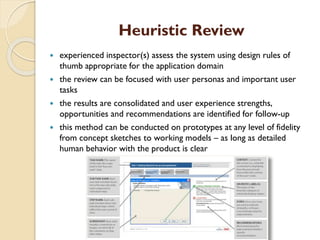
 experienced inspector(s) assess the system using design rules of
thumb appropriate for the application domain
 the review can be focused with user personas and important user
tasks
 the results are consolidated and user experience strengths,
opportunities and recommendations are identified for follow-up
 this method can be conducted on prototypes at any level of fidelity
from concept sketches to working models – as long as detailed
human behavior with the product is clear
Eye-Tracking
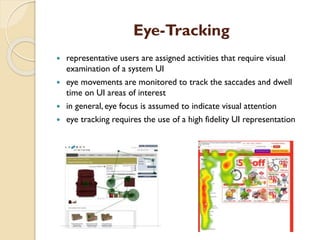
 representative users are assigned activities that require visual
examination of a system UI
 eye movements are monitored to track the saccades and dwell
time on UI areas of interest
 in general, eye focus is assumed to indicate visual attention
 eye tracking requires the use of a high fidelity UI representation
GOMS Analysis
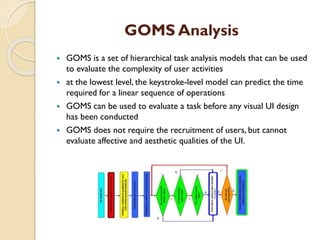
 GOMS is a set of hierarchical task analysis models that can be used
to evaluate the complexity of user activities
 at the lowest level, the keystroke-level model can predict the time
required for a linear sequence of operations
 GOMS can be used to evaluate a task before any visual UI design
has been conducted
 GOMS does not require the recruitment of users, but cannot
evaluate affective and aesthetic qualities of the UI.
Edge Case Brainstorm
 edge cases represent the extremes of system use, including
challenging environments, difficult tasks, and atypical users
 brainstorming is a participatory design method that promotes a
creative perspective on the UI function and visual design
 edge case brainstorming explores unique UX challenges that may
not emerge in traditional UX methods
 edge case brainstorming is not intended to maximize performance
of the edge case scenario, but rather to force the consideration of
design features that may also be beneficial to important and
frequent use cases.
Results Summary
Heuristic Review
1.
2.
3.
4.
5.
6.
7.
8.
9.
10.
Eye-Tracking
1.
2.
3.
4.
5.
6.
7.
8.
9.
10.
GOMS Analysis
1.
2.
3.
4.
5.
6.
7.
8.
9.
10.
Edge Case Brainstorm
1.
2.
3.
4.
5.
6.
7.
8.
9.
10.
Final Comments
So what have we learned?
Thank You!!

2013 UX Day Design Charrette

  • 1.
    Triangulating UX Methods ADesign Charrette Marc Resnick, Ph.D. Bentley University mresnick@bentley.edu humanfactors.blogspot.com @PerformSol Jay Elkerton, Ph.D. Emerson Process Management jay.elkerton@emerson.com Pete Maher LUMA Institute pete@luma-institute.com www.luma-institute.com/ Robert Pastel, Ph.D. Michigan Technological University rpastel@mtu.edu www.cs.mtu.edu/~rpastel Ania Rodriguez Key Lime Interactive ania@keylimeinteractive.com www.keylimeinteractive.com Jeff Kelley, Ph.D. IBM Interactive jfkcpe@hfergo.com www.musicman.net/jfkres.html
  • 2.
    Introduction to theCharrette  Brief introduction to the four UX Methods that will be demonstrated ◦ Heuristic Review ◦ Eye-Tracking ◦ GOMS Analysis ◦ Edge Case Brainstorm  Each UX Method will be used to evaluate OneNote  The results of these methods will be compared and contrasted.  Open discussion of: ◦ the strengths and weaknesses of each method ◦ the value of triangulation with multiple UX methods ◦ other issues that arose during the session
  • 3.
    Heuristic Review  experiencedinspector(s) assess the system using design rules of thumb appropriate for the application domain  the review can be focused with user personas and important user tasks  the results are consolidated and user experience strengths, opportunities and recommendations are identified for follow-up  this method can be conducted on prototypes at any level of fidelity from concept sketches to working models – as long as detailed human behavior with the product is clear
  • 4.
    Eye-Tracking  representative usersare assigned activities that require visual examination of a system UI  eye movements are monitored to track the saccades and dwell time on UI areas of interest  in general, eye focus is assumed to indicate visual attention  eye tracking requires the use of a high fidelity UI representation
  • 5.
    GOMS Analysis  GOMSis a set of hierarchical task analysis models that can be used to evaluate the complexity of user activities  at the lowest level, the keystroke-level model can predict the time required for a linear sequence of operations  GOMS can be used to evaluate a task before any visual UI design has been conducted  GOMS does not require the recruitment of users, but cannot evaluate affective and aesthetic qualities of the UI.
  • 6.
    Edge Case Brainstorm edge cases represent the extremes of system use, including challenging environments, difficult tasks, and atypical users  brainstorming is a participatory design method that promotes a creative perspective on the UI function and visual design  edge case brainstorming explores unique UX challenges that may not emerge in traditional UX methods  edge case brainstorming is not intended to maximize performance of the edge case scenario, but rather to force the consideration of design features that may also be beneficial to important and frequent use cases.
  • 7.
    Results Summary Heuristic Review 1. 2. 3. 4. 5. 6. 7. 8. 9. 10. Eye-Tracking 1. 2. 3. 4. 5. 6. 7. 8. 9. 10. GOMSAnalysis 1. 2. 3. 4. 5. 6. 7. 8. 9. 10. Edge Case Brainstorm 1. 2. 3. 4. 5. 6. 7. 8. 9. 10.
  • 8.
    Final Comments So whathave we learned?
  • 9.