Evaluation of the Impact of Telemedicine on
Access to Stroke Care in Oregon
Evaluation of the Impact of Telemedicine on Access to Stroke Care in Oregon
McDaneld L1, Wolff CS2, Salhi R2, Tommasini A2, Branas CC2, Lutsep H1, Carr BG2.
1. Dept. of Neurology, Oregon Health and Science University, Portland, OR
2. Dept. of Epidemiology, University of Pennsylvania, Philadelphia, PA
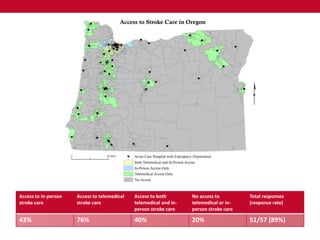
Access to in-person   Access to telemedical   Access to both        No access to         Total responses
stroke care           stroke care             telemedical and in-   telemedical or in-   (response rate)
                                              person stroke care    person stroke care

43%                   76%                     40%                   20%                  51/57 (89%)
Introduction
• Acute ischemic stroke is a leading cause of serious neurologic disability in
 the US

• Tissue plasminogen activator (tPA) administered within 4.5 hours of onset is
 an effective treatment for acute ischemic stroke (1, 2) but tPA treatment
 rates are estimated to be only 3.5-8% (3)

• Access to appropriate specialty care is limited; only 66% of the US
 population can reach a stroke center in 60 minutes or less (4), and 77% of
 US counties do not have a hospital with neurological services (5)

• Telemedical consultation for stroke results in a high proportion of correct
 treatment decisions (6, 7) and could improve access to stroke care
Objective
• To evaluate the impact of telemedical networks on access to stroke care
 within the state of Oregon, which has a small urbanized corridor and a large
 rural area.
Methods
Data:
• Hospital and Primary Stroke Center (PSC) Certification data were obtained from the
  Joint Commission.
• 2010 Neilson Claritas Demographic data were used for block-group population data.
• The 2009 Area Resource File was used to obtain county-level demographic data.
• Hospital Identification and Classification:
• All acute care hospitals in Oregon were identified using The Joint Commission data
• Between 9/2011 – 2/2012 ED Directors, nurse managers, or stroke coordinators at
  all identified hospitals were contacted to complete a semi-structured phone survey,
  with follow-up calls if necessary
• Survey focused on stroke capabilities including self-designation as a stroke center
  and availability of telemedical support
Access Calculations:
• Total time from population-weighted block group central point to nearest PSC was
  calculated using existing road networks and speeds and prehospital time estimates
  as has been described elsewhere (8).
• Geographic access was calculated by summing the population within 60 minutes by
  ground from a primary stroke center, telemedicine site, or both.
Results
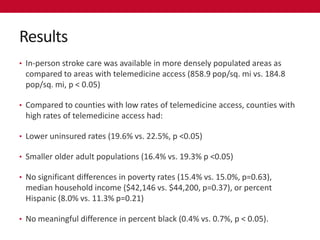
• In-person stroke care was available in more densely populated areas as
 compared to areas with telemedicine access (858.9 pop/sq. mi vs. 184.8
 pop/sq. mi, p < 0.05)

• Compared to counties with low rates of telemedicine access, counties with
 high rates of telemedicine access had:

• Lower uninsured rates (19.6% vs. 22.5%, p <0.05)

• Smaller older adult populations (16.4% vs. 19.3% p <0.05)

• No significant differences in poverty rates (15.4% vs. 15.0%, p=0.63),
 median household income ($42,146 vs. $44,200, p=0.37), or percent
 Hispanic (8.0% vs. 11.3% p=0.21)

• No meaningful difference in percent black (0.4% vs. 0.7%, p < 0.05).
Limitations
• We examined differences in access to care rather than differences in
 outcomes; the latter is likely a more accurate measure of population
 benefit.

• Hospitals were identified via The Joint Commission’s database and thus
 hospitals that are not TJC certified were not included.

• Prehospital time estimates were used as actual prehospital times are not
 available.
Discussion
• Telemedicine has reduced the percent of the population without access to
 stroke care from 57% to 20%.

• Of those with access to telemedical care, more than half also had in-person
 access to care.

• High rates of telemedicine access was associated with lower uninsured rates
 and younger populations compared to areas with low rates of telemedicine
 access.

• No meaningful racial discrepancies were noted.
References
1.   Tissue Plasminogen Activator for Acute Ischemic Stroke, rt-PA Study Group, NEJM 1995

2.   Thrombolysis with Alteplace 3 to 4.5 hours after Acute Ischemic Stroke, Hacke et al, NEJM 2008

3.   Acute stroke care in the US: results from 4 pilot prototypes of the Paul Coverdell National Acute Stroke
     Registry. Reeves et al, Paul Coverdell Prototype Registries Writing Group, Stroke 2005

4.   StrokeMaps.org 2010 Stroke Center Maps, Carr et al, University of Pennsylvania Cartographic Modeling
     Laboratory, Available from: www.strokemaps.org

5.   Heart Disease and Stroke Statistics – 2010 Update, Lloyd-Jones et al, Circulation 2009

6.   Efficacy of site-independent telemedicine in the STRokE DOC trial: a randomised, blinded, prospective
     study, Meyer et al, Lancet Neurology 2008

7.   Stroke Team Remote Evaluation Using a Digital Observation Camera in Arizona – The Initial Mayo Clinic
     Experience, Demaershalk et al, Stroke 2010

8.   Access to trauma centers in the United States. Branas et al, JAMA 2005

UPenn Oregon Telestroke

  • 1.
    Evaluation of theImpact of Telemedicine on Access to Stroke Care in Oregon Evaluation of the Impact of Telemedicine on Access to Stroke Care in Oregon McDaneld L1, Wolff CS2, Salhi R2, Tommasini A2, Branas CC2, Lutsep H1, Carr BG2. 1. Dept. of Neurology, Oregon Health and Science University, Portland, OR 2. Dept. of Epidemiology, University of Pennsylvania, Philadelphia, PA
  • 2.
    Access to in-person Access to telemedical Access to both No access to Total responses stroke care stroke care telemedical and in- telemedical or in- (response rate) person stroke care person stroke care 43% 76% 40% 20% 51/57 (89%)
  • 3.
    Introduction • Acute ischemicstroke is a leading cause of serious neurologic disability in the US • Tissue plasminogen activator (tPA) administered within 4.5 hours of onset is an effective treatment for acute ischemic stroke (1, 2) but tPA treatment rates are estimated to be only 3.5-8% (3) • Access to appropriate specialty care is limited; only 66% of the US population can reach a stroke center in 60 minutes or less (4), and 77% of US counties do not have a hospital with neurological services (5) • Telemedical consultation for stroke results in a high proportion of correct treatment decisions (6, 7) and could improve access to stroke care
  • 4.
    Objective • To evaluatethe impact of telemedical networks on access to stroke care within the state of Oregon, which has a small urbanized corridor and a large rural area.
  • 5.
    Methods Data: • Hospital andPrimary Stroke Center (PSC) Certification data were obtained from the Joint Commission. • 2010 Neilson Claritas Demographic data were used for block-group population data. • The 2009 Area Resource File was used to obtain county-level demographic data. • Hospital Identification and Classification: • All acute care hospitals in Oregon were identified using The Joint Commission data • Between 9/2011 – 2/2012 ED Directors, nurse managers, or stroke coordinators at all identified hospitals were contacted to complete a semi-structured phone survey, with follow-up calls if necessary • Survey focused on stroke capabilities including self-designation as a stroke center and availability of telemedical support Access Calculations: • Total time from population-weighted block group central point to nearest PSC was calculated using existing road networks and speeds and prehospital time estimates as has been described elsewhere (8). • Geographic access was calculated by summing the population within 60 minutes by ground from a primary stroke center, telemedicine site, or both.
  • 6.
    Results • In-person strokecare was available in more densely populated areas as compared to areas with telemedicine access (858.9 pop/sq. mi vs. 184.8 pop/sq. mi, p < 0.05) • Compared to counties with low rates of telemedicine access, counties with high rates of telemedicine access had: • Lower uninsured rates (19.6% vs. 22.5%, p <0.05) • Smaller older adult populations (16.4% vs. 19.3% p <0.05) • No significant differences in poverty rates (15.4% vs. 15.0%, p=0.63), median household income ($42,146 vs. $44,200, p=0.37), or percent Hispanic (8.0% vs. 11.3% p=0.21) • No meaningful difference in percent black (0.4% vs. 0.7%, p < 0.05).
  • 7.
    Limitations • We examineddifferences in access to care rather than differences in outcomes; the latter is likely a more accurate measure of population benefit. • Hospitals were identified via The Joint Commission’s database and thus hospitals that are not TJC certified were not included. • Prehospital time estimates were used as actual prehospital times are not available.
  • 8.
    Discussion • Telemedicine hasreduced the percent of the population without access to stroke care from 57% to 20%. • Of those with access to telemedical care, more than half also had in-person access to care. • High rates of telemedicine access was associated with lower uninsured rates and younger populations compared to areas with low rates of telemedicine access. • No meaningful racial discrepancies were noted.
  • 9.
    References 1. Tissue Plasminogen Activator for Acute Ischemic Stroke, rt-PA Study Group, NEJM 1995 2. Thrombolysis with Alteplace 3 to 4.5 hours after Acute Ischemic Stroke, Hacke et al, NEJM 2008 3. Acute stroke care in the US: results from 4 pilot prototypes of the Paul Coverdell National Acute Stroke Registry. Reeves et al, Paul Coverdell Prototype Registries Writing Group, Stroke 2005 4. StrokeMaps.org 2010 Stroke Center Maps, Carr et al, University of Pennsylvania Cartographic Modeling Laboratory, Available from: www.strokemaps.org 5. Heart Disease and Stroke Statistics – 2010 Update, Lloyd-Jones et al, Circulation 2009 6. Efficacy of site-independent telemedicine in the STRokE DOC trial: a randomised, blinded, prospective study, Meyer et al, Lancet Neurology 2008 7. Stroke Team Remote Evaluation Using a Digital Observation Camera in Arizona – The Initial Mayo Clinic Experience, Demaershalk et al, Stroke 2010 8. Access to trauma centers in the United States. Branas et al, JAMA 2005