A NN U LA ER P TO R
2012
Forone, weare many. Formany,we areone.
“Faith, fight, family, and friends—if
you recognize and do those things in
that order, I truly believe your chances
are much greater at beating cancer.”
1 UPMC CancerCenter and University of Pittsburgh Cancer Institute 12012 Annual Report
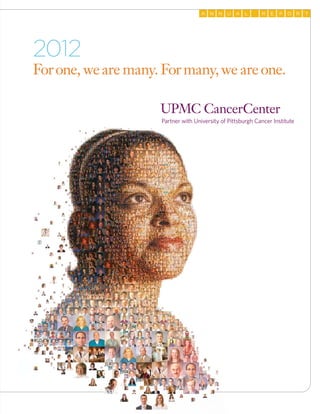
The cover of our 2012 Annual Report highlights the MANY physicians,
researchers, administrators, and staff who contribute to our mission to provide
each patient with comprehensive oncology services and programs through
UPMC CancerCenter, and who work tirelessly to translate effective cancer
treatments to clinical care through the University of Pittsburgh Cancer Institute.
For one, we are many. For many, we are one.
	2	 Leadership Message
	4	Diagnosis: Destiny
	7	 Bone Cancer
	 11	Brain Cancer
	14	 One Sister’s Mission
	16	 Head  Neck Cancers
	20	 Imaging
	23	 Blood Cancers
	24 	 GI Cancers
	30 	A Final Gift
	32 	Women’s Cancer
	42 	Children’s Survivorship Clinic
	44 	Pediatric Hem-Onc
	48 	Coping with Cancer
	50 	Network
	52 	 Community Outreach
	56 	 Precision Medicine
	58 	 Biobehavioral Medicine
	60 	 New  Notable
	62 	Circle of Hope Donors
	63 	Leadership
	66 	Locations
O
E
NM A Y
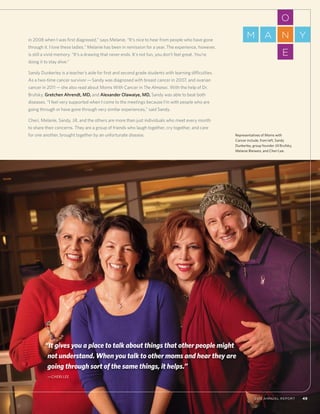
Meet ourcover model,
MargoBrown. 	
M
argo was initially diagnosed with breast cancer at UPMC
CancerCenter in 2001 at age 34, following the removal of what
was thought to be a cyst on her breast. “Behind the cyst was a
very small tumor that had attached itself to my chest wall—it
was cancer,” says Margo. Margo’s surgeon, John A. McKeating, MD, referred her
to Stanley M. Marks, MD, medical oncologist, who recommended an aggressive
treatment plan that included four rounds of chemotherapy at UPMC Shadyside,
followed by radiation at Magee-Womens Hospital of UPMC. Margo’s radiation
therapy was administered by Dwight E. Heron, MD, FACRO, FACR. Margo’s cancer
was in remission for seven years until a very small tumor was detected during a
routine mammogram in 2008. Margo again underwent aggressive chemotherapy
at Hillman Cancer Center and ultimately decided to undergo a double mastectomy,
performed by Gretchen M. Ahrendt, MD, with reconstruction performed by
Michael Gimbel, MD. With her cancer in remission, Margo enjoys talking with
other women about her experiences with cancer and sharing her philosophy for
overcoming the disease. “Faith, fight, family, and friends—if you recognize and
do those things in that order, I truly believe your chances are much greater at
beating cancer,” says Margo.
Margo is a flight attendant and lives in Penn Hills, a suburb of Pittsburgh, with
her husband, Rev. Dr. Eric Brown. In 2011, with the help of her church family,
Margo coordinated an outreach project that raised $3,500 for the Pittsburgh
Affiliate of Susan G. Komen for the Cure®. The money ultimately provided
mammograms for 35 women who were unable to afford them. She is excited
to continue this effort moving forward.
2 UPMC CancerCenter and University of Pittsburgh Cancer Institute
For one, we are many.
For many, we are one.
W
e introduced these
powerful words in our
2011 Annual Report when
we rolled out our new
UPMC CancerCenter brand. They epitomize
the unification of our UPMC and University
of Pittsburgh Cancer Institute (UPCI) oncology
activities—from medical and radiation services
to surgical services, from research and specialty
areas of expertise to education — all offered
across one of the nation’s largest networks of
cancer treatment centers.
The year 2012 marked the 10th anniversary
of our move to the Shadyside campus, located
just a few miles from the heart of downtown
Pittsburgh. The move to this campus allowed
us to bring together the research and clinical
aspects of our program under one roof in what
has become the nucleus of our network of
cancer centers—Hillman Cancer Center.
At Hillman, basic researchers collaborate with
physician-researchers and clinicians to rapidly
advance the most promising laboratory studies
into novel clinical trials, providing patients with
early access to new and innovative treatments.
This approach has yielded many success stories
and we are exceptionally proud to highlight
some of them from the past year.
Physician accomplishments
In 2012, Patrick S. Moore, MD, MPH, and
Yuan Chang, MD, were elected to the National
Academy of Sciences, a high honor bestowed
on only 105 scientists around the world. They
led the team that identified the virus that causes
Merkel cell carcinoma and isolated a protein
that allows tumor survival. These findings led
to identification of a drug that hinders the effect
of that protein and could lead to a therapy for
this deadly skin cancer. A national clinical trial
to test this approach will start this year—truly
an example of bench-to-bedside research.
We are pleased that head and neck cancer
specialist Jennifer R. Grandis, MD, FACS, was
elected to the Institute of Medicine. This
prestigious organization serves as the health
arm of the National Academy of Sciences and
seeks answers to the nation’s most pressing
questions about health and health care.
Two of our neurosurgery leaders, Ian F.
Pollack, MD, and Robert M. Friedlander, MD,
were elected to the Association of American
Physicians, an honorary society for physicians
that dates back to the 1880s.
And we were proud to learn that The Alliance
for Cancer Gene Therapy (ACGT) named UPMC
surgical oncologist Herbert Zeh III, MD, FACS,
as its 2012 ACGT Investigator. The award comes
with a $500,000 grant that will allow him to
continue his promising research focused on
gene therapy for pancreatic cancer.
In Pediatrics, A. Kim Ritchey, MD, vice chair
of Clinical Affairs at Children’s Hospital of
Pittsburgh of UPMC, was elected president of
the American Society of Pediatric Hematology/
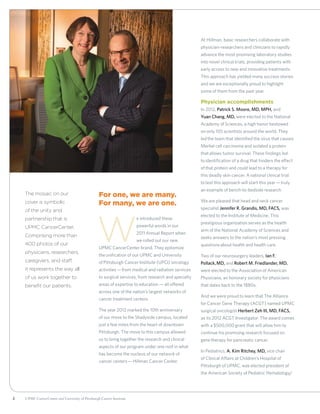
The mosaic on our
cover is symbolic
of the unity and
partnership that is
UPMC CancerCenter.
Comprising more than
400 photos of our
physicians, researchers,
caregivers, and staff,
it represents the way all
of us work together to
benefit our patients.
32012 Annual Report
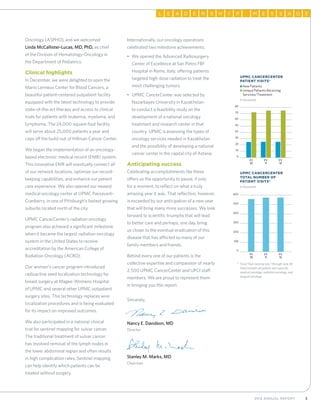
AL E D RE S IH P M E AS S G E
	UPMC CancerCenter
	 patient Visits*
	 4 New Patients
	 4 Unique Patients Receiving
Services/Treatment
	 In thousands
	80
	70
	60
	50
	40
	30
	20
	10
	0
FY
10
FY
11
	UPMC CancerCenter
	 Total number of
	patient visits*
	 In thousands
	600
	500
	400
	300
	200
	100
	0
FY
10
FY
11
	 *	 Fiscal Year running July 1 through June 30.
		Total includes all patient visit types for
medical oncology, radiation oncology, and
surgical oncology
FY
12
FY
12
Oncology (ASPHO), and we welcomed
Linda McCallister-Lucas, MD, PhD, as chief
of the Division of Hematology-Oncology in
the Department of Pediatrics.
Clinical highlights
In December, we were delighted to open the
Mario Lemieux Center for Blood Cancers, a
beautiful patient-centered outpatient facility
equipped with the latest technology to provide
state-of-the-art therapy and access to clinical
trials for patients with leukemia, myeloma, and
lymphoma. The 24,000-square-foot facility
will serve about 25,000 patients a year and
caps off the build-out of Hillman Cancer Center.
We began the implementation of an oncology-
based electronic medical record (EMR) system.
This innovative EMR will eventually connect all
of our network locations, optimize our record-
keeping capabilities, and enhance our patient
care experience. We also opened our newest
medical oncology center at UPMC Passavant–
Cranberry, in one of Pittsburgh’s fastest growing
suburbs located north of the city.
UPMC CancerCenter’s radiation oncology
program also achieved a significant milestone
when it became the largest radiation oncology
system in the United States to receive
accreditation by the American College of
Radiation Oncology (ACRO).
Our women’s cancer program introduced
radioactive seed localization technology for
breast surgery at Magee-Womens Hospital
of UPMC and several other UPMC outpatient
surgery sites. This technology replaces wire
localization procedures and is being evaluated
for its impact on improved outcomes.
We also participated in a national clinical
trial for sentinel mapping for vulvar cancer.
The traditional treatment of vulvar cancer
has involved removal of the lymph nodes in
the lower abdominal region and often results
in high complication rates. Sentinel mapping
can help identify which patients can be
treated without surgery.
Internationally, our oncology operations
celebrated two milestone achievements:
•	 We opened the Advanced Radiosurgery
Center of Excellence at San Pietro FBF
Hospital in Rome, Italy, offering patients
targeted high-dose radiation to treat the
most challenging tumors.
•	 UPMC CancerCenter was selected by
Nazarbayev University in Kazakhstan
to conduct a feasibility study on the
development of a national oncology
treatment and research center in that
country. UPMC is assessing the types of
oncology services needed in Kazakhstan
and the possibility of developing a national
cancer center in the capital city of Astana.
Anticipating success
Celebrating accomplishments like these
offers us the opportunity to pause, if only
for a moment, to reflect on what a truly
amazing year it was. That reflection, however,
is exceeded by our anticipation of a new year
that will bring many more successes. We look
forward to scientific triumphs that will lead
to better care and perhaps, one day, bring
us closer to the eventual eradication of this
disease that has afflicted so many of our
family members and friends.
Behind every one of our patients is the
collective expertise and compassion of nearly
2,500 UPMC CancerCenter and UPCI staff
members. We are proud to represent them
in bringing you this report.
Sincerely,
Nancy E. Davidson, MD
Director
Stanley M. Marks, MD
Chairman
4 UPMC CancerCenter and University of Pittsburgh Cancer Institute4 UPMC CancerCenter and University of Pittsburgh Cancer Institute
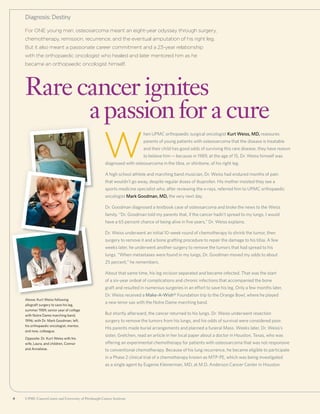
Above: Kurt Weiss following
allograft surgery to save his leg,
summer 1989; senior year of college
with Notre Dame marching band,
1996; with Dr. Mark Goodman, left,
his orthopaedic oncologist, mentor,
and now, colleague.
Opposite: Dr. Kurt Weiss with his
wife, Laura, and children, Connor
and Annaliese.
For ONE young man, osteosarcoma meant an eight-year odyssey through surgery,
chemotherapy, remission, recurrence, and the eventual amputation of his right leg.
But it also meant a passionate career commitment and a 23-year relationship
with the orthopaedic oncologist who healed and later mentored him as he
became an orthopaedic oncologist himself.
Rare cancer ignites
	 apassionfor a cure
Diagnosis: Destiny
W
hen UPMC orthopaedic surgical oncologist Kurt Weiss, MD, reassures
parents of young patients with osteosarcoma that the disease is treatable
and their child has good odds of surviving this rare disease, they have reason
to believe him—because in 1989, at the age of 15, Dr. Weiss himself was
diagnosed with osteosarcoma in the tibia, or shinbone, of his right leg.
A high school athlete and marching band musician, Dr. Weiss had endured months of pain
that wouldn’t go away, despite regular doses of ibuprofen. His mother insisted they see a
sports medicine specialist who, after reviewing the x-rays, referred him to UPMC orthopaedic
oncologist Mark Goodman, MD, the very next day.
Dr. Goodman diagnosed a textbook case of osteosarcoma and broke the news to the Weiss
family. “Dr. Goodman told my parents that, if the cancer hadn’t spread to my lungs, I would
have a 65 percent chance of being alive in five years,” Dr. Weiss explains.
Dr. Weiss underwent an initial 10-week round of chemotherapy to shrink the tumor, then
surgery to remove it and a bone grafting procedure to repair the damage to his tibia. A few
weeks later, he underwent another surgery to remove the tumors that had spread to his
lungs. “When metastases were found in my lungs, Dr. Goodman moved my odds to about
25 percent,” he remembers.
About that same time, his leg incision separated and became infected. That was the start
of a six-year ordeal of complications and chronic infections that accompanied the bone
graft and resulted in numerous surgeries in an effort to save his leg. Only a few months later,
Dr. Weiss received a Make-A-Wish® Foundation trip to the Orange Bowl, where he played
a new tenor sax with the Notre Dame marching band.
But shortly afterward, the cancer returned to his lungs. Dr. Weiss underwent resection
surgery to remove the tumors from his lungs, and his odds of survival were considered poor.
His parents made burial arrangements and planned a funeral Mass. Weeks later, Dr. Weiss’s
sister, Gretchen, read an article in her local paper about a doctor in Houston, Texas, who was
offering an experimental chemotherapy for patients with osteosarcoma that was not responsive
to conventional chemotherapy. Because of his lung recurrence, he became eligible to participate
in a Phase 2 clinical trial of a chemotherapy known as MTP-PE, which was being investigated
as a single agent by Eugenie Kleinerman, MD, at M.D. Anderson Cancer Center in Houston.
52012 Annual Report 52012 Annual Report
O
E
NM A Y
6 UPMC CancerCenter and University of Pittsburgh Cancer Institute6 UPMC CancerCenter and University of Pittsburgh Cancer Institute
Diagnosis: Destiny
His treatment was initiated in Houston, and, because of Children’s Hospital of Pittsburgh of
UPMC’s participation in the organization now known as the Children’s Oncology Group (COG),
Dr. Weiss was able to transfer his care and continue his treatments in Pittsburgh, under the
supervision of pediatric oncologist Michael Wollman, MD. After six months of treatment in the
clinical trial, his response was considered successful, and he has been in remission ever since.
Unfortunately, the repair surgery on his leg was not as successful, and a supportive metal
plate in his leg broke a few months later, requiring several additional surgeries and treatment
for severe infections. Yet he continued to defy the odds when, the next year, he was able to fulfill
one of his earliest dreams—attending the University of Notre Dame. But just weeks into the first
semester of his freshman year, his leg repair came apart and became so infected that he was
forced to leave school and undergo several more operations to repair the bone.
He was eventually able to return to college but, not long afterward, his leg became infected
yet again and, after 20 major surgeries trying to save his leg, Dr. Weiss made the decision
to undergo an amputation above the knee. Although a difficult and permanent decision, the
amputation ironically made his final year at Notre Dame his most mobile, because of his
prosthesis, and enjoyable, because he was no longer in pain or worried about future surgeries.
He marched in the Notre Dame marching band for the full football season and, the following
May, graduated from Notre Dame.
The following year, he began attending Jefferson Medical College in Philadelphia. The next
summer, Dr. Weiss was given an opportunity to do research at M.D. Anderson, where he
worked alongside Dr. Kleinerman, the very physician who had developed the experimental
chemotherapy drug that had saved his life. Also that year, he married his wife, Laura.
He then took a year off from medical school to participate in the Howard Hughes Medical
Research Scholars Program at the National Institutes of Health (NIH), under the tutelage of
Lee Helman, MD, one of the world’s premier pediatric bone cancer investigators. At that point,
he made the decision to dedicate a significant portion of his time to basic scientific research
on bone cancer.
After earning his medical degree, he matriculated to the University of Pittsburgh for an
orthopaedic surgery residency, which included one year in the lab of Johnny Huard, PhD,
professor at the University of Pittsburgh and Henry J. Mankin Endowed Chair in Orthopaedic
Surgery Research. While working in the Huard lab, Dr. Weiss began his own research and, using
cell lines he was given by Dr. Helman at the NIH, he and Dr. Huard published a paper that same
year, marking the beginning of the osteosarcoma basic science research program at UPMC.
Following his residency at UPMC, Dr. Weiss was offered a fellowship in musculoskeletal oncology
at the University of Toronto. He returned to Pittsburgh in 2010 to work with his former surgeon
and mentor, Dr. Goodman, and Richard McGough, MD, chief of orthopaedic oncology at UPMC.
He has been married for almost 13 years and is the father of Connor, 12, and Annaliese, 8.
Although delivering the news of an osteosarcoma diagnosis is always difficult, Dr. Weiss often
relates his personal success story and reminds parents that osteosarcoma is both treatable
and curable. “I tell them that I know it’s a tough situation, but they can get through it,” he says.
It doesn’t hurt that he is living proof that not only can patients with osteosarcoma go on to live
normal lives, but they can fulfill their dreams, as well.
From top: Kurt with parents Joanne
and Frank, and sister, Gretchen, on
a family outing just before Kurt’s
diagnosis, spring 1989; Joanne and
Frank with Kurt while he received
treatment in Texas, summer 1990;
Kurt as president of the Notre
Dame marching band, 1995; trip
to the Grand Canyon following his
amputation, summer 1998; with
Dr. Eugenie Kleinerman as a research
assistant, summer 1999.
72012 Annual Report
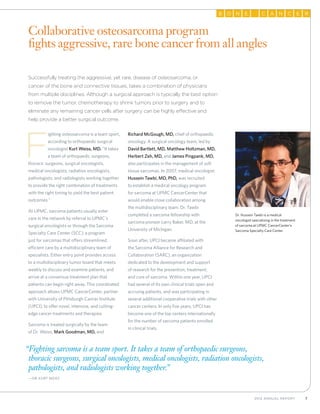
Dr. Hussein Tawbi is a medical
oncologist specializing in the treatment
of sarcoma at UPMC CancerCenter’s
Sarcoma Specialty Care Center.
Successfully treating the aggressive, yet rare, disease of osteosarcoma, or
cancer of the bone and connective tissues, takes a combination of physicians
from multiple disciplines. Although a surgical approach is typically the best option
to remove the tumor, chemotherapy to shrink tumors prior to surgery and to
eliminate any remaining cancer cells after surgery can be highly effective and
help provide a better surgical outcome.
F
ighting osteosarcoma is a team sport,
according to orthopaedic surgical
oncologist Kurt Weiss, MD. “It takes
a team of orthopaedic surgeons,
thoracic surgeons, surgical oncologists,
medical oncologists, radiation oncologists,
pathologists, and radiologists working together
to provide the right combination of treatments
with the right timing to yield the best patient
outcomes.”
At UPMC, sarcoma patients usually enter
care in the network by referral to UPMC’s
surgical oncologists or through the Sarcoma
Specialty Care Center (SCC), a program
just for sarcomas that offers streamlined,
efficient care by a multidisciplinary team of
specialists. Either entry point provides access
to a multidisciplinary tumor board that meets
weekly to discuss and examine patients, and
arrive at a consensus treatment plan that
patients can begin right away. This coordinated
approach allows UPMC CancerCenter, partner
with University of Pittsburgh Cancer Institute
(UPCI), to offer novel, intensive, and cutting-
edge cancer treatments and therapies.
Sarcoma is treated surgically by the team
of Dr. Weiss, Mark Goodman, MD, and
Richard McGough, MD, chief of orthopaedic
oncology. A surgical oncology team, led by
David Bartlett, MD, Matthew Holtzman, MD,
Herbert Zeh, MD, and James Pingpank, MD,
also participates in the management of soft
tissue sarcomas. In 2007, medical oncologist
Hussein Tawbi, MD, PhD, was recruited
to establish a medical oncology program
for sarcoma at UPMC CancerCenter that
would enable close collaboration among
the multidisciplinary team. Dr. Tawbi
completed a sarcoma fellowship with
sarcoma pioneer Larry Baker, MD, at the
University of Michigan.
Soon after, UPCI became affiliated with
the Sarcoma Alliance for Research and
Collaboration (SARC), an organization
dedicated to the development and support
of research for the prevention, treatment,
and cure of sarcoma. Within one year, UPCI
had several of its own clinical trials open and
accruing patients, and was participating in
several additional cooperative trials with other
cancer centers. In only five years, UPCI has
become one of the top centers internationally
for the number of sarcoma patients enrolled
in clinical trials.
Collaborative osteosarcoma program
fights aggressive, rare bone cancer from all angles
NB O E C A CN E R
“Fighting sarcoma is a team sport. It takes a team of orthopaedic surgeons,
thoracic surgeons, surgical oncologists, medical oncologists, radiation oncologists,
pathologists, and radiologists working together.”
	—Dr. Kurt Weiss
8 UPMC CancerCenter and University of Pittsburgh Cancer Institute
“Our surgeons see close to 600 sarcoma
patients every year, and I see about 150 of
them,” says Dr. Tawbi. “Of those 150 patients,
half have metastatic disease and are treated
through the Sarcoma SCC. In addition, we are
able to enroll roughly 25 patients a year in one
of our six or seven active clinical trials that are
accruing at any given time. When you consider
how rare sarcoma is to begin with, those
accrual volumes are very good.”
And outcomes are improving all the time.
“We see patients with bone and soft-tissue
sarcomas every single day, hundreds of
patients every year, even though these cancers
are rare—because patients are referred to
UPMC from all over.” This volume, combined
with excellent patient care and capability
to conduct research, makes our sarcoma
program among the best in the country.
One distinct advantage of seeing so many
sarcoma patients has been the program’s
ability to quickly build a tissue bank that
can be used for research. Initially using the
tissue banking resources established by
UPMC CancerCenter’s melanoma program,
Drs. Tawbi, Weiss, and the multidisciplinary
team were able to get the sarcoma tissue
bank up and running quickly. “Every sarcoma
tumor removed by a surgeon at UPMC
with patient consent is contributed to the
sarcoma tissue bank,” says Dr. Tawbi. “This
research resource is an absolutely invaluable
component of any translational or clinical
research program, and our tissue bank
continues to grow steadily.”
“Sarcoma is a tough disease,” says
Dr. Weiss. “The only good thing about it
is that it is predictable—we know where it
likes to go, and that’s to the lungs. We also
know, historically, that more than 80 percent
of people have metastatic tumor cells moving
throughout their bodies at the time they’re
diagnosed. The addition of chemotherapy
has changed the survival rate from about
10 percent in the 1960s and 1970s to about
65 percent survival now, but it hasn’t really
improved for about 30 years. So the survival
rate from osteosarcoma for the kids I diagnose
now is about the same as it was for me when
I was diagnosed in 1989, and that’s what
we’re out to change.”
There are no agents that specifically target
the metastatic process for osteosarcoma,
because chemotherapy targets replicating
cells indiscriminately. “Nobody dies from
the tumor in their arm or leg, and we can
almost always save the limb where the tumor
originates,” says Dr. Weiss. “But we need
more intelligent ways to fight the metastatic
disease, which is what I’m working on.”
Dr. Weiss’ research aims to find out how
metastatic cancer cells differ from regular
cancer cells and why some make that journey
from the original tumor to the lungs. By figuring
that out, he hopes to interrupt or stop that
process. The difference between metastatic
cancer cells and regular cancer cells is part
of the reason why chemotherapy agents that
target lung cancer do not work on metastatic
cancer of the lung, which is chemoresistant.
And the tumor bank is central to his research.
“The sarcoma registry and tumor bank are
important initiatives,” he adds. “As soon as a
surgeon removes a sarcoma in the operating
room, we’ll get a sample of that tumor to start
a cell line. We have all the patients’ clinical
data to be able to compare patients who did
well with patients who did poorly. By looking
at the difference between their cells, we hope
to understand the biology behind why one
cell spread and another did not.”
Because osteosarcoma is so rare, only a
handful of medical centers worldwide are
involved in sarcoma research. UPCI, because
of its existing research infrastructure, is
able to conduct this research, fueled by
Dr. Weiss’ passion and the support from
his department head.
BON E C ANCER
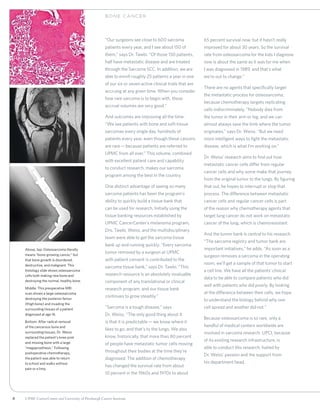
Above, top: Osteosarcoma literally
means “bone-growing cancer,” but
that bone growth is disordered,
destructive, and malignant. This
histology slide shows osteosarcoma
cells both making new bone and
destroying the normal, healthy bone.
Middle: This preoperative MRI
scan shows a large osteosarcoma
destroying the posterior femur
(thigh bone) and invading the
surrounding tissues of a patient
diagnosed at age 16.
Bottom: After radical removal
of the cancerous bone and
surrounding tissues, Dr. Weiss
replaced the patient’s knee joint
and missing bone with a large
“megaprosthesis.” Following
postoperative chemotherapy,
the patient was able to return
to school and walks without
pain or a limp.
92012 Annual Report
Racing for a Cure
Often, fundraising efforts start at the grassroots
level, and that is especially true for the Pittsburgh
Cure Sarcoma 5K Run and Walk.
What began in 2008 with a small informational
gathering organized by Anette Duensing, MD, a
UPCI pathologist and researcher, grew within two
years into the Pittsburgh Cure Sarcoma (PCS)
Committee, made up of former patients and family
members. The committee’s first major fundraising
event, a 5K run/walk, was held in summer 2010 and
raised $50,000; their second event in 2012 more
than doubled that amount and attracted more than
1,500 runners.
Hussein Tawbi, MD, PhD, head of UPMC
CancerCenter’s Sarcoma Specialty Care Center,
serves on the PCS Committee, and is appreciative,
not only of the work done by the committee, but
also the money they raise, which helps fund
sarcoma research, both locally at UPCI and
nationally through the Sarcoma Foundation of
America (SFA).
Dr. Tawbi’s own research projects are supported by
the proceeds of the event. He is currently working
toward a clinical trial that will introduce novel
epigenetic agents with chemotherapy in hopes of
making sarcoma less resistant to chemotherapy.
Radiation oncology and
osteosarcoma
Years ago, treatment options for
osteosarcoma were limited and consisted
of amputating the limb with the tumor.
Thankfully, there are now many more treatment modalities for patients with
osteosarcoma—and research has shown that a multidisciplinary approach,
consisting of surgical oncology, radiation oncology, and medical oncology,
can positively affect patient outcomes.
“Today, we do less aggressive, ‘limb-sparing’ surgeries in conjunction with
more intensive, multidisciplinary therapies in an attempt to preserve function,”
says Dwight E. Heron, MD, FACRO, FACR, director of radiation services at
UPMC CancerCenter. “Often we can use chemoradiotherapy as a neoadjuvant
therapy to shrink the tumor and make it more resectable, so that when the
surgery is performed, limb preservation may be realized.”
But patients with osteosarcoma almost invariably have pain; in fact, it is usually
persistent pain that drives patients to their doctors in the first place when they
get their initial diagnoses. “Radiation can be used for pain control, both as part
of the therapeutic process—for cure—or as palliation for recurrent cancer in
other bones or at end of life, because it is a very potent, but very localized,
effective treatment,” explains Dr. Heron. “Radiation can reduce pain and
eliminate the need to keep patients on large doses of narcotics that make
them feel groggy and negatively impact their quality of life.”
UPMC is constantly pushing the boundaries with clinical trials and trying to
understand this rare cancer and develop multidisciplinary ways to treat it.
Often these trials draw from clinical research that was done over the past
10 to 20 years, much of which has come from the pediatric arena, since the
disease is more prevalent in children and young adults.
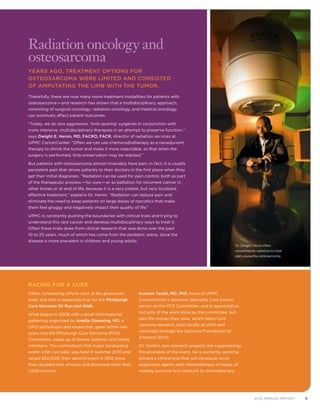
Dr. Dwight Heron often
recommends radiation to treat
pain caused by osteosarcoma.
10 UPMC CancerCenter and University of Pittsburgh Cancer Institute10 UPMC CancerCenter and University of Pittsburgh Cancer Institute
BON E C ANCER
UPCI building strong bone and mineral
research program
B
one-related research has
always been a strength of the
University of Pittsburgh Cancer
Institute (UPCI). Deborah L.
Galson, PhD, assistant professor of medicine
at the University of Pittsburgh and member
of the UPCI Molecular and Cellular Cancer
Biology Program, recognized that strength
and helped form the collaborative Pittsburgh
Center for Bone and Mineral Research
(PCBMR).
A molecular biologist whose expertise lies
in osteoclast differentiation, Paget’s disease,
and multiple myeloma, Dr. Galson is
pioneering efforts to unite researchers at the
University of Pittsburgh, Carnegie Mellon
University, and Duquesne University who
have interest in all aspects of bone biology.
The PCBMR is expected to:
•	 Help investigators locate resources
around Pittsburgh, including state-of-the
art instrumentation and methodology for
conducting bone-related research.
•	 Develop fruitful collaborations.
•	 Serve as a resource for researchers who
find their work moving unexpectedly
into the field of bone biology.
•	 Showcase the extensive bone-related
research that is being conducted in
Pittsburgh.
The PCBMR sponsors a monthly seminar
series that features lectures by both internal
and external experts in the field of bone
and mineral research, covering a diverse
array of topics, including bone development
and remodeling, bone cancers and bone
metastases, and immune-related bone
issues, such as arthritis and inflammation,
among many others.
Sarcoma Warning Signs
Bone sarcoma is a very rare disease—roughly one in 500,000 children receives a
sarcoma diagnosis—that typically causes pain in the limbs, particularly the legs. Because
many youngsters complain of “growing pains” in their legs, how do you know when bone
pain is a part of normal growth and when it should be checked out by a doctor?
“Osteosarcoma, or cancer of the bones, usually occurs during periods of rapid growth—
mainly adolescence—when the child is past the typical growing pain years,” says
Michael Wollman, MD, pediatric oncologist at Children’s Hospital of Pittsburgh of UPMC.
“About 75 percent of osteosarcomas present in the long bones above or below the knee.
Ewing sarcoma, another form of bone sarcoma, can present anywhere—but the hip, the
spine, and the long bones are common sites.”
Parents should seek a doctor’s advice if their child has any pain that:
•	 Is persistent in one place.
•	 Does not respond to ibuprofen or acetaminophen.
•	 Wakes a child up during the night.
•	 Causes a limp, difficulty walking, or change in gait.
•	 Includes swelling at the site.
•	 Is present with fever or other systemic symptoms.
Because teenagers often are more private with their bodies, parents should ask about
and monitor any persistent pain of which their child may complain.
Clinical trial
for osteosarcoma
Children’s Hospital of
Pittsburgh of UPMC has an
actively accruing clinical trial
specifically focused on
patients with osteosarcoma.
This Phase 3 trial is being
conducted in conjunction
with the Children’s Oncology
Group (COG) for children ages
5 and up who have resectable,
histologically confirmed,
high-grade osteosarcomas,
including second malignancies.
“The trial is studying the
effectiveness of chemotherapy
followed by surgery and two
different combinations of
chemotherapy regimens—
with or without PEG-interferon
alfa-2b—to compare how well
they work in offering durable
remission and possible cure,“
says Yatin M. Vyas, MD, the
institutional principal
investigator on the trial.
“The idea is to see if adding
a biological agent, such as
interferon, augments cure
rates, or not.” Participants
enrolled in the study will
undergo chemo­therapy using
the standard anticancer
regimen for two months,
followed by surgery and
assessment of their response.
Participants will then be
separated into two groups—
those who had good response
and those who had poor
response—and each group
will be randomly assigned to
further chemo­therapy using
standard or experimental
regimens. Results will be
compared to see whether
the experimental regimen
is better than, equal to, or
worse than the currently
accepted regimen based
on effectiveness, side effects,
and hospital lengths of stay.
112012 Annual Report
RB A NI AC N RC E
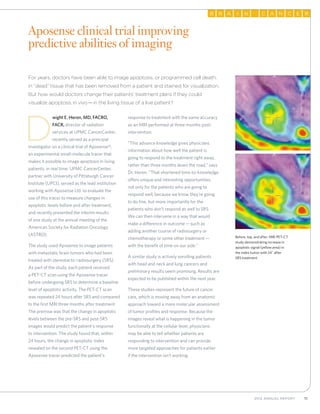
Before, top, and after: MRI PET-CT
study demonstrating increase in
apoptotic signal (yellow area) in
the index tumor with 24˚ after
SRS treatment.
For years, doctors have been able to image apoptosis, or programmed cell death,
in “dead” tissue that has been removed from a patient and stained for visualization.
But how would doctors change their patients’ treatment plans if they could
visualize apoptosis in vivo—in the living tissue of a live patient?
D
wight E. Heron, MD, FACRO,
FACR, director of radiation
services at UPMC CancerCenter,
recently served as a principal
investigator on a clinical trial of Aposense®,
an experimental small-molecule tracer that
makes it possible to image apoptosis in living
patients, in real time. UPMC CancerCenter,
partner with University of Pittsburgh Cancer
Institute (UPCI), served as the lead institution
working with Aposense Ltd. to evaluate the
use of this tracer to measure changes in
apoptotic levels before and after treatment,
and recently presented the interim results
of one study at the annual meeting of the
American Society for Radiation Oncology
(ASTRO).
The study used Aposense to image patients
with metastatic brain tumors who had been
treated with stereotactic radiosurgery (SRS).
As part of the study, each patient received
a PET-CT scan using the Aposense tracer
before undergoing SRS to determine a baseline
level of apoptotic activity. The PET-CT scan
was repeated 24 hours after SRS and compared
to the first MRI three months after treatment.
The premise was that the change in apoptotic
levels between the pre-SRS and post-SRS
images would predict the patient’s response
to intervention. The study found that, within
24 hours, the change in apoptotic index
revealed on the second PET-CT using the
Aposense tracer predicted the patient’s
response to treatment with the same accuracy
as an MRI performed at three months post-
intervention.
“This advance knowledge gives physicians
information about how well the patient is
going to respond to the treatment right away,
rather than three months down the road,” says
Dr. Heron. “That shortened time-to-knowledge
offers unique and interesting opportunities,
not only for the patients who are going to
respond well, because we know they’re going
to do fine, but more importantly for the
patients who don’t respond as well to SRS.
We can then intervene in a way that would
make a difference in outcome—such as
adding another course of radiosurgery or
chemotherapy or some other treatment—
with the benefit of time on our side.”
A similar study is actively enrolling patients
with head and neck and lung cancers and
preliminary results seem promising. Results are
expected to be published within the next year.
These studies represent the future of cancer
care, which is moving away from an anatomic
approach toward a more molecular assessment
of tumor profiles and response. Because the
images reveal what is happening in the tumor
functionally at the cellular level, physicians
may be able to tell whether patients are
responding to intervention and can provide
more targeted approaches for patients earlier
if the intervention isn’t working.
Aposense clinical trial improving
predictive abilities of imaging
12 UPMC CancerCenter and University of Pittsburgh Cancer Institute
Understanding brain cancer and developing
novel treatments
G
liomas are tumors in the brain
that arise from glial cells, the
supportive glue-like tissue that
helps to keep neurons in place and
functioning. Malignant gliomas are among the
most common and deadly brain tumors. There
are several types of gliomas, characterized by
where they are found and the type of cell that
gave rise to the tumor, including astrocytomas,
brain stem gliomas, ependymomas, and
visual pathway gliomas.
Glioblastoma multiforme (GBM), also known
as grade IV (severe) astrocytoma, is the
most aggressive malignant primary brain
tumor in adults and has the worst prognosis
of any central nervous system malignancy,
with the exception of the brainstem gliomas,
which can begin as low-grade tumors and
evolve into GBM. Despite multimodality
treatment—including surgical resection to
remove as much of the tumor as possible,
concurrent or sequential chemotherapy and
radiation therapy, antiangiogenic therapy,
and stereotactic radiosurgery—prognosis
is extremely poor, and the disease is almost
always fatal.
The University of Pittsburgh Cancer Institute
(UPCI) has initiated a number of research
projects devoted to a daunting task—
increasing the understanding of gliomas
so that novel treatment for these malignant
brain cancers can be developed.
Nduka M. Amankulor, MD, recently joined
UPCI and UPMC CancerCenter and the
Department of Neurological Surgery as
an assistant professor. In addition to his
clinical practice, Dr. Amankulor is a cancer
biologist whose research focuses on the tumor
microenvironment, which contains normal,
non-neoplastic cells that may contribute
to tumor growth and maintenance. Within
platelet-derived growth factor (PDGF)-driven
murine gliomas, tumor-associated astrocytes
(TAAs) make up a large component of the
tumor microenvironment. Dr. Amankulor
and his colleagues identified unique gene
expression patterns between populations
of TAAs and suggested potential roles
for stromal astrocytes within the glioma

microenvironment. They showed that
certain stromal astrocytes in the tumor
microenvironment express a GBM-specific
gene signature and that the majority of these
stromal astrocyte genes can predict survival
in humans with GBM.
Hideho Okada, MD, PhD, is a professor in
the departments of Neurological Surgery,
Surgery, and Immunology, as well as co-leader
of the UPCI Brain Tumor Program.
Dr. Okada’s lab was the first to identify and fully
characterize cytotoxic T-lymphocyte (CTL)
epitopes for gliomas. His seminal discovery
of CTL epitopes in glioma-associated antigens
and work on the mechanisms underlying the
adjuvant effects of the experimental drug
poly-ICLC enabled Dr. Okada to launch novel
glioma vaccine trials in combination with
poly-ICLC as adjuvant therapy. The first of
these—a Phase 1 study for recurrent high-
grade glioma—has already yielded evidence
of the vaccine’s safety and ability to evoke
relevant immunological responses, as well as
preliminary, but promising, clinical responses,
such as a case of complete remission of GBM.
Recently, Dr. Okada has been working to
launch clinical trials for glioma patients using
a novel personalized medicine approach to
immunotherapy. This Phase 1-2 study will be
part of a larger collaborative effort by the nine-
center Glioma Actively Personalized Vaccine
Consortium (GAPVAC), which comprises
eight European centers and the University of
Pittsburgh. Dr. Okada and his collaborators
will try to transform the treatment of glioma
B R AIN C ANCER
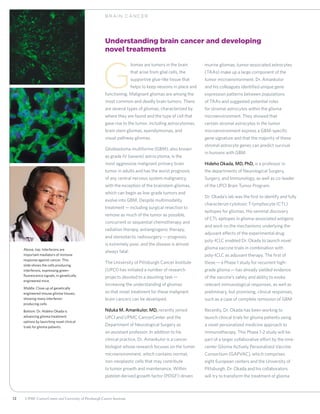
Above, top: Interferons are
important mediators of immune
response against cancer. This
slide shows the cells producing
interferons, expressing green-
fluorescence signals, in genetically
engineered mice.
Middle: Close up of genetically
engineered mouse glioma tissues,
showing many interferon-
producing cells.
Bottom: Dr. Hideho Okada is
advancing glioma treatment
options by launching novel clinical
trials for glioma patients.
132012 Annual Report
by developing a novel method for generating
a glioma vaccine customized to each patient
based on the genetic pattern of his or her
tumor. Each patient’s tumor tissue will be
analyzed for peptides that are overexpressed
or mutated. Next-generation exome
sequencing and a novel method for predicting
immunogenic peptides (peptidomics) will be
integrated to assess each patient’s specific
mutated peptides. The European Union has
funded this research at the eight European
sites; Dr. Okada was able to obtain generous
funding from Voices Against Brain Cancer,
the Musella Foundation for Brain Tumor
Research and Information, and Gray Matters
Brain Cancer Foundation, making UPCI the
only site in North America to participate and
enroll patients.
UPMC’s Radiosurgical Experience Goes Global
For more than 30 years, UPMC has been known as a pioneer in stereotactic
radiosurgery (SRS), “bloodless” surgery that enables the treatment of tumors deep
within the brain and spinal cord. Three years ago, UPMC attained the milestone of
treating its 10,000th patient using the Gamma Knife®.
Now, through the close collaboration of radiation oncologists, neurosurgeons, and
medical physicists, UPMC is approaching a new radiosurgical milestone of treating
its 12,000th patient using the Gamma Knife—yet countless more patients have been
helped throughout the world by the sharing of UPMC’s radiosurgery experience.
According to Dwight E. Heron, MD, FACRO, FACR, director of radiation services,
UPMC CancerCenter regularly hosts physicians from around the world to be trained
on these devices. These physicians then return to their own countries to implement
successful radiosurgery programs, affecting thousands more people worldwide.
The concept of radiosurgery began in Pittsburgh in 1987 when the Gamma Knife was
first used here, and has evolved into the newer technologies that make up UPMC
CancerCenter’s SRS program, among them the CyberKnife®. UPMC was one of the first
centers in the world to use the CyberKnife and, in the last two years, its Mary Hillman
Jennings Radiation Oncology Center at UPMC Shadyside was recognized as the top site
in the United States and fourth in the world for total procedures done using the device.
Two additional cutting-edge devices—the Triology™ linear accelerator and our newest
acquisition, the Novalis® powered by TrueBeam™ STx system, a novel radiosurgical
device—complete UPMC’s radiosurgical offerings and have been used over the past
decade to treat nearly 18,000 patients.
“These devices use the same principal of applying a highly focused radiosurgical beam
to treat the most challenging cancers, such as head and neck, liver, and pancreatic
cancers,” says Dr. Heron. “In addition, radiosurgery can be used with neoadjuvant
chemotherapy to shrink tumors in patients who were considered unresectable,
rendering them surgical candidates and positively affecting their odds for survival.”
“Radiosurgery can be used with neoadjuvant chemotherapy to shrink tumors in 
patients who were considered unresectable, rendering them surgical candidates
and positively affecting their odds for survival.”
	—Dr. Dwight Heron
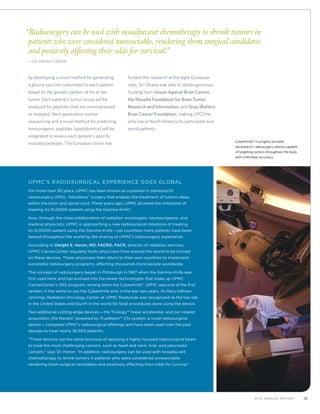
CyberKnife® is a highly versatile
stereotactic radiosurgery device capable
of targeting tumors throughout the body
with millimeter accuracy.
14 UPMC CancerCenter and University of Pittsburgh Cancer Institute14 UPMC CancerCenter and University of Pittsburgh Cancer Institute
Her MANY followers (5,000) know her as Steelergurl, the blogger and
football fan dedicated to all things Steelers n’at. To her family and friends,
she’s Lahne, whose love for the Pittsburgh Steelers turned into a side job,
and whose love for her younger brother turned into a mission.
Steelergurl’s blog raises
	 funds forcancer research
One sister’s mission
$10 for 10K
Lahne has called upon
her blog friends and
community to step up
and donate to Dr. Ferris’
research in a campaign
called $10 for 10K. “If
every one of my followers
donated $10, we would
easily reach our goal of
$10,000,” she says.
“Lahne’s effort to
educate the public about
this type of oral cancer
is just as important as
funding the research to
prevent it,” says Dr. Ferris.
“Her campaign will help
drive UPMC CancerCenter
and UPCI efforts to curb
HPV-associated oral
cancers.”
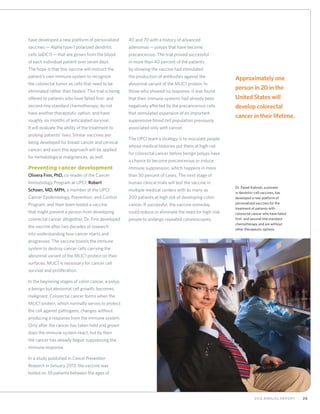
L
ahne Mattas grew up in a close-knit family in Altoona, Pa., with her parents,
grandparents, and brother Brian. Everyone in her family loves the Pittsburgh Steelers.
“People say they ‘bleed black and gold’ and that would be true for everyone in my family,”
says Lahne, whose love for the black and gold stayed with her through college and
a career in public relations and marketing.
In 2008, after her friend joked that she should create a Steelers blog, she purchased the URL
Steelergurl.com and has since had booming success, even catching the eye of the NFL. “Women
fans have been a target market for the NFL,” says Lahne. “I’ve been lucky to have the opportunity
to attend the NFL Draft a few times and Media Day at Super Bowl XLV when the Steelers played
Green Bay in 2011.”
In 2011, Lahne’s priorities shifted when she learned her brother Brian had developed oral cancer.
“Brian didn’t have the typical risk factors associated with this type of cancer, such as smoking and
drinking,” says Lahne. “It was a shock to the family.” Brian had surgery in November 2011 to remove
the tumor, but a scan in February 2012 showed that the cancer had recurred. He underwent a
second surgery, followed by chemotherapy and radiation.
“It’s so hard to watch a loved one go through cancer treatment and know there’s nothing you can
do to take away the pain,” she says. “Cancer really makes you feel helpless. That’s when I realized
I could help others through my blog and social networking.”
Lahne was put in touch with Robert L. Ferris, MD, PhD, chief of the Division of Head and Neck
Surgery; professor of otolaryngology, immunology, and radiation oncology; and associate director
of translational research and co-leader, Cancer Immunology Program, UPCI. According to
Dr. Ferris, the majority of oral cancers are associated with tobacco and alcohol, but in recent
years, the oncology community has learned that the human papillomavirus (HPV) has also
been associated with causing cancer of the oropharynx, which is the middle part of the throat,
including the soft palate, the base of the tongue, and the tonsils. Still, in up to 30 percent of
cases, patients have no known risk factors, as was the case with Brian. Yet, he succumbed to
his cancer in January 2013.
Dr. Ferris currently is investigating a vaccine that would inhibit HPV from initiating cancer
development. Although Brian’s cancer wasn’t associated with the virus, Lahne felt it was important
to support his research. “While Dr. Ferris’ work did not help my brother directly, we’re looking
to help Dr. Ferris prevent HPV-positive patients from getting cancer so no other family has to
go through this,” says Lahne.
152012 Annual Report 152012 Annual Report
O
E
NM A Y
16 UPMC CancerCenter and University of Pittsburgh Cancer Institute
AH E D N E KC AC N RC E S
Tobacco and alcohol have long been identified as risk factors for developing
many types of cancers, including head and neck cancers. In the last decade,
however, researchers have determined that the human papillomavirus (HPV),
a common cause of cervical cancer, also plays a large role in causing cancer
of the oropharynx. Head and neck cancer experts at UPMC CancerCenter
and the University of Pittsburgh Cancer Institute (UPCI) are actively pursuing
preventive therapies and targeted treatment for patients with HPV-associated
head and neck cancers.
N
ot everyone infected with HPV
will develop cancer, according
to Jonas T. Johnson, MD, FACS,
the Dr. Eugene Myers Professor
and chairman of otolaryngology. In 2011, UPMC
CancerCenter treated 645 patients with head
and neck tumors, 64 of which were HPV-
positive. “Most HPVs are innocuous,” says Dr.
Johnson. “Unfortunately, some people will be
exposed to the oncogenic subtypes, but won’t
be diagnosed with a cancer until 15 to 20 years
later, when the HPV mutates and the cancer
exposes itself as an ulcer on the back of the
tongue or tonsils, the most common sites
for HPV-positive head and neck cancers.”
Dr. Johnson meets weekly with other head
and neck specialists from radiation oncology,
medical oncology, immunology, and radiology
in a multidisciplinary forum called the Head and
Neck Cancer Specialty Care Center (SCC), to
discuss new patient cases, develop treatment
plans, and evaluate existing patients’ treatment
plans. This multidisciplinary approach to
oncology care is a highly effective way to
explore all available treatment options and offer
optimal care for patients. One of Dr. Johnson’s
colleagues in the meeting is Dwight E. Heron,
MD, FACRO, FACR, director of radiation
services at UPMC CancerCenter.
“HPV has revolutionized how we think
about head and neck cancers and is challenging
us to rethink our conventional assumptions
about these tumors,” says Dr. Heron. Within
the last five years, it’s been determined that
HPV-positive head and neck cancers respond
better to standard treatment than head and
neck cancers caused by other risk factors,
such as smoking.
Awareness is key to early diagnosis
of HPV-related head and neck cancers
One of THE Nation’s top clinical researchers comes to pittsburgh
UPMC CancerCenter and UPCI have added to their already experienced group of head and neck cancer specialists
with the recruitment of Julie Bauman, MD, MPH. Dr. Bauman is a medical oncologist, assistant professor of medicine,
director of the Head and Neck Cancer Section and Thyroid Cancer Section in the Division of Hematology-Oncology,
and co-director of the UPMC Head and Neck Cancer Center of Excellence. She specializes in the treatment of head and
neck cancer and thyroid cancer. Since coming on board, Dr. Bauman has developed three clinical trials intended to bring
cutting-edge laboratory findings into the care of head and neck cancer patients. In 2011, she was honored with the NCI
Cancer Clinical Investigator Team Leadership Award.
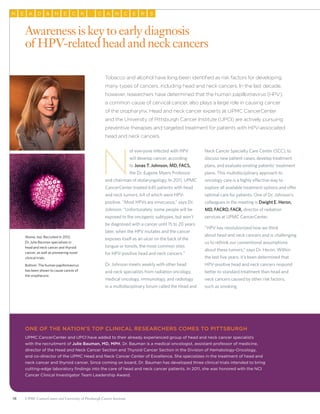
Above, top: Recruited in 2012,
Dr. Julie Bauman specializes in
head and neck cancer and thyroid
cancer, as well as pioneering novel
clinical trials.
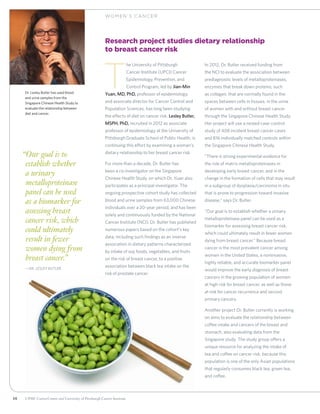
Bottom: The human papillomavirus
has been shown to cause cancer of
the oropharynx.
172012 Annual Report
“Knowing that a patient’s tumor is HPV-
positive, we can adjust the patient’s treatment
plan to de-intensify therapies, which may
reduce treatment-related side effects, and
achieve the same result—remission,” says
Dr. Heron.
James Ohr, DO, medical oncologist, UPMC
CancerCenter, and assistant professor of
medicine, also attends the weekly meetings
and says early detection of HPV-positive head
and neck cancers is as important as in any
other cancer, but notes the lack of education
surrounding HPV-associated head and neck
cancers is a problem. “We have done such
a good job at educating the public on the
cancer dangers of tobacco that many people
will ignore symptoms—such as a prolonged
tongue or mouth ulcer, a hoarse voice, or
difficulty swallowing—because they’re
unaware that HPV can lead to head and
neck cancers,” says Dr. Ohr. “Educating
patients and dentists to perform oral cancer
evaluations is important.”
Multidisciplinary care
Designated nurse coordinators for the
Head and Neck Cancer SCC will schedule a
patient to see a member from each specialty,
oftentimes on the same day, or within a few
days of each other. Afterward, the patient’s
options are weighed during the meetings and
a final treatment plan is developed, based on
input from all specialties. Clinical trial options
also are considered for patients who might
benefit from them.
“I can’t speak highly enough about the
benefits of the multidisciplinary approach in
treating HPV-positive head and neck cancers,”
says Dr. Heron. “Our team works well together
in developing ideas and sharing resources.
We have tremendous talent focused on making
the therapies we deliver kinder, gentler, and
more effective.”
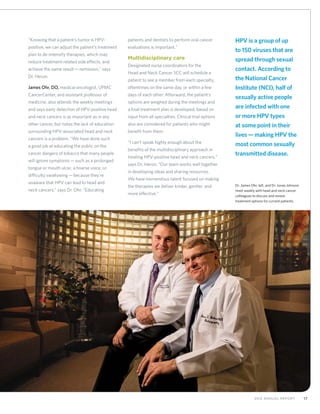
Dr. James Ohr, left, and Dr. Jonas Johnson
meet weekly with head and neck cancer
colleagues to discuss and review
treatment options for current patients.
HPV is a group of up
to 150 viruses that are
spread through sexual
contact. According to
the National Cancer
Institute (NCI), half of
sexually active people
are infected with one
or more HPV types
at some point in their
lives—making HPV the
most common sexually
transmitted disease.
18 UPMC CancerCenter and University of Pittsburgh Cancer Institute
H E AD  N ECK C ANCERS
New program provides
personalized care for
patients with virus-
associated cancers
F
or patients who present with
virus-associated cancers, such
as human papillomavirus (HPV)-
positive head and neck cancers,
a new research-based collaborative effort
between UPMC and the University of Pittsburgh
Cancer Institute (UPCI) has been formed to
improve personalized treatment options. The
Translational Microenvironment/Viral Oncology
Program was founded and is directed by
Robert Ferris, MD, PhD, FACS, chief of the
Division of Head and Neck Surgery; professor
of otolaryngology, immunology, and radiation
oncology; associate director for translational
research; and co-leader, Cancer Immunology
Program, UPCI.
According to Dr. Ferris, the program aims to
enhance and accelerate a cancer patient’s own
body response to virus-associated cancer by
understanding how cancer cells interact with
their microenvironment, including immune,
inflammatory, and patient-specific factors
that regulate the development, progression,
and response to cancer treatment, such as
chemotherapy.
The program will examine why some people
develop a virus-associated cancer, such as
HPV-positive head and neck cancer, while others
exposed to the same virus do not. Utilizing
molecular findings from laboratory research
in this specific subset of cancer cells, program
investigators are teaming up to develop targeted,
virus-specific therapeutic interventions and
methods for immunoprevention, such as a
vaccine that would provide an opportunity to
intervene and prevent the virus from initiating
cancer development.
UPCI SPORE in
head and neck cancers
Since 2002, the University of Pittsburgh Cancer Institute
(UPCI) has received continuous funding from the National
Cancer Institute (NCI) for a Specialized Program of Research
Excellence (SPORE) in Head and Neck Cancers. Led by
Jennifer Rubin Grandis, MD, FACS, principal investigator,
pictured above, and Jonas T. Johnson, MD, co-principal
investigator, the SPORE uses an interdisciplinary approach
to meet its objective, which is to improve the detection and
treatment of head and neck cancers by carrying out projects
with co-investigators in basic, applied, and clinical science.
The long-term goal of the SPORE is to conduct clinical studies
using research results from the translational research projects
that will serve as the basis for improving the outcome of patients
diagnosed with head and neck cancer. SPORE investigators
work together and interact with other SPORE investigators
from across the country to improve the outcome of patients
with head and neck cancers.
UPCI Head and Neck SPORE investigators recently validated
a novel method of inhibiting the signal transducer and activator
of transcription (STAT3), which is involved in uncontrolled cell
growth, or cancer. This new method also may be used to inhibit
other cancer-causing proteins. EGFR-expressing head and
neck tumors typically result in poor survival. Furthermore,
the presence of a modified EGFR protein is an independent
predictor of a poor outcome.
High copy number of the TMEM16A gene occurs in several
malignancies. Recently, UPCI Head and Neck Cancer SPORE
researchers discovered a function of TMEM16A in tumor
development. They also developed a small-molecule inhibitor
of the protein. Future investigations will explore the clinical
application of the TMEM16A inhibitor.
192012 Annual Report
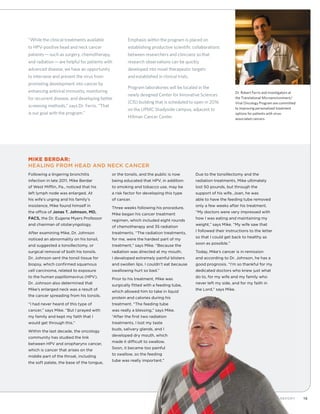
Mike Berdar:
Healing from Head and Neck Cancer
Following a lingering bronchitis
infection in late 2011, Mike Berdar
of West Mifflin, Pa., noticed that his
left lymph node was enlarged. At
his wife’s urging and his family’s
insistence, Mike found himself in
the office of Jonas T. Johnson, MD,
FACS, the Dr. Eugene Myers Professor
and chairman of otolaryngology.
After examining Mike, Dr. Johnson
noticed an abnormality on his tonsil,
and suggested a tonsillectomy, or
surgical removal of both his tonsils.
Dr. Johnson sent the tonsil tissue for
biopsy, which confirmed squamous
cell carcinoma, related to exposure
to the human papillomavirus (HPV).
Dr. Johnson also determined that
Mike’s enlarged neck was a result of
the cancer spreading from his tonsils.
“I had never heard of this type of
cancer,” says Mike. “But I prayed with
my family and kept my faith that I
would get through this.”
Within the last decade, the oncology
community has studied the link
between HPV and oropharynx cancer,
which is cancer that arises on the
middle part of the throat, including
the soft palate, the base of the tongue,
or the tonsils, and the public is now
being educated that HPV, in addition
to smoking and tobacco use, may be
a risk factor for developing this type
of cancer.
Three weeks following his procedure,
Mike began his cancer treatment
regimen, which included eight rounds
of chemotherapy and 35 radiation
treatments. “The radiation treatments,
for me, were the hardest part of my
treatment,” says Mike. “Because the
radiation was directed at my mouth,
I developed extremely painful blisters
and swollen lips. I couldn’t eat because
swallowing hurt so bad.”
Prior to his treatment, Mike was
surgically fitted with a feeding tube,
which allowed him to take in liquid
protein and calories during his
treatment. “The feeding tube
was really a blessing,” says Mike.
“After the first two radiation
treatments, I lost my taste
buds, salivary glands, and I
developed dry mouth, which
made it difficult to swallow.
Soon, it became too painful
to swallow, so the feeding
tube was really important.”
Due to the tonsillectomy and the
radiation treatments, Mike ultimately
lost 50 pounds, but through the
support of his wife, Joan, he was
able to have the feeding tube removed
only a few weeks after his treatment.
“My doctors were very impressed with
how I was eating and maintaining my
weight,” says Mike. “My wife saw that
I followed their instructions to the letter
so that I could get back to healthy as
soon as possible.”
Today, Mike’s cancer is in remission
and according to Dr. Johnson, he has a
good prognosis. “I’m so thankful for my
dedicated doctors who knew just what
do to, for my wife and my family who
never left my side, and for my faith in
the Lord,” says Mike.
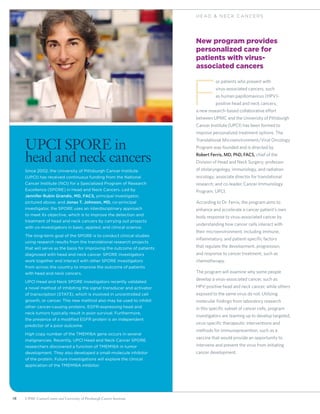
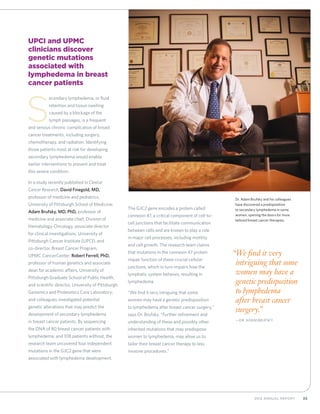
Dr. Robert Ferris and investigators at
the Translational Microenvironment/
Viral Oncology Program are committed
to improving personalized treatment
options for patients with virus-
associated cancers.
“While the clinical treatments available
to HPV-positive head and neck cancer
patients—such as surgery, chemotherapy,
and radiation—are helpful for patients with
advanced disease, we have an opportunity
to intervene and prevent the virus from
promoting development into cancer by
enhancing antiviral immunity, monitoring
for recurrent disease, and developing better
screening methods,” says Dr. Ferris. “That
is our goal with the program.”
Emphasis within the program is placed on
establishing productive scientific collaborations
between researchers and clinicians so that
research observations can be quickly
developed into novel therapeutic targets
and established in clinical trials.
Program laboratories will be located in the
newly designed Center for Innovative Sciences
(CIS) building that is scheduled to open in 2016
on the UPMC Shadyside campus, adjacent to
Hillman Cancer Center.
20 UPMC CancerCenter and University of Pittsburgh Cancer Institute
AI M G NI G
A
dvancing research that will
enable targeted, personalized
cancer therapies requires the
integration of information from
many imaging modalities. The University
of Pittsburgh Cancer Institute’s (UPCI’s)
In Vivo Imaging Facility (IVIF) provides unique
state-of-the-art resources for both clinical and
preclinical research, including ultrahigh-field
magnetic resonance imaging (MRI), positron
emission tomography-computed tomography
(PET-CT), simultaneous MRI-PET, and optical
(bioluminescence and fluorescence) and
ultrasound imaging. The goals of the IVIF are
to facilitate protocol development for cancer
detection, diagnosis, and staging; provide
methods for clinical assessment of early
therapeutic response; and provide preclinical
assessment of biomarker expression
throughout cancer treatment.
In September 2012, renovation of the multi-
modality preclinical imaging suite at Hillman
Cancer Center was completed, providing
investigators access to a Siemens Inveon®
small animal PET-CT scanner. Directed by
Carolyn Anderson, PhD, professor of radiology,
University of Pittsburgh School of Medicine,
the new preclinical PET-CT and adjacent
radiochemistry laboratory enable noninvasive
small animal imaging of molecular targets, and
represent a highly valuable tool for studying
cancer biology and determining cancer therapy
effectiveness. In addition, this new technology
facilitates translational research aimed at
improving clinical PET-CT imaging methods
for cancer patients.
K. Ty Bae, MD, PhD, professor and chairman
of radiology, played a key role in bringing this
innovative technology to UPCI. “We are so
excited to have one of the best preclinical
imaging facilities in the country in our
backyard,” says Dr. Bae.“This new facility
will promote and reinvigorate collaborations
between imaging researchers and oncology
investigators to lead to new discoveries and
advance science.”
In addition to PET, CT, and PET-CT imaging
services, the preclinical PET-CT imaging
suite is working to develop and produce
new radioactive tracer molecules that can be
used in research studies to track distribution
and pharmacokinetics of drugs and other
molecules of interest. For example, one
ongoing project is examining how diet affects
glucose metabolism in tumor-bearing mice
by tracking the FDA-approved glucose mimic,
18 F-labeled 2 deoxyglucose (FDG), through
PET-CT imaging.
Expert facility staff offers consultation
services to investigators to discuss specific
research objectives and the appropriate PET
imaging protocol to employ. Consultations
include guidance in experimental design,
development, validations, and implementation
of methodology and the interpretation of
imaging data.
These PET-CT services complement the
extensive imaging capabilities offered
through the preclinical MRI, optical, and
ultrasound instrumentation of the IVIF
that is housed nearby.
State-of-the-art preclinical
MRI technology
Comprehensive, economical, and state-
of-the-art preclinical MRI services enable
real-time analyses of physiological, cellular,
and molecular processes, as well as responses
to medical interventions and treatments.
MRI methodologies aid investigators in their
UPCI preclinical imaging suite
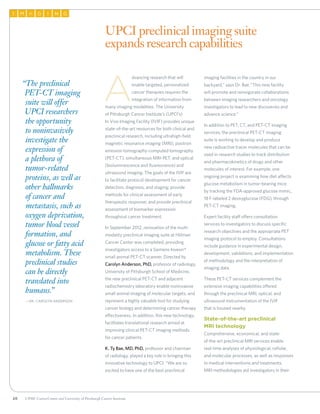
expands research capabilities
“The preclinical
PET-CT imaging
suite will offer
UPCI researchers
the opportunity
to noninvasively
investigate the
expression of
a plethora of
tumor-related
proteins, as well as
other hallmarks
of cancer and
metastasis, such as
oxygen deprivation,
tumor blood vessel
formation, and
glucose or fatty acid
metabolism. These
preclinical studies
can be directly
translated into
humans.”
	—Dr. Carolyn Anderson
212012 Annual Report
cancer-related research by enabling the
measurement of tumor volume, monitoring
of drug pharmacokinetics, and tracking of cell
division and movement, among many other
applications. In addition, the instrumentation
and expertise of the IVIF provides cancer
researchers with the opportunity to examine
tumor protein levels, tumor metabolism, and
“hallmarks of cancer,” such as tumor blood
vessel formation, metastasis, and evasion of
programmed cell death.
The Hillman Cancer Center preclinical imaging
suite houses a 7T translational small animal
MRI system, a Bruker 7T ClinScan®. The
instrument uses the same user interface as the
human clinical systems housed in the Magnetic
Resonance Research Center (MRRC) at the
University of Pittsburgh, facilitating the clinical
translation of new preclinical discoveries, such
as cancer imaging biomarkers and techniques,
to clinical studies in patients.
This instrument was purchased in part with
a grant from the National Institutes of Health
(NIH) and was made possible with additional
foundation donations to UPCI. “We thank
those generous individuals and foundations
who donate to UPCI and make life-saving
research possible,” says Nancy E. Davidson,
MD, director of UPCI and UPMC CancerCenter.
“In a time of reduced government spending and
budgets, contributions from individuals and
foundations make our work possible.”
Optical and ultrasound imaging
capabilities
The UPCI small animal optical and ultrasound
imaging services of the IVIF provide expertise
and equipment that enable researchers to
quickly, easily, and inexpensively answer
technical cancer-related questions in animal
models. The imaging suite is equipped with
several versatile instruments, including an
IVIS® 200 bioluminescence and fluorescence
imaging system (Perkin Elmer), an FMT2500
fluorescence tomographic imaging device
(Perkin Elmer), a Lumina XR system with
bioluminescence, fluorescence, and x-ray
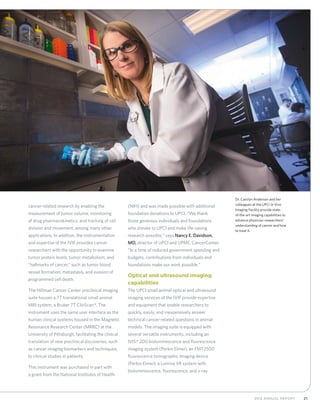
Dr. Carolyn Anderson and her
colleagues at the UPCI In Vivo
Imaging Facility provide state-
of-the-art imaging capabilities to
advance physician-researchers’
understanding of cancer and how
to treat it.
22 UPMC CancerCenter and University of Pittsburgh Cancer Institute
imaging capabilities (Perkin Elmer), and
a Visual Sonics Vevo® 770 small animal
ultrasound. These tools facilitate numerous
cancer-relevant experimental applications,
including three-dimensional reconstructions
of tumors in living animals; rapid and
sequential measurements of tumor growth,
progression and spread, and response to
therapy relapse; determination of trafficking,
biodistribution, and persistence of cell-based
immunotherapies, stem cells, and gene-
based therapies; monitoring of host immune-
cell responses; targeted delivery of genes to
tumors; profiling of gene-expression patterns
or enzymatic activity; and determination of
tumor vasculature and blood flow prior to
and after therapeutic intervention.
Optical and Ultrasound Imaging Director
Stephen Thorne, PhD, assistant professor of
surgery, is available to assist investigators in
defining the best research model and imaging
modality to achieve their experimental goals.
“The implementation of state-of-the-art
optical imaging techniques to cancer research
has provided the opportunity to study the
disease in a more realistic context and so has
advanced our understanding of cancer and
how to treat it,” says Dr. Thorne.
IMAG ING
New center brings mass spectrometry to the masses
T
he Biomedical Mass Spectrometry
Center is a campus-wide shared
facility that brings together
University of Pittsburgh Cancer
Institute (UPCI) and University of Pittsburgh
Office of Research Health Sciences staff
and resources to advance the application of
mass spectrometry in basic and translational
research. The center is located on the ninth
floor of Biomedical Science Tower 3 in
Pittsburgh’s Oakland neighborhood.
Research teams from the UPCI Cancer
Biomarkers Facility and the University of
Pittsburgh Genomics and Proteomics Core
Laboratory are collaborating to ensure that
university students and investigators working
across disciplines will be able to apply new
and rapidly advancing technologies to expand
our basic understanding of biology and offer
new ways to measure health and disease.
The center houses 11 modern instruments,
including three hybrid Orbitrap® Fourier
transform mass spectrometers that enable
state-of-the-art structural characterization
and quantification of biologically relevant
proteins. The center also is available to
researchers who require staff assistance with
their experiments, as well as researchers who
prefer to take a “hands on” approach and
collect their own data.
Led by Nathan Yates, PhD, associate
professor of cell biology and physiology and
co-director of the UPCI Cancer Biomarkers
Facility, the center collaborates with UPCI
disease-specific research programs in
biomarker discovery and translational efforts.
Dr. Yates is an expert in mass spectrometry
analysis, and pioneered differential mass
spectrometry (dMS)—a method that is
widely used in the pharmaceutical industry.
A unique feature of the shared facility is its
interaction with industrial and academic
research groups that are actively advancing
technology. Through these collaborations,
the center can access new instruments and
technologies as they are developed and
integrate these capabilities into research
projects and proposals.
The center will soon be offering seminars
and hands-on workshops to introduce new
users to a variety of proteomics methods.
The Pittsburgh
Foundation
Endows Chair
at UPCI
The Pittsburgh Foundation
has made a leadership gift
of $1 million to the University
of Pittsburgh Cancer Institute
(UPCI) to establish The
Pittsburgh Foundation
Endowed Chair in Innovative
Cancer Research, which will
support critical and innovative
cancer research at UPCI.
This major partnership is
a demonstration of The
Pittsburgh Foundation’s deep
commitment to Pittsburgh
and its mission to build a
better community by
investing philanthropic
resources to meet critical
community needs.
Endowed chairs serve as
cornerstones of established
academic institutions, and last
in perpetuity. Researchers and
physicians who hold the chairs
use the annual interest on the
investment to fund research
programs and teaching. Funds
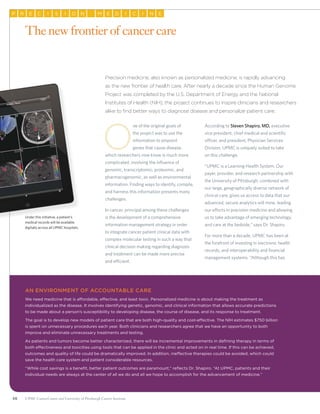
are used in conjunction with
other available funding to
reach even higher levels of
achievement. The chairs have
national and international
visibility, making them
important in efforts to recruit
and retain world-class leaders.
UPCI development officers
are working to raise $1 million
in additional donations to
match The Pittsburgh
Foundation’s commitment
and fully fund the endowed
chair. For more information
or to support this initiative,
please call 412-623-4700.
232012 Annual Report
OL O SD AC N RC EB
A dedication:
the Mario Lemieux Center for Blood Cancers
Treating the Whole Person
The Mario Lemieux Center for Blood Cancers goes beyond the clinical needs of treating
blood cancers to look at each person’s holistic needs. To help patients and families prepare
for and manage treatment, recovery, and life after blood cancer, the center offers a full
range of supportive care, including nutritional, psychological, and pain management
services. These specialized services, coupled with coordinated treatment plans, highlight
the range of needs of those facing a blood cancer diagnosis.
Top: Nathalie and Mario Lemieux
with Elsie Hillman
Middle: Ribbon cutting, from left,
John Innocenti, president, UPMC
Presbyterian Shadyside, Nancy
Davidson, MD, director, UPCI and
UPMC CancerCenter, Tom Grealish,
president, Mario Lemieux Foundation,
Mario Lemieux, and Stanley Marks,
MD, chairman, UPMC CancerCenter.
Bottom: Tom Grealish, Nancy Angus,
executive director, Mario Lemieux
Foundation, and Dr. Nancy Davidson.
No detail was overlooked in the design of the Mario Lemieux Center for Blood
Cancers. Housed on the fourth floor of Hillman Cancer Center, the center offers
a comfortable, healing environment that provides ease of care for clinical staff,
patients, and families.
T
he center opened its doors to
patients in January 2013. This
new clinical space accommodates
patients’ needs for flexibility
and incorporates the latest information
management technologies essential for
personalized medicine. The center was funded,
in part, by grants from the Mario Lemieux
Foundation, The Hillman Foundation, and
The Henry L. Hillman Foundation.
Easing care for complex diseases
The center offers convenient access to a
range of new outpatient treatment options
and therapies in a tranquil environment. The
unique space is technology-centered, providing
“edutainment” for all visitors, including
Web-based interactive activities and access
to television shows, movies, and news. Open
12 hours a day, seven days a week, the center
offers treatment and care planning for patients
with cancers of the blood, bone marrow, and
lymph nodes, such as leukemia, lymphoma,
and multiple myeloma. These cancers can be
treated with a variety of care plans, as outlined
by the physician, adjusted to fit the personal
needs of the patient and their family.
Treatment options include:
•	 Chemotherapy
•	 Biological therapy
•	 Cord blood transplantation
•	 Stem cell transplantation
•	 Radiation therapy
The center is UPMC CancerCenter’s
home for providing stem cell transplants.
This treatment option can be effective
in treating advanced or recurrent blood
cancers, such as leukemia and lymphoma.
Historically, the Stem Cell Transplantation
Program of UPMC CancerCenter has
been one of the largest providers of stem
cell transplantation services in western
Pennsylvania. With the new facility, the
program now offers tailored treatment on
an outpatient or inpatient basis, works closely
with experts in the Leukemia and Lymphoma
Program of UPMC CancerCenter, and is
expected to perform approximately 150 stem
cell transplants annually.
The center also will house research
initiatives aimed at preventing and curing
blood cancers.
24 UPMC CancerCenter and University of Pittsburgh Cancer Institute
G I AC N RC E S
The human gastrointestinal (GI) tract comprises all the organs between the
esophagus and rectum. Measuring up to 20 feet long, these organs collectively
are responsible for the digestive process. GI cancers are diagnosed in nearly
250,000 people each year, according to the American Cancer Society, and
risk factors include smoking, excessive alcohol consumption, increasing age,
a diet high in animal fats or salted, cured, or poorly preserved foods, chronic
pancreatitis, and obesity.
U
PMC CancerCenter specialists
care for patients with all types
of GI cancers, including anal,
colorectal, esophageal, gallbladder,
gastric (stomach), liver, pancreatic, and small
intestine cancers. A complex subset of cancers,
GI cancers often require a multimodality
treatment approach, which typically includes
surgery to remove as much of the tumor as
possible, and pre- or postoperative chemo­
therapy or chemoradiation to shrink the tumor
and/or prevent it from returning.
Surgery: A primary treatment
for GI cancers
Led by Herbert J. Zeh III, MD, UPMC
CancerCenter’s Division of GI Surgical
Oncology is made up of faculty surgeons
who have dedicated their careers to the
treatment of patients with GI diseases and
cancers. According to Dr. Zeh, the group
covers all aspects of GI surgery and is known
well for treating large complex abdominal
tumors and tumors that have spread to the
peritoneal cavity.
For some GI cancers, such as liver, pancreas,
stomach, colon, and rectal cancers, a
minimally invasive approach can provide
the best outcome, while also decreasing
surgical side effects for the patient. Minimally
invasive surgery is typically performed
robotically through four to five small (smaller
than one inch) incisions in the abdomen
into which surgeons insert a camera and
small instruments. The surgeon can control
the instruments remotely to carry out the
procedure. Benefits of this type of surgery
include less bleeding, smaller scars, reduced
pain, shorter hospital stay, quicker recovery,
and earlier return to normal activity.
According to Dr. Zeh, the Division of GI Surgical
Oncology also is using and having success
with a single-incision laparoscopic technique
for treating colon cancer. The procedure
allows specially trained surgeons to perform
a colectomy, or removal of any extent of
the colon, through a single small incision, as
the name suggests. The same instruments
are used, as with the standard laparoscopic
procedure, but benefits may include even faster
healing, a shorter hospital stay, and lower
risk of infection compared to the traditional
laparoscopic procedure, due to fewer incisions.
“I see the single-incision technique as the
natural progression of minimally invasive
surgery,” says Dr. Zeh. “We are able to
perform the same procedure using the same
instruments, providing similar—if not better—
benefits and outcomes.”
In addition to these techniques, a number of
treatment options are available to patients
with GI cancers, including the traditional
and robotic-assisted pylorus-preserving
pancreaticoduodenectomy or Whipple
Experts come together to treat
complex GI cancers
Dr. Herbert Zeh is the chief of the
Division of GI Surgical Oncology,
which has a particular strength in
treating large complex abdominal
tumors and tumors that have spread
to the peritoneal cavity.
“The Division of
GI Surgical Oncology
boasts a high level
of focused expertise,
which allows for the
use of specialized
and individualized
techniques that are
appropriate for our
patients.”
	—Dr. Herbert Zeh
252012 Annual Report
procedure, a highly complex surgery used
to treat a number of tumors of the pancreas,
duodenum, and bile duct; and hyperthermic
intraperitoneal chemoperfusion (HIPEC),
a surgical procedure in which the surgeon
removes as much of the tumor as possible and
then bathes the cavity in heated chemotherapy,
killing cancer cells confined to that area. HIPEC
may be suggested for patients with cancers
that have advanced beyond surgical removal,
but still are limited to the peritoneum. Regional
chemotherapy also can be applied to the liver
for tumors that cannot be completely removed
by surgery.
“Every patient presents uniquely,” says
Dr. Zeh. “Our background, expertise, and
treatment options enable us to provide patients
with custom treatment to provide the best
outcomes.”
UPMC Liver Cancer Center:
Pioneering surgical advances
for liver cancer
Approximately 60 percent of patients with
a GI cancer will be diagnosed with a liver
metastasis, or cancer that has spread to the
liver. The liver’s large size and blood flow make
it highly susceptible to attracting tumor cells.
Still, according to the National Cancer Institute
(NCI), approximately 28,500 patients are
diagnosed each year with primary liver cancer,
or cancer that originates in the liver. Physicians
at the UPMC Liver Cancer Center have the
expertise and technology to diagnose and treat
a full range of liver diseases, including primary
liver cancers, such as hepatocellular carcinoma
(HCC), cholangiocarcinoma, and gallbladder
cancer; metastatic tumors of the liver, such as
metastatic colon/rectal cancer, neuroendocrine
cancer, and melanoma; benign liver masses;
and chronic, underlying diseases, such as
hepatitis and cirrhosis.
Led by surgeon David Geller, MD, Richard L.
Simmons Professor of Surgery, chief, Division
of Hepatobiliary and Pancreatic Surgery, and
co-director, UPMC Liver Cancer Center, the
center is a nationally recognized program offering
a multidisciplinary approach and the latest
surgical techniques, including traditional and
robotic minimally invasive surgery. Since seeing
their first patient in 2000, surgeons at the UPMC
Liver Cancer Center have performed more than
500 laparoscopic liver tumor resections.
“Our physicians are pioneers of minimally
invasive laparoscopic techniques for complex
liver surgical procedures, and continue to lead
the way using state-of-the-art technology to
benefit our patients,” says Dr. Geller.
Minimally invasive surgery
for liver cancer
During a minimally invasive procedure to
remove a liver tumor, surgeons make five or
six small bandage-size incisions across the
abdomen, allowing for access to the liver from
various angles. The surgeon inserts ports
that serve as pathways for the laparoscopic
instruments and other tools. The abdominal
cavity is then filled with air to provide space
to maneuver the instruments.
The surgeon cauterizes the liver tissue to
seal off blood vessels and reduce bleeding.
The tumor can then be separated from the
remaining healthy liver, and removed through
one of the incisions. Due to the liver’s ability
to almost fully regenerate, surgeons can
comfortably remove up to 75 percent of the
liver. The incisions are then closed and covered
with small bandages.
Following the procedure, many liver cancer
patients are referred to a medical oncologist
to start a chemotherapy regime. Patients who
undergo a minimally invasive procedure may be
able to start their chemotherapy sooner, due to
the minimal side effects of the surgery.
Besides state-of-the-art clinical treatment
options for liver cancer, the UPMC Liver Cancer
Center offers innovative clinical research trials
and serves as an educational resource for local
physicians to participate in the care of their
patients.
“The UPMC Liver
Cancer Center is
one of only a handful
of centers in the
country to offer a
minimally invasive
surgical procedure
for liver cancer, and
we actually pioneered
the procedure.”
	—Dr. David Geller
Dr. David Geller, center, chief of
the Division of Hepatobiliary and
Pancreatic Surgery and co-director of
the UPMC Liver Cancer Center, uses
minimally invasive surgical techniques
to treat tumors of the liver.
26 UPMC CancerCenter and University of Pittsburgh Cancer Institute
Grant allows study of
experimental cancer therapy
In 2010, Dr. Geller was the recipient of a
two-year, $425,000 grant from the Kanzius
Cancer Research Foundation, whose mission
is to raise funds to support the ongoing
research of the Kanzius noninvasive radio wave
cancer treatment, an experimental cancer
treatment developed by radio and television
engineer John Kanzius in 2005. The therapy
employs a combination of either gold or
carbon nanoparticles and radio waves to heat
and destroy cancer cells without damaging
surrounding healthy cells.
The goal of Dr. Geller’s research was to use
the technology invented by Mr. Kanzius to
thermally ablate, or destroy, inoperable liver
cancer in a noninvasive manner. He had
previously used gold nanoparticles to ablate
liver cancer cells in the lab and by direct
injection in rodent liver cancer. The grant from
the Kanzius Cancer Research Foundation
has allowed Dr. Geller to further study the
mechanisms of cellular death caused by the
experimental treatment, as well as develop
antibody-labeled gold nanoparticles for the
selective targeting of liver cancer in vivo, with
the ultimate goal of developing a clinically
useful strategy for noninvasive radio wave
thermal ablation of liver cancer in patients.
Liver regeneration and the impact
of hepatic growth factor
The liver is the only solid organ in the body,
besides skin, that can naturally regenerate
if partially damaged. The mechanism of this
regenerative liver growth is the subject of
intense research by internationally recognized
researcher George Michalopoulos, MD, PhD,
professor and chairman of the Department
of Pathology at the University of Pittsburgh.
Dr. Michalopoulos and colleague Reza
Zarnegar, PhD, professor of pathology,
University of Pittsburgh School of Medicine,
discovered a protein called hepatocyte growth
factor (HGF) in 1980, which is responsible
for cell growth, motility, and organism
development. HGF has been shown to have a
major role in embryonic organ development,
wound healing, and adult organ—such as
liver—regeneration. In a recent study, Dr.
Michalopoulos’ lab showed that genomic
lesions associated with liver cancer occur in
many genes associated directly or indirectly
with signaling pathways operating in liver
regeneration and hepatocyte growth regulation.
Dr. Zarnegar has devoted his research efforts
to understanding this important signaling
factor. HGF and its cell surface receptor (Met)
play an important role in tissue regeneration,
and the deregulation of these genes may lead
to cancer. Dr. Zarnegar’s group has mapped
the interaction region in Met and Fas, a death
promoting receptor. His lab currently is
expanding these studies of Met. An in-depth
understanding of the molecular mechanisms
of HGF/Met function will not only shed light
on normal tissue physiology, but also on
understanding the basis of its pathogenic
G I C ANCERS
Colorectal Cancer Outreach
Many experts agree that colorectal cancer could be greatly reduced if people got screened. Toward that end, colorectal cancer
screenings for African-Americans—particularly men, who are the most reluctant to be screened—continue to be a top priority for
UPCI’s Cancer Outreach Program. Lyn Robertson, DrPH, RN, MSN, director of Cancer Outreach, and her team continue to develop
mechanisms to screen those in need, according to established guidelines. One new test that looks promising is the InSure® FIT test,
which tests the DNA in the stool and indicates people who are at a higher risk for developing colorectal cancer. Once identified,
the outreach team can encourage them to undergo a follow-up colonoscopy. Because a colonoscopy can be costly for those
without medical insurance, Dr. Robertson’s team works closely with at-risk individuals to help them apply for assistance or make
financial arrangements for colonoscopies at reduced rates.
Dr. Lyn Robertson and her team
from UPCI’s Cancer Outreach
Program screen at-risk populations
for a variety of cancers, including
colorectal cancer, by visiting the
communities in which they live.
272012 Annual Report
effects, thus providing opportunities for rational
drug design to combat various diseases,
including tissue degeneration and cancer.
Satdarshan (Paul) Singh Monga, MD, and his
lab are focusing on the signaling pathways of
the Wnt and β-catenin gene to understand the
molecular mechanisms of liver development,
growth, regeneration, and cancer. Dr. Monga
recently discovered that liver cancer caused by
chemical carcinogens was more prevalent in
animals that did not have the β-catenin gene.
Absence of this gene also made the cancer cells
more sensitive to certain chemotherapeutics.
Hypoxia and inflammation
Hypoxia (a low level of oxygen) often is found
in solid tumors and is associated with tumor
progression and poor clinical outcomes. The
exact mechanisms related to hypoxia-induced
invasion and metastasis remain unclear. Dr.
Monga, in collaboration with Dr. David Geller
and others, has elucidated the mechanism
by which the nuclear-damage-associated
molecular pattern molecule, high-mobility
group box 1 (HMGB1), released under hypoxic
stress, can induce an inflammatory response
to promote invasion and metastasis in
hepatocellular carcinoma cells (HCC).
Tumor cells survive hypoxic conditions
by inducing autophagy, the process of
self-digestion by a cell through the action
of enzymes originating within the same cell.
Dr. Geller and collaborators found that the
microRNA miR-375 inhibits autophagy and
impairs viability of HCC cells under hypoxic
conditions. These miRNAs that inhibit
autophagy of cancer cells also may
be developed as therapeutics.
Expanding treatment options
For most GI cancers, adjuvant chemotherapy—
or chemotherapy after surgery—is prescribed
to shrink any remaining tumor and/or kill
any tumor cells that may have spread.
Led by Edward Chu, MD, chief, Division of
Hematology-Oncology, and deputy director,
University of Pittsburgh Cancer Institute
(UPCI), GI cancer specialists are collaborating
to make better chemotherapy treatments
available for GI cancer patients who have
exhausted other treatment options.
Weijing Sun, MD, joined UPCI and UPMC
CancerCenter in September 2012 as
the director of the GI Cancer Section of
Hematology-Oncology and co-director of
UPMC GI Cancer Center of Excellence at the
University of Pittsburgh. Dr. Sun is a member of
the National Cancer Institute’s Gastrointestinal
Steering Committee-Hepatobiliary Cancer
Task Force, the Eastern Cooperative Oncology
Group (ECOG) GI Core Committee, and the
American Society of Clinical Oncology (ASCO)
Scientific Program Committee. At UPCI, Dr. Sun
and his team are focused on the development
of new drugs and biologic agents for GI cancers
through Phase 1 and 2 clinical trials.
Clinical trials are research studies used to
evaluate new, possibly more effective drug
combinations for patients who often have
exhausted their conventional treatment
options. These trials help to further understand
how cancer responds to different types of
treatment. Each clinical trial acts as a stepping
stone to the next, depending on its outcomes.
Dr. Sun’s group is focused on Phase 1 clinical
trials, which allow researchers to determine
the safe dose of a new drug or agent and learn
about its side effects, and Phase 2 clinical trials,
which test the effectiveness of the new drug or
agent in stopping or controlling the growth of
tumor cells in a certain type of cancer.
James Lee, MD, PhD, joined the Division
of Hematology-Oncology in April 2012.
Specializing in colorectal cancers, Dr. Lee
is working alongside Dr. Sun to revamp the
Phase 1 and 2 clinical trials program and
offer more treatment options for patients.
Dr. Lee is currently investigating inhibitors of
epidermal growth factor (EGF) receptors, which
block proteins called growth factors, preventing
them from helping tumor cells to divide, grow,
and spread, and anti-angiogenic therapy, which
“We are working
to identify and
implement the
most effective and
least toxic drug
combinations for our
GI cancer patients.
We’re looking to
offer new treatment
modalities through
more clinical trials.”
	—Dr. Weijing Sun
Dr. Edward Chu, chief of the Division
of Hematology-Oncology and UPCI
deputy director, and collaborators
are working to develop new and
better drugs and biologic agents for
the treatment of GI cancers.
28 UPMC CancerCenter and University of Pittsburgh Cancer Institute
blocks the formation of blood vessels that
supply the tumor with the blood and oxygen
needed to grow and spread.
Also high on Dr. Lee’s priority list is
personalized medicine. “This is not a new
concept at UPCI and UPMC CancerCenter,
but we continue to learn more about how
we can tailor our treatments to work best
for each patient,” says Dr. Lee.
According to Dr. Lee, the group is investigating
gene sequencing, which can determine
which genes in a patient’s body harbor the
mutations that lead to colorectal cancer. Once
determined, the sequence can be compared
to existing information with the goal of
determining the likelihood of disease risk.
Coordinating care for a better
outcome
GI cancer experts at UPMC CancerCenter
know that effective treatment of these cancers
relies on both a multimodality treatment plan
and a coordinated approach to care. Employing
a team approach, physicians from surgical
oncology, thoracic oncology, medical oncology,
radiation oncology, and the UPMC Liver Cancer
Center meet with diagnostic and interventional
radiologists, gastroenterologists, hepatologists,
and pathologists weekly in a setting called the
GI Specialty Care Center to review individual
cases and create treatment plans for each
patient. Ongoing reviews and updates of each
case ensure that patients are continually
receiving the most appropriate care for their
type and stage of disease.
“Patients benefit from having their cases
presented at the weekly meetings because
multiple treatment options are discussed and
weighed based on their specific disease and
stage,” says Dr. Geller, who represents the
UPMC Liver Cancer Center at these meetings.
“A group consensus is reached and patients
can begin their coordinated, specialized
treatment plans as soon as possible.”
G I C ANCERS
Committed to
Colon Cancer
Research
In 2011, UPCI received a
$500,000 commitment
from the Chris4Life Colon
Cancer Foundation to
support their colon cancer
research and clinical efforts.
Chris4Life is a nonprofit
organization named after
Christine “Chris” Sapienza,
a Pittsburgh native who
died from colon cancer
in 2006.
In summer 2012, the
foundation hosted the
second Cookies4Chris
Luncheon and Vendor Show,
highlighting Pittsburgh’s
famous “cookie table.”
Another Cookies4Chris
event is planned for spring
2013, and a Pittsburgh
Scope It Out™ run/walk
is planned for summer 2013.
Proceeds from these events
will benefit the Chris4Life
Foundation to help support
their commitment to UPCI’s
colon cancer research
program.
Chris’s son Michael,
founder and executive
director of Chris4Life, says
the foundation selected
UPCI because of its
dedication to research and
superior ability in treatment.
“We’re very excited to
continue to build on this
partnership,” says Michael.
“UPMC CancerCenter has an impressive track record for treating and managing
GI cancers with chemotherapy. But we can’t say, ‘What we have is good enough.’
We need to find new hope.”
	—Dr. James Lee
Vaccines offer personalized colorectal cancer
immune defense treatments
T
he National Cancer Institute (NCI)
lists colorectal cancer as the third-
leading cause of cancer deaths in
the United States, with nearly
52,000 deaths per year. Physician-scientists at
University of Pittsburgh Cancer Institute (UPCI)
are investigating a number of noteworthy
vaccine clinical trials, not only to treat the
disease, but to prevent it altogether.
Although a person’s immune system can
mount an aggressive and typically effective
defense against viral infection, it does not do so
when infiltrated with cancer cells. Investigators
are aiming to condition a patient’s immune
system into eliminating cancer as aggressively
as it would a viral infection. UPCI researchers
are taking a two-pronged approach using a
novel type of dendritic cells—immune cells
specialized in initiating immune responses—
that are administered as a vaccine, and studying
and implementing ways to manipulate the
tumor microenvironment.
Personalized, targeted treatments
Pawel Kalinski, MD, PhD, professor of surgery,
University of Pittsburgh School of Medicine,
and Dr. Herbert Zeh and Dr. David Bartlett
292012 Annual Report
Dr. Pawel Kalinski, a pioneer
in dendritic-cell vaccines, has
developed a new platform of
personalized vaccines for the
treatment of patients with
colorectal cancer who have failed
first- and second-line standard
chemotherapy and are without
other therapeutic options.
have developed a new platform of personalized
vaccines—Alpha type-1 polarized dendritic
cells (αDC1)—that are grown from the blood
of each individual patient over seven days.
The hope is that this vaccine will instruct the
patient’s own immune system to recognize
the colorectal tumor as cells that need to be
eliminated rather than healed. This trial is being
offered to patients who have failed first- and
second-line standard chemotherapy, do not
have another therapeutic option, and have
roughly six months of anticipated survival.
It will evaluate the ability of the treatment to
prolong patients’ lives. Similar vaccines are
being developed for breast cancer and cervical
cancer, and soon this approach will be applied
for hematological malignances, as well.
Preventing cancer development
Olivera Finn, PhD, co-leader of the Cancer
Immunology Program at UPCI, Robert
Schoen, MD, MPH, a member of the UPCI
Cancer Epidemiology, Prevention, and Control
Program, and their team tested a vaccine
that might prevent a person from developing
colorectal cancer altogether. Dr. Finn developed
the vaccine after two decades of research
into understanding how cancer starts and
progresses. The vaccine boosts the immune
system to destroy cancer cells carrying the
abnormal variant of the MUC1 protein on their
surfaces. MUC1 is necessary for cancer cell
survival and proliferation.
In the beginning stages of colon cancer, a polyp,
a benign but abnormal cell growth, becomes
malignant. Colorectal cancer forms when the
MUC1 protein, which normally serves to protect
the cell against pathogens, changes without
producing a response from the immune system.
Only after the cancer has taken hold and grown
does the immune system react, but by then
the cancer has already begun suppressing the
immune response.
In a study published in Cancer Prevention
Research in January 2013, the vaccine was
tested on 39 patients between the ages of
40 and 70 with a history of advanced
adenomas—polyps that have become
precancerous. The trial proved successful
in more than 40 percent of the patients
by showing the vaccine had stimulated
the production of antibodies against the
abnormal variant of the MUC1 protein. In
those who showed no response, it was found
that their immune systems had already been
negatively affected by the precancerous cells
that stimulated expansion of an important
suppressive blood cell population previously
associated only with cancer.
The UPCI team’s strategy is to inoculate people
whose medical histories put them at high risk
for colorectal cancer before benign polyps have
a chance to become precancerous or induce
immune suppression, which happens in more
than 30 percent of cases. The next stage of
human clinical trials will test the vaccine in
multiple medical centers with as many as
200 patients at high risk of developing colon
cancer. If successful, the vaccine someday
could reduce or eliminate the need for high-risk
people to undergo repeated colonoscopies.
Approximately one
person in 20 in the
United States will
develop colorectal
cancer in their lifetime.
30 UPMC CancerCenter and University of Pittsburgh Cancer Institute
Rapid autopsy
Explained
Rapid autopsy, or warm
autopsy, is the process
of procuring organs,
tissue, or other specimens
within six hours of death.
Obtaining samples
immediately allows
medical researchers
to evaluate advanced-
stage disease conditions
in the recently deceased
and compare them with
tissue collected during
biopsies done earlier
during the course of the
patient’s illness, providing
an opportunity to
compare the disease at a
cellular level at different
stages. The goal of the
program is to gain a
better understanding
of recurrence and why
individuals die from
disease.
30 UPMC CancerCenter and University of Pittsburgh Cancer Institute
The name may seem unsympathetic and impersonal to some, but the rapid
autopsy program at Magee-Womens Hospital of UPMC is anything but the
callous, rushed process it conveys. Rather, it’s an opportunity for patients and
families to leave ONE final gift in hopes of finding cures for deadly diseases.
A final gift
Rapid autopsy vital to
scientific researchof cancer
K
aren Perry, a special education teacher from Pittsburgh, was first diagnosed with
breast cancer 15 years ago. She spent 12 years cancer free before receiving a second
cancer diagnosis. A bilateral mastectomy and removal of her lymph nodes seemed to
stall the disease until a year and a half later when a PET scan revealed that the cancer
had spread to her clavicle. “The cancer returned with a vengeance,” says Karen’s brother, Craig
Perry. “Everyone was astounded by the rate of metastasis. Not even radiation was successful.”
As Craig watched his sister slip away, he asked Karen’s medical oncologist Shannon Puhalla, MD,
assistant professor of medicine at the University of Pittsburgh School of Medicine, and an
oncologist at the Magee-Womens Breast Care Program, part of UPMC CancerCenter, about the
possibility of donating Karen’s organs. Because Karen’s cancer had metastasized, she was not a
candidate for typical organ donation, but Dr. Puhalla introduced Craig to the rapid autopsy
program. “Tissue gathered through rapid autopsy gives us an invaluable opportunity to understand
why we die of certain diseases,” says Adrian V. Lee, PhD, professor, Department of Pharmacology
and Chemical Biology, and director, Women’s Cancer Research Center, University of Pittsburgh
Cancer Institute (UPCI) and Magee-Womens Research Institute. “It allows us to get closer to the
root of the problem. If we can’t get to the root, we can’t cure these diseases.”
Rapid autopsy has been in use for more than 30 years, though primarily for research into
Alzheimer’s disease and multiple sclerosis. But it was Naftali Kaminski, MD, director, Dorothy P.
 Richard P. Simmons Center for Interstitial Lung Disease at UPMC, who conducted UPMC’s first
rapid autopsy in 2002 at the request of a firefighter dying of lung disease. The patient was looking
for a meaningful way to contribute to a better understanding of his disease for future generations.
Today, the program has evolved into part of the University of Pittsburgh’s Health Science Tissue
Bank and spans several medical specialties. There is no cost to take part in the rapid autopsy
program, and UPMC absorbs any costs associated with the initiative, including transportation and
funeral home expenses.
Karen passed away at the age of 56, but her legacy lives on through her organ donation. According
to Craig, with the help of UPMC and Karen’s hospice team, Karen’s rapid autopsy process was
seamless. Necessary paperwork was completed in advance, and when Karen died on October 25,
2012, she received an autopsy within hours of her death, allowing samples of the diseased tissue to
be collected. Her body was then transported to the funeral home to be prepared for her memorial
service. “Karen felt so strongly about organ donation that I have no doubts that being able to
donate to the rapid autopsy program is what she would have wanted,” explains Craig.
312012 Annual Report 312012 Annual Report
Dr. Shannon Puhalla and
Dr. Adrian Lee in the autopsy
suite, where rapid autopsies
take place.
O
E
NM A Y
32
MW O E SN AC N RC E’
Experts in the Lymphedema Education, Monitoring, Early Detection,
Intervention, and Prevention (LEMEP) Program use advanced technology
to detect lymphedema—the buildup of fluids after lymph node removal—
in its earliest stages, when it’s more treatable and manageable.
T
he fight against breast cancer
has been an important battle fought
hard on the front lines by dedicated
physicians, patients, and their
families. But there’s one disease that is often
associated with breast cancer that is often
overlooked: lymphedema.
About 30 percent of breast cancer patients
who undergo an axillary lymph node dissection,
a common surgical procedure to remove the
lymph nodes from the axilla (armpit) to stage
breast cancer, will develop lymphedema, a
painful condition in which lymph fluids build up
in tissues of the extremities, causing swelling.
Patients are often referred to a lymphedema
specialist after the swelling has occurred.
Experts at the LEMEP Program, housed at
Magee-Womens Hospital of UPMC, advocate
for multidisciplinary care and presurgery
lymphedema consultations.
Led by Atilla Soran, MD, professor of
surgery, the program is specifically for breast
cancer patients. Experts work with UPMC
CancerCenter breast surgeons to meet
with patients prior to their axillary lymph
node dissection procedure to perform a
baseline procedure. Experts use noninvasive
bioimpedance spectroscopy technology
created by ImpediMed Limited to send
low-frequency electrical currents through
Detecting and managing lymphedema
in its earliest stages
“There is no cure
for lymphedema.
You can only
manage the
symptoms. The
most optimal
scenario is to
diagnose patients
in the preclinical
stage.”
	—Dr. Atilla Soran
Karen Vogel:
Develops Lymphedema 15 Years Following Breast Cancer Surgery
Karen Vogel from Crafton Heights,
Pa., was diagnosed with cancer
in her left breast in 1996. She
underwent a lumpectomy,
an axillary lymph node
dissection, and radiation
therapy.
At the time, Karen was advised that the
lymph node dissection could cause
lymphedema, a buildup of lymph fluid
that causes painful swelling.
“While removing lymph nodes
is important to staging breast cancer,
it can disrupt the flow of lymph fluid
in that area,” says Dr. Atilla Soran.
“As a result, sometimes excess fluids
build up, causing lymphedema.”
Karen was initially diligent in doing
daily exercises suggested by her
doctor to prevent lymphedema, but
the regimen waned as Karen began
her life as a breast cancer survivor.
In July 2012, 15 years after her breast
cancer diagnosis and treatment, Karen
woke up with a swollen left arm and
initially disregarded it as a bug bite.
“The idea that this could be related
to my breast cancer from so long
ago didn’t even cross my mind,”
says Karen.
About a month later, however, she
brought her slightly swollen arm to the
attention of her radiation oncologist,
Melvin Deutsch, MD, during her annual
checkup. “He looked at my arm
and immediately told me it was
lymphedema,” says Karen. “I was
shocked that it could appear so long
332012 Annual Report
a patient’s arms and legs. Because these
currents flow faster through fluid than muscle
or bone, the procedure provides a baseline
of the amount of fluid the patient is retaining.
Before surgery, the patient’s baseline number
should be normal. The patient returns to the
clinic 90 days after surgery, and every three
to six months thereafter to have the fluid levels
tested and compared to the baseline number.
If the test reveals that the amount of fluid has
increased beyond a reasonable range, she is
considered as having developed preclinical
lymphedema—or lymphedema with no
clinical symptoms—and is put on a track
for treatment.
“There is no cure for lymphedema,” says
Dr. Soran. “You can only manage the
symptoms. The most optimal scenario is
to diagnose patients in the preclinical stage.
If you can catch the disease in this stage,
we may be able to prevent swelling, offer
more treatment options, reduce the pain,
aches, tightness, cramps, and infections
often associated with clinical lymphedema,
and, most importantly, improve the patient’s
quality of life.”
Since the program was established in 2010,
more than 500 patients have been measured
to determine their baseline numbers, and
42 patients—or 14 percent—have been
diagnosed with preclinical lymphedema.
Lymphedema treatment
options
Lymphedema treatment depends on the
severity of the disease, and more treatment
options are available in the disease’s earliest
stages. The Lymphedema Clinic at Magee,
which also treats lymphedema patients
unrelated to breast cancer, provides physical
therapy, compression garments, new
Above, top and bottom: Dr. Atilla
Soran advocates for lymphedema
screenings before and after a
patient’s surgery to catch the
disease in its earliest stages.
“Awareness is the key to discovering
lymphedema in its earliest stages, when
it’s more treatable.”
	—Dr. Atilla Soran
after my cancer.” Dr. Deutsch referred
Karen to Dr. Soran and the LEMEP
Program.
According to Dr. Soran, breast cancer
patients who undergo an axillary lymph
node dissection, or those who receive
radiation to the underarm area, are
susceptible to lymphedema for the rest
of their lives.
“Because lymphedema can creep
up on a breast cancer patient at any
time following their surgery—even
up to 30 years post-surgery—it’s
important to continue to monitor the
patient so that if lymphedema
symptoms arise, treatment is available
sooner, when it is more effective,”
says Dr. Soran. “That is our goal with
the LEMEP Program.”
Karen began laser treatments to
clear the existing scar tissue that was
causing the lymph fluid to back up.
Her first and last treatments were
administered by Dr. Soran at Magee-
Womens Hospital of UPMC. The
remaining treatments were performed
at UPMC South Hills in Bethel Park, Pa.,
closer to Karen’s home. During the
procedure, the therapist placed a small,
hand-held device onto the skin under
Karen’s underarm, which delivered low
levels of laser therapy. “The treatment
was simple and finished in 10 minutes,”
says Karen. “I didn’t feel anything.”
As part of her lymphedema treatment,
following the laser therapy, Karen also
received body massages to help open
her lymph vessels so her lymph fluids
could flow more freely.
Since completing treatment in
November 2012, Karen’s lymphedema
has regressed and the swelling in
her arm has mostly subsided. As a
part of the LEMEP Program, Karen’s
lymphedema will continue to be
monitored, and she knows that
she’ll need to continue exercises
and keep vigilant.
34 UPMC CancerCenter and University of Pittsburgh Cancer Institute
generation pumps, and laser therapy as
options for treating and managing the disease.
According to Dr. Soran, in 2013 the clinic also
will offer surgery, including lymphovascular
anastomosis and liposuction, as treatment
options.
Although lymphedema is a common
complication of breast cancer surgery, only
36 percent of primary care physicians and
21 percent of nurse practitioners referred
their at-risk patients to a lymphedema clinic,
according to a recent study published in
Breast Cancer Research.
“These figures represent a lack of nearby
clinics or a lack of knowledge,” says Dr.
Soran. “Awareness is the key to discovering
lymphedema in its earliest stages, when
it’s more treatable.”
Educating patients and those
at risk of lymphedema
The LEMEP Program is doing its part to educate
lymphedema patients in western Pennsylvania
by hosting quarterly meetings through the
Lymphedema Educational Program.
“We facilitate communication by inviting
experts in the coordination of care for
lymphedema patients—such as physical
therapists, dietitians, and our nurse
coordinator—to speak to at-risk breast cancer
patients and those struggling with the disease,”
says Dr. Soran. “At these meetings, we provide
one-on-one, postoperative lymphedema
education as a component in prevention;
individual risk assessment, such as body mass
index (BMI), lifestyle, occupation, and other
possible risk factors; review of lymphatic
function and anatomy; and discussion of early
warning signs and risk-reduction strategies.”
WOM EN ’ S C ANCER
	Epidemiology Research And the Women’s Cancer Research Center
	Cancer epidemiology is the
study of factors that affect cancer
for the purposes of identifying
what causes cancer and, ultimately,
developing improved treatments.
Joel L. Weissfeld, MD, MPH,
co-leader of the Cancer
Epidemiology Prevention and
Control Program at UPCI and
associate professor of
epidemiology, Graduate School
of Public Health, University of
Pittsburgh, and his colleagues
are working with experts at the
UPCI Women’s Cancer Research
Center (WCRC) to identify
possible trends and causes of
cancers that may affect women.
As a result, many exciting research
initiatives are blooming:
•	 In a recent study, Dr. Weissfeld
and his colleagues at the National
Surgical Adjuvant Breast and
Bowel Project determined that
premenopausal women over
35 years old with high body mass
indexes (BMIs) have an increased
breast cancer risk. However,
the group determined that this
higher risk was not present in
postmenopausal women.
•	 According to Dr. Weissfeld,
previous studies examining the
association between the use
of fertility drugs and ovarian
cancer risk have often provided
conflicting results. Dr. Weissfeld
and colleagues at the University
of Pittsburgh Cancer Institute’s
(UPCI’s) Cancer Epidemiology,
Prevention, and Control Program
analyzed data from the Hormones
and Ovarian Cancer Prediction
(HOPE) study and found that
fertility drugs were not associated
with an increased risk of
developing ovarian cancer for
women who succeeded in getting
pregnant with the help of fertility
drugs. The study also showed that
women who use fertility drugs and
are not pregnant may have an
elevated risk for ovarian cancer.
•	 Women diagnosed with breast
cancer metastases often have a
poor prognosis. In a recent study,
Dr. Weissfeld and colleagues
identified the following factors
as related to survival from this
disease: a history of hypertension;
tumor status, such as estrogen
receptors (ER), progesterone
receptors (PR), and HER2, a
specialized protein found on breast
cancer cells that controls cancer
growth and spread; metastasis-
free interval, or the time between
the original diagnosis and
recurrence; the location to which
the cancer has spread, specifically,
the brain, bone, and liver; and BMI
at diagnosis.
Dr. Joel Weissfeld and his team
are working with experts at the
Women’s Cancer Research Center
to analyze and infer possible trends
concerning BMI and breast cancer
risk, fertility drugs and ovarian
cancer risk, and risk factors related
to metastatic breast cancer survival.
352012 Annual Report
“We find it very
intriguing that some
women may have a
genetic predisposition
to lymphedema
after breast cancer
surgery.”
	—Dr. Adam Brufsky
UPCI and UPMC
clinicians discover
genetic mutations
associated with
lymphedema in breast
cancer patients
S
econdary lymphedema, or fluid
retention and tissue swelling
caused by a blockage of the
lymph passages, is a frequent
and serious chronic complication of breast
cancer treatments, including surgery,
chemotherapy, and radiation. Identifying
those patients most at risk for developing
secondary lymphedema would enable
earlier interventions to prevent and treat
this severe condition.
In a study recently published in Clinical
Cancer Research, David Finegold, MD,
professor of medicine and pediatrics,
University of Pittsburgh School of Medicine;
Adam Brufsky, MD, PhD, professor of
medicine and associate chief, Division of
Hematology-Oncology, associate director
for clinical investigations, University of
Pittsburgh Cancer Institute (UPCI), and
co-director, Breast Cancer Program,
UPMC CancerCenter; Robert Ferrell, PhD,
professor of human genetics and associate
dean for academic affairs, University of
Pittsburgh Graduate School of Public Health,
and scientific director, University of Pittsburgh
Genomics and Proteomics Core Laboratory;
and colleagues investigated potential
genetic alterations that may predict the
development of secondary lymphedema
in breast cancer patients. By sequencing
the DNA of 80 breast cancer patients with
lymphedema, and 108 patients without, the
research team uncovered four independent
mutations in the GJC2 gene that were
associated with lymphedema development.
The GJC2 gene encodes a protein called
connexin 47, a critical component of cell-to-
cell junctions that facilitate communication
between cells and are known to play a role
in major cell processes, including motility
and cell growth. The research team claims
that mutations in the connexin 47 protein
impair function of these crucial cellular
junctions, which in turn impairs how the
lymphatic system behaves, resulting in
lymphedema.
“We find it very intriguing that some
women may have a genetic predisposition
to lymphedema after breast cancer surgery,”
says Dr. Brufsky. “Further refinement and
understanding of these and possibly other
inherited mutations that may predispose
women to lymphedema, may allow us to
tailor their breast cancer therapy to less
invasive procedures.”
Dr. Adam Brufsky and his colleagues
have discovered a predisposition
to secondary lymphedema in some
women, opening the doors for more
tailored breast cancer therapies.
36 UPMC CancerCenter and University of Pittsburgh Cancer Institute
WOM EN ’ S C ANCER
“Our goal is to
establish whether
a urinary
metalloproteinase
panel can be used
as a biomarker for
assessing breast
cancer risk, which
could ultimately
result in fewer
women dying from
breast cancer.”
	—Dr. Lesley Butler
Research project studies dietary relationship
to breast cancer risk
T
he University of Pittsburgh
Cancer Institute (UPCI) Cancer
Epidemiology, Prevention, and
Control Program, led by Jian-Min
Yuan, MD, PhD, professor of epidemiology,
and associate director for Cancer Control and
Population Sciences, has long been studying
the effects of diet on cancer risk. Lesley Butler,
MSPH, PhD, recruited in 2012 as associate
professor of epidemiology at the University of
Pittsburgh Graduate School of Public Health, is
continuing this effort by examining a woman’s
dietary relationship to her breast cancer risk.
For more than a decade, Dr. Butler has
been a co-investigator on the Singapore
Chinese Health Study, on which Dr. Yuan also
participates as a principal investigator. The
ongoing prospective cohort study has collected
blood and urine samples from 63,000 Chinese
individuals over a 20-year period, and has been
solely and continuously funded by the National
Cancer Institute (NCI). Dr. Butler has published
numerous papers based on the cohort’s key
data, including such findings as an inverse
association in dietary patterns characterized
by intake of soy foods, vegetables, and fruits
on the risk of breast cancer, to a positive
association between black tea intake on the
risk of prostate cancer.
In 2012, Dr. Butler received funding from
the NCI to evaluate the association between
prediagnostic levels of metalloproteinases,
enzymes that break down proteins, such
as collagen, that are normally found in the
spaces between cells in tissues, in the urine
of women with and without breast cancer
through the Singapore Chinese Health Study.
Her project will use a nested case-control
study of 408 incident breast cancer cases
and 816 individually matched controls within
the Singapore Chinese Health Study.
“There is strong experimental evidence for
the role of matrix metalloproteinases in
developing early breast cancer, and in the
change in the formation of cells that may result
in a subgroup of dysplasia/carcinoma in situ
that is prone to progression toward invasive
disease,” says Dr. Butler.
“Our goal is to establish whether a urinary
metalloproteinase panel can be used as a
biomarker for assessing breast cancer risk,
which could ultimately result in fewer women
dying from breast cancer.” Because breast
cancer is the most prevalent cancer among
women in the United States, a noninvasive,
highly reliable, and accurate biomarker panel
would improve the early diagnosis of breast
cancers in the growing population of women
at high risk for breast cancer, as well as those
at risk for cancer recurrence and second
primary cancers.
Another project Dr. Butler currently is working
on aims to evaluate the relationship between
coffee intake and cancers of the breast and
stomach, also evaluating data from the
Singapore study. The study group offers a
unique resource for analyzing the intake of
tea and coffee on cancer risk, because this
population is one of the only Asian populations
that regularly consumes black tea, green tea,
and coffee.
Dr. Lesley Butler has used blood
and urine samples from the
Singapore Chinese Health Study to
evaluate the relationship between
diet and cancer.
372012 Annual Report
Pink Glove Dance
A Nationwide YouTube Competition Raises
Breast Cancer Awarness	 	
In July 2012, UPMC CancerCenter entered the second annual Pink Glove
Dance™ contest, a nationwide competition to raise breast cancer awareness.
Sponsored by Medline Industries Inc., more than 260 hospitals, schools, and
other organizations throughout the United States and Canada submitted videos
of staff and faculty dancing to music with pink gloves in hopes of winning a
$10,000 donation to a breast cancer charity of their choice.
Representing various UPMC CancerCenter locations and more than 15
departments, 200 advocates, including cheerleaders and Pittsburgh Steelers
Quarterback Charlie Batch, rallied around the mission to raise awareness and
funds for Dignity Robes, a local nonprofit organization that makes robes,
designed like kimonos, for women undergoing breast cancer treatment.
As cancer can be discomforting and a hospital gown unflattering, these robes
are meant to preserve the women’s dignity, reduce stress, and hug the patients
during their treatment. The dignity robes are made from 100 percent cotton and
are designed so women can wash and wear them more than once. They come in
many colors and feminine patterns, and have pockets in the front with Velcro®
sides so doctors can easily access the treatment area without completely
undressing the patient. Made by volunteers, all of the materials are either
donated or purchased in bulk at a reduced price.
“The Pink Glove Dance was a morale booster for our network,” says Nancy E.
Davidson, MD, director, UPCI and UPMC CancerCenter. “The excitement and
pride surrounding our video was sensational. Not only was this an opportunity
to raise money for a wonderful charity, it was a way to radiate the spirit of what
UPMC CancerCenter is all about.”
Through internal promotion, social media, and help from our local news and
radio stations, UPMC CancerCenter finished in ninth place out of 260 submissions
with a total of 3,923 votes. Although the video did not win a prize, it was a hit
with employees, UPMC CancerCenter physicians, and the western Pennsylvania
community.
“A main goal of our Pink Glove Dance was to bring happiness, hope, and courage
to those who watched it,” says Chuck Bogosta, executive vice president, UPMC,
and president, UPMC CancerCenter. “No matter how old we are, what job title
we have, and whether or not cancer has personally affected us or our loved
ones, we wanted the world to know that we are in this together. UPMC
CancerCenter is truly dedicated to the fight against breast and other cancers.”
Medline produced the original Pink Glove Dance video in 2009, which has since
been viewed more than 13 million times on YouTube. The video was so successful
that Medline created a sequel featuring more than 4,000 health care workers and
breast cancer survivors. In 2011, Medline hosted the first online national
competition, bringing in more than 1.2 million views and half a million votes.
38 UPMC CancerCenter and University of Pittsburgh Cancer Institute
WOM EN ’ S C ANCER
Women’s Cancer Research Institute
continues to make strides
W
hen Adrian V. Lee, PhD,
professor, Department of
Pharmacology  Chemical
Biology, and director,
Women’s Cancer Research Center (WCRC),
University of Pittsburgh Cancer Institute
(UPCI), a renowned expert in the molecular
and cellular biology of breast cancer, moved
with his family from Houston to Pittsburgh
in 2010, it was to lead the newly developed
WCRC, a collaboration between UPCI and
Magee-Womens Research Institute (MWRI).
The center’s mission is to reduce the incidence
and death from women’s cancer. Two years
later, Dr. Lee and his team are entrenched
in cutting-edge, high-impact translational
science, and seeing real results.
Life-changing medicine
As recently as September 2012, Dr. Lee’s
team of researchers at the WCRC had
made a major breakthrough in slowing triple-
negative breast cancer, a particularly powerful
form of the disease that disproportionately
affects younger and minority women. Triple-
negative cases typically don’t respond well
to traditional hormone therapies, such as
tamoxifen, but his team discovered a cell-
growth regulator that can impair triple-
negative breast cancer when blocked.
According to Dr. Lee, combining this
approach with chemotherapy in rodents
has been shown to eliminate tumors.
But perhaps even more exciting is that
the discovery may lead to clinical trials in
humans within the next couple of years.
“Discoveries such as this speak directly to
the WCRC’s goal of translating laboratory
findings into advancements in the treatment
and prevention of women’s cancers,” says
Dr. Lee. “With the cooperation of basic
scientists, oncologists, surgeons, and medical
oncologists, we have the ability to make
a major impact.”
Recognition and research
Housed at the MWRI in the Oakland
neighborhood of Pittsburgh, the WCRC
is co-directed by Robert Edwards, MD.
Steffi Oesterreich, PhD, oversees the
education program. The center is home
to 173 members from a variety of medical
specialties who are actively involved in
women’s cancer research initiatives and
who have been published in some of the
most highly regarded medical journals.
The WCRC and its investigators receive
support from organizations such as the
National Cancer Institute, the Department
To date, more than
450 women have enrolled
in the Cancer Family Registry
(CFR), giving researchers at
the WCRC unfettered access
to members’ medical
histories, along with blood,
urine, and in some cases,
surgical specimens.
	Other research initiatives under way at the WCRC
•	 Exploration into why breast cancer affects white women and African-American women
differently. National studies reveal that mortality rates from breast cancer are 41 percent
higher for African-American women than white women, underscoring the need for
African-American women to ask their health care providers about clinical trials.
•	 Investigation into new biomarkers for invasive and in situ breast cancer and how those
markers play into patient outcomes.
•	 Research of risk assessment and reduction of breast and ovarian cancers by utilizing
information collected from the Magee-Womens Hospital High Risk Breast and Ovarian
Cancer Program and the CFR.
“Discoveries such as
this speak directly
to the WCRC’s
goal of translating
laboratory findings
into advancements
in the treatment
and prevention of
women’s cancers.”
	—Dr. Adrian Lee
392012 Annual Report
of Defense, and Susan G. Komen for the
Cure®. The RK Mellon Foundation and Scaife
Foundation, alone, provided pilot funding for
more than a half dozen studies during 2011
and 2012. And this past October, the Fashion
Footwear Association of New York (FFANY)
and QVC named UPCI, partner with UPMC
CancerCenter, one of the beneficiaries of the
2012 QVC Presents “FFANY Shoes on Sale®,”
a charitable shoe sale to benefit breast cancer
research and education.
The FFANY grant will support research led
by Dr. Lee and Nancy E. Davidson, MD, director
of UPCI and UPMC CancerCenter. Dr. Lee
and Dr. Davidson are using the funds to
continue their research into why breast cancer
recurs and what causes it to metastasize.
Banking on personalized
medicine
Investigators at WCRC also have at their
fingertips tissue and other biological specimens
through the University of Pittsburgh’s Health
Sciences Tissue Bank (HSTB). The HSTB
is one of the most comprehensive in the
world with more than 4,000 specimens and
corresponding clinical data that serve as the
critical basis for research, providing support to
major research initiatives, including The Cancer
Genome Atlas project (TCGA), and laying
the foundation for the future of personalized
medicine.
“The HSTB and TCGA are molecular
dictionaries for breast and ovarian cancers,”
explains Dr. Lee. “And by combining biology
with informatics, we can move discovery into
practice in the form of personalized medicine,
making the treatment as individualized as
the disease.”
Dr. Lee and researchers at the WCRC are
involved in a personalized medicine breast
cancer pilot program that will allow physicians
and researchers to integrate patient genotype
and phenotype data. The program helped to
get a larger UPMC initiative off the ground—
the creation of the Center for Innovative
Science—which highlights the strengths and
challenges of such an expansive project.
The future of health care
In October 2012, UPMC announced a five-
year, $100 million investment in personalized
medicine. Together with technology partners
Oracle, IBM, Informatica, and dbMotion,
UPMC is developing the Enterprise Data
Warehouse that will enable scientists to mine
more than three petabytes, equivalent to 500
billion pages of standard text, of patient data at
UPMC alone and the 4,000 specimens from
the HSTB, to start. Physicians, researchers,
and administrators will focus in part on the
biology of cancer and aging with the goal of
developing new understandings of disease to
improve patient outcomes while reducing over-
diagnosis and unnecessary treatments.
“The framework is in place,” says Dr. Lee.
“Smart technology and good science will
open the doors to new models of care. This
warehouse will transform what we do as
clinicians and researchers.”
Dr. Robert Edwards, left, and
Dr. Adrian Lee, right, are co-
directors of the Women’s Cancer
Research Center; Dr. Steffi
Oesterreich, center, oversees
the education program.
40 UPMC CancerCenter and University of Pittsburgh Cancer Institute
Magee aids in advancing breast imaging
F
or the past several years, breast
radiologists at Magee-Womens
Hospital of UPMC have participated
in research evaluating breast
tomosynthesis, also called 3D mammography,
for screening and diagnosing lesions of the
breast. Based on the success of this research,
the same group of imaging specialists at
Magee also was instrumental in translating this
research to patient care, and is now offering
patients this advanced 3D breast imaging, in
conjunction with standard mammography,
at Magee, Magee-Womens Imaging in
Monroeville, and UPMC St. Margaret.
Approved by the Food and Drug
Administration, tomosynthesis is an imaging
procedure that uses low-energy x-rays to
create a 3D image of the breasts. While
conventional mammography takes pictures
of the breast from two angles—up and
down, and left to right—tomosynthesis takes
multiple pictures from different angles, which
creates images in thin slices of the breast,
like a CT scan. Both the regular mammogram
and tomosynthesis may be performed as a
screening procedure. Tomosynthesis also
is a valuable tool used in diagnostic breast
imaging, which is done when a woman exhibits
a symptom, such as a breast lump.
“For many years, women have been hearing
that a yearly mammogram is the key to
detecting and treating breast cancer in its
earliest stages,” says LaJuana Fuller, director
of Women’s Imaging. “But we didn’t just sit
back and say, ‘That’s good enough for our
patients.’ As frontrunners in women’s imaging,
we have been eager to bring tomosynthesis
from the bench to the bedside to provide the
optimal breast imaging for our patients.”
How the procedure works
The technique for a tomosynthesis imaging
session is essentially the same as a traditional
mammogram. The radiologic technologist
places the breasts, one at a time, on a platform
on the mammography unit. The technologist
then compresses the breast with a clear, acrylic
paddle and captures four images of the breast
tissue. With the breast still compressed, the
3D imaging commences. An x-ray tube rotates
in a 30 degree arc, taking up to 50 low-dose
images. These images are used to create the
thin slices which allow the radiologist to get
clear 3D images of every angle of the breast,
helping to detect very subtle breast cancers.
The advantages of tomosynthesis
While tomosynthesis does not replace
a traditional mammogram, it provides
radiologists an opportunity to increase the
level of imaging and care for their patients.
Tomosynthesis helps to distinguish normal
overlapping tissue from an underlying mass.
WOM EN ’ S C ANCER
Breast Imaging Locations
Magee-Womens Imaging provides
state-of-the-art breast imaging
services at nine locations
throughout western Pennsylvania.
*	Tomosynthesis is currently offered at these locations.
Digital breast tomosynthesis
(DBT) generates a 3D image of
the breast, which may improve
tissue characterization, tumor
visualization, and diagnostic ability,
and reduce unnecessary follow-up
testing when used with conventional
mammography.
Magee-Womens
Hospital of UPMC *
300 Halket St.
Pittsburgh, PA 15213
Magee-Womens
Imaging Hillman
Cancer Center
5115 Centre Ave.
Pittsburgh, PA 15232
Magee-Womens
Imaging
Monroeville *
Corp. One Office Park
Building II, Suite 225
4075 Monroeville Blvd.
Monroeville, PA 15146
Magee-Womens
Imaging
South Hills
1300 Oxford Drive
Suite 2A
Bethel Park, PA 15102
412012 Annual Report
For instance, in a tomosynthesis image, a lesion
that’s missed in one image may be detected
because of the thin slices that are produced
by the tomosynthesis scan.
Tomosynthesis research
Research at Magee is ongoing to determine if
tomosynthesis is helpful in decreasing the
number of false-positives, or recalls, which may
occur as a result of screening mammograms.
According to Jules Sumkin, DO, FACR, chief
of Women’s Imaging at Magee, results from
traditional screening mammograms may be
reported as inconclusive, requiring the patient
to return for another imaging session.
“Recalls occur in about 10 percent of patients
who undergo traditional mammograms, and
a very small number of those patients actually
have cancer,” says Dr. Sumkin. “This number
is even higher in women who come for their
first mammogram, called the baseline
mammogram, because there is nothing to
compare it to. The women with false-positive
mammograms are asked to return for further
imaging, which may result in considerable
anxiety for the patient.”
Dr. Sumkin is currently in the fourth
year of an R01 grant from the National
Institutes of Health (NIH), studying whether
tomosynthesis, in conjunction with standard
screening mammography, decreases recall
rates in women having their initial baseline
mammograms. Dr. Sumkin presented the
study’s preliminary results on the first
120 women at the Radiologic Society of
North America in 2011. These results have
shown that the addition of tomosynthesis
has decreased the recall rate by 28 percent.
In summer 2012, the NIH also awarded a
two-year R21 grant to Margarita Zuley, MD,
medical director of breast imaging at Magee
and associate professor of radiology at the
University of Pittsburgh School of Medicine,
to evaluate novel imaging compression paddle
systems used in tomosynthesis.
According to Dr. Zuley, tomosynthesis has
the capability to reduce the need to compress
the breasts during imaging. “One of the main
reasons women don’t schedule mammograms
is because the compression required for
standard mammography can be painful,” says
Dr. Zuley. “Because tomosynthesis has the
ability to reduce the occurrence of overlapping
tissue, compression becomes less important.”
Dr. Zuley’s study has three phases. She is
currently collecting and analyzing data from
the first phase of the study, which assessed
by what percentage the compression could
be reduced in order to have 90 percent of
study participants experience no pain. The
next phase will include testing a series of new
paddle designs to determine which is best for
tomosynthesis. Then, 100 women will undergo
standard mammography on one breast and
digital mammography with less compression
from the new paddle on the other breast.
Dr. Zuley will then determine if the diagnostic
accuracy is equivalent between the two images.
Magee-Womens
Imaging
Pleasant Hills
51 Professional Plaza
Suite 2100
850 Clairton Blvd.
Pleasant Hills, PA 15236
Magee-Womens
Imaging
at UPMC
St. Margaret *
815 Freeport Road
Suite 2160
Pittsburgh, PA 15215
Magee-Womens
Imaging North
2599 Wexford-Bayne Road
Suite 1000A
Sewickley, PA 15143
Women’s
Imaging North
9000 Brooktree Road
Suite 402
Wexford, PA 15090
Cranberry
Breast Imaging
3 St. Francis Way
Building 3
Cranberry Township, PA
16066
“Magee has succeeded
in being one of the
first hospitals to
offer tomosynthesis.
We are excited to
continue moving
forward with these
two NIH-funded
studies so that we
continue to be at the
forefront of women’s
imaging and bring
the best level of care
to our patients.”
	—Dr. Margarita Zuley
*	Tomosynthesis is currently offered at these locations.
42 UPMC CancerCenter and University of Pittsburgh Cancer Institute42 UPMC CancerCenter and University of Pittsburgh Cancer Institute
For the first time in history, a large population of college-aged individuals—estimated at
300,000 nationwide—has been cured of childhood cancers and survived into adulthood.
Being a cancer survivor can present unique health issues later in life, but MANY of these
former patients don’t receive the proper follow-up care as adults. Children’s Hospital wants
to change that.
Strengthinnumbers
Survivorship Clinic at Children’s Hospital of Pittsburgh of UPMC
R
oughly one in 350 American children will develop cancer by the age of 20.
Advances in treatment and supportive care have resulted in long-term survival
rates of 80 percent, so that roughly one in 570 Americans ages 20 to 34 is now
a survivor of childhood cancer. But their longevity is uncharted territory for primary
care physicians and, often, for the survivors themselves—many of whom were too young to
remember much about the specifics of their cancer care.
“A lot of former cancer patients don’t know their own medical histories because they were so
young at the time and their parents handled everything,” says Jean M. Tersak, MD, medical
oncologist and director of the Survivorship Clinic at Children’s Hospital of Pittsburgh of UPMC.
“Then when they grow up and move away from their families, they often don’t have access
to their complete histories or don’t continue the follow-up care and early intervention that is
recommended to maintain a high quality of life.”
The Survivorship Clinic is a special program for young cancer survivors about to embark on
their futures. Once patients hit the five-year mark following cancer treatment, they graduate
Top row, left: Dr. Jean Tersak is a
pediatric medical oncologist and
director of the Survivorship Clinic
at Children’s.
Bottom row, third from left,
Aimee Costello, clinical coordinator,
prepares documentation of each
survivor’s cancer treatments for
their use later in their lives.
All other photos: Patients who are
seen through the Survivorship Clinic
receive preventive care focused on
maintaining a high quality of life
and proactively managing any late
effects of their cancer treatment
once they are no longer receiving
follow-up care for their cancers.
432012 Annual Report 432012 Annual Report
into Survivorship Clinic to transition out of the period of surveillance for disease
relapse and into the rest of their lives as survivors. The program allows survivors to remain
in contact with the oncology team that treated them, so that they can access information,
education, and support, even years down the road.
“Greater than 60 percent of survivors who have been treated for cancer with surgery,
chemotherapy, or radiation will develop chronic health conditions or ‘late’ side effects from
the treatments,” Dr. Tersak says. “Of these late effects, about 25 percent of them will be
considered severe or life-threatening, so it is important that survivors know their risks and
understand the special needs they might have over the course of their lifetimes.”
Survivorship Clinic visits do not include screenings or scans to look for cancer recurrences;
rather, visits establish baseline health assessments through tests such as echocardiograms,
pulmonary function tests, and blood draws. Because these young people now must begin to
take responsibility for their own health care, it is important that they understand the treatments
they received to achieve a cure, and how those treatments may affect their health in the future.
A team of professionals meets with survivors to provide one-on-one counseling focused on
teaching them about their past medical and treatment histories, making healthy lifestyle
choices, transitioning into the adult medical system, and being aware of their unique medical
needs as cancer survivors.
One of the most valuable tools survivors take away from Survivorship Clinic is the
comprehensive treatment summary that is prepared for each patient by the clinical coordinator,
Aimee Costello, RN, MSN, CRNP. This documentation is complete with dates, diagnosis, duration
of treatment, chemotherapy agents and doses received, radiation site and doses received, as
well as contact information for their primary oncologist and Survivorship Clinic team. Importantly,
the treatment summary also outlines potential late effects of therapy and an individualized plan
of care for health promotion and prevention of complications. This data is helpful for survivors
transitioning to adult PCPs, or for future surgeries where anesthesia will be used, and could
be critical in an emergency situation.
Other members of the team are Jessica Mink, MSW, a clinical social worker, who helps
survivors over age 18 gain access to health insurance or medical assistance once they’re on their
own; and Meghan Eberle, PsyD, a psychologist, who helps survivors deal with late neurocognitive
effects, such as attention, focus, and reading comprehension problems, anxiety, depression, and
self-esteem issues, and to gain access to community mental health services, if needed.
The Survivorship Clinic recently held its first event—a reunion of sorts—at which survivors could
meet one another and visit with their heroes: the surgical, medical, and radiation oncologists who
treated them. The event drew 50 young adult and teenage survivors and an additional 150 family
members, who gathered to support one another and celebrate their futures free of cancer.
Survivorship research
The Survivorship Clinic actively participates in a number of research projects related to
survivorship, among them the Childhood Cancer Survivorship Study, the largest study of its
kind. Children’s is one of 27 medical centers across the country reviewing the medical records of
approximately 28,000 patients treated at their facilities for childhood cancers between 1970 and
1999. This body of information will yield important data on the types of health issues this cohort
of survivors—some of whom are now in their 40s and 50s—are encountering as they age.
“Being a cancer
survivor doesn’t
define these former
patients, but many
do see it is an
important part
of their identities.”
	—Dr. Jean Tersak
Children’s recently
received a two-year,
$100,000 grant from
the Hyundai Foundation’s
Hope On Wheels program
to fund an outreach and
database project called
SurvivorConnect. Managed
by Noelle Conover, MS,
project coordinator,
SurvivorConnect will track
and maintain communication
with survivors through the
Web, email, Facebook, text,
newsletters, and by other
means, to keep survivors
up to date on medical
information and prevent
them from straying from
their follow-up care plans.
O
E
NM A Y
44 UPMC CancerCenter and University of Pittsburgh Cancer Institute
P E D AI T CR I H E M O– N C
A successful transition
and a promising beginning
Dr. Linda McAllister, right, has
been working closely with outgoing
chief Dr. A. Kim Ritchey during the
transition to her new position as
chief of the Division of Hematology-
Oncology at Children’s. Dr. Ritchey
was promoted to vice chair of the
Department of Pediatrics.
In 1951, when Children’s Hospital of Pittsburgh of UPMC founded its Tumor
Clinic, marking its beginning in pediatric hematology-oncology care, the cure
rate for childhood cancer was only about 5 percent. Today, the pediatric cure rate
stands at about 80 percent, which is a dramatic improvement; yet the remaining
20 percent of incurable cancers has proved especially difficult and has not
decreased much over the past 10 years, despite medical advances.
T
he cure rate for pediatric cancers
has plateaued over the past decade,
according to A. Kim Ritchey, MD,
a pediatric hematologist-oncologist
who has served for 14 years as chief of the
Division of Pediatric Hematology-Oncology
at Children’s Hospital. “Several cancers,
particularly neuroblastoma, brain tumors,
and certain types of leukemia, still represent
significant challenges,” says Dr. Ritchey.
“These remaining cases have been difficult
to cure not just at Children’s, but at pediatric
hospitals across the country.”
During his time as chief, Dr. Ritchey set a
strong course for the research, clinical care,
and academic activities related to pediatric
hematology-oncology. Collaboration and
research are critical to improving the cure
rate for all cancers, particularly the difficult
ones. Toward that end, Children’s has shared
in and contributed to the body of knowledge
of Children’s Oncology Group (COG), an
international team of physicians and scientists
at more than 200 medical institutions studying
cancer in children.
Since 1955, COG has been the world’s most
experienced organization in the clinical
development of new therapeutics for children
and adolescents with cancer, and Children’s
was a founding member.
Children’s also is a member of COG’s
Phase 1–2 and Pilot Consortium, a limited
group comprising 21 premier pediatric
oncology programs across the country.
Selected through a peer-review process,
this elite group serves as a national
and international model for new agent
development in pediatric oncology and
provides the necessary infrastructure for
conducting pediatric Phase 1 clinical trials
452012 Annual Report
Late Effects of Cancer Treatments
A cancer diagnosis, treatment, and recovery can take a toll on
a child’s body that might cause some health problems down
the road, so survivors benefit by knowing what to watch for
as they age. Survivors may be urged to have screenings, such
as mammograms and colonoscopies, at earlier ages than
their peers, as well.
Late effects that might present years after receiving surgery,
chemotherapy, or radiation therapy include:
•	 Fertility issues
•	 Premature menopause
•	 Cataracts
•	 Hypothyroidism
•	 Hypertension and other cardiac problems
•	 Lung problems
•	 Vitamin D deficiency
•	 Loss of bone density
•	 Chronic pain
•	 Neurocognitive deficits
•	 A treatment-related second cancer
As more and more childhood cancer patients become
childhood cancer survivors, PCPs will be seeing more new
patients who have complex medical histories and risks for
these late effects of treatment. Doctors treating survivors can
access the complete list of evidence-based Survivorship
Guidelines and related Health Links, published by the COG,
on the CureSearch website.
and pharmacokinetic studies. Dr. Ritchey has
held numerous leadership positions in COG,
and has served as the principal investigator of
COG at Children’s, supervising hundreds of
COG protocols over the years.
In January 2013, Dr. Ritchey transitioned
into a newly created position as vice chair
for Clinical Affairs, reporting directly to David
Perlmutter, MD, chair, Department of Pediatrics.
As the vice chair, Dr. Ritchey will attend to the
administrative needs of the entire Department
of Pediatrics.
“The newly created position will call upon Dr.
Ritchey’s unique clinical expertise and leadership
skills honed during his tenure as division chief,”
says Dr. Perlmutter. “Dr. Ritchey understands
what physicians need to enhance patient care
and optimize clinical practice across all pediatric
specialties.”
Charting the future in pediatric
hematology-oncology
Following Dr. Ritchey as chief of the Hematology-
Oncology Division is Linda McAllister, MD, PhD,
who joined Children’s in December 2012. “Some
may call Dr. McAllister my successor, but she
will actually pave a new path for pediatric cancer
care at Children’s,” says Dr. Ritchey about the
future of the program. Dr. McAllister brings with
her a breadth of clinical expertise and research
experience.
As a top National Institutes of Health
(NIH)-funded professor at the University of
Michigan, Dr. McAllister ran a basic research
lab investigating the mechanisms by which
inflammation triggers mucosa-associated
lymphoid tissue (MALT) lymphoma. In this
disease, chronic inflammation along mucosal
surfaces promotes cancer growth at the site.
Many of the disease-causing mechanisms
discovered by studying MALT lymphoma were
then found to also operate in other lymphomas,
such as diffuse large B-cell lymphoma, a disease
that is fairly common in children.
More than 200 people — 50 of them childhood
cancer survivors — attended the first Survivorship
Clinic event at Children’s Hospital.
46 UPMC CancerCenter and University of Pittsburgh Cancer Institute
PEDIATRIC H EM – ONC
“I want to optimize
Children’s relationship
with UPCI. The
infrastructure already
in place at UPCI
represents a real
opportunity for us
to enhance pediatric
cancer research and
expand the reputation
for hematology-
oncology at Children’s
on a national scale.”
	—Dr. Linda McAllister
At Michigan, Dr. McAllister shared a joint
lab with her husband, Peter Lucas, MD, PhD,
a pathologist, and their research later branched
out into studying other inflammatory diseases,
including vascular and hepatic inflammation,
and identifying additional connections
between inflammation and cancer. Dr. Lucas
also will join the Children’s team, continuing
the couple’s inflammation and cancer
research in Pittsburgh, and will collaborate
with renowned University of Pittsburgh
pathologist Yuri Nikiforov, MD, PhD, in
conducting molecular diagnostics at UPMC.
Dr. Perlmutter predicts that the addition
of Dr. McAllister will be a game-changer
for Children’s Hospital and the Division
of Pediatric Hematology-Oncology.
“Dr. McAllister’s ability to mentor, recruit,
and lead research initiatives will have a
fantastic trickle-down effect on our institution
for years to come,” he adds. “Her investigative
drive and approach to collaborative research
is expected to bring new funding relationships,
research opportunities, and the potential
to expand on clinical trials, opening new
doors for the department.”
“I have goals for myself and for the division,”
says Dr. McAllister. “I want to further
strengthen the relationships I have seen
among my new research and clinical colleagues
at Children’s and capitalize on the exciting
intellectual atmosphere here at the University
of Pittsburgh. We will be recruiting talented
physician-scientists to build a cohesive team
who can collaborate in our efforts to better
understand why pediatric cancer occurs
and how to improve treatment.
“I want to optimize Children’s relationship
with the University of Pittsburgh Cancer
Institute (UPCI). The infrastructure already
in place at UPCI represents a real opportunity
for us to enhance pediatric cancer research
and expand the reputation for hematology-
oncology at Children’s on a national scale.”
As both Dr. Ritchey and Dr. McAllister begin
new chapters of their careers, they will
have the benefit of each other’s support.
Dr. Ritchey will continue his clinical work
in pediatric oncology, where he will be an
asset to Dr. McAllister as she learns and
grows within her new role. Conversely,
Dr. Ritchey’s new responsibilities will be
supported by the ongoing success of
Dr. McAllister’s research and clinical
development. “Dr. McAllister and I will
have the unique opportunity to learn from
one another, unlike most predecessor-
successor relationships,” adds Dr. Ritchey.
“I look forward to watching the department
get to the next level.”
Cancer Medication
Shortage Reveals
Need for New
Drug Development
What happens when there isn’t enough chemotherapy medication stockpiled to treat
the pediatric patients who need it? That very scenario became a reality in spring 2012
when the Children’s Oncology Group (COG) called for mass rationing of methotrexate,
one of the most commonly used forms of chemotherapy for children.
“The COG website regularly updates a list of medications and treatments that are
considered at shortage levels in the United States,” explains Dr. Ritchey. “While the list’s
length may be startling, the drugs typically aren’t high in demand or in regular use among
pediatric oncology patients—until the methotrexate ration was initiated.” The rationing
left physicians and clinicians unsettled and families frustrated.
Although back in supply, Dr. Ritchey’s team, and thousands of other physicians across the
country, will be keeping a keen eye on methotrexate supply levels and are understandably
more cautious about usage and utilizing alternative methods when possible. Scares such as
this are further evidence of the need for more novel drugs to treat pediatric cancers and
access the supply of established agents.
472012 Annual Report
Pediatric bone marrow transplant: Expanding
expertise beyond cancer
B
one Marrow Transplantation
(BMT) is most commonly
associated with treating cancers,
but the Blood and Marrow
Transplantation and Cellular Therapies
department at Children’s Hospital of
Pittsburgh of UPMC is expanding its
expertise to benefit children with
nonmalignant diseases.
Recognizing the scope of BMT as a
successful treatment for a number of cancers,
blood diseases, and immune disorders,
Children’s Hospital has restructured the
program by spinning it off from the Division
of Pediatric Hematology-Oncology and
establishing it as an independent entity.
The Bone Marrow Transplantation and
Cellular Therapies Program, under the
direction of Paul Szabolcs, MD, has begun to
magnify the capabilities of BMT by focusing
on individually rare disorders within immune
deficiency syndromes, autoimmune diseases,
and genetic disorders. Working closely with his
wife, Maria Escolar, MD, MS, director of the
Program for the Study of Neurodevelopment
in Rare Disorders at Children’s, Dr. Szabolcs
now offers unrelated donor cord blood
transplant (CBT) as a treatment for patients
with rare metabolic disorders.
Through CBT, cord blood stem cells repopulate
the bone marrow and give rise to circulating
white blood cells that will provide the missing
enzyme for the patient’s lifetime and
also may detoxify the body from harmful
byproducts. Dr. Szabolcs has overseen this
treatment in myofascial pain syndromes,
such as Hurler syndrome and Hunter
syndrome, and also in leukodystrophies,
such as Krabbe disease, metachromatic
leukodystrophy (MLD), and others. The
magnitude of the beneficial impact of CBT
varies in each disease and also is greatly
influenced by the timing of the intervention.
Some children who receive CBT before the
onset of disease symptoms may develop
without obvious deficits to live productive
lives for decades while, in other children,
progression of the neurodegenerative
disease will be halted to reduce suffering
and preserve vision and hearing.
Although BMT often can offer a cure,
high-dose chemoradiation and chemotherapy
associated with BMT can be too toxic and
dangerous for more fragile patients.
Dr. Szabolcs and members of his division
are working to tailor treatment protocols
toward a reduced intensity/reduced toxicity
approach that can be used for children who
are too sick to transplant through conventional
BMT preparative regimens. Dr. Szabolcs is
working to develop protocols for upcoming
clinical trials using the reduced intensity/
reduced toxicity approach, which may pave
the way for improving cure rates and quality
of life among patients.
With the expanded
use of BMT and related
enzyme-replacement
therapies, Dr. Szabolcs
and Dr. Escolar
have seen favorable
outcomes in seven
children diagnosed
with rare disorders
since summer 2011.
From left, a patient and her mother
at a checkup at the Bone Marrow
Transplantation and Cellular
Therapies Program; middle,
Dr. Paul Szabolcs examines a tiny
patient; right, Dr. Szabolcs, left,
explains a procedure to the parents
of a young patient, with help from
Dr. Maria Escolar, far right, an expert
in neurodevelopment and rare
disorders at Children’s.
48 UPMC CancerCenter and University of Pittsburgh Cancer Institute48 UPMC CancerCenter and University of Pittsburgh Cancer Institute
It’s common for a group of women to have similar interests, such as a
favorite hobby or the same taste in movies, but MANY women are finding
strength and comfort through specialized support groups that help them
cope with something as serious and frightening as a cancer diagnosis.
Cancer support group
	 unites young moms
Coping with cancer
M
oms With Cancer is a networking group developed by the Cancer Caring Center
in partnership with UPMC CancerCenter. Created and led by Jill Brufsky, PharmD,
a mom and cancer survivor, this group offers support, advice, and companionship
to mothers who have been diagnosed with cancer.
“Mothers with cancer face special challenges,” said Jill, an Upper St. Clair, Pa., resident who
was diagnosed with acute myeloid leukemia in June 2011. “The purpose of this group is to
address those challenges—from how much about our disease to tell our children to how to
manage being caregivers and having loved ones take care of us.”
Jill is currently being treated at Hillman Cancer Center by Mounzer Agha, MD. Her personal
fears about how her illness would affect her husband, Adam Brufsky, MD, PhD, FACP, a professor
at the University of Pittsburgh and a medical oncologist at UPMC CancerCenter, and their three
children, ages 15, 13, and 10, led her to start Moms With Cancer.
The group of 13 members gets together once a month at UPMC South Hills to talk about their
experiences. The group is not focused on one specific type of cancer, but rather the concerns
that arise from their diagnoses. “Everyone in this group is a mom, and a lot of the fears we have
are related to our kids,” says Jill. “We don’t talk about specific treatments, but we’ll discuss how
we feel and what we’re going through being moms with cancer.”
Moms With Cancer member Cheri Lee moved to Upper St. Clair about a year and a half ago
and is a chocolatier who sells candies and gifts to small businesses. She told her family, including
her 11-year-old daughter, that she was diagnosed with liposarcoma and breast cancer in early
spring 2012. Due to her treatments at Hillman Cancer Center with Hussein Tawbi, MD, PhD,
which consisted of surgeries in addition to cycles of chemotherapy, Cheri put a hold on her work.
She has been a part of the group since it was formed in September 2012.
Melanie Bleiweis joined the group after reading about it in The Almanac, a local newspaper.
Having been friends for years, Jill and Melanie have supported and encouraged each other
through their diagnoses. As a two-time melanoma survivor, Melanie was open with her children—
a 14-year-old daughter and 11-year-old son—about her disease from the beginning. She was
treated initially with surgery and interferon by John Kirkwood, MD, at Hillman Cancer Center
and, when her cancer came back a few years later, she received surgery and ipilimumab
treatment at UPMC CancerCenter, Upper St. Clair. Although it has been a tough road, she is
thankful for the networking group. “I would have loved to have had a melanoma support group
Cancer Caring
Center
Since 1988, the Cancer
Caring Center has
provided a wide variety
of free support services
to more than 65,000 area
residents, including
neighborhood network
groups, counseling for
individuals and couples,
“Live Well With Cancer”
programs, and pet
therapy for children with
cancer. The center’s
mission is to help cancer
patients and family
members move forward
after a cancer diagnosis.
492012 Annual Report 492012 Annual Report
in 2008 when I was first diagnosed,” says Melanie. “It’s nice to hear from people who have gone
through it. I love these ladies.” Melanie has been in remission for a year. The experience, however,
is still a vivid memory. “It’s a drawing that never ends. It’s not fun, you don’t feel great. You’re
doing it to stay alive.”
Sandy Dunkerley is a teacher’s aide for first and second grade students with learning difficulties.
As a two-time cancer survivor—Sandy was diagnosed with breast cancer in 2007, and ovarian
cancer in 2011—she also read about Moms With Cancer in The Almanac. With the help of Dr.
Brufsky, Gretchen Ahrendt, MD, and Alexander Olawaiye, MD, Sandy was able to beat both
diseases. “I feel very supported when I come to the meetings because I’m with people who are
going through or have gone through very similar experiences,” said Sandy.
Cheri, Melanie, Sandy, Jill, and the others are more than just individuals who meet every month
to share their concerns. They are a group of friends who laugh together, cry together, and care
for one another, brought together by an unfortunate disease. Representatives of Moms with
Cancer include, from left, Sandy
Dunkerley, group founder Jill Brufsky,
Melanie Bleiweis, and Cheri Lee.
“It gives you a place to talk about things that other people might
not understand. When you talk to other moms and hear they are
going through sort of the same things, it helps.”
	—Cheri Lee
O
E
NM A Y
50
TN E W RO K
Network receives ACRO accreditation
U
PMC CancerCenter recently
became the largest health care
system in the country to be
accredited by the American
College of Radiation Oncology (ACRO).
The accreditation recognizes the highest
quality of radiation oncology care.
“We know we deliver quality, state-of-the-art
care for a variety of cancers. We know we do
it across a large geographic area and with a
great deal of safety. But it’s always helpful to
have another set of eyes—external eyes—
to look critically at what and how we do what
we do,” said Dwight E. Heron, MD, FACRO,
FACR, director of radiation services at UPMC
CancerCenter. “We are constantly trying to
improve the care we give our patients and
strive to be better.”
For UPMC CancerCenter, ACRO accreditation
is an external validation of the commitment
to quality and excellence in patient care and
treatments across its network of radiation
oncology sites. For patients, it serves as a
reassurance that they made the right decision
to come to UPMC CancerCenter, as staff is
dedicated to their well-being and offers the
most up-to-date treatments and technologies.
In addition, it is an educational process for
our practices, pointing out what opportunities
are available to improve upon.
The comprehensive ACRO accreditation
planning process began in summer 2011.
ACRO clinical and administrative experts
reviewed detailed reports of patient
charts, technology, staff certifications,
and documentation of processes and site
services for each radiation oncology site.
Officials then visited each of the 20 UPMC
CancerCenter radiation oncology sites to
survey day-to-day operations.
Following the successful application and
review of the findings by an ACRO committee
made up of physicians, physicists, and
administrators, UPMC CancerCenter was
awarded accreditation—making UPMC
CancerCenter the largest ACRO-accredited
network in the United States.
“On a regular basis, everyone needs to be
involved in the culture of safety and quality.
It takes a team to provide this high level of
care,” says James Sinicki, manager, Quality
and Regulatory, UPMC CancerCenter Division
of Radiation Oncology, who was responsible
for ensuring each site was properly prepared
for this detailed process. “Although the
process is arduous, it represents a substantial
honor to our practices and signifies a
commitment of the utmost in excellence
in care for our patients.”
Regardless of accreditation, UPMC
CancerCenter is committed to continuously
moving forward and advancing. “What we
do is what we breathe,” said Dr. Heron.
“Having the accreditation doesn’t mean our
work is done. We’re still going to innovate
and do all we can so that every patient gets
the right treatment every time.”
ACRO was founded to represent both
patient and practitioner interests and issues
regarding radiation oncology. According to
the Manual for ACRO Accreditation, ACRO
has become a source of physician education,
an advocate for patients and practitioners,
and a forum for new technology.
“Although the
process is arduous,
it represents a
substantial honor
to our practices
and signifies a
commitment of the
utmost in excellence
in care for our
patients.”
	—James Sinicki
UPMC CancerCenter and University of Pittsburgh Cancer Institute
512012 Annual Report
International services
Expanding UPMC CancerCenter’s Global
Footprint
For more than two decades, UPMC has been mastering clinical expertise in
the western Pennsylvania region. Capitalizing on this proven foundation, the
UPMC International and Commercial Services Division, in partnership with UPMC
Global Care, continues to extend UPMC CancerCenter’s international reach.
Ireland
The first of the international cancer centers was the UPMC Whitfield Cancer
Centre in Waterford, Ireland, which opened in 2006. A year later, this
expansion continued when UPMC CancerCenter took over the management
of Beacon Hospital Cancer Centre in Dublin. The radiosurgery program at
UPMC Beacon Hospital was recently awarded for excellence in delivering
stereotactic radiosurgery treatment during a ceremony attended by local
and national dignitaries, including Minister Alex White, TD, Minister of State
at the Department of Health.
Kazakhstan
In addition to providing clinical expertise, UPMC CancerCenter offers international
universities and organizations comprehensive feasibility studies. In summer 2012,
UPMC was selected by Nazarbayev University in Kazakhstan to conduct such a
study related to the development of a national oncology treatment and research
center in that country. Kazakhstan President Nursultan Nazarbayev outlined a
bold plan to build the nation’s most advanced oncology treatment and research
center for its citizens and others of Eurasia. More than 30,000 new cases of
cancer are detected in Kazakhstan annually—with over half of all cancer patients
being diagnosed at a late stage. The government-funded National Research
Cancer Center, to be managed by Nazarbayev University, is expected to include
a 300- to 400-bed hospital, outpatient care, a research facility, and a hotel
complex. The UPMC CancerCenter feasibility study will significantly impact the
inner workings and development of this center, potentially paving the way for
future partnerships in the Eurasian region.
Italy
UPMC CancerCenter continues to extend itself to meet the needs of
international patients with its newest endeavor, the management of UPMC San
Pietro Fatebenefratelli (FBF) Advanced Radiotherapy Center in Rome, Italy. The
San Pietro facility, which opened in early 2013, offers stereotactic radiosurgery
via the Novalis powered by TrueBeam® STx system, developed by Varian Medical
Systems and BrainLab, Inc., the same state-of-the-art platform operating in Mary
Hillman Jennings Radiation Oncology Center at UPMC Shadyside in Pittsburgh.
Varian’s TrueBeam is one of the most advanced linear accelerators in the world,
and the San Pietro facility houses the only one in Rome.
The facility benefits cancer patients in Rome by fulfilling an unmet need for
advanced radiotherapy treatment options, as patients had to travel to other
regions for this type of treatment. The facility sets the stage for additional
opportunities in Rome as it promotes UPMC’s recognition among the international
scientific and academic community. Patients at the San Pietro facility receive the
same individualized, high-quality care and treatment that patients receive at all
UPMC CancerCenter network sites in the United States and Ireland.
UPMC CancerCenter
Opens New Site at
UPMC East
In July 2012, UPMC East in
Monroeville, Pa., opened to provide
the best health care practices and
medical technology to patients in
communities east of Pittsburgh.
UPMC CancerCenter at UPMC East is
part of this state-of-the-art hospital,
offering advanced radiation oncology
treatment services to complement
the existing medical oncology center
nearby. UPMC CancerCenter at UPMC
East treats an average of 21 patients a
day, exceeding the expected volume
of five. These patients have access to
the latest therapies and clinical trials
through the University of Pittsburgh
Cancer Institute (UPCI), nutritional
counseling and support services,
patient and caregiver support
groups, free parking, and more.
“With our team, patient care comes
first. We develop very special bonds
with our patients—we talk to them,
listen to them, comfort them. Our
patients are our neighbors, and we
are proud to offer them the world-
class care they deserve,” says
Sanjeev Bahri, MD, FACRO, chairman,
radiation oncology, UPMC East.
UPMC East Radiation Oncology offers
intensity-modulated radiation therapy
(IMRT), image-guided radiation
therapy (IGRT), respiratory gating,
RapidArc®, prostate seed
implantation, and high-dose rate
brachytherapy.
As part of its work to give back
to the community, UPMC East
participates in many events, such
as the Race to No Where, the Pink
Glove Dance™, and Breast Cancer
Awareness Day. In addition, the
radiation oncology department
had one of the first Above and
Beyond winners for UPMC East.
52 UPMC CancerCenter and University of Pittsburgh Cancer Institute
MC O M NU I YT UO T AR E C H
Cancer Outreach Program
committed to the many underserved
	 2012 Outreach
	By the Numbers
	Children reached by
Health Choices for
Students program:
•	 7,685 in 7 counties and 18
school districts during the
school year
•	 5,712 during the summer
	Community-based
	 education and screening
	activities:
•	 55 community events
•	 7,500 individuals educated
•	 20,000 individuals
reached in 5 counties
•	 41 screening clinics
•	 17 wellness fairs
•	 11 “Ask the Nurse” sessions
with the Salvation Army
Food Bank, reaching
685 individuals
(27% more than 2011)
•	 433 individuals screened
per guidelines
(47% more than 2011)
•	 336 participants
in programs with Health
Care for the Homeless
As a National Cancer Institute (NCI)-designated Comprehensive Cancer
Center, the University of Pittsburgh Cancer Institute (UPCI), partner with UPMC
CancerCenter, is committed to reducing the burden of cancer through a focused
approach to education, risk reduction, screening, reducing barriers, and research.
T
he Cancer Outreach Program,
funded, in part, by the
Pennsylvania Department of
Health, is the vehicle through
which UPCI reaches the population at
large, with a particular interest in meeting
the needs of the region’s underserved
populations—among them, the
uninsured and underinsured, minorities,
seniors, the homeless and those living in
transitional housing, people in rural areas,
and those with mental and/or physical
challenges.
To reach these groups who generally do
not receive routine health care, Lyn Robertson,
DrPH, RN, MSN, and her staff have developed
innovative programs and partnerships with
local social services agencies. “Our network
continues to expand out into more of the
places where our underserved and at-risk
residents are—such as residential facilities,
domestic shelters, and public libraries,”
says Dr. Robertson. “We’re there regularly,
so people know us and trust us.”
The team regularly visits local community
centers, YMCAs/YWCAs, food banks,
support agencies, as well as businesses—
such as barbershops, pictured at left, and
beauty academies—to educate and provide
screenings for these populations, including
African-American men and women, who
may be at higher risk for developing certain
chronic diseases.
Cancer screenings
UPMC CancerCenter and UPCI support
a number of community initiatives which
provide no-cost or low-cost access to
screening tests, according to medically
accepted guidelines, that at-risk people
otherwise might not receive. Included are
prostate-specific antigen (PSA) blood tests
to screen for prostate cancer in at-risk men,
which are performed at no cost by the
Pathology Lab at UPMC, and low-cost
HPV tests and Pap smears to qualifying
women to screen for cervical cancer.
UPCI also distributes vouchers for free
mammograms, which are provided by
Adagio Health with funding from Susan G.
Komen for the Cure®, as well as vouchers
for public transportation to and from these
screening appointments.
Supporting research
Research is another area that Dr. Robertson’s
team supports, both in Pittsburgh and
nationally. Her team actively assists UPCI
researchers in obtaining blood samples
from minority groups that might be
underrepresented in research.
In addition, Dr. Robertson currently is the
site primary investigator for a study with
Cone Health and the Greensboro Health
Disparities Collaborative in North Carolina.
Geni Eng, DrPH, from the University of
North Carolina, is the principal investigator
of this study, funded by a five-year R01 grant
from the National Cancer Institute, called
532012 Annual Report
Accountability for Cancer Care through
Undoing Racism and Equity (ACCURE).
African-American cancer patients, as
compared to their white counterparts, tend
to initiate treatment later and are less likely
to complete recommended treatment,
contributing to poorer outcomes and
shortened survival rates. UPMC CancerCenter
and the two sites in North Carolina have
joined together to identify structures built into
cancer care systems that make cancer care
vulnerable to institutional racism. The study
will investigate how these systems can be
changed to reduce racial inequity in quality
and completion of treatment for Stage 1–2
breast and lung cancer patients.
The first phase of this study involves looking
at patient data from 2007 to 2011 for those
diagnosed with early-stage lung and breast
cancer to examine treatment outcome
measures and demographics, such as age,
gender, and year. “Once we have this baseline
data, we will then move forward to develop
our intervention, hire an ACCURE navigator,
and educate the health care teams caring for
this group of patients on health equity issues,”
says Dr. Robertson.
Phase 3 of the study, which will be a
randomized, controlled trial, will include
150 patients with newly diagnosed Stage
1–2 breast or lung cancer from each of the
two sites. Patients will be randomized to the
ACCURE navigator or usual care. Data also
will be collected in a “real-time registry” so
that statistics can be kept regarding patient
compliance with appointments and follow-up
care, while controlling for demographic data
and comorbidity.
Educating at-risk populations is an
important goal of the Cancer Outreach
Program. At left, Beth Simon, DrPH, RN,
MSN, and at right, Dr. Lyn Robertson
present frequent teaching programs
for men at local treatment centers.
Here the team presents a prostate
cancer session at the Salvation Army’s
Harbor Light Center on Pittsburgh’s
North Side, a residential treatment and
bridge housing program for adult men
recovering from substance abuse.
“We expend a lot of effort to save a few lives, and that reflects UPMC CancerCenter’s
commitment to understanding and meeting the needs of the communities we serve.”
	—Dr. Lyn Robertson
Volunteers find enrichment and fulfillment
while helping others
U
PMC CancerCenter, partner
with University of Pittsburgh
Cancer Institute (UPCI) has an
active Volunteer and Community
Services Program whose central mission is
to improve the quality of life for patients and
their families during their visits to UPMC
CancerCenter, and to enhance the efforts
of the medical and research staff.
Some people choose to volunteer at UPMC
CancerCenter to gain educational and career-
related experience, while others seek personal
fulfillment, growth, or an opportunity to serve
their community. Many of our volunteers are
cancer survivors themselves, or have been
moved to serve by friends or family members
who have been diagnosed with cancer.
Hundreds of volunteers transition through
our program each year, but we maintain a
base of 150 to 200 volunteers at any given
time. Our volunteers donated nearly 40,000
hours in 2012.
Volunteer opportunities are created wherever
there is a need. Last year, we:
•	 Established a pet therapy program, which
began in January 2012 with one pet. By the
end of the year, the program had reached
11 pets, with an additional nine pets planned
to join the program in early 2013.
•	 Showcased volunteer service opportunities
to prospective volunteers at two University
of Pittsburgh volunteer fairs.
•	 Collaborated with various schools to be
a host site for 40 student externs who
donated 5,400 hours to fulfill their school
requirements. Extern roles included medical
assistants and patient care technicians.
•	 Partnered with the University of Pittsburgh
School of Pharmacy to host 20 students
(10 in each of the spring and fall terms)
for experiential learning studies in various
clinical settings.
•	 Hosted 42 students who participated in
the UPCI Summer Academy program.
Funded by a grant from the National Cancer
Institute, the program was designed to
promote engagement in cancer research and
cancer careers. Students were mentored by
several research faculty members during the
eight-week program. These students also
participated in our “Oncology on Canvas”
volunteer reception, in which they presented
some of their findings from their summer
experience.
•	 Collaborated with educational programs
through organizations such as Goodwill,
which focus on teen workforce development.
We provided two teens the opportunity
to gain first-time experience in a work
setting during an eight-week summer youth
employment program and to continue that
experience in their after-school hours during
the academic year. We also expanded our
partnership to work with Goodwill’s health
care office skills program to recruit their
students for entry-level administrative
positions.
54
COM M U NIT Y OUTRE ACH
Community
Event Support
Another form of outreach
through which UPMC
CancerCenter, partner
with UPCI, touches the
communities it serves
is through participation
in events and donated
services and supplies
to support community
agencies and organizations.
Each of the more than 35
individual sites in the UPMC
CancerCenter network
is extremely proactive in
building and maintaining
close working relationships
with their local community
agencies, and partners
with those agencies in
many events and activities
year-round. Support for
these activities may come
in the form of donated staff
hours, supplies, materials,
meeting sites, and program
underwriting.
Among the many groups
with which UPCI and UPMC
CancerCenter partners
are Susan G. Komen for
the Cure®, the National
Ovarian Cancer Coalition,
the Glimmer of Hope
Foundation, the Young
Women’s Breast Cancer
Awareness Foundation,
the Leukemia and
Lymphoma Society, and
the American Cancer
Society.
552012 Annual Report
UPMC CancerCenter pledges
support for American Cancer
Society
Since 1994, UPMC has supported the
American Cancer Society (ACS) through
independent sponsorships, primarily focusing
on events, galas, research, and receptions.
In 2011, UPMC CancerCenter agreed to
provide a $100,000 direct grant for ACS
programs, services, and research efforts
in exchange for ACS acknowledgment and
recognition of this sponsorship at all western
Pennsylvania programs and events. This year,
UPMC CancerCenter and UPCI extended their
arrangement with ACS through a two-year
contract and will provide $250,000 in support.
Events and initiatives covered by the
sponsorship include:
•	 Relay for Life—An overnight event that
celebrates the lives of people who have
battled cancer, remembers those lost, and
fights back against the disease.
•	 Patient Navigator Program—On- and off-
site navigators help patients get the right
information they need.
•	 Making Strides Against Breast Cancer—
A walk to honor breast cancer survivors,
raise awareness, and raise funds for breast
cancer research, education, outreach, local
services, and support. Representatives
of UPMC CancerCenter and UPCI who
participated in the walk raised nearly
$5,000, and the Hillman Healers team
placed sixth overall out of 217 teams.
•	 Look Good … Feel Better—A program
that teaches beauty techniques to cancer
patients to help them manage appearance-
related side effects of cancer treatment.
•	 Daffodil Days—Allegheny County’s Daffodil
Days campaign is the largest in the country,
raising more than $400,000 annually. This
program offers daffodils in the spring to
donors in appreciation for their contributions
to the fight against cancer.
	In 2012, the Volunteers and Community
Services program helped coordinate sales
for more than 100 different departments
across the entire UPMC hospital network. As
a result, more than $47,000 was donated to
ACS—the largest amount given by a single
participating organization in the Greater
Pittsburgh Unit’s fundraiser. More than
$11,000 of that total went to fund orders
through Project Care, which provides stuffed
bears to hospitalized children, and Project
Hope, which provides daffodil bouquets
for cancer patients in hospitals, treatment
centers, and other facilities.
•	 Support and education programs—
including Man to Man, a program that helps
men and their families cope with prostate
cancer; Reach to Recovery, a program that
helps women and their families cope with
breast cancer; Road to Recovery, a free
transportation service offered by the ACS to
help patients get to treatment appointments;
and I Can Cope, a free educational program
for people facing cancer.
Through this partnership, UPMC CancerCenter
and ACS help roughly 2,500 patients annually
to detect, prevent, and beat cancer, as well as
obtain free transportation and lodging, provide
emotional support and on-site navigation to
information and resources, assist with financial
and other cancer-related needs, and celebrate
survivors. By working together, ACS and
UPMC CancerCenter have built a partnership
that has increased survival rates in breast,
colorectal, lung, and prostate cancers
through prevention and earlier detection.
Comprising more than 4 million volunteers,
ACS offers nearly 100 programs and services
and is the largest source of private cancer
research funding in the United States.
Through this
partnership, UPMC
CancerCenter and
ACS help roughly
2,500 patients annually
to detect, prevent,
and beat cancer.
56 UPMC CancerCenter and University of Pittsburgh Cancer Institute
EP R C SI I NO EM D II C N E
Precision medicine, also known as personalized medicine, is rapidly advancing
as the new frontier of health care. After nearly a decade since the Human Genome
Project was completed by the U.S. Department of Energy and the National
Institutes of Health (NIH), the project continues to inspire clinicians and researchers
alike to find better ways to diagnose disease and personalize patient care.
O
ne of the original goals of
the project was to use the
information to pinpoint
genes that cause disease,
which researchers now know is much more
complicated, involving the influence of
genomic, transcriptomic, proteomic, and
pharmacogenomic, as well as environmental
information. Finding ways to identify, compile,
and harness this information presents many
challenges.
In cancer, principal among these challenges
is the development of a comprehensive
information management strategy in order
to integrate cancer patient clinical data with
complex molecular testing in such a way that
clinical decision making regarding diagnosis
and treatment can be made more precise
and efficient.
According to Steven Shapiro, MD, executive
vice president, chief medical and scientific
officer, and president, Physician Services
Division, UPMC is uniquely suited to take
on this challenge.
“UPMC is a Learning Health System. Our
payer, provider, and research partnership with
the University of Pittsburgh, combined with
our large, geographically diverse network of
clinical care, gives us access to data that our
advanced, secure analytics will mine, leading
our efforts in precision medicine and allowing
us to take advantage of emerging technology
and care at the bedside,” says Dr. Shapiro.
For more than a decade, UPMC has been at
the forefront of investing in electronic health
records, and interoperability and financial
management systems. “Although this has
The new frontier of cancer care
Under this initiative, a patient’s
medical records will be available
digitally across all UPMC hospitals.
An environment of accountable care
We need medicine that is affordable, effective, and least toxic. Personalized medicine is about making the treatment as
individualized as the disease. It involves identifying genetic, genomic, and clinical information that allows accurate predictions
to be made about a person’s susceptibility to developing disease, the course of disease, and its response to treatment.
The goal is to develop new models of patient care that are both high-quality and cost-effective. The NIH estimates $750 billion
is spent on unnecessary procedures each year. Both clinicians and researchers agree that we have an opportunity to both
improve and eliminate unnecessary treatments and testing.
As patients and tumors become better characterized, there will be incremental improvements in defining therapy in terms of
both effectiveness and toxicities using tools that can be applied in the clinic and acted on in real time. If this can be achieved,
outcomes and quality of life could be dramatically improved. In addition, ineffective therapies could be avoided, which could
save the health care system and patient considerable resources.
“While cost savings is a benefit, better patient outcomes are paramount,” reflects Dr. Shapiro. “At UPMC, patients and their
individual needs are always at the center of all we do and all we hope to accomplish for the advancement of medicine.”
572012 Annual Report
provided vast amounts of information to
enhance the quality and safety of care, the
explosion of data at UPMC alone is moving
faster than our ability to transform that
information into intelligence and improved
decision making at the point of care,” says
Dr. Shapiro. “And with the rapidly decreasing
cost of sequencing genes, huge amounts of
genomic information will be added to that
data base in the future.”
Roadmaps for clinical practice
Many of today’s treatments come from an
outdated population-based clinical model,
where at best 20 percent of our population
may benefit from treatments, despite advances
in the fields of genomics and proteomics.
Michael Becich, MD, PhD, pathology
informatics leader and chairman and professor
of the University of Pittsburgh Department of
Biomedical Informatics, says that clinicians
and researchers agree that our next focus in
the evolution of medicine is to digitize patient
information in an efficient way that creates
opportunity for computational analysis
and interpretation of patient care, so that
treatment decisions can be made in the clinical
environment.
“This is a very exciting time in research and
medicine,” says Dr. Becich. “We have the
opportunity to make patient information and
informatics ‘come to life’ and positively affect
how we treat patients.”
Leading the way
But feasibility isn’t the only challenge.
Achieving the goal of personalized medicine
in cancer will require substantial input from
clinicians, scientists, bioinformatics experts,
information technology experts, and
administrators.
With the help of its technology partners,
UPMC over the next two years will install the
hardware and software needed to create a
comprehensive data warehouse that will bring
together data from more than 200 sources
across UPMC, UPMC Health Plan, and
outside entities, including labs and pharmacies.
Clinicians, researchers, and administrators
will have secure, real-time access to data and
analytic tools that fit their particular interests
and needs.
“UPMC’s analytics initiative is one of the most
ambitious and comprehensive efforts of its
kind in health care,” says Scot Stevens, chief
information officer for UPMC CancerCenter
and the University of Pittsburgh Cancer
Institute.
This effort represents the new intersection
of technology and patient care, enabling
UPMC to find the most effective ways to
manage and mine valuable health information.
Early analytics projects are expected to
improve quality reporting and measurement
across UPMC hospitals and physician offices;
provide insight into the effectiveness of
treatments and the cost of variations in care;
and offer predictive alerts that will improve
disease prevention.
“Given the
size, scope, and
influence of this
leading academic
medical center, the
discoveries made
here are likely to
transform the
practice of medicine
far beyond the
walls of UPMC.”
	—Scot Stevens
Dr. Michael Becich of the University
of Pittsburgh Department of
Biomedical Informatics and his
colleagues across UPMC and UPMC
CancerCenter are leading our efforts
in personalized medicine.
58 UPMC CancerCenter and University of Pittsburgh Cancer Institute
OB I HB E A IV O AR L M E CD I I N E
			 The overall goal of the Biobehavioral Medicine in Oncology Program
(BMOP) of the University of Pittsburgh Cancer Institute (UPCI) is to
promote innovative and productive interdisciplinary research focused
on the role of mind and brain in relation to cancer, with the long-term
objective of contributing to a reduced risk of cancer development,
earlier detection, improved treatment response, reduced symptom
burden, and enhanced survival.
T
he BMOP has a rich history
as one of the University of
Pittsburgh’s first National
Cancer Institute (NCI)-
supported programs, with more than two
decades of scientific accomplishments
investigating the impact of psychological
and social influences on behavioral and
biological pathways related to cancer
initiation, progression, response to
treatment, and patient quality of life.
Grounded in the behavioral sciences,
program investigators are conducting a
number of basic, preclinical, clinical, and
translational research studies examining
effects of stress and other psychological
processes across the cancer continuum,
including:
•	 At the basic science level, Melanie S.
Flint, PhD, Dana H. Bovbjerg, PhD,
Frank J. Jenkins, PhD, and Bennett Van
Houten, PhD, are studying the effects
of chronic exposure to stress hormones
on cultured human cells. They found
that under chronic stress, the cultured
cells incur DNA damage, which in a
person may increase the risk of cancer
development. This adverse effect of
stress hormones could be antagonized
in cell culture by the appropriate
antagonists, which also may work
in people.
•	 Eric Donny, PhD, has expertise ranging
from animal and human behavioral
pharmacology to the regulatory
science of tobacco control. His recent
work focuses on understanding the
role of nicotine in tobacco use and
dependence, including how nicotine
functions as a reinforcer and impacts the
processing of other reinforcing stimuli
in the environment. Dr. Donny currently
directs the National Institute on Drug
Abuse (NIDA)-funded Center for the
Evaluation of Nicotine in Cigarettes,
which aims to assess the potential
impact of regulated reduction of the
nicotine content of cigarettes as a means
of improving public health.
•	 Inna Belfer, MD, PhD, is a human
geneticist with a primary interest in the
relationship between genotypes and
complex traits, such as human pain,
psychiatric diseases, and addictions. Her
current research focuses on optimizing
pain assessment, acute and chronic pain
phenotyping, selection of pain candidate
genes, and genotyping single nucleotide
polymorphism (SNP) markers. Her
primary research goal is to identify
genetic and nongenetic determinants
of human pain conditions, such as
postmastectomy chronic pain, with a
particular focus on the effect of genotype
on neurobiology of neurons in human
spinal ganglia.
•	 The research of Hilary Tindle, MD,
focuses on the application of mind-body
therapies for tobacco dependence,
particularly among adult smokers with
coronary heart disease (CHD). Cigarette
smoking is the leading preventable
cause of death in the United States, is
associated with significant morbidity, and
is a major cause of CHD and lung cancer.
Despite standard therapy for tobacco
dependence, the process of quitting
smoking can produce mood, sleep,
and cognitive disturbances, resulting in
profound distress that hinders cessation
attempts and hastens relapse. Smoking
cessation therapies are needed to
effectively address this gap in treatment.
•	 Faina Linkov, PhD, MPH, is surveying
ovarian cancer patient and provider
experiences to develop an educational
curriculum and decision support
system that promotes adherence to
best evidence-based care. In particular,
this information will help in areas where
existing interventions traditionally failed
to include patient input.
•	 Chemotherapy-induced nausea and
vomiting (CINV) is a prominent side
effect of several anticancer treatments.
The role of mind and brain
in relation to cancer
592012 Annual Report
Although antiemetics (antivomiting
medications) have improved the
management of CINV, a substantial
number of patients with cancer still
experience these debilitating effects.
Using musk shrews as animal models,
Charles Horn, PhD, found evidence of
multiple biological pathways for CINV.
Shrews were selectively bred into high-
and low-emetic responders using motion
exposure as the emetic stimulus. The
biological pathway differences for emesis
now are being studied, which could
lead to testing novel antiemetic and
antinausea agents.
•	 Epidermal growth factor receptor (EGFR)
tyrosine kinase inhibitors (TKIs) have
been shown to increase survival and
improve quality of life for patients with
non-small cell lung cancer (NSCLC).
Because EGFR-TKIs are a new class
of drugs, implications for taking the
medication are unknown. Catherine
M. Bender, PhD, RN, FAAN, and Ahmad
Tarhini, MD, PhD, MSc, explored the
process of medication-taking for
NSCLC patients receiving erlotinib TKI
therapy through extensive interviews
of these patients. Their informative
findings may provide the theoretical
basis for developing patient-centered
interventions to improve medication-
taking, including peer support groups or
group interventions.
•	 Dr. Bovbjerg and Robert Schoen,
MD, MPH, found that the successful
recruitment of patients to a
psychosocial/behavioral study is most
likely due to the established relationship
with the health care team and flexibility
regarding time and meeting location.
These important observations could be
implemented in future clinical studies.
•	 Women with ovarian cancer often
experience many co-occurring, severe,
and distressing symptoms that directly
impact their quality of life. Optimal
symptom management depends on
patients’ abilities to negotiate the
health care system. “Self-advocacy”
is frequently promoted within cancer
survivorship research and policy as a
key factor ensuring patient participation
and engagement in their care. Heidi
Donovan, PhD, RN, and her nursing
colleagues found that a deepened
understanding of self-advocacy can
lead to improved clinical support for
and research approaches to improving
patient-centered care, in addition to
guiding potential interventions for
women with ovarian cancer.
•	 Studies have shown a significant racial
survival disparity in breast cancer
patients. An intervention of Advocacy,
Communication, Treatment Explanation
and Support (ACTS) was developed by
Margaret Rosenzweig, PhD, CRNP-C,
AOCN, and colleagues to counter
common symptoms related to African-
American treatment nonadherence.
Their results showed that the ratings
for cultural appropriateness and
acceptability of materials improved
following implementation of suggested
changes from the African-American
Women’s Speakers Bureau, a
community advocacy group of breast
cancer survivors.
•	 Head and neck cancer is a life-
threatening illness, often with a poor
prognosis. Although incidence rates are
higher in men, a substantial number of
women also are affected by this disease.
It is unclear whether men and women
differ in their emotional reactions to a
new head and neck cancer diagnosis.
Donna Posluszny, PhD, and Dr. Bovbjerg
developed a study that showed that
symptoms of emotional distress,
characterized by anxiety rather than
depression, were more prevalent in
women than in men, and that women
were more vulnerable to the emotional
impact of a head and neck cancer
diagnosis. Efforts to further understand
the emotional impact of this diagnosis in
both men and women are important for
future research.
•	 According to a study by Paula Sherwood,
PhD, RN, CNRN, FAAN, and Dr.
Donovan, cognitive representation
of symptoms—such as severity,
distress, consequences, controllability,
cause, and timeline—may advance the
understanding of patients’ engagement
in symptom-related coping efforts. The
study aimed to describe relationships
between representations of pain
and numbness/tingling and coping
in women with a history of ovarian
cancer. They found that acceptance,
or the belief that nothing can be done
about the symptoms, was pervasive
for numbness/tingling. Assessment
of symptom representations may help
practitioners identify patients’ concerns
about symptoms that may interfere with
productive coping efforts.
•	 Obesity has been associated with
an increased risk of many diseases,
including certain types of cancer. Lewis
H. Kuller, MD, DrPH, and colleagues
found that weight loss was significantly
associated with improvements in two
proinflammatory adipokines, adiponectin
and IL-6. When weight gain occurred,
those changes were attenuated.
Implementing strategies that support
healthy behaviors and sustained weight
loss can help prevent a state of chronic
systemic inflammation and prevent
adverse health outcomes.
60 UPMC CancerCenter and University of Pittsburgh Cancer Institute
Nduka Amankulor, MD
Neurosurgeon and assistant professor in the Department
of Neurological Surgery. Dr. Amankulor specializes in
spine surgery, neuro-oncology, and cranial base
surgery. He received his medical degree from Yale
University School of Medicine in New Haven, Conn.
He completed his residency at Yale New Haven
Hospital, and his fellowship at Memorial Sloan-
Kettering Cancer Center in New York.
Julie Bauman, MD, MPH
Medical oncologist, assistant professor of medicine,
director of the Head and Neck Cancer Section and
Thyroid Cancer Section in the Division of Hematology-
Oncology, and co-director of the UPMC Head and
Neck Cancer Center of Excellence. Dr. Bauman
specializes in the treatment of head and neck cancer
and thyroid cancer. Dr. Bauman is board-certified
in medical oncology and internal medicine. She
received her medical degree from Tufts University
School of Medicine in Boston, completed a residency
in internal medicine at the University of Utah in
Salt Lake City, and a medical oncology fellowship
at the University of Washington Fred Hutchinson
Cancer Research Center in Seattle.
Timothy F. Burns, MD, PhD
Medical oncologist focusing on the treatment of lung
cancer. Dr. Burns has a special interest in patients with
KRAS-mutant non-small cell lung cancer. Dr. Burns
is board-certified in internal medicine and medical
oncology. He received a medical degree and doctorate
from the University of Pennsylvania and completed
a residency and a medical oncology fellowship at
The Johns Hopkins Hospital in Baltimore.
Lesley Butler, MSPH, PhD
Associate professor of epidemiology at the University
of Pittsburgh Department of Epidemiology Graduate
School of Public Health. Dr. Butler received her
bachelor’s degree in biology from the University of
California Davis, and her doctorate in epidemiology
from the University of North Carolina at Chapel Hill.
She is a member of the American Association for
Cancer Research and the Molecular Epidemiology
Working Group.
Lijun Dai, MD, PhD
Medical hematologist-oncologist. Dr. Dai has a
clinical interest in the management of hematologic
disorders and the treatment of all cancers, including
breast, gastrointestinal, and lung cancer. She received
her medical degree from Sun Yat-Sen University of
Medical Sciences (SUMS), Guangzhou, China, and
completed residencies in internal medicine at the
First Affiliated Hospital of SUMS, Guangzhou, China,
and Texas Tech University Health Sciences Center
at Amarillo, Texas. In addition, Dr. Dai completed a
fellowship at the University of Pittsburgh School of
Medicine and UPMC.
Emilia Diego, MD
Assistant professor in the Department of Surgery
at Magee-Womens Hospital of UPMC. Dr. Diego
specializes in premenopausal breast cancer, breast
conservation therapy, locally advanced breast cancer,
and high-risk breast disease. Board-certified in
surgery, Dr. Diego received her medical degree from
the University of the Philippines College of Medicine,
Manila, Philippines. She completed a residency in
general surgery at Mercy Catholic Medical Center in
Darby, Pa., and a surgical breast oncology fellowship
at the University of Pittsburgh School of Medicine.
Subarna Eisaman, MD, PhD
Radiation oncologist specializing in the treatment
of breast, prostate, lung, and gynecologic cancers.
Dr. Eisaman is board-eligible in radiation oncology.
She received her medical degree from Pennsylvania
State University College of Medicine in Hershey, and
completed a dual residency in radiation oncology at
Tufts Medical Center, Boston, and Brown University,
Rhode Island Hospital, Providence, R.I.
Rafic Farah, MD
Medical oncologist specializing in allogeneic and
autologous stem cell transplant and hematologic
malignancies, including lymphoma, leukemia, and
myeloma. Dr. Farah is board-certified in medical
oncology and internal medicine, and received a medical
degree from Saint Joseph University Medical School in
Beirut, Lebanon. He completed his residency in internal
medicine at Staten Island University Hospital in New
York and his fellowship in medical oncology at the
University of Washington School of Medicine
Fred Hutchinson Cancer Research Center in Seattle.
Deborah Galson, PhD
Assistant professor of medicine at the University
of Pittsburgh School of Medicine and director of the
Pittsburgh Center for Bone and Mineral Research.
Dr. Galson’s areas of specialization and research
interests include osteoclast differentiation, Paget’s
disease of the bone, and multiple myeloma bone
disease. She received her doctoral degree from
Brandeis University, Waltham, Mass., and completed
a molecular biology fellowship at the Center For
Cancer Research, Massachusetts Institute of
Technology, Cambridge, Mass.
Marsha Haley, MD
Radiation oncologist specializing in the treatment of
breast cancer, gynecologic cancers, and head and neck
cancer. Dr. Haley is board-certified in radiation
oncology. She received a medical degree from the
University of Virginia School of Medicine in
Charlottesville and completed a residency in
radiation oncology at the University of Pittsburgh
School of Medicine.
Nitin Kapoor, DO
Medical oncologist specializing in general hematology
and oncology disorders. Board-certified in internal
medicine and board-eligible in oncology and
hematology, Dr. Kapoor received a medical degree
from Ohio University College of Medicine. He
completed a residency in internal medicine at
Riverside Methodist Hospital, affiliated with The
Ohio State University in Columbus, and a hematology-
oncology fellowship at Grandview Hospital and
Medical Center in Dayton, Ohio.
Brian Karlovits, DO
Radiation oncologist and director of clinical operations
at Mary Hillman Jennings Radiation Oncology Center
at UPMC Shadyside. Dr. Karlovits specializes in lung
and prostate cancer. A Pittsburgh native, he is
board-certified in radiation oncology. He received a
medical degree from Kirksville College of Osteopathic
Medicine, Kirksville, Mo., completed an internship
in transitional medicine at the Naval Medical Center,
San Diego, and graduated from the Naval Aerospace
Medical Institute, Pensacola, Fla., as a naval flight
surgeon. He completed a residency in radiation
oncology at Allegheny General Hospital, Pittsburgh.
The UPMC CancerCenter and University of Pittsburgh Cancer Institute (UPCI) network has expanded to more than
35 locations in western Pennsylvania and eastern Ohio so our patients get the best care at the cancer center closest
to home. The goal of engaging new talent is to enhance our knowledge and expertise as an organization, so that
patients have confidence in UPMC CancerCenter as the right place for their treatment. In addition, new recruits help us
to continuously advance our education and research missions to discover new treatments and ways to prevent cancer.
Recruiting the best physicians
and researchers to join our team
of experts
WN E  ON T BA L E
612012 Annual Report
Sri Kottapally, MD
Radiation oncologist specializing in head and neck,
prostate, and lung cancers, and general radiation
oncology. Board-certified in radiation oncology,
Dr. Kottapally received a medical degree from Kurnool
Medical School in Kurnool, India, and completed a
residency in radiation oncology at St. Francis Medical
Center, formerly located in Pittsburgh. In addition,
he is a fellow of the American College of Radiation
Oncology.
Michal Krauze, MD, PhD
Medical oncologist with special interest in all areas
of oncology. Board-certified in internal medicine,
Dr. Krauze received a medical degree from the Medical
University of Vienna, Austria, completed a residency
at Albert Einstein College of Medicine in the Bronx,
N.Y., and a hematology-oncology fellowship at the
University of Pittsburgh School of Medicine and UPMC.
James Lee, MD, PhD
Medical oncologist specializing in Phase 1 clinical trials of
new cancer drugs and the treatment of gastrointestinal
(GI) cancers, especially colon, rectal, and liver cancer.
Dr. Lee’s research has focused on the development of
new cancer drugs, including cytotoxic chemothera­
peutic agents, biologics, and natural herbal agents.
He also has a strong interest in the basic and clinical
research of colorectal cancer. He is board-certified in
medical oncology and internal medicine. He received a
medical degree from Seoul National University and a
doctorate in immunology from The Johns Hopkins
University School of Medicine. Dr. Lee completed an
internal medicine residency at Albert Einstein College
of Medicine/Long Island Jewish Medical Center in New
York and a medical oncology fellowship at the National
Cancer Institute (NCI)/National Institutes of Health
(NIH) in Bethesda, Md. Prior to joining UPMC
CancerCenter, he had been a faculty member at Yale
University School of Medicine and Yale Cancer Center/
Yale New Haven Hospital, focusing on GI cancers and
Phase 1 clinical trials.
Amy Lowery, PhD
Assistant professor of medicine and clinical
psychologist at the University of Pittsburgh Department
of Medicine. Dr. Lowery’s area of specialization and
research interests include symptom management in
psycho-oncology, sleep disorders in people with
cancer, behavioral sleep medicine, distress screening
in cancer care, geriatric psycho-oncology, clinical
practice guidelines in cancer care, instrument
development and validation, and cost-effectiveness
of interventions. She received her doctoral degree
from Alliant International University in San Diego.
She completed her psycho-oncology fellowship and
was the chief fellow in psycho-oncology at Memorial
Sloan-Kettering Cancer Center in New York.
Brian McLaughlin, MD
Medical oncologist-hematologist specializing in
the treatment of all cancers and benign hematology.
Dr. McLaughlin is board-certified in internal medicine,
medical oncology, and hematology. He received his
medical degree from Stony Brook University School
of Medicine, Stony Brook, N.Y., and completed his
residency in internal medicine and fellowship training
in hematology-oncology, both at UPMC.
Carola Neumann, MD
Associate professor in the Department of Pharmacology
 Chemical Biology. Dr. Neumann’s research is on redox
reactions with a focus on DNA repair and breast
cancer. She received her medical degree from
Ludwig-Maximilian University in Munich, and her
postdoctoral training in the Department of Genetics
at Harvard Medical School and from Dana-Farber
Cancer Institute, a teaching affiliate of the Harvard
Medical School, in Boston.
Lidiya Orlichenko, PhD
Research assistant professor at the University of
Pittsburgh Department of Medicine. Dr. Orlichenko’s
research interests include cellular and molecular
mechanisms of onset and progression of ovarian and
pancreatic cancers aiming at a better understanding
of factors that lead to precancerous lesions, as well
as factors that affect prognosis for patients at high
risk of metastatic relapse. Her current research
project is focused on development of novel tools for
disease diagnostics. She received her doctorate in
biological sciences at the University of Notre Dame
and completed her postdoctoral training at the Mayo
Clinic, Rochester, Minn. In addition, she completed
her research fellowship in internal medicine at the
Mayo Clinic Department of Biochemistry and
Molecular Biology.
Rahul Parikh, MD, PhD
Medical oncologist in the Division of Hematology-
Oncology. Dr. Parikh specializes in treating patients
with genitourinary malignancies, with a focus on
prostate cancer. Board-certified in internal medicine,
he received his medical degree from Seth G.S. Medical
College and K.E.M. Hospital in Mumbai, India, and his
doctorate in human genetics, with an emphasis on
DNA repair in cancer, at the University of Pittsburgh.
Dr. Parikh completed his residency in internal medicine
at UPMC Shadyside, where he received the I. Arthur
Mirsky award for compassion and clinical integrity,
and completed his fellowship in hematology-oncology
at UPMC.
Kathy Shair, PhD
Assistant professor in the Department of Microbiology
and Molecular Genetics at the University of Pittsburgh.
Dr. Shair received her doctoral degree in virology
from the University of Cambridge, United Kingdom,
and completed training at the University of North
Carolina at Chapel Hill. Her laboratory studies on
the Epstein-Barr virus center on how virus-host
interactions alter the biology of the infected cell and
how modulation of the tumor microenvironment can
contribute to cancer progression, maintenance, and
metastasis.
Bernard Schneider, MD, PhD
Radiation oncologist specializing in the treatment of
prostate cancer and gynecologic cancers, intensity-
modulated radiation therapy (IMRT), 4D radiotherapy,
patient education, and quality of life. Dr. Schneider is
board-certified in radiation oncology and received
his medical degree from the University of Virginia
Medical School, Charlottesville. He completed his
residencies in radiation oncology and pathology, and
fellowships in neuropathology and clinical oncology,
at the University of Virginia.
Weijing Sun, MD
Medical oncologist, professor of medicine, director
of the Gastrointestinal Cancer Disease Section in the
Division of Hematology-Oncology, and co-director of
the UPMC Gastrointestinal Cancer Center of Excellence.
Specializing in the treatment of colorectal cancer,
Dr. Sun is board-certified in internal medicine and
medical oncology. He received his medical degree from
Shanghai Medical College, Fudan University, Shanghai.
He completed his residency in internal medicine at
Loyola University Medical Center in Maywood, Ill., and
his hematology-oncology fellowship at the University
of Pennsylvania in Philadelphia. In addition, Dr. Sun
has been recognized on U.S. News  World Report’s
American Top Doctors list.
Paul Szabolcs, MD
Pediatric medical oncologist and chief of the Division
of Blood and Marrow Transplantation and Cellular
Therapies at Children’s Hospital of Pittsburgh of UPMC,
and professor of pediatrics at the University of
Pittsburgh School of Medicine. Board-certified in
pediatric hematology-oncology, Dr. Szabolcs received
his medical degree from Semmelweis University
School of Medicine, Budapest, Hungary. He completed
his residency in pediatrics from Bellevue Hospital-New
York University School of Medicine, and a hematology-
oncology/bone marrow transplantation fellowship at
Memorial Sloan-Kettering Cancer Center-New York
Hospital Cornell College of Medicine, in New York.
Donald Woytowitz, MD
Medical oncologist and clinical assistant professor of
medicine. Dr. Woytowitz specializes in myelodysplastic
syndrome, myelopro­liferative disorder, idiopathic
thrombocytopenic purpura, and palliative care. He
received his medical degree from the University of
Maryland in College Park, Md. He completed a
residency in internal medicine at the University of
Miami, and his hematology-oncology fellowship at
the University of Virginia, Charlottesville.
Nathan Yates, PhD
Associate professor in the Department of Cell Biology
and Physiology at the University of Pittsburgh School of
Medicine, and co-director of the UPCI Cancer Biomarkers
Facility. Dr. Yates received his doctoral degree from the
University of Florida in Gainesville, and completed his
postgraduate degree at the University of Virginia in
Charlottesville.
Mei Zhang, PhD
Assistant professor at the Department of Developmental
Biology at the University of Pittsburgh School of Medicine.
Dr. Zhang’s research interests are cancer stem cells
and tumor heterogeneity. She received her degree from
the Baylor College of Medicine and her doctorate
from The University of Texas, MD Anderson Cancer
Center, Houston.
RC I C EL FO H O P E
62 UPMC CancerCenter and University of Pittsburgh Cancer Institute
The Circle of Hope honors individuals, family foundations, and privately held
companies that make contributions of $10,000 or more in a calendar year.
This list recognizes those who were members in 2012.
Cheryl and Bruce Americus
Patrice and Robert Americus
Anonymous (5)
Beckwith Family Foundation
	 at the recommendation of
Dotty and Nick Beckwith
and Alice and Jim* Beckwith
Joan and Thomas Bigley
Mrs. Donald Blechman
Richard M. Boccabella
Mary Ann and Chuck Bogosta
Barbara and Gary Bowser
Jill and Adam Brufsky, MD, PhD
Jodi and Seth Brufsky
Becky Burgwin and Patrick L.
	 Kane, MD
Carl Citron
Susan and Alan Citron
Mary and Jay Cleveland Jr.
Sandy and Richard Cohen
Cary D. Cowden
Michele and Theodore
	 Crandall, MD
Crawford Consulting Services
Randi and L. Van V. Dauler Jr.
Ada and George A. Davidson Jr.
Nancy Davidson and
	 Thomas Kensler
Jamini Vincent Davies
Karen and Joseph V. DiVito Jr.
Sharon L. and William J. Duca
Mary Lou and Richard Durr
Antoinette and Robert P.
	 Edwards, MD
Peter G. Ellis, MD
Karen Esposito for The Paul
	Esposito Foundation for Bile
Duct and Liver Cancer
Anthony Evnin
Gloria T. Fader
Diane M. Faust and
	 Barry C. Lembersky, MD
Sheila and Milton Fine
Kimberly and Curtis Fleming
Ellen and Robert Flug
Joe Fortunato
Jane France and Chris Allison
Gary Frazier
Mr. and Mrs. John P. Friel
Mary Louise and Henry J. Gailliot
Anne Gendler and David Leib
Merle E. and Olive Lee Gilliand
	Foundation
Lyndell* and Daniel Glosser
Ellen Goodman and
	 Randall Crawford
Shirley and Robert Gordon, Jr.
Frank and Mary Gorell
	Memorial Fund
at the recommendation of
Franklyn and Dale Gorell
Tom Grealish
Rhonda and Glen Gross
Sara and Alan Guttman
Susan and Barney Guttman
Gretchen and Jim Haggerty
Haleski Foundation
Andrea and Bruce* Haney
Grayson G. Heard
Margaret and John Hill, MD
Elsie and Henry Hillman
The William Talbott Hillman
	Foundation
Cathy and Sy Holzer
The Jonathan M. Houy
	Memorial Fund
of The Pittsburgh Foundation
Janis and Jonas Johnson, MD
Fran and David Kaplan
Laura and Thomas Karet
Linda and Frank Kass
Tricia and Bill Kassling
Karen and Joseph L. Kelley III, MD
Gauri Kiefer, MD and Jan Kiefer
Kathryn and Cary Klein
Koch Family
Valerie R. Koch
Curtis I. Kossman Foundation
Kathryn and David A. Kowcheck
Rita Perlow Langue and
	 Edwin D. Langue
Nathalie and Mario Lemieux
Robert Levin
Sally Levin
Anne Lewis
Christine and Jim Luketich, MD
Reena and Baljeet Mahal, MD
Nikol Snee Marks and
	 Stanley Marks, MD
Shirley Hobbs Martin Memorial
	Fund
Myrna and Mark Mason
Fran and Jim McGlothlin
The McKamish Family
Dani Jo and Craig McLane
Julie and Michael McMullen
Patrick McMullen
Katie and David McSorley
Donald A. Mosites
Michael Nightingale
Theresa L. Nimick-Whiteside, PhD
Kevin Nord
Stuart Nord
Sandy and Gene O’Sullivan
Kit and Arnold Palmer
Charles H. Parker III
Frank J.  Sylvia T. Pasquerilla
	Foundation
Mr. and Mrs. Kenneth L. Payne
Perlow Family
Diane and Dennis Petronko
Helana and William Pietragallo II
Dorothy L. Raizman
Rosemarie and Kiran
	 Rajasenan, MD
David Rath
Diana and Frank Rath
Lillian S. Rath
Jan and Don Rea
Daniel Riggs
Roesch Family Foundation
Stefania and Jeffrey Romoff
Scott Roy
Athena Sarris
Ritchie Scaife
Mikell and Bill Schenck
John Martin Schneider
Lindsey Smail Schneider
Tracy and Evan J. Segal
Deborah Shapira and
	 Barry Stern, PhD
Barbara and Herbert Shear
Honorable Jacqueline O. Shogan
John Paxton Siebart
Shirlie and Owen Siegel
	Foundation
Sheila and Bernard Small
Patricia G. Snyder
Patricia and William Snyder
Sandy and Edgar Snyder
David J. Spigelmyer
Paulette and David Stefanik, MD
Elaine and James Steinfurth
Stork Foundation
Hilda M. and Henry D.
	 Sundermann Jr.
Elizabeth L. and John P. Surma
Bonnie and Tom VanKirk
James F. Walsh Foundation
Molly E. and Joseph C. Walton
Debi Wheeler
Pete Wheeler
Wheeler Family Charitable
	Foundation
Sally and Craig Wolfanger
Sarah and Rob Woodings III
Robin and Gary Zentner
* deceased
632012 Annual Report
AL E D RE S IH P
University of Pittsburgh Cancer Institute
and UPMC CancerCenter Leadership
University of Pittsburgh Cancer
Institute (UPCI) and UPMC
CancerCenter Clinical Executive
Advisory Committee
Chair
Nancy E. Davidson, MD
Director, UPCI and UPMC CancerCenter
Associate Vice Chancellor for Cancer
	Research
Hillman Professor of Oncology
Professor of Medicine and Pharmacology
	 and Chemical Biology, University of
	 Pittsburgh School of Medicine
Co-Chair
Stanley M. Marks, MD
Chairman, UPMC CancerCenter
Director, Clinical Services and Chief
	 Medical Officer, UPMC CancerCenter
Chief, Division of Hematology-Oncology,
	 UPMC Shadyside
Clinical Professor of Medicine, University
	 of Pittsburgh School of Medicine
Recording Secretary
Dorothy Mann
Administrator, Office of the Director
David L. Bartlett, MD
Bernard Fisher Professor of Surgery,
	 University of Pittsburgh School of
	Medicine
Vice Chairman, Surgical Oncology and
	 GI Surgical Services
Director, David C. Koch Regional Perfusion
	 Cancer Therapy Center
Director, Multidisciplinary Disease Site
	 Clinical and Research Programs, UPCI
Charles E. Bogosta, MBA
Executive Vice President, UPMC
President, International and Commercial
	 Services Division
President, UPMC CancerCenter
Adam M. Brufsky, MD, PhD
Co-Leader, Breast Cancer Program
Associate Director, Clinical Investigations,
	UPCI
Associate Chief, Division of Hematology-
	Oncology
Professor of Medicine, University of
	Pittsburgh School of Medicine
Edward Chu, MD
Chief, Division of Hematology-Oncology
Deputy Director, UPCI
Professor of Medicine and Pharmacology
	 and Chemical Biology, University of
	 Pittsburgh School of Medicine
Stephanie K. Dutton, MPA, CMPE
Chief Operating Officer
Vice President, Medical Oncology
	 Operations, UPMC CancerCenter
Peter G. Ellis, MD
Deputy Director, Clinical Services
Associate Chief Medical Officer,
	 UPMC CancerCenter
Clinical Associate Professor, University
	 of Pittsburgh School of Medicine
Dwight E. Heron, MD, FACRO, FACR
Director, Radiation Services,
	 UPMC CancerCenter
Vice Chairman of Clinical Affairs,
	 Department of Radiation Oncology and
	 Professor of Radiation Oncology,
	 Otolaryngology, and Head and
	 Neck Surgery, University of Pittsburgh
	 School of Medicine
Kelly B. Kassab, RT (R)(T), MHA
Vice President, Radiation Oncology
	Operations
Executive Administrator, Department
	 of Radiation Oncology
James D. Luketich, MD
Co-Director, Surgical Oncology Services
Chairman, Department of Cardiothoracic
	 Surgery, UPMC
Henry T. Bahnson Professor of
	 Cardiothoracic Surgery, University
	 of Pittsburgh School of Medicine
Joel Nelson, MD
Leader, Prostate Cancer Program
Chief, Division of Surgery,
	 UPMC Shadyside
Frederic N. Schwentker Professor and
	 Chairman, Department of Urology,
	 University of Pittsburgh School of
	Medicine
64 UPMC CancerCenter and University of Pittsburgh Cancer Institute
University of Pittsburgh Cancer
Institute (UPCI) and UPMC
CancerCenter Research Executive
Advisory Committee
Chair
Nancy E. Davidson, MD
Director, UPCI and UPMC CancerCenter
Associate Vice Chancellor for Cancer
	Research
Hillman Professor of Oncology
Professor of Medicine and Pharmacology
	 and Chemical Biology, University of
	 Pittsburgh School of Medicine
Recording Secretary
Dorothy Mann
Administrator, Office of the Director
Michael J. Becich, MD, PhD
Chair, Department of Biomedical Informatics
Professor of Pathology, Information
	 Sciences/Telecommunications, and
	 Clinical/Translational Sciences
Associate Director, Cancer Informatics
Associate Director, Clinical and Translational
	 Science Institute, University of Pittsburgh
	 School of Medicine
Richard P. Bondi
Chief Financial Officer,
	 UPCI and UPMC CancerCenter
Dana Bovbjerg, PhD
Leader, Biobehavioral Medicine in
	 Oncology Program, UPCI
Visiting Professor of Psychiatry, Psychology,
	and Behavioral and Community Health
Sciences, and Clinical and Translational
Sciences, University of Pittsburgh
Adam M. Brufsky, MD, PhD
Co-Leader, Breast Cancer Program
Associate Director, Clinical Investigations,
	UPCI
Associate Chief, Hematology-Oncology,
	UPMC
Professor of Medicine, University of
	Pittsburgh School of Medicine
Edward Chu, MD
Deputy Director, UPCI
Chief, Division of Hematology-Oncology
Co-Leader, Molecular Therapeutics and
	 Drug Discovery Program, UPCI
Professor of Medicine and Pharmacology
	  Chemical Biology, University of
	 Pittsburgh School of Medicine
Maryann Donovan, PhD, MPH
Associate Director, Research
	 Administration, UPCI
Assistant Professor of Pathology, University
	 of Pittsburgh School of Medicine
Robert L. Ferris, MD, PhD, FACS
Chief, Division of Head and Neck Surgery
Associate Director for Translational Research
Co-Leader, Cancer Immunology Program, UPCI
Professor of Otolaryngology, Immunology,
	 and Radiation Oncology, University of
	 Pittsburgh School of Medicine
Jennifer Rubin Grandis, MD, FACS
Leader, Head and Neck Cancer Program, UPCI
Vice Chair for Research, Department
	 of Otolaryngology
UPMC Endowed Chair in Head and Neck
	Cancer Surgical Research, Department
of Otolaryngology
Assistant Vice Chancellor for Research
	Program Integration in the Health Sciences
Professor of Otolaryngology and
	 Pharmacology, University of Pittsburgh
	 School of Medicine
American Cancer Society Clinical Research
	Professor
Pawel Kalinski, MD, PhD
Professor of Surgery and Immunology,
	 University of Pittsburgh School of
	Medicine
Professor of Infectious Disease and
	 Microbiology, University of Pittsburgh
	 Graduate School of Public Health
Professor of Bioengineering, University of
	 Pittsburgh Swanson School of Engineering
Rodney J. Landreneau, MD
Professor of Surgery, Department of
	 Cardiothoracic Surgery, University
	 of Pittsburgh School of Medicine
Director, Comprehensive Lung
	 Cancer Centers
Shivendra Singh, PhD
Associate Director, Basic Research, UPCI
Professor of Pharmacology  Chemical
	 Biology, and Urology, University of
	 Pittsburgh School of Medicine
Bennett Van Houten, PhD
Co-Leader, Molecular and Cellular Cancer
	 Biology Program, UPCI
Richard M. Cyert Professor of Molecular
	Oncology, and Professor of Pharmacology
 Chemical Biology, University of
Pittsburgh School of Medicine
Jian-Min Yuan, MD, PhD
Associate Director, Cancer Control
	and Population Sciences, UPCI
Co-Leader, Cancer Epidemiology,
	 Prevention, and Control Program, UPCI
Professor, Department of Epidemiology,
	University of Pittsburgh Graduate School
of Public Health
University of Pittsburgh Cancer
Institute (UPCI) External Advisory
Board
Chair
Joseph S. Pagano, MD
Lineberger Professor of Cancer Research
	 and Director Emeritus, University of
	 North Carolina at Chapel Hill School
	 of Medicine
Robert C. Bast Jr., MD
Vice President, Translational Research
	 University of Texas, MD Anderson
	 Cancer Center
Edward Benz Jr., MD
President and CEO, Dana-Farber Cancer
	Institute
Director, Dana-Farber/Harvard Cancer
	Center
Nathan A. Berger, MD
Director, Center for Science, Health and
	 Society, Case Western Reserve University 	
	 School of Medicine
George J. Bosl, MD
Chair, Department of Medicine,
	 Memorial Sloan-Kettering Cancer Center
Powel H. Brown, MD, PhD
Professor of Medicine and Chairman,
	 Department of Clinical Cancer Prevention,
	 University of Texas, MD Anderson Cancer
	Center
Mary L. (Nora) Disis, MD
Professor of Medicine, Division of Oncology,
	 University of Washington
Timothy J. Eberlein, MD
Director, The Alvin J. Siteman Cancer
	 Center, Washington University School
	 of Medicine
Paul Engstrom, MD
Professor and Chairman, Medical Oncology
The Samuel M.V. Hamilton Chair in Cancer
	 Prevention, Fox Chase Cancer Center
Beverly R. Ginsburg-Cooper, MBA
Senior Vice President for Research,
	 Dana-Farber Cancer Institute
Associate Director for Administration,
	 Dana-Farber/Harvard Cancer Center
Michael B. Kastan, MD, PhD
Executive Director, Duke Cancer Institute
William W. Shingleton Professor,
	 Pharmacology and Cancer Biology
Michelle M. LeBeau, PhD
Arthur and Marian Edelstein Professor
	 of Medicine
Director, University of Chicago
	 Comprehensive Cancer Center
Jennifer A. Pietenpol, PhD
Director, Vanderbilt-Ingram Cancer Center
B.F. Byrd Jr. Professor of Oncology
Professor, Biochemistry, Cancer Biology,
	 and Otolaryngology
LE ADERSHIP
652012 Annual Report
UPMC CancerCenter and University
of Pittsburgh Cancer Institute
(UPCI) Executive Leadership
Nancy E. Davidson, MD
Director
Stanley M. Marks, MD
Chairman
Charles E. Bogosta, MBA
President
David Bartlett, MD
Vice Chairman, Surgical Oncology and
	 GI Surgical Services
Michael J. Becich, MD, PhD
Associate Director, Cancer Informatics
Richard P. Bondi
Chief Financial Officer
Dana Bovbjerg, PhD
Leader, Biobehavioral Medicine in
	 Oncology Program
Adam M. Brufsky, MD, PhD
Associate Director, Clinical Investigations
Edward Chu, MD
Deputy Director, UPCI
Chief, Division of Hematology-Oncology
Co-Leader, Molecular Therapeutics and
	 Drug Discovery Program, UPCI
Diedre Cleary
Senior Director, Clinical Research
	Administration
Frank Czura, CPA
Director, Compliance and Privacy
Maryann Donovan, PhD, MPH
Associate Director, Research Administration
Stephanie K. Dutton, MPA, CMPE
Chief Operating Officer
Vice President, Medical Oncology
	 Operations, UPMC CancerCenter
Peter G. Ellis, MD
Deputy Director, Clinical Services
Associate Chief Medical Officer
Susan Gibson, RN, BSN, MBA
Senior Director, Hillman Cancer Center
Jennifer Rubin Grandis, MD, FACS
Leader, Head and Neck Cancer Program
Lisa Haskins, RT (R)(T)(ARRT)
SeniorDirector,Operations,RadiationOncology
Maureen Hatch, MBA
SeniorDirector,Operations,MedicalOncology
Dwight E. Heron, MD, FACRO, FACR
Vice Chairman, Clinical Affairs
Director, Radiation Services,
	 UPMC CancerCenter
Chairman, Department of Radiation
	 Oncology, UPMC Shadyside
Kelly B. Kassab, RT (R)(T), MHA
Vice President, Radiation Oncology
	Operations
Executive Administrator, Department
	 of Radiation Oncology
Douglas J. Lucas
Director, Marketing
James D. Luketich, MD
Co-Director, Surgical Oncology Services
Chairman, Department of Cardiothoracic
	Surgery
Colleen McCabe Mantini, MPA
Director, Government Relations
Eric D. McIntosh
Director, Human Resources
John Mucenski, PharmD
Regional Director, Pharmacy Operations
Joel Nelson, MD
Co-Leader, Prostate Cancer Program
Chairman, Department of Urology
Jennifer M. Raetz, MPA
Director, Development
Kimberly Schriver
Administrator, Division of
	Hematology-Oncology
Susan Schoonover
Research Manager, Surgical Oncology
Shivendra V. Singh, PhD
Associate Director, Basic Research
Cheryl Steele, RN, MSN, MPM, AOCN
Senior Director, Clinical Operations
Scot Stevens
Chief Information Officer
Director, Personalized Medicine Technology,
	UPMC
Bennett Van Houten, PhD
Co-Leader, Molecular and Cellular Cancer
	 Biology Program
Jennifer C. Yates
Manager, Media Relations
Jian-Min Yuan, MD, PhD
Associate Director, Cancer Control
	 and Population Sciences, UPCI
Co-Leader, Cancer Epidemiology,
	 Prevention, and Control Program
Karen Yuhas, RN, BSN, MBA
Director, Central Billing Office
University of Pittsburgh
Cancer Institute (UPCI) Council
Chair
Sy Holzer
Co-Chair
Elsie H. Hillman
Curtis Aiken
Thomas Balestrieri
G. Nicholas Beckwith III
James Broadhurst
Carlos Cardoso
Frank Coonelly
Harriet Crawford
Randall L. Crawford
Barbara Crown
Nick DeIuliis
Joseph W. DeNardo
Robert Denove
Douglas P. Dick
George A. Fechter
Lee B. Foster
John P. Friel
Chip Ganassi
Thomas B. Grealish
Joseph Haleski
Roy W. Haley
I.N. Rendall Harper Jr.
Mark Hart
Dawne Hickton
Bill Isler
William Kassling
Mario Lemieux
Sally Levin
Jeffrey Lipton
David Malone
Leslie Merrill
Kevin McClatchy
Susan P. McGalla
Katie McSorley
David Morehouse
Eugene J. O’Sullivan
Arnold Palmer
Bradley Penrod
John R. Pippy
Jane Roesch
Cynthia Roth
Susan C. Santa-Cruz
Frederic B. Sargent
Dan Shapira
Robert Slagle
Sandy Snyder
Thomas VanKirk
Jack Wagner
John Weinstein
Michael Zamagias
66 UPMC CancerCenter and University of Pittsburgh Cancer Institute
Pittsburgh
Pittsburgh
NEW YORK
PENNSYLVANIA
PENNSYLVANIA
MARYLAND
PENNSYLVANIA
WEST VIRGINIA
WESTVIRGINIA
PENNSYLVANIA
OHIO
PENNSYLVANIA
Erie
Crawford
Mercer
Lawrence
Beaver
Washington
Greene
Fayette
Somerset
Bedford
Blair
Cambria
Westmoreland
Indiana
Butler
Armstrong
Clearfield
Jefferson
Clarion
Venango
Forest
Warren
Allegheny
1
2
3
4
5
6
7
19
21
17
16
18
23
24
30
29
31
28
26 27
13
22
33
25
9
10
8
12
13
15
11
32
20
ITALY
Rome
Waterford
Dublin
IRELAND 34
35
36
UNITED
KINGDOM
FRANCE
SPAIN
PORTUGAL
GERMANY
AUSTRIA
POLANDBELGIUM
NETHERLANDS
DENMARK
NORWAY
SWEDEN
ICELAND
SWITZERLAND
CZECH
REPUBLIC
2012 Annual Report
%	 UPMC Shadyside Campus
		 Hillman Cancer Center
		 Mary Hillman Jennings Radiation
		 Oncology Center
	3	Radiation Oncology Centers
	 1	 Jameson Radiation Oncology1
	 2 	Heritage Valley Radiation Oncology
(Beaver)1
	
	 3	Heritage Valley Radiation Oncology
(UPMC West)1
	 4	St. Clair Hospital Radiation Oncology1
	 5	Jefferson Regional Radiation Oncology1
	 6	Washington Health System Radiation
Oncology1
	 7	Uniontown Hospital Radiation Oncology,
Robert E. Eberly Pavilion1
	 8	UPMC CancerCenter at UPMC East
	 4	 Medical Oncology Centers
	 9	 UPMC CancerCenter, New Castle
	10	 UPMC CancerCenter, Beaver
	 11	 UPMC CancerCenter, Steubenville
	12	UPMC CancerCenter, Sewickley Medical
Oncology
	13	 UPMC CancerCenter, Upper St. Clair
	14	UPMC CancerCenter, Jefferson
	15	 UPMC CancerCenter, Washington
	16	Arnold Palmer Medical Oncology
(Oakbrook Commons)2
	17	 Arnold Palmer Medical Oncology
		 (Mt. Pleasant)2
	18	 UPMC CancerCenter, Uniontown
	19	 UPMC CancerCenter, Windber
	20	 UPMC CancerCenter at UPMC Mercy
	21	 UPMC CancerCenter, Indiana
	22	 UPMC CancerCenter, Greenville
	23	UPMC CancerCenter, Monroeville
	1	Dual Centers
(Radiation and Medical Oncology)
	24	 UPMC CancerCenter at UPMC Horizon
25		 The Regional Cancer Center, Erie
	26	UPMC CancerCenter at UPMC Passavant
	27	 UPMC CancerCenter, Natrona Heights
	28	UPMC CancerCenter at UPMC McKeesport
	29	Arnold Palmer Medical Oncology
(Mountain View)2
and Arnold Palmer
Radiation Oncology (Mountain View)2
	30	 John P. Murtha Regional Cancer Center
	31	UPMC CancerCenter at UPMC St. Margaret
	32	UPMC CancerCenter at Magee-Womens
Hospital of UPMC
	33	 UPMC CancerCenter at UPMC Northwest
	#	 International
	34	 UPMC Beacon Hospital, Dublin, Ireland
	35	UPMC Whitfield Cancer Centre, Waterford,
Ireland
	36	UPMC San Pietro FBF Advanced Radiotherapy
Center, Rome, Italy
L O AC N ST I O
1
In partnership with UPMC CancerCenter 2
A partnership of Excela Health and UPMC CancerCenter
UPMC Cancer Pavilion
5150 Centre Ave.
Pittsburgh, PA 15232
412-647-2811
UPMCCancerCenter.com
UPCI.UPMC.edu
UPMC CancerCenter connects patients to the integrated expertise of leading clinicians, academic
researchers, specialty programs, and treatment centers. By partnering with the University of Pittsburgh
Cancer Institute (UPCI), designated as a Comprehensive Cancer Center by the National Cancer Institute,
we are accelerating the breakthroughs in our labs into clinical practice around the world. Backed by the
collective strengths of UPMC and UPCI, UPMC CancerCenter is revolutionizing cancer research, care,
and prevention—one patient at a time.
The University of Pittsburgh and UPMC are equal opportunity employers. The University of Pittsburgh
and UPMC policy prohibits discrimination or harassment on the basis of race, color, religion, national
origin, ancestry, sex, age, marital status, familial status, sexual orientation, disability, veteran status, or
any other legally protected group status. Further, the University of Pittsburgh and UPMC will continue to
support and promote equal employment opportunity, human dignity, and racial, ethnic, and cultural
diversity. This policy applies to admissions, employment, and access to and treatment in programs and
facilities. This commitment is made by the University of Pittsburgh and UPMC in accordance with federal,
state, and/or local laws and regulations.
For information about supporting cancer research efforts and patient care at UPMC CancerCenter
and the University of Pittsburgh Cancer Institute, contact us at 412-623-4700.
PG | 03/13 | 1750 © 2013 UPMC

2012UPMCCCAnualReport

  • 1.
    A NN ULA ER P TO R 2012 Forone, weare many. Formany,we areone.
  • 2.
    “Faith, fight, family,and friends—if you recognize and do those things in that order, I truly believe your chances are much greater at beating cancer.”
  • 3.
    1 UPMC CancerCenterand University of Pittsburgh Cancer Institute 12012 Annual Report The cover of our 2012 Annual Report highlights the MANY physicians, researchers, administrators, and staff who contribute to our mission to provide each patient with comprehensive oncology services and programs through UPMC CancerCenter, and who work tirelessly to translate effective cancer treatments to clinical care through the University of Pittsburgh Cancer Institute. For one, we are many. For many, we are one. 2 Leadership Message 4 Diagnosis: Destiny 7 Bone Cancer 11 Brain Cancer 14 One Sister’s Mission 16 Head Neck Cancers 20 Imaging 23 Blood Cancers 24 GI Cancers 30 A Final Gift 32 Women’s Cancer 42 Children’s Survivorship Clinic 44 Pediatric Hem-Onc 48 Coping with Cancer 50 Network 52 Community Outreach 56 Precision Medicine 58 Biobehavioral Medicine 60 New Notable 62 Circle of Hope Donors 63 Leadership 66 Locations O E NM A Y Meet ourcover model, MargoBrown. M argo was initially diagnosed with breast cancer at UPMC CancerCenter in 2001 at age 34, following the removal of what was thought to be a cyst on her breast. “Behind the cyst was a very small tumor that had attached itself to my chest wall—it was cancer,” says Margo. Margo’s surgeon, John A. McKeating, MD, referred her to Stanley M. Marks, MD, medical oncologist, who recommended an aggressive treatment plan that included four rounds of chemotherapy at UPMC Shadyside, followed by radiation at Magee-Womens Hospital of UPMC. Margo’s radiation therapy was administered by Dwight E. Heron, MD, FACRO, FACR. Margo’s cancer was in remission for seven years until a very small tumor was detected during a routine mammogram in 2008. Margo again underwent aggressive chemotherapy at Hillman Cancer Center and ultimately decided to undergo a double mastectomy, performed by Gretchen M. Ahrendt, MD, with reconstruction performed by Michael Gimbel, MD. With her cancer in remission, Margo enjoys talking with other women about her experiences with cancer and sharing her philosophy for overcoming the disease. “Faith, fight, family, and friends—if you recognize and do those things in that order, I truly believe your chances are much greater at beating cancer,” says Margo. Margo is a flight attendant and lives in Penn Hills, a suburb of Pittsburgh, with her husband, Rev. Dr. Eric Brown. In 2011, with the help of her church family, Margo coordinated an outreach project that raised $3,500 for the Pittsburgh Affiliate of Susan G. Komen for the Cure®. The money ultimately provided mammograms for 35 women who were unable to afford them. She is excited to continue this effort moving forward.
  • 4.
    2 UPMC CancerCenterand University of Pittsburgh Cancer Institute For one, we are many. For many, we are one. W e introduced these powerful words in our 2011 Annual Report when we rolled out our new UPMC CancerCenter brand. They epitomize the unification of our UPMC and University of Pittsburgh Cancer Institute (UPCI) oncology activities—from medical and radiation services to surgical services, from research and specialty areas of expertise to education — all offered across one of the nation’s largest networks of cancer treatment centers. The year 2012 marked the 10th anniversary of our move to the Shadyside campus, located just a few miles from the heart of downtown Pittsburgh. The move to this campus allowed us to bring together the research and clinical aspects of our program under one roof in what has become the nucleus of our network of cancer centers—Hillman Cancer Center. At Hillman, basic researchers collaborate with physician-researchers and clinicians to rapidly advance the most promising laboratory studies into novel clinical trials, providing patients with early access to new and innovative treatments. This approach has yielded many success stories and we are exceptionally proud to highlight some of them from the past year. Physician accomplishments In 2012, Patrick S. Moore, MD, MPH, and Yuan Chang, MD, were elected to the National Academy of Sciences, a high honor bestowed on only 105 scientists around the world. They led the team that identified the virus that causes Merkel cell carcinoma and isolated a protein that allows tumor survival. These findings led to identification of a drug that hinders the effect of that protein and could lead to a therapy for this deadly skin cancer. A national clinical trial to test this approach will start this year—truly an example of bench-to-bedside research. We are pleased that head and neck cancer specialist Jennifer R. Grandis, MD, FACS, was elected to the Institute of Medicine. This prestigious organization serves as the health arm of the National Academy of Sciences and seeks answers to the nation’s most pressing questions about health and health care. Two of our neurosurgery leaders, Ian F. Pollack, MD, and Robert M. Friedlander, MD, were elected to the Association of American Physicians, an honorary society for physicians that dates back to the 1880s. And we were proud to learn that The Alliance for Cancer Gene Therapy (ACGT) named UPMC surgical oncologist Herbert Zeh III, MD, FACS, as its 2012 ACGT Investigator. The award comes with a $500,000 grant that will allow him to continue his promising research focused on gene therapy for pancreatic cancer. In Pediatrics, A. Kim Ritchey, MD, vice chair of Clinical Affairs at Children’s Hospital of Pittsburgh of UPMC, was elected president of the American Society of Pediatric Hematology/ The mosaic on our cover is symbolic of the unity and partnership that is UPMC CancerCenter. Comprising more than 400 photos of our physicians, researchers, caregivers, and staff, it represents the way all of us work together to benefit our patients.
  • 5.
    32012 Annual Report ALE D RE S IH P M E AS S G E UPMC CancerCenter patient Visits* 4 New Patients 4 Unique Patients Receiving Services/Treatment In thousands 80 70 60 50 40 30 20 10 0 FY 10 FY 11 UPMC CancerCenter Total number of patient visits* In thousands 600 500 400 300 200 100 0 FY 10 FY 11 * Fiscal Year running July 1 through June 30. Total includes all patient visit types for medical oncology, radiation oncology, and surgical oncology FY 12 FY 12 Oncology (ASPHO), and we welcomed Linda McCallister-Lucas, MD, PhD, as chief of the Division of Hematology-Oncology in the Department of Pediatrics. Clinical highlights In December, we were delighted to open the Mario Lemieux Center for Blood Cancers, a beautiful patient-centered outpatient facility equipped with the latest technology to provide state-of-the-art therapy and access to clinical trials for patients with leukemia, myeloma, and lymphoma. The 24,000-square-foot facility will serve about 25,000 patients a year and caps off the build-out of Hillman Cancer Center. We began the implementation of an oncology- based electronic medical record (EMR) system. This innovative EMR will eventually connect all of our network locations, optimize our record- keeping capabilities, and enhance our patient care experience. We also opened our newest medical oncology center at UPMC Passavant– Cranberry, in one of Pittsburgh’s fastest growing suburbs located north of the city. UPMC CancerCenter’s radiation oncology program also achieved a significant milestone when it became the largest radiation oncology system in the United States to receive accreditation by the American College of Radiation Oncology (ACRO). Our women’s cancer program introduced radioactive seed localization technology for breast surgery at Magee-Womens Hospital of UPMC and several other UPMC outpatient surgery sites. This technology replaces wire localization procedures and is being evaluated for its impact on improved outcomes. We also participated in a national clinical trial for sentinel mapping for vulvar cancer. The traditional treatment of vulvar cancer has involved removal of the lymph nodes in the lower abdominal region and often results in high complication rates. Sentinel mapping can help identify which patients can be treated without surgery. Internationally, our oncology operations celebrated two milestone achievements: • We opened the Advanced Radiosurgery Center of Excellence at San Pietro FBF Hospital in Rome, Italy, offering patients targeted high-dose radiation to treat the most challenging tumors. • UPMC CancerCenter was selected by Nazarbayev University in Kazakhstan to conduct a feasibility study on the development of a national oncology treatment and research center in that country. UPMC is assessing the types of oncology services needed in Kazakhstan and the possibility of developing a national cancer center in the capital city of Astana. Anticipating success Celebrating accomplishments like these offers us the opportunity to pause, if only for a moment, to reflect on what a truly amazing year it was. That reflection, however, is exceeded by our anticipation of a new year that will bring many more successes. We look forward to scientific triumphs that will lead to better care and perhaps, one day, bring us closer to the eventual eradication of this disease that has afflicted so many of our family members and friends. Behind every one of our patients is the collective expertise and compassion of nearly 2,500 UPMC CancerCenter and UPCI staff members. We are proud to represent them in bringing you this report. Sincerely, Nancy E. Davidson, MD Director Stanley M. Marks, MD Chairman
  • 6.
    4 UPMC CancerCenterand University of Pittsburgh Cancer Institute4 UPMC CancerCenter and University of Pittsburgh Cancer Institute Above: Kurt Weiss following allograft surgery to save his leg, summer 1989; senior year of college with Notre Dame marching band, 1996; with Dr. Mark Goodman, left, his orthopaedic oncologist, mentor, and now, colleague. Opposite: Dr. Kurt Weiss with his wife, Laura, and children, Connor and Annaliese. For ONE young man, osteosarcoma meant an eight-year odyssey through surgery, chemotherapy, remission, recurrence, and the eventual amputation of his right leg. But it also meant a passionate career commitment and a 23-year relationship with the orthopaedic oncologist who healed and later mentored him as he became an orthopaedic oncologist himself. Rare cancer ignites apassionfor a cure Diagnosis: Destiny W hen UPMC orthopaedic surgical oncologist Kurt Weiss, MD, reassures parents of young patients with osteosarcoma that the disease is treatable and their child has good odds of surviving this rare disease, they have reason to believe him—because in 1989, at the age of 15, Dr. Weiss himself was diagnosed with osteosarcoma in the tibia, or shinbone, of his right leg. A high school athlete and marching band musician, Dr. Weiss had endured months of pain that wouldn’t go away, despite regular doses of ibuprofen. His mother insisted they see a sports medicine specialist who, after reviewing the x-rays, referred him to UPMC orthopaedic oncologist Mark Goodman, MD, the very next day. Dr. Goodman diagnosed a textbook case of osteosarcoma and broke the news to the Weiss family. “Dr. Goodman told my parents that, if the cancer hadn’t spread to my lungs, I would have a 65 percent chance of being alive in five years,” Dr. Weiss explains. Dr. Weiss underwent an initial 10-week round of chemotherapy to shrink the tumor, then surgery to remove it and a bone grafting procedure to repair the damage to his tibia. A few weeks later, he underwent another surgery to remove the tumors that had spread to his lungs. “When metastases were found in my lungs, Dr. Goodman moved my odds to about 25 percent,” he remembers. About that same time, his leg incision separated and became infected. That was the start of a six-year ordeal of complications and chronic infections that accompanied the bone graft and resulted in numerous surgeries in an effort to save his leg. Only a few months later, Dr. Weiss received a Make-A-Wish® Foundation trip to the Orange Bowl, where he played a new tenor sax with the Notre Dame marching band. But shortly afterward, the cancer returned to his lungs. Dr. Weiss underwent resection surgery to remove the tumors from his lungs, and his odds of survival were considered poor. His parents made burial arrangements and planned a funeral Mass. Weeks later, Dr. Weiss’s sister, Gretchen, read an article in her local paper about a doctor in Houston, Texas, who was offering an experimental chemotherapy for patients with osteosarcoma that was not responsive to conventional chemotherapy. Because of his lung recurrence, he became eligible to participate in a Phase 2 clinical trial of a chemotherapy known as MTP-PE, which was being investigated as a single agent by Eugenie Kleinerman, MD, at M.D. Anderson Cancer Center in Houston.
  • 7.
    52012 Annual Report52012 Annual Report O E NM A Y
  • 8.
    6 UPMC CancerCenterand University of Pittsburgh Cancer Institute6 UPMC CancerCenter and University of Pittsburgh Cancer Institute Diagnosis: Destiny His treatment was initiated in Houston, and, because of Children’s Hospital of Pittsburgh of UPMC’s participation in the organization now known as the Children’s Oncology Group (COG), Dr. Weiss was able to transfer his care and continue his treatments in Pittsburgh, under the supervision of pediatric oncologist Michael Wollman, MD. After six months of treatment in the clinical trial, his response was considered successful, and he has been in remission ever since. Unfortunately, the repair surgery on his leg was not as successful, and a supportive metal plate in his leg broke a few months later, requiring several additional surgeries and treatment for severe infections. Yet he continued to defy the odds when, the next year, he was able to fulfill one of his earliest dreams—attending the University of Notre Dame. But just weeks into the first semester of his freshman year, his leg repair came apart and became so infected that he was forced to leave school and undergo several more operations to repair the bone. He was eventually able to return to college but, not long afterward, his leg became infected yet again and, after 20 major surgeries trying to save his leg, Dr. Weiss made the decision to undergo an amputation above the knee. Although a difficult and permanent decision, the amputation ironically made his final year at Notre Dame his most mobile, because of his prosthesis, and enjoyable, because he was no longer in pain or worried about future surgeries. He marched in the Notre Dame marching band for the full football season and, the following May, graduated from Notre Dame. The following year, he began attending Jefferson Medical College in Philadelphia. The next summer, Dr. Weiss was given an opportunity to do research at M.D. Anderson, where he worked alongside Dr. Kleinerman, the very physician who had developed the experimental chemotherapy drug that had saved his life. Also that year, he married his wife, Laura. He then took a year off from medical school to participate in the Howard Hughes Medical Research Scholars Program at the National Institutes of Health (NIH), under the tutelage of Lee Helman, MD, one of the world’s premier pediatric bone cancer investigators. At that point, he made the decision to dedicate a significant portion of his time to basic scientific research on bone cancer. After earning his medical degree, he matriculated to the University of Pittsburgh for an orthopaedic surgery residency, which included one year in the lab of Johnny Huard, PhD, professor at the University of Pittsburgh and Henry J. Mankin Endowed Chair in Orthopaedic Surgery Research. While working in the Huard lab, Dr. Weiss began his own research and, using cell lines he was given by Dr. Helman at the NIH, he and Dr. Huard published a paper that same year, marking the beginning of the osteosarcoma basic science research program at UPMC. Following his residency at UPMC, Dr. Weiss was offered a fellowship in musculoskeletal oncology at the University of Toronto. He returned to Pittsburgh in 2010 to work with his former surgeon and mentor, Dr. Goodman, and Richard McGough, MD, chief of orthopaedic oncology at UPMC. He has been married for almost 13 years and is the father of Connor, 12, and Annaliese, 8. Although delivering the news of an osteosarcoma diagnosis is always difficult, Dr. Weiss often relates his personal success story and reminds parents that osteosarcoma is both treatable and curable. “I tell them that I know it’s a tough situation, but they can get through it,” he says. It doesn’t hurt that he is living proof that not only can patients with osteosarcoma go on to live normal lives, but they can fulfill their dreams, as well. From top: Kurt with parents Joanne and Frank, and sister, Gretchen, on a family outing just before Kurt’s diagnosis, spring 1989; Joanne and Frank with Kurt while he received treatment in Texas, summer 1990; Kurt as president of the Notre Dame marching band, 1995; trip to the Grand Canyon following his amputation, summer 1998; with Dr. Eugenie Kleinerman as a research assistant, summer 1999.
  • 9.
    72012 Annual Report Dr.Hussein Tawbi is a medical oncologist specializing in the treatment of sarcoma at UPMC CancerCenter’s Sarcoma Specialty Care Center. Successfully treating the aggressive, yet rare, disease of osteosarcoma, or cancer of the bone and connective tissues, takes a combination of physicians from multiple disciplines. Although a surgical approach is typically the best option to remove the tumor, chemotherapy to shrink tumors prior to surgery and to eliminate any remaining cancer cells after surgery can be highly effective and help provide a better surgical outcome. F ighting osteosarcoma is a team sport, according to orthopaedic surgical oncologist Kurt Weiss, MD. “It takes a team of orthopaedic surgeons, thoracic surgeons, surgical oncologists, medical oncologists, radiation oncologists, pathologists, and radiologists working together to provide the right combination of treatments with the right timing to yield the best patient outcomes.” At UPMC, sarcoma patients usually enter care in the network by referral to UPMC’s surgical oncologists or through the Sarcoma Specialty Care Center (SCC), a program just for sarcomas that offers streamlined, efficient care by a multidisciplinary team of specialists. Either entry point provides access to a multidisciplinary tumor board that meets weekly to discuss and examine patients, and arrive at a consensus treatment plan that patients can begin right away. This coordinated approach allows UPMC CancerCenter, partner with University of Pittsburgh Cancer Institute (UPCI), to offer novel, intensive, and cutting- edge cancer treatments and therapies. Sarcoma is treated surgically by the team of Dr. Weiss, Mark Goodman, MD, and Richard McGough, MD, chief of orthopaedic oncology. A surgical oncology team, led by David Bartlett, MD, Matthew Holtzman, MD, Herbert Zeh, MD, and James Pingpank, MD, also participates in the management of soft tissue sarcomas. In 2007, medical oncologist Hussein Tawbi, MD, PhD, was recruited to establish a medical oncology program for sarcoma at UPMC CancerCenter that would enable close collaboration among the multidisciplinary team. Dr. Tawbi completed a sarcoma fellowship with sarcoma pioneer Larry Baker, MD, at the University of Michigan. Soon after, UPCI became affiliated with the Sarcoma Alliance for Research and Collaboration (SARC), an organization dedicated to the development and support of research for the prevention, treatment, and cure of sarcoma. Within one year, UPCI had several of its own clinical trials open and accruing patients, and was participating in several additional cooperative trials with other cancer centers. In only five years, UPCI has become one of the top centers internationally for the number of sarcoma patients enrolled in clinical trials. Collaborative osteosarcoma program fights aggressive, rare bone cancer from all angles NB O E C A CN E R “Fighting sarcoma is a team sport. It takes a team of orthopaedic surgeons, thoracic surgeons, surgical oncologists, medical oncologists, radiation oncologists, pathologists, and radiologists working together.” —Dr. Kurt Weiss
  • 10.
    8 UPMC CancerCenterand University of Pittsburgh Cancer Institute “Our surgeons see close to 600 sarcoma patients every year, and I see about 150 of them,” says Dr. Tawbi. “Of those 150 patients, half have metastatic disease and are treated through the Sarcoma SCC. In addition, we are able to enroll roughly 25 patients a year in one of our six or seven active clinical trials that are accruing at any given time. When you consider how rare sarcoma is to begin with, those accrual volumes are very good.” And outcomes are improving all the time. “We see patients with bone and soft-tissue sarcomas every single day, hundreds of patients every year, even though these cancers are rare—because patients are referred to UPMC from all over.” This volume, combined with excellent patient care and capability to conduct research, makes our sarcoma program among the best in the country. One distinct advantage of seeing so many sarcoma patients has been the program’s ability to quickly build a tissue bank that can be used for research. Initially using the tissue banking resources established by UPMC CancerCenter’s melanoma program, Drs. Tawbi, Weiss, and the multidisciplinary team were able to get the sarcoma tissue bank up and running quickly. “Every sarcoma tumor removed by a surgeon at UPMC with patient consent is contributed to the sarcoma tissue bank,” says Dr. Tawbi. “This research resource is an absolutely invaluable component of any translational or clinical research program, and our tissue bank continues to grow steadily.” “Sarcoma is a tough disease,” says Dr. Weiss. “The only good thing about it is that it is predictable—we know where it likes to go, and that’s to the lungs. We also know, historically, that more than 80 percent of people have metastatic tumor cells moving throughout their bodies at the time they’re diagnosed. The addition of chemotherapy has changed the survival rate from about 10 percent in the 1960s and 1970s to about 65 percent survival now, but it hasn’t really improved for about 30 years. So the survival rate from osteosarcoma for the kids I diagnose now is about the same as it was for me when I was diagnosed in 1989, and that’s what we’re out to change.” There are no agents that specifically target the metastatic process for osteosarcoma, because chemotherapy targets replicating cells indiscriminately. “Nobody dies from the tumor in their arm or leg, and we can almost always save the limb where the tumor originates,” says Dr. Weiss. “But we need more intelligent ways to fight the metastatic disease, which is what I’m working on.” Dr. Weiss’ research aims to find out how metastatic cancer cells differ from regular cancer cells and why some make that journey from the original tumor to the lungs. By figuring that out, he hopes to interrupt or stop that process. The difference between metastatic cancer cells and regular cancer cells is part of the reason why chemotherapy agents that target lung cancer do not work on metastatic cancer of the lung, which is chemoresistant. And the tumor bank is central to his research. “The sarcoma registry and tumor bank are important initiatives,” he adds. “As soon as a surgeon removes a sarcoma in the operating room, we’ll get a sample of that tumor to start a cell line. We have all the patients’ clinical data to be able to compare patients who did well with patients who did poorly. By looking at the difference between their cells, we hope to understand the biology behind why one cell spread and another did not.” Because osteosarcoma is so rare, only a handful of medical centers worldwide are involved in sarcoma research. UPCI, because of its existing research infrastructure, is able to conduct this research, fueled by Dr. Weiss’ passion and the support from his department head. BON E C ANCER Above, top: Osteosarcoma literally means “bone-growing cancer,” but that bone growth is disordered, destructive, and malignant. This histology slide shows osteosarcoma cells both making new bone and destroying the normal, healthy bone. Middle: This preoperative MRI scan shows a large osteosarcoma destroying the posterior femur (thigh bone) and invading the surrounding tissues of a patient diagnosed at age 16. Bottom: After radical removal of the cancerous bone and surrounding tissues, Dr. Weiss replaced the patient’s knee joint and missing bone with a large “megaprosthesis.” Following postoperative chemotherapy, the patient was able to return to school and walks without pain or a limp.
  • 11.
    92012 Annual Report Racingfor a Cure Often, fundraising efforts start at the grassroots level, and that is especially true for the Pittsburgh Cure Sarcoma 5K Run and Walk. What began in 2008 with a small informational gathering organized by Anette Duensing, MD, a UPCI pathologist and researcher, grew within two years into the Pittsburgh Cure Sarcoma (PCS) Committee, made up of former patients and family members. The committee’s first major fundraising event, a 5K run/walk, was held in summer 2010 and raised $50,000; their second event in 2012 more than doubled that amount and attracted more than 1,500 runners. Hussein Tawbi, MD, PhD, head of UPMC CancerCenter’s Sarcoma Specialty Care Center, serves on the PCS Committee, and is appreciative, not only of the work done by the committee, but also the money they raise, which helps fund sarcoma research, both locally at UPCI and nationally through the Sarcoma Foundation of America (SFA). Dr. Tawbi’s own research projects are supported by the proceeds of the event. He is currently working toward a clinical trial that will introduce novel epigenetic agents with chemotherapy in hopes of making sarcoma less resistant to chemotherapy. Radiation oncology and osteosarcoma Years ago, treatment options for osteosarcoma were limited and consisted of amputating the limb with the tumor. Thankfully, there are now many more treatment modalities for patients with osteosarcoma—and research has shown that a multidisciplinary approach, consisting of surgical oncology, radiation oncology, and medical oncology, can positively affect patient outcomes. “Today, we do less aggressive, ‘limb-sparing’ surgeries in conjunction with more intensive, multidisciplinary therapies in an attempt to preserve function,” says Dwight E. Heron, MD, FACRO, FACR, director of radiation services at UPMC CancerCenter. “Often we can use chemoradiotherapy as a neoadjuvant therapy to shrink the tumor and make it more resectable, so that when the surgery is performed, limb preservation may be realized.” But patients with osteosarcoma almost invariably have pain; in fact, it is usually persistent pain that drives patients to their doctors in the first place when they get their initial diagnoses. “Radiation can be used for pain control, both as part of the therapeutic process—for cure—or as palliation for recurrent cancer in other bones or at end of life, because it is a very potent, but very localized, effective treatment,” explains Dr. Heron. “Radiation can reduce pain and eliminate the need to keep patients on large doses of narcotics that make them feel groggy and negatively impact their quality of life.” UPMC is constantly pushing the boundaries with clinical trials and trying to understand this rare cancer and develop multidisciplinary ways to treat it. Often these trials draw from clinical research that was done over the past 10 to 20 years, much of which has come from the pediatric arena, since the disease is more prevalent in children and young adults. Dr. Dwight Heron often recommends radiation to treat pain caused by osteosarcoma.
  • 12.
    10 UPMC CancerCenterand University of Pittsburgh Cancer Institute10 UPMC CancerCenter and University of Pittsburgh Cancer Institute BON E C ANCER UPCI building strong bone and mineral research program B one-related research has always been a strength of the University of Pittsburgh Cancer Institute (UPCI). Deborah L. Galson, PhD, assistant professor of medicine at the University of Pittsburgh and member of the UPCI Molecular and Cellular Cancer Biology Program, recognized that strength and helped form the collaborative Pittsburgh Center for Bone and Mineral Research (PCBMR). A molecular biologist whose expertise lies in osteoclast differentiation, Paget’s disease, and multiple myeloma, Dr. Galson is pioneering efforts to unite researchers at the University of Pittsburgh, Carnegie Mellon University, and Duquesne University who have interest in all aspects of bone biology. The PCBMR is expected to: • Help investigators locate resources around Pittsburgh, including state-of-the art instrumentation and methodology for conducting bone-related research. • Develop fruitful collaborations. • Serve as a resource for researchers who find their work moving unexpectedly into the field of bone biology. • Showcase the extensive bone-related research that is being conducted in Pittsburgh. The PCBMR sponsors a monthly seminar series that features lectures by both internal and external experts in the field of bone and mineral research, covering a diverse array of topics, including bone development and remodeling, bone cancers and bone metastases, and immune-related bone issues, such as arthritis and inflammation, among many others. Sarcoma Warning Signs Bone sarcoma is a very rare disease—roughly one in 500,000 children receives a sarcoma diagnosis—that typically causes pain in the limbs, particularly the legs. Because many youngsters complain of “growing pains” in their legs, how do you know when bone pain is a part of normal growth and when it should be checked out by a doctor? “Osteosarcoma, or cancer of the bones, usually occurs during periods of rapid growth— mainly adolescence—when the child is past the typical growing pain years,” says Michael Wollman, MD, pediatric oncologist at Children’s Hospital of Pittsburgh of UPMC. “About 75 percent of osteosarcomas present in the long bones above or below the knee. Ewing sarcoma, another form of bone sarcoma, can present anywhere—but the hip, the spine, and the long bones are common sites.” Parents should seek a doctor’s advice if their child has any pain that: • Is persistent in one place. • Does not respond to ibuprofen or acetaminophen. • Wakes a child up during the night. • Causes a limp, difficulty walking, or change in gait. • Includes swelling at the site. • Is present with fever or other systemic symptoms. Because teenagers often are more private with their bodies, parents should ask about and monitor any persistent pain of which their child may complain. Clinical trial for osteosarcoma Children’s Hospital of Pittsburgh of UPMC has an actively accruing clinical trial specifically focused on patients with osteosarcoma. This Phase 3 trial is being conducted in conjunction with the Children’s Oncology Group (COG) for children ages 5 and up who have resectable, histologically confirmed, high-grade osteosarcomas, including second malignancies. “The trial is studying the effectiveness of chemotherapy followed by surgery and two different combinations of chemotherapy regimens— with or without PEG-interferon alfa-2b—to compare how well they work in offering durable remission and possible cure,“ says Yatin M. Vyas, MD, the institutional principal investigator on the trial. “The idea is to see if adding a biological agent, such as interferon, augments cure rates, or not.” Participants enrolled in the study will undergo chemo­therapy using the standard anticancer regimen for two months, followed by surgery and assessment of their response. Participants will then be separated into two groups— those who had good response and those who had poor response—and each group will be randomly assigned to further chemo­therapy using standard or experimental regimens. Results will be compared to see whether the experimental regimen is better than, equal to, or worse than the currently accepted regimen based on effectiveness, side effects, and hospital lengths of stay.
  • 13.
    112012 Annual Report RBA NI AC N RC E Before, top, and after: MRI PET-CT study demonstrating increase in apoptotic signal (yellow area) in the index tumor with 24˚ after SRS treatment. For years, doctors have been able to image apoptosis, or programmed cell death, in “dead” tissue that has been removed from a patient and stained for visualization. But how would doctors change their patients’ treatment plans if they could visualize apoptosis in vivo—in the living tissue of a live patient? D wight E. Heron, MD, FACRO, FACR, director of radiation services at UPMC CancerCenter, recently served as a principal investigator on a clinical trial of Aposense®, an experimental small-molecule tracer that makes it possible to image apoptosis in living patients, in real time. UPMC CancerCenter, partner with University of Pittsburgh Cancer Institute (UPCI), served as the lead institution working with Aposense Ltd. to evaluate the use of this tracer to measure changes in apoptotic levels before and after treatment, and recently presented the interim results of one study at the annual meeting of the American Society for Radiation Oncology (ASTRO). The study used Aposense to image patients with metastatic brain tumors who had been treated with stereotactic radiosurgery (SRS). As part of the study, each patient received a PET-CT scan using the Aposense tracer before undergoing SRS to determine a baseline level of apoptotic activity. The PET-CT scan was repeated 24 hours after SRS and compared to the first MRI three months after treatment. The premise was that the change in apoptotic levels between the pre-SRS and post-SRS images would predict the patient’s response to intervention. The study found that, within 24 hours, the change in apoptotic index revealed on the second PET-CT using the Aposense tracer predicted the patient’s response to treatment with the same accuracy as an MRI performed at three months post- intervention. “This advance knowledge gives physicians information about how well the patient is going to respond to the treatment right away, rather than three months down the road,” says Dr. Heron. “That shortened time-to-knowledge offers unique and interesting opportunities, not only for the patients who are going to respond well, because we know they’re going to do fine, but more importantly for the patients who don’t respond as well to SRS. We can then intervene in a way that would make a difference in outcome—such as adding another course of radiosurgery or chemotherapy or some other treatment— with the benefit of time on our side.” A similar study is actively enrolling patients with head and neck and lung cancers and preliminary results seem promising. Results are expected to be published within the next year. These studies represent the future of cancer care, which is moving away from an anatomic approach toward a more molecular assessment of tumor profiles and response. Because the images reveal what is happening in the tumor functionally at the cellular level, physicians may be able to tell whether patients are responding to intervention and can provide more targeted approaches for patients earlier if the intervention isn’t working. Aposense clinical trial improving predictive abilities of imaging
  • 14.
    12 UPMC CancerCenterand University of Pittsburgh Cancer Institute Understanding brain cancer and developing novel treatments G liomas are tumors in the brain that arise from glial cells, the supportive glue-like tissue that helps to keep neurons in place and functioning. Malignant gliomas are among the most common and deadly brain tumors. There are several types of gliomas, characterized by where they are found and the type of cell that gave rise to the tumor, including astrocytomas, brain stem gliomas, ependymomas, and visual pathway gliomas. Glioblastoma multiforme (GBM), also known as grade IV (severe) astrocytoma, is the most aggressive malignant primary brain tumor in adults and has the worst prognosis of any central nervous system malignancy, with the exception of the brainstem gliomas, which can begin as low-grade tumors and evolve into GBM. Despite multimodality treatment—including surgical resection to remove as much of the tumor as possible, concurrent or sequential chemotherapy and radiation therapy, antiangiogenic therapy, and stereotactic radiosurgery—prognosis is extremely poor, and the disease is almost always fatal. The University of Pittsburgh Cancer Institute (UPCI) has initiated a number of research projects devoted to a daunting task— increasing the understanding of gliomas so that novel treatment for these malignant brain cancers can be developed. Nduka M. Amankulor, MD, recently joined UPCI and UPMC CancerCenter and the Department of Neurological Surgery as an assistant professor. In addition to his clinical practice, Dr. Amankulor is a cancer biologist whose research focuses on the tumor microenvironment, which contains normal, non-neoplastic cells that may contribute to tumor growth and maintenance. Within platelet-derived growth factor (PDGF)-driven murine gliomas, tumor-associated astrocytes (TAAs) make up a large component of the tumor microenvironment. Dr. Amankulor and his colleagues identified unique gene expression patterns between populations of TAAs and suggested potential roles for stromal astrocytes within the glioma microenvironment. They showed that certain stromal astrocytes in the tumor microenvironment express a GBM-specific gene signature and that the majority of these stromal astrocyte genes can predict survival in humans with GBM. Hideho Okada, MD, PhD, is a professor in the departments of Neurological Surgery, Surgery, and Immunology, as well as co-leader of the UPCI Brain Tumor Program. Dr. Okada’s lab was the first to identify and fully characterize cytotoxic T-lymphocyte (CTL) epitopes for gliomas. His seminal discovery of CTL epitopes in glioma-associated antigens and work on the mechanisms underlying the adjuvant effects of the experimental drug poly-ICLC enabled Dr. Okada to launch novel glioma vaccine trials in combination with poly-ICLC as adjuvant therapy. The first of these—a Phase 1 study for recurrent high- grade glioma—has already yielded evidence of the vaccine’s safety and ability to evoke relevant immunological responses, as well as preliminary, but promising, clinical responses, such as a case of complete remission of GBM. Recently, Dr. Okada has been working to launch clinical trials for glioma patients using a novel personalized medicine approach to immunotherapy. This Phase 1-2 study will be part of a larger collaborative effort by the nine- center Glioma Actively Personalized Vaccine Consortium (GAPVAC), which comprises eight European centers and the University of Pittsburgh. Dr. Okada and his collaborators will try to transform the treatment of glioma B R AIN C ANCER Above, top: Interferons are important mediators of immune response against cancer. This slide shows the cells producing interferons, expressing green- fluorescence signals, in genetically engineered mice. Middle: Close up of genetically engineered mouse glioma tissues, showing many interferon- producing cells. Bottom: Dr. Hideho Okada is advancing glioma treatment options by launching novel clinical trials for glioma patients.
  • 15.
    132012 Annual Report bydeveloping a novel method for generating a glioma vaccine customized to each patient based on the genetic pattern of his or her tumor. Each patient’s tumor tissue will be analyzed for peptides that are overexpressed or mutated. Next-generation exome sequencing and a novel method for predicting immunogenic peptides (peptidomics) will be integrated to assess each patient’s specific mutated peptides. The European Union has funded this research at the eight European sites; Dr. Okada was able to obtain generous funding from Voices Against Brain Cancer, the Musella Foundation for Brain Tumor Research and Information, and Gray Matters Brain Cancer Foundation, making UPCI the only site in North America to participate and enroll patients. UPMC’s Radiosurgical Experience Goes Global For more than 30 years, UPMC has been known as a pioneer in stereotactic radiosurgery (SRS), “bloodless” surgery that enables the treatment of tumors deep within the brain and spinal cord. Three years ago, UPMC attained the milestone of treating its 10,000th patient using the Gamma Knife®. Now, through the close collaboration of radiation oncologists, neurosurgeons, and medical physicists, UPMC is approaching a new radiosurgical milestone of treating its 12,000th patient using the Gamma Knife—yet countless more patients have been helped throughout the world by the sharing of UPMC’s radiosurgery experience. According to Dwight E. Heron, MD, FACRO, FACR, director of radiation services, UPMC CancerCenter regularly hosts physicians from around the world to be trained on these devices. These physicians then return to their own countries to implement successful radiosurgery programs, affecting thousands more people worldwide. The concept of radiosurgery began in Pittsburgh in 1987 when the Gamma Knife was first used here, and has evolved into the newer technologies that make up UPMC CancerCenter’s SRS program, among them the CyberKnife®. UPMC was one of the first centers in the world to use the CyberKnife and, in the last two years, its Mary Hillman Jennings Radiation Oncology Center at UPMC Shadyside was recognized as the top site in the United States and fourth in the world for total procedures done using the device. Two additional cutting-edge devices—the Triology™ linear accelerator and our newest acquisition, the Novalis® powered by TrueBeam™ STx system, a novel radiosurgical device—complete UPMC’s radiosurgical offerings and have been used over the past decade to treat nearly 18,000 patients. “These devices use the same principal of applying a highly focused radiosurgical beam to treat the most challenging cancers, such as head and neck, liver, and pancreatic cancers,” says Dr. Heron. “In addition, radiosurgery can be used with neoadjuvant chemotherapy to shrink tumors in patients who were considered unresectable, rendering them surgical candidates and positively affecting their odds for survival.” “Radiosurgery can be used with neoadjuvant chemotherapy to shrink tumors in  patients who were considered unresectable, rendering them surgical candidates and positively affecting their odds for survival.” —Dr. Dwight Heron CyberKnife® is a highly versatile stereotactic radiosurgery device capable of targeting tumors throughout the body with millimeter accuracy.
  • 16.
    14 UPMC CancerCenterand University of Pittsburgh Cancer Institute14 UPMC CancerCenter and University of Pittsburgh Cancer Institute Her MANY followers (5,000) know her as Steelergurl, the blogger and football fan dedicated to all things Steelers n’at. To her family and friends, she’s Lahne, whose love for the Pittsburgh Steelers turned into a side job, and whose love for her younger brother turned into a mission. Steelergurl’s blog raises funds forcancer research One sister’s mission $10 for 10K Lahne has called upon her blog friends and community to step up and donate to Dr. Ferris’ research in a campaign called $10 for 10K. “If every one of my followers donated $10, we would easily reach our goal of $10,000,” she says. “Lahne’s effort to educate the public about this type of oral cancer is just as important as funding the research to prevent it,” says Dr. Ferris. “Her campaign will help drive UPMC CancerCenter and UPCI efforts to curb HPV-associated oral cancers.” L ahne Mattas grew up in a close-knit family in Altoona, Pa., with her parents, grandparents, and brother Brian. Everyone in her family loves the Pittsburgh Steelers. “People say they ‘bleed black and gold’ and that would be true for everyone in my family,” says Lahne, whose love for the black and gold stayed with her through college and a career in public relations and marketing. In 2008, after her friend joked that she should create a Steelers blog, she purchased the URL Steelergurl.com and has since had booming success, even catching the eye of the NFL. “Women fans have been a target market for the NFL,” says Lahne. “I’ve been lucky to have the opportunity to attend the NFL Draft a few times and Media Day at Super Bowl XLV when the Steelers played Green Bay in 2011.” In 2011, Lahne’s priorities shifted when she learned her brother Brian had developed oral cancer. “Brian didn’t have the typical risk factors associated with this type of cancer, such as smoking and drinking,” says Lahne. “It was a shock to the family.” Brian had surgery in November 2011 to remove the tumor, but a scan in February 2012 showed that the cancer had recurred. He underwent a second surgery, followed by chemotherapy and radiation. “It’s so hard to watch a loved one go through cancer treatment and know there’s nothing you can do to take away the pain,” she says. “Cancer really makes you feel helpless. That’s when I realized I could help others through my blog and social networking.” Lahne was put in touch with Robert L. Ferris, MD, PhD, chief of the Division of Head and Neck Surgery; professor of otolaryngology, immunology, and radiation oncology; and associate director of translational research and co-leader, Cancer Immunology Program, UPCI. According to Dr. Ferris, the majority of oral cancers are associated with tobacco and alcohol, but in recent years, the oncology community has learned that the human papillomavirus (HPV) has also been associated with causing cancer of the oropharynx, which is the middle part of the throat, including the soft palate, the base of the tongue, and the tonsils. Still, in up to 30 percent of cases, patients have no known risk factors, as was the case with Brian. Yet, he succumbed to his cancer in January 2013. Dr. Ferris currently is investigating a vaccine that would inhibit HPV from initiating cancer development. Although Brian’s cancer wasn’t associated with the virus, Lahne felt it was important to support his research. “While Dr. Ferris’ work did not help my brother directly, we’re looking to help Dr. Ferris prevent HPV-positive patients from getting cancer so no other family has to go through this,” says Lahne.
  • 17.
    152012 Annual Report152012 Annual Report O E NM A Y
  • 18.
    16 UPMC CancerCenterand University of Pittsburgh Cancer Institute AH E D N E KC AC N RC E S Tobacco and alcohol have long been identified as risk factors for developing many types of cancers, including head and neck cancers. In the last decade, however, researchers have determined that the human papillomavirus (HPV), a common cause of cervical cancer, also plays a large role in causing cancer of the oropharynx. Head and neck cancer experts at UPMC CancerCenter and the University of Pittsburgh Cancer Institute (UPCI) are actively pursuing preventive therapies and targeted treatment for patients with HPV-associated head and neck cancers. N ot everyone infected with HPV will develop cancer, according to Jonas T. Johnson, MD, FACS, the Dr. Eugene Myers Professor and chairman of otolaryngology. In 2011, UPMC CancerCenter treated 645 patients with head and neck tumors, 64 of which were HPV- positive. “Most HPVs are innocuous,” says Dr. Johnson. “Unfortunately, some people will be exposed to the oncogenic subtypes, but won’t be diagnosed with a cancer until 15 to 20 years later, when the HPV mutates and the cancer exposes itself as an ulcer on the back of the tongue or tonsils, the most common sites for HPV-positive head and neck cancers.” Dr. Johnson meets weekly with other head and neck specialists from radiation oncology, medical oncology, immunology, and radiology in a multidisciplinary forum called the Head and Neck Cancer Specialty Care Center (SCC), to discuss new patient cases, develop treatment plans, and evaluate existing patients’ treatment plans. This multidisciplinary approach to oncology care is a highly effective way to explore all available treatment options and offer optimal care for patients. One of Dr. Johnson’s colleagues in the meeting is Dwight E. Heron, MD, FACRO, FACR, director of radiation services at UPMC CancerCenter. “HPV has revolutionized how we think about head and neck cancers and is challenging us to rethink our conventional assumptions about these tumors,” says Dr. Heron. Within the last five years, it’s been determined that HPV-positive head and neck cancers respond better to standard treatment than head and neck cancers caused by other risk factors, such as smoking. Awareness is key to early diagnosis of HPV-related head and neck cancers One of THE Nation’s top clinical researchers comes to pittsburgh UPMC CancerCenter and UPCI have added to their already experienced group of head and neck cancer specialists with the recruitment of Julie Bauman, MD, MPH. Dr. Bauman is a medical oncologist, assistant professor of medicine, director of the Head and Neck Cancer Section and Thyroid Cancer Section in the Division of Hematology-Oncology, and co-director of the UPMC Head and Neck Cancer Center of Excellence. She specializes in the treatment of head and neck cancer and thyroid cancer. Since coming on board, Dr. Bauman has developed three clinical trials intended to bring cutting-edge laboratory findings into the care of head and neck cancer patients. In 2011, she was honored with the NCI Cancer Clinical Investigator Team Leadership Award. Above, top: Recruited in 2012, Dr. Julie Bauman specializes in head and neck cancer and thyroid cancer, as well as pioneering novel clinical trials. Bottom: The human papillomavirus has been shown to cause cancer of the oropharynx.
  • 19.
    172012 Annual Report “Knowingthat a patient’s tumor is HPV- positive, we can adjust the patient’s treatment plan to de-intensify therapies, which may reduce treatment-related side effects, and achieve the same result—remission,” says Dr. Heron. James Ohr, DO, medical oncologist, UPMC CancerCenter, and assistant professor of medicine, also attends the weekly meetings and says early detection of HPV-positive head and neck cancers is as important as in any other cancer, but notes the lack of education surrounding HPV-associated head and neck cancers is a problem. “We have done such a good job at educating the public on the cancer dangers of tobacco that many people will ignore symptoms—such as a prolonged tongue or mouth ulcer, a hoarse voice, or difficulty swallowing—because they’re unaware that HPV can lead to head and neck cancers,” says Dr. Ohr. “Educating patients and dentists to perform oral cancer evaluations is important.” Multidisciplinary care Designated nurse coordinators for the Head and Neck Cancer SCC will schedule a patient to see a member from each specialty, oftentimes on the same day, or within a few days of each other. Afterward, the patient’s options are weighed during the meetings and a final treatment plan is developed, based on input from all specialties. Clinical trial options also are considered for patients who might benefit from them. “I can’t speak highly enough about the benefits of the multidisciplinary approach in treating HPV-positive head and neck cancers,” says Dr. Heron. “Our team works well together in developing ideas and sharing resources. We have tremendous talent focused on making the therapies we deliver kinder, gentler, and more effective.” Dr. James Ohr, left, and Dr. Jonas Johnson meet weekly with head and neck cancer colleagues to discuss and review treatment options for current patients. HPV is a group of up to 150 viruses that are spread through sexual contact. According to the National Cancer Institute (NCI), half of sexually active people are infected with one or more HPV types at some point in their lives—making HPV the most common sexually transmitted disease.
  • 20.
    18 UPMC CancerCenterand University of Pittsburgh Cancer Institute H E AD N ECK C ANCERS New program provides personalized care for patients with virus- associated cancers F or patients who present with virus-associated cancers, such as human papillomavirus (HPV)- positive head and neck cancers, a new research-based collaborative effort between UPMC and the University of Pittsburgh Cancer Institute (UPCI) has been formed to improve personalized treatment options. The Translational Microenvironment/Viral Oncology Program was founded and is directed by Robert Ferris, MD, PhD, FACS, chief of the Division of Head and Neck Surgery; professor of otolaryngology, immunology, and radiation oncology; associate director for translational research; and co-leader, Cancer Immunology Program, UPCI. According to Dr. Ferris, the program aims to enhance and accelerate a cancer patient’s own body response to virus-associated cancer by understanding how cancer cells interact with their microenvironment, including immune, inflammatory, and patient-specific factors that regulate the development, progression, and response to cancer treatment, such as chemotherapy. The program will examine why some people develop a virus-associated cancer, such as HPV-positive head and neck cancer, while others exposed to the same virus do not. Utilizing molecular findings from laboratory research in this specific subset of cancer cells, program investigators are teaming up to develop targeted, virus-specific therapeutic interventions and methods for immunoprevention, such as a vaccine that would provide an opportunity to intervene and prevent the virus from initiating cancer development. UPCI SPORE in head and neck cancers Since 2002, the University of Pittsburgh Cancer Institute (UPCI) has received continuous funding from the National Cancer Institute (NCI) for a Specialized Program of Research Excellence (SPORE) in Head and Neck Cancers. Led by Jennifer Rubin Grandis, MD, FACS, principal investigator, pictured above, and Jonas T. Johnson, MD, co-principal investigator, the SPORE uses an interdisciplinary approach to meet its objective, which is to improve the detection and treatment of head and neck cancers by carrying out projects with co-investigators in basic, applied, and clinical science. The long-term goal of the SPORE is to conduct clinical studies using research results from the translational research projects that will serve as the basis for improving the outcome of patients diagnosed with head and neck cancer. SPORE investigators work together and interact with other SPORE investigators from across the country to improve the outcome of patients with head and neck cancers. UPCI Head and Neck SPORE investigators recently validated a novel method of inhibiting the signal transducer and activator of transcription (STAT3), which is involved in uncontrolled cell growth, or cancer. This new method also may be used to inhibit other cancer-causing proteins. EGFR-expressing head and neck tumors typically result in poor survival. Furthermore, the presence of a modified EGFR protein is an independent predictor of a poor outcome. High copy number of the TMEM16A gene occurs in several malignancies. Recently, UPCI Head and Neck Cancer SPORE researchers discovered a function of TMEM16A in tumor development. They also developed a small-molecule inhibitor of the protein. Future investigations will explore the clinical application of the TMEM16A inhibitor.
  • 21.
    192012 Annual Report MikeBerdar: Healing from Head and Neck Cancer Following a lingering bronchitis infection in late 2011, Mike Berdar of West Mifflin, Pa., noticed that his left lymph node was enlarged. At his wife’s urging and his family’s insistence, Mike found himself in the office of Jonas T. Johnson, MD, FACS, the Dr. Eugene Myers Professor and chairman of otolaryngology. After examining Mike, Dr. Johnson noticed an abnormality on his tonsil, and suggested a tonsillectomy, or surgical removal of both his tonsils. Dr. Johnson sent the tonsil tissue for biopsy, which confirmed squamous cell carcinoma, related to exposure to the human papillomavirus (HPV). Dr. Johnson also determined that Mike’s enlarged neck was a result of the cancer spreading from his tonsils. “I had never heard of this type of cancer,” says Mike. “But I prayed with my family and kept my faith that I would get through this.” Within the last decade, the oncology community has studied the link between HPV and oropharynx cancer, which is cancer that arises on the middle part of the throat, including the soft palate, the base of the tongue, or the tonsils, and the public is now being educated that HPV, in addition to smoking and tobacco use, may be a risk factor for developing this type of cancer. Three weeks following his procedure, Mike began his cancer treatment regimen, which included eight rounds of chemotherapy and 35 radiation treatments. “The radiation treatments, for me, were the hardest part of my treatment,” says Mike. “Because the radiation was directed at my mouth, I developed extremely painful blisters and swollen lips. I couldn’t eat because swallowing hurt so bad.” Prior to his treatment, Mike was surgically fitted with a feeding tube, which allowed him to take in liquid protein and calories during his treatment. “The feeding tube was really a blessing,” says Mike. “After the first two radiation treatments, I lost my taste buds, salivary glands, and I developed dry mouth, which made it difficult to swallow. Soon, it became too painful to swallow, so the feeding tube was really important.” Due to the tonsillectomy and the radiation treatments, Mike ultimately lost 50 pounds, but through the support of his wife, Joan, he was able to have the feeding tube removed only a few weeks after his treatment. “My doctors were very impressed with how I was eating and maintaining my weight,” says Mike. “My wife saw that I followed their instructions to the letter so that I could get back to healthy as soon as possible.” Today, Mike’s cancer is in remission and according to Dr. Johnson, he has a good prognosis. “I’m so thankful for my dedicated doctors who knew just what do to, for my wife and my family who never left my side, and for my faith in the Lord,” says Mike. Dr. Robert Ferris and investigators at the Translational Microenvironment/ Viral Oncology Program are committed to improving personalized treatment options for patients with virus- associated cancers. “While the clinical treatments available to HPV-positive head and neck cancer patients—such as surgery, chemotherapy, and radiation—are helpful for patients with advanced disease, we have an opportunity to intervene and prevent the virus from promoting development into cancer by enhancing antiviral immunity, monitoring for recurrent disease, and developing better screening methods,” says Dr. Ferris. “That is our goal with the program.” Emphasis within the program is placed on establishing productive scientific collaborations between researchers and clinicians so that research observations can be quickly developed into novel therapeutic targets and established in clinical trials. Program laboratories will be located in the newly designed Center for Innovative Sciences (CIS) building that is scheduled to open in 2016 on the UPMC Shadyside campus, adjacent to Hillman Cancer Center.
  • 22.
    20 UPMC CancerCenterand University of Pittsburgh Cancer Institute AI M G NI G A dvancing research that will enable targeted, personalized cancer therapies requires the integration of information from many imaging modalities. The University of Pittsburgh Cancer Institute’s (UPCI’s) In Vivo Imaging Facility (IVIF) provides unique state-of-the-art resources for both clinical and preclinical research, including ultrahigh-field magnetic resonance imaging (MRI), positron emission tomography-computed tomography (PET-CT), simultaneous MRI-PET, and optical (bioluminescence and fluorescence) and ultrasound imaging. The goals of the IVIF are to facilitate protocol development for cancer detection, diagnosis, and staging; provide methods for clinical assessment of early therapeutic response; and provide preclinical assessment of biomarker expression throughout cancer treatment. In September 2012, renovation of the multi- modality preclinical imaging suite at Hillman Cancer Center was completed, providing investigators access to a Siemens Inveon® small animal PET-CT scanner. Directed by Carolyn Anderson, PhD, professor of radiology, University of Pittsburgh School of Medicine, the new preclinical PET-CT and adjacent radiochemistry laboratory enable noninvasive small animal imaging of molecular targets, and represent a highly valuable tool for studying cancer biology and determining cancer therapy effectiveness. In addition, this new technology facilitates translational research aimed at improving clinical PET-CT imaging methods for cancer patients. K. Ty Bae, MD, PhD, professor and chairman of radiology, played a key role in bringing this innovative technology to UPCI. “We are so excited to have one of the best preclinical imaging facilities in the country in our backyard,” says Dr. Bae.“This new facility will promote and reinvigorate collaborations between imaging researchers and oncology investigators to lead to new discoveries and advance science.” In addition to PET, CT, and PET-CT imaging services, the preclinical PET-CT imaging suite is working to develop and produce new radioactive tracer molecules that can be used in research studies to track distribution and pharmacokinetics of drugs and other molecules of interest. For example, one ongoing project is examining how diet affects glucose metabolism in tumor-bearing mice by tracking the FDA-approved glucose mimic, 18 F-labeled 2 deoxyglucose (FDG), through PET-CT imaging. Expert facility staff offers consultation services to investigators to discuss specific research objectives and the appropriate PET imaging protocol to employ. Consultations include guidance in experimental design, development, validations, and implementation of methodology and the interpretation of imaging data. These PET-CT services complement the extensive imaging capabilities offered through the preclinical MRI, optical, and ultrasound instrumentation of the IVIF that is housed nearby. State-of-the-art preclinical MRI technology Comprehensive, economical, and state- of-the-art preclinical MRI services enable real-time analyses of physiological, cellular, and molecular processes, as well as responses to medical interventions and treatments. MRI methodologies aid investigators in their UPCI preclinical imaging suite expands research capabilities “The preclinical PET-CT imaging suite will offer UPCI researchers the opportunity to noninvasively investigate the expression of a plethora of tumor-related proteins, as well as other hallmarks of cancer and metastasis, such as oxygen deprivation, tumor blood vessel formation, and glucose or fatty acid metabolism. These preclinical studies can be directly translated into humans.” —Dr. Carolyn Anderson
  • 23.
    212012 Annual Report cancer-relatedresearch by enabling the measurement of tumor volume, monitoring of drug pharmacokinetics, and tracking of cell division and movement, among many other applications. In addition, the instrumentation and expertise of the IVIF provides cancer researchers with the opportunity to examine tumor protein levels, tumor metabolism, and “hallmarks of cancer,” such as tumor blood vessel formation, metastasis, and evasion of programmed cell death. The Hillman Cancer Center preclinical imaging suite houses a 7T translational small animal MRI system, a Bruker 7T ClinScan®. The instrument uses the same user interface as the human clinical systems housed in the Magnetic Resonance Research Center (MRRC) at the University of Pittsburgh, facilitating the clinical translation of new preclinical discoveries, such as cancer imaging biomarkers and techniques, to clinical studies in patients. This instrument was purchased in part with a grant from the National Institutes of Health (NIH) and was made possible with additional foundation donations to UPCI. “We thank those generous individuals and foundations who donate to UPCI and make life-saving research possible,” says Nancy E. Davidson, MD, director of UPCI and UPMC CancerCenter. “In a time of reduced government spending and budgets, contributions from individuals and foundations make our work possible.” Optical and ultrasound imaging capabilities The UPCI small animal optical and ultrasound imaging services of the IVIF provide expertise and equipment that enable researchers to quickly, easily, and inexpensively answer technical cancer-related questions in animal models. The imaging suite is equipped with several versatile instruments, including an IVIS® 200 bioluminescence and fluorescence imaging system (Perkin Elmer), an FMT2500 fluorescence tomographic imaging device (Perkin Elmer), a Lumina XR system with bioluminescence, fluorescence, and x-ray Dr. Carolyn Anderson and her colleagues at the UPCI In Vivo Imaging Facility provide state- of-the-art imaging capabilities to advance physician-researchers’ understanding of cancer and how to treat it.
  • 24.
    22 UPMC CancerCenterand University of Pittsburgh Cancer Institute imaging capabilities (Perkin Elmer), and a Visual Sonics Vevo® 770 small animal ultrasound. These tools facilitate numerous cancer-relevant experimental applications, including three-dimensional reconstructions of tumors in living animals; rapid and sequential measurements of tumor growth, progression and spread, and response to therapy relapse; determination of trafficking, biodistribution, and persistence of cell-based immunotherapies, stem cells, and gene- based therapies; monitoring of host immune- cell responses; targeted delivery of genes to tumors; profiling of gene-expression patterns or enzymatic activity; and determination of tumor vasculature and blood flow prior to and after therapeutic intervention. Optical and Ultrasound Imaging Director Stephen Thorne, PhD, assistant professor of surgery, is available to assist investigators in defining the best research model and imaging modality to achieve their experimental goals. “The implementation of state-of-the-art optical imaging techniques to cancer research has provided the opportunity to study the disease in a more realistic context and so has advanced our understanding of cancer and how to treat it,” says Dr. Thorne. IMAG ING New center brings mass spectrometry to the masses T he Biomedical Mass Spectrometry Center is a campus-wide shared facility that brings together University of Pittsburgh Cancer Institute (UPCI) and University of Pittsburgh Office of Research Health Sciences staff and resources to advance the application of mass spectrometry in basic and translational research. The center is located on the ninth floor of Biomedical Science Tower 3 in Pittsburgh’s Oakland neighborhood. Research teams from the UPCI Cancer Biomarkers Facility and the University of Pittsburgh Genomics and Proteomics Core Laboratory are collaborating to ensure that university students and investigators working across disciplines will be able to apply new and rapidly advancing technologies to expand our basic understanding of biology and offer new ways to measure health and disease. The center houses 11 modern instruments, including three hybrid Orbitrap® Fourier transform mass spectrometers that enable state-of-the-art structural characterization and quantification of biologically relevant proteins. The center also is available to researchers who require staff assistance with their experiments, as well as researchers who prefer to take a “hands on” approach and collect their own data. Led by Nathan Yates, PhD, associate professor of cell biology and physiology and co-director of the UPCI Cancer Biomarkers Facility, the center collaborates with UPCI disease-specific research programs in biomarker discovery and translational efforts. Dr. Yates is an expert in mass spectrometry analysis, and pioneered differential mass spectrometry (dMS)—a method that is widely used in the pharmaceutical industry. A unique feature of the shared facility is its interaction with industrial and academic research groups that are actively advancing technology. Through these collaborations, the center can access new instruments and technologies as they are developed and integrate these capabilities into research projects and proposals. The center will soon be offering seminars and hands-on workshops to introduce new users to a variety of proteomics methods. The Pittsburgh Foundation Endows Chair at UPCI The Pittsburgh Foundation has made a leadership gift of $1 million to the University of Pittsburgh Cancer Institute (UPCI) to establish The Pittsburgh Foundation Endowed Chair in Innovative Cancer Research, which will support critical and innovative cancer research at UPCI. This major partnership is a demonstration of The Pittsburgh Foundation’s deep commitment to Pittsburgh and its mission to build a better community by investing philanthropic resources to meet critical community needs. Endowed chairs serve as cornerstones of established academic institutions, and last in perpetuity. Researchers and physicians who hold the chairs use the annual interest on the investment to fund research programs and teaching. Funds are used in conjunction with other available funding to reach even higher levels of achievement. The chairs have national and international visibility, making them important in efforts to recruit and retain world-class leaders. UPCI development officers are working to raise $1 million in additional donations to match The Pittsburgh Foundation’s commitment and fully fund the endowed chair. For more information or to support this initiative, please call 412-623-4700.
  • 25.
    232012 Annual Report OLO SD AC N RC EB A dedication: the Mario Lemieux Center for Blood Cancers Treating the Whole Person The Mario Lemieux Center for Blood Cancers goes beyond the clinical needs of treating blood cancers to look at each person’s holistic needs. To help patients and families prepare for and manage treatment, recovery, and life after blood cancer, the center offers a full range of supportive care, including nutritional, psychological, and pain management services. These specialized services, coupled with coordinated treatment plans, highlight the range of needs of those facing a blood cancer diagnosis. Top: Nathalie and Mario Lemieux with Elsie Hillman Middle: Ribbon cutting, from left, John Innocenti, president, UPMC Presbyterian Shadyside, Nancy Davidson, MD, director, UPCI and UPMC CancerCenter, Tom Grealish, president, Mario Lemieux Foundation, Mario Lemieux, and Stanley Marks, MD, chairman, UPMC CancerCenter. Bottom: Tom Grealish, Nancy Angus, executive director, Mario Lemieux Foundation, and Dr. Nancy Davidson. No detail was overlooked in the design of the Mario Lemieux Center for Blood Cancers. Housed on the fourth floor of Hillman Cancer Center, the center offers a comfortable, healing environment that provides ease of care for clinical staff, patients, and families. T he center opened its doors to patients in January 2013. This new clinical space accommodates patients’ needs for flexibility and incorporates the latest information management technologies essential for personalized medicine. The center was funded, in part, by grants from the Mario Lemieux Foundation, The Hillman Foundation, and The Henry L. Hillman Foundation. Easing care for complex diseases The center offers convenient access to a range of new outpatient treatment options and therapies in a tranquil environment. The unique space is technology-centered, providing “edutainment” for all visitors, including Web-based interactive activities and access to television shows, movies, and news. Open 12 hours a day, seven days a week, the center offers treatment and care planning for patients with cancers of the blood, bone marrow, and lymph nodes, such as leukemia, lymphoma, and multiple myeloma. These cancers can be treated with a variety of care plans, as outlined by the physician, adjusted to fit the personal needs of the patient and their family. Treatment options include: • Chemotherapy • Biological therapy • Cord blood transplantation • Stem cell transplantation • Radiation therapy The center is UPMC CancerCenter’s home for providing stem cell transplants. This treatment option can be effective in treating advanced or recurrent blood cancers, such as leukemia and lymphoma. Historically, the Stem Cell Transplantation Program of UPMC CancerCenter has been one of the largest providers of stem cell transplantation services in western Pennsylvania. With the new facility, the program now offers tailored treatment on an outpatient or inpatient basis, works closely with experts in the Leukemia and Lymphoma Program of UPMC CancerCenter, and is expected to perform approximately 150 stem cell transplants annually. The center also will house research initiatives aimed at preventing and curing blood cancers.
  • 26.
    24 UPMC CancerCenterand University of Pittsburgh Cancer Institute G I AC N RC E S The human gastrointestinal (GI) tract comprises all the organs between the esophagus and rectum. Measuring up to 20 feet long, these organs collectively are responsible for the digestive process. GI cancers are diagnosed in nearly 250,000 people each year, according to the American Cancer Society, and risk factors include smoking, excessive alcohol consumption, increasing age, a diet high in animal fats or salted, cured, or poorly preserved foods, chronic pancreatitis, and obesity. U PMC CancerCenter specialists care for patients with all types of GI cancers, including anal, colorectal, esophageal, gallbladder, gastric (stomach), liver, pancreatic, and small intestine cancers. A complex subset of cancers, GI cancers often require a multimodality treatment approach, which typically includes surgery to remove as much of the tumor as possible, and pre- or postoperative chemo­ therapy or chemoradiation to shrink the tumor and/or prevent it from returning. Surgery: A primary treatment for GI cancers Led by Herbert J. Zeh III, MD, UPMC CancerCenter’s Division of GI Surgical Oncology is made up of faculty surgeons who have dedicated their careers to the treatment of patients with GI diseases and cancers. According to Dr. Zeh, the group covers all aspects of GI surgery and is known well for treating large complex abdominal tumors and tumors that have spread to the peritoneal cavity. For some GI cancers, such as liver, pancreas, stomach, colon, and rectal cancers, a minimally invasive approach can provide the best outcome, while also decreasing surgical side effects for the patient. Minimally invasive surgery is typically performed robotically through four to five small (smaller than one inch) incisions in the abdomen into which surgeons insert a camera and small instruments. The surgeon can control the instruments remotely to carry out the procedure. Benefits of this type of surgery include less bleeding, smaller scars, reduced pain, shorter hospital stay, quicker recovery, and earlier return to normal activity. According to Dr. Zeh, the Division of GI Surgical Oncology also is using and having success with a single-incision laparoscopic technique for treating colon cancer. The procedure allows specially trained surgeons to perform a colectomy, or removal of any extent of the colon, through a single small incision, as the name suggests. The same instruments are used, as with the standard laparoscopic procedure, but benefits may include even faster healing, a shorter hospital stay, and lower risk of infection compared to the traditional laparoscopic procedure, due to fewer incisions. “I see the single-incision technique as the natural progression of minimally invasive surgery,” says Dr. Zeh. “We are able to perform the same procedure using the same instruments, providing similar—if not better— benefits and outcomes.” In addition to these techniques, a number of treatment options are available to patients with GI cancers, including the traditional and robotic-assisted pylorus-preserving pancreaticoduodenectomy or Whipple Experts come together to treat complex GI cancers Dr. Herbert Zeh is the chief of the Division of GI Surgical Oncology, which has a particular strength in treating large complex abdominal tumors and tumors that have spread to the peritoneal cavity. “The Division of GI Surgical Oncology boasts a high level of focused expertise, which allows for the use of specialized and individualized techniques that are appropriate for our patients.” —Dr. Herbert Zeh
  • 27.
    252012 Annual Report procedure,a highly complex surgery used to treat a number of tumors of the pancreas, duodenum, and bile duct; and hyperthermic intraperitoneal chemoperfusion (HIPEC), a surgical procedure in which the surgeon removes as much of the tumor as possible and then bathes the cavity in heated chemotherapy, killing cancer cells confined to that area. HIPEC may be suggested for patients with cancers that have advanced beyond surgical removal, but still are limited to the peritoneum. Regional chemotherapy also can be applied to the liver for tumors that cannot be completely removed by surgery. “Every patient presents uniquely,” says Dr. Zeh. “Our background, expertise, and treatment options enable us to provide patients with custom treatment to provide the best outcomes.” UPMC Liver Cancer Center: Pioneering surgical advances for liver cancer Approximately 60 percent of patients with a GI cancer will be diagnosed with a liver metastasis, or cancer that has spread to the liver. The liver’s large size and blood flow make it highly susceptible to attracting tumor cells. Still, according to the National Cancer Institute (NCI), approximately 28,500 patients are diagnosed each year with primary liver cancer, or cancer that originates in the liver. Physicians at the UPMC Liver Cancer Center have the expertise and technology to diagnose and treat a full range of liver diseases, including primary liver cancers, such as hepatocellular carcinoma (HCC), cholangiocarcinoma, and gallbladder cancer; metastatic tumors of the liver, such as metastatic colon/rectal cancer, neuroendocrine cancer, and melanoma; benign liver masses; and chronic, underlying diseases, such as hepatitis and cirrhosis. Led by surgeon David Geller, MD, Richard L. Simmons Professor of Surgery, chief, Division of Hepatobiliary and Pancreatic Surgery, and co-director, UPMC Liver Cancer Center, the center is a nationally recognized program offering a multidisciplinary approach and the latest surgical techniques, including traditional and robotic minimally invasive surgery. Since seeing their first patient in 2000, surgeons at the UPMC Liver Cancer Center have performed more than 500 laparoscopic liver tumor resections. “Our physicians are pioneers of minimally invasive laparoscopic techniques for complex liver surgical procedures, and continue to lead the way using state-of-the-art technology to benefit our patients,” says Dr. Geller. Minimally invasive surgery for liver cancer During a minimally invasive procedure to remove a liver tumor, surgeons make five or six small bandage-size incisions across the abdomen, allowing for access to the liver from various angles. The surgeon inserts ports that serve as pathways for the laparoscopic instruments and other tools. The abdominal cavity is then filled with air to provide space to maneuver the instruments. The surgeon cauterizes the liver tissue to seal off blood vessels and reduce bleeding. The tumor can then be separated from the remaining healthy liver, and removed through one of the incisions. Due to the liver’s ability to almost fully regenerate, surgeons can comfortably remove up to 75 percent of the liver. The incisions are then closed and covered with small bandages. Following the procedure, many liver cancer patients are referred to a medical oncologist to start a chemotherapy regime. Patients who undergo a minimally invasive procedure may be able to start their chemotherapy sooner, due to the minimal side effects of the surgery. Besides state-of-the-art clinical treatment options for liver cancer, the UPMC Liver Cancer Center offers innovative clinical research trials and serves as an educational resource for local physicians to participate in the care of their patients. “The UPMC Liver Cancer Center is one of only a handful of centers in the country to offer a minimally invasive surgical procedure for liver cancer, and we actually pioneered the procedure.” —Dr. David Geller Dr. David Geller, center, chief of the Division of Hepatobiliary and Pancreatic Surgery and co-director of the UPMC Liver Cancer Center, uses minimally invasive surgical techniques to treat tumors of the liver.
  • 28.
    26 UPMC CancerCenterand University of Pittsburgh Cancer Institute Grant allows study of experimental cancer therapy In 2010, Dr. Geller was the recipient of a two-year, $425,000 grant from the Kanzius Cancer Research Foundation, whose mission is to raise funds to support the ongoing research of the Kanzius noninvasive radio wave cancer treatment, an experimental cancer treatment developed by radio and television engineer John Kanzius in 2005. The therapy employs a combination of either gold or carbon nanoparticles and radio waves to heat and destroy cancer cells without damaging surrounding healthy cells. The goal of Dr. Geller’s research was to use the technology invented by Mr. Kanzius to thermally ablate, or destroy, inoperable liver cancer in a noninvasive manner. He had previously used gold nanoparticles to ablate liver cancer cells in the lab and by direct injection in rodent liver cancer. The grant from the Kanzius Cancer Research Foundation has allowed Dr. Geller to further study the mechanisms of cellular death caused by the experimental treatment, as well as develop antibody-labeled gold nanoparticles for the selective targeting of liver cancer in vivo, with the ultimate goal of developing a clinically useful strategy for noninvasive radio wave thermal ablation of liver cancer in patients. Liver regeneration and the impact of hepatic growth factor The liver is the only solid organ in the body, besides skin, that can naturally regenerate if partially damaged. The mechanism of this regenerative liver growth is the subject of intense research by internationally recognized researcher George Michalopoulos, MD, PhD, professor and chairman of the Department of Pathology at the University of Pittsburgh. Dr. Michalopoulos and colleague Reza Zarnegar, PhD, professor of pathology, University of Pittsburgh School of Medicine, discovered a protein called hepatocyte growth factor (HGF) in 1980, which is responsible for cell growth, motility, and organism development. HGF has been shown to have a major role in embryonic organ development, wound healing, and adult organ—such as liver—regeneration. In a recent study, Dr. Michalopoulos’ lab showed that genomic lesions associated with liver cancer occur in many genes associated directly or indirectly with signaling pathways operating in liver regeneration and hepatocyte growth regulation. Dr. Zarnegar has devoted his research efforts to understanding this important signaling factor. HGF and its cell surface receptor (Met) play an important role in tissue regeneration, and the deregulation of these genes may lead to cancer. Dr. Zarnegar’s group has mapped the interaction region in Met and Fas, a death promoting receptor. His lab currently is expanding these studies of Met. An in-depth understanding of the molecular mechanisms of HGF/Met function will not only shed light on normal tissue physiology, but also on understanding the basis of its pathogenic G I C ANCERS Colorectal Cancer Outreach Many experts agree that colorectal cancer could be greatly reduced if people got screened. Toward that end, colorectal cancer screenings for African-Americans—particularly men, who are the most reluctant to be screened—continue to be a top priority for UPCI’s Cancer Outreach Program. Lyn Robertson, DrPH, RN, MSN, director of Cancer Outreach, and her team continue to develop mechanisms to screen those in need, according to established guidelines. One new test that looks promising is the InSure® FIT test, which tests the DNA in the stool and indicates people who are at a higher risk for developing colorectal cancer. Once identified, the outreach team can encourage them to undergo a follow-up colonoscopy. Because a colonoscopy can be costly for those without medical insurance, Dr. Robertson’s team works closely with at-risk individuals to help them apply for assistance or make financial arrangements for colonoscopies at reduced rates. Dr. Lyn Robertson and her team from UPCI’s Cancer Outreach Program screen at-risk populations for a variety of cancers, including colorectal cancer, by visiting the communities in which they live.
  • 29.
    272012 Annual Report effects,thus providing opportunities for rational drug design to combat various diseases, including tissue degeneration and cancer. Satdarshan (Paul) Singh Monga, MD, and his lab are focusing on the signaling pathways of the Wnt and β-catenin gene to understand the molecular mechanisms of liver development, growth, regeneration, and cancer. Dr. Monga recently discovered that liver cancer caused by chemical carcinogens was more prevalent in animals that did not have the β-catenin gene. Absence of this gene also made the cancer cells more sensitive to certain chemotherapeutics. Hypoxia and inflammation Hypoxia (a low level of oxygen) often is found in solid tumors and is associated with tumor progression and poor clinical outcomes. The exact mechanisms related to hypoxia-induced invasion and metastasis remain unclear. Dr. Monga, in collaboration with Dr. David Geller and others, has elucidated the mechanism by which the nuclear-damage-associated molecular pattern molecule, high-mobility group box 1 (HMGB1), released under hypoxic stress, can induce an inflammatory response to promote invasion and metastasis in hepatocellular carcinoma cells (HCC). Tumor cells survive hypoxic conditions by inducing autophagy, the process of self-digestion by a cell through the action of enzymes originating within the same cell. Dr. Geller and collaborators found that the microRNA miR-375 inhibits autophagy and impairs viability of HCC cells under hypoxic conditions. These miRNAs that inhibit autophagy of cancer cells also may be developed as therapeutics. Expanding treatment options For most GI cancers, adjuvant chemotherapy— or chemotherapy after surgery—is prescribed to shrink any remaining tumor and/or kill any tumor cells that may have spread. Led by Edward Chu, MD, chief, Division of Hematology-Oncology, and deputy director, University of Pittsburgh Cancer Institute (UPCI), GI cancer specialists are collaborating to make better chemotherapy treatments available for GI cancer patients who have exhausted other treatment options. Weijing Sun, MD, joined UPCI and UPMC CancerCenter in September 2012 as the director of the GI Cancer Section of Hematology-Oncology and co-director of UPMC GI Cancer Center of Excellence at the University of Pittsburgh. Dr. Sun is a member of the National Cancer Institute’s Gastrointestinal Steering Committee-Hepatobiliary Cancer Task Force, the Eastern Cooperative Oncology Group (ECOG) GI Core Committee, and the American Society of Clinical Oncology (ASCO) Scientific Program Committee. At UPCI, Dr. Sun and his team are focused on the development of new drugs and biologic agents for GI cancers through Phase 1 and 2 clinical trials. Clinical trials are research studies used to evaluate new, possibly more effective drug combinations for patients who often have exhausted their conventional treatment options. These trials help to further understand how cancer responds to different types of treatment. Each clinical trial acts as a stepping stone to the next, depending on its outcomes. Dr. Sun’s group is focused on Phase 1 clinical trials, which allow researchers to determine the safe dose of a new drug or agent and learn about its side effects, and Phase 2 clinical trials, which test the effectiveness of the new drug or agent in stopping or controlling the growth of tumor cells in a certain type of cancer. James Lee, MD, PhD, joined the Division of Hematology-Oncology in April 2012. Specializing in colorectal cancers, Dr. Lee is working alongside Dr. Sun to revamp the Phase 1 and 2 clinical trials program and offer more treatment options for patients. Dr. Lee is currently investigating inhibitors of epidermal growth factor (EGF) receptors, which block proteins called growth factors, preventing them from helping tumor cells to divide, grow, and spread, and anti-angiogenic therapy, which “We are working to identify and implement the most effective and least toxic drug combinations for our GI cancer patients. We’re looking to offer new treatment modalities through more clinical trials.” —Dr. Weijing Sun Dr. Edward Chu, chief of the Division of Hematology-Oncology and UPCI deputy director, and collaborators are working to develop new and better drugs and biologic agents for the treatment of GI cancers.
  • 30.
    28 UPMC CancerCenterand University of Pittsburgh Cancer Institute blocks the formation of blood vessels that supply the tumor with the blood and oxygen needed to grow and spread. Also high on Dr. Lee’s priority list is personalized medicine. “This is not a new concept at UPCI and UPMC CancerCenter, but we continue to learn more about how we can tailor our treatments to work best for each patient,” says Dr. Lee. According to Dr. Lee, the group is investigating gene sequencing, which can determine which genes in a patient’s body harbor the mutations that lead to colorectal cancer. Once determined, the sequence can be compared to existing information with the goal of determining the likelihood of disease risk. Coordinating care for a better outcome GI cancer experts at UPMC CancerCenter know that effective treatment of these cancers relies on both a multimodality treatment plan and a coordinated approach to care. Employing a team approach, physicians from surgical oncology, thoracic oncology, medical oncology, radiation oncology, and the UPMC Liver Cancer Center meet with diagnostic and interventional radiologists, gastroenterologists, hepatologists, and pathologists weekly in a setting called the GI Specialty Care Center to review individual cases and create treatment plans for each patient. Ongoing reviews and updates of each case ensure that patients are continually receiving the most appropriate care for their type and stage of disease. “Patients benefit from having their cases presented at the weekly meetings because multiple treatment options are discussed and weighed based on their specific disease and stage,” says Dr. Geller, who represents the UPMC Liver Cancer Center at these meetings. “A group consensus is reached and patients can begin their coordinated, specialized treatment plans as soon as possible.” G I C ANCERS Committed to Colon Cancer Research In 2011, UPCI received a $500,000 commitment from the Chris4Life Colon Cancer Foundation to support their colon cancer research and clinical efforts. Chris4Life is a nonprofit organization named after Christine “Chris” Sapienza, a Pittsburgh native who died from colon cancer in 2006. In summer 2012, the foundation hosted the second Cookies4Chris Luncheon and Vendor Show, highlighting Pittsburgh’s famous “cookie table.” Another Cookies4Chris event is planned for spring 2013, and a Pittsburgh Scope It Out™ run/walk is planned for summer 2013. Proceeds from these events will benefit the Chris4Life Foundation to help support their commitment to UPCI’s colon cancer research program. Chris’s son Michael, founder and executive director of Chris4Life, says the foundation selected UPCI because of its dedication to research and superior ability in treatment. “We’re very excited to continue to build on this partnership,” says Michael. “UPMC CancerCenter has an impressive track record for treating and managing GI cancers with chemotherapy. But we can’t say, ‘What we have is good enough.’ We need to find new hope.” —Dr. James Lee Vaccines offer personalized colorectal cancer immune defense treatments T he National Cancer Institute (NCI) lists colorectal cancer as the third- leading cause of cancer deaths in the United States, with nearly 52,000 deaths per year. Physician-scientists at University of Pittsburgh Cancer Institute (UPCI) are investigating a number of noteworthy vaccine clinical trials, not only to treat the disease, but to prevent it altogether. Although a person’s immune system can mount an aggressive and typically effective defense against viral infection, it does not do so when infiltrated with cancer cells. Investigators are aiming to condition a patient’s immune system into eliminating cancer as aggressively as it would a viral infection. UPCI researchers are taking a two-pronged approach using a novel type of dendritic cells—immune cells specialized in initiating immune responses— that are administered as a vaccine, and studying and implementing ways to manipulate the tumor microenvironment. Personalized, targeted treatments Pawel Kalinski, MD, PhD, professor of surgery, University of Pittsburgh School of Medicine, and Dr. Herbert Zeh and Dr. David Bartlett
  • 31.
    292012 Annual Report Dr.Pawel Kalinski, a pioneer in dendritic-cell vaccines, has developed a new platform of personalized vaccines for the treatment of patients with colorectal cancer who have failed first- and second-line standard chemotherapy and are without other therapeutic options. have developed a new platform of personalized vaccines—Alpha type-1 polarized dendritic cells (αDC1)—that are grown from the blood of each individual patient over seven days. The hope is that this vaccine will instruct the patient’s own immune system to recognize the colorectal tumor as cells that need to be eliminated rather than healed. This trial is being offered to patients who have failed first- and second-line standard chemotherapy, do not have another therapeutic option, and have roughly six months of anticipated survival. It will evaluate the ability of the treatment to prolong patients’ lives. Similar vaccines are being developed for breast cancer and cervical cancer, and soon this approach will be applied for hematological malignances, as well. Preventing cancer development Olivera Finn, PhD, co-leader of the Cancer Immunology Program at UPCI, Robert Schoen, MD, MPH, a member of the UPCI Cancer Epidemiology, Prevention, and Control Program, and their team tested a vaccine that might prevent a person from developing colorectal cancer altogether. Dr. Finn developed the vaccine after two decades of research into understanding how cancer starts and progresses. The vaccine boosts the immune system to destroy cancer cells carrying the abnormal variant of the MUC1 protein on their surfaces. MUC1 is necessary for cancer cell survival and proliferation. In the beginning stages of colon cancer, a polyp, a benign but abnormal cell growth, becomes malignant. Colorectal cancer forms when the MUC1 protein, which normally serves to protect the cell against pathogens, changes without producing a response from the immune system. Only after the cancer has taken hold and grown does the immune system react, but by then the cancer has already begun suppressing the immune response. In a study published in Cancer Prevention Research in January 2013, the vaccine was tested on 39 patients between the ages of 40 and 70 with a history of advanced adenomas—polyps that have become precancerous. The trial proved successful in more than 40 percent of the patients by showing the vaccine had stimulated the production of antibodies against the abnormal variant of the MUC1 protein. In those who showed no response, it was found that their immune systems had already been negatively affected by the precancerous cells that stimulated expansion of an important suppressive blood cell population previously associated only with cancer. The UPCI team’s strategy is to inoculate people whose medical histories put them at high risk for colorectal cancer before benign polyps have a chance to become precancerous or induce immune suppression, which happens in more than 30 percent of cases. The next stage of human clinical trials will test the vaccine in multiple medical centers with as many as 200 patients at high risk of developing colon cancer. If successful, the vaccine someday could reduce or eliminate the need for high-risk people to undergo repeated colonoscopies. Approximately one person in 20 in the United States will develop colorectal cancer in their lifetime.
  • 32.
    30 UPMC CancerCenterand University of Pittsburgh Cancer Institute Rapid autopsy Explained Rapid autopsy, or warm autopsy, is the process of procuring organs, tissue, or other specimens within six hours of death. Obtaining samples immediately allows medical researchers to evaluate advanced- stage disease conditions in the recently deceased and compare them with tissue collected during biopsies done earlier during the course of the patient’s illness, providing an opportunity to compare the disease at a cellular level at different stages. The goal of the program is to gain a better understanding of recurrence and why individuals die from disease. 30 UPMC CancerCenter and University of Pittsburgh Cancer Institute The name may seem unsympathetic and impersonal to some, but the rapid autopsy program at Magee-Womens Hospital of UPMC is anything but the callous, rushed process it conveys. Rather, it’s an opportunity for patients and families to leave ONE final gift in hopes of finding cures for deadly diseases. A final gift Rapid autopsy vital to scientific researchof cancer K aren Perry, a special education teacher from Pittsburgh, was first diagnosed with breast cancer 15 years ago. She spent 12 years cancer free before receiving a second cancer diagnosis. A bilateral mastectomy and removal of her lymph nodes seemed to stall the disease until a year and a half later when a PET scan revealed that the cancer had spread to her clavicle. “The cancer returned with a vengeance,” says Karen’s brother, Craig Perry. “Everyone was astounded by the rate of metastasis. Not even radiation was successful.” As Craig watched his sister slip away, he asked Karen’s medical oncologist Shannon Puhalla, MD, assistant professor of medicine at the University of Pittsburgh School of Medicine, and an oncologist at the Magee-Womens Breast Care Program, part of UPMC CancerCenter, about the possibility of donating Karen’s organs. Because Karen’s cancer had metastasized, she was not a candidate for typical organ donation, but Dr. Puhalla introduced Craig to the rapid autopsy program. “Tissue gathered through rapid autopsy gives us an invaluable opportunity to understand why we die of certain diseases,” says Adrian V. Lee, PhD, professor, Department of Pharmacology and Chemical Biology, and director, Women’s Cancer Research Center, University of Pittsburgh Cancer Institute (UPCI) and Magee-Womens Research Institute. “It allows us to get closer to the root of the problem. If we can’t get to the root, we can’t cure these diseases.” Rapid autopsy has been in use for more than 30 years, though primarily for research into Alzheimer’s disease and multiple sclerosis. But it was Naftali Kaminski, MD, director, Dorothy P. Richard P. Simmons Center for Interstitial Lung Disease at UPMC, who conducted UPMC’s first rapid autopsy in 2002 at the request of a firefighter dying of lung disease. The patient was looking for a meaningful way to contribute to a better understanding of his disease for future generations. Today, the program has evolved into part of the University of Pittsburgh’s Health Science Tissue Bank and spans several medical specialties. There is no cost to take part in the rapid autopsy program, and UPMC absorbs any costs associated with the initiative, including transportation and funeral home expenses. Karen passed away at the age of 56, but her legacy lives on through her organ donation. According to Craig, with the help of UPMC and Karen’s hospice team, Karen’s rapid autopsy process was seamless. Necessary paperwork was completed in advance, and when Karen died on October 25, 2012, she received an autopsy within hours of her death, allowing samples of the diseased tissue to be collected. Her body was then transported to the funeral home to be prepared for her memorial service. “Karen felt so strongly about organ donation that I have no doubts that being able to donate to the rapid autopsy program is what she would have wanted,” explains Craig.
  • 33.
    312012 Annual Report312012 Annual Report Dr. Shannon Puhalla and Dr. Adrian Lee in the autopsy suite, where rapid autopsies take place. O E NM A Y
  • 34.
    32 MW O ESN AC N RC E’ Experts in the Lymphedema Education, Monitoring, Early Detection, Intervention, and Prevention (LEMEP) Program use advanced technology to detect lymphedema—the buildup of fluids after lymph node removal— in its earliest stages, when it’s more treatable and manageable. T he fight against breast cancer has been an important battle fought hard on the front lines by dedicated physicians, patients, and their families. But there’s one disease that is often associated with breast cancer that is often overlooked: lymphedema. About 30 percent of breast cancer patients who undergo an axillary lymph node dissection, a common surgical procedure to remove the lymph nodes from the axilla (armpit) to stage breast cancer, will develop lymphedema, a painful condition in which lymph fluids build up in tissues of the extremities, causing swelling. Patients are often referred to a lymphedema specialist after the swelling has occurred. Experts at the LEMEP Program, housed at Magee-Womens Hospital of UPMC, advocate for multidisciplinary care and presurgery lymphedema consultations. Led by Atilla Soran, MD, professor of surgery, the program is specifically for breast cancer patients. Experts work with UPMC CancerCenter breast surgeons to meet with patients prior to their axillary lymph node dissection procedure to perform a baseline procedure. Experts use noninvasive bioimpedance spectroscopy technology created by ImpediMed Limited to send low-frequency electrical currents through Detecting and managing lymphedema in its earliest stages “There is no cure for lymphedema. You can only manage the symptoms. The most optimal scenario is to diagnose patients in the preclinical stage.” —Dr. Atilla Soran Karen Vogel: Develops Lymphedema 15 Years Following Breast Cancer Surgery Karen Vogel from Crafton Heights, Pa., was diagnosed with cancer in her left breast in 1996. She underwent a lumpectomy, an axillary lymph node dissection, and radiation therapy. At the time, Karen was advised that the lymph node dissection could cause lymphedema, a buildup of lymph fluid that causes painful swelling. “While removing lymph nodes is important to staging breast cancer, it can disrupt the flow of lymph fluid in that area,” says Dr. Atilla Soran. “As a result, sometimes excess fluids build up, causing lymphedema.” Karen was initially diligent in doing daily exercises suggested by her doctor to prevent lymphedema, but the regimen waned as Karen began her life as a breast cancer survivor. In July 2012, 15 years after her breast cancer diagnosis and treatment, Karen woke up with a swollen left arm and initially disregarded it as a bug bite. “The idea that this could be related to my breast cancer from so long ago didn’t even cross my mind,” says Karen. About a month later, however, she brought her slightly swollen arm to the attention of her radiation oncologist, Melvin Deutsch, MD, during her annual checkup. “He looked at my arm and immediately told me it was lymphedema,” says Karen. “I was shocked that it could appear so long
  • 35.
    332012 Annual Report apatient’s arms and legs. Because these currents flow faster through fluid than muscle or bone, the procedure provides a baseline of the amount of fluid the patient is retaining. Before surgery, the patient’s baseline number should be normal. The patient returns to the clinic 90 days after surgery, and every three to six months thereafter to have the fluid levels tested and compared to the baseline number. If the test reveals that the amount of fluid has increased beyond a reasonable range, she is considered as having developed preclinical lymphedema—or lymphedema with no clinical symptoms—and is put on a track for treatment. “There is no cure for lymphedema,” says Dr. Soran. “You can only manage the symptoms. The most optimal scenario is to diagnose patients in the preclinical stage. If you can catch the disease in this stage, we may be able to prevent swelling, offer more treatment options, reduce the pain, aches, tightness, cramps, and infections often associated with clinical lymphedema, and, most importantly, improve the patient’s quality of life.” Since the program was established in 2010, more than 500 patients have been measured to determine their baseline numbers, and 42 patients—or 14 percent—have been diagnosed with preclinical lymphedema. Lymphedema treatment options Lymphedema treatment depends on the severity of the disease, and more treatment options are available in the disease’s earliest stages. The Lymphedema Clinic at Magee, which also treats lymphedema patients unrelated to breast cancer, provides physical therapy, compression garments, new Above, top and bottom: Dr. Atilla Soran advocates for lymphedema screenings before and after a patient’s surgery to catch the disease in its earliest stages. “Awareness is the key to discovering lymphedema in its earliest stages, when it’s more treatable.” —Dr. Atilla Soran after my cancer.” Dr. Deutsch referred Karen to Dr. Soran and the LEMEP Program. According to Dr. Soran, breast cancer patients who undergo an axillary lymph node dissection, or those who receive radiation to the underarm area, are susceptible to lymphedema for the rest of their lives. “Because lymphedema can creep up on a breast cancer patient at any time following their surgery—even up to 30 years post-surgery—it’s important to continue to monitor the patient so that if lymphedema symptoms arise, treatment is available sooner, when it is more effective,” says Dr. Soran. “That is our goal with the LEMEP Program.” Karen began laser treatments to clear the existing scar tissue that was causing the lymph fluid to back up. Her first and last treatments were administered by Dr. Soran at Magee- Womens Hospital of UPMC. The remaining treatments were performed at UPMC South Hills in Bethel Park, Pa., closer to Karen’s home. During the procedure, the therapist placed a small, hand-held device onto the skin under Karen’s underarm, which delivered low levels of laser therapy. “The treatment was simple and finished in 10 minutes,” says Karen. “I didn’t feel anything.” As part of her lymphedema treatment, following the laser therapy, Karen also received body massages to help open her lymph vessels so her lymph fluids could flow more freely. Since completing treatment in November 2012, Karen’s lymphedema has regressed and the swelling in her arm has mostly subsided. As a part of the LEMEP Program, Karen’s lymphedema will continue to be monitored, and she knows that she’ll need to continue exercises and keep vigilant.
  • 36.
    34 UPMC CancerCenterand University of Pittsburgh Cancer Institute generation pumps, and laser therapy as options for treating and managing the disease. According to Dr. Soran, in 2013 the clinic also will offer surgery, including lymphovascular anastomosis and liposuction, as treatment options. Although lymphedema is a common complication of breast cancer surgery, only 36 percent of primary care physicians and 21 percent of nurse practitioners referred their at-risk patients to a lymphedema clinic, according to a recent study published in Breast Cancer Research. “These figures represent a lack of nearby clinics or a lack of knowledge,” says Dr. Soran. “Awareness is the key to discovering lymphedema in its earliest stages, when it’s more treatable.” Educating patients and those at risk of lymphedema The LEMEP Program is doing its part to educate lymphedema patients in western Pennsylvania by hosting quarterly meetings through the Lymphedema Educational Program. “We facilitate communication by inviting experts in the coordination of care for lymphedema patients—such as physical therapists, dietitians, and our nurse coordinator—to speak to at-risk breast cancer patients and those struggling with the disease,” says Dr. Soran. “At these meetings, we provide one-on-one, postoperative lymphedema education as a component in prevention; individual risk assessment, such as body mass index (BMI), lifestyle, occupation, and other possible risk factors; review of lymphatic function and anatomy; and discussion of early warning signs and risk-reduction strategies.” WOM EN ’ S C ANCER Epidemiology Research And the Women’s Cancer Research Center Cancer epidemiology is the study of factors that affect cancer for the purposes of identifying what causes cancer and, ultimately, developing improved treatments. Joel L. Weissfeld, MD, MPH, co-leader of the Cancer Epidemiology Prevention and Control Program at UPCI and associate professor of epidemiology, Graduate School of Public Health, University of Pittsburgh, and his colleagues are working with experts at the UPCI Women’s Cancer Research Center (WCRC) to identify possible trends and causes of cancers that may affect women. As a result, many exciting research initiatives are blooming: • In a recent study, Dr. Weissfeld and his colleagues at the National Surgical Adjuvant Breast and Bowel Project determined that premenopausal women over 35 years old with high body mass indexes (BMIs) have an increased breast cancer risk. However, the group determined that this higher risk was not present in postmenopausal women. • According to Dr. Weissfeld, previous studies examining the association between the use of fertility drugs and ovarian cancer risk have often provided conflicting results. Dr. Weissfeld and colleagues at the University of Pittsburgh Cancer Institute’s (UPCI’s) Cancer Epidemiology, Prevention, and Control Program analyzed data from the Hormones and Ovarian Cancer Prediction (HOPE) study and found that fertility drugs were not associated with an increased risk of developing ovarian cancer for women who succeeded in getting pregnant with the help of fertility drugs. The study also showed that women who use fertility drugs and are not pregnant may have an elevated risk for ovarian cancer. • Women diagnosed with breast cancer metastases often have a poor prognosis. In a recent study, Dr. Weissfeld and colleagues identified the following factors as related to survival from this disease: a history of hypertension; tumor status, such as estrogen receptors (ER), progesterone receptors (PR), and HER2, a specialized protein found on breast cancer cells that controls cancer growth and spread; metastasis- free interval, or the time between the original diagnosis and recurrence; the location to which the cancer has spread, specifically, the brain, bone, and liver; and BMI at diagnosis. Dr. Joel Weissfeld and his team are working with experts at the Women’s Cancer Research Center to analyze and infer possible trends concerning BMI and breast cancer risk, fertility drugs and ovarian cancer risk, and risk factors related to metastatic breast cancer survival.
  • 37.
    352012 Annual Report “Wefind it very intriguing that some women may have a genetic predisposition to lymphedema after breast cancer surgery.” —Dr. Adam Brufsky UPCI and UPMC clinicians discover genetic mutations associated with lymphedema in breast cancer patients S econdary lymphedema, or fluid retention and tissue swelling caused by a blockage of the lymph passages, is a frequent and serious chronic complication of breast cancer treatments, including surgery, chemotherapy, and radiation. Identifying those patients most at risk for developing secondary lymphedema would enable earlier interventions to prevent and treat this severe condition. In a study recently published in Clinical Cancer Research, David Finegold, MD, professor of medicine and pediatrics, University of Pittsburgh School of Medicine; Adam Brufsky, MD, PhD, professor of medicine and associate chief, Division of Hematology-Oncology, associate director for clinical investigations, University of Pittsburgh Cancer Institute (UPCI), and co-director, Breast Cancer Program, UPMC CancerCenter; Robert Ferrell, PhD, professor of human genetics and associate dean for academic affairs, University of Pittsburgh Graduate School of Public Health, and scientific director, University of Pittsburgh Genomics and Proteomics Core Laboratory; and colleagues investigated potential genetic alterations that may predict the development of secondary lymphedema in breast cancer patients. By sequencing the DNA of 80 breast cancer patients with lymphedema, and 108 patients without, the research team uncovered four independent mutations in the GJC2 gene that were associated with lymphedema development. The GJC2 gene encodes a protein called connexin 47, a critical component of cell-to- cell junctions that facilitate communication between cells and are known to play a role in major cell processes, including motility and cell growth. The research team claims that mutations in the connexin 47 protein impair function of these crucial cellular junctions, which in turn impairs how the lymphatic system behaves, resulting in lymphedema. “We find it very intriguing that some women may have a genetic predisposition to lymphedema after breast cancer surgery,” says Dr. Brufsky. “Further refinement and understanding of these and possibly other inherited mutations that may predispose women to lymphedema, may allow us to tailor their breast cancer therapy to less invasive procedures.” Dr. Adam Brufsky and his colleagues have discovered a predisposition to secondary lymphedema in some women, opening the doors for more tailored breast cancer therapies.
  • 38.
    36 UPMC CancerCenterand University of Pittsburgh Cancer Institute WOM EN ’ S C ANCER “Our goal is to establish whether a urinary metalloproteinase panel can be used as a biomarker for assessing breast cancer risk, which could ultimately result in fewer women dying from breast cancer.” —Dr. Lesley Butler Research project studies dietary relationship to breast cancer risk T he University of Pittsburgh Cancer Institute (UPCI) Cancer Epidemiology, Prevention, and Control Program, led by Jian-Min Yuan, MD, PhD, professor of epidemiology, and associate director for Cancer Control and Population Sciences, has long been studying the effects of diet on cancer risk. Lesley Butler, MSPH, PhD, recruited in 2012 as associate professor of epidemiology at the University of Pittsburgh Graduate School of Public Health, is continuing this effort by examining a woman’s dietary relationship to her breast cancer risk. For more than a decade, Dr. Butler has been a co-investigator on the Singapore Chinese Health Study, on which Dr. Yuan also participates as a principal investigator. The ongoing prospective cohort study has collected blood and urine samples from 63,000 Chinese individuals over a 20-year period, and has been solely and continuously funded by the National Cancer Institute (NCI). Dr. Butler has published numerous papers based on the cohort’s key data, including such findings as an inverse association in dietary patterns characterized by intake of soy foods, vegetables, and fruits on the risk of breast cancer, to a positive association between black tea intake on the risk of prostate cancer. In 2012, Dr. Butler received funding from the NCI to evaluate the association between prediagnostic levels of metalloproteinases, enzymes that break down proteins, such as collagen, that are normally found in the spaces between cells in tissues, in the urine of women with and without breast cancer through the Singapore Chinese Health Study. Her project will use a nested case-control study of 408 incident breast cancer cases and 816 individually matched controls within the Singapore Chinese Health Study. “There is strong experimental evidence for the role of matrix metalloproteinases in developing early breast cancer, and in the change in the formation of cells that may result in a subgroup of dysplasia/carcinoma in situ that is prone to progression toward invasive disease,” says Dr. Butler. “Our goal is to establish whether a urinary metalloproteinase panel can be used as a biomarker for assessing breast cancer risk, which could ultimately result in fewer women dying from breast cancer.” Because breast cancer is the most prevalent cancer among women in the United States, a noninvasive, highly reliable, and accurate biomarker panel would improve the early diagnosis of breast cancers in the growing population of women at high risk for breast cancer, as well as those at risk for cancer recurrence and second primary cancers. Another project Dr. Butler currently is working on aims to evaluate the relationship between coffee intake and cancers of the breast and stomach, also evaluating data from the Singapore study. The study group offers a unique resource for analyzing the intake of tea and coffee on cancer risk, because this population is one of the only Asian populations that regularly consumes black tea, green tea, and coffee. Dr. Lesley Butler has used blood and urine samples from the Singapore Chinese Health Study to evaluate the relationship between diet and cancer.
  • 39.
    372012 Annual Report PinkGlove Dance A Nationwide YouTube Competition Raises Breast Cancer Awarness In July 2012, UPMC CancerCenter entered the second annual Pink Glove Dance™ contest, a nationwide competition to raise breast cancer awareness. Sponsored by Medline Industries Inc., more than 260 hospitals, schools, and other organizations throughout the United States and Canada submitted videos of staff and faculty dancing to music with pink gloves in hopes of winning a $10,000 donation to a breast cancer charity of their choice. Representing various UPMC CancerCenter locations and more than 15 departments, 200 advocates, including cheerleaders and Pittsburgh Steelers Quarterback Charlie Batch, rallied around the mission to raise awareness and funds for Dignity Robes, a local nonprofit organization that makes robes, designed like kimonos, for women undergoing breast cancer treatment. As cancer can be discomforting and a hospital gown unflattering, these robes are meant to preserve the women’s dignity, reduce stress, and hug the patients during their treatment. The dignity robes are made from 100 percent cotton and are designed so women can wash and wear them more than once. They come in many colors and feminine patterns, and have pockets in the front with Velcro® sides so doctors can easily access the treatment area without completely undressing the patient. Made by volunteers, all of the materials are either donated or purchased in bulk at a reduced price. “The Pink Glove Dance was a morale booster for our network,” says Nancy E. Davidson, MD, director, UPCI and UPMC CancerCenter. “The excitement and pride surrounding our video was sensational. Not only was this an opportunity to raise money for a wonderful charity, it was a way to radiate the spirit of what UPMC CancerCenter is all about.” Through internal promotion, social media, and help from our local news and radio stations, UPMC CancerCenter finished in ninth place out of 260 submissions with a total of 3,923 votes. Although the video did not win a prize, it was a hit with employees, UPMC CancerCenter physicians, and the western Pennsylvania community. “A main goal of our Pink Glove Dance was to bring happiness, hope, and courage to those who watched it,” says Chuck Bogosta, executive vice president, UPMC, and president, UPMC CancerCenter. “No matter how old we are, what job title we have, and whether or not cancer has personally affected us or our loved ones, we wanted the world to know that we are in this together. UPMC CancerCenter is truly dedicated to the fight against breast and other cancers.” Medline produced the original Pink Glove Dance video in 2009, which has since been viewed more than 13 million times on YouTube. The video was so successful that Medline created a sequel featuring more than 4,000 health care workers and breast cancer survivors. In 2011, Medline hosted the first online national competition, bringing in more than 1.2 million views and half a million votes.
  • 40.
    38 UPMC CancerCenterand University of Pittsburgh Cancer Institute WOM EN ’ S C ANCER Women’s Cancer Research Institute continues to make strides W hen Adrian V. Lee, PhD, professor, Department of Pharmacology Chemical Biology, and director, Women’s Cancer Research Center (WCRC), University of Pittsburgh Cancer Institute (UPCI), a renowned expert in the molecular and cellular biology of breast cancer, moved with his family from Houston to Pittsburgh in 2010, it was to lead the newly developed WCRC, a collaboration between UPCI and Magee-Womens Research Institute (MWRI). The center’s mission is to reduce the incidence and death from women’s cancer. Two years later, Dr. Lee and his team are entrenched in cutting-edge, high-impact translational science, and seeing real results. Life-changing medicine As recently as September 2012, Dr. Lee’s team of researchers at the WCRC had made a major breakthrough in slowing triple- negative breast cancer, a particularly powerful form of the disease that disproportionately affects younger and minority women. Triple- negative cases typically don’t respond well to traditional hormone therapies, such as tamoxifen, but his team discovered a cell- growth regulator that can impair triple- negative breast cancer when blocked. According to Dr. Lee, combining this approach with chemotherapy in rodents has been shown to eliminate tumors. But perhaps even more exciting is that the discovery may lead to clinical trials in humans within the next couple of years. “Discoveries such as this speak directly to the WCRC’s goal of translating laboratory findings into advancements in the treatment and prevention of women’s cancers,” says Dr. Lee. “With the cooperation of basic scientists, oncologists, surgeons, and medical oncologists, we have the ability to make a major impact.” Recognition and research Housed at the MWRI in the Oakland neighborhood of Pittsburgh, the WCRC is co-directed by Robert Edwards, MD. Steffi Oesterreich, PhD, oversees the education program. The center is home to 173 members from a variety of medical specialties who are actively involved in women’s cancer research initiatives and who have been published in some of the most highly regarded medical journals. The WCRC and its investigators receive support from organizations such as the National Cancer Institute, the Department To date, more than 450 women have enrolled in the Cancer Family Registry (CFR), giving researchers at the WCRC unfettered access to members’ medical histories, along with blood, urine, and in some cases, surgical specimens. Other research initiatives under way at the WCRC • Exploration into why breast cancer affects white women and African-American women differently. National studies reveal that mortality rates from breast cancer are 41 percent higher for African-American women than white women, underscoring the need for African-American women to ask their health care providers about clinical trials. • Investigation into new biomarkers for invasive and in situ breast cancer and how those markers play into patient outcomes. • Research of risk assessment and reduction of breast and ovarian cancers by utilizing information collected from the Magee-Womens Hospital High Risk Breast and Ovarian Cancer Program and the CFR. “Discoveries such as this speak directly to the WCRC’s goal of translating laboratory findings into advancements in the treatment and prevention of women’s cancers.” —Dr. Adrian Lee
  • 41.
    392012 Annual Report ofDefense, and Susan G. Komen for the Cure®. The RK Mellon Foundation and Scaife Foundation, alone, provided pilot funding for more than a half dozen studies during 2011 and 2012. And this past October, the Fashion Footwear Association of New York (FFANY) and QVC named UPCI, partner with UPMC CancerCenter, one of the beneficiaries of the 2012 QVC Presents “FFANY Shoes on Sale®,” a charitable shoe sale to benefit breast cancer research and education. The FFANY grant will support research led by Dr. Lee and Nancy E. Davidson, MD, director of UPCI and UPMC CancerCenter. Dr. Lee and Dr. Davidson are using the funds to continue their research into why breast cancer recurs and what causes it to metastasize. Banking on personalized medicine Investigators at WCRC also have at their fingertips tissue and other biological specimens through the University of Pittsburgh’s Health Sciences Tissue Bank (HSTB). The HSTB is one of the most comprehensive in the world with more than 4,000 specimens and corresponding clinical data that serve as the critical basis for research, providing support to major research initiatives, including The Cancer Genome Atlas project (TCGA), and laying the foundation for the future of personalized medicine. “The HSTB and TCGA are molecular dictionaries for breast and ovarian cancers,” explains Dr. Lee. “And by combining biology with informatics, we can move discovery into practice in the form of personalized medicine, making the treatment as individualized as the disease.” Dr. Lee and researchers at the WCRC are involved in a personalized medicine breast cancer pilot program that will allow physicians and researchers to integrate patient genotype and phenotype data. The program helped to get a larger UPMC initiative off the ground— the creation of the Center for Innovative Science—which highlights the strengths and challenges of such an expansive project. The future of health care In October 2012, UPMC announced a five- year, $100 million investment in personalized medicine. Together with technology partners Oracle, IBM, Informatica, and dbMotion, UPMC is developing the Enterprise Data Warehouse that will enable scientists to mine more than three petabytes, equivalent to 500 billion pages of standard text, of patient data at UPMC alone and the 4,000 specimens from the HSTB, to start. Physicians, researchers, and administrators will focus in part on the biology of cancer and aging with the goal of developing new understandings of disease to improve patient outcomes while reducing over- diagnosis and unnecessary treatments. “The framework is in place,” says Dr. Lee. “Smart technology and good science will open the doors to new models of care. This warehouse will transform what we do as clinicians and researchers.” Dr. Robert Edwards, left, and Dr. Adrian Lee, right, are co- directors of the Women’s Cancer Research Center; Dr. Steffi Oesterreich, center, oversees the education program.
  • 42.
    40 UPMC CancerCenterand University of Pittsburgh Cancer Institute Magee aids in advancing breast imaging F or the past several years, breast radiologists at Magee-Womens Hospital of UPMC have participated in research evaluating breast tomosynthesis, also called 3D mammography, for screening and diagnosing lesions of the breast. Based on the success of this research, the same group of imaging specialists at Magee also was instrumental in translating this research to patient care, and is now offering patients this advanced 3D breast imaging, in conjunction with standard mammography, at Magee, Magee-Womens Imaging in Monroeville, and UPMC St. Margaret. Approved by the Food and Drug Administration, tomosynthesis is an imaging procedure that uses low-energy x-rays to create a 3D image of the breasts. While conventional mammography takes pictures of the breast from two angles—up and down, and left to right—tomosynthesis takes multiple pictures from different angles, which creates images in thin slices of the breast, like a CT scan. Both the regular mammogram and tomosynthesis may be performed as a screening procedure. Tomosynthesis also is a valuable tool used in diagnostic breast imaging, which is done when a woman exhibits a symptom, such as a breast lump. “For many years, women have been hearing that a yearly mammogram is the key to detecting and treating breast cancer in its earliest stages,” says LaJuana Fuller, director of Women’s Imaging. “But we didn’t just sit back and say, ‘That’s good enough for our patients.’ As frontrunners in women’s imaging, we have been eager to bring tomosynthesis from the bench to the bedside to provide the optimal breast imaging for our patients.” How the procedure works The technique for a tomosynthesis imaging session is essentially the same as a traditional mammogram. The radiologic technologist places the breasts, one at a time, on a platform on the mammography unit. The technologist then compresses the breast with a clear, acrylic paddle and captures four images of the breast tissue. With the breast still compressed, the 3D imaging commences. An x-ray tube rotates in a 30 degree arc, taking up to 50 low-dose images. These images are used to create the thin slices which allow the radiologist to get clear 3D images of every angle of the breast, helping to detect very subtle breast cancers. The advantages of tomosynthesis While tomosynthesis does not replace a traditional mammogram, it provides radiologists an opportunity to increase the level of imaging and care for their patients. Tomosynthesis helps to distinguish normal overlapping tissue from an underlying mass. WOM EN ’ S C ANCER Breast Imaging Locations Magee-Womens Imaging provides state-of-the-art breast imaging services at nine locations throughout western Pennsylvania. * Tomosynthesis is currently offered at these locations. Digital breast tomosynthesis (DBT) generates a 3D image of the breast, which may improve tissue characterization, tumor visualization, and diagnostic ability, and reduce unnecessary follow-up testing when used with conventional mammography. Magee-Womens Hospital of UPMC * 300 Halket St. Pittsburgh, PA 15213 Magee-Womens Imaging Hillman Cancer Center 5115 Centre Ave. Pittsburgh, PA 15232 Magee-Womens Imaging Monroeville * Corp. One Office Park Building II, Suite 225 4075 Monroeville Blvd. Monroeville, PA 15146 Magee-Womens Imaging South Hills 1300 Oxford Drive Suite 2A Bethel Park, PA 15102
  • 43.
    412012 Annual Report Forinstance, in a tomosynthesis image, a lesion that’s missed in one image may be detected because of the thin slices that are produced by the tomosynthesis scan. Tomosynthesis research Research at Magee is ongoing to determine if tomosynthesis is helpful in decreasing the number of false-positives, or recalls, which may occur as a result of screening mammograms. According to Jules Sumkin, DO, FACR, chief of Women’s Imaging at Magee, results from traditional screening mammograms may be reported as inconclusive, requiring the patient to return for another imaging session. “Recalls occur in about 10 percent of patients who undergo traditional mammograms, and a very small number of those patients actually have cancer,” says Dr. Sumkin. “This number is even higher in women who come for their first mammogram, called the baseline mammogram, because there is nothing to compare it to. The women with false-positive mammograms are asked to return for further imaging, which may result in considerable anxiety for the patient.” Dr. Sumkin is currently in the fourth year of an R01 grant from the National Institutes of Health (NIH), studying whether tomosynthesis, in conjunction with standard screening mammography, decreases recall rates in women having their initial baseline mammograms. Dr. Sumkin presented the study’s preliminary results on the first 120 women at the Radiologic Society of North America in 2011. These results have shown that the addition of tomosynthesis has decreased the recall rate by 28 percent. In summer 2012, the NIH also awarded a two-year R21 grant to Margarita Zuley, MD, medical director of breast imaging at Magee and associate professor of radiology at the University of Pittsburgh School of Medicine, to evaluate novel imaging compression paddle systems used in tomosynthesis. According to Dr. Zuley, tomosynthesis has the capability to reduce the need to compress the breasts during imaging. “One of the main reasons women don’t schedule mammograms is because the compression required for standard mammography can be painful,” says Dr. Zuley. “Because tomosynthesis has the ability to reduce the occurrence of overlapping tissue, compression becomes less important.” Dr. Zuley’s study has three phases. She is currently collecting and analyzing data from the first phase of the study, which assessed by what percentage the compression could be reduced in order to have 90 percent of study participants experience no pain. The next phase will include testing a series of new paddle designs to determine which is best for tomosynthesis. Then, 100 women will undergo standard mammography on one breast and digital mammography with less compression from the new paddle on the other breast. Dr. Zuley will then determine if the diagnostic accuracy is equivalent between the two images. Magee-Womens Imaging Pleasant Hills 51 Professional Plaza Suite 2100 850 Clairton Blvd. Pleasant Hills, PA 15236 Magee-Womens Imaging at UPMC St. Margaret * 815 Freeport Road Suite 2160 Pittsburgh, PA 15215 Magee-Womens Imaging North 2599 Wexford-Bayne Road Suite 1000A Sewickley, PA 15143 Women’s Imaging North 9000 Brooktree Road Suite 402 Wexford, PA 15090 Cranberry Breast Imaging 3 St. Francis Way Building 3 Cranberry Township, PA 16066 “Magee has succeeded in being one of the first hospitals to offer tomosynthesis. We are excited to continue moving forward with these two NIH-funded studies so that we continue to be at the forefront of women’s imaging and bring the best level of care to our patients.” —Dr. Margarita Zuley * Tomosynthesis is currently offered at these locations.
  • 44.
    42 UPMC CancerCenterand University of Pittsburgh Cancer Institute42 UPMC CancerCenter and University of Pittsburgh Cancer Institute For the first time in history, a large population of college-aged individuals—estimated at 300,000 nationwide—has been cured of childhood cancers and survived into adulthood. Being a cancer survivor can present unique health issues later in life, but MANY of these former patients don’t receive the proper follow-up care as adults. Children’s Hospital wants to change that. Strengthinnumbers Survivorship Clinic at Children’s Hospital of Pittsburgh of UPMC R oughly one in 350 American children will develop cancer by the age of 20. Advances in treatment and supportive care have resulted in long-term survival rates of 80 percent, so that roughly one in 570 Americans ages 20 to 34 is now a survivor of childhood cancer. But their longevity is uncharted territory for primary care physicians and, often, for the survivors themselves—many of whom were too young to remember much about the specifics of their cancer care. “A lot of former cancer patients don’t know their own medical histories because they were so young at the time and their parents handled everything,” says Jean M. Tersak, MD, medical oncologist and director of the Survivorship Clinic at Children’s Hospital of Pittsburgh of UPMC. “Then when they grow up and move away from their families, they often don’t have access to their complete histories or don’t continue the follow-up care and early intervention that is recommended to maintain a high quality of life.” The Survivorship Clinic is a special program for young cancer survivors about to embark on their futures. Once patients hit the five-year mark following cancer treatment, they graduate Top row, left: Dr. Jean Tersak is a pediatric medical oncologist and director of the Survivorship Clinic at Children’s. Bottom row, third from left, Aimee Costello, clinical coordinator, prepares documentation of each survivor’s cancer treatments for their use later in their lives. All other photos: Patients who are seen through the Survivorship Clinic receive preventive care focused on maintaining a high quality of life and proactively managing any late effects of their cancer treatment once they are no longer receiving follow-up care for their cancers.
  • 45.
    432012 Annual Report432012 Annual Report into Survivorship Clinic to transition out of the period of surveillance for disease relapse and into the rest of their lives as survivors. The program allows survivors to remain in contact with the oncology team that treated them, so that they can access information, education, and support, even years down the road. “Greater than 60 percent of survivors who have been treated for cancer with surgery, chemotherapy, or radiation will develop chronic health conditions or ‘late’ side effects from the treatments,” Dr. Tersak says. “Of these late effects, about 25 percent of them will be considered severe or life-threatening, so it is important that survivors know their risks and understand the special needs they might have over the course of their lifetimes.” Survivorship Clinic visits do not include screenings or scans to look for cancer recurrences; rather, visits establish baseline health assessments through tests such as echocardiograms, pulmonary function tests, and blood draws. Because these young people now must begin to take responsibility for their own health care, it is important that they understand the treatments they received to achieve a cure, and how those treatments may affect their health in the future. A team of professionals meets with survivors to provide one-on-one counseling focused on teaching them about their past medical and treatment histories, making healthy lifestyle choices, transitioning into the adult medical system, and being aware of their unique medical needs as cancer survivors. One of the most valuable tools survivors take away from Survivorship Clinic is the comprehensive treatment summary that is prepared for each patient by the clinical coordinator, Aimee Costello, RN, MSN, CRNP. This documentation is complete with dates, diagnosis, duration of treatment, chemotherapy agents and doses received, radiation site and doses received, as well as contact information for their primary oncologist and Survivorship Clinic team. Importantly, the treatment summary also outlines potential late effects of therapy and an individualized plan of care for health promotion and prevention of complications. This data is helpful for survivors transitioning to adult PCPs, or for future surgeries where anesthesia will be used, and could be critical in an emergency situation. Other members of the team are Jessica Mink, MSW, a clinical social worker, who helps survivors over age 18 gain access to health insurance or medical assistance once they’re on their own; and Meghan Eberle, PsyD, a psychologist, who helps survivors deal with late neurocognitive effects, such as attention, focus, and reading comprehension problems, anxiety, depression, and self-esteem issues, and to gain access to community mental health services, if needed. The Survivorship Clinic recently held its first event—a reunion of sorts—at which survivors could meet one another and visit with their heroes: the surgical, medical, and radiation oncologists who treated them. The event drew 50 young adult and teenage survivors and an additional 150 family members, who gathered to support one another and celebrate their futures free of cancer. Survivorship research The Survivorship Clinic actively participates in a number of research projects related to survivorship, among them the Childhood Cancer Survivorship Study, the largest study of its kind. Children’s is one of 27 medical centers across the country reviewing the medical records of approximately 28,000 patients treated at their facilities for childhood cancers between 1970 and 1999. This body of information will yield important data on the types of health issues this cohort of survivors—some of whom are now in their 40s and 50s—are encountering as they age. “Being a cancer survivor doesn’t define these former patients, but many do see it is an important part of their identities.” —Dr. Jean Tersak Children’s recently received a two-year, $100,000 grant from the Hyundai Foundation’s Hope On Wheels program to fund an outreach and database project called SurvivorConnect. Managed by Noelle Conover, MS, project coordinator, SurvivorConnect will track and maintain communication with survivors through the Web, email, Facebook, text, newsletters, and by other means, to keep survivors up to date on medical information and prevent them from straying from their follow-up care plans. O E NM A Y
  • 46.
    44 UPMC CancerCenterand University of Pittsburgh Cancer Institute P E D AI T CR I H E M O– N C A successful transition and a promising beginning Dr. Linda McAllister, right, has been working closely with outgoing chief Dr. A. Kim Ritchey during the transition to her new position as chief of the Division of Hematology- Oncology at Children’s. Dr. Ritchey was promoted to vice chair of the Department of Pediatrics. In 1951, when Children’s Hospital of Pittsburgh of UPMC founded its Tumor Clinic, marking its beginning in pediatric hematology-oncology care, the cure rate for childhood cancer was only about 5 percent. Today, the pediatric cure rate stands at about 80 percent, which is a dramatic improvement; yet the remaining 20 percent of incurable cancers has proved especially difficult and has not decreased much over the past 10 years, despite medical advances. T he cure rate for pediatric cancers has plateaued over the past decade, according to A. Kim Ritchey, MD, a pediatric hematologist-oncologist who has served for 14 years as chief of the Division of Pediatric Hematology-Oncology at Children’s Hospital. “Several cancers, particularly neuroblastoma, brain tumors, and certain types of leukemia, still represent significant challenges,” says Dr. Ritchey. “These remaining cases have been difficult to cure not just at Children’s, but at pediatric hospitals across the country.” During his time as chief, Dr. Ritchey set a strong course for the research, clinical care, and academic activities related to pediatric hematology-oncology. Collaboration and research are critical to improving the cure rate for all cancers, particularly the difficult ones. Toward that end, Children’s has shared in and contributed to the body of knowledge of Children’s Oncology Group (COG), an international team of physicians and scientists at more than 200 medical institutions studying cancer in children. Since 1955, COG has been the world’s most experienced organization in the clinical development of new therapeutics for children and adolescents with cancer, and Children’s was a founding member. Children’s also is a member of COG’s Phase 1–2 and Pilot Consortium, a limited group comprising 21 premier pediatric oncology programs across the country. Selected through a peer-review process, this elite group serves as a national and international model for new agent development in pediatric oncology and provides the necessary infrastructure for conducting pediatric Phase 1 clinical trials
  • 47.
    452012 Annual Report LateEffects of Cancer Treatments A cancer diagnosis, treatment, and recovery can take a toll on a child’s body that might cause some health problems down the road, so survivors benefit by knowing what to watch for as they age. Survivors may be urged to have screenings, such as mammograms and colonoscopies, at earlier ages than their peers, as well. Late effects that might present years after receiving surgery, chemotherapy, or radiation therapy include: • Fertility issues • Premature menopause • Cataracts • Hypothyroidism • Hypertension and other cardiac problems • Lung problems • Vitamin D deficiency • Loss of bone density • Chronic pain • Neurocognitive deficits • A treatment-related second cancer As more and more childhood cancer patients become childhood cancer survivors, PCPs will be seeing more new patients who have complex medical histories and risks for these late effects of treatment. Doctors treating survivors can access the complete list of evidence-based Survivorship Guidelines and related Health Links, published by the COG, on the CureSearch website. and pharmacokinetic studies. Dr. Ritchey has held numerous leadership positions in COG, and has served as the principal investigator of COG at Children’s, supervising hundreds of COG protocols over the years. In January 2013, Dr. Ritchey transitioned into a newly created position as vice chair for Clinical Affairs, reporting directly to David Perlmutter, MD, chair, Department of Pediatrics. As the vice chair, Dr. Ritchey will attend to the administrative needs of the entire Department of Pediatrics. “The newly created position will call upon Dr. Ritchey’s unique clinical expertise and leadership skills honed during his tenure as division chief,” says Dr. Perlmutter. “Dr. Ritchey understands what physicians need to enhance patient care and optimize clinical practice across all pediatric specialties.” Charting the future in pediatric hematology-oncology Following Dr. Ritchey as chief of the Hematology- Oncology Division is Linda McAllister, MD, PhD, who joined Children’s in December 2012. “Some may call Dr. McAllister my successor, but she will actually pave a new path for pediatric cancer care at Children’s,” says Dr. Ritchey about the future of the program. Dr. McAllister brings with her a breadth of clinical expertise and research experience. As a top National Institutes of Health (NIH)-funded professor at the University of Michigan, Dr. McAllister ran a basic research lab investigating the mechanisms by which inflammation triggers mucosa-associated lymphoid tissue (MALT) lymphoma. In this disease, chronic inflammation along mucosal surfaces promotes cancer growth at the site. Many of the disease-causing mechanisms discovered by studying MALT lymphoma were then found to also operate in other lymphomas, such as diffuse large B-cell lymphoma, a disease that is fairly common in children. More than 200 people — 50 of them childhood cancer survivors — attended the first Survivorship Clinic event at Children’s Hospital.
  • 48.
    46 UPMC CancerCenterand University of Pittsburgh Cancer Institute PEDIATRIC H EM – ONC “I want to optimize Children’s relationship with UPCI. The infrastructure already in place at UPCI represents a real opportunity for us to enhance pediatric cancer research and expand the reputation for hematology- oncology at Children’s on a national scale.” —Dr. Linda McAllister At Michigan, Dr. McAllister shared a joint lab with her husband, Peter Lucas, MD, PhD, a pathologist, and their research later branched out into studying other inflammatory diseases, including vascular and hepatic inflammation, and identifying additional connections between inflammation and cancer. Dr. Lucas also will join the Children’s team, continuing the couple’s inflammation and cancer research in Pittsburgh, and will collaborate with renowned University of Pittsburgh pathologist Yuri Nikiforov, MD, PhD, in conducting molecular diagnostics at UPMC. Dr. Perlmutter predicts that the addition of Dr. McAllister will be a game-changer for Children’s Hospital and the Division of Pediatric Hematology-Oncology. “Dr. McAllister’s ability to mentor, recruit, and lead research initiatives will have a fantastic trickle-down effect on our institution for years to come,” he adds. “Her investigative drive and approach to collaborative research is expected to bring new funding relationships, research opportunities, and the potential to expand on clinical trials, opening new doors for the department.” “I have goals for myself and for the division,” says Dr. McAllister. “I want to further strengthen the relationships I have seen among my new research and clinical colleagues at Children’s and capitalize on the exciting intellectual atmosphere here at the University of Pittsburgh. We will be recruiting talented physician-scientists to build a cohesive team who can collaborate in our efforts to better understand why pediatric cancer occurs and how to improve treatment. “I want to optimize Children’s relationship with the University of Pittsburgh Cancer Institute (UPCI). The infrastructure already in place at UPCI represents a real opportunity for us to enhance pediatric cancer research and expand the reputation for hematology- oncology at Children’s on a national scale.” As both Dr. Ritchey and Dr. McAllister begin new chapters of their careers, they will have the benefit of each other’s support. Dr. Ritchey will continue his clinical work in pediatric oncology, where he will be an asset to Dr. McAllister as she learns and grows within her new role. Conversely, Dr. Ritchey’s new responsibilities will be supported by the ongoing success of Dr. McAllister’s research and clinical development. “Dr. McAllister and I will have the unique opportunity to learn from one another, unlike most predecessor- successor relationships,” adds Dr. Ritchey. “I look forward to watching the department get to the next level.” Cancer Medication Shortage Reveals Need for New Drug Development What happens when there isn’t enough chemotherapy medication stockpiled to treat the pediatric patients who need it? That very scenario became a reality in spring 2012 when the Children’s Oncology Group (COG) called for mass rationing of methotrexate, one of the most commonly used forms of chemotherapy for children. “The COG website regularly updates a list of medications and treatments that are considered at shortage levels in the United States,” explains Dr. Ritchey. “While the list’s length may be startling, the drugs typically aren’t high in demand or in regular use among pediatric oncology patients—until the methotrexate ration was initiated.” The rationing left physicians and clinicians unsettled and families frustrated. Although back in supply, Dr. Ritchey’s team, and thousands of other physicians across the country, will be keeping a keen eye on methotrexate supply levels and are understandably more cautious about usage and utilizing alternative methods when possible. Scares such as this are further evidence of the need for more novel drugs to treat pediatric cancers and access the supply of established agents.
  • 49.
    472012 Annual Report Pediatricbone marrow transplant: Expanding expertise beyond cancer B one Marrow Transplantation (BMT) is most commonly associated with treating cancers, but the Blood and Marrow Transplantation and Cellular Therapies department at Children’s Hospital of Pittsburgh of UPMC is expanding its expertise to benefit children with nonmalignant diseases. Recognizing the scope of BMT as a successful treatment for a number of cancers, blood diseases, and immune disorders, Children’s Hospital has restructured the program by spinning it off from the Division of Pediatric Hematology-Oncology and establishing it as an independent entity. The Bone Marrow Transplantation and Cellular Therapies Program, under the direction of Paul Szabolcs, MD, has begun to magnify the capabilities of BMT by focusing on individually rare disorders within immune deficiency syndromes, autoimmune diseases, and genetic disorders. Working closely with his wife, Maria Escolar, MD, MS, director of the Program for the Study of Neurodevelopment in Rare Disorders at Children’s, Dr. Szabolcs now offers unrelated donor cord blood transplant (CBT) as a treatment for patients with rare metabolic disorders. Through CBT, cord blood stem cells repopulate the bone marrow and give rise to circulating white blood cells that will provide the missing enzyme for the patient’s lifetime and also may detoxify the body from harmful byproducts. Dr. Szabolcs has overseen this treatment in myofascial pain syndromes, such as Hurler syndrome and Hunter syndrome, and also in leukodystrophies, such as Krabbe disease, metachromatic leukodystrophy (MLD), and others. The magnitude of the beneficial impact of CBT varies in each disease and also is greatly influenced by the timing of the intervention. Some children who receive CBT before the onset of disease symptoms may develop without obvious deficits to live productive lives for decades while, in other children, progression of the neurodegenerative disease will be halted to reduce suffering and preserve vision and hearing. Although BMT often can offer a cure, high-dose chemoradiation and chemotherapy associated with BMT can be too toxic and dangerous for more fragile patients. Dr. Szabolcs and members of his division are working to tailor treatment protocols toward a reduced intensity/reduced toxicity approach that can be used for children who are too sick to transplant through conventional BMT preparative regimens. Dr. Szabolcs is working to develop protocols for upcoming clinical trials using the reduced intensity/ reduced toxicity approach, which may pave the way for improving cure rates and quality of life among patients. With the expanded use of BMT and related enzyme-replacement therapies, Dr. Szabolcs and Dr. Escolar have seen favorable outcomes in seven children diagnosed with rare disorders since summer 2011. From left, a patient and her mother at a checkup at the Bone Marrow Transplantation and Cellular Therapies Program; middle, Dr. Paul Szabolcs examines a tiny patient; right, Dr. Szabolcs, left, explains a procedure to the parents of a young patient, with help from Dr. Maria Escolar, far right, an expert in neurodevelopment and rare disorders at Children’s.
  • 50.
    48 UPMC CancerCenterand University of Pittsburgh Cancer Institute48 UPMC CancerCenter and University of Pittsburgh Cancer Institute It’s common for a group of women to have similar interests, such as a favorite hobby or the same taste in movies, but MANY women are finding strength and comfort through specialized support groups that help them cope with something as serious and frightening as a cancer diagnosis. Cancer support group unites young moms Coping with cancer M oms With Cancer is a networking group developed by the Cancer Caring Center in partnership with UPMC CancerCenter. Created and led by Jill Brufsky, PharmD, a mom and cancer survivor, this group offers support, advice, and companionship to mothers who have been diagnosed with cancer. “Mothers with cancer face special challenges,” said Jill, an Upper St. Clair, Pa., resident who was diagnosed with acute myeloid leukemia in June 2011. “The purpose of this group is to address those challenges—from how much about our disease to tell our children to how to manage being caregivers and having loved ones take care of us.” Jill is currently being treated at Hillman Cancer Center by Mounzer Agha, MD. Her personal fears about how her illness would affect her husband, Adam Brufsky, MD, PhD, FACP, a professor at the University of Pittsburgh and a medical oncologist at UPMC CancerCenter, and their three children, ages 15, 13, and 10, led her to start Moms With Cancer. The group of 13 members gets together once a month at UPMC South Hills to talk about their experiences. The group is not focused on one specific type of cancer, but rather the concerns that arise from their diagnoses. “Everyone in this group is a mom, and a lot of the fears we have are related to our kids,” says Jill. “We don’t talk about specific treatments, but we’ll discuss how we feel and what we’re going through being moms with cancer.” Moms With Cancer member Cheri Lee moved to Upper St. Clair about a year and a half ago and is a chocolatier who sells candies and gifts to small businesses. She told her family, including her 11-year-old daughter, that she was diagnosed with liposarcoma and breast cancer in early spring 2012. Due to her treatments at Hillman Cancer Center with Hussein Tawbi, MD, PhD, which consisted of surgeries in addition to cycles of chemotherapy, Cheri put a hold on her work. She has been a part of the group since it was formed in September 2012. Melanie Bleiweis joined the group after reading about it in The Almanac, a local newspaper. Having been friends for years, Jill and Melanie have supported and encouraged each other through their diagnoses. As a two-time melanoma survivor, Melanie was open with her children— a 14-year-old daughter and 11-year-old son—about her disease from the beginning. She was treated initially with surgery and interferon by John Kirkwood, MD, at Hillman Cancer Center and, when her cancer came back a few years later, she received surgery and ipilimumab treatment at UPMC CancerCenter, Upper St. Clair. Although it has been a tough road, she is thankful for the networking group. “I would have loved to have had a melanoma support group Cancer Caring Center Since 1988, the Cancer Caring Center has provided a wide variety of free support services to more than 65,000 area residents, including neighborhood network groups, counseling for individuals and couples, “Live Well With Cancer” programs, and pet therapy for children with cancer. The center’s mission is to help cancer patients and family members move forward after a cancer diagnosis.
  • 51.
    492012 Annual Report492012 Annual Report in 2008 when I was first diagnosed,” says Melanie. “It’s nice to hear from people who have gone through it. I love these ladies.” Melanie has been in remission for a year. The experience, however, is still a vivid memory. “It’s a drawing that never ends. It’s not fun, you don’t feel great. You’re doing it to stay alive.” Sandy Dunkerley is a teacher’s aide for first and second grade students with learning difficulties. As a two-time cancer survivor—Sandy was diagnosed with breast cancer in 2007, and ovarian cancer in 2011—she also read about Moms With Cancer in The Almanac. With the help of Dr. Brufsky, Gretchen Ahrendt, MD, and Alexander Olawaiye, MD, Sandy was able to beat both diseases. “I feel very supported when I come to the meetings because I’m with people who are going through or have gone through very similar experiences,” said Sandy. Cheri, Melanie, Sandy, Jill, and the others are more than just individuals who meet every month to share their concerns. They are a group of friends who laugh together, cry together, and care for one another, brought together by an unfortunate disease. Representatives of Moms with Cancer include, from left, Sandy Dunkerley, group founder Jill Brufsky, Melanie Bleiweis, and Cheri Lee. “It gives you a place to talk about things that other people might not understand. When you talk to other moms and hear they are going through sort of the same things, it helps.” —Cheri Lee O E NM A Y
  • 52.
    50 TN E WRO K Network receives ACRO accreditation U PMC CancerCenter recently became the largest health care system in the country to be accredited by the American College of Radiation Oncology (ACRO). The accreditation recognizes the highest quality of radiation oncology care. “We know we deliver quality, state-of-the-art care for a variety of cancers. We know we do it across a large geographic area and with a great deal of safety. But it’s always helpful to have another set of eyes—external eyes— to look critically at what and how we do what we do,” said Dwight E. Heron, MD, FACRO, FACR, director of radiation services at UPMC CancerCenter. “We are constantly trying to improve the care we give our patients and strive to be better.” For UPMC CancerCenter, ACRO accreditation is an external validation of the commitment to quality and excellence in patient care and treatments across its network of radiation oncology sites. For patients, it serves as a reassurance that they made the right decision to come to UPMC CancerCenter, as staff is dedicated to their well-being and offers the most up-to-date treatments and technologies. In addition, it is an educational process for our practices, pointing out what opportunities are available to improve upon. The comprehensive ACRO accreditation planning process began in summer 2011. ACRO clinical and administrative experts reviewed detailed reports of patient charts, technology, staff certifications, and documentation of processes and site services for each radiation oncology site. Officials then visited each of the 20 UPMC CancerCenter radiation oncology sites to survey day-to-day operations. Following the successful application and review of the findings by an ACRO committee made up of physicians, physicists, and administrators, UPMC CancerCenter was awarded accreditation—making UPMC CancerCenter the largest ACRO-accredited network in the United States. “On a regular basis, everyone needs to be involved in the culture of safety and quality. It takes a team to provide this high level of care,” says James Sinicki, manager, Quality and Regulatory, UPMC CancerCenter Division of Radiation Oncology, who was responsible for ensuring each site was properly prepared for this detailed process. “Although the process is arduous, it represents a substantial honor to our practices and signifies a commitment of the utmost in excellence in care for our patients.” Regardless of accreditation, UPMC CancerCenter is committed to continuously moving forward and advancing. “What we do is what we breathe,” said Dr. Heron. “Having the accreditation doesn’t mean our work is done. We’re still going to innovate and do all we can so that every patient gets the right treatment every time.” ACRO was founded to represent both patient and practitioner interests and issues regarding radiation oncology. According to the Manual for ACRO Accreditation, ACRO has become a source of physician education, an advocate for patients and practitioners, and a forum for new technology. “Although the process is arduous, it represents a substantial honor to our practices and signifies a commitment of the utmost in excellence in care for our patients.” —James Sinicki UPMC CancerCenter and University of Pittsburgh Cancer Institute
  • 53.
    512012 Annual Report Internationalservices Expanding UPMC CancerCenter’s Global Footprint For more than two decades, UPMC has been mastering clinical expertise in the western Pennsylvania region. Capitalizing on this proven foundation, the UPMC International and Commercial Services Division, in partnership with UPMC Global Care, continues to extend UPMC CancerCenter’s international reach. Ireland The first of the international cancer centers was the UPMC Whitfield Cancer Centre in Waterford, Ireland, which opened in 2006. A year later, this expansion continued when UPMC CancerCenter took over the management of Beacon Hospital Cancer Centre in Dublin. The radiosurgery program at UPMC Beacon Hospital was recently awarded for excellence in delivering stereotactic radiosurgery treatment during a ceremony attended by local and national dignitaries, including Minister Alex White, TD, Minister of State at the Department of Health. Kazakhstan In addition to providing clinical expertise, UPMC CancerCenter offers international universities and organizations comprehensive feasibility studies. In summer 2012, UPMC was selected by Nazarbayev University in Kazakhstan to conduct such a study related to the development of a national oncology treatment and research center in that country. Kazakhstan President Nursultan Nazarbayev outlined a bold plan to build the nation’s most advanced oncology treatment and research center for its citizens and others of Eurasia. More than 30,000 new cases of cancer are detected in Kazakhstan annually—with over half of all cancer patients being diagnosed at a late stage. The government-funded National Research Cancer Center, to be managed by Nazarbayev University, is expected to include a 300- to 400-bed hospital, outpatient care, a research facility, and a hotel complex. The UPMC CancerCenter feasibility study will significantly impact the inner workings and development of this center, potentially paving the way for future partnerships in the Eurasian region. Italy UPMC CancerCenter continues to extend itself to meet the needs of international patients with its newest endeavor, the management of UPMC San Pietro Fatebenefratelli (FBF) Advanced Radiotherapy Center in Rome, Italy. The San Pietro facility, which opened in early 2013, offers stereotactic radiosurgery via the Novalis powered by TrueBeam® STx system, developed by Varian Medical Systems and BrainLab, Inc., the same state-of-the-art platform operating in Mary Hillman Jennings Radiation Oncology Center at UPMC Shadyside in Pittsburgh. Varian’s TrueBeam is one of the most advanced linear accelerators in the world, and the San Pietro facility houses the only one in Rome. The facility benefits cancer patients in Rome by fulfilling an unmet need for advanced radiotherapy treatment options, as patients had to travel to other regions for this type of treatment. The facility sets the stage for additional opportunities in Rome as it promotes UPMC’s recognition among the international scientific and academic community. Patients at the San Pietro facility receive the same individualized, high-quality care and treatment that patients receive at all UPMC CancerCenter network sites in the United States and Ireland. UPMC CancerCenter Opens New Site at UPMC East In July 2012, UPMC East in Monroeville, Pa., opened to provide the best health care practices and medical technology to patients in communities east of Pittsburgh. UPMC CancerCenter at UPMC East is part of this state-of-the-art hospital, offering advanced radiation oncology treatment services to complement the existing medical oncology center nearby. UPMC CancerCenter at UPMC East treats an average of 21 patients a day, exceeding the expected volume of five. These patients have access to the latest therapies and clinical trials through the University of Pittsburgh Cancer Institute (UPCI), nutritional counseling and support services, patient and caregiver support groups, free parking, and more. “With our team, patient care comes first. We develop very special bonds with our patients—we talk to them, listen to them, comfort them. Our patients are our neighbors, and we are proud to offer them the world- class care they deserve,” says Sanjeev Bahri, MD, FACRO, chairman, radiation oncology, UPMC East. UPMC East Radiation Oncology offers intensity-modulated radiation therapy (IMRT), image-guided radiation therapy (IGRT), respiratory gating, RapidArc®, prostate seed implantation, and high-dose rate brachytherapy. As part of its work to give back to the community, UPMC East participates in many events, such as the Race to No Where, the Pink Glove Dance™, and Breast Cancer Awareness Day. In addition, the radiation oncology department had one of the first Above and Beyond winners for UPMC East.
  • 54.
    52 UPMC CancerCenterand University of Pittsburgh Cancer Institute MC O M NU I YT UO T AR E C H Cancer Outreach Program committed to the many underserved 2012 Outreach By the Numbers Children reached by Health Choices for Students program: • 7,685 in 7 counties and 18 school districts during the school year • 5,712 during the summer Community-based education and screening activities: • 55 community events • 7,500 individuals educated • 20,000 individuals reached in 5 counties • 41 screening clinics • 17 wellness fairs • 11 “Ask the Nurse” sessions with the Salvation Army Food Bank, reaching 685 individuals (27% more than 2011) • 433 individuals screened per guidelines (47% more than 2011) • 336 participants in programs with Health Care for the Homeless As a National Cancer Institute (NCI)-designated Comprehensive Cancer Center, the University of Pittsburgh Cancer Institute (UPCI), partner with UPMC CancerCenter, is committed to reducing the burden of cancer through a focused approach to education, risk reduction, screening, reducing barriers, and research. T he Cancer Outreach Program, funded, in part, by the Pennsylvania Department of Health, is the vehicle through which UPCI reaches the population at large, with a particular interest in meeting the needs of the region’s underserved populations—among them, the uninsured and underinsured, minorities, seniors, the homeless and those living in transitional housing, people in rural areas, and those with mental and/or physical challenges. To reach these groups who generally do not receive routine health care, Lyn Robertson, DrPH, RN, MSN, and her staff have developed innovative programs and partnerships with local social services agencies. “Our network continues to expand out into more of the places where our underserved and at-risk residents are—such as residential facilities, domestic shelters, and public libraries,” says Dr. Robertson. “We’re there regularly, so people know us and trust us.” The team regularly visits local community centers, YMCAs/YWCAs, food banks, support agencies, as well as businesses— such as barbershops, pictured at left, and beauty academies—to educate and provide screenings for these populations, including African-American men and women, who may be at higher risk for developing certain chronic diseases. Cancer screenings UPMC CancerCenter and UPCI support a number of community initiatives which provide no-cost or low-cost access to screening tests, according to medically accepted guidelines, that at-risk people otherwise might not receive. Included are prostate-specific antigen (PSA) blood tests to screen for prostate cancer in at-risk men, which are performed at no cost by the Pathology Lab at UPMC, and low-cost HPV tests and Pap smears to qualifying women to screen for cervical cancer. UPCI also distributes vouchers for free mammograms, which are provided by Adagio Health with funding from Susan G. Komen for the Cure®, as well as vouchers for public transportation to and from these screening appointments. Supporting research Research is another area that Dr. Robertson’s team supports, both in Pittsburgh and nationally. Her team actively assists UPCI researchers in obtaining blood samples from minority groups that might be underrepresented in research. In addition, Dr. Robertson currently is the site primary investigator for a study with Cone Health and the Greensboro Health Disparities Collaborative in North Carolina. Geni Eng, DrPH, from the University of North Carolina, is the principal investigator of this study, funded by a five-year R01 grant from the National Cancer Institute, called
  • 55.
    532012 Annual Report Accountabilityfor Cancer Care through Undoing Racism and Equity (ACCURE). African-American cancer patients, as compared to their white counterparts, tend to initiate treatment later and are less likely to complete recommended treatment, contributing to poorer outcomes and shortened survival rates. UPMC CancerCenter and the two sites in North Carolina have joined together to identify structures built into cancer care systems that make cancer care vulnerable to institutional racism. The study will investigate how these systems can be changed to reduce racial inequity in quality and completion of treatment for Stage 1–2 breast and lung cancer patients. The first phase of this study involves looking at patient data from 2007 to 2011 for those diagnosed with early-stage lung and breast cancer to examine treatment outcome measures and demographics, such as age, gender, and year. “Once we have this baseline data, we will then move forward to develop our intervention, hire an ACCURE navigator, and educate the health care teams caring for this group of patients on health equity issues,” says Dr. Robertson. Phase 3 of the study, which will be a randomized, controlled trial, will include 150 patients with newly diagnosed Stage 1–2 breast or lung cancer from each of the two sites. Patients will be randomized to the ACCURE navigator or usual care. Data also will be collected in a “real-time registry” so that statistics can be kept regarding patient compliance with appointments and follow-up care, while controlling for demographic data and comorbidity. Educating at-risk populations is an important goal of the Cancer Outreach Program. At left, Beth Simon, DrPH, RN, MSN, and at right, Dr. Lyn Robertson present frequent teaching programs for men at local treatment centers. Here the team presents a prostate cancer session at the Salvation Army’s Harbor Light Center on Pittsburgh’s North Side, a residential treatment and bridge housing program for adult men recovering from substance abuse. “We expend a lot of effort to save a few lives, and that reflects UPMC CancerCenter’s commitment to understanding and meeting the needs of the communities we serve.” —Dr. Lyn Robertson
  • 56.
    Volunteers find enrichmentand fulfillment while helping others U PMC CancerCenter, partner with University of Pittsburgh Cancer Institute (UPCI) has an active Volunteer and Community Services Program whose central mission is to improve the quality of life for patients and their families during their visits to UPMC CancerCenter, and to enhance the efforts of the medical and research staff. Some people choose to volunteer at UPMC CancerCenter to gain educational and career- related experience, while others seek personal fulfillment, growth, or an opportunity to serve their community. Many of our volunteers are cancer survivors themselves, or have been moved to serve by friends or family members who have been diagnosed with cancer. Hundreds of volunteers transition through our program each year, but we maintain a base of 150 to 200 volunteers at any given time. Our volunteers donated nearly 40,000 hours in 2012. Volunteer opportunities are created wherever there is a need. Last year, we: • Established a pet therapy program, which began in January 2012 with one pet. By the end of the year, the program had reached 11 pets, with an additional nine pets planned to join the program in early 2013. • Showcased volunteer service opportunities to prospective volunteers at two University of Pittsburgh volunteer fairs. • Collaborated with various schools to be a host site for 40 student externs who donated 5,400 hours to fulfill their school requirements. Extern roles included medical assistants and patient care technicians. • Partnered with the University of Pittsburgh School of Pharmacy to host 20 students (10 in each of the spring and fall terms) for experiential learning studies in various clinical settings. • Hosted 42 students who participated in the UPCI Summer Academy program. Funded by a grant from the National Cancer Institute, the program was designed to promote engagement in cancer research and cancer careers. Students were mentored by several research faculty members during the eight-week program. These students also participated in our “Oncology on Canvas” volunteer reception, in which they presented some of their findings from their summer experience. • Collaborated with educational programs through organizations such as Goodwill, which focus on teen workforce development. We provided two teens the opportunity to gain first-time experience in a work setting during an eight-week summer youth employment program and to continue that experience in their after-school hours during the academic year. We also expanded our partnership to work with Goodwill’s health care office skills program to recruit their students for entry-level administrative positions. 54 COM M U NIT Y OUTRE ACH Community Event Support Another form of outreach through which UPMC CancerCenter, partner with UPCI, touches the communities it serves is through participation in events and donated services and supplies to support community agencies and organizations. Each of the more than 35 individual sites in the UPMC CancerCenter network is extremely proactive in building and maintaining close working relationships with their local community agencies, and partners with those agencies in many events and activities year-round. Support for these activities may come in the form of donated staff hours, supplies, materials, meeting sites, and program underwriting. Among the many groups with which UPCI and UPMC CancerCenter partners are Susan G. Komen for the Cure®, the National Ovarian Cancer Coalition, the Glimmer of Hope Foundation, the Young Women’s Breast Cancer Awareness Foundation, the Leukemia and Lymphoma Society, and the American Cancer Society.
  • 57.
    552012 Annual Report UPMCCancerCenter pledges support for American Cancer Society Since 1994, UPMC has supported the American Cancer Society (ACS) through independent sponsorships, primarily focusing on events, galas, research, and receptions. In 2011, UPMC CancerCenter agreed to provide a $100,000 direct grant for ACS programs, services, and research efforts in exchange for ACS acknowledgment and recognition of this sponsorship at all western Pennsylvania programs and events. This year, UPMC CancerCenter and UPCI extended their arrangement with ACS through a two-year contract and will provide $250,000 in support. Events and initiatives covered by the sponsorship include: • Relay for Life—An overnight event that celebrates the lives of people who have battled cancer, remembers those lost, and fights back against the disease. • Patient Navigator Program—On- and off- site navigators help patients get the right information they need. • Making Strides Against Breast Cancer— A walk to honor breast cancer survivors, raise awareness, and raise funds for breast cancer research, education, outreach, local services, and support. Representatives of UPMC CancerCenter and UPCI who participated in the walk raised nearly $5,000, and the Hillman Healers team placed sixth overall out of 217 teams. • Look Good … Feel Better—A program that teaches beauty techniques to cancer patients to help them manage appearance- related side effects of cancer treatment. • Daffodil Days—Allegheny County’s Daffodil Days campaign is the largest in the country, raising more than $400,000 annually. This program offers daffodils in the spring to donors in appreciation for their contributions to the fight against cancer. In 2012, the Volunteers and Community Services program helped coordinate sales for more than 100 different departments across the entire UPMC hospital network. As a result, more than $47,000 was donated to ACS—the largest amount given by a single participating organization in the Greater Pittsburgh Unit’s fundraiser. More than $11,000 of that total went to fund orders through Project Care, which provides stuffed bears to hospitalized children, and Project Hope, which provides daffodil bouquets for cancer patients in hospitals, treatment centers, and other facilities. • Support and education programs— including Man to Man, a program that helps men and their families cope with prostate cancer; Reach to Recovery, a program that helps women and their families cope with breast cancer; Road to Recovery, a free transportation service offered by the ACS to help patients get to treatment appointments; and I Can Cope, a free educational program for people facing cancer. Through this partnership, UPMC CancerCenter and ACS help roughly 2,500 patients annually to detect, prevent, and beat cancer, as well as obtain free transportation and lodging, provide emotional support and on-site navigation to information and resources, assist with financial and other cancer-related needs, and celebrate survivors. By working together, ACS and UPMC CancerCenter have built a partnership that has increased survival rates in breast, colorectal, lung, and prostate cancers through prevention and earlier detection. Comprising more than 4 million volunteers, ACS offers nearly 100 programs and services and is the largest source of private cancer research funding in the United States. Through this partnership, UPMC CancerCenter and ACS help roughly 2,500 patients annually to detect, prevent, and beat cancer.
  • 58.
    56 UPMC CancerCenterand University of Pittsburgh Cancer Institute EP R C SI I NO EM D II C N E Precision medicine, also known as personalized medicine, is rapidly advancing as the new frontier of health care. After nearly a decade since the Human Genome Project was completed by the U.S. Department of Energy and the National Institutes of Health (NIH), the project continues to inspire clinicians and researchers alike to find better ways to diagnose disease and personalize patient care. O ne of the original goals of the project was to use the information to pinpoint genes that cause disease, which researchers now know is much more complicated, involving the influence of genomic, transcriptomic, proteomic, and pharmacogenomic, as well as environmental information. Finding ways to identify, compile, and harness this information presents many challenges. In cancer, principal among these challenges is the development of a comprehensive information management strategy in order to integrate cancer patient clinical data with complex molecular testing in such a way that clinical decision making regarding diagnosis and treatment can be made more precise and efficient. According to Steven Shapiro, MD, executive vice president, chief medical and scientific officer, and president, Physician Services Division, UPMC is uniquely suited to take on this challenge. “UPMC is a Learning Health System. Our payer, provider, and research partnership with the University of Pittsburgh, combined with our large, geographically diverse network of clinical care, gives us access to data that our advanced, secure analytics will mine, leading our efforts in precision medicine and allowing us to take advantage of emerging technology and care at the bedside,” says Dr. Shapiro. For more than a decade, UPMC has been at the forefront of investing in electronic health records, and interoperability and financial management systems. “Although this has The new frontier of cancer care Under this initiative, a patient’s medical records will be available digitally across all UPMC hospitals. An environment of accountable care We need medicine that is affordable, effective, and least toxic. Personalized medicine is about making the treatment as individualized as the disease. It involves identifying genetic, genomic, and clinical information that allows accurate predictions to be made about a person’s susceptibility to developing disease, the course of disease, and its response to treatment. The goal is to develop new models of patient care that are both high-quality and cost-effective. The NIH estimates $750 billion is spent on unnecessary procedures each year. Both clinicians and researchers agree that we have an opportunity to both improve and eliminate unnecessary treatments and testing. As patients and tumors become better characterized, there will be incremental improvements in defining therapy in terms of both effectiveness and toxicities using tools that can be applied in the clinic and acted on in real time. If this can be achieved, outcomes and quality of life could be dramatically improved. In addition, ineffective therapies could be avoided, which could save the health care system and patient considerable resources. “While cost savings is a benefit, better patient outcomes are paramount,” reflects Dr. Shapiro. “At UPMC, patients and their individual needs are always at the center of all we do and all we hope to accomplish for the advancement of medicine.”
  • 59.
    572012 Annual Report providedvast amounts of information to enhance the quality and safety of care, the explosion of data at UPMC alone is moving faster than our ability to transform that information into intelligence and improved decision making at the point of care,” says Dr. Shapiro. “And with the rapidly decreasing cost of sequencing genes, huge amounts of genomic information will be added to that data base in the future.” Roadmaps for clinical practice Many of today’s treatments come from an outdated population-based clinical model, where at best 20 percent of our population may benefit from treatments, despite advances in the fields of genomics and proteomics. Michael Becich, MD, PhD, pathology informatics leader and chairman and professor of the University of Pittsburgh Department of Biomedical Informatics, says that clinicians and researchers agree that our next focus in the evolution of medicine is to digitize patient information in an efficient way that creates opportunity for computational analysis and interpretation of patient care, so that treatment decisions can be made in the clinical environment. “This is a very exciting time in research and medicine,” says Dr. Becich. “We have the opportunity to make patient information and informatics ‘come to life’ and positively affect how we treat patients.” Leading the way But feasibility isn’t the only challenge. Achieving the goal of personalized medicine in cancer will require substantial input from clinicians, scientists, bioinformatics experts, information technology experts, and administrators. With the help of its technology partners, UPMC over the next two years will install the hardware and software needed to create a comprehensive data warehouse that will bring together data from more than 200 sources across UPMC, UPMC Health Plan, and outside entities, including labs and pharmacies. Clinicians, researchers, and administrators will have secure, real-time access to data and analytic tools that fit their particular interests and needs. “UPMC’s analytics initiative is one of the most ambitious and comprehensive efforts of its kind in health care,” says Scot Stevens, chief information officer for UPMC CancerCenter and the University of Pittsburgh Cancer Institute. This effort represents the new intersection of technology and patient care, enabling UPMC to find the most effective ways to manage and mine valuable health information. Early analytics projects are expected to improve quality reporting and measurement across UPMC hospitals and physician offices; provide insight into the effectiveness of treatments and the cost of variations in care; and offer predictive alerts that will improve disease prevention. “Given the size, scope, and influence of this leading academic medical center, the discoveries made here are likely to transform the practice of medicine far beyond the walls of UPMC.” —Scot Stevens Dr. Michael Becich of the University of Pittsburgh Department of Biomedical Informatics and his colleagues across UPMC and UPMC CancerCenter are leading our efforts in personalized medicine.
  • 60.
    58 UPMC CancerCenterand University of Pittsburgh Cancer Institute OB I HB E A IV O AR L M E CD I I N E The overall goal of the Biobehavioral Medicine in Oncology Program (BMOP) of the University of Pittsburgh Cancer Institute (UPCI) is to promote innovative and productive interdisciplinary research focused on the role of mind and brain in relation to cancer, with the long-term objective of contributing to a reduced risk of cancer development, earlier detection, improved treatment response, reduced symptom burden, and enhanced survival. T he BMOP has a rich history as one of the University of Pittsburgh’s first National Cancer Institute (NCI)- supported programs, with more than two decades of scientific accomplishments investigating the impact of psychological and social influences on behavioral and biological pathways related to cancer initiation, progression, response to treatment, and patient quality of life. Grounded in the behavioral sciences, program investigators are conducting a number of basic, preclinical, clinical, and translational research studies examining effects of stress and other psychological processes across the cancer continuum, including: • At the basic science level, Melanie S. Flint, PhD, Dana H. Bovbjerg, PhD, Frank J. Jenkins, PhD, and Bennett Van Houten, PhD, are studying the effects of chronic exposure to stress hormones on cultured human cells. They found that under chronic stress, the cultured cells incur DNA damage, which in a person may increase the risk of cancer development. This adverse effect of stress hormones could be antagonized in cell culture by the appropriate antagonists, which also may work in people. • Eric Donny, PhD, has expertise ranging from animal and human behavioral pharmacology to the regulatory science of tobacco control. His recent work focuses on understanding the role of nicotine in tobacco use and dependence, including how nicotine functions as a reinforcer and impacts the processing of other reinforcing stimuli in the environment. Dr. Donny currently directs the National Institute on Drug Abuse (NIDA)-funded Center for the Evaluation of Nicotine in Cigarettes, which aims to assess the potential impact of regulated reduction of the nicotine content of cigarettes as a means of improving public health. • Inna Belfer, MD, PhD, is a human geneticist with a primary interest in the relationship between genotypes and complex traits, such as human pain, psychiatric diseases, and addictions. Her current research focuses on optimizing pain assessment, acute and chronic pain phenotyping, selection of pain candidate genes, and genotyping single nucleotide polymorphism (SNP) markers. Her primary research goal is to identify genetic and nongenetic determinants of human pain conditions, such as postmastectomy chronic pain, with a particular focus on the effect of genotype on neurobiology of neurons in human spinal ganglia. • The research of Hilary Tindle, MD, focuses on the application of mind-body therapies for tobacco dependence, particularly among adult smokers with coronary heart disease (CHD). Cigarette smoking is the leading preventable cause of death in the United States, is associated with significant morbidity, and is a major cause of CHD and lung cancer. Despite standard therapy for tobacco dependence, the process of quitting smoking can produce mood, sleep, and cognitive disturbances, resulting in profound distress that hinders cessation attempts and hastens relapse. Smoking cessation therapies are needed to effectively address this gap in treatment. • Faina Linkov, PhD, MPH, is surveying ovarian cancer patient and provider experiences to develop an educational curriculum and decision support system that promotes adherence to best evidence-based care. In particular, this information will help in areas where existing interventions traditionally failed to include patient input. • Chemotherapy-induced nausea and vomiting (CINV) is a prominent side effect of several anticancer treatments. The role of mind and brain in relation to cancer
  • 61.
    592012 Annual Report Althoughantiemetics (antivomiting medications) have improved the management of CINV, a substantial number of patients with cancer still experience these debilitating effects. Using musk shrews as animal models, Charles Horn, PhD, found evidence of multiple biological pathways for CINV. Shrews were selectively bred into high- and low-emetic responders using motion exposure as the emetic stimulus. The biological pathway differences for emesis now are being studied, which could lead to testing novel antiemetic and antinausea agents. • Epidermal growth factor receptor (EGFR) tyrosine kinase inhibitors (TKIs) have been shown to increase survival and improve quality of life for patients with non-small cell lung cancer (NSCLC). Because EGFR-TKIs are a new class of drugs, implications for taking the medication are unknown. Catherine M. Bender, PhD, RN, FAAN, and Ahmad Tarhini, MD, PhD, MSc, explored the process of medication-taking for NSCLC patients receiving erlotinib TKI therapy through extensive interviews of these patients. Their informative findings may provide the theoretical basis for developing patient-centered interventions to improve medication- taking, including peer support groups or group interventions. • Dr. Bovbjerg and Robert Schoen, MD, MPH, found that the successful recruitment of patients to a psychosocial/behavioral study is most likely due to the established relationship with the health care team and flexibility regarding time and meeting location. These important observations could be implemented in future clinical studies. • Women with ovarian cancer often experience many co-occurring, severe, and distressing symptoms that directly impact their quality of life. Optimal symptom management depends on patients’ abilities to negotiate the health care system. “Self-advocacy” is frequently promoted within cancer survivorship research and policy as a key factor ensuring patient participation and engagement in their care. Heidi Donovan, PhD, RN, and her nursing colleagues found that a deepened understanding of self-advocacy can lead to improved clinical support for and research approaches to improving patient-centered care, in addition to guiding potential interventions for women with ovarian cancer. • Studies have shown a significant racial survival disparity in breast cancer patients. An intervention of Advocacy, Communication, Treatment Explanation and Support (ACTS) was developed by Margaret Rosenzweig, PhD, CRNP-C, AOCN, and colleagues to counter common symptoms related to African- American treatment nonadherence. Their results showed that the ratings for cultural appropriateness and acceptability of materials improved following implementation of suggested changes from the African-American Women’s Speakers Bureau, a community advocacy group of breast cancer survivors. • Head and neck cancer is a life- threatening illness, often with a poor prognosis. Although incidence rates are higher in men, a substantial number of women also are affected by this disease. It is unclear whether men and women differ in their emotional reactions to a new head and neck cancer diagnosis. Donna Posluszny, PhD, and Dr. Bovbjerg developed a study that showed that symptoms of emotional distress, characterized by anxiety rather than depression, were more prevalent in women than in men, and that women were more vulnerable to the emotional impact of a head and neck cancer diagnosis. Efforts to further understand the emotional impact of this diagnosis in both men and women are important for future research. • According to a study by Paula Sherwood, PhD, RN, CNRN, FAAN, and Dr. Donovan, cognitive representation of symptoms—such as severity, distress, consequences, controllability, cause, and timeline—may advance the understanding of patients’ engagement in symptom-related coping efforts. The study aimed to describe relationships between representations of pain and numbness/tingling and coping in women with a history of ovarian cancer. They found that acceptance, or the belief that nothing can be done about the symptoms, was pervasive for numbness/tingling. Assessment of symptom representations may help practitioners identify patients’ concerns about symptoms that may interfere with productive coping efforts. • Obesity has been associated with an increased risk of many diseases, including certain types of cancer. Lewis H. Kuller, MD, DrPH, and colleagues found that weight loss was significantly associated with improvements in two proinflammatory adipokines, adiponectin and IL-6. When weight gain occurred, those changes were attenuated. Implementing strategies that support healthy behaviors and sustained weight loss can help prevent a state of chronic systemic inflammation and prevent adverse health outcomes.
  • 62.
    60 UPMC CancerCenterand University of Pittsburgh Cancer Institute Nduka Amankulor, MD Neurosurgeon and assistant professor in the Department of Neurological Surgery. Dr. Amankulor specializes in spine surgery, neuro-oncology, and cranial base surgery. He received his medical degree from Yale University School of Medicine in New Haven, Conn. He completed his residency at Yale New Haven Hospital, and his fellowship at Memorial Sloan- Kettering Cancer Center in New York. Julie Bauman, MD, MPH Medical oncologist, assistant professor of medicine, director of the Head and Neck Cancer Section and Thyroid Cancer Section in the Division of Hematology- Oncology, and co-director of the UPMC Head and Neck Cancer Center of Excellence. Dr. Bauman specializes in the treatment of head and neck cancer and thyroid cancer. Dr. Bauman is board-certified in medical oncology and internal medicine. She received her medical degree from Tufts University School of Medicine in Boston, completed a residency in internal medicine at the University of Utah in Salt Lake City, and a medical oncology fellowship at the University of Washington Fred Hutchinson Cancer Research Center in Seattle. Timothy F. Burns, MD, PhD Medical oncologist focusing on the treatment of lung cancer. Dr. Burns has a special interest in patients with KRAS-mutant non-small cell lung cancer. Dr. Burns is board-certified in internal medicine and medical oncology. He received a medical degree and doctorate from the University of Pennsylvania and completed a residency and a medical oncology fellowship at The Johns Hopkins Hospital in Baltimore. Lesley Butler, MSPH, PhD Associate professor of epidemiology at the University of Pittsburgh Department of Epidemiology Graduate School of Public Health. Dr. Butler received her bachelor’s degree in biology from the University of California Davis, and her doctorate in epidemiology from the University of North Carolina at Chapel Hill. She is a member of the American Association for Cancer Research and the Molecular Epidemiology Working Group. Lijun Dai, MD, PhD Medical hematologist-oncologist. Dr. Dai has a clinical interest in the management of hematologic disorders and the treatment of all cancers, including breast, gastrointestinal, and lung cancer. She received her medical degree from Sun Yat-Sen University of Medical Sciences (SUMS), Guangzhou, China, and completed residencies in internal medicine at the First Affiliated Hospital of SUMS, Guangzhou, China, and Texas Tech University Health Sciences Center at Amarillo, Texas. In addition, Dr. Dai completed a fellowship at the University of Pittsburgh School of Medicine and UPMC. Emilia Diego, MD Assistant professor in the Department of Surgery at Magee-Womens Hospital of UPMC. Dr. Diego specializes in premenopausal breast cancer, breast conservation therapy, locally advanced breast cancer, and high-risk breast disease. Board-certified in surgery, Dr. Diego received her medical degree from the University of the Philippines College of Medicine, Manila, Philippines. She completed a residency in general surgery at Mercy Catholic Medical Center in Darby, Pa., and a surgical breast oncology fellowship at the University of Pittsburgh School of Medicine. Subarna Eisaman, MD, PhD Radiation oncologist specializing in the treatment of breast, prostate, lung, and gynecologic cancers. Dr. Eisaman is board-eligible in radiation oncology. She received her medical degree from Pennsylvania State University College of Medicine in Hershey, and completed a dual residency in radiation oncology at Tufts Medical Center, Boston, and Brown University, Rhode Island Hospital, Providence, R.I. Rafic Farah, MD Medical oncologist specializing in allogeneic and autologous stem cell transplant and hematologic malignancies, including lymphoma, leukemia, and myeloma. Dr. Farah is board-certified in medical oncology and internal medicine, and received a medical degree from Saint Joseph University Medical School in Beirut, Lebanon. He completed his residency in internal medicine at Staten Island University Hospital in New York and his fellowship in medical oncology at the University of Washington School of Medicine Fred Hutchinson Cancer Research Center in Seattle. Deborah Galson, PhD Assistant professor of medicine at the University of Pittsburgh School of Medicine and director of the Pittsburgh Center for Bone and Mineral Research. Dr. Galson’s areas of specialization and research interests include osteoclast differentiation, Paget’s disease of the bone, and multiple myeloma bone disease. She received her doctoral degree from Brandeis University, Waltham, Mass., and completed a molecular biology fellowship at the Center For Cancer Research, Massachusetts Institute of Technology, Cambridge, Mass. Marsha Haley, MD Radiation oncologist specializing in the treatment of breast cancer, gynecologic cancers, and head and neck cancer. Dr. Haley is board-certified in radiation oncology. She received a medical degree from the University of Virginia School of Medicine in Charlottesville and completed a residency in radiation oncology at the University of Pittsburgh School of Medicine. Nitin Kapoor, DO Medical oncologist specializing in general hematology and oncology disorders. Board-certified in internal medicine and board-eligible in oncology and hematology, Dr. Kapoor received a medical degree from Ohio University College of Medicine. He completed a residency in internal medicine at Riverside Methodist Hospital, affiliated with The Ohio State University in Columbus, and a hematology- oncology fellowship at Grandview Hospital and Medical Center in Dayton, Ohio. Brian Karlovits, DO Radiation oncologist and director of clinical operations at Mary Hillman Jennings Radiation Oncology Center at UPMC Shadyside. Dr. Karlovits specializes in lung and prostate cancer. A Pittsburgh native, he is board-certified in radiation oncology. He received a medical degree from Kirksville College of Osteopathic Medicine, Kirksville, Mo., completed an internship in transitional medicine at the Naval Medical Center, San Diego, and graduated from the Naval Aerospace Medical Institute, Pensacola, Fla., as a naval flight surgeon. He completed a residency in radiation oncology at Allegheny General Hospital, Pittsburgh. The UPMC CancerCenter and University of Pittsburgh Cancer Institute (UPCI) network has expanded to more than 35 locations in western Pennsylvania and eastern Ohio so our patients get the best care at the cancer center closest to home. The goal of engaging new talent is to enhance our knowledge and expertise as an organization, so that patients have confidence in UPMC CancerCenter as the right place for their treatment. In addition, new recruits help us to continuously advance our education and research missions to discover new treatments and ways to prevent cancer. Recruiting the best physicians and researchers to join our team of experts WN E ON T BA L E
  • 63.
    612012 Annual Report SriKottapally, MD Radiation oncologist specializing in head and neck, prostate, and lung cancers, and general radiation oncology. Board-certified in radiation oncology, Dr. Kottapally received a medical degree from Kurnool Medical School in Kurnool, India, and completed a residency in radiation oncology at St. Francis Medical Center, formerly located in Pittsburgh. In addition, he is a fellow of the American College of Radiation Oncology. Michal Krauze, MD, PhD Medical oncologist with special interest in all areas of oncology. Board-certified in internal medicine, Dr. Krauze received a medical degree from the Medical University of Vienna, Austria, completed a residency at Albert Einstein College of Medicine in the Bronx, N.Y., and a hematology-oncology fellowship at the University of Pittsburgh School of Medicine and UPMC. James Lee, MD, PhD Medical oncologist specializing in Phase 1 clinical trials of new cancer drugs and the treatment of gastrointestinal (GI) cancers, especially colon, rectal, and liver cancer. Dr. Lee’s research has focused on the development of new cancer drugs, including cytotoxic chemothera­ peutic agents, biologics, and natural herbal agents. He also has a strong interest in the basic and clinical research of colorectal cancer. He is board-certified in medical oncology and internal medicine. He received a medical degree from Seoul National University and a doctorate in immunology from The Johns Hopkins University School of Medicine. Dr. Lee completed an internal medicine residency at Albert Einstein College of Medicine/Long Island Jewish Medical Center in New York and a medical oncology fellowship at the National Cancer Institute (NCI)/National Institutes of Health (NIH) in Bethesda, Md. Prior to joining UPMC CancerCenter, he had been a faculty member at Yale University School of Medicine and Yale Cancer Center/ Yale New Haven Hospital, focusing on GI cancers and Phase 1 clinical trials. Amy Lowery, PhD Assistant professor of medicine and clinical psychologist at the University of Pittsburgh Department of Medicine. Dr. Lowery’s area of specialization and research interests include symptom management in psycho-oncology, sleep disorders in people with cancer, behavioral sleep medicine, distress screening in cancer care, geriatric psycho-oncology, clinical practice guidelines in cancer care, instrument development and validation, and cost-effectiveness of interventions. She received her doctoral degree from Alliant International University in San Diego. She completed her psycho-oncology fellowship and was the chief fellow in psycho-oncology at Memorial Sloan-Kettering Cancer Center in New York. Brian McLaughlin, MD Medical oncologist-hematologist specializing in the treatment of all cancers and benign hematology. Dr. McLaughlin is board-certified in internal medicine, medical oncology, and hematology. He received his medical degree from Stony Brook University School of Medicine, Stony Brook, N.Y., and completed his residency in internal medicine and fellowship training in hematology-oncology, both at UPMC. Carola Neumann, MD Associate professor in the Department of Pharmacology  Chemical Biology. Dr. Neumann’s research is on redox reactions with a focus on DNA repair and breast cancer. She received her medical degree from Ludwig-Maximilian University in Munich, and her postdoctoral training in the Department of Genetics at Harvard Medical School and from Dana-Farber Cancer Institute, a teaching affiliate of the Harvard Medical School, in Boston. Lidiya Orlichenko, PhD Research assistant professor at the University of Pittsburgh Department of Medicine. Dr. Orlichenko’s research interests include cellular and molecular mechanisms of onset and progression of ovarian and pancreatic cancers aiming at a better understanding of factors that lead to precancerous lesions, as well as factors that affect prognosis for patients at high risk of metastatic relapse. Her current research project is focused on development of novel tools for disease diagnostics. She received her doctorate in biological sciences at the University of Notre Dame and completed her postdoctoral training at the Mayo Clinic, Rochester, Minn. In addition, she completed her research fellowship in internal medicine at the Mayo Clinic Department of Biochemistry and Molecular Biology. Rahul Parikh, MD, PhD Medical oncologist in the Division of Hematology- Oncology. Dr. Parikh specializes in treating patients with genitourinary malignancies, with a focus on prostate cancer. Board-certified in internal medicine, he received his medical degree from Seth G.S. Medical College and K.E.M. Hospital in Mumbai, India, and his doctorate in human genetics, with an emphasis on DNA repair in cancer, at the University of Pittsburgh. Dr. Parikh completed his residency in internal medicine at UPMC Shadyside, where he received the I. Arthur Mirsky award for compassion and clinical integrity, and completed his fellowship in hematology-oncology at UPMC. Kathy Shair, PhD Assistant professor in the Department of Microbiology and Molecular Genetics at the University of Pittsburgh. Dr. Shair received her doctoral degree in virology from the University of Cambridge, United Kingdom, and completed training at the University of North Carolina at Chapel Hill. Her laboratory studies on the Epstein-Barr virus center on how virus-host interactions alter the biology of the infected cell and how modulation of the tumor microenvironment can contribute to cancer progression, maintenance, and metastasis. Bernard Schneider, MD, PhD Radiation oncologist specializing in the treatment of prostate cancer and gynecologic cancers, intensity- modulated radiation therapy (IMRT), 4D radiotherapy, patient education, and quality of life. Dr. Schneider is board-certified in radiation oncology and received his medical degree from the University of Virginia Medical School, Charlottesville. He completed his residencies in radiation oncology and pathology, and fellowships in neuropathology and clinical oncology, at the University of Virginia. Weijing Sun, MD Medical oncologist, professor of medicine, director of the Gastrointestinal Cancer Disease Section in the Division of Hematology-Oncology, and co-director of the UPMC Gastrointestinal Cancer Center of Excellence. Specializing in the treatment of colorectal cancer, Dr. Sun is board-certified in internal medicine and medical oncology. He received his medical degree from Shanghai Medical College, Fudan University, Shanghai. He completed his residency in internal medicine at Loyola University Medical Center in Maywood, Ill., and his hematology-oncology fellowship at the University of Pennsylvania in Philadelphia. In addition, Dr. Sun has been recognized on U.S. News World Report’s American Top Doctors list. Paul Szabolcs, MD Pediatric medical oncologist and chief of the Division of Blood and Marrow Transplantation and Cellular Therapies at Children’s Hospital of Pittsburgh of UPMC, and professor of pediatrics at the University of Pittsburgh School of Medicine. Board-certified in pediatric hematology-oncology, Dr. Szabolcs received his medical degree from Semmelweis University School of Medicine, Budapest, Hungary. He completed his residency in pediatrics from Bellevue Hospital-New York University School of Medicine, and a hematology- oncology/bone marrow transplantation fellowship at Memorial Sloan-Kettering Cancer Center-New York Hospital Cornell College of Medicine, in New York. Donald Woytowitz, MD Medical oncologist and clinical assistant professor of medicine. Dr. Woytowitz specializes in myelodysplastic syndrome, myelopro­liferative disorder, idiopathic thrombocytopenic purpura, and palliative care. He received his medical degree from the University of Maryland in College Park, Md. He completed a residency in internal medicine at the University of Miami, and his hematology-oncology fellowship at the University of Virginia, Charlottesville. Nathan Yates, PhD Associate professor in the Department of Cell Biology and Physiology at the University of Pittsburgh School of Medicine, and co-director of the UPCI Cancer Biomarkers Facility. Dr. Yates received his doctoral degree from the University of Florida in Gainesville, and completed his postgraduate degree at the University of Virginia in Charlottesville. Mei Zhang, PhD Assistant professor at the Department of Developmental Biology at the University of Pittsburgh School of Medicine. Dr. Zhang’s research interests are cancer stem cells and tumor heterogeneity. She received her degree from the Baylor College of Medicine and her doctorate from The University of Texas, MD Anderson Cancer Center, Houston.
  • 64.
    RC I CEL FO H O P E 62 UPMC CancerCenter and University of Pittsburgh Cancer Institute The Circle of Hope honors individuals, family foundations, and privately held companies that make contributions of $10,000 or more in a calendar year. This list recognizes those who were members in 2012. Cheryl and Bruce Americus Patrice and Robert Americus Anonymous (5) Beckwith Family Foundation at the recommendation of Dotty and Nick Beckwith and Alice and Jim* Beckwith Joan and Thomas Bigley Mrs. Donald Blechman Richard M. Boccabella Mary Ann and Chuck Bogosta Barbara and Gary Bowser Jill and Adam Brufsky, MD, PhD Jodi and Seth Brufsky Becky Burgwin and Patrick L. Kane, MD Carl Citron Susan and Alan Citron Mary and Jay Cleveland Jr. Sandy and Richard Cohen Cary D. Cowden Michele and Theodore Crandall, MD Crawford Consulting Services Randi and L. Van V. Dauler Jr. Ada and George A. Davidson Jr. Nancy Davidson and Thomas Kensler Jamini Vincent Davies Karen and Joseph V. DiVito Jr. Sharon L. and William J. Duca Mary Lou and Richard Durr Antoinette and Robert P. Edwards, MD Peter G. Ellis, MD Karen Esposito for The Paul Esposito Foundation for Bile Duct and Liver Cancer Anthony Evnin Gloria T. Fader Diane M. Faust and Barry C. Lembersky, MD Sheila and Milton Fine Kimberly and Curtis Fleming Ellen and Robert Flug Joe Fortunato Jane France and Chris Allison Gary Frazier Mr. and Mrs. John P. Friel Mary Louise and Henry J. Gailliot Anne Gendler and David Leib Merle E. and Olive Lee Gilliand Foundation Lyndell* and Daniel Glosser Ellen Goodman and Randall Crawford Shirley and Robert Gordon, Jr. Frank and Mary Gorell Memorial Fund at the recommendation of Franklyn and Dale Gorell Tom Grealish Rhonda and Glen Gross Sara and Alan Guttman Susan and Barney Guttman Gretchen and Jim Haggerty Haleski Foundation Andrea and Bruce* Haney Grayson G. Heard Margaret and John Hill, MD Elsie and Henry Hillman The William Talbott Hillman Foundation Cathy and Sy Holzer The Jonathan M. Houy Memorial Fund of The Pittsburgh Foundation Janis and Jonas Johnson, MD Fran and David Kaplan Laura and Thomas Karet Linda and Frank Kass Tricia and Bill Kassling Karen and Joseph L. Kelley III, MD Gauri Kiefer, MD and Jan Kiefer Kathryn and Cary Klein Koch Family Valerie R. Koch Curtis I. Kossman Foundation Kathryn and David A. Kowcheck Rita Perlow Langue and Edwin D. Langue Nathalie and Mario Lemieux Robert Levin Sally Levin Anne Lewis Christine and Jim Luketich, MD Reena and Baljeet Mahal, MD Nikol Snee Marks and Stanley Marks, MD Shirley Hobbs Martin Memorial Fund Myrna and Mark Mason Fran and Jim McGlothlin The McKamish Family Dani Jo and Craig McLane Julie and Michael McMullen Patrick McMullen Katie and David McSorley Donald A. Mosites Michael Nightingale Theresa L. Nimick-Whiteside, PhD Kevin Nord Stuart Nord Sandy and Gene O’Sullivan Kit and Arnold Palmer Charles H. Parker III Frank J. Sylvia T. Pasquerilla Foundation Mr. and Mrs. Kenneth L. Payne Perlow Family Diane and Dennis Petronko Helana and William Pietragallo II Dorothy L. Raizman Rosemarie and Kiran Rajasenan, MD David Rath Diana and Frank Rath Lillian S. Rath Jan and Don Rea Daniel Riggs Roesch Family Foundation Stefania and Jeffrey Romoff Scott Roy Athena Sarris Ritchie Scaife Mikell and Bill Schenck John Martin Schneider Lindsey Smail Schneider Tracy and Evan J. Segal Deborah Shapira and Barry Stern, PhD Barbara and Herbert Shear Honorable Jacqueline O. Shogan John Paxton Siebart Shirlie and Owen Siegel Foundation Sheila and Bernard Small Patricia G. Snyder Patricia and William Snyder Sandy and Edgar Snyder David J. Spigelmyer Paulette and David Stefanik, MD Elaine and James Steinfurth Stork Foundation Hilda M. and Henry D. Sundermann Jr. Elizabeth L. and John P. Surma Bonnie and Tom VanKirk James F. Walsh Foundation Molly E. and Joseph C. Walton Debi Wheeler Pete Wheeler Wheeler Family Charitable Foundation Sally and Craig Wolfanger Sarah and Rob Woodings III Robin and Gary Zentner * deceased
  • 65.
    632012 Annual Report ALE D RE S IH P University of Pittsburgh Cancer Institute and UPMC CancerCenter Leadership University of Pittsburgh Cancer Institute (UPCI) and UPMC CancerCenter Clinical Executive Advisory Committee Chair Nancy E. Davidson, MD Director, UPCI and UPMC CancerCenter Associate Vice Chancellor for Cancer Research Hillman Professor of Oncology Professor of Medicine and Pharmacology and Chemical Biology, University of Pittsburgh School of Medicine Co-Chair Stanley M. Marks, MD Chairman, UPMC CancerCenter Director, Clinical Services and Chief Medical Officer, UPMC CancerCenter Chief, Division of Hematology-Oncology, UPMC Shadyside Clinical Professor of Medicine, University of Pittsburgh School of Medicine Recording Secretary Dorothy Mann Administrator, Office of the Director David L. Bartlett, MD Bernard Fisher Professor of Surgery, University of Pittsburgh School of Medicine Vice Chairman, Surgical Oncology and GI Surgical Services Director, David C. Koch Regional Perfusion Cancer Therapy Center Director, Multidisciplinary Disease Site Clinical and Research Programs, UPCI Charles E. Bogosta, MBA Executive Vice President, UPMC President, International and Commercial Services Division President, UPMC CancerCenter Adam M. Brufsky, MD, PhD Co-Leader, Breast Cancer Program Associate Director, Clinical Investigations, UPCI Associate Chief, Division of Hematology- Oncology Professor of Medicine, University of Pittsburgh School of Medicine Edward Chu, MD Chief, Division of Hematology-Oncology Deputy Director, UPCI Professor of Medicine and Pharmacology and Chemical Biology, University of Pittsburgh School of Medicine Stephanie K. Dutton, MPA, CMPE Chief Operating Officer Vice President, Medical Oncology Operations, UPMC CancerCenter Peter G. Ellis, MD Deputy Director, Clinical Services Associate Chief Medical Officer, UPMC CancerCenter Clinical Associate Professor, University of Pittsburgh School of Medicine Dwight E. Heron, MD, FACRO, FACR Director, Radiation Services, UPMC CancerCenter Vice Chairman of Clinical Affairs, Department of Radiation Oncology and Professor of Radiation Oncology, Otolaryngology, and Head and Neck Surgery, University of Pittsburgh School of Medicine Kelly B. Kassab, RT (R)(T), MHA Vice President, Radiation Oncology Operations Executive Administrator, Department of Radiation Oncology James D. Luketich, MD Co-Director, Surgical Oncology Services Chairman, Department of Cardiothoracic Surgery, UPMC Henry T. Bahnson Professor of Cardiothoracic Surgery, University of Pittsburgh School of Medicine Joel Nelson, MD Leader, Prostate Cancer Program Chief, Division of Surgery, UPMC Shadyside Frederic N. Schwentker Professor and Chairman, Department of Urology, University of Pittsburgh School of Medicine
  • 66.
    64 UPMC CancerCenterand University of Pittsburgh Cancer Institute University of Pittsburgh Cancer Institute (UPCI) and UPMC CancerCenter Research Executive Advisory Committee Chair Nancy E. Davidson, MD Director, UPCI and UPMC CancerCenter Associate Vice Chancellor for Cancer Research Hillman Professor of Oncology Professor of Medicine and Pharmacology and Chemical Biology, University of Pittsburgh School of Medicine Recording Secretary Dorothy Mann Administrator, Office of the Director Michael J. Becich, MD, PhD Chair, Department of Biomedical Informatics Professor of Pathology, Information Sciences/Telecommunications, and Clinical/Translational Sciences Associate Director, Cancer Informatics Associate Director, Clinical and Translational Science Institute, University of Pittsburgh School of Medicine Richard P. Bondi Chief Financial Officer, UPCI and UPMC CancerCenter Dana Bovbjerg, PhD Leader, Biobehavioral Medicine in Oncology Program, UPCI Visiting Professor of Psychiatry, Psychology, and Behavioral and Community Health Sciences, and Clinical and Translational Sciences, University of Pittsburgh Adam M. Brufsky, MD, PhD Co-Leader, Breast Cancer Program Associate Director, Clinical Investigations, UPCI Associate Chief, Hematology-Oncology, UPMC Professor of Medicine, University of Pittsburgh School of Medicine Edward Chu, MD Deputy Director, UPCI Chief, Division of Hematology-Oncology Co-Leader, Molecular Therapeutics and Drug Discovery Program, UPCI Professor of Medicine and Pharmacology Chemical Biology, University of Pittsburgh School of Medicine Maryann Donovan, PhD, MPH Associate Director, Research Administration, UPCI Assistant Professor of Pathology, University of Pittsburgh School of Medicine Robert L. Ferris, MD, PhD, FACS Chief, Division of Head and Neck Surgery Associate Director for Translational Research Co-Leader, Cancer Immunology Program, UPCI Professor of Otolaryngology, Immunology, and Radiation Oncology, University of Pittsburgh School of Medicine Jennifer Rubin Grandis, MD, FACS Leader, Head and Neck Cancer Program, UPCI Vice Chair for Research, Department of Otolaryngology UPMC Endowed Chair in Head and Neck Cancer Surgical Research, Department of Otolaryngology Assistant Vice Chancellor for Research Program Integration in the Health Sciences Professor of Otolaryngology and Pharmacology, University of Pittsburgh School of Medicine American Cancer Society Clinical Research Professor Pawel Kalinski, MD, PhD Professor of Surgery and Immunology, University of Pittsburgh School of Medicine Professor of Infectious Disease and Microbiology, University of Pittsburgh Graduate School of Public Health Professor of Bioengineering, University of Pittsburgh Swanson School of Engineering Rodney J. Landreneau, MD Professor of Surgery, Department of Cardiothoracic Surgery, University of Pittsburgh School of Medicine Director, Comprehensive Lung Cancer Centers Shivendra Singh, PhD Associate Director, Basic Research, UPCI Professor of Pharmacology Chemical Biology, and Urology, University of Pittsburgh School of Medicine Bennett Van Houten, PhD Co-Leader, Molecular and Cellular Cancer Biology Program, UPCI Richard M. Cyert Professor of Molecular Oncology, and Professor of Pharmacology Chemical Biology, University of Pittsburgh School of Medicine Jian-Min Yuan, MD, PhD Associate Director, Cancer Control and Population Sciences, UPCI Co-Leader, Cancer Epidemiology, Prevention, and Control Program, UPCI Professor, Department of Epidemiology, University of Pittsburgh Graduate School of Public Health University of Pittsburgh Cancer Institute (UPCI) External Advisory Board Chair Joseph S. Pagano, MD Lineberger Professor of Cancer Research and Director Emeritus, University of North Carolina at Chapel Hill School of Medicine Robert C. Bast Jr., MD Vice President, Translational Research University of Texas, MD Anderson Cancer Center Edward Benz Jr., MD President and CEO, Dana-Farber Cancer Institute Director, Dana-Farber/Harvard Cancer Center Nathan A. Berger, MD Director, Center for Science, Health and Society, Case Western Reserve University School of Medicine George J. Bosl, MD Chair, Department of Medicine, Memorial Sloan-Kettering Cancer Center Powel H. Brown, MD, PhD Professor of Medicine and Chairman, Department of Clinical Cancer Prevention, University of Texas, MD Anderson Cancer Center Mary L. (Nora) Disis, MD Professor of Medicine, Division of Oncology, University of Washington Timothy J. Eberlein, MD Director, The Alvin J. Siteman Cancer Center, Washington University School of Medicine Paul Engstrom, MD Professor and Chairman, Medical Oncology The Samuel M.V. Hamilton Chair in Cancer Prevention, Fox Chase Cancer Center Beverly R. Ginsburg-Cooper, MBA Senior Vice President for Research, Dana-Farber Cancer Institute Associate Director for Administration, Dana-Farber/Harvard Cancer Center Michael B. Kastan, MD, PhD Executive Director, Duke Cancer Institute William W. Shingleton Professor, Pharmacology and Cancer Biology Michelle M. LeBeau, PhD Arthur and Marian Edelstein Professor of Medicine Director, University of Chicago Comprehensive Cancer Center Jennifer A. Pietenpol, PhD Director, Vanderbilt-Ingram Cancer Center B.F. Byrd Jr. Professor of Oncology Professor, Biochemistry, Cancer Biology, and Otolaryngology LE ADERSHIP
  • 67.
    652012 Annual Report UPMCCancerCenter and University of Pittsburgh Cancer Institute (UPCI) Executive Leadership Nancy E. Davidson, MD Director Stanley M. Marks, MD Chairman Charles E. Bogosta, MBA President David Bartlett, MD Vice Chairman, Surgical Oncology and GI Surgical Services Michael J. Becich, MD, PhD Associate Director, Cancer Informatics Richard P. Bondi Chief Financial Officer Dana Bovbjerg, PhD Leader, Biobehavioral Medicine in Oncology Program Adam M. Brufsky, MD, PhD Associate Director, Clinical Investigations Edward Chu, MD Deputy Director, UPCI Chief, Division of Hematology-Oncology Co-Leader, Molecular Therapeutics and Drug Discovery Program, UPCI Diedre Cleary Senior Director, Clinical Research Administration Frank Czura, CPA Director, Compliance and Privacy Maryann Donovan, PhD, MPH Associate Director, Research Administration Stephanie K. Dutton, MPA, CMPE Chief Operating Officer Vice President, Medical Oncology Operations, UPMC CancerCenter Peter G. Ellis, MD Deputy Director, Clinical Services Associate Chief Medical Officer Susan Gibson, RN, BSN, MBA Senior Director, Hillman Cancer Center Jennifer Rubin Grandis, MD, FACS Leader, Head and Neck Cancer Program Lisa Haskins, RT (R)(T)(ARRT) SeniorDirector,Operations,RadiationOncology Maureen Hatch, MBA SeniorDirector,Operations,MedicalOncology Dwight E. Heron, MD, FACRO, FACR Vice Chairman, Clinical Affairs Director, Radiation Services, UPMC CancerCenter Chairman, Department of Radiation Oncology, UPMC Shadyside Kelly B. Kassab, RT (R)(T), MHA Vice President, Radiation Oncology Operations Executive Administrator, Department of Radiation Oncology Douglas J. Lucas Director, Marketing James D. Luketich, MD Co-Director, Surgical Oncology Services Chairman, Department of Cardiothoracic Surgery Colleen McCabe Mantini, MPA Director, Government Relations Eric D. McIntosh Director, Human Resources John Mucenski, PharmD Regional Director, Pharmacy Operations Joel Nelson, MD Co-Leader, Prostate Cancer Program Chairman, Department of Urology Jennifer M. Raetz, MPA Director, Development Kimberly Schriver Administrator, Division of Hematology-Oncology Susan Schoonover Research Manager, Surgical Oncology Shivendra V. Singh, PhD Associate Director, Basic Research Cheryl Steele, RN, MSN, MPM, AOCN Senior Director, Clinical Operations Scot Stevens Chief Information Officer Director, Personalized Medicine Technology, UPMC Bennett Van Houten, PhD Co-Leader, Molecular and Cellular Cancer Biology Program Jennifer C. Yates Manager, Media Relations Jian-Min Yuan, MD, PhD Associate Director, Cancer Control and Population Sciences, UPCI Co-Leader, Cancer Epidemiology, Prevention, and Control Program Karen Yuhas, RN, BSN, MBA Director, Central Billing Office University of Pittsburgh Cancer Institute (UPCI) Council Chair Sy Holzer Co-Chair Elsie H. Hillman Curtis Aiken Thomas Balestrieri G. Nicholas Beckwith III James Broadhurst Carlos Cardoso Frank Coonelly Harriet Crawford Randall L. Crawford Barbara Crown Nick DeIuliis Joseph W. DeNardo Robert Denove Douglas P. Dick George A. Fechter Lee B. Foster John P. Friel Chip Ganassi Thomas B. Grealish Joseph Haleski Roy W. Haley I.N. Rendall Harper Jr. Mark Hart Dawne Hickton Bill Isler William Kassling Mario Lemieux Sally Levin Jeffrey Lipton David Malone Leslie Merrill Kevin McClatchy Susan P. McGalla Katie McSorley David Morehouse Eugene J. O’Sullivan Arnold Palmer Bradley Penrod John R. Pippy Jane Roesch Cynthia Roth Susan C. Santa-Cruz Frederic B. Sargent Dan Shapira Robert Slagle Sandy Snyder Thomas VanKirk Jack Wagner John Weinstein Michael Zamagias
  • 68.
    66 UPMC CancerCenterand University of Pittsburgh Cancer Institute Pittsburgh Pittsburgh NEW YORK PENNSYLVANIA PENNSYLVANIA MARYLAND PENNSYLVANIA WEST VIRGINIA WESTVIRGINIA PENNSYLVANIA OHIO PENNSYLVANIA Erie Crawford Mercer Lawrence Beaver Washington Greene Fayette Somerset Bedford Blair Cambria Westmoreland Indiana Butler Armstrong Clearfield Jefferson Clarion Venango Forest Warren Allegheny 1 2 3 4 5 6 7 19 21 17 16 18 23 24 30 29 31 28 26 27 13 22 33 25 9 10 8 12 13 15 11 32 20 ITALY Rome Waterford Dublin IRELAND 34 35 36 UNITED KINGDOM FRANCE SPAIN PORTUGAL GERMANY AUSTRIA POLANDBELGIUM NETHERLANDS DENMARK NORWAY SWEDEN ICELAND SWITZERLAND CZECH REPUBLIC 2012 Annual Report % UPMC Shadyside Campus Hillman Cancer Center Mary Hillman Jennings Radiation Oncology Center 3 Radiation Oncology Centers 1 Jameson Radiation Oncology1 2 Heritage Valley Radiation Oncology (Beaver)1 3 Heritage Valley Radiation Oncology (UPMC West)1 4 St. Clair Hospital Radiation Oncology1 5 Jefferson Regional Radiation Oncology1 6 Washington Health System Radiation Oncology1 7 Uniontown Hospital Radiation Oncology, Robert E. Eberly Pavilion1 8 UPMC CancerCenter at UPMC East 4 Medical Oncology Centers 9 UPMC CancerCenter, New Castle 10 UPMC CancerCenter, Beaver 11 UPMC CancerCenter, Steubenville 12 UPMC CancerCenter, Sewickley Medical Oncology 13 UPMC CancerCenter, Upper St. Clair 14 UPMC CancerCenter, Jefferson 15 UPMC CancerCenter, Washington 16 Arnold Palmer Medical Oncology (Oakbrook Commons)2 17 Arnold Palmer Medical Oncology (Mt. Pleasant)2 18 UPMC CancerCenter, Uniontown 19 UPMC CancerCenter, Windber 20 UPMC CancerCenter at UPMC Mercy 21 UPMC CancerCenter, Indiana 22 UPMC CancerCenter, Greenville 23 UPMC CancerCenter, Monroeville 1 Dual Centers (Radiation and Medical Oncology) 24 UPMC CancerCenter at UPMC Horizon 25 The Regional Cancer Center, Erie 26 UPMC CancerCenter at UPMC Passavant 27 UPMC CancerCenter, Natrona Heights 28 UPMC CancerCenter at UPMC McKeesport 29 Arnold Palmer Medical Oncology (Mountain View)2 and Arnold Palmer Radiation Oncology (Mountain View)2 30 John P. Murtha Regional Cancer Center 31 UPMC CancerCenter at UPMC St. Margaret 32 UPMC CancerCenter at Magee-Womens Hospital of UPMC 33 UPMC CancerCenter at UPMC Northwest # International 34 UPMC Beacon Hospital, Dublin, Ireland 35 UPMC Whitfield Cancer Centre, Waterford, Ireland 36 UPMC San Pietro FBF Advanced Radiotherapy Center, Rome, Italy L O AC N ST I O 1 In partnership with UPMC CancerCenter 2 A partnership of Excela Health and UPMC CancerCenter
  • 70.
    UPMC Cancer Pavilion 5150Centre Ave. Pittsburgh, PA 15232 412-647-2811 UPMCCancerCenter.com UPCI.UPMC.edu UPMC CancerCenter connects patients to the integrated expertise of leading clinicians, academic researchers, specialty programs, and treatment centers. By partnering with the University of Pittsburgh Cancer Institute (UPCI), designated as a Comprehensive Cancer Center by the National Cancer Institute, we are accelerating the breakthroughs in our labs into clinical practice around the world. Backed by the collective strengths of UPMC and UPCI, UPMC CancerCenter is revolutionizing cancer research, care, and prevention—one patient at a time. The University of Pittsburgh and UPMC are equal opportunity employers. The University of Pittsburgh and UPMC policy prohibits discrimination or harassment on the basis of race, color, religion, national origin, ancestry, sex, age, marital status, familial status, sexual orientation, disability, veteran status, or any other legally protected group status. Further, the University of Pittsburgh and UPMC will continue to support and promote equal employment opportunity, human dignity, and racial, ethnic, and cultural diversity. This policy applies to admissions, employment, and access to and treatment in programs and facilities. This commitment is made by the University of Pittsburgh and UPMC in accordance with federal, state, and/or local laws and regulations. For information about supporting cancer research efforts and patient care at UPMC CancerCenter and the University of Pittsburgh Cancer Institute, contact us at 412-623-4700. PG | 03/13 | 1750 © 2013 UPMC