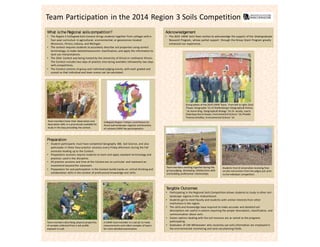
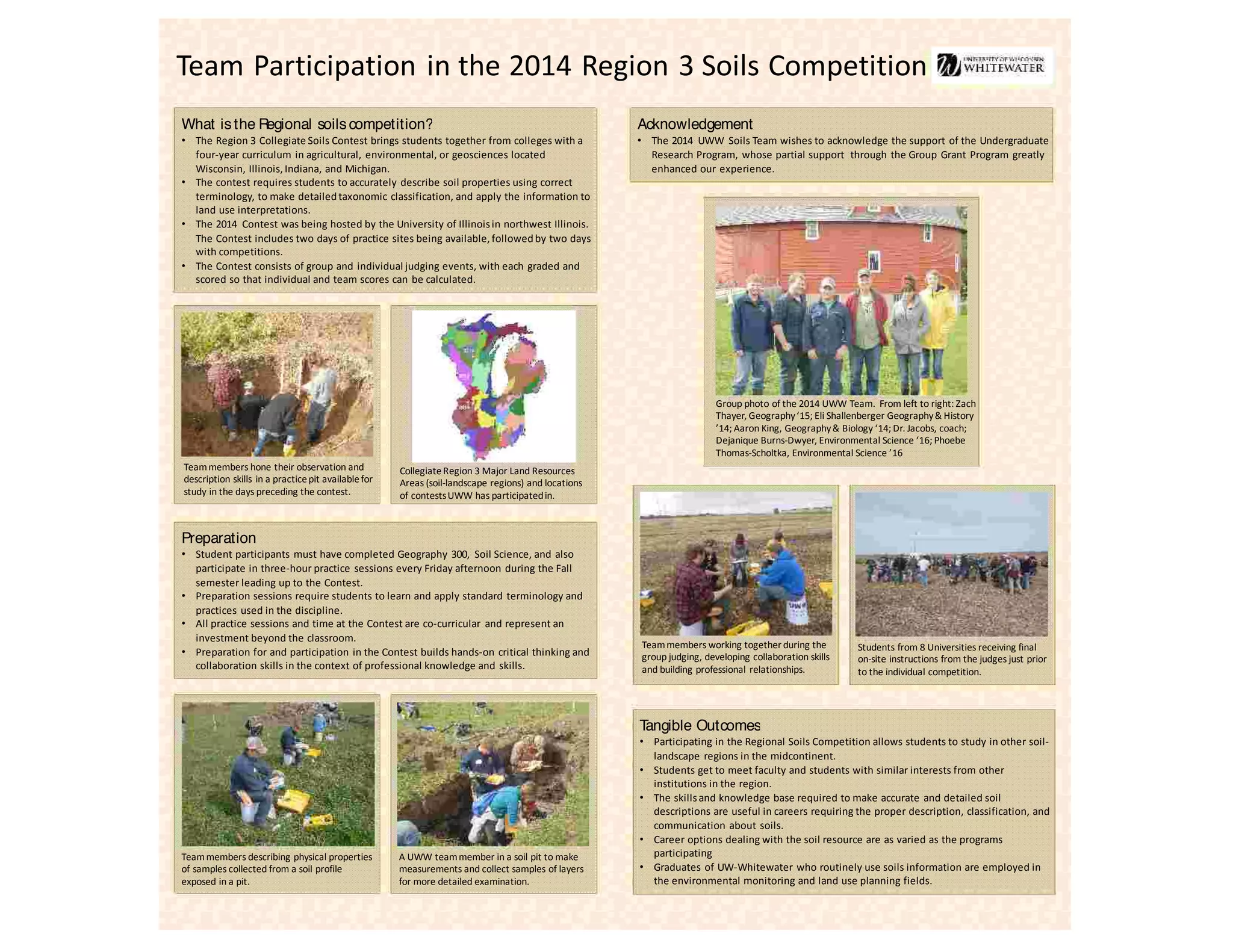
Team Participation in the 2014 Region 3 Soils Competition
The Region 3 Collegiate Soils Contest brings students together from colleges with a
four-year curriculum in agricultural, environmental, or geosciences located
Wisconsin, Illinois,Indiana, and Michigan.
The contest requires students to accurately describe soil properties using correct
terminology, to make detailedtaxonomic classification, and apply the information to
land use interpretations.
The 2014 Contest was being hosted by the University of Illinoisin northwest Illinois.
The Contest includes two days of practice sites being available, followedby two days
with competitions.
The Contest consists of group and individual judging events, with each graded and
scored so that individual and team scores can be calculated.
Student participants must have completed Geography 300, Soil Science, and also
participate in three-hour practice sessions every Friday afternoon during the Fall
semester leading up to the Contest.
Preparation sessions require students to learn and apply standard terminology and
practices used in the discipline.
All practice sessions and time at the Contest are co-curricular and represent an
investment beyond the classroom.
Preparation for and participation in the Contest builds hands-on critical thinking and
collaboration skills in the context of professional knowledge and skills.
Participating in the Regional Soils Competition allows students to study in other soil-
landscape regions in the midcontinent.
Students get to meet faculty and students with similar interests from other
institutions in the region.
The skillsand knowledge base required to make accurate and detailed soil
descriptions are useful in careers requiring the proper description, classification, and
communication about soils.
Career options dealing with the soil resource are as varied as the programs
participating
Graduates of UW-Whitewater who routinely use soils information are employed in
the environmental monitoring and land use planning fields.
The 2014 UWW Soils Team wishes to acknowledge the support of the Undergraduate
Research Program, whose partial support through the Group Grant Program greatly
enhanced our experience.
Group photo of the 2014 UWW Team. From left to right: Zach
Thayer, Geography‘15; Eli Shallenberger Geography& History
’14; Aaron King, Geography& Biology ‘14; Dr. Jacobs, coach;
Dejanique Burns-Dwyer, Environmental Science ‘16; Phoebe
Thomas-Scholtka, Environmental Science ’16
Students from 8 Universities receiving final
on-site instructions from the judges just prior
to the individual competition.
Teammembers hone their observation and
description skills in a practicepit availablefor
study in the days preceding the contest.
Teammembers describing physical properties
of samples collected from a soil profile
exposed in a pit.
A UWW teammember in a soil pit to make
measurements and collect samples of layers
for more detailed examination.
Teammembers working together during the
group judging, developing collaboration skills
and building professional relationships.
CollegiateRegion 3 Major Land Resources
Areas (soil-landscape regions) and locations
of contestsUWW has participatedin.
What isthe Regional soilscompetition?
Preparation
Tangible Outcomes
Acknowledgement
•
•
•
•
•
•
•
•
•
•
•
•
•
•

UGR%20poster%202014.PDF

  • 1.
    Team Participation inthe 2014 Region 3 Soils Competition The Region 3 Collegiate Soils Contest brings students together from colleges with a four-year curriculum in agricultural, environmental, or geosciences located Wisconsin, Illinois,Indiana, and Michigan. The contest requires students to accurately describe soil properties using correct terminology, to make detailedtaxonomic classification, and apply the information to land use interpretations. The 2014 Contest was being hosted by the University of Illinoisin northwest Illinois. The Contest includes two days of practice sites being available, followedby two days with competitions. The Contest consists of group and individual judging events, with each graded and scored so that individual and team scores can be calculated. Student participants must have completed Geography 300, Soil Science, and also participate in three-hour practice sessions every Friday afternoon during the Fall semester leading up to the Contest. Preparation sessions require students to learn and apply standard terminology and practices used in the discipline. All practice sessions and time at the Contest are co-curricular and represent an investment beyond the classroom. Preparation for and participation in the Contest builds hands-on critical thinking and collaboration skills in the context of professional knowledge and skills. Participating in the Regional Soils Competition allows students to study in other soil- landscape regions in the midcontinent. Students get to meet faculty and students with similar interests from other institutions in the region. The skillsand knowledge base required to make accurate and detailed soil descriptions are useful in careers requiring the proper description, classification, and communication about soils. Career options dealing with the soil resource are as varied as the programs participating Graduates of UW-Whitewater who routinely use soils information are employed in the environmental monitoring and land use planning fields. The 2014 UWW Soils Team wishes to acknowledge the support of the Undergraduate Research Program, whose partial support through the Group Grant Program greatly enhanced our experience. Group photo of the 2014 UWW Team. From left to right: Zach Thayer, Geography‘15; Eli Shallenberger Geography& History ’14; Aaron King, Geography& Biology ‘14; Dr. Jacobs, coach; Dejanique Burns-Dwyer, Environmental Science ‘16; Phoebe Thomas-Scholtka, Environmental Science ’16 Students from 8 Universities receiving final on-site instructions from the judges just prior to the individual competition. Teammembers hone their observation and description skills in a practicepit availablefor study in the days preceding the contest. Teammembers describing physical properties of samples collected from a soil profile exposed in a pit. A UWW teammember in a soil pit to make measurements and collect samples of layers for more detailed examination. Teammembers working together during the group judging, developing collaboration skills and building professional relationships. CollegiateRegion 3 Major Land Resources Areas (soil-landscape regions) and locations of contestsUWW has participatedin. What isthe Regional soilscompetition? Preparation Tangible Outcomes Acknowledgement • • • • • • • • • • • • • •