Thermoregulation: the basics Applied physiology BND Yr2
Aims: To consider the importance of environment To define key terms To identify the role of the hypothalamus
Introduction Sport, competitions and tournaments are held all over the world, in all types of conditions. Sport can occur in hot humid climates, e.g. Commonwealth Games 1998 was held in Kuala Lumpar. Competitions can also be held in cold, icy and snowy conditions, e.g. Winter Olympics  Athletes need to be prepared for whatever conditions they are required to perform in.
Introduction Competing in different countries puts different types of stress on the body and the way in which it functions.  This unit will look at how these different conditions affects performance. It will also examine how training in different climates and conditions can help an athlete to cope more effectively.
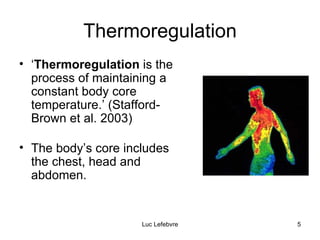
Thermoregulation ‘ Thermoregulation  is the process of maintaining a constant body core temperature.’ (Stafford-Brown et al. 2003) The body’s core includes the chest, head and abdomen.
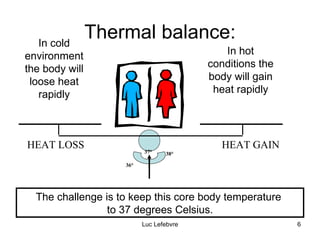
Thermal balance: 36 ° 37 ° 38 ° HEAT LOSS HEAT GAIN In cold environment the body will loose heat rapidly In hot conditions the body will gain heat rapidly The challenge is to keep this core body temperature  to 37 degrees Celsius.
Skin and Core Temperature The body’s skin temperature can vary greatly.  However, if the body’s core temperature varies by 1 ºC or more, it will affect the performer’s performance, both physically  and mentally. Larger changes to core temperature can lead to either  hyperthermia  or  hypothermia .
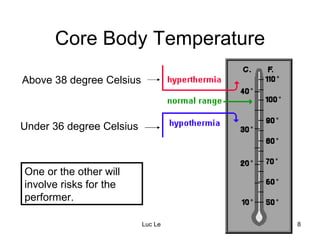
Core Body Temperature Under 36 degree Celsius Above 38 degree Celsius One or the other will involve risks for the performer.
Body temperature regulation The mechanisms that regulate temperature are activated in one of two ways: Thermal receptors in the skin that send a message to the hypothalamus Direct stimulation of the hypothalamus, by changes in blood temperature.
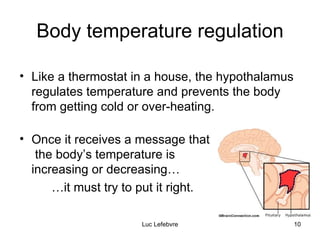
Body temperature regulation Like a thermostat in a house, the hypothalamus regulates temperature and prevents the body from getting cold or over-heating. Once it receives a message that  the body’s temperature is  increasing or decreasing…  … it must try to put it right.

2010 thermal balance 1

  • 1.
    Thermoregulation: the basicsApplied physiology BND Yr2
  • 2.
    Aims: To considerthe importance of environment To define key terms To identify the role of the hypothalamus
  • 3.
    Introduction Sport, competitionsand tournaments are held all over the world, in all types of conditions. Sport can occur in hot humid climates, e.g. Commonwealth Games 1998 was held in Kuala Lumpar. Competitions can also be held in cold, icy and snowy conditions, e.g. Winter Olympics Athletes need to be prepared for whatever conditions they are required to perform in.
  • 4.
    Introduction Competing indifferent countries puts different types of stress on the body and the way in which it functions. This unit will look at how these different conditions affects performance. It will also examine how training in different climates and conditions can help an athlete to cope more effectively.
  • 5.
    Thermoregulation ‘ Thermoregulation is the process of maintaining a constant body core temperature.’ (Stafford-Brown et al. 2003) The body’s core includes the chest, head and abdomen.
  • 6.
    Thermal balance: 36° 37 ° 38 ° HEAT LOSS HEAT GAIN In cold environment the body will loose heat rapidly In hot conditions the body will gain heat rapidly The challenge is to keep this core body temperature to 37 degrees Celsius.
  • 7.
    Skin and CoreTemperature The body’s skin temperature can vary greatly. However, if the body’s core temperature varies by 1 ºC or more, it will affect the performer’s performance, both physically and mentally. Larger changes to core temperature can lead to either hyperthermia or hypothermia .
  • 8.
    Core Body TemperatureUnder 36 degree Celsius Above 38 degree Celsius One or the other will involve risks for the performer.
  • 9.
    Body temperature regulationThe mechanisms that regulate temperature are activated in one of two ways: Thermal receptors in the skin that send a message to the hypothalamus Direct stimulation of the hypothalamus, by changes in blood temperature.
  • 10.
    Body temperature regulationLike a thermostat in a house, the hypothalamus regulates temperature and prevents the body from getting cold or over-heating. Once it receives a message that the body’s temperature is increasing or decreasing… … it must try to put it right.

Editor's Notes

  • #4 Hot conditions – Sidney 2000/ Athens 2004 Cold conditions – salt lake city 2002/ nagano 1998 Athletes must be prepared to face the conditions they are required to perform in: High altitude Cold/ hot conditions Water…
  • #6 What is the process of maintaining a constant body core temperature? What does include the body’s core?
  • #8 Skin temperature does not mean body core temperature!!!