Supporting wiki designers with a  Confluence Design Pattern Library Dan Wendling,  [email_address] National Library of Medicine Presentation for the Wiki Pecha Kucha, 5/14/2009, http://wiki.sla.org/display/CEWIKI/2009+05+14+~+Sharing+our+Stories+about+Wikis+the+Pecha+Kucha+Way
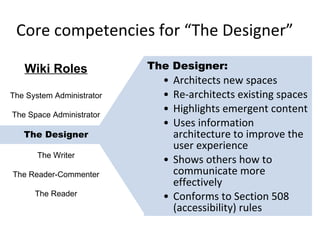
Core competencies for “The Designer” The Designer: Architects new spaces Re-architects existing spaces Highlights emergent content Uses information architecture to improve the user experience Shows others how to communicate more effectively Conforms to Section 508 (accessibility) rules Wiki Roles The System Administrator The Space Administrator The Designer The Writer The Reader-Commenter The Reader
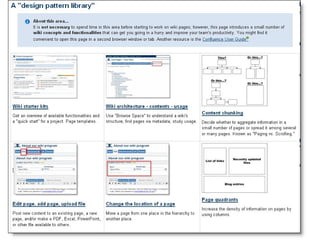
Design Pattern Library home page 6 of 25 entries
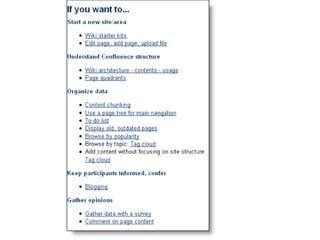
DPL home page-list by task
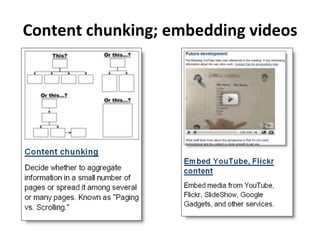
Content chunking; embedding videos
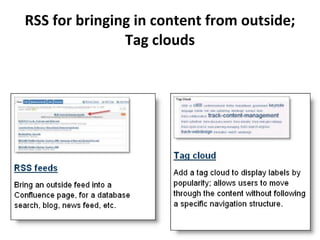
RSS for bringing in content from outside; Tag clouds
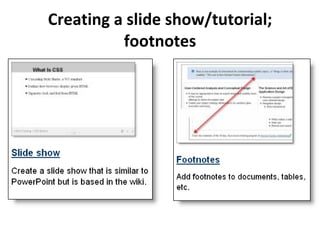
Creating a slide show/tutorial; footnotes
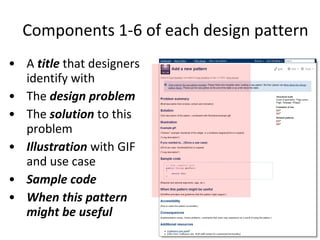
Components 1-6 of each design pattern A  title   that designers identify with The  design problem The  solution  to this problem Illustration  with GIF and use case Sample code When this pattern might be useful
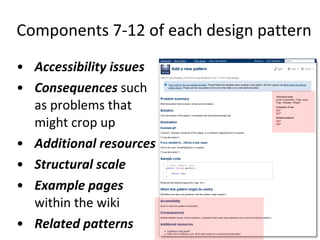
Components 7-12 of each design pattern Accessibility issues Consequences  such as problems that might crop up Additional resources Structural scale Example pages  within the wiki Related patterns
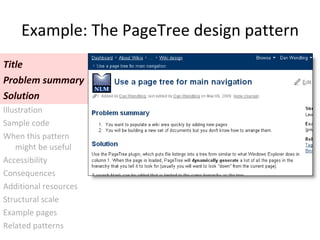
Example: The PageTree design pattern Title Problem summary Solution Illustration  Sample code When this pattern  might be useful Accessibility Consequences Additional resources Structural scale Example pages Related patterns
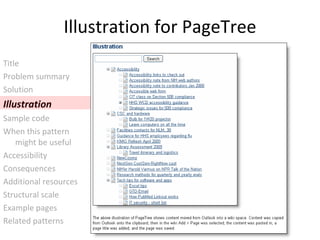
Illustration for PageTree Title Problem summary Solution Illustration  Sample code When this pattern  might be useful Accessibility Consequences Additional resources Structural scale Example pages Related patterns
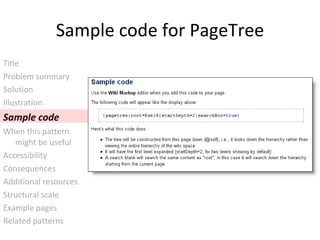
Sample code for PageTree Title Problem summary Solution Illustration  Sample code When this pattern  might be useful Accessibility Consequences Additional resources Structural scale Example pages Related patterns
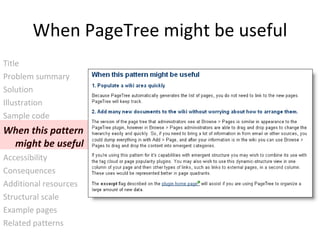
When PageTree might be useful Title Problem summary Solution Illustration  Sample code When this pattern  might be useful Accessibility Consequences Additional resources Structural scale Example pages Related patterns
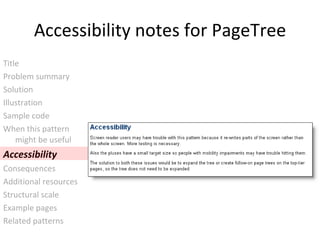
Accessibility notes for PageTree Title Problem summary Solution Illustration  Sample code When this pattern  might be useful Accessibility Consequences Additional resources Structural scale Example pages Related patterns
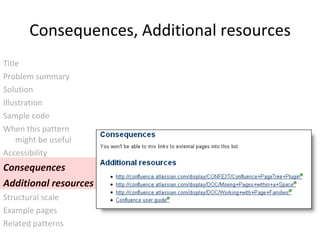
Consequences, Additional resources Title Problem summary Solution Illustration  Sample code When this pattern  might be useful Accessibility Consequences Additional resources Structural scale Example pages Related patterns
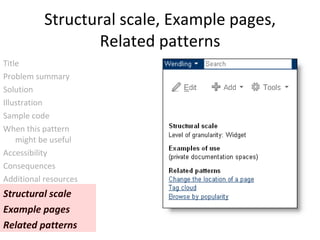
Structural scale, Example pages, Related patterns Title Problem summary Solution Illustration  Sample code When this pattern  might be useful Accessibility Consequences Additional resources Structural scale Example pages Related patterns
9 reasons to implement a design pattern library, 1 st  screen (Derived from Lamantia, 2006, 2007) Be user-centric; address user experience design challenges;  create an effective user experience Provide a simple design approach with building blocks  Provide a structure for growth and evolution  Increase the value of each individual tool by showing context and the differences between functionalities
9 reasons to implement, 2 nd Demonstrate new ways to accomplish work, pre-vetted, to increase and improve content assets Rapidly create larger units of content from smaller chunks of information  Ease concerns about problems with enterprise information architecture  Provide collaboration functionalities that scale up and help you respond to change  Provide sharing and reuse of familiar, defined blocks of functionality among projects of all sizes and complexity.
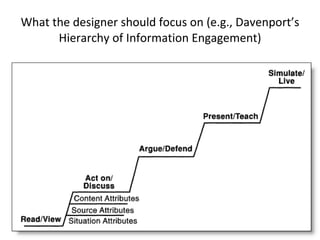
What the designer should focus on (e.g., Davenport’s Hierarchy of Information Engagement)
Key influences Barker, Dean T. (2007, July 12).  User interface patterns: Reusable solutions for design.  White paper. Human Factors International, Inc. Online at:  http://humanfactors.com/downloads/whitepapers.asp   Lamantia, Joe. (2006, 2007).  The challenge of dashboards and portals.  Part 1 of 6. Boxes and Arrows, August 2007. Online at  http://www.boxesandarrows.com/view/the-challenge-of   (see all parts) Yahoo! Developer Network, Design Pattern Library:  http://developer.yahoo.com/ypatterns/index.php Tidwell, Jennifer.  Designing Interfaces :  http://designinginterfaces.com/   Davenport, Thomas, and Prusak, Laurence. (1997).  Information Ecology: Why technology is not enough for success in the information age.  New York: Oxford University Press. p. 93, Hierarchy of information engagement. Davenport, Thomas. (2005).  Thinking for a living: How to get better performance and results from knowledge workers.  Boston: Harvard Business School Press. Chapter 4, Knowledge work processes; chapter 7, Investing in knowledge workers’ networks and learning.
Thanks!

20090514 Wendling Dan Pecha Kucha Wikis

  • 1.
    Supporting wiki designerswith a Confluence Design Pattern Library Dan Wendling, [email_address] National Library of Medicine Presentation for the Wiki Pecha Kucha, 5/14/2009, http://wiki.sla.org/display/CEWIKI/2009+05+14+~+Sharing+our+Stories+about+Wikis+the+Pecha+Kucha+Way
  • 2.
    Core competencies for“The Designer” The Designer: Architects new spaces Re-architects existing spaces Highlights emergent content Uses information architecture to improve the user experience Shows others how to communicate more effectively Conforms to Section 508 (accessibility) rules Wiki Roles The System Administrator The Space Administrator The Designer The Writer The Reader-Commenter The Reader
  • 3.
    Design Pattern Libraryhome page 6 of 25 entries
  • 4.
  • 5.
  • 6.
    RSS for bringingin content from outside; Tag clouds
  • 7.
    Creating a slideshow/tutorial; footnotes
  • 8.
    Components 1-6 ofeach design pattern A title that designers identify with The design problem The solution to this problem Illustration with GIF and use case Sample code When this pattern might be useful
  • 9.
    Components 7-12 ofeach design pattern Accessibility issues Consequences such as problems that might crop up Additional resources Structural scale Example pages within the wiki Related patterns
  • 10.
    Example: The PageTreedesign pattern Title Problem summary Solution Illustration Sample code When this pattern might be useful Accessibility Consequences Additional resources Structural scale Example pages Related patterns
  • 11.
    Illustration for PageTreeTitle Problem summary Solution Illustration Sample code When this pattern might be useful Accessibility Consequences Additional resources Structural scale Example pages Related patterns
  • 12.
    Sample code forPageTree Title Problem summary Solution Illustration Sample code When this pattern might be useful Accessibility Consequences Additional resources Structural scale Example pages Related patterns
  • 13.
    When PageTree mightbe useful Title Problem summary Solution Illustration Sample code When this pattern might be useful Accessibility Consequences Additional resources Structural scale Example pages Related patterns
  • 14.
    Accessibility notes forPageTree Title Problem summary Solution Illustration Sample code When this pattern might be useful Accessibility Consequences Additional resources Structural scale Example pages Related patterns
  • 15.
    Consequences, Additional resourcesTitle Problem summary Solution Illustration Sample code When this pattern might be useful Accessibility Consequences Additional resources Structural scale Example pages Related patterns
  • 16.
    Structural scale, Examplepages, Related patterns Title Problem summary Solution Illustration Sample code When this pattern might be useful Accessibility Consequences Additional resources Structural scale Example pages Related patterns
  • 17.
    9 reasons toimplement a design pattern library, 1 st screen (Derived from Lamantia, 2006, 2007) Be user-centric; address user experience design challenges; create an effective user experience Provide a simple design approach with building blocks Provide a structure for growth and evolution Increase the value of each individual tool by showing context and the differences between functionalities
  • 18.
    9 reasons toimplement, 2 nd Demonstrate new ways to accomplish work, pre-vetted, to increase and improve content assets Rapidly create larger units of content from smaller chunks of information Ease concerns about problems with enterprise information architecture Provide collaboration functionalities that scale up and help you respond to change Provide sharing and reuse of familiar, defined blocks of functionality among projects of all sizes and complexity.
  • 19.
    What the designershould focus on (e.g., Davenport’s Hierarchy of Information Engagement)
  • 20.
    Key influences Barker,Dean T. (2007, July 12). User interface patterns: Reusable solutions for design. White paper. Human Factors International, Inc. Online at: http://humanfactors.com/downloads/whitepapers.asp Lamantia, Joe. (2006, 2007). The challenge of dashboards and portals. Part 1 of 6. Boxes and Arrows, August 2007. Online at http://www.boxesandarrows.com/view/the-challenge-of (see all parts) Yahoo! Developer Network, Design Pattern Library: http://developer.yahoo.com/ypatterns/index.php Tidwell, Jennifer. Designing Interfaces : http://designinginterfaces.com/ Davenport, Thomas, and Prusak, Laurence. (1997). Information Ecology: Why technology is not enough for success in the information age. New York: Oxford University Press. p. 93, Hierarchy of information engagement. Davenport, Thomas. (2005). Thinking for a living: How to get better performance and results from knowledge workers. Boston: Harvard Business School Press. Chapter 4, Knowledge work processes; chapter 7, Investing in knowledge workers’ networks and learning.
  • 21.