Enhancing access to
banking and financial services
in Botswana

Keith Jefferis
Glossary                                                     Contents
AML     Anti-money laundering                                Foreword                                                                           2
ATM     Automatic Transaction Machine
                                                             Introduction                                                                       4
BDC     Botswana Development Corporation
BBS     Botswana Building Society                            The importance of access to finance                                                4
BIDPA   Botswana Institute for Development Policy Analysis   Financial access issues in Botswana                                                7
BIFM    Botswana Insurance Fund Management                      Geographical access                                                             7
BPS     Botswana Postal Services                                Financial depth                                                                 9
BSB     Botswana Savings Bank                                   Botswana’s financial sector                                                    11
CEDA    Citizen Entrepreneurial Development Agency              Measurement of financial access in Botswana                                    13
CFT     Countering the financing of terrorism                   Implications                                                                   17
DFID    Department for International Development (UK)           Bank charges and access                                                        19
FI      Financial Institution                                Options for broadening access to financial services                               20
FSC     Financial Sector Charter (South Africa)                 Extending the services of existing institutions                                21
GDP     Gross Domestic Product                                  Making use of new technology                                                   22
HIES    Household Income and Expenditure Survey                 Regulatory reform                                                              25
IMF     International Monetary Fund                             Getting the banks to do more                                                   28
NDB     National Development Bank
                                                             Conclusions: The way forward                                                      31
NFSC    Namibian Financial Sector Charter
NGOs    Non-Governmental Organisations
P
POS
        Pula (currency)
        Point of sale
                                                             Tables
SMMEs   Small, Medium and Micro Enterprises                  Table   1:    Settlements with bank presence                                       8
SACU    Southern African Customs Union                       Table   2:    Major unbanked settlements (population > 10,000)                     8
SADC    Southern African Development Community               Table   3:    Indicators of financial development by income group, 2000-04        10
SSA     Sub-Saharan Africa                                   Table   4:    Financial institutions balance sheet (December 2005)                11
                                                             Table   5:    Banking profitability (various years, 1999-2003)                    12
                                                             Table   6:    Bank choice drivers                                                 18
                                                             Table   7:    Affordability of bank charges                                       19


                                                             Figures
                                                             Figure   1:   Financial depth and GDP per capita (developing countries, 2003-4)    9
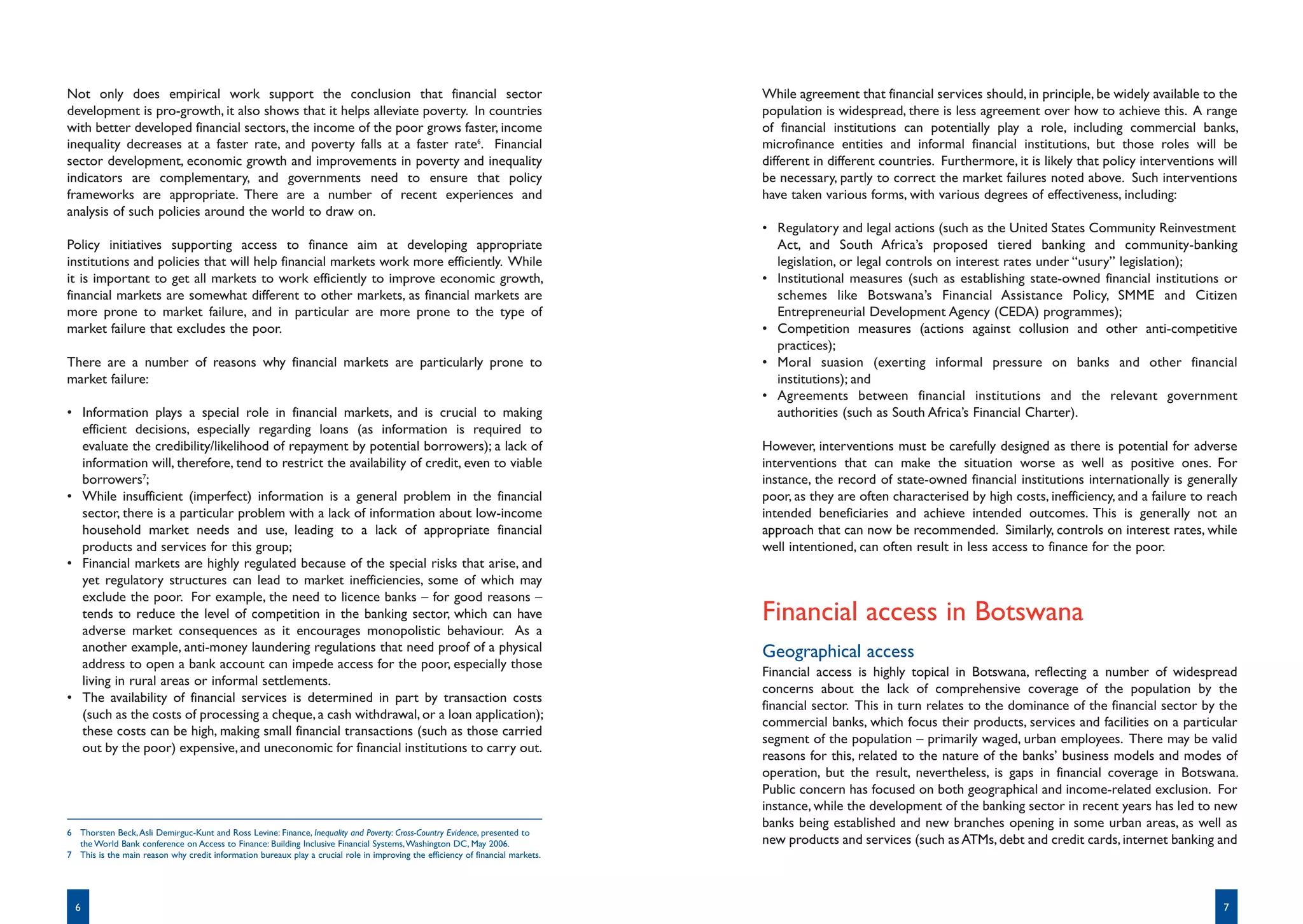
                                                             Figure   2:   Banking sector profitability (RoA) (1999-2003)                      13
                                                             Figure   3:   Use of main products                                                14
                                                             Figure   4:   Banking status by sub-groups – I                                    15
                                                             Figure   5:   Banking status by sub-groups – II                                   15
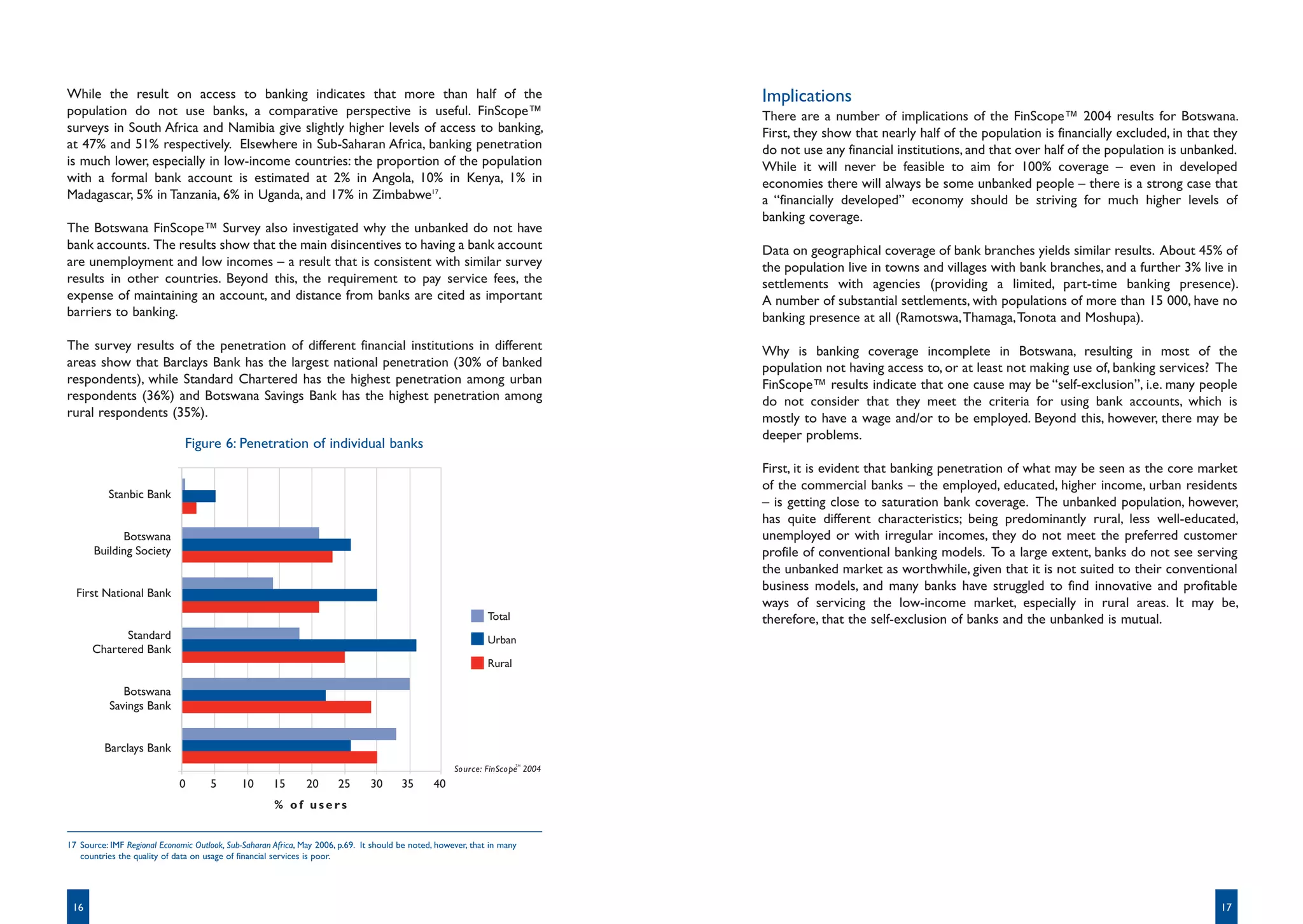
                                                             Figure   6:   Penetration of individual banks                                     16
                                                             Figure   7:   Reasons for not having a bank account                               18


                                                                                                                                               1
Foreword
The banking sector plays a crucial role in any economy through the provision of            about financial products and institutions, relating these to the socio-economic and
financial intermediation and payments services. Through these services, banks enable       demographic characteristics of the population. In collaboration with Botswana
the efficient allocation of savings and investment, and enable financial transactions to   Insurance Fund Management (BIFM), FinMark has also sponsored a series of regular
take place at minimum cost. In discharging these functions, Botswana’s banking             Forums in Botswana, which bring together practitioners, academics and
sector has many strengths: it is reasonably efficient, it is sound and profitable, has     policymakers to discuss topical issues relating to enhancing access to finance.
never experienced any serious banking crises, and on the few occasions that
financial institutions have experienced problems that threaten their continued             In this regard, this publication on Enhancing Access to Banking and Financial Services
existence, these problems have been dealt with quickly and without any negative            in Botswana by Dr Keith Jefferis and sponsored by FinMark Trust, marks a timely
impact on the financial system as a whole. The high quality of banking regulation and      contribution to an important debate. The booklet provides a range of information,
supervision in Botswana is internationally recognised, and in recent years there have      much of it based on the FinScopeTM survey, and presents a “landscape of access”
been a number of product innovations and improvements in service quality.                  detailing which segments of the population do and do not have access to financial
                                                                                           services in general and banking services in particular. The results indicate that over
Nevertheless, banks in Botswana – as in most countries – are frequently the subject        half of the adult population does not make use of banking services, and show that
of negative comments and criticism. Among the major concerns are high charges,             while Botswana does not do badly by regional standards, there are nonetheless
long queues, a lack of services in rural areas, and more generally perceptions of only     challenges to be faced in ensuring greater participation in the use of banking
serving a small minority of the population. Some of the criticism is misplaced, and        services, and participation in the benefits that can be derived from these services.
there is evidence that the banks have tried to address at least some of these
concerns.                                                                                  The booklet also reviews recent developments in both the regulatory and
                                                                                           technological fields that can help to support enhanced access to banking, and
However, the issue of access to banking and financial services is of crucial               provides some very useful suggestions as to how this can be achieved in Botswana.
importance. In Botswana, as in most developing economies, the banks dominate the           I trust that a wide range of stakeholders will consider these suggestions as the basis
financial system. As the dominant financial institutions, banks need to be cognisant       for a programme of action. This includes policymakers in the government and the
of their role as important agents of economic development, and not confine                 Bank of Botswana, the banks themselves, as well as researchers, donors and NGOs.
themselves to a narrow range of activities or customers, especially given the very         The booklet also illustrates the importance of having high quality data, which we can
high rates of profit earned by banks in Botswana. There is widespread evidence and         learn much from and use as an input to the policy process. In order to improve our
experience showing that broadening access to financial products and services has           knowledge and provide a means of judging progress on enhancing access to finance,
benefits for both individuals and business, and for the economy as a whole. Access         I hope that FinMark Trust will consider running another FinScopeTM Survey, and that
to savings products, credit, and transaction services enables people and businesses to     financial institutions will participate and support this important initiative.
accumulate financial assets, invest, spread risks, and make payments cheaply and
efficiently. There are well-established links between the size and scope of the            I commend this publication to all who have an interest in developing an efficient and
financial system and the rate of economic growth. Furthermore, ensuring that access        inclusive financial sector in Botswana. Success in this will support our objectives of
to finance is widespread can have benefits in terms of poverty reduction and income        raising economic growth, diversifying the economy, and reducing poverty in line with
distribution, and there are many benefits that can flow from overcoming the                Vision 2016. I would like to thank FinMark Trust and Dr Jefferis for their efforts in
obstacles and reducing the high costs that the poor often face in gaining access to        producing the publication, and look forward to concrete results from the debate that
financial products and services.                                                           it will stimulate.

The recent focus of many development efforts has been on “Making Markets Work
for the Poor”, sometimes termed “MMW4P”. I am pleased to note that among the
pioneers of MMW4P in the financial sector is FinMark Trust, an organisation based
in South Africa that is active across Southern Africa. In recent years, FinMark has        Hon. Baledzi Gaolathe
carried out a number of activities in Botswana. These include “FinScopeTM”, a              Minister of Finance and Development Planning
nationwide survey of access to and usage of financial services, and of perceptions         Gaborone, March 2007


 2                                                                                                                                                                            3
World Bank has also taken a keen interest, promoting research and policy debate3,
Introduction                                                                                                             and the International Monetary Fund (IMF) has recently come on board; the May
                                                                                                                         2005 Regional Economic Outlook – Sub-Saharan Africa (SSA) incorporated a
This booklet examines access to financial services, particularly banking services, in                                    discussion of access to finance issues in a review of Issues, Challenges and Reform
Botswana. The issue is a topical one, given widespread concerns that most of the                                         Strategies in SSA Financial Sectors4. Various bilateral donors such as the UK’s
population do not have access to financial services, and as a result may be excluded                                     Department for International Development (DFID) have also been devoting
from full participation in the modern monetary economy. The aim of this booklet is                                       resources to promoting access to finance5.
threefold:
                                                                                                                         The common thread running through all of the above is that financial exclusion, or
• To present general issues around why access to finance is important, from both                                         constrained access to finance, has negative, interrelated economic and social impacts.
  economic development and social perspectives;                                                                          These arise for a number of reasons:
• To present comprehensive information on access to finance in Botswana, drawing
  in particular on data collected by the FinScope™ Survey carried out in 2004; and                                       • The lack of efficient financial service provision means that poor people are either
• To discuss the challenges of making access to finance more inclusive in Botswana,                                        forced to use inefficient provisions, often at high cost (for instance, with high
  thus enabling lower-income groups to participate more effectively in the modern                                          transactions costs, excessively high interest rates on loans, or poor returns on
  economy, and to make some suggestions as to how access can be improved.                                                  savings) – thereby entrenching poverty – or they do not have access to certain
                                                                                                                           financial products, either because of an absolute absence of suitable products or
                                                                                                                           because available products are too expensive;
                                                                                                                         • This in turn tends to restrict the economic opportunities open to the poor. This
The importance of access to finance                                                                                        is most obviously the case with credit, as almost all entrepreneurship activities
                                                                                                                           need capital upfront, even if in small amounts, to fund investment;
Making financial markets work effectively is one of the most important issues                                            • It makes the poor vulnerable to adverse events and financial loss (due to lack of
developing countries face today. Indeed, the effectiveness of financial markets is one                                     insurance and secure savings products);
of the biggest differentiating factors between developed and developing countries. As                                    • The absence of savings products makes it difficult to build up capital;
The Economist noted in a survey in late 2005, in developed countries “the vast                                           • Poverty is entrenched, as the poor are faced with the high costs of accessing
majority of people have access to interest-bearing savings accounts, mortgages at                                          financial services, and are denied entrepreneurship opportunities that might
reasonable rates, abundant consumer credit, insurance at premiums that reflect the                                         provide them with a chance to earn an income; and
risk of losses, cheap ways of transferring money, and innumerable sources of capital                                     • Economic growth is below potential, as the level of investment is reduced.
for funding a business”.1
                                                                                                                         There is considerable evidence that the level of financial development in a country
In developing countries, however, this is not the case. Financial markets are                                            relates positively to the level of real income. Financial development can be measured
characterised by only partial coverage – or at least only partial coverage by efficient                                  in a variety of ways, but essentially refers to the size of the financial sector and the
markets offering a broad range of financial products at reasonable prices.                                               range of financial institutions and markets that comprise the sector. The extent of
Furthermore, it is the poor who tend to be excluded, whether as individuals or as                                        financial development is often termed “financial depth”, which can be measured in
entrepreneurs. Simply put, effective participation in a modern monetary economy                                          various ways, but typically would be measured by the ratio of bank deposits, or bank
requires more than cash.                                                                                                 credit, to Gross Domestic Product (GDP). There is also increasing evidence that this
                                                                                                                         positive relationship is not simply a correlation, but that causation runs from
The importance of the issue is reflected in widespread discussions and policy                                            financial depth to growth and incomes, that is, the more financially developed an
debates around the world, with a number of multilateral institutions focusing on the                                     economy is, the better able it is to achieve higher rates of economic and income
importance of building inclusive financial sectors. The United Nations has been                                          growth.
particularly active, publishing the authoritative Building Inclusive Financial Sectors
for Development – The Blue Book2, following the Year of Microfinance in 2005. The
                                                                                                                         3 See, e.g. T. Beck, A. Demirguc-Kunt & M Peria, Reaching Out: Access to and Use of Banking Services Across Countries, World
                                                                                                                           Bank Policy Research Working Paper 3754, October 2005; and S. Claessens, Access to Financial Services: A Review of the
                                                                                                                           Issues and Public Policy Objectives, World Bank Policy Research Working Paper 3589, May 2005.
                                                                                                                         4 IMF: Regional Economic Outlook – Sub-Saharan Africa, Chapter 4, May 2006.
1 The Hidden Wealth of the Poor – A Survey of Microfinance, The Economist, November 5, 2005.                             5 See e.g., Banking the Underserved: New Opportunities for Commercial Banks – Exploring the Business Case, Policy Division
2 Building Inclusive Financial Sectors for Development – The Blue Book, United Nations, May 2006 (bluebook.uncdf.org).     Working Paper, DFID, April 2005.


  4                                                                                                                                                                                                                                                     5
Not only does empirical work support the conclusion that financial sector                                                        While agreement that financial services should, in principle, be widely available to the
development is pro-growth, it also shows that it helps alleviate poverty. In countries                                           population is widespread, there is less agreement over how to achieve this. A range
with better developed financial sectors, the income of the poor grows faster, income                                             of financial institutions can potentially play a role, including commercial banks,
inequality decreases at a faster rate, and poverty falls at a faster rate6. Financial                                            microfinance entities and informal financial institutions, but those roles will be
sector development, economic growth and improvements in poverty and inequality                                                   different in different countries. Furthermore, it is likely that policy interventions will
indicators are complementary, and governments need to ensure that policy                                                         be necessary, partly to correct the market failures noted above. Such interventions
frameworks are appropriate. There are a number of recent experiences and                                                         have taken various forms, with various degrees of effectiveness, including:
analysis of such policies around the world to draw on.
                                                                                                                                 • Regulatory and legal actions (such as the United States Community Reinvestment
Policy initiatives supporting access to finance aim at developing appropriate                                                      Act, and South Africa’s proposed tiered banking and community-banking
institutions and policies that will help financial markets work more efficiently. While                                            legislation, or legal controls on interest rates under “usury” legislation);
it is important to get all markets to work efficiently to improve economic growth,                                               • Institutional measures (such as establishing state-owned financial institutions or
financial markets are somewhat different to other markets, as financial markets are                                                schemes like Botswana’s Financial Assistance Policy, SMME and Citizen
more prone to market failure, and in particular are more prone to the type of                                                      Entrepreneurial Development Agency (CEDA) programmes);
market failure that excludes the poor.                                                                                           • Competition measures (actions against collusion and other anti-competitive
                                                                                                                                   practices);
There are a number of reasons why financial markets are particularly prone to                                                    • Moral suasion (exerting informal pressure on banks and other financial
market failure:                                                                                                                    institutions); and
                                                                                                                                 • Agreements between financial institutions and the relevant government
• Information plays a special role in financial markets, and is crucial to making                                                  authorities (such as South Africa’s Financial Charter).
  efficient decisions, especially regarding loans (as information is required to
  evaluate the credibility/likelihood of repayment by potential borrowers); a lack of                                            However, interventions must be carefully designed as there is potential for adverse
  information will, therefore, tend to restrict the availability of credit, even to viable                                       interventions that can make the situation worse as well as positive ones. For
  borrowers7;                                                                                                                    instance, the record of state-owned financial institutions internationally is generally
• While insufficient (imperfect) information is a general problem in the financial                                               poor, as they are often characterised by high costs, inefficiency, and a failure to reach
  sector, there is a particular problem with a lack of information about low-income                                              intended beneficiaries and achieve intended outcomes. This is generally not an
  household market needs and use, leading to a lack of appropriate financial                                                     approach that can now be recommended. Similarly, controls on interest rates, while
  products and services for this group;                                                                                          well intentioned, can often result in less access to finance for the poor.
• Financial markets are highly regulated because of the special risks that arise, and
  yet regulatory structures can lead to market inefficiencies, some of which may
  exclude the poor. For example, the need to licence banks – for good reasons –
  tends to reduce the level of competition in the banking sector, which can have                                                 Financial access in Botswana
  adverse market consequences as it encourages monopolistic behaviour. As a
  another example, anti-money laundering regulations that need proof of a physical                                               Geographical access
  address to open a bank account can impede access for the poor, especially those
                                                                                                                                 Financial access is highly topical in Botswana, reflecting a number of widespread
  living in rural areas or informal settlements.
                                                                                                                                 concerns about the lack of comprehensive coverage of the population by the
• The availability of financial services is determined in part by transaction costs
                                                                                                                                 financial sector. This in turn relates to the dominance of the financial sector by the
  (such as the costs of processing a cheque, a cash withdrawal, or a loan application);
                                                                                                                                 commercial banks, which focus their products, services and facilities on a particular
  these costs can be high, making small financial transactions (such as those carried
                                                                                                                                 segment of the population – primarily waged, urban employees. There may be valid
  out by the poor) expensive, and uneconomic for financial institutions to carry out.
                                                                                                                                 reasons for this, related to the nature of the banks’ business models and modes of
                                                                                                                                 operation, but the result, nevertheless, is gaps in financial coverage in Botswana.
                                                                                                                                 Public concern has focused on both geographical and income-related exclusion. For
                                                                                                                                 instance, while the development of the banking sector in recent years has led to new
                                                                                                                                 banks being established and new branches opening in some urban areas, as well as
6 Thorsten Beck, Asli Demirguc-Kunt and Ross Levine: Finance, Inequality and Poverty: Cross-Country Evidence, presented to
  the World Bank conference on Access to Finance: Building Inclusive Financial Systems, Washington DC, May 2006.                 new products and services (such as ATMs, debt and credit cards, internet banking and
7 This is the main reason why credit information bureaux play a crucial role in improving the efficiency of financial markets.


  6                                                                                                                                                                                                                     7
foreign currency accounts), the number of branches in rural areas has fallen, and                                       that Botswana has a relatively low demographic penetration of bank branches; with
branches in some small- to medium-sized towns have been closed. As a result, only                                       3.8 branches per 100 000 people, Botswana ranks 73 out of 99 countries –
around 45% of the Botswana population live in settlements with a permanent                                              significantly better than most African countries but below South Africa (6.0),
banking presence, and many large population centres have no local access to                                             Mauritius (11.9) and Namibia (4.5). Botswana does better with ATM availability,
banking services (see Tables 1 and 2).                                                                                  ranked internationally at 59 out of 99 countries, with nine ATMs per 100 000 people.

                  Table 1:
      Settlements with bank presence                                                                                    Financial depth
                                                                                                                        Besides concerns about geographical coverage, there are also concerns about the
       Location            No. of Population                                                                            effective exclusion of the low-income or unwaged segments of the population from
                           banks                                                                                        access to banking services, due to product design and selection criteria. Essentially
  Gaborone           5       280,460                                                                                    the structuring of banking products and services reflects a belief that there is little
  Francistown        4        91,430                                                                                    or no profit to be made from serving low-income and/or rural and peri-urban/
  Molepolole         1        57,951                                                                                    semi-urban communities, given the size of population settlements in Botswana.
  Selebi-Phikwe      2        50,040
                                                                                                                        Before considering measures of financial access in Botswana, it is worth looking at a
  Serowe             1        43,250
                                                                                                                        more general measure of financial development in Botswana. A commonly-used
  Maun               4        42,081                                 Table 2: Major unbanked settlements                measure of financial development is the ratio of M2 money supply to GDP, which is
  Mahalapye          3        38,373                                         (population > 10,000)                      equivalent to the ratio of deposits held in the banking system to GDP, and is also
  Mochudi            1        37,754                                                                                    known as financial depth. In general there is a positive correlation between financial
                                                                               Location                    Population
  Kanye              2        37,457                                                                                    depth and income levels, in other words, richer countries (with higher GDP per
  Lobatse            3        29,779                                        Ramotswa                          21,927    capita) tend to have higher financial depth.
  Palapye            3        26,792                                        Thamaga                           19,243
  Jwaneng            3        16,201                                        Tonota                            15,855    Figure 1 shows the relationship between financial depth and GDP per capita across
  Ghanzi             1        10,200                                        Moshupa                           15,769    100 developing countries in Africa and elsewhere, and includes a regression line
                                                                            Letlhakane [1]                    15,644    showing the “average” relationship between the two, demonstrating the positive
  Orapa              1         9,002
  Kasane             1         8,312                                        Bobonong [1]                      14,461
                                                                            Tutume                            13,944
                                                                                                                              Figure 1: Financial depth and GDP per capita (Developing countries, 2003-4)
  Tsabong            1         6,731
  Total                      785,813                                        Mmadinare                         10,798                 100%
  Total Botswana          1,739,556                                         Total                            127,641                 90%
                                                                            % of pop.                           7.3%                                                                                         Regression line
  % of population covered       45%
                                                                                                                                     80%
  Source: Bank of Botswana; CSO                                            [1] Part-time banking agency presence
                                                                                                                                     70%


                                                                                                                        M2/GDP (%)
For much of the population, the main channel of access to (a limited range of)                                                       60%
banking services is the Botswana Savings Bank, operating in association with the Post                                                50%
Office, which is well represented across the country, with 112 outlets covering 65%
of the population.                                                                                                                   40%
                                                                                                                                     30%
Research published by the World Bank shows that Botswana, along with Namibia,                                                                                               Botswana
                                                                                                                                     20%
has the lowest geographical penetration of bank branches out of a survey of
99 countries8. This is not surprising, given that Botswana and Namibia have among                                                    10%
the lowest population densities of any countries in the world. Of more relevance is                                                                                     Source: IMF International Financial Statistics (IFS)
                                                                                                                                      0%
                                                                                                                                            0   1,000   2,000    3,000  4,000  5,000 6,000                               7,000   8,000
8 See Reaching Out: Access to and Use of Banking Services Across Countries, op.cit.                                                                             GDP per capita (US$)


  8                                                                                                                                                                                                                               9
correlation noted above. The chart shows that Botswana’s level of financial depth is                                       Botswana’s financial sector
well below the level that would be expected for a country of its income level; the                                         One of the characteristics of Botswana’s financial system is the dominant role of the
regression line indicates that a country with Botswana’s level of GDP per capita                                           commercial banks9. Total bank assets and liabilities amounted to P18.8-billion at the
($5600) would have a M2/GDP ratio of more than double Botswana’s actual level of                                           end of 2005 (about 33% of GDP); of liabilities, around P13.8-billion represents
31%. In other words Botswana’s banking sector is relatively small – and hence                                              customer deposits, and of assets, around P9.0-billion represents loans and advances.
arguably underdeveloped – for a country of its income level.
                                                                                                                           Besides the commercial banks, there is one merchant bank and a number of
Other financial development indicators include the level of bank deposits and private                                      government-owned financial institutions (FIs), including the Botswana Savings Bank
sector credit, both in relation to GDP. As Table 3 shows, Botswana’s performance is                                        (BSB) (which offers both deposit-taking and lending products), and the National
only slightly below the average for middle-income countries in Sub-Saharan Africa                                          Development Bank (NDB), CEDA, and the Botswana Development Corporation
(excluding South Africa); the main issue is that middle-income countries in                                                (BDC), all of which offer only business lending products. In addition, the Botswana
Sub-Saharan Africa have far lower levels of financial development than middle-income                                       Building Society (BBS), has a significant government shareholding, and offers both
countries generally.                                                                                                       loans and deposits. The combined balance sheets of these institutions amounts to
                                                                                                                           around one quarter of the combined balance sheet of the commercial banks (see
       Table 3: Indicators of financial development by income group, 2000-04                                               Table 4).

                                                              Sub- Saharan Africa                                 Other                  Table 4: Financial institutions balance sheet (December 2005)
                                                Low           Middle           Middle            Botswana         Middle
                                              income          income          income                              income                                                   Assets                         Loans                       Deposits
                                                                              excl. SA                                                                              Pmn            % of            Pmn            % of            Pmn           % of
 Bank deposits/GDP                               18.0            50.7              29.2                25.8        39.4                                                            to tal                         to tal                        to tal
 Private sector credit/GDP                       13.3            64.0              21.0                18.8        40.3      Bots. Bdg Soc.                          953   4.1%                     726          6.6%              186   1.3%
 M2/GDP                                          26.9            55.6              32.1                29.4        94.2      Govt owned FIs [1]                    3,518 15.3%                    1,206         10.9%              181   1.3%
 Source: IMF Regional Economic Outlook – Sub-Saharan Africa, 2006, p.30, and International Financial Statistics
                                                                                                                             Merchant banks                          881   3.8%                     227          2.1%              756   5.3%
                                                                                                                             Commercial banks                     17,686  76.8%                   8,908         80.5%           13,073 92.1%
Another measure of financial development is the ratio of cash to deposits –                                                  Total                                23,038 100.0%                  11,067        100.0%           14,196 100.0%
essentially measuring the relative importance of cash and the banking system in the                                          Note: [1] BSB, BDC, NDB, CEDA
                                                                                                                             Source: Botswana Financial Statistics; CEDA (data for March 2005)
economy; the higher the ratio, the more dependent the economy is on cash and the
less developed is the financial system. For Botswana, the measure is more positive
than the financial depth measure noted above. The ratio is around 4%, which is                                             Private-lending companies range from relatively large formal entities (Letshego,
relatively low and means that the banking system plays a generally important role in                                       Penrich, First Funding, Peo), sometimes called “term lenders”, to a large number of
transactions and as a store of value, suggesting that the banking system is doing                                          small, informal entities (“cash loans”). As they do not take deposits, they are not
reasonably well in intermediating finance.                                                                                 subject to banking regulations and accurate information on them is sparse. In 2003
                                                                                                                           the total lending of the term lenders was estimated at P350-million and cash loans
                                                                                                                           at P50-million10. There are also a large number of registered credit unions, burial
                                                                                                                           societies, informal savings and loans groups (metshelo ), and two microfinance
                                                                                                                           operations focused on small-scale entrepreneurs11. The total lending of the credit
                                                                                                                           unions was P95-million in 2005, and the two microfinance lenders were
                                                                                                                           P0.65-million in 200512.


                                                                                                                            9 This data includes Barclays, Standard Chartered, FNB, Stanbic, and Bank of Baroda. A sixth bank, Bank Gaborone started
                                                                                                                              operating in mid-2006.
                                                                                                                           10 FinMark Trust/Genesis Analytics (2003) Access to Financial Services in Botswana.
                                                                                                                           11 Women’s Finance House and Kgetsi ya Tsie.
                                                                                                                           12 International Year of Microcredit – Fact Sheet on Access to Financial Services and Microfinance in Botswana: UNDP Gaborone,
                                                                                                                              2005.


10                                                                                                                                                                                                                                                    11
Besides BSB and the two microfinance lenders, few of these entities have extended                                                        Figure 2: Banking sector profitability (return on assets) (1999-2003)
financial access significantly. The NDB and BDC deal with commercial lending only
to medium and large-scale enterprises; CEDA lends to a range of enterprises,                                                           Romania
including small ones, although it does not extend to micro-enterprises; BBS                                                            Hungary
                                                                                                                                           Brazil
specialises in property lending to commercial and household borrowers, but in the
                                                                                                                                     Costa Rica
latter category would concentrate on the employed. Credit unions provide a                                                       Emg Mkt ex. Afr
small-scale savings facility, as do metshelo, and burial societies combine savings with                                                   Poland
insurance, though none provide savers with an attractive rate of interest on their                                                          Chile
savings.                                                                                                                                    Peru
                                                                                                                                       Sri Lanka
One of the perennially controversial issues about the banking system is its                                                              Mexico
                                                                                                                                      Phillipines
profitability, especially given concerns (discussed later) about the level of bank
                                                                                                                                          Ghana
charges and access issues. As Table 5 and Figure 2 show, Botswana banks are                                                              Zambia
extremely profitable, even by African standards where returns on assets and equity                                                       Gabon
are high by world standards13. This has persisted notwithstanding the entry of new                                                    Botswana
banks and increased competition in the sector, which would be expected to bring                                                          Uganda
profits down. Lending in Botswana is not particularly risky, so high returns cannot                                                  Madagascar
be explained by risk. Despite new entrants, the number of banks remains small and                                                          Africa
concentration is high, although perhaps not excessively so by regional standards14.                                                     Namibia
                                                                                                                                           Kenya
                                                                                                                                        Ethiopia
Nevertheless, persistent high profits suggest that competition is inadequate.                                                        Cameroun
However, the licensing regulations permit new entrants, subject to modest                                                          Mozambique
prudential conditions, and the problem may simply be market size and that Botswana                                                      Tanzania
is not big enough to accommodate new full-service commercial banks. Hence the                                                       South Africa
                                                                                                                                     Cape Verde                                                                              Source: IMF
main barrier to entry – and hence to more competition – may simply be the
small size of the market. There may be an argument for making the bank                                                            Cote DÕIvoire
licensing regulations more flexible to accommodate the entry of different types of                                                                   0%            1%            2%            3%           4%            5%               6%         7%
banks, not necessarily offering a full range of commercial banking services.

                                                                                                                                Measuring financial access in Botswana
                   Table 5: Banking profitability (various years, 1999-2003)                                                    The starting point for a discussion of the present state of access to financial
                                                                                                                                services in Botswana is the FinScope™ 2004 survey. FinScope™ was a
                                      Return on Assets (RoA) Return on Equity (RoE)                                             representative, nationwide survey of 1 200 households, with questions on the use of
  Emrg mkt excl. Africa                                 1.4%                                        15.0%                       a wide range of financial services focusing on four main product types: savings,
  Africa                                                2.7%                                        27.0%                       credit, insurance and transactions/remittances, both formal and informal. The survey
  South Africa                                          1.4%                                        30.0%                       focused on the use of personal financial products and services by households, and so
  Botswana                                              4.2%                                        44.0%                       did not cover businesses needs (such as credit for SMMEs). The results provide a
  Source: IMF Working Paper WP/05/166
                                                                                                                                range of information about use of financial products and services, by different
                                                                                                                                segments of the population, from which many conclusions about access can be
                                                                                                                                derived15.

                                                                                                                                15 The FinScope™ 2004 Survey comprised 1 200 face-to-face interviews during September and October 2004, drawn from
13 Based on data from Emilio Sacerdoti, Access to Credit in Sub-Saharan Africa: Key Issues and Reform Strategies, IMF Working      a nationally representative sample of adults aged 18+ years. It covers two cities, five towns and 21 other census
   Paper WP/05/166, August 2005.                                                                                                   districts. It used a stratified multi-stage random sampling method applied using 2001 Census data. The sample size gives
14 In 2004, the two largest banks had a market share of 63%, and the next two 32%. By comparison, in Mauritius the largest         a precision level of +/- 3%. The data has been weighted by age, gender and region to bring sample profile in line with
   two banks had a market share of 90%, and in South Africa the top four banks had a market share of 85% (Soylemezoglu,            that of the population. The survey was funded by a consortium of Botswana financial institutions, including the Botswana
   A. Botswana’s Financial Sector: Issues and Prospects, background paper prepared for World Bank/BIDPA Study on Export            Building Society, Botswana Savings Bank, Botswana Life Insurance, First National Bank of Botswana and Standard
   Diversification in Botswana, 2004).                                                                                             Chartered Bank Botswana.


 12                                                                                                                                                                                                                                                    13
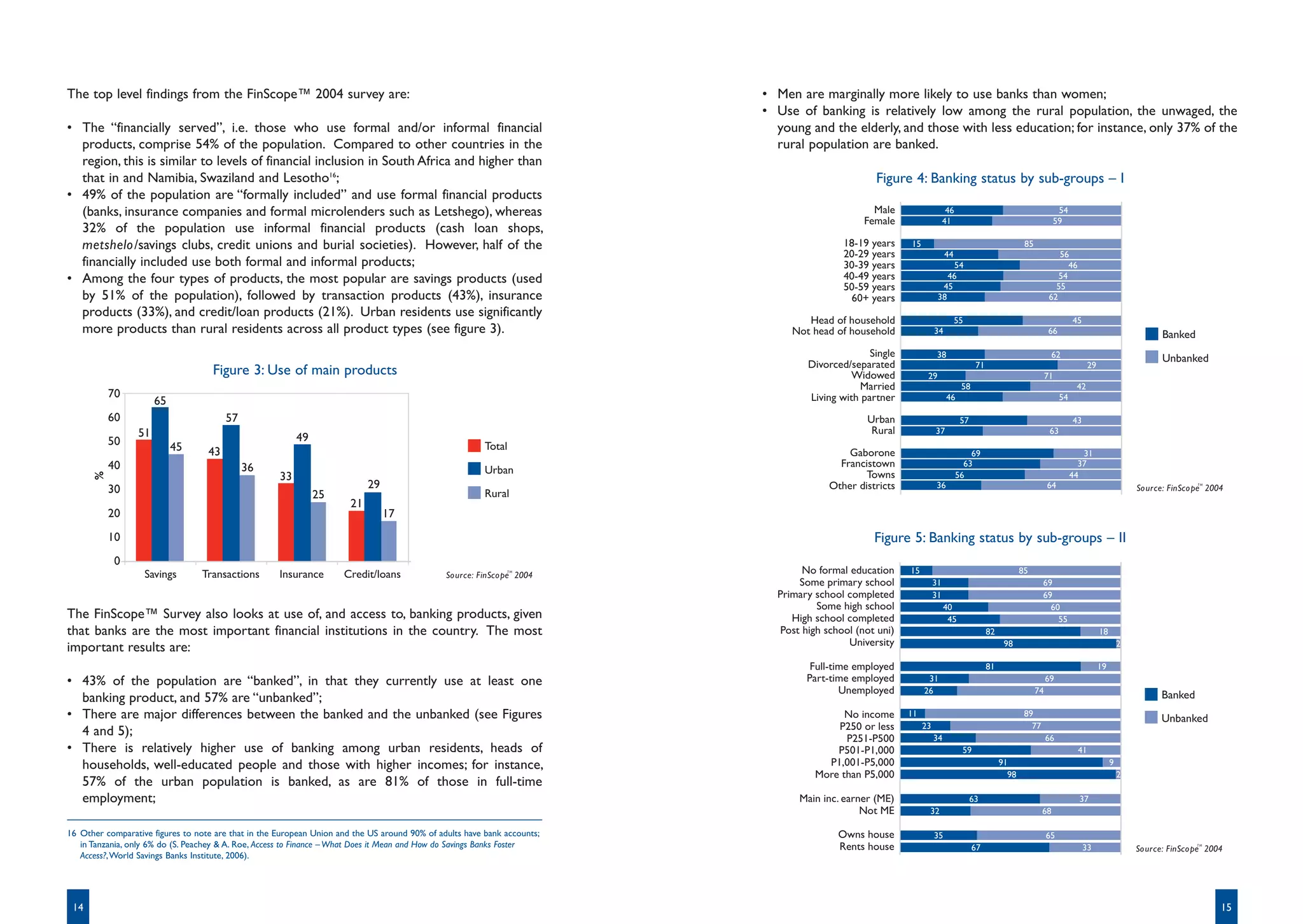
The top level findings from the FinScope™ 2004 survey are:                                                                • Men are marginally more likely to use banks than women;
                                                                                                                          • Use of banking is relatively low among the rural population, the unwaged, the
• The “financially served”, i.e. those who use formal and/or informal financial                                             young and the elderly, and those with less education; for instance, only 37% of the
  products, comprise 54% of the population. Compared to other countries in the                                              rural population are banked.
  region, this is similar to levels of financial inclusion in South Africa and higher than
  that in and Namibia, Swaziland and Lesotho16;                                                                                                   Figure 4: Banking status by sub-groups – I
• 49% of the population are “formally included” and use formal financial products
  (banks, insurance companies and formal microlenders such as Letshego), whereas                                                                  Male                    46                                         54
                                                                                                                                                Female                   41                                         59
  32% of the population use informal financial products (cash loan shops,
  metshelo /savings clubs, credit unions and burial societies). However, half of the                                                       18-19 years    15                                            85
                                                                                                                                           20-29 years                   44                                             56
  financially included use both formal and informal products;                                                                              30-39 years                   54                                               46
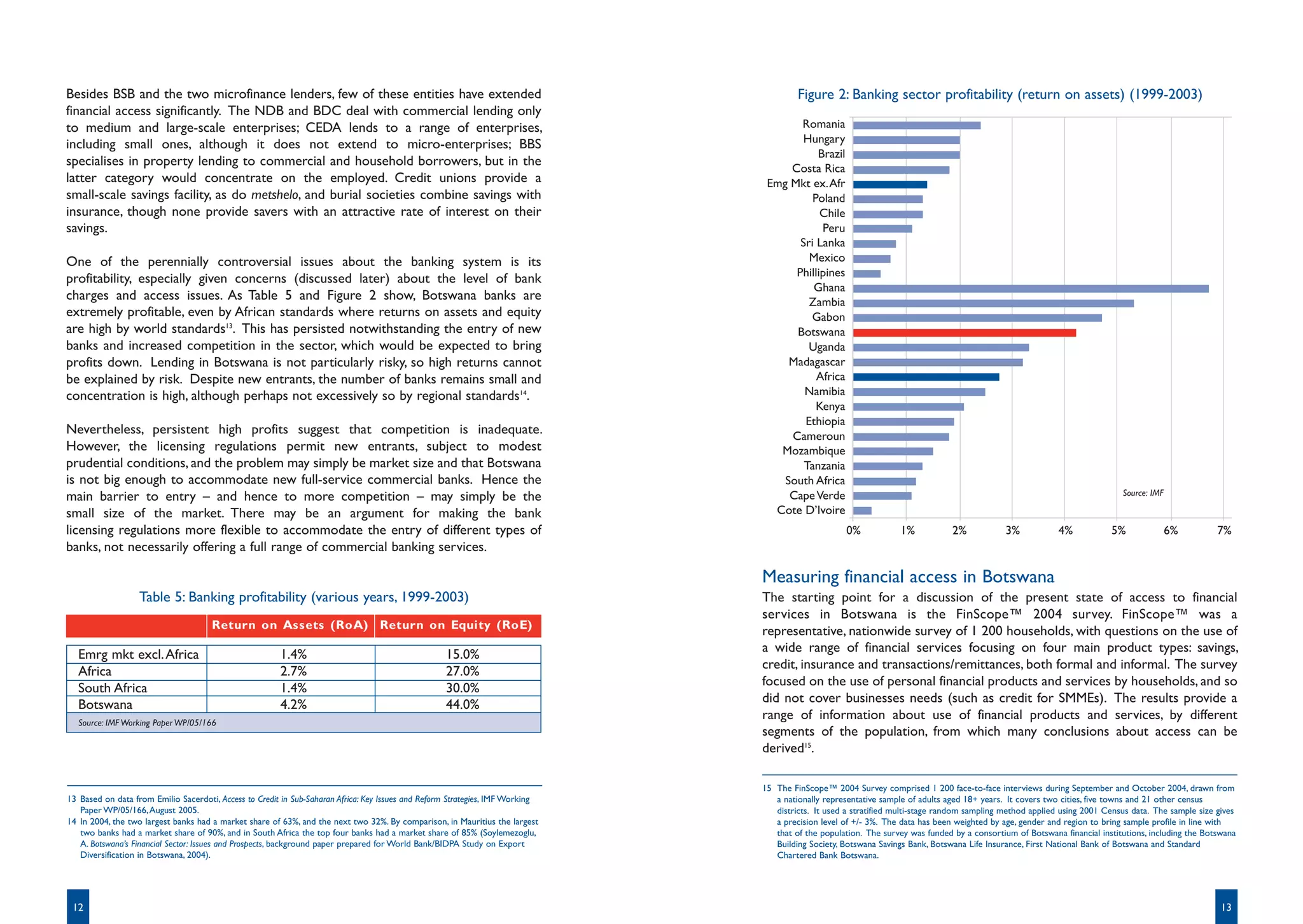
• Among the four types of products, the most popular are savings products (used                                                            40-49 years                  46                                            54
                                                                                                                                           50-59 years                45                                             55
  by 51% of the population), followed by transaction products (43%), insurance                                                              60+ years                38                                            62
  products (33%), and credit/loan products (21%). Urban residents use significantly
                                                                                                                                  Head of household                           55                                             45
  more products than rural residents across all product types (see figure 3).                                                  Not head of household                34                                            66                                  Banked
                                                                                                                                                 Single              38                                            62                                 Unbanked
                                                                                                                                   Divorced/separated                                 71                                            29
                                    Figure 3: Use of main products                                                                          Widowed             29                                                71
                                                                                                                                              Married                           58                                            42
           70                                                                                                                      Living with partner                    46                                            54
                      65
           60                           57                                                                                                      Urban                           57                                           43
                 51                                                                                                                              Rural              37                                             63
           50                                             49
                           45                                                                            Total
                                   43                                                                                                      Gaborone                                69                                           31
           40                                36                                                                                          Francistown                             63                                            37
                                                                                                         Urban                                Towns
       %


                                                     33                                                                                                                        56                                            44
           30                                                               29                                                         Other districts              36                                            64
                                                               25                                        Rural
                                                                       21
           20                                                                    17
           10                                                                                                                                     Figure 5: Banking status by sub-groups – II
           0
                   Savings       Transactions        Insurance       Credit/loans                                                 No formal education     15                                           85
                                                                                                                                 Some primary school                31                                         69
                                                                                                                            Primary school completed                31                                         69
                                                                                                                                     Some high school                    40                                      60
The FinScope™ Survey also looks at use of, and access to, banking products, given                                              High school completed                      45                                       55
that banks are the most important financial institutions in the country. The most                                            Post high school (not uni)                                    82                                            18
                                                                                                                                            University                                           98                                               2
important results are:
                                                                                                                                   Full-time employed                                      81                                            19
• 43% of the population are “banked”, in that they currently use at least one                                                     Part-time employed            31                                                69
                                                                                                                                          Unemployed           26                                            74
                                                                                                                                                                                                                                                      Banked
  banking product, and 57% are “unbanked”;
• There are major differences between the banked and the unbanked (see Figures                                                            No income       11                                            89
                                                                                                                                                                                                                                                      Unbanked
                                                                                                                                        P250 or less           23                                         77
  4 and 5);                                                                                                                               P251-P500                 34                                            66
• There is relatively higher use of banking among urban residents, heads of                                                             P501-P1,000                             59                                             41
  households, well-educated people and those with higher incomes; for instance,                                                       P1,001-P5,000                                             91                                            9
                                                                                                                                    More than P5,000                                              98                                              2
  57% of the urban population is banked, as are 81% of those in full-time
  employment;                                                                                                                    Main inc. earner (ME)                               63                                        37
                                                                                                                                               Not ME           32                                             68

16 Other comparative figures to note are that in the European Union and the US around 90% of adults have bank accounts;                   Owns house                35                                            65
   in Tanzania, only 6% do (S. Peachey & A. Roe, Access to Finance – What Does it Mean and How do Savings Banks Foster                    Rents house                                67                                           33
   Access?, World Savings Banks Institute, 2006).


 14                                                                                                                                                                                                                                                              15
While the result on access to banking indicates that more than half of the                                                Implications
population do not use banks, a comparative perspective is useful. FinScope™                                               There are a number of implications of the FinScope™ 2004 results for Botswana.
surveys in South Africa and Namibia give slightly higher levels of access to banking,                                     First, they show that nearly half of the population is financially excluded, in that they
at 47% and 51% respectively. Elsewhere in Sub-Saharan Africa, banking penetration                                         do not use any financial institutions, and that over half of the population is unbanked.
is much lower, especially in low-income countries: the proportion of the population                                       While it will never be feasible to aim for 100% coverage – even in developed
with a formal bank account is estimated at 2% in Angola, 10% in Kenya, 1% in                                              economies there will always be some unbanked people – there is a strong case that
Madagascar, 5% in Tanzania, 6% in Uganda, and 17% in Zimbabwe17.                                                          a “financially developed” economy should be striving for much higher levels of
                                                                                                                          banking coverage.
The Botswana FinScope™ Survey also investigated why the unbanked do not have
bank accounts. The results show that the main disincentives to having a bank account                                      Data on geographical coverage of bank branches yields similar results. About 45% of
are unemployment and low incomes – a result that is consistent with similar survey                                        the population live in towns and villages with bank branches, and a further 3% live in
results in other countries. Beyond this, the requirement to pay service fees, the                                         settlements with agencies (providing a limited, part-time banking presence).
expense of maintaining an account, and distance from banks are cited as important                                         A number of substantial settlements, with populations of more than 15 000, have no
barriers to banking.                                                                                                      banking presence at all (Ramotswa, Thamaga, Tonota and Moshupa).
The survey results of the penetration of different financial institutions in different                                    Why is banking coverage incomplete in Botswana, resulting in most of the
areas show that Barclays Bank has the largest national penetration (30% of banked                                         population not having access to, or at least not making use of, banking services? The
respondents), while Standard Chartered has the highest penetration among urban                                            FinScope™ results indicate that one cause may be “self-exclusion”, i.e. many people
respondents (36%) and Botswana Savings Bank has the highest penetration among                                             do not consider that they meet the criteria for using bank accounts, which is
rural respondents (35%).                                                                                                  mostly to have a wage and/or to be employed. Beyond this, however, there may be
                                                                                                                          deeper problems.
                               Figure 6: Penetration of individual banks
                                                                                                                          First, it is evident that banking penetration of what may be seen as the core market
                                                                                                                          of the commercial banks – the employed, educated, higher income, urban residents
           Stanbic Bank
                                                                                                                          – is getting close to saturation bank coverage. The unbanked population, however,
                                                                                                                          has quite different characteristics; being predominantly rural, less well-educated,
             Botswana                                                                                                     unemployed or with irregular incomes, they do not meet the preferred customer
       Building Society                                                                                                   profile of conventional banking models. To a large extent, banks do not see serving
                                                                                                                          the unbanked market as worthwhile, given that it is not suited to their conventional
  First National Bank
                                                                                                                          business models, and many banks have struggled to find innovative and profitable
                                                                                                                          ways of servicing the low-income market, especially in rural areas. It may be,
                                                                                                               Total      therefore, that the self-exclusion of banks and the unbanked is mutual.
            Standard                                                                                           Urban
      Chartered Bank
                                                                                                               Rural

              Botswana
           Savings Bank


         Barclays Bank

                             0       5        10      15       20      25       30      35       40
                                                      % of users


17 Source: IMF Regional Economic Outlook, Sub-Saharan Africa, May 2006, p.69. It should be noted, however, that in many
   countries the quality of data on usage of financial services is poor.


 16                                                                                                                                                                                                            17
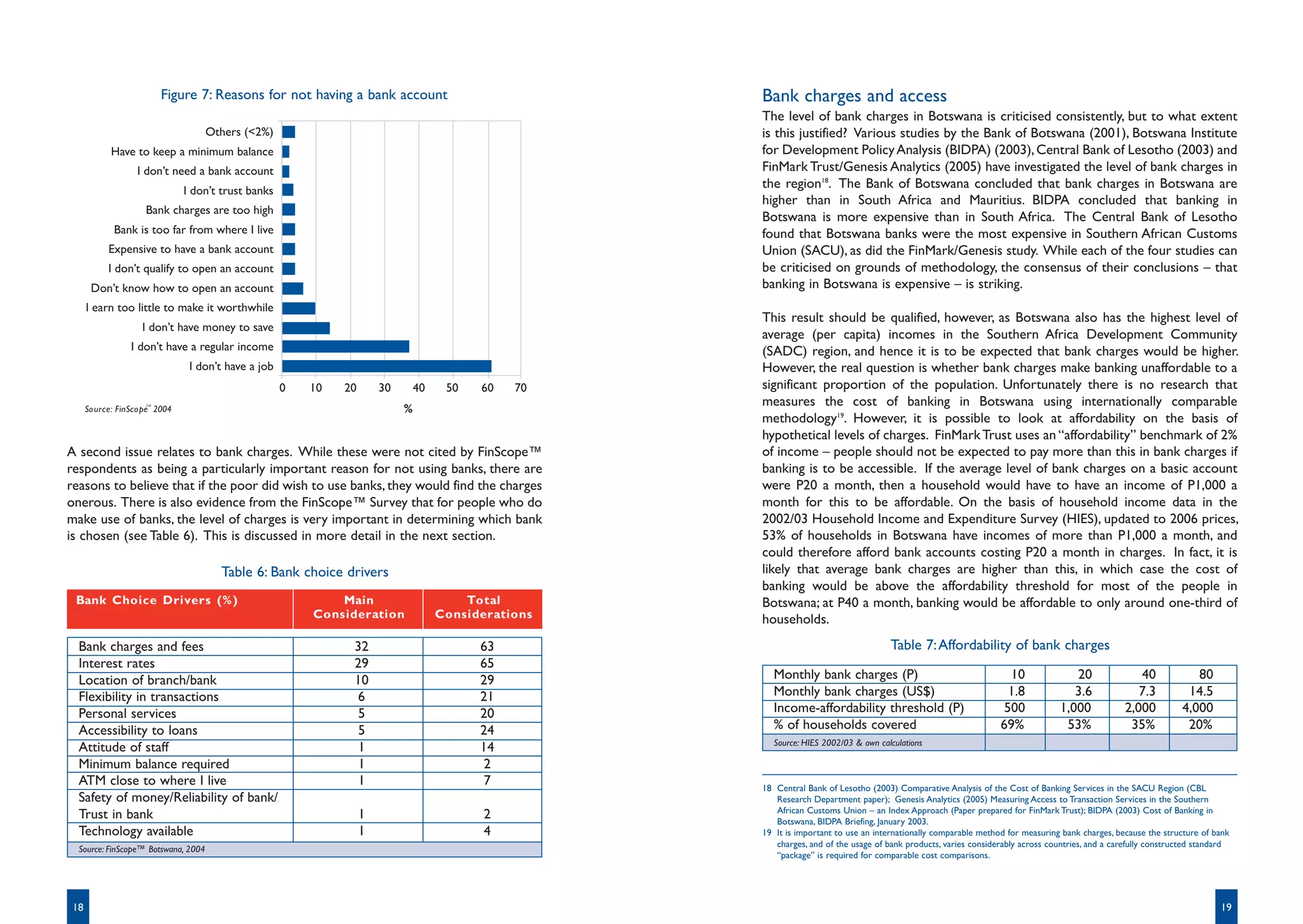
Figure 7: Reasons for not having a bank account                                Bank charges and access
                                                                                                     The level of bank charges in Botswana is criticised consistently, but to what extent
                                     Others (<2%)                                                    is this justified? Various studies by the Bank of Botswana (2001), Botswana Institute
           Have to keep a minimum balance                                                            for Development Policy Analysis (BIDPA) (2003), Central Bank of Lesotho (2003) and
                I donÕt need a bank account                                                          FinMark Trust/Genesis Analytics (2005) have investigated the level of bank charges in
                            I donÕt trust banks
                                                                                                     the region18. The Bank of Botswana concluded that bank charges in Botswana are
                                                                                                     higher than in South Africa and Mauritius. BIDPA concluded that banking in
                  Bank charges are too high
                                                                                                     Botswana is more expensive than in South Africa. The Central Bank of Lesotho
           Bank is too far from where I live                                                         found that Botswana banks were the most expensive in Southern African Customs
          Expensive to have a bank account                                                           Union (SACU), as did the FinMark/Genesis study. While each of the four studies can
          I donÕt qualify to open an account                                                         be criticised on grounds of methodology, the consensus of their conclusions – that
       DonÕt know how to open an account                                                             banking in Botswana is expensive – is striking.
      I earn too little to make it worthwhile
                                                                                                     This result should be qualified, however, as Botswana also has the highest level of
                  I donÕt have money to save
                                                                                                     average (per capita) incomes in the Southern Africa Development Community
               I donÕt have a regular income                                                         (SADC) region, and hence it is to be expected that bank charges would be higher.
                             I donÕt have a job                                                      However, the real question is whether bank charges make banking unaffordable to a
                                                    0   10   20       30       40    50   60   70    significant proportion of the population. Unfortunately there is no research that
                                                                           %
                                                                                                     measures the cost of banking in Botswana using internationally comparable
                                                                                                     methodology19. However, it is possible to look at affordability on the basis of
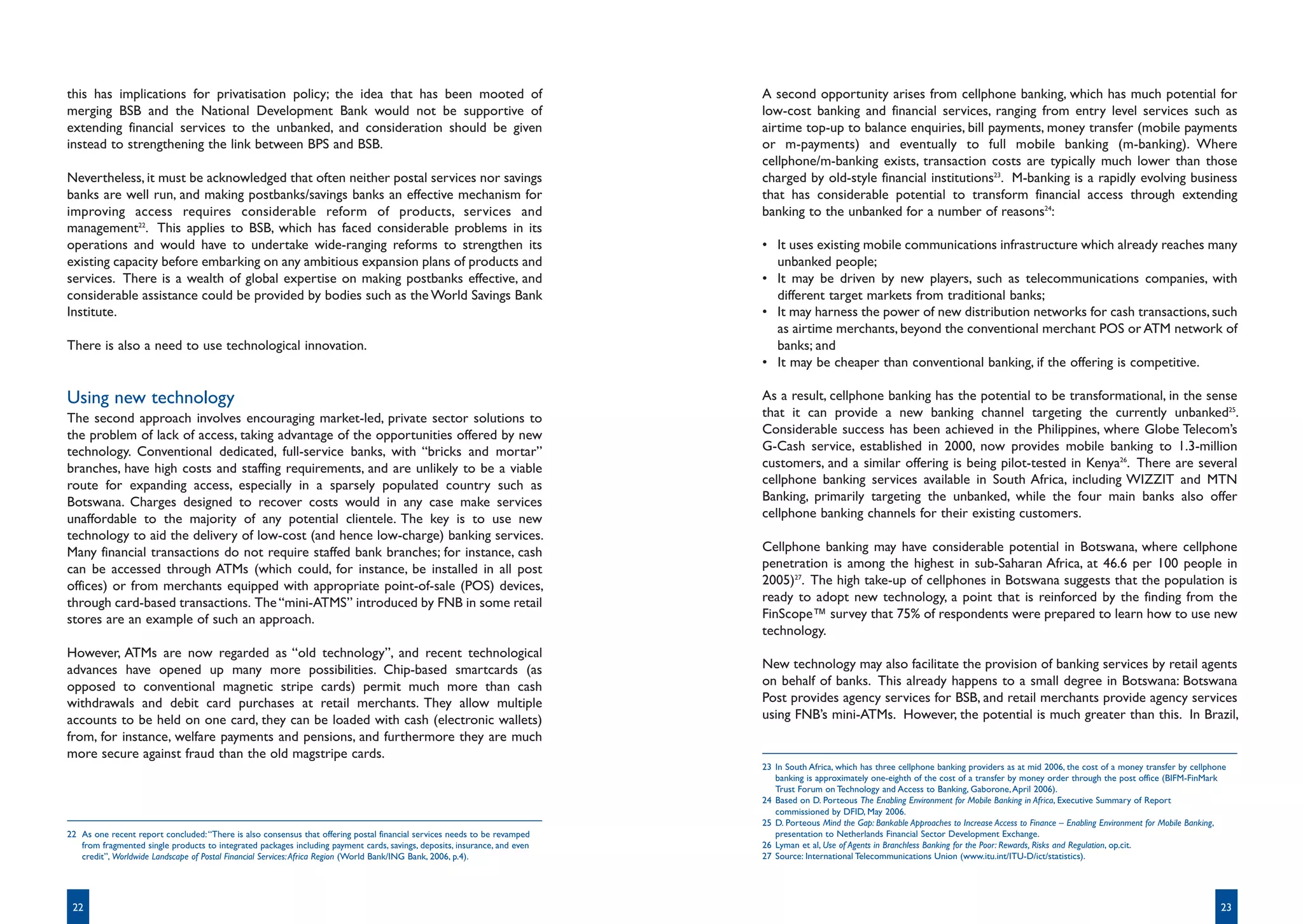
                                                                                                     hypothetical levels of charges. FinMark Trust uses an “affordability” benchmark of 2%
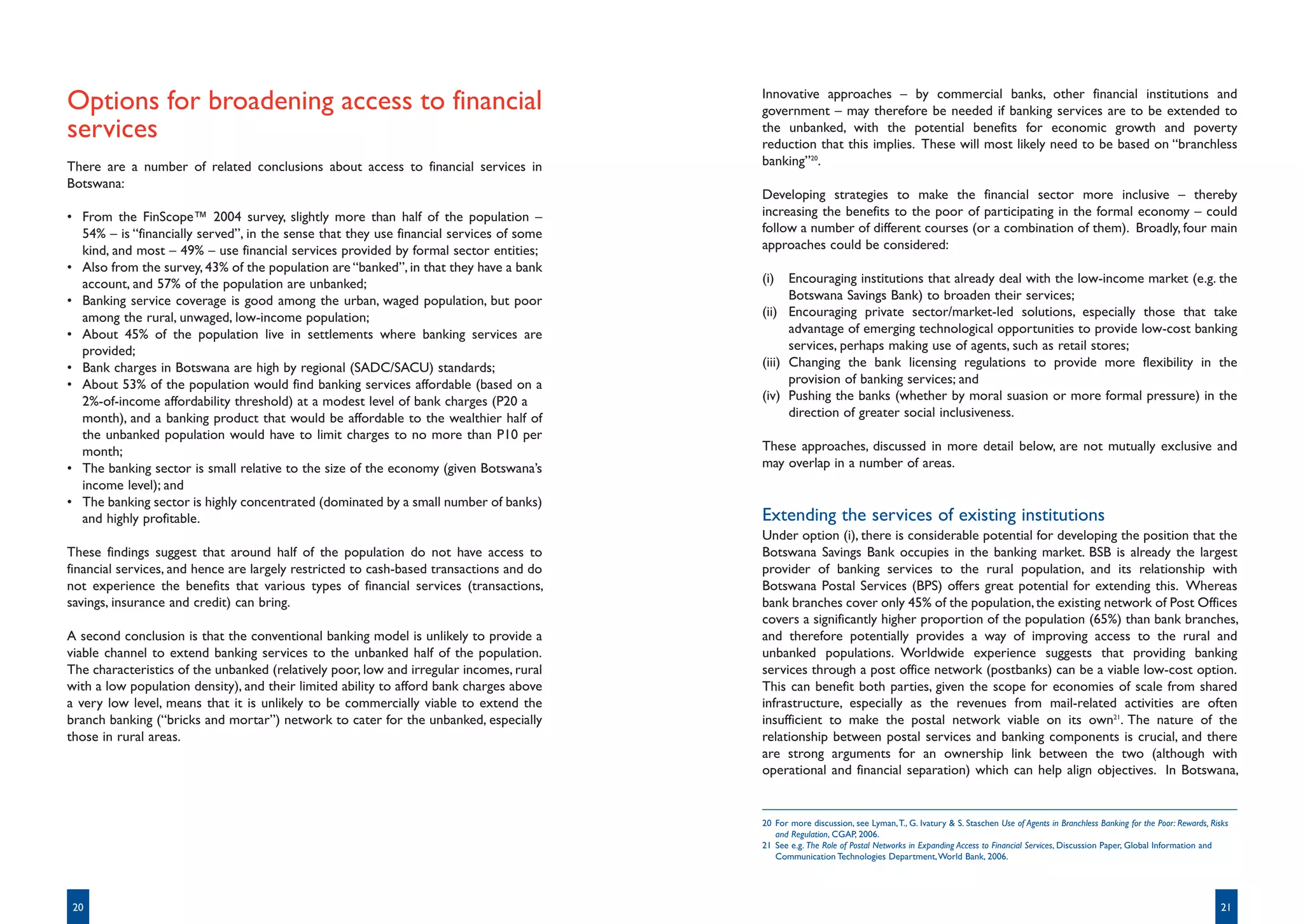
A second issue relates to bank charges. While these were not cited by FinScope™                      of income – people should not be expected to pay more than this in bank charges if
respondents as being a particularly important reason for not using banks, there are                  banking is to be accessible. If the average level of bank charges on a basic account
reasons to believe that if the poor did wish to use banks, they would find the charges               were P20 a month, then a household would have to have an income of P1,000 a
onerous. There is also evidence from the FinScope™ Survey that for people who do                     month for this to be affordable. On the basis of household income data in the
make use of banks, the level of charges is very important in determining which bank                  2002/03 Household Income and Expenditure Survey (HIES), updated to 2006 prices,
is chosen (see Table 6). This is discussed in more detail in the next section.                       53% of households in Botswana have incomes of more than P1,000 a month, and
                                                                                                     could therefore afford bank accounts costing P20 a month in charges. In fact, it is
                                       Table 6: Bank choice drivers                                  likely that average bank charges are higher than this, in which case the cost of
                                                                                                     banking would be above the affordability threshold for most of the people in
 Bank Choice Drivers (% )                                   Main                        Total        Botswana; at P40 a month, banking would be affordable to only around one-third of
                                                        Consideration               Considerations   households.
  Bank charges and fees                                       32                          63                                          Table 7: Affordability of bank charges
  Interest rates                                              29                          65
  Location of branch/bank                                     10                          29            Monthly bank charges (P)                                   10                20              40             80
  Flexibility in transactions                                 6                           21            Monthly bank charges (US$)                                 1.8               3.6             7.3          14.5
  Personal services                                            5                          20            Income-affordability threshold (P)                        500             1,000           2,000          4,000
  Accessibility to loans                                       5                          24            % of households covered                                   69%              53%             35%            20%
                                                                                                        Source: HIES 2002/03 & own calculations
  Attitude of staff                                            1                          14
  Minimum balance required                                     1                           2
  ATM close to where I live                                    1                           7         18 Central Bank of Lesotho (2003) Comparative Analysis of the Cost of Banking Services in the SACU Region (CBL
  Safety of money/Reliability of bank/                                                                  Research Department paper); Genesis Analytics (2005) Measuring Access to Transaction Services in the Southern
                                                                                                        African Customs Union – an Index Approach (Paper prepared for FinMark Trust); BIDPA (2003) Cost of Banking in
  Trust in bank                                                   1                        2            Botswana, BIDPA Briefing, January 2003.
  Technology available                                            1                        4         19 It is important to use an internationally comparable method for measuring bank charges, because the structure of bank
                                                                                                        charges, and of the usage of bank products, varies considerably across countries, and a carefully constructed standard
  Source: FinScope™ Botswana, 2004
                                                                                                        “package” is required for comparable cost comparisons.


 18                                                                                                                                                                                                                        19
Innovative approaches – by commercial banks, other financial institutions and
Options for broadening access to financial                                               government – may therefore be needed if banking services are to be extended to
services                                                                                 the unbanked, with the potential benefits for economic growth and poverty
                                                                                         reduction that this implies. These will most likely need to be based on “branchless
There are a number of related conclusions about access to financial services in          banking”20.
Botswana:
                                                                                         Developing strategies to make the financial sector more inclusive – thereby
• From the FinScope™ 2004 survey, slightly more than half of the population –            increasing the benefits to the poor of participating in the formal economy – could
  54% – is “financially served”, in the sense that they use financial services of some   follow a number of different courses (or a combination of them). Broadly, four main
  kind, and most – 49% – use financial services provided by formal sector entities;      approaches could be considered:
• Also from the survey, 43% of the population are “banked”, in that they have a bank
  account, and 57% of the population are unbanked;                                       (i)   Encouraging institutions that already deal with the low-income market (e.g. the
• Banking service coverage is good among the urban, waged population, but poor                 Botswana Savings Bank) to broaden their services;
  among the rural, unwaged, low-income population;                                       (ii) Encouraging private sector/market-led solutions, especially those that take
• About 45% of the population live in settlements where banking services are                   advantage of emerging technological opportunities to provide low-cost banking
  provided;                                                                                    services, perhaps making use of agents, such as retail stores;
• Bank charges in Botswana are high by regional (SADC/SACU) standards;                   (iii) Changing the bank licensing regulations to provide more flexibility in the
• About 53% of the population would find banking services affordable (based on a               provision of banking services; and
  2%-of-income affordability threshold) at a modest level of bank charges (P20 a         (iv) Pushing the banks (whether by moral suasion or more formal pressure) in the
  month), and a banking product that would be affordable to the wealthier half of              direction of greater social inclusiveness.
  the unbanked population would have to limit charges to no more than P10 per
  month;                                                                                 These approaches, discussed in more detail below, are not mutually exclusive and
• The banking sector is small relative to the size of the economy (given Botswana’s      may overlap in a number of areas.
  income level); and
• The banking sector is highly concentrated (dominated by a small number of banks)
  and highly profitable.                                                                 Extending the services of existing institutions
                                                                                         Under option (i), there is considerable potential for developing the position that the
These findings suggest that around half of the population do not have access to          Botswana Savings Bank occupies in the banking market. BSB is already the largest
financial services, and hence are largely restricted to cash-based transactions and do   provider of banking services to the rural population, and its relationship with
not experience the benefits that various types of financial services (transactions,      Botswana Postal Services (BPS) offers great potential for extending this. Whereas
savings, insurance and credit) can bring.                                                bank branches cover only 45% of the population, the existing network of Post Offices
                                                                                         covers a significantly higher proportion of the population (65%) than bank branches,
A second conclusion is that the conventional banking model is unlikely to provide a      and therefore potentially provides a way of improving access to the rural and
viable channel to extend banking services to the unbanked half of the population.        unbanked populations. Worldwide experience suggests that providing banking
The characteristics of the unbanked (relatively poor, low and irregular incomes, rural   services through a post office network (postbanks) can be a viable low-cost option.
with a low population density), and their limited ability to afford bank charges above   This can benefit both parties, given the scope for economies of scale from shared
a very low level, means that it is unlikely to be commercially viable to extend the      infrastructure, especially as the revenues from mail-related activities are often
branch banking (“bricks and mortar”) network to cater for the unbanked, especially       insufficient to make the postal network viable on its own21. The nature of the
those in rural areas.                                                                    relationship between postal services and banking components is crucial, and there
                                                                                         are strong arguments for an ownership link between the two (although with
                                                                                         operational and financial separation) which can help align objectives. In Botswana,


                                                                                         20 For more discussion, see Lyman, T., G. Ivatury & S. Staschen Use of Agents in Branchless Banking for the Poor: Rewards, Risks
                                                                                            and Regulation, CGAP, 2006.
                                                                                         21 See e.g. The Role of Postal Networks in Expanding Access to Financial Services, Discussion Paper, Global Information and
                                                                                            Communication Technologies Department, World Bank, 2006.


 20                                                                                                                                                                                                                   21
this has implications for privatisation policy; the idea that has been mooted of                                            A second opportunity arises from cellphone banking, which has much potential for
merging BSB and the National Development Bank would not be supportive of                                                    low-cost banking and financial services, ranging from entry level services such as
extending financial services to the unbanked, and consideration should be given                                             airtime top-up to balance enquiries, bill payments, money transfer (mobile payments
instead to strengthening the link between BPS and BSB.                                                                      or m-payments) and eventually to full mobile banking (m-banking). Where
                                                                                                                            cellphone/m-banking exists, transaction costs are typically much lower than those
Nevertheless, it must be acknowledged that often neither postal services nor savings                                        charged by old-style financial institutions23. M-banking is a rapidly evolving business
banks are well run, and making postbanks/savings banks an effective mechanism for                                           that has considerable potential to transform financial access through extending
improving access requires considerable reform of products, services and                                                     banking to the unbanked for a number of reasons24:
management22. This applies to BSB, which has faced considerable problems in its
operations and would have to undertake wide-ranging reforms to strengthen its                                               • It uses existing mobile communications infrastructure which already reaches many
existing capacity before embarking on any ambitious expansion plans of products and                                           unbanked people;
services. There is a wealth of global expertise on making postbanks effective, and                                          • It may be driven by new players, such as telecommunications companies, with
considerable assistance could be provided by bodies such as the World Savings Bank                                            different target markets from traditional banks;
Institute.                                                                                                                  • It may harness the power of new distribution networks for cash transactions, such
                                                                                                                              as airtime merchants, beyond the conventional merchant POS or ATM network of
There is also a need to use technological innovation.                                                                         banks; and
                                                                                                                            • It may be cheaper than conventional banking, if the offering is competitive.

Using new technology                                                                                                        As a result, cellphone banking has the potential to be transformational, in the sense
The second approach involves encouraging market-led, private sector solutions to                                            that it can provide a new banking channel targeting the currently unbanked25.
the problem of lack of access, taking advantage of the opportunities offered by new                                         Considerable success has been achieved in the Philippines, where Globe Telecom’s
technology. Conventional dedicated, full-service banks, with “bricks and mortar”                                            G-Cash service, established in 2000, now provides mobile banking to 1.3-million
branches, have high costs and staffing requirements, and are unlikely to be a viable                                        customers, and a similar offering is being pilot-tested in Kenya26. There are several
route for expanding access, especially in a sparsely populated country such as                                              cellphone banking services available in South Africa, including WIZZIT and MTN
Botswana. Charges designed to recover costs would in any case make services                                                 Banking, primarily targeting the unbanked, while the four main banks also offer
unaffordable to the majority of any potential clientele. The key is to use new                                              cellphone banking channels for their existing customers.
technology to aid the delivery of low-cost (and hence low-charge) banking services.
Many financial transactions do not require staffed bank branches; for instance, cash                                        Cellphone banking may have considerable potential in Botswana, where cellphone
can be accessed through ATMs (which could, for instance, be installed in all post                                           penetration is among the highest in sub-Saharan Africa, at 46.6 per 100 people in
offices) or from merchants equipped with appropriate point-of-sale (POS) devices,                                           2005)27. The high take-up of cellphones in Botswana suggests that the population is
through card-based transactions. The “mini-ATMS” introduced by FNB in some retail                                           ready to adopt new technology, a point that is reinforced by the finding from the
stores are an example of such an approach.                                                                                  FinScope™ survey that 75% of respondents were prepared to learn how to use new
                                                                                                                            technology.
However, ATMs are now regarded as “old technology”, and recent technological
advances have opened up many more possibilities. Chip-based smartcards (as                                                  New technology may also facilitate the provision of banking services by retail agents
opposed to conventional magnetic stripe cards) permit much more than cash                                                   on behalf of banks. This already happens to a small degree in Botswana: Botswana
withdrawals and debit card purchases at retail merchants. They allow multiple                                               Post provides agency services for BSB, and retail merchants provide agency services
accounts to be held on one card, they can be loaded with cash (electronic wallets)                                          using FNB’s mini-ATMs. However, the potential is much greater than this. In Brazil,
from, for instance, welfare payments and pensions, and furthermore they are much
more secure against fraud than the old magstripe cards.
                                                                                                                            23 In South Africa, which has three cellphone banking providers as at mid 2006, the cost of a money transfer by cellphone
                                                                                                                               banking is approximately one-eighth of the cost of a transfer by money order through the post office (BIFM-FinMark
                                                                                                                               Trust Forum on Technology and Access to Banking, Gaborone, April 2006).
                                                                                                                            24 Based on D. Porteous The Enabling Environment for Mobile Banking in Africa, Executive Summary of Report
                                                                                                                               commissioned by DFID, May 2006.
                                                                                                                            25 D. Porteous Mind the Gap: Bankable Approaches to Increase Access to Finance – Enabling Environment for Mobile Banking,
22 As one recent report concluded: “There is also consensus that offering postal financial services needs to be revamped       presentation to Netherlands Financial Sector Development Exchange.
   from fragmented single products to integrated packages including payment cards, savings, deposits, insurance, and even   26 Lyman et al, Use of Agents in Branchless Banking for the Poor: Rewards, Risks and Regulation, op.cit.
   credit”, Worldwide Landscape of Postal Financial Services: Africa Region (World Bank/ING Bank, 2006, p.4).               27 Source: International Telecommunications Union (www.itu.int/ITU-D/ict/statistics).


 22                                                                                                                                                                                                                                                23
the use of retail agents by existing banks to deliver financial services through                                                 More generally, the government’s responsibilities in enhancing the provision of
supermarkets, pharmacies and lottery kiosks has transformed the availability of                                                  technology-based financial products and services include as a minimum the creation
banking services throughout the country, and a similar approach is being tried in                                                of a liberalised and efficient regulatory structure that accommodates innovation, but
India. Much of the potential of this type of service stems from the availability of                                              may extend beyond this to meeting at least part of the costs of core infrastructure
information and communication technologies that can be used to record and                                                        provision (as it does, for instance, with the provision of roads, water and sanitation).
transmit transaction details quickly and reliably, and cellphones and smartcards have                                            The provision of new financial products and services on the basis of technological
the potential to provide stores of value. Given the widespread network of shops,                                                 developments will also be influenced by regulatory requirements in the financial
post offices and airtime vendors throughout Botswana, there is scope for low-cost                                                sector. While some products will not require regulatory approval (e.g. card-based
provision of banking services through retail agents, although regulatory issues may                                              payments and transactions services), others, however, extend into the area of
need to be addressed (for instance, restrictions on the opening of accounts and the                                              banking business (e.g. e-money, deposit taking) which has regulatory implications and
taking of deposits).                                                                                                             hence may require regulatory reforms to enable such developments. The role of
                                                                                                                                 regulatory reforms more generally in supporting the extension of financial access is
Technology-based services therefore have the potential to improve access to                                                      discussed below.
financial services in two ways: first, by offering services that are more suited to the
poor than those offered by conventional banks, and second by offering financial
services much more cheaply, thus making them more widely available and affordable                                                Regulatory reform
to the unbanked. Indeed, technology is likely to change the face of banking in                                                   The banking sector in Botswana, as in many other countries, is one of the most
general, not just for the poor, by making branches and personal contact less relevant                                            heavily regulated sectors of economic activity. There are good reasons for this, as
(although not irrelevant). Building on option (i) above, technology also opens                                                   the banking sector has specific characteristics (such as the role of information –
opportunities for post/savings banks to provide modern low-cost services and                                                     which is imperfect – in assessing risks) and particular vulnerabilities (whereby
consolidate their leading position in the provision of low-cost banking services.                                                problems in one financial institution can cause systemic instability) that require such
However, this would require considerable investment in the modernisation of post                                                 regulation. The fundamental reason for banking prudential regulation is to minimise
offices, with, for instance, automation of counter services and ATMs throughout, in                                              the risks of financial and macroeconomic crises stemming from the banking sector.
turn requiring power supplies and satellite communications. It also provides                                                     A secondary reason is to protect depositors, whose savings may be at risk in the
opportunities for existing banks to expand their networks and availability of financial                                          event of a banking crisis, and a third is to help promote market efficiency, especially
services using agents rather than through branches.                                                                              where such efficiency may be inhibited by asymmetric information.

This in turn suggests that access-to-finance issues should be incorporated into                                                  There may also be other reasons for regulation. Many countries have recently
broader government policy deliberations about the development of the                                                             introduced regulations relating to money-laundering and the financing of terrorism.
telecommunications sector, especially in the rural areas. Current policy documents                                               These are aimed at ensuring public safety and minimising the scope for criminal
provide only limited consideration of the potential for telecommunications                                                       activity, rather than systemic stability. Some countries have specific consumer
technology to contribute to improving access to finance. For instance, a recent                                                  protection objectives (beyond depositor protection) in their regulatory frameworks.
report on the development of a universal access and service policy for the
communications sector acknowledges that there is scope for the Post Office to                                                    Generally, financial sector regulation does not deal explicitly with financial access,
“provide expanded financial services to its clients”, but does not go on to explore                                              although increasingly the question is being asked as to whether regulatory
how the telecoms infrastructure can contribute to this28. And a recent draft                                                     frameworks should have an access dimension (beyond systemic stability and safety of
document on developing a rural telecommunications strategy makes no mention of                                                   depositors’ money). Access may be seen as part of a broader developmental
the potential role of rural telecoms in enhancing the provision of financial services                                            objective of regulation, which, along with contributing to public safety, may be seen
in rural areas29.                                                                                                                as a new generation objective of regulation30. Introducing access as a regulatory issue
                                                                                                                                 does not mean that traditional regulatory concerns are compromised. However, it


28 Intelecon Research & Consultancy Ltd, Development of a Universal Access and Service Policy for the Communications Sector in
   Botswana, Final Interim Report presented to the Botswana Telecommunications Authority (BTA), July 2006,
   www.bta.org.bw/pubs).
29 Icegate Solutions Ltd, Draft Rural Telecommunications Strategy, prepared for Ministry of Communications, Science and
   Technology, June 2006.                                                                                                        30 Genesis Analytics, A Policy Lens to View Financial Regulation, Report for FinMark Trust, December 2004.


 24                                                                                                                                                                                                                                           25
does mean that, at the very least, regulatory authorities should recognise that rules                                           While the current regulatory structure has served Botswana well, and has
and decisions affect access to finance, and that regulation should not unnecessarily                                            supported a stable banking sector with orderly restructuring of failing banks and no
constrain access to finance.                                                                                                    depositor losses, the banking industry worldwide has changed in many ways since
                                                                                                                                this structure was originated, and there are reasons to believe that it should be
The current regulatory structure for banks in Botswana is laid out in the Banking Act                                           reformed, specifically to permit new entry and innovation in the financial sector, but
1995, the substance of which dates back to the establishment of the Bank of                                                     without introducing unnecessary or excessive risks. One way is a tiered-banking
Botswana in 1975 and the original Financial Institutions Act. Banking legislation                                               approach that allows new banks to enter the market to conduct a limited range of
focuses on deposit-taking institutions (hence lending-only institutions, using private                                          banking activities. As a result they are exposed to less risk, and hence there is
funds, do not need a banking licence); the key purpose of regulation is to protect                                              commensurately less need for capital and technical resources, making it easier to
depositors and to guard against market failure in the banking system. The banking                                               enter the industry. For instance, a savings bank that takes deposits but does not lend,
legislation provides for the issuance of a banking licence, which entitles a bank to                                            and invests only in risk-free government or central bank instruments, would require
carry out a full range of banking activities, and imposes a range of requirements on                                            relatively little initial capital. In principle, this would also permit non-banks such as
banking institutions designed to protect the public (primarily depositors) from risks                                           retailers, cellphone companies and insurers to offer a limited range of banking
that may be taken by the banks. Under the Banking Act, the Bank of Botswana has                                                 services (such as transaction facilities, small retail deposits and loans).
the power to issue different categories of banking licence, with different conditions
and requirements attached.                                                                                                      The key is to have a well-designed regulatory structure that accommodates different
                                                                                                                                types of banking service provision with capital and technical requirements that are
This regulatory structure has several consequences. First, the need to acquire a                                                appropriately specified relative to the risk that the entity is exposed to, rather than
banking license to carry out banking business provides a barrier to entry to the                                                relative to the full range of activities that a full-service bank might undertake.
market, and hence restricts the level of competition. For instance, non-bank
companies cannot enter many areas of banking business31. Second, any bank wishing                                               The regulatory structure may also need to be revised to accommodate e-money
to establish in Botswana and acquire a license essentially has to meet the same                                                 developments33. Such developments use smartcards (or cellphones) that can be
regulatory requirements as the existing full-service banks, even if it wishes to                                                loaded with “cash”, which can in turn be spent where appropriate terminals or
undertake only a limited range of business.                                                                                     facilities are available. At present, such card-based cash is likely to be classed as a
                                                                                                                                deposit, and hence restricted to licensed banks. Initiatives such as Globe Telecom’s
While some kind of regulation of entry into the banking sector is necessary,                                                    G-Cash e-money account in the Philippines would not be permitted in Botswana
excessive regulation may unnecessarily inhibit new entry to the sector and                                                      under present legislation and regulations. While there are arguments for ensuring
innovation, thus contributing to reduced competition and possible stagnation.                                                   the protection of e-money users, this may not require e-money issuers to obtain a
                                                                                                                                full banking licence, as at present. In the European Union, for instance, the issuance
Issues of entry and innovation are particularly relevant to the issue of access. As                                             of e-money can be done either by banks or by a new category of Electronic Money
discussed above, existing banking forms are unlikely to extend their operations to                                              Institutions, licensed specifically (and exclusively) for this purpose, and such an
accommodate the unbanked on any significant scale, and hence new forms of                                                       approach could be considered in Botswana.
financial service provision are required – necessitating new entry to the banking
sector. Furthermore, products suited to the low-income market may well be based                                                 Such changes – accommodating different types of banks and electronic money
on recent technological developments, thus requiring innovation. The regulator’s                                                institutions – could be introduced within the context of the existing Banking Act,
dilemma is, therefore, to provide an appropriate degree of openness in the financial                                            through the development of appropriate regulations that would enable the Bank of
sector architecture, striking a balance between, on the one hand, maintaining                                                   Botswana to license new types of banking operations.
stability in the financial system and, on the other, reducing barriers to entry to
encourage rivalry, innovation and market expansion32.                                                                           A further regulatory issue concerns recent international developments related to
                                                                                                                                the prevention of money laundering and the financing of terrorism. This has been the
                                                                                                                                focus of a great deal of international attention in recent years, for obvious reasons,
                                                                                                                                and developing countries have been pressurised to implement reforms and
31 Take cellphone companies as an example. At present (in Botswana) pre-paid cellphone balances can only be applied to
   the use of airtime (or transfered to another person for the same purpose). However, it is technologically
   straightforward to enable such prepaid balances to be used for the purchase of other commodities. But then the
   pre-paid balance starts to look like a medium of exchange, i.e. money (or at least e-money), and the cellphone company       33 See e.g., K. Jefferis, S. Kgosi, M. Robotham & J. Kgoadi, Electronic Money Developments, Bank of Botswana Research Bulletin,
   the recipient of a deposit, which requires a banking licence.                                                                   22(1), pp27-36.
32 D. Porteous, The Regulator’s Dilemma: Opening Space for Innovation and Development in the Financial System, FinMark Trust.


 26                                                                                                                                                                                                                                                        27
safeguards in their financial sectors in line with international anti-money laundering        institutional structures and strategies36. But this often needs new, specialised
(AML) and countering the financing of terrorism (CFT) initiatives. While the                  products, systems and staff, while leveraging off existing infrastructure.
objectives are worthy, such initiatives are expensive to implement and of
questionable effectiveness, even in developed countries34. In developing countries,           Banks may not move in this direction on their own, however, especially when they
there are additional concerns about the possible/likely effect of AML/CFT initiatives         enjoy large margins on their traditional business and competitive pressures are
on extending access to financial services. The regulations associated with AML/CFT            insufficient to pressure them to seek out new markets. In this case, it may take some
typically include strict requirements for those wishing to open bank accounts,                prodding by governments and/or public opinion to get them to innovate and move
including proof of physical address, for instance in the form of a utilities bill. But many   closer to the access frontier.
of the poor – especially in rural areas – do not have a physical address in the
conventional sense, let alone access to the type of water, electricity or telephone           The basic philosophy in Botswana at present is to leave the banks to operate more
services that come with a monthly bill. Insisting on new customers meeting                    or less as they see fit, within the context of the prudential regulatory and licensing
international proof-of-physical-address standards will make it even more difficult for        framework, with little or no direct intervention in their operations by government,37
the poor to gain access to banking services, and thus entrench poverty further. Such          although they do require approval to open and close branches, and the Bank of
regulations need to be implemented flexibly, in a way that will not undermine efforts         Botswana uses moral suasion to try to persuade the banks to moderate bank
to extend access to financial services. For instance, holders of small deposits and           charges.
low-balance accounts could be allowed to comply with simpler customer
identification requirements, so as not to impose onerous requirements that would              Such an approach is consistent with a market economy and minimal state
exclude low-income customers from access to banking, given the small AML/CFT                  intervention, allowing the market to determine efficient outcomes. Generally, this is
risks associated with small balances and low-value transactions.                              a good basis for economic policy. However, the primacy of market forces is not
                                                                                              absolute, and intervention is appropriate when market failure occurs, or is likely to
In summary, a regulatory structure that offers “facilitative conditions” for access to        occur. In the financial sector there is clear evidence of market failure given the
finance should encompass the following35:                                                     persistence of very high bank profits. Competition in the banking sector may have
                                                                                              increased, but remains insufficient to bring profits down to levels that appropriately
•    Creating more competition;                                                               reflect the cost of capital and the risks involved in banking in Botswana. Insufficient
•    Improving infrastructure;                                                                competition may be due, in part, to the regulatory structure, with its restrictions
•    Allowing space for innovation;                                                           on new entry. Persistent market failure, in turn, indicates a possible need for
•    Improving consumer education; and                                                        government intervention to improve the functioning of the banking market.
•    Facilitating entry to the market, institutional growth, and exit.
                                                                                              What form could such intervention take? One approach could be a tax on excess
                                                                                              or windfall profits, similar to the taxation of the mining sector38. While this would
Getting banks to do more                                                                      help to bring after-tax profits down to more reasonable levels, it would not help
A fourth dimension to access is to encourage the banks to move in the direction of            resolve the problems of inadequate access to banking or reduce prices; indeed it
greater inclusiveness and enhanced access to financial services. Typically, commercial        might push bank charges up to even higher levels. A second form of intervention
banks shy away from providing services to low-income households, on the basis that            could be price controls (on bank charges or interest rates), although this is likely to
it is too high-risk and high-cost to be able to make a profit. While there is some            be counterproductive and would generally be inconsistent with a market-led
reason for banks to be cautious – the unit costs of managing small transactions and           economic development philosophy.
low-value accounts is relatively high, meaning that securing adequate volumes and
achieving economies of scale is important – there is evidence that commercial banks           An alternative approach could be based on the recognition by the banking industry
overestimate costs and underestimate potential returns. Some commercial banks                 that the award of a banking licence confers privileges (including the right to be
have managed to successfully operate in the low-income market, using a variety of             partially protected from competition and make above-normal profits), and that the


                                                                                              36 DFID, Banking the Underserved: New Opportunities for Commercial Banks – Exploring the Business Case, op.cit., provides useful
                                                                                                 case studies. See also S. Claessens, Access to Financial Services: A Review of the Issues and Public Policy Objectives, op.cit.
                                                                                              37 This reflects the more liberalised environment that has been in place since the late 1980s.
                                                                                              38 The monopoly powers enjoyed by mining companies stemming from their rights to exploit mineral deposits on the basis
34 See for instance articles in The Economist, October 22, 2005.                                 of a government-awarded mining licence are subject to a special corporate profits tax formula that leads to a rising profit
35 Genesis Analytics, A Policy Lens to View Financial Regulation, op.cit, p.18-19.               rate as the profitability of the mining operation increases.


    28                                                                                                                                                                                                                     29
possession of such a privilege also brings social obligations (beyond making
donations to charities). There should be recognition that financial intermediation has
                                                                                             Conclusions: The way forward
social as well as economic and commercial functions, and that financial services
should be accessible to a broad spectrum of the population, both for social reasons          This paper has demonstrated that Botswana’s banking system has a mixed record in
(reducing poverty) and long-term economic development reasons. It can be argued              providing access to finance for the country’s population. Access levels are
that the banks have an obligation to co-operate in extending financial access, even if       reasonable by the standards of Sub-Saharan Africa, but these standards are generally
not immediately profitable, as a quid pro quo for the benefits that stem from being          low, and the banking system covers less than half of Botswana’s adult population.
awarded banking licences.                                                                    Levels of financial sector development are low for a middle-income country. These
                                                                                             results, combined with the well-established links between financial sector
Once such recognition is in place, there is scope for negotiation between the                development, economic growth and poverty reduction, suggest that financial sector
banking industry and government to determine how social obligations should be                policy should focus, inter alia, on making financial services more accessible, in
met. It would be up to the banks to come up with innovative ideas on how to meet             particular to low-income groups that are presently excluded.
these obligations (underpinned by the threat that if they do not respond adequately
there may be statutory intervention, such as an excess profits tax).                         A number of policy developments and other initiatives could assist in achieving this
                                                                                             objective:
This approach has been followed successfully in South Africa, where the Financial
Sector Charter (FSC) was negotiated and agreed between the banking industry and              (i) The regulatory system should be reviewed to establish whether reforms could
other financial sector entities (including insurers, pension funds, the stock exchange           be introduced that would improve access to banking; such reforms could include:
etc.), government and representatives of civil society. One of the most immediate                • Facilitating the entry of new institutions to the banking sector, perhaps by
and visible results of the FSC is the Mzansi account initiative, an entry-level bank                introducing tiered banking that would enable limited-scope banks to operate,
account launched by the major banks and the Postbank, which has been effective at                   with less onerous regulatory requirements, while ensuring that conventional
making low-cost basic banking services available to large numbers of previously                     regulatory concerns are not compromised;
unbanked clients.                                                                                • Facilitating the innovative provision of financial services, such as e-money and
                                                                                                    other electronic transactions services, including by non-bank entities; and
While the content of the FSC was specific to South African history and needs,                    • Analysing the potential unanticipated impact of well-intended regulations,
dealing with the legacy of apartheid, and hence may not be directly applicable in                   such as those relating to anti-money laundering, which may inadvertently
countries with different structures and history, the principle that the banks have a                restrict access to basic financial services.
social obligation that includes, inter alia, making efforts to extend financial access, is
more widely relevant. Also relevant to other countries is the idea of agreeing to            (ii) Reviewing plans for the reform and privatisation of the Botswana Savings Bank
provide certain products and services to lower-income groups within a certain                     to ensure that BSB’s potential for serving low-income consumers in both rural
timeframe, backed up by targets relating to physical access (e.g. x% of the population            and urban areas is developed. This is likely to include restructuring BSB to
should have access to basic banking services within y kilometres of their homes),                 rectify long-standing operational deficiencies, as well as exploring the scope for
affordability and appropriateness. And while such a debate can be initiated by the                closer co-operation with BotswanaPost, including a possible ownership stake.
government, and driven by pressure from the government, the outcome should be a
negotiated one that ultimately rests on voluntary agreements reached by financial            (iii) Ensuring that policies on rural telecommunications and universal access to
sector entities. This approach is likely to be more constructive than coercive                     communications are supportive of technologies that would facilitate the
legislation, which is more likely to deter investment and encourage avoidance rather               innovative provision of financial services in under-served areas.
than stimulate competition and innovation.
                                                                                             (iv) The 2004 FinScope™ Survey provided valuable information on the use of, and
A similar process is under way in Namibia, where the financial sector, in consultation            access to, financial services in Botswana, and on the characteristics of the banked
with a variety of stakeholders, is engaged in drafting a Namibia Financial Services               and the unbanked. A follow-up survey – which could take place in 2007 – would
Charter (NFSC). The NFSC, which will cover access to banking as well as other                     provide further valuable information on the evolution of access to banking and
issues relevant to Namibia, was expected to be completed by the end of 2006. While                finance over time. Banks and other entities with an interest in developing the
the output of such a process would be expected to vary from country to country,                   financial sector (including the government and the Bank of Botswana) should be
the important point is that the process is a broad-based dialogue on how best an                  prepared to contribute resources to ensure that a second FinScope™ survey
inclusive financial sector can be arrived at in a particular national environment.                can proceed.


 30                                                                                                                                                                              31
(v) Consideration should be given to developing a Botswana Financial Sector
    Charter that would help focus priorities and objectives and develop a plan for
    improving access to finance. Banks and other financial sector entities would be
    expected to take the lead in this process, with participation by government and
    the regulatory authorities. However, as the entity with policy responsibility for
    the development of the financial sector, the Ministry of Finance and
    Development Planning should initiate the process, perhaps through a roundtable
    discussion with financial sector entities and stakeholders.

(vi) The Financial Sector Assessment Programme that is scheduled to be
     undertaken by the IMF and the World Bank in early 2007 should include access
     to finance issues in its review, and make appropriate recommendations.


                                                                                              FinMark Trust was established in March 2002 with initial funding from the
                                                                                                            UK's Department for International Development.
                                                                                        Its mission is summarised in its slogan, "Making financial markets work for the poor".
                                                                                           In practice this means promoting and supporting institutional and organisational
                                                                                              development to increase access to financial services by the unbanked and
                                                                                                                        underbanked of Africa.

                                                                                          FinMark Trust has been working in Botswana with Econsult on enhancing access
                                                                                                         to banking and financial services in that country.


                                                                                            Ground Floor Howick Gardens Waterfall Park 84 Bekker Road Vorna Valley (Midrand) 1686 South Africa
                                                                                                                       PO Box 61674 Marshalltown 2107 South Africa
                                                                                                        Telephone +27 11 315 9197 Facsimile +27 86 518 3579 Email info@finmark.org.za
                                                                                                                                  www.finmarktrust.org.za


32
FinMark Trust                               Econsult Botswana (Pty) Ltd
   PO Box 61674 Marshalltown 2107 South Africa              P O Box 45016 Gaborone Botswana
Telephone +27 11 315 9197 Facsimile +27 86 518 3579   Telephone +267 3900575 Facsimile +267 3900585
              Email info@finmark.org.za                           Email info@econsult.co.bw
               www.finmarktrust.org.za                              www.econsult.co.bw

2007 Enhancing Access to Financial Services in Botswana (Econsult/FinMark Trust)

  • 1.
    Enhancing access to bankingand financial services in Botswana Keith Jefferis
  • 2.
    Glossary Contents AML Anti-money laundering Foreword 2 ATM Automatic Transaction Machine Introduction 4 BDC Botswana Development Corporation BBS Botswana Building Society The importance of access to finance 4 BIDPA Botswana Institute for Development Policy Analysis Financial access issues in Botswana 7 BIFM Botswana Insurance Fund Management Geographical access 7 BPS Botswana Postal Services Financial depth 9 BSB Botswana Savings Bank Botswana’s financial sector 11 CEDA Citizen Entrepreneurial Development Agency Measurement of financial access in Botswana 13 CFT Countering the financing of terrorism Implications 17 DFID Department for International Development (UK) Bank charges and access 19 FI Financial Institution Options for broadening access to financial services 20 FSC Financial Sector Charter (South Africa) Extending the services of existing institutions 21 GDP Gross Domestic Product Making use of new technology 22 HIES Household Income and Expenditure Survey Regulatory reform 25 IMF International Monetary Fund Getting the banks to do more 28 NDB National Development Bank Conclusions: The way forward 31 NFSC Namibian Financial Sector Charter NGOs Non-Governmental Organisations P POS Pula (currency) Point of sale Tables SMMEs Small, Medium and Micro Enterprises Table 1: Settlements with bank presence 8 SACU Southern African Customs Union Table 2: Major unbanked settlements (population > 10,000) 8 SADC Southern African Development Community Table 3: Indicators of financial development by income group, 2000-04 10 SSA Sub-Saharan Africa Table 4: Financial institutions balance sheet (December 2005) 11 Table 5: Banking profitability (various years, 1999-2003) 12 Table 6: Bank choice drivers 18 Table 7: Affordability of bank charges 19 Figures Figure 1: Financial depth and GDP per capita (developing countries, 2003-4) 9 Figure 2: Banking sector profitability (RoA) (1999-2003) 13 Figure 3: Use of main products 14 Figure 4: Banking status by sub-groups – I 15 Figure 5: Banking status by sub-groups – II 15 Figure 6: Penetration of individual banks 16 Figure 7: Reasons for not having a bank account 18 1
  • 3.
    Foreword The banking sectorplays a crucial role in any economy through the provision of about financial products and institutions, relating these to the socio-economic and financial intermediation and payments services. Through these services, banks enable demographic characteristics of the population. In collaboration with Botswana the efficient allocation of savings and investment, and enable financial transactions to Insurance Fund Management (BIFM), FinMark has also sponsored a series of regular take place at minimum cost. In discharging these functions, Botswana’s banking Forums in Botswana, which bring together practitioners, academics and sector has many strengths: it is reasonably efficient, it is sound and profitable, has policymakers to discuss topical issues relating to enhancing access to finance. never experienced any serious banking crises, and on the few occasions that financial institutions have experienced problems that threaten their continued In this regard, this publication on Enhancing Access to Banking and Financial Services existence, these problems have been dealt with quickly and without any negative in Botswana by Dr Keith Jefferis and sponsored by FinMark Trust, marks a timely impact on the financial system as a whole. The high quality of banking regulation and contribution to an important debate. The booklet provides a range of information, supervision in Botswana is internationally recognised, and in recent years there have much of it based on the FinScopeTM survey, and presents a “landscape of access” been a number of product innovations and improvements in service quality. detailing which segments of the population do and do not have access to financial services in general and banking services in particular. The results indicate that over Nevertheless, banks in Botswana – as in most countries – are frequently the subject half of the adult population does not make use of banking services, and show that of negative comments and criticism. Among the major concerns are high charges, while Botswana does not do badly by regional standards, there are nonetheless long queues, a lack of services in rural areas, and more generally perceptions of only challenges to be faced in ensuring greater participation in the use of banking serving a small minority of the population. Some of the criticism is misplaced, and services, and participation in the benefits that can be derived from these services. there is evidence that the banks have tried to address at least some of these concerns. The booklet also reviews recent developments in both the regulatory and technological fields that can help to support enhanced access to banking, and However, the issue of access to banking and financial services is of crucial provides some very useful suggestions as to how this can be achieved in Botswana. importance. In Botswana, as in most developing economies, the banks dominate the I trust that a wide range of stakeholders will consider these suggestions as the basis financial system. As the dominant financial institutions, banks need to be cognisant for a programme of action. This includes policymakers in the government and the of their role as important agents of economic development, and not confine Bank of Botswana, the banks themselves, as well as researchers, donors and NGOs. themselves to a narrow range of activities or customers, especially given the very The booklet also illustrates the importance of having high quality data, which we can high rates of profit earned by banks in Botswana. There is widespread evidence and learn much from and use as an input to the policy process. In order to improve our experience showing that broadening access to financial products and services has knowledge and provide a means of judging progress on enhancing access to finance, benefits for both individuals and business, and for the economy as a whole. Access I hope that FinMark Trust will consider running another FinScopeTM Survey, and that to savings products, credit, and transaction services enables people and businesses to financial institutions will participate and support this important initiative. accumulate financial assets, invest, spread risks, and make payments cheaply and efficiently. There are well-established links between the size and scope of the I commend this publication to all who have an interest in developing an efficient and financial system and the rate of economic growth. Furthermore, ensuring that access inclusive financial sector in Botswana. Success in this will support our objectives of to finance is widespread can have benefits in terms of poverty reduction and income raising economic growth, diversifying the economy, and reducing poverty in line with distribution, and there are many benefits that can flow from overcoming the Vision 2016. I would like to thank FinMark Trust and Dr Jefferis for their efforts in obstacles and reducing the high costs that the poor often face in gaining access to producing the publication, and look forward to concrete results from the debate that financial products and services. it will stimulate. The recent focus of many development efforts has been on “Making Markets Work for the Poor”, sometimes termed “MMW4P”. I am pleased to note that among the pioneers of MMW4P in the financial sector is FinMark Trust, an organisation based in South Africa that is active across Southern Africa. In recent years, FinMark has Hon. Baledzi Gaolathe carried out a number of activities in Botswana. These include “FinScopeTM”, a Minister of Finance and Development Planning nationwide survey of access to and usage of financial services, and of perceptions Gaborone, March 2007 2 3
  • 4.
    World Bank hasalso taken a keen interest, promoting research and policy debate3, Introduction and the International Monetary Fund (IMF) has recently come on board; the May 2005 Regional Economic Outlook – Sub-Saharan Africa (SSA) incorporated a This booklet examines access to financial services, particularly banking services, in discussion of access to finance issues in a review of Issues, Challenges and Reform Botswana. The issue is a topical one, given widespread concerns that most of the Strategies in SSA Financial Sectors4. Various bilateral donors such as the UK’s population do not have access to financial services, and as a result may be excluded Department for International Development (DFID) have also been devoting from full participation in the modern monetary economy. The aim of this booklet is resources to promoting access to finance5. threefold: The common thread running through all of the above is that financial exclusion, or • To present general issues around why access to finance is important, from both constrained access to finance, has negative, interrelated economic and social impacts. economic development and social perspectives; These arise for a number of reasons: • To present comprehensive information on access to finance in Botswana, drawing in particular on data collected by the FinScope™ Survey carried out in 2004; and • The lack of efficient financial service provision means that poor people are either • To discuss the challenges of making access to finance more inclusive in Botswana, forced to use inefficient provisions, often at high cost (for instance, with high thus enabling lower-income groups to participate more effectively in the modern transactions costs, excessively high interest rates on loans, or poor returns on economy, and to make some suggestions as to how access can be improved. savings) – thereby entrenching poverty – or they do not have access to certain financial products, either because of an absolute absence of suitable products or because available products are too expensive; • This in turn tends to restrict the economic opportunities open to the poor. This The importance of access to finance is most obviously the case with credit, as almost all entrepreneurship activities need capital upfront, even if in small amounts, to fund investment; Making financial markets work effectively is one of the most important issues • It makes the poor vulnerable to adverse events and financial loss (due to lack of developing countries face today. Indeed, the effectiveness of financial markets is one insurance and secure savings products); of the biggest differentiating factors between developed and developing countries. As • The absence of savings products makes it difficult to build up capital; The Economist noted in a survey in late 2005, in developed countries “the vast • Poverty is entrenched, as the poor are faced with the high costs of accessing majority of people have access to interest-bearing savings accounts, mortgages at financial services, and are denied entrepreneurship opportunities that might reasonable rates, abundant consumer credit, insurance at premiums that reflect the provide them with a chance to earn an income; and risk of losses, cheap ways of transferring money, and innumerable sources of capital • Economic growth is below potential, as the level of investment is reduced. for funding a business”.1 There is considerable evidence that the level of financial development in a country In developing countries, however, this is not the case. Financial markets are relates positively to the level of real income. Financial development can be measured characterised by only partial coverage – or at least only partial coverage by efficient in a variety of ways, but essentially refers to the size of the financial sector and the markets offering a broad range of financial products at reasonable prices. range of financial institutions and markets that comprise the sector. The extent of Furthermore, it is the poor who tend to be excluded, whether as individuals or as financial development is often termed “financial depth”, which can be measured in entrepreneurs. Simply put, effective participation in a modern monetary economy various ways, but typically would be measured by the ratio of bank deposits, or bank requires more than cash. credit, to Gross Domestic Product (GDP). There is also increasing evidence that this positive relationship is not simply a correlation, but that causation runs from The importance of the issue is reflected in widespread discussions and policy financial depth to growth and incomes, that is, the more financially developed an debates around the world, with a number of multilateral institutions focusing on the economy is, the better able it is to achieve higher rates of economic and income importance of building inclusive financial sectors. The United Nations has been growth. particularly active, publishing the authoritative Building Inclusive Financial Sectors for Development – The Blue Book2, following the Year of Microfinance in 2005. The 3 See, e.g. T. Beck, A. Demirguc-Kunt & M Peria, Reaching Out: Access to and Use of Banking Services Across Countries, World Bank Policy Research Working Paper 3754, October 2005; and S. Claessens, Access to Financial Services: A Review of the Issues and Public Policy Objectives, World Bank Policy Research Working Paper 3589, May 2005. 4 IMF: Regional Economic Outlook – Sub-Saharan Africa, Chapter 4, May 2006. 1 The Hidden Wealth of the Poor – A Survey of Microfinance, The Economist, November 5, 2005. 5 See e.g., Banking the Underserved: New Opportunities for Commercial Banks – Exploring the Business Case, Policy Division 2 Building Inclusive Financial Sectors for Development – The Blue Book, United Nations, May 2006 (bluebook.uncdf.org). Working Paper, DFID, April 2005. 4 5
  • 5.
    Not only doesempirical work support the conclusion that financial sector While agreement that financial services should, in principle, be widely available to the development is pro-growth, it also shows that it helps alleviate poverty. In countries population is widespread, there is less agreement over how to achieve this. A range with better developed financial sectors, the income of the poor grows faster, income of financial institutions can potentially play a role, including commercial banks, inequality decreases at a faster rate, and poverty falls at a faster rate6. Financial microfinance entities and informal financial institutions, but those roles will be sector development, economic growth and improvements in poverty and inequality different in different countries. Furthermore, it is likely that policy interventions will indicators are complementary, and governments need to ensure that policy be necessary, partly to correct the market failures noted above. Such interventions frameworks are appropriate. There are a number of recent experiences and have taken various forms, with various degrees of effectiveness, including: analysis of such policies around the world to draw on. • Regulatory and legal actions (such as the United States Community Reinvestment Policy initiatives supporting access to finance aim at developing appropriate Act, and South Africa’s proposed tiered banking and community-banking institutions and policies that will help financial markets work more efficiently. While legislation, or legal controls on interest rates under “usury” legislation); it is important to get all markets to work efficiently to improve economic growth, • Institutional measures (such as establishing state-owned financial institutions or financial markets are somewhat different to other markets, as financial markets are schemes like Botswana’s Financial Assistance Policy, SMME and Citizen more prone to market failure, and in particular are more prone to the type of Entrepreneurial Development Agency (CEDA) programmes); market failure that excludes the poor. • Competition measures (actions against collusion and other anti-competitive practices); There are a number of reasons why financial markets are particularly prone to • Moral suasion (exerting informal pressure on banks and other financial market failure: institutions); and • Agreements between financial institutions and the relevant government • Information plays a special role in financial markets, and is crucial to making authorities (such as South Africa’s Financial Charter). efficient decisions, especially regarding loans (as information is required to evaluate the credibility/likelihood of repayment by potential borrowers); a lack of However, interventions must be carefully designed as there is potential for adverse information will, therefore, tend to restrict the availability of credit, even to viable interventions that can make the situation worse as well as positive ones. For borrowers7; instance, the record of state-owned financial institutions internationally is generally • While insufficient (imperfect) information is a general problem in the financial poor, as they are often characterised by high costs, inefficiency, and a failure to reach sector, there is a particular problem with a lack of information about low-income intended beneficiaries and achieve intended outcomes. This is generally not an household market needs and use, leading to a lack of appropriate financial approach that can now be recommended. Similarly, controls on interest rates, while products and services for this group; well intentioned, can often result in less access to finance for the poor. • Financial markets are highly regulated because of the special risks that arise, and yet regulatory structures can lead to market inefficiencies, some of which may exclude the poor. For example, the need to licence banks – for good reasons – tends to reduce the level of competition in the banking sector, which can have Financial access in Botswana adverse market consequences as it encourages monopolistic behaviour. As a another example, anti-money laundering regulations that need proof of a physical Geographical access address to open a bank account can impede access for the poor, especially those Financial access is highly topical in Botswana, reflecting a number of widespread living in rural areas or informal settlements. concerns about the lack of comprehensive coverage of the population by the • The availability of financial services is determined in part by transaction costs financial sector. This in turn relates to the dominance of the financial sector by the (such as the costs of processing a cheque, a cash withdrawal, or a loan application); commercial banks, which focus their products, services and facilities on a particular these costs can be high, making small financial transactions (such as those carried segment of the population – primarily waged, urban employees. There may be valid out by the poor) expensive, and uneconomic for financial institutions to carry out. reasons for this, related to the nature of the banks’ business models and modes of operation, but the result, nevertheless, is gaps in financial coverage in Botswana. Public concern has focused on both geographical and income-related exclusion. For instance, while the development of the banking sector in recent years has led to new banks being established and new branches opening in some urban areas, as well as 6 Thorsten Beck, Asli Demirguc-Kunt and Ross Levine: Finance, Inequality and Poverty: Cross-Country Evidence, presented to the World Bank conference on Access to Finance: Building Inclusive Financial Systems, Washington DC, May 2006. new products and services (such as ATMs, debt and credit cards, internet banking and 7 This is the main reason why credit information bureaux play a crucial role in improving the efficiency of financial markets. 6 7
  • 6.
    foreign currency accounts),the number of branches in rural areas has fallen, and that Botswana has a relatively low demographic penetration of bank branches; with branches in some small- to medium-sized towns have been closed. As a result, only 3.8 branches per 100 000 people, Botswana ranks 73 out of 99 countries – around 45% of the Botswana population live in settlements with a permanent significantly better than most African countries but below South Africa (6.0), banking presence, and many large population centres have no local access to Mauritius (11.9) and Namibia (4.5). Botswana does better with ATM availability, banking services (see Tables 1 and 2). ranked internationally at 59 out of 99 countries, with nine ATMs per 100 000 people. Table 1: Settlements with bank presence Financial depth Besides concerns about geographical coverage, there are also concerns about the Location No. of Population effective exclusion of the low-income or unwaged segments of the population from banks access to banking services, due to product design and selection criteria. Essentially Gaborone 5 280,460 the structuring of banking products and services reflects a belief that there is little Francistown 4 91,430 or no profit to be made from serving low-income and/or rural and peri-urban/ Molepolole 1 57,951 semi-urban communities, given the size of population settlements in Botswana. Selebi-Phikwe 2 50,040 Before considering measures of financial access in Botswana, it is worth looking at a Serowe 1 43,250 more general measure of financial development in Botswana. A commonly-used Maun 4 42,081 Table 2: Major unbanked settlements measure of financial development is the ratio of M2 money supply to GDP, which is Mahalapye 3 38,373 (population > 10,000) equivalent to the ratio of deposits held in the banking system to GDP, and is also Mochudi 1 37,754 known as financial depth. In general there is a positive correlation between financial Location Population Kanye 2 37,457 depth and income levels, in other words, richer countries (with higher GDP per Lobatse 3 29,779 Ramotswa 21,927 capita) tend to have higher financial depth. Palapye 3 26,792 Thamaga 19,243 Jwaneng 3 16,201 Tonota 15,855 Figure 1 shows the relationship between financial depth and GDP per capita across Ghanzi 1 10,200 Moshupa 15,769 100 developing countries in Africa and elsewhere, and includes a regression line Letlhakane [1] 15,644 showing the “average” relationship between the two, demonstrating the positive Orapa 1 9,002 Kasane 1 8,312 Bobonong [1] 14,461 Tutume 13,944 Figure 1: Financial depth and GDP per capita (Developing countries, 2003-4) Tsabong 1 6,731 Total 785,813 Mmadinare 10,798 100% Total Botswana 1,739,556 Total 127,641 90% % of pop. 7.3% Regression line % of population covered 45% 80% Source: Bank of Botswana; CSO [1] Part-time banking agency presence 70% M2/GDP (%) For much of the population, the main channel of access to (a limited range of) 60% banking services is the Botswana Savings Bank, operating in association with the Post 50% Office, which is well represented across the country, with 112 outlets covering 65% of the population. 40% 30% Research published by the World Bank shows that Botswana, along with Namibia, Botswana 20% has the lowest geographical penetration of bank branches out of a survey of 99 countries8. This is not surprising, given that Botswana and Namibia have among 10% the lowest population densities of any countries in the world. Of more relevance is Source: IMF International Financial Statistics (IFS) 0% 0 1,000 2,000 3,000 4,000 5,000 6,000 7,000 8,000 8 See Reaching Out: Access to and Use of Banking Services Across Countries, op.cit. GDP per capita (US$) 8 9
  • 7.
    correlation noted above.The chart shows that Botswana’s level of financial depth is Botswana’s financial sector well below the level that would be expected for a country of its income level; the One of the characteristics of Botswana’s financial system is the dominant role of the regression line indicates that a country with Botswana’s level of GDP per capita commercial banks9. Total bank assets and liabilities amounted to P18.8-billion at the ($5600) would have a M2/GDP ratio of more than double Botswana’s actual level of end of 2005 (about 33% of GDP); of liabilities, around P13.8-billion represents 31%. In other words Botswana’s banking sector is relatively small – and hence customer deposits, and of assets, around P9.0-billion represents loans and advances. arguably underdeveloped – for a country of its income level. Besides the commercial banks, there is one merchant bank and a number of Other financial development indicators include the level of bank deposits and private government-owned financial institutions (FIs), including the Botswana Savings Bank sector credit, both in relation to GDP. As Table 3 shows, Botswana’s performance is (BSB) (which offers both deposit-taking and lending products), and the National only slightly below the average for middle-income countries in Sub-Saharan Africa Development Bank (NDB), CEDA, and the Botswana Development Corporation (excluding South Africa); the main issue is that middle-income countries in (BDC), all of which offer only business lending products. In addition, the Botswana Sub-Saharan Africa have far lower levels of financial development than middle-income Building Society (BBS), has a significant government shareholding, and offers both countries generally. loans and deposits. The combined balance sheets of these institutions amounts to around one quarter of the combined balance sheet of the commercial banks (see Table 3: Indicators of financial development by income group, 2000-04 Table 4). Sub- Saharan Africa Other Table 4: Financial institutions balance sheet (December 2005) Low Middle Middle Botswana Middle income income income income Assets Loans Deposits excl. SA Pmn % of Pmn % of Pmn % of Bank deposits/GDP 18.0 50.7 29.2 25.8 39.4 to tal to tal to tal Private sector credit/GDP 13.3 64.0 21.0 18.8 40.3 Bots. Bdg Soc. 953 4.1% 726 6.6% 186 1.3% M2/GDP 26.9 55.6 32.1 29.4 94.2 Govt owned FIs [1] 3,518 15.3% 1,206 10.9% 181 1.3% Source: IMF Regional Economic Outlook – Sub-Saharan Africa, 2006, p.30, and International Financial Statistics Merchant banks 881 3.8% 227 2.1% 756 5.3% Commercial banks 17,686 76.8% 8,908 80.5% 13,073 92.1% Another measure of financial development is the ratio of cash to deposits – Total 23,038 100.0% 11,067 100.0% 14,196 100.0% essentially measuring the relative importance of cash and the banking system in the Note: [1] BSB, BDC, NDB, CEDA Source: Botswana Financial Statistics; CEDA (data for March 2005) economy; the higher the ratio, the more dependent the economy is on cash and the less developed is the financial system. For Botswana, the measure is more positive than the financial depth measure noted above. The ratio is around 4%, which is Private-lending companies range from relatively large formal entities (Letshego, relatively low and means that the banking system plays a generally important role in Penrich, First Funding, Peo), sometimes called “term lenders”, to a large number of transactions and as a store of value, suggesting that the banking system is doing small, informal entities (“cash loans”). As they do not take deposits, they are not reasonably well in intermediating finance. subject to banking regulations and accurate information on them is sparse. In 2003 the total lending of the term lenders was estimated at P350-million and cash loans at P50-million10. There are also a large number of registered credit unions, burial societies, informal savings and loans groups (metshelo ), and two microfinance operations focused on small-scale entrepreneurs11. The total lending of the credit unions was P95-million in 2005, and the two microfinance lenders were P0.65-million in 200512. 9 This data includes Barclays, Standard Chartered, FNB, Stanbic, and Bank of Baroda. A sixth bank, Bank Gaborone started operating in mid-2006. 10 FinMark Trust/Genesis Analytics (2003) Access to Financial Services in Botswana. 11 Women’s Finance House and Kgetsi ya Tsie. 12 International Year of Microcredit – Fact Sheet on Access to Financial Services and Microfinance in Botswana: UNDP Gaborone, 2005. 10 11
  • 8.
    Besides BSB andthe two microfinance lenders, few of these entities have extended Figure 2: Banking sector profitability (return on assets) (1999-2003) financial access significantly. The NDB and BDC deal with commercial lending only to medium and large-scale enterprises; CEDA lends to a range of enterprises, Romania including small ones, although it does not extend to micro-enterprises; BBS Hungary Brazil specialises in property lending to commercial and household borrowers, but in the Costa Rica latter category would concentrate on the employed. Credit unions provide a Emg Mkt ex. Afr small-scale savings facility, as do metshelo, and burial societies combine savings with Poland insurance, though none provide savers with an attractive rate of interest on their Chile savings. Peru Sri Lanka One of the perennially controversial issues about the banking system is its Mexico Phillipines profitability, especially given concerns (discussed later) about the level of bank Ghana charges and access issues. As Table 5 and Figure 2 show, Botswana banks are Zambia extremely profitable, even by African standards where returns on assets and equity Gabon are high by world standards13. This has persisted notwithstanding the entry of new Botswana banks and increased competition in the sector, which would be expected to bring Uganda profits down. Lending in Botswana is not particularly risky, so high returns cannot Madagascar be explained by risk. Despite new entrants, the number of banks remains small and Africa concentration is high, although perhaps not excessively so by regional standards14. Namibia Kenya Ethiopia Nevertheless, persistent high profits suggest that competition is inadequate. Cameroun However, the licensing regulations permit new entrants, subject to modest Mozambique prudential conditions, and the problem may simply be market size and that Botswana Tanzania is not big enough to accommodate new full-service commercial banks. Hence the South Africa Cape Verde Source: IMF main barrier to entry – and hence to more competition – may simply be the small size of the market. There may be an argument for making the bank Cote DÕIvoire licensing regulations more flexible to accommodate the entry of different types of 0% 1% 2% 3% 4% 5% 6% 7% banks, not necessarily offering a full range of commercial banking services. Measuring financial access in Botswana Table 5: Banking profitability (various years, 1999-2003) The starting point for a discussion of the present state of access to financial services in Botswana is the FinScope™ 2004 survey. FinScope™ was a Return on Assets (RoA) Return on Equity (RoE) representative, nationwide survey of 1 200 households, with questions on the use of Emrg mkt excl. Africa 1.4% 15.0% a wide range of financial services focusing on four main product types: savings, Africa 2.7% 27.0% credit, insurance and transactions/remittances, both formal and informal. The survey South Africa 1.4% 30.0% focused on the use of personal financial products and services by households, and so Botswana 4.2% 44.0% did not cover businesses needs (such as credit for SMMEs). The results provide a Source: IMF Working Paper WP/05/166 range of information about use of financial products and services, by different segments of the population, from which many conclusions about access can be derived15. 15 The FinScope™ 2004 Survey comprised 1 200 face-to-face interviews during September and October 2004, drawn from 13 Based on data from Emilio Sacerdoti, Access to Credit in Sub-Saharan Africa: Key Issues and Reform Strategies, IMF Working a nationally representative sample of adults aged 18+ years. It covers two cities, five towns and 21 other census Paper WP/05/166, August 2005. districts. It used a stratified multi-stage random sampling method applied using 2001 Census data. The sample size gives 14 In 2004, the two largest banks had a market share of 63%, and the next two 32%. By comparison, in Mauritius the largest a precision level of +/- 3%. The data has been weighted by age, gender and region to bring sample profile in line with two banks had a market share of 90%, and in South Africa the top four banks had a market share of 85% (Soylemezoglu, that of the population. The survey was funded by a consortium of Botswana financial institutions, including the Botswana A. Botswana’s Financial Sector: Issues and Prospects, background paper prepared for World Bank/BIDPA Study on Export Building Society, Botswana Savings Bank, Botswana Life Insurance, First National Bank of Botswana and Standard Diversification in Botswana, 2004). Chartered Bank Botswana. 12 13
  • 9.
    The top levelfindings from the FinScope™ 2004 survey are: • Men are marginally more likely to use banks than women; • Use of banking is relatively low among the rural population, the unwaged, the • The “financially served”, i.e. those who use formal and/or informal financial young and the elderly, and those with less education; for instance, only 37% of the products, comprise 54% of the population. Compared to other countries in the rural population are banked. region, this is similar to levels of financial inclusion in South Africa and higher than that in and Namibia, Swaziland and Lesotho16; Figure 4: Banking status by sub-groups – I • 49% of the population are “formally included” and use formal financial products (banks, insurance companies and formal microlenders such as Letshego), whereas Male 46 54 Female 41 59 32% of the population use informal financial products (cash loan shops, metshelo /savings clubs, credit unions and burial societies). However, half of the 18-19 years 15 85 20-29 years 44 56 financially included use both formal and informal products; 30-39 years 54 46 • Among the four types of products, the most popular are savings products (used 40-49 years 46 54 50-59 years 45 55 by 51% of the population), followed by transaction products (43%), insurance 60+ years 38 62 products (33%), and credit/loan products (21%). Urban residents use significantly Head of household 55 45 more products than rural residents across all product types (see figure 3). Not head of household 34 66 Banked Single 38 62 Unbanked Divorced/separated 71 29 Figure 3: Use of main products Widowed 29 71 Married 58 42 70 Living with partner 46 54 65 60 57 Urban 57 43 51 Rural 37 63 50 49 45 Total 43 Gaborone 69 31 40 36 Francistown 63 37 Urban Towns % 33 56 44 30 29 Other districts 36 64 25 Rural 21 20 17 10 Figure 5: Banking status by sub-groups – II 0 Savings Transactions Insurance Credit/loans No formal education 15 85 Some primary school 31 69 Primary school completed 31 69 Some high school 40 60 The FinScope™ Survey also looks at use of, and access to, banking products, given High school completed 45 55 that banks are the most important financial institutions in the country. The most Post high school (not uni) 82 18 University 98 2 important results are: Full-time employed 81 19 • 43% of the population are “banked”, in that they currently use at least one Part-time employed 31 69 Unemployed 26 74 Banked banking product, and 57% are “unbanked”; • There are major differences between the banked and the unbanked (see Figures No income 11 89 Unbanked P250 or less 23 77 4 and 5); P251-P500 34 66 • There is relatively higher use of banking among urban residents, heads of P501-P1,000 59 41 households, well-educated people and those with higher incomes; for instance, P1,001-P5,000 91 9 More than P5,000 98 2 57% of the urban population is banked, as are 81% of those in full-time employment; Main inc. earner (ME) 63 37 Not ME 32 68 16 Other comparative figures to note are that in the European Union and the US around 90% of adults have bank accounts; Owns house 35 65 in Tanzania, only 6% do (S. Peachey & A. Roe, Access to Finance – What Does it Mean and How do Savings Banks Foster Rents house 67 33 Access?, World Savings Banks Institute, 2006). 14 15
  • 10.
    While the resulton access to banking indicates that more than half of the Implications population do not use banks, a comparative perspective is useful. FinScope™ There are a number of implications of the FinScope™ 2004 results for Botswana. surveys in South Africa and Namibia give slightly higher levels of access to banking, First, they show that nearly half of the population is financially excluded, in that they at 47% and 51% respectively. Elsewhere in Sub-Saharan Africa, banking penetration do not use any financial institutions, and that over half of the population is unbanked. is much lower, especially in low-income countries: the proportion of the population While it will never be feasible to aim for 100% coverage – even in developed with a formal bank account is estimated at 2% in Angola, 10% in Kenya, 1% in economies there will always be some unbanked people – there is a strong case that Madagascar, 5% in Tanzania, 6% in Uganda, and 17% in Zimbabwe17. a “financially developed” economy should be striving for much higher levels of banking coverage. The Botswana FinScope™ Survey also investigated why the unbanked do not have bank accounts. The results show that the main disincentives to having a bank account Data on geographical coverage of bank branches yields similar results. About 45% of are unemployment and low incomes – a result that is consistent with similar survey the population live in towns and villages with bank branches, and a further 3% live in results in other countries. Beyond this, the requirement to pay service fees, the settlements with agencies (providing a limited, part-time banking presence). expense of maintaining an account, and distance from banks are cited as important A number of substantial settlements, with populations of more than 15 000, have no barriers to banking. banking presence at all (Ramotswa, Thamaga, Tonota and Moshupa). The survey results of the penetration of different financial institutions in different Why is banking coverage incomplete in Botswana, resulting in most of the areas show that Barclays Bank has the largest national penetration (30% of banked population not having access to, or at least not making use of, banking services? The respondents), while Standard Chartered has the highest penetration among urban FinScope™ results indicate that one cause may be “self-exclusion”, i.e. many people respondents (36%) and Botswana Savings Bank has the highest penetration among do not consider that they meet the criteria for using bank accounts, which is rural respondents (35%). mostly to have a wage and/or to be employed. Beyond this, however, there may be deeper problems. Figure 6: Penetration of individual banks First, it is evident that banking penetration of what may be seen as the core market of the commercial banks – the employed, educated, higher income, urban residents Stanbic Bank – is getting close to saturation bank coverage. The unbanked population, however, has quite different characteristics; being predominantly rural, less well-educated, Botswana unemployed or with irregular incomes, they do not meet the preferred customer Building Society profile of conventional banking models. To a large extent, banks do not see serving the unbanked market as worthwhile, given that it is not suited to their conventional First National Bank business models, and many banks have struggled to find innovative and profitable ways of servicing the low-income market, especially in rural areas. It may be, Total therefore, that the self-exclusion of banks and the unbanked is mutual. Standard Urban Chartered Bank Rural Botswana Savings Bank Barclays Bank 0 5 10 15 20 25 30 35 40 % of users 17 Source: IMF Regional Economic Outlook, Sub-Saharan Africa, May 2006, p.69. It should be noted, however, that in many countries the quality of data on usage of financial services is poor. 16 17
  • 11.
    Figure 7: Reasonsfor not having a bank account Bank charges and access The level of bank charges in Botswana is criticised consistently, but to what extent Others (<2%) is this justified? Various studies by the Bank of Botswana (2001), Botswana Institute Have to keep a minimum balance for Development Policy Analysis (BIDPA) (2003), Central Bank of Lesotho (2003) and I donÕt need a bank account FinMark Trust/Genesis Analytics (2005) have investigated the level of bank charges in I donÕt trust banks the region18. The Bank of Botswana concluded that bank charges in Botswana are higher than in South Africa and Mauritius. BIDPA concluded that banking in Bank charges are too high Botswana is more expensive than in South Africa. The Central Bank of Lesotho Bank is too far from where I live found that Botswana banks were the most expensive in Southern African Customs Expensive to have a bank account Union (SACU), as did the FinMark/Genesis study. While each of the four studies can I donÕt qualify to open an account be criticised on grounds of methodology, the consensus of their conclusions – that DonÕt know how to open an account banking in Botswana is expensive – is striking. I earn too little to make it worthwhile This result should be qualified, however, as Botswana also has the highest level of I donÕt have money to save average (per capita) incomes in the Southern Africa Development Community I donÕt have a regular income (SADC) region, and hence it is to be expected that bank charges would be higher. I donÕt have a job However, the real question is whether bank charges make banking unaffordable to a 0 10 20 30 40 50 60 70 significant proportion of the population. Unfortunately there is no research that % measures the cost of banking in Botswana using internationally comparable methodology19. However, it is possible to look at affordability on the basis of hypothetical levels of charges. FinMark Trust uses an “affordability” benchmark of 2% A second issue relates to bank charges. While these were not cited by FinScope™ of income – people should not be expected to pay more than this in bank charges if respondents as being a particularly important reason for not using banks, there are banking is to be accessible. If the average level of bank charges on a basic account reasons to believe that if the poor did wish to use banks, they would find the charges were P20 a month, then a household would have to have an income of P1,000 a onerous. There is also evidence from the FinScope™ Survey that for people who do month for this to be affordable. On the basis of household income data in the make use of banks, the level of charges is very important in determining which bank 2002/03 Household Income and Expenditure Survey (HIES), updated to 2006 prices, is chosen (see Table 6). This is discussed in more detail in the next section. 53% of households in Botswana have incomes of more than P1,000 a month, and could therefore afford bank accounts costing P20 a month in charges. In fact, it is Table 6: Bank choice drivers likely that average bank charges are higher than this, in which case the cost of banking would be above the affordability threshold for most of the people in Bank Choice Drivers (% ) Main Total Botswana; at P40 a month, banking would be affordable to only around one-third of Consideration Considerations households. Bank charges and fees 32 63 Table 7: Affordability of bank charges Interest rates 29 65 Location of branch/bank 10 29 Monthly bank charges (P) 10 20 40 80 Flexibility in transactions 6 21 Monthly bank charges (US$) 1.8 3.6 7.3 14.5 Personal services 5 20 Income-affordability threshold (P) 500 1,000 2,000 4,000 Accessibility to loans 5 24 % of households covered 69% 53% 35% 20% Source: HIES 2002/03 & own calculations Attitude of staff 1 14 Minimum balance required 1 2 ATM close to where I live 1 7 18 Central Bank of Lesotho (2003) Comparative Analysis of the Cost of Banking Services in the SACU Region (CBL Safety of money/Reliability of bank/ Research Department paper); Genesis Analytics (2005) Measuring Access to Transaction Services in the Southern African Customs Union – an Index Approach (Paper prepared for FinMark Trust); BIDPA (2003) Cost of Banking in Trust in bank 1 2 Botswana, BIDPA Briefing, January 2003. Technology available 1 4 19 It is important to use an internationally comparable method for measuring bank charges, because the structure of bank charges, and of the usage of bank products, varies considerably across countries, and a carefully constructed standard Source: FinScope™ Botswana, 2004 “package” is required for comparable cost comparisons. 18 19
  • 12.
    Innovative approaches –by commercial banks, other financial institutions and Options for broadening access to financial government – may therefore be needed if banking services are to be extended to services the unbanked, with the potential benefits for economic growth and poverty reduction that this implies. These will most likely need to be based on “branchless There are a number of related conclusions about access to financial services in banking”20. Botswana: Developing strategies to make the financial sector more inclusive – thereby • From the FinScope™ 2004 survey, slightly more than half of the population – increasing the benefits to the poor of participating in the formal economy – could 54% – is “financially served”, in the sense that they use financial services of some follow a number of different courses (or a combination of them). Broadly, four main kind, and most – 49% – use financial services provided by formal sector entities; approaches could be considered: • Also from the survey, 43% of the population are “banked”, in that they have a bank account, and 57% of the population are unbanked; (i) Encouraging institutions that already deal with the low-income market (e.g. the • Banking service coverage is good among the urban, waged population, but poor Botswana Savings Bank) to broaden their services; among the rural, unwaged, low-income population; (ii) Encouraging private sector/market-led solutions, especially those that take • About 45% of the population live in settlements where banking services are advantage of emerging technological opportunities to provide low-cost banking provided; services, perhaps making use of agents, such as retail stores; • Bank charges in Botswana are high by regional (SADC/SACU) standards; (iii) Changing the bank licensing regulations to provide more flexibility in the • About 53% of the population would find banking services affordable (based on a provision of banking services; and 2%-of-income affordability threshold) at a modest level of bank charges (P20 a (iv) Pushing the banks (whether by moral suasion or more formal pressure) in the month), and a banking product that would be affordable to the wealthier half of direction of greater social inclusiveness. the unbanked population would have to limit charges to no more than P10 per month; These approaches, discussed in more detail below, are not mutually exclusive and • The banking sector is small relative to the size of the economy (given Botswana’s may overlap in a number of areas. income level); and • The banking sector is highly concentrated (dominated by a small number of banks) and highly profitable. Extending the services of existing institutions Under option (i), there is considerable potential for developing the position that the These findings suggest that around half of the population do not have access to Botswana Savings Bank occupies in the banking market. BSB is already the largest financial services, and hence are largely restricted to cash-based transactions and do provider of banking services to the rural population, and its relationship with not experience the benefits that various types of financial services (transactions, Botswana Postal Services (BPS) offers great potential for extending this. Whereas savings, insurance and credit) can bring. bank branches cover only 45% of the population, the existing network of Post Offices covers a significantly higher proportion of the population (65%) than bank branches, A second conclusion is that the conventional banking model is unlikely to provide a and therefore potentially provides a way of improving access to the rural and viable channel to extend banking services to the unbanked half of the population. unbanked populations. Worldwide experience suggests that providing banking The characteristics of the unbanked (relatively poor, low and irregular incomes, rural services through a post office network (postbanks) can be a viable low-cost option. with a low population density), and their limited ability to afford bank charges above This can benefit both parties, given the scope for economies of scale from shared a very low level, means that it is unlikely to be commercially viable to extend the infrastructure, especially as the revenues from mail-related activities are often branch banking (“bricks and mortar”) network to cater for the unbanked, especially insufficient to make the postal network viable on its own21. The nature of the those in rural areas. relationship between postal services and banking components is crucial, and there are strong arguments for an ownership link between the two (although with operational and financial separation) which can help align objectives. In Botswana, 20 For more discussion, see Lyman, T., G. Ivatury & S. Staschen Use of Agents in Branchless Banking for the Poor: Rewards, Risks and Regulation, CGAP, 2006. 21 See e.g. The Role of Postal Networks in Expanding Access to Financial Services, Discussion Paper, Global Information and Communication Technologies Department, World Bank, 2006. 20 21
  • 13.
    this has implicationsfor privatisation policy; the idea that has been mooted of A second opportunity arises from cellphone banking, which has much potential for merging BSB and the National Development Bank would not be supportive of low-cost banking and financial services, ranging from entry level services such as extending financial services to the unbanked, and consideration should be given airtime top-up to balance enquiries, bill payments, money transfer (mobile payments instead to strengthening the link between BPS and BSB. or m-payments) and eventually to full mobile banking (m-banking). Where cellphone/m-banking exists, transaction costs are typically much lower than those Nevertheless, it must be acknowledged that often neither postal services nor savings charged by old-style financial institutions23. M-banking is a rapidly evolving business banks are well run, and making postbanks/savings banks an effective mechanism for that has considerable potential to transform financial access through extending improving access requires considerable reform of products, services and banking to the unbanked for a number of reasons24: management22. This applies to BSB, which has faced considerable problems in its operations and would have to undertake wide-ranging reforms to strengthen its • It uses existing mobile communications infrastructure which already reaches many existing capacity before embarking on any ambitious expansion plans of products and unbanked people; services. There is a wealth of global expertise on making postbanks effective, and • It may be driven by new players, such as telecommunications companies, with considerable assistance could be provided by bodies such as the World Savings Bank different target markets from traditional banks; Institute. • It may harness the power of new distribution networks for cash transactions, such as airtime merchants, beyond the conventional merchant POS or ATM network of There is also a need to use technological innovation. banks; and • It may be cheaper than conventional banking, if the offering is competitive. Using new technology As a result, cellphone banking has the potential to be transformational, in the sense The second approach involves encouraging market-led, private sector solutions to that it can provide a new banking channel targeting the currently unbanked25. the problem of lack of access, taking advantage of the opportunities offered by new Considerable success has been achieved in the Philippines, where Globe Telecom’s technology. Conventional dedicated, full-service banks, with “bricks and mortar” G-Cash service, established in 2000, now provides mobile banking to 1.3-million branches, have high costs and staffing requirements, and are unlikely to be a viable customers, and a similar offering is being pilot-tested in Kenya26. There are several route for expanding access, especially in a sparsely populated country such as cellphone banking services available in South Africa, including WIZZIT and MTN Botswana. Charges designed to recover costs would in any case make services Banking, primarily targeting the unbanked, while the four main banks also offer unaffordable to the majority of any potential clientele. The key is to use new cellphone banking channels for their existing customers. technology to aid the delivery of low-cost (and hence low-charge) banking services. Many financial transactions do not require staffed bank branches; for instance, cash Cellphone banking may have considerable potential in Botswana, where cellphone can be accessed through ATMs (which could, for instance, be installed in all post penetration is among the highest in sub-Saharan Africa, at 46.6 per 100 people in offices) or from merchants equipped with appropriate point-of-sale (POS) devices, 2005)27. The high take-up of cellphones in Botswana suggests that the population is through card-based transactions. The “mini-ATMS” introduced by FNB in some retail ready to adopt new technology, a point that is reinforced by the finding from the stores are an example of such an approach. FinScope™ survey that 75% of respondents were prepared to learn how to use new technology. However, ATMs are now regarded as “old technology”, and recent technological advances have opened up many more possibilities. Chip-based smartcards (as New technology may also facilitate the provision of banking services by retail agents opposed to conventional magnetic stripe cards) permit much more than cash on behalf of banks. This already happens to a small degree in Botswana: Botswana withdrawals and debit card purchases at retail merchants. They allow multiple Post provides agency services for BSB, and retail merchants provide agency services accounts to be held on one card, they can be loaded with cash (electronic wallets) using FNB’s mini-ATMs. However, the potential is much greater than this. In Brazil, from, for instance, welfare payments and pensions, and furthermore they are much more secure against fraud than the old magstripe cards. 23 In South Africa, which has three cellphone banking providers as at mid 2006, the cost of a money transfer by cellphone banking is approximately one-eighth of the cost of a transfer by money order through the post office (BIFM-FinMark Trust Forum on Technology and Access to Banking, Gaborone, April 2006). 24 Based on D. Porteous The Enabling Environment for Mobile Banking in Africa, Executive Summary of Report commissioned by DFID, May 2006. 25 D. Porteous Mind the Gap: Bankable Approaches to Increase Access to Finance – Enabling Environment for Mobile Banking, 22 As one recent report concluded: “There is also consensus that offering postal financial services needs to be revamped presentation to Netherlands Financial Sector Development Exchange. from fragmented single products to integrated packages including payment cards, savings, deposits, insurance, and even 26 Lyman et al, Use of Agents in Branchless Banking for the Poor: Rewards, Risks and Regulation, op.cit. credit”, Worldwide Landscape of Postal Financial Services: Africa Region (World Bank/ING Bank, 2006, p.4). 27 Source: International Telecommunications Union (www.itu.int/ITU-D/ict/statistics). 22 23
  • 14.
    the use ofretail agents by existing banks to deliver financial services through More generally, the government’s responsibilities in enhancing the provision of supermarkets, pharmacies and lottery kiosks has transformed the availability of technology-based financial products and services include as a minimum the creation banking services throughout the country, and a similar approach is being tried in of a liberalised and efficient regulatory structure that accommodates innovation, but India. Much of the potential of this type of service stems from the availability of may extend beyond this to meeting at least part of the costs of core infrastructure information and communication technologies that can be used to record and provision (as it does, for instance, with the provision of roads, water and sanitation). transmit transaction details quickly and reliably, and cellphones and smartcards have The provision of new financial products and services on the basis of technological the potential to provide stores of value. Given the widespread network of shops, developments will also be influenced by regulatory requirements in the financial post offices and airtime vendors throughout Botswana, there is scope for low-cost sector. While some products will not require regulatory approval (e.g. card-based provision of banking services through retail agents, although regulatory issues may payments and transactions services), others, however, extend into the area of need to be addressed (for instance, restrictions on the opening of accounts and the banking business (e.g. e-money, deposit taking) which has regulatory implications and taking of deposits). hence may require regulatory reforms to enable such developments. The role of regulatory reforms more generally in supporting the extension of financial access is Technology-based services therefore have the potential to improve access to discussed below. financial services in two ways: first, by offering services that are more suited to the poor than those offered by conventional banks, and second by offering financial services much more cheaply, thus making them more widely available and affordable Regulatory reform to the unbanked. Indeed, technology is likely to change the face of banking in The banking sector in Botswana, as in many other countries, is one of the most general, not just for the poor, by making branches and personal contact less relevant heavily regulated sectors of economic activity. There are good reasons for this, as (although not irrelevant). Building on option (i) above, technology also opens the banking sector has specific characteristics (such as the role of information – opportunities for post/savings banks to provide modern low-cost services and which is imperfect – in assessing risks) and particular vulnerabilities (whereby consolidate their leading position in the provision of low-cost banking services. problems in one financial institution can cause systemic instability) that require such However, this would require considerable investment in the modernisation of post regulation. The fundamental reason for banking prudential regulation is to minimise offices, with, for instance, automation of counter services and ATMs throughout, in the risks of financial and macroeconomic crises stemming from the banking sector. turn requiring power supplies and satellite communications. It also provides A secondary reason is to protect depositors, whose savings may be at risk in the opportunities for existing banks to expand their networks and availability of financial event of a banking crisis, and a third is to help promote market efficiency, especially services using agents rather than through branches. where such efficiency may be inhibited by asymmetric information. This in turn suggests that access-to-finance issues should be incorporated into There may also be other reasons for regulation. Many countries have recently broader government policy deliberations about the development of the introduced regulations relating to money-laundering and the financing of terrorism. telecommunications sector, especially in the rural areas. Current policy documents These are aimed at ensuring public safety and minimising the scope for criminal provide only limited consideration of the potential for telecommunications activity, rather than systemic stability. Some countries have specific consumer technology to contribute to improving access to finance. For instance, a recent protection objectives (beyond depositor protection) in their regulatory frameworks. report on the development of a universal access and service policy for the communications sector acknowledges that there is scope for the Post Office to Generally, financial sector regulation does not deal explicitly with financial access, “provide expanded financial services to its clients”, but does not go on to explore although increasingly the question is being asked as to whether regulatory how the telecoms infrastructure can contribute to this28. And a recent draft frameworks should have an access dimension (beyond systemic stability and safety of document on developing a rural telecommunications strategy makes no mention of depositors’ money). Access may be seen as part of a broader developmental the potential role of rural telecoms in enhancing the provision of financial services objective of regulation, which, along with contributing to public safety, may be seen in rural areas29. as a new generation objective of regulation30. Introducing access as a regulatory issue does not mean that traditional regulatory concerns are compromised. However, it 28 Intelecon Research & Consultancy Ltd, Development of a Universal Access and Service Policy for the Communications Sector in Botswana, Final Interim Report presented to the Botswana Telecommunications Authority (BTA), July 2006, www.bta.org.bw/pubs). 29 Icegate Solutions Ltd, Draft Rural Telecommunications Strategy, prepared for Ministry of Communications, Science and Technology, June 2006. 30 Genesis Analytics, A Policy Lens to View Financial Regulation, Report for FinMark Trust, December 2004. 24 25
  • 15.
    does mean that,at the very least, regulatory authorities should recognise that rules While the current regulatory structure has served Botswana well, and has and decisions affect access to finance, and that regulation should not unnecessarily supported a stable banking sector with orderly restructuring of failing banks and no constrain access to finance. depositor losses, the banking industry worldwide has changed in many ways since this structure was originated, and there are reasons to believe that it should be The current regulatory structure for banks in Botswana is laid out in the Banking Act reformed, specifically to permit new entry and innovation in the financial sector, but 1995, the substance of which dates back to the establishment of the Bank of without introducing unnecessary or excessive risks. One way is a tiered-banking Botswana in 1975 and the original Financial Institutions Act. Banking legislation approach that allows new banks to enter the market to conduct a limited range of focuses on deposit-taking institutions (hence lending-only institutions, using private banking activities. As a result they are exposed to less risk, and hence there is funds, do not need a banking licence); the key purpose of regulation is to protect commensurately less need for capital and technical resources, making it easier to depositors and to guard against market failure in the banking system. The banking enter the industry. For instance, a savings bank that takes deposits but does not lend, legislation provides for the issuance of a banking licence, which entitles a bank to and invests only in risk-free government or central bank instruments, would require carry out a full range of banking activities, and imposes a range of requirements on relatively little initial capital. In principle, this would also permit non-banks such as banking institutions designed to protect the public (primarily depositors) from risks retailers, cellphone companies and insurers to offer a limited range of banking that may be taken by the banks. Under the Banking Act, the Bank of Botswana has services (such as transaction facilities, small retail deposits and loans). the power to issue different categories of banking licence, with different conditions and requirements attached. The key is to have a well-designed regulatory structure that accommodates different types of banking service provision with capital and technical requirements that are This regulatory structure has several consequences. First, the need to acquire a appropriately specified relative to the risk that the entity is exposed to, rather than banking license to carry out banking business provides a barrier to entry to the relative to the full range of activities that a full-service bank might undertake. market, and hence restricts the level of competition. For instance, non-bank companies cannot enter many areas of banking business31. Second, any bank wishing The regulatory structure may also need to be revised to accommodate e-money to establish in Botswana and acquire a license essentially has to meet the same developments33. Such developments use smartcards (or cellphones) that can be regulatory requirements as the existing full-service banks, even if it wishes to loaded with “cash”, which can in turn be spent where appropriate terminals or undertake only a limited range of business. facilities are available. At present, such card-based cash is likely to be classed as a deposit, and hence restricted to licensed banks. Initiatives such as Globe Telecom’s While some kind of regulation of entry into the banking sector is necessary, G-Cash e-money account in the Philippines would not be permitted in Botswana excessive regulation may unnecessarily inhibit new entry to the sector and under present legislation and regulations. While there are arguments for ensuring innovation, thus contributing to reduced competition and possible stagnation. the protection of e-money users, this may not require e-money issuers to obtain a full banking licence, as at present. In the European Union, for instance, the issuance Issues of entry and innovation are particularly relevant to the issue of access. As of e-money can be done either by banks or by a new category of Electronic Money discussed above, existing banking forms are unlikely to extend their operations to Institutions, licensed specifically (and exclusively) for this purpose, and such an accommodate the unbanked on any significant scale, and hence new forms of approach could be considered in Botswana. financial service provision are required – necessitating new entry to the banking sector. Furthermore, products suited to the low-income market may well be based Such changes – accommodating different types of banks and electronic money on recent technological developments, thus requiring innovation. The regulator’s institutions – could be introduced within the context of the existing Banking Act, dilemma is, therefore, to provide an appropriate degree of openness in the financial through the development of appropriate regulations that would enable the Bank of sector architecture, striking a balance between, on the one hand, maintaining Botswana to license new types of banking operations. stability in the financial system and, on the other, reducing barriers to entry to encourage rivalry, innovation and market expansion32. A further regulatory issue concerns recent international developments related to the prevention of money laundering and the financing of terrorism. This has been the focus of a great deal of international attention in recent years, for obvious reasons, and developing countries have been pressurised to implement reforms and 31 Take cellphone companies as an example. At present (in Botswana) pre-paid cellphone balances can only be applied to the use of airtime (or transfered to another person for the same purpose). However, it is technologically straightforward to enable such prepaid balances to be used for the purchase of other commodities. But then the pre-paid balance starts to look like a medium of exchange, i.e. money (or at least e-money), and the cellphone company 33 See e.g., K. Jefferis, S. Kgosi, M. Robotham & J. Kgoadi, Electronic Money Developments, Bank of Botswana Research Bulletin, the recipient of a deposit, which requires a banking licence. 22(1), pp27-36. 32 D. Porteous, The Regulator’s Dilemma: Opening Space for Innovation and Development in the Financial System, FinMark Trust. 26 27
  • 16.
    safeguards in theirfinancial sectors in line with international anti-money laundering institutional structures and strategies36. But this often needs new, specialised (AML) and countering the financing of terrorism (CFT) initiatives. While the products, systems and staff, while leveraging off existing infrastructure. objectives are worthy, such initiatives are expensive to implement and of questionable effectiveness, even in developed countries34. In developing countries, Banks may not move in this direction on their own, however, especially when they there are additional concerns about the possible/likely effect of AML/CFT initiatives enjoy large margins on their traditional business and competitive pressures are on extending access to financial services. The regulations associated with AML/CFT insufficient to pressure them to seek out new markets. In this case, it may take some typically include strict requirements for those wishing to open bank accounts, prodding by governments and/or public opinion to get them to innovate and move including proof of physical address, for instance in the form of a utilities bill. But many closer to the access frontier. of the poor – especially in rural areas – do not have a physical address in the conventional sense, let alone access to the type of water, electricity or telephone The basic philosophy in Botswana at present is to leave the banks to operate more services that come with a monthly bill. Insisting on new customers meeting or less as they see fit, within the context of the prudential regulatory and licensing international proof-of-physical-address standards will make it even more difficult for framework, with little or no direct intervention in their operations by government,37 the poor to gain access to banking services, and thus entrench poverty further. Such although they do require approval to open and close branches, and the Bank of regulations need to be implemented flexibly, in a way that will not undermine efforts Botswana uses moral suasion to try to persuade the banks to moderate bank to extend access to financial services. For instance, holders of small deposits and charges. low-balance accounts could be allowed to comply with simpler customer identification requirements, so as not to impose onerous requirements that would Such an approach is consistent with a market economy and minimal state exclude low-income customers from access to banking, given the small AML/CFT intervention, allowing the market to determine efficient outcomes. Generally, this is risks associated with small balances and low-value transactions. a good basis for economic policy. However, the primacy of market forces is not absolute, and intervention is appropriate when market failure occurs, or is likely to In summary, a regulatory structure that offers “facilitative conditions” for access to occur. In the financial sector there is clear evidence of market failure given the finance should encompass the following35: persistence of very high bank profits. Competition in the banking sector may have increased, but remains insufficient to bring profits down to levels that appropriately • Creating more competition; reflect the cost of capital and the risks involved in banking in Botswana. Insufficient • Improving infrastructure; competition may be due, in part, to the regulatory structure, with its restrictions • Allowing space for innovation; on new entry. Persistent market failure, in turn, indicates a possible need for • Improving consumer education; and government intervention to improve the functioning of the banking market. • Facilitating entry to the market, institutional growth, and exit. What form could such intervention take? One approach could be a tax on excess or windfall profits, similar to the taxation of the mining sector38. While this would Getting banks to do more help to bring after-tax profits down to more reasonable levels, it would not help A fourth dimension to access is to encourage the banks to move in the direction of resolve the problems of inadequate access to banking or reduce prices; indeed it greater inclusiveness and enhanced access to financial services. Typically, commercial might push bank charges up to even higher levels. A second form of intervention banks shy away from providing services to low-income households, on the basis that could be price controls (on bank charges or interest rates), although this is likely to it is too high-risk and high-cost to be able to make a profit. While there is some be counterproductive and would generally be inconsistent with a market-led reason for banks to be cautious – the unit costs of managing small transactions and economic development philosophy. low-value accounts is relatively high, meaning that securing adequate volumes and achieving economies of scale is important – there is evidence that commercial banks An alternative approach could be based on the recognition by the banking industry overestimate costs and underestimate potential returns. Some commercial banks that the award of a banking licence confers privileges (including the right to be have managed to successfully operate in the low-income market, using a variety of partially protected from competition and make above-normal profits), and that the 36 DFID, Banking the Underserved: New Opportunities for Commercial Banks – Exploring the Business Case, op.cit., provides useful case studies. See also S. Claessens, Access to Financial Services: A Review of the Issues and Public Policy Objectives, op.cit. 37 This reflects the more liberalised environment that has been in place since the late 1980s. 38 The monopoly powers enjoyed by mining companies stemming from their rights to exploit mineral deposits on the basis 34 See for instance articles in The Economist, October 22, 2005. of a government-awarded mining licence are subject to a special corporate profits tax formula that leads to a rising profit 35 Genesis Analytics, A Policy Lens to View Financial Regulation, op.cit, p.18-19. rate as the profitability of the mining operation increases. 28 29
  • 17.
    possession of sucha privilege also brings social obligations (beyond making donations to charities). There should be recognition that financial intermediation has Conclusions: The way forward social as well as economic and commercial functions, and that financial services should be accessible to a broad spectrum of the population, both for social reasons This paper has demonstrated that Botswana’s banking system has a mixed record in (reducing poverty) and long-term economic development reasons. It can be argued providing access to finance for the country’s population. Access levels are that the banks have an obligation to co-operate in extending financial access, even if reasonable by the standards of Sub-Saharan Africa, but these standards are generally not immediately profitable, as a quid pro quo for the benefits that stem from being low, and the banking system covers less than half of Botswana’s adult population. awarded banking licences. Levels of financial sector development are low for a middle-income country. These results, combined with the well-established links between financial sector Once such recognition is in place, there is scope for negotiation between the development, economic growth and poverty reduction, suggest that financial sector banking industry and government to determine how social obligations should be policy should focus, inter alia, on making financial services more accessible, in met. It would be up to the banks to come up with innovative ideas on how to meet particular to low-income groups that are presently excluded. these obligations (underpinned by the threat that if they do not respond adequately there may be statutory intervention, such as an excess profits tax). A number of policy developments and other initiatives could assist in achieving this objective: This approach has been followed successfully in South Africa, where the Financial Sector Charter (FSC) was negotiated and agreed between the banking industry and (i) The regulatory system should be reviewed to establish whether reforms could other financial sector entities (including insurers, pension funds, the stock exchange be introduced that would improve access to banking; such reforms could include: etc.), government and representatives of civil society. One of the most immediate • Facilitating the entry of new institutions to the banking sector, perhaps by and visible results of the FSC is the Mzansi account initiative, an entry-level bank introducing tiered banking that would enable limited-scope banks to operate, account launched by the major banks and the Postbank, which has been effective at with less onerous regulatory requirements, while ensuring that conventional making low-cost basic banking services available to large numbers of previously regulatory concerns are not compromised; unbanked clients. • Facilitating the innovative provision of financial services, such as e-money and other electronic transactions services, including by non-bank entities; and While the content of the FSC was specific to South African history and needs, • Analysing the potential unanticipated impact of well-intended regulations, dealing with the legacy of apartheid, and hence may not be directly applicable in such as those relating to anti-money laundering, which may inadvertently countries with different structures and history, the principle that the banks have a restrict access to basic financial services. social obligation that includes, inter alia, making efforts to extend financial access, is more widely relevant. Also relevant to other countries is the idea of agreeing to (ii) Reviewing plans for the reform and privatisation of the Botswana Savings Bank provide certain products and services to lower-income groups within a certain to ensure that BSB’s potential for serving low-income consumers in both rural timeframe, backed up by targets relating to physical access (e.g. x% of the population and urban areas is developed. This is likely to include restructuring BSB to should have access to basic banking services within y kilometres of their homes), rectify long-standing operational deficiencies, as well as exploring the scope for affordability and appropriateness. And while such a debate can be initiated by the closer co-operation with BotswanaPost, including a possible ownership stake. government, and driven by pressure from the government, the outcome should be a negotiated one that ultimately rests on voluntary agreements reached by financial (iii) Ensuring that policies on rural telecommunications and universal access to sector entities. This approach is likely to be more constructive than coercive communications are supportive of technologies that would facilitate the legislation, which is more likely to deter investment and encourage avoidance rather innovative provision of financial services in under-served areas. than stimulate competition and innovation. (iv) The 2004 FinScope™ Survey provided valuable information on the use of, and A similar process is under way in Namibia, where the financial sector, in consultation access to, financial services in Botswana, and on the characteristics of the banked with a variety of stakeholders, is engaged in drafting a Namibia Financial Services and the unbanked. A follow-up survey – which could take place in 2007 – would Charter (NFSC). The NFSC, which will cover access to banking as well as other provide further valuable information on the evolution of access to banking and issues relevant to Namibia, was expected to be completed by the end of 2006. While finance over time. Banks and other entities with an interest in developing the the output of such a process would be expected to vary from country to country, financial sector (including the government and the Bank of Botswana) should be the important point is that the process is a broad-based dialogue on how best an prepared to contribute resources to ensure that a second FinScope™ survey inclusive financial sector can be arrived at in a particular national environment. can proceed. 30 31
  • 18.
    (v) Consideration shouldbe given to developing a Botswana Financial Sector Charter that would help focus priorities and objectives and develop a plan for improving access to finance. Banks and other financial sector entities would be expected to take the lead in this process, with participation by government and the regulatory authorities. However, as the entity with policy responsibility for the development of the financial sector, the Ministry of Finance and Development Planning should initiate the process, perhaps through a roundtable discussion with financial sector entities and stakeholders. (vi) The Financial Sector Assessment Programme that is scheduled to be undertaken by the IMF and the World Bank in early 2007 should include access to finance issues in its review, and make appropriate recommendations. FinMark Trust was established in March 2002 with initial funding from the UK's Department for International Development. Its mission is summarised in its slogan, "Making financial markets work for the poor". In practice this means promoting and supporting institutional and organisational development to increase access to financial services by the unbanked and underbanked of Africa. FinMark Trust has been working in Botswana with Econsult on enhancing access to banking and financial services in that country. Ground Floor Howick Gardens Waterfall Park 84 Bekker Road Vorna Valley (Midrand) 1686 South Africa PO Box 61674 Marshalltown 2107 South Africa Telephone +27 11 315 9197 Facsimile +27 86 518 3579 Email info@finmark.org.za www.finmarktrust.org.za 32
  • 19.
    FinMark Trust Econsult Botswana (Pty) Ltd PO Box 61674 Marshalltown 2107 South Africa P O Box 45016 Gaborone Botswana Telephone +27 11 315 9197 Facsimile +27 86 518 3579 Telephone +267 3900575 Facsimile +267 3900585 Email info@finmark.org.za Email info@econsult.co.bw www.finmarktrust.org.za www.econsult.co.bw