2007 JavaOne Conference

A Lock-Free Hash Table

Debugging Data Races

Dr. Cliff Click
Chief JVM Architect & Distinguished Engineer
blogs.azulsystems.com/cliff
Azul Systems
May 8, 2007
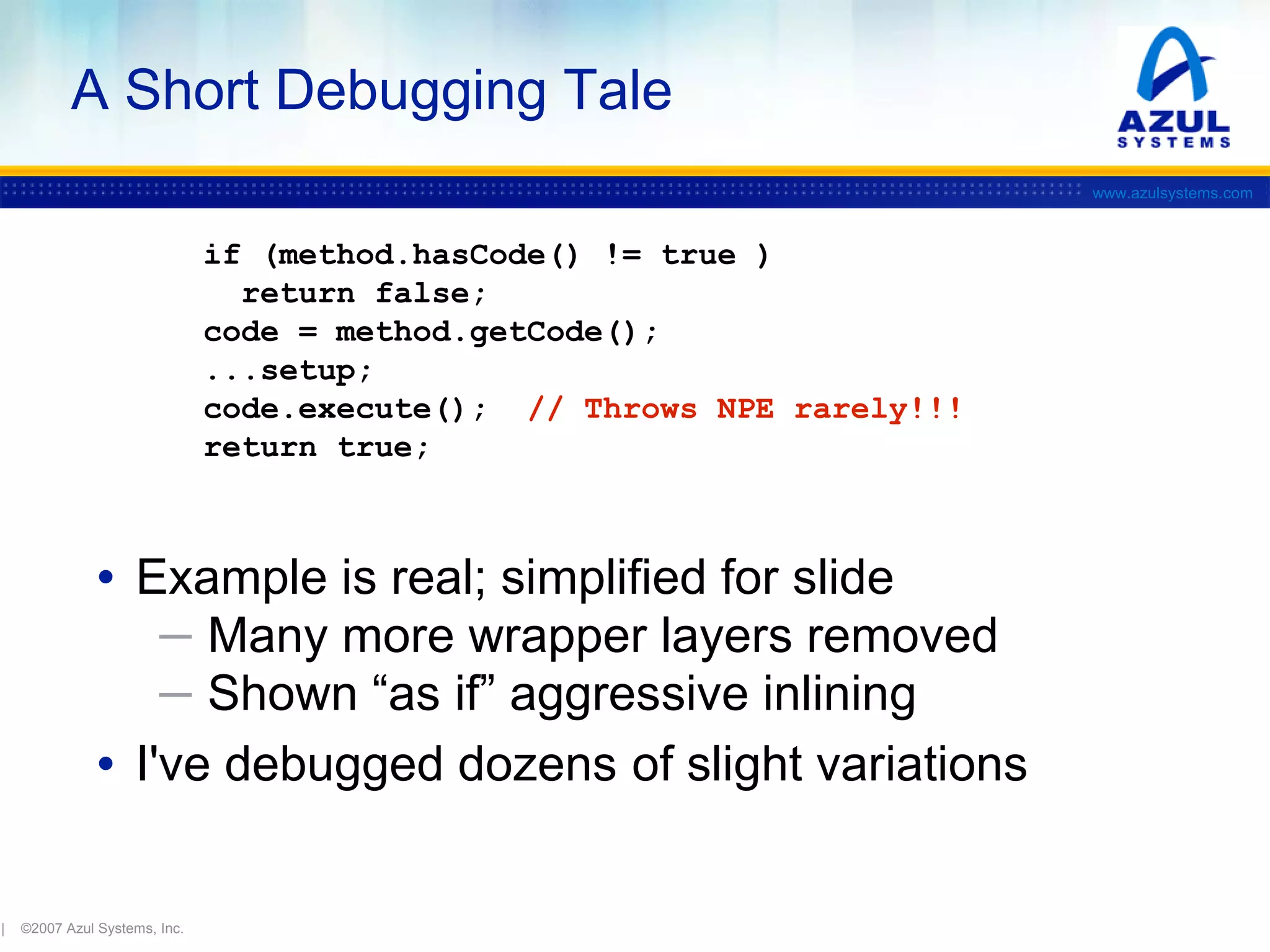
A Short Debugging Tale
www.azulsystems.com

if (method.hasCode() != true )
return false;
code = method.getCode();
...setup;
code.execute(); // Throws NPE rarely!!!
return true;

• Example is real; simplified for slide
─ Many more wrapper layers removed
─ Shown “as if” aggressive inlining

• I've debugged dozens of slight variations
|

©2007 Azul Systems, Inc.
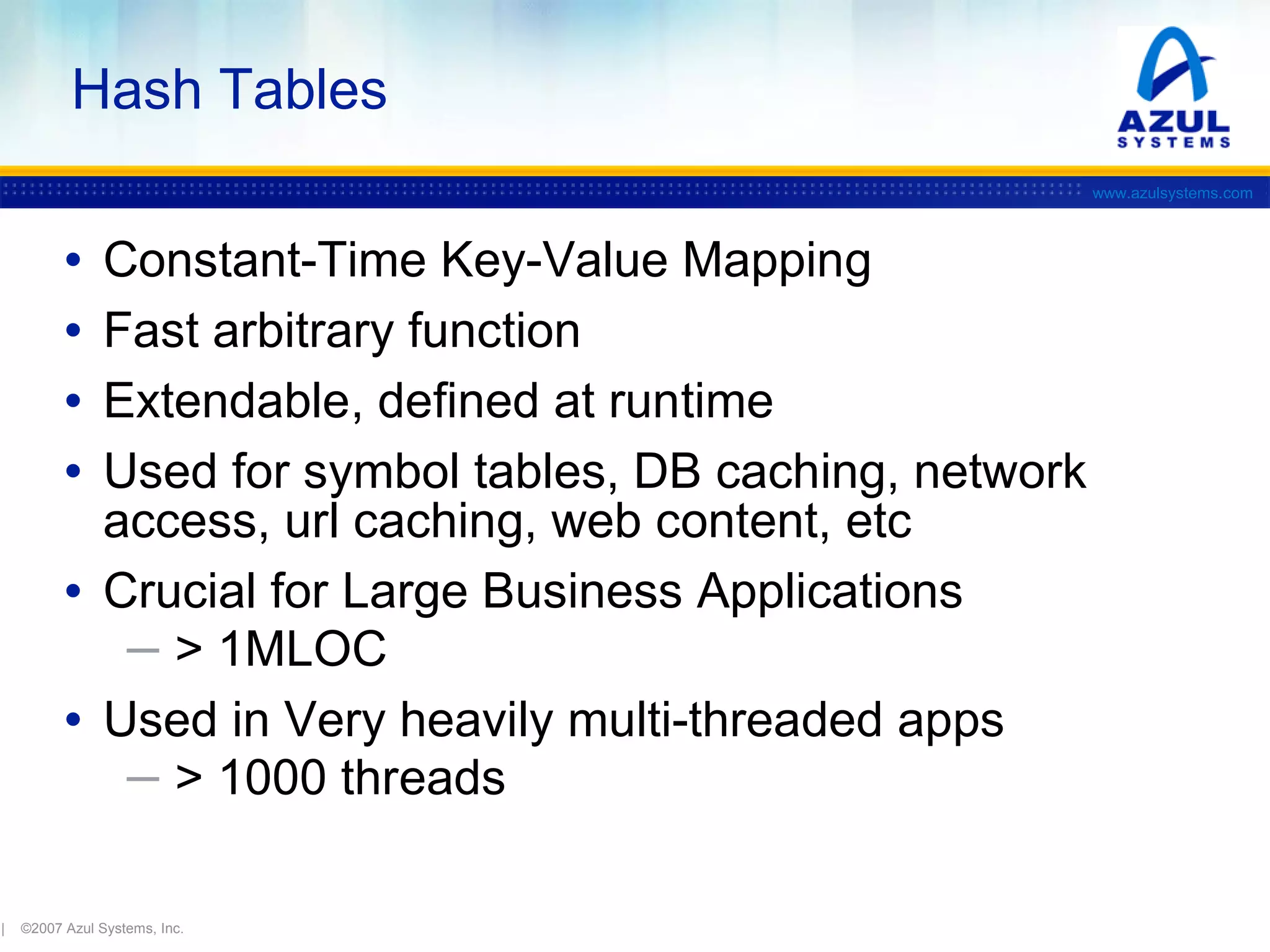
Hash Tables
www.azulsystems.com

•
•
•
•

Constant-Time Key-Value Mapping
Fast arbitrary function
Extendable, defined at runtime
Used for symbol tables, DB caching, network
access, url caching, web content, etc
• Crucial for Large Business Applications
─ > 1MLOC
• Used in Very heavily multi-threaded apps
─ > 1000 threads
|

©2007 Azul Systems, Inc.
Agenda
www.azulsystems.com

•
•
•
•
•

|

(not very) Formal Stuff
Reordering Memory – A peek under the hood
Common Data Races
Finally(!) Some Debugging Techniques
Summary

©2007 Azul Systems, Inc.
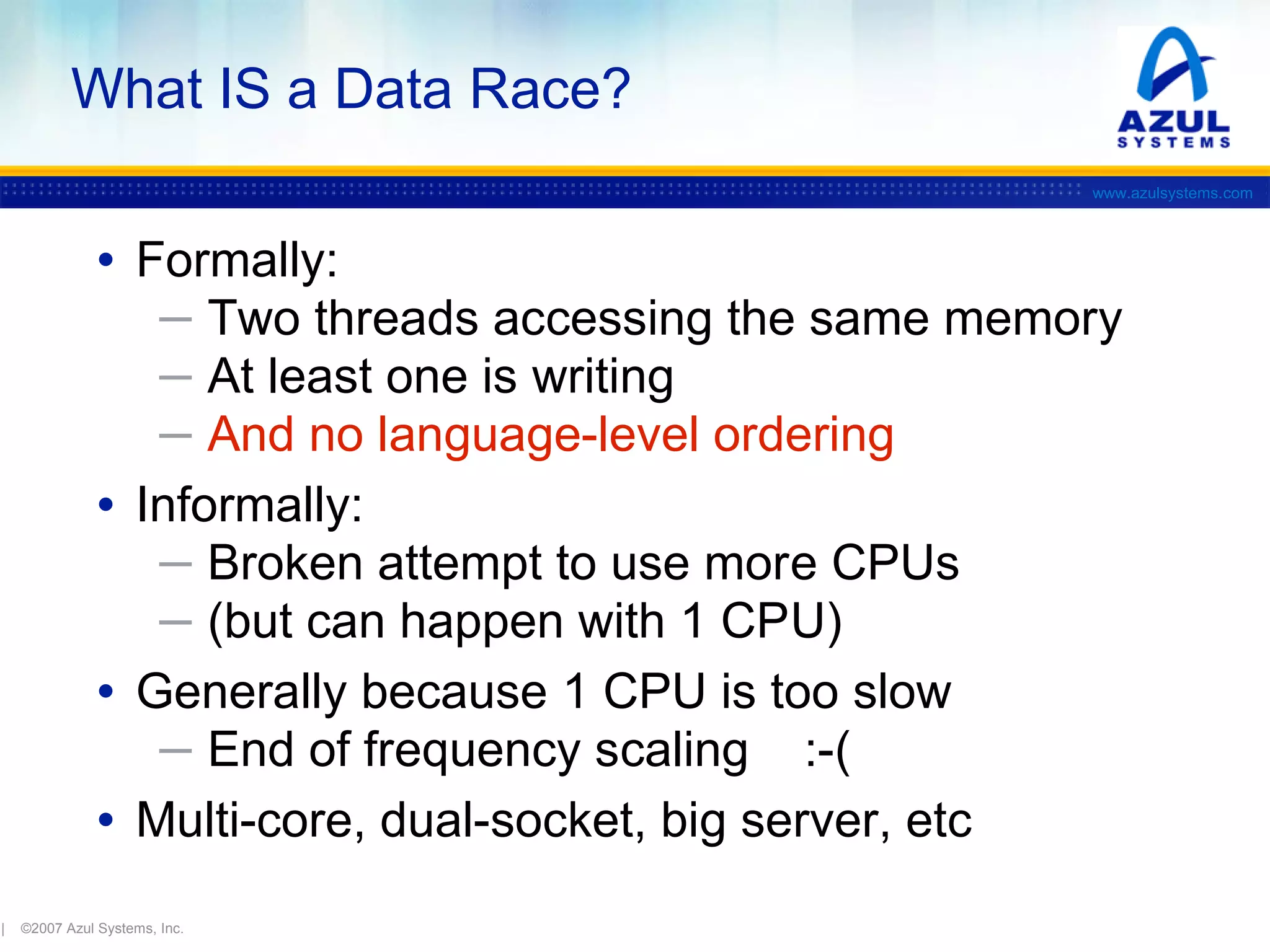
What IS a Data Race?
www.azulsystems.com

• Formally:
─ Two threads accessing the same memory
─ At least one is writing
─ And no language-level ordering

• Informally:

─ Broken attempt to use more CPUs
─ (but can happen with 1 CPU)

• Generally because 1 CPU is too slow
─ End of frequency scaling

:-(
• Multi-core, dual-socket, big server, etc
|

©2007 Azul Systems, Inc.
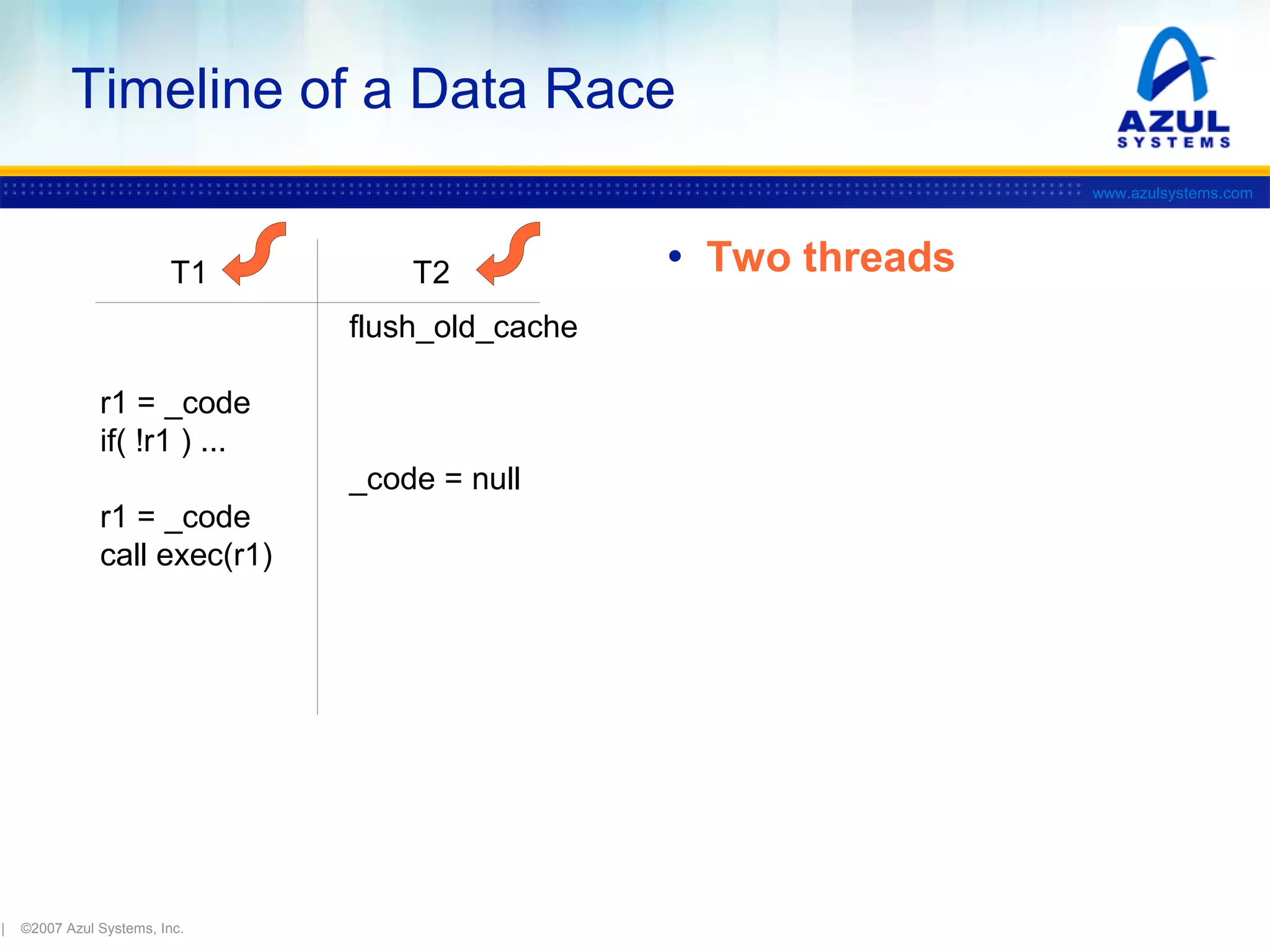
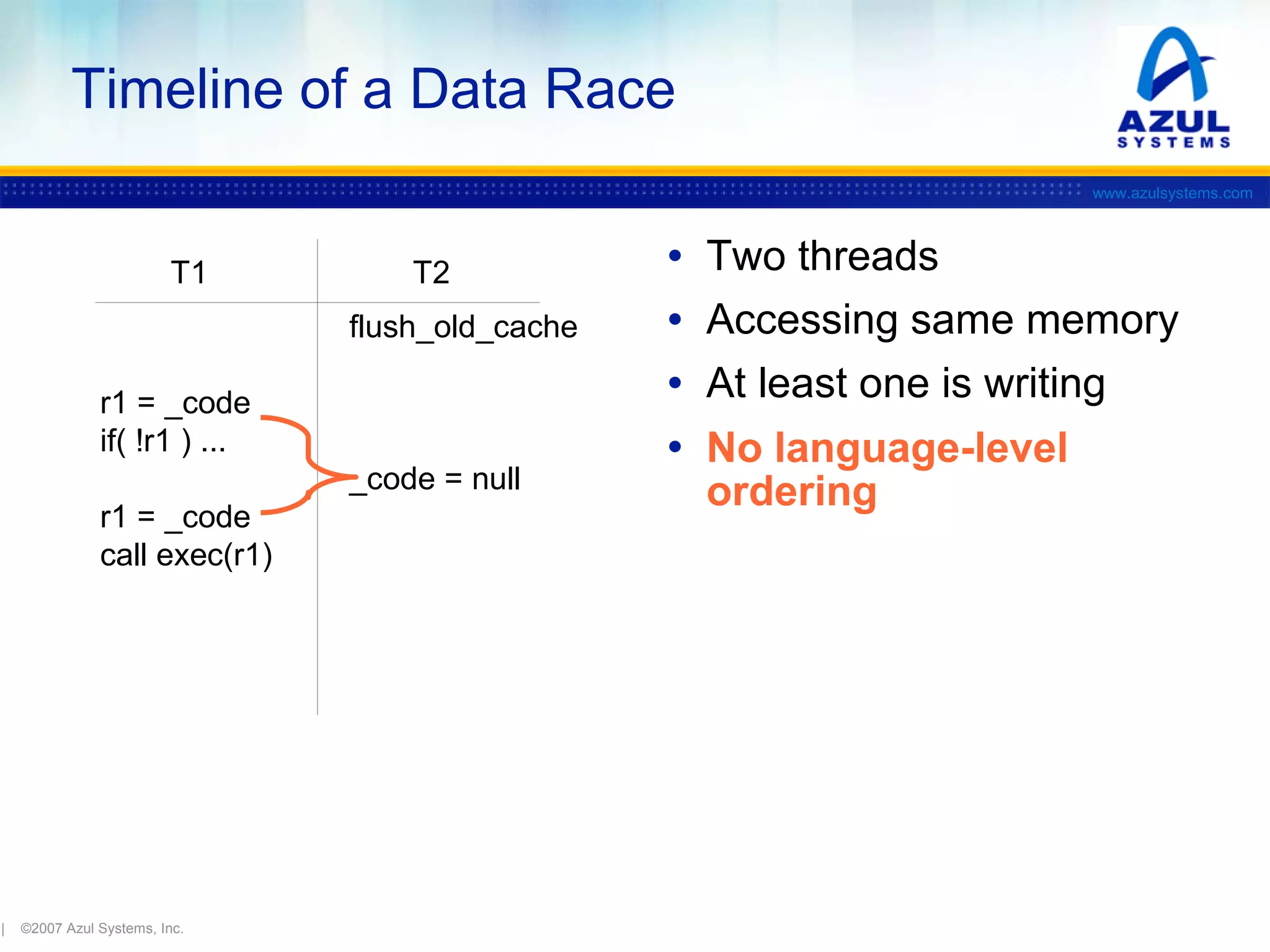
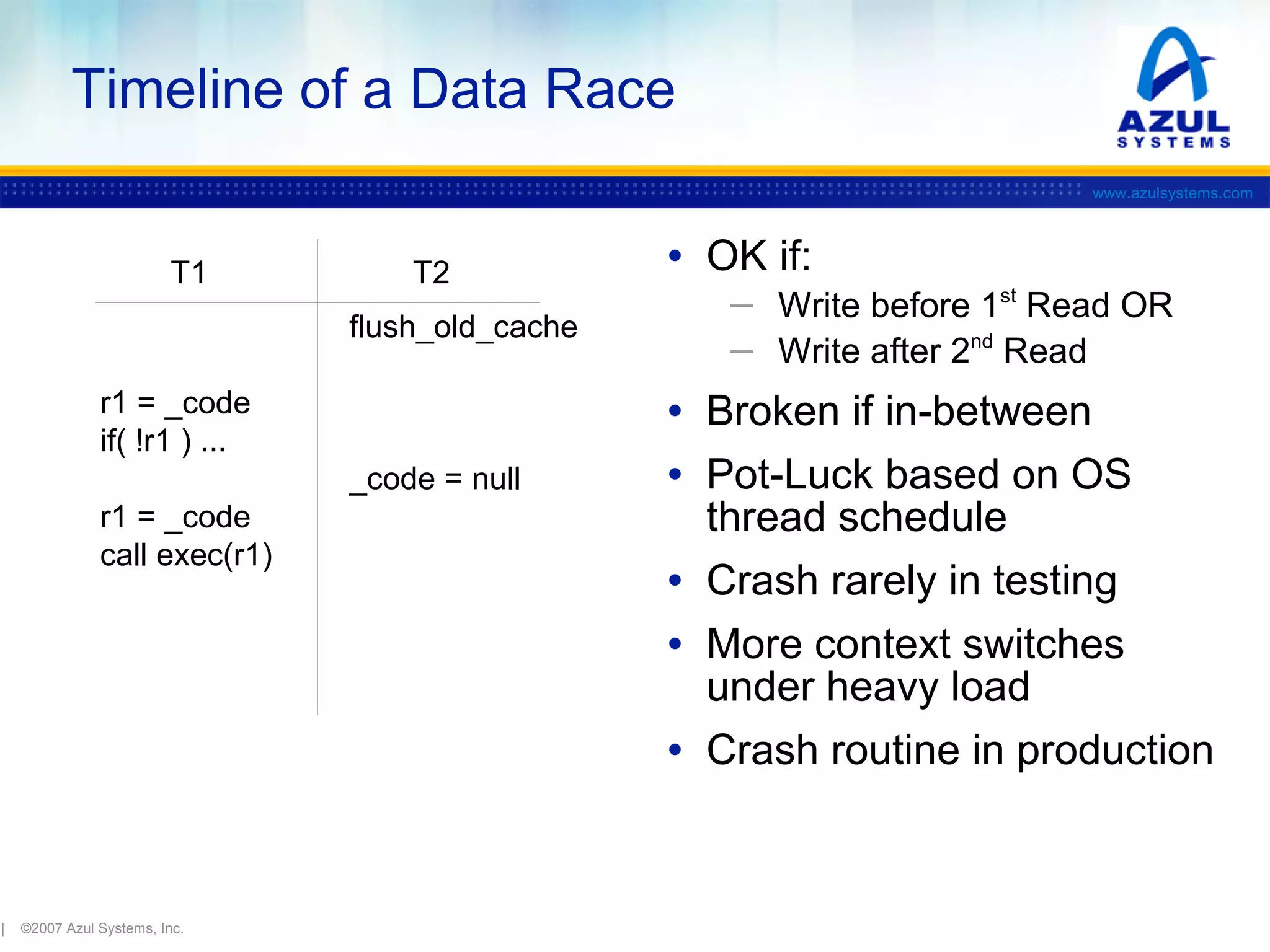
Timeline of a Data Race
www.azulsystems.com

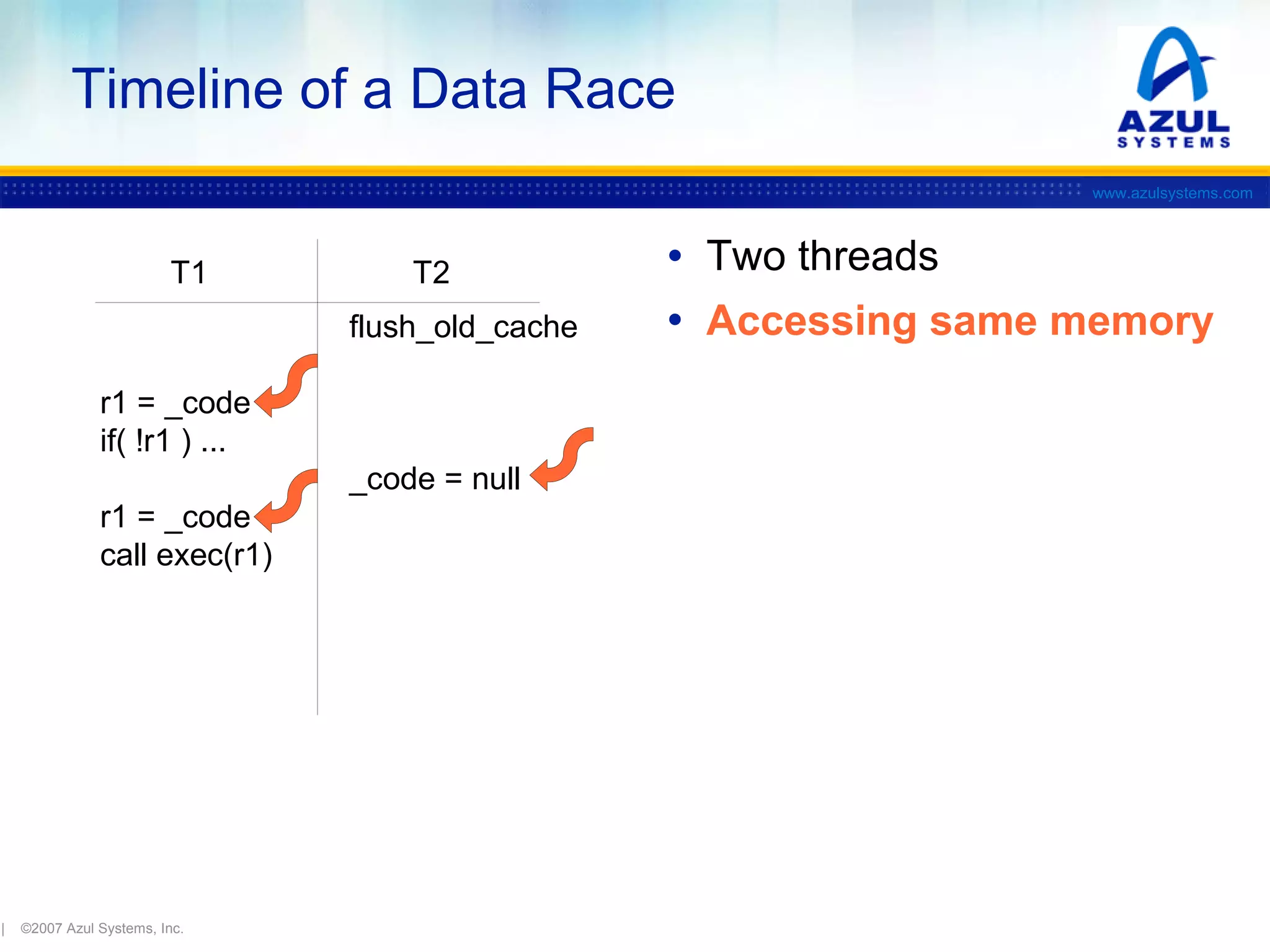
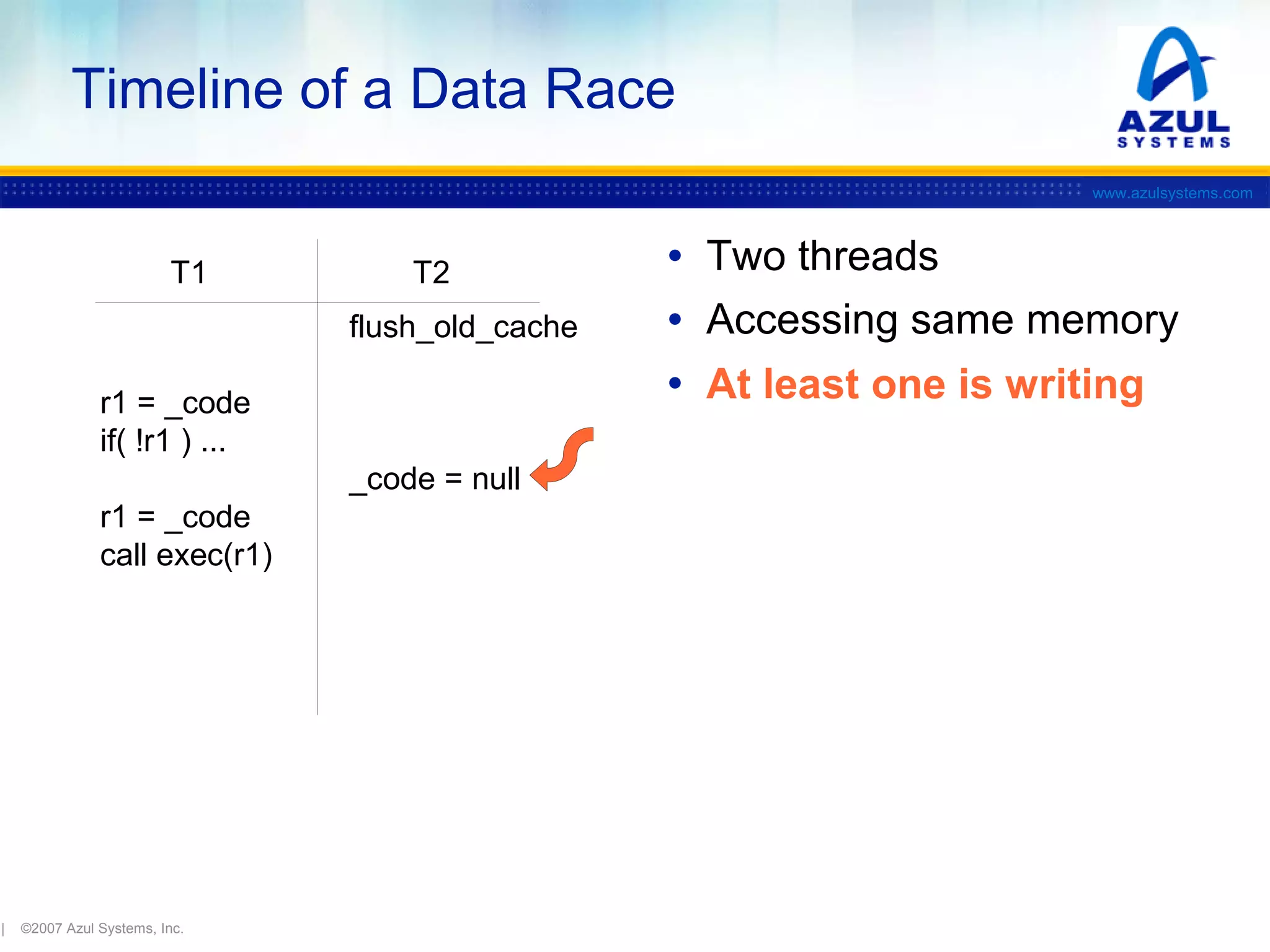
T1

T2
flush_old_cache

r1 = _code
if( !r1 ) ...
_code = null
r1 = _code
call exec(r1)

|

©2007 Azul Systems, Inc.

• Two threads
Timeline of a Data Race
www.azulsystems.com

T1

T2
flush_old_cache

r1 = _code
if( !r1 ) ...
_code = null
r1 = _code
call exec(r1)

|

©2007 Azul Systems, Inc.

• Two threads
• Accessing same memory
Timeline of a Data Race
www.azulsystems.com

T1

T2
flush_old_cache

r1 = _code
if( !r1 ) ...
_code = null
r1 = _code
call exec(r1)

|

©2007 Azul Systems, Inc.

• Two threads
• Accessing same memory
• At least one is writing
Timeline of a Data Race
www.azulsystems.com

T1

T2
flush_old_cache

r1 = _code
if( !r1 ) ...
_code = null
r1 = _code
call exec(r1)

|

©2007 Azul Systems, Inc.

•
•
•
•

Two threads
Accessing same memory
At least one is writing
No language-level
ordering
Timeline of a Data Race
www.azulsystems.com

T1

T2
flush_old_cache

r1 = _code
if( !r1 ) ...
_code = null
r1 = _code
call exec(r1)

|

©2007 Azul Systems, Inc.

• OK if:
─ Write before 1st Read OR
─ Write after 2nd Read

• Broken if in-between
• Pot-Luck based on OS

thread schedule
• Crash rarely in testing
• More context switches
under heavy load
• Crash routine in production
Agenda
www.azulsystems.com

•
•
•
•
•

|

(not very) Formal Stuff
Reordering Memory – A peek under the hood
Common Data Races
Finally(!) Some Debugging Techniques
Summary

©2007 Azul Systems, Inc.
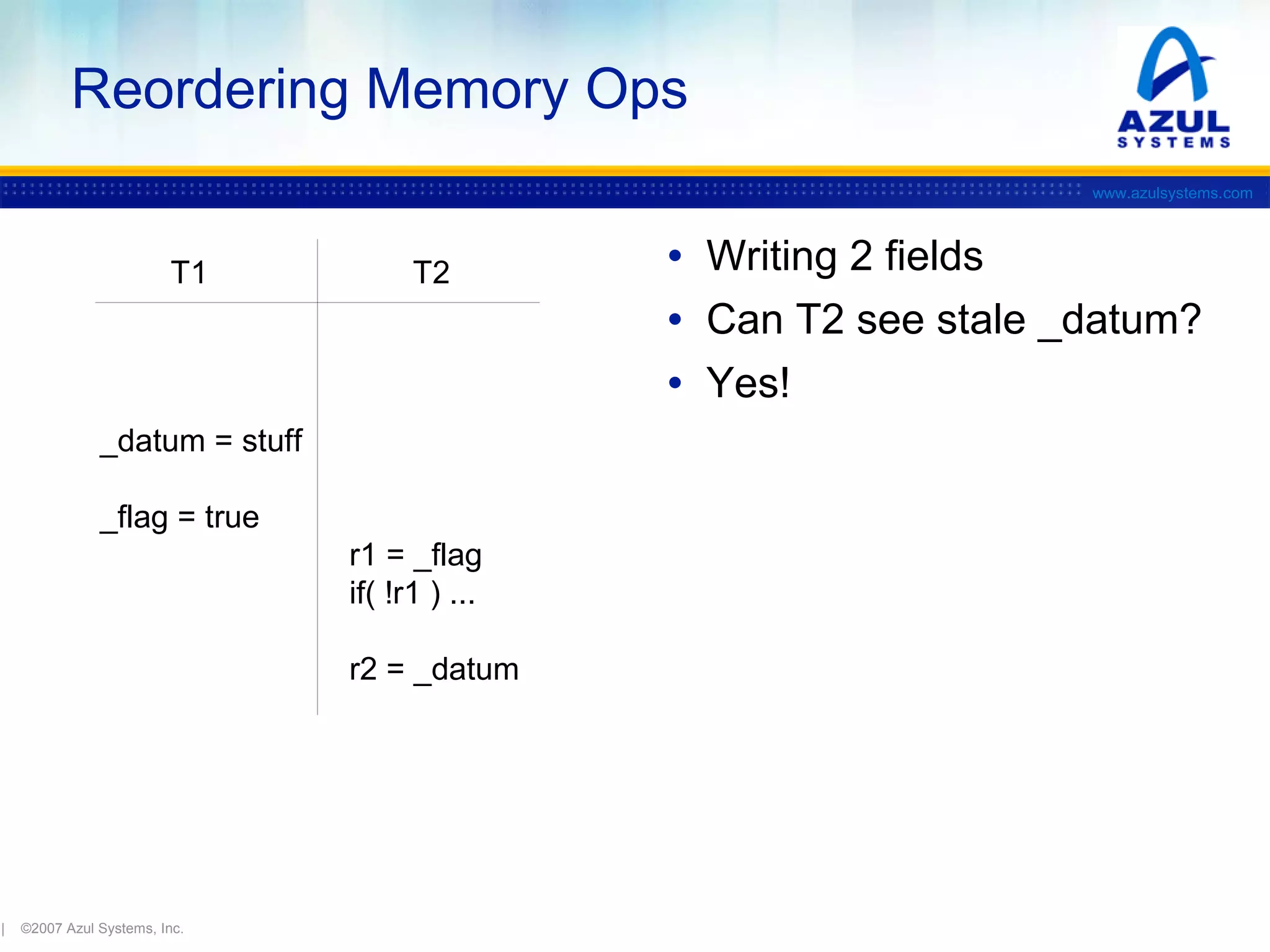
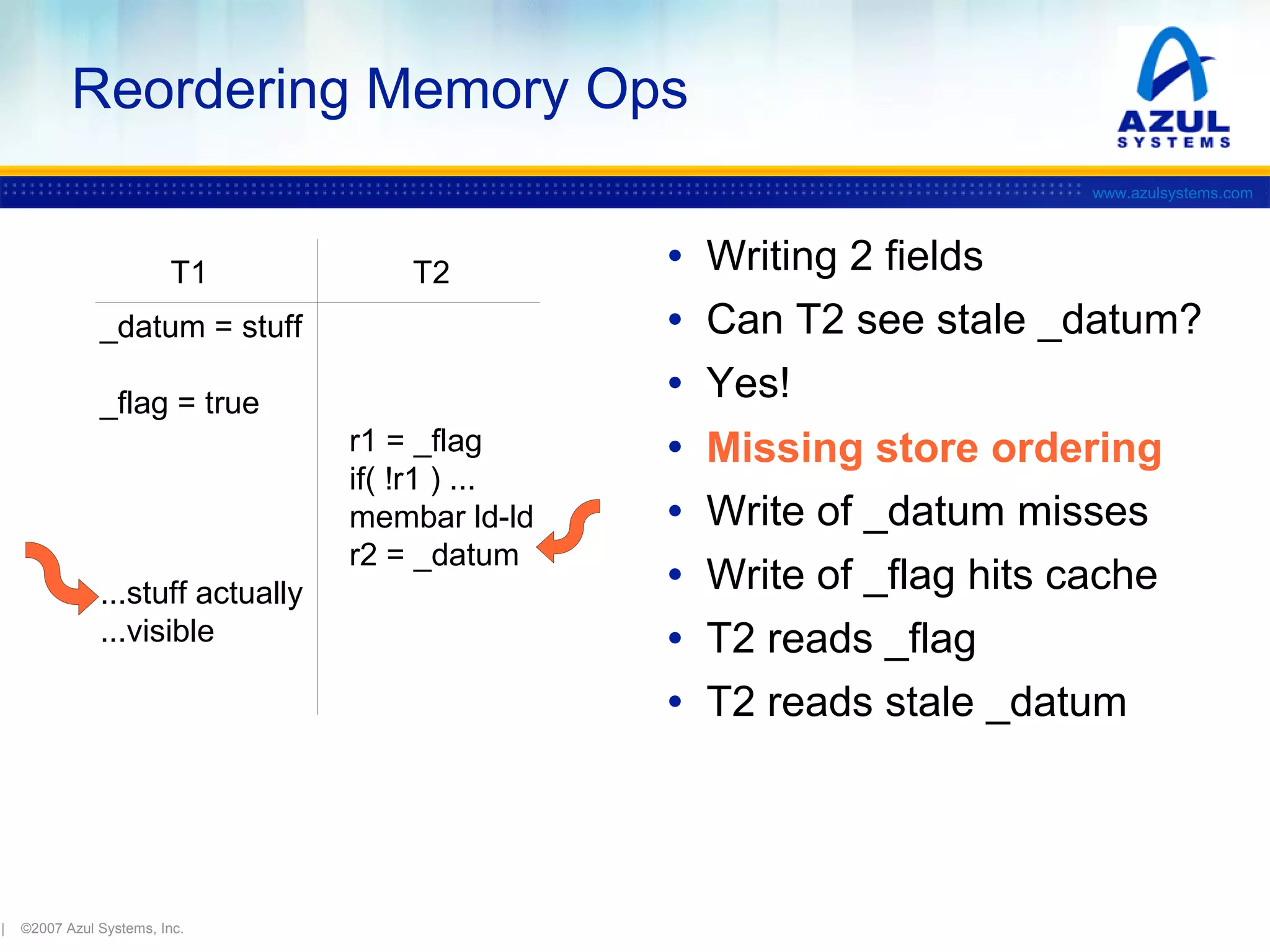
Reordering Memory Ops
www.azulsystems.com

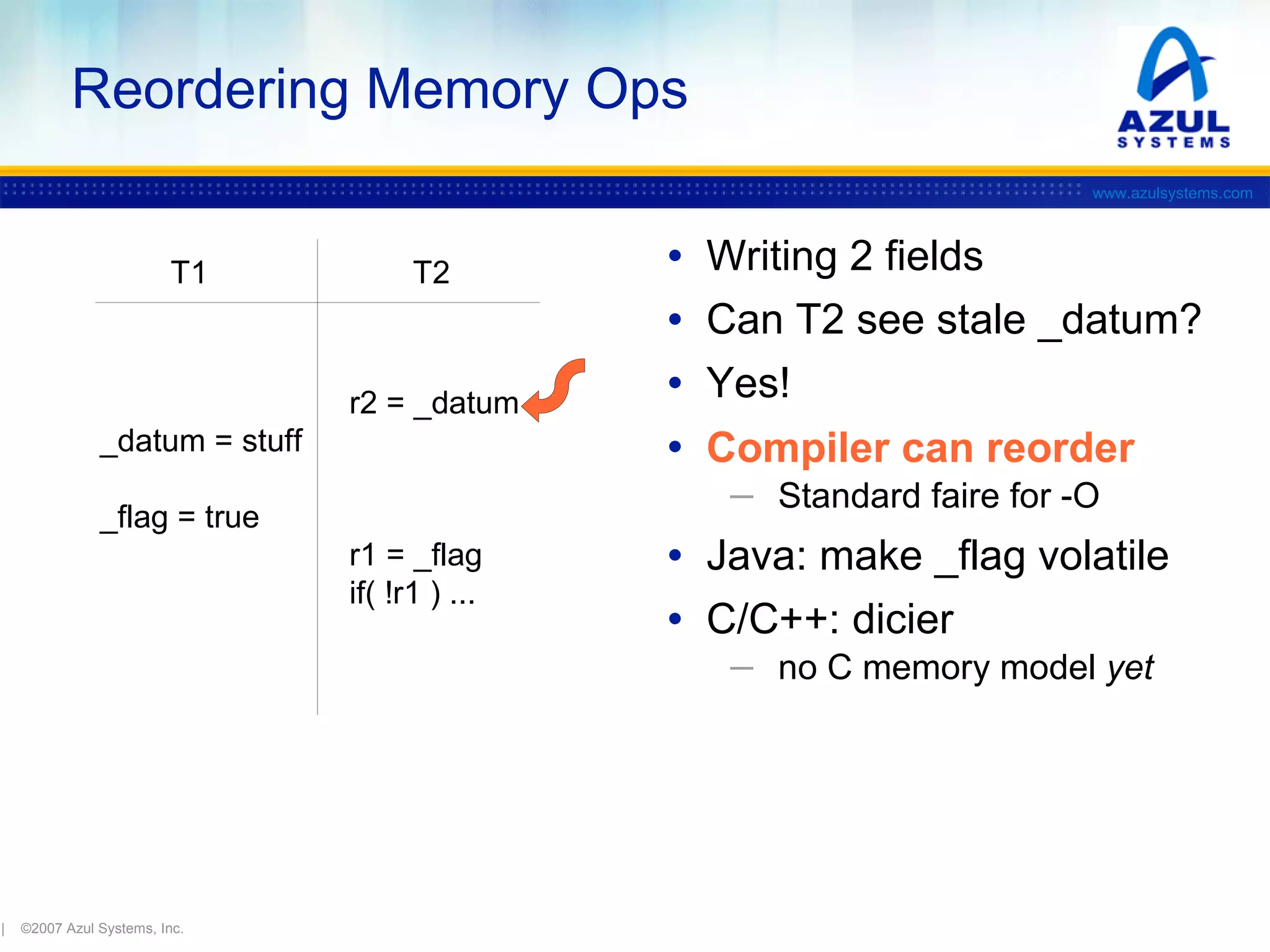
T1

T2

_datum = stuff
_flag = true
r1 = _flag
if( !r1 ) ...
r2 = _datum

|

©2007 Azul Systems, Inc.

• Writing 2 fields
• Can T2 see stale _datum?
• Yes!
Reordering Memory Ops
www.azulsystems.com

T1

T2

r2 = _datum
_datum = stuff

•
•
•
•

Writing 2 fields
Can T2 see stale _datum?
Yes!
Compiler can reorder
─ Standard faire for -O

_flag = true
r1 = _flag
if( !r1 ) ...

• Java: make _flag volatile
• C/C++: dicier
─ no C memory model yet

|

©2007 Azul Systems, Inc.
Reordering Memory Ops
www.azulsystems.com

T1

T2
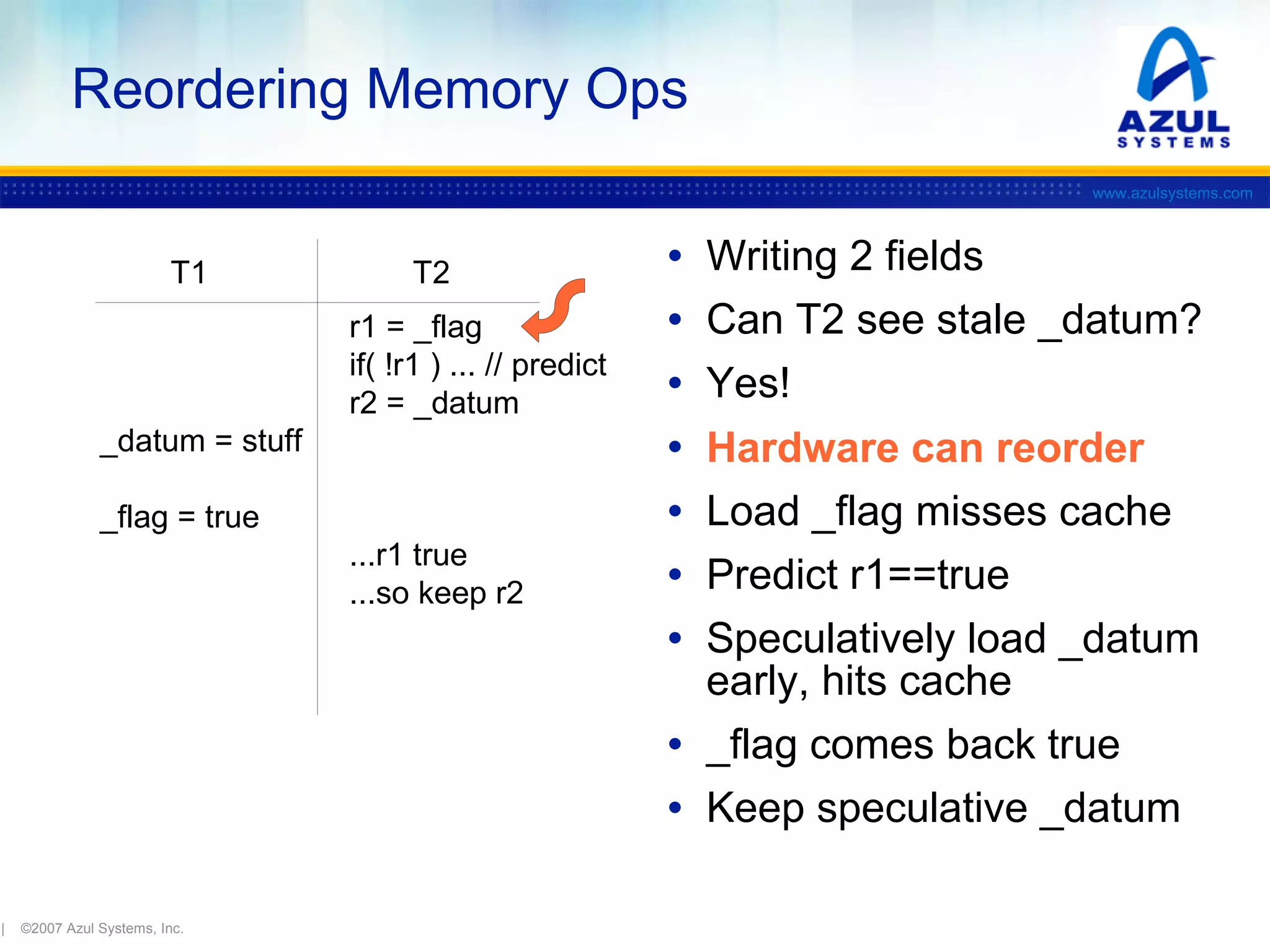
r1 = _flag
if( !r1 ) ... // predict
r2 = _datum

_datum = stuff
_flag = true
...r1 true
...so keep r2

•
•
•
•
•
•
•

Writing 2 fields
Can T2 see stale _datum?
Yes!
Hardware can reorder
Load _flag misses cache
Predict r1==true
Speculatively load _datum
early, hits cache

• _flag comes back true
• Keep speculative _datum
|

©2007 Azul Systems, Inc.
Reordering Memory Ops
www.azulsystems.com

T1

T2

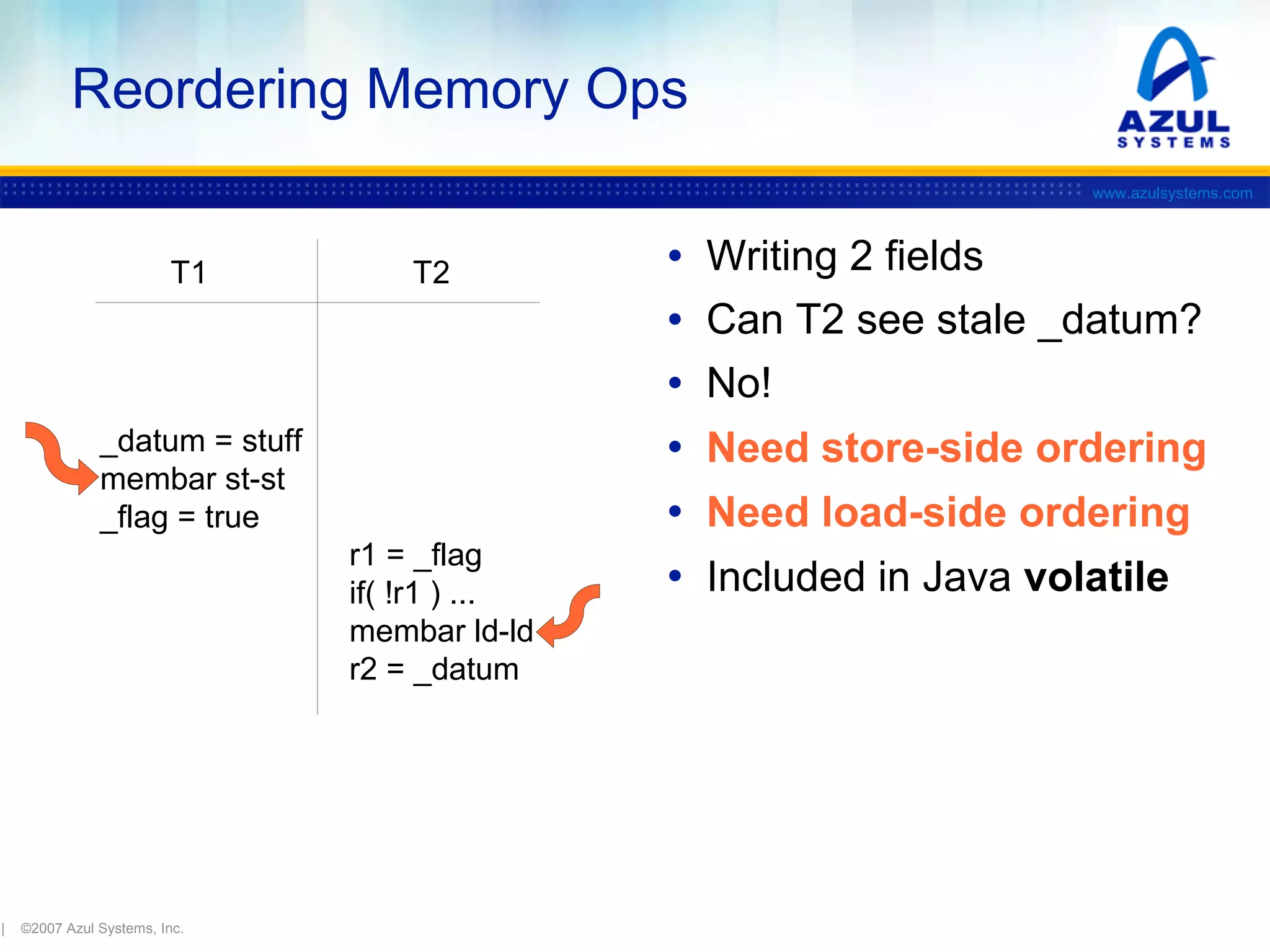
_datum = stuff
membar st-st
_flag = true
r1 = _flag
if( !r1 ) ...
membar ld-ld
r2 = _datum

|

©2007 Azul Systems, Inc.

•
•
•
•
•
•

Writing 2 fields
Can T2 see stale _datum?
No!
Need store-side ordering
Need load-side ordering
Included in Java volatile
Reordering Memory Ops
www.azulsystems.com

T1

T2
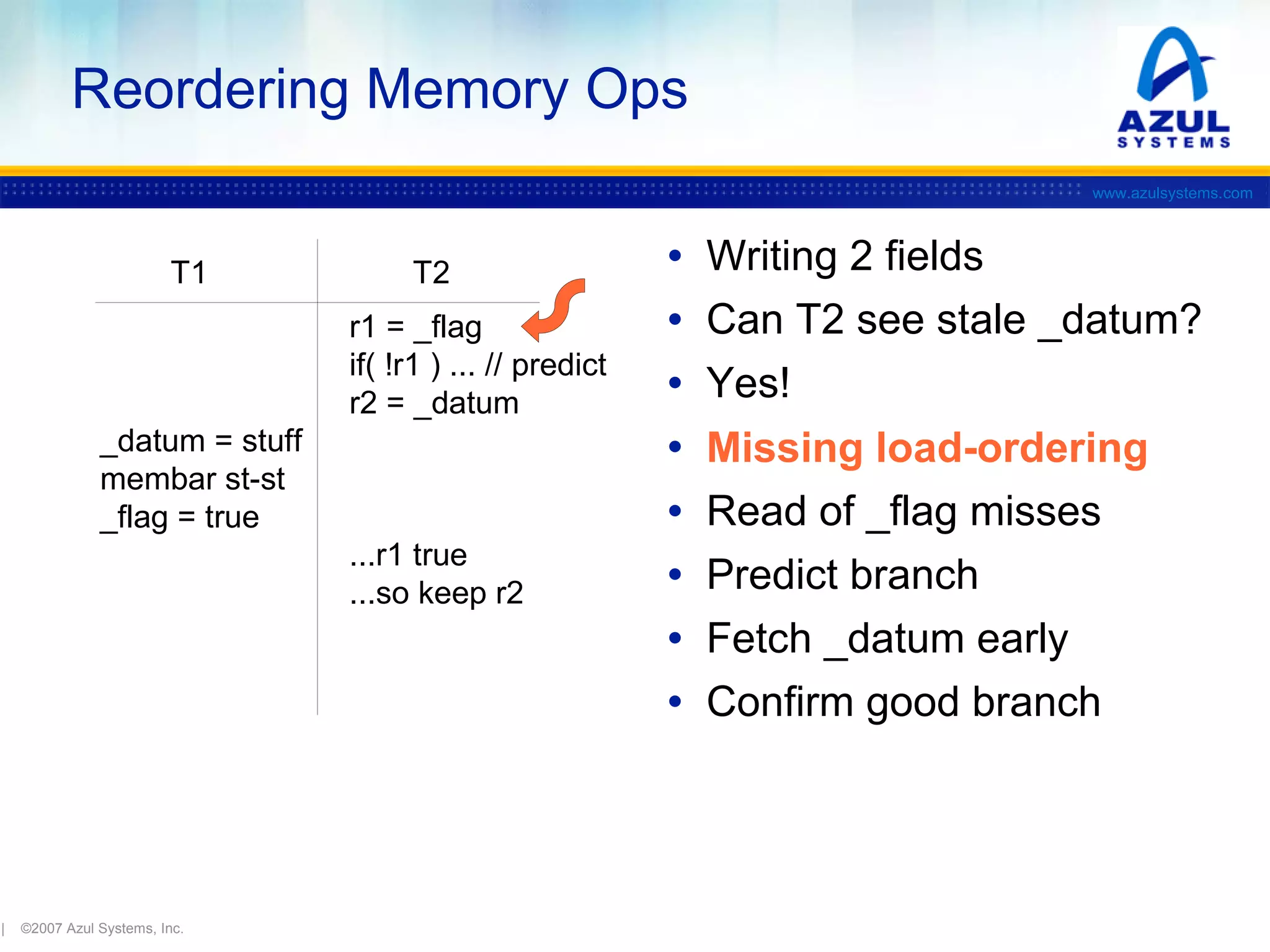
r1 = _flag
if( !r1 ) ... // predict
r2 = _datum

_datum = stuff
membar st-st
_flag = true
...r1 true
...so keep r2

|

©2007 Azul Systems, Inc.

•
•
•
•
•
•
•
•

Writing 2 fields
Can T2 see stale _datum?
Yes!
Missing load-ordering
Read of _flag misses
Predict branch
Fetch _datum early
Confirm good branch
Reordering Memory Ops
www.azulsystems.com

T1

T2

_datum = stuff
_flag = true
r1 = _flag
if( !r1 ) ...
membar ld-ld
r2 = _datum
...stuff actually
...visible

|

©2007 Azul Systems, Inc.

•
•
•
•
•
•
•
•

Writing 2 fields
Can T2 see stale _datum?
Yes!
Missing store ordering
Write of _datum misses
Write of _flag hits cache
T2 reads _flag
T2 reads stale _datum
Agenda
www.azulsystems.com

•
•
•
•
•

|

(not very) Formal Stuff
Reordering Memory – A peek under the hood
Common Data Races
Finally(!) Some Debugging Techniques
Summary

©2007 Azul Systems, Inc.
Common Data Races
www.azulsystems.com

• My experiences only
• Double-read with write in the middle:
if( _p != null )
... _p._fld...

_p = null;

• ...and it's usually a null write
• Two writes with reads in the middle:
_size++;
_array=new[_size];

• Double Checked Locking:
|

©2007 Azul Systems, Inc.

..._array[_size-1]...
if( _global == null )
synchronized(x)
if( _global == null )
_global = new;
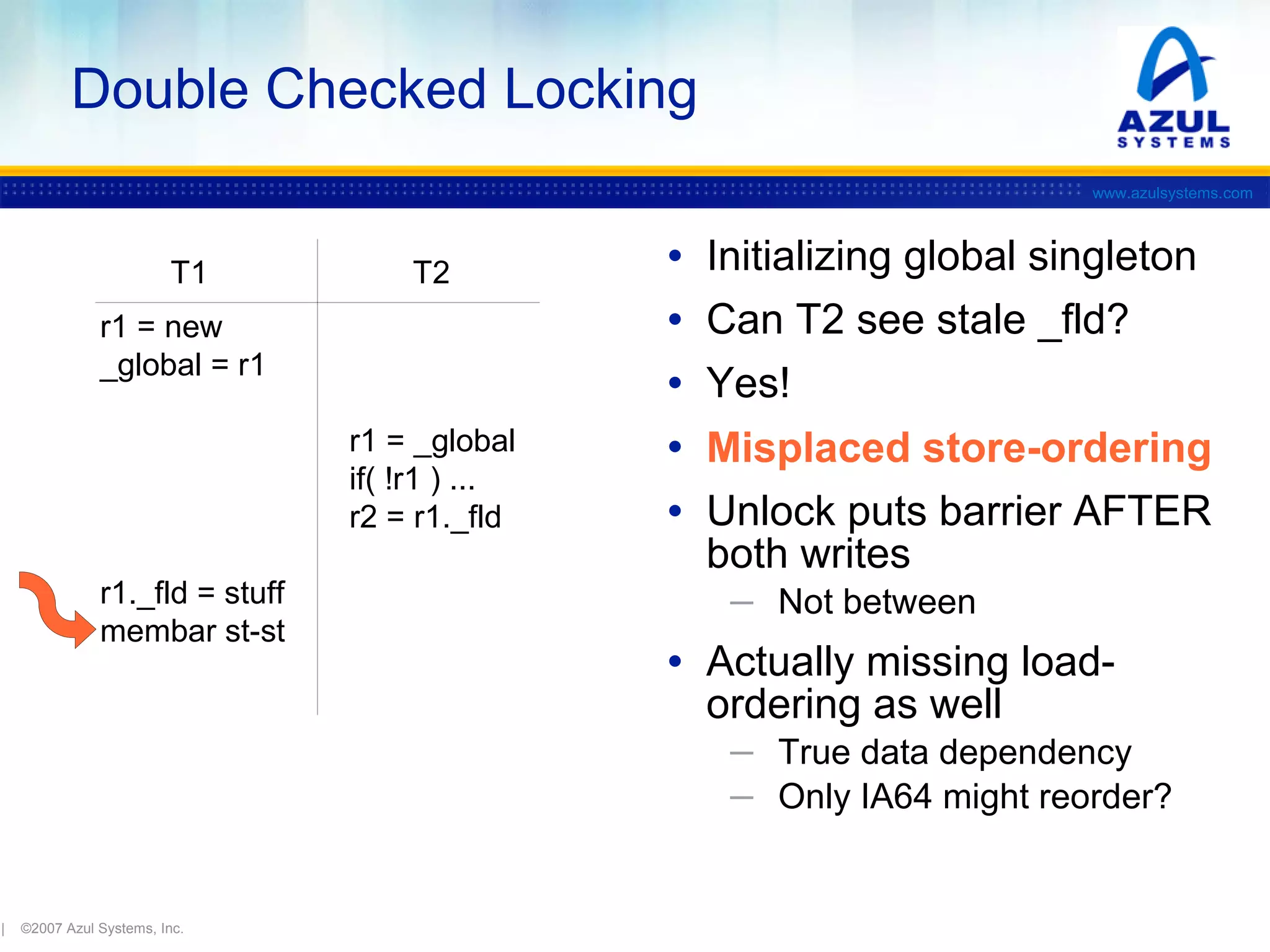
Double Checked Locking
www.azulsystems.com

T1

T2

r1 = new
_global = r1
r1 = _global
if( !r1 ) ...
r2 = r1._fld
r1._fld = stuff
membar st-st

•
•
•
•
•

Initializing global singleton
Can T2 see stale _fld?
Yes!
Misplaced store-ordering
Unlock puts barrier AFTER
both writes
─ Not between

• Actually missing loadordering as well

─ True data dependency
─ Only IA64 might reorder?

|

©2007 Azul Systems, Inc.
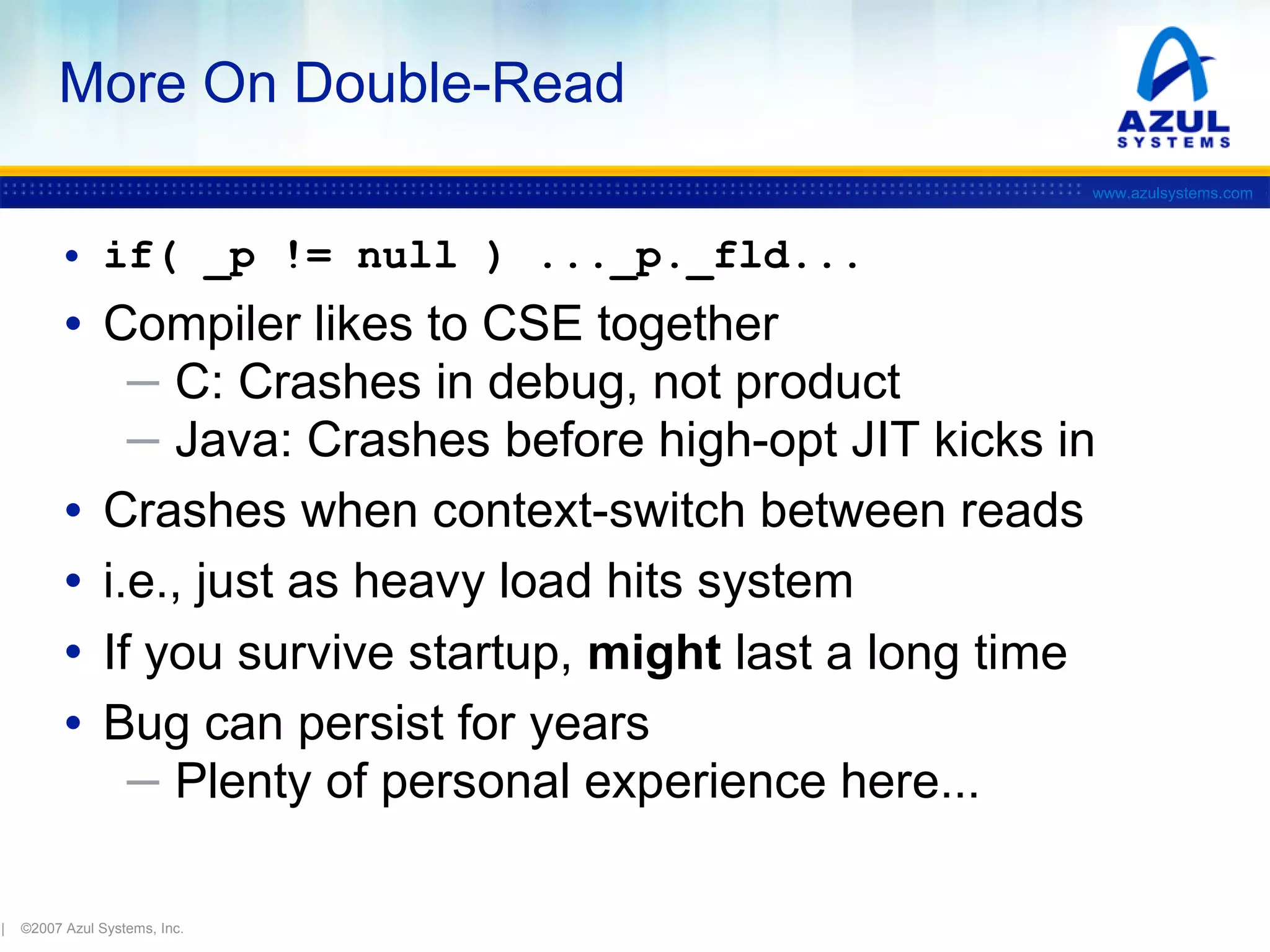
More On Double-Read
www.azulsystems.com

• if( _p != null ) ..._p._fld...

• Compiler likes to CSE together

─ C: Crashes in debug, not product
─ Java: Crashes before high-opt JIT kicks in

•
•
•
•

|

Crashes when context-switch between reads
i.e., just as heavy load hits system
If you survive startup, might last a long time
Bug can persist for years
─ Plenty of personal experience here...

©2007 Azul Systems, Inc.
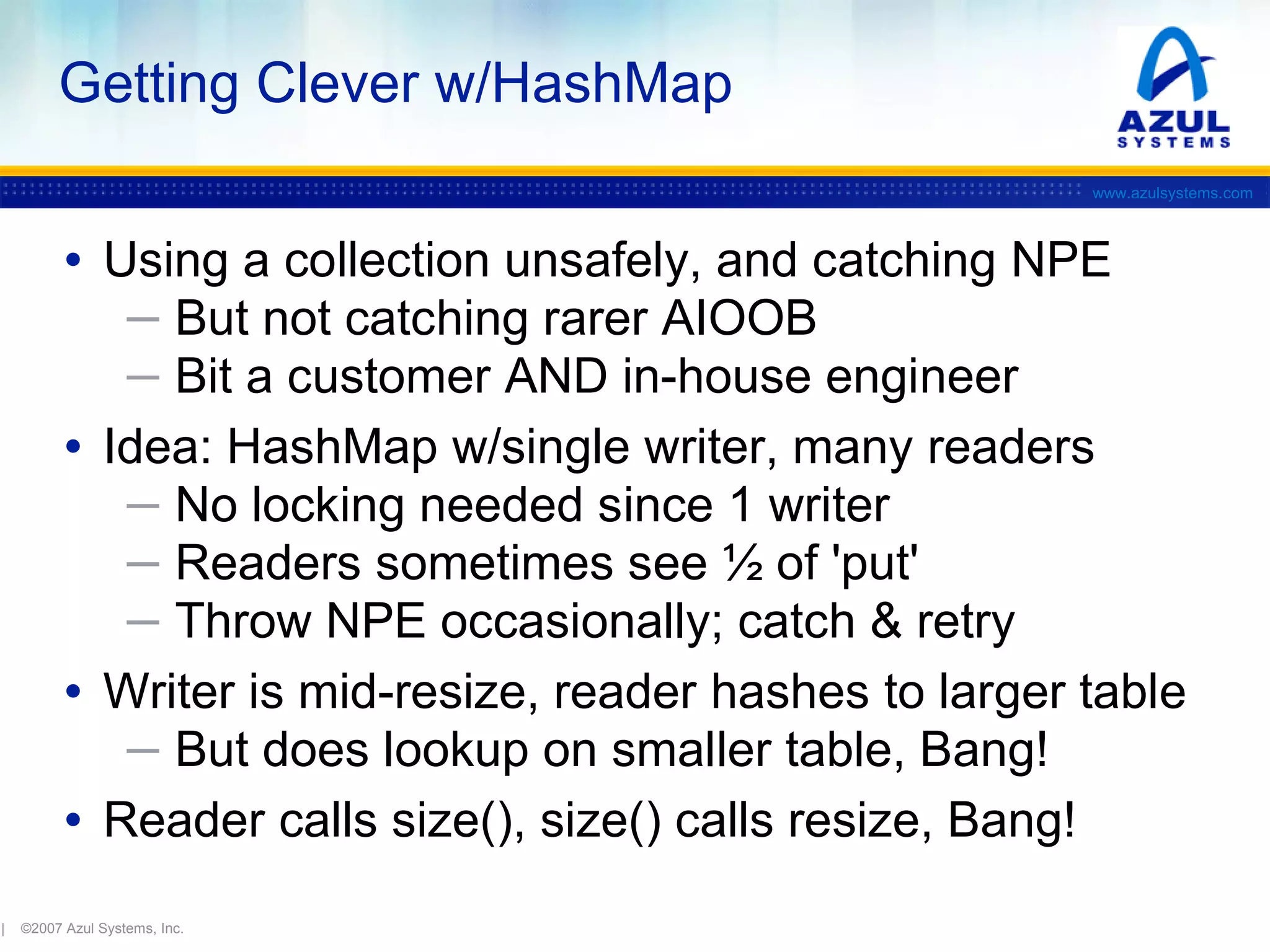
Getting Clever w/HashMap
www.azulsystems.com

• Using a collection unsafely, and catching NPE
─ But not catching rarer AIOOB
─ Bit a customer AND in-house engineer

• Idea: HashMap w/single writer, many readers
─ No locking needed since 1 writer
─ Readers sometimes see ½ of 'put'
─ Throw NPE occasionally; catch & retry

• Writer is mid-resize, reader hashes to larger table
─ But does lookup on smaller table, Bang!

• Reader calls size(), size() calls resize, Bang!
|

©2007 Azul Systems, Inc.
Agenda
www.azulsystems.com

•
•
•
•
•

|

(not very) Formal Stuff
Reordering Memory – A peek under the hood
Common Data Races
Finally(!) Some Debugging Techniques
Summary

©2007 Azul Systems, Inc.
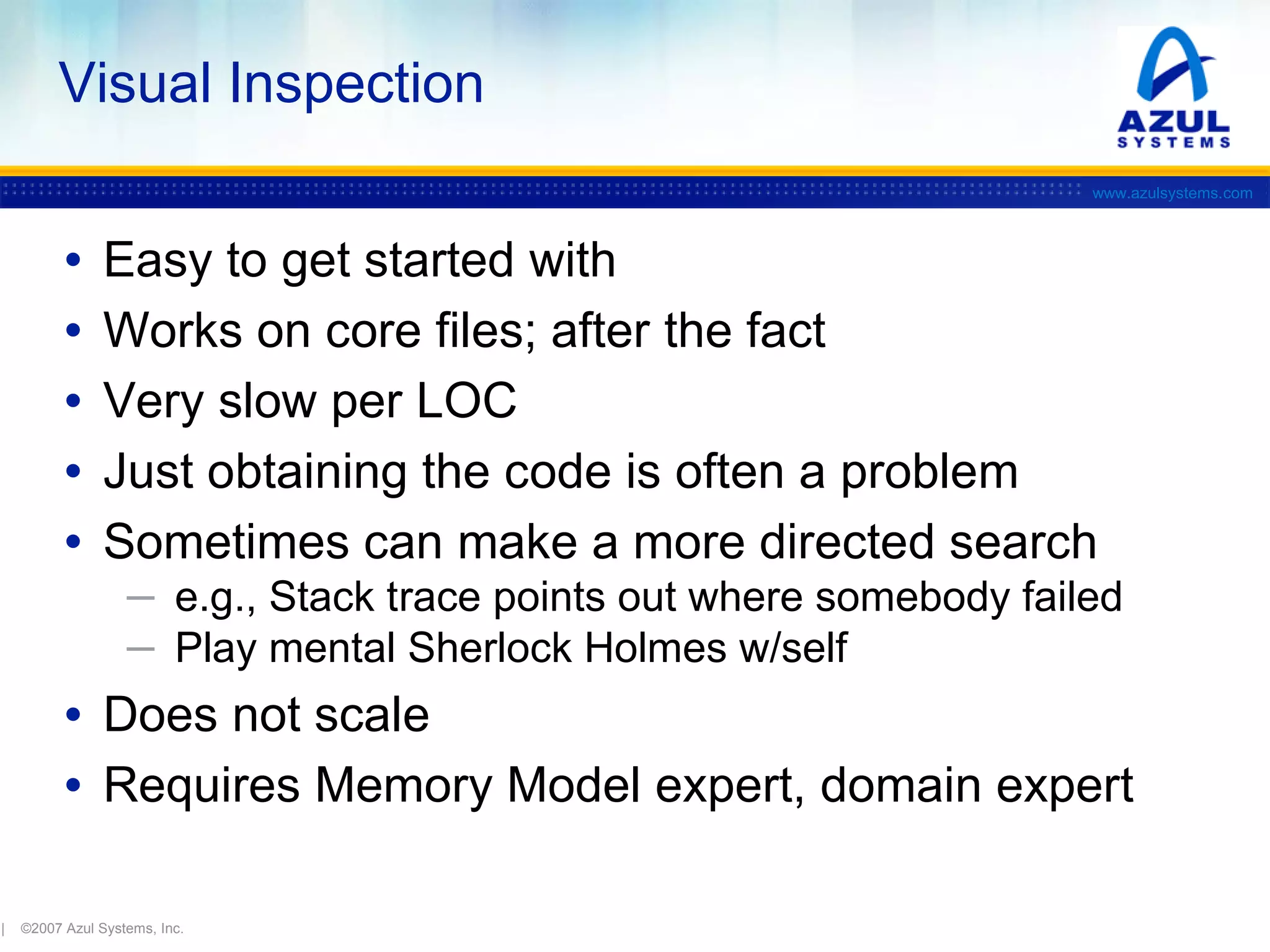
Visual Inspection
www.azulsystems.com

•
•
•
•
•

Easy to get started with
Works on core files; after the fact
Very slow per LOC
Just obtaining the code is often a problem
Sometimes can make a more directed search
─ e.g., Stack trace points out where somebody failed
─ Play mental Sherlock Holmes w/self

• Does not scale
• Requires Memory Model expert, domain expert
|

©2007 Azul Systems, Inc.
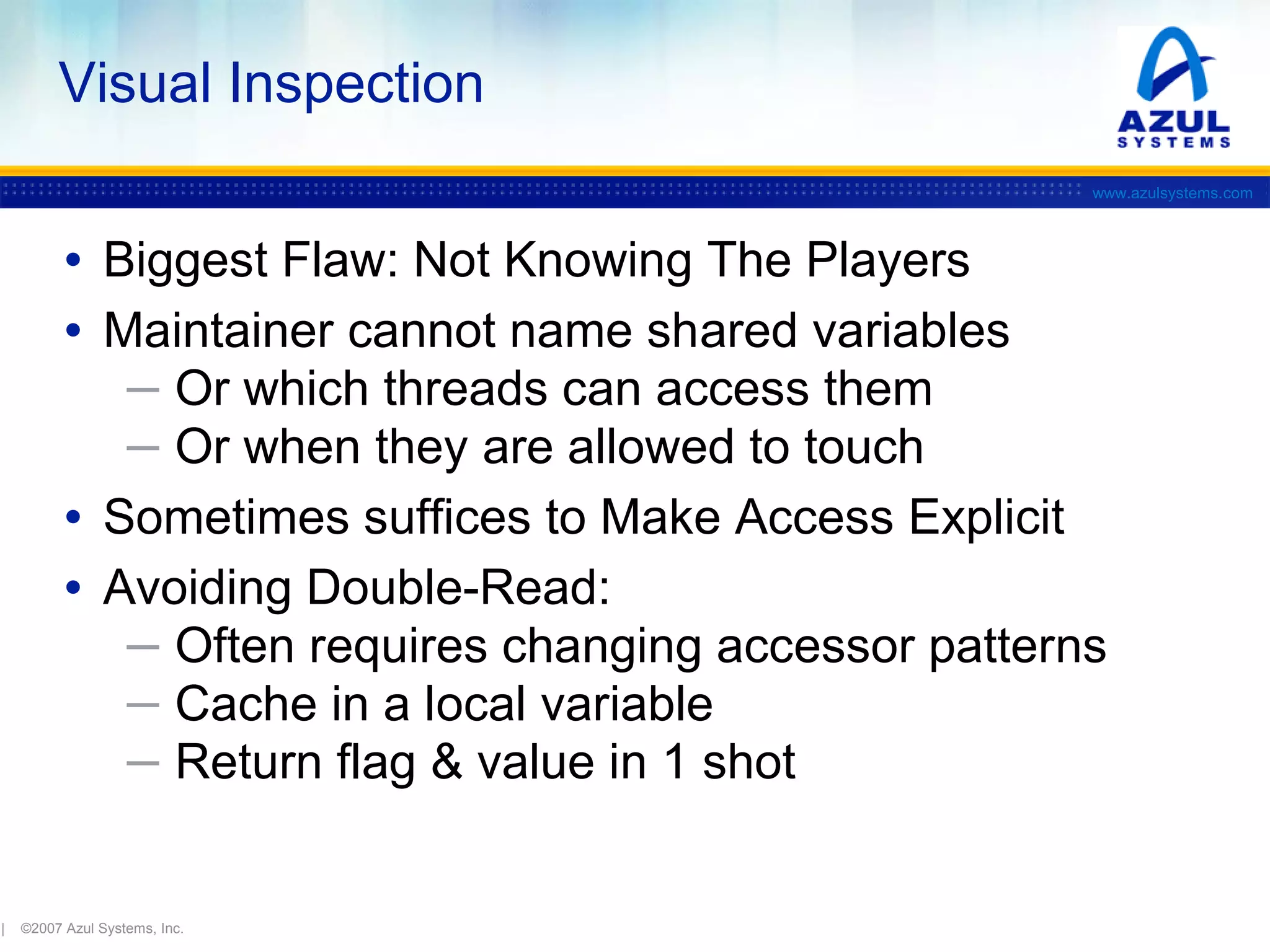
Visual Inspection
www.azulsystems.com

• Biggest Flaw: Not Knowing The Players
• Maintainer cannot name shared variables
─ Or which threads can access them
─ Or when they are allowed to touch

• Sometimes suffices to Make Access Explicit
• Avoiding Double-Read:

─ Often requires changing accessor patterns
─ Cache in a local variable
─ Return flag & value in 1 shot

|

©2007 Azul Systems, Inc.
Visual Inspection
www.azulsystems.com

•
•
•
•

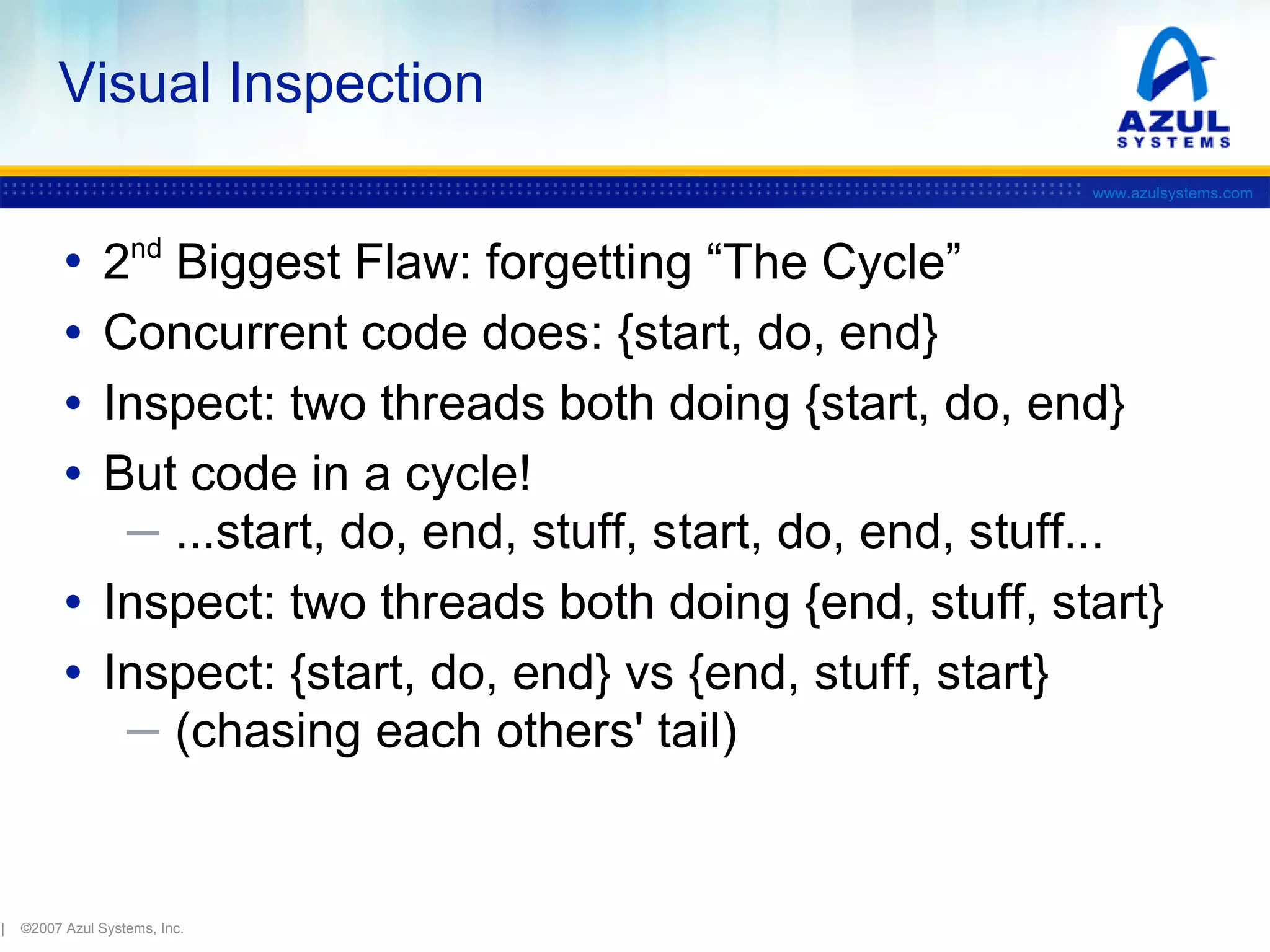
2nd Biggest Flaw: forgetting “The Cycle”
Concurrent code does: {start, do, end}
Inspect: two threads both doing {start, do, end}
But code in a cycle!
─ ...start, do, end, stuff, start, do, end, stuff...
• Inspect: two threads both doing {end, stuff, start}
• Inspect: {start, do, end} vs {end, stuff, start}
─ (chasing each others' tail)

|

©2007 Azul Systems, Inc.
Printing
www.azulsystems.com

• Printing / Logging / Events
─
─
─
─
─

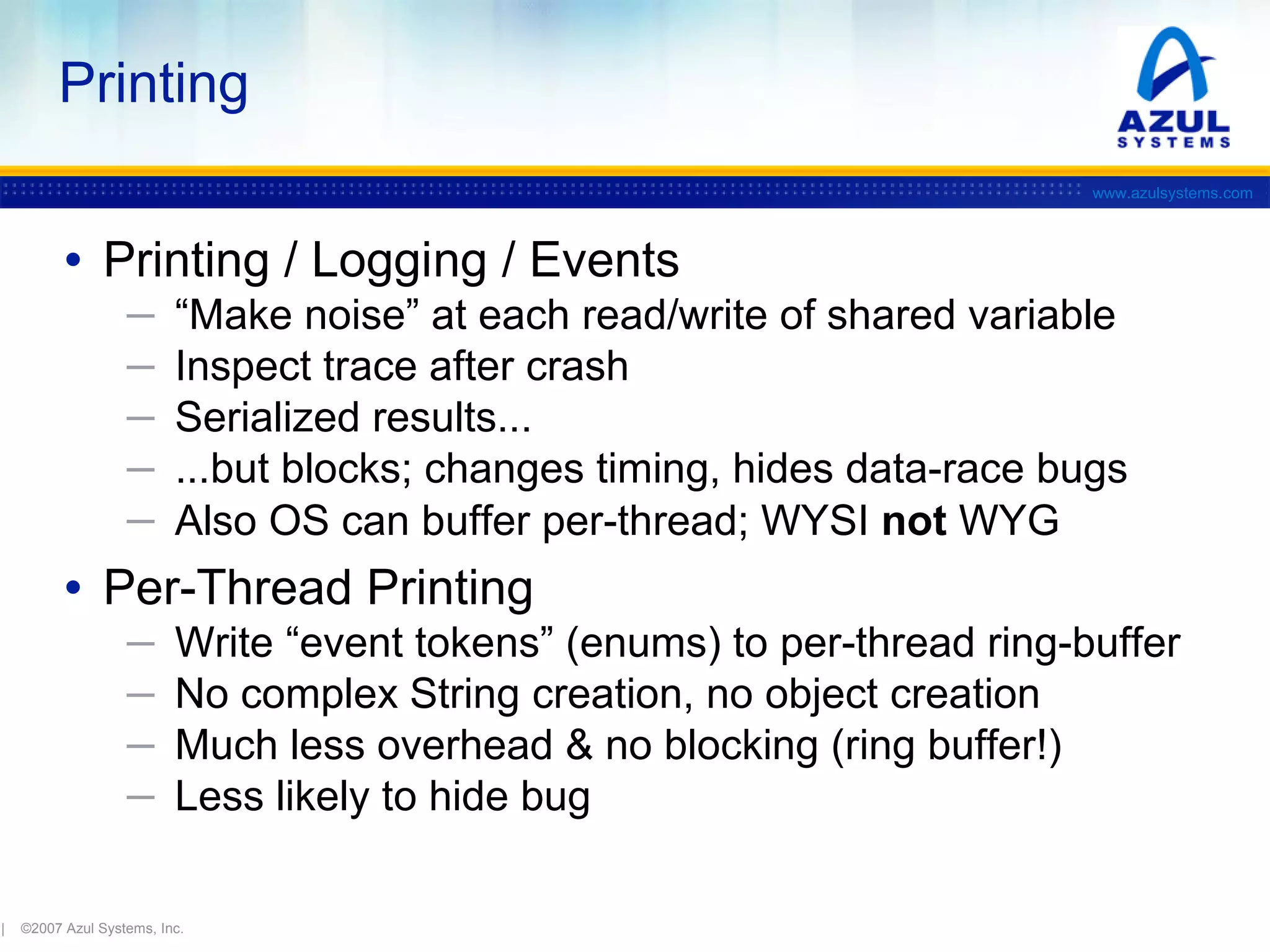
“Make noise” at each read/write of shared variable
Inspect trace after crash
Serialized results...
...but blocks; changes timing, hides data-race bugs
Also OS can buffer per-thread; WYSI not WYG

• Per-Thread Printing
─
─
─
─

|

Write “event tokens” (enums) to per-thread ring-buffer
No complex String creation, no object creation
Much less overhead & no blocking (ring buffer!)
Less likely to hide bug

©2007 Azul Systems, Inc.
It Takes Two to Tangle...
www.azulsystems.com

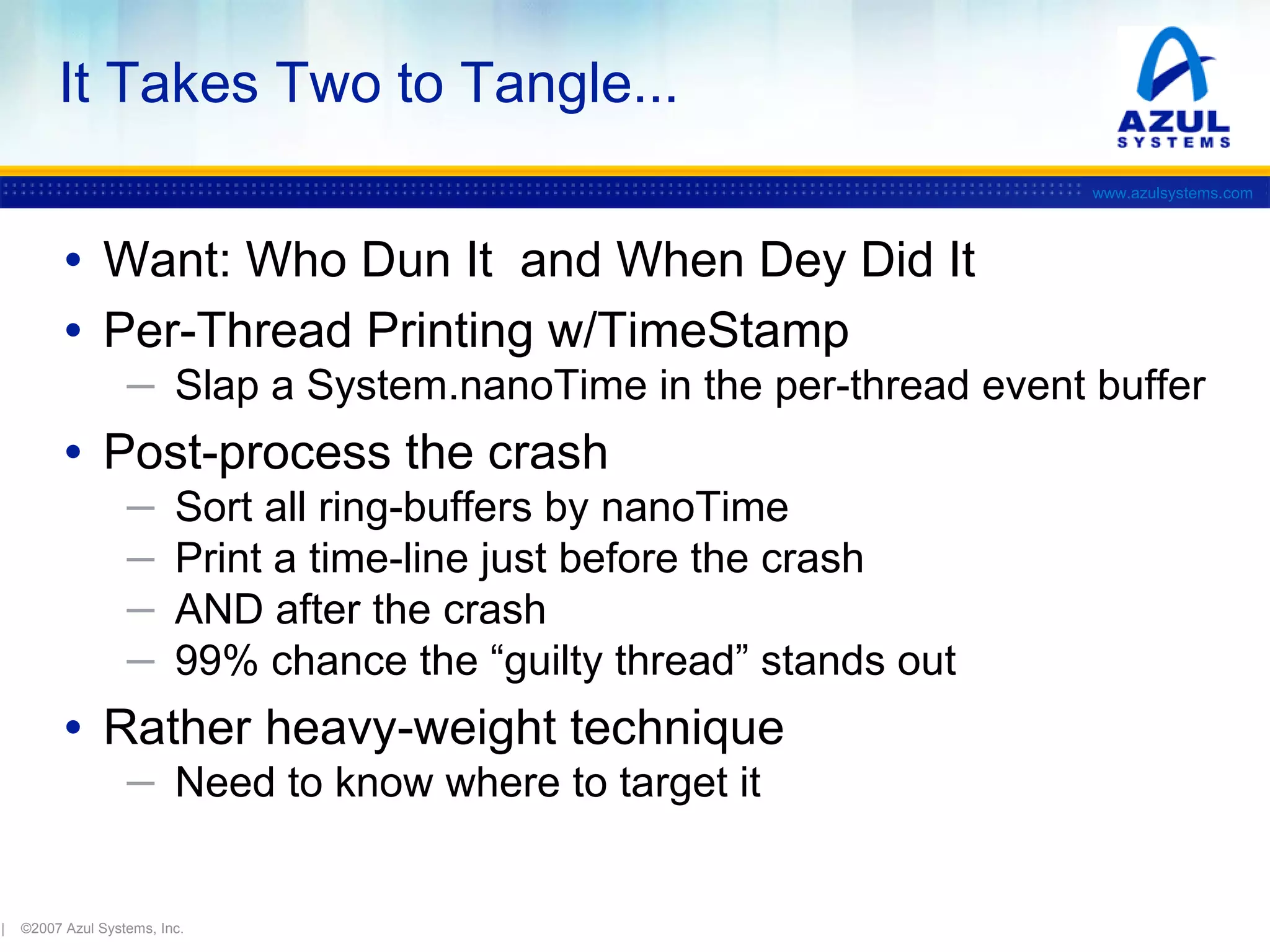
• Want: Who Dun It and When Dey Did It
• Per-Thread Printing w/TimeStamp
─ Slap a System.nanoTime in the per-thread event buffer

• Post-process the crash
─
─
─
─

Sort all ring-buffers by nanoTime
Print a time-line just before the crash
AND after the crash
99% chance the “guilty thread” stands out

• Rather heavy-weight technique
─ Need to know where to target it

|

©2007 Azul Systems, Inc.
Agenda
www.azulsystems.com

•
•
•
•
•

|

(not very) Formal Stuff
Reordering Memory – A peek under the hood
Common Data Races
Finally(!) Some Debugging Techniques
Summary

©2007 Azul Systems, Inc.
Writing Data Races
www.azulsystems.com

• Often hidden by Good Programming Practice
• Already solving a Large, Complex Problem
• Using abstraction, accessors
─ Giving meaning to memory access
─ In context of L.C.P.

• Need more speed
• So introduce Concurrency, Threads
• Patterns like Double-Checked Locking
─ Or double-read

|

©2007 Azul Systems, Inc.
The Pitfall
www.azulsystems.com

• End up adding Concurrency to L.C.P.
• Fail to recognize Concurrency as a

(subtle) Complex Problem
• Needs its own wrappers, access control
• Interviews w/Data-Race Victims:
─ Often they cannot name the shared vars
─ Don't know which thread can touch what
─ ... or when
• Fix starts with Gathering this info and
asserting Access Control over shared vars
|

©2007 Azul Systems, Inc.
Summary
www.azulsystems.com

• Other techniques
─ Formal proofs? Still not ready for prime-time
─ Although hardware designers make it work

• Statistical
─ I get X fails/month; what happens that often?

• No good answers yet
• Best answers so far:
─ Don't Get Clever w/Concurrency
─ Document, Document, Document
http://www.azulsystems.com/blogs/cliff
|

©2007 Azul Systems, Inc.
#1 Platform for
Business Critical Java™

WWW.AZULSYSTEMS.COM
Thank You

Experiences with Debugging Data Races

  • 1.
    2007 JavaOne Conference ALock-Free Hash Table Debugging Data Races Dr. Cliff Click Chief JVM Architect & Distinguished Engineer blogs.azulsystems.com/cliff Azul Systems May 8, 2007
  • 2.
    A Short DebuggingTale www.azulsystems.com if (method.hasCode() != true ) return false; code = method.getCode(); ...setup; code.execute(); // Throws NPE rarely!!! return true; • Example is real; simplified for slide ─ Many more wrapper layers removed ─ Shown “as if” aggressive inlining • I've debugged dozens of slight variations | ©2007 Azul Systems, Inc.
  • 3.
    Hash Tables www.azulsystems.com • • • • Constant-Time Key-ValueMapping Fast arbitrary function Extendable, defined at runtime Used for symbol tables, DB caching, network access, url caching, web content, etc • Crucial for Large Business Applications ─ > 1MLOC • Used in Very heavily multi-threaded apps ─ > 1000 threads | ©2007 Azul Systems, Inc.
  • 4.
    Agenda www.azulsystems.com • • • • • | (not very) FormalStuff Reordering Memory – A peek under the hood Common Data Races Finally(!) Some Debugging Techniques Summary ©2007 Azul Systems, Inc.
  • 5.
    What IS aData Race? www.azulsystems.com • Formally: ─ Two threads accessing the same memory ─ At least one is writing ─ And no language-level ordering • Informally: ─ Broken attempt to use more CPUs ─ (but can happen with 1 CPU) • Generally because 1 CPU is too slow ─ End of frequency scaling :-( • Multi-core, dual-socket, big server, etc | ©2007 Azul Systems, Inc.
  • 6.
    Timeline of aData Race www.azulsystems.com T1 T2 flush_old_cache r1 = _code if( !r1 ) ... _code = null r1 = _code call exec(r1) | ©2007 Azul Systems, Inc. • Two threads
  • 7.
    Timeline of aData Race www.azulsystems.com T1 T2 flush_old_cache r1 = _code if( !r1 ) ... _code = null r1 = _code call exec(r1) | ©2007 Azul Systems, Inc. • Two threads • Accessing same memory
  • 8.
    Timeline of aData Race www.azulsystems.com T1 T2 flush_old_cache r1 = _code if( !r1 ) ... _code = null r1 = _code call exec(r1) | ©2007 Azul Systems, Inc. • Two threads • Accessing same memory • At least one is writing
  • 9.
    Timeline of aData Race www.azulsystems.com T1 T2 flush_old_cache r1 = _code if( !r1 ) ... _code = null r1 = _code call exec(r1) | ©2007 Azul Systems, Inc. • • • • Two threads Accessing same memory At least one is writing No language-level ordering
  • 10.
    Timeline of aData Race www.azulsystems.com T1 T2 flush_old_cache r1 = _code if( !r1 ) ... _code = null r1 = _code call exec(r1) | ©2007 Azul Systems, Inc. • OK if: ─ Write before 1st Read OR ─ Write after 2nd Read • Broken if in-between • Pot-Luck based on OS thread schedule • Crash rarely in testing • More context switches under heavy load • Crash routine in production
  • 11.
    Agenda www.azulsystems.com • • • • • | (not very) FormalStuff Reordering Memory – A peek under the hood Common Data Races Finally(!) Some Debugging Techniques Summary ©2007 Azul Systems, Inc.
  • 12.
    Reordering Memory Ops www.azulsystems.com T1 T2 _datum= stuff _flag = true r1 = _flag if( !r1 ) ... r2 = _datum | ©2007 Azul Systems, Inc. • Writing 2 fields • Can T2 see stale _datum? • Yes!
  • 13.
    Reordering Memory Ops www.azulsystems.com T1 T2 r2= _datum _datum = stuff • • • • Writing 2 fields Can T2 see stale _datum? Yes! Compiler can reorder ─ Standard faire for -O _flag = true r1 = _flag if( !r1 ) ... • Java: make _flag volatile • C/C++: dicier ─ no C memory model yet | ©2007 Azul Systems, Inc.
  • 14.
    Reordering Memory Ops www.azulsystems.com T1 T2 r1= _flag if( !r1 ) ... // predict r2 = _datum _datum = stuff _flag = true ...r1 true ...so keep r2 • • • • • • • Writing 2 fields Can T2 see stale _datum? Yes! Hardware can reorder Load _flag misses cache Predict r1==true Speculatively load _datum early, hits cache • _flag comes back true • Keep speculative _datum | ©2007 Azul Systems, Inc.
  • 15.
    Reordering Memory Ops www.azulsystems.com T1 T2 _datum= stuff membar st-st _flag = true r1 = _flag if( !r1 ) ... membar ld-ld r2 = _datum | ©2007 Azul Systems, Inc. • • • • • • Writing 2 fields Can T2 see stale _datum? No! Need store-side ordering Need load-side ordering Included in Java volatile
  • 16.
    Reordering Memory Ops www.azulsystems.com T1 T2 r1= _flag if( !r1 ) ... // predict r2 = _datum _datum = stuff membar st-st _flag = true ...r1 true ...so keep r2 | ©2007 Azul Systems, Inc. • • • • • • • • Writing 2 fields Can T2 see stale _datum? Yes! Missing load-ordering Read of _flag misses Predict branch Fetch _datum early Confirm good branch
  • 17.
    Reordering Memory Ops www.azulsystems.com T1 T2 _datum= stuff _flag = true r1 = _flag if( !r1 ) ... membar ld-ld r2 = _datum ...stuff actually ...visible | ©2007 Azul Systems, Inc. • • • • • • • • Writing 2 fields Can T2 see stale _datum? Yes! Missing store ordering Write of _datum misses Write of _flag hits cache T2 reads _flag T2 reads stale _datum
  • 18.
    Agenda www.azulsystems.com • • • • • | (not very) FormalStuff Reordering Memory – A peek under the hood Common Data Races Finally(!) Some Debugging Techniques Summary ©2007 Azul Systems, Inc.
  • 19.
    Common Data Races www.azulsystems.com •My experiences only • Double-read with write in the middle: if( _p != null ) ... _p._fld... _p = null; • ...and it's usually a null write • Two writes with reads in the middle: _size++; _array=new[_size]; • Double Checked Locking: | ©2007 Azul Systems, Inc. ..._array[_size-1]... if( _global == null ) synchronized(x) if( _global == null ) _global = new;
  • 20.
    Double Checked Locking www.azulsystems.com T1 T2 r1= new _global = r1 r1 = _global if( !r1 ) ... r2 = r1._fld r1._fld = stuff membar st-st • • • • • Initializing global singleton Can T2 see stale _fld? Yes! Misplaced store-ordering Unlock puts barrier AFTER both writes ─ Not between • Actually missing loadordering as well ─ True data dependency ─ Only IA64 might reorder? | ©2007 Azul Systems, Inc.
  • 21.
    More On Double-Read www.azulsystems.com •if( _p != null ) ..._p._fld... • Compiler likes to CSE together ─ C: Crashes in debug, not product ─ Java: Crashes before high-opt JIT kicks in • • • • | Crashes when context-switch between reads i.e., just as heavy load hits system If you survive startup, might last a long time Bug can persist for years ─ Plenty of personal experience here... ©2007 Azul Systems, Inc.
  • 22.
    Getting Clever w/HashMap www.azulsystems.com •Using a collection unsafely, and catching NPE ─ But not catching rarer AIOOB ─ Bit a customer AND in-house engineer • Idea: HashMap w/single writer, many readers ─ No locking needed since 1 writer ─ Readers sometimes see ½ of 'put' ─ Throw NPE occasionally; catch & retry • Writer is mid-resize, reader hashes to larger table ─ But does lookup on smaller table, Bang! • Reader calls size(), size() calls resize, Bang! | ©2007 Azul Systems, Inc.
  • 23.
    Agenda www.azulsystems.com • • • • • | (not very) FormalStuff Reordering Memory – A peek under the hood Common Data Races Finally(!) Some Debugging Techniques Summary ©2007 Azul Systems, Inc.
  • 24.
    Visual Inspection www.azulsystems.com • • • • • Easy toget started with Works on core files; after the fact Very slow per LOC Just obtaining the code is often a problem Sometimes can make a more directed search ─ e.g., Stack trace points out where somebody failed ─ Play mental Sherlock Holmes w/self • Does not scale • Requires Memory Model expert, domain expert | ©2007 Azul Systems, Inc.
  • 25.
    Visual Inspection www.azulsystems.com • BiggestFlaw: Not Knowing The Players • Maintainer cannot name shared variables ─ Or which threads can access them ─ Or when they are allowed to touch • Sometimes suffices to Make Access Explicit • Avoiding Double-Read: ─ Often requires changing accessor patterns ─ Cache in a local variable ─ Return flag & value in 1 shot | ©2007 Azul Systems, Inc.
  • 26.
    Visual Inspection www.azulsystems.com • • • • 2nd BiggestFlaw: forgetting “The Cycle” Concurrent code does: {start, do, end} Inspect: two threads both doing {start, do, end} But code in a cycle! ─ ...start, do, end, stuff, start, do, end, stuff... • Inspect: two threads both doing {end, stuff, start} • Inspect: {start, do, end} vs {end, stuff, start} ─ (chasing each others' tail) | ©2007 Azul Systems, Inc.
  • 27.
    Printing www.azulsystems.com • Printing /Logging / Events ─ ─ ─ ─ ─ “Make noise” at each read/write of shared variable Inspect trace after crash Serialized results... ...but blocks; changes timing, hides data-race bugs Also OS can buffer per-thread; WYSI not WYG • Per-Thread Printing ─ ─ ─ ─ | Write “event tokens” (enums) to per-thread ring-buffer No complex String creation, no object creation Much less overhead & no blocking (ring buffer!) Less likely to hide bug ©2007 Azul Systems, Inc.
  • 28.
    It Takes Twoto Tangle... www.azulsystems.com • Want: Who Dun It and When Dey Did It • Per-Thread Printing w/TimeStamp ─ Slap a System.nanoTime in the per-thread event buffer • Post-process the crash ─ ─ ─ ─ Sort all ring-buffers by nanoTime Print a time-line just before the crash AND after the crash 99% chance the “guilty thread” stands out • Rather heavy-weight technique ─ Need to know where to target it | ©2007 Azul Systems, Inc.
  • 29.
    Agenda www.azulsystems.com • • • • • | (not very) FormalStuff Reordering Memory – A peek under the hood Common Data Races Finally(!) Some Debugging Techniques Summary ©2007 Azul Systems, Inc.
  • 30.
    Writing Data Races www.azulsystems.com •Often hidden by Good Programming Practice • Already solving a Large, Complex Problem • Using abstraction, accessors ─ Giving meaning to memory access ─ In context of L.C.P. • Need more speed • So introduce Concurrency, Threads • Patterns like Double-Checked Locking ─ Or double-read | ©2007 Azul Systems, Inc.
  • 31.
    The Pitfall www.azulsystems.com • Endup adding Concurrency to L.C.P. • Fail to recognize Concurrency as a (subtle) Complex Problem • Needs its own wrappers, access control • Interviews w/Data-Race Victims: ─ Often they cannot name the shared vars ─ Don't know which thread can touch what ─ ... or when • Fix starts with Gathering this info and asserting Access Control over shared vars | ©2007 Azul Systems, Inc.
  • 32.
    Summary www.azulsystems.com • Other techniques ─Formal proofs? Still not ready for prime-time ─ Although hardware designers make it work • Statistical ─ I get X fails/month; what happens that often? • No good answers yet • Best answers so far: ─ Don't Get Clever w/Concurrency ─ Document, Document, Document http://www.azulsystems.com/blogs/cliff | ©2007 Azul Systems, Inc.
  • 33.
    #1 Platform for BusinessCritical Java™ WWW.AZULSYSTEMS.COM Thank You