WELCOME TO SCIENCE
CLASS!
Friendly Reminders:
1. Let us be responsible students.
2. Let us be kind and polite.
3. Let us participate actively.
4. Let us learn, enjoy and thankful
5. Let us always give Glory to God.
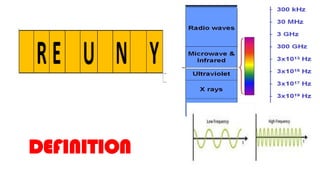
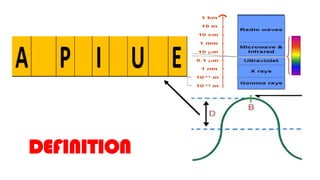
VERBAL and
VISUAL WORD
GAME
DEFINITION
DEFINITION
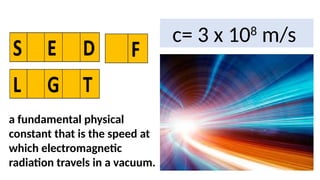
c= 3 x 10⁸
m/s
a fundamental physical
constant that is the speed at
which electromagnetic
radiation travels in a vacuum.
the capacity to do
work.
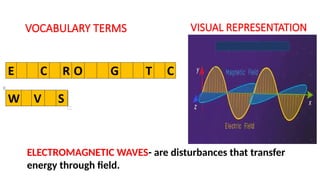
VOCABULARY TERMS VISUAL REPRESENTATION
ELECTROMAGNETIC WAVES- are disturbances that transfer
energy through field.
OBJECTIVES:
1. Explain the relationship between
wavelength and frequency of a wave.
2. Compute for the frequency and
wavelength of a wave.
3. Apply basic mathematical
concept in solving problem.
•ELECTROMAGNETIC
WAVES can be
described by their
wavelengths,
energy, and
frequency. All three
describe a different
property of light,
yet they are related
to each other
mathematically.
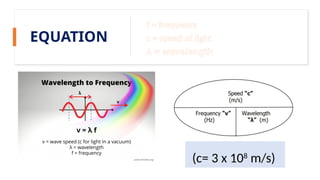
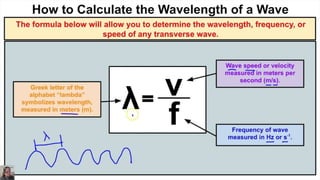
EQUATION
• f = frequency
• c = speed of light
• λ = wavelength
(c= 3 x 10⁸
m/s)
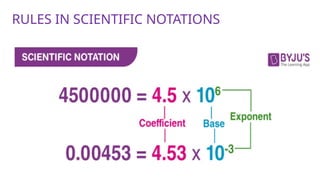
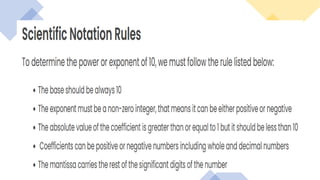
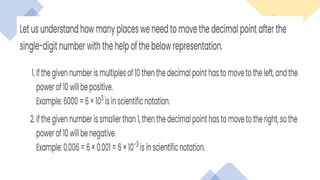
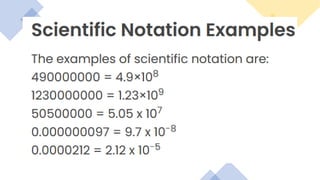
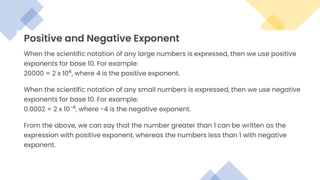
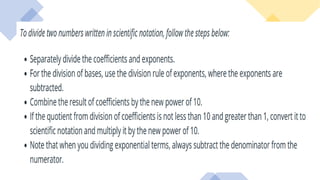
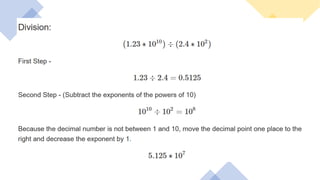
RULES IN SCIENTIFIC NOTATIONS
WORD PROBLEM GAME
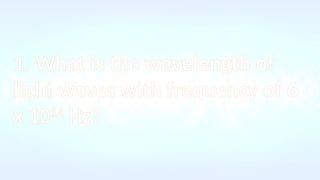
1. What is the wavelength of
light waves with frequency of 6
x 1014
Hz?
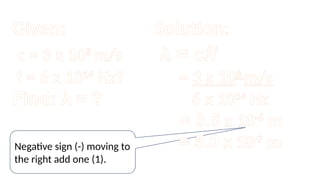
Negative sign (-) moving to
the right add one (1).
Given:
c = 3 x 10⁸
m/s
f = 6 x 10¹⁴
Hz?
Find: λ = ?
Solution:
λ = c/f
= 3 x 10⁸
m/s
6 x 10¹⁴
Hz
= 0.5 x 10⁻⁶
m
= 5.0 x 10⁻⁷
m
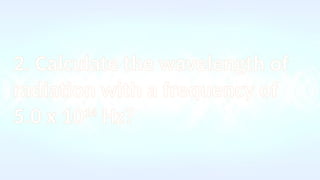
2. Calculate the wavelength of
radiation with a frequency of
5.0 x 10¹⁴
Hz?
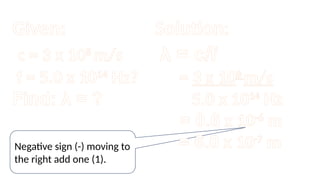
Negative sign (-) moving to
the right add one (1).
Given:
c = 3 x 10⁸
m/s
f = 5.0 x 10¹⁴
Hz?
Find: λ = ?
Solution:
λ = c/f
= 3 x 10⁸
m/s
5.0 x 10¹⁴
Hz
= 0.6 x 10⁻⁶
m
= 6.0 x 10⁻⁷
m
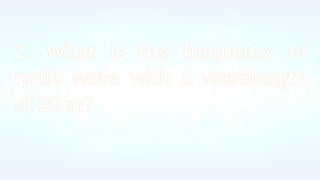
2. What is the frequency of
radio wave with a wavelength
of 20 m?
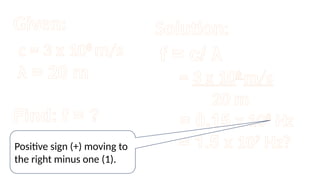
Given:
c = 3 x 10⁸
m/s
λ = 20 m
Find: f = ?
Solution:
f = c/ λ
= 3 x 10⁸
m/s
20 m
= 0.15 x 10⁸
Hz
= 1.5 x 10⁷
Hz?
Positive sign (+) moving to
the right minus one (1).
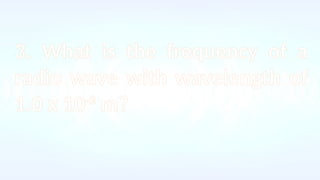
3. What is the frequency of a
radio wave with wavelength of
1.0 x 10⁻³
m?
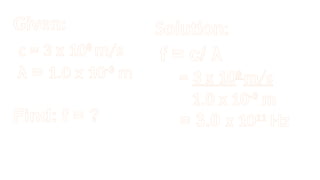
Given:
c = 3 x 10⁸
m/s
λ = 1.0 x 10⁻³
m
Find: f = ?
Solution:
f = c/ λ
= 3 x 10⁸
m/s
1.0 x 10⁻³
m
= 3.0 x 10¹¹
Hz
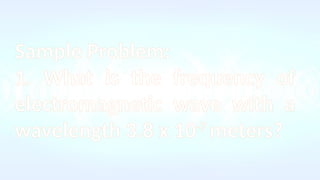
Sample Problem:
1. What is the frequency of
electromagnetic wave with a
wavelength 3.8 x 10⁻⁷
meters?
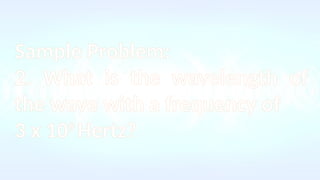
Sample Problem:
2. What is the wavelength of
the wave with a frequency of
3 x 10⁹
Hertz?
As the frequency of the wave
increases, wavelengths decreases.
In problem number 1, how do varying wavelengths
affect the frequency of a wave?
As wavelengths decreases, the frequency of the
waves increases.
In problem number 2, how do varying frequencies
affect the wavelength of a wave?
Therefore, the higher the
frequency of an electromagnetic
wave, the more electromagnetic
energy it carries. Interestingly, the
frequency of an electromagnetic
wave is inversely proportional to its
wavelength, which means that the
larger the frequency of such wave,
the shorter its wavelength, and vice
versa.
2-ppt-electromagnetic-wave-equation.pptx

2-ppt-electromagnetic-wave-equation.pptx

  • 1.
  • 2.
    Friendly Reminders: 1. Letus be responsible students. 2. Let us be kind and polite. 3. Let us participate actively. 4. Let us learn, enjoy and thankful 5. Let us always give Glory to God.
  • 3.
  • 4.
  • 5.
  • 6.
    c= 3 x10⁸ m/s a fundamental physical constant that is the speed at which electromagnetic radiation travels in a vacuum.
  • 7.
  • 8.
    VOCABULARY TERMS VISUALREPRESENTATION ELECTROMAGNETIC WAVES- are disturbances that transfer energy through field.
  • 9.
    OBJECTIVES: 1. Explain therelationship between wavelength and frequency of a wave. 2. Compute for the frequency and wavelength of a wave. 3. Apply basic mathematical concept in solving problem.
  • 10.
    •ELECTROMAGNETIC WAVES can be describedby their wavelengths, energy, and frequency. All three describe a different property of light, yet they are related to each other mathematically.
  • 11.
    EQUATION • f =frequency • c = speed of light • λ = wavelength (c= 3 x 10⁸ m/s)
  • 13.
  • 20.
  • 21.
    1. What isthe wavelength of light waves with frequency of 6 x 10¹⁴ Hz?
  • 22.
    Negative sign (-)moving to the right add one (1). Given: c = 3 x 10⁸ m/s f = 6 x 10¹⁴ Hz? Find: λ = ? Solution: λ = c/f = 3 x 10⁸ m/s 6 x 10¹⁴ Hz = 0.5 x 10⁻⁶ m = 5.0 x 10⁻⁷ m
  • 23.
    2. Calculate thewavelength of radiation with a frequency of 5.0 x 10¹⁴ Hz?
  • 24.
    Negative sign (-)moving to the right add one (1). Given: c = 3 x 10⁸ m/s f = 5.0 x 10¹⁴ Hz? Find: λ = ? Solution: λ = c/f = 3 x 10⁸ m/s 5.0 x 10¹⁴ Hz = 0.6 x 10⁻⁶ m = 6.0 x 10⁻⁷ m
  • 25.
    2. What isthe frequency of radio wave with a wavelength of 20 m?
  • 26.
    Given: c = 3x 10⁸ m/s λ = 20 m Find: f = ? Solution: f = c/ λ = 3 x 10⁸ m/s 20 m = 0.15 x 10⁸ Hz = 1.5 x 10⁷ Hz? Positive sign (+) moving to the right minus one (1).
  • 27.
    3. What isthe frequency of a radio wave with wavelength of 1.0 x 10⁻³ m?
  • 28.
    Given: c = 3x 10⁸ m/s λ = 1.0 x 10⁻³ m Find: f = ? Solution: f = c/ λ = 3 x 10⁸ m/s 1.0 x 10⁻³ m = 3.0 x 10¹¹ Hz
  • 30.
    Sample Problem: 1. Whatis the frequency of electromagnetic wave with a wavelength 3.8 x 10⁻⁷ meters?
  • 31.
    Sample Problem: 2. Whatis the wavelength of the wave with a frequency of 3 x 10⁹ Hertz?
  • 32.
    As the frequencyof the wave increases, wavelengths decreases. In problem number 1, how do varying wavelengths affect the frequency of a wave? As wavelengths decreases, the frequency of the waves increases. In problem number 2, how do varying frequencies affect the wavelength of a wave?
  • 33.
    Therefore, the higherthe frequency of an electromagnetic wave, the more electromagnetic energy it carries. Interestingly, the frequency of an electromagnetic wave is inversely proportional to its wavelength, which means that the larger the frequency of such wave, the shorter its wavelength, and vice versa.

Editor's Notes

  • #13 Scientific notation is a form of presenting very large numbers or very small numbers in a simpler form. As we know, the whole numbers can be extended till infinity, but we cannot write such huge numbers on a piece of paper. Also, the numbers which are present at the millions place after the decimal needed to be represented in a simpler form. Thus, it is difficult to represent a few numbers in their expanded form. Hence, we use scientific notations.
  • #14 Mantissa- is the number which occurs before the 10m part. For example, in 2.34 x 10⁴, the mantissa is 2.34
  • #22 In division subtract the exponent, change the sign of the subtrahend. Then follow the rules in addition. (Like sign add and copy the sign of the absolute (kadakulo numero) number) Unlike sign copy the sign of the sign of the number with greater value. From lesser value (0.5) to greater value (5.0) add 1. Do not change the sign of the exponent.
  • #24 In division subtract the exponent, change the sign of the subtrahend. Then follow the rules in addition. (Like sign add and copy the sign of the absolute (kadakulo numero) number) Unlike sign copy the sign of the sign of the number with greater value. From lesser value (0.5) to greater value (5.0) add 1. Do not change the sign of the exponent.
  • #26 Lesser value (0.15) to greater value (1.5) minus one.
  • #28 Lesser value (0.15) to greater value (1.5) minus one.
  • #33 The shorter the wavelength, the higher the frequency. Hence, frequency and wavelength are inversely proportional to each other.