2 JOHN COMMENTARY
EDITED BY GLENN PEASE
1
The elder,
To the lady chosen by God and to her children, whom
I love in the truth—and not I only, but also all who
know the truth—
1.BARNES. “The elder - See the introduction, Section 1, (2,d).
Unto the elect lady - The elect or chosen Kyria. See the introduction, Section 2. He
addresses her as one chosen of God to salvation, in the use of a term often applied to Christians
in the New Testament.
And her children - The word here rendered “children” (τέκνοις teknois) would include in
itself both sons and daughters, but since the apostle immediately uses a masculine pronoun, τοις
tois it would seem more probable that sons only were intended. At all events, the use of such a
pronoun proves that some at least of her children were sons. Of their number and character we
have no information, except that (the notes at 2Jo_1:4) a part of them were Christians.
Whom I love in the truth - See the notes, Joh_3:18. The meaning here is, that he “truly” or
“sincerely” loved them. The introduction of the article the here, which is not in the original, (ᅚν ᅊ
ληθίᇮ en alethia) somewhat obscures the sense, as if the meaning were that he loved them so far
as they embraced the truth. The meaning however is, that he was sincerely attached to them.
The word “whom” here, (οཋς hous,) embraces both the mother and her children, though the
pronoun is in the masculine gender, in accordance with the usage of the Greek language. No
mention is made of her husband, and it may thence be inferred that she was a widow. Had he
been living, though he might not have been a Christian, it is to be presumed that some allusion
would have been made to him as well as to the children, especially since there is reason to
believe that only some of her children were pious. See the notes, 2Jo_1:4.
And not I only, but also all they that have known the truth - That is, all those
Christians who had had an opportunity of knowing them, were sincerely attached to them. It
would seem, from a subsequent part of the Epistle 2Jo_1:10, that this female was of a hospitable
character, and was accustomed to entertain at her house the professed friends of religion,
especially religious teachers, and it is probable that she was the more extensively known from
this fact. The commendation of the apostle here shows that it is possible that a family shall be
extensively known as one of order, peace, and religion, so that all who know it or hear of it shall
regard it with interest, respect, and love.
2. CLARKE, “The elder - John the apostle, who was now a very old man, generally
supposed to be about ninety, and therefore he uses the term ᆇ πρεσβυτερος, presbyter or elder,
not as the name of an office, but as designating his advanced age. He is allowed to have been the
oldest of all the apostles, and to have been the only one who died a natural death.
This title led some of the ancients to attribute this epistle to a person called John the
Presbyter, a member of the Church at Ephesus; and not to John the apostle. But this is a
groundless supposition.
The elect lady - Εκλεκτᇽ Κυρια· As Κυρια, kuria, may be the feminine of Κυριος, kurios, lord,
therefore it may signify lady; and so several, both ancients and moderns, have understood it. But
others have considered it the proper name of a woman, Kyria; and that this is a very ancient
opinion is evident from the Peshito Syriac, the oldest version we have, which uses it as a proper
name koureea, as does also the Arabic kooreea.
Some have thought that Eclecta was the name of this matron, from the word εκλεκτη, which
we translate elect, and which here signifies the same as excellent, eminent, honorable, or the
like. Others think that a particular Church is intended, which some suppose to be the Church at
Jerusalem, and that the elect sister, 2Jo_1:13, means the Church at Ephesus; but these are
conjectures which appear to me to have no good ground. I am satisfied that no metaphor is here
intended; that the epistle was sent to some eminent Christian matron, not far from Ephesus,
who was probably deaconess of the Church, who, it is likely, had a Church at her house, or at
whose house the apostles and traveling evangelists frequently preached, and were entertained.
This will appear more probable in the course of the notes.
Whom I love in the truth - Whom I love as the Christian religion requires us to love one
another.
And not I only - She was well known in the Churches; many had witnessed or heard of her
fidelity, and partook of her hospitality; so that she had a good report of all Christians in that
quarter.
3. GILL, “The elder unto the elect lady and her children,.... By the "elder" is meant the
writer of this epistle, the Apostle John, who so calls himself either on account of his age, he
being now near an hundred years of age, having outlived all the apostles: or on account of his
office, being a bishop or overseer, not only of the church at Ephesus, but of all the Asiatic
churches, which is the same with an elder; nor is this incompatible with his being an apostle; see
1Pe_5:1, the elect lady is the person he writes unto; by whom is designed not the church of
Christ, since such a way of speaking is unusual; and besides, he speaks of coming to see her face
to face, and of the children of her elect sister: but some particular person, some rich, as well as
gracious woman of John's acquaintance; and these words, "elect lady", are neither of them
proper names of the person: some think that the word "Kyria", rendered "lady", was the name of
the person, as "Domina" with the Romans, and answers to the Hebrew word "Martha"; for as ‫,מר‬
"Mar", signifies lord, so ‫,מרתא‬ "Martha, lady"; and then the inscription runs, "to the choice" or
"excellent Martha"; and the Syriac and Arabic versions read, "to the elect Kyria": and others
think that the word rendered elect is a proper name, and that this person's name was "Electa",
as "Electus" (d) is a man's name; and then it must read thus, "to the lady Electa"; but her sister
also is so called, and it can hardly be thought that two sisters should be both of a name; neither
of them are proper names, but characters and titles of respect and honour: she is called a "lady",
because she was a person of distinction and substance, which shows that God sometimes calls by
his grace some that are rich and noble; and also that titles of respect and honour, where flattery
is avoided, may be lawfully given to persons of dignity and wealth; so Nazianzen (e) calls his own
mother by the same title; and it was usual to call women by this name from fourteen years of age
(f): and this person also is said to be "elect"; either because she was a choice, famous, and
excellent person, not only for her birth, nobility, and riches, but for her virtue, grace, and good
works; or because she was chosen unto eternal life and salvation; and which the apostle might
know without a special and divine revelation, by the Gospel coming with power to her; by the
grace that was wrought in her; by the faith of God's elect, which she appeared to have, seeing it
worked by love; and which may be, and ought to be concluded in a judgment of charity, of
everyone that professes faith in Christ, and walks according to it; and this also makes it appear
that election is of particular persons, and not of nations, communities, and churches, as such;
nor is it unusual to salute single persons under this character; see Rom_16:13, this epistle is
inscribed not only to this lady, but also to "her children"; who were not infants, but grown up,
and had made a profession of the truth, and walked in it, 2Jo_1:4, and both the mother and the
children the apostle represents as the objects of his love:
whom I love in the truth; either as being in the truth and faith of the Gospel; for though all
men are to be loved as men, and to be done well to, yet they that are of the household of faith, or
are in the faith, are in and especial manner to be loved and respected; see Gal_6:10; or the sense
is, that the apostle loved this lady and her children sincerely and heartily, without dissimulation;
not in word and in tongue, but in deed and in truth, 1Jo_3:18,
and not I only, but also all they that have known the truth; either the Lord Jesus Christ,
who is the truth; not with a notional knowledge, but with the knowledge of approbation and
affection; with a fiducial and appropriating one: or the Gospel, the word of truth; not with a
speculative, but with a spiritual and experimental knowledge of it: and this is not to be
understood of every individual person then living, which had such a knowledge of the truth; for
it cannot be reasonably thought that every individual person should know this lady and her
children; but of all such persons who had any knowledge of them; for such who are born again
by the word of truth, love not only him that begot them, but all those who are begotten of him:
this shows in what sense the word "all" is sometimes taken.
4. HENRY, “Ancient epistles began, as here, with salutation and good wishes: religion
consecrates, as far as may be, old forms, and turns compliments into real expressions of life and
love. Here we have, as usually,
I. The saluter, not expressed by name, but by a chosen character: The elder. The expression,
and style, and love, intimate that the penman was the same with that of the foregoing epistle; he
is now the elder, emphatically and eminently so; possibly the oldest apostle now living, the chief
elder in the church of God. An elder in the ancient house of Israel was reverend, or to be
reverenced, much more he who is so In the gospel Israel of God. An old disciple is honourable;
and old apostle and leader of disciples is more so. He was now old in holy service and
experience, had seen and tasted much of heaven, and was much nearer than when at first he
believed.
II. The saluted - a noble Christian matron, and her children: To the elect lady and her children.
A lady, a person of eminent quality for birth, education, and estate. It is well that the gospel ha
got among such. It is a pity but lords and ladies should be acquainted with the Lord Christ and
his religion. They owe more to him than others do; though usually not many noble are called.
Here is a pattern for persons of quality of the same sex. The elect lady; not only a choice one, but
one chosen of God. It is lovely and beautiful to see ladies, by holy walking, demonstrate their
election of God. And her children; probably the lady was a widow; she and her children then are
the principal part of the family, and so this may be styled an economical epistle. Families may
well be written to and encouraged, and further directed in their domestic love, and order, and
duties. We see that children may well be taken notice of in Christian letters, and they should
know it too; it may avail to their encouragement and caution. Those who love and commend
them will be apt to enquire after them. This lady and her children are further notified by the
respect paid them, and that, 1. By the apostle himself: Whom I love in the truth, or in truth,
whom I sincerely and heartily love. He who was the beloved disciple had learnt the art or
exercise of love; and he especially loved those who loved him, that Lord who loved him. 2. By all
her Christian acquaintance, all the religious who knew her: And not I only, but also all those
that have known the truth. virtue and goodness in an elevated sphere shine brightly. Truth
demands acknowledgment, and those who see the evidences of pure religion should confess and
attest them; it is a good sign and great duty to love and value religion in others. The ground of
this love and respect thus paid to this lady and her children was their regard to the truth: For the
truth's sake (or true religion's sake) which dwelleth in us, and shall be with us for ever.
Christian love is founded upon the appearance of vital religion. Likeness should beget affection.
Those who love truth and piety in themselves should love it in others too, or love others upon
the account of it. The apostle and the other Christians loved this lady, not so much for her
honour as her holiness; not so much for her bounty as her serious Christianity. We should not be
religious merely by fits and starts, in certain moods and moons; but religion should still dwell
within us, in our minds and hearts, in our faith and love. It is to be hoped that where religion
once truly dwells it will abide for ever. The Spirit of Christianity, we may suppose, will not be
totally extinguished: Which shall be with us for ever.
5.JAMISON, “2Jo_1:1-13. Address: Greeting: Thanksgiving for the elect lady’s faithfulness
in the truth: Enjoins love: Warns against deceivers, lest we lose our reward: Conclusion.
The elder — In a familiar letter John gives himself a less authoritative designation than
“apostle”; so 1Pe_5:1.
lady — Bengel takes the Greek as a proper name Kyria, answering to the Hebrew “Martha.”
Being a person of influence, “deceivers” (2Jo_1:7) were insinuating themselves into her family to
seduce her and her children from the faith [Tirinus], whence John felt it necessary to write a
warning to her. (But see my Introduction and see on 1Pe_5:13). A particular Church, probably
that at Babylon, was intended. “Church” is derived from Greek “Kuriake,” akin to Kuria, or Kyria
here; the latter word among the Romans and Athenians means the same as ecclesia, the term
appropriated to designate the Church assembly.
love in the truth — Christian love rests on the Christian truth (2Jo_1:3, end). Not merely “I
love in truth,” but “I love in THE truth.”
all — All Christians form one fellowship, rejoicing in the spiritual prosperity of one another.
“The communion of love is as wide as the communion of faith” [Alford].
5B, IVP COMMENTARY, “Unlike 1 John, 2 John has the formal characteristics of a true
letter: the sender and recipients are iden tified and a greeting typical of ancient letters is
passed on to them. And yet the identification of the author is unusual, for where one
would expect a personal name, the author refers to himself only as the Elder (ho
presbyteros). Literally the word means someone who is old, but because those who
were old were deemed to have wisdom and expe rience that qualified them to be
leaders, an "elder" was someone who was also in a position of authority (Deut 19:12;
Josh 20:4; Ruth 4:2; Ezra 10:4; Acts 11:30; 14:23; 15:2, 23; 16:4; 20:17; Jas 5:14; 1 Pet
5:1; 1 Tim 5:17; Tit 1:5). The Elder must have been well known and respected by his
readers. He expects them to recognize him without further identi fication and to follow
his instructions. As in 1 John, he speaks of them as children (vv. 4, 13), suggesting both
the intimacy and the authority he has with them. That he is writing to other
congregations suggests that his authority extends beyond one local congregation.
The congregation to which he is writing is designated metaphorically as the chosen lady
and her children;we would say "the church and its members." Regularly in the
Scriptures Israel or the church is designated as a woman or the bride of Yahweh or
Christ (Is 54:1, 13; Jer 6:21; 31:21; Lam 4:2-3; Jn 3:29; 2 Cor 11:2; Gal 4:25-26; Eph
5:22; Rev 18--19). Chosen recalls Jesus' statement in John 15:16, "You did not choose
me, but I chose you." The church is not a voluntary organization but the fellowship of
those called together by Christ. For such a fellowship, family imagery is all the more
appropriate, for it suggests the bonds of intimacy and love that bind the family together.
Family imagery also underscores that it was not by the children's initiative that this
family came into existence.
In his greeting to the congregation the Elder repeats two important themes: truth (vv. 1-
4) and love (vv. 1, 3, 5-6). Truth includes matters of both faith and practice, and thus
designates what Christians are to believe (v. 7; 1 Jn 4:2; 5:6) and how they are to live
(vv. 5-6). Truth is the reality to which Christians are committed, and they are known by
their commitment to it.
But that reality is not simply a static and objective entity or set of beliefs. We tend to
think of truth as a number of abstract propositions that we are to comprehend and
believe. But for the Elder, truth is a vital force that can be personified as living in us and
being with us. Because it comes from the living God, truth is a dynamic power that
abides with believers, enabling them to know what is true. And because truth comes
from God, it exists forever and remains with the faithful, just as God exists eternally and
remains in relationship with the faithful. If we could capture John's view of truth as a
force that, because it is the work of God's own Spirit, shapes and empowers us, we
might be less prone to think of truth as something that depends upon us to preserve it.
In reality, we depend upon the truth to guard us--and not vice versa--because we
depend upon God. Only as the truth abides in us do we abide in the truth. But we are
somewhat too quick to reverse that relationship, and put human beings in the place
where God's activity and power belong.
The actual greeting is similar to the somewhat standardized greetings and blessings
found in other New Testament epistles (such as Rom 1:7; Gal 6:16; 1 Tim 1:2; 2 Tim
1:2; Jude 2). This is the only use of mercyin the Johannine writings. Six other instances
of peace appear, all in the Gospel of John (14:27; 16:33; 20:19, 21, 26). Peace is the
assurance that Christians have in knowing that, whatever the world may bring, they are
kept secure in God's love and truth by God's own power (Jn 14:27; 16:33).
Surprisingly, graceappears elsewhere only in the Gospel of John, and then only in the
opening prologue (Jn 1:14, 16-17). Grace summar izes the revelation and salvation that
we have received in the Incarnate Word. So while the opening greeting of 2 John may
well echo a standard form of greeting, we should understand its content in light of the
Chris tian conception of grace, mercy and peace, supremely manifested in God's work
in Jesus Christ. Those who live in Christ can be confident that grace, mercy and
peace will be and are theirs. Thus the greeting is really a promise: grace, mercy and
peace . . . will [always] be with us.
6. PULPIT, “FROM very early times some have held the opinion that the Second Epistle is addressed
to a community, which is spoken of allegorically as "the elect lady," her "elect sister" being a sister
community; but at no time does there seem to have been any doubt that the Third Epistle is addressed to
an individual. It certainly would be an extravagant hypothesis that Gains symbolizes a Church.
3Jn_1:1
To Gaius the beloved ( Γαΐ́ῳ τῷ ἀγαπητῷ ). This is additional reason for thinking that κυρία in the Second
Epistle is not a proper name; if it were we should probably have the same formula as we have
here, Κυρίᾳ τῇ ἐκλεκτῇ . The name Gaius occurs elsewhere in the New Testament four times
(Act_19:29; Act_20:4; Rom_16:23; 1Co_1:14); as it was as common in the Roman Empire as John
Smith is among ourselves, it would be rash to infer that the Gaius addressed here is the same as any of
those mentioned elsewhere. In all probability there are at least four persons of this name in the New
Testament. In the opening of this Epistle also we have to remark the characteristic repetition of the word
"truth," which occurs four times in the first four verses. Deeds, in which Gaius and Demetrius were rich,
not words, of which Diotrephes was so prodigal, are what win the approbation and love of the apostle.
The thing which he hates is unreality; the object of his special adoration is "the truth;" "to walk in the truth"
is nothing less than to follow in the footsteps of the Lord.
7. DR. GRANT RICHIESON, “THE ELDER,
There are two main usages of the word “elder” in the New Testament: 1) a
person old in age (Acts 2:17) and 2) someone who holds the office or rank of
leadership in the local church (Acts 20:17, 18; Ti 1:5,7). The “elder” here is the
apostle John who holds rank in the cause of Christ.
Ac 20:17 “From Miletus he sent to Ephesus and called for the elders of the
church 28 “Therefore take heed to yourselves and to all the flock, among
which the Holy Spirit has made you overseers, to shepherd the church of God
which He purchased with His own blood.”
1 Pe 5:1 “The elders who are among you I exhort, I who am a fellow elder and
a witness of the sufferings of Christ, and also a partaker of the glory that will
be revealed ”
Titus 1:5 “For this reason I left you in Crete, that you should set in order the
things that are lacking, and appoint elders in every city as I commanded you—
6 if a man is blameless, the husband of one wife, having faithful children not
accused of dissipation or insubordination. 7 For a bishop [a bishop is an elder]
must be blameless, as a steward of God, not self-willed, not quick-tempered,
not given to wine, not violent, not greedy for money, 8 but hospitable, a lover
of what is good, sober-minded, just, holy, self-controlled, 9 holding fast the
faithful word as he has been taught, that he may be able, by sound doctrine,
both to exhort and convict those who contradict.”
To the elect lady and her children,
Some interpreters believe that the phrase “elect lady and her children” refers
metaphorically to the local church in Ephesus and its constituents. However, it
is more natural or normal to take this phrase literally as a woman and her
children. John does not name this woman.
The “elect lady” is a lady chosen of God. This “elect lady” was probably a
widow with children. God chooses women to do His work.
Apparently the “elect lady” exercised love at the expense of truth. She showed
hospitality to itinerate false teachers. These people denied Jesus as the
sovereign Son of God. Genuine hospitality does not advance error. Love
should never violate truth; instead, genuine love upholds truth. There is a
close relationship between truth and love in the Scriptures.
PRINCIPLE: True biblical love is always bound by truth.
APPLICATION: There is a close relationship between truth and love in the
Word of God. Truth is the motivation and context of genuine Christian love.
True love is bound by truth. Pop psychology says that we love people
regardless of what they believe. It contends that we are to put aside what we
believe. Divergence and pluralism are the new standard of orientation to
people. The principles of the Word never surrender truth for love. Faithfulness
to truth overshadows and governs true biblical love.
2 Co 13:7 “Now I pray to God that you do no evil, not that we should appear
approved, but that you should do what is honorable, though we may seem
disqualified. 8 For we can do nothing against the truth, but for the truth.”
Ga 2:11 “Now when Peter had come to Antioch, I withstood him to his face,
because he was to be blamed; 12 for before certain men came from James,
he would eat with the Gentiles; but when they came, he withdrew and
separated himself, fearing those who were of the circumcision. 13 And the
rest of the Jews also played the hypocrite with him, so that even Barnabas
was carried away with their hypocrisy. 14 But when I saw that they were not
straightforward about the truth of the gospel, I said to Peter before them all, ‘If
you, being a Jew, live in the manner of Gentiles and not as the Jews, why do
you compel Gentiles to live as Jews?’”
Everything we specifically know about God is through the truth of Scripture.
Jn 8:31 “Then Jesus said to those Jews who believed Him, ‘If you abide in My
word, you are My disciples indeed. 32 “And you shall know the truth, and the
truth shall make you free.’”
2 Ti 2:15 “Be diligent to present yourself approved to God, a worker who does
not need to be ashamed, rightly dividing the word of truth.”
Jas 1:18 “Of His own will He brought us forth by the word of truth, that we
might be a kind of firstfruits of His creatures.”
*********************************************************
2 John 1 whom I love in truth,
“Love” here is not romantic love. “Whom” is in the plural, making reference to
both the “elect lady” and her “children.” John loves these people “in truth.”
Jn 17:17 “Sanctify them by Your truth. Your word is truth.”
The “I” is emphatic in the Greek. It may be that the heretics did not love the
church at Ephesus but merely preyed on them.
“Truth” and “love” are the two major subjects of 2 John. Christian love is more
than mere sentiment. It revolves around the structure of truth. John loves the
“elect lady” and her children in the sphere of truth.
John loves people within the framework of the “truth.” He reiterates the word
“truth” five times in the first four verses. “Truth” refers to the fundamentals of
the Christian faith, so truth is the essential prerequisite for fellowship.
Ti 3:15 “All who are with me greet you. Greet those who love us in the faith.
Grace be with you all. Amen.”
and not only I, but also all those who have known the truth
Many others knowledgeable of the truth and operating in the sphere of truth
also love the “elect lady” and her children. We love the truth because we
came to know Truth Himself.
1 Ti 2:4 “ who desires all men to be saved and to come to the knowledge of
the truth.”
PRINCIPLE: True Christian love revolves around the structure of truth.
APPLICATION: Christians do not love each other because they are
temporarily compatible or naturally drawn to each other, but because of the
truth they share with each other. Unbelievers can come to know the truth of
Christianity in a casual sense, but not in a true and genuine sense.
Biblical love is always conditioned by truth. This love is more than mere
sentiment. It does not lean on the attractiveness of its object. It rests on the
Truth Himself, Jesus the Lord. Christian love rests on Christian truth. We
cannot compromise truth and genuine love biblically. Biblical truth and love
closely interrelate. They are inseparable traveling companions. Genuine love
cannot exist apart from Bible truth. They can never be divorced.
8. BI, “Truth the bond of love
How much is implied very often by the phrase or style with which a letter is begun or ended!
How different is the formal “Sir” from “My dear Sir”; and, again, how much does this differ from
the intimacy which addresses by a Christian name! Those different styles mean a great deal; and
as it is now, so it was in the Apostolic age. St. John calls himself by way of endearment “the
Presbyter,” when writing to a family with which he has been long on terms of intimacy. Nothing
is more welcome to persons of simple character who are in high office than an opportunity of
laying its formalities aside; they like to address others and to be themselves addressed in their
personal capacity, or by a title in which there is more affection than form. And he introduces
himself to them by a description around which so much affection had gathered, and which
seemed to have acquired a new appropriateness in his advanced age. To whom does he write?
“The Presbyter to the elect lady and her children.” It may be that the word translated “lady” is
really a proper name, “Kyria.” She was an elderly person, probably a widow, living with her
grown-up children. When St. John says that she was loved by “all them that knew the truth,” he
makes it plain that her name was at least well known in the Asiatic Churches, and that she was a
person of real and high excellence. What Dorcas was to St. Peter; what Lydia of Philippi, and
Phoebe of Cenchrea, and Priscilla, and many others were to St. Paul, such was this Christian
lady to St. John.
I. The atmosphere of this friendship was sincerity. “Whom I love,” not in the truth (there is no
article in the original), but “in truth.” Not “truly”: St. John would have used an adverb to say
that. What he means is that truth—truth of thought, truth of feeling, truth of speech and
intercourse—was the very air in which his affection for this Christian lady had grown up and
maintained itself. And the word which he uses to describe this affection points to the same
conclusion. It stands for that kind of affection which is based on a reasoned perception of
excellence in its object; and thus it is the word which is invariably used to describe the love that
man ought to have for God. But such a love as this between man and man grows up and is
fostered in an atmosphere of truthfulness. It is grounded not on feeling or passion, but on a
reciprocal conviction of simplicity of purpose; and, being true in its origin, it is true at every
stage of its development. That the sense of a common integrity of purpose, a common anxiety to
be true, and to recognise truth, is an atmosphere especially favourable to the growth of personal
friendships, is observable at this moment in England among students of the natural sciences.
The common investigation, prosecuted day by day, into natural facts and laws; the assurance of
a common nobility of purpose, of a common liability to failure, of a common anxiety to pursue
and proclaim fact—creates a feeling of brotherhood which traverses other differences, and is an
enrichment of human life. St. John loved this lady and her children “in truth”; and therefore he
did not hesitate, when occasion made it a duty, to put a strain on their affection. Those who love
in truth, like St. John, can, when it is necessary to do so, carry out St. Paul’s precept about
speaking the truth in love. St. John, as a great master of faith and charity, could be at once
tender and uncompromising. It was necessary in these days at Ephesus. There were dangers to
which the apostle could not close his eyes. His love was not a vague sentiment, unregulated by
any principle; it was a love of all men, but it was pre-eminently a love of each man’s immortal
soul. Therefore in proportion to its sincerity and intensity it was outspoken. It would be well if
there was more of love in truth, as distinct from love by impulse, among us; among those of us,
for instance, who are already bound to each other by ties of natural affection. Sincerity does not
chill natural love; but it raises a mere passion to the rank of a moral power. How much trouble
might parents not save their children in after years by a little plain speaking, dictated, not by the
desire to assert authority, but by simple affection! Too often parents love their children, not in
truth, but with a purely selfish love. They will not risk a passing misunderstanding, even for the
sake of the child’s best interests hereafter.
II. What was the motive-power of St. John’s love? St. John replies, “For the Truth’s sake, which
dwelleth in us, and shall be with us for ever.” He adds that all who knew the truth share in this
affection. By the truth St. John here means a something the very existence of which appears
improbable or impossible to some minds in our own day. He means a body of ascertained facts
about God, about the soul, about the means of reaching God, and being blessed by Him, about
the eternal future, about the true rule of man’s conduct, and the true secret of his happiness and
well-being. Other knowledge which human beings possess is no doubt true; such, for instance,
as that which enables us to make the most of the visible world in which God has placed us. But
St. John calls this higher knowledge the truth; as being incomparably more important; as
interesting man, not merely in his capacity of a creature of time, but in his capacity of a being
destined for eternity. And this truth, as St. John conceived it, was not merely a set of
propositions resting upon evidence. It was that: but it was more. It centred in a Person whom St.
John had seen, heard, touched, handled; who had died in agony, and had risen in triumph from
death, and had left the world with an assurance that He would return to judge it. To share this
faith was to share a bond of common affection. To have the same ideal of conduct before the
soul; the same view of the meaning of life; the same hopes and fears about that which will follow
it; above all, the same devotion to a Person—the Incomparable Person of Jesus Christ—was to
have a vast fund of common sympathy. To us it might have seemed that, with the Church
expanding around him, St. John’s mind would have been wholly occupied with the larger
interests of administration; and that he would have had no leisure to attend to the wants of
individuals. And if St. John had been only a statesman, endeavouring to carry out a great policy,
or only a philosopher intent upon diffusing his ideas, he would have contented himself, to use
the modern phrase, with “acting upon the masses.” But as an apostle of Christ he had a very
different work to do: he had to save souls. And souls are to be saved, not gregariously, but one by
one. They who are brought out of darkness and error into a knowledge and love of God and His
Blessed Son, generally are brought by the loving interest and care of some servant of Christ. No
philosophy can thus create and combine. The philosophers of all ages, even if good friends
among themselves, can only set up a fancied aristocracy of intellect for themselves, and are very
jealous about admitting the people into the Olympus of their sympathies. No political scheme
can do this: history is there to answer. But love, with sincerity for its sphere, and with Jesus
Christ for its object, can do it. Love did it of old, love does it now. And, among the counteracting
and restorative influences which carry the Church of Christ unharmed through the animated
and sometimes passionate discussion of public questions, private friendships, formed and
strengthened in the atmosphere of a fearless sincerity, and knit and banded together by a
common share in the faith of ages, are, humanly speaking, among the strongest. One and all, we
may at some time realise to the letter the language of St. John to this Christian mother. (Canon
Liddon.)
The elect lady
I. What the apostle says as descriptive of her character.
1. John does not mean to represent her as faultless. He views her not as infallible and
impeccable, not beyond the need of cautions and admonitions, which tie therefore
administers.
2. Neither does he furnish us with a full delineation of her character, but gives us a few
intimations which will enable us to estimate her worth.
(1) The foundation of all her excellencies washer personal and evangelical godliness.
(2) Her regard to the truth is expressed by her “walking in it.” Walking implies life,
action, and progress; and she exemplified the influence of the principle by walking in the
knowledge of the truth; in the practice of the truth; in the profession of the truth; and in
the service of the truth; or, as the apostle expresses it, in being a “fellow-helper to the
truth.”
(3) She seems to have been a woman of some rank and distinction.
(4) Again, we see that this excellent lady was in wedded life. Nothing, however, is said of
her husband. This may be accounted for in two ways. First, he may not have been a
Christian: and if so, and if when she married him she was herself a Christian, she
disregarded the requisition to marry “only in the Lord“; and she had no reason to
complain of any trials resulting from it. But she may have been herself converted after
the union; while he remained in the same state as before. Or, secondly, her husband
might have been dead: and, considering the representation given here of the state of her
family, this appears to be much more probable than that he was a heathen or an infidel.
Now, if this was true, she had been called to sustain the most painful of all bereavements,
and was a widow; and a “widow indeed,” for she was a maternal widow. Her “children,”
like herself, were “found walking in truth.”
(5) Finally, this “elect lady” had not only holy offspring, but pious connections and
relatives. “The children of thine elect sister greet thee.” If you say this was no part of her
character, yet it was, surely, no inconsiderable part of her happiness. And who can tell
how far it was in answer to her prayers, and the result of her example, endeavours, and
influence?
II. What the apostle does as expressive of his regard.
1. He writes her an epistle. How vain would many feel, if they could show a letter addressed
to themselves from an extraordinary scholar, or genius, or statesman, or warrior—a
Chatham, or a Wellington. What was it then to receive a letter thus indited and directed—
“The elder unto the elect lady and her children, whom I love in the truth.”
2. He honours her not only with a letter, but with a visit.
(1) We ought to be thankful for ink and paper. They identify information; they
perpetuate intelligence; they annihilate distance; they enable us to talk without being
heard. Still, however nimble the pen of a ready writer may be, it cannot utter a
thousandth part of the overflowings of the tongue.
(2) We know not the place of the residence of this lady; and therefore we know not how
far John had to travel: nor can we tell the mode of his conveyance; for he could hardly, at
his age, travel on foot. He speaks of his intended journey with pleasure; yet he could not
be insensible of the difficulties, dangers, and uncertainties of travelling; especially in
those days, and under a weight of years. He, therefore, expresses himself concerning it
dependently and piously; and says, “I trust to come unto you”; acknowledging the
providence of God, and confiding for the issue in Him.
(3) But see the advantage which John desires and expects from the journey itself—“That
our joy may be full.” They were to be blessings to each other; not only the apostle to the
disciple, but the disciple to the apostle. There is no such thing as independence: all are
needful, all are useful. We are not only “one body in Christ,” but “every one also
members one of another.”
3. The power of the social principle; and the value, not only of friendship, but of actual
intercourse.
(1) How pleasing is it to meet “face to face,” and commune, after long separation and
absence; especially if, during that separation, we have experienced trying circumstances
and perilous events.
(2) How pleasing to meet “face to face,” and commune, in the apartments and
confinements of trouble.
(3) How pleasing to meet “face to face,” in the exercises of social devotion in the
sanctuary.
(4) What will it be to meet “face to face” in heaven? Then our joy will be full. (W. Jay.)
The salutation
Present-day pressure has driven the good old style of epistolary writing out of the market. The
Church of Christ has well-nigh forgotten the power of the pen. We intrust all teaching to the
tongue and the press. Parents, ministers, and Sunday-school teachers may keep in touch with
the hearts of their children and scholars by an occasional letter, brimful of holy thoughts and
aspirations.
I. The person who salutes. “The elder.” Many of the best expositors have naturally inferred that
the apostle used the term elder because it had become an appellative among the people owing to
his old age. John was the only survivor of the wonderful Apostolic band.
II. The persons saluted. “The elect lady and her children.”
1. We know that she was a Christian. Elect in Christ Jesus is the full meaning, for the
election of grace must not be separated from the means which bring it about. Salvation is not
favouritism, but agreement. It is the effect that points to the cause, as the river reminds one
of the source. This view of election is in harmony with human liberty and responsibility.
2. We know that she was a mother. With the cares of the household and anxiety about their
children, mothers are often depressed. The truly pious mother is more anxious about the
salvation of her children than about any other matter.
3. We know that she was a mother surrounded by her family.
III. The ground of mutual union. “Whom I love in truth.” Everything tends to show that the
“elect lady” was possessed of many embellishments such as society delights to recognise, and the
worth of which the Apostle John would be the last to undervalue, and yet love for the truth is the
only ground of affection which he acknowledges. Christian love can only be excited by character
built upon Divine truth.
IV. The devout invocation. “Grace, mercy, peace, shall be with us,” etc.
V. The source of all blessing. “From God the Father, and from Jesus Christ, the Son of the
Father.”
VI. The final condition. “In truth and love.” (T. Davies, M. A.)
Honour of women in the old world
We are sometimes told by Christian apologists that women have acquired an honour since the
preaching of the gospel, which was almost denied them in the old world; and that because the
feminine type of character is commended to us by the example of Him who was emphatically the
sufferer. I believe both assertions have a foundation of truth in them; but that they are not true,
and therefore would not have been adopted or commended by the apostle. It is not true that
women were not honoured in the old world. I might allude to the Jewish feeling about mothers.
In that character the highest and Divinest promises rested upon them. But they do not only
appear as mothers. Deborah is a judge and a prophetess of the people. Miriam leads the songs
which celebrate the deliverance of the nation from Pharaoh. Greek history, again, pays high
honour to women. The Trojan war, the subject of its earliest legends, of its noblest song, is
undertaken in vindication of female honour and the sacredness of the marriage bond. In the
Homeric poems, the freewoman is treated with reverence; even the captive taken in war is not
without honour. The Roman State, which almost rests on the authority of fathers, was anything
but neglectful of the mother and the wife. The traditional origin of the Republic is the
retribution for the wrong done to Lucretia. One of the earliest stories, that of Coriolanus,
illustrates the honour which even the proudest, most wilful son paid to her who had borne and
nursed him. Some of the noblest recollections of the perishing commonwealth are connected
with the name of Cornelia, the mother of the Gracchi, and Portia, the wife of Brutus. It is
dishonest to over look these facts; and being dishonest, it is unchristian. We do not honour
Christ by disparaging that which took place before He dwelt on earth. (F. D. Maurice, M. A.)
Whom I love in the truth.
Christian friendship
“Whom I love in the truth.” It was not an ordinary kind of friendship. It did not rest on kindred,
nor on neighbourhood, nor on business, nor on country, nor on common tastes and pursuits,
nor even on services rendered and gratitude for these returned; it was a friendship shared by “all
who knew the truth,” it was “for the truth’s sake which dwelleth in us and shall be with us for
ever.” The Truth meant much for John and for such as he reckoned friends. It was a certain body
of doctrine, no doubt, held by him and them very dogmatically indeed; but it was not abstract
doctrine, it was doctrine subsisting in the personal, historical, living Christ. It is plain that
friends who hold a common relation to the truth thus understood will be friends after a quite
distinct and very lofty fashion. They have a birth and kinship not of this world (1Pe_1:22-23).
They live by virtue of a principle the world cannot understand, even “the truth which dwelleth in
us.” And they are practically influenced in their daily conduct by the hope of sharing the “many
mansions of the Father’s house.”
1. Those who love one another “in the truth” will love in truth; sincerity marks all friendship
worthy to be called Christian.
2. This friendship is always fruitful. Ten thousand little things done or not done, and which
the friend who benefits by them may not always know, are the habitual outcome of
friendship for the truth’s sake. And there is one fruit which from its nature is least of all seen
or talked about, which yet is both the commonest and the best that friendship can yield—
prayer for one another.
3. Christian friendship may sometimes be severe. A friend, in proportion to the purity and
spiritual intensity of his love, will discern faults and weaknesses and dangers which, for
friendship’s sake, he must not wink at.
4. This friendship hallows and strengthens all the other ties that bind us to one another.
5. It is another distinguishing excellence of Christian friendship that it bears strain best.
This love yields mutual gentleness and forbearance and tender-heartedness.
6. Christian friendship has the widest reach. It boasts of its comprehensiveness here—“And
not I only, but also all they that have known the truth.”
7. The crowning distinction of this friendship is that it is not dissolved by death itself. (A. M.
Symington, D.D.)
The permanent love of friendship
Some love for pleasure. Isaac loved Esau because venison was his delight. An adulterer loves an
harlot for the satisfying of his filthy lust. Some love for profit: they love their friends as they do
their cows, horses, and grounds—for the benefit they reap by them. Some love for beauty: so
Shechem loved Dinah. Some love for honour and promotion, in hope to be preferred by such a
great man. All these stand upon a tickle ground; pleasure vanisheth, and that quickly too, then
love vanisheth together with it. When Amnon had gotten his pleasure of Tamar he hated her
more than before he loved her. Riches betake themselves to their wings, as Solomon speaketh,
and fly away, then love flies away too. If a rich man become a poor man we set not much by him.
Honour is mutable: the nail that is now aloft is in the dirt, as it fell out with Haman, then he is
little regarded of any of his followers. Beauty fades away like a flower, then love fades away too;
love for the truth’s sake, for Christ’s sake, for the gospel’s sake, and that will be a permanent
love. (W. Jones, D. D.)
Christ the inspiration of Christian love
The enthusiasm of humanity may be caught from the example and inspiration of Jesus Christ.
The mill-wheel wilt cease to revolve when the waters of the rushing stream are cut off; the
moving train will stop when the glowing heat cools within the hidden chamber, and charity in
this world will degenerate into a professional schedule without inspiration and without power
unless we keep Jesus as our example. (J. Mitchell.)
8. RBC MINISTRIES, 1-6, “The story is told of a king who had a silver bell placed
in a high tower of his palace early in his reign. He announced that he would
ring the bell whenever he was happy so that his subjects would know of his
joy.
The people listened for the sound of that silver bell, but it remained silent.
Days turned into weeks, and weeks into months, and months into years. But
no sound of the bell rang out to indicate that the king was happy.
The king grew old and gray, and eventually he lay on his deathbed in the
palace. As some of his weeping subjects gathered around him, he discovered
that he had really been loved by his people all through the years. At last the
king was happy. Just before he died, he reached up and pulled the rope that
rang the silver bell.
Think of it--a lifetime of unhappiness because he didn't know that he was
warmly loved and accepted by his loyal subjects.
Like that monarch, many lonely souls live out their days without the joy of
knowing they are loved and appreciated by others. Do you know people who
need an encouraging word? If so, tell them how much they mean to you. It
may be just what's needed to bring joy into their lives. --R W DeHaan (Our
Daily Bread, Copyright RBC Ministries, Grand Rapids, MI. Reprinted by
permission. All rights reserved)
Someone gave me a cheering word
Of which I was in need,
And faith was bolstered once again
By just that tiny deed. --Sheldon
The human spirit rings with hope at the sound of an encouraging word.
2
because of the truth, which lives in us and will be
with us forever:
1.BARNES. “For the truth’s sake - They love this family because they love the truth, and
see it so cordially embraced and so happily exemplified. Those who love the gospel itself will
rejoice in all the effects which it produces in society, on individuals, families, neighborhoods,
and their hearts will be drawn with warm affection to the places where its influence is most fully
seen.
Which dwelleth in us - In us who are Christians; that is, the truths of the gospel which we
have embraced. Truth may be said to have taken up a permanent abode in the hearts of all who
love religion.
And shall be with us for ever - Its abode with us is not for a night or a day; not for a
month or a year; not for the few years that make up mortal life; it is not a passing stranger that
finds a lodging like the weary traveler for a night, and in the morning is gone to be seen no
more; it has come to us to make our hearts its permanent home, and it is to be with us in all
worlds, and while ceaseless ages shall roll away.
2. CLARKE, “For the truth’s sake - On account of the Gospel.
Which dwelleth in us - By the grace which it has proclaimed.
And shall be with us - For God will preserve not only the Christian religion but its truth, all
its essential doctrines for ever. And they that abide in the truth shall go whither that truth leads,
i.e. to glory. The Armenian has a strange reading here: “For the truth’s sake which dwelleth in
us, because it is also with you; and ye shall be with us for ever.” But this is supported by no other
version, nor by any MS.
3. GILL, “For the truth's sake, which dwelleth in us,.... Not for her high birth, nobility, or
riches; but either for Christ's sake, who is the truth, and who dwells in the hearts of believers by
faith, and who is the same that dwells in one as in another; and on his account it is that saints
love one another, because they belong to him, he is formed in them, and his image is stamped
upon them; and every like loves its like: or for the Gospel's sake, which has a place, and dwells in
every saint, and is the same for matter and substance in one as in another; and unity of mind
and judgment produces unity of affection: or for the sake of the truth of grace, the inward
principle of grace, which dwells in every regenerate person; a communication of the experience
of which knits the saints one to another:
and shall be with us for ever; where Christ enters and takes up his abode, from thence he
never finally and totally departs, though he may sometimes hide his face with respect to
communion, or withdraw his gracious presence; and where the Gospel has once took place in
the heart, and is become the ingrafted word, it can never be rooted out, or be removed; and
where the truth of grace is, it will remain; it is an incorruptible seed, a well of living water,
springing up into eternal life.
4. PULPIT, “Beloved, I pray that in all respects (not "above all things"—St. John would surely never
have said that) thou mayest prosper and be in health, even as thy soul prospereth. The apostle wishes that
his earthly career may be as bright as his spiritual career is; may he have a sound body for his sound
mind, and may his fortunes be sound also. The Greek for "prosper" εὐοδοῦσθαι means exactly to "have a
good career."
4B. PULPIT, “Ideal prosperity.
"Beloved, I wish above all things that thou mayest prosper," etc. The Authorized Version of this verse
seems to carry the meaning that St. John valued physical health and secular prosperity above everything
else. The original does not convey such a meaning. Revised Version, "Beloved, I pray that in all things
thou mayest prosper and be in health, even as thy soul prospereth."
I. THE APOSTLE PRAYS THAT HIS FRIEND GAIUS MAY HAVE TEMPORAL PROSPERITY AND PH
YSICAL HEALTH. From the expression of this desire in so brief a letter, we may infer that St. John
regarded these things as of great importance.
1. Secular prosperity is desirable. Non-success in business is to be deprecated. For our own sake, for the
sake of our families, and for the sake of our usefulness, prosperity in temporal things is desirable. Wealth
is a wonderful power; and in the hands of a wise man it is a great boon both to himself and to others.
2. Physical health is desirable. Health of body, for many obvious reasons, is one of God's best gifts to
man. It is important also for other reasons which are not obvious to all. The state of the body exercises a
great influence upon the mind and soul. It is the organ and agent of both; and, if it be unhealthy, our
impressions of the outward will be untrue, and our influence upon the outward will be limited and feeble.
Our spiritual feelings and expressions are considerably toned and coloured by our physical condition.
II. THE APOSTLE INDICATES THE REMARKABLE SPIRITUAL PROSPERITY OF HIS FRIEND CAIUS
. This is clear from his making his spiritual prosperity the measure of the desired bodily health and
temporal prosperity. The next verse also contributes evidence of this prosperity of soul. It was seen in his
growing acquaintance with the truth and his growing conformity to the truth. "Brethren bare witness
unto thy truth, even as thou walkest in truth." Perhaps Gaius himself needed this assurance of his spiritual
prosperity. "The words of the apostle seem to imply," says Dr. Binney," that the health of Gains was
somewhat enfeebled. This might affect his feelings, and render the actual prosperity of his soul, while
visible to others, unperceived by himself; his excellence was obvious to all who knew him, though bodily
infirmity or mental depression concealed the truth from his own consciousness. On this account he was
addressed by John in the words of encouragement—words delicately but strongly conveying the apostle's
confidence in his spiritual state, and assuring him, at the same time, of his constantly sharing in his
supplications and prayers." This spiritual prosperity is more important than material progress and
success.
III. THE APOSTLE MAKES THE PROSPERITY OF HIS SOUL THE MEASURE OF THE PHYSICAL HE
ALTH AND SECULAR PROSPERITY DESIRED FOR GAIUS. This is profoundly significant. Unless our
spiritual prosperity be at least commensurate with our temporal prosperity, the latter ceases to be a
blessing. All the worldly wealth which a man possesses which is more than proportionate to the wealth of
his soul, he will do well to get rid of at once, or by Divine grace bring the wealth of his soul into proportion
with it. Without this correspondence we cannot use wealth aright, riches will injure us, the material will
crush the spiritual in us. When outward riches are more than proportionate to his godliness and grace,
they are a curse to their possessor. But when there is a proportion between the two, wealth is a blessing
worthy an apostle's prayer. What astounding revolutions would take place if this prayer were universally
realized! What transformations in health! Many now hale and strong would become weak and sickly.
Many now diseased and feeble would become sound and vigorous. What transformations
in circumstances! Many pampered sons and daughters of riches and luxury would come to poverty and
want. Many of the indigent would pass from the abode of penury to the palace of ease and plenty. "A
terrible wish this," says Binney, "if it were offered for and were to take effect upon many a professor: it
would blast them in body and ruin them in circumstances; it would render them, like the Church that
thought itself rich and increased in goods, ' poor, and miserable, and blind, and naked.'" Shah I offer this
prayer for you? If this prayer were realized, the physical would bear the true proportion to the spiritual,
and the temporal to the eternal. Learn how far secular wealth is desirable.—W.J.
5.JAMISON, “For the truth’s sake — joined with “I love,” 2Jo_1:1. “They who love in the
truth, also love on account of the truth.”
dwelleth in us, and shall be with us for ever — in consonance with Christ’s promise.
6.R GRANT RICHIESON, “2 John 1:2 because of the truth
Love comes from the truth of God’s Word. Biblical love goes far beyond
sentiment and human sympathy. Knowledge of the person and work of Christ
cannot do anything else but affect the way we think of others.
which abides in us
The Word of God lives in and dwells in the believer.
Dt 6:6 “And these words which I command you today shall be in your heart.”
Dt 11:18 “Therefore you shall lay up these words of mine in your heart and in
your soul, and bind them as a sign on your hand, and they shall be as frontlets
between your eyes.”
Jn 15:7 “If you abide in Me, and My words abide in you, you will ask what you
desire, and it shall be done for you.”
1Jn 2:14 “I have written to you, fathers, Because you have known Him who is
from the beginning. I have written to you, young men, Because you are
strong, and the word of God abides in you, And you have overcome the
wicked one.”
PRINCIPLE: God always predicates biblical love on truth.
APPLICATION: Truth demands response. We cannot help but love others if
we genuinely understand the love of God for us in Christ. Like begets like.
Love begets love. God is love and those who love Him love others. Truth
makes love possible. Truth binds Christians together in a special bond.
*********************************************************
2 John 2 “ because of the truth which abides in us and will be with us
forever: ”
and will be with us forever
John now makes an assertion of promise. Truth will be with us forever in
consort with Christ’s promise. The Bible will never go out of existence. No one
can escape its truth.
Mt 24:35 “Heaven and earth will pass away, but My words will by no means
pass away.”
1Pe 1:22 “Since you have purified your souls in obeying the truth through the
Spirit in sincere love of the brethren, love one another fervently with a pure
heart, 23 having been born again, not of corruptible seed but incorruptible,
through the word of God which lives and abides forever, 24 because
‘All flesh is as grass, And all the glory of man as the flower of the grass. The
grass withers, And its flower falls away,25 But the word of the Lord endures
forever.” Now this is the word which by the gospel was preached to you.’”
PRINCIPLE: The eternal Word of God can never be accommodated to current
situations.
APPLICATION: Popular thinking of our day says that it does not matter what
we believe as long as we love others. Difference of opinion does not matter.
The primary value is the agreement to differ. This is not biblical. We must
never accommodate truth to the situation because truth is more valuable than
the situation.
Ps 138:2 “I will worship toward Your holy temple, And praise Your name For
Your lovingkindness and Your truth; For You have magnified Your word above
all Your name.”
Jn 10:35 “If He called them gods, to whom the word of God came (and the
Scripture cannot be broken) ”
God’s primary instrument for speaking to us is His Word. The Bible will
safeguard us against fanaticism and heresy. God furthers His purpose in our
lives through His Word. Maximum application of God’s Word to experience
brings us to the point of maturity. God’s Word will change our attitude toward
people and our outlook on life. We will love more and care more.
Ac 20:32 “So now, brethren, I commend you to God and to the word of His
grace, which is able to build you up and give you an inheritance among all
those who are sanctified.”
1Th 2:13 “For this reason we also thank God without ceasing, because when
you received the word of God which you heard from us, you welcomed it not
as the word of men, but as it is in truth, the word of God, which also effectively
works in you who believe.”
2Ti 2:15 “Be diligent to present yourself approved to God, a worker who does
not need to be ashamed, rightly dividing the word of truth.”
We can determine the measure of our spiritual growth by our attitude toward
the Bible. We will grow in admiration of the meticulous accuracy of the Bible
as a book without discrepancy, error or mistakes. God makes no mistakes in
His Word. All agnostics, atheists and detractors of the Bible will be long gone
before the Bible goes out of existence. The Bible will march on into eternity. It
is the one book that tells how everything will turn out.
1Co 2:13 “These things we also speak, not in words which man’s wisdom
teaches but which the Holy Spirit teaches, comparing spiritual things with
spiritual.”
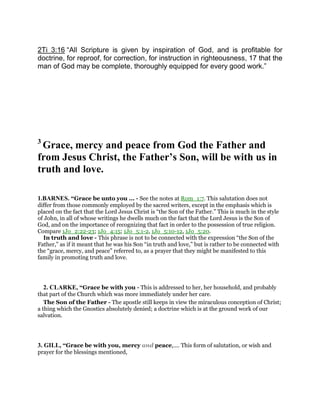
2Ti 3:16 “All Scripture is given by inspiration of God, and is profitable for
doctrine, for reproof, for correction, for instruction in righteousness, 17 that the
man of God may be complete, thoroughly equipped for every good work.”
3
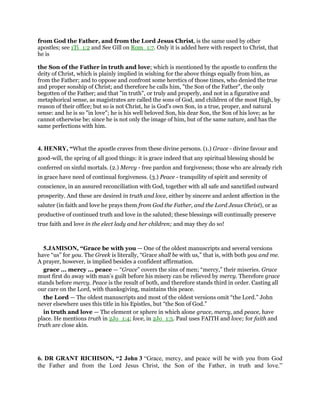
Grace, mercy and peace from God the Father and
from Jesus Christ, the Father’s Son, will be with us in
truth and love.
1.BARNES. “Grace be unto you ... - See the notes at Rom_1:7. This salutation does not
differ from those commonly employed by the sacred writers, except in the emphasis which is
placed on the fact that the Lord Jesus Christ is “the Son of the Father.” This is much in the style
of John, in all of whose writings he dwells much on the fact that the Lord Jesus is the Son of
God, and on the importance of recognizing that fact in order to the possession of true religion.
Compare 1Jo_2:22-23; 1Jo_4:15; 1Jo_5:1-2, 1Jo_5:10-12, 1Jo_5:20.
In truth and love - This phrase is not to be connected with the expression “the Son of the
Father,” as if it meant that he was his Son “in truth and love,” but is rather to be connected with
the “grace, mercy, and peace” referred to, as a prayer that they might be manifested to this
family in promoting truth and love.
2. CLARKE, “Grace be with you - This is addressed to her, her household, and probably
that part of the Church which was more immediately under her care.
The Son of the Father - The apostle still keeps in view the miraculous conception of Christ;
a thing which the Gnostics absolutely denied; a doctrine which is at the ground work of our
salvation.
3. GILL, “Grace be with you, mercy and peace,.... This form of salutation, or wish and
prayer for the blessings mentioned,
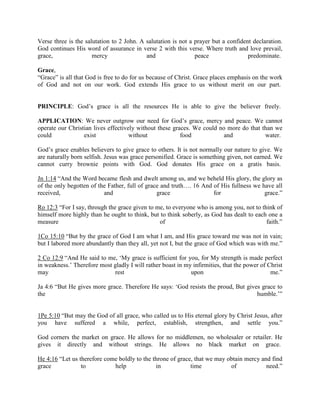
from God the Father, and from the Lord Jesus Christ, is the same used by other
apostles; see 1Ti_1:2 and See Gill on Rom_1:7. Only it is added here with respect to Christ, that
he is
the Son of the Father in truth and love; which is mentioned by the apostle to confirm the
deity of Christ, which is plainly implied in wishing for the above things equally from him, as
from the Father; and to oppose and confront some heretics of those times, who denied the true
and proper sonship of Christ; and therefore he calls him, "the Son of the Father", the only
begotten of the Father; and that "in truth", or truly and properly, and not in a figurative and
metaphorical sense, as magistrates are called the sons of God, and children of the most High, by
reason of their office; but so is not Christ, he is God's own Son, in a true, proper, and natural
sense: and he is so "in love"; he is his well beloved Son, his dear Son, the Son of his love; as he
cannot otherwise be; since he is not only the image of him, but of the same nature, and has the
same perfections with him.
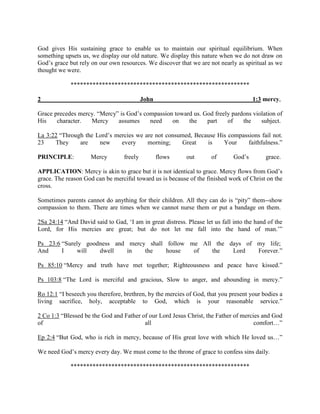
4. HENRY, “What the apostle craves from these divine persons. (1.) Grace - divine favour and
good-will, the spring of all good things: it is grace indeed that any spiritual blessing should be
conferred on sinful mortals. (2.) Mercy - free pardon and forgiveness; those who are already rich
in grace have need of continual forgiveness. (3.) Peace - tranquility of spirit and serenity of
conscience, in an assured reconciliation with God, together with all safe and sanctified outward
prosperity. And these are desired in truth and love, either by sincere and ardent affection in the
saluter (in faith and love he prays them from God the Father, and the Lord Jesus Christ), or as
productive of continued truth and love in the saluted; these blessings will continually preserve
true faith and love in the elect lady and her children; and may they do so!
5.JAMISON, “Grace be with you — One of the oldest manuscripts and several versions
have “us” for you. The Greek is literally, “Grace shall be with us,” that is, with both you and me.
A prayer, however, is implied besides a confident affirmation.
grace ... mercy ... peace — “Grace” covers the sins of men; “mercy,” their miseries. Grace
must first do away with man’s guilt before his misery can be relieved by mercy. Therefore grace
stands before mercy. Peace is the result of both, and therefore stands third in order. Casting all
our care on the Lord, with thanksgiving, maintains this peace.
the Lord — The oldest manuscripts and most of the oldest versions omit “the Lord.” John
never elsewhere uses this title in his Epistles, but “the Son of God.”
in truth and love — The element or sphere in which alone grace, mercy, and peace, have
place. He mentions truth in 2Jo_1:4; love, in 2Jo_1:5. Paul uses FAITH and love; for faith and
truth are close akin.
6. DR GRANT RICHISON, “2 John 3 “Grace, mercy, and peace will be with you from God
the Father and from the Lord Jesus Christ, the Son of the Father, in truth and love.”
Verse three is the salutation to 2 John. A salutation is not a prayer but a confident declaration.
God continues His word of assurance in verse 2 with this verse. Where truth and love prevail,
grace, mercy and peace predominate.
Grace,
“Grace” is all that God is free to do for us because of Christ. Grace places emphasis on the work
of God and not on our work. God extends His grace to us without merit on our part.
PRINCIPLE: God’s grace is all the resources He is able to give the believer freely.
APPLICATION: We never outgrow our need for God’s grace, mercy and peace. We cannot
operate our Christian lives effectively without these graces. We could no more do that than we
could exist without food and water.
God’s grace enables believers to give grace to others. It is not normally our nature to give. We
are naturally born selfish. Jesus was grace personified. Grace is something given, not earned. We
cannot curry brownie points with God. God donates His grace on a gratis basis.
Jn 1:14 “And the Word became flesh and dwelt among us, and we beheld His glory, the glory as
of the only begotten of the Father, full of grace and truth…. 16 And of His fullness we have all
received, and grace for grace.”
Ro 12:3 “For I say, through the grace given to me, to everyone who is among you, not to think of
himself more highly than he ought to think, but to think soberly, as God has dealt to each one a
measure of faith.”
1Co 15:10 “But by the grace of God I am what I am, and His grace toward me was not in vain;
but I labored more abundantly than they all, yet not I, but the grace of God which was with me.”
2 Co 12:9 “And He said to me, ‘My grace is sufficient for you, for My strength is made perfect
in weakness.’ Therefore most gladly I will rather boast in my infirmities, that the power of Christ
may rest upon me.”
Ja 4:6 “But He gives more grace. Therefore He says: ‘God resists the proud, But gives grace to
the humble.’”
1Pe 5:10 “But may the God of all grace, who called us to His eternal glory by Christ Jesus, after
you have suffered a while, perfect, establish, strengthen, and settle you.”
God corners the market on grace. He allows for no middlemen, no wholesaler or retailer. He
gives it directly and without strings. He allows no black market on grace.
He 4:16 “Let us therefore come boldly to the throne of grace, that we may obtain mercy and find
grace to help in time of need.”
God gives His sustaining grace to enable us to maintain our spiritual equilibrium. When
something upsets us, we display our old nature. We display this nature when we do not draw on
God’s grace but rely on our own resources. We discover that we are not nearly as spiritual as we
thought we were.
*********************************************************
2 John 1:3 mercy,
Grace precedes mercy. “Mercy” is God’s compassion toward us. God freely pardons violation of
His character. Mercy assumes need on the part of the subject.
La 3:22 “Through the Lord’s mercies we are not consumed, Because His compassions fail not.
23 They are new every morning; Great is Your faithfulness.”
PRINCIPLE: Mercy freely flows out of God’s grace.
APPLICATION: Mercy is akin to grace but it is not identical to grace. Mercy flows from God’s
grace. The reason God can be merciful toward us is because of the finished work of Christ on the
cross.
Sometimes parents cannot do anything for their children. All they can do is “pity” them--show
compassion to them. There are times when we cannot nurse them or put a bandage on them.
2Sa 24:14 “And David said to Gad, ‘I am in great distress. Please let us fall into the hand of the
Lord, for His mercies are great; but do not let me fall into the hand of man.’”
Ps 23:6 “Surely goodness and mercy shall follow me All the days of my life;
And I will dwell in the house of the Lord Forever.”
Ps 85:10 “Mercy and truth have met together; Righteousness and peace have kissed.”
Ps 103:8 “The Lord is merciful and gracious, Slow to anger, and abounding in mercy.”
Ro 12:1 “I beseech you therefore, brethren, by the mercies of God, that you present your bodies a
living sacrifice, holy, acceptable to God, which is your reasonable service.”
2 Co 1:3 “Blessed be the God and Father of our Lord Jesus Christ, the Father of mercies and God
of all comfort…”
Ep 2:4 “But God, who is rich in mercy, because of His great love with which He loved us…”
We need God’s mercy every day. We must come to the throne of grace to confess sins daily.
*********************************************************
2 John 3 and peace
“Peace” is the internal tranquilitythat God gives to those who fellowship with Him. Peace brings
harmony to the soul. There is no mercy until first God extends His grace. There is no peace until
first God extends His mercy. Peace always follows grace and mercy.
will be with you
It is the believer’s birthrightto daily live in God’s grace, mercy and peace. These three spiritual
commodities are available to us at any moment in which we choose to draw upon them.
PRINCIPLE: Peace flows from God’s grace and mercy.
APPLICATION: Every Christian has peace with God (Ro 5:1). Jesus resolved that issue once
and for all. He settled that issue at the cross. However, not every Christian has the peace “of
God” (Ph 4:6, 7).
Non-Christians try to find peace by drowning their heartaches in booze or drugs. They hate their
lives. They can’t wait until they can drown their sorrows. That is sublimation and escapism.
They will never find peace in sublimation. Neither will Christians find peace in sublimation.
They must come to grips with their problems and turn them over to the Lord.
What is eating you? Who is giving you grief? What is your problem? Do you know that God
is tapping His foot waiting for you come to Him? Peace comes to us when we trust in Him.
Is 26:3 “You will keep him in perfect peace, Whose mind is stayed onYou, Because he trusts in
You.”
Jn 14:27 “Peace I leave with you, My peace I give to you; not as the world gives do I give to
you. Let not your heart be troubled, neither let it be afraid.”
Jn 16:33 “These things I have spoken to you, that in Me you may have peace. In the world you
will have tribulation; but be of good cheer, I have overcome the world.”
Ro 15:13 “Now may the God of hope fill you with all joy and peacein believing, that you may
abound in hope by the power of the Holy Spirit.”
1Th 5:23 “Now may the God of peace Himself sanctify you completely; and may your whole
spirit, soul, and body be preserved blameless at the coming of our Lord Jesus Christ.”
God is the God of peace.
Ro 15:33 Now the God of peace be with you all. Amen.”
Ro 16:20 “And the God of peace will crush Satan under your feet shortly. The grace of our Lord
Jesus Christ be with you. Amen.”
Php 4:9 “The things which you learned and received and heard and saw in me, these do, and the
b>God of peace will be with you.”
He 13:20 “Now may the God of peace who brought up our Lord Jesus from the dead, that great
Shepherd of the sheep, through the blood of the everlasting covenant, 21 make you complete in
every good work to do His will, working in you what is well pleasing in His sight, through Jesus
Christ, to whom be glory forever and ever. Amen.”
Peace comes when we allow the Holy Spirit to fill us.
Ga 5:22 “But the fruit of the Spirit is love, joy, peace, longsuffering, kindness, goodness,
faithfulness…”
Col 3:15 “And let the peace of God rule in your hearts, to which also you were called in one
body; and be thankful.”
*********************************************************
2 John 3 from God the Father
John assures his readers of the source of their grace, mercy and peace. Note the two occurrences
of the word “from.” We do not get the three spiritual commodities of grace, mercy and peace
from the natural world. They do not originate down here. The Father is one of two fountainheads
of grace, mercy and peace.
The New Testament regularly uses the formula “God the Father.” There is no confusion on this
issue. God is the Creator of everyone but the Father of few.
Mt 7:21 “Not everyone who says to Me, ‘Lord, Lord,’ shall enter the kingdom of heaven, but he
who does the will of My Father in heaven.”
Jn 1:12 “But as many as received Him, to them He gave the right to become children of God, to
those who believe in His name: 13 who were born, not of blood, nor of the will of the flesh, nor
of the will of man, but of God.”
and from the Lord Jesus Christ,
The two givers (the Father and the Son) are equal givers – “from” (immediate personal source).
the Son of the Father,
This unique statement is the only occurrence of the phrase “the Son of the Father” in the New
Testament. John designates this title here to put stress on the Incarnation of Christ. The Father
and Son are coeternal and coequal. There never was nor ever will be anyone like God the Son.
PRINCIPLE: God is the only source of grace, mercy and peace.
APPLICATION: We do not get grace, mercy and peace in college or university. Professors there
know nothing about these things. The tools they chose for arriving at truth will not allow them to
discover these wonderful spiritual commodities. The only source of these spiritual commodities
is found in God.
*********************************************************
2 John 3 “in truth and love
We experience grace, mercy and peace in the sphere of truth and love. Truth and love are the
conditions for grace, mercy and peace. The Christian walk rests on truth and is demonstrated in
love.
Truth makes love discerning so love never undermines truth. Love moderates truth so that truth
does not show itself in harshness. Fellowship always revolves around both truth and love. Truth
is the sphere of principle and love is the sphere of attitude and action. Truth makes genuine love
viable.
PRINCIPLE: God always conditions love by truth.
APPLICATION: We can emphasize love at the expense of truth and we can emphasize truth at
the expense of love. Love must always be predicated on truth. Giving material aid without the
context of truth is not a Christian act. Propagation of error in the name of love is not truth! That
is simply sentimentality.
In an attempt to unite religions into an ecumenical movement, some religionists try to reduce the
things they believe to almost zero. They cannot tolerate truth. The Bible repudiates such ideas.
Ep 4:15 “…but, speaking the truth in love, may grow up in all things into Him who is the head—
Christ…”
Jesus is truth personified. He is the love of God wrapped up as one incredible gift of God.
Jn 14:6 “Jesus said to him, ‘I am the way, the truth, and the life. No one comes to the Father
except through Me.’”
Ep 4:20 “But you have not so learned Christ, 21 if indeed you have heard Him and have been
taught by Him, as the truth is in Jesus…”
Jesus is also the personification of love.
2 Co 9:15 “Thanks be to God for His indescribable gift!”
1Ti 1:5 “Now the purpose of the commandment is love from a pure heart, from a good
conscience, and from sincere faith…”
2Ti 2:15 “Be diligent to present yourself approved to God, a worker who does not need to be
ashamed, rightly dividing the word of truth.”
7. BI, “Grace, mercy, and peace
Grace in Scripture comprehends all the senses that it bears, separately and apart, in our
common dialects. When you say of a royal person, “How gracious he is”; when you say of a
beautiful woman, “What grace there is in her”; when you speak of a man not having the grace to
return a benefit that has been done to him; you indicate some aspect of that grace which the
Source of all good bestows upon men; which becomes in them a comeliness answering to His
from whom it is derived; which awakens the reaction that we call gratitude or thanksgiving. And
this grace being manifested towards creatures who have need of daily forgiveness is inseparable
from mercy, which, like it, proceeds from the nature of the being who shows it, and becomes an
element in the nature of the being to whom it is showed—the merciful obtaining mercy. And this
grace or mercy flowing forth towards creatures who have been alienated from their Creator, who
have been at war with Him—and, being at war with Him, have been, necessarily, at war with
each other and themselves—becomes peace or atonement. But that the grace, because it is royal,
free, and undeserved, may not be supposed to be capricious; that the mercy may not be taken as
dependent on the mercy which it calls forth; that the peace may not be judged by the results
which it produces here, where oftentimes the proclamation of it is the signal of fresh fighting;
they are declared to come from God the Father and from Jesus Christ the Son of the Father, in
truth and love; these being the essential Godhead; these dwelling absolutely in the Father;
shining forth to all in the life of the Son; while the Spirit in whom they are eternally united
imparts them to the family in heaven and earth. (F. D. Maurice, M. A.)
Grace first
Our poverty wants grace, our guilt wants mercy, our misery wants peace. Let us ever keep the
apostle’s order. Do not let us put peace, our feeling of peace, first. The emotionalists’ is a topsy
turvy theology. Apostles do not say “peace and grace,” but “grace and peace.” (Bp. Wm.
Alexander.)
The common salutation
In this short letter John does not grudge space for a salutation. It is the common salutation or
benediction that might be pronounced on any Christian, whether having little more than a
decent profession, or distinguished, as this lady was, by works truly good. What familiarity has
made words of course to us were not words of course or empty form to John, although he must
have repeated and heard them oftener than any of us. That is one thought: we should linger over
the words till they get a firm grip on our hearts, till we feel their Divine meaning. And another
thought is this: each individual needs the whole of this benediction. Do we not often lose
ourselves in the mass? Grace, mercy, peace: the blessings stand in their due order, the first
leading to the second, and the second securing the third. There is a fourth word, indeed, which
includes all the three, the greatest word in any language—love. John reaches to it at the end of
his sentence. But it could not have been used instead of grace and mercy. For grace expresses
the Divine favour viewed as undeserved. It is the fountain of every good and perfect gift coming
down from the Father of lights to us who have no claim on Him, who have nothing of our own to
call forth love. Mercy, again, is more than simple grace; it is sovereign love pitying and
pardoning sinners, those who positively deserve ill from God. Then peace comes in its place and
order. If that peace with God, a clear and substantial reality in a crucified and interceding
Mediator, then all other peace. The Elder is careful to make prominent the source from whence
the supreme blessing comes. It is from God indeed, but from God in His new covenant relation
to man—“from God the Father.” God was now for them not less the Creator, the Lawgiver, the
Judge, but He was, in Christ, also and above all the Father. “And from the Lord Jesus Christ.”
Here there is no distracting perplexity, there is only fulness and rest, when the heart, rather than
the head, is engaged about grace, mercy, and peace. In John’s mind the holy mystery of the
Trinity was, while none the less sublime, more a fact than a mystery, for he had beheld the Lord
Jesus Christ manifesting the glory of the Father, full of grace and truth, and bearing away the sin
of the world. This benediction is distinguished by the words being added, “In truth and love.” (A.
M. Symington, D. D.)
Grace, mercy, and peace
“Grace, mercy, and peace” stand related to each other in a very interesting manner. The apostle
starts, as it were, from the fountain-head, and slowly traces the course of the blessing down to its
lodgment in the heart of man. Grace, referring solely to the Divine attitude and thought; mercy,
the manifestation of grace in act, referring to the workings of that great Godhead in its relation
to humanity; and peace, which is the issue in the soul of the fluttering down upon it of the mercy
which is the activity of the grace. “Grace from God the Father and from the Lord Jesus Christ,
the Son of the Father.” These two, blended and yet separate, to either of whom a Christian man
has a distinct relation, these two are the sources, equally, of the whole of the grace. The
Scriptural idea of grace is love that stoops and that pardons and that communicates. The first
thing, then, that strikes me in it, is how it exults in that great thought that there is no reason
whatsoever for God’s love except God’s will. The very foundation and notion of the word “grace”
is a free, undeserved, unsolicited, self-prompted, and altogether gratuitous bestowment, a love
that is its own reason. God’s love is like an artesian well; whensoever you strike up comes, self-
impelled, gushing into light because there is such a central store of it beneath everything, the
bright and flashing waters. Grace is love that is not drawn out, but that bursts out, self-
originated, undeserved. And then let me remind you that there lies in this great word the
preaching that God’s love, though it be not turned away by, is made tender by our sin. Grace is
love extended to a person that might reasonably expect, because he deserves, something very
different. Then, if we turn for a moment from that deep fountain to the stream, we get other
blessed thoughts. The love, the grace, breaks into mercy. As grace is love which forgives, so
mercy is love which pities and helps. God’s grace softens itself into mercy, and all His dealings
with us men must be on the footing that we are not only sinful, but that we are weak and
wretched, and so fit subjects for a compassion which is the strangest paradox of a perfect and
Divine heart. The mercy of God is the outcome of His grace. And as is the fountain and the
stream, so is the great lake into which it spreads itself when it is received into a human heart.
Peace comes, the all-sufficient summing up of everything that God can give, and that men can
need, from His loving-kindness and from their needs. The world is too wide to be narrowed to
any single aspect of the various discords and disharmonies which trouble men. Peace with God;
peace in this anarchic kingdom within me, where conscience and will, hopes and fears, duty and
passion, sorrows and joys, cares and confidence, are ever fighting one another; where we are
torn asunder by conflicting aims and rival claims, and wherever any part of our nature asserting
itself against another leads to intestine warfare and troubles the poor soul. All that is
harmonised and quieted down, and made concordant and co-operative to one great end, when
the grace and the mercy have flowed silently into our spirits and harmonised aims and desires.
There is peace that comes from submission; tranquillity of spirit, which is the crown and reward
of obedience; repose, which is the very smile upon the face of faith, and all these things are given
unto us along with the grace and mercy of our God. And as the man that possesses this is at
peace with God and at peace with himself, so he may bear in his heart that singular blessing of a
perfect tranquillity and quiet amidst the distractions of duty, of sorrows, of losses, and of cares.
And now one word as to what this great text tells us are the conditions for a Christian man, of
preserving, vivid and full, these great gifts, “Grace, mercy, and peace be unto you,” or, as the
Revised Version more accurately reads, “shall be with us in truth and love.” Truth and love are,
as it were, the space within which the river flows, if I may so say, the banks of the stream. Or, to
get away from the metaphor, these are set forth as being the conditions abiding in which, for our
parts, we shall receive this benediction—“In truth and in love.” To “abide in the truth” is to keep
our selves conscientiously and habitually under the influence of the gospel of Jesus Christ, and
of the Christ who is Himself the Truth. They who, keeping in Him, realising His presence,
believing His word, founding their thinking about the unseen, about their relations to God,
about sin and forgiveness, about righteousness and duty, and about a thousand other things,
upon Christ and the revelation that He makes, these are those who shall receive “Grace, mercy,
and peace.” (A. Maclaren, D. D.)
8. PULPIT, “For I rejoiced greatly. We must not lose sight of the "for," which is full of meaning. The
elder has just expressed a wish that the external well-being of Gains may equal the well-being of his soul;
and he is quite sure of the latter, for brethren keep coming and bearing witness to the fact. The good
report of Gains is still greater joy to the apostle than the evil report of Diotrephes is a sorrow to him. The
language in condemnation of Diotrephes, severe as it is, is not so strong as this in thankful delight
respecting Gaius: Greater joy have I none than (to hear of) these things. "Greater" is made doubly
emphatic, first by position at the beginning of the sentence, and secondly by the double
comparative µειζοτέραν .
9. MACLAREN, “Alexander Maclaren
‘Grace be with you. mercy, and peace, from God the Father, and from the
Jesus Christ, the Son of the Father, in truth and love.’ — 2 John 1:3.
WE have here a very unusual form of the Apostolic salutation. ‘Grace, mercy,
and peace’ are put together in this fashion only in Paul’s two Epistles to
Timothy, and in this the present instance; and all reference to the Holy Spirit
as an agent in the benediction is, as there, omitted. The three main words,
‘Grace, mercy, and peace,’ stand related to each other in a very interesting
manner. If you will think for a moment you will see, I presume, that the Apostle
starts, as it were, from the fountain-head, and slowly traces the course of the
blessing down to its lodgment in the heart of man. There is the fountain, and
the stream, and, if I may so say; the great still lake in the soul, into which its
waters flow, and which the flowing waters make. There is the sun, and the
beam, and the brightness grows deep in the heart of man. Grace, referring
solely to the Divine attitude and thought: mercy, the manifestation of grace in
act, referring to the workings of that great Godhead in its relation to humanity:
and peace, which is the issue in the soul of the fluttering down upon it of the
mercy which is the activity of the grace. So these three come down, as it
were, a great, solemn, marble staircase from the heights of the Divine mind,
one step at a time, down to the level of earth; and the blessings which are
shed along the earth. Such is the order. All begins with grace; and the end
and purpose of grace, when it flashes into deed, and becomes mercy, is to fill
my soul with quiet repose, and shed across all the turbulent sea of human
love a great calm, a beam of sunshine that gilds, and miraculously stills while
it gilds, the waves.
If that be, then, the account of the relation of these three to one another, let
me just dwell for a moment upon their respective characteristics, that we may
get more fully the large significance and wide scope of this blessing. Let us
begin at what may be regarded either as the highest point from which all the
stream descends, or as the foundation upon which all the structure rests
‘Grace from God the Father and from the Lord Jesus Christ, the Son of the
Father.’ These two, blended and yet separate, to either of whom a Christian
man has a distinct relation, these two are the sources, equally, of the whole of
the grace
The Scriptural idea of grace is love that stoops, and that pardons, and that
communicates. I say nothing about that last characteristic, but I would like to
dwell for a moment or two upon the other phases of this great word, a key-
word to the understanding of so much of Scripture.
The first thing then that strikes me in it is how it exults in that great thought
that there is no reason whatsoever for God’s love except God’s will. The very
foundation and notion of the word ‘grace’ is a free, undeserved, unsolicited,
self-prompted, and altogether gratuitous bestowment, a love that is its own
reason, as indeed the whole of the Divine acts are, just as we say of Him that
He draws His being from Himself, so the whole motive for His action and the
whole reason for His heart of tenderness to us lies in Himself. We have no
power. We love one another because we apprehend something deserving of
love, or fancy that we do. We love one another because there is something in
the object on which our love falls; which, either by kindred or by character, or
by visible form, draws it out. We are influenced so, and love a thing because
the thing or the person is perceived by us as being worthy, for some reason or
other, of the love. God loves because He cannot help it; God loves because
He is God. Our love is drawn out — I was going to say pumped out — by an
application of external causes.
God’s love is like an artesian well, whensoever you strike, up comes, self-
impelled, gushing into light because there is such a central store of it beneath
everything, the bright and flashing waters. Grace is love that is not drawn out,
but that bursts out, self-originated, undeserved. ‘Not for your sakes, be it
known unto you, O house of Israel, but for Mine own name’s sake, do I this.’
The grace of God is above that, comes spontaneously, driven by its own
fulness, and welling up unasked, unprompted, undeserved, and therefore
never to be turned away by our evil, never to be wearied by our indifference,
never to be brushed aside by our negligence, never to be provoked by our
transgression, the fixed, eternal, unalterable centre of the Divine nature. His
love is grace.
And then, in like manner, let me remind you that there lies in this great word,
which in itself is a gospel, the preaching that God’s love, though it he not
turned away by, is made tender by our sin. Grace is love extended to a person
that might reasonably expect, because he deserves, something very different;
and when there is laid, as the foundation of everything, the grace of our
Father and of the Son of the Father; it is but packing into one word that great
truth which we all of us, saints and sinners, need — a sign that God’s love is
love that deals with our transgressions and shortcomings, flows forth perfectly
conscious of them, and manifests itself in taking them away, both in their guilt,
punishment, and peril. ‘The grace of our Father’ is a love to which sin-
convinced consciences may certainly appeal; a love to which all sin-
tyrannised souls may turn for emancipation and deliverance. Then, if we turn
for a moment from that deep fountain, ‘Love’s ever-springing well,’ as one of
our old hymns has it, to the stream, we get other blessed thoughts. The love,
the grace, breaks into mercy. The fountain gathers itself into a river, the
infinite, Divine love concentrates itself in act, and that act is described by this
one word, mercy. As grace is love which forgives, so mercy is love which
pities and helps. Mercy regards men, its object, as full of sorrows and
miseries, and so robes itself in garb of compassion, and takes wine and oil
into its hands to pour into the wound, and lays often a healing hand, very
carefully and very gently, upon the creature, lest, like a clumsy surgeon, it
should pain instead of heal, and hurt where it desires to console. God’s grace
softens itself into mercy, and all His dealings with us men must be on the
footing that we are not only sinful, but that we are weak and wretched, and so
fit subjects for a compassion which is the strangest paradox of a perfect and
divine heart.
The mercy of God is the outcome of His grace. And as is the fountain and the
stream, so is the great lake into which it spreads itself when it is received into
a human heart. Peace comes, the all-sufficient sum-mint up of everything that
God can give, and that men can need, from HIS loving-kindness, and from
their needs. The world is too wide to be narrowed to any single aspect of the
various discords and disharmonies which trouble men. Peace with God,
peace in this anarchic kingdom within me, where conscience and will, hopes
and fears, duty and passion, sorrows and joys, cares and confidence, are ever
fighting one another; where we are torn asunder by conflicting aims and rival
claims, and wherever any part of our nature asserting itself against another
leads to intestine warfare, and troubles the poor soul. All that is harmonised
and quieted down, and made concordant and co-operative to one great end,
when the grace and the mercy have flowed silently into our spirits and
harmonised aims and desires.
There is peace that comes from submission; tranquillity of spirit, which is the
crown and reward of obedience; repose, which is the very smile upon the face
of faith, and all these things are given unto us along with the grac and mercy
of our God. And as the man that possesses this is at peace with God, and at
peace with himself, so he may bear in his heart that singular blessing of a
perfect tranquillity and quiet amidst the distractions of duty, of sorrows, of
losses, and of cares. ‘In everything by prayer and supplication with
thanksgiving let your requests be known unto God; and the peace of God
which passeth all understanding shall keep your hearts and minds in Christ
Jesus.’ And he who is thus at friendship with God, and in harmony with
himself, and at rest from sorrows and cares, will surely find no enemies
amongst men with whom he must needs be at war, but will be a son of peace,
and walk the world, meeting in them all a friend and a brother. So all discords
maybe quieted; even though still we have to fight the good fight of faith, we
may do, like Gideon of old, build an altar to ‘Jehovah-shalom,’ the God of
peace.
And now one word, as to what this great text tells us are the conditions for a
Christian man, of preserving, vivid and full, these great gifts, ‘Grace, mercy,
and peace be unto you,’ or, as the Revised Version more accurately
reads, ‘shall be with us in truth and love.’ Truth and love are, as it were, the
space within which the river flows, if I may so say, the banks of the stream.
Or, to get away from the metaphor, these are set forth as being the conditions
abiding in which, for our parts, we shall receive this benediction— ‘In truth and
in love.’
I have no time to enlarge upon the great thoughts that these two words, thus
looked at, suggest; let me put it into a sentence. To ‘abide in the truth’ is to
keep ourselves conscientiously and habitually under the influence of the
Gospel of Jesus Christ, and of the Christ who is Himself the Truth. They who,
keeping in Him, realising His presence, believing His word, founding their
thinking about the unseen, about their relations to God, about sin and
forgiveness, about righteousness and duty, and about a thousand other
things, upon Christ and the revelation that He makes, these are those who
shall receive ‘Grace, mercy, and peace.’ Keep yourselves in Christ, and Christ
coming to you, brings in His hands, and is, the grace and the mercy and the
peace of which my text speaks. And in love, if we want these blessings, we
must keep ourselves consciously in the possession of, and in the grateful
response of our hearts to, the great love, the incarnate Love, which is given in
Jesus Christ.
Here is, so to speak, the line of direction which these great mercies take. The
man who stands in their path, they will come to him and fill his heart; the man
that steps aside, they will run past him and not touch him. You keep
yourselves in the love of God, by communion, by the exercise of mind and
heart and faith upon Him; and then be sure — for my text is not only a wish,
but a confident affirmation — be sure that the fountain of all blessing itself,
and the stream of petty benedictions which flow from it, will open themselves
out in your hearts into a quiet, deep sea, on whose calm surface no tempests
shall ever rave, and on whose unruffled bosom God Himself will manifest and
mirror His face.
10. PULPIT, Spiritual prosperity.
"For I rejoiced greatly when the brethren came and testified of the truth that is in thee," etc. In these and
some subsequent verses we have some aspects and evidences of the spiritual prosperity of Gaius.
I. ASPECTS OF SPIRITUAL PROSPERITY. "Brethren came and bare witness unto thy truth, even as
thou walkest in truth."
1. Truth appropriated in mind and heart. Our interpretation of the words, "thy truth," would be superficial
and inadequate if we simply said that they express the sincerity of Gaius. The expression involves this,
that he was true in religion and in life; but it means that his religious beliefs were correct—that he held the
truth concerning the Person and work of Jesus Christ. On these subjects pernicious errors had arisen in
the Church. Some denied the Godhead of our Saviour; others denied the reality of his manhood. "The first
stumbled at his pre-existence and incarnation, because he suffered indignity and anguish; the other,
admitting his Divine nature, thought it beneath him actually to suffer, and therefore denied that his body or
his sufferings were anything else but illusory appearances" (Binney). Against each of these errors St.
John wrote. And by the expression, "the truth," he generally means the apostolic doctrine concerning the
Person and work of Jesus Christ. "This truth Gaius held; held it as his life; it was 'in him,' as filling his
intellect and affections; in his understanding as a source of light, in his heart as the object of love." The
apostle, as we have learned from his former Epistles, attached the utmost importance to correct religious
belief.
2. Truth manifested in life and conduct. "Thou walkest in truth." His practical life was in harmony with his
professed creed. The truth he held was not merely a form of sound words, but a living force in his
character and conduct. His faith was not a mere speculation or opinion, but a thing of deep feeling and
firm conviction. The faith that does not influence the life towards harmony with itself is not faith in the
scriptural sense; it is assent, or opinion; but it is not Christian faith, or saving faith. Our real faith moulds
the life into conformity with the truth believed. St. John quite as earnestly insisted upon practicing the truth
as upon holding it. "He that doeth good is of God; he that doeth evil hath not seen God" (verse 11;
and 1Jn_3:7, 1Jn_3:10). Let us, like Gaius, hold the truth, make it our own; and also live the truth, walk in
it day by day. Cultivate a true faith and a holy life.
II. TESTIMONY TO SPIRITUAL PROSPERITY. " Brethren came and bare witness unto thy truth," etc.
These brethren were probably those who had been commended to the Church by the apostle, rejected
through the influence of Diotrephes (verse 9), and then entertained by Gains. They probably presented
this report on their return to the Church of which St. John was pastor, and from which they had been sent
forth (verses 5, 6).
1. It is a pleasure to good men to testify to the excellence of others.
2. It is gratifying to a good man to ,receive the commendation of good men. "A good name is better than
precious ointment." "A good name is rather to be chosen than great riches."
III. THE INFLUENCE OF SPIRITUAL PROSPERITY UPON THE GOOD. "Greater joy have I none than
this, to hear of my children," etc.
1. The tender relation here mentioned. "My children." It seems that Gains had been converted through the
ministry of St. John. He was the spiritual child of the apostle; his "true child in faith;" his "beloved child," as
St. Paul says of Timothy. This relationship is very close, tender, and sacred (cf. 1Co_4:14, 1Co_4:15).
2. The great joy here spoken of. "Greater joy have I none than this," etc. Every genuine Christian rejoices to
find men walking in the truth; but the apostle had the additional joy which arose from the dear and holy tie
by which he and Gains were united. The success of a young man in temporal things is a great joy to his
parents. To Christian parents it is a far greater joy when their children give their hearts to God, and walk
in truth. And to the Christian minister, and the Sunday school teacher, the spiritual prosperity of those
whom they have led to the Saviour is a source of deep and pure rejoicing. Such prosperity is a proof that
we have not laboured in vain; it is a distinguished honour conferred upon us by God; and it gives a
foretaste of the grand final reward, "Well done, good and faithful servant," etc. To hear of or to behold
such fruits of our Christian work both humbles and rejoices us.
Christian brethren, let us aim both to appropriate and to exemplify Christian truth.—W.J.
4
It has given me great joy to find some of your
children walking in the truth,just as the Father
commanded us.
1.BARNES. “I rejoiced greatly that I found ... - That I learned this fact respecting some
of thy children. The apostle does not say how he had learned this. It may have been that he had
become personally acquainted with them when they were away from their home, or that he had
learned it from others. The word used εᆖρηκα heureka would apply to either method. Grotius
supposed that some of the sons had come to Ephesus on business, and that John had become
acquainted with them there.
Of thy children walking in truth - That is, true Christians; living in accordance with the
truth, for this constitutes the essence of religion. The expression used here, “of thy children,” (ᅚκ
τራν τέκνων ek ton teknon,) means some of thy children; implying that he knew of a part of them
who were true Christians. This is clear from the Greek construction, because:
(a) If he had meant to say that he had found them all to be of this description, the sentiment
would have been directly expressed, “thy children;” but as it is, some word is necessary to
be understood to complete the sense; and,
(b) The same thing is demanded by the fact that the participle used (“walking” - περιπατοሞντας
peripatountas) is in the accusative case.
If he had referred to them all, the participle would have been in the genitive, agreeing with the
word “children,” (τራν περιπατοሞντων ton peripatounton) - Lucke. Whether the apostle means to
say that only a part of them had in fact embraced the gospel, or that he had only known that a
part of them had done it, though the others might have done it without his knowledge, is not
quite clear, though the former supposition appears to be the correct one, for if they had all
become Christians it is to be presumed that he would have been informed of it. The probability
seems to be that a part of her children only were truly pious, though there is no evidence that the
others were otherwise than correct in their moral conduct. If there had been improper conduct
in any of her other children, John was too courteous, and too delicate in his feelings, to allude to
so disagreeable a circumstance. But “if that pious lady,” to use the language of Benson, “had
some wicked children, her lot was not unique. Her consolation was that she had some who were
truly good. John commended those who were good, in order to excite them in the most
agreeable manner to persevere.”
As we have received a commandment from the Father - That is, as he has
commanded us to live; in accordance with the truth which he has revealed. The “Father,” in the
Scripture, is everywhere represented as the Source of law.
2. CLARKE, “That I found of thy children walking in truth - I have already supposed
this Christian matron to be mother of a family, probably a widow, for no mention is made of her
husband; and that she was also a deaconess in the church, and one in those house the traveling
evangelists preached, and there they were entertained. The children mentioned here may either
be her own children, or those members of the Church which were under her care, or some of
both. The apostle was glad to find, probably by an epistle sent from herself to him, or from the
information of some of the itinerant evangelists, that the work of God was prospering in the
place where she lived, and also in her own household. He does not say that all were walking in
the truth, but εκ των τεκνων, some of her children; there was a growing and spreading work, and
there were many adversaries who strove to pervert them who had already believed, and perhaps
were successful in drawing several away from their simplicity.
3. GILL, “I rejoiced greatly that I found of thy children,.... Not all, but some of them; for
good parents have not always good children, or at least not all of them; Adam had a Cain,
Abraham an Ishmael, and Isaac an Esau: God is pleased to show his discriminating grace in
tribes and families, by taking some, and leaving others: it is a great mercy when any are called by
grace, and instead of the fathers are the children: and this was the case of some of the children of
this elect lady, they were
walking in the truth: in Christ, the truth, by faith, as they had received him; and in the truth
of the Gospel, as they had embraced and professed it; they abode in it, and by it, and made a
proficiency in the knowledge of it, which may be signified by walking, that being a progressive
action: as also they walked according to it, and as became it; and likewise they walked in the
truth of Gospel worship, discipline, and ordinances:
as we have received a commandment from the Father; and which has been made
known by Jesus Christ, as his mind and will. Now as it is matter of joy and gladness to godly
parents when their children walk in the paths of faith, truth, and holiness, so it is also to
ministers of the Gospel, as well as to the angels in heaven; it gives them an inward pleasure and
joy, and which is not only expressed by them, to such children and their parents, but is also
abundant by many thanksgivings unto God.
4. HENRY, “The congratulation upon the prospect of the exemplary behaviour of other
children of this excellent lady. Happy parent, who was blessed with such a numerous religious
offspring! I rejoiced greatly that I found of thy children walking in the truth, as we have
received commandment from the Father, 2Jo_1:4. Possibly the lady's sons travelled abroad,
either for accomplishment and acquaintance with the world, or on the account of their own
business or the common affairs of the family, and in their travels might come to Ephesus, where
the apostle is supposed to have now resided, and might there happily converse with him. See
how good it is to be trained up to early religion! Though religion is not to be founded upon
education, yet education may be and often is blessed, and is the way to fortify youth against
irreligious infection. Hence too let young travellers learn to carry their religion along with them,
and not either leave it at home or learn the ill customs of the countries where they come. It may
be observed, also, that sometimes election runs in a direct line; here we have an elect lady, and
her elect children; children may be beloved for their parents' sake, but both by virtue of free
grace. From the apostle's joy herein we may observe that it is pleasant to see children treading in
good parent's steps; and those who see this may well congratulate their parents thereupon, and
that both to excite their thankfulness to God for, and to enlarge their comfort in, so great a
blessing. How happy a lady was this, who had brought forth so many children for heaven and for
God! And how great a joy must it be to her ladyship to hear so good an account of them from so
good a judge! And we may further see that it is joyful to good old ministers, and accordingly to
other good old disciples, to see a hopeful rising generation, who may serve God and support
religion in the world when they are dead and gone. We see here also the rule of true walking: the
commandment of the Father. Then is our walk true, our converse right, when it is managed by
the word of God.
5.JAMISON, “I found — probably in one of his missionary tours of superintendence. See on
Introduction, at the end, and 2Jo_1:12; 3Jo_1:10, 3Jo_1:14.
of thy children — some.
in truth — that is, in the Gospel truth.
as — even as. “The Father’s commandment” is the standard of “the truth.”
6. IVP PRESS, “It was common practice to include a thanks giving after the greeting of a
letter that expressed the writer's pleasure in knowing of the well-being of the
addressees. The Elder is "overjoyed" (NRSV) because he has found some of your
children walking [or living] in the truth. This does not necessarily imply that other
members of the congregation were not living in the truth. But the Elder is acquainted
with or has met some who are. And to know that these people are faithful in their
commitment to God brings the author joy. The Johannine com mand to love one
another inculcates concern for the spiritual welfare of Christian compatriots and joy over
their well-being and faithfulness.
The Elder goes on to explicate the truth by which they live in terms of the
commandment to love each other (compare 1 Jn 3:23). In fact, love is to live in
obedience to [God's] commands. The love spoken of here includes love for God and
love for others. We show that we love God when we do what God desires, and what
God desires is that we live a life of love. Love is not a feeling or emotion, but a way of
life that manifests itself concretely in its concern for others in obedience to the
commandments of God. Love circumscribes the whole of life and ought to permeate the
actions and attitudes of the Christian person.
7. BI, “The old apostle’s chief joy
The affairs of the soul are not so entirely hidden as we may sometimes imagine. I do not see the
roots of my plants; but if they grow, and are fragrant, and bear fruit, I know better than if I could
look at them that the roots are thriving. Nothing is easier than to tell whether a man is walking
or standing still; and again, whether firmly or with weary and fainting steps; and again, in what
direction. Walking in the truth is that which is expected of all Christians; yet it does not so
uniformly or so fully accompany a Christian profession but that the seeing of it and the hearing
about it cause lively joy. It brings into the relations of friend and friend the best kind of
gladness; for friendship is more concerned about the inside than the outside, and a good walk
seen is taken as hopeful evidence of a prosperous state within, sure to end well.
1. For one thing, the life of one who walks in the truth will be governed by Divine principles.
The standard of the new life is fixed by God, not by us; the reason of it is the will of the
Father, not our will; the strength to enter on and to keep going forward in it is His strength,
not ours.
2. For another thing, if a man is walking in the truth, his life will be pure and consistent.
Veracity in speech, integrity in all dealing with man, a sense of honour, are sure fruits of a
life governed by Christ. Such clear, sterling integrity before man is not all by any means that
is intended by “walking in the light as God is in the light,” but—it certainly is part of that. No;
not all. For mark in what terms John expounds to the elect lady his conception of what
walking in the truth means (verses 6, 7). For a man to have ascertained the due balance of
truth and love in the government of his conduct is to have made the most important of all
discoveries. Love, without the backbone of truth, is weakness and sentimentalism. Truth
wanting love is a grinning skeleton, is not true.
3. Looking to the case of the elect lady we find, for one thing, that walking in the truth
means careful orthodoxy.
4. For another thing, it appears that walking in the truth means the maintaining of Christian
influences at home. (A. M. Symington, D. D.)
A Christian family
I. A christian mother.
1. A praying mother. Every mother is a praying mother in the sense of wishing well, or of
entertaining some hopes of the future prosperity of her children. A truly praying mother is
anxious for the salvation of her children. Richard Cecil tried, when a boy, to be an infidel,
but his mother’s prayers blocked the way. Garibaldi never lost his courage on the field of
battle, because he saw his mother on her knees praying for him. The wife of the late Rev.
William Jones, Castle Street, Swansea, held a separate family worship with her children. A
gentleman came one day to see Mr. Jones on business, and when he was told by the eldest
boy, who opened the door, that his father was from home, he asked to see Mrs. Jones. The
boy said, “You will have to wait, sir, until she finishes praying with the children.” He
immediately left the room to join the little party. The gentleman, while alone, said to
himself, “I am the father of six children, and have never offered a prayer with them.” The
example of the praying mother made a new man of him.
2. An exemplary mother. The power of imitation is great in children, and the example
sometimes is more powerful than prayer. Take a homely illustration. The hen has a swarm of
a dozen little ones hopping about her. As she moves, how careful she is in putting down her
foot, lest they be trampled upon. Unguarded mothers stamp on their children and crush the
good out of them.
3. A watchful mother. The young heart is impressible, and will more readily receive evil
impressions than good ones. The Christian mother will not tolerate indulgence in sin. The
“elect lady” was the guardian angel of the hearts of her children, which she often found
“prone to wander” from the paths of truth and virtue.
4. A happy mother. A gleam of joy on the countenance, a beam of hope in the speech, and a
loving touch of the hand will recommend religion to the child beyond our expectation. The
poet Cowper said of his mother’s likeness, “I had rather possess that picture than the richest
jewel in the British crown.” Years never effaced her love and devotion from his heart. The
“elect lady,” as we may infer from the following verses, had learnt that love is the essence of
the gospel.
II. The children.
1. They believed the truth. They were converted children. There is here no reference to
natural beauty or grace of manner. There are many attractions both in the persons and the
lives of children. It is a perpetual entertainment to live with some children. But on all points
of natural endowment the apostle is silent. Their spiritual state alone engaged his attention.
2. They loved the truth. The tendrils of the Divine vine had extended from the intellect to the
heart. When the heart is won for Christ the whole life will follow.
3. They lived the truth. The meaning of περιπατέω in the New Testament in reference to
character signifies “habit and practice.” The Apostle John had sufficient evidence that the
children of the “elect lady” were consistent followers of Christ.
III. The religious education of children is a duty, “as we received commandment from the
Father.” It is a very old commandment (Deu_6:6-7) (T. Davies, M A.)
The right mother
My answer to the question, “How I was educated,” ends where it began. “I had the right
mother.” (T. Dwight, LL. D.)
A good mother
Of his mother the late John Stuart Blackie said, “My mother died when I was ten years old, and I
remember her only as everything that was womanly and motherly. I have no doubt that I owe
much of what is best in my moral and emotional nature to her.”
8. GRANT RICHIESON, “2 John 4 I rejoiced greatly
John’s joy comes from the fact that the woman’s children, to whom he wrote 2nd John, walked
in the truth.
that I have found some of your children
False teachers made inroads into the Christian community but some believers walked according
to the truth of God’s revelation, His Word. Second generation Christians often wane from the
faithful passion of their parents.
Ephesus was a great center for learning. It was the seat of philosophy, science and medicine.
Some
children of Christian parents may have fallen from the faith because of this schooling. Others
came to Ephesus for business because it was a prosperous seaport. There was active nightlife,
and crime was rampant throughout the city. Pagan religions dominated the landscape. There
were many reasons why some children fell from the faith in Ephesus.
PRINCIPLE: Children, even in their adulthood, generally do not rise above the level of their
parents spiritually.
APPLICATION: Parental responsibility goes beyond intellectual, social and physical care of
children. Children need moral and spiritual direction. It is no excuse to say that my children do
not like church or the youth group. God commands parents to guide their children responsibly
while they are under their care. Children may not like the fact that you require them to come
home at a reasonable hour but you make that standard anyway. They may not want to go to
school but you send them anyway.
You say, “If I place high standards for my children, they may rebel against me.” That is a
possibility but there is a much greater possibility that if you do not provide high standards for
them they will rebel against you and the Lord.
Pr 22:6 “Train up a child in the way he should go, And when he is old he will not depart from
it.”
We can claim the promise that “he will not depart from it.” That means that if we inculcate
Christian values in our children, those values will never leave them. All of the excursions in the
world will not eradicate that training. They may rebel against the Lord but they will always carry
Christian values with them.
You may ask, “Where did I make my mistake with my children? Why did they go astray?” In
some cases, there may be no answers to that question. In other cases, there are. Some parents set
the values of their children by living out their own values. If their primary value is acquiring
possessions, their children will pick that up. If the Lord is second, then their children will put
God second or third in their lives.
Your daughter will be just like you, mother. Your son will be just like you, father. They will hold
the same attitudes as you do toward the Bible, toward God, toward values in life. They will talk
like you and they will walk like you. If you become inebriated, they will become drunkards as
well. If you don’t read the Bible and apply it to your life, they will not do so, either.
Water seldom rises higher than its source. There are exceptions to this but we are presenting the
general pattern here.
It breaks the hearts of some parents to find that their children no longer walk in the truth. The
Lord is secondary and trivialized in their lives.
*********************************************************
2 John 1:4b walking in truth
Fidelity to truth is a core Christian value. John discovered on his travels that the lady’s children
of 2nd John lived out their Christianity. They went on with the Lord. Nothing delights the hearts
of parents more than to know that their children walk with the Lord.
Walking is a figure of speech for living. Walking in the truth is living in the truth. Walking in the
truth is more than obtaining a corpus of doctrine. Christianity is more than an intellectual
exercise. It should be something that shapes our attitudes and behavior. Truth shapes total
conduct by internalizing its principles.
1Jn 1:6 “If we say that we have fellowship with Him, and walk in darkness, we lie and do not
practice the truth. 7 But if we walk in the light as He is in the light, we have fellowship with one
another, and the blood of Jesus Christ His Son cleanses us from all sin.”
Ro 10:2 “For I bear them witness that they have a zeal for God, but not according to knowledge.
3 For they being ignorant of God’s righteousness, and seeking to establish their own
righteousness, have not submitted to the righteousness of God.”
PRINCIPLE: Fidelity to truth is a core Christian value.
APPLICATION: The Word of God directs and molds our values and attitudes toward life. If we
apply the Word to our experience daily, it will change us and make us more like the Lord Jesus.
God gives us divine life that He might mold us into the image of Christ. God will reproduce the
life of Christ in us.
Ga 1:15 “But when it pleased God, who separated me from my mother’s womb and called me
through His grace, 16 to reveal His Son in me, that I might preach Him among the Gentiles, I did
not immediately confer with flesh and blood…”
Ga 4: 9 “My little children, for whom I labor in birth again until Christ is formed in you…”
The Word of God will also cast light on the dark places where God calls us to walk.
2Co 4:2 “But we have renounced the hidden things of shame, not walking in craftiness nor
handling the word of God deceitfully, but by manifestation of the truth commending ourselves to
every man’s conscience in the sight of God.”
*********************************************************
2 John 1:4c as we received commandment from the Father
Faithfulness to God’s commandment is the foundation of true Christian living. The lady’s
children of 2nd John made a close correspondence between how they lived their lives and God’s
commandment or His Word.
True Christianity cannot separate truth, love and application of truth to experience. Love without
truth is mere sentiment. Application of truth to experience without love is simply ceremony.
Truth must always direct our love.
Ga 2:5 “…to whom we did not yield submission even for an hour, that the truth of the gospel
might continue with you.”
Ga 3:1 O foolish Galatians! Who has bewitched you that you should not obey the truth, before
whose eyes Jesus Christ was clearly portrayed among you as crucified?”
Ga 5:7 “You ran well. Who hindered you from obeying the truth?”
Ep 6:14 “Stand therefore, having girded your waist with truth, having put on the breastplate of
righteousness…”
2Th 2:10 “…and with all unrighteous deception among those who perish, because they did not
receive the love of the truth, that they might be saved.”
2Ti 2:15 “Be diligent to present yourself approved to God, a worker who does not need to be
ashamed, rightly dividing the word of truth.”
1Pe 1:22 “Since you have purified your souls in obeying the truth through the Spirit in sincere
love of the brethren, love one another fervently with a pure heart, 23 having been born again, not
of corruptible seed but incorruptible, through the word of God which lives and abides forever…”
PRINCIPLE: Faithfulness to God’s Word is the foundation of Christian living.
APPLICATION: Love without application of truth to experience is mere sentiment. It is
deficient of reality. Service without love is servility. True Christianity harmonizes doctrinal
orientation to truth and living truth out in experience.
Continuance is proof of conversion. The evidence of divine life is when people live out what
they believe.
Jn 8:31 “Then Jesus said to those Jews who believed Him, ‘If you abide in My word, you are My
disciples indeed. 32 ‘And you shall know the truth, and the truth shall make you free.’”
Jn 15:9 “As the Father loved Me, I also have loved you; abide in My love.”
Col 1:23 “…if indeed you continue in the faith, grounded and steadfast, and are not moved away
from the hope of the gospel which you heard, which was preached to every creature under
heaven, of which I, Paul, became a minister.”
1Jn 2:19 “They went out from us, but they were not of us; for if they had been of us, they would
have continued with us; but they went out that they might be made manifest, that none of them
were of us.”
There is a point when children are too old for parents to do anything about their lifestyles. All
they can do then is to hold them up before the Lord.
5
And now, dear lady, I am not writing you a new
command but one we have had from the beginning. I
ask that we love one another.
1.BARNES. “And now I beseech thee, lady - Dr, “And now I entreat thee, Kyria,” (κυρία
kuria.) See the introduction, Section 2. If this was her proper name, there is no impropriety in
supposing that he would address her in this familiar style. John was probably then a very old
man; the female to whom the Epistle was addressed was doubtless much younger.
Not as though I wrote a new commandment unto thee - John presumed that the
command to love one another was understood as far as the gospel was known; and he might well
presume it, for true Christianity never prevails anywhere without prompting to the observance
of this law. See the notes at 1Th_4:9.
But that which we had from the beginning - From the time when the gospel was first
made known to us. See the notes at 1Jo_2:7; 1Jo_3:11.
That we love one another - That is, that there be among the disciples of Christ mutual
love; or that in all circumstances and relations they should love one another, Joh_15:12,
Joh_15:17. This general command, addressed to all the disciples of the Saviour, John doubtless
means to say was as applicable to him and to the pious female to whom he wrote as to any
others, and ought to be exercised by them toward all true Christians; and he exhorts her, as he
did all Christians, to exercise it. It was a command upon which, in his old age, he loved to dwell;
and he had little more to say to her than this, to exhort her to obey this injunction of the Saviour.
2. CLARKE, “That which we had from the beginning - The commandment to love one
another was what they had heard from the first publication of Christianity, and what he wishes
this excellent woman to inculcate on all those under her care. The mode of address here shows
that it was a person, not a Church, to which the apostle wrote.
3. GILL, “And now I beseech thee, lady,.... Or "Kyria", which word the Syriac and Arabic
versions retain, as if it was a proper name: the apostle having finished the inscription,
salutation, and congratulation in the preceding verses, passes to an exhortation and entreaty to
observe the commandment of love to one another, which is not a new commandment, but what
was from the beginning:
not as though I wrote a new commandment, &c. See Gill on 1Jo_2:7 and See Gill on
1Jo_2:8.
4. HENRY, “We come now more into the design and substance of the epistle; and here we
have,
I. The apostle's request: Now, I beseech thee, lady. Considering what it is that he entreats, the
way of address is very remarkable; it is not any particular boon or bounty to himself, but
common duty and observance of divine command. Here he might command or charge; but
harsher measures are worse than needless where milder will prevail; and the apostolical spirit is,
of all other, the most tender and endearing. Whether out of deference to her ladyship, or
apostolical meekness, or both, he condescends to beseech: And now I beseech thee, lady. He
may be supposed speaking as another apostle does to a certain master to whom he writes:
Wherefore, though I might be very bold in Christ (and according to the power with which Christ
hath entrusted me) to enjoin thee that which is convenient, yet, for love's sake I rather beseech
thee, being such a one as the aged, the elder. Love will avail where authority will not; and we
may often see that the more authority is urged the more it is slighted. The apostolical minister
will love and beseech his friends into their duty.
II. The thing requested of the lady and her children - Christian sacred love: That we love one
another, 2Jo_1:5. Those that are eminent in any Christian virtue have yet room to grow therein.
But, as touching brotherly love, you need not that I write unto you; for you yourselves are
taught of God to love one another. But we beseech you, brethren (and sisters), that you
increase more and more, 1Th_4:9, 1Th_4:10.
1. This love is recommended, (1.) From the obligation thereto - the commandment. Divine
command should sway our mind and heart. (2.) From the antiquity of the obligation: Not as
though I wrote a new commandment unto thee, but that which we had from the beginning,
2Jo_1:5. This commandment of mutual Christian love may be said to be a new one in respect of
its new enaction and sanction by the Lord Christ; but yet, as to the matter of it (mutual holy
love), it is as old as natural, Jewish, or Christian religion. This commandment must every where
attend Christianity, that the disciples of it must love one another.
5.JAMISON, “I beseech — rather (compare Note, see on 1Jo_5:16), “I request thee,”
implying some degree of authority.
not ... new commandment — It was old in that Christians heard it from the first in the
Gospel preaching; new, in that the Gospel rested love on the new principle of filial imitation of
God who first loved us, and gave Jesus to die for us; and also, in that love is now set forth with
greater clearness than in the Old Testament dispensation. Love performs both tables of the law,
and is the end of the law and the Gospel alike (compare Notes, see on 1Jo_2:7, 1Jo_2:8).
that we — implying that he already had love, and urging her to join him in the same Christian
grace. This verse seems to me to decide that a Church, not an individual lady, is meant. For a
man to urge a woman (“THEE”; not thee and thy children) that he and she should love one
another, is hardly like an apostolic precept, however pure may be the love enjoined; but all is
clear if “the lady” represent a Church.
6. BI, “The feminine danger
No one was more likely than a woman to think that the precept of loving was something
altogether different in kind from the precepts of the old law; no one was more likely to say,
“Love has nothing to do with precepts; it springs up unbidden in the heart.” And no one was
more likely than a woman to suffer from these very natural opinions; to turn love into a mere
taste and sentiment; to suppose it had its origin in herself, and that its continuance might be
trusted to her strong feelings; to separate it from obedience; to make it unpractical; so to divorce
it from self-denial and endurance. Nothing would be so fatal to all that is noblest in the female
character, to the sacrificing and persevering affection for which women have been so eminent, as
this temper of mind. Nothing, therefore, appears more entirely appropriate than the apostle’s
double admonition, which is enforced in the following verse: “This is love,” etc. (F. D. Maurice,
M. A.)
7. PULPIT, “It is by no means easy to translate this verse satisfactorily, πιστὸν ποιεῖς ὅ ἐὰν ἐργάσῃ εἰς
τοὺς ἀδελφοὺς καὶ τοῦτο ξένους . Here we have three difficulties:
(1) to determine the meaning of πιστὸν ποιεῖς ;
(2) to bring out the meaning of ἐργάσῃ ;
(3) to translate τοῦτο without awkwardness.
The reading εἰς τοὺς (K, L) for τοῦτο ( à , A, B, C, and versions) has probably arisen from a wish to avoid
this last difficulty. Thou doest a faithful act in all that thou workest towards the brethren, and that towards
strangers, is a fairly literal and intelligible rendering. But "to do a faithful act" is somewhat obscure.
Probably it means "to act as a faithful man would." All his conduct towards the brethren, even when they
were not previously known to him, was such as became a faithful Christian. This was his special merit; he
treated brethren who were entire strangers to him, not as strangers, but as brethren. He did not pick and
choose, showing hospitality to those whom he liked and neglecting the rest. Every missionary was sure of
a welcome from Gains.
8. GRANT RICHIESON, “2 John 1:5 “And now I plead with you, lady, not as
though I wrote a new commandment to you, but that which we have had from
the beginning: that we love one another.”
The thrust of John’s argument is that Christians should be wary with their
hospitality. False teachers were roaming the territory, and people committed
to truth should not give hospitality to them. Before he sounds a warning about
this, he challenges Christians to practice divine love.
John reasons in a circle in verses 5 and 6. Application of truth to experience
results in love toward other Christians (v. 5). Love also lives according to
God’s principles (v. 6). God tightly weaves together love with living according
to the principles of His Word.
And now
With the word “now,” John turns to the main thrust of the letter – the
relationship between truth and love. The church in Ephesus stood in peril of
false teaching, and love without truth puts the church in danger.
I plead with you, lady,
“Plead” is more authoritative than “beseech.” It is directly personal and not an
exhortation. It is a request among equals. John requests that this influential
lady manifests genuine biblical love, not phony or sentimental love toward the
false teachers.
not as though I wrote a new commandment to you,
The content of the “new commandment” is to “love one another.” This is not a
“new” commandment in that it did not originate with the apostle John. It
originated with the Lord Jesus
Mt 22:37 “Jesus said to him, “ ‘You shall love the Lord your God with all your
heart, with all your soul, and with all your mind.’ 38 ‘This is the first and great
commandment. 39 ‘And the second is like it: ‘You shall love your neighbor as
yourself.’ 40 “On these two commandments hang all the Law and the
Prophets.’”
Jn 13:34 “A new commandment I give to you, that you love one another; as I
have loved you, that you also love one another. 35 “By this all will know that
you are My disciples, if you have love for one another.”
Ro 13:10 “Love does no harm to a neighbor; therefore love is the fulfillment of
the law.”
1Jn 2:7 “Brethren, I write no new commandment to you, but an old
commandment which you have had from the beginning. The old
commandment is the word which you heard from the beginning.”
but that which we have had from the beginning:
John identifies himself with the lady and her children by “we have had.” The
commandment they had was from the beginning of Jesus’ earthly ministry.
that we love one another
The words “one another” indicate reciprocity. True believers reciprocate love
shown to them by fellow Christians.
1Jn 3:11 “For this is the message that you heard from the beginning, that we
should love one another ”
John exhorts his readers no less than ten times in his writings to love each
other. He places great emphasis on this subject because of its importance to
the integrity of Christianity.
PRINCIPLE: We measure the integrity of our Christianity by our love for one
another.
APPLICATION: It appears that we are very slow to learn how to love one
another. It seems that if we do disagree, then we cannot agree on the spirit in
which to disagree. True love seeks a way to be constructive in a negative
situation. This love does not seek to possess or control the other person.
The most difficult thing God calls upon believers to do is to love one another.
We can trace most relationship problems among Christians to lack of love.
Some of us do truly love but we do not know how to show it. Some men love
their wives but do not know how to declare it. It is always crucial for lovers to
express their love and demonstrate their love. We violate biblical love if we
take it for granted. “Well, she knows that I love her.” If that is so, then tell her
how. Does she have to guess that you love her?
Jn 15:17 “These things I command you, that you love one another.”
1Co 13:1 “Though I speak with the tongues of men and of angels, but have
not love, I have become sounding brass or a clanging cymbal.”
1Pe 4:8 “And above all things have fervent love for one another, for ‘love will
cover a multitude of sins.’”
Love presents the patent test of the genuineness of belief. Love is hard to
counterfeit. We can tell whether our belief is genuine by the nature of our
love.
True love does not lie beyond the sphere of action. Love as an emotion or
sentiment has no accountability. Faith applies truth to experience. It is a
response to the grace of God in Christ. Love does not come by a resolve to
obey God but from trust in Him and acting on that trust.
9. PULPIT, “Hospitality.
"Beloved, thou doest faithfully whatsoever thou doest to the brethren," etc. We have here—
I. HOSPITALITY EXERCISED. "Beloved, thou doest a faithful work in whatsoever thou doest toward
them that are brethren and strangers withal."
1. The persons towards whom it had been exercised.
(1) "Strangers." We mention this first because it is involved in the Greek word for
"hospitality," φιλοξενία , i.e., kindness to strangers. Entertaining our friends is not properly hospitality. This
virtue, says Barnes, "springs up naturally in countries thinly settled, where the sight of a stranger would
be therefore peculiarly pleasant; and where the population was too sparse, and the travelers too
infrequent, to justify inn-keeping as a business. From these causes it has happened that there are,
properly speaking, no inns or taverns in the region around Palestine. It was customary, indeed, to erect
places for lodging and shelter at suitable distances, or by the side of springs or watering-places, for
travelers to lodge in. But they are built at the public expense, and are unfurnished. Each traveler carries
his own bed and clothes and cooking utensils, and such places are merely designed as a shelter for
caravans. It is still so; and hence it becomes, in their view, a virtue of high order to entertain, at their own
tables and in their families, such strangers as may be traveling." But these strangers were also:
(2) "Brethren." They were fellow-Christians. Hospitality should not be limited to them, but it should be
shown to them first and chiefly. The New Testament teaches that kindness should begin at home
(1Ti_5:8; Gal_6:10). The apostles were to "begin at Jerusalem." Christian people have sometimes
supplied the wants of the drunken, the indolent, and the wasteful, and neglected their own sober,
industrious, and thrifty poor in their need. It seems to us that in such ministries the rule should be—our
own home first, our own Church and congregation next, other Christian brethren next, and then the
irreligious.
2. The person by whom it had been exercised. Gains. But St. John in the text sets forth the exercise of
hospitality as specially becoming in Christians. He speaks of it as "a faithful work," i.e., a work worthy of a
faithful man or a Christian. Hospitality is frequently in the sacred Scriptures enjoined upon Christians as a
duty (Rom_12:13; Heb_13:2; 1Pe_4:9). St. Paul mentions it as one of the duties of a Christian bishop
(1Ti_3:2; Tit_1:8). At the last judgment, one reason for the reward of the good is that they exercised
hospitality, and one of the charges upon which the wicked will be condemned is the neglect of hospitality
(Mat_25:34-46). Accordingly, we find that the "primitive Christians considered one principal part of their
duty to consist in showing hospitality to strangers. They were, in fact, so ready in discharging this duty,
that the very heathen admired them for it. They were hospitable to all strangers, but especially to those
who were of the household of faith. Believers scarcely ever traveled without letters of communion, which
testified the purity of their faith, and procured for them a favourable reception wherever the name of Jesus
Christ was known" (Calmer). We also find that the hospitality of Gains was hearty; for the brethren whom
he had entertained testified to his love (verse 6). "There is," says Washington Irving, "an emanation from
the heart in genuine hospitality which cannot be described, but is immediately felt, and puts the stranger
at once at his ease." As occasion requires it, hospitality is still a Christian duty.
II. HOSPITALITY ACKNOWLEDGED. "Who bare witness to thy love before the Church." The evangelists,
when they returned to the Church from which they had been sent forth on their work, gave an account of
their mission, and in so doing testified to the hearty hospitality of Gains. This report of Gains differed from
that of a minister of whom I have read. This minister "had traveled far to preach for a congregation at—.
After the sermon, he waited, expecting some one would ask him to dinner. At length, the place becoming
almost empty, he mustered courage, and walked up to an old gentleman, and said, 'Will you go home and
dine with me today, brother?' 'Where do you live?' 'About twenty miles from here, sir.' 'No;' said the man,
colouring, 'but you must go with me.' 'Thank you; I will, cheerfully.' After this the minister was never
troubled about his dinner." Gratefully to testify to kindness like that of Gaius must be a delight to those
who are worthy recipients of it.
III. HOSPITALITY ENCOURAGED "Whom thou wilt do well to set forward on their journey worthily of
God." This refers to a second visit to Gains, in which they probably brought this letter with them. To set
them forward was to enable them to proceed onward by furnishing them with necessaries for the journey.
Here is an admirable rule for regulating the exercise of our hospitality—"worthily of God;" Alford, "In a
manner worthy of him whose messengers they are and whose servant thou art." We should show
kindness as becometh the followers of him "who giveth to all liberally and upbraideth not." "It would," says
Barnes, "be particularly expected of Christians that they should show hospitality to the ministers of
religion. They were commonly poor; they received no fixed salary; they traveled from place to place; and
they would be dependent for support on the kindness of those who loved the Lord Jesus Christ"
(cf.Mat_10:9-15). The exercise of this duty is often richly rewarded in the present. Certain and splendid is
its reward in the future (Mat_10:40-42; Mat_25:34-36).—W.J.
6
And this is love: that we walk in obedience to his
commands. As you have heard from the beginning, his
command is that you walk in love.
1.BARNES. “And this is love, that we walk after his commandments - This is the
proper expression or evidence of love to God. See the notes at Joh_14:15, Joh_14:21.
This is the commandment - That is, this is his great and special commandment; the one
by which his disciples are to be especially characterized, and by which they are to be
distinguished in the world. See the notes at Joh_13:34.
2. CLARKE, “And this is love - That is, our love is shown and proved by our walking
according to the commandments of God; for love is the principle of obedience.
3. GILL, “And this is love, that we walk after his commandments,.... By observing
them as a rule of conversation, in so doing love is shown to God; and such may expect the fresh
discoveries of the love of God to, them; See Gill on 1Jo_5:3;
this is the commandment, that as ye have heard from the beginning,
ye should walk in it; that is, this is the will of God, that his people should walk in the truth of
the Gospel, and abide by it, as they heard and received it at their first conversion, from the
mouths of the apostles, or other faithful ministers of the word; a reason for which, is given in
2Jo_1:7.
4. HENRY, “Then this love is illustrated from the fruitful nature of it: And this is love, that we
walk after his commandments, 2Jo_1:5. This is the test of our love to God, our obedience to
him. This is love to ourselves, to our own souls, that we walk in obedience to divine commands.
In keeping them there is great reward. This is love to one another, to engage one another to
walk in holiness; and this is the evidence of our sincere, mutual, Christian love - that we (in
other things) walk after God's commands. There may be mutual love that is not religious and
Christian; but we know ours to be so, by our attendance to all other commands besides that of
mutual love. Universal obedience is the proof of the goodness and sincerity of Christian virtues;
and those that aim at all Christian obedience will be sure to attend to Christian love. This is a
fundamental duty in the gospel-charter: This is the commandment, that, as you have heard
from the beginning, you should walk in it (2Jo_1:6), that is, walk in this love. The foresight of
the decay of this love, as well as of other apostasy, might engage the apostle to inculcate this
duty, and this primordial command, the more frequently, the more earnestly.
5.JAMISON, ““Love is the fulfilling of the law” (Rom_13:10), and the fulfilling of the law is
the sure test of love.
This is the commandment — Greek, “The commandment is this,” namely, love, in which
all God’s other commandments are summed up.
6. PULPIT, “Who bare witness to thy love before the Church. The thoroughly Greek word ἐκκλησία is
used by St. John nowhere but in this Epistle. This witness of the brethren before the Church respecting
the good deeds done to them is a type and earnest of the witness of Christ at the day of judgment: "I was
a stranger, and ye took me in Inasmuch as ye did it unto one of these my brethren, even these least,
ye did it unto me." Whom thou wilt do well to forward on their journey in a manner worthy of God. No higher
standard could well be set. It reminds us of "perfect, as your heavenly Father is perfect" Gains is to treat them as
remembering the Divine declaration, "He that receiveth whomsoever I send, receiveth me; and he that receiveth me,
receiveth him that sent me" (Joh_13:20). This coincidence, consciously or unconsciously made, between the Gospel
and Third Epistle, is lost in the rather colourless rendering in the Authorized Version, "after a godly sort."
7. GRANT RICHIESON, “2 John 1:6 “This is love, that we walk according to His
commandments. This is the commandment, that as you have heard from the
beginning, you should walk in it.”
The blessed circular logic of verses 5 and 6 shows how love and the
application of truth to experience are vitally tied together.
— Applying God’s principle to experience produces love (v. 5)
— Love in turn produces application of truth to experience (v. 6a)
— Application of God’s Word to experience produces love (v. 6b)
This is love,
To allay any doubt about the nature of Christian love, John declares that love
is in essence applying God’s Word to experience. Love consists in
appropriating God’s Word to experience. Love finds its manifestation in
responding to God’s will.
1Jn 5:2 “By this we know that we love the children of God, when we love God
and keep His commandments. 3 For this is the love of God, that we keep His
commandments. And His commandments are not burdensome.”
that we walk according to His commandments.
We love other Christians the best when we do God’s will. John interprets love
and application of truth to experience in terms of their reciprocal relationship
between each other.
Jn 14:15 “If you love Me, keep My commandments . 21 “He who has My
commandments and keeps them, it is he who loves Me. And he who loves Me
will be loved by My Father, and I will love him and manifest Myself to him.”
Jn 15:10 “If you keep My commandments, you will abide in My love, just as I
have kept My Father’s commandments and abide in His love. 11 “These
things I have spoken to you, that My joy may remain in you, and that your joy
may be full. 12 “This is My commandment, that you love one another as I
have loved you.”
PRINCIPLE: Incomplete response to God’s will is derived from incomplete
love for God.
APPLICATION: Love outside the standards of God’s will and Word can sink
into sentimentality. A believer who truly loves walks “in the truth” (v. 4).
Conformity to truth is proof that we love the Lord.
Joshua 1:8 “This Book of the Law shall not depart from your mouth, but you
shall meditate in it day and night, that you may observe to do according to all
that is written in it. For then you will make your way prosperous, and then you
will have good success.”
Jn 13:17 “If you know these things, blessed are you if you do them.”
Jas 1:22 “But be doers of the word, and not hearers only, deceiving
yourselves.”
Don’t believe in love at first sight – at least take a second glance!
Shakespeare said, “Love reasons without reason.” That is the opposite of
what God says. God says that love always contains content.
Love makes obedience light. Divine love on the part of the believer bestows
benefit on the object of his redemption – the Lord Jesus. Keeping God’s will
out of a sense of duty and with little love for God is not true love. True love is
response to God from the heart.
*********************************************************
2 John 1:6b This is the commandment,
God’s command is a statement of His will. Love for other Christians is doing
the will of God. All of God’s commands issue out of love and actions that
manifest love. We see love for each other in applying truth to experience.
God’s truth opens up the nature of true love.
that as you have heard from the beginning,
God gives the content of love by revelation. He states the nature of love in
propositions in His Word; therefore, love is more than sentimental
relationship.
PRINCIPLE: Love is more than sentiment for it also involves content.
APPLICATION: Man cannot artificially produce divine love by keeping the
law. This is not true love for God. Self-justification is not love. A truly
regenerate person loves God and seeks to please Him.
Facts that are not frankly faced have a way of stabbing us in the back.
It is twice as hard to crush a half-truth as a whole lie.
Truth is what God says about a thing.
Beware of half-truths; you may get hold of the wrong half.
Nothing is more harmful to a new truth than an old error.
All of God’s principles have intrinsic value since they come from an absolute
being. Any violation of them constitutes sin.
*********************************************************
2 John 1:6c you should walk in it
A command cannot generate love but love can be commanded. Love
manifests itself in responding to God’s will. Love for God is equal to keeping
His commandments (Jn 14:15,31; 15:10,14). By the phrase, “walk in it,” John
is saying in effect, “Put into practice your love for God, and don’t reinterpret
God’s Word for sentimental reasons. Don’t yield to false teachers simply
because they need a place to eat and sleep.”
Ro 13:8 “Owe no one anything except to love one another, for he who loves
another has fulfilled the law. 9 For the commandments, ‘You shall not commit
adultery,’ ‘You shall not murder,’ ‘You shall not steal,’ ‘You shall not bear false
witness,’ ‘You shall not covet,’ and if there is any other commandment, are all
summed up in this saying, namely, ‘You shall love your neighbor as yourself.’
10 Love does no harm to a neighbor; therefore love is the fulfillment of the
law.”
PRINCIPLE: Spirituality is more than dull and dead orthodoxy; it is vital
response to God’s will.
APPLICATION: Walking in the truth can be as dry as last year’s bird nest.
Orthodoxy without “orthopraxy” can be dry as dust. Many churches are like
this today. They do not experience truth; they just assert truth. They are sound
in doctrine but sound asleep in vitality.
Pharisees of 2000 years ago believed their Bible but they were dead to a vital
walk with God. Walking in the truth is more than believing the truth. It is
practicing the truth. This involves loving one another.
8. BI, “Love, the principle of obedience
I. Love as the principle of obedience.
1. The excellency of this principle. It renders obedience.
(1) Divinely acceptable.
(2) Delightful to ourselves. “What are the most pleasing actions you ever performed?
“was a question once addressed to a man, and who answered, “The services I have
performed for those whom I love.”
(3) Perpetual. Christ’s people are not detained in His service against their will; they are
volunteers, “made willing in the day of His power.”
(4) Impartial.
(a) In avoiding all sins.
(b) In performing all duties.
2. How is this love produced and maintained? Power may cause a man to be feared;
authority, to be reverenced; wealth, to be envied; learning, to be admired; genius, to be
praised; but it is only goodness that chains one heart to another. And this is the grand and
only expedient that God has devised and revealed to bring back the minds of His alienated
creatures to Himself. “Keep yourselves in the love of God.”
II. Obedience as the fruit of love.
1. It is practical, consisting in nothing less than walking. In Scripture you will observe, that
walking never refers to a single action, but always to our conduct at large. Everything else,
however valuable in connection with this, will be found vain without it. Even endowments
and exertion will not be substitutes for obedience.
2. It is prescribed. Walking shows that religion is not a speculation, a notion, a pretence, for
we are not merely to walk, but we are to walk after His commandments—not after the course
of this world—not according to the lusts of men—not according to the imagination of our
hearts, but to walk after His commandments. (W. Jay.)
Love the great commanding commandment
Love is in the heart, “the great commanding commandment, that commands all other duties
whatsoever. It is the first wheel that turns the whole soul about.” (R. Sibbes.)
9. MEYER., 2 John 6 This is love, that we should walk after his
commandments. (r.v.) (F B Meyer)
Here is a solution to many difficulties, and given so easily and naturally by this
beloved elder to the elect lady and her children. He had been laying much
emphasis on truth, and combining truth and love in an exquisite unity.
Probably we can never love perfectly, till we are perfectly true. If you examine
yourself in the feelings of distance and dislike which you have towards some
individual, it is almost certain that you will come on some want of transparency
and sincerity in your dealings with him. It is also the case that if we put away
all insincerity, and want of consecration, as between us and God, we shall
come to love God more perfectly.
What deep, sweet rhythm of meaning there is in the first three verses of this
letter! One reads them over and over again. Oh that that grace, mercy, and
peace, may be with us, from God the Father, and from Jesus Christ, the Son
of the Father, in truth and love.
The difficulty that you feel is that you do not love enough. You would like to
love with a strong, undying flame, burning steadily towards Jesus Christ,
cleansing you with its heat, constraining you with its love. But perhaps you fail
to distinguish between love and the emotion of love. They are not the same.
We may love without being directly conscious of love, or being able to
estimate its strength and passion. Here is the solution to many of our
questionings They love who obey.
It is recorded of Dr. Chalmers that when a Scotch girl applied to be admitted
to the sacrament, her testimony was so halting that it seemed as though she
must stand back; but as she was leaving his room she turned back and said,
“I canna speak for the Lord Jesus, but I could dee for Him.” (Our Daily
Homily)
8. “Don’t Go Down There - 2 John 1:6 - In his book Lessons Learned Early,
Jerry Jenkins tells a story about his freshman year in college. It was 1968, a
year of tremendous political and social upheaval in the US.
Riots had broken out in many major cities. From the rooftop of his dorm in
Chicago, Jerry heard sirens and saw fires burning. Students had been told to
stay on campus, but Jerry wanted to see what was happening.
As he ran toward a store that was blazing a few blocks away, a police car
pulled up beside him. “Don’t go down there,” the officer warned.
Jerry waited till the car pulled away and then kept walking. The officer
returned. This time he made it more clear as he repeated, “Don’t go down
there”—and leveled a shotgun out the window.
Our rebellious or willful streaks often lead to unhappy outcomes. In anger,
Moses struck the rock to get water rather than just speak to it as God had
commanded. He forfeited the privilege of entering the Promised Land with his
people (Nu. 20:7, 8, 9, 10, 1112). Jonah disobeyed an order to go to Nineveh
and was given 3 days to think about his choice—inside a big fish (Jonah 1).
What does it take for us to obey Him? Will we obey simply because we love
Him? (John 14:15,21).— Cindy Hess Kasper
Nothing between, like worldly pleasure:
Habits of life, though harmless they seem,
Must not my heart from Him ever sever—
He is my all! There’s nothing between. —Tindley
© 1968 by Singspiration, Inc.
Obedience is another word for love and loyalty.
7
I say this because many deceivers, who do not
acknowledge Jesus Christ as coming in the flesh, have
gone out into the world. Any such person is the
deceiver and the antichrist.
1.BARNES. “For - ᆑτι Hoti. This word “for” is not here to be regarded as connected with the
previous verse, and as giving a reason why there should be the exercise of mutual love, but is
rather to be understood as connected with the following verse, 2Jo_1:8, and as giving a reason
for the caution there expressed: “Because it is a truth that many deceivers have appeared, or
since it has occurred that many such are abroad, look to yourselves lest you be betrayed and
ruined.” The fact that there were many such deceivers was a good reason for being constantly on
their guard, lest they should be so far drawn away as not to receive a full reward.
Many deceivers are entered into the world - Are abroad in the world, or have appeared
among men. Several manuscripts read here, “have gone out into the world,” (ᅚξᇿλθον exelthon,)
instead of “have entered into,” εᅶσᇿλθον eiselthon. The common reading is the correct one, and
the other was originated, probably, from the unusual form of the expression, “have come into
the world,” as if they had come from another abode. That, however, is not necessarily implied,
the language being such as would he properly used to denote the idea that there were such
deceivers in the world.
Who confess not that Jesus Christ is come in the flesh - Who maintain that he
assumed only the appearance of a man, and was not really incarnate. See the notes at 1Jo_4:2-3.
This is a deceiver - Everyone who maintains this is to be regarded as a deceiver.
And an antichrist - See the notes at 1Jo_2:18; 1Jo_4:3.
2. CLARKE, “For many deceivers, etc. - Of these he had spoken before, see 1Jo_4:1, etc.
And these appear to have been Gnostics, for they denied that Jesus was come in the flesh. And
this doctrine, so essential to salvation, none could deny but a deceiver and an antichrist. Instead
of εισηλθον are entered in, many excellent MSS. and versions have εξηλθον, are gone out. The
sense is nearly the same.
3. GILL, “For many deceivers are entered into the world,.... By whom are meant false
teachers, who are described by their quality, "deceivers", deceitful workers, pretending to be
ministers of Christ, to have a: value for truth, a love for souls, and a view to the glory of God, but
lie in wait to deceive, and handle the word of God deceitfully; and by their quantity or number,
"many", and so likely to do much mischief; and by the place where they were, they were "entered
into the world"; or "gone out into the world", as the Alexandrian copy and some others, and the
Vulgate Latin and Syriac versions read; See Gill on 1Jo_4:1; and by their tenet,
who confess not that Jesus Christ is come in the flesh; these were not the Jews who
denied that Jesus was the Christ, though they would not allow that Christ was come in the flesh;
but these were some who bore the Christian name, and professed to believe in Jesus Christ, but
would not own that he was really incarnate, or assumed a true human nature, only in
appearance; and denied that he took true and real flesh of the virgin, but only seemed to do so;
and these are confuted by the apostle, 1Jo_1:1; and upon everyone of these he justly fixes the
following character.
This is a deceiver and an antichrist; one of the deceivers that were come into the world,
and one of the antichrists that were already in it; and who were the forerunners of the man of
sin, and in whom the mystery of iniquity already began to work; for antichrist does not design
anyone particular individual person, but a set of men, that are contrary to Christ, and opposers
of him.
4. HENRY, “In this principal part of the epistle we find,
I. The ill news communicated to the lady-seducers are abroad: For many deceivers have entered
into the world. This report is introduced by a particle that bespeaks a reason of the report. “You
have need to maintain your love, for there are destroyers of it in the world. Those who subvert
the faith destroy the love; the common faith is one ground of the common love;” or, “You must
secure your walk according to the commands of God; this will secure you. Your stability is likely
to be tried, for many deceivers have entered into the world.” Sad and saddening news may be
communicated to our Christian friends; not that we should love to make them sorry, but to fore-
warn is the way to fore-arm them against their trials. Now here is, 1. The description of the
deceiver and his deceit - he confesses not that Jesus Christ has come in the flesh (2Jo_1:7); he
brings some error or other concerning the person of the Lord Jesus; he either confesses not that
Jesus Christ is the same person, or that Jesus of Nazareth was the Christ, the anointed of God,
the Messiah promised of old for the redemption of Israel, or that the promised Messiah and
Redeemer has come in the flesh, or into the flesh, into our world and into our nature; such a one
pretends that he is yet to be expected. Strange that after such evidence any should deny that the
Lord Jesus is the Son of God and Saviour of the world! 2. The aggravation of the case - such a
one is a deceiver and an antichrist (2Jo_1:7); he deludes souls and undermines the glory and
kingdom of the Lord Christ. He must be an impostor, a wilful deceiver, after all the light that has
been afforded, and all the evidence that Christ has given concerning himself, and the attestation
God has given concerning his Son; and he is a wilful opposer of the person, and honour, and
interest of the Lord Christ, and as such shall be reckoned with when the Lord Christ comes
again. Let us not think it strange that there are deceivers and opposers of the Lord Christ's name
and dignity now, for there were such of old, even in the apostle's times.
5.JAMISON, “As love and truth go hand in hand (2Jo_1:3, 2Jo_1:4), he feels it needful to
give warning against teachers of untruth.
For — giving the reason why he dwelt on truth and on love, which manifests itself in keeping
God’s commandments (2Jo_1:6).
many — (1Jo_2:18; 1Jo_4:1).
are entered — The oldest manuscripts read, “have gone forth,” namely, from us.
confess not ... Jesus ... in the flesh — the token of Antichrist.
is come — Greek, “coming.” He who denies Christ’s coming in the flesh, denies the
possibility of the incarnation; he who denies that he has come, denies its actuality. They denied
the possibility of a Messiah’s appearing, or coming, in the flesh [Neander]. I think the Greek
present participle implies both the first and the second advent of Christ. He is often elsewhere
called the Coming One (Greek), Mat_11:3; Heb_10:37. The denial of the reality of His
manifestation in the flesh, at His first coming, and of His personal advent again, constitutes
Antichrist. “The world turns away from God and Christ, busily intent upon its own husks; but to
OPPOSE God and Christ is of the leaven of Satan” [Bengel].
This is a, etc. — Greek, “This (such a one as has been just described) is the deceiver and the
Antichrist.” The many who in a degree fulfil the character, are forerunners of the final personal
Antichrist, who shall concentrate in himself all the features of previous Antichristian systems.
6. IVP COMMENTARY, “Living in Truth
If Christian existence can be characterized as "living in love," it can equally be
designated as a life that is lived in truth, where truth is the opposite of deception and
wickedness. Truth is both doctrinal and moral in scope. The previous section (vv. 4-6)
dealt with the moral aspect of truth; the present section turns to the question of doctrinal
truth and, specifically, true confession of Jesus Christ.
The confession Jesus Christ has come in the flesh is identical in em phasis, although
not in wording, to the confession of 1 John 4:2. This confession calls attention to Jesus'
true and full humanity and to the significance of his life in the flesh. For it was as the one
who became flesh (Jn 1:14) that he revealed the glory of God, and it was his flesh that
he gave for the life of the world (Jn 6:51). It was also as a human being that he modeled
the life of obedience to God and love for others that is commanded throughout the
epistles (2 Jn 6; 1 Jn 3:23). In short, this confession summarizes who Jesus is and what
he has done for our salvation: he became flesh, and he gave that flesh in death so that
we might have life. Those who are calleddeceivers and antichrists have left the sphere
of truth for the sphere known as the world--that arena which rejects the work of Christ
on its behalf. By leaving the church and going out into the world, they have shown that
they rejected the salvation that Jesus brings and have disobeyed the commandment to
maintain the bonds of love with other Christians.
The Elder urges his readers not to commit the same error as those who have gone out
into the world, but to see that you do not lose what you have worked for. This
admonition can be illuminated by setting it against the Gospel of John. The verb that is
translated lose is found in several instances in the Gospel, where it refers to being lost
(6:39; 17:12; 18:9) and to perishing (3:16; 10:28). Those whom Jesus has chosen
cannot be lost; those who do not accept Jesus as God's provision for salvation are
perishing. These are the only options. There is no way to have a little bit of life or death;
one either lives or dies. To lose what you have worked for is to lose life. It would be to
abandon one's commitment to God. For the work in view is the act of faith. As Jesus
says in the Gospel of John, the "work of God" is "believing in the one [whom God] has
sent" (6:29). The deceivers who have gone out into the world have not continued in
believing "in the one [whom God] has sent."
So the Elder cautions his readers not to follow their example or to be swayed by their
superficially progressive teaching. Even more, the Johan nine Christians are not to
welcome into their house anyone who comes with this deceptive teaching. The refusal
to welcome the false teachers into one's home is a sign of judgment upon their teaching
and life. And if the house in question is not merely a personal residence but rather a
house church, then the Elder forbids them to be given entrance into the church so as to
teach the people.
Anyone who welcomes him shares in his wicked work means more than "you are known
by the company you keep." Rather, to give false teachers a hearing is to further their
work and so to be equally guilty of false teaching. The word translated by the NIV
as shares is more literally translated "to share fellowship with," and it is an important
idea in the Johannine community. First John spoke of having fellowship with God and
his Son, just as Christians have fellowship with each other (1:3). These are not passing
acquaintances, but deep and life-shaping relation ships. The Johannine Christians are
not to share such fellowship with those who do not speak the truth.
This brings us back to the question that C. H. Dodd raised: "Does truth prevail the more
if we are not on speaking terms with those whose view of the truth differs from ours--
however disastrous their error may be?" Dodd's query raises an important point, but is it
the right question? It is difficult, if not impossible, to know exactly what the personal and
social relationships were between the Christians of the Elder's congre gation and those
who had withdrawn from it. Were the Christians of John's community actually "not on
speaking terms" with those who had left the church? Had they tried to win back those
under the sway of the false teachers? Were their attitudes and actions cold and
judgmental? We have no way of answering these kinds of questions.
We do know, however, that the Elder categorically refused to compro mise his beliefs or
to allow the false teachers to gain a hearing at all. Some might label such actions
intolerant and haughty. After all, how can the Elder be sure that he indeed knows the
truth? In fact, his confidence rests in his belief that God has revealed what is true in the
Son, Jesus Christ (v. 3), and that the Holy Spirit enables him to know and hold to his
confession of faith. Truth is neither an arbitrary construct of the human mind nor
impossibly obscure. Christians need not fear that they have somehow missed the truth
or failed to understand it, that there is some key that unlocks the mysteries of knowing
God that they have been missing all along. Such a "key" may have been promised by
the false teachers, but to John they are not revealing the heart of the truth but are
rather run[ning] ahead of (or "going beyond," RSV) the truth.
And what of the charge of intolerance? As Kysar notes, "Tolerance must finally have its
limits, if the church is to have integrity" (1986:133). We would do well to take note of the
corporate focus of the Elder's concern, for he is particularly worried lest the false
teachers be granted an open ing to teach and propagate their doctrine within the
church. It is the church's responsibility to teach people and to nurture them in faith,
righteousness and love. As a church, it must draw the lines that exclude teaching and
practice it deems out of harmony with the revelation of the Scripture. It has this right and
responsibility. To be sure, in the effort to guard truth with zeal, some churches draw the
lines too soon and too narrowly. But in the effort to exhibit Christian charity and
tolerance, some churches refuse to draw the line at all. The continuing challenge to the
church is to "speak the truth in love." Unfortunately, as one wag has said, this generally
leads to a lot of speaking, little truth and even less love!
7. BI, “The prevalence and danger of negative error in matters of faith
I. The nature of the error denounced. It did not consist so much in openly impugning the
principles of the gospel as in “not confessing them.” It was insinuated rather than avowed.
II. The tendency of the error denounced. In temporal matters, that form of evil which is most
injurious is not always that which is most so in appearance. “The pestilence that walketh in
darkness” is not less fatal than the “destruction which wasteth at noonday.” In our religious
concerns it is the same. The description will apply to those of the present day who, without
openly patronising Socinianism, secretly advance it by the systematic omission of the Scriptural
doctrines of Christ’s deity and atonement.
1. The relation which the points omitted have to the other facts and doctrines of the
Christian system.
(1) The object of Christ’s advent.
(2) The tendency and results of Christ’s advent.
(3) The demerit of sin.
(4) The love of God in our redemption.
(5) The motives of Christian obedience.
2. The tendency which the omission has to subvert the principles omitted. Never hearing
any distinct ideas in regard to the person and work of the Redeemer, the people come to
regard them as matters of “doubtful disputation,” if not as positively unscriptural.
Lessons—
1. Let this subject furnish a criterion of truth and error.
2. Let us learn the danger of erroneous principles in matters of religion.
3. Let us avoid those connections which would lead to the adoption of erroneous principles.
(R. Brodie, M. A.)
Warning against false teachers
1. False teaching is injurious to faith, especially the faith of young Christians. Gnosticism is
not actively taught in our day, but other forms of evil teaching abound. As a system of ethics,
they say, the gospel is the best which has reached us from ancient times, but its miracles are
legendary. We ask—Are not the Incarnation and the Resurrection the two pillars on which
the whole fabric rests? How much of the literature of the New Testament will remain after
the removal of these pillars? Some would say that it matters not what our sons and
daughters believe, so long as their character is good. But does not belief shape character?
Character is built on the great principles of the gospel, and our whole energy is required to
complete it.
2. The great fact which is fundamental to the gospel, and animates the faith of the believer,
is that “Jesus Christ is come in the flesh.” The very mystery which envelops the fact stamps it
with Divinity. That one of the gods should descend from heaven, become incarnate, and bear
universal sway, was a thought and a desire which haunted the ancients. Their philosophers,
thinkers, and poets felt the need of a restorer of purity, prosperity, and joy to the human
race. The best of mortals had failed in the attempt to do so, and the gods were too far off, and
too unsympathetic, to undertake the task. Some one of heavenly birth must come, and He
came, who would unite in Himself power, wisdom, love, goodness, holiness, and method, at
once both Divine and human. This regulating thought is also the all-animating thought of
faith.
3. To profess this truth is both a duty and a privilege. The verb ᆇµολογέω, to speak the same
language, suggests a beautiful thought in this connection. The “elect lady” had taught her
sons the language of Bethlehem, Bethany, and the Cross. The deceivers did not speak that
spiritual language. There was an imminent danger lest the children might pick up their
shibboleth. For is it not the case that we are influenced by the words we speak? (T. Davies,
M. A.)
The ingratitude of deceivers
The Volucellae have a strong resemblance to the humble bee. Certain kinds make use and abuse
of this resemblance to introduce themselves fraudulently into its nests, and to deposit their eggs
therein. When these eggs have hatched, the larvae, which have two mandibles, devour the larvae
of their hosts the bees. This is the return they make for the hospitality they have received.
(Scientific Illustrations.)
8. PULPIT, “For the sake of THE NAME. Such is the exact rendering of the true text; the insertion of "his"
before "Name" weakens the effect. There was no need to say more. Just as to a Jew "the Name" must mean
"Jehovah," so to a Christian "the Name" must mean "Jesus Christ" (comp. Act_5:41; Jas_2:7). St. Ignatius writes to
the Ephesians, "I am in bonds for the Name's sake" (3); and "Some are wont of malicious guile to hawk about the
Name" (7); and again to the Philadelphians, "It is becoming for you, as a Church of God, to appoint a deacon to go
thither as God's ambassador, that he may congratulate them when they are assembled together, and may glorify the
Name" (10.). Taking nothing of the Gentiles, lest the heathen should suspect their motives, and think, "Like all the
quack priests and philosophers, you make a mere trade of your doctrine, and preach to fill your bellies." Nothing
wins men over so much as clear proofs of disinterestedness. The missionary who is suspected of self-seeking will
preach in vain. That οἱ ἐθνικοί here must mean "heathen" seems clear from Mat_5:47; Mat_6:7; Mat_18:17, the
only other places in the New Testament where the word is found; moreover, the context requires it. There is no need
to ask whether the word may not mean "Gentile Christians." The missionary brethren would, therefore, have been in
great straits but for the courage and generosity of Gains; Diotrephes turned them out of doors and forbade others to
succour them; and they themselves made it a rule not to ask for help from Gentiles.
9. DR. GRANT RICHIESON, “2 John 1:7 “For many deceivers have gone out
into the world who do not confess Jesus Christ as coming in the flesh. This is
a deceiver and an antichrist.”
John now moves to the occasion for his writing of 2nd John – safeguard of
truth. This is a challenge to resist false teachers. Verse seven is the reason
for the challenge in verse six. It is a warning not to propagate error by hosting
false teachers and thereby giving them credibility. Love requires a condition to
its integrity -- the truth of God’s Word.
John gives 3 warnings:
— Warning against many deceivers abroad, v 7.
— Warning against receiving a half-reward, v 8.
— Warning against apostates who reject the deity of Christ, vv 9-11.
For many deceivers have gone out into the world
There were few suitable motels in the first century so traveling teachers
stayed in homes of the locality where they ministered. Many of these teachers
were imposters. Some of them taught Gnosticism which held that, since
matter is evil, God could not dwell in human flesh.
The presence of false teachers proves damaging to the exercise of mutual
love because their teaching negates the essence of Christianity, the
incarnation. The false teacher, Cerinthus, preyed not on pagans but on true
Christians.
who do not confess Jesus Christ as coming in the flesh.
The essential error rampant in John’s day related to the doctrine of Christ.
They denied that He came in the flesh (1 Jn 5:1). They could not conceive of
the fact that Jesus was both truly God and perfect man. All of Christianity
revolves around this doctrine.
1Jn 4:2 “By this you know the Spirit of God: Every spirit that confesses that
Jesus Christ has come in the flesh is of God, 3 and every spirit that does not
confess that Jesus Christ has come in the flesh is not of God. And this is the
spirit of the Antichrist, which you have heard was coming, and is now already
in the world.”
PRINCIPLE: There is a need for great discrimination in the present-day
culture of non-discrimination.
APPLICATION: We live in a day when almost no one wants to exercise
spiritual discrimination because we live in a culture that neutralizes truth. No
one wants to be dogmatic or claim anything definitely. David Wells, in his book
No Place for Truth, comes to the conclusion that evangelical Christians of our
day have arrived at the point where there is no place for truth. He chronicles
doctrinal death among evangelicals. He says that this cliché culture has taken
a dreadful toll on the human spirit, emptying it of “meaning, depth and
morality.”
Churches today refashion their faith increasingly on therapies centered on
self. They have lost the truth that stands outside human experience. Instead
of standing apart from the blandishments of the world, they are absorbed into
it.
We have to be accurate in the truth of God. If a chemist is not exact in his
measurements, he may blow the lab into pieces. We live in a day when
anything is good enough when it comes to truth. Anything is not good enough
and almost is not close enough. Two plus two never equals five. There is no
place for sloppiness in expounding the truth of the Word of God.
*********************************************************
2 John 1:7b This is a deceiver
John now stamps the person who denies the incarnation as a “deceiver” and
“an antichrist.” John does not mean here that the deceivers of his day were
“the” Antichrist of the Tribulation.
A “deceiver” is a religious seducer who leads others astray (1Ti 4.1). A
deceiver is an imposter, a faker, who misleads people doctrinally.
and an antichrist
An “antichrist” is someone opposed to Christ. He may usurp the role of Christ
(1Jn 2:18). The word “antichrist” occurs only five times in the Bible and all five
are in John’s writings (1Jn 2:18 [2 times], 1Jn 2:22; 4:3).
PRINCIPLE: Many fakers surreptitiously sneak into the local church with their
false doctrine.
APPLICATION: The world today is filled with phonies and fakers. Many of
them are in the local church. They sneak in surreptitiously. They do not want
people to know what they truly believe.
2Pe 2:1 “But there were also false prophets among the people, even as there
will be false teachers among you, who will secretly bring in destructive
heresies, even denying the Lord who bought them, and bring on themselves
swift destruction.”
Jude 4 “For certain men have crept in unnoticed, who long ago were marked
out for this condemnation, ungodly men, who turn the grace of our God into
lewdness and deny the only Lord God and our Lord Jesus Christ.”
If a person is wrong about Jesus Christ, he is wrong about everything from
God’s viewpoint. The person and work of Jesus Christ is the standard for
measuring everything that matters to God. We can detect false teachers by
their thinking about Christ.
Mt 22:41 “While the Pharisees were gathered together, Jesus asked them, 42
saying, ‘What do you think about the Christ? Whose Son is He?’”
Antichristian teaching essentially is that teaching which repudiates the deity of
Christ and His true humanity. If we do not honor the Son, we do not honor the
Father.
Jn 5:23 “ that all should honor the Son just as they honor the Father. He who
does not honor the Son does not honor the Father who sent Him.”
8
Watch out that you do not lose what we[a]
have
worked for, but that you may be rewarded fully.
1.BARNES. “Look to yourselves - This seems to be addressed to the lady to whom he
wrote, and to her children. The idea is, that they should be particularly on their guard, and that
their first care should be to secure their own hearts, so that they should not be exposed to the
dangerous attacks of error. When error abounds in the world, our first duty is not to attack it
and make war upon it; it is to look to the citadel of our own souls, and see that all is well guarded
there. When an enemy invades a land, the first thing will not be to go out against him, regardless
of our own strength, or of the security of our own fortresses, but it will be to see that our forts
are well manned, and that we are secure there from his assaults. If that is so, we may then go
forth with confidence to meet him on the open field. In relation to an error that is in the world,
the first thing for a Christian to do is to take care of his own heart.
That we lose not those things which we have wrought - Margin: “Or, gained.” Some
copies read: “which ye have gained, but that ye.” The reading here referred to in the margin is
found in several manuscripts and also in the Vulgate, the Syriac, and the Aethiopic versions. It is
not, however, adopted in the late critical editions of the New Testament, and the common
reading is probably genuine. The sense is not materially varied, and the common reading is not
unnatural. John was exhorting the family to whom this Epistle was written to take good heed to
themselves while so many artful errorists were around them, lest they should be drawn away
from the truth, and lose a part of the full reward which they might hope to receive in heaven. In
doing this, nothing was more natural than that he, as a Christian friend, should group himself
with them, and speak of himself as having the same need of caution, and express the feeling that
he ought to strive also to obtain the full reward, thus showing that he was not disposed to
address an exhortation to them which he was not willing to regard as applicable to himself.
The truth which is taught here is one of interest to all Christians - that it is possible for even
genuine Christians, by suffering themselves to be led into error, or by failure in duty, to lose a
part of the reward which they might have obtained. The crown which they will wear in heaven
will be less bright than that which they might have worn, and the throne which they will occupy
will be less elevated. The rewards of heaven will be in accordance with the services rendered to
the Redeemer; and it would not be right that they who turn aside, or falter in their course,
should have the same exalted honours which they might have received if they had devoted
themselves to God with ever-increasing fidelity. It is painful to think how many there are who
begin the Christian career with burnings zeal, as if they would strike for the highest rewards in
heaven, but who soon waver in their course, and fall into some paralyzing error, until at last they
receive, perhaps, not half the reward which they might have obtained.
But that we receive a full reward - Such as will be granted to a life uniformly consistent
and faithful; all that God has to bestow on his people when most faithful and true. But who can
estimate the “full reward” of heaven, the unspeakable glory of those who make it the grand
business of their lives to obtain all they can of its bliss. And who is there that does not feel that
he ought to strive for a crown in which not one gem shall be missing that might have sparkled
there forever?
2. CLARKE, “Look to yourselves - Be on your guard against these seducers; watch, pray,
love God and each other, and walk in newness of life.
That we lose not those things which we have wrought - That we apostles, who have
been the means of your conversion, may not be deprived of you as our crown of rejoicing in the
day of the Lord Jesus.
Instead of the first person plural, απολεσωµεν, etc., We lose, etc., many MSS., versions, and
fathers, read the whole clause in the second person plural, απολεσητε, Ye lose, etc. Take heed to
yourselves that Ye lose not the things which Ye have wrought, but that Ye receive a full reward.
This reading is more consistent and likely, and is supported by at least as good evidence as the
other. We find that if these persons did not keep on their guard they might lose their salvation,
and the apostles their rejoicing in the day of the Lord Jesus. Even this intimation might put
them on their guard. Had the apostle said ye cannot finally fall, what a different effect would it
have produced! Griesbach has placed these readings in the margin as being very probable.
3. GILL, “Look to yourselves,.... This is an exhortation to the elect lady, and her children, to
look about them, and take care of themselves, and beware of these deceivers, and their
doctrines:
that we lose not those things which we have wrought; or as the Alexandrian copy, and
many other copies, and the Vulgate Latin, Syriac, and Ethiopic versions read, "that ye lose not
those things which ye have wrought"; in embracing the Gospel, making a profession of it,
walking in it, showing a zeal, and contending for it, expressing a love both by words and actions
to the ministers of it, and suffering much reproach on the account of it; all which would be lost,
and in vain, should they at last drop the Gospel, and embrace the errors of the wicked; see
Gal_3:4. Moreover, such who do not go such lengths, as to let go the head, Christ, but retain him
as the foundation, and the fundamental doctrines of the Gospel, yet, among many precious
things, may lay much rubbish on this foundation; and therefore should take heed what they
build upon it, since, though they themselves may be saved, their works may be destroyed, and so
they suffer loss; see 1Co_3:11; and if we read the words, "that we lose not--which we have
wrought"; the sense is the same, it being only a figure which rhetoricians call communion, and it
is frequently used when a common duty is exhorted to; see 1Jo_2:28; unless it should be
thought that this has a peculiar reference to the ministers of the Gospel, as it may: for though
the Gospel preached by them can never be lost, being the everlasting Gospel, and the word
which abides for ever; yet it may be received in vain, and persons may fall from it, and imbibe
error, and so the labour of Christ's faithful ministers may be so far in vain, and lost; and
likewise, many souls whom they have thought they have gained to Christ, and that they have
been instruments of working upon them for good, and have hoped they would be their joy and
crown of rejoicing another day; when such are carried away by deceivers, fall off from the truth,
ministers of the word lose what they thought they had wrought, which must give them great
concern; and this is improved by the apostle into a reason and argument why the persons he
wrote to should beware of seducers and their errors:
but that we receive a full reward; in heaven, and which itself is called the recompense of
reward, and the reward of the inheritance; not that this is a reward of debt due to the works of
men, which are not rewardable in themselves; for they are such as are due to God before they
are performed; and when they are done, they are not profitable to him, nothing is given to him,
or received by him; when all is done that can be done, men are unprofitable servants; but this is
a reward of grace, God has of his own grace promised it to those who love and serve him; and
because it will be given them of his grace, after their work is over, as wages are given to a servant
when he has done his work, it goes by this name: and whereas it is said to be a "full" one, the
meaning is not as if it was different to different persons, for there is but one recompense of
reward, or reward of the inheritance common to all the saints; or, as if it might be incomplete in
some; it only signifies a large and exceeding great reward; see Gen_15:1; in which last place the
same phrase is used as here; and where the Septuagint interpreters use the same words as here;
and which is thus paraphrased by the Targumist,
"the Lord give thee a good recompence in this world for thy good work, and let thy reward be
‫,שלימא‬ "full", or "perfect", in the world to come.''
And the Jews (g) often speak of a full reward, and an equal one, to be received hereafter.
Perhaps regard is here had particularly to the ministers of the Gospel, who have their reward in
part here, for the workman is worthy of his reward, and they will have it in full hereafter.
Moreover, the apostle might here be concerned, that he, and every faithful minister, might have
their full number, they expected, that none may be missing, and which he may call a full reward:
though the above copies and versions read here, as before, "ye", and "not we".
4. HENRY, “The counsel given to this elect household hereupon. Now care and caution are
needful: Look to yourselves, 2Jo_1:8. The more deceivers and deceits abound, the more
watchful the disciples must be. Delusions may so prevail that even the elect may be endangered
thereby. Two things they must beware of: - 1. That they lose not what they have wrought
(2Jo_1:8), what they have done or what they have gained. It is a pity that any religious labour
should be in vain; some begin well, but at last lose all their pains. The hopeful gentleman, who
had kept the commands of the second table from his youth up, lost all for want of less love to the
world and more love to Christ. Professors should take care not to lose what they have gained.
Many have not only gained a fair reputation for religion, but much light therein, much
conviction of the evil of sin, the vanity of the world, the excellency of religion, and the power of
God's word. They have even tasted of the powers of the world to come, and the gifts of the Holy
Spirit; and yet at last lose all. You did run well, who hindered you, that you should not obey (or
not go on to obey) the truth? Sad it is that fair and splendid attainments in the school of Christ
should all be lost at last. 2. That they lose not their reward, none of it, no portion of that honour,
or praise, or glory that they once stood fair for. That we (or you, as in some copies) receive a full
reward. “Secure you as full a reward as will be given to any in the church of God; if there are
degrees of glory, lose none of that grace (that light, or love, or peace) which is to prepare you for
the higher elevation in glory. Hold fast that which thou hast (in faith, and hope, and a good
conscience), that no man take thy crown, that thou neither lose it nor any jewel out of it,”
Rev_3:11. The way to attain the full reward is to abide true to Christ, and constant in religion to
the end.
5.JAMISON, “Look to yourselves — amidst the widespread prevalence of deception so
many being led astray. So Christ’s warning, Mat_24:4, Mat_24:5, Mat_24:24.
we lose not ... we receive — The oldest manuscripts and versions read, “That YE lose not,
but that YE receive.”
which we have wrought — So one oldest manuscript reads. Other very old manuscripts,
versions, and Fathers, read, “which YE have wrought.” The we being seemingly the more
difficult reading is less likely to have been a transcriber’s alteration. Look that ye lose not the
believing state of “truth and love,” which WE (as God’s workmen, 2Co_6:1; 2Ti_2:15) were the
instruments of working in you.
a full reward — of grace not of debt. Fully consummated glory. If “which YE have wrought”
be read with very old authorities, the reward meant is that of their “work (of faith) and labor of
love.” There are degrees of heavenly reward proportioned to the degrees of capability of
receiving heavenly blessedness. Each vessel of glory hanging on Jesus shall be fully happy. But
the larger the vessel, the greater will be its capacity for receiving heavenly bliss. He who with one
pound made ten, received authority over ten cities. He who made five pounds received five
cities; each according to his capacity of rule, and in proportion to his faithfulness. Compare
1Co_15:41. “There is no half reward of the saints. It is either lost altogether, or received in full;
in full communion with God” [Bengel]. Still no service of minister or people shall fail to receive
its reward.
6. BI, “Self-inspection
I. look to your creed, whether it be scriptural. We know too well there may be a scriptural creed
without real piety; but it does not appear how there can be the latter where faith in the gospel is
entirely wanting. Every one that impartially reads the Scriptures must see how decidedly they
speak of the really Divine character of our Lord Jesus Christ, and of the cause and design of
those sufferings which He endured in our world; also the weight and value that are attached to
those subjects, and our reception in a believing manner of those Divine representations.
II. Look to your state, whether it be one of conversion to God. However excellent religion is in
theory, its theory is insufficient for your salvation. An artificial flower may strikingly resemble a
natural one, but a nearer inspection will detect the difference. The delicate tints and scents of
nature cannot be supplied by the most practised hand in art, so as long to deceive. The
difference between a mere nominal and a real Christian is immense. But immense as it is, it
cannot be detected but by examination; and that examination must be by yourself. What are you
to examine? “Look to yourselves,” to see whether you are born again? If there be the new birth,
there will be spiritual life in the soul. If there be life there will be spiritual feelings. You feel that
you have a soul to be saved or lost for ever, and you arc anxious to be instructed in the will of
God, to cease to be what is wrong, and to become all that is right. And do you feel sin to be a
burden? Souls born again do. “Look to yourselves” and see whether you do. What thoughts and
feelings have you concerning Christ? We read, “To them that believe He is precious.” And not
less necessary is it that you look to your temper and walk. Everything in its proper place. The
cause of our justification before God is not in our own goodness, but if grace does not infuse its
goodness into us, we are not Christians.
III. In case you are compelled to come to a conclusion unfavourable to your present condition,
“look to yourselves” with apprehension. Are you satisfied to be irreligious because others are?
Will it be any palliation of your guilt, or diminution of your final misery, to be lost with the
multitude? Begin at once to “look to yourselves”—to look to your souls. (T. Pinchback.)
Danger of inattention
“Her pilot was asleep below” is given as the simple and sufficient explanation of the disaster that
happened to the steamer Montana, which was grounded and wrecked upon a rock off the
English coast. Of how many shipwrecked souls might the same thing be said, “The pilot was
asleep below.”
The duty of self-inspection
It will not do for the sailor, however many dangers he may have passed safely through, or
however far he may have advanced upon the voyage, to become unwatchful. While he is upon
the sea he is in peril. So is it with the Christian, who is called so to pass through the waves of this
troublesome world. It will not do for him to furl his sails, to neglect his compass, or to drop his
hold upon the helm.
I. “Look to yourselves.” There is a looking to ourselves that is wrong, which we are to be careful
to avoid, and which we are bound to overcome. Selfishness—the looking to ourselves, keeping
always in view what we think is for our own personal interest or advantage—is one of the surest
signs of a worldly and unbelieving mind. There is also a looking to ourselves in carnal
confidence—putting confidence in our own goodness. What, then, are we to understand by
“looking to ourselves?“ When a man is going upon a dangerous journey, in which he may be very
apt to make a false step or a slip—and that slip may cost him his life—you would naturally say to
him, “Look to yourself.” “Do not,” you would say, “let your attention be distracted, or taken up
by the things you see upon the road; do not let anything carry you out of your way, but ‘look to
yourself’; see that you are going right, see that you do not get betrayed into an unexpected snare,
where you may lose yourself.” Pay perpetual attention to the motives by which you are
governed—to the ends you have in view, to the plans you are laying—see that they are all in
accordance with God’s truth and will; see that they are such as become the disciples of Christ;
see that you are “walking worthy of the vocation wherewith you are called.” Do not suppose it is
all right with you, because you are comfortable and at ease, but suspect yourselves. We look at
others often when we are hearing God’s Word, and think how suitable the word is to such and
such an individual, and how exactly it fits the case of another. But are we looking to ourselves?
II. Note how beautifully this venerable and ripened servant of God, who stood prominent
among the twelve, and who was now, we have every reason to suppose, a hoary-headed soldier
in the army of Christ; look how he, with all humility, brings in himself; how he slips out of the
address to others into an address that includes himself. At first he says, “Look to yourselves”;
but he adds, “that we lose not the things which we have wrought.” What are we to understand by
“the things which we have wrought”? and what by “losing those things which we have wrought
“? By “those things which we have wrought” is meant that work which through God’s grace has
been accomplished in us and by us, in the times that are gone past. Is there any Christian that
has not a recollection of this? Yet all need to have their recollection revived and refreshed. To
look back upon your high privileges: you have been taught from your earliest days that you
ought to be “born again”; you can recollect when God led you to know and see the way of
reconciliation for your sin, and to find your peace in the righteousness of Christ your Saviour.
What holy thankfulness! What fervour of first love filled your hearts! You can recollect how
careful and anxious you were not to offend—how you studied to know the will of God in all
things. Consider the things that you wrought in former days. Where are they now? Are they still
with you, or have they passed away? They may be lost. Can any man in a world like ours, with a
mind like ours, and Satan’s machinations ever against him, declare he is not in danger “of losing
what he hath wrought”?
III. And let us take heed for others, because if we lose the “things which we have wrought” we
shall also fail in the “recompense of the reward.” “That we receive a full reward.” It is called a
reward in this sense because, though it is the free gift of God, it pleased God to ordain that in
this world and in the world to come it should be proportionate to a man’s diligence, and to the
fruits he brings forth. We are judged solely with regard to our works; and the measure of our
fidelity will be the measure of our “recompense of reward.” And this is true in this present world.
“Every one that hath,” says Christ, “is to make more of the talent that is given to him, whether it
be money or diligence, and he shall have more.” “He that is a righteous man shall hold on his
way, and he that hath clean hands shall wax stronger and stronger.” Such an one “shall be as a
shining light that shineth more and more unto the perfect day.” What a sad thing to have
laboured in vain! What a sad thing for the Christian to lose the ground he has gained! Just as in
the “Pilgrim’s Progress,” where the traveller Zion-ward is toiling up the hill to reach the City of
Life. With many a weary step and many a straining muscle he has reached high upon the hill;
but becoming weary or languid, or amusing himself with the landscape around him, or beguiled
by the conversation of his fellow-pilgrims, or looking anxiously back at something left behind at
the bottom of the mountain, he begins to slip backwards—he slips backwards unawares, step by
step, till he finds himself not midway but wholly down at the bottom where he started from.
What a sad and bitter thought—“I have lost all.! I had just got up high; I have to go through all
the mire and dust again! I have to begin again!” “Wherefore the rather, give diligence to make
your calling and election sure,” and do not lose the things which you have wrought; but rather go
on from grace to grace and from strength to strength. (H. Stowell, M. A.)
Look to self
In the text itself we have two general parts considerable, First, the caution propounded.
Secondly, the argument whereupon the caution is urged, or the matter wherein to be exercised.
We begin with the first, the caution in its general and indefinite proposition, “Look to
yourselves.” This is that which belongs to all Christians. The ground hereof is this:—First, the
danger which they are exposed to, and the assaults which are upon them. Those which are
subject to very much hazard, they had need to take very much heed. St. John before said, “that
there were many deceivers entered into the world”; adds presently, “Look to yourselves,” as a
caution very fitly consequent upon that intimation; where there are cheaters and cutpurses in
the crowd people have need to look to their pockets. Secondly, as there are assaults upon them,
so themselves without better heed are too apt to be overtaken with them. There is not more
deceitfulness and malice in Satan and his instruments than there is likewise naturally in our
own hearts to yield and comply with them; therefore we had need to look to ourselves. As it is in
matter of the body, where people are more apt to take such infection or contagion in them, they
conceive it does more concern them to be more heedful and regardful of their health; even so it
is here. We are ready ever to comply with every evil suggestion and temptation which is
administered unto us; we are like dry tinder to these sparks which are struck upon us, which is
the difference betwixt us and Christ. Thirdly, add also hereunto the grievousness of the
miscarriage. The Apostle John does in this case with these believers as some physician would do
with his patient; who, when he has done all for him that belongs to him and lies in his power,
bids him now to beware and take care of his own health and to look to himself, and accordingly
it behoves all Christians so to do. And that for this reason especially, forasmuch as they may not
always have other helps near unto them. This caution here of the apostle was not a word of
negligence, but rather of prudent forecast for them. He had done his part already with them, and
now does but provoke them to make good use of what they heard from him and to put those his
doctrines into practice. I might here also further seasonably observe, that God will make use of
ourselves in our passage to heaven. The second is the argument or matter which it is conversant
about, which is laid down two manner of ways:—First, in the negative, “That ye love not,” etc.;
and secondly, in the affirmative, “But that we receive a full reward.” We begin with the first, the
negative, “That ye love not,” etc. Some copies read, “That we love not,” etc. We may understand
it of either. First, “That ye love not,” etc. People have cause to look to it that they do not frustrate
the labours of the ministers by losing those doctrines and instructions which are tendered unto
them. First, that we may not lose things out of our memory. Secondly, meditation, that is also a
good conduce merit hereunto. Thirdly, conference and holy communion. This does imprint
them more (Deu_6:7). Lastly, practice and conscientious improvement. There is no such way for
us to remember any doctrine as to draw it forth into exercise, which is the truest memory of all.
That is the first particular in which we are to take heed of losing, viz., in regard of memory. The
second is in regard of judgment. Then we are said to lose any doctrine when we alter our opinion
of it, and so let it go from us. Thirdly, in regard of affection. Take heed ye lose not herein neither.
Now therefore let us be careful to put this caution in practise; losses are for the most part
unacceptable. We see in matters of the world how men do not love to lose anything; if they do, it
is very grievous to them. And how much more does it then concern them to avoid it, and shun it
all they can in such things as these are, which are of such weighty importance. Like some young
scholars that lose more in a breaking up than they get in many weeks’ schooling and learning
besides. I would not it should be so with you; I warn you of it. There are divers ways of losing in
other things, as well as this, which accordingly are now to be avoided by you. First, by fraud and
circumvention. Secondly, there is loss also by force and open violence. Thirdly, by mere
carelessness and neglect. There is many a jewel which is lost thus for want of due and
proportionable care in him that has it. But then further, take it in reference to their own works,
“that ye lose not the things which ye have wrought.” The apostle, as he would not have them to
frustrate his labours towards them, so neither their own labours to themselves. And so it is an
exhortation to constancy. First, they lose their labour, and there is a great matter in that.
Secondly, they lose that expediteness and facility of doing good, or of resisting evil. Thirdly, take
it as to the reward; they are losers of what they have wrought as to this likewise. If a man will
watch his house, how much more should he watch his soul? Now further, secondly, take it in the
first as it is here in our own textual translation, “That we lose not what we have wrought.” First, I
say, the heedlessness of people frustrates the labours of their ministers; it makes them lose the
things which they have wrought. Now secondly, for what also is expressed, that ministers are
justly very tender of the frustrating of their labours. First, the Person they work from, and that is
God Himself. The miscarriages of the ministry redound to the dishonour of God. Secondly, the
persons they work for, and that is the church and people of God (Eph_4:12). “They watch for
your souls” (Heb_13:17). They would not lose their work in reference to those they work for.
Thirdly, for the work itself, and that in sundry respects. First, the labour of it; it is a painful
work, and therefore is it so often in Scripture set forth by such an expression. The more pains
that any man takes the less willing is he to lose it. Secondly, the dignity of it; there is somewhat
also in that. Men may take pains in a thing of nought. To lose such a work as this is, the work of
the ministry, this is no ordinary business, nor so to be accounted. Thirdly, add to this the extent
of it, and that which goes along with it, for if we lose our work there is somewhat more lost
besides that, as is implied afterwards; and that is of yourselves, “it is unprofitable for you”
(Heb_13:17). And the rather upon this added still to it, that it is irrecoverable, for so it is. If the
work of the ministry take not there is nothing hereafter to be expected. The second is the
affirmative, “But that ye, or we, receive a full reward.” Here is another piece of a motive why
believers should “look to themselves,” not only that they might not lose, but that moreover they
might gain and their teachers gain with them. We will take notice of both. First, take it as to
themselves, “that ye may receive a full reward.” It is true indeed we have other things to move
us, even the excellency which is in goodness itself, and that example which we have of it in God
and regard to Him, that requires it of us. But yet moreover we may take in this with it, that
recompense which it brings in with it in a better world. Secondly, observe this, that perseverance
in goodness hath its reward belonging to it (Gal_6:9). There is no man serves God for nought
who is a free and bountiful pay-master. When we hear of reward we may not dream of merit.
But, thirdly, here is the word of amplification, a full reward. First, take it denominatively as a
description of heaven and the condition of glory to come, it is a full reward—it is that which will
make sufficient recompense. First, a fulness of sufficiency. There is nothing which is in any way
desirable but it is to be found in this reward. Take the best things of this life and they have an
emptiness; they are not sufficient, there is a great deal wanting in them. Secondly, a fulness of
expectation. Whatever can be looked for shall be enjoyed. Thirdly, a fulness of compensation.
Here is in this reward that which makes amends for all which has been undergone in reference
to it. The wages is not here short of the work, but infinitely transcendent. This shows the
fondness and vanity of those therefore which will deprive themselves of it; seeing it is a full
reward, who would then not be partaker of it, and especially lose it for the want of a little care
and heedfulness about it? Secondly, it is called so emphatically, as implying that there is a
reward which is not full belonging to those which are inconstant, and declining in religion. Now,
further, secondly, as they refer to the apostles and other ministers, “that we may receive a full
reward.” This reward was not temporal, and from them which he did not so much look at; but
from God, a reward in heaven. The apostle did hereby imply that these Christians, if they were
careless, would be apt to deprive him of this. What is that? namely, of joy and rejoicing.
Ministers, when people miscarry under their hands, they will miss of this, though not of their
glory. And this the apostle signifies there in that place (Heb_13:17). That we may do with joy and
not with grief. (T. Horton, D. D.)
Self-preservation
1. Look to yourselves, that ye lose not those gracious principles which seemed to be planted
in your hearts by the Holy Ghost (Heb_2:1; 1Co_15:1; 2Co_6:1).
2. Look to yourselves, that ye lose not those vivid and vigorous impressions of Divine truth,
which marked the early part of your Christian career.
3. Look to yourselves, that ye lose not the spirit of secret prayer, and proper seasons for
attending to it. The lifeless performance of this duty is generally the forerunner of open sin
or absolute apostasy (Jud_1:20).
4. Look to yourselves, that ye lose not your taste for domestic duties, and your relish for the
public ordinances of the gospel.
5. Look to yourselves that ye lose not the power and practical influence of the gospel upon
your hearts and lives.
6. Look to your selves that ye lose not a good conscience, the favour of God, the affections of
His people, the blessings of the gospel, and the eternal salvation of your souls. (The
Christian Herald.)
Looking after one’s own interest
This is a glorious subject! Looking after our own interest; looking after Number One! It is a
motto most men believe in. Never mind about anybody else, at any rate till your own turn is
served. “Men will praise thee when thou doest well to thyself.” What will God do? Lot was a man
who believed in looking after himself. His uncle Abraham and himself were large farmers, their
herds pasturing together. The grass and water supply was scarcely sufficient for all, and as a
result there were frequent quarrels between their herdmen. What was the result of Lot’s self-
care? It left him poor indeed; his property was burnt in Sodom; his wife became a pillar of salt
upon the plain! Gehazi was another man who believed in looking after his own interest. A lie is
soon framed, carried out; Gehazi is enriched, and his spoil safely under lock and key. What
then? Judas also firmly believed in looking after Number One. The rich farmer held the same
doctrine about self-care. They were his grounds that brought forth so plentifully. Dives quite
believed in taking every care of himself. Listen to what Jesus Christ will one day say to men who
have done nothing but study their own interest—“I was hungry, ye gave Me no meat,” etc.
Remember Jesus Christ, our great Example, came not to study His own interest, but to minister,
and to give His life a ransom for many.
1. Christian men, look to your selves. See that ye walk worthy of your high vocation, as
becometh sons of God; that ye let your light shine before men; that ye obey Jesus Christ’s
commandments.
2. Unconverted men, look to yourselves. You have a priceless treasure; your soul. “What
shall it profit a man if he shall gain the whole world, and lose his own soul?“ Your body and
its interests, what you call Number One, is really Number Two: the soul is most important. It
may be, you have insured your house, and your life, against fire, accident, or death. What
have you done for your soul? Look to yourselves.
(1) You have tremendous responsibilities. God has given His Son to die for you. Look to
yourselves.
(2) You are running terrible risk out of Christ. Life is uncertain; with it ends the day of
grace. Look to yourselves.
(3) Don’t expect that some day some extraordinary influence will be brought to bear
upon you, and that you will be suddenly anxious for salvation. (G. B. Foster.)
Concerning spiritual property
Persecution had to a large extent ceased at the time when this Epistle was written, but a far more
dangerous form was assumed, viz., the preaching of false doctrines. The difference is that
between open violence and stealth. The banditti storm the dwelling, and if the tenant is able to
show any resistance he is at liberty to do so; but the thief creeps in silently into the house, and
while the inmates sleep peaceably he steals all their valuables.
I. Protect the good which is in you, “That ye lose not the things which we wrought.” The
Churches—we seem much more anxious to make converts than to retain them. 1, Remember the
services of others. In the mansion you will see some old pictures of no great artistic value, and
others of value but not of a modern style. You say, “These are old, valuable heirlooms of the
family.” Sacred memories cluster around them. They speak of old times. These old pictures look
at you from their elevated stations on the wall and say, “See that ye lose none of the inheritance
which your noble ancestors have gained for you.” The “elect lady” alone knew the significance of
the words “which we have wrought.” Did he not use all the persuasion of his soul to lead her and
her children to the truth?
2. Exercise, watchfulness, and prayer. Even the valuable old pictures will decay unless they
are protected from the ravages of time. Hold the fort of truth, and defend the citadel of faith.
Remember that there are enemies ready to despoil you of your precious experience.
3. Guard the entrances. There is danger within as well as without.
II. Expect the reward which is before you. There is a present reward in any Christian act. Full
reward hereafter. (T. Davies, M. A.)
That we lose not those things which we have wrought.
The wrought work of the Divine Spirit within the soul
I. The wrought work of our spiritual state.
(1) The wrought work of God. That we are what we are is due to the working of the
Eternal Father in all His providential ruling, and of the Divine Son in His special
redemptive work in this world: but more particularly to the working of the Holy Spirit in
His direct and immediate action on the heart. If there be lines of beauty, tracings of truth
on the tablet of our soul, it is because we bear within the imprint of His gentle but mighty
hand.
(2) The wrought work of the Christian minister. Probably John wrote, “The things which
we have wrought.” So far as the truth which is held in their minds, and the convictions
which stir their conscience, and the principles which rule their life, are due to the fidelity
of the minister of Christ, to that extent their spiritual state is the wrought work of the
Christian teacher.
(5) The wrought work of the soul itself. Paul speaks (Gal_6:3) of a man’s character as
being his “own work.” We have thought seriously, felt deeply, prayed earnestly, resolved
strenuously, chosen deliberately, wrestled manfully, persisted patiently. Our spiritual
condition is the outcome of much expenditure of our own vital energy.
II. Its possible effacement. Can these lines of heavenly beauty and Divine truth, traced by the
finger of God, be so crossed and counter-marked as to present nothing but a mass of senseless
hieroglyphs? To this question we give
(l) The answer of a very sensible philosophy. In theory it certainly may be so. The
waters wear the stones—not only the lashings of the mighty and furious waves of the
Atlantic flinging themselves on the rock, but the nearly noiseless drip of a single drop
falling on the slab of stone below. And surely the powerful forces of evil
companionship, of frivolous or sceptical literature, of unwise self-indulgence, of
excessive pleasure-seeking, acting daily, hourly, on the sensitive responsive spirit,
will wear the soul and disfigure it.
(2) The answer of a too common experience; in fact it often is so.
III. Our practical wisdom in regard to it. We had better
(1) own to ourselves how disastrous would be the entire loss of it. What other loss will
compare with this?
(2) Count the cost of a partial loss of it. If we do not heed there will be those who will fail
to attain a “full reward.” These may be the ministers who will miss something of the
blessedness that would be theirs if their converts were presented complete in Him; or
they may be our own spirits, for there will be those who will rule over a few cities that
might have ruled over many, who will be saved as by fire instead of having the “abundant
entrance.”
(3) Take the most vigorous measures against spiritual loss. (W. Clarkson, B. A.)
7. PULPIT, “We, therefore, ought to support such. The pronoun is very emphatic. If no help comes from the
heathen, we must give it; that we may become their fellow-workers for the truth. Just as the apostle warned the elect
lady that to welcome and support preachers of false doctrine is to partake in their evils works (2Jn_1:11), so he
encourages Gains and his friends with the thought that to welcome and support preachers of the truth is to partake
in their good works. It is the Master's teaching in another form, "He that receiveth a prophet in the name of a
prophet shall receive a prophet's reward" (Mat_10:41).
8. GRANT RICHIESON, “2 John 1:8 Look to yourselves,
2John 8 “Look to yourselves, that we do not lose those things we worked for,
but that we may receive a full reward.”
Verse 8 contains John’s second warning. This is a warning about rewards.
Look to yourselves,
This is an exhortation to the “elect lady” and her children. “Look” is in the
present tense indicating that we are to be continuously on our guard against
false doctrine. No believer who wishes to stay on his spiritual toes wants to be
tainted to the slightest degree with false teaching. This is especially true in
widespread defection from the faith. It is easy to get caught up in the crowd.
Mt 24:4 “And Jesus answered and said to them: ‘Take heed that no one
deceives you. 5 ‘For many will come in My name, saying, ‘I am the Christ,’
and will deceive many.’”
The verb “look” means to have spiritual perception and carries a more intent,
earnest seeing or contemplation – take heed. Believers need to watch out for
spiritual disaster. They are not to be blind to spiritual deception.
that we do not lose those things we worked for,
Compromise with false teaching leads to loss of reward. Loss of salvation is
not in view here, but loss of reward.
PRINCIPLE: The existence of error demands self-examination.
APPLICATION: There is an issue in which each Christian should be duly
concerned about himself – the area of false doctrine. Participation in false
teaching negates reward in heaven. Any departure from the faith results in
regrettable loss of reward. Christians need to place themselves under
continuous guard against this. If we do, we will protect our spiritual gains here
on earth.
Any true Christian who gets involved with a cult will lose his reward. He will
not lose his salvation but his reward. He did not work for His salvation, so he
cannot lose it. He did not work for it in the first place so he cannot lose it in the
second place. However, since he did give effort for his reward, he can lose
reward. Anything he deserves, he can lose. He will throw away all his service
for the Lord. Everything from that moment on is wood, hay and stubble.
We Christians cannot afford to relax our vigilance against false teaching. If we
do, we may lose reward. Our eternal life is eternally secure but our reward is
not. We want our fruit to last eternally.
Col 2:18 “Let no one cheat you of your reward, taking delight in false humility
and worship of angels, intruding into those things which he has not seen,
vainly puffed up by his fleshly mind ”
There are many religious “sweet talkers” out there. They will seduce you if
they can. They will beguile you, hoodwink you, bamboozle you and fool you. If
you cave into them, you will lose your reward over there.
2Co 13:5 “Examine yourselves as to whether you are in the faith. Test
yourselves. Do you not know yourselves, that Jesus Christ is in you?—unless
indeed you are disqualified. 6 But I trust that you will know that we are not
disqualified.”
1Ti 4:16 “Take heed to yourself and to the doctrine. Continue in them, for in
doing this you will save both yourself and those who hear you.”
Re 3:11 “Behold, I am coming quickly! Hold fast what you have, that no one
may take your crown.”
*********************************************************
2 John 1:8b but that we may receive a full reward
The “lady” and her children will lose their reward for faithful missionary service
if they fall for the false teachers. If they allow false teachers to proselytize their
community of believers, they will lose those for whom they labor.
“Reward” is the term for a day laborer’s wage. People who work for a living
should receive due wages for their labor.
Mt 5:12 “Rejoice and be exceedingly glad, for great is your reward in heaven,
for so they persecuted the prophets who were before you.”
1Co 3:8 “Now he who plants and he who waters are one, and each one will
receive his own reward according to his own labor.”
Generally God rewards hospitality (Mt 10:41; 25:40) but not in this case. If a
Christian does not discriminate between truth and error, she will lose her
reward. This loss of reward would only be partial. She would still receive some
reward (1 Co 3:11-15).
Col 2:18 “Let no one cheat you of your reward, taking delight in false humility
and worship of angels, intruding into those things which he has not seen,
vainly puffed up by his fleshly mind, 19 and not holding fast to the Head, from
whom all the body, nourished and knit together by joints and ligaments, grows
with the increase that is from God.”
Col 3:23 “And whatever you do, do it heartily, as to the Lord and not to men,
24 knowing that from the Lord you will receive the reward of the inheritance;
for you serve the Lord Christ. 25 But he who does wrong will be repaid for
what he has done, and there is no partiality.”
PRINCIPLE: Christians should aim for a “full reward” in heaven.
APPLICATION: Even if Christians lose some reward they will not lose all
reward. God does not forget our labor of love (He 6:10). If there is anything
coming to us, we should get it all. We should get a “full reward.”
It is quite clear that some will not receive full reward. Work and effort for Christ
can be lost. Do not let anyone cheat you out of your reward. Do not let some
fast-talking, religious salesman cheat you out of your reward.
Mt 5:11 “Blessed are you when they revile and persecute you, and say all
kinds of evil against you falsely for My sake. 12 “Rejoice and be exceedingly
glad, for great is your reward in heaven, for so they persecuted the prophets
who were before you.”
Mt 6:6 “But you, when you pray, go into your room, and when you have shut
your door, pray to your Father who is in the secret place; and your Father who
sees in secret will reward you openly.”
Mt 6:16 “Moreover, when you fast, do not be like the hypocrites, with a sad
countenance. For they disfigure their faces that they may appear to men to be
fasting. Assuredly, I say to you, they have their reward. 17 “But you, when you
fast, anoint your head and wash your face, 18 “so that you do not appear to
men to be fasting, but to your Father who is in the secret place; and your
Father who sees in secret will reward you openly.”
Ro 14:12 “So then each of us shall give account of himself to God.”
1Co 3:8 “Now he who plants and he who waters are one, and each one will
receive his own reward according to his own labor. 9 For we are God’s fellow
workers; you are God’s field, you are God’s building. 10 According to the
grace of God which was given to me, as a wise master builder I have laid the
foundation, and another builds on it. But let each one take heed how he builds
on it. 11 For no other foundation can anyone lay than that which is laid, which
is Jesus Christ. 12 Now if anyone builds on this foundation with gold, silver,
precious stones, wood, hay, straw, 13 each one’s work will become clear; for
the Day will declare it, because it will be revealed by fire; and the fire will test
each one’s work, of what sort it is. 14 If anyone’s work which he has built on it
endures, he will receive a reward. 15 If anyone’s work is burned, he will suffer
loss; but he himself will be saved, yet so as through fire.”
1Co 4:5 “Therefore judge nothing before the time, until the Lord comes, who
will both bring to light the hidden things of darkness and reveal the counsels of
the hearts. Then each one’s praise will come from God.”
2Co 5:10 “For we must all appear before the judgment seat of Christ, that
each one may receive the things done in the body, according to what he has
done, whether good or bad.”
Re 22:12 “And behold, I am coming quickly, and My reward is with Me, to give
to every one according to his work. 13 “I am the Alpha and the Omega, the
Beginning and the End, the First and the Last.”
We have a short time down here to be effective; then God will usher us into
His presence. Will there be any crown on our head there? Will there be any
reward, any fruit? Will you have little to present to the Master? You will stand
there alone. You will be accountable for the life that God gave you. He will
search your hearts and give a reward for what is done for His glory.
God always rewards justly. He will not give us an A when we deserve a B.
Some of us deserve a D. If so, God will not give us a C. Rewards are not
given; they are deserved. God always rewards us according to absolute
fairness.
9
Anyone who runs ahead and does not continue in the
teaching of Christ does not have God; whoever
continues in the teaching has both the Father and the
Son.
1.BARNES. “Whosoever transgresseth, and abideth not in the doctrine of Christ,
hath not God - In the doctrine which Christ taught, or the true doctrine respecting him. The
language is somewhat ambiguous, like the phrase “the love of Christ,” which may mean either
his love to us, or our love to him. Compare Joh_15:9. It is difficult to determine here which is
the true sense - whether it means the doctrine or precepts which he taught, or the true doctrine
respecting him. Macknight understands by it the doctrine taught by Christ and his apostles. It
would seem most probable that this is the sense of the passage, but then it would include, of
course, all that Christ taught respecting himself, as well as his other instructions. The essential
idea is, that the truth must be held respecting the precepts, the character, and the work of the
Saviour. Probably the immediate allusion here is to those to whom John so frequently referred
as “antichrist,” who denied that Jesus had come in the flesh, 2Jo_1:7. At the same time,
however, he makes the remark general, that if anyone did not hold the true doctrine respecting
the Saviour, he had no real knowledge of God. See Joh_1:18; Joh_5:23; Joh_15:23; Joh_17:3;
1Jo_2:23.
Hath not God - Has no true knowledge of God. The truth taught here is, that it is essential
for piety to hold the true doctrine respecting Christ.
He that abideth in the doctrine of Christ - In the true doctrine respecting Christ, or in
the doctrine which he taught.
He hath both the Father and the Son - There is such an intimate union between the
Father and the Son, that he who has just views of the one has also of the other. Compare the
Joh_14:7, Joh_14:9-11 notes; 1Jo_2:23 note.
2. CLARKE, “Whosoever transgresseth - Παραβαινων· He who passes over the sacred
enclosure, or goes beyond the prescribed limits; and abideth not in the doctrine - does not
remain within these holy limits, but indulges himself either in excesses of action or passion;
hath not God for his Father, nor the love of God in his heart.
Hath both the father and the Son - He who abideth in the doctrine of Christ, his body is a
temple of the Holy Trinity, and he has communion with the Father as his Father, and with the
Son as his Savior and Redeemer.
3. GILL, “Whosoever transgresseth,.... Not the law of God, of which everyone is a
transgressors and that daily, in thought, word, or deed; but who passes over the rule and
standard of doctrine, the word of God, and will not adhere to that, nor walk according to it, but
rejects and despises that rule:
and abideth not in the doctrine of Christ; which he received from his Father, and
delivered to his apostles, and of which he is the sum and substance; the doctrine which is
concerning his person as the Son of God, and as truly God, and the union of the two natures,
divine and human, in his one person; and concerning his office, as the Mediator, surety, and
messenger of the covenant, and as the prophet, priest, and King of his church; and concerning
his incarnation, obedience, sufferings, death, resurrection from the dead, ascension to heaven,
session at God's right hand, intercession for his people, and second coming to judgment;
concerning peace and pardon by his blood, atonement by his sacrifice, justification by his
righteousness, and complete salvation by him: this is ‫תלמודו‬‫של‬‫מלך‬‫המשיח‬ , "the doctrine of the
King Messiah", or the Messiah's Talmud (h), to use the Jewish phrase, and which agrees with
John's. Now, whoever has embraced and professed this doctrine, but errs concerning it, and
rejects it, and abides not in it, as Satan abode not in the truth, appears to be of him:
hath not God; for his Father, but the devil, the father of lies; he has no true knowledge of God,
for there is none but in Christ, whose doctrine such an one has denied; nor has he, nor can he,
have communion with him, nor any interest in him.
He that abideth in the doctrine of Christ; as he hath received and professed it; neither can
anything remove him from it, not the arguments of false teachers, nor the reproaches and
persecutions of men, or the snares and allurements of the world:
he hath both the Father and the Son; he has an interest in them both, and has knowledge
of each of them, and fellowship with them. The Alexandrian copy and the Vulgate Latin version
leave out the phrase, "of Christ", in the preceding clause, and only read, "in the doctrine"; and
the Syriac version, "in his doctrine"; the sense is the same.
4. HENRY, “The reason of the apostle's counsel, and of their care and caution about
themselves, which is twofold: - 1. The danger and evil of departure from gospel light and
revelation; it is in effect and reality a departure from God himself: Whosoever transgresseth
(transgresseth at this dismal rate), and abideth not in the doctrine of Christ, hath not God. It is
the doctrine of Christ that is appointed to guide us to God; it is that whereby God draws souls to
salvation and to himself. Those who revolt thence, in so doing revolt from God. 2. The advantage
and happiness of firm adherence to Christian truth; it unites us to Christ (the object or subject-
matter of that truth), and thereby to the Father also; for they are one. He that abideth (rooted
and grounded) in the doctrine of Christ, he hath both the Father and the Son. By the doctrine of
Christ we are enlightened in the knowledge of the Father and the Son; by it we are sanctified for
the Father and the Son; thereupon we are enriched with holy love to the Father and the Son; and
thereby prepared for the endless enjoyment of the Father and the Son. Now you are clean
through the word which I have spoken to you, Joh_15:3. This purity makes meet for heaven.
The great God, as he has set his seal to the doctrine of Christ, so he puts a value upon it. We
must retain that holy doctrine in faith and love, as we hope or desire to arrive at blessed
communion with the Father and the Son.
5.JAMISON, “The loss (2Jo_1:8) meant is here explained: the not having God, which results
from abiding not in the doctrine of Christ.
transgresseth — The oldest manuscripts and versions read, “Every one who takes the lead”;
literally, “goes,” or “leads on before”; compare Joh_10:4, “He goeth before them” (not the same
Greek). Compare 3Jo_1:9, “Loveth to have the pre-eminence.”
hath not God — (1Jo_2:23; 1Jo_5:15). The second “of Christ” is omitted in the oldest
manuscripts, but is understood in the sense.
He — emphatical: He and He alone.
6. BI, “The doctrine of Christ
The words “doctrine of Christ” may signify either that doctrine which Christ taught when He was
here on earth, or that doctrine of which Christ is the subject—the doctrine which sets forth the
truth concerning Him. I believe it is in the latter sense that the phrase is used here. By “doctrine”
here we are not to understand what that term commonly means as used in the present day, viz.,
a dogmatic or speculative affirmation of truth. The original word means simply teaching, and it
embraces all kinds and matters of teaching—the assertion of facts, the elucidation of beliefs, as
well as the affirmation and proof of dogmatic propositions. The doctrine of or concerning Christ,
then, here referred to, is the whole body of truth made known to us by Christ and His apostles
concerning Him. Now, you will observe that to this the apostle here assigns a supremely
important place. A real religion must have a basis in real beliefs. As a fountain which is itself
poisoned will not send forth waters that are wholesome, as little will beliefs that are false or
erroneous conduct to a religion that is true and beneficent. From this it follows that, as
Christianity is offered to men as the only true religion, its teachers are shut up to the necessity of
requiring the belief of the facts and truths upon which it is founded as the indispensable
condition of a man’s receiving the benefits of this religion or being recognised as a true professor
of it. “Whosoever transgresseth, and abideth not in the doctrine of Christ, hath not God.” The
apostle regards the doctrine of Christ as coming to us under Divine authority, as a command to
which we are bound to submit, and consequently he speaks of all departures from the truth thus
binding on us as “transgressions.”
I. The grand fundamental fact of Christianity is The incarnation, the assumption by the Second
Person of the Trinity of human nature into personal union with the Divine, the manifestation of
God in the flesh of man. This is a great mystery which we cannot comprehend or explain. The
fact transcends human reason, and therefore never could have been discovered by human
reason, which can no more rise above itself than the eagle can outsoar the atmosphere in which
it floats. But, though reason cannot discover this, the history of man’s efforts after a religion give
ample proof that this is a felt necessity of the human soul. How can the weak and sinful come
before the All-perfect? How can the finite enter into relation with the Infinite? How can the
weak voice of man be heard across that tremendous gulf which yawns between him, the creature
of a day, and the Eternal? Who shall bring God nigh to him? His soul cries out after a Living, a
Personal, an Incarnate God. This shows that the fact of an Incarnation is not foreign to our
nature; nay, that it is felt by the human consciousness to be essential to religion. And this great
want the “doctrine of Christ” alone supplies. God “manifest in the flesh” is the solution of man’s
sorest difficulty as a religious being, the grand accomplished fact on which he can securely rest
in his approaches to God.
II. Another fundamental truth of Christianity is the Atonement. That in some sense it is only
through Christ that we can come unto God so as to be accepted of Him, is admitted on all hands
by those who profess to be Christians. Now, no attentive reader of the New Testament can fail to
see that that on which stress is everywhere laid in this respect is Christ’s offering Himself as a
ransom and sacrifice for men. He has taken our sins upon Him, and by His obedience unto
death hath removed the obstacle which our sin placed in the way of our acceptance with the
Father. And thus has He made atonement for us. Now, this also meets an acknowledged and
widely felt want of man. Everywhere, and in all ages, man is seen acting upon the principle that
some satisfaction must be rendered to the Divine justice before man can be accepted by God.
Man, conscious of guilt, condemned at the bar of his own conscience, has asked himself the
question, “How shall man be just before God? … Wherewith shall I come before the Lord, and
bow myself before the high God?” That it is with something he must appear is a settled point;
the only question is, What shall that be? And the only answer he has been able to find to this is
that which tradition has handed down from the earliest times, namely, sacrifice—in which the
offering up of an animal to the Deity was an acknowledgment that the sin of man deserved
death, and a petition that a substitute might be accepted for him. Now, what all men thus feel
they want, the Scriptures tell us Christ has supplied. He offered for us a real and all-sufficient
atonement when He offered up Himself. He took on Him our sins, He bore them away, made
“an end of sins,” made “reconciliation for iniquity,” and brought in “everlasting righteousness.”
Man, with his conscious weakness and his deep wants, finds here at length that which meets his
wants, satisfies his conviction and gives peace to his conscience, so that he is filled with a joy
which is “unspeakable and full of glory.” (W.L. Alexander, D. D.)
“Whosoever goeth onward”
(R.V.) may be interpreted in two ways—
(1) Every one who sets himself up as a leader;
(2) Every one who goes on beyond the gospel. The latter is, perhaps, better. These anti-
Christian gnostics were advanced thinkers; the gospel was all very well for the
unenlightened, but they knew something higher. (Cambridge Bible for Schools.)
The law of self-restraint
This ninth verse appears to contain one of the counsels that occurred to the apostle, as he
thought on the one hand of youthful impulsiveness and love of novelty, and on the other of the
fascinations that are wont to attach to dubious doctrines and to evil deeds. Its real meaning may
be seen in the rendering of the Revised Version. St. John wrote, not “whosoever transgresseth”
(for he was not thinking of general breaches of the law of God), but specifically “whosoever
goeth onward, and abideth not in the teaching of Christ, hath not God.” If that be taken in
connection with the preceding verse, where a man is represented as through half-heartedness,
losing whatever he has gained, the unexpected but important lesson is obtained, that “to
advance over-eagerly and to hang back are alike violations of duty.”
I. The first thing to avoid is over-eagerness. “Whosoever goeth onward” (at too great a rate, it
means, or impelled by a hot fancy that has broken away from every restraint) “hath not God.” It
is possible to imagine that the phrase might be interpreted in a different way, as denoting that
all progress in the statement or application of religious truths is for ever barred, and that the
incapacity or the refusal to see in them any other bearings than have been found in the past
must be classed amongst the virtues. But with such teaching no sympathy can be found in the
Bible. The body of revealed truth is not a dictionary, and when Christ teaches, He teaches free
men, providing them not with endless minute rules which they must mechanically follow, but
with great principles which they must use their own wits in interpreting and their own
responsible skill in applying. The germs of religious truth will be perpetually unfolding
themselves, expanding into new conceptions of the glory of God and of the spiritual privileges
possible to man; and through all the future, one of the rewards of loyalty to Christ is to be that
the loyal will be continually advancing in Christian thought, ever more completely knowing as
they are known. To make this or similar paragraphs, therefore, an old man’s protest against
progress, or an apology for intolerance, is to sin against the entire Scripture. The warning is
against needless progress, a progress that is suicidal and unworthy the name, the impulsiveness
and the haste that ignore all the restraints of reason. It is more than doubtful whether any
Christian can get to know much about God, unless he be stirred by an ambition to know, or can
make much progress in personal religion, unless he be taken possession of by the ambition to be
made like his Saviour. The mistake is in allowing the ambition to separate itself from Christ,
and, as men say, to run away with them, so that no influence from above or from within can
withhold them from extravagance, but the force of every reasonable restraint is broken. Of the
serious mistakes, in matters of opinion and in matters of practice, to which this over-eagerness
leads, the disposition that sweeps onwards under the dominancy of a single idea, and consents
neither to look back upon the point from which it started, nor to glance around at the facts with
which relations should be maintained, there are instances enough. One man, for instance, is led
to no good result by his own investigations into God’s existence, and quickly pronounces that all
such investigations must prove sterile, and founds an entire system upon the alleged
impossibility of attaining any certainty in certain branches of knowledge.
II. At the other extreme there is the equal, perhaps the more common fault of hanging back, and
so, as the apostle teaches, gradually letting slip and losing every beneficent truth and every holy
privilege we have gained. It is a fault that goes by many names—half-heartedness,
colourlessness, lack of principle, of decision, of earnestness; but there can he no doubt that it is
one of the most prevalent defects in the modern Church, tending throughout the Christian world
to destroy the force and very vitality of personal religion. The fashion is to hold opinions and
views that are as colourless as possible, and carefully to refrain from committing oneself to
anything; to remember that every question has “so many sides that life is not long enough for
men to examine them all,” and that therefore a man should not venture to be positive about
anything. Accordingly men compromise with obligation, hesitate in their allegiance to truth, and
make a disposition to hang back, and a lack of thoroughness in opinion and in practice, the most
prominent feature of their lives. There can be no question as to the effect. The man who hangs
back, permitting his convictions to become indefinite, and his sense of duty to die down into
silent weakness, must in reason hold himself responsible for so much of the evil in the world as
is done, because he provides the opportunity, or at least removes the hindrance. But that is not
all. Let a man try to discover the reason why his progress in religion is slow, why he does not
throw off evil habits that have disturbed him for years, why his influence for good in his own
neighbourhood is so limited and uncertain; and he will generally, though not always, find that
the secret of it all is his own half-heartedness, the superficiality of his religion.
III. Those being the faults at either extreme against which the apostle warns us, The conclusion
is obvious, that the best and most perfect Christian life is one in which both are avoided, and the
path midway between the two is trodden. The ideal Christian life, according to this old apostle,
is one in which the progress of the fancy in regard to religious truth or duty is restrained by the
reins of a sanctified reason, in which all backwardness is for ever prevented by thorough
religious earnestness. There is a tendency at times to imagine that such matters are merely a
question of temperament; that the vivacious man will be certain to go forward, and the languid
man to hang back; and that neither can be held responsible for faults that arise from the
peculiarities of their very natures. But that is not the way in which the Bible looks at the matter.
To plead personal temperament in excuse for the habit of over-eagerness or of backwardness, is
to overlook the grace of God. But it is well to look a little more closely at the reasonableness and
advantage of maintaining this intermediate position between the two extremes. That it avoids on
the one hand presumptuous positiveness concerning everything, and on the other the faltering
that turns religious conviction and obligation into matters for compromise, is in itself a
sufficient, but far from the only, commendation. It is also the course that should be adopted, the
state of mind that is most defensible and helpful, in relation to the fluctuations of religious
opinion and the controversies that periodically shake the kingdom of God. In the department of
Christian service similarly, most men will agree that the best human qualifications for doing it
well are not over-eagerness, still less backwardness, but steady earnestness or well-controlled
zeal. The man who in his work hangs back, never manages to get much done; and the man who
is always apt to go a little too far forward, is also always apt to miss his mark, and to awaken in
others suspicions of his discretion that seriously weaken his influence. The strongest man is he
whose enthusiasm is disciplined by self-control, whose devotion to Christ is whole-hearted and
well-nigh incapable of increase, but yet is closely regulated by a sanctified reason, and thus
made provident of its resources and unalterable in its purposes. In all associated warfare or
service, the perfect heart of devotion is good, but waste and failure follow unless there is also the
power to keep rank. But the teaching of the verse applies quite as much to personal religious life
as it does to service or to opinions; and what it urges as the condition of swift progress to the
highest spiritual attainments, is that the spirit and the life should be, as it were, ringed round
with the teaching of Christ, never advancing far forward from the neighbourhood of Him, never
drifting far behind, but keeping day by day as closely as possible within the circle which His
influence fills. If he be tempted to advance beyond the Saviour, the master-passion of love for
Him will hold him back; or if he be tempted to linger behind, the love will draw him on. A more
blessed kind of life no man can conceive; and that becomes our kind of life, according as we
crush out the disposition to regulate our ways in independence of Christ, and pour our hearts
upon Him in continuous trustfulness. (R. W. Moss.)
Doctrine and character
Some one may say, “Oh, I do not want doctrines, I look at doctrines as so many dry bones.” True,
we may compare doctrines to bones, but they are like the bones in your body, and they need not
be dry. The skeleton is not a live body, it is true, but what would that body be without the
skeleton? In the natural world there are living creatures that have no vertebrae, and they consist
of a soft gelatinous mass, very yielding and compressible. And in the moral world there are those
whose religion is of the same sentimental kind. They are accommodating, because it has no
backbone. How different is that religion from the robust Christianity that we see exemplified in
the Apostle Paul! He taught that the framework of definite truth or doctrine was essentially the
strength and stability of the Christian character. (E. H. Hopkins, B. A.)
Error affects conduct
As a small mistake in levelling an arrow at the hand makes a great difference at the mark, so a
small mistake in the notion of truth makes a wide difference in the practice of the ungodly. (E.
H. Hopkins, B. A.)
Abide in the doctrine of Christ
The text itself consists of two general parts, a negative and an affirmative. We begin with the
first, viz., the negative, “Whosoever transgresseth and abideth,” etc., which is a censure of all
such persons as do withdraw from the doctrine of Christ. First, no knowledge of God without
Christ, because it is He that manifests Him (Job_1:18). Secondly, no knowledge of God neither
out of Christ, because it is He that represents Him: as we cannot look upon the sun directly. So
that those who deny the doctrine of Christ, they have not God. First, in point of knowledge.
Secondly, they have not God neither in point of worship. God out of Christ is an idol, as to any
true adoration of Him, or religious service exhibited to Him. This is true both in regard of the
object of worship, as also in regard of the medium. Thirdly, they have not God in point of
interest, they have not that relation to God as is desirable for them. They have God indeed in the
common relation of a Creator. But they have not God as a God in covenant. Those that think to
come to God upon the terms of nature and common providence they will have little comfort in
such approaches; for God considered out of Christ He is a consuming fire. Lastly, they have not
God, i.e., they have Him not in point of influence. And that according to all these kind of
influences which are to be desired, and those benefits which are of the greatest concernment. As
first, of grace and holiness; they have not God to sanctify them and to communicate His Holy
Spirit unto them. God is the God of all grace, but it is God in Christ; He is the channel of the
grace of God unto us in all the several kinds and particulars of it wherein it is communicated.
We must rightly understand this method and order which God has set for the conveying of
saving grace unto us. We have not grace from the Spirit immediately but from the Spirit in
reference to Christ. Secondly, as not to the influences of grace so neither to the influences of
comfort; no true comfort or peace of conscience but from God in Christ; He is our peace, both in
the thing itself as also in the discovery and manifestation of it. The spirit of comfort, it is of His
sending and comes from Him. He that hath not Christ and His Spirit, he hath not God to
comfort him. Thirdly, as to matter of salvation, not God to save him. There is no salvation out of
Christ (Act_4:12). And thus we have the point in the several explications of it, wherein it holds
good unto us, that he that transgresseth, that is, rejects the doctrine of Christ, he hath not God.
The use and improvement of this point by way of application: First, it comes home to sundry
sorts of persons who are hence concluded in a very sad condition. This is so much the more
grievous as it is the less thought of and expected; for these persons which we have now
mentioned, they make a full account they have God whatever they have else. At least they have
Him not in that way and to that purpose for which they would have Him. They have God to
judge them, but they have not God to save them. Therefore we see what cause we have to pity
and to bewail such persons as these are. Here is the misery of all unregenerate persons; these
come under this censure likewise, who though they should hold this doctrine in judgment, yet
deny it in affection and practice; forasmuch as they do not submit to the power and efficacy of it.
Therefore in the second place, let us make this use of the point, even to acknowledge Christ and
His doctrine and the grace of God which is revealed in it. First, this conveyance of all good to us
in the covenant of grace and in the name of Christ, it is the safest and surest dispensation. We
are now upon very good terms which we may rest upon. If salvation with the appurtenances of it
had been in any other hands besides we had not been so sure of it. Secondly, there is the
sweetness of it also; there is a great deal of delightfulness also in it if we were capable of it; to see
everything coming to us, strained through the love of God in Christ; it is wonderful pleasing and
satisfying, and the heart of a true believer does exceedingly rejoice in it. The second is of
unworthy recession in apostacy or departure from it, and abideth not in the doctrine of Christ.
He that abides not in the doctrine of Christ, hath not God. First, as to matter of judgment: here
is a censure upon declining in this; for any that have formerly embraced Christ and His doctrine
to depart from it thus, it is a business of great danger to them and does exclude them from
interest in God Himself. But secondly, as this may be extended to matter of judgment, so
likewise to matter of practice. A man may in some sort abide in Christ’s doctrine so as to give
assent and credence to it, and yet not abide in it so as to improve it and to live answerable to it.
Therefore this must be taken in likewise together with the other; then do we indeed abide in it
when it abides in us and has an influence and efficacy upon us. The second is laid down in the
affirmative, “He that abideth in the doctrine of Christ, he hath both the Father and the Son.” The
sum of all is this, that he that hath not both, hath neither; and he that hath one, hath both. This
having may admit of a threefold interpretation. First, hath them in him, by way of abode and
habitation. Secondly, hath them with him, by way of society and communion. Thirdly, hath them
for him, by way of assistance and approbation. ( T. Horton, D. D.)
7. PULPIT, “ Just as the missionary brethren bore witness before the Church to the Christian love of Gains, so
the elder will bear witness before the Church to the arrogant hostility of Diotrephes. Once more we see
that words may be works. He who sanctions teachers of false doctrine shares in their "evil works" (2Jn_1:11); and
the "works" of Diotrephes partly consist in "prating against us with evil words." The same word for "evil" is used in
both cases πονηρός —the word used to express "the evil one;" the coincidence is significant. The insolent opposition
to the apostle on the part of Diotrephes, and the severe language used by St. John in condemning him, stand almost
alone in the New Testament. For a parallel to the latter we must look to our Lord's denunciation of the arrogant and
hypocritical Pharisees who opposed him. The Pharisees, like Diotrephes, not merely refused to walk in the right
path themselves, but hindered those who were entering upon it (Luk_11:52). They also "cast out" those who
presumed to take a less narrow view than themselves (Joh_9:34, Joh_9:35).
8. GRANT RICHIESON, “2 John 1:9 “Whoever transgresses and does not abide
in the doctrine of Christ does not have God. He who abides in the doctrine of
Christ has both the Father and the Son.”
John now demonstrates the gravity of defecting to the false teachers (cf. verse
8). Christian courtesy and hospitality do not extend to false teachers. It is a
grave issue to tamper with false teachers.
Whoever transgresses and does not abide in the doctrine of Christ does
not have God.
The word “transgresses” should be translated “goes onward.” This is a
sarcastic allusion to Gnostic false teachers who were trying to bring the
church into their fold. These false teachers thought that their teaching went
beyond the traditional view of Christ.
The transgressor here is a Christian who defects from the pure doctrine of
Christ to a supposedly higher view of truth. Gnostics claimed to be advanced
thinkers for the enlightened, but John warns against teaching that does not
stay within the structure of apostolic teaching.
He who abides in the doctrine of Christ
The term “abides” indicates that John speaks of vital belief in the truth.
“Abides” indicates that this person is a Christian. Note that in the previous
verse John warns against loss of reward (v. 8).
True belief always revolves around a proper view of Christ. Dead orthodoxy
cannot produce vital fellowship with God. It is one thing for the truth to abide in
the believer and it is another for the believer to remain in the truth.
1Jn 2:22 “Who is a liar but he who denies that Jesus is the Christ? He is
antichrist who denies the Father and the Son. 23 Whoever denies the Son
does not have the Father either; he who acknowledges the Son has the
Father also.”
has both the Father and the Son
If we confess the Son, we possess the Father. If we deny the Son, we
renounce the Father. We cannot deny Christ and believe in the Father at the
same time. That is why non-Christian religions cannot be true. It is not true
that there are many roads to heaven, for either Jesus is who He claimed to be
or He is a faker. To advance beyond Christ is to reject Christ.
Those who embrace Jesus Christ embrace the Father as well. They have
dynamic relationship to both.
Jn 14:21 “He who has My commandments and keeps them, it is he who loves
Me. And he who loves Me will be loved by My Father, and I will love him and
manifest Myself to him.” 22 Judas (not Iscariot) said to Him, ‘Lord, how is it
that You will manifest Yourself to us, and not to the world?’ 23 Jesus
answered and said to him, “If anyone loves Me, he will keep My word; and My
Father will love him, and We will come to him and make Our home with him.
24 “He who does not love Me does not keep My words; and the word which
you hear is not Mine but the Father’s who sent Me.”
The argument here is not that mere orthodoxy leads to dynamic fellowship but
that genuine fellowship issues from right doctrine.
PRINCIPLE: Those who go beyond the bounds of Scripture are not of God.
APPLICATION: Whenever some teacher comes along and professes some
special new revelation, be wary of him for is a faker. Groups that claim that
the Bible is not fully sufficient to tell us all that we know about God are in error.
The test of truth is always the Word of God and the person of Christ.
The exhortation to deal definitely with false teachers appears strange in a day
when compromise, accommodation and doctrinal confusion reign supreme.
Much of truth today is watered down, diluted and adulterated.
9. MORGAN, “2 John 9 Whosoever goeth onward and abideth not in the
teaching of Christ, hath not God.-2 John 9.
Dr. Findlay has pointed out in his wonderful volume on the letters of John, that
both the second and the third have to do with the subject of Christian
hospitality. In this one, addressed to "the elect lady," perhaps a church, and
perhaps a person, the persons to whom no Christian hospitality is to be
extended are dealt with. These are described as "deceivers . even they that
confess not that Jesus Christ cometh in the flesh." It is with reference to such
that this declaration is made. They were persons who claimed to be leaders;
they were advanced thinkers, they were progressive. The Gnostic teachers of
the time were claiming that while the Gospel of the historic Jesus might be all
very well for unenlightened people, they had a profounder knowledge. Such
were to receive no hospitality. In this warning, we find a principle of perpetual
application. There is always room for advanced thinking, for progressive
interpretation, for the things of Christ are as profound as God and life. We
never ought to be content to tarry with the first principles of truth. We should in
know-ledge go on unto perfection. But there is one infallible test for such
advanced thinking, for such progressive interpretation. It is that the advanced
thinking do not contradict the first principles, or deny the fundamental facts of
our faith —those of the historic Jesus, that of the fact that He came in the
flesh. Such advanced thinking as denies these things, is not progress, but
retrogression and apostasy. (G Campbell Morgan)
10. PULPIT, “Diotrephes: a beacon.
"I wrote unto the Church: but Diotrephes," etc.
I. THE CHARACTER OF DIOTREPHES BRIEFLY STATED. "Diotrephes, who loveth to have the pre-
eminence among them." We do not know who or what this man was beyond what is stated in our text.
Whether he was pastor, elder, deacon, or other office-bearer in the Church, we cannot tell. Whatever he
was in other respects, we know that he was ambitious of the highest place and of the greatest power in
the Church: he would be first and chief of all, or he would be nothing. An evil and dangerous character in
any one. "Before honour is humility." "A man's pride shall bring him low; but honour shall uphold the
humble in spirit." "Every one that is proud in heart is an abomination to the Lord." "Pride goeth before
destruction," etc. "Whosoever would become great among you shall be your minister [or, 'servant']; and
whosoever would be first among you shall be your servant [or, 'bondservant']; even as the Son of man
came not to be ministered unto," etc. The chiefship is to be given, not to him who loveth to be first, but to
him who most humbly and faithfully serves others. "For every one that exalteth himself shall be humbled;
and he that humbleth himself shall be exalted." "Humility is the surest path to exaltation." "The highest
honour is won by the deepest humility." He who will be first of all, or nothing, will in the end be last and
lowest of all.
II. THE CHARACTER OF DIOTREPHES ILLUSTRATED IN HIS CONDUCT,
1. He rejected the highest commendation. "I wrote somewhat unto the Church: but Diotrephes receiveth
us not." He would not recognize the authority of St. John, and rejected the letter of commendation which
the apostle had sent to the Church. Neither would he receive the missionaries, and that probably because
St. John commended them, and he would acknowledge no one to be greater than himself in the Church
to which he belonged. He was determined "that not the apostle, but himself, should rule the Church."
2. He defamed the fairest reputation. "Prating against us with wicked words." Here are two evils, and one
worse than the other.
(1) Loquacity. "Prating"—running on with speech. "The reproaches were mere tattle, worth nothing,
irrelevant." "In the multitude of words there wanteth not sin." "Be slow to speak." "If any man bridleth not
his tongue, this man's religion is vain." Beware of the slavery of the tongue, and the sin of gab.
(2) Slander. "With wicked words." The holiest man is exposed to the venom of the tongue of the
slanderer. Arrogance leads to terrible extremes; it dares to calumniate the most beautiful-spirited apostle.
When a man has done wrong to another, he finds it necessary either to confess the wrong or to say false
and wicked things against him he has wronged, hoping thereby to justify himself. So Diotrephes prated
against St. John with wicked words. Therefore beware of the first wrong step. The slanderer frequently
assails the best of men. Our Lord was thus attacked. "A gluttonous man and a wine-bibber." "He hath
Beelzebub, and by the prince of the demons casteth he out the demons."
"No might nor greatness in mortality
Can censure 'scape; back-wounding calumny
The whitest virtue strikes: what king so strong
Can tie the gall up in the slanderous tongue?"
(Shakespeare.)
"Be thou as chaste as ice, as pure as snow,
Thou shalt not escape calumny."
(Ibid.)
Be not dismayed if you are thus assailed. Loathe this sin.
3. He prohibited the exercise of a sacred privilege and duty. "Neither doth he himself receive the brethren,
and them that would he forbiddeth," etc. He would neither receive the missionaries himself nor allow
others to do so. "The dog in the manger" is the best exponent of his spirit and conduct. He prevented
some from doing two things which are at once duties and privileges:
(1) exercising hospitality to the "brethren and strangers;"
(2) aiding them in their work of evangelization.
How terribly evil was the course he pursued! He injured the apostle, the missionaries, those who would
have received them, those to whom they were sent, the whole Church, and the Church's Lord; and yet he
was a member of the Church, and the chief man in it! He went so far as to expel from the Church those
who would have entertained the evangelists. "And casteth them out of the Church."
III. THE CHARACTER AND CONDUCT OF DIOTREPHES CONDEMNED. In this letter they are justly
censured. And further rebuke is referred to: "If I come, I will bring to remembrance his works which he
doeth," etc. There is nothing vindictive in this. The apostle would vindicate his own authority and the
commission of the missionaries, enlighten the Church, and rebuke Diotrephes. "There are awkward men
in the Church; men who, if they have any grace at all, have so much of the devil in them still that their
grace has but little control over them. Good men should resist such persons. It may be very pleasant to
talk of dealing with them in a spirit of charity, and being gentle with them, and forbearing and kind. Up to a
certain point this is perfectly right. There is a work which compassion has to do; there is a sphere in which
pity may be called into active exercise; at the same time, we are to mark those who cause divisions and
offences, and to avoid them; and there is a certain class of men on whom pity has no effect, and
compassion is lost; and the only thing which can be done is to 'deliver them over unto Satan, that they
may learn not to blaspheme'" (Dr. Joseph Parker).
One masterful, power-loving man in a Church may work incalculable mischief and injury; therefore
(1) let us guard against the presence or growth of such a spirit in ourselves;
(2) let us take heed that we afford no encouragement or countenance to such a spirit in others.—W.J.
3Jn_1:11, 3Jn_1:12
10
If anyone comes to you and does not bring this
teaching, do not take them into your house or welcome
them.
1.BARNES. “If there come any unto you - Any professed teacher of religion. There can
be no doubt that she to whom this Epistle was written was accustomed to entertain such
teachers.
And bring not this doctrine - This doctrine which Christ taught, or the true doctrine
respecting him and his religion.
Receive him not into your house - This cannot mean that no acts of kindness, in any
circumstances, were to be shown to such persons; but that there was to be nothing done which
could be fairly construed as encouraging or countenancing them as “religious teachers.” The true
rule would seem to be, in regard to such persons, that, so far as we have contact with them as
neighbors, or strangers, we are to be honest, true, kind, and just, but we are to do nothing that
will countenance them as religious teachers, We are not to aid their instruction, Pro_19:27; we
are not to receive them into our houses, or to entertain them as religious teachers; we are not to
commend them to others, or to give them any reason to use our names or influence in
propagating error. It would not be difficult to practice this rule, and yet to show to others all the
kindness, and all the attention in circumstances of need, which religion demands. A person who
is truly consistent is never suspected of countenancing error, even when he is distinguished for
liberality, and is ready, like the good Samaritan, to pour in oil and wine in the wounds of any
waylaid traveler. The command not to “receive such an one into the house,” in such
circumstances as those referred to by John, would be probably understood literally, as he
doubtless designed that it should be. To do that, to meet such persons with a friendly greeting,
would be construed as countenancing their doctrine, and as commending them to others; and
hence it was forbidden that they should be entertained as such. This treatment would not be
demanded where no such interpretation could be put on receiving a friend or relative who held
different and even erroneous views, or in showing kindness to a stranger who differed from us,
but it would apply to the receiving and entertaining “a professed teacher of religion, as such;”
and the rule is as applicable now as it was then.
Neither bid him God speed - Καᆳ χαίρειν αᆒτሬ µᆱ λέγετε Kai chairein auto me legete - “and
do not say to him, hail, or joy.” Do not wish him joy; do not hail, or salute him. The word used
expresses the common form of salutation, as when we wish one health, success, prosperity,
Mat_26:49; Act_15:23; Act_23:26; Jam_1:1. It would be understood as expressing a wish for
success in the enterprise in which they were embarked; and, though we should love all people,
and desire their welfare, and sincerely seek their happiness, yet we can properly wish no one
success in career of sin and error.
2. CLARKE, “If there come any unto you - Under the character of an apostle or
evangelist, to preach in your house; and bring not this doctrine, that Jesus is come in the flesh,
and has died for the redemption of the world.
Receive him not unto your house - Give him no entertainment as an evangelical teacher.
Let him not preach under your roof.
Neither bid him God speed - Και χαιρειν αυτሩ µη λεγερε· And do not say, Health to him -
do not salute him with Peace be to thee! The usual salutation among friends and those of the
same religion in the east is, Salam aleekum, “Peace be to you;” which those of the same religion
will use among themselves, but never to strangers, except in very rare cases. This is the case to
the present day; and, from what John says here, it was a very ancient custom. We have often
seen that peace among the Hebrews comprehended every spiritual and temporal blessing. The
words mean, according to the eastern use of them, “Have no religious connection with him, nor
act towards him so as to induce others to believe you acknowledge him as a brother.”
3. GILL, “If there come any unto you,.... Under the character of a preacher;
and bring not this doctrine; or does not preach the doctrine of Christ, as before explained,
but despises it, and preaches a contrary one:
receive him not into your house; neither into the house of God, suffer him not to preach
there; nor into your own house, give him no entertainment there: false teachers always tried to
creep into houses, where they served their own turn every way, both by feeding their bellies, and
spreading their pernicious doctrines; and therefore such should: be avoided, both publicly and
privately; their ministry should not be attended on in the church, or house of God; and they
should not be entertained in private houses, and much less caressed:
neither bid him God speed; or give him the usual civil form of salutation, as a good day to
you, all hail, all health and prosperity attend you, the Lord be with you, and the like. The word
used by the Jews was ‫,אישר‬ which signifies "happiness"; so it is said (i), what do they salute with?
‫,אישר‬ "God speed"; which was forbidden to say to one that was ploughing in the seventh year.
The meaning is, that with such no familiar conversation should be had, lest any encouragement
should be given them; or it should induce a suspicion in the minds of other saints, that they are
in the same sentiments; or it should tend to make others think favourably of them, and be a
snare and a stumblingblock to weak Christians.
4. HENRY, “Here, I. Upon due warning given concerning seducers, the apostle gives
direction concerning the treatment of such. They are not to be entertained as the ministers of
Christ. The Lord Christ will distinguish them from such, and so would he have his disciples. The
direction is negative. 1. “Support them not: If there come any unto you, and bring not this
doctrine (concerning Christ as the Son of God, the Messiah and anointed of God for our
redemption and salvation), receive him not into your house.” Possibly this lady was like Gaius,
of whom we read in the next epistle, a generous housekeeper, and hospitable entertainer of
travelling ministers and Christians. These deceivers might possibly expect the same reception
with others, or with the best who came there (as the blind are often bold enough), but the
apostle allows it not: “Do not welcome them into your family.” Doubtless such may be relieved
in their pressing necessities, but not encouraged for ill service. Deniers of the faith are
destroyers of souls; and it is supposed that even ladies themselves should have good
understanding in the affairs of religion. 2. “Bless not their enterprises: Neither bid him God
speed. Attend not their service with your prayers and good wishes.” Bad work should not be
consecrated or recommended to the divine benediction. God will be no patron of falsehood,
seduction, and sin. We ought to bid God speed to evangelical ministration; but the propagation
of fatal error, if we cannot prevent, we must not dare to countenance.
5.JAMISON, “If there come any — as a teacher or brother. The Greek is indicative, not
subjunctive; implying that such persons do actually come, and are sure to come; when any
comes, as there will. True love is combined with hearty renunciation and separation from all
that is false, whether persons or doctrines.
receive him not ... neither bid him God speed — This is not said of those who were
always aliens from the Church, but of those who wish to be esteemed brethren, and subvert the
true doctrine [Grotius]. The greeting salutation forbidden in the case of such a one is that usual
among Christian brethren in those days, not a mere formality, but a token of Christian
brotherhood.
6. BI 10-11, “Loyalty to Christ
The man who comes to undermine men’s faith in Christ is on an evil errand. His work is an “evil
work.” Let no false motives of courtesy or toleration lead you to give any assistance or
encouragement to such. Let not your tolerance to men have for its other side indifference to
Christ. A tremendous responsibility rests upon us to-day. Christ is the sole remaining hope of
the world. For the sake of our own souls, and all the souls around us, and for all that are coming
to be born into this world, let us be faithful. Polycarp, said Dr. Duncan, would have stood a bad
chance in an examination by John Owen; but he was a famous man to burn. He was offered his
life if he would just say, “Caesar is Lord,” and fling a few grains of incense on the altar. No; life at
that price was too dear. He could not afford to live at such a cost. Would he swear, then? Revile
Christ by a word? No. “Eighty and six years,” said the old man, “have I served Him, and He hath
done me no wrong. How, then, can I speak evil of my King?“ And then they put him in the fire.
He was but a simple, commonplace, pious old man. But he burned well. He has left no system of
theology. That was his theology—to burn for Christ, to be faithful unto death. God give us to be
equally faithful under different and less arduous circumstances, that at the last we too may
“receive the crown of life.” (J. M. Gibbon.)
No toleration
1. Intercourse with anti-christian teachers is very injurious to the faith of young Christians.
The faith of young Christians is itself young and tender. Any fellow may knock about the
babe in the cradle, but he would not lift up his hand against its father. What is very painful in
the conduct of the infidels, agnostics, and secularists of the day, is the effort they make to get
young men together to their meetings.
2. It also incurs a grave responsibility. “For he that giveth him greeting partaketh in his evil
works.” That is, he is reckoned by others to be in partnership with him. To countenance evil
is as bad as to commit it, and to be where evil is done is to countenance it. Let religious
teachers often show to the young the perils and responsibilities of mixing up in unchristian
and immoral society. (T. Davies, M. A.)
The contagion of evil to be avoided
When a man is known to suffer from a sadly contagious disease none of his friends will come
near the house. There is little need to warn them off: they are all too alarmed to come near. Why
is it men are not as much afraid of the contagion of vice? How dare they run risks for themselves
and children by allowing evil companions to frequent their house? Sin is as infectious and far
more deadly than the smallpox or fever. (C. H. Spurgeon.)
He that biddeth him God speed is partaker of his evil deeds.
Our share in other men’s sins
There are few more remarkable sayings in Holy Writ than that of our blessed Redeemer, “He
that receiveth a prophet in the name of a prophet shall receive a prophet’s reward.” But the
principle which pervades this saying of Christ is not limited in its operations; and, if one
application of it be encouraging, another may be alarming. May it not be possible to identify
yourself with an evil man as well as with a good, so that, though you may not yourself actually
commit the evil man’s deeds, yet you shall be reckoned with as though you had done the deeds?
That the principle admits of this application is but too clearly proved by our text. These words of
St. John are, indeed, precisely parallel to what our Saviour says in regard of a prophet. To bid
the heretic God speed would be to give the weight of your authority to his heresy. In mercantile
phrase, as has been well said, it would be to endorse his false doctrines; and the day of reckoning
shall come. But this opens before us a great and solemn subject of discourse One is disposed at
first to hope that it may be merely through some metaphysical subtlety that human beings are
represented as so interwoven with each other, that the same actions may be charged on a variety
of agents: but metaphysical subtlety there is absolutely none; the apostle speaks of our partaking
in other men’s evil deeds with the same plainness which he would use if speaking of our obeying
any one of the Ten Commandments. Oh, this wonderfully enlarges the power or opportunity of
destroying our souls; this amazingly magnifies the dread business of the judgment. I could
tremble at being told, “Every man shall bear his own burden”—at hearing, “So, then, every one
of us shall give account of himself to God”; but I do not apprehend all the awfulness of appearing
at the tribunal of the Most High till I ponder this assertion of St. John, “He that biddeth him
God speed is partaker of his evil deeds.” Now, examine more definitely the modes in which we
may have share in other men’s sins. We will select two modes: the first is that of giving evil
counsel, or diffusing wrong principles; the second is that of setting a bad example. To illustrate
the first mode, we will take an extreme case, but which cannot be examined without our
discovering a principle which may equally be applied in various lesser instances. The case is that
of an author, who, having committed to writing licentious or sceptical thoughts, applies the vast
power of the Press to the gaining for them currency through the world. You will hardly require of
us to show you that this author participates in the sins of ether men. Wheresoever his book is,
there may he be, undermining the foundations of morality and religion, poisoning the springs of
life, and instigating others to be as sceptical or as debauched as himself. Repentance, for the
most part, is utterly unavailing; the author may become altogether a reformed man, being
changed from the infidel into the sincere believer, and from the immoral into the righteous; but
he may have no power whatsoever of recalling his writings: they have gone forth as upon wings
to the farthest ends of the earth. What a perpetuity of evil-doing has thus been acquired by many
of the dead! And though you may think that this, however clear an illustration of the partaking
in the sins of other men, furnishes but little of practical lesson to yourselves, I would remind you
that the author only does that in a higher degree that is done by any one in a lower, who gives
bad advice or sanctions wrong principles. The act of printing does but enlarge, so to speak, the
sphere of the author’s individuality, and cause him to act on a broader surface; but evidently if,
in place of printing, he confines himself to speaking, delivering to the comparatively few who are
brought within sound of his voice the same sentiments that we suppose scattered by the Press
over half a community, why, he will partake of the sins of those few, even as under the other
supposition he would of the sins of the whole host of his fellow-men. And if you still further
reduce the position of the author, so that in place of blasphemous sentiments you put mere
worldly words into his mouth, and without making him a pattern of immorality simply ascribe
to him indifference as to religion, it is clear you do not touch the argument upon which
participation in other men’s sins is established, though you may diminish the likelihood of his
making other men to sin, or the enormity of the crimes to which he may be accessory. Do you
never let slip an opportunity of reproving vice, of recommending virtue? Do you never, when
you have given an opinion on points of difference between men of the world and disciples of
Christ—do you never lean to the side of the world, because not honest enough to despise the risk
of giving offence? There is not one of you whose actions do not operate on the actions of others—
operate, we mean, in the way of example. He would be insignificant who could only destroy his
own soul; but you are all, alas! of importance enough to help also to destroy the souls of others;
and henceforward we would have you remember that whensoever you act you act for a
multitude; eyes are upon you, many or few, according to the position that you occupy; some are
either watching to take pattern or waiting for your halting. Be vicious, and viciousness may go
down as an heirloom in half a hundred families; be inconsistent, and enmity to the gospel may
be propagated over a parish; give occasions of offence, and many may fall; those who are
entering in the narrow way may be discouraged, and those who have already entered may be
made to stumble. Well, then, if such be the fact—if, through our necessary connection with
numbers of our fellow-men, a connection resulting from the circumstances of our nature—if,
through the giving evil counsel, which it seems almost impossible to avoid, and through the
setting evil example, which must be done in some sense by all but the perfect—if in these ways
we become partakers in other men’s sins—better fly the world at once; better retire to the desert,
where, altogether separated from our kind, we should at least have no guilt to add to our own!
Vain thought! Suppose, then, that we flee from active life and bury these powers in solitude, we
shall still be chargeable with all the evil which might have been counteracted, had we stood to
our posts and made use of our talents. We might have stayed the torrent of vice and
ungodliness; we might have turned some sinners from the error of their ways. What, then, have
we obtained by flight? Have I striven up to the measure of the ability conferred on me by God to
promote the diffusion of sound principles, and to subdue the aboundings of iniquity? You ask, in
a sort of terror, for some specific by which to guard against this partaking in the sins of other
men. I have but one answer to give. The only way not to partake in other men’s sins is not to sin
yourselves. The great use which we make of this subject of discourse is the furnishing another
motive to you to the walking circumspectly and the living righteously. (H. Melvill, B. D.)
7. GRANT RICHIESON, “2 John 1:10 “If anyone comes to you and does not
bring this doctrine, do not receive him into your house nor greet him ”
We come now to the second warning – intolerance for the access of
antichrists to the local congregation.
If anyone comes to you
Traveling teachers depended on local people for lodging and finances (Ac
18:2-3; 21:7; 3 Jn 5-8). The “if” indicates the reality of the attendance of false
teachers in the church at Ephesus.
and does not bring this doctrine,
“This doctrine” is the doctrine of the incarnate Christ. False teachers who
denied the incarnation did visit the elect lady’s congregation. Their purpose
was to spread Gnostic doctrine.
For the third time, John uses the word “doctrine.” It is impossible to be a
Christian without doctrine. We have to know Whom we believe, what we
believe and why we believe it. If a person is wrong about Christ, he is wrong
about everything in Christianity. Jesus Christ is the substructure for everything
in the Bible.
PRINCIPLE: There is no latitude for difference in the doctrine of the
incarnation.
APPLICATION: There are doctrines in the Bible that leave room for honest
difference of opinion among evangelicals; however, there is no latitude in the
doctrine of Christ. If we make a mistake about Jesus Christ, it will cost us our
souls. He is the only way of access into heaven.
Jn 10:7 “Then Jesus said to them again, ‘Most assuredly, I say to you, I am
the door of the sheep. 8 “All who ever came before Me are thieves and
robbers, but the sheep did not hear them. 9 “I am the door. If anyone enters
by Me, he will be saved, and will go in and out and find pasture.’”
Jn 14:6 “Jesus said to him, ‘I am the way [literally, road], the truth, and the life.
No one comes to the Father except through Me.’”
Ac 4:12 “Nor is there salvation in any other, for there is no other name under
heaven given among men by which we must be saved.”
1 Co 3:11 “For no other foundation can anyone lay than that which is laid,
which is Jesus Christ.”
Col 2:9 “For in Him dwells all the fullness of the Godhead bodily; 10 and you
are complete in Him, who is the head of all principality and power.”
*********************************************************
2 John 1:10b do not receive him into your house
John warned his readers not to provide hospitality to false teachers. There is
no compromise here: “Do not recognize him as a genuine Christian by giving
him hospitality. Do not give him the credibility of a Christian.” The elect lady
already had extended hospitality indiscriminately to these false teachers
because the phrase “do not” means to stop doing something you are already
doing. She provided food and lodging for antichrists! She invested her
resources for the devil!
nor greet him
The first century person used the word “greet” for the arrival and departure of
a visitor (2Co 13:11). It was a cordial salutation. John says in effect, “Do not
encourage false teachers. Don’t give them a warm welcome to your
congregation.” This applies solely to antichrists. We should not over interpret
this to mean that we should forbid anyone who disagrees with our point of
view. John’s reference here is to teachers of false doctrine and not merely the
believers of it.
PRINCIPLE: False love loves without discrimination.
APPLICATION: Dealing ruthlessly with false doctrine seems unduly harsh to
the modern mind. The problem, however, lies with modern man, not with God.
North American and European culture tends to be exceedingly tolerant of
religious differences. God does not mollycoddle this same distortion. God
cannot contradict His own absolutes. Man is relative and God is absolute. The
more absolutes in which one believes, the more conviction he has about what
is true and right.
There are two extremes to this issue: 1) There are those who coddle any idea
that comes down the pike; they use no discrimination regarding with whom
they fellowship. These types are maudlin and mawkish in their love. 2) Then
there are those who separate themselves from almost anyone who even
slightly disagrees with them. Both of these extremes are wrong. The issue at
hand concerns those teachers who deny fundamental Christian doctrine.
11
Anyone who welcomes them shares in their wicked
work.
1.BARNES. “For he that biddeth him God speed, is partaker of his evil deeds -
Shows that he countenances and approves of the doctrine which is taught. Compare the notes at
1Ti_5:22.
2. CLARKE, “Is partaker of his evil deeds - He that acts towards him as if he considered
him a Christian brother, and sound in the faith, puts it in his power to deceive others, by thus
apparently accrediting his ministry. No sound Christian should countenance any man as a
Gospel minister, who holds and preaches erroneous doctrines; especially concerning the Lord
Jesus. Nor can any Christian attend the ministry of such teachers without being criminal in the
sight of God. He who attends their ministry is, in effect, bidding them God speed; no matter
whether such belong to an established Church, or to any congregation of dissenters from it. But
what St. John says here does not mean that we should deny such the common offices of
humanity, charity, and mercy. No. In these offices we are equally bound to all men; far less does
it intimate that we should persecute such on account of their heretical or heterodox sentiments.
No. This right has God given to no man, to no Church, to no state. They who persecute others,
even for the worst heretical opinions, may expect the heaviest judgments of Almighty God.
There is a remarkable addition here in several MSS. Of the Vulgate, and in some printed
editions. Ecce praedixi vobis, ut in diem Domini nostri Jesu Christi non confundamini. “Behold,
I have foretold this to you, that ye may not be confounded in the day of our Lord Jesus Christ.”
This addition is found in the edition of Pope Sixtus the Fifth, and in the Complutensian
Polyglot; but it is not acknowledged by any of the versions, nor by any Greek MSS.
3. GILL, “For he that biddeth him God speed,.... Wishes him well, and success in his
ministry, or in a friendly and familiar way converses with him:
is partaker of his evil deeds; he has fellowship with him, instead of reproving or shunning
him, as he ought; he is an abettor of him in his principles, and so far joins in the propagation of
them, and helps to spread them, and gives too much reason to think he is one with him in them.
4. HENRY, “Here is the reason of such direction, forbidding the support and patronage of
the deceiver: For he that biddeth him God speed is partaker of his evil deeds. Favour and
affection partake of the sin. We may be sharers in the iniquities of others. How judicious and
how cautious should the Christian be! There are many ways of sharing the guilt of other people's
transgressions; it may be done by culpable silence, indolence, unconcernedness, private
contribution, public countenance and assistance, inward approbation, open apology and
defence. The Lord pardon our guilt of other persons' sins!
5.JAMISON, “By wishing a false brother or teacher “God (or ‘good’) speed,” you imply that
he is capable as such of good speed and joy (the literal meaning of the Greek), and that you wish
him it while opposing Christ; so you identify yourself with “his evil deeds.” The Greek of
“partaker” is “having communion with.” We cannot have communion with saints and with
Antichrist at the same time. Here we see John’s naturally fiery zeal directed to a right end.
Polycarp, the disciple of John, told contemporaries of Irenaeus, who narrates the story on their
authority, that on one occasion when John was about to bathe, and heard that Cerinthus, the
heretic, was within, he retired with abhorrence, exclaiming, Surely the house will fall in ruins
since the enemy of the truth is there.
6. , “GRANT RICHIESON, “2 John 1:11 “ for he who greets him shares in his
evil deeds.”
for
The word “for” gives the reason for the sharp prohibition of verse 10 – “Do not
greet them.”
he who greets him shares in his evil deeds
To show hospitality to false teachers is to partake of their heresy. The word
“shares” conveys close union and active participation. This word never carries
casual or superficial connection.
PRINCIPLE: Showing hospitality to heretics helps propagate their error
because it gives credibility to their teaching.
APPLICATION: Our generation is tolerant of heresy, whereas God says that
we are not to have tolerance for it at all. Biblically, love has its limits. It is not
love to extend hospitality to heresy.
In his last book, The Great Evangelical Disaster, Francis Schaffer wrote that
evangelicals of our generation would accommodate truth to fit the culture of
our generation, thus subverting our own beliefs. Many are too ready to
engage in doubt even about the verities of the faith. They have a shrinking
sense of the peril of heresy.
The issue here is not an unloving attitude toward heretics but decisive dealing
with error. When Christians deviate from the truth, they defect from God who
is the truth. God is not tolerant of differences in terms of content of truth. God
expects Christians to be courteous and tolerant in terms of mode.
Ga 1:8 “But even if we, or an angel from heaven, preach any other gospel to
you than what we have preached to you, let him be accursed. 9 As we have
said before, so now I say again, if anyone preaches any other gospel to you
than what you have received, let him be accursed.”
1Co 16:22 “If anyone does not love the Lord Jesus Christ, let him be
accursed. O Lord, come!”
2Co 6:14 “Do not be unequally yoked together with unbelievers. For what
fellowship has righteousness with lawlessness? And what communion has
light with darkness? 15 And what accord has Christ with Belial? Or what part
has a believer with an unbeliever? 16 And what agreement has the temple of
God with idols? For you are the temple of the living God. As God has said:
‘I will dwell in them And walk among them. I will be their God, And they shall
be My people.” 17 Therefore “Come out from among them And be separate,
says the Lord. Do not touch what is unclean, And I will receive you.” 18 “I will
be a Father to you, And you shall be My sons and daughters, Says the Lord
Almighty.’”
Ep 5:11 “And have no fellowship with the unfruitful works of darkness, but
rather expose them.”
1Ti 6:5 “ useless wranglings of men of corrupt minds and destitute of the
truth, who suppose that godliness is a means of gain. From such withdraw
yourself.”
2Ti 3:5 “ having a form of godliness but denying its power. And from such
people turn away!”
Those who give credibility to teachers participate in their teaching, whether
good or evil. If we wish heretics well, we fellowship with their heresy. We
fellowship in their teaching. Instead of rebuking them, we unintentionally assist
their principles and spread their teaching.
12
I have much to write to you, but I do not want to use
paper and ink. Instead, I hope to visit you and talk
with you face to face, so that our joy may be complete.
1.BARNES. “Having many things to write unto you - That I would wish to say. This
language is such as would be used by one who was hurried, or who was in feeble health, or who
hoped soon to see the person written to. In such a case only the points would be selected which
were of most immediate and pressing importance, and the remainder would be reserved for a
more free personal interview.
I would not write with paper - The word “paper” here conveys an idea which is not strictly
correct. “Paper,” as that term is now understood, was not invented until long after this period.
The material designated by the word used by John (χάρτης chartes) was the Egyptian papyrus,
and the particular thing denoted was a leaf made out of that plant. The sheets were made from
membranes of the plant closely pressed together. This plant was found also in Syria and
Babylon, but it was produced in greater abundance in Egypt, and that was the plant which was
commonly used. It was so comparatively cheap, that it in a great measure superseded the earlier
materials for writing - plates of lead, or stone, or the skins of animals. It is probable that the
books of the New Testament were written on this species of paper. Compare Hug, Introduction,
chapter iii., Section 11.
And ink - The ink which was commonly employed in writing was made of soot and water,
with a mixture of some species of gum to give it consistency and durability - Lucke. The
instrument (pen) was made of a reed.
But I trust to come unto you, and speak face to face - Margin, as in Greek, “mouth to
mouth.” The phrase is a common one, to denote conversation with any one, especially free and
confidential conversation. Compare Num_12:8; Jer_32:4.
That our joy may be full - Margin, “your.” The marginal reading has arisen from a
variation in the Greek copies. The word “our” is best sustained, and accords best with the
connection. John would be likely to express the hope that he would find pleasure from such an
interview. See the notes at 1Jo_1:4. Compare Rom_1:11-12.
2. CLARKE, “Having many things to write - That is, I have many things that I might
write to thee, but I think it best not to commit them to paper, because I hope to visit thee
shortly, and speak fully of those matters, which will be a means of increasing the comfort both of
thee and thy family, as well as my own. There is more comfort in mutual interviews among
friends than in epistolaty correspondence,
3. GILL, “Having many things to write unto you,.... Either on a civil, or on a religious
account, concerning the state of the churches of Asia, and particularly Ephesus, and of private
families and persons, and concerning the truths and doctrines of the Gospel; not that he had any
new one, or any other than what they had heard from the beginning, to communicate to them,
by word of mouth, for this he denies, 2Jo_1:5; wherefore this makes nothing for the unwritten
traditions of the Papists, and as if the Scriptures did not contain the whole of doctrine and of the
will of God.
I would not write with paper and ink; any more than what was written:
but I trust to come unto you; where they were, but where that was is not known; very likely
in some parts of Asia, and it may be not far from Ephesus, since any long journey would not
have been fit for the apostle to have taken in this his old age:
and speak face to face; that is, freely and familiarly converse together about things omitted in
this epistle:
that our joy may be full; in seeing one another's faces, and through hearing the things that
may be talked of; and since the conversation would doubtless turn on divine and evangelic
things, so fulness, or a large measure of spiritual joy, may be here intended. Instead of "our joy",
the Alexandrian copy, and some others, and the Vulgate Latin and the Ethiopic versions, read,
"your joy".
4. HENRY, “The apostle concludes this letter, 1. With an adjournment of many things to
personal conference: Having many things to write unto you I would not write with paper and
ink; but I trust to come unto you, and speak face to face, that our joy may be full. Here it is
supposed that some things are better spoken than written. The use of pen and ink may be a
mercy and a pleasure; but a personal interview may be more so. The apostle was not yet too old
for travel, nor consequently for travelling service. The communion of saints should be by all
methods maintained; and their communion should tend to their mutual joy. Excellent ministers
may have their joy advanced by their Christian friends. That I may be comforted together with
you by the mutual faith both of you and me, Rom_1:12. 2. With the presentation of service and
salutation from some near relations to the lady: The children of thy elect sister greet thee. Grace
was abundant towards this family; here are two elect sisters, and probably their elect children.
How will they admire this grace in heaven! The apostle condescends to insert the nieces' duty (as
we should call it), or dutiful salutation, to their aunt. The duty of inferior relations is to be
cherished. Doubtless the apostle was easy of access, and would admit all friendly and pious
communication, and was ready to enhance the good lady's joy in her nieces as well as in her
children. May there by many such gracious ladies rejoicing in their gracious descendants and
other relations! Amen.
5.JAMISON, “I would not write — A heart full of love pours itself out more freely face to
face, than by letter.
paper — made of Egyptian papyrus. Pens were then reeds split.
ink — made of soot and water, thickened with gum. Parchment was used for the permanent
manuscripts in which the Epistles were preserved. Writing tablets were used merely for
temporary purposes, as our slates.
face to face — literally, “mouth to mouth.”
full — Greek, “filled full.” Your joy will be complete in hearing from me in person the joyful
Gospel truths which I now defer communicating till I see you. On other occasions his writing the
glad truths was for the same purpose.
6. BI, “Christian intercourse
I. The fulness of John’s heart. His heart, doubtless, was full of what concerned the fruits of his
ministry in the Church of Christ; of what he had seen and heard, of the results of his long-
continued and laborious exertions for the salvation of men; of his own feelings and prospects in
his advanced stage of life, and of his cheering hopes of soon being in a better world, where he
would have a sight of Christ. And his heart might be full of those tender emotions which would
express themselves in sacred admonitions and directions, which he designed to give to the pious
family whom he was shortly to visit.
1. What are those things which should fill our hearts? We may be afraid, if our hearts are not
full of good things, it is not because there is any scantiness in the word or works of God; but
because the ground is already preoccupied, or because there is in us too little relish for what
is good and profitable.
2. Religion is social and communicative. Selfishness and exclusiveness are as unchristian as
they are unamiable.
II. John expresses his deference to and reliance on the Divine Providence for the
accomplishment of his intended visit.
1. We are, in all things, dependent on God. We may propose, but should ever remember
there is one that disposes of us, and of all things, according to His good pleasure.
2. Trusting in God for the fulfilment of our designs is justifiable only on the supposition that
such designs are well-pleasing in His sight.
III. John, in the expectation of an interview with his pious friends, looked for mutual and ample
joy.
1. Inquire into the nature of that joy which he expected in his visit. We doubt not it was a
religious joy. There John expected to witness Christian order and decorum, reciprocal proofs
of affection, and lovely demeanour. There he would expect to find that humbleness of mind,
that holy walking, that devotedness of heart and life to God, and that active piety which so
finely illustrate the gospel. He would also expect to have an interchange of feeling on the
sublimest and most interesting of all subjects, relative to the redemption of the world by the
Lord Jesus Christ, and to find in the hearts of all in that family a response to what he felt in
his own, in reference to the progress then making or made of the gospel in the world by the
instrumentality of his fellow apostles; and thus heart would kindle heart, and Christian, holy
fellowship would produce joy with which a stranger to such themes could never intermeddle.
2. We see how mistaken many are in their view of religion as incapable of affording joy. This
must arise either from their disbelieving the word of God, or because, irrespective of its
testimony, they form their judgment from their own inability to feel any pleasure in it.
(Essex Congregational Remembrancer.)
Face to face
The social feeling is a vital element of our nature, and fit society is indispensable to the
perfection of happiness. Indeed it would seem that this is necessary not only for beings
constituted and related as we are, but for every intelligent being. There is society among the
angels of heaven; there is society in the being of God Himself. Conceive of the creation of one
solitary being to occupy the vast physical universe. He finds himself surrounded with the
grandeur and the ever-varying beauty of the material creation.
1. This view of the necessity of Christian communion to the perfection of religious joy
teaches us that a monkish seclusion from the world is contrary to the whole genius of the
gospel.
2. This view of Christian communion suggests the wisdom and the desirableness of those
ordinances and arrangements that are designed to facilitate that communion.
3. This view of Christian communion suggests delightful anticipations of the blessedness of
heaven. (J. P. Thompson.)
7. PULPIT, “Respecting Demetrius we know no more than is told us here. All that we can safely infer from what
is stated is that he is a person of whom Gaius has not hitherto known much; otherwise this elaborate commendation
would scarcely be necessary. Conjectures about him are
(1) that he was the bearer of this Epistle to Gaius,—which is not improbable;
(2) that he was a member of the same Church as Diotrephes, and had done good service in opposing him,—which is
possible;
(3) that he is the silversmith of Artemis (Act_19:24), now "preaching the faith of which he once made havoc,"—
which is not probable. The name was a common one. It is not easy to determine the meaning of the statement that
Demetrius hath the witness of all men, and of the truth itself. Perhaps it means that those who bore testimony to
Demetrius were something more than a large body of unanimous human witnesses, strong as such testimony would
be; in giving their witness they were guided by "the Spirit of truth." Or it may mean that the facts speak of
themselves: as soon as Gaius knows Demetrius he will see that the universal commendation of him is amply
justified. The true reading in what follows is, "and thou knowest that our witness is true"
(comp. Joh_19:35; Joh_21:24). The calm confidence with which the writer asserts his authority, both over
Diotrephes and also as a witness, confirms us in the belief that "the elder" is no less than the apostle.
8. GRANT RICHIESON, “2 John 1:12-13 “Having many things to write to you, I
did not wish to do so with paper and ink; but I hope to come to you and speak
face to face, that our joy may be full. 13 The children of your elect sister greet
you. Amen.”
We come to the conclusion of 2 John in verses 12 and 13.
Having many things to write to you,
John has more to say on the subject of 2nd John.
I did not wish to do so with paper and ink;
“Paper” here is papyrus, not parchment (which is much more costly). They
made papyrus by placing strips of pith side-by-side and then crosswise with a
paste. They made “ink” from lampblack, carbon or soot.
It is one thing to write something on paper but it is another to speak personally
“face to face.”
but I hope to come to you and speak face to face,
John hopes to visit his readers personally to explain more fully the principles
behind 2nd John.
that our joy may be full
The readers of 2nd John will be full of joy when John comes to explain himself
more fully. Spoken words face to face are a more suitable method of
interaction than writing.
The children of your elect sister greet you. Amen
The reference here is to two Christian women and their children. The mother
of the 2nd set of children may have died. These children may be the nephews
and nieces of the elect lady (v. 1). These “children” may be those who
informed John of the elect lady’s error in entertaining false teachers.
PRINCIPLE: There is joy in Christian fellowship.
APPLICATION: Far too many of us endure religion rather than enjoy the
richness of Christian fellowship.
13
The children of your sister, who is chosen by
God, send their greetings.
1.BARNES. “The children of thy elect sister greet thee - Of this “elect sister” nothing
more is known. It would seem probable, from the fact that she is not mentioned as sending her
salutations, that she was either dead, or that she was absent. John mentions her, however, as a
Christian - as one of the elect or chosen of God.
Remarks On 2 John
In view of the exposition of this Epistle we may make the following remarks:
(1) It is desirable for a family to have a character for piety so consistent and well understood
that all who know it shall perceive it and love it, 2Jo_1:1. In the case of this lady and her
household, it would seem that, as far as they were known, they were known as a well-ordered
Christian household. John said he loved such a family; and he said that it was loved by all who
had any knowledge of them. What is more lovely to the view than such a household? What is
better fitted to make an impression on the world favorable to religion?
(2) It is a matter of great rejoicing when any part of a family becomes truly religious, 2Jo_1:4.
We should rejoice with our friends, and should render unfeigned thanks to God, if any of their
children are converted, and walk in the truth. No greater blessing can descend on a family than
the early conversion of children; and, just as angels rejoice over one sinner that is converted, we
should rejoice when the children of our friends are brought to a knowledge of the truth, and
devote themselves to God in early life.
(3) It is our duty to be on our guard against the arts of the teachers of error, 2Jo_1:7. They
abound in every age. They are often learned, eloquent, and profound. They study and
understand the arts of persuasion. They adapt their instructions to the capacity of those whom
they would lead astray. They flatter their vanity; accommodate themselves to their peculiar
views and tastes; court their society, and seek to share their friendship. They often appear to be
eminently meek, and serious, and devout, and prayerful, for they know that no others can
succeed who profess to inculcate the principles of religion. There are few arts more profound
than that of leading people into error; few that are studied more, or with greater success. Every
Christian, therefore, should be on his or her guard against such arts; and while he should (upon
all subjects) be open to conviction, and be ready to yield his own opinions when convinced that
they are wrong, yet he should yield to truth, not to people; to argument, not to the influence of
the personal character of the professed religious teacher.
(4) We may see that it is possible for us to lose a portion of the reward which we might enjoy
in heaven, 2Jo_1:8. The rewards of heaven will be apportioned to our character, and for our
services in the cause of religion in this life, and those who “sow sparingly shall reap also
sparingly.” Christians often begin their course with great zeal, and as if they were determined to
reap the highest rewards of the heavenly world. If they should persevere in the course which
they have commenced, they would indeed shine as the stars in the firmament. But, alas, their
zeal soon dies away. They relax their efforts, and lose their watchfulness. They engage in some
pursuit that absorbs their time, and interferes with their habits of devotion. They connive at
error and sin; begin to love the comforts of this life; seek the honors or the riches of this world;
and though they may be saved at last, yet they lose half their reward. It should be a fixed
purpose with all Christians, and especially with such as are just entering upon the Christian life,
to wear in heaven a crown as bright and studded with as many jewels as “can possibly be
obtained.”
(5) We may learn from this Epistle how to regard and treat the teachers of error, 2Jo_1:10. We
“are not to do anything that can be fairly construed as contenancing their doctrines.” This
simple rule would guide us to a course that is right. We are to have minds open to conviction.
We are to love the truth, and always be ready to follow it. We are not to be prejudiced against
anything. We are to treat all people with kindness; to be true, and just, and faithful in our
contact with everyone; to be hospitable, and always ready to do good to any who are needy,
whatever their name, color, rank, or opinions. We are not to cut the ties which bind us to our
friends and kindred, though they embrace opinions which we deem erroneous or dangerous; but
we are in no way to become the patrons of error, or to leave the impression that we are
indifferent as to what is believed. The friends of truth and piety we should receive cordially to
our dwellings, and should account ourselves honored by their presence, Psa_101:6-7; strangers
we should not forget to entertain, for thereby we may entertain angels unawares, Heb_13:2; but
the open advocate of what we regard as dangerous error, we are not to receive in any such sense
or way as to have our treatment of him fairly construed as patronising his errors, or
commending him as a teacher to the favorable regards of our fellowmen.
Neither by our influence, our names, our money, our personal friendship, are we to give him
increased facilities for spreading pernicious error through the world. As people, as fellow-
sufferers, as citizens, as neighbors, as the friends of temperance, of the prisoner, of the widow,
the orphan, and the slave, and as the patrons of learning, we may be united in promoting objects
dear to our hearts, but as “religious teachers” we are to show them no countenance, not so much
as would be implied in the common form of salutation wishing them success. In all this there is
no breach of charity, and no want of true love, for we are to love the truth more than we are the
persons of men. To the person himself we should be ever ready to do good. We should never
injure that individual in any way - in his person, property, or feelings. We should never attempt
to deprive him of the right of cherishing his own opinions, and of spreading them in his own
way, answerable, not to us, but to God. We should impose no pains or penalties upon him for the
opinions which he holds. But we should do nothing to give him increased power to propagate
them, and should never place ourselves by any alliance of friendship, family, or business, in such
a position that we shall not be perfectly free to maintain our own sentiments, and to oppose
what we deem to be error, whoever may advocate it.
2. CLARKE, “The children of thy elect sister - Probably her own sister, who lived at
Ephesus; and, being acquainted with the apostle’s writing, desired to be thus remembered to
her. Elect, both in this and the first verse, signifies excellent, eminent, or honorable. See on
2Jo_1:1 (note).
Amen is wanting in the most ancient MSS., and in most of the versions; but ᅧ χαρις µετα σου
and µεθ’ ᆓµων, Grace be with thee, or with you, is found in several MSS. and versions.
Subscriptions in the Versions: -
The end of the Second Epistle. - Syriac.
The Second Epistle of John is ended. - Philox. Syriac.
Praise be to God for ever, Amen! - Arabic.
In the Manuscripts: -
The Second of John. - Codex Alexandrinus and Codex Vaticanus.
The Second of John to the Parthians. - One of Colbert’s MSS.
The Second catholic Epistle of St. John the apostle and divine.
There are other subscriptions, but, like the above, they are worthy of little regard.
This epistle is more remarkable for the spirit of Christian love which it breathes than for any
thing else. It contains scarcely any thing that is not found in the preceding; and out of the
thirteen verses there are at least eight which are found, either in so many words or in sentiment,
precisely the same with those of the first epistle. The most remarkable part of it is the tenth and
eleventh verses, (2Jo_1:10, 2Jo_1:11) relative to the orders concerning the heretical teacher; and
from them we see how such teachers were treated in the apostolic Church. They held no
communion with them, afforded them no support, as teachers; but did not persecute them.
On this model the conduct of all Christians should be formed, relative to the teachers of false
doctrine in general. To go thus far, we have apostolical authority, to go farther, we have none.
And let us still remember, in all cases it is our duty to love even our enemies, and consequently
to do them any act of humanity and mercy.
3. GILL, “The children of thy elect sister greet thee. Amen. Not the members of a sister
church, as some think; but the children of one who was the sister of this lady, according to the
flesh; and who, as she was either a very famous and excellent person, or rather one chosen of
God likewise unto eternal life and salvation; and whose children also were walking in the truth,
and here send their Christian salutation to their aunt; very likely those sister's children lived at
Ephesus, where John resided.
4. PULPIT, “3. CONCLUSION (see notes on 2Jn_1:12, 2Jn_1:13). Here the pen or reed κάλαµος is mentioned
instead of the paper, as a means of writing. The word is found nowhere else in the New Testament in this sense Note
the ἀλλά and the δέ , each with its right force, the former expressing a strongcr opposition than the latter: "I had
many things to write to thee; nevertheless, I do not care ἀλλ οὐ θέλω with ink and pen to write to thee: but I
hope ἐλπίζω δέ straightway to see thee, and we shall speak mouth to mouth." "The friends" are perhaps so called in
contrast to the hostility of Diotrephes and his party. Instead of warfare, "peace be to thee;" instead of the wicked
prating of enemies, the salutations of friends. The elder concludes with his own personal salutation to all the
members of his flock who reside near to Gaius (comp. Joh_10:3).
5.JAMISON, “Alford confesses that the non-mention of the “lady" herself here seems rather to
favor the hypothesis that a Church is meant.
6. IVP, “Ancient secular letters often include an expression of desire to see the recipients of the
letter, as is found in the closing greetings of 2 John. A face-to-face visit will complete our joy. If
the author is not simply speaking in the editorial "we," then the plural refers to him and the
community with him. Indeed, this is what the closing verse suggests, for the children of your
chosen sister are the Christians of the local church from which the Elder is writing. Their joy, the
Elder's joy and the joy of the recipients--our joy--will be completed. "Completed joy" is joy that
has reached its goal in fellowship with each other and with God. Again the mutual
interdependence of Christians, so important to the Johannine community, comes to expression
in the simplest way, in a farewell greeting to a church. For the greeting is not simply from an
isolated writer, even one so well known as the Elder, but from one church to another. "Beloved,
let us love one another" was not simply an external obligation, but the inner directive by which
these believers lived.
Footnotes:
a. 2 John 1:8 Some manuscripts you
New International Version (NIV)
Holy Bible, New International Version®, NIV® Copyright © 1973, 1978, 1984, 2011 by Biblica,
Inc.®Used by permission. All rights reserved worldwide.

2 john commentary

  • 1.
    2 JOHN COMMENTARY EDITEDBY GLENN PEASE 1 The elder, To the lady chosen by God and to her children, whom I love in the truth—and not I only, but also all who know the truth— 1.BARNES. “The elder - See the introduction, Section 1, (2,d). Unto the elect lady - The elect or chosen Kyria. See the introduction, Section 2. He addresses her as one chosen of God to salvation, in the use of a term often applied to Christians in the New Testament. And her children - The word here rendered “children” (τέκνοις teknois) would include in itself both sons and daughters, but since the apostle immediately uses a masculine pronoun, τοις tois it would seem more probable that sons only were intended. At all events, the use of such a pronoun proves that some at least of her children were sons. Of their number and character we have no information, except that (the notes at 2Jo_1:4) a part of them were Christians. Whom I love in the truth - See the notes, Joh_3:18. The meaning here is, that he “truly” or “sincerely” loved them. The introduction of the article the here, which is not in the original, (ᅚν ᅊ ληθίᇮ en alethia) somewhat obscures the sense, as if the meaning were that he loved them so far as they embraced the truth. The meaning however is, that he was sincerely attached to them. The word “whom” here, (οཋς hous,) embraces both the mother and her children, though the pronoun is in the masculine gender, in accordance with the usage of the Greek language. No mention is made of her husband, and it may thence be inferred that she was a widow. Had he been living, though he might not have been a Christian, it is to be presumed that some allusion would have been made to him as well as to the children, especially since there is reason to believe that only some of her children were pious. See the notes, 2Jo_1:4. And not I only, but also all they that have known the truth - That is, all those Christians who had had an opportunity of knowing them, were sincerely attached to them. It would seem, from a subsequent part of the Epistle 2Jo_1:10, that this female was of a hospitable character, and was accustomed to entertain at her house the professed friends of religion, especially religious teachers, and it is probable that she was the more extensively known from this fact. The commendation of the apostle here shows that it is possible that a family shall be extensively known as one of order, peace, and religion, so that all who know it or hear of it shall regard it with interest, respect, and love.
  • 2.
    2. CLARKE, “Theelder - John the apostle, who was now a very old man, generally supposed to be about ninety, and therefore he uses the term ᆇ πρεσβυτερος, presbyter or elder, not as the name of an office, but as designating his advanced age. He is allowed to have been the oldest of all the apostles, and to have been the only one who died a natural death. This title led some of the ancients to attribute this epistle to a person called John the Presbyter, a member of the Church at Ephesus; and not to John the apostle. But this is a groundless supposition. The elect lady - Εκλεκτᇽ Κυρια· As Κυρια, kuria, may be the feminine of Κυριος, kurios, lord, therefore it may signify lady; and so several, both ancients and moderns, have understood it. But others have considered it the proper name of a woman, Kyria; and that this is a very ancient opinion is evident from the Peshito Syriac, the oldest version we have, which uses it as a proper name koureea, as does also the Arabic kooreea. Some have thought that Eclecta was the name of this matron, from the word εκλεκτη, which we translate elect, and which here signifies the same as excellent, eminent, honorable, or the like. Others think that a particular Church is intended, which some suppose to be the Church at Jerusalem, and that the elect sister, 2Jo_1:13, means the Church at Ephesus; but these are conjectures which appear to me to have no good ground. I am satisfied that no metaphor is here intended; that the epistle was sent to some eminent Christian matron, not far from Ephesus, who was probably deaconess of the Church, who, it is likely, had a Church at her house, or at whose house the apostles and traveling evangelists frequently preached, and were entertained. This will appear more probable in the course of the notes. Whom I love in the truth - Whom I love as the Christian religion requires us to love one another. And not I only - She was well known in the Churches; many had witnessed or heard of her fidelity, and partook of her hospitality; so that she had a good report of all Christians in that quarter. 3. GILL, “The elder unto the elect lady and her children,.... By the "elder" is meant the writer of this epistle, the Apostle John, who so calls himself either on account of his age, he being now near an hundred years of age, having outlived all the apostles: or on account of his office, being a bishop or overseer, not only of the church at Ephesus, but of all the Asiatic churches, which is the same with an elder; nor is this incompatible with his being an apostle; see 1Pe_5:1, the elect lady is the person he writes unto; by whom is designed not the church of Christ, since such a way of speaking is unusual; and besides, he speaks of coming to see her face to face, and of the children of her elect sister: but some particular person, some rich, as well as gracious woman of John's acquaintance; and these words, "elect lady", are neither of them proper names of the person: some think that the word "Kyria", rendered "lady", was the name of the person, as "Domina" with the Romans, and answers to the Hebrew word "Martha"; for as ‫,מר‬ "Mar", signifies lord, so ‫,מרתא‬ "Martha, lady"; and then the inscription runs, "to the choice" or "excellent Martha"; and the Syriac and Arabic versions read, "to the elect Kyria": and others think that the word rendered elect is a proper name, and that this person's name was "Electa", as "Electus" (d) is a man's name; and then it must read thus, "to the lady Electa"; but her sister
  • 3.
    also is socalled, and it can hardly be thought that two sisters should be both of a name; neither of them are proper names, but characters and titles of respect and honour: she is called a "lady", because she was a person of distinction and substance, which shows that God sometimes calls by his grace some that are rich and noble; and also that titles of respect and honour, where flattery is avoided, may be lawfully given to persons of dignity and wealth; so Nazianzen (e) calls his own mother by the same title; and it was usual to call women by this name from fourteen years of age (f): and this person also is said to be "elect"; either because she was a choice, famous, and excellent person, not only for her birth, nobility, and riches, but for her virtue, grace, and good works; or because she was chosen unto eternal life and salvation; and which the apostle might know without a special and divine revelation, by the Gospel coming with power to her; by the grace that was wrought in her; by the faith of God's elect, which she appeared to have, seeing it worked by love; and which may be, and ought to be concluded in a judgment of charity, of everyone that professes faith in Christ, and walks according to it; and this also makes it appear that election is of particular persons, and not of nations, communities, and churches, as such; nor is it unusual to salute single persons under this character; see Rom_16:13, this epistle is inscribed not only to this lady, but also to "her children"; who were not infants, but grown up, and had made a profession of the truth, and walked in it, 2Jo_1:4, and both the mother and the children the apostle represents as the objects of his love: whom I love in the truth; either as being in the truth and faith of the Gospel; for though all men are to be loved as men, and to be done well to, yet they that are of the household of faith, or are in the faith, are in and especial manner to be loved and respected; see Gal_6:10; or the sense is, that the apostle loved this lady and her children sincerely and heartily, without dissimulation; not in word and in tongue, but in deed and in truth, 1Jo_3:18, and not I only, but also all they that have known the truth; either the Lord Jesus Christ, who is the truth; not with a notional knowledge, but with the knowledge of approbation and affection; with a fiducial and appropriating one: or the Gospel, the word of truth; not with a speculative, but with a spiritual and experimental knowledge of it: and this is not to be understood of every individual person then living, which had such a knowledge of the truth; for it cannot be reasonably thought that every individual person should know this lady and her children; but of all such persons who had any knowledge of them; for such who are born again by the word of truth, love not only him that begot them, but all those who are begotten of him: this shows in what sense the word "all" is sometimes taken. 4. HENRY, “Ancient epistles began, as here, with salutation and good wishes: religion consecrates, as far as may be, old forms, and turns compliments into real expressions of life and love. Here we have, as usually, I. The saluter, not expressed by name, but by a chosen character: The elder. The expression, and style, and love, intimate that the penman was the same with that of the foregoing epistle; he is now the elder, emphatically and eminently so; possibly the oldest apostle now living, the chief elder in the church of God. An elder in the ancient house of Israel was reverend, or to be reverenced, much more he who is so In the gospel Israel of God. An old disciple is honourable; and old apostle and leader of disciples is more so. He was now old in holy service and experience, had seen and tasted much of heaven, and was much nearer than when at first he believed. II. The saluted - a noble Christian matron, and her children: To the elect lady and her children. A lady, a person of eminent quality for birth, education, and estate. It is well that the gospel ha
  • 4.
    got among such.It is a pity but lords and ladies should be acquainted with the Lord Christ and his religion. They owe more to him than others do; though usually not many noble are called. Here is a pattern for persons of quality of the same sex. The elect lady; not only a choice one, but one chosen of God. It is lovely and beautiful to see ladies, by holy walking, demonstrate their election of God. And her children; probably the lady was a widow; she and her children then are the principal part of the family, and so this may be styled an economical epistle. Families may well be written to and encouraged, and further directed in their domestic love, and order, and duties. We see that children may well be taken notice of in Christian letters, and they should know it too; it may avail to their encouragement and caution. Those who love and commend them will be apt to enquire after them. This lady and her children are further notified by the respect paid them, and that, 1. By the apostle himself: Whom I love in the truth, or in truth, whom I sincerely and heartily love. He who was the beloved disciple had learnt the art or exercise of love; and he especially loved those who loved him, that Lord who loved him. 2. By all her Christian acquaintance, all the religious who knew her: And not I only, but also all those that have known the truth. virtue and goodness in an elevated sphere shine brightly. Truth demands acknowledgment, and those who see the evidences of pure religion should confess and attest them; it is a good sign and great duty to love and value religion in others. The ground of this love and respect thus paid to this lady and her children was their regard to the truth: For the truth's sake (or true religion's sake) which dwelleth in us, and shall be with us for ever. Christian love is founded upon the appearance of vital religion. Likeness should beget affection. Those who love truth and piety in themselves should love it in others too, or love others upon the account of it. The apostle and the other Christians loved this lady, not so much for her honour as her holiness; not so much for her bounty as her serious Christianity. We should not be religious merely by fits and starts, in certain moods and moons; but religion should still dwell within us, in our minds and hearts, in our faith and love. It is to be hoped that where religion once truly dwells it will abide for ever. The Spirit of Christianity, we may suppose, will not be totally extinguished: Which shall be with us for ever. 5.JAMISON, “2Jo_1:1-13. Address: Greeting: Thanksgiving for the elect lady’s faithfulness in the truth: Enjoins love: Warns against deceivers, lest we lose our reward: Conclusion. The elder — In a familiar letter John gives himself a less authoritative designation than “apostle”; so 1Pe_5:1. lady — Bengel takes the Greek as a proper name Kyria, answering to the Hebrew “Martha.” Being a person of influence, “deceivers” (2Jo_1:7) were insinuating themselves into her family to seduce her and her children from the faith [Tirinus], whence John felt it necessary to write a warning to her. (But see my Introduction and see on 1Pe_5:13). A particular Church, probably
  • 5.
    that at Babylon,was intended. “Church” is derived from Greek “Kuriake,” akin to Kuria, or Kyria here; the latter word among the Romans and Athenians means the same as ecclesia, the term appropriated to designate the Church assembly. love in the truth — Christian love rests on the Christian truth (2Jo_1:3, end). Not merely “I love in truth,” but “I love in THE truth.” all — All Christians form one fellowship, rejoicing in the spiritual prosperity of one another. “The communion of love is as wide as the communion of faith” [Alford]. 5B, IVP COMMENTARY, “Unlike 1 John, 2 John has the formal characteristics of a true letter: the sender and recipients are iden tified and a greeting typical of ancient letters is passed on to them. And yet the identification of the author is unusual, for where one would expect a personal name, the author refers to himself only as the Elder (ho presbyteros). Literally the word means someone who is old, but because those who were old were deemed to have wisdom and expe rience that qualified them to be leaders, an "elder" was someone who was also in a position of authority (Deut 19:12; Josh 20:4; Ruth 4:2; Ezra 10:4; Acts 11:30; 14:23; 15:2, 23; 16:4; 20:17; Jas 5:14; 1 Pet 5:1; 1 Tim 5:17; Tit 1:5). The Elder must have been well known and respected by his readers. He expects them to recognize him without further identi fication and to follow his instructions. As in 1 John, he speaks of them as children (vv. 4, 13), suggesting both the intimacy and the authority he has with them. That he is writing to other congregations suggests that his authority extends beyond one local congregation. The congregation to which he is writing is designated metaphorically as the chosen lady and her children;we would say "the church and its members." Regularly in the Scriptures Israel or the church is designated as a woman or the bride of Yahweh or Christ (Is 54:1, 13; Jer 6:21; 31:21; Lam 4:2-3; Jn 3:29; 2 Cor 11:2; Gal 4:25-26; Eph 5:22; Rev 18--19). Chosen recalls Jesus' statement in John 15:16, "You did not choose me, but I chose you." The church is not a voluntary organization but the fellowship of those called together by Christ. For such a fellowship, family imagery is all the more appropriate, for it suggests the bonds of intimacy and love that bind the family together. Family imagery also underscores that it was not by the children's initiative that this family came into existence. In his greeting to the congregation the Elder repeats two important themes: truth (vv. 1- 4) and love (vv. 1, 3, 5-6). Truth includes matters of both faith and practice, and thus designates what Christians are to believe (v. 7; 1 Jn 4:2; 5:6) and how they are to live (vv. 5-6). Truth is the reality to which Christians are committed, and they are known by their commitment to it.
  • 6.
    But that realityis not simply a static and objective entity or set of beliefs. We tend to think of truth as a number of abstract propositions that we are to comprehend and believe. But for the Elder, truth is a vital force that can be personified as living in us and being with us. Because it comes from the living God, truth is a dynamic power that abides with believers, enabling them to know what is true. And because truth comes from God, it exists forever and remains with the faithful, just as God exists eternally and remains in relationship with the faithful. If we could capture John's view of truth as a force that, because it is the work of God's own Spirit, shapes and empowers us, we might be less prone to think of truth as something that depends upon us to preserve it. In reality, we depend upon the truth to guard us--and not vice versa--because we depend upon God. Only as the truth abides in us do we abide in the truth. But we are somewhat too quick to reverse that relationship, and put human beings in the place where God's activity and power belong. The actual greeting is similar to the somewhat standardized greetings and blessings found in other New Testament epistles (such as Rom 1:7; Gal 6:16; 1 Tim 1:2; 2 Tim 1:2; Jude 2). This is the only use of mercyin the Johannine writings. Six other instances of peace appear, all in the Gospel of John (14:27; 16:33; 20:19, 21, 26). Peace is the assurance that Christians have in knowing that, whatever the world may bring, they are kept secure in God's love and truth by God's own power (Jn 14:27; 16:33). Surprisingly, graceappears elsewhere only in the Gospel of John, and then only in the opening prologue (Jn 1:14, 16-17). Grace summar izes the revelation and salvation that we have received in the Incarnate Word. So while the opening greeting of 2 John may well echo a standard form of greeting, we should understand its content in light of the Chris tian conception of grace, mercy and peace, supremely manifested in God's work in Jesus Christ. Those who live in Christ can be confident that grace, mercy and peace will be and are theirs. Thus the greeting is really a promise: grace, mercy and peace . . . will [always] be with us. 6. PULPIT, “FROM very early times some have held the opinion that the Second Epistle is addressed to a community, which is spoken of allegorically as "the elect lady," her "elect sister" being a sister community; but at no time does there seem to have been any doubt that the Third Epistle is addressed to an individual. It certainly would be an extravagant hypothesis that Gains symbolizes a Church. 3Jn_1:1 To Gaius the beloved ( Γαΐ́ῳ τῷ ἀγαπητῷ ). This is additional reason for thinking that κυρία in the Second Epistle is not a proper name; if it were we should probably have the same formula as we have
  • 7.
    here, Κυρίᾳ τῇἐκλεκτῇ . The name Gaius occurs elsewhere in the New Testament four times (Act_19:29; Act_20:4; Rom_16:23; 1Co_1:14); as it was as common in the Roman Empire as John Smith is among ourselves, it would be rash to infer that the Gaius addressed here is the same as any of those mentioned elsewhere. In all probability there are at least four persons of this name in the New Testament. In the opening of this Epistle also we have to remark the characteristic repetition of the word "truth," which occurs four times in the first four verses. Deeds, in which Gaius and Demetrius were rich, not words, of which Diotrephes was so prodigal, are what win the approbation and love of the apostle. The thing which he hates is unreality; the object of his special adoration is "the truth;" "to walk in the truth" is nothing less than to follow in the footsteps of the Lord. 7. DR. GRANT RICHIESON, “THE ELDER, There are two main usages of the word “elder” in the New Testament: 1) a person old in age (Acts 2:17) and 2) someone who holds the office or rank of leadership in the local church (Acts 20:17, 18; Ti 1:5,7). The “elder” here is the apostle John who holds rank in the cause of Christ. Ac 20:17 “From Miletus he sent to Ephesus and called for the elders of the church 28 “Therefore take heed to yourselves and to all the flock, among which the Holy Spirit has made you overseers, to shepherd the church of God which He purchased with His own blood.” 1 Pe 5:1 “The elders who are among you I exhort, I who am a fellow elder and a witness of the sufferings of Christ, and also a partaker of the glory that will be revealed ” Titus 1:5 “For this reason I left you in Crete, that you should set in order the things that are lacking, and appoint elders in every city as I commanded you— 6 if a man is blameless, the husband of one wife, having faithful children not accused of dissipation or insubordination. 7 For a bishop [a bishop is an elder] must be blameless, as a steward of God, not self-willed, not quick-tempered, not given to wine, not violent, not greedy for money, 8 but hospitable, a lover of what is good, sober-minded, just, holy, self-controlled, 9 holding fast the faithful word as he has been taught, that he may be able, by sound doctrine, both to exhort and convict those who contradict.” To the elect lady and her children, Some interpreters believe that the phrase “elect lady and her children” refers metaphorically to the local church in Ephesus and its constituents. However, it is more natural or normal to take this phrase literally as a woman and her children. John does not name this woman. The “elect lady” is a lady chosen of God. This “elect lady” was probably a
  • 8.
    widow with children.God chooses women to do His work. Apparently the “elect lady” exercised love at the expense of truth. She showed hospitality to itinerate false teachers. These people denied Jesus as the sovereign Son of God. Genuine hospitality does not advance error. Love should never violate truth; instead, genuine love upholds truth. There is a close relationship between truth and love in the Scriptures. PRINCIPLE: True biblical love is always bound by truth. APPLICATION: There is a close relationship between truth and love in the Word of God. Truth is the motivation and context of genuine Christian love. True love is bound by truth. Pop psychology says that we love people regardless of what they believe. It contends that we are to put aside what we believe. Divergence and pluralism are the new standard of orientation to people. The principles of the Word never surrender truth for love. Faithfulness to truth overshadows and governs true biblical love. 2 Co 13:7 “Now I pray to God that you do no evil, not that we should appear approved, but that you should do what is honorable, though we may seem disqualified. 8 For we can do nothing against the truth, but for the truth.” Ga 2:11 “Now when Peter had come to Antioch, I withstood him to his face, because he was to be blamed; 12 for before certain men came from James, he would eat with the Gentiles; but when they came, he withdrew and separated himself, fearing those who were of the circumcision. 13 And the rest of the Jews also played the hypocrite with him, so that even Barnabas was carried away with their hypocrisy. 14 But when I saw that they were not straightforward about the truth of the gospel, I said to Peter before them all, ‘If you, being a Jew, live in the manner of Gentiles and not as the Jews, why do you compel Gentiles to live as Jews?’” Everything we specifically know about God is through the truth of Scripture. Jn 8:31 “Then Jesus said to those Jews who believed Him, ‘If you abide in My word, you are My disciples indeed. 32 “And you shall know the truth, and the truth shall make you free.’” 2 Ti 2:15 “Be diligent to present yourself approved to God, a worker who does not need to be ashamed, rightly dividing the word of truth.”
  • 9.
    Jas 1:18 “OfHis own will He brought us forth by the word of truth, that we might be a kind of firstfruits of His creatures.” ********************************************************* 2 John 1 whom I love in truth, “Love” here is not romantic love. “Whom” is in the plural, making reference to both the “elect lady” and her “children.” John loves these people “in truth.” Jn 17:17 “Sanctify them by Your truth. Your word is truth.” The “I” is emphatic in the Greek. It may be that the heretics did not love the church at Ephesus but merely preyed on them. “Truth” and “love” are the two major subjects of 2 John. Christian love is more than mere sentiment. It revolves around the structure of truth. John loves the “elect lady” and her children in the sphere of truth. John loves people within the framework of the “truth.” He reiterates the word “truth” five times in the first four verses. “Truth” refers to the fundamentals of the Christian faith, so truth is the essential prerequisite for fellowship. Ti 3:15 “All who are with me greet you. Greet those who love us in the faith. Grace be with you all. Amen.” and not only I, but also all those who have known the truth Many others knowledgeable of the truth and operating in the sphere of truth also love the “elect lady” and her children. We love the truth because we came to know Truth Himself. 1 Ti 2:4 “ who desires all men to be saved and to come to the knowledge of the truth.” PRINCIPLE: True Christian love revolves around the structure of truth. APPLICATION: Christians do not love each other because they are temporarily compatible or naturally drawn to each other, but because of the truth they share with each other. Unbelievers can come to know the truth of Christianity in a casual sense, but not in a true and genuine sense.
  • 10.
    Biblical love isalways conditioned by truth. This love is more than mere sentiment. It does not lean on the attractiveness of its object. It rests on the Truth Himself, Jesus the Lord. Christian love rests on Christian truth. We cannot compromise truth and genuine love biblically. Biblical truth and love closely interrelate. They are inseparable traveling companions. Genuine love cannot exist apart from Bible truth. They can never be divorced. 8. BI, “Truth the bond of love How much is implied very often by the phrase or style with which a letter is begun or ended! How different is the formal “Sir” from “My dear Sir”; and, again, how much does this differ from the intimacy which addresses by a Christian name! Those different styles mean a great deal; and as it is now, so it was in the Apostolic age. St. John calls himself by way of endearment “the Presbyter,” when writing to a family with which he has been long on terms of intimacy. Nothing is more welcome to persons of simple character who are in high office than an opportunity of laying its formalities aside; they like to address others and to be themselves addressed in their personal capacity, or by a title in which there is more affection than form. And he introduces himself to them by a description around which so much affection had gathered, and which seemed to have acquired a new appropriateness in his advanced age. To whom does he write? “The Presbyter to the elect lady and her children.” It may be that the word translated “lady” is really a proper name, “Kyria.” She was an elderly person, probably a widow, living with her grown-up children. When St. John says that she was loved by “all them that knew the truth,” he makes it plain that her name was at least well known in the Asiatic Churches, and that she was a person of real and high excellence. What Dorcas was to St. Peter; what Lydia of Philippi, and Phoebe of Cenchrea, and Priscilla, and many others were to St. Paul, such was this Christian lady to St. John. I. The atmosphere of this friendship was sincerity. “Whom I love,” not in the truth (there is no article in the original), but “in truth.” Not “truly”: St. John would have used an adverb to say that. What he means is that truth—truth of thought, truth of feeling, truth of speech and intercourse—was the very air in which his affection for this Christian lady had grown up and maintained itself. And the word which he uses to describe this affection points to the same conclusion. It stands for that kind of affection which is based on a reasoned perception of excellence in its object; and thus it is the word which is invariably used to describe the love that man ought to have for God. But such a love as this between man and man grows up and is fostered in an atmosphere of truthfulness. It is grounded not on feeling or passion, but on a reciprocal conviction of simplicity of purpose; and, being true in its origin, it is true at every stage of its development. That the sense of a common integrity of purpose, a common anxiety to be true, and to recognise truth, is an atmosphere especially favourable to the growth of personal friendships, is observable at this moment in England among students of the natural sciences. The common investigation, prosecuted day by day, into natural facts and laws; the assurance of a common nobility of purpose, of a common liability to failure, of a common anxiety to pursue and proclaim fact—creates a feeling of brotherhood which traverses other differences, and is an enrichment of human life. St. John loved this lady and her children “in truth”; and therefore he did not hesitate, when occasion made it a duty, to put a strain on their affection. Those who love in truth, like St. John, can, when it is necessary to do so, carry out St. Paul’s precept about speaking the truth in love. St. John, as a great master of faith and charity, could be at once tender and uncompromising. It was necessary in these days at Ephesus. There were dangers to
  • 11.
    which the apostlecould not close his eyes. His love was not a vague sentiment, unregulated by any principle; it was a love of all men, but it was pre-eminently a love of each man’s immortal soul. Therefore in proportion to its sincerity and intensity it was outspoken. It would be well if there was more of love in truth, as distinct from love by impulse, among us; among those of us, for instance, who are already bound to each other by ties of natural affection. Sincerity does not chill natural love; but it raises a mere passion to the rank of a moral power. How much trouble might parents not save their children in after years by a little plain speaking, dictated, not by the desire to assert authority, but by simple affection! Too often parents love their children, not in truth, but with a purely selfish love. They will not risk a passing misunderstanding, even for the sake of the child’s best interests hereafter. II. What was the motive-power of St. John’s love? St. John replies, “For the Truth’s sake, which dwelleth in us, and shall be with us for ever.” He adds that all who knew the truth share in this affection. By the truth St. John here means a something the very existence of which appears improbable or impossible to some minds in our own day. He means a body of ascertained facts about God, about the soul, about the means of reaching God, and being blessed by Him, about the eternal future, about the true rule of man’s conduct, and the true secret of his happiness and well-being. Other knowledge which human beings possess is no doubt true; such, for instance, as that which enables us to make the most of the visible world in which God has placed us. But St. John calls this higher knowledge the truth; as being incomparably more important; as interesting man, not merely in his capacity of a creature of time, but in his capacity of a being destined for eternity. And this truth, as St. John conceived it, was not merely a set of propositions resting upon evidence. It was that: but it was more. It centred in a Person whom St. John had seen, heard, touched, handled; who had died in agony, and had risen in triumph from death, and had left the world with an assurance that He would return to judge it. To share this faith was to share a bond of common affection. To have the same ideal of conduct before the soul; the same view of the meaning of life; the same hopes and fears about that which will follow it; above all, the same devotion to a Person—the Incomparable Person of Jesus Christ—was to have a vast fund of common sympathy. To us it might have seemed that, with the Church expanding around him, St. John’s mind would have been wholly occupied with the larger interests of administration; and that he would have had no leisure to attend to the wants of individuals. And if St. John had been only a statesman, endeavouring to carry out a great policy, or only a philosopher intent upon diffusing his ideas, he would have contented himself, to use the modern phrase, with “acting upon the masses.” But as an apostle of Christ he had a very different work to do: he had to save souls. And souls are to be saved, not gregariously, but one by one. They who are brought out of darkness and error into a knowledge and love of God and His Blessed Son, generally are brought by the loving interest and care of some servant of Christ. No philosophy can thus create and combine. The philosophers of all ages, even if good friends among themselves, can only set up a fancied aristocracy of intellect for themselves, and are very jealous about admitting the people into the Olympus of their sympathies. No political scheme can do this: history is there to answer. But love, with sincerity for its sphere, and with Jesus Christ for its object, can do it. Love did it of old, love does it now. And, among the counteracting and restorative influences which carry the Church of Christ unharmed through the animated and sometimes passionate discussion of public questions, private friendships, formed and strengthened in the atmosphere of a fearless sincerity, and knit and banded together by a common share in the faith of ages, are, humanly speaking, among the strongest. One and all, we may at some time realise to the letter the language of St. John to this Christian mother. (Canon Liddon.) The elect lady
  • 12.
    I. What theapostle says as descriptive of her character. 1. John does not mean to represent her as faultless. He views her not as infallible and impeccable, not beyond the need of cautions and admonitions, which tie therefore administers. 2. Neither does he furnish us with a full delineation of her character, but gives us a few intimations which will enable us to estimate her worth. (1) The foundation of all her excellencies washer personal and evangelical godliness. (2) Her regard to the truth is expressed by her “walking in it.” Walking implies life, action, and progress; and she exemplified the influence of the principle by walking in the knowledge of the truth; in the practice of the truth; in the profession of the truth; and in the service of the truth; or, as the apostle expresses it, in being a “fellow-helper to the truth.” (3) She seems to have been a woman of some rank and distinction. (4) Again, we see that this excellent lady was in wedded life. Nothing, however, is said of her husband. This may be accounted for in two ways. First, he may not have been a Christian: and if so, and if when she married him she was herself a Christian, she disregarded the requisition to marry “only in the Lord“; and she had no reason to complain of any trials resulting from it. But she may have been herself converted after the union; while he remained in the same state as before. Or, secondly, her husband might have been dead: and, considering the representation given here of the state of her family, this appears to be much more probable than that he was a heathen or an infidel. Now, if this was true, she had been called to sustain the most painful of all bereavements, and was a widow; and a “widow indeed,” for she was a maternal widow. Her “children,” like herself, were “found walking in truth.” (5) Finally, this “elect lady” had not only holy offspring, but pious connections and relatives. “The children of thine elect sister greet thee.” If you say this was no part of her character, yet it was, surely, no inconsiderable part of her happiness. And who can tell how far it was in answer to her prayers, and the result of her example, endeavours, and influence? II. What the apostle does as expressive of his regard. 1. He writes her an epistle. How vain would many feel, if they could show a letter addressed to themselves from an extraordinary scholar, or genius, or statesman, or warrior—a Chatham, or a Wellington. What was it then to receive a letter thus indited and directed— “The elder unto the elect lady and her children, whom I love in the truth.” 2. He honours her not only with a letter, but with a visit. (1) We ought to be thankful for ink and paper. They identify information; they perpetuate intelligence; they annihilate distance; they enable us to talk without being heard. Still, however nimble the pen of a ready writer may be, it cannot utter a thousandth part of the overflowings of the tongue. (2) We know not the place of the residence of this lady; and therefore we know not how far John had to travel: nor can we tell the mode of his conveyance; for he could hardly, at his age, travel on foot. He speaks of his intended journey with pleasure; yet he could not be insensible of the difficulties, dangers, and uncertainties of travelling; especially in those days, and under a weight of years. He, therefore, expresses himself concerning it dependently and piously; and says, “I trust to come unto you”; acknowledging the providence of God, and confiding for the issue in Him.
  • 13.
    (3) But seethe advantage which John desires and expects from the journey itself—“That our joy may be full.” They were to be blessings to each other; not only the apostle to the disciple, but the disciple to the apostle. There is no such thing as independence: all are needful, all are useful. We are not only “one body in Christ,” but “every one also members one of another.” 3. The power of the social principle; and the value, not only of friendship, but of actual intercourse. (1) How pleasing is it to meet “face to face,” and commune, after long separation and absence; especially if, during that separation, we have experienced trying circumstances and perilous events. (2) How pleasing to meet “face to face,” and commune, in the apartments and confinements of trouble. (3) How pleasing to meet “face to face,” in the exercises of social devotion in the sanctuary. (4) What will it be to meet “face to face” in heaven? Then our joy will be full. (W. Jay.) The salutation Present-day pressure has driven the good old style of epistolary writing out of the market. The Church of Christ has well-nigh forgotten the power of the pen. We intrust all teaching to the tongue and the press. Parents, ministers, and Sunday-school teachers may keep in touch with the hearts of their children and scholars by an occasional letter, brimful of holy thoughts and aspirations. I. The person who salutes. “The elder.” Many of the best expositors have naturally inferred that the apostle used the term elder because it had become an appellative among the people owing to his old age. John was the only survivor of the wonderful Apostolic band. II. The persons saluted. “The elect lady and her children.” 1. We know that she was a Christian. Elect in Christ Jesus is the full meaning, for the election of grace must not be separated from the means which bring it about. Salvation is not favouritism, but agreement. It is the effect that points to the cause, as the river reminds one of the source. This view of election is in harmony with human liberty and responsibility. 2. We know that she was a mother. With the cares of the household and anxiety about their children, mothers are often depressed. The truly pious mother is more anxious about the salvation of her children than about any other matter. 3. We know that she was a mother surrounded by her family. III. The ground of mutual union. “Whom I love in truth.” Everything tends to show that the “elect lady” was possessed of many embellishments such as society delights to recognise, and the worth of which the Apostle John would be the last to undervalue, and yet love for the truth is the only ground of affection which he acknowledges. Christian love can only be excited by character built upon Divine truth. IV. The devout invocation. “Grace, mercy, peace, shall be with us,” etc. V. The source of all blessing. “From God the Father, and from Jesus Christ, the Son of the Father.”
  • 14.
    VI. The finalcondition. “In truth and love.” (T. Davies, M. A.) Honour of women in the old world We are sometimes told by Christian apologists that women have acquired an honour since the preaching of the gospel, which was almost denied them in the old world; and that because the feminine type of character is commended to us by the example of Him who was emphatically the sufferer. I believe both assertions have a foundation of truth in them; but that they are not true, and therefore would not have been adopted or commended by the apostle. It is not true that women were not honoured in the old world. I might allude to the Jewish feeling about mothers. In that character the highest and Divinest promises rested upon them. But they do not only appear as mothers. Deborah is a judge and a prophetess of the people. Miriam leads the songs which celebrate the deliverance of the nation from Pharaoh. Greek history, again, pays high honour to women. The Trojan war, the subject of its earliest legends, of its noblest song, is undertaken in vindication of female honour and the sacredness of the marriage bond. In the Homeric poems, the freewoman is treated with reverence; even the captive taken in war is not without honour. The Roman State, which almost rests on the authority of fathers, was anything but neglectful of the mother and the wife. The traditional origin of the Republic is the retribution for the wrong done to Lucretia. One of the earliest stories, that of Coriolanus, illustrates the honour which even the proudest, most wilful son paid to her who had borne and nursed him. Some of the noblest recollections of the perishing commonwealth are connected with the name of Cornelia, the mother of the Gracchi, and Portia, the wife of Brutus. It is dishonest to over look these facts; and being dishonest, it is unchristian. We do not honour Christ by disparaging that which took place before He dwelt on earth. (F. D. Maurice, M. A.) Whom I love in the truth. Christian friendship “Whom I love in the truth.” It was not an ordinary kind of friendship. It did not rest on kindred, nor on neighbourhood, nor on business, nor on country, nor on common tastes and pursuits, nor even on services rendered and gratitude for these returned; it was a friendship shared by “all who knew the truth,” it was “for the truth’s sake which dwelleth in us and shall be with us for ever.” The Truth meant much for John and for such as he reckoned friends. It was a certain body of doctrine, no doubt, held by him and them very dogmatically indeed; but it was not abstract doctrine, it was doctrine subsisting in the personal, historical, living Christ. It is plain that friends who hold a common relation to the truth thus understood will be friends after a quite distinct and very lofty fashion. They have a birth and kinship not of this world (1Pe_1:22-23). They live by virtue of a principle the world cannot understand, even “the truth which dwelleth in us.” And they are practically influenced in their daily conduct by the hope of sharing the “many mansions of the Father’s house.” 1. Those who love one another “in the truth” will love in truth; sincerity marks all friendship worthy to be called Christian. 2. This friendship is always fruitful. Ten thousand little things done or not done, and which the friend who benefits by them may not always know, are the habitual outcome of friendship for the truth’s sake. And there is one fruit which from its nature is least of all seen or talked about, which yet is both the commonest and the best that friendship can yield— prayer for one another.
  • 15.
    3. Christian friendshipmay sometimes be severe. A friend, in proportion to the purity and spiritual intensity of his love, will discern faults and weaknesses and dangers which, for friendship’s sake, he must not wink at. 4. This friendship hallows and strengthens all the other ties that bind us to one another. 5. It is another distinguishing excellence of Christian friendship that it bears strain best. This love yields mutual gentleness and forbearance and tender-heartedness. 6. Christian friendship has the widest reach. It boasts of its comprehensiveness here—“And not I only, but also all they that have known the truth.” 7. The crowning distinction of this friendship is that it is not dissolved by death itself. (A. M. Symington, D.D.) The permanent love of friendship Some love for pleasure. Isaac loved Esau because venison was his delight. An adulterer loves an harlot for the satisfying of his filthy lust. Some love for profit: they love their friends as they do their cows, horses, and grounds—for the benefit they reap by them. Some love for beauty: so Shechem loved Dinah. Some love for honour and promotion, in hope to be preferred by such a great man. All these stand upon a tickle ground; pleasure vanisheth, and that quickly too, then love vanisheth together with it. When Amnon had gotten his pleasure of Tamar he hated her more than before he loved her. Riches betake themselves to their wings, as Solomon speaketh, and fly away, then love flies away too. If a rich man become a poor man we set not much by him. Honour is mutable: the nail that is now aloft is in the dirt, as it fell out with Haman, then he is little regarded of any of his followers. Beauty fades away like a flower, then love fades away too; love for the truth’s sake, for Christ’s sake, for the gospel’s sake, and that will be a permanent love. (W. Jones, D. D.) Christ the inspiration of Christian love The enthusiasm of humanity may be caught from the example and inspiration of Jesus Christ. The mill-wheel wilt cease to revolve when the waters of the rushing stream are cut off; the moving train will stop when the glowing heat cools within the hidden chamber, and charity in this world will degenerate into a professional schedule without inspiration and without power unless we keep Jesus as our example. (J. Mitchell.) 8. RBC MINISTRIES, 1-6, “The story is told of a king who had a silver bell placed in a high tower of his palace early in his reign. He announced that he would ring the bell whenever he was happy so that his subjects would know of his joy. The people listened for the sound of that silver bell, but it remained silent. Days turned into weeks, and weeks into months, and months into years. But no sound of the bell rang out to indicate that the king was happy.
  • 16.
    The king grewold and gray, and eventually he lay on his deathbed in the palace. As some of his weeping subjects gathered around him, he discovered that he had really been loved by his people all through the years. At last the king was happy. Just before he died, he reached up and pulled the rope that rang the silver bell. Think of it--a lifetime of unhappiness because he didn't know that he was warmly loved and accepted by his loyal subjects. Like that monarch, many lonely souls live out their days without the joy of knowing they are loved and appreciated by others. Do you know people who need an encouraging word? If so, tell them how much they mean to you. It may be just what's needed to bring joy into their lives. --R W DeHaan (Our Daily Bread, Copyright RBC Ministries, Grand Rapids, MI. Reprinted by permission. All rights reserved) Someone gave me a cheering word Of which I was in need, And faith was bolstered once again By just that tiny deed. --Sheldon The human spirit rings with hope at the sound of an encouraging word. 2 because of the truth, which lives in us and will be with us forever: 1.BARNES. “For the truth’s sake - They love this family because they love the truth, and see it so cordially embraced and so happily exemplified. Those who love the gospel itself will rejoice in all the effects which it produces in society, on individuals, families, neighborhoods, and their hearts will be drawn with warm affection to the places where its influence is most fully seen.
  • 17.
    Which dwelleth inus - In us who are Christians; that is, the truths of the gospel which we have embraced. Truth may be said to have taken up a permanent abode in the hearts of all who love religion. And shall be with us for ever - Its abode with us is not for a night or a day; not for a month or a year; not for the few years that make up mortal life; it is not a passing stranger that finds a lodging like the weary traveler for a night, and in the morning is gone to be seen no more; it has come to us to make our hearts its permanent home, and it is to be with us in all worlds, and while ceaseless ages shall roll away. 2. CLARKE, “For the truth’s sake - On account of the Gospel. Which dwelleth in us - By the grace which it has proclaimed. And shall be with us - For God will preserve not only the Christian religion but its truth, all its essential doctrines for ever. And they that abide in the truth shall go whither that truth leads, i.e. to glory. The Armenian has a strange reading here: “For the truth’s sake which dwelleth in us, because it is also with you; and ye shall be with us for ever.” But this is supported by no other version, nor by any MS. 3. GILL, “For the truth's sake, which dwelleth in us,.... Not for her high birth, nobility, or riches; but either for Christ's sake, who is the truth, and who dwells in the hearts of believers by faith, and who is the same that dwells in one as in another; and on his account it is that saints love one another, because they belong to him, he is formed in them, and his image is stamped upon them; and every like loves its like: or for the Gospel's sake, which has a place, and dwells in every saint, and is the same for matter and substance in one as in another; and unity of mind and judgment produces unity of affection: or for the sake of the truth of grace, the inward principle of grace, which dwells in every regenerate person; a communication of the experience of which knits the saints one to another: and shall be with us for ever; where Christ enters and takes up his abode, from thence he never finally and totally departs, though he may sometimes hide his face with respect to communion, or withdraw his gracious presence; and where the Gospel has once took place in the heart, and is become the ingrafted word, it can never be rooted out, or be removed; and where the truth of grace is, it will remain; it is an incorruptible seed, a well of living water, springing up into eternal life. 4. PULPIT, “Beloved, I pray that in all respects (not "above all things"—St. John would surely never have said that) thou mayest prosper and be in health, even as thy soul prospereth. The apostle wishes that his earthly career may be as bright as his spiritual career is; may he have a sound body for his sound mind, and may his fortunes be sound also. The Greek for "prosper" εὐοδοῦσθαι means exactly to "have a good career." 4B. PULPIT, “Ideal prosperity.
  • 18.
    "Beloved, I wishabove all things that thou mayest prosper," etc. The Authorized Version of this verse seems to carry the meaning that St. John valued physical health and secular prosperity above everything else. The original does not convey such a meaning. Revised Version, "Beloved, I pray that in all things thou mayest prosper and be in health, even as thy soul prospereth." I. THE APOSTLE PRAYS THAT HIS FRIEND GAIUS MAY HAVE TEMPORAL PROSPERITY AND PH YSICAL HEALTH. From the expression of this desire in so brief a letter, we may infer that St. John regarded these things as of great importance. 1. Secular prosperity is desirable. Non-success in business is to be deprecated. For our own sake, for the sake of our families, and for the sake of our usefulness, prosperity in temporal things is desirable. Wealth is a wonderful power; and in the hands of a wise man it is a great boon both to himself and to others. 2. Physical health is desirable. Health of body, for many obvious reasons, is one of God's best gifts to man. It is important also for other reasons which are not obvious to all. The state of the body exercises a great influence upon the mind and soul. It is the organ and agent of both; and, if it be unhealthy, our impressions of the outward will be untrue, and our influence upon the outward will be limited and feeble. Our spiritual feelings and expressions are considerably toned and coloured by our physical condition. II. THE APOSTLE INDICATES THE REMARKABLE SPIRITUAL PROSPERITY OF HIS FRIEND CAIUS . This is clear from his making his spiritual prosperity the measure of the desired bodily health and temporal prosperity. The next verse also contributes evidence of this prosperity of soul. It was seen in his growing acquaintance with the truth and his growing conformity to the truth. "Brethren bare witness unto thy truth, even as thou walkest in truth." Perhaps Gaius himself needed this assurance of his spiritual prosperity. "The words of the apostle seem to imply," says Dr. Binney," that the health of Gains was somewhat enfeebled. This might affect his feelings, and render the actual prosperity of his soul, while visible to others, unperceived by himself; his excellence was obvious to all who knew him, though bodily infirmity or mental depression concealed the truth from his own consciousness. On this account he was addressed by John in the words of encouragement—words delicately but strongly conveying the apostle's confidence in his spiritual state, and assuring him, at the same time, of his constantly sharing in his supplications and prayers." This spiritual prosperity is more important than material progress and success. III. THE APOSTLE MAKES THE PROSPERITY OF HIS SOUL THE MEASURE OF THE PHYSICAL HE ALTH AND SECULAR PROSPERITY DESIRED FOR GAIUS. This is profoundly significant. Unless our spiritual prosperity be at least commensurate with our temporal prosperity, the latter ceases to be a
  • 19.
    blessing. All theworldly wealth which a man possesses which is more than proportionate to the wealth of his soul, he will do well to get rid of at once, or by Divine grace bring the wealth of his soul into proportion with it. Without this correspondence we cannot use wealth aright, riches will injure us, the material will crush the spiritual in us. When outward riches are more than proportionate to his godliness and grace, they are a curse to their possessor. But when there is a proportion between the two, wealth is a blessing worthy an apostle's prayer. What astounding revolutions would take place if this prayer were universally realized! What transformations in health! Many now hale and strong would become weak and sickly. Many now diseased and feeble would become sound and vigorous. What transformations in circumstances! Many pampered sons and daughters of riches and luxury would come to poverty and want. Many of the indigent would pass from the abode of penury to the palace of ease and plenty. "A terrible wish this," says Binney, "if it were offered for and were to take effect upon many a professor: it would blast them in body and ruin them in circumstances; it would render them, like the Church that thought itself rich and increased in goods, ' poor, and miserable, and blind, and naked.'" Shah I offer this prayer for you? If this prayer were realized, the physical would bear the true proportion to the spiritual, and the temporal to the eternal. Learn how far secular wealth is desirable.—W.J. 5.JAMISON, “For the truth’s sake — joined with “I love,” 2Jo_1:1. “They who love in the truth, also love on account of the truth.” dwelleth in us, and shall be with us for ever — in consonance with Christ’s promise. 6.R GRANT RICHIESON, “2 John 1:2 because of the truth Love comes from the truth of God’s Word. Biblical love goes far beyond sentiment and human sympathy. Knowledge of the person and work of Christ cannot do anything else but affect the way we think of others. which abides in us The Word of God lives in and dwells in the believer. Dt 6:6 “And these words which I command you today shall be in your heart.” Dt 11:18 “Therefore you shall lay up these words of mine in your heart and in your soul, and bind them as a sign on your hand, and they shall be as frontlets between your eyes.”
  • 20.
    Jn 15:7 “Ifyou abide in Me, and My words abide in you, you will ask what you desire, and it shall be done for you.” 1Jn 2:14 “I have written to you, fathers, Because you have known Him who is from the beginning. I have written to you, young men, Because you are strong, and the word of God abides in you, And you have overcome the wicked one.” PRINCIPLE: God always predicates biblical love on truth. APPLICATION: Truth demands response. We cannot help but love others if we genuinely understand the love of God for us in Christ. Like begets like. Love begets love. God is love and those who love Him love others. Truth makes love possible. Truth binds Christians together in a special bond. ********************************************************* 2 John 2 “ because of the truth which abides in us and will be with us forever: ” and will be with us forever John now makes an assertion of promise. Truth will be with us forever in consort with Christ’s promise. The Bible will never go out of existence. No one can escape its truth. Mt 24:35 “Heaven and earth will pass away, but My words will by no means pass away.” 1Pe 1:22 “Since you have purified your souls in obeying the truth through the Spirit in sincere love of the brethren, love one another fervently with a pure heart, 23 having been born again, not of corruptible seed but incorruptible, through the word of God which lives and abides forever, 24 because ‘All flesh is as grass, And all the glory of man as the flower of the grass. The grass withers, And its flower falls away,25 But the word of the Lord endures forever.” Now this is the word which by the gospel was preached to you.’” PRINCIPLE: The eternal Word of God can never be accommodated to current situations.
  • 21.
    APPLICATION: Popular thinkingof our day says that it does not matter what we believe as long as we love others. Difference of opinion does not matter. The primary value is the agreement to differ. This is not biblical. We must never accommodate truth to the situation because truth is more valuable than the situation. Ps 138:2 “I will worship toward Your holy temple, And praise Your name For Your lovingkindness and Your truth; For You have magnified Your word above all Your name.” Jn 10:35 “If He called them gods, to whom the word of God came (and the Scripture cannot be broken) ” God’s primary instrument for speaking to us is His Word. The Bible will safeguard us against fanaticism and heresy. God furthers His purpose in our lives through His Word. Maximum application of God’s Word to experience brings us to the point of maturity. God’s Word will change our attitude toward people and our outlook on life. We will love more and care more. Ac 20:32 “So now, brethren, I commend you to God and to the word of His grace, which is able to build you up and give you an inheritance among all those who are sanctified.” 1Th 2:13 “For this reason we also thank God without ceasing, because when you received the word of God which you heard from us, you welcomed it not as the word of men, but as it is in truth, the word of God, which also effectively works in you who believe.” 2Ti 2:15 “Be diligent to present yourself approved to God, a worker who does not need to be ashamed, rightly dividing the word of truth.” We can determine the measure of our spiritual growth by our attitude toward the Bible. We will grow in admiration of the meticulous accuracy of the Bible as a book without discrepancy, error or mistakes. God makes no mistakes in His Word. All agnostics, atheists and detractors of the Bible will be long gone before the Bible goes out of existence. The Bible will march on into eternity. It is the one book that tells how everything will turn out. 1Co 2:13 “These things we also speak, not in words which man’s wisdom teaches but which the Holy Spirit teaches, comparing spiritual things with spiritual.”
  • 22.
    2Ti 3:16 “AllScripture is given by inspiration of God, and is profitable for doctrine, for reproof, for correction, for instruction in righteousness, 17 that the man of God may be complete, thoroughly equipped for every good work.” 3 Grace, mercy and peace from God the Father and from Jesus Christ, the Father’s Son, will be with us in truth and love. 1.BARNES. “Grace be unto you ... - See the notes at Rom_1:7. This salutation does not differ from those commonly employed by the sacred writers, except in the emphasis which is placed on the fact that the Lord Jesus Christ is “the Son of the Father.” This is much in the style of John, in all of whose writings he dwells much on the fact that the Lord Jesus is the Son of God, and on the importance of recognizing that fact in order to the possession of true religion. Compare 1Jo_2:22-23; 1Jo_4:15; 1Jo_5:1-2, 1Jo_5:10-12, 1Jo_5:20. In truth and love - This phrase is not to be connected with the expression “the Son of the Father,” as if it meant that he was his Son “in truth and love,” but is rather to be connected with the “grace, mercy, and peace” referred to, as a prayer that they might be manifested to this family in promoting truth and love. 2. CLARKE, “Grace be with you - This is addressed to her, her household, and probably that part of the Church which was more immediately under her care. The Son of the Father - The apostle still keeps in view the miraculous conception of Christ; a thing which the Gnostics absolutely denied; a doctrine which is at the ground work of our salvation. 3. GILL, “Grace be with you, mercy and peace,.... This form of salutation, or wish and prayer for the blessings mentioned,
  • 23.
    from God theFather, and from the Lord Jesus Christ, is the same used by other apostles; see 1Ti_1:2 and See Gill on Rom_1:7. Only it is added here with respect to Christ, that he is the Son of the Father in truth and love; which is mentioned by the apostle to confirm the deity of Christ, which is plainly implied in wishing for the above things equally from him, as from the Father; and to oppose and confront some heretics of those times, who denied the true and proper sonship of Christ; and therefore he calls him, "the Son of the Father", the only begotten of the Father; and that "in truth", or truly and properly, and not in a figurative and metaphorical sense, as magistrates are called the sons of God, and children of the most High, by reason of their office; but so is not Christ, he is God's own Son, in a true, proper, and natural sense: and he is so "in love"; he is his well beloved Son, his dear Son, the Son of his love; as he cannot otherwise be; since he is not only the image of him, but of the same nature, and has the same perfections with him. 4. HENRY, “What the apostle craves from these divine persons. (1.) Grace - divine favour and good-will, the spring of all good things: it is grace indeed that any spiritual blessing should be conferred on sinful mortals. (2.) Mercy - free pardon and forgiveness; those who are already rich in grace have need of continual forgiveness. (3.) Peace - tranquility of spirit and serenity of conscience, in an assured reconciliation with God, together with all safe and sanctified outward prosperity. And these are desired in truth and love, either by sincere and ardent affection in the saluter (in faith and love he prays them from God the Father, and the Lord Jesus Christ), or as productive of continued truth and love in the saluted; these blessings will continually preserve true faith and love in the elect lady and her children; and may they do so! 5.JAMISON, “Grace be with you — One of the oldest manuscripts and several versions have “us” for you. The Greek is literally, “Grace shall be with us,” that is, with both you and me. A prayer, however, is implied besides a confident affirmation. grace ... mercy ... peace — “Grace” covers the sins of men; “mercy,” their miseries. Grace must first do away with man’s guilt before his misery can be relieved by mercy. Therefore grace stands before mercy. Peace is the result of both, and therefore stands third in order. Casting all our care on the Lord, with thanksgiving, maintains this peace. the Lord — The oldest manuscripts and most of the oldest versions omit “the Lord.” John never elsewhere uses this title in his Epistles, but “the Son of God.” in truth and love — The element or sphere in which alone grace, mercy, and peace, have place. He mentions truth in 2Jo_1:4; love, in 2Jo_1:5. Paul uses FAITH and love; for faith and truth are close akin. 6. DR GRANT RICHISON, “2 John 3 “Grace, mercy, and peace will be with you from God the Father and from the Lord Jesus Christ, the Son of the Father, in truth and love.”
  • 24.
    Verse three isthe salutation to 2 John. A salutation is not a prayer but a confident declaration. God continues His word of assurance in verse 2 with this verse. Where truth and love prevail, grace, mercy and peace predominate. Grace, “Grace” is all that God is free to do for us because of Christ. Grace places emphasis on the work of God and not on our work. God extends His grace to us without merit on our part. PRINCIPLE: God’s grace is all the resources He is able to give the believer freely. APPLICATION: We never outgrow our need for God’s grace, mercy and peace. We cannot operate our Christian lives effectively without these graces. We could no more do that than we could exist without food and water. God’s grace enables believers to give grace to others. It is not normally our nature to give. We are naturally born selfish. Jesus was grace personified. Grace is something given, not earned. We cannot curry brownie points with God. God donates His grace on a gratis basis. Jn 1:14 “And the Word became flesh and dwelt among us, and we beheld His glory, the glory as of the only begotten of the Father, full of grace and truth…. 16 And of His fullness we have all received, and grace for grace.” Ro 12:3 “For I say, through the grace given to me, to everyone who is among you, not to think of himself more highly than he ought to think, but to think soberly, as God has dealt to each one a measure of faith.” 1Co 15:10 “But by the grace of God I am what I am, and His grace toward me was not in vain; but I labored more abundantly than they all, yet not I, but the grace of God which was with me.” 2 Co 12:9 “And He said to me, ‘My grace is sufficient for you, for My strength is made perfect in weakness.’ Therefore most gladly I will rather boast in my infirmities, that the power of Christ may rest upon me.” Ja 4:6 “But He gives more grace. Therefore He says: ‘God resists the proud, But gives grace to the humble.’” 1Pe 5:10 “But may the God of all grace, who called us to His eternal glory by Christ Jesus, after you have suffered a while, perfect, establish, strengthen, and settle you.” God corners the market on grace. He allows for no middlemen, no wholesaler or retailer. He gives it directly and without strings. He allows no black market on grace. He 4:16 “Let us therefore come boldly to the throne of grace, that we may obtain mercy and find grace to help in time of need.”
  • 25.
    God gives Hissustaining grace to enable us to maintain our spiritual equilibrium. When something upsets us, we display our old nature. We display this nature when we do not draw on God’s grace but rely on our own resources. We discover that we are not nearly as spiritual as we thought we were. ********************************************************* 2 John 1:3 mercy, Grace precedes mercy. “Mercy” is God’s compassion toward us. God freely pardons violation of His character. Mercy assumes need on the part of the subject. La 3:22 “Through the Lord’s mercies we are not consumed, Because His compassions fail not. 23 They are new every morning; Great is Your faithfulness.” PRINCIPLE: Mercy freely flows out of God’s grace. APPLICATION: Mercy is akin to grace but it is not identical to grace. Mercy flows from God’s grace. The reason God can be merciful toward us is because of the finished work of Christ on the cross. Sometimes parents cannot do anything for their children. All they can do is “pity” them--show compassion to them. There are times when we cannot nurse them or put a bandage on them. 2Sa 24:14 “And David said to Gad, ‘I am in great distress. Please let us fall into the hand of the Lord, for His mercies are great; but do not let me fall into the hand of man.’” Ps 23:6 “Surely goodness and mercy shall follow me All the days of my life; And I will dwell in the house of the Lord Forever.” Ps 85:10 “Mercy and truth have met together; Righteousness and peace have kissed.” Ps 103:8 “The Lord is merciful and gracious, Slow to anger, and abounding in mercy.” Ro 12:1 “I beseech you therefore, brethren, by the mercies of God, that you present your bodies a living sacrifice, holy, acceptable to God, which is your reasonable service.” 2 Co 1:3 “Blessed be the God and Father of our Lord Jesus Christ, the Father of mercies and God of all comfort…” Ep 2:4 “But God, who is rich in mercy, because of His great love with which He loved us…” We need God’s mercy every day. We must come to the throne of grace to confess sins daily. *********************************************************
  • 26.
    2 John 3and peace “Peace” is the internal tranquilitythat God gives to those who fellowship with Him. Peace brings harmony to the soul. There is no mercy until first God extends His grace. There is no peace until first God extends His mercy. Peace always follows grace and mercy. will be with you It is the believer’s birthrightto daily live in God’s grace, mercy and peace. These three spiritual commodities are available to us at any moment in which we choose to draw upon them. PRINCIPLE: Peace flows from God’s grace and mercy. APPLICATION: Every Christian has peace with God (Ro 5:1). Jesus resolved that issue once and for all. He settled that issue at the cross. However, not every Christian has the peace “of God” (Ph 4:6, 7). Non-Christians try to find peace by drowning their heartaches in booze or drugs. They hate their lives. They can’t wait until they can drown their sorrows. That is sublimation and escapism. They will never find peace in sublimation. Neither will Christians find peace in sublimation. They must come to grips with their problems and turn them over to the Lord. What is eating you? Who is giving you grief? What is your problem? Do you know that God is tapping His foot waiting for you come to Him? Peace comes to us when we trust in Him. Is 26:3 “You will keep him in perfect peace, Whose mind is stayed onYou, Because he trusts in You.” Jn 14:27 “Peace I leave with you, My peace I give to you; not as the world gives do I give to you. Let not your heart be troubled, neither let it be afraid.” Jn 16:33 “These things I have spoken to you, that in Me you may have peace. In the world you will have tribulation; but be of good cheer, I have overcome the world.” Ro 15:13 “Now may the God of hope fill you with all joy and peacein believing, that you may abound in hope by the power of the Holy Spirit.” 1Th 5:23 “Now may the God of peace Himself sanctify you completely; and may your whole spirit, soul, and body be preserved blameless at the coming of our Lord Jesus Christ.” God is the God of peace. Ro 15:33 Now the God of peace be with you all. Amen.” Ro 16:20 “And the God of peace will crush Satan under your feet shortly. The grace of our Lord Jesus Christ be with you. Amen.”
  • 27.
    Php 4:9 “Thethings which you learned and received and heard and saw in me, these do, and the b>God of peace will be with you.” He 13:20 “Now may the God of peace who brought up our Lord Jesus from the dead, that great Shepherd of the sheep, through the blood of the everlasting covenant, 21 make you complete in every good work to do His will, working in you what is well pleasing in His sight, through Jesus Christ, to whom be glory forever and ever. Amen.” Peace comes when we allow the Holy Spirit to fill us. Ga 5:22 “But the fruit of the Spirit is love, joy, peace, longsuffering, kindness, goodness, faithfulness…” Col 3:15 “And let the peace of God rule in your hearts, to which also you were called in one body; and be thankful.” ********************************************************* 2 John 3 from God the Father John assures his readers of the source of their grace, mercy and peace. Note the two occurrences of the word “from.” We do not get the three spiritual commodities of grace, mercy and peace from the natural world. They do not originate down here. The Father is one of two fountainheads of grace, mercy and peace. The New Testament regularly uses the formula “God the Father.” There is no confusion on this issue. God is the Creator of everyone but the Father of few. Mt 7:21 “Not everyone who says to Me, ‘Lord, Lord,’ shall enter the kingdom of heaven, but he who does the will of My Father in heaven.” Jn 1:12 “But as many as received Him, to them He gave the right to become children of God, to those who believe in His name: 13 who were born, not of blood, nor of the will of the flesh, nor of the will of man, but of God.” and from the Lord Jesus Christ, The two givers (the Father and the Son) are equal givers – “from” (immediate personal source). the Son of the Father, This unique statement is the only occurrence of the phrase “the Son of the Father” in the New Testament. John designates this title here to put stress on the Incarnation of Christ. The Father and Son are coeternal and coequal. There never was nor ever will be anyone like God the Son. PRINCIPLE: God is the only source of grace, mercy and peace. APPLICATION: We do not get grace, mercy and peace in college or university. Professors there know nothing about these things. The tools they chose for arriving at truth will not allow them to
  • 28.
    discover these wonderfulspiritual commodities. The only source of these spiritual commodities is found in God. ********************************************************* 2 John 3 “in truth and love We experience grace, mercy and peace in the sphere of truth and love. Truth and love are the conditions for grace, mercy and peace. The Christian walk rests on truth and is demonstrated in love. Truth makes love discerning so love never undermines truth. Love moderates truth so that truth does not show itself in harshness. Fellowship always revolves around both truth and love. Truth is the sphere of principle and love is the sphere of attitude and action. Truth makes genuine love viable. PRINCIPLE: God always conditions love by truth. APPLICATION: We can emphasize love at the expense of truth and we can emphasize truth at the expense of love. Love must always be predicated on truth. Giving material aid without the context of truth is not a Christian act. Propagation of error in the name of love is not truth! That is simply sentimentality. In an attempt to unite religions into an ecumenical movement, some religionists try to reduce the things they believe to almost zero. They cannot tolerate truth. The Bible repudiates such ideas. Ep 4:15 “…but, speaking the truth in love, may grow up in all things into Him who is the head— Christ…” Jesus is truth personified. He is the love of God wrapped up as one incredible gift of God. Jn 14:6 “Jesus said to him, ‘I am the way, the truth, and the life. No one comes to the Father except through Me.’” Ep 4:20 “But you have not so learned Christ, 21 if indeed you have heard Him and have been taught by Him, as the truth is in Jesus…” Jesus is also the personification of love. 2 Co 9:15 “Thanks be to God for His indescribable gift!” 1Ti 1:5 “Now the purpose of the commandment is love from a pure heart, from a good conscience, and from sincere faith…” 2Ti 2:15 “Be diligent to present yourself approved to God, a worker who does not need to be ashamed, rightly dividing the word of truth.”
  • 29.
    7. BI, “Grace,mercy, and peace Grace in Scripture comprehends all the senses that it bears, separately and apart, in our common dialects. When you say of a royal person, “How gracious he is”; when you say of a beautiful woman, “What grace there is in her”; when you speak of a man not having the grace to return a benefit that has been done to him; you indicate some aspect of that grace which the Source of all good bestows upon men; which becomes in them a comeliness answering to His from whom it is derived; which awakens the reaction that we call gratitude or thanksgiving. And this grace being manifested towards creatures who have need of daily forgiveness is inseparable from mercy, which, like it, proceeds from the nature of the being who shows it, and becomes an element in the nature of the being to whom it is showed—the merciful obtaining mercy. And this grace or mercy flowing forth towards creatures who have been alienated from their Creator, who have been at war with Him—and, being at war with Him, have been, necessarily, at war with each other and themselves—becomes peace or atonement. But that the grace, because it is royal, free, and undeserved, may not be supposed to be capricious; that the mercy may not be taken as dependent on the mercy which it calls forth; that the peace may not be judged by the results which it produces here, where oftentimes the proclamation of it is the signal of fresh fighting; they are declared to come from God the Father and from Jesus Christ the Son of the Father, in truth and love; these being the essential Godhead; these dwelling absolutely in the Father; shining forth to all in the life of the Son; while the Spirit in whom they are eternally united imparts them to the family in heaven and earth. (F. D. Maurice, M. A.) Grace first Our poverty wants grace, our guilt wants mercy, our misery wants peace. Let us ever keep the apostle’s order. Do not let us put peace, our feeling of peace, first. The emotionalists’ is a topsy turvy theology. Apostles do not say “peace and grace,” but “grace and peace.” (Bp. Wm. Alexander.) The common salutation In this short letter John does not grudge space for a salutation. It is the common salutation or benediction that might be pronounced on any Christian, whether having little more than a decent profession, or distinguished, as this lady was, by works truly good. What familiarity has made words of course to us were not words of course or empty form to John, although he must have repeated and heard them oftener than any of us. That is one thought: we should linger over the words till they get a firm grip on our hearts, till we feel their Divine meaning. And another thought is this: each individual needs the whole of this benediction. Do we not often lose ourselves in the mass? Grace, mercy, peace: the blessings stand in their due order, the first leading to the second, and the second securing the third. There is a fourth word, indeed, which includes all the three, the greatest word in any language—love. John reaches to it at the end of his sentence. But it could not have been used instead of grace and mercy. For grace expresses the Divine favour viewed as undeserved. It is the fountain of every good and perfect gift coming down from the Father of lights to us who have no claim on Him, who have nothing of our own to call forth love. Mercy, again, is more than simple grace; it is sovereign love pitying and pardoning sinners, those who positively deserve ill from God. Then peace comes in its place and
  • 30.
    order. If thatpeace with God, a clear and substantial reality in a crucified and interceding Mediator, then all other peace. The Elder is careful to make prominent the source from whence the supreme blessing comes. It is from God indeed, but from God in His new covenant relation to man—“from God the Father.” God was now for them not less the Creator, the Lawgiver, the Judge, but He was, in Christ, also and above all the Father. “And from the Lord Jesus Christ.” Here there is no distracting perplexity, there is only fulness and rest, when the heart, rather than the head, is engaged about grace, mercy, and peace. In John’s mind the holy mystery of the Trinity was, while none the less sublime, more a fact than a mystery, for he had beheld the Lord Jesus Christ manifesting the glory of the Father, full of grace and truth, and bearing away the sin of the world. This benediction is distinguished by the words being added, “In truth and love.” (A. M. Symington, D. D.) Grace, mercy, and peace “Grace, mercy, and peace” stand related to each other in a very interesting manner. The apostle starts, as it were, from the fountain-head, and slowly traces the course of the blessing down to its lodgment in the heart of man. Grace, referring solely to the Divine attitude and thought; mercy, the manifestation of grace in act, referring to the workings of that great Godhead in its relation to humanity; and peace, which is the issue in the soul of the fluttering down upon it of the mercy which is the activity of the grace. “Grace from God the Father and from the Lord Jesus Christ, the Son of the Father.” These two, blended and yet separate, to either of whom a Christian man has a distinct relation, these two are the sources, equally, of the whole of the grace. The Scriptural idea of grace is love that stoops and that pardons and that communicates. The first thing, then, that strikes me in it, is how it exults in that great thought that there is no reason whatsoever for God’s love except God’s will. The very foundation and notion of the word “grace” is a free, undeserved, unsolicited, self-prompted, and altogether gratuitous bestowment, a love that is its own reason. God’s love is like an artesian well; whensoever you strike up comes, self- impelled, gushing into light because there is such a central store of it beneath everything, the bright and flashing waters. Grace is love that is not drawn out, but that bursts out, self- originated, undeserved. And then let me remind you that there lies in this great word the preaching that God’s love, though it be not turned away by, is made tender by our sin. Grace is love extended to a person that might reasonably expect, because he deserves, something very different. Then, if we turn for a moment from that deep fountain to the stream, we get other blessed thoughts. The love, the grace, breaks into mercy. As grace is love which forgives, so mercy is love which pities and helps. God’s grace softens itself into mercy, and all His dealings with us men must be on the footing that we are not only sinful, but that we are weak and wretched, and so fit subjects for a compassion which is the strangest paradox of a perfect and Divine heart. The mercy of God is the outcome of His grace. And as is the fountain and the stream, so is the great lake into which it spreads itself when it is received into a human heart. Peace comes, the all-sufficient summing up of everything that God can give, and that men can need, from His loving-kindness and from their needs. The world is too wide to be narrowed to any single aspect of the various discords and disharmonies which trouble men. Peace with God; peace in this anarchic kingdom within me, where conscience and will, hopes and fears, duty and passion, sorrows and joys, cares and confidence, are ever fighting one another; where we are torn asunder by conflicting aims and rival claims, and wherever any part of our nature asserting itself against another leads to intestine warfare and troubles the poor soul. All that is harmonised and quieted down, and made concordant and co-operative to one great end, when the grace and the mercy have flowed silently into our spirits and harmonised aims and desires. There is peace that comes from submission; tranquillity of spirit, which is the crown and reward of obedience; repose, which is the very smile upon the face of faith, and all these things are given
  • 31.
    unto us alongwith the grace and mercy of our God. And as the man that possesses this is at peace with God and at peace with himself, so he may bear in his heart that singular blessing of a perfect tranquillity and quiet amidst the distractions of duty, of sorrows, of losses, and of cares. And now one word as to what this great text tells us are the conditions for a Christian man, of preserving, vivid and full, these great gifts, “Grace, mercy, and peace be unto you,” or, as the Revised Version more accurately reads, “shall be with us in truth and love.” Truth and love are, as it were, the space within which the river flows, if I may so say, the banks of the stream. Or, to get away from the metaphor, these are set forth as being the conditions abiding in which, for our parts, we shall receive this benediction—“In truth and in love.” To “abide in the truth” is to keep our selves conscientiously and habitually under the influence of the gospel of Jesus Christ, and of the Christ who is Himself the Truth. They who, keeping in Him, realising His presence, believing His word, founding their thinking about the unseen, about their relations to God, about sin and forgiveness, about righteousness and duty, and about a thousand other things, upon Christ and the revelation that He makes, these are those who shall receive “Grace, mercy, and peace.” (A. Maclaren, D. D.) 8. PULPIT, “For I rejoiced greatly. We must not lose sight of the "for," which is full of meaning. The elder has just expressed a wish that the external well-being of Gains may equal the well-being of his soul; and he is quite sure of the latter, for brethren keep coming and bearing witness to the fact. The good report of Gains is still greater joy to the apostle than the evil report of Diotrephes is a sorrow to him. The language in condemnation of Diotrephes, severe as it is, is not so strong as this in thankful delight respecting Gaius: Greater joy have I none than (to hear of) these things. "Greater" is made doubly emphatic, first by position at the beginning of the sentence, and secondly by the double comparative µειζοτέραν . 9. MACLAREN, “Alexander Maclaren ‘Grace be with you. mercy, and peace, from God the Father, and from the Jesus Christ, the Son of the Father, in truth and love.’ — 2 John 1:3. WE have here a very unusual form of the Apostolic salutation. ‘Grace, mercy, and peace’ are put together in this fashion only in Paul’s two Epistles to Timothy, and in this the present instance; and all reference to the Holy Spirit as an agent in the benediction is, as there, omitted. The three main words, ‘Grace, mercy, and peace,’ stand related to each other in a very interesting manner. If you will think for a moment you will see, I presume, that the Apostle starts, as it were, from the fountain-head, and slowly traces the course of the blessing down to its lodgment in the heart of man. There is the fountain, and the stream, and, if I may so say; the great still lake in the soul, into which its waters flow, and which the flowing waters make. There is the sun, and the beam, and the brightness grows deep in the heart of man. Grace, referring
  • 32.
    solely to theDivine attitude and thought: mercy, the manifestation of grace in act, referring to the workings of that great Godhead in its relation to humanity: and peace, which is the issue in the soul of the fluttering down upon it of the mercy which is the activity of the grace. So these three come down, as it were, a great, solemn, marble staircase from the heights of the Divine mind, one step at a time, down to the level of earth; and the blessings which are shed along the earth. Such is the order. All begins with grace; and the end and purpose of grace, when it flashes into deed, and becomes mercy, is to fill my soul with quiet repose, and shed across all the turbulent sea of human love a great calm, a beam of sunshine that gilds, and miraculously stills while it gilds, the waves. If that be, then, the account of the relation of these three to one another, let me just dwell for a moment upon their respective characteristics, that we may get more fully the large significance and wide scope of this blessing. Let us begin at what may be regarded either as the highest point from which all the stream descends, or as the foundation upon which all the structure rests ‘Grace from God the Father and from the Lord Jesus Christ, the Son of the Father.’ These two, blended and yet separate, to either of whom a Christian man has a distinct relation, these two are the sources, equally, of the whole of the grace The Scriptural idea of grace is love that stoops, and that pardons, and that communicates. I say nothing about that last characteristic, but I would like to dwell for a moment or two upon the other phases of this great word, a key- word to the understanding of so much of Scripture. The first thing then that strikes me in it is how it exults in that great thought that there is no reason whatsoever for God’s love except God’s will. The very foundation and notion of the word ‘grace’ is a free, undeserved, unsolicited, self-prompted, and altogether gratuitous bestowment, a love that is its own reason, as indeed the whole of the Divine acts are, just as we say of Him that He draws His being from Himself, so the whole motive for His action and the whole reason for His heart of tenderness to us lies in Himself. We have no power. We love one another because we apprehend something deserving of love, or fancy that we do. We love one another because there is something in the object on which our love falls; which, either by kindred or by character, or by visible form, draws it out. We are influenced so, and love a thing because the thing or the person is perceived by us as being worthy, for some reason or other, of the love. God loves because He cannot help it; God loves because He is God. Our love is drawn out — I was going to say pumped out — by an application of external causes.
  • 33.
    God’s love islike an artesian well, whensoever you strike, up comes, self- impelled, gushing into light because there is such a central store of it beneath everything, the bright and flashing waters. Grace is love that is not drawn out, but that bursts out, self-originated, undeserved. ‘Not for your sakes, be it known unto you, O house of Israel, but for Mine own name’s sake, do I this.’ The grace of God is above that, comes spontaneously, driven by its own fulness, and welling up unasked, unprompted, undeserved, and therefore never to be turned away by our evil, never to be wearied by our indifference, never to be brushed aside by our negligence, never to be provoked by our transgression, the fixed, eternal, unalterable centre of the Divine nature. His love is grace. And then, in like manner, let me remind you that there lies in this great word, which in itself is a gospel, the preaching that God’s love, though it he not turned away by, is made tender by our sin. Grace is love extended to a person that might reasonably expect, because he deserves, something very different; and when there is laid, as the foundation of everything, the grace of our Father and of the Son of the Father; it is but packing into one word that great truth which we all of us, saints and sinners, need — a sign that God’s love is love that deals with our transgressions and shortcomings, flows forth perfectly conscious of them, and manifests itself in taking them away, both in their guilt, punishment, and peril. ‘The grace of our Father’ is a love to which sin- convinced consciences may certainly appeal; a love to which all sin- tyrannised souls may turn for emancipation and deliverance. Then, if we turn for a moment from that deep fountain, ‘Love’s ever-springing well,’ as one of our old hymns has it, to the stream, we get other blessed thoughts. The love, the grace, breaks into mercy. The fountain gathers itself into a river, the infinite, Divine love concentrates itself in act, and that act is described by this one word, mercy. As grace is love which forgives, so mercy is love which pities and helps. Mercy regards men, its object, as full of sorrows and miseries, and so robes itself in garb of compassion, and takes wine and oil into its hands to pour into the wound, and lays often a healing hand, very carefully and very gently, upon the creature, lest, like a clumsy surgeon, it should pain instead of heal, and hurt where it desires to console. God’s grace softens itself into mercy, and all His dealings with us men must be on the footing that we are not only sinful, but that we are weak and wretched, and so fit subjects for a compassion which is the strangest paradox of a perfect and divine heart. The mercy of God is the outcome of His grace. And as is the fountain and the stream, so is the great lake into which it spreads itself when it is received into
  • 34.
    a human heart.Peace comes, the all-sufficient sum-mint up of everything that God can give, and that men can need, from HIS loving-kindness, and from their needs. The world is too wide to be narrowed to any single aspect of the various discords and disharmonies which trouble men. Peace with God, peace in this anarchic kingdom within me, where conscience and will, hopes and fears, duty and passion, sorrows and joys, cares and confidence, are ever fighting one another; where we are torn asunder by conflicting aims and rival claims, and wherever any part of our nature asserting itself against another leads to intestine warfare, and troubles the poor soul. All that is harmonised and quieted down, and made concordant and co-operative to one great end, when the grace and the mercy have flowed silently into our spirits and harmonised aims and desires. There is peace that comes from submission; tranquillity of spirit, which is the crown and reward of obedience; repose, which is the very smile upon the face of faith, and all these things are given unto us along with the grac and mercy of our God. And as the man that possesses this is at peace with God, and at peace with himself, so he may bear in his heart that singular blessing of a perfect tranquillity and quiet amidst the distractions of duty, of sorrows, of losses, and of cares. ‘In everything by prayer and supplication with thanksgiving let your requests be known unto God; and the peace of God which passeth all understanding shall keep your hearts and minds in Christ Jesus.’ And he who is thus at friendship with God, and in harmony with himself, and at rest from sorrows and cares, will surely find no enemies amongst men with whom he must needs be at war, but will be a son of peace, and walk the world, meeting in them all a friend and a brother. So all discords maybe quieted; even though still we have to fight the good fight of faith, we may do, like Gideon of old, build an altar to ‘Jehovah-shalom,’ the God of peace. And now one word, as to what this great text tells us are the conditions for a Christian man, of preserving, vivid and full, these great gifts, ‘Grace, mercy, and peace be unto you,’ or, as the Revised Version more accurately reads, ‘shall be with us in truth and love.’ Truth and love are, as it were, the space within which the river flows, if I may so say, the banks of the stream. Or, to get away from the metaphor, these are set forth as being the conditions abiding in which, for our parts, we shall receive this benediction— ‘In truth and in love.’ I have no time to enlarge upon the great thoughts that these two words, thus looked at, suggest; let me put it into a sentence. To ‘abide in the truth’ is to
  • 35.
    keep ourselves conscientiouslyand habitually under the influence of the Gospel of Jesus Christ, and of the Christ who is Himself the Truth. They who, keeping in Him, realising His presence, believing His word, founding their thinking about the unseen, about their relations to God, about sin and forgiveness, about righteousness and duty, and about a thousand other things, upon Christ and the revelation that He makes, these are those who shall receive ‘Grace, mercy, and peace.’ Keep yourselves in Christ, and Christ coming to you, brings in His hands, and is, the grace and the mercy and the peace of which my text speaks. And in love, if we want these blessings, we must keep ourselves consciously in the possession of, and in the grateful response of our hearts to, the great love, the incarnate Love, which is given in Jesus Christ. Here is, so to speak, the line of direction which these great mercies take. The man who stands in their path, they will come to him and fill his heart; the man that steps aside, they will run past him and not touch him. You keep yourselves in the love of God, by communion, by the exercise of mind and heart and faith upon Him; and then be sure — for my text is not only a wish, but a confident affirmation — be sure that the fountain of all blessing itself, and the stream of petty benedictions which flow from it, will open themselves out in your hearts into a quiet, deep sea, on whose calm surface no tempests shall ever rave, and on whose unruffled bosom God Himself will manifest and mirror His face. 10. PULPIT, Spiritual prosperity. "For I rejoiced greatly when the brethren came and testified of the truth that is in thee," etc. In these and some subsequent verses we have some aspects and evidences of the spiritual prosperity of Gaius. I. ASPECTS OF SPIRITUAL PROSPERITY. "Brethren came and bare witness unto thy truth, even as thou walkest in truth." 1. Truth appropriated in mind and heart. Our interpretation of the words, "thy truth," would be superficial and inadequate if we simply said that they express the sincerity of Gaius. The expression involves this, that he was true in religion and in life; but it means that his religious beliefs were correct—that he held the truth concerning the Person and work of Jesus Christ. On these subjects pernicious errors had arisen in the Church. Some denied the Godhead of our Saviour; others denied the reality of his manhood. "The first stumbled at his pre-existence and incarnation, because he suffered indignity and anguish; the other, admitting his Divine nature, thought it beneath him actually to suffer, and therefore denied that his body or his sufferings were anything else but illusory appearances" (Binney). Against each of these errors St. John wrote. And by the expression, "the truth," he generally means the apostolic doctrine concerning the Person and work of Jesus Christ. "This truth Gaius held; held it as his life; it was 'in him,' as filling his intellect and affections; in his understanding as a source of light, in his heart as the object of love." The apostle, as we have learned from his former Epistles, attached the utmost importance to correct religious
  • 36.
    belief. 2. Truth manifestedin life and conduct. "Thou walkest in truth." His practical life was in harmony with his professed creed. The truth he held was not merely a form of sound words, but a living force in his character and conduct. His faith was not a mere speculation or opinion, but a thing of deep feeling and firm conviction. The faith that does not influence the life towards harmony with itself is not faith in the scriptural sense; it is assent, or opinion; but it is not Christian faith, or saving faith. Our real faith moulds the life into conformity with the truth believed. St. John quite as earnestly insisted upon practicing the truth as upon holding it. "He that doeth good is of God; he that doeth evil hath not seen God" (verse 11; and 1Jn_3:7, 1Jn_3:10). Let us, like Gaius, hold the truth, make it our own; and also live the truth, walk in it day by day. Cultivate a true faith and a holy life. II. TESTIMONY TO SPIRITUAL PROSPERITY. " Brethren came and bare witness unto thy truth," etc. These brethren were probably those who had been commended to the Church by the apostle, rejected through the influence of Diotrephes (verse 9), and then entertained by Gains. They probably presented this report on their return to the Church of which St. John was pastor, and from which they had been sent forth (verses 5, 6). 1. It is a pleasure to good men to testify to the excellence of others. 2. It is gratifying to a good man to ,receive the commendation of good men. "A good name is better than precious ointment." "A good name is rather to be chosen than great riches." III. THE INFLUENCE OF SPIRITUAL PROSPERITY UPON THE GOOD. "Greater joy have I none than this, to hear of my children," etc. 1. The tender relation here mentioned. "My children." It seems that Gains had been converted through the ministry of St. John. He was the spiritual child of the apostle; his "true child in faith;" his "beloved child," as St. Paul says of Timothy. This relationship is very close, tender, and sacred (cf. 1Co_4:14, 1Co_4:15). 2. The great joy here spoken of. "Greater joy have I none than this," etc. Every genuine Christian rejoices to find men walking in the truth; but the apostle had the additional joy which arose from the dear and holy tie by which he and Gains were united. The success of a young man in temporal things is a great joy to his parents. To Christian parents it is a far greater joy when their children give their hearts to God, and walk in truth. And to the Christian minister, and the Sunday school teacher, the spiritual prosperity of those whom they have led to the Saviour is a source of deep and pure rejoicing. Such prosperity is a proof that we have not laboured in vain; it is a distinguished honour conferred upon us by God; and it gives a foretaste of the grand final reward, "Well done, good and faithful servant," etc. To hear of or to behold such fruits of our Christian work both humbles and rejoices us. Christian brethren, let us aim both to appropriate and to exemplify Christian truth.—W.J.
  • 37.
    4 It has givenme great joy to find some of your children walking in the truth,just as the Father commanded us. 1.BARNES. “I rejoiced greatly that I found ... - That I learned this fact respecting some of thy children. The apostle does not say how he had learned this. It may have been that he had become personally acquainted with them when they were away from their home, or that he had learned it from others. The word used εᆖρηκα heureka would apply to either method. Grotius supposed that some of the sons had come to Ephesus on business, and that John had become acquainted with them there. Of thy children walking in truth - That is, true Christians; living in accordance with the truth, for this constitutes the essence of religion. The expression used here, “of thy children,” (ᅚκ τራν τέκνων ek ton teknon,) means some of thy children; implying that he knew of a part of them who were true Christians. This is clear from the Greek construction, because: (a) If he had meant to say that he had found them all to be of this description, the sentiment would have been directly expressed, “thy children;” but as it is, some word is necessary to be understood to complete the sense; and, (b) The same thing is demanded by the fact that the participle used (“walking” - περιπατοሞντας peripatountas) is in the accusative case. If he had referred to them all, the participle would have been in the genitive, agreeing with the word “children,” (τራν περιπατοሞντων ton peripatounton) - Lucke. Whether the apostle means to say that only a part of them had in fact embraced the gospel, or that he had only known that a part of them had done it, though the others might have done it without his knowledge, is not quite clear, though the former supposition appears to be the correct one, for if they had all become Christians it is to be presumed that he would have been informed of it. The probability seems to be that a part of her children only were truly pious, though there is no evidence that the others were otherwise than correct in their moral conduct. If there had been improper conduct in any of her other children, John was too courteous, and too delicate in his feelings, to allude to so disagreeable a circumstance. But “if that pious lady,” to use the language of Benson, “had some wicked children, her lot was not unique. Her consolation was that she had some who were truly good. John commended those who were good, in order to excite them in the most agreeable manner to persevere.” As we have received a commandment from the Father - That is, as he has commanded us to live; in accordance with the truth which he has revealed. The “Father,” in the Scripture, is everywhere represented as the Source of law. 2. CLARKE, “That I found of thy children walking in truth - I have already supposed this Christian matron to be mother of a family, probably a widow, for no mention is made of her husband; and that she was also a deaconess in the church, and one in those house the traveling
  • 38.
    evangelists preached, andthere they were entertained. The children mentioned here may either be her own children, or those members of the Church which were under her care, or some of both. The apostle was glad to find, probably by an epistle sent from herself to him, or from the information of some of the itinerant evangelists, that the work of God was prospering in the place where she lived, and also in her own household. He does not say that all were walking in the truth, but εκ των τεκνων, some of her children; there was a growing and spreading work, and there were many adversaries who strove to pervert them who had already believed, and perhaps were successful in drawing several away from their simplicity. 3. GILL, “I rejoiced greatly that I found of thy children,.... Not all, but some of them; for good parents have not always good children, or at least not all of them; Adam had a Cain, Abraham an Ishmael, and Isaac an Esau: God is pleased to show his discriminating grace in tribes and families, by taking some, and leaving others: it is a great mercy when any are called by grace, and instead of the fathers are the children: and this was the case of some of the children of this elect lady, they were walking in the truth: in Christ, the truth, by faith, as they had received him; and in the truth of the Gospel, as they had embraced and professed it; they abode in it, and by it, and made a proficiency in the knowledge of it, which may be signified by walking, that being a progressive action: as also they walked according to it, and as became it; and likewise they walked in the truth of Gospel worship, discipline, and ordinances: as we have received a commandment from the Father; and which has been made known by Jesus Christ, as his mind and will. Now as it is matter of joy and gladness to godly parents when their children walk in the paths of faith, truth, and holiness, so it is also to ministers of the Gospel, as well as to the angels in heaven; it gives them an inward pleasure and joy, and which is not only expressed by them, to such children and their parents, but is also abundant by many thanksgivings unto God. 4. HENRY, “The congratulation upon the prospect of the exemplary behaviour of other children of this excellent lady. Happy parent, who was blessed with such a numerous religious offspring! I rejoiced greatly that I found of thy children walking in the truth, as we have received commandment from the Father, 2Jo_1:4. Possibly the lady's sons travelled abroad, either for accomplishment and acquaintance with the world, or on the account of their own business or the common affairs of the family, and in their travels might come to Ephesus, where the apostle is supposed to have now resided, and might there happily converse with him. See how good it is to be trained up to early religion! Though religion is not to be founded upon education, yet education may be and often is blessed, and is the way to fortify youth against irreligious infection. Hence too let young travellers learn to carry their religion along with them, and not either leave it at home or learn the ill customs of the countries where they come. It may be observed, also, that sometimes election runs in a direct line; here we have an elect lady, and her elect children; children may be beloved for their parents' sake, but both by virtue of free grace. From the apostle's joy herein we may observe that it is pleasant to see children treading in good parent's steps; and those who see this may well congratulate their parents thereupon, and that both to excite their thankfulness to God for, and to enlarge their comfort in, so great a blessing. How happy a lady was this, who had brought forth so many children for heaven and for God! And how great a joy must it be to her ladyship to hear so good an account of them from so
  • 39.
    good a judge!And we may further see that it is joyful to good old ministers, and accordingly to other good old disciples, to see a hopeful rising generation, who may serve God and support religion in the world when they are dead and gone. We see here also the rule of true walking: the commandment of the Father. Then is our walk true, our converse right, when it is managed by the word of God. 5.JAMISON, “I found — probably in one of his missionary tours of superintendence. See on Introduction, at the end, and 2Jo_1:12; 3Jo_1:10, 3Jo_1:14. of thy children — some. in truth — that is, in the Gospel truth. as — even as. “The Father’s commandment” is the standard of “the truth.” 6. IVP PRESS, “It was common practice to include a thanks giving after the greeting of a letter that expressed the writer's pleasure in knowing of the well-being of the addressees. The Elder is "overjoyed" (NRSV) because he has found some of your children walking [or living] in the truth. This does not necessarily imply that other members of the congregation were not living in the truth. But the Elder is acquainted with or has met some who are. And to know that these people are faithful in their commitment to God brings the author joy. The Johannine com mand to love one another inculcates concern for the spiritual welfare of Christian compatriots and joy over their well-being and faithfulness. The Elder goes on to explicate the truth by which they live in terms of the commandment to love each other (compare 1 Jn 3:23). In fact, love is to live in obedience to [God's] commands. The love spoken of here includes love for God and love for others. We show that we love God when we do what God desires, and what God desires is that we live a life of love. Love is not a feeling or emotion, but a way of life that manifests itself concretely in its concern for others in obedience to the commandments of God. Love circumscribes the whole of life and ought to permeate the actions and attitudes of the Christian person. 7. BI, “The old apostle’s chief joy The affairs of the soul are not so entirely hidden as we may sometimes imagine. I do not see the roots of my plants; but if they grow, and are fragrant, and bear fruit, I know better than if I could
  • 40.
    look at themthat the roots are thriving. Nothing is easier than to tell whether a man is walking or standing still; and again, whether firmly or with weary and fainting steps; and again, in what direction. Walking in the truth is that which is expected of all Christians; yet it does not so uniformly or so fully accompany a Christian profession but that the seeing of it and the hearing about it cause lively joy. It brings into the relations of friend and friend the best kind of gladness; for friendship is more concerned about the inside than the outside, and a good walk seen is taken as hopeful evidence of a prosperous state within, sure to end well. 1. For one thing, the life of one who walks in the truth will be governed by Divine principles. The standard of the new life is fixed by God, not by us; the reason of it is the will of the Father, not our will; the strength to enter on and to keep going forward in it is His strength, not ours. 2. For another thing, if a man is walking in the truth, his life will be pure and consistent. Veracity in speech, integrity in all dealing with man, a sense of honour, are sure fruits of a life governed by Christ. Such clear, sterling integrity before man is not all by any means that is intended by “walking in the light as God is in the light,” but—it certainly is part of that. No; not all. For mark in what terms John expounds to the elect lady his conception of what walking in the truth means (verses 6, 7). For a man to have ascertained the due balance of truth and love in the government of his conduct is to have made the most important of all discoveries. Love, without the backbone of truth, is weakness and sentimentalism. Truth wanting love is a grinning skeleton, is not true. 3. Looking to the case of the elect lady we find, for one thing, that walking in the truth means careful orthodoxy. 4. For another thing, it appears that walking in the truth means the maintaining of Christian influences at home. (A. M. Symington, D. D.) A Christian family I. A christian mother. 1. A praying mother. Every mother is a praying mother in the sense of wishing well, or of entertaining some hopes of the future prosperity of her children. A truly praying mother is anxious for the salvation of her children. Richard Cecil tried, when a boy, to be an infidel, but his mother’s prayers blocked the way. Garibaldi never lost his courage on the field of battle, because he saw his mother on her knees praying for him. The wife of the late Rev. William Jones, Castle Street, Swansea, held a separate family worship with her children. A gentleman came one day to see Mr. Jones on business, and when he was told by the eldest boy, who opened the door, that his father was from home, he asked to see Mrs. Jones. The boy said, “You will have to wait, sir, until she finishes praying with the children.” He immediately left the room to join the little party. The gentleman, while alone, said to himself, “I am the father of six children, and have never offered a prayer with them.” The example of the praying mother made a new man of him. 2. An exemplary mother. The power of imitation is great in children, and the example sometimes is more powerful than prayer. Take a homely illustration. The hen has a swarm of a dozen little ones hopping about her. As she moves, how careful she is in putting down her foot, lest they be trampled upon. Unguarded mothers stamp on their children and crush the good out of them. 3. A watchful mother. The young heart is impressible, and will more readily receive evil impressions than good ones. The Christian mother will not tolerate indulgence in sin. The
  • 41.
    “elect lady” wasthe guardian angel of the hearts of her children, which she often found “prone to wander” from the paths of truth and virtue. 4. A happy mother. A gleam of joy on the countenance, a beam of hope in the speech, and a loving touch of the hand will recommend religion to the child beyond our expectation. The poet Cowper said of his mother’s likeness, “I had rather possess that picture than the richest jewel in the British crown.” Years never effaced her love and devotion from his heart. The “elect lady,” as we may infer from the following verses, had learnt that love is the essence of the gospel. II. The children. 1. They believed the truth. They were converted children. There is here no reference to natural beauty or grace of manner. There are many attractions both in the persons and the lives of children. It is a perpetual entertainment to live with some children. But on all points of natural endowment the apostle is silent. Their spiritual state alone engaged his attention. 2. They loved the truth. The tendrils of the Divine vine had extended from the intellect to the heart. When the heart is won for Christ the whole life will follow. 3. They lived the truth. The meaning of περιπατέω in the New Testament in reference to character signifies “habit and practice.” The Apostle John had sufficient evidence that the children of the “elect lady” were consistent followers of Christ. III. The religious education of children is a duty, “as we received commandment from the Father.” It is a very old commandment (Deu_6:6-7) (T. Davies, M A.) The right mother My answer to the question, “How I was educated,” ends where it began. “I had the right mother.” (T. Dwight, LL. D.) A good mother Of his mother the late John Stuart Blackie said, “My mother died when I was ten years old, and I remember her only as everything that was womanly and motherly. I have no doubt that I owe much of what is best in my moral and emotional nature to her.” 8. GRANT RICHIESON, “2 John 4 I rejoiced greatly John’s joy comes from the fact that the woman’s children, to whom he wrote 2nd John, walked in the truth. that I have found some of your children False teachers made inroads into the Christian community but some believers walked according to the truth of God’s revelation, His Word. Second generation Christians often wane from the faithful passion of their parents.
  • 42.
    Ephesus was agreat center for learning. It was the seat of philosophy, science and medicine. Some children of Christian parents may have fallen from the faith because of this schooling. Others came to Ephesus for business because it was a prosperous seaport. There was active nightlife, and crime was rampant throughout the city. Pagan religions dominated the landscape. There were many reasons why some children fell from the faith in Ephesus. PRINCIPLE: Children, even in their adulthood, generally do not rise above the level of their parents spiritually. APPLICATION: Parental responsibility goes beyond intellectual, social and physical care of children. Children need moral and spiritual direction. It is no excuse to say that my children do not like church or the youth group. God commands parents to guide their children responsibly while they are under their care. Children may not like the fact that you require them to come home at a reasonable hour but you make that standard anyway. They may not want to go to school but you send them anyway. You say, “If I place high standards for my children, they may rebel against me.” That is a possibility but there is a much greater possibility that if you do not provide high standards for them they will rebel against you and the Lord. Pr 22:6 “Train up a child in the way he should go, And when he is old he will not depart from it.” We can claim the promise that “he will not depart from it.” That means that if we inculcate Christian values in our children, those values will never leave them. All of the excursions in the world will not eradicate that training. They may rebel against the Lord but they will always carry Christian values with them. You may ask, “Where did I make my mistake with my children? Why did they go astray?” In some cases, there may be no answers to that question. In other cases, there are. Some parents set the values of their children by living out their own values. If their primary value is acquiring possessions, their children will pick that up. If the Lord is second, then their children will put God second or third in their lives. Your daughter will be just like you, mother. Your son will be just like you, father. They will hold the same attitudes as you do toward the Bible, toward God, toward values in life. They will talk like you and they will walk like you. If you become inebriated, they will become drunkards as well. If you don’t read the Bible and apply it to your life, they will not do so, either. Water seldom rises higher than its source. There are exceptions to this but we are presenting the general pattern here. It breaks the hearts of some parents to find that their children no longer walk in the truth. The Lord is secondary and trivialized in their lives.
  • 43.
    ********************************************************* 2 John 1:4bwalking in truth Fidelity to truth is a core Christian value. John discovered on his travels that the lady’s children of 2nd John lived out their Christianity. They went on with the Lord. Nothing delights the hearts of parents more than to know that their children walk with the Lord. Walking is a figure of speech for living. Walking in the truth is living in the truth. Walking in the truth is more than obtaining a corpus of doctrine. Christianity is more than an intellectual exercise. It should be something that shapes our attitudes and behavior. Truth shapes total conduct by internalizing its principles. 1Jn 1:6 “If we say that we have fellowship with Him, and walk in darkness, we lie and do not practice the truth. 7 But if we walk in the light as He is in the light, we have fellowship with one another, and the blood of Jesus Christ His Son cleanses us from all sin.” Ro 10:2 “For I bear them witness that they have a zeal for God, but not according to knowledge. 3 For they being ignorant of God’s righteousness, and seeking to establish their own righteousness, have not submitted to the righteousness of God.” PRINCIPLE: Fidelity to truth is a core Christian value. APPLICATION: The Word of God directs and molds our values and attitudes toward life. If we apply the Word to our experience daily, it will change us and make us more like the Lord Jesus. God gives us divine life that He might mold us into the image of Christ. God will reproduce the life of Christ in us. Ga 1:15 “But when it pleased God, who separated me from my mother’s womb and called me through His grace, 16 to reveal His Son in me, that I might preach Him among the Gentiles, I did not immediately confer with flesh and blood…” Ga 4: 9 “My little children, for whom I labor in birth again until Christ is formed in you…” The Word of God will also cast light on the dark places where God calls us to walk. 2Co 4:2 “But we have renounced the hidden things of shame, not walking in craftiness nor handling the word of God deceitfully, but by manifestation of the truth commending ourselves to every man’s conscience in the sight of God.” ********************************************************* 2 John 1:4c as we received commandment from the Father Faithfulness to God’s commandment is the foundation of true Christian living. The lady’s children of 2nd John made a close correspondence between how they lived their lives and God’s commandment or His Word.
  • 44.
    True Christianity cannotseparate truth, love and application of truth to experience. Love without truth is mere sentiment. Application of truth to experience without love is simply ceremony. Truth must always direct our love. Ga 2:5 “…to whom we did not yield submission even for an hour, that the truth of the gospel might continue with you.” Ga 3:1 O foolish Galatians! Who has bewitched you that you should not obey the truth, before whose eyes Jesus Christ was clearly portrayed among you as crucified?” Ga 5:7 “You ran well. Who hindered you from obeying the truth?” Ep 6:14 “Stand therefore, having girded your waist with truth, having put on the breastplate of righteousness…” 2Th 2:10 “…and with all unrighteous deception among those who perish, because they did not receive the love of the truth, that they might be saved.” 2Ti 2:15 “Be diligent to present yourself approved to God, a worker who does not need to be ashamed, rightly dividing the word of truth.” 1Pe 1:22 “Since you have purified your souls in obeying the truth through the Spirit in sincere love of the brethren, love one another fervently with a pure heart, 23 having been born again, not of corruptible seed but incorruptible, through the word of God which lives and abides forever…” PRINCIPLE: Faithfulness to God’s Word is the foundation of Christian living. APPLICATION: Love without application of truth to experience is mere sentiment. It is deficient of reality. Service without love is servility. True Christianity harmonizes doctrinal orientation to truth and living truth out in experience. Continuance is proof of conversion. The evidence of divine life is when people live out what they believe. Jn 8:31 “Then Jesus said to those Jews who believed Him, ‘If you abide in My word, you are My disciples indeed. 32 ‘And you shall know the truth, and the truth shall make you free.’” Jn 15:9 “As the Father loved Me, I also have loved you; abide in My love.” Col 1:23 “…if indeed you continue in the faith, grounded and steadfast, and are not moved away from the hope of the gospel which you heard, which was preached to every creature under heaven, of which I, Paul, became a minister.” 1Jn 2:19 “They went out from us, but they were not of us; for if they had been of us, they would have continued with us; but they went out that they might be made manifest, that none of them
  • 45.
    were of us.” Thereis a point when children are too old for parents to do anything about their lifestyles. All they can do then is to hold them up before the Lord. 5 And now, dear lady, I am not writing you a new command but one we have had from the beginning. I ask that we love one another. 1.BARNES. “And now I beseech thee, lady - Dr, “And now I entreat thee, Kyria,” (κυρία kuria.) See the introduction, Section 2. If this was her proper name, there is no impropriety in supposing that he would address her in this familiar style. John was probably then a very old man; the female to whom the Epistle was addressed was doubtless much younger. Not as though I wrote a new commandment unto thee - John presumed that the command to love one another was understood as far as the gospel was known; and he might well presume it, for true Christianity never prevails anywhere without prompting to the observance of this law. See the notes at 1Th_4:9. But that which we had from the beginning - From the time when the gospel was first made known to us. See the notes at 1Jo_2:7; 1Jo_3:11. That we love one another - That is, that there be among the disciples of Christ mutual love; or that in all circumstances and relations they should love one another, Joh_15:12, Joh_15:17. This general command, addressed to all the disciples of the Saviour, John doubtless means to say was as applicable to him and to the pious female to whom he wrote as to any others, and ought to be exercised by them toward all true Christians; and he exhorts her, as he did all Christians, to exercise it. It was a command upon which, in his old age, he loved to dwell; and he had little more to say to her than this, to exhort her to obey this injunction of the Saviour. 2. CLARKE, “That which we had from the beginning - The commandment to love one another was what they had heard from the first publication of Christianity, and what he wishes this excellent woman to inculcate on all those under her care. The mode of address here shows that it was a person, not a Church, to which the apostle wrote.
  • 46.
    3. GILL, “Andnow I beseech thee, lady,.... Or "Kyria", which word the Syriac and Arabic versions retain, as if it was a proper name: the apostle having finished the inscription, salutation, and congratulation in the preceding verses, passes to an exhortation and entreaty to observe the commandment of love to one another, which is not a new commandment, but what was from the beginning: not as though I wrote a new commandment, &c. See Gill on 1Jo_2:7 and See Gill on 1Jo_2:8. 4. HENRY, “We come now more into the design and substance of the epistle; and here we have, I. The apostle's request: Now, I beseech thee, lady. Considering what it is that he entreats, the way of address is very remarkable; it is not any particular boon or bounty to himself, but common duty and observance of divine command. Here he might command or charge; but harsher measures are worse than needless where milder will prevail; and the apostolical spirit is, of all other, the most tender and endearing. Whether out of deference to her ladyship, or apostolical meekness, or both, he condescends to beseech: And now I beseech thee, lady. He may be supposed speaking as another apostle does to a certain master to whom he writes: Wherefore, though I might be very bold in Christ (and according to the power with which Christ hath entrusted me) to enjoin thee that which is convenient, yet, for love's sake I rather beseech thee, being such a one as the aged, the elder. Love will avail where authority will not; and we may often see that the more authority is urged the more it is slighted. The apostolical minister will love and beseech his friends into their duty. II. The thing requested of the lady and her children - Christian sacred love: That we love one another, 2Jo_1:5. Those that are eminent in any Christian virtue have yet room to grow therein. But, as touching brotherly love, you need not that I write unto you; for you yourselves are taught of God to love one another. But we beseech you, brethren (and sisters), that you increase more and more, 1Th_4:9, 1Th_4:10. 1. This love is recommended, (1.) From the obligation thereto - the commandment. Divine command should sway our mind and heart. (2.) From the antiquity of the obligation: Not as though I wrote a new commandment unto thee, but that which we had from the beginning, 2Jo_1:5. This commandment of mutual Christian love may be said to be a new one in respect of its new enaction and sanction by the Lord Christ; but yet, as to the matter of it (mutual holy love), it is as old as natural, Jewish, or Christian religion. This commandment must every where attend Christianity, that the disciples of it must love one another. 5.JAMISON, “I beseech — rather (compare Note, see on 1Jo_5:16), “I request thee,” implying some degree of authority. not ... new commandment — It was old in that Christians heard it from the first in the Gospel preaching; new, in that the Gospel rested love on the new principle of filial imitation of God who first loved us, and gave Jesus to die for us; and also, in that love is now set forth with greater clearness than in the Old Testament dispensation. Love performs both tables of the law, and is the end of the law and the Gospel alike (compare Notes, see on 1Jo_2:7, 1Jo_2:8). that we — implying that he already had love, and urging her to join him in the same Christian grace. This verse seems to me to decide that a Church, not an individual lady, is meant. For a man to urge a woman (“THEE”; not thee and thy children) that he and she should love one another, is hardly like an apostolic precept, however pure may be the love enjoined; but all is clear if “the lady” represent a Church.
  • 47.
    6. BI, “Thefeminine danger No one was more likely than a woman to think that the precept of loving was something altogether different in kind from the precepts of the old law; no one was more likely to say, “Love has nothing to do with precepts; it springs up unbidden in the heart.” And no one was more likely than a woman to suffer from these very natural opinions; to turn love into a mere taste and sentiment; to suppose it had its origin in herself, and that its continuance might be trusted to her strong feelings; to separate it from obedience; to make it unpractical; so to divorce it from self-denial and endurance. Nothing would be so fatal to all that is noblest in the female character, to the sacrificing and persevering affection for which women have been so eminent, as this temper of mind. Nothing, therefore, appears more entirely appropriate than the apostle’s double admonition, which is enforced in the following verse: “This is love,” etc. (F. D. Maurice, M. A.) 7. PULPIT, “It is by no means easy to translate this verse satisfactorily, πιστὸν ποιεῖς ὅ ἐὰν ἐργάσῃ εἰς τοὺς ἀδελφοὺς καὶ τοῦτο ξένους . Here we have three difficulties: (1) to determine the meaning of πιστὸν ποιεῖς ; (2) to bring out the meaning of ἐργάσῃ ; (3) to translate τοῦτο without awkwardness. The reading εἰς τοὺς (K, L) for τοῦτο ( à , A, B, C, and versions) has probably arisen from a wish to avoid this last difficulty. Thou doest a faithful act in all that thou workest towards the brethren, and that towards strangers, is a fairly literal and intelligible rendering. But "to do a faithful act" is somewhat obscure. Probably it means "to act as a faithful man would." All his conduct towards the brethren, even when they were not previously known to him, was such as became a faithful Christian. This was his special merit; he treated brethren who were entire strangers to him, not as strangers, but as brethren. He did not pick and choose, showing hospitality to those whom he liked and neglecting the rest. Every missionary was sure of a welcome from Gains. 8. GRANT RICHIESON, “2 John 1:5 “And now I plead with you, lady, not as though I wrote a new commandment to you, but that which we have had from the beginning: that we love one another.” The thrust of John’s argument is that Christians should be wary with their hospitality. False teachers were roaming the territory, and people committed to truth should not give hospitality to them. Before he sounds a warning about this, he challenges Christians to practice divine love.
  • 48.
    John reasons ina circle in verses 5 and 6. Application of truth to experience results in love toward other Christians (v. 5). Love also lives according to God’s principles (v. 6). God tightly weaves together love with living according to the principles of His Word. And now With the word “now,” John turns to the main thrust of the letter – the relationship between truth and love. The church in Ephesus stood in peril of false teaching, and love without truth puts the church in danger. I plead with you, lady, “Plead” is more authoritative than “beseech.” It is directly personal and not an exhortation. It is a request among equals. John requests that this influential lady manifests genuine biblical love, not phony or sentimental love toward the false teachers. not as though I wrote a new commandment to you, The content of the “new commandment” is to “love one another.” This is not a “new” commandment in that it did not originate with the apostle John. It originated with the Lord Jesus Mt 22:37 “Jesus said to him, “ ‘You shall love the Lord your God with all your heart, with all your soul, and with all your mind.’ 38 ‘This is the first and great commandment. 39 ‘And the second is like it: ‘You shall love your neighbor as yourself.’ 40 “On these two commandments hang all the Law and the Prophets.’” Jn 13:34 “A new commandment I give to you, that you love one another; as I have loved you, that you also love one another. 35 “By this all will know that you are My disciples, if you have love for one another.” Ro 13:10 “Love does no harm to a neighbor; therefore love is the fulfillment of the law.” 1Jn 2:7 “Brethren, I write no new commandment to you, but an old commandment which you have had from the beginning. The old commandment is the word which you heard from the beginning.” but that which we have had from the beginning: John identifies himself with the lady and her children by “we have had.” The commandment they had was from the beginning of Jesus’ earthly ministry.
  • 49.
    that we loveone another The words “one another” indicate reciprocity. True believers reciprocate love shown to them by fellow Christians. 1Jn 3:11 “For this is the message that you heard from the beginning, that we should love one another ” John exhorts his readers no less than ten times in his writings to love each other. He places great emphasis on this subject because of its importance to the integrity of Christianity. PRINCIPLE: We measure the integrity of our Christianity by our love for one another. APPLICATION: It appears that we are very slow to learn how to love one another. It seems that if we do disagree, then we cannot agree on the spirit in which to disagree. True love seeks a way to be constructive in a negative situation. This love does not seek to possess or control the other person. The most difficult thing God calls upon believers to do is to love one another. We can trace most relationship problems among Christians to lack of love. Some of us do truly love but we do not know how to show it. Some men love their wives but do not know how to declare it. It is always crucial for lovers to express their love and demonstrate their love. We violate biblical love if we take it for granted. “Well, she knows that I love her.” If that is so, then tell her how. Does she have to guess that you love her? Jn 15:17 “These things I command you, that you love one another.” 1Co 13:1 “Though I speak with the tongues of men and of angels, but have not love, I have become sounding brass or a clanging cymbal.” 1Pe 4:8 “And above all things have fervent love for one another, for ‘love will cover a multitude of sins.’” Love presents the patent test of the genuineness of belief. Love is hard to counterfeit. We can tell whether our belief is genuine by the nature of our love. True love does not lie beyond the sphere of action. Love as an emotion or
  • 50.
    sentiment has noaccountability. Faith applies truth to experience. It is a response to the grace of God in Christ. Love does not come by a resolve to obey God but from trust in Him and acting on that trust. 9. PULPIT, “Hospitality. "Beloved, thou doest faithfully whatsoever thou doest to the brethren," etc. We have here— I. HOSPITALITY EXERCISED. "Beloved, thou doest a faithful work in whatsoever thou doest toward them that are brethren and strangers withal." 1. The persons towards whom it had been exercised. (1) "Strangers." We mention this first because it is involved in the Greek word for "hospitality," φιλοξενία , i.e., kindness to strangers. Entertaining our friends is not properly hospitality. This virtue, says Barnes, "springs up naturally in countries thinly settled, where the sight of a stranger would be therefore peculiarly pleasant; and where the population was too sparse, and the travelers too infrequent, to justify inn-keeping as a business. From these causes it has happened that there are, properly speaking, no inns or taverns in the region around Palestine. It was customary, indeed, to erect places for lodging and shelter at suitable distances, or by the side of springs or watering-places, for travelers to lodge in. But they are built at the public expense, and are unfurnished. Each traveler carries his own bed and clothes and cooking utensils, and such places are merely designed as a shelter for caravans. It is still so; and hence it becomes, in their view, a virtue of high order to entertain, at their own tables and in their families, such strangers as may be traveling." But these strangers were also: (2) "Brethren." They were fellow-Christians. Hospitality should not be limited to them, but it should be shown to them first and chiefly. The New Testament teaches that kindness should begin at home (1Ti_5:8; Gal_6:10). The apostles were to "begin at Jerusalem." Christian people have sometimes supplied the wants of the drunken, the indolent, and the wasteful, and neglected their own sober, industrious, and thrifty poor in their need. It seems to us that in such ministries the rule should be—our own home first, our own Church and congregation next, other Christian brethren next, and then the irreligious. 2. The person by whom it had been exercised. Gains. But St. John in the text sets forth the exercise of hospitality as specially becoming in Christians. He speaks of it as "a faithful work," i.e., a work worthy of a faithful man or a Christian. Hospitality is frequently in the sacred Scriptures enjoined upon Christians as a duty (Rom_12:13; Heb_13:2; 1Pe_4:9). St. Paul mentions it as one of the duties of a Christian bishop (1Ti_3:2; Tit_1:8). At the last judgment, one reason for the reward of the good is that they exercised hospitality, and one of the charges upon which the wicked will be condemned is the neglect of hospitality (Mat_25:34-46). Accordingly, we find that the "primitive Christians considered one principal part of their duty to consist in showing hospitality to strangers. They were, in fact, so ready in discharging this duty, that the very heathen admired them for it. They were hospitable to all strangers, but especially to those who were of the household of faith. Believers scarcely ever traveled without letters of communion, which testified the purity of their faith, and procured for them a favourable reception wherever the name of Jesus Christ was known" (Calmer). We also find that the hospitality of Gains was hearty; for the brethren whom he had entertained testified to his love (verse 6). "There is," says Washington Irving, "an emanation from the heart in genuine hospitality which cannot be described, but is immediately felt, and puts the stranger at once at his ease." As occasion requires it, hospitality is still a Christian duty. II. HOSPITALITY ACKNOWLEDGED. "Who bare witness to thy love before the Church." The evangelists, when they returned to the Church from which they had been sent forth on their work, gave an account of
  • 51.
    their mission, andin so doing testified to the hearty hospitality of Gains. This report of Gains differed from that of a minister of whom I have read. This minister "had traveled far to preach for a congregation at—. After the sermon, he waited, expecting some one would ask him to dinner. At length, the place becoming almost empty, he mustered courage, and walked up to an old gentleman, and said, 'Will you go home and dine with me today, brother?' 'Where do you live?' 'About twenty miles from here, sir.' 'No;' said the man, colouring, 'but you must go with me.' 'Thank you; I will, cheerfully.' After this the minister was never troubled about his dinner." Gratefully to testify to kindness like that of Gaius must be a delight to those who are worthy recipients of it. III. HOSPITALITY ENCOURAGED "Whom thou wilt do well to set forward on their journey worthily of God." This refers to a second visit to Gains, in which they probably brought this letter with them. To set them forward was to enable them to proceed onward by furnishing them with necessaries for the journey. Here is an admirable rule for regulating the exercise of our hospitality—"worthily of God;" Alford, "In a manner worthy of him whose messengers they are and whose servant thou art." We should show kindness as becometh the followers of him "who giveth to all liberally and upbraideth not." "It would," says Barnes, "be particularly expected of Christians that they should show hospitality to the ministers of religion. They were commonly poor; they received no fixed salary; they traveled from place to place; and they would be dependent for support on the kindness of those who loved the Lord Jesus Christ" (cf.Mat_10:9-15). The exercise of this duty is often richly rewarded in the present. Certain and splendid is its reward in the future (Mat_10:40-42; Mat_25:34-36).—W.J. 6 And this is love: that we walk in obedience to his commands. As you have heard from the beginning, his command is that you walk in love. 1.BARNES. “And this is love, that we walk after his commandments - This is the proper expression or evidence of love to God. See the notes at Joh_14:15, Joh_14:21. This is the commandment - That is, this is his great and special commandment; the one by which his disciples are to be especially characterized, and by which they are to be distinguished in the world. See the notes at Joh_13:34. 2. CLARKE, “And this is love - That is, our love is shown and proved by our walking according to the commandments of God; for love is the principle of obedience.
  • 52.
    3. GILL, “Andthis is love, that we walk after his commandments,.... By observing them as a rule of conversation, in so doing love is shown to God; and such may expect the fresh discoveries of the love of God to, them; See Gill on 1Jo_5:3; this is the commandment, that as ye have heard from the beginning, ye should walk in it; that is, this is the will of God, that his people should walk in the truth of the Gospel, and abide by it, as they heard and received it at their first conversion, from the mouths of the apostles, or other faithful ministers of the word; a reason for which, is given in 2Jo_1:7. 4. HENRY, “Then this love is illustrated from the fruitful nature of it: And this is love, that we walk after his commandments, 2Jo_1:5. This is the test of our love to God, our obedience to him. This is love to ourselves, to our own souls, that we walk in obedience to divine commands. In keeping them there is great reward. This is love to one another, to engage one another to walk in holiness; and this is the evidence of our sincere, mutual, Christian love - that we (in other things) walk after God's commands. There may be mutual love that is not religious and Christian; but we know ours to be so, by our attendance to all other commands besides that of mutual love. Universal obedience is the proof of the goodness and sincerity of Christian virtues; and those that aim at all Christian obedience will be sure to attend to Christian love. This is a fundamental duty in the gospel-charter: This is the commandment, that, as you have heard from the beginning, you should walk in it (2Jo_1:6), that is, walk in this love. The foresight of the decay of this love, as well as of other apostasy, might engage the apostle to inculcate this duty, and this primordial command, the more frequently, the more earnestly. 5.JAMISON, ““Love is the fulfilling of the law” (Rom_13:10), and the fulfilling of the law is the sure test of love. This is the commandment — Greek, “The commandment is this,” namely, love, in which all God’s other commandments are summed up. 6. PULPIT, “Who bare witness to thy love before the Church. The thoroughly Greek word ἐκκλησία is used by St. John nowhere but in this Epistle. This witness of the brethren before the Church respecting the good deeds done to them is a type and earnest of the witness of Christ at the day of judgment: "I was a stranger, and ye took me in Inasmuch as ye did it unto one of these my brethren, even these least, ye did it unto me." Whom thou wilt do well to forward on their journey in a manner worthy of God. No higher standard could well be set. It reminds us of "perfect, as your heavenly Father is perfect" Gains is to treat them as remembering the Divine declaration, "He that receiveth whomsoever I send, receiveth me; and he that receiveth me, receiveth him that sent me" (Joh_13:20). This coincidence, consciously or unconsciously made, between the Gospel and Third Epistle, is lost in the rather colourless rendering in the Authorized Version, "after a godly sort."
  • 53.
    7. GRANT RICHIESON,“2 John 1:6 “This is love, that we walk according to His commandments. This is the commandment, that as you have heard from the beginning, you should walk in it.” The blessed circular logic of verses 5 and 6 shows how love and the application of truth to experience are vitally tied together. — Applying God’s principle to experience produces love (v. 5) — Love in turn produces application of truth to experience (v. 6a) — Application of God’s Word to experience produces love (v. 6b) This is love, To allay any doubt about the nature of Christian love, John declares that love is in essence applying God’s Word to experience. Love consists in appropriating God’s Word to experience. Love finds its manifestation in responding to God’s will. 1Jn 5:2 “By this we know that we love the children of God, when we love God and keep His commandments. 3 For this is the love of God, that we keep His commandments. And His commandments are not burdensome.” that we walk according to His commandments. We love other Christians the best when we do God’s will. John interprets love and application of truth to experience in terms of their reciprocal relationship between each other. Jn 14:15 “If you love Me, keep My commandments . 21 “He who has My commandments and keeps them, it is he who loves Me. And he who loves Me will be loved by My Father, and I will love him and manifest Myself to him.” Jn 15:10 “If you keep My commandments, you will abide in My love, just as I have kept My Father’s commandments and abide in His love. 11 “These things I have spoken to you, that My joy may remain in you, and that your joy may be full. 12 “This is My commandment, that you love one another as I have loved you.” PRINCIPLE: Incomplete response to God’s will is derived from incomplete love for God.
  • 54.
    APPLICATION: Love outsidethe standards of God’s will and Word can sink into sentimentality. A believer who truly loves walks “in the truth” (v. 4). Conformity to truth is proof that we love the Lord. Joshua 1:8 “This Book of the Law shall not depart from your mouth, but you shall meditate in it day and night, that you may observe to do according to all that is written in it. For then you will make your way prosperous, and then you will have good success.” Jn 13:17 “If you know these things, blessed are you if you do them.” Jas 1:22 “But be doers of the word, and not hearers only, deceiving yourselves.” Don’t believe in love at first sight – at least take a second glance! Shakespeare said, “Love reasons without reason.” That is the opposite of what God says. God says that love always contains content. Love makes obedience light. Divine love on the part of the believer bestows benefit on the object of his redemption – the Lord Jesus. Keeping God’s will out of a sense of duty and with little love for God is not true love. True love is response to God from the heart. ********************************************************* 2 John 1:6b This is the commandment, God’s command is a statement of His will. Love for other Christians is doing the will of God. All of God’s commands issue out of love and actions that manifest love. We see love for each other in applying truth to experience. God’s truth opens up the nature of true love. that as you have heard from the beginning, God gives the content of love by revelation. He states the nature of love in propositions in His Word; therefore, love is more than sentimental relationship. PRINCIPLE: Love is more than sentiment for it also involves content. APPLICATION: Man cannot artificially produce divine love by keeping the law. This is not true love for God. Self-justification is not love. A truly regenerate person loves God and seeks to please Him.
  • 55.
    Facts that arenot frankly faced have a way of stabbing us in the back. It is twice as hard to crush a half-truth as a whole lie. Truth is what God says about a thing. Beware of half-truths; you may get hold of the wrong half. Nothing is more harmful to a new truth than an old error. All of God’s principles have intrinsic value since they come from an absolute being. Any violation of them constitutes sin. ********************************************************* 2 John 1:6c you should walk in it A command cannot generate love but love can be commanded. Love manifests itself in responding to God’s will. Love for God is equal to keeping His commandments (Jn 14:15,31; 15:10,14). By the phrase, “walk in it,” John is saying in effect, “Put into practice your love for God, and don’t reinterpret God’s Word for sentimental reasons. Don’t yield to false teachers simply because they need a place to eat and sleep.” Ro 13:8 “Owe no one anything except to love one another, for he who loves another has fulfilled the law. 9 For the commandments, ‘You shall not commit adultery,’ ‘You shall not murder,’ ‘You shall not steal,’ ‘You shall not bear false witness,’ ‘You shall not covet,’ and if there is any other commandment, are all summed up in this saying, namely, ‘You shall love your neighbor as yourself.’ 10 Love does no harm to a neighbor; therefore love is the fulfillment of the law.” PRINCIPLE: Spirituality is more than dull and dead orthodoxy; it is vital response to God’s will. APPLICATION: Walking in the truth can be as dry as last year’s bird nest. Orthodoxy without “orthopraxy” can be dry as dust. Many churches are like this today. They do not experience truth; they just assert truth. They are sound in doctrine but sound asleep in vitality. Pharisees of 2000 years ago believed their Bible but they were dead to a vital
  • 56.
    walk with God.Walking in the truth is more than believing the truth. It is practicing the truth. This involves loving one another. 8. BI, “Love, the principle of obedience I. Love as the principle of obedience. 1. The excellency of this principle. It renders obedience. (1) Divinely acceptable. (2) Delightful to ourselves. “What are the most pleasing actions you ever performed? “was a question once addressed to a man, and who answered, “The services I have performed for those whom I love.” (3) Perpetual. Christ’s people are not detained in His service against their will; they are volunteers, “made willing in the day of His power.” (4) Impartial. (a) In avoiding all sins. (b) In performing all duties. 2. How is this love produced and maintained? Power may cause a man to be feared; authority, to be reverenced; wealth, to be envied; learning, to be admired; genius, to be praised; but it is only goodness that chains one heart to another. And this is the grand and only expedient that God has devised and revealed to bring back the minds of His alienated creatures to Himself. “Keep yourselves in the love of God.” II. Obedience as the fruit of love. 1. It is practical, consisting in nothing less than walking. In Scripture you will observe, that walking never refers to a single action, but always to our conduct at large. Everything else, however valuable in connection with this, will be found vain without it. Even endowments and exertion will not be substitutes for obedience. 2. It is prescribed. Walking shows that religion is not a speculation, a notion, a pretence, for we are not merely to walk, but we are to walk after His commandments—not after the course of this world—not according to the lusts of men—not according to the imagination of our hearts, but to walk after His commandments. (W. Jay.) Love the great commanding commandment Love is in the heart, “the great commanding commandment, that commands all other duties whatsoever. It is the first wheel that turns the whole soul about.” (R. Sibbes.)
  • 57.
    9. MEYER., 2John 6 This is love, that we should walk after his commandments. (r.v.) (F B Meyer) Here is a solution to many difficulties, and given so easily and naturally by this beloved elder to the elect lady and her children. He had been laying much emphasis on truth, and combining truth and love in an exquisite unity. Probably we can never love perfectly, till we are perfectly true. If you examine yourself in the feelings of distance and dislike which you have towards some individual, it is almost certain that you will come on some want of transparency and sincerity in your dealings with him. It is also the case that if we put away all insincerity, and want of consecration, as between us and God, we shall come to love God more perfectly. What deep, sweet rhythm of meaning there is in the first three verses of this letter! One reads them over and over again. Oh that that grace, mercy, and peace, may be with us, from God the Father, and from Jesus Christ, the Son of the Father, in truth and love. The difficulty that you feel is that you do not love enough. You would like to love with a strong, undying flame, burning steadily towards Jesus Christ, cleansing you with its heat, constraining you with its love. But perhaps you fail to distinguish between love and the emotion of love. They are not the same. We may love without being directly conscious of love, or being able to estimate its strength and passion. Here is the solution to many of our questionings They love who obey. It is recorded of Dr. Chalmers that when a Scotch girl applied to be admitted to the sacrament, her testimony was so halting that it seemed as though she must stand back; but as she was leaving his room she turned back and said, “I canna speak for the Lord Jesus, but I could dee for Him.” (Our Daily Homily) 8. “Don’t Go Down There - 2 John 1:6 - In his book Lessons Learned Early, Jerry Jenkins tells a story about his freshman year in college. It was 1968, a year of tremendous political and social upheaval in the US. Riots had broken out in many major cities. From the rooftop of his dorm in Chicago, Jerry heard sirens and saw fires burning. Students had been told to stay on campus, but Jerry wanted to see what was happening. As he ran toward a store that was blazing a few blocks away, a police car pulled up beside him. “Don’t go down there,” the officer warned.
  • 58.
    Jerry waited tillthe car pulled away and then kept walking. The officer returned. This time he made it more clear as he repeated, “Don’t go down there”—and leveled a shotgun out the window. Our rebellious or willful streaks often lead to unhappy outcomes. In anger, Moses struck the rock to get water rather than just speak to it as God had commanded. He forfeited the privilege of entering the Promised Land with his people (Nu. 20:7, 8, 9, 10, 1112). Jonah disobeyed an order to go to Nineveh and was given 3 days to think about his choice—inside a big fish (Jonah 1). What does it take for us to obey Him? Will we obey simply because we love Him? (John 14:15,21).— Cindy Hess Kasper Nothing between, like worldly pleasure: Habits of life, though harmless they seem, Must not my heart from Him ever sever— He is my all! There’s nothing between. —Tindley © 1968 by Singspiration, Inc. Obedience is another word for love and loyalty. 7 I say this because many deceivers, who do not acknowledge Jesus Christ as coming in the flesh, have gone out into the world. Any such person is the deceiver and the antichrist. 1.BARNES. “For - ᆑτι Hoti. This word “for” is not here to be regarded as connected with the previous verse, and as giving a reason why there should be the exercise of mutual love, but is rather to be understood as connected with the following verse, 2Jo_1:8, and as giving a reason for the caution there expressed: “Because it is a truth that many deceivers have appeared, or since it has occurred that many such are abroad, look to yourselves lest you be betrayed and ruined.” The fact that there were many such deceivers was a good reason for being constantly on their guard, lest they should be so far drawn away as not to receive a full reward.
  • 59.
    Many deceivers areentered into the world - Are abroad in the world, or have appeared among men. Several manuscripts read here, “have gone out into the world,” (ᅚξᇿλθον exelthon,) instead of “have entered into,” εᅶσᇿλθον eiselthon. The common reading is the correct one, and the other was originated, probably, from the unusual form of the expression, “have come into the world,” as if they had come from another abode. That, however, is not necessarily implied, the language being such as would he properly used to denote the idea that there were such deceivers in the world. Who confess not that Jesus Christ is come in the flesh - Who maintain that he assumed only the appearance of a man, and was not really incarnate. See the notes at 1Jo_4:2-3. This is a deceiver - Everyone who maintains this is to be regarded as a deceiver. And an antichrist - See the notes at 1Jo_2:18; 1Jo_4:3. 2. CLARKE, “For many deceivers, etc. - Of these he had spoken before, see 1Jo_4:1, etc. And these appear to have been Gnostics, for they denied that Jesus was come in the flesh. And this doctrine, so essential to salvation, none could deny but a deceiver and an antichrist. Instead of εισηλθον are entered in, many excellent MSS. and versions have εξηλθον, are gone out. The sense is nearly the same. 3. GILL, “For many deceivers are entered into the world,.... By whom are meant false teachers, who are described by their quality, "deceivers", deceitful workers, pretending to be ministers of Christ, to have a: value for truth, a love for souls, and a view to the glory of God, but lie in wait to deceive, and handle the word of God deceitfully; and by their quantity or number, "many", and so likely to do much mischief; and by the place where they were, they were "entered into the world"; or "gone out into the world", as the Alexandrian copy and some others, and the Vulgate Latin and Syriac versions read; See Gill on 1Jo_4:1; and by their tenet, who confess not that Jesus Christ is come in the flesh; these were not the Jews who denied that Jesus was the Christ, though they would not allow that Christ was come in the flesh; but these were some who bore the Christian name, and professed to believe in Jesus Christ, but would not own that he was really incarnate, or assumed a true human nature, only in appearance; and denied that he took true and real flesh of the virgin, but only seemed to do so; and these are confuted by the apostle, 1Jo_1:1; and upon everyone of these he justly fixes the following character. This is a deceiver and an antichrist; one of the deceivers that were come into the world, and one of the antichrists that were already in it; and who were the forerunners of the man of sin, and in whom the mystery of iniquity already began to work; for antichrist does not design anyone particular individual person, but a set of men, that are contrary to Christ, and opposers of him. 4. HENRY, “In this principal part of the epistle we find,
  • 60.
    I. The illnews communicated to the lady-seducers are abroad: For many deceivers have entered into the world. This report is introduced by a particle that bespeaks a reason of the report. “You have need to maintain your love, for there are destroyers of it in the world. Those who subvert the faith destroy the love; the common faith is one ground of the common love;” or, “You must secure your walk according to the commands of God; this will secure you. Your stability is likely to be tried, for many deceivers have entered into the world.” Sad and saddening news may be communicated to our Christian friends; not that we should love to make them sorry, but to fore- warn is the way to fore-arm them against their trials. Now here is, 1. The description of the deceiver and his deceit - he confesses not that Jesus Christ has come in the flesh (2Jo_1:7); he brings some error or other concerning the person of the Lord Jesus; he either confesses not that Jesus Christ is the same person, or that Jesus of Nazareth was the Christ, the anointed of God, the Messiah promised of old for the redemption of Israel, or that the promised Messiah and Redeemer has come in the flesh, or into the flesh, into our world and into our nature; such a one pretends that he is yet to be expected. Strange that after such evidence any should deny that the Lord Jesus is the Son of God and Saviour of the world! 2. The aggravation of the case - such a one is a deceiver and an antichrist (2Jo_1:7); he deludes souls and undermines the glory and kingdom of the Lord Christ. He must be an impostor, a wilful deceiver, after all the light that has been afforded, and all the evidence that Christ has given concerning himself, and the attestation God has given concerning his Son; and he is a wilful opposer of the person, and honour, and interest of the Lord Christ, and as such shall be reckoned with when the Lord Christ comes again. Let us not think it strange that there are deceivers and opposers of the Lord Christ's name and dignity now, for there were such of old, even in the apostle's times. 5.JAMISON, “As love and truth go hand in hand (2Jo_1:3, 2Jo_1:4), he feels it needful to give warning against teachers of untruth. For — giving the reason why he dwelt on truth and on love, which manifests itself in keeping God’s commandments (2Jo_1:6). many — (1Jo_2:18; 1Jo_4:1). are entered — The oldest manuscripts read, “have gone forth,” namely, from us. confess not ... Jesus ... in the flesh — the token of Antichrist. is come — Greek, “coming.” He who denies Christ’s coming in the flesh, denies the possibility of the incarnation; he who denies that he has come, denies its actuality. They denied the possibility of a Messiah’s appearing, or coming, in the flesh [Neander]. I think the Greek present participle implies both the first and the second advent of Christ. He is often elsewhere called the Coming One (Greek), Mat_11:3; Heb_10:37. The denial of the reality of His manifestation in the flesh, at His first coming, and of His personal advent again, constitutes Antichrist. “The world turns away from God and Christ, busily intent upon its own husks; but to OPPOSE God and Christ is of the leaven of Satan” [Bengel]. This is a, etc. — Greek, “This (such a one as has been just described) is the deceiver and the Antichrist.” The many who in a degree fulfil the character, are forerunners of the final personal Antichrist, who shall concentrate in himself all the features of previous Antichristian systems.
  • 61.
    6. IVP COMMENTARY,“Living in Truth If Christian existence can be characterized as "living in love," it can equally be designated as a life that is lived in truth, where truth is the opposite of deception and wickedness. Truth is both doctrinal and moral in scope. The previous section (vv. 4-6) dealt with the moral aspect of truth; the present section turns to the question of doctrinal truth and, specifically, true confession of Jesus Christ. The confession Jesus Christ has come in the flesh is identical in em phasis, although not in wording, to the confession of 1 John 4:2. This confession calls attention to Jesus' true and full humanity and to the significance of his life in the flesh. For it was as the one who became flesh (Jn 1:14) that he revealed the glory of God, and it was his flesh that he gave for the life of the world (Jn 6:51). It was also as a human being that he modeled the life of obedience to God and love for others that is commanded throughout the epistles (2 Jn 6; 1 Jn 3:23). In short, this confession summarizes who Jesus is and what he has done for our salvation: he became flesh, and he gave that flesh in death so that we might have life. Those who are calleddeceivers and antichrists have left the sphere of truth for the sphere known as the world--that arena which rejects the work of Christ on its behalf. By leaving the church and going out into the world, they have shown that they rejected the salvation that Jesus brings and have disobeyed the commandment to maintain the bonds of love with other Christians. The Elder urges his readers not to commit the same error as those who have gone out into the world, but to see that you do not lose what you have worked for. This admonition can be illuminated by setting it against the Gospel of John. The verb that is translated lose is found in several instances in the Gospel, where it refers to being lost (6:39; 17:12; 18:9) and to perishing (3:16; 10:28). Those whom Jesus has chosen cannot be lost; those who do not accept Jesus as God's provision for salvation are perishing. These are the only options. There is no way to have a little bit of life or death; one either lives or dies. To lose what you have worked for is to lose life. It would be to abandon one's commitment to God. For the work in view is the act of faith. As Jesus says in the Gospel of John, the "work of God" is "believing in the one [whom God] has sent" (6:29). The deceivers who have gone out into the world have not continued in believing "in the one [whom God] has sent." So the Elder cautions his readers not to follow their example or to be swayed by their superficially progressive teaching. Even more, the Johan nine Christians are not to
  • 62.
    welcome into theirhouse anyone who comes with this deceptive teaching. The refusal to welcome the false teachers into one's home is a sign of judgment upon their teaching and life. And if the house in question is not merely a personal residence but rather a house church, then the Elder forbids them to be given entrance into the church so as to teach the people. Anyone who welcomes him shares in his wicked work means more than "you are known by the company you keep." Rather, to give false teachers a hearing is to further their work and so to be equally guilty of false teaching. The word translated by the NIV as shares is more literally translated "to share fellowship with," and it is an important idea in the Johannine community. First John spoke of having fellowship with God and his Son, just as Christians have fellowship with each other (1:3). These are not passing acquaintances, but deep and life-shaping relation ships. The Johannine Christians are not to share such fellowship with those who do not speak the truth. This brings us back to the question that C. H. Dodd raised: "Does truth prevail the more if we are not on speaking terms with those whose view of the truth differs from ours-- however disastrous their error may be?" Dodd's query raises an important point, but is it the right question? It is difficult, if not impossible, to know exactly what the personal and social relationships were between the Christians of the Elder's congre gation and those who had withdrawn from it. Were the Christians of John's community actually "not on speaking terms" with those who had left the church? Had they tried to win back those under the sway of the false teachers? Were their attitudes and actions cold and judgmental? We have no way of answering these kinds of questions. We do know, however, that the Elder categorically refused to compro mise his beliefs or to allow the false teachers to gain a hearing at all. Some might label such actions intolerant and haughty. After all, how can the Elder be sure that he indeed knows the truth? In fact, his confidence rests in his belief that God has revealed what is true in the Son, Jesus Christ (v. 3), and that the Holy Spirit enables him to know and hold to his confession of faith. Truth is neither an arbitrary construct of the human mind nor impossibly obscure. Christians need not fear that they have somehow missed the truth or failed to understand it, that there is some key that unlocks the mysteries of knowing God that they have been missing all along. Such a "key" may have been promised by the false teachers, but to John they are not revealing the heart of the truth but are rather run[ning] ahead of (or "going beyond," RSV) the truth. And what of the charge of intolerance? As Kysar notes, "Tolerance must finally have its limits, if the church is to have integrity" (1986:133). We would do well to take note of the corporate focus of the Elder's concern, for he is particularly worried lest the false
  • 63.
    teachers be grantedan open ing to teach and propagate their doctrine within the church. It is the church's responsibility to teach people and to nurture them in faith, righteousness and love. As a church, it must draw the lines that exclude teaching and practice it deems out of harmony with the revelation of the Scripture. It has this right and responsibility. To be sure, in the effort to guard truth with zeal, some churches draw the lines too soon and too narrowly. But in the effort to exhibit Christian charity and tolerance, some churches refuse to draw the line at all. The continuing challenge to the church is to "speak the truth in love." Unfortunately, as one wag has said, this generally leads to a lot of speaking, little truth and even less love! 7. BI, “The prevalence and danger of negative error in matters of faith I. The nature of the error denounced. It did not consist so much in openly impugning the principles of the gospel as in “not confessing them.” It was insinuated rather than avowed. II. The tendency of the error denounced. In temporal matters, that form of evil which is most injurious is not always that which is most so in appearance. “The pestilence that walketh in darkness” is not less fatal than the “destruction which wasteth at noonday.” In our religious concerns it is the same. The description will apply to those of the present day who, without openly patronising Socinianism, secretly advance it by the systematic omission of the Scriptural doctrines of Christ’s deity and atonement. 1. The relation which the points omitted have to the other facts and doctrines of the Christian system. (1) The object of Christ’s advent. (2) The tendency and results of Christ’s advent. (3) The demerit of sin. (4) The love of God in our redemption. (5) The motives of Christian obedience. 2. The tendency which the omission has to subvert the principles omitted. Never hearing any distinct ideas in regard to the person and work of the Redeemer, the people come to regard them as matters of “doubtful disputation,” if not as positively unscriptural. Lessons— 1. Let this subject furnish a criterion of truth and error. 2. Let us learn the danger of erroneous principles in matters of religion. 3. Let us avoid those connections which would lead to the adoption of erroneous principles. (R. Brodie, M. A.) Warning against false teachers
  • 64.
    1. False teachingis injurious to faith, especially the faith of young Christians. Gnosticism is not actively taught in our day, but other forms of evil teaching abound. As a system of ethics, they say, the gospel is the best which has reached us from ancient times, but its miracles are legendary. We ask—Are not the Incarnation and the Resurrection the two pillars on which the whole fabric rests? How much of the literature of the New Testament will remain after the removal of these pillars? Some would say that it matters not what our sons and daughters believe, so long as their character is good. But does not belief shape character? Character is built on the great principles of the gospel, and our whole energy is required to complete it. 2. The great fact which is fundamental to the gospel, and animates the faith of the believer, is that “Jesus Christ is come in the flesh.” The very mystery which envelops the fact stamps it with Divinity. That one of the gods should descend from heaven, become incarnate, and bear universal sway, was a thought and a desire which haunted the ancients. Their philosophers, thinkers, and poets felt the need of a restorer of purity, prosperity, and joy to the human race. The best of mortals had failed in the attempt to do so, and the gods were too far off, and too unsympathetic, to undertake the task. Some one of heavenly birth must come, and He came, who would unite in Himself power, wisdom, love, goodness, holiness, and method, at once both Divine and human. This regulating thought is also the all-animating thought of faith. 3. To profess this truth is both a duty and a privilege. The verb ᆇµολογέω, to speak the same language, suggests a beautiful thought in this connection. The “elect lady” had taught her sons the language of Bethlehem, Bethany, and the Cross. The deceivers did not speak that spiritual language. There was an imminent danger lest the children might pick up their shibboleth. For is it not the case that we are influenced by the words we speak? (T. Davies, M. A.) The ingratitude of deceivers The Volucellae have a strong resemblance to the humble bee. Certain kinds make use and abuse of this resemblance to introduce themselves fraudulently into its nests, and to deposit their eggs therein. When these eggs have hatched, the larvae, which have two mandibles, devour the larvae of their hosts the bees. This is the return they make for the hospitality they have received. (Scientific Illustrations.) 8. PULPIT, “For the sake of THE NAME. Such is the exact rendering of the true text; the insertion of "his" before "Name" weakens the effect. There was no need to say more. Just as to a Jew "the Name" must mean "Jehovah," so to a Christian "the Name" must mean "Jesus Christ" (comp. Act_5:41; Jas_2:7). St. Ignatius writes to the Ephesians, "I am in bonds for the Name's sake" (3); and "Some are wont of malicious guile to hawk about the Name" (7); and again to the Philadelphians, "It is becoming for you, as a Church of God, to appoint a deacon to go thither as God's ambassador, that he may congratulate them when they are assembled together, and may glorify the Name" (10.). Taking nothing of the Gentiles, lest the heathen should suspect their motives, and think, "Like all the quack priests and philosophers, you make a mere trade of your doctrine, and preach to fill your bellies." Nothing wins men over so much as clear proofs of disinterestedness. The missionary who is suspected of self-seeking will preach in vain. That οἱ ἐθνικοί here must mean "heathen" seems clear from Mat_5:47; Mat_6:7; Mat_18:17, the only other places in the New Testament where the word is found; moreover, the context requires it. There is no need to ask whether the word may not mean "Gentile Christians." The missionary brethren would, therefore, have been in great straits but for the courage and generosity of Gains; Diotrephes turned them out of doors and forbade others to succour them; and they themselves made it a rule not to ask for help from Gentiles.
  • 65.
    9. DR. GRANTRICHIESON, “2 John 1:7 “For many deceivers have gone out into the world who do not confess Jesus Christ as coming in the flesh. This is a deceiver and an antichrist.” John now moves to the occasion for his writing of 2nd John – safeguard of truth. This is a challenge to resist false teachers. Verse seven is the reason for the challenge in verse six. It is a warning not to propagate error by hosting false teachers and thereby giving them credibility. Love requires a condition to its integrity -- the truth of God’s Word. John gives 3 warnings: — Warning against many deceivers abroad, v 7. — Warning against receiving a half-reward, v 8. — Warning against apostates who reject the deity of Christ, vv 9-11. For many deceivers have gone out into the world There were few suitable motels in the first century so traveling teachers stayed in homes of the locality where they ministered. Many of these teachers were imposters. Some of them taught Gnosticism which held that, since matter is evil, God could not dwell in human flesh. The presence of false teachers proves damaging to the exercise of mutual love because their teaching negates the essence of Christianity, the incarnation. The false teacher, Cerinthus, preyed not on pagans but on true Christians. who do not confess Jesus Christ as coming in the flesh. The essential error rampant in John’s day related to the doctrine of Christ. They denied that He came in the flesh (1 Jn 5:1). They could not conceive of the fact that Jesus was both truly God and perfect man. All of Christianity revolves around this doctrine. 1Jn 4:2 “By this you know the Spirit of God: Every spirit that confesses that Jesus Christ has come in the flesh is of God, 3 and every spirit that does not confess that Jesus Christ has come in the flesh is not of God. And this is the spirit of the Antichrist, which you have heard was coming, and is now already in the world.” PRINCIPLE: There is a need for great discrimination in the present-day
  • 66.
    culture of non-discrimination. APPLICATION:We live in a day when almost no one wants to exercise spiritual discrimination because we live in a culture that neutralizes truth. No one wants to be dogmatic or claim anything definitely. David Wells, in his book No Place for Truth, comes to the conclusion that evangelical Christians of our day have arrived at the point where there is no place for truth. He chronicles doctrinal death among evangelicals. He says that this cliché culture has taken a dreadful toll on the human spirit, emptying it of “meaning, depth and morality.” Churches today refashion their faith increasingly on therapies centered on self. They have lost the truth that stands outside human experience. Instead of standing apart from the blandishments of the world, they are absorbed into it. We have to be accurate in the truth of God. If a chemist is not exact in his measurements, he may blow the lab into pieces. We live in a day when anything is good enough when it comes to truth. Anything is not good enough and almost is not close enough. Two plus two never equals five. There is no place for sloppiness in expounding the truth of the Word of God. ********************************************************* 2 John 1:7b This is a deceiver John now stamps the person who denies the incarnation as a “deceiver” and “an antichrist.” John does not mean here that the deceivers of his day were “the” Antichrist of the Tribulation. A “deceiver” is a religious seducer who leads others astray (1Ti 4.1). A deceiver is an imposter, a faker, who misleads people doctrinally. and an antichrist An “antichrist” is someone opposed to Christ. He may usurp the role of Christ (1Jn 2:18). The word “antichrist” occurs only five times in the Bible and all five are in John’s writings (1Jn 2:18 [2 times], 1Jn 2:22; 4:3). PRINCIPLE: Many fakers surreptitiously sneak into the local church with their false doctrine. APPLICATION: The world today is filled with phonies and fakers. Many of
  • 67.
    them are inthe local church. They sneak in surreptitiously. They do not want people to know what they truly believe. 2Pe 2:1 “But there were also false prophets among the people, even as there will be false teachers among you, who will secretly bring in destructive heresies, even denying the Lord who bought them, and bring on themselves swift destruction.” Jude 4 “For certain men have crept in unnoticed, who long ago were marked out for this condemnation, ungodly men, who turn the grace of our God into lewdness and deny the only Lord God and our Lord Jesus Christ.” If a person is wrong about Jesus Christ, he is wrong about everything from God’s viewpoint. The person and work of Jesus Christ is the standard for measuring everything that matters to God. We can detect false teachers by their thinking about Christ. Mt 22:41 “While the Pharisees were gathered together, Jesus asked them, 42 saying, ‘What do you think about the Christ? Whose Son is He?’” Antichristian teaching essentially is that teaching which repudiates the deity of Christ and His true humanity. If we do not honor the Son, we do not honor the Father. Jn 5:23 “ that all should honor the Son just as they honor the Father. He who does not honor the Son does not honor the Father who sent Him.” 8 Watch out that you do not lose what we[a] have worked for, but that you may be rewarded fully. 1.BARNES. “Look to yourselves - This seems to be addressed to the lady to whom he wrote, and to her children. The idea is, that they should be particularly on their guard, and that
  • 68.
    their first careshould be to secure their own hearts, so that they should not be exposed to the dangerous attacks of error. When error abounds in the world, our first duty is not to attack it and make war upon it; it is to look to the citadel of our own souls, and see that all is well guarded there. When an enemy invades a land, the first thing will not be to go out against him, regardless of our own strength, or of the security of our own fortresses, but it will be to see that our forts are well manned, and that we are secure there from his assaults. If that is so, we may then go forth with confidence to meet him on the open field. In relation to an error that is in the world, the first thing for a Christian to do is to take care of his own heart. That we lose not those things which we have wrought - Margin: “Or, gained.” Some copies read: “which ye have gained, but that ye.” The reading here referred to in the margin is found in several manuscripts and also in the Vulgate, the Syriac, and the Aethiopic versions. It is not, however, adopted in the late critical editions of the New Testament, and the common reading is probably genuine. The sense is not materially varied, and the common reading is not unnatural. John was exhorting the family to whom this Epistle was written to take good heed to themselves while so many artful errorists were around them, lest they should be drawn away from the truth, and lose a part of the full reward which they might hope to receive in heaven. In doing this, nothing was more natural than that he, as a Christian friend, should group himself with them, and speak of himself as having the same need of caution, and express the feeling that he ought to strive also to obtain the full reward, thus showing that he was not disposed to address an exhortation to them which he was not willing to regard as applicable to himself. The truth which is taught here is one of interest to all Christians - that it is possible for even genuine Christians, by suffering themselves to be led into error, or by failure in duty, to lose a part of the reward which they might have obtained. The crown which they will wear in heaven will be less bright than that which they might have worn, and the throne which they will occupy will be less elevated. The rewards of heaven will be in accordance with the services rendered to the Redeemer; and it would not be right that they who turn aside, or falter in their course, should have the same exalted honours which they might have received if they had devoted themselves to God with ever-increasing fidelity. It is painful to think how many there are who begin the Christian career with burnings zeal, as if they would strike for the highest rewards in heaven, but who soon waver in their course, and fall into some paralyzing error, until at last they receive, perhaps, not half the reward which they might have obtained. But that we receive a full reward - Such as will be granted to a life uniformly consistent and faithful; all that God has to bestow on his people when most faithful and true. But who can estimate the “full reward” of heaven, the unspeakable glory of those who make it the grand business of their lives to obtain all they can of its bliss. And who is there that does not feel that he ought to strive for a crown in which not one gem shall be missing that might have sparkled there forever? 2. CLARKE, “Look to yourselves - Be on your guard against these seducers; watch, pray, love God and each other, and walk in newness of life. That we lose not those things which we have wrought - That we apostles, who have been the means of your conversion, may not be deprived of you as our crown of rejoicing in the day of the Lord Jesus. Instead of the first person plural, απολεσωµεν, etc., We lose, etc., many MSS., versions, and fathers, read the whole clause in the second person plural, απολεσητε, Ye lose, etc. Take heed to yourselves that Ye lose not the things which Ye have wrought, but that Ye receive a full reward. This reading is more consistent and likely, and is supported by at least as good evidence as the
  • 69.
    other. We findthat if these persons did not keep on their guard they might lose their salvation, and the apostles their rejoicing in the day of the Lord Jesus. Even this intimation might put them on their guard. Had the apostle said ye cannot finally fall, what a different effect would it have produced! Griesbach has placed these readings in the margin as being very probable. 3. GILL, “Look to yourselves,.... This is an exhortation to the elect lady, and her children, to look about them, and take care of themselves, and beware of these deceivers, and their doctrines: that we lose not those things which we have wrought; or as the Alexandrian copy, and many other copies, and the Vulgate Latin, Syriac, and Ethiopic versions read, "that ye lose not those things which ye have wrought"; in embracing the Gospel, making a profession of it, walking in it, showing a zeal, and contending for it, expressing a love both by words and actions to the ministers of it, and suffering much reproach on the account of it; all which would be lost, and in vain, should they at last drop the Gospel, and embrace the errors of the wicked; see Gal_3:4. Moreover, such who do not go such lengths, as to let go the head, Christ, but retain him as the foundation, and the fundamental doctrines of the Gospel, yet, among many precious things, may lay much rubbish on this foundation; and therefore should take heed what they build upon it, since, though they themselves may be saved, their works may be destroyed, and so they suffer loss; see 1Co_3:11; and if we read the words, "that we lose not--which we have wrought"; the sense is the same, it being only a figure which rhetoricians call communion, and it is frequently used when a common duty is exhorted to; see 1Jo_2:28; unless it should be thought that this has a peculiar reference to the ministers of the Gospel, as it may: for though the Gospel preached by them can never be lost, being the everlasting Gospel, and the word which abides for ever; yet it may be received in vain, and persons may fall from it, and imbibe error, and so the labour of Christ's faithful ministers may be so far in vain, and lost; and likewise, many souls whom they have thought they have gained to Christ, and that they have been instruments of working upon them for good, and have hoped they would be their joy and crown of rejoicing another day; when such are carried away by deceivers, fall off from the truth, ministers of the word lose what they thought they had wrought, which must give them great concern; and this is improved by the apostle into a reason and argument why the persons he wrote to should beware of seducers and their errors: but that we receive a full reward; in heaven, and which itself is called the recompense of reward, and the reward of the inheritance; not that this is a reward of debt due to the works of men, which are not rewardable in themselves; for they are such as are due to God before they are performed; and when they are done, they are not profitable to him, nothing is given to him, or received by him; when all is done that can be done, men are unprofitable servants; but this is a reward of grace, God has of his own grace promised it to those who love and serve him; and because it will be given them of his grace, after their work is over, as wages are given to a servant when he has done his work, it goes by this name: and whereas it is said to be a "full" one, the meaning is not as if it was different to different persons, for there is but one recompense of reward, or reward of the inheritance common to all the saints; or, as if it might be incomplete in some; it only signifies a large and exceeding great reward; see Gen_15:1; in which last place the same phrase is used as here; and where the Septuagint interpreters use the same words as here; and which is thus paraphrased by the Targumist,
  • 70.
    "the Lord givethee a good recompence in this world for thy good work, and let thy reward be ‫,שלימא‬ "full", or "perfect", in the world to come.'' And the Jews (g) often speak of a full reward, and an equal one, to be received hereafter. Perhaps regard is here had particularly to the ministers of the Gospel, who have their reward in part here, for the workman is worthy of his reward, and they will have it in full hereafter. Moreover, the apostle might here be concerned, that he, and every faithful minister, might have their full number, they expected, that none may be missing, and which he may call a full reward: though the above copies and versions read here, as before, "ye", and "not we". 4. HENRY, “The counsel given to this elect household hereupon. Now care and caution are needful: Look to yourselves, 2Jo_1:8. The more deceivers and deceits abound, the more watchful the disciples must be. Delusions may so prevail that even the elect may be endangered thereby. Two things they must beware of: - 1. That they lose not what they have wrought (2Jo_1:8), what they have done or what they have gained. It is a pity that any religious labour should be in vain; some begin well, but at last lose all their pains. The hopeful gentleman, who had kept the commands of the second table from his youth up, lost all for want of less love to the world and more love to Christ. Professors should take care not to lose what they have gained. Many have not only gained a fair reputation for religion, but much light therein, much conviction of the evil of sin, the vanity of the world, the excellency of religion, and the power of God's word. They have even tasted of the powers of the world to come, and the gifts of the Holy Spirit; and yet at last lose all. You did run well, who hindered you, that you should not obey (or not go on to obey) the truth? Sad it is that fair and splendid attainments in the school of Christ should all be lost at last. 2. That they lose not their reward, none of it, no portion of that honour, or praise, or glory that they once stood fair for. That we (or you, as in some copies) receive a full reward. “Secure you as full a reward as will be given to any in the church of God; if there are degrees of glory, lose none of that grace (that light, or love, or peace) which is to prepare you for the higher elevation in glory. Hold fast that which thou hast (in faith, and hope, and a good conscience), that no man take thy crown, that thou neither lose it nor any jewel out of it,” Rev_3:11. The way to attain the full reward is to abide true to Christ, and constant in religion to the end. 5.JAMISON, “Look to yourselves — amidst the widespread prevalence of deception so many being led astray. So Christ’s warning, Mat_24:4, Mat_24:5, Mat_24:24. we lose not ... we receive — The oldest manuscripts and versions read, “That YE lose not, but that YE receive.” which we have wrought — So one oldest manuscript reads. Other very old manuscripts, versions, and Fathers, read, “which YE have wrought.” The we being seemingly the more difficult reading is less likely to have been a transcriber’s alteration. Look that ye lose not the believing state of “truth and love,” which WE (as God’s workmen, 2Co_6:1; 2Ti_2:15) were the instruments of working in you. a full reward — of grace not of debt. Fully consummated glory. If “which YE have wrought” be read with very old authorities, the reward meant is that of their “work (of faith) and labor of love.” There are degrees of heavenly reward proportioned to the degrees of capability of receiving heavenly blessedness. Each vessel of glory hanging on Jesus shall be fully happy. But the larger the vessel, the greater will be its capacity for receiving heavenly bliss. He who with one pound made ten, received authority over ten cities. He who made five pounds received five cities; each according to his capacity of rule, and in proportion to his faithfulness. Compare
  • 71.
    1Co_15:41. “There isno half reward of the saints. It is either lost altogether, or received in full; in full communion with God” [Bengel]. Still no service of minister or people shall fail to receive its reward. 6. BI, “Self-inspection I. look to your creed, whether it be scriptural. We know too well there may be a scriptural creed without real piety; but it does not appear how there can be the latter where faith in the gospel is entirely wanting. Every one that impartially reads the Scriptures must see how decidedly they speak of the really Divine character of our Lord Jesus Christ, and of the cause and design of those sufferings which He endured in our world; also the weight and value that are attached to those subjects, and our reception in a believing manner of those Divine representations. II. Look to your state, whether it be one of conversion to God. However excellent religion is in theory, its theory is insufficient for your salvation. An artificial flower may strikingly resemble a natural one, but a nearer inspection will detect the difference. The delicate tints and scents of nature cannot be supplied by the most practised hand in art, so as long to deceive. The difference between a mere nominal and a real Christian is immense. But immense as it is, it cannot be detected but by examination; and that examination must be by yourself. What are you to examine? “Look to yourselves,” to see whether you are born again? If there be the new birth, there will be spiritual life in the soul. If there be life there will be spiritual feelings. You feel that you have a soul to be saved or lost for ever, and you arc anxious to be instructed in the will of God, to cease to be what is wrong, and to become all that is right. And do you feel sin to be a burden? Souls born again do. “Look to yourselves” and see whether you do. What thoughts and feelings have you concerning Christ? We read, “To them that believe He is precious.” And not less necessary is it that you look to your temper and walk. Everything in its proper place. The cause of our justification before God is not in our own goodness, but if grace does not infuse its goodness into us, we are not Christians. III. In case you are compelled to come to a conclusion unfavourable to your present condition, “look to yourselves” with apprehension. Are you satisfied to be irreligious because others are? Will it be any palliation of your guilt, or diminution of your final misery, to be lost with the multitude? Begin at once to “look to yourselves”—to look to your souls. (T. Pinchback.) Danger of inattention “Her pilot was asleep below” is given as the simple and sufficient explanation of the disaster that happened to the steamer Montana, which was grounded and wrecked upon a rock off the English coast. Of how many shipwrecked souls might the same thing be said, “The pilot was asleep below.” The duty of self-inspection It will not do for the sailor, however many dangers he may have passed safely through, or however far he may have advanced upon the voyage, to become unwatchful. While he is upon the sea he is in peril. So is it with the Christian, who is called so to pass through the waves of this troublesome world. It will not do for him to furl his sails, to neglect his compass, or to drop his hold upon the helm. I. “Look to yourselves.” There is a looking to ourselves that is wrong, which we are to be careful to avoid, and which we are bound to overcome. Selfishness—the looking to ourselves, keeping
  • 72.
    always in viewwhat we think is for our own personal interest or advantage—is one of the surest signs of a worldly and unbelieving mind. There is also a looking to ourselves in carnal confidence—putting confidence in our own goodness. What, then, are we to understand by “looking to ourselves?“ When a man is going upon a dangerous journey, in which he may be very apt to make a false step or a slip—and that slip may cost him his life—you would naturally say to him, “Look to yourself.” “Do not,” you would say, “let your attention be distracted, or taken up by the things you see upon the road; do not let anything carry you out of your way, but ‘look to yourself’; see that you are going right, see that you do not get betrayed into an unexpected snare, where you may lose yourself.” Pay perpetual attention to the motives by which you are governed—to the ends you have in view, to the plans you are laying—see that they are all in accordance with God’s truth and will; see that they are such as become the disciples of Christ; see that you are “walking worthy of the vocation wherewith you are called.” Do not suppose it is all right with you, because you are comfortable and at ease, but suspect yourselves. We look at others often when we are hearing God’s Word, and think how suitable the word is to such and such an individual, and how exactly it fits the case of another. But are we looking to ourselves? II. Note how beautifully this venerable and ripened servant of God, who stood prominent among the twelve, and who was now, we have every reason to suppose, a hoary-headed soldier in the army of Christ; look how he, with all humility, brings in himself; how he slips out of the address to others into an address that includes himself. At first he says, “Look to yourselves”; but he adds, “that we lose not the things which we have wrought.” What are we to understand by “the things which we have wrought”? and what by “losing those things which we have wrought “? By “those things which we have wrought” is meant that work which through God’s grace has been accomplished in us and by us, in the times that are gone past. Is there any Christian that has not a recollection of this? Yet all need to have their recollection revived and refreshed. To look back upon your high privileges: you have been taught from your earliest days that you ought to be “born again”; you can recollect when God led you to know and see the way of reconciliation for your sin, and to find your peace in the righteousness of Christ your Saviour. What holy thankfulness! What fervour of first love filled your hearts! You can recollect how careful and anxious you were not to offend—how you studied to know the will of God in all things. Consider the things that you wrought in former days. Where are they now? Are they still with you, or have they passed away? They may be lost. Can any man in a world like ours, with a mind like ours, and Satan’s machinations ever against him, declare he is not in danger “of losing what he hath wrought”? III. And let us take heed for others, because if we lose the “things which we have wrought” we shall also fail in the “recompense of the reward.” “That we receive a full reward.” It is called a reward in this sense because, though it is the free gift of God, it pleased God to ordain that in this world and in the world to come it should be proportionate to a man’s diligence, and to the fruits he brings forth. We are judged solely with regard to our works; and the measure of our fidelity will be the measure of our “recompense of reward.” And this is true in this present world. “Every one that hath,” says Christ, “is to make more of the talent that is given to him, whether it be money or diligence, and he shall have more.” “He that is a righteous man shall hold on his way, and he that hath clean hands shall wax stronger and stronger.” Such an one “shall be as a shining light that shineth more and more unto the perfect day.” What a sad thing to have laboured in vain! What a sad thing for the Christian to lose the ground he has gained! Just as in the “Pilgrim’s Progress,” where the traveller Zion-ward is toiling up the hill to reach the City of Life. With many a weary step and many a straining muscle he has reached high upon the hill; but becoming weary or languid, or amusing himself with the landscape around him, or beguiled by the conversation of his fellow-pilgrims, or looking anxiously back at something left behind at the bottom of the mountain, he begins to slip backwards—he slips backwards unawares, step by step, till he finds himself not midway but wholly down at the bottom where he started from.
  • 73.
    What a sadand bitter thought—“I have lost all.! I had just got up high; I have to go through all the mire and dust again! I have to begin again!” “Wherefore the rather, give diligence to make your calling and election sure,” and do not lose the things which you have wrought; but rather go on from grace to grace and from strength to strength. (H. Stowell, M. A.) Look to self In the text itself we have two general parts considerable, First, the caution propounded. Secondly, the argument whereupon the caution is urged, or the matter wherein to be exercised. We begin with the first, the caution in its general and indefinite proposition, “Look to yourselves.” This is that which belongs to all Christians. The ground hereof is this:—First, the danger which they are exposed to, and the assaults which are upon them. Those which are subject to very much hazard, they had need to take very much heed. St. John before said, “that there were many deceivers entered into the world”; adds presently, “Look to yourselves,” as a caution very fitly consequent upon that intimation; where there are cheaters and cutpurses in the crowd people have need to look to their pockets. Secondly, as there are assaults upon them, so themselves without better heed are too apt to be overtaken with them. There is not more deceitfulness and malice in Satan and his instruments than there is likewise naturally in our own hearts to yield and comply with them; therefore we had need to look to ourselves. As it is in matter of the body, where people are more apt to take such infection or contagion in them, they conceive it does more concern them to be more heedful and regardful of their health; even so it is here. We are ready ever to comply with every evil suggestion and temptation which is administered unto us; we are like dry tinder to these sparks which are struck upon us, which is the difference betwixt us and Christ. Thirdly, add also hereunto the grievousness of the miscarriage. The Apostle John does in this case with these believers as some physician would do with his patient; who, when he has done all for him that belongs to him and lies in his power, bids him now to beware and take care of his own health and to look to himself, and accordingly it behoves all Christians so to do. And that for this reason especially, forasmuch as they may not always have other helps near unto them. This caution here of the apostle was not a word of negligence, but rather of prudent forecast for them. He had done his part already with them, and now does but provoke them to make good use of what they heard from him and to put those his doctrines into practice. I might here also further seasonably observe, that God will make use of ourselves in our passage to heaven. The second is the argument or matter which it is conversant about, which is laid down two manner of ways:—First, in the negative, “That ye love not,” etc.; and secondly, in the affirmative, “But that we receive a full reward.” We begin with the first, the negative, “That ye love not,” etc. Some copies read, “That we love not,” etc. We may understand it of either. First, “That ye love not,” etc. People have cause to look to it that they do not frustrate the labours of the ministers by losing those doctrines and instructions which are tendered unto them. First, that we may not lose things out of our memory. Secondly, meditation, that is also a good conduce merit hereunto. Thirdly, conference and holy communion. This does imprint them more (Deu_6:7). Lastly, practice and conscientious improvement. There is no such way for us to remember any doctrine as to draw it forth into exercise, which is the truest memory of all. That is the first particular in which we are to take heed of losing, viz., in regard of memory. The second is in regard of judgment. Then we are said to lose any doctrine when we alter our opinion of it, and so let it go from us. Thirdly, in regard of affection. Take heed ye lose not herein neither. Now therefore let us be careful to put this caution in practise; losses are for the most part unacceptable. We see in matters of the world how men do not love to lose anything; if they do, it is very grievous to them. And how much more does it then concern them to avoid it, and shun it all they can in such things as these are, which are of such weighty importance. Like some young scholars that lose more in a breaking up than they get in many weeks’ schooling and learning
  • 74.
    besides. I wouldnot it should be so with you; I warn you of it. There are divers ways of losing in other things, as well as this, which accordingly are now to be avoided by you. First, by fraud and circumvention. Secondly, there is loss also by force and open violence. Thirdly, by mere carelessness and neglect. There is many a jewel which is lost thus for want of due and proportionable care in him that has it. But then further, take it in reference to their own works, “that ye lose not the things which ye have wrought.” The apostle, as he would not have them to frustrate his labours towards them, so neither their own labours to themselves. And so it is an exhortation to constancy. First, they lose their labour, and there is a great matter in that. Secondly, they lose that expediteness and facility of doing good, or of resisting evil. Thirdly, take it as to the reward; they are losers of what they have wrought as to this likewise. If a man will watch his house, how much more should he watch his soul? Now further, secondly, take it in the first as it is here in our own textual translation, “That we lose not what we have wrought.” First, I say, the heedlessness of people frustrates the labours of their ministers; it makes them lose the things which they have wrought. Now secondly, for what also is expressed, that ministers are justly very tender of the frustrating of their labours. First, the Person they work from, and that is God Himself. The miscarriages of the ministry redound to the dishonour of God. Secondly, the persons they work for, and that is the church and people of God (Eph_4:12). “They watch for your souls” (Heb_13:17). They would not lose their work in reference to those they work for. Thirdly, for the work itself, and that in sundry respects. First, the labour of it; it is a painful work, and therefore is it so often in Scripture set forth by such an expression. The more pains that any man takes the less willing is he to lose it. Secondly, the dignity of it; there is somewhat also in that. Men may take pains in a thing of nought. To lose such a work as this is, the work of the ministry, this is no ordinary business, nor so to be accounted. Thirdly, add to this the extent of it, and that which goes along with it, for if we lose our work there is somewhat more lost besides that, as is implied afterwards; and that is of yourselves, “it is unprofitable for you” (Heb_13:17). And the rather upon this added still to it, that it is irrecoverable, for so it is. If the work of the ministry take not there is nothing hereafter to be expected. The second is the affirmative, “But that ye, or we, receive a full reward.” Here is another piece of a motive why believers should “look to themselves,” not only that they might not lose, but that moreover they might gain and their teachers gain with them. We will take notice of both. First, take it as to themselves, “that ye may receive a full reward.” It is true indeed we have other things to move us, even the excellency which is in goodness itself, and that example which we have of it in God and regard to Him, that requires it of us. But yet moreover we may take in this with it, that recompense which it brings in with it in a better world. Secondly, observe this, that perseverance in goodness hath its reward belonging to it (Gal_6:9). There is no man serves God for nought who is a free and bountiful pay-master. When we hear of reward we may not dream of merit. But, thirdly, here is the word of amplification, a full reward. First, take it denominatively as a description of heaven and the condition of glory to come, it is a full reward—it is that which will make sufficient recompense. First, a fulness of sufficiency. There is nothing which is in any way desirable but it is to be found in this reward. Take the best things of this life and they have an emptiness; they are not sufficient, there is a great deal wanting in them. Secondly, a fulness of expectation. Whatever can be looked for shall be enjoyed. Thirdly, a fulness of compensation. Here is in this reward that which makes amends for all which has been undergone in reference to it. The wages is not here short of the work, but infinitely transcendent. This shows the fondness and vanity of those therefore which will deprive themselves of it; seeing it is a full reward, who would then not be partaker of it, and especially lose it for the want of a little care and heedfulness about it? Secondly, it is called so emphatically, as implying that there is a reward which is not full belonging to those which are inconstant, and declining in religion. Now, further, secondly, as they refer to the apostles and other ministers, “that we may receive a full reward.” This reward was not temporal, and from them which he did not so much look at; but from God, a reward in heaven. The apostle did hereby imply that these Christians, if they were
  • 75.
    careless, would beapt to deprive him of this. What is that? namely, of joy and rejoicing. Ministers, when people miscarry under their hands, they will miss of this, though not of their glory. And this the apostle signifies there in that place (Heb_13:17). That we may do with joy and not with grief. (T. Horton, D. D.) Self-preservation 1. Look to yourselves, that ye lose not those gracious principles which seemed to be planted in your hearts by the Holy Ghost (Heb_2:1; 1Co_15:1; 2Co_6:1). 2. Look to yourselves, that ye lose not those vivid and vigorous impressions of Divine truth, which marked the early part of your Christian career. 3. Look to yourselves, that ye lose not the spirit of secret prayer, and proper seasons for attending to it. The lifeless performance of this duty is generally the forerunner of open sin or absolute apostasy (Jud_1:20). 4. Look to yourselves, that ye lose not your taste for domestic duties, and your relish for the public ordinances of the gospel. 5. Look to yourselves that ye lose not the power and practical influence of the gospel upon your hearts and lives. 6. Look to your selves that ye lose not a good conscience, the favour of God, the affections of His people, the blessings of the gospel, and the eternal salvation of your souls. (The Christian Herald.) Looking after one’s own interest This is a glorious subject! Looking after our own interest; looking after Number One! It is a motto most men believe in. Never mind about anybody else, at any rate till your own turn is served. “Men will praise thee when thou doest well to thyself.” What will God do? Lot was a man who believed in looking after himself. His uncle Abraham and himself were large farmers, their herds pasturing together. The grass and water supply was scarcely sufficient for all, and as a result there were frequent quarrels between their herdmen. What was the result of Lot’s self- care? It left him poor indeed; his property was burnt in Sodom; his wife became a pillar of salt upon the plain! Gehazi was another man who believed in looking after his own interest. A lie is soon framed, carried out; Gehazi is enriched, and his spoil safely under lock and key. What then? Judas also firmly believed in looking after Number One. The rich farmer held the same doctrine about self-care. They were his grounds that brought forth so plentifully. Dives quite believed in taking every care of himself. Listen to what Jesus Christ will one day say to men who have done nothing but study their own interest—“I was hungry, ye gave Me no meat,” etc. Remember Jesus Christ, our great Example, came not to study His own interest, but to minister, and to give His life a ransom for many. 1. Christian men, look to your selves. See that ye walk worthy of your high vocation, as becometh sons of God; that ye let your light shine before men; that ye obey Jesus Christ’s commandments. 2. Unconverted men, look to yourselves. You have a priceless treasure; your soul. “What shall it profit a man if he shall gain the whole world, and lose his own soul?“ Your body and its interests, what you call Number One, is really Number Two: the soul is most important. It
  • 76.
    may be, youhave insured your house, and your life, against fire, accident, or death. What have you done for your soul? Look to yourselves. (1) You have tremendous responsibilities. God has given His Son to die for you. Look to yourselves. (2) You are running terrible risk out of Christ. Life is uncertain; with it ends the day of grace. Look to yourselves. (3) Don’t expect that some day some extraordinary influence will be brought to bear upon you, and that you will be suddenly anxious for salvation. (G. B. Foster.) Concerning spiritual property Persecution had to a large extent ceased at the time when this Epistle was written, but a far more dangerous form was assumed, viz., the preaching of false doctrines. The difference is that between open violence and stealth. The banditti storm the dwelling, and if the tenant is able to show any resistance he is at liberty to do so; but the thief creeps in silently into the house, and while the inmates sleep peaceably he steals all their valuables. I. Protect the good which is in you, “That ye lose not the things which we wrought.” The Churches—we seem much more anxious to make converts than to retain them. 1, Remember the services of others. In the mansion you will see some old pictures of no great artistic value, and others of value but not of a modern style. You say, “These are old, valuable heirlooms of the family.” Sacred memories cluster around them. They speak of old times. These old pictures look at you from their elevated stations on the wall and say, “See that ye lose none of the inheritance which your noble ancestors have gained for you.” The “elect lady” alone knew the significance of the words “which we have wrought.” Did he not use all the persuasion of his soul to lead her and her children to the truth? 2. Exercise, watchfulness, and prayer. Even the valuable old pictures will decay unless they are protected from the ravages of time. Hold the fort of truth, and defend the citadel of faith. Remember that there are enemies ready to despoil you of your precious experience. 3. Guard the entrances. There is danger within as well as without. II. Expect the reward which is before you. There is a present reward in any Christian act. Full reward hereafter. (T. Davies, M. A.) That we lose not those things which we have wrought. The wrought work of the Divine Spirit within the soul I. The wrought work of our spiritual state. (1) The wrought work of God. That we are what we are is due to the working of the Eternal Father in all His providential ruling, and of the Divine Son in His special redemptive work in this world: but more particularly to the working of the Holy Spirit in His direct and immediate action on the heart. If there be lines of beauty, tracings of truth on the tablet of our soul, it is because we bear within the imprint of His gentle but mighty hand. (2) The wrought work of the Christian minister. Probably John wrote, “The things which we have wrought.” So far as the truth which is held in their minds, and the convictions which stir their conscience, and the principles which rule their life, are due to the fidelity
  • 77.
    of the ministerof Christ, to that extent their spiritual state is the wrought work of the Christian teacher. (5) The wrought work of the soul itself. Paul speaks (Gal_6:3) of a man’s character as being his “own work.” We have thought seriously, felt deeply, prayed earnestly, resolved strenuously, chosen deliberately, wrestled manfully, persisted patiently. Our spiritual condition is the outcome of much expenditure of our own vital energy. II. Its possible effacement. Can these lines of heavenly beauty and Divine truth, traced by the finger of God, be so crossed and counter-marked as to present nothing but a mass of senseless hieroglyphs? To this question we give (l) The answer of a very sensible philosophy. In theory it certainly may be so. The waters wear the stones—not only the lashings of the mighty and furious waves of the Atlantic flinging themselves on the rock, but the nearly noiseless drip of a single drop falling on the slab of stone below. And surely the powerful forces of evil companionship, of frivolous or sceptical literature, of unwise self-indulgence, of excessive pleasure-seeking, acting daily, hourly, on the sensitive responsive spirit, will wear the soul and disfigure it. (2) The answer of a too common experience; in fact it often is so. III. Our practical wisdom in regard to it. We had better (1) own to ourselves how disastrous would be the entire loss of it. What other loss will compare with this? (2) Count the cost of a partial loss of it. If we do not heed there will be those who will fail to attain a “full reward.” These may be the ministers who will miss something of the blessedness that would be theirs if their converts were presented complete in Him; or they may be our own spirits, for there will be those who will rule over a few cities that might have ruled over many, who will be saved as by fire instead of having the “abundant entrance.” (3) Take the most vigorous measures against spiritual loss. (W. Clarkson, B. A.) 7. PULPIT, “We, therefore, ought to support such. The pronoun is very emphatic. If no help comes from the heathen, we must give it; that we may become their fellow-workers for the truth. Just as the apostle warned the elect lady that to welcome and support preachers of false doctrine is to partake in their evils works (2Jn_1:11), so he encourages Gains and his friends with the thought that to welcome and support preachers of the truth is to partake in their good works. It is the Master's teaching in another form, "He that receiveth a prophet in the name of a prophet shall receive a prophet's reward" (Mat_10:41). 8. GRANT RICHIESON, “2 John 1:8 Look to yourselves, 2John 8 “Look to yourselves, that we do not lose those things we worked for, but that we may receive a full reward.”
  • 78.
    Verse 8 containsJohn’s second warning. This is a warning about rewards. Look to yourselves, This is an exhortation to the “elect lady” and her children. “Look” is in the present tense indicating that we are to be continuously on our guard against false doctrine. No believer who wishes to stay on his spiritual toes wants to be tainted to the slightest degree with false teaching. This is especially true in widespread defection from the faith. It is easy to get caught up in the crowd. Mt 24:4 “And Jesus answered and said to them: ‘Take heed that no one deceives you. 5 ‘For many will come in My name, saying, ‘I am the Christ,’ and will deceive many.’” The verb “look” means to have spiritual perception and carries a more intent, earnest seeing or contemplation – take heed. Believers need to watch out for spiritual disaster. They are not to be blind to spiritual deception. that we do not lose those things we worked for, Compromise with false teaching leads to loss of reward. Loss of salvation is not in view here, but loss of reward. PRINCIPLE: The existence of error demands self-examination. APPLICATION: There is an issue in which each Christian should be duly concerned about himself – the area of false doctrine. Participation in false teaching negates reward in heaven. Any departure from the faith results in regrettable loss of reward. Christians need to place themselves under continuous guard against this. If we do, we will protect our spiritual gains here on earth. Any true Christian who gets involved with a cult will lose his reward. He will not lose his salvation but his reward. He did not work for His salvation, so he cannot lose it. He did not work for it in the first place so he cannot lose it in the second place. However, since he did give effort for his reward, he can lose reward. Anything he deserves, he can lose. He will throw away all his service for the Lord. Everything from that moment on is wood, hay and stubble. We Christians cannot afford to relax our vigilance against false teaching. If we do, we may lose reward. Our eternal life is eternally secure but our reward is not. We want our fruit to last eternally.
  • 79.
    Col 2:18 “Letno one cheat you of your reward, taking delight in false humility and worship of angels, intruding into those things which he has not seen, vainly puffed up by his fleshly mind ” There are many religious “sweet talkers” out there. They will seduce you if they can. They will beguile you, hoodwink you, bamboozle you and fool you. If you cave into them, you will lose your reward over there. 2Co 13:5 “Examine yourselves as to whether you are in the faith. Test yourselves. Do you not know yourselves, that Jesus Christ is in you?—unless indeed you are disqualified. 6 But I trust that you will know that we are not disqualified.” 1Ti 4:16 “Take heed to yourself and to the doctrine. Continue in them, for in doing this you will save both yourself and those who hear you.” Re 3:11 “Behold, I am coming quickly! Hold fast what you have, that no one may take your crown.” ********************************************************* 2 John 1:8b but that we may receive a full reward The “lady” and her children will lose their reward for faithful missionary service if they fall for the false teachers. If they allow false teachers to proselytize their community of believers, they will lose those for whom they labor. “Reward” is the term for a day laborer’s wage. People who work for a living should receive due wages for their labor. Mt 5:12 “Rejoice and be exceedingly glad, for great is your reward in heaven, for so they persecuted the prophets who were before you.” 1Co 3:8 “Now he who plants and he who waters are one, and each one will receive his own reward according to his own labor.” Generally God rewards hospitality (Mt 10:41; 25:40) but not in this case. If a Christian does not discriminate between truth and error, she will lose her reward. This loss of reward would only be partial. She would still receive some reward (1 Co 3:11-15).
  • 80.
    Col 2:18 “Letno one cheat you of your reward, taking delight in false humility and worship of angels, intruding into those things which he has not seen, vainly puffed up by his fleshly mind, 19 and not holding fast to the Head, from whom all the body, nourished and knit together by joints and ligaments, grows with the increase that is from God.” Col 3:23 “And whatever you do, do it heartily, as to the Lord and not to men, 24 knowing that from the Lord you will receive the reward of the inheritance; for you serve the Lord Christ. 25 But he who does wrong will be repaid for what he has done, and there is no partiality.” PRINCIPLE: Christians should aim for a “full reward” in heaven. APPLICATION: Even if Christians lose some reward they will not lose all reward. God does not forget our labor of love (He 6:10). If there is anything coming to us, we should get it all. We should get a “full reward.” It is quite clear that some will not receive full reward. Work and effort for Christ can be lost. Do not let anyone cheat you out of your reward. Do not let some fast-talking, religious salesman cheat you out of your reward. Mt 5:11 “Blessed are you when they revile and persecute you, and say all kinds of evil against you falsely for My sake. 12 “Rejoice and be exceedingly glad, for great is your reward in heaven, for so they persecuted the prophets who were before you.” Mt 6:6 “But you, when you pray, go into your room, and when you have shut your door, pray to your Father who is in the secret place; and your Father who sees in secret will reward you openly.” Mt 6:16 “Moreover, when you fast, do not be like the hypocrites, with a sad countenance. For they disfigure their faces that they may appear to men to be fasting. Assuredly, I say to you, they have their reward. 17 “But you, when you fast, anoint your head and wash your face, 18 “so that you do not appear to men to be fasting, but to your Father who is in the secret place; and your Father who sees in secret will reward you openly.” Ro 14:12 “So then each of us shall give account of himself to God.” 1Co 3:8 “Now he who plants and he who waters are one, and each one will
  • 81.
    receive his ownreward according to his own labor. 9 For we are God’s fellow workers; you are God’s field, you are God’s building. 10 According to the grace of God which was given to me, as a wise master builder I have laid the foundation, and another builds on it. But let each one take heed how he builds on it. 11 For no other foundation can anyone lay than that which is laid, which is Jesus Christ. 12 Now if anyone builds on this foundation with gold, silver, precious stones, wood, hay, straw, 13 each one’s work will become clear; for the Day will declare it, because it will be revealed by fire; and the fire will test each one’s work, of what sort it is. 14 If anyone’s work which he has built on it endures, he will receive a reward. 15 If anyone’s work is burned, he will suffer loss; but he himself will be saved, yet so as through fire.” 1Co 4:5 “Therefore judge nothing before the time, until the Lord comes, who will both bring to light the hidden things of darkness and reveal the counsels of the hearts. Then each one’s praise will come from God.” 2Co 5:10 “For we must all appear before the judgment seat of Christ, that each one may receive the things done in the body, according to what he has done, whether good or bad.” Re 22:12 “And behold, I am coming quickly, and My reward is with Me, to give to every one according to his work. 13 “I am the Alpha and the Omega, the Beginning and the End, the First and the Last.” We have a short time down here to be effective; then God will usher us into His presence. Will there be any crown on our head there? Will there be any reward, any fruit? Will you have little to present to the Master? You will stand there alone. You will be accountable for the life that God gave you. He will search your hearts and give a reward for what is done for His glory. God always rewards justly. He will not give us an A when we deserve a B. Some of us deserve a D. If so, God will not give us a C. Rewards are not given; they are deserved. God always rewards us according to absolute fairness.
  • 82.
    9 Anyone who runsahead and does not continue in the teaching of Christ does not have God; whoever continues in the teaching has both the Father and the Son. 1.BARNES. “Whosoever transgresseth, and abideth not in the doctrine of Christ, hath not God - In the doctrine which Christ taught, or the true doctrine respecting him. The language is somewhat ambiguous, like the phrase “the love of Christ,” which may mean either his love to us, or our love to him. Compare Joh_15:9. It is difficult to determine here which is the true sense - whether it means the doctrine or precepts which he taught, or the true doctrine respecting him. Macknight understands by it the doctrine taught by Christ and his apostles. It would seem most probable that this is the sense of the passage, but then it would include, of course, all that Christ taught respecting himself, as well as his other instructions. The essential idea is, that the truth must be held respecting the precepts, the character, and the work of the Saviour. Probably the immediate allusion here is to those to whom John so frequently referred as “antichrist,” who denied that Jesus had come in the flesh, 2Jo_1:7. At the same time, however, he makes the remark general, that if anyone did not hold the true doctrine respecting the Saviour, he had no real knowledge of God. See Joh_1:18; Joh_5:23; Joh_15:23; Joh_17:3; 1Jo_2:23. Hath not God - Has no true knowledge of God. The truth taught here is, that it is essential for piety to hold the true doctrine respecting Christ. He that abideth in the doctrine of Christ - In the true doctrine respecting Christ, or in the doctrine which he taught. He hath both the Father and the Son - There is such an intimate union between the Father and the Son, that he who has just views of the one has also of the other. Compare the Joh_14:7, Joh_14:9-11 notes; 1Jo_2:23 note. 2. CLARKE, “Whosoever transgresseth - Παραβαινων· He who passes over the sacred enclosure, or goes beyond the prescribed limits; and abideth not in the doctrine - does not remain within these holy limits, but indulges himself either in excesses of action or passion; hath not God for his Father, nor the love of God in his heart. Hath both the father and the Son - He who abideth in the doctrine of Christ, his body is a temple of the Holy Trinity, and he has communion with the Father as his Father, and with the Son as his Savior and Redeemer. 3. GILL, “Whosoever transgresseth,.... Not the law of God, of which everyone is a transgressors and that daily, in thought, word, or deed; but who passes over the rule and
  • 83.
    standard of doctrine,the word of God, and will not adhere to that, nor walk according to it, but rejects and despises that rule: and abideth not in the doctrine of Christ; which he received from his Father, and delivered to his apostles, and of which he is the sum and substance; the doctrine which is concerning his person as the Son of God, and as truly God, and the union of the two natures, divine and human, in his one person; and concerning his office, as the Mediator, surety, and messenger of the covenant, and as the prophet, priest, and King of his church; and concerning his incarnation, obedience, sufferings, death, resurrection from the dead, ascension to heaven, session at God's right hand, intercession for his people, and second coming to judgment; concerning peace and pardon by his blood, atonement by his sacrifice, justification by his righteousness, and complete salvation by him: this is ‫תלמודו‬‫של‬‫מלך‬‫המשיח‬ , "the doctrine of the King Messiah", or the Messiah's Talmud (h), to use the Jewish phrase, and which agrees with John's. Now, whoever has embraced and professed this doctrine, but errs concerning it, and rejects it, and abides not in it, as Satan abode not in the truth, appears to be of him: hath not God; for his Father, but the devil, the father of lies; he has no true knowledge of God, for there is none but in Christ, whose doctrine such an one has denied; nor has he, nor can he, have communion with him, nor any interest in him. He that abideth in the doctrine of Christ; as he hath received and professed it; neither can anything remove him from it, not the arguments of false teachers, nor the reproaches and persecutions of men, or the snares and allurements of the world: he hath both the Father and the Son; he has an interest in them both, and has knowledge of each of them, and fellowship with them. The Alexandrian copy and the Vulgate Latin version leave out the phrase, "of Christ", in the preceding clause, and only read, "in the doctrine"; and the Syriac version, "in his doctrine"; the sense is the same. 4. HENRY, “The reason of the apostle's counsel, and of their care and caution about themselves, which is twofold: - 1. The danger and evil of departure from gospel light and revelation; it is in effect and reality a departure from God himself: Whosoever transgresseth (transgresseth at this dismal rate), and abideth not in the doctrine of Christ, hath not God. It is the doctrine of Christ that is appointed to guide us to God; it is that whereby God draws souls to salvation and to himself. Those who revolt thence, in so doing revolt from God. 2. The advantage and happiness of firm adherence to Christian truth; it unites us to Christ (the object or subject- matter of that truth), and thereby to the Father also; for they are one. He that abideth (rooted and grounded) in the doctrine of Christ, he hath both the Father and the Son. By the doctrine of Christ we are enlightened in the knowledge of the Father and the Son; by it we are sanctified for the Father and the Son; thereupon we are enriched with holy love to the Father and the Son; and thereby prepared for the endless enjoyment of the Father and the Son. Now you are clean through the word which I have spoken to you, Joh_15:3. This purity makes meet for heaven. The great God, as he has set his seal to the doctrine of Christ, so he puts a value upon it. We must retain that holy doctrine in faith and love, as we hope or desire to arrive at blessed communion with the Father and the Son.
  • 84.
    5.JAMISON, “The loss(2Jo_1:8) meant is here explained: the not having God, which results from abiding not in the doctrine of Christ. transgresseth — The oldest manuscripts and versions read, “Every one who takes the lead”; literally, “goes,” or “leads on before”; compare Joh_10:4, “He goeth before them” (not the same Greek). Compare 3Jo_1:9, “Loveth to have the pre-eminence.” hath not God — (1Jo_2:23; 1Jo_5:15). The second “of Christ” is omitted in the oldest manuscripts, but is understood in the sense. He — emphatical: He and He alone. 6. BI, “The doctrine of Christ The words “doctrine of Christ” may signify either that doctrine which Christ taught when He was here on earth, or that doctrine of which Christ is the subject—the doctrine which sets forth the truth concerning Him. I believe it is in the latter sense that the phrase is used here. By “doctrine” here we are not to understand what that term commonly means as used in the present day, viz., a dogmatic or speculative affirmation of truth. The original word means simply teaching, and it embraces all kinds and matters of teaching—the assertion of facts, the elucidation of beliefs, as well as the affirmation and proof of dogmatic propositions. The doctrine of or concerning Christ, then, here referred to, is the whole body of truth made known to us by Christ and His apostles concerning Him. Now, you will observe that to this the apostle here assigns a supremely important place. A real religion must have a basis in real beliefs. As a fountain which is itself poisoned will not send forth waters that are wholesome, as little will beliefs that are false or erroneous conduct to a religion that is true and beneficent. From this it follows that, as Christianity is offered to men as the only true religion, its teachers are shut up to the necessity of requiring the belief of the facts and truths upon which it is founded as the indispensable condition of a man’s receiving the benefits of this religion or being recognised as a true professor of it. “Whosoever transgresseth, and abideth not in the doctrine of Christ, hath not God.” The apostle regards the doctrine of Christ as coming to us under Divine authority, as a command to which we are bound to submit, and consequently he speaks of all departures from the truth thus binding on us as “transgressions.” I. The grand fundamental fact of Christianity is The incarnation, the assumption by the Second Person of the Trinity of human nature into personal union with the Divine, the manifestation of God in the flesh of man. This is a great mystery which we cannot comprehend or explain. The fact transcends human reason, and therefore never could have been discovered by human reason, which can no more rise above itself than the eagle can outsoar the atmosphere in which it floats. But, though reason cannot discover this, the history of man’s efforts after a religion give ample proof that this is a felt necessity of the human soul. How can the weak and sinful come before the All-perfect? How can the finite enter into relation with the Infinite? How can the weak voice of man be heard across that tremendous gulf which yawns between him, the creature of a day, and the Eternal? Who shall bring God nigh to him? His soul cries out after a Living, a Personal, an Incarnate God. This shows that the fact of an Incarnation is not foreign to our nature; nay, that it is felt by the human consciousness to be essential to religion. And this great want the “doctrine of Christ” alone supplies. God “manifest in the flesh” is the solution of man’s sorest difficulty as a religious being, the grand accomplished fact on which he can securely rest in his approaches to God. II. Another fundamental truth of Christianity is the Atonement. That in some sense it is only through Christ that we can come unto God so as to be accepted of Him, is admitted on all hands
  • 85.
    by those whoprofess to be Christians. Now, no attentive reader of the New Testament can fail to see that that on which stress is everywhere laid in this respect is Christ’s offering Himself as a ransom and sacrifice for men. He has taken our sins upon Him, and by His obedience unto death hath removed the obstacle which our sin placed in the way of our acceptance with the Father. And thus has He made atonement for us. Now, this also meets an acknowledged and widely felt want of man. Everywhere, and in all ages, man is seen acting upon the principle that some satisfaction must be rendered to the Divine justice before man can be accepted by God. Man, conscious of guilt, condemned at the bar of his own conscience, has asked himself the question, “How shall man be just before God? … Wherewith shall I come before the Lord, and bow myself before the high God?” That it is with something he must appear is a settled point; the only question is, What shall that be? And the only answer he has been able to find to this is that which tradition has handed down from the earliest times, namely, sacrifice—in which the offering up of an animal to the Deity was an acknowledgment that the sin of man deserved death, and a petition that a substitute might be accepted for him. Now, what all men thus feel they want, the Scriptures tell us Christ has supplied. He offered for us a real and all-sufficient atonement when He offered up Himself. He took on Him our sins, He bore them away, made “an end of sins,” made “reconciliation for iniquity,” and brought in “everlasting righteousness.” Man, with his conscious weakness and his deep wants, finds here at length that which meets his wants, satisfies his conviction and gives peace to his conscience, so that he is filled with a joy which is “unspeakable and full of glory.” (W.L. Alexander, D. D.) “Whosoever goeth onward” (R.V.) may be interpreted in two ways— (1) Every one who sets himself up as a leader; (2) Every one who goes on beyond the gospel. The latter is, perhaps, better. These anti- Christian gnostics were advanced thinkers; the gospel was all very well for the unenlightened, but they knew something higher. (Cambridge Bible for Schools.) The law of self-restraint This ninth verse appears to contain one of the counsels that occurred to the apostle, as he thought on the one hand of youthful impulsiveness and love of novelty, and on the other of the fascinations that are wont to attach to dubious doctrines and to evil deeds. Its real meaning may be seen in the rendering of the Revised Version. St. John wrote, not “whosoever transgresseth” (for he was not thinking of general breaches of the law of God), but specifically “whosoever goeth onward, and abideth not in the teaching of Christ, hath not God.” If that be taken in connection with the preceding verse, where a man is represented as through half-heartedness, losing whatever he has gained, the unexpected but important lesson is obtained, that “to advance over-eagerly and to hang back are alike violations of duty.” I. The first thing to avoid is over-eagerness. “Whosoever goeth onward” (at too great a rate, it means, or impelled by a hot fancy that has broken away from every restraint) “hath not God.” It is possible to imagine that the phrase might be interpreted in a different way, as denoting that all progress in the statement or application of religious truths is for ever barred, and that the incapacity or the refusal to see in them any other bearings than have been found in the past must be classed amongst the virtues. But with such teaching no sympathy can be found in the Bible. The body of revealed truth is not a dictionary, and when Christ teaches, He teaches free men, providing them not with endless minute rules which they must mechanically follow, but
  • 86.
    with great principleswhich they must use their own wits in interpreting and their own responsible skill in applying. The germs of religious truth will be perpetually unfolding themselves, expanding into new conceptions of the glory of God and of the spiritual privileges possible to man; and through all the future, one of the rewards of loyalty to Christ is to be that the loyal will be continually advancing in Christian thought, ever more completely knowing as they are known. To make this or similar paragraphs, therefore, an old man’s protest against progress, or an apology for intolerance, is to sin against the entire Scripture. The warning is against needless progress, a progress that is suicidal and unworthy the name, the impulsiveness and the haste that ignore all the restraints of reason. It is more than doubtful whether any Christian can get to know much about God, unless he be stirred by an ambition to know, or can make much progress in personal religion, unless he be taken possession of by the ambition to be made like his Saviour. The mistake is in allowing the ambition to separate itself from Christ, and, as men say, to run away with them, so that no influence from above or from within can withhold them from extravagance, but the force of every reasonable restraint is broken. Of the serious mistakes, in matters of opinion and in matters of practice, to which this over-eagerness leads, the disposition that sweeps onwards under the dominancy of a single idea, and consents neither to look back upon the point from which it started, nor to glance around at the facts with which relations should be maintained, there are instances enough. One man, for instance, is led to no good result by his own investigations into God’s existence, and quickly pronounces that all such investigations must prove sterile, and founds an entire system upon the alleged impossibility of attaining any certainty in certain branches of knowledge. II. At the other extreme there is the equal, perhaps the more common fault of hanging back, and so, as the apostle teaches, gradually letting slip and losing every beneficent truth and every holy privilege we have gained. It is a fault that goes by many names—half-heartedness, colourlessness, lack of principle, of decision, of earnestness; but there can he no doubt that it is one of the most prevalent defects in the modern Church, tending throughout the Christian world to destroy the force and very vitality of personal religion. The fashion is to hold opinions and views that are as colourless as possible, and carefully to refrain from committing oneself to anything; to remember that every question has “so many sides that life is not long enough for men to examine them all,” and that therefore a man should not venture to be positive about anything. Accordingly men compromise with obligation, hesitate in their allegiance to truth, and make a disposition to hang back, and a lack of thoroughness in opinion and in practice, the most prominent feature of their lives. There can be no question as to the effect. The man who hangs back, permitting his convictions to become indefinite, and his sense of duty to die down into silent weakness, must in reason hold himself responsible for so much of the evil in the world as is done, because he provides the opportunity, or at least removes the hindrance. But that is not all. Let a man try to discover the reason why his progress in religion is slow, why he does not throw off evil habits that have disturbed him for years, why his influence for good in his own neighbourhood is so limited and uncertain; and he will generally, though not always, find that the secret of it all is his own half-heartedness, the superficiality of his religion. III. Those being the faults at either extreme against which the apostle warns us, The conclusion is obvious, that the best and most perfect Christian life is one in which both are avoided, and the path midway between the two is trodden. The ideal Christian life, according to this old apostle, is one in which the progress of the fancy in regard to religious truth or duty is restrained by the reins of a sanctified reason, in which all backwardness is for ever prevented by thorough religious earnestness. There is a tendency at times to imagine that such matters are merely a question of temperament; that the vivacious man will be certain to go forward, and the languid man to hang back; and that neither can be held responsible for faults that arise from the peculiarities of their very natures. But that is not the way in which the Bible looks at the matter. To plead personal temperament in excuse for the habit of over-eagerness or of backwardness, is
  • 87.
    to overlook thegrace of God. But it is well to look a little more closely at the reasonableness and advantage of maintaining this intermediate position between the two extremes. That it avoids on the one hand presumptuous positiveness concerning everything, and on the other the faltering that turns religious conviction and obligation into matters for compromise, is in itself a sufficient, but far from the only, commendation. It is also the course that should be adopted, the state of mind that is most defensible and helpful, in relation to the fluctuations of religious opinion and the controversies that periodically shake the kingdom of God. In the department of Christian service similarly, most men will agree that the best human qualifications for doing it well are not over-eagerness, still less backwardness, but steady earnestness or well-controlled zeal. The man who in his work hangs back, never manages to get much done; and the man who is always apt to go a little too far forward, is also always apt to miss his mark, and to awaken in others suspicions of his discretion that seriously weaken his influence. The strongest man is he whose enthusiasm is disciplined by self-control, whose devotion to Christ is whole-hearted and well-nigh incapable of increase, but yet is closely regulated by a sanctified reason, and thus made provident of its resources and unalterable in its purposes. In all associated warfare or service, the perfect heart of devotion is good, but waste and failure follow unless there is also the power to keep rank. But the teaching of the verse applies quite as much to personal religious life as it does to service or to opinions; and what it urges as the condition of swift progress to the highest spiritual attainments, is that the spirit and the life should be, as it were, ringed round with the teaching of Christ, never advancing far forward from the neighbourhood of Him, never drifting far behind, but keeping day by day as closely as possible within the circle which His influence fills. If he be tempted to advance beyond the Saviour, the master-passion of love for Him will hold him back; or if he be tempted to linger behind, the love will draw him on. A more blessed kind of life no man can conceive; and that becomes our kind of life, according as we crush out the disposition to regulate our ways in independence of Christ, and pour our hearts upon Him in continuous trustfulness. (R. W. Moss.) Doctrine and character Some one may say, “Oh, I do not want doctrines, I look at doctrines as so many dry bones.” True, we may compare doctrines to bones, but they are like the bones in your body, and they need not be dry. The skeleton is not a live body, it is true, but what would that body be without the skeleton? In the natural world there are living creatures that have no vertebrae, and they consist of a soft gelatinous mass, very yielding and compressible. And in the moral world there are those whose religion is of the same sentimental kind. They are accommodating, because it has no backbone. How different is that religion from the robust Christianity that we see exemplified in the Apostle Paul! He taught that the framework of definite truth or doctrine was essentially the strength and stability of the Christian character. (E. H. Hopkins, B. A.) Error affects conduct As a small mistake in levelling an arrow at the hand makes a great difference at the mark, so a small mistake in the notion of truth makes a wide difference in the practice of the ungodly. (E. H. Hopkins, B. A.) Abide in the doctrine of Christ
  • 88.
    The text itselfconsists of two general parts, a negative and an affirmative. We begin with the first, viz., the negative, “Whosoever transgresseth and abideth,” etc., which is a censure of all such persons as do withdraw from the doctrine of Christ. First, no knowledge of God without Christ, because it is He that manifests Him (Job_1:18). Secondly, no knowledge of God neither out of Christ, because it is He that represents Him: as we cannot look upon the sun directly. So that those who deny the doctrine of Christ, they have not God. First, in point of knowledge. Secondly, they have not God neither in point of worship. God out of Christ is an idol, as to any true adoration of Him, or religious service exhibited to Him. This is true both in regard of the object of worship, as also in regard of the medium. Thirdly, they have not God in point of interest, they have not that relation to God as is desirable for them. They have God indeed in the common relation of a Creator. But they have not God as a God in covenant. Those that think to come to God upon the terms of nature and common providence they will have little comfort in such approaches; for God considered out of Christ He is a consuming fire. Lastly, they have not God, i.e., they have Him not in point of influence. And that according to all these kind of influences which are to be desired, and those benefits which are of the greatest concernment. As first, of grace and holiness; they have not God to sanctify them and to communicate His Holy Spirit unto them. God is the God of all grace, but it is God in Christ; He is the channel of the grace of God unto us in all the several kinds and particulars of it wherein it is communicated. We must rightly understand this method and order which God has set for the conveying of saving grace unto us. We have not grace from the Spirit immediately but from the Spirit in reference to Christ. Secondly, as not to the influences of grace so neither to the influences of comfort; no true comfort or peace of conscience but from God in Christ; He is our peace, both in the thing itself as also in the discovery and manifestation of it. The spirit of comfort, it is of His sending and comes from Him. He that hath not Christ and His Spirit, he hath not God to comfort him. Thirdly, as to matter of salvation, not God to save him. There is no salvation out of Christ (Act_4:12). And thus we have the point in the several explications of it, wherein it holds good unto us, that he that transgresseth, that is, rejects the doctrine of Christ, he hath not God. The use and improvement of this point by way of application: First, it comes home to sundry sorts of persons who are hence concluded in a very sad condition. This is so much the more grievous as it is the less thought of and expected; for these persons which we have now mentioned, they make a full account they have God whatever they have else. At least they have Him not in that way and to that purpose for which they would have Him. They have God to judge them, but they have not God to save them. Therefore we see what cause we have to pity and to bewail such persons as these are. Here is the misery of all unregenerate persons; these come under this censure likewise, who though they should hold this doctrine in judgment, yet deny it in affection and practice; forasmuch as they do not submit to the power and efficacy of it. Therefore in the second place, let us make this use of the point, even to acknowledge Christ and His doctrine and the grace of God which is revealed in it. First, this conveyance of all good to us in the covenant of grace and in the name of Christ, it is the safest and surest dispensation. We are now upon very good terms which we may rest upon. If salvation with the appurtenances of it had been in any other hands besides we had not been so sure of it. Secondly, there is the sweetness of it also; there is a great deal of delightfulness also in it if we were capable of it; to see everything coming to us, strained through the love of God in Christ; it is wonderful pleasing and satisfying, and the heart of a true believer does exceedingly rejoice in it. The second is of unworthy recession in apostacy or departure from it, and abideth not in the doctrine of Christ. He that abides not in the doctrine of Christ, hath not God. First, as to matter of judgment: here is a censure upon declining in this; for any that have formerly embraced Christ and His doctrine to depart from it thus, it is a business of great danger to them and does exclude them from interest in God Himself. But secondly, as this may be extended to matter of judgment, so likewise to matter of practice. A man may in some sort abide in Christ’s doctrine so as to give assent and credence to it, and yet not abide in it so as to improve it and to live answerable to it.
  • 89.
    Therefore this mustbe taken in likewise together with the other; then do we indeed abide in it when it abides in us and has an influence and efficacy upon us. The second is laid down in the affirmative, “He that abideth in the doctrine of Christ, he hath both the Father and the Son.” The sum of all is this, that he that hath not both, hath neither; and he that hath one, hath both. This having may admit of a threefold interpretation. First, hath them in him, by way of abode and habitation. Secondly, hath them with him, by way of society and communion. Thirdly, hath them for him, by way of assistance and approbation. ( T. Horton, D. D.) 7. PULPIT, “ Just as the missionary brethren bore witness before the Church to the Christian love of Gains, so the elder will bear witness before the Church to the arrogant hostility of Diotrephes. Once more we see that words may be works. He who sanctions teachers of false doctrine shares in their "evil works" (2Jn_1:11); and the "works" of Diotrephes partly consist in "prating against us with evil words." The same word for "evil" is used in both cases πονηρός —the word used to express "the evil one;" the coincidence is significant. The insolent opposition to the apostle on the part of Diotrephes, and the severe language used by St. John in condemning him, stand almost alone in the New Testament. For a parallel to the latter we must look to our Lord's denunciation of the arrogant and hypocritical Pharisees who opposed him. The Pharisees, like Diotrephes, not merely refused to walk in the right path themselves, but hindered those who were entering upon it (Luk_11:52). They also "cast out" those who presumed to take a less narrow view than themselves (Joh_9:34, Joh_9:35). 8. GRANT RICHIESON, “2 John 1:9 “Whoever transgresses and does not abide in the doctrine of Christ does not have God. He who abides in the doctrine of Christ has both the Father and the Son.” John now demonstrates the gravity of defecting to the false teachers (cf. verse 8). Christian courtesy and hospitality do not extend to false teachers. It is a grave issue to tamper with false teachers. Whoever transgresses and does not abide in the doctrine of Christ does not have God. The word “transgresses” should be translated “goes onward.” This is a sarcastic allusion to Gnostic false teachers who were trying to bring the church into their fold. These false teachers thought that their teaching went beyond the traditional view of Christ. The transgressor here is a Christian who defects from the pure doctrine of Christ to a supposedly higher view of truth. Gnostics claimed to be advanced
  • 90.
    thinkers for theenlightened, but John warns against teaching that does not stay within the structure of apostolic teaching. He who abides in the doctrine of Christ The term “abides” indicates that John speaks of vital belief in the truth. “Abides” indicates that this person is a Christian. Note that in the previous verse John warns against loss of reward (v. 8). True belief always revolves around a proper view of Christ. Dead orthodoxy cannot produce vital fellowship with God. It is one thing for the truth to abide in the believer and it is another for the believer to remain in the truth. 1Jn 2:22 “Who is a liar but he who denies that Jesus is the Christ? He is antichrist who denies the Father and the Son. 23 Whoever denies the Son does not have the Father either; he who acknowledges the Son has the Father also.” has both the Father and the Son If we confess the Son, we possess the Father. If we deny the Son, we renounce the Father. We cannot deny Christ and believe in the Father at the same time. That is why non-Christian religions cannot be true. It is not true that there are many roads to heaven, for either Jesus is who He claimed to be or He is a faker. To advance beyond Christ is to reject Christ. Those who embrace Jesus Christ embrace the Father as well. They have dynamic relationship to both. Jn 14:21 “He who has My commandments and keeps them, it is he who loves Me. And he who loves Me will be loved by My Father, and I will love him and manifest Myself to him.” 22 Judas (not Iscariot) said to Him, ‘Lord, how is it that You will manifest Yourself to us, and not to the world?’ 23 Jesus answered and said to him, “If anyone loves Me, he will keep My word; and My Father will love him, and We will come to him and make Our home with him. 24 “He who does not love Me does not keep My words; and the word which you hear is not Mine but the Father’s who sent Me.”
  • 91.
    The argument hereis not that mere orthodoxy leads to dynamic fellowship but that genuine fellowship issues from right doctrine. PRINCIPLE: Those who go beyond the bounds of Scripture are not of God. APPLICATION: Whenever some teacher comes along and professes some special new revelation, be wary of him for is a faker. Groups that claim that the Bible is not fully sufficient to tell us all that we know about God are in error. The test of truth is always the Word of God and the person of Christ. The exhortation to deal definitely with false teachers appears strange in a day when compromise, accommodation and doctrinal confusion reign supreme. Much of truth today is watered down, diluted and adulterated. 9. MORGAN, “2 John 9 Whosoever goeth onward and abideth not in the teaching of Christ, hath not God.-2 John 9. Dr. Findlay has pointed out in his wonderful volume on the letters of John, that both the second and the third have to do with the subject of Christian hospitality. In this one, addressed to "the elect lady," perhaps a church, and perhaps a person, the persons to whom no Christian hospitality is to be extended are dealt with. These are described as "deceivers . even they that confess not that Jesus Christ cometh in the flesh." It is with reference to such that this declaration is made. They were persons who claimed to be leaders; they were advanced thinkers, they were progressive. The Gnostic teachers of the time were claiming that while the Gospel of the historic Jesus might be all very well for unenlightened people, they had a profounder knowledge. Such were to receive no hospitality. In this warning, we find a principle of perpetual application. There is always room for advanced thinking, for progressive interpretation, for the things of Christ are as profound as God and life. We never ought to be content to tarry with the first principles of truth. We should in know-ledge go on unto perfection. But there is one infallible test for such advanced thinking, for such progressive interpretation. It is that the advanced thinking do not contradict the first principles, or deny the fundamental facts of our faith —those of the historic Jesus, that of the fact that He came in the
  • 92.
    flesh. Such advancedthinking as denies these things, is not progress, but retrogression and apostasy. (G Campbell Morgan) 10. PULPIT, “Diotrephes: a beacon. "I wrote unto the Church: but Diotrephes," etc. I. THE CHARACTER OF DIOTREPHES BRIEFLY STATED. "Diotrephes, who loveth to have the pre- eminence among them." We do not know who or what this man was beyond what is stated in our text. Whether he was pastor, elder, deacon, or other office-bearer in the Church, we cannot tell. Whatever he was in other respects, we know that he was ambitious of the highest place and of the greatest power in the Church: he would be first and chief of all, or he would be nothing. An evil and dangerous character in any one. "Before honour is humility." "A man's pride shall bring him low; but honour shall uphold the humble in spirit." "Every one that is proud in heart is an abomination to the Lord." "Pride goeth before destruction," etc. "Whosoever would become great among you shall be your minister [or, 'servant']; and whosoever would be first among you shall be your servant [or, 'bondservant']; even as the Son of man came not to be ministered unto," etc. The chiefship is to be given, not to him who loveth to be first, but to him who most humbly and faithfully serves others. "For every one that exalteth himself shall be humbled; and he that humbleth himself shall be exalted." "Humility is the surest path to exaltation." "The highest honour is won by the deepest humility." He who will be first of all, or nothing, will in the end be last and lowest of all. II. THE CHARACTER OF DIOTREPHES ILLUSTRATED IN HIS CONDUCT, 1. He rejected the highest commendation. "I wrote somewhat unto the Church: but Diotrephes receiveth us not." He would not recognize the authority of St. John, and rejected the letter of commendation which the apostle had sent to the Church. Neither would he receive the missionaries, and that probably because St. John commended them, and he would acknowledge no one to be greater than himself in the Church to which he belonged. He was determined "that not the apostle, but himself, should rule the Church." 2. He defamed the fairest reputation. "Prating against us with wicked words." Here are two evils, and one worse than the other. (1) Loquacity. "Prating"—running on with speech. "The reproaches were mere tattle, worth nothing, irrelevant." "In the multitude of words there wanteth not sin." "Be slow to speak." "If any man bridleth not
  • 93.
    his tongue, thisman's religion is vain." Beware of the slavery of the tongue, and the sin of gab. (2) Slander. "With wicked words." The holiest man is exposed to the venom of the tongue of the slanderer. Arrogance leads to terrible extremes; it dares to calumniate the most beautiful-spirited apostle. When a man has done wrong to another, he finds it necessary either to confess the wrong or to say false and wicked things against him he has wronged, hoping thereby to justify himself. So Diotrephes prated against St. John with wicked words. Therefore beware of the first wrong step. The slanderer frequently assails the best of men. Our Lord was thus attacked. "A gluttonous man and a wine-bibber." "He hath Beelzebub, and by the prince of the demons casteth he out the demons." "No might nor greatness in mortality Can censure 'scape; back-wounding calumny The whitest virtue strikes: what king so strong Can tie the gall up in the slanderous tongue?" (Shakespeare.) "Be thou as chaste as ice, as pure as snow, Thou shalt not escape calumny." (Ibid.) Be not dismayed if you are thus assailed. Loathe this sin. 3. He prohibited the exercise of a sacred privilege and duty. "Neither doth he himself receive the brethren, and them that would he forbiddeth," etc. He would neither receive the missionaries himself nor allow others to do so. "The dog in the manger" is the best exponent of his spirit and conduct. He prevented some from doing two things which are at once duties and privileges: (1) exercising hospitality to the "brethren and strangers;" (2) aiding them in their work of evangelization.
  • 94.
    How terribly evilwas the course he pursued! He injured the apostle, the missionaries, those who would have received them, those to whom they were sent, the whole Church, and the Church's Lord; and yet he was a member of the Church, and the chief man in it! He went so far as to expel from the Church those who would have entertained the evangelists. "And casteth them out of the Church." III. THE CHARACTER AND CONDUCT OF DIOTREPHES CONDEMNED. In this letter they are justly censured. And further rebuke is referred to: "If I come, I will bring to remembrance his works which he doeth," etc. There is nothing vindictive in this. The apostle would vindicate his own authority and the commission of the missionaries, enlighten the Church, and rebuke Diotrephes. "There are awkward men in the Church; men who, if they have any grace at all, have so much of the devil in them still that their grace has but little control over them. Good men should resist such persons. It may be very pleasant to talk of dealing with them in a spirit of charity, and being gentle with them, and forbearing and kind. Up to a certain point this is perfectly right. There is a work which compassion has to do; there is a sphere in which pity may be called into active exercise; at the same time, we are to mark those who cause divisions and offences, and to avoid them; and there is a certain class of men on whom pity has no effect, and compassion is lost; and the only thing which can be done is to 'deliver them over unto Satan, that they may learn not to blaspheme'" (Dr. Joseph Parker). One masterful, power-loving man in a Church may work incalculable mischief and injury; therefore (1) let us guard against the presence or growth of such a spirit in ourselves; (2) let us take heed that we afford no encouragement or countenance to such a spirit in others.—W.J. 3Jn_1:11, 3Jn_1:12 10 If anyone comes to you and does not bring this teaching, do not take them into your house or welcome them.
  • 95.
    1.BARNES. “If therecome any unto you - Any professed teacher of religion. There can be no doubt that she to whom this Epistle was written was accustomed to entertain such teachers. And bring not this doctrine - This doctrine which Christ taught, or the true doctrine respecting him and his religion. Receive him not into your house - This cannot mean that no acts of kindness, in any circumstances, were to be shown to such persons; but that there was to be nothing done which could be fairly construed as encouraging or countenancing them as “religious teachers.” The true rule would seem to be, in regard to such persons, that, so far as we have contact with them as neighbors, or strangers, we are to be honest, true, kind, and just, but we are to do nothing that will countenance them as religious teachers, We are not to aid their instruction, Pro_19:27; we are not to receive them into our houses, or to entertain them as religious teachers; we are not to commend them to others, or to give them any reason to use our names or influence in propagating error. It would not be difficult to practice this rule, and yet to show to others all the kindness, and all the attention in circumstances of need, which religion demands. A person who is truly consistent is never suspected of countenancing error, even when he is distinguished for liberality, and is ready, like the good Samaritan, to pour in oil and wine in the wounds of any waylaid traveler. The command not to “receive such an one into the house,” in such circumstances as those referred to by John, would be probably understood literally, as he doubtless designed that it should be. To do that, to meet such persons with a friendly greeting, would be construed as countenancing their doctrine, and as commending them to others; and hence it was forbidden that they should be entertained as such. This treatment would not be demanded where no such interpretation could be put on receiving a friend or relative who held different and even erroneous views, or in showing kindness to a stranger who differed from us, but it would apply to the receiving and entertaining “a professed teacher of religion, as such;” and the rule is as applicable now as it was then. Neither bid him God speed - Καᆳ χαίρειν αᆒτሬ µᆱ λέγετε Kai chairein auto me legete - “and do not say to him, hail, or joy.” Do not wish him joy; do not hail, or salute him. The word used expresses the common form of salutation, as when we wish one health, success, prosperity, Mat_26:49; Act_15:23; Act_23:26; Jam_1:1. It would be understood as expressing a wish for success in the enterprise in which they were embarked; and, though we should love all people, and desire their welfare, and sincerely seek their happiness, yet we can properly wish no one success in career of sin and error. 2. CLARKE, “If there come any unto you - Under the character of an apostle or evangelist, to preach in your house; and bring not this doctrine, that Jesus is come in the flesh, and has died for the redemption of the world. Receive him not unto your house - Give him no entertainment as an evangelical teacher. Let him not preach under your roof. Neither bid him God speed - Και χαιρειν αυτሩ µη λεγερε· And do not say, Health to him - do not salute him with Peace be to thee! The usual salutation among friends and those of the same religion in the east is, Salam aleekum, “Peace be to you;” which those of the same religion will use among themselves, but never to strangers, except in very rare cases. This is the case to the present day; and, from what John says here, it was a very ancient custom. We have often seen that peace among the Hebrews comprehended every spiritual and temporal blessing. The
  • 96.
    words mean, accordingto the eastern use of them, “Have no religious connection with him, nor act towards him so as to induce others to believe you acknowledge him as a brother.” 3. GILL, “If there come any unto you,.... Under the character of a preacher; and bring not this doctrine; or does not preach the doctrine of Christ, as before explained, but despises it, and preaches a contrary one: receive him not into your house; neither into the house of God, suffer him not to preach there; nor into your own house, give him no entertainment there: false teachers always tried to creep into houses, where they served their own turn every way, both by feeding their bellies, and spreading their pernicious doctrines; and therefore such should: be avoided, both publicly and privately; their ministry should not be attended on in the church, or house of God; and they should not be entertained in private houses, and much less caressed: neither bid him God speed; or give him the usual civil form of salutation, as a good day to you, all hail, all health and prosperity attend you, the Lord be with you, and the like. The word used by the Jews was ‫,אישר‬ which signifies "happiness"; so it is said (i), what do they salute with? ‫,אישר‬ "God speed"; which was forbidden to say to one that was ploughing in the seventh year. The meaning is, that with such no familiar conversation should be had, lest any encouragement should be given them; or it should induce a suspicion in the minds of other saints, that they are in the same sentiments; or it should tend to make others think favourably of them, and be a snare and a stumblingblock to weak Christians. 4. HENRY, “Here, I. Upon due warning given concerning seducers, the apostle gives direction concerning the treatment of such. They are not to be entertained as the ministers of Christ. The Lord Christ will distinguish them from such, and so would he have his disciples. The direction is negative. 1. “Support them not: If there come any unto you, and bring not this doctrine (concerning Christ as the Son of God, the Messiah and anointed of God for our redemption and salvation), receive him not into your house.” Possibly this lady was like Gaius, of whom we read in the next epistle, a generous housekeeper, and hospitable entertainer of travelling ministers and Christians. These deceivers might possibly expect the same reception with others, or with the best who came there (as the blind are often bold enough), but the apostle allows it not: “Do not welcome them into your family.” Doubtless such may be relieved in their pressing necessities, but not encouraged for ill service. Deniers of the faith are destroyers of souls; and it is supposed that even ladies themselves should have good understanding in the affairs of religion. 2. “Bless not their enterprises: Neither bid him God speed. Attend not their service with your prayers and good wishes.” Bad work should not be consecrated or recommended to the divine benediction. God will be no patron of falsehood, seduction, and sin. We ought to bid God speed to evangelical ministration; but the propagation of fatal error, if we cannot prevent, we must not dare to countenance. 5.JAMISON, “If there come any — as a teacher or brother. The Greek is indicative, not subjunctive; implying that such persons do actually come, and are sure to come; when any
  • 97.
    comes, as therewill. True love is combined with hearty renunciation and separation from all that is false, whether persons or doctrines. receive him not ... neither bid him God speed — This is not said of those who were always aliens from the Church, but of those who wish to be esteemed brethren, and subvert the true doctrine [Grotius]. The greeting salutation forbidden in the case of such a one is that usual among Christian brethren in those days, not a mere formality, but a token of Christian brotherhood. 6. BI 10-11, “Loyalty to Christ The man who comes to undermine men’s faith in Christ is on an evil errand. His work is an “evil work.” Let no false motives of courtesy or toleration lead you to give any assistance or encouragement to such. Let not your tolerance to men have for its other side indifference to Christ. A tremendous responsibility rests upon us to-day. Christ is the sole remaining hope of the world. For the sake of our own souls, and all the souls around us, and for all that are coming to be born into this world, let us be faithful. Polycarp, said Dr. Duncan, would have stood a bad chance in an examination by John Owen; but he was a famous man to burn. He was offered his life if he would just say, “Caesar is Lord,” and fling a few grains of incense on the altar. No; life at that price was too dear. He could not afford to live at such a cost. Would he swear, then? Revile Christ by a word? No. “Eighty and six years,” said the old man, “have I served Him, and He hath done me no wrong. How, then, can I speak evil of my King?“ And then they put him in the fire. He was but a simple, commonplace, pious old man. But he burned well. He has left no system of theology. That was his theology—to burn for Christ, to be faithful unto death. God give us to be equally faithful under different and less arduous circumstances, that at the last we too may “receive the crown of life.” (J. M. Gibbon.) No toleration 1. Intercourse with anti-christian teachers is very injurious to the faith of young Christians. The faith of young Christians is itself young and tender. Any fellow may knock about the babe in the cradle, but he would not lift up his hand against its father. What is very painful in the conduct of the infidels, agnostics, and secularists of the day, is the effort they make to get young men together to their meetings. 2. It also incurs a grave responsibility. “For he that giveth him greeting partaketh in his evil works.” That is, he is reckoned by others to be in partnership with him. To countenance evil is as bad as to commit it, and to be where evil is done is to countenance it. Let religious teachers often show to the young the perils and responsibilities of mixing up in unchristian and immoral society. (T. Davies, M. A.) The contagion of evil to be avoided When a man is known to suffer from a sadly contagious disease none of his friends will come near the house. There is little need to warn them off: they are all too alarmed to come near. Why is it men are not as much afraid of the contagion of vice? How dare they run risks for themselves and children by allowing evil companions to frequent their house? Sin is as infectious and far more deadly than the smallpox or fever. (C. H. Spurgeon.)
  • 98.
    He that biddethhim God speed is partaker of his evil deeds. Our share in other men’s sins There are few more remarkable sayings in Holy Writ than that of our blessed Redeemer, “He that receiveth a prophet in the name of a prophet shall receive a prophet’s reward.” But the principle which pervades this saying of Christ is not limited in its operations; and, if one application of it be encouraging, another may be alarming. May it not be possible to identify yourself with an evil man as well as with a good, so that, though you may not yourself actually commit the evil man’s deeds, yet you shall be reckoned with as though you had done the deeds? That the principle admits of this application is but too clearly proved by our text. These words of St. John are, indeed, precisely parallel to what our Saviour says in regard of a prophet. To bid the heretic God speed would be to give the weight of your authority to his heresy. In mercantile phrase, as has been well said, it would be to endorse his false doctrines; and the day of reckoning shall come. But this opens before us a great and solemn subject of discourse One is disposed at first to hope that it may be merely through some metaphysical subtlety that human beings are represented as so interwoven with each other, that the same actions may be charged on a variety of agents: but metaphysical subtlety there is absolutely none; the apostle speaks of our partaking in other men’s evil deeds with the same plainness which he would use if speaking of our obeying any one of the Ten Commandments. Oh, this wonderfully enlarges the power or opportunity of destroying our souls; this amazingly magnifies the dread business of the judgment. I could tremble at being told, “Every man shall bear his own burden”—at hearing, “So, then, every one of us shall give account of himself to God”; but I do not apprehend all the awfulness of appearing at the tribunal of the Most High till I ponder this assertion of St. John, “He that biddeth him God speed is partaker of his evil deeds.” Now, examine more definitely the modes in which we may have share in other men’s sins. We will select two modes: the first is that of giving evil counsel, or diffusing wrong principles; the second is that of setting a bad example. To illustrate the first mode, we will take an extreme case, but which cannot be examined without our discovering a principle which may equally be applied in various lesser instances. The case is that of an author, who, having committed to writing licentious or sceptical thoughts, applies the vast power of the Press to the gaining for them currency through the world. You will hardly require of us to show you that this author participates in the sins of ether men. Wheresoever his book is, there may he be, undermining the foundations of morality and religion, poisoning the springs of life, and instigating others to be as sceptical or as debauched as himself. Repentance, for the most part, is utterly unavailing; the author may become altogether a reformed man, being changed from the infidel into the sincere believer, and from the immoral into the righteous; but he may have no power whatsoever of recalling his writings: they have gone forth as upon wings to the farthest ends of the earth. What a perpetuity of evil-doing has thus been acquired by many of the dead! And though you may think that this, however clear an illustration of the partaking in the sins of other men, furnishes but little of practical lesson to yourselves, I would remind you that the author only does that in a higher degree that is done by any one in a lower, who gives bad advice or sanctions wrong principles. The act of printing does but enlarge, so to speak, the sphere of the author’s individuality, and cause him to act on a broader surface; but evidently if, in place of printing, he confines himself to speaking, delivering to the comparatively few who are brought within sound of his voice the same sentiments that we suppose scattered by the Press over half a community, why, he will partake of the sins of those few, even as under the other supposition he would of the sins of the whole host of his fellow-men. And if you still further reduce the position of the author, so that in place of blasphemous sentiments you put mere worldly words into his mouth, and without making him a pattern of immorality simply ascribe to him indifference as to religion, it is clear you do not touch the argument upon which
  • 99.
    participation in othermen’s sins is established, though you may diminish the likelihood of his making other men to sin, or the enormity of the crimes to which he may be accessory. Do you never let slip an opportunity of reproving vice, of recommending virtue? Do you never, when you have given an opinion on points of difference between men of the world and disciples of Christ—do you never lean to the side of the world, because not honest enough to despise the risk of giving offence? There is not one of you whose actions do not operate on the actions of others— operate, we mean, in the way of example. He would be insignificant who could only destroy his own soul; but you are all, alas! of importance enough to help also to destroy the souls of others; and henceforward we would have you remember that whensoever you act you act for a multitude; eyes are upon you, many or few, according to the position that you occupy; some are either watching to take pattern or waiting for your halting. Be vicious, and viciousness may go down as an heirloom in half a hundred families; be inconsistent, and enmity to the gospel may be propagated over a parish; give occasions of offence, and many may fall; those who are entering in the narrow way may be discouraged, and those who have already entered may be made to stumble. Well, then, if such be the fact—if, through our necessary connection with numbers of our fellow-men, a connection resulting from the circumstances of our nature—if, through the giving evil counsel, which it seems almost impossible to avoid, and through the setting evil example, which must be done in some sense by all but the perfect—if in these ways we become partakers in other men’s sins—better fly the world at once; better retire to the desert, where, altogether separated from our kind, we should at least have no guilt to add to our own! Vain thought! Suppose, then, that we flee from active life and bury these powers in solitude, we shall still be chargeable with all the evil which might have been counteracted, had we stood to our posts and made use of our talents. We might have stayed the torrent of vice and ungodliness; we might have turned some sinners from the error of their ways. What, then, have we obtained by flight? Have I striven up to the measure of the ability conferred on me by God to promote the diffusion of sound principles, and to subdue the aboundings of iniquity? You ask, in a sort of terror, for some specific by which to guard against this partaking in the sins of other men. I have but one answer to give. The only way not to partake in other men’s sins is not to sin yourselves. The great use which we make of this subject of discourse is the furnishing another motive to you to the walking circumspectly and the living righteously. (H. Melvill, B. D.) 7. GRANT RICHIESON, “2 John 1:10 “If anyone comes to you and does not bring this doctrine, do not receive him into your house nor greet him ” We come now to the second warning – intolerance for the access of antichrists to the local congregation. If anyone comes to you Traveling teachers depended on local people for lodging and finances (Ac 18:2-3; 21:7; 3 Jn 5-8). The “if” indicates the reality of the attendance of false teachers in the church at Ephesus. and does not bring this doctrine, “This doctrine” is the doctrine of the incarnate Christ. False teachers who denied the incarnation did visit the elect lady’s congregation. Their purpose
  • 100.
    was to spreadGnostic doctrine. For the third time, John uses the word “doctrine.” It is impossible to be a Christian without doctrine. We have to know Whom we believe, what we believe and why we believe it. If a person is wrong about Christ, he is wrong about everything in Christianity. Jesus Christ is the substructure for everything in the Bible. PRINCIPLE: There is no latitude for difference in the doctrine of the incarnation. APPLICATION: There are doctrines in the Bible that leave room for honest difference of opinion among evangelicals; however, there is no latitude in the doctrine of Christ. If we make a mistake about Jesus Christ, it will cost us our souls. He is the only way of access into heaven. Jn 10:7 “Then Jesus said to them again, ‘Most assuredly, I say to you, I am the door of the sheep. 8 “All who ever came before Me are thieves and robbers, but the sheep did not hear them. 9 “I am the door. If anyone enters by Me, he will be saved, and will go in and out and find pasture.’” Jn 14:6 “Jesus said to him, ‘I am the way [literally, road], the truth, and the life. No one comes to the Father except through Me.’” Ac 4:12 “Nor is there salvation in any other, for there is no other name under heaven given among men by which we must be saved.” 1 Co 3:11 “For no other foundation can anyone lay than that which is laid, which is Jesus Christ.” Col 2:9 “For in Him dwells all the fullness of the Godhead bodily; 10 and you are complete in Him, who is the head of all principality and power.” ********************************************************* 2 John 1:10b do not receive him into your house John warned his readers not to provide hospitality to false teachers. There is no compromise here: “Do not recognize him as a genuine Christian by giving him hospitality. Do not give him the credibility of a Christian.” The elect lady already had extended hospitality indiscriminately to these false teachers because the phrase “do not” means to stop doing something you are already doing. She provided food and lodging for antichrists! She invested her
  • 101.
    resources for thedevil! nor greet him The first century person used the word “greet” for the arrival and departure of a visitor (2Co 13:11). It was a cordial salutation. John says in effect, “Do not encourage false teachers. Don’t give them a warm welcome to your congregation.” This applies solely to antichrists. We should not over interpret this to mean that we should forbid anyone who disagrees with our point of view. John’s reference here is to teachers of false doctrine and not merely the believers of it. PRINCIPLE: False love loves without discrimination. APPLICATION: Dealing ruthlessly with false doctrine seems unduly harsh to the modern mind. The problem, however, lies with modern man, not with God. North American and European culture tends to be exceedingly tolerant of religious differences. God does not mollycoddle this same distortion. God cannot contradict His own absolutes. Man is relative and God is absolute. The more absolutes in which one believes, the more conviction he has about what is true and right. There are two extremes to this issue: 1) There are those who coddle any idea that comes down the pike; they use no discrimination regarding with whom they fellowship. These types are maudlin and mawkish in their love. 2) Then there are those who separate themselves from almost anyone who even slightly disagrees with them. Both of these extremes are wrong. The issue at hand concerns those teachers who deny fundamental Christian doctrine. 11 Anyone who welcomes them shares in their wicked work.
  • 102.
    1.BARNES. “For hethat biddeth him God speed, is partaker of his evil deeds - Shows that he countenances and approves of the doctrine which is taught. Compare the notes at 1Ti_5:22. 2. CLARKE, “Is partaker of his evil deeds - He that acts towards him as if he considered him a Christian brother, and sound in the faith, puts it in his power to deceive others, by thus apparently accrediting his ministry. No sound Christian should countenance any man as a Gospel minister, who holds and preaches erroneous doctrines; especially concerning the Lord Jesus. Nor can any Christian attend the ministry of such teachers without being criminal in the sight of God. He who attends their ministry is, in effect, bidding them God speed; no matter whether such belong to an established Church, or to any congregation of dissenters from it. But what St. John says here does not mean that we should deny such the common offices of humanity, charity, and mercy. No. In these offices we are equally bound to all men; far less does it intimate that we should persecute such on account of their heretical or heterodox sentiments. No. This right has God given to no man, to no Church, to no state. They who persecute others, even for the worst heretical opinions, may expect the heaviest judgments of Almighty God. There is a remarkable addition here in several MSS. Of the Vulgate, and in some printed editions. Ecce praedixi vobis, ut in diem Domini nostri Jesu Christi non confundamini. “Behold, I have foretold this to you, that ye may not be confounded in the day of our Lord Jesus Christ.” This addition is found in the edition of Pope Sixtus the Fifth, and in the Complutensian Polyglot; but it is not acknowledged by any of the versions, nor by any Greek MSS. 3. GILL, “For he that biddeth him God speed,.... Wishes him well, and success in his ministry, or in a friendly and familiar way converses with him: is partaker of his evil deeds; he has fellowship with him, instead of reproving or shunning him, as he ought; he is an abettor of him in his principles, and so far joins in the propagation of them, and helps to spread them, and gives too much reason to think he is one with him in them. 4. HENRY, “Here is the reason of such direction, forbidding the support and patronage of the deceiver: For he that biddeth him God speed is partaker of his evil deeds. Favour and affection partake of the sin. We may be sharers in the iniquities of others. How judicious and how cautious should the Christian be! There are many ways of sharing the guilt of other people's transgressions; it may be done by culpable silence, indolence, unconcernedness, private contribution, public countenance and assistance, inward approbation, open apology and defence. The Lord pardon our guilt of other persons' sins! 5.JAMISON, “By wishing a false brother or teacher “God (or ‘good’) speed,” you imply that he is capable as such of good speed and joy (the literal meaning of the Greek), and that you wish him it while opposing Christ; so you identify yourself with “his evil deeds.” The Greek of “partaker” is “having communion with.” We cannot have communion with saints and with Antichrist at the same time. Here we see John’s naturally fiery zeal directed to a right end.
  • 103.
    Polycarp, the discipleof John, told contemporaries of Irenaeus, who narrates the story on their authority, that on one occasion when John was about to bathe, and heard that Cerinthus, the heretic, was within, he retired with abhorrence, exclaiming, Surely the house will fall in ruins since the enemy of the truth is there. 6. , “GRANT RICHIESON, “2 John 1:11 “ for he who greets him shares in his evil deeds.” for The word “for” gives the reason for the sharp prohibition of verse 10 – “Do not greet them.” he who greets him shares in his evil deeds To show hospitality to false teachers is to partake of their heresy. The word “shares” conveys close union and active participation. This word never carries casual or superficial connection. PRINCIPLE: Showing hospitality to heretics helps propagate their error because it gives credibility to their teaching. APPLICATION: Our generation is tolerant of heresy, whereas God says that we are not to have tolerance for it at all. Biblically, love has its limits. It is not love to extend hospitality to heresy. In his last book, The Great Evangelical Disaster, Francis Schaffer wrote that evangelicals of our generation would accommodate truth to fit the culture of our generation, thus subverting our own beliefs. Many are too ready to engage in doubt even about the verities of the faith. They have a shrinking sense of the peril of heresy. The issue here is not an unloving attitude toward heretics but decisive dealing with error. When Christians deviate from the truth, they defect from God who is the truth. God is not tolerant of differences in terms of content of truth. God expects Christians to be courteous and tolerant in terms of mode. Ga 1:8 “But even if we, or an angel from heaven, preach any other gospel to you than what we have preached to you, let him be accursed. 9 As we have said before, so now I say again, if anyone preaches any other gospel to you than what you have received, let him be accursed.”
  • 104.
    1Co 16:22 “Ifanyone does not love the Lord Jesus Christ, let him be accursed. O Lord, come!” 2Co 6:14 “Do not be unequally yoked together with unbelievers. For what fellowship has righteousness with lawlessness? And what communion has light with darkness? 15 And what accord has Christ with Belial? Or what part has a believer with an unbeliever? 16 And what agreement has the temple of God with idols? For you are the temple of the living God. As God has said: ‘I will dwell in them And walk among them. I will be their God, And they shall be My people.” 17 Therefore “Come out from among them And be separate, says the Lord. Do not touch what is unclean, And I will receive you.” 18 “I will be a Father to you, And you shall be My sons and daughters, Says the Lord Almighty.’” Ep 5:11 “And have no fellowship with the unfruitful works of darkness, but rather expose them.” 1Ti 6:5 “ useless wranglings of men of corrupt minds and destitute of the truth, who suppose that godliness is a means of gain. From such withdraw yourself.” 2Ti 3:5 “ having a form of godliness but denying its power. And from such people turn away!” Those who give credibility to teachers participate in their teaching, whether good or evil. If we wish heretics well, we fellowship with their heresy. We fellowship in their teaching. Instead of rebuking them, we unintentionally assist their principles and spread their teaching.
  • 105.
    12 I have muchto write to you, but I do not want to use paper and ink. Instead, I hope to visit you and talk with you face to face, so that our joy may be complete. 1.BARNES. “Having many things to write unto you - That I would wish to say. This language is such as would be used by one who was hurried, or who was in feeble health, or who hoped soon to see the person written to. In such a case only the points would be selected which were of most immediate and pressing importance, and the remainder would be reserved for a more free personal interview. I would not write with paper - The word “paper” here conveys an idea which is not strictly correct. “Paper,” as that term is now understood, was not invented until long after this period. The material designated by the word used by John (χάρτης chartes) was the Egyptian papyrus, and the particular thing denoted was a leaf made out of that plant. The sheets were made from membranes of the plant closely pressed together. This plant was found also in Syria and Babylon, but it was produced in greater abundance in Egypt, and that was the plant which was commonly used. It was so comparatively cheap, that it in a great measure superseded the earlier materials for writing - plates of lead, or stone, or the skins of animals. It is probable that the books of the New Testament were written on this species of paper. Compare Hug, Introduction, chapter iii., Section 11. And ink - The ink which was commonly employed in writing was made of soot and water, with a mixture of some species of gum to give it consistency and durability - Lucke. The instrument (pen) was made of a reed. But I trust to come unto you, and speak face to face - Margin, as in Greek, “mouth to mouth.” The phrase is a common one, to denote conversation with any one, especially free and confidential conversation. Compare Num_12:8; Jer_32:4. That our joy may be full - Margin, “your.” The marginal reading has arisen from a variation in the Greek copies. The word “our” is best sustained, and accords best with the connection. John would be likely to express the hope that he would find pleasure from such an interview. See the notes at 1Jo_1:4. Compare Rom_1:11-12. 2. CLARKE, “Having many things to write - That is, I have many things that I might write to thee, but I think it best not to commit them to paper, because I hope to visit thee shortly, and speak fully of those matters, which will be a means of increasing the comfort both of thee and thy family, as well as my own. There is more comfort in mutual interviews among friends than in epistolaty correspondence, 3. GILL, “Having many things to write unto you,.... Either on a civil, or on a religious account, concerning the state of the churches of Asia, and particularly Ephesus, and of private families and persons, and concerning the truths and doctrines of the Gospel; not that he had any new one, or any other than what they had heard from the beginning, to communicate to them, by word of mouth, for this he denies, 2Jo_1:5; wherefore this makes nothing for the unwritten
  • 106.
    traditions of thePapists, and as if the Scriptures did not contain the whole of doctrine and of the will of God. I would not write with paper and ink; any more than what was written: but I trust to come unto you; where they were, but where that was is not known; very likely in some parts of Asia, and it may be not far from Ephesus, since any long journey would not have been fit for the apostle to have taken in this his old age: and speak face to face; that is, freely and familiarly converse together about things omitted in this epistle: that our joy may be full; in seeing one another's faces, and through hearing the things that may be talked of; and since the conversation would doubtless turn on divine and evangelic things, so fulness, or a large measure of spiritual joy, may be here intended. Instead of "our joy", the Alexandrian copy, and some others, and the Vulgate Latin and the Ethiopic versions, read, "your joy". 4. HENRY, “The apostle concludes this letter, 1. With an adjournment of many things to personal conference: Having many things to write unto you I would not write with paper and ink; but I trust to come unto you, and speak face to face, that our joy may be full. Here it is supposed that some things are better spoken than written. The use of pen and ink may be a mercy and a pleasure; but a personal interview may be more so. The apostle was not yet too old for travel, nor consequently for travelling service. The communion of saints should be by all methods maintained; and their communion should tend to their mutual joy. Excellent ministers may have their joy advanced by their Christian friends. That I may be comforted together with you by the mutual faith both of you and me, Rom_1:12. 2. With the presentation of service and salutation from some near relations to the lady: The children of thy elect sister greet thee. Grace was abundant towards this family; here are two elect sisters, and probably their elect children. How will they admire this grace in heaven! The apostle condescends to insert the nieces' duty (as we should call it), or dutiful salutation, to their aunt. The duty of inferior relations is to be cherished. Doubtless the apostle was easy of access, and would admit all friendly and pious communication, and was ready to enhance the good lady's joy in her nieces as well as in her children. May there by many such gracious ladies rejoicing in their gracious descendants and other relations! Amen. 5.JAMISON, “I would not write — A heart full of love pours itself out more freely face to face, than by letter. paper — made of Egyptian papyrus. Pens were then reeds split. ink — made of soot and water, thickened with gum. Parchment was used for the permanent manuscripts in which the Epistles were preserved. Writing tablets were used merely for temporary purposes, as our slates. face to face — literally, “mouth to mouth.” full — Greek, “filled full.” Your joy will be complete in hearing from me in person the joyful Gospel truths which I now defer communicating till I see you. On other occasions his writing the glad truths was for the same purpose.
  • 107.
    6. BI, “Christianintercourse I. The fulness of John’s heart. His heart, doubtless, was full of what concerned the fruits of his ministry in the Church of Christ; of what he had seen and heard, of the results of his long- continued and laborious exertions for the salvation of men; of his own feelings and prospects in his advanced stage of life, and of his cheering hopes of soon being in a better world, where he would have a sight of Christ. And his heart might be full of those tender emotions which would express themselves in sacred admonitions and directions, which he designed to give to the pious family whom he was shortly to visit. 1. What are those things which should fill our hearts? We may be afraid, if our hearts are not full of good things, it is not because there is any scantiness in the word or works of God; but because the ground is already preoccupied, or because there is in us too little relish for what is good and profitable. 2. Religion is social and communicative. Selfishness and exclusiveness are as unchristian as they are unamiable. II. John expresses his deference to and reliance on the Divine Providence for the accomplishment of his intended visit. 1. We are, in all things, dependent on God. We may propose, but should ever remember there is one that disposes of us, and of all things, according to His good pleasure. 2. Trusting in God for the fulfilment of our designs is justifiable only on the supposition that such designs are well-pleasing in His sight. III. John, in the expectation of an interview with his pious friends, looked for mutual and ample joy. 1. Inquire into the nature of that joy which he expected in his visit. We doubt not it was a religious joy. There John expected to witness Christian order and decorum, reciprocal proofs of affection, and lovely demeanour. There he would expect to find that humbleness of mind, that holy walking, that devotedness of heart and life to God, and that active piety which so finely illustrate the gospel. He would also expect to have an interchange of feeling on the sublimest and most interesting of all subjects, relative to the redemption of the world by the Lord Jesus Christ, and to find in the hearts of all in that family a response to what he felt in his own, in reference to the progress then making or made of the gospel in the world by the instrumentality of his fellow apostles; and thus heart would kindle heart, and Christian, holy fellowship would produce joy with which a stranger to such themes could never intermeddle. 2. We see how mistaken many are in their view of religion as incapable of affording joy. This must arise either from their disbelieving the word of God, or because, irrespective of its testimony, they form their judgment from their own inability to feel any pleasure in it. (Essex Congregational Remembrancer.) Face to face The social feeling is a vital element of our nature, and fit society is indispensable to the perfection of happiness. Indeed it would seem that this is necessary not only for beings constituted and related as we are, but for every intelligent being. There is society among the angels of heaven; there is society in the being of God Himself. Conceive of the creation of one
  • 108.
    solitary being tooccupy the vast physical universe. He finds himself surrounded with the grandeur and the ever-varying beauty of the material creation. 1. This view of the necessity of Christian communion to the perfection of religious joy teaches us that a monkish seclusion from the world is contrary to the whole genius of the gospel. 2. This view of Christian communion suggests the wisdom and the desirableness of those ordinances and arrangements that are designed to facilitate that communion. 3. This view of Christian communion suggests delightful anticipations of the blessedness of heaven. (J. P. Thompson.) 7. PULPIT, “Respecting Demetrius we know no more than is told us here. All that we can safely infer from what is stated is that he is a person of whom Gaius has not hitherto known much; otherwise this elaborate commendation would scarcely be necessary. Conjectures about him are (1) that he was the bearer of this Epistle to Gaius,—which is not improbable; (2) that he was a member of the same Church as Diotrephes, and had done good service in opposing him,—which is possible; (3) that he is the silversmith of Artemis (Act_19:24), now "preaching the faith of which he once made havoc,"— which is not probable. The name was a common one. It is not easy to determine the meaning of the statement that Demetrius hath the witness of all men, and of the truth itself. Perhaps it means that those who bore testimony to Demetrius were something more than a large body of unanimous human witnesses, strong as such testimony would be; in giving their witness they were guided by "the Spirit of truth." Or it may mean that the facts speak of themselves: as soon as Gaius knows Demetrius he will see that the universal commendation of him is amply justified. The true reading in what follows is, "and thou knowest that our witness is true" (comp. Joh_19:35; Joh_21:24). The calm confidence with which the writer asserts his authority, both over Diotrephes and also as a witness, confirms us in the belief that "the elder" is no less than the apostle. 8. GRANT RICHIESON, “2 John 1:12-13 “Having many things to write to you, I did not wish to do so with paper and ink; but I hope to come to you and speak face to face, that our joy may be full. 13 The children of your elect sister greet you. Amen.”
  • 109.
    We come tothe conclusion of 2 John in verses 12 and 13. Having many things to write to you, John has more to say on the subject of 2nd John. I did not wish to do so with paper and ink; “Paper” here is papyrus, not parchment (which is much more costly). They made papyrus by placing strips of pith side-by-side and then crosswise with a paste. They made “ink” from lampblack, carbon or soot. It is one thing to write something on paper but it is another to speak personally “face to face.” but I hope to come to you and speak face to face, John hopes to visit his readers personally to explain more fully the principles behind 2nd John. that our joy may be full The readers of 2nd John will be full of joy when John comes to explain himself more fully. Spoken words face to face are a more suitable method of interaction than writing. The children of your elect sister greet you. Amen The reference here is to two Christian women and their children. The mother of the 2nd set of children may have died. These children may be the nephews and nieces of the elect lady (v. 1). These “children” may be those who informed John of the elect lady’s error in entertaining false teachers. PRINCIPLE: There is joy in Christian fellowship. APPLICATION: Far too many of us endure religion rather than enjoy the richness of Christian fellowship.
  • 110.
    13 The children ofyour sister, who is chosen by God, send their greetings. 1.BARNES. “The children of thy elect sister greet thee - Of this “elect sister” nothing more is known. It would seem probable, from the fact that she is not mentioned as sending her salutations, that she was either dead, or that she was absent. John mentions her, however, as a Christian - as one of the elect or chosen of God. Remarks On 2 John In view of the exposition of this Epistle we may make the following remarks: (1) It is desirable for a family to have a character for piety so consistent and well understood that all who know it shall perceive it and love it, 2Jo_1:1. In the case of this lady and her household, it would seem that, as far as they were known, they were known as a well-ordered Christian household. John said he loved such a family; and he said that it was loved by all who had any knowledge of them. What is more lovely to the view than such a household? What is better fitted to make an impression on the world favorable to religion? (2) It is a matter of great rejoicing when any part of a family becomes truly religious, 2Jo_1:4. We should rejoice with our friends, and should render unfeigned thanks to God, if any of their children are converted, and walk in the truth. No greater blessing can descend on a family than the early conversion of children; and, just as angels rejoice over one sinner that is converted, we should rejoice when the children of our friends are brought to a knowledge of the truth, and devote themselves to God in early life. (3) It is our duty to be on our guard against the arts of the teachers of error, 2Jo_1:7. They abound in every age. They are often learned, eloquent, and profound. They study and understand the arts of persuasion. They adapt their instructions to the capacity of those whom they would lead astray. They flatter their vanity; accommodate themselves to their peculiar views and tastes; court their society, and seek to share their friendship. They often appear to be eminently meek, and serious, and devout, and prayerful, for they know that no others can succeed who profess to inculcate the principles of religion. There are few arts more profound than that of leading people into error; few that are studied more, or with greater success. Every Christian, therefore, should be on his or her guard against such arts; and while he should (upon all subjects) be open to conviction, and be ready to yield his own opinions when convinced that they are wrong, yet he should yield to truth, not to people; to argument, not to the influence of the personal character of the professed religious teacher. (4) We may see that it is possible for us to lose a portion of the reward which we might enjoy in heaven, 2Jo_1:8. The rewards of heaven will be apportioned to our character, and for our services in the cause of religion in this life, and those who “sow sparingly shall reap also sparingly.” Christians often begin their course with great zeal, and as if they were determined to reap the highest rewards of the heavenly world. If they should persevere in the course which they have commenced, they would indeed shine as the stars in the firmament. But, alas, their zeal soon dies away. They relax their efforts, and lose their watchfulness. They engage in some pursuit that absorbs their time, and interferes with their habits of devotion. They connive at error and sin; begin to love the comforts of this life; seek the honors or the riches of this world; and though they may be saved at last, yet they lose half their reward. It should be a fixed
  • 111.
    purpose with allChristians, and especially with such as are just entering upon the Christian life, to wear in heaven a crown as bright and studded with as many jewels as “can possibly be obtained.” (5) We may learn from this Epistle how to regard and treat the teachers of error, 2Jo_1:10. We “are not to do anything that can be fairly construed as contenancing their doctrines.” This simple rule would guide us to a course that is right. We are to have minds open to conviction. We are to love the truth, and always be ready to follow it. We are not to be prejudiced against anything. We are to treat all people with kindness; to be true, and just, and faithful in our contact with everyone; to be hospitable, and always ready to do good to any who are needy, whatever their name, color, rank, or opinions. We are not to cut the ties which bind us to our friends and kindred, though they embrace opinions which we deem erroneous or dangerous; but we are in no way to become the patrons of error, or to leave the impression that we are indifferent as to what is believed. The friends of truth and piety we should receive cordially to our dwellings, and should account ourselves honored by their presence, Psa_101:6-7; strangers we should not forget to entertain, for thereby we may entertain angels unawares, Heb_13:2; but the open advocate of what we regard as dangerous error, we are not to receive in any such sense or way as to have our treatment of him fairly construed as patronising his errors, or commending him as a teacher to the favorable regards of our fellowmen. Neither by our influence, our names, our money, our personal friendship, are we to give him increased facilities for spreading pernicious error through the world. As people, as fellow- sufferers, as citizens, as neighbors, as the friends of temperance, of the prisoner, of the widow, the orphan, and the slave, and as the patrons of learning, we may be united in promoting objects dear to our hearts, but as “religious teachers” we are to show them no countenance, not so much as would be implied in the common form of salutation wishing them success. In all this there is no breach of charity, and no want of true love, for we are to love the truth more than we are the persons of men. To the person himself we should be ever ready to do good. We should never injure that individual in any way - in his person, property, or feelings. We should never attempt to deprive him of the right of cherishing his own opinions, and of spreading them in his own way, answerable, not to us, but to God. We should impose no pains or penalties upon him for the opinions which he holds. But we should do nothing to give him increased power to propagate them, and should never place ourselves by any alliance of friendship, family, or business, in such a position that we shall not be perfectly free to maintain our own sentiments, and to oppose what we deem to be error, whoever may advocate it. 2. CLARKE, “The children of thy elect sister - Probably her own sister, who lived at Ephesus; and, being acquainted with the apostle’s writing, desired to be thus remembered to her. Elect, both in this and the first verse, signifies excellent, eminent, or honorable. See on 2Jo_1:1 (note). Amen is wanting in the most ancient MSS., and in most of the versions; but ᅧ χαρις µετα σου and µεθ’ ᆓµων, Grace be with thee, or with you, is found in several MSS. and versions. Subscriptions in the Versions: - The end of the Second Epistle. - Syriac. The Second Epistle of John is ended. - Philox. Syriac. Praise be to God for ever, Amen! - Arabic. In the Manuscripts: - The Second of John. - Codex Alexandrinus and Codex Vaticanus.
  • 112.
    The Second ofJohn to the Parthians. - One of Colbert’s MSS. The Second catholic Epistle of St. John the apostle and divine. There are other subscriptions, but, like the above, they are worthy of little regard. This epistle is more remarkable for the spirit of Christian love which it breathes than for any thing else. It contains scarcely any thing that is not found in the preceding; and out of the thirteen verses there are at least eight which are found, either in so many words or in sentiment, precisely the same with those of the first epistle. The most remarkable part of it is the tenth and eleventh verses, (2Jo_1:10, 2Jo_1:11) relative to the orders concerning the heretical teacher; and from them we see how such teachers were treated in the apostolic Church. They held no communion with them, afforded them no support, as teachers; but did not persecute them. On this model the conduct of all Christians should be formed, relative to the teachers of false doctrine in general. To go thus far, we have apostolical authority, to go farther, we have none. And let us still remember, in all cases it is our duty to love even our enemies, and consequently to do them any act of humanity and mercy. 3. GILL, “The children of thy elect sister greet thee. Amen. Not the members of a sister church, as some think; but the children of one who was the sister of this lady, according to the flesh; and who, as she was either a very famous and excellent person, or rather one chosen of God likewise unto eternal life and salvation; and whose children also were walking in the truth, and here send their Christian salutation to their aunt; very likely those sister's children lived at Ephesus, where John resided. 4. PULPIT, “3. CONCLUSION (see notes on 2Jn_1:12, 2Jn_1:13). Here the pen or reed κάλαµος is mentioned instead of the paper, as a means of writing. The word is found nowhere else in the New Testament in this sense Note the ἀλλά and the δέ , each with its right force, the former expressing a strongcr opposition than the latter: "I had many things to write to thee; nevertheless, I do not care ἀλλ οὐ θέλω with ink and pen to write to thee: but I hope ἐλπίζω δέ straightway to see thee, and we shall speak mouth to mouth." "The friends" are perhaps so called in contrast to the hostility of Diotrephes and his party. Instead of warfare, "peace be to thee;" instead of the wicked prating of enemies, the salutations of friends. The elder concludes with his own personal salutation to all the members of his flock who reside near to Gaius (comp. Joh_10:3). 5.JAMISON, “Alford confesses that the non-mention of the “lady" herself here seems rather to favor the hypothesis that a Church is meant. 6. IVP, “Ancient secular letters often include an expression of desire to see the recipients of the letter, as is found in the closing greetings of 2 John. A face-to-face visit will complete our joy. If the author is not simply speaking in the editorial "we," then the plural refers to him and the community with him. Indeed, this is what the closing verse suggests, for the children of your
  • 113.
    chosen sister arethe Christians of the local church from which the Elder is writing. Their joy, the Elder's joy and the joy of the recipients--our joy--will be completed. "Completed joy" is joy that has reached its goal in fellowship with each other and with God. Again the mutual interdependence of Christians, so important to the Johannine community, comes to expression in the simplest way, in a farewell greeting to a church. For the greeting is not simply from an isolated writer, even one so well known as the Elder, but from one church to another. "Beloved, let us love one another" was not simply an external obligation, but the inner directive by which these believers lived. Footnotes: a. 2 John 1:8 Some manuscripts you New International Version (NIV) Holy Bible, New International Version®, NIV® Copyright © 1973, 1978, 1984, 2011 by Biblica, Inc.®Used by permission. All rights reserved worldwide.