Kloé Tricot O’Farrell, Conflict & Security Adviser, Central Asia
7 December 2018
Not without risks: Working with the
media and counter-messaging for PVE
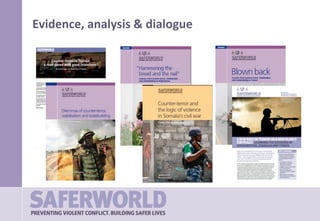
Evidence, analysis & dialogue
A. The risks posed by C/PVE
1. It ignores the problematic agendas and
behaviours of certain actors;
2. It focusses on certain issues;
3. It seeks to establish simplistic causal links to
achieve a narrow objective;
4. In spite of the name, it is more about reaction
than prevention…
B. The problems with counter-messaging
1. It is difficult to develop messages and narratives
which resonate and reach target audiences;
2. It can reinforce people’s beliefs and create anger;
3. It can stigmatise, foment division and cement
repression;
4. It tends to close and control the debate;
5. It puts local partners in a difficult position;
6. It distracts from what is really needed: improving
people’s lives.
C. What can be done?
1. Shift from top down messaging to promoting dialogue and
listening to concerns;
2. Ensure people can trust your communications:
• Information should be objective and grounded in evidence;
• Information should be shared to benefit the people
receiving it, not to better control them;
• Don’t make promises you can’t keep;
• Peace education is important, seeing it work in practice
even more so
3. Actions speak louder than words: focus on improving
people’s lives
Спасибо!
www.Saferworld.org.uk
ktricotofarrell@saferworld.org.uk

2 1 3 ofarell

  • 1.
    Kloé Tricot O’Farrell,Conflict & Security Adviser, Central Asia 7 December 2018 Not without risks: Working with the media and counter-messaging for PVE
  • 2.
  • 3.
    A. The risksposed by C/PVE 1. It ignores the problematic agendas and behaviours of certain actors; 2. It focusses on certain issues; 3. It seeks to establish simplistic causal links to achieve a narrow objective; 4. In spite of the name, it is more about reaction than prevention…
  • 4.
    B. The problemswith counter-messaging 1. It is difficult to develop messages and narratives which resonate and reach target audiences; 2. It can reinforce people’s beliefs and create anger; 3. It can stigmatise, foment division and cement repression; 4. It tends to close and control the debate; 5. It puts local partners in a difficult position; 6. It distracts from what is really needed: improving people’s lives.
  • 5.
    C. What canbe done? 1. Shift from top down messaging to promoting dialogue and listening to concerns; 2. Ensure people can trust your communications: • Information should be objective and grounded in evidence; • Information should be shared to benefit the people receiving it, not to better control them; • Don’t make promises you can’t keep; • Peace education is important, seeing it work in practice even more so 3. Actions speak louder than words: focus on improving people’s lives
  • 6.

Editor's Notes

  • #2 13 December 2018November 15, 2004