SecDev
потенциал в риске
リスクから機会
riesgo y oportunidad
opportunity in risk
Digital Dimensions of VE
Trends: Bangladesh and Central Asia
April-November 2018
SecDev
SecDev is a digital research and
innovation consultancy that addresses
the toughest challenges of the digital era.
We have a deep understanding of
geopolitical trends, the digital economy,
technology and urbanization.
SecDev builds value through innovation.
We are fluent in technology and data
science, global in scope and singularly
results-oriented.
SecDev’s mission is to empower clients
to make informed choices that deliver
value in the digital era.
.digital geo-politics
SecDev
.who we are
.what we do (VEpractice)
Providebaselineanalysisof scopeof
onlineviolentextremist(VE)
communitiesvisiblethroughsocial
mediaandthepublicInternet.
Provideanalyticalinputforcounter-
messagingprogramdevelopmentand
PVEprogrammes
SecDev
.
Our methods
Ethical approach. Public health model of trend
analysis using Internet-based resources
All source analysis. Subject matter led,
incorporates corroborating data sources and
applies level of confidence to analysis.
We apply a public health approach
to C/PVE. Identify and address risk
and protective factors
most importantly…
Data access is changing
Social media companies are under pressure
Facebook has applied self-regulation and closed
access to APIs needed for automated qualitative data
analysis
New data protection standards have been implemented,
leading to industry restrictions on data sharing and use,
and greater scrutiny of research
Social media “firehose” data is now restricted and
highly constrained by new privacy and acceptable
usage rules.
Ethical practices and use cases for social media
collection are in flux and under development. We are
working with Facebook on the development and
application of those standards to CVE work.
SecDev
VE trends
April - November 2018
Bangladesh&CentralAsia
(positive) impact of online
policing and industry action
Account takedown and content
blocking have eliminated most public
VE sites. Facebook removed over 3
million terrorism-related posts
worldwide. Takedown time ranged
from 2 minutes to 14 hours.
SecDev
What we foundA dense ecosystem of online content sites professionally managed and representing
a constituency that ranges from hard-core foreign fighters to moderate voices calling
for political change through Islam.
Hundreds of social media accounts
containing some VE content or
belonging to groups known to support
VE
Over a hundred accounts actively
distributing VE content to over 300,000
subscribers. SecDev
Central Asia
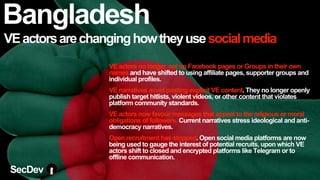
VEactorsarechanginghowtheyusesocialmedia
VE actors no longer set up Facebook pages or Groups in their own
names and have shifted to using affiliate pages, supporter groups and
individual profiles.
VE narratives avoid posting explicit VE content. They no longer openly
publish target hitlists, violent videos, or other content that violates
platform community standards.
VE actors now favour messages that appeal to the religious or moral
obligations of followers. Current narratives stress ideological and anti-
democracy narratives.
Open recruitment has stopped. Open social media platforms are now
being used to gauge the interest of potential recruits, upon which VE
actors shift to closed and encrypted platforms like Telegram or to
offline communication.
Bangladesh
SecDev
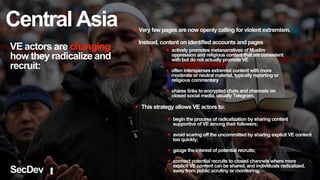
VE actors are changing
how they radicalize and
recruit:
✴ Very few pages are now openly calling for violent extremism.
✴ Instead, content on identified accounts and pages
✴ actively promotes metanarratives of Muslim
oppression and religious content that are consistent
with but do not actually promote VE
✴ often intersperses extremist content with more
moderate or neutral material, typically reporting or
religious commentary
✴ shares links to encrypted chats and channels on
closed social media, usually Telegram.
✴ begin the process of radicalization by sharing content
supportive of VE among their followers;
✴ avoid scaring off the uncommitted by sharing explicit VE content
too quickly;
✴ gauge the interest of potential recruits;
✴ connect potential recruits to closed channels where more
explicit VE content can be shared, and individuals radicalized,
away from public scrutiny or monitoring.
✴ This strategy allows VE actors to:
SecDev
Central Asia
VE groups are adapting their tactics on social media in
response to increased monitoring and policing.
They are changing how they use social media: ✴ Groups are responding to blocking and takedowns by
establishing redundancy within and across social media
channels
✴ Having accounts across many channels so that some
channels will always remain active (and can be used to share
new account details for other channels)
✴ Creating multiple accounts within a single channel so they
can migrate easily after account blocking
✴ Anticipating takedowns by sharing links to dormant channels
before active ones are blocked
✴ Using join links on Telegram with expiring terms, which are
constantly updated and distributed among subscribers
✴ Using individual profiles on Facebook as informal groups to
bypass the blocking of open groups and pages with VE
content..
SecDev
Central Asia
Telegram & Facebook
…are the most commonly used channels In Central Asia and Bangladesh.
✴These trends are evident in VE groups in other
parts of the world.
✴Creating social media empires offering content in multiple
languages across multiple channels in varying formats
✴Creating soft points of entry through religious or news
pages that run in parallel with VE accounts/pages
✴Soliciting funds in bitcoin or other cryptocurrencies
✴Larger groups are becoming more sophisticated in
their usage of social media:
SecDev
Links to closed Telegram channels are
shared on open social media, including
Facebook pages
Content and communication in closed
channels are much harder to monitor
MoreextremeVEcontentshiftstoclosed
channelsonTelegram
SecDev
Key trends
Theriseofthesocialmediainfluencer
✴ Subscriptions to Tamim Al Adnani YouTube
channels have surged, and his posts attract very
high levels of interaction.
✴ Adnani’s lectures are strongly critical of the existing
Bangladeshi social and political system.
✴ Although he has promoted AQ narratives in the past,
he currently refrains from calling for jihad or sharing
openly VE content. Instead, he prefers to radicalise
his audience by advocating for an Islamic political
and educational system.
In Bangladesh, the increasing popularity of Tamim Al Adnani is indicative of the shift
in strategy in use of social media to avoid content takedown.
SecDev
Key trends
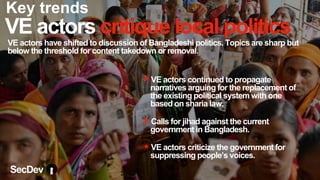
VE actors critique local politics
VE actors have shifted to discussion of Bangladeshi politics. Topics are sharp but
below the threshold for content takedown or removal.
✴VE actors continued to propagate
narratives arguing for the replacement of
the existing political system with one
based on sharia law.
✴Calls for jihad against the current
government in Bangladesh.
✴VE actors criticize the government for
suppressing people’s voices.
SecDev
Key trends
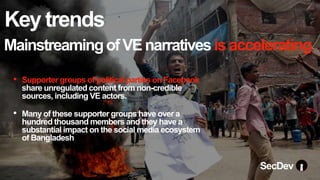
• Supporter groups of political parties on Facebook
share unregulated content from non-credible
sources, including VE actors.
• Many of these supporter groups have over a
hundred thousand members and they have a
substantial impact on the social media ecosystem
of Bangladesh
MainstreamingofVEnarrativesis accelerating
Key trends
SecDev
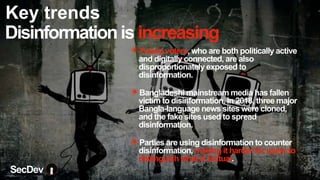
Disinformationis increasing
✴Young voters, who are both politically active
and digitally connected, are also
disproportionately exposed to
disinformation.
✴Bangladeshi mainstream media has fallen
victim to disinformation. In 2018, three major
Bangla-language news sites were cloned,
and the fake sites used to spread
disinformation.
✴Parties are using disinformation to counter
disinformation, making it harder for users to
distinguish what is factual.
SecDev
Key trends
Next steps
Need for Audience Analysis
Selected content takedown of foreign fighter
recruitment and tradecraft sites.
Counter-messaging and engagement on moderate
VE accounts and channels.
Selected community engagement among those
communities clearly impacted by online fora,
working to empower community leaders and other
intermediaries (specifically focusing on youth).
The diversity, density, and scale of the VE online presence requires further study
including audience segmentation to identify specific at-risk populations, and to develop
appropriate response strategies.
Response strategies should include:
SecDev
And also….
Strengthening the link between C/PVE and Democratic
Governance. As policing online content has become
more effective, defining what constitutes “digital
citizenship” is ever more important. Given that VE
actors continue to propagate anti-democratic
narratives, there is a need to strengthen society’s
commitment to inclusion, equality, democracy and the
rule of law.
SecDev
Questions?
SecDev
SecDev
потенциал в риске
リスクから機会
riesgo y oportunidad
opportunity in risk

1 3 5 mc_murren

  • 1.
  • 2.
    Digital Dimensions ofVE Trends: Bangladesh and Central Asia April-November 2018 SecDev
  • 3.
    SecDev is adigital research and innovation consultancy that addresses the toughest challenges of the digital era. We have a deep understanding of geopolitical trends, the digital economy, technology and urbanization. SecDev builds value through innovation. We are fluent in technology and data science, global in scope and singularly results-oriented. SecDev’s mission is to empower clients to make informed choices that deliver value in the digital era. .digital geo-politics SecDev .who we are
  • 4.
    .what we do(VEpractice) Providebaselineanalysisof scopeof onlineviolentextremist(VE) communitiesvisiblethroughsocial mediaandthepublicInternet. Provideanalyticalinputforcounter- messagingprogramdevelopmentand PVEprogrammes SecDev .
  • 5.
    Our methods Ethical approach.Public health model of trend analysis using Internet-based resources All source analysis. Subject matter led, incorporates corroborating data sources and applies level of confidence to analysis.
  • 6.
    We apply apublic health approach to C/PVE. Identify and address risk and protective factors most importantly…
  • 7.
    Data access ischanging Social media companies are under pressure Facebook has applied self-regulation and closed access to APIs needed for automated qualitative data analysis New data protection standards have been implemented, leading to industry restrictions on data sharing and use, and greater scrutiny of research Social media “firehose” data is now restricted and highly constrained by new privacy and acceptable usage rules. Ethical practices and use cases for social media collection are in flux and under development. We are working with Facebook on the development and application of those standards to CVE work. SecDev
  • 8.
    VE trends April -November 2018 Bangladesh&CentralAsia
  • 9.
    (positive) impact ofonline policing and industry action Account takedown and content blocking have eliminated most public VE sites. Facebook removed over 3 million terrorism-related posts worldwide. Takedown time ranged from 2 minutes to 14 hours. SecDev
  • 10.
    What we foundAdense ecosystem of online content sites professionally managed and representing a constituency that ranges from hard-core foreign fighters to moderate voices calling for political change through Islam. Hundreds of social media accounts containing some VE content or belonging to groups known to support VE Over a hundred accounts actively distributing VE content to over 300,000 subscribers. SecDev Central Asia
  • 11.
    VEactorsarechanginghowtheyusesocialmedia VE actors nolonger set up Facebook pages or Groups in their own names and have shifted to using affiliate pages, supporter groups and individual profiles. VE narratives avoid posting explicit VE content. They no longer openly publish target hitlists, violent videos, or other content that violates platform community standards. VE actors now favour messages that appeal to the religious or moral obligations of followers. Current narratives stress ideological and anti- democracy narratives. Open recruitment has stopped. Open social media platforms are now being used to gauge the interest of potential recruits, upon which VE actors shift to closed and encrypted platforms like Telegram or to offline communication. Bangladesh SecDev
  • 12.
    VE actors arechanging how they radicalize and recruit: ✴ Very few pages are now openly calling for violent extremism. ✴ Instead, content on identified accounts and pages ✴ actively promotes metanarratives of Muslim oppression and religious content that are consistent with but do not actually promote VE ✴ often intersperses extremist content with more moderate or neutral material, typically reporting or religious commentary ✴ shares links to encrypted chats and channels on closed social media, usually Telegram. ✴ begin the process of radicalization by sharing content supportive of VE among their followers; ✴ avoid scaring off the uncommitted by sharing explicit VE content too quickly; ✴ gauge the interest of potential recruits; ✴ connect potential recruits to closed channels where more explicit VE content can be shared, and individuals radicalized, away from public scrutiny or monitoring. ✴ This strategy allows VE actors to: SecDev Central Asia
  • 13.
    VE groups areadapting their tactics on social media in response to increased monitoring and policing. They are changing how they use social media: ✴ Groups are responding to blocking and takedowns by establishing redundancy within and across social media channels ✴ Having accounts across many channels so that some channels will always remain active (and can be used to share new account details for other channels) ✴ Creating multiple accounts within a single channel so they can migrate easily after account blocking ✴ Anticipating takedowns by sharing links to dormant channels before active ones are blocked ✴ Using join links on Telegram with expiring terms, which are constantly updated and distributed among subscribers ✴ Using individual profiles on Facebook as informal groups to bypass the blocking of open groups and pages with VE content.. SecDev Central Asia
  • 14.
    Telegram & Facebook …arethe most commonly used channels In Central Asia and Bangladesh. ✴These trends are evident in VE groups in other parts of the world. ✴Creating social media empires offering content in multiple languages across multiple channels in varying formats ✴Creating soft points of entry through religious or news pages that run in parallel with VE accounts/pages ✴Soliciting funds in bitcoin or other cryptocurrencies ✴Larger groups are becoming more sophisticated in their usage of social media: SecDev
  • 15.
    Links to closedTelegram channels are shared on open social media, including Facebook pages Content and communication in closed channels are much harder to monitor MoreextremeVEcontentshiftstoclosed channelsonTelegram SecDev Key trends
  • 16.
    Theriseofthesocialmediainfluencer ✴ Subscriptions toTamim Al Adnani YouTube channels have surged, and his posts attract very high levels of interaction. ✴ Adnani’s lectures are strongly critical of the existing Bangladeshi social and political system. ✴ Although he has promoted AQ narratives in the past, he currently refrains from calling for jihad or sharing openly VE content. Instead, he prefers to radicalise his audience by advocating for an Islamic political and educational system. In Bangladesh, the increasing popularity of Tamim Al Adnani is indicative of the shift in strategy in use of social media to avoid content takedown. SecDev Key trends
  • 17.
    VE actors critiquelocal politics VE actors have shifted to discussion of Bangladeshi politics. Topics are sharp but below the threshold for content takedown or removal. ✴VE actors continued to propagate narratives arguing for the replacement of the existing political system with one based on sharia law. ✴Calls for jihad against the current government in Bangladesh. ✴VE actors criticize the government for suppressing people’s voices. SecDev Key trends
  • 18.
    • Supporter groupsof political parties on Facebook share unregulated content from non-credible sources, including VE actors. • Many of these supporter groups have over a hundred thousand members and they have a substantial impact on the social media ecosystem of Bangladesh MainstreamingofVEnarrativesis accelerating Key trends SecDev
  • 19.
    Disinformationis increasing ✴Young voters,who are both politically active and digitally connected, are also disproportionately exposed to disinformation. ✴Bangladeshi mainstream media has fallen victim to disinformation. In 2018, three major Bangla-language news sites were cloned, and the fake sites used to spread disinformation. ✴Parties are using disinformation to counter disinformation, making it harder for users to distinguish what is factual. SecDev Key trends
  • 20.
  • 21.
    Need for AudienceAnalysis Selected content takedown of foreign fighter recruitment and tradecraft sites. Counter-messaging and engagement on moderate VE accounts and channels. Selected community engagement among those communities clearly impacted by online fora, working to empower community leaders and other intermediaries (specifically focusing on youth). The diversity, density, and scale of the VE online presence requires further study including audience segmentation to identify specific at-risk populations, and to develop appropriate response strategies. Response strategies should include: SecDev
  • 22.
    And also…. Strengthening thelink between C/PVE and Democratic Governance. As policing online content has become more effective, defining what constitutes “digital citizenship” is ever more important. Given that VE actors continue to propagate anti-democratic narratives, there is a need to strengthen society’s commitment to inclusion, equality, democracy and the rule of law. SecDev
  • 23.
  • 24.

Editor's Notes

  • #3 Good afternoon and thanks for the opportunity to speak here today. In this presentation I’m going to be sharing some of the insights from SecDev’s research into trends in social media usage by VE actors in Bangladesh and Central Asia.
  • #4 SecDev is a geopolitical risk consultancy specialising in digital risk, including C/PVE. We are subject matter experts in cybersecurity, urban and digital risk, and the digital economy. Our practice is data-driven, global in scope and results-oriented. Our goal is to empower our clients to make informed and effective decisions in the digital era.
  • #5  Our VE practice gives clients a baseline analysis of the scope and scale of online VE communities active on open social media and publicly accessible sites on the Internet. We aim to answer questions like: Who are the actors and groups? What is their reach in terms of channels, accounts, languages, and numbers of followers? What narratives are they using to connect with their followers, and how well are these resonating? This data allows us to provide data-driven analysis to help clients develop effective programming.
  • #6 Our research involves analysing and monitoring open Internet-based sources to create trend analyses according to the public health model. We hold ourselves to the highest ethical standards regarding individual privacy, which is constantly evolving as norms and standards change. We aim to corroborate all our sources through secondary sources and infield expert opinion so that we can offer clients analysis with a clear level of confidence.
  • #7 SecDev uses a public health approach in our C/PVE monitoring and analysis. This involves: Defining and monitoring the problem through a deep dive into relevant data Identifying risk and protective factors that increase or decrease the likelihood of radicalization to violent extremism Using this understanding to help our clients improve the effectiveness of their programming. Adopting this model means that we track trends and groups, not individuals. We are committed to ensuring individual privacy and safety.
  • #8 Data protection standards are changing rapidly and our practice is evolving with it. Public controversy and new data protection standards such as GDPR have led to changes in what data is available and how it can be used. Platforms are imposing restrictions on what data can be shared. Facebook has closed access to data sharing that formerly enabled us to conduct automated analysis of VE data. As the discussion continues, we are working with Facebook to on how to develop and apply standards to C/PVE work that enable access to data while protecting privacy.
  • #9 The following are some of our the key trends in VE usage of social media that we’ve been observing in Bangladesh and Central Asia this year.
  • #10 Moves by social media platforms to detect and remove VE content and actors are working worldwide. Online policing and automation of detection of VE content have removed a huge amount of VE content from social media. Facebook recently reported that it had taken doen over 3 million terrorism-related posts, most of which were automatically detected by the platform’s Ai and removed within 2 minutes of posting. The effectiveness of detection is particularly true for Bangladesh, where the number of open VE sites dropped by two thirds between 2016 and 2018, and is still dropping.
  • #11 Despite takedowns by platforms, Central Asia appears to have a far denser VE social media ecosystem than Bangladesh. We found: - Hundreds of social media accounts containing some VE content or belonging to groups known to support VE - More than a hundred were actively distributing VE content to over 300 000 subscribers. Given efforts by social media platforms and governments to identify and remove VE content and block VE actors, the availability of so much VE content in open social media is significant and concerning.
  • #12 In response to increased policing, VE actors in Bangladesh are changing how they use social media They no longer set up pages or groups under their group names, using unofficial groups instead They avoid posting explicit VE content that will violate community standards and prompt takedowns and blocking. They have moved towards softer messaging that appeals to users’ moral, ideological and religious views. These messages also put forward anti=democratic ideas They no longer recruit through open social media, moving recruitment to closed channels or offline.
  • #13 Many of the same changes are also evident in Central Asia. VE groups on social media are changing how they radicalise and recruit: As in Bangladesh, very few pages are now openly calling for violent extremism. Instead, content on identified accounts and pages - promote metanarratives of Muslim oppression and religious content that stop short of actually promoting VE, but are sympathetic to it Mix extremist content with more moderate or neutral material, typically reporting or religious commentary\ Share links to encrypted chats and channels on closed social media, usually Telegram. This strategy allows VE actors to - begin the process of radicalisation by sharing content supportive of VE among their followers; - avoid scaring off the uncommitted by sharing explicit VE content too quickly; - gauge the interest of potential recruits; - connect potential recruits to closed channels where more explicit VE content can be shared, and individuals radicalised, away from public scrutiny or monitoring.
  • #14 We also found evidence that extremist groups are adapting how they operate on social media to ensure they can stay active on social media in response to increased monitoring and policing. - Groups are responding to blocking and takedowns by establishing redundancy within and across social media channels - Having accounts across many channels so that some channels will always remain active (and can be used to share new account details for other channels) - Creating multiple accounts within a single channel so they can migrate easily after account blocking - Anticipating takedowns by sharing links to dormant channels before active ones are blocked - Using join links on Telegram with expiring terms, which are constantly updated and distributed among subscribers - Using individual profiles on Facebook as informal groups to bypass the blocking of open groups and pages with VE content.
  • #15 In both Central Asia and Bangladesh, Telegram and Facebook remain the most commonly used channels Some common trends: - Usage of social media is changing as VE groups become more sophisticated: - Larger groups are becoming more sophisticated in their usage of social media: -Creating social media empires offering content in multiple languages across multiple channels accounts in varying formats -Creating soft points of entry through religious or news pages that run in parallel with VE accounts/pages -Soliciting funds in bitcoin or other cryptocurrencies These trends are also evident in VE groups in other parts of the world.
  • #16 I’d now like to turn to some of the key emerging trends we’re observing in VE use of social media, with some examples from Bangladesh. In both Central Asia and Bangladesh, closed Telegram channels are being used to share more extreme content, and may be used for recruitment. Links to closed channels are actively shared on open social media, since they don’t violate platform community standards. Content and communication within closed channels is much harder to monitor. SecDev doesn’t monitor content in closed channels that require administrator approval to join, but content shared from these channels into open social media tends to be more radical in nature, with calls to jihad and martyrdom.
  • #17  Another kye trend is the rise of VE social media influencers such as Tamim Al Adnani. Often at the helm of a social media empire, they typically share less extreme VE content that stresses ideological and religious themes. They are significant because of their strong followings and capacity to subtly radicalize a large base and mainstream some VE messaging. Tamim Al Adnani has ties to AQ, although his current messaging avoids those narratives.
  • #18 Social media influencers often engage with local political issues that resonate with social media users, as in Bangladesh. In Bangladesh, where local political issues attract high levels of interaction on social media, VE actors are increasingly engaging in these discussions. Discussions of political issues offer an opportunity to propagate narratives for the overthrow of the existing political system and its replacement with one based on sharia law, which may appeal to those who feel dissatisfied or disenfranchised.
  • #19 As VE actors involve themselves more in political discussions online, some of their views – particularly less extreme, ideological or anti-democratic positions -- are being picked up and amplified by unofficial and official supporter groups for political parties. Content shared in this way can quickly go viral and spread beyond these supporter groups. Through these routes, VE content is being mainstreamed throughout social media and political debate subtly radicalised.
  • #20 Some of the mainstreaming involves the sharing of disinformation – non-credible information being deliberately shared to sow confusion, division or violence. This spreads very easily on social media, where content is not regulated and viral transmission makes quickly spreading content easy. Because they are the most digitally connected Bangladeshis, young people are most exposed to disinformation. But mainstream media and political parties aren’t immune either, with recent instances of major media sites being cloned and used to spread disinformation, and disinformation against both government and opposition. Parties are even using disinformation to counter disinformation, making it ever harder for social media users to establish what is fact and what is not.
  • #21 next steps
  • #22 The diversity, density, and scale of the VE online presence requires further study including audience segmentation to identify the specific “at risk” populations, and to develop appropriate response strategies. A one-size fits all strategy is likely either to be too heavyhanded or ineffective Response strategies should include: - Selected content takedown and account blocking-   of the most extreme forms of VE online, including foreign fighter recruitment and tradecraft sites. - Countermessaging and engagement -  on moderate VE accounts and channels to redirect those at high risk. - Selected community engagement -  among those communities that are clearly affected/impacted by online VE,  working to empower community leaders and other intermediaries (specifically focusing on youth).
  • #23 An effective response to VE on social media needs to build in strengthening links between C/PVE and democratic governance. VE actors are increasingly managing to mainstream their narratives and insert anti-democratic positions into political debate. But a heavyhanded and repressive response is likely to feed these narratives. Instead, responses need to build a positive model of digital citizenship which strengthens the commitment to democracy and the rule of law.
  • #24 That’s the end of my presentation. I’d now like to turn it over to the audience for any questions.