The Future of Python
Programming
Presented by - Shipra Bharti
Reg No.-23105109903
Introduction to python
• Python is a widely used high-level, interpreted programming
language.
• It was created by Guido van Rossum in 1991 and further
developed by the Python Software Foundation.
Python's Meteoric Rise: By the
Numbers
#1
Python's rank as the top language
for machine learning
15.7M
Estimated number of Python
developers worldwide in 2024
48.24%
Percentage of developers using
Python (Statista, 2023)
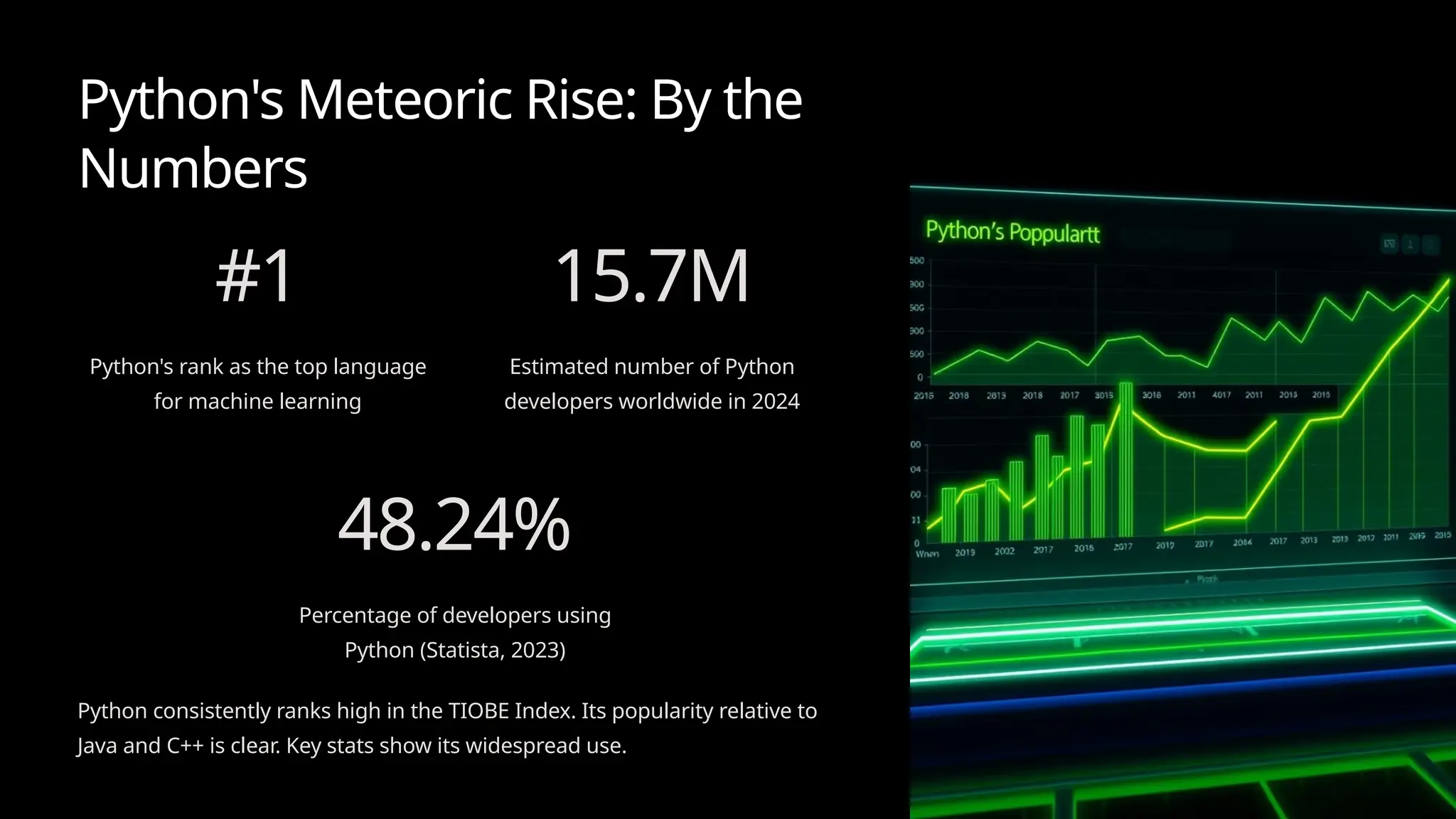
Python consistently ranks high in the TIOBE Index. Its popularity relative to
Java and C++ is clear. Key stats show its widespread use.
Core Strengths Fueling Growth
Simplicity and Readability
Python's clear syntax lowers the
barrier to entry for new
developers.
Extensive Libraries and
Frameworks
TensorFlow, PyTorch, Django,
Flask, Pandas, and NumPy
support diverse applications.
Strong Community Support
Active forums, conferences, and
open-source contributions drive
innovation.
Python's strengths include its clear syntax and extensive support. Its versatility makes it adaptable to various domains.
Python in Emerging
Technologies
Machine Learning
and AI
Python is the
dominant language
for AI development.
Data Science and
Analytics
Pandas and NumPy
simplify data
manipulation and
analysis.
Scientific
Computing
Python is increasingly
used in research and
simulations.
Python excels in machine learning, with 87% of data scientists using it. It's
also crucial for automation, DevOps, and cybersecurity.
Python in Web Development
Asynchronous Frameworks
FastAPI and Starlette are gaining
traction for high-performance APIs.
Microservices Architecture
Python helps build scalable and
maintainable web applications.
Serverless Computing
Python functions are deployed on AWS
Lambda and Google Cloud Functions.
Python powers evolving web frameworks. It is ideal for microservices and serverless computing. Libraries like websockets
enable real-time communication.
Predictions and Future Trends
Continued Growth in
AI/ML
Python's role in cutting-edge AI
research and applications will
expand.
Increased Adoption in IoT
Python's suitability for
resource-constrained devices
makes it ideal for IoT.
Expansion in Quantum Computing
Python libraries like Google Cirq and PennyLane are gaining traction.
Python will grow in AI/ML and IoT. Education emphasizes Python, and
low-code platforms are integrating it. Quantum computing will also adopt
it.
Conclusion: Python's Bright
Future
Adaptability
Python adapts to new challenges.
Community
Its strong community drives success.
Evolution
Embrace its applications.
Python's adaptability ensures continued success. Embrace its evolution and
explore emerging technologies. Stay updated and contribute to its vibrant
ecosystem.
1st presentation.pptx nnnnnnnnnnnnnnnnnnnn

1st presentation.pptx nnnnnnnnnnnnnnnnnnnn

  • 1.
    The Future ofPython Programming Presented by - Shipra Bharti Reg No.-23105109903
  • 2.
    Introduction to python •Python is a widely used high-level, interpreted programming language. • It was created by Guido van Rossum in 1991 and further developed by the Python Software Foundation.
  • 3.
    Python's Meteoric Rise:By the Numbers #1 Python's rank as the top language for machine learning 15.7M Estimated number of Python developers worldwide in 2024 48.24% Percentage of developers using Python (Statista, 2023) Python consistently ranks high in the TIOBE Index. Its popularity relative to Java and C++ is clear. Key stats show its widespread use.
  • 4.
    Core Strengths FuelingGrowth Simplicity and Readability Python's clear syntax lowers the barrier to entry for new developers. Extensive Libraries and Frameworks TensorFlow, PyTorch, Django, Flask, Pandas, and NumPy support diverse applications. Strong Community Support Active forums, conferences, and open-source contributions drive innovation. Python's strengths include its clear syntax and extensive support. Its versatility makes it adaptable to various domains.
  • 5.
    Python in Emerging Technologies MachineLearning and AI Python is the dominant language for AI development. Data Science and Analytics Pandas and NumPy simplify data manipulation and analysis. Scientific Computing Python is increasingly used in research and simulations. Python excels in machine learning, with 87% of data scientists using it. It's also crucial for automation, DevOps, and cybersecurity.
  • 6.
    Python in WebDevelopment Asynchronous Frameworks FastAPI and Starlette are gaining traction for high-performance APIs. Microservices Architecture Python helps build scalable and maintainable web applications. Serverless Computing Python functions are deployed on AWS Lambda and Google Cloud Functions. Python powers evolving web frameworks. It is ideal for microservices and serverless computing. Libraries like websockets enable real-time communication.
  • 7.
    Predictions and FutureTrends Continued Growth in AI/ML Python's role in cutting-edge AI research and applications will expand. Increased Adoption in IoT Python's suitability for resource-constrained devices makes it ideal for IoT. Expansion in Quantum Computing Python libraries like Google Cirq and PennyLane are gaining traction. Python will grow in AI/ML and IoT. Education emphasizes Python, and low-code platforms are integrating it. Quantum computing will also adopt it.
  • 8.
    Conclusion: Python's Bright Future Adaptability Pythonadapts to new challenges. Community Its strong community drives success. Evolution Embrace its applications. Python's adaptability ensures continued success. Embrace its evolution and explore emerging technologies. Stay updated and contribute to its vibrant ecosystem.