1
Running head: CREATIVITY AND INNOVATION
CREATIVITY AND INNOVATION 2
Creativity and innovation
Introduction
This is an educational project that attempts to create an
interactive website for educational purposes. The website
created is for education and for providing s platform for the
learners to share their knowledge with the community in a way
that seeks to solve the problems. Education is used as a means
to attain the socio-economic status in the society. It imparts
educational and innovative skills in the learners to enable them
cope with everyday life challenges. The young ones will have
entrepreneurial skills imparted in them so that as they grow they
continue to develop good business acumen.
Modification
This learning website has to be redesigned to capture the 21st
Century Skills. This is a method that factors in the current
education environment and the prevailing social issues. It seeks
to integrate the children into the new global economy. This
education plan imparts the information, media and technology
skills; the 4Cs of learning; career and life skills; standards and
guidelines for assessments; professional development and
favorable learning environment. In the changes made for this
plan, the website would be used to impart valuable life and
career skills.
Other than real knowledge and thinking ability, the working
environment requires an individual who can steer through life in
the social sphere and who has other innate qualities. Some of
these attributes include self-direction, leadership, initiative,
adaptability and creativity. The learners are taught the creative
thinking and problem-solving skills to help cope with situations.
Technology skills are critical in the current world. Without
information technology and communication skills, we would not
be able to cooperate with one another and share ideas.
Evaluation
The learning activities in this project are aligned with the
components of the 21st Century Support System. These systems
aid in the creation of the multi-dimensional abilities that enable
the learners to cope well in the current economic system. The
skills require a well-structured support system to boost their
mastery. The education program must be set to the 21st Century
Standards. These standards are technologically oriented; focus
on the life skills and problem-solving abilities.
The curriculum instruction given used in this education program
is set to the 21st Century Standards. They are development
oriented and are designed to produce all-round individuals. The
learning environment created by this method is conducive for
creative and innovative thinkers. It boosts cooperation and
social interactions. Communication offers the key to
understanding one another. It is used to enhance the
performance of the individual learners and the community.
Reflection
When redesigning this learning program, I met with so many
technical challenges that I had to overcome if I was to come up
with a working plan. The first challenge was that of integrating
technology into the learning system. Technology is tough to
operate, and I was faced with the task of putting it in a way that
it enhances rather than impeding the process of sharing
information and grasping concepts.
The other challenge was the choice of life skills to conclude in
the program so that it achieves its objectives. Aligning the
everyday life skills with the goals of the project assisted in
identifying the right skills for the education program. This
website is designed to be easy to use for the purposes of
learning and developing necessary skills.
Reference
International Society for Technology in Education (2014)
Advancing Digital Age Learning. NETS for Students 2007.
Partnership for 21st Century Learning (n.d) Framework for 21st
Century Learning: 21st Century Students Outcomes and
Support Systems.
News article response (NAR) essay
Select a newspaper news article (not an opinion piece) either
from an online newspaper or from a hard copy newspaper that
interests you AND that is socially relevant (attach the article to
the back of your completed essay). After selecting and reading
the news article write (type) a two-page essay answering the
below six questions. These essays are due at the beginning of
class (within the first five minutes) and will be subject to peer
review. No late essays will be accepted. Note the headline of
the article and the response piece number (E.g., No. 1 or 2) in
the heading, and then attach the article behind the essay. I will
not accept papers that aren’t stapled or in this specific order!
(This assignment is worth a max. of 15 points. Approx. 2.5
points per question). See an example of this assignment below.
1. Main point: What is the main point or thesis of the article?
2. Clarity: Is the author clear (or is further explanation
necessary)?
3. Depth: Do the author’s answers address the complexities in
the questions at issue? Does the authors’ reasoning lead to
significant and far-reaching implications?
4. Breadth: Does the author approach the issues from the
multiple [differing] viewpoints (where relevant) or is his/her
reasoning too narrow-minded? Are opposing viewpoints
considered?
5. Give at least on specific example of a “fact” and one
example of an “opinion.”
6. Other insightful comments: Basically, tell me your opinion
on the issue. Don’t tell me your feelings about the writer's
presentation "style." Focus on what “is there” versus “what
isn't.” Do not use words such as ‘sad’, ‘nice; ‘scared,’ or other
similar emotional reactions in this section. Insightfulness is
related to analysis not emotion!
P21 Framework Definitions Page 1 of 9
Publication date: 5/15
P21 Framework Definitions
To help practitioners integrate skills into the teaching of key
academic subjects, the
Partnership has developed a unified, collective vision for
learning known as the
Framework for 21st Century Learning. This Framework
describes the skills, knowledge
and expertise students must master to succeed in work and life;
it is a blend of content
knowledge, specific skills, expertise and literacies.
Every 21st century skills implementation requires the
development of key academic
subject knowledge and understanding among all students. Those
who can think critically
and communicate effectively must build on a base of key
academic subject knowledge.
Within the context of key knowledge instruction, students must
also learn the
essential skills for success in today’s world, such as critical
thinking, problem
solving, communication and collaboration.
When a school or district builds on this foundation, combining
the entire Framework with
the necessary support systems—standards, assessments,
curriculum and instruction,
professional development and learning environments—students
are more engaged in the
learning process and graduate better prepared to thrive in
today’s global economy.
While the graphic represents each element distinctly for
descriptive purposes,
the Partnership views all the components as fully interconnected
in the process
of 21st century teaching and learning.
P21 Framework Definitions Page 2 of 9
Publication date: 5/15
21st CENTURY STUDENT OUTCOMES
The elements described in this section as “21st century student
outcomes” (represented
by the rainbow) are the knowledge, skills and expertise students
should master to
succeed in work and life in the 21st century.
Key SUBJECTS AND 21st CENTURY THEMES
Mastery of key subjects and 21st century themes is essential for
all students in
the 21st century. Key subjects include:
In addition to these subjects, we believe schools must move to
include not only a
focus on mastery of key subjects, but also promote
understanding of academic
content at much higher levels by weaving 21st century
interdisciplinary themes
into key subjects:
Global Awareness
issues
representing
diverse cultures, religions and lifestyles in a spirit of mutual
respect and
open dialogue in personal, work and community contexts
of non-English
languages
Financial, Economic, Business and Entrepreneurial Literacy
ng the role of the economy in society
productivity and career
options
Civic Literacy
stay informed
and understanding governmental processes
state, national
and global levels
decisions
P21 Framework Definitions Page 3 of 9
Publication date: 5/15
Health Literacy
information and
services and using such information and services in ways that
enhance
health
measures, including
proper diet, nutrition, exercise, risk avoidance and stress
reduction
-
related decisions
ealth and
safety issues
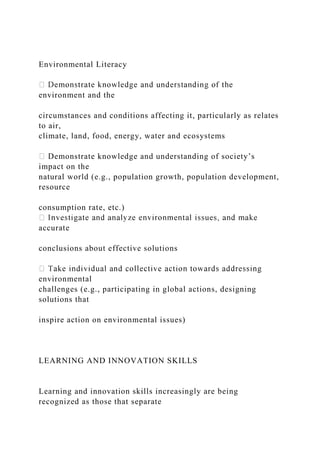
Environmental Literacy
environment and the
circumstances and conditions affecting it, particularly as relates
to air,
climate, land, food, energy, water and ecosystems
Demonstrate knowledge and understanding of society’s
impact on the
natural world (e.g., population growth, population development,
resource
consumption rate, etc.)
accurate
conclusions about effective solutions
environmental
challenges (e.g., participating in global actions, designing
solutions that
inspire action on environmental issues)
LEARNING AND INNOVATION SKILLS
Learning and innovation skills increasingly are being
recognized as those that separate
students who are prepared for a more and more complex life and
work environments in
the 21st century, and those who are not. A focus on creativity,
critical thinking,
communication and collaboration is essential to prepare
students for the future.
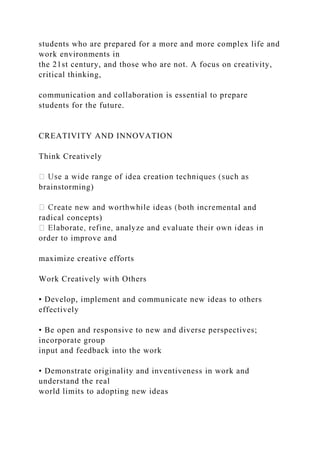
CREATIVITY AND INNOVATION
Think Creatively
brainstorming)
ntal and
radical concepts)
order to improve and
maximize creative efforts
Work Creatively with Others
• Develop, implement and communicate new ideas to others
effectively
• Be open and responsive to new and diverse perspectives;
incorporate group
input and feedback into the work
• Demonstrate originality and inventiveness in work and
understand the real
world limits to adopting new ideas
P21 Framework Definitions Page 4 of 9
Publication date: 5/15
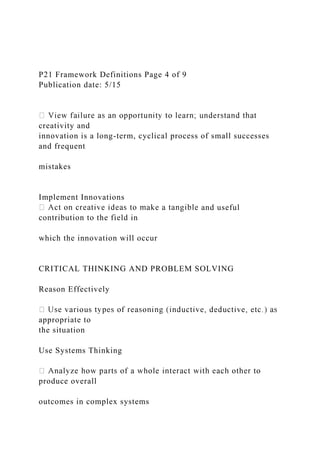
creativity and
innovation is a long-term, cyclical process of small successes
and frequent
mistakes
Implement Innovations
and useful
contribution to the field in
which the innovation will occur
CRITICAL THINKING AND PROBLEM SOLVING
Reason Effectively
appropriate to
the situation
Use Systems Thinking
produce overall
outcomes in complex systems
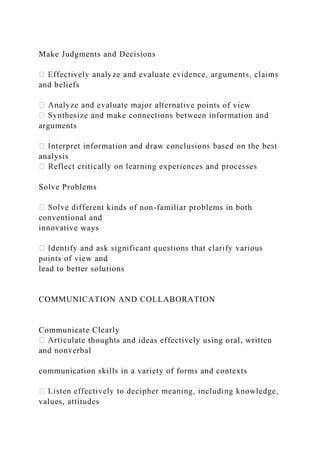
Make Judgments and Decisions
and beliefs
ve points of view
arguments
analysis
Solve Problems
rent kinds of non-familiar problems in both
conventional and
innovative ways
points of view and
lead to better solutions
COMMUNICATION AND COLLABORATION
Communicate Clearly
ate thoughts and ideas effectively using oral, written
and nonverbal
communication skills in a variety of forms and contexts
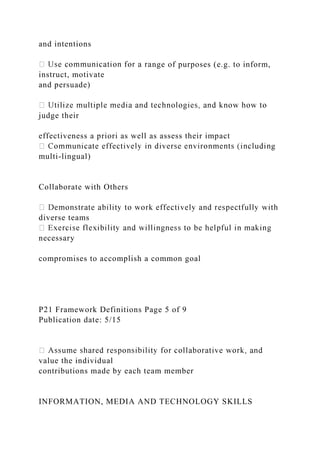
values, attitudes
and intentions
nge of purposes (e.g. to inform,
instruct, motivate
and persuade)
judge their
effectiveness a priori as well as assess their impact
g
multi-lingual)
Collaborate with Others
diverse teams
necessary
compromises to accomplish a common goal
P21 Framework Definitions Page 5 of 9
Publication date: 5/15
value the individual
contributions made by each team member
INFORMATION, MEDIA AND TECHNOLOGY SKILLS
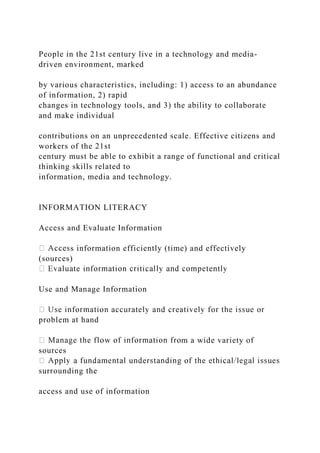
People in the 21st century live in a technology and media-
driven environment, marked
by various characteristics, including: 1) access to an abundance
of information, 2) rapid
changes in technology tools, and 3) the ability to collaborate
and make individual
contributions on an unprecedented scale. Effective citizens and
workers of the 21st
century must be able to exhibit a range of functional and critical
thinking skills related to
information, media and technology.
INFORMATION LITERACY
Access and Evaluate Information
s information efficiently (time) and effectively
(sources)
Use and Manage Information
problem at hand
m a wide variety of
sources
surrounding the
access and use of information
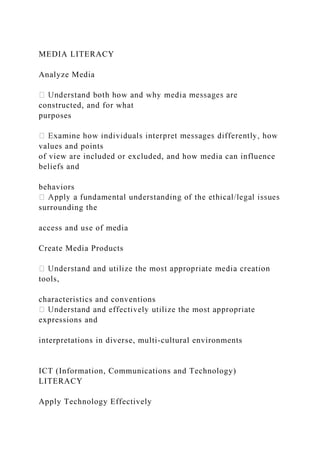
MEDIA LITERACY
Analyze Media
constructed, and for what
purposes
values and points
of view are included or excluded, and how media can influence
beliefs and
behaviors
surrounding the
access and use of media
Create Media Products
tools,
characteristics and conventions
expressions and
interpretations in diverse, multi-cultural environments
ICT (Information, Communications and Technology)
LITERACY
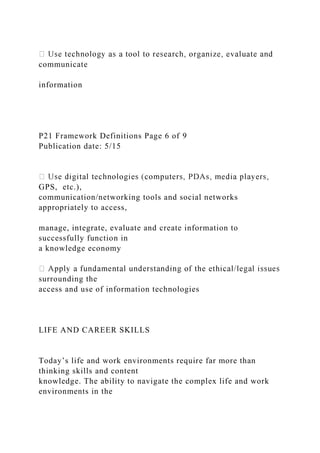
Apply Technology Effectively
communicate
information
P21 Framework Definitions Page 6 of 9
Publication date: 5/15
GPS, etc.),
communication/networking tools and social networks
appropriately to access,
manage, integrate, evaluate and create information to
successfully function in
a knowledge economy
surrounding the
access and use of information technologies
LIFE AND CAREER SKILLS
Today’s life and work environments require far more than
thinking skills and content
knowledge. The ability to navigate the complex life and work
environments in the
globally competitive information age requires students to pay
rigorous attention to
developing adequate life and career skills.
FLEXIBILITY AND ADAPTABILITY
Adapt to Change
contexts
priorities
Be Flexible
cks and criticism
to reach workable
solutions, particularly in multi-cultural environments
INITIATIVE AND SELF-DIRECTION
Manage Goals and Time
e success criteria
-term) and strategic (long-term) goals
Work Independently
oversight
Be Self-directed Learners
explore and expand
one’s own learning and opportunities to gain expertise
professional level
g as a lifelong process
future progress
SOCIAL AND CROSS-CULTURAL SKILLS
Interact Effectively with Others
P21 Framework Definitions Page 7 of 9
Publication date: 5/15
Work Effectively in Diverse Teams
from a range of
social and cultural backgrounds
-mindedly to different ideas and values
and increase both
innovation and quality of work
PRODUCTIVITY AND ACCOUNTABILITY
Manage Projects
even in the face of obstacles and
competing pressures
result
Produce Results
high quality
products including the abilities to:
- Work positively and ethically
- Manage time and projects effectively
- Multi-task
- Participate actively, as well as be reliable and punctual
- Present oneself professionally and with proper etiquette
- Collaborate and cooperate effectively with teams
- Respect and appreciate team diversity
- Be accountable for results
LEADERSHIP AND RESPONSIBILITY
Guide and Lead Others
-solving skills to influence and
guide others
toward a goal
hs of others to accomplish a common goal
selflessness
and power
Be Responsible to Others
of the larger community in
mind
21st CENTURY SUPPORT SYSTEMS
The elements described below are the critical systems necessary
to ensure student
mastery of 21st century skills. 21st century standards,
assessments, curriculum,
instruction, professional development and learning
environments must be aligned to
produce a support system that produces 21st century outcomes
for today’s students.
P21 Framework Definitions Page 8 of 9
Publication date: 5/15
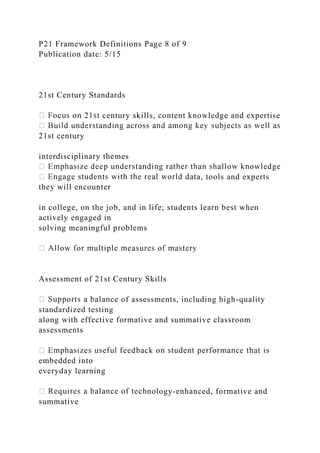
21st Century Standards
century skills, content knowledge and expertise
21st century
interdisciplinary themes
ta, tools and experts
they will encounter
in college, on the job, and in life; students learn best when
actively engaged in
solving meaningful problems
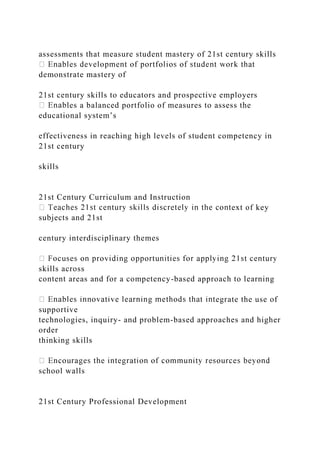
Assessment of 21st Century Skills
ce of assessments, including high-quality
standardized testing
along with effective formative and summative classroom
assessments
embedded into
everyday learning
nology-enhanced, formative and
summative
assessments that measure student mastery of 21st century skills
demonstrate mastery of
21st century skills to educators and prospective employers
les a balanced portfolio of measures to assess the
educational system’s
effectiveness in reaching high levels of student competency in
21st century
skills
21st Century Curriculum and Instruction
ext of key
subjects and 21st
century interdisciplinary themes
skills across
content areas and for a competency-based approach to learning
egrate the use of
supportive
technologies, inquiry- and problem-based approaches and higher
order
thinking skills
school walls
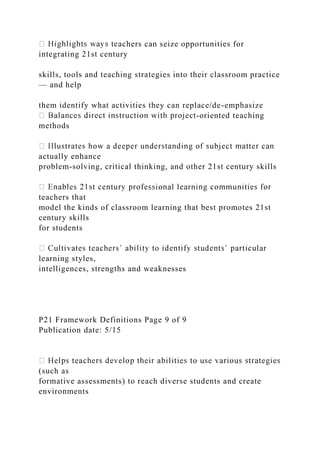
21st Century Professional Development
hers can seize opportunities for
integrating 21st century
skills, tools and teaching strategies into their classroom practice
— and help
them identify what activities they can replace/de-emphasize
-oriented teaching
methods
actually enhance
problem-solving, critical thinking, and other 21st century skills
teachers that
model the kinds of classroom learning that best promotes 21st
century skills
for students
learning styles,
intelligences, strengths and weaknesses
P21 Framework Definitions Page 9 of 9
Publication date: 5/15
(such as
formative assessments) to reach diverse students and create
environments
that support differentiated teaching and learning
f students’ 21st century
skills
development
practitioners, using
face-to-face, virtual and blended communications
development
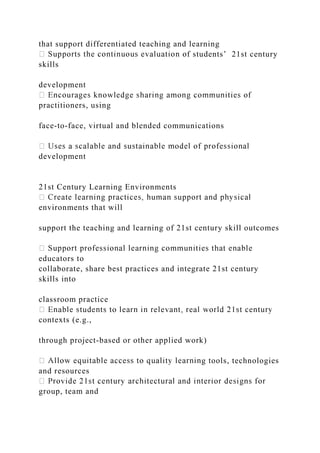
21st Century Learning Environments
environments that will
support the teaching and learning of 21st century skill outcomes
educators to
collaborate, share best practices and integrate 21st century
skills into
classroom practice
contexts (e.g.,
through project-based or other applied work)
g tools, technologies
and resources
group, team and
individual learning
in learning, both
face-to-face and online
About the Partnership for 21st Century Learning
The Partnership for 21st Century Learning recognizes that all
learners need educational
experiences in school and beyond, from cradle to career, to
build knowledge and skills
for success in a globally and digitally interconnected world.
Representing over 5 million
members of the global workforce, P21 unites business,
government and education
leaders from the U.S. and abroad to advance evidence-based
education policy and
practice and to make innovative teaching and learning a reality
for all.
P21 and member organizations provide tools and resources that
help facilitate and drive
this necessary change.
Learn more and get involved at www.p21.org.
Copyright © 2015, The Partnership for 21st Century Learning.
All rights reserved.
http://www.p21.org/

1Running head CREATIVITY AND INNOVATIONCREATIVITY AND INNOVAT.docx

  • 1.
    1 Running head: CREATIVITYAND INNOVATION CREATIVITY AND INNOVATION 2 Creativity and innovation Introduction This is an educational project that attempts to create an interactive website for educational purposes. The website created is for education and for providing s platform for the learners to share their knowledge with the community in a way that seeks to solve the problems. Education is used as a means to attain the socio-economic status in the society. It imparts educational and innovative skills in the learners to enable them cope with everyday life challenges. The young ones will have
  • 2.
    entrepreneurial skills impartedin them so that as they grow they continue to develop good business acumen. Modification This learning website has to be redesigned to capture the 21st Century Skills. This is a method that factors in the current education environment and the prevailing social issues. It seeks to integrate the children into the new global economy. This education plan imparts the information, media and technology skills; the 4Cs of learning; career and life skills; standards and guidelines for assessments; professional development and favorable learning environment. In the changes made for this plan, the website would be used to impart valuable life and career skills. Other than real knowledge and thinking ability, the working environment requires an individual who can steer through life in the social sphere and who has other innate qualities. Some of these attributes include self-direction, leadership, initiative, adaptability and creativity. The learners are taught the creative thinking and problem-solving skills to help cope with situations. Technology skills are critical in the current world. Without information technology and communication skills, we would not be able to cooperate with one another and share ideas. Evaluation The learning activities in this project are aligned with the components of the 21st Century Support System. These systems aid in the creation of the multi-dimensional abilities that enable the learners to cope well in the current economic system. The skills require a well-structured support system to boost their mastery. The education program must be set to the 21st Century Standards. These standards are technologically oriented; focus on the life skills and problem-solving abilities. The curriculum instruction given used in this education program is set to the 21st Century Standards. They are development oriented and are designed to produce all-round individuals. The learning environment created by this method is conducive for creative and innovative thinkers. It boosts cooperation and
  • 3.
    social interactions. Communicationoffers the key to understanding one another. It is used to enhance the performance of the individual learners and the community. Reflection When redesigning this learning program, I met with so many technical challenges that I had to overcome if I was to come up with a working plan. The first challenge was that of integrating technology into the learning system. Technology is tough to operate, and I was faced with the task of putting it in a way that it enhances rather than impeding the process of sharing information and grasping concepts. The other challenge was the choice of life skills to conclude in the program so that it achieves its objectives. Aligning the everyday life skills with the goals of the project assisted in identifying the right skills for the education program. This website is designed to be easy to use for the purposes of learning and developing necessary skills. Reference International Society for Technology in Education (2014) Advancing Digital Age Learning. NETS for Students 2007. Partnership for 21st Century Learning (n.d) Framework for 21st Century Learning: 21st Century Students Outcomes and Support Systems. News article response (NAR) essay Select a newspaper news article (not an opinion piece) either from an online newspaper or from a hard copy newspaper that interests you AND that is socially relevant (attach the article to the back of your completed essay). After selecting and reading the news article write (type) a two-page essay answering the below six questions. These essays are due at the beginning of class (within the first five minutes) and will be subject to peer review. No late essays will be accepted. Note the headline of the article and the response piece number (E.g., No. 1 or 2) in the heading, and then attach the article behind the essay. I will
  • 4.
    not accept papersthat aren’t stapled or in this specific order! (This assignment is worth a max. of 15 points. Approx. 2.5 points per question). See an example of this assignment below. 1. Main point: What is the main point or thesis of the article? 2. Clarity: Is the author clear (or is further explanation necessary)? 3. Depth: Do the author’s answers address the complexities in the questions at issue? Does the authors’ reasoning lead to significant and far-reaching implications? 4. Breadth: Does the author approach the issues from the multiple [differing] viewpoints (where relevant) or is his/her reasoning too narrow-minded? Are opposing viewpoints considered? 5. Give at least on specific example of a “fact” and one example of an “opinion.” 6. Other insightful comments: Basically, tell me your opinion on the issue. Don’t tell me your feelings about the writer's presentation "style." Focus on what “is there” versus “what isn't.” Do not use words such as ‘sad’, ‘nice; ‘scared,’ or other similar emotional reactions in this section. Insightfulness is related to analysis not emotion!
  • 5.
    P21 Framework DefinitionsPage 1 of 9 Publication date: 5/15 P21 Framework Definitions To help practitioners integrate skills into the teaching of key academic subjects, the Partnership has developed a unified, collective vision for learning known as the Framework for 21st Century Learning. This Framework describes the skills, knowledge and expertise students must master to succeed in work and life; it is a blend of content knowledge, specific skills, expertise and literacies. Every 21st century skills implementation requires the development of key academic subject knowledge and understanding among all students. Those who can think critically and communicate effectively must build on a base of key academic subject knowledge. Within the context of key knowledge instruction, students must
  • 6.
    also learn the essentialskills for success in today’s world, such as critical thinking, problem solving, communication and collaboration. When a school or district builds on this foundation, combining the entire Framework with the necessary support systems—standards, assessments, curriculum and instruction, professional development and learning environments—students are more engaged in the learning process and graduate better prepared to thrive in today’s global economy. While the graphic represents each element distinctly for descriptive purposes, the Partnership views all the components as fully interconnected in the process of 21st century teaching and learning. P21 Framework Definitions Page 2 of 9 Publication date: 5/15
  • 7.
    21st CENTURY STUDENTOUTCOMES The elements described in this section as “21st century student outcomes” (represented by the rainbow) are the knowledge, skills and expertise students should master to succeed in work and life in the 21st century. Key SUBJECTS AND 21st CENTURY THEMES Mastery of key subjects and 21st century themes is essential for all students in the 21st century. Key subjects include: In addition to these subjects, we believe schools must move to include not only a focus on mastery of key subjects, but also promote understanding of academic
  • 8.
    content at muchhigher levels by weaving 21st century interdisciplinary themes into key subjects: Global Awareness issues representing diverse cultures, religions and lifestyles in a spirit of mutual respect and open dialogue in personal, work and community contexts of non-English languages Financial, Economic, Business and Entrepreneurial Literacy ng the role of the economy in society productivity and career options Civic Literacy stay informed
  • 9.
    and understanding governmentalprocesses state, national and global levels decisions P21 Framework Definitions Page 3 of 9 Publication date: 5/15 Health Literacy information and services and using such information and services in ways that enhance health measures, including proper diet, nutrition, exercise, risk avoidance and stress reduction - related decisions ealth and safety issues
  • 10.
    Environmental Literacy environment andthe circumstances and conditions affecting it, particularly as relates to air, climate, land, food, energy, water and ecosystems Demonstrate knowledge and understanding of society’s impact on the natural world (e.g., population growth, population development, resource consumption rate, etc.) accurate conclusions about effective solutions environmental challenges (e.g., participating in global actions, designing solutions that inspire action on environmental issues) LEARNING AND INNOVATION SKILLS Learning and innovation skills increasingly are being recognized as those that separate
  • 11.
    students who areprepared for a more and more complex life and work environments in the 21st century, and those who are not. A focus on creativity, critical thinking, communication and collaboration is essential to prepare students for the future. CREATIVITY AND INNOVATION Think Creatively brainstorming) ntal and radical concepts) order to improve and maximize creative efforts Work Creatively with Others • Develop, implement and communicate new ideas to others effectively • Be open and responsive to new and diverse perspectives; incorporate group input and feedback into the work • Demonstrate originality and inventiveness in work and understand the real world limits to adopting new ideas
  • 12.
    P21 Framework DefinitionsPage 4 of 9 Publication date: 5/15 creativity and innovation is a long-term, cyclical process of small successes and frequent mistakes Implement Innovations and useful contribution to the field in which the innovation will occur CRITICAL THINKING AND PROBLEM SOLVING Reason Effectively appropriate to the situation Use Systems Thinking produce overall outcomes in complex systems
  • 13.
    Make Judgments andDecisions and beliefs ve points of view arguments analysis Solve Problems rent kinds of non-familiar problems in both conventional and innovative ways points of view and lead to better solutions COMMUNICATION AND COLLABORATION Communicate Clearly ate thoughts and ideas effectively using oral, written and nonverbal communication skills in a variety of forms and contexts values, attitudes
  • 14.
    and intentions nge ofpurposes (e.g. to inform, instruct, motivate and persuade) judge their effectiveness a priori as well as assess their impact g multi-lingual) Collaborate with Others diverse teams necessary compromises to accomplish a common goal P21 Framework Definitions Page 5 of 9 Publication date: 5/15 value the individual contributions made by each team member INFORMATION, MEDIA AND TECHNOLOGY SKILLS
  • 15.
    People in the21st century live in a technology and media- driven environment, marked by various characteristics, including: 1) access to an abundance of information, 2) rapid changes in technology tools, and 3) the ability to collaborate and make individual contributions on an unprecedented scale. Effective citizens and workers of the 21st century must be able to exhibit a range of functional and critical thinking skills related to information, media and technology. INFORMATION LITERACY Access and Evaluate Information s information efficiently (time) and effectively (sources) Use and Manage Information problem at hand m a wide variety of sources surrounding the access and use of information
  • 16.
    MEDIA LITERACY Analyze Media constructed,and for what purposes values and points of view are included or excluded, and how media can influence beliefs and behaviors surrounding the access and use of media Create Media Products tools, characteristics and conventions expressions and interpretations in diverse, multi-cultural environments ICT (Information, Communications and Technology) LITERACY Apply Technology Effectively
  • 17.
    communicate information P21 Framework DefinitionsPage 6 of 9 Publication date: 5/15 GPS, etc.), communication/networking tools and social networks appropriately to access, manage, integrate, evaluate and create information to successfully function in a knowledge economy surrounding the access and use of information technologies LIFE AND CAREER SKILLS Today’s life and work environments require far more than thinking skills and content knowledge. The ability to navigate the complex life and work environments in the
  • 18.
    globally competitive informationage requires students to pay rigorous attention to developing adequate life and career skills. FLEXIBILITY AND ADAPTABILITY Adapt to Change contexts priorities Be Flexible cks and criticism to reach workable solutions, particularly in multi-cultural environments INITIATIVE AND SELF-DIRECTION Manage Goals and Time e success criteria -term) and strategic (long-term) goals Work Independently
  • 19.
    oversight Be Self-directed Learners exploreand expand one’s own learning and opportunities to gain expertise professional level g as a lifelong process future progress SOCIAL AND CROSS-CULTURAL SKILLS Interact Effectively with Others P21 Framework Definitions Page 7 of 9 Publication date: 5/15 Work Effectively in Diverse Teams from a range of
  • 20.
    social and culturalbackgrounds -mindedly to different ideas and values and increase both innovation and quality of work PRODUCTIVITY AND ACCOUNTABILITY Manage Projects even in the face of obstacles and competing pressures result Produce Results high quality products including the abilities to: - Work positively and ethically - Manage time and projects effectively - Multi-task - Participate actively, as well as be reliable and punctual - Present oneself professionally and with proper etiquette - Collaborate and cooperate effectively with teams - Respect and appreciate team diversity - Be accountable for results
  • 21.
    LEADERSHIP AND RESPONSIBILITY Guideand Lead Others -solving skills to influence and guide others toward a goal hs of others to accomplish a common goal selflessness and power Be Responsible to Others of the larger community in mind 21st CENTURY SUPPORT SYSTEMS The elements described below are the critical systems necessary to ensure student mastery of 21st century skills. 21st century standards, assessments, curriculum, instruction, professional development and learning environments must be aligned to produce a support system that produces 21st century outcomes for today’s students.
  • 22.
    P21 Framework DefinitionsPage 8 of 9 Publication date: 5/15 21st Century Standards century skills, content knowledge and expertise 21st century interdisciplinary themes ta, tools and experts they will encounter in college, on the job, and in life; students learn best when actively engaged in solving meaningful problems Assessment of 21st Century Skills ce of assessments, including high-quality standardized testing along with effective formative and summative classroom assessments embedded into everyday learning nology-enhanced, formative and summative
  • 23.
    assessments that measurestudent mastery of 21st century skills demonstrate mastery of 21st century skills to educators and prospective employers les a balanced portfolio of measures to assess the educational system’s effectiveness in reaching high levels of student competency in 21st century skills 21st Century Curriculum and Instruction ext of key subjects and 21st century interdisciplinary themes skills across content areas and for a competency-based approach to learning egrate the use of supportive technologies, inquiry- and problem-based approaches and higher order thinking skills school walls 21st Century Professional Development
  • 24.
    hers can seizeopportunities for integrating 21st century skills, tools and teaching strategies into their classroom practice — and help them identify what activities they can replace/de-emphasize -oriented teaching methods actually enhance problem-solving, critical thinking, and other 21st century skills teachers that model the kinds of classroom learning that best promotes 21st century skills for students learning styles, intelligences, strengths and weaknesses P21 Framework Definitions Page 9 of 9 Publication date: 5/15 (such as formative assessments) to reach diverse students and create environments
  • 25.
    that support differentiatedteaching and learning f students’ 21st century skills development practitioners, using face-to-face, virtual and blended communications development 21st Century Learning Environments environments that will support the teaching and learning of 21st century skill outcomes educators to collaborate, share best practices and integrate 21st century skills into classroom practice contexts (e.g., through project-based or other applied work) g tools, technologies and resources group, team and
  • 26.
    individual learning in learning,both face-to-face and online About the Partnership for 21st Century Learning The Partnership for 21st Century Learning recognizes that all learners need educational experiences in school and beyond, from cradle to career, to build knowledge and skills for success in a globally and digitally interconnected world. Representing over 5 million members of the global workforce, P21 unites business, government and education leaders from the U.S. and abroad to advance evidence-based education policy and practice and to make innovative teaching and learning a reality for all. P21 and member organizations provide tools and resources that help facilitate and drive this necessary change. Learn more and get involved at www.p21.org. Copyright © 2015, The Partnership for 21st Century Learning.
  • 27.