SUBJECT : SOCIALSCIENCE BOOK: SOC.& POL. LIFE
CLASS: VIII
CHAPTER-01
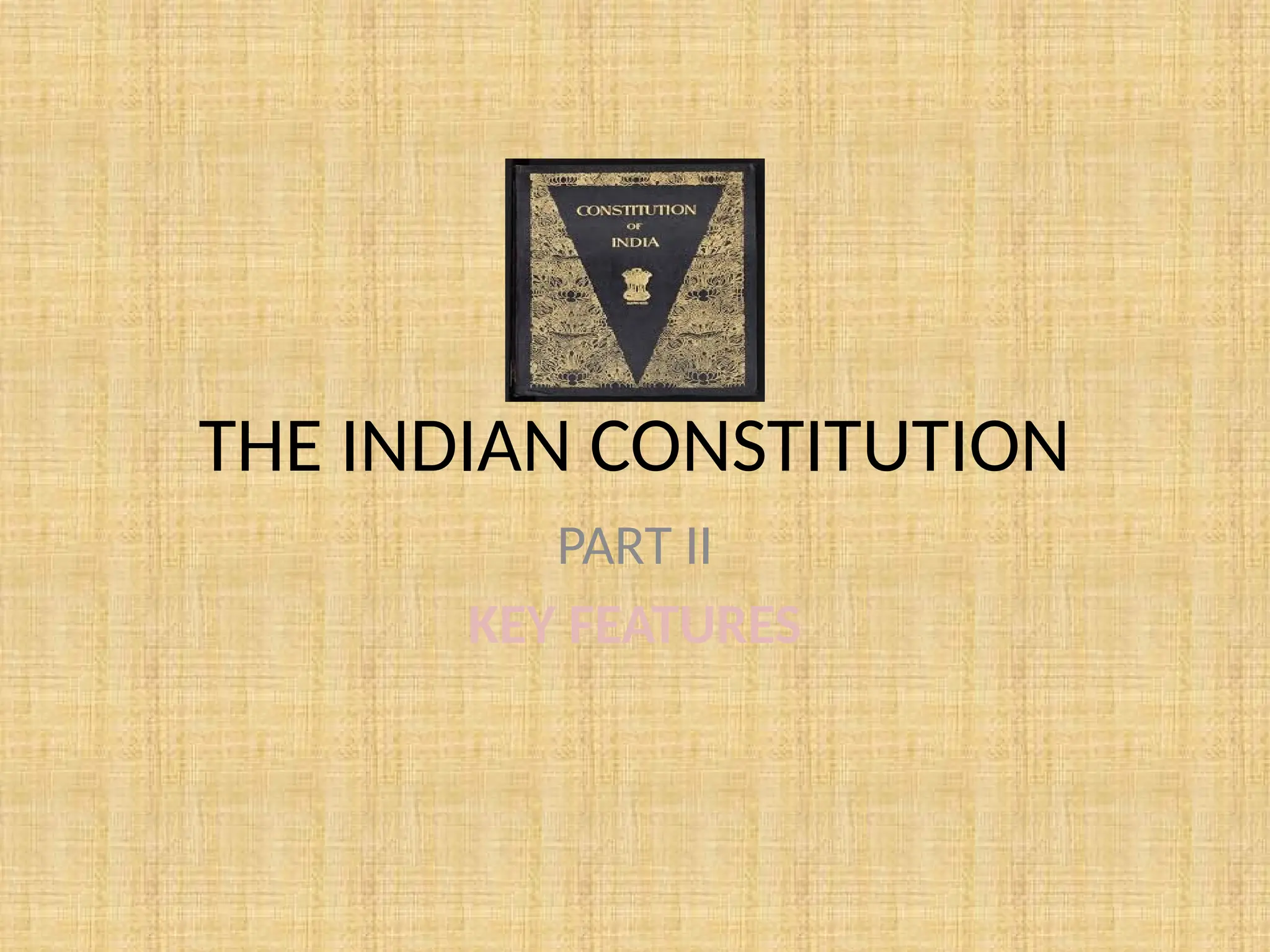
THE INDIAN CONSTITUTION
Ramachandra G Deshpande
TGT Social Science
Jawahar Navodaya Vidyalaya
Haveri, Karnataka
2.
OBJECTIVES
• The Studentswill be able to
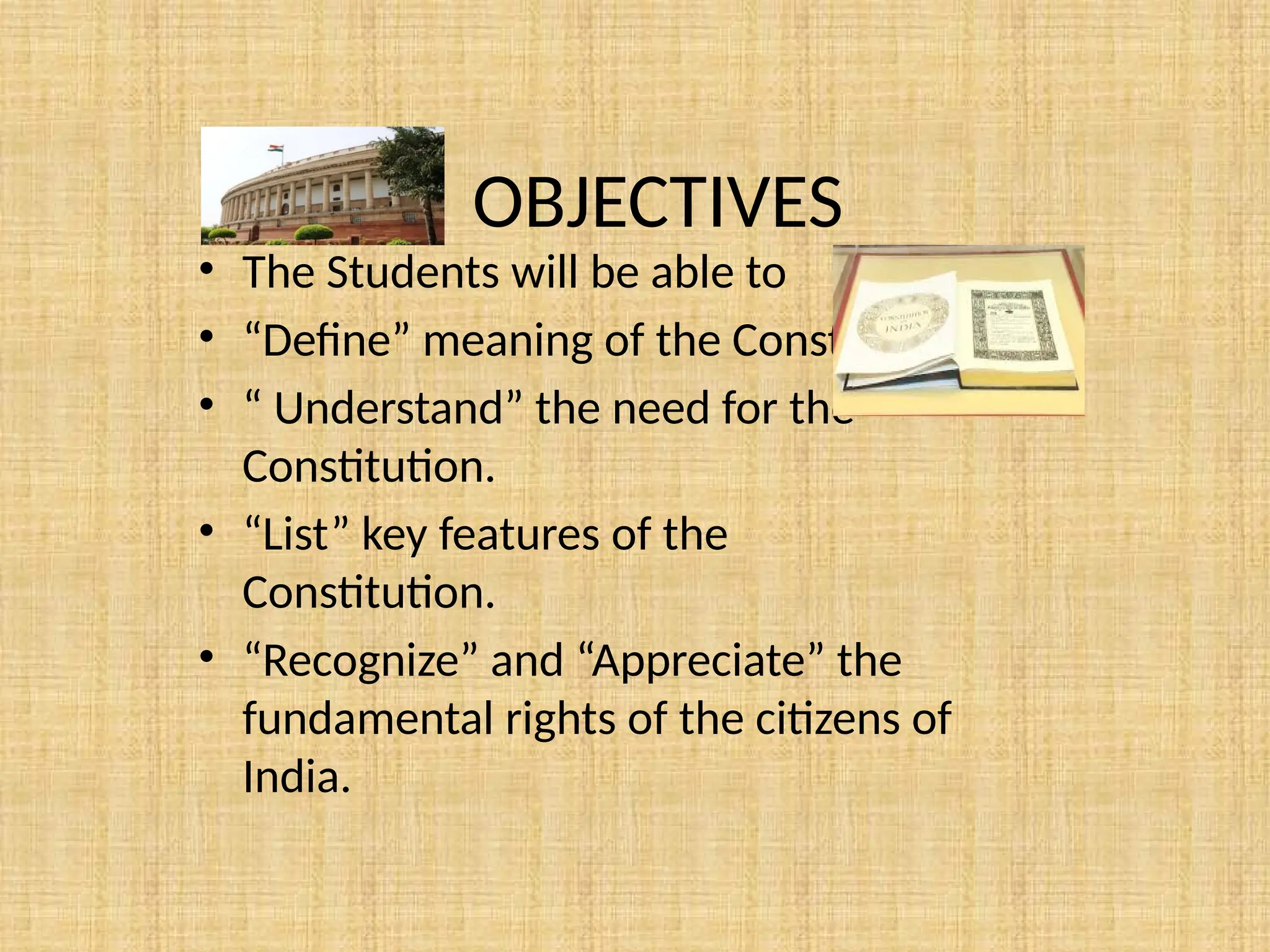
• “Define” meaning of the Constitution
• “ Understand” the need for the
Constitution.
• “List” key features of the
Constitution.
• “Recognize” and “Appreciate” the
fundamental rights of the citizens of
India.
3.
Meaning of theConstitution
• In large societies in
which different
communities of the
people live together
rules are formulated
through consensus is
usually available in
written form
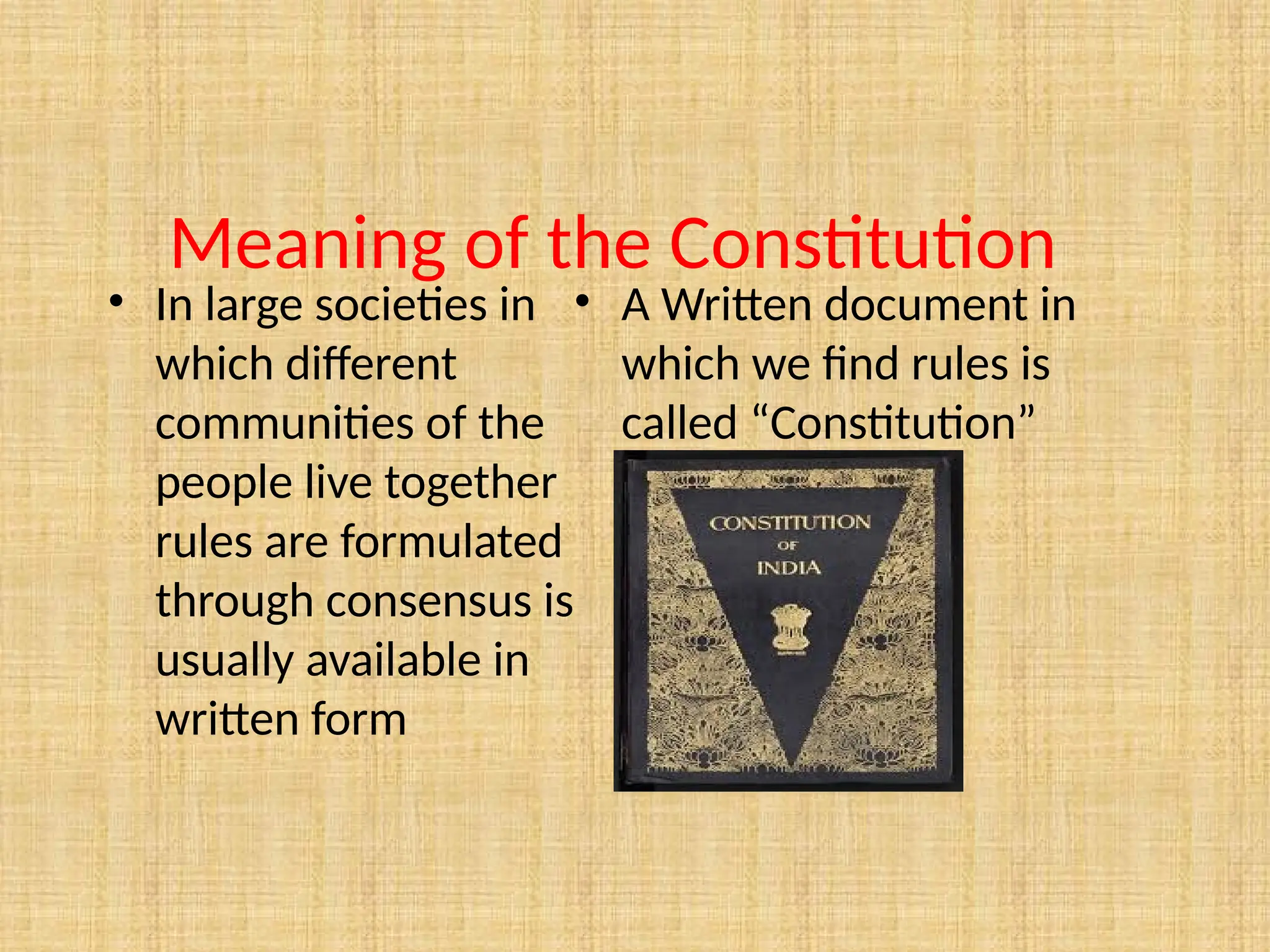
• A Written document in
which we find rules is
called “Constitution”
4.
The Purposes ofthe
Constitution
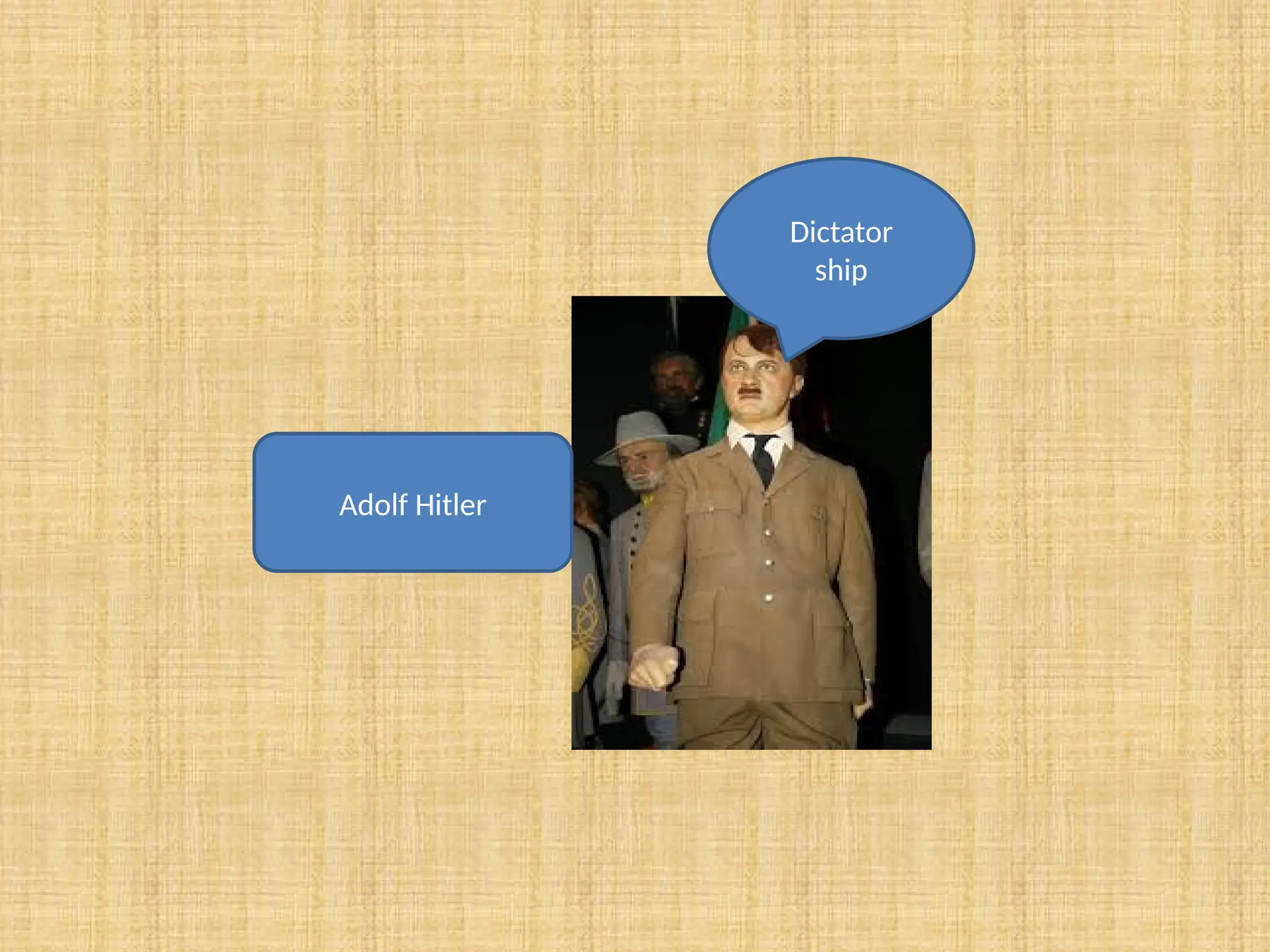
• To Define the
fundamental nature of
our society .
• To Define the nature of
a Country’s political
system or Government.
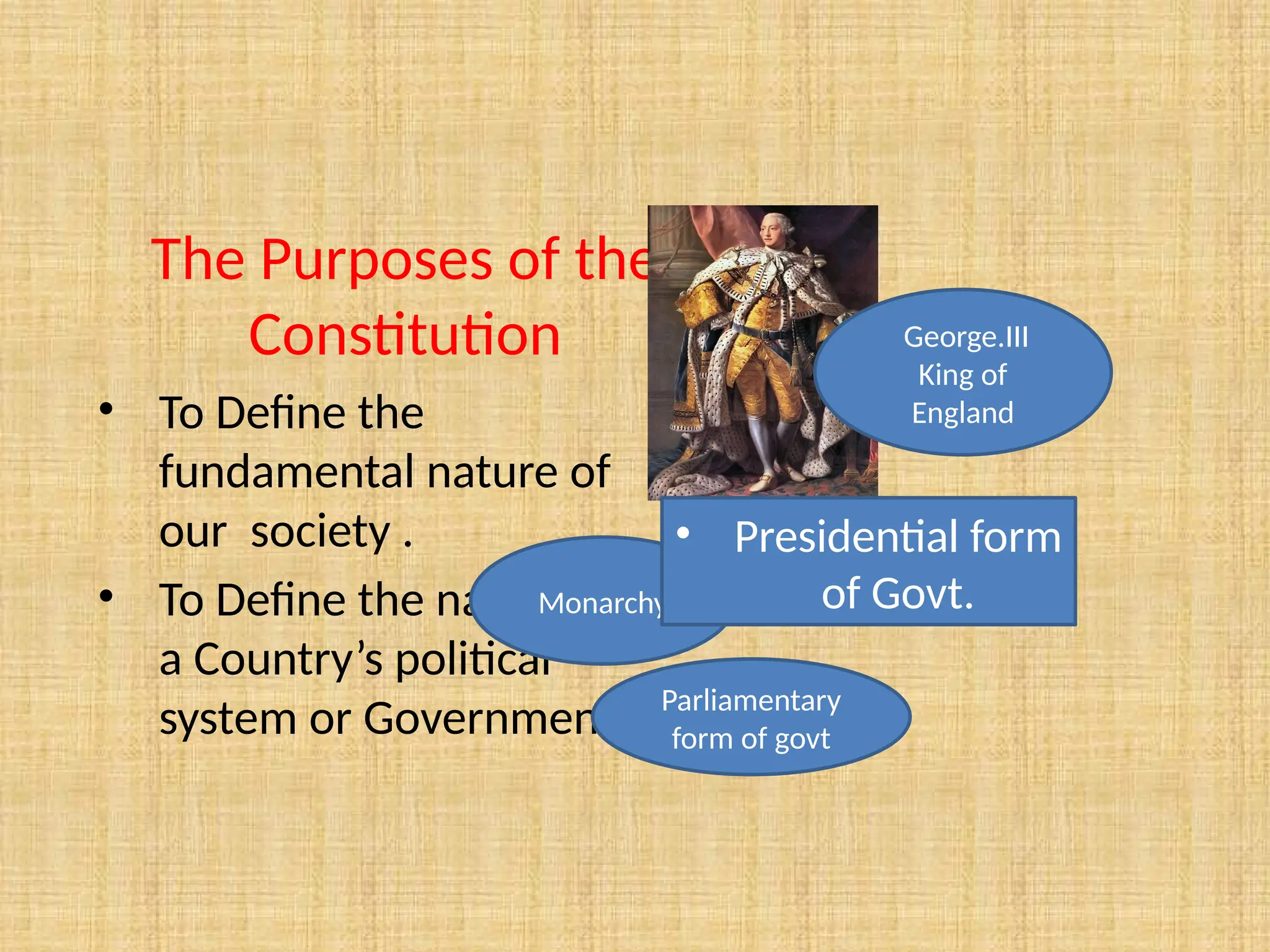
George.III
King of
England
Monarchy
Parliamentary
form of govt
• Presidential form
of Govt.
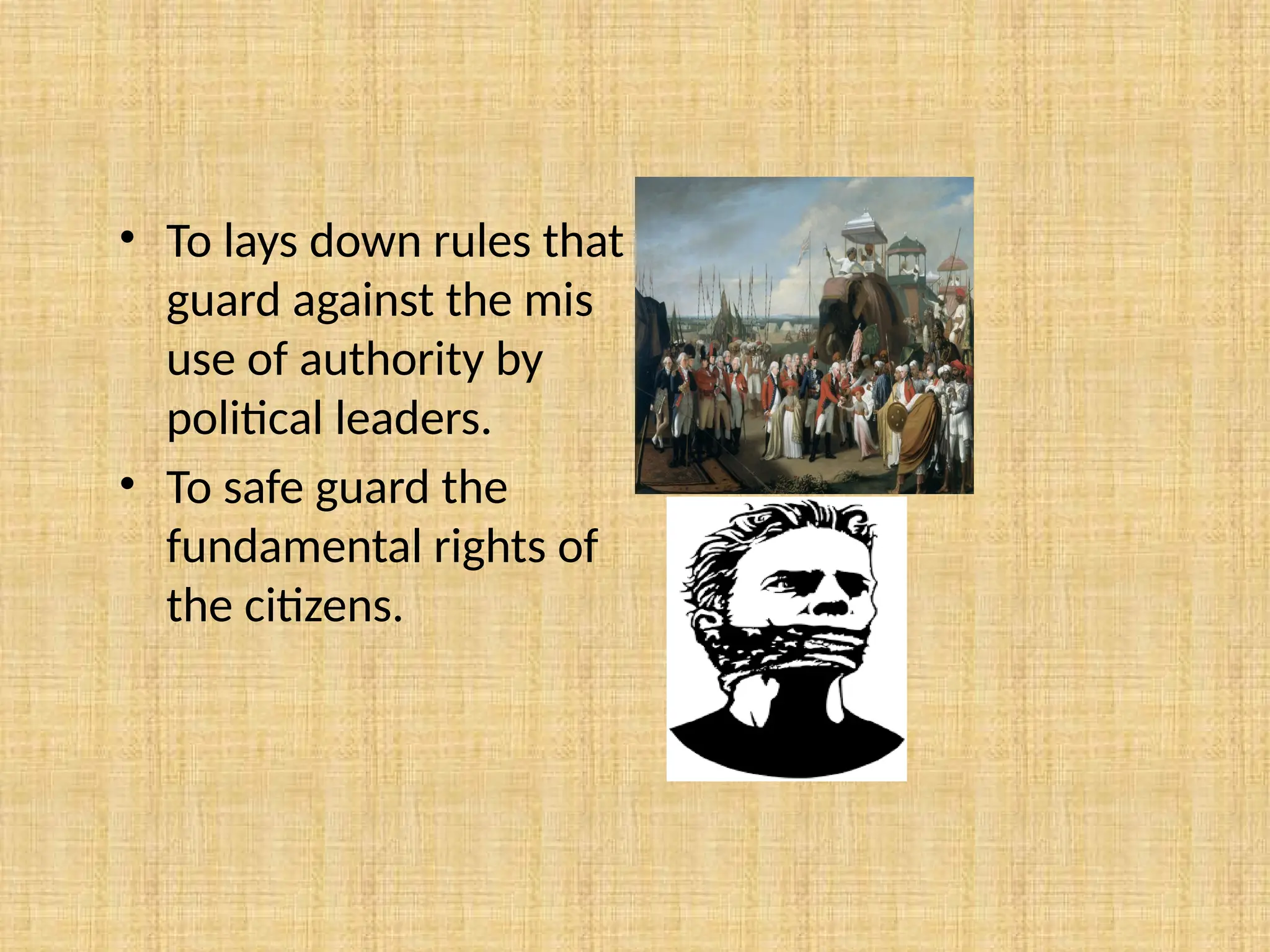
• To laysdown rules that
guard against the mis
use of authority by
political leaders.
• To safe guard the
fundamental rights of
the citizens.
7.
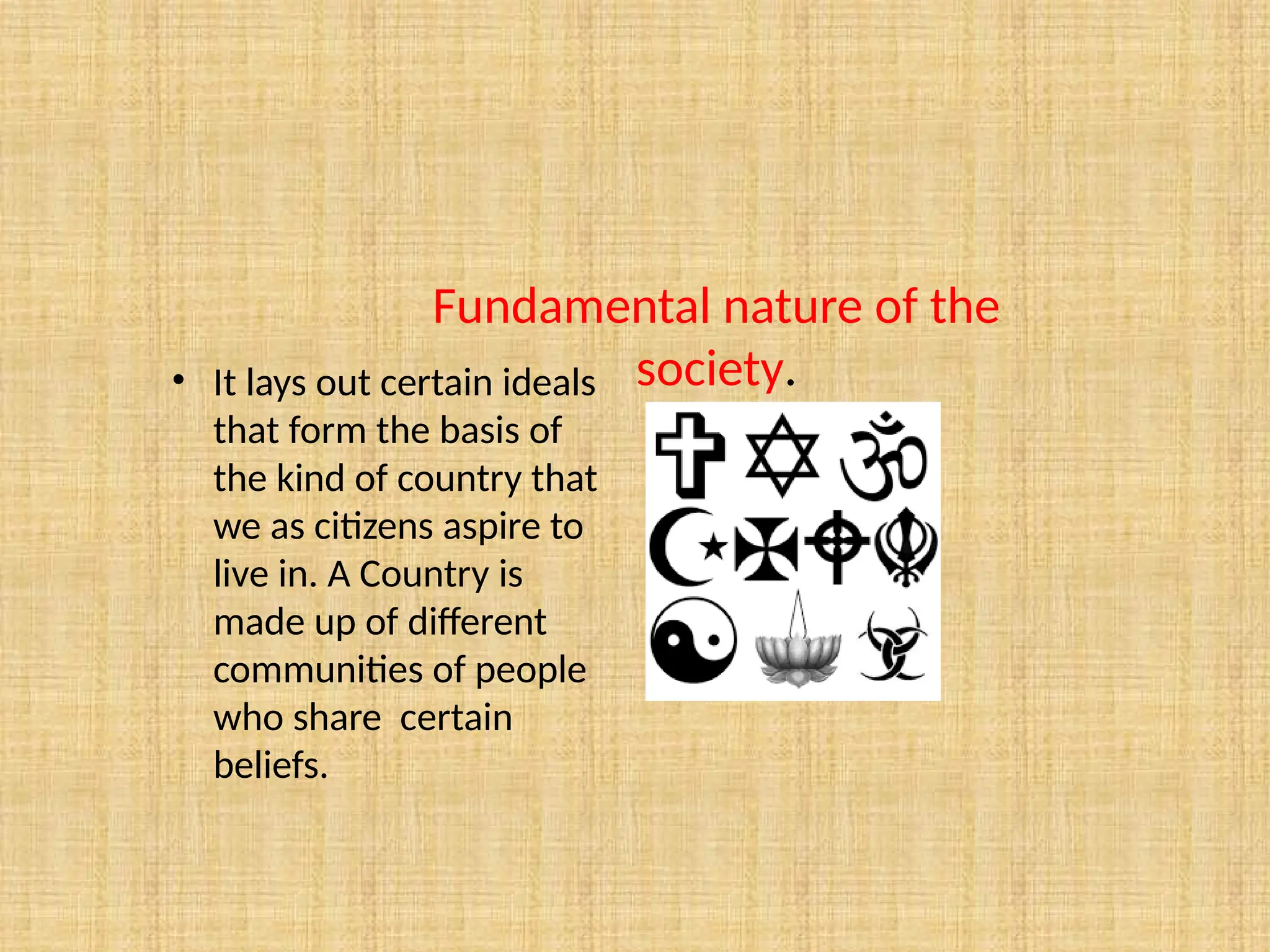
• It laysout certain ideals
that form the basis of
the kind of country that
we as citizens aspire to
live in. A Country is
made up of different
communities of people
who share certain
beliefs.
Fundamental nature of the
society.
8.
Based on ideals
•A Constitution helps serve
as a set of rules and
principles that all persons
in a country can agree
upon as the basis of the
way in which they want
the country to be
governed. This includes
not only the type of
government but also an
agreement on certain
ideals
9.
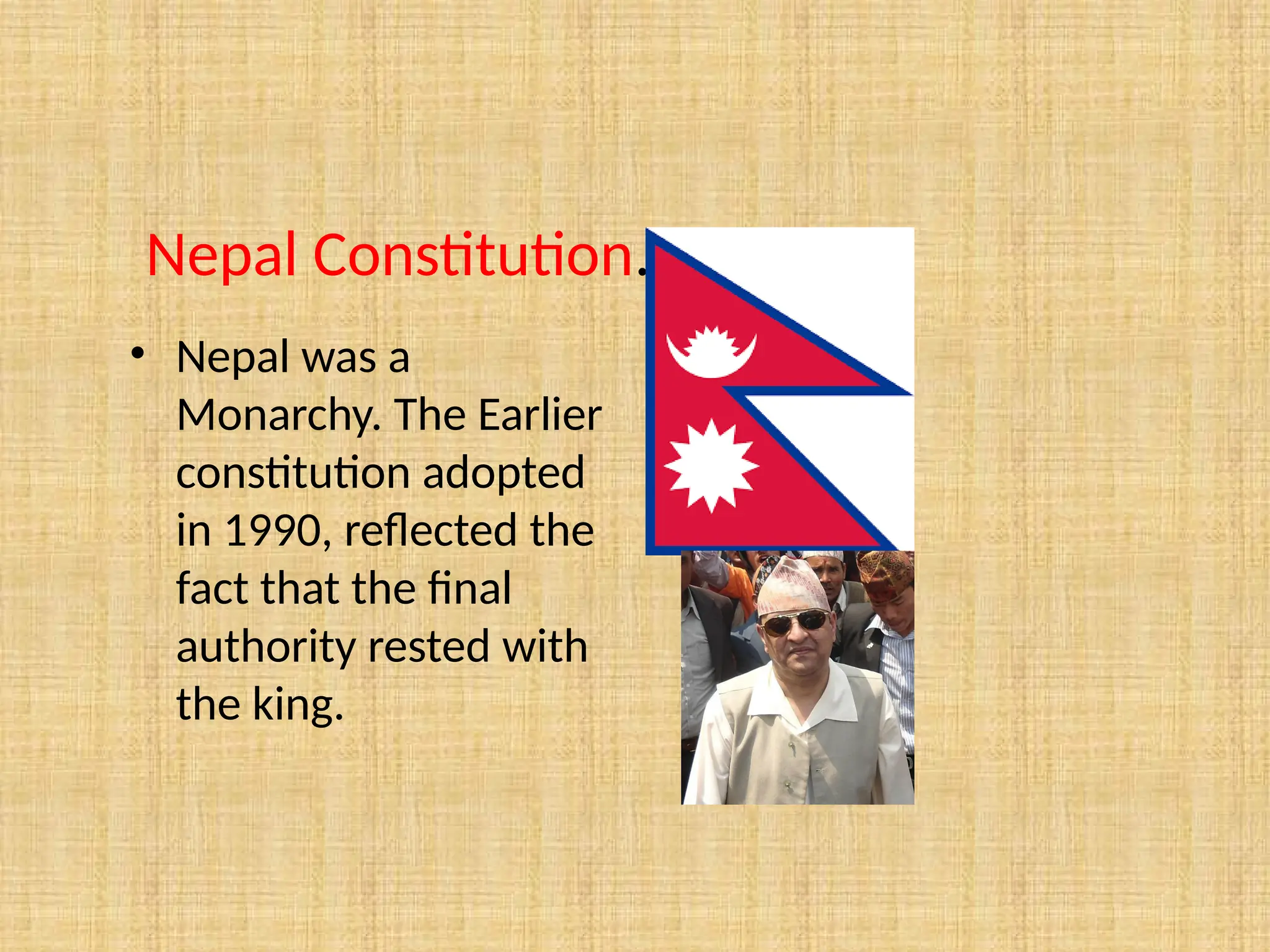
Nepal Constitution.
• Nepalwas a
Monarchy. The Earlier
constitution adopted
in 1990, reflected the
fact that the final
authority rested with
the king.
10.
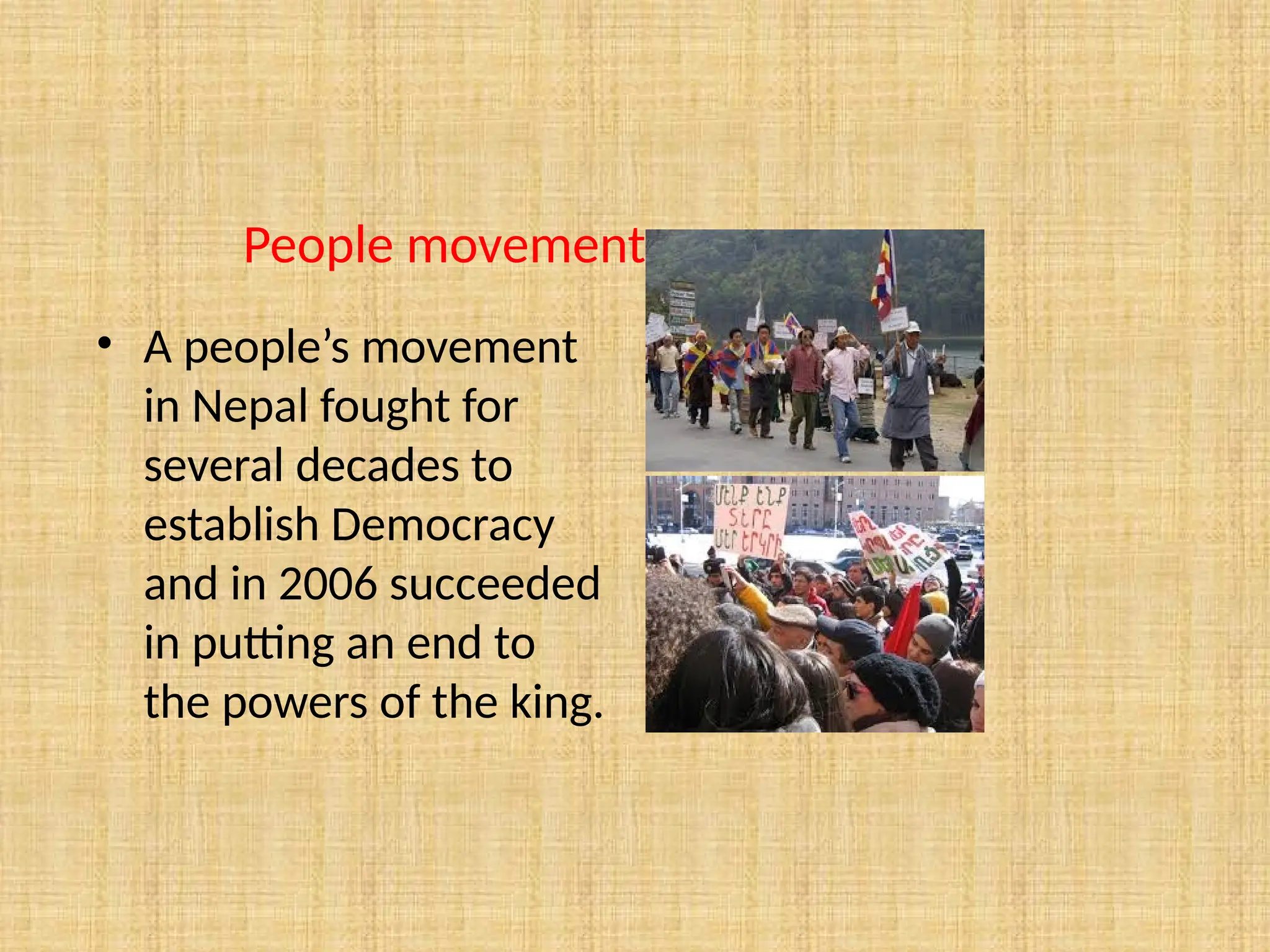
People movements
• Apeople’s movement
in Nepal fought for
several decades to
establish Democracy
and in 2006 succeeded
in putting an end to
the powers of the king.
11.
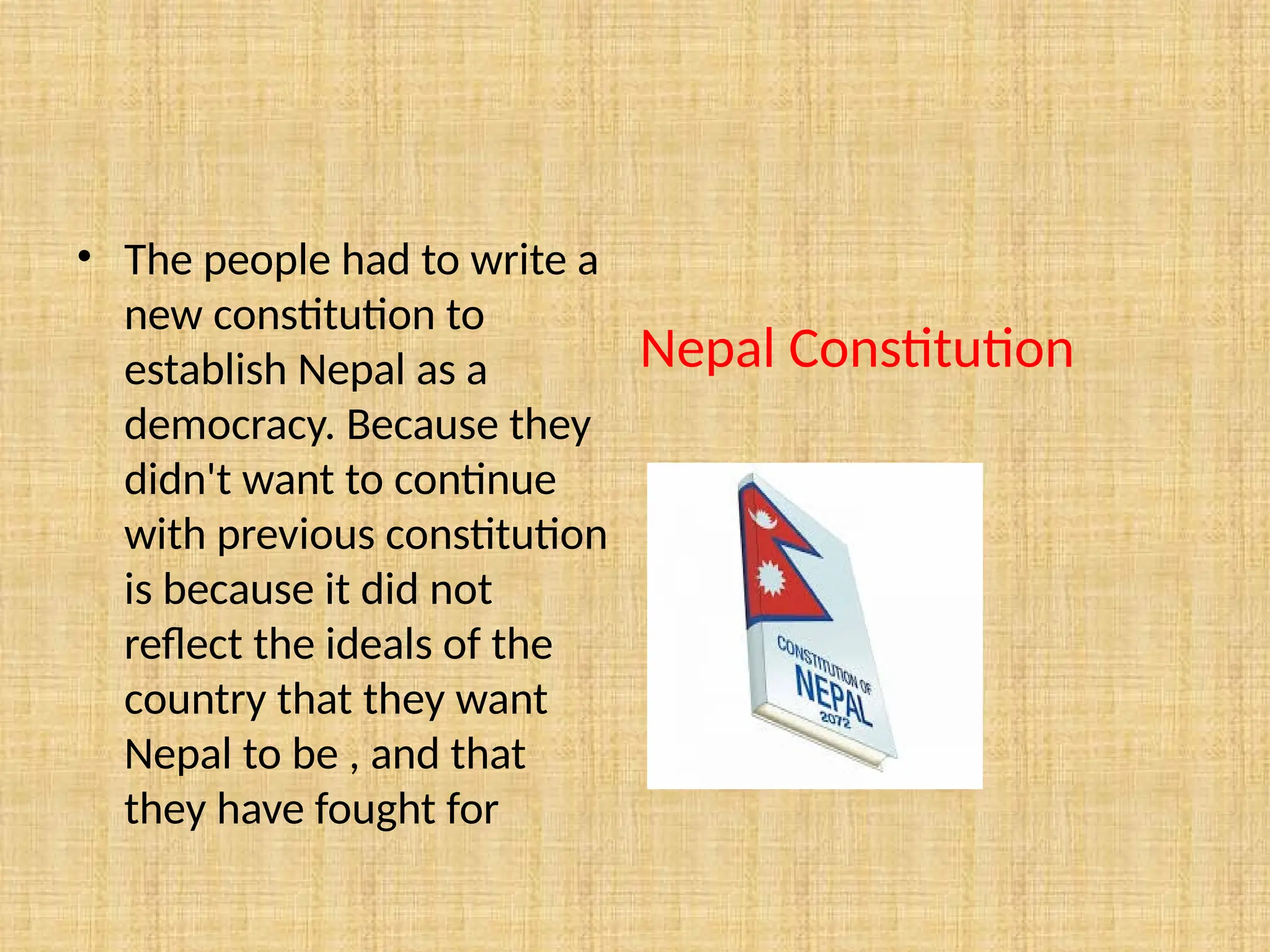
Nepal Constitution
• Thepeople had to write a
new constitution to
establish Nepal as a
democracy. Because they
didn't want to continue
with previous constitution
is because it did not
reflect the ideals of the
country that they want
Nepal to be , and that
they have fought for
12.
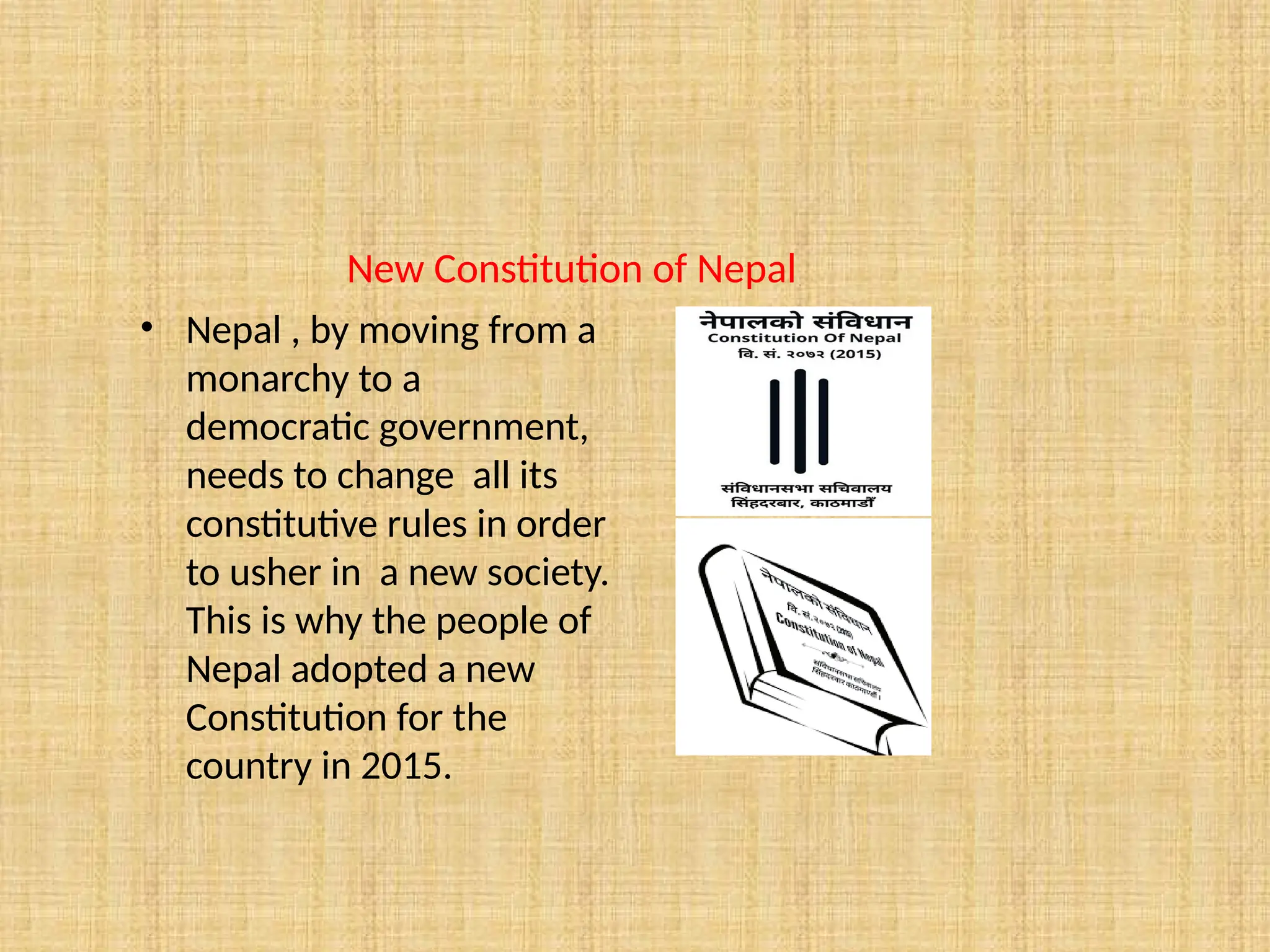
New Constitution ofNepal
• Nepal , by moving from a
monarchy to a
democratic government,
needs to change all its
constitutive rules in order
to usher in a new society.
This is why the people of
Nepal adopted a new
Constitution for the
country in 2015.
13.
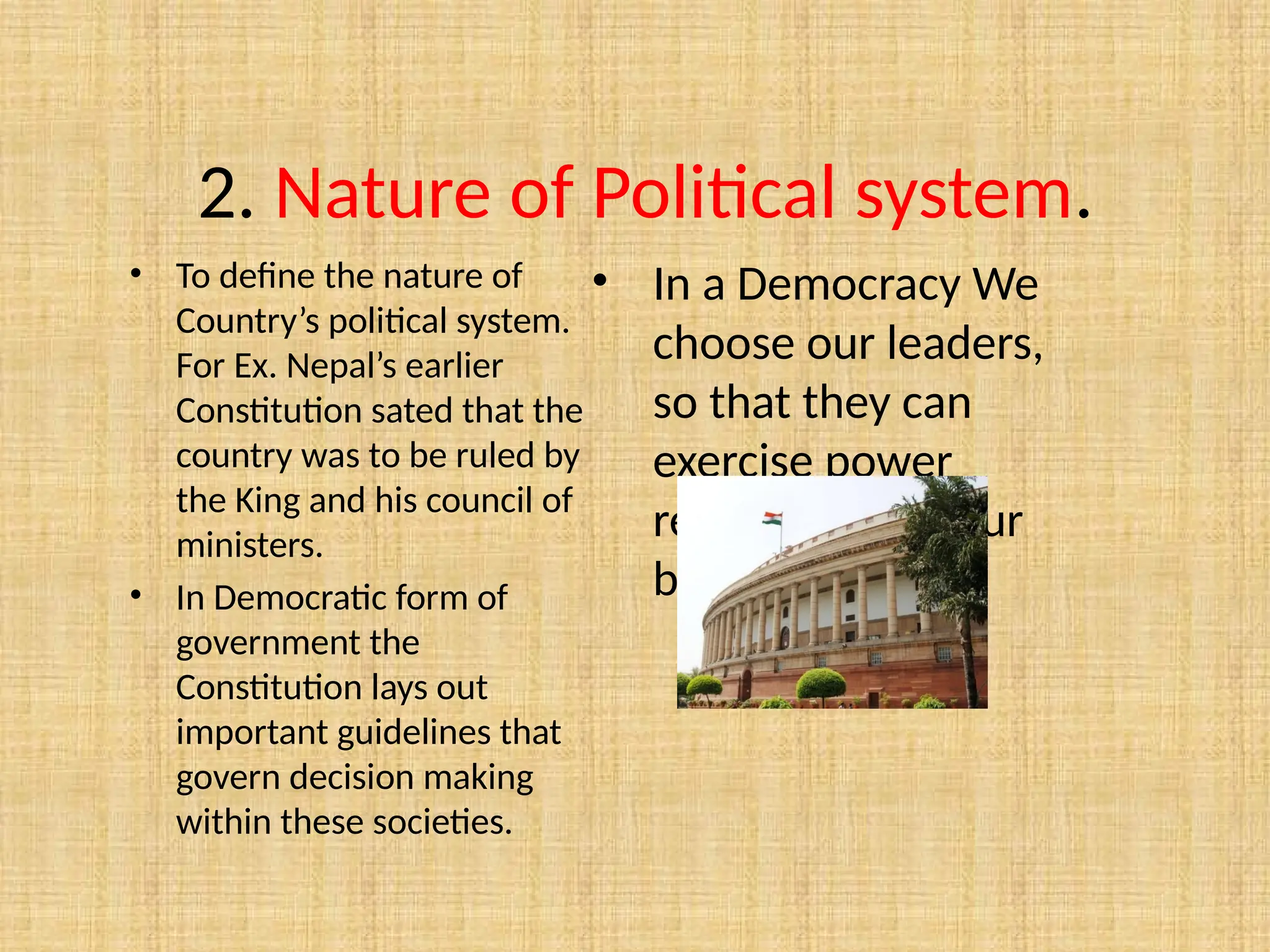
2. Nature ofPolitical system.
• To define the nature of
Country’s political system.
For Ex. Nepal’s earlier
Constitution sated that the
country was to be ruled by
the King and his council of
ministers.
• In Democratic form of
government the
Constitution lays out
important guidelines that
govern decision making
within these societies.
• In a Democracy We
choose our leaders,
so that they can
exercise power
responsibly on our
behalf.
14.
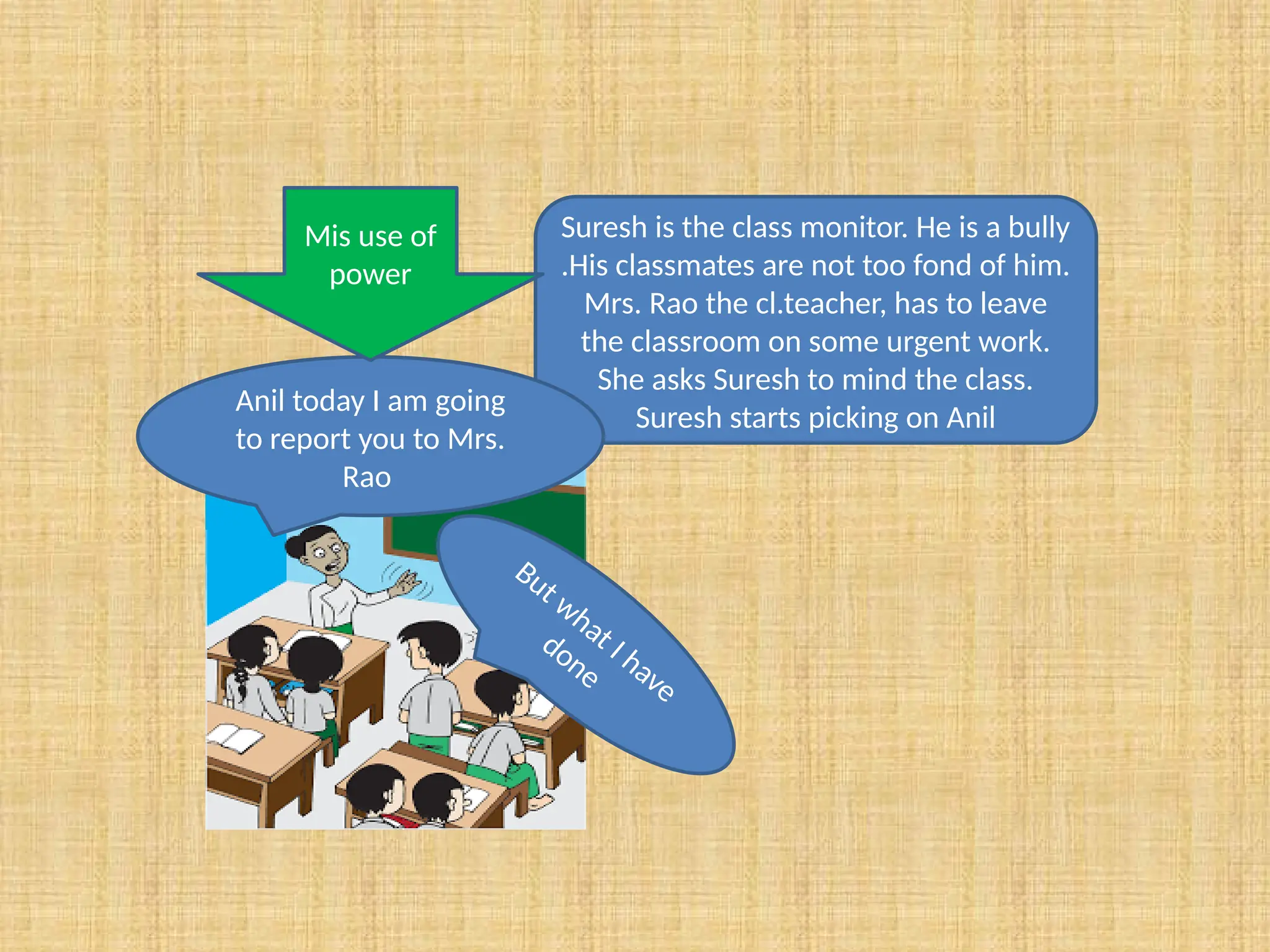
Suresh is theclass monitor. He is a bully
.His classmates are not too fond of him.
Mrs. Rao the cl.teacher, has to leave
the classroom on some urgent work.
She asks Suresh to mind the class.
Suresh starts picking on Anil
Anil today I am going
to report you to Mrs.
Rao
But what I have
done
Mis use of
power
15.
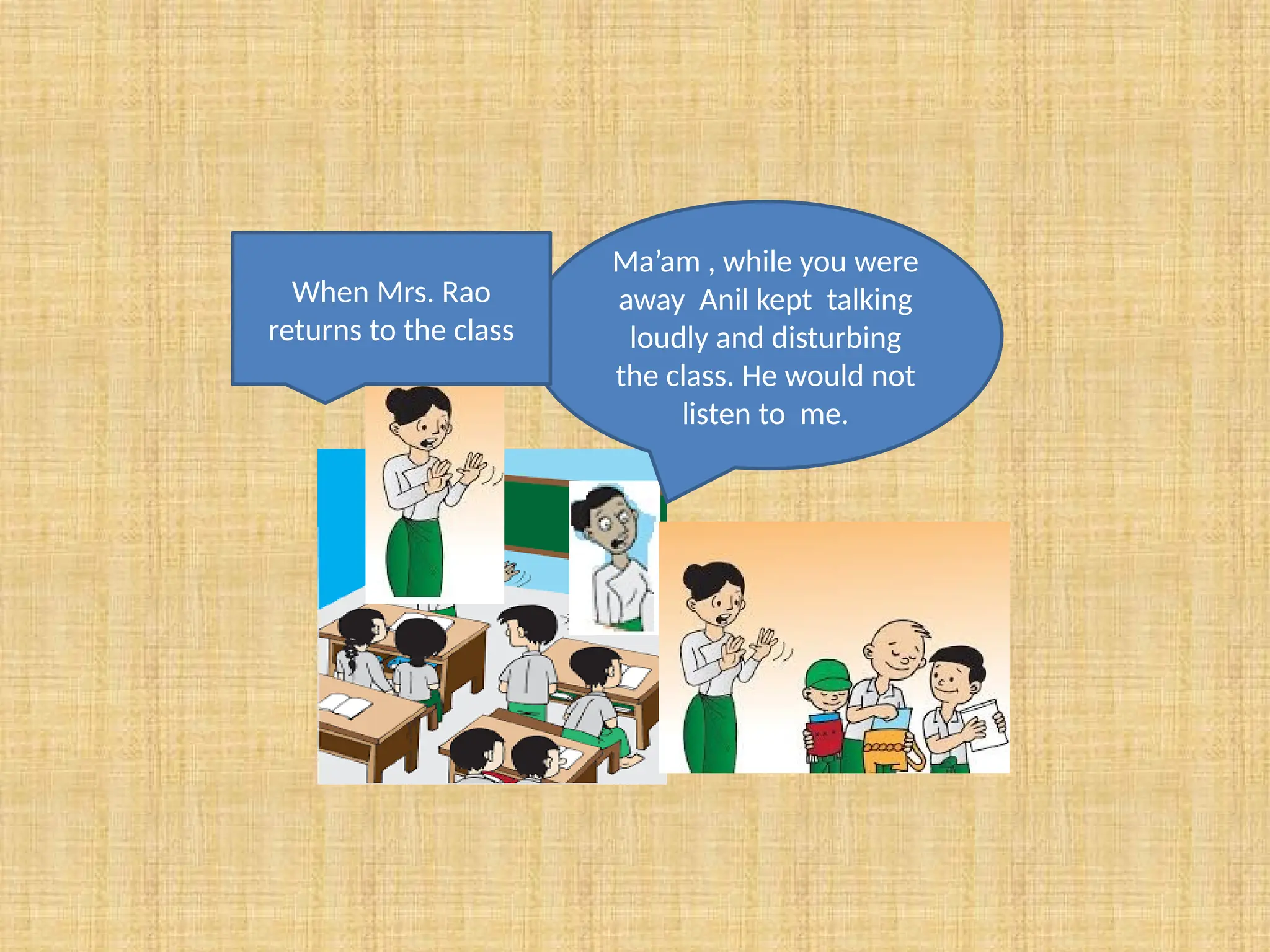
Ma’am , whileyou were
away Anil kept talking
loudly and disturbing
the class. He would not
listen to me.
When Mrs. Rao
returns to the class
16.
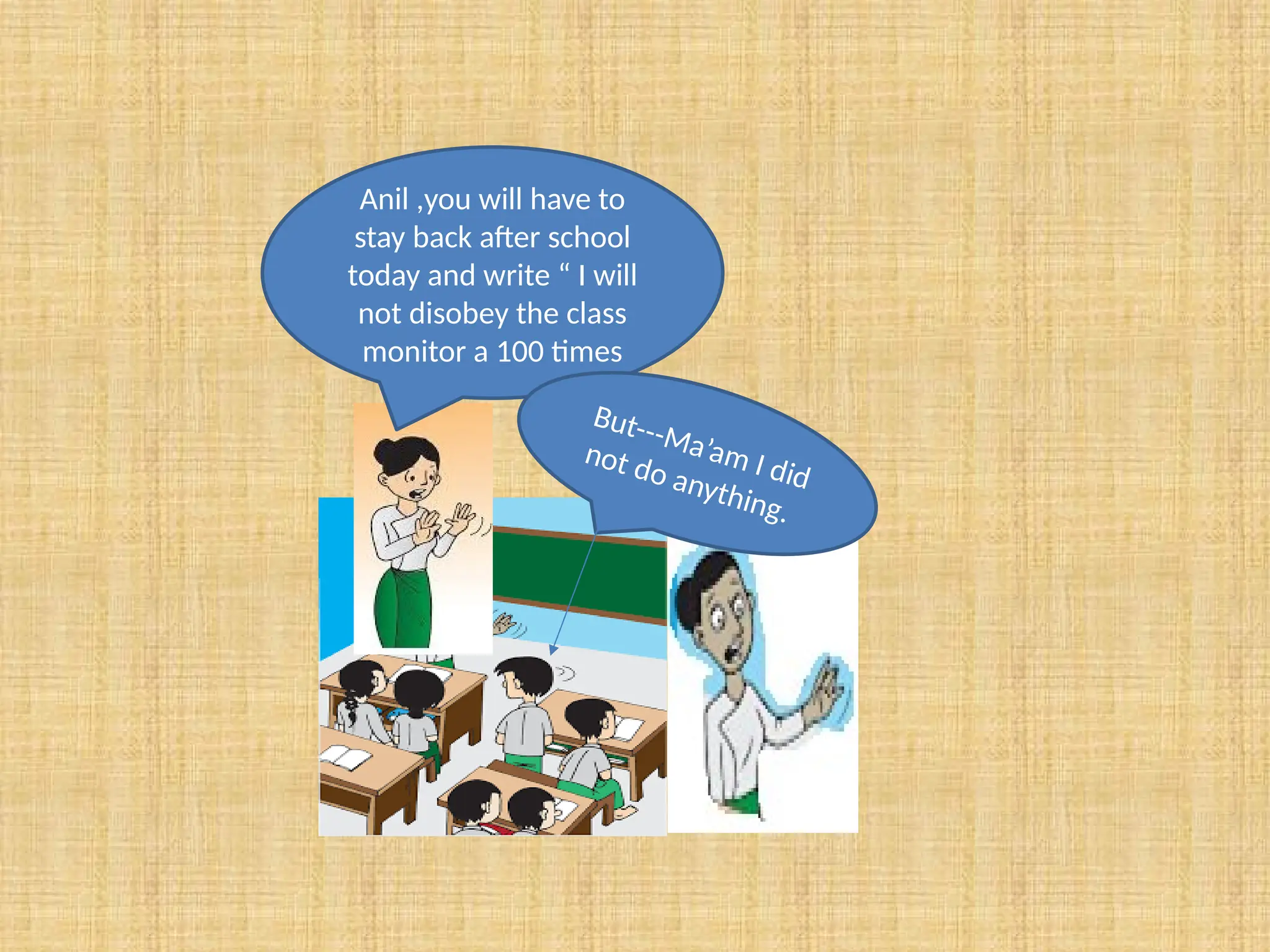
Anil ,you willhave to
stay back after school
today and write “ I will
not disobey the class
monitor a 100 times
But---Ma’am I did
not do anything.
17.
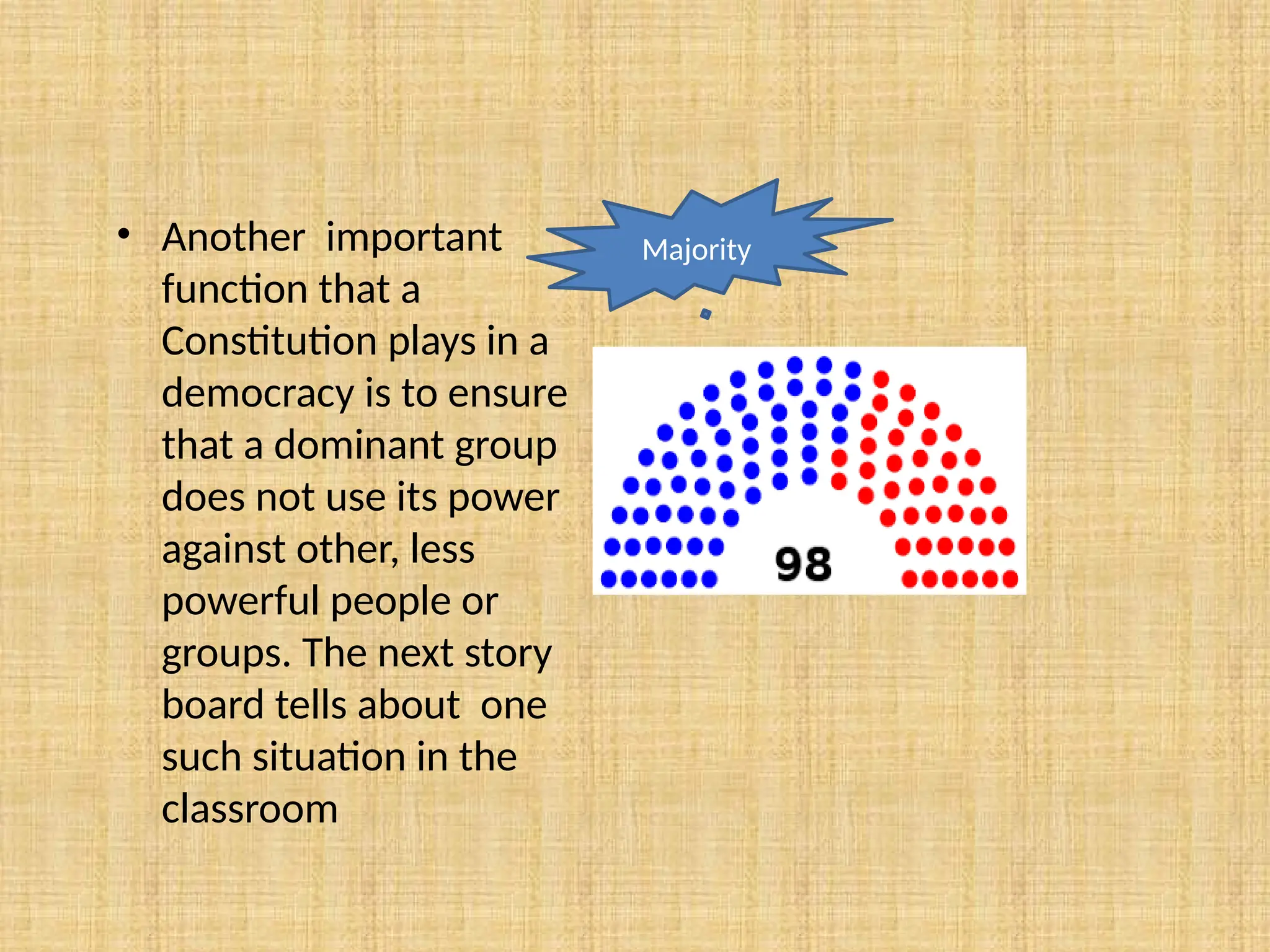
• Another important
functionthat a
Constitution plays in a
democracy is to ensure
that a dominant group
does not use its power
against other, less
powerful people or
groups. The next story
board tells about one
such situation in the
classroom
Majority
18.
The games periodis about to begin
Let us play
basket ball
today for a
change
Girls
19.
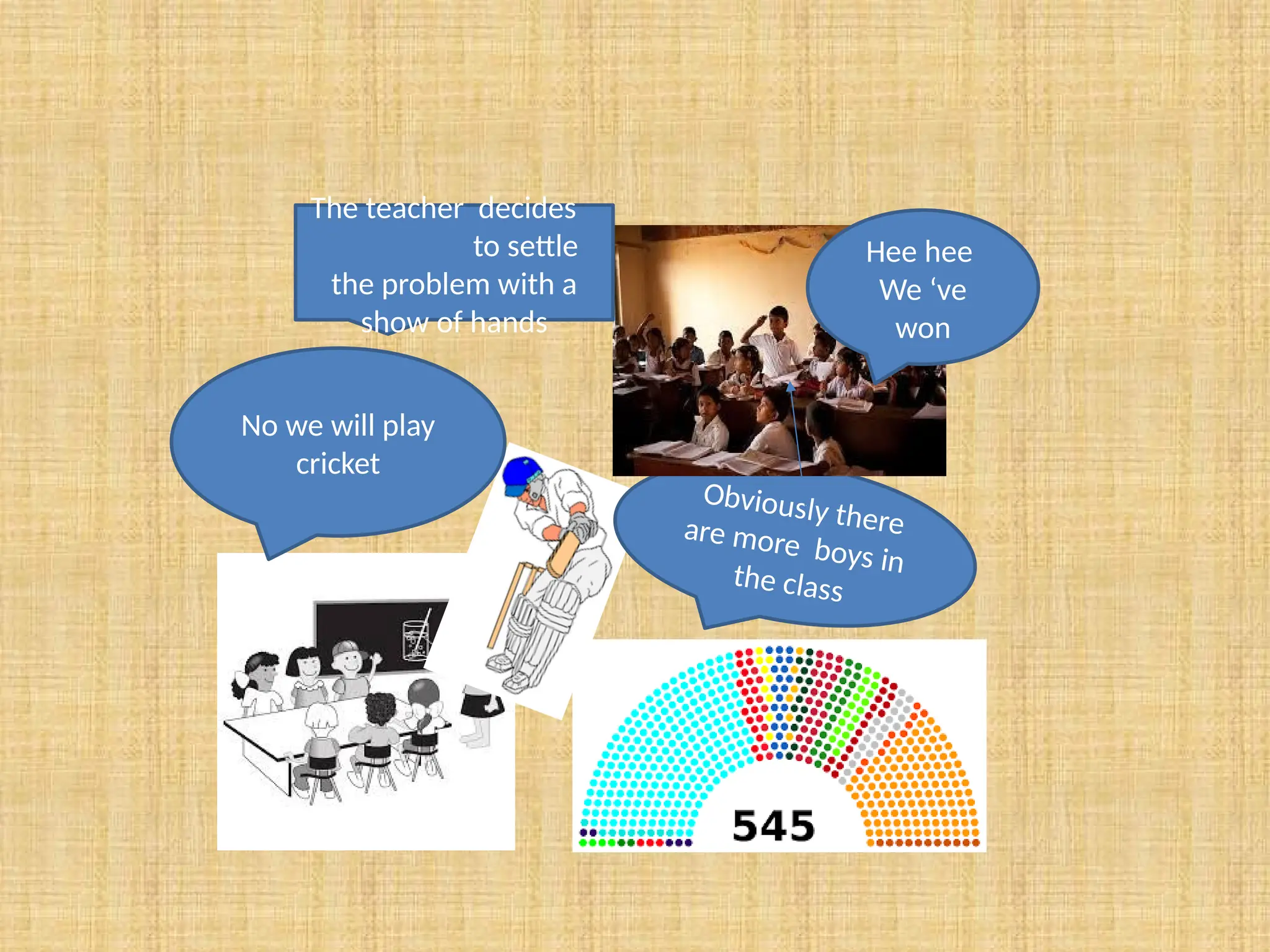
No we willplay
cricket
Obviously there
are more boys in
the class
The teacher decides
to settle
the problem with a
show of hands
Hee hee
We ‘ve
won
20.
• Such unhealthy situations can occur in
democratic societies too, where a majority
can continuously enforce dicisions that
exclude minorities and go against their
interests. As the above storyboard
illustrates, every society is prone to this
tyranny of majority.
21.
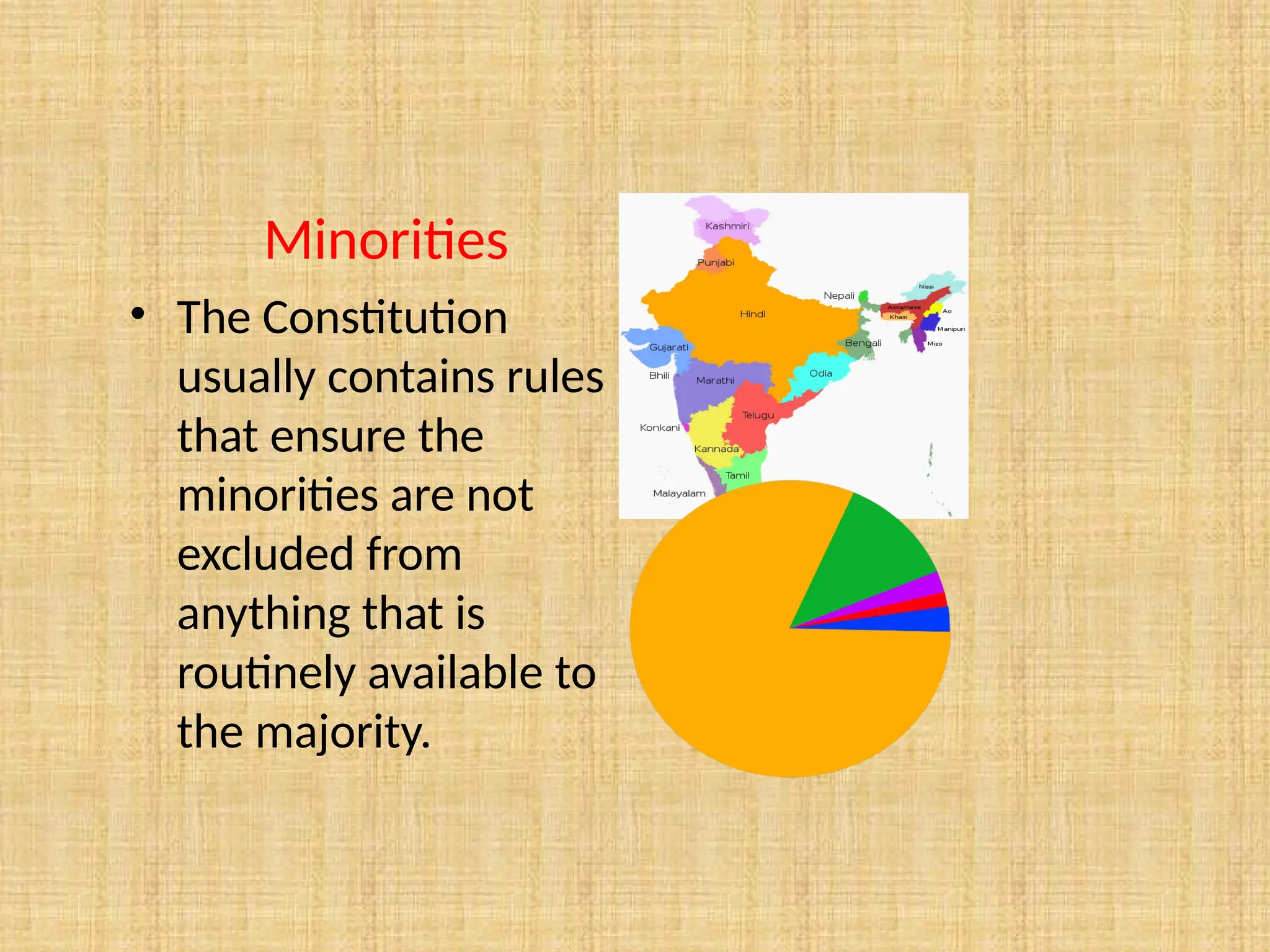
Minorities
• The Constitution
usuallycontains rules
that ensure the
minorities are not
excluded from
anything that is
routinely available to
the majority.
22.
• The thirdsignificant reason ,
why we need a Constitution is
to save us from ourselves. This
may sound strange but what is
meant by this is that we might
at times feel strongly about an
issue that might go against this.
Every bodies responsibility to
take correct decision
Example
23.
Shabnam , why
areyou looking
so worried
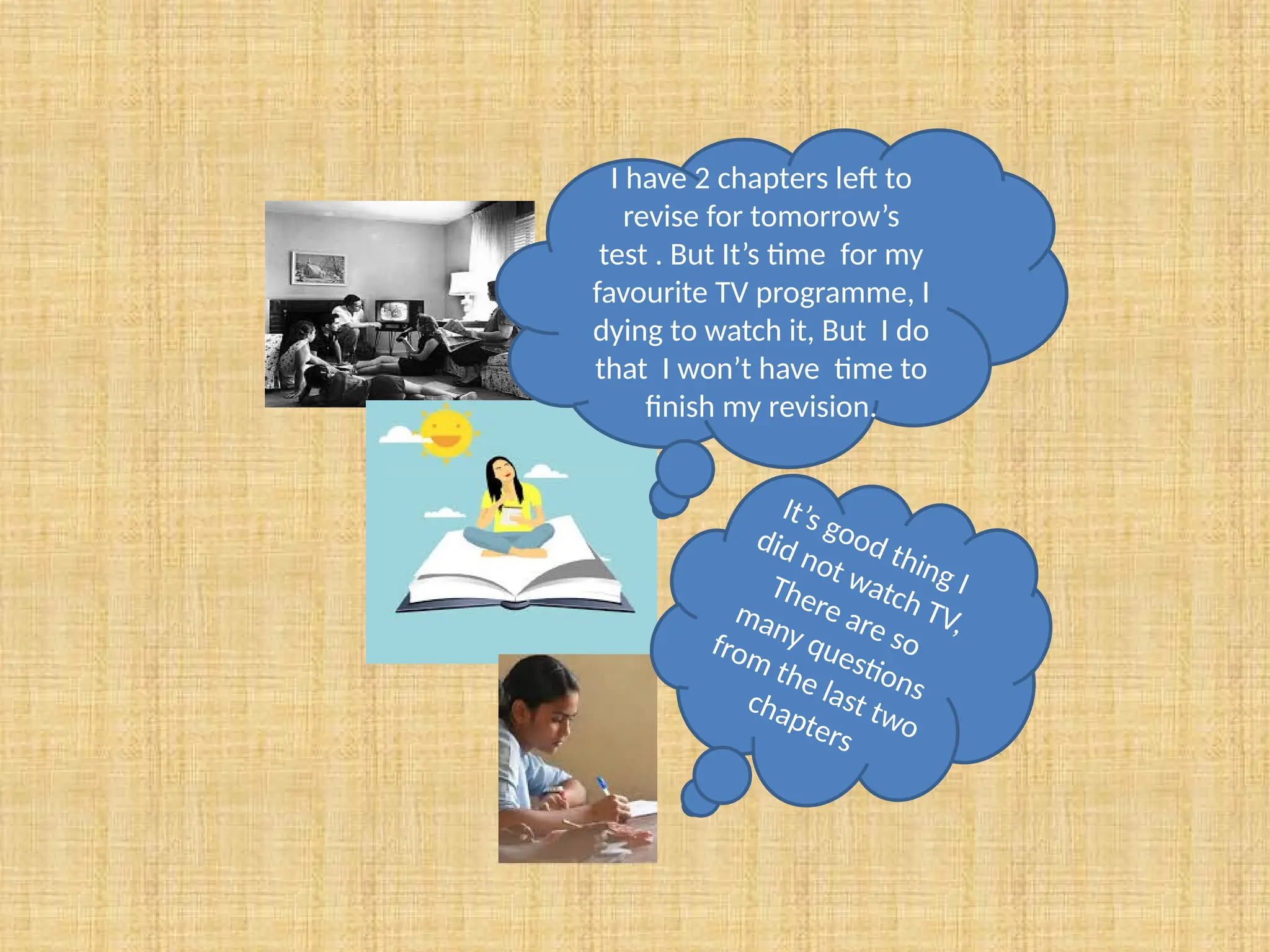
I want to watch this TV
programme but I have a test
tomorrow . If you all watch TV I
will also want to watch, I have an
idea What If no one watches TV
tonight? Then I may not tempted
24.
I have 2chapters left to
revise for tomorrow’s
test . But It’s time for my
favourite TV programme, I
dying to watch it, But I do
that I won’t have time to
finish my revision.
It’s good thing I
did not watch TV,
There are so
many questions
from the last two
chapters
25.
• A goodConstitution does
not allow these whims to
change its basic
structure. It does not
allow these for the easy
overthrow of provisions
that guarantee rights of
citizens and protect their
freedom.
• Similarly, the
Constitution helps to
protect us against
certain decisions that
we might take that
could have an adverse
effect on the larger
principles that the
country believes in.
26.
Summary
• A writtendocument in which we find rules is
called Constitution.
• The Main purposes of the Constitution:
• To Define:1. Fundamental nature of the society.
• 2. -Country’s Political System.
3. -Safeguard fundamental rights.
4. -Lays down rules that guard
against the misuse by leaders.
.Due to people’s movement Nepal adopted a new
Constitution in 2015.
27.
SUBJECT : SOCIALSCIENCE BOOK: SOC.& POL. LIFE
CLASS: VIII
CHAPTER-01
THE INDIAN CONSTITUTION
Ramachandra G Deshpande
TGT Social Science
Jawahar Navodaya Vidyalaya
Haveri, Karnataka
PART II – KEY FEATURES
INTRODUCTION
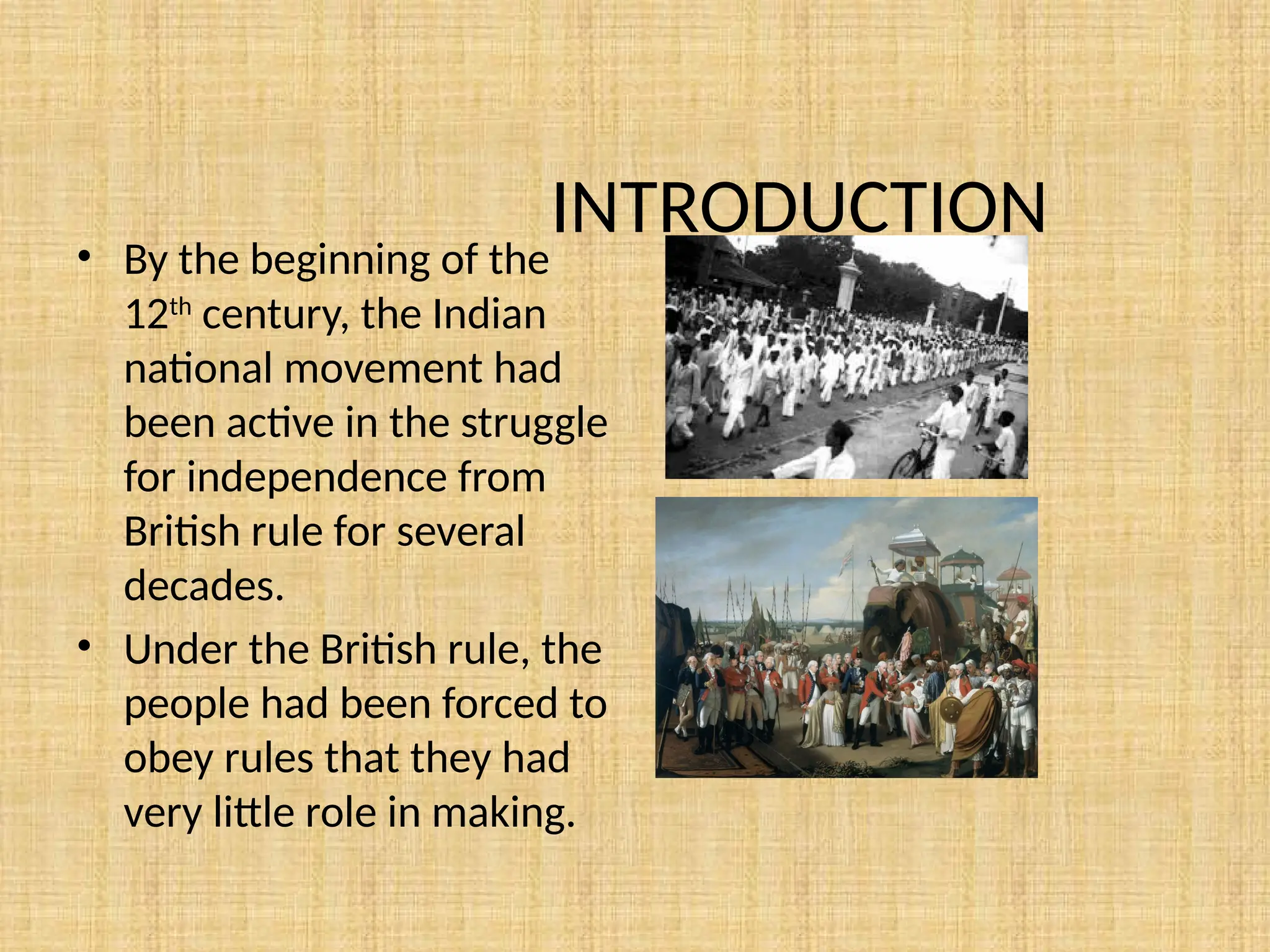
• By thebeginning of the
12th
century, the Indian
national movement had
been active in the struggle
for independence from
British rule for several
decades.
• Under the British rule, the
people had been forced to
obey rules that they had
very little role in making.
30.
Democracy
• Under thecolonial
state convinced Indian
that free India should
be a democracy in
which everyone
should be treated
equally and be
allowed to participate
in government.
31.
Framing of theNew Constitution
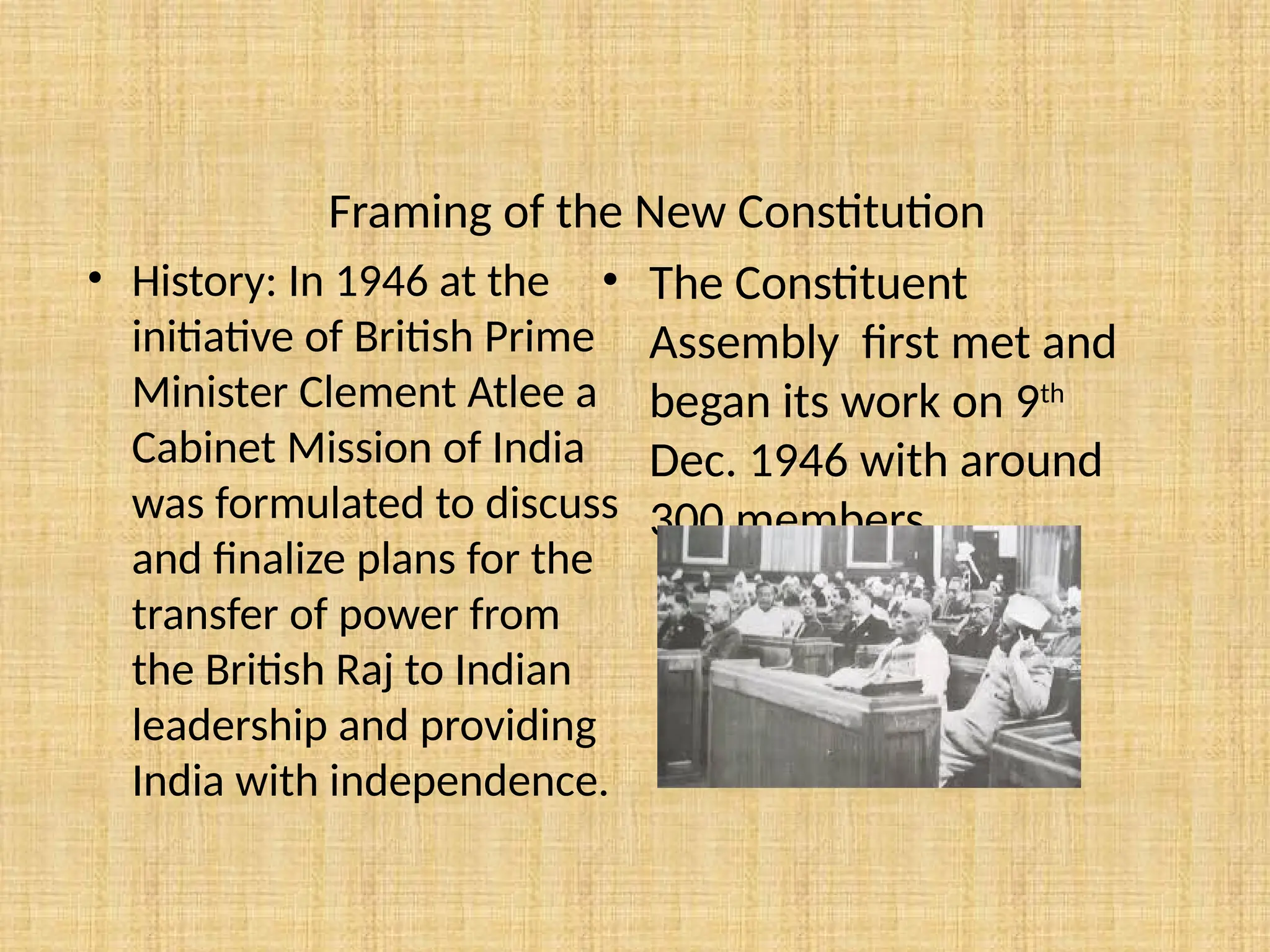
• History: In 1946 at the
initiative of British Prime
Minister Clement Atlee a
Cabinet Mission of India
was formulated to discuss
and finalize plans for the
transfer of power from
the British Raj to Indian
leadership and providing
India with independence.
• The Constituent
Assembly first met and
began its work on 9th
Dec. 1946 with around
300 members.
32.
Work of theConstituent
Assembly
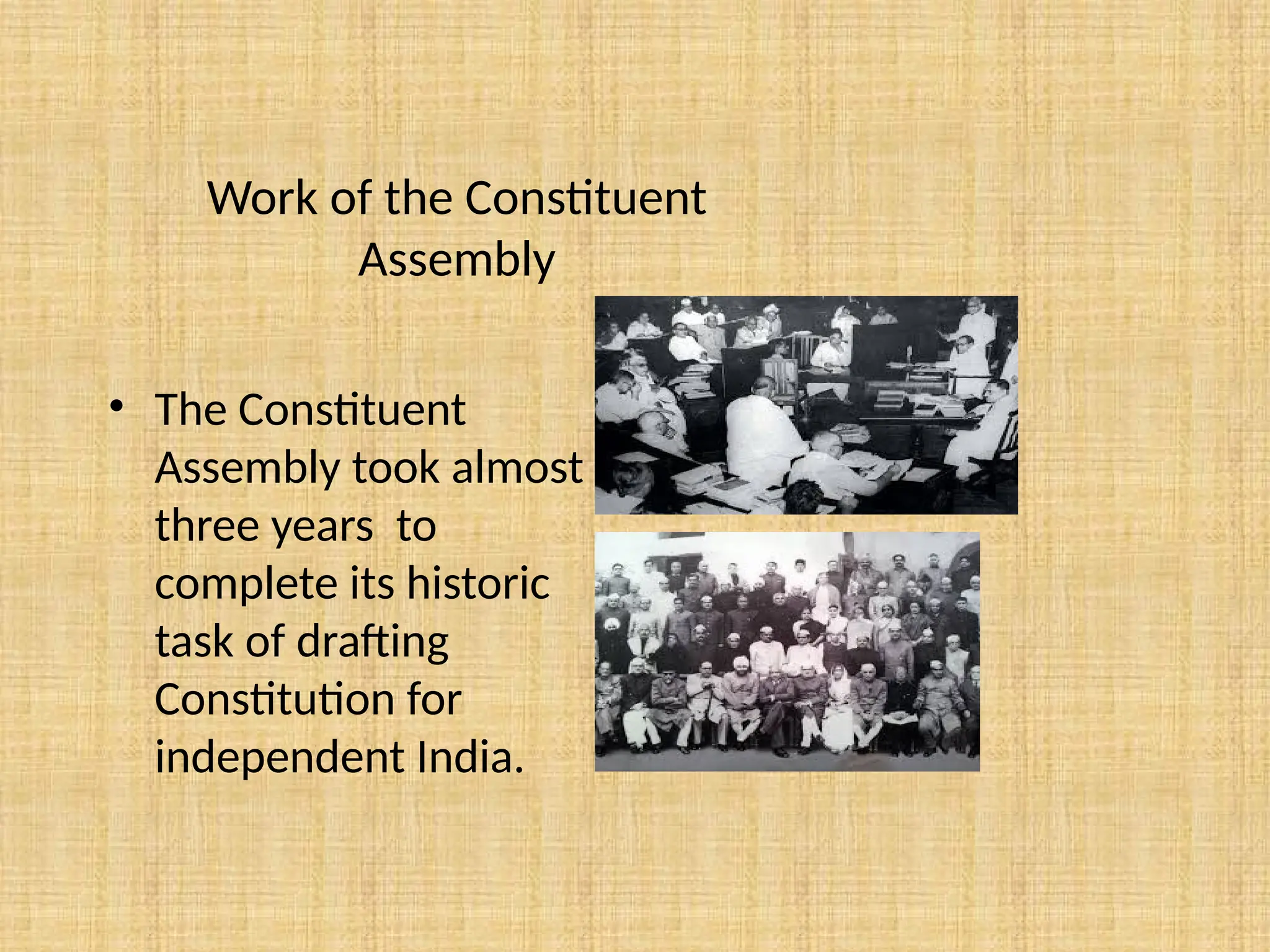
• The Constituent
Assembly took almost
three years to
complete its historic
task of drafting
Constitution for
independent India.
33.
Constituent Assembly.
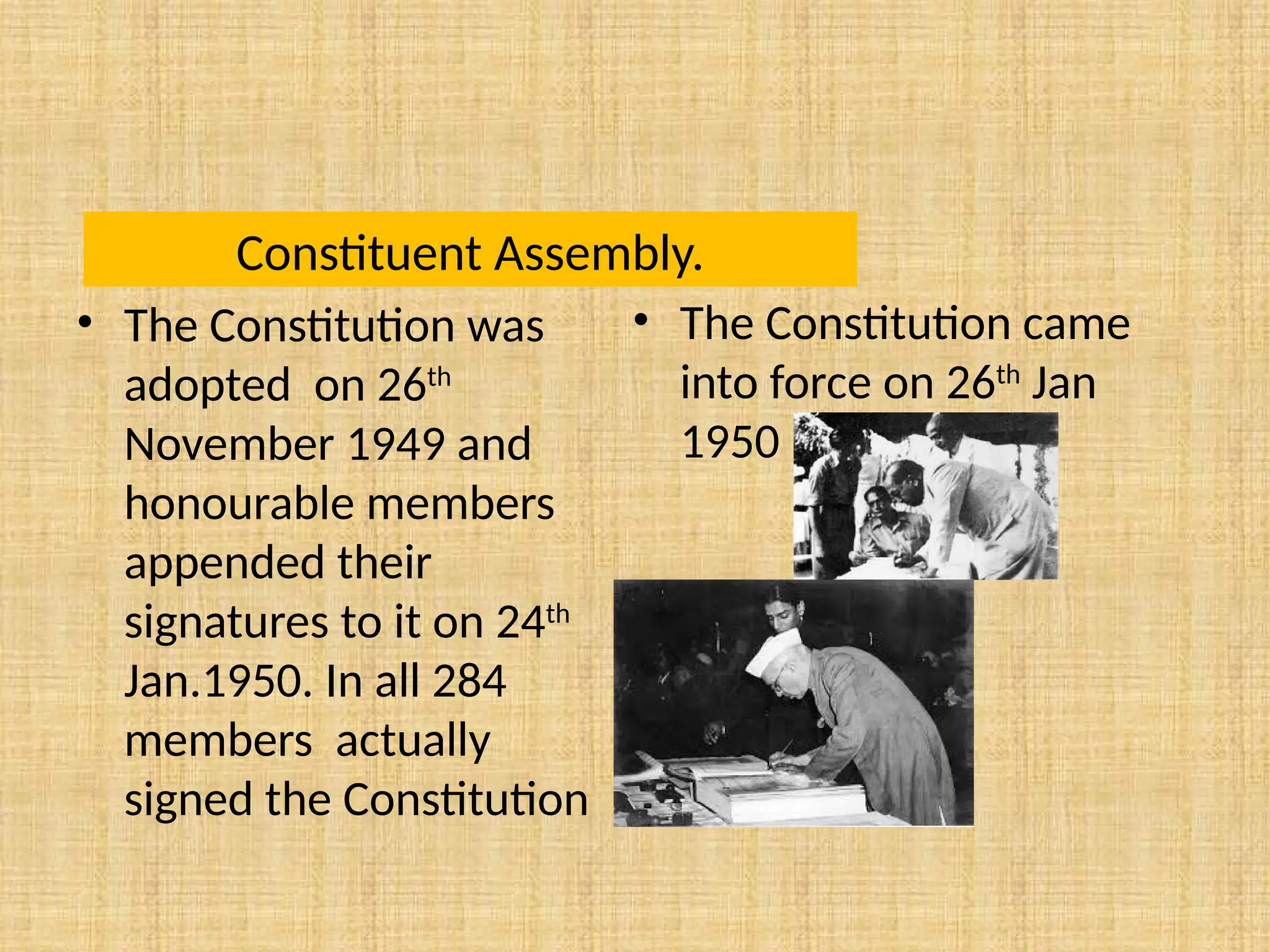
• TheConstitution was
adopted on 26th
November 1949 and
honourable members
appended their
signatures to it on 24th
Jan.1950. In all 284
members actually
signed the Constitution
• The Constitution came
into force on 26th
Jan
1950
34.
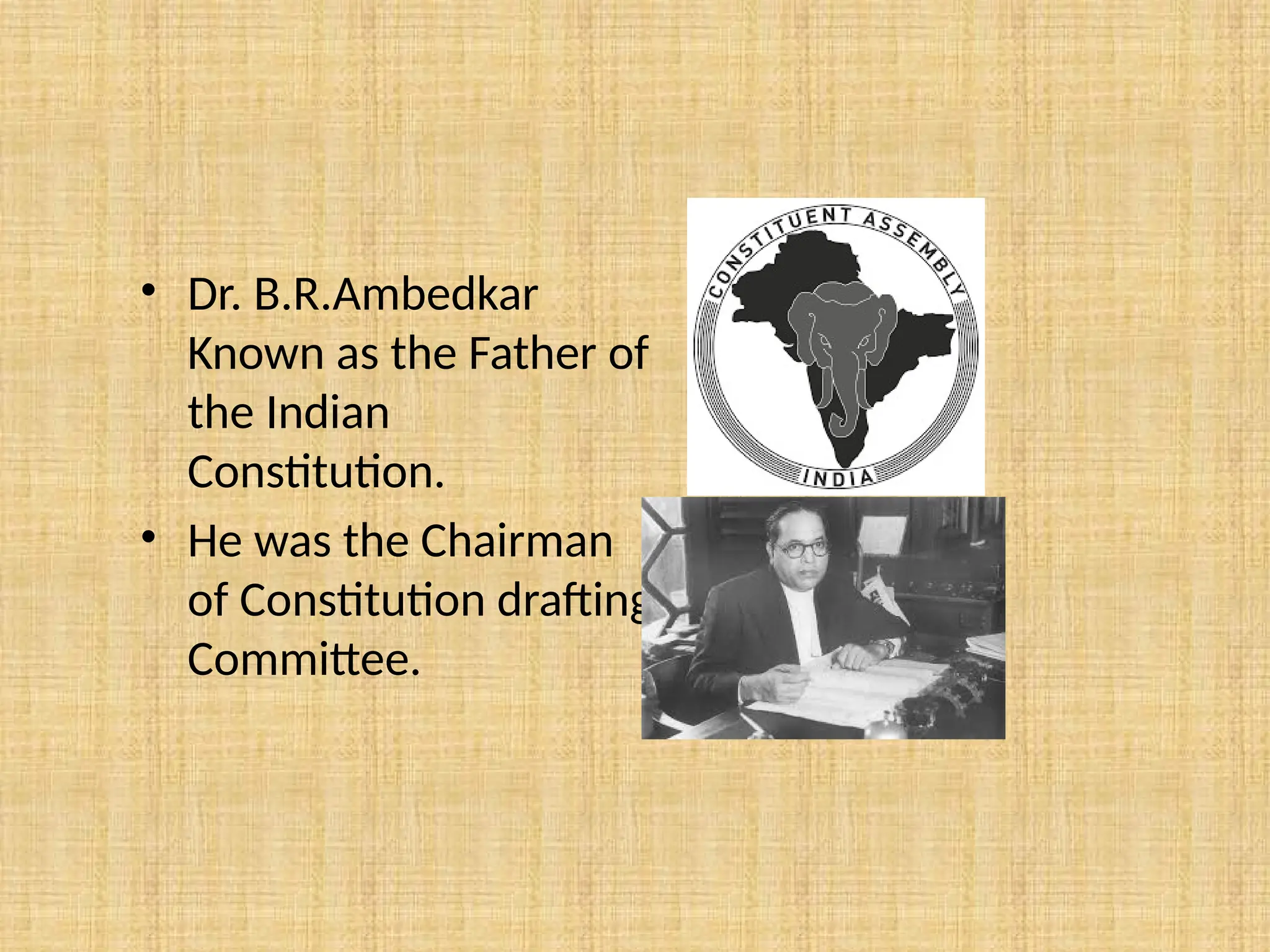
• Dr. B.R.Ambedkar
Knownas the Father of
the Indian
Constitution.
• He was the Chairman
of Constitution drafting
Committee.
35.
Important members
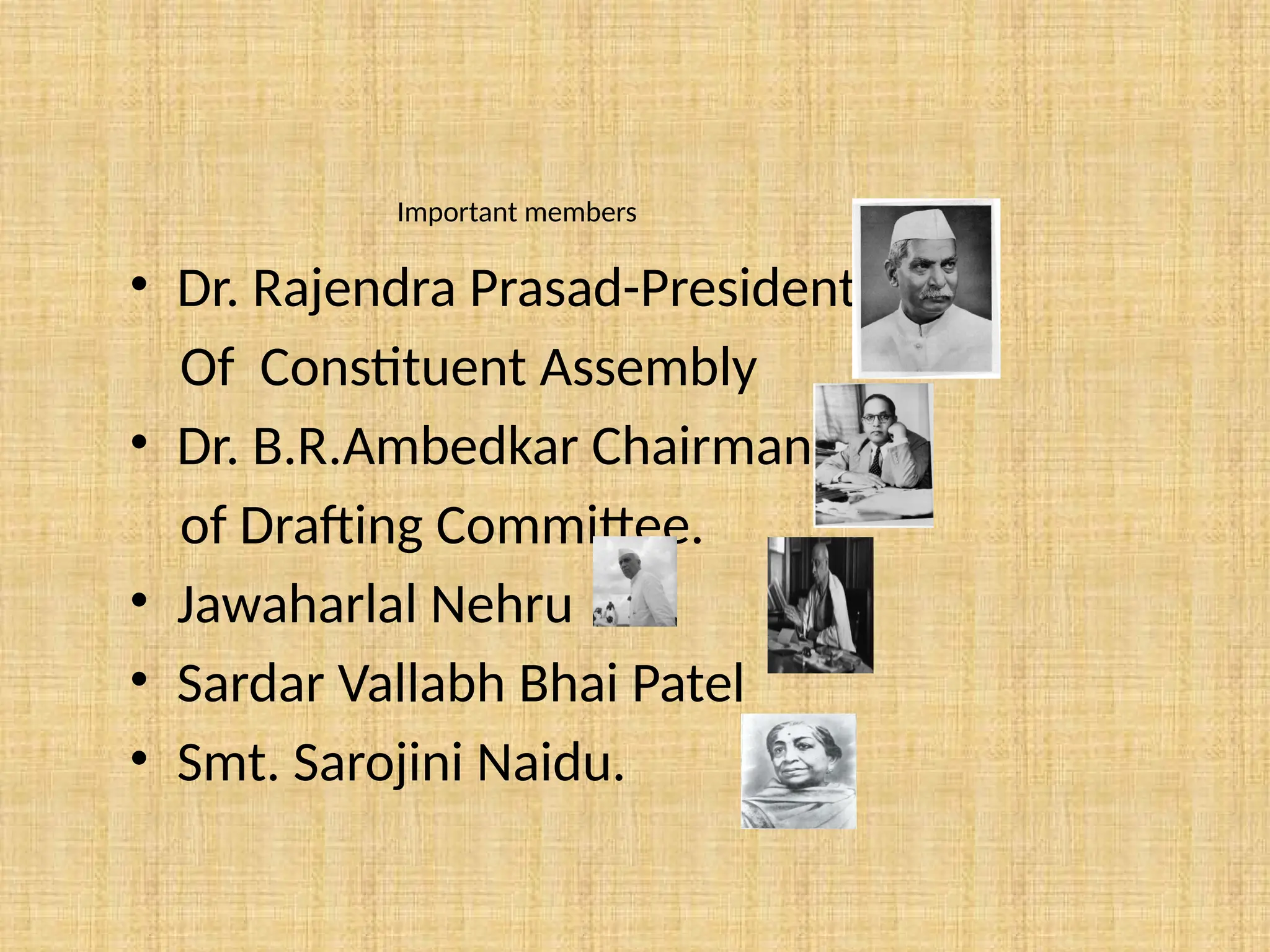
• Dr.Rajendra Prasad-President
Of Constituent Assembly
• Dr. B.R.Ambedkar Chairman
of Drafting Committee.
• Jawaharlal Nehru
• Sardar Vallabh Bhai Patel
• Smt. Sarojini Naidu.
36.
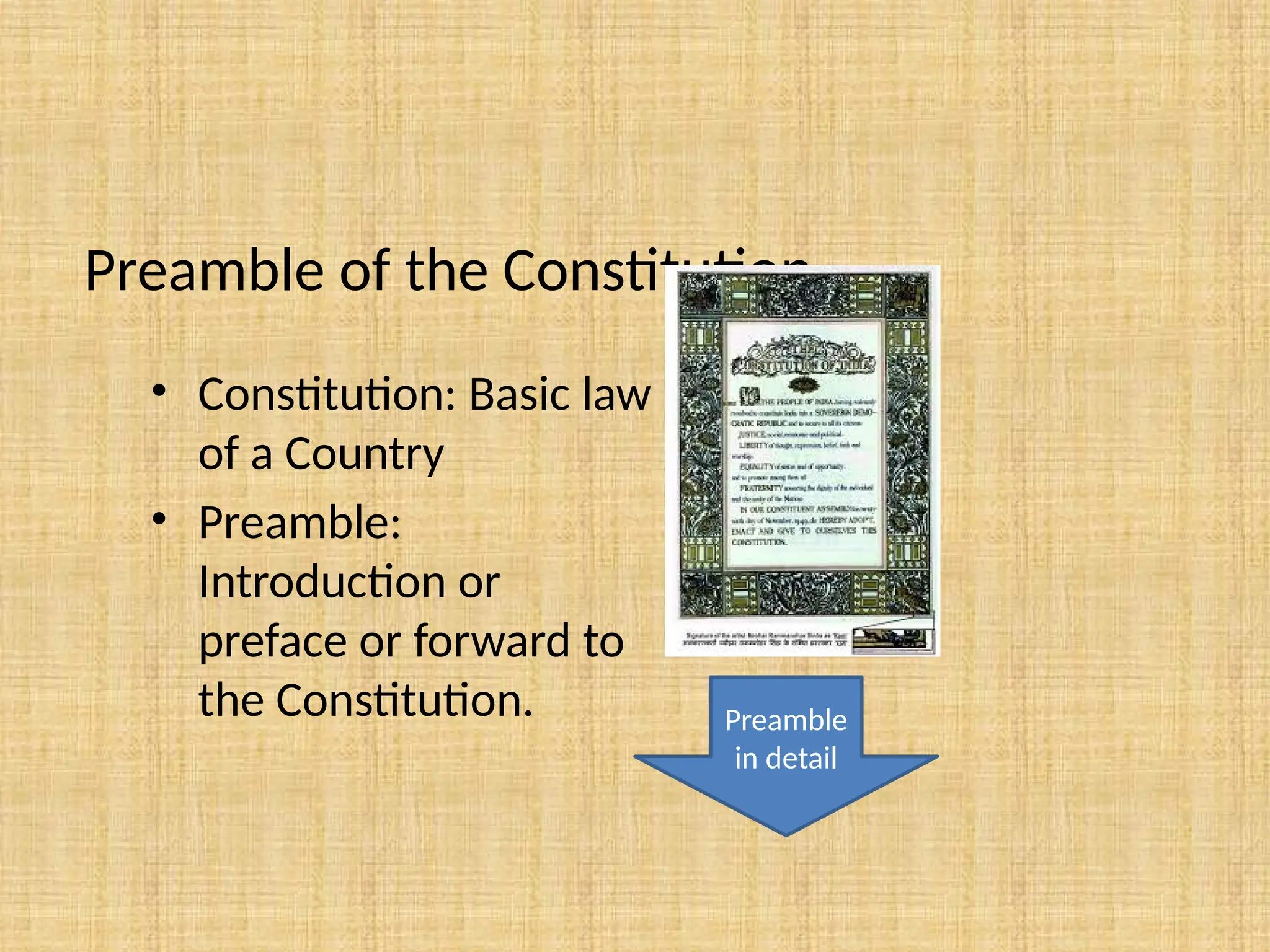
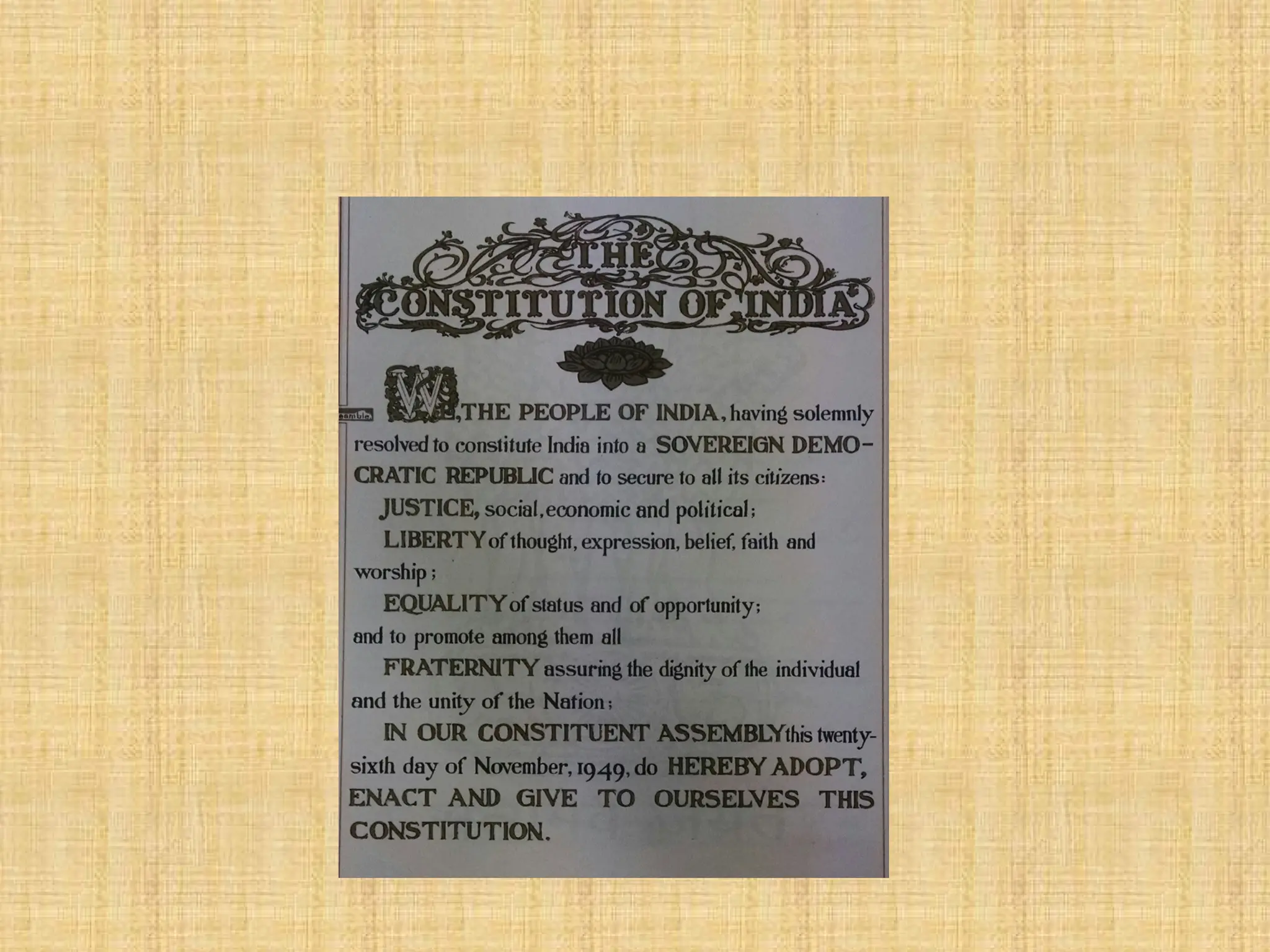
Preamble of theConstitution
• Constitution: Basic law
of a Country
• Preamble:
Introduction or
preface or forward to
the Constitution. Preamble
in detail
38.
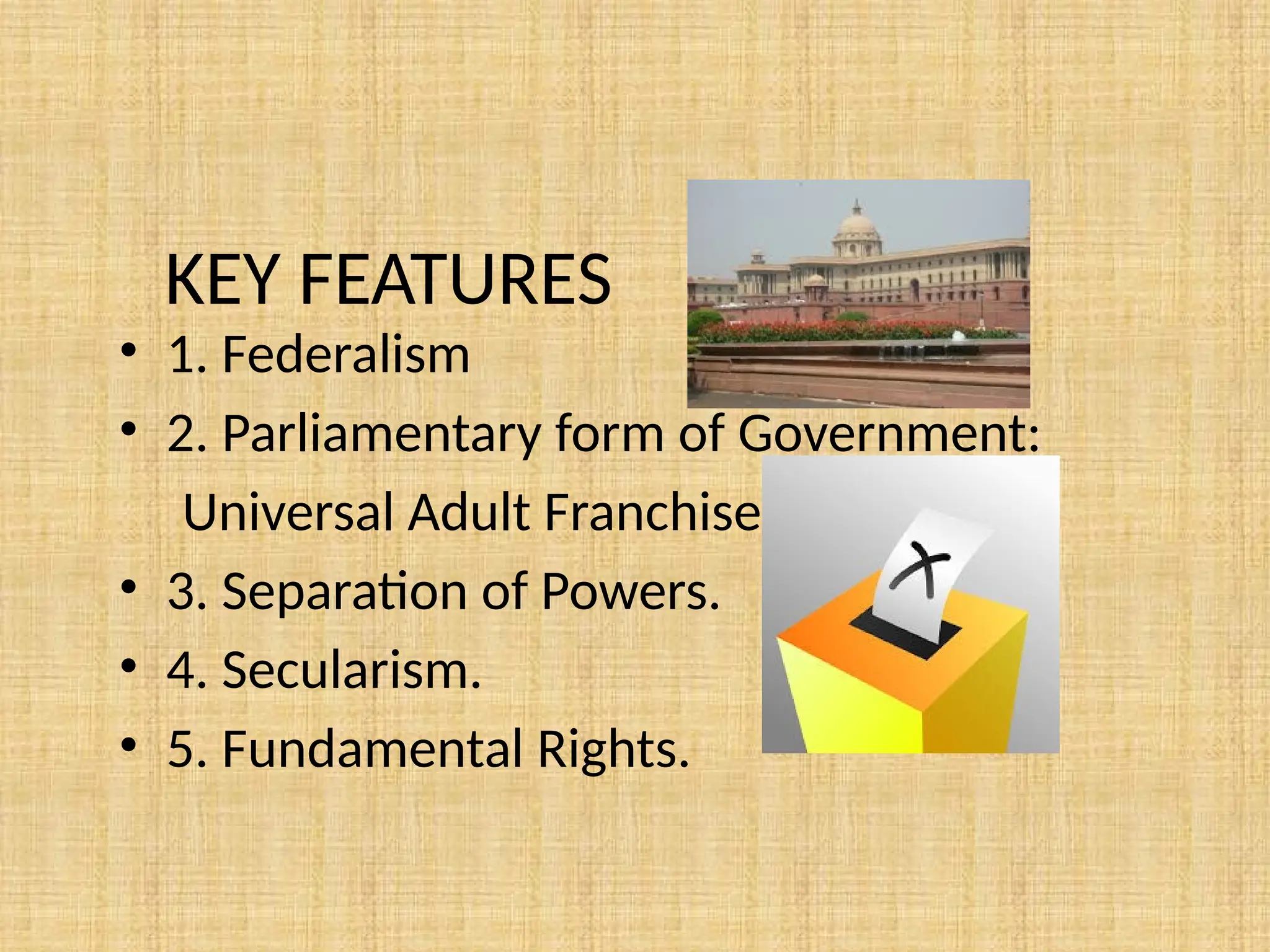
KEY FEATURES
• 1.Federalism
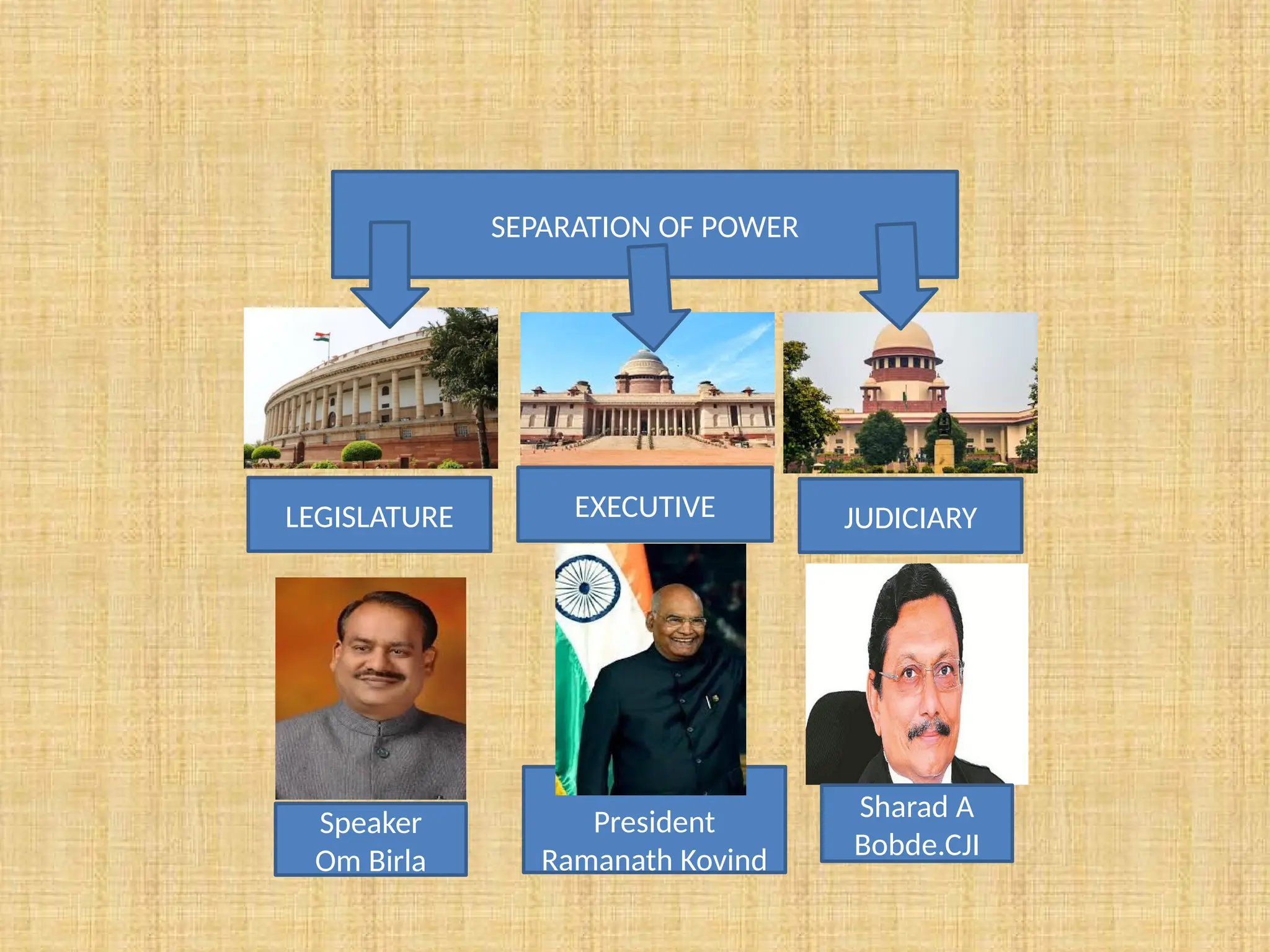
• 2. Parliamentary form of Government:
Universal Adult Franchise.
• 3. Separation of Powers.
• 4. Secularism.
• 5. Fundamental Rights.
39.
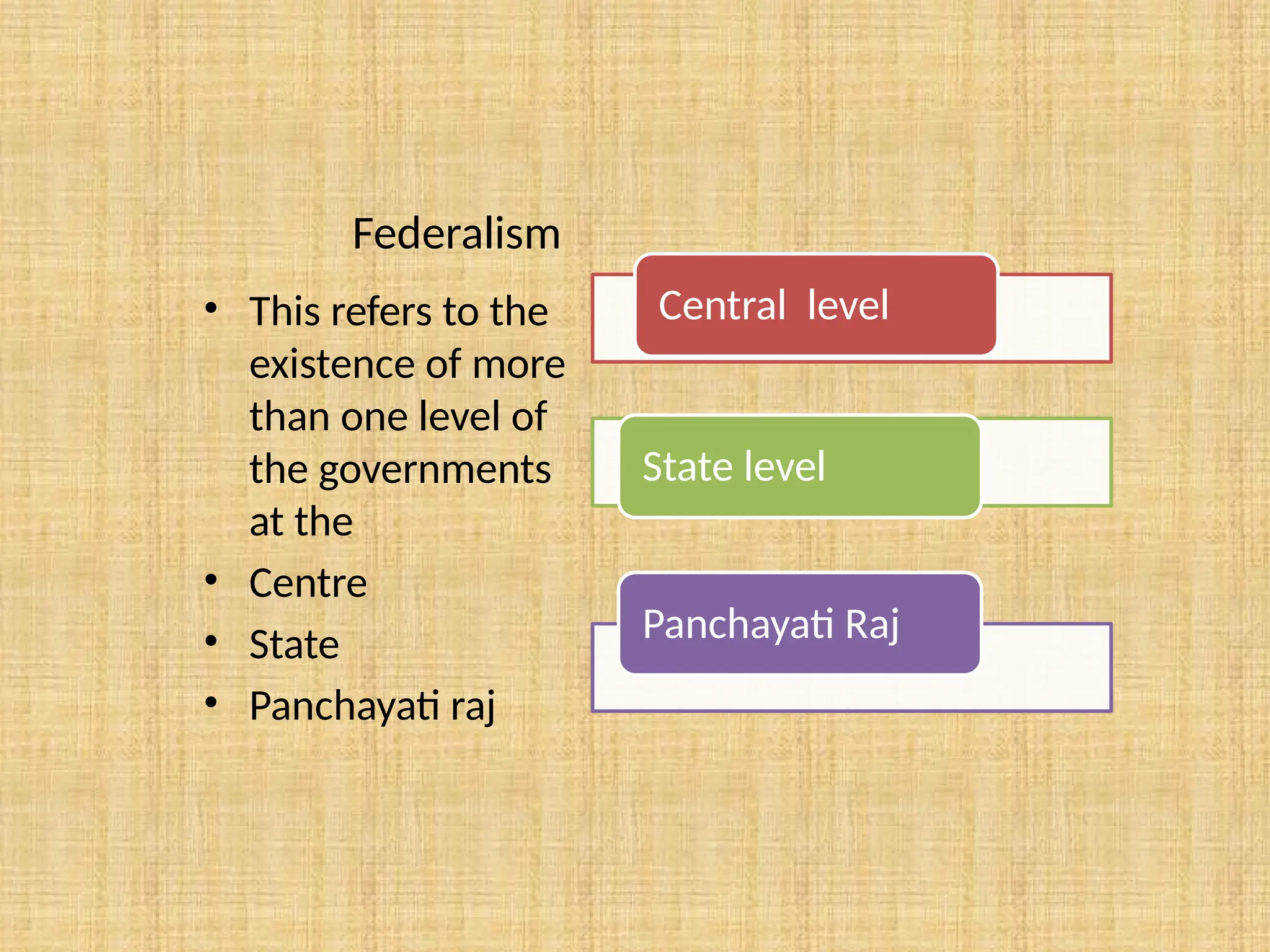
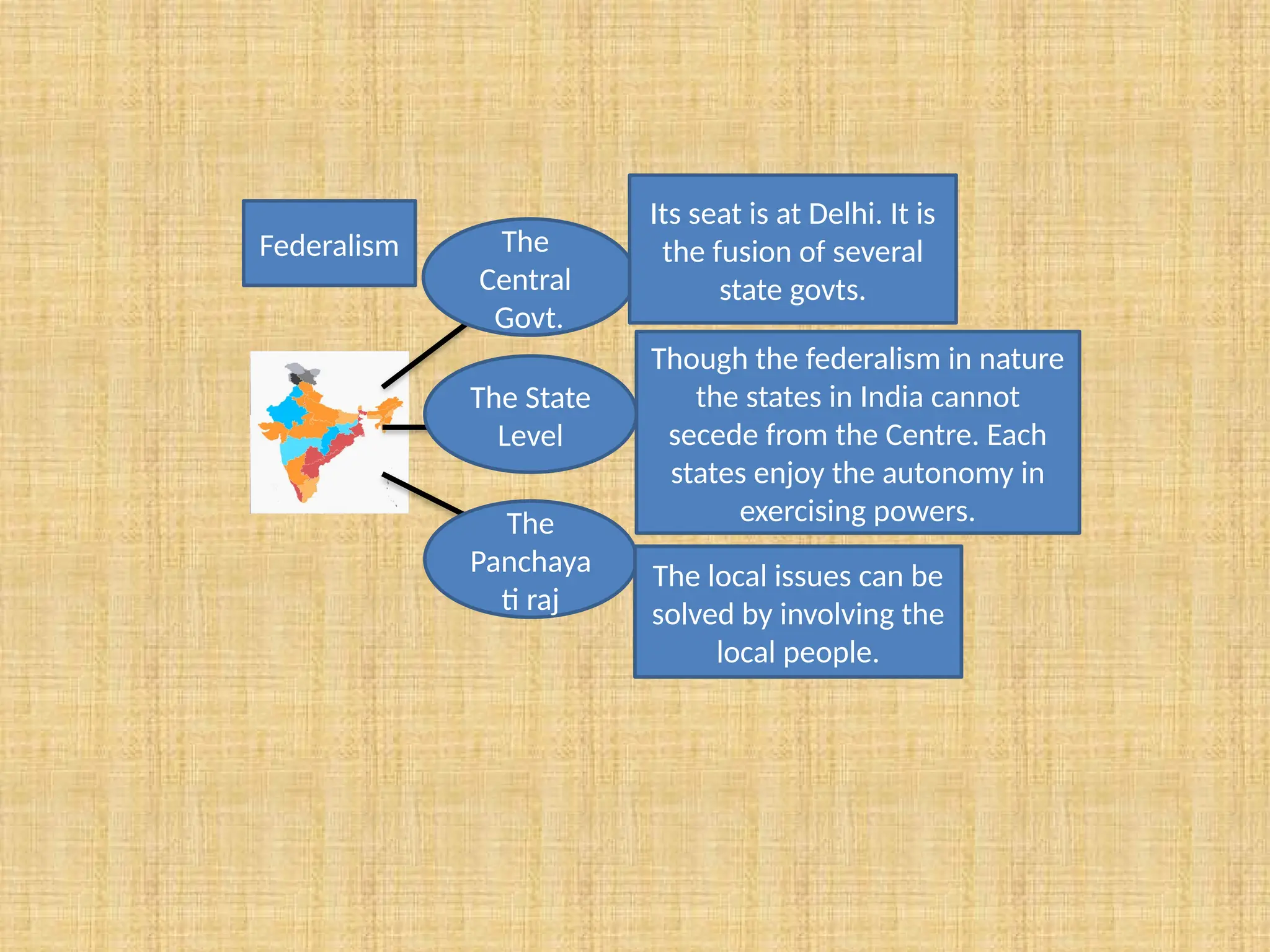
Federalism
• This refersto the
existence of more
than one level of
the governments
at the
• Centre
• State
• Panchayati raj
Central level
State level
Panchayati Raj
40.
Federalism The
Central
Govt.
The State
Level
The
Panchaya
tiraj
Its seat is at Delhi. It is
the fusion of several
state govts.
Though the federalism in nature
the states in India cannot
secede from the Centre. Each
states enjoy the autonomy in
exercising powers.
The local issues can be
solved by involving the
local people.
41.
• Subjects ofnational concern
require that all of these
states follow the laws of the
central Government.
• The Constitution contains
lists that detail the issues
that each tier of government
can make laws on.
42.
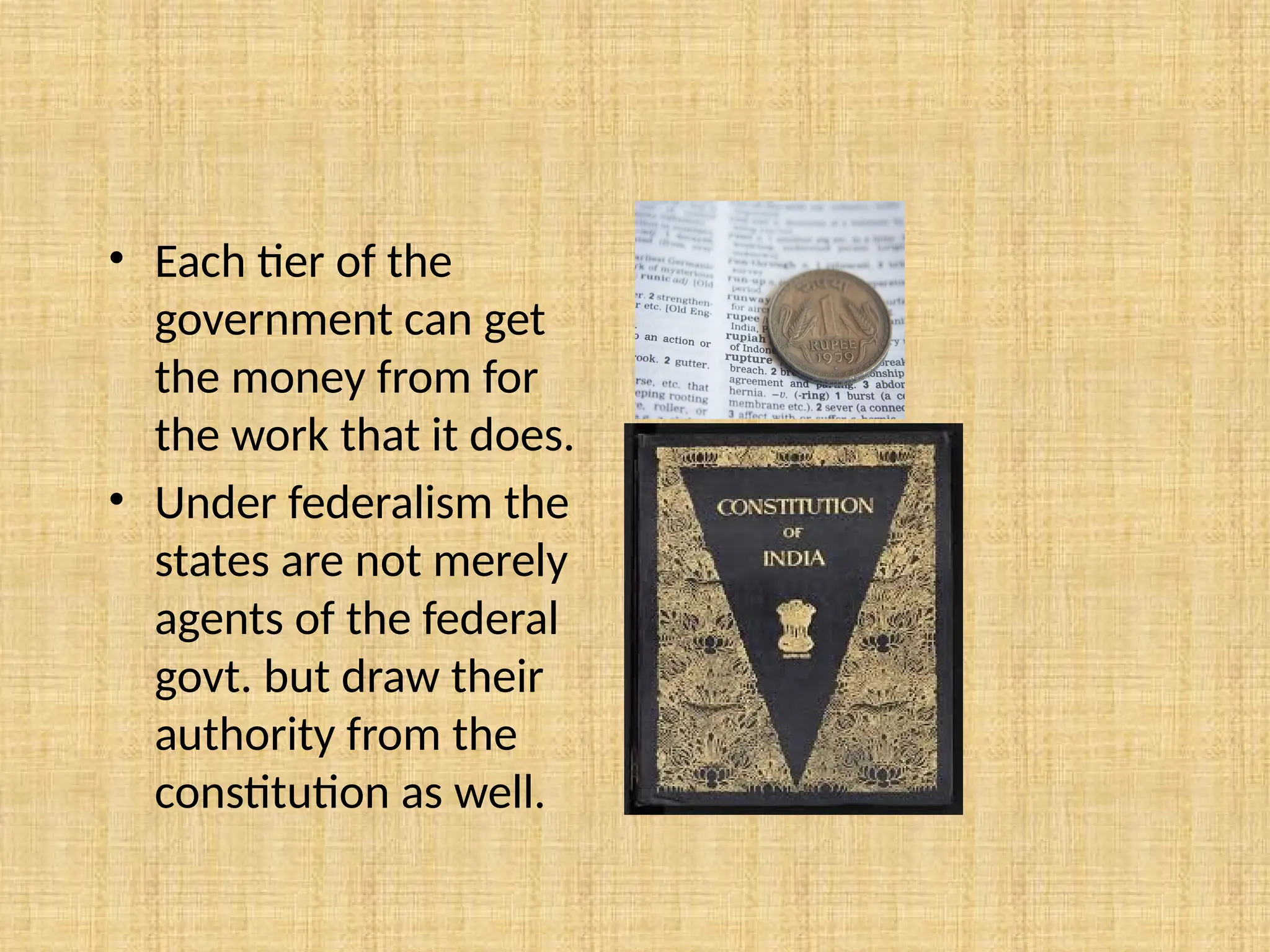
• Each tierof the
government can get
the money from for
the work that it does.
• Under federalism the
states are not merely
agents of the federal
govt. but draw their
authority from the
constitution as well.
43.
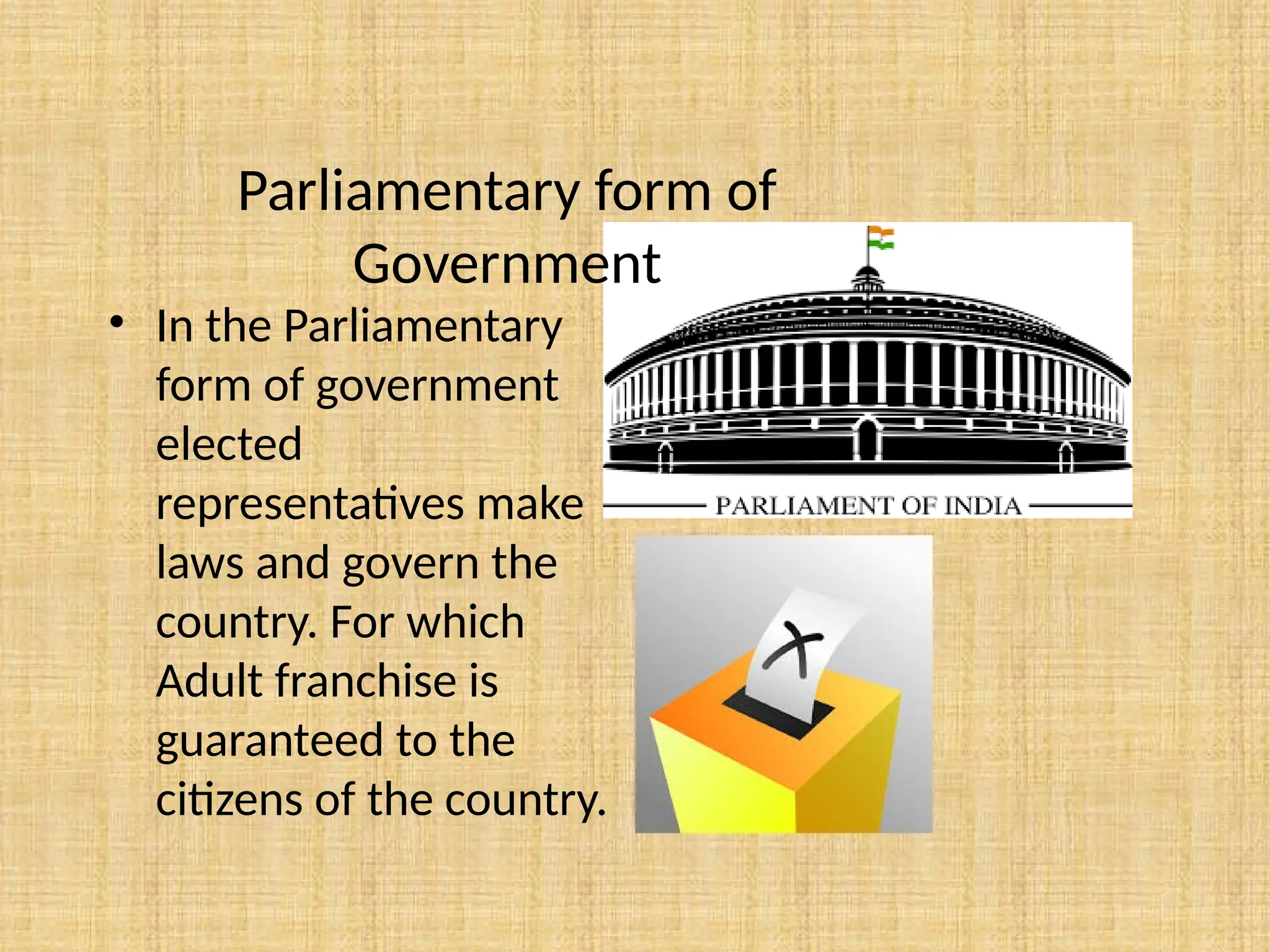
Parliamentary form of
Government
•In the Parliamentary
form of government
elected
representatives make
laws and govern the
country. For which
Adult franchise is
guaranteed to the
citizens of the country.
44.
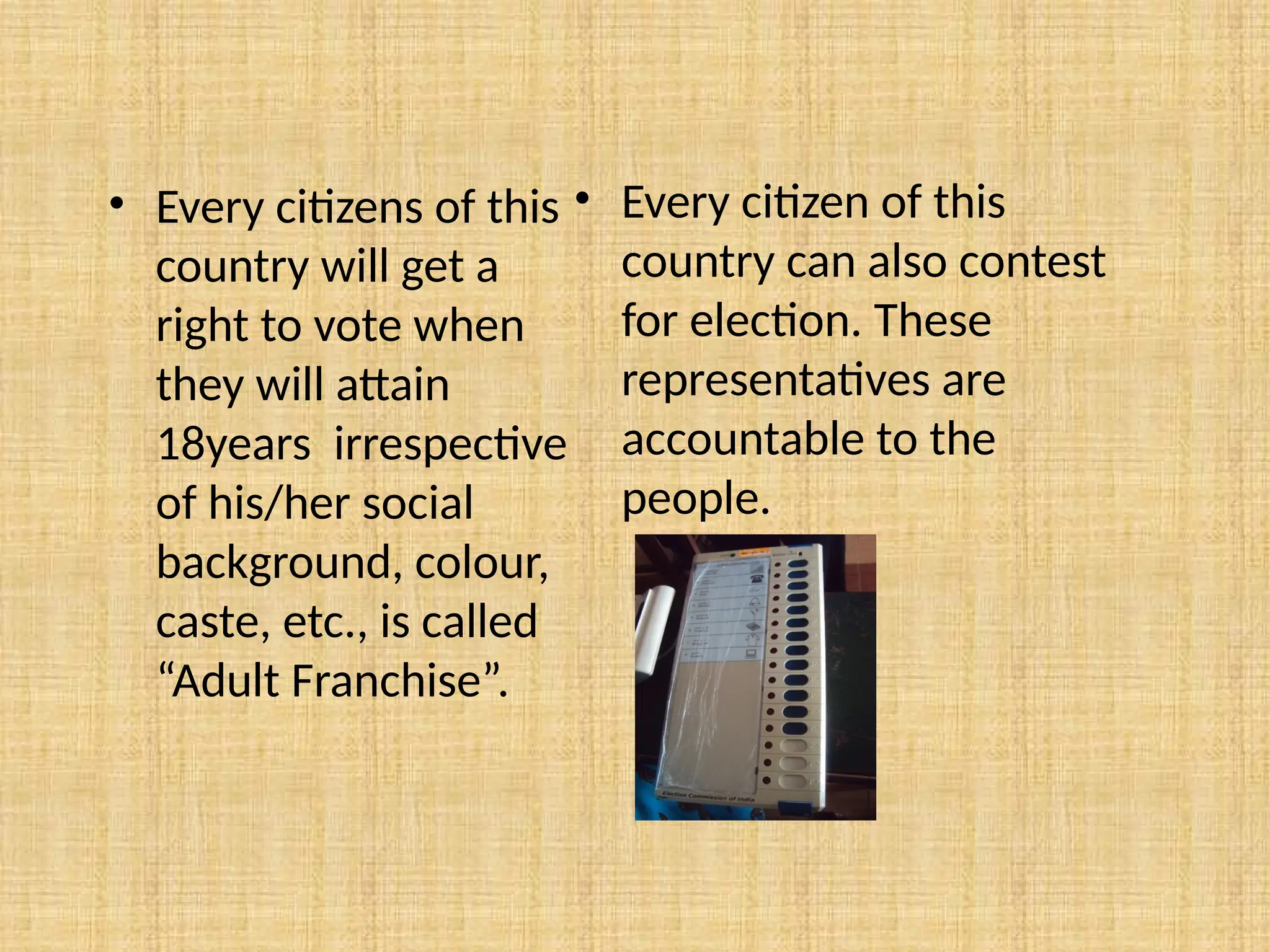
• Every citizensof this
country will get a
right to vote when
they will attain
18years irrespective
of his/her social
background, colour,
caste, etc., is called
“Adult Franchise”.
• Every citizen of this
country can also contest
for election. These
representatives are
accountable to the
people.
45.
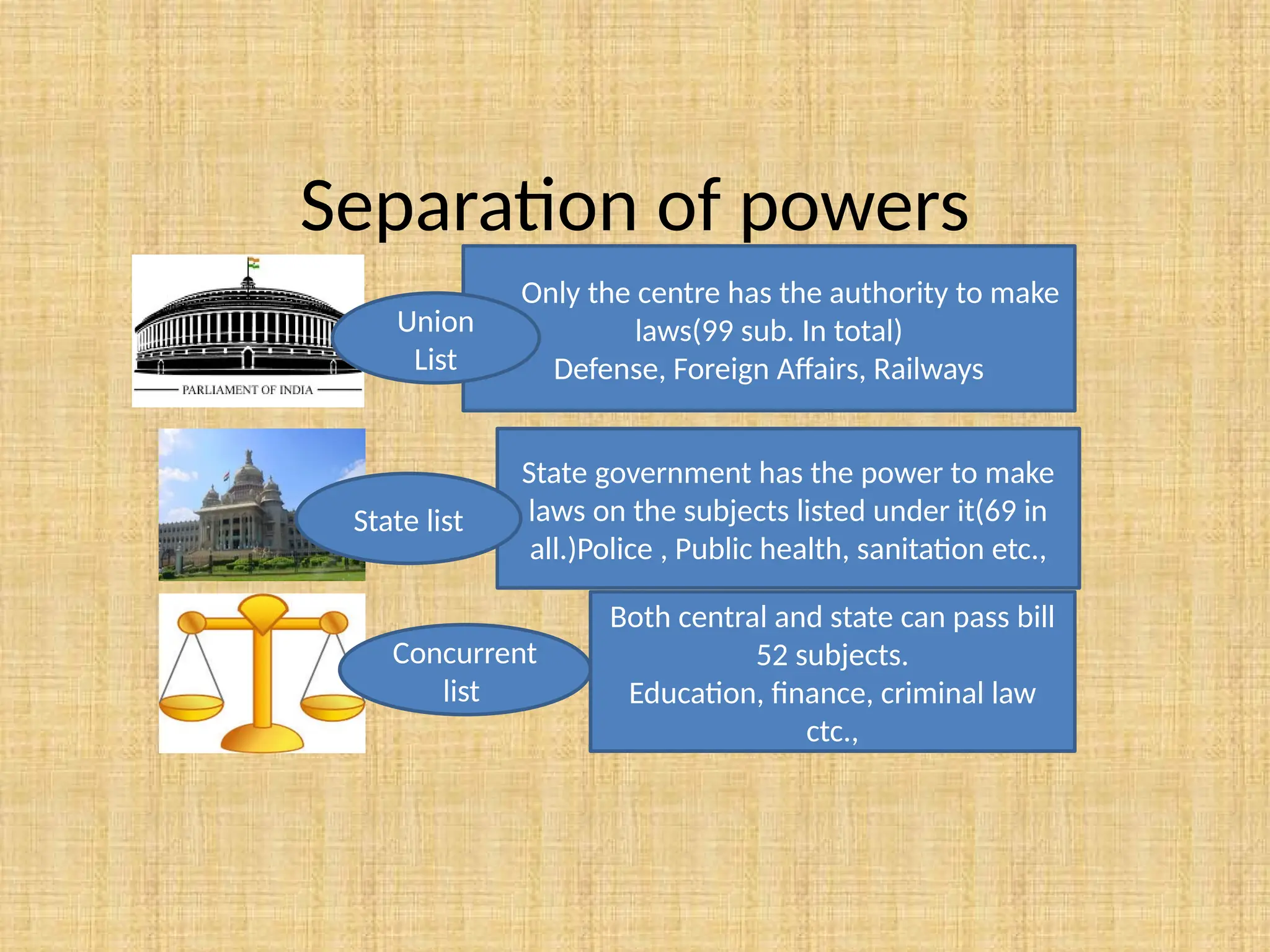
Separation of powers
Onlythe centre has the authority to make
laws(99 sub. In total)
Defense, Foreign Affairs, Railways
State government has the power to make
laws on the subjects listed under it(69 in
all.)Police , Public health, sanitation etc.,
Union
List
Concurrent
list
State list
Both central and state can pass bill
52 subjects.
Education, finance, criminal law
ctc.,
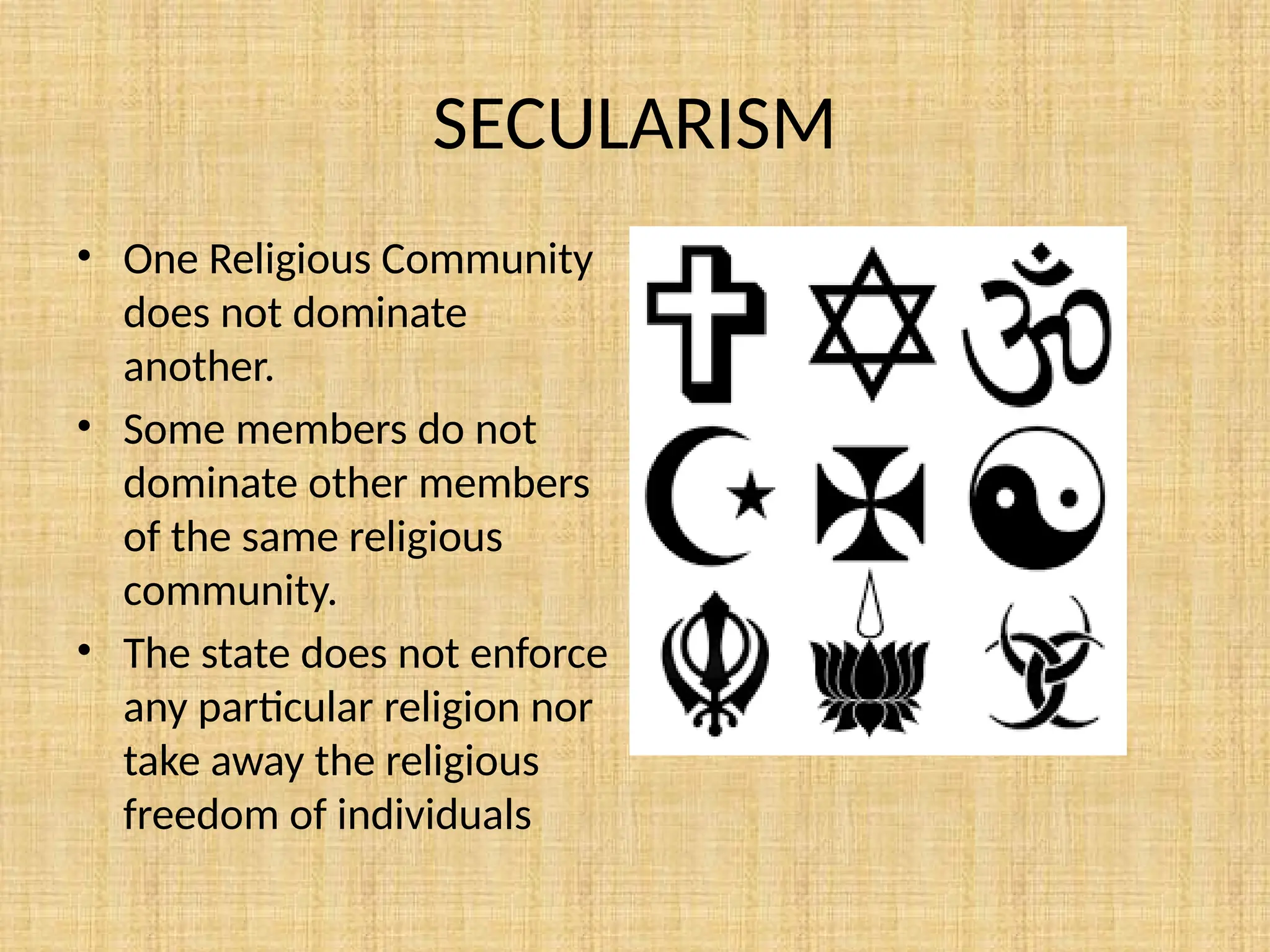
SECULARISM
• One ReligiousCommunity
does not dominate
another.
• Some members do not
dominate other members
of the same religious
community.
• The state does not enforce
any particular religion nor
take away the religious
freedom of individuals
48.
FUNDAMENTAL RIGHTS
• Fundamentalrights
protect citizen against
the arbitrary and
absolute exercise of
power by the State. The
Constitution thus
guarantees the rights of
individuals against the
State as well as against
other individuals.
49.
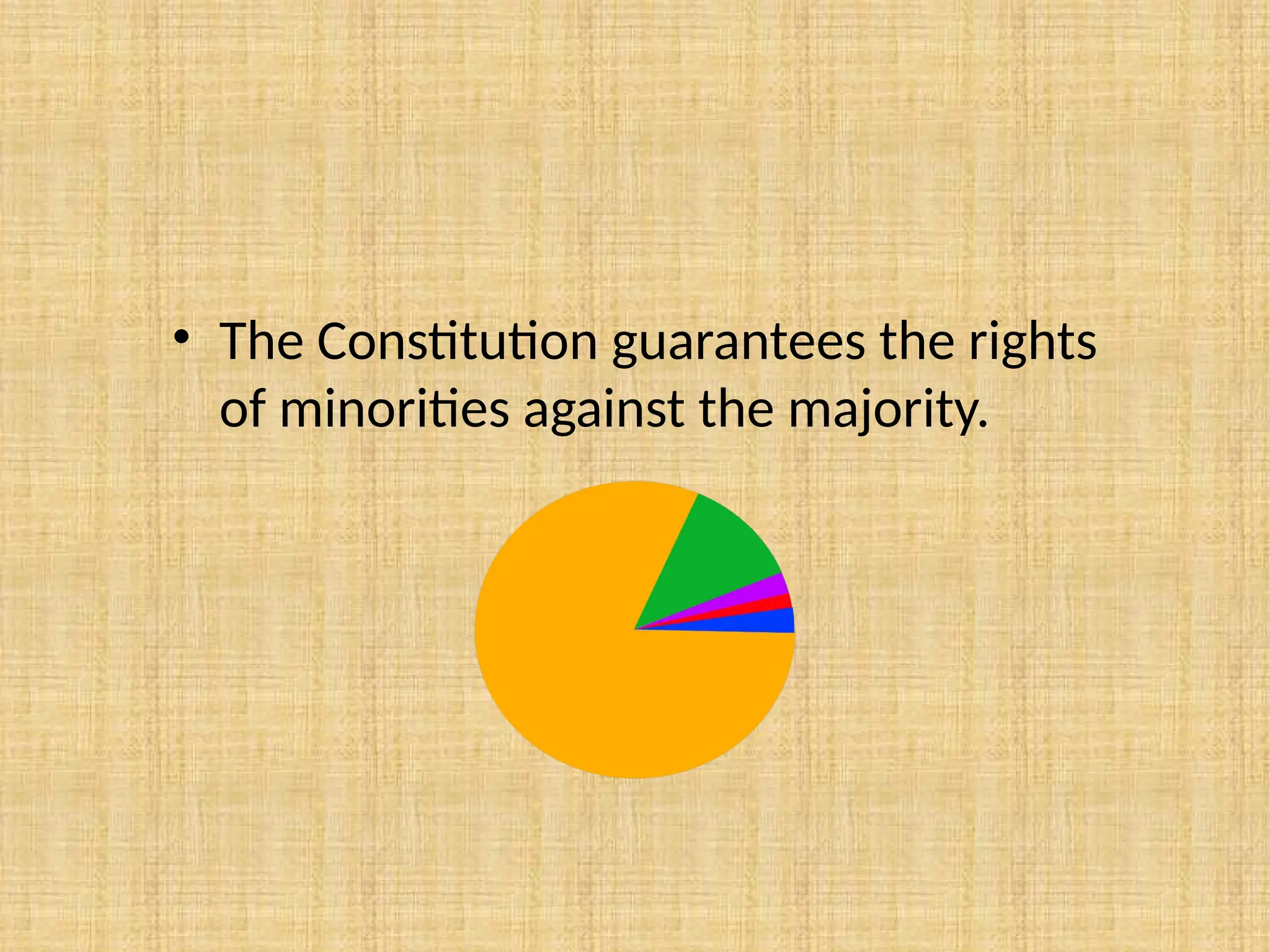
• The Constitutionguarantees the rights
of minorities against the majority.
50.
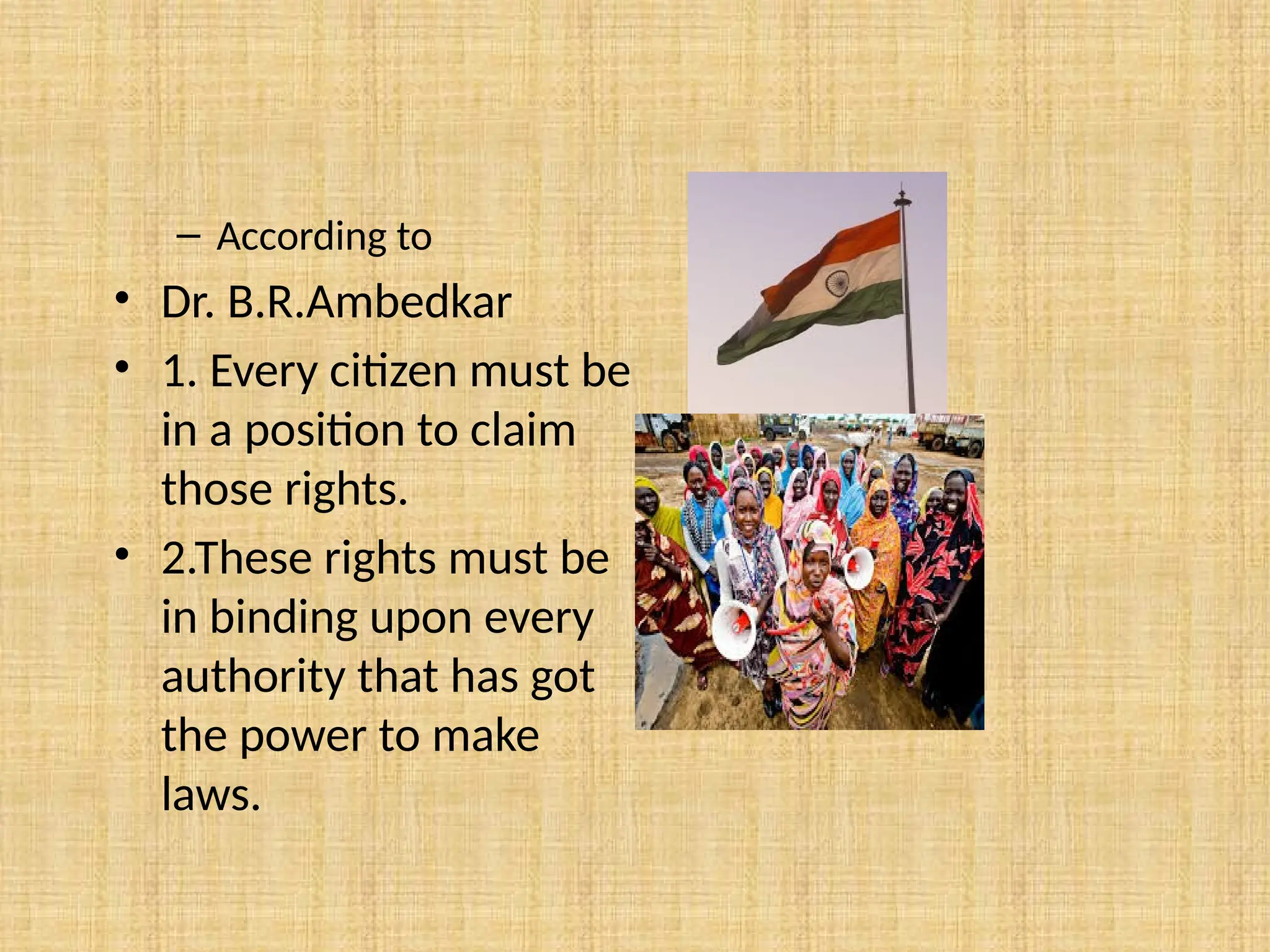
– According to
•Dr. B.R.Ambedkar
• 1. Every citizen must be
in a position to claim
those rights.
• 2.These rights must be
in binding upon every
authority that has got
the power to make
laws.
51.
FUNDAMENTAL RIGHTS
• 1.The Right to Equality
• 2. Right to Freedom
• 3. Right against
Exploitation.
• 4. Right to Freedom of
Religion
• 5. Cultural and
Educational Rights.
• 6. Right to Constitutional
Remedies.
52.
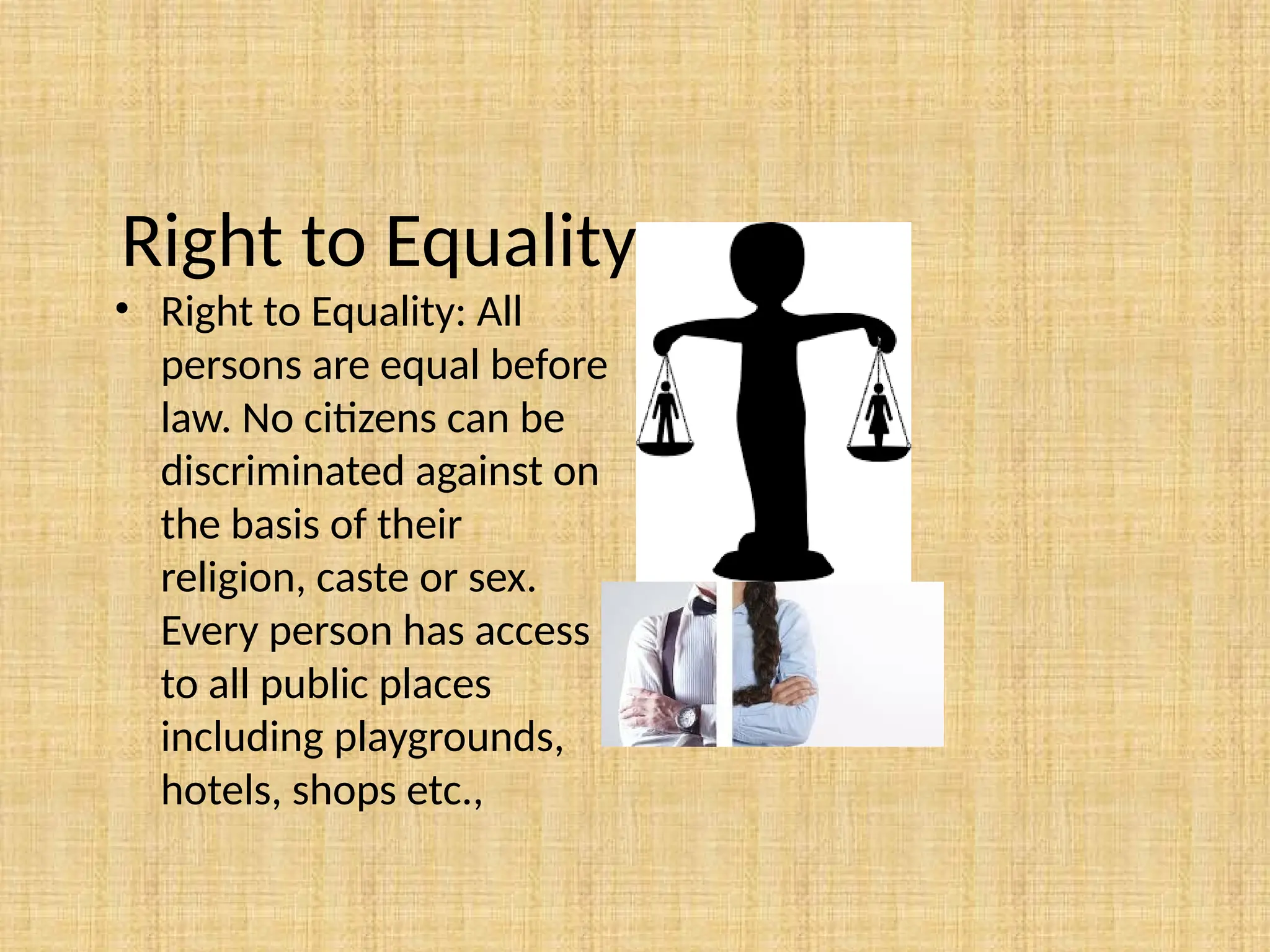
Right to Equality.
•Right to Equality: All
persons are equal before
law. No citizens can be
discriminated against on
the basis of their
religion, caste or sex.
Every person has access
to all public places
including playgrounds,
hotels, shops etc.,
53.
Right to Freedom.
•This includes
• The right to freedom
of speech and expression,
• To form associations,
• move freely
• Reside in any part of the
country.
• Practise any profession,
occupation or business
54.
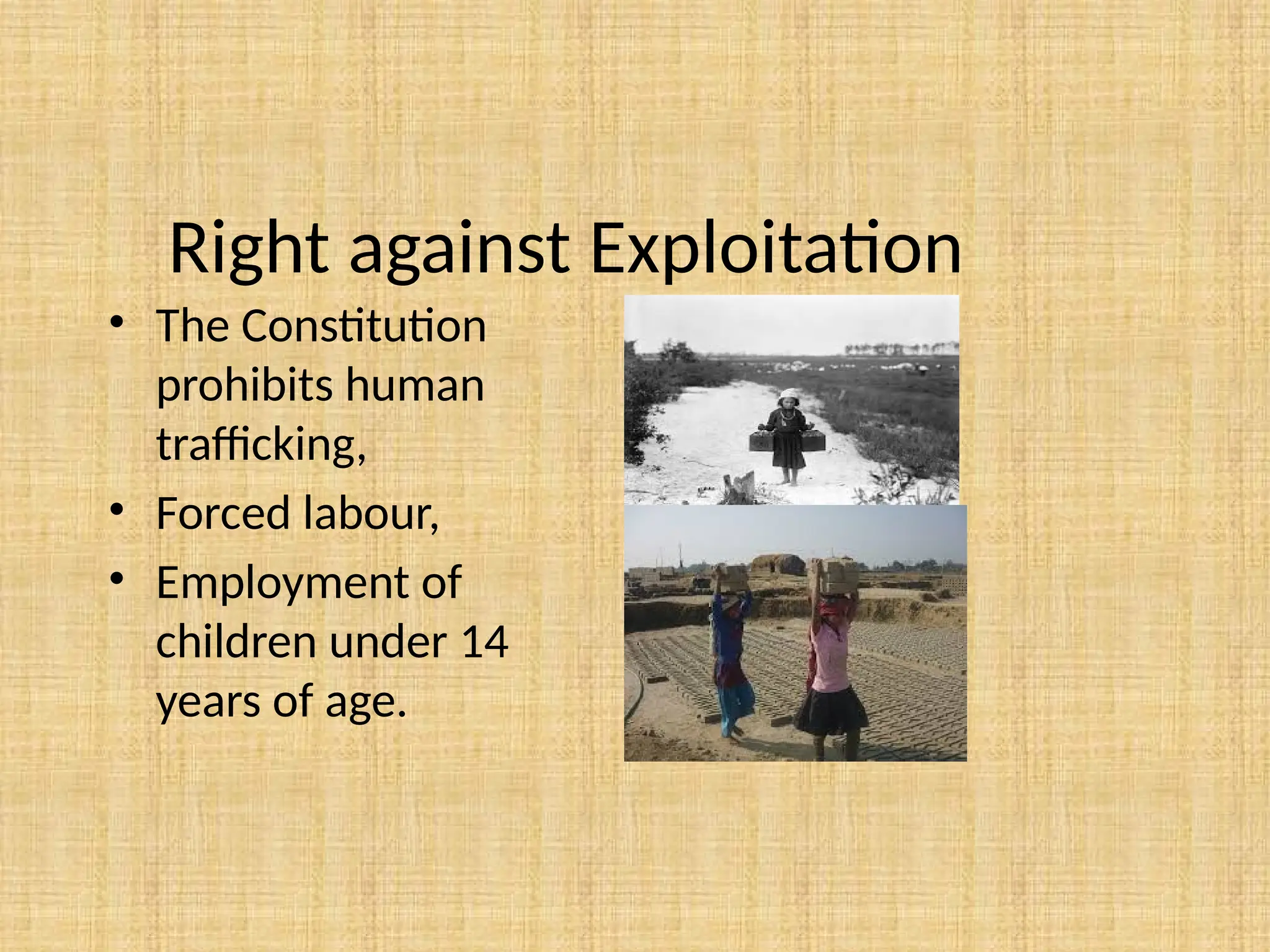
Right against Exploitation
•The Constitution
prohibits human
trafficking,
• Forced labour,
• Employment of
children under 14
years of age.
55.
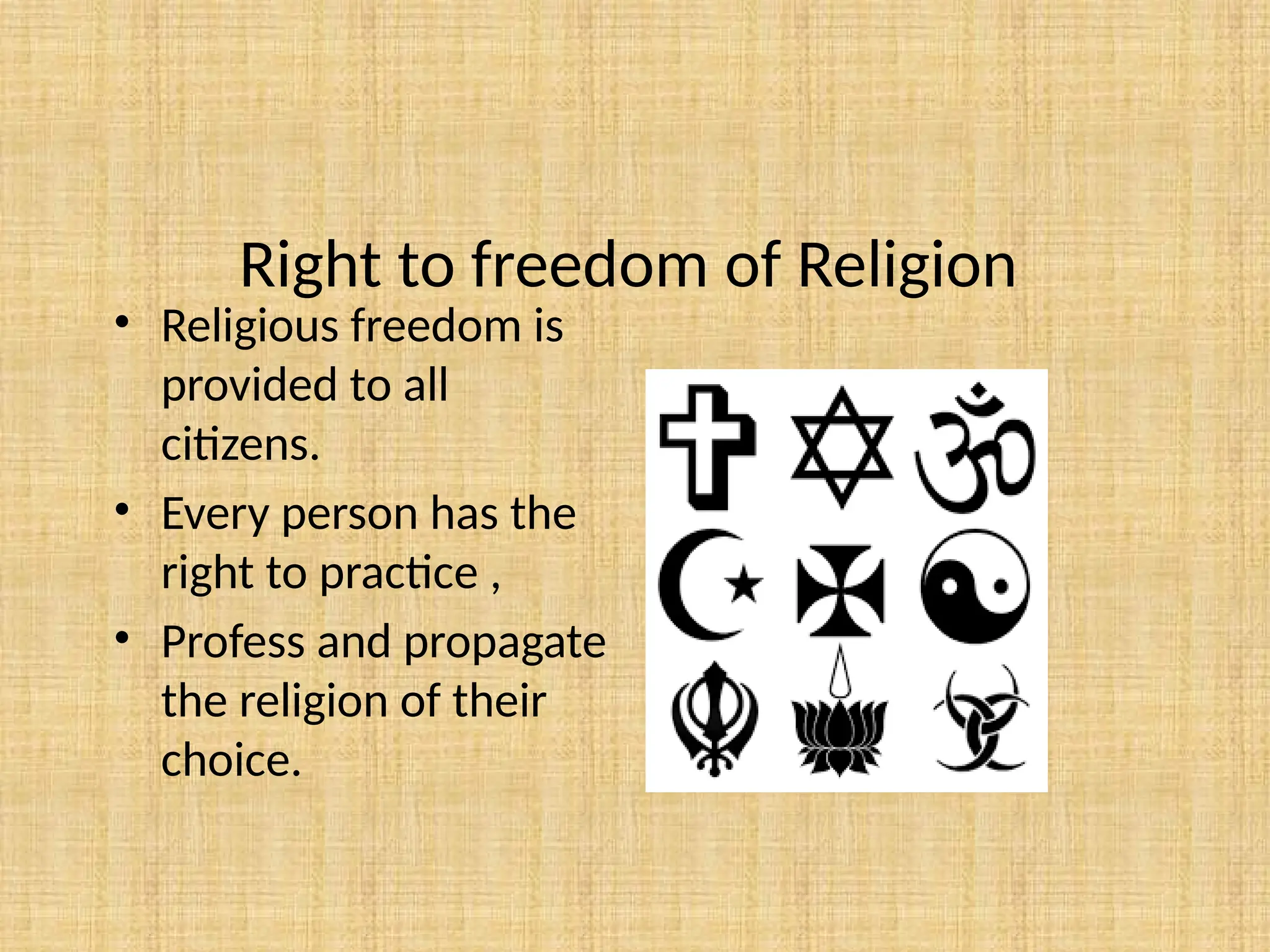
Right to freedomof Religion
• Religious freedom is
provided to all
citizens.
• Every person has the
right to practice ,
• Profess and propagate
the religion of their
choice.
56.
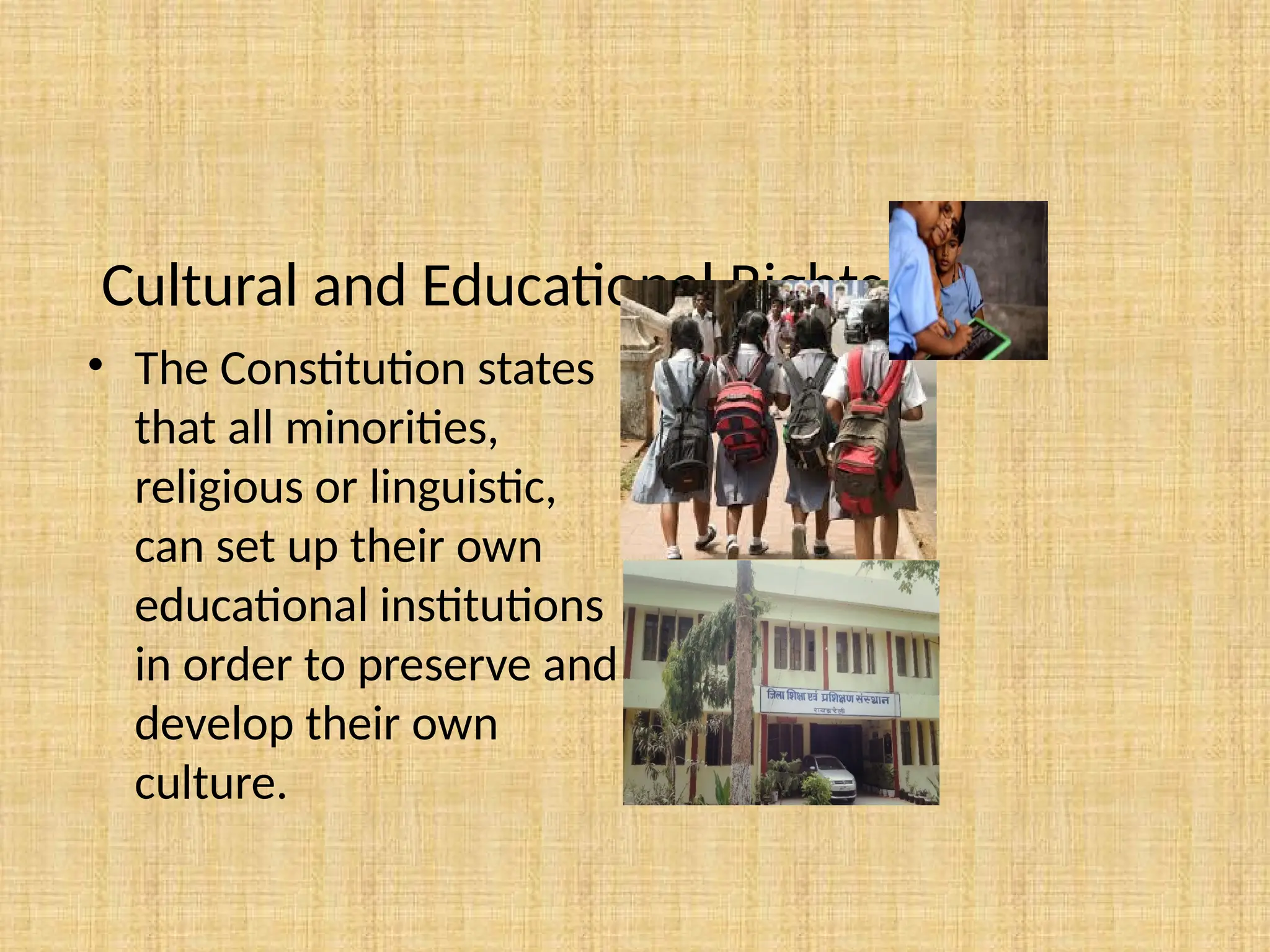
Cultural and EducationalRights
• The Constitution states
that all minorities,
religious or linguistic,
can set up their own
educational institutions
in order to preserve and
develop their own
culture.
57.
Right to ConstitutionalRemedies.
• This allows citizens to
move the court if they
believe that any of their
Fundamental Rights
have been violated by
the State.
58.
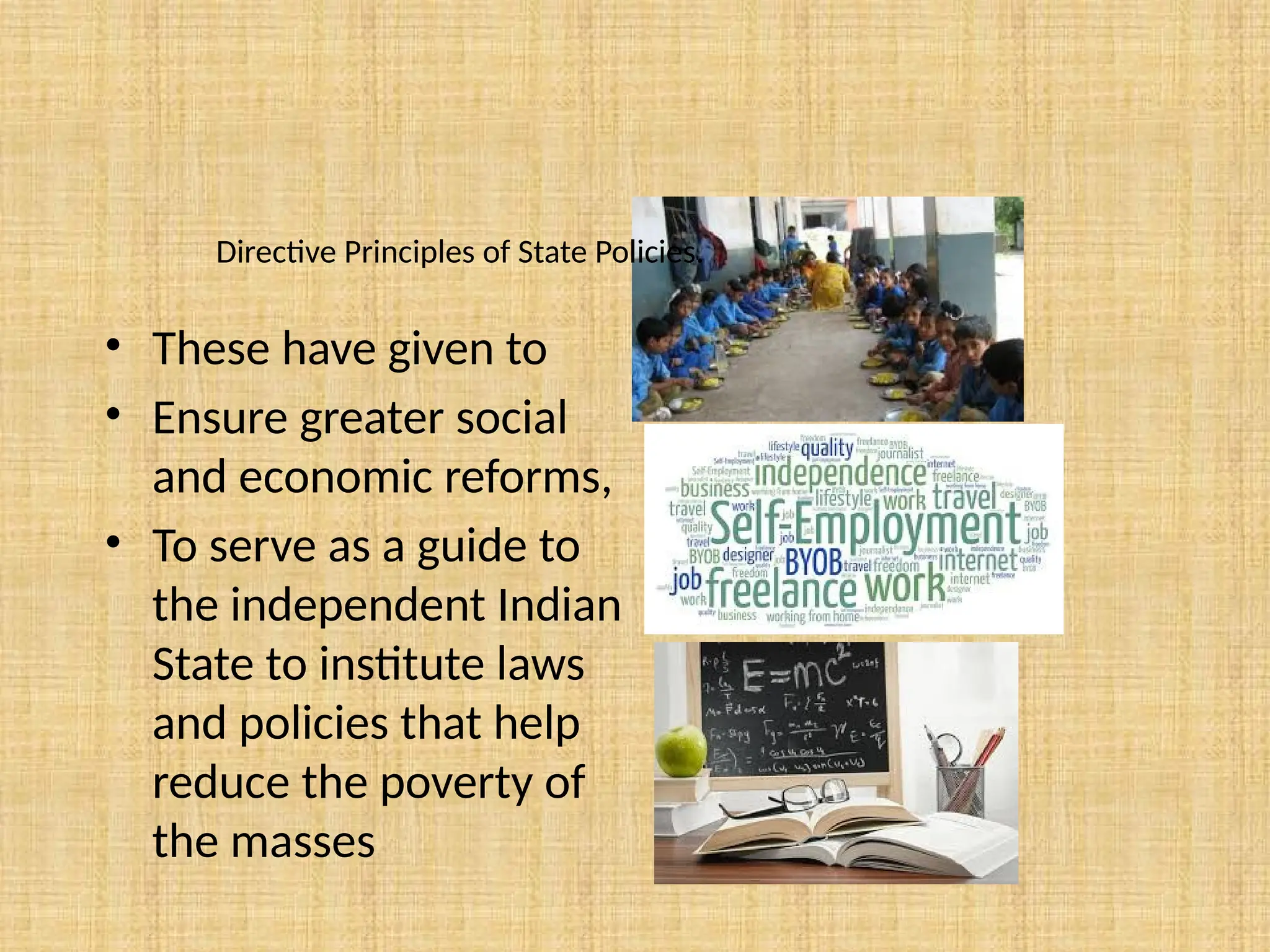
Directive Principles ofState Policies.
• These have given to
• Ensure greater social
and economic reforms,
• To serve as a guide to
the independent Indian
State to institute laws
and policies that help
reduce the poverty of
the masses
59.
Summary
• Our Constitutionadopted on 26th
Jan 1950.
• Dr. B.R.Ambedkar was a chairman of Constitution
drafting committee.
• Dr. Rajendra Prasad President of Constituent Assembly.
• Key Features: Federalism
• Parliamentary form of government
• Separation of Power.
• Secularism.
• Fundamental Rights








![Constitution of India [world's largest written constitution] unit II.ppt](https://cdn.slidesharecdn.com/ss_thumbnails/indianconstitutionunitii-241125162907-9380afdf-thumbnail.jpg?width=640&height=640&fit=bounds)


