Lorna Boschman at  Games for Health in Boston May 19, 2011 everyday design lab SSHRC Doctoral Award


In industrialized countries, fewer than half of adults exercise as frequently as national fitness guidelines suggest (Shields et al., 2010, Biddle & Mutrie, 2008) Adults over forty have an increased risk of developing chronic health conditions  that  could be prevented or controlled through regular exercise:  cardiovascular disease, type 2 diabetes, non-clinical depression (Warburton, 2007b, 2006)
Review of evidence supporting international physical activity guidelines: most recommend moderate physical activity most days of the week (Warburton et al., 2007b) Newly released Canadian guidelines suggest at least 150 minutes per week (in bouts of 10+ minutes) of  moderate to vigorous-intensity activities  like brisk walking, bicycling, swimming or jogging – shortness of breath & elevated heartbeat (CSEP, 2011)
Studies of perceived barriers to fitness – most say they don’t have time or energy (Biddle & Mutrie, 2008) Fast paced modern lifestyle – may not have time for hour at the gym but do have time for short bursts of exercise (McElroy, 2002)
Physical and brain fitness titles are among the most popular console-based games purchased by Canadian adults over forty (ESA Canada, 2009); Wii Fit Plus with Balance Board ranks #5 in Canada’s console game sales (ESA Canada, 2011) People intend to exercise when they buy the game, but are exergames the latest home fitness fad that will collect dust? Do people need to develop strategies for using exergames to support fitness?
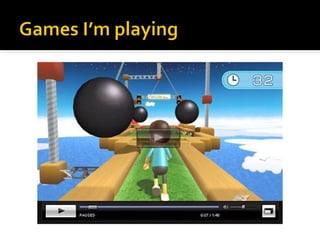
British study compared energy expenditure of  Wii Sports  games to sedentary games – boxing was more active, but otherwise not enough for a daily exercise (Graves et al., 2008) Australian study with elderly participants – liked social aspects of playing  Wii Sports  but no measurable physical benefits (Wollersheim et al., 2010)
North American version of game introduced in May 2008;  Wii Fit Plus  in October 2009 Wii Fit (Plus)  designed to encourage physical activity and body awareness Australian study – ten women aged 30-58 who played two Wii Fit sessions (30 min.) per week for ten weeks (Nitz et al., 2009) Exercise adherence was 70% Improvement in standardized tests for balance and lower body strength, but no change in other areas
Interested in how women use active games to support a program of physical activity Looking at overall program rather than trying to prove that active games are “the answer” Look at how women approach the question of increasing and maintaining physical activity
What are the  factors  that encourage women over forty to adopt exercise fitness games as one component of a program of physical activity?  Does  personalized instruction  in using exergames support the development of an ongoing program of physical activity?  How do the actions of  exercise partners and the social environment  influence exercise adherence and fitness levels of co-exercisers?
 
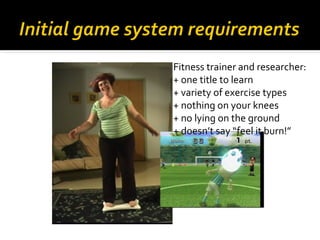
Fitness trainer and researcher: + one title to learn  + variety of exercise types  + nothing on your knees  + no lying on the ground  + doesn’t say “feel it burn!”
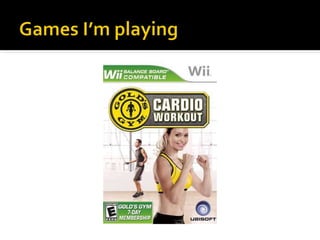
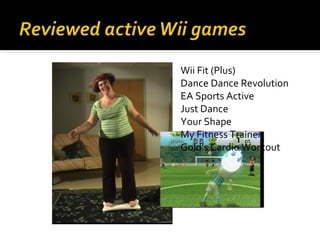
Wii Fit (Plus) Dance Dance Revolution EA Sports Active Just Dance Your Shape My Fitness Trainer Gold’s Cardio Workout
Contribution to HCI: How women use digital games to increase and maintain physical activity – contribute concepts for designers Contribution to public health: Aging adults can sustain good health and mobility through regular exercise; exergames can support their strategies Contribution to game studies: Market for fitness games geared toward aging adults is growing, but suitable products are limited to a few titles – insights for game developers
 
Two groups – those who use  Wii Fit  at home and those who use the game at Britannia Community Centre Began as a six-month longitudinal study – women liked coming back every week and didn’t lose interest after initial enthusiastic response
After first 7 participants, shortened study to 3 months for remaining 53 volunteers Total of 13 participants joined since February 2011 Will recruit total of 60 by November 2011 (study ends in February 2012) Instead of telling them what to do, I ask them what they are doing now and what they’d like to do next
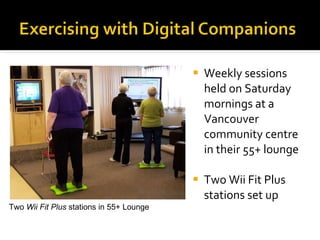
Weekly sessions held on Saturday mornings at a Vancouver community centre in their 55+ lounge Two Wii Fit Plus stations set up Two  Wii Fit Plus  stations in 55+ Lounge
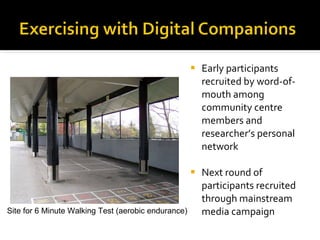
Early participants recruited by word-of-mouth among community centre members and researcher’s personal network Next round of participants recruited through mainstream media campaign  Site for 6 Minute Walking Test (aerobic endurance)
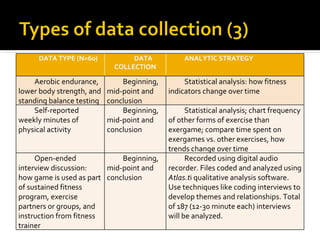
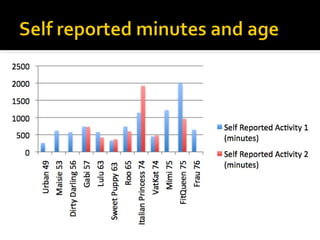
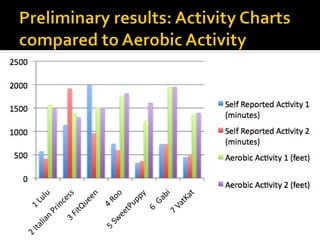
DATA TYPE (N=60) DATA COLLECTION ANALYTIC STRATEGY Aerobic endurance, lower body strength, and standing balance testing Beginning, mid-point and conclusion Statistical analysis: how fitness indicators change over time Self-reported weekly minutes of physical activity Beginning, mid-point and conclusion Statistical analysis; chart frequency of other forms of exercise than exergame; compare time spent on exergames vs. other exercises, how trends change over time Open-ended interview discussion: how game is used as part of sustained fitness program, exercise partners or groups, and instruction from fitness trainer Beginning, mid-point and conclusion Recorded using digital audio recorder. Files coded and analyzed using  Atlas.t i qualitative analysis software. Use techniques like coding interviews to develop themes and relationships. Total of 187 (12-30 minute each) interviews will be analyzed.
Bring these three forms of data together to develop a theory based on multiple perspectives of a common process, growing out of a systematic analysis Research process is iterative – participants help to inform the direction of the study as well as the fitness trainer – examining a whole system of interaction including the game, the social environment and participant info like previous and current exercise experience
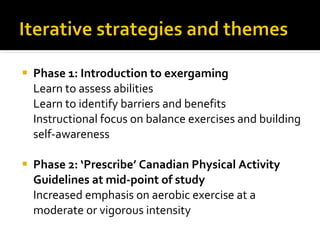
Phase 1: Introduction to exergaming  Learn to assess abilities Learn to identify barriers and benefits Instructional focus on balance exercises and building self-awareness Phase 2: ‘Prescribe’ Canadian Physical Activity Guidelines at mid-point of study  Increased emphasis on aerobic exercise at a moderate or vigorous intensity
Researcher relies on the experience of the fitness instructor (who has assisted previous physical activity studies for people living with cardiovascular disease or diabetes) I asked: “If these women were coming to you at the community center where you work, what would you tell them?” And the trainers said “More aerobic activities.”
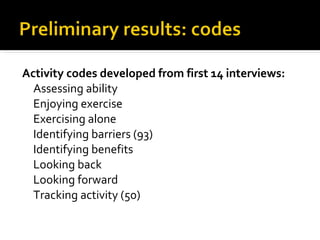
Activity codes developed from first 14 interviews: Assessing ability Enjoying exercise Exercising alone Identifying barriers (93) Identifying benefits Looking back Looking forward Tracking activity (50)
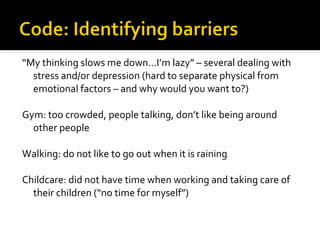
“ My thinking slows me down…I’m lazy” – several dealing with stress and/or depression (hard to separate physical from emotional factors – and why would you want to?) Gym: too crowded, people talking, don’t like being around other people Walking: do not like to go out when it is raining Childcare: did not have time when working and taking care of their children (“no time for myself”)
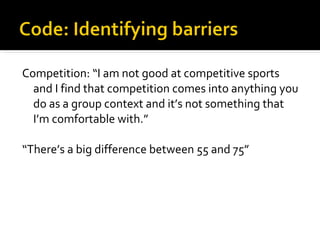
Competition: “I am not good at competitive sports and I find that competition comes into anything you do as a group context and it’s not something that I’m comfortable with.” “ There’s a big difference between 55 and 75”
 
 
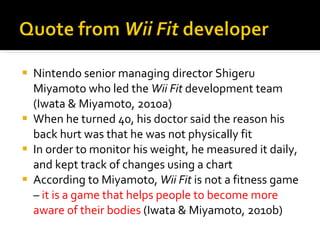
Nintendo senior managing director Shigeru Miyamoto who led the  Wii Fit  development team (Iwata & Miyamoto, 2010a)  When he turned 40, his doctor said the reason his back hurt was that he was not physically fit  In order to monitor his weight, he measured it daily, and kept track of changes using a chart  According to Miyamoto,  Wii Fit  is not a fitness game –  it is a game that helps people to become more aware of their bodies   (Iwata & Miyamoto, 2010b)
Tom Calvert, Suzanne de Castell and Ron Wakkary And to the Britannia Community Services Centre And to Margaret Dragu, the fitness trainer And to the Canadian GRAND Network, SFU for support, and SSHRC Doctoral Award
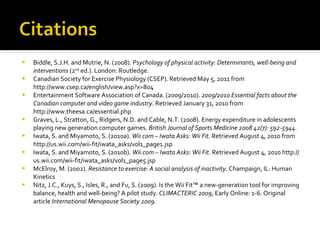
Biddle, S.J.H. and Mutrie, N.   (2008).  Psychology of physical activity: Determinants, well-being and interventions  (2 nd  ed.). London: Routledge.  Canadian Society for Exercise Physiology (CSEP). Retrieved May 5, 2011 from  http://www.csep.ca/english/view.asp?x=804 Entertainment Software Association of Canada.   (2009/2010).  2009/2010 Essential facts about the Canadian computer and video game industry . Retrieved January 31, 2010 from http://www.theesa.ca/essential.php Graves, L., Stratton, G., Ridgers, N.D. and Cable, N.T. (2008). Energy expenditure in adolescents playing new generation computer games.  British Journal of Sports Medicine 2008 42(7): 592-5944.  Iwata, S. and Miyamoto, S.   (2010a).  Wii.com – Iwata Asks: Wii Fit.  Retrieved August 4, 2010 from http://us.wii.com/wii-fit/iwata_asks/vol1_page1.jsp Iwata, S. and Miyamoto, S.   (2010b).   Wii.com – Iwata Asks: Wii Fit.  Retrieved August 4, 2010 http://us.wii.com/wii-fit/iwata_asks/vol1_page5.jsp McElroy, M. (2002).  Resistance to exercise: A social analysis of inactivity . Champaign, IL: Human Kinetics Nitz, J.C., Kuys, S., Isles, R., and Fu, S. (2009). Is the Wii Fit™ a new-generation tool for improving balance, health and well-being? A pilot study.  CLIMACTERIC 2009 , Early Online: 1-6. Original article  International Menopause Society 2009.
Shields, M., Tremblay, M.S., Laviolette, M., Craig, C.L., Jansses, I., and Gorber, S.C. (2010). Fitness of Canadian adults: Results from the 2007-2009 Canadian Health Measures Survey.  Statistics Canada  20 (4). Retrieved August 4, 2010 from http://www.statcan.gc.ca/cgi-bin/af-fdr.cgi?l=eng&loc=http://www.statcan.gc.ca/pub/82-003-x/2010001/article/11064-eng.pdf&t=Fitness%20of%20Canadian%20adults:%20Results%20from%20the%202007-2009%20Canadian%20Health%20Measures%20Survey Warburton, D.E.R., Nicol, C.W. and Bredin, S.S.D.   (2006). Health benefits of physical activity: The evidence.  Canadian Medical Association Journal 174 (6): 801-809. Warburton, D.E.R., Bredin, S.S.D, Horita, L.T.L., Zbogar, D., Scott, J.M., Esch, B.T.A., and Rhodes, R.E. (2007a).   The health benefits of interactive video game exercise. A ppl. Physiol. Nutr. Metab. 32 : 255-263. Warburton, D.E.R., Katzmarzyk, P.T., Rhodes, R.E., and Shephard, R.J.   (2007b). Evidence-informed physical activity guidelines for Canadian adults.  Appl. Physio. Nutr. Metab.  32: S16-S68.
How Women Over 40 Use Exergames (like Wii Fit Plus)

  • 1.
    Lorna Boschman at Games for Health in Boston May 19, 2011 everyday design lab SSHRC Doctoral Award
  • 2.
  • 3.
  • 4.
  • 5.
  • 6.
  • 7.
    In industrialized countries,fewer than half of adults exercise as frequently as national fitness guidelines suggest (Shields et al., 2010, Biddle & Mutrie, 2008) Adults over forty have an increased risk of developing chronic health conditions that could be prevented or controlled through regular exercise: cardiovascular disease, type 2 diabetes, non-clinical depression (Warburton, 2007b, 2006)
  • 8.
    Review of evidencesupporting international physical activity guidelines: most recommend moderate physical activity most days of the week (Warburton et al., 2007b) Newly released Canadian guidelines suggest at least 150 minutes per week (in bouts of 10+ minutes) of moderate to vigorous-intensity activities like brisk walking, bicycling, swimming or jogging – shortness of breath & elevated heartbeat (CSEP, 2011)
  • 9.
    Studies of perceivedbarriers to fitness – most say they don’t have time or energy (Biddle & Mutrie, 2008) Fast paced modern lifestyle – may not have time for hour at the gym but do have time for short bursts of exercise (McElroy, 2002)
  • 10.
    Physical and brainfitness titles are among the most popular console-based games purchased by Canadian adults over forty (ESA Canada, 2009); Wii Fit Plus with Balance Board ranks #5 in Canada’s console game sales (ESA Canada, 2011) People intend to exercise when they buy the game, but are exergames the latest home fitness fad that will collect dust? Do people need to develop strategies for using exergames to support fitness?
  • 11.
    British study comparedenergy expenditure of Wii Sports games to sedentary games – boxing was more active, but otherwise not enough for a daily exercise (Graves et al., 2008) Australian study with elderly participants – liked social aspects of playing Wii Sports but no measurable physical benefits (Wollersheim et al., 2010)
  • 12.
    North American versionof game introduced in May 2008; Wii Fit Plus in October 2009 Wii Fit (Plus) designed to encourage physical activity and body awareness Australian study – ten women aged 30-58 who played two Wii Fit sessions (30 min.) per week for ten weeks (Nitz et al., 2009) Exercise adherence was 70% Improvement in standardized tests for balance and lower body strength, but no change in other areas
  • 13.
    Interested in howwomen use active games to support a program of physical activity Looking at overall program rather than trying to prove that active games are “the answer” Look at how women approach the question of increasing and maintaining physical activity
  • 14.
    What are the factors that encourage women over forty to adopt exercise fitness games as one component of a program of physical activity? Does personalized instruction in using exergames support the development of an ongoing program of physical activity? How do the actions of exercise partners and the social environment influence exercise adherence and fitness levels of co-exercisers?
  • 15.
  • 16.
    Fitness trainer andresearcher: + one title to learn + variety of exercise types + nothing on your knees + no lying on the ground + doesn’t say “feel it burn!”
  • 17.
    Wii Fit (Plus)Dance Dance Revolution EA Sports Active Just Dance Your Shape My Fitness Trainer Gold’s Cardio Workout
  • 18.
    Contribution to HCI:How women use digital games to increase and maintain physical activity – contribute concepts for designers Contribution to public health: Aging adults can sustain good health and mobility through regular exercise; exergames can support their strategies Contribution to game studies: Market for fitness games geared toward aging adults is growing, but suitable products are limited to a few titles – insights for game developers
  • 19.
  • 20.
    Two groups –those who use Wii Fit at home and those who use the game at Britannia Community Centre Began as a six-month longitudinal study – women liked coming back every week and didn’t lose interest after initial enthusiastic response
  • 21.
    After first 7participants, shortened study to 3 months for remaining 53 volunteers Total of 13 participants joined since February 2011 Will recruit total of 60 by November 2011 (study ends in February 2012) Instead of telling them what to do, I ask them what they are doing now and what they’d like to do next
  • 22.
    Weekly sessions heldon Saturday mornings at a Vancouver community centre in their 55+ lounge Two Wii Fit Plus stations set up Two Wii Fit Plus stations in 55+ Lounge
  • 23.
    Early participants recruitedby word-of-mouth among community centre members and researcher’s personal network Next round of participants recruited through mainstream media campaign Site for 6 Minute Walking Test (aerobic endurance)
  • 24.
    DATA TYPE (N=60)DATA COLLECTION ANALYTIC STRATEGY Aerobic endurance, lower body strength, and standing balance testing Beginning, mid-point and conclusion Statistical analysis: how fitness indicators change over time Self-reported weekly minutes of physical activity Beginning, mid-point and conclusion Statistical analysis; chart frequency of other forms of exercise than exergame; compare time spent on exergames vs. other exercises, how trends change over time Open-ended interview discussion: how game is used as part of sustained fitness program, exercise partners or groups, and instruction from fitness trainer Beginning, mid-point and conclusion Recorded using digital audio recorder. Files coded and analyzed using Atlas.t i qualitative analysis software. Use techniques like coding interviews to develop themes and relationships. Total of 187 (12-30 minute each) interviews will be analyzed.
  • 25.
    Bring these threeforms of data together to develop a theory based on multiple perspectives of a common process, growing out of a systematic analysis Research process is iterative – participants help to inform the direction of the study as well as the fitness trainer – examining a whole system of interaction including the game, the social environment and participant info like previous and current exercise experience
  • 26.
    Phase 1: Introductionto exergaming Learn to assess abilities Learn to identify barriers and benefits Instructional focus on balance exercises and building self-awareness Phase 2: ‘Prescribe’ Canadian Physical Activity Guidelines at mid-point of study Increased emphasis on aerobic exercise at a moderate or vigorous intensity
  • 27.
    Researcher relies onthe experience of the fitness instructor (who has assisted previous physical activity studies for people living with cardiovascular disease or diabetes) I asked: “If these women were coming to you at the community center where you work, what would you tell them?” And the trainers said “More aerobic activities.”
  • 28.
    Activity codes developedfrom first 14 interviews: Assessing ability Enjoying exercise Exercising alone Identifying barriers (93) Identifying benefits Looking back Looking forward Tracking activity (50)
  • 29.
    “ My thinkingslows me down…I’m lazy” – several dealing with stress and/or depression (hard to separate physical from emotional factors – and why would you want to?) Gym: too crowded, people talking, don’t like being around other people Walking: do not like to go out when it is raining Childcare: did not have time when working and taking care of their children (“no time for myself”)
  • 30.
    Competition: “I amnot good at competitive sports and I find that competition comes into anything you do as a group context and it’s not something that I’m comfortable with.” “ There’s a big difference between 55 and 75”
  • 31.
  • 32.
  • 33.
    Nintendo senior managingdirector Shigeru Miyamoto who led the Wii Fit development team (Iwata & Miyamoto, 2010a) When he turned 40, his doctor said the reason his back hurt was that he was not physically fit In order to monitor his weight, he measured it daily, and kept track of changes using a chart According to Miyamoto, Wii Fit is not a fitness game – it is a game that helps people to become more aware of their bodies (Iwata & Miyamoto, 2010b)
  • 34.
    Tom Calvert, Suzannede Castell and Ron Wakkary And to the Britannia Community Services Centre And to Margaret Dragu, the fitness trainer And to the Canadian GRAND Network, SFU for support, and SSHRC Doctoral Award
  • 35.
    Biddle, S.J.H. andMutrie, N. (2008). Psychology of physical activity: Determinants, well-being and interventions (2 nd ed.). London: Routledge. Canadian Society for Exercise Physiology (CSEP). Retrieved May 5, 2011 from http://www.csep.ca/english/view.asp?x=804 Entertainment Software Association of Canada. (2009/2010). 2009/2010 Essential facts about the Canadian computer and video game industry . Retrieved January 31, 2010 from http://www.theesa.ca/essential.php Graves, L., Stratton, G., Ridgers, N.D. and Cable, N.T. (2008). Energy expenditure in adolescents playing new generation computer games. British Journal of Sports Medicine 2008 42(7): 592-5944. Iwata, S. and Miyamoto, S. (2010a). Wii.com – Iwata Asks: Wii Fit. Retrieved August 4, 2010 from http://us.wii.com/wii-fit/iwata_asks/vol1_page1.jsp Iwata, S. and Miyamoto, S. (2010b). Wii.com – Iwata Asks: Wii Fit. Retrieved August 4, 2010 http://us.wii.com/wii-fit/iwata_asks/vol1_page5.jsp McElroy, M. (2002). Resistance to exercise: A social analysis of inactivity . Champaign, IL: Human Kinetics Nitz, J.C., Kuys, S., Isles, R., and Fu, S. (2009). Is the Wii Fit™ a new-generation tool for improving balance, health and well-being? A pilot study. CLIMACTERIC 2009 , Early Online: 1-6. Original article International Menopause Society 2009.
  • 36.
    Shields, M., Tremblay,M.S., Laviolette, M., Craig, C.L., Jansses, I., and Gorber, S.C. (2010). Fitness of Canadian adults: Results from the 2007-2009 Canadian Health Measures Survey. Statistics Canada 20 (4). Retrieved August 4, 2010 from http://www.statcan.gc.ca/cgi-bin/af-fdr.cgi?l=eng&loc=http://www.statcan.gc.ca/pub/82-003-x/2010001/article/11064-eng.pdf&t=Fitness%20of%20Canadian%20adults:%20Results%20from%20the%202007-2009%20Canadian%20Health%20Measures%20Survey Warburton, D.E.R., Nicol, C.W. and Bredin, S.S.D. (2006). Health benefits of physical activity: The evidence. Canadian Medical Association Journal 174 (6): 801-809. Warburton, D.E.R., Bredin, S.S.D, Horita, L.T.L., Zbogar, D., Scott, J.M., Esch, B.T.A., and Rhodes, R.E. (2007a). The health benefits of interactive video game exercise. A ppl. Physiol. Nutr. Metab. 32 : 255-263. Warburton, D.E.R., Katzmarzyk, P.T., Rhodes, R.E., and Shephard, R.J. (2007b). Evidence-informed physical activity guidelines for Canadian adults. Appl. Physio. Nutr. Metab. 32: S16-S68.

Editor's Notes

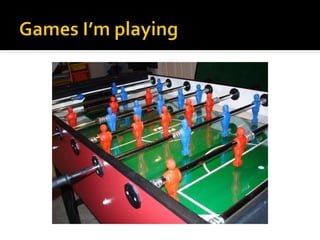
  • #7 Games like air hockey might have seemed futuristic at one time, but now we are promoting even more active games.
  • #16 One title to learn + variety of exercise types + nothing on your knees or lying on the ground + doesn’t say “feel it burn!” Wii Fit Plus, Dance Dance Revolution, EA Sports Active, Your Fitness Trainer, Just Dance (came second)
  • #17 One title to learn + variety of exercise types + nothing on your knees or lying on the ground + doesn’t say “feel it burn!” Wii Fit Plus, Dance Dance Revolution, EA Sports Active, Just Dance (came second), Your Shape, My Fitness Trainer, Gold’s Cardio Workout
  • #18 One title to learn + variety of exercise types + nothing on your knees or lying on the ground + doesn’t say “feel it burn!” Wii Fit Plus, Dance Dance Revolution, EA Sports Active, Just Dance (came second), Your Shape, My Fitness Trainer, Gold’s Cardio Workout