instagram 
Lets talk terms ... *
Instant photo sharing, instant 
updates for your followers. 
Instagram is an application with 
multiple links to friends, 
conversations and images. 
Whether you are a new user or 
have already started 
uploading...... 
you should know 
there are limits 
to your rights and 
content ownership.
* Instagram is a file sharing application allowing 
users to upload images and videos to share with 
followers of their social media sites like 
Facebook, Twitter or Instagram itself. 
* Instagram aims to make it easy for users to upload 
and manipulate their images. 
•Download the app, upload your images, add 
some tags and users will find you. 
(Latorre-Martínez, & Iñíguez-Berrozpe, 2014, p. 18)
But wait ! Have you read 
Instagram's Terms 
of Use? 
Are you familiar with 
Instagram's Privacy 
Policy? 
Do you know your rights? 
Or the rights you may be 
giving up? 
Are you ready to 
relinquish control over 
your content? 
Do you know that facebook owns instagram? 
(Privacy Policy, Instagram, 2014)
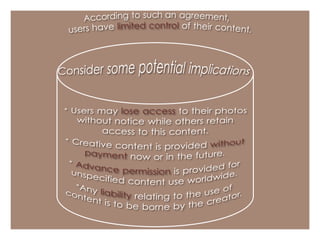
Lets look at what users of the service agree to: 
* User access to Instagram can be terminated 
without notice or liability to the user. 
* Photos from a terminated account may persist 
on Instagram but will not be accessible 
through the terminated account . 
* Users grant Instagram a fully paid, transferable 
licence to use their content worldwide. 
* Users agree to pay any fees or other money 
owed by reason of their content. 
(Terms and Conditions, Instagram, 2014)
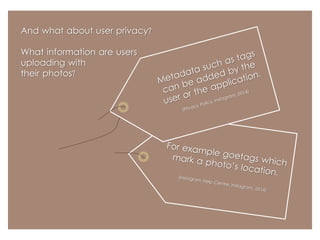
And what about user privacy? 
What information are users 
uploading with 
their photos?
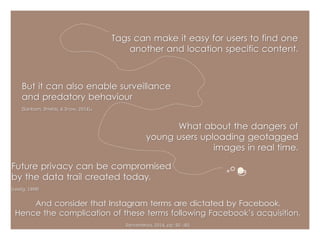
Tags can make it easy for users to find one 
another and location specific content. 
What about the dangers of 
But it can also enable surveillance 
and predatory behaviour 
(Sanborn, Shields, & Snow, 2014). 
young users uploading geotagged 
images in real time. 
Future privacy can be compromised 
by the data trail created today. 
(Lessig, 1998) 
And consider that Instagram terms are dictated by Facebook. 
Hence the complication of these terms following Facebook’s acquisition. 
Sanveneroa, 2014, pp. 92 -93
m e . . . y e a r s f r o m n o w 
m e . . . s o o n 
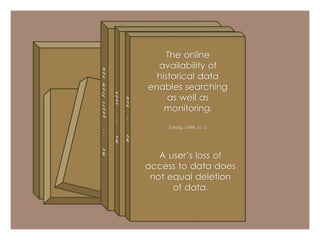
The online 
availability of 
historical data 
enables searching 
as well as 
monitoring. 
(Lessig, 1998, p. 1) 
access to data does 
not equal deletion 
A user’s loss of 
of data. 
m e . . . n o w
What users can do . . . . 
Take the time to read and digest the terms and 
conditions of new and existing media tools. 
Check out an applications feedback in forums and 
online articles. 
Consider the application’s terms and limits in the 
context of current and future needs and uses. 
Educate young users about online responsibilities, 
dangers and technological ethics (Lyon, 2002, p. 247). 
Create limited versions of online content by 
watermarking images, disabling geotags and limit 
linking between multiple applications.
Best tip - Enjoy the applications that 
work for you, but use them on your terms. 
References 
Instagram. (2014). Instagram Help Centre . Retrieved from https://help.instagram.com/158476944298556 
Instagram. (2014). Privacy Policy . Retrieved from http://instagram.com/about/legal/privacy/ 
Instagram. (2014). Terms of Use . Retrieved from http://instagram.com/about/legal/terms/ 
Latorre-Martínez, M. P. & Iñíguez-Berrozpe, T. (2014). Image-focused social media for a market analysis of tourism consumption. 
International Journal of Technology Management, 64 (1). 17-30. Retrieved from 
http://inderscience.metapress.com.dbgw.lis.curtin.edu.au/content/218u40116v167843/fulltext.pdf 
Lessig, L. (1998). The Architecture of Privacy (2nd draft.). In Proceedings of the Taiwan Net 1998 conference held in Taipei, Taiwan, 
March 1998 . Retrieved from http://cyber.law.harvard.edu/works/lessig/architecture_priv.pdf 
Lyon, D. (2002) Everyday Surveillance: Personal Data and Social Classification. Information, Communication, and Society, 5 (1). 
242-257. Retrieved from http://www.casa.ucl.ac.uk/cyberspace/lyon_ics.pdf 
NYC Counsel. (2014). Who Owns Photos and Videos Posted on Facebook, Instagram or Twitter? NYC Counsel. Retrieved from 
http://www.nyccounsel.com/business-blogs-websites/who-owns-photos-and-videos-posted-on-facebook-or-twitter/ 
Sanborn, V. E., Shields, C. E. & Snow, V. (2014). How the "Rich Kids of Instagram" create poor security risks. Estate Planning, 41(4). 18-22. 
Retrieved from http://search.proquest.com.dbgw.lis.curtin.edu.au/docview/1530079601 
Sanveneroa, R. (2014). Social media and our misconceptions of the realities. Information & Communications Technology Law, 22(2). 
89-108. Retrieved from http://dx.doi.org/10.1080/13600834.2013.805923 
The Guardian. (2014). Instagram users begin fightback against stolen photos. The Guardian: US News Blog. Retrieved from 
http://www.theguardian.com/technology/us-news-blog/2013/feb/05/instagram-users-fightback-stolen-photos

16658576_Inst-Poli-Prim

  • 1.
  • 2.
    Instant photo sharing,instant updates for your followers. Instagram is an application with multiple links to friends, conversations and images. Whether you are a new user or have already started uploading...... you should know there are limits to your rights and content ownership.
  • 3.
    * Instagram isa file sharing application allowing users to upload images and videos to share with followers of their social media sites like Facebook, Twitter or Instagram itself. * Instagram aims to make it easy for users to upload and manipulate their images. •Download the app, upload your images, add some tags and users will find you. (Latorre-Martínez, & Iñíguez-Berrozpe, 2014, p. 18)
  • 4.
    But wait !Have you read Instagram's Terms of Use? Are you familiar with Instagram's Privacy Policy? Do you know your rights? Or the rights you may be giving up? Are you ready to relinquish control over your content? Do you know that facebook owns instagram? (Privacy Policy, Instagram, 2014)
  • 5.
    Lets look atwhat users of the service agree to: * User access to Instagram can be terminated without notice or liability to the user. * Photos from a terminated account may persist on Instagram but will not be accessible through the terminated account . * Users grant Instagram a fully paid, transferable licence to use their content worldwide. * Users agree to pay any fees or other money owed by reason of their content. (Terms and Conditions, Instagram, 2014)
  • 8.
    And what aboutuser privacy? What information are users uploading with their photos?
  • 9.
    Tags can makeit easy for users to find one another and location specific content. What about the dangers of But it can also enable surveillance and predatory behaviour (Sanborn, Shields, & Snow, 2014). young users uploading geotagged images in real time. Future privacy can be compromised by the data trail created today. (Lessig, 1998) And consider that Instagram terms are dictated by Facebook. Hence the complication of these terms following Facebook’s acquisition. Sanveneroa, 2014, pp. 92 -93
  • 10.
    m e .. . y e a r s f r o m n o w m e . . . s o o n The online availability of historical data enables searching as well as monitoring. (Lessig, 1998, p. 1) access to data does not equal deletion A user’s loss of of data. m e . . . n o w
  • 11.
    What users cando . . . . Take the time to read and digest the terms and conditions of new and existing media tools. Check out an applications feedback in forums and online articles. Consider the application’s terms and limits in the context of current and future needs and uses. Educate young users about online responsibilities, dangers and technological ethics (Lyon, 2002, p. 247). Create limited versions of online content by watermarking images, disabling geotags and limit linking between multiple applications.
  • 12.
    Best tip -Enjoy the applications that work for you, but use them on your terms. References Instagram. (2014). Instagram Help Centre . Retrieved from https://help.instagram.com/158476944298556 Instagram. (2014). Privacy Policy . Retrieved from http://instagram.com/about/legal/privacy/ Instagram. (2014). Terms of Use . Retrieved from http://instagram.com/about/legal/terms/ Latorre-Martínez, M. P. & Iñíguez-Berrozpe, T. (2014). Image-focused social media for a market analysis of tourism consumption. International Journal of Technology Management, 64 (1). 17-30. Retrieved from http://inderscience.metapress.com.dbgw.lis.curtin.edu.au/content/218u40116v167843/fulltext.pdf Lessig, L. (1998). The Architecture of Privacy (2nd draft.). In Proceedings of the Taiwan Net 1998 conference held in Taipei, Taiwan, March 1998 . Retrieved from http://cyber.law.harvard.edu/works/lessig/architecture_priv.pdf Lyon, D. (2002) Everyday Surveillance: Personal Data and Social Classification. Information, Communication, and Society, 5 (1). 242-257. Retrieved from http://www.casa.ucl.ac.uk/cyberspace/lyon_ics.pdf NYC Counsel. (2014). Who Owns Photos and Videos Posted on Facebook, Instagram or Twitter? NYC Counsel. Retrieved from http://www.nyccounsel.com/business-blogs-websites/who-owns-photos-and-videos-posted-on-facebook-or-twitter/ Sanborn, V. E., Shields, C. E. & Snow, V. (2014). How the "Rich Kids of Instagram" create poor security risks. Estate Planning, 41(4). 18-22. Retrieved from http://search.proquest.com.dbgw.lis.curtin.edu.au/docview/1530079601 Sanveneroa, R. (2014). Social media and our misconceptions of the realities. Information & Communications Technology Law, 22(2). 89-108. Retrieved from http://dx.doi.org/10.1080/13600834.2013.805923 The Guardian. (2014). Instagram users begin fightback against stolen photos. The Guardian: US News Blog. Retrieved from http://www.theguardian.com/technology/us-news-blog/2013/feb/05/instagram-users-fightback-stolen-photos