1
Center for Advancing Research
in Transportation Emissions,
Energy, and Health
A USDOT University Transportation Center
www.carteeh.org
2
Lecture #15: Air Pollution Dispersion Modeling
Methods and Data Sources
Akula Venkatram
University of California, Riverside, CA
venky@engr.ucr.edu, 951-827-2195
The author declares that there is no conflict of interest
Lecture Tracks: HT/TT
3
• Studies have shown that living near roadways is implicated in adverse
health effects. These studies include both short-term and long-term
exposures (Health Effects Institute, 2010).
• These studies coupled with the fact that over 10% of the US
population lives within 100 m from highways (Brugge, 2007) has
motivated field, wind tunnel and modeling studies to examine the
impact of highway emissions on near-road air quality.
• Such studies have been conducted since the 1970s, but recent health
studies have added impetus to them.
Introduction
4
Field and Laboratory Studies
• Dispersion of releases from sources close to the ground
• Green Glow, Prairie Grass (1956)
• Project Sagebrush (2013)
• Field studies to understand road dispersion –GM tracer study (1980)- tracer released from 352 automobiles
• New road field studies
• Caltrans (Benson,1989), Raleigh study (Baldauf et al., 2008), Idaho Falls Study (2008, Finn et al. 2010)
Models
 EPA Highway Model (1970s)
 CALINE Model (Benson, 1989)
 RLINE (Snyder et al., 2013)
 C-LINE (Barzyk et al, 2013
Field and Modeling Studies
5
Governing Processes
d
Boundary Layer
U
𝜎𝑤
Turbulence
h0
W
Concentration
i
z

  
 
 
 

 

0
2 1
ln 1
f w
w w
f
far
i
Te W
C
W h U d
Te
C
Uz









0
Traffic Flow Rate, vehicles/s
Emission Factor, g/m/vehicle
Wind Speed, m/s
Turbulence Level, m/s
Mixed Layer Height. m
Distance from Road Edge, m
Width of Road, m
Height of Vehicle, m
f
w
i
T
e
U
z
d
W
h
6
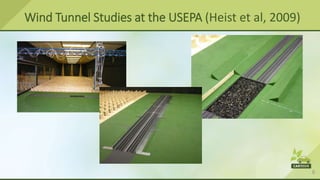
Wind Tunnel Studies at the USEPA (Heist et al, 2009)
7
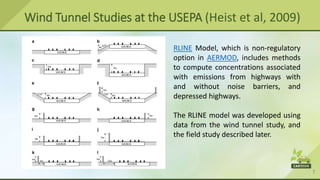
Wind Tunnel Studies at the USEPA (Heist et al, 2009)
RLINE Model, which is non-regulatory
option in AERMOD, includes methods
to compute concentrations associated
with emissions from highways with
and without noise barriers, and
depressed highways.
The RLINE model was developed using
data from the wind tunnel study, and
the field study described later.
8
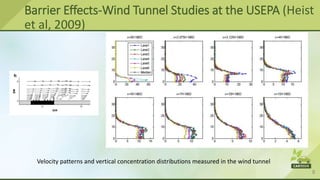
Barrier Effects-Wind Tunnel Studies at the USEPA (Heist
et al, 2009)
Velocity patterns and vertical concentration distributions measured in the wind tunnel
9
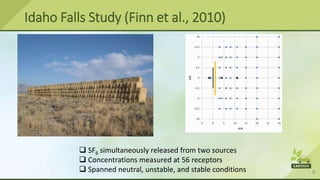
Idaho Falls Study (Finn et al., 2010)
 SF6 simultaneously released from two sources
 Concentrations measured at 56 receptors
 Spanned neutral, unstable, and stable conditions
10
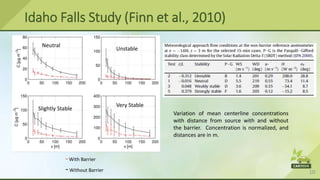
Idaho Falls Study (Finn et al., 2010)
- With Barrier
-Without Barrier
Neutral
Unstable
Slightly Stable
Very Stable
Variation of mean centerline concentrations
with distance from source with and without
the barrier. Concentration is normalized, and
distances are in m.
11
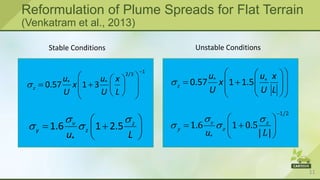
Reformulation of Plume Spreads for Flat Terrain
(Venkatram et al., 2013)


 
 
 
 
 
 
 
 
1
2/3
* *
0.57 1 3
z
u u x
x
U U L
 
 
 
 
 
 
*
1.6 1 2.5
v z
y z
u L
Stable Conditions Unstable Conditions
 
 
 
 
 
 
 
 
 
 
*
0.57 1 1.5
z
u u x
x
U U L
 
 

 
 
 
 
1/2
*
1.6 1 0.5
| |
v z
y z
u L
12
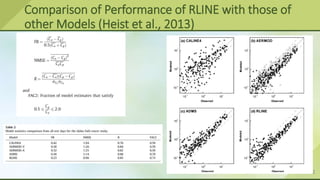
Comparison of Performance of RLINE with those of
other Models (Heist et al., 2013)
13
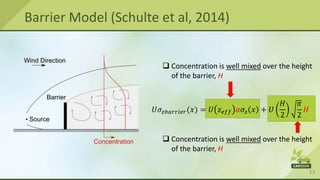
Barrier Model (Schulte et al, 2014)
 Concentration is well mixed over the height
of the barrier, H
𝑈𝜎𝑧𝑏𝑎𝑟𝑟𝑖𝑒𝑟(𝑥) = 𝑈 𝑧𝑒𝑓𝑓 𝛼𝜎𝑧 𝑥 + 𝑈
𝐻
2
𝜋
2
𝐻
 Concentration is well mixed over the height
of the barrier, H
14
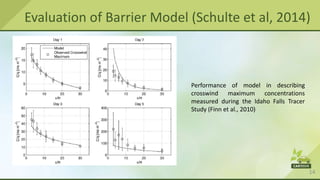
Evaluation of Barrier Model (Schulte et al, 2014)
Performance of model in describing
crosswind maximum concentrations
measured during the Idaho Falls Tracer
Study (Finn et al., 2010)
15
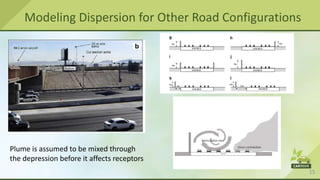
Modeling Dispersion for Other Road Configurations
Plume is assumed to be mixed through
the depression before it affects receptors
16
Effects of Buildings on Dispersion
?
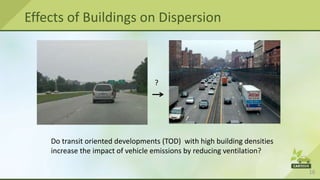
Do transit oriented developments (TOD) with high building densities
increase the impact of vehicle emissions by reducing ventilation?
17
Models for Effects of Buildings on Dispersion
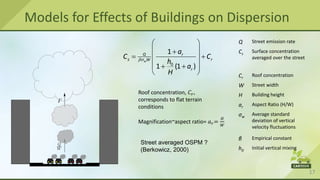
Q Street emission rate
Cs
Surface concentration
averaged over the street
Cr
Roof concentration
W Street width
H Building height
ar
Aspect Ratio (H/W)
σw
Average standard
deviation of vertical
velocity fluctuations
β Empirical constant
h0
Initial vertical mixing
Roof concentration, 𝐶𝑟,
corresponds to flat terrain
conditions
Street averaged OSPM ?
(Berkowicz, 2000)

 
 

 
 
 
 
 
0
1
1 (1 )
w
Q r
s r
W
r
a
C C
h
a
H
Magnification~aspect ratio= 𝑎𝑟=
𝐻
𝑊
18
Evaluation of Buildings Effects Model
19
Computing Effective Height
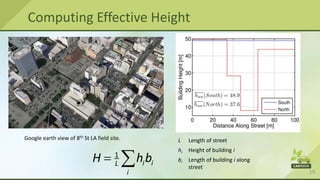
L Length of street
hi Height of building i
bi Length of building i along
street
 
1
i i
L
i
H hb
Google earth view of 8th St LA field site.
20
Discussion
Models such as RLINE and AERMOD have now been incorporated
into comprehensive frameworks that enables policy makers to
analyze the “chain effect of transportation demand on air quality
and population health exposure” (Vallamsundar et al., 2016).
However, such frameworks are computationally demanding if the
urban area being studied involves a large number of road links.
Models such as C-LINE (Barzyk et al., 2015) are available to
overcome this problem. This model uses an analytical version of
RLINE that requires computational resources that are at least an
order of magnitude smaller than the version of RLINE that uses
numerical integration.
21
• Models for dispersion from different road configurations-elevated,
depressed roads-need improvement and evaluation with observations
• Models for building effects require more evaluation before they cab be
applied in a regulatory context.
• Models overestimate concentrations under low wind speeds (Askariyeh et
al., 2017). Need methods to account for wind meandering under these
conditions.
• Need methods to account for
• Conversion of NOx to NO2
• Impact of porous vegetative barriers
• Estimating “edge” effect of roadside barriers
• Estimating micrometeorological model inputs in urban areas
Research Gaps and Future Directions
22
• Current models for dispersion of emissions from highways with and
without barriers provide adequate estimates of concentrations
associated with highway emissions. New version of AERMOD includes
a non-regulatory option for RLINE application.
• Data sets from field and wind tunnel studies are available for
development and evaluation of highway dispersion models.
• Street canyons between tall buildings magnify traffic-related
concentrations that would occur in the absence of buildings. The
magnification depends on the ratio of the effective height to width of
the street. Available dispersion models do not account or building
effects.
Take-Home Messages
23
AERMOD- AMS/EPA Regulatory Model
AMS- American Meteorological Society
CFD-Computational Fluid Dynamics
OSPM- Operational Street Pollution Model
RLINE- Research Line Source Dispersion Model
USEPA- United States Environmental Protection Agency
List of Abbreviations
24
Ahangar, F.E., Heist, D., Perry, S. and Venkatram, A., 2017. Reduction of air pollution levels downwind of a road with an upwind noise
barrier. Atmospheric Environment, 155, pp.1-10.
Amini, S., Ahangar, F.E., Schulte, N. and Venkatram, A., 2016. Using models to interpret the impact of roadside barriers on near-road air
quality. Atmospheric Environment, 138, pp.55-64.
Amini, S., Enayati Ahangar, F., Heist, D., Perry, S., Venkatram, A., 2018. Modeling Dispersion of Emissions from Depressed Roadways. Atmos. Environ.
186, 189–197. https://doi.org/10.1016/j.atmosenv.2018.04.058
Askariyeh, M.H., Kota, S.H., Vallamsundar, S., Zietsman, J., Ying, Q., 2017. AERMOD for near-road pollutant dispersion: Evaluation of model performance with different
emission source representations and low wind options. Transp. Res. Part D Transp. Environ. 57, 392–402. https://doi.org/10.1016/j.trd.2017.10.008
Baldauf, R., Thoma, E., Khlystov, A., Isakov, V., Bowker, G., Long, T., Snow, R., 2008. Impacts of noise barriers on near-road air quality. Atmos. Environ.
42, 7502–7507. https://doi.org/10.1016/j.atmosenv.2008.05.051
Baldauf, R.W., Heist, D., Isakov, V., Perry, S., Hagler, G.S.W., Kimbrough, S., Shores, R., Black, K., Brixey, L., 2013. Air quality variability near a highway
in a complex urban environment. Atmos. Environ. 64, 169–178. doi:10.1016/j.atmosenv.2012.09.054
Barad, M., 1958. Project Prairie Grass. a Field Program in Diffusion AFCRF-tr-58-235.
Barzyk, T.M., Isakov, V., Arunachalam, S., Venkatram, A., Cook, R., Naess, B., 2015. A near-road modeling system for community-scale assessments
oftraffic-related air pollution in the United States. Environ. Model. Softw. 66, 46–56. https://doi.org/10.1016/j.envsoft.2014.12.004
Benson, P.E., 1989. CALINE3—A Versatile Dispersion Model for Predicting Air Pollutant Levels Near Highways and Arterial Streets. Interim Report,
Report. Number FHWA/CA/TL-79/23. Federal Highway Administration, Washington, DC (NTIS No. PB 80-220841).
Berkowicz, R., 2000. OSPM - A Parameterised Street Pollution Model. Environmental Monitoring and Assessment 65: 323–331, 2000
Brugge, D., Durant, J.L., Rioux, C., 2007. Near-highway pollutants in motor vehicle exhaust: a review of epidemiologic evidence of cardiac and pulmonary health risks.
Environ. Health: Glob. Access Sci. Source 6 23–23
Deshmukh, P., Isakov, V., Venkatram, A., Yang, B., Zhang, K.M., Logan, R., Baldauf, R., 2019. The effects of roadside vegetation characteristics on local,
near-road air quality. AIR Qual. Atmos. Heal. 12, 259–270. https://doi.org/10.1007/s11869-018-0651-8
Eckman, R.M., 1994. Re-examination of empirically derived formulas for horizontal diffusion from surface sources. Atmos. Environ. 28, 265–272.
https://doi.org/10.1016/1352-2310(94)90101-5
References
25
Finn, D., Clawson, K.L., Carter, R.G., Rich, J.D., Eckman, R.M., Perry, S.G., Isakov, V., Heist, D.K., 2010. Tracer studies to characterize the effects of
roadside noise barriers on near-road pollutant dispersion under varying atmospheric stability conditions. Atmos. Environ. 44, 204–214.
doi:10.1016/j.atmosenv.2009.10.012
Gallagher, J., Baldauf, R., Fuller, C.H., Kumar, P., Gill, L.W., McNabola, A., 2015. Passive methods for improving air quality in the built environment: A
review of porous and solid barriers. Atmos. Environ.
Hagler, G.S.W., Tang, W., Freeman, M.J., Heist, D.K., Perry, S.G., Vette, A.F., 2011. Model evaluation of roadside barrier impact on near-road air
pollution. Atmos. Environ. 45, 2522–2530. https://doi.org/10.1016/j.atmosenv.2011.02.030
Heist, D., Isakov, V., Perry, S., Snyder, M., Venkatram, A., Hood, C., Stocker, J., Carruthers, D., Arunachalam, S., Owen, R.C., 2013. Estimating near-
road pollutant dispersion: A model inter-comparison. Transp. Res. Part D Transp. Environ. 25, 93–105. https://doi.org/10.1016/j.trd.2013.09.003
Heist, D.K., Perry, S.G., Brixey, L.A., 2009. A wind tunnel study of the effect of roadway configurations on the dispersion of traffic-related pollution. Atmos.
Environ. 43, 5101–5111. https://doi.org/10.1016/j.atmosenv.2009.06.034
Luhar, A.K., Venkatram, A., Lee, S.-M., 2006. On relationships between urban and rural near-surface meteorology for diffusion applications. Atmos.
Environ. 40. https://doi.org/10.1016/j.atmosenv.2006.05.067
Schulte, N., Snyder, M., Isakov, V., Heist, D. and Venkatram, A., 2014. Effects of solid barriers on dispersion of roadway emissions. Atmospheric
Environment, 97, pp.286-295.
Schulte, N., Tan, S., Venkatram, A., 2015. The ratio of effective building height to street width governs dispersion of local vehicle emissions. Atmos.
Environ. 112. doi:10.1016/j.atmosenv.2015.03.061
Snyder, M.G., Venkatram, A., Heist, D.K., Perry, S.G., Petersen, W.B. and Isakov, V., 2013. RLINE: A line source dispersion model for near-surface
releases. Atmospheric environment, 77, pp.748-756.
Valencia, A., Venkatram, A., Heist, D., Carruthers, D., Arunachalam, S., 2018. Development and evaluation of the R-LINE model algorithms to account for
chemical transformation in the near-road environment. Transp. Res. Part D Transp. Environ. 59, 464–477. https://doi.org/10.1016/j.trd.2018.01.028
Vallamsundar, S., Lin, J., Konduri, K., Zhou, X., Pendyala, R.M., 2016. A comprehensive modeling framework for transportation-induced population exposure
assessment. Transp. Res. Part D Transp. Environ. 46, 94–113. https://doi.org/10.1016/j.trd.2016.03.009
Venkatram, A., Horst, T.W., 2006. Approximating dispersion from a finite line source. Atmos. Environ. 40. https://doi.org/10.1016/j.atmosenv.2005.12.014
References
26
Venkatram, A., Snyder, M., Isakov, V., Kimbrough, S., 2013. Impact of wind direction on near-road pollutant concentrations. Atmos. Environ. 80, 248–258.
https://doi.org/10.1016/j.atmosenv.2013.07.073
Venkatram, A., Snyder, M., Isakov, V., Kimbrough, S., 2013. Impact of wind direction on near-road pollutant concentrations. Atmos. Environ. 80, 248–258.
https://doi.org/10.1016/j.atmosenv.2013.07.073
Venkatram, A., Snyder, M.G., Heist, D.K., Perry, S.G., Petersen, W.B., Isakov, V., 2013. Re-formulation of plume spread for near-surface dispersion.
Atmos. Environ. 77, 846–855. doi:10.1016/j.atmosenv.2013.05.073
Wang, Y.J., Zhang, K.M.A.X., 2009. Modeling Near-Road Air Quality Using a Computational Fluid Dynamics Model , CFD-VIT-RIT 43, ES&T, 43, 7778–
7783.
References
27
• Cimorelli, A.J., Perry, S.G., Venkatram, A., Weil, J.C., Paine, R.J.,
Wilson, R.B., Lee, R.F., Peters, W.D., Brode, R.W., 2005. AERMOD: A
dispersion model for industrial source applications. Part I: General
model formulation and boundary layer characterization. J. Appl.
Meteorol. 44. https://doi.org/10.1175/JAM2227.1
• Venkatram, A., and Schulte, N., 2018. Urban Transportation and Air
Pollution. Elsevier, ISBN-13: 978-0128115060
Reading List
28
Research funded by South Coast Air Quality Management District,
California Air Resources Board, California Energy Commission, National
Science Foundation, and US Environmental Protection Agency
Collaborators: Marko Princevac, David Pankratz, Dennis Fitz, Jeffrey
Weil, Steven Perry, David Heist, Alan Cimorelli, Roger Brode, Richard
Baldauf, Vlad Isakov, Parikh Deshmukh, Steven Hanna, Sarav
Arunachalam, Sang-Mi Lee, Shuming Du
Students: Nico Schulte, Seyedmorteza Amini, Faraz Ahangar, Wenjun
Qian, Jing Yuan
Acknowledgements

15.-Air-Pollution-Dispersion-Modeling-Methods-and-Data-Sources_23Sep2020.pptx

  • 1.
    1 Center for AdvancingResearch in Transportation Emissions, Energy, and Health A USDOT University Transportation Center www.carteeh.org
  • 2.
    2 Lecture #15: AirPollution Dispersion Modeling Methods and Data Sources Akula Venkatram University of California, Riverside, CA venky@engr.ucr.edu, 951-827-2195 The author declares that there is no conflict of interest Lecture Tracks: HT/TT
  • 3.
    3 • Studies haveshown that living near roadways is implicated in adverse health effects. These studies include both short-term and long-term exposures (Health Effects Institute, 2010). • These studies coupled with the fact that over 10% of the US population lives within 100 m from highways (Brugge, 2007) has motivated field, wind tunnel and modeling studies to examine the impact of highway emissions on near-road air quality. • Such studies have been conducted since the 1970s, but recent health studies have added impetus to them. Introduction
  • 4.
    4 Field and LaboratoryStudies • Dispersion of releases from sources close to the ground • Green Glow, Prairie Grass (1956) • Project Sagebrush (2013) • Field studies to understand road dispersion –GM tracer study (1980)- tracer released from 352 automobiles • New road field studies • Caltrans (Benson,1989), Raleigh study (Baldauf et al., 2008), Idaho Falls Study (2008, Finn et al. 2010) Models  EPA Highway Model (1970s)  CALINE Model (Benson, 1989)  RLINE (Snyder et al., 2013)  C-LINE (Barzyk et al, 2013 Field and Modeling Studies
  • 5.
    5 Governing Processes d Boundary Layer U 𝜎𝑤 Turbulence h0 W Concentration i z              0 2 1 ln 1 f w w w f far i Te W C W h U d Te C Uz          0 Traffic Flow Rate, vehicles/s Emission Factor, g/m/vehicle Wind Speed, m/s Turbulence Level, m/s Mixed Layer Height. m Distance from Road Edge, m Width of Road, m Height of Vehicle, m f w i T e U z d W h
  • 6.
    6 Wind Tunnel Studiesat the USEPA (Heist et al, 2009)
  • 7.
    7 Wind Tunnel Studiesat the USEPA (Heist et al, 2009) RLINE Model, which is non-regulatory option in AERMOD, includes methods to compute concentrations associated with emissions from highways with and without noise barriers, and depressed highways. The RLINE model was developed using data from the wind tunnel study, and the field study described later.
  • 8.
    8 Barrier Effects-Wind TunnelStudies at the USEPA (Heist et al, 2009) Velocity patterns and vertical concentration distributions measured in the wind tunnel
  • 9.
    9 Idaho Falls Study(Finn et al., 2010)  SF6 simultaneously released from two sources  Concentrations measured at 56 receptors  Spanned neutral, unstable, and stable conditions
  • 10.
    10 Idaho Falls Study(Finn et al., 2010) - With Barrier -Without Barrier Neutral Unstable Slightly Stable Very Stable Variation of mean centerline concentrations with distance from source with and without the barrier. Concentration is normalized, and distances are in m.
  • 11.
    11 Reformulation of PlumeSpreads for Flat Terrain (Venkatram et al., 2013)                   1 2/3 * * 0.57 1 3 z u u x x U U L             * 1.6 1 2.5 v z y z u L Stable Conditions Unstable Conditions                     * 0.57 1 1.5 z u u x x U U L              1/2 * 1.6 1 0.5 | | v z y z u L
  • 12.
    12 Comparison of Performanceof RLINE with those of other Models (Heist et al., 2013)
  • 13.
    13 Barrier Model (Schulteet al, 2014)  Concentration is well mixed over the height of the barrier, H 𝑈𝜎𝑧𝑏𝑎𝑟𝑟𝑖𝑒𝑟(𝑥) = 𝑈 𝑧𝑒𝑓𝑓 𝛼𝜎𝑧 𝑥 + 𝑈 𝐻 2 𝜋 2 𝐻  Concentration is well mixed over the height of the barrier, H
  • 14.
    14 Evaluation of BarrierModel (Schulte et al, 2014) Performance of model in describing crosswind maximum concentrations measured during the Idaho Falls Tracer Study (Finn et al., 2010)
  • 15.
    15 Modeling Dispersion forOther Road Configurations Plume is assumed to be mixed through the depression before it affects receptors
  • 16.
    16 Effects of Buildingson Dispersion ? Do transit oriented developments (TOD) with high building densities increase the impact of vehicle emissions by reducing ventilation?
  • 17.
    17 Models for Effectsof Buildings on Dispersion Q Street emission rate Cs Surface concentration averaged over the street Cr Roof concentration W Street width H Building height ar Aspect Ratio (H/W) σw Average standard deviation of vertical velocity fluctuations β Empirical constant h0 Initial vertical mixing Roof concentration, 𝐶𝑟, corresponds to flat terrain conditions Street averaged OSPM ? (Berkowicz, 2000)                 0 1 1 (1 ) w Q r s r W r a C C h a H Magnification~aspect ratio= 𝑎𝑟= 𝐻 𝑊
  • 18.
  • 19.
    19 Computing Effective Height LLength of street hi Height of building i bi Length of building i along street   1 i i L i H hb Google earth view of 8th St LA field site.
  • 20.
    20 Discussion Models such asRLINE and AERMOD have now been incorporated into comprehensive frameworks that enables policy makers to analyze the “chain effect of transportation demand on air quality and population health exposure” (Vallamsundar et al., 2016). However, such frameworks are computationally demanding if the urban area being studied involves a large number of road links. Models such as C-LINE (Barzyk et al., 2015) are available to overcome this problem. This model uses an analytical version of RLINE that requires computational resources that are at least an order of magnitude smaller than the version of RLINE that uses numerical integration.
  • 21.
    21 • Models fordispersion from different road configurations-elevated, depressed roads-need improvement and evaluation with observations • Models for building effects require more evaluation before they cab be applied in a regulatory context. • Models overestimate concentrations under low wind speeds (Askariyeh et al., 2017). Need methods to account for wind meandering under these conditions. • Need methods to account for • Conversion of NOx to NO2 • Impact of porous vegetative barriers • Estimating “edge” effect of roadside barriers • Estimating micrometeorological model inputs in urban areas Research Gaps and Future Directions
  • 22.
    22 • Current modelsfor dispersion of emissions from highways with and without barriers provide adequate estimates of concentrations associated with highway emissions. New version of AERMOD includes a non-regulatory option for RLINE application. • Data sets from field and wind tunnel studies are available for development and evaluation of highway dispersion models. • Street canyons between tall buildings magnify traffic-related concentrations that would occur in the absence of buildings. The magnification depends on the ratio of the effective height to width of the street. Available dispersion models do not account or building effects. Take-Home Messages
  • 23.
    23 AERMOD- AMS/EPA RegulatoryModel AMS- American Meteorological Society CFD-Computational Fluid Dynamics OSPM- Operational Street Pollution Model RLINE- Research Line Source Dispersion Model USEPA- United States Environmental Protection Agency List of Abbreviations
  • 24.
    24 Ahangar, F.E., Heist,D., Perry, S. and Venkatram, A., 2017. Reduction of air pollution levels downwind of a road with an upwind noise barrier. Atmospheric Environment, 155, pp.1-10. Amini, S., Ahangar, F.E., Schulte, N. and Venkatram, A., 2016. Using models to interpret the impact of roadside barriers on near-road air quality. Atmospheric Environment, 138, pp.55-64. Amini, S., Enayati Ahangar, F., Heist, D., Perry, S., Venkatram, A., 2018. Modeling Dispersion of Emissions from Depressed Roadways. Atmos. Environ. 186, 189–197. https://doi.org/10.1016/j.atmosenv.2018.04.058 Askariyeh, M.H., Kota, S.H., Vallamsundar, S., Zietsman, J., Ying, Q., 2017. AERMOD for near-road pollutant dispersion: Evaluation of model performance with different emission source representations and low wind options. Transp. Res. Part D Transp. Environ. 57, 392–402. https://doi.org/10.1016/j.trd.2017.10.008 Baldauf, R., Thoma, E., Khlystov, A., Isakov, V., Bowker, G., Long, T., Snow, R., 2008. Impacts of noise barriers on near-road air quality. Atmos. Environ. 42, 7502–7507. https://doi.org/10.1016/j.atmosenv.2008.05.051 Baldauf, R.W., Heist, D., Isakov, V., Perry, S., Hagler, G.S.W., Kimbrough, S., Shores, R., Black, K., Brixey, L., 2013. Air quality variability near a highway in a complex urban environment. Atmos. Environ. 64, 169–178. doi:10.1016/j.atmosenv.2012.09.054 Barad, M., 1958. Project Prairie Grass. a Field Program in Diffusion AFCRF-tr-58-235. Barzyk, T.M., Isakov, V., Arunachalam, S., Venkatram, A., Cook, R., Naess, B., 2015. A near-road modeling system for community-scale assessments oftraffic-related air pollution in the United States. Environ. Model. Softw. 66, 46–56. https://doi.org/10.1016/j.envsoft.2014.12.004 Benson, P.E., 1989. CALINE3—A Versatile Dispersion Model for Predicting Air Pollutant Levels Near Highways and Arterial Streets. Interim Report, Report. Number FHWA/CA/TL-79/23. Federal Highway Administration, Washington, DC (NTIS No. PB 80-220841). Berkowicz, R., 2000. OSPM - A Parameterised Street Pollution Model. Environmental Monitoring and Assessment 65: 323–331, 2000 Brugge, D., Durant, J.L., Rioux, C., 2007. Near-highway pollutants in motor vehicle exhaust: a review of epidemiologic evidence of cardiac and pulmonary health risks. Environ. Health: Glob. Access Sci. Source 6 23–23 Deshmukh, P., Isakov, V., Venkatram, A., Yang, B., Zhang, K.M., Logan, R., Baldauf, R., 2019. The effects of roadside vegetation characteristics on local, near-road air quality. AIR Qual. Atmos. Heal. 12, 259–270. https://doi.org/10.1007/s11869-018-0651-8 Eckman, R.M., 1994. Re-examination of empirically derived formulas for horizontal diffusion from surface sources. Atmos. Environ. 28, 265–272. https://doi.org/10.1016/1352-2310(94)90101-5 References
  • 25.
    25 Finn, D., Clawson,K.L., Carter, R.G., Rich, J.D., Eckman, R.M., Perry, S.G., Isakov, V., Heist, D.K., 2010. Tracer studies to characterize the effects of roadside noise barriers on near-road pollutant dispersion under varying atmospheric stability conditions. Atmos. Environ. 44, 204–214. doi:10.1016/j.atmosenv.2009.10.012 Gallagher, J., Baldauf, R., Fuller, C.H., Kumar, P., Gill, L.W., McNabola, A., 2015. Passive methods for improving air quality in the built environment: A review of porous and solid barriers. Atmos. Environ. Hagler, G.S.W., Tang, W., Freeman, M.J., Heist, D.K., Perry, S.G., Vette, A.F., 2011. Model evaluation of roadside barrier impact on near-road air pollution. Atmos. Environ. 45, 2522–2530. https://doi.org/10.1016/j.atmosenv.2011.02.030 Heist, D., Isakov, V., Perry, S., Snyder, M., Venkatram, A., Hood, C., Stocker, J., Carruthers, D., Arunachalam, S., Owen, R.C., 2013. Estimating near- road pollutant dispersion: A model inter-comparison. Transp. Res. Part D Transp. Environ. 25, 93–105. https://doi.org/10.1016/j.trd.2013.09.003 Heist, D.K., Perry, S.G., Brixey, L.A., 2009. A wind tunnel study of the effect of roadway configurations on the dispersion of traffic-related pollution. Atmos. Environ. 43, 5101–5111. https://doi.org/10.1016/j.atmosenv.2009.06.034 Luhar, A.K., Venkatram, A., Lee, S.-M., 2006. On relationships between urban and rural near-surface meteorology for diffusion applications. Atmos. Environ. 40. https://doi.org/10.1016/j.atmosenv.2006.05.067 Schulte, N., Snyder, M., Isakov, V., Heist, D. and Venkatram, A., 2014. Effects of solid barriers on dispersion of roadway emissions. Atmospheric Environment, 97, pp.286-295. Schulte, N., Tan, S., Venkatram, A., 2015. The ratio of effective building height to street width governs dispersion of local vehicle emissions. Atmos. Environ. 112. doi:10.1016/j.atmosenv.2015.03.061 Snyder, M.G., Venkatram, A., Heist, D.K., Perry, S.G., Petersen, W.B. and Isakov, V., 2013. RLINE: A line source dispersion model for near-surface releases. Atmospheric environment, 77, pp.748-756. Valencia, A., Venkatram, A., Heist, D., Carruthers, D., Arunachalam, S., 2018. Development and evaluation of the R-LINE model algorithms to account for chemical transformation in the near-road environment. Transp. Res. Part D Transp. Environ. 59, 464–477. https://doi.org/10.1016/j.trd.2018.01.028 Vallamsundar, S., Lin, J., Konduri, K., Zhou, X., Pendyala, R.M., 2016. A comprehensive modeling framework for transportation-induced population exposure assessment. Transp. Res. Part D Transp. Environ. 46, 94–113. https://doi.org/10.1016/j.trd.2016.03.009 Venkatram, A., Horst, T.W., 2006. Approximating dispersion from a finite line source. Atmos. Environ. 40. https://doi.org/10.1016/j.atmosenv.2005.12.014 References
  • 26.
    26 Venkatram, A., Snyder,M., Isakov, V., Kimbrough, S., 2013. Impact of wind direction on near-road pollutant concentrations. Atmos. Environ. 80, 248–258. https://doi.org/10.1016/j.atmosenv.2013.07.073 Venkatram, A., Snyder, M., Isakov, V., Kimbrough, S., 2013. Impact of wind direction on near-road pollutant concentrations. Atmos. Environ. 80, 248–258. https://doi.org/10.1016/j.atmosenv.2013.07.073 Venkatram, A., Snyder, M.G., Heist, D.K., Perry, S.G., Petersen, W.B., Isakov, V., 2013. Re-formulation of plume spread for near-surface dispersion. Atmos. Environ. 77, 846–855. doi:10.1016/j.atmosenv.2013.05.073 Wang, Y.J., Zhang, K.M.A.X., 2009. Modeling Near-Road Air Quality Using a Computational Fluid Dynamics Model , CFD-VIT-RIT 43, ES&T, 43, 7778– 7783. References
  • 27.
    27 • Cimorelli, A.J.,Perry, S.G., Venkatram, A., Weil, J.C., Paine, R.J., Wilson, R.B., Lee, R.F., Peters, W.D., Brode, R.W., 2005. AERMOD: A dispersion model for industrial source applications. Part I: General model formulation and boundary layer characterization. J. Appl. Meteorol. 44. https://doi.org/10.1175/JAM2227.1 • Venkatram, A., and Schulte, N., 2018. Urban Transportation and Air Pollution. Elsevier, ISBN-13: 978-0128115060 Reading List
  • 28.
    28 Research funded bySouth Coast Air Quality Management District, California Air Resources Board, California Energy Commission, National Science Foundation, and US Environmental Protection Agency Collaborators: Marko Princevac, David Pankratz, Dennis Fitz, Jeffrey Weil, Steven Perry, David Heist, Alan Cimorelli, Roger Brode, Richard Baldauf, Vlad Isakov, Parikh Deshmukh, Steven Hanna, Sarav Arunachalam, Sang-Mi Lee, Shuming Du Students: Nico Schulte, Seyedmorteza Amini, Faraz Ahangar, Wenjun Qian, Jing Yuan Acknowledgements

Editor's Notes

  • #3 Health Track (HT)—mainly targeted at urban planners, transportation planners, and engineers with limited knowledge of public health-related concepts; Transportation Track (TT)—mainly targeted at environmental epidemiologists and public health professionals with limited knowledge of transportation-related concepts; and; Planning and Policy Track (PPT)—mainly targeted at planners, civil servants, and policy and decision makers with particular interest in the science-policy link.
  • #4 HEI, 2010. Traffic-Related Air Pollution: A Critical Review of the Literature on Emissions, Exposure, and Health Effects, Special Report 17. Health Effects Institute Panel on the Health Effects of Traffic-Related Air Pollution, Boston, MA.
  • #5 In these models, the highway is treated as a set of line sources centered on lanes. A line source is modeled as a set of point sources. The contribution of the line source to the concentration at a receptor is obtained by integrating over the contributions of the point sources. Assuming that the horizontal concentration distribution is Gaussian, you can obtain an analytical solution for the concentration at the receptor when the wind direction is perpendicular to the line source. When it is not, you can obtain approximate solutions that are accurate for wind angles up to 75 degrees from the vertical to the line source (Venkatram and Horst, 2006). Dispersion of highway emissions can be modeled using computational fluid dynamics (CFD) models that solve the governing species, momentum, and energy equations using parameterizations for transport by turbulence (Wang and Zhang, 2009; Hagler et al., 2011). Such models are computationally demanding, and generally not used in regulatory applications. The models treated here are semiempirical: they have a mechanistic foundation but some of the parameters are obtained by fitting model estimates to observations. The formulation of such models is also guided by results from CFD models. Currently used models, such as AERMOD and RLINE, do not use stability classes to select vertical and horizontal dispersion spreads, 𝜎 𝑦 𝑎𝑛𝑑 𝜎 𝑧 , used in the Gaussian distributions. They use plume spreads expressed in terms of continuous functions of downwind distance, 𝑥, the surface friction velocity, 𝑢 ∗ , and the Monin-Obukhov length, 𝐿, described later.
  • #6 This simple equation contains the variables that control dispersion of emissions from a highway. Note that dispersion is affected by the initial vertical mixing, ℎ 0 , induced by the vehicle. This equation, which assumes that the highway emissions emerge from an area source with width, 𝑊, can be adapted to estimate the impact of a near road noise barrier on near road concentrations by assuming that ℎ 0 now corresponds to the height of the barrier (Schulte et al, 2014). The wind speed, 𝑈, represents an average over the vertical spread of the plume, 𝜎 𝑧 = 𝜎 𝑤 𝑥/𝑈, where 𝜎 𝑤 is the standard deviation of the vertical velocity fluctuations in the surface boundary layer, and 𝑥 is the downwind distance. This linear growth of the vertical spread is an adequate formulation close to the source. The dilution, 𝜎 𝑧 𝑈= 𝜎 𝑤 𝑥, is independent of the wind speed. So the near surface concentration is inversely proportional to 𝜎 𝑤 rather than the wind speed, 𝑈. The concentration far from the source, 𝐶 𝑓𝑎𝑟 , is governed by the dilution, 𝑈 𝑧 𝑖 . Note that there is no “safe” distance at which concentration reaches background levels. The distance at which the concentration is below a threshold value depends on the emission rate, 𝑇 𝑒 𝑓 , and the background concentration.
  • #7 Some of the data used to develop highway dispersion models were obtained from the wind tunnel studies conducted by the USEPA. Experiments were conducted in the U.S. EPA’s Fluid Modeling Facility meteorological wind tunnel (Snyder, 1979). The test section is 370 cm wide, 210 cm high, and 1830 cm long. The air speed in the test section was fixed at 4.7 𝑚/𝑠 at a height of 165 cm. Laser Doppler velocimetry (LDV) was used for all velocity measurements in this study. The tracer gas used in this study was high-purity ethane (C2H6; CP grade; minimum purity 99.5 mole percent), which with a molecular weight of 30 is only slightly heavier than air. In combination with the high turbulence level at the release point and a total release rate, Q, of only 1500 cc min-1, this tracer may be regarded as neutrally buoyant.
  • #8 The wind tunnel study involved twelve roadway configurations comprising various combinations of elevation changes relative to the surrounding terrain and noise barrier height and locations relative to the roadway were studied. All cases were modeled as a six-lane, divided highway at a 1:150 scale. The full-scale equivalent of the barriers used in the study is 6 m. To simulate the traffic along a six-lane highway, a roadway 280 cm long and 24 cm wide (420 m 36 m, full scale) was installed in the wind tunnel with the roadway perpendicular to the wind direction. At the center of the roadway laterally, a source measuring 48 cm long and 24 cm wide (72 m 36 m, full scale)was mounted. The source construction consists of three plates of aluminum: the bottom plate, with two holes to connect to the source gas; the middle plate, hollowed out to form the perimeter of the box; and the top plate, with six lines of small holes forming the emission lines. The emission lines, oriented parallel to the axis of the highway, each contained approximately 30 small holes (0.1 cm diameter) uniformly spaced with the holes in subsequent lines staggered to provide a near-continuous release along the length of the road source area.
  • #9 A recirculating wake forms behind the barrier, which leads to efficient mixing of the emissions downwind of the barrier. The concentration is more or less uniform in the vertical downwind of the barrier up to distances of 10H, where H= 6m is the height of the barrier. The concentration then increases above this well mixed region before decreasing. The main features of this pattern, which is reproduced in CFD models (Hagler et al., 2011), are parameterized in dispersion models such as RLINE.
  • #10 A dispersion study was conducted at the Idaho National Laboratory (INL) to document the effects on concentrations of roadway emissions behind a roadside sound barrier under varying atmospheric stabilities. The homogeneous fetch of the INL, controlled emission source, lack of other man made or natural flow obstructions, and absence of vehicle-generated turbulence reduced the ambiguities in interpretation of the data. Roadway emissions were simulated by the release of an atmospheric tracer (SF6) from two 54 m long line sources, one for an experiment with a 90 m long noise barrier and one for a control experiment without a barrier. Simultaneous near-surface tracer concentration measurements were made with bag samplers on identical sampling grids downwind from the line sources. An array of six 3-d sonic anemometers was employed to measure the barrier-induced turbulence.
  • #11 Stabilities are characterized using the Monin-Obukhov length, 𝐿=− 𝑇 𝑜 𝑢 ∗ 3 /(𝑔𝑘 𝑄 0 ) , where 𝑢 ∗ is the surface friction velocity, 𝑄 0 is the surface kinematic surface heat flux, 𝑘 is the von-Karman constant, 𝑔 is the acceleration due to gravity, and 𝑇 0 is the surface temperature. It is the roughly the height below which turbulence generated by shear is dominant. Above this height, turbulence production is dominated by buoyancy driven by surface heating. Concentrations in the absence of the barrier are decreased by as much as factor of 3 close to the source in the presence of the barrier.
  • #12 Analysis from the Idaho Falls tracer field study led to a re-examination of near-surface dispersion resulting in new formulations for horizontal and vertical plume spread. The equations for vertical spread use the solution of the two-dimensional diffusion equation, in which the eddy diffusivity, based on surface layer similarity, is a function of surface micrometeorological variables such as surface friction velocity and Monin-Obukhov length. The horizontal plume spread equations are based on Eckman’s (1994) suggestion that plume spread is governed by horizontal turbulent velocity fluctuations and the vertical variation of the wind speed at mean plume height. Concentration estimates based on the proposed plume spread equations compare well with data from both the Prairie Grass experiment (Barad, 1958) as well as the recently conducted Idaho Falls experiment (Finn et al., 2010). One of the major conclusions of this study is that the plume spreads as well as the wind speed used to estimate concentrations in a dispersion model form a set of coupled variables.
  • #13 Four models, AERMOD, run with both the area-source and volume-source options to represent roadways, CALINE, versions 3 and 4, ADMS and RLINE, were evaluated with data from two field tracer studies are used: the Idaho Falls tracer study and the Caltrans Highway 99 tracer study. Model performance measures are calculated using concentrations (observed and estimated) that are paired in time and space, since many of the health related questions involve outcomes associate with spatially and temporally distributed human activities. All four models showed an ability to estimate the majority of downwind concentrations within a factor of two of the observations. RLINE, AERMOD-V, and ADMS, also have the capability to predict concentrations upwind of the roadway that result from low-speed meandering of the plume. Generally, RLINE, ADMS, and AERMOD (both source types) had overall performance statistics that were broadly similar, while CALINE 3 and 4 both produced a larger degree of scatter in their concentration estimates. The models performed best for near-neutral conditions in both tracer studies, but had mixed results under convective and stable conditions.
  • #14 Several studies have found that exposure to traffic-generated air pollution is associated with several adverse health effects. Field studies, laboratory experiments, and numerical simulations indicate that roadside barriers represent a practical method of mitigating the impact of vehicle emissions because near road concentrations are significantly reduced downwind of a barrier relative to concentrations in the absence of a barrier. These studies also show that the major effects of barriers on concentrations are: 1) the concentration is well mixed over a height roughly proportional to the barrier height, and this effect persists over several barrier heights downwind, 2) the turbulence that spreads the plume vertically is increased downwind of the barrier, 3) the pollutant is lofted above the top of the barrier. This paper ties these effects together using two semi-empirical dispersion models. These models provide good descriptions of concentrations measured in a wind tunnel study and a tracer field study. Their performance is best during neutral and stable conditions. The models overestimate concentrations near the barrier during unstable conditions. We illustrate an application of these models by estimating the effect of barrier height on concentrations during neutral, stable, and unstable conditions.
  • #15 The model performs well in estimating concentrations under near neutral and slightly unstable conditions on Day 1 and Day 3. The model underestimates concentrations near the source on the unstable conditions of Day 2. On Day 4, under very stable conditions, the model underestimates concentrations close to the source because the model does not account for flow carrying tracer around edges of barrier. The underestimation during unstable conditions has been corrected in recent version of model by accounting for enhanced entrainment into wake of the model under unstable conditions (See Venkatram and Schulte, 2018).
  • #16 The simplest way of accounting for dispersion from depressed highways is to add an initial vertical spread to the total spread. The initial spread is proportional to the depth of the depressed highway (Venkatram et al., 2013). Amini et al. present a model based on an analysis of data from a wind tunnel (Heist et al., 2009) conducted to study dispersion of emissions from three depressed roadway configurations; a 6m deep depressed roadway with vertical sidewalls, a 6m deep depressed roadway with 30° sloping sidewalls, and a 9m deep depressed roadway with vertical sidewalls. All these configurations induce complex flow fields, increase turbulence levels, and decrease surface concentrations downwind of the depressed road compared to those of the at-grade configuration. The paper presents a simple method to account for these effects in models such as RLINE and AERMOD through two parameters that modify vertical plume spread. Ahangar et al. (2017) present dispersion model to estimate the impact of a solid noise barrier upwind of a highway on air pollution concentrations downwind of the road. The model, based on data from wind tunnel experiments conducted by Heist et al. (2009), assumes that the upwind barrier has two main effects: 1) it creates a recirculation zone behind the barrier that sweeps the emissions from the highway back towards the wall, and 2) it enhances vertical dispersion and initial mixing. By combining the upwind barrier model with the mixed wake model for a downwind barrier described in Schulte et al. (2014), the model describes dispersion of emissions from a highway with noise barriers on both sides. The model provides a good description of measurements made in the wind tunnel. The presence of an upwind barrier causes reductions in concentrations relative to those measured downwind of a road with no barriers. The reduction can be as large as that caused by a downwind barrier if the recirculation zone covers the width of the highway. Barriers on both sides of the highway result in larger reductions downwind of the barriers than those caused by a single barrier either upwind or downwind. As expected, barrier effects are small beyond 10 barrier heights downwind of the highway.
  • #17 The Operational Street Pollution Model (OSPM) (Berkowicz et al., 1997) is the most widely used model for estimating the impact of buildings on dispersion of traffic emissions. This model applies primarily to street canyons between relatively uniform buildings which are common in Europe, where this model originates. It may not be applicable to the inhomogeneous building structures that characterize urban area cores in the United States, because the inhomogeneous environments produce complex flow structures inconsistent with the street canyon model formulation.
  • #18 Schulte at al. (2015) propose a model that accounts for the inhomogeneous building structures in US cities. Analysis of data collected in street canyons located in Hanover, Germany and Los Angeles, USA, suggests that street-level concentrations of vehicle-related pollutants can be estimated with a model that assumes that vertical turbulent transport of emissions dominates the governing processes. The dispersion model relates surface concentrations to traffic flow rate, the effective aspect ratio of the street, and roof level turbulence. The dispersion model indicates that magnification of concentrations relative to those in the absence of buildings is most sensitive to the aspect ratio of the street, which is the ratio of the effective height of the buildings on the street to the width of the street. This result can be useful in the design of transit oriented developments that increase building density to reduce emissions from transportation.
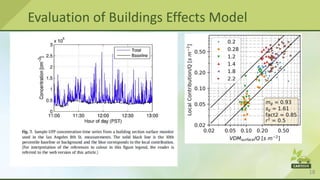
  • #19 The figure in the left panel shows the UFP peaks associated with emissions from traffic in a street canyon in Los Angeles, superimposed on the background UFP concentration. These peaks were averaged to obtain half hour values that were compared with the observations, shown in the right panel. The points correspond to the aspect ratios of the streets that were sampled in the field studies conducted in Los Angeles. The next slide describes how the aspect ratio was calculated in streets in which building heights varied substantially.
  • #20 The figure shows the computation of the effective height of buildings in a street block. The silhouettes of buildings on each side of the street are projected on vertical planes. The average height is the projected area divided by the block length as shown in the figure. The aspect ratio is then 𝐻 𝑒𝑓𝑓 /𝑊, where 𝑊 is the width of the street.
  • #21 The Community Line Source (C-LINE) modeling system estimates emissions and dispersion of toxic air pollutants for roadways within the continental United States. It accesses publicly available traffic and meteorological datasets, and is optimized for use on community-sized areas (100 to 1000 km2). The user is not required to provide input data, but can provide their own if desired. C-LINE is a modeling and visualization system that access inputs, performs calculations, visualizes results, provides options to manipulate input variables, and performs basic data analysis. C-LINE is not intended for regulatory applications. Its local-scale focus and ability to quickly compare different roadway pollution scenarios supports community-based applications and help to identify areas for further research.
  • #22 Valencia et al. (2018) describe different methods to model conversion of NOx to NO2. One or more of these methods will be included in AERMOD. At wind speeds less than 2 m/s at 10 m, models tend to overestimate concentrations, which is a problem when these models are used to meet air quality standards. AERMOD has several options to account for the horizontal wind meandering that occurs under low wind speeds, which is the likely reason that concentrations are lower than model estimates. However, there is little consensus on the option that provides adequate concentration estimates. Urban highways are invariably affected by urban structures that modify the flow field and micrometeorological variables that affect dispersion. Meteorological inputs constructed using airport data from airports, which are generally located far from urban centers, have to be modified to account for the presence of buildings and other urban structures adjacent to traffic emissions. Progress is required in developing methods that can be used to construct model inputs applicable to urban areas using airport data. Some progress (Luhar et al., 2006) has been made in this area, but there is generally accepted method that is incorporated in models such as AERMMOD. Several studies (Gallagher et., 2015; Deshmukh et., 2019) have been conducted to examine the impact of vegetative barriers on near-road air quality. Observations indicate that these barriers can increase or decrease concentrations relative to those in the absence of the barrier. Porous barriers can decrease turbulence velocity and length scales of the component of the flow passing through the barrier, and thus increase concentrations. On the other hand, the flow that goes over the barrier enhances vertical dispersion and thus decreases concentrations. The relative effects of these two opposing processes depends on the porosity of the barrier and the height of the barrier. We do not have a simple model that incorporates these two effects. “Edge” effect refers to that near the end of a roadside barrier where the flow can be directed along and then around the edge of the barrier. The emissions carried by this flow can reduce the mitigating effect of barriers at some distance before the barrier ends. Wind tunnel studies conducted by the USPEPA indicate that the near-surface concentration starts increasing to levels above the values at the middle of the barrier at about six barrier heights from the edge of the barrier, reaching about halfway between the values corresponding to the no-barrier and barrier cases.