Network Analysis of  Effective Knowledge Construction  In Asynchronous Learning Networks 9’th ALN/SLOAN-C Conference November 14-16, 2003, Orlando Dr. Reuven Aviv Dr. Zippy Erlich Gilad Ravid Open University of Israel
Content Introduction: What this research is all about Network Analysis of two ALNs Macro-structures: Cohesion structures, Power Distribution and Role groups Micro-structures: Markov Stochastic Models Theories underlying the micro-structures Conclusions, Limitations
Research Questions and Techniques What are the network macro-structures in a knowledge constructing ALN Done by Social Network Analysis What are the network micro-structures By Analysis of Markov Stochastic Models What are the theories underlying these micro-structures Literature Search
Details Content Analysis and Social Network Analysis: Journal of Asynchronous Learning Networks, (JALN) Vol. 7, Sept. 2003 http://www.aln.org/publications/jaln/v7n3/v7n3_aviv.asp Analysis of Markov Stochastic Models: Forthcoming
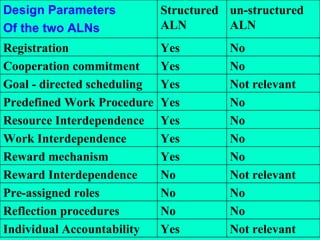
Test-bed: Two ALNs 16 weeks each 18, 17 participants Parts of  Open U “Business Ethics” Course Structured ALN: Online Seminar Design & Test for Knowledge Construction un-Structured ALN: Q & A
Not relevant Yes Individual Accountability No No Reflection procedures No No Pre-assigned roles Not relevant No Reward Interdependence No Yes Reward mechanism No Yes Work Interdependence No Yes Resource Interdependence No Yes Predefined Work Procedure Not relevant Yes Goal - directed scheduling No Yes Cooperation commitment No Yes Registration un-structured ALN Structured ALN Design Parameters Of the two ALNs
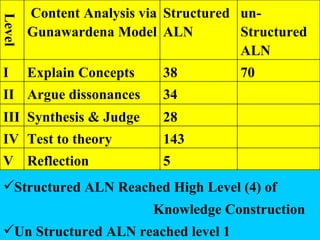
Structured ALN Reached High Level (4) of  Knowledge Construction Un Structured ALN reached level 1 5 Reflection V 143 Test to theory IV 28 Synthesis & Judge III 34 Argue dissonances II 70 38 Explain Concepts I un- Structured ALN Structured ALN Content Analysis via  Gunawardena Model Level
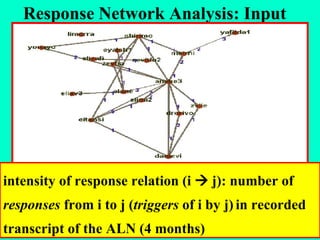
Response Network Analysis: Input intensity of response relation (i    j): number of  responses  from i to j ( triggers  of i by j)   in recorded transcript of the ALN (4 months)
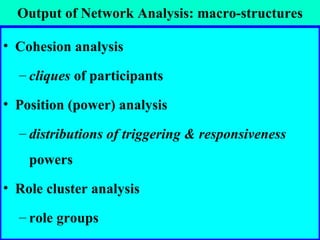
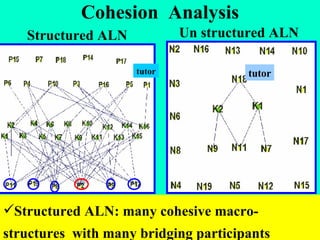
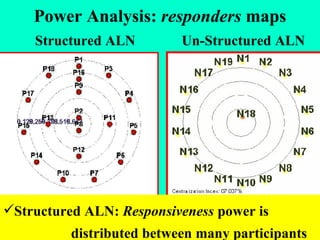
Output of Network Analysis: macro-structures Cohesion analysis cliques  of participants Position (power) analysis distributions of   triggering & responsiveness  powers Role cluster analysis role groups
Cohesion  Analysis Structured ALN Un structured ALN Structured ALN: many cohesive macro-structures  with many bridging participants  tutor tutor
Power Analysis:  responders  maps Structured ALN Un-Structured ALN Structured ALN:  Responsiveness  power is  distributed between many participants
Role Cluster Analysis Structured ALN Un Structured ALN Structured ALN: multiple roles distributed  between large groups of participants [responder] [lurkers] tutor students [responders] [triggers] tutor [lurkers]
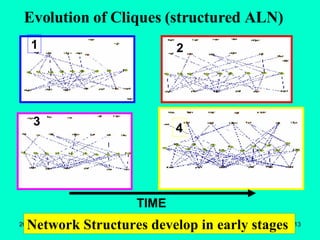
Evolution of Cliques (structured ALN) TIME Network Structures develop in early stages  1 2 3 4
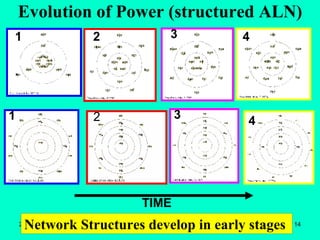
Evolution of Power (structured ALN) TIME Network Structures develop in early stages  1 2 3 4 1 2 3 4
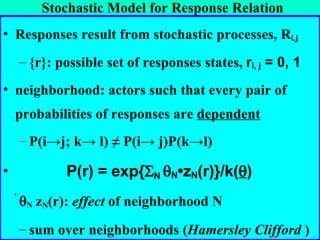
Stochastic Model for Response Relation Responses result from stochastic processes, R i,j {r}: possible set of responses states,  r i, j  = 0, 1 neighborhood: actors such that every pair of probabilities of responses are  dependent   P(i->j; k-> l) ≠ P(i-> j)P(k->l) P(r) = exp{  N   N •z N (r)}/k(  )    N  z N (r):  effect  of neighborhood N sum over neighborhoods ( Hamersley Clifford  )
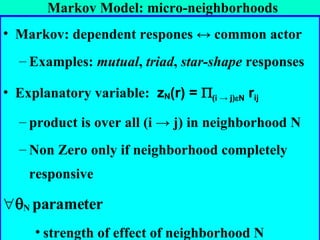
Markov Model: micro-neighborhoods Markov: dependent respones  ↔  common actor Examples:  mutual ,  triad ,  star-shape  responses Explanatory variable:  z N (r) =   (i -> j)  N  r ij   product is over all (i  ->  j) in neighborhood N Non Zero only if neighborhood completely responsive  N  parameter  strength of effect of neighborhood N
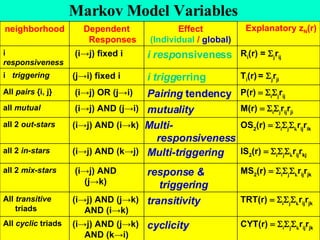
Markov Model Variables T i (r)   =   j r ji i trigg erring (j->i) fixed i i  triggering R i ( r ) =   j r ij i resp onsiveness (i->j) fixed i i  responsiveness CYT(r )   i  j  k r ij r jk cyclicity (i->j) AND (j->k) AND (k->i)  All  cyclic  triads TRT(r )   i  j  k r ij r jk transitivity (i->j) AND (j->k) AND (i->k) All  transitive  triads MS 2 ( r )   i  j  k r ij r jk response & triggering (i->j) AND   (j->k) all 2  mix-stars IS 2 ( r )   i  j  k r ij r kj Multi-triggering (i->j) AND (k->j) all 2  in-stars OS 2 ( r )   i  j  k r ij r ik Multi-responsiveness (i->j) AND (i->k) all 2  out-stars M(r )   i  j r ij r ji mutuality (i->j) AND (j->i) all  mutual P(r )  i  j r ij Pairing  tendency (i->j) OR (j->i) All  pairs  {i, j} neighborhood    Explanatory z N (r ) Effect (Individual  /  global) Dependent Responses
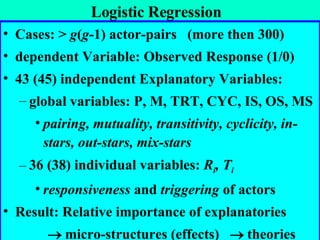
Logistic Regression Cases: >  g ( g -1) actor-pairs  (more then 300) dependent Variable: Observed Response (1/0) 43 (45) independent Explanatory Variables:  global variables: P, M, TRT, CYC, IS, OS, MS pairing, mutuality, transitivity, cyclicity, in-stars, out-stars, mix-stars 36 (38) individual variables:  R i , T i responsiveness  and  triggering  of actors Result: Relative importance of explanatories    micro-structures (effects)    theories
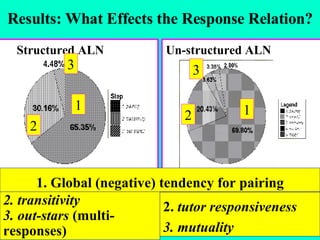
Results: What Effects the Response Relation? Structured ALN Un-structured ALN 2. transitivity 3. out-stars  (multi-responses) 1. Global (negative) tendency for pairing 2.  tutor responsiveness 3. mutuality 1 1 2 2 3 3
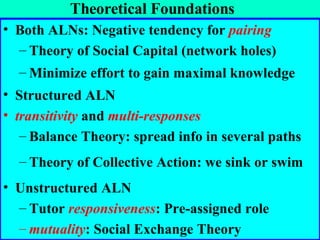
Theoretical Foundations   Both ALNs: Negative tendency for  pairing Theory of Social Capital (network holes) Minimize effort to gain maximal knowledge Structured ALN transitivity   and   multi-responses Balance Theory: spread info in several paths Theory of Collective Action: we sink or swim Unstructured ALN Tutor  responsiveness : Pre-assigned role mutuality : Social Exchange Theory
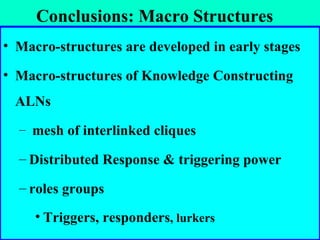
Conclusions: Macro Structures Macro-structures are developed in early stages Macro-structures of Knowledge Constructing ALNs  mesh of interlinked cliques Distributed Response & triggering power  roles groups Triggers, responders , lurkers
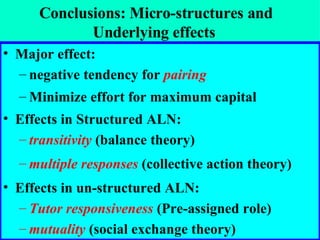
Conclusions: Micro-structures and Underlying effects  Major effect:  negative tendency for  pairing Minimize effort for maximum capital Effects in Structured ALN:  transitivity  (balance theory)  multiple responses  (collective action theory) Effects in un-structured ALN:  Tutor   responsiveness   (Pre-assigned role) mutuality   (social exchange theory)
Limitations Only two ALNs Only one relation (response) Definitions of Network Structures are not standardized Check stability of results with respect to redefinition of structures Time dependence was not analyzed analytically Markov model is limited to few effects More …
Thank You

1574

  • 1.
    Network Analysis of Effective Knowledge Construction In Asynchronous Learning Networks 9’th ALN/SLOAN-C Conference November 14-16, 2003, Orlando Dr. Reuven Aviv Dr. Zippy Erlich Gilad Ravid Open University of Israel
  • 2.
    Content Introduction: Whatthis research is all about Network Analysis of two ALNs Macro-structures: Cohesion structures, Power Distribution and Role groups Micro-structures: Markov Stochastic Models Theories underlying the micro-structures Conclusions, Limitations
  • 3.
    Research Questions andTechniques What are the network macro-structures in a knowledge constructing ALN Done by Social Network Analysis What are the network micro-structures By Analysis of Markov Stochastic Models What are the theories underlying these micro-structures Literature Search
  • 4.
    Details Content Analysisand Social Network Analysis: Journal of Asynchronous Learning Networks, (JALN) Vol. 7, Sept. 2003 http://www.aln.org/publications/jaln/v7n3/v7n3_aviv.asp Analysis of Markov Stochastic Models: Forthcoming
  • 5.
    Test-bed: Two ALNs16 weeks each 18, 17 participants Parts of Open U “Business Ethics” Course Structured ALN: Online Seminar Design & Test for Knowledge Construction un-Structured ALN: Q & A
  • 6.
    Not relevant YesIndividual Accountability No No Reflection procedures No No Pre-assigned roles Not relevant No Reward Interdependence No Yes Reward mechanism No Yes Work Interdependence No Yes Resource Interdependence No Yes Predefined Work Procedure Not relevant Yes Goal - directed scheduling No Yes Cooperation commitment No Yes Registration un-structured ALN Structured ALN Design Parameters Of the two ALNs
  • 7.
    Structured ALN ReachedHigh Level (4) of Knowledge Construction Un Structured ALN reached level 1 5 Reflection V 143 Test to theory IV 28 Synthesis & Judge III 34 Argue dissonances II 70 38 Explain Concepts I un- Structured ALN Structured ALN Content Analysis via Gunawardena Model Level
  • 8.
    Response Network Analysis:Input intensity of response relation (i  j): number of responses from i to j ( triggers of i by j) in recorded transcript of the ALN (4 months)
  • 9.
    Output of NetworkAnalysis: macro-structures Cohesion analysis cliques of participants Position (power) analysis distributions of triggering & responsiveness powers Role cluster analysis role groups
  • 10.
    Cohesion AnalysisStructured ALN Un structured ALN Structured ALN: many cohesive macro-structures with many bridging participants tutor tutor
  • 11.
    Power Analysis: responders maps Structured ALN Un-Structured ALN Structured ALN: Responsiveness power is distributed between many participants
  • 12.
    Role Cluster AnalysisStructured ALN Un Structured ALN Structured ALN: multiple roles distributed between large groups of participants [responder] [lurkers] tutor students [responders] [triggers] tutor [lurkers]
  • 13.
    Evolution of Cliques(structured ALN) TIME Network Structures develop in early stages 1 2 3 4
  • 14.
    Evolution of Power(structured ALN) TIME Network Structures develop in early stages 1 2 3 4 1 2 3 4
  • 15.
    Stochastic Model forResponse Relation Responses result from stochastic processes, R i,j {r}: possible set of responses states, r i, j = 0, 1 neighborhood: actors such that every pair of probabilities of responses are dependent P(i->j; k-> l) ≠ P(i-> j)P(k->l) P(r) = exp{  N  N •z N (r)}/k(  )  N z N (r): effect of neighborhood N sum over neighborhoods ( Hamersley Clifford )
  • 16.
    Markov Model: micro-neighborhoodsMarkov: dependent respones ↔ common actor Examples: mutual , triad , star-shape responses Explanatory variable: z N (r) =  (i -> j)  N r ij product is over all (i -> j) in neighborhood N Non Zero only if neighborhood completely responsive  N parameter strength of effect of neighborhood N
  • 17.
    Markov Model VariablesT i (r) =  j r ji i trigg erring (j->i) fixed i i triggering R i ( r ) =  j r ij i resp onsiveness (i->j) fixed i i responsiveness CYT(r )  i  j  k r ij r jk cyclicity (i->j) AND (j->k) AND (k->i) All cyclic triads TRT(r )  i  j  k r ij r jk transitivity (i->j) AND (j->k) AND (i->k) All transitive triads MS 2 ( r )  i  j  k r ij r jk response & triggering (i->j) AND (j->k) all 2 mix-stars IS 2 ( r )  i  j  k r ij r kj Multi-triggering (i->j) AND (k->j) all 2 in-stars OS 2 ( r )  i  j  k r ij r ik Multi-responsiveness (i->j) AND (i->k) all 2 out-stars M(r )  i  j r ij r ji mutuality (i->j) AND (j->i) all mutual P(r )  i  j r ij Pairing tendency (i->j) OR (j->i) All pairs {i, j} neighborhood    Explanatory z N (r ) Effect (Individual / global) Dependent Responses
  • 18.
    Logistic Regression Cases:> g ( g -1) actor-pairs (more then 300) dependent Variable: Observed Response (1/0) 43 (45) independent Explanatory Variables: global variables: P, M, TRT, CYC, IS, OS, MS pairing, mutuality, transitivity, cyclicity, in-stars, out-stars, mix-stars 36 (38) individual variables: R i , T i responsiveness and triggering of actors Result: Relative importance of explanatories  micro-structures (effects)  theories
  • 19.
    Results: What Effectsthe Response Relation? Structured ALN Un-structured ALN 2. transitivity 3. out-stars (multi-responses) 1. Global (negative) tendency for pairing 2. tutor responsiveness 3. mutuality 1 1 2 2 3 3
  • 20.
    Theoretical Foundations Both ALNs: Negative tendency for pairing Theory of Social Capital (network holes) Minimize effort to gain maximal knowledge Structured ALN transitivity and multi-responses Balance Theory: spread info in several paths Theory of Collective Action: we sink or swim Unstructured ALN Tutor responsiveness : Pre-assigned role mutuality : Social Exchange Theory
  • 21.
    Conclusions: Macro StructuresMacro-structures are developed in early stages Macro-structures of Knowledge Constructing ALNs mesh of interlinked cliques Distributed Response & triggering power roles groups Triggers, responders , lurkers
  • 22.
    Conclusions: Micro-structures andUnderlying effects Major effect: negative tendency for pairing Minimize effort for maximum capital Effects in Structured ALN: transitivity (balance theory) multiple responses (collective action theory) Effects in un-structured ALN: Tutor responsiveness (Pre-assigned role) mutuality (social exchange theory)
  • 23.
    Limitations Only twoALNs Only one relation (response) Definitions of Network Structures are not standardized Check stability of results with respect to redefinition of structures Time dependence was not analyzed analytically Markov model is limited to few effects More …
  • 24.