An Intro to Game Theory 15-451  Avrim Blum  12/07/04
Plan for Today 2-Player Zero-Sum Games (matrix games) Minimax optimal strategies Minimax theorem General-Sum Games (bimatrix games) notion of Nash Equilibrium Proof of existence of Nash Equilibria using Brouwer’s fixed-point theorem test material not test material
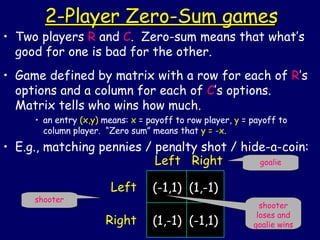
2-Player Zero-Sum games Two players  R  and  C .  Zero-sum means that what’s good for one is bad for the other. Game defined by matrix with a row for each of  R ’s options and a column for each of  C ’s options.  Matrix tells who wins how much. an entry  (x,y)  means:  x  = payoff to row player,  y  = payoff to column player.  “Zero sum” means that  y = -x . E.g., matching pennies / penalty shot / hide-a-coin: shooter goalie shooter loses and goalie wins (-1,1)  (1,-1) (1,-1)  (-1,1) Left Right Left  Right
Minimax-optimal strategies Minimax optimal strategy is a (randomized) strategy that has the best guarantee on its expected gain.  [maximizes the minimum] I.e., the thing to play if your opponent knows you well.  Same as our notion of a randomized strategy with a good worst-case bound. In class on Linear Programming, we saw how to solve for this using LP. polynomial time in size of matrix if use poly-time LP alg (like Ellipsoid).
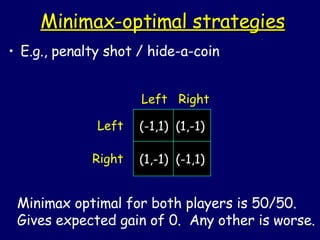
Minimax-optimal strategies E.g., penalty shot / hide-a-coin Minimax optimal for both players is 50/50. Gives expected gain of 0.  Any other is worse. (-1,1)  (1,-1) (1,-1)  (-1,1) Left Right Left  Right
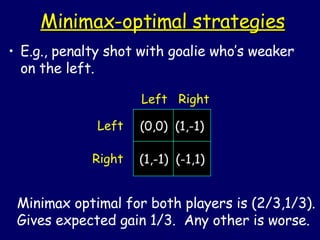
Minimax-optimal strategies E.g., penalty shot with goalie who’s weaker on the left. Minimax optimal for both players is (2/3,1/3). Gives expected gain 1/3.  Any other is worse. (0,0)  (1,-1) (1,-1)  (-1,1) Left Right Left  Right
Matrix games and Algorithms Gives a useful way of thinking about guarantees on algorithms. Think of rows as different algorithms, columns as different possible inputs. M(i,j) = cost of algorithm i on input j. Of course matrix may be HUGE. But helpful conceptually.
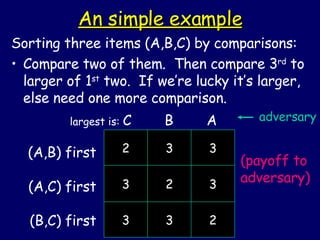
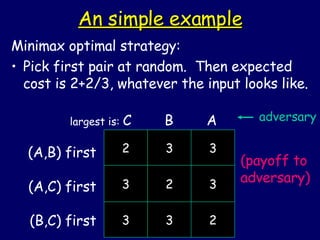
An simple example Sorting three items (A,B,C) by comparisons: Compare two of them.  Then compare 3 rd  to larger of 1 st  two.  If we’re lucky it’s larger, else need one more comparison. 2 3 3 3 2 3 3 3 2 (A,B) first (A,C) first (B,C) first (payoff to adversary) adversary largest is:  C  B  A
An simple example Minimax optimal strategy: Pick first pair at random.  Then expected cost is 2+2/3, whatever the input looks like. 2 3 3 3 2 3 3 3 2 (A,B) first (A,C) first (B,C) first (payoff to adversary) adversary largest is:  C  B  A
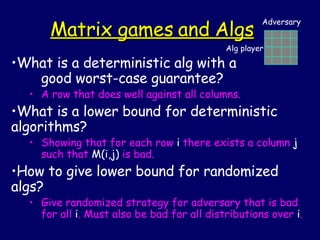
Matrix games and Algs What is a deterministic alg with a  good worst-case guarantee? A row that does well against all columns. What is a lower bound for deterministic algorithms? Showing that for each row  i  there exists a column  j  such that  M(i,j)  is bad. How to give lower bound for randomized algs? Give randomized strategy for adversary that is bad for all  i . Must also be bad for all distributions over  i . Alg player Adversary
E.g., hashing Rows are different hash functions. Cols are different sets of n items to hash. M(i,j) = #collisions incurred by alg i on set j.  [alg is trying to minimize] For any row, can reverse-engineer a bad column. Universal hashing is a randomized strategy for row player. Alg player Adversary
Minimax Theorem (von Neumann 1928) Every 2-player zero-sum game has a unique  value   V . Minimax optimal strategy for  R  guarantees  R ’s expected gain at least  V . Minimax optimal strategy for  C  guarantees  R ’s expected gain at most  V . Counterintuitive:  Means it doesn’t hurt to publish your strategy if both players are optimal.  (Borel had proved for symmetric 5x5 but thought was false for larger games)
Nice proof of minimax thm (sketch) Suppose for contradiction it was false. This means some game G has  V C   >  V R : If Column player commits first, there exists a row that gets at least  V C . But if Row player has to commit first, the Column player can make him get only  V R . Scale matrix so payoffs to row are  in [0,1].  Say  V R  = V C (1-  ) . V C V R
Proof sketch, contd Consider repeatedly playing game G against some opponent.  [think of you as row player] Use “picking a winner / expert advice” alg to do nearly as well as best fixed row in hindsight. Alg gets  ¸    OPT – c*log  n  >  OPT  [if play long enough] OPT  ¸  V C   [Best against opponent’s empirical distribution] Alg  ·  V R   [Each time, opponent knows your randomized strategy] Contradicts assumption.
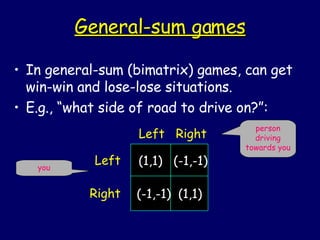
General-sum games In general-sum (bimatrix) games, can get win-win and lose-lose situations. E.g., “what side of road to drive on?”: person driving towards you you (1,1)  (-1,-1) (-1,-1)  (1,1) Left Right Left  Right
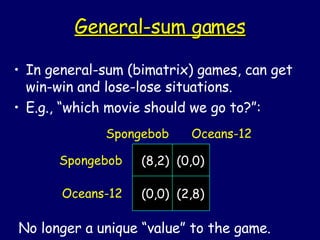
General-sum games In general-sum (bimatrix) games, can get win-win and lose-lose situations. E.g., “which movie should we go to?”: Spongebob Oceans-12 Spongebob  Oceans-12 No longer a unique “value” to the game. (8,2)  (0,0) (0,0)  (2,8)
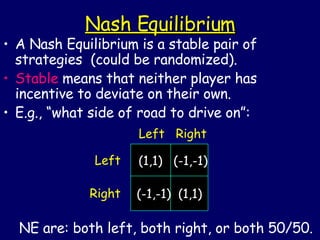
Nash Equilibrium A Nash Equilibrium is a stable pair of strategies  (could be randomized). Stable  means that neither player has incentive to deviate on their own. E.g., “what side of road to drive on”: NE are: both left, both right, or both 50/50. (1,1)  (-1,-1) (-1,-1)  (1,1) Left Right Left  Right
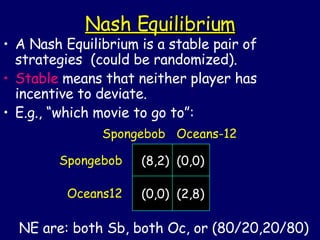
Nash Equilibrium A Nash Equilibrium is a stable pair of strategies  (could be randomized). Stable  means that neither player has incentive to deviate. E.g., “which movie to go to”: NE are: both Sb, both Oc, or (80/20,20/80) Spongebob Oceans12 Spongebob  Oceans-12 (8,2)  (0,0) (0,0)  (2,8)
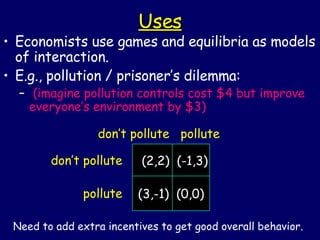
Uses Economists use games and equilibria as models of interaction. E.g., pollution / prisoner’s dilemma: (imagine pollution controls cost $4 but improve everyone’s environment by $3) don’t pollute pollute don’t pollute  pollute Need to add extra incentives to get good overall behavior. (2,2)  (-1,3) (3,-1)  (0,0)
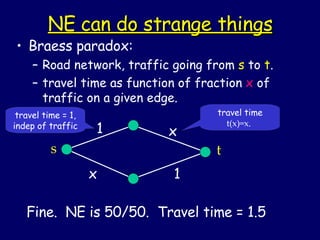
NE can do strange things Braess paradox: Road network, traffic going from  s  to  t . travel time as function of fraction  x  of traffic on a given edge. Fine.  NE is 50/50.  Travel time = 1.5 travel time = 1, indep of traffic travel time  t(x)=x .  s x 1 1 t x
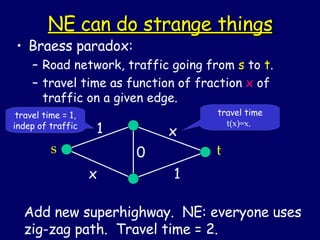
NE can do strange things Braess paradox: Road network, traffic going from  s  to  t . travel time as function of fraction  x  of traffic on a given edge. Add new superhighway.  NE: everyone uses zig-zag path.  Travel time = 2. s x 1 1 t x travel time = 1, indep of traffic travel time  t(x)=x .  0
Existence of NE Nash (1950) proved: any general-sum game must have at least one such equilibrium. Might require randomized strategies (called “mixed strategies”) This also yields minimax thm as a corollary. Pick some NE and let  V  = value to row player in that equilibrium.  Since it’s a NE, neither player can do better even knowing the (randomized)  strategy their opponent is playing. So, they’re each playing minimax optimal.
Existence of NE Proof will be non-constructive. Unlike case of zero-sum games, we  do not know any  polynomial-time algorithm for finding Nash Equilibria in general-sum games.  [great open problem!] Notation: Assume an nxn matrix. Use (p 1 ,...,p n ) to denote mixed strategy for row player, and (q 1 ,...,q n ) to denote mixed strategy for column player.
Proof We’ll start with Brouwer’s fixed point theorem. Let S be a compact convex region in R n  and let f:S  !  S be a continuous function. Then there must exist x  2  S such that f(x)=x. x is called a “fixed point” of f. Simple case: S is the interval [0,1]. We will care about: S = {(p,q): p,q are legal probability distributions on 1,...,n}.  I.e.,  S =  simplex n   £  simplex n
Proof (cont) S = {(p,q): p,q are mixed strategies}. Want to define f(p,q) = (p’,q’) such that: f is continuous.  This means that changing p or q a little bit shouldn’t cause p’ or q’ to change a lot. Any fixed point of f is a Nash Equilibrium. Then Brouwer will imply existence of NE.
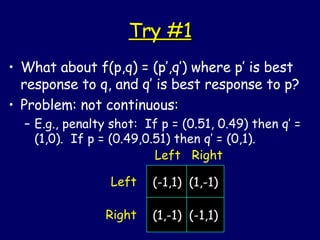
Try #1 What about f(p,q) = (p’,q’) where p’ is best response to q, and q’ is best response to p? Problem: not continuous: E.g., penalty shot:  If p = (0.51, 0.49) then q’ = (1,0).  If p = (0.49,0.51) then q’ = (0,1). (-1,1)  (1,-1) (1,-1)  (-1,1) Left Right Left  Right
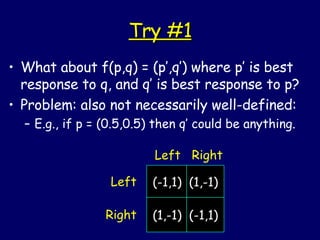
Try #1 What about f(p,q) = (p’,q’) where p’ is best response to q, and q’ is best response to p? Problem: also not necessarily well-defined: E.g., if p = (0.5,0.5) then q’ could be anything. (-1,1)  (1,-1) (1,-1)  (-1,1) Left Right Left  Right
Instead we will use... f(p,q) = (p’,q’) such that: q’ maximizes [(expected gain wrt p) - ||q-q’|| 2 ] p’ maximizes [(expected gain wrt q) - ||p-p’|| 2 ] p  p’ Note: quadratic + linear = quadratic.
Instead we will use... f(p,q) = (p’,q’) such that: q’ maximizes [(expected gain wrt p) - ||q-q’|| 2 ] p’ maximizes [(expected gain wrt q) - ||p-p’|| 2 ] p Note: quadratic + linear = quadratic. p’
Instead we will use... f(p,q) = (p’,q’) such that: q’ maximizes [(expected gain wrt p) - ||q-q’|| 2 ] p’ maximizes [(expected gain wrt q) - ||p-p’|| 2 ] f is well-defined and continuous since quadratic has unique maximum and small change to p,q only moves this a little. Also fixed point = NE.  (even if tiny incentive to move, will move little bit). So, that’s it!

lect1207

  • 1.
    An Intro toGame Theory 15-451 Avrim Blum 12/07/04
  • 2.
    Plan for Today2-Player Zero-Sum Games (matrix games) Minimax optimal strategies Minimax theorem General-Sum Games (bimatrix games) notion of Nash Equilibrium Proof of existence of Nash Equilibria using Brouwer’s fixed-point theorem test material not test material
  • 3.
    2-Player Zero-Sum gamesTwo players R and C . Zero-sum means that what’s good for one is bad for the other. Game defined by matrix with a row for each of R ’s options and a column for each of C ’s options. Matrix tells who wins how much. an entry (x,y) means: x = payoff to row player, y = payoff to column player. “Zero sum” means that y = -x . E.g., matching pennies / penalty shot / hide-a-coin: shooter goalie shooter loses and goalie wins (-1,1) (1,-1) (1,-1) (-1,1) Left Right Left Right
  • 4.
    Minimax-optimal strategies Minimaxoptimal strategy is a (randomized) strategy that has the best guarantee on its expected gain. [maximizes the minimum] I.e., the thing to play if your opponent knows you well. Same as our notion of a randomized strategy with a good worst-case bound. In class on Linear Programming, we saw how to solve for this using LP. polynomial time in size of matrix if use poly-time LP alg (like Ellipsoid).
  • 5.
    Minimax-optimal strategies E.g.,penalty shot / hide-a-coin Minimax optimal for both players is 50/50. Gives expected gain of 0. Any other is worse. (-1,1) (1,-1) (1,-1) (-1,1) Left Right Left Right
  • 6.
    Minimax-optimal strategies E.g.,penalty shot with goalie who’s weaker on the left. Minimax optimal for both players is (2/3,1/3). Gives expected gain 1/3. Any other is worse. (0,0) (1,-1) (1,-1) (-1,1) Left Right Left Right
  • 7.
    Matrix games andAlgorithms Gives a useful way of thinking about guarantees on algorithms. Think of rows as different algorithms, columns as different possible inputs. M(i,j) = cost of algorithm i on input j. Of course matrix may be HUGE. But helpful conceptually.
  • 8.
    An simple exampleSorting three items (A,B,C) by comparisons: Compare two of them. Then compare 3 rd to larger of 1 st two. If we’re lucky it’s larger, else need one more comparison. 2 3 3 3 2 3 3 3 2 (A,B) first (A,C) first (B,C) first (payoff to adversary) adversary largest is: C B A
  • 9.
    An simple exampleMinimax optimal strategy: Pick first pair at random. Then expected cost is 2+2/3, whatever the input looks like. 2 3 3 3 2 3 3 3 2 (A,B) first (A,C) first (B,C) first (payoff to adversary) adversary largest is: C B A
  • 10.
    Matrix games andAlgs What is a deterministic alg with a good worst-case guarantee? A row that does well against all columns. What is a lower bound for deterministic algorithms? Showing that for each row i there exists a column j such that M(i,j) is bad. How to give lower bound for randomized algs? Give randomized strategy for adversary that is bad for all i . Must also be bad for all distributions over i . Alg player Adversary
  • 11.
    E.g., hashing Rowsare different hash functions. Cols are different sets of n items to hash. M(i,j) = #collisions incurred by alg i on set j. [alg is trying to minimize] For any row, can reverse-engineer a bad column. Universal hashing is a randomized strategy for row player. Alg player Adversary
  • 12.
    Minimax Theorem (vonNeumann 1928) Every 2-player zero-sum game has a unique value V . Minimax optimal strategy for R guarantees R ’s expected gain at least V . Minimax optimal strategy for C guarantees R ’s expected gain at most V . Counterintuitive: Means it doesn’t hurt to publish your strategy if both players are optimal. (Borel had proved for symmetric 5x5 but thought was false for larger games)
  • 13.
    Nice proof ofminimax thm (sketch) Suppose for contradiction it was false. This means some game G has V C > V R : If Column player commits first, there exists a row that gets at least V C . But if Row player has to commit first, the Column player can make him get only V R . Scale matrix so payoffs to row are in [0,1]. Say V R = V C (1-  ) . V C V R
  • 14.
    Proof sketch, contdConsider repeatedly playing game G against some opponent. [think of you as row player] Use “picking a winner / expert advice” alg to do nearly as well as best fixed row in hindsight. Alg gets ¸  OPT – c*log  n  >  OPT [if play long enough] OPT ¸ V C [Best against opponent’s empirical distribution] Alg · V R [Each time, opponent knows your randomized strategy] Contradicts assumption.
  • 15.
    General-sum games Ingeneral-sum (bimatrix) games, can get win-win and lose-lose situations. E.g., “what side of road to drive on?”: person driving towards you you (1,1) (-1,-1) (-1,-1) (1,1) Left Right Left Right
  • 16.
    General-sum games Ingeneral-sum (bimatrix) games, can get win-win and lose-lose situations. E.g., “which movie should we go to?”: Spongebob Oceans-12 Spongebob Oceans-12 No longer a unique “value” to the game. (8,2) (0,0) (0,0) (2,8)
  • 17.
    Nash Equilibrium ANash Equilibrium is a stable pair of strategies (could be randomized). Stable means that neither player has incentive to deviate on their own. E.g., “what side of road to drive on”: NE are: both left, both right, or both 50/50. (1,1) (-1,-1) (-1,-1) (1,1) Left Right Left Right
  • 18.
    Nash Equilibrium ANash Equilibrium is a stable pair of strategies (could be randomized). Stable means that neither player has incentive to deviate. E.g., “which movie to go to”: NE are: both Sb, both Oc, or (80/20,20/80) Spongebob Oceans12 Spongebob Oceans-12 (8,2) (0,0) (0,0) (2,8)
  • 19.
    Uses Economists usegames and equilibria as models of interaction. E.g., pollution / prisoner’s dilemma: (imagine pollution controls cost $4 but improve everyone’s environment by $3) don’t pollute pollute don’t pollute pollute Need to add extra incentives to get good overall behavior. (2,2) (-1,3) (3,-1) (0,0)
  • 20.
    NE can dostrange things Braess paradox: Road network, traffic going from s to t . travel time as function of fraction x of traffic on a given edge. Fine. NE is 50/50. Travel time = 1.5 travel time = 1, indep of traffic travel time t(x)=x . s x 1 1 t x
  • 21.
    NE can dostrange things Braess paradox: Road network, traffic going from s to t . travel time as function of fraction x of traffic on a given edge. Add new superhighway. NE: everyone uses zig-zag path. Travel time = 2. s x 1 1 t x travel time = 1, indep of traffic travel time t(x)=x . 0
  • 22.
    Existence of NENash (1950) proved: any general-sum game must have at least one such equilibrium. Might require randomized strategies (called “mixed strategies”) This also yields minimax thm as a corollary. Pick some NE and let V = value to row player in that equilibrium. Since it’s a NE, neither player can do better even knowing the (randomized) strategy their opponent is playing. So, they’re each playing minimax optimal.
  • 23.
    Existence of NEProof will be non-constructive. Unlike case of zero-sum games, we do not know any polynomial-time algorithm for finding Nash Equilibria in general-sum games. [great open problem!] Notation: Assume an nxn matrix. Use (p 1 ,...,p n ) to denote mixed strategy for row player, and (q 1 ,...,q n ) to denote mixed strategy for column player.
  • 24.
    Proof We’ll startwith Brouwer’s fixed point theorem. Let S be a compact convex region in R n and let f:S ! S be a continuous function. Then there must exist x 2 S such that f(x)=x. x is called a “fixed point” of f. Simple case: S is the interval [0,1]. We will care about: S = {(p,q): p,q are legal probability distributions on 1,...,n}. I.e., S = simplex n £ simplex n
  • 25.
    Proof (cont) S= {(p,q): p,q are mixed strategies}. Want to define f(p,q) = (p’,q’) such that: f is continuous. This means that changing p or q a little bit shouldn’t cause p’ or q’ to change a lot. Any fixed point of f is a Nash Equilibrium. Then Brouwer will imply existence of NE.
  • 26.
    Try #1 Whatabout f(p,q) = (p’,q’) where p’ is best response to q, and q’ is best response to p? Problem: not continuous: E.g., penalty shot: If p = (0.51, 0.49) then q’ = (1,0). If p = (0.49,0.51) then q’ = (0,1). (-1,1) (1,-1) (1,-1) (-1,1) Left Right Left Right
  • 27.
    Try #1 Whatabout f(p,q) = (p’,q’) where p’ is best response to q, and q’ is best response to p? Problem: also not necessarily well-defined: E.g., if p = (0.5,0.5) then q’ could be anything. (-1,1) (1,-1) (1,-1) (-1,1) Left Right Left Right
  • 28.
    Instead we willuse... f(p,q) = (p’,q’) such that: q’ maximizes [(expected gain wrt p) - ||q-q’|| 2 ] p’ maximizes [(expected gain wrt q) - ||p-p’|| 2 ] p p’ Note: quadratic + linear = quadratic.
  • 29.
    Instead we willuse... f(p,q) = (p’,q’) such that: q’ maximizes [(expected gain wrt p) - ||q-q’|| 2 ] p’ maximizes [(expected gain wrt q) - ||p-p’|| 2 ] p Note: quadratic + linear = quadratic. p’
  • 30.
    Instead we willuse... f(p,q) = (p’,q’) such that: q’ maximizes [(expected gain wrt p) - ||q-q’|| 2 ] p’ maximizes [(expected gain wrt q) - ||p-p’|| 2 ] f is well-defined and continuous since quadratic has unique maximum and small change to p,q only moves this a little. Also fixed point = NE. (even if tiny incentive to move, will move little bit). So, that’s it!