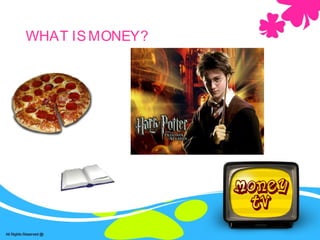
WHAT ISMONEY?
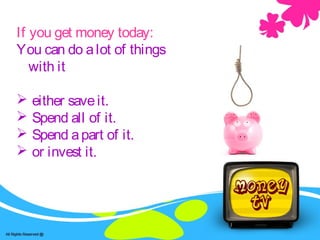
If you get money today:
You can do alot of things
with it
 either saveit.
 Spend all of it.
 Spend apart of it.
 or invest it.
?Do you say for themoney your parentsgive.
 Allowance
Or
 Income
Thefirst thing that oneshould do after
he/shereceivesan allowanceor pocket
money or incomeisprepareaBUDGET
?Isthefirst thing you should do each timeyou prepare
abudget or receiveyour allowance.
Save
What elsecan you do with your pocket
money/allowance
 Spend all of it.
 Spend apart of it.
 or saveit.
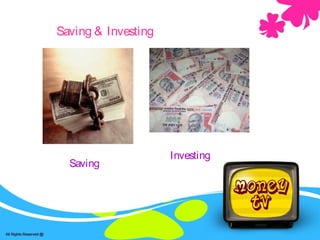
Saving & Investing
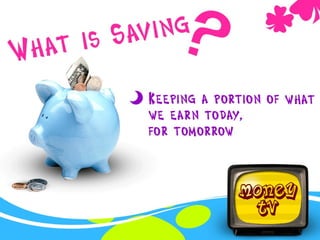
Saving
Investing
On thefaceof it saving and investing or
making investmentsarethesamething.
They areboth thingsthat wedo with our spare
money.
Investmentsaremoney or other
assetspurchased with thehopethat it
will generateincome, or appreciate
in thefuture.
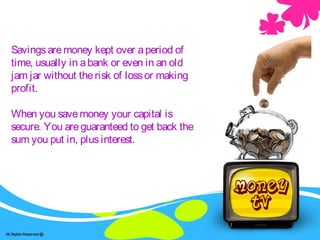
Savingsaremoney kept over aperiod of
time, usually in abank or even in an old
jam jar without therisk of lossor making
profit.
When you savemoney your capital is
secure. You areguaranteed to get back the
sum you put in, plusinterest.
When you invest you haveno such
guarantee. Your money/capital isat
risk.
In return for therisk you takeyou
expect to get moreback than ?you put
in.
In general terms, investment meanstheuse
money in thehopeof making moremoney.
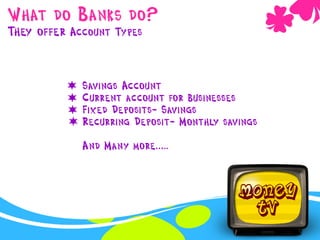
In relation to saving it isthedeposit madein a bank,
Or post office
In hopesgetting afuture return or interest from it.
Savings -account
       
Therearetwo basic kindsof interest:
»simpleinterest
»compound interest
Simpleinterest
Simpleinterest istheinterest that isfigured
only onceon theprincipal.
Example: If you loaned Rs300 to afriend for
onemonth and charged her 1% interest .Then
at theend of themonth you would receive
303.
Savings -accountCompound interest isalittledifferent.
With compound interest, themoney you earn in
interest becomespart of theprincipal, and also
startsto earn interest.
Compound interest iswhen your interest earns
additional interest;
simpleinterest iswhen only theoriginal principle
earnsinterest.
Savings -accountSavingsaccount
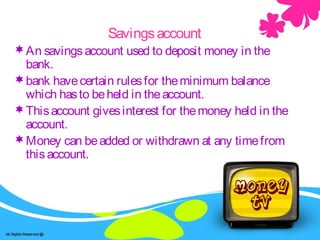
An savingsaccount used to deposit money in the
bank.
bank havecertain rulesfor theminimum balance
which hasto beheld in theaccount.
Thisaccount givesinterest for themoney held in the
account.
Money can beadded or withdrawn at any timefrom
thisaccount.
Savings -account• Remember that if you add money to your account,
your balancemight grow alot more.
• And, if you withdraw or takemoney out, it might
grow much less.
• When you add or takeaway from your account,
you'rechanging theamount you can earn aswell.
• And when you'rebuilding amoney TV of savings,
every rupeecounts.
Pass-Book
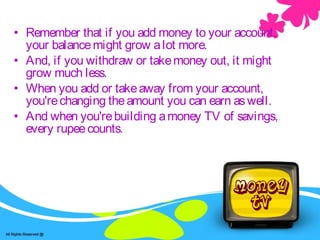
when weopen asavingsaccount with any bank
wearegiven apassbook.
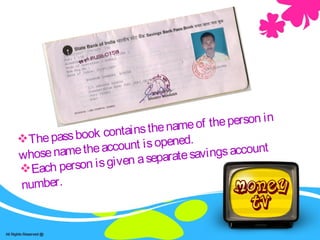
Thepassbook containsthenameof theperson in
whosenametheaccount isopened.
Each person isgiven aseparatesavingsaccount
number.
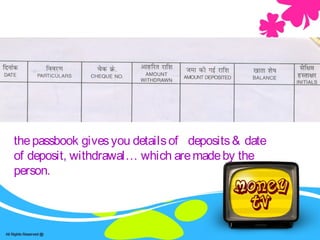
thepassbook givesyou detailsof deposits& date
of deposit, withdrawal… which aremadeby the
person.
Current Account
Current Account
Thesearebasically meant for businessman, firmsand
companies.
It doesnot giveinterest for themoney held in the
account.
Internet BankingFixed Deposits
A fixed deposit ismeant for thoseinvestorswho want
to deposit alump sum of money for afixed period.
 say for aminimum period of 15 daysto fiveyears
and above.
Investor getsalump sum (principal + interest) at the
maturity of thedeposit. 
Fixed depositsalso giveahigher rateof interest than
asavingsbank account. 
Internet BankingRecurring Deposit
Theminimum amount of Recurring Deposit varies
from bank to bank but usually it beginsfrom Rs
100/-.
aspecific sum of money isdeposited on amonthly
basisfor aspecific period of 6 monthsto 10 years.
At theend, you will get theprincipal sum aswell as
theinterest earned during that period.
Internet BankingINTERNET BANKING
Oneof themain reasonsthat peopleuseInternet
banking over regular banking isbecauseof the
convenience.
Everybody wantsmethodsthat aregoing to savethem
timeand makedaily taskseasier on them, and that is
exactly what Internet banking does.
allowscustomersto conduct financial transactionson
asecurewebsite
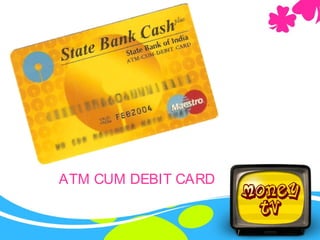
ATM CUM DEBIT CARD
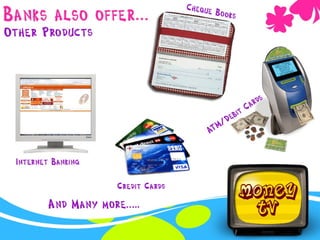
ATM /Debt cards and Credit cards.Thesearebasically issued by banksto personswho
havean account with them.
An ATM card givesyou accessto your bank savings
and current account 24 hoursaday, 7 daysof the
week.
Therearetwo typesof cardsthey arethe
Debit and credit cards.
ATM /Debt cards and Credit cards.credit cards
A plastic card with magnetic strip on onesidewhich
isused to swipe.
It isused to buy goodsand services.
Thebank issuing thecredit card paysthebill first
then collectsthemoney from theholder of thecard.
Credit card offersa25 day graceperiod during which
no interest ischarged.
ATM /Debt cards and Credit cards.Debit cards
A plastic card with magnetic strip on oneside
which isused to swipe.
It isused to buy goodsand services.
Thebank issuing thedebit card paysthebill
first then collectsthemoney from theholders
account immediately.
TheReservebank of Indiawasset up
on April 1, 1935 in Kolkata.
Thefirst governor of RBI wasSir OsborneSmith.
TheFirst Indian Governor of RBI was
Sir.C.D.Deshmukh(1943-1949)
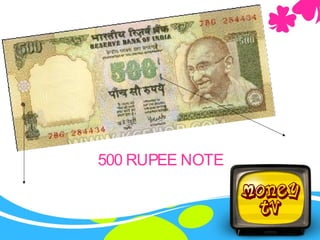
500 RUPEE NOTE
 You know thereareidentification marksin aIndian
rupeenotethat will help blind peoplein identifying
thenotes.
 It isusually represented by araised black circleOR
triangle
Haveweever looked closely at acurrency note
or acoin?
Haveyou heard of theword Security Thread in anote?
It isasecurity featurein notesto protect against
FORGERY/MAKING OF FAKE NOTES
It consist of aribbon which isthreaded through the
paper .
Theribbon isusually madeup of metal foil or plastic
and usually hassometext or numbersengraved on it.
Bartering worked for many yearsuntil it wasno longer
convenient to trade.
After bartering, metal becamethemost popular form of
money in most of Europeand Asia.
Peopleused gold, silver, and copper asmoney becausethey
werepretty and hard to get.
Theproblem with themetal wasthat it wastoo heavy.
Peoplehated carrying it around.
Kidsnext timeyou look at money remember that
it hasavery interesting history behind it.
14 to 16 years

14 to 16 years

  • 4.
  • 6.
    If you getmoney today: You can do alot of things with it  either saveit.  Spend all of it.  Spend apart of it.  or invest it.
  • 7.
    ?Do you sayfor themoney your parentsgive.  Allowance Or  Income
  • 8.
    Thefirst thing thatoneshould do after he/shereceivesan allowanceor pocket money or incomeisprepareaBUDGET
  • 9.
    ?Isthefirst thing youshould do each timeyou prepare abudget or receiveyour allowance.
  • 10.
  • 16.
    What elsecan youdo with your pocket money/allowance  Spend all of it.  Spend apart of it.  or saveit.
  • 17.
  • 18.
    On thefaceof itsaving and investing or making investmentsarethesamething. They areboth thingsthat wedo with our spare money.
  • 19.
    Investmentsaremoney or other assetspurchasedwith thehopethat it will generateincome, or appreciate in thefuture.
  • 20.
    Savingsaremoney kept overaperiod of time, usually in abank or even in an old jam jar without therisk of lossor making profit. When you savemoney your capital is secure. You areguaranteed to get back the sum you put in, plusinterest.
  • 21.
    When you investyou haveno such guarantee. Your money/capital isat risk. In return for therisk you takeyou expect to get moreback than ?you put in.
  • 22.
    In general terms,investment meanstheuse money in thehopeof making moremoney. In relation to saving it isthedeposit madein a bank, Or post office In hopesgetting afuture return or interest from it.
  • 24.
    Savings -account         Therearetwo basickindsof interest: »simpleinterest »compound interest
  • 25.
    Simpleinterest Simpleinterest istheinterest thatisfigured only onceon theprincipal. Example: If you loaned Rs300 to afriend for onemonth and charged her 1% interest .Then at theend of themonth you would receive 303.
  • 26.
    Savings -accountCompound interestisalittledifferent. With compound interest, themoney you earn in interest becomespart of theprincipal, and also startsto earn interest.
  • 27.
    Compound interest iswhenyour interest earns additional interest; simpleinterest iswhen only theoriginal principle earnsinterest.
  • 31.
    Savings -accountSavingsaccount An savingsaccountused to deposit money in the bank. bank havecertain rulesfor theminimum balance which hasto beheld in theaccount. Thisaccount givesinterest for themoney held in the account. Money can beadded or withdrawn at any timefrom thisaccount.
  • 32.
    Savings -account• Rememberthat if you add money to your account, your balancemight grow alot more. • And, if you withdraw or takemoney out, it might grow much less. • When you add or takeaway from your account, you'rechanging theamount you can earn aswell. • And when you'rebuilding amoney TV of savings, every rupeecounts.
  • 33.
    Pass-Book when weopen asavingsaccountwith any bank wearegiven apassbook.
  • 34.
    Thepassbook containsthenameof thepersonin whosenametheaccount isopened. Each person isgiven aseparatesavingsaccount number.
  • 35.
    thepassbook givesyou detailsofdeposits& date of deposit, withdrawal… which aremadeby the person.
  • 37.
    Current Account Current Account Thesearebasicallymeant for businessman, firmsand companies. It doesnot giveinterest for themoney held in the account.
  • 38.
    Internet BankingFixed Deposits Afixed deposit ismeant for thoseinvestorswho want to deposit alump sum of money for afixed period.  say for aminimum period of 15 daysto fiveyears and above. Investor getsalump sum (principal + interest) at the maturity of thedeposit.  Fixed depositsalso giveahigher rateof interest than asavingsbank account. 
  • 39.
    Internet BankingRecurring Deposit Theminimumamount of Recurring Deposit varies from bank to bank but usually it beginsfrom Rs 100/-. aspecific sum of money isdeposited on amonthly basisfor aspecific period of 6 monthsto 10 years. At theend, you will get theprincipal sum aswell as theinterest earned during that period.
  • 41.
    Internet BankingINTERNET BANKING Oneofthemain reasonsthat peopleuseInternet banking over regular banking isbecauseof the convenience. Everybody wantsmethodsthat aregoing to savethem timeand makedaily taskseasier on them, and that is exactly what Internet banking does. allowscustomersto conduct financial transactionson asecurewebsite
  • 42.
  • 43.
    ATM /Debt cardsand Credit cards.Thesearebasically issued by banksto personswho havean account with them. An ATM card givesyou accessto your bank savings and current account 24 hoursaday, 7 daysof the week. Therearetwo typesof cardsthey arethe Debit and credit cards.
  • 44.
    ATM /Debt cardsand Credit cards.credit cards A plastic card with magnetic strip on onesidewhich isused to swipe. It isused to buy goodsand services. Thebank issuing thecredit card paysthebill first then collectsthemoney from theholder of thecard. Credit card offersa25 day graceperiod during which no interest ischarged.
  • 45.
    ATM /Debt cardsand Credit cards.Debit cards A plastic card with magnetic strip on oneside which isused to swipe. It isused to buy goodsand services. Thebank issuing thedebit card paysthebill first then collectsthemoney from theholders account immediately.
  • 48.
    TheReservebank of Indiawassetup on April 1, 1935 in Kolkata. Thefirst governor of RBI wasSir OsborneSmith. TheFirst Indian Governor of RBI was Sir.C.D.Deshmukh(1943-1949)
  • 49.
  • 50.
     You knowthereareidentification marksin aIndian rupeenotethat will help blind peoplein identifying thenotes.  It isusually represented by araised black circleOR triangle Haveweever looked closely at acurrency note or acoin?
  • 51.
    Haveyou heard oftheword Security Thread in anote? It isasecurity featurein notesto protect against FORGERY/MAKING OF FAKE NOTES It consist of aribbon which isthreaded through the paper . Theribbon isusually madeup of metal foil or plastic and usually hassometext or numbersengraved on it.
  • 54.
    Bartering worked formany yearsuntil it wasno longer convenient to trade. After bartering, metal becamethemost popular form of money in most of Europeand Asia. Peopleused gold, silver, and copper asmoney becausethey werepretty and hard to get.
  • 55.
    Theproblem with themetalwasthat it wastoo heavy. Peoplehated carrying it around.
  • 59.
    Kidsnext timeyou lookat money remember that it hasavery interesting history behind it.