MICRO-MACRO-INTERNATIONAL
SYSTEM OF ALGEBRAIC MODEL EQUATIONS
Sophremiano B. Antipolo, PhD, EdD, CES
Professorial Lecturer
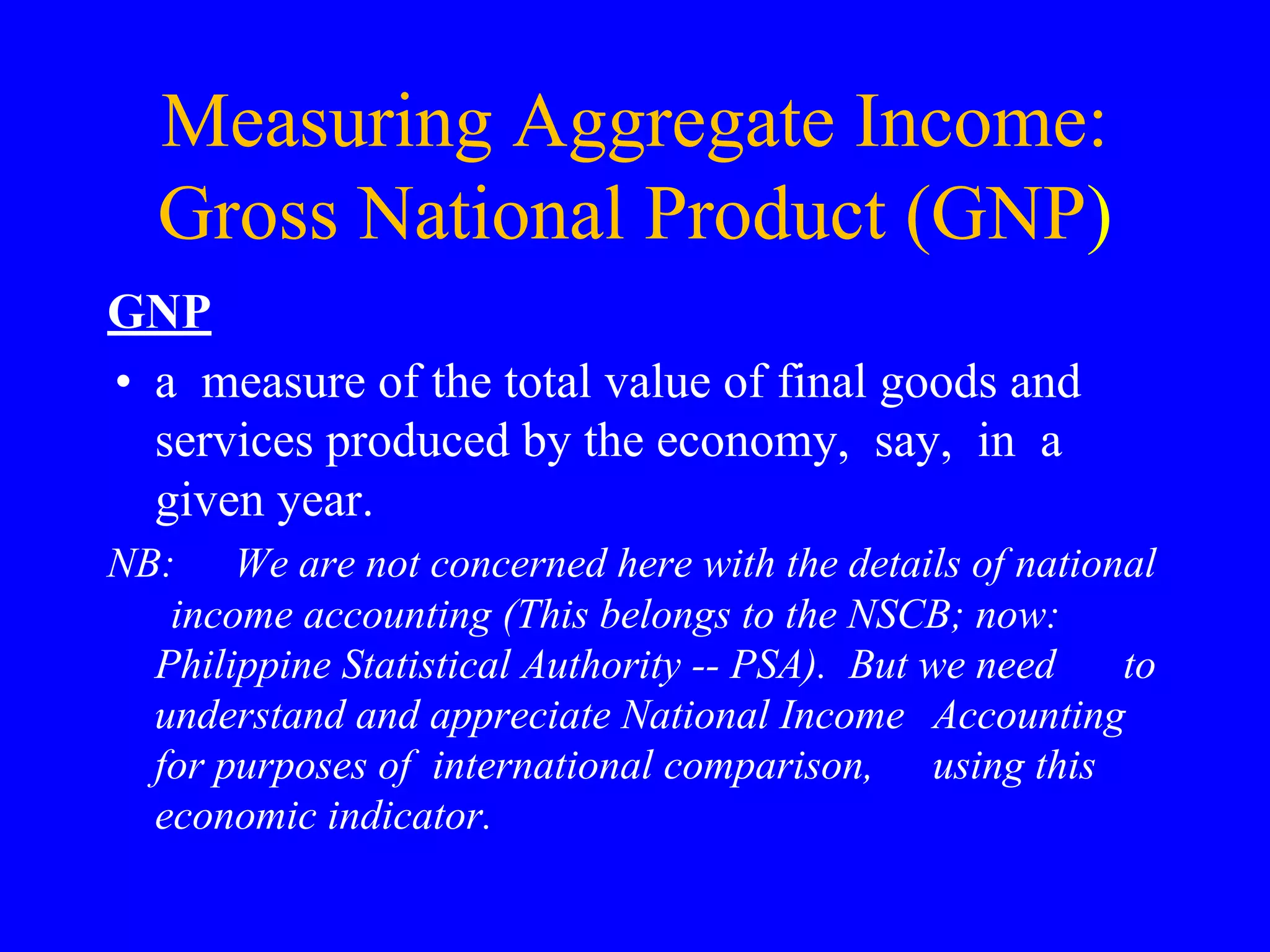
Measuring Aggregate Income:
Gross National Product (GNP)
GNP
• a measure of the total value of final goods and
services produced by the economy, say, in a
given year.
NB: We are not concerned here with the details of national
income accounting (This belongs to the NSCB; now:
Philippine Statistical Authority -- PSA). But we need to
understand and appreciate National Income Accounting
for purposes of international comparison, using this
economic indicator.
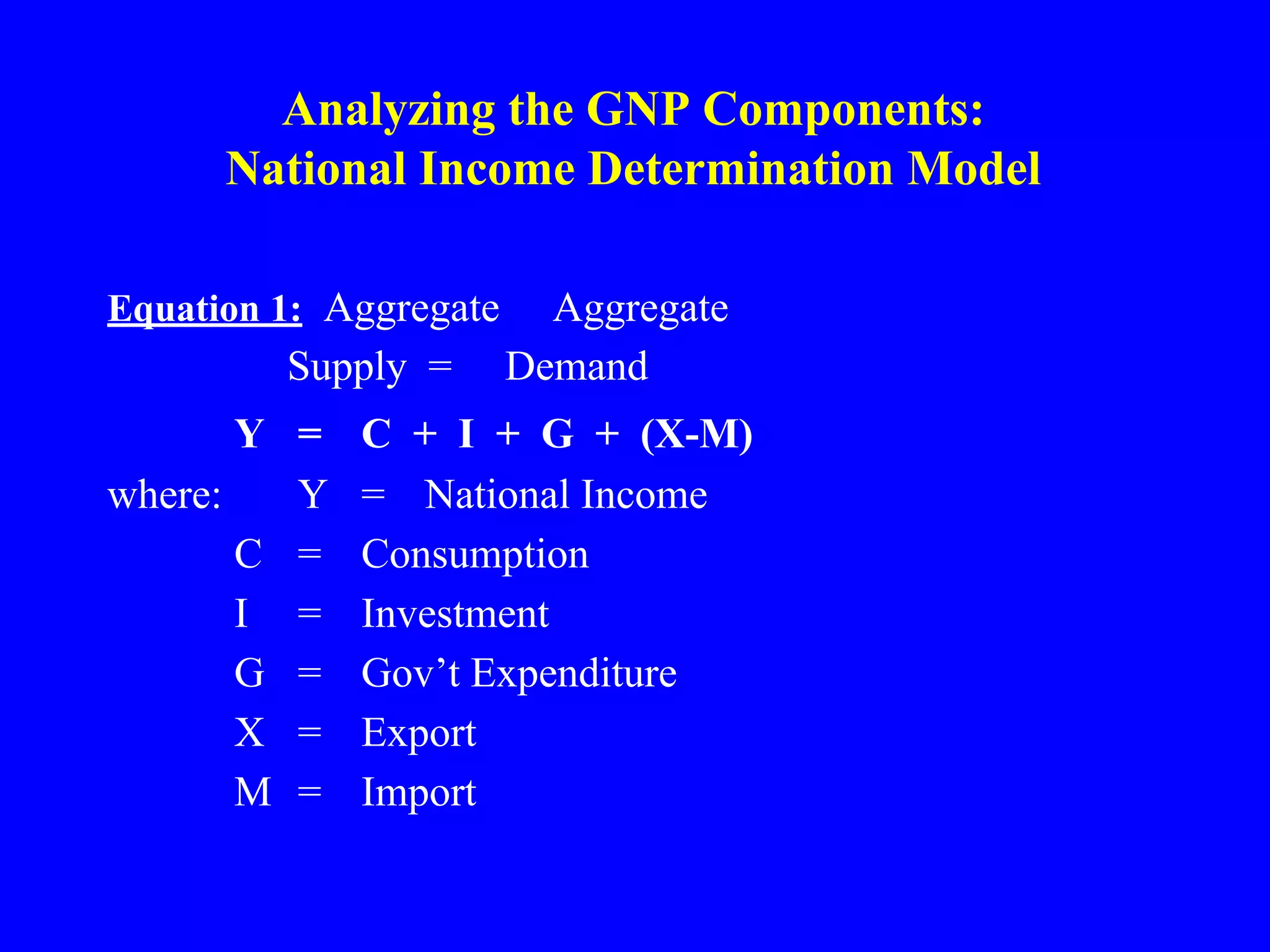
Analyzing the GNP Components:
National Income Determination Model
Equation 1: Aggregate Aggregate
Supply = Demand
Y = C + I + G + (X-M)
where: Y = National Income
C = Consumption
I = Investment
G = Gov’t Expenditure
X = Export
M = Import
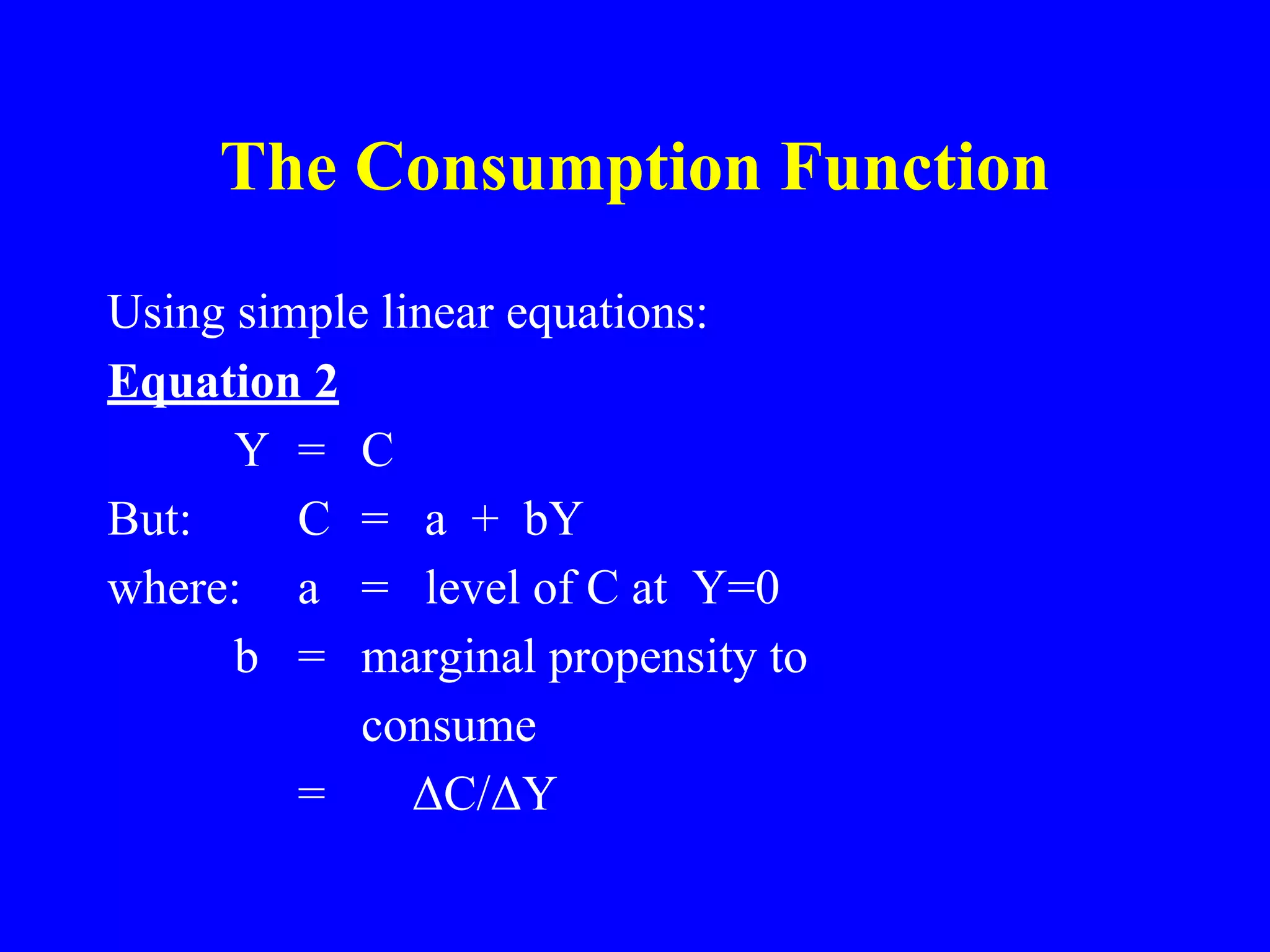
The Consumption Function
Using simple linear equations:
Equation 2
Y = C
But: C = a + bY
where: a = level of C at Y=0
b = marginal propensity to
consume
= ΔC/ΔY
Analyzing C-function
Simplifying
Equation 2: Y = C
Y = a + bY
Y - bY = a
Y[1-b] = a
Y = a/1-b
or: Y = [a] [1/1-b]
where: [1/1-b] = multiplier = k
Exercise #1: Multiplier Value
when Y = C
If mpc = b = 0.2, compute for k.
Solution:
k = [1/1-b]
k = 1/1-0.2
k = 1/0.8
Thus: k = 1.250 (Note this k-value as
our reference. Compare later when
Y-model has an added component.
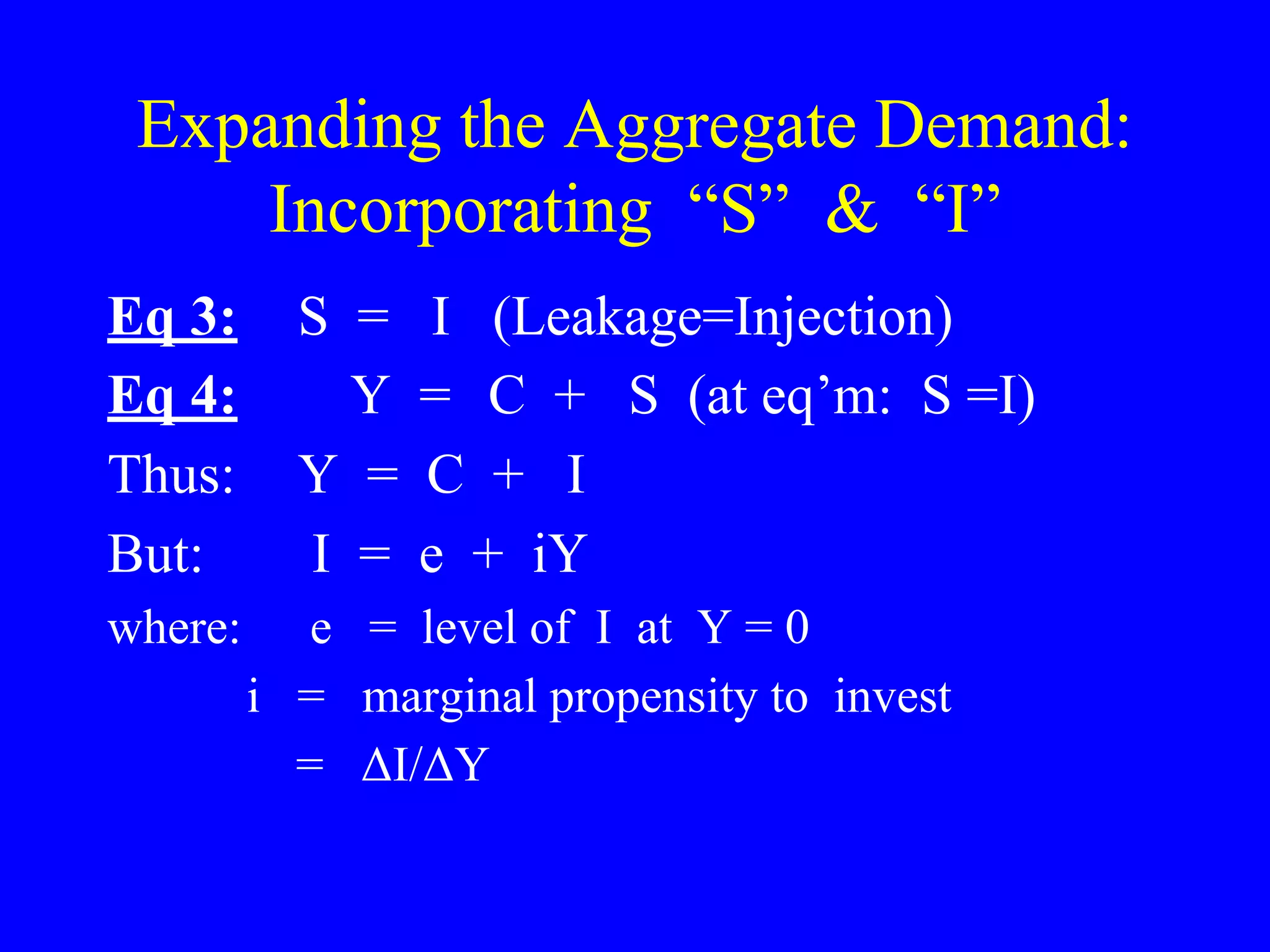
Expanding the Aggregate Demand:
Incorporating “S” & “I”
Eq 3: S = I (Leakage=Injection)
Eq 4: Y = C + S (at eq’m: S =I)
Thus: Y = C + I
But: I = e + iY
where: e = level of I at Y = 0
i = marginal propensity to invest
= ΔI/ΔY
Substituting & simplifying Eq 4:
Y = C + I
Y = a + bY + e + iY
Y -bY -iY = a + e
Y [1-b-i] = a + e
Y = [a+e]/[1-b-i]
or: Y = [a+e] [1/1-b-i]
where: [1/1-b-i] = new multiplier =k
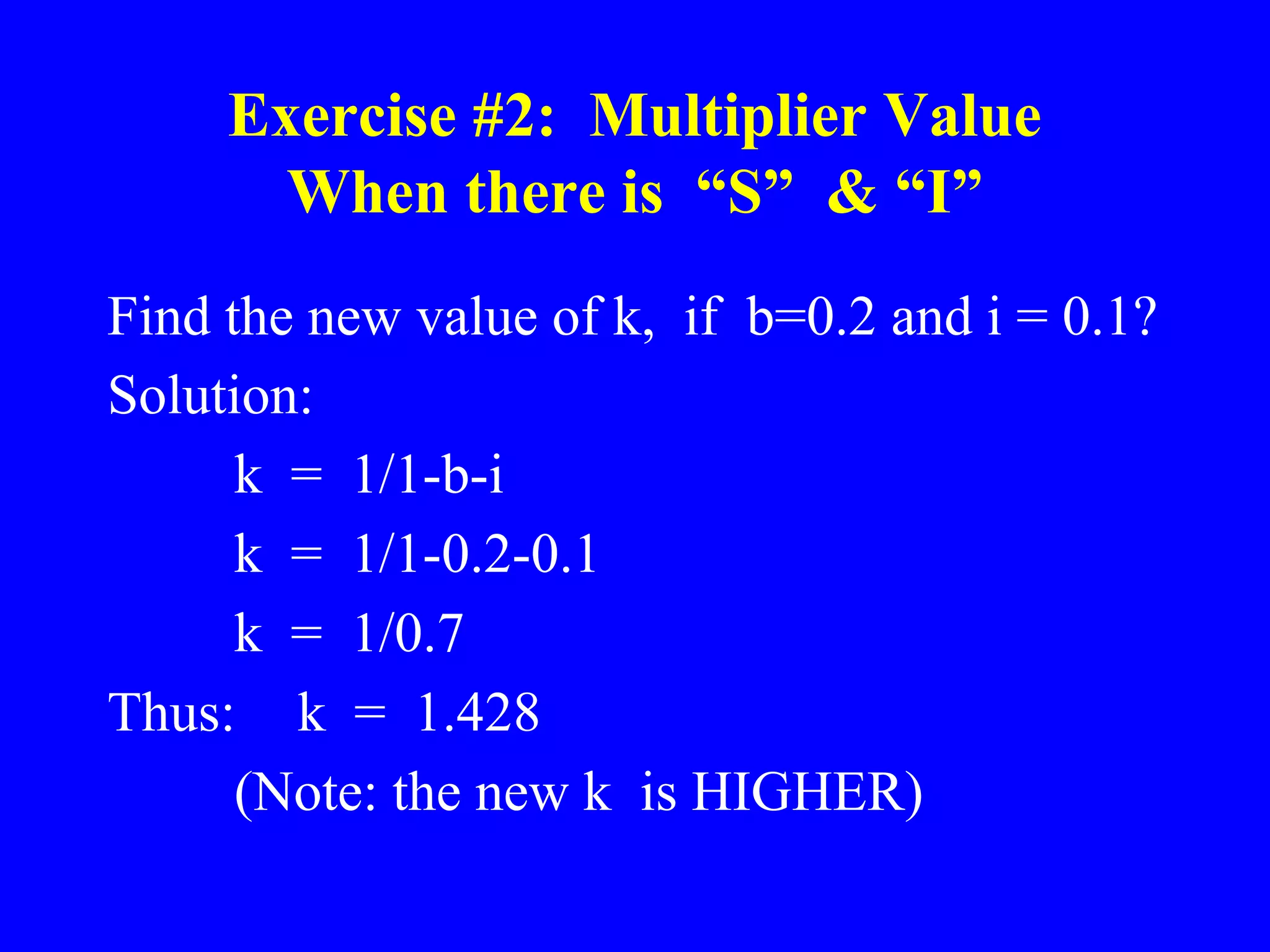
Exercise #2: Multiplier Value
When there is “S” & “I”
Find the new value of k, if b=0.2 and i = 0.1?
Solution:
k = 1/1-b-i
k = 1/1-0.2-0.1
k = 1/0.7
Thus: k = 1.428
(Note: the new k is HIGHER)
Incorporating “G”– Govt Expenditure
Eq. 5 Y = C + I + G; G=autonomous
Simplify: Y = a +bY + e + iY + G
Y-bY-iY = a +e +G
Y(1-b-i) = [a+e+G]
Y = [a+e+G]/1-b-i
Or: Y = [a+e+G] [1/1-b-i]
where: [1/1-b-i] = k (Note: k has not
changed; but Y increases due to (+G)
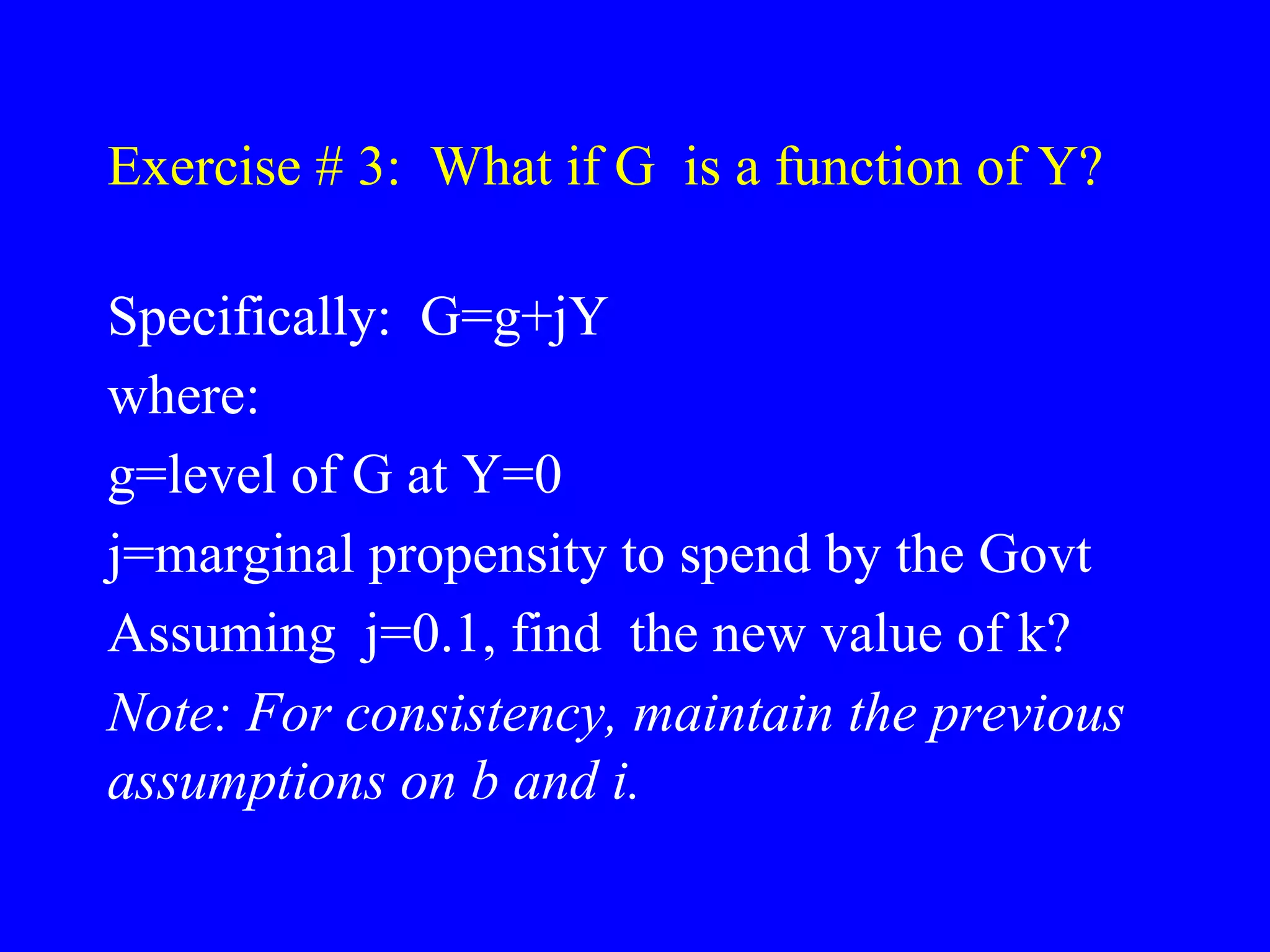
Exercise # 3: What if G is a function of Y?
Specifically: G=g+jY
where:
g=level of G at Y=0
j=marginal propensity to spend by the Govt
Assuming j=0.1, find the new value of k?
Note: For consistency, maintain the previous
assumptions on b and i.
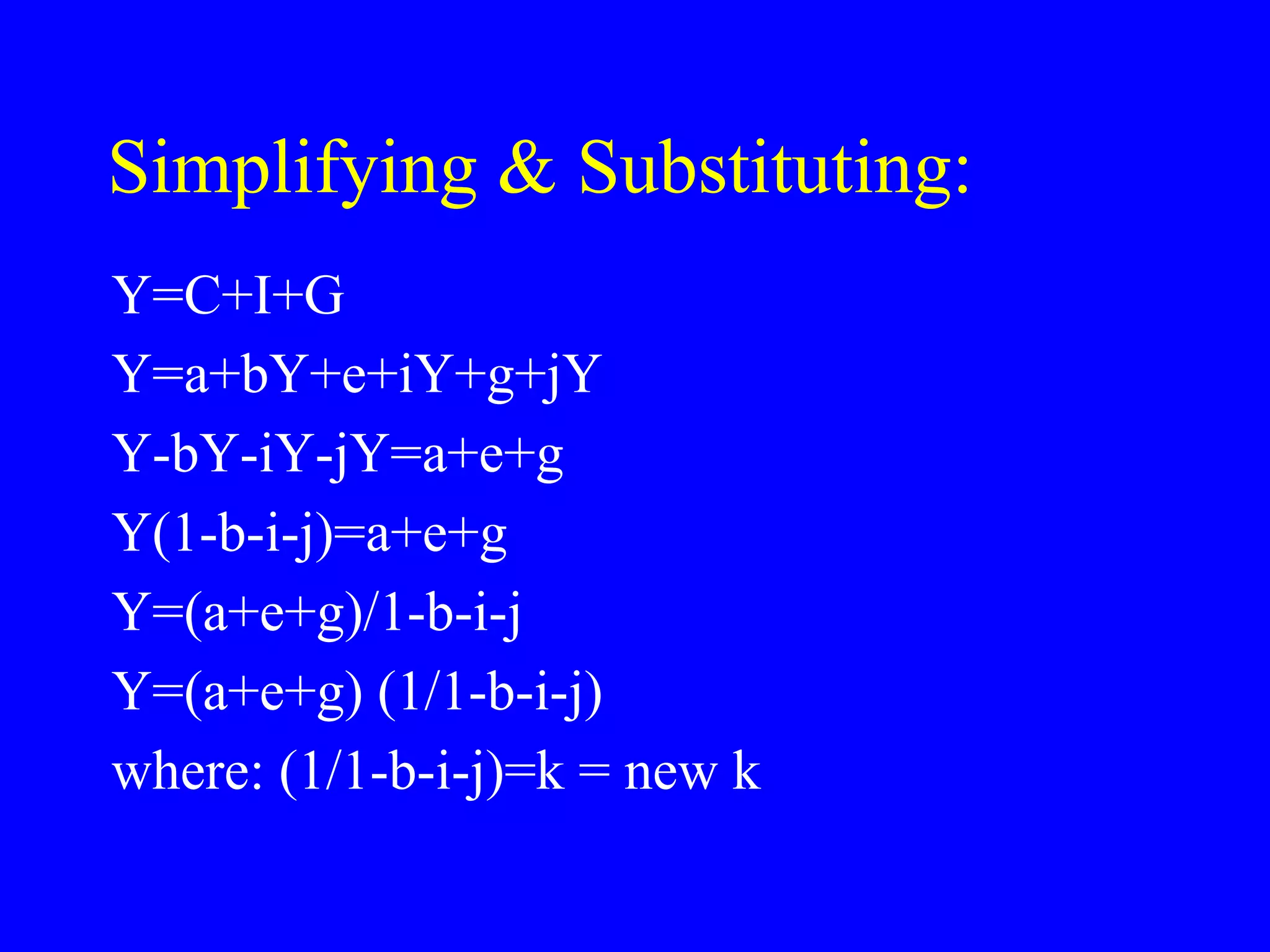
Simplifying & Substituting:
Y=C+I+G
Y=a+bY+e+iY+g+jY
Y-bY-iY-jY=a+e+g
Y(1-b-i-j)=a+e+g
Y=(a+e+g)/1-b-i-j
Y=(a+e+g) (1/1-b-i-j)
where: (1/1-b-i-j)=k = new k
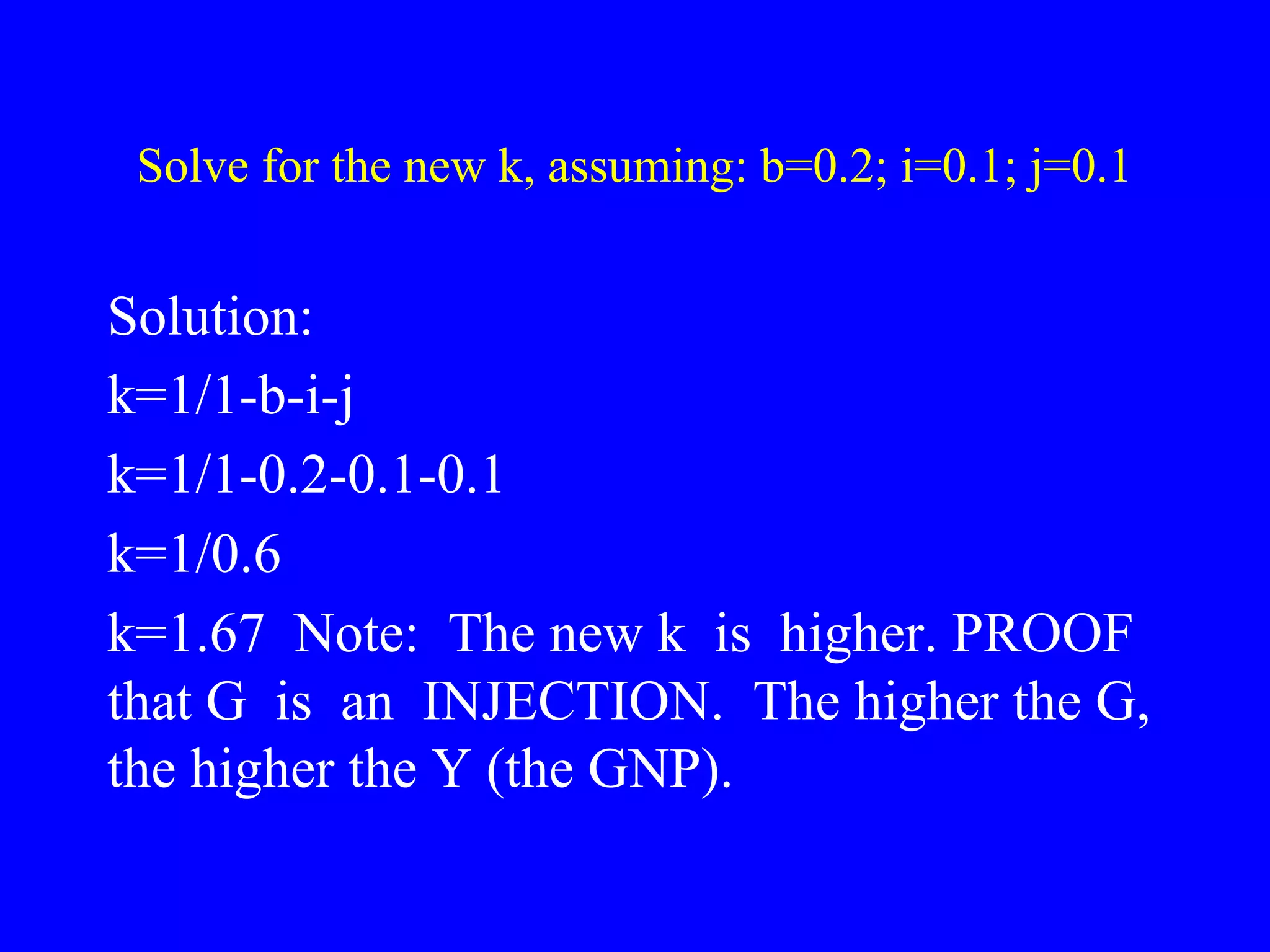
Solve for the new k, assuming: b=0.2; i=0.1; j=0.1
Solution:
k=1/1-b-i-j
k=1/1-0.2-0.1-0.1
k=1/0.6
k=1.67 Note: The new k is higher. PROOF
that G is an INJECTION. The higher the G,
the higher the Y (the GNP).
OPEN ECONOMY MODEL
Eq. 6: Y = C + I + G + [X-M]
To simplify, assume that X is autonomous
But: M = m + zY
where: m = level of M at Y=0
z = marginal propensity to
import
= ΔM/ΔY
Simplify: Y= a+bY+e+iY+G+[X-M]
Y= a+bY+e+iY+G+[X-(m+zY)]
Y= a+bY+e+iY+G+X-m-zY
Y-bY-iY+zY= a+e+G+X-m
Y(1-b-i+z) = a+e+G+X-m
Y= [a+e+G+X-m]/1-b-i+z
or: Y= [a+e+G+X-m][1/1-b-i+z]
where: [1/1-b-i+z] = the new multiplier = k
Exercise #4: Multiplier Value
with C+I+G+[X-M]
Solve for k, if b=0.2, i=0.1, and z=0.2?
Solution: k = 1/1-b-i+z
k = 1/1-0.2-0.1+0.2
k = 1/0.9
Thus: k = 1.11 (Note: the new value of
k DECREASES. Proof that M is a
leakage not an injection.)
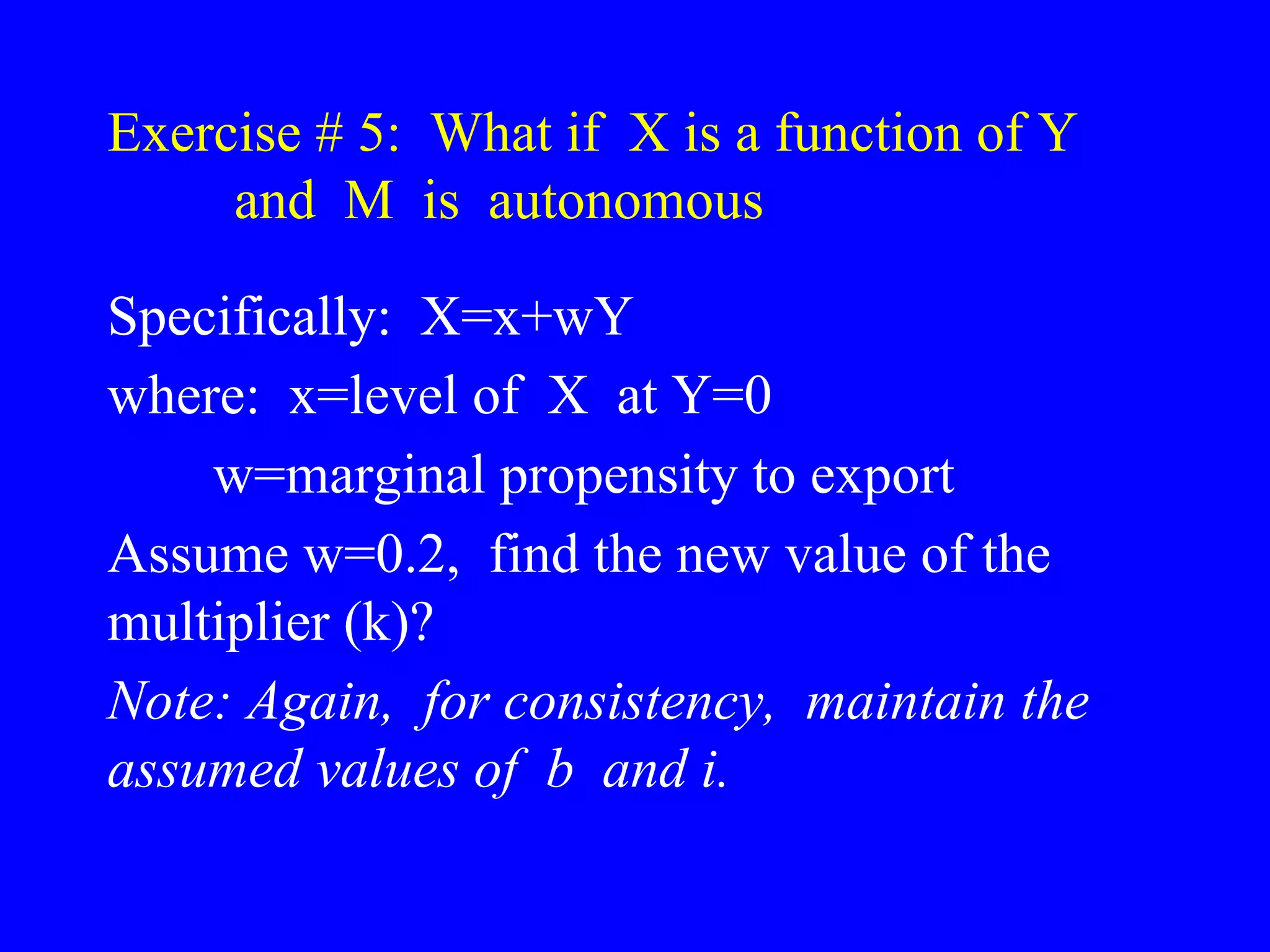
Exercise # 5: What if X is a function of Y
and M is autonomous
Specifically: X=x+wY
where: x=level of X at Y=0
w=marginal propensity to export
Assume w=0.2, find the new value of the
multiplier (k)?
Note: Again, for consistency, maintain the
assumed values of b and i.
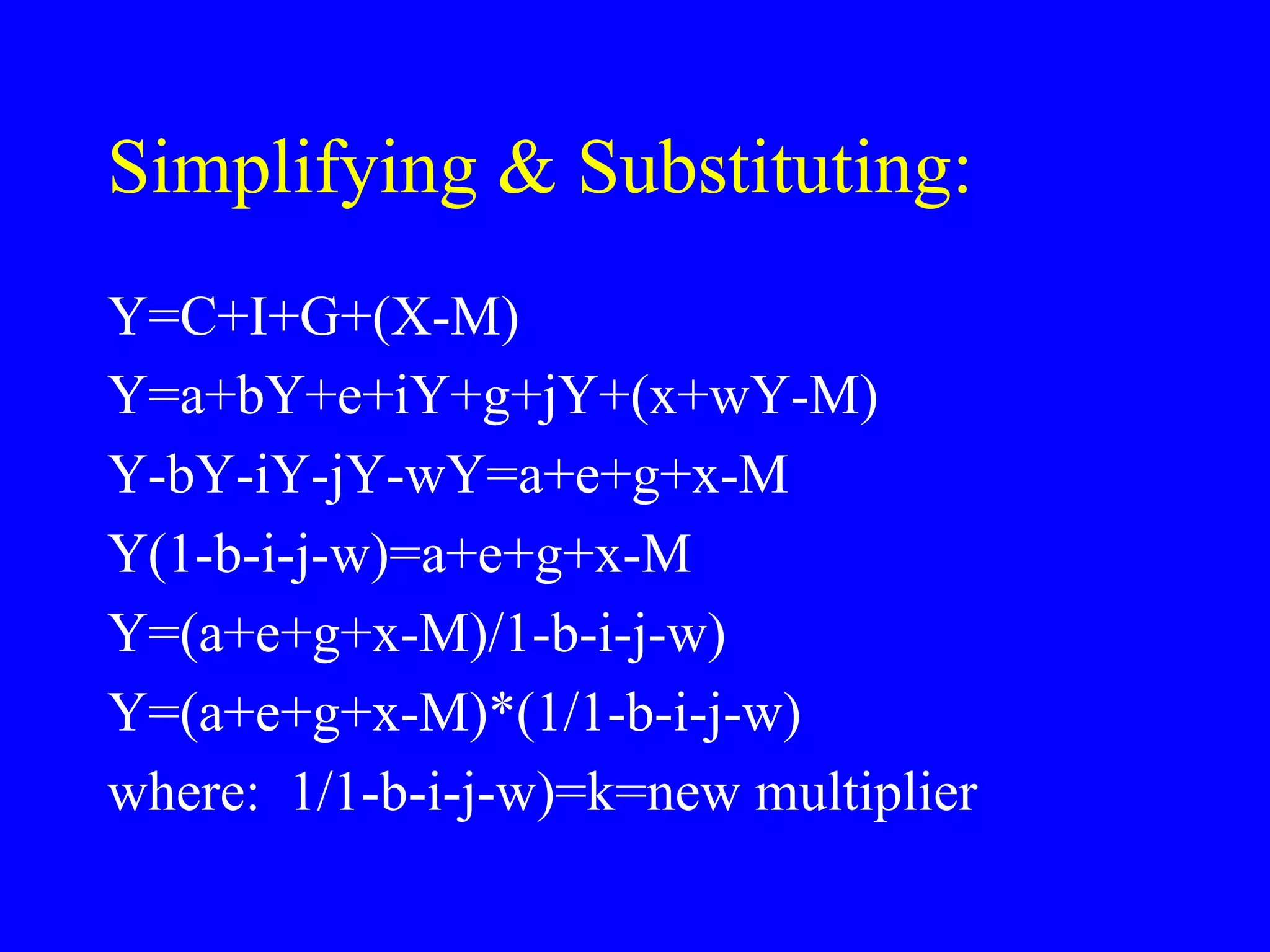
Simplifying & Substituting:
Y=C+I+G+(X-M)
Y=a+bY+e+iY+g+jY+(x+wY-M)
Y-bY-iY-jY-wY=a+e+g+x-M
Y(1-b-i-j-w)=a+e+g+x-M
Y=(a+e+g+x-M)/1-b-i-j-w)
Y=(a+e+g+x-M)*(1/1-b-i-j-w)
where: 1/1-b-i-j-w)=k=new multiplier
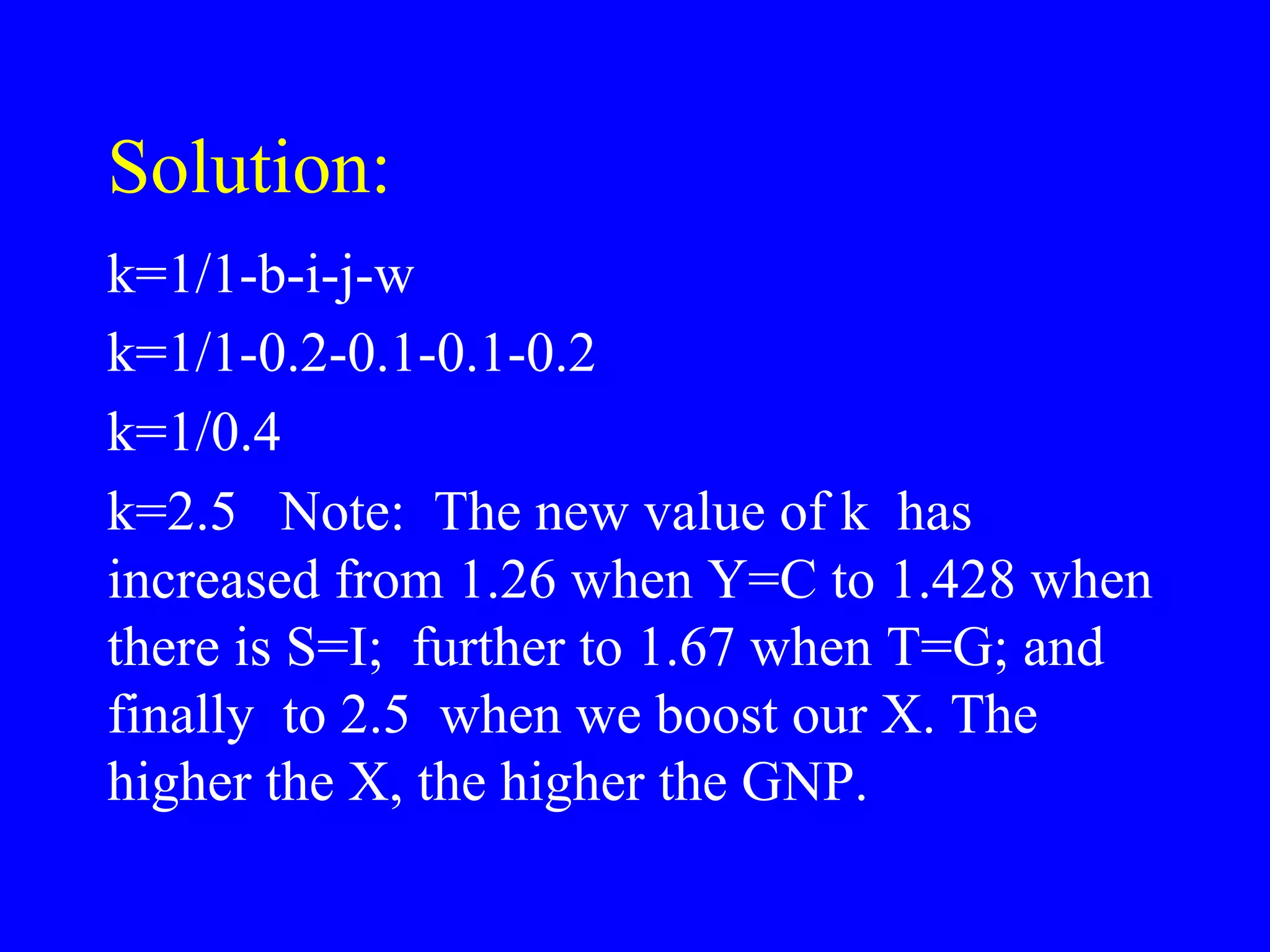
Solution:
k=1/1-b-i-j-w
k=1/1-0.2-0.1-0.1-0.2
k=1/0.4
k=2.5 Note: The new value of k has
increased from 1.26 when Y=C to 1.428 when
there is S=I; further to 1.67 when T=G; and
finally to 2.5 when we boost our X. The
higher the X, the higher the GNP.
THE END

13 System of Algebraic Model.pdf

  • 1.
    MICRO-MACRO-INTERNATIONAL SYSTEM OF ALGEBRAICMODEL EQUATIONS Sophremiano B. Antipolo, PhD, EdD, CES Professorial Lecturer
  • 2.
    Measuring Aggregate Income: GrossNational Product (GNP) GNP • a measure of the total value of final goods and services produced by the economy, say, in a given year. NB: We are not concerned here with the details of national income accounting (This belongs to the NSCB; now: Philippine Statistical Authority -- PSA). But we need to understand and appreciate National Income Accounting for purposes of international comparison, using this economic indicator.
  • 3.
    Analyzing the GNPComponents: National Income Determination Model Equation 1: Aggregate Aggregate Supply = Demand Y = C + I + G + (X-M) where: Y = National Income C = Consumption I = Investment G = Gov’t Expenditure X = Export M = Import
  • 4.
    The Consumption Function Usingsimple linear equations: Equation 2 Y = C But: C = a + bY where: a = level of C at Y=0 b = marginal propensity to consume = ΔC/ΔY
  • 5.
    Analyzing C-function Simplifying Equation 2:Y = C Y = a + bY Y - bY = a Y[1-b] = a Y = a/1-b or: Y = [a] [1/1-b] where: [1/1-b] = multiplier = k
  • 6.
    Exercise #1: MultiplierValue when Y = C If mpc = b = 0.2, compute for k. Solution: k = [1/1-b] k = 1/1-0.2 k = 1/0.8 Thus: k = 1.250 (Note this k-value as our reference. Compare later when Y-model has an added component.
  • 7.
    Expanding the AggregateDemand: Incorporating “S” & “I” Eq 3: S = I (Leakage=Injection) Eq 4: Y = C + S (at eq’m: S =I) Thus: Y = C + I But: I = e + iY where: e = level of I at Y = 0 i = marginal propensity to invest = ΔI/ΔY
  • 8.
    Substituting & simplifyingEq 4: Y = C + I Y = a + bY + e + iY Y -bY -iY = a + e Y [1-b-i] = a + e Y = [a+e]/[1-b-i] or: Y = [a+e] [1/1-b-i] where: [1/1-b-i] = new multiplier =k
  • 9.
    Exercise #2: MultiplierValue When there is “S” & “I” Find the new value of k, if b=0.2 and i = 0.1? Solution: k = 1/1-b-i k = 1/1-0.2-0.1 k = 1/0.7 Thus: k = 1.428 (Note: the new k is HIGHER)
  • 10.
    Incorporating “G”– GovtExpenditure Eq. 5 Y = C + I + G; G=autonomous Simplify: Y = a +bY + e + iY + G Y-bY-iY = a +e +G Y(1-b-i) = [a+e+G] Y = [a+e+G]/1-b-i Or: Y = [a+e+G] [1/1-b-i] where: [1/1-b-i] = k (Note: k has not changed; but Y increases due to (+G)
  • 11.
    Exercise # 3:What if G is a function of Y? Specifically: G=g+jY where: g=level of G at Y=0 j=marginal propensity to spend by the Govt Assuming j=0.1, find the new value of k? Note: For consistency, maintain the previous assumptions on b and i.
  • 12.
  • 13.
    Solve for thenew k, assuming: b=0.2; i=0.1; j=0.1 Solution: k=1/1-b-i-j k=1/1-0.2-0.1-0.1 k=1/0.6 k=1.67 Note: The new k is higher. PROOF that G is an INJECTION. The higher the G, the higher the Y (the GNP).
  • 14.
    OPEN ECONOMY MODEL Eq.6: Y = C + I + G + [X-M] To simplify, assume that X is autonomous But: M = m + zY where: m = level of M at Y=0 z = marginal propensity to import = ΔM/ΔY
  • 15.
    Simplify: Y= a+bY+e+iY+G+[X-M] Y=a+bY+e+iY+G+[X-(m+zY)] Y= a+bY+e+iY+G+X-m-zY Y-bY-iY+zY= a+e+G+X-m Y(1-b-i+z) = a+e+G+X-m Y= [a+e+G+X-m]/1-b-i+z or: Y= [a+e+G+X-m][1/1-b-i+z] where: [1/1-b-i+z] = the new multiplier = k
  • 16.
    Exercise #4: MultiplierValue with C+I+G+[X-M] Solve for k, if b=0.2, i=0.1, and z=0.2? Solution: k = 1/1-b-i+z k = 1/1-0.2-0.1+0.2 k = 1/0.9 Thus: k = 1.11 (Note: the new value of k DECREASES. Proof that M is a leakage not an injection.)
  • 17.
    Exercise # 5:What if X is a function of Y and M is autonomous Specifically: X=x+wY where: x=level of X at Y=0 w=marginal propensity to export Assume w=0.2, find the new value of the multiplier (k)? Note: Again, for consistency, maintain the assumed values of b and i.
  • 18.
  • 19.
    Solution: k=1/1-b-i-j-w k=1/1-0.2-0.1-0.1-0.2 k=1/0.4 k=2.5 Note: Thenew value of k has increased from 1.26 when Y=C to 1.428 when there is S=I; further to 1.67 when T=G; and finally to 2.5 when we boost our X. The higher the X, the higher the GNP.
  • 20.