Louis Columbus
Senior Manager, Enterprise
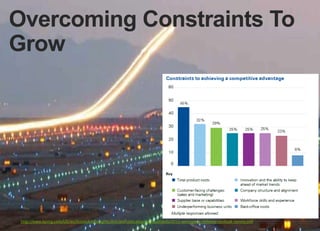
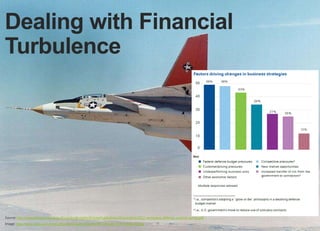
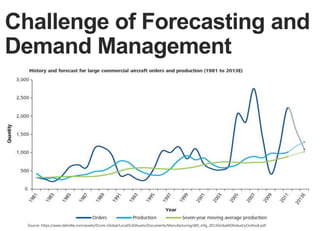
http://www.kpmg.com/US/en/IssuesAndInsights/ArticlesPublications/Documents/2012-aerospace-defense-outlook-survey.pdf
http://www.nasa.gov/centers/dryden/images/content/305729main_ECN-11648_full.jpg
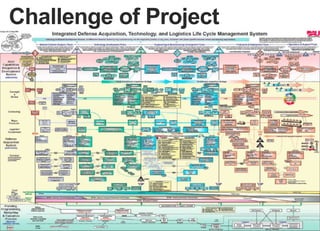
Challenge of Project-based
Manufacturing
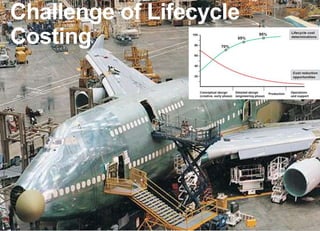
Challenge of Lifecycle
Costing
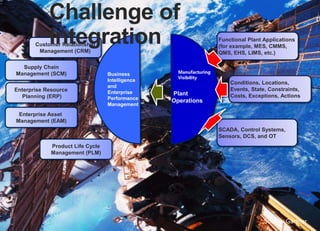
Challenge of
Integration

Customer Relationship
Management (CRM)
Supply Chain
Management (SCM)
Enterprise Resource
Planning (ERP)

Business
Intelligence
and
Enterprise
Performance
Management

Functional Plant Applications
(for example, MES, CMMS,
QMS, EHS, LIMS, etc.)

Manufacturing
Visibility

Plant
Operations

Conditions, Locations,
Events, State, Constraints,
Costs, Exceptions, Actions

Enterprise Asset
Management (EAM)
SCADA, Control Systems,
Sensors, DCS, and OT

Product Life Cycle
Management (PLM)

Source: Gartner
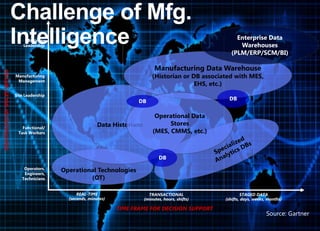
Challenge of Mfg.
Intelligence
CONTINUUM OF ROLES SERVED

Business
Leadership

Enterprise Data
Warehouses
(PLM/ERP/SCM/BI)

Manufacturing Data Warehouse

(Historian or DB associated with MES,
EHS, etc.)

Manufacturing
Management
Site Leadership

Functional/
Task Workers

DB

DB

Data Historians

Operational Data
Stores
(MES, CMMS, etc.)

DB
Operators,
Engineers,
Technicians

Operational Technologies
(OT)
REAL-TIME
(seconds, minutes)

TRANSACTIONAL
(minutes, hours, shifts)

TIME FRAME FOR DECISION SUPPORT

STAGED DATA
(shifts, days, weeks, months)

Source: Gartner
Challenge of Time-to-Market

Image source: http://www.boeing.com/companyoffices/gallery/images/military/fa18ef/e35-13-106.html
Flight Plan for 2013
Thank you!

13 ad keynote final compressed images

Editor's Notes

  • #7 Over 80% of Product Lifecycle Costs Are Locked In During DesignSource: DARPA Rapid Design Exploration and Optimization ProjectFlexibility, agility and reliabilityAn integrated view across all operationsResource and cost optimizationIncreasing information volumes and variety of support rolesBottom line: Real-time performance management requires asset, manufacturing and supply chain intelligence, and manufacturers can't afford to silo manufacturing process performance data from their asset data and supply chain execution data.If the name of the game is quicker — and cheaper — to market, the expectations of manufacturing are for flexibility, agility and resiliency.Companies must balance right first-time production across increasingly complex and regulated product supply networks and value chains. They must deal with new technology paradigms and identify supporting talent models to deal with the explosion of information and product flows which, if not harnessed, represent massive opportunities for misaligned goals (metrics, measures), higher-cost inventory Successful new product introductions generate 70% of a given A&D products’ revenue, yet must integrate from several hundred to over a thousand systems to achieve this on a consistent basis.
  • #8 Manufacturing companies are managing a convergence between IT and operations functions in manufacturing plants.Manufacturing operations systems can no longer work in silos. Manufacturing operations systems need to be connected to the enterprise systems, such as ERP to allow for data flow between such systems so the ERP has a near-real-time view of production, inventories, etc., to support the connected supply chain. Also, production execution systems need to be connected to maintenance systems so that when a piece of equipment needs to be fixed, the proper workflow can be started promptly.Establish and Maintain Manufacturing Visibility Into New Product Introduction Plans Across the Enterprise
  • #9 Adding business context to manufacturing data isn't a trivial exercise. It isn't really the natural domain of BI vendors that can't typically connect to real-time manufacturing data sources, can't deal with real-time event management and can't provide the metrics in real time or provide the analytic tools for complex manufacturing processes. EMI, in total, is an architecture that must be constructed from the models that represent multiple application domains.Define An Analytics & Intelligence Strategy To Measure Demand and Increase Forecast Accuracy