Liang, Introduction to Java Programming, Eleventh Edition, (c) 2017 Pearson Education, Inc. All
rights reserved.
1
Chapter 12 Exception Handling
and Text IO
Liang, Introduction to Java Programming, Eleventh Edition, (c) 2017 Pearson Education, Inc. All
rights reserved.
2
Motivations
When a program runs into a runtime error, the
program terminates abnormally. How can you
handle the runtime error so that the program can
continue to run or terminate gracefully? This is the
subject we will introduce in this chapter.
Liang, Introduction to Java Programming, Eleventh Edition, (c) 2017 Pearson Education, Inc. All
rights reserved.
3
Objectives
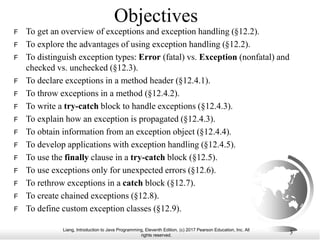
F To get an overview of exceptions and exception handling (§12.2).
F To explore the advantages of using exception handling (§12.2).
F To distinguish exception types: Error (fatal) vs. Exception (nonfatal) and
checked vs. unchecked (§12.3).
F To declare exceptions in a method header (§12.4.1).
F To throw exceptions in a method (§12.4.2).
F To write a try-catch block to handle exceptions (§12.4.3).
F To explain how an exception is propagated (§12.4.3).
F To obtain information from an exception object (§12.4.4).
F To develop applications with exception handling (§12.4.5).
F To use the finally clause in a try-catch block (§12.5).
F To use exceptions only for unexpected errors (§12.6).
F To rethrow exceptions in a catch block (§12.7).
F To create chained exceptions (§12.8).
F To define custom exception classes (§12.9).
Liang, Introduction to Java Programming, Eleventh Edition, (c) 2017 Pearson Education, Inc. All
rights reserved.
4
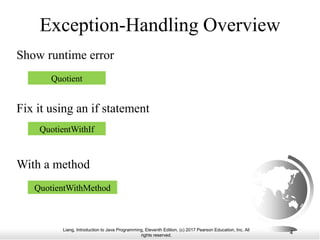
Exception-Handling Overview
Show runtime error
Fix it using an if statement
With a method
Quotient
QuotientWithIf
QuotientWithMethod
Liang, Introduction to Java Programming, Eleventh Edition, (c) 2017 Pearson Education, Inc. All
rights reserved.
5
Exception Advantages
Now you see the advantages of using exception handling.
It enables a method to throw an exception to its caller.
Without this capability, a method must handle the
exception or terminate the program.
QuotientWithException
Liang, Introduction to Java Programming, Eleventh Edition, (c) 2017 Pearson Education, Inc. All
rights reserved.
6
Handling InputMismatchException
By handling InputMismatchException, your program will
continuously read an input until it is correct.
InputMismatchExceptionDemo
Liang, Introduction to Java Programming, Eleventh Edition, (c) 2017 Pearson Education, Inc. All
rights reserved.
7
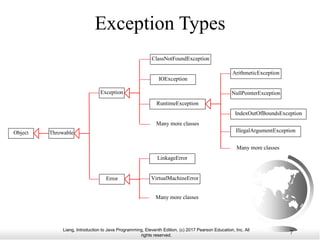
Exception Types
LinkageError
Error
Throwable
ClassNotFoundException
VirtualMachineError
IOException
Exception
RuntimeException
Object
ArithmeticException
NullPointerException
IndexOutOfBoundsException
Many more classes
Many more classes
Many more classes
IllegalArgumentException
Liang, Introduction to Java Programming, Eleventh Edition, (c) 2017 Pearson Education, Inc. All
rights reserved.
8
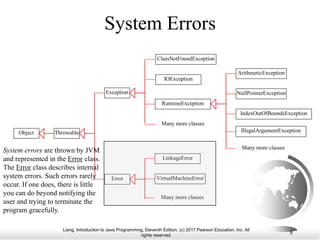
System Errors
LinkageError
Error
Throwable
ClassNotFoundException
VirtualMachineError
IOException
Exception
RuntimeException
Object
ArithmeticException
NullPointerException
IndexOutOfBoundsException
Many more classes
Many more classes
Many more classes
IllegalArgumentException
System errors are thrown by JVM
and represented in the Error class.
The Error class describes internal
system errors. Such errors rarely
occur. If one does, there is little
you can do beyond notifying the
user and trying to terminate the
program gracefully.
Liang, Introduction to Java Programming, Eleventh Edition, (c) 2017 Pearson Education, Inc. All
rights reserved.
9
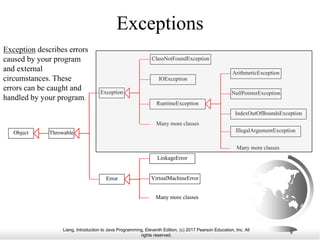
Exceptions
LinkageError
Error
Throwable
ClassNotFoundException
VirtualMachineError
IOException
Exception
RuntimeException
Object
ArithmeticException
NullPointerException
IndexOutOfBoundsException
Many more classes
Many more classes
Many more classes
IllegalArgumentException
Exception describes errors
caused by your program
and external
circumstances. These
errors can be caught and
handled by your program.
Liang, Introduction to Java Programming, Eleventh Edition, (c) 2017 Pearson Education, Inc. All
rights reserved.
10
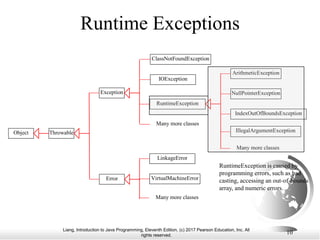
Runtime Exceptions
LinkageError
Error
Throwable
ClassNotFoundException
VirtualMachineError
IOException
Exception
RuntimeException
Object
ArithmeticException
NullPointerException
IndexOutOfBoundsException
Many more classes
Many more classes
Many more classes
IllegalArgumentException
RuntimeException is caused by
programming errors, such as bad
casting, accessing an out-of-bounds
array, and numeric errors.
Liang, Introduction to Java Programming, Eleventh Edition, (c) 2017 Pearson Education, Inc. All
rights reserved.
11
Checked Exceptions vs.
Unchecked Exceptions
RuntimeException, Error and their subclasses are
known as unchecked exceptions. All other
exceptions are known as checked exceptions,
meaning that the compiler forces the programmer
to check and deal with the exceptions.
Liang, Introduction to Java Programming, Eleventh Edition, (c) 2017 Pearson Education, Inc. All
rights reserved.
12
Unchecked Exceptions
In most cases, unchecked exceptions reflect programming
logic errors that are not recoverable. For example, a
NullPointerException is thrown if you access an object
through a reference variable before an object is assigned to
it; an IndexOutOfBoundsException is thrown if you access
an element in an array outside the bounds of the array.
These are the logic errors that should be corrected in the
program. Unchecked exceptions can occur anywhere in the
program. To avoid cumbersome overuse of try-catch
blocks, Java does not mandate you to write code to catch
unchecked exceptions.
Liang, Introduction to Java Programming, Eleventh Edition, (c) 2017 Pearson Education, Inc. All
rights reserved.
13
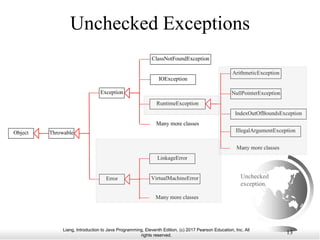
Unchecked Exceptions
LinkageError
Error
Throwable
ClassNotFoundException
VirtualMachineError
IOException
Exception
RuntimeException
Object
ArithmeticException
NullPointerException
IndexOutOfBoundsException
Many more classes
Many more classes
Many more classes
IllegalArgumentException
Unchecked
exception.
Liang, Introduction to Java Programming, Eleventh Edition, (c) 2017 Pearson Education, Inc. All
rights reserved.
14
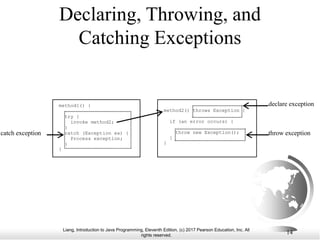
Declaring, Throwing, and
Catching Exceptions
method1() {
try {
invoke method2;
}
catch (Exception ex) {
Process exception;
}
}
method2() throws Exception {
if (an error occurs) {
throw new Exception();
}
}
catch exception throw exception
declare exception
Liang, Introduction to Java Programming, Eleventh Edition, (c) 2017 Pearson Education, Inc. All
rights reserved.
15
Declaring Exceptions
Every method must state the types of checked
exceptions it might throw. This is known as
declaring exceptions.
public void myMethod()
throws IOException
public void myMethod()
throws IOException, OtherException
Liang, Introduction to Java Programming, Eleventh Edition, (c) 2017 Pearson Education, Inc. All
rights reserved.
16
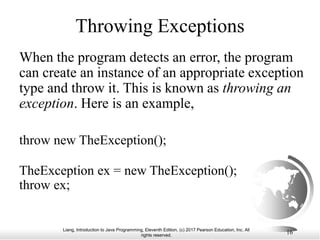
Throwing Exceptions
When the program detects an error, the program
can create an instance of an appropriate exception
type and throw it. This is known as throwing an
exception. Here is an example,
throw new TheException();
TheException ex = new TheException();
throw ex;
Liang, Introduction to Java Programming, Eleventh Edition, (c) 2017 Pearson Education, Inc. All
rights reserved.
17
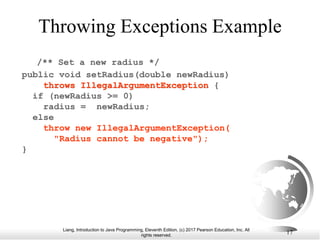
Throwing Exceptions Example
/** Set a new radius */
public void setRadius(double newRadius)
throws IllegalArgumentException {
if (newRadius >= 0)
radius = newRadius;
else
throw new IllegalArgumentException(
"Radius cannot be negative");
}
Liang, Introduction to Java Programming, Eleventh Edition, (c) 2017 Pearson Education, Inc. All
rights reserved.
18
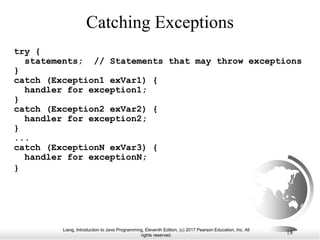
Catching Exceptions
try {
statements; // Statements that may throw exceptions
}
catch (Exception1 exVar1) {
handler for exception1;
}
catch (Exception2 exVar2) {
handler for exception2;
}
...
catch (ExceptionN exVar3) {
handler for exceptionN;
}
Liang, Introduction to Java Programming, Eleventh Edition, (c) 2017 Pearson Education, Inc. All
rights reserved.
19
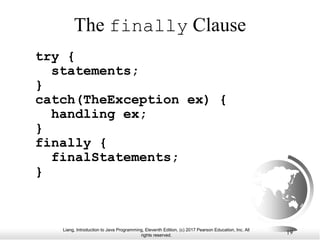
The finally Clause
try {
statements;
}
catch(TheException ex) {
handling ex;
}
finally {
finalStatements;
}
Liang, Introduction to Java Programming, Eleventh Edition, (c) 2017 Pearson Education, Inc. All
rights reserved.
20
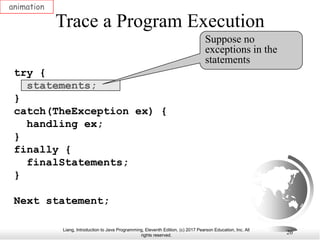
Trace a Program Execution
animation
try {
statements;
}
catch(TheException ex) {
handling ex;
}
finally {
finalStatements;
}
Next statement;
Suppose no
exceptions in the
statements
Liang, Introduction to Java Programming, Eleventh Edition, (c) 2017 Pearson Education, Inc. All
rights reserved.
21
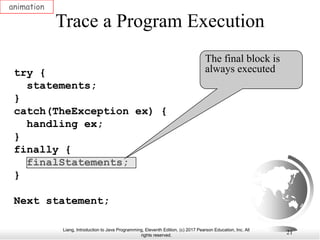
Trace a Program Execution
animation
try {
statements;
}
catch(TheException ex) {
handling ex;
}
finally {
finalStatements;
}
Next statement;
The final block is
always executed
Liang, Introduction to Java Programming, Eleventh Edition, (c) 2017 Pearson Education, Inc. All
rights reserved.
22
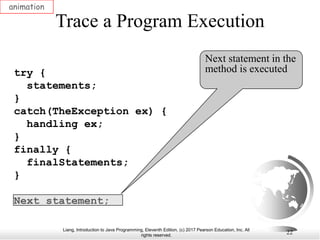
Trace a Program Execution
animation
try {
statements;
}
catch(TheException ex) {
handling ex;
}
finally {
finalStatements;
}
Next statement;
Next statement in the
method is executed
Liang, Introduction to Java Programming, Eleventh Edition, (c) 2017 Pearson Education, Inc. All
rights reserved.
23
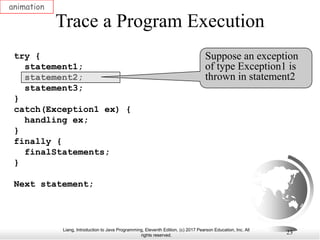
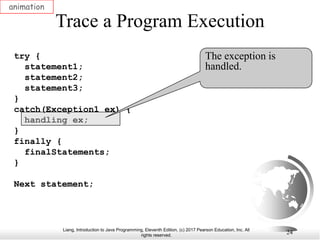
Trace a Program Execution
animation
try {
statement1;
statement2;
statement3;
}
catch(Exception1 ex) {
handling ex;
}
finally {
finalStatements;
}
Next statement;
Suppose an exception
of type Exception1 is
thrown in statement2
Liang, Introduction to Java Programming, Eleventh Edition, (c) 2017 Pearson Education, Inc. All
rights reserved.
24
Trace a Program Execution
animation
try {
statement1;
statement2;
statement3;
}
catch(Exception1 ex) {
handling ex;
}
finally {
finalStatements;
}
Next statement;
The exception is
handled.
Liang, Introduction to Java Programming, Eleventh Edition, (c) 2017 Pearson Education, Inc. All
rights reserved.
25
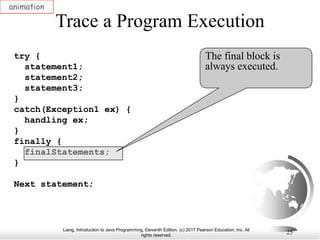
Trace a Program Execution
animation
try {
statement1;
statement2;
statement3;
}
catch(Exception1 ex) {
handling ex;
}
finally {
finalStatements;
}
Next statement;
The final block is
always executed.
Liang, Introduction to Java Programming, Eleventh Edition, (c) 2017 Pearson Education, Inc. All
rights reserved.
26
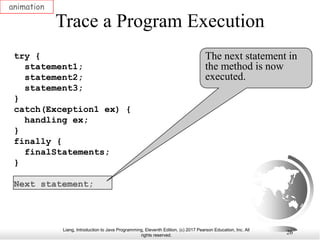
Trace a Program Execution
animation
try {
statement1;
statement2;
statement3;
}
catch(Exception1 ex) {
handling ex;
}
finally {
finalStatements;
}
Next statement;
The next statement in
the method is now
executed.
Liang, Introduction to Java Programming, Eleventh Edition, (c) 2017 Pearson Education, Inc. All
rights reserved.
27
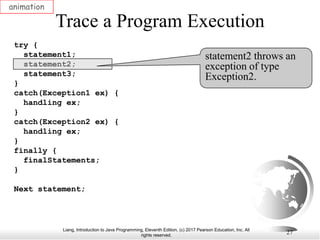
Trace a Program Execution
animation
try {
statement1;
statement2;
statement3;
}
catch(Exception1 ex) {
handling ex;
}
catch(Exception2 ex) {
handling ex;
}
finally {
finalStatements;
}
Next statement;
statement2 throws an
exception of type
Exception2.
Liang, Introduction to Java Programming, Eleventh Edition, (c) 2017 Pearson Education, Inc. All
rights reserved.
28
Trace a Program Execution
animation
try {
statement1;
statement2;
statement3;
}
catch(Exception1 ex) {
handling ex;
}
catch(Exception2 ex) {
handling ex;
}
finally {
finalStatements;
}
Next statement;
Handling exception
Liang, Introduction to Java Programming, Eleventh Edition, (c) 2017 Pearson Education, Inc. All
rights reserved.
29
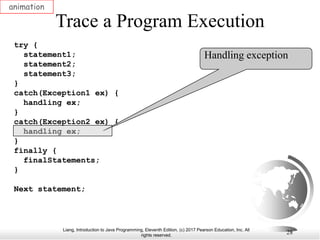
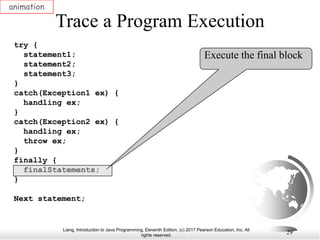
Trace a Program Execution
animation
try {
statement1;
statement2;
statement3;
}
catch(Exception1 ex) {
handling ex;
}
catch(Exception2 ex) {
handling ex;
throw ex;
}
finally {
finalStatements;
}
Next statement;
Execute the final block
Liang, Introduction to Java Programming, Eleventh Edition, (c) 2017 Pearson Education, Inc. All
rights reserved.
30
When to Throw Exceptions
An exception occurs in a method. If you want
the exception to be processed by its caller, you
should create an exception object and throw it.
If you can handle the exception in the method
where it occurs, there is no need to throw it.
Liang, Introduction to Java Programming, Eleventh Edition, (c) 2017 Pearson Education, Inc. All
rights reserved.
31
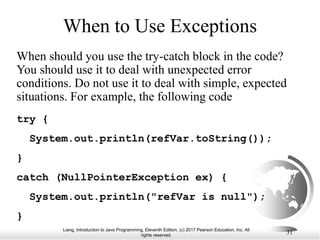
When to Use Exceptions
When should you use the try-catch block in the code?
You should use it to deal with unexpected error
conditions. Do not use it to deal with simple, expected
situations. For example, the following code
try {
System.out.println(refVar.toString());
}
catch (NullPointerException ex) {
System.out.println("refVar is null");
}
Liang, Introduction to Java Programming, Eleventh Edition, (c) 2017 Pearson Education, Inc. All
rights reserved.
32
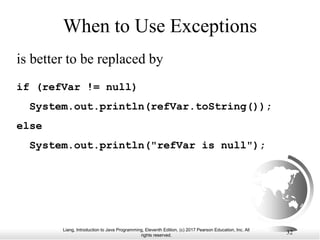
When to Use Exceptions
is better to be replaced by
if (refVar != null)
System.out.println(refVar.toString());
else
System.out.println("refVar is null");

12slide.ppt

  • 1.
    Liang, Introduction toJava Programming, Eleventh Edition, (c) 2017 Pearson Education, Inc. All rights reserved. 1 Chapter 12 Exception Handling and Text IO
  • 2.
    Liang, Introduction toJava Programming, Eleventh Edition, (c) 2017 Pearson Education, Inc. All rights reserved. 2 Motivations When a program runs into a runtime error, the program terminates abnormally. How can you handle the runtime error so that the program can continue to run or terminate gracefully? This is the subject we will introduce in this chapter.
  • 3.
    Liang, Introduction toJava Programming, Eleventh Edition, (c) 2017 Pearson Education, Inc. All rights reserved. 3 Objectives F To get an overview of exceptions and exception handling (§12.2). F To explore the advantages of using exception handling (§12.2). F To distinguish exception types: Error (fatal) vs. Exception (nonfatal) and checked vs. unchecked (§12.3). F To declare exceptions in a method header (§12.4.1). F To throw exceptions in a method (§12.4.2). F To write a try-catch block to handle exceptions (§12.4.3). F To explain how an exception is propagated (§12.4.3). F To obtain information from an exception object (§12.4.4). F To develop applications with exception handling (§12.4.5). F To use the finally clause in a try-catch block (§12.5). F To use exceptions only for unexpected errors (§12.6). F To rethrow exceptions in a catch block (§12.7). F To create chained exceptions (§12.8). F To define custom exception classes (§12.9).
  • 4.
    Liang, Introduction toJava Programming, Eleventh Edition, (c) 2017 Pearson Education, Inc. All rights reserved. 4 Exception-Handling Overview Show runtime error Fix it using an if statement With a method Quotient QuotientWithIf QuotientWithMethod
  • 5.
    Liang, Introduction toJava Programming, Eleventh Edition, (c) 2017 Pearson Education, Inc. All rights reserved. 5 Exception Advantages Now you see the advantages of using exception handling. It enables a method to throw an exception to its caller. Without this capability, a method must handle the exception or terminate the program. QuotientWithException
  • 6.
    Liang, Introduction toJava Programming, Eleventh Edition, (c) 2017 Pearson Education, Inc. All rights reserved. 6 Handling InputMismatchException By handling InputMismatchException, your program will continuously read an input until it is correct. InputMismatchExceptionDemo
  • 7.
    Liang, Introduction toJava Programming, Eleventh Edition, (c) 2017 Pearson Education, Inc. All rights reserved. 7 Exception Types LinkageError Error Throwable ClassNotFoundException VirtualMachineError IOException Exception RuntimeException Object ArithmeticException NullPointerException IndexOutOfBoundsException Many more classes Many more classes Many more classes IllegalArgumentException
  • 8.
    Liang, Introduction toJava Programming, Eleventh Edition, (c) 2017 Pearson Education, Inc. All rights reserved. 8 System Errors LinkageError Error Throwable ClassNotFoundException VirtualMachineError IOException Exception RuntimeException Object ArithmeticException NullPointerException IndexOutOfBoundsException Many more classes Many more classes Many more classes IllegalArgumentException System errors are thrown by JVM and represented in the Error class. The Error class describes internal system errors. Such errors rarely occur. If one does, there is little you can do beyond notifying the user and trying to terminate the program gracefully.
  • 9.
    Liang, Introduction toJava Programming, Eleventh Edition, (c) 2017 Pearson Education, Inc. All rights reserved. 9 Exceptions LinkageError Error Throwable ClassNotFoundException VirtualMachineError IOException Exception RuntimeException Object ArithmeticException NullPointerException IndexOutOfBoundsException Many more classes Many more classes Many more classes IllegalArgumentException Exception describes errors caused by your program and external circumstances. These errors can be caught and handled by your program.
  • 10.
    Liang, Introduction toJava Programming, Eleventh Edition, (c) 2017 Pearson Education, Inc. All rights reserved. 10 Runtime Exceptions LinkageError Error Throwable ClassNotFoundException VirtualMachineError IOException Exception RuntimeException Object ArithmeticException NullPointerException IndexOutOfBoundsException Many more classes Many more classes Many more classes IllegalArgumentException RuntimeException is caused by programming errors, such as bad casting, accessing an out-of-bounds array, and numeric errors.
  • 11.
    Liang, Introduction toJava Programming, Eleventh Edition, (c) 2017 Pearson Education, Inc. All rights reserved. 11 Checked Exceptions vs. Unchecked Exceptions RuntimeException, Error and their subclasses are known as unchecked exceptions. All other exceptions are known as checked exceptions, meaning that the compiler forces the programmer to check and deal with the exceptions.
  • 12.
    Liang, Introduction toJava Programming, Eleventh Edition, (c) 2017 Pearson Education, Inc. All rights reserved. 12 Unchecked Exceptions In most cases, unchecked exceptions reflect programming logic errors that are not recoverable. For example, a NullPointerException is thrown if you access an object through a reference variable before an object is assigned to it; an IndexOutOfBoundsException is thrown if you access an element in an array outside the bounds of the array. These are the logic errors that should be corrected in the program. Unchecked exceptions can occur anywhere in the program. To avoid cumbersome overuse of try-catch blocks, Java does not mandate you to write code to catch unchecked exceptions.
  • 13.
    Liang, Introduction toJava Programming, Eleventh Edition, (c) 2017 Pearson Education, Inc. All rights reserved. 13 Unchecked Exceptions LinkageError Error Throwable ClassNotFoundException VirtualMachineError IOException Exception RuntimeException Object ArithmeticException NullPointerException IndexOutOfBoundsException Many more classes Many more classes Many more classes IllegalArgumentException Unchecked exception.
  • 14.
    Liang, Introduction toJava Programming, Eleventh Edition, (c) 2017 Pearson Education, Inc. All rights reserved. 14 Declaring, Throwing, and Catching Exceptions method1() { try { invoke method2; } catch (Exception ex) { Process exception; } } method2() throws Exception { if (an error occurs) { throw new Exception(); } } catch exception throw exception declare exception
  • 15.
    Liang, Introduction toJava Programming, Eleventh Edition, (c) 2017 Pearson Education, Inc. All rights reserved. 15 Declaring Exceptions Every method must state the types of checked exceptions it might throw. This is known as declaring exceptions. public void myMethod() throws IOException public void myMethod() throws IOException, OtherException
  • 16.
    Liang, Introduction toJava Programming, Eleventh Edition, (c) 2017 Pearson Education, Inc. All rights reserved. 16 Throwing Exceptions When the program detects an error, the program can create an instance of an appropriate exception type and throw it. This is known as throwing an exception. Here is an example, throw new TheException(); TheException ex = new TheException(); throw ex;
  • 17.
    Liang, Introduction toJava Programming, Eleventh Edition, (c) 2017 Pearson Education, Inc. All rights reserved. 17 Throwing Exceptions Example /** Set a new radius */ public void setRadius(double newRadius) throws IllegalArgumentException { if (newRadius >= 0) radius = newRadius; else throw new IllegalArgumentException( "Radius cannot be negative"); }
  • 18.
    Liang, Introduction toJava Programming, Eleventh Edition, (c) 2017 Pearson Education, Inc. All rights reserved. 18 Catching Exceptions try { statements; // Statements that may throw exceptions } catch (Exception1 exVar1) { handler for exception1; } catch (Exception2 exVar2) { handler for exception2; } ... catch (ExceptionN exVar3) { handler for exceptionN; }
  • 19.
    Liang, Introduction toJava Programming, Eleventh Edition, (c) 2017 Pearson Education, Inc. All rights reserved. 19 The finally Clause try { statements; } catch(TheException ex) { handling ex; } finally { finalStatements; }
  • 20.
    Liang, Introduction toJava Programming, Eleventh Edition, (c) 2017 Pearson Education, Inc. All rights reserved. 20 Trace a Program Execution animation try { statements; } catch(TheException ex) { handling ex; } finally { finalStatements; } Next statement; Suppose no exceptions in the statements
  • 21.
    Liang, Introduction toJava Programming, Eleventh Edition, (c) 2017 Pearson Education, Inc. All rights reserved. 21 Trace a Program Execution animation try { statements; } catch(TheException ex) { handling ex; } finally { finalStatements; } Next statement; The final block is always executed
  • 22.
    Liang, Introduction toJava Programming, Eleventh Edition, (c) 2017 Pearson Education, Inc. All rights reserved. 22 Trace a Program Execution animation try { statements; } catch(TheException ex) { handling ex; } finally { finalStatements; } Next statement; Next statement in the method is executed
  • 23.
    Liang, Introduction toJava Programming, Eleventh Edition, (c) 2017 Pearson Education, Inc. All rights reserved. 23 Trace a Program Execution animation try { statement1; statement2; statement3; } catch(Exception1 ex) { handling ex; } finally { finalStatements; } Next statement; Suppose an exception of type Exception1 is thrown in statement2
  • 24.
    Liang, Introduction toJava Programming, Eleventh Edition, (c) 2017 Pearson Education, Inc. All rights reserved. 24 Trace a Program Execution animation try { statement1; statement2; statement3; } catch(Exception1 ex) { handling ex; } finally { finalStatements; } Next statement; The exception is handled.
  • 25.
    Liang, Introduction toJava Programming, Eleventh Edition, (c) 2017 Pearson Education, Inc. All rights reserved. 25 Trace a Program Execution animation try { statement1; statement2; statement3; } catch(Exception1 ex) { handling ex; } finally { finalStatements; } Next statement; The final block is always executed.
  • 26.
    Liang, Introduction toJava Programming, Eleventh Edition, (c) 2017 Pearson Education, Inc. All rights reserved. 26 Trace a Program Execution animation try { statement1; statement2; statement3; } catch(Exception1 ex) { handling ex; } finally { finalStatements; } Next statement; The next statement in the method is now executed.
  • 27.
    Liang, Introduction toJava Programming, Eleventh Edition, (c) 2017 Pearson Education, Inc. All rights reserved. 27 Trace a Program Execution animation try { statement1; statement2; statement3; } catch(Exception1 ex) { handling ex; } catch(Exception2 ex) { handling ex; } finally { finalStatements; } Next statement; statement2 throws an exception of type Exception2.
  • 28.
    Liang, Introduction toJava Programming, Eleventh Edition, (c) 2017 Pearson Education, Inc. All rights reserved. 28 Trace a Program Execution animation try { statement1; statement2; statement3; } catch(Exception1 ex) { handling ex; } catch(Exception2 ex) { handling ex; } finally { finalStatements; } Next statement; Handling exception
  • 29.
    Liang, Introduction toJava Programming, Eleventh Edition, (c) 2017 Pearson Education, Inc. All rights reserved. 29 Trace a Program Execution animation try { statement1; statement2; statement3; } catch(Exception1 ex) { handling ex; } catch(Exception2 ex) { handling ex; throw ex; } finally { finalStatements; } Next statement; Execute the final block
  • 30.
    Liang, Introduction toJava Programming, Eleventh Edition, (c) 2017 Pearson Education, Inc. All rights reserved. 30 When to Throw Exceptions An exception occurs in a method. If you want the exception to be processed by its caller, you should create an exception object and throw it. If you can handle the exception in the method where it occurs, there is no need to throw it.
  • 31.
    Liang, Introduction toJava Programming, Eleventh Edition, (c) 2017 Pearson Education, Inc. All rights reserved. 31 When to Use Exceptions When should you use the try-catch block in the code? You should use it to deal with unexpected error conditions. Do not use it to deal with simple, expected situations. For example, the following code try { System.out.println(refVar.toString()); } catch (NullPointerException ex) { System.out.println("refVar is null"); }
  • 32.
    Liang, Introduction toJava Programming, Eleventh Edition, (c) 2017 Pearson Education, Inc. All rights reserved. 32 When to Use Exceptions is better to be replaced by if (refVar != null) System.out.println(refVar.toString()); else System.out.println("refVar is null");