PART 7 THE CIRCULAR FLOW AND ECONOMIC FLUCTUATIONS Chapter 15 The Circular Flow 15-
Lecture Plan The exchange flow between households and the business sector The two-sector economy The exchange flows with financial markets The financial sector and the three-sector economy The exchange flows between households, businesses and government The government sector and the four-sector economy Exchange flows with other countries The overseas sector and the five-sector (open) economy 15-
The Circular Flow of Goods and Money In a capitalistic/mixed economy money is used to Buy and sell goods and resources in markets Pay and collect taxes Borrow and lend in financial markets The ABS structures the Australian national accounts around the five sectors of the economy i.e. Businesses, households Financial, government, overseas sectors 15-
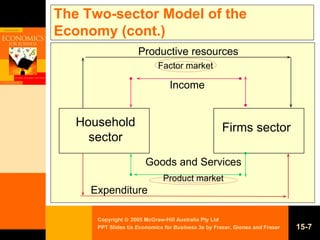
The Two-sector Model of the Economy (Households and Firms)  The households  (consumers): Require goods and services to satisfy their   personal wants Own all resources (i.e. labour, capital, land, enterprise)  Sell resources to businesses Gain income (e.g. wage, interest, rent, profit) from such sales The firms/business sector  (producers): Uses resources provided by households to produce goods and services Sells those goods and services for income 15-
The Two-sector Model of the Economy Assumptions: Businesses are the only producers All goods and services are sold to consumers Consumers spend ALL their income on goods and services There are no resource inventories Therefore: Total demand (expenditure) = total supply (output)  The economy will always be in  equilibrium 15- (cont.)
The Two-sector Model of the Economy (cont.) Two groups of decision makers Households (sell their resources) Firms (sell goods and services) Interaction between the two sectors through markets: Resource (factor)  markets Product  markets 15- (cont.)
15- Productive resources Income Expenditure Goods and Services Household sector Product market Firms sector Factor market The Two-sector Model of the Economy (cont.)
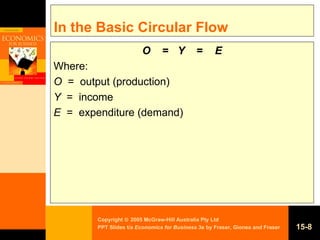
In the Basic Circular Flow O   =  Y   =  E Where: O  =  output (production) Y   =  income E   =  expenditure (demand) 15-
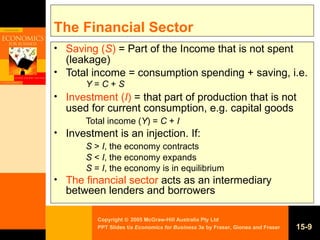
The Financial Sector Saving ( S )  = Part of the Income that is not spent (leakage) Total income = consumption spending + saving, i.e.  Y  =  C  +  S Investment ( I )  = that part of production that is not used for current consumption, e.g. capital goods Total income ( Y ) =  C  +  I Investment is an injection. If: S  >  I , the economy contracts S  <  I , the economy expands S  =  I , the economy is in equilibrium The financial sector  acts as an intermediary between lenders and borrowers 15-
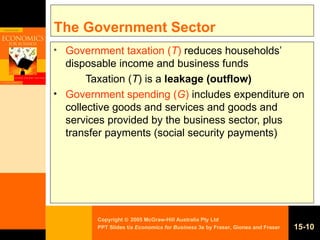
The Government Sector  Government taxation ( T )  reduces households’ disposable income and business funds Taxation ( T )   is a  leakage (outflow)   Government spending ( G )   includes expenditure on collective goods and services and goods and services provided by the business sector, plus transfer payments (social security payments) 15-
The Modified Five-sector Model of the Economy  It is a  five-sector model  of the economy: The household sector T he firms sector The government sector The financial sector The external (overseas) sector 15-
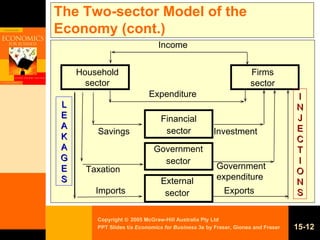
15- The Two-sector Model of the Economy (cont.) Household sector Financial sector Government sector External sector Firms sector Imports Savings Government expenditure Exports Taxation Investment INJECTIONS LEAKAGES Expenditure Income
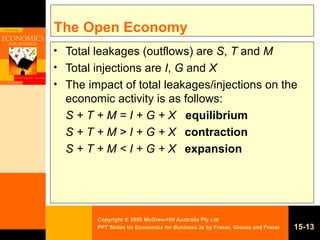
The Open Economy Total leakages (outflows) are  S ,  T  and  M Total injections are  I ,  G  and  X The impact of total leakages/injections on the economic activity is as follows: S + T + M = I + G + X  equilibrium S + T + M > I + G + X   contraction S + T + M < I + G + X   expansion 15-

12680 nat inc flow.ppt

  • 1.
    PART 7 THECIRCULAR FLOW AND ECONOMIC FLUCTUATIONS Chapter 15 The Circular Flow 15-
  • 2.
    Lecture Plan Theexchange flow between households and the business sector The two-sector economy The exchange flows with financial markets The financial sector and the three-sector economy The exchange flows between households, businesses and government The government sector and the four-sector economy Exchange flows with other countries The overseas sector and the five-sector (open) economy 15-
  • 3.
    The Circular Flowof Goods and Money In a capitalistic/mixed economy money is used to Buy and sell goods and resources in markets Pay and collect taxes Borrow and lend in financial markets The ABS structures the Australian national accounts around the five sectors of the economy i.e. Businesses, households Financial, government, overseas sectors 15-
  • 4.
    The Two-sector Modelof the Economy (Households and Firms) The households (consumers): Require goods and services to satisfy their personal wants Own all resources (i.e. labour, capital, land, enterprise) Sell resources to businesses Gain income (e.g. wage, interest, rent, profit) from such sales The firms/business sector (producers): Uses resources provided by households to produce goods and services Sells those goods and services for income 15-
  • 5.
    The Two-sector Modelof the Economy Assumptions: Businesses are the only producers All goods and services are sold to consumers Consumers spend ALL their income on goods and services There are no resource inventories Therefore: Total demand (expenditure) = total supply (output) The economy will always be in equilibrium 15- (cont.)
  • 6.
    The Two-sector Modelof the Economy (cont.) Two groups of decision makers Households (sell their resources) Firms (sell goods and services) Interaction between the two sectors through markets: Resource (factor) markets Product markets 15- (cont.)
  • 7.
    15- Productive resourcesIncome Expenditure Goods and Services Household sector Product market Firms sector Factor market The Two-sector Model of the Economy (cont.)
  • 8.
    In the BasicCircular Flow O = Y = E Where: O = output (production) Y = income E = expenditure (demand) 15-
  • 9.
    The Financial SectorSaving ( S ) = Part of the Income that is not spent (leakage) Total income = consumption spending + saving, i.e. Y = C + S Investment ( I ) = that part of production that is not used for current consumption, e.g. capital goods Total income ( Y ) = C + I Investment is an injection. If: S > I , the economy contracts S < I , the economy expands S = I , the economy is in equilibrium The financial sector acts as an intermediary between lenders and borrowers 15-
  • 10.
    The Government Sector Government taxation ( T ) reduces households’ disposable income and business funds Taxation ( T ) is a leakage (outflow) Government spending ( G ) includes expenditure on collective goods and services and goods and services provided by the business sector, plus transfer payments (social security payments) 15-
  • 11.
    The Modified Five-sectorModel of the Economy It is a five-sector model of the economy: The household sector T he firms sector The government sector The financial sector The external (overseas) sector 15-
  • 12.
    15- The Two-sectorModel of the Economy (cont.) Household sector Financial sector Government sector External sector Firms sector Imports Savings Government expenditure Exports Taxation Investment INJECTIONS LEAKAGES Expenditure Income
  • 13.
    The Open EconomyTotal leakages (outflows) are S , T and M Total injections are I , G and X The impact of total leakages/injections on the economic activity is as follows: S + T + M = I + G + X equilibrium S + T + M > I + G + X contraction S + T + M < I + G + X expansion 15-