Homework Help
https://www.homeworkping.com/
Research Paper help
https://www.homeworkping.com/
Online Tutoring
https://www.homeworkping.com/
click here for freelancing tutoring sites
Republic of the Philippines
SUPREME COURT
Manila
SECOND DIVISION
G.R. No. 183404 October 13, 2010
BERRIS AGRICULTURAL CO., INC., Petitioner,
vs.
NORVY ABYADANG, Respondent.
D E C I S I O N
NACHURA, J.:
This petition for review1
on certiorari under Rule 45 of the Rules of Court seeks the
reversal of the Decision dated April 14, 20082
and the Resolution dated June 18,
20083
of the Court of Appeals (CA) in CA-G.R. SP No. 99928.
The antecedents—
On January 16, 2004, respondent Norvy A. Abyadang (Abyadang), proprietor of NS
Northern Organic Fertilizer, with address at No. 43 Lower QM, Baguio City, filed
with the Intellectual Property Office (IPO) a trademark application for the mark "NS
D-10 PLUS" for use in connection with Fungicide (Class 5) with active ingredient
80% Mancozeb. The application, under Application Serial No. 4-2004-00450, was
given due course and was published in the IPO e-Gazette for opposition on July 28,
2005.
On August 17, 2005, petitioner Berris Agricultural Co., Inc. (Berris), with business
address in Barangay Masiit, Calauan, Laguna, filed with the IPO Bureau of Legal
Affairs (IPO-BLA) a Verified Notice of Opposition4
against the mark under
application allegedly because "NS D-10 PLUS" is similar and/or confusingly similar
to its registered trademark "D-10 80 WP," also used for Fungicide (Class 5) with
active ingredient 80% Mancozeb. The opposition was docketed as IPC No. 14-2005-
00099.
After an exchange of pleadings, on April 28, 2006, Director Estrellita Beltran-
Abelardo (Director Abelardo) of the IPO-BLA issued Decision No. 2006-245
(BLA
decision), the dispositive portion of which reads—
WHEREFORE, viewed in the light of all the foregoing, this Bureau finds and so
holds that Respondent-Applicant’s mark "NS D-10 PLUS" is confusingly similar to
the Opposer’s mark and as such, the opposition is hereby SUSTAINED.
Consequently, trademark application bearing Serial No. 4-2004-00450 for the mark
"NS D-10 PLUS" filed on January 16, 2004 by Norvy A. Ab[yada]ng covering the
goods fungicide under Class 5 of the International Classification of goods is, as it is
hereby, REJECTED.
Let the filewrapper of the trademark "NS D-10 PLUS" subject matter under
consideration be forwarded to the Administrative, Financial and Human Resources
Development Services Bureau (AFHRDSB) for appropriate action in accordance with
this Order with a copy to be furnished the Bureau of Trademark (BOT) for
information and to update its records.
SO ORDERED.6
Abyadang filed a motion for reconsideration, and Berris, in turn, filed its opposition
to the motion.
On August 2, 2006, Director Abelardo issued Resolution No. 2006-09(D)7
(BLA
resolution), denying the motion for reconsideration and disposing as follows —
IN VIEW OF THE FOREGOING, the Motion for Reconsideration filed by the
Respondent-Applicant is hereby DENIED FOR LACK OF MERIT. Consequently,
Decision No. 2006-24 dated April 28, 2006 STANDS.
Let the filewrapper of the trademark "NS D-10 PLUS" subject matter under
consideration be forwarded to the Bureau of Trademarks for appropriate action in
accordance with this Resolution.
SO ORDERED.8
Aggrieved, Abyadang filed an appeal on August 22, 2006 with the Office of the
Director General, Intellectual Property Philippines (IPPDG), docketed as Appeal No.
14-06-13.
With the filing of the parties’ respective memoranda, Director General Adrian S.
Cristobal, Jr. of the IPPDG rendered a decision dated July 20, 2007,9
ruling as follows
—
Wherefore, premises considered[,] the appeal is hereby DENIED. Accordingly, the
appealed Decision of the Director is hereby AFFIRMED.
Let a copy of this Decision as well as the trademark application and records be
furnished and returned to the Director of Bureau of Legal Affairs for appropriate
action. Further, let also the Directors of the Bureau of Trademarks, the
Administrative, Financial and Human Resources Development Services Bureau, and
the library of the Documentation, Information and Technology Transfer Bureau be
furnished a copy of this Decision for information, guidance, and records purposes.
SO ORDERED.10
Undeterred, Abyadang filed a petition for review11
before the CA.
In its Decision dated April 14, 2008, the CA reversed the IPPDG decision. It held—
In sum, the petition should be granted due to the following reasons: 1) petitioner’s
mark "NS D-10 PLUS" is not confusingly similar with respondent’s trademark "D-10
80 WP"; 2) respondent failed to establish its ownership of the mark "D-10 80 WP"
and 3) respondent’s trademark registration for "D-10 80 WP" may be cancelled in the
present case to avoid multiplicity of suits.
WHEREFORE, the petition is GRANTED. The decision dated July 20, 2007 of the
IPO Director General in Appeal No. 14-06-13 (IPC No. 14-2005-00099) is
REVERSED and SET ASIDE, and a new one is entered giving due course to
petitioner’s application for registration of the mark "NS D-10 PLUS," and canceling
respondent’s trademark registration for "D-10 80 WP."
SO ORDERED.12
Berris filed a Motion for Reconsideration, but in its June 18, 2008 Resolution, the CA
denied the motion for lack of merit. Hence, this petition anchored on the following
arguments—
I. The Honorable Court of Appeals’ finding that there exists no confusing similarity
between Petitioner’s and respondent’s marks is based on misapprehension of facts,
surmise and conjecture and not in accord with the Intellectual Property Code and
applicable Decisions of this Honorable Court [Supreme Court].
II. The Honorable Court of Appeals’ Decision reversing and setting aside the
technical findings of the Intellectual Property Office even without a finding or, at the
very least, an allegation of grave abuse of discretion on the part of said agency is not
in accord with law and earlier pronouncements of this Honorable Court [Supreme
Court].
III. The Honorable Court of Appeals’ Decision ordering the cancellation of herein
Petitioner’s duly registered and validly existing trademark in the absence of a
properly filed Petition for Cancellation before the Intellectual Property Office is not
in accord with the Intellectual Property Code and applicable Decisions of this
Honorable Court [Supreme Court].13
The basic law on trademark, infringement, and unfair competition is Republic Act
(R.A.) No. 829314
(Intellectual Property Code of the Philippines), specifically
Sections 121 to 170 thereof. It took effect on January 1, 1998. Prior to its effectivity,
the applicable law was R.A. No. 166,15
as amended.
Interestingly, R.A. No. 8293 did not expressly repeal in its entirety R.A. No. 166, but
merely provided in Section 239.116
that Acts and parts of Acts inconsistent with it
were repealed. In other words, only in the instances where a substantial and
irreconcilable conflict is found between the provisions of R.A. No. 8293 and of R.A.
No. 166 would the provisions of the latter be deemed repealed.
R.A. No. 8293 defines a "mark" as any visible sign capable of distinguishing the
goods (trademark) or services (service mark) of an enterprise and shall include a
stamped or marked container of goods.17
It also defines a "collective mark" as any
visible sign designated as such in the application for registration and capable of
distinguishing the origin or any other common characteristic, including the quality of
goods or services of different enterprises which use the sign under the control of the
registered owner of the collective mark.18
On the other hand, R.A. No. 166 defines a "trademark" as any distinctive word, name,
symbol, emblem, sign, or device, or any combination thereof, adopted and used by a
manufacturer or merchant on his goods to identify and distinguish them from those
manufactured, sold, or dealt by another.19
A trademark, being a special property, is
afforded protection by law. But for one to enjoy this legal protection, legal protection
ownership of the trademark should rightly be established.
The ownership of a trademark is acquired by its registration and its actual use by the
manufacturer or distributor of the goods made available to the purchasing public.
Section 12220
of R.A. No. 8293 provides that the rights in a mark shall be acquired by
means of its valid registration with the IPO. A certificate of registration of a mark,
once issued, constitutes prima facie evidence of the validity of the registration, of the
registrant’s ownership of the mark, and of the registrant’s exclusive right to use the
same in connection with the goods or services and those that are related thereto
specified in the certificate.21
R.A. No. 8293, however, requires the applicant for
registration or the registrant to file a declaration of actual use (DAU) of the mark,
with evidence to that effect, within three (3) years from the filing of the application
for registration; otherwise, the application shall be refused or the mark shall be
removed from the register.22
In other words, the prima facie presumption brought
about by the registration of a mark may be challenged and overcome, in an
appropriate action, by proof of the nullity of the registration or of non-use of the
mark, except when excused.23
Moreover, the presumption may likewise be defeated
by evidence of prior use by another person, i.e., it will controvert a claim of legal
appropriation or of ownership based on registration by a subsequent user. This is
because a trademark is a creation of use and belongs to one who first used it in trade
or commerce.24
The determination of priority of use of a mark is a question of fact. Adoption of the
mark alone does not suffice. One may make advertisements, issue circulars, distribute
price lists on certain goods, but these alone will not inure to the claim of ownership of
the mark until the goods bearing the mark are sold to the public in the market.
Accordingly, receipts, sales invoices, and testimonies of witnesses as customers, or
orders of buyers, best prove the actual use of a mark in trade and commerce during a
certain period of time.25
In the instant case, both parties have submitted proof to support their claim of
ownership of their respective trademarks.
Culled from the records, Berris, as oppositor to Abyadang’s application for
registration of his trademark, presented the following evidence: (1) its trademark
application dated November 29, 200226
with Application No. 4-2002-0010272; (2) its
IPO certificate of registration dated October 25, 2004,27
with Registration No. 4-
2002-010272 and July 8, 2004 as the date of registration; (3) a photocopy of its
packaging28
bearing the mark "D-10 80 WP"; (4) photocopies of its sales invoices and
official receipts;29
and (5) its notarized DAU dated April 23, 2003,30
stating that the
mark was first used on June 20, 2002, and indicating that, as proof of actual use,
copies of official receipts or sales invoices of goods using the mark were attached as
Annex "B."
On the other hand, Abyadang’s proofs consisted of the following: (1) a photocopy of
the packaging31
for his marketed fungicide bearing mark "NS D-10 PLUS"; (2)
Abyadang’s Affidavit dated February 14, 2006,32
stating among others that the mark
"NS D-10 PLUS" was his own creation derived from: N – for Norvy, his name; S –
for Soledad, his wife’s name; D – the first letter for December, his birth month; 10 –
for October, the 10th month of the year, the month of his business name registration;
and PLUS – to connote superior quality; that when he applied for registration, there
was nobody applying for a mark similar to "NS D-10 PLUS"; that he did not know of
the existence of Berris or any of its products; that "D-10" could not have been
associated with Berris because the latter never engaged in any commercial activity to
sell "D-10 80 WP" fungicide in the local market; and that he could not have copied
Berris’ mark because he registered his packaging with the Fertilizer and Pesticide
Authority (FPA) ahead of Berris; (3) Certification dated December 19, 200533
issued
by the FPA, stating that "NS D-10 PLUS" is owned and distributed by NS Northern
Organic Fertilizer, registered with the FPA since May 26, 2003, and had been in the
market since July 30, 2003; (4) Certification dated October 11, 200534
issued by the
FPA, stating that, per monitoring among dealers in Region I and in the Cordillera
Administrative Region registered with its office, the Regional Officer neither
encountered the fungicide with mark "D-10 80 WP" nor did the FPA provincial
officers from the same area receive any report as to the presence or sale of Berris’
product; (5) Certification dated March 14, 200635
issued by the FPA, certifying that
all pesticides must be registered with the said office pursuant to Section 936
of
Presidential Decree (P.D.) No. 114437
and Section 1, Article II of FPA Rules and
Regulations No. 1, Series of 1977; (6) Certification dated March 16, 200638
issued by
the FPA, certifying that the pesticide "D-10 80 WP" was registered by Berris on
November 12, 2004; and (7) receipts from Sunrise Farm Supply39
in La Trinidad,
Benguet of the sale of Abyadang’s goods referred to as "D-10" and "D-10+."
Based on their proffered pieces of evidence, both Berris and Abyadang claim to be
the prior user of their respective marks.
We rule in favor of Berris.
Berris was able to establish that it was using its mark "D-10 80 WP" since June 20,
2002, even before it filed for its registration with the IPO on November 29, 2002, as
shown by its DAU which was under oath and notarized, bearing the stamp of the
Bureau of Trademarks of the IPO on April 25, 2003,40
and which stated that it had an
attachment as Annex "B" sales invoices and official receipts of goods bearing the
mark. Indeed, the DAU, being a notarized document, especially when received in due
course by the IPO, is evidence of the facts it stated and has the presumption of
regularity, entitled to full faith and credit upon its face. Thus, the burden of proof to
overcome the presumption of authenticity and due execution lies on the party
contesting it, and the rebutting evidence should be clear, strong, and convincing as to
preclude all controversy as to the falsity of the certificate.41
What is more, the DAU is
buttressed by the Certification dated April 21, 200642
issued by the Bureau of
Trademarks that Berris’ mark is still valid and existing.
Hence, we cannot subscribe to the contention of Abyadang that Berris’ DAU is
fraudulent based only on his assumption that Berris could not have legally used the
mark in the sale of its goods way back in June 2002 because it registered the product
with the FPA only on November 12, 2004. As correctly held by the IPPDG in its
decision on Abyadang’s appeal, the question of whether or not Berris violated P.D.
No. 1144, because it sold its product without prior registration with the FPA, is a
distinct and separate matter from the jurisdiction and concern of the IPO. Thus, even
a determination of violation by Berris of P.D. No. 1144 would not controvert the fact
that it did submit evidence that it had used the mark "D-10 80 WP" earlier than its
FPA registration in 2004.
Furthermore, even the FPA Certification dated October 11, 2005, stating that the
office had neither encountered nor received reports about the sale of the fungicide "D-
10 80 WP" within Region I and the Cordillera Administrative Region, could not
negate the fact that Berris was selling its product using that mark in 2002, especially
considering that it first traded its goods in Calauan, Laguna, where its business office
is located, as stated in the DAU.
Therefore, Berris, as prior user and prior registrant, is the owner of the mark "D-10 80
WP." As such, Berris has in its favor the rights conferred by Section 147 of R.A. No.
8293, which provides—
Sec. 147. Rights Conferred.—
147.1. The owner of a registered mark shall have the exclusive right to prevent all
third parties not having the owner’s consent from using in the course of trade
identical or similar signs or containers for goods or services which are identical or
similar to those in respect of which the trademark is registered where such use would
result in a likelihood of confusion. In case of the use of an identical sign for identical
goods or services, a likelihood of confusion shall be presumed.
147.2. The exclusive right of the owner of a well-known mark defined in Subsection
123.1(e) which is registered in the Philippines, shall extend to goods and services
which are not similar to those in respect of which the mark is registered: Provided,
That use of that mark in relation to those goods or services would indicate a
connection between those goods or services and the owner of the registered mark:
Provided, further, That the interests of the owner of the registered mark are likely to
be damaged by such use.
Now, we confront the question, "Is Abyadang’s mark ‘NS D-10 PLUS’ confusingly
similar to that of Berris’ ‘D-10 80 WP’ such that the latter can rightfully prevent the
IPO registration of the former?"
We answer in the affirmative.
According to Section 123.1(d) of R.A. No. 8293, a mark cannot be registered if it is
identical with a registered mark belonging to a different proprietor with an earlier
filing or priority date, with respect to: (1) the same goods or services; (2) closely
related goods or services; or (3) near resemblance of such mark as to likely deceive or
cause confusion.
In determining similarity and likelihood of confusion, jurisprudence has developed
tests—the Dominancy Test and the Holistic or Totality Test. The Dominancy Test
focuses on the similarity of the prevalent or dominant features of the competing
trademarks that might cause confusion, mistake, and deception in the mind of the
purchasing public. Duplication or imitation is not necessary; neither is it required that
the mark sought to be registered suggests an effort to imitate. Given more
consideration are the aural and visual impressions created by the marks on the buyers
of goods, giving little weight to factors like prices, quality, sales outlets, and market
segments.43
In contrast, the Holistic or Totality Test necessitates a consideration of the entirety of
the marks as applied to the products, including the labels and packaging, in
determining confusing similarity. The discerning eye of the observer must focus not
only on the predominant words but also on the other features appearing on both labels
so that the observer may draw conclusion on whether one is confusingly similar to the
other.44
Comparing Berris’ mark "D-10 80 WP" with Abyadang’s mark "NS D-10 PLUS," as
appearing on their respective packages, one cannot but notice that both have a
common component which is "D-10." On Berris’ package, the "D-10" is written with
a bigger font than the "80 WP." Admittedly, the "D-10" is the dominant feature of the
mark. The "D-10," being at the beginning of the mark, is what is most remembered of
it. Although, it appears in Berris’ certificate of registration in the same font size as the
"80 WP," its dominancy in the "D-10 80 WP" mark stands since the difference in the
form does not alter its distinctive character.45
Applying the Dominancy Test, it cannot be gainsaid that Abyadang’s "NS D-10
PLUS" is similar to Berris’ "D-10 80 WP," that confusion or mistake is more likely to
occur. Undeniably, both marks pertain to the same type of goods – fungicide with
80% Mancozeb as an active ingredient and used for the same group of fruits, crops,
vegetables, and ornamental plants, using the same dosage and manner of application.
They also belong to the same classification of goods under R.A. No. 8293. Both
depictions of "D-10," as found in both marks, are similar in size, such that this portion
is what catches the eye of the purchaser. Undeniably, the likelihood of confusion is
present.
This likelihood of confusion and mistake is made more manifest when the Holistic
Test is applied, taking into consideration the packaging, for both use the same type of
material (foil type) and have identical color schemes (red, green, and white); and the
marks are both predominantly red in color, with the same phrase "BROAD
SPECTRUM FUNGICIDE" written underneath.1awphi1
Considering these striking similarities, predominantly the "D-10," the buyers of both
products, mainly farmers, may be misled into thinking that "NS D-10 PLUS" could
be an upgraded formulation of the "D-10 80 WP."
Moreover, notwithstanding the finding of the IPPDG that the "D-10" is a fanciful
component of the trademark, created for the sole purpose of functioning as a
trademark, and does not give the name, quality, or description of the product for
which it is used, nor does it describe the place of origin, such that the degree of
exclusiveness given to the mark is closely restricted,46
and considering its challenge
by Abyadang with respect to the meaning he has given to it, what remains is the fact
that Berris is the owner of the mark "D-10 80 WP," inclusive of its dominant feature
"D-10," as established by its prior use, and prior registration with the IPO. Therefore,
Berris properly opposed and the IPO correctly rejected Abyadang’s application for
registration of the mark "NS D-10 PLUS."
Verily, the protection of trademarks as intellectual property is intended not only to
preserve the goodwill and reputation of the business established on the goods bearing
the mark through actual use over a period of time, but also to safeguard the public as
consumers against confusion on these goods.47
On this matter of particular concern,
administrative agencies, such as the IPO, by reason of their special knowledge and
expertise over matters falling under their jurisdiction, are in a better position to pass
judgment thereon. Thus, their findings of fact in that regard are generally accorded
great respect, if not finality by the courts, as long as they are supported by substantial
evidence, even if such evidence might not be overwhelming or even preponderant. It
is not the task of the appellate court to weigh once more the evidence submitted
before the administrative body and to substitute its own judgment for that of the
administrative agency in respect to sufficiency of evidence.48
Inasmuch as the ownership of the mark "D-10 80 WP" fittingly belongs to Berris, and
because the same should not have been cancelled by the CA, we consider it proper
not to belabor anymore the issue of whether cancellation of a registered mark may be
done absent a petition for cancellation.
WHEREFORE, the petition is GRANTED. The assailed Decision dated April 14,
2008 and Resolution dated June 18, 2008 of the Court of Appeals in CA-G.R. SP No.
99928 are REVERSED and SET ASIDE. Accordingly, the Decision No. 2006-24
dated April 28, 2006 and the Resolution No. 2006-09(D) dated August 2, 2006 in IPC
No. 14-2005-00099, and the Decision dated July 20, 2007 in Appeal No. 14-06-13 are
REINSTATED. Costs against respondent.
SO ORDERED.
ANTONIO EDUARDO B. NACHURA**
Associate Justice
Acting Chairperson
WE CONCUR:
SECOND DIVISION
COFFEE PARTNERS, INC., G.R. No. 169504
Petitioner,
Present:
CARPIO, J., Chairperson,
VELASCO, JR.,*
DEL CASTILLO,
- versus - ABAD, and
PEREZ, JJ.
SAN FRANCISCO COFFEE & Promulgated:
ROASTERY, INC.,
Respondent. March 3, 2010
x- - - - - - - - - - - - - - - - - - - - - - - - - - - - - - - - - - - - - - - - - - - - - - - - - - - x
D E C I S I O N
CARPIO, J.:
The Case
*
This is a petition for review1[1]
of the 15 June 2005 Decision2[2]
and the 1
September 2005 Resolution3[3]
of the Court of Appeals in CA-G.R. SP No. 80396.
In its 15 June 2005 Decision, the Court of Appeals set aside the 22 October 2003
Decision4[4]
of the Office of the Director General-Intellectual Property Office and
reinstated the 14 August 2002 Decision5[5]
of the Bureau of Legal Affairs-Intellectual
Property Office. In its 1 September 2005 Resolution, the Court of Appeals denied
petitioner’s motion for reconsideration and respondent’s motion for partial
reconsideration.
The Facts
Petitioner Coffee Partners, Inc. is a local corporation engaged in the business
of establishing and maintaining coffee shops in the country. It registered with the
Securities and Exchange Commission (SEC) in January 2001. It has a franchise
agreement6[6]
with Coffee Partners Ltd. (CPL), a business entity organized and
existing under the laws of British Virgin Islands, for a non-exclusive right to operate
1
2
3
4
5
6
coffee shops in the Philippines using trademarks designed by CPL such as “SAN
FRANCISCO COFFEE.”
Respondent is a local corporation engaged in the wholesale and retail sale of
coffee. It registered with the SEC in May 1995. It registered the business name “SAN
FRANCISCO COFFEE & ROASTERY, INC.” with the Department of Trade and
Industry (DTI) in June 1995. Respondent had since built a customer base that
included Figaro Company, Tagaytay Highlands, Fat Willy’s, and other coffee
companies.
In 1998, respondent formed a joint venture company with Boyd Coffee USA
under the company name Boyd Coffee Company Philippines, Inc. (BCCPI). BCCPI
engaged in the processing, roasting, and wholesale selling of coffee. Respondent later
embarked on a project study of setting up coffee carts in malls and other commercial
establishments in Metro Manila.
In June 2001, respondent discovered that petitioner was about to open a coffee
shop under the name “SAN FRANCISCO COFFEE” in Libis, Quezon City.
According to respondent, petitioner’s shop caused confusion in the minds of the
public as it bore a similar name and it also engaged in the business of selling coffee.
Respondent sent a letter to petitioner demanding that the latter stop using the name
“SAN FRANCISCO COFFEE.” Respondent also filed a complaint with the Bureau
of Legal Affairs-Intellectual Property Office (BLA-IPO) for infringement and/or
unfair competition with claims for damages.
In its answer, petitioner denied the allegations in the complaint. Petitioner
alleged it filed with the Intellectual Property Office (IPO) applications for registration
of the mark “SAN FRANCISCO COFFEE & DEVICE” for class 42 in 1999 and for
class 35 in 2000. Petitioner maintained its mark could not be confused with
respondent’s trade name because of the notable distinctions in their appearances.
Petitioner argued respondent stopped operating under the trade name “SAN
FRANCISCO COFFEE” when it formed a joint venture with Boyd Coffee USA.
Petitioner contended respondent did not cite any specific acts that would lead one to
believe petitioner had, through fraudulent means, passed off its mark as that of
respondent, or that it had diverted business away from respondent.
Mr. David Puyat, president of petitioner corporation, testified that the coffee
shop in Libis, Quezon City opened sometime in June 2001 and that another coffee
shop would be opened in Glorietta Mall, Makati City. He stated that the coffee shop
was set up pursuant to a franchise agreement executed in January 2001 with CPL, a
British Virgin Island Company owned by Robert Boxwell. Mr. Puyat said he became
involved in the business when one Arthur Gindang invited him to invest in a coffee
shop and introduced him to Mr. Boxwell. For his part, Mr. Boxwell attested that the
coffee shop “SAN FRANCISCO COFFEE” has branches in Malaysia and Singapore.
He added that he formed CPL in 1997 along with two other colleagues, Shirley Miller
John and Leah Warren, who were former managers of Starbucks Coffee Shop in the
United States. He said they decided to invest in a similar venture and adopted the
name “SAN FRANCISCO COFFEE” from the famous city in California where he
and his former colleagues once lived and where special coffee roasts came from.
The Ruling of the Bureau of Legal Affairs-Intellectual Property Office
In its 14 August 2002 Decision, the BLA-IPO held that petitioner’s trademark
infringed on respondent’s trade name. It ruled that the right to the exclusive use of a
trade name with freedom from infringement by similarity is determined from priority
of adoption. Since respondent registered its business name with the DTI in 1995 and
petitioner registered its trademark with the IPO in 2001 in the Philippines and in 1997
in other countries, then respondent must be protected from infringement of its trade
name.
The BLA-IPO also held that respondent did not abandon the use of its trade
name as substantial evidence indicated respondent continuously used its trade name
in connection with the purpose for which it was organized. It found that although
respondent was no longer involved in blending, roasting, and distribution of coffee
because of the creation of BCCPI, it continued making plans and doing research on
the retailing of coffee and the setting up of coffee carts. The BLA-IPO ruled that for
abandonment to exist, the disuse must be permanent, intentional, and voluntary.
The BLA-IPO held that petitioner’s use of the trademark “SAN FRANCISCO
COFFEE” will likely cause confusion because of the exact similarity in sound,
spelling, pronunciation, and commercial impression of the words “SAN
FRANCISCO” which is the dominant portion of respondent’s trade name and
petitioner’s trademark. It held that no significant difference resulted even with a
diamond-shaped figure with a cup in the center in petitioner's trademark because
greater weight is given to words – the medium consumers use in ordering coffee
products.
On the issue of unfair competition, the BLA-IPO absolved petitioner from
liability. It found that petitioner adopted the trademark “SAN FRANCISCO
COFFEE” because of the authority granted to it by its franchisor. The BLA-IPO held
there was no evidence of intent to defraud on the part of petitioner.
The BLA-IPO also dismissed respondent’s claim of actual damages because
its claims of profit loss were based on mere assumptions as respondent had not even
started the operation of its coffee carts. The BLA-IPO likewise dismissed
respondent’s claim of moral damages, but granted its claim of attorney’s fees.
Both parties moved for partial reconsideration. Petitioner protested the finding
of infringement, while respondent questioned the denial of actual damages. The BLA-
IPO denied the parties’ partial motion for reconsideration. The parties appealed to the
Office of the Director General-Intellectual Property Office (ODG-IPO).
The Ruling of the Office of the Director General-
Intellectual Property Office
In its 22 October 2003 Decision, the ODG-IPO reversed the BLA-IPO. It
ruled that petitioner’s use of the trademark “SAN FRANCISCO COFFEE” did not
infringe on respondent's trade name. The ODG-IPO found that respondent had
stopped using its trade name after it entered into a joint venture with Boyd Coffee
USA in 1998 while petitioner continuously used the trademark since June 2001 when
it opened its first coffee shop in Libis, Quezon City. It ruled that between a
subsequent user of a trade name in good faith and a prior user who had stopped using
such trade name, it would be inequitable to rule in favor of the latter.
The Ruling of the Court of Appeals
In its 15 June 2005 Decision, the Court of Appeals set aside the 22
October 2003 decision of the ODG-IPO in so far as it ruled that there was no
infringement. It reinstated the 14 August 2002 decision of the BLA-IPO finding
infringement. The appellate court denied respondent’s claim for actual damages and
retained the award of attorney’s fees. In its 1 September 2005 Resolution, the Court
of Appeals denied petitioner’s motion for reconsideration and respondent’s motion
for partial reconsideration.
The Issue
The sole issue is whether petitioner’s use of the trademark “SAN FRANCISCO
COFFEE” constitutes infringement of respondent’s trade name “SAN
FRANCISCO COFFEE & ROASTERY, INC.,” even if the trade name is not
registered with the Intellectual Property Office (IPO).
The Court’s Ruling
The petition has no merit.
Petitioner contends that when a trade name is not registered, a suit for
infringement is not available. Petitioner alleges respondent has abandoned its trade
name. Petitioner points out that respondent’s registration of its business name with
the DTI expired on 16 June 2000 and it was only in 2001 when petitioner opened a
coffee shop in Libis, Quezon City that respondent made a belated effort to seek the
renewal of its business name registration. Petitioner stresses respondent’s failure to
continue the use of its trade name to designate its goods negates any allegation of
infringement. Petitioner claims no confusion is likely to occur between its trademark
and respondent’s trade name because of a wide divergence in the channels of trade,
petitioner serving ready-made coffee while respondent is in wholesale blending,
roasting, and distribution of coffee. Lastly, petitioner avers the proper noun “San
Francisco” and the generic word “coffee” are not capable of exclusive appropriation.
Respondent maintains the law protects trade names from infringement even if
they are not registered with the IPO. Respondent claims Republic Act No. 8293 (RA
8293)7[7]
dispensed with registration of a trade name with the IPO as a requirement for
the filing of an action for infringement. All that is required is that the trade name is
previously used in trade or commerce in the Philippines. Respondent insists it never
abandoned the use of its trade name as evidenced by its letter to petitioner demanding
immediate discontinuation of the use of its trademark and by the filing of the
infringement case. Respondent alleges petitioner’s trademark is confusingly similar to
respondent’s trade name. Respondent stresses ordinarily prudent consumers are likely
to be misled about the source, affiliation, or sponsorship of petitioner’s coffee.
As to the issue of alleged abandonment of trade name by respondent, the
BLA-IPO found that respondent continued to make plans and do research on the
7
retailing of coffee and the establishment of coffee carts, which negates abandonment.
This finding was upheld by the Court of Appeals, which further found that while
respondent stopped using its trade name in its business of selling coffee, it continued
to import and sell coffee machines, one of the services for which the use of the
business name has been registered. The binding effect of the factual findings of the
Court of Appeals on this Court applies with greater force when both the quasi-judicial
body or tribunal like the BLA-IPO and the Court of Appeals are in complete
agreement on their factual findings. It is also settled that absent any circumstance
requiring the overturning of the factual conclusions made by the quasi-judicial body
or tribunal, particularly if affirmed by the Court of Appeals, the Court necessarily
upholds such findings of fact.8[8]
Coming now to the main issue, in Prosource International, Inc. v. Horphag
Research Management SA,9[9]
this Court laid down what constitutes infringement of
an unregistered trade name, thus:
(1) The trademark being infringed is registered in the Intellectual
Property Office; however, in infringement of trade name, the
same need not be registered;
(2) The trademark or trade name is reproduced, counterfeited, copied,
or colorably imitated by the infringer;
8
9
(3) The infringing mark or trade name is used in connection with the
sale, offering for sale, or advertising of any goods, business or
services; or the infringing mark or trade name is applied to labels,
signs, prints, packages, wrappers, receptacles, or advertisements
intended to be used upon or in connection with such goods, business,
or services;
(4) The use or application of the infringing mark or trade name is likely to cause
confusion or mistake or to deceive purchasers or others as to the goods or services
themselves or as to the source or origin of such goods or services or the identity of
such business; and
(5) It is without the consent of the trademark or trade name owner or the assignee
thereof.10[10]
(Emphasis supplied)
Clearly, a trade name need not be registered with the IPO before an
infringement suit may be filed by its owner against the owner of an infringing
trademark. All that is required is that the trade name is previously used in trade or
commerce in the Philippines.11[11]
Section 22 of Republic Act No. 166,12[12]
as amended, required registration of
a trade name as a condition for the institution of an infringement suit, to wit:
10
11
12
Sec. 22. Infringement, what constitutes. – Any person who
shall use, without the consent of the registrant, any reproduction,
counterfeit, copy, or colorable imitation of any registered mark or
trade name in connection with the sale, offering for sale, or advertising
of any goods, business or services on or in connection with which such
use is likely to cause confusion or mistake or to deceive purchasers or
others as to the source or origin of such goods or services, or identity
of such business; or reproduce, counterfeit, copy, or colorably imitate
any such mark or trade name and apply such reproduction, counterfeit,
copy, or colorable imitation to labels, signs, prints, packages,
wrappers, receptacles, or advertisements intended to be used upon or
in connection with such goods, business, or services, shall be liable to
a civil action by the registrant for any or all of the remedies herein
provided. (Emphasis supplied)
HOWEVER, RA 8293, WHICH TOOK EFFECT ON 1 JANUARY 1998,
HAS DISPENSED WITH THE REGISTRATION REQUIREMENT. SECTION
165.2 OF RA 8293 CATEGORICALLY STATES THAT TRADE NAMES SHALL
BE PROTECTED, EVEN PRIOR TO OR WITHOUT REGISTRATION WITH THE
IPO, AGAINST ANY UNLAWFUL ACT INCLUDING ANY SUBSEQUENT USE
OF THE TRADE NAME BY A THIRD PARTY, WHETHER AS A TRADE NAME
OR A TRADEMARK LIKELY TO MISLEAD THE PUBLIC. THUS:
SEC. 165.2 (A) NOTWITHSTANDING ANY LAWS OR
REGULATIONS PROVIDING FOR ANY OBLIGATION TO
REGISTER TRADE NAMES, SUCH NAMES SHALL BE
PROTECTED, EVEN PRIOR TO OR WITHOUT
REGISTRATION, AGAINST ANY UNLAWFUL ACT
COMMITTED BY THIRD PARTIES.
(B) IN PARTICULAR, ANY SUBSEQUENT USE OF A TRADE NAME
BY A THIRD PARTY, WHETHER AS A TRADE NAME OR A MARK OR
COLLECTIVE MARK, OR ANY SUCH USE OF A SIMILAR TRADE NAME OR
MARK, LIKELY TO MISLEAD THE PUBLIC, SHALL BE DEEMED
UNLAWFUL. (EMPHASIS SUPPLIED)
IT IS THE LIKELIHOOD OF CONFUSION THAT IS THE GRAVAMEN
OF INFRINGEMENT. BUT THERE IS NO ABSOLUTE STANDARD FOR
LIKELIHOOD OF CONFUSION. ONLY THE PARTICULAR, AND SOMETIMES
PECULIAR, CIRCUMSTANCES OF EACH CASE CAN DETERMINE ITS
EXISTENCE. THUS, IN INFRINGEMENT CASES, PRECEDENTS MUST BE
EVALUATED IN THE LIGHT OF EACH PARTICULAR CASE.13[13]
IN DETERMINING SIMILARITY AND LIKELIHOOD OF CONFUSION,
OUR JURISPRUDENCE HAS DEVELOPED TWO TESTS: THE DOMINANCY
TEST AND THE HOLISTIC TEST. THE DOMINANCY TEST FOCUSES ON
THE SIMILARITY OF THE PREVALENT FEATURES OF THE COMPETING
13
TRADEMARKS THAT MIGHT CAUSE CONFUSION AND DECEPTION, THUS
CONSTITUTING INFRINGEMENT. IF THE COMPETING TRADEMARK
CONTAINS THE MAIN, ESSENTIAL, AND DOMINANT FEATURES OF
ANOTHER, AND CONFUSION OR DECEPTION IS LIKELY TO RESULT,
INFRINGEMENT OCCURS. EXACT DUPLICATION OR IMITATION IS NOT
REQUIRED. THE QUESTION IS WHETHER THE USE OF THE MARKS
INVOLVED IS LIKELY TO CAUSE CONFUSION OR MISTAKE IN THE MIND
OF THE PUBLIC OR TO DECEIVE CONSUMERS.14[14]
IN CONTRAST, THE HOLISTIC TEST ENTAILS A CONSIDERATION
OF THE ENTIRETY OF THE MARKS AS APPLIED TO THE PRODUCTS,
INCLUDING THE LABELS AND PACKAGING, IN DETERMINING
CONFUSING SIMILARITY.15[15]
THE DISCERNING EYE OF THE OBSERVER
MUST FOCUS NOT ONLY ON THE PREDOMINANT WORDS BUT ALSO ON
THE OTHER FEATURES APPEARING ON BOTH MARKS IN ORDER THAT
THE OBSERVER MAY DRAW HIS CONCLUSION WHETHER ONE IS
CONFUSINGLY SIMILAR TO THE OTHER.16[16]
14
15
16
APPLYING EITHER THE DOMINANCY TEST OR THE HOLISTIC
TEST, PETITIONER’S “SAN FRANCISCO COFFEE” TRADEMARK IS A
CLEAR INFRINGEMENT OF RESPONDENT’S “SAN FRANCISCO COFFEE &
ROASTERY, INC.” TRADE NAME. THE DESCRIPTIVE WORDS “SAN
FRANCISCO COFFEE” ARE PRECISELY THE DOMINANT FEATURES OF
RESPONDENT’S TRADE NAME. PETITIONER AND RESPONDENT ARE
ENGAGED IN THE SAME BUSINESS OF SELLING COFFEE, WHETHER
WHOLESALE OR RETAIL. THE LIKELIHOOD OF CONFUSION IS HIGHER IN
CASES WHERE THE BUSINESS OF ONE CORPORATION IS THE SAME OR
SUBSTANTIALLY THE SAME AS THAT OF ANOTHER CORPORATION. IN
THIS CASE, THE CONSUMING PUBLIC WILL LIKELY BE CONFUSED AS TO
THE SOURCE OF THE COFFEE BEING SOLD AT PETITIONER’S COFFEE
SHOPS. PETITIONER’S ARGUMENT THAT “SAN FRANCISCO” IS JUST A
PROPER NAME REFERRING TO THE FAMOUS CITY IN CALIFORNIA AND
THAT “COFFEE” IS SIMPLY A GENERIC TERM, IS UNTENABLE.
RESPONDENT HAS ACQUIRED AN EXCLUSIVE RIGHT TO THE USE OF
THE TRADE NAME “SAN FRANCISCO COFFEE & ROASTERY, INC.” SINCE
THE REGISTRATION OF THE BUSINESS NAME WITH THE DTI IN 1995.
THUS, RESPONDENT’S USE OF ITS TRADE NAME FROM THEN ON MUST
BE FREE FROM ANY INFRINGEMENT BY SIMILARITY. OF COURSE, THIS
DOES NOT MEAN THAT RESPONDENT HAS EXCLUSIVE USE OF THE
GEOGRAPHIC WORD “SAN FRANCISCO” OR THE GENERIC WORD
“COFFEE.” GEOGRAPHIC OR GENERIC WORDS ARE NOT, PER SE,
SUBJECT TO EXCLUSIVE APPROPRIATION. IT IS ONLY THE
COMBINATION OF THE WORDS “SAN FRANCISCO COFFEE,” WHICH IS
RESPONDENT’S TRADE NAME IN ITS COFFEE BUSINESS, THAT IS
PROTECTED AGAINST INFRINGEMENT ON MATTERS RELATED TO THE
COFFEE BUSINESS TO AVOID CONFUSING OR DECEIVING THE PUBLIC.
IN PHILIPS EXPORT B.V. V. COURT OF APPEALS,17[17]
THIS COURT
HELD THAT A CORPORATION HAS AN EXCLUSIVE RIGHT TO THE USE
OF ITS NAME. THE RIGHT PROCEEDS FROM THE THEORY THAT IT IS A
FRAUD ON THE CORPORATION WHICH HAS ACQUIRED A RIGHT TO
THAT NAME AND PERHAPS CARRIED ON ITS BUSINESS THEREUNDER,
THAT ANOTHER SHOULD ATTEMPT TO USE THE SAME NAME, OR THE
SAME NAME WITH A SLIGHT VARIATION IN SUCH A WAY AS TO
INDUCE PERSONS TO DEAL WITH IT IN THE BELIEF THAT THEY ARE
DEALING WITH THE CORPORATION WHICH HAS GIVEN A REPUTATION
TO THE NAME.18[18]
THIS COURT IS NOT JUST A COURT OF LAW, BUT ALSO OF
EQUITY. WE CANNOT ALLOW PETITIONER TO PROFIT BY THE NAME
AND REPUTATION SO FAR BUILT BY RESPONDENT WITHOUT RUNNING
AFOUL OF THE BASIC DEMANDS OF FAIR PLAY. NOT ONLY THE LAW
BUT EQUITY CONSIDERATIONS HOLD PETITIONER LIABLE FOR
INFRINGEMENT OF RESPONDENT’S TRADE NAME.
THE COURT OF APPEALS WAS CORRECT IN SETTING ASIDE THE 22
OCTOBER 2003 DECISION OF THE OFFICE OF THE DIRECTOR GENERAL-
INTELLECTUAL PROPERTY OFFICE AND IN REINSTATING THE 14
AUGUST 2002 DECISION OF THE BUREAU OF LEGAL AFFAIRS-
INTELLECTUAL PROPERTY OFFICE.
WHEREFORE, WE DENY THE PETITION FOR REVIEW. WE AFFIRM
THE 15 JUNE 2005 DECISION AND 1 SEPTEMBER 2005 RESOLUTION OF
THE COURT OF APPEALS IN CA-G.R. SP NO. 80396.
17
18
COSTS AGAINST PETITIONER.
SO ORDERED.
FREDCO MANUFACTURING G.R. No. 185917
CORPORATION,
Petitioner, Present:
CARPIO,
J., Chairperson,
NACHUR
A,
- versus -
PERALTA,
ABAD,
and
MENDOZ
A, JJ.
PRESIDENT AND FELLOWS
OF HARVARD COLLEGE
Promulgated:
(HARVARD UNIVERSITY),
Respondents. June 1, 2011
x- - - - - - - - - - - - - - - - - - - - - - - - - - - - - - - - - - - - - - - - - - - - - - - - - - - x
D E C I S I O N
CARPIO, J.:
The Case
Before the Court is a petition for review1
assailing the 24 October 2008 Decision2
and
8 January 2009 Resolution3
of the Court of Appeals in CA-G.R. SP No. 103394.
The Antecedent Facts
On 10 August 2005, petitioner Fredco Manufacturing Corporation (Fredco), a
corporation organized and existing under the laws of the Philippines, filed a Petition
for Cancellation of Registration No. 56561 before the Bureau of Legal Affairs of the
Intellectual Property Office (IPO) against respondents President and Fellows of
Harvard College (Harvard University), a corporation organized and existing under the
laws of Massachusetts, United States of America. The case was docketed as Inter
Partes Case No. 14-2005-00094.
Fredco alleged that Registration No. 56561 was issued to Harvard University on 25
November 1993 for the mark “Harvard Veritas Shield Symbol” for decals, tote bags,
serving trays, sweatshirts, t-shirts, hats and flying discs under Classes 16, 18, 21, 25
and 28 of the Nice International Classification of Goods and Services. Fredco alleged
that the mark “Harvard” for t-shirts, polo shirts, sandos, briefs, jackets and slacks was
first used in the Philippines on 2 January 1982 by New York Garments
Manufacturing & Export Co., Inc. (New York Garments), a domestic corporation and
Fredco’s predecessor-in-interest. On 24 January 1985, New York Garments filed for
trademark registration of the mark “Harvard” for goods under Class 25. The
application matured into a registration and a Certificate of Registration was issued on
12 December 1988, with a 20-year term subject to renewal at the end of the term. The
registration was later assigned to Romeo Chuateco, a member of the family that
owned New York Garments.
Fredco alleged that it was formed and registered with the Securities and Exchange
Commission on 9 November 1995 and had since then handled the manufacture,
promotion and marketing of “Harvard” clothing articles. Fredco alleged that at the
time of issuance of Registration No. 56561 to Harvard University, New York
Garments had already registered the mark “Harvard” for goods under Class 25.
Fredco alleged that the registration was cancelled on 30 July 1998 when New York
Garments inadvertently failed to file an affidavit of use/non-use on the fifth
anniversary of the registration but the right to the mark “Harvard” remained with its
predecessor New York Garments and now with Fredco.
Harvard University, on the other hand, alleged that it is the lawful owner of the name
and mark “Harvard” in numerous countries worldwide, including the Philippines.
Among the countries where Harvard University has registered its name and mark
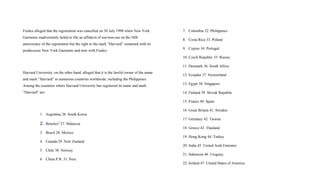
“Harvard” are:
1. Argentina 26. South Korea
2. Benelux4
27. Malaysia
3. Brazil 28. Mexico
4. Canada 29. New Zealand
5. Chile 30. Norway
6. China P.R. 31. Peru
7. Colombia 32. Philippines
8. Costa Rica 33. Poland
9. Cyprus 34. Portugal
10. Czech Republic 35. Russia
11. Denmark 36. South Africa
12. Ecuador 37. Switzerland
13. Egypt 38. Singapore
14. Finland 39. Slovak Republic
15. France 40. Spain
16. Great Britain 41. Sweden
17. Germany 42. Taiwan
18. Greece 43. Thailand
19. Hong Kong 44. Turkey
20. India 45. United Arab Emirates
21. Indonesia 46. Uruguay
22. Ireland 47. United States of America
23. Israel 48. Venezuela
24. Italy 49. Zimbabwe
25. Japan 50. European Community5
The name and mark “Harvard” was adopted in 1639 as the name of Harvard College6
of Cambridge, Massachusetts, U.S.A. The name and mark “Harvard” was allegedly
used in commerce as early as 1872. Harvard University is over 350 years old and is a
highly regarded institution of higher learning in the United States and throughout the
world. Harvard University promotes, uses, and advertises its name “Harvard” through
various publications, services, and products in foreign countries, including the
Philippines. Harvard University further alleged that the name and the mark have been
rated as one of the most famous brands in the world, valued between US
$750,000,000 and US $1,000,000,000.
Harvard University alleged that in March 2002, it discovered, through its
international trademark watch program, Fredco’s website www.harvard-usa.com. The
website advertises and promotes the brand name “Harvard Jeans USA” without
Harvard University’s consent. The website’s main page shows an oblong logo bearing
the mark “Harvard Jeans USA®,” “Established 1936,” and “Cambridge,
Massachusetts.” On 20 April 2004, Harvard University filed an administrative
complaint against Fredco before the IPO for trademark infringement and/or unfair
competition with damages.
Harvard University alleged that its valid and existing certificates of trademark
registration in the Philippines are:
1. Trademark Registration No. 56561 issued on 25 November 1993 for “Harvard
Veritas Shield Design” for goods and services in Classes 16, 18, 21, 25 and 28
(decals, tote bags, serving trays, sweatshirts, t-shirts, hats and flying discs) of
the Nice International Classification of Goods and Services;
2. Trademark Registration No. 57526 issued on 24 March 1994 for “Harvard
Veritas Shield Symbol” for services in Class 41; Trademark Registration No.
56539 issued on 25 November 1998 for “Harvard” for services in Class 41;
and
3. Trademark Registration No. 66677 issued on 8 December 1998 for “Harvard
Graphics” for goods in Class 9. Harvard University further alleged that it filed
the requisite affidavits of use for the mark “Harvard Veritas Shield Symbol”
with the IPO.
Further, on 7 May 2003
Harvard University filed
Trademark Application
No. 4-2003-04090 for
“Harvard Medical
International & Shield
Design” for services in
Classes 41 and 44. In
1989, Harvard University
established the Harvard
Trademark Licensing
Program, operated by the
Office for Technology
and Trademark
Licensing, to oversee and
manage the worldwide
licensing of the
“Harvard” name and
trademarks for various
goods and services.
Harvard University stated
that it never authorized or
licensed any person to use
its name and mark
“Harvard” in connection
with any goods or
services in the
Philippines.
In a Decision7
dated 22 December 2006, Director Estrellita Beltran-Abelardo of the
Bureau of Legal Affairs, IPO cancelled Harvard University’s registration of the mark
“Harvard” under Class 25, as follows:
WHEREFORE, premises considered, the Petition for Cancellation is
hereby GRANTED. Consequently, Trademark Registration Number
56561 for the trademark “HARVARD VE RI TAS ‘SHIELD’
SYMBOL” issued on November 25, 1993 to PRESIDENT AND
FELLOWS OF HARVARD COLLEGE (HARVARD UNIVERSITY)
should be CANCELLED only with respect to goods falling under
Class 25. On the other hand, considering that the goods of Respondent-
Registrant falling under Classes 16, 18, 21 and 28 are not confusingly
similar with the Petitioner’s goods, the Respondent-Registrant has
acquired vested right over the same and therefore, should not be
cancelled.
Let the filewrapper of the Trademark Registration No. 56561 issued on
November 25, 1993 for the trademark “HARVARD VE RI TAS
‘SHIELD’ SYMBOL”, subject matter of this case together with a copy
of this Decision be forwarded to the Bureau of Trademarks (BOT) for
appropriate action.
SO ORDERED.8
Harvard University filed an appeal before the Office of the Director General of the
IPO. In a Decision9
dated 21 April 2008, the Office of the Director General, IPO
reversed the decision of the Bureau of Legal Affairs, IPO.
The Director General ruled that more than the use of the trademark in the Philippines,
the applicant must be the owner of the mark sought to be registered. The Director
General ruled that the right to register a trademark is based on ownership and when
the applicant is not the owner, he has no right to register the mark. The Director
General noted that the mark covered by Harvard University’s Registration No. 56561
is not only the word “Harvard” but also the logo, emblem or symbol of Harvard
University. The Director General ruled that Fredco failed to explain how its
predecessor New York Garments came up with the mark “Harvard.” In addition, there
was no evidence that Fredco or New York Garments was licensed or authorized by
Harvard University to use its name in commerce or for any other use.
The dispositive portion of the decision of the Office of the Director General, IPO
reads:
WHEREFORE, premises considered, the instant appeal is GRANTED.
The appealed decision is hereby REVERSED and SET ASIDE. Let a
copy of this Decision as well as the trademark application and records
be furnished and returned to the Director of Bureau of Legal Affairs
for appropriate action. Further, let also the Directors of the Bureau of
Trademarks and the Administrative, Financial and Human Resources
Development Services Bureau, and the library of the Documentation,
Information and Technology Transfer Bureau be furnished a copy of
this Decision for information, guidance, and records purposes.
SO ORDERED.10
Fredco filed a petition for review before the Court of Appeals assailing the decision
of the Director General.
The Decision of the Court of Appeals
In its assailed decision, the Court of Appeals affirmed the decision of the Office of
the Director General of the IPO.
The Court of Appeals adopted the findings of the Office of the Director General and
ruled that the latter correctly set aside the cancellation by the Director of the Bureau
of Legal Affairs of Harvard University’s trademark registration under Class 25. The
Court of Appeals ruled that Harvard University was able to substantiate that it
appropriated and used the marks “Harvard” and “Harvard Veritas Shield Symbol” in
Class 25 way ahead of Fredco and its predecessor New York Garments. The Court of
Appeals also ruled that the records failed to disclose any explanation for Fredco’s use
of the name and mark “Harvard” and the words “USA,” “Established 1936,” and
“Cambridge, Massachusetts” within an oblong device, “US Legend” and “Europe’s
No. 1 Brand.” Citing Shangri-La International Hotel Management, Ltd. v.
Developers Group of Companies, Inc.,11
the Court of Appeals ruled:
One who has imitated the trademark of another cannot bring an action
for infringement, particularly against the true owner of the mark,
because he would be coming to court with unclean hands. Priority is of
no avail to the bad faith plaintiff. Good faith is required in order to
ensure that a second user may not merely take advantage of the
goodwill established by the true owner.12
The dispositive portion of the decision of the Court of Appeals reads:
WHEREFORE, premises considered, the petition for review is
DENIED. The Decision dated April 21, 2008 of the Director General
of the IPO in Appeal No. 14-07-09 Inter Partes Case No. 14-2005-
00094 is hereby AFFIRMED.
SO ORDERED.13
Fredco filed a motion for reconsideration.
In its Resolution promulgated on 8 January 2009, the Court of Appeals denied the
motion for lack of merit.
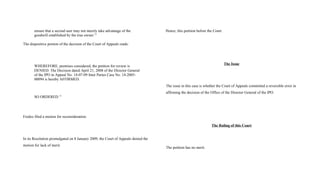
Hence, this petition before the Court.
The Issue
The issue in this case is whether the Court of Appeals committed a reversible error in
affirming the decision of the Office of the Director General of the IPO.
The Ruling of this Court
The petition has no merit.
There is no dispute that the mark “Harvard” used by Fredco is the same as the mark
“Harvard” in the “Harvard Veritas Shield Symbol” of Harvard University. It is also
not disputed that Harvard University was named Harvard College in 1639 and that
then, as now, Harvard University is located in Cambridge, Massachusetts, U.S.A. It is
also unrefuted that Harvard University has been using the mark “Harvard” in
commerce since 1872. It is also established that Harvard University has been using
the marks “Harvard” and “Harvard Veritas Shield Symbol” for Class 25 goods in the
United States since 1953. Further, there is no dispute that Harvard University has
registered the name and mark “Harvard” in at least 50 countries.
On the other hand, Fredco’s predecessor-in-interest, New York Garments, started
using the mark “Harvard” in the Philippines only in 1982. New York Garments filed
an application with the Philippine Patent Office in 1985 to register the mark
“Harvard,” which application was approved in 1988. Fredco insists that the date of
actual use in the Philippines should prevail on the issue of who has the better right to
register the marks.
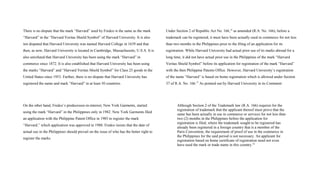
Under Section 2 of Republic Act No. 166,14
as amended (R.A. No. 166), before a
trademark can be registered, it must have been actually used in commerce for not less
than two months in the Philippines prior to the filing of an application for its
registration. While Harvard University had actual prior use of its marks abroad for a
long time, it did not have actual prior use in the Philippines of the mark “Harvard
Veritas Shield Symbol” before its application for registration of the mark “Harvard”
with the then Philippine Patents Office. However, Harvard University’s registration
of the name “Harvard” is based on home registration which is allowed under Section
37 of R.A. No. 166.15
As pointed out by Harvard University in its Comment:
Although Section 2 of the Trademark law (R.A. 166) requires for the
registration of trademark that the applicant thereof must prove that the
same has been actually in use in commerce or services for not less than
two (2) months in the Philippines before the application for
registration is filed, where the trademark sought to be registered has
already been registered in a foreign country that is a member of the
Paris Convention, the requirement of proof of use in the commerce in
the Philippines for the said period is not necessary. An applicant for
registration based on home certificate of registration need not even
have used the mark or trade name in this country.16
Indeed, in its Petition for Cancellation of Registration No. 56561, Fredco alleged that
Harvard University’s registration “is based on ‘home registration’ for the mark
‘Harvard Veritas Shield’ for Class 25.”17
In any event, under Section 239.2 of Republic Act No. 8293 (R.A. No. 8293),18
“[m]arks registered under Republic Act No. 166 shall remain in force but shall be
deemed to have been granted under this Act x x x,” which does not require actual
prior use of the mark in the Philippines. Since the mark “Harvard Veritas Shield
Symbol” is now deemed granted under R.A. No. 8293, any alleged defect arising
from the absence of actual prior use in the Philippines has been cured by Section
239.2.19
In addition, Fredco’s registration was already cancelled on 30 July 1998
when it failed to file the required affidavit of use/non-use for the fifth anniversary of
the mark’s registration. Hence, at the time of Fredco’s filing of the Petition for
Cancellation before the Bureau of Legal Affairs of the IPO, Fredco was no longer the
registrant or presumptive owner of the mark “Harvard.”
There are two compelling reasons why Fredco’s petition must fail.
First, Fredco’s registration of the mark “Harvard” and its identification of origin as
“Cambridge, Massachusetts” falsely suggest that Fredco or its goods are connected
with Harvard University, which uses the same mark “Harvard” and is also located in
Cambridge, Massachusetts. This can easily be gleaned from the following oblong
logo of Fredco that it attaches to its clothing line:
Fredco’s registration
of the mark
“Harvard” should not
have been allowed
because Section 4(a)
of R.A. No. 166 prohibits the registration of a mark “which may disparage or falsely
suggest a connection with persons, living or dead, institutions, beliefs x x x.”
Section 4(a) of R.A. No. 166 provides:
Section 4. Registration of trade-marks, trade-names and service-
marks on the principal register. There is hereby established a‒
register of trade-mark, trade-names and service-marks which shall be
known as the principal register. The owner of a trade-mark, a trade-
name or service-mark used to distinguish his goods, business or
services from the goods, business or services of others shall have the
right to register the same on the principal register, unless it:
(a) Consists of or comprises immoral, deceptive or scandalous manner,
or matter which may disparage or falsely suggest a connection with
persons, living or dead, institutions, beliefs, or national symbols, or
bring them into contempt or disrepute;
(b) x x x (emphasis supplied)
Fredco’s use of the mark “Harvard,” coupled with its claimed origin in Cambridge,
Massachusetts, obviously suggests a false connection with Harvard University. On
this ground alone, Fredco’s registration of the mark “Harvard” should have been
disallowed.
Indisputably, Fredco does not have any affiliation or connection with Harvard
University, or even with Cambridge, Massachusetts. Fredco or its predecessor New
York Garments was not established in 1936, or in the U.S.A. as indicated by Fredco
in its oblong logo. Fredco offered no explanation to the Court of Appeals or to the
IPO why it used the mark “Harvard” on its oblong logo with the words “Cambridge,
Massachusetts,” “Established in 1936,” and “USA.” Fredco now claims before this
Court that it used these words “to evoke a ‘lifestyle’ or suggest a ‘desirable aura’ of
petitioner’s clothing lines.” Fredco’s belated justification merely confirms that it
sought to connect or associate its products with Harvard University, riding on the
prestige and popularity of Harvard University, and thus appropriating part of Harvard
University’s goodwill without the latter’s consent.
Section 4(a) of R.A. No. 166 is identical to Section 2(a) of the Lanham Act,20
the
trademark law of the United States. These provisions are intended to protect the right
of publicity of famous individuals and institutions from commercial exploitation of
their goodwill by others.21
What Fredco has done in using the mark “Harvard” and
the words “Cambridge, Massachusetts,” “USA” to evoke a “desirable aura” to its
products is precisely to exploit commercially the goodwill of Harvard University
without the latter’s consent. This is a clear violation of Section 4(a) of R.A. No. 166.
Under Section 17(c)22
of R.A. No. 166, such violation is a ground for cancellation of
Fredco’s registration of the mark “Harvard” because the registration was obtained in
violation of Section 4 of R.A. No. 166.
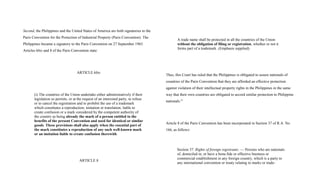
Second, the Philippines and the United States of America are both signatories to the
Paris Convention for the Protection of Industrial Property (Paris Convention). The
Philippines became a signatory to the Paris Convention on 27 September 1965.
Articles 6bis and 8 of the Paris Convention state:
ARTICLE 6bis
(i) The countries of the Union undertake either administratively if their
legislation so permits, or at the request of an interested party, to refuse
or to cancel the registration and to prohibit the use of a trademark
which constitutes a reproduction, imitation or translation, liable to
create confusion or a mark considered by the competent authority of
the country as being already the mark of a person entitled to the
benefits of the present Convention and used for identical or similar
goods. These provisions shall also apply when the essential part of
the mark constitutes a reproduction of any such well-known mark
or an imitation liable to create confusion therewith.
ARTICLE 8
A trade name shall be protected in all the countries of the Union
without the obligation of filing or registration, whether or not it
forms part of a trademark. (Emphasis supplied)
Thus, this Court has ruled that the Philippines is obligated to assure nationals of
countries of the Paris Convention that they are afforded an effective protection
against violation of their intellectual property rights in the Philippines in the same
way that their own countries are obligated to accord similar protection to Philippine
nationals.23
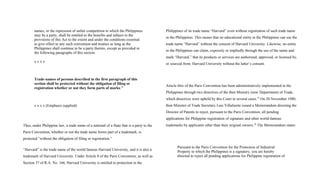
Article 8 of the Paris Convention has been incorporated in Section 37 of R.A. No.
166, as follows:
Section 37. Rights of foreign registrants. — Persons who are nationals
of, domiciled in, or have a bona fide or effective business or
commercial establishment in any foreign country, which is a party to
any international convention or treaty relating to marks or trade-
names, or the repression of unfair competition to which the Philippines
may be a party, shall be entitled to the benefits and subject to the
provisions of this Act to the extent and under the conditions essential
to give effect to any such convention and treaties so long as the
Philippines shall continue to be a party thereto, except as provided in
the following paragraphs of this section.
x x x x
Trade-names of persons described in the first paragraph of this
section shall be protected without the obligation of filing or
registration whether or not they form parts of marks.24
x x x x (Emphasis supplied)
Thus, under Philippine law, a trade name of a national of a State that is a party to the
Paris Convention, whether or not the trade name forms part of a trademark, is
protected “without the obligation of filing or registration.”
“Harvard” is the trade name of the world famous Harvard University, and it is also a
trademark of Harvard University. Under Article 8 of the Paris Convention, as well as
Section 37 of R.A. No. 166, Harvard University is entitled to protection in the
Philippines of its trade name “Harvard” even without registration of such trade name
in the Philippines. This means that no educational entity in the Philippines can use the
trade name “Harvard” without the consent of Harvard University. Likewise, no entity
in the Philippines can claim, expressly or impliedly through the use of the name and
mark “Harvard,” that its products or services are authorized, approved, or licensed by,
or sourced from, Harvard University without the latter’s consent.
Article 6bis of the Paris Convention has been administratively implemented in the
Philippines through two directives of the then Ministry (now Department) of Trade,
which directives were upheld by this Court in several cases.25
On 20 November 1980,
then Minister of Trade Secretary Luis Villafuerte issued a Memorandum directing the
Director of Patents to reject, pursuant to the Paris Convention, all pending
applications for Philippine registration of signature and other world-famous
trademarks by applicants other than their original owners.26
The Memorandum states:
Pursuant to the Paris Convention for the Protection of Industrial
Property to which the Philippines is a signatory, you are hereby
directed to reject all pending applications for Philippine registration of
signature and other world-famous trademarks by applicants other than
its original owners or users.
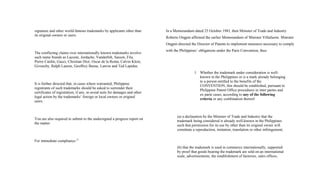
The conflicting claims over internationally known trademarks involve
such name brands as Lacoste, Jordache, Vanderbilt, Sasson, Fila,
Pierre Cardin, Gucci, Christian Dior, Oscar de la Renta, Calvin Klein,
Givenchy, Ralph Lauren, Geoffrey Beene, Lanvin and Ted Lapidus.
It is further directed that, in cases where warranted, Philippine
registrants of such trademarks should be asked to surrender their
certificates of registration, if any, to avoid suits for damages and other
legal action by the trademarks’ foreign or local owners or original
users.
You are also required to submit to the undersigned a progress report on
the matter.
For immediate compliance.27
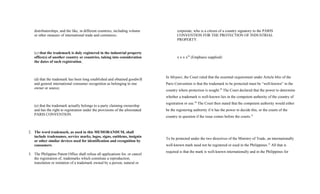
In a Memorandum dated 25 October 1983, then Minister of Trade and Industry
Roberto Ongpin affirmed the earlier Memorandum of Minister Villafuerte. Minister
Ongpin directed the Director of Patents to implement measures necessary to comply
with the Philippines’ obligations under the Paris Convention, thus:
1. Whether the trademark under consideration is well-
known in the Philippines or is a mark already belonging
to a person entitled to the benefits of the
CONVENTION, this should be established, pursuant to
Philippine Patent Office procedures in inter partes and
ex parte cases, according to any of the following
criteria or any combination thereof:
(a) a declaration by the Minister of Trade and Industry that the
trademark being considered is already well-known in the Philippines
such that permission for its use by other than its original owner will
constitute a reproduction, imitation, translation or other infringement;
(b) that the trademark is used in commerce internationally, supported
by proof that goods bearing the trademark are sold on an international
scale, advertisements, the establishment of factories, sales offices,
distributorships, and the like, in different countries, including volume
or other measure of international trade and commerce;
(c) that the trademark is duly registered in the industrial property
office(s) of another country or countries, taking into consideration
the dates of such registration;
(d) that the trademark has been long established and obtained goodwill
and general international consumer recognition as belonging to one
owner or source;
(e) that the trademark actually belongs to a party claiming ownership
and has the right to registration under the provisions of the aforestated
PARIS CONVENTION.
2. The word trademark, as used in this MEMORANDUM, shall
include tradenames, service marks, logos, signs, emblems, insignia
or other similar devices used for identification and recognition by
consumers.
3. The Philippine Patent Office shall refuse all applications for, or cancel
the registration of, trademarks which constitute a reproduction,
translation or imitation of a trademark owned by a person, natural or
corporate, who is a citizen of a country signatory to the PARIS
CONVENTION FOR THE PROTECTION OF INDUSTRIAL
PROPERTY.
x x x x28
(Emphasis supplied)
In Mirpuri, the Court ruled that the essential requirement under Article 6bis of the
Paris Convention is that the trademark to be protected must be “well-known” in the
country where protection is sought.29
The Court declared that the power to determine
whether a trademark is well-known lies in the competent authority of the country of
registration or use.30
The Court then stated that the competent authority would either
be the registering authority if it has the power to decide this, or the courts of the
country in question if the issue comes before the courts.31
To be protected under the two directives of the Ministry of Trade, an internationally
well-known mark need not be registered or used in the Philippines.32
All that is
required is that the mark is well-known internationally and in the Philippines for
identical or similar goods, whether or not the mark is registered or used in the
Philippines. The Court ruled in Sehwani, Incorporated v. In-N-Out Burger, Inc.:33
The fact that respondent’s marks are neither registered nor used
in the Philippines is of no moment. The scope of protection initially
afforded by Article 6bis of the Paris Convention has been expanded in
the 1999 Joint Recommendation Concerning Provisions on the
Protection of Well-Known Marks, wherein the World Intellectual
Property Organization (WIPO) General Assembly and the Paris Union
agreed to a nonbinding recommendation that a well-known mark
should be protected in a country even if the mark is neither
registered nor used in that country. Part I, Article 2(3) thereof
provides:
(3) [Factors Which Shall Not Be Required] (a) A Member State shall
not require, as a condition for determining whether a mark is a well-
known mark:
(i) that the mark has been used in, or that the mark has been
registered or that an application for registration of the mark has been
filed in or in respect of, the Member State:
(ii) that the mark is well known in, or that the mark has been registered
or that an application for registration of the mark has been filed in or in
respect of, any jurisdiction other than the Member State; or
(iii) that the mark is well known by the public at large in the Member
State.34
(Italics in the original decision; boldface supplied)
Indeed, Section 123.1(e) of R.A. No. 8293 now categorically states that “a mark
which is considered by the competent authority of the Philippines to be well-known
internationally and in the Philippines, whether or not it is registered here,”
cannot be registered by another in the Philippines. Section 123.1(e) does not require
that the well-known mark be used in commerce in the Philippines but only that it be
well-known in the Philippines. Moreover, Rule 102 of the Rules and Regulations on
Trademarks, Service Marks, Trade Names and Marked or Stamped Containers, which
implement R.A. No. 8293, provides:
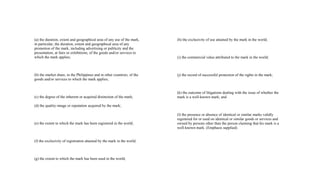
Rule 102. Criteria for determining whether a mark is well-known. In
determining whether a mark is well-known, the following criteria or
any combination thereof may be taken into account:
(a) the duration, extent and geographical area of any use of the mark,
in particular, the duration, extent and geographical area of any
promotion of the mark, including advertising or publicity and the
presentation, at fairs or exhibitions, of the goods and/or services to
which the mark applies;
(b) the market share, in the Philippines and in other countries, of the
goods and/or services to which the mark applies;
(c) the degree of the inherent or acquired distinction of the mark;
(d) the quality-image or reputation acquired by the mark;
(e) the extent to which the mark has been registered in the world;
(f) the exclusivity of registration attained by the mark in the world;
(g) the extent to which the mark has been used in the world;
(h) the exclusivity of use attained by the mark in the world;
(i) the commercial value attributed to the mark in the world;
(j) the record of successful protection of the rights in the mark;
(k) the outcome of litigations dealing with the issue of whether the
mark is a well-known mark; and
(l) the presence or absence of identical or similar marks validly
registered for or used on identical or similar goods or services and
owned by persons other than the person claiming that his mark is a
well-known mark. (Emphasis supplied)
Since “any combination” of the foregoing criteria is sufficient to determine that a
mark is well-known, it is clearly not necessary that the mark be used in commerce in
the Philippines. Thus, while under the territoriality principle a mark must be used in
commerce in the Philippines to be entitled to protection, internationally well-known
marks are the exceptions to this rule.
In the assailed Decision of the Office of the Director General dated 21 April 2008, the
Director General found that:
Traced to its roots or origin, HARVARD is not an ordinary word. It
refers to no other than Harvard University, a recognized and respected
institution of higher learning located in Cambridge, Massachusetts,
U.S.A. Initially referred to simply as “the new college,” the institution
was named “Harvard College” on 13 March 1639, after its first
principal donor, a young clergyman named John Harvard. A graduate
of Emmanuel College, Cambridge in England, John Harvard
bequeathed about four hundred books in his will to form the basis of
the college library collection, along with half his personal wealth
worth several hundred pounds. The earliest known official reference to
Harvard as a “university” rather than “college” occurred in the new
Massachusetts Constitution of 1780.
Records also show that the first use of the name HARVARD was in
1638 for educational services, policy courses of instructions and
training at the university level. It has a Charter. Its first commercial
use of the name or mark HARVARD for Class 25 was on 31
December 1953 covered by UPTON Reg. No. 2,119,339 and
2,101,295. Assuming in arguendo, that the Appellate may have used
the mark HARVARD in the Philippines ahead of the Appellant, it still
cannot be denied that the Appellant’s use thereof was decades, even
centuries, ahead of the Appellee’s. More importantly, the name
HARVARD was the name of a person whose deeds were considered
to be a cornerstone of the university. The Appellant’s logos, emblems
or symbols are owned by Harvard University. The name HARVARD
and the logos, emblems or symbols are endemic and cannot be
separated from the institution.35
Finally, in its assailed Decision, the Court of Appeals ruled:
Records show that Harvard University is the oldest and one of the
foremost educational institutions in the United States, it being
established in 1636. It is located primarily in Cambridge,
Massachusetts and was named after John Harvard, a puritan minister
who left to the college his books and half of his estate.
The mark “Harvard College” was first used in commerce in the United
States in 1638 for educational services, specifically, providing courses
of instruction and training at the university level (Class 41). Its
application for registration with the United States Patent and
Trademark Office was filed on September 20, 2000 and it was
registered on October 16, 2001. The marks “Harvard” and “Harvard
Ve ri tas ‘Shield’ Symbol” were first used in commerce in the the
United States on December 31, 1953 for athletic uniforms, boxer
shorts, briefs, caps, coats, leather coats, sports coats, gym shorts, infant
jackets, leather jackets, night shirts, shirts, socks, sweat pants,
sweatshirts, sweaters and underwear (Class 25). The applications for
registration with the USPTO were filed on September 9, 1996, the
mark “Harvard” was registered on December 9, 1997 and the mark
“Harvard Ve ri tas ‘Shield’ Symbol” was registered on September 30,
1997.36
We also note that in a Decision37
dated 18 December 2008 involving a separate case
between Harvard University and Streetward International, Inc.,38
the Bureau of Legal
Affairs of the IPO ruled that the mark “Harvard” is a “well-known mark.” This
Decision, which cites among others the numerous trademark registrations of Harvard
University in various countries, has become final and executory.
There is no question then, and this Court so declares, that “Harvard” is a well-known
name and mark not only in the United States but also internationally, including the
Philippines. The mark “Harvard” is rated as one of the most famous marks in the
world. It has been registered in at least 50 countries. It has been used and promoted
extensively in numerous publications worldwide. It has established a considerable
goodwill worldwide since the founding of Harvard University more than 350 years
ago. It is easily recognizable as the trade name and mark of Harvard University of
Cambridge, Massachusetts, U.S.A., internationally known as one of the leading
educational institutions in the world. As such, even before Harvard University
applied for registration of the mark “Harvard” in the Philippines, the mark was
already protected under Article 6bis and Article 8 of the Paris Convention. Again,
even without applying the Paris Convention, Harvard University can invoke Section
4(a) of R.A. No. 166 which prohibits the registration of a mark “which may disparage
or falsely suggest a connection with persons, living or dead, institutions, beliefs x x
x.”
WHEREFORE, we DENY the petition. We AFFIRM the 24 October 2008
Decision and 8 January 2009 Resolution of the Court of Appeals in CA-G.R. SP No.
103394.
SO ORDERED.
SKECHERS, U.S.A., INC.,
Petitioner,
- versus -
INTER PACIFIC INDUSTRIAL
TRADING CORP., and/or INTER
PACIFIC TRADING CORP. and/or
STRONG SPORTS GEAR CO., LTD.,
and/or STRONGSHOES WAREHOUSE
and/or STRONG FASHION SHOES
TRADING and/or TAN TUAN HONG
and/or VIOLETA T. MAGAYAGA and/or
JEFFREY R. MORALES and/or any of its
other proprietor/s, directors, officers,
employees and/or occupants of its premises
located at S-7, Ed & Joe’s Commercial
Arcade, No. 153 Quirino Avenue,
Parañaque City,
Respondents.
x----------------------------------------------x
TRENDWORKS INTERNATIONAL
G.R. No. 164321
Present:
CARPIO, J., Chairperson,
NACHURA,
PERALTA,
ABAD, and
MENDOZA, JJ.
CORPORATION,
Petitioner-Intervenor,
- versus –
INTER PACIFIC INDUSTRIAL
TRADING CORP. and/or INTER PACIFIC
TRADING CORP. and/or STRONG
SPORTS GEAR CO., LTD., and/or
STRONGSHOES WAREHOUSE and/or
STRONG FASHION SHOES TRADING
and/or TAN TUAN HONG and/or
VIOLETA T. MAGAYAGA and/or
JEFFREY R. MORALES and/or any of its
other proprietor/s, directors, officers,
employees and/or occupants of its premises
located at S-7, Ed & Joe’s Commercial
Arcade, No. 153 Quirino Avenue,
Parañaque City,
Respondents.
Promulgated:
March 23, 2011
x - - - - - - - - - - - - - - - - - - - - - - - - - - - - - - - - - - - - - - - - - - - - - - - - - - x
4. R E S O L U T I O N
PERALTA, J.:
For resolution are the twin Motions for Reconsideration19[1]
filed by petitioner
and petitioner-intervenor from the Decision rendered in favor of respondents, dated
November 30, 2006.
At the outset, a brief narration of the factual and procedural antecedents that
transpired and led to the filing of the motions is in order.
The present controversy arose when petitioner filed with Branch 24 of the
Regional Trial Court (RTC) of Manila an application for the issuance of search
warrants against an outlet and warehouse operated by respondents for infringement of
trademark under Section 155, in relation to Section 170 of Republic Act No. 8293,
otherwise known as the Intellectual Property Code of the Philippines.20[2]
In the
course of its business, petitioner has registered the trademark “SKECHERS”21[3]
and
the trademark “S” (within an oval design)22[4]
with the Intellectual Property Office
(IPO).
19
20
21
22
Two search warrants23[5]
were issued by the RTC and were served on the
premises of respondents. As a result of the raid, more than 6,000 pairs of shoes
bearing the “S” logo were seized.
Later, respondents moved to quash the search warrants, arguing that there was
no confusing similarity between petitioner’s “Skechers” rubber shoes and its “Strong”
rubber shoes.
On November 7, 2002, the RTC issued an Order24[6]
quashing the search
warrants and directing the NBI to return the seized goods. The RTC agreed with
respondent’s view that Skechers rubber shoes and Strong rubber shoes have glaring
differences such that an ordinary prudent purchaser would not likely be misled or
confused in purchasing the wrong article.
Aggrieved, petitioner filed a petition for certiorari25[7]
with the Court of
Appeals (CA) assailing the RTC Order. On November 17, 2003, the CA issued a
Decision26[8]
affirming the ruling of the RTC.
23
24
25
26
Subsequently, petitioner filed the present petition27[9]
before this Court which
puts forth the following assignment of errors:
A. WHETHER THE COURT OF APPEALS COMMITTED GRAVE
ABUSE OF DISCRETION IN CONSIDERING MATTERS OF
DEFENSE IN A CRIMINAL TRIAL FOR TRADEMARK
INFRINGEMENT IN PASSING UPON THE VALIDITY OF
THE SEARCH WARRANT WHEN IT SHOULD HAVE
LIMITED ITSELF TO A DETERMINATION OF WHETHER
THE TRIAL COURT COMMITTED GRAVE ABUSE OF
DISCRETION IN QUASHING THE SEARCH WARRANTS.
B. WHETHER THE COURT OF APPEALS COMMITTED GRAVE
ABUSE OF DISCRETION IN FINDING THAT RESPONDENTS
ARE NOT GUILTY OF TRADEMARK INFRINGEMENT IN
THE CASE WHERE THE SOLE TRIABLE ISSUE IS THE
EXISTENCE OF PROBABLE CAUSE TO ISSUE A SEARCH
WARRANT.28[10]
In the meantime, petitioner-intervenor filed a Petition-in-Intervention29[11]
with
this Court claiming to be the sole licensed distributor of Skechers products here in the
Philippines.
27
28
29
On November 30, 2006, this Court rendered a Decision30[12]
dismissing the
petition.
Both petitioner and petitioner-intervenor filed separate motions for
reconsideration.
In petitioner’s motion for reconsideration, petitioner moved for a
reconsideration of the earlier decision on the following grounds:
(a) THIS HONORABLE COURT MUST RE-EXAMINE THE
FACTS OF THIS CASE DUE TO THE SIGNIFICANCE AND
REPERCUSSIONS OF ITS DECISION.
(b) COMMERCIAL QUANTITIES OF THE SEIZED ITEMS WITH
THE UNAUTHORIZED REPRODUCTIONS OF THE “S”
TRADEMARK OWNED BY PETITIONER WERE INTENDED
FOR DISTRIBUTION IN THE PHILIPPINE MARKET TO
THE DETRIMENT OF PETITIONER – RETURNING THE
GOODS TO RESPONDENTS WILL ADVERSELY AFFECT
THE GOODWILL AND REPUTATION OF PETITIONER.
(c) THE SEARCH WARRANT COURT AND THE COURT OF
APPEALS BOTH ACTED WITH GRAVE ABUSE OF
DISCRETION.
(d) THE SEARCH WARRANT COURT DID NOT PROPERLY
RE-EVALUATE THE EVIDENCE PRESENTED DURING
THE SEARCH WARRANT APPLICATION PROCEEDINGS.
30
(e) THE SOLID TRIANGLE CASE IS NOT APPLICABLE IN
THIS CASE, AS IT IS BASED ON A DIFFERENT FACTUAL
MILIEU. PRELIMINARY FINDING OF GUILT (OR
ABSENCE THEREOF) MADE BY THE SEARCH WARRANT
COURT AND THE COURT OF APPEALS WAS IMPROPER.
(f) THE SEARCH WARRANT COURT OVERSTEPPED ITS
DISCRETION. THE LAW IS CLEAR. THE DOMINANCY
TEST SHOULD BE USED.
(g) THE COURT OF APPEALS COMMITTED ERRORS OF
JURISDICTION.31[13]
On the other hand, petitioner-intervenor’s motion for reconsideration raises
the following errors for this Court’s consideration, to wit:
(a) THE COURT OF APPEALS AND THE SEARCH
WARRANT COURT ACTED CONTRARY TO LAW AND
JURISPRUDENCE IN ADOPTING THE ALREADY-
REJECTED HOLISTIC TEST IN DETERMINING THE
ISSUE OF CONFUSING SIMILARITY;
(b) THE COURT OF APPEALS AND THE SEARCH
WARRANT COURT ACTED CONTRARY TO LAW IN
HOLDING THAT THERE IS NO PROBABLE CAUSE FOR
TRADEMARK INFRINGEMENT; AND
(c) THE COURT OF APPEALS SANCTIONED THE TRIAL
COURT’S DEPARTURE FROM THE USUAL AND
ACCEPTED COURSE OF JUDICIAL PROCEEDINGS
WHEN IT UPHELD THE QUASHAL OF THE SEARCH
31
WARRANT ON THE BASIS SOLELY OF A FINDING
THAT THERE IS NO CONFUSING SIMILARITY.32[14]
A perusal of the motions submitted by petitioner and petitioner-intervenor
would show that the primary issue posed by them dwells on the issue of whether or
not respondent is guilty of trademark infringement.
After a thorough review of the arguments raised herein, this Court reconsiders
its earlier decision.
The basic law on trademark, infringement, and unfair competition is Republic
Act (R.A.) No. 8293. Specifically, Section 155 of R.A. No. 8293 states:
Remedies; Infringement. — Any person who shall, without the
consent of the owner of the registered mark:
155.1. Use in commerce any reproduction,
counterfeit, copy, or colorable imitation of a
registered mark or the same container or a
dominant feature thereof in connection with the sale,
offering for sale, distribution, advertising of any goods
or services including other preparatory steps necessary
to carry out the sale of any goods or services on or in
connection with which such use is likely to cause
32
confusion, or to cause mistake, or to deceive; or
155.2. Reproduce, counterfeit, copy or colorably
imitate a registered mark or a dominant feature
thereof and apply such reproduction, counterfeit, copy
or colorable imitation to labels, signs, prints, packages,
wrappers, receptacles or advertisements intended to be
used in commerce upon or in connection with the sale,
offering for sale, distribution, or advertising of goods or
services on or in connection with which such use is
likely to cause confusion, or to cause mistake, or to
deceive, shall be liable in a civil action for infringement
by the registrant for the remedies hereinafter set forth:
Provided, That the infringement takes place at the
moment any of the acts stated in Subsection 155.1 or
this subsection are committed regardless of whether
there is actual sale of goods or services using the
infringing material.33[15]
The essential element of infringement under R.A. No. 8293 is that the
infringing mark is likely to cause confusion. In determining similarity and likelihood
of confusion, jurisprudence has developed tests  the Dominancy Test and the
Holistic or Totality Test. The Dominancy Test focuses on the similarity of the
prevalent or dominant features of the competing trademarks that might cause
confusion, mistake, and deception in the mind of the purchasing public. Duplication
33
or imitation is not necessary; neither is it required that the mark sought to be
registered suggests an effort to imitate. Given more consideration are the aural and
visual impressions created by the marks on the buyers of goods, giving little weight to
factors like prices, quality, sales outlets, and market segments.34[16]
In contrast, the Holistic or Totality Test necessitates a consideration of the
entirety of the marks as applied to the products, including the labels and packaging, in
determining confusing similarity. The discerning eye of the observer must focus not
only on the predominant words, but also on the other features appearing on both
labels so that the observer may draw conclusion on whether one is confusingly
similar to the other.35[17]
Relative to the question on confusion of marks and trade names, jurisprudence
has noted two (2) types of confusion, viz.: (1) confusion of goods (product
confusion), where the ordinarily prudent purchaser would be induced to purchase one
product in the belief that he was purchasing the other; and (2) confusion of business
(source or origin confusion), where, although the goods of the parties are different,
the product, the mark of which registration is applied for by one party, is such as
might reasonably be assumed to originate with the registrant of an earlier product, and
34
35
the public would then be deceived either into that belief or into the belief that there is
some connection between the two parties, though inexistent.36[18]
Applying the Dominancy Test to the case at bar, this Court finds that the use
of the stylized “S” by respondent in its Strong rubber shoes infringes on the mark
already registered by petitioner with the IPO. While it is undisputed that petitioner’s
stylized “S” is within an oval design, to this Court’s mind, the dominant feature of the
trademark is the stylized “S,” as it is precisely the stylized “S” which catches the eye
of the purchaser. Thus, even if respondent did not use an oval design, the mere fact
that it used the same stylized “S”, the same being the dominant feature of petitioner’s
trademark, already constitutes infringement under the Dominancy Test.
This Court cannot agree with the observation of the CA that the use of the
letter “S” could hardly be considered as highly identifiable to the products of
petitioner alone. The CA even supported its conclusion by stating that the letter “S”
has been used in so many existing trademarks, the most popular of which is the
trademark “S” enclosed by an inverted triangle, which the CA says is identifiable to
Superman. Such reasoning, however, misses the entire point, which is that respondent
had used a stylized “S,” which is the same stylized “S” which petitioner has a
registered trademark for. The letter “S” used in the Superman logo, on the other
36
hand, has a block-like tip on the upper portion and a round elongated tip on the lower
portion. Accordingly, the comparison made by the CA of the letter “S” used in the
Superman trademark with petitioner’s stylized “S” is not appropriate to the case at
bar.
Furthermore, respondent did not simply use the letter “S,” but it appears to
this Court that based on the font and the size of the lettering, the stylized “S” utilized
by respondent is the very same stylized “S” used by petitioner; a stylized “S” which is
unique and distinguishes petitioner’s trademark. Indubitably, the likelihood of
confusion is present as purchasers will associate the respondent’s use of the stylized
“S” as having been authorized by petitioner or that respondent’s product is connected
with petitioner’s business.
Both the RTC and the CA applied the Holistic Test in ruling that respondent
had not infringed petitioner’s trademark. For its part, the RTC noted the following
supposed dissimilarities between the shoes, to wit:
1. The mark “S” found in Strong Shoes is not enclosed in an “oval
design.”
2. The word “Strong” is conspicuously placed at the backside and
insoles.
3. The hang tags and labels attached to the shoes bears the word
“Strong” for respondent and “Skechers U.S.A.” for private
complainant;
4. Strong shoes are modestly priced compared to the costs of
Skechers Shoes.37[19]
While there may be dissimilarities between the appearances of the shoes, to
this Court’s mind such dissimilarities do not outweigh the stark and blatant
similarities in their general features. As can be readily observed by simply comparing
petitioner’s Energy38[20]
model and respondent’s Strong39[21]
rubber shoes, respondent
also used the color scheme of blue, white and gray utilized by petitioner. Even the
design and “wavelike” pattern of the midsole and outer sole of respondent’s shoes are
very similar to petitioner’s shoes, if not exact patterns thereof. At the side of the
midsole near the heel of both shoes are two elongated designs in practically the same
location. Even the outer soles of both shoes have the same number of ridges, five at
the back and six in front. On the side of respondent’s shoes, near the upper part,
appears the stylized “S,” placed in the exact location as that of the stylized “S” on
petitioner’s shoes. On top of the "tongue" of both shoes appears the stylized “S” in
practically the same location and size. Moreover, at the back of petitioner’s shoes,
near the heel counter, appears “Skechers Sport Trail” written in white lettering.
37
38
39
However, on respondent’s shoes appears “Strong Sport Trail” noticeably written in
the same white lettering, font size, direction and orientation as that of petitioner’s
shoes. On top of the heel collar of petitioner’s shoes are two grayish-white semi-
transparent circles. Not surprisingly, respondent’s shoes also have two grayish-white
semi-transparent circles in the exact same location.
Based on the foregoing, this Court is at a loss as to how the RTC and the
CA, in applying the holistic test, ruled that there was no colorable imitation, when it
cannot be any more clear and apparent to this Court that there is colorable
imitation. The dissimilarities between the shoes are too trifling and frivolous that it is
indubitable that respondent’s products will cause confusion and mistake in the eyes of
the public. Respondent’s shoes may not be an exact replica of petitioner’s shoes, but
the features and overall design are so similar and alike that confusion is highly likely.
In Converse Rubber Corporation v. Jacinto Rubber & Plastic Co., Inc.,40[22]
this Court, in a case for unfair competition, had opined that even if not all the details
are identical, as long as the general appearance of the two products are such that any
ordinary purchaser would be deceived, the imitator should be liable, to wit:
From said examination, We find the shoes manufactured by
defendants to contain, as found by the trial court, practically all the
40
features of those of the plaintiff Converse Rubber Corporation and
manufactured, sold or marketed by plaintiff Edwardson Manufacturing
Corporation, except for their respective brands, of course. We fully
agree with the trial court that "the respective designs, shapes, the
colors of the ankle patches, the bands, the toe patch and the soles of the
two products are exactly the same ... (such that) at a distance of a few
meters, it is impossible to distinguish "Custombuilt" from "Chuck
Taylor." These elements are more than sufficient to serve as basis for a
charge of unfair competition. Even if not all the details just mentioned
were identical, with the general appearances alone of the two products,
any ordinary, or even perhaps even a not too perceptive and
discriminating customer could be deceived, and, therefore,
Custombuilt could easily be passed off for Chuck Taylor.
Jurisprudence supports the view that under such circumstances, the
imitator must be held liable. x x x41[23]
Neither can the difference in price be a complete defense in trademark
infringement. In McDonald’s Corporation v. L.C. Big Mak Burger. Inc.,42[24]
this
Court held:
Modern law recognizes that the protection to which the owner
of a trademark is entitled is not limited to guarding his goods or
business from actual market competition with identical or similar
products of the parties, but extends to all cases in which the use by a
junior appropriator of a trade-mark or trade-name is likely to lead to a
confusion of source, as where prospective purchasers would be
41
42
misled into thinking that the complaining party has extended his
business into the field (see 148 ALR 56 et seq; 53 Am. Jur. 576) or is
in any way connected with the activities of the infringer; or when it
forestalls the normal potential expansion of his business (v. 148 ALR
77, 84; 52 Am. Jur. 576, 577). x x x43[25]
Indeed, the registered trademark owner may use its mark on the same or
similar products, in different segments of the market, and at different price levels
depending on variations of the products for specific segments of the market.44[26]
The
purchasing public might be mistaken in thinking that petitioner had ventured into a
lower market segment such that it is not inconceivable for the public to think that
Strong or Strong Sport Trail might be associated or connected with petitioner’s brand,
which scenario is plausible especially since both petitioner and respondent
manufacture rubber shoes.
Withal, the protection of trademarks as intellectual property is intended not
only to preserve the goodwill and reputation of the business established on the goods
bearing the mark through actual use over a period of time, but also to safeguard the
public as consumers against confusion on these goods.45[27]
While respondent’s shoes
contain some dissimilarities with petitioner’s shoes, this Court cannot close its eye to
43
44
45
the fact that for all intents and purpose, respondent had deliberately attempted to copy
petitioner’s mark and overall design and features of the shoes. Let it be remembered,
that defendants in cases of infringement do not normally copy but only make
colorable changes.46[28]
The most successful form of copying is to employ enough
points of similarity to confuse the public, with enough points of difference to confuse
the courts.47[29]
WHEREFORE, premises considered, the Motion for Reconsideration is
GRANTED. The Decision dated November 30, 2006 is RECONSIDERED and
SET ASIDE.
SO ORDERED.
Homework Help
https://www.homeworkping.com/
Math homework help
https://www.homeworkping.com/
Research Paper help
https://www.homeworkping.com/
46
47
Algebra Help
https://www.homeworkping.com/
Calculus Help
https://www.homeworkping.com/
Accounting help
https://www.homeworkping.com/
Paper Help
https://www.homeworkping.com/
Writing Help
https://www.homeworkping.com/
Online Tutor
https://www.homeworkping.com/
Online Tutoring
https://www.homeworkping.com/

126345691 ip-case

  • 1.
    Homework Help https://www.homeworkping.com/ Research Paperhelp https://www.homeworkping.com/ Online Tutoring https://www.homeworkping.com/ click here for freelancing tutoring sites Republic of the Philippines SUPREME COURT Manila SECOND DIVISION G.R. No. 183404 October 13, 2010 BERRIS AGRICULTURAL CO., INC., Petitioner, vs. NORVY ABYADANG, Respondent. D E C I S I O N NACHURA, J.: This petition for review1 on certiorari under Rule 45 of the Rules of Court seeks the reversal of the Decision dated April 14, 20082 and the Resolution dated June 18, 20083 of the Court of Appeals (CA) in CA-G.R. SP No. 99928. The antecedents— On January 16, 2004, respondent Norvy A. Abyadang (Abyadang), proprietor of NS Northern Organic Fertilizer, with address at No. 43 Lower QM, Baguio City, filed with the Intellectual Property Office (IPO) a trademark application for the mark "NS D-10 PLUS" for use in connection with Fungicide (Class 5) with active ingredient 80% Mancozeb. The application, under Application Serial No. 4-2004-00450, was given due course and was published in the IPO e-Gazette for opposition on July 28, 2005. On August 17, 2005, petitioner Berris Agricultural Co., Inc. (Berris), with business address in Barangay Masiit, Calauan, Laguna, filed with the IPO Bureau of Legal Affairs (IPO-BLA) a Verified Notice of Opposition4 against the mark under application allegedly because "NS D-10 PLUS" is similar and/or confusingly similar to its registered trademark "D-10 80 WP," also used for Fungicide (Class 5) with active ingredient 80% Mancozeb. The opposition was docketed as IPC No. 14-2005- 00099. After an exchange of pleadings, on April 28, 2006, Director Estrellita Beltran- Abelardo (Director Abelardo) of the IPO-BLA issued Decision No. 2006-245 (BLA decision), the dispositive portion of which reads— WHEREFORE, viewed in the light of all the foregoing, this Bureau finds and so holds that Respondent-Applicant’s mark "NS D-10 PLUS" is confusingly similar to the Opposer’s mark and as such, the opposition is hereby SUSTAINED. Consequently, trademark application bearing Serial No. 4-2004-00450 for the mark "NS D-10 PLUS" filed on January 16, 2004 by Norvy A. Ab[yada]ng covering the
  • 2.
    goods fungicide underClass 5 of the International Classification of goods is, as it is hereby, REJECTED. Let the filewrapper of the trademark "NS D-10 PLUS" subject matter under consideration be forwarded to the Administrative, Financial and Human Resources Development Services Bureau (AFHRDSB) for appropriate action in accordance with this Order with a copy to be furnished the Bureau of Trademark (BOT) for information and to update its records. SO ORDERED.6 Abyadang filed a motion for reconsideration, and Berris, in turn, filed its opposition to the motion. On August 2, 2006, Director Abelardo issued Resolution No. 2006-09(D)7 (BLA resolution), denying the motion for reconsideration and disposing as follows — IN VIEW OF THE FOREGOING, the Motion for Reconsideration filed by the Respondent-Applicant is hereby DENIED FOR LACK OF MERIT. Consequently, Decision No. 2006-24 dated April 28, 2006 STANDS. Let the filewrapper of the trademark "NS D-10 PLUS" subject matter under consideration be forwarded to the Bureau of Trademarks for appropriate action in accordance with this Resolution. SO ORDERED.8 Aggrieved, Abyadang filed an appeal on August 22, 2006 with the Office of the Director General, Intellectual Property Philippines (IPPDG), docketed as Appeal No. 14-06-13. With the filing of the parties’ respective memoranda, Director General Adrian S. Cristobal, Jr. of the IPPDG rendered a decision dated July 20, 2007,9 ruling as follows — Wherefore, premises considered[,] the appeal is hereby DENIED. Accordingly, the appealed Decision of the Director is hereby AFFIRMED. Let a copy of this Decision as well as the trademark application and records be furnished and returned to the Director of Bureau of Legal Affairs for appropriate action. Further, let also the Directors of the Bureau of Trademarks, the Administrative, Financial and Human Resources Development Services Bureau, and the library of the Documentation, Information and Technology Transfer Bureau be furnished a copy of this Decision for information, guidance, and records purposes. SO ORDERED.10 Undeterred, Abyadang filed a petition for review11 before the CA. In its Decision dated April 14, 2008, the CA reversed the IPPDG decision. It held— In sum, the petition should be granted due to the following reasons: 1) petitioner’s mark "NS D-10 PLUS" is not confusingly similar with respondent’s trademark "D-10 80 WP"; 2) respondent failed to establish its ownership of the mark "D-10 80 WP" and 3) respondent’s trademark registration for "D-10 80 WP" may be cancelled in the present case to avoid multiplicity of suits. WHEREFORE, the petition is GRANTED. The decision dated July 20, 2007 of the IPO Director General in Appeal No. 14-06-13 (IPC No. 14-2005-00099) is REVERSED and SET ASIDE, and a new one is entered giving due course to petitioner’s application for registration of the mark "NS D-10 PLUS," and canceling respondent’s trademark registration for "D-10 80 WP."
  • 3.
    SO ORDERED.12 Berris fileda Motion for Reconsideration, but in its June 18, 2008 Resolution, the CA denied the motion for lack of merit. Hence, this petition anchored on the following arguments— I. The Honorable Court of Appeals’ finding that there exists no confusing similarity between Petitioner’s and respondent’s marks is based on misapprehension of facts, surmise and conjecture and not in accord with the Intellectual Property Code and applicable Decisions of this Honorable Court [Supreme Court]. II. The Honorable Court of Appeals’ Decision reversing and setting aside the technical findings of the Intellectual Property Office even without a finding or, at the very least, an allegation of grave abuse of discretion on the part of said agency is not in accord with law and earlier pronouncements of this Honorable Court [Supreme Court]. III. The Honorable Court of Appeals’ Decision ordering the cancellation of herein Petitioner’s duly registered and validly existing trademark in the absence of a properly filed Petition for Cancellation before the Intellectual Property Office is not in accord with the Intellectual Property Code and applicable Decisions of this Honorable Court [Supreme Court].13 The basic law on trademark, infringement, and unfair competition is Republic Act (R.A.) No. 829314 (Intellectual Property Code of the Philippines), specifically Sections 121 to 170 thereof. It took effect on January 1, 1998. Prior to its effectivity, the applicable law was R.A. No. 166,15 as amended. Interestingly, R.A. No. 8293 did not expressly repeal in its entirety R.A. No. 166, but merely provided in Section 239.116 that Acts and parts of Acts inconsistent with it were repealed. In other words, only in the instances where a substantial and irreconcilable conflict is found between the provisions of R.A. No. 8293 and of R.A. No. 166 would the provisions of the latter be deemed repealed. R.A. No. 8293 defines a "mark" as any visible sign capable of distinguishing the goods (trademark) or services (service mark) of an enterprise and shall include a stamped or marked container of goods.17 It also defines a "collective mark" as any visible sign designated as such in the application for registration and capable of distinguishing the origin or any other common characteristic, including the quality of goods or services of different enterprises which use the sign under the control of the registered owner of the collective mark.18 On the other hand, R.A. No. 166 defines a "trademark" as any distinctive word, name, symbol, emblem, sign, or device, or any combination thereof, adopted and used by a manufacturer or merchant on his goods to identify and distinguish them from those manufactured, sold, or dealt by another.19 A trademark, being a special property, is afforded protection by law. But for one to enjoy this legal protection, legal protection ownership of the trademark should rightly be established. The ownership of a trademark is acquired by its registration and its actual use by the manufacturer or distributor of the goods made available to the purchasing public. Section 12220 of R.A. No. 8293 provides that the rights in a mark shall be acquired by means of its valid registration with the IPO. A certificate of registration of a mark, once issued, constitutes prima facie evidence of the validity of the registration, of the registrant’s ownership of the mark, and of the registrant’s exclusive right to use the same in connection with the goods or services and those that are related thereto specified in the certificate.21 R.A. No. 8293, however, requires the applicant for registration or the registrant to file a declaration of actual use (DAU) of the mark, with evidence to that effect, within three (3) years from the filing of the application for registration; otherwise, the application shall be refused or the mark shall be removed from the register.22 In other words, the prima facie presumption brought about by the registration of a mark may be challenged and overcome, in an
  • 4.
    appropriate action, byproof of the nullity of the registration or of non-use of the mark, except when excused.23 Moreover, the presumption may likewise be defeated by evidence of prior use by another person, i.e., it will controvert a claim of legal appropriation or of ownership based on registration by a subsequent user. This is because a trademark is a creation of use and belongs to one who first used it in trade or commerce.24 The determination of priority of use of a mark is a question of fact. Adoption of the mark alone does not suffice. One may make advertisements, issue circulars, distribute price lists on certain goods, but these alone will not inure to the claim of ownership of the mark until the goods bearing the mark are sold to the public in the market. Accordingly, receipts, sales invoices, and testimonies of witnesses as customers, or orders of buyers, best prove the actual use of a mark in trade and commerce during a certain period of time.25 In the instant case, both parties have submitted proof to support their claim of ownership of their respective trademarks. Culled from the records, Berris, as oppositor to Abyadang’s application for registration of his trademark, presented the following evidence: (1) its trademark application dated November 29, 200226 with Application No. 4-2002-0010272; (2) its IPO certificate of registration dated October 25, 2004,27 with Registration No. 4- 2002-010272 and July 8, 2004 as the date of registration; (3) a photocopy of its packaging28 bearing the mark "D-10 80 WP"; (4) photocopies of its sales invoices and official receipts;29 and (5) its notarized DAU dated April 23, 2003,30 stating that the mark was first used on June 20, 2002, and indicating that, as proof of actual use, copies of official receipts or sales invoices of goods using the mark were attached as Annex "B." On the other hand, Abyadang’s proofs consisted of the following: (1) a photocopy of the packaging31 for his marketed fungicide bearing mark "NS D-10 PLUS"; (2) Abyadang’s Affidavit dated February 14, 2006,32 stating among others that the mark "NS D-10 PLUS" was his own creation derived from: N – for Norvy, his name; S – for Soledad, his wife’s name; D – the first letter for December, his birth month; 10 – for October, the 10th month of the year, the month of his business name registration; and PLUS – to connote superior quality; that when he applied for registration, there was nobody applying for a mark similar to "NS D-10 PLUS"; that he did not know of the existence of Berris or any of its products; that "D-10" could not have been associated with Berris because the latter never engaged in any commercial activity to sell "D-10 80 WP" fungicide in the local market; and that he could not have copied Berris’ mark because he registered his packaging with the Fertilizer and Pesticide Authority (FPA) ahead of Berris; (3) Certification dated December 19, 200533 issued by the FPA, stating that "NS D-10 PLUS" is owned and distributed by NS Northern Organic Fertilizer, registered with the FPA since May 26, 2003, and had been in the market since July 30, 2003; (4) Certification dated October 11, 200534 issued by the FPA, stating that, per monitoring among dealers in Region I and in the Cordillera Administrative Region registered with its office, the Regional Officer neither encountered the fungicide with mark "D-10 80 WP" nor did the FPA provincial officers from the same area receive any report as to the presence or sale of Berris’ product; (5) Certification dated March 14, 200635 issued by the FPA, certifying that all pesticides must be registered with the said office pursuant to Section 936 of Presidential Decree (P.D.) No. 114437 and Section 1, Article II of FPA Rules and Regulations No. 1, Series of 1977; (6) Certification dated March 16, 200638 issued by the FPA, certifying that the pesticide "D-10 80 WP" was registered by Berris on November 12, 2004; and (7) receipts from Sunrise Farm Supply39 in La Trinidad, Benguet of the sale of Abyadang’s goods referred to as "D-10" and "D-10+." Based on their proffered pieces of evidence, both Berris and Abyadang claim to be the prior user of their respective marks. We rule in favor of Berris.
  • 5.
    Berris was ableto establish that it was using its mark "D-10 80 WP" since June 20, 2002, even before it filed for its registration with the IPO on November 29, 2002, as shown by its DAU which was under oath and notarized, bearing the stamp of the Bureau of Trademarks of the IPO on April 25, 2003,40 and which stated that it had an attachment as Annex "B" sales invoices and official receipts of goods bearing the mark. Indeed, the DAU, being a notarized document, especially when received in due course by the IPO, is evidence of the facts it stated and has the presumption of regularity, entitled to full faith and credit upon its face. Thus, the burden of proof to overcome the presumption of authenticity and due execution lies on the party contesting it, and the rebutting evidence should be clear, strong, and convincing as to preclude all controversy as to the falsity of the certificate.41 What is more, the DAU is buttressed by the Certification dated April 21, 200642 issued by the Bureau of Trademarks that Berris’ mark is still valid and existing. Hence, we cannot subscribe to the contention of Abyadang that Berris’ DAU is fraudulent based only on his assumption that Berris could not have legally used the mark in the sale of its goods way back in June 2002 because it registered the product with the FPA only on November 12, 2004. As correctly held by the IPPDG in its decision on Abyadang’s appeal, the question of whether or not Berris violated P.D. No. 1144, because it sold its product without prior registration with the FPA, is a distinct and separate matter from the jurisdiction and concern of the IPO. Thus, even a determination of violation by Berris of P.D. No. 1144 would not controvert the fact that it did submit evidence that it had used the mark "D-10 80 WP" earlier than its FPA registration in 2004. Furthermore, even the FPA Certification dated October 11, 2005, stating that the office had neither encountered nor received reports about the sale of the fungicide "D- 10 80 WP" within Region I and the Cordillera Administrative Region, could not negate the fact that Berris was selling its product using that mark in 2002, especially considering that it first traded its goods in Calauan, Laguna, where its business office is located, as stated in the DAU. Therefore, Berris, as prior user and prior registrant, is the owner of the mark "D-10 80 WP." As such, Berris has in its favor the rights conferred by Section 147 of R.A. No. 8293, which provides— Sec. 147. Rights Conferred.— 147.1. The owner of a registered mark shall have the exclusive right to prevent all third parties not having the owner’s consent from using in the course of trade identical or similar signs or containers for goods or services which are identical or similar to those in respect of which the trademark is registered where such use would result in a likelihood of confusion. In case of the use of an identical sign for identical goods or services, a likelihood of confusion shall be presumed. 147.2. The exclusive right of the owner of a well-known mark defined in Subsection 123.1(e) which is registered in the Philippines, shall extend to goods and services which are not similar to those in respect of which the mark is registered: Provided, That use of that mark in relation to those goods or services would indicate a connection between those goods or services and the owner of the registered mark: Provided, further, That the interests of the owner of the registered mark are likely to be damaged by such use. Now, we confront the question, "Is Abyadang’s mark ‘NS D-10 PLUS’ confusingly similar to that of Berris’ ‘D-10 80 WP’ such that the latter can rightfully prevent the IPO registration of the former?" We answer in the affirmative. According to Section 123.1(d) of R.A. No. 8293, a mark cannot be registered if it is identical with a registered mark belonging to a different proprietor with an earlier filing or priority date, with respect to: (1) the same goods or services; (2) closely
  • 6.
    related goods orservices; or (3) near resemblance of such mark as to likely deceive or cause confusion. In determining similarity and likelihood of confusion, jurisprudence has developed tests—the Dominancy Test and the Holistic or Totality Test. The Dominancy Test focuses on the similarity of the prevalent or dominant features of the competing trademarks that might cause confusion, mistake, and deception in the mind of the purchasing public. Duplication or imitation is not necessary; neither is it required that the mark sought to be registered suggests an effort to imitate. Given more consideration are the aural and visual impressions created by the marks on the buyers of goods, giving little weight to factors like prices, quality, sales outlets, and market segments.43 In contrast, the Holistic or Totality Test necessitates a consideration of the entirety of the marks as applied to the products, including the labels and packaging, in determining confusing similarity. The discerning eye of the observer must focus not only on the predominant words but also on the other features appearing on both labels so that the observer may draw conclusion on whether one is confusingly similar to the other.44 Comparing Berris’ mark "D-10 80 WP" with Abyadang’s mark "NS D-10 PLUS," as appearing on their respective packages, one cannot but notice that both have a common component which is "D-10." On Berris’ package, the "D-10" is written with a bigger font than the "80 WP." Admittedly, the "D-10" is the dominant feature of the mark. The "D-10," being at the beginning of the mark, is what is most remembered of it. Although, it appears in Berris’ certificate of registration in the same font size as the "80 WP," its dominancy in the "D-10 80 WP" mark stands since the difference in the form does not alter its distinctive character.45 Applying the Dominancy Test, it cannot be gainsaid that Abyadang’s "NS D-10 PLUS" is similar to Berris’ "D-10 80 WP," that confusion or mistake is more likely to occur. Undeniably, both marks pertain to the same type of goods – fungicide with 80% Mancozeb as an active ingredient and used for the same group of fruits, crops, vegetables, and ornamental plants, using the same dosage and manner of application. They also belong to the same classification of goods under R.A. No. 8293. Both depictions of "D-10," as found in both marks, are similar in size, such that this portion is what catches the eye of the purchaser. Undeniably, the likelihood of confusion is present. This likelihood of confusion and mistake is made more manifest when the Holistic Test is applied, taking into consideration the packaging, for both use the same type of material (foil type) and have identical color schemes (red, green, and white); and the marks are both predominantly red in color, with the same phrase "BROAD SPECTRUM FUNGICIDE" written underneath.1awphi1 Considering these striking similarities, predominantly the "D-10," the buyers of both products, mainly farmers, may be misled into thinking that "NS D-10 PLUS" could be an upgraded formulation of the "D-10 80 WP." Moreover, notwithstanding the finding of the IPPDG that the "D-10" is a fanciful component of the trademark, created for the sole purpose of functioning as a trademark, and does not give the name, quality, or description of the product for which it is used, nor does it describe the place of origin, such that the degree of exclusiveness given to the mark is closely restricted,46 and considering its challenge by Abyadang with respect to the meaning he has given to it, what remains is the fact that Berris is the owner of the mark "D-10 80 WP," inclusive of its dominant feature "D-10," as established by its prior use, and prior registration with the IPO. Therefore, Berris properly opposed and the IPO correctly rejected Abyadang’s application for registration of the mark "NS D-10 PLUS." Verily, the protection of trademarks as intellectual property is intended not only to preserve the goodwill and reputation of the business established on the goods bearing
  • 7.
    the mark throughactual use over a period of time, but also to safeguard the public as consumers against confusion on these goods.47 On this matter of particular concern, administrative agencies, such as the IPO, by reason of their special knowledge and expertise over matters falling under their jurisdiction, are in a better position to pass judgment thereon. Thus, their findings of fact in that regard are generally accorded great respect, if not finality by the courts, as long as they are supported by substantial evidence, even if such evidence might not be overwhelming or even preponderant. It is not the task of the appellate court to weigh once more the evidence submitted before the administrative body and to substitute its own judgment for that of the administrative agency in respect to sufficiency of evidence.48 Inasmuch as the ownership of the mark "D-10 80 WP" fittingly belongs to Berris, and because the same should not have been cancelled by the CA, we consider it proper not to belabor anymore the issue of whether cancellation of a registered mark may be done absent a petition for cancellation. WHEREFORE, the petition is GRANTED. The assailed Decision dated April 14, 2008 and Resolution dated June 18, 2008 of the Court of Appeals in CA-G.R. SP No. 99928 are REVERSED and SET ASIDE. Accordingly, the Decision No. 2006-24 dated April 28, 2006 and the Resolution No. 2006-09(D) dated August 2, 2006 in IPC No. 14-2005-00099, and the Decision dated July 20, 2007 in Appeal No. 14-06-13 are REINSTATED. Costs against respondent. SO ORDERED. ANTONIO EDUARDO B. NACHURA** Associate Justice Acting Chairperson WE CONCUR: SECOND DIVISION COFFEE PARTNERS, INC., G.R. No. 169504 Petitioner, Present: CARPIO, J., Chairperson, VELASCO, JR.,* DEL CASTILLO, - versus - ABAD, and PEREZ, JJ. SAN FRANCISCO COFFEE & Promulgated: ROASTERY, INC., Respondent. March 3, 2010 x- - - - - - - - - - - - - - - - - - - - - - - - - - - - - - - - - - - - - - - - - - - - - - - - - - - x D E C I S I O N CARPIO, J.: The Case *
  • 8.
    This is apetition for review1[1] of the 15 June 2005 Decision2[2] and the 1 September 2005 Resolution3[3] of the Court of Appeals in CA-G.R. SP No. 80396. In its 15 June 2005 Decision, the Court of Appeals set aside the 22 October 2003 Decision4[4] of the Office of the Director General-Intellectual Property Office and reinstated the 14 August 2002 Decision5[5] of the Bureau of Legal Affairs-Intellectual Property Office. In its 1 September 2005 Resolution, the Court of Appeals denied petitioner’s motion for reconsideration and respondent’s motion for partial reconsideration. The Facts Petitioner Coffee Partners, Inc. is a local corporation engaged in the business of establishing and maintaining coffee shops in the country. It registered with the Securities and Exchange Commission (SEC) in January 2001. It has a franchise agreement6[6] with Coffee Partners Ltd. (CPL), a business entity organized and existing under the laws of British Virgin Islands, for a non-exclusive right to operate 1 2 3 4 5 6 coffee shops in the Philippines using trademarks designed by CPL such as “SAN FRANCISCO COFFEE.” Respondent is a local corporation engaged in the wholesale and retail sale of coffee. It registered with the SEC in May 1995. It registered the business name “SAN FRANCISCO COFFEE & ROASTERY, INC.” with the Department of Trade and Industry (DTI) in June 1995. Respondent had since built a customer base that included Figaro Company, Tagaytay Highlands, Fat Willy’s, and other coffee companies. In 1998, respondent formed a joint venture company with Boyd Coffee USA under the company name Boyd Coffee Company Philippines, Inc. (BCCPI). BCCPI engaged in the processing, roasting, and wholesale selling of coffee. Respondent later embarked on a project study of setting up coffee carts in malls and other commercial establishments in Metro Manila. In June 2001, respondent discovered that petitioner was about to open a coffee shop under the name “SAN FRANCISCO COFFEE” in Libis, Quezon City. According to respondent, petitioner’s shop caused confusion in the minds of the public as it bore a similar name and it also engaged in the business of selling coffee. Respondent sent a letter to petitioner demanding that the latter stop using the name “SAN FRANCISCO COFFEE.” Respondent also filed a complaint with the Bureau of Legal Affairs-Intellectual Property Office (BLA-IPO) for infringement and/or unfair competition with claims for damages. In its answer, petitioner denied the allegations in the complaint. Petitioner alleged it filed with the Intellectual Property Office (IPO) applications for registration of the mark “SAN FRANCISCO COFFEE & DEVICE” for class 42 in 1999 and for class 35 in 2000. Petitioner maintained its mark could not be confused with respondent’s trade name because of the notable distinctions in their appearances.
  • 9.
    Petitioner argued respondentstopped operating under the trade name “SAN FRANCISCO COFFEE” when it formed a joint venture with Boyd Coffee USA. Petitioner contended respondent did not cite any specific acts that would lead one to believe petitioner had, through fraudulent means, passed off its mark as that of respondent, or that it had diverted business away from respondent. Mr. David Puyat, president of petitioner corporation, testified that the coffee shop in Libis, Quezon City opened sometime in June 2001 and that another coffee shop would be opened in Glorietta Mall, Makati City. He stated that the coffee shop was set up pursuant to a franchise agreement executed in January 2001 with CPL, a British Virgin Island Company owned by Robert Boxwell. Mr. Puyat said he became involved in the business when one Arthur Gindang invited him to invest in a coffee shop and introduced him to Mr. Boxwell. For his part, Mr. Boxwell attested that the coffee shop “SAN FRANCISCO COFFEE” has branches in Malaysia and Singapore. He added that he formed CPL in 1997 along with two other colleagues, Shirley Miller John and Leah Warren, who were former managers of Starbucks Coffee Shop in the United States. He said they decided to invest in a similar venture and adopted the name “SAN FRANCISCO COFFEE” from the famous city in California where he and his former colleagues once lived and where special coffee roasts came from. The Ruling of the Bureau of Legal Affairs-Intellectual Property Office In its 14 August 2002 Decision, the BLA-IPO held that petitioner’s trademark infringed on respondent’s trade name. It ruled that the right to the exclusive use of a trade name with freedom from infringement by similarity is determined from priority of adoption. Since respondent registered its business name with the DTI in 1995 and petitioner registered its trademark with the IPO in 2001 in the Philippines and in 1997 in other countries, then respondent must be protected from infringement of its trade name. The BLA-IPO also held that respondent did not abandon the use of its trade name as substantial evidence indicated respondent continuously used its trade name in connection with the purpose for which it was organized. It found that although respondent was no longer involved in blending, roasting, and distribution of coffee because of the creation of BCCPI, it continued making plans and doing research on the retailing of coffee and the setting up of coffee carts. The BLA-IPO ruled that for abandonment to exist, the disuse must be permanent, intentional, and voluntary. The BLA-IPO held that petitioner’s use of the trademark “SAN FRANCISCO COFFEE” will likely cause confusion because of the exact similarity in sound, spelling, pronunciation, and commercial impression of the words “SAN FRANCISCO” which is the dominant portion of respondent’s trade name and petitioner’s trademark. It held that no significant difference resulted even with a diamond-shaped figure with a cup in the center in petitioner's trademark because greater weight is given to words – the medium consumers use in ordering coffee products. On the issue of unfair competition, the BLA-IPO absolved petitioner from liability. It found that petitioner adopted the trademark “SAN FRANCISCO COFFEE” because of the authority granted to it by its franchisor. The BLA-IPO held there was no evidence of intent to defraud on the part of petitioner. The BLA-IPO also dismissed respondent’s claim of actual damages because its claims of profit loss were based on mere assumptions as respondent had not even started the operation of its coffee carts. The BLA-IPO likewise dismissed
  • 10.
    respondent’s claim ofmoral damages, but granted its claim of attorney’s fees. Both parties moved for partial reconsideration. Petitioner protested the finding of infringement, while respondent questioned the denial of actual damages. The BLA- IPO denied the parties’ partial motion for reconsideration. The parties appealed to the Office of the Director General-Intellectual Property Office (ODG-IPO). The Ruling of the Office of the Director General- Intellectual Property Office In its 22 October 2003 Decision, the ODG-IPO reversed the BLA-IPO. It ruled that petitioner’s use of the trademark “SAN FRANCISCO COFFEE” did not infringe on respondent's trade name. The ODG-IPO found that respondent had stopped using its trade name after it entered into a joint venture with Boyd Coffee USA in 1998 while petitioner continuously used the trademark since June 2001 when it opened its first coffee shop in Libis, Quezon City. It ruled that between a subsequent user of a trade name in good faith and a prior user who had stopped using such trade name, it would be inequitable to rule in favor of the latter. The Ruling of the Court of Appeals In its 15 June 2005 Decision, the Court of Appeals set aside the 22 October 2003 decision of the ODG-IPO in so far as it ruled that there was no infringement. It reinstated the 14 August 2002 decision of the BLA-IPO finding infringement. The appellate court denied respondent’s claim for actual damages and retained the award of attorney’s fees. In its 1 September 2005 Resolution, the Court of Appeals denied petitioner’s motion for reconsideration and respondent’s motion for partial reconsideration. The Issue The sole issue is whether petitioner’s use of the trademark “SAN FRANCISCO COFFEE” constitutes infringement of respondent’s trade name “SAN FRANCISCO COFFEE & ROASTERY, INC.,” even if the trade name is not registered with the Intellectual Property Office (IPO). The Court’s Ruling The petition has no merit. Petitioner contends that when a trade name is not registered, a suit for infringement is not available. Petitioner alleges respondent has abandoned its trade
  • 11.
    name. Petitioner pointsout that respondent’s registration of its business name with the DTI expired on 16 June 2000 and it was only in 2001 when petitioner opened a coffee shop in Libis, Quezon City that respondent made a belated effort to seek the renewal of its business name registration. Petitioner stresses respondent’s failure to continue the use of its trade name to designate its goods negates any allegation of infringement. Petitioner claims no confusion is likely to occur between its trademark and respondent’s trade name because of a wide divergence in the channels of trade, petitioner serving ready-made coffee while respondent is in wholesale blending, roasting, and distribution of coffee. Lastly, petitioner avers the proper noun “San Francisco” and the generic word “coffee” are not capable of exclusive appropriation. Respondent maintains the law protects trade names from infringement even if they are not registered with the IPO. Respondent claims Republic Act No. 8293 (RA 8293)7[7] dispensed with registration of a trade name with the IPO as a requirement for the filing of an action for infringement. All that is required is that the trade name is previously used in trade or commerce in the Philippines. Respondent insists it never abandoned the use of its trade name as evidenced by its letter to petitioner demanding immediate discontinuation of the use of its trademark and by the filing of the infringement case. Respondent alleges petitioner’s trademark is confusingly similar to respondent’s trade name. Respondent stresses ordinarily prudent consumers are likely to be misled about the source, affiliation, or sponsorship of petitioner’s coffee. As to the issue of alleged abandonment of trade name by respondent, the BLA-IPO found that respondent continued to make plans and do research on the 7 retailing of coffee and the establishment of coffee carts, which negates abandonment. This finding was upheld by the Court of Appeals, which further found that while respondent stopped using its trade name in its business of selling coffee, it continued to import and sell coffee machines, one of the services for which the use of the business name has been registered. The binding effect of the factual findings of the Court of Appeals on this Court applies with greater force when both the quasi-judicial body or tribunal like the BLA-IPO and the Court of Appeals are in complete agreement on their factual findings. It is also settled that absent any circumstance requiring the overturning of the factual conclusions made by the quasi-judicial body or tribunal, particularly if affirmed by the Court of Appeals, the Court necessarily upholds such findings of fact.8[8] Coming now to the main issue, in Prosource International, Inc. v. Horphag Research Management SA,9[9] this Court laid down what constitutes infringement of an unregistered trade name, thus: (1) The trademark being infringed is registered in the Intellectual Property Office; however, in infringement of trade name, the same need not be registered; (2) The trademark or trade name is reproduced, counterfeited, copied, or colorably imitated by the infringer; 8 9
  • 12.
    (3) The infringingmark or trade name is used in connection with the sale, offering for sale, or advertising of any goods, business or services; or the infringing mark or trade name is applied to labels, signs, prints, packages, wrappers, receptacles, or advertisements intended to be used upon or in connection with such goods, business, or services; (4) The use or application of the infringing mark or trade name is likely to cause confusion or mistake or to deceive purchasers or others as to the goods or services themselves or as to the source or origin of such goods or services or the identity of such business; and (5) It is without the consent of the trademark or trade name owner or the assignee thereof.10[10] (Emphasis supplied) Clearly, a trade name need not be registered with the IPO before an infringement suit may be filed by its owner against the owner of an infringing trademark. All that is required is that the trade name is previously used in trade or commerce in the Philippines.11[11] Section 22 of Republic Act No. 166,12[12] as amended, required registration of a trade name as a condition for the institution of an infringement suit, to wit: 10 11 12 Sec. 22. Infringement, what constitutes. – Any person who shall use, without the consent of the registrant, any reproduction, counterfeit, copy, or colorable imitation of any registered mark or trade name in connection with the sale, offering for sale, or advertising of any goods, business or services on or in connection with which such use is likely to cause confusion or mistake or to deceive purchasers or others as to the source or origin of such goods or services, or identity of such business; or reproduce, counterfeit, copy, or colorably imitate any such mark or trade name and apply such reproduction, counterfeit, copy, or colorable imitation to labels, signs, prints, packages, wrappers, receptacles, or advertisements intended to be used upon or in connection with such goods, business, or services, shall be liable to a civil action by the registrant for any or all of the remedies herein provided. (Emphasis supplied) HOWEVER, RA 8293, WHICH TOOK EFFECT ON 1 JANUARY 1998, HAS DISPENSED WITH THE REGISTRATION REQUIREMENT. SECTION 165.2 OF RA 8293 CATEGORICALLY STATES THAT TRADE NAMES SHALL BE PROTECTED, EVEN PRIOR TO OR WITHOUT REGISTRATION WITH THE IPO, AGAINST ANY UNLAWFUL ACT INCLUDING ANY SUBSEQUENT USE OF THE TRADE NAME BY A THIRD PARTY, WHETHER AS A TRADE NAME OR A TRADEMARK LIKELY TO MISLEAD THE PUBLIC. THUS: SEC. 165.2 (A) NOTWITHSTANDING ANY LAWS OR REGULATIONS PROVIDING FOR ANY OBLIGATION TO
  • 13.
    REGISTER TRADE NAMES,SUCH NAMES SHALL BE PROTECTED, EVEN PRIOR TO OR WITHOUT REGISTRATION, AGAINST ANY UNLAWFUL ACT COMMITTED BY THIRD PARTIES. (B) IN PARTICULAR, ANY SUBSEQUENT USE OF A TRADE NAME BY A THIRD PARTY, WHETHER AS A TRADE NAME OR A MARK OR COLLECTIVE MARK, OR ANY SUCH USE OF A SIMILAR TRADE NAME OR MARK, LIKELY TO MISLEAD THE PUBLIC, SHALL BE DEEMED UNLAWFUL. (EMPHASIS SUPPLIED) IT IS THE LIKELIHOOD OF CONFUSION THAT IS THE GRAVAMEN OF INFRINGEMENT. BUT THERE IS NO ABSOLUTE STANDARD FOR LIKELIHOOD OF CONFUSION. ONLY THE PARTICULAR, AND SOMETIMES PECULIAR, CIRCUMSTANCES OF EACH CASE CAN DETERMINE ITS EXISTENCE. THUS, IN INFRINGEMENT CASES, PRECEDENTS MUST BE EVALUATED IN THE LIGHT OF EACH PARTICULAR CASE.13[13] IN DETERMINING SIMILARITY AND LIKELIHOOD OF CONFUSION, OUR JURISPRUDENCE HAS DEVELOPED TWO TESTS: THE DOMINANCY TEST AND THE HOLISTIC TEST. THE DOMINANCY TEST FOCUSES ON THE SIMILARITY OF THE PREVALENT FEATURES OF THE COMPETING 13 TRADEMARKS THAT MIGHT CAUSE CONFUSION AND DECEPTION, THUS CONSTITUTING INFRINGEMENT. IF THE COMPETING TRADEMARK CONTAINS THE MAIN, ESSENTIAL, AND DOMINANT FEATURES OF ANOTHER, AND CONFUSION OR DECEPTION IS LIKELY TO RESULT, INFRINGEMENT OCCURS. EXACT DUPLICATION OR IMITATION IS NOT REQUIRED. THE QUESTION IS WHETHER THE USE OF THE MARKS INVOLVED IS LIKELY TO CAUSE CONFUSION OR MISTAKE IN THE MIND OF THE PUBLIC OR TO DECEIVE CONSUMERS.14[14] IN CONTRAST, THE HOLISTIC TEST ENTAILS A CONSIDERATION OF THE ENTIRETY OF THE MARKS AS APPLIED TO THE PRODUCTS, INCLUDING THE LABELS AND PACKAGING, IN DETERMINING CONFUSING SIMILARITY.15[15] THE DISCERNING EYE OF THE OBSERVER MUST FOCUS NOT ONLY ON THE PREDOMINANT WORDS BUT ALSO ON THE OTHER FEATURES APPEARING ON BOTH MARKS IN ORDER THAT THE OBSERVER MAY DRAW HIS CONCLUSION WHETHER ONE IS CONFUSINGLY SIMILAR TO THE OTHER.16[16] 14 15 16
  • 14.
    APPLYING EITHER THEDOMINANCY TEST OR THE HOLISTIC TEST, PETITIONER’S “SAN FRANCISCO COFFEE” TRADEMARK IS A CLEAR INFRINGEMENT OF RESPONDENT’S “SAN FRANCISCO COFFEE & ROASTERY, INC.” TRADE NAME. THE DESCRIPTIVE WORDS “SAN FRANCISCO COFFEE” ARE PRECISELY THE DOMINANT FEATURES OF RESPONDENT’S TRADE NAME. PETITIONER AND RESPONDENT ARE ENGAGED IN THE SAME BUSINESS OF SELLING COFFEE, WHETHER WHOLESALE OR RETAIL. THE LIKELIHOOD OF CONFUSION IS HIGHER IN CASES WHERE THE BUSINESS OF ONE CORPORATION IS THE SAME OR SUBSTANTIALLY THE SAME AS THAT OF ANOTHER CORPORATION. IN THIS CASE, THE CONSUMING PUBLIC WILL LIKELY BE CONFUSED AS TO THE SOURCE OF THE COFFEE BEING SOLD AT PETITIONER’S COFFEE SHOPS. PETITIONER’S ARGUMENT THAT “SAN FRANCISCO” IS JUST A PROPER NAME REFERRING TO THE FAMOUS CITY IN CALIFORNIA AND THAT “COFFEE” IS SIMPLY A GENERIC TERM, IS UNTENABLE. RESPONDENT HAS ACQUIRED AN EXCLUSIVE RIGHT TO THE USE OF THE TRADE NAME “SAN FRANCISCO COFFEE & ROASTERY, INC.” SINCE THE REGISTRATION OF THE BUSINESS NAME WITH THE DTI IN 1995. THUS, RESPONDENT’S USE OF ITS TRADE NAME FROM THEN ON MUST BE FREE FROM ANY INFRINGEMENT BY SIMILARITY. OF COURSE, THIS DOES NOT MEAN THAT RESPONDENT HAS EXCLUSIVE USE OF THE GEOGRAPHIC WORD “SAN FRANCISCO” OR THE GENERIC WORD “COFFEE.” GEOGRAPHIC OR GENERIC WORDS ARE NOT, PER SE, SUBJECT TO EXCLUSIVE APPROPRIATION. IT IS ONLY THE COMBINATION OF THE WORDS “SAN FRANCISCO COFFEE,” WHICH IS RESPONDENT’S TRADE NAME IN ITS COFFEE BUSINESS, THAT IS PROTECTED AGAINST INFRINGEMENT ON MATTERS RELATED TO THE COFFEE BUSINESS TO AVOID CONFUSING OR DECEIVING THE PUBLIC. IN PHILIPS EXPORT B.V. V. COURT OF APPEALS,17[17] THIS COURT HELD THAT A CORPORATION HAS AN EXCLUSIVE RIGHT TO THE USE OF ITS NAME. THE RIGHT PROCEEDS FROM THE THEORY THAT IT IS A FRAUD ON THE CORPORATION WHICH HAS ACQUIRED A RIGHT TO THAT NAME AND PERHAPS CARRIED ON ITS BUSINESS THEREUNDER, THAT ANOTHER SHOULD ATTEMPT TO USE THE SAME NAME, OR THE SAME NAME WITH A SLIGHT VARIATION IN SUCH A WAY AS TO INDUCE PERSONS TO DEAL WITH IT IN THE BELIEF THAT THEY ARE DEALING WITH THE CORPORATION WHICH HAS GIVEN A REPUTATION TO THE NAME.18[18] THIS COURT IS NOT JUST A COURT OF LAW, BUT ALSO OF EQUITY. WE CANNOT ALLOW PETITIONER TO PROFIT BY THE NAME AND REPUTATION SO FAR BUILT BY RESPONDENT WITHOUT RUNNING AFOUL OF THE BASIC DEMANDS OF FAIR PLAY. NOT ONLY THE LAW BUT EQUITY CONSIDERATIONS HOLD PETITIONER LIABLE FOR INFRINGEMENT OF RESPONDENT’S TRADE NAME. THE COURT OF APPEALS WAS CORRECT IN SETTING ASIDE THE 22 OCTOBER 2003 DECISION OF THE OFFICE OF THE DIRECTOR GENERAL- INTELLECTUAL PROPERTY OFFICE AND IN REINSTATING THE 14 AUGUST 2002 DECISION OF THE BUREAU OF LEGAL AFFAIRS- INTELLECTUAL PROPERTY OFFICE. WHEREFORE, WE DENY THE PETITION FOR REVIEW. WE AFFIRM THE 15 JUNE 2005 DECISION AND 1 SEPTEMBER 2005 RESOLUTION OF THE COURT OF APPEALS IN CA-G.R. SP NO. 80396. 17 18
  • 15.
    COSTS AGAINST PETITIONER. SOORDERED. FREDCO MANUFACTURING G.R. No. 185917 CORPORATION, Petitioner, Present: CARPIO, J., Chairperson, NACHUR A, - versus - PERALTA, ABAD, and MENDOZ A, JJ. PRESIDENT AND FELLOWS OF HARVARD COLLEGE Promulgated: (HARVARD UNIVERSITY), Respondents. June 1, 2011 x- - - - - - - - - - - - - - - - - - - - - - - - - - - - - - - - - - - - - - - - - - - - - - - - - - - x D E C I S I O N CARPIO, J.: The Case
  • 16.
    Before the Courtis a petition for review1 assailing the 24 October 2008 Decision2 and 8 January 2009 Resolution3 of the Court of Appeals in CA-G.R. SP No. 103394. The Antecedent Facts On 10 August 2005, petitioner Fredco Manufacturing Corporation (Fredco), a corporation organized and existing under the laws of the Philippines, filed a Petition for Cancellation of Registration No. 56561 before the Bureau of Legal Affairs of the Intellectual Property Office (IPO) against respondents President and Fellows of Harvard College (Harvard University), a corporation organized and existing under the laws of Massachusetts, United States of America. The case was docketed as Inter Partes Case No. 14-2005-00094. Fredco alleged that Registration No. 56561 was issued to Harvard University on 25 November 1993 for the mark “Harvard Veritas Shield Symbol” for decals, tote bags, serving trays, sweatshirts, t-shirts, hats and flying discs under Classes 16, 18, 21, 25 and 28 of the Nice International Classification of Goods and Services. Fredco alleged that the mark “Harvard” for t-shirts, polo shirts, sandos, briefs, jackets and slacks was first used in the Philippines on 2 January 1982 by New York Garments Manufacturing & Export Co., Inc. (New York Garments), a domestic corporation and Fredco’s predecessor-in-interest. On 24 January 1985, New York Garments filed for trademark registration of the mark “Harvard” for goods under Class 25. The application matured into a registration and a Certificate of Registration was issued on 12 December 1988, with a 20-year term subject to renewal at the end of the term. The registration was later assigned to Romeo Chuateco, a member of the family that owned New York Garments. Fredco alleged that it was formed and registered with the Securities and Exchange Commission on 9 November 1995 and had since then handled the manufacture, promotion and marketing of “Harvard” clothing articles. Fredco alleged that at the time of issuance of Registration No. 56561 to Harvard University, New York Garments had already registered the mark “Harvard” for goods under Class 25.
  • 17.
    Fredco alleged thatthe registration was cancelled on 30 July 1998 when New York Garments inadvertently failed to file an affidavit of use/non-use on the fifth anniversary of the registration but the right to the mark “Harvard” remained with its predecessor New York Garments and now with Fredco. Harvard University, on the other hand, alleged that it is the lawful owner of the name and mark “Harvard” in numerous countries worldwide, including the Philippines. Among the countries where Harvard University has registered its name and mark “Harvard” are: 1. Argentina 26. South Korea 2. Benelux4 27. Malaysia 3. Brazil 28. Mexico 4. Canada 29. New Zealand 5. Chile 30. Norway 6. China P.R. 31. Peru 7. Colombia 32. Philippines 8. Costa Rica 33. Poland 9. Cyprus 34. Portugal 10. Czech Republic 35. Russia 11. Denmark 36. South Africa 12. Ecuador 37. Switzerland 13. Egypt 38. Singapore 14. Finland 39. Slovak Republic 15. France 40. Spain 16. Great Britain 41. Sweden 17. Germany 42. Taiwan 18. Greece 43. Thailand 19. Hong Kong 44. Turkey 20. India 45. United Arab Emirates 21. Indonesia 46. Uruguay 22. Ireland 47. United States of America
  • 18.
    23. Israel 48.Venezuela 24. Italy 49. Zimbabwe 25. Japan 50. European Community5 The name and mark “Harvard” was adopted in 1639 as the name of Harvard College6 of Cambridge, Massachusetts, U.S.A. The name and mark “Harvard” was allegedly used in commerce as early as 1872. Harvard University is over 350 years old and is a highly regarded institution of higher learning in the United States and throughout the world. Harvard University promotes, uses, and advertises its name “Harvard” through various publications, services, and products in foreign countries, including the Philippines. Harvard University further alleged that the name and the mark have been rated as one of the most famous brands in the world, valued between US $750,000,000 and US $1,000,000,000. Harvard University alleged that in March 2002, it discovered, through its international trademark watch program, Fredco’s website www.harvard-usa.com. The website advertises and promotes the brand name “Harvard Jeans USA” without Harvard University’s consent. The website’s main page shows an oblong logo bearing the mark “Harvard Jeans USA®,” “Established 1936,” and “Cambridge, Massachusetts.” On 20 April 2004, Harvard University filed an administrative complaint against Fredco before the IPO for trademark infringement and/or unfair competition with damages. Harvard University alleged that its valid and existing certificates of trademark registration in the Philippines are: 1. Trademark Registration No. 56561 issued on 25 November 1993 for “Harvard Veritas Shield Design” for goods and services in Classes 16, 18, 21, 25 and 28 (decals, tote bags, serving trays, sweatshirts, t-shirts, hats and flying discs) of the Nice International Classification of Goods and Services; 2. Trademark Registration No. 57526 issued on 24 March 1994 for “Harvard Veritas Shield Symbol” for services in Class 41; Trademark Registration No. 56539 issued on 25 November 1998 for “Harvard” for services in Class 41; and
  • 19.
    3. Trademark RegistrationNo. 66677 issued on 8 December 1998 for “Harvard Graphics” for goods in Class 9. Harvard University further alleged that it filed the requisite affidavits of use for the mark “Harvard Veritas Shield Symbol” with the IPO. Further, on 7 May 2003 Harvard University filed Trademark Application No. 4-2003-04090 for “Harvard Medical International & Shield Design” for services in Classes 41 and 44. In 1989, Harvard University established the Harvard Trademark Licensing Program, operated by the Office for Technology and Trademark Licensing, to oversee and manage the worldwide licensing of the “Harvard” name and trademarks for various goods and services. Harvard University stated that it never authorized or licensed any person to use its name and mark “Harvard” in connection with any goods or services in the Philippines. In a Decision7 dated 22 December 2006, Director Estrellita Beltran-Abelardo of the Bureau of Legal Affairs, IPO cancelled Harvard University’s registration of the mark “Harvard” under Class 25, as follows:
  • 20.
    WHEREFORE, premises considered,the Petition for Cancellation is hereby GRANTED. Consequently, Trademark Registration Number 56561 for the trademark “HARVARD VE RI TAS ‘SHIELD’ SYMBOL” issued on November 25, 1993 to PRESIDENT AND FELLOWS OF HARVARD COLLEGE (HARVARD UNIVERSITY) should be CANCELLED only with respect to goods falling under Class 25. On the other hand, considering that the goods of Respondent- Registrant falling under Classes 16, 18, 21 and 28 are not confusingly similar with the Petitioner’s goods, the Respondent-Registrant has acquired vested right over the same and therefore, should not be cancelled. Let the filewrapper of the Trademark Registration No. 56561 issued on November 25, 1993 for the trademark “HARVARD VE RI TAS ‘SHIELD’ SYMBOL”, subject matter of this case together with a copy of this Decision be forwarded to the Bureau of Trademarks (BOT) for appropriate action. SO ORDERED.8 Harvard University filed an appeal before the Office of the Director General of the IPO. In a Decision9 dated 21 April 2008, the Office of the Director General, IPO reversed the decision of the Bureau of Legal Affairs, IPO. The Director General ruled that more than the use of the trademark in the Philippines, the applicant must be the owner of the mark sought to be registered. The Director General ruled that the right to register a trademark is based on ownership and when the applicant is not the owner, he has no right to register the mark. The Director General noted that the mark covered by Harvard University’s Registration No. 56561 is not only the word “Harvard” but also the logo, emblem or symbol of Harvard University. The Director General ruled that Fredco failed to explain how its predecessor New York Garments came up with the mark “Harvard.” In addition, there was no evidence that Fredco or New York Garments was licensed or authorized by Harvard University to use its name in commerce or for any other use. The dispositive portion of the decision of the Office of the Director General, IPO reads:
  • 21.
    WHEREFORE, premises considered,the instant appeal is GRANTED. The appealed decision is hereby REVERSED and SET ASIDE. Let a copy of this Decision as well as the trademark application and records be furnished and returned to the Director of Bureau of Legal Affairs for appropriate action. Further, let also the Directors of the Bureau of Trademarks and the Administrative, Financial and Human Resources Development Services Bureau, and the library of the Documentation, Information and Technology Transfer Bureau be furnished a copy of this Decision for information, guidance, and records purposes. SO ORDERED.10 Fredco filed a petition for review before the Court of Appeals assailing the decision of the Director General. The Decision of the Court of Appeals In its assailed decision, the Court of Appeals affirmed the decision of the Office of the Director General of the IPO. The Court of Appeals adopted the findings of the Office of the Director General and ruled that the latter correctly set aside the cancellation by the Director of the Bureau of Legal Affairs of Harvard University’s trademark registration under Class 25. The Court of Appeals ruled that Harvard University was able to substantiate that it appropriated and used the marks “Harvard” and “Harvard Veritas Shield Symbol” in Class 25 way ahead of Fredco and its predecessor New York Garments. The Court of Appeals also ruled that the records failed to disclose any explanation for Fredco’s use of the name and mark “Harvard” and the words “USA,” “Established 1936,” and “Cambridge, Massachusetts” within an oblong device, “US Legend” and “Europe’s No. 1 Brand.” Citing Shangri-La International Hotel Management, Ltd. v. Developers Group of Companies, Inc.,11 the Court of Appeals ruled: One who has imitated the trademark of another cannot bring an action for infringement, particularly against the true owner of the mark, because he would be coming to court with unclean hands. Priority is of no avail to the bad faith plaintiff. Good faith is required in order to
  • 22.
    ensure that asecond user may not merely take advantage of the goodwill established by the true owner.12 The dispositive portion of the decision of the Court of Appeals reads: WHEREFORE, premises considered, the petition for review is DENIED. The Decision dated April 21, 2008 of the Director General of the IPO in Appeal No. 14-07-09 Inter Partes Case No. 14-2005- 00094 is hereby AFFIRMED. SO ORDERED.13 Fredco filed a motion for reconsideration. In its Resolution promulgated on 8 January 2009, the Court of Appeals denied the motion for lack of merit. Hence, this petition before the Court. The Issue The issue in this case is whether the Court of Appeals committed a reversible error in affirming the decision of the Office of the Director General of the IPO. The Ruling of this Court The petition has no merit.
  • 23.
    There is nodispute that the mark “Harvard” used by Fredco is the same as the mark “Harvard” in the “Harvard Veritas Shield Symbol” of Harvard University. It is also not disputed that Harvard University was named Harvard College in 1639 and that then, as now, Harvard University is located in Cambridge, Massachusetts, U.S.A. It is also unrefuted that Harvard University has been using the mark “Harvard” in commerce since 1872. It is also established that Harvard University has been using the marks “Harvard” and “Harvard Veritas Shield Symbol” for Class 25 goods in the United States since 1953. Further, there is no dispute that Harvard University has registered the name and mark “Harvard” in at least 50 countries. On the other hand, Fredco’s predecessor-in-interest, New York Garments, started using the mark “Harvard” in the Philippines only in 1982. New York Garments filed an application with the Philippine Patent Office in 1985 to register the mark “Harvard,” which application was approved in 1988. Fredco insists that the date of actual use in the Philippines should prevail on the issue of who has the better right to register the marks. Under Section 2 of Republic Act No. 166,14 as amended (R.A. No. 166), before a trademark can be registered, it must have been actually used in commerce for not less than two months in the Philippines prior to the filing of an application for its registration. While Harvard University had actual prior use of its marks abroad for a long time, it did not have actual prior use in the Philippines of the mark “Harvard Veritas Shield Symbol” before its application for registration of the mark “Harvard” with the then Philippine Patents Office. However, Harvard University’s registration of the name “Harvard” is based on home registration which is allowed under Section 37 of R.A. No. 166.15 As pointed out by Harvard University in its Comment: Although Section 2 of the Trademark law (R.A. 166) requires for the registration of trademark that the applicant thereof must prove that the same has been actually in use in commerce or services for not less than two (2) months in the Philippines before the application for registration is filed, where the trademark sought to be registered has already been registered in a foreign country that is a member of the Paris Convention, the requirement of proof of use in the commerce in the Philippines for the said period is not necessary. An applicant for registration based on home certificate of registration need not even have used the mark or trade name in this country.16
  • 24.
    Indeed, in itsPetition for Cancellation of Registration No. 56561, Fredco alleged that Harvard University’s registration “is based on ‘home registration’ for the mark ‘Harvard Veritas Shield’ for Class 25.”17 In any event, under Section 239.2 of Republic Act No. 8293 (R.A. No. 8293),18 “[m]arks registered under Republic Act No. 166 shall remain in force but shall be deemed to have been granted under this Act x x x,” which does not require actual prior use of the mark in the Philippines. Since the mark “Harvard Veritas Shield Symbol” is now deemed granted under R.A. No. 8293, any alleged defect arising from the absence of actual prior use in the Philippines has been cured by Section 239.2.19 In addition, Fredco’s registration was already cancelled on 30 July 1998 when it failed to file the required affidavit of use/non-use for the fifth anniversary of the mark’s registration. Hence, at the time of Fredco’s filing of the Petition for Cancellation before the Bureau of Legal Affairs of the IPO, Fredco was no longer the registrant or presumptive owner of the mark “Harvard.” There are two compelling reasons why Fredco’s petition must fail. First, Fredco’s registration of the mark “Harvard” and its identification of origin as “Cambridge, Massachusetts” falsely suggest that Fredco or its goods are connected with Harvard University, which uses the same mark “Harvard” and is also located in Cambridge, Massachusetts. This can easily be gleaned from the following oblong logo of Fredco that it attaches to its clothing line: Fredco’s registration of the mark “Harvard” should not have been allowed because Section 4(a) of R.A. No. 166 prohibits the registration of a mark “which may disparage or falsely suggest a connection with persons, living or dead, institutions, beliefs x x x.” Section 4(a) of R.A. No. 166 provides:
  • 25.
    Section 4. Registrationof trade-marks, trade-names and service- marks on the principal register. There is hereby established a‒ register of trade-mark, trade-names and service-marks which shall be known as the principal register. The owner of a trade-mark, a trade- name or service-mark used to distinguish his goods, business or services from the goods, business or services of others shall have the right to register the same on the principal register, unless it: (a) Consists of or comprises immoral, deceptive or scandalous manner, or matter which may disparage or falsely suggest a connection with persons, living or dead, institutions, beliefs, or national symbols, or bring them into contempt or disrepute; (b) x x x (emphasis supplied) Fredco’s use of the mark “Harvard,” coupled with its claimed origin in Cambridge, Massachusetts, obviously suggests a false connection with Harvard University. On this ground alone, Fredco’s registration of the mark “Harvard” should have been disallowed. Indisputably, Fredco does not have any affiliation or connection with Harvard University, or even with Cambridge, Massachusetts. Fredco or its predecessor New York Garments was not established in 1936, or in the U.S.A. as indicated by Fredco in its oblong logo. Fredco offered no explanation to the Court of Appeals or to the IPO why it used the mark “Harvard” on its oblong logo with the words “Cambridge, Massachusetts,” “Established in 1936,” and “USA.” Fredco now claims before this Court that it used these words “to evoke a ‘lifestyle’ or suggest a ‘desirable aura’ of petitioner’s clothing lines.” Fredco’s belated justification merely confirms that it sought to connect or associate its products with Harvard University, riding on the prestige and popularity of Harvard University, and thus appropriating part of Harvard University’s goodwill without the latter’s consent. Section 4(a) of R.A. No. 166 is identical to Section 2(a) of the Lanham Act,20 the trademark law of the United States. These provisions are intended to protect the right of publicity of famous individuals and institutions from commercial exploitation of their goodwill by others.21 What Fredco has done in using the mark “Harvard” and the words “Cambridge, Massachusetts,” “USA” to evoke a “desirable aura” to its products is precisely to exploit commercially the goodwill of Harvard University without the latter’s consent. This is a clear violation of Section 4(a) of R.A. No. 166. Under Section 17(c)22 of R.A. No. 166, such violation is a ground for cancellation of Fredco’s registration of the mark “Harvard” because the registration was obtained in violation of Section 4 of R.A. No. 166.
  • 26.
    Second, the Philippinesand the United States of America are both signatories to the Paris Convention for the Protection of Industrial Property (Paris Convention). The Philippines became a signatory to the Paris Convention on 27 September 1965. Articles 6bis and 8 of the Paris Convention state: ARTICLE 6bis (i) The countries of the Union undertake either administratively if their legislation so permits, or at the request of an interested party, to refuse or to cancel the registration and to prohibit the use of a trademark which constitutes a reproduction, imitation or translation, liable to create confusion or a mark considered by the competent authority of the country as being already the mark of a person entitled to the benefits of the present Convention and used for identical or similar goods. These provisions shall also apply when the essential part of the mark constitutes a reproduction of any such well-known mark or an imitation liable to create confusion therewith. ARTICLE 8 A trade name shall be protected in all the countries of the Union without the obligation of filing or registration, whether or not it forms part of a trademark. (Emphasis supplied) Thus, this Court has ruled that the Philippines is obligated to assure nationals of countries of the Paris Convention that they are afforded an effective protection against violation of their intellectual property rights in the Philippines in the same way that their own countries are obligated to accord similar protection to Philippine nationals.23 Article 8 of the Paris Convention has been incorporated in Section 37 of R.A. No. 166, as follows: Section 37. Rights of foreign registrants. — Persons who are nationals of, domiciled in, or have a bona fide or effective business or commercial establishment in any foreign country, which is a party to any international convention or treaty relating to marks or trade-
  • 27.
    names, or therepression of unfair competition to which the Philippines may be a party, shall be entitled to the benefits and subject to the provisions of this Act to the extent and under the conditions essential to give effect to any such convention and treaties so long as the Philippines shall continue to be a party thereto, except as provided in the following paragraphs of this section. x x x x Trade-names of persons described in the first paragraph of this section shall be protected without the obligation of filing or registration whether or not they form parts of marks.24 x x x x (Emphasis supplied) Thus, under Philippine law, a trade name of a national of a State that is a party to the Paris Convention, whether or not the trade name forms part of a trademark, is protected “without the obligation of filing or registration.” “Harvard” is the trade name of the world famous Harvard University, and it is also a trademark of Harvard University. Under Article 8 of the Paris Convention, as well as Section 37 of R.A. No. 166, Harvard University is entitled to protection in the Philippines of its trade name “Harvard” even without registration of such trade name in the Philippines. This means that no educational entity in the Philippines can use the trade name “Harvard” without the consent of Harvard University. Likewise, no entity in the Philippines can claim, expressly or impliedly through the use of the name and mark “Harvard,” that its products or services are authorized, approved, or licensed by, or sourced from, Harvard University without the latter’s consent. Article 6bis of the Paris Convention has been administratively implemented in the Philippines through two directives of the then Ministry (now Department) of Trade, which directives were upheld by this Court in several cases.25 On 20 November 1980, then Minister of Trade Secretary Luis Villafuerte issued a Memorandum directing the Director of Patents to reject, pursuant to the Paris Convention, all pending applications for Philippine registration of signature and other world-famous trademarks by applicants other than their original owners.26 The Memorandum states: Pursuant to the Paris Convention for the Protection of Industrial Property to which the Philippines is a signatory, you are hereby directed to reject all pending applications for Philippine registration of
  • 28.
    signature and otherworld-famous trademarks by applicants other than its original owners or users. The conflicting claims over internationally known trademarks involve such name brands as Lacoste, Jordache, Vanderbilt, Sasson, Fila, Pierre Cardin, Gucci, Christian Dior, Oscar de la Renta, Calvin Klein, Givenchy, Ralph Lauren, Geoffrey Beene, Lanvin and Ted Lapidus. It is further directed that, in cases where warranted, Philippine registrants of such trademarks should be asked to surrender their certificates of registration, if any, to avoid suits for damages and other legal action by the trademarks’ foreign or local owners or original users. You are also required to submit to the undersigned a progress report on the matter. For immediate compliance.27 In a Memorandum dated 25 October 1983, then Minister of Trade and Industry Roberto Ongpin affirmed the earlier Memorandum of Minister Villafuerte. Minister Ongpin directed the Director of Patents to implement measures necessary to comply with the Philippines’ obligations under the Paris Convention, thus: 1. Whether the trademark under consideration is well- known in the Philippines or is a mark already belonging to a person entitled to the benefits of the CONVENTION, this should be established, pursuant to Philippine Patent Office procedures in inter partes and ex parte cases, according to any of the following criteria or any combination thereof: (a) a declaration by the Minister of Trade and Industry that the trademark being considered is already well-known in the Philippines such that permission for its use by other than its original owner will constitute a reproduction, imitation, translation or other infringement; (b) that the trademark is used in commerce internationally, supported by proof that goods bearing the trademark are sold on an international scale, advertisements, the establishment of factories, sales offices,
  • 29.
    distributorships, and thelike, in different countries, including volume or other measure of international trade and commerce; (c) that the trademark is duly registered in the industrial property office(s) of another country or countries, taking into consideration the dates of such registration; (d) that the trademark has been long established and obtained goodwill and general international consumer recognition as belonging to one owner or source; (e) that the trademark actually belongs to a party claiming ownership and has the right to registration under the provisions of the aforestated PARIS CONVENTION. 2. The word trademark, as used in this MEMORANDUM, shall include tradenames, service marks, logos, signs, emblems, insignia or other similar devices used for identification and recognition by consumers. 3. The Philippine Patent Office shall refuse all applications for, or cancel the registration of, trademarks which constitute a reproduction, translation or imitation of a trademark owned by a person, natural or corporate, who is a citizen of a country signatory to the PARIS CONVENTION FOR THE PROTECTION OF INDUSTRIAL PROPERTY. x x x x28 (Emphasis supplied) In Mirpuri, the Court ruled that the essential requirement under Article 6bis of the Paris Convention is that the trademark to be protected must be “well-known” in the country where protection is sought.29 The Court declared that the power to determine whether a trademark is well-known lies in the competent authority of the country of registration or use.30 The Court then stated that the competent authority would either be the registering authority if it has the power to decide this, or the courts of the country in question if the issue comes before the courts.31 To be protected under the two directives of the Ministry of Trade, an internationally well-known mark need not be registered or used in the Philippines.32 All that is required is that the mark is well-known internationally and in the Philippines for
  • 30.
    identical or similargoods, whether or not the mark is registered or used in the Philippines. The Court ruled in Sehwani, Incorporated v. In-N-Out Burger, Inc.:33 The fact that respondent’s marks are neither registered nor used in the Philippines is of no moment. The scope of protection initially afforded by Article 6bis of the Paris Convention has been expanded in the 1999 Joint Recommendation Concerning Provisions on the Protection of Well-Known Marks, wherein the World Intellectual Property Organization (WIPO) General Assembly and the Paris Union agreed to a nonbinding recommendation that a well-known mark should be protected in a country even if the mark is neither registered nor used in that country. Part I, Article 2(3) thereof provides: (3) [Factors Which Shall Not Be Required] (a) A Member State shall not require, as a condition for determining whether a mark is a well- known mark: (i) that the mark has been used in, or that the mark has been registered or that an application for registration of the mark has been filed in or in respect of, the Member State: (ii) that the mark is well known in, or that the mark has been registered or that an application for registration of the mark has been filed in or in respect of, any jurisdiction other than the Member State; or (iii) that the mark is well known by the public at large in the Member State.34 (Italics in the original decision; boldface supplied) Indeed, Section 123.1(e) of R.A. No. 8293 now categorically states that “a mark which is considered by the competent authority of the Philippines to be well-known internationally and in the Philippines, whether or not it is registered here,” cannot be registered by another in the Philippines. Section 123.1(e) does not require that the well-known mark be used in commerce in the Philippines but only that it be well-known in the Philippines. Moreover, Rule 102 of the Rules and Regulations on Trademarks, Service Marks, Trade Names and Marked or Stamped Containers, which implement R.A. No. 8293, provides: Rule 102. Criteria for determining whether a mark is well-known. In determining whether a mark is well-known, the following criteria or any combination thereof may be taken into account:
  • 31.
    (a) the duration,extent and geographical area of any use of the mark, in particular, the duration, extent and geographical area of any promotion of the mark, including advertising or publicity and the presentation, at fairs or exhibitions, of the goods and/or services to which the mark applies; (b) the market share, in the Philippines and in other countries, of the goods and/or services to which the mark applies; (c) the degree of the inherent or acquired distinction of the mark; (d) the quality-image or reputation acquired by the mark; (e) the extent to which the mark has been registered in the world; (f) the exclusivity of registration attained by the mark in the world; (g) the extent to which the mark has been used in the world; (h) the exclusivity of use attained by the mark in the world; (i) the commercial value attributed to the mark in the world; (j) the record of successful protection of the rights in the mark; (k) the outcome of litigations dealing with the issue of whether the mark is a well-known mark; and (l) the presence or absence of identical or similar marks validly registered for or used on identical or similar goods or services and owned by persons other than the person claiming that his mark is a well-known mark. (Emphasis supplied)
  • 32.
    Since “any combination”of the foregoing criteria is sufficient to determine that a mark is well-known, it is clearly not necessary that the mark be used in commerce in the Philippines. Thus, while under the territoriality principle a mark must be used in commerce in the Philippines to be entitled to protection, internationally well-known marks are the exceptions to this rule. In the assailed Decision of the Office of the Director General dated 21 April 2008, the Director General found that: Traced to its roots or origin, HARVARD is not an ordinary word. It refers to no other than Harvard University, a recognized and respected institution of higher learning located in Cambridge, Massachusetts, U.S.A. Initially referred to simply as “the new college,” the institution was named “Harvard College” on 13 March 1639, after its first principal donor, a young clergyman named John Harvard. A graduate of Emmanuel College, Cambridge in England, John Harvard bequeathed about four hundred books in his will to form the basis of the college library collection, along with half his personal wealth worth several hundred pounds. The earliest known official reference to Harvard as a “university” rather than “college” occurred in the new Massachusetts Constitution of 1780. Records also show that the first use of the name HARVARD was in 1638 for educational services, policy courses of instructions and training at the university level. It has a Charter. Its first commercial use of the name or mark HARVARD for Class 25 was on 31 December 1953 covered by UPTON Reg. No. 2,119,339 and 2,101,295. Assuming in arguendo, that the Appellate may have used the mark HARVARD in the Philippines ahead of the Appellant, it still cannot be denied that the Appellant’s use thereof was decades, even centuries, ahead of the Appellee’s. More importantly, the name HARVARD was the name of a person whose deeds were considered to be a cornerstone of the university. The Appellant’s logos, emblems or symbols are owned by Harvard University. The name HARVARD and the logos, emblems or symbols are endemic and cannot be separated from the institution.35 Finally, in its assailed Decision, the Court of Appeals ruled: Records show that Harvard University is the oldest and one of the foremost educational institutions in the United States, it being established in 1636. It is located primarily in Cambridge,
  • 33.
    Massachusetts and wasnamed after John Harvard, a puritan minister who left to the college his books and half of his estate. The mark “Harvard College” was first used in commerce in the United States in 1638 for educational services, specifically, providing courses of instruction and training at the university level (Class 41). Its application for registration with the United States Patent and Trademark Office was filed on September 20, 2000 and it was registered on October 16, 2001. The marks “Harvard” and “Harvard Ve ri tas ‘Shield’ Symbol” were first used in commerce in the the United States on December 31, 1953 for athletic uniforms, boxer shorts, briefs, caps, coats, leather coats, sports coats, gym shorts, infant jackets, leather jackets, night shirts, shirts, socks, sweat pants, sweatshirts, sweaters and underwear (Class 25). The applications for registration with the USPTO were filed on September 9, 1996, the mark “Harvard” was registered on December 9, 1997 and the mark “Harvard Ve ri tas ‘Shield’ Symbol” was registered on September 30, 1997.36 We also note that in a Decision37 dated 18 December 2008 involving a separate case between Harvard University and Streetward International, Inc.,38 the Bureau of Legal Affairs of the IPO ruled that the mark “Harvard” is a “well-known mark.” This Decision, which cites among others the numerous trademark registrations of Harvard University in various countries, has become final and executory. There is no question then, and this Court so declares, that “Harvard” is a well-known name and mark not only in the United States but also internationally, including the Philippines. The mark “Harvard” is rated as one of the most famous marks in the world. It has been registered in at least 50 countries. It has been used and promoted extensively in numerous publications worldwide. It has established a considerable goodwill worldwide since the founding of Harvard University more than 350 years ago. It is easily recognizable as the trade name and mark of Harvard University of Cambridge, Massachusetts, U.S.A., internationally known as one of the leading educational institutions in the world. As such, even before Harvard University applied for registration of the mark “Harvard” in the Philippines, the mark was already protected under Article 6bis and Article 8 of the Paris Convention. Again, even without applying the Paris Convention, Harvard University can invoke Section 4(a) of R.A. No. 166 which prohibits the registration of a mark “which may disparage or falsely suggest a connection with persons, living or dead, institutions, beliefs x x x.”
  • 34.
    WHEREFORE, we DENYthe petition. We AFFIRM the 24 October 2008 Decision and 8 January 2009 Resolution of the Court of Appeals in CA-G.R. SP No. 103394. SO ORDERED. SKECHERS, U.S.A., INC., Petitioner, - versus - INTER PACIFIC INDUSTRIAL TRADING CORP., and/or INTER PACIFIC TRADING CORP. and/or STRONG SPORTS GEAR CO., LTD., and/or STRONGSHOES WAREHOUSE and/or STRONG FASHION SHOES TRADING and/or TAN TUAN HONG and/or VIOLETA T. MAGAYAGA and/or JEFFREY R. MORALES and/or any of its other proprietor/s, directors, officers, employees and/or occupants of its premises located at S-7, Ed & Joe’s Commercial Arcade, No. 153 Quirino Avenue, Parañaque City, Respondents. x----------------------------------------------x TRENDWORKS INTERNATIONAL G.R. No. 164321 Present: CARPIO, J., Chairperson, NACHURA, PERALTA, ABAD, and MENDOZA, JJ. CORPORATION, Petitioner-Intervenor, - versus – INTER PACIFIC INDUSTRIAL TRADING CORP. and/or INTER PACIFIC TRADING CORP. and/or STRONG SPORTS GEAR CO., LTD., and/or STRONGSHOES WAREHOUSE and/or STRONG FASHION SHOES TRADING and/or TAN TUAN HONG and/or VIOLETA T. MAGAYAGA and/or JEFFREY R. MORALES and/or any of its other proprietor/s, directors, officers, employees and/or occupants of its premises located at S-7, Ed & Joe’s Commercial Arcade, No. 153 Quirino Avenue, Parañaque City, Respondents. Promulgated: March 23, 2011 x - - - - - - - - - - - - - - - - - - - - - - - - - - - - - - - - - - - - - - - - - - - - - - - - - - x 4. R E S O L U T I O N PERALTA, J.:
  • 35.
    For resolution arethe twin Motions for Reconsideration19[1] filed by petitioner and petitioner-intervenor from the Decision rendered in favor of respondents, dated November 30, 2006. At the outset, a brief narration of the factual and procedural antecedents that transpired and led to the filing of the motions is in order. The present controversy arose when petitioner filed with Branch 24 of the Regional Trial Court (RTC) of Manila an application for the issuance of search warrants against an outlet and warehouse operated by respondents for infringement of trademark under Section 155, in relation to Section 170 of Republic Act No. 8293, otherwise known as the Intellectual Property Code of the Philippines.20[2] In the course of its business, petitioner has registered the trademark “SKECHERS”21[3] and the trademark “S” (within an oval design)22[4] with the Intellectual Property Office (IPO). 19 20 21 22 Two search warrants23[5] were issued by the RTC and were served on the premises of respondents. As a result of the raid, more than 6,000 pairs of shoes bearing the “S” logo were seized. Later, respondents moved to quash the search warrants, arguing that there was no confusing similarity between petitioner’s “Skechers” rubber shoes and its “Strong” rubber shoes. On November 7, 2002, the RTC issued an Order24[6] quashing the search warrants and directing the NBI to return the seized goods. The RTC agreed with respondent’s view that Skechers rubber shoes and Strong rubber shoes have glaring differences such that an ordinary prudent purchaser would not likely be misled or confused in purchasing the wrong article. Aggrieved, petitioner filed a petition for certiorari25[7] with the Court of Appeals (CA) assailing the RTC Order. On November 17, 2003, the CA issued a Decision26[8] affirming the ruling of the RTC. 23 24 25 26
  • 36.
    Subsequently, petitioner filedthe present petition27[9] before this Court which puts forth the following assignment of errors: A. WHETHER THE COURT OF APPEALS COMMITTED GRAVE ABUSE OF DISCRETION IN CONSIDERING MATTERS OF DEFENSE IN A CRIMINAL TRIAL FOR TRADEMARK INFRINGEMENT IN PASSING UPON THE VALIDITY OF THE SEARCH WARRANT WHEN IT SHOULD HAVE LIMITED ITSELF TO A DETERMINATION OF WHETHER THE TRIAL COURT COMMITTED GRAVE ABUSE OF DISCRETION IN QUASHING THE SEARCH WARRANTS. B. WHETHER THE COURT OF APPEALS COMMITTED GRAVE ABUSE OF DISCRETION IN FINDING THAT RESPONDENTS ARE NOT GUILTY OF TRADEMARK INFRINGEMENT IN THE CASE WHERE THE SOLE TRIABLE ISSUE IS THE EXISTENCE OF PROBABLE CAUSE TO ISSUE A SEARCH WARRANT.28[10] In the meantime, petitioner-intervenor filed a Petition-in-Intervention29[11] with this Court claiming to be the sole licensed distributor of Skechers products here in the Philippines. 27 28 29 On November 30, 2006, this Court rendered a Decision30[12] dismissing the petition. Both petitioner and petitioner-intervenor filed separate motions for reconsideration. In petitioner’s motion for reconsideration, petitioner moved for a reconsideration of the earlier decision on the following grounds: (a) THIS HONORABLE COURT MUST RE-EXAMINE THE FACTS OF THIS CASE DUE TO THE SIGNIFICANCE AND REPERCUSSIONS OF ITS DECISION. (b) COMMERCIAL QUANTITIES OF THE SEIZED ITEMS WITH THE UNAUTHORIZED REPRODUCTIONS OF THE “S” TRADEMARK OWNED BY PETITIONER WERE INTENDED FOR DISTRIBUTION IN THE PHILIPPINE MARKET TO THE DETRIMENT OF PETITIONER – RETURNING THE GOODS TO RESPONDENTS WILL ADVERSELY AFFECT THE GOODWILL AND REPUTATION OF PETITIONER. (c) THE SEARCH WARRANT COURT AND THE COURT OF APPEALS BOTH ACTED WITH GRAVE ABUSE OF DISCRETION. (d) THE SEARCH WARRANT COURT DID NOT PROPERLY RE-EVALUATE THE EVIDENCE PRESENTED DURING THE SEARCH WARRANT APPLICATION PROCEEDINGS. 30
  • 37.
    (e) THE SOLIDTRIANGLE CASE IS NOT APPLICABLE IN THIS CASE, AS IT IS BASED ON A DIFFERENT FACTUAL MILIEU. PRELIMINARY FINDING OF GUILT (OR ABSENCE THEREOF) MADE BY THE SEARCH WARRANT COURT AND THE COURT OF APPEALS WAS IMPROPER. (f) THE SEARCH WARRANT COURT OVERSTEPPED ITS DISCRETION. THE LAW IS CLEAR. THE DOMINANCY TEST SHOULD BE USED. (g) THE COURT OF APPEALS COMMITTED ERRORS OF JURISDICTION.31[13] On the other hand, petitioner-intervenor’s motion for reconsideration raises the following errors for this Court’s consideration, to wit: (a) THE COURT OF APPEALS AND THE SEARCH WARRANT COURT ACTED CONTRARY TO LAW AND JURISPRUDENCE IN ADOPTING THE ALREADY- REJECTED HOLISTIC TEST IN DETERMINING THE ISSUE OF CONFUSING SIMILARITY; (b) THE COURT OF APPEALS AND THE SEARCH WARRANT COURT ACTED CONTRARY TO LAW IN HOLDING THAT THERE IS NO PROBABLE CAUSE FOR TRADEMARK INFRINGEMENT; AND (c) THE COURT OF APPEALS SANCTIONED THE TRIAL COURT’S DEPARTURE FROM THE USUAL AND ACCEPTED COURSE OF JUDICIAL PROCEEDINGS WHEN IT UPHELD THE QUASHAL OF THE SEARCH 31 WARRANT ON THE BASIS SOLELY OF A FINDING THAT THERE IS NO CONFUSING SIMILARITY.32[14] A perusal of the motions submitted by petitioner and petitioner-intervenor would show that the primary issue posed by them dwells on the issue of whether or not respondent is guilty of trademark infringement. After a thorough review of the arguments raised herein, this Court reconsiders its earlier decision. The basic law on trademark, infringement, and unfair competition is Republic Act (R.A.) No. 8293. Specifically, Section 155 of R.A. No. 8293 states: Remedies; Infringement. — Any person who shall, without the consent of the owner of the registered mark: 155.1. Use in commerce any reproduction, counterfeit, copy, or colorable imitation of a registered mark or the same container or a dominant feature thereof in connection with the sale, offering for sale, distribution, advertising of any goods or services including other preparatory steps necessary to carry out the sale of any goods or services on or in connection with which such use is likely to cause 32
  • 38.
    confusion, or tocause mistake, or to deceive; or 155.2. Reproduce, counterfeit, copy or colorably imitate a registered mark or a dominant feature thereof and apply such reproduction, counterfeit, copy or colorable imitation to labels, signs, prints, packages, wrappers, receptacles or advertisements intended to be used in commerce upon or in connection with the sale, offering for sale, distribution, or advertising of goods or services on or in connection with which such use is likely to cause confusion, or to cause mistake, or to deceive, shall be liable in a civil action for infringement by the registrant for the remedies hereinafter set forth: Provided, That the infringement takes place at the moment any of the acts stated in Subsection 155.1 or this subsection are committed regardless of whether there is actual sale of goods or services using the infringing material.33[15] The essential element of infringement under R.A. No. 8293 is that the infringing mark is likely to cause confusion. In determining similarity and likelihood of confusion, jurisprudence has developed tests  the Dominancy Test and the Holistic or Totality Test. The Dominancy Test focuses on the similarity of the prevalent or dominant features of the competing trademarks that might cause confusion, mistake, and deception in the mind of the purchasing public. Duplication 33 or imitation is not necessary; neither is it required that the mark sought to be registered suggests an effort to imitate. Given more consideration are the aural and visual impressions created by the marks on the buyers of goods, giving little weight to factors like prices, quality, sales outlets, and market segments.34[16] In contrast, the Holistic or Totality Test necessitates a consideration of the entirety of the marks as applied to the products, including the labels and packaging, in determining confusing similarity. The discerning eye of the observer must focus not only on the predominant words, but also on the other features appearing on both labels so that the observer may draw conclusion on whether one is confusingly similar to the other.35[17] Relative to the question on confusion of marks and trade names, jurisprudence has noted two (2) types of confusion, viz.: (1) confusion of goods (product confusion), where the ordinarily prudent purchaser would be induced to purchase one product in the belief that he was purchasing the other; and (2) confusion of business (source or origin confusion), where, although the goods of the parties are different, the product, the mark of which registration is applied for by one party, is such as might reasonably be assumed to originate with the registrant of an earlier product, and 34 35
  • 39.
    the public wouldthen be deceived either into that belief or into the belief that there is some connection between the two parties, though inexistent.36[18] Applying the Dominancy Test to the case at bar, this Court finds that the use of the stylized “S” by respondent in its Strong rubber shoes infringes on the mark already registered by petitioner with the IPO. While it is undisputed that petitioner’s stylized “S” is within an oval design, to this Court’s mind, the dominant feature of the trademark is the stylized “S,” as it is precisely the stylized “S” which catches the eye of the purchaser. Thus, even if respondent did not use an oval design, the mere fact that it used the same stylized “S”, the same being the dominant feature of petitioner’s trademark, already constitutes infringement under the Dominancy Test. This Court cannot agree with the observation of the CA that the use of the letter “S” could hardly be considered as highly identifiable to the products of petitioner alone. The CA even supported its conclusion by stating that the letter “S” has been used in so many existing trademarks, the most popular of which is the trademark “S” enclosed by an inverted triangle, which the CA says is identifiable to Superman. Such reasoning, however, misses the entire point, which is that respondent had used a stylized “S,” which is the same stylized “S” which petitioner has a registered trademark for. The letter “S” used in the Superman logo, on the other 36 hand, has a block-like tip on the upper portion and a round elongated tip on the lower portion. Accordingly, the comparison made by the CA of the letter “S” used in the Superman trademark with petitioner’s stylized “S” is not appropriate to the case at bar. Furthermore, respondent did not simply use the letter “S,” but it appears to this Court that based on the font and the size of the lettering, the stylized “S” utilized by respondent is the very same stylized “S” used by petitioner; a stylized “S” which is unique and distinguishes petitioner’s trademark. Indubitably, the likelihood of confusion is present as purchasers will associate the respondent’s use of the stylized “S” as having been authorized by petitioner or that respondent’s product is connected with petitioner’s business. Both the RTC and the CA applied the Holistic Test in ruling that respondent had not infringed petitioner’s trademark. For its part, the RTC noted the following supposed dissimilarities between the shoes, to wit: 1. The mark “S” found in Strong Shoes is not enclosed in an “oval design.” 2. The word “Strong” is conspicuously placed at the backside and insoles.
  • 40.
    3. The hangtags and labels attached to the shoes bears the word “Strong” for respondent and “Skechers U.S.A.” for private complainant; 4. Strong shoes are modestly priced compared to the costs of Skechers Shoes.37[19] While there may be dissimilarities between the appearances of the shoes, to this Court’s mind such dissimilarities do not outweigh the stark and blatant similarities in their general features. As can be readily observed by simply comparing petitioner’s Energy38[20] model and respondent’s Strong39[21] rubber shoes, respondent also used the color scheme of blue, white and gray utilized by petitioner. Even the design and “wavelike” pattern of the midsole and outer sole of respondent’s shoes are very similar to petitioner’s shoes, if not exact patterns thereof. At the side of the midsole near the heel of both shoes are two elongated designs in practically the same location. Even the outer soles of both shoes have the same number of ridges, five at the back and six in front. On the side of respondent’s shoes, near the upper part, appears the stylized “S,” placed in the exact location as that of the stylized “S” on petitioner’s shoes. On top of the "tongue" of both shoes appears the stylized “S” in practically the same location and size. Moreover, at the back of petitioner’s shoes, near the heel counter, appears “Skechers Sport Trail” written in white lettering. 37 38 39 However, on respondent’s shoes appears “Strong Sport Trail” noticeably written in the same white lettering, font size, direction and orientation as that of petitioner’s shoes. On top of the heel collar of petitioner’s shoes are two grayish-white semi- transparent circles. Not surprisingly, respondent’s shoes also have two grayish-white semi-transparent circles in the exact same location. Based on the foregoing, this Court is at a loss as to how the RTC and the CA, in applying the holistic test, ruled that there was no colorable imitation, when it cannot be any more clear and apparent to this Court that there is colorable imitation. The dissimilarities between the shoes are too trifling and frivolous that it is indubitable that respondent’s products will cause confusion and mistake in the eyes of the public. Respondent’s shoes may not be an exact replica of petitioner’s shoes, but the features and overall design are so similar and alike that confusion is highly likely. In Converse Rubber Corporation v. Jacinto Rubber & Plastic Co., Inc.,40[22] this Court, in a case for unfair competition, had opined that even if not all the details are identical, as long as the general appearance of the two products are such that any ordinary purchaser would be deceived, the imitator should be liable, to wit: From said examination, We find the shoes manufactured by defendants to contain, as found by the trial court, practically all the 40
  • 41.
    features of thoseof the plaintiff Converse Rubber Corporation and manufactured, sold or marketed by plaintiff Edwardson Manufacturing Corporation, except for their respective brands, of course. We fully agree with the trial court that "the respective designs, shapes, the colors of the ankle patches, the bands, the toe patch and the soles of the two products are exactly the same ... (such that) at a distance of a few meters, it is impossible to distinguish "Custombuilt" from "Chuck Taylor." These elements are more than sufficient to serve as basis for a charge of unfair competition. Even if not all the details just mentioned were identical, with the general appearances alone of the two products, any ordinary, or even perhaps even a not too perceptive and discriminating customer could be deceived, and, therefore, Custombuilt could easily be passed off for Chuck Taylor. Jurisprudence supports the view that under such circumstances, the imitator must be held liable. x x x41[23] Neither can the difference in price be a complete defense in trademark infringement. In McDonald’s Corporation v. L.C. Big Mak Burger. Inc.,42[24] this Court held: Modern law recognizes that the protection to which the owner of a trademark is entitled is not limited to guarding his goods or business from actual market competition with identical or similar products of the parties, but extends to all cases in which the use by a junior appropriator of a trade-mark or trade-name is likely to lead to a confusion of source, as where prospective purchasers would be 41 42 misled into thinking that the complaining party has extended his business into the field (see 148 ALR 56 et seq; 53 Am. Jur. 576) or is in any way connected with the activities of the infringer; or when it forestalls the normal potential expansion of his business (v. 148 ALR 77, 84; 52 Am. Jur. 576, 577). x x x43[25] Indeed, the registered trademark owner may use its mark on the same or similar products, in different segments of the market, and at different price levels depending on variations of the products for specific segments of the market.44[26] The purchasing public might be mistaken in thinking that petitioner had ventured into a lower market segment such that it is not inconceivable for the public to think that Strong or Strong Sport Trail might be associated or connected with petitioner’s brand, which scenario is plausible especially since both petitioner and respondent manufacture rubber shoes. Withal, the protection of trademarks as intellectual property is intended not only to preserve the goodwill and reputation of the business established on the goods bearing the mark through actual use over a period of time, but also to safeguard the public as consumers against confusion on these goods.45[27] While respondent’s shoes contain some dissimilarities with petitioner’s shoes, this Court cannot close its eye to 43 44 45
  • 42.
    the fact thatfor all intents and purpose, respondent had deliberately attempted to copy petitioner’s mark and overall design and features of the shoes. Let it be remembered, that defendants in cases of infringement do not normally copy but only make colorable changes.46[28] The most successful form of copying is to employ enough points of similarity to confuse the public, with enough points of difference to confuse the courts.47[29] WHEREFORE, premises considered, the Motion for Reconsideration is GRANTED. The Decision dated November 30, 2006 is RECONSIDERED and SET ASIDE. SO ORDERED. Homework Help https://www.homeworkping.com/ Math homework help https://www.homeworkping.com/ Research Paper help https://www.homeworkping.com/ 46 47 Algebra Help https://www.homeworkping.com/ Calculus Help https://www.homeworkping.com/ Accounting help https://www.homeworkping.com/ Paper Help https://www.homeworkping.com/ Writing Help https://www.homeworkping.com/ Online Tutor https://www.homeworkping.com/ Online Tutoring https://www.homeworkping.com/