12/28/2017 Print
https://content.ashford.edu/print/AUBUS375.14.1?sections=ch0
4,ch04intro,sec4.1,sec4.2,sec4.3,sec4.4,sec4.5,sec4.6,ch04summ
ary&content=all&cli… 1/22
Chapter 4
(D)esigning Effective Training
Image Source/Getty Images
Learning Objectives
After reading this chapter, you should be able to:
Develop effective training objectives.
Choose the appropriate training setting and
delivery method.
List individual trainee differences.
Explain sequence training.
Prepare a lesson plan.
Create learning assessment questions.
Training objectives focus in on the trainee and
training goals focus in on the training.
—Piskurich, 2010
12/28/2017 Print
https://content.ashford.edu/print/AUBUS375.14.1?sections=ch0
4,ch04intro,sec4.1,sec4.2,sec4.3,sec4.4,sec4.5,sec4.6,ch04summ
ary&content=all&cli… 2/22
Introduction
This chapter discusses the second phase of ADDIE
and how fundamental to training design
developing effective training objectives is. Design
is accomplished, in
part, by �irstconsidering the behavior, conditions,
and standards of a training objective. Another
training design technique discussed is the
SMART approach.
Foodfor Thought: Interpreting Instructions: "As Soonas
Possible"
Training and performance objectives can vary when
left up to interpretation by the employee.
Consider, for example, how you might interpret
the meaning of ASAP (as soon as possible) in
thesescenarios:
Someone from another department calls. He needs
somedetailed information ASAP; but you are
already busy. In this situation, you might
interpret "ASAP" as "when I have �inished all of
my own work and have a chance to get to it.
It might be tomorrow or the next day."
A coworker comes to you for help with an
assignment. She needs you ASAP, but you
have another job to �inish before lunch. In
this
situation, you might interpret "ASAP" as "after I
have �inished my own work, I will help out
after lunch."
Yourimmediate supervisor asks you to type a
memo for her ASAP, but you already have a
stackof otherjobs to �inish. In this situation,
you
might interpret "ASAP" as "I'll do this now and
�inish my otherwork afterward."
Source: Adapted from Harris-Small, E. (2013, March).
Communicate to persuade. Conference presentation
at Rutgers University. Retrieved from
http://www.prodevmedia.com/conferences/bursars/presentations
/2013/14_Communicate_to_Persuade.pdf
(http://www.prodevmedia.com/conferences/bursars/presentation
s/2013/14_Communicate_to_Persuade.pdf)
Consider This
1. How would aspects of performance concepts
like quality, leadership, and team be impacted by
varied interpretations by the receiver?
2. How you can protect against performance actions
varying as a function of the sender (that is,
the person who is asking).
3. Is therea context in which varied
interpretation of meaning is advantageous in a
workplaceperformance setting?
Indeed, objectivity of objectives is key to
training, so read on to learnhow to create
effective training and performance objectives within
ADDIE's design phase.
http://www.prodevmedia.com/conferences/bursars/presentations
/2013/14_Communicate_to_Persuade.pdf
12/28/2017 Print
https://content.ashford.edu/print/AUBUS375.14.1?sections=ch0
4,ch04intro,sec4.1,sec4.2,sec4.3,sec4.4,sec4.5,sec4.6,ch04summ
ary&content=all&cli… 3/22
The second step in the ADDIE process is design.
During this phase, training objectives are
developed and a training delivery method is chosen.
4.1 Developing Training Objectives
As discussed in Chapter 3, if a needs
assessment con�irms what we need to train in,
then design, the next step in the ADDIE
process, is how we are going to train
to closeany of the identi�ied performance gaps
from that needs assessment (see Figure 4.1).
The design phase of ADDIE includes the
processes of de�ining the
scope of the training, setting goals, performing
trainee analysis, and establishing time
requirements. Also in the design phase,
decisions are made about the type
of training content and materials needed, the training
delivery methods, the training venue, and the
individuals who will be speci�ically involved.
Figure 4.1: ADDIE model: Design
The �irststep in the design phase is that of
designing effective training objectives. These
describe the intent and desired results of
the training (Gagné, Wager,
Golas, & Keller, 2005). Overall, training
objectives must:
meet trainee needs,
cover content requirements; and
be ef�icient.
However, as you will come to appreciate,
creating effective training objectives is a skill
unto itself.
Consider any of the following training objectives taken
from training workshops:
"Be better in customer service."
"Improve your communication skills."
"Understand web design."
"Operate your smart phone."
If you suspect that thesetraining objectives are
lacking, your instincts are correct. All of the
training objectives suffer from being too vague,
overly subjective, and
not measurable.
To make the objectives of training more tangible
and suitable for operations, Robert Mager, a
renowned expert in training, suggested breaking
performance
objectives into smaller learning dimensions.
Speci�ically, according to Mager (1988), training
objectives must have threecomponents:
Behavior. The behaviors should be speci�ic and
observable.
Conditions. The conditions under which the
behavior is to be completedshould be
documented, including what tools are to be
provided.
Standards. The level of desired performance should
be stated, including an acceptable range of
answers to be considered correct.
So, for example, using this approach, we can convert
the training objective of
"Be better in customer service"
to
"By the next �iscal quarter, Sandra will be able to
achieve a 90% customer service satisfaction by
incorporating the voice in�lection techniques
during
her normal work shift."
This training objective becomes immediately more
effective because observable behavior (use of
voice in�lection techniques) is measurable,
occurs under
conditions (during her normal shift), and has a
standard (90% customer service satisfaction
rating).
Another popular technique to ensure that training
objectives are targeted and focused is the
SMART approach. SMART is an acronym we
can use to ensure that
our training objectives are speci�ic, measurable,
attainable, realistic, and time bound (Hersey &
Blanchard, 1977; Prokopenko, 1998;
Wake�ield, 2011). Here are
the details of SMART:
Speci�ic. What exactly should be done?
Speci�icity makes the objective concrete,
detailed, focused, and well de�ined. The objective
states a speci�ic
outcome or a precise action to be
accomplished and can be stated in numbers,
percentages, frequency, or scienti�ic�indings.
Measurable. Is the objective measurable? If the
objective is measurable, it means that the
measurement source is identi�ied and you
are able to trackthe
actions toward the objective. Measurement enables us
to compare results.
Achievable. Can the employee get the goal
accomplished in the proposed time frame, in
the existing culture, or at his or her current
level of competency?
Objectives need to be achievable. The objective
may stretch the employee,but not so far that he
or she becomes frustrated and losesmotivation.
12/28/2017 Print
https://content.ashford.edu/print/AUBUS375.14.1?sections=ch0
4,ch04intro,sec4.1,sec4.2,sec4.3,sec4.4,sec4.5,sec4.6,ch04summ
ary&content=all&cli… 4/22
Realistic. Will this goal lead to the desired results?
Achievable objectives may not be realistic. If an
objective is realistic, it means that you have
the
resources (such as skills, money, and equipment)
to get it done. Also, whether an
objective is realistic or not many times
depends on if it has ever been
done before.
Timebound. When or how oftendoes the employee
need to meet a particular goal? Being time
bound means setting deadlines for the
achievement of the
objective. Deadlines need to be achievable and
realistic, but the lack of a deadline may reduce
the motivation and urgency required to execute
the tasks.
Here is an example of a SMART objective:
"Rachel will increase her number of widgets by
10% by the end of the year."
Why is this SMART?
S—number of widgets
M—by 10%
A—increase her output
R—this output is realistic
T—by the end of the year
It is important to note, too, that sinceSMART was
originally developed in the early1980s, many
have revised it to accommodate the ever-
changing work
environment. Speci�ically, you may �indthat SMART
has gone to SMARTER, where (E)valuate
and (R)eevaluate are added to ensure, for
example, that goals are
realistic and achievable in light of new
technologies, global competition, and a more
sophisticated economy.
And, �inally, we can evaluate training objectives both
strategically and tactically. That is, like needs
assessments, training objectives are considered at
different
levels. As Chapter 7 will further discuss, with
Kirkpatrick's (2009) four-level hierarchy, we can
use the following perspectives (Blanchard &
Thacker, 2010) to
consider whether the training objectives were met:
Level 1, trainee reaction objectives. Simply
put, "Did they like the training session?" Did the
training meet the attitudinaland subjective expectations
of the
trainee? Using a questionnaire about why they
are attending training and what they hope to
accomplish can con�irm thesetypes of
objectives (Snell &
Bohlander, 2011).
Level 2, learning. "Did they learnanything in the
training session?" The training has measures that
will indicate if a suf�icient level of
learning occurred.
Comparing a pretraining test with a posttraining
test can con�irm this level. For example, if
therewas a training session on blood-borne
pathogens, the
trainer might start the session by �irstasking, "If
you have a bloody nose at work, what do
you do with the tissue afterward?" Priorto
the training,
participants may say, "Throw it away, of
course!" However, after the training, they know
that it must go in a hazardous materials
(HazMat) bag for
disposal.
Level 3, behavior. "Will they apply what they've
learned in the training?" The training must be
transferred from the training to application on
the job.
Chapter 7 will discuss the challenges of training
transfer. Snelland Bohlander(2011) assert that
goal-oriented trainees are more likely to
perceive a link
between effort they put into training and higher
performance on the job. The complexity of
level 3 is that myriad reasons might explain
why an employee
is able to apply the training, but is not
willing—"Oh, I know how to do, but I
am not doing for you!"
Level 4, results. In the �inal analysis, the
training should ultimately lead to positive
organizational outcomes. For example, due to
effective training, an
organization could see improvements such as lower
error rates, fewer workplaceinjuries, or better
customer satisfaction survey scores.
12/28/2017 Print
https://content.ashford.edu/print/AUBUS375.14.1?sections=ch0
4,ch04intro,sec4.1,sec4.2,sec4.3,sec4.4,sec4.5,sec4.6,ch04summ
ary&content=all&cli… 5/22
4.2 Setting and Delivery Method Considerations
Two important aspects to training design are the
training setting and the training delivery
method. In fact, many times the training
delivery method will be
dictated by the training setting. For example,
consider the questions, "Where would on-the-job
training take place? Where would instructor-
led training be
held?" Also, training setting and delivery
sometimes are constrained by the expense or
how quickly the training needs to take place.
If training content requires a
computer, for example, e-learning or computer-based
training may be most appropriate. Likewise, if
travel expenses must be kept to a minimum,
then
teleconferencing or self-directed instruction may be
necessary. Consider, too, that even current events
may help dictate training setting, delivery, and
content. For
example, following Hurricane Katrina and the tsunami in
Japan, the Centers for Disease Control and
Prevention implemented new disaster response
training to
cover stress and fatigue:
http://www.cdc.gov/niosh/topics/emres/�lood.html
(http://www.cdc.gov/niosh/topics/emres/�lood.html) .
Another consideration, especially as it relates to
the use of technology and e-learning, is
which generation the trainee belongs to. In
a white paper on overcoming
the generational gap in the workplace(United
Nations, 2013), the United Nations Talent
Management Division pointed out the workplace
preferences of each
generation that must be considered when training
employees (see Table 4.1).
Table 4.1: Generational workplacepreferences
Preference category Traditionalist Baby boomers
Generation X Generation Y/Z
Attire Formal Business casual (high end) Business
casual (low end) Whatever feels comfortable
Work environment Of�ice only Longhours—of�ice only
Of�ice, home, desires
�lexible schedule
Of�ice, home—desires
�lexible schedule
Motivators Self-worth Salary Security Maintain personal
life
Mentoring Not necessary Does not handle negative
feedback well
Not necessary to receive
feedback
Constant feedback needed
Retention Loyalty Salary Security and salary Personal
relationships
Client orientation Personal contact Telephone E-mail E-mail,
instant messaging,
and text
Technology Dictatesdocuments, e-mail
only in the of�ice, use of
library instead of web,
limited phone use
Documents prepared by the
associates, e-mail primarily
in the of�ice, uses web to
use Google
Creates own documents;
uses mobile and laptop;
uses web to research,
review, etc.; e-mail and
mobile 24/7
Creates own documents;
creates databases;uses
web to research and
network; use of e-mail,
instant messaging, and
texting 24/7
Career goals Build a legacy, a lifetime
career with one company
Build a perfect career, excel Build a
transferable career,
variety of skills and
experiences
Build several parallel
careers, have several jobs
simultaneously
Source: Reprinted with permisison from the United
Nations Joint Staff Pension Fundfrom Traditionalists,
BabyBoomers, Generation X, Generation Y
(and Generation Z) Working
Together. What Matters and How They Learn? How
they are different? Fact and �iction.
The style of the trainer, too, or his or her
preference, may indicate a preferred setting.
(Many interesting stories from the �ield
can be found in Wacker's and
Silverman's Stories Trainers Tell (Wacker &
Silverman, 2005). However, ultimately, the
decision about which delivery method—and
therefore which setting—to
use should be substantially guided by the
objectives of the training itselfand which KSAs
are to be practiced.
Let us say the objective of the training was to
improve interpersonal skills; in this case in-class
training would be more appropriate than OJT or
job aids. Yet OJT
and job aids would be appropriate if knowledge
retention were the objective. Table 4.2 outlines
the preferred delivery method, dependingon the
trainee KSA
objectives.
Table 4.2: Delivery method per KSA objective
KSA objective Preferred delivery method Adequate
delivery method
Knowledge acquisition Classroom
Self-instruction
Technology-based training
On-the-job training
Problem solving Classroom
Technology-based training
Job aids
On-the-job training
Self-instruction
Changing attitudes Classroom On-the-job training
Technology-based training
Interpersonal skills Classroom Technology-based training
http://www.cdc.gov/niosh/topics/emres/flood.html
12/28/2017 Print
https://content.ashford.edu/print/AUBUS375.14.1?sections=ch0
4,ch04intro,sec4.1,sec4.2,sec4.3,sec4.4,sec4.5,sec4.6,ch04summ
ary&content=all&cli… 6/22
Knowledge retention On-the-jobtraining
Self-instruction
Technology-based training
Job aids
Rote learning, or learning by repetition
Source: Adapted from Piskurich, G. M. (2010). Rapid
training development: Developing training courses
fast and right. New York: Wiley.
Additionally, as Table 4.3 illustrates, when it
comes to training design, the venue itself
will be dictated where the domains of time
and place meet.
Table 4.3: Training venue: Timeand place
Time Place In classroom lecture
Same time Different place Teleconferencing or virtual
lab
Different time Same place Library or training lab
Different time Different place CD or correspondence
course
Foodfor Thought: The Two-Dimensional Trainer Versus
the Three-Dimensional Trainer
—Is There a Difference?
If you cannot smell or touch your trainer,
does it matter?
As silly as this might sound, it raises an
issueabout what, if anything, is lost when
your trainer is in the same roomwith you versus
in a different
room, being beamed to you from 1,000 miles
away.
Consider This
1. Does effective learning require that all the senses
be engaged?
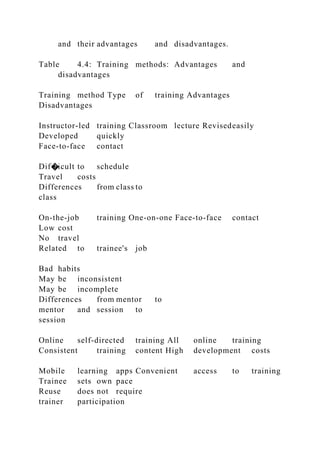
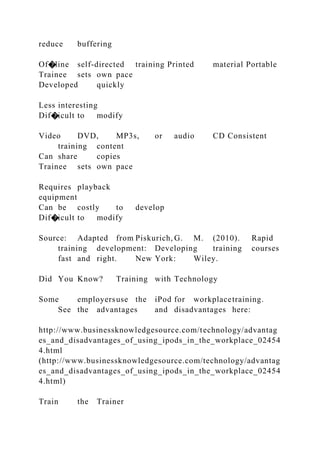
Table 4.4 presents somepotential delivery methods
and their advantages and disadvantages.
Table 4.4: Training methods: Advantages and
disadvantages
Training method Type of training Advantages
Disadvantages
Instructor-led training Classroom lecture Revisedeasily
Developed quickly
Face-to-face contact
Dif�icult to schedule
Travel costs
Differences from class to
class
On-the-job training One-on-one Face-to-face contact
Low cost
No travel
Related to trainee's job
Bad habits
May be inconsistent
May be incomplete
Differences from mentor to
mentor and session to
session
Online self-directed training All online training
Consistent training content High development costs
Mobile learning apps Convenient access to training
Trainee sets own pace
Reuse does not require
trainer participation
Lengthy development time
Requires computer
equipment
Web-based training Easy to modify Slow download
times from
limited bandwidth, for
example
CD-ROM and DVD Supports complex
multimedia
Dif�icult to modify
12/28/2017 Print
https://content.ashford.edu/print/AUBUS375.14.1?sections=ch0
4,ch04intro,sec4.1,sec4.2,sec4.3,sec4.4,sec4.5,sec4.6,ch04summ
ary&content=all&cli… 7/22
Effective training is dependent in no small part on
the training venue itself. From proper
lighting to adequate sound and a comfortable
roomtemperature, trainee opinions about the
training venue can dictate the trainees' initial
reaction to the training.
Webinars Easily distributed
Trainee sets own pace
Can be costly to develop
May need faster Internet
speed and bandwidth to
reduce buffering
Of�line self-directed training Printed material Portable
Trainee sets own pace
Developed quickly
Less interesting
Dif�icult to modify
Video DVD, MP3s, or audio CD Consistent
training content
Can share copies
Trainee sets own pace
Requires playback
equipment
Can be costly to develop
Dif�icult to modify
Source: Adapted from Piskurich, G. M. (2010). Rapid
training development: Developing training courses
fast and right. New York: Wiley.
Did You Know? Training with Technology
Some employersuse the iPod for workplacetraining.
See the advantages and disadvantages here:
http://www.businessknowledgesource.com/technology/advantag
es_and_disadvantages_of_using_ipods_in_the_workplace_02454
4.html
(http://www.businessknowledgesource.com/technology/advantag
es_and_disadvantages_of_using_ipods_in_the_workplace_02454
4.html)
Train the Trainer
Another training method is known as train the
trainer. With this type of delivery method, an
experienced trainer—sometimes as an external
consultant—trains
a less experienced trainer to deliver the training
(Lawson, 1998; Pike,Pike,Arch, & Solem,
2000). Usually, the new trainer will �irstobserve
a training led by the
course designer or subject matter expert.
Rather than just a single one-on-one event,
sometrain-the-trainer workshops builda pool of
competentinstructors who can then teach training
material to
others as needed (Pike et al., 2000). As a
result, instead of just one instructor teaching
the same course over and over,multiple instructors
teach the same course
at the same time.This approach ensures that employees
get timely training should a needs
assessment determine that training is required.
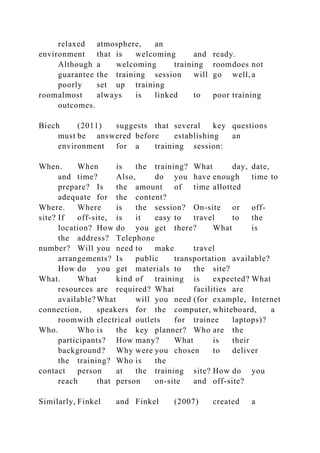
Preparing YourTraining Environment Room
Beyond all the analyses and theories, thereis also a
practicality associatedwith training; that is, you
should prepare your training environment so it
will be
conducive to learning—from the lighting in the roomto
the colors of the �loors and walls.
According to training expert Elaine Biech
(2011), establishing an
environment for learning is a critical aspect of
starting a training session off on the right
foot. Simply put, trainees need to walk in to a
relaxed atmosphere, an
environment that is welcoming and ready.
Although a welcoming training roomdoes not
guarantee the training session will go well, a
poorly set up training
roomalmost always is linked to poor training
outcomes.
Biech (2011) suggests that several key questions
must be answered before establishing an
environment for a training session:
When. When is the training? What day, date,
and time? Also, do you have enough time to
prepare? Is the amount of time allotted
adequate for the content?
Where. Where is the session? On-site or off-
site? If off-site, is it easy to travel to the
location? How do you get there? What is
the address? Telephone
number? Will you need to make travel
arrangements? Is public transportation available?
How do you get materials to the site?
What. What kind of training is expected? What
resources are required? What facilities are
available? What will you need (for example, Internet
connection, speakers for the computer, whiteboard, a
roomwith electrical outlets for trainee laptops)?
Who. Who is the key planner? Who are the
participants? How many? What is their
background? Why were you chosen to deliver
the training? Who is the
contact person at the training site? How do you
reach that person on-site and off-site?
Similarly, Finkel and Finkel (2007) created a
questionnaire that rates the quality of a training
room(see Figure 4.2).
Figure 4.2: Rating the quality of the training
room
http://www.businessknowledgesource.com/technology/advantag
es_and_disadvantages_of_using_ipods_in_the_workplace_02454
4.html
12/28/2017 Print
https://content.ashford.edu/print/AUBUS375.14.1?sections=ch0
4,ch04intro,sec4.1,sec4.2,sec4.3,sec4.4,sec4.5,sec4.6,ch04summ
ary&content=all&cli… 8/22
Click here
(https://media.thuze.com/MediaService/MediaService.svc/conste
llation/book/AUBUS375.14.1/{�igures}�igure4.2.pdf)
to download a pdf of the training quality
questionnaire. Open with Adobe Acrobat to
access
an editable �ile.
Source: Finkel, C., & Finkel, A. D. Facilities
Planning: Managing the Training Function in Info-
line, Issue
8504, p. 9. Copyright © 1985, 2000 by The
American Society for Training and Development
(ASTD). All
Rights Reserved. For use by permission only.
Training methods review
https://media.thuze.com/MediaService/MediaService.svc/constel
lation/book/AUBUS375.14.1/%7Bfigures%7Dfigure4.2.pdf
12/28/2017 Print
https://content.ashford.edu/print/AUBUS375.14.1?sections=ch0
4,ch04intro,sec4.1,sec4.2,sec4.3,sec4.4,sec4.5,sec4.6,ch04summ
ary&content=all&cli… 9/22
12/28/2017 Print
https://content.ashford.edu/print/AUBUS375.14.1?sections=ch0
4,ch04intro,sec4.1,sec4.2,sec4.3,sec4.4,sec4.5,sec4.6,ch04summ
ary&content=all&… 10/22
Incorporating the principles of adultlearning (andragogy)
in training design can increase the
relevance of training for the trainees, and also
improve its effectiveness for the organization.
1. How, speci�ically, would a training
program incorporate the principle of andragogy
that
states adults are generally intrinsically motivated?
2. Given the above, would it still be
recommended to include extrinsic rewards as
part of
training program outcomes?
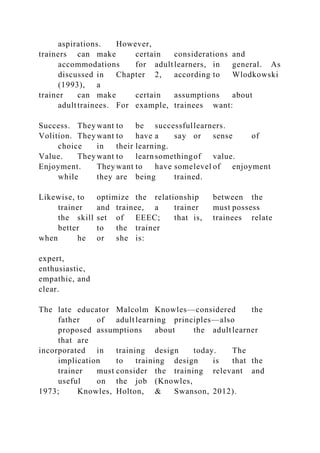
4.3 IndividualTrainee Differences
Naturally, trainers do not always have the time or
resources to design training to accommodate
individual trainee learning styles or career
aspirations. However,
trainers can make certain considerations and
accommodations for adultlearners, in general. As
discussed in Chapter 2, according to Wlodkowski
(1993), a
trainer can make certain assumptions about
adulttrainees. For example, trainees want:
Success. They want to be successfullearners.
Volition. They want to have a say or sense of
choice in their learning.
Value. They want to learnsomethingof value.
Enjoyment. They want to have somelevel of enjoyment
while they are being trained.
Likewise, to optimize the relationship between the
trainer and trainee, a trainer must possess
the skill set of EEEC; that is, trainees relate
better to the trainer
when he or she is:
expert,
enthusiastic,
empathic, and
clear.
The late educator Malcolm Knowles—considered the
father of adultlearning principles—also
proposed assumptions about the adultlearner
that are
incorporated in training design today. The
implication to training design is that the
trainer must consider the training relevant and
useful on the job (Knowles,
1973; Knowles, Holton, & Swanson, 2012).
Andragogy: Adult learning principles
Critical Thinking Questions
Table 4.5 outlines all of Knowles's adultlearning
principles and how trainers might use the
principles in training practice.
Table 4.5 Adult learning principles
Principle Practices
1. Autonomous and self-directed Ask what they would
like to get out of the training before
beginning
class and adjust lesson plan.
Discuss what they thinkthey need to accomplish: the
objectives or
do their jobs.
Allow them to skip material they already understand.
Present in a way that caters to a variety of
learning styles.
2. Experienced Ask them to share an example
from their life experiences to help
clarify the lesson.
Approach unlearning of old information gently
before facilitating
learning of new information.
3. Goal-oriented Explain the reasons why competing
the training is important.
Use real-world problems or case studies that call on
expertise of
group members.
Focus on doing somethingwith the information,
rather than simply
knowing the information.
12/28/2017 Print
https://content.ashford.edu/print/AUBUS375.14.1?sections=ch0
4,ch04intro,sec4.1,sec4.2,sec4.3,sec4.4,sec4.5,sec4.6,ch04summ
ary&content=all&c… 11/22
4. Require relevance Provide them with the objectives
for the class.
Ask them to re�lect on how they may use what they
have learned in
the future.
5. Practical Explain how the training will be useful
on the job.
6. Needto be shown respect Encourage them to
express their thoughts, opinions, and reasoning
on the subject.
Treat them as equals in the subject you are
training.
Appeal to intrinsic motivation by providing
feedback that increases
self-esteem, satisfaction, or quality of life.
Source: Knowles, Holton, & Swanson, 2012.
Rothwell and Kazanas (2011) suggested that trainees'
learning characteristics could be assessed for
the design phase using a derived
approach or a contrived
approach. That is, the derived approach could be
used when instructional designers are able to
identify relevant learner characteristics of obvious
importance
based on a given performance problem,
instructional need, or organizational constraint.
A contrived approach should be used by the
designer when the learner
characteristics of the trainees cannot be identi�ied
as easily; in this case the designer creates a
list of trainee learning characteristics to be
considered.
Two particular trainee characteristics that instructional
designers must consider are the trainees' readiness
and motivation (Snell & Bohlander, 2011).
According
to Snelland Bohlander(2011), trainee readiness refers
to "both maturity and experience factors in
the trainee's background" (p. 302). The premise
is that
training should be designed with assumptions about
the prospective trainee's starting point. The
entrybehaviors the trainees will need are useful in
prescreening the prospective trainees for these
prerequisite KSAs necessary to absorb what
will be presented to them in the training.
The othertrainee characteristic to consider in training
design is trainee motivation. That is, training
should be designed in a way that motivates
trainees to
learnthe new material (Kozlowski & Salas, 2009;
Krishnaveni, 2008). First, the design must
clearly link the training objectives to the
trainee's workplaceneeds
in order to increase the motivation to succeed
in training programs. For example, if a trainee
sees a new training as a sought-after
competency for advancement
in his or her career path, he or she will be
more motivated to learnthe new material (Snell &
Bohlander, 2011).
Frequently, the state of the trainee's motivation
will also be based on not only his or her
perception of the new learning, but also the
trainee's experiences in
using prior training. As a result, if a trainee,
for example, had a bad experience with
learning new software last time,it is likely
that the trainee will come to the
new training with a negative attitude; contrast this to
another trainee who had success in learning
the prior software (Knowles,1973; Knowles et
al., 2012).
Speci�ically, a trainee's motivation toward the
new training will be impacted if the training is
perceived by the trainees as making them more
effective at their
jobs. In fact, according to 19th-century philosopher
and psychologist William James (as cited in
Baldwin et al., 1906), even a person's self-
esteem would be
linked to successes over pretensions what we today
would call "achievements over attempts." Is the
training assisting in making the employee
con�ident he or she
could do the task well to accomplish work goals?
Consider how the relationship between tasksattempted
and tasksachieved could affect an employee's
self-esteem in the long run:
Workplace self-esteem = Achievements ÷
Attempt
Employee Mario was interviewed and asked how
his �iscal year had gone...
"Well, it was a tough year, and we had a
couple hiccups, but all-and-all, I
accomplished 8 of the 10 major projects
this year."
Now compare that to employee Michele; we also asked
her how her �iscal year went...
"To be honest, everything that could've gone wrong
this year ... did! I, maybe, accomplished 2 of
the 10 major projects we had this year."
Using the performance formula from Chapter 2,
we would have to determine if Michele's poor
performance was due to her ability, poor
training, lack of
motivation, or somethingin the environment. But,
you can see that if this became a chronic
outcome of successes versus failures for
Michele, we would expect to
see a discernible difference between Mario's (8/10)
and Michele's (2/10) (organizational) self-esteem.
In sum, training design must consider these
scenarios of
training's utility.
Self-Directed Trainees
One aspect of how ef�iciently training will become
learning is how self-directed the trainee is
(Durr & Guglielmino (1996)). Speci�ically,
self-directed learning
(SDL) is a learning process whereby individuals
take the initiative in diagnosing their learning
needs, formulating learning goals, identifying
resources for
learning, choosing and implementing appropriate
strategies,and evaluating outcomes (Candy, 1991).
Though one assumption about adultlearners is
that they
are self-directed (Knowles,1973), like otherpersonal
characteristics, the level of self-direction varies
from trainee to trainee. Guglielmino (1977)
developed the
self-directed learning readiness scale, which can
actually measure one'slevel of self-direction.
SDL has two dimensions—self-teaching and autonomy—
and one does not necessarily mean the other.
Although self-direction can mean self-teaching,
being self-
directed also means that an employee can choose
(exercise autonomy) to be taught.
12/28/2017 Print
https://content.ashford.edu/print/AUBUS375.14.1?sections=ch0
4,ch04intro,sec4.1,sec4.2,sec4.3,sec4.4,sec4.5,sec4.6,ch04summ
ary&content=all&… 12/22
SDL is a trait that seemingly can become stronger
with certain in�luences (Guglielmino, 1977). In
fact, although teaching self-directed learning seems
like a
contradiction in terms, it is not. According to
Guglielmino (1977) and Brook�ield (1984),
trainers can offer speci�ic tactics for developing
SDL competence within
employees:
Offer training and workshops in speci�ic skill
competence like goal setting, time management,
and self-evaluation.
Ensure that your employee has access to adequate,
comprehensive, and readily available learning
resources such as computer-assisted instruction,
trade
publications, and access to experts.
Give your employees enough personal space and
discretionary power to act on their own behalf.
Some experts suggest that enhancing SDL
competency
within an individual may speci�ically lie in
increasingthe component of personal autonomy.
Underscore the importance of teams and the
virtues of collaboration. This is an important tip
because SDL is not an isolated, solitary
endeavor but is
inevitably tied to and affected by others in the
organization.
Locus of Control
Another concept that a trainer should be mindful
of is locus of control. The concept was
�irstintroduced by Rotter (1954) and
considers where a person gets his
or her energies from. That is, does a person
believe he can control his destiny (internal) or
believe that his decisions and life are controlled by
environmental
factors that he cannot in�luence(external)? Issues
of locus of control are important because a
trainee might be more dependent or less
dependent on the trainer.
Although it might not be practical for trainers to
customize every training session to each and
every trainee's learning style or personality
type, designing
training to recognize and appreciatelearner
characteristics such as level of self-direction, self-
ef�icacy, and locus of control go a long way in
making the training
relevant and enabling it to resonate with each trainee.
Foodfor Thought: Locus of Control
If you want to do somequick analysis, go around
a roomand ask people to draw a capital E
on their foreheads with their �ingers. As they do,
observe whether they are drawing the E with respect
to their audience or themselves (it would
look backward to a viewer).
If they draw the E with respect to you, they have an
external locus of control. If they draw the E
with respect to themselves, they have an internal
locus of control (Hass, 1984).
Consider This
1. How could you incorporate an employee's
locus of control into training design?
2. What type of advantages might therebe in
pairing a trainer who has an external locus
of control with a trainee who has an internal
locus of
control, or vice-versa?
12/28/2017 Print
https://content.ashford.edu/print/AUBUS375.14.1?sections=ch0
4,ch04intro,sec4.1,sec4.2,sec4.3,sec4.4,sec4.5,sec4.6,ch04summ
ary&content=all&… 13/22
4.4 Training Design Sequencing
Part of training design includes decisions about
the sequencing of the training topics,
including how you �irstpresent the concepts that
will be covered to
trainees. There are many choices for sequencing,
including chronological, problem solution, known to
unknown, and unknown to known (Rothwell &
Kazanas,
2011). Here is an overview of someof those
design sequence strategies.
Chronological. With chronological sequencing, the training
objectives can be introduced with a history of
the training content sequencedfrom past to
present. So, for example, if we were training newly
hiredemployees at Hewlett-Packard during
orientation, we might use this sequencing by
starting with
how the company was founded: "Hewlett Packard was
started in a garage by Stanford University
classmates Bill Hewlett and DavePackard in
1939."
Problem solution. Introduce the training by explaining
how this training is the solution to a
particular problem. The trainer might start the
session by
explaining that ineffective communication in the
workplacehas resulted in an increase in
con�lict, confusion, and dissatisfaction within
the organization,
and then explain that theseare the reasons for holding
today's effective communication workshop.
Known to unknown. Trainees are introduced to
what they already know and are gradually led
through the training into what they do not know.
In a
computer training, for example, the trainer might
start out with somefamiliar software and then delve
into more complex aspects within that software: "I
know all of you currently use and are familiar
with Excel® for your spreadsheets, but today
we are going to learnhow to create
macros."
Unknown to known. Trainees are deliberately
disoriented at the outset of the training.
Trainers are strategically ambiguous and attempt
to have all
trainees starting at a consciously incompetent
realm, as discussed in Chapter 2. For
example, at the onset of a training session,
the trainer treats the
trainees rudely and dismissively for the �irst10
minutes, until he reveals that it was a role-
play to showthem how customers feel when customer
representatives treat them rudely!
WPW Learning Model in Training Design
Another important design sequence strategy is the
whole-part-whole (WPW) model. The model is
meant to mirror the natural whole-part-whole
rhythm in
adultlearning (Knowles,1973; Knowles et al., 2012;
Swanson, 1995; Swanson & Holton, 2001).
In the WPW model, learning is introduced in
a way that the �irstmajor overarching concept
(�irst whole) is built on by integrating
new learning segments
(parts), resulting in a more knowledgeable learning
framework (second whole). Trainees would be
�irstexposed to the �irst"whole" concept in
which they then
prepare for new training with mental scaffolding
(Wlodkowski, 1993); that is, the learning
objectives and building-block concepts placed within
the larger
framework of the topic.
The training then focuses back onto the "parts," the
details of the KSAs that are required,
including speci�ic expertise and activity. Knowles
and colleagues (2012)
described the process this way:
After learners have mastered the speci�ic, structured
material, it is time to return to the
"whole." The second "whole" helps learners
place their newly-
mastered skills in context. The model is
effective because it encourages training or
instruction that gives learners an overview of
what they are about
to learn, details the speci�ics, and then
integrates the new knowledge or skills into a
broader framework. (pp. 247–249)
Here is an example of how WPW could work
when incorporated into the training design
for a printing pressoperator, for example:
First whole: introduction and overview of systems
and pressequipment
Part: How to start up printer
Part: Operation of printer
Part: Checking for printing defects
Part: Troubleshooting
Part: Shutting down printer
Second whole: competentsolo performance of
printing pressequipment
The premise of the second whole in WPW is
that the trainee is wiser having gone through
not only critical re�lection of the processes,
but also
what leadershipconsultantRobert Staub (2002) called
the walking through the weeds of details.
Did You Know? Perspectives on Employee Training
You will also experience a similar WPW effect
regarding employee training. Consider what you thought
about employee training before this
course. Of course, you understood the term
employee training at an intellectual level;
that is, you knew it meant "howyou train
employees."
However, once you have completedthis course, the term
will take on a deeper, richer meaning for
you because you will have conceptually
stretched and critically re�lected, having gone through
and been challenged with the details of training
and its systems. This learning process will
necessarily lead to you holding a different
perspective on the concept of employee training
from now on.
Now, consider theseexamples of design-sequencing
"hooks" for new hires at the Kopp Dry Erase
Marker company:
Chronological. "Good morning, and welcome to our
organization. Many people don't realize that
the very �irstdry erasemarker was manufactured in
Portugal in 1926 by Dominican monks. Now,
back then, they did not have our Ariastar 120 to
�ill the felt with ink, but we do."
12/28/2017 Print
https://content.ashford.edu/print/AUBUS375.14.1?sections=ch0
4,ch04intro,sec4.1,sec4.2,sec4.3,sec4.4,sec4.5,sec4.6,ch04summ
ary&content=all&… 14/22
Chronological
Problem solution
Known to unknown
Unknown to known
Whole part whole
Unknown to known. "Good morning, and welcome
(the trainer is standing in front of two barrels,
one �illed with small black pellets, the
otherwith white
clothstuf�ing). These barrels may look strange to
you, but believe it or not, theseraw materials
are exactly how we make our dry erase
markers (trainer
pulls out a brand-new dry erasemarker from the
package). Speci�ically using the Ariastar 120,
we...."
Problem solution. "Good morning. One of the biggest
criticisms of chalk and blackboards was that
chalk was messy, chronically breaking, and
got
'stubby,' and the blackboard was a pain to clean
up after use. So, in 1982 our company invented a
system of markers that could be used for
instruction for
recording temporary information. No longer were there
just permanent markers; now therewere markers of
more than 16 different colors, whose marks
could easily be cleaned awaywhen complete!
The era of the dry erasemarker began, and
we...."
Foodfor Thought: Design Hook
Take an ordinary item such as a soda can, TV remote
control, or mouse pad and create your own
design hook from the list in this box. Imagine
you have new trainees who have to learnhow to
manufacture that item.
Consider This
1. Choose one ordinary item and compare two of
the design hook approaches that could be
used. Explain the reasons why each would or
would not suit trainees.
12/28/2017 Print
https://content.ashford.edu/print/AUBUS375.14.1?sections=ch0
4,ch04intro,sec4.1,sec4.2,sec4.3,sec4.4,sec4.5,sec4.6,ch04summ
ary&content=all&… 15/22
4.5 Preparing Lesson Plan
As part of the training design, a lesson plan is
created that will outline the activities of the
day'straining; this is the training script. Many
of the items, or end
products, of the lesson plan will be produced in
the next phase of ADDIE— development, which
will be discussed in Chapter 5.
The training lesson plan should have activities that
introduce and allow for practice of the
knowledge, skills, and attitudes needed for
the new training outcomes.
Table 4.6 outlines instructional methods to be
included in training design, according to the
National Training and Education Division (Federal
Emergency
Management Agency [FEMA], 2012).
Speci�ically, the lesson plan is the organization of
the material and learning activities based on
your goals and objectives for the training
(Charney & Conway,
2005; Hannum & Hansen, 1989; McArdle, 1999;
Piskurich, 2010; Reed & Signorelli, 2011;
Rothwell & Kazanas, 2011). The lesson plan
should include:
topics you choose to cover (to accomplish
your goals and objectives),
goals and objectives,
types of teaching techniques and learning
activities you will use,
training aids and materials you will use,
length of the training to accomplish your goals
and objectives, and
ways you will check for understanding and get
feedback from employees.
Table 4.6: Instructional methods included in training
design
Training dimension Instructional method
Knowledge Lecture, guided discussion, practical
application, self-study, television, debate,
interview, symposium, panel, group
interview, colloquy, motion picture, slide �ilm,
recording,book-based discussion, reading
Skills Demonstration, practical application, role-playing,
in-basket exercise, games, action mazes,
participative cases,
nonverbal skill practice exercises, drills, coaching
Attitudes Guided discussion, demonstration, television,
lecture, debate, symposium, colloquy, motion
picture, dramatization,
guided discussion, experience-sharing discussion,
role-playing, critical incident, process, games
Source: Federal Emergency Management Agency,
2014.
There are different types of lesson plan
formats. A popular format is the two-column
format, with one side showing content and
containing items such as trainer
notes, activities, and anything else that the trainer
might use to get the content across
(Piskurich, 2010); otherformats get more
complex. For example, the four-
column format includes the following columns: time,
media, content, and testing. According to
Reed and Signorelli (2011), the following components
should be
included in a lesson plan outline:
Introduction—provides an overview of the course, to
include
– The course goal
– A target audience description
– A high-level view of the structure
Modules—possibly the largest unit of instruction
within a course, usually containing
multiple learning objectives and consisting of
– Module introduction
– Objectives
– Lessons
– Module summary
Lessons—a unit of instruction within a course,
consisting of
– Lesson introduction
– Objectives
– Topics
– Content
– Lesson summary
A sample two-column lesson plan appears in
Table 4.7.
Table 4.7: Sample lesson plan
Time Activity
Saturday
7:00–8:00 a.m. BREAKFAST
8:00–9:00 a.m. Program introduction and completion of
pre-questionnaires.
12/28/2017 Print
https://content.ashford.edu/print/AUBUS375.14.1?sections=ch0
4,ch04intro,sec4.1,sec4.2,sec4.3,sec4.4,sec4.5,sec4.6,ch04summ
ary&content=all&… 16/22
Initial activities—the napkin game. Participants
form groups of equal size. Each group gets a
napkin, and
the task is to fold the napkin as small as
possible, but still largeenough for each group
member to place
a toe on the napkin.
Discuss what happened during the activity and how
the group handled the issues it encountered.
Present Kirkpatrick's learning model; group or
team members should ideally enjoy the activity
and
learnsomethingfrom it that they can apply and that
will improve results.
9:00–10:00 a.m.
Brainstorming session: Haveeach group work on group
goal setting. Groups will share the problems
that they encounter at work and generate an initial
discussion of how to deal with those issues
by
working as a team.
Icebreaker activity—toilet paper go-round. Direct
the group to pass along a roll of toilet
paper within 1
minute and each group member to tear off as
many sheets as possible. When the time is
up, each person
must tell a number of facts about themselves,
and the number of facts must equal the number
of sheets
of toilet paper the person holds.
10:00–10:30 a.m. BREAK
10:30 a.m.–12:00 p.m.
Discuss the earlier task before the break, what
problems they encountered, and how they solved
problems. A focus can be how competitiveness
can back�ire unless you know what you are
competing
for, and on the fact that making assumptions carries
risks. Discussion can continue on how to
solve
someof theseproblems they encounter at work.
GROUP ACTIVITIES
Best day at work. Start out by having every
team member take 20 minutes to writeout what
their best
day at work was and why. Oncethe group has
�inished, start asking for volunteers to
describe the
circumstances of the best day and start writing the
themes on the board. This appreciative inquiry
exercise focuses the group on what is valued
within the group. Group members might be
surprised to
�indthat monetary issues are NOT part of their best
day, but intrinsic themes like recognition,
appreciation, and feeling they made a difference
were themes.
Managing change. Form groups of four to �ive
people from different divisions or departments.
Ask them
to discuss the following questions with their group
members:
1. A recent situation in which sometype of
change was introduced.
2. Whether this change was resisted.
3. Why or why not.
4. What could have been done to make the
change easier.
Ask one representative of each group to present
the discussion.
Havethe groups try each of the activities and do
their own planning for subsequent activities.
12:00–1:00 p.m. LUNCH
1:00–2:00 p.m. Discuss the morning activities and what
needs to be done to make the afternoon
successful.
2:00–3:30 p.m.
More group activities:
Sneak a peak. The instructor will builda small
sculpture with someof the building blocks and
hide it in
an area that is an equal distance from each group.
While group members try to duplicate the
structure,
one member from each group can come up at
the same time to look at the sculpture for 10
seconds and
try to memorize it before returning to his or
her group. After members return to their
group, they have
25 seconds to instruct their group about how to
buildan exact replica of the instructor's
sculpture. After
1 minute of trying to re-create the sculpture,
another member from each group can come up
to "sneak a
peek" before returning to his or her team and
trying to recreate the sculpture. The game
should be
continued in this pattern until one of the groups
successfully duplicates the original sculpture. This
game will teach participants how to problem
solve in a group and communicate
effectively.
Day colors. Explore how mental associations can
colorour worlds differently. Havemembers close
their
eyes and imagine the days of the week, then write
down the colorof each day. Let the group
share and
compare people's different colorassociations and—where
people consciously know and are willing to
share their reasons and associations—review these
differences, too.
3:30–4:00 p.m. BREAK
12/28/2017 Print
https://content.ashford.edu/print/AUBUS375.14.1?sections=ch0
4,ch04intro,sec4.1,sec4.2,sec4.3,sec4.4,sec4.5,sec4.6,ch04summ
ary&content=all&… 17/22
4:00–5:00 p.m.
Review and discuss the concept of teamwork and
how the activities of the day have helped the
group
members learnhow effective teams work by
acknowledging individual perspectives, emotional
triggers,
empathy, and respectingpersonal differences. Brie�ly
introduce Johari window.
5:00–7:00 p.m. DINNER
7:00–9:00 p.m.
AFTER-DINNER ACTIVITY
Finalactivity to sum up the concept of teamwork;
working in two largegroups.
The greategg drop. (The groups experience
working together and communicating for the
common goal
of both winning and successfully creating an egg
package.) Split the roominto two largegroups with
the
task of building an egg package that can sustain an
8-foot drop. A variety of tools and other
materials
should be provided to the teams. After the
packages have been built, each team must also present
a 30-
second advertisement for their package, highlighting
why it is unique and how it works. For
the
conclusion of the presentations, each group will
have to drop their egg using their package to
see if it
really works.
Sunday Morning
8:00–9:00 a.m. BREAKFAST
9:00–10:00 a.m. Review and discuss the egg drop
activity, reviewing the program concepts especially on
building
teamwork and communication, and how the activity
was accomplished using the concepts learned.
10:00–12:00 p.m. Closing: Finaldiscussion of
teamwork, focusing on speci�ic issues of
the organization. While the trainer
facilitates the discussion, management can be the
leader in developing the issues.
A key part of the lesson plan includes some
pretraining activities such as icebreakers; these
are intended to help trainees and the trainer
get to know each other
and become more comfortable so they can
communicate and work together during the
training. The HRD in Practice feature box titled
"Two Truths and a Lie"
contains an example of an icebreaker.
HRD in Practice: Icebreakers—Two Truths and a
Lie
Two truths and a lie is a classic get-to-know-
you icebreaker. Trainees tell two truths and one
lie. The object of the game is to
determine which
statement is the false one.
Ask trainees to arrange themselves in a circle.
Instruct each to thinkof threestatements about
themselves. Two must be true statements, and
one must be false. For each person, he or she
shares the threestatements (in any order) to
the group. The goal of the icebreaker game
is to
determine which statement is false. The group
members vote on which statement they thinkis a
lie, and at the end of each round, the person
reveals which one was the lie.
I recently used this exercise in my class. Can
you guess which of the following was the
lie?*
I have a tattoo you cannot see.
I had dinner with Yoko Ono.
I wrote jokes for The Tonight Show with
Jay Leno.
Looking for more icebreakers? http://www.icebreakers.ws
(http://www.icebreakers.ws)
Source: Thiagarajan, S. (2012). More jolts!
Activities to wakeup and engage your participants.
New York: Wiley.
Consider This
1. Why is breaking the ice with trainees important?
2. Is therea certain training subject matter
for which an icebreaker would be
inappropriate?
3. What should you consider in the selection
process in deciding to use one icebreaker
over another?
* Answer at end of chapter.
http://www.icebreakers.ws/
12/28/2017 Print
https://content.ashford.edu/print/AUBUS375.14.1?sections=ch0
4,ch04intro,sec4.1,sec4.2,sec4.3,sec4.4,sec4.5,sec4.6,ch04summ
ary&content=all&… 18/22
4.6 Designing Learning Assessment
The design phase not only assists in de�ining
what content will be taught, but also in
de�ining how the learning of that content will be
measured after the
training. The training design should include an
assessment that tests changes in trainees in
the learning posttraining, what Donald Kirkpatrick
(2009) called a
level 2 assessment. This will be discussed in detail
in Chapter 7.
Speci�ically, you can incorporate testing to
measure any dimension—knowledge, skills, and
attitudes—of learning (Dick et al., 2009;
FEMA, 2012; Wick, Pollock,
Jefferson, Flanagan, & Wilde, 2011). The following
are different types of tests that indicate
achievement with regard to knowledge, skill,or
attitudinalobjective
(Table 4.8).
Table 4.8: Types of testing methods
Learning outcome Best method of testing Activities
Knowledge
Discriminations Multiple choice and true or false Detect
similarities or differences
Concrete concepts and de�ined
concepts
Constructed response (labeling, sorting, matching)
Recognize examples or nonexamples
Rule learning Performance of integrated tasksor
constructed
response (short answer)
Apply rule, principle, or procedure
Solve problems
Produce a product
Skills
Behaviorally based Performance tests Perform smooth,
timely, coordinated action
Attitudes
Emotionally based Performance tests Display desired
situated behavior
As previously discussed,in addition to pretests
(used to measure prerequisite entryskills)
and posttests (used after exposure to an
instructional program to
provide a measure of the changes that have
occurred after training), otherspeci�ic types of
tests can be incorporated into the design to
measure otheraspects of
pre- and posttraining learning (Dick et al., 2009;
Wick et al., 2011). These include:
Diagnostic tests. These are used to determine
which knowledge and skills (enabling
objectives) are necessary to master a �inal
objective of the training.
Survey testing. These are used to determine what
prospective learners already know and can do
before receiving training.
Appraisals. These are used to informally assess
retention and or comprehension to provide early
identi�ication of trainees who may need
individualized
assistance and what the learners need to learn.
12/28/2017 Print
https://content.ashford.edu/print/AUBUS375.14.1?sections=ch0
4,ch04intro,sec4.1,sec4.2,sec4.3,sec4.4,sec4.5,sec4.6,ch04summ
ary&content=all&… 19/22
Summary and Resources
Chapter Summary
Chapter 4 showed how fundamental training design
is to developing effective training objectives.
To accomplish this step, we considered the
behavior,
conditions, and standards of a training objective.
This chapter discussed choosing the appropriate training
setting and delivery method. Sometimes the
delivery method dictates the training setting, as
is
seen in on-the-job training. Attention needs to be
given to the training roomand what a room
conducive to learning looks like.
The chapter considered individual trainee differences,
such as trainee readiness, trainee motivation,
self-direction, and locus of control. Assumptions
about trainees as adultlearners should be
incorporated into the design.
The chapter also introduced design-sequencing
options, which include chronological, problem
solution, and whole part whole. After making
design-
sequencing decisions, a lesson plan must be
developed that breaks down the time sequence of
the day'straining and includes icebreakers to
encourage
trainee participation and trainee group cohesion.
Finally, the chapter explained that training design
must include a learning assessment of how
the learning of that content will be measured
after the
training. Speci�ically, the training design should
include an assessment that tests changes in
trainee in learning posttraining.
*The author has no tattoos.
Assess YourLearning: Critical Re�lection
1. Where conceptually does the ADDIE process
�it into human resource development?
2. How might the characteristics of a job affect
the employee's psychological state?
3. How can an organization's rating philosophy
impact the individual assessment of
performance?
4. Is self-directed learning a characteristic people
are born with,or can it be taught?
5. Why might a subject matter expert not be
the best person to train others on the
subject?
6. Why is it important to prioritize training?
7. The goal of training is not only to get from
competence to expertise, but sometimes from
incompetence to competence. What does this
mean?
Additional Resources
Web Resources
More info on adultlearning principles and andragogy:
http://www.instructionaldesign.org/theories/andragogy.html
(http://www.instructionaldesign.org/theories/andragogy.ht
ml) .
To explore more on design sequencing with
multiple resources:
http://www.learningsolutionsmag.com/articles/236/taking-an-
overlapping-andsequenced-project-approach-to-training-
development/page3
(http://www.learningsolutionsmag.com/articles/236/taking-an-
overlapping-andsequenced-project-approach-to-training-
development/page3) .
Actus Consulting has a helpful video on
SMART objective setting:
http://www.youtube.com/watch?v=hyxox_amuDY
(http://www.youtube.com/watch?v=hyxox_amuDY) .
Further Reading
Biech, E. (2011). Training for dummies. New York:
Wiley.
Charney, C., & Conway, K. (2005). The trainer's
tool kit. New York: AMACOM.
Mager, R. F. (1988). The new Mager six-pack.
Belmont, CA: Lake.
Thiagarajan, S. (2012). More jolts! Activities to
wakeup and engage your participants. New York:
Wiley.
Key Terms
Click on each key term to see the de�inition.
achievable
(http://content.thuzelearning.com/books/AUBUS375.14.1/sectio
ns/fm/books/AUBUS375.14.1/sections/fm/books/AUBUS375.14.
1/sections/fm/books/AUBUS375.14.1/section
The quality of being able to be accomplished;
training objectives need to be achievable so
that they stretch the employee,but not so far
that he or she becomes
frustrated and losesmotivation.
behavior
(http://content.thuzelearning.com/books/AUBUS375.14.1/sectio
ns/fm/books/AUBUS375.14.1/sections/fm/books/AUBUS375.14.
1/sections/fm/books/AUBUS375.14.1/section
One of the threecomponents that training objectives
need to have; the behaviors should be
speci�ic and observable.
http://www.instructionaldesign.org/theories/andragogy.html
http://www.learningsolutionsmag.com/articles/236/taking-an-
overlapping-andsequenced-project-approach-to-training-
development/page3
http://www.youtube.com/watch?v=hyxox_amuDY
https://content.ashford.edu/books/AUBUS375.14.1/sections/fm/
books/AUBUS375.14.1/sections/fm/books/AUBUS375.14.1/sect
ions/fm/books/AUBUS375.14.1/sections/fm/books/AUBUS375.
14.1/sections/fm/books/AUBUS375.14.1/sections/fm/books/AU
BUS375.14.1/sections/fm/books/AUBUS375.14.1/sections/fm/b
ooks/AUBUS375.14.1/sections/fm/books/AUBUS375.14.1/secti
ons/fm/books/AUBUS375.14.1/sections/fm/books/AUBUS375.1
4.1/sections/fm/books/AUBUS375.14.1/sections/fm/books/AUB
US375.14.1/sections/fm/books/AUBUS375.14.1/sections/fm/boo
ks/AUBUS375.14.1/sections/fm/books/AUBUS375.14.1/sections
/fm/books/AUBUS375.14.1/sections/fm/books/AUBUS375.14.1/
sections/fm/books/AUBUS375.14.1/sections/fm/books/AUBUS3
75.14.1/sections/fm/books/AUBUS375.14.1/sections/fm/books/
AUBUS375.14.1/sections/fm/books/AUBUS375.14.1/sections/f
m/books/AUBUS375.14.1/sections/fm/books/AUBUS375.14.1/s
ections/fm/books/AUBUS375.14.1/sections/fm/books/AUBUS37
5.14.1/sections/fm/books/AUBUS375.14.1/sections/fm/books/A
UBUS375.14.1/sections/fm/books/AUBUS375.14.1/sections/fm/
books/AUBUS375.14.1/sections/fm/books/AUBUS375.14.1/sect
ions/fm#
https://content.ashford.edu/books/AUBUS375.14.1/sections/fm/
books/AUBUS375.14.1/sections/fm/books/AUBUS375.14.1/sect
ions/fm/books/AUBUS375.14.1/sections/fm/books/AUBUS375.
14.1/sections/fm/books/AUBUS375.14.1/sections/fm/books/AU
BUS375.14.1/sections/fm/books/AUBUS375.14.1/sections/fm/b
ooks/AUBUS375.14.1/sections/fm/books/AUBUS375.14.1/secti
ons/fm/books/AUBUS375.14.1/sections/fm/books/AUBUS375.1
4.1/sections/fm/books/AUBUS375.14.1/sections/fm/books/AUB
US375.14.1/sections/fm/books/AUBUS375.14.1/sections/fm/boo
ks/AUBUS375.14.1/sections/fm/books/AUBUS375.14.1/sections
/fm/books/AUBUS375.14.1/sections/fm/books/AUBUS375.14.1/
sections/fm/books/AUBUS375.14.1/sections/fm/books/AUBUS3
75.14.1/sections/fm/books/AUBUS375.14.1/sections/fm/books/
AUBUS375.14.1/sections/fm/books/AUBUS375.14.1/sections/f
m/books/AUBUS375.14.1/sections/fm/books/AUBUS375.14.1/s
ections/fm/books/AUBUS375.14.1/sections/fm/books/AUBUS37
5.14.1/sections/fm/books/AUBUS375.14.1/sections/fm/books/A
UBUS375.14.1/sections/fm/books/AUBUS375.14.1/sections/fm/
books/AUBUS375.14.1/sections/fm/books/AUBUS375.14.1/sect
ions/fm#
12/28/2017 Print
https://content.ashford.edu/print/AUBUS375.14.1?sections=ch0
4,ch04intro,sec4.1,sec4.2,sec4.3,sec4.4,sec4.5,sec4.6,ch04summ
ary&content=all&… 20/22
chronological
(http://content.thuzelearning.com/books/AUBUS375.14.1/sectio
ns/fm/books/AUBUS375.14.1/sections/fm/books/AUBUS375.14.
1/sections/fm/books/AUBUS375.14.1/section
A training strategy in which the training
objectives can be introduced with a history of
the training content sequencedfrom past to present.
condition
(http://content.thuzelearning.com/books/AUBUS375.14.1/sectio
ns/fm/books/AUBUS375.14.1/sections/fm/books/AUBUS375.14.
1/sections/fm/books/AUBUS375.14.1/section
One of the threecomponents that training objectives
need to have; the conditions under which
the behavior is to be completedshould be
stated, including what
tools or assistance are to be provided.
contrived approach
(http://content.thuzelearning.com/books/AUBUS375.14.1/sectio
ns/fm/books/AUBUS375.14.1/sections/fm/books/AUBUS375.14.
1/sections/fm/books/AUBUS375.14.1/section
A learning assessment method designers use when
the learner characteristics of the trainees cannot
be identi�ied easily; designers should create
a list of trainee
learning characteristics to be considered.
derived approach
(http://content.thuzelearning.com/books/AUBUS375.14.1/sectio
ns/fm/books/AUBUS375.14.1/sections/fm/books/AUBUS375.14.
1/sections/fm/books/AUBUS375.14.1/section
A method used to assess trainees' learning
characteristics; it is used when instructional
designers can identify relevant learner
characteristics of obvious
importance, based on a given performance
problem, instructional need, or organizational
constraint.
design
(http://content.thuzelearning.com/books/AUBUS375.14.1/sectio
ns/fm/books/AUBUS375.14.1/sections/fm/books/AUBUS375.14.
1/sections/fm/books/AUBUS375.14.1/section
The second phase of ADDIE; it concerns how
we are going to train so that we closeany
identi�ied performance gaps from the needs
assessment; it speci�ically
includes the processes of de�ining the scope of
the training, setting goals, performing trainee
analysis, and establishing time requirements.
icebreakers
(http://content.thuzelearning.com/books/AUBUS375.14.1/sectio
ns/fm/books/AUBUS375.14.1/sections/fm/books/AUBUS375.14.
1/sections/fm/books/AUBUS375.14.1/section
Pretraining activities that are intended to help trainees
and the trainer get to know each otherand
become more comfortable so they can
communicate and work
together during the training.
instructor-led training
(http://content.thuzelearning.com/books/AUBUS375.14.1/sectio
ns/fm/books/AUBUS375.14.1/sections/fm/books/AUBUS375.14.
1/sections/fm/books/AUBUS375.14.1/section
Any kind of training that occurs in a training
room, typically in an of�ice, classroom, or
conference room.
known to unknown
(http://content.thuzelearning.com/books/AUBUS375.14.1/sectio
ns/fm/books/AUBUS375.14.1/sections/fm/books/AUBUS375.14.
1/sections/fm/books/AUBUS375.14.1/section
A training strategy in which trainees are
introduced to what they already know and
are gradually led through the training into what
they do not know.
lesson plan
(http://content.thuzelearning.com/books/AUBUS375.14.1/sectio
ns/fm/books/AUBUS375.14.1/sections/fm/books/AUBUS375.14.
1/sections/fm/books/AUBUS375.14.1/section
The organization of the material and learning
activities based on the goals and objectives
for the training.
locus of control
(http://content.thuzelearning.com/books/AUBUS375.14.1/sectio
ns/fm/books/AUBUS375.14.1/sections/fm/books/AUBUS375.14.
1/sections/fm/books/AUBUS375.14.1/section
A concept that concerns whether a person gets
his or her energies externally or internally;
that is, from the environment or from within
themselves.
measurable
(http://content.thuzelearning.com/books/AUBUS375.14.1/sectio
ns/fm/books/AUBUS375.14.1/sections/fm/books/AUBUS375.14.
1/sections/fm/books/AUBUS375.14.1/section
Able to be measured; to ensure that training
objectives are measurable, the measurement source
is identi�ied and you are able to trackthe
actions as the
employee progresses toward the objective; measurement
enables us to compare outputs.
of�line self-directed training
(http://content.thuzelearning.com/books/AUBUS375.14.1/sectio
ns/fm/books/AUBUS375.14.1/sections/fm/books/AUBUS375.14.
1/sections/fm/books/AUBUS375.14.1/section
A training method in which trainees use
materials that do not require a computer and
use a self-study process to acquire the desired
knowledge or skill; of�line
self-directed training materials include printed
material (such as workbooks and books),
audio cassettes, and videotapes.
online self-directed training
(http://content.thuzelearning.com/books/AUBUS375.14.1/sectio
ns/fm/books/AUBUS375.14.1/sections/fm/books/AUBUS375.14.
1/sections/fm/books/AUBUS375.14.1/section
https://content.ashford.edu/books/AUBUS375.14.1/sections/fm/
books/AUBUS375.14.1/sections/fm/books/AUBUS375.14.1/sect
ions/fm/books/AUBUS375.14.1/sections/fm/books/AUBUS375.
14.1/sections/fm/books/AUBUS375.14.1/sections/fm/books/AU
BUS375.14.1/sections/fm/books/AUBUS375.14.1/sections/fm/b
ooks/AUBUS375.14.1/sections/fm/books/AUBUS375.14.1/secti
ons/fm/books/AUBUS375.14.1/sections/fm/books/AUBUS375.1
4.1/sections/fm/books/AUBUS375.14.1/sections/fm/books/AUB
US375.14.1/sections/fm/books/AUBUS375.14.1/sections/fm/boo
ks/AUBUS375.14.1/sections/fm/books/AUBUS375.14.1/sections
/fm/books/AUBUS375.14.1/sections/fm/books/AUBUS375.14.1/
sections/fm/books/AUBUS375.14.1/sections/fm/books/AUBUS3
75.14.1/sections/fm/books/AUBUS375.14.1/sections/fm/books/
AUBUS375.14.1/sections/fm/books/AUBUS375.14.1/sections/f
m/books/AUBUS375.14.1/sections/fm/books/AUBUS375.14.1/s
ections/fm/books/AUBUS375.14.1/sections/fm/books/AUBUS37
5.14.1/sections/fm/books/AUBUS375.14.1/sections/fm/books/A
UBUS375.14.1/sections/fm/books/AUBUS375.14.1/sections/fm/
books/AUBUS375.14.1/sections/fm/books/AUBUS375.14.1/sect
ions/fm#
https://content.ashford.edu/books/AUBUS375.14.1/sections/fm/
books/AUBUS375.14.1/sections/fm/books/AUBUS375.14.1/sect
ions/fm/books/AUBUS375.14.1/sections/fm/books/AUBUS375.
14.1/sections/fm/books/AUBUS375.14.1/sections/fm/books/AU
BUS375.14.1/sections/fm/books/AUBUS375.14.1/sections/fm/b
ooks/AUBUS375.14.1/sections/fm/books/AUBUS375.14.1/secti
ons/fm/books/AUBUS375.14.1/sections/fm/books/AUBUS375.1
4.1/sections/fm/books/AUBUS375.14.1/sections/fm/books/AUB
US375.14.1/sections/fm/books/AUBUS375.14.1/sections/fm/boo
ks/AUBUS375.14.1/sections/fm/books/AUBUS375.14.1/sections
/fm/books/AUBUS375.14.1/sections/fm/books/AUBUS375.14.1/
sections/fm/books/AUBUS375.14.1/sections/fm/books/AUBUS3
75.14.1/sections/fm/books/AUBUS375.14.1/sections/fm/books/
AUBUS375.14.1/sections/fm/books/AUBUS375.14.1/sections/f
m/books/AUBUS375.14.1/sections/fm/books/AUBUS375.14.1/s
ections/fm/books/AUBUS375.14.1/sections/fm/books/AUBUS37
5.14.1/sections/fm/books/AUBUS375.14.1/sections/fm/books/A
UBUS375.14.1/sections/fm/books/AUBUS375.14.1/sections/fm/
books/AUBUS375.14.1/sections/fm/books/AUBUS375.14.1/sect
ions/fm#
https://content.ashford.edu/books/AUBUS375.14.1/sections/fm/
books/AUBUS375.14.1/sections/fm/books/AUBUS375.14.1/sect
ions/fm/books/AUBUS375.14.1/sections/fm/books/AUBUS375.
14.1/sections/fm/books/AUBUS375.14.1/sections/fm/books/AU
BUS375.14.1/sections/fm/books/AUBUS375.14.1/sections/fm/b
ooks/AUBUS375.14.1/sections/fm/books/AUBUS375.14.1/secti
ons/fm/books/AUBUS375.14.1/sections/fm/books/AUBUS375.1
4.1/sections/fm/books/AUBUS375.14.1/sections/fm/books/AUB
US375.14.1/sections/fm/books/AUBUS375.14.1/sections/fm/boo
ks/AUBUS375.14.1/sections/fm/books/AUBUS375.14.1/sections
/fm/books/AUBUS375.14.1/sections/fm/books/AUBUS375.14.1/
sections/fm/books/AUBUS375.14.1/sections/fm/books/AUBUS3
75.14.1/sections/fm/books/AUBUS375.14.1/sections/fm/books/
AUBUS375.14.1/sections/fm/books/AUBUS375.14.1/sections/f
m/books/AUBUS375.14.1/sections/fm/books/AUBUS375.14.1/s
ections/fm/books/AUBUS375.14.1/sections/fm/books/AUBUS37
5.14.1/sections/fm/books/AUBUS375.14.1/sections/fm/books/A
UBUS375.14.1/sections/fm/books/AUBUS375.14.1/sections/fm/
books/AUBUS375.14.1/sections/fm/books/AUBUS375.14.1/sect
ions/fm#
https://content.ashford.edu/books/AUBUS375.14.1/sections/fm/
books/AUBUS375.14.1/sections/fm/books/AUBUS375.14.1/sect
ions/fm/books/AUBUS375.14.1/sections/fm/books/AUBUS375.
14.1/sections/fm/books/AUBUS375.14.1/sections/fm/books/AU
BUS375.14.1/sections/fm/books/AUBUS375.14.1/sections/fm/b
ooks/AUBUS375.14.1/sections/fm/books/AUBUS375.14.1/secti
ons/fm/books/AUBUS375.14.1/sections/fm/books/AUBUS375.1
4.1/sections/fm/books/AUBUS375.14.1/sections/fm/books/AUB
US375.14.1/sections/fm/books/AUBUS375.14.1/sections/fm/boo
ks/AUBUS375.14.1/sections/fm/books/AUBUS375.14.1/sections
/fm/books/AUBUS375.14.1/sections/fm/books/AUBUS375.14.1/
sections/fm/books/AUBUS375.14.1/sections/fm/books/AUBUS3
75.14.1/sections/fm/books/AUBUS375.14.1/sections/fm/books/
AUBUS375.14.1/sections/fm/books/AUBUS375.14.1/sections/f
m/books/AUBUS375.14.1/sections/fm/books/AUBUS375.14.1/s
ections/fm/books/AUBUS375.14.1/sections/fm/books/AUBUS37
5.14.1/sections/fm/books/AUBUS375.14.1/sections/fm/books/A
UBUS375.14.1/sections/fm/books/AUBUS375.14.1/sections/fm/
books/AUBUS375.14.1/sections/fm/books/AUBUS375.14.1/sect
ions/fm#
https://content.ashford.edu/books/AUBUS375.14.1/sections/fm/
books/AUBUS375.14.1/sections/fm/books/AUBUS375.14.1/sect
ions/fm/books/AUBUS375.14.1/sections/fm/books/AUBUS375.
14.1/sections/fm/books/AUBUS375.14.1/sections/fm/books/AU
BUS375.14.1/sections/fm/books/AUBUS375.14.1/sections/fm/b
ooks/AUBUS375.14.1/sections/fm/books/AUBUS375.14.1/secti
ons/fm/books/AUBUS375.14.1/sections/fm/books/AUBUS375.1
4.1/sections/fm/books/AUBUS375.14.1/sections/fm/books/AUB
US375.14.1/sections/fm/books/AUBUS375.14.1/sections/fm/boo
ks/AUBUS375.14.1/sections/fm/books/AUBUS375.14.1/sections
/fm/books/AUBUS375.14.1/sections/fm/books/AUBUS375.14.1/
sections/fm/books/AUBUS375.14.1/sections/fm/books/AUBUS3
75.14.1/sections/fm/books/AUBUS375.14.1/sections/fm/books/
AUBUS375.14.1/sections/fm/books/AUBUS375.14.1/sections/f
m/books/AUBUS375.14.1/sections/fm/books/AUBUS375.14.1/s
ections/fm/books/AUBUS375.14.1/sections/fm/books/AUBUS37
5.14.1/sections/fm/books/AUBUS375.14.1/sections/fm/books/A
UBUS375.14.1/sections/fm/books/AUBUS375.14.1/sections/fm/
books/AUBUS375.14.1/sections/fm/books/AUBUS375.14.1/sect
ions/fm#
https://content.ashford.edu/books/AUBUS375.14.1/sections/fm/
books/AUBUS375.14.1/sections/fm/books/AUBUS375.14.1/sect
ions/fm/books/AUBUS375.14.1/sections/fm/books/AUBUS375.
14.1/sections/fm/books/AUBUS375.14.1/sections/fm/books/AU
BUS375.14.1/sections/fm/books/AUBUS375.14.1/sections/fm/b
ooks/AUBUS375.14.1/sections/fm/books/AUBUS375.14.1/secti
ons/fm/books/AUBUS375.14.1/sections/fm/books/AUBUS375.1
4.1/sections/fm/books/AUBUS375.14.1/sections/fm/books/AUB
US375.14.1/sections/fm/books/AUBUS375.14.1/sections/fm/boo
ks/AUBUS375.14.1/sections/fm/books/AUBUS375.14.1/sections
/fm/books/AUBUS375.14.1/sections/fm/books/AUBUS375.14.1/
sections/fm/books/AUBUS375.14.1/sections/fm/books/AUBUS3
75.14.1/sections/fm/books/AUBUS375.14.1/sections/fm/books/
AUBUS375.14.1/sections/fm/books/AUBUS375.14.1/sections/f
m/books/AUBUS375.14.1/sections/fm/books/AUBUS375.14.1/s
ections/fm/books/AUBUS375.14.1/sections/fm/books/AUBUS37
5.14.1/sections/fm/books/AUBUS375.14.1/sections/fm/books/A
UBUS375.14.1/sections/fm/books/AUBUS375.14.1/sections/fm/
books/AUBUS375.14.1/sections/fm/books/AUBUS375.14.1/sect
ions/fm#
https://content.ashford.edu/books/AUBUS375.14.1/sections/fm/
books/AUBUS375.14.1/sections/fm/books/AUBUS375.14.1/sect
ions/fm/books/AUBUS375.14.1/sections/fm/books/AUBUS375.
14.1/sections/fm/books/AUBUS375.14.1/sections/fm/books/AU
BUS375.14.1/sections/fm/books/AUBUS375.14.1/sections/fm/b
ooks/AUBUS375.14.1/sections/fm/books/AUBUS375.14.1/secti
ons/fm/books/AUBUS375.14.1/sections/fm/books/AUBUS375.1
4.1/sections/fm/books/AUBUS375.14.1/sections/fm/books/AUB
US375.14.1/sections/fm/books/AUBUS375.14.1/sections/fm/boo
ks/AUBUS375.14.1/sections/fm/books/AUBUS375.14.1/sections
/fm/books/AUBUS375.14.1/sections/fm/books/AUBUS375.14.1/
sections/fm/books/AUBUS375.14.1/sections/fm/books/AUBUS3
75.14.1/sections/fm/books/AUBUS375.14.1/sections/fm/books/
AUBUS375.14.1/sections/fm/books/AUBUS375.14.1/sections/f
m/books/AUBUS375.14.1/sections/fm/books/AUBUS375.14.1/s
ections/fm/books/AUBUS375.14.1/sections/fm/books/AUBUS37
5.14.1/sections/fm/books/AUBUS375.14.1/sections/fm/books/A
UBUS375.14.1/sections/fm/books/AUBUS375.14.1/sections/fm/
books/AUBUS375.14.1/sections/fm/books/AUBUS375.14.1/sect
ions/fm#
https://content.ashford.edu/books/AUBUS375.14.1/sections/fm/
books/AUBUS375.14.1/sections/fm/books/AUBUS375.14.1/sect
ions/fm/books/AUBUS375.14.1/sections/fm/books/AUBUS375.
14.1/sections/fm/books/AUBUS375.14.1/sections/fm/books/AU
BUS375.14.1/sections/fm/books/AUBUS375.14.1/sections/fm/b
ooks/AUBUS375.14.1/sections/fm/books/AUBUS375.14.1/secti
ons/fm/books/AUBUS375.14.1/sections/fm/books/AUBUS375.1
4.1/sections/fm/books/AUBUS375.14.1/sections/fm/books/AUB
US375.14.1/sections/fm/books/AUBUS375.14.1/sections/fm/boo
ks/AUBUS375.14.1/sections/fm/books/AUBUS375.14.1/sections
/fm/books/AUBUS375.14.1/sections/fm/books/AUBUS375.14.1/
sections/fm/books/AUBUS375.14.1/sections/fm/books/AUBUS3
75.14.1/sections/fm/books/AUBUS375.14.1/sections/fm/books/
AUBUS375.14.1/sections/fm/books/AUBUS375.14.1/sections/f
m/books/AUBUS375.14.1/sections/fm/books/AUBUS375.14.1/s
ections/fm/books/AUBUS375.14.1/sections/fm/books/AUBUS37
5.14.1/sections/fm/books/AUBUS375.14.1/sections/fm/books/A
UBUS375.14.1/sections/fm/books/AUBUS375.14.1/sections/fm/
books/AUBUS375.14.1/sections/fm/books/AUBUS375.14.1/sect
ions/fm#
https://content.ashford.edu/books/AUBUS375.14.1/sections/fm/
books/AUBUS375.14.1/sections/fm/books/AUBUS375.14.1/sect
ions/fm/books/AUBUS375.14.1/sections/fm/books/AUBUS375.
14.1/sections/fm/books/AUBUS375.14.1/sections/fm/books/AU
BUS375.14.1/sections/fm/books/AUBUS375.14.1/sections/fm/b
ooks/AUBUS375.14.1/sections/fm/books/AUBUS375.14.1/secti
ons/fm/books/AUBUS375.14.1/sections/fm/books/AUBUS375.1
4.1/sections/fm/books/AUBUS375.14.1/sections/fm/books/AUB
US375.14.1/sections/fm/books/AUBUS375.14.1/sections/fm/boo
ks/AUBUS375.14.1/sections/fm/books/AUBUS375.14.1/sections
/fm/books/AUBUS375.14.1/sections/fm/books/AUBUS375.14.1/
sections/fm/books/AUBUS375.14.1/sections/fm/books/AUBUS3
75.14.1/sections/fm/books/AUBUS375.14.1/sections/fm/books/
AUBUS375.14.1/sections/fm/books/AUBUS375.14.1/sections/f
m/books/AUBUS375.14.1/sections/fm/books/AUBUS375.14.1/s
ections/fm/books/AUBUS375.14.1/sections/fm/books/AUBUS37
5.14.1/sections/fm/books/AUBUS375.14.1/sections/fm/books/A
UBUS375.14.1/sections/fm/books/AUBUS375.14.1/sections/fm/
books/AUBUS375.14.1/sections/fm/books/AUBUS375.14.1/sect
ions/fm#
https://content.ashford.edu/books/AUBUS375.14.1/sections/fm/
books/AUBUS375.14.1/sections/fm/books/AUBUS375.14.1/sect
ions/fm/books/AUBUS375.14.1/sections/fm/books/AUBUS375.
14.1/sections/fm/books/AUBUS375.14.1/sections/fm/books/AU
BUS375.14.1/sections/fm/books/AUBUS375.14.1/sections/fm/b
ooks/AUBUS375.14.1/sections/fm/books/AUBUS375.14.1/secti
ons/fm/books/AUBUS375.14.1/sections/fm/books/AUBUS375.1
4.1/sections/fm/books/AUBUS375.14.1/sections/fm/books/AUB
US375.14.1/sections/fm/books/AUBUS375.14.1/sections/fm/boo
ks/AUBUS375.14.1/sections/fm/books/AUBUS375.14.1/sections
/fm/books/AUBUS375.14.1/sections/fm/books/AUBUS375.14.1/
sections/fm/books/AUBUS375.14.1/sections/fm/books/AUBUS3
75.14.1/sections/fm/books/AUBUS375.14.1/sections/fm/books/
AUBUS375.14.1/sections/fm/books/AUBUS375.14.1/sections/f
m/books/AUBUS375.14.1/sections/fm/books/AUBUS375.14.1/s
ections/fm/books/AUBUS375.14.1/sections/fm/books/AUBUS37
5.14.1/sections/fm/books/AUBUS375.14.1/sections/fm/books/A
UBUS375.14.1/sections/fm/books/AUBUS375.14.1/sections/fm/
books/AUBUS375.14.1/sections/fm/books/AUBUS375.14.1/sect
ions/fm#
https://content.ashford.edu/books/AUBUS375.14.1/sections/fm/
books/AUBUS375.14.1/sections/fm/books/AUBUS375.14.1/sect
ions/fm/books/AUBUS375.14.1/sections/fm/books/AUBUS375.
14.1/sections/fm/books/AUBUS375.14.1/sections/fm/books/AU
BUS375.14.1/sections/fm/books/AUBUS375.14.1/sections/fm/b
ooks/AUBUS375.14.1/sections/fm/books/AUBUS375.14.1/secti
ons/fm/books/AUBUS375.14.1/sections/fm/books/AUBUS375.1
4.1/sections/fm/books/AUBUS375.14.1/sections/fm/books/AUB
US375.14.1/sections/fm/books/AUBUS375.14.1/sections/fm/boo
ks/AUBUS375.14.1/sections/fm/books/AUBUS375.14.1/sections
/fm/books/AUBUS375.14.1/sections/fm/books/AUBUS375.14.1/
sections/fm/books/AUBUS375.14.1/sections/fm/books/AUBUS3
75.14.1/sections/fm/books/AUBUS375.14.1/sections/fm/books/
AUBUS375.14.1/sections/fm/books/AUBUS375.14.1/sections/f
m/books/AUBUS375.14.1/sections/fm/books/AUBUS375.14.1/s
ections/fm/books/AUBUS375.14.1/sections/fm/books/AUBUS37
5.14.1/sections/fm/books/AUBUS375.14.1/sections/fm/books/A
UBUS375.14.1/sections/fm/books/AUBUS375.14.1/sections/fm/
books/AUBUS375.14.1/sections/fm/books/AUBUS375.14.1/sect
ions/fm#
https://content.ashford.edu/books/AUBUS375.14.1/sections/fm/
books/AUBUS375.14.1/sections/fm/books/AUBUS375.14.1/sect
ions/fm/books/AUBUS375.14.1/sections/fm/books/AUBUS375.
14.1/sections/fm/books/AUBUS375.14.1/sections/fm/books/AU
BUS375.14.1/sections/fm/books/AUBUS375.14.1/sections/fm/b
ooks/AUBUS375.14.1/sections/fm/books/AUBUS375.14.1/secti
ons/fm/books/AUBUS375.14.1/sections/fm/books/AUBUS375.1
4.1/sections/fm/books/AUBUS375.14.1/sections/fm/books/AUB
US375.14.1/sections/fm/books/AUBUS375.14.1/sections/fm/boo
ks/AUBUS375.14.1/sections/fm/books/AUBUS375.14.1/sections
/fm/books/AUBUS375.14.1/sections/fm/books/AUBUS375.14.1/
sections/fm/books/AUBUS375.14.1/sections/fm/books/AUBUS3
75.14.1/sections/fm/books/AUBUS375.14.1/sections/fm/books/
AUBUS375.14.1/sections/fm/books/AUBUS375.14.1/sections/f
m/books/AUBUS375.14.1/sections/fm/books/AUBUS375.14.1/s
ections/fm/books/AUBUS375.14.1/sections/fm/books/AUBUS37
5.14.1/sections/fm/books/AUBUS375.14.1/sections/fm/books/A
UBUS375.14.1/sections/fm/books/AUBUS375.14.1/sections/fm/
books/AUBUS375.14.1/sections/fm/books/AUBUS375.14.1/sect
ions/fm#
https://content.ashford.edu/books/AUBUS375.14.1/sections/fm/
books/AUBUS375.14.1/sections/fm/books/AUBUS375.14.1/sect
ions/fm/books/AUBUS375.14.1/sections/fm/books/AUBUS375.
14.1/sections/fm/books/AUBUS375.14.1/sections/fm/books/AU
BUS375.14.1/sections/fm/books/AUBUS375.14.1/sections/fm/b
ooks/AUBUS375.14.1/sections/fm/books/AUBUS375.14.1/secti
ons/fm/books/AUBUS375.14.1/sections/fm/books/AUBUS375.1
4.1/sections/fm/books/AUBUS375.14.1/sections/fm/books/AUB
US375.14.1/sections/fm/books/AUBUS375.14.1/sections/fm/boo
ks/AUBUS375.14.1/sections/fm/books/AUBUS375.14.1/sections
/fm/books/AUBUS375.14.1/sections/fm/books/AUBUS375.14.1/
sections/fm/books/AUBUS375.14.1/sections/fm/books/AUBUS3
75.14.1/sections/fm/books/AUBUS375.14.1/sections/fm/books/
AUBUS375.14.1/sections/fm/books/AUBUS375.14.1/sections/f
m/books/AUBUS375.14.1/sections/fm/books/AUBUS375.14.1/s
ections/fm/books/AUBUS375.14.1/sections/fm/books/AUBUS37
5.14.1/sections/fm/books/AUBUS375.14.1/sections/fm/books/A
UBUS375.14.1/sections/fm/books/AUBUS375.14.1/sections/fm/
books/AUBUS375.14.1/sections/fm/books/AUBUS375.14.1/sect
ions/fm#
12/28/2017 Print
https://content.ashford.edu/print/AUBUS375.14.1?sections=ch0
4,ch04intro,sec4.1,sec4.2,sec4.3,sec4.4,sec4.5,sec4.6,ch04summ
ary&content=all&… 21/22
A training method in which trainees use
materials on a computer and a self-study process
to acquire the desired knowledge or skill.
on-the-job training (OJT)
(http://content.thuzelearning.com/books/AUBUS375.14.1/sectio
ns/fm/books/AUBUS375.14.1/sections/fm/books/AUBUS375.14.
1/sections/fm/books/AUBUS375.14.1/section
The direct instructional method to train a new
employee in the workplace; an experienced
coworker trains the newcomer by demonstrating
the proper way to
perform the job tasks.
problem solution
(http://content.thuzelearning.com/books/AUBUS375.14.1/sectio
ns/fm/books/AUBUS375.14.1/sections/fm/books/AUBUS375.14.
1/sections/fm/books/AUBUS375.14.1/section
A training strategy in which the trainer begins
by explaining how this training is the
solution to a particular problem
realistic
(http://content.thuzelearning.com/books/AUBUS375.14.1/sectio
ns/fm/books/AUBUS375.14.1/sections/fm/books/AUBUS375.14.
1/sections/fm/books/AUBUS375.14.1/section
Grounded in reality; training objectives need to be
realistic so that they lead to the desired results;
having a realistic objective means that you
have the resources
to get it done, such as skills, money, and
equipment.
script
(http://content.thuzelearning.com/books/AUBUS375.14.1/sectio
ns/fm/books/AUBUS375.14.1/sections/fm/books/AUBUS375.14.
1/sections/fm/books/AUBUS375.14.1/section
A list of all spoken lines in a self-instructional
course or media production.
self-directed learning (SDL)
(http://content.thuzelearning.com/books/AUBUS375.14.1/sectio
ns/fm/books/AUBUS375.14.1/sections/fm/books/AUBUS375.14.
1/sections/fm/books/AUBUS375.14.1/section
A learning process whereby individuals take the
initiative in diagnosing their learning needs,
formulating learning goals, identifying
resources for learning,
choosing and implementing appropriate strategies,and
evaluating outcomes.
sequencing
(http://content.thuzelearning.com/books/AUBUS375.14.1/sectio
ns/fm/books/AUBUS375.14.1/sections/fm/books/AUBUS375.14.
1/sections/fm/books/AUBUS375.14.1/section
Deciding on the order in which to present
the concepts that will be covered to trainees;
choices for sequencing include chronological,
problem solution, known
to unknown, and unknown to known.
SMART approach
(http://content.thuzelearning.com/books/AUBUS375.14.1/sectio
ns/fm/books/AUBUS375.14.1/sections/fm/books/AUBUS375.14.
1/sections/fm/books/AUBUS375.14.1/section
One of several popular techniques to ensure
that training objectives are targeted and focused;
SMART is an acronym for "speci�ic,
measurable, attainable,
realistic, and time bound."
speci�ic
(http://content.thuzelearning.com/books/AUBUS375.14.1/sectio
ns/fm/books/AUBUS375.14.1/sections/fm/books/AUBUS375.14.
1/sections/fm/books/AUBUS375.14.1/section
The �irstpart of the SMART approach; being
speci�ic means making the training objective
concrete, detailed, focused, and well-de�ined.
standards
(http://content.thuzelearning.com/books/AUBUS375.14.1/sectio
ns/fm/books/AUBUS375.14.1/sections/fm/books/AUBUS375.14.
1/sections/fm/books/AUBUS375.14.1/section
One of the threecomponents that training objectives
need to have; the level of performance that is
desirable should be stated, including an
acceptable range of
answers that are allowable as correct.
time bound
(http://content.thuzelearning.com/books/AUBUS375.14.1/sectio
ns/fm/books/AUBUS375.14.1/sections/fm/books/AUBUS375.14.
1/sections/fm/books/AUBUS375.14.1/section
Having deadlines set for the achievement of the
objective. Deadlines need to be both achievable
and realistic.
trainee motivation
(http://content.thuzelearning.com/books/AUBUS375.14.1/sectio
ns/fm/books/AUBUS375.14.1/sections/fm/books/AUBUS375.14.
1/sections/fm/books/AUBUS375.14.1/section
The desire of trainees to learnnew material; training
should be designed so that trainees will be
motivated to learnbased on their perception of
the new
learning or their experiences in using prior
training.
trainee readiness
(http://content.thuzelearning.com/books/AUBUS375.14.1/sectio
ns/fm/books/AUBUS375.14.1/sections/fm/books/AUBUS375.14.
1/sections/fm/books/AUBUS375.14.1/section
A trainee characteristic that refers to both
maturity and experience factors in the
trainee's background.
https://content.ashford.edu/books/AUBUS375.14.1/sections/fm/
books/AUBUS375.14.1/sections/fm/books/AUBUS375.14.1/sect
ions/fm/books/AUBUS375.14.1/sections/fm/books/AUBUS375.
14.1/sections/fm/books/AUBUS375.14.1/sections/fm/books/AU
BUS375.14.1/sections/fm/books/AUBUS375.14.1/sections/fm/b
ooks/AUBUS375.14.1/sections/fm/books/AUBUS375.14.1/secti
ons/fm/books/AUBUS375.14.1/sections/fm/books/AUBUS375.1
4.1/sections/fm/books/AUBUS375.14.1/sections/fm/books/AUB
US375.14.1/sections/fm/books/AUBUS375.14.1/sections/fm/boo
ks/AUBUS375.14.1/sections/fm/books/AUBUS375.14.1/sections
/fm/books/AUBUS375.14.1/sections/fm/books/AUBUS375.14.1/
sections/fm/books/AUBUS375.14.1/sections/fm/books/AUBUS3
75.14.1/sections/fm/books/AUBUS375.14.1/sections/fm/books/
AUBUS375.14.1/sections/fm/books/AUBUS375.14.1/sections/f
m/books/AUBUS375.14.1/sections/fm/books/AUBUS375.14.1/s
ections/fm/books/AUBUS375.14.1/sections/fm/books/AUBUS37
5.14.1/sections/fm/books/AUBUS375.14.1/sections/fm/books/A
UBUS375.14.1/sections/fm/books/AUBUS375.14.1/sections/fm/
books/AUBUS375.14.1/sections/fm/books/AUBUS375.14.1/sect
ions/fm#
https://content.ashford.edu/books/AUBUS375.14.1/sections/fm/
books/AUBUS375.14.1/sections/fm/books/AUBUS375.14.1/sect
ions/fm/books/AUBUS375.14.1/sections/fm/books/AUBUS375.
14.1/sections/fm/books/AUBUS375.14.1/sections/fm/books/AU
BUS375.14.1/sections/fm/books/AUBUS375.14.1/sections/fm/b
ooks/AUBUS375.14.1/sections/fm/books/AUBUS375.14.1/secti
ons/fm/books/AUBUS375.14.1/sections/fm/books/AUBUS375.1
4.1/sections/fm/books/AUBUS375.14.1/sections/fm/books/AUB
US375.14.1/sections/fm/books/AUBUS375.14.1/sections/fm/boo
ks/AUBUS375.14.1/sections/fm/books/AUBUS375.14.1/sections
/fm/books/AUBUS375.14.1/sections/fm/books/AUBUS375.14.1/
sections/fm/books/AUBUS375.14.1/sections/fm/books/AUBUS3
75.14.1/sections/fm/books/AUBUS375.14.1/sections/fm/books/
AUBUS375.14.1/sections/fm/books/AUBUS375.14.1/sections/f
m/books/AUBUS375.14.1/sections/fm/books/AUBUS375.14.1/s
ections/fm/books/AUBUS375.14.1/sections/fm/books/AUBUS37
5.14.1/sections/fm/books/AUBUS375.14.1/sections/fm/books/A
UBUS375.14.1/sections/fm/books/AUBUS375.14.1/sections/fm/
books/AUBUS375.14.1/sections/fm/books/AUBUS375.14.1/sect
ions/fm#
https://content.ashford.edu/books/AUBUS375.14.1/sections/fm/
books/AUBUS375.14.1/sections/fm/books/AUBUS375.14.1/sect
ions/fm/books/AUBUS375.14.1/sections/fm/books/AUBUS375.
14.1/sections/fm/books/AUBUS375.14.1/sections/fm/books/AU
BUS375.14.1/sections/fm/books/AUBUS375.14.1/sections/fm/b
ooks/AUBUS375.14.1/sections/fm/books/AUBUS375.14.1/secti
ons/fm/books/AUBUS375.14.1/sections/fm/books/AUBUS375.1
4.1/sections/fm/books/AUBUS375.14.1/sections/fm/books/AUB
US375.14.1/sections/fm/books/AUBUS375.14.1/sections/fm/boo
ks/AUBUS375.14.1/sections/fm/books/AUBUS375.14.1/sections
/fm/books/AUBUS375.14.1/sections/fm/books/AUBUS375.14.1/
sections/fm/books/AUBUS375.14.1/sections/fm/books/AUBUS3
75.14.1/sections/fm/books/AUBUS375.14.1/sections/fm/books/
AUBUS375.14.1/sections/fm/books/AUBUS375.14.1/sections/f
m/books/AUBUS375.14.1/sections/fm/books/AUBUS375.14.1/s
ections/fm/books/AUBUS375.14.1/sections/fm/books/AUBUS37
5.14.1/sections/fm/books/AUBUS375.14.1/sections/fm/books/A
UBUS375.14.1/sections/fm/books/AUBUS375.14.1/sections/fm/
books/AUBUS375.14.1/sections/fm/books/AUBUS375.14.1/sect
ions/fm#
https://content.ashford.edu/books/AUBUS375.14.1/sections/fm/
books/AUBUS375.14.1/sections/fm/books/AUBUS375.14.1/sect
ions/fm/books/AUBUS375.14.1/sections/fm/books/AUBUS375.
14.1/sections/fm/books/AUBUS375.14.1/sections/fm/books/AU
BUS375.14.1/sections/fm/books/AUBUS375.14.1/sections/fm/b
ooks/AUBUS375.14.1/sections/fm/books/AUBUS375.14.1/secti
ons/fm/books/AUBUS375.14.1/sections/fm/books/AUBUS375.1
4.1/sections/fm/books/AUBUS375.14.1/sections/fm/books/AUB
US375.14.1/sections/fm/books/AUBUS375.14.1/sections/fm/boo
ks/AUBUS375.14.1/sections/fm/books/AUBUS375.14.1/sections
/fm/books/AUBUS375.14.1/sections/fm/books/AUBUS375.14.1/
sections/fm/books/AUBUS375.14.1/sections/fm/books/AUBUS3
75.14.1/sections/fm/books/AUBUS375.14.1/sections/fm/books/
AUBUS375.14.1/sections/fm/books/AUBUS375.14.1/sections/f
m/books/AUBUS375.14.1/sections/fm/books/AUBUS375.14.1/s
ections/fm/books/AUBUS375.14.1/sections/fm/books/AUBUS37
5.14.1/sections/fm/books/AUBUS375.14.1/sections/fm/books/A
UBUS375.14.1/sections/fm/books/AUBUS375.14.1/sections/fm/
books/AUBUS375.14.1/sections/fm/books/AUBUS375.14.1/sect
ions/fm#
https://content.ashford.edu/books/AUBUS375.14.1/sections/fm/
books/AUBUS375.14.1/sections/fm/books/AUBUS375.14.1/sect
ions/fm/books/AUBUS375.14.1/sections/fm/books/AUBUS375.
14.1/sections/fm/books/AUBUS375.14.1/sections/fm/books/AU
BUS375.14.1/sections/fm/books/AUBUS375.14.1/sections/fm/b
ooks/AUBUS375.14.1/sections/fm/books/AUBUS375.14.1/secti
ons/fm/books/AUBUS375.14.1/sections/fm/books/AUBUS375.1
4.1/sections/fm/books/AUBUS375.14.1/sections/fm/books/AUB
US375.14.1/sections/fm/books/AUBUS375.14.1/sections/fm/boo
ks/AUBUS375.14.1/sections/fm/books/AUBUS375.14.1/sections
/fm/books/AUBUS375.14.1/sections/fm/books/AUBUS375.14.1/
sections/fm/books/AUBUS375.14.1/sections/fm/books/AUBUS3
75.14.1/sections/fm/books/AUBUS375.14.1/sections/fm/books/
AUBUS375.14.1/sections/fm/books/AUBUS375.14.1/sections/f
m/books/AUBUS375.14.1/sections/fm/books/AUBUS375.14.1/s
ections/fm/books/AUBUS375.14.1/sections/fm/books/AUBUS37
5.14.1/sections/fm/books/AUBUS375.14.1/sections/fm/books/A
UBUS375.14.1/sections/fm/books/AUBUS375.14.1/sections/fm/
books/AUBUS375.14.1/sections/fm/books/AUBUS375.14.1/sect
ions/fm#
https://content.ashford.edu/books/AUBUS375.14.1/sections/fm/
books/AUBUS375.14.1/sections/fm/books/AUBUS375.14.1/sect
ions/fm/books/AUBUS375.14.1/sections/fm/books/AUBUS375.
14.1/sections/fm/books/AUBUS375.14.1/sections/fm/books/AU
BUS375.14.1/sections/fm/books/AUBUS375.14.1/sections/fm/b
ooks/AUBUS375.14.1/sections/fm/books/AUBUS375.14.1/secti
ons/fm/books/AUBUS375.14.1/sections/fm/books/AUBUS375.1
4.1/sections/fm/books/AUBUS375.14.1/sections/fm/books/AUB
US375.14.1/sections/fm/books/AUBUS375.14.1/sections/fm/boo
ks/AUBUS375.14.1/sections/fm/books/AUBUS375.14.1/sections
/fm/books/AUBUS375.14.1/sections/fm/books/AUBUS375.14.1/
sections/fm/books/AUBUS375.14.1/sections/fm/books/AUBUS3
75.14.1/sections/fm/books/AUBUS375.14.1/sections/fm/books/
AUBUS375.14.1/sections/fm/books/AUBUS375.14.1/sections/f
m/books/AUBUS375.14.1/sections/fm/books/AUBUS375.14.1/s
ections/fm/books/AUBUS375.14.1/sections/fm/books/AUBUS37
5.14.1/sections/fm/books/AUBUS375.14.1/sections/fm/books/A
UBUS375.14.1/sections/fm/books/AUBUS375.14.1/sections/fm/
books/AUBUS375.14.1/sections/fm/books/AUBUS375.14.1/sect
ions/fm#
https://content.ashford.edu/books/AUBUS375.14.1/sections/fm/
books/AUBUS375.14.1/sections/fm/books/AUBUS375.14.1/sect
ions/fm/books/AUBUS375.14.1/sections/fm/books/AUBUS375.
14.1/sections/fm/books/AUBUS375.14.1/sections/fm/books/AU
BUS375.14.1/sections/fm/books/AUBUS375.14.1/sections/fm/b
ooks/AUBUS375.14.1/sections/fm/books/AUBUS375.14.1/secti
ons/fm/books/AUBUS375.14.1/sections/fm/books/AUBUS375.1
4.1/sections/fm/books/AUBUS375.14.1/sections/fm/books/AUB
US375.14.1/sections/fm/books/AUBUS375.14.1/sections/fm/boo
ks/AUBUS375.14.1/sections/fm/books/AUBUS375.14.1/sections
/fm/books/AUBUS375.14.1/sections/fm/books/AUBUS375.14.1/
sections/fm/books/AUBUS375.14.1/sections/fm/books/AUBUS3
75.14.1/sections/fm/books/AUBUS375.14.1/sections/fm/books/
AUBUS375.14.1/sections/fm/books/AUBUS375.14.1/sections/f
m/books/AUBUS375.14.1/sections/fm/books/AUBUS375.14.1/s
ections/fm/books/AUBUS375.14.1/sections/fm/books/AUBUS37
5.14.1/sections/fm/books/AUBUS375.14.1/sections/fm/books/A
UBUS375.14.1/sections/fm/books/AUBUS375.14.1/sections/fm/
books/AUBUS375.14.1/sections/fm/books/AUBUS375.14.1/sect
ions/fm#
https://content.ashford.edu/books/AUBUS375.14.1/sections/fm/
books/AUBUS375.14.1/sections/fm/books/AUBUS375.14.1/sect
ions/fm/books/AUBUS375.14.1/sections/fm/books/AUBUS375.
14.1/sections/fm/books/AUBUS375.14.1/sections/fm/books/AU
BUS375.14.1/sections/fm/books/AUBUS375.14.1/sections/fm/b
ooks/AUBUS375.14.1/sections/fm/books/AUBUS375.14.1/secti
ons/fm/books/AUBUS375.14.1/sections/fm/books/AUBUS375.1
4.1/sections/fm/books/AUBUS375.14.1/sections/fm/books/AUB
US375.14.1/sections/fm/books/AUBUS375.14.1/sections/fm/boo
ks/AUBUS375.14.1/sections/fm/books/AUBUS375.14.1/sections
/fm/books/AUBUS375.14.1/sections/fm/books/AUBUS375.14.1/
sections/fm/books/AUBUS375.14.1/sections/fm/books/AUBUS3
75.14.1/sections/fm/books/AUBUS375.14.1/sections/fm/books/
AUBUS375.14.1/sections/fm/books/AUBUS375.14.1/sections/f
m/books/AUBUS375.14.1/sections/fm/books/AUBUS375.14.1/s
ections/fm/books/AUBUS375.14.1/sections/fm/books/AUBUS37
5.14.1/sections/fm/books/AUBUS375.14.1/sections/fm/books/A
UBUS375.14.1/sections/fm/books/AUBUS375.14.1/sections/fm/
books/AUBUS375.14.1/sections/fm/books/AUBUS375.14.1/sect
ions/fm#
https://content.ashford.edu/books/AUBUS375.14.1/sections/fm/
books/AUBUS375.14.1/sections/fm/books/AUBUS375.14.1/sect
ions/fm/books/AUBUS375.14.1/sections/fm/books/AUBUS375.
14.1/sections/fm/books/AUBUS375.14.1/sections/fm/books/AU
BUS375.14.1/sections/fm/books/AUBUS375.14.1/sections/fm/b
ooks/AUBUS375.14.1/sections/fm/books/AUBUS375.14.1/secti
ons/fm/books/AUBUS375.14.1/sections/fm/books/AUBUS375.1
4.1/sections/fm/books/AUBUS375.14.1/sections/fm/books/AUB
US375.14.1/sections/fm/books/AUBUS375.14.1/sections/fm/boo
ks/AUBUS375.14.1/sections/fm/books/AUBUS375.14.1/sections
/fm/books/AUBUS375.14.1/sections/fm/books/AUBUS375.14.1/
sections/fm/books/AUBUS375.14.1/sections/fm/books/AUBUS3
75.14.1/sections/fm/books/AUBUS375.14.1/sections/fm/books/
AUBUS375.14.1/sections/fm/books/AUBUS375.14.1/sections/f
m/books/AUBUS375.14.1/sections/fm/books/AUBUS375.14.1/s
ections/fm/books/AUBUS375.14.1/sections/fm/books/AUBUS37
5.14.1/sections/fm/books/AUBUS375.14.1/sections/fm/books/A
UBUS375.14.1/sections/fm/books/AUBUS375.14.1/sections/fm/
books/AUBUS375.14.1/sections/fm/books/AUBUS375.14.1/sect
ions/fm#
https://content.ashford.edu/books/AUBUS375.14.1/sections/fm/
books/AUBUS375.14.1/sections/fm/books/AUBUS375.14.1/sect
ions/fm/books/AUBUS375.14.1/sections/fm/books/AUBUS375.
14.1/sections/fm/books/AUBUS375.14.1/sections/fm/books/AU
BUS375.14.1/sections/fm/books/AUBUS375.14.1/sections/fm/b
ooks/AUBUS375.14.1/sections/fm/books/AUBUS375.14.1/secti
ons/fm/books/AUBUS375.14.1/sections/fm/books/AUBUS375.1
4.1/sections/fm/books/AUBUS375.14.1/sections/fm/books/AUB
US375.14.1/sections/fm/books/AUBUS375.14.1/sections/fm/boo
ks/AUBUS375.14.1/sections/fm/books/AUBUS375.14.1/sections
/fm/books/AUBUS375.14.1/sections/fm/books/AUBUS375.14.1/
sections/fm/books/AUBUS375.14.1/sections/fm/books/AUBUS3
75.14.1/sections/fm/books/AUBUS375.14.1/sections/fm/books/
AUBUS375.14.1/sections/fm/books/AUBUS375.14.1/sections/f
m/books/AUBUS375.14.1/sections/fm/books/AUBUS375.14.1/s
ections/fm/books/AUBUS375.14.1/sections/fm/books/AUBUS37
5.14.1/sections/fm/books/AUBUS375.14.1/sections/fm/books/A
UBUS375.14.1/sections/fm/books/AUBUS375.14.1/sections/fm/
books/AUBUS375.14.1/sections/fm/books/AUBUS375.14.1/sect
ions/fm#
https://content.ashford.edu/books/AUBUS375.14.1/sections/fm/
books/AUBUS375.14.1/sections/fm/books/AUBUS375.14.1/sect
ions/fm/books/AUBUS375.14.1/sections/fm/books/AUBUS375.
14.1/sections/fm/books/AUBUS375.14.1/sections/fm/books/AU
BUS375.14.1/sections/fm/books/AUBUS375.14.1/sections/fm/b
ooks/AUBUS375.14.1/sections/fm/books/AUBUS375.14.1/secti
ons/fm/books/AUBUS375.14.1/sections/fm/books/AUBUS375.1
4.1/sections/fm/books/AUBUS375.14.1/sections/fm/books/AUB
US375.14.1/sections/fm/books/AUBUS375.14.1/sections/fm/boo
ks/AUBUS375.14.1/sections/fm/books/AUBUS375.14.1/sections
/fm/books/AUBUS375.14.1/sections/fm/books/AUBUS375.14.1/
sections/fm/books/AUBUS375.14.1/sections/fm/books/AUBUS3
75.14.1/sections/fm/books/AUBUS375.14.1/sections/fm/books/
AUBUS375.14.1/sections/fm/books/AUBUS375.14.1/sections/f
m/books/AUBUS375.14.1/sections/fm/books/AUBUS375.14.1/s
ections/fm/books/AUBUS375.14.1/sections/fm/books/AUBUS37
5.14.1/sections/fm/books/AUBUS375.14.1/sections/fm/books/A
UBUS375.14.1/sections/fm/books/AUBUS375.14.1/sections/fm/
books/AUBUS375.14.1/sections/fm/books/AUBUS375.14.1/sect
ions/fm#
https://content.ashford.edu/books/AUBUS375.14.1/sections/fm/
books/AUBUS375.14.1/sections/fm/books/AUBUS375.14.1/sect
ions/fm/books/AUBUS375.14.1/sections/fm/books/AUBUS375.
14.1/sections/fm/books/AUBUS375.14.1/sections/fm/books/AU
BUS375.14.1/sections/fm/books/AUBUS375.14.1/sections/fm/b
ooks/AUBUS375.14.1/sections/fm/books/AUBUS375.14.1/secti
ons/fm/books/AUBUS375.14.1/sections/fm/books/AUBUS375.1
4.1/sections/fm/books/AUBUS375.14.1/sections/fm/books/AUB
US375.14.1/sections/fm/books/AUBUS375.14.1/sections/fm/boo
ks/AUBUS375.14.1/sections/fm/books/AUBUS375.14.1/sections
/fm/books/AUBUS375.14.1/sections/fm/books/AUBUS375.14.1/
sections/fm/books/AUBUS375.14.1/sections/fm/books/AUBUS3
75.14.1/sections/fm/books/AUBUS375.14.1/sections/fm/books/
AUBUS375.14.1/sections/fm/books/AUBUS375.14.1/sections/f
m/books/AUBUS375.14.1/sections/fm/books/AUBUS375.14.1/s
ections/fm/books/AUBUS375.14.1/sections/fm/books/AUBUS37
5.14.1/sections/fm/books/AUBUS375.14.1/sections/fm/books/A
UBUS375.14.1/sections/fm/books/AUBUS375.14.1/sections/fm/
books/AUBUS375.14.1/sections/fm/books/AUBUS375.14.1/sect
ions/fm#
12/28/2017 Print
https://content.ashford.edu/print/AUBUS375.14.1?sections=ch0
4,ch04intro,sec4.1,sec4.2,sec4.3,sec4.4,sec4.5,sec4.6,ch04summ
ary&content=all&… 22/22
training delivery method
(http://content.thuzelearning.com/books/AUBUS375.14.1/sectio
ns/fm/books/AUBUS375.14.1/sections/fm/books/AUBUS375.14.
1/sections/fm/books/AUBUS375.14.1/section
A training method used to transfer effective
learning; for example, classroom, e-learning,
one-on-one tutorial; oftendictated by the training
setting.
training objectives
(http://content.thuzelearning.com/books/AUBUS375.14.1/sectio
ns/fm/books/AUBUS375.14.1/sections/fm/books/AUBUS375.14.
1/sections/fm/books/AUBUS375.14.1/section
The �irststep to clarify in the design phase of
ADDIE; a description of the intent and
desired results of the training to meet trainee
needs, cover content
requirements, and be ef�icient.
training setting
(http://content.thuzelearning.com/books/AUBUS375.14.1/sectio
ns/fm/books/AUBUS375.14.1/sections/fm/books/AUBUS375.14.
1/sections/fm/books/AUBUS375.14.1/section
One of two important aspects in training design; it
regards where a particular type of training
will take place and may be constrained by
the expense or how
quickly the training needs to occur; for
example, for e-training, the venue also needs
to be analyzed.
train the trainer
(http://content.thuzelearning.com/books/AUBUS375.14.1/sectio
ns/fm/books/AUBUS375.14.1/sections/fm/books/AUBUS375.14.
1/sections/fm/books/AUBUS375.14.1/section
One of several training delivery methods in which
an experienced trainer—sometimes as an
external consultant—trains a less experienced
trainer in how to
deliver the training; usually, the new trainer will
�irstobserve a training led by the course
designer or subject matter expert.
unknown to known
(http://content.thuzelearning.com/books/AUBUS375.14.1/sectio
ns/fm/books/AUBUS375.14.1/sections/fm/books/AUBUS375.14.
1/sections/fm/books/AUBUS375.14.1/section
A training strategy in which trainees are
deliberately disoriented at the outset of
the training. Trainers are strategically ambiguous
and attempt to have all
trainees starting at a consciously incompetent
realm.
whole-part-whole (WPW) model
(http://content.thuzelearning.com/books/AUBUS375.14.1/sectio
ns/fm/books/AUBUS375.14.1/sections/fm/books/AUBUS375.14.
1/sections/fm/books/AUBUS375.14.1/section
A training design sequence strategy model that
mirrors the natural whole-part-whole rhythm in
adultlearning.
https://content.ashford.edu/books/AUBUS375.14.1/sections/fm/
books/AUBUS375.14.1/sections/fm/books/AUBUS375.14.1/sect
ions/fm/books/AUBUS375.14.1/sections/fm/books/AUBUS375.
14.1/sections/fm/books/AUBUS375.14.1/sections/fm/books/AU
BUS375.14.1/sections/fm/books/AUBUS375.14.1/sections/fm/b
ooks/AUBUS375.14.1/sections/fm/books/AUBUS375.14.1/secti
ons/fm/books/AUBUS375.14.1/sections/fm/books/AUBUS375.1
4.1/sections/fm/books/AUBUS375.14.1/sections/fm/books/AUB
US375.14.1/sections/fm/books/AUBUS375.14.1/sections/fm/boo
ks/AUBUS375.14.1/sections/fm/books/AUBUS375.14.1/sections
/fm/books/AUBUS375.14.1/sections/fm/books/AUBUS375.14.1/
sections/fm/books/AUBUS375.14.1/sections/fm/books/AUBUS3
75.14.1/sections/fm/books/AUBUS375.14.1/sections/fm/books/
AUBUS375.14.1/sections/fm/books/AUBUS375.14.1/sections/f
m/books/AUBUS375.14.1/sections/fm/books/AUBUS375.14.1/s
ections/fm/books/AUBUS375.14.1/sections/fm/books/AUBUS37
5.14.1/sections/fm/books/AUBUS375.14.1/sections/fm/books/A
UBUS375.14.1/sections/fm/books/AUBUS375.14.1/sections/fm/
books/AUBUS375.14.1/sections/fm/books/AUBUS375.14.1/sect
ions/fm#
https://content.ashford.edu/books/AUBUS375.14.1/sections/fm/
books/AUBUS375.14.1/sections/fm/books/AUBUS375.14.1/sect
ions/fm/books/AUBUS375.14.1/sections/fm/books/AUBUS375.
14.1/sections/fm/books/AUBUS375.14.1/sections/fm/books/AU
BUS375.14.1/sections/fm/books/AUBUS375.14.1/sections/fm/b
ooks/AUBUS375.14.1/sections/fm/books/AUBUS375.14.1/secti
ons/fm/books/AUBUS375.14.1/sections/fm/books/AUBUS375.1
4.1/sections/fm/books/AUBUS375.14.1/sections/fm/books/AUB
US375.14.1/sections/fm/books/AUBUS375.14.1/sections/fm/boo
ks/AUBUS375.14.1/sections/fm/books/AUBUS375.14.1/sections
/fm/books/AUBUS375.14.1/sections/fm/books/AUBUS375.14.1/
sections/fm/books/AUBUS375.14.1/sections/fm/books/AUBUS3
75.14.1/sections/fm/books/AUBUS375.14.1/sections/fm/books/
AUBUS375.14.1/sections/fm/books/AUBUS375.14.1/sections/f
m/books/AUBUS375.14.1/sections/fm/books/AUBUS375.14.1/s
ections/fm/books/AUBUS375.14.1/sections/fm/books/AUBUS37
5.14.1/sections/fm/books/AUBUS375.14.1/sections/fm/books/A
UBUS375.14.1/sections/fm/books/AUBUS375.14.1/sections/fm/
books/AUBUS375.14.1/sections/fm/books/AUBUS375.14.1/sect
ions/fm#
https://content.ashford.edu/books/AUBUS375.14.1/sections/fm/
books/AUBUS375.14.1/sections/fm/books/AUBUS375.14.1/sect
ions/fm/books/AUBUS375.14.1/sections/fm/books/AUBUS375.
14.1/sections/fm/books/AUBUS375.14.1/sections/fm/books/AU
BUS375.14.1/sections/fm/books/AUBUS375.14.1/sections/fm/b
ooks/AUBUS375.14.1/sections/fm/books/AUBUS375.14.1/secti
ons/fm/books/AUBUS375.14.1/sections/fm/books/AUBUS375.1
4.1/sections/fm/books/AUBUS375.14.1/sections/fm/books/AUB
US375.14.1/sections/fm/books/AUBUS375.14.1/sections/fm/boo
ks/AUBUS375.14.1/sections/fm/books/AUBUS375.14.1/sections
/fm/books/AUBUS375.14.1/sections/fm/books/AUBUS375.14.1/
sections/fm/books/AUBUS375.14.1/sections/fm/books/AUBUS3
75.14.1/sections/fm/books/AUBUS375.14.1/sections/fm/books/
AUBUS375.14.1/sections/fm/books/AUBUS375.14.1/sections/f
m/books/AUBUS375.14.1/sections/fm/books/AUBUS375.14.1/s
ections/fm/books/AUBUS375.14.1/sections/fm/books/AUBUS37
5.14.1/sections/fm/books/AUBUS375.14.1/sections/fm/books/A
UBUS375.14.1/sections/fm/books/AUBUS375.14.1/sections/fm/
books/AUBUS375.14.1/sections/fm/books/AUBUS375.14.1/sect
ions/fm#
https://content.ashford.edu/books/AUBUS375.14.1/sections/fm/
books/AUBUS375.14.1/sections/fm/books/AUBUS375.14.1/sect
ions/fm/books/AUBUS375.14.1/sections/fm/books/AUBUS375.
14.1/sections/fm/books/AUBUS375.14.1/sections/fm/books/AU
BUS375.14.1/sections/fm/books/AUBUS375.14.1/sections/fm/b
ooks/AUBUS375.14.1/sections/fm/books/AUBUS375.14.1/secti
ons/fm/books/AUBUS375.14.1/sections/fm/books/AUBUS375.1
4.1/sections/fm/books/AUBUS375.14.1/sections/fm/books/AUB
US375.14.1/sections/fm/books/AUBUS375.14.1/sections/fm/boo
ks/AUBUS375.14.1/sections/fm/books/AUBUS375.14.1/sections
/fm/books/AUBUS375.14.1/sections/fm/books/AUBUS375.14.1/
sections/fm/books/AUBUS375.14.1/sections/fm/books/AUBUS3
75.14.1/sections/fm/books/AUBUS375.14.1/sections/fm/books/
AUBUS375.14.1/sections/fm/books/AUBUS375.14.1/sections/f
m/books/AUBUS375.14.1/sections/fm/books/AUBUS375.14.1/s
ections/fm/books/AUBUS375.14.1/sections/fm/books/AUBUS37
5.14.1/sections/fm/books/AUBUS375.14.1/sections/fm/books/A
UBUS375.14.1/sections/fm/books/AUBUS375.14.1/sections/fm/
books/AUBUS375.14.1/sections/fm/books/AUBUS375.14.1/sect
ions/fm#
https://content.ashford.edu/books/AUBUS375.14.1/sections/fm/
books/AUBUS375.14.1/sections/fm/books/AUBUS375.14.1/sect
ions/fm/books/AUBUS375.14.1/sections/fm/books/AUBUS375.
14.1/sections/fm/books/AUBUS375.14.1/sections/fm/books/AU
BUS375.14.1/sections/fm/books/AUBUS375.14.1/sections/fm/b
ooks/AUBUS375.14.1/sections/fm/books/AUBUS375.14.1/secti
ons/fm/books/AUBUS375.14.1/sections/fm/books/AUBUS375.1
4.1/sections/fm/books/AUBUS375.14.1/sections/fm/books/AUB
US375.14.1/sections/fm/books/AUBUS375.14.1/sections/fm/boo
ks/AUBUS375.14.1/sections/fm/books/AUBUS375.14.1/sections
/fm/books/AUBUS375.14.1/sections/fm/books/AUBUS375.14.1/
sections/fm/books/AUBUS375.14.1/sections/fm/books/AUBUS3
75.14.1/sections/fm/books/AUBUS375.14.1/sections/fm/books/
AUBUS375.14.1/sections/fm/books/AUBUS375.14.1/sections/f
m/books/AUBUS375.14.1/sections/fm/books/AUBUS375.14.1/s
ections/fm/books/AUBUS375.14.1/sections/fm/books/AUBUS37
5.14.1/sections/fm/books/AUBUS375.14.1/sections/fm/books/A
UBUS375.14.1/sections/fm/books/AUBUS375.14.1/sections/fm/
books/AUBUS375.14.1/sections/fm/books/AUBUS375.14.1/sect
ions/fm#
https://content.ashford.edu/books/AUBUS375.14.1/sections/fm/
books/AUBUS375.14.1/sections/fm/books/AUBUS375.14.1/sect
ions/fm/books/AUBUS375.14.1/sections/fm/books/AUBUS375.
14.1/sections/fm/books/AUBUS375.14.1/sections/fm/books/AU
BUS375.14.1/sections/fm/books/AUBUS375.14.1/sections/fm/b
ooks/AUBUS375.14.1/sections/fm/books/AUBUS375.14.1/secti
ons/fm/books/AUBUS375.14.1/sections/fm/books/AUBUS375.1
4.1/sections/fm/books/AUBUS375.14.1/sections/fm/books/AUB
US375.14.1/sections/fm/books/AUBUS375.14.1/sections/fm/boo
ks/AUBUS375.14.1/sections/fm/books/AUBUS375.14.1/sections
/fm/books/AUBUS375.14.1/sections/fm/books/AUBUS375.14.1/
sections/fm/books/AUBUS375.14.1/sections/fm/books/AUBUS3
75.14.1/sections/fm/books/AUBUS375.14.1/sections/fm/books/
AUBUS375.14.1/sections/fm/books/AUBUS375.14.1/sections/f
m/books/AUBUS375.14.1/sections/fm/books/AUBUS375.14.1/s
ections/fm/books/AUBUS375.14.1/sections/fm/books/AUBUS37
5.14.1/sections/fm/books/AUBUS375.14.1/sections/fm/books/A
UBUS375.14.1/sections/fm/books/AUBUS375.14.1/sections/fm/
books/AUBUS375.14.1/sections/fm/books/AUBUS375.14.1/sect
ions/fm#
12/28/2017 Print
https://content.ashford.edu/print/AUBUS375.14.1?sections=ch0
3,ch03intro,sec3.1,sec3.2,sec3.3,sec3.4,sec3.5,ch03summary&c
ontent=all&clientTok… 1/23
Chapter 3
Introduction to ADDIE: (A)nalyzing
Training Needs
Fuse/Getty Images
Learning Objectives
After reading this chapter, you should be able to:
Explain the ADDIE process and how it �its into
the HRD system.
Carry out a needs analysis.
Distinguish between organizational, task, and individual
levels of needs analysis.
Use various data collection methods.
Prioritize training using a criticality analysis.
Then the weedasked the �lower, "Must you always
get pollinated?"
The �lower replied, "Only if needs bee."
—David M. Kopp
12/28/2017 Print
https://content.ashford.edu/print/AUBUS375.14.1?sections=ch0
3,ch03intro,sec3.1,sec3.2,sec3.3,sec3.4,sec3.5,ch03summary&c
ontent=all&clientTok… 2/23
Introduction
To start this chapter, ask yourself the following
questions:
Do you know what all of your trainees' needs
are?
Do you know whether your trainees learned what
they needed to learn?
Do you always create the most cost-effective
training?
Is your training being applied back at the job?
Can you design materials that are exactly what the
content and trainees require?
It is likely that you answered most of these
questions no. This chapter, along with the
subsequent chapters, will enable you to answer
yes to all those questions,
and more. Let us begin.
12/28/2017 Print
https://content.ashford.edu/print/AUBUS375.14.1?sections=ch0
3,ch03intro,sec3.1,sec3.2,sec3.3,sec3.4,sec3.5,ch03summary&c
ontent=all&clientTok… 3/23
Though not without its critics, the ADDIE training
design model has been the principal
framework used in the training and development
�ield for decades.
ADDIE is considered a subsystemwithin the
HRD's open system of input-process-output.
Collapsing ADDIE into HRD, we regard the
inputas the analysis of the training needs,
the
processes as the design, development, and
implementation of the training, and the output
as
the outcomes of the training to be evaluated.
3.1 Analysis, Design, Development, Implementation,
Evaluation
Effectively designed training programs need to
improve employee performance, but they must also
alignwith the organization's business and performance
needs (Jones, 1993; Kirkpatrick, 2009; Noe,
2012; Piskurich, 2010; Robinson & Robinson,
1996; Rummler & Brache, 1990). Programs
must also alignwith
speci�ic work processes and tasks, as well as with
the employees' understanding of the big picture.
Aligning training programs with the company's
strategies is more dif�icult than you may think.
Consider this: According to Kaplan and Norton
(2001), only 7% of
employees fully understand their company's
business strategies and know what the company
expects of them to achieve its goals.
Therefore, not only is a well-
thought-out, well-designed training program essential, it
can also limit theserisks:
incorrectly assuming that training is always the
solution to a performance problem,
needlessly expendingfunds on training programs
that do not alignwith the business strategy,
having training programs with incorrect or irrelevant
content, and
adopting training programs just because of what Clark
(2010) called "training fads and �iction" (p. 7).
Fortunately, a systematic process is available to
ensure that a training program not only
improves workplaceperformance but also aligns
with organizational
goals—this training or instructional design process
is known as ADDIE.
ADDIE is an acronym that stands for "analysis,
design, development, implementation, and
evaluation." This model has been used in
workplacetraining and
development for decades. It was originally created in
1975 by the Center for Educational Technology
at Florida StateUniversity and ultimately was
adapted by
all the U.S. armed forces (Mayo & DuBois,
1987).
Today ADDIE is not without its critics,
however. (See Figure 3.1.) Some practitioners
argue that the ADDIE process can be a
very time-consuming, cumbersome,
and expensive (Hodell, 2011). Because ADDIE tends
to be a linear process, others assert
that ADDIE limits creativity and what Piskurich
(2010) called design
artistry with its opportunities for the �lexibility to
thinkoutside the instructional design box. As a
result, a proliferation of alternative
instructional development
models has emerged (Molenda,Pershing, & Reigeluth,
1996), including the successive approximation
model (Allen & Sites, 2012) and Dick,
Carey, and Carey's
systematic instructional design model (Dick,
Carey, & Carey, 2009).
However, theseothermodels tend to be distinctions
without a real difference to the ADDIE
methodology, and more oftenthan not, failed training
programs were
usually due to malpractice in the use of the
ADDIE model, not the model itself.
Figure 3.1: ADDIE model: Analyze
Where Is ADDIE in the HRD System?
As Section 1.1 discussed,the framework for human
resource development Gilley, Eggland, and Gilley
(2002) proposed considered two important
dimensions:
time frame (short term versus long term) and
focus (individual versus organizational). As
we detail the ADDIE process here and in
subsequent chapters, we will
explore the process starting from the training
domain, or the shortterm, individual domain. In
subsequent chapters, we will see how the other
domains of HRD,
those of performance management, career
development, and organizational development, are
impacted by and linked to ADDIE, as well.
The ADDIE process can be represented as a
subsystemof the HRD open systems model of
input-process-output, as �irstproposed by
Swanson (1995) and as
depicted by Figure 3.2 (adapted from Quang &
Dung, 1998).
1. Here, inputs are the triggers or performance
gaps—the analysis being the assessment of
the differences between expected performance
and actual
performance—as seen,for example, in the performance
level of unskilled employees or those
attempting new skill sets the job now requires.
2. The process becomes the design, development,
and implementation of the new training.
3. Finally, the output includes evaluating the
success of the new training outcomes as
re�lected in willing and able employees who, in
theory, will now have
improved or new skills that result in an
increase in the likelihood the organization can
meet its goals.
Figure 3.2: ADDIE and HRD processes
12/28/2017 Print
https://content.ashford.edu/print/AUBUS375.14.1?sections=ch0
3,ch03intro,sec3.1,sec3.2,sec3.3,sec3.4,sec3.5,ch03summary&c
ontent=all&clientTok… 4/23
Source: Adapted from Quang, T., & Dung, H. K.
(1998). Human resource development in state-
owned
enterprises in Vietnam. Research and Practice in
Human Resource Management, 6(1), 85–103.
So, let us start by looking at ADDIE's �irststep,
analysis.
12/28/2017 Print
https://content.ashford.edu/print/AUBUS375.14.1?sections=ch0
3,ch03intro,sec3.1,sec3.2,sec3.3,sec3.4,sec3.5,ch03summary&c
ontent=all&clientTok… 5/23
Typically,performance gaps occur due to de�iciencies
in the employee's ability, willingness,
or somethingin the work environment that is
impeding employee performance.
3.2 Analysis—De�ining the Needs
In many ways the analysis phase of ADDIE is
a deeper variation of root cause analysis
(Basarab, 2011; Fee, 2011; Rothwell, 2005a;
Watkins, Meiers, & Visser,
2012; Wysocki, 2004), discussed in Chapter 2. As
you will remember, in root cause analysis,
we try to pinpoint the reasons for performance
problems to see if the
job performance gaps are due to:
1. the employee (for example, lack of willingness or
ability);
2. the work environment (for example, roadblocks,
such as a supervisor's poor communication skills);
or
3. a systemic organizational practice (for example,
weakhuman resources recruiting practices).
Speci�ically, using the performance formula of P
= f (KSAs × motivation ×
environment) from Chapter 2, a performance
gap can be conceptually broken down by
asking where the performance breakdown is, as
shown in Figure 3.3.
Figure 3.3: Breakdown of a performance gap
Source: Adapted from McArdle, G. (2010). Instructional
design for action learning. New York:
AMACOM.
In the analysis phase of ADDIE, we perform
what is known as a needs assessment, a
systematic and detailed analysis to determine
what is needed to resolve a
performance gap (Brown, 2012; Kaufman, Rojas, &
Mayer, 1993). In particular, a needs
assessment can answer someimportant questions,
such as:
Why is therea difference between the expected
performance and the actual performance, what
Blanchard and Thacker (2010) call the trigger?
What are the reasons for the performance gap,
and what is the risk of ignoring it?
At what level of the organization does the performance
gap occur?
How do we prioritize any training interventions?
What data do we need to collect, and how do
we collect it?
Do we create or purchase the training?
Perhaps the most valuable question a needs
assessment can answer is whether to
continue with the ADDIE or not! The needs
assessment will also answer the
question of whether training is the most effective
remedy for the performance discrepancy.
Additionally, a needs assessment may
uncover that organizational
inef�iciencies may remain even after the ADDIE process
is complete. As a result, thereare times
when training may be necessary, but not
suf�icient to meet the
organizational goals. Other nontraining systems
also in�luenceorganizational outcomes. Kaplan and
Norton (2001), for example, developed the
balanced
scorecard to illustrate how, in addition to human
resource systems, organizational effectiveness is
also in�luenced by the overall effectiveness of
the
organization's �inancial systems, customer service, and
internal business processes.Although effective training
and development is necessary to meet and
sustain organizational needs and goals, training
alone is not suf�icient and should never
be thought of as a panacea.
12/28/2017 Print
https://content.ashford.edu/print/AUBUS375.14.1?sections=ch0
3,ch03intro,sec3.1,sec3.2,sec3.3,sec3.4,sec3.5,ch03summary&c
ontent=all&clientTok… 6/23
Using the performance formula, we can frame
our needs assessment to evaluate the tasks,
individuals, and organization to determine the area
where the performance gap resides.
3.3 Levels of Needs Assessment
The trigger of a performance gap is why you
perform a needs assessment; however, we
also need to know where, what, and who
needs training. Therefore,
keeping in mind our systemic view of HRD, we
assess the organizational, task, and individual levels
of performance processes;thesedifferent perspectives
enable us to consider both the strategic and tactical
performance levels.
To get a frame of reference, we can �irstsee
where each level of assessment would be
located in our performance formula (Figure
3.4), discussed in Chapter 2.
For example, as we will discuss, an organizational
assessment analyzes the environmental variables
that affect performance, individual analysis
investigates
the status of the employee's current KSAs,
and task analysis evaluates the performance that is
expected from the job.
Figure 3.4: Pinpointing the performance gap
Let us begin by detailing each level of needs
assessment.
Organizational Analysis
An organizational analysis evaluates current or
projected organizational performance gaps. In an
organizational assessment, we would ask
strategic questions
such as:
How important is training to achieve business
objectives?
Do we want to spend money on training and, if
so, how much?
Do we have a legal duty to train?
Are we growing our workforce's skill sets to meet
upcoming changes?
Do we want to outsource or design the training
in-house?
Is it more ef�icient to hire workers who already
possess the needed skills versus training
current employees who do not?
Here we focus on performance not only in relation
to alignment with the organization's culture and
strategic goals, but also in relation to how
performance can
be affected by external variables such as available
resources, changing workforce demographics, consumer
preferences, political trends, obsolete technology,
or
the economy. Chiu, Thompson, Mak,and Lo (1999)
called this a demand-led training needs
assessment. In this context the organization
modi�ies performance
standards due to new legal mandates, changes in
industry standards, or what the competition is
doing. For example, consider that upon the arrival
of the Ford
Model T in 1908, it no longer mattered if
a horse buggy manufacturer had the best-
trained employees (Levitt, 2008).
A modern example of a demand-led training
need is the recent federal mandate called
the Health Information Technology for
Economic and Clinical Health Act,
abbreviated HITECH Act, which requires all
Medicare-eligible health care providers to convert
to all electronic medical records by 2015 or
risk �inancial
penalties. Because of this mandate, health care staff
must be trained on new electronic medical record
software. Untilthis new training is complete, these
new
requirements might result in a performance
gap.
Table 3.1 provides recommendations for traditional
sources of data for an organizational needs
assessment, modi�ied from an approach �irst
suggested by Moore
and Dutton (1978). In a more recent study,
Md.Som and Nam (2009) found that, in
addition to an organization's goals and
objectives, competitor's training
practices such as e-learning and shared accountability
for applying the training also ranked high in
data sources that companies use for
organizational needs
assessments. In addition, many companies also
use a SWOT analysis speci�ically as an
organizational assessment data–gathering technique.
SWOT stands for
"strengths, weaknesses, opportunities, and threats"
(Chiu et al., 1999; Dealtry, 1992).
Strengths and weaknesses typically assess the
organization's internal
capability; opportunities and threats refer to how
the external environment affects the organization
and its competitive environment.
Table 3.1: Sources of data for organizational needs
assessment
Data sources recommended Training need implication
12/28/2017 Print
https://content.ashford.edu/print/AUBUS375.14.1?sections=ch0
3,ch03intro,sec3.1,sec3.2,sec3.3,sec3.4,sec3.5,ch03summary&c
ontent=all&clientTok… 7/23
Organizational goals and objectives Where training
emphasis can and should be placed; theseprovide
normative standards of both direction and expected impact,
which can
highlight deviationsfrom objectives and performance
problems.
Manpower and laborinventory Where training is
needed to �ill gaps caused by retirement,
turnover, age,
etc.; this provides an important database regarding
possible scope of
training needs.
Skills inventory Number of employees in each
skill group, knowledge and skill levels,
training time per job, etc.; this provides an estimate of
the magnitude of
speci�ic training needs and is useful in cost–
bene�it analysis of training
projects.
Organizational climate indices (e.g., labormanagement
data, grievances,
turnover, absenteeisms, suggestions, productivity,
accidents, short-term
sickness, observation of employee behavior, attitude
surveys, and
customer complaints)
These quality-of-working-life indicators at the
organization level may
help focus on problems that have training components.
Analysis of ef�iciency indices (e.g., cost of
labor, cost of materials, quality
of product, late deliveries, and repairs)
Cost-accounting concepts may represent a ratio
between actual
performance and desired or standard performance.
Changes in system or subsystem Newor changed
equipment may present a training problem.
Management requests or management interrogation This
is one of the most common techniques of
training needs
determination.
Source: Moore & Dutton, 1978.
HRD in Practice: SWOT Analysis
"I conduct a SWOT analysis in my business
annually to assess our situation. From time to
time,I have asked a valued client to
spend
half an hour with me identifying what he or she
feels are the strengths and weaknesses of our
business, as well."
Here is Kristina's example of the SWOT analysis
she used for an organizational needs assessment.
Strengths
Our brand and reputation in our markets are strong.
We are recognized as being professional,
reliable, and quality driven.
We have excellent employees who are currently well
trained, customer oriented, and ef�icient.
Weaknesses
We are not the low-cost or low-price supplier in
the market.
We need to buildstronger relationships with our top
�ive customers, perhaps introducing a new
customer service program.
Opportunities
We have opportunities for growth in new locations.
The cost of marketing is less in this digital age;
we could capitalize on the lowered cost with a
stronger program.
Threats
The impact of global economy on local businesses
is a threat to us.
Foreign currency exchange rate variations are problematic.
For example, the U.S.-Canadian dollar exchange
rate �luctuations can impact
our business.
Source: Reprinted with permission from Bovay, K.
(n.d.). More for small business owners
and managers. Retrieved from More for Small
Business.com website: www.more-
for-small-business.com (http://www.more-for-small-
business.com/)
Consider This
1. How would this organizational assessment impact
training and development decisions?
2. Speci�ically, how might the implementation of
a new organizational strategy be linked to
the strengths and weaknesses of the workforce?
Training delivery mechanisms? New training policies?
Foodfor Thought: SWOT Analysis
Conduct a SWOT analysis of your organization; if
you do not work for an organization, do a
personal SWOT inventory for yourself as a
career
development tool. Write down the strengths,
weaknesses, opportunities, and threats to the
organization as you see them. Keepin mind
what the
organization's vision is. Where does the organization
want to be in 3 to 5 years?
http://www.more-for-small-business.com/
12/28/2017 Print
https://content.ashford.edu/print/AUBUS375.14.1?sections=ch0
3,ch03intro,sec3.1,sec3.2,sec3.3,sec3.4,sec3.5,ch03summary&c
ontent=all&clientTok… 8/23
Job descriptions include the tasks, functions, and
responsibilities of the job; theseare
informed by the job task analysis and include
essential duties as well as the physical
demands of the job.
Consider This
1. What does this analysis say about the training
that may be necessary for your organization's
employees?
2. As a training consultant, what training that
re�lects the organization's strategic plan would
you suggest?
Job-Task Analysis
Job-task analyses (JTAs), sometimes called
operational assessments, are the most common
type of assessment. They examine the knowledge,
skills, and
attitudes required to perform the job at the optimal
or expected levels. Through a JTA, employers
can create a detailed list of required tasks
and then evaluate
them. As the name suggests, a JTA has two
levels to it—the job analysis and the task
analysis (Kandula, 2013; Stolovitch& Keeps,
2005)—as follows:
1. Level 1: job analysis (what work you do).
This is used for job design, position advertising,
and career planning.
2. Level 2: task analysis (howyou do your work).
This is used to determine what an employee must
know—specify the equipment used—and to
establish the
minimum performance standards.
Typically,we begin a JTA by �irstevaluating
the job description itself. A job description
lists the major activities involved in performing
a job and the conditions
under which the employee performs them (Werner &
DeSimone, 2011). See Figure 3.5 for a
sample job description. It is bene�icial
for the job description to
break down the necessary versus desirable
functions of the job, as well.
Figure 3.5: Executive assistant job description sample
Source: Executive assistant job description sample.
(2013). Retrieved from Docstoc website:
http://www.docstoc.com/docs/603784/Executive-Assistant-Job-
Description-Sample
(http://www.docstoc.com/docs/603784/Executive-Assistant-Job-
Description-Sample)
Reviewing job descriptions is a good way to
evaluate the tasksof a job. Job descriptions
memorialize the major activities of the job,
including those tasksthat are
necessary versus desirable, as well as the work
conditions in which the worker operates.
http://www.docstoc.com/docs/603784/Executive-Assistant-Job-
Description-Sample
12/28/2017 Print
https://content.ashford.edu/print/AUBUS375.14.1?sections=ch0
3,ch03intro,sec3.1,sec3.2,sec3.3,sec3.4,sec3.5,ch03summary&c
ontent=all&clientTok… 9/23
Not surprisingly, well-written job descriptions follow
the premises of Bloom's taxonomy (Anderson,
Krathwohl, & Bloom, 2001; Bloom, 1956),
discussed in
Chapter 1. Bloom's taxonomy classi�iesthe depth
and breadth of job-learning objectives from
cognitive (knowledge), psychomotor (skills), and
affective
(attitudinal) perspectives—what we call today the
KSAs of the job. Table 3.2 outlines the
action verbs of KSAs.
Table 3.2: KSA action verbs of job descriptions
Learning type Related action words
Knowledge development cite
compare
contrast
de�ine
describe
detect
differentiate
distinguish
enumerate
explain
identify
list
name
quote
recite
recognize
relate
repeat
reproduce
Skill development assemble
compute
construct
copy
count
demonstrate
design
develop
draw
measure
operate
prepare
process
prove
record
repair
solve
speak
transcribe
type
write
Attitude development adjust
analyze
assess
choose
criticize
decide
evaluate
pick
select
Source: Piskurich, G. M. (2010). Rapid training
development: Developing training courses fast
and right. New York: Wiley. Copyright ©
2009, John Wiley and Sons. Reprinted with
permission.
So, for example, as with a tire installer, the
worker's KSAs in performing the following
taskscould be (Piskurich, 2010):
Identify appropriate brand
Detect the correct treadsize
Prepare tire for installation
Measure for excess rubber
Inspect and evaluate for proper seal
Job-Task Analyses Con�irm KSAs of the Job
With a job-task analysis, you not only determine the
KSAs needed to perform a job effectively
and ef�iciently, but speci�ically the level of
competence required for
that job. It is the JTA that helps ensure training
is developed with respect to the job function
and content.
Knowledge. The job analysis should provide a
list of tasksthat will verify the knowledge
requirements necessary for job success. This list
should include
declarative and procedural knowledge, which
includes a need to recall speci�ic facts,
principles, trends, criteria, and ways of
organizing events, as well as
explanations on how to do things (Silber &
Foshay, 2009). In the tire-installing example,
knowledge requirements might include a
need to recall appropriate tire
brand or knowledge on how to inspect and
con�irm a proper seal.
Skills. The job analysis will also con�irm the list of
skills required to perform the job optimally.
So, for example, someone who �illsa customer
service
representative position may need higher order skills
such as con�lict management (Blanchard &
Thacker, 2010). In the tire-installing example,
successful
workers may need more of a basicpsychomotor skill
like detecting the correct treadsize, preparing the
tire for installation, and measuringfor excess
rubber.
Attitudes. The job analysis also generates attitudinal
outcomes. Speci�ically, the job analysis should
con�irm what attitudes or feelings might be
present that
would facilitate or inhibit an employee from doing
any part of the job well. For example, does the
job require a worker to be helpful,
professional, and friendly, or
just to be open to new learning? In the tire-
installation example, an employee may have to be
open to new ways to trim excess rubber from a
tire due to new
technology, for example.
12/28/2017 Print
https://content.ashford.edu/print/AUBUS375.14.1?sections=ch0
3,ch03intro,sec3.1,sec3.2,sec3.3,sec3.4,sec3.5,ch03summary&c
ontent=all&clientTo… 10/23
Job Characteristics Model
Another way to analyze a job is to break it
down into its individual task behaviors. Using
the job characteristics model originally developed by
Hackman and
Oldham (1980), we can break down any job
function into its smaller parts; this enables us
not only to see the requirements needed to
perform at component
levels, but also to identify which part of the
job may be responsible for less-than-expected
performance. In otherwords, the job
characteristics model helps us
�indthe weakest performance link in the expected
behaviors of performance. Task behaviors of a
job are broken down as follows:
Skill variety—the degree to which a job
requires a variety of different activities or
the use of several different skills and talents
to carryout the work. For
example, a car mechanic may �ix �lat tires,rebuild
carburetors, and check �luids, as well as
interact with customers.
Task identity—the degree to which the job
requires completion of a whole and
identi�iable piece of work; that is, doing
a job from beginning to end with
a visible outcome. An example here could be of
a cabinetmaker who, prior to producing the
�inished product, must select and re�ine raw
wood, stain
panels, and install hardware.
Task signi�icance—the degree to which the job
has a substantial impact on the lives or
work of otherpeople, either in the immediate
organization or the
external environment. A health care provider is an
example of someone whose every job task
has an immediate impact on the recipients.
Autonomy—the degree to which the job
provides the employee substantial freedom,
independence, and discretion in scheduling the
work and
determining the procedures to be used to
perform it. University professorshave a high
degree of autonomy in their jobs.
Feedback—the degree to which carrying out job-
required work activities causes the employee to obtain
direct and clear information about the
effectiveness of his or her personal performance. A
massage therapist is a good example of a
worker who receives immediate feedback from
clients after
the session.
Did You Know? The Men of Texaco and Skill Variety
For most of us, going to a gas station
involves little more than swiping our debitor credit
card at the pump. However, in the 1950s it
was much
moreof a "full-service experience," in which
gas station attendants took pridein giving
customers the best service they could. Watch
this video
to hear the gas attendants, these"menof Texaco,"
sing about their skill variety.
http://www.youtube.com/watch?v=6BML01zMlqQ
(http://www.youtube.com/watch?v=6BML01zMlqQ)
The Job's Impact on the Employee's Psychological
State
Finally, a comprehensive job characteristics model
evaluates not only each job component, but also
the attitudinalpotentialities, or the job holder's
psychological state. For example, the state or quality
of the job's skill variety, task identity, and task
signi�icance impact the worker's perceptions
regarding
meaningfulness of work; autonomy in�luences
how empowered (or not) an employee feels;
and feedback is associatedwith the employee's
perceptions of the
actual impact he or she is making on the
job (Snyder & Lopez, 2001).
Subject Matter Experts
Another technique for analyzing a job is to use a
subject matter expert (SME). Subject matter
experts are just that: Experts on how the job
should be
performed. According to Clark (2010), subject
matter experts:
validate the job tasks, including the order of
the performance steps;
know the technical jargon;
know the acceptable performance levels; and
con�irm the performance objectives.
Did You Know? Subject Matter Experts
Subject matter experts are relatively easy to �ind
per industry. In fact, the website LinkedIn has a
section just for SMEs.
http://www.linkedin.com/job/q-subject-matter-expert-jobs
(http://www.linkedin.com/job/q-subject-matter-expert-
jobs)
http://www.youtube.com/watch?v=6BML01zMlqQ
http://www.linkedin.com/job/q-subject-matter-expert-jobs
12/28/2017 Print
https://content.ashford.edu/print/AUBUS375.14.1?sections=ch0
3,ch03intro,sec3.1,sec3.2,sec3.3,sec3.4,sec3.5,ch03summary&c
ontent=all&clientTo… 11/23
3.4 Other Data Collection Methods
Other methods of data collection for job-task
analysis—varying in time and expense—include
questionnaires, surveys, interviews, focus groups,
and archival
records (Beebe, Mottet, & Roach, 2012).
Consultants in the �ield �indthe data
collection methods listed in Table 3.3
effective.
Observation is another data gathering technique.
According to Noe and Hollenbeck (2010),
direct observation of the jobs provides
�irsthand knowledge and data
about the job. Job observations are most appropriate
for jobs that consist of observable behaviors,
such as �ieldwork, manual labor, or
interpersonal
communication.
Some examples of jobs where the observation
method would be particularly successfulwould
be machine operators, construction workers, police
of�icers, �light
attendants, bus drivers, janitors, and tire installers.
Table 3.3: Outline of the pros and cons of each
type of data collection method
Method Description Advantages Disadvantages
Observations Can be technical, functional, or
behavioral.
Can yieldqualitative or
quantitative feedback.
May be unstructured.
Minimize interruption of routine
work �low or group activity.
Generate real-life data.
Requires a highly skilled observer
with process and content
knowledge.
Allow data collection only in the
work setting.
May cause "spied on" feelings.
Tests Can be functionally oriented to
test a board, staff, or committee
member's understanding.
Can be administered in a
monitored setting or "take home."
Can be helpful in determining
de�iciencies in terms of
knowledge, skills, or attitudes.
Easily quanti�iable and
comparable.
Mustbe constructed for the
audience, and validity can be
questionable.
Do not indicate if measured
knowledge and skills are actually
being used on the job.
Surveys and
questionnaires
May be in the form of surveys or
polls of a random or strati�ied
sample or an entire population.
Can use a variety of question
formats: open ended, projective,
forced choice, priority ranking.
Can reach a largenumber of
people in a shorttime.
Are inexpensive.
Give opportunity of response
without fear of embarrassment.
Yield data easily summarized and
reported.
Make little provision for free
response.
Require substantial time for
development of effective survey
or questionnaire.
Do not effectively get at causes of
problems or possible solutions.
Interviews Can be formal or casual,
structured or unstructured.
May be used with a
representative sample or whole
group.
Can be done in person, by phone,
at the work site, or awayfrom it.
Uncover attitudes, causes of
problems, and possible solutions.
Gather feedback: yieldof data is
rich.
Allow for spontaneous feedback.
Are usually time-consuming.
Can be dif�icult to analyze and
quantify results.
Require a skillful interviewer who
can generate data without
making interviewee self-
conscious or suspicious.
Assessment centers For management development.
Require participants to complete
a battery of exercises to
determine areasof strength that
need development.
Assess potential by having people
work in simulated management
situations.
Can provide earlyidenti�ication of
people with potential for
advancement.
More accurate than "intuition."
Reduce bias and increase
objectivity in selection process.
Selecting people to be included in
the high-potential process
dif�icult with no hard criteria
available.
Are time-consuming and costly to
administer.
May be used to diagnose
developmental needs rather than
high potential.
Focus groups and
group discussion
Can be formal or informal.
Widely used method.
Can be focused on a speci�ic
problem, goal, task, or theme.
Allow interaction between
viewpoints.
Enhance buy-in; focus on
consensus.
Help group members become
better listeners, analyzers, and
problem solvers.
Are time-consuming for both
consultants and group members.
Can produce data that is dif�icult
to quantify.
12/28/2017 Print
https://content.ashford.edu/print/AUBUS375.14.1?sections=ch0
3,ch03intro,sec3.1,sec3.2,sec3.3,sec3.4,sec3.5,ch03summary&c
ontent=all&clientTo… 12/23
Document reviews Organizational charts, planning
documents, policy manuals,
audits, and budget reports.
Include employee records
(accidents, grievances,
attendance, etc.).
Also include meeting minutes,
program reports, and memos.
Provide cluesto trouble spots.
Provide objective evidence or
results.
Can easily be collected and
compiled.
Often do not indicate causes of
problems or solutions.
Re�lect the past rather than the
current situation.
Mustbe interpreted by skilled
data analysis.
Source: Adapted from McArdle, G. (2010). Instructional
design for action learning. New York:
AMACOM.
Remember, all of thesemethods attempt to
con�irm the expected performance of a given
job. That is, we are trying to validate the
requisite knowledge, skills, and
attitudes needed for optimal performance.
In sum, the selection of a particular organizational
data source depends on many factors,
including the following:
Cost-effectiveness. What bene�its will thesedata hold?

Will it be worth the resources expended?
Persons to be involved. Will certain personnel need to
be available to collect or interpret data?
Con�identiality. Will you have permission to access
all required data?
Ease of use. Oncethe data is collected, will it be
easily interpretable?
Timerequired. As a practical matter, will it take
too much time to collect the needed data?
Top management's preference. And, with all the other
factors considered, even then leadershipmay want
you to collect certain data in particular ways.
Individualor Person Analysis
The �inal assessment—the individual employee—delves
into an employee's actual performance (that is,
the state of the employee's willingness and
ability).
Individualassessment tests pinpoint which employees
need training and at what level, including any
remedial skills or assessing the entrybehaviors
(Hannum & Hansen, 1989).
IndividualPerformance Terminology
Let us take a moment to clarify the terms of
performance. As discussed in Chapter 2, when
we assess an employee's ability, we are
describing the present state of
an employee's knowledge, skills, and attitudes in
totality as they relate to performing a
speci�ic job. This should not be confused with
achievement, which is an
assessment of what an employee has accomplished in
the past, or aptitude, which is how quickly or
easily an employee will be able to learnand be
trained in the
future (Salkind & Rasmussen, 2008). These
terms are also differentiated from the term
competency, which typically is a broader
term that includes an
employee's developmental and motivational dimensions.
Examples of competencies would be teamwork,
commitment, innovation, and customer orientation
(Blanchard & Thacker, 2010). One way to think
about it is that competencies belong to
the worker, and KSAs are required for the
job (Blanchard & Thacker, 2010;
Piskurich, 2010).
Performance Appraisals
A good place to start to evaluate actual
performance is to look to the performance
appraisal to determine if and by how much an
employee's performance
deviates from expected performance; this would have
been con�irmed by our earlier job-task
analysis.
Many types of performance appraisal instruments
exist. If you type "performance appraisal forms"
in Google, you will get well over 174,000 hits.
Today's
organizations tend to use somestandard performance
appraisal instruments. Here is a sample listing,
with brief descriptions from Murphy and Cleveland
(1995):
Critical incidents. The supervisor's attention is focused
on speci�ic or critical behaviors that separate
effective from ineffective performance.
Graphic rating scale. This method lists a set of
performance factors, such as job knowledge,
work quality, and cooperation; the supervisor
uses theseto
rate employee performance using an incremental
scale.
Behaviorally anchored rating scales. These
combine elements from critical incident and graphic
rating scaleapproaches. The supervisor rates
employees according to items on a numerical
scale.
Management by objectives. These evaluate how
well an employee has accomplished objectives
determined to be critical in job
performance.
360-degree feedback. This multisource feedback method
provides a comprehensive perspective of
employee performance by using feedback from
the
full circle of people with whom the employee
interacts: supervisors, subordinates, and coworkers.
It is effective for career coaching and
identifying
strengths and weaknesses.
Regardless of the actual performance appraisal
tool used, what is clear is that the performance
appraisal should appraise the actual behaviors of
the expected
performance. That is, you must ensure that the
instrument captures all the tasksand duties
necessary to make a judgment on the quality
of the employee's
performance. Unfortunately, this is not always the
case;a good example of the performance
appraisal instrument not being properly aligned
with the actual job
duties required was found in my study of
certi�ied diabetes educators (CDEs). (See the HRD in
Practice feature box titled "EffectiveCDE or
Ineffective CDE?")
HRD in Practice: Effective CDE or Ineffective CDE?
12/28/2017 Print
https://content.ashford.edu/print/AUBUS375.14.1?sections=ch0
3,ch03intro,sec3.1,sec3.2,sec3.3,sec3.4,sec3.5,ch03summary&c
ontent=all&clientTo… 13/23
Leniency and severity bias are two rater errors in
employee performance evaluation. Over
time,without accurate ratings, the employee can suffer
by receiving no or ineffective
development because true performance gaps are
concealed or obscured.
Currently,diabetes education lacksa performance
appraisal mechanism for the successfultransfer of
the requisite knowledge, skills, and
attitudes from the educator to the patient.
Effective diabetes education is vital to diabetes care. It
offers the promise of patient empowerment
and independence by teaching self-care
behaviors that can contribute greatly to maintaining
the patient's overall long-term health.
Unfortunately, the �ield currently lacksa
standard in
the performance appraisal instrument itselfthat
contains line items speci�ic to the educator's
success (or failure) in diabetes education
transfer.
Performance appraisal instruments used for CDEs
are little more than adaptations of those used
for otherjobs, such as for nurse practitioners or
registered nurses. No assessment for diabetes
education transfer, arguably a CDE's most
important job task, is available. A fundamental
component of any learning performance system
contains transfer of learning accountability for
those who have job descriptions surrounding
training and learning.
Because diabetes education ultimately empowers the patient
by helping promote effective self-care behaviors,
the earlier the successfultransfer
of diabetes education occurs, the earlier the patient
can begin those essential self-care behaviors.
Modi�ications to the performance appraisal
instrument used for diabetes educators may in�luence
the rate of diabetes education transfer to the
patient.
Source: Kopp, D. M. (2005). Effective CDE,
ineffective CDE: What's the difference?
Diabetes Educator, 31(5), 641–647. Retrieved from
http://tde.sagepub.com/content/31/5/641.extract
(http://tde.sagepub.com/content/31/5/641.extract)
Consider This
1. What would be the biggest problem in
having a performance appraisal instrument
that evaluates only some, but not all, of the
job tasks?
2. How can you better alignthe performance
appraisal instruments with the actual duties of
the job?
On Rating Philosophy
Before analyzing employees' actual performance,
learnthe organization's rating philosophy.
Speci�ically, in your organization, what is
considered effective
versus outstanding performance? It is important to
investigate this distinction because in the
absence of a forced rating system—where,
similar to a bell curve,
only so many outstanding ratings are given
out—there may be inaccuracies due to
manager rating in�lation or de�lation or to
ratings being lazily and uncritically
awarded (Murphy & Cleveland, 1995).
Consider, for example, in a Likert scale–type of
performance appraisal, what a rating of 5
out of 5 really means. Likewise, what does a
rating of 3 out of 5
represent?A rater also must be wary of leniency bias
and severity bias in performance evaluations.
(See Figure 3.6.) For instance, a rater may be
too soft or too
generous when rating the employee's
performance, due to manager discomfort with
giving an honest rating (Armstrong &
Appelbaum, 2003); this is known as
the leniency bias. In contrast, the severity bias occurs
when a leader is too harsh in rating
an employee's performance (Armstrong &
Appelbaum, 2003).
Figure 3.6: Leniency bias and severity bias examples
http://tde.sagepub.com/content/31/5/641.extract
12/28/2017 Print
https://content.ashford.edu/print/AUBUS375.14.1?sections=ch0
3,ch03intro,sec3.1,sec3.2,sec3.3,sec3.4,sec3.5,ch03summary&c
ontent=all&clientTo… 14/23
The challenge here is that potential rating in�lation or
de�lation may conceal true performance problems
the leaders should address. Therefore,
consider the
following when assessing the state of actual
employee performance, as documented in the
performance appraisals:
What is the philosophical starting place for
employee performance?
Does the organization distinguish between competent
performance and effective performance?
Does expert performance mean outstanding
performance?
Does inter-rater agreementoccur among different raters?
Are raters trained in how to perform evaluations?
Other Evaluator Errors
When evaluating individual performance, raters
must be careful not to fall into otherrating
traps that may distort the reality of the
employee's actual
performance (Armstrong & Appelbaum, 2003).
The following sections offer a summary of other
potential evaluator errors (Dreher & Dougherty,
2005; Lussier &
Hendon, 2012; Noe & Hollenbeck, 2010).
The Halo Effect The halo effect occurs when a
rater tends to judge all aspects of an
individual using a general impression based
on only one or a few of the
individual's characteristics. An example might be
when a manager observes an employee
providing excellent service to a customer and
then uses this particular
positive view of the employee to assess all areasof
the employee's performance favorably.A
negative halo effect may also occur, where a
rater has formed an
earlynegative view of the employee's customer service
capabilities and then assesses otherareasof the
employee's performance negatively. To reduce
the risk of
this error, raters should look at the job
performance holistically; that is, they should
ensure that all aspects of the job performance
are evaluated and that the
assessment is not just linked to one aspect of
the job.
Contrast Errors The contrast error occurs when a
rater compares subordinates with one another instead
of against individual performance standards. This
method may result in an average employee being
ratedas a high performer when compared to
underperforming peers, or in a good
performer unfairly being
ratedas a poor performer when compared to high-
performing peers. To reduce the risk of this
error, raters should evaluate each employee
objectively according
to the job requirements, not otheremployees'
performance.
Similar-to-Me Error A similar-to-me error, also
called a similarity error, is giving an
unwarranted favorable rating to an employee
due to his or her personal or
professional similarity to the interviewer or
evaluator. To reduce the risk of this error,
raters should put personal biases asideand
review only the behaviors of
the employee on the job, rather than traitsthat are
not job related.
12/28/2017 Print
https://content.ashford.edu/print/AUBUS375.14.1?sections=ch0
3,ch03intro,sec3.1,sec3.2,sec3.3,sec3.4,sec3.5,ch03summary&c
ontent=all&clientTo… 15/23
Review the different types of performance
appraisals.
Recency Bias The recency bias occurs when a
rater assigns ratings based only on the
employee's most recent performance, rather
than the employee's
performance over the entire rating period. This
can even occur independently of performance
issues. For example, if the employee brings in
doughnutson his or
her evaluation day, a hungry manager might be
appreciative—and in�luenced. To reduce the
risk of this error, raters should ideally
review notes throughout the
whole year or rating period to ensure an
objective rating, rather than just focus on
performance the day or weekof evaluation.
Why Are Needs Assessments Not Done More
Often?
We hope you are convinced that needs assessments
are fundamental to creating effective training
programs; however, it may surprise you that, many
times,
organizations adopt and implement training
programs without having done any level of needs
assessments whatsoever. Werner and DeSimone
(2011) provide
insight with quotes from the �ield that explain
why and how training programs begin without a
needs assessment:
"Look at all the big companies that are using
this program. It's got to be right for us."
"Professor Z is going to do our program.
Everyone is talking about how greatshe is!"
"The Purchasing Department just asked for
management training in two weeks. Here's a
�irm that will do it."
"A consulting �irm told us if we pay them a
lot of money, they will tailor their program to
us." (p.107)
Hopefully, thesequotes have not rung true for you
and your organization. Other more speci�ic, yet
erroneous, rationales explain why organizations
and those
who would train fail to do a needs assessment.
Table 3.4 describes someof the rationales.
Table 3.4: Why organizations do not do needs
assessments
Reason Explanation
They are afraid. A needs assessment may uncover
that someone is not doing his or her job
or is not doing it as effectively as others
may think
They lack know-how. Needs assessments can be
complex and cannot be done casually. You
must know the techniques and methods, as we
have described.
They thinkthey already know. Those in charge may
thinkthey themselves already know what is
needed,
but only 60% of the time does that assumption hold
true.
No one asked for it. The number one reason
for organizations not doing a needs
assessment
before designing and implementing training is that no
one asked for one
to be done.
Source: Russ-Eft & Preskill, 2009.
Performance appraisals quiz show
12/28/2017 Print
https://content.ashford.edu/print/AUBUS375.14.1?sections=ch0
3,ch03intro,sec3.1,sec3.2,sec3.3,sec3.4,sec3.5,ch03summary&c
ontent=all&clientTo… 16/23
12/28/2017 Print
https://content.ashford.edu/print/AUBUS375.14.1?sections=ch0
3,ch03intro,sec3.1,sec3.2,sec3.3,sec3.4,sec3.5,ch03summary&c
ontent=all&clientTo… 17/23
3.5 Prioritizing the Training Needs
As discussed is Chapter 1, the basisof every
job's expected performance begins with the job-
speci�ic knowledge, skills, and attitudes, collectively
known as the
job ability. Many times, the prioritization of
KSAs within the job is found in a
well-written job description that �irstbreaks
down the necessary versus desirable
job functions. For example, in a given job, it
may be necessary to be pro�icient in
Microsoft Word® and desirable to be pro�icient
in speaking Spanish. By the way, a
good rule of thumb is, "If it's not on the job
description, you shouldn't have to train on it."
Yet people sometimes do have to prioritize or
evaluate the criticality of tasksin a job,
especially given limited organizational resources
and time.One mechanism
that can be used is to evaluate the frequency,
dif�iculty, and importance (FDI) (Piskurich,
2010; Romiszowski, 1984) of a job. To
illustrate how an FDI analysis
is done, let us take a simple example of an
of�ice receptionist. After reviewing the job
description and interviewing the current
receptionist, we come up with a
list of job tasks, as follows:
Receptionist
1. Wear employee identi�ication.
2. Punch in.
3. Communicate with supervisor.
4. Greet vendors, customers, and otherguests.
5. Determine the needs of vendors, customers,
and otherguests.
6. Announce vendors, customers, and guests to
the person they are visiting.
7. Provide directions for vendors, customers, and
guests.
8. Answer telephone.
9. Handle messages.
10. Sort incoming mail.
11. Collect employees' outgoing mail.
12. Complete log sheet.
13. Communicate with security personnel.
14. Punch out.
Next, from this list, let us say that because of
limited time and resources, we have to prioritize
(for example, using a 1 to 5 Likert
scalerating, with 5 being the
highest) the key functions of this job. The list might
look somethinglike the FDI analysis shown in
Table 3.5.
Table 3.5: Example of FDI analysis
Receptionist F D I Total
Communicate with supervisor 4 2 4 10
Greet vendors, customers and guests 4 3 5 12
Answer telephone 5 3 5 13
Handle messages 5 2 5 12
Sort incoming mail 5 2 2 9
F = Frequency (How oftenis the task done?)
D = Dif�iculty (How dif�icult is the task to
perform and therefore train for?)
I = Importance (How important is the task to
the job or organization, as a whole?)
After performing this FDI analysis for the
receptionist position, we could correctly
conclude that the threemost critical functions of
this position (highest
totaled) are answering the phone, greeting visitors,
and handling messages. Tasks not critical to
the job itselfscore lower. We would
prioritize training dollars to
the highest scoring functions, at least. By the
way, if someFDI totals were tied and you had to
eliminate one function for training, the importance
(I) subtotal
breaks the tie.
By evaluating the taskswithin a job—speci�ically
their frequency, dif�iculty, and importance—
organizations, especially those with limited training
budgets, are
better able to focus their training efforts
between and among jobs to prioritize the training
that may be needed, thus saving training time
and expense.
Foodfor Thought: Create Your Own FDI
Choose a job from this database of the American
Job Center and create your own FDI:
http://jobcenter.usa.gov (http://jobcenter.usa.gov/)
Interview a subject matter expert in your �ield.
Use the article titled "SMEs Are From
Mars, Instructional Designers Are From Venus,"
by Tara
Denton Holwegner, which discusses SME interviewing
techniques:
http://www.lce.com/SMEs_are_from_Mars_Instructional_Desig
ners_are_from_ Venus_514-item.html
(http://www.lce.com/SMEs_are_from_Mars_Instructional_Desig
ners_are_from_Venus_514-item.html)
http://jobcenter.usa.gov/
http://www.lce.com/SMEs_are_from_Mars_Instructional_Desig
ners_are_from_Venus_514-item.html
12/28/2017 Print
https://content.ashford.edu/print/AUBUS375.14.1?sections=ch0
3,ch03intro,sec3.1,sec3.2,sec3.3,sec3.4,sec3.5,ch03summary&c
ontent=all&clientTo… 18/23
Consider This
1. Do you agree with the premise that not all
SMEs make good trainers? Why would this be
so?
2. When it comes to subject matter
expertise, re�lect on the notion that an expert
is never done. What does this mean?
12/28/2017 Print
https://content.ashford.edu/print/AUBUS375.14.1?sections=ch0
3,ch03intro,sec3.1,sec3.2,sec3.3,sec3.4,sec3.5,ch03summary&c
ontent=all&clientTo… 19/23
Summary and Resources
Chapter Summary
This chapter introduced the analysis phase of
ADDIE, a systematic process to ensure
that a training program not only improve
workplaceperformance,
but also be aligned with the organization's goals.
In this �irstphase, we evaluate any performance
gaps by assessing any or all of the threelevels:
organizational, job task, and individual.
Many ways are available to collect data to
evaluate for performance gaps. Different data
collection techniques have their advantages and
disadvantages,
and the selection of which particular organizational
data source depends on many factors,
including cost-effectiveness, which personnel need to
be
involved, aspects of con�identiality, and time
constraints.
We discussed prioritizing training using a
criticality analysis. One mechanism that can be
used is FDI, evaluating the frequency,
dif�iculty, and
importance of a particular job. In sum, a good
rule of thumb is, "If it is not on the
task list, you do not need to train on it!"
Assess YourLearning: Critical Re�lection
1. Where conceptually does the ADDIE process
�it into human resource development?
2. How might the characteristics of a job affect
the employee's psychological state?
3. Why can an organization's rating philosophy
impact the individual assessment of
performance?
4. Explain why a job description might not
always be the best tool to evaluate an
expected job performance.
5. Why might a subject matter expert not be
the best person to train on the subject?
6. Why is it important to prioritize training?
7. The goal of training is not only to get from
competence to expertise, but sometimes from
incompetence to competence. What does this
mean?
Additional Resources
Web Resources
For more information on how HITECH Act affects a
performance gap:
http://www.chcf.org/publications/2010/03/ehr-deployment-
techniques (http://www.chcf.org/publications/2010/03/ehr-
deployment-techniques)
List of potential evaluator errors:
http://www.whatmakesagoodleader.com/Job-Performance-
Appraisal.html (http://www.whatmakesagoodleader.com/Job-
Performance-Appraisal.html)
Practice creating FDI criticality analyses here:
http://www.bls.gov/ooh/occupation-�inder.htm
(http://www.bls.gov/ooh/occupation-�inder.htm)
Websites with information and diagrams on SWOT
analysis:
http://www.planware.org/strategicplanner.htm
(http://www.planware.org/strategicplanner.htm)
http://www.mplans.com/articles/how-to-perform-a-swot-
analysis (http://www.mplans.com/articles/how-to-perform-a-
swot-analysis/)
http://www.mplans.com/articles/customer-relationship-
management-crm (http://www.mplans.com/articles/customer-
relationship-management-crm/)
http://www.whatmakesagoodleader.com/swot_analysis.html
(http://www.whatmakesagoodleader.com/swot_analysis.ht
ml)
Further Reading
Clark, R. C. (2010). Evidence-based training
methods: A guide for training professionals.
Alexandria, VA: ASTD.
Hodell, C. (2011). ISD from the ground up: A
no-nonsense approach to instructional design.
Alexandria, VA: ASTD.
McArdle, G. (2010). Instructional design for action
learning. New York: AMACOM.
Piskurich, G. M. (2010). Rapid training
development: developing training courses fast
and right. New York: Wiley.
Key Terms
Click on each key term to see the de�inition.
achievement
(http://content.thuzelearning.com/books/AUBUS375.14.1/sectio
ns/fm/books/AUBUS375.14.1/sections/fm/books/AUBUS375.14.
1/sections/fm/books/AUBUS375.14.1/section
What an employee has accomplished in the past.
ADDIE
(http://content.thuzelearning.com/books/AUBUS375.14.1/sectio
ns/fm/books/AUBUS375.14.1/sections/fm/books/AUBUS375.14.
1/sections/fm/books/AUBUS375.14.1/section
A training or instructional design process; it is
an acronym that stands for "analysis, design,
development, implementation, and evaluation."
http://www.chcf.org/publications/2010/03/ehr-deployment-
techniques
http://www.whatmakesagoodleader.com/Job-Performance-
Appraisal.html
http://www.bls.gov/ooh/occupation-finder.htm
http://www.planware.org/strategicplanner.htm
http://www.mplans.com/articles/how-to-perform-a-swot-
analysis/
http://www.mplans.com/articles/customer-relationship-
management-crm/
http://www.whatmakesagoodleader.com/swot_analysis.html
https://content.ashford.edu/books/AUBUS375.14.1/sections/fm/
books/AUBUS375.14.1/sections/fm/books/AUBUS375.14.1/sect
ions/fm/books/AUBUS375.14.1/sections/fm/books/AUBUS375.
14.1/sections/fm/books/AUBUS375.14.1/sections/fm/books/AU
BUS375.14.1/sections/fm/books/AUBUS375.14.1/sections/fm/b
ooks/AUBUS375.14.1/sections/fm/books/AUBUS375.14.1/secti
ons/fm/books/AUBUS375.14.1/sections/fm/books/AUBUS375.1
4.1/sections/fm/books/AUBUS375.14.1/sections/fm/books/AUB
US375.14.1/sections/fm/books/AUBUS375.14.1/sections/fm/boo
ks/AUBUS375.14.1/sections/fm/books/AUBUS375.14.1/sections
/fm/books/AUBUS375.14.1/sections/fm/books/AUBUS375.14.1/
sections/fm/books/AUBUS375.14.1/sections/fm/books/AUBUS3
75.14.1/sections/fm/books/AUBUS375.14.1/sections/fm/books/
AUBUS375.14.1/sections/fm/books/AUBUS375.14.1/sections/f
m/books/AUBUS375.14.1/sections/fm/books/AUBUS375.14.1/s
ections/fm/books/AUBUS375.14.1/sections/fm/books/AUBUS37
5.14.1/sections/fm/books/AUBUS375.14.1/sections/fm/books/A
UBUS375.14.1/sections/fm/books/AUBUS375.14.1/sections/fm/
books/AUBUS375.14.1/sections/fm/books/AUBUS375.14.1/sect
ions/fm/books/AUBUS375.14.1/sections/fm/books/AUBUS375.
14.1/sections/fm/books/AUBUS375.14.1/sections/fm/books/AU
BUS375.14.1/sections/fm/books/AUBUS375.14.1/sections/fm/b
ooks/AUBUS375.14.1/sections/fm/books/AUBUS375.14.1/secti
ons/fm/books/AUBUS375.14.1/sections/fm/books/AUBUS375.1
4.1/sections/fm#
https://content.ashford.edu/books/AUBUS375.14.1/sections/fm/
books/AUBUS375.14.1/sections/fm/books/AUBUS375.14.1/sect
ions/fm/books/AUBUS375.14.1/sections/fm/books/AUBUS375.
14.1/sections/fm/books/AUBUS375.14.1/sections/fm/books/AU
BUS375.14.1/sections/fm/books/AUBUS375.14.1/sections/fm/b
ooks/AUBUS375.14.1/sections/fm/books/AUBUS375.14.1/secti
ons/fm/books/AUBUS375.14.1/sections/fm/books/AUBUS375.1
4.1/sections/fm/books/AUBUS375.14.1/sections/fm/books/AUB
US375.14.1/sections/fm/books/AUBUS375.14.1/sections/fm/boo
ks/AUBUS375.14.1/sections/fm/books/AUBUS375.14.1/sections
/fm/books/AUBUS375.14.1/sections/fm/books/AUBUS375.14.1/
sections/fm/books/AUBUS375.14.1/sections/fm/books/AUBUS3
75.14.1/sections/fm/books/AUBUS375.14.1/sections/fm/books/
AUBUS375.14.1/sections/fm/books/AUBUS375.14.1/sections/f
m/books/AUBUS375.14.1/sections/fm/books/AUBUS375.14.1/s
ections/fm/books/AUBUS375.14.1/sections/fm/books/AUBUS37
5.14.1/sections/fm/books/AUBUS375.14.1/sections/fm/books/A
UBUS375.14.1/sections/fm/books/AUBUS375.14.1/sections/fm/
books/AUBUS375.14.1/sections/fm/books/AUBUS375.14.1/sect
ions/fm/books/AUBUS375.14.1/sections/fm/books/AUBUS375.
14.1/sections/fm/books/AUBUS375.14.1/sections/fm/books/AU
BUS375.14.1/sections/fm/books/AUBUS375.14.1/sections/fm/b
ooks/AUBUS375.14.1/sections/fm/books/AUBUS375.14.1/secti
ons/fm/books/AUBUS375.14.1/sections/fm/books/AUBUS375.1
4.1/sections/fm#
12/28/2017 Print
https://content.ashford.edu/print/AUBUS375.14.1?sections=ch0
3,ch03intro,sec3.1,sec3.2,sec3.3,sec3.4,sec3.5,ch03summary&c
ontent=all&clientTo… 20/23
analysis
(http://content.thuzelearning.com/books/AUBUS375.14.1/sectio
ns/fm/books/AUBUS375.14.1/sections/fm/books/AUBUS375.14.
1/sections/fm/books/AUBUS375.14.1/section
The �irstphase of ADDIE; it is a deeper
variation of the root cause analysis. A needs
assessment is performedto resolve a variety
of performance discrepancies,
as well as to determine whether or not to
continue with ADDIE.
aptitude
(http://content.thuzelearning.com/books/AUBUS375.14.1/sectio
ns/fm/books/AUBUS375.14.1/sections/fm/books/AUBUS375.14.
1/sections/fm/books/AUBUS375.14.1/section
An employee's ability in terms of how quickly
or easily he or she will be able to learn
and be trained in the future.
assessment tests
(http://content.thuzelearning.com/books/AUBUS375.14.1/sectio
ns/fm/books/AUBUS375.14.1/sections/fm/books/AUBUS375.14.
1/sections/fm/books/AUBUS375.14.1/section
A test that measures what a worker knows and
what he or she can do before any training.
These can be very helpful in establishing
benchmarks and identifying
the weakness and/or skills already possessed by
the worker.
autonomy
(http://content.thuzelearning.com/books/AUBUS375.14.1/sectio
ns/fm/books/AUBUS375.14.1/sections/fm/books/AUBUS375.14.
1/sections/fm/books/AUBUS375.14.1/section
The degree to which the job provides substantial
freedom, independence, and discretion of the
employee in scheduling the work and in
determining the
procedures to be used in carrying it out.
behaviorally anchored rating scales
(http://content.thuzelearning.com/books/AUBUS375.14.1/sectio
ns/fm/books/AUBUS375.14.1/sections/fm/books/AUBUS375.14.
1/sections/fm/books/AUBUS375.14.1/section
One of several standard performance appraisal
instruments used by combining elements from
critical incident and graphic rating scale
approaches. Employees
are ratedaccording to items on a numerical scale.
competency
(http://content.thuzelearning.com/books/AUBUS375.14.1/sectio
ns/fm/books/AUBUS375.14.1/sections/fm/books/AUBUS375.14.
1/sections/fm/books/AUBUS375.14.1/section
A broader and more general sense, it includes
developmental and motivational dimensions of an
employee;for example, teamwork, commitment,
innovation,
and customer orientation.
contrast error
(http://content.thuzelearning.com/books/AUBUS375.14.1/sectio
ns/fm/books/AUBUS375.14.1/sections/fm/books/AUBUS375.14.
1/sections/fm/books/AUBUS375.14.1/section
One of the errors a performance evaluator can
make; it occurs when a rater compares
subordinates with one another instead of against
performance standards.
critical incidents
(http://content.thuzelearning.com/books/AUBUS375.14.1/sectio
ns/fm/books/AUBUS375.14.1/sections/fm/books/AUBUS375.14.
1/sections/fm/books/AUBUS375.14.1/section
A performance appraisal method in which the
supervisor's attention is focused on speci�ic or
critical behaviors that separate effective from
ineffective
performance.
criticality analysis
(http://content.thuzelearning.com/books/AUBUS375.14.1/sectio
ns/fm/books/AUBUS375.14.1/sections/fm/books/AUBUS375.14.
1/sections/fm/books/AUBUS375.14.1/section
An analysis that determines which tasksare most
critical and thus require the most training
resources; it is done for each task during the
job analysis.
entrybehaviors
(http://content.thuzelearning.com/books/AUBUS375.14.1/sectio
ns/fm/books/AUBUS375.14.1/sections/fm/books/AUBUS375.14.
1/sections/fm/books/AUBUS375.14.1/section
What a worker knows and what he or she
can do before any training.
feedback
(http://content.thuzelearning.com/books/AUBUS375.14.1/sectio
ns/fm/books/AUBUS375.14.1/sections/fm/books/AUBUS375.14.
1/sections/fm/books/AUBUS375.14.1/section
The degree to which carrying out work activities
required by the job results in an employee
obtaining direct and clear information about
the effectiveness of his
or her personal performance.
focus group
(http://content.thuzelearning.com/books/AUBUS375.14.1/sectio
ns/fm/books/AUBUS375.14.1/sections/fm/books/AUBUS375.14.
1/sections/fm/books/AUBUS375.14.1/section
Small gatherings of people usually guided by
a moderator who keeps the topicon trackand
asks open-ended questions. These can be time-
consuming, and
sometimes it can be hard to get people
together in one setting for very long.
https://content.ashford.edu/books/AUBUS375.14.1/sections/fm/
books/AUBUS375.14.1/sections/fm/books/AUBUS375.14.1/sect
ions/fm/books/AUBUS375.14.1/sections/fm/books/AUBUS375.
14.1/sections/fm/books/AUBUS375.14.1/sections/fm/books/AU
BUS375.14.1/sections/fm/books/AUBUS375.14.1/sections/fm/b
ooks/AUBUS375.14.1/sections/fm/books/AUBUS375.14.1/secti
ons/fm/books/AUBUS375.14.1/sections/fm/books/AUBUS375.1
4.1/sections/fm/books/AUBUS375.14.1/sections/fm/books/AUB
US375.14.1/sections/fm/books/AUBUS375.14.1/sections/fm/boo
ks/AUBUS375.14.1/sections/fm/books/AUBUS375.14.1/sections
/fm/books/AUBUS375.14.1/sections/fm/books/AUBUS375.14.1/
sections/fm/books/AUBUS375.14.1/sections/fm/books/AUBUS3
75.14.1/sections/fm/books/AUBUS375.14.1/sections/fm/books/
AUBUS375.14.1/sections/fm/books/AUBUS375.14.1/sections/f
m/books/AUBUS375.14.1/sections/fm/books/AUBUS375.14.1/s
ections/fm/books/AUBUS375.14.1/sections/fm/books/AUBUS37
5.14.1/sections/fm/books/AUBUS375.14.1/sections/fm/books/A
UBUS375.14.1/sections/fm/books/AUBUS375.14.1/sections/fm/
books/AUBUS375.14.1/sections/fm/books/AUBUS375.14.1/sect
ions/fm/books/AUBUS375.14.1/sections/fm/books/AUBUS375.
14.1/sections/fm/books/AUBUS375.14.1/sections/fm/books/AU
BUS375.14.1/sections/fm/books/AUBUS375.14.1/sections/fm/b
ooks/AUBUS375.14.1/sections/fm/books/AUBUS375.14.1/secti
ons/fm/books/AUBUS375.14.1/sections/fm/books/AUBUS375.1
4.1/sections/fm#
https://content.ashford.edu/books/AUBUS375.14.1/sections/fm/
books/AUBUS375.14.1/sections/fm/books/AUBUS375.14.1/sect
ions/fm/books/AUBUS375.14.1/sections/fm/books/AUBUS375.
14.1/sections/fm/books/AUBUS375.14.1/sections/fm/books/AU
BUS375.14.1/sections/fm/books/AUBUS375.14.1/sections/fm/b
ooks/AUBUS375.14.1/sections/fm/books/AUBUS375.14.1/secti
ons/fm/books/AUBUS375.14.1/sections/fm/books/AUBUS375.1
4.1/sections/fm/books/AUBUS375.14.1/sections/fm/books/AUB
US375.14.1/sections/fm/books/AUBUS375.14.1/sections/fm/boo
ks/AUBUS375.14.1/sections/fm/books/AUBUS375.14.1/sections
/fm/books/AUBUS375.14.1/sections/fm/books/AUBUS375.14.1/
sections/fm/books/AUBUS375.14.1/sections/fm/books/AUBUS3
75.14.1/sections/fm/books/AUBUS375.14.1/sections/fm/books/
AUBUS375.14.1/sections/fm/books/AUBUS375.14.1/sections/f
m/books/AUBUS375.14.1/sections/fm/books/AUBUS375.14.1/s
ections/fm/books/AUBUS375.14.1/sections/fm/books/AUBUS37
5.14.1/sections/fm/books/AUBUS375.14.1/sections/fm/books/A
UBUS375.14.1/sections/fm/books/AUBUS375.14.1/sections/fm/
books/AUBUS375.14.1/sections/fm/books/AUBUS375.14.1/sect
ions/fm/books/AUBUS375.14.1/sections/fm/books/AUBUS375.
14.1/sections/fm/books/AUBUS375.14.1/sections/fm/books/AU
BUS375.14.1/sections/fm/books/AUBUS375.14.1/sections/fm/b
ooks/AUBUS375.14.1/sections/fm/books/AUBUS375.14.1/secti
ons/fm/books/AUBUS375.14.1/sections/fm/books/AUBUS375.1
4.1/sections/fm#
https://content.ashford.edu/books/AUBUS375.14.1/sections/fm/
books/AUBUS375.14.1/sections/fm/books/AUBUS375.14.1/sect
ions/fm/books/AUBUS375.14.1/sections/fm/books/AUBUS375.
14.1/sections/fm/books/AUBUS375.14.1/sections/fm/books/AU
BUS375.14.1/sections/fm/books/AUBUS375.14.1/sections/fm/b
ooks/AUBUS375.14.1/sections/fm/books/AUBUS375.14.1/secti
ons/fm/books/AUBUS375.14.1/sections/fm/books/AUBUS375.1
4.1/sections/fm/books/AUBUS375.14.1/sections/fm/books/AUB
US375.14.1/sections/fm/books/AUBUS375.14.1/sections/fm/boo
ks/AUBUS375.14.1/sections/fm/books/AUBUS375.14.1/sections
/fm/books/AUBUS375.14.1/sections/fm/books/AUBUS375.14.1/
sections/fm/books/AUBUS375.14.1/sections/fm/books/AUBUS3
75.14.1/sections/fm/books/AUBUS375.14.1/sections/fm/books/
AUBUS375.14.1/sections/fm/books/AUBUS375.14.1/sections/f
m/books/AUBUS375.14.1/sections/fm/books/AUBUS375.14.1/s
ections/fm/books/AUBUS375.14.1/sections/fm/books/AUBUS37
5.14.1/sections/fm/books/AUBUS375.14.1/sections/fm/books/A
UBUS375.14.1/sections/fm/books/AUBUS375.14.1/sections/fm/
books/AUBUS375.14.1/sections/fm/books/AUBUS375.14.1/sect
ions/fm/books/AUBUS375.14.1/sections/fm/books/AUBUS375.
14.1/sections/fm/books/AUBUS375.14.1/sections/fm/books/AU
BUS375.14.1/sections/fm/books/AUBUS375.14.1/sections/fm/b
ooks/AUBUS375.14.1/sections/fm/books/AUBUS375.14.1/secti
ons/fm/books/AUBUS375.14.1/sections/fm/books/AUBUS375.1
4.1/sections/fm#
https://content.ashford.edu/books/AUBUS375.14.1/sections/fm/
books/AUBUS375.14.1/sections/fm/books/AUBUS375.14.1/sect
ions/fm/books/AUBUS375.14.1/sections/fm/books/AUBUS375.
14.1/sections/fm/books/AUBUS375.14.1/sections/fm/books/AU
BUS375.14.1/sections/fm/books/AUBUS375.14.1/sections/fm/b
ooks/AUBUS375.14.1/sections/fm/books/AUBUS375.14.1/secti
ons/fm/books/AUBUS375.14.1/sections/fm/books/AUBUS375.1
4.1/sections/fm/books/AUBUS375.14.1/sections/fm/books/AUB
US375.14.1/sections/fm/books/AUBUS375.14.1/sections/fm/boo
ks/AUBUS375.14.1/sections/fm/books/AUBUS375.14.1/sections
/fm/books/AUBUS375.14.1/sections/fm/books/AUBUS375.14.1/
sections/fm/books/AUBUS375.14.1/sections/fm/books/AUBUS3
75.14.1/sections/fm/books/AUBUS375.14.1/sections/fm/books/
AUBUS375.14.1/sections/fm/books/AUBUS375.14.1/sections/f
m/books/AUBUS375.14.1/sections/fm/books/AUBUS375.14.1/s
ections/fm/books/AUBUS375.14.1/sections/fm/books/AUBUS37
5.14.1/sections/fm/books/AUBUS375.14.1/sections/fm/books/A
UBUS375.14.1/sections/fm/books/AUBUS375.14.1/sections/fm/
books/AUBUS375.14.1/sections/fm/books/AUBUS375.14.1/sect
ions/fm/books/AUBUS375.14.1/sections/fm/books/AUBUS375.
14.1/sections/fm/books/AUBUS375.14.1/sections/fm/books/AU
BUS375.14.1/sections/fm/books/AUBUS375.14.1/sections/fm/b
ooks/AUBUS375.14.1/sections/fm/books/AUBUS375.14.1/secti
ons/fm/books/AUBUS375.14.1/sections/fm/books/AUBUS375.1
4.1/sections/fm#
https://content.ashford.edu/books/AUBUS375.14.1/sections/fm/
books/AUBUS375.14.1/sections/fm/books/AUBUS375.14.1/sect
ions/fm/books/AUBUS375.14.1/sections/fm/books/AUBUS375.
14.1/sections/fm/books/AUBUS375.14.1/sections/fm/books/AU
BUS375.14.1/sections/fm/books/AUBUS375.14.1/sections/fm/b
ooks/AUBUS375.14.1/sections/fm/books/AUBUS375.14.1/secti
ons/fm/books/AUBUS375.14.1/sections/fm/books/AUBUS375.1
4.1/sections/fm/books/AUBUS375.14.1/sections/fm/books/AUB
US375.14.1/sections/fm/books/AUBUS375.14.1/sections/fm/boo
ks/AUBUS375.14.1/sections/fm/books/AUBUS375.14.1/sections
/fm/books/AUBUS375.14.1/sections/fm/books/AUBUS375.14.1/
sections/fm/books/AUBUS375.14.1/sections/fm/books/AUBUS3
75.14.1/sections/fm/books/AUBUS375.14.1/sections/fm/books/
AUBUS375.14.1/sections/fm/books/AUBUS375.14.1/sections/f
m/books/AUBUS375.14.1/sections/fm/books/AUBUS375.14.1/s
ections/fm/books/AUBUS375.14.1/sections/fm/books/AUBUS37
5.14.1/sections/fm/books/AUBUS375.14.1/sections/fm/books/A
UBUS375.14.1/sections/fm/books/AUBUS375.14.1/sections/fm/
books/AUBUS375.14.1/sections/fm/books/AUBUS375.14.1/sect
ions/fm/books/AUBUS375.14.1/sections/fm/books/AUBUS375.
14.1/sections/fm/books/AUBUS375.14.1/sections/fm/books/AU
BUS375.14.1/sections/fm/books/AUBUS375.14.1/sections/fm/b
ooks/AUBUS375.14.1/sections/fm/books/AUBUS375.14.1/secti
ons/fm/books/AUBUS375.14.1/sections/fm/books/AUBUS375.1
4.1/sections/fm#
https://content.ashford.edu/books/AUBUS375.14.1/sections/fm/
books/AUBUS375.14.1/sections/fm/books/AUBUS375.14.1/sect
ions/fm/books/AUBUS375.14.1/sections/fm/books/AUBUS375.
14.1/sections/fm/books/AUBUS375.14.1/sections/fm/books/AU
BUS375.14.1/sections/fm/books/AUBUS375.14.1/sections/fm/b
ooks/AUBUS375.14.1/sections/fm/books/AUBUS375.14.1/secti
ons/fm/books/AUBUS375.14.1/sections/fm/books/AUBUS375.1
4.1/sections/fm/books/AUBUS375.14.1/sections/fm/books/AUB
US375.14.1/sections/fm/books/AUBUS375.14.1/sections/fm/boo
ks/AUBUS375.14.1/sections/fm/books/AUBUS375.14.1/sections
/fm/books/AUBUS375.14.1/sections/fm/books/AUBUS375.14.1/
sections/fm/books/AUBUS375.14.1/sections/fm/books/AUBUS3
75.14.1/sections/fm/books/AUBUS375.14.1/sections/fm/books/
AUBUS375.14.1/sections/fm/books/AUBUS375.14.1/sections/f
m/books/AUBUS375.14.1/sections/fm/books/AUBUS375.14.1/s
ections/fm/books/AUBUS375.14.1/sections/fm/books/AUBUS37
5.14.1/sections/fm/books/AUBUS375.14.1/sections/fm/books/A
UBUS375.14.1/sections/fm/books/AUBUS375.14.1/sections/fm/
books/AUBUS375.14.1/sections/fm/books/AUBUS375.14.1/sect
ions/fm/books/AUBUS375.14.1/sections/fm/books/AUBUS375.
14.1/sections/fm/books/AUBUS375.14.1/sections/fm/books/AU
BUS375.14.1/sections/fm/books/AUBUS375.14.1/sections/fm/b
ooks/AUBUS375.14.1/sections/fm/books/AUBUS375.14.1/secti
ons/fm/books/AUBUS375.14.1/sections/fm/books/AUBUS375.1
4.1/sections/fm#
https://content.ashford.edu/books/AUBUS375.14.1/sections/fm/
books/AUBUS375.14.1/sections/fm/books/AUBUS375.14.1/sect
ions/fm/books/AUBUS375.14.1/sections/fm/books/AUBUS375.
14.1/sections/fm/books/AUBUS375.14.1/sections/fm/books/AU
BUS375.14.1/sections/fm/books/AUBUS375.14.1/sections/fm/b
ooks/AUBUS375.14.1/sections/fm/books/AUBUS375.14.1/secti
ons/fm/books/AUBUS375.14.1/sections/fm/books/AUBUS375.1
4.1/sections/fm/books/AUBUS375.14.1/sections/fm/books/AUB
US375.14.1/sections/fm/books/AUBUS375.14.1/sections/fm/boo
ks/AUBUS375.14.1/sections/fm/books/AUBUS375.14.1/sections
/fm/books/AUBUS375.14.1/sections/fm/books/AUBUS375.14.1/
sections/fm/books/AUBUS375.14.1/sections/fm/books/AUBUS3
75.14.1/sections/fm/books/AUBUS375.14.1/sections/fm/books/
AUBUS375.14.1/sections/fm/books/AUBUS375.14.1/sections/f
m/books/AUBUS375.14.1/sections/fm/books/AUBUS375.14.1/s
ections/fm/books/AUBUS375.14.1/sections/fm/books/AUBUS37
5.14.1/sections/fm/books/AUBUS375.14.1/sections/fm/books/A
UBUS375.14.1/sections/fm/books/AUBUS375.14.1/sections/fm/
books/AUBUS375.14.1/sections/fm/books/AUBUS375.14.1/sect
ions/fm/books/AUBUS375.14.1/sections/fm/books/AUBUS375.
14.1/sections/fm/books/AUBUS375.14.1/sections/fm/books/AU
BUS375.14.1/sections/fm/books/AUBUS375.14.1/sections/fm/b
ooks/AUBUS375.14.1/sections/fm/books/AUBUS375.14.1/secti
ons/fm/books/AUBUS375.14.1/sections/fm/books/AUBUS375.1
4.1/sections/fm#
https://content.ashford.edu/books/AUBUS375.14.1/sections/fm/
books/AUBUS375.14.1/sections/fm/books/AUBUS375.14.1/sect
ions/fm/books/AUBUS375.14.1/sections/fm/books/AUBUS375.
14.1/sections/fm/books/AUBUS375.14.1/sections/fm/books/AU
BUS375.14.1/sections/fm/books/AUBUS375.14.1/sections/fm/b
ooks/AUBUS375.14.1/sections/fm/books/AUBUS375.14.1/secti
ons/fm/books/AUBUS375.14.1/sections/fm/books/AUBUS375.1
4.1/sections/fm/books/AUBUS375.14.1/sections/fm/books/AUB
US375.14.1/sections/fm/books/AUBUS375.14.1/sections/fm/boo
ks/AUBUS375.14.1/sections/fm/books/AUBUS375.14.1/sections
/fm/books/AUBUS375.14.1/sections/fm/books/AUBUS375.14.1/
sections/fm/books/AUBUS375.14.1/sections/fm/books/AUBUS3
75.14.1/sections/fm/books/AUBUS375.14.1/sections/fm/books/
AUBUS375.14.1/sections/fm/books/AUBUS375.14.1/sections/f
m/books/AUBUS375.14.1/sections/fm/books/AUBUS375.14.1/s
ections/fm/books/AUBUS375.14.1/sections/fm/books/AUBUS37
5.14.1/sections/fm/books/AUBUS375.14.1/sections/fm/books/A
UBUS375.14.1/sections/fm/books/AUBUS375.14.1/sections/fm/
books/AUBUS375.14.1/sections/fm/books/AUBUS375.14.1/sect
ions/fm/books/AUBUS375.14.1/sections/fm/books/AUBUS375.
14.1/sections/fm/books/AUBUS375.14.1/sections/fm/books/AU
BUS375.14.1/sections/fm/books/AUBUS375.14.1/sections/fm/b
ooks/AUBUS375.14.1/sections/fm/books/AUBUS375.14.1/secti
ons/fm/books/AUBUS375.14.1/sections/fm/books/AUBUS375.1
4.1/sections/fm#
https://content.ashford.edu/books/AUBUS375.14.1/sections/fm/
books/AUBUS375.14.1/sections/fm/books/AUBUS375.14.1/sect
ions/fm/books/AUBUS375.14.1/sections/fm/books/AUBUS375.
14.1/sections/fm/books/AUBUS375.14.1/sections/fm/books/AU
BUS375.14.1/sections/fm/books/AUBUS375.14.1/sections/fm/b
ooks/AUBUS375.14.1/sections/fm/books/AUBUS375.14.1/secti
ons/fm/books/AUBUS375.14.1/sections/fm/books/AUBUS375.1
4.1/sections/fm/books/AUBUS375.14.1/sections/fm/books/AUB
US375.14.1/sections/fm/books/AUBUS375.14.1/sections/fm/boo
ks/AUBUS375.14.1/sections/fm/books/AUBUS375.14.1/sections
/fm/books/AUBUS375.14.1/sections/fm/books/AUBUS375.14.1/
sections/fm/books/AUBUS375.14.1/sections/fm/books/AUBUS3
75.14.1/sections/fm/books/AUBUS375.14.1/sections/fm/books/
AUBUS375.14.1/sections/fm/books/AUBUS375.14.1/sections/f
m/books/AUBUS375.14.1/sections/fm/books/AUBUS375.14.1/s
ections/fm/books/AUBUS375.14.1/sections/fm/books/AUBUS37
5.14.1/sections/fm/books/AUBUS375.14.1/sections/fm/books/A
UBUS375.14.1/sections/fm/books/AUBUS375.14.1/sections/fm/
books/AUBUS375.14.1/sections/fm/books/AUBUS375.14.1/sect
ions/fm/books/AUBUS375.14.1/sections/fm/books/AUBUS375.
14.1/sections/fm/books/AUBUS375.14.1/sections/fm/books/AU
BUS375.14.1/sections/fm/books/AUBUS375.14.1/sections/fm/b
ooks/AUBUS375.14.1/sections/fm/books/AUBUS375.14.1/secti
ons/fm/books/AUBUS375.14.1/sections/fm/books/AUBUS375.1
4.1/sections/fm#
https://content.ashford.edu/books/AUBUS375.14.1/sections/fm/
books/AUBUS375.14.1/sections/fm/books/AUBUS375.14.1/sect
ions/fm/books/AUBUS375.14.1/sections/fm/books/AUBUS375.
14.1/sections/fm/books/AUBUS375.14.1/sections/fm/books/AU
BUS375.14.1/sections/fm/books/AUBUS375.14.1/sections/fm/b
ooks/AUBUS375.14.1/sections/fm/books/AUBUS375.14.1/secti
ons/fm/books/AUBUS375.14.1/sections/fm/books/AUBUS375.1
4.1/sections/fm/books/AUBUS375.14.1/sections/fm/books/AUB
US375.14.1/sections/fm/books/AUBUS375.14.1/sections/fm/boo
ks/AUBUS375.14.1/sections/fm/books/AUBUS375.14.1/sections
/fm/books/AUBUS375.14.1/sections/fm/books/AUBUS375.14.1/
sections/fm/books/AUBUS375.14.1/sections/fm/books/AUBUS3
75.14.1/sections/fm/books/AUBUS375.14.1/sections/fm/books/
AUBUS375.14.1/sections/fm/books/AUBUS375.14.1/sections/f
m/books/AUBUS375.14.1/sections/fm/books/AUBUS375.14.1/s
ections/fm/books/AUBUS375.14.1/sections/fm/books/AUBUS37
5.14.1/sections/fm/books/AUBUS375.14.1/sections/fm/books/A
UBUS375.14.1/sections/fm/books/AUBUS375.14.1/sections/fm/
books/AUBUS375.14.1/sections/fm/books/AUBUS375.14.1/sect
ions/fm/books/AUBUS375.14.1/sections/fm/books/AUBUS375.
14.1/sections/fm/books/AUBUS375.14.1/sections/fm/books/AU
BUS375.14.1/sections/fm/books/AUBUS375.14.1/sections/fm/b
ooks/AUBUS375.14.1/sections/fm/books/AUBUS375.14.1/secti
ons/fm/books/AUBUS375.14.1/sections/fm/books/AUBUS375.1
4.1/sections/fm#
https://content.ashford.edu/books/AUBUS375.14.1/sections/fm/
books/AUBUS375.14.1/sections/fm/books/AUBUS375.14.1/sect
ions/fm/books/AUBUS375.14.1/sections/fm/books/AUBUS375.
14.1/sections/fm/books/AUBUS375.14.1/sections/fm/books/AU
BUS375.14.1/sections/fm/books/AUBUS375.14.1/sections/fm/b
ooks/AUBUS375.14.1/sections/fm/books/AUBUS375.14.1/secti
ons/fm/books/AUBUS375.14.1/sections/fm/books/AUBUS375.1
4.1/sections/fm/books/AUBUS375.14.1/sections/fm/books/AUB
US375.14.1/sections/fm/books/AUBUS375.14.1/sections/fm/boo
ks/AUBUS375.14.1/sections/fm/books/AUBUS375.14.1/sections
/fm/books/AUBUS375.14.1/sections/fm/books/AUBUS375.14.1/
sections/fm/books/AUBUS375.14.1/sections/fm/books/AUBUS3
75.14.1/sections/fm/books/AUBUS375.14.1/sections/fm/books/
AUBUS375.14.1/sections/fm/books/AUBUS375.14.1/sections/f
m/books/AUBUS375.14.1/sections/fm/books/AUBUS375.14.1/s
ections/fm/books/AUBUS375.14.1/sections/fm/books/AUBUS37
5.14.1/sections/fm/books/AUBUS375.14.1/sections/fm/books/A
UBUS375.14.1/sections/fm/books/AUBUS375.14.1/sections/fm/
books/AUBUS375.14.1/sections/fm/books/AUBUS375.14.1/sect
ions/fm/books/AUBUS375.14.1/sections/fm/books/AUBUS375.
14.1/sections/fm/books/AUBUS375.14.1/sections/fm/books/AU
BUS375.14.1/sections/fm/books/AUBUS375.14.1/sections/fm/b
ooks/AUBUS375.14.1/sections/fm/books/AUBUS375.14.1/secti
ons/fm/books/AUBUS375.14.1/sections/fm/books/AUBUS375.1
4.1/sections/fm#
https://content.ashford.edu/books/AUBUS375.14.1/sections/fm/
books/AUBUS375.14.1/sections/fm/books/AUBUS375.14.1/sect
ions/fm/books/AUBUS375.14.1/sections/fm/books/AUBUS375.
14.1/sections/fm/books/AUBUS375.14.1/sections/fm/books/AU
BUS375.14.1/sections/fm/books/AUBUS375.14.1/sections/fm/b
ooks/AUBUS375.14.1/sections/fm/books/AUBUS375.14.1/secti
ons/fm/books/AUBUS375.14.1/sections/fm/books/AUBUS375.1
4.1/sections/fm/books/AUBUS375.14.1/sections/fm/books/AUB
US375.14.1/sections/fm/books/AUBUS375.14.1/sections/fm/boo
ks/AUBUS375.14.1/sections/fm/books/AUBUS375.14.1/sections
/fm/books/AUBUS375.14.1/sections/fm/books/AUBUS375.14.1/
sections/fm/books/AUBUS375.14.1/sections/fm/books/AUBUS3
75.14.1/sections/fm/books/AUBUS375.14.1/sections/fm/books/
AUBUS375.14.1/sections/fm/books/AUBUS375.14.1/sections/f
m/books/AUBUS375.14.1/sections/fm/books/AUBUS375.14.1/s
ections/fm/books/AUBUS375.14.1/sections/fm/books/AUBUS37
5.14.1/sections/fm/books/AUBUS375.14.1/sections/fm/books/A
UBUS375.14.1/sections/fm/books/AUBUS375.14.1/sections/fm/
books/AUBUS375.14.1/sections/fm/books/AUBUS375.14.1/sect
ions/fm/books/AUBUS375.14.1/sections/fm/books/AUBUS375.
14.1/sections/fm/books/AUBUS375.14.1/sections/fm/books/AU
BUS375.14.1/sections/fm/books/AUBUS375.14.1/sections/fm/b
ooks/AUBUS375.14.1/sections/fm/books/AUBUS375.14.1/secti
ons/fm/books/AUBUS375.14.1/sections/fm/books/AUBUS375.1
4.1/sections/fm#
12/28/2017 Print
https://content.ashford.edu/print/AUBUS375.14.1?sections=ch0
3,ch03intro,sec3.1,sec3.2,sec3.3,sec3.4,sec3.5,ch03summary&c
ontent=all&clientTo… 21/23
forced rating system
(http://content.thuzelearning.com/books/AUBUS375.14.1/sectio
ns/fm/books/AUBUS375.14.1/sections/fm/books/AUBUS375.14.
1/sections/fm/books/AUBUS375.14.1/section
A rating system in which each team is
required to have an equal number of high,
middle, and low performers.
frequency, dif�iculty, and importance (FDI)
(http://content.thuzelearning.com/books/AUBUS375.14.1/sectio
ns/fm/books/AUBUS375.14.1/sections/fm/books/AUBUS375.14.
1/sections/fm/books/AUBUS375.14.1/section
One of the mechanisms used to prioritize or
evaluate the criticality of tasksin a job,
especially under limited organizational resources
and time.
graphic rating scale
(http://content.thuzelearning.com/books/AUBUS375.14.1/sectio
ns/fm/books/AUBUS375.14.1/sections/fm/books/AUBUS375.14.
1/sections/fm/books/AUBUS375.14.1/section
A performance appraisal method that lists a set of
performance factors that the supervisor uses to
rate an employee's performance using an
incremental scale.
halo effect
(http://content.thuzelearning.com/books/AUBUS375.14.1/sectio
ns/fm/books/AUBUS375.14.1/sections/fm/books/AUBUS375.14.
1/sections/fm/books/AUBUS375.14.1/section
The tendency of the rater to judge all aspects of
an individual using a general impression
that was formed on only one or a few of
the individual's characteristics.
HITECH Act
(http://content.thuzelearning.com/books/AUBUS375.14.1/sectio
ns/fm/books/AUBUS375.14.1/sections/fm/books/AUBUS375.14.
1/sections/fm/books/AUBUS375.14.1/section
A federal law that mandates all Medicare-eligible
health care providers must convert to all
electronic medical records by 2015 or risk
penalties; the act has
resulted in the training of health care staff on
new electronic medical record software.
individual analysis
(http://content.thuzelearning.com/books/AUBUS375.14.1/sectio
ns/fm/books/AUBUS375.14.1/sections/fm/books/AUBUS375.14.
1/sections/fm/books/AUBUS375.14.1/section
An individual assessment of the employee's actual
performance in order to pinpoint which
employees need training and what kind.
job characteristics model
(http://content.thuzelearning.com/books/AUBUS375.14.1/sectio
ns/fm/books/AUBUS375.14.1/sections/fm/books/AUBUS375.14.
1/sections/fm/books/AUBUS375.14.1/section
One way to analyze a job by breaking down
any job function into smaller parts, or its
individual task behaviors; task behaviors of a
job are broken down as skill
variety, task identity, task signi�icance, autonomy,
and feedback.
job description
(http://content.thuzelearning.com/books/AUBUS375.14.1/sectio
ns/fm/books/AUBUS375.14.1/sections/fm/books/AUBUS375.14.
1/sections/fm/books/AUBUS375.14.1/section
A description of the major activities involved in
performing a job and the conditions under
which theseactivities are performed.
job-task analysis (JTA)
(http://content.thuzelearning.com/books/AUBUS375.14.1/sectio
ns/fm/books/AUBUS375.14.1/sections/fm/books/AUBUS375.14.
1/sections/fm/books/AUBUS375.14.1/section
The most common type of assessment; it examines
the knowledge, skills, and attitudes required to
perform the job at the optimal or expected
levels; also called
operational assessment.
leniency bias
(http://content.thuzelearning.com/books/AUBUS375.14.1/sectio
ns/fm/books/AUBUS375.14.1/sections/fm/books/AUBUS375.14.
1/sections/fm/books/AUBUS375.14.1/section
Any bias that occurs where a leader is too
soft or too generous when rating the
employee's performance.
Likert scale
(http://content.thuzelearning.com/books/AUBUS375.14.1/sectio
ns/fm/books/AUBUS375.14.1/sections/fm/books/AUBUS375.14.
1/sections/fm/books/AUBUS375.14.1/section
One of the most widely used scales to measure
attitudes; it assumes that the strength or
intensity of experience is linear, so it
allows individuals to express how
much they agree or disagree with a particular
statement on a continuum from strongly agree
to strongly disagree. The Likert scaleis a 5-
or 7-point scale.
management by objectives
(http://content.thuzelearning.com/books/AUBUS375.14.1/sectio
ns/fm/books/AUBUS375.14.1/sections/fm/books/AUBUS375.14.
1/sections/fm/books/AUBUS375.14.1/section
A performance appraisal instrument that evaluates
how well an employee has accomplished objectives
determined to be critical in job
performance.
meaningfulness of work
(http://content.thuzelearning.com/books/AUBUS375.14.1/sectio
ns/fm/books/AUBUS375.14.1/sections/fm/books/AUBUS375.14.
1/sections/fm/books/AUBUS375.14.1/section
Any amounts of signi�icance produced by mechanisms
and processes related to perceptions of
meaningfulness of work; this is sometimes
called employee
satisfaction.
https://content.ashford.edu/books/AUBUS375.14.1/sections/fm/
books/AUBUS375.14.1/sections/fm/books/AUBUS375.14.1/sect
ions/fm/books/AUBUS375.14.1/sections/fm/books/AUBUS375.
14.1/sections/fm/books/AUBUS375.14.1/sections/fm/books/AU
BUS375.14.1/sections/fm/books/AUBUS375.14.1/sections/fm/b
ooks/AUBUS375.14.1/sections/fm/books/AUBUS375.14.1/secti
ons/fm/books/AUBUS375.14.1/sections/fm/books/AUBUS375.1
4.1/sections/fm/books/AUBUS375.14.1/sections/fm/books/AUB
US375.14.1/sections/fm/books/AUBUS375.14.1/sections/fm/boo
ks/AUBUS375.14.1/sections/fm/books/AUBUS375.14.1/sections
/fm/books/AUBUS375.14.1/sections/fm/books/AUBUS375.14.1/
sections/fm/books/AUBUS375.14.1/sections/fm/books/AUBUS3
75.14.1/sections/fm/books/AUBUS375.14.1/sections/fm/books/
AUBUS375.14.1/sections/fm/books/AUBUS375.14.1/sections/f
m/books/AUBUS375.14.1/sections/fm/books/AUBUS375.14.1/s
ections/fm/books/AUBUS375.14.1/sections/fm/books/AUBUS37
5.14.1/sections/fm/books/AUBUS375.14.1/sections/fm/books/A
UBUS375.14.1/sections/fm/books/AUBUS375.14.1/sections/fm/
books/AUBUS375.14.1/sections/fm/books/AUBUS375.14.1/sect
ions/fm/books/AUBUS375.14.1/sections/fm/books/AUBUS375.
14.1/sections/fm/books/AUBUS375.14.1/sections/fm/books/AU
BUS375.14.1/sections/fm/books/AUBUS375.14.1/sections/fm/b
ooks/AUBUS375.14.1/sections/fm/books/AUBUS375.14.1/secti
ons/fm/books/AUBUS375.14.1/sections/fm/books/AUBUS375.1
4.1/sections/fm#
https://content.ashford.edu/books/AUBUS375.14.1/sections/fm/
books/AUBUS375.14.1/sections/fm/books/AUBUS375.14.1/sect
ions/fm/books/AUBUS375.14.1/sections/fm/books/AUBUS375.
14.1/sections/fm/books/AUBUS375.14.1/sections/fm/books/AU
BUS375.14.1/sections/fm/books/AUBUS375.14.1/sections/fm/b
ooks/AUBUS375.14.1/sections/fm/books/AUBUS375.14.1/secti
ons/fm/books/AUBUS375.14.1/sections/fm/books/AUBUS375.1
4.1/sections/fm/books/AUBUS375.14.1/sections/fm/books/AUB
US375.14.1/sections/fm/books/AUBUS375.14.1/sections/fm/boo
ks/AUBUS375.14.1/sections/fm/books/AUBUS375.14.1/sections
/fm/books/AUBUS375.14.1/sections/fm/books/AUBUS375.14.1/
sections/fm/books/AUBUS375.14.1/sections/fm/books/AUBUS3
75.14.1/sections/fm/books/AUBUS375.14.1/sections/fm/books/
AUBUS375.14.1/sections/fm/books/AUBUS375.14.1/sections/f
m/books/AUBUS375.14.1/sections/fm/books/AUBUS375.14.1/s
ections/fm/books/AUBUS375.14.1/sections/fm/books/AUBUS37
5.14.1/sections/fm/books/AUBUS375.14.1/sections/fm/books/A
UBUS375.14.1/sections/fm/books/AUBUS375.14.1/sections/fm/
books/AUBUS375.14.1/sections/fm/books/AUBUS375.14.1/sect
ions/fm/books/AUBUS375.14.1/sections/fm/books/AUBUS375.
14.1/sections/fm/books/AUBUS375.14.1/sections/fm/books/AU
BUS375.14.1/sections/fm/books/AUBUS375.14.1/sections/fm/b
ooks/AUBUS375.14.1/sections/fm/books/AUBUS375.14.1/secti
ons/fm/books/AUBUS375.14.1/sections/fm/books/AUBUS375.1
4.1/sections/fm#
https://content.ashford.edu/books/AUBUS375.14.1/sections/fm/
books/AUBUS375.14.1/sections/fm/books/AUBUS375.14.1/sect
ions/fm/books/AUBUS375.14.1/sections/fm/books/AUBUS375.
14.1/sections/fm/books/AUBUS375.14.1/sections/fm/books/AU
BUS375.14.1/sections/fm/books/AUBUS375.14.1/sections/fm/b
ooks/AUBUS375.14.1/sections/fm/books/AUBUS375.14.1/secti
ons/fm/books/AUBUS375.14.1/sections/fm/books/AUBUS375.1
4.1/sections/fm/books/AUBUS375.14.1/sections/fm/books/AUB
US375.14.1/sections/fm/books/AUBUS375.14.1/sections/fm/boo
ks/AUBUS375.14.1/sections/fm/books/AUBUS375.14.1/sections
/fm/books/AUBUS375.14.1/sections/fm/books/AUBUS375.14.1/
sections/fm/books/AUBUS375.14.1/sections/fm/books/AUBUS3
75.14.1/sections/fm/books/AUBUS375.14.1/sections/fm/books/
AUBUS375.14.1/sections/fm/books/AUBUS375.14.1/sections/f
m/books/AUBUS375.14.1/sections/fm/books/AUBUS375.14.1/s
ections/fm/books/AUBUS375.14.1/sections/fm/books/AUBUS37
5.14.1/sections/fm/books/AUBUS375.14.1/sections/fm/books/A
UBUS375.14.1/sections/fm/books/AUBUS375.14.1/sections/fm/
books/AUBUS375.14.1/sections/fm/books/AUBUS375.14.1/sect
ions/fm/books/AUBUS375.14.1/sections/fm/books/AUBUS375.
14.1/sections/fm/books/AUBUS375.14.1/sections/fm/books/AU
BUS375.14.1/sections/fm/books/AUBUS375.14.1/sections/fm/b
ooks/AUBUS375.14.1/sections/fm/books/AUBUS375.14.1/secti
ons/fm/books/AUBUS375.14.1/sections/fm/books/AUBUS375.1
4.1/sections/fm#
https://content.ashford.edu/books/AUBUS375.14.1/sections/fm/
books/AUBUS375.14.1/sections/fm/books/AUBUS375.14.1/sect
ions/fm/books/AUBUS375.14.1/sections/fm/books/AUBUS375.
14.1/sections/fm/books/AUBUS375.14.1/sections/fm/books/AU
BUS375.14.1/sections/fm/books/AUBUS375.14.1/sections/fm/b
ooks/AUBUS375.14.1/sections/fm/books/AUBUS375.14.1/secti
ons/fm/books/AUBUS375.14.1/sections/fm/books/AUBUS375.1
4.1/sections/fm/books/AUBUS375.14.1/sections/fm/books/AUB
US375.14.1/sections/fm/books/AUBUS375.14.1/sections/fm/boo
ks/AUBUS375.14.1/sections/fm/books/AUBUS375.14.1/sections
/fm/books/AUBUS375.14.1/sections/fm/books/AUBUS375.14.1/
sections/fm/books/AUBUS375.14.1/sections/fm/books/AUBUS3
75.14.1/sections/fm/books/AUBUS375.14.1/sections/fm/books/
AUBUS375.14.1/sections/fm/books/AUBUS375.14.1/sections/f
m/books/AUBUS375.14.1/sections/fm/books/AUBUS375.14.1/s
ections/fm/books/AUBUS375.14.1/sections/fm/books/AUBUS37
5.14.1/sections/fm/books/AUBUS375.14.1/sections/fm/books/A
UBUS375.14.1/sections/fm/books/AUBUS375.14.1/sections/fm/
books/AUBUS375.14.1/sections/fm/books/AUBUS375.14.1/sect
ions/fm/books/AUBUS375.14.1/sections/fm/books/AUBUS375.
14.1/sections/fm/books/AUBUS375.14.1/sections/fm/books/AU
BUS375.14.1/sections/fm/books/AUBUS375.14.1/sections/fm/b
ooks/AUBUS375.14.1/sections/fm/books/AUBUS375.14.1/secti
ons/fm/books/AUBUS375.14.1/sections/fm/books/AUBUS375.1
4.1/sections/fm#
https://content.ashford.edu/books/AUBUS375.14.1/sections/fm/
books/AUBUS375.14.1/sections/fm/books/AUBUS375.14.1/sect
ions/fm/books/AUBUS375.14.1/sections/fm/books/AUBUS375.
14.1/sections/fm/books/AUBUS375.14.1/sections/fm/books/AU
BUS375.14.1/sections/fm/books/AUBUS375.14.1/sections/fm/b
ooks/AUBUS375.14.1/sections/fm/books/AUBUS375.14.1/secti
ons/fm/books/AUBUS375.14.1/sections/fm/books/AUBUS375.1
4.1/sections/fm/books/AUBUS375.14.1/sections/fm/books/AUB
US375.14.1/sections/fm/books/AUBUS375.14.1/sections/fm/boo
ks/AUBUS375.14.1/sections/fm/books/AUBUS375.14.1/sections
/fm/books/AUBUS375.14.1/sections/fm/books/AUBUS375.14.1/
sections/fm/books/AUBUS375.14.1/sections/fm/books/AUBUS3
75.14.1/sections/fm/books/AUBUS375.14.1/sections/fm/books/
AUBUS375.14.1/sections/fm/books/AUBUS375.14.1/sections/f
m/books/AUBUS375.14.1/sections/fm/books/AUBUS375.14.1/s
ections/fm/books/AUBUS375.14.1/sections/fm/books/AUBUS37
5.14.1/sections/fm/books/AUBUS375.14.1/sections/fm/books/A
UBUS375.14.1/sections/fm/books/AUBUS375.14.1/sections/fm/
books/AUBUS375.14.1/sections/fm/books/AUBUS375.14.1/sect
ions/fm/books/AUBUS375.14.1/sections/fm/books/AUBUS375.
14.1/sections/fm/books/AUBUS375.14.1/sections/fm/books/AU
BUS375.14.1/sections/fm/books/AUBUS375.14.1/sections/fm/b
ooks/AUBUS375.14.1/sections/fm/books/AUBUS375.14.1/secti
ons/fm/books/AUBUS375.14.1/sections/fm/books/AUBUS375.1
4.1/sections/fm#
https://content.ashford.edu/books/AUBUS375.14.1/sections/fm/
books/AUBUS375.14.1/sections/fm/books/AUBUS375.14.1/sect
ions/fm/books/AUBUS375.14.1/sections/fm/books/AUBUS375.
14.1/sections/fm/books/AUBUS375.14.1/sections/fm/books/AU
BUS375.14.1/sections/fm/books/AUBUS375.14.1/sections/fm/b
ooks/AUBUS375.14.1/sections/fm/books/AUBUS375.14.1/secti
ons/fm/books/AUBUS375.14.1/sections/fm/books/AUBUS375.1
4.1/sections/fm/books/AUBUS375.14.1/sections/fm/books/AUB
US375.14.1/sections/fm/books/AUBUS375.14.1/sections/fm/boo
ks/AUBUS375.14.1/sections/fm/books/AUBUS375.14.1/sections
/fm/books/AUBUS375.14.1/sections/fm/books/AUBUS375.14.1/
sections/fm/books/AUBUS375.14.1/sections/fm/books/AUBUS3
75.14.1/sections/fm/books/AUBUS375.14.1/sections/fm/books/
AUBUS375.14.1/sections/fm/books/AUBUS375.14.1/sections/f
m/books/AUBUS375.14.1/sections/fm/books/AUBUS375.14.1/s
ections/fm/books/AUBUS375.14.1/sections/fm/books/AUBUS37
5.14.1/sections/fm/books/AUBUS375.14.1/sections/fm/books/A
UBUS375.14.1/sections/fm/books/AUBUS375.14.1/sections/fm/
books/AUBUS375.14.1/sections/fm/books/AUBUS375.14.1/sect
ions/fm/books/AUBUS375.14.1/sections/fm/books/AUBUS375.
14.1/sections/fm/books/AUBUS375.14.1/sections/fm/books/AU
BUS375.14.1/sections/fm/books/AUBUS375.14.1/sections/fm/b
ooks/AUBUS375.14.1/sections/fm/books/AUBUS375.14.1/secti
ons/fm/books/AUBUS375.14.1/sections/fm/books/AUBUS375.1
4.1/sections/fm#
https://content.ashford.edu/books/AUBUS375.14.1/sections/fm/
books/AUBUS375.14.1/sections/fm/books/AUBUS375.14.1/sect
ions/fm/books/AUBUS375.14.1/sections/fm/books/AUBUS375.
14.1/sections/fm/books/AUBUS375.14.1/sections/fm/books/AU
BUS375.14.1/sections/fm/books/AUBUS375.14.1/sections/fm/b
ooks/AUBUS375.14.1/sections/fm/books/AUBUS375.14.1/secti
ons/fm/books/AUBUS375.14.1/sections/fm/books/AUBUS375.1
4.1/sections/fm/books/AUBUS375.14.1/sections/fm/books/AUB
US375.14.1/sections/fm/books/AUBUS375.14.1/sections/fm/boo
ks/AUBUS375.14.1/sections/fm/books/AUBUS375.14.1/sections
/fm/books/AUBUS375.14.1/sections/fm/books/AUBUS375.14.1/
sections/fm/books/AUBUS375.14.1/sections/fm/books/AUBUS3
75.14.1/sections/fm/books/AUBUS375.14.1/sections/fm/books/
AUBUS375.14.1/sections/fm/books/AUBUS375.14.1/sections/f
m/books/AUBUS375.14.1/sections/fm/books/AUBUS375.14.1/s
ections/fm/books/AUBUS375.14.1/sections/fm/books/AUBUS37
5.14.1/sections/fm/books/AUBUS375.14.1/sections/fm/books/A
UBUS375.14.1/sections/fm/books/AUBUS375.14.1/sections/fm/
books/AUBUS375.14.1/sections/fm/books/AUBUS375.14.1/sect
ions/fm/books/AUBUS375.14.1/sections/fm/books/AUBUS375.
14.1/sections/fm/books/AUBUS375.14.1/sections/fm/books/AU
BUS375.14.1/sections/fm/books/AUBUS375.14.1/sections/fm/b
ooks/AUBUS375.14.1/sections/fm/books/AUBUS375.14.1/secti
ons/fm/books/AUBUS375.14.1/sections/fm/books/AUBUS375.1
4.1/sections/fm#
https://content.ashford.edu/books/AUBUS375.14.1/sections/fm/
books/AUBUS375.14.1/sections/fm/books/AUBUS375.14.1/sect
ions/fm/books/AUBUS375.14.1/sections/fm/books/AUBUS375.
14.1/sections/fm/books/AUBUS375.14.1/sections/fm/books/AU
BUS375.14.1/sections/fm/books/AUBUS375.14.1/sections/fm/b
ooks/AUBUS375.14.1/sections/fm/books/AUBUS375.14.1/secti
ons/fm/books/AUBUS375.14.1/sections/fm/books/AUBUS375.1
4.1/sections/fm/books/AUBUS375.14.1/sections/fm/books/AUB
US375.14.1/sections/fm/books/AUBUS375.14.1/sections/fm/boo
ks/AUBUS375.14.1/sections/fm/books/AUBUS375.14.1/sections
/fm/books/AUBUS375.14.1/sections/fm/books/AUBUS375.14.1/
sections/fm/books/AUBUS375.14.1/sections/fm/books/AUBUS3
75.14.1/sections/fm/books/AUBUS375.14.1/sections/fm/books/
AUBUS375.14.1/sections/fm/books/AUBUS375.14.1/sections/f
m/books/AUBUS375.14.1/sections/fm/books/AUBUS375.14.1/s
ections/fm/books/AUBUS375.14.1/sections/fm/books/AUBUS37
5.14.1/sections/fm/books/AUBUS375.14.1/sections/fm/books/A
UBUS375.14.1/sections/fm/books/AUBUS375.14.1/sections/fm/
books/AUBUS375.14.1/sections/fm/books/AUBUS375.14.1/sect
ions/fm/books/AUBUS375.14.1/sections/fm/books/AUBUS375.
14.1/sections/fm/books/AUBUS375.14.1/sections/fm/books/AU
BUS375.14.1/sections/fm/books/AUBUS375.14.1/sections/fm/b
ooks/AUBUS375.14.1/sections/fm/books/AUBUS375.14.1/secti
ons/fm/books/AUBUS375.14.1/sections/fm/books/AUBUS375.1
4.1/sections/fm#
https://content.ashford.edu/books/AUBUS375.14.1/sections/fm/
books/AUBUS375.14.1/sections/fm/books/AUBUS375.14.1/sect
ions/fm/books/AUBUS375.14.1/sections/fm/books/AUBUS375.
14.1/sections/fm/books/AUBUS375.14.1/sections/fm/books/AU
BUS375.14.1/sections/fm/books/AUBUS375.14.1/sections/fm/b
ooks/AUBUS375.14.1/sections/fm/books/AUBUS375.14.1/secti
ons/fm/books/AUBUS375.14.1/sections/fm/books/AUBUS375.1
4.1/sections/fm/books/AUBUS375.14.1/sections/fm/books/AUB
US375.14.1/sections/fm/books/AUBUS375.14.1/sections/fm/boo
ks/AUBUS375.14.1/sections/fm/books/AUBUS375.14.1/sections
/fm/books/AUBUS375.14.1/sections/fm/books/AUBUS375.14.1/
sections/fm/books/AUBUS375.14.1/sections/fm/books/AUBUS3
75.14.1/sections/fm/books/AUBUS375.14.1/sections/fm/books/
AUBUS375.14.1/sections/fm/books/AUBUS375.14.1/sections/f
m/books/AUBUS375.14.1/sections/fm/books/AUBUS375.14.1/s
ections/fm/books/AUBUS375.14.1/sections/fm/books/AUBUS37
5.14.1/sections/fm/books/AUBUS375.14.1/sections/fm/books/A
UBUS375.14.1/sections/fm/books/AUBUS375.14.1/sections/fm/
books/AUBUS375.14.1/sections/fm/books/AUBUS375.14.1/sect
ions/fm/books/AUBUS375.14.1/sections/fm/books/AUBUS375.
14.1/sections/fm/books/AUBUS375.14.1/sections/fm/books/AU
BUS375.14.1/sections/fm/books/AUBUS375.14.1/sections/fm/b
ooks/AUBUS375.14.1/sections/fm/books/AUBUS375.14.1/secti
ons/fm/books/AUBUS375.14.1/sections/fm/books/AUBUS375.1
4.1/sections/fm#
https://content.ashford.edu/books/AUBUS375.14.1/sections/fm/
books/AUBUS375.14.1/sections/fm/books/AUBUS375.14.1/sect
ions/fm/books/AUBUS375.14.1/sections/fm/books/AUBUS375.
14.1/sections/fm/books/AUBUS375.14.1/sections/fm/books/AU
BUS375.14.1/sections/fm/books/AUBUS375.14.1/sections/fm/b
ooks/AUBUS375.14.1/sections/fm/books/AUBUS375.14.1/secti
ons/fm/books/AUBUS375.14.1/sections/fm/books/AUBUS375.1
4.1/sections/fm/books/AUBUS375.14.1/sections/fm/books/AUB
US375.14.1/sections/fm/books/AUBUS375.14.1/sections/fm/boo
ks/AUBUS375.14.1/sections/fm/books/AUBUS375.14.1/sections
/fm/books/AUBUS375.14.1/sections/fm/books/AUBUS375.14.1/
sections/fm/books/AUBUS375.14.1/sections/fm/books/AUBUS3
75.14.1/sections/fm/books/AUBUS375.14.1/sections/fm/books/
AUBUS375.14.1/sections/fm/books/AUBUS375.14.1/sections/f
m/books/AUBUS375.14.1/sections/fm/books/AUBUS375.14.1/s
ections/fm/books/AUBUS375.14.1/sections/fm/books/AUBUS37
5.14.1/sections/fm/books/AUBUS375.14.1/sections/fm/books/A
UBUS375.14.1/sections/fm/books/AUBUS375.14.1/sections/fm/
books/AUBUS375.14.1/sections/fm/books/AUBUS375.14.1/sect
ions/fm/books/AUBUS375.14.1/sections/fm/books/AUBUS375.
14.1/sections/fm/books/AUBUS375.14.1/sections/fm/books/AU
BUS375.14.1/sections/fm/books/AUBUS375.14.1/sections/fm/b
ooks/AUBUS375.14.1/sections/fm/books/AUBUS375.14.1/secti
ons/fm/books/AUBUS375.14.1/sections/fm/books/AUBUS375.1
4.1/sections/fm#
https://content.ashford.edu/books/AUBUS375.14.1/sections/fm/
books/AUBUS375.14.1/sections/fm/books/AUBUS375.14.1/sect
ions/fm/books/AUBUS375.14.1/sections/fm/books/AUBUS375.
14.1/sections/fm/books/AUBUS375.14.1/sections/fm/books/AU
BUS375.14.1/sections/fm/books/AUBUS375.14.1/sections/fm/b
ooks/AUBUS375.14.1/sections/fm/books/AUBUS375.14.1/secti
ons/fm/books/AUBUS375.14.1/sections/fm/books/AUBUS375.1
4.1/sections/fm/books/AUBUS375.14.1/sections/fm/books/AUB
US375.14.1/sections/fm/books/AUBUS375.14.1/sections/fm/boo
ks/AUBUS375.14.1/sections/fm/books/AUBUS375.14.1/sections
/fm/books/AUBUS375.14.1/sections/fm/books/AUBUS375.14.1/
sections/fm/books/AUBUS375.14.1/sections/fm/books/AUBUS3
75.14.1/sections/fm/books/AUBUS375.14.1/sections/fm/books/
AUBUS375.14.1/sections/fm/books/AUBUS375.14.1/sections/f
m/books/AUBUS375.14.1/sections/fm/books/AUBUS375.14.1/s
ections/fm/books/AUBUS375.14.1/sections/fm/books/AUBUS37
5.14.1/sections/fm/books/AUBUS375.14.1/sections/fm/books/A
UBUS375.14.1/sections/fm/books/AUBUS375.14.1/sections/fm/
books/AUBUS375.14.1/sections/fm/books/AUBUS375.14.1/sect
ions/fm/books/AUBUS375.14.1/sections/fm/books/AUBUS375.
14.1/sections/fm/books/AUBUS375.14.1/sections/fm/books/AU
BUS375.14.1/sections/fm/books/AUBUS375.14.1/sections/fm/b
ooks/AUBUS375.14.1/sections/fm/books/AUBUS375.14.1/secti
ons/fm/books/AUBUS375.14.1/sections/fm/books/AUBUS375.1
4.1/sections/fm#
https://content.ashford.edu/books/AUBUS375.14.1/sections/fm/
books/AUBUS375.14.1/sections/fm/books/AUBUS375.14.1/sect
ions/fm/books/AUBUS375.14.1/sections/fm/books/AUBUS375.
14.1/sections/fm/books/AUBUS375.14.1/sections/fm/books/AU
BUS375.14.1/sections/fm/books/AUBUS375.14.1/sections/fm/b
ooks/AUBUS375.14.1/sections/fm/books/AUBUS375.14.1/secti
ons/fm/books/AUBUS375.14.1/sections/fm/books/AUBUS375.1
4.1/sections/fm/books/AUBUS375.14.1/sections/fm/books/AUB
US375.14.1/sections/fm/books/AUBUS375.14.1/sections/fm/boo
ks/AUBUS375.14.1/sections/fm/books/AUBUS375.14.1/sections
/fm/books/AUBUS375.14.1/sections/fm/books/AUBUS375.14.1/
sections/fm/books/AUBUS375.14.1/sections/fm/books/AUBUS3
75.14.1/sections/fm/books/AUBUS375.14.1/sections/fm/books/
AUBUS375.14.1/sections/fm/books/AUBUS375.14.1/sections/f
m/books/AUBUS375.14.1/sections/fm/books/AUBUS375.14.1/s
ections/fm/books/AUBUS375.14.1/sections/fm/books/AUBUS37
5.14.1/sections/fm/books/AUBUS375.14.1/sections/fm/books/A
UBUS375.14.1/sections/fm/books/AUBUS375.14.1/sections/fm/
books/AUBUS375.14.1/sections/fm/books/AUBUS375.14.1/sect
ions/fm/books/AUBUS375.14.1/sections/fm/books/AUBUS375.
14.1/sections/fm/books/AUBUS375.14.1/sections/fm/books/AU
BUS375.14.1/sections/fm/books/AUBUS375.14.1/sections/fm/b
ooks/AUBUS375.14.1/sections/fm/books/AUBUS375.14.1/secti
ons/fm/books/AUBUS375.14.1/sections/fm/books/AUBUS375.1
4.1/sections/fm#
https://content.ashford.edu/books/AUBUS375.14.1/sections/fm/
books/AUBUS375.14.1/sections/fm/books/AUBUS375.14.1/sect
ions/fm/books/AUBUS375.14.1/sections/fm/books/AUBUS375.
14.1/sections/fm/books/AUBUS375.14.1/sections/fm/books/AU
BUS375.14.1/sections/fm/books/AUBUS375.14.1/sections/fm/b
ooks/AUBUS375.14.1/sections/fm/books/AUBUS375.14.1/secti
ons/fm/books/AUBUS375.14.1/sections/fm/books/AUBUS375.1
4.1/sections/fm/books/AUBUS375.14.1/sections/fm/books/AUB
US375.14.1/sections/fm/books/AUBUS375.14.1/sections/fm/boo
ks/AUBUS375.14.1/sections/fm/books/AUBUS375.14.1/sections
/fm/books/AUBUS375.14.1/sections/fm/books/AUBUS375.14.1/
sections/fm/books/AUBUS375.14.1/sections/fm/books/AUBUS3
75.14.1/sections/fm/books/AUBUS375.14.1/sections/fm/books/
AUBUS375.14.1/sections/fm/books/AUBUS375.14.1/sections/f
m/books/AUBUS375.14.1/sections/fm/books/AUBUS375.14.1/s
ections/fm/books/AUBUS375.14.1/sections/fm/books/AUBUS37
5.14.1/sections/fm/books/AUBUS375.14.1/sections/fm/books/A
UBUS375.14.1/sections/fm/books/AUBUS375.14.1/sections/fm/
books/AUBUS375.14.1/sections/fm/books/AUBUS375.14.1/sect
ions/fm/books/AUBUS375.14.1/sections/fm/books/AUBUS375.
14.1/sections/fm/books/AUBUS375.14.1/sections/fm/books/AU
BUS375.14.1/sections/fm/books/AUBUS375.14.1/sections/fm/b
ooks/AUBUS375.14.1/sections/fm/books/AUBUS375.14.1/secti
ons/fm/books/AUBUS375.14.1/sections/fm/books/AUBUS375.1
4.1/sections/fm#
12/28/2017 Print
https://content.ashford.edu/print/AUBUS375.14.1?sections=ch0
3,ch03intro,sec3.1,sec3.2,sec3.3,sec3.4,sec3.5,ch03summary&c
ontent=all&clientTo… 22/23
needs assessment
(http://content.thuzelearning.com/books/AUBUS375.14.1/sectio
ns/fm/books/AUBUS375.14.1/sections/fm/books/AUBUS375.14.
1/sections/fm/books/AUBUS375.14.1/section
A systematic and detailed analysis to determine
what is needed to resolve a performance
discrepancy in ADDIE.
organizational analysis
(http://content.thuzelearning.com/books/AUBUS375.14.1/sectio
ns/fm/books/AUBUS375.14.1/sections/fm/books/AUBUS375.14.
1/sections/fm/books/AUBUS375.14.1/section
A needs assessment that evaluates the current or
projected organizational performance gaps.
performance appraisal
(http://content.thuzelearning.com/books/AUBUS375.14.1/sectio
ns/fm/books/AUBUS375.14.1/sections/fm/books/AUBUS375.14.
1/sections/fm/books/AUBUS375.14.1/section
An evaluation of if and by how much an
employee's actual performance deviates from
expected performance.
performance gap
(http://content.thuzelearning.com/books/AUBUS375.14.1/sectio
ns/fm/books/AUBUS375.14.1/sections/fm/books/AUBUS375.14.
1/sections/fm/books/AUBUS375.14.1/section
The difference between expected performance and actual
performance.
psychological state
(http://content.thuzelearning.com/books/AUBUS375.14.1/sectio
ns/fm/books/AUBUS375.14.1/sections/fm/books/AUBUS375.14.
1/sections/fm/books/AUBUS375.14.1/section
The attitudinalpotentialities of the job holder.
rating philosophy
(http://content.thuzelearning.com/books/AUBUS375.14.1/sectio
ns/fm/books/AUBUS375.14.1/sections/fm/books/AUBUS375.14.
1/sections/fm/books/AUBUS375.14.1/section
Speci�ically, in your organization, what is considered
effective versus outstanding performance.
recency bias
(http://content.thuzelearning.com/books/AUBUS375.14.1/sectio
ns/fm/books/AUBUS375.14.1/sections/fm/books/AUBUS375.14.
1/sections/fm/books/AUBUS375.14.1/section
One of the errors a performance evaluator can
make; it occurs when a rater assigns
ratings based only on the employee's most
recent performance rather than
the employee's performance over the entire period
being rated.
severity bias
(http://content.thuzelearning.com/books/AUBUS375.14.1/sectio
ns/fm/books/AUBUS375.14.1/sections/fm/books/AUBUS375.14.
1/sections/fm/books/AUBUS375.14.1/section
A bias that occurs when a leader is too
hard or harsh when rating an employee's
performance.
similar-to-me error
(http://content.thuzelearning.com/books/AUBUS375.14.1/sectio
ns/fm/books/AUBUS375.14.1/sections/fm/books/AUBUS375.14.
1/sections/fm/books/AUBUS375.14.1/section
When an employee receives an unwarranted
favorable rating on a performance appraisal
because of personal or professional
characteristics shared with the
evaluator.
skill variety
(http://content.thuzelearning.com/books/AUBUS375.14.1/sectio
ns/fm/books/AUBUS375.14.1/sections/fm/books/AUBUS375.14.
1/sections/fm/books/AUBUS375.14.1/section
The degree to which a job requires a variety
of different activities or the use of a number
of different skills and talents to carryout
the work.
subject matter expert (SME)
(http://content.thuzelearning.com/books/AUBUS375.14.1/sectio
ns/fm/books/AUBUS375.14.1/sections/fm/books/AUBUS375.14.
1/sections/fm/books/AUBUS375.14.1/section
Experts on how a particular job should be
performed.
SWOT analysis
(http://content.thuzelearning.com/books/AUBUS375.14.1/sectio
ns/fm/books/AUBUS375.14.1/sections/fm/books/AUBUS375.14.
1/sections/fm/books/AUBUS375.14.1/section
The acronym stands for strengths, weaknesses,
opportunities, and threats; it is an
organizational assessment data–gathering technique
that evaluates strengths
and weaknesses to assess an organization's internal
capability, and opportunities and threats to
assess external environments that affect the
organization.
task identity
(http://content.thuzelearning.com/books/AUBUS375.14.1/sectio
ns/fm/books/AUBUS375.14.1/sections/fm/books/AUBUS375.14.
1/sections/fm/books/AUBUS375.14.1/section
The degree to which the job requires completion
of a whole and identi�iable piece of
work; in otherwords, doing a job from
beginning to end, with a visible
outcome.
https://content.ashford.edu/books/AUBUS375.14.1/sections/fm/
books/AUBUS375.14.1/sections/fm/books/AUBUS375.14.1/sect
ions/fm/books/AUBUS375.14.1/sections/fm/books/AUBUS375.
14.1/sections/fm/books/AUBUS375.14.1/sections/fm/books/AU
BUS375.14.1/sections/fm/books/AUBUS375.14.1/sections/fm/b
ooks/AUBUS375.14.1/sections/fm/books/AUBUS375.14.1/secti
ons/fm/books/AUBUS375.14.1/sections/fm/books/AUBUS375.1
4.1/sections/fm/books/AUBUS375.14.1/sections/fm/books/AUB
US375.14.1/sections/fm/books/AUBUS375.14.1/sections/fm/boo
ks/AUBUS375.14.1/sections/fm/books/AUBUS375.14.1/sections
/fm/books/AUBUS375.14.1/sections/fm/books/AUBUS375.14.1/
sections/fm/books/AUBUS375.14.1/sections/fm/books/AUBUS3
75.14.1/sections/fm/books/AUBUS375.14.1/sections/fm/books/
AUBUS375.14.1/sections/fm/books/AUBUS375.14.1/sections/f
m/books/AUBUS375.14.1/sections/fm/books/AUBUS375.14.1/s
ections/fm/books/AUBUS375.14.1/sections/fm/books/AUBUS37
5.14.1/sections/fm/books/AUBUS375.14.1/sections/fm/books/A
UBUS375.14.1/sections/fm/books/AUBUS375.14.1/sections/fm/
books/AUBUS375.14.1/sections/fm/books/AUBUS375.14.1/sect
ions/fm/books/AUBUS375.14.1/sections/fm/books/AUBUS375.
14.1/sections/fm/books/AUBUS375.14.1/sections/fm/books/AU
BUS375.14.1/sections/fm/books/AUBUS375.14.1/sections/fm/b
ooks/AUBUS375.14.1/sections/fm/books/AUBUS375.14.1/secti
ons/fm/books/AUBUS375.14.1/sections/fm/books/AUBUS375.1
4.1/sections/fm#
https://content.ashford.edu/books/AUBUS375.14.1/sections/fm/
books/AUBUS375.14.1/sections/fm/books/AUBUS375.14.1/sect
ions/fm/books/AUBUS375.14.1/sections/fm/books/AUBUS375.
14.1/sections/fm/books/AUBUS375.14.1/sections/fm/books/AU
BUS375.14.1/sections/fm/books/AUBUS375.14.1/sections/fm/b
ooks/AUBUS375.14.1/sections/fm/books/AUBUS375.14.1/secti
ons/fm/books/AUBUS375.14.1/sections/fm/books/AUBUS375.1
4.1/sections/fm/books/AUBUS375.14.1/sections/fm/books/AUB
US375.14.1/sections/fm/books/AUBUS375.14.1/sections/fm/boo
ks/AUBUS375.14.1/sections/fm/books/AUBUS375.14.1/sections
/fm/books/AUBUS375.14.1/sections/fm/books/AUBUS375.14.1/
sections/fm/books/AUBUS375.14.1/sections/fm/books/AUBUS3
75.14.1/sections/fm/books/AUBUS375.14.1/sections/fm/books/
AUBUS375.14.1/sections/fm/books/AUBUS375.14.1/sections/f
m/books/AUBUS375.14.1/sections/fm/books/AUBUS375.14.1/s
ections/fm/books/AUBUS375.14.1/sections/fm/books/AUBUS37
5.14.1/sections/fm/books/AUBUS375.14.1/sections/fm/books/A
UBUS375.14.1/sections/fm/books/AUBUS375.14.1/sections/fm/
books/AUBUS375.14.1/sections/fm/books/AUBUS375.14.1/sect
ions/fm/books/AUBUS375.14.1/sections/fm/books/AUBUS375.
14.1/sections/fm/books/AUBUS375.14.1/sections/fm/books/AU
BUS375.14.1/sections/fm/books/AUBUS375.14.1/sections/fm/b
ooks/AUBUS375.14.1/sections/fm/books/AUBUS375.14.1/secti
ons/fm/books/AUBUS375.14.1/sections/fm/books/AUBUS375.1
4.1/sections/fm#
https://content.ashford.edu/books/AUBUS375.14.1/sections/fm/
books/AUBUS375.14.1/sections/fm/books/AUBUS375.14.1/sect
ions/fm/books/AUBUS375.14.1/sections/fm/books/AUBUS375.
14.1/sections/fm/books/AUBUS375.14.1/sections/fm/books/AU
BUS375.14.1/sections/fm/books/AUBUS375.14.1/sections/fm/b
ooks/AUBUS375.14.1/sections/fm/books/AUBUS375.14.1/secti
ons/fm/books/AUBUS375.14.1/sections/fm/books/AUBUS375.1
4.1/sections/fm/books/AUBUS375.14.1/sections/fm/books/AUB
US375.14.1/sections/fm/books/AUBUS375.14.1/sections/fm/boo
ks/AUBUS375.14.1/sections/fm/books/AUBUS375.14.1/sections
/fm/books/AUBUS375.14.1/sections/fm/books/AUBUS375.14.1/
sections/fm/books/AUBUS375.14.1/sections/fm/books/AUBUS3
75.14.1/sections/fm/books/AUBUS375.14.1/sections/fm/books/
AUBUS375.14.1/sections/fm/books/AUBUS375.14.1/sections/f
m/books/AUBUS375.14.1/sections/fm/books/AUBUS375.14.1/s
ections/fm/books/AUBUS375.14.1/sections/fm/books/AUBUS37
5.14.1/sections/fm/books/AUBUS375.14.1/sections/fm/books/A
UBUS375.14.1/sections/fm/books/AUBUS375.14.1/sections/fm/
books/AUBUS375.14.1/sections/fm/books/AUBUS375.14.1/sect
ions/fm/books/AUBUS375.14.1/sections/fm/books/AUBUS375.
14.1/sections/fm/books/AUBUS375.14.1/sections/fm/books/AU
BUS375.14.1/sections/fm/books/AUBUS375.14.1/sections/fm/b
ooks/AUBUS375.14.1/sections/fm/books/AUBUS375.14.1/secti
ons/fm/books/AUBUS375.14.1/sections/fm/books/AUBUS375.1
4.1/sections/fm#
https://content.ashford.edu/books/AUBUS375.14.1/sections/fm/
books/AUBUS375.14.1/sections/fm/books/AUBUS375.14.1/sect
ions/fm/books/AUBUS375.14.1/sections/fm/books/AUBUS375.
14.1/sections/fm/books/AUBUS375.14.1/sections/fm/books/AU
BUS375.14.1/sections/fm/books/AUBUS375.14.1/sections/fm/b
ooks/AUBUS375.14.1/sections/fm/books/AUBUS375.14.1/secti
ons/fm/books/AUBUS375.14.1/sections/fm/books/AUBUS375.1
4.1/sections/fm/books/AUBUS375.14.1/sections/fm/books/AUB
US375.14.1/sections/fm/books/AUBUS375.14.1/sections/fm/boo
ks/AUBUS375.14.1/sections/fm/books/AUBUS375.14.1/sections
/fm/books/AUBUS375.14.1/sections/fm/books/AUBUS375.14.1/
sections/fm/books/AUBUS375.14.1/sections/fm/books/AUBUS3
75.14.1/sections/fm/books/AUBUS375.14.1/sections/fm/books/
AUBUS375.14.1/sections/fm/books/AUBUS375.14.1/sections/f
m/books/AUBUS375.14.1/sections/fm/books/AUBUS375.14.1/s
ections/fm/books/AUBUS375.14.1/sections/fm/books/AUBUS37
5.14.1/sections/fm/books/AUBUS375.14.1/sections/fm/books/A
UBUS375.14.1/sections/fm/books/AUBUS375.14.1/sections/fm/
books/AUBUS375.14.1/sections/fm/books/AUBUS375.14.1/sect
ions/fm/books/AUBUS375.14.1/sections/fm/books/AUBUS375.
14.1/sections/fm/books/AUBUS375.14.1/sections/fm/books/AU
BUS375.14.1/sections/fm/books/AUBUS375.14.1/sections/fm/b
ooks/AUBUS375.14.1/sections/fm/books/AUBUS375.14.1/secti
ons/fm/books/AUBUS375.14.1/sections/fm/books/AUBUS375.1
4.1/sections/fm#
https://content.ashford.edu/books/AUBUS375.14.1/sections/fm/
books/AUBUS375.14.1/sections/fm/books/AUBUS375.14.1/sect
ions/fm/books/AUBUS375.14.1/sections/fm/books/AUBUS375.
14.1/sections/fm/books/AUBUS375.14.1/sections/fm/books/AU
BUS375.14.1/sections/fm/books/AUBUS375.14.1/sections/fm/b
ooks/AUBUS375.14.1/sections/fm/books/AUBUS375.14.1/secti
ons/fm/books/AUBUS375.14.1/sections/fm/books/AUBUS375.1
4.1/sections/fm/books/AUBUS375.14.1/sections/fm/books/AUB
US375.14.1/sections/fm/books/AUBUS375.14.1/sections/fm/boo
ks/AUBUS375.14.1/sections/fm/books/AUBUS375.14.1/sections
/fm/books/AUBUS375.14.1/sections/fm/books/AUBUS375.14.1/
sections/fm/books/AUBUS375.14.1/sections/fm/books/AUBUS3
75.14.1/sections/fm/books/AUBUS375.14.1/sections/fm/books/
AUBUS375.14.1/sections/fm/books/AUBUS375.14.1/sections/f
m/books/AUBUS375.14.1/sections/fm/books/AUBUS375.14.1/s
ections/fm/books/AUBUS375.14.1/sections/fm/books/AUBUS37
5.14.1/sections/fm/books/AUBUS375.14.1/sections/fm/books/A
UBUS375.14.1/sections/fm/books/AUBUS375.14.1/sections/fm/
books/AUBUS375.14.1/sections/fm/books/AUBUS375.14.1/sect
ions/fm/books/AUBUS375.14.1/sections/fm/books/AUBUS375.
14.1/sections/fm/books/AUBUS375.14.1/sections/fm/books/AU
BUS375.14.1/sections/fm/books/AUBUS375.14.1/sections/fm/b
ooks/AUBUS375.14.1/sections/fm/books/AUBUS375.14.1/secti
ons/fm/books/AUBUS375.14.1/sections/fm/books/AUBUS375.1
4.1/sections/fm#
https://content.ashford.edu/books/AUBUS375.14.1/sections/fm/
books/AUBUS375.14.1/sections/fm/books/AUBUS375.14.1/sect
ions/fm/books/AUBUS375.14.1/sections/fm/books/AUBUS375.
14.1/sections/fm/books/AUBUS375.14.1/sections/fm/books/AU
BUS375.14.1/sections/fm/books/AUBUS375.14.1/sections/fm/b
ooks/AUBUS375.14.1/sections/fm/books/AUBUS375.14.1/secti
ons/fm/books/AUBUS375.14.1/sections/fm/books/AUBUS375.1
4.1/sections/fm/books/AUBUS375.14.1/sections/fm/books/AUB
US375.14.1/sections/fm/books/AUBUS375.14.1/sections/fm/boo
ks/AUBUS375.14.1/sections/fm/books/AUBUS375.14.1/sections
/fm/books/AUBUS375.14.1/sections/fm/books/AUBUS375.14.1/
sections/fm/books/AUBUS375.14.1/sections/fm/books/AUBUS3
75.14.1/sections/fm/books/AUBUS375.14.1/sections/fm/books/
AUBUS375.14.1/sections/fm/books/AUBUS375.14.1/sections/f
m/books/AUBUS375.14.1/sections/fm/books/AUBUS375.14.1/s
ections/fm/books/AUBUS375.14.1/sections/fm/books/AUBUS37
5.14.1/sections/fm/books/AUBUS375.14.1/sections/fm/books/A
UBUS375.14.1/sections/fm/books/AUBUS375.14.1/sections/fm/
books/AUBUS375.14.1/sections/fm/books/AUBUS375.14.1/sect
ions/fm/books/AUBUS375.14.1/sections/fm/books/AUBUS375.
14.1/sections/fm/books/AUBUS375.14.1/sections/fm/books/AU
BUS375.14.1/sections/fm/books/AUBUS375.14.1/sections/fm/b
ooks/AUBUS375.14.1/sections/fm/books/AUBUS375.14.1/secti
ons/fm/books/AUBUS375.14.1/sections/fm/books/AUBUS375.1
4.1/sections/fm#
https://content.ashford.edu/books/AUBUS375.14.1/sections/fm/
books/AUBUS375.14.1/sections/fm/books/AUBUS375.14.1/sect
ions/fm/books/AUBUS375.14.1/sections/fm/books/AUBUS375.
14.1/sections/fm/books/AUBUS375.14.1/sections/fm/books/AU
BUS375.14.1/sections/fm/books/AUBUS375.14.1/sections/fm/b
ooks/AUBUS375.14.1/sections/fm/books/AUBUS375.14.1/secti
ons/fm/books/AUBUS375.14.1/sections/fm/books/AUBUS375.1
4.1/sections/fm/books/AUBUS375.14.1/sections/fm/books/AUB
US375.14.1/sections/fm/books/AUBUS375.14.1/sections/fm/boo
ks/AUBUS375.14.1/sections/fm/books/AUBUS375.14.1/sections
/fm/books/AUBUS375.14.1/sections/fm/books/AUBUS375.14.1/
sections/fm/books/AUBUS375.14.1/sections/fm/books/AUBUS3
75.14.1/sections/fm/books/AUBUS375.14.1/sections/fm/books/
AUBUS375.14.1/sections/fm/books/AUBUS375.14.1/sections/f
m/books/AUBUS375.14.1/sections/fm/books/AUBUS375.14.1/s
ections/fm/books/AUBUS375.14.1/sections/fm/books/AUBUS37
5.14.1/sections/fm/books/AUBUS375.14.1/sections/fm/books/A
UBUS375.14.1/sections/fm/books/AUBUS375.14.1/sections/fm/
books/AUBUS375.14.1/sections/fm/books/AUBUS375.14.1/sect
ions/fm/books/AUBUS375.14.1/sections/fm/books/AUBUS375.
14.1/sections/fm/books/AUBUS375.14.1/sections/fm/books/AU
BUS375.14.1/sections/fm/books/AUBUS375.14.1/sections/fm/b
ooks/AUBUS375.14.1/sections/fm/books/AUBUS375.14.1/secti
ons/fm/books/AUBUS375.14.1/sections/fm/books/AUBUS375.1
4.1/sections/fm#
https://content.ashford.edu/books/AUBUS375.14.1/sections/fm/
books/AUBUS375.14.1/sections/fm/books/AUBUS375.14.1/sect
ions/fm/books/AUBUS375.14.1/sections/fm/books/AUBUS375.
14.1/sections/fm/books/AUBUS375.14.1/sections/fm/books/AU
BUS375.14.1/sections/fm/books/AUBUS375.14.1/sections/fm/b
ooks/AUBUS375.14.1/sections/fm/books/AUBUS375.14.1/secti
ons/fm/books/AUBUS375.14.1/sections/fm/books/AUBUS375.1
4.1/sections/fm/books/AUBUS375.14.1/sections/fm/books/AUB
US375.14.1/sections/fm/books/AUBUS375.14.1/sections/fm/boo
ks/AUBUS375.14.1/sections/fm/books/AUBUS375.14.1/sections
/fm/books/AUBUS375.14.1/sections/fm/books/AUBUS375.14.1/
sections/fm/books/AUBUS375.14.1/sections/fm/books/AUBUS3
75.14.1/sections/fm/books/AUBUS375.14.1/sections/fm/books/
AUBUS375.14.1/sections/fm/books/AUBUS375.14.1/sections/f
m/books/AUBUS375.14.1/sections/fm/books/AUBUS375.14.1/s
ections/fm/books/AUBUS375.14.1/sections/fm/books/AUBUS37
5.14.1/sections/fm/books/AUBUS375.14.1/sections/fm/books/A
UBUS375.14.1/sections/fm/books/AUBUS375.14.1/sections/fm/
books/AUBUS375.14.1/sections/fm/books/AUBUS375.14.1/sect
ions/fm/books/AUBUS375.14.1/sections/fm/books/AUBUS375.
14.1/sections/fm/books/AUBUS375.14.1/sections/fm/books/AU
BUS375.14.1/sections/fm/books/AUBUS375.14.1/sections/fm/b
ooks/AUBUS375.14.1/sections/fm/books/AUBUS375.14.1/secti
ons/fm/books/AUBUS375.14.1/sections/fm/books/AUBUS375.1
4.1/sections/fm#
https://content.ashford.edu/books/AUBUS375.14.1/sections/fm/
books/AUBUS375.14.1/sections/fm/books/AUBUS375.14.1/sect
ions/fm/books/AUBUS375.14.1/sections/fm/books/AUBUS375.
14.1/sections/fm/books/AUBUS375.14.1/sections/fm/books/AU
BUS375.14.1/sections/fm/books/AUBUS375.14.1/sections/fm/b
ooks/AUBUS375.14.1/sections/fm/books/AUBUS375.14.1/secti
ons/fm/books/AUBUS375.14.1/sections/fm/books/AUBUS375.1
4.1/sections/fm/books/AUBUS375.14.1/sections/fm/books/AUB
US375.14.1/sections/fm/books/AUBUS375.14.1/sections/fm/boo
ks/AUBUS375.14.1/sections/fm/books/AUBUS375.14.1/sections
/fm/books/AUBUS375.14.1/sections/fm/books/AUBUS375.14.1/
sections/fm/books/AUBUS375.14.1/sections/fm/books/AUBUS3
75.14.1/sections/fm/books/AUBUS375.14.1/sections/fm/books/
AUBUS375.14.1/sections/fm/books/AUBUS375.14.1/sections/f
m/books/AUBUS375.14.1/sections/fm/books/AUBUS375.14.1/s
ections/fm/books/AUBUS375.14.1/sections/fm/books/AUBUS37
5.14.1/sections/fm/books/AUBUS375.14.1/sections/fm/books/A
UBUS375.14.1/sections/fm/books/AUBUS375.14.1/sections/fm/
books/AUBUS375.14.1/sections/fm/books/AUBUS375.14.1/sect
ions/fm/books/AUBUS375.14.1/sections/fm/books/AUBUS375.
14.1/sections/fm/books/AUBUS375.14.1/sections/fm/books/AU
BUS375.14.1/sections/fm/books/AUBUS375.14.1/sections/fm/b
ooks/AUBUS375.14.1/sections/fm/books/AUBUS375.14.1/secti
ons/fm/books/AUBUS375.14.1/sections/fm/books/AUBUS375.1
4.1/sections/fm#
https://content.ashford.edu/books/AUBUS375.14.1/sections/fm/
books/AUBUS375.14.1/sections/fm/books/AUBUS375.14.1/sect
ions/fm/books/AUBUS375.14.1/sections/fm/books/AUBUS375.
14.1/sections/fm/books/AUBUS375.14.1/sections/fm/books/AU
BUS375.14.1/sections/fm/books/AUBUS375.14.1/sections/fm/b
ooks/AUBUS375.14.1/sections/fm/books/AUBUS375.14.1/secti
ons/fm/books/AUBUS375.14.1/sections/fm/books/AUBUS375.1
4.1/sections/fm/books/AUBUS375.14.1/sections/fm/books/AUB
US375.14.1/sections/fm/books/AUBUS375.14.1/sections/fm/boo
ks/AUBUS375.14.1/sections/fm/books/AUBUS375.14.1/sections
/fm/books/AUBUS375.14.1/sections/fm/books/AUBUS375.14.1/
sections/fm/books/AUBUS375.14.1/sections/fm/books/AUBUS3
75.14.1/sections/fm/books/AUBUS375.14.1/sections/fm/books/
AUBUS375.14.1/sections/fm/books/AUBUS375.14.1/sections/f
m/books/AUBUS375.14.1/sections/fm/books/AUBUS375.14.1/s
ections/fm/books/AUBUS375.14.1/sections/fm/books/AUBUS37
5.14.1/sections/fm/books/AUBUS375.14.1/sections/fm/books/A
UBUS375.14.1/sections/fm/books/AUBUS375.14.1/sections/fm/
books/AUBUS375.14.1/sections/fm/books/AUBUS375.14.1/sect
ions/fm/books/AUBUS375.14.1/sections/fm/books/AUBUS375.
14.1/sections/fm/books/AUBUS375.14.1/sections/fm/books/AU
BUS375.14.1/sections/fm/books/AUBUS375.14.1/sections/fm/b
ooks/AUBUS375.14.1/sections/fm/books/AUBUS375.14.1/secti
ons/fm/books/AUBUS375.14.1/sections/fm/books/AUBUS375.1
4.1/sections/fm#
https://content.ashford.edu/books/AUBUS375.14.1/sections/fm/
books/AUBUS375.14.1/sections/fm/books/AUBUS375.14.1/sect
ions/fm/books/AUBUS375.14.1/sections/fm/books/AUBUS375.
14.1/sections/fm/books/AUBUS375.14.1/sections/fm/books/AU
BUS375.14.1/sections/fm/books/AUBUS375.14.1/sections/fm/b
ooks/AUBUS375.14.1/sections/fm/books/AUBUS375.14.1/secti
ons/fm/books/AUBUS375.14.1/sections/fm/books/AUBUS375.1
4.1/sections/fm/books/AUBUS375.14.1/sections/fm/books/AUB
US375.14.1/sections/fm/books/AUBUS375.14.1/sections/fm/boo
ks/AUBUS375.14.1/sections/fm/books/AUBUS375.14.1/sections
/fm/books/AUBUS375.14.1/sections/fm/books/AUBUS375.14.1/
sections/fm/books/AUBUS375.14.1/sections/fm/books/AUBUS3
75.14.1/sections/fm/books/AUBUS375.14.1/sections/fm/books/
AUBUS375.14.1/sections/fm/books/AUBUS375.14.1/sections/f
m/books/AUBUS375.14.1/sections/fm/books/AUBUS375.14.1/s
ections/fm/books/AUBUS375.14.1/sections/fm/books/AUBUS37
5.14.1/sections/fm/books/AUBUS375.14.1/sections/fm/books/A
UBUS375.14.1/sections/fm/books/AUBUS375.14.1/sections/fm/
books/AUBUS375.14.1/sections/fm/books/AUBUS375.14.1/sect
ions/fm/books/AUBUS375.14.1/sections/fm/books/AUBUS375.
14.1/sections/fm/books/AUBUS375.14.1/sections/fm/books/AU
BUS375.14.1/sections/fm/books/AUBUS375.14.1/sections/fm/b
ooks/AUBUS375.14.1/sections/fm/books/AUBUS375.14.1/secti
ons/fm/books/AUBUS375.14.1/sections/fm/books/AUBUS375.1
4.1/sections/fm#
https://content.ashford.edu/books/AUBUS375.14.1/sections/fm/
books/AUBUS375.14.1/sections/fm/books/AUBUS375.14.1/sect
ions/fm/books/AUBUS375.14.1/sections/fm/books/AUBUS375.
14.1/sections/fm/books/AUBUS375.14.1/sections/fm/books/AU
BUS375.14.1/sections/fm/books/AUBUS375.14.1/sections/fm/b
ooks/AUBUS375.14.1/sections/fm/books/AUBUS375.14.1/secti
ons/fm/books/AUBUS375.14.1/sections/fm/books/AUBUS375.1
4.1/sections/fm/books/AUBUS375.14.1/sections/fm/books/AUB
US375.14.1/sections/fm/books/AUBUS375.14.1/sections/fm/boo
ks/AUBUS375.14.1/sections/fm/books/AUBUS375.14.1/sections
/fm/books/AUBUS375.14.1/sections/fm/books/AUBUS375.14.1/
sections/fm/books/AUBUS375.14.1/sections/fm/books/AUBUS3
75.14.1/sections/fm/books/AUBUS375.14.1/sections/fm/books/
AUBUS375.14.1/sections/fm/books/AUBUS375.14.1/sections/f
m/books/AUBUS375.14.1/sections/fm/books/AUBUS375.14.1/s
ections/fm/books/AUBUS375.14.1/sections/fm/books/AUBUS37
5.14.1/sections/fm/books/AUBUS375.14.1/sections/fm/books/A
UBUS375.14.1/sections/fm/books/AUBUS375.14.1/sections/fm/
books/AUBUS375.14.1/sections/fm/books/AUBUS375.14.1/sect
ions/fm/books/AUBUS375.14.1/sections/fm/books/AUBUS375.
14.1/sections/fm/books/AUBUS375.14.1/sections/fm/books/AU
BUS375.14.1/sections/fm/books/AUBUS375.14.1/sections/fm/b
ooks/AUBUS375.14.1/sections/fm/books/AUBUS375.14.1/secti
ons/fm/books/AUBUS375.14.1/sections/fm/books/AUBUS375.1
4.1/sections/fm#
https://content.ashford.edu/books/AUBUS375.14.1/sections/fm/
books/AUBUS375.14.1/sections/fm/books/AUBUS375.14.1/sect
ions/fm/books/AUBUS375.14.1/sections/fm/books/AUBUS375.
14.1/sections/fm/books/AUBUS375.14.1/sections/fm/books/AU
BUS375.14.1/sections/fm/books/AUBUS375.14.1/sections/fm/b
ooks/AUBUS375.14.1/sections/fm/books/AUBUS375.14.1/secti
ons/fm/books/AUBUS375.14.1/sections/fm/books/AUBUS375.1
4.1/sections/fm/books/AUBUS375.14.1/sections/fm/books/AUB
US375.14.1/sections/fm/books/AUBUS375.14.1/sections/fm/boo
ks/AUBUS375.14.1/sections/fm/books/AUBUS375.14.1/sections
/fm/books/AUBUS375.14.1/sections/fm/books/AUBUS375.14.1/
sections/fm/books/AUBUS375.14.1/sections/fm/books/AUBUS3
75.14.1/sections/fm/books/AUBUS375.14.1/sections/fm/books/
AUBUS375.14.1/sections/fm/books/AUBUS375.14.1/sections/f
m/books/AUBUS375.14.1/sections/fm/books/AUBUS375.14.1/s
ections/fm/books/AUBUS375.14.1/sections/fm/books/AUBUS37
5.14.1/sections/fm/books/AUBUS375.14.1/sections/fm/books/A
UBUS375.14.1/sections/fm/books/AUBUS375.14.1/sections/fm/
books/AUBUS375.14.1/sections/fm/books/AUBUS375.14.1/sect
ions/fm/books/AUBUS375.14.1/sections/fm/books/AUBUS375.
14.1/sections/fm/books/AUBUS375.14.1/sections/fm/books/AU
BUS375.14.1/sections/fm/books/AUBUS375.14.1/sections/fm/b
ooks/AUBUS375.14.1/sections/fm/books/AUBUS375.14.1/secti
ons/fm/books/AUBUS375.14.1/sections/fm/books/AUBUS375.1
4.1/sections/fm#
12/28/2017 Print
https://content.ashford.edu/print/AUBUS375.14.1?sections=ch0
3,ch03intro,sec3.1,sec3.2,sec3.3,sec3.4,sec3.5,ch03summary&c
ontent=all&clientTo… 23/23
task signi�icance
(http://content.thuzelearning.com/books/AUBUS375.14.1/sectio
ns/fm/books/AUBUS375.14.1/sections/fm/books/AUBUS375.14.
1/sections/fm/books/AUBUS375.14.1/section
The degree to which a job has a substantial
impact on the lives or work of otherpeople,
either in the immediate organization or to
the external environment.
360-degree feedback
(http://content.thuzelearning.com/books/AUBUS375.14.1/sectio
ns/fm/books/AUBUS375.14.1/sections/fm/books/AUBUS375.14.
1/sections/fm/books/AUBUS375.14.1/section
A multisource feedback method that provides a
comprehensive perspective of employee performance
by using feedback from the full circle of
people with whom
the employee interacts; this is effective for career
coaching and identifying strengths and weakness.
https://content.ashford.edu/books/AUBUS375.14.1/sections/fm/
books/AUBUS375.14.1/sections/fm/books/AUBUS375.14.1/sect
ions/fm/books/AUBUS375.14.1/sections/fm/books/AUBUS375.

14.1/sections/fm/books/AUBUS375.14.1/sections/fm/books/AU
BUS375.14.1/sections/fm/books/AUBUS375.14.1/sections/fm/b
ooks/AUBUS375.14.1/sections/fm/books/AUBUS375.14.1/secti
ons/fm/books/AUBUS375.14.1/sections/fm/books/AUBUS375.1
4.1/sections/fm/books/AUBUS375.14.1/sections/fm/books/AUB
US375.14.1/sections/fm/books/AUBUS375.14.1/sections/fm/boo
ks/AUBUS375.14.1/sections/fm/books/AUBUS375.14.1/sections
/fm/books/AUBUS375.14.1/sections/fm/books/AUBUS375.14.1/
sections/fm/books/AUBUS375.14.1/sections/fm/books/AUBUS3
75.14.1/sections/fm/books/AUBUS375.14.1/sections/fm/books/
AUBUS375.14.1/sections/fm/books/AUBUS375.14.1/sections/f
m/books/AUBUS375.14.1/sections/fm/books/AUBUS375.14.1/s
ections/fm/books/AUBUS375.14.1/sections/fm/books/AUBUS37
5.14.1/sections/fm/books/AUBUS375.14.1/sections/fm/books/A
UBUS375.14.1/sections/fm/books/AUBUS375.14.1/sections/fm/
books/AUBUS375.14.1/sections/fm/books/AUBUS375.14.1/sect
ions/fm/books/AUBUS375.14.1/sections/fm/books/AUBUS375.
14.1/sections/fm/books/AUBUS375.14.1/sections/fm/books/AU
BUS375.14.1/sections/fm/books/AUBUS375.14.1/sections/fm/b
ooks/AUBUS375.14.1/sections/fm/books/AUBUS375.14.1/secti
ons/fm/books/AUBUS375.14.1/sections/fm/books/AUBUS375.1
4.1/sections/fm#
https://content.ashford.edu/books/AUBUS375.14.1/sections/fm/
books/AUBUS375.14.1/sections/fm/books/AUBUS375.14.1/sect
ions/fm/books/AUBUS375.14.1/sections/fm/books/AUBUS375.
14.1/sections/fm/books/AUBUS375.14.1/sections/fm/books/AU
BUS375.14.1/sections/fm/books/AUBUS375.14.1/sections/fm/b
ooks/AUBUS375.14.1/sections/fm/books/AUBUS375.14.1/secti
ons/fm/books/AUBUS375.14.1/sections/fm/books/AUBUS375.1
4.1/sections/fm/books/AUBUS375.14.1/sections/fm/books/AUB
US375.14.1/sections/fm/books/AUBUS375.14.1/sections/fm/boo
ks/AUBUS375.14.1/sections/fm/books/AUBUS375.14.1/sections
/fm/books/AUBUS375.14.1/sections/fm/books/AUBUS375.14.1/
sections/fm/books/AUBUS375.14.1/sections/fm/books/AUBUS3
75.14.1/sections/fm/books/AUBUS375.14.1/sections/fm/books/
AUBUS375.14.1/sections/fm/books/AUBUS375.14.1/sections/f
m/books/AUBUS375.14.1/sections/fm/books/AUBUS375.14.1/s
ections/fm/books/AUBUS375.14.1/sections/fm/books/AUBUS37
5.14.1/sections/fm/books/AUBUS375.14.1/sections/fm/books/A
UBUS375.14.1/sections/fm/books/AUBUS375.14.1/sections/fm/
books/AUBUS375.14.1/sections/fm/books/AUBUS375.14.1/sect
ions/fm/books/AUBUS375.14.1/sections/fm/books/AUBUS375.
14.1/sections/fm/books/AUBUS375.14.1/sections/fm/books/AU
BUS375.14.1/sections/fm/books/AUBUS375.14.1/sections/fm/b
ooks/AUBUS375.14.1/sections/fm/books/AUBUS375.14.1/secti
ons/fm/books/AUBUS375.14.1/sections/fm/books/AUBUS375.1
4.1/sections/fm#

12282017 Printhttpscontent.ashford.eduprintAUBUS375.docx