Clinical Trial Protocol
Kursus dan Pelatihan
Metodologi Uji Klinik
Jakarta, 3 Maret 2015
Arini Setiawati
Clinical Study Unit
Faculty of Medicine, University of Indonesia
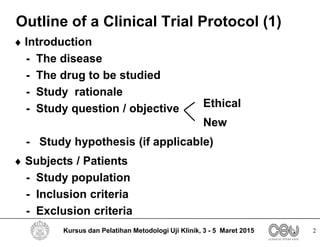
Outline of a Clinical Trial Protocol (1)
♦
♦
♦
♦ Introduction
- The disease
- The drug to be studied
- Study rationale
- Study question / objective Ethical
New
2
Kursus dan Pelatihan Metodologi Uji Klinik, 3 - 5 Maret 2015
- Study hypothesis (if applicable)
♦
♦
♦
♦ Subjects / Patients
- Study population
- Inclusion criteria
- Exclusion criteria
New
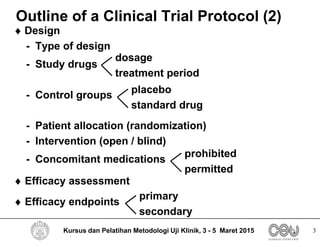
Outline of a Clinical Trial Protocol (2)
♦
♦
♦
♦ Design
- Type of design
- Study drugs
- Control groups
- Patient allocation (randomization)
dosage
treatment period
placebo
standard drug
3
Kursus dan Pelatihan Metodologi Uji Klinik, 3 - 5 Maret 2015
- Patient allocation (randomization)
- Intervention (open / blind)
- Concomitant medications
♦
♦
♦
♦ Efficacy assessment
♦
♦
♦
♦ Efficacy endpoints
prohibited
permitted
primary
secondary
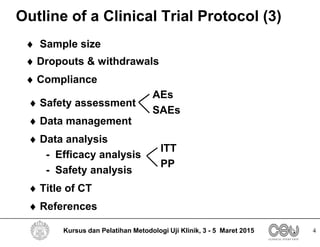
Outline of a Clinical Trial Protocol (3)
♦
♦
♦
♦ Sample size
♦
♦
♦
♦ Dropouts & withdrawals
♦
♦
♦
♦ Compliance
♦
♦
♦
♦ Safety assessment
♦
♦
♦
♦ Data management
AEs
SAEs
4
Kursus dan Pelatihan Metodologi Uji Klinik, 3 - 5 Maret 2015
♦
♦
♦
♦ Data management
♦
♦
♦
♦ Data analysis
- Efficacy analysis
- Safety analysis
♦
♦
♦
♦ Title of CT
♦
♦
♦
♦ References
ITT
PP
Ethical approval
♦
♦
♦
♦ The CT protocol with the informed consent form
should be approved by the Ethics Committee
before initiating the study
5
Kursus dan Pelatihan Metodologi Uji Klinik, 3 - 5 Maret 2015
♦
♦
♦
♦ Informed consent approved by the EC should be
obtained from each subject before screening
the subject
Background of a Clinical Trial
explain the rationale for conducting the study
Research question
= Objective of the study
6
Kursus dan Pelatihan Metodologi Uji Klinik, 3 - 5 Maret 2015
= the uncertainty that the investigator wants
to resolve by conducting the study
– for all studies (analytic & descriptive)
• Primary research question / objective : only 1
• Secondary research questions / objectives
FINER Criteria for a Good Research Question
Feasible : Adequate number of subjects
Adequate technical expertise
Affordable in time & money
Manageable in scope
Interesting : To the investigator
Novel : Confirms or refutes previous findings
Extends previous findings
7
Kursus dan Pelatihan Metodologi Uji Klinik, 3 - 5 Maret 2015
Extends previous findings
Provides new findings
Ethical : Substantive Ethics : equipoise (< 2 : 1)
Procedural Ethics : Ethics Committee,
Informed Consent
Relevant : To scientific knowledge
To clinical & health policy
To future research directions Cummings et al, 2001
Lilford, 1992
Research hypothesis
= the temporary answer to the research question
that will be tested in the study
– only for analytical studies (not for descriptive
studies)
≠
≠
≠
≠ statistical hypothesis
• Research hypothesis : only 1
8
Kursus dan Pelatihan Metodologi Uji Klinik, 3 - 5 Maret 2015
• Research hypothesis : only 1
- from primary objective
- for sample size calculation
• Several research hypotheses of similar importance
- from primary & secondary objectives
- calculate sample size for each hypothesis
and take the largest sample size
Subjects / Patients
Selection criteria = Eligibility criteria
• Inclusion criteria : target population that are accessible
- clinical characts : diagnostic criteria &
prognostic factors
- demographic characts : age, gender, etc.
- geographic characts : study site
9
Kursus dan Pelatihan Metodologi Uji Klinik, 3 - 5 Maret 2015
- geographic characts : study site
- temporal characts : study period
• Exclusion criteria :
- contraindications : hypersensitivity, pregnancy, etc.
- precaution : liver dis, renal dis, elderly, etc.
- ethical problem : children, etc.
- compliance problem : alcoholics, drug abusers, etc
CT Design
A. Noncomparative (open study)
- no control group
- before & after treatment comparison
10
Kursus dan Pelatihan Metodologi Uji Klinik, 3 - 5 Maret 2015
B. Comparative
- with control group
- between treatment comparison
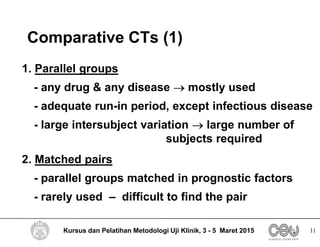
Comparative CTs (1)
1. Parallel groups
- any drug & any disease →
→
→
→ mostly used
- adequate run-in period, except infectious disease
- large intersubject variation →
→
→
→ large number of
11
Kursus dan Pelatihan Metodologi Uji Klinik, 3 - 5 Maret 2015
- large intersubject variation →
→
→
→ large number of
subjects required
2. Matched pairs
- parallel groups matched in prognostic factors
- rarely used – difficult to find the pair
Comparative CTs (2)
3. Cross-over design : 2-way, 3-way
Group 1 Treatm. A A
Group 2 Treatm. B B
Period I Period II
- very powerful design, because each subject becomes
his/her own control
12
Kursus dan Pelatihan Metodologi Uji Klinik, 3 - 5 Maret 2015
his/her own control
- chronic relatively stable disease - order effect
- symptomatic drug - period effect
- run-in period - carry-over effect
- wash-out period
• intrasubject variation small
• number of subject much smaller
• longer follow-up time per subject →
→
→
→ more dropouts
Comparative CTs (3)
4. Factorial design
- parallel groups
- each combination of variable = 1 group
eg. HOPE study : var. 1 = ramipril vs placebo
var. 2 = vit. E vs placebo
13
Kursus dan Pelatihan Metodologi Uji Klinik, 3 - 5 Maret 2015
Ramipril Pla Ram
Vit E Ram + vit E Pla Ram + Vit E
Pla E Ram + Pla E Pla Ram + Pla E
- there may be interaction among variables
Comparative CTs (4)
5. Latin square design
6. Sequential design
rarely used
14
Kursus dan Pelatihan Metodologi Uji Klinik, 3 - 5 Maret 2015
Control Groups (1)
♦
♦
♦
♦ to quantify the therapeutic & toxic effects
of a new drug, there are 2 usual standards
of reference :
a) placebo
15
Kursus dan Pelatihan Metodologi Uji Klinik, 3 - 5 Maret 2015
a) placebo
b) standard drug (the best treatment available)
Control Groups (2)
a) Placebo
- in general : only in the absence of existing proven th/
- even if proven therapy is available, it may be ethically
acceptable in case of :
* the treatment response is only subjective (for mild dis.)
(to control subjective response in efficacy & safety of the drug)
* self-limiting disease
* spontaneous remission period
to distinguish between
16
Kursus dan Pelatihan Metodologi Uji Klinik, 3 - 5 Maret 2015
* spontaneous remission period
a true therapeutic effect or spontaneous changes
in the course of the disease / symptoms
* minor condition and no additional risk of serious or
irreversible harm (eg. mild to mod. hypertension / T2DM for 3
months)
* escape drug is provided
- add-on therapy (on standard drug or best supportive care)
to distinguish between
Control Groups (3)
b) standard drug : the best current treatment
- dangerous, severe or life-threatening disease
- status of the new drug / for marketing approval by
17
Kursus dan Pelatihan Metodologi Uji Klinik, 3 - 5 Maret 2015
- status of the new drug / for marketing approval by
BPOM
- long-term studies to assess the effect of drug on
mortality & morbidity
Patient allocation
Random allocation is a must for all comparative
clinical trials
→
→
→
→ to obtain comparable groups in baseline
characteristics, esp. in prognostic factors
→
→
→
→ to avoid selection bias in treatment assignment
18
Kursus dan Pelatihan Metodologi Uji Klinik, 3 - 5 Maret 2015
→
→
→
→ to avoid selection bias in treatment assignment
→
→
→
→ to permit use of statistical tests
a) simple randomization
b) block randomization
c) stratified randomization
Intervention
♦
♦
♦
♦ Drug dosage of test drug & reference drug should be
equipotent !
♦
♦
♦
♦ Drug administration
a) double blind →
→
→
→ unbiased response &
unbiased measurement of response
* double dummy
b) single blind – patient blind (usually) or
19
Kursus dan Pelatihan Metodologi Uji Klinik, 3 - 5 Maret 2015
b) single blind – patient blind (usually) or
investigator blind
c) unblind – only if ethically not feasible for
blindness
d) unblind, with PROBE design
♦
♦
♦
♦ Duration of treatment / observation
long enough to show sustained efficacy
Concomitant medications
♦
♦
♦
♦ should not affect assessment of response
♦
♦
♦
♦ if any effect →
→
→
→ become baseline therapy for both
groups
20
Kursus dan Pelatihan Metodologi Uji Klinik, 3 - 5 Maret 2015
♦
♦
♦
♦ escape / rescue medication – becomes an
objective parameter for drug efficacy
Response variables (1)
♦
♦
♦
♦ Study endpoints : response variables chosen to
assess drug effects
♦
♦
♦
♦ Primary endpoint : - preferably only 1
- should be clinically relevant
- based on the primary objective of the study
♦ Secondary endpoints : other drug effects that may /
21
Kursus dan Pelatihan Metodologi Uji Klinik, 3 - 5 Maret 2015
♦ Secondary endpoints : other drug effects that may /
may not related to the primary endpoint (1 or more)
♦ Surrogate endpoint : replace clinical endpoint because
can be measured at much shorter time, but
must be predictive of clinical endpoint
Response variables (2)
Measurement of endpoints :
- objective methods should be used where possible
and when appropriate
- both subjective and objective methods should be
22
Kursus dan Pelatihan Metodologi Uji Klinik, 3 - 5 Maret 2015
- both subjective and objective methods should be
validated and meet appropriate standards for
accuracy, precision, reproducibility, reliability,
and responsiveness (sensitivity to change
over time)
Sample size calculation (1)
♦
♦
♦
♦ Aim : able to answer the research question :
↓
↓
↓
↓
- in case of superiority trial :
able to make the minimal clinically significant
difference determined by the investigator
reach statistical significance
23
Kursus dan Pelatihan Metodologi Uji Klinik, 3 - 5 Maret 2015
reach statistical significance
- in case of equivalence trial :
able to confirm statistically the small
clinically nonsignificant difference
Sample size calculation (2)
♦
♦
♦
♦ calculate for the primary objective only or
for each hypothesis →
→
→
→ take the largest sample
♦
♦
♦
♦ calculate based on the primary efficacy variable :
- numerical scale
24
Kursus dan Pelatihan Metodologi Uji Klinik, 3 - 5 Maret 2015
- numerical scale
- nominal 2 categories →
→
→
→ 2 proportions
- ordinal scale →
→
→
→ make 2 proportions
♦
♦
♦
♦ too small →
→
→
→ false negative
Dropouts ∼
∼
∼
∼ Withdrawals (1)
♦
♦
♦
♦ ≠
≠
≠
≠ ineligible patients
♦
♦
♦
♦ Eligible pts - drop from the study before end of study,
due to :
* reasons unrelated to treatment :
- move to another city / country
25
Kursus dan Pelatihan Metodologi Uji Klinik, 3 - 5 Maret 2015
- move to another city / country
- loss of patient’s interest
- too busy to continue participation
- etc.
* unknown reason, not come for visit & out of contact
→
→
→
→ loss to follow-up
♦
♦
♦
♦ These dropouts are calculated in sample size estimation
→
→
→
→ withdraw
Dropouts ∼
∼
∼
∼ Withdrawals (2)
♦
♦
♦
♦ Eligible pts who drop from the study or
withdrawn by the investigator
due to reasons related to treatment :
- adverse events
before
end of study
26
Kursus dan Pelatihan Metodologi Uji Klinik, 3 - 5 Maret 2015
- inefficacy of the study drug
are not drop-outs, and should be included in
the analysis !
♦
♦
♦
♦ These dropouts are not replaced
Compliance
♦
♦
♦
♦ methods to minimize noncompliance
- clear information of the CT →
→
→
→ clearly under-
standing patients
- simple dosage
- patient diary card
27
Kursus dan Pelatihan Metodologi Uji Klinik, 3 - 5 Maret 2015
- patient diary card
- adequate supervision
♦
♦
♦
♦ Measures to check compliance
- excess number of tablets →
→
→
→ count number of
tablets returned
- measure drug level in serum / urine
Adverse events (AEs)
♦
♦
♦
♦ all AEs are recorded, irrespective of
their relationship to study drugs
♦
♦
♦
♦ the relationship to study drugs, according to the
investigator : - probably related,
- possibly related,
- unlikely
28
Kursus dan Pelatihan Metodologi Uji Klinik, 3 - 5 Maret 2015
- unlikely
♦
♦
♦
♦ serious AEs (SAEs) : reported to sponsor & CRO
within 24 hrs, followed promptly by detailed,
written reports
♦ serious & unexpected ADRs : reported to EC &
NRA within 15 calender days (Indonesia)
= SUSAR = susp. unexp. serious adv. reaction
In Indonesia : all SAEs are reported
Efficacy analysis : ITT vs PP (1)
1) Intent-to-treat (ITT) analysis
* include all randomized pts, regardless of
compliance with protocol
* without eligibility violation
* take at least one dose of trial medication
* have at least one data post randomization
→
→
→
→
29
Kursus dan Pelatihan Metodologi Uji Klinik, 3 - 5 Maret 2015
* have at least one data post randomization
Full Analysis Set (FAS)
- last observation carried forward (LOCF)
- pragmatic approach : more likely to mirror the
actual clinical practice
- bias is minimal
- secure foundation for statistical tests
Efficacy analysis : ITT vs PP (2)
2) Per-protocol (PP) analysis
* include only pts who comply with the protocol :
have a certain pre-specified minimal exposure
to treatment
* bias (may be severe) because adherence to the
30
Kursus dan Pelatihan Metodologi Uji Klinik, 3 - 5 Maret 2015
* bias (may be severe) because adherence to the
study protocol may be related to treatment & outcome
– explanatory approach
In confirmatory trials : used both ITT & PP analyses
- superiority trials : ITT – analysis set of choice
- noninferiority trials : ITT & PP – equal importance &
should lead to similar conclusions
Efficacy analysis : ITT vs PP (3)
♦
♦
♦
♦ specify the statistical test used for every
response variable to be analyzed
♦
♦
♦
♦ planned analysis : to answer the study objective /
hypothesis
31
Kursus dan Pelatihan Metodologi Uji Klinik, 3 - 5 Maret 2015
hypothesis
♦
♦
♦
♦ interim analysis
- after min. 50% of the calculated sample size
- ↓
↓
↓
↓ level of significance α
α
α
α
Safety analysis
♦
♦
♦
♦ include pts who received at least one dose of
study medication (although ineligible)
and have at least one post-baseline data
♦
♦
♦
♦ compare the incidence rates of (descriptively)
32
Kursus dan Pelatihan Metodologi Uji Klinik, 3 - 5 Maret 2015
♦
♦
♦
♦ compare the incidence rates of (descriptively)
- all adverse events
- AEs considered possibly & probably related to
the study medications (= ADRs)
- abnormal laboratory values
Title of the CT
♦
♦
♦
♦ consistent with the content ?
♦
♦
♦
♦ concise but informative
- not too short →
→
→
→ not specific
- not too long →
→
→
→ discard words such as “study on”,
“observation on”
33
Kursus dan Pelatihan Metodologi Uji Klinik, 3 - 5 Maret 2015
“observation on”
♦
♦
♦
♦ site & period :
- included only if the results will be specific for
the respective site & period
- usually not included if the results will be
not different anywhere & anytime
References
♦
♦
♦
♦ support “Background”, “Sample size” and
“Discussion”
♦
♦
♦
♦ as up-to-date as possible
34
Kursus dan Pelatihan Metodologi Uji Klinik, 3 - 5 Maret 2015
♦
♦
♦
♦ as up-to-date as possible
Thank
Thank
Thank
Thank
you
you
you
you
you
you
you
you

1.2. Clinical Trial Protocol.pdf

  • 1.
    Clinical Trial Protocol Kursusdan Pelatihan Metodologi Uji Klinik Jakarta, 3 Maret 2015 Arini Setiawati Clinical Study Unit Faculty of Medicine, University of Indonesia
  • 2.
    Outline of aClinical Trial Protocol (1) ♦ ♦ ♦ ♦ Introduction - The disease - The drug to be studied - Study rationale - Study question / objective Ethical New 2 Kursus dan Pelatihan Metodologi Uji Klinik, 3 - 5 Maret 2015 - Study hypothesis (if applicable) ♦ ♦ ♦ ♦ Subjects / Patients - Study population - Inclusion criteria - Exclusion criteria New
  • 3.
    Outline of aClinical Trial Protocol (2) ♦ ♦ ♦ ♦ Design - Type of design - Study drugs - Control groups - Patient allocation (randomization) dosage treatment period placebo standard drug 3 Kursus dan Pelatihan Metodologi Uji Klinik, 3 - 5 Maret 2015 - Patient allocation (randomization) - Intervention (open / blind) - Concomitant medications ♦ ♦ ♦ ♦ Efficacy assessment ♦ ♦ ♦ ♦ Efficacy endpoints prohibited permitted primary secondary
  • 4.
    Outline of aClinical Trial Protocol (3) ♦ ♦ ♦ ♦ Sample size ♦ ♦ ♦ ♦ Dropouts & withdrawals ♦ ♦ ♦ ♦ Compliance ♦ ♦ ♦ ♦ Safety assessment ♦ ♦ ♦ ♦ Data management AEs SAEs 4 Kursus dan Pelatihan Metodologi Uji Klinik, 3 - 5 Maret 2015 ♦ ♦ ♦ ♦ Data management ♦ ♦ ♦ ♦ Data analysis - Efficacy analysis - Safety analysis ♦ ♦ ♦ ♦ Title of CT ♦ ♦ ♦ ♦ References ITT PP
  • 5.
    Ethical approval ♦ ♦ ♦ ♦ TheCT protocol with the informed consent form should be approved by the Ethics Committee before initiating the study 5 Kursus dan Pelatihan Metodologi Uji Klinik, 3 - 5 Maret 2015 ♦ ♦ ♦ ♦ Informed consent approved by the EC should be obtained from each subject before screening the subject
  • 6.
    Background of aClinical Trial explain the rationale for conducting the study Research question = Objective of the study 6 Kursus dan Pelatihan Metodologi Uji Klinik, 3 - 5 Maret 2015 = the uncertainty that the investigator wants to resolve by conducting the study – for all studies (analytic & descriptive) • Primary research question / objective : only 1 • Secondary research questions / objectives
  • 7.
    FINER Criteria fora Good Research Question Feasible : Adequate number of subjects Adequate technical expertise Affordable in time & money Manageable in scope Interesting : To the investigator Novel : Confirms or refutes previous findings Extends previous findings 7 Kursus dan Pelatihan Metodologi Uji Klinik, 3 - 5 Maret 2015 Extends previous findings Provides new findings Ethical : Substantive Ethics : equipoise (< 2 : 1) Procedural Ethics : Ethics Committee, Informed Consent Relevant : To scientific knowledge To clinical & health policy To future research directions Cummings et al, 2001 Lilford, 1992
  • 8.
    Research hypothesis = thetemporary answer to the research question that will be tested in the study – only for analytical studies (not for descriptive studies) ≠ ≠ ≠ ≠ statistical hypothesis • Research hypothesis : only 1 8 Kursus dan Pelatihan Metodologi Uji Klinik, 3 - 5 Maret 2015 • Research hypothesis : only 1 - from primary objective - for sample size calculation • Several research hypotheses of similar importance - from primary & secondary objectives - calculate sample size for each hypothesis and take the largest sample size
  • 9.
    Subjects / Patients Selectioncriteria = Eligibility criteria • Inclusion criteria : target population that are accessible - clinical characts : diagnostic criteria & prognostic factors - demographic characts : age, gender, etc. - geographic characts : study site 9 Kursus dan Pelatihan Metodologi Uji Klinik, 3 - 5 Maret 2015 - geographic characts : study site - temporal characts : study period • Exclusion criteria : - contraindications : hypersensitivity, pregnancy, etc. - precaution : liver dis, renal dis, elderly, etc. - ethical problem : children, etc. - compliance problem : alcoholics, drug abusers, etc
  • 10.
    CT Design A. Noncomparative(open study) - no control group - before & after treatment comparison 10 Kursus dan Pelatihan Metodologi Uji Klinik, 3 - 5 Maret 2015 B. Comparative - with control group - between treatment comparison
  • 11.
    Comparative CTs (1) 1.Parallel groups - any drug & any disease → → → → mostly used - adequate run-in period, except infectious disease - large intersubject variation → → → → large number of 11 Kursus dan Pelatihan Metodologi Uji Klinik, 3 - 5 Maret 2015 - large intersubject variation → → → → large number of subjects required 2. Matched pairs - parallel groups matched in prognostic factors - rarely used – difficult to find the pair
  • 12.
    Comparative CTs (2) 3.Cross-over design : 2-way, 3-way Group 1 Treatm. A A Group 2 Treatm. B B Period I Period II - very powerful design, because each subject becomes his/her own control 12 Kursus dan Pelatihan Metodologi Uji Klinik, 3 - 5 Maret 2015 his/her own control - chronic relatively stable disease - order effect - symptomatic drug - period effect - run-in period - carry-over effect - wash-out period • intrasubject variation small • number of subject much smaller • longer follow-up time per subject → → → → more dropouts
  • 13.
    Comparative CTs (3) 4.Factorial design - parallel groups - each combination of variable = 1 group eg. HOPE study : var. 1 = ramipril vs placebo var. 2 = vit. E vs placebo 13 Kursus dan Pelatihan Metodologi Uji Klinik, 3 - 5 Maret 2015 Ramipril Pla Ram Vit E Ram + vit E Pla Ram + Vit E Pla E Ram + Pla E Pla Ram + Pla E - there may be interaction among variables
  • 14.
    Comparative CTs (4) 5.Latin square design 6. Sequential design rarely used 14 Kursus dan Pelatihan Metodologi Uji Klinik, 3 - 5 Maret 2015
  • 15.
    Control Groups (1) ♦ ♦ ♦ ♦to quantify the therapeutic & toxic effects of a new drug, there are 2 usual standards of reference : a) placebo 15 Kursus dan Pelatihan Metodologi Uji Klinik, 3 - 5 Maret 2015 a) placebo b) standard drug (the best treatment available)
  • 16.
    Control Groups (2) a)Placebo - in general : only in the absence of existing proven th/ - even if proven therapy is available, it may be ethically acceptable in case of : * the treatment response is only subjective (for mild dis.) (to control subjective response in efficacy & safety of the drug) * self-limiting disease * spontaneous remission period to distinguish between 16 Kursus dan Pelatihan Metodologi Uji Klinik, 3 - 5 Maret 2015 * spontaneous remission period a true therapeutic effect or spontaneous changes in the course of the disease / symptoms * minor condition and no additional risk of serious or irreversible harm (eg. mild to mod. hypertension / T2DM for 3 months) * escape drug is provided - add-on therapy (on standard drug or best supportive care) to distinguish between
  • 17.
    Control Groups (3) b)standard drug : the best current treatment - dangerous, severe or life-threatening disease - status of the new drug / for marketing approval by 17 Kursus dan Pelatihan Metodologi Uji Klinik, 3 - 5 Maret 2015 - status of the new drug / for marketing approval by BPOM - long-term studies to assess the effect of drug on mortality & morbidity
  • 18.
    Patient allocation Random allocationis a must for all comparative clinical trials → → → → to obtain comparable groups in baseline characteristics, esp. in prognostic factors → → → → to avoid selection bias in treatment assignment 18 Kursus dan Pelatihan Metodologi Uji Klinik, 3 - 5 Maret 2015 → → → → to avoid selection bias in treatment assignment → → → → to permit use of statistical tests a) simple randomization b) block randomization c) stratified randomization
  • 19.
    Intervention ♦ ♦ ♦ ♦ Drug dosageof test drug & reference drug should be equipotent ! ♦ ♦ ♦ ♦ Drug administration a) double blind → → → → unbiased response & unbiased measurement of response * double dummy b) single blind – patient blind (usually) or 19 Kursus dan Pelatihan Metodologi Uji Klinik, 3 - 5 Maret 2015 b) single blind – patient blind (usually) or investigator blind c) unblind – only if ethically not feasible for blindness d) unblind, with PROBE design ♦ ♦ ♦ ♦ Duration of treatment / observation long enough to show sustained efficacy
  • 20.
    Concomitant medications ♦ ♦ ♦ ♦ shouldnot affect assessment of response ♦ ♦ ♦ ♦ if any effect → → → → become baseline therapy for both groups 20 Kursus dan Pelatihan Metodologi Uji Klinik, 3 - 5 Maret 2015 ♦ ♦ ♦ ♦ escape / rescue medication – becomes an objective parameter for drug efficacy
  • 21.
    Response variables (1) ♦ ♦ ♦ ♦Study endpoints : response variables chosen to assess drug effects ♦ ♦ ♦ ♦ Primary endpoint : - preferably only 1 - should be clinically relevant - based on the primary objective of the study ♦ Secondary endpoints : other drug effects that may / 21 Kursus dan Pelatihan Metodologi Uji Klinik, 3 - 5 Maret 2015 ♦ Secondary endpoints : other drug effects that may / may not related to the primary endpoint (1 or more) ♦ Surrogate endpoint : replace clinical endpoint because can be measured at much shorter time, but must be predictive of clinical endpoint
  • 22.
    Response variables (2) Measurementof endpoints : - objective methods should be used where possible and when appropriate - both subjective and objective methods should be 22 Kursus dan Pelatihan Metodologi Uji Klinik, 3 - 5 Maret 2015 - both subjective and objective methods should be validated and meet appropriate standards for accuracy, precision, reproducibility, reliability, and responsiveness (sensitivity to change over time)
  • 23.
    Sample size calculation(1) ♦ ♦ ♦ ♦ Aim : able to answer the research question : ↓ ↓ ↓ ↓ - in case of superiority trial : able to make the minimal clinically significant difference determined by the investigator reach statistical significance 23 Kursus dan Pelatihan Metodologi Uji Klinik, 3 - 5 Maret 2015 reach statistical significance - in case of equivalence trial : able to confirm statistically the small clinically nonsignificant difference
  • 24.
    Sample size calculation(2) ♦ ♦ ♦ ♦ calculate for the primary objective only or for each hypothesis → → → → take the largest sample ♦ ♦ ♦ ♦ calculate based on the primary efficacy variable : - numerical scale 24 Kursus dan Pelatihan Metodologi Uji Klinik, 3 - 5 Maret 2015 - numerical scale - nominal 2 categories → → → → 2 proportions - ordinal scale → → → → make 2 proportions ♦ ♦ ♦ ♦ too small → → → → false negative
  • 25.
    Dropouts ∼ ∼ ∼ ∼ Withdrawals(1) ♦ ♦ ♦ ♦ ≠ ≠ ≠ ≠ ineligible patients ♦ ♦ ♦ ♦ Eligible pts - drop from the study before end of study, due to : * reasons unrelated to treatment : - move to another city / country 25 Kursus dan Pelatihan Metodologi Uji Klinik, 3 - 5 Maret 2015 - move to another city / country - loss of patient’s interest - too busy to continue participation - etc. * unknown reason, not come for visit & out of contact → → → → loss to follow-up ♦ ♦ ♦ ♦ These dropouts are calculated in sample size estimation → → → → withdraw
  • 26.
    Dropouts ∼ ∼ ∼ ∼ Withdrawals(2) ♦ ♦ ♦ ♦ Eligible pts who drop from the study or withdrawn by the investigator due to reasons related to treatment : - adverse events before end of study 26 Kursus dan Pelatihan Metodologi Uji Klinik, 3 - 5 Maret 2015 - inefficacy of the study drug are not drop-outs, and should be included in the analysis ! ♦ ♦ ♦ ♦ These dropouts are not replaced
  • 27.
    Compliance ♦ ♦ ♦ ♦ methods tominimize noncompliance - clear information of the CT → → → → clearly under- standing patients - simple dosage - patient diary card 27 Kursus dan Pelatihan Metodologi Uji Klinik, 3 - 5 Maret 2015 - patient diary card - adequate supervision ♦ ♦ ♦ ♦ Measures to check compliance - excess number of tablets → → → → count number of tablets returned - measure drug level in serum / urine
  • 28.
    Adverse events (AEs) ♦ ♦ ♦ ♦all AEs are recorded, irrespective of their relationship to study drugs ♦ ♦ ♦ ♦ the relationship to study drugs, according to the investigator : - probably related, - possibly related, - unlikely 28 Kursus dan Pelatihan Metodologi Uji Klinik, 3 - 5 Maret 2015 - unlikely ♦ ♦ ♦ ♦ serious AEs (SAEs) : reported to sponsor & CRO within 24 hrs, followed promptly by detailed, written reports ♦ serious & unexpected ADRs : reported to EC & NRA within 15 calender days (Indonesia) = SUSAR = susp. unexp. serious adv. reaction In Indonesia : all SAEs are reported
  • 29.
    Efficacy analysis :ITT vs PP (1) 1) Intent-to-treat (ITT) analysis * include all randomized pts, regardless of compliance with protocol * without eligibility violation * take at least one dose of trial medication * have at least one data post randomization → → → → 29 Kursus dan Pelatihan Metodologi Uji Klinik, 3 - 5 Maret 2015 * have at least one data post randomization Full Analysis Set (FAS) - last observation carried forward (LOCF) - pragmatic approach : more likely to mirror the actual clinical practice - bias is minimal - secure foundation for statistical tests
  • 30.
    Efficacy analysis :ITT vs PP (2) 2) Per-protocol (PP) analysis * include only pts who comply with the protocol : have a certain pre-specified minimal exposure to treatment * bias (may be severe) because adherence to the 30 Kursus dan Pelatihan Metodologi Uji Klinik, 3 - 5 Maret 2015 * bias (may be severe) because adherence to the study protocol may be related to treatment & outcome – explanatory approach In confirmatory trials : used both ITT & PP analyses - superiority trials : ITT – analysis set of choice - noninferiority trials : ITT & PP – equal importance & should lead to similar conclusions
  • 31.
    Efficacy analysis :ITT vs PP (3) ♦ ♦ ♦ ♦ specify the statistical test used for every response variable to be analyzed ♦ ♦ ♦ ♦ planned analysis : to answer the study objective / hypothesis 31 Kursus dan Pelatihan Metodologi Uji Klinik, 3 - 5 Maret 2015 hypothesis ♦ ♦ ♦ ♦ interim analysis - after min. 50% of the calculated sample size - ↓ ↓ ↓ ↓ level of significance α α α α
  • 32.
    Safety analysis ♦ ♦ ♦ ♦ includepts who received at least one dose of study medication (although ineligible) and have at least one post-baseline data ♦ ♦ ♦ ♦ compare the incidence rates of (descriptively) 32 Kursus dan Pelatihan Metodologi Uji Klinik, 3 - 5 Maret 2015 ♦ ♦ ♦ ♦ compare the incidence rates of (descriptively) - all adverse events - AEs considered possibly & probably related to the study medications (= ADRs) - abnormal laboratory values
  • 33.
    Title of theCT ♦ ♦ ♦ ♦ consistent with the content ? ♦ ♦ ♦ ♦ concise but informative - not too short → → → → not specific - not too long → → → → discard words such as “study on”, “observation on” 33 Kursus dan Pelatihan Metodologi Uji Klinik, 3 - 5 Maret 2015 “observation on” ♦ ♦ ♦ ♦ site & period : - included only if the results will be specific for the respective site & period - usually not included if the results will be not different anywhere & anytime
  • 34.
    References ♦ ♦ ♦ ♦ support “Background”,“Sample size” and “Discussion” ♦ ♦ ♦ ♦ as up-to-date as possible 34 Kursus dan Pelatihan Metodologi Uji Klinik, 3 - 5 Maret 2015 ♦ ♦ ♦ ♦ as up-to-date as possible
  • 35.