Network Layer:
Logical Addressing
IPv4 ADDRESSES
IPv4 ADDRESSES
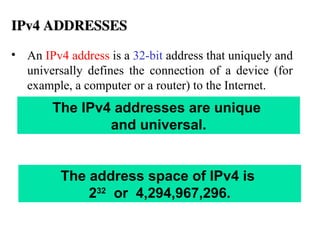
• An IPv4 address is a 32-bit address that uniquely and
universally defines the connection of a device (for
example, a computer or a router) to the Internet.
The IPv4 addresses are unique
and universal.
The address space of IPv4 is
232
or 4,294,967,296.
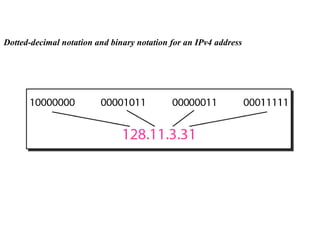
Dotted-decimal notation and binary notation for an IPv4 address
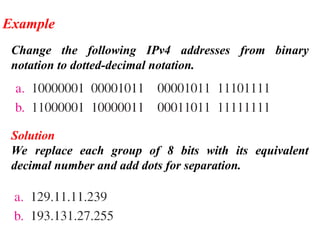
Change the following IPv4 addresses from binary
notation to dotted-decimal notation.
Example
Solution
We replace each group of 8 bits with its equivalent
decimal number and add dots for separation.
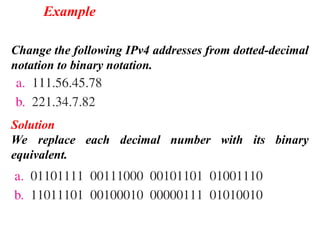
Change the following IPv4 addresses from dotted-decimal
notation to binary notation.
Example
Solution
We replace each decimal number with its binary
equivalent.
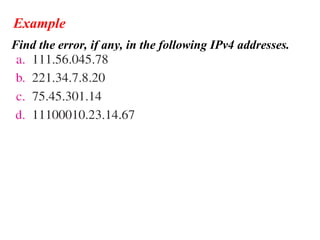
Find the error, if any, in the following IPv4 addresses.
Example
19.7
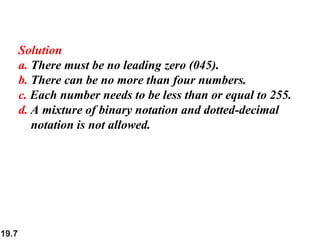
Solution
a. There must be no leading zero (045).
b. There can be no more than four numbers.
c. Each number needs to be less than or equal to 255.
d. A mixture of binary notation and dotted-decimal
notation is not allowed.
Finding the classes in binary and dotted-decimal notation
Netid and Hostid
In classful addressing, the address
space is divided into five classes:
A, B, C, D, and E.
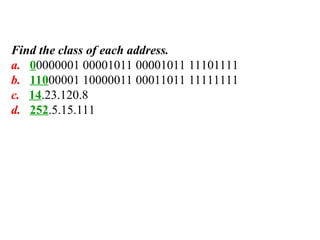
Find the class of each address.
a. 00000001 00001011 00001011 11101111
b. 11000001 10000011 00011011 11111111
c. 14.23.120.8
d. 252.5.15.111
19.10
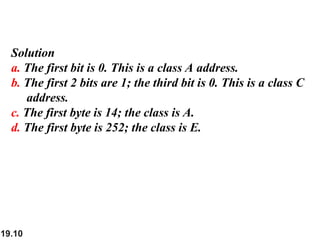
Solution
a. The first bit is 0. This is a class A address.
b. The first 2 bits are 1; the third bit is 0. This is a class C
address.
c. The first byte is 14; the class is A.
d. The first byte is 252; the class is E.
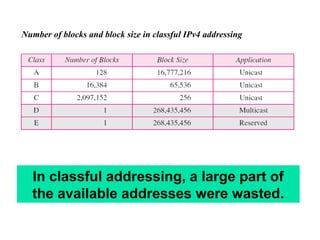
Number of blocks and block size in classful IPv4 addressing
In classful addressing, a large part of
the available addresses were wasted.
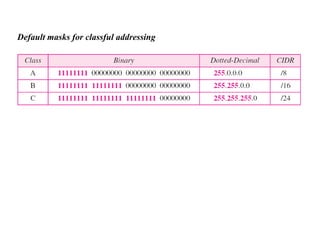
Default masks for classful addressing
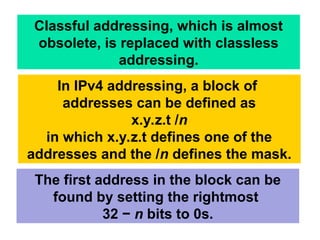
Classful addressing, which is almost
obsolete, is replaced with classless
addressing.
In IPv4 addressing, a block of
addresses can be defined as
x.y.z.t /n
in which x.y.z.t defines one of the
addresses and the /n defines the mask.
The first address in the block can be
found by setting the rightmost
32 − n bits to 0s.
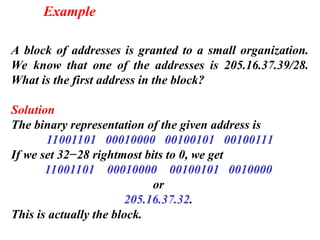
A block of addresses is granted to a small organization.
We know that one of the addresses is 205.16.37.39/28.
What is the first address in the block?
Solution
The binary representation of the given address is
11001101 00010000 00100101 00100111
If we set 32−28 rightmost bits to 0, we get
11001101 00010000 00100101 0010000
or
205.16.37.32.
This is actually the block.
Example
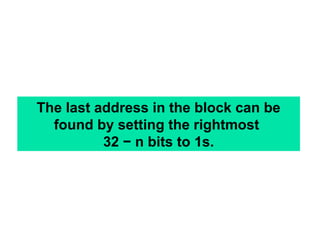
The last address in the block can be
found by setting the rightmost
32 − n bits to 1s.
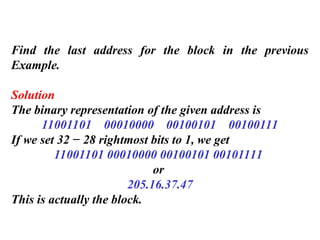
Find the last address for the block in the previous
Example.
Solution
The binary representation of the given address is
11001101 00010000 00100101 00100111
If we set 32 − 28 rightmost bits to 1, we get
11001101 00010000 00100101 00101111
or
205.16.37.47
This is actually the block.
The number of addresses in the block
can be found by using the formula
232−n
.
The first address in a block is
normally not assigned to any device;
it is used as the network address that
represents the organization
to the rest of the world.
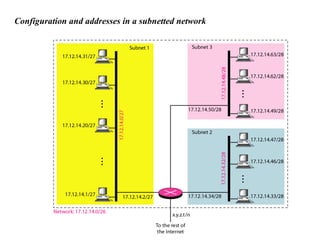
Configuration and addresses in a subnetted network
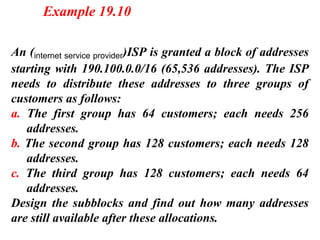
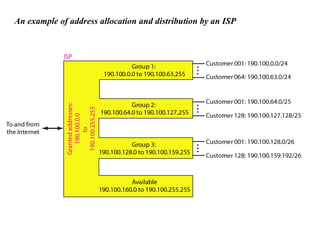
An (internet service provider)ISP is granted a block of addresses
starting with 190.100.0.0/16 (65,536 addresses). The ISP
needs to distribute these addresses to three groups of
customers as follows:
a. The first group has 64 customers; each needs 256
addresses.
b. The second group has 128 customers; each needs 128
addresses.
c. The third group has 128 customers; each needs 64
addresses.
Design the subblocks and find out how many addresses
are still available after these allocations.
Example 19.10
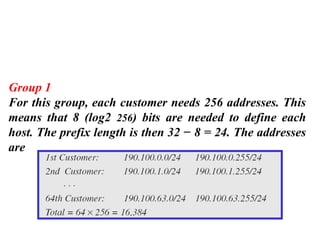
Group 1
For this group, each customer needs 256 addresses. This
means that 8 (log2 256) bits are needed to define each
host. The prefix length is then 32 − 8 = 24. The addresses
are
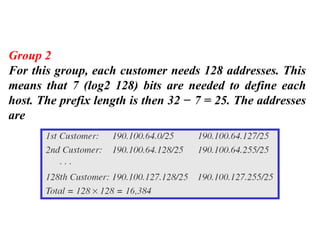
Group 2
For this group, each customer needs 128 addresses. This
means that 7 (log2 128) bits are needed to define each
host. The prefix length is then 32 − 7 = 25. The addresses
are
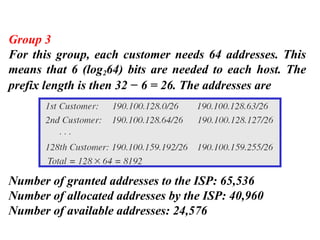
Group 3
For this group, each customer needs 64 addresses. This
means that 6 (log264) bits are needed to each host. The
prefix length is then 32 − 6 = 26. The addresses are
Number of granted addresses to the ISP: 65,536
Number of allocated addresses by the ISP: 40,960
Number of available addresses: 24,576
An example of address allocation and distribution by an ISP
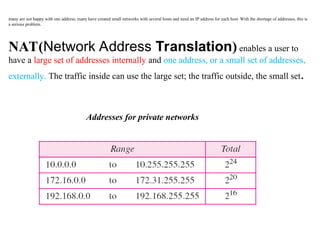
Addresses for private networks
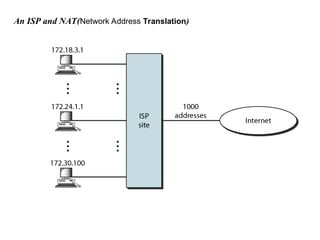
NAT(Network Address Translation) enables a user to
have a large set of addresses internally and one address, or a small set of addresses,
externally. The traffic inside can use the large set; the traffic outside, the small set.
many are not happy with one address; many have created small networks with several hosts and need an IP address for each host. With the shortage of addresses, this is
a serious problem.
An ISP and NAT(Network Address Translation)
IPv6 ADDRESSES
IPv6 ADDRESSES
Despite all short-term solutions, address depletion is
still a long-term problem for the Internet. This and
other problems in the IP protocol itself have been the
motivation for IPv6.
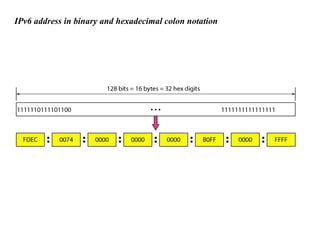
An IPv6 address is 128 bits long.
IPv6 address in binary and hexadecimal colon notation

11 IP Addressing computer networks and modes

  • 1.
  • 2.
    IPv4 ADDRESSES IPv4 ADDRESSES •An IPv4 address is a 32-bit address that uniquely and universally defines the connection of a device (for example, a computer or a router) to the Internet. The IPv4 addresses are unique and universal. The address space of IPv4 is 232 or 4,294,967,296.
  • 3.
    Dotted-decimal notation andbinary notation for an IPv4 address
  • 4.
    Change the followingIPv4 addresses from binary notation to dotted-decimal notation. Example Solution We replace each group of 8 bits with its equivalent decimal number and add dots for separation.
  • 5.
    Change the followingIPv4 addresses from dotted-decimal notation to binary notation. Example Solution We replace each decimal number with its binary equivalent.
  • 6.
    Find the error,if any, in the following IPv4 addresses. Example
  • 7.
    19.7 Solution a. There mustbe no leading zero (045). b. There can be no more than four numbers. c. Each number needs to be less than or equal to 255. d. A mixture of binary notation and dotted-decimal notation is not allowed.
  • 8.
    Finding the classesin binary and dotted-decimal notation Netid and Hostid In classful addressing, the address space is divided into five classes: A, B, C, D, and E.
  • 9.
    Find the classof each address. a. 00000001 00001011 00001011 11101111 b. 11000001 10000011 00011011 11111111 c. 14.23.120.8 d. 252.5.15.111
  • 10.
    19.10 Solution a. The firstbit is 0. This is a class A address. b. The first 2 bits are 1; the third bit is 0. This is a class C address. c. The first byte is 14; the class is A. d. The first byte is 252; the class is E.
  • 11.
    Number of blocksand block size in classful IPv4 addressing In classful addressing, a large part of the available addresses were wasted.
  • 12.
    Default masks forclassful addressing
  • 13.
    Classful addressing, whichis almost obsolete, is replaced with classless addressing. In IPv4 addressing, a block of addresses can be defined as x.y.z.t /n in which x.y.z.t defines one of the addresses and the /n defines the mask. The first address in the block can be found by setting the rightmost 32 − n bits to 0s.
  • 14.
    A block ofaddresses is granted to a small organization. We know that one of the addresses is 205.16.37.39/28. What is the first address in the block? Solution The binary representation of the given address is 11001101 00010000 00100101 00100111 If we set 32−28 rightmost bits to 0, we get 11001101 00010000 00100101 0010000 or 205.16.37.32. This is actually the block. Example
  • 15.
    The last addressin the block can be found by setting the rightmost 32 − n bits to 1s.
  • 16.
    Find the lastaddress for the block in the previous Example. Solution The binary representation of the given address is 11001101 00010000 00100101 00100111 If we set 32 − 28 rightmost bits to 1, we get 11001101 00010000 00100101 00101111 or 205.16.37.47 This is actually the block.
  • 17.
    The number ofaddresses in the block can be found by using the formula 232−n . The first address in a block is normally not assigned to any device; it is used as the network address that represents the organization to the rest of the world.
  • 18.
    Configuration and addressesin a subnetted network
  • 19.
    An (internet serviceprovider)ISP is granted a block of addresses starting with 190.100.0.0/16 (65,536 addresses). The ISP needs to distribute these addresses to three groups of customers as follows: a. The first group has 64 customers; each needs 256 addresses. b. The second group has 128 customers; each needs 128 addresses. c. The third group has 128 customers; each needs 64 addresses. Design the subblocks and find out how many addresses are still available after these allocations. Example 19.10
  • 20.
    Group 1 For thisgroup, each customer needs 256 addresses. This means that 8 (log2 256) bits are needed to define each host. The prefix length is then 32 − 8 = 24. The addresses are
  • 21.
    Group 2 For thisgroup, each customer needs 128 addresses. This means that 7 (log2 128) bits are needed to define each host. The prefix length is then 32 − 7 = 25. The addresses are
  • 22.
    Group 3 For thisgroup, each customer needs 64 addresses. This means that 6 (log264) bits are needed to each host. The prefix length is then 32 − 6 = 26. The addresses are Number of granted addresses to the ISP: 65,536 Number of allocated addresses by the ISP: 40,960 Number of available addresses: 24,576
  • 23.
    An example ofaddress allocation and distribution by an ISP
  • 24.
    Addresses for privatenetworks NAT(Network Address Translation) enables a user to have a large set of addresses internally and one address, or a small set of addresses, externally. The traffic inside can use the large set; the traffic outside, the small set. many are not happy with one address; many have created small networks with several hosts and need an IP address for each host. With the shortage of addresses, this is a serious problem.
  • 25.
    An ISP andNAT(Network Address Translation)
  • 26.
    IPv6 ADDRESSES IPv6 ADDRESSES Despiteall short-term solutions, address depletion is Despite all short-term solutions, address depletion is still a long-term problem for the Internet. This and still a long-term problem for the Internet. This and other problems in the IP protocol itself have been the other problems in the IP protocol itself have been the motivation for IPv6. motivation for IPv6.
  • 27.
    An IPv6 addressis 128 bits long.
  • 28.
    IPv6 address inbinary and hexadecimal colon notation