QUALITY
GURUS/AWARD
S
REGINA M. DELOTINA
Reporter
January 22, 1901 - Sir John Wolfe-Barry (the man who designed London’s Tower
Bridge) instigated the Council of the Institution of Civil Engineers to form a
committee to consider standardizing iron and steel sections.
1911 - Frederick W. Taylor published “The Principles of Scientific Management.
1924 - ”Walter A. Shewhart, a statistician at Bell Laboratories, developed the
control charts, and principles of statistical process control.
1925 - Sir Ronald Fisher published the book, Statistical Methods for Research
Workers, and introduced the concept of ANOVA.
1937 - Joseph Juran introduced the Pareto principle as a means of narrowing on
the vital few.
1940 - The acceptance sampling plan was developed by Harold F Dodge and
Harry G Roming.
1943 - Kaoru Ishikawa developed the cause and effect diagram (also known as
fishbone diagram).
History of Quality Gurus/Awards
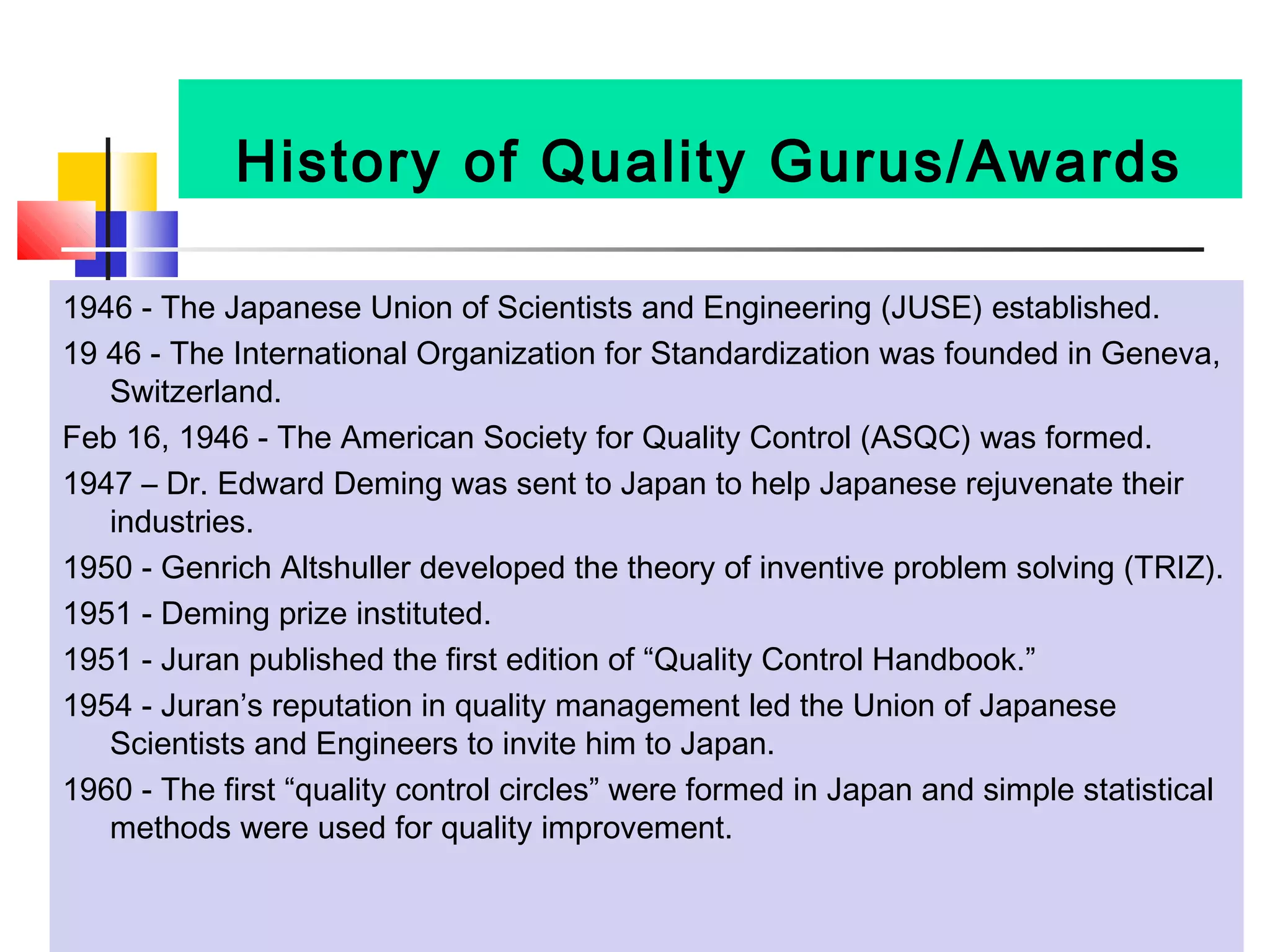
1946 - The Japanese Union of Scientists and Engineering (JUSE) established.
19 46 - The International Organization for Standardization was founded in Geneva,
Switzerland.
Feb 16, 1946 - The American Society for Quality Control (ASQC) was formed.
1947 – Dr. Edward Deming was sent to Japan to help Japanese rejuvenate their
industries.
1950 - Genrich Altshuller developed the theory of inventive problem solving (TRIZ).
1951 - Deming prize instituted.
1951 - Juran published the first edition of “Quality Control Handbook.”
1954 - Juran’s reputation in quality management led the Union of Japanese
Scientists and Engineers to invite him to Japan.
1960 - The first “quality control circles” were formed in Japan and simple statistical
methods were used for quality improvement.
History of Quality Gurus/Awards
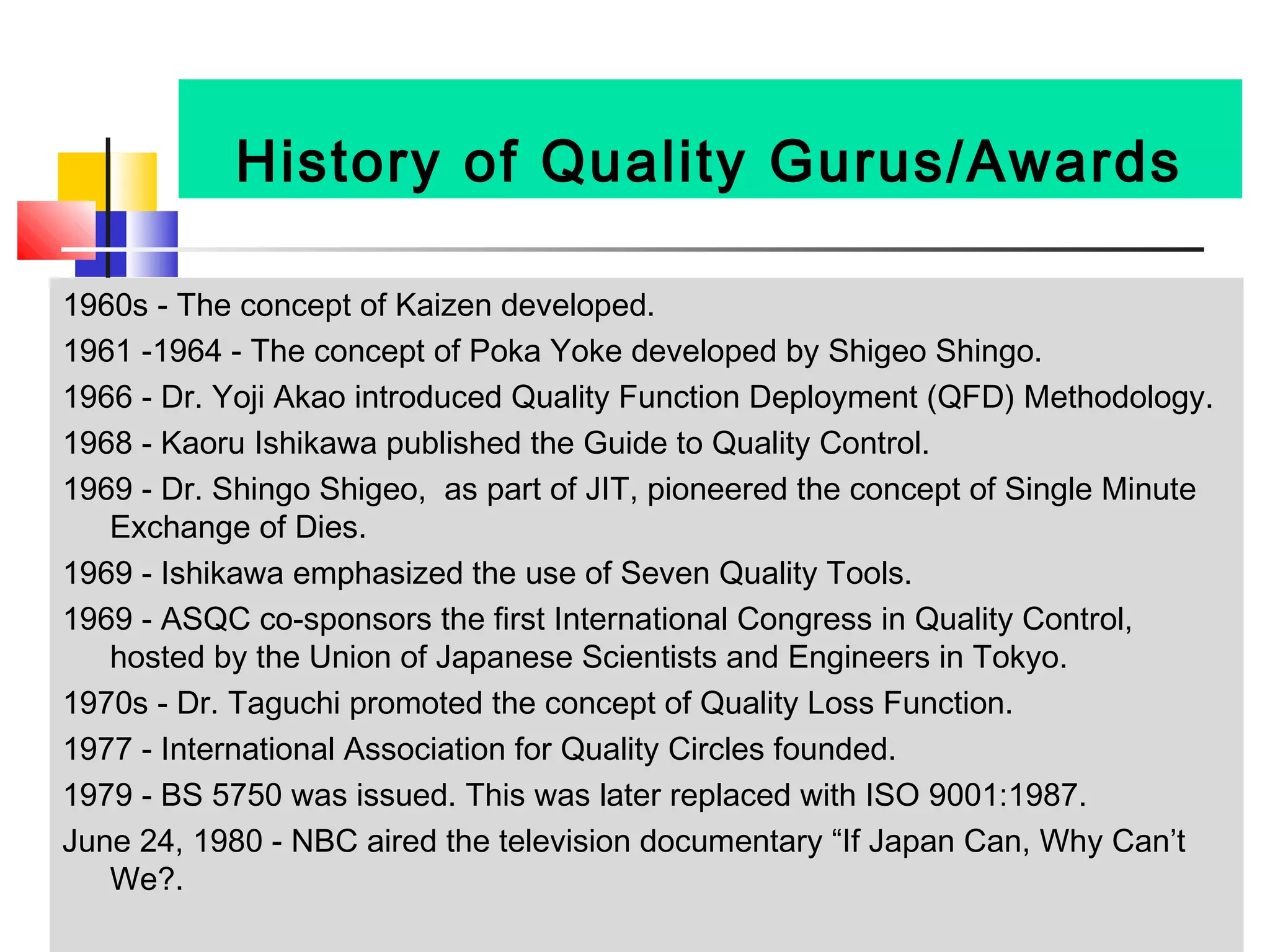
1960s - The concept of Kaizen developed.
1961 -1964 - The concept of Poka Yoke developed by Shigeo Shingo.
1966 - Dr. Yoji Akao introduced Quality Function Deployment (QFD) Methodology.
1968 - Kaoru Ishikawa published the Guide to Quality Control.
1969 - Dr. Shingo Shigeo, as part of JIT, pioneered the concept of Single Minute
Exchange of Dies.
1969 - Ishikawa emphasized the use of Seven Quality Tools.
1969 - ASQC co-sponsors the first International Congress in Quality Control,
hosted by the Union of Japanese Scientists and Engineers in Tokyo.
1970s - Dr. Taguchi promoted the concept of Quality Loss Function.
1977 - International Association for Quality Circles founded.
1979 - BS 5750 was issued. This was later replaced with ISO 9001:1987.
June 24, 1980 - NBC aired the television documentary “If Japan Can, Why Can’t
We?.
History of Quality Gurus/Awards
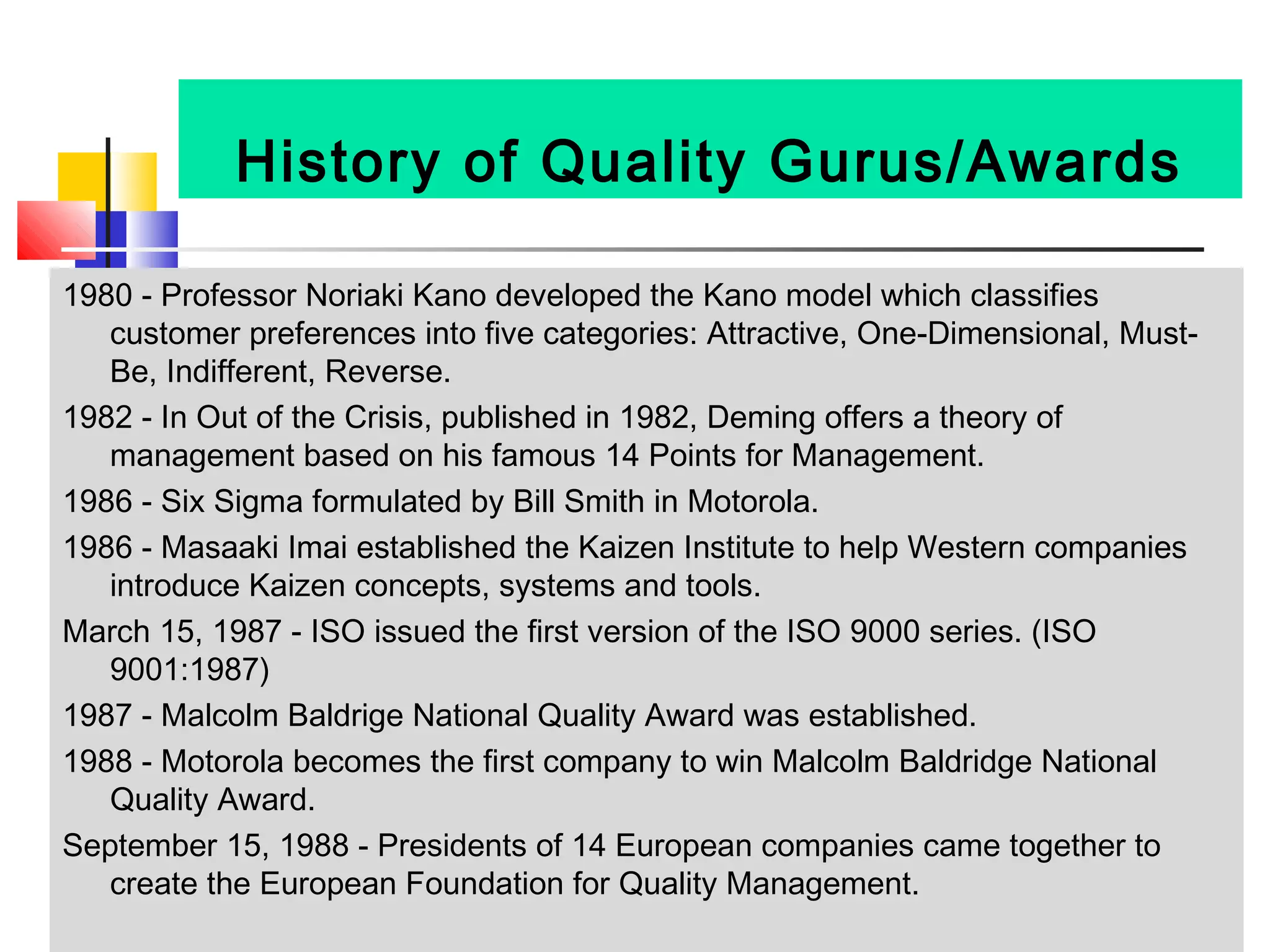
1980 - Professor Noriaki Kano developed the Kano model which classifies
customer preferences into five categories: Attractive, One-Dimensional, Must-
Be, Indifferent, Reverse.
1982 - In Out of the Crisis, published in 1982, Deming offers a theory of
management based on his famous 14 Points for Management.
1986 - Six Sigma formulated by Bill Smith in Motorola.
1986 - Masaaki Imai established the Kaizen Institute to help Western companies
introduce Kaizen concepts, systems and tools.
March 15, 1987 - ISO issued the first version of the ISO 9000 series. (ISO
9001:1987)
1987 - Malcolm Baldrige National Quality Award was established.
1988 - Motorola becomes the first company to win Malcolm Baldridge National
Quality Award.
September 15, 1988 - Presidents of 14 European companies came together to
create the European Foundation for Quality Management.
History of Quality Gurus/Awards
1994 - QS9000 quality standard developed by a joint effort of the ‘Big Three’
automakers, General Motors, Chrysler, and Ford.
1994 - ISO issued the second version of the ISO 9000 series. (ISO 9001:1994)
1995 - General Electric (GE) launched the Six Sigma initiative.
1997 - ASQC drops ‘Control’ from its name, becomes ASQ.
1999 - ISO/TS 16949 1st Edition was released.
2000 - ISO issued the third version of the ISO 9000 series. (ISO 9001:2000)
2008 - ISO issued the fourth version of the ISO 9000 series. (ISO 9001:2008)
2015 - ISO issued the fifth version of the ISO 9000 series. (ISO 9001:2015)
History of Quality Gurus/Awards
MALCOLM BALDRIDGE
After the war (1947), Baldrige began his career at a
production company in Connecticut (United States) that
specialized in casting iron.
In 1962, Baldrige continued his career as Chief
Executive Officer (CEO) at Scovill Inc., a large production
company of consumer goods. 
This ground breaking realization shed a positive
light on Baldrige which in turn led to his nomination for the
position of United States Secretary of Commerce.
In 1981 Malcolm Baldrige got to work. During his
term of office, Malcolm Baldrige played a major role in
developing and carrying out Administration trade policy.
In 1982, Malcolm Baldrige was the President of the
Trade Strike Force committee that had been set up to
investigate unfair trading practices and make
recommendations to end those practices.
Malcolm Baldrige died on 25 July 1987 in a rodeo
accident in California.
(1922 – 1987) was especially
famous for his role as United
States Secretary of Commerce.
He was arguably one of the most
prominent leaders in the world.
An award established by the
U.S. Congress in 1987 to raise
awareness of quality management and
recognize U.S. companies that have
implemented successful quality
management systems.
Awards can be given
annually in six categories:
manufacturing, service, small
business, education,
healthcare and nonprofit.
The award is named after the
late Secretary of Commerce Malcolm
Baldrige, a proponent of quality
management.
The U.S. Commerce
Department’s National Institute of
Standards and Technology manages
the award, and ASQ administers it.
The Malcolm Baldrige National
Quality Award (MBNQA) is presented
annually by the President of the United
States to organizations that demonstrate
quality and performance excellence.
The award may be given
annually in each of six categories:
1. Manufacturing
2. Service company
3. Small business
4. Education
5. Healthcare
6. Nonprofit
William Edwards Deming
The Father of Quality Control
 Best known for
reminding management
that most problems are
systemic and that it is
management's
responsibility to improve
the systems so that
workers (management
and non-management)
can do their jobs more
effectively. Deming argued
that higher quality leads to
higher productivity, which,
in turn, leads to long-term
competitive strength.
. His knowledge system
consists of four
interrelated parts:
(1) Theory of
Optimization;
(2) Theory of Variation;
(3) Theory of Knowledge;
and
(4) Theory of Psychology.
DEMING’S SYSTEM
OF PROFOUND KNOWLEDGE
THEORY OF
OPTIMIZATION.
The objective of an organization
is the optimization of the total
system and not the optimization
of the individual subsystems.
The total system consists of all
constituents—customers,
employees, suppliers,
shareholders, the community,
and the environment. A
company's long-term objective is
to create a win-win situation for
all of its constituents.
THEORY OF
VARIATION.
Deming's philosophy
focuses on improving the product
and service uncertainty and
variability in design and
manufacturing processes.
Deming believed that variation is
a major cause of poor quality. In
mechanical assemblies, for
example, variations from
specifications for part
dimensions lead to inconsistent
performance and premature
DEMING’S SYSTEM
OF PROFOUND KNOWLEDGE
THEORY OF
KNOWLEDGE.
Deming emphasized
that knowledge is not
possible without theory, and
experience alone does not
establish a theory.
Experience only describes—it
cannot be tested or validated
—and alone is no help for
management. Theory, on the
other hand, shows a cause-
and-effect relationship that
DEMING’S SYSTEM
OF PROFOUND KNOWLEDGE
THEORY OF PSYCHOLOGY.
Psychology helps to understand people,
interactions between people and
circumstances, interactions between
leaders and employees, and any system of
management.
1. Lack of constancy of purpose to plan and deliver products and
services that will help a company survive in the long term.
2. Emphasis on short-term profits caused by short-term thinking
(which is just the opposite of constancy of purpose), fear of takeovers,
worry about quarterly dividends, and other types of reactive
management.
3. Performance appraisals (i.e., annual reviews, merit ratings) that
promote fear and stimulate unnecessary competition among employees.
4. Mobility of management (i.e., job hopping), which promotes short-
term thinking.
5. Management by use of visible figures without concern about other
data, such as the effect of happy and unhappy customers on sales, and
the increase in overall quality and productivity that comes from quality
improvement upstream.
6. Excessive medical costs, which now have been acknowledged as
excessive by federal and state governments, as well as industries
themselves.
7. Excessive costs of liability further increased by lawyers working on
contingency fees.
DEMING’S 7 DEALY DISEASES:
DEMING'S 14
PRINCIPLES
1. Create constancy of purpose for improvement of
product and service
2. Adopt the new philosophy.
3. Cease dependency on mass inspection to
achieve quality.
4. End the practice of awarding business on the
basis of price tag alone. 
5. Improve constantly and forever every process for
planning, production, and service
6. Institute training on the job for all, including
management, to make better use of every employee.
DEMING'S 14
PRINCIPLES
7. Adopt and institute leadership aimed at helping
people do a better job.
8. Drive out fear so that everybody may work
effectively and more productively for the company.
9. Break down barriers between departments and
staff areas
10. Eliminate slogans and exhortations for the
work force as they create adversarial relationships.
11. Eliminate arbitrary numerical targets for the
workforce and management.
DEMING'S 14
PRINCIPLES
12. Remove barriers that rob people of pride of
workmanship. This includes the annual appraisal of
performance and Management by Objective.
13. Encourage education. Institute a vigorous
program of education and self-improvement for
everyone
14. Clearly define top management’s permanent
commitment to ever improving quality and
productivity. Put everybody in the company to work to
accomplish the transformation. Support is not enough,
action is required.
-is one of the highest awards on
TQM (Total Quality Management) in
the world. It was established in 1951 in
commemoration of the late Dr. William
Edwards Deming who contributed
greatly to Japan’s proliferation of
statistical quality control after the
World War II. His teachings helped
Japan build its foundation by which the
level of Japan’s product quality has
been recognized as the highest in the
world.
THE DEMING PRIZE
GENECHI
TAGUCHI
The Father of Modern Quality Engineering
Genichi Taguchi's Quality Loss Function
The Quality Loss Function gives a financial value
for customers' increasing dissatisfaction as the
product performance goes below the desired target
performance. Equally, it gives a financial value for
increasing costs as product performance goes above
the desired target performance. Determining the
target performance is an educated guess, often
based on customer surveys and feedback. The
quality loss function allows financial decisions to be
made at the design stage regarding the cost of
achieving the target performance.
Quality through
Robust Design Methodology
 emphasized quality through robust design, not quality
through inspection. Taguchi breaks the design
process into three stages:
 System design - involves creating a working design
first
 Parameter design - involves experimenting to find
which factors influence product performance most
 Tolerance design - involves setting tight tolerance
limits for the critical factors and looser tolerance limits
for less important factors.
Awards:
 The Shewhart Medal is
awarded for technical leadership:
“The Shewhart Medal committee
may designate, not more often
than once each year, that
nominee, not previously so
designated, who is deemed by it
to have demonstrated the most
outstanding technical leadership
in the field of modern quality
control, especially through the
development to its theory,
principles, and
techniques...” (ASQ bylaws)
.
Indigo Ribbon or
Medals of Honor ( 褒
章  hōshō) are medals
awarded by the 
Government of Japan. They
are awarded to individuals
who have done meritorious
deeds and also to those who
have achieved excellence in
their field of work.
Thank You

Quality gurus and awards

  • 1.
  • 2.
    January 22, 1901- Sir John Wolfe-Barry (the man who designed London’s Tower Bridge) instigated the Council of the Institution of Civil Engineers to form a committee to consider standardizing iron and steel sections. 1911 - Frederick W. Taylor published “The Principles of Scientific Management. 1924 - ”Walter A. Shewhart, a statistician at Bell Laboratories, developed the control charts, and principles of statistical process control. 1925 - Sir Ronald Fisher published the book, Statistical Methods for Research Workers, and introduced the concept of ANOVA. 1937 - Joseph Juran introduced the Pareto principle as a means of narrowing on the vital few. 1940 - The acceptance sampling plan was developed by Harold F Dodge and Harry G Roming. 1943 - Kaoru Ishikawa developed the cause and effect diagram (also known as fishbone diagram). History of Quality Gurus/Awards
  • 3.
    1946 - TheJapanese Union of Scientists and Engineering (JUSE) established. 19 46 - The International Organization for Standardization was founded in Geneva, Switzerland. Feb 16, 1946 - The American Society for Quality Control (ASQC) was formed. 1947 – Dr. Edward Deming was sent to Japan to help Japanese rejuvenate their industries. 1950 - Genrich Altshuller developed the theory of inventive problem solving (TRIZ). 1951 - Deming prize instituted. 1951 - Juran published the first edition of “Quality Control Handbook.” 1954 - Juran’s reputation in quality management led the Union of Japanese Scientists and Engineers to invite him to Japan. 1960 - The first “quality control circles” were formed in Japan and simple statistical methods were used for quality improvement. History of Quality Gurus/Awards
  • 4.
    1960s - Theconcept of Kaizen developed. 1961 -1964 - The concept of Poka Yoke developed by Shigeo Shingo. 1966 - Dr. Yoji Akao introduced Quality Function Deployment (QFD) Methodology. 1968 - Kaoru Ishikawa published the Guide to Quality Control. 1969 - Dr. Shingo Shigeo, as part of JIT, pioneered the concept of Single Minute Exchange of Dies. 1969 - Ishikawa emphasized the use of Seven Quality Tools. 1969 - ASQC co-sponsors the first International Congress in Quality Control, hosted by the Union of Japanese Scientists and Engineers in Tokyo. 1970s - Dr. Taguchi promoted the concept of Quality Loss Function. 1977 - International Association for Quality Circles founded. 1979 - BS 5750 was issued. This was later replaced with ISO 9001:1987. June 24, 1980 - NBC aired the television documentary “If Japan Can, Why Can’t We?. History of Quality Gurus/Awards
  • 5.
    1980 - ProfessorNoriaki Kano developed the Kano model which classifies customer preferences into five categories: Attractive, One-Dimensional, Must- Be, Indifferent, Reverse. 1982 - In Out of the Crisis, published in 1982, Deming offers a theory of management based on his famous 14 Points for Management. 1986 - Six Sigma formulated by Bill Smith in Motorola. 1986 - Masaaki Imai established the Kaizen Institute to help Western companies introduce Kaizen concepts, systems and tools. March 15, 1987 - ISO issued the first version of the ISO 9000 series. (ISO 9001:1987) 1987 - Malcolm Baldrige National Quality Award was established. 1988 - Motorola becomes the first company to win Malcolm Baldridge National Quality Award. September 15, 1988 - Presidents of 14 European companies came together to create the European Foundation for Quality Management. History of Quality Gurus/Awards
  • 6.
    1994 - QS9000quality standard developed by a joint effort of the ‘Big Three’ automakers, General Motors, Chrysler, and Ford. 1994 - ISO issued the second version of the ISO 9000 series. (ISO 9001:1994) 1995 - General Electric (GE) launched the Six Sigma initiative. 1997 - ASQC drops ‘Control’ from its name, becomes ASQ. 1999 - ISO/TS 16949 1st Edition was released. 2000 - ISO issued the third version of the ISO 9000 series. (ISO 9001:2000) 2008 - ISO issued the fourth version of the ISO 9000 series. (ISO 9001:2008) 2015 - ISO issued the fifth version of the ISO 9000 series. (ISO 9001:2015) History of Quality Gurus/Awards
  • 7.
    MALCOLM BALDRIDGE After thewar (1947), Baldrige began his career at a production company in Connecticut (United States) that specialized in casting iron. In 1962, Baldrige continued his career as Chief Executive Officer (CEO) at Scovill Inc., a large production company of consumer goods.  This ground breaking realization shed a positive light on Baldrige which in turn led to his nomination for the position of United States Secretary of Commerce. In 1981 Malcolm Baldrige got to work. During his term of office, Malcolm Baldrige played a major role in developing and carrying out Administration trade policy. In 1982, Malcolm Baldrige was the President of the Trade Strike Force committee that had been set up to investigate unfair trading practices and make recommendations to end those practices. Malcolm Baldrige died on 25 July 1987 in a rodeo accident in California. (1922 – 1987) was especially famous for his role as United States Secretary of Commerce. He was arguably one of the most prominent leaders in the world.
  • 8.
    An award establishedby the U.S. Congress in 1987 to raise awareness of quality management and recognize U.S. companies that have implemented successful quality management systems. Awards can be given annually in six categories: manufacturing, service, small business, education, healthcare and nonprofit. The award is named after the late Secretary of Commerce Malcolm Baldrige, a proponent of quality management. The U.S. Commerce Department’s National Institute of Standards and Technology manages the award, and ASQ administers it. The Malcolm Baldrige National Quality Award (MBNQA) is presented annually by the President of the United States to organizations that demonstrate quality and performance excellence. The award may be given annually in each of six categories: 1. Manufacturing 2. Service company 3. Small business 4. Education 5. Healthcare 6. Nonprofit
  • 10.
    William Edwards Deming TheFather of Quality Control  Best known for reminding management that most problems are systemic and that it is management's responsibility to improve the systems so that workers (management and non-management) can do their jobs more effectively. Deming argued that higher quality leads to higher productivity, which, in turn, leads to long-term competitive strength.
  • 11.
    . His knowledgesystem consists of four interrelated parts: (1) Theory of Optimization; (2) Theory of Variation; (3) Theory of Knowledge; and (4) Theory of Psychology. DEMING’S SYSTEM OF PROFOUND KNOWLEDGE THEORY OF OPTIMIZATION. The objective of an organization is the optimization of the total system and not the optimization of the individual subsystems. The total system consists of all constituents—customers, employees, suppliers, shareholders, the community, and the environment. A company's long-term objective is to create a win-win situation for all of its constituents.
  • 12.
    THEORY OF VARIATION. Deming's philosophy focuseson improving the product and service uncertainty and variability in design and manufacturing processes. Deming believed that variation is a major cause of poor quality. In mechanical assemblies, for example, variations from specifications for part dimensions lead to inconsistent performance and premature DEMING’S SYSTEM OF PROFOUND KNOWLEDGE THEORY OF KNOWLEDGE. Deming emphasized that knowledge is not possible without theory, and experience alone does not establish a theory. Experience only describes—it cannot be tested or validated —and alone is no help for management. Theory, on the other hand, shows a cause- and-effect relationship that
  • 13.
    DEMING’S SYSTEM OF PROFOUNDKNOWLEDGE THEORY OF PSYCHOLOGY. Psychology helps to understand people, interactions between people and circumstances, interactions between leaders and employees, and any system of management.
  • 14.
    1. Lack ofconstancy of purpose to plan and deliver products and services that will help a company survive in the long term. 2. Emphasis on short-term profits caused by short-term thinking (which is just the opposite of constancy of purpose), fear of takeovers, worry about quarterly dividends, and other types of reactive management. 3. Performance appraisals (i.e., annual reviews, merit ratings) that promote fear and stimulate unnecessary competition among employees. 4. Mobility of management (i.e., job hopping), which promotes short- term thinking. 5. Management by use of visible figures without concern about other data, such as the effect of happy and unhappy customers on sales, and the increase in overall quality and productivity that comes from quality improvement upstream. 6. Excessive medical costs, which now have been acknowledged as excessive by federal and state governments, as well as industries themselves. 7. Excessive costs of liability further increased by lawyers working on contingency fees. DEMING’S 7 DEALY DISEASES:
  • 15.
    DEMING'S 14 PRINCIPLES 1. Create constancyof purpose for improvement of product and service 2. Adopt the new philosophy. 3. Cease dependency on mass inspection to achieve quality. 4. End the practice of awarding business on the basis of price tag alone.  5. Improve constantly and forever every process for planning, production, and service 6. Institute training on the job for all, including management, to make better use of every employee.
  • 16.
    DEMING'S 14 PRINCIPLES 7. Adoptand institute leadership aimed at helping people do a better job. 8. Drive out fear so that everybody may work effectively and more productively for the company. 9. Break down barriers between departments and staff areas 10. Eliminate slogans and exhortations for the work force as they create adversarial relationships. 11. Eliminate arbitrary numerical targets for the workforce and management.
  • 17.
    DEMING'S 14 PRINCIPLES 12. Removebarriers that rob people of pride of workmanship. This includes the annual appraisal of performance and Management by Objective. 13. Encourage education. Institute a vigorous program of education and self-improvement for everyone 14. Clearly define top management’s permanent commitment to ever improving quality and productivity. Put everybody in the company to work to accomplish the transformation. Support is not enough, action is required.
  • 18.
    -is one ofthe highest awards on TQM (Total Quality Management) in the world. It was established in 1951 in commemoration of the late Dr. William Edwards Deming who contributed greatly to Japan’s proliferation of statistical quality control after the World War II. His teachings helped Japan build its foundation by which the level of Japan’s product quality has been recognized as the highest in the world. THE DEMING PRIZE
  • 19.
    GENECHI TAGUCHI The Father ofModern Quality Engineering
  • 21.
    Genichi Taguchi's QualityLoss Function The Quality Loss Function gives a financial value for customers' increasing dissatisfaction as the product performance goes below the desired target performance. Equally, it gives a financial value for increasing costs as product performance goes above the desired target performance. Determining the target performance is an educated guess, often based on customer surveys and feedback. The quality loss function allows financial decisions to be made at the design stage regarding the cost of achieving the target performance.
  • 22.
    Quality through Robust DesignMethodology  emphasized quality through robust design, not quality through inspection. Taguchi breaks the design process into three stages:  System design - involves creating a working design first  Parameter design - involves experimenting to find which factors influence product performance most  Tolerance design - involves setting tight tolerance limits for the critical factors and looser tolerance limits for less important factors.
  • 23.
    Awards:  The ShewhartMedal is awarded for technical leadership: “The Shewhart Medal committee may designate, not more often than once each year, that nominee, not previously so designated, who is deemed by it to have demonstrated the most outstanding technical leadership in the field of modern quality control, especially through the development to its theory, principles, and techniques...” (ASQ bylaws) . Indigo Ribbon or Medals of Honor ( 褒 章  hōshō) are medals awarded by the  Government of Japan. They are awarded to individuals who have done meritorious deeds and also to those who have achieved excellence in their field of work.
  • 25.