AUTHOR : Rufran C. Frago, P. Eng., PMP®, CCP, PMI-RMP® 
REVISION : November 7, 2014 
1
Disclaimer: 
The names, events, locations, and circumstances in this write up are fictitious & any resemblance to 
real persons living or dead, events, locations, and circumstances is purely coincidental. The mock up 
situation considered is something that could happen in real life and can be a source of learning for 
anyone interested in root cause analysis using the Fault Tree Analysis technique. 
2 
Announcement: 
For those who are interested, please 
join my Risk-based Management 
(RBM) group in Linkedin. 
Click the hyperlinked logo below to 
join and ask your questions. 
Risk-based Management
Using Root Cause analysis techniques 
investigate the given lifelike accident involving 
truck road rollover reportedly caused by one of 
the vehicle main part failure and build a Fault 
Tree Analysis (FTA) chart to prove the report. 
Briefly discuss accident data/ details collection, 
causal factors charting and provide two/ three 
recommendations to prevent this accident from 
re-occurring. 
3
2014: 
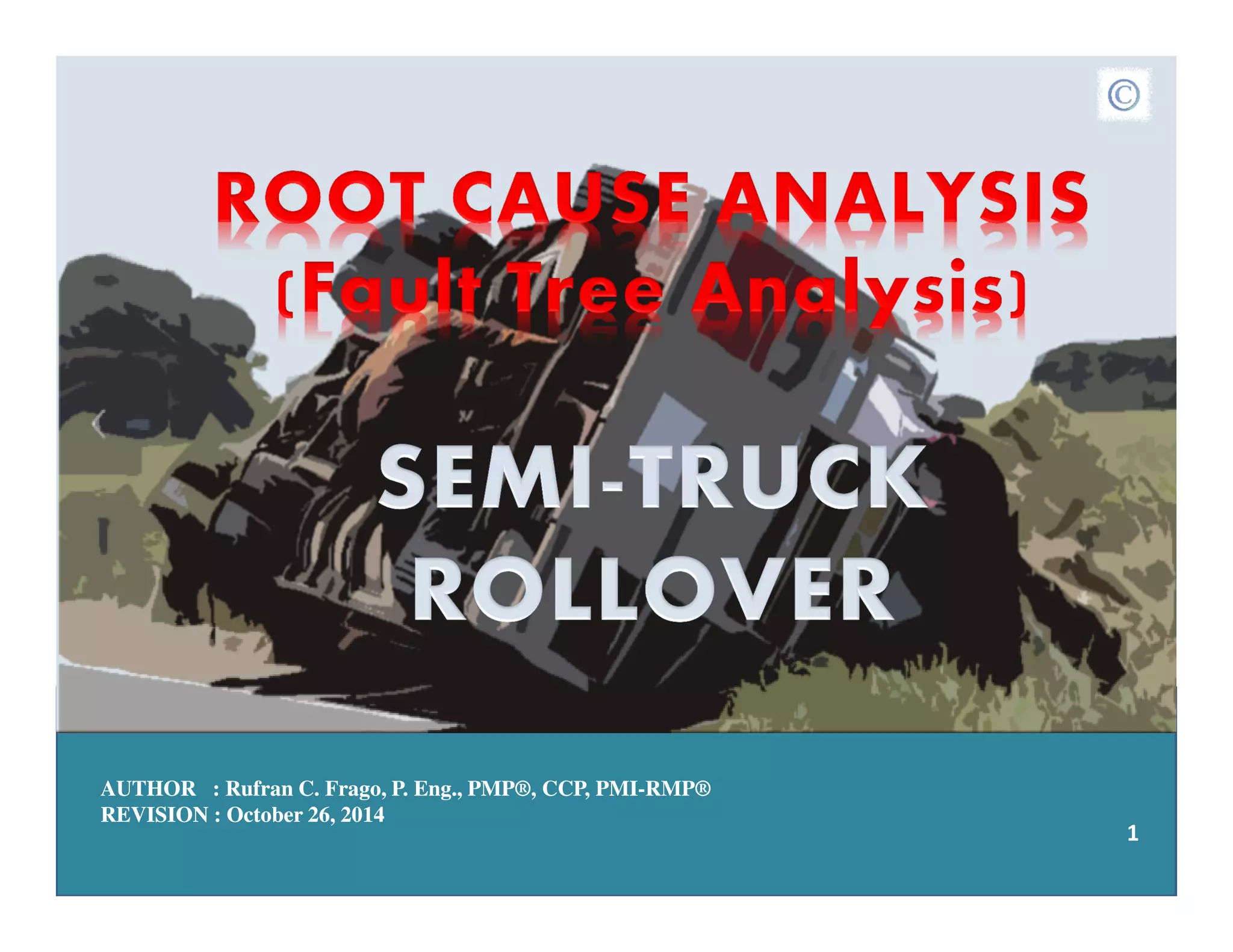
A truck rolled over a car in XYZ, USA taking the lives of three 
people. A 50,000-pound semi truck rolled on top of their car, 
according to a story on Local TV. Witness report said the truck 
was traveling north behind a small car turning right to the ABC 
Road intersection when the rollover occurred. 
Fatal consequence: 
Three adult passenger of the small vehicle were killed. Witnesses 
described “an unbelievable scene” as they watched those inside 
the car crushed and then being extracted under the semi-truck 
trailer. It took at least four hours to get the truck up right again. 
4
For this report, relevant details were collected using the 
following internet facilities: 
1. Blogs & threads 
2. News Report 
3. Injury Lawyer’s website 
4. Government website 
5. Transportation regulatory website such as the Federal 
Motor Carrier Safety Administration (FMCSA) 
6. Various statistical studies published via internet 
5
6
77
8
9
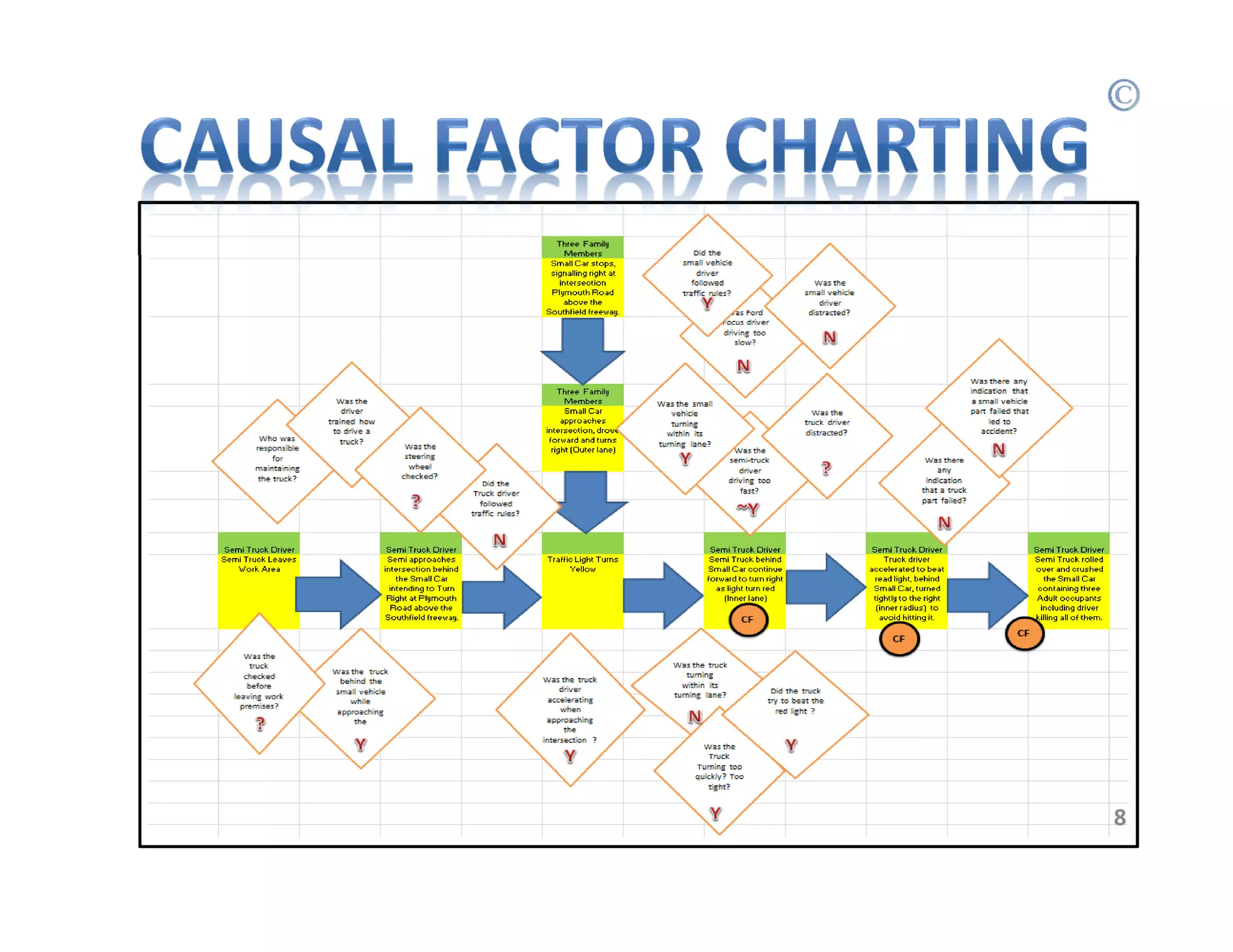
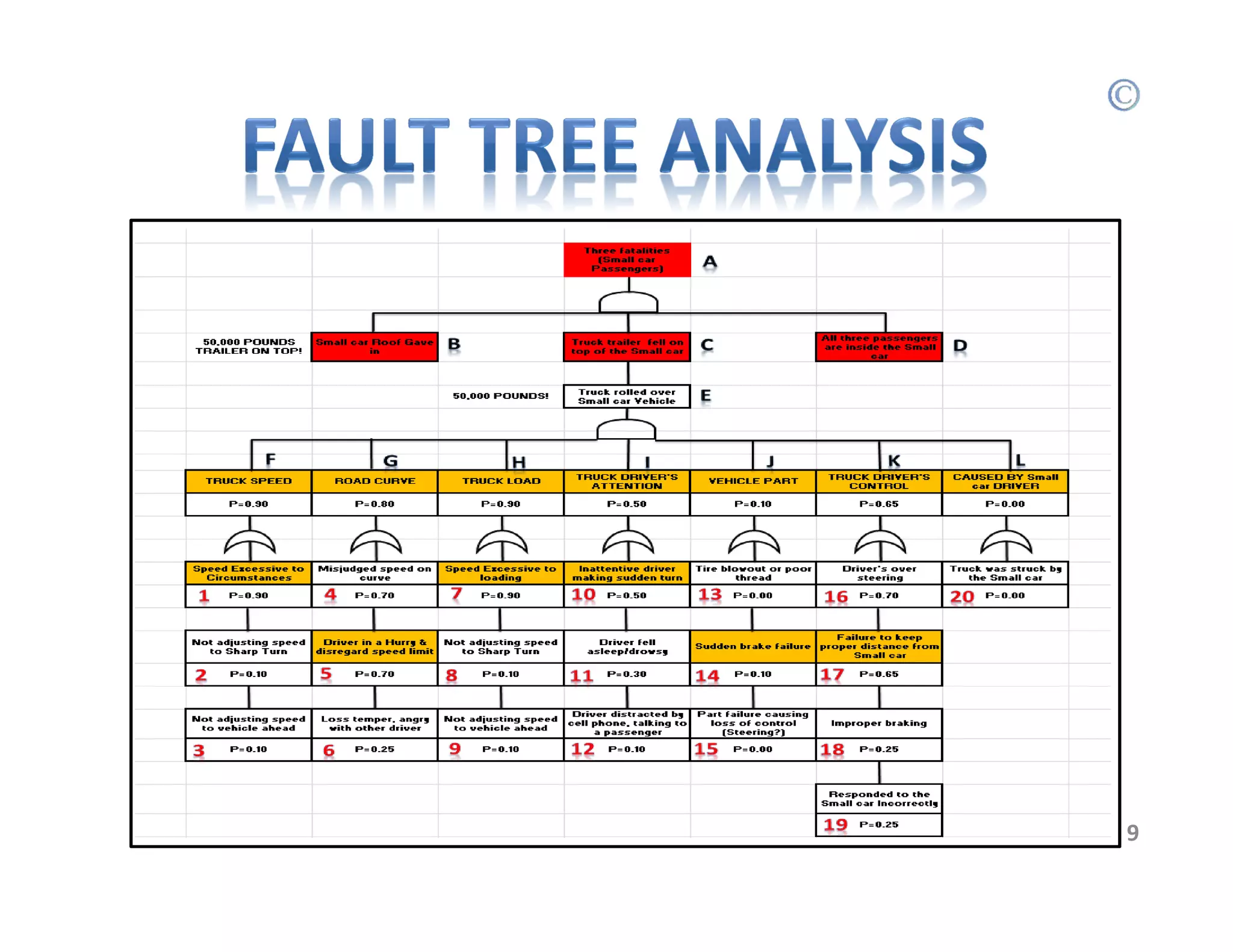
Although initial investigation pointed to a potential truck brake or steering wheel failure, 
compounded by an intersection collision of two vehicles travelling in perpendicular 
directions from each other, in-depth follow-up assessment says otherwise. The two 
vehicles were actually both travelling north, and turning right at the EFG Road-ABC 
Road intersection. The rollover was caused mainly by the truck speed excessive to what 
is properly required in negotiating a turn. 
Other contributory causes are as follow: 
1. Driver appears to be in a hurry approaching and turning right sharply at the 
intersection right behind the Small Car (accelerating when the traffic light is about to 
turn red). 
2. Speed Excessive to loading (impacts the center of gravity and turning moment). 
Rollovers occur when the front wheels are turning the truck more quickly than the 
cargo it is carrying; the faster the speed of the vehicle, the greater the difference. 
3. Possible inattentive driver when making tight, sudden turn 
4. Failure to keep proper distance from Small Car 
***Note that the potential brake failure initially entertained was ruled out due to the 
absence of signs, road markings, and part wears that would indicate such. 
10
1. Commercial Driver License programs could improve safety through the 
use of video to expose truck drivers to the situations leading to rollovers. 
2. Simulation can allow drivers to experience the results of rollover inducing 
errors without the consequences. 
3. Post lower truck speed limit for semis at that intersection and other 
similar locations. The judgment problem is aggravated in many locations 
by posted speed limits that are too high for loaded semi and tractor-trailers. 
4. Continuing education and skill training on semi-trailer truck driving to 
improve driving safety. It has to be renewed every year with the renewal 
supported by the trucking companies. 
5. All truck drivers should be extra cautious when approaching an 
intersection and should understand that yellow light in an intersection 
means slowing down. 
6. Semi-truck drivers who are persistent traffic violators should be stripped 
of their license for a considerable period of time. 
11
1. Gursten, S. (2014).Four (4) Major Causes of Truck Rollover accidents (FMSCA).Retrieved 
from http://www.michiganautolaw.com/blog/2014/07/19/truck-rollover-accident-causes/ 
2. ClickonDetroit.com, (2014).Eyewitness says police have false story about semi truck 
rollover.Retrieved from http://www.clickondetroit.com/news/Eyewitness-says-police-have-false- 
story-about-semi-truck-rollover/24783212 
3. McKnight and Bahout (2008). Analysis of Large Truck Rollover Crashes.Retrieved from 
http://www.ncbi.nlm.nih.gov/pmc/articles/PMC3256782/ 
4. Swarz & Lynch LLP (2014). Rollover Cases and Roof Crush.Retrieved from 
http://www.swartzlynch.com/personal-injury/product-liability/rollover-roof-crush-cases/# 
sthash.MIO4oynN.dpuf 
5. Zhu & Srinavasan (2011).A comprehensive analysis of factors influencing the injury 
severity of large-truck crashes.Retrieved from 
http://www.ncbi.nlm.nih.gov/pubmed/21094296 
6. Sabbagh-Erlich (2005). Working conditions and fatigue in professional truck drivers at 
Israeli ports.Retrieved from http://www.ncbi.nlm.nih.gov/pubmed/15805441 
7. FMCSA Report to Congress on the large truck crash causation study, Federal Motor Carrier 
Safety Administration (MC-R/MC-RRA) 2006. 
8. McKnight AJ. Investigative analysis of large truck accident causation. Prepared for 
Transportation Research Board, Transportation Research Associates; 2004 
9. Khattak AJ, Schneider RJ. How can we prevent rollovers and reduce injury severity in 
single-vehicle large truck crashes?; International Truck and Bus Safety Research and Policy 
Symposium; Knoxville: University of Tennessee; 2002. 
12

102614 Root Cause Analysis using Fault Tree Analysis (FTA) Technique

  • 1.
    AUTHOR : RufranC. Frago, P. Eng., PMP®, CCP, PMI-RMP® REVISION : November 7, 2014 1
  • 2.
    Disclaimer: The names,events, locations, and circumstances in this write up are fictitious & any resemblance to real persons living or dead, events, locations, and circumstances is purely coincidental. The mock up situation considered is something that could happen in real life and can be a source of learning for anyone interested in root cause analysis using the Fault Tree Analysis technique. 2 Announcement: For those who are interested, please join my Risk-based Management (RBM) group in Linkedin. Click the hyperlinked logo below to join and ask your questions. Risk-based Management
  • 3.
    Using Root Causeanalysis techniques investigate the given lifelike accident involving truck road rollover reportedly caused by one of the vehicle main part failure and build a Fault Tree Analysis (FTA) chart to prove the report. Briefly discuss accident data/ details collection, causal factors charting and provide two/ three recommendations to prevent this accident from re-occurring. 3
  • 4.
    2014: A truckrolled over a car in XYZ, USA taking the lives of three people. A 50,000-pound semi truck rolled on top of their car, according to a story on Local TV. Witness report said the truck was traveling north behind a small car turning right to the ABC Road intersection when the rollover occurred. Fatal consequence: Three adult passenger of the small vehicle were killed. Witnesses described “an unbelievable scene” as they watched those inside the car crushed and then being extracted under the semi-truck trailer. It took at least four hours to get the truck up right again. 4
  • 5.
    For this report,relevant details were collected using the following internet facilities: 1. Blogs & threads 2. News Report 3. Injury Lawyer’s website 4. Government website 5. Transportation regulatory website such as the Federal Motor Carrier Safety Administration (FMCSA) 6. Various statistical studies published via internet 5
  • 6.
  • 7.
  • 8.
  • 9.
  • 10.
    Although initial investigationpointed to a potential truck brake or steering wheel failure, compounded by an intersection collision of two vehicles travelling in perpendicular directions from each other, in-depth follow-up assessment says otherwise. The two vehicles were actually both travelling north, and turning right at the EFG Road-ABC Road intersection. The rollover was caused mainly by the truck speed excessive to what is properly required in negotiating a turn. Other contributory causes are as follow: 1. Driver appears to be in a hurry approaching and turning right sharply at the intersection right behind the Small Car (accelerating when the traffic light is about to turn red). 2. Speed Excessive to loading (impacts the center of gravity and turning moment). Rollovers occur when the front wheels are turning the truck more quickly than the cargo it is carrying; the faster the speed of the vehicle, the greater the difference. 3. Possible inattentive driver when making tight, sudden turn 4. Failure to keep proper distance from Small Car ***Note that the potential brake failure initially entertained was ruled out due to the absence of signs, road markings, and part wears that would indicate such. 10
  • 11.
    1. Commercial DriverLicense programs could improve safety through the use of video to expose truck drivers to the situations leading to rollovers. 2. Simulation can allow drivers to experience the results of rollover inducing errors without the consequences. 3. Post lower truck speed limit for semis at that intersection and other similar locations. The judgment problem is aggravated in many locations by posted speed limits that are too high for loaded semi and tractor-trailers. 4. Continuing education and skill training on semi-trailer truck driving to improve driving safety. It has to be renewed every year with the renewal supported by the trucking companies. 5. All truck drivers should be extra cautious when approaching an intersection and should understand that yellow light in an intersection means slowing down. 6. Semi-truck drivers who are persistent traffic violators should be stripped of their license for a considerable period of time. 11
  • 12.
    1. Gursten, S.(2014).Four (4) Major Causes of Truck Rollover accidents (FMSCA).Retrieved from http://www.michiganautolaw.com/blog/2014/07/19/truck-rollover-accident-causes/ 2. ClickonDetroit.com, (2014).Eyewitness says police have false story about semi truck rollover.Retrieved from http://www.clickondetroit.com/news/Eyewitness-says-police-have-false- story-about-semi-truck-rollover/24783212 3. McKnight and Bahout (2008). Analysis of Large Truck Rollover Crashes.Retrieved from http://www.ncbi.nlm.nih.gov/pmc/articles/PMC3256782/ 4. Swarz & Lynch LLP (2014). Rollover Cases and Roof Crush.Retrieved from http://www.swartzlynch.com/personal-injury/product-liability/rollover-roof-crush-cases/# sthash.MIO4oynN.dpuf 5. Zhu & Srinavasan (2011).A comprehensive analysis of factors influencing the injury severity of large-truck crashes.Retrieved from http://www.ncbi.nlm.nih.gov/pubmed/21094296 6. Sabbagh-Erlich (2005). Working conditions and fatigue in professional truck drivers at Israeli ports.Retrieved from http://www.ncbi.nlm.nih.gov/pubmed/15805441 7. FMCSA Report to Congress on the large truck crash causation study, Federal Motor Carrier Safety Administration (MC-R/MC-RRA) 2006. 8. McKnight AJ. Investigative analysis of large truck accident causation. Prepared for Transportation Research Board, Transportation Research Associates; 2004 9. Khattak AJ, Schneider RJ. How can we prevent rollovers and reduce injury severity in single-vehicle large truck crashes?; International Truck and Bus Safety Research and Policy Symposium; Knoxville: University of Tennessee; 2002. 12