100
women
history
made
who
Remarkable
women who
shaped
our world
First American Edition, 2017
Published in the United States by DK Publishing
345 Hudson Street, New York, New York 10014
Copyright © 2017 Dorling Kindersley Limited
DK, a Division of Penguin Random House LLC
17 18 19 20 21 10 9 8 7 6 5 4 3 2 1
001—294589—February/2017
All rights reserved.
Without limiting the rights under the copyright reserved above, no part of this publication
may be reproduced, stored in or introduced into a retrieval system, or transmitted, in any
form, or by any means (electronic, mechanical,photocopying, recording, or otherwise),
without the prior written permission of the copyright owner.
Published in Great Britain by Dorling Kindersley Limited.
A catalog record for this book is available from the Library of Congress.
ISBN: 978–1–4654–5688–5
DK books are available at special discounts when purchased in bulk
for sales promotions, premiums, fund-raising, or educational use. For
details, contact: DK Publishing Special Markets, 345 Hudson Street,
New York, New York 10014.
SpecialSales@dk.com
Printed and bound in China
A WORLD OF IDEAS:
SEE ALL THERE IS TO KNOW
www.dk.com
DK London
Senior project editor
Steven Carton
Senior art editors
Jacqui Swan, Laura Gardner
US editor Rebecca Warren
Jackets coordinator Claire Gell
Jacket design development manager
Sophia MTT
Producer, pre-production
Jacqueline Street
Producers
Mary Slater, Anna Vallarino
Managing editor Lisa Gillespie
Managing art editor Owen Peyton Jones
Publisher Andrew Macintyre
Associate publishing director
Liz Wheeler
Art director Karen Self
Design director Phil Ormerod
Publishing director Jonathan Metcalf
DK Delhi
Senior editor Sreshtha Bhattacharya
Project editor Priyaneet Singh
Project art editor Shreya Anand
Assistant editor Charvi Arora
Assistant art editors Nidhi Rastogi,
Garima Sharma, Saloni Dhawan
Jacket designers
Suhita Dharamjit, Surabhi Wadhwa
Jacket editorial coordinator
Priyanka Sharma
Senior DTP designers
Harish Aggarwal, Jagtar Singh
DTP designers
Pawan Kumar, Mohammad Rizwan
Senior picture researcher Sumedha Chopra
Managing jackets editor Saloni Singh
Picture researcher manager Taiyaba Khatoon
Pre-production manager Balwant Singh
Production manager Pankaj Sharma
Managing editor Kingshuk Ghoshal
Managing art editor Govind Mittal
This book is dedicated to Lin Esposito
Remarkable women who
shaped our world
Written by Stella Caldwell,
Clare Hibbert, Andrea Mills,
and Rona Skene
Consultant Philip Parker
100
women
history
made
who
4
Contents
Contents
Contents
Contents
6 Clued-up
creatives
8 Sappho
9 Mira Bai
10 Emily Dickinson
12 Screen stars
Marlene Dietrich
Marilyn Monroe
Kathryn Bigelow
Madhuri Dixit
Jennifer Lawrence
14 Josephine Baker
16 Edith Piaf
17 Maria Callas
18 Frida Kahlo
20 Women writers
Murasaki Shikibu
Shin Saimdang
Mary Wollstonecraft
Jane Austen
Maya Angelou
22 Anne Frank
24 Joni Mitchell
25 J. K. Rowling
26 Super
scientists
28 Hypatia
30 Émilie du Châtelet
31 Ada Lovelace
32 Mary Anning
34 Sofia Kovalevskaya
35 Lise Meitner
36 Marie Curie
38 Healthcare heroes
Mary Seacole
Florence Nightingale
Edith Cavell
Agnes Hunt
Averil Mansfield
40 Chien-Shung Wu
42 Dian Fossey
43 Françoise Barré-Sinoussi
44 Rosalind Franklin
46 Inspiring
campaigners
48 Olympe de Gouges
49 Elizabeth Cady Stanton
50 Harriet Tubman
52 Louise Michel
53 Bertha von Suttner
54 Landmark moments
Princess Isabel of Brazil
Helen Keller
Rachel Carson
Wangari Maathai
Margaret Chan
56 Emmeline Pankhurst
58 Rosa Luxemburg
59 Sophie Scholl
60 Rosa Parks
62 Aung San Suu Kyi
64 Malala Yousafzai
5
90 Intrepid
entrepreneurs
92 Bertha Benz
94 Sarah Breedlove
96 Coco Chanel
97 Indra Nooyi
98 Peggy Guggenheim
100 Oprah Winfrey
102 Internet impact
Carol Bartz
Radia Perlman
Sheryl Sandberg
Martha Lane Fox
Juliana Rotich
104 Amazing
achievers
106 Althea Gibson
108 Nellie Bly
110 High fliers
Harriet Quimby
Eugenie Mikhailovna
Shakhovskaya
Amelia Earhart
Amy Johnson
Valentina Tereshkova
112 Gertrude Bell
114 Junko Tabei
116 Wilma Rudolph
117 Nova Peris
118 Serena Williams
120 Tanni Grey-Thompson
121 Jessica Ennis-Hill
122 Marta
124 Let’s applaud…
126 Glossary
127 Index
128 Acknowledgments
66 Leading
ladies
68 Joan of Arc
70 Cool queens
Hatshepsut
Cleopatra
Eleanor of Aquitaine
Razia Sultana
Queen Victoria
72 Catherine the Great
74 Wu Zetian
75 Taytu Betul
76 Queen Elizabeth I
78 Sacagawea
80 Maria Quitéria de Jesus
81 Dolores Ibárruri
82 Eleanor Roosevelt
84 Indira Gandhi
86 Margaret Thatcher
87 Angela Merkel
88 Political pioneers
Golda Meir
Ellen Johnson Sirleaf
Graça Machel
Shirin Ebadi
Benazir Bhutto
There’s no business like show business with these
leading ladies topping the bill. From the stars of
stage and screen to the brains behind-the-scenes,
a glittering line-up of authors, actors, and artists
lights up the world of entertainment and the arts.
Whether they give us painted portraits, powerhouse
performances, or penned poems, their extraordinary
talent is an inspiration to us all.
Clued-up
creatives
8
Sappho
The GREATEST FEMALE
POET of the ancient world
Mysterious life
Very little is known about Sappho’s
life. Born on the Greek island
of LESBOS, sometime between
630 and 612 bce, she may have
married and had a daughter.
One legend tells of how Sappho
threw herself off a cliff when
a sailor broke her heart.
Love poetry
As a lyrical poet, Sappho intended her
verses to be sung to the music of a
LYRE. Her poetry is often about love,
and she was one of the first poets
to write about her own feelings and
thoughts. Although Sappho wrote
nine volumes of poetry, today only
650 lines of her work survive.
By the way…
My likeness appeared on
ancient coins, and my
poetry was so admired
that Plato called me the
“tenth muse.”
H
ow she changed…
the worl
d
Many poets have
tried to imitate Sappho’s
style through the ages.
Her meter, or rhythm,
is named “Sapphic
meter,” after her.
The lyre is similar
to a small harp,
and features
between four
and ten strings.
9
Mira Bai
The SAINTLY POET-PRINCESS who was
not afraid to stand up for her beliefs
Saintly poet
Mixing with the poor, Mira Bai
displayed her love for
Krishna by singing and
dancing in the streets.
Many were inspired
by her SELFLESS
DEVOTION. Today, about
1,300 poems in passionate praise of Krishna—
each called a bhajan—are attributed to her.
Life of devotion
Raised A PRINCESS in
16th-century India, Mira Bai
devoted her life to the Hindu
god Krishna. When her husband
died, she refused to kill herself—
as was customary—and instead
escaped to live the life of a
wandering saint and poet.
Krishna is revered
as a warrior and
teacher by Hindus.
Mira Bai played a
stringed instrument
called the dotara.
By the way…
Today, I am considered
one of the greatest
female saints in India,
and my poems are sung
throughout the country.
H
ow
she changed…
the wor
l
d
In going against the
customs of her time,
Mira Bai inspired many
women to lead creative
and spiritual lives.
10
Unrecognized during her lifetime, American
poet Emily Dickinson produced nearly
1,800 strikingly original poems and
colorful letters.
Family life
Born in 1830 into a well-known
family from Massachusetts,
Emily Dickinson enjoyed a
LIVELY CHILDHOOD.
Sensitive and intelligent,
she was adored by her two
siblings, but her relationship
with her mother was frosty,
and her father could
be controlling.
The solitary poet
Dickinson first wrote poetry in her teens, but she began
taking it seriously around 1850, experimenting and trying
out NEW IDEAS. As time passed, she withdrew more
and more from society, but her poetic output increased.
Despite her isolation, she corresponded with many
friends and literary associates.
The 17th-century “metaphysical”
poets—including the famous
John Donne—strongly influenced
Dickinson with their direct style,
wit, and striking metaphors.
Dickinson admired English
novelist and poet emily Brontë.
One of Brontë’s poems
was read aloud at
Dickinson’s funeral.
Who came before…
Did you know?
Dickinson may have
suffered from either epilepsy
or agoraphobia (a fear of
being in public places),
making her reluctant to
leave home.
Dickinson with her
brother Austin
and sister Lavinia
Emily Dickinso
n
The POET who wasn't afraid to
rewrite the rules
11
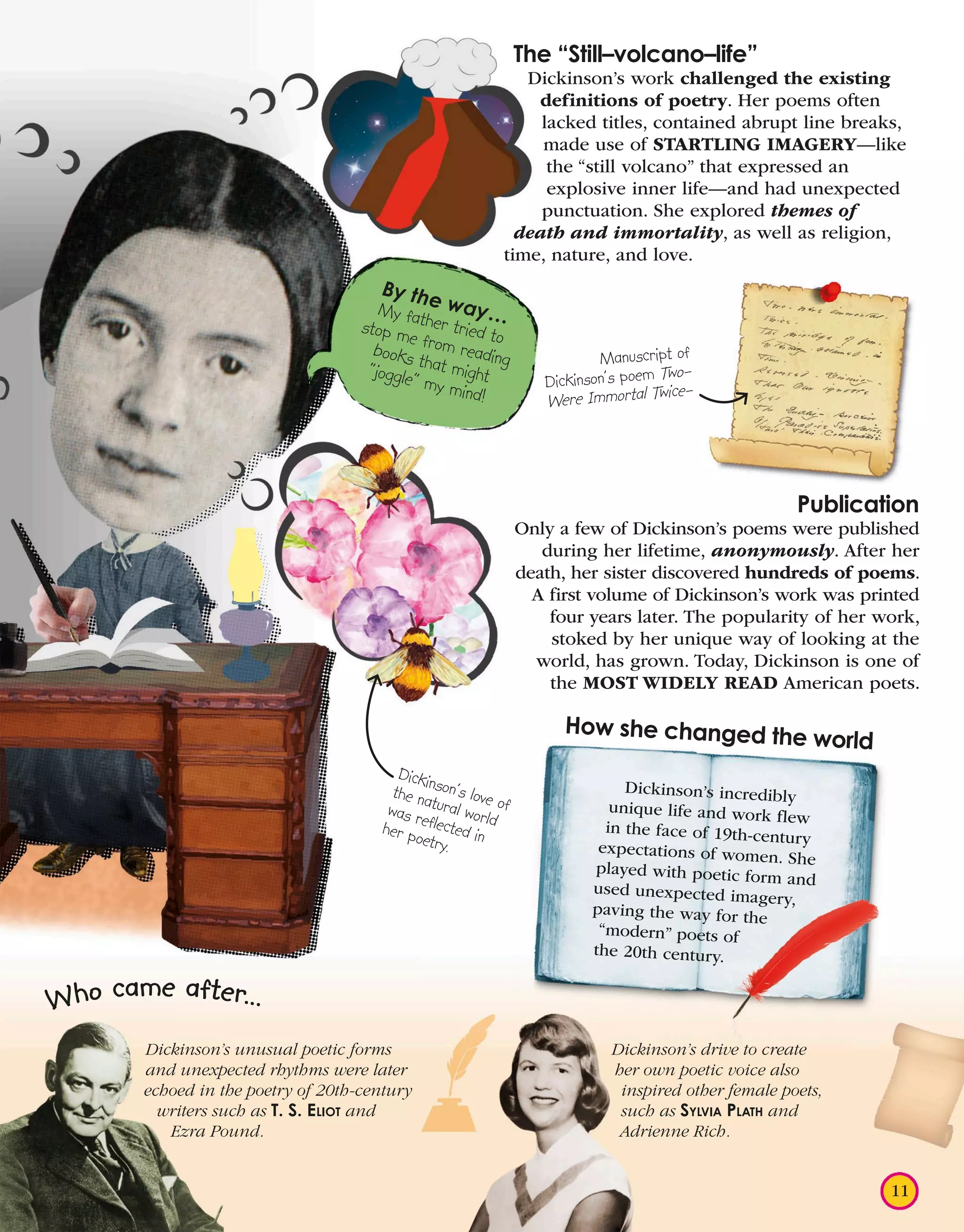
The “Still–volcano–life”
Dickinson’s work challenged the existing
definitions of poetry. Her poems often
lacked titles, contained abrupt line breaks,
made use of STARTLING IMAGERY—like
the “still volcano” that expressed an
explosive inner life—and had unexpected
punctuation. She explored themes of
death and immortality, as well as religion,
time, nature, and love.
Publication
Only a few of Dickinson’s poems were published
during her lifetime, anonymously. After her
death, her sister discovered hundreds of poems.
A first volume of Dickinson’s work was printed
four years later. The popularity of her work,
stoked by her unique way of looking at the
world, has grown. Today, Dickinson is one of
the MOST WIDELY READ American poets.
Dickinson’s unusual poetic forms
and unexpected rhythms were later
echoed in the poetry of 20th-century
writers such as T. S. ElioT and
Ezra Pound.
Dickinson’s drive to create
her own poetic voice also
inspired other female poets,
such as Sylvia PlaTh and
Adrienne Rich.
Who came after…
By the way…
My father tried to
stop me from reading
books that might
“joggle” my mind!
Dickinson’s love of
the natural world
was reflected in
her poetry.
Manuscript of
Dickinson’s poem Two–
Were Immortal Twice–
Dickinson’s incredibly
unique life and work flew
in the face of 19th-century
expectations of women. She
played with poetic form and
used unexpected imagery,
paving the way for the
“modern” poets of
the 20th century.
How she changed the world
12
Since the early days of cinema,
women have had an increasingly
important creative input, with
these stars topping the bill.
Marilyn Monroe
Born Norma Jeane Mortenson in
1926, American actor Marilyn
Monroe grew up in foster homes.
She took on her famous name
at the start of her glittering
film career in the 1950s, which
included a win at the GOLDEN
GLOBE AWARDS. Monroe
died tragically aged 36, but
she remains the ultimate
glamour icon.
Marlene Dietrich
German-American singer and actor Marlene Dietrich
featured in the successful 1930 film Der Blaue Engel
(The Blue Angel). It propelled her to stardom, and she
was soon whisked off to the center of the American
film industry, HOLLYWOOD. She went on to become
one of the highest-paid actors of the time, and later
toured the world singing and acting in theaters.
S
c
reen stars
During World War II,
Dietrich helped refugees
fleeing Germany and France
to settle in the USA.
Monroe shot to fame after
she was spotted working in
a weapons factory in 1944.
L
E
A
DING LIGHTS of the movi
e
s
13
Madhuri Dixit
Indian film star Madhuri Dixit
was the queen of the Indian film
industry, known as BOLLYWOOD, in the
1980s and 1990s, taking the lead in many
screen love stories. Nominated a record-
breaking 14 times for Filmfare Awards
(a popular awards show in India),
she was the winner four times.
Kathryn Bigelow
This American writer and director is best known for
her GRIPPING FILM AND TELEVISION DRAMAS
featuring striking visuals and slow-motion action
sequences. In 2008, Kathryn Bigelow made history
by becoming the first woman to win the Best
Director award at the Oscars, for her war-themed
blockbuster, The Hurt Locker.
Jennifer Lawrence
The 21st century’s leading lady
in Hollywood, American actor
Jennifer Lawrence is famous for
her RIVETING PERFORMANCE
in the Hunger Games series of
films. The youngest actor to
receive four Oscar nominations,
she took the prize for her role in
the romantic comedy Silver
Linings Playbook in 2013.
Bigelow filmed
The Hurt Locker
in Jordan.
Dixit is reknowned
for her spectacular
dance performances.
14
Known as the “Black Pearl,”
Josephine Baker painted the town
red, lit up the silver screen, and
gathered a Rainbow Tribe.
A star is born
Born in 1906 in St. Louis,
Baker left home as a teenager
and joined a VAUDEVILLE
(variety entertainment) troupe.
She honed her dancing and
comedic skills before winning
a part in the Broadway musical
Shuffle Along in 1921.
French fancy
Spotted by a talent scout in 1925, BAKER
MOVED TO PARIS, France. Her exotic
style and wild dance routines made her
Europe’s highest-paid performer by 1927.
Baker became a singer and actor in
the 1930s, breaking new ground
for African-American women.
The father of tap dance,
Bill “Bojangles” RoBinson,
was the first African-
American performer to cross
into mainstream vaudeville
shows and star in major
motion films in the 1930s.
Josephine
Baker
All-singing, ALL-DANCING
freedom-fighter
By the way…
My pet cheetah Chiquita
wore a diamond-encrusted
collar and caused a stir
whenever we went
for a walk!
In 1891, the Creole Show in New
York, introduced the cakewalk, the
first dance performed on stage by
African-American people. This was
followed by the Charleston, Jitterbug,
Lindy Hop, and Twist.
What came before...
A scene from
Shuffle Along
15
In 2015, Misty Copeland
made history at the American
Ballet Theatre Company when she
became the first African-American
principal dancer of the company.
Josephine Baker remains a style
icon in the 21st century, with
African-American star BeyonCé
describing Baker’s dance moves as
inspirational and paying homage
with her costumes and routines.
Josephine Baker is proof that anything is
possible, turning humble beginnings into
international superstardom. She lived life to
the fullest, cramming in careers as a singer,
dancer, actor, spy, activist, and campaigner,
at a time when opportunities for African-
Americans were few and far between.
How she changed the world
Who came after...
Making a stand
Baker experienced racism and hostility in
her American homeland, so she campaigned
hard for the 1960s CIVIL RIGHTS
MOVEMENT at demonstrations and marches.
Following the assassination of Martin Luther
King, Jr., the movement’s leader, she was
asked to take control. She declined, believing
she would be too busy to see her children.
Baker with some of her 12 children
Baker addressing
the crowds at the
Lincoln Memorial,
Washington, DC
War and peace
During WORLD WAR II, the glamour
girl was a spy for the French Resistance
against the Nazi German forces, delivering
messages. She also helped the Red Cross
and entertained troops overseas. After the
war, she adopted 12 children from around
the world to prove that people of all races
could live in harmony. She called them
her “Rainbow Tribe”.
Did you know?
When she died in 1975,
Baker was the first
American woman to
receive full French military
honors at her funeral.
16
The LITTLE SPARROW of Paris who
became a global singing sensation
Edith Piaf
Born to perform
The daughter of a circus acrobat
and a street singer, Edith Piaf started
performing for a living in her teens. Her
speciality was the chanson—a type
of nostalgic song from the cafés of
Paris. After becoming popular in
France, her fame spread until she
was a GLOBAL CELEBRITY.
Did you know?
Edith’s surname was
actually Gassion, but she
was called Piaf (“sparrow”
in French) due to her
slight build.
Piaf’s unique voice and
dramatic style made
her one of the highest-
paid, most admired,
and most influential
performers ever.
H
o
w
she changed…
the wo
r
l
d
Piaf visited many injured
French servicemen during
World War II.
War hero
During WORLD WAR II,
Piaf used her stardom to
help German-occupied France.
During a concert in a prisoner-
of-war camp, she smuggled in
false identity papers, helping
more than 300 French
prisoners to escape.
17
The SUPERSTAR who put as much
passion into her life as her art
Maria Callas
Musical megastar
Callas was adored for her acting performances
as well as her singing. Her charisma made opera
appeal to people who had never been interested
in it before. Callas’s off-stage life was FULL OF
DRAMA, too. Her glamorous looks, celebrity
lifestyle, and public fights with fellow musicians
meant that she was often in the headlines.
Rising star
Greek-American Maria Callas took
singing lessons from the age of five.
Her BIG BREAK came in 1949, when she
took a leading role in an opera at Teatro
la Fenice, Venice, Italy. She learned the
whole part in just six days—and her
performance was a sensation!
Present-day
Teatro la Fenice
Callas’s dazzling talents
and style attracted
millions of new fans
to opera.
H
ow she changed…
One of Callas’s most
famous roles was as
tragic hero Tosca.
the wor
l
d
18
SELFIE-starter
Mexico’s greatest female artist
broke with convention by putting
herself in the picture, revealing her
personal struggles in self-portraits
for all the world to see.
Unlucky start
Bad luck plagued Frida Kahlo’s
early life. She contracted polio
at the age of six and was badly
injured in a bus accident as a
teenager. Faced with CONSTANT
PAIN and ongoing operations, she
turned to painting for expression
and entertainment.
Artist and activist
Kahlo was one of the only female students at
Mexico’s National Preparatory School, where
she painted DRAMATIC SELF-PORTRAITS.
With the Mexican Revolution underway, Kahlo
joined the Mexican Communist Party. In 1929,
she married Mexican muralist Diego Rivera,
who shared her political views.
F
r
i
d
a
Kahlo
With the use of mirrors in the
Renaissance period, artists
such as Leonardo da Vinci
began painting themselves
in formal portraits.
What came before…
By the way…
Known as surrealism, my
style of painting involved
bizarre themes and
imaginative subjects.
The world’s first portraits
date back to ancient egyptian
tomb art, sculptures,
and paintings.
Kahlo at the
age of five
Diego Rivera
19
Inspirational icon
In 1939, Kahlo moved to Paris, France, where she
exhibited her paintings and befriended Spanish painter
Pablo Picasso and French artist Marcel Duchamp.
Returning home in 1943, Kahlo began teaching at a
new art school in Mexico City named LA ESMERALDA,
where her work gained fans and followers, leading
to a solo exhibition there in 1953.
Spanish painter Salvador dali
was a surrealist artist with
a quirky personality
and a preference for
self-portraiture.
Many modern female
artists, including American
photographer Cindy Sherman,
have been influenced by
Kahlo’s self-portraits.
Who came after…
At a time when female artists
were largely ignored by critics,
Kahlo broke the mold with her
surrealist style. If a picture
paints a thousand words,
Kahlo’s raw and rebellious
works voiced the strengths
and struggles of millions
of women.
H
o
w
she changed the world
Fight to the death
Poor health blighted Kahlo’s
later life, but that didn’t keep
her from appearing at her
exhibition’s opening night.
From a bed in the gallery,
Kahlo celebrated her success
and spoke to the audience.
She made a LAST PUBLIC
APPEARANCE at a political
rally before her death at
the age of 47 at Casa Azul
(Blue House), her home
in Mexico City.
Kahlo’s pets, including
monkeys, dogs, and
birds, featured
regularly in her work.
Casa Azul is
now a museum
dedicated to Kahlo.
20
Shin Saimdang
There was nothing ordinary about this gifted artist who
OVERCAME THE RIGID BARRIERS of 16th-century
Korean society to excel not only at poetry, but at
calligraphy, painting, and embroidery, too. As
the mother of seven children, including the
famous scholar Yulgok, Shin Saimdang is
often celebrated as a “wise mother.”
Murasaki Shikibu
Shikibu’s novel, The Tale of Genji, was
finished by 1021 and is considered to be
the single greatest work of Japanese
literature. It is also one of the WORLD’S
FIRST novels. The 54-chapter book tells the
tale of Genji, the son of an ancient Japanese
emperor, and is almost certainly based on
Shikibu’s experience of life at court.
For centuries, female writers struggled
to get their work
published, let alone
praised. However, as these authors
show, they have given us some of the
greatest literature ever written.
Breaking down barriers with WORDS
“Murasaki Shikibu”
is a nickname—the
writer’s real name
is unknown.
Women
writers
21
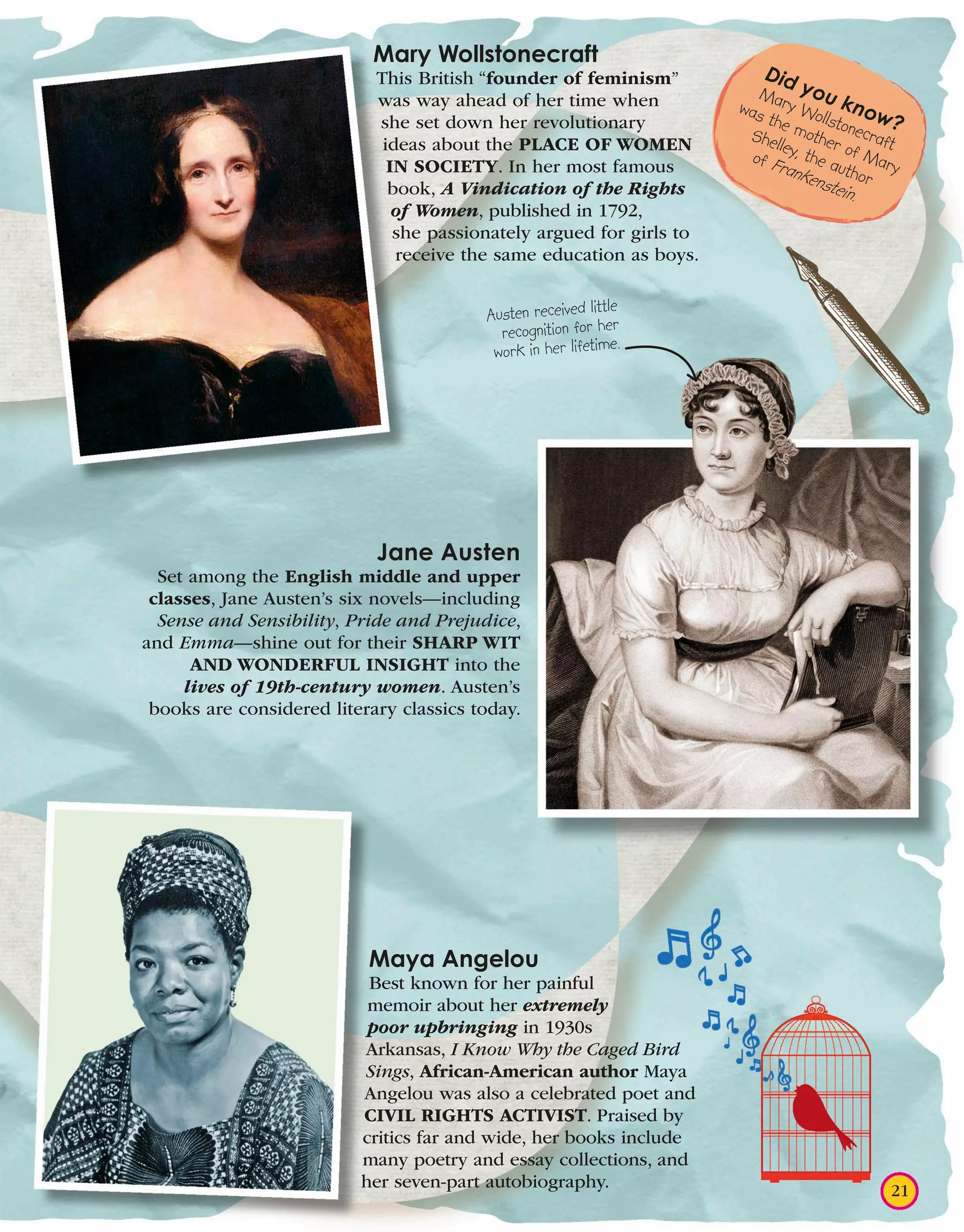
Mary Wollstonecraft
This British “founder of feminism”
was way ahead of her time when
she set down her revolutionary
ideas about the PLACE OF WOMEN
IN SOCIETY. In her most famous
book, A Vindication of the Rights
of Women, published in 1792,
she passionately argued for girls to
receive the same education as boys.
Jane Austen
Set among the English middle and upper
classes, Jane Austen’s six novels—including
Sense and Sensibility, Pride and Prejudice,
and Emma—shine out for their SHARP WIT
AND WONDERFUL INSIGHT into the
lives of 19th-century women. Austen’s
books are considered literary classics today.
Maya Angelou
Best known for her painful
memoir about her extremely
poor upbringing in 1930s
Arkansas, I Know Why the Caged Bird
Sings, African-American author Maya
Angelou was also a celebrated poet and
CIVIL RIGHTS ACTIVIST. Praised by
critics far and wide, her books include
many poetry and essay collections, and
her seven-part autobiography.
Did you know?
Mary Wollstonecraft
was the mother of Mary
Shelley, the author
of Frankenstein.
Austen received little
recognition for her
work in her lifetime.
22
Start of the story
Annelies Marie Frank was
born in Frankfurt, Germany,
in 1929. Her father, Otto
Frank, fearing persecution
for their JEWISH FAITH at
the hands of the anti-Jewish
Nazi party, moved his
family to the Netherlands
in 1933. Anne was educated
in Amsterdam. She was a
voracious reader who
excelled at writing.
The Confessions of
sT. AugusTine of hippo
are autobiographical
books in Latin, in
which St. Augustine
explored his feelings on
religion and philosophy.
Famous English diarist
sAmuel pepys kept a diary
for almost a decade,
giving a valuable account
of London, England,
during the 17th century.
Anne Frank
History’s most
endearing and
enduring teenage
DIARIST
The young Jewish
girl whose wartime
writings won the
hearts of millions
of readers around
the world.
Special gift
By 1940, World War II was underway.
The Netherlands was occupied by the
Nazis and the Frank family was under
threat. The family tried to emigrate once
again, this time to the USA, but this was
blocked in 1941. Anne turned 13 in 1942, and
received a journal as a gift from her parents.
Did you know?
Originally written in Dutch,
Anne’s diary has been
translated into more than
60 languages and sold more
than 30 million copies.
Who came before…
23
Today, people use
the Internet to record
their thoughts on
weblogs, or through
social media sites.
From 1991 to 1993, Zlata FIlIpovIć
kept a record of her experiences
growing up in war-torn Sarajevo
in Bosnia and Herzegovina.
Her experiences were published
in the book Zlata’s Diary.
Final chapter
The Frank family was
taken to Auschwitz
concentration camp.
Anne was moved to
Bergen-Belsen camp
where she died of typhus
in 1945. Otto survived the
war and ensured Anne’s
diary was published
in 1947. It became an
international BEST-SELLER.
Secret hideaway
Shortly after Anne’s birthday, the family fled to a
secret living area behind and above Otto’s office.
Friends brought food supplies and news updates.
Anne relieved her boredom by recording her feelings
about her family, about what was happening, and her
hopes for the future. On August 4, 1944, the NAZIS
FOUND THE HIDEAWAY and Anne’s diary ended.
By the way...
I named my diary "Kitty"
because I thought of it as
a friend in whom I
could confide.
Who came after…
How she changed
the world
Though Anne was
tragically killed by the
Nazis, her words,
preserved in her diary,
have lived on to remind
us of the value and
dignity of human life.
Located above Otto’s
Amsterdam office, the
family hideaway is now
the most visited place
in the Netherlands.
24
Joni
Mitchell
A SONGWRITER
whose music will play
on forever
A legend in the making
Born in a remote Canadian
town in 1943, Joni Mitchell
always loved art and
music. She learned to play
guitar, and wrote songs
with meaningful lyrics
and beautiful melodies.
She released her debut
album in 1968. Mitchell’s
huge hits, including
“Both Sides Now” and
“Big Yellow Taxi,”
turned her into a FOLK
MUSIC LEGEND.
Albums and awards
Mitchell won her first Grammy
Award in 1969 for BEST FOLK
PERFORMANCE. Throughout
the 1970s, she experimented with
jazz, pop, and other musical
genres. Her passion for painting
showed in the many album covers
that displayed her artwork. She
went on to release 19 albums and
bag another eight Grammys.
The originality of
Mitchell’s music and
lyrics influenced many
songwriters and
captivated fans around
the world.
H
o
w
she changed…
the wo
r
l
d
25
J. K. Rowling
The WRITING WIZARD whose
spellbinding words cast their magic
over readers worldwide
Bookworm’s journey
Born in 1965, Joanne Rowling grew up in
Gloucestershire, UK, surrounded by books. At
the age of six, she wrote her first story, about
a rabbit with measles. In 1990, she dreamed up
the idea for her BOY-WIZARD, HARRY
POTTER, while delayed on a train. Harry
Potter and the Philosopher’s Stone was
published seven years later.
Rags to riches
Children and adults alike loved the FANTASY
STORIES set at “Hogwarts School of Witchcraft
and Wizardry.” More books followed in the
series, all of which sold amazingly well, and
Rowling became a household name. A film
deal for the series followed, and the eight
films smashed box office records.
A multi-award-winning
author, Rowling has sold
more than 450 million
books in over
70 languages.
H
ow she changed…
the worl
d
S
u
per
Science has welcomed many groundbreaking
developments and discoveries from women. Light
years ahead of their time, these pioneers of
progress have conquered new ground in their
chosen areas of chemistry, physics, biology,
mathematics, zoology, and palaeontology. By
bringing their knowledge and inventions to
the forefront, they have transformed our lives
for the better.
sci
e
n
t
i
s
t
s
28
Hypatia
The MATH WHIZZ of ancient Alexandria
Plotinus was an
important Neoplatonist
philosopher of the ancient
world. He believed that
there was a supreme,
supernatural entity that
he called “The One.”
Who came before...
Solid foundations
Born in about 355 ce in
Alexandria, an Egyptian
city famous for being
a center of learning,
Hypatia was the child of
Theon, a philosopher and
mathematician. Although it
was unusual for the time,
Theon educated his
daughter and she
EXCELLED IN
HER STUDIES.
A brilliant mathematician, philosopher,
and astronomer, Hypatia was one of the
great thinkers of the ancient world.
Charismatic teacher
Hypatia became the leading mathematician of her era,
achieving recognition in algebra, geometry, and astronomy. She
also BUILT A REPUTATION AS AN OUTSTANDING TEACHER,
particularly of philosophy. Hypatia taught a kind of philosophy
called “Neoplatonism,” which, at the time, was seen as a form
of paganism. Her lectures drew huge crowds, and she
played an active role in Alexandrian life.
An abacus is
a mathematical
instrument used
for addition
and subtraction.
Greek mathematician
Ptolemy was one of the most
influential astronomers of
the 2nd century ce. Hypatia
corrected and improved his
astronomical work Almagest.
Alexandria was well-known for its library,
which contained works by the greatest
minds of the ancient world.
29
Grisly death
Cyril, the Christian archbishop of Alexandria,
was involved in an intense feud with the
city’s pagan governor, Orestes. As the
governor’s friend, Hypatia became a FOCAL
POINT OF RELIGIOUS TENSION. Things
came to a head in 415 ce, when she was
dragged from her carriage and brutally
murdered by a Christian mob.
In 1786, German astronomer
Caroline HersCHel was the
first woman to discover a
comet, and the first to be paid
for her scientific work.
In 2014, Iranian-American
mathematician MaryaM
MirzakHani was the first
woman and first Iranian
to receive the Fields Medal
(a prestigious award
in mathematics).
Who came after...
Hypatia’s extraordinary
brilliance lay not only in
her inquiring mind, but
in her ability to teach
complicated concepts. At
a time when almost all
women led lives centered
around the home, she was
a leading mathematician
and teacher.
By the way...
I was so well-known
that eminent thinkers
traveled from many
different countries to
hear me lecture.
How she changed the world
Did you know?
Alexandria was a great
center of learning for
almost 800 years, but was
in decline by 400 ce due to
religious turmoil.
30
Émilie du Châtelet
The mathematician, physicist, and writer who played a
key role in Europe’s AGE OF ENLIGHTENMENT
Advances in science
Du Châtelet’s partner was the French philosopher
Voltaire. They wrote a best-selling book together,
and even set up a science laboratory at home. Her
major achievement was her French translation
of Isaac Newton’s great work, the Principia
Mathematica. In it she also EXPLAINED AND
TESTED Newton’s exciting new theories on
astronomy, gravity, and the nature of
light and colors.
Talented teen
Émilie du Châtelet was born into a wealthy French aristocratic family
in 1706. Her father allowed her to attend his discussion groups,
to which he invited well-known writers and thinkers. The debates
FIRED HER CURIOSITY. She also had fencing and riding lessons,
and became fluent in Latin, Greek,
German, and English.
Voltaire said of his partner,
“No woman was ever
more learned.”
By translating and
building on Newton’s
work, du Châtelet made
a massive contribution to
the scientific community
of her time.
H
ow she changed…
the worl
d
Du Châtelet’s
father, Louis
Nicolas le
Tonnelier
de Breteuil
By the way…
My study of how
fire behaves was the first
paper by a woman ever
published by the Académie
des Sciences in Paris.
31
Ada Lovelace
The trailblazer who wrote the first
COMPUTER code
Charles Babbage’s
Analytical Engine
was never built in
his lifetime, but
experts agree
that it would
have worked.
By the way…
The programming
language “ADA,” first
created for the US
Department of Defense,
was named after me.
Lovelace not only
wrote the first computer
program, she also got
people thinking about the
kinds of things computers
could do.
H
o
w
she changed…
the worl
d
Father of computing,
Charles Babbage
Babbage’s
Engine was
designed to use
punched cards
to input data.
The first computer geek
As a child, Ada Lovelace developed
a passion for mathematics. When
she was 17, she met British
mathematician Charles Babbage,
who had designed the Analytical
Engine—an early computer to do
calculations. She devised a set of
instructions, or an ALGORITHM,
on how to make the Engine
perform different tasks—
making her the world’s first
computer programmer.
Taking a gamble
A keen GAMBLER, Lovelace
developed a mathematical model
to beat the odds on horse races.
The scheme went very wrong,
and she lost so much money that
she secretly had to sell some
family jewelry.
32
England’s most
formidable
FOSSIL FINDER
British amateur geologist Mary Anning
trawled the sands of her local beach
to make discoveries that would
change our understanding of
evolutionary history.
Buried treasures
Born in 1799, Mary Anning grew up in the British seaside
resort of Lyme Regis, Dorset, England, where she sold shells
to tourists. One memorable day, she and her brother Joseph
found a MARINE REPTILE SKELETON on the beach, which
was later identified as an ichthyosaur, or “fish-lizard.”
In 1841, English
anatomist RichaRd
Owen coined the
term “dinosaur,”
which means
“terrible lizard.”
Who came after...
That same year, English
geologist JOhn PhilliPs
came up with the first
timescale of Earth based
on the creatures found
in rock fossils.
M
a
ry
Anning
Did you know?
Mary was a born survivor,
remaining unscathed after
being hit by lightning
as a baby.
Ichthyosaurus had
the largest eye sockets
found anywhere among
vertebrate animals.
Coprolites are animal
droppings that have
become fossilized.
Fossils of ammonites—ancient
sea creatures with coiled shells—
are common on the Jurassic
Coast of England.
33
In 2001, Dorset’s
Jurassic Coast became
a UNESCO WOrld
HEritagE SitE, 200 years
after Mary Anning first
explored there.
Fossilized finds
Anning found hundreds of fossils of fascinating creatures that
nobody knew existed on the same coast, including the skeleton
of the world’s first plesiosaur (near-lizard) in 1821. Anning’s
discoveries led other scientists to realize that this coastline
had formed 185 MILLION YEARS AGO. Strong winds, rain,
and waves had crumbled the rock layers away, helping
Anning to uncover the fossils.
Understanding evolution
Anning had been raised to believe
that God had created all living
things. However, her findings
challenged the traditional belief
that Earth’s species had always
existed unchanged. Her discoveries
proved that different creatures had
LIVED, DIED OUT, AND
EVOLVED over time.
English scientist Charles
Darwin wrote about the
theory of evolution in his
book ON tHE OrigiN Of
SpECiES in 1859.
Mary Anning
did the dirty
work, searching
the sands so that
palaeontologists (scientists who study
fossils) could analyze her finds and
develop new theories. Despite not having
any formal education or training, she
helped to change our view of how
life evolved on Earth.
H
o
w
s
h
e
changed the
w
o
r
l
d
By the way...
I am said to be
the inspiration for the
famous tongue-twister,
“She sells seashells by
the seashore.”
Anning’s sketch of one of her
findings—a Plesiosaurus fossil
34
Sofia
Kovalevskaya
The Russian SUPER-SCHOLAR who excelled
at science and mathematics
Algebra addict
Sofia Kovalevskaya was
born in Moscow, Russia, in
1850. At the time, girls in Russia
received little education, but young
Kovalevskaya became HOOKED ON
MATHEMATICS. Her father ordered
her to concentrate on other studies,
but Kovalevskaya secretly borrowed
an algebra book and read it at night!
A brilliant career
Kovalevskaya scored another first for women
when she was made a MATH PROFESSOR
at the University of Stockholm, in Sweden.
When she won a major math prize at the
French Academy of Science in 1888, they were
so impressed by her work that they increased
her prize money from 3,000 to 5,000 francs!
No women allowed
Kovalevskaya was determined
to go to university—but women
were not allowed to study in
universities in Russia. Kovalevskaya
persisted and, eventually, she got
special permission to study in
Germany. She became the first
woman in Europe to be
awarded a DOCTORATE
IN MATHEMATICS.
Did you know?
My achievements
include being the first
woman to be elected
to the Russian Academy
of Sciences.
Kovalevskaya
studied the
changing shape
of Saturn's rings.
Kovalevskaya made
new discoveries
about how objects
such as tops spin.
Kovalevskaya's childhood
home in Russia
Kovalevskaya
made some important
breakthroughs in the world
of mathematics, paving
the way for other
women to work in the
academic world.
H
ow she changed…
the worl
d
35
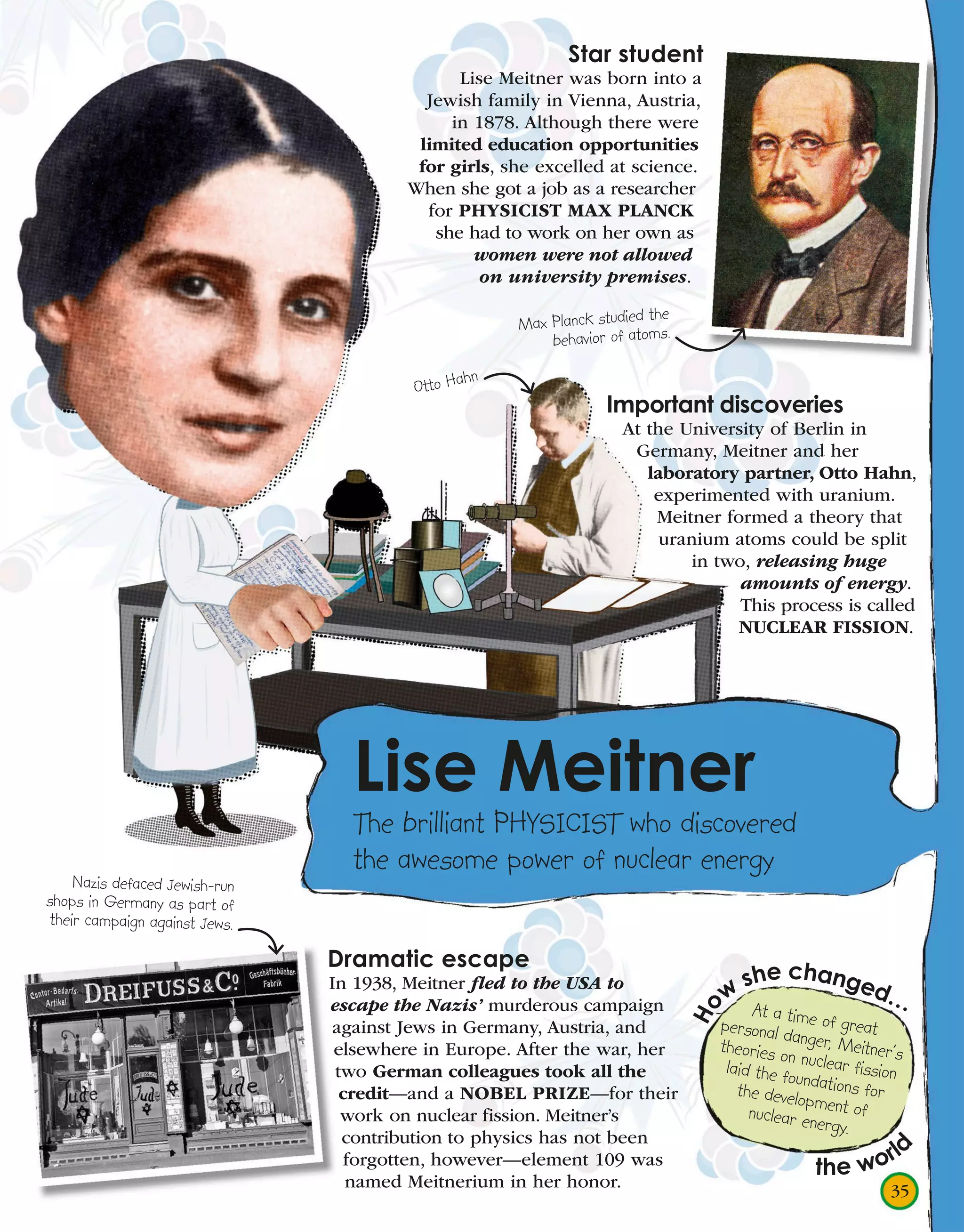
Lise Meitner
The brilliant PHYSICIST who discovered
the awesome power of nuclear energy
Dramatic escape
In 1938, Meitner fled to the USA to
escape the Nazis’ murderous campaign
against Jews in Germany, Austria, and
elsewhere in Europe. After the war, her
two German colleagues took all the
credit—and a NOBEL PRIZE—for their
work on nuclear fission. Meitner’s
contribution to physics has not been
forgotten, however—element 109 was
named Meitnerium in her honor.
Important discoveries
At the University of Berlin in
Germany, Meitner and her
laboratory partner, Otto Hahn,
experimented with uranium.
Meitner formed a theory that
uranium atoms could be split
in two, releasing huge
amounts of energy.
This process is called
NUCLEAR FISSION.
Star student
Lise Meitner was born into a
Jewish family in Vienna, Austria,
in 1878. Although there were
limited education opportunities
for girls, she excelled at science.
When she got a job as a researcher
for PHYSICIST MAX PLANCK
she had to work on her own as
women were not allowed
on university premises.
Otto Hahn
Nazis defaced Jewish-run
shops in Germany as part of
their campaign against Jews.
Max Planck studied the
behavior of atoms.
At a time of great
personal danger, Meitner's
theories on nuclear fission
laid the foundations for
the development of
nuclear energy.
H
o
w
she changed…
the worl
d
36
Ray of hope
Curie proved that atoms of some elements
release high-energy particles in a process called
radiation. With Pierre, she DISCOVERED TWO
NEW ELEMENTS—polonium (named after Poland,
her home country) and radium (named after the
Latin word for “ray”). They also coined the term
“radioactivity,” and found that radiation could
help treat diseases such as cancer.
Marie Curie
RADIATION revolutionary
History’s foremost female physicist
was in her element pioneering
groundbreaking advances in
science and medicine.
Scientific schooling
Maria Salomea Skłodowska was born
in Poland in 1867. She was introduced
to science by her parents, who
were both teachers. A TALENTED
STUDENT, she moved to Paris,
France, in 1891 to study physics and
mathematics. She married French
physicist Pierre Curie four years later.
German physicist
Wilhelm Roentgen
discovered X-rays in
1895. The radioactive
element roentgenium
is named after him.
In 1896, French physicist
henRi BecqueRel discovered
that uranium is a radioactive
element. He shared the Nobel
prize with the Curies in 1903.
Who came before…
Did you know?
Curie’s research
papers are
radioactive, and are
stored in protective
lead-lined boxes.
Pierre Curie
37
Double award
In 1903, Marie and Pierre won
the Nobel Prize in Physics.
Pierre died in a tragic
accident three years later,
and Marie took his teaching
position, becoming the first
female professor at the
Sorbonne University in Paris.
Her research led to ANOTHER
NOBEL PRIZE, in Chemistry, in 1911.
Wartime wounded
During World War I, Curie
developed a smaller, mobile
version of a hospital X-RAY
MACHINE for ambulances
to scan wounded soldiers
in the field en route.
Years of being exposed
to radiation caused her
death in 1934. The Marie
Curie organization was
set up in 1948 to care for
terminally ill patients.
Daughter of Marie and
Pierre, Irène JolIot-CurIe
followed in her parents’
footsteps, winning the Nobel
Prize in Chemistry in 1935.
New Zealand scientist
ernest rutherford revealed
the structure of an atom
and split it apart in the
first demonstration of
nuclear physics.
Who came after…
Mobile X-ray
unit in use during
World War I
At a time when science
was a male domain, Curie
did not let gender hold her
back. She devoted her life
to the subject and, despite
paying the ultimate price
for her radiation research,
has improved the lives
of millions.
H
o
w
s
he changed the worl
d
By the way…
I was the first woman to win
a Nobel Prize, and am the
only person to win Nobel
Prizes in multiple sciences.
38
The CAREGIVERS who
stood out from
Mary Seacole
When the CRIMEAN WAR broke out in 1853,
Jamaican-Scottish nurse Mary Seacole volunteered
to help but was rejected—possibly because of her
mixed-race heritage. Undeterred, she traveled to
Crimea (on the northern coast of the Black Sea)
and built her “British Hotel” from abandoned
wood, metal, and glass. Here, she cared for
soldiers, and sometimes even tended to
them on the battlefield itself.
Florence Nightingale
Horrified at the filthy conditions
in which wounded soldiers were
treated during the Crimean War, English
social reformer Florence Nightingale and
her team of nurses set about cleaning
the rat-infested wards and improving
efficiency in medical care. As a result, the
number of patient deaths was dramatically
reduced. After the war, Nightingale set up a
NURSE TRAINING SCHOOL in London.
Healthcare
heroes
the crowd
Women have always been
involved in healthcare,
but for a long time they
were restricted to nursing.
These days, female
doctors are becoming
increasingly common.
These caregivers were
pioneers in their fields.
Did you know?
Mary Seacole returned
to England penniless and
unwell, and a benefit
festival was organized to
raise funds for her.
Did you know?
Florence Nightingale was
also a pioneer of using
statistics and graphs to
highlight issues of health
and sanitation.
39
Averil Mansfield
A role model to women trying to
succeed in a male-dominated field,
Averil Mansfield pioneered stroke-
preventing surgery and, in 1993,
became the UK’s first female
professor of surgery. Her diverse
medical career has covered
research and teaching, and she
was president of the BRITISH
MEDICAL ASSOCIATION
(BMA) in 2009–2010.
Edith Cavell
When WORLD WAR I broke out in 1914, Edith
Cavell was already known for pioneering nursing
work in Belgium. She nursed the wounded
from both sides of the conflict, and risked her
life to help Allied soldiers escape from German-
occupied Belgium. She was sentenced to
death by firing squad for her espionage.
Agnes Hunt
Despite suffering from a painful
hip condition, Agnes Hunt worked
tirelessly to help physically disabled
children. She turned her home in
Shrewsbury, UK, into a CHILDREN’S
CONVALESCENT HOME in 1900. Hunt
later teamed up with surgeon Robert
Jones to found a large hospital and
training facility specializing in bone
and joint disorders.
Did you know?
Cavell’s bravery made her a
national hero and she was
given a state funeral at
Westminster Abbey.
40
C
hien-Shiung Wu
The PHYSICS pioneer
Chien-Shiung Wu was a Chinese-American
nuclear physicist who worked on creating
the world’s first atomic bomb.
Early life
Chien-Shiung Wu grew up in China and studied math and physics
at Nanjing University. In 1936, she headed to the USA to STUDY
RADIOACTIVITY. Her supervisor, American Ernest Lawrence, had
invented a new kind of particle accelerator. Wu used this to split uranium
atoms and produce radioactive isotopes (versions of an element that
have the same number of protons but different numbers of neutrons).
Nanjing University, China, where
Wu studied from 1930 to 1934
Who came before…
French scientist Irène JolIot-
CurIe won the Nobel Prize in
1935 for discovering artificial
radioactivity. She was the
daughter of the physicists
Marie and Pierre Curie.
American physicist J. robert
oppenheImer directed the
Manhattan Project and
became known as “the father
of the atomic bomb.”
By the way…
Since relations between
the USA and China were
strained after China’s
communist revolution in 1949,
I was unable to return to
China until 1973.
41
Did you know?
Radioactive decay is the
process by which an unstable
atomic nucleus releases
particles and energy
over time.
The Wu Experiment
After the war, scientists put forward the idea that
nuclear particles don’t always decay in the
same way. Wu was the first to prove this theory.
She conducted her Wu Experiement using beta
rays given off by cobalt-60, a RADIOACTIVE
ISOTOPE of the element cobalt.
Wu made some incredible
contributions to science, at
an important time in history.
Thanks to her example,
many more women were
encouraged to take up
careers in science.
One electron breaks away
as a beta ray (a form of
radioactive decay)
How she changed the world
Who came after…
Italian physicist Fabiola Gianotti
began her five-year post in charge
of CERN (Conseil Européen pour
la Recherche Nucléaire)—the top
body in Europe for nuclear
research—in 2016.
Beta decay
Melissa Franklin is a physicist
at Harvard University in
Massachusetts. Her team
found evidence of a particle
known as the top quark
in 1995.
The Manhattan Project
Wu finished her studies in 1940,
but stayed in the USA to research
radioactivity further. She became an
EXPERT in her field, and was asked to
join the top-secret Manhattan Project:
the research project that created the
atomic bomb that ended World War II.
Unstable nucleus of
a cobalt-60 atom
The first nuclear weapon was
tested in the New Mexico
desert on July 16, 1945.
42
Dian Fossey
The ZOOLOGIST who
put mountain gorillas
on the map
A change of career
Raised in California, Dian Fossey began
her career as an occupational therapist.
While traveling in Africa in 1963 she
became interested in primates. She
was invited to study mountain gorillas,
and soon established the KARISOKE
RESEARCH CENTER in Rwanda.
Primate pals
The mountain gorilla population
was rapidly dwindling in Rwanda
due to poaching and loss of habitat.
Fossey set out to UNDERSTAND AND
PROTECT the remaining gorillas.
To get close to them, she imitated
their behavior, scratching herself,
beating her chest, and copying the
gorillas’ belch-like calls.
Mysterious murder
Fossey spent 18 years
studying the structure
and rituals of the gorillas’
society. She was murdered
in 1985, a crime that
remains unsolved. Her
RESEARCH is continued
today through the Dian
Fossey Gorilla Fund
International.
Before Fossey’s
research, gorillas were not
well understood. Her work
has increased our
knowledge, helping us to
protect them.
H
o
w
she changed…
the w
o
r
l
d
By the way…
I wrote the memoir Gorillas
in the Mist, which was later
made into a major film
starring American actor
Sigourney Weaver.
Fossey was buried next to
her favourite gorilla, Digit,
who was killed by poachers.
43
The VIROLOGIST who discovered
the deadly HIV virus
Fighting AIDS
Barré-Sinoussi traveled to Africa
and Asia to find out more about
AIDS. She also became active
in humanitarian organizations
fighting the crisis. She
conducted vital laboratory
research and co-authored many
scientific publications. In 2008,
she shared the NOBEL PRIZE
in Medicine with virologists Luc
Montagnier from France and
Germany’s Harald zur Hausen.
Françoise
Barré-Sinoussi
Killer virus
In the 1980s, the deadly AIDS
(Acquired Immunodeficiency
Syndrome) disease became
a crisis after it killed millions
of people. French virologist
Françoise Barré-Sinoussi
conducted research on an
infected patient and discovered
that an aggressive virus, HIV
(Human Immunodeficiency
Virus) was the cause of AIDS.
HIV virus
Barré-Sinoussi‘s work
on the HIV virus has
improved treatment for
sufferers, and may one
day lead to a cure for
the illness.
By the way…
Though we cannot
currently cure HIV, my
research has allowed
sufferers to lead longer,
healthier lives.
H
o
w
she changed…
the
w
o
r
l
d
44
Rosalind Franklin played a crucial role
in working out the structure of DNA,
the chemical “instructions” contained
in the cells of all living creatures.
Pioneering scientist
Born in London, UK, in 1920,
Franklin studied natural sciences
at Cambridge University. At that time,
scientists knew that a substance found in the
nucleus of cells called deoxyribonucleic acid (DNA)
carries information, but not how it does this. In 1951,
Rosalind began studying the structure of DNA alongside
scientist Maurice Wilkins at King’s College, London. Using
a special technique called X-ray diffraction, Franklin
produced a photograph—now known as “Photograph 51”—
which suggested that DNA had a DOUBLE-HELIX structure.
The 19th-century Swiss scientist
Johannes Friedrich Miescher was
the first to identify “nuclein”—
now called DNA. It would
be another 75 years before
its significance would
be fully understood.
In 1915, father and son
WilliaM and laWrence
Bragg won the Nobel
Prize in Physics for
their pioneering work
on X-ray diffraction.
Who came before…
Rosalind
Franklin
The brilliant chemist who helped
unravel the SECRET OF LIFE
By the way…
My father thought
science was an unsuitable
career for a woman and
did his best to
discourage me.
45
Francis
Crick
James
Watson
The bases are made of four
substances: adenine, thymine,
cytosine, and guanine.
The DNA race
Scientists Francis Crick and James Watson were also researching DNA.
Without Franklin’s permission, Wilkins showed “Photograph 51” to
Watson. Crick and Watson combined this with their own research and
published the results. They explained that the double-helix shape is
made up of bases, which ZIP together. When the genetic information
needs to be copied, the two sides of the double-helix unzip, each able
to assemble new strands. They gave Franklin no credit for her work.
Virus research
Franklin went on to research
the structure of viruses, and
gave many talks on her
findings. She continued
working until her
death from cancer in
1958. In 1962, Wilkins,
Crick, and Watson were
awarded the NOBEL
PRIZE for their
work on DNA.
The study of DNA has revolutionized the
field of forensic science. Everybody’s
DNA is different, so a criminal can
be identified from the DNA that
he or she leaves behind
at a crime scene.
Completed in 2003, the
Human Genome Project
studied human DNA to map
all the genes of human
beings. It found we have
around 24,000 genes, only a
few more than chimpanzees.
What came after…
At a time when very few
women followed a career in
science, Franklin pursued her
ambition to be a chemist with
determination. The discovery
of the structure of DNA was
one of the 20th century’s
most important scientific
advances, though she didn’t
receive the credit for her part
in it during her lifetime.
H
o
w
she changed the wo
r
l
d
“Photograph 51” was a turning
point in understanding DNA.
Franklin studied the
tobacco mosaic virus,
which was the first
virus ever isolated.
Inspiring
campaigners
Society is transformed by women and men who
stand up and make their voices heard. Throughout
history, radical women have lit up campaign trails,
actively pursuing their goals and stopping at nothing
to achieve them. In the fight for justice, their struggles
have challenged the treatment of women, religious
groups, and ethnic minorities. These political and
social activists have used everything from peaceful
protests to all-out anarchy to right wrongs and make
the world a better place.
48
A new life in Paris
Born in southwestern France in 1748,
Olympe de Gouges moved to Paris
when she was just 22. She was
drawn to the crowd of writers
and artists who met in the salons
(drawing rooms) of well-to-do
ladies. She soon began to write
plays and pamphlets with a
POLITICAL MESSAGE.
The Revolution
In 1789, the French, demanding
liberty and equality, overthrew
their king. De Gouges was for
the Revolution until she realized
it overlooked women. She wrote
a document in 1791 called The
Declaration of the Rights of Woman
and the Female Citizen, which called
for EQUALITY among the sexes.
Olympe de
Gouges
The courageous POLITICAL ACTIVIST
who fought for equality
De Gouges's
political
writings led to
her execution
by guillotine
in 1793.
De Gouges wrote
the first manifesto for
women’s rights. English
writer Mary Wollstonecraft
wrote the second a
year later.
By the way...
My real name was Marie
Gouze. My pen name,
Olympe de Gouges, was a
combination of my parents'
names—Olympe Moisset
and Pierre Gouze.
H
o
w
she changed…
the wo
r
l
d
Artists and writers attend
a reading in a Paris salon.
49
Born reformer
American social activist Elizabeth
Cady Stanton was born in 1815.
She received a full education,
which was unusual for girls
at this time. Stanton became
involved in the temperance
(anti-alcohol) and abolitionist
(anti-slavery) movements. In
1848, she wrote the Declaration
of Sentiments, which argued
for WOMEN’S RIGHTS.
Universal suffrage
The American Civil War (1861–1865)
was won by the Union, but most
only wanted the vote for black
men, not women. Stanton demanded
universal suffrage—allowing all
men and women to vote. When the
groups calling for the vote for women
united as the National American
Woman Suffrage Association
in 1890, Stanton was elected
its PRESIDENT.
Elizabeth
Cady Stanton
The American activist who introduced
WOMEN’S RIGHTS to the USA
Stanton’s Declaration
of Sentiments laid the
foundations for American
women finally winning the
vote in 1920.
By the way...
I was president
of the National Woman
Suffrage Association
for 20 years.
Stanton studied
at Troy Female
Seminary.
How she changed…
the world
50
A long, hard STRUGGLE
for freedom
Born a slave
Tubman was born a slave on a
farm in Maryland, USA, around
1820. Determined to escape,
she finally fled to Philadelphia,
USA, a free state in which
slavery was outlawed, in 1849.
She travelled via a network
of secret routes and safe
houses used by anti-slavery
activists, known as
the UNDERGROUND
RAILROAD.
Railroad to freedom
Once Tubman was free, she
didn’t forget the people she had
left behind. She risked her life
many times to GUIDE HUNDREDS
OF SLAVES—including her own
parents—from the southern slave
states to the northern free states,
and even to Canada.
What came before…
In 1619, the first ship
containing AfricAn slAves
arrived in Jamestown,
Virginia. The slave trade
had begun.
The slave trade was
abolished in England in
1807, largely due to the
campaigning of politician
WilliAm Wilberforce.
Harriet
Tubman
African-American Harriet
Tubman devoted her life
to fighting inequality
and injustice in the USA.
Free states
Slave states
Underground
Railroad routes
51
Although she was
born into poverty
and slavery, Tubman
overcame all the odds
to become one of the
most important and
effective campaigners
against injustice in the
history of the USA.
Civil War hero
In 1861, CIVIL WAR
BROKE OUT over slavery
in the USA. Tubman served
as a nurse and spy for the
Union, who wanted to
abolish slavery. She even
led a successful military
raid, guiding 300 troops up the
Combahee River in South Carolina
to rescue up to 800 slaves.
Carry on campaigning
Slavery was finally abolished in
the USA in 1865. Tubman opened
a home for the elderly, and became a
PASSIONATE CAMPAIGNER for equal
rights for African-Americans and
votes for women. She died, in the
home she founded, at the age of 93.
By the way…
Although I was a brilliant
speaker and campaigner,
I was never taught to
read or write.
What came after…
In 1920, seven years after
Tubman’s death, women
over the age of 21 in the
USA were finally granted
the right to vote.
An act guaranteeing all
African-Americans the right
to vote was signed into law
by US PreSident Lyndon
B. JohnSon in 1965 in the
presence of African-American
Civil Rights leader Martin
Luther King, Jr.
Did you know?
Tubman's nickname was
“Moses” as, like the
biblical figure, she led
so many of her people
to freedom.
How she changed the world
The Combahee River was
littered with mines, dropped
by slave owners to deter
raids like Tubman’s.
52
Louise Michel
The REVOLUTIONARY who fought for
a worker’s government
By the way…
In 1888, I survived an
attempt on my life when
a right-wing opponent
shot me in the head.
Exile and return to Paris
After 72 days, the Commune was
crushed by the French government.
Michel was charged with attempting
to overthrow the government. She
was EXILED to the French islands
of New Caledonia, but pardoned
seven years later. Continuing to
preach revolution, Michel was
imprisoned several times before
her death aged 74.
Michel’s heroism and
devotion to her ideals
made her one of the
world’s most celebrated
female revolutionaries.
How she changed…
the worl
d
The courtyard in front of the
Basilica of the Sacred Heart, Paris,
is named after Louise Michel.
Revolutionary fighter
Louise Michel worked as an ambulance nurse and
fought on the barricades against French troops
during the PARIS COMMUNE of 1871. The
Commune was a revolutionary government
that took control of the city after the
country lost a war against Prussia.
The French government tried
to reestablish control, but
failed, causing a stand-off.
Revolutionary
workers defend the
Paris Commune.
53
Bertha von
Suttner
The novelist and PACIFIST who became the
first woman to receive the Nobel Peace Prize
Pioneering pacifist
After seeing the dreadful consequences
of the Russo-Turkish war, von Suttner
wrote her hugely successful anti-
war novel Lay Down Your Arms!
Devoting her life to PACIFISM,
she lectured and traveled widely.
Before he died, Arthur Nobel
left the majority of his wealth to
a committee that would award
prizes for excellence. Many
believe his contact with von
Suttner’s work convinced
him to include a Nobel
Prize for Peace, which
she won in 1905.
Aristocratic beginnings
Born Countess Kinsky in 1843,
Bertha was working in Vienna,
Austria, when she fell in love with
Baron Arthur von Suttner. Facing
family disapproval, she moved to
Paris, France, and worked as a
secretary for Swedish inventor
Arthur Nobel for a short time.
Returning to Vienna later, she and
von Suttner ELOPED to Russia.
By the way…
I was the only woman
admitted to the opening
ceremony of the first
Hague Peace Conference
in 1899.
Von Suttner’s
novel Lay Down
Your Arms!
Von Suttner was
an early campaigner for
peace and humanitarian
issues, and many of her
ideas influenced the
United Nations.
H
o
w
she changed…
the wo
r
l
d
Von Suttner’s
birthplace in Vienna
54
Landmark
moments
MAKING CHANGES to protect
our rights and our planet
These women made
their names in different
fields, but they share
one thing—they all
overturned outdated
ideas by speaking out.
Princess Isabel of Brazil
Whenever the Emperor of Brazil, Pedro II,
was busy abroad, his daughter Princess
Isabel RULED on his behalf. She used her
power in 1888 to sign the “Golden Law,”
which ended slavery in Brazil. Though
popular with the people, the move angered
the powerful slave owners, who, along with
other groups unhappy with Pedro’s rule,
rose up to depose the imperial family
the following year.
Helen Keller
Robbed of her ability to hear, see, and speak
by a childhood illness, American Helen Keller
developed the ability to communicate by
learning to sign, speak, lip-read, and use
Braille. She later became the first deaf-blind
person to gain a degree. Keller went on to
write 12 books and co-founded Helen Keller
International, an organization that works
around the world to SAVE SIGHT.
Did you know?
Isabel fled to France
after the coup, and spent
the last 30 years of
her life there.
The word
“hello” in Braille
55
Margaret Chan
During the bird flu (1997) and SARS
(2002) epidemics in southeast Asia,
Chan was Hong Kong’s Director
of Health. Against fierce opposition,
she helped to control bird flu by
culling 1.5 million chickens. Chan
headed the WORLD HEALTH
ORGANIZATION (WHO) from
2006 to 2017.
Rachel Carson
As a marine biologist, American
Rachel Carson saw how chemicals affect
the environment. Her 1962 book, Silent
Spring, blamed a pesticide called DDT for
endangering birds and causing cancer
in humans. Carson’s message gained much
support from both the scientific community
and the public. Shortly after her
death in 1964, the US government
set up its Environmental Protection
Agency and BANNED DDT.
Wangari Maathai
In 1977, Professor Maathai founded
Kenya’s Green Belt Movement—an
environmental organization dedicated to
planting trees, conserving the environment,
and women’s rights. She believed working
with the land was a way of improving both
the environment and the lives of women. This
annoyed big businesses, however, and Maathai
was ARRESTED MANY TIMES. In 2002, she
joined the government, and in 2004, she was
the first African woman to receive the
Nobel Peace Prize.
The Green Belt Movement has planted 51 million trees.
56
Who came before…
In 1867, English politician
John Stuart Mill suggested
women be allowed to vote.
His idea was defeated
in Parliament.
In 1893, after a series of
parliamentary petitions,
new Zealand became the
first self-governing nation to
grant women the right to vote.
Emmeline
Pankhurst
The HERO who proved actions
speak louder than words
Spearheading the campaign for women to
get the vote in Britain, this leader made an
impact on the lives of women worldwide.
Rebel with a cause
In 1858, Emmeline Goulden was
born into a family of political activists.
She married Richard Pankhurst,
a supporter of women’s equality.
Later, she set up the WOMEN’S
FRANCHISE LEAGUE to
campaign for female suffrage
(the right for women to vote).
Suffragette sisterhood
In 1903, Pankhurst set up the Women’s Social and
Political Union (WSPU) to fight for equality and
the vote. A newspaper called the female members
“suffragettes,” and the name stuck. “DEEDS, NOT
WORDS” was their motto, with suffragettes
smashing windows and chaining themselves
to railings to raise awareness of their cause.
Richard Pankhurst
57
A victory for voters
The suffragettes’ tactics began to work.
British women over 30 were given the
right to vote in 1918. Women in the USA
could vote by 1920, and other countries
soon followed. Pankhurst died in 1928,
shortly after British women were given
the same voting rights as men, when the
law changed so that EVERYONE
OVER 21 COULD VOTE.
Hunger games
Many suffragettes were sent to prison,
where they went on hunger strike for their
cause. When World War I broke out in 1914,
Pankhurst CHANGED FOCUS. She encouraged
British women to take jobs in factories and
farms, so men could fight on the front line.
What came after…
In the 1960s, the women's
liberation movement fought for
women to have equal status
in society, with the same jobs
and wages as men.
Pankhurst led thousands
of suffragettes to wage
war against gender
inequality, so that future
generations of women
could enjoy the same
rights and freedoms
as men.
In 2015, the world economic
Forum predicted it might be
another 118 years before the
global pay gap between men
and women is closed.
Did you know?
In 1987, Pankhurst’s home
opened as the Pankhurst
Centre—a meeting place
where women can learn
and work together.
By the way…
My three daughters,
Christabel, Sylvia, and
Adela, were all
very involved in the
Suffrage Movement.
A cartoon showing a
suffragette being force-fed
to break her hunger strike
A woman casts her vote
for the first time in 1918.
How she changed
t
h
e
w
o
r
l
d
58
Rosa
Luxemburg
The RADICAL who tried to
start a revolution
Life cut short
The postwar German
government was afraid that
radicals such as Luxemburg
were encouraging Germans to
rise against the government.
They began taking TOUGH
MEASURES. In January 1919,
Luxemburg was captured
and shot dead, without
even having a trial.
Working for revolution
Born in 1870 in Poland, Rosa Luxemburg
became involved in politics as a
teenager. She believed in SOCIALISM
(a form of society in which the people
own the means of production, such as
factories) and felt that only a socialist
revolution could lead to equal
opportunities for all. She traveled
across Europe, supporting workers’
uprisings, and started a political
party called the
Spartacus League.
A Spartacist is arrested during
the crackdown in Germany.
Luxemburg lost her life
fighting for the causes
she believed in. Her
fearless activism was an
inspiration to many.
H
o
w
she changed…
the worl
d
59
Sophie Scholl
An ordinary student who STOOD UP
to the might of Hitler and the Nazis
Growing up in Nazi Germany
German political activist Sophie Scholl was born in 1921.
During her childhood, Adolf Hitler and the Nazi party
came to power. Scholl and her brother Hans joined the
Hitler Youth Movement, but they soon came to despise
the HATE-FILLED BELIEFS of the Nazis.
A tragic end
Scholl, Hans, and another student,
Christoph, were put on trial and
sentenced to death for the
“CRIME” of speaking up against
Hitler. The brave students were
executed the next morning. Witnesses
later said that Scholl remained calm
and strong until the end.
Resistance movement
As Germany fought against
Britain and its allies in World
War II, Scholl studied at the
University of Munich. There,
she and some other students
formed the WHITE ROSE—
a small, nonviolent resistance
movement that
carried out a
pamphlet and
graffiti campaign
against the Nazis.
The name “White
Rose” signified
innocence and purity.
Decades after her
death, Sophie is still a
powerful symbol of
bravery and resistance,
both in Germany
and worldwide.
H
ow she changed…
the worl
d
60
In 1954, the US
Supreme Court
ruled schools must
offer integrated
education for all the
nation’s children.
Nine months before Parks’s protest,
African-American claudette colvin
was the first notable African-
American to refuse to give her
seat to a white person, but she
wasn’t as well-known in the
Civil Rights community.
What came before…
This bus passenger found herself
in the driving seat for Civil Rights
at a time of racial intolerance. Her
courage spurred the introduction
of new laws that brought greater
equality for all.
Divided society
Born in 1913, African-
American Rosa Parks grew
up at a time of racial
segregation in the USA,
with separate schools, social
areas, and rules for black
and white people. White
children took a BUS to
school, while black
children often
had to walk.
Rebel’s refusal
On December 1, 1955, Parks
was traveling HOME by bus in
Montgomery, Alabama, when the
driver asked her to give her seat
to a white person. She refused
and the police ARRESTED HER.
Blacks and whites are segregated
during a social event in Alabama.
FIRST LADY of the
Rosa Parks
Civil Rights Movement
61
Dr. Martin Luther King, Jr. delivered
his famous “I have a dream” speech
in 1963, and the following year,
racial discrimination was made
illegal in the USA.
PresiDent BaracK OBaMa
made history in 2008 when
he became the USA’s first
African-American president.
Who came after…
Show of solidarity
Her arrest resulted in a city-wide bus protest,
arranged by Civil Rights leader Dr. Martin Luther
King, Jr. Montgomery’s African-American
community showed huge support for Parks by
staying at home or walking to work. After the city’s
buses went mostly empty for a year,
SEGREGATION ON BUSES
WAS LIFTED in 1956.
Later life
After the bus boycott, Parks
continued to fight for racial
equality. She took part in
the marches from Selma,
Alabama, to Montgomery
in 1965 in protest against
restrictions on African-
Americans voting. She
walked alongside Dr. King.
Parks continued to raise
awareness of INEQUALITY
until her death in 2005.
Did you know?
President Barack Obama
said, “With the simplest
of gestures, Parks helped
change America and
change the world.”
By the way…
I was given many
awards, including the
Martin Luther King, Jr.
Award and the Presidential
Medal of Freedom.
An understated act
of defiance by Parks
produced one of the
defining moments of
the Civil Rights Movement,
proving that the actions of
an individual can bring
about positive change
throughout society.
H
o
w
she changed the w
o
r
l
d
Rosa Parks marching from
Selma to Montgomery
62
Father’s footsteps
In 1945, Aung San Suu
Kyi was born in Rangoon,
Burma (now Myanmar).
Her father, General Aung San,
was a NATIONAL HERO
who played a key role in
freeing Burma from British
rule. As a teenager, Suu Kyi
lived and studied abroad,
in India and the UK. She
settled in the UK.
Who came before...
The nation of Burma
was first formed in
the 11th century,
under the rule of
King AnAwrAthA.
By the way…
I am known for wearing
fresh flowers in my hair,
many of which are given
to me as gifts by
my supporters.
After three Anglo-
Burmese wArs, Burma
became a British
colony in 1886.
Peaceful Burmese protestor Aung
San Suu Kyi set her country free
from the chains of dictatorship in
pursuit of her democratic dream.
Aung San
Suu Kyi
Fighting for FREEDOM
63
House arrest
When Suu Kyi returned home to Burma in 1988,
General Ne Win was leading a DICTATORIAL
REGIME. People who tried to protest against
his rule were persecuted. Suu Kyi began to speak
out against the regime and arranged peaceful
protests. The regime put Suu Kyi under house
arrest several times, banning her from leaving
home for most of a two-decade period. Suu Kyi
and her National League for Democracy (NLD)
party won the national election in 1990, but the
military regime refused to hand over power.
Power position
Suu Kyi was released from house arrest in
2010, once her sentence expired. Her NLD
party won the next national elections, but she
was barred from becoming president as
she was married to a UK national. In 2016, her
adviser Htin Kyaw took the role, while she was
given the position of STATE COUNSELLOR.
In 1947, General aunG
San made a deal with
the British, which
gave Burma total
independence.
After a coup, military
dictator General ne Win
took charge of the
Burmese government in
1962, and the country
experienced turmoil.
H
o
w
s
h
e
changed the world
Suu Kyi is a living
testament of what one
brave individual can
achieve using peaceful
means in the face of
relentless aggression
and violence.
The NLD became
the most important
pro-democracy
party in Burma.
Did you know?
In 1991, Suu Kyi was
awarded the Nobel Peace
Prize for her commitment
to democracy and
human rights.
Burmese President
Htin Kyaw
64
Taliban trouble
In northwest Pakistan, the Taliban, a
hardline religious terrorist group, had
banned girls from attending school.
In early 2009, aged only 11, Yousafzai
began taking action by writing a blog to
draw attention to this injustice. Her brave
stance won praise and even a NATIONAL
YOUTH PEACE PRIZE, but she also
attracted the attention of the Taliban.
A BRAVE voice speaking
out for girls
Malala
Yousafzai
Even before she had reached her
teens, Pakistani schoolgirl Malala
Yousafzai had made a name for
herself as a champion of
education for girls.
Malala’s father, Ziauddin
YousafZai, was a teacher
whose activism inspired his
daughter. Today, he is a
special adviser on global
education at the UN.
Welsh businesswoman
ann Cotton started Camfed
(Campaign for Female
Education) in 1993. Its aim
is to educate and empower
young African women.
Who came before…
By the way…
When I first began
blogging, I used a
fake name to protect
my identity.
65
In 2014, British actor Emma
Watson launched the UN’s
HeForShe campaign, which
aims to get both women and
men involved in gender
equality issues.
The Norwegian government,
led by Prime Minister Erna
solbErg, announced it would
begin funding education
initiatives in Africa
from 2014.
Who came after…
Aftermath
Within just months after the shooting,
Yousafzai had made an amazing
recovery. She attended school
in the UK, gave a speech at the United
Nations (UN) headquarters in New York,
and wrote her autobiography. In 2014,
she became the youngest person ever to
win the NOBEL PEACE PRIZE.
How she changed
the world
Thanks to Yousafzai’s
bravery and persistence,
the UN has renewed its
promise to fight for
primary education
for every child in the
world. And, in her native
Pakistan, every child
now has the right to
free education.
Yousafzai with
her Nobel
Peace Prize
Attack
Although Yousafzai received
DEATH THREATS, she carried on
attending school. In October 2012,
a Taliban gunman boarded her
school bus and shot her in the
head. Though she narrowly avoided
death, one bullet damaged her
brain. After initial treatment in
Pakistan, she was flown to the
UK for specialist treatment.
Yousafzai was still in
a coma when she
arrived in the UK.
Did you know…
The Malala Fund works
across the world to win
the right for every girl to
have at least 12 years
of quality education.
Leading
Girl power is in action around the world as
women take pole position, leading their nations
to progress and prosperity. Whether they are
regal rulers, powerful presidents, or fierce
freedom fighters, these queen bees are driven to
succeed against all the odds.The guts they display
in their quests for power as well as the legacies
they leave behind show us all who is boss.
ladies
68
Mission from God
Joan was born into a peasant family in
France in 1412. When she was 13, she
believed angels and saints spoke to
her, revealing GOD’S PLAN for her:
Joan would help defeat the English in the
Hundred Years’ War and install Charles,
heir to the French throne, as King of
France. It took Joan a few years to work
up the courage to tell Charles.
Joan’s battles were part of
the Hundred Years’ War. It
began when King Edward iii of
England attempted to seize the
throne of France, declaring
that he was the rightful king.
England’s most successful
military commander in the
war was Edward III’s eldest
son, Edward of Woodstock,
nicknamed thE BlacK PrincE
by the French.
Who came before…
Joan of Arc
From farm girl to NATIONAL HERO
She led her nation’s troops, broke a siege,
helped a prince claim the throne, and was
put to death—and all by her 20th birthday.
Ready for battle
Joan rode for 11 days, through enemy territory, to
reach Charles and tell him her mission. At first, he
refused to take her seriously, but Joan eventually
won him over. Royal craftsmen made Joan a
special suit of armor. Joan was ready to
LEAD THE FRENCH ARMY INTO BATTLE.
The Hundred Years’ War
between France and England
actually lasted for 116 years.
69
Bitter end
Almost a year later, Joan was captured
and handed over to the English and
found guilty of DISOBEYING GOD’S
LAWS. On May 30, 1431, in the French
town of Rouen, 10,000 people watched
as Joan was burned to death.
In 1453, the Hundred
Years’ War finally ended
with a decisive victory
for France at the Battle
of Castillon.
Almost 500 years after her death,
PoPe BenediCt XV officially
declared Joan a saint of the
Catholic Church. Her feast day
is May 30—the anniversary
of her death.
What came after…
Joan’s bravery and
unshakeable belief in God’s purpose
for her has made her one of
history’s most powerful symbols
of courage, patriotism, and faith.
Maid of Orléans
The army was lifted by Joan’s divine messages as they
marched to the CITY OF ORLÉANS, which had
been under siege by the English for six months.
Within days, the confident French soldiers
broke the siege and the English fled. Joan
escorted Charles to the city of Reims, where
he was crowned King of France in 1429.
Joan’s holy mission was accomplished.
How she changed the world
By the way…
Two of my brothers,
Jean and Pierre, fought
alongside me at Orléans.
70
Hatshepsut
Given charge in 1473 bce
when the new pharaoh was
only a baby, Hatshepsut
soon declared herself
pharaoh, even DRESSING
as a male ruler would.
Historians rate Hatshepsut
as one of Egypt’s most
important pharaohs.
Cleopatra
Cleopatra was a RUTHLESS,
INTELLIGENT RULER, who kept Egypt
safe from Roman invasion by forming
alliances with powerful Romans, such as Julius
Caesar. She was eventually defeated by the might
of Rome. She killed herself in 30 bce and Egypt
became part of the Roman Empire.
From feisty pharaohs to
eminent EMPRESSES
Throughout history, being a ruler was
seen as mainly a man’s job. But plenty of
powerful women have shown that women
can be as memorable monarchs as men.
Cleopatra depicted herself
as a reincarnation of the
goddess Isis.
Cool queens
Hatshepsut
Hatshepsut’s cartouche—
her name written in symbols
called hieroglyphs—means
“first among noble women.”
Cleopatra
Did you know?
Hatshepsut may have been
killed by Thutmose III, the
Pharaoh whose throne she
had snatched when he was
much younger!
71
Razia Sultana
Razia al-Din was the ONLY WOMAN
RULER of the Delhi Sultanate, a Muslim
kingdom in the north of modern-day India.
Her father didn’t think much of his sons’ abilities, so he
named his daughter his heir instead. Razia led her
troops on the battlefield and ruled for four years
before being ousted in 1240 by nobles who refused
to accept a woman leader.
Queen Victoria
As Queen of the United Kingdom from 1819, Victoria
was also the head of the vast British Empire. At the
Empire’s height, Victoria reigned over 450 MILLION
SUBJECTS, almost a quarter of the planet’s population.
She ruled for more than 63 years, during an era of
growing economic prosperity and industrialization.
Eleanor of Aquitaine
Eleanor was one of the most
powerful figures of the Middle
Ages, married to two kings and the
mother of two more. As Queen of
France, then England, she helped
her husbands to manage their realms.
She then RULED ENGLAND while
her son, King Richard I, fought
in wars overseas.
Eleanor came from the
richest family in France and
had her own coat of arms.
Named after the queen, the
Victoria Cross is the highest
award for bravery in the
British armed forces.
Eleanor
of Aquitaine
Razia Sultana
Queen Victoria
72
French queen Catherine
de’ MediCi was a powerful
16th-century leader,
taking charge during the
Wars of Religion. Three
of her sons became
kings of France.
In the 6th century, eMpress
theodora transformed the
Byzantine Empire with
her political influence
and groundbreaking
reforms to improve
life for women.
Who came before…
From Russia with love
Sophie Auguste Friedericke
von Anhalt-Zerbst-Dornburg
was born in Germany in
1729. At the age of 15, she
was invited to Russia
by the Empress Elizabeth
to meet—and perhaps
marry—GRAND DUKE
PETER, who was Elizabeth’s
son and heir to the throne.
Crowning moment
Grand Duke Peter and Sophie married in 1745,
with the bride taking the name Catherine.
Shortly after Peter became Tsar (emperor) in
1762, Catherine became involved in a conspiracy
against him, and had her husband overthrown
and arrested. On 12 September 1762, Catherine
was crowned EMPRESS OF RUSSIA. Her
glorious reign lasted three decades.
Grand Duke Peter
This daughter of
a German prince
led Russia out of
the past and into
the future.
Catherine
the Great
Russia’s LONGEST-
SERVING female ruler
73
In the 18th century, Maria
Theresa of Austria was Holy
Roman Empress and Queen
of Hungary and Bohemia
for 40 years. She reformed
the national government
and military.
Queen VicToria ruled Great
Britain for 63 years, making
monumental changes in
government policy and
hugely expanding the
British Empire.
Who came after…
Catherine the Great
heralded a Golden Age for
Russia, bringing sweeping
changes to a long-troubled
nation. Driven by ambition
and desire for progress, she
modernized the country
by pursuing goals of
expansion, education,
and enlightenment.
Time for change
Introducing change and reform, Catherine
extended the boundaries of Russia, improved the
system of governing the provinces, and founded
schools. She was also a great patron of the arts and
developed and promoted the capital St. Petersburg
as a CULTURAL CENTER of excellence.
How she changed the world
Catherine ordered the construction of the
Hermitage Theater in St. Petersburg.
It showed plays and operas.
Did you know?
Catherine was buried
in an ornate coffin
covered in expensive
gold fabric.
Enlightened empress
Catherine was also at the forefront of the
ENLIGHTENMENT—a movement during which
advances in science, politics, and philosophy
changed the way many thought about the
world. Philosophers such as Frenchmen
Diderot and Voltaire corresponded with
Catherine often, and she also wrote many
books herself. After 34 years of rule, she
suffered a stroke in 1796 and died.
By the way…
I was an avid art collector,
and the paintings, sculptures,
and other treasures I
amassed now form the basis
of the Hermitage Museum
in St. Petersburg.
Denis Diderot
74
Rise to rule
Born in Bingzhou, China, in 624 ce, Wu Zetian learned about
running a country when she was consort (second wife) to
Emperor Taizong. After his death, Emperor Gaozong made
her his consort, but Zetian soon began pulling the
strings behind the scenes, GAINING POWER and
making allies. After Gaozong’s death in 690 ce,
Zetian became the Empress of China.
Golden era
During the 15 years of her rule, Zetian
introduced POSITIVE CHANGES:
she developed the education system
and improved farming techniques. She
recruited people based on ability rather
than status, and worked at maintaining
foreign relations. She remained Empress
until 705 ce, when some enemies within
her court had her removed from power.
She died shortly afterward.
Zetian had striking Buddhist statues carved
into the Longmen Grottoes in China.
By the way…
Under my rule, the
famous trade route called
the Silk Road opened,
allowing new trading
opportunities for China.
Wu Zetian
The ONLY FEMALE ever to rule China
Fierce ambition ensured
Zetian became Empress
of China, with the country
enjoying prosperity and
peace under her rule.
H
o
w
she changed…
the wo
r
l
d
75
Military mastermind
With the first Italo-Ethiopian War
underway, the BATTLE OF ADWA of 1896
proved a turning point. Betul was on the
frontline leading her own battalion as
Ethiopia triumphed over Italy. The defeat of
the Europeans served as a warning against
colonizing Africa. Betul later focused on trade
links and modernization for her country.
Formidable union
Born into an aristocratic family, Taytu Betul found
happiness in her marriage to King Sahle Maryam
of Shewa, a region of Ethiopia. She helped
found Addis Ababa, which became the capital
of Ethiopia in 1886. The king became
Emperor Menelik II in 1889, so Betul
took the title of Empress. When
Italy attempted to colonize Ethiopia,
Betul convinced Menelik
to DECLARE WAR.
Italian
battalion
By the way…
During the battle with
Italy, my spies brought
me critical information,
giving Ethiopia an edge
in the war.
Taytu Betul
The GREAT EMPRESS who led her nation
to victory in the Battle of Adwa
King Menelik II
on horseback
Ethiopian
troops
Empress Taytu Betul’s
heart was set on avoiding
the European colonization
of Ethiopia, and her
military strategies helped
protect her nation.
H
ow she changed…
the worl
d
76
Perhaps the greatest of all
English monarchs, this queen’s
remarkable 44-year reign saw
the emergence of England
as a world power.
The first queen to rule
England officially in her
own right was Mary I,
known as “Bloody Mary”
for her persecution
of Protestants.
WIllIaM CeCIl was Elizabeth’s
most trusted adviser, and
one of the few people who
remained a constant figure
through most of her life.
Q
u
e
e
n
Elizabeth
I
Who influenced her…
She defied the age to rule w
i
t
h
p
o
w
e
r
,
The Golden Age
Following the persecution of Protestants
during the reign of her Catholic half-sister,
Mary I, Elizabeth worked to RESTORE
RELIGIOUS STABILITY. Foreign trade
flourished, and explorers such as Sir Francis
Drake sought out new territory for England
abroad. Elizabeth’s reign was also a period
of great cultural achievement, seeing the
emergence of outstanding artists such as
English playwright William Shakespeare.
Did you know?
Despite Elizabeth’s
long battle to overthrow
her rival, Mary, Queen
of Scots, she never
met her.
STRENGTH, and intelli
g
e
n
c
e
Turbulent childhood
Elizabeth was just two years
old when her father, King
Henry VIII, had her mother
executed in 1536 after she
failed to produce a male
heir. Elizabeth and her
older half-sister Mary
were exiled from the
royal court, but were
eventually brought
back into the line of
succession. Elizabeth
BECAME QUEEN
after Mary’s
death in 1558.
King Henry VIII with
Elizabeth’s mother,
Anne Boleyn
77
Elizabeth’s namesake, Queen
elizabeth ii, is Britain’s longest-
reigning monarch. Today, the
monarch has little political power,
but upholds important traditions.
Elizabeth’s reign set the
scene for the growth of the
british empire. At its height, it
controlled approximately one
quarter of the world’s land.
What came after…
Bitter rivalry
Perhaps Elizabeth’s greatest
challenge was her RIVALRY
with her cousin Mary, Queen
of Scots. With a claim to
the English throne, Mary
was at the center of plots
to overthrow Elizabeth.
In 1587, Elizabeth made
the difficult decision
to have Mary killed.
The Spanish Armada
The defeat of the “invincible”
Spanish Armada in 1588 was possibly
Elizabeth’s finest hour. King Philip II
of Spain sent a fleet of 130 ships to
the English Channel, with the aim of
invading England. Despite being greatly
outnumbered, the English navy—helped
by bad weather—destroyed the Armada
and emerged VICTORIOUS.
A clever politician,
Elizabeth was not afraid
to be bold, and ushered in
an age of peace and
prosperity. Choosing
to remain unmarried, her
extraordinary success
was all her
own doing.
How
she changed th
e
w
o
r
l
d
Death warrant of Mary,
Queen of Scots
By the way…
I loved finery, and many
women copied my style.
When my teeth began
to decay, some even
blackened their teeth
to match me!
78
A Native American from the Shoshone
tribe, Sacagawea was a key member
of a daring expedition into the
American Wild West.
Kidnapped!
Sacagawea, the daughter of a chief of the
Shoshone tribe, was born in about 1788.
When she was 12, she was CAPTURED BY
THE HIDATSA, a rival tribe, and taken east to
their homeland. A few years later, a Canadian
fur trapper made Sacagawea his wife.
Go west
Sacagawea met
American explorers
Meriwether Lewis
and William Clark in
1804, when they were
exploring the American West.
Sacagawea, with her husband and
baby in tow, joined the expedition as
an interpreter and guide. She also kept
the party safe—the sight of her carrying
her son reassured Native Americans, who
WELCOMED THE EXPLORERS instead
of attacking them.
Ancestors of sAcAgAweA’s
tribe had lived in the
American West since about
500 ce, as seen in ancient
Shoshone artwork found
in the region. Europeans
arrived on the scene
much later.
In 1803, US President Thomas
Jefferson bought the LouisiAnA
territory, a huge area of
territory, from France.
It was this land that
Lewis and Clark were
sent to explore.
Who came before…
Did you know?
Most of what we know
about Sacagawea comes
from Lewis’s and Clark’s
journals about the trip.
The Hidatsa lived in
an area that is now
North Dakota.
S
acagawe
a
EXPLORER, guide, interpreter, and peacekeeper
79
Short life
After seven months and thousands of
miles, the explorers finally reached
their goal—the PACIFIC OCEAN. It is
thought that Sacagawea died a few
years later, aged only 25, and that
Clark cared for her two children.
In 1869, the first coast-
to-coast railway line
was completed,
triggering a boom
in population and
prosperity in The West.
The population boom forced
Native Americans off their
land. The Eastern Shoshone
leader, chief washakie,
reluctantly settled his
people on a reservation
in Wyoming.
What came after…
Sacagawea
was a key
member of an
expedition that
changed the USA
forever. It paved the
way for settlement of
The West, allowing the
new country to expand
and grow richer, until it
became the world’s wealthiest
and most powerful nation.
How she changed the world
Meriwether
Lewis
William
Clark
By the way…
During the journey I was
amazed to bump into my
brother, who I hadn’t seen
since I was kidnapped.
He had become a
Shoshone chief! Sacagawea was
celebrated on the
US dollar coin in 2000.
80
Maria Quitéria
de Jesus
Brazil’s BRAVEST HERO was
a fearless fighter in the war
for Brazilian independence
Battle born
Maria Quitéria de Jesus was RAISED ON HER
FATHER’S FARM in Bahia, Brazil, where she
hunted, rode horses, and practiced using
weapons. This upbringing equipped her
to serve in the Brazilian War
of Independence (1822–1824).
Fighting Portuguese domination,
Maria was known for her bravery
and skill in leading ambushes
of the more numerous
Portuguese soldiers.
Maria’s exceptional
courage in conflict
saw her play a major
role in the struggle for
Brazilian independence.
How she changed…
Military honors
Maria was PROMOTED TO CADET and then
to lieutenant in 1823. She was awarded the
prestigious Imperial Order for her military
service. In 1825, Portugal and Britain signed a
treaty giving Brazil the independence Maria
had fought for.
Imperial Order of
the Southern Cross,
awarded to Maria
By the way...
In 1953, a century after
my death, I was given the
great honor of being
named patron of the
Brazilian Army.
the worl
d
81
Dolores Ibárruri
The Spanish “PASSION FLOWER” who
strove for a fairer society
A way with words
From a young age, Dolores Ibárruri wondered why
there always seemed to be people who were POOR,
while others were rich. She began speaking and
writing about her ideas under the pseudonym
“La Pasionara” (The Passion Flower). In 1920,
she joined the Spanish Communist Party,
which stated that all property should be owned
by the people, and each person should share
and benefit according to his or her needs.
Battle cry
In 1936, the SPANISH CIVIL WAR broke out. Ibárruri’s
strong speeches rallied the troops on the Republican
(pro-communist) side, with her slogan “¡No pasarán!”
(They shall not pass!). After the Republicans were
defeated, she was exiled to the communist Soviet Union,
and stayed there until 1977. When she returned to Spain,
she became a member of parliament. She continued to
speak out about communism until her death in 1989.
By the way...
While in exile in the
USSR, I was awarded the
prestigious Lenin Peace
Prize and the Order
of Lenin.
A 1937 “Win the
War” poster for
the Communist party
Logo of the Partido
Comunista de España
(PCE)—Spain’s
Communist Party
In male-dominated
wartime, Dolores Ibárruri
made her voice heard
above all the others and
earned her place as a
revolutionary leader.
H
o
w
she changed…
the wo
r
l
d
82
Eleanor
Roosevelt
First Lady of the WORLD
Not content to take a back seat
during her husband’s presidency,
Eleanor Roosevelt became a tireless
campaigner for human rights.
The Magna Carta,
signed by King John
of England in 1215,
was a crucial turning
point in the history of
human rights.
The idea of human
rights came to the fore
during the 18th century,
and was at the heart
of the aMeriCan and
FrenCh revolutions.
What came before...
Broken childhood
Born into a wealthy
family in 1884, Eleanor
became an ORPHAN at
10 years old. At the age
of 15, she was sent to
Allenswood Academy, near
London, England, where the
feminist head teacher
encouraged the young
student to think for herself.
Outspoken First Lady
Eleanor married Franklin Roosevelt
in 1905. When he became president in
1933, she dramatically reshaped the
role of First Lady, giving press
conferences, and speaking in support of
civil rights, young people’s issues, and
women’s causes. She even wrote her own
NEWSPAPER COLUMN, called “My Day.”
Roosevelt at
Allenswood Academy
Did you know?
As a child, Roosevelt was
so solemn and shy that
her mother nicknamed
her “Granny.”
83
Universal Declaration
of Human Rights
The work of First Ladies
such as Jacqueline
Kennedy and Michelle
ObaMa has been
guided by Eleanor
Roosevelt’s example.
In 1963, the March
On WashingtOn and
Martin Luther King, Jr.’s
stirring speech made
the Civil Rights Movement
something that politicians
could no longer ignore.
What came after...
How she changed the world
Final years
Eleanor continued to champion
many causes, and, at the request of
President Kennedy, she headed a
COMMISSION ON THE STATUS
OF WOMEN. Until her death at the
age of 78, she continued to write her
newspaper column, made television and
radio broadcasts, and wrote many books.
Human rights
Eleanor became the first chairperson of the United Nations
Commission on Human Rights in 1946. Two years later, she
was the driving force behind the creation of the UNIVERSAL
DECLARATION OF HUMAN RIGHTS, which states
that everyone is entitled to the same rights and
freedoms. Eleanor regarded this effort as
her greatest achievement.
By the way...
I banned male reporters
from my press conferences,
forcing newspapers to
employ female staff.
Through her
dedication to many issues, Eleanor
Roosevelt redefined the role of First Lady
and effectively became a leader in her own
right. She was called the “First Lady of the
World” for her contribution to humanitarian
causes, and remains an inspiration
to millions.
Eleanor with
President John F.
Kennedy in 1960
84
Father’s footsteps
India gained independence in 1947,
with Nehru appointed the nation’s first
prime minister. Gandhi worked with
him before becoming Congress Party
President. When her father and his
replacement died in quick succession,
the Congress Party made Gandhi
PRIME MINISTER IN 1966.
Independence struggle
The only child of Indian political leader
Jawaharlal Nehru and his wife Kamala,
Indira was born in 1917. While her father
campaigned for INDEPENDENCE FROM
BRITISH RULE under the banner of
the Indian Congress Party, Indira
involved local children in the fight
with posters and demonstrations.
After home tutoring, she attended
European boarding schools, and
married Feroze Gandhi in 1942.
Leader of the Indian
independence movement
Mohandas Gandhi promoted
peaceful demonstrations
and protests against the
British Empire.
siriMavo Bandaranaike became
the world’s first female prime
minister when she was elected
leader of the Sri Lankan
government in 1960.
Who came before…
Indira Gandhi
India’s own IRON LADY
The State
Emblem of India
Indians lie down on the streets of
Delhi, India, to resist British rule.
Prime Minister
Jawaharlal Nehru
The only female prime
minister of India, Indira
Gandhi transformed her
nation and inspired the
birth of a new country.
Did you know…
Gandhi was friends with
British Prime Minister
Margaret Thatcher, and
they admired each
other’s leadership.
85
By the way…
I served as Minister of
Information and Broadcasting
before becoming prime
minister of India.
Political powerhouse
Gandhi introduced reforms aimed at making India self-sufficient
in food production. This GREEN REVOLUTION was a success,
and made food and jobs more plentiful. When a war broke
out between the neighboring eastern and western parts
of Pakistan in 1971, Gandhi supported East Pakistan. India’s
involvement proved decisive, and East Pakistan broke away
and became Bangladesh.
End of an era
Gandhi served three terms before being voted
out. She led a NEW CONGRESS PARTY and
was reelected to her fourth term as prime
minister in 1980. Four years later, Gandhi
was assassinated by her bodyguards, who
disagreed with some of her actions. Gandhi’s
son Rajiv replaced her as prime minister.
Khaleda Zia became the first female
prime minister of Bangladesh in
1991. She governed during a time
of economic instability in
the country.
In 2014, India’s annual food grain
production reached 275 million
tons, compared to under
55 million tons in 1947.
Who came after…
India’s first female prime
minister turned the nation on
its head, bringing opportunities,
food, and jobs to its poorest
people. Without her support,
the newly independent country
of Bangladesh would never
have existed.
How she changed the world
Rajiv Gandhi
86
Margaret
Thatcher
Britain’s first FEMALE
PRIME MINISTER
Iron Lady
Originally a research chemist, and
then a lawyer, Margaret Thatcher
became a Conservative member of
parliament (MP) in 1959. Elected
party leader, she BECAME PRIME
MINISTER IN 1979. Renowned for
taking a tough stance on many issues,
she set about reducing the power of
the trade unions and raising taxes.
Loved and loathed
Perhaps Thatcher’s BIGGEST SUCCESS came in
war. The Falkland Islands are an island chain off the
coast of Argentina, but they are a British territory.
When Argentina invaded in 1982, Thatcher ordered
the British army to attack, eventually regaining the
islands. She divided opinion up until her resignation
in 1990. Some say she rescued Britain from economic
decline, while others believe her tough policies ruined
the livelihoods of millions.
British troops round up
captured Argentinian soldiers.
Thatcher's policies
transformed the face
of Britain, with some of
her ideas—such as
reducing the power of
the unions—having
lasting effects.
How she changed…
the worl
d
By the way…
I was lucky to escape
with my life when a
terrorist bomb exploded
at the Conservative Party
conference in 1984.
87
Angela
Merkel
Germany’s first female CHANCELLOR
Rise to power
Joining the Christian Democratic
Union (CDU) shortly before the reunification
of Germany, Merkel soon became Minister
for Children and Youth. She was elected
leader of the party in 2000, and in 2005,
became not only Germany’s first female
chancellor (head of the German
government), but also its YOUNGEST.
Quiet beginnings
Born in East Germany in 1954, Angela
Merkel began her working life as a
chemist and did not become politically
active until she was 36. When Germany
was reunited in 1989, Merkel became a
SPOKESWOMAN for democracy.
Mutti
Over three terms, Merkel
has steered Germany through
MANY CRISES. Perhaps the
most notable was the 2011
Syrian refugee crisis, when
she agreed to accept around
300,000 people fleeing civil war
in Syria. Her steadfast approach
earned her the nickname
“Mutti”, or “mother.”
By the way…
At the end of the 1970s,
I was asked to spy for
the Stasi, or East
German Secret Police.
I declined.
West Germans gather as
East German soldiers break
down a part of the Berlin Wall.
Migrants crossing the
Greece-Macedonia border
As a woman, a scientist,
and an East German,
Merkel rose from
political obscurity to
lead Europe’s
richest economy.
H
ow she changed…
the worl
d
88
Political
pioneers
Using POLITICS to
make their points
These trailblazers helped
to lead their countries, fight corruption,
and campaign for human rights.
Golda Meir
Born in Russia in 1898, Golda Meir
escaped the anti-Jewish pogroms
(massacres and riots) at the age of
eight. She believed that the Jewish
people needed their own nation, and
helped found the Jewish state of
Israel in 1948. She later served as its
PRIME MINISTER from 1969 to 1974.
Ellen Johnson Sirleaf
This gifted economist was a
finance minister in her
native Liberia until an army
coup in 1980. Civil war and
general unrest followed. When
democracy returned, Sirleaf
became Africa’s first elected
female head of state when she
was made Liberia’s president
in 2006. She was awarded
the NOBEL PEACE PRIZE in
2011 for fighting corruption.
Did you know?
More than two million
Jews left Russia between
1880 and 1920 because
of the pogroms.
89
Graça Machel
Passionate about improving
the standard of life for women
and children, Graça Machel is a
politician and humanitarian
from Mozambique. She belongs to
THE ELDERS, a group of leaders
from across the world who work
together to help solve serious
problems, such as war, poverty,
and climate change.
Benazir Bhutto
Born into a powerful political
family, Benazir Bhutto became
leader of the Pakistan People’s
Party (PPP) in 1982. The PPP
campaigns for equality and
social justice. Bhutto twice
served as prime minister and
was campaigning for a third
term in office when she was
ASSASSINATED in 2007.
Shirin Ebadi
Iran’s first female judge Shirin Ebadi
was dismissed after the IRANIAN
REVOLUTION in 1979 as the new
government ruled that women should not
hold high office. Undeterred, Ebadi began
legally defending people who opposed
the regime. She took an interest in human
rights issues, especially the rights of
women and children. Her work earned
her the Nobel Peace Prize.
Bhutto was Pakistan's first
female prime minister when
she took office in 1988.
I
n
t
r
epid
Some of the keenest minds in business belong
to women. These pioneers of profit have raised
the bar for traditional industry giants with their
fresh ideas,and broken the mold using modern-
day marvels such as the Internet and social
media. Business is booming as the world’s
greatest female entrepreneurs understand that
the sky’s the limit.
entrep
r
e
n
e
u
r
s
92
Took the world’s
first ROAD TRIP
When Bertha Benz went for a spin in her
husband’s invention in 1888, she made
history. It was the first long-distance
drive in one of the world’s earliest cars!
Creative Karl
Bertha was the wife
and business partner
of German engineer Karl
Benz. In 1885, Karl BUILT
HIS FIRST CAR, but three
years later, he was still
tinkering with the design.
Worried about losing out to
competition, Bertha decided
it was time to go public
with Karl’s invention.
On the road
In August 1888, Bertha and her sons,
Eugen and Richard, set off on the world’s first
long-distance drive, to demonstrate the car’s
capability. The destination was Bertha’s mother’s
house, about 65 miles (104 km) away. As they
motored along, the travelers attracted
LOTS OF ATTENTION.
The first known racing
event was held in
France in 1894,
when 21 cars raced
79 miles (127 km)
from Paris to Rouen.
Motoring got more
comfortable in 1902,
when British engineer
Edgar Hooley invented
tarmac. The smooth, tough
road surface was perfect
for cars.
What came after...
Bertha’s older
son, Eugen, was
15 years old when
he rode in the car.
Did you know?
In 2008, the Bertha Benz
Memorial Route opened,
following the path of
Bertha’s historic trip.
Bertha
Benz
The tires
were made of
solid rubber,
which meant a
bumpy ride!
93
Mission accomplished
During the 12-hour trip, Bertha
made repairs to the car herself,
including unblocking a fuel line
with her hat pin. Her feat led to
BOOMING SALES and, within
10 years, Karl Benz was running the
world’s biggest motor company.
The most successful female
Formula 1 racer is Italian
LeLLa Lombardi, who came
sixth in the 1975 Spanish
Grand Prix.
American Mary Anderson
played an important role in
the history of road safety—
she invented the windscreen
wiper in 1903.
Logo for Benz & Cie.,
Karl Benz’s company
H
o
w
s
he
changed the
w
o
r
l
d
Bertha put cars
on the map by
showing the world
what they were capable
of. Her daring stunt brought
worldwide attention to her
husband’s invention and
brought their business
stunning success.
By the way…
The car’s engine and two
gears couldn’t cope with
steep hills, so my sons
sometimes had to get
out and push.
Richard, aged 13 at
the time, was Bertha’s
younger son.
94
Sarah
Breedlove
America’s first female
SELF-MADE millionaire
An extraordinary businesswoman,
Sarah Breedlove developed hair
products, rising from a background
of crippling poverty to take her place
among America’s elite entrepreneurs.
Harsh beginnings
Born to former slaves in
1867, Breedlove was the
first child in her family to
be born into FREEDOM.
Married at 14 but widowed
at 20, she worked as a
washerwoman, earning
just $1.50 a day. Breedlove
began developing
treatments after
suffering hair loss.
The Walker Method
Breedlove created a treatment and advertised it with the
help of her second husband, salesman Charles J. Walker. She
changed her name to Madam C. J. Walker and traveled
to promote the treatment, which she called the “WALKER
METHOD.” This involved a special shampoo, scented oil that
she said helped the hair to grow, and heated combs.
A former slave, African-American
Clara Brown set up a laundry
business during the Colorado
gold rush in the 19th century
and used her earnings to
help other freed slaves.
African-American entrepreneur
annie TurnBo Malone was an
important influence on
Breedlove. The two later
became fierce business rivals.
Who came before…
Did you know?
Many African-American
women struggled at the
time with hair loss due
to poor nutrition and
harsh soaps.
African-American
washerwomen in the
late 19th century
95
Rise to the top
Breedlove’s business became a WILD SUCCESS, and she began
scaling up her operations. She opened factories, hair salons,
and beauty schools to train her sales agents. Many of the
top roles in her business were filled by women. As sales
rocketed, she expanded her business internationally.
Role model
Breedlove saw her
prosperity as a way of creating
opportunities for others, and she
donated thousands to African-American
causes. An accomplished speaker, her
story of personal triumph INSPIRED
OTHER WOMEN to “rise above laundry”
and start their own businesses.
African-American Ann
Fudge became the leader
of the massive advertising
agency Young & Rubicam in
2003, and was an adviser to
US President Barack Obama.
African-American JAnice
BryAnt Howroyd launched
Act-1 Group in 1978.
Today, it is one of the
largest employment
agencies in the USA.
Who came after…
By the way…
When I started my
business, I was practically
illiterate. Once I could
afford to, I hired tutors
to teach me to read
and write.
Madam C. J. Walker's hair
care product was called
“Wonderful Hair Grower.”
Breedlove driving
her electric car
Overcoming
a tough start in
life to work her way to
the top, Breedlove used
her wealth and fame to
help fellow African-
Americans. Her
company is still in
business today.
H
o
w
she changed the worl
d
96
Coco Chanel
The fashion TRAILBLAZER who
gave the world the “little black dress”
Fashion pioneer
After her mother’s early death, Coco
Chanel was raised in an orphanage
where nuns taught her to sew.
In 1910, she opened her FIRST
BOUTIQUE in Paris, France, and her
innovative use of comfortable jersey
fabric proved a big hit. By the 1920s,
her business had expanded to include a
fashion house, her own textile factory, and a
line of perfumes. She went on to introduce the
legendary fragrance Chanel No. 5 and
the “little black dress” to the fashion world.
Decline and comeback
Chanel suffered BAD PRESS after having
a relationship with a German Nazi officer
during World War II. Returning to favor in
the 1950s, she continued to design clothes
until her death in 1971. Today, the Chanel
label remains one of the world’s best-
known luxury brands.
By the way...
My real name is Gabrielle.
“Coco” was my nickname
when I sang in cabaret
clubs as a young woman.
Chanel fashion house
in Paris, France, in 1936
Chanel’s chic and
comfortable designs
revolutionized fashion. Her
signature black dress is
still popular today.
H
ow she changed…
the worl
d
97
Breaking the mold
Born in India, Nooyi was raised
in a conservative society with
rigid gender roles. After gaining
degrees in chemistry and business
administration, she worked
as a PRODUCT
MANAGER. She
moved to the USA
in 1978 to study at
the Yale School
of Management.
Influential innovator
Nooyi joined PepsiCo in 1994, and
became head of the company in 2006.
Under her management, the company has
expanded, while making Pepsi’s products
HEALTHIER. She is regarded as one of the
most powerful women in business today.
Indian Institute of Management, in Kolkata,
India, where Nooyi did her masters degree
Indra Nooyi
From India to the top of
CORPORATE USA
By the way…
As a young woman, I
played a lot of a cricket
and fronted an all-female
rock band.
With hard work and
determination, Nooyi
became CEO of the world’s
second-largest drink and
food business.
the wo
r
l
d
H
o
w
she changed…
98
Peggy
Guggenheim
The PATRON of modern art
An eccentric socialite,
American Peggy Guggenheim
was instrumental in
promoting modern art
during the 20th century.
Family fortune
Born into fabulous
wealth, Peggy Guggenheim
was the niece of American
art collector Solomon
R. Guggenheim. Tragedy
struck in 1912 when her
father died in the sinking
of the Titanic. Coming
into her inheritance at
the age of 21, Guggenheim
SET OFF TO SEE EUROPE.
Free-spirited lifestyle
Finding sanctuary in bohemian Paris, France,
Guggenheim fell in with its modernist artists and
writers. In 1938, she opened an art gallery in London,
England, that showcased artists including Frenchman
Jean Cocteau and Russia’s Wassily Kandinsky.
Although it CREATED A BUZZ IN THE ART
WORLD, the gallery lost money and
Guggenheim returned to Paris.
Welsh sisters
Gwendoline and
Margaret Davies
amassed one of
Britain’s largest art
collections in the
early 20th century.
It is housed in the
NatioNal MuseuM of
Wales in Cardiff.
American art collector
louisiNe HaveMeyer
developed a passion for
the French artist Edgar
Degas’s work. She and
her husband became
the greatest collectors of
Impressionist paintings.
Who came before…
Did you know?
Guggenheim held a
women-only exhibition
in 1943, one of the
first of its kind.
Wassily Kandinsky’s
Transverse Line
The Titanic
99
Passionate art collector
With the onset of World War II, Guggenheim began buying
the works of artists such as Spaniards Pablo Picasso and
Joan Miró. As the Germans advanced into France, she
fled to the USA. Her SECOND GALLERY, “Art of this
Century,” opened in New York in 1942, exhibiting
Cubist, surrealist, and abstract art.
Return to Europe
After the war, Guggenheim settled in
Venice, Italy, where she established herself
in the Palazzo Venier dei Leoni. By the
1960s, she had stopped collecting art. After
her death in 1979, her home was OPENED
TO THE PUBLIC as a modern art museum.
It attracts 400,000 visitors each year.
Qatari art curator
Sheikha MayaSSa is one
of the most powerful
people in the art world.
In 2012, she oversaw
the record-setting
purchase of French
artist Paul Cézanne’s
The Card Players for
$250 million.
American agneS gund
has built up a personal
collection to rival any
museum. She is now
the President Emerita
of New York’s Museum
of Modern Art (MoMA).
Who came after…
By the way…
I once shaved off
my eyebrows to shock my
high-school classmates.
Peggy Guggenheim’s love of art was crucial to
its development. Her support helped artists
reach wider audiences. She was, in her own
words, determined to “serve the future instead
of recording the past.”
How she changed the world
The Peggy Guggenheim
Collection, a museum
devoted to modern
art, in Venice
100
Winfrey
The SUPERSTAR of all media
Known for her hugely popular television
talk show, African-American Oprah
Winfrey is also an actor, publisher,
producer, and philanthropist. Her
rags-to-riches life story has
inspired millions.
Poor childhood
Born in Mississippi, Winfrey’s early years were
marred by poverty and neglect—she was so poor
as a child that she wore dresses made from potato
sacks. Things began to improve when Winfrey went
to live with her father in Nashville, Tennessee.
Under his guidance, she EXCELLED at school
and won a university scholarship.
Ratings revolution
Aged 19, Winfrey began co-anchoring the
local television news, and by the age of 24,
was hosting a television chat show. She
joined talk show A.M. Chicago in 1984,
which became the WILDLY SUCCESSFUL
Oprah Winfrey Show. Winfrey’s interviewing
style and warm personality helped her to
overcome the unspoken race and gender
barriers in television and she soon
dominated the ratings.
In the early 20th century,
French director Alice Guy-
BlAché became the first woman
to found her own film studio.
During her career, she
oversaw the production
of nearly 750 films.
American journalist and
star of the Today program
BArBArA WAlters paved the
way for Winfrey and other
female television personalities
in the 20th century.
Who came before…
Did you know?
Winfrey holds such
sway over public opinion
that her influence has
even been called "The
Oprah Effect."
Oprah
Winfrey winning an award
in Nashville in 1971
101
Charity work
Winfrey has donated millions
to charitable causes—from
education programs in South
Africa to reconstruction in
New Orleans following
Hurricane Katrina. In 2013,
President Barack Obama
awarded her the
Presidential Medal of
Freedom, the HIGHEST
CIVILIAN AWARD
in the USA.
Winfrey overcame poverty and
hardship to become the most
influential woman in television,
a media mogul, and the first
African-American billionaire. Her
story has shown that it is your
attitude that determines
your path in life.
Billions in business
Winfrey set up production
company Harpo, Inc. in
1986 and took ownership of
her talk show. Her MANY
SUCCESSFUL VENTURES
include a book club and
magazine. In 2011, she
launched her own cable
TV channel.
American actor and
comedian EllEn DEGEnErEs
became a star on daytime
TV with her talk show The
Ellen DeGeneres Show.
Winfrey’s public support
of presidential candidate
Barack OBama in the 2008
Democratic primary race
was estimated to have
generated more than one
million votes for Obama.
What came after…
By the way…
My real name is “Orpah,”
from the Bible—but
because no one could
spell or pronounce it,
I became Oprah.
How she changed the world
Presidential Medal
of Freedom
102
Internet
impact
The TECH WOMEN
making digital waves
The Internet has opened up
many new opportunities, and
these women are shaking up
the digital landscape.
Carol Bartz
American business executive Carol
Bartz built her reputation at the
software developer Autodesk. In
2009, she TOOK CHARGE of the
struggling Internet giant Yahoo,
becoming the first female chief
executive officer (CEO) of a
major software company.
Radia Perlman
In the 1970s and 1980s,
scientists were busy working
on the technology that
would one day lead to the
Internet. American software
designer Radia Perlman’s
INNOVATION in 1985 of
the “spanning tree protocol”
allowed larger numbers of
interconnected computers
to communicate with one
another more effectively.
By the way...
Perlman’s vital contribution
to the underlying structure
of the Internet earned
her the title “Mother
of the Internet.”
103
Juliana Rotich
Kenyan-born Rotich is best known
as one of the founders of the website
USHAHIDI, which presents crisis
areas around the world as live,
online maps to raise awareness.
She currently campaigns for
Internet access for the world’s
estimated 4 billion plus people
who are “offline.”
Sheryl Sandberg
Having cut her teeth at Google, American
businesswoman Sheryl Sandberg joined
the world’s largest social networking
site, Facebook, in 2008 as its chief
operating officer. Her main achievement
has been to make Facebook a very
profitable company. She is also the
first woman to sit on Facebook’s
BOARD OF DIRECTORS.
Martha Lane Fox
In the late 1990s, British businesswoman and
philanthropist Martha Lane Fox found fame as the
co-founder of Europe’s largest travel website,
Lastminute.com. Still making an impact, she inspired
Dot Everyone—a public institution that aims to make
digital technology ACCESSIBLE to all and close the
gender gap in the technology sector.
A
m
azing
2
The greatest success stories are from people who
have buckets of self-belief and well-defined goals.
Some are sporting legends at the top of their game,
going for gold on the international stage; some
are fearless aviators who take to the skies for
record-breaking flights; while others are intrepid
explorers, scaling mountains and mapping lands.
All push themselves to the limit, and achieve
things that once seemed impossible.
achiev
e
r
s
1
3
106
Althea Gibson was the
first African-American
athlete to have a successful
career as an international
tennis player.
By the way…
In my career I won
11 Grand Slam
tournaments, including
six doubles titles.
From troubles to tennis
The terrible drought of the 1930s in South Carolina
forced Althea Gibson’s family to leave their farm and
move to New York City. They lived in a poor, African-
American neighborhood called Harlem, where few
people had jobs. Gibson LEARNED TO PLAY TENNIS
at a community sports project for disadvantaged kids.
In 1948, Reginald WeiR became
the first African-American to
play a USLTA (United States
Lawn Tennis Association)
national championship.
Four-time Olympic gold medallist
Jesse OWens inspired African-
American athletes. He was the
first to be honored with a
ticker-tape parade in 1936.
Gibson was the second.
Althea
Gibson
Who came before...
Grand Slam
SUPERSTAR
Men line up outside
an unemployment
office in Harlem,
New York,
in 1931.
107
Tennis highs
Gibson had skill and she was prepared to work hard. She
IGNORED people who thought tennis was only for white
people. In 1951, she was the first African-American player at
the Wimbledon Championships in London, UK. In 1957, she
won Wimbledon and shook hands with Queen Elizabeth II,
who presented her with the trophy. Soon,
Gibson was ranked number one in
the world.
Golfing and later life
Gibson left the tennis world
in around 1960, disillusioned by
racism in the sport. She reinvented
herself as a professional golfer,
but still faced a lot of discrimination.
Later, Gibson switched to something
more worthy. She ran OUTREACH
PROGRAMS to bring sports
to disadvantaged children.
Aboriginal Australian tennis
player EvonnE GoolaGonG
CawlEy became a role model
by winning 12 Grand Slam
titles from 1971 to 1980.
African-American tennis
player vEnus williams has
won 21 Grand Slam events
and—along with her sister
Serena—more Olympic golds
than any other player.
The first African-
American woman to make
it to the International
Women’s Sports Hall of
Fame, Gibson also helped
make tennis more diverse.
Today, about a third of
American tennis players
are non-white.
Who came after...
H
o
w
s
h
e
c
hanged the world
Wimbledon trophy
In 1972, Gibson began heading a
program to bring tennis equipment to
underprivileged city neighborhoods.
Did you know?
Gibson was the first
African-American
woman to appear on
the covers of Sports
Illustrated and Time.
108
Around the WORLD in 72 days
Fearless American journalist
Nellie Bly became a global celebrity
when she took on a challenge to
travel around the world in under
80 days—and succeeded.
Nellie Bly
Starting out
Nellie Bly got her
break when she
was only 18 years
old. The Pittsburgh
Dispatch newspaper
published an
article calling
working women
“a monstrosity.” Bly
wrote a LETTER
OF PROTEST to the
editor, who was so
impressed that he
hired her!
The Pittsburgh
Dispatch building
The first successful voyage to
circumnavigate the Earth was
embarked on in 1519. Portuguese sailor
Ferdinand Magellan led the expedition,
which lasted three years, but Magellan
himself was killed on the way.
In 1766, French woman
Jeanne Baré became
the first woman to sail
around the world. She
set off disguised as a
male sailor.
Who came before...
Ace investigator
Bly made her name as one of the world’s first
undercover reporters, exposing scandals such as
government corruption and dangerous working
conditions in factories. She even pretended to be
mentally ill so that she could INVESTIGATE CRUEL
TREATMENT of patients at a hospital for the mentally ill.
Japan
UK
The Blackwell's Island asylum in New York,
where Bly posed as a patient
109
Bly the globetrotter
In 1889, Bly set out from New Jersey, on
her MOST DARING ASSIGNMENT yet—to
beat the “record” of Phineas Fogg, the fictional
hero of the novel Around the World in
80 Days by French writer Jules Verne. She
eventually completed the trip in 72 days,
6 hours, 11 minutes, and 14 seconds.
Who came after...
American aviator Wiley
Post became the first
pilot to fly solo around
the world, in 1933. His
flight took just under
eight days.
In 2012, Dutch sailor
laura Dekker became
the youngest person,
at 16, to sail solo
around the world.
By the way
My around-the-globe
route included the USA,
UK, France, Egypt,
Singapore, Hong Kong,
and Japan.
Did you know?
Bly was also an
inventor—she designed
a kind of milk can and a
stackable trash can.
How she changed the world
Nellie Bly was a real pioneer in
journalism—as a woman, and because
she created a new kind of undercover
journalism. Her daredevil stunts
and worldwide fame inspired
other women to pursue their own
adventurous ambitions.
The route taken
by Bly on her
world trip
Eiffel Tower,
Paris, France
110
The first people to fly
airplanes or travel in
space were men—but these
courageous women were
close on their tails.
Harriet Quimby
American journalist and screenwriter
Harriet Quimby TOOK UP FLYING
AS A HOBBY—but it is what she
is most remembered for. She was
the first woman to gain a pilot’s
license in the USA, in 1911, and
she became the first woman to fly
across the English Channel the
following year. Quimby died in an
airshow accident aged just 37.
Eugenie Mikhailovna Shakhovskaya
Shakhovskaya trained as a pilot in Germany and
then returned to her native Russia to work for the
Wright Brothers’ aircraft company. She became
the first female military pilot when she flew
RECONNAISSANCE MISSIONS in World
War I, and may have been a spy. She was
sentenced to death by firing squad for
attempting to desert the army during the
war, but she was eventually freed during
the Russian Revolution of 1917.
Did you know?
Shakhovskaya was a
Russian princess. Tsar
Nicholas II was
her cousin.
Quimby crossed the
English Channel in a
Blériot XI monoplane.
High fliers
INTREPID WOMEN who embarked
on historic flights
Shakhovskaya flew
one of the Wright
Brothers’ biplanes.
111
Amy Johnson
Pioneering English pilot Amy Johnson made her
name by flying solo from England to Australia
in 1930. She was the first woman to make the
11,000-mile (18,000-km) flight. Johnson set more
flying records in the 1930s. She died in a
PLANE CRASH in World War II: some say she
was shot down by friendly fire (accidental
weapon fire from one’s own side).
Amelia Earhart
American aviator Amelia Earhart saw her first plane
when she was 10 years old—and fell in love. She
grew up to be the first woman to fly across the
Atlantic and to co-found the 99s, an international
organization for female pilots. Earhart went missing
over the Pacific during an attempt to FLY AROUND
THE WORLD in 1937.
Valentina Tereshkova
Soviet factory worker and amateur skydiver Valentina
Tereshkova beat more than 400 other candidates to be
the FIRST WOMAN IN SPACE, in 1963. She was inducted
into the Soviet Air Force in order to join the space
program. During her three-day mission, she took some
of the first photos of Earth’s atmosphere from space.
Johnson flew to
Australia in a
Gipsy Moth plane
nicknamed “Jason.”
By the way…
My first plane
was a bright yellow
Kinner Airster that I
nicknamed “The Canary.”
Tereshkova orbited
Earth 48 times in a
Vostok 6 spacecraft.
Earhart’s record-breaking solo
transatlantic flight was made
in a red Lockheed Vega 5B.
112
Best known for helping establish
modern Iraq, Gertrude Bell was
also a writer, archaeologist, spy,
explorer, and mountaineer.
Who came before…
In 1813, eccentric British
socialite and adventurer Lady
Hester stanHope became the
first woman to cross the Syrian
desert—but she had to disguise
herself as a man to do it!
In the 19th century, British
writer IsabeLLa bIrd, called the
“boldest of travelers,” was
the first female to become
a Fellow of the prestigious
Royal Geographical Society.
Brilliant student
Born into a wealthy family
in Durham, UK, in 1868,
Gertrude Bell always had
a sense of adventure.
Aged 17, she began
studying at Oxford
University, where she
became the first woman
to gain a FIRST-CLASS
DEGREE in modern history.
Travels around the world
A trip Bell made to Tehran, Iran, in 1892,
sparked a lifelong interest in the Middle
East and in Arabian culture. Over the next
decade, she developed a passion for traveling
and archaeology. She wrote and published on
the things she saw. Going deep into the Syrian
and Arabian deserts, she DOCUMENTED THE
LANDS AND THEIR TRIBES.
Did you know?
Bell spoke eight
languages, and was fluent
in Arabic, Persian,
French, and German.
Gertrude Bell
EXPLORER of the desert
113
Who came after…
The Iraq of Gertrude Bell lasted
until 1958. Ten years later, the Arab
Socialist Ba’ath party seized power.
Ba’ath party leaders AhmAd hAssAn
Al-BAkr and Saddam Hussein went
on to govern the country.
British author FreyA
stArk wrote books on
her Middle East travels,
and encouraged Arab
support for the Allies
during World War II.
Museum treasures
In the final years of her life, Bell’s love
of archaeology inspired her to establish
a museum, now known as the IRAQI
NATIONAL MUSEUM. She died soon
after the museum’s opening in 1926. She
was posthumously honored with the
Order of the British Empire.
Creation of modern Iraq
After the outbreak of World War I in 1914, British
Intelligence recruited Bell as an officer to help forge
ARAB ALLIANCES against the Ottoman Empire. With
the help of her maps and local knowledge, the British
captured the enemy’s southern capital of Baghdad. Bell
helped to define the boundaries of the new country
of Iraq, with Baghdad as its capital, and helped to
choose its first ruler.
Bell was one of the most powerful women in
the British Empire in the early 20th century.
She achieved many “firsts,” from climbing
mountain peaks and exploring uncharted
deserts, to being the first female intelligence
officer in the British military.
Bell worked with British archaeologist
and diplomat T. E. Lawrence
during World War I.
Bell traveled to the city
of Najaf (in modern-day
Iraq) in 1911, and saw the
Main Gate of the city.
The Dome of the Rock is
a shrine in the Old City of
Jerusalem, which Bell visited
for the first time in 1899.
How she changed the world
By the way…
In 1902, I spent 48 hours
clinging to a rope while
attempting to climb the
Finsteraarhorn—the highest
peak in the Swiss Alps.
114
Seeking the high life
As a student, Junko Tabei
began mountaineering. After
she graduated, she founded the
LADIES’ CLIMBING CLUB
(LCC) in Japan. At that time,
women in Japan did not enjoy the
same freedoms as men, and were
expected to stay at home and
raise children. Tabei had
different plans.
Junko Tabei
FEARLESS Japanese mountaineer
Mount Everest is named
after Welsh surveyor and
geographer GeorGe everest.
The mountain is also called
Sagarmatha in Nepal, and
Chomolungma in Tibet.
Who came before…
In 1953, New Zealand’s
edmund Hillary and his
Nepalese guide tenzinG
norGay were the first
people to scale Everest.
Pioneering female climber Junko Tabei
was the first woman to scale Mount
Everest, the world’s highest mountain.
Tabei became passionate about
mountaineering after climbing Mount
Nasu, Japan, when she was 10 years old.
115
Keep on climbing
After Everest, Tabei went on to climb the
remaining six of the Seven Summits. She
campaigns for climbers and tourists to conserve
mountain environments, and her current goal is to
scale the HIGHEST MOUNTAIN in every country.
She’s climbed more than 60 of them so far.
Conquering Everest
In 1975, 35-year-old Tabei set out to climb Mount Everest—29,029 ft (8,848 m) above
sea level—with the LCC. Disaster struck nearly three-quarters of the way up when
an avalanche engulfed their camp. Knocked UNCONSCIOUS, Tabei had to be
dug out of the snow by the expedition’s Sherpas (skilled mountaineers
who live near the Himalayan mountain range). Just 12 days
after the avalanche that nearly killed her, Tabei became
the first female to reach the top of Mount Everest.
Faced with
some of the
toughest
challenges on
Earth, Tabei’s
determination to
succeed has seen her achieve her
dreams, and inspire countless others.
Map showing the
Seven Summits
In 2010, Spanish mountaineer
EdurnE Pasaban became the first
woman to climb the 14 eight-
thousanders—mountains with
peaks over 26,247 ft
(8,000 m) above sea level.
The first woman to climb the
eight-thousanders without
oxygen tanks was Austrian
mountaineer GErlindE
KaltEnbrunnEr, in 2011.
Who came after…
Denali
Aconcagua
Vinson Massif
Kilimanjaro
Elbrus
Everest
By the way...
Our 1975 expedition had
little funding, so we had to
make our own equipment
and sleeping bags to
save money.
Puncak Jaya
H
o
w she changed th
e
w
o
r
l
d
116
Wilma Rudolph
The bedridden child who battled illness to
become the world’s FASTEST woman
Slow start
Born prematurely into a large African-
American family in 1940, Wilma Rudolph
suffered from polio as a child. By the
age of nine, she was strong enough to
play basketball, and she tried track
races at school. After winning a
place on the US Olympics team, she
took home a BRONZE MEDAL for
the 400 m relay in the 1956 Olympics.
Did you know?
Rudolph entered the
Black Sports Hall of Fame
in 1973, and the National
Track and Field Hall
of Fame in 1974.
Rudolph holds the gold
medals she won at the
1960 Olympics in Rome.
Fast track
At the 1960 Olympics, Rudolph won the 100 m and
200 m races, and the 400 m relay. The champion
returned to her hometown of Clarksville, Tennessee,
for a VICTORY PARADE. At Rudolph’s request, both
blacks and whites were allowed to celebrate together.
It was the first integrated event in the city’s history.
How she changed…
Rudolph was the first
American woman to win
three gold medals at an
Olympic Games, making
her a role model for
female athletes.
the worl
d
117
Nova Peris
The Aboriginal Australian who INSPIRED
her people to celebrate their identity
Gold run
Nova Peris was a sporty Aboriginal
(native Australian) teenager from
Darwin, Australia, who joined the
national women’s hockey team. When
they won at the 1996 Olympics,
Peris became the first Aboriginal
Australian to win gold. She also
EXCELLED AT RUNNING, winning
in two events at the Commonwealth
Games in 1998. This made her the first
Australian to win gold in two sports.
Political pioneer
When Peris RETIRED, she
started painting Aboriginal art
and designing commemorative
Olympic coins. Peris also set
up a charity to promote a
healthy lifestyle for Aboriginal
children. In 2013, she became
the first Aboriginal woman
elected to Australia’s
federal parliament.
H
o
w
she changed…
the wor
l
d
After going for
gold in two sporting
fields, Peris has worked
tirelessly to improve the
lives of Australia’s
Aboriginal population.
By the way…
For the 2000 Olympic Games
in Sydney, Australia, I carried
the Olympic torch from
Uluru, a sacred site for
Aboriginal Australians.
There are more than
600,000 Australian
Aboriginal people.
118
Serena
Williams
The best female player in the
history of the game, this tennis
titan is one of the 21st century’s
most celebrated sports people.
Toddler tennis
Serena Jameka Williams was born
in Michigan in 1981. She and her
older sister, Venus, were introduced
to tennis by their enthusiastic father at
an early age—Serena was just three
at the time! In California’s junior circuit,
both sisters managed to receive
NUMBER-ONE RANKINGS.
British skater Madge SyerS
competed alongside men at
the 1902 World Figure Skating
Championships and took silver,
leading to the creation of a
separate women’s competition.
In 1567, Mary, Queen of ScotS,
became the first woman to play
the game of golf in Scotland.
Taking titles
After joining the Rick Macci Tennis
Academy in Florida, Serena turned
professional in 1995. In 1999, the
Williams sisters became CHAMPIONS
at Wimbledon and the US Open in the
ladies’ doubles. Serena was also
victorious in the singles competition
in the US Open that year,
becoming the second
African-American woman
to win the tournament.
Who came before...
Grand Slam CHAMP
The Williams sisters, Venus
and Serena (on the right),
with their father
Did you know?
The phrase “Serena Slam”
describes Serena’s feat
of winning all four Grand
Slam singles titles
in 2002–2003.
119
By the way...
I have won four Olympic
gold medals across three
Olympic games, three of
them in doubles
with Venus.
Perhaps the
greatest ever female
tennis player, Serena has
dominated the game since the
late 1990s. Her powerhouse
performances inspire fans
and athletes across
the world.
Czech-American Martina
navratilova won 18 Grand
Slam titles, including a
record-breaking nine
Wimbledon wins.
Winner of 22 major tennis titles,
German tennis player Steffi Graf
made history with her Golden
Grand Slam (the big four plus
Olympic gold) in 1988.
The speed of Serena’s
fastest serve
207
128.6
KM/H
MPH
H
o
w
s
h
e
c
hanged the world
Number one
Serena became the NUMBER ONE player
in 2002 when she won the US Open, French
Open, Wimbledon, and the Australian Open
(in early 2003). She continues to rack
up titles, winning a seventh Wimbledon
title in 2016, taking her total tally
of Grand Slam singles wins to 22.
She is now just three titles away
from breaking the record,
currently held by Australian
Margaret Court.
120
Tanni
Grey-Thompson
The Welsh WHEELCHAIR RACER who
became a baroness in the House of Lords
By the way…
I won 11 gold medals
at the Paralympics, and
held more than
30 world records
during my career.
Paralympian prowess
Born with spina bifida, a condition that left her legs
paralysed, Tanni Grey-Thompson began wheelchair
racing at 13. Representing Great Britain, she won
a total of 16 medals over five Paralympic Games,
competing in the 100 m, 200 m, 400 m, and 800 m,
and in the 400 m relay. She also won the women’s
wheelchair race of the LONDON MARATHON
six times between 1992 and 2002.
Life after sports
Since retiring from sports in 2007, Grey-Thompson
has dedicated her time to sports and disability issues.
She often gives her expert opinion on sports for TV and
radio shows. In 2010, she was rewarded for all her
achievements with a seat in the HOUSE OF LORDS (the
upper house of the UK parliament), where she uses her
experience and knowledge to contribute to debates.
Grey-Thompson is
inducted into the
House of Lords
as a baroness.
As a famous and
successful athlete,
Grey-Thompson has
inspired countless people
and helped make sports
more accessible.
H
o
w
she changed…
the wo
r
l
d
121
Jessica Ennis-Hill
Olympic HEPTATHLON CHAMPION and winner of
three World Championship golds
Versatile sportswoman
Track and field athletes who are brilliant all-rounders
can show off their skills by specializing in multi-events,
such as the heptathlon, which consists of seven events:
100 m hurdles, high jump, shot put, 200 m, 800 m, long
jump, and javelin. British athlete Jessica Ennis-Hill was
just 20 when she announced her arrival on the senior
international stage by winning a COMMONWEALTH
GAMES BRONZE for the heptathlon.
International career
In the 2012 Olympics in London, UK, Ennis-Hill
racked up a BRITISH RECORD SCORE as she took
the heptathlon gold in front of her home fans. More
accolades followed, including a gold
at the 2015 World Championships
in Beijing, China, and a silver in
the 2016 Olympics in
Rio de Janeiro, Brazil. 1
2
3
High jump
Shot
put
By competing at the
highest level in one of the
toughest sports, Ennis-Hill
has shown herself to be one
of the most impressive
athletes in her field.
How she changed…
the worl
d
By the way…
I’ve held the British
records for the 100 m
hurdles, high jump, and
indoor pentathlon (which
consists of five events).
Hurdles
122
What came before…
In 1895, one of the
first official women’s
soccer matches took
place, with North
London beating
South London 7-1.
The first international
women’s game was
held in 1920. Dick
kerr’s laDies from
Preston, UK, beat a
French side 2-0 in
Paris, France, watched
by 25,000 fans.
On the ball
Born in 1986, Marta Vieira da Silva grew up
surrounded by street soccer. She was talent-spotted
playing on a boys’ team and moved to Vasco da
Gama in Rio de Janeiro, Brazil. She spent two years
there, honing her skills for the women’s club, before
moving on to another Brazilian club, Santa Cruz. In
2004, she left Brazil to play in SWEDEN for Umeå IK.
Did you know?
Marta is nicknamed
“Pelé con faldas” (Pelé
with skirts) after Pelé,
the famous Brazilian
soccer player.
Marta By the way…
My feet have been
immortalized in concrete
at Brazil’s celebrated
Estádio do Maracanã
(Maracanã Stadium).
Young people playing
soccer in the streets
of Rio de Janeiro.
The brilliance of Brazilian Marta has
bagged her World Player of the Year
a record-breaking five times.
Football’s FINEST female forward
123
What came after…
During the 1970s, the
first part-time professional
women’s league was
established in Italy.
Other countries followed
suit and set up leagues
of their own.
In 1991, the first fifa
women’s world Cup
tournament was held, with
the USA taking the trophy.
The first women’s soccer
tournament at the Olympics
was staged five years later.
Sublime skills
Marta became a soccer giant in both the midfield and
striker positions. She won six Swedish leagues with
Umeå IK and two more in the USA for Los Angeles
Sol. From 2006, she was named FIFA World Player
of the Year five consecutive times. She has scored
15 goals for Brazil in four World Cups, a RECORD
for the competition.
In a sport dominated by men, Marta
has shone the spotlight on women’s
soccer. Relying only on her skills and
determination, she has risen to the top
to be the best female soccer player of
all time. She leads the global drive to
bring more players and fans to the
beautiful game.
How she changed the world
Marta meets the women's soccer
team from Sierra Leone, Africa.
Global ambassador
Marta has gained recognition
as an international sporting star
and spokesperson. She was
made Goodwill Ambassador
for the United Nations in 2010,
standing up for women’s
rights and people from less
privileged backgrounds. She
became an AMBASSADOR
FOR THE MEN’S WORLD CUP
in Brazil in 2014, alongside five
legends from the men’s game.
Marta is fluent in Portugues
e
,
English, and Swedish.
124
Let's applaud…
These amazing women made their mark on
the history of the USA and CANADA.
Anne Trotter Bailey (1742–1825)
After Shawnee Indians killed Bailey’s first
husband, she became an army scout. She was
a REVOLUTIONARY during the American
War of Independence, and once rode 100 miles
(160 km) to fetch ammunition.
Margaret Corbin (1751–1800)
Corbin was the first female to be awarded a
US Army pension, after she was WOUNDED
while defending Fort Washington against the
British during the American War of Independence.
Dorothea Dix (1802–1887)
From the 1840s, American activist Dix investigated
MENTAL HEALTH CARE in prisons and asylums,
and mental illness among the homeless. Her
work helped ensure the opening of proper
state-run hospitals for the mentally ill.
Susan B. Anthony (1820–1906)
American WOMEN’S RIGHTS campaigner
Anthony worked with her friend Elizabeth
Cady Stanton to found the National Woman
Suffrage Association, and wrote a history of
early feminists.
Elizabeth Blackwell (1821–1910)
Blackwell was the first female to receive
a medical degree in the US and the first
registered female doctor in the UK. She opened
a WOMEN’S HOSPITAL in New York,
and also set up women’s medical schools
there and in London, UK.
Mary Shadd Cary (1823–1893)
American-Canadian Shadd was the first black
female newspaper editor in North America.
She also taught, qualified as a LAWYER, and
campaigned for women’s right to vote.
Belva Ann Lockwood (1830–1917)
Widowed schoolteacher Lockwood trained as
a LAWYER to support herself and her daughter.
She was the first female to practice before the
US Supreme Court and ran for president twice.
Hetty Green (1834–1916)
American businesswoman Hetty Green
MADE A FORTUNE through banking and
investing in land, railroads, and mines. She was
probably the richest woman in the world
in her lifetime.
Victoria Woodhull (1838–1927)
AMERICAN WOMEN’S RIGHTS ACTIVIST
Woodhull was the first woman to run for
president, in 1872. Two years earlier, she and
her sister, Tennessee, had become the first
female stockbrokers on Wall Street, New York.
Emily Carr (1871–1945)
Canadian artist Carr studied in the UK, USA, and
France. She was INSPIRED by the First Nations
people of the Pacific Northwest. She also wrote
Klee Wyck, an account of her travels.
Frances Perkins (1880–1965)
Perkins was the first woman in the US Cabinet.
As SECRETARY OF LABOR (1933–1945), she
introduced welfare payments, pensions, and a
minimum wage to improve workers’ conditions.
Dorothy Parker (1893–1967)
American poet and writer Parker became
famous for her pieces in The New Yorker. She
later became a HOLLYWOOD SCREENWRITER.
Anthony was the first
real (not fictional)
woman to appear
on a US coin.
125
Gerty Cori (1896–1957)
Czech-born Cori was the first American
woman to win a Nobel Prize in Science.
She received it for her research into what is
called the CORI CYCLE—how the body stores
and uses sugars.
Margaret Bourke-White (1904–1971)
American photographer Bourke-White
documented major 20th-century events with her
ICONIC PHOTOGRAPHS. In 1936, she became
Life magazine’s first female photojournalist.
Hedy Lamarr (1913–2000)
Austrian-born Lamarr was a HOLLYWOOD STAR
from the 1930s to 1950s. During World War II,
she invented a radio guidance system based
on principles that are still in use today, in
technologies such as GPS and Bluetooth.
Ella Fitzgerald (1917–1996)
Over her 60-year career, American jazz
singer Fitzgerald perfected the art of SCAT
SINGING—using her voice to imitate
instruments. She is known as the
“First Lady of Song.”
Gloria Steinem
(born 1934)
Cofounder of Ms. magazine,
journalist Steinem was a
leading spokeswoman of the US
feminist movement in the 1970s and 1980s.
She helped set up the WOMEN’S MEDIA
CENTER to “ensure women are powerfully
and visibly represented in the media.”
Roberta Bondar (born 1945)
Bondar was the first Canadian woman in
space, conducting EXPERIMENTS on a space
shuttle mission in 1992. She has doctorates in
neurology (brain science) and medicine.
Louise Arbour (born 1947)
In the 1990s, Canadian lawyer Arbour
prosecuted war criminals in INTERNATIONAL
COURTS. She then became the UN High
Commissioner for Human Rights.
Hillary Clinton (born 1947)
Former First Lady Clinton has forged a
political career of her own as US senator and
Secretary of State. She ran for PRESIDENT
in 2008 and is running again in 2016.
Meryl Streep (born 1949)
American actor Streep holds the record for
most Oscar nominations. She has WON
BEST ACTRESS TWICE and Best Supporting
Actress once.
Sally Ride (1951–2012)
Ride was the first American woman in
space. She flew on two SPACE SHUTTLE
MISSIONS, in 1983 and 1984, and helped
to investigate the Challenger and Columbia
shuttle disasters.
Condoleezza Rice (born 1954)
International relations expert Rice was on
the NATIONAL SECURITY COUNCIL for US
President George Bush, Sr. His son, President
George W. Bush, appointed her the first
female African-American US Secretary
of State (2005–2009).
Mae
Jemison
(born 1956)
Jemison had a career as a DOCTOR
before becoming the first African-American
woman in space, in 1992. She has also flown
fictional space missions as an actor in Star
Trek: The Next Generation.
Fitzgerald recorded
m
o
r
e
t
han 200 albums and about 2,000 songs.
126
Glossary
Atom
The smallest particle of a chemical
element that has the properties of
that element.
Boycott
An action in which people stop
commercial or social relations as
an act of punishment or protest. 
Civil Rights Movement
A campaign that started in the USA
during the 1960s with the aim of
giving people the same rights
regardless of their skin color.
Communism
A system of government in which
a country’s people hold property in
common and each person contributes
to society according to his or her
ability and needs.
Concentration camp
A type of jail in which political
prisoners, prisoners of war, or
persecuted minorities are kept and
do hard labor or await execution.
Corruption
Any type of dishonest, immoral,
or illegal action, often on the
part of a country’s ruling leader
or government.
Democracy
A society in which the people have a
say in how their government is run.
Dictatorship
A society in which the government is
ruled completely by an individual or
small group. The leader, or dictator,
has absolute power.
Double-helix structure
The spiral, ladder-shaped structure
of deoxyribonucleic acid (DNA)—
the genetic code for almost all
forms of life.
Electron
A subatomic particle with a negative
charge that orbits an atom’s nucleus.
Evolution
The scientific theory that all living
things have developed gradually over
long periods of time.
Feminism
A cause aiming to give women the
same rights and opportunities as men.
Gene
A part of deoxyribonucleic
acid (DNA) that determines a
particular characteristic (such as
eye color) based on traits passed
down generations.
Neutron
A subatomic particle with no charge,
which is found in an atom’s nucleus.
Nuclear energy
A type of energy released in one of
two ways—by joining atoms together
to make a larger atom (fusion) or by
splitting an atom (fission).
Nucleus
The center of an atom, which contains
protons and neutrons.
Pacifism
The belief that problems can be
resolved peacefully without war,
conflict, or violence.
Paganism
A group of religions that often base
their practices on the worship of
traditional gods. Paganism precedes
monotheistic religions like Christianity
and Islam.
Proton
A subatomic particle with a positive
charge, which is found in an
atom’s nucleus.
Racial segregation
The policy of separating racial groups.
Radioactivity
The emission of a powerful form
of energy when atoms break down.
Exposure to this intense energy is
harmful to the human body.
Revolutionary
A person who fights for radical change
in society by challenging accepted
policies, sometimes through forceful
or violent means.
Socialism
An economic system in which the
workers control the production and
distribution of goods themselves.
Suffragette Movement
A movement led by women to win the
right to vote in political elections.
Taliban
An Islamic militant group that took
over Afghanistan in 1995 and was
overturned by US-led forces in 2001.
It has since regrouped in the region.
Trade union
Employees in the same company
or industry who unite as a group to
negotiate with employers over contracts,
benefits, and working conditions.
Tsar
A king or emperor of Russia
before 1917.
USSR
The Union of Soviet Socialist Republics,
which included most of the former
Russian Empire. It existed from
1922 to 1991.
127
Index
A, B
Africa 42, 43, 55, 75,
88, 89
African-Americans
14–15, 21, 50–51,
60–61, 94–95,
100–101, 106–107,
116
Anderson, Mary 93
Angelou, Maya 21
Anning, Mary 32–33
Art 18–19, 98–99
Aung San Suu Kyi
62–63
Austen, Jane 21
Baker, Josephine
14–15
Bandaranaike,
Sirimavo 84
Baré, Jeanne 108
Barré-Sinoussi,
Françoise 43
Bartz, Carol 102
Bell, Gertrude
112–113
Benz, Bertha 92–93
Beyoncé 15
Bhutto, Benazir 89
Bigelow, Kathryn 13
Bird, Isabella 112
Bly, Nellie 108–109
Brazil 80, 122–123
Breedlove, Sarah
94–95
Brontë, Emily 10
Brown, Clara 94
Bryant Howroyd,
Janice 95
C
Callas, Maria 17
Cars 92–93, 95
Carson, Rachel 55
Catherine de’ Medici 72
Catherine the Great,
Empress 72–73
Cavell, Edith 39
Chan, Margaret 55
Chanel, Coco 96
Civil Rights 15, 21,
50–51, 60–61, 82, 83
Cleopatra 70
Colvin, Claudette 60
Computers 31, 102–103
Copeland, Misty 15
Cotton, Ann 64
Curie, Marie 36–37
D, E
DeGeneres, Ellen 101
De Gouges, Olympe 48
Dekker, Laura 109
Diarists 22–23
Dickinson, Emily 10–11
Dietrich, Marlene 12
Dixit, Madhuri 13
DNA 44–45
Du Châtelet, Émilie 30
E, F
Earhart, Amelia 111
Ebadi, Shirin 89
Egypt 18, 28–29, 70
Eleanor of Aquitaine 71
Elizabeth I, Queen
76–77
Elizabeth II, Queen 77
Ennis-Hill, Jessica 121
Entertainers 12–17
Entrepreneurs 90–103
Environment 42, 55
Everest, Mount
114–115
Explorers 78–79,
112–113
Fighters 68–69, 80
Filipović, Zlata 23
Film stars 12–13
Fossey, Dian 42
Fossils 32–33
France 14–15, 16, 30,
36, 48, 52, 68–69,
96, 98
Frank, Anne 22–23
Franklin, Melissa 41
Franklin, Rosalind
44–45
Fudge, Ann 95
G, H
Gandhi, Indira 84–85
Gianotti, Fabiola 41
Gibson, Althea 106–107
Goolagong Cawley,
Evonne 107
Graf, Steffi 119
Grey-Thompson, Tanni
120
Guggenheim, Peggy
98–99
Guy-Blaché, Alice 100
Hatshepsut, Queen 70
Health 38–39, 43, 55
Herschel, Caroline 29
Human rights 82–83,
89
Hunt, Agnes 39
Hypatia 28–29
I, J
Ibárruri, Dolores 81
India 9, 71, 84–85, 97
Internet 102–103
Isabel of Brazil,
Princess 54
Japan 20, 114
Joan of Arc 68–69
Johnson, Amy 111
Joliot-Curie, Irène 37,
40
Journalism 108–109
K, L
Kahlo, Frida 18–19
Kaltenbrunner,
Gerlinde 115
Keller, Helen 54
King, Martin Luther, Jr.
61, 83
Kovalevskaya, Sofia 34
Lane Fox, Martha 103
Lawrence, Jennifer 13
Lombardi, Lella 93
Lovelace, Ada 31
Luxemburg, Rosa 58
M, N, O
Maathai, Wangari 55
Machel, Graça 89
Mansfield, Averil 39
Maria Theresa,
Empress 73
Marta 122–123
Mary I, Queen 76
Mary, Queen of Scots
76, 77, 118
Mathematics 28–31, 34
Meir, Golda 88
Meitner, Lise 35
Merkel, Angela 87
Michel, Louise 52
Middle East 89,
112–113
Mira Bai 9
Mirzakhani, Maryam 29
Mitchell, Joni 24
Monroe, Marilyn 12
Mountaineering
114–115
Murasaki Shikibu 20
Native Americans
78–79
Navratilova, Martina
119
Nazis 22–23, 35, 59
Nightingale, Florence
38
Nobel prizes 37, 43, 45
Peace Prize 53, 55,
63, 65, 88, 89
Nooyi, Indra 97
Nurses 38–39
Obama, Barack 61, 101
Obama, Michelle 83
Olympic Games 116,
117, 121
P, Q
Pacifism 53
Pakistan 64–65, 89
Pankhurst, Emmeline
56–57
Paralympic Games 120
Parks, Rosa 60–61
Pasaban, Edurne 115
Peris, Nova 117
Perlman, Radia 102
Physics 35, 36–37,
40–41
Piaf, Edith 16
Pilots 109, 110–111
Plath, Sylvia 11
Poets 8–11
Political leaders 62–63,
82–89
Queens 70–77
Quimby, Harriet 110
Quitéria de Jesus,
Maria 80
R, S
Razia Sultana 71
revolutionaries 52,
58–59, 80–81
Roosevelt, Eleanor
82–83
Rotich, Juliana 103
Rowling, J. K. 25
Rudolph, Wilma 116
Russia 34, 72–73, 88,
110
Sacagawea 78–79
Sandberg, Sheryl 103
Sappho 8
Scholl, Sophie 59
Scientists 28–45
Seacole, Mary 38
Shakhovskaya, Eugenie
Mikhailovna 110
Sherman, Cindy 19
Shin Saimdang 20
Singers 16–17, 24
Sirleaf, Ellen Johnson
88
Slavery 50–51, 54, 94
Soccer 122–123
Solberg, Erna 65
Space travel 111
Sport 106–107,
116–123
Stanhope, Hester 112
Stanton, Elizabeth
Cady 49
Stark, Freya 113
Suffragettes 56–57
Suttner, Bertha von 53
Syers, Madge 118
T, V
Tabei, Junko 114–115
Taytu Betul, Empress
75
Television 100–101
Tennis 106–107,
118–119
Tereshkova, Valentina
111
Thatcher, Margaret 86
Theodora, Empress 72
Travel, world 108–109
Tubman, Harriet 50–51
Turnbo Malone, Annie
94
Victoria, Queen 71, 73
W, Y , Z
Walters, Barbara 100
Watson, Emma 65
Williams, Serena
118–119
Williams, Venus 107
Winfrey, Oprah
100–101
Wollstonecraft, Mary
21, 64–65
Women’s rights 48–49,
56–57, 64–65, 82–83,
123
Writers 8–11, 20–21, 25
Wu, Chien-Shiung
40–41
Wu Zetian 74
Yousafzai, Malala 64–65
Zia, Khaleda 85
128
DK WOULD LIKE TO THANK:
Jackie Brind for the index; Victoria Pyke for proofreading; Hansa
Babra, Kshitiz Dobhal, Amisha Gupta, Neetika Malik Jhingan, and Arun
Pottirayil for design assistance; and Anita Kakar for editorial assistance.
THE PUBLISHER WOULD LIKE TO THANK THE
FOLLOWING FOR THEIR KIND PERMISSION TO
REPRODUCE THEIR PHOTOGRAPHS:
(Key: a-above; b-below/bottom; c-center; f-far; l-left; r-right; t-top)
1 Getty Images: Don Cravens (clb, cb). 3 123RF.com: leftleg
(clb/HAND). Alamy Stock Photo: Epa B.v. / Mk Chaudhry (clb);
Friedrich Stark (clb/students); Epa B.v. / Bilawal (bl/Girls). Getty
Images: Paul Ellis / AFP (bl). 8 123RF.com: Georgios Kollidas (ca).
9 123RF.com: Malgorzata Kistryn (r). Getty Images: IndiaPictures
/ Universal Images Group (c). 10 Alamy Stock Photo: Lebrecht
Music and Arts Photo Library (cl). Fotolia: Dario Sabljak (cl/Golden
frame). Getty Images: PHAS / Universal Images Group (bl).
PENGUIN and the Penguin logo are trademarks of Penguin
Books Ltd: Wuthering Heights Emily Bronte, S.E. Hinton Puffin
Classics (bc). 11 Alamy Stock Photo: CSU Archives / Everett
Collection (bc); Photo Researchers, Inc (cla); Granger, NYC. /
Granger Historical Picture Archive (cra); Pictorial Press Ltd (bl).
12 Alamy Stock Photo: Pictorial Press Ltd (cr). Getty Images:
Frank Worth, Courtesy of Capital Art / Hulton Archive (bl).
13 Alamy Stock Photo: A.F. Archive (tl, crb); Moviestore collection
Ltd (bl). 14-15 Rex by Shutterstock: Everett Collection (c).
14 Courtesy of the Maryland Historical Society: White Studio /
Eubie Blake Photograph Collection (cl). Getty Images: Michael
Ochs Archives (bc). 15 Alamy Stock Photo: Ricky Fitchett / ZUMA
Wire / ZUMA press (bc). Getty Images: MENAGER Georges / Paris
Match Archive (tc). Library of Congress, Washington, D.C.: (cra).
Photoshot: Pete Mariner / Retna (bl). 16 Alamy Stock Photo:
France Soir / Photos 12 (tl). Dreamstime.com: Laifa (t).
Getty Images: Keystone-France / Gamma-Keystone (br).
17 Alamy Stock Photo: ZUMA Press Inc (b). Dreamstime.com:
Olegslabinskiy (tr). Getty Images: Moore / Hulton Archive (cl).
18 Alamy Stock Photo: Granger Historical Picture Archive (tr, cl).
Dorling Kindersley: Durham University Oriental Museum (bl).
Getty Images: Bettmann (cb). Wellcome Images http://
creativecommons.org/licenses/by/4.0/: Iconographic Collections
(bc). 19 Alamy Stock Photo: The Artchives / Banco de México
Diego Rivera Frida Kahlo Museums Trust, Mexico, D.F. / DACS /
© DACS 2016 (tl); John Mitchell (cr); Scott Houston (bc). Library
of Congress, Washington, D.C.: (bl). 20 Alamy Stock Photo: The
Art Archive (crb). Getty Images: JTB Photo / Universal Images
Group (bl). 21 Alamy Stock Photo: GL Archive (tl); Granamour
Weems Collection (bl). Dreamstime.com: Georgios Kollidas (cr).
22 Alamy Stock Photo: H. Armstrong Roberts / ClassicStock (cra);
dpa picture alliance archive (cl). Dreamstime.com: Pictac (crb).
Getty Images: Hulton Archive (bc); PHAS / Prisma / UIG (bl).
23 Alamy Stock Photo: United Archives GmbH (ca). PENGUIN
and the Penguin logo are trademarks of Penguin Books Ltd: The
Diary of a Young Girl , Anne Frank (cb). Press Association Images:
AP (bl). 24 Alamy Stock Photo: Gregg Mancuso / Globe Photos /
Zumapress.com (tc); sjvinyl / JoniMitchell.com (cl). 25 123RF.com:
Andrei Zaripov (cl/Book). Alamy Stock Photo: ZUMA Press, Inc.
(br). Dreamstime.com: Luis Alvarenga (cl); Liquoricelegs (cb).
Getty Images: Jenny Anderson / Wireimage (tl). 28 Alamy Stock
Photo: Gianni Dagli Orti / The Art Archive (bc); Mary Evans Picture
Library (cl). Dorling Kindersley: The Science Museum, London
(cra). Dreamstime.com: Frenta (tl). Wellcome Images http://
creativecommons.org/licenses/by/4.0/: Rare Books (bl).
29 Alamy Stock Photo: epa european pressphoto agency b.v. (br);
Mary Evans Picture Library (tr). Getty Images: 517398340 (tl).
Wellcome Images http://creativecommons.org/licenses/
by/4.0/: Iconographic Collections (bl). 30 akg-images: Archives
CDA / St-Genès (cla). Alamy Stock Photo: Pictorial Press Ltd (cr).
Getty Images: Dea / G. Dagli Orti (bc). 31 Alamy Stock Photo:
Library of Congress / RGB Ventures / SuperStock (cl); The Print
Collector (bl). Dorling Kindersley: The Science Museum (tl). Getty
Images: Science & Society Picture Library (c). 32 Alamy Stock
Photo: The Natural History Museum (cr, bl); World History Archive
(bc). 33 Alamy Stock Photo: The Natural History Museum (tl).
Wellcome Images http://creativecommons.org/licenses/
by/4.0/: Archives & Manuscripts (cra); General Collections (bl).
34 Dreamstime.com: Galina Ermolaeva (tr). Getty Images:
Heritage Images / Hulton Archive (c). 35 Alamy Stock Photo:
Lebrecht Music and Arts Photo Library (tr); Photo Researchers, Inc
(tl, c). Dorling Kindersley: Churchill College Archives, Cambridge
University (clb). Getty Images: AFP (bl). 36 Alamy Stock Photo:
Granger Historical Picture Archive (bl). Getty Images: Culture Club
/ Hulton Archive (bc). Wellcome Images http://creativecommons.
org/licenses/by/4.0/: Iconographic Collections (cla). 37 Alamy
Stock Photo: Akademie (tc); Granger Historical Picture Archive
(bc). Getty Images: Apic / Hulton Archive (tl). Science Photo
Library: Library of Congress (cra). Wellcome Images http://
creativecommons.org/licenses/by/4.0/: (bl). 38 Dorling
Kindersley: Barrie Watts (bl). Mary Evans Picture Library:
Winchester College / In aid of Mary Seacole Memorial Statue
Appeal (cl). Wellcome Images http://creativecommons.org/
licenses/by/4.0/: Iconographic Collections (crb). 39 Derwen
College: (cr). Library of Congress, Washington, D.C.: (tl). Averil
Mansfield: (bl). 40 Alamy Stock Photo: Gabbro (cl); Photo
Researchers, Inc (cra). Getty Images: Bettmann (bl); Library of
Congress (bc). 41 Alamy Stock Photo: Photo Researchers, Inc (tr).
Melissa Franklin: Reidar Hahn / Fermi lab (bl). Getty Images: Pier
Marco Tacca (bc). 42 123RF.com: Maurizio Giovanni Bersanelli
(cb/gorilla). Alamy Stock Photo: Arco Images GmbH / Vnoucek, F.
(bl); Liam White (cb). Getty Images: Neil Selkirk / The LIFE Images
Collection (c). SuperStock: Minden Pictures (cb/Mountain Gorilla).
43 123RF.com: robert hyrons (clb); Naveen kalwa (cr). Alamy
Stock Photo: epa european pressphoto agency b.v / Lucas Dolega
(c). 44 Alamy Stock Photo: World History Archive (cra). Wellcome
Images http://creativecommons.org/licenses/by/4.0/:
Iconographic Collections (bl); Science Museum, London / Medical
Photographic Library (bc). 45 123RF.com: broukoid (bl). Getty
Images: Bettmann (c); De Agostini Picture Library (tr); Mario
Tama (bc). Science Photo Library: King’s College London Archives
(cla). 48 Alamy Stock Photo: Granger Historical Picture Archive
(tr). Dorling Kindersley: Banbury Museum (bc). Dreamstime.com:
Italianestro (cb). Getty Images: Heritage Images / Hulton Fine Art
Collection (ca). 49 Alamy Stock Photo: Granger Historical Picture
Archive (tr, cb). Library of Congress, Washington, D.C.: (tl).
50 Alamy Stock Photo: Mary Evans Picture Library (cl); North
Wind Picture Archives (bl). Getty Images: Universal Images Group
(cra). Library of Congress, Washington, D.C.: Popular Graphic Arts
(bc). 50-51 Alamy Stock Photo: North Wind Picture Archives (c).
51 Alamy Stock Photo: Granger Historical Picture Archive (bc);
Philip Scalia (cra). 52 Alamy Stock Photo: The Art Archive (c);
Interfoto (tl). Getty Images: adoc-photos (ca); Pierre Ogeron (bl).
53 Alamy Stock Photo: Akademie (cb/Nobel Prize ); Interfoto (c);
akg-images (clb). Dreamstime.com: Italianestro (cb); Peter Probst
(tl). 54 Getty Images: ullstein bild (clb); Hulton Archive (cra).
55 Getty Images: Chung Sung-Jun (bl); Alfred Eisenstaedt / The
LIFE Picture Collection (cla); Gianluigi Guercia / AFP (cr). 56 Alamy
Stock Photo: Mary Evans Picture Library (cl). Getty Images: Dea
Picture Library (bl); Keystone-France / Gamma-Keystone (tc).
56-57 Alamy Stock Photo: Archive Pics (c/suffragettes). Getty
Images: Heritage Images / Hulton Archive (c). 57 Alamy Stock
Photo: Hilary Morgan (cr). Mary Evans Picture Library: Peter
Higginbotham Collection (tr). 58 Alamy Stock Photo: age
fotostock (c); Berliner Verlag / Berliner Verlag (br); Heritage Image
Partnership Ltd (tl). 59 akg-images: George (Jürgen) Wittenstein
(c). Alamy Stock Photo: Pictorial Press Ltd (tl). Dreamstime.com:
Italianestro (cb). 60-61 Getty Images: Don Cravens (c). 60 Alamy
Stock Photo: Everett Collection Historical (cl); Granger Historical
Picture Archive (cb); World History Archive (bl). Press Association
Images: Julie Jacobson / AP (bc). 61 Dreamstime.com: Palinchak
(bc). Getty Images: Don Cravens (c); Steve Schapiro / Corbis
Premium Historical (tr); Rolls Press / Popperfoto (bl). 62-63
Getty Images: STR / AFP (c); Thierry Falise / LightRocket (cb).
62 Bridgeman Images: David Henley (bl). Getty Images: De
Agostini Picture Library (bc); Sandro Tucci / The LIFE Images
Collection (tc). Photoshot: UPPA (clb). 63 Alamy Stock Photo: epa
european pressphoto agency b.v. (tr); Sputnik (bc). Getty Images:
Burmese Talks / Hulton Archive (bl). 64-65 Alamy Stock Photo:
Epa B.v. / Mk Chaudhry (c); Friedrich Stark (c/Students); Epa B.v.
/ Bilawal (c/Girls). Getty Images: Paul Ellis / AFP (tc). 64 123RF.
com: leftleg (tc). Alamy Stock Photo: EPA b.v. / Maciej Kulczynski
POLAND OUT (bc). Getty Images: Pete Marovich (bl). 65 Alamy
Stock Photo: Luiz Rampelotto / EuropaNewswire (bl); Gonçalo
Silva (bc). Getty Images: AFP (tc, cr). 68 Alamy Stock Photo:
Classic Image (cra); Granger Historical Picture Archive (clb).
Getty Images: Culture Club / Hulton Archive (bl); Hulton Archive
(bc). 69 123RF.com: Maria Itina (c). Alamy Stock Photo: Yolanda
Perera Sánchez (bl). Getty Images: Kean Collection / Archive
Photos (cra); Stock Montage (tl); Time Life Pictures (cl). Library
of Congress, Washington, D.C.: Bain Collection (bc). 70 Getty
Images: Hulton Archive (bl). 71 Alamy Stock Photo: Antiques
& Collectables (tr); IanDagnall Computing (br). 72 Alamy Stock
Photo: Artokoloro Quint Lox Limited (cra); Sputnik (cl); Granger
Historical Picture Archive (bl); Chris Hellier (bc). Dreamstime.com:
Italianestro (cb). Getty Images: Heritage Images / Hulton Fine Art
Collection (cr). 72-73 Alamy Stock Photo: The Print Collector (c).
73 Alamy Stock Photo: Active Museum (c); Lanmas (bl). Getty
Images: Heritage Images / Hulton Archive (tr). Library of Congress,
Washington, D.C.: Popular Graphic Arts (bc). 74 123RF.com:
Sanchai Loongroong (cl). Alamy Stock Photo: Chronicle (crb).
Bridgeman Images: Musee Guimet, Paris, France / Archives
Charmet (cr). 75 Alamy Stock Photo: Photo12 / Elk-Opid (cl);
Mary Evans Picture Library (tr). Bridgeman Images: Royal Asiatic
Society, London, UK (b). 76 Alamy Stock Photo: Digital Image
Library (bl); Heritage Image Partnership Ltd (cl); Falkensteinfoto
(bc). Dreamstime.com: Italianestro (cr). 77 Alamy Stock Photo:
Falkensteinfoto (tr). Dorling Kindersley: National Maritime
Museum, London (bl). Getty Images: Print Collector / Hulton
Fine Art Collection (tl). Photoshot: (bc). 78 Alamy Stock Photo:
Granger Historical Picture Archive (cl). Getty Images: James L.
Amos (bl). 78-79 Alamy Stock Photo: Granger Historical Picture
Archive (c). 79 123RF.com: wrangel (tr). Alamy Stock Photo:
nsf (bc). Getty Images: Archive Photos (bl). 80 Amura Yachts &
Lifestyle: www.amuraworld.com / en / topics / history-art-and-
culture / articles / 272-maria-quiteria-de-jesus-the-heroine-of-
brazil. 81 Alamy Stock Photo: Interfoto (tl). The Art Archive: CCI
(cr). 82-83 123RF.com: Songquan Deng (c). 82 Alamy Stock
Photo: Josse Christophel (bc); Mary Evans Picture Library (cl);
GL Archive (bl). 83 Alamy Stock Photo: Everett Collection Historical
(c, bl). Getty Images: Bettmann (cla, cra); Jeff J Mitchell (bc).
84 123RF.com: Ivan Aleshin (bl). Alamy Stock Photo: Tetra Images
(cr). Bridgeman Images: De Agostini Picture Library / A. Dagli Orti
(cla). Getty Images: Dungan / The LIFE Images Collection (cb);
Murali / The LIFE Images Collection (bc). 85 Getty Images: The
India Today Group (bl); Garofalo Jack (tl); Robert Nickelsberg /
The LIFE Images Collection (cra). 86 123RF.com: leftleg (c/Hand).
Alamy Stock Photo: Slim Plantagenate (c). Getty Images: ullstein
bild (tr); Keystone-France / Gamma-Keystone (bl). 87 123RF.com:
Enrique Calvo (ca). Getty Images: Handout (c); Gerard Malie / AFP
(tl). Rex by Shutterstock: Dimitris Tossidis / Intime / Athena (bl).
88 Alamy Stock Photo: irishphoto.com (cra); Keystone Pictures
USA (clb). 89 Alamy Stock Photo: Epa b.v. / Naeem Ul Haq (clb);
epa european pressphoto agency b.v. (tl); Luciano Movio (cr).
92 Alamy Stock Photo: GL Archive (cl). Getty Images: Bettmann
(bl). 92-93 Alamy Stock Photo: Hi-Story (c). Dreamstime.com:
Hupeng (c/Motor-wagen). 93 Alamy Stock Photo: Hi-Story (tl);
Keystone Pictures USA (bc). Courtesy Mercedes-Benz Cars,
Daimler AG: Mercedes-Benz Classic (tr). 94-95 Bridgeman
Images: Museum of the City of New York, USA (c). 94 Getty
Images: Fotosearch / Archive Photos (bl). Library of Congress,
Washington, D.C.: (cl). 95 Alamy Stock Photo: Photo Researchers,
Inc (tl, clb, cra); Wenn Ltd (bc). Getty Images: Anthony Barboza /
Archive Photos (bl). 96 Alamy Stock Photo: Granger Historical
Picture Archive (tr). Getty Images: Keystone-France / Gamma-
Keystone (clb); Chicago Tribune / Tribune News Service (cr).
Photoshot: R4610 / Picture Alliance (crb). 97 Alamy Stock Photo:
Dinodia Photos (tl); Xinhua (c). 98 Alamy Stock Photo: Peter
Horree (cr). Dreamstime.com: Leonid Andronov (bc). Getty
Images: Francis G. Mayer (bl); George Rinhart (cl). 99 123RF.com:
Eric Isselee (crb, crb/Lhasa); Erik Lam (crb/Lhasa Apso). Alamy
Stock Photo: steven gillis hd9 imaging (cra). Getty Images: Ron
Galella (tl); Venturelli (bc). Photoshot: Patrick McMullan / LFI (bl).
100-101 123RF.com: skdesign (cb). 100 Dreamstime.com:
Laurence Agron (bc). Getty Images: Apic / Hulton Archive (bl).
Rex by Shutterstock: (c). 101 Alamy Stock Photo: Paul Velgos
(tc). Dreamstime.com: Featureflash (bc); Jaguarps (cla).
Photoshot: Everett (bl). 102 Alamy Stock Photo: Richard Ellis (cl).
Images Copyright 2012 by Katy Dickinson. All Rights Reserved:
(cb). 103 Alamy Stock Photo: Britta Pedersen / dpa picture
alliance (tc). Getty Images: Bloomberg (bl). Photoshot: David
Wimsett (cra). 106-107 Getty Images: Keystone / Hulton Archive
(c). 106 Alamy Stock Photo: Granger Historical Picture Archive
(cl). Library of Congress, Washington, D.C.: (bc). Press Association
Images: Tom Fitzsimmons / AP (bl). 107 Alamy Stock Photo:
Diane Johnson (bl). Dreamstime.com: Eagleflying (bc). Getty
Images: Bettmann (cra). 108-109 Alamy Stock Photo: Granger
Historical Picture Archive (c). 108 Alamy Stock Photo:
Granger Historical Picture Archive (cl). SuperStock: Universal
Images Group (bc). Wellcome Images http://creativecommons.
org/licenses/by/4.0/: Archives & Manuscripts (bl). Wikipedia:
Thurston, George H. (1876) Pittsburgh and Allegheny in the
Centennial Year, Pittsburgh: A.A. Anderson & Son, bet. pp. 262
and 263 (tc). 109 Alamy Stock Photo: Granger Historical Picture
Archive (tc). Dreamstime.com: Ariwasabi (cr); Italianestro (c).
Getty Images: Imagno / Hulton Archive (bl); Michel Porro (bc).
Library of Congress, Washington, D.C.: (cb). 110 Dorling
Kindersley: The Shuttleworth Collection (cl). Getty Images:
Heritage Images / Hulton Archive (br). Library of Congress,
Washington, D.C.: Bain Collection (cla). 111 Alamy Stock Photo:
Pictorial Press Ltd (cra); Sputnik (bl). Dorling Kindersley: Roy
Palmer (cr). ESA: (clb). Getty Images: New York Times Co. (tc).
112 Dreamstime.com: Italianestro (cr). Mary Evans Picture
Library: (cl). Photoshot: UPPA (bc). Wellcome Images http://
creativecommons.org/licenses/by/4.0/: Rare Books (bl).
112-113 Photoshot: (c). 113 123RF.com: Ievgenii Fesenko (crb).
Alamy Stock Photo: GL Archive (clb); Keystone Pictures USA (bc).
Getty Images: Ron Burton / Hulton Archive (bl); Danita Delimont
(tr). 114 Alamy Stock Photo: Granger Historical Picture Archive
(bc). Getty Images: Science & Society Picture Library (bl).
115 Alamy Stock Photo: Norbert Eisele-Hein / imageBROKER
(bc). Getty Images: Europa Press (bl); Keystone / Hulton Archive
(cla). 116 Getty Images: Bettmann (c, bl); Keystone / Hulton
Archive (ca). 117 Dreamstime.com: Ecophoto (cb). Getty Images:
Darren England (c). Press Association Images: Alan Porritt / Aap
(clb). 118 Getty Images: ullstein bild (bc); Ken Levine (cla).
Photoshot: World History Archive (bl). 119 Alamy Stock Photo:
PCN Photography (cl, bc). Getty Images: Bettmann (bl).
120 Getty Images: AFP (cr). Photoshot: Gary Lee (cl). 121 Alamy
Stock Photo: Matthew Taylor (cra). Getty Images: Andy Lyons
(crb); Ian Walton (cla, fcl, cl). 122 Getty Images: Buda Mendes
(cl); Popperfoto (bl, bc). 122-123 Getty Images: Anadolu Agency
(cl). 123 Alamy Stock Photo: Tommy E Trenchard (cra). Getty
Images: Evening Standard / Hulton Archive (bl)
All other images © Dorling Kindersley
For further information see: www.dkimages.com
Acknowledgments

100 Women Who Made History

  • 3.
  • 4.
    First American Edition,2017 Published in the United States by DK Publishing 345 Hudson Street, New York, New York 10014 Copyright © 2017 Dorling Kindersley Limited DK, a Division of Penguin Random House LLC 17 18 19 20 21 10 9 8 7 6 5 4 3 2 1 001—294589—February/2017 All rights reserved. Without limiting the rights under the copyright reserved above, no part of this publication may be reproduced, stored in or introduced into a retrieval system, or transmitted, in any form, or by any means (electronic, mechanical,photocopying, recording, or otherwise), without the prior written permission of the copyright owner. Published in Great Britain by Dorling Kindersley Limited. A catalog record for this book is available from the Library of Congress. ISBN: 978–1–4654–5688–5 DK books are available at special discounts when purchased in bulk for sales promotions, premiums, fund-raising, or educational use. For details, contact: DK Publishing Special Markets, 345 Hudson Street, New York, New York 10014. SpecialSales@dk.com Printed and bound in China A WORLD OF IDEAS: SEE ALL THERE IS TO KNOW www.dk.com DK London Senior project editor Steven Carton Senior art editors Jacqui Swan, Laura Gardner US editor Rebecca Warren Jackets coordinator Claire Gell Jacket design development manager Sophia MTT Producer, pre-production Jacqueline Street Producers Mary Slater, Anna Vallarino Managing editor Lisa Gillespie Managing art editor Owen Peyton Jones Publisher Andrew Macintyre Associate publishing director Liz Wheeler Art director Karen Self Design director Phil Ormerod Publishing director Jonathan Metcalf DK Delhi Senior editor Sreshtha Bhattacharya Project editor Priyaneet Singh Project art editor Shreya Anand Assistant editor Charvi Arora Assistant art editors Nidhi Rastogi, Garima Sharma, Saloni Dhawan Jacket designers Suhita Dharamjit, Surabhi Wadhwa Jacket editorial coordinator Priyanka Sharma Senior DTP designers Harish Aggarwal, Jagtar Singh DTP designers Pawan Kumar, Mohammad Rizwan Senior picture researcher Sumedha Chopra Managing jackets editor Saloni Singh Picture researcher manager Taiyaba Khatoon Pre-production manager Balwant Singh Production manager Pankaj Sharma Managing editor Kingshuk Ghoshal Managing art editor Govind Mittal This book is dedicated to Lin Esposito
  • 5.
    Remarkable women who shapedour world Written by Stella Caldwell, Clare Hibbert, Andrea Mills, and Rona Skene Consultant Philip Parker 100 women history made who
  • 6.
    4 Contents Contents Contents Contents 6 Clued-up creatives 8 Sappho 9Mira Bai 10 Emily Dickinson 12 Screen stars Marlene Dietrich Marilyn Monroe Kathryn Bigelow Madhuri Dixit Jennifer Lawrence 14 Josephine Baker 16 Edith Piaf 17 Maria Callas 18 Frida Kahlo 20 Women writers Murasaki Shikibu Shin Saimdang Mary Wollstonecraft Jane Austen Maya Angelou 22 Anne Frank 24 Joni Mitchell 25 J. K. Rowling 26 Super scientists 28 Hypatia 30 Émilie du Châtelet 31 Ada Lovelace 32 Mary Anning 34 Sofia Kovalevskaya 35 Lise Meitner 36 Marie Curie 38 Healthcare heroes Mary Seacole Florence Nightingale Edith Cavell Agnes Hunt Averil Mansfield 40 Chien-Shung Wu 42 Dian Fossey 43 Françoise Barré-Sinoussi 44 Rosalind Franklin 46 Inspiring campaigners 48 Olympe de Gouges 49 Elizabeth Cady Stanton 50 Harriet Tubman 52 Louise Michel 53 Bertha von Suttner 54 Landmark moments Princess Isabel of Brazil Helen Keller Rachel Carson Wangari Maathai Margaret Chan 56 Emmeline Pankhurst 58 Rosa Luxemburg 59 Sophie Scholl 60 Rosa Parks 62 Aung San Suu Kyi 64 Malala Yousafzai
  • 7.
    5 90 Intrepid entrepreneurs 92 BerthaBenz 94 Sarah Breedlove 96 Coco Chanel 97 Indra Nooyi 98 Peggy Guggenheim 100 Oprah Winfrey 102 Internet impact Carol Bartz Radia Perlman Sheryl Sandberg Martha Lane Fox Juliana Rotich 104 Amazing achievers 106 Althea Gibson 108 Nellie Bly 110 High fliers Harriet Quimby Eugenie Mikhailovna Shakhovskaya Amelia Earhart Amy Johnson Valentina Tereshkova 112 Gertrude Bell 114 Junko Tabei 116 Wilma Rudolph 117 Nova Peris 118 Serena Williams 120 Tanni Grey-Thompson 121 Jessica Ennis-Hill 122 Marta 124 Let’s applaud… 126 Glossary 127 Index 128 Acknowledgments 66 Leading ladies 68 Joan of Arc 70 Cool queens Hatshepsut Cleopatra Eleanor of Aquitaine Razia Sultana Queen Victoria 72 Catherine the Great 74 Wu Zetian 75 Taytu Betul 76 Queen Elizabeth I 78 Sacagawea 80 Maria Quitéria de Jesus 81 Dolores Ibárruri 82 Eleanor Roosevelt 84 Indira Gandhi 86 Margaret Thatcher 87 Angela Merkel 88 Political pioneers Golda Meir Ellen Johnson Sirleaf Graça Machel Shirin Ebadi Benazir Bhutto
  • 9.
    There’s no businesslike show business with these leading ladies topping the bill. From the stars of stage and screen to the brains behind-the-scenes, a glittering line-up of authors, actors, and artists lights up the world of entertainment and the arts. Whether they give us painted portraits, powerhouse performances, or penned poems, their extraordinary talent is an inspiration to us all. Clued-up creatives
  • 10.
    8 Sappho The GREATEST FEMALE POETof the ancient world Mysterious life Very little is known about Sappho’s life. Born on the Greek island of LESBOS, sometime between 630 and 612 bce, she may have married and had a daughter. One legend tells of how Sappho threw herself off a cliff when a sailor broke her heart. Love poetry As a lyrical poet, Sappho intended her verses to be sung to the music of a LYRE. Her poetry is often about love, and she was one of the first poets to write about her own feelings and thoughts. Although Sappho wrote nine volumes of poetry, today only 650 lines of her work survive. By the way… My likeness appeared on ancient coins, and my poetry was so admired that Plato called me the “tenth muse.” H ow she changed… the worl d Many poets have tried to imitate Sappho’s style through the ages. Her meter, or rhythm, is named “Sapphic meter,” after her. The lyre is similar to a small harp, and features between four and ten strings.
  • 11.
    9 Mira Bai The SAINTLYPOET-PRINCESS who was not afraid to stand up for her beliefs Saintly poet Mixing with the poor, Mira Bai displayed her love for Krishna by singing and dancing in the streets. Many were inspired by her SELFLESS DEVOTION. Today, about 1,300 poems in passionate praise of Krishna— each called a bhajan—are attributed to her. Life of devotion Raised A PRINCESS in 16th-century India, Mira Bai devoted her life to the Hindu god Krishna. When her husband died, she refused to kill herself— as was customary—and instead escaped to live the life of a wandering saint and poet. Krishna is revered as a warrior and teacher by Hindus. Mira Bai played a stringed instrument called the dotara. By the way… Today, I am considered one of the greatest female saints in India, and my poems are sung throughout the country. H ow she changed… the wor l d In going against the customs of her time, Mira Bai inspired many women to lead creative and spiritual lives.
  • 12.
    10 Unrecognized during herlifetime, American poet Emily Dickinson produced nearly 1,800 strikingly original poems and colorful letters. Family life Born in 1830 into a well-known family from Massachusetts, Emily Dickinson enjoyed a LIVELY CHILDHOOD. Sensitive and intelligent, she was adored by her two siblings, but her relationship with her mother was frosty, and her father could be controlling. The solitary poet Dickinson first wrote poetry in her teens, but she began taking it seriously around 1850, experimenting and trying out NEW IDEAS. As time passed, she withdrew more and more from society, but her poetic output increased. Despite her isolation, she corresponded with many friends and literary associates. The 17th-century “metaphysical” poets—including the famous John Donne—strongly influenced Dickinson with their direct style, wit, and striking metaphors. Dickinson admired English novelist and poet emily Brontë. One of Brontë’s poems was read aloud at Dickinson’s funeral. Who came before… Did you know? Dickinson may have suffered from either epilepsy or agoraphobia (a fear of being in public places), making her reluctant to leave home. Dickinson with her brother Austin and sister Lavinia Emily Dickinso n The POET who wasn't afraid to rewrite the rules
  • 13.
    11 The “Still–volcano–life” Dickinson’s workchallenged the existing definitions of poetry. Her poems often lacked titles, contained abrupt line breaks, made use of STARTLING IMAGERY—like the “still volcano” that expressed an explosive inner life—and had unexpected punctuation. She explored themes of death and immortality, as well as religion, time, nature, and love. Publication Only a few of Dickinson’s poems were published during her lifetime, anonymously. After her death, her sister discovered hundreds of poems. A first volume of Dickinson’s work was printed four years later. The popularity of her work, stoked by her unique way of looking at the world, has grown. Today, Dickinson is one of the MOST WIDELY READ American poets. Dickinson’s unusual poetic forms and unexpected rhythms were later echoed in the poetry of 20th-century writers such as T. S. ElioT and Ezra Pound. Dickinson’s drive to create her own poetic voice also inspired other female poets, such as Sylvia PlaTh and Adrienne Rich. Who came after… By the way… My father tried to stop me from reading books that might “joggle” my mind! Dickinson’s love of the natural world was reflected in her poetry. Manuscript of Dickinson’s poem Two– Were Immortal Twice– Dickinson’s incredibly unique life and work flew in the face of 19th-century expectations of women. She played with poetic form and used unexpected imagery, paving the way for the “modern” poets of the 20th century. How she changed the world
  • 14.
    12 Since the earlydays of cinema, women have had an increasingly important creative input, with these stars topping the bill. Marilyn Monroe Born Norma Jeane Mortenson in 1926, American actor Marilyn Monroe grew up in foster homes. She took on her famous name at the start of her glittering film career in the 1950s, which included a win at the GOLDEN GLOBE AWARDS. Monroe died tragically aged 36, but she remains the ultimate glamour icon. Marlene Dietrich German-American singer and actor Marlene Dietrich featured in the successful 1930 film Der Blaue Engel (The Blue Angel). It propelled her to stardom, and she was soon whisked off to the center of the American film industry, HOLLYWOOD. She went on to become one of the highest-paid actors of the time, and later toured the world singing and acting in theaters. S c reen stars During World War II, Dietrich helped refugees fleeing Germany and France to settle in the USA. Monroe shot to fame after she was spotted working in a weapons factory in 1944. L E A DING LIGHTS of the movi e s
  • 15.
    13 Madhuri Dixit Indian filmstar Madhuri Dixit was the queen of the Indian film industry, known as BOLLYWOOD, in the 1980s and 1990s, taking the lead in many screen love stories. Nominated a record- breaking 14 times for Filmfare Awards (a popular awards show in India), she was the winner four times. Kathryn Bigelow This American writer and director is best known for her GRIPPING FILM AND TELEVISION DRAMAS featuring striking visuals and slow-motion action sequences. In 2008, Kathryn Bigelow made history by becoming the first woman to win the Best Director award at the Oscars, for her war-themed blockbuster, The Hurt Locker. Jennifer Lawrence The 21st century’s leading lady in Hollywood, American actor Jennifer Lawrence is famous for her RIVETING PERFORMANCE in the Hunger Games series of films. The youngest actor to receive four Oscar nominations, she took the prize for her role in the romantic comedy Silver Linings Playbook in 2013. Bigelow filmed The Hurt Locker in Jordan. Dixit is reknowned for her spectacular dance performances.
  • 16.
    14 Known as the“Black Pearl,” Josephine Baker painted the town red, lit up the silver screen, and gathered a Rainbow Tribe. A star is born Born in 1906 in St. Louis, Baker left home as a teenager and joined a VAUDEVILLE (variety entertainment) troupe. She honed her dancing and comedic skills before winning a part in the Broadway musical Shuffle Along in 1921. French fancy Spotted by a talent scout in 1925, BAKER MOVED TO PARIS, France. Her exotic style and wild dance routines made her Europe’s highest-paid performer by 1927. Baker became a singer and actor in the 1930s, breaking new ground for African-American women. The father of tap dance, Bill “Bojangles” RoBinson, was the first African- American performer to cross into mainstream vaudeville shows and star in major motion films in the 1930s. Josephine Baker All-singing, ALL-DANCING freedom-fighter By the way… My pet cheetah Chiquita wore a diamond-encrusted collar and caused a stir whenever we went for a walk! In 1891, the Creole Show in New York, introduced the cakewalk, the first dance performed on stage by African-American people. This was followed by the Charleston, Jitterbug, Lindy Hop, and Twist. What came before... A scene from Shuffle Along
  • 17.
    15 In 2015, MistyCopeland made history at the American Ballet Theatre Company when she became the first African-American principal dancer of the company. Josephine Baker remains a style icon in the 21st century, with African-American star BeyonCé describing Baker’s dance moves as inspirational and paying homage with her costumes and routines. Josephine Baker is proof that anything is possible, turning humble beginnings into international superstardom. She lived life to the fullest, cramming in careers as a singer, dancer, actor, spy, activist, and campaigner, at a time when opportunities for African- Americans were few and far between. How she changed the world Who came after... Making a stand Baker experienced racism and hostility in her American homeland, so she campaigned hard for the 1960s CIVIL RIGHTS MOVEMENT at demonstrations and marches. Following the assassination of Martin Luther King, Jr., the movement’s leader, she was asked to take control. She declined, believing she would be too busy to see her children. Baker with some of her 12 children Baker addressing the crowds at the Lincoln Memorial, Washington, DC War and peace During WORLD WAR II, the glamour girl was a spy for the French Resistance against the Nazi German forces, delivering messages. She also helped the Red Cross and entertained troops overseas. After the war, she adopted 12 children from around the world to prove that people of all races could live in harmony. She called them her “Rainbow Tribe”. Did you know? When she died in 1975, Baker was the first American woman to receive full French military honors at her funeral.
  • 18.
    16 The LITTLE SPARROWof Paris who became a global singing sensation Edith Piaf Born to perform The daughter of a circus acrobat and a street singer, Edith Piaf started performing for a living in her teens. Her speciality was the chanson—a type of nostalgic song from the cafés of Paris. After becoming popular in France, her fame spread until she was a GLOBAL CELEBRITY. Did you know? Edith’s surname was actually Gassion, but she was called Piaf (“sparrow” in French) due to her slight build. Piaf’s unique voice and dramatic style made her one of the highest- paid, most admired, and most influential performers ever. H o w she changed… the wo r l d Piaf visited many injured French servicemen during World War II. War hero During WORLD WAR II, Piaf used her stardom to help German-occupied France. During a concert in a prisoner- of-war camp, she smuggled in false identity papers, helping more than 300 French prisoners to escape.
  • 19.
    17 The SUPERSTAR whoput as much passion into her life as her art Maria Callas Musical megastar Callas was adored for her acting performances as well as her singing. Her charisma made opera appeal to people who had never been interested in it before. Callas’s off-stage life was FULL OF DRAMA, too. Her glamorous looks, celebrity lifestyle, and public fights with fellow musicians meant that she was often in the headlines. Rising star Greek-American Maria Callas took singing lessons from the age of five. Her BIG BREAK came in 1949, when she took a leading role in an opera at Teatro la Fenice, Venice, Italy. She learned the whole part in just six days—and her performance was a sensation! Present-day Teatro la Fenice Callas’s dazzling talents and style attracted millions of new fans to opera. H ow she changed… One of Callas’s most famous roles was as tragic hero Tosca. the wor l d
  • 20.
    18 SELFIE-starter Mexico’s greatest femaleartist broke with convention by putting herself in the picture, revealing her personal struggles in self-portraits for all the world to see. Unlucky start Bad luck plagued Frida Kahlo’s early life. She contracted polio at the age of six and was badly injured in a bus accident as a teenager. Faced with CONSTANT PAIN and ongoing operations, she turned to painting for expression and entertainment. Artist and activist Kahlo was one of the only female students at Mexico’s National Preparatory School, where she painted DRAMATIC SELF-PORTRAITS. With the Mexican Revolution underway, Kahlo joined the Mexican Communist Party. In 1929, she married Mexican muralist Diego Rivera, who shared her political views. F r i d a Kahlo With the use of mirrors in the Renaissance period, artists such as Leonardo da Vinci began painting themselves in formal portraits. What came before… By the way… Known as surrealism, my style of painting involved bizarre themes and imaginative subjects. The world’s first portraits date back to ancient egyptian tomb art, sculptures, and paintings. Kahlo at the age of five Diego Rivera
  • 21.
    19 Inspirational icon In 1939,Kahlo moved to Paris, France, where she exhibited her paintings and befriended Spanish painter Pablo Picasso and French artist Marcel Duchamp. Returning home in 1943, Kahlo began teaching at a new art school in Mexico City named LA ESMERALDA, where her work gained fans and followers, leading to a solo exhibition there in 1953. Spanish painter Salvador dali was a surrealist artist with a quirky personality and a preference for self-portraiture. Many modern female artists, including American photographer Cindy Sherman, have been influenced by Kahlo’s self-portraits. Who came after… At a time when female artists were largely ignored by critics, Kahlo broke the mold with her surrealist style. If a picture paints a thousand words, Kahlo’s raw and rebellious works voiced the strengths and struggles of millions of women. H o w she changed the world Fight to the death Poor health blighted Kahlo’s later life, but that didn’t keep her from appearing at her exhibition’s opening night. From a bed in the gallery, Kahlo celebrated her success and spoke to the audience. She made a LAST PUBLIC APPEARANCE at a political rally before her death at the age of 47 at Casa Azul (Blue House), her home in Mexico City. Kahlo’s pets, including monkeys, dogs, and birds, featured regularly in her work. Casa Azul is now a museum dedicated to Kahlo.
  • 22.
    20 Shin Saimdang There wasnothing ordinary about this gifted artist who OVERCAME THE RIGID BARRIERS of 16th-century Korean society to excel not only at poetry, but at calligraphy, painting, and embroidery, too. As the mother of seven children, including the famous scholar Yulgok, Shin Saimdang is often celebrated as a “wise mother.” Murasaki Shikibu Shikibu’s novel, The Tale of Genji, was finished by 1021 and is considered to be the single greatest work of Japanese literature. It is also one of the WORLD’S FIRST novels. The 54-chapter book tells the tale of Genji, the son of an ancient Japanese emperor, and is almost certainly based on Shikibu’s experience of life at court. For centuries, female writers struggled to get their work published, let alone praised. However, as these authors show, they have given us some of the greatest literature ever written. Breaking down barriers with WORDS “Murasaki Shikibu” is a nickname—the writer’s real name is unknown. Women writers
  • 23.
    21 Mary Wollstonecraft This British“founder of feminism” was way ahead of her time when she set down her revolutionary ideas about the PLACE OF WOMEN IN SOCIETY. In her most famous book, A Vindication of the Rights of Women, published in 1792, she passionately argued for girls to receive the same education as boys. Jane Austen Set among the English middle and upper classes, Jane Austen’s six novels—including Sense and Sensibility, Pride and Prejudice, and Emma—shine out for their SHARP WIT AND WONDERFUL INSIGHT into the lives of 19th-century women. Austen’s books are considered literary classics today. Maya Angelou Best known for her painful memoir about her extremely poor upbringing in 1930s Arkansas, I Know Why the Caged Bird Sings, African-American author Maya Angelou was also a celebrated poet and CIVIL RIGHTS ACTIVIST. Praised by critics far and wide, her books include many poetry and essay collections, and her seven-part autobiography. Did you know? Mary Wollstonecraft was the mother of Mary Shelley, the author of Frankenstein. Austen received little recognition for her work in her lifetime.
  • 24.
    22 Start of thestory Annelies Marie Frank was born in Frankfurt, Germany, in 1929. Her father, Otto Frank, fearing persecution for their JEWISH FAITH at the hands of the anti-Jewish Nazi party, moved his family to the Netherlands in 1933. Anne was educated in Amsterdam. She was a voracious reader who excelled at writing. The Confessions of sT. AugusTine of hippo are autobiographical books in Latin, in which St. Augustine explored his feelings on religion and philosophy. Famous English diarist sAmuel pepys kept a diary for almost a decade, giving a valuable account of London, England, during the 17th century. Anne Frank History’s most endearing and enduring teenage DIARIST The young Jewish girl whose wartime writings won the hearts of millions of readers around the world. Special gift By 1940, World War II was underway. The Netherlands was occupied by the Nazis and the Frank family was under threat. The family tried to emigrate once again, this time to the USA, but this was blocked in 1941. Anne turned 13 in 1942, and received a journal as a gift from her parents. Did you know? Originally written in Dutch, Anne’s diary has been translated into more than 60 languages and sold more than 30 million copies. Who came before…
  • 25.
    23 Today, people use theInternet to record their thoughts on weblogs, or through social media sites. From 1991 to 1993, Zlata FIlIpovIć kept a record of her experiences growing up in war-torn Sarajevo in Bosnia and Herzegovina. Her experiences were published in the book Zlata’s Diary. Final chapter The Frank family was taken to Auschwitz concentration camp. Anne was moved to Bergen-Belsen camp where she died of typhus in 1945. Otto survived the war and ensured Anne’s diary was published in 1947. It became an international BEST-SELLER. Secret hideaway Shortly after Anne’s birthday, the family fled to a secret living area behind and above Otto’s office. Friends brought food supplies and news updates. Anne relieved her boredom by recording her feelings about her family, about what was happening, and her hopes for the future. On August 4, 1944, the NAZIS FOUND THE HIDEAWAY and Anne’s diary ended. By the way... I named my diary "Kitty" because I thought of it as a friend in whom I could confide. Who came after… How she changed the world Though Anne was tragically killed by the Nazis, her words, preserved in her diary, have lived on to remind us of the value and dignity of human life. Located above Otto’s Amsterdam office, the family hideaway is now the most visited place in the Netherlands.
  • 26.
    24 Joni Mitchell A SONGWRITER whose musicwill play on forever A legend in the making Born in a remote Canadian town in 1943, Joni Mitchell always loved art and music. She learned to play guitar, and wrote songs with meaningful lyrics and beautiful melodies. She released her debut album in 1968. Mitchell’s huge hits, including “Both Sides Now” and “Big Yellow Taxi,” turned her into a FOLK MUSIC LEGEND. Albums and awards Mitchell won her first Grammy Award in 1969 for BEST FOLK PERFORMANCE. Throughout the 1970s, she experimented with jazz, pop, and other musical genres. Her passion for painting showed in the many album covers that displayed her artwork. She went on to release 19 albums and bag another eight Grammys. The originality of Mitchell’s music and lyrics influenced many songwriters and captivated fans around the world. H o w she changed… the wo r l d
  • 27.
    25 J. K. Rowling TheWRITING WIZARD whose spellbinding words cast their magic over readers worldwide Bookworm’s journey Born in 1965, Joanne Rowling grew up in Gloucestershire, UK, surrounded by books. At the age of six, she wrote her first story, about a rabbit with measles. In 1990, she dreamed up the idea for her BOY-WIZARD, HARRY POTTER, while delayed on a train. Harry Potter and the Philosopher’s Stone was published seven years later. Rags to riches Children and adults alike loved the FANTASY STORIES set at “Hogwarts School of Witchcraft and Wizardry.” More books followed in the series, all of which sold amazingly well, and Rowling became a household name. A film deal for the series followed, and the eight films smashed box office records. A multi-award-winning author, Rowling has sold more than 450 million books in over 70 languages. H ow she changed… the worl d
  • 28.
  • 29.
    Science has welcomedmany groundbreaking developments and discoveries from women. Light years ahead of their time, these pioneers of progress have conquered new ground in their chosen areas of chemistry, physics, biology, mathematics, zoology, and palaeontology. By bringing their knowledge and inventions to the forefront, they have transformed our lives for the better. sci e n t i s t s
  • 30.
    28 Hypatia The MATH WHIZZof ancient Alexandria Plotinus was an important Neoplatonist philosopher of the ancient world. He believed that there was a supreme, supernatural entity that he called “The One.” Who came before... Solid foundations Born in about 355 ce in Alexandria, an Egyptian city famous for being a center of learning, Hypatia was the child of Theon, a philosopher and mathematician. Although it was unusual for the time, Theon educated his daughter and she EXCELLED IN HER STUDIES. A brilliant mathematician, philosopher, and astronomer, Hypatia was one of the great thinkers of the ancient world. Charismatic teacher Hypatia became the leading mathematician of her era, achieving recognition in algebra, geometry, and astronomy. She also BUILT A REPUTATION AS AN OUTSTANDING TEACHER, particularly of philosophy. Hypatia taught a kind of philosophy called “Neoplatonism,” which, at the time, was seen as a form of paganism. Her lectures drew huge crowds, and she played an active role in Alexandrian life. An abacus is a mathematical instrument used for addition and subtraction. Greek mathematician Ptolemy was one of the most influential astronomers of the 2nd century ce. Hypatia corrected and improved his astronomical work Almagest. Alexandria was well-known for its library, which contained works by the greatest minds of the ancient world.
  • 31.
    29 Grisly death Cyril, theChristian archbishop of Alexandria, was involved in an intense feud with the city’s pagan governor, Orestes. As the governor’s friend, Hypatia became a FOCAL POINT OF RELIGIOUS TENSION. Things came to a head in 415 ce, when she was dragged from her carriage and brutally murdered by a Christian mob. In 1786, German astronomer Caroline HersCHel was the first woman to discover a comet, and the first to be paid for her scientific work. In 2014, Iranian-American mathematician MaryaM MirzakHani was the first woman and first Iranian to receive the Fields Medal (a prestigious award in mathematics). Who came after... Hypatia’s extraordinary brilliance lay not only in her inquiring mind, but in her ability to teach complicated concepts. At a time when almost all women led lives centered around the home, she was a leading mathematician and teacher. By the way... I was so well-known that eminent thinkers traveled from many different countries to hear me lecture. How she changed the world Did you know? Alexandria was a great center of learning for almost 800 years, but was in decline by 400 ce due to religious turmoil.
  • 32.
    30 Émilie du Châtelet Themathematician, physicist, and writer who played a key role in Europe’s AGE OF ENLIGHTENMENT Advances in science Du Châtelet’s partner was the French philosopher Voltaire. They wrote a best-selling book together, and even set up a science laboratory at home. Her major achievement was her French translation of Isaac Newton’s great work, the Principia Mathematica. In it she also EXPLAINED AND TESTED Newton’s exciting new theories on astronomy, gravity, and the nature of light and colors. Talented teen Émilie du Châtelet was born into a wealthy French aristocratic family in 1706. Her father allowed her to attend his discussion groups, to which he invited well-known writers and thinkers. The debates FIRED HER CURIOSITY. She also had fencing and riding lessons, and became fluent in Latin, Greek, German, and English. Voltaire said of his partner, “No woman was ever more learned.” By translating and building on Newton’s work, du Châtelet made a massive contribution to the scientific community of her time. H ow she changed… the worl d Du Châtelet’s father, Louis Nicolas le Tonnelier de Breteuil By the way… My study of how fire behaves was the first paper by a woman ever published by the Académie des Sciences in Paris.
  • 33.
    31 Ada Lovelace The trailblazerwho wrote the first COMPUTER code Charles Babbage’s Analytical Engine was never built in his lifetime, but experts agree that it would have worked. By the way… The programming language “ADA,” first created for the US Department of Defense, was named after me. Lovelace not only wrote the first computer program, she also got people thinking about the kinds of things computers could do. H o w she changed… the worl d Father of computing, Charles Babbage Babbage’s Engine was designed to use punched cards to input data. The first computer geek As a child, Ada Lovelace developed a passion for mathematics. When she was 17, she met British mathematician Charles Babbage, who had designed the Analytical Engine—an early computer to do calculations. She devised a set of instructions, or an ALGORITHM, on how to make the Engine perform different tasks— making her the world’s first computer programmer. Taking a gamble A keen GAMBLER, Lovelace developed a mathematical model to beat the odds on horse races. The scheme went very wrong, and she lost so much money that she secretly had to sell some family jewelry.
  • 34.
    32 England’s most formidable FOSSIL FINDER Britishamateur geologist Mary Anning trawled the sands of her local beach to make discoveries that would change our understanding of evolutionary history. Buried treasures Born in 1799, Mary Anning grew up in the British seaside resort of Lyme Regis, Dorset, England, where she sold shells to tourists. One memorable day, she and her brother Joseph found a MARINE REPTILE SKELETON on the beach, which was later identified as an ichthyosaur, or “fish-lizard.” In 1841, English anatomist RichaRd Owen coined the term “dinosaur,” which means “terrible lizard.” Who came after... That same year, English geologist JOhn PhilliPs came up with the first timescale of Earth based on the creatures found in rock fossils. M a ry Anning Did you know? Mary was a born survivor, remaining unscathed after being hit by lightning as a baby. Ichthyosaurus had the largest eye sockets found anywhere among vertebrate animals. Coprolites are animal droppings that have become fossilized. Fossils of ammonites—ancient sea creatures with coiled shells— are common on the Jurassic Coast of England.
  • 35.
    33 In 2001, Dorset’s JurassicCoast became a UNESCO WOrld HEritagE SitE, 200 years after Mary Anning first explored there. Fossilized finds Anning found hundreds of fossils of fascinating creatures that nobody knew existed on the same coast, including the skeleton of the world’s first plesiosaur (near-lizard) in 1821. Anning’s discoveries led other scientists to realize that this coastline had formed 185 MILLION YEARS AGO. Strong winds, rain, and waves had crumbled the rock layers away, helping Anning to uncover the fossils. Understanding evolution Anning had been raised to believe that God had created all living things. However, her findings challenged the traditional belief that Earth’s species had always existed unchanged. Her discoveries proved that different creatures had LIVED, DIED OUT, AND EVOLVED over time. English scientist Charles Darwin wrote about the theory of evolution in his book ON tHE OrigiN Of SpECiES in 1859. Mary Anning did the dirty work, searching the sands so that palaeontologists (scientists who study fossils) could analyze her finds and develop new theories. Despite not having any formal education or training, she helped to change our view of how life evolved on Earth. H o w s h e changed the w o r l d By the way... I am said to be the inspiration for the famous tongue-twister, “She sells seashells by the seashore.” Anning’s sketch of one of her findings—a Plesiosaurus fossil
  • 36.
    34 Sofia Kovalevskaya The Russian SUPER-SCHOLARwho excelled at science and mathematics Algebra addict Sofia Kovalevskaya was born in Moscow, Russia, in 1850. At the time, girls in Russia received little education, but young Kovalevskaya became HOOKED ON MATHEMATICS. Her father ordered her to concentrate on other studies, but Kovalevskaya secretly borrowed an algebra book and read it at night! A brilliant career Kovalevskaya scored another first for women when she was made a MATH PROFESSOR at the University of Stockholm, in Sweden. When she won a major math prize at the French Academy of Science in 1888, they were so impressed by her work that they increased her prize money from 3,000 to 5,000 francs! No women allowed Kovalevskaya was determined to go to university—but women were not allowed to study in universities in Russia. Kovalevskaya persisted and, eventually, she got special permission to study in Germany. She became the first woman in Europe to be awarded a DOCTORATE IN MATHEMATICS. Did you know? My achievements include being the first woman to be elected to the Russian Academy of Sciences. Kovalevskaya studied the changing shape of Saturn's rings. Kovalevskaya made new discoveries about how objects such as tops spin. Kovalevskaya's childhood home in Russia Kovalevskaya made some important breakthroughs in the world of mathematics, paving the way for other women to work in the academic world. H ow she changed… the worl d
  • 37.
    35 Lise Meitner The brilliantPHYSICIST who discovered the awesome power of nuclear energy Dramatic escape In 1938, Meitner fled to the USA to escape the Nazis’ murderous campaign against Jews in Germany, Austria, and elsewhere in Europe. After the war, her two German colleagues took all the credit—and a NOBEL PRIZE—for their work on nuclear fission. Meitner’s contribution to physics has not been forgotten, however—element 109 was named Meitnerium in her honor. Important discoveries At the University of Berlin in Germany, Meitner and her laboratory partner, Otto Hahn, experimented with uranium. Meitner formed a theory that uranium atoms could be split in two, releasing huge amounts of energy. This process is called NUCLEAR FISSION. Star student Lise Meitner was born into a Jewish family in Vienna, Austria, in 1878. Although there were limited education opportunities for girls, she excelled at science. When she got a job as a researcher for PHYSICIST MAX PLANCK she had to work on her own as women were not allowed on university premises. Otto Hahn Nazis defaced Jewish-run shops in Germany as part of their campaign against Jews. Max Planck studied the behavior of atoms. At a time of great personal danger, Meitner's theories on nuclear fission laid the foundations for the development of nuclear energy. H o w she changed… the worl d
  • 38.
    36 Ray of hope Curieproved that atoms of some elements release high-energy particles in a process called radiation. With Pierre, she DISCOVERED TWO NEW ELEMENTS—polonium (named after Poland, her home country) and radium (named after the Latin word for “ray”). They also coined the term “radioactivity,” and found that radiation could help treat diseases such as cancer. Marie Curie RADIATION revolutionary History’s foremost female physicist was in her element pioneering groundbreaking advances in science and medicine. Scientific schooling Maria Salomea Skłodowska was born in Poland in 1867. She was introduced to science by her parents, who were both teachers. A TALENTED STUDENT, she moved to Paris, France, in 1891 to study physics and mathematics. She married French physicist Pierre Curie four years later. German physicist Wilhelm Roentgen discovered X-rays in 1895. The radioactive element roentgenium is named after him. In 1896, French physicist henRi BecqueRel discovered that uranium is a radioactive element. He shared the Nobel prize with the Curies in 1903. Who came before… Did you know? Curie’s research papers are radioactive, and are stored in protective lead-lined boxes. Pierre Curie
  • 39.
    37 Double award In 1903,Marie and Pierre won the Nobel Prize in Physics. Pierre died in a tragic accident three years later, and Marie took his teaching position, becoming the first female professor at the Sorbonne University in Paris. Her research led to ANOTHER NOBEL PRIZE, in Chemistry, in 1911. Wartime wounded During World War I, Curie developed a smaller, mobile version of a hospital X-RAY MACHINE for ambulances to scan wounded soldiers in the field en route. Years of being exposed to radiation caused her death in 1934. The Marie Curie organization was set up in 1948 to care for terminally ill patients. Daughter of Marie and Pierre, Irène JolIot-CurIe followed in her parents’ footsteps, winning the Nobel Prize in Chemistry in 1935. New Zealand scientist ernest rutherford revealed the structure of an atom and split it apart in the first demonstration of nuclear physics. Who came after… Mobile X-ray unit in use during World War I At a time when science was a male domain, Curie did not let gender hold her back. She devoted her life to the subject and, despite paying the ultimate price for her radiation research, has improved the lives of millions. H o w s he changed the worl d By the way… I was the first woman to win a Nobel Prize, and am the only person to win Nobel Prizes in multiple sciences.
  • 40.
    38 The CAREGIVERS who stoodout from Mary Seacole When the CRIMEAN WAR broke out in 1853, Jamaican-Scottish nurse Mary Seacole volunteered to help but was rejected—possibly because of her mixed-race heritage. Undeterred, she traveled to Crimea (on the northern coast of the Black Sea) and built her “British Hotel” from abandoned wood, metal, and glass. Here, she cared for soldiers, and sometimes even tended to them on the battlefield itself. Florence Nightingale Horrified at the filthy conditions in which wounded soldiers were treated during the Crimean War, English social reformer Florence Nightingale and her team of nurses set about cleaning the rat-infested wards and improving efficiency in medical care. As a result, the number of patient deaths was dramatically reduced. After the war, Nightingale set up a NURSE TRAINING SCHOOL in London. Healthcare heroes the crowd Women have always been involved in healthcare, but for a long time they were restricted to nursing. These days, female doctors are becoming increasingly common. These caregivers were pioneers in their fields. Did you know? Mary Seacole returned to England penniless and unwell, and a benefit festival was organized to raise funds for her. Did you know? Florence Nightingale was also a pioneer of using statistics and graphs to highlight issues of health and sanitation.
  • 41.
    39 Averil Mansfield A rolemodel to women trying to succeed in a male-dominated field, Averil Mansfield pioneered stroke- preventing surgery and, in 1993, became the UK’s first female professor of surgery. Her diverse medical career has covered research and teaching, and she was president of the BRITISH MEDICAL ASSOCIATION (BMA) in 2009–2010. Edith Cavell When WORLD WAR I broke out in 1914, Edith Cavell was already known for pioneering nursing work in Belgium. She nursed the wounded from both sides of the conflict, and risked her life to help Allied soldiers escape from German- occupied Belgium. She was sentenced to death by firing squad for her espionage. Agnes Hunt Despite suffering from a painful hip condition, Agnes Hunt worked tirelessly to help physically disabled children. She turned her home in Shrewsbury, UK, into a CHILDREN’S CONVALESCENT HOME in 1900. Hunt later teamed up with surgeon Robert Jones to found a large hospital and training facility specializing in bone and joint disorders. Did you know? Cavell’s bravery made her a national hero and she was given a state funeral at Westminster Abbey.
  • 42.
    40 C hien-Shiung Wu The PHYSICSpioneer Chien-Shiung Wu was a Chinese-American nuclear physicist who worked on creating the world’s first atomic bomb. Early life Chien-Shiung Wu grew up in China and studied math and physics at Nanjing University. In 1936, she headed to the USA to STUDY RADIOACTIVITY. Her supervisor, American Ernest Lawrence, had invented a new kind of particle accelerator. Wu used this to split uranium atoms and produce radioactive isotopes (versions of an element that have the same number of protons but different numbers of neutrons). Nanjing University, China, where Wu studied from 1930 to 1934 Who came before… French scientist Irène JolIot- CurIe won the Nobel Prize in 1935 for discovering artificial radioactivity. She was the daughter of the physicists Marie and Pierre Curie. American physicist J. robert oppenheImer directed the Manhattan Project and became known as “the father of the atomic bomb.” By the way… Since relations between the USA and China were strained after China’s communist revolution in 1949, I was unable to return to China until 1973.
  • 43.
    41 Did you know? Radioactivedecay is the process by which an unstable atomic nucleus releases particles and energy over time. The Wu Experiment After the war, scientists put forward the idea that nuclear particles don’t always decay in the same way. Wu was the first to prove this theory. She conducted her Wu Experiement using beta rays given off by cobalt-60, a RADIOACTIVE ISOTOPE of the element cobalt. Wu made some incredible contributions to science, at an important time in history. Thanks to her example, many more women were encouraged to take up careers in science. One electron breaks away as a beta ray (a form of radioactive decay) How she changed the world Who came after… Italian physicist Fabiola Gianotti began her five-year post in charge of CERN (Conseil Européen pour la Recherche Nucléaire)—the top body in Europe for nuclear research—in 2016. Beta decay Melissa Franklin is a physicist at Harvard University in Massachusetts. Her team found evidence of a particle known as the top quark in 1995. The Manhattan Project Wu finished her studies in 1940, but stayed in the USA to research radioactivity further. She became an EXPERT in her field, and was asked to join the top-secret Manhattan Project: the research project that created the atomic bomb that ended World War II. Unstable nucleus of a cobalt-60 atom The first nuclear weapon was tested in the New Mexico desert on July 16, 1945.
  • 44.
    42 Dian Fossey The ZOOLOGISTwho put mountain gorillas on the map A change of career Raised in California, Dian Fossey began her career as an occupational therapist. While traveling in Africa in 1963 she became interested in primates. She was invited to study mountain gorillas, and soon established the KARISOKE RESEARCH CENTER in Rwanda. Primate pals The mountain gorilla population was rapidly dwindling in Rwanda due to poaching and loss of habitat. Fossey set out to UNDERSTAND AND PROTECT the remaining gorillas. To get close to them, she imitated their behavior, scratching herself, beating her chest, and copying the gorillas’ belch-like calls. Mysterious murder Fossey spent 18 years studying the structure and rituals of the gorillas’ society. She was murdered in 1985, a crime that remains unsolved. Her RESEARCH is continued today through the Dian Fossey Gorilla Fund International. Before Fossey’s research, gorillas were not well understood. Her work has increased our knowledge, helping us to protect them. H o w she changed… the w o r l d By the way… I wrote the memoir Gorillas in the Mist, which was later made into a major film starring American actor Sigourney Weaver. Fossey was buried next to her favourite gorilla, Digit, who was killed by poachers.
  • 45.
    43 The VIROLOGIST whodiscovered the deadly HIV virus Fighting AIDS Barré-Sinoussi traveled to Africa and Asia to find out more about AIDS. She also became active in humanitarian organizations fighting the crisis. She conducted vital laboratory research and co-authored many scientific publications. In 2008, she shared the NOBEL PRIZE in Medicine with virologists Luc Montagnier from France and Germany’s Harald zur Hausen. Françoise Barré-Sinoussi Killer virus In the 1980s, the deadly AIDS (Acquired Immunodeficiency Syndrome) disease became a crisis after it killed millions of people. French virologist Françoise Barré-Sinoussi conducted research on an infected patient and discovered that an aggressive virus, HIV (Human Immunodeficiency Virus) was the cause of AIDS. HIV virus Barré-Sinoussi‘s work on the HIV virus has improved treatment for sufferers, and may one day lead to a cure for the illness. By the way… Though we cannot currently cure HIV, my research has allowed sufferers to lead longer, healthier lives. H o w she changed… the w o r l d
  • 46.
    44 Rosalind Franklin playeda crucial role in working out the structure of DNA, the chemical “instructions” contained in the cells of all living creatures. Pioneering scientist Born in London, UK, in 1920, Franklin studied natural sciences at Cambridge University. At that time, scientists knew that a substance found in the nucleus of cells called deoxyribonucleic acid (DNA) carries information, but not how it does this. In 1951, Rosalind began studying the structure of DNA alongside scientist Maurice Wilkins at King’s College, London. Using a special technique called X-ray diffraction, Franklin produced a photograph—now known as “Photograph 51”— which suggested that DNA had a DOUBLE-HELIX structure. The 19th-century Swiss scientist Johannes Friedrich Miescher was the first to identify “nuclein”— now called DNA. It would be another 75 years before its significance would be fully understood. In 1915, father and son WilliaM and laWrence Bragg won the Nobel Prize in Physics for their pioneering work on X-ray diffraction. Who came before… Rosalind Franklin The brilliant chemist who helped unravel the SECRET OF LIFE By the way… My father thought science was an unsuitable career for a woman and did his best to discourage me.
  • 47.
    45 Francis Crick James Watson The bases aremade of four substances: adenine, thymine, cytosine, and guanine. The DNA race Scientists Francis Crick and James Watson were also researching DNA. Without Franklin’s permission, Wilkins showed “Photograph 51” to Watson. Crick and Watson combined this with their own research and published the results. They explained that the double-helix shape is made up of bases, which ZIP together. When the genetic information needs to be copied, the two sides of the double-helix unzip, each able to assemble new strands. They gave Franklin no credit for her work. Virus research Franklin went on to research the structure of viruses, and gave many talks on her findings. She continued working until her death from cancer in 1958. In 1962, Wilkins, Crick, and Watson were awarded the NOBEL PRIZE for their work on DNA. The study of DNA has revolutionized the field of forensic science. Everybody’s DNA is different, so a criminal can be identified from the DNA that he or she leaves behind at a crime scene. Completed in 2003, the Human Genome Project studied human DNA to map all the genes of human beings. It found we have around 24,000 genes, only a few more than chimpanzees. What came after… At a time when very few women followed a career in science, Franklin pursued her ambition to be a chemist with determination. The discovery of the structure of DNA was one of the 20th century’s most important scientific advances, though she didn’t receive the credit for her part in it during her lifetime. H o w she changed the wo r l d “Photograph 51” was a turning point in understanding DNA. Franklin studied the tobacco mosaic virus, which was the first virus ever isolated.
  • 48.
  • 49.
    Society is transformedby women and men who stand up and make their voices heard. Throughout history, radical women have lit up campaign trails, actively pursuing their goals and stopping at nothing to achieve them. In the fight for justice, their struggles have challenged the treatment of women, religious groups, and ethnic minorities. These political and social activists have used everything from peaceful protests to all-out anarchy to right wrongs and make the world a better place.
  • 50.
    48 A new lifein Paris Born in southwestern France in 1748, Olympe de Gouges moved to Paris when she was just 22. She was drawn to the crowd of writers and artists who met in the salons (drawing rooms) of well-to-do ladies. She soon began to write plays and pamphlets with a POLITICAL MESSAGE. The Revolution In 1789, the French, demanding liberty and equality, overthrew their king. De Gouges was for the Revolution until she realized it overlooked women. She wrote a document in 1791 called The Declaration of the Rights of Woman and the Female Citizen, which called for EQUALITY among the sexes. Olympe de Gouges The courageous POLITICAL ACTIVIST who fought for equality De Gouges's political writings led to her execution by guillotine in 1793. De Gouges wrote the first manifesto for women’s rights. English writer Mary Wollstonecraft wrote the second a year later. By the way... My real name was Marie Gouze. My pen name, Olympe de Gouges, was a combination of my parents' names—Olympe Moisset and Pierre Gouze. H o w she changed… the wo r l d Artists and writers attend a reading in a Paris salon.
  • 51.
    49 Born reformer American socialactivist Elizabeth Cady Stanton was born in 1815. She received a full education, which was unusual for girls at this time. Stanton became involved in the temperance (anti-alcohol) and abolitionist (anti-slavery) movements. In 1848, she wrote the Declaration of Sentiments, which argued for WOMEN’S RIGHTS. Universal suffrage The American Civil War (1861–1865) was won by the Union, but most only wanted the vote for black men, not women. Stanton demanded universal suffrage—allowing all men and women to vote. When the groups calling for the vote for women united as the National American Woman Suffrage Association in 1890, Stanton was elected its PRESIDENT. Elizabeth Cady Stanton The American activist who introduced WOMEN’S RIGHTS to the USA Stanton’s Declaration of Sentiments laid the foundations for American women finally winning the vote in 1920. By the way... I was president of the National Woman Suffrage Association for 20 years. Stanton studied at Troy Female Seminary. How she changed… the world
  • 52.
    50 A long, hardSTRUGGLE for freedom Born a slave Tubman was born a slave on a farm in Maryland, USA, around 1820. Determined to escape, she finally fled to Philadelphia, USA, a free state in which slavery was outlawed, in 1849. She travelled via a network of secret routes and safe houses used by anti-slavery activists, known as the UNDERGROUND RAILROAD. Railroad to freedom Once Tubman was free, she didn’t forget the people she had left behind. She risked her life many times to GUIDE HUNDREDS OF SLAVES—including her own parents—from the southern slave states to the northern free states, and even to Canada. What came before… In 1619, the first ship containing AfricAn slAves arrived in Jamestown, Virginia. The slave trade had begun. The slave trade was abolished in England in 1807, largely due to the campaigning of politician WilliAm Wilberforce. Harriet Tubman African-American Harriet Tubman devoted her life to fighting inequality and injustice in the USA. Free states Slave states Underground Railroad routes
  • 53.
    51 Although she was borninto poverty and slavery, Tubman overcame all the odds to become one of the most important and effective campaigners against injustice in the history of the USA. Civil War hero In 1861, CIVIL WAR BROKE OUT over slavery in the USA. Tubman served as a nurse and spy for the Union, who wanted to abolish slavery. She even led a successful military raid, guiding 300 troops up the Combahee River in South Carolina to rescue up to 800 slaves. Carry on campaigning Slavery was finally abolished in the USA in 1865. Tubman opened a home for the elderly, and became a PASSIONATE CAMPAIGNER for equal rights for African-Americans and votes for women. She died, in the home she founded, at the age of 93. By the way… Although I was a brilliant speaker and campaigner, I was never taught to read or write. What came after… In 1920, seven years after Tubman’s death, women over the age of 21 in the USA were finally granted the right to vote. An act guaranteeing all African-Americans the right to vote was signed into law by US PreSident Lyndon B. JohnSon in 1965 in the presence of African-American Civil Rights leader Martin Luther King, Jr. Did you know? Tubman's nickname was “Moses” as, like the biblical figure, she led so many of her people to freedom. How she changed the world The Combahee River was littered with mines, dropped by slave owners to deter raids like Tubman’s.
  • 54.
    52 Louise Michel The REVOLUTIONARYwho fought for a worker’s government By the way… In 1888, I survived an attempt on my life when a right-wing opponent shot me in the head. Exile and return to Paris After 72 days, the Commune was crushed by the French government. Michel was charged with attempting to overthrow the government. She was EXILED to the French islands of New Caledonia, but pardoned seven years later. Continuing to preach revolution, Michel was imprisoned several times before her death aged 74. Michel’s heroism and devotion to her ideals made her one of the world’s most celebrated female revolutionaries. How she changed… the worl d The courtyard in front of the Basilica of the Sacred Heart, Paris, is named after Louise Michel. Revolutionary fighter Louise Michel worked as an ambulance nurse and fought on the barricades against French troops during the PARIS COMMUNE of 1871. The Commune was a revolutionary government that took control of the city after the country lost a war against Prussia. The French government tried to reestablish control, but failed, causing a stand-off. Revolutionary workers defend the Paris Commune.
  • 55.
    53 Bertha von Suttner The novelistand PACIFIST who became the first woman to receive the Nobel Peace Prize Pioneering pacifist After seeing the dreadful consequences of the Russo-Turkish war, von Suttner wrote her hugely successful anti- war novel Lay Down Your Arms! Devoting her life to PACIFISM, she lectured and traveled widely. Before he died, Arthur Nobel left the majority of his wealth to a committee that would award prizes for excellence. Many believe his contact with von Suttner’s work convinced him to include a Nobel Prize for Peace, which she won in 1905. Aristocratic beginnings Born Countess Kinsky in 1843, Bertha was working in Vienna, Austria, when she fell in love with Baron Arthur von Suttner. Facing family disapproval, she moved to Paris, France, and worked as a secretary for Swedish inventor Arthur Nobel for a short time. Returning to Vienna later, she and von Suttner ELOPED to Russia. By the way… I was the only woman admitted to the opening ceremony of the first Hague Peace Conference in 1899. Von Suttner’s novel Lay Down Your Arms! Von Suttner was an early campaigner for peace and humanitarian issues, and many of her ideas influenced the United Nations. H o w she changed… the wo r l d Von Suttner’s birthplace in Vienna
  • 56.
    54 Landmark moments MAKING CHANGES toprotect our rights and our planet These women made their names in different fields, but they share one thing—they all overturned outdated ideas by speaking out. Princess Isabel of Brazil Whenever the Emperor of Brazil, Pedro II, was busy abroad, his daughter Princess Isabel RULED on his behalf. She used her power in 1888 to sign the “Golden Law,” which ended slavery in Brazil. Though popular with the people, the move angered the powerful slave owners, who, along with other groups unhappy with Pedro’s rule, rose up to depose the imperial family the following year. Helen Keller Robbed of her ability to hear, see, and speak by a childhood illness, American Helen Keller developed the ability to communicate by learning to sign, speak, lip-read, and use Braille. She later became the first deaf-blind person to gain a degree. Keller went on to write 12 books and co-founded Helen Keller International, an organization that works around the world to SAVE SIGHT. Did you know? Isabel fled to France after the coup, and spent the last 30 years of her life there. The word “hello” in Braille
  • 57.
    55 Margaret Chan During thebird flu (1997) and SARS (2002) epidemics in southeast Asia, Chan was Hong Kong’s Director of Health. Against fierce opposition, she helped to control bird flu by culling 1.5 million chickens. Chan headed the WORLD HEALTH ORGANIZATION (WHO) from 2006 to 2017. Rachel Carson As a marine biologist, American Rachel Carson saw how chemicals affect the environment. Her 1962 book, Silent Spring, blamed a pesticide called DDT for endangering birds and causing cancer in humans. Carson’s message gained much support from both the scientific community and the public. Shortly after her death in 1964, the US government set up its Environmental Protection Agency and BANNED DDT. Wangari Maathai In 1977, Professor Maathai founded Kenya’s Green Belt Movement—an environmental organization dedicated to planting trees, conserving the environment, and women’s rights. She believed working with the land was a way of improving both the environment and the lives of women. This annoyed big businesses, however, and Maathai was ARRESTED MANY TIMES. In 2002, she joined the government, and in 2004, she was the first African woman to receive the Nobel Peace Prize. The Green Belt Movement has planted 51 million trees.
  • 58.
    56 Who came before… In1867, English politician John Stuart Mill suggested women be allowed to vote. His idea was defeated in Parliament. In 1893, after a series of parliamentary petitions, new Zealand became the first self-governing nation to grant women the right to vote. Emmeline Pankhurst The HERO who proved actions speak louder than words Spearheading the campaign for women to get the vote in Britain, this leader made an impact on the lives of women worldwide. Rebel with a cause In 1858, Emmeline Goulden was born into a family of political activists. She married Richard Pankhurst, a supporter of women’s equality. Later, she set up the WOMEN’S FRANCHISE LEAGUE to campaign for female suffrage (the right for women to vote). Suffragette sisterhood In 1903, Pankhurst set up the Women’s Social and Political Union (WSPU) to fight for equality and the vote. A newspaper called the female members “suffragettes,” and the name stuck. “DEEDS, NOT WORDS” was their motto, with suffragettes smashing windows and chaining themselves to railings to raise awareness of their cause. Richard Pankhurst
  • 59.
    57 A victory forvoters The suffragettes’ tactics began to work. British women over 30 were given the right to vote in 1918. Women in the USA could vote by 1920, and other countries soon followed. Pankhurst died in 1928, shortly after British women were given the same voting rights as men, when the law changed so that EVERYONE OVER 21 COULD VOTE. Hunger games Many suffragettes were sent to prison, where they went on hunger strike for their cause. When World War I broke out in 1914, Pankhurst CHANGED FOCUS. She encouraged British women to take jobs in factories and farms, so men could fight on the front line. What came after… In the 1960s, the women's liberation movement fought for women to have equal status in society, with the same jobs and wages as men. Pankhurst led thousands of suffragettes to wage war against gender inequality, so that future generations of women could enjoy the same rights and freedoms as men. In 2015, the world economic Forum predicted it might be another 118 years before the global pay gap between men and women is closed. Did you know? In 1987, Pankhurst’s home opened as the Pankhurst Centre—a meeting place where women can learn and work together. By the way… My three daughters, Christabel, Sylvia, and Adela, were all very involved in the Suffrage Movement. A cartoon showing a suffragette being force-fed to break her hunger strike A woman casts her vote for the first time in 1918. How she changed t h e w o r l d
  • 60.
    58 Rosa Luxemburg The RADICAL whotried to start a revolution Life cut short The postwar German government was afraid that radicals such as Luxemburg were encouraging Germans to rise against the government. They began taking TOUGH MEASURES. In January 1919, Luxemburg was captured and shot dead, without even having a trial. Working for revolution Born in 1870 in Poland, Rosa Luxemburg became involved in politics as a teenager. She believed in SOCIALISM (a form of society in which the people own the means of production, such as factories) and felt that only a socialist revolution could lead to equal opportunities for all. She traveled across Europe, supporting workers’ uprisings, and started a political party called the Spartacus League. A Spartacist is arrested during the crackdown in Germany. Luxemburg lost her life fighting for the causes she believed in. Her fearless activism was an inspiration to many. H o w she changed… the worl d
  • 61.
    59 Sophie Scholl An ordinarystudent who STOOD UP to the might of Hitler and the Nazis Growing up in Nazi Germany German political activist Sophie Scholl was born in 1921. During her childhood, Adolf Hitler and the Nazi party came to power. Scholl and her brother Hans joined the Hitler Youth Movement, but they soon came to despise the HATE-FILLED BELIEFS of the Nazis. A tragic end Scholl, Hans, and another student, Christoph, were put on trial and sentenced to death for the “CRIME” of speaking up against Hitler. The brave students were executed the next morning. Witnesses later said that Scholl remained calm and strong until the end. Resistance movement As Germany fought against Britain and its allies in World War II, Scholl studied at the University of Munich. There, she and some other students formed the WHITE ROSE— a small, nonviolent resistance movement that carried out a pamphlet and graffiti campaign against the Nazis. The name “White Rose” signified innocence and purity. Decades after her death, Sophie is still a powerful symbol of bravery and resistance, both in Germany and worldwide. H ow she changed… the worl d
  • 62.
    60 In 1954, theUS Supreme Court ruled schools must offer integrated education for all the nation’s children. Nine months before Parks’s protest, African-American claudette colvin was the first notable African- American to refuse to give her seat to a white person, but she wasn’t as well-known in the Civil Rights community. What came before… This bus passenger found herself in the driving seat for Civil Rights at a time of racial intolerance. Her courage spurred the introduction of new laws that brought greater equality for all. Divided society Born in 1913, African- American Rosa Parks grew up at a time of racial segregation in the USA, with separate schools, social areas, and rules for black and white people. White children took a BUS to school, while black children often had to walk. Rebel’s refusal On December 1, 1955, Parks was traveling HOME by bus in Montgomery, Alabama, when the driver asked her to give her seat to a white person. She refused and the police ARRESTED HER. Blacks and whites are segregated during a social event in Alabama. FIRST LADY of the Rosa Parks Civil Rights Movement
  • 63.
    61 Dr. Martin LutherKing, Jr. delivered his famous “I have a dream” speech in 1963, and the following year, racial discrimination was made illegal in the USA. PresiDent BaracK OBaMa made history in 2008 when he became the USA’s first African-American president. Who came after… Show of solidarity Her arrest resulted in a city-wide bus protest, arranged by Civil Rights leader Dr. Martin Luther King, Jr. Montgomery’s African-American community showed huge support for Parks by staying at home or walking to work. After the city’s buses went mostly empty for a year, SEGREGATION ON BUSES WAS LIFTED in 1956. Later life After the bus boycott, Parks continued to fight for racial equality. She took part in the marches from Selma, Alabama, to Montgomery in 1965 in protest against restrictions on African- Americans voting. She walked alongside Dr. King. Parks continued to raise awareness of INEQUALITY until her death in 2005. Did you know? President Barack Obama said, “With the simplest of gestures, Parks helped change America and change the world.” By the way… I was given many awards, including the Martin Luther King, Jr. Award and the Presidential Medal of Freedom. An understated act of defiance by Parks produced one of the defining moments of the Civil Rights Movement, proving that the actions of an individual can bring about positive change throughout society. H o w she changed the w o r l d Rosa Parks marching from Selma to Montgomery
  • 64.
    62 Father’s footsteps In 1945,Aung San Suu Kyi was born in Rangoon, Burma (now Myanmar). Her father, General Aung San, was a NATIONAL HERO who played a key role in freeing Burma from British rule. As a teenager, Suu Kyi lived and studied abroad, in India and the UK. She settled in the UK. Who came before... The nation of Burma was first formed in the 11th century, under the rule of King AnAwrAthA. By the way… I am known for wearing fresh flowers in my hair, many of which are given to me as gifts by my supporters. After three Anglo- Burmese wArs, Burma became a British colony in 1886. Peaceful Burmese protestor Aung San Suu Kyi set her country free from the chains of dictatorship in pursuit of her democratic dream. Aung San Suu Kyi Fighting for FREEDOM
  • 65.
    63 House arrest When SuuKyi returned home to Burma in 1988, General Ne Win was leading a DICTATORIAL REGIME. People who tried to protest against his rule were persecuted. Suu Kyi began to speak out against the regime and arranged peaceful protests. The regime put Suu Kyi under house arrest several times, banning her from leaving home for most of a two-decade period. Suu Kyi and her National League for Democracy (NLD) party won the national election in 1990, but the military regime refused to hand over power. Power position Suu Kyi was released from house arrest in 2010, once her sentence expired. Her NLD party won the next national elections, but she was barred from becoming president as she was married to a UK national. In 2016, her adviser Htin Kyaw took the role, while she was given the position of STATE COUNSELLOR. In 1947, General aunG San made a deal with the British, which gave Burma total independence. After a coup, military dictator General ne Win took charge of the Burmese government in 1962, and the country experienced turmoil. H o w s h e changed the world Suu Kyi is a living testament of what one brave individual can achieve using peaceful means in the face of relentless aggression and violence. The NLD became the most important pro-democracy party in Burma. Did you know? In 1991, Suu Kyi was awarded the Nobel Peace Prize for her commitment to democracy and human rights. Burmese President Htin Kyaw
  • 66.
    64 Taliban trouble In northwestPakistan, the Taliban, a hardline religious terrorist group, had banned girls from attending school. In early 2009, aged only 11, Yousafzai began taking action by writing a blog to draw attention to this injustice. Her brave stance won praise and even a NATIONAL YOUTH PEACE PRIZE, but she also attracted the attention of the Taliban. A BRAVE voice speaking out for girls Malala Yousafzai Even before she had reached her teens, Pakistani schoolgirl Malala Yousafzai had made a name for herself as a champion of education for girls. Malala’s father, Ziauddin YousafZai, was a teacher whose activism inspired his daughter. Today, he is a special adviser on global education at the UN. Welsh businesswoman ann Cotton started Camfed (Campaign for Female Education) in 1993. Its aim is to educate and empower young African women. Who came before… By the way… When I first began blogging, I used a fake name to protect my identity.
  • 67.
    65 In 2014, Britishactor Emma Watson launched the UN’s HeForShe campaign, which aims to get both women and men involved in gender equality issues. The Norwegian government, led by Prime Minister Erna solbErg, announced it would begin funding education initiatives in Africa from 2014. Who came after… Aftermath Within just months after the shooting, Yousafzai had made an amazing recovery. She attended school in the UK, gave a speech at the United Nations (UN) headquarters in New York, and wrote her autobiography. In 2014, she became the youngest person ever to win the NOBEL PEACE PRIZE. How she changed the world Thanks to Yousafzai’s bravery and persistence, the UN has renewed its promise to fight for primary education for every child in the world. And, in her native Pakistan, every child now has the right to free education. Yousafzai with her Nobel Peace Prize Attack Although Yousafzai received DEATH THREATS, she carried on attending school. In October 2012, a Taliban gunman boarded her school bus and shot her in the head. Though she narrowly avoided death, one bullet damaged her brain. After initial treatment in Pakistan, she was flown to the UK for specialist treatment. Yousafzai was still in a coma when she arrived in the UK. Did you know… The Malala Fund works across the world to win the right for every girl to have at least 12 years of quality education.
  • 68.
  • 69.
    Girl power isin action around the world as women take pole position, leading their nations to progress and prosperity. Whether they are regal rulers, powerful presidents, or fierce freedom fighters, these queen bees are driven to succeed against all the odds.The guts they display in their quests for power as well as the legacies they leave behind show us all who is boss. ladies
  • 70.
    68 Mission from God Joanwas born into a peasant family in France in 1412. When she was 13, she believed angels and saints spoke to her, revealing GOD’S PLAN for her: Joan would help defeat the English in the Hundred Years’ War and install Charles, heir to the French throne, as King of France. It took Joan a few years to work up the courage to tell Charles. Joan’s battles were part of the Hundred Years’ War. It began when King Edward iii of England attempted to seize the throne of France, declaring that he was the rightful king. England’s most successful military commander in the war was Edward III’s eldest son, Edward of Woodstock, nicknamed thE BlacK PrincE by the French. Who came before… Joan of Arc From farm girl to NATIONAL HERO She led her nation’s troops, broke a siege, helped a prince claim the throne, and was put to death—and all by her 20th birthday. Ready for battle Joan rode for 11 days, through enemy territory, to reach Charles and tell him her mission. At first, he refused to take her seriously, but Joan eventually won him over. Royal craftsmen made Joan a special suit of armor. Joan was ready to LEAD THE FRENCH ARMY INTO BATTLE. The Hundred Years’ War between France and England actually lasted for 116 years.
  • 71.
    69 Bitter end Almost ayear later, Joan was captured and handed over to the English and found guilty of DISOBEYING GOD’S LAWS. On May 30, 1431, in the French town of Rouen, 10,000 people watched as Joan was burned to death. In 1453, the Hundred Years’ War finally ended with a decisive victory for France at the Battle of Castillon. Almost 500 years after her death, PoPe BenediCt XV officially declared Joan a saint of the Catholic Church. Her feast day is May 30—the anniversary of her death. What came after… Joan’s bravery and unshakeable belief in God’s purpose for her has made her one of history’s most powerful symbols of courage, patriotism, and faith. Maid of Orléans The army was lifted by Joan’s divine messages as they marched to the CITY OF ORLÉANS, which had been under siege by the English for six months. Within days, the confident French soldiers broke the siege and the English fled. Joan escorted Charles to the city of Reims, where he was crowned King of France in 1429. Joan’s holy mission was accomplished. How she changed the world By the way… Two of my brothers, Jean and Pierre, fought alongside me at Orléans.
  • 72.
    70 Hatshepsut Given charge in1473 bce when the new pharaoh was only a baby, Hatshepsut soon declared herself pharaoh, even DRESSING as a male ruler would. Historians rate Hatshepsut as one of Egypt’s most important pharaohs. Cleopatra Cleopatra was a RUTHLESS, INTELLIGENT RULER, who kept Egypt safe from Roman invasion by forming alliances with powerful Romans, such as Julius Caesar. She was eventually defeated by the might of Rome. She killed herself in 30 bce and Egypt became part of the Roman Empire. From feisty pharaohs to eminent EMPRESSES Throughout history, being a ruler was seen as mainly a man’s job. But plenty of powerful women have shown that women can be as memorable monarchs as men. Cleopatra depicted herself as a reincarnation of the goddess Isis. Cool queens Hatshepsut Hatshepsut’s cartouche— her name written in symbols called hieroglyphs—means “first among noble women.” Cleopatra Did you know? Hatshepsut may have been killed by Thutmose III, the Pharaoh whose throne she had snatched when he was much younger!
  • 73.
    71 Razia Sultana Razia al-Dinwas the ONLY WOMAN RULER of the Delhi Sultanate, a Muslim kingdom in the north of modern-day India. Her father didn’t think much of his sons’ abilities, so he named his daughter his heir instead. Razia led her troops on the battlefield and ruled for four years before being ousted in 1240 by nobles who refused to accept a woman leader. Queen Victoria As Queen of the United Kingdom from 1819, Victoria was also the head of the vast British Empire. At the Empire’s height, Victoria reigned over 450 MILLION SUBJECTS, almost a quarter of the planet’s population. She ruled for more than 63 years, during an era of growing economic prosperity and industrialization. Eleanor of Aquitaine Eleanor was one of the most powerful figures of the Middle Ages, married to two kings and the mother of two more. As Queen of France, then England, she helped her husbands to manage their realms. She then RULED ENGLAND while her son, King Richard I, fought in wars overseas. Eleanor came from the richest family in France and had her own coat of arms. Named after the queen, the Victoria Cross is the highest award for bravery in the British armed forces. Eleanor of Aquitaine Razia Sultana Queen Victoria
  • 74.
    72 French queen Catherine de’MediCi was a powerful 16th-century leader, taking charge during the Wars of Religion. Three of her sons became kings of France. In the 6th century, eMpress theodora transformed the Byzantine Empire with her political influence and groundbreaking reforms to improve life for women. Who came before… From Russia with love Sophie Auguste Friedericke von Anhalt-Zerbst-Dornburg was born in Germany in 1729. At the age of 15, she was invited to Russia by the Empress Elizabeth to meet—and perhaps marry—GRAND DUKE PETER, who was Elizabeth’s son and heir to the throne. Crowning moment Grand Duke Peter and Sophie married in 1745, with the bride taking the name Catherine. Shortly after Peter became Tsar (emperor) in 1762, Catherine became involved in a conspiracy against him, and had her husband overthrown and arrested. On 12 September 1762, Catherine was crowned EMPRESS OF RUSSIA. Her glorious reign lasted three decades. Grand Duke Peter This daughter of a German prince led Russia out of the past and into the future. Catherine the Great Russia’s LONGEST- SERVING female ruler
  • 75.
    73 In the 18thcentury, Maria Theresa of Austria was Holy Roman Empress and Queen of Hungary and Bohemia for 40 years. She reformed the national government and military. Queen VicToria ruled Great Britain for 63 years, making monumental changes in government policy and hugely expanding the British Empire. Who came after… Catherine the Great heralded a Golden Age for Russia, bringing sweeping changes to a long-troubled nation. Driven by ambition and desire for progress, she modernized the country by pursuing goals of expansion, education, and enlightenment. Time for change Introducing change and reform, Catherine extended the boundaries of Russia, improved the system of governing the provinces, and founded schools. She was also a great patron of the arts and developed and promoted the capital St. Petersburg as a CULTURAL CENTER of excellence. How she changed the world Catherine ordered the construction of the Hermitage Theater in St. Petersburg. It showed plays and operas. Did you know? Catherine was buried in an ornate coffin covered in expensive gold fabric. Enlightened empress Catherine was also at the forefront of the ENLIGHTENMENT—a movement during which advances in science, politics, and philosophy changed the way many thought about the world. Philosophers such as Frenchmen Diderot and Voltaire corresponded with Catherine often, and she also wrote many books herself. After 34 years of rule, she suffered a stroke in 1796 and died. By the way… I was an avid art collector, and the paintings, sculptures, and other treasures I amassed now form the basis of the Hermitage Museum in St. Petersburg. Denis Diderot
  • 76.
    74 Rise to rule Bornin Bingzhou, China, in 624 ce, Wu Zetian learned about running a country when she was consort (second wife) to Emperor Taizong. After his death, Emperor Gaozong made her his consort, but Zetian soon began pulling the strings behind the scenes, GAINING POWER and making allies. After Gaozong’s death in 690 ce, Zetian became the Empress of China. Golden era During the 15 years of her rule, Zetian introduced POSITIVE CHANGES: she developed the education system and improved farming techniques. She recruited people based on ability rather than status, and worked at maintaining foreign relations. She remained Empress until 705 ce, when some enemies within her court had her removed from power. She died shortly afterward. Zetian had striking Buddhist statues carved into the Longmen Grottoes in China. By the way… Under my rule, the famous trade route called the Silk Road opened, allowing new trading opportunities for China. Wu Zetian The ONLY FEMALE ever to rule China Fierce ambition ensured Zetian became Empress of China, with the country enjoying prosperity and peace under her rule. H o w she changed… the wo r l d
  • 77.
    75 Military mastermind With thefirst Italo-Ethiopian War underway, the BATTLE OF ADWA of 1896 proved a turning point. Betul was on the frontline leading her own battalion as Ethiopia triumphed over Italy. The defeat of the Europeans served as a warning against colonizing Africa. Betul later focused on trade links and modernization for her country. Formidable union Born into an aristocratic family, Taytu Betul found happiness in her marriage to King Sahle Maryam of Shewa, a region of Ethiopia. She helped found Addis Ababa, which became the capital of Ethiopia in 1886. The king became Emperor Menelik II in 1889, so Betul took the title of Empress. When Italy attempted to colonize Ethiopia, Betul convinced Menelik to DECLARE WAR. Italian battalion By the way… During the battle with Italy, my spies brought me critical information, giving Ethiopia an edge in the war. Taytu Betul The GREAT EMPRESS who led her nation to victory in the Battle of Adwa King Menelik II on horseback Ethiopian troops Empress Taytu Betul’s heart was set on avoiding the European colonization of Ethiopia, and her military strategies helped protect her nation. H ow she changed… the worl d
  • 78.
    76 Perhaps the greatestof all English monarchs, this queen’s remarkable 44-year reign saw the emergence of England as a world power. The first queen to rule England officially in her own right was Mary I, known as “Bloody Mary” for her persecution of Protestants. WIllIaM CeCIl was Elizabeth’s most trusted adviser, and one of the few people who remained a constant figure through most of her life. Q u e e n Elizabeth I Who influenced her… She defied the age to rule w i t h p o w e r , The Golden Age Following the persecution of Protestants during the reign of her Catholic half-sister, Mary I, Elizabeth worked to RESTORE RELIGIOUS STABILITY. Foreign trade flourished, and explorers such as Sir Francis Drake sought out new territory for England abroad. Elizabeth’s reign was also a period of great cultural achievement, seeing the emergence of outstanding artists such as English playwright William Shakespeare. Did you know? Despite Elizabeth’s long battle to overthrow her rival, Mary, Queen of Scots, she never met her. STRENGTH, and intelli g e n c e Turbulent childhood Elizabeth was just two years old when her father, King Henry VIII, had her mother executed in 1536 after she failed to produce a male heir. Elizabeth and her older half-sister Mary were exiled from the royal court, but were eventually brought back into the line of succession. Elizabeth BECAME QUEEN after Mary’s death in 1558. King Henry VIII with Elizabeth’s mother, Anne Boleyn
  • 79.
    77 Elizabeth’s namesake, Queen elizabethii, is Britain’s longest- reigning monarch. Today, the monarch has little political power, but upholds important traditions. Elizabeth’s reign set the scene for the growth of the british empire. At its height, it controlled approximately one quarter of the world’s land. What came after… Bitter rivalry Perhaps Elizabeth’s greatest challenge was her RIVALRY with her cousin Mary, Queen of Scots. With a claim to the English throne, Mary was at the center of plots to overthrow Elizabeth. In 1587, Elizabeth made the difficult decision to have Mary killed. The Spanish Armada The defeat of the “invincible” Spanish Armada in 1588 was possibly Elizabeth’s finest hour. King Philip II of Spain sent a fleet of 130 ships to the English Channel, with the aim of invading England. Despite being greatly outnumbered, the English navy—helped by bad weather—destroyed the Armada and emerged VICTORIOUS. A clever politician, Elizabeth was not afraid to be bold, and ushered in an age of peace and prosperity. Choosing to remain unmarried, her extraordinary success was all her own doing. How she changed th e w o r l d Death warrant of Mary, Queen of Scots By the way… I loved finery, and many women copied my style. When my teeth began to decay, some even blackened their teeth to match me!
  • 80.
    78 A Native Americanfrom the Shoshone tribe, Sacagawea was a key member of a daring expedition into the American Wild West. Kidnapped! Sacagawea, the daughter of a chief of the Shoshone tribe, was born in about 1788. When she was 12, she was CAPTURED BY THE HIDATSA, a rival tribe, and taken east to their homeland. A few years later, a Canadian fur trapper made Sacagawea his wife. Go west Sacagawea met American explorers Meriwether Lewis and William Clark in 1804, when they were exploring the American West. Sacagawea, with her husband and baby in tow, joined the expedition as an interpreter and guide. She also kept the party safe—the sight of her carrying her son reassured Native Americans, who WELCOMED THE EXPLORERS instead of attacking them. Ancestors of sAcAgAweA’s tribe had lived in the American West since about 500 ce, as seen in ancient Shoshone artwork found in the region. Europeans arrived on the scene much later. In 1803, US President Thomas Jefferson bought the LouisiAnA territory, a huge area of territory, from France. It was this land that Lewis and Clark were sent to explore. Who came before… Did you know? Most of what we know about Sacagawea comes from Lewis’s and Clark’s journals about the trip. The Hidatsa lived in an area that is now North Dakota. S acagawe a EXPLORER, guide, interpreter, and peacekeeper
  • 81.
    79 Short life After sevenmonths and thousands of miles, the explorers finally reached their goal—the PACIFIC OCEAN. It is thought that Sacagawea died a few years later, aged only 25, and that Clark cared for her two children. In 1869, the first coast- to-coast railway line was completed, triggering a boom in population and prosperity in The West. The population boom forced Native Americans off their land. The Eastern Shoshone leader, chief washakie, reluctantly settled his people on a reservation in Wyoming. What came after… Sacagawea was a key member of an expedition that changed the USA forever. It paved the way for settlement of The West, allowing the new country to expand and grow richer, until it became the world’s wealthiest and most powerful nation. How she changed the world Meriwether Lewis William Clark By the way… During the journey I was amazed to bump into my brother, who I hadn’t seen since I was kidnapped. He had become a Shoshone chief! Sacagawea was celebrated on the US dollar coin in 2000.
  • 82.
    80 Maria Quitéria de Jesus Brazil’sBRAVEST HERO was a fearless fighter in the war for Brazilian independence Battle born Maria Quitéria de Jesus was RAISED ON HER FATHER’S FARM in Bahia, Brazil, where she hunted, rode horses, and practiced using weapons. This upbringing equipped her to serve in the Brazilian War of Independence (1822–1824). Fighting Portuguese domination, Maria was known for her bravery and skill in leading ambushes of the more numerous Portuguese soldiers. Maria’s exceptional courage in conflict saw her play a major role in the struggle for Brazilian independence. How she changed… Military honors Maria was PROMOTED TO CADET and then to lieutenant in 1823. She was awarded the prestigious Imperial Order for her military service. In 1825, Portugal and Britain signed a treaty giving Brazil the independence Maria had fought for. Imperial Order of the Southern Cross, awarded to Maria By the way... In 1953, a century after my death, I was given the great honor of being named patron of the Brazilian Army. the worl d
  • 83.
    81 Dolores Ibárruri The Spanish“PASSION FLOWER” who strove for a fairer society A way with words From a young age, Dolores Ibárruri wondered why there always seemed to be people who were POOR, while others were rich. She began speaking and writing about her ideas under the pseudonym “La Pasionara” (The Passion Flower). In 1920, she joined the Spanish Communist Party, which stated that all property should be owned by the people, and each person should share and benefit according to his or her needs. Battle cry In 1936, the SPANISH CIVIL WAR broke out. Ibárruri’s strong speeches rallied the troops on the Republican (pro-communist) side, with her slogan “¡No pasarán!” (They shall not pass!). After the Republicans were defeated, she was exiled to the communist Soviet Union, and stayed there until 1977. When she returned to Spain, she became a member of parliament. She continued to speak out about communism until her death in 1989. By the way... While in exile in the USSR, I was awarded the prestigious Lenin Peace Prize and the Order of Lenin. A 1937 “Win the War” poster for the Communist party Logo of the Partido Comunista de España (PCE)—Spain’s Communist Party In male-dominated wartime, Dolores Ibárruri made her voice heard above all the others and earned her place as a revolutionary leader. H o w she changed… the wo r l d
  • 84.
    82 Eleanor Roosevelt First Lady ofthe WORLD Not content to take a back seat during her husband’s presidency, Eleanor Roosevelt became a tireless campaigner for human rights. The Magna Carta, signed by King John of England in 1215, was a crucial turning point in the history of human rights. The idea of human rights came to the fore during the 18th century, and was at the heart of the aMeriCan and FrenCh revolutions. What came before... Broken childhood Born into a wealthy family in 1884, Eleanor became an ORPHAN at 10 years old. At the age of 15, she was sent to Allenswood Academy, near London, England, where the feminist head teacher encouraged the young student to think for herself. Outspoken First Lady Eleanor married Franklin Roosevelt in 1905. When he became president in 1933, she dramatically reshaped the role of First Lady, giving press conferences, and speaking in support of civil rights, young people’s issues, and women’s causes. She even wrote her own NEWSPAPER COLUMN, called “My Day.” Roosevelt at Allenswood Academy Did you know? As a child, Roosevelt was so solemn and shy that her mother nicknamed her “Granny.”
  • 85.
    83 Universal Declaration of HumanRights The work of First Ladies such as Jacqueline Kennedy and Michelle ObaMa has been guided by Eleanor Roosevelt’s example. In 1963, the March On WashingtOn and Martin Luther King, Jr.’s stirring speech made the Civil Rights Movement something that politicians could no longer ignore. What came after... How she changed the world Final years Eleanor continued to champion many causes, and, at the request of President Kennedy, she headed a COMMISSION ON THE STATUS OF WOMEN. Until her death at the age of 78, she continued to write her newspaper column, made television and radio broadcasts, and wrote many books. Human rights Eleanor became the first chairperson of the United Nations Commission on Human Rights in 1946. Two years later, she was the driving force behind the creation of the UNIVERSAL DECLARATION OF HUMAN RIGHTS, which states that everyone is entitled to the same rights and freedoms. Eleanor regarded this effort as her greatest achievement. By the way... I banned male reporters from my press conferences, forcing newspapers to employ female staff. Through her dedication to many issues, Eleanor Roosevelt redefined the role of First Lady and effectively became a leader in her own right. She was called the “First Lady of the World” for her contribution to humanitarian causes, and remains an inspiration to millions. Eleanor with President John F. Kennedy in 1960
  • 86.
    84 Father’s footsteps India gainedindependence in 1947, with Nehru appointed the nation’s first prime minister. Gandhi worked with him before becoming Congress Party President. When her father and his replacement died in quick succession, the Congress Party made Gandhi PRIME MINISTER IN 1966. Independence struggle The only child of Indian political leader Jawaharlal Nehru and his wife Kamala, Indira was born in 1917. While her father campaigned for INDEPENDENCE FROM BRITISH RULE under the banner of the Indian Congress Party, Indira involved local children in the fight with posters and demonstrations. After home tutoring, she attended European boarding schools, and married Feroze Gandhi in 1942. Leader of the Indian independence movement Mohandas Gandhi promoted peaceful demonstrations and protests against the British Empire. siriMavo Bandaranaike became the world’s first female prime minister when she was elected leader of the Sri Lankan government in 1960. Who came before… Indira Gandhi India’s own IRON LADY The State Emblem of India Indians lie down on the streets of Delhi, India, to resist British rule. Prime Minister Jawaharlal Nehru The only female prime minister of India, Indira Gandhi transformed her nation and inspired the birth of a new country. Did you know… Gandhi was friends with British Prime Minister Margaret Thatcher, and they admired each other’s leadership.
  • 87.
    85 By the way… Iserved as Minister of Information and Broadcasting before becoming prime minister of India. Political powerhouse Gandhi introduced reforms aimed at making India self-sufficient in food production. This GREEN REVOLUTION was a success, and made food and jobs more plentiful. When a war broke out between the neighboring eastern and western parts of Pakistan in 1971, Gandhi supported East Pakistan. India’s involvement proved decisive, and East Pakistan broke away and became Bangladesh. End of an era Gandhi served three terms before being voted out. She led a NEW CONGRESS PARTY and was reelected to her fourth term as prime minister in 1980. Four years later, Gandhi was assassinated by her bodyguards, who disagreed with some of her actions. Gandhi’s son Rajiv replaced her as prime minister. Khaleda Zia became the first female prime minister of Bangladesh in 1991. She governed during a time of economic instability in the country. In 2014, India’s annual food grain production reached 275 million tons, compared to under 55 million tons in 1947. Who came after… India’s first female prime minister turned the nation on its head, bringing opportunities, food, and jobs to its poorest people. Without her support, the newly independent country of Bangladesh would never have existed. How she changed the world Rajiv Gandhi
  • 88.
    86 Margaret Thatcher Britain’s first FEMALE PRIMEMINISTER Iron Lady Originally a research chemist, and then a lawyer, Margaret Thatcher became a Conservative member of parliament (MP) in 1959. Elected party leader, she BECAME PRIME MINISTER IN 1979. Renowned for taking a tough stance on many issues, she set about reducing the power of the trade unions and raising taxes. Loved and loathed Perhaps Thatcher’s BIGGEST SUCCESS came in war. The Falkland Islands are an island chain off the coast of Argentina, but they are a British territory. When Argentina invaded in 1982, Thatcher ordered the British army to attack, eventually regaining the islands. She divided opinion up until her resignation in 1990. Some say she rescued Britain from economic decline, while others believe her tough policies ruined the livelihoods of millions. British troops round up captured Argentinian soldiers. Thatcher's policies transformed the face of Britain, with some of her ideas—such as reducing the power of the unions—having lasting effects. How she changed… the worl d By the way… I was lucky to escape with my life when a terrorist bomb exploded at the Conservative Party conference in 1984.
  • 89.
    87 Angela Merkel Germany’s first femaleCHANCELLOR Rise to power Joining the Christian Democratic Union (CDU) shortly before the reunification of Germany, Merkel soon became Minister for Children and Youth. She was elected leader of the party in 2000, and in 2005, became not only Germany’s first female chancellor (head of the German government), but also its YOUNGEST. Quiet beginnings Born in East Germany in 1954, Angela Merkel began her working life as a chemist and did not become politically active until she was 36. When Germany was reunited in 1989, Merkel became a SPOKESWOMAN for democracy. Mutti Over three terms, Merkel has steered Germany through MANY CRISES. Perhaps the most notable was the 2011 Syrian refugee crisis, when she agreed to accept around 300,000 people fleeing civil war in Syria. Her steadfast approach earned her the nickname “Mutti”, or “mother.” By the way… At the end of the 1970s, I was asked to spy for the Stasi, or East German Secret Police. I declined. West Germans gather as East German soldiers break down a part of the Berlin Wall. Migrants crossing the Greece-Macedonia border As a woman, a scientist, and an East German, Merkel rose from political obscurity to lead Europe’s richest economy. H ow she changed… the worl d
  • 90.
    88 Political pioneers Using POLITICS to maketheir points These trailblazers helped to lead their countries, fight corruption, and campaign for human rights. Golda Meir Born in Russia in 1898, Golda Meir escaped the anti-Jewish pogroms (massacres and riots) at the age of eight. She believed that the Jewish people needed their own nation, and helped found the Jewish state of Israel in 1948. She later served as its PRIME MINISTER from 1969 to 1974. Ellen Johnson Sirleaf This gifted economist was a finance minister in her native Liberia until an army coup in 1980. Civil war and general unrest followed. When democracy returned, Sirleaf became Africa’s first elected female head of state when she was made Liberia’s president in 2006. She was awarded the NOBEL PEACE PRIZE in 2011 for fighting corruption. Did you know? More than two million Jews left Russia between 1880 and 1920 because of the pogroms.
  • 91.
    89 Graça Machel Passionate aboutimproving the standard of life for women and children, Graça Machel is a politician and humanitarian from Mozambique. She belongs to THE ELDERS, a group of leaders from across the world who work together to help solve serious problems, such as war, poverty, and climate change. Benazir Bhutto Born into a powerful political family, Benazir Bhutto became leader of the Pakistan People’s Party (PPP) in 1982. The PPP campaigns for equality and social justice. Bhutto twice served as prime minister and was campaigning for a third term in office when she was ASSASSINATED in 2007. Shirin Ebadi Iran’s first female judge Shirin Ebadi was dismissed after the IRANIAN REVOLUTION in 1979 as the new government ruled that women should not hold high office. Undeterred, Ebadi began legally defending people who opposed the regime. She took an interest in human rights issues, especially the rights of women and children. Her work earned her the Nobel Peace Prize. Bhutto was Pakistan's first female prime minister when she took office in 1988.
  • 92.
  • 93.
    Some of thekeenest minds in business belong to women. These pioneers of profit have raised the bar for traditional industry giants with their fresh ideas,and broken the mold using modern- day marvels such as the Internet and social media. Business is booming as the world’s greatest female entrepreneurs understand that the sky’s the limit. entrep r e n e u r s
  • 94.
    92 Took the world’s firstROAD TRIP When Bertha Benz went for a spin in her husband’s invention in 1888, she made history. It was the first long-distance drive in one of the world’s earliest cars! Creative Karl Bertha was the wife and business partner of German engineer Karl Benz. In 1885, Karl BUILT HIS FIRST CAR, but three years later, he was still tinkering with the design. Worried about losing out to competition, Bertha decided it was time to go public with Karl’s invention. On the road In August 1888, Bertha and her sons, Eugen and Richard, set off on the world’s first long-distance drive, to demonstrate the car’s capability. The destination was Bertha’s mother’s house, about 65 miles (104 km) away. As they motored along, the travelers attracted LOTS OF ATTENTION. The first known racing event was held in France in 1894, when 21 cars raced 79 miles (127 km) from Paris to Rouen. Motoring got more comfortable in 1902, when British engineer Edgar Hooley invented tarmac. The smooth, tough road surface was perfect for cars. What came after... Bertha’s older son, Eugen, was 15 years old when he rode in the car. Did you know? In 2008, the Bertha Benz Memorial Route opened, following the path of Bertha’s historic trip. Bertha Benz The tires were made of solid rubber, which meant a bumpy ride!
  • 95.
    93 Mission accomplished During the12-hour trip, Bertha made repairs to the car herself, including unblocking a fuel line with her hat pin. Her feat led to BOOMING SALES and, within 10 years, Karl Benz was running the world’s biggest motor company. The most successful female Formula 1 racer is Italian LeLLa Lombardi, who came sixth in the 1975 Spanish Grand Prix. American Mary Anderson played an important role in the history of road safety— she invented the windscreen wiper in 1903. Logo for Benz & Cie., Karl Benz’s company H o w s he changed the w o r l d Bertha put cars on the map by showing the world what they were capable of. Her daring stunt brought worldwide attention to her husband’s invention and brought their business stunning success. By the way… The car’s engine and two gears couldn’t cope with steep hills, so my sons sometimes had to get out and push. Richard, aged 13 at the time, was Bertha’s younger son.
  • 96.
    94 Sarah Breedlove America’s first female SELF-MADEmillionaire An extraordinary businesswoman, Sarah Breedlove developed hair products, rising from a background of crippling poverty to take her place among America’s elite entrepreneurs. Harsh beginnings Born to former slaves in 1867, Breedlove was the first child in her family to be born into FREEDOM. Married at 14 but widowed at 20, she worked as a washerwoman, earning just $1.50 a day. Breedlove began developing treatments after suffering hair loss. The Walker Method Breedlove created a treatment and advertised it with the help of her second husband, salesman Charles J. Walker. She changed her name to Madam C. J. Walker and traveled to promote the treatment, which she called the “WALKER METHOD.” This involved a special shampoo, scented oil that she said helped the hair to grow, and heated combs. A former slave, African-American Clara Brown set up a laundry business during the Colorado gold rush in the 19th century and used her earnings to help other freed slaves. African-American entrepreneur annie TurnBo Malone was an important influence on Breedlove. The two later became fierce business rivals. Who came before… Did you know? Many African-American women struggled at the time with hair loss due to poor nutrition and harsh soaps. African-American washerwomen in the late 19th century
  • 97.
    95 Rise to thetop Breedlove’s business became a WILD SUCCESS, and she began scaling up her operations. She opened factories, hair salons, and beauty schools to train her sales agents. Many of the top roles in her business were filled by women. As sales rocketed, she expanded her business internationally. Role model Breedlove saw her prosperity as a way of creating opportunities for others, and she donated thousands to African-American causes. An accomplished speaker, her story of personal triumph INSPIRED OTHER WOMEN to “rise above laundry” and start their own businesses. African-American Ann Fudge became the leader of the massive advertising agency Young & Rubicam in 2003, and was an adviser to US President Barack Obama. African-American JAnice BryAnt Howroyd launched Act-1 Group in 1978. Today, it is one of the largest employment agencies in the USA. Who came after… By the way… When I started my business, I was practically illiterate. Once I could afford to, I hired tutors to teach me to read and write. Madam C. J. Walker's hair care product was called “Wonderful Hair Grower.” Breedlove driving her electric car Overcoming a tough start in life to work her way to the top, Breedlove used her wealth and fame to help fellow African- Americans. Her company is still in business today. H o w she changed the worl d
  • 98.
    96 Coco Chanel The fashionTRAILBLAZER who gave the world the “little black dress” Fashion pioneer After her mother’s early death, Coco Chanel was raised in an orphanage where nuns taught her to sew. In 1910, she opened her FIRST BOUTIQUE in Paris, France, and her innovative use of comfortable jersey fabric proved a big hit. By the 1920s, her business had expanded to include a fashion house, her own textile factory, and a line of perfumes. She went on to introduce the legendary fragrance Chanel No. 5 and the “little black dress” to the fashion world. Decline and comeback Chanel suffered BAD PRESS after having a relationship with a German Nazi officer during World War II. Returning to favor in the 1950s, she continued to design clothes until her death in 1971. Today, the Chanel label remains one of the world’s best- known luxury brands. By the way... My real name is Gabrielle. “Coco” was my nickname when I sang in cabaret clubs as a young woman. Chanel fashion house in Paris, France, in 1936 Chanel’s chic and comfortable designs revolutionized fashion. Her signature black dress is still popular today. H ow she changed… the worl d
  • 99.
    97 Breaking the mold Bornin India, Nooyi was raised in a conservative society with rigid gender roles. After gaining degrees in chemistry and business administration, she worked as a PRODUCT MANAGER. She moved to the USA in 1978 to study at the Yale School of Management. Influential innovator Nooyi joined PepsiCo in 1994, and became head of the company in 2006. Under her management, the company has expanded, while making Pepsi’s products HEALTHIER. She is regarded as one of the most powerful women in business today. Indian Institute of Management, in Kolkata, India, where Nooyi did her masters degree Indra Nooyi From India to the top of CORPORATE USA By the way… As a young woman, I played a lot of a cricket and fronted an all-female rock band. With hard work and determination, Nooyi became CEO of the world’s second-largest drink and food business. the wo r l d H o w she changed…
  • 100.
    98 Peggy Guggenheim The PATRON ofmodern art An eccentric socialite, American Peggy Guggenheim was instrumental in promoting modern art during the 20th century. Family fortune Born into fabulous wealth, Peggy Guggenheim was the niece of American art collector Solomon R. Guggenheim. Tragedy struck in 1912 when her father died in the sinking of the Titanic. Coming into her inheritance at the age of 21, Guggenheim SET OFF TO SEE EUROPE. Free-spirited lifestyle Finding sanctuary in bohemian Paris, France, Guggenheim fell in with its modernist artists and writers. In 1938, she opened an art gallery in London, England, that showcased artists including Frenchman Jean Cocteau and Russia’s Wassily Kandinsky. Although it CREATED A BUZZ IN THE ART WORLD, the gallery lost money and Guggenheim returned to Paris. Welsh sisters Gwendoline and Margaret Davies amassed one of Britain’s largest art collections in the early 20th century. It is housed in the NatioNal MuseuM of Wales in Cardiff. American art collector louisiNe HaveMeyer developed a passion for the French artist Edgar Degas’s work. She and her husband became the greatest collectors of Impressionist paintings. Who came before… Did you know? Guggenheim held a women-only exhibition in 1943, one of the first of its kind. Wassily Kandinsky’s Transverse Line The Titanic
  • 101.
    99 Passionate art collector Withthe onset of World War II, Guggenheim began buying the works of artists such as Spaniards Pablo Picasso and Joan Miró. As the Germans advanced into France, she fled to the USA. Her SECOND GALLERY, “Art of this Century,” opened in New York in 1942, exhibiting Cubist, surrealist, and abstract art. Return to Europe After the war, Guggenheim settled in Venice, Italy, where she established herself in the Palazzo Venier dei Leoni. By the 1960s, she had stopped collecting art. After her death in 1979, her home was OPENED TO THE PUBLIC as a modern art museum. It attracts 400,000 visitors each year. Qatari art curator Sheikha MayaSSa is one of the most powerful people in the art world. In 2012, she oversaw the record-setting purchase of French artist Paul Cézanne’s The Card Players for $250 million. American agneS gund has built up a personal collection to rival any museum. She is now the President Emerita of New York’s Museum of Modern Art (MoMA). Who came after… By the way… I once shaved off my eyebrows to shock my high-school classmates. Peggy Guggenheim’s love of art was crucial to its development. Her support helped artists reach wider audiences. She was, in her own words, determined to “serve the future instead of recording the past.” How she changed the world The Peggy Guggenheim Collection, a museum devoted to modern art, in Venice
  • 102.
    100 Winfrey The SUPERSTAR ofall media Known for her hugely popular television talk show, African-American Oprah Winfrey is also an actor, publisher, producer, and philanthropist. Her rags-to-riches life story has inspired millions. Poor childhood Born in Mississippi, Winfrey’s early years were marred by poverty and neglect—she was so poor as a child that she wore dresses made from potato sacks. Things began to improve when Winfrey went to live with her father in Nashville, Tennessee. Under his guidance, she EXCELLED at school and won a university scholarship. Ratings revolution Aged 19, Winfrey began co-anchoring the local television news, and by the age of 24, was hosting a television chat show. She joined talk show A.M. Chicago in 1984, which became the WILDLY SUCCESSFUL Oprah Winfrey Show. Winfrey’s interviewing style and warm personality helped her to overcome the unspoken race and gender barriers in television and she soon dominated the ratings. In the early 20th century, French director Alice Guy- BlAché became the first woman to found her own film studio. During her career, she oversaw the production of nearly 750 films. American journalist and star of the Today program BArBArA WAlters paved the way for Winfrey and other female television personalities in the 20th century. Who came before… Did you know? Winfrey holds such sway over public opinion that her influence has even been called "The Oprah Effect." Oprah Winfrey winning an award in Nashville in 1971
  • 103.
    101 Charity work Winfrey hasdonated millions to charitable causes—from education programs in South Africa to reconstruction in New Orleans following Hurricane Katrina. In 2013, President Barack Obama awarded her the Presidential Medal of Freedom, the HIGHEST CIVILIAN AWARD in the USA. Winfrey overcame poverty and hardship to become the most influential woman in television, a media mogul, and the first African-American billionaire. Her story has shown that it is your attitude that determines your path in life. Billions in business Winfrey set up production company Harpo, Inc. in 1986 and took ownership of her talk show. Her MANY SUCCESSFUL VENTURES include a book club and magazine. In 2011, she launched her own cable TV channel. American actor and comedian EllEn DEGEnErEs became a star on daytime TV with her talk show The Ellen DeGeneres Show. Winfrey’s public support of presidential candidate Barack OBama in the 2008 Democratic primary race was estimated to have generated more than one million votes for Obama. What came after… By the way… My real name is “Orpah,” from the Bible—but because no one could spell or pronounce it, I became Oprah. How she changed the world Presidential Medal of Freedom
  • 104.
    102 Internet impact The TECH WOMEN makingdigital waves The Internet has opened up many new opportunities, and these women are shaking up the digital landscape. Carol Bartz American business executive Carol Bartz built her reputation at the software developer Autodesk. In 2009, she TOOK CHARGE of the struggling Internet giant Yahoo, becoming the first female chief executive officer (CEO) of a major software company. Radia Perlman In the 1970s and 1980s, scientists were busy working on the technology that would one day lead to the Internet. American software designer Radia Perlman’s INNOVATION in 1985 of the “spanning tree protocol” allowed larger numbers of interconnected computers to communicate with one another more effectively. By the way... Perlman’s vital contribution to the underlying structure of the Internet earned her the title “Mother of the Internet.”
  • 105.
    103 Juliana Rotich Kenyan-born Rotichis best known as one of the founders of the website USHAHIDI, which presents crisis areas around the world as live, online maps to raise awareness. She currently campaigns for Internet access for the world’s estimated 4 billion plus people who are “offline.” Sheryl Sandberg Having cut her teeth at Google, American businesswoman Sheryl Sandberg joined the world’s largest social networking site, Facebook, in 2008 as its chief operating officer. Her main achievement has been to make Facebook a very profitable company. She is also the first woman to sit on Facebook’s BOARD OF DIRECTORS. Martha Lane Fox In the late 1990s, British businesswoman and philanthropist Martha Lane Fox found fame as the co-founder of Europe’s largest travel website, Lastminute.com. Still making an impact, she inspired Dot Everyone—a public institution that aims to make digital technology ACCESSIBLE to all and close the gender gap in the technology sector.
  • 106.
  • 107.
    The greatest successstories are from people who have buckets of self-belief and well-defined goals. Some are sporting legends at the top of their game, going for gold on the international stage; some are fearless aviators who take to the skies for record-breaking flights; while others are intrepid explorers, scaling mountains and mapping lands. All push themselves to the limit, and achieve things that once seemed impossible. achiev e r s 1 3
  • 108.
    106 Althea Gibson wasthe first African-American athlete to have a successful career as an international tennis player. By the way… In my career I won 11 Grand Slam tournaments, including six doubles titles. From troubles to tennis The terrible drought of the 1930s in South Carolina forced Althea Gibson’s family to leave their farm and move to New York City. They lived in a poor, African- American neighborhood called Harlem, where few people had jobs. Gibson LEARNED TO PLAY TENNIS at a community sports project for disadvantaged kids. In 1948, Reginald WeiR became the first African-American to play a USLTA (United States Lawn Tennis Association) national championship. Four-time Olympic gold medallist Jesse OWens inspired African- American athletes. He was the first to be honored with a ticker-tape parade in 1936. Gibson was the second. Althea Gibson Who came before... Grand Slam SUPERSTAR Men line up outside an unemployment office in Harlem, New York, in 1931.
  • 109.
    107 Tennis highs Gibson hadskill and she was prepared to work hard. She IGNORED people who thought tennis was only for white people. In 1951, she was the first African-American player at the Wimbledon Championships in London, UK. In 1957, she won Wimbledon and shook hands with Queen Elizabeth II, who presented her with the trophy. Soon, Gibson was ranked number one in the world. Golfing and later life Gibson left the tennis world in around 1960, disillusioned by racism in the sport. She reinvented herself as a professional golfer, but still faced a lot of discrimination. Later, Gibson switched to something more worthy. She ran OUTREACH PROGRAMS to bring sports to disadvantaged children. Aboriginal Australian tennis player EvonnE GoolaGonG CawlEy became a role model by winning 12 Grand Slam titles from 1971 to 1980. African-American tennis player vEnus williams has won 21 Grand Slam events and—along with her sister Serena—more Olympic golds than any other player. The first African- American woman to make it to the International Women’s Sports Hall of Fame, Gibson also helped make tennis more diverse. Today, about a third of American tennis players are non-white. Who came after... H o w s h e c hanged the world Wimbledon trophy In 1972, Gibson began heading a program to bring tennis equipment to underprivileged city neighborhoods. Did you know? Gibson was the first African-American woman to appear on the covers of Sports Illustrated and Time.
  • 110.
    108 Around the WORLDin 72 days Fearless American journalist Nellie Bly became a global celebrity when she took on a challenge to travel around the world in under 80 days—and succeeded. Nellie Bly Starting out Nellie Bly got her break when she was only 18 years old. The Pittsburgh Dispatch newspaper published an article calling working women “a monstrosity.” Bly wrote a LETTER OF PROTEST to the editor, who was so impressed that he hired her! The Pittsburgh Dispatch building The first successful voyage to circumnavigate the Earth was embarked on in 1519. Portuguese sailor Ferdinand Magellan led the expedition, which lasted three years, but Magellan himself was killed on the way. In 1766, French woman Jeanne Baré became the first woman to sail around the world. She set off disguised as a male sailor. Who came before... Ace investigator Bly made her name as one of the world’s first undercover reporters, exposing scandals such as government corruption and dangerous working conditions in factories. She even pretended to be mentally ill so that she could INVESTIGATE CRUEL TREATMENT of patients at a hospital for the mentally ill. Japan UK The Blackwell's Island asylum in New York, where Bly posed as a patient
  • 111.
    109 Bly the globetrotter In1889, Bly set out from New Jersey, on her MOST DARING ASSIGNMENT yet—to beat the “record” of Phineas Fogg, the fictional hero of the novel Around the World in 80 Days by French writer Jules Verne. She eventually completed the trip in 72 days, 6 hours, 11 minutes, and 14 seconds. Who came after... American aviator Wiley Post became the first pilot to fly solo around the world, in 1933. His flight took just under eight days. In 2012, Dutch sailor laura Dekker became the youngest person, at 16, to sail solo around the world. By the way My around-the-globe route included the USA, UK, France, Egypt, Singapore, Hong Kong, and Japan. Did you know? Bly was also an inventor—she designed a kind of milk can and a stackable trash can. How she changed the world Nellie Bly was a real pioneer in journalism—as a woman, and because she created a new kind of undercover journalism. Her daredevil stunts and worldwide fame inspired other women to pursue their own adventurous ambitions. The route taken by Bly on her world trip Eiffel Tower, Paris, France
  • 112.
    110 The first peopleto fly airplanes or travel in space were men—but these courageous women were close on their tails. Harriet Quimby American journalist and screenwriter Harriet Quimby TOOK UP FLYING AS A HOBBY—but it is what she is most remembered for. She was the first woman to gain a pilot’s license in the USA, in 1911, and she became the first woman to fly across the English Channel the following year. Quimby died in an airshow accident aged just 37. Eugenie Mikhailovna Shakhovskaya Shakhovskaya trained as a pilot in Germany and then returned to her native Russia to work for the Wright Brothers’ aircraft company. She became the first female military pilot when she flew RECONNAISSANCE MISSIONS in World War I, and may have been a spy. She was sentenced to death by firing squad for attempting to desert the army during the war, but she was eventually freed during the Russian Revolution of 1917. Did you know? Shakhovskaya was a Russian princess. Tsar Nicholas II was her cousin. Quimby crossed the English Channel in a Blériot XI monoplane. High fliers INTREPID WOMEN who embarked on historic flights Shakhovskaya flew one of the Wright Brothers’ biplanes.
  • 113.
    111 Amy Johnson Pioneering Englishpilot Amy Johnson made her name by flying solo from England to Australia in 1930. She was the first woman to make the 11,000-mile (18,000-km) flight. Johnson set more flying records in the 1930s. She died in a PLANE CRASH in World War II: some say she was shot down by friendly fire (accidental weapon fire from one’s own side). Amelia Earhart American aviator Amelia Earhart saw her first plane when she was 10 years old—and fell in love. She grew up to be the first woman to fly across the Atlantic and to co-found the 99s, an international organization for female pilots. Earhart went missing over the Pacific during an attempt to FLY AROUND THE WORLD in 1937. Valentina Tereshkova Soviet factory worker and amateur skydiver Valentina Tereshkova beat more than 400 other candidates to be the FIRST WOMAN IN SPACE, in 1963. She was inducted into the Soviet Air Force in order to join the space program. During her three-day mission, she took some of the first photos of Earth’s atmosphere from space. Johnson flew to Australia in a Gipsy Moth plane nicknamed “Jason.” By the way… My first plane was a bright yellow Kinner Airster that I nicknamed “The Canary.” Tereshkova orbited Earth 48 times in a Vostok 6 spacecraft. Earhart’s record-breaking solo transatlantic flight was made in a red Lockheed Vega 5B.
  • 114.
    112 Best known forhelping establish modern Iraq, Gertrude Bell was also a writer, archaeologist, spy, explorer, and mountaineer. Who came before… In 1813, eccentric British socialite and adventurer Lady Hester stanHope became the first woman to cross the Syrian desert—but she had to disguise herself as a man to do it! In the 19th century, British writer IsabeLLa bIrd, called the “boldest of travelers,” was the first female to become a Fellow of the prestigious Royal Geographical Society. Brilliant student Born into a wealthy family in Durham, UK, in 1868, Gertrude Bell always had a sense of adventure. Aged 17, she began studying at Oxford University, where she became the first woman to gain a FIRST-CLASS DEGREE in modern history. Travels around the world A trip Bell made to Tehran, Iran, in 1892, sparked a lifelong interest in the Middle East and in Arabian culture. Over the next decade, she developed a passion for traveling and archaeology. She wrote and published on the things she saw. Going deep into the Syrian and Arabian deserts, she DOCUMENTED THE LANDS AND THEIR TRIBES. Did you know? Bell spoke eight languages, and was fluent in Arabic, Persian, French, and German. Gertrude Bell EXPLORER of the desert
  • 115.
    113 Who came after… TheIraq of Gertrude Bell lasted until 1958. Ten years later, the Arab Socialist Ba’ath party seized power. Ba’ath party leaders AhmAd hAssAn Al-BAkr and Saddam Hussein went on to govern the country. British author FreyA stArk wrote books on her Middle East travels, and encouraged Arab support for the Allies during World War II. Museum treasures In the final years of her life, Bell’s love of archaeology inspired her to establish a museum, now known as the IRAQI NATIONAL MUSEUM. She died soon after the museum’s opening in 1926. She was posthumously honored with the Order of the British Empire. Creation of modern Iraq After the outbreak of World War I in 1914, British Intelligence recruited Bell as an officer to help forge ARAB ALLIANCES against the Ottoman Empire. With the help of her maps and local knowledge, the British captured the enemy’s southern capital of Baghdad. Bell helped to define the boundaries of the new country of Iraq, with Baghdad as its capital, and helped to choose its first ruler. Bell was one of the most powerful women in the British Empire in the early 20th century. She achieved many “firsts,” from climbing mountain peaks and exploring uncharted deserts, to being the first female intelligence officer in the British military. Bell worked with British archaeologist and diplomat T. E. Lawrence during World War I. Bell traveled to the city of Najaf (in modern-day Iraq) in 1911, and saw the Main Gate of the city. The Dome of the Rock is a shrine in the Old City of Jerusalem, which Bell visited for the first time in 1899. How she changed the world By the way… In 1902, I spent 48 hours clinging to a rope while attempting to climb the Finsteraarhorn—the highest peak in the Swiss Alps.
  • 116.
    114 Seeking the highlife As a student, Junko Tabei began mountaineering. After she graduated, she founded the LADIES’ CLIMBING CLUB (LCC) in Japan. At that time, women in Japan did not enjoy the same freedoms as men, and were expected to stay at home and raise children. Tabei had different plans. Junko Tabei FEARLESS Japanese mountaineer Mount Everest is named after Welsh surveyor and geographer GeorGe everest. The mountain is also called Sagarmatha in Nepal, and Chomolungma in Tibet. Who came before… In 1953, New Zealand’s edmund Hillary and his Nepalese guide tenzinG norGay were the first people to scale Everest. Pioneering female climber Junko Tabei was the first woman to scale Mount Everest, the world’s highest mountain. Tabei became passionate about mountaineering after climbing Mount Nasu, Japan, when she was 10 years old.
  • 117.
    115 Keep on climbing AfterEverest, Tabei went on to climb the remaining six of the Seven Summits. She campaigns for climbers and tourists to conserve mountain environments, and her current goal is to scale the HIGHEST MOUNTAIN in every country. She’s climbed more than 60 of them so far. Conquering Everest In 1975, 35-year-old Tabei set out to climb Mount Everest—29,029 ft (8,848 m) above sea level—with the LCC. Disaster struck nearly three-quarters of the way up when an avalanche engulfed their camp. Knocked UNCONSCIOUS, Tabei had to be dug out of the snow by the expedition’s Sherpas (skilled mountaineers who live near the Himalayan mountain range). Just 12 days after the avalanche that nearly killed her, Tabei became the first female to reach the top of Mount Everest. Faced with some of the toughest challenges on Earth, Tabei’s determination to succeed has seen her achieve her dreams, and inspire countless others. Map showing the Seven Summits In 2010, Spanish mountaineer EdurnE Pasaban became the first woman to climb the 14 eight- thousanders—mountains with peaks over 26,247 ft (8,000 m) above sea level. The first woman to climb the eight-thousanders without oxygen tanks was Austrian mountaineer GErlindE KaltEnbrunnEr, in 2011. Who came after… Denali Aconcagua Vinson Massif Kilimanjaro Elbrus Everest By the way... Our 1975 expedition had little funding, so we had to make our own equipment and sleeping bags to save money. Puncak Jaya H o w she changed th e w o r l d
  • 118.
    116 Wilma Rudolph The bedriddenchild who battled illness to become the world’s FASTEST woman Slow start Born prematurely into a large African- American family in 1940, Wilma Rudolph suffered from polio as a child. By the age of nine, she was strong enough to play basketball, and she tried track races at school. After winning a place on the US Olympics team, she took home a BRONZE MEDAL for the 400 m relay in the 1956 Olympics. Did you know? Rudolph entered the Black Sports Hall of Fame in 1973, and the National Track and Field Hall of Fame in 1974. Rudolph holds the gold medals she won at the 1960 Olympics in Rome. Fast track At the 1960 Olympics, Rudolph won the 100 m and 200 m races, and the 400 m relay. The champion returned to her hometown of Clarksville, Tennessee, for a VICTORY PARADE. At Rudolph’s request, both blacks and whites were allowed to celebrate together. It was the first integrated event in the city’s history. How she changed… Rudolph was the first American woman to win three gold medals at an Olympic Games, making her a role model for female athletes. the worl d
  • 119.
    117 Nova Peris The AboriginalAustralian who INSPIRED her people to celebrate their identity Gold run Nova Peris was a sporty Aboriginal (native Australian) teenager from Darwin, Australia, who joined the national women’s hockey team. When they won at the 1996 Olympics, Peris became the first Aboriginal Australian to win gold. She also EXCELLED AT RUNNING, winning in two events at the Commonwealth Games in 1998. This made her the first Australian to win gold in two sports. Political pioneer When Peris RETIRED, she started painting Aboriginal art and designing commemorative Olympic coins. Peris also set up a charity to promote a healthy lifestyle for Aboriginal children. In 2013, she became the first Aboriginal woman elected to Australia’s federal parliament. H o w she changed… the wor l d After going for gold in two sporting fields, Peris has worked tirelessly to improve the lives of Australia’s Aboriginal population. By the way… For the 2000 Olympic Games in Sydney, Australia, I carried the Olympic torch from Uluru, a sacred site for Aboriginal Australians. There are more than 600,000 Australian Aboriginal people.
  • 120.
    118 Serena Williams The best femaleplayer in the history of the game, this tennis titan is one of the 21st century’s most celebrated sports people. Toddler tennis Serena Jameka Williams was born in Michigan in 1981. She and her older sister, Venus, were introduced to tennis by their enthusiastic father at an early age—Serena was just three at the time! In California’s junior circuit, both sisters managed to receive NUMBER-ONE RANKINGS. British skater Madge SyerS competed alongside men at the 1902 World Figure Skating Championships and took silver, leading to the creation of a separate women’s competition. In 1567, Mary, Queen of ScotS, became the first woman to play the game of golf in Scotland. Taking titles After joining the Rick Macci Tennis Academy in Florida, Serena turned professional in 1995. In 1999, the Williams sisters became CHAMPIONS at Wimbledon and the US Open in the ladies’ doubles. Serena was also victorious in the singles competition in the US Open that year, becoming the second African-American woman to win the tournament. Who came before... Grand Slam CHAMP The Williams sisters, Venus and Serena (on the right), with their father Did you know? The phrase “Serena Slam” describes Serena’s feat of winning all four Grand Slam singles titles in 2002–2003.
  • 121.
    119 By the way... Ihave won four Olympic gold medals across three Olympic games, three of them in doubles with Venus. Perhaps the greatest ever female tennis player, Serena has dominated the game since the late 1990s. Her powerhouse performances inspire fans and athletes across the world. Czech-American Martina navratilova won 18 Grand Slam titles, including a record-breaking nine Wimbledon wins. Winner of 22 major tennis titles, German tennis player Steffi Graf made history with her Golden Grand Slam (the big four plus Olympic gold) in 1988. The speed of Serena’s fastest serve 207 128.6 KM/H MPH H o w s h e c hanged the world Number one Serena became the NUMBER ONE player in 2002 when she won the US Open, French Open, Wimbledon, and the Australian Open (in early 2003). She continues to rack up titles, winning a seventh Wimbledon title in 2016, taking her total tally of Grand Slam singles wins to 22. She is now just three titles away from breaking the record, currently held by Australian Margaret Court.
  • 122.
    120 Tanni Grey-Thompson The Welsh WHEELCHAIRRACER who became a baroness in the House of Lords By the way… I won 11 gold medals at the Paralympics, and held more than 30 world records during my career. Paralympian prowess Born with spina bifida, a condition that left her legs paralysed, Tanni Grey-Thompson began wheelchair racing at 13. Representing Great Britain, she won a total of 16 medals over five Paralympic Games, competing in the 100 m, 200 m, 400 m, and 800 m, and in the 400 m relay. She also won the women’s wheelchair race of the LONDON MARATHON six times between 1992 and 2002. Life after sports Since retiring from sports in 2007, Grey-Thompson has dedicated her time to sports and disability issues. She often gives her expert opinion on sports for TV and radio shows. In 2010, she was rewarded for all her achievements with a seat in the HOUSE OF LORDS (the upper house of the UK parliament), where she uses her experience and knowledge to contribute to debates. Grey-Thompson is inducted into the House of Lords as a baroness. As a famous and successful athlete, Grey-Thompson has inspired countless people and helped make sports more accessible. H o w she changed… the wo r l d
  • 123.
    121 Jessica Ennis-Hill Olympic HEPTATHLONCHAMPION and winner of three World Championship golds Versatile sportswoman Track and field athletes who are brilliant all-rounders can show off their skills by specializing in multi-events, such as the heptathlon, which consists of seven events: 100 m hurdles, high jump, shot put, 200 m, 800 m, long jump, and javelin. British athlete Jessica Ennis-Hill was just 20 when she announced her arrival on the senior international stage by winning a COMMONWEALTH GAMES BRONZE for the heptathlon. International career In the 2012 Olympics in London, UK, Ennis-Hill racked up a BRITISH RECORD SCORE as she took the heptathlon gold in front of her home fans. More accolades followed, including a gold at the 2015 World Championships in Beijing, China, and a silver in the 2016 Olympics in Rio de Janeiro, Brazil. 1 2 3 High jump Shot put By competing at the highest level in one of the toughest sports, Ennis-Hill has shown herself to be one of the most impressive athletes in her field. How she changed… the worl d By the way… I’ve held the British records for the 100 m hurdles, high jump, and indoor pentathlon (which consists of five events). Hurdles
  • 124.
    122 What came before… In1895, one of the first official women’s soccer matches took place, with North London beating South London 7-1. The first international women’s game was held in 1920. Dick kerr’s laDies from Preston, UK, beat a French side 2-0 in Paris, France, watched by 25,000 fans. On the ball Born in 1986, Marta Vieira da Silva grew up surrounded by street soccer. She was talent-spotted playing on a boys’ team and moved to Vasco da Gama in Rio de Janeiro, Brazil. She spent two years there, honing her skills for the women’s club, before moving on to another Brazilian club, Santa Cruz. In 2004, she left Brazil to play in SWEDEN for Umeå IK. Did you know? Marta is nicknamed “Pelé con faldas” (Pelé with skirts) after Pelé, the famous Brazilian soccer player. Marta By the way… My feet have been immortalized in concrete at Brazil’s celebrated Estádio do Maracanã (Maracanã Stadium). Young people playing soccer in the streets of Rio de Janeiro. The brilliance of Brazilian Marta has bagged her World Player of the Year a record-breaking five times. Football’s FINEST female forward
  • 125.
    123 What came after… Duringthe 1970s, the first part-time professional women’s league was established in Italy. Other countries followed suit and set up leagues of their own. In 1991, the first fifa women’s world Cup tournament was held, with the USA taking the trophy. The first women’s soccer tournament at the Olympics was staged five years later. Sublime skills Marta became a soccer giant in both the midfield and striker positions. She won six Swedish leagues with Umeå IK and two more in the USA for Los Angeles Sol. From 2006, she was named FIFA World Player of the Year five consecutive times. She has scored 15 goals for Brazil in four World Cups, a RECORD for the competition. In a sport dominated by men, Marta has shone the spotlight on women’s soccer. Relying only on her skills and determination, she has risen to the top to be the best female soccer player of all time. She leads the global drive to bring more players and fans to the beautiful game. How she changed the world Marta meets the women's soccer team from Sierra Leone, Africa. Global ambassador Marta has gained recognition as an international sporting star and spokesperson. She was made Goodwill Ambassador for the United Nations in 2010, standing up for women’s rights and people from less privileged backgrounds. She became an AMBASSADOR FOR THE MEN’S WORLD CUP in Brazil in 2014, alongside five legends from the men’s game. Marta is fluent in Portugues e , English, and Swedish.
  • 126.
    124 Let's applaud… These amazingwomen made their mark on the history of the USA and CANADA. Anne Trotter Bailey (1742–1825) After Shawnee Indians killed Bailey’s first husband, she became an army scout. She was a REVOLUTIONARY during the American War of Independence, and once rode 100 miles (160 km) to fetch ammunition. Margaret Corbin (1751–1800) Corbin was the first female to be awarded a US Army pension, after she was WOUNDED while defending Fort Washington against the British during the American War of Independence. Dorothea Dix (1802–1887) From the 1840s, American activist Dix investigated MENTAL HEALTH CARE in prisons and asylums, and mental illness among the homeless. Her work helped ensure the opening of proper state-run hospitals for the mentally ill. Susan B. Anthony (1820–1906) American WOMEN’S RIGHTS campaigner Anthony worked with her friend Elizabeth Cady Stanton to found the National Woman Suffrage Association, and wrote a history of early feminists. Elizabeth Blackwell (1821–1910) Blackwell was the first female to receive a medical degree in the US and the first registered female doctor in the UK. She opened a WOMEN’S HOSPITAL in New York, and also set up women’s medical schools there and in London, UK. Mary Shadd Cary (1823–1893) American-Canadian Shadd was the first black female newspaper editor in North America. She also taught, qualified as a LAWYER, and campaigned for women’s right to vote. Belva Ann Lockwood (1830–1917) Widowed schoolteacher Lockwood trained as a LAWYER to support herself and her daughter. She was the first female to practice before the US Supreme Court and ran for president twice. Hetty Green (1834–1916) American businesswoman Hetty Green MADE A FORTUNE through banking and investing in land, railroads, and mines. She was probably the richest woman in the world in her lifetime. Victoria Woodhull (1838–1927) AMERICAN WOMEN’S RIGHTS ACTIVIST Woodhull was the first woman to run for president, in 1872. Two years earlier, she and her sister, Tennessee, had become the first female stockbrokers on Wall Street, New York. Emily Carr (1871–1945) Canadian artist Carr studied in the UK, USA, and France. She was INSPIRED by the First Nations people of the Pacific Northwest. She also wrote Klee Wyck, an account of her travels. Frances Perkins (1880–1965) Perkins was the first woman in the US Cabinet. As SECRETARY OF LABOR (1933–1945), she introduced welfare payments, pensions, and a minimum wage to improve workers’ conditions. Dorothy Parker (1893–1967) American poet and writer Parker became famous for her pieces in The New Yorker. She later became a HOLLYWOOD SCREENWRITER. Anthony was the first real (not fictional) woman to appear on a US coin.
  • 127.
    125 Gerty Cori (1896–1957) Czech-bornCori was the first American woman to win a Nobel Prize in Science. She received it for her research into what is called the CORI CYCLE—how the body stores and uses sugars. Margaret Bourke-White (1904–1971) American photographer Bourke-White documented major 20th-century events with her ICONIC PHOTOGRAPHS. In 1936, she became Life magazine’s first female photojournalist. Hedy Lamarr (1913–2000) Austrian-born Lamarr was a HOLLYWOOD STAR from the 1930s to 1950s. During World War II, she invented a radio guidance system based on principles that are still in use today, in technologies such as GPS and Bluetooth. Ella Fitzgerald (1917–1996) Over her 60-year career, American jazz singer Fitzgerald perfected the art of SCAT SINGING—using her voice to imitate instruments. She is known as the “First Lady of Song.” Gloria Steinem (born 1934) Cofounder of Ms. magazine, journalist Steinem was a leading spokeswoman of the US feminist movement in the 1970s and 1980s. She helped set up the WOMEN’S MEDIA CENTER to “ensure women are powerfully and visibly represented in the media.” Roberta Bondar (born 1945) Bondar was the first Canadian woman in space, conducting EXPERIMENTS on a space shuttle mission in 1992. She has doctorates in neurology (brain science) and medicine. Louise Arbour (born 1947) In the 1990s, Canadian lawyer Arbour prosecuted war criminals in INTERNATIONAL COURTS. She then became the UN High Commissioner for Human Rights. Hillary Clinton (born 1947) Former First Lady Clinton has forged a political career of her own as US senator and Secretary of State. She ran for PRESIDENT in 2008 and is running again in 2016. Meryl Streep (born 1949) American actor Streep holds the record for most Oscar nominations. She has WON BEST ACTRESS TWICE and Best Supporting Actress once. Sally Ride (1951–2012) Ride was the first American woman in space. She flew on two SPACE SHUTTLE MISSIONS, in 1983 and 1984, and helped to investigate the Challenger and Columbia shuttle disasters. Condoleezza Rice (born 1954) International relations expert Rice was on the NATIONAL SECURITY COUNCIL for US President George Bush, Sr. His son, President George W. Bush, appointed her the first female African-American US Secretary of State (2005–2009). Mae Jemison (born 1956) Jemison had a career as a DOCTOR before becoming the first African-American woman in space, in 1992. She has also flown fictional space missions as an actor in Star Trek: The Next Generation. Fitzgerald recorded m o r e t han 200 albums and about 2,000 songs.
  • 128.
    126 Glossary Atom The smallest particleof a chemical element that has the properties of that element. Boycott An action in which people stop commercial or social relations as an act of punishment or protest.  Civil Rights Movement A campaign that started in the USA during the 1960s with the aim of giving people the same rights regardless of their skin color. Communism A system of government in which a country’s people hold property in common and each person contributes to society according to his or her ability and needs. Concentration camp A type of jail in which political prisoners, prisoners of war, or persecuted minorities are kept and do hard labor or await execution. Corruption Any type of dishonest, immoral, or illegal action, often on the part of a country’s ruling leader or government. Democracy A society in which the people have a say in how their government is run. Dictatorship A society in which the government is ruled completely by an individual or small group. The leader, or dictator, has absolute power. Double-helix structure The spiral, ladder-shaped structure of deoxyribonucleic acid (DNA)— the genetic code for almost all forms of life. Electron A subatomic particle with a negative charge that orbits an atom’s nucleus. Evolution The scientific theory that all living things have developed gradually over long periods of time. Feminism A cause aiming to give women the same rights and opportunities as men. Gene A part of deoxyribonucleic acid (DNA) that determines a particular characteristic (such as eye color) based on traits passed down generations. Neutron A subatomic particle with no charge, which is found in an atom’s nucleus. Nuclear energy A type of energy released in one of two ways—by joining atoms together to make a larger atom (fusion) or by splitting an atom (fission). Nucleus The center of an atom, which contains protons and neutrons. Pacifism The belief that problems can be resolved peacefully without war, conflict, or violence. Paganism A group of religions that often base their practices on the worship of traditional gods. Paganism precedes monotheistic religions like Christianity and Islam. Proton A subatomic particle with a positive charge, which is found in an atom’s nucleus. Racial segregation The policy of separating racial groups. Radioactivity The emission of a powerful form of energy when atoms break down. Exposure to this intense energy is harmful to the human body. Revolutionary A person who fights for radical change in society by challenging accepted policies, sometimes through forceful or violent means. Socialism An economic system in which the workers control the production and distribution of goods themselves. Suffragette Movement A movement led by women to win the right to vote in political elections. Taliban An Islamic militant group that took over Afghanistan in 1995 and was overturned by US-led forces in 2001. It has since regrouped in the region. Trade union Employees in the same company or industry who unite as a group to negotiate with employers over contracts, benefits, and working conditions. Tsar A king or emperor of Russia before 1917. USSR The Union of Soviet Socialist Republics, which included most of the former Russian Empire. It existed from 1922 to 1991.
  • 129.
    127 Index A, B Africa 42,43, 55, 75, 88, 89 African-Americans 14–15, 21, 50–51, 60–61, 94–95, 100–101, 106–107, 116 Anderson, Mary 93 Angelou, Maya 21 Anning, Mary 32–33 Art 18–19, 98–99 Aung San Suu Kyi 62–63 Austen, Jane 21 Baker, Josephine 14–15 Bandaranaike, Sirimavo 84 Baré, Jeanne 108 Barré-Sinoussi, Françoise 43 Bartz, Carol 102 Bell, Gertrude 112–113 Benz, Bertha 92–93 Beyoncé 15 Bhutto, Benazir 89 Bigelow, Kathryn 13 Bird, Isabella 112 Bly, Nellie 108–109 Brazil 80, 122–123 Breedlove, Sarah 94–95 Brontë, Emily 10 Brown, Clara 94 Bryant Howroyd, Janice 95 C Callas, Maria 17 Cars 92–93, 95 Carson, Rachel 55 Catherine de’ Medici 72 Catherine the Great, Empress 72–73 Cavell, Edith 39 Chan, Margaret 55 Chanel, Coco 96 Civil Rights 15, 21, 50–51, 60–61, 82, 83 Cleopatra 70 Colvin, Claudette 60 Computers 31, 102–103 Copeland, Misty 15 Cotton, Ann 64 Curie, Marie 36–37 D, E DeGeneres, Ellen 101 De Gouges, Olympe 48 Dekker, Laura 109 Diarists 22–23 Dickinson, Emily 10–11 Dietrich, Marlene 12 Dixit, Madhuri 13 DNA 44–45 Du Châtelet, Émilie 30 E, F Earhart, Amelia 111 Ebadi, Shirin 89 Egypt 18, 28–29, 70 Eleanor of Aquitaine 71 Elizabeth I, Queen 76–77 Elizabeth II, Queen 77 Ennis-Hill, Jessica 121 Entertainers 12–17 Entrepreneurs 90–103 Environment 42, 55 Everest, Mount 114–115 Explorers 78–79, 112–113 Fighters 68–69, 80 Filipović, Zlata 23 Film stars 12–13 Fossey, Dian 42 Fossils 32–33 France 14–15, 16, 30, 36, 48, 52, 68–69, 96, 98 Frank, Anne 22–23 Franklin, Melissa 41 Franklin, Rosalind 44–45 Fudge, Ann 95 G, H Gandhi, Indira 84–85 Gianotti, Fabiola 41 Gibson, Althea 106–107 Goolagong Cawley, Evonne 107 Graf, Steffi 119 Grey-Thompson, Tanni 120 Guggenheim, Peggy 98–99 Guy-Blaché, Alice 100 Hatshepsut, Queen 70 Health 38–39, 43, 55 Herschel, Caroline 29 Human rights 82–83, 89 Hunt, Agnes 39 Hypatia 28–29 I, J Ibárruri, Dolores 81 India 9, 71, 84–85, 97 Internet 102–103 Isabel of Brazil, Princess 54 Japan 20, 114 Joan of Arc 68–69 Johnson, Amy 111 Joliot-Curie, Irène 37, 40 Journalism 108–109 K, L Kahlo, Frida 18–19 Kaltenbrunner, Gerlinde 115 Keller, Helen 54 King, Martin Luther, Jr. 61, 83 Kovalevskaya, Sofia 34 Lane Fox, Martha 103 Lawrence, Jennifer 13 Lombardi, Lella 93 Lovelace, Ada 31 Luxemburg, Rosa 58 M, N, O Maathai, Wangari 55 Machel, Graça 89 Mansfield, Averil 39 Maria Theresa, Empress 73 Marta 122–123 Mary I, Queen 76 Mary, Queen of Scots 76, 77, 118 Mathematics 28–31, 34 Meir, Golda 88 Meitner, Lise 35 Merkel, Angela 87 Michel, Louise 52 Middle East 89, 112–113 Mira Bai 9 Mirzakhani, Maryam 29 Mitchell, Joni 24 Monroe, Marilyn 12 Mountaineering 114–115 Murasaki Shikibu 20 Native Americans 78–79 Navratilova, Martina 119 Nazis 22–23, 35, 59 Nightingale, Florence 38 Nobel prizes 37, 43, 45 Peace Prize 53, 55, 63, 65, 88, 89 Nooyi, Indra 97 Nurses 38–39 Obama, Barack 61, 101 Obama, Michelle 83 Olympic Games 116, 117, 121 P, Q Pacifism 53 Pakistan 64–65, 89 Pankhurst, Emmeline 56–57 Paralympic Games 120 Parks, Rosa 60–61 Pasaban, Edurne 115 Peris, Nova 117 Perlman, Radia 102 Physics 35, 36–37, 40–41 Piaf, Edith 16 Pilots 109, 110–111 Plath, Sylvia 11 Poets 8–11 Political leaders 62–63, 82–89 Queens 70–77 Quimby, Harriet 110 Quitéria de Jesus, Maria 80 R, S Razia Sultana 71 revolutionaries 52, 58–59, 80–81 Roosevelt, Eleanor 82–83 Rotich, Juliana 103 Rowling, J. K. 25 Rudolph, Wilma 116 Russia 34, 72–73, 88, 110 Sacagawea 78–79 Sandberg, Sheryl 103 Sappho 8 Scholl, Sophie 59 Scientists 28–45 Seacole, Mary 38 Shakhovskaya, Eugenie Mikhailovna 110 Sherman, Cindy 19 Shin Saimdang 20 Singers 16–17, 24 Sirleaf, Ellen Johnson 88 Slavery 50–51, 54, 94 Soccer 122–123 Solberg, Erna 65 Space travel 111 Sport 106–107, 116–123 Stanhope, Hester 112 Stanton, Elizabeth Cady 49 Stark, Freya 113 Suffragettes 56–57 Suttner, Bertha von 53 Syers, Madge 118 T, V Tabei, Junko 114–115 Taytu Betul, Empress 75 Television 100–101 Tennis 106–107, 118–119 Tereshkova, Valentina 111 Thatcher, Margaret 86 Theodora, Empress 72 Travel, world 108–109 Tubman, Harriet 50–51 Turnbo Malone, Annie 94 Victoria, Queen 71, 73 W, Y , Z Walters, Barbara 100 Watson, Emma 65 Williams, Serena 118–119 Williams, Venus 107 Winfrey, Oprah 100–101 Wollstonecraft, Mary 21, 64–65 Women’s rights 48–49, 56–57, 64–65, 82–83, 123 Writers 8–11, 20–21, 25 Wu, Chien-Shiung 40–41 Wu Zetian 74 Yousafzai, Malala 64–65 Zia, Khaleda 85
  • 130.
    128 DK WOULD LIKETO THANK: Jackie Brind for the index; Victoria Pyke for proofreading; Hansa Babra, Kshitiz Dobhal, Amisha Gupta, Neetika Malik Jhingan, and Arun Pottirayil for design assistance; and Anita Kakar for editorial assistance. THE PUBLISHER WOULD LIKE TO THANK THE FOLLOWING FOR THEIR KIND PERMISSION TO REPRODUCE THEIR PHOTOGRAPHS: (Key: a-above; b-below/bottom; c-center; f-far; l-left; r-right; t-top) 1 Getty Images: Don Cravens (clb, cb). 3 123RF.com: leftleg (clb/HAND). Alamy Stock Photo: Epa B.v. / Mk Chaudhry (clb); Friedrich Stark (clb/students); Epa B.v. / Bilawal (bl/Girls). Getty Images: Paul Ellis / AFP (bl). 8 123RF.com: Georgios Kollidas (ca). 9 123RF.com: Malgorzata Kistryn (r). Getty Images: IndiaPictures / Universal Images Group (c). 10 Alamy Stock Photo: Lebrecht Music and Arts Photo Library (cl). Fotolia: Dario Sabljak (cl/Golden frame). Getty Images: PHAS / Universal Images Group (bl). PENGUIN and the Penguin logo are trademarks of Penguin Books Ltd: Wuthering Heights Emily Bronte, S.E. Hinton Puffin Classics (bc). 11 Alamy Stock Photo: CSU Archives / Everett Collection (bc); Photo Researchers, Inc (cla); Granger, NYC. / Granger Historical Picture Archive (cra); Pictorial Press Ltd (bl). 12 Alamy Stock Photo: Pictorial Press Ltd (cr). Getty Images: Frank Worth, Courtesy of Capital Art / Hulton Archive (bl). 13 Alamy Stock Photo: A.F. Archive (tl, crb); Moviestore collection Ltd (bl). 14-15 Rex by Shutterstock: Everett Collection (c). 14 Courtesy of the Maryland Historical Society: White Studio / Eubie Blake Photograph Collection (cl). Getty Images: Michael Ochs Archives (bc). 15 Alamy Stock Photo: Ricky Fitchett / ZUMA Wire / ZUMA press (bc). Getty Images: MENAGER Georges / Paris Match Archive (tc). Library of Congress, Washington, D.C.: (cra). Photoshot: Pete Mariner / Retna (bl). 16 Alamy Stock Photo: France Soir / Photos 12 (tl). Dreamstime.com: Laifa (t). Getty Images: Keystone-France / Gamma-Keystone (br). 17 Alamy Stock Photo: ZUMA Press Inc (b). Dreamstime.com: Olegslabinskiy (tr). Getty Images: Moore / Hulton Archive (cl). 18 Alamy Stock Photo: Granger Historical Picture Archive (tr, cl). Dorling Kindersley: Durham University Oriental Museum (bl). Getty Images: Bettmann (cb). Wellcome Images http:// creativecommons.org/licenses/by/4.0/: Iconographic Collections (bc). 19 Alamy Stock Photo: The Artchives / Banco de México Diego Rivera Frida Kahlo Museums Trust, Mexico, D.F. / DACS / © DACS 2016 (tl); John Mitchell (cr); Scott Houston (bc). Library of Congress, Washington, D.C.: (bl). 20 Alamy Stock Photo: The Art Archive (crb). Getty Images: JTB Photo / Universal Images Group (bl). 21 Alamy Stock Photo: GL Archive (tl); Granamour Weems Collection (bl). Dreamstime.com: Georgios Kollidas (cr). 22 Alamy Stock Photo: H. Armstrong Roberts / ClassicStock (cra); dpa picture alliance archive (cl). Dreamstime.com: Pictac (crb). Getty Images: Hulton Archive (bc); PHAS / Prisma / UIG (bl). 23 Alamy Stock Photo: United Archives GmbH (ca). PENGUIN and the Penguin logo are trademarks of Penguin Books Ltd: The Diary of a Young Girl , Anne Frank (cb). Press Association Images: AP (bl). 24 Alamy Stock Photo: Gregg Mancuso / Globe Photos / Zumapress.com (tc); sjvinyl / JoniMitchell.com (cl). 25 123RF.com: Andrei Zaripov (cl/Book). Alamy Stock Photo: ZUMA Press, Inc. (br). Dreamstime.com: Luis Alvarenga (cl); Liquoricelegs (cb). Getty Images: Jenny Anderson / Wireimage (tl). 28 Alamy Stock Photo: Gianni Dagli Orti / The Art Archive (bc); Mary Evans Picture Library (cl). Dorling Kindersley: The Science Museum, London (cra). Dreamstime.com: Frenta (tl). Wellcome Images http:// creativecommons.org/licenses/by/4.0/: Rare Books (bl). 29 Alamy Stock Photo: epa european pressphoto agency b.v. (br); Mary Evans Picture Library (tr). Getty Images: 517398340 (tl). Wellcome Images http://creativecommons.org/licenses/ by/4.0/: Iconographic Collections (bl). 30 akg-images: Archives CDA / St-Genès (cla). Alamy Stock Photo: Pictorial Press Ltd (cr). Getty Images: Dea / G. Dagli Orti (bc). 31 Alamy Stock Photo: Library of Congress / RGB Ventures / SuperStock (cl); The Print Collector (bl). Dorling Kindersley: The Science Museum (tl). Getty Images: Science & Society Picture Library (c). 32 Alamy Stock Photo: The Natural History Museum (cr, bl); World History Archive (bc). 33 Alamy Stock Photo: The Natural History Museum (tl). Wellcome Images http://creativecommons.org/licenses/ by/4.0/: Archives & Manuscripts (cra); General Collections (bl). 34 Dreamstime.com: Galina Ermolaeva (tr). Getty Images: Heritage Images / Hulton Archive (c). 35 Alamy Stock Photo: Lebrecht Music and Arts Photo Library (tr); Photo Researchers, Inc (tl, c). Dorling Kindersley: Churchill College Archives, Cambridge University (clb). Getty Images: AFP (bl). 36 Alamy Stock Photo: Granger Historical Picture Archive (bl). Getty Images: Culture Club / Hulton Archive (bc). Wellcome Images http://creativecommons. org/licenses/by/4.0/: Iconographic Collections (cla). 37 Alamy Stock Photo: Akademie (tc); Granger Historical Picture Archive (bc). Getty Images: Apic / Hulton Archive (tl). Science Photo Library: Library of Congress (cra). Wellcome Images http:// creativecommons.org/licenses/by/4.0/: (bl). 38 Dorling Kindersley: Barrie Watts (bl). Mary Evans Picture Library: Winchester College / In aid of Mary Seacole Memorial Statue Appeal (cl). Wellcome Images http://creativecommons.org/ licenses/by/4.0/: Iconographic Collections (crb). 39 Derwen College: (cr). Library of Congress, Washington, D.C.: (tl). Averil Mansfield: (bl). 40 Alamy Stock Photo: Gabbro (cl); Photo Researchers, Inc (cra). Getty Images: Bettmann (bl); Library of Congress (bc). 41 Alamy Stock Photo: Photo Researchers, Inc (tr). Melissa Franklin: Reidar Hahn / Fermi lab (bl). Getty Images: Pier Marco Tacca (bc). 42 123RF.com: Maurizio Giovanni Bersanelli (cb/gorilla). Alamy Stock Photo: Arco Images GmbH / Vnoucek, F. (bl); Liam White (cb). Getty Images: Neil Selkirk / The LIFE Images Collection (c). SuperStock: Minden Pictures (cb/Mountain Gorilla). 43 123RF.com: robert hyrons (clb); Naveen kalwa (cr). Alamy Stock Photo: epa european pressphoto agency b.v / Lucas Dolega (c). 44 Alamy Stock Photo: World History Archive (cra). Wellcome Images http://creativecommons.org/licenses/by/4.0/: Iconographic Collections (bl); Science Museum, London / Medical Photographic Library (bc). 45 123RF.com: broukoid (bl). Getty Images: Bettmann (c); De Agostini Picture Library (tr); Mario Tama (bc). Science Photo Library: King’s College London Archives (cla). 48 Alamy Stock Photo: Granger Historical Picture Archive (tr). Dorling Kindersley: Banbury Museum (bc). Dreamstime.com: Italianestro (cb). Getty Images: Heritage Images / Hulton Fine Art Collection (ca). 49 Alamy Stock Photo: Granger Historical Picture Archive (tr, cb). Library of Congress, Washington, D.C.: (tl). 50 Alamy Stock Photo: Mary Evans Picture Library (cl); North Wind Picture Archives (bl). Getty Images: Universal Images Group (cra). Library of Congress, Washington, D.C.: Popular Graphic Arts (bc). 50-51 Alamy Stock Photo: North Wind Picture Archives (c). 51 Alamy Stock Photo: Granger Historical Picture Archive (bc); Philip Scalia (cra). 52 Alamy Stock Photo: The Art Archive (c); Interfoto (tl). Getty Images: adoc-photos (ca); Pierre Ogeron (bl). 53 Alamy Stock Photo: Akademie (cb/Nobel Prize ); Interfoto (c); akg-images (clb). Dreamstime.com: Italianestro (cb); Peter Probst (tl). 54 Getty Images: ullstein bild (clb); Hulton Archive (cra). 55 Getty Images: Chung Sung-Jun (bl); Alfred Eisenstaedt / The LIFE Picture Collection (cla); Gianluigi Guercia / AFP (cr). 56 Alamy Stock Photo: Mary Evans Picture Library (cl). Getty Images: Dea Picture Library (bl); Keystone-France / Gamma-Keystone (tc). 56-57 Alamy Stock Photo: Archive Pics (c/suffragettes). Getty Images: Heritage Images / Hulton Archive (c). 57 Alamy Stock Photo: Hilary Morgan (cr). Mary Evans Picture Library: Peter Higginbotham Collection (tr). 58 Alamy Stock Photo: age fotostock (c); Berliner Verlag / Berliner Verlag (br); Heritage Image Partnership Ltd (tl). 59 akg-images: George (Jürgen) Wittenstein (c). Alamy Stock Photo: Pictorial Press Ltd (tl). Dreamstime.com: Italianestro (cb). 60-61 Getty Images: Don Cravens (c). 60 Alamy Stock Photo: Everett Collection Historical (cl); Granger Historical Picture Archive (cb); World History Archive (bl). Press Association Images: Julie Jacobson / AP (bc). 61 Dreamstime.com: Palinchak (bc). Getty Images: Don Cravens (c); Steve Schapiro / Corbis Premium Historical (tr); Rolls Press / Popperfoto (bl). 62-63 Getty Images: STR / AFP (c); Thierry Falise / LightRocket (cb). 62 Bridgeman Images: David Henley (bl). Getty Images: De Agostini Picture Library (bc); Sandro Tucci / The LIFE Images Collection (tc). Photoshot: UPPA (clb). 63 Alamy Stock Photo: epa european pressphoto agency b.v. (tr); Sputnik (bc). Getty Images: Burmese Talks / Hulton Archive (bl). 64-65 Alamy Stock Photo: Epa B.v. / Mk Chaudhry (c); Friedrich Stark (c/Students); Epa B.v. / Bilawal (c/Girls). Getty Images: Paul Ellis / AFP (tc). 64 123RF. com: leftleg (tc). Alamy Stock Photo: EPA b.v. / Maciej Kulczynski POLAND OUT (bc). Getty Images: Pete Marovich (bl). 65 Alamy Stock Photo: Luiz Rampelotto / EuropaNewswire (bl); Gonçalo Silva (bc). Getty Images: AFP (tc, cr). 68 Alamy Stock Photo: Classic Image (cra); Granger Historical Picture Archive (clb). Getty Images: Culture Club / Hulton Archive (bl); Hulton Archive (bc). 69 123RF.com: Maria Itina (c). Alamy Stock Photo: Yolanda Perera Sánchez (bl). Getty Images: Kean Collection / Archive Photos (cra); Stock Montage (tl); Time Life Pictures (cl). Library of Congress, Washington, D.C.: Bain Collection (bc). 70 Getty Images: Hulton Archive (bl). 71 Alamy Stock Photo: Antiques & Collectables (tr); IanDagnall Computing (br). 72 Alamy Stock Photo: Artokoloro Quint Lox Limited (cra); Sputnik (cl); Granger Historical Picture Archive (bl); Chris Hellier (bc). Dreamstime.com: Italianestro (cb). Getty Images: Heritage Images / Hulton Fine Art Collection (cr). 72-73 Alamy Stock Photo: The Print Collector (c). 73 Alamy Stock Photo: Active Museum (c); Lanmas (bl). Getty Images: Heritage Images / Hulton Archive (tr). Library of Congress, Washington, D.C.: Popular Graphic Arts (bc). 74 123RF.com: Sanchai Loongroong (cl). Alamy Stock Photo: Chronicle (crb). Bridgeman Images: Musee Guimet, Paris, France / Archives Charmet (cr). 75 Alamy Stock Photo: Photo12 / Elk-Opid (cl); Mary Evans Picture Library (tr). Bridgeman Images: Royal Asiatic Society, London, UK (b). 76 Alamy Stock Photo: Digital Image Library (bl); Heritage Image Partnership Ltd (cl); Falkensteinfoto (bc). Dreamstime.com: Italianestro (cr). 77 Alamy Stock Photo: Falkensteinfoto (tr). Dorling Kindersley: National Maritime Museum, London (bl). Getty Images: Print Collector / Hulton Fine Art Collection (tl). Photoshot: (bc). 78 Alamy Stock Photo: Granger Historical Picture Archive (cl). Getty Images: James L. Amos (bl). 78-79 Alamy Stock Photo: Granger Historical Picture Archive (c). 79 123RF.com: wrangel (tr). Alamy Stock Photo: nsf (bc). Getty Images: Archive Photos (bl). 80 Amura Yachts & Lifestyle: www.amuraworld.com / en / topics / history-art-and- culture / articles / 272-maria-quiteria-de-jesus-the-heroine-of- brazil. 81 Alamy Stock Photo: Interfoto (tl). The Art Archive: CCI (cr). 82-83 123RF.com: Songquan Deng (c). 82 Alamy Stock Photo: Josse Christophel (bc); Mary Evans Picture Library (cl); GL Archive (bl). 83 Alamy Stock Photo: Everett Collection Historical (c, bl). Getty Images: Bettmann (cla, cra); Jeff J Mitchell (bc). 84 123RF.com: Ivan Aleshin (bl). Alamy Stock Photo: Tetra Images (cr). Bridgeman Images: De Agostini Picture Library / A. Dagli Orti (cla). Getty Images: Dungan / The LIFE Images Collection (cb); Murali / The LIFE Images Collection (bc). 85 Getty Images: The India Today Group (bl); Garofalo Jack (tl); Robert Nickelsberg / The LIFE Images Collection (cra). 86 123RF.com: leftleg (c/Hand). Alamy Stock Photo: Slim Plantagenate (c). Getty Images: ullstein bild (tr); Keystone-France / Gamma-Keystone (bl). 87 123RF.com: Enrique Calvo (ca). Getty Images: Handout (c); Gerard Malie / AFP (tl). Rex by Shutterstock: Dimitris Tossidis / Intime / Athena (bl). 88 Alamy Stock Photo: irishphoto.com (cra); Keystone Pictures USA (clb). 89 Alamy Stock Photo: Epa b.v. / Naeem Ul Haq (clb); epa european pressphoto agency b.v. (tl); Luciano Movio (cr). 92 Alamy Stock Photo: GL Archive (cl). Getty Images: Bettmann (bl). 92-93 Alamy Stock Photo: Hi-Story (c). Dreamstime.com: Hupeng (c/Motor-wagen). 93 Alamy Stock Photo: Hi-Story (tl); Keystone Pictures USA (bc). Courtesy Mercedes-Benz Cars, Daimler AG: Mercedes-Benz Classic (tr). 94-95 Bridgeman Images: Museum of the City of New York, USA (c). 94 Getty Images: Fotosearch / Archive Photos (bl). Library of Congress, Washington, D.C.: (cl). 95 Alamy Stock Photo: Photo Researchers, Inc (tl, clb, cra); Wenn Ltd (bc). Getty Images: Anthony Barboza / Archive Photos (bl). 96 Alamy Stock Photo: Granger Historical Picture Archive (tr). Getty Images: Keystone-France / Gamma- Keystone (clb); Chicago Tribune / Tribune News Service (cr). Photoshot: R4610 / Picture Alliance (crb). 97 Alamy Stock Photo: Dinodia Photos (tl); Xinhua (c). 98 Alamy Stock Photo: Peter Horree (cr). Dreamstime.com: Leonid Andronov (bc). Getty Images: Francis G. Mayer (bl); George Rinhart (cl). 99 123RF.com: Eric Isselee (crb, crb/Lhasa); Erik Lam (crb/Lhasa Apso). Alamy Stock Photo: steven gillis hd9 imaging (cra). Getty Images: Ron Galella (tl); Venturelli (bc). Photoshot: Patrick McMullan / LFI (bl). 100-101 123RF.com: skdesign (cb). 100 Dreamstime.com: Laurence Agron (bc). Getty Images: Apic / Hulton Archive (bl). Rex by Shutterstock: (c). 101 Alamy Stock Photo: Paul Velgos (tc). Dreamstime.com: Featureflash (bc); Jaguarps (cla). Photoshot: Everett (bl). 102 Alamy Stock Photo: Richard Ellis (cl). Images Copyright 2012 by Katy Dickinson. All Rights Reserved: (cb). 103 Alamy Stock Photo: Britta Pedersen / dpa picture alliance (tc). Getty Images: Bloomberg (bl). Photoshot: David Wimsett (cra). 106-107 Getty Images: Keystone / Hulton Archive (c). 106 Alamy Stock Photo: Granger Historical Picture Archive (cl). Library of Congress, Washington, D.C.: (bc). Press Association Images: Tom Fitzsimmons / AP (bl). 107 Alamy Stock Photo: Diane Johnson (bl). Dreamstime.com: Eagleflying (bc). Getty Images: Bettmann (cra). 108-109 Alamy Stock Photo: Granger Historical Picture Archive (c). 108 Alamy Stock Photo: Granger Historical Picture Archive (cl). SuperStock: Universal Images Group (bc). Wellcome Images http://creativecommons. org/licenses/by/4.0/: Archives & Manuscripts (bl). Wikipedia: Thurston, George H. (1876) Pittsburgh and Allegheny in the Centennial Year, Pittsburgh: A.A. Anderson & Son, bet. pp. 262 and 263 (tc). 109 Alamy Stock Photo: Granger Historical Picture Archive (tc). Dreamstime.com: Ariwasabi (cr); Italianestro (c). Getty Images: Imagno / Hulton Archive (bl); Michel Porro (bc). Library of Congress, Washington, D.C.: (cb). 110 Dorling Kindersley: The Shuttleworth Collection (cl). Getty Images: Heritage Images / Hulton Archive (br). Library of Congress, Washington, D.C.: Bain Collection (cla). 111 Alamy Stock Photo: Pictorial Press Ltd (cra); Sputnik (bl). Dorling Kindersley: Roy Palmer (cr). ESA: (clb). Getty Images: New York Times Co. (tc). 112 Dreamstime.com: Italianestro (cr). Mary Evans Picture Library: (cl). Photoshot: UPPA (bc). Wellcome Images http:// creativecommons.org/licenses/by/4.0/: Rare Books (bl). 112-113 Photoshot: (c). 113 123RF.com: Ievgenii Fesenko (crb). Alamy Stock Photo: GL Archive (clb); Keystone Pictures USA (bc). Getty Images: Ron Burton / Hulton Archive (bl); Danita Delimont (tr). 114 Alamy Stock Photo: Granger Historical Picture Archive (bc). Getty Images: Science & Society Picture Library (bl). 115 Alamy Stock Photo: Norbert Eisele-Hein / imageBROKER (bc). Getty Images: Europa Press (bl); Keystone / Hulton Archive (cla). 116 Getty Images: Bettmann (c, bl); Keystone / Hulton Archive (ca). 117 Dreamstime.com: Ecophoto (cb). Getty Images: Darren England (c). Press Association Images: Alan Porritt / Aap (clb). 118 Getty Images: ullstein bild (bc); Ken Levine (cla). Photoshot: World History Archive (bl). 119 Alamy Stock Photo: PCN Photography (cl, bc). Getty Images: Bettmann (bl). 120 Getty Images: AFP (cr). Photoshot: Gary Lee (cl). 121 Alamy Stock Photo: Matthew Taylor (cra). Getty Images: Andy Lyons (crb); Ian Walton (cla, fcl, cl). 122 Getty Images: Buda Mendes (cl); Popperfoto (bl, bc). 122-123 Getty Images: Anadolu Agency (cl). 123 Alamy Stock Photo: Tommy E Trenchard (cra). Getty Images: Evening Standard / Hulton Archive (bl) All other images © Dorling Kindersley For further information see: www.dkimages.com Acknowledgments