10 Key Factors to Consider for Website Design &
Development Services
In the digital age, a website serves as the virtual front door to your business. It
represents the initial impression you convey to potential customers, partners,
and clients. Therefore, it's crucial to invest in a well-designed and
professionally developed website. Whether you're revamping an existing site
or starting from scratch, here are 10 key factors to consider for top-notch
website design and development services.
1. Clear Objectives and Goals
Before diving into the design and development process, outline your website's
objectives and goals. Are you looking to increase online sales, enhance brand
visibility, provide information, or offer a platform for engagement? Defining
these objectives will guide the entire process, ensuring that every aspect of the
website is aligned with your business goals.
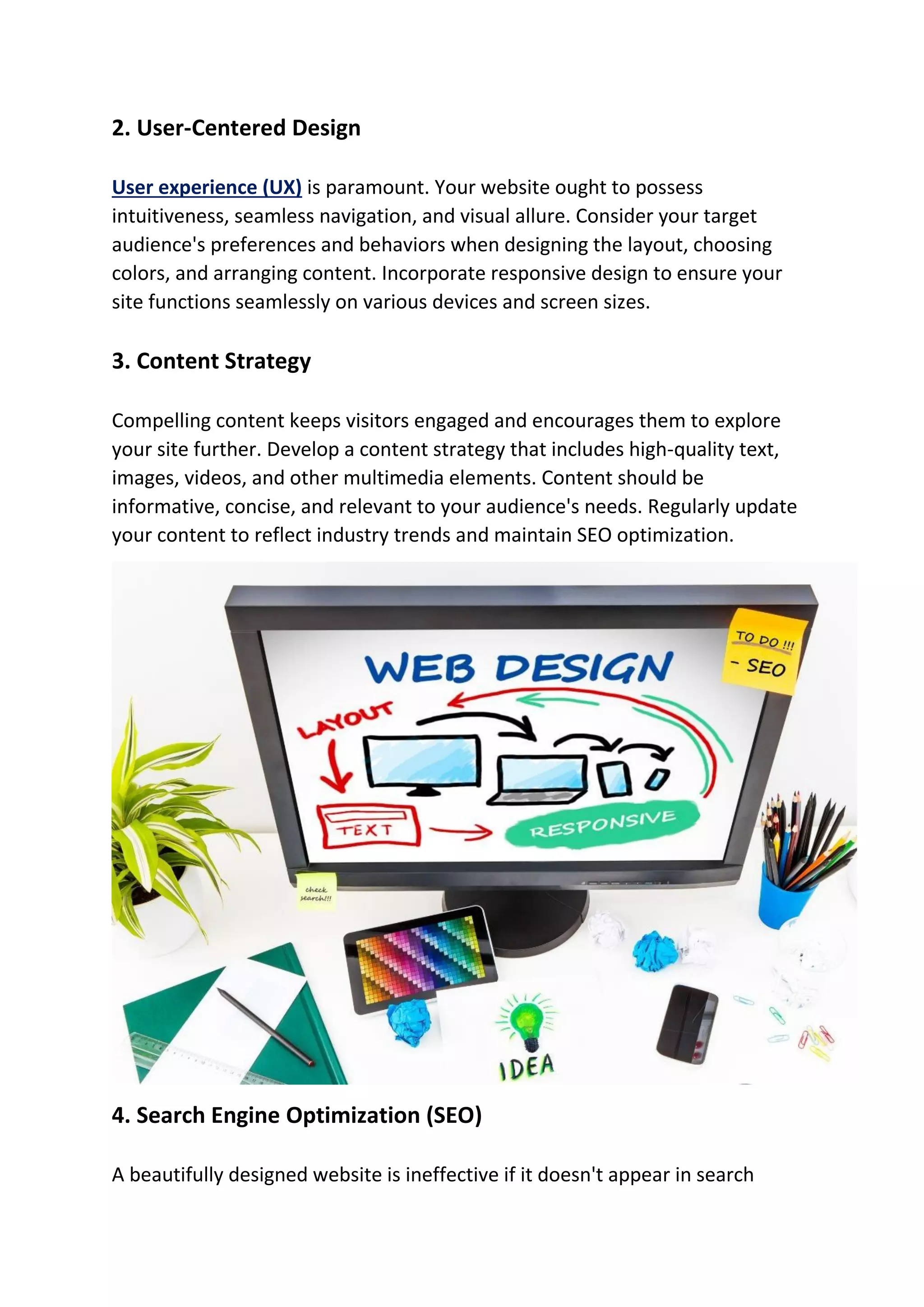
2. User-Centered Design
User experience (UX) is paramount. Your website ought to possess
intuitiveness, seamless navigation, and visual allure. Consider your target
audience's preferences and behaviors when designing the layout, choosing
colors, and arranging content. Incorporate responsive design to ensure your
site functions seamlessly on various devices and screen sizes.
3. Content Strategy
Compelling content keeps visitors engaged and encourages them to explore
your site further. Develop a content strategy that includes high-quality text,
images, videos, and other multimedia elements. Content should be
informative, concise, and relevant to your audience's needs. Regularly update
your content to reflect industry trends and maintain SEO optimization.
4. Search Engine Optimization (SEO)
A beautifully designed website is ineffective if it doesn't appear in search
engine results. Incorporate proper SEO techniques during development to
improve your website's visibility and ranking on search engines. This involves
optimizing meta tags, using relevant keywords, creating descriptive URLs, and
implementing other SEO best practices.
5. Mobile Compatibility
With a significant portion of internet traffic coming from mobile devices, it's
essential that your website is mobile-responsive. Mobile compatibility ensures
that your site looks and functions well on smartphones and tablets. Google
also considers mobile-friendliness as a ranking factor, making it a crucial aspect
of website design and development.
6. Loading Speed
In our fast-moving world, people want websites to load up fast. If a site takes
too long to load, folks might leave quickly, and that's not a great experience.
Optimize images, use efficient coding practices, and consider content delivery
networks (CDNs) to ensure your website loads swiftly across all devices and
connection speeds.
7. Scalability
As your business grows, your website needs to accommodate increased traffic
and content. Ensure that the chosen design and development approach can be
easily scaled up. Whether you're adding new product pages, blog posts, or
features, scalability will save you time and resources in the long run.
8. Security Measures
Website security is a non-negotiable factor. Put strong security measures in
place to keep user data safe and stop cyberattacks from happening. This
includes using SSL certificates, regularly updating software, and employing
firewall and intrusion detection systems. Make sure to focus on security right
from the beginning when you're developing the website.
9. Integration of Analytics
To gauge the effectiveness of your website, integrate analytics tools like
Google Analytics. These tools provide valuable insights into user behavior,
traffic sources, and conversion rates. Monitoring these metrics allows you to
make data-driven decisions to optimize your website's performance
continually.
10. Ongoing Maintenance and Support
Website development isn't a one-time task; it requires ongoing maintenance
and support. Ensure you have a plan in place to address software updates,
security patches, and content refreshes. Regularly monitor the website's
performance and seek professional assistance if issues arise.
If you want to get a website designed then visit: https://mpiricsoftware.com
In conclusion, a successful website is a combination of well-thought-out
design, meticulous development, and continuous optimization. By considering
these 10 key factors, you'll be well-equipped to create a website that not only
captivates your audience but also drives business growth. Remember that your
website is an investment, and allocating resources to professional design and
development services will undoubtedly yield substantial returns in the digital
landscape.
Content Source: https://mpiricsoftware.weebly.com/blog/10-key-factors-to-
consider-for-website-design-development-services

10 Key Factors to Consider for Website Design.pdf

  • 1.
    10 Key Factorsto Consider for Website Design & Development Services In the digital age, a website serves as the virtual front door to your business. It represents the initial impression you convey to potential customers, partners, and clients. Therefore, it's crucial to invest in a well-designed and professionally developed website. Whether you're revamping an existing site or starting from scratch, here are 10 key factors to consider for top-notch website design and development services. 1. Clear Objectives and Goals Before diving into the design and development process, outline your website's objectives and goals. Are you looking to increase online sales, enhance brand visibility, provide information, or offer a platform for engagement? Defining these objectives will guide the entire process, ensuring that every aspect of the website is aligned with your business goals.
  • 2.
    2. User-Centered Design Userexperience (UX) is paramount. Your website ought to possess intuitiveness, seamless navigation, and visual allure. Consider your target audience's preferences and behaviors when designing the layout, choosing colors, and arranging content. Incorporate responsive design to ensure your site functions seamlessly on various devices and screen sizes. 3. Content Strategy Compelling content keeps visitors engaged and encourages them to explore your site further. Develop a content strategy that includes high-quality text, images, videos, and other multimedia elements. Content should be informative, concise, and relevant to your audience's needs. Regularly update your content to reflect industry trends and maintain SEO optimization. 4. Search Engine Optimization (SEO) A beautifully designed website is ineffective if it doesn't appear in search
  • 3.
    engine results. Incorporateproper SEO techniques during development to improve your website's visibility and ranking on search engines. This involves optimizing meta tags, using relevant keywords, creating descriptive URLs, and implementing other SEO best practices. 5. Mobile Compatibility With a significant portion of internet traffic coming from mobile devices, it's essential that your website is mobile-responsive. Mobile compatibility ensures that your site looks and functions well on smartphones and tablets. Google also considers mobile-friendliness as a ranking factor, making it a crucial aspect of website design and development. 6. Loading Speed In our fast-moving world, people want websites to load up fast. If a site takes too long to load, folks might leave quickly, and that's not a great experience. Optimize images, use efficient coding practices, and consider content delivery networks (CDNs) to ensure your website loads swiftly across all devices and connection speeds.
  • 4.
    7. Scalability As yourbusiness grows, your website needs to accommodate increased traffic and content. Ensure that the chosen design and development approach can be easily scaled up. Whether you're adding new product pages, blog posts, or features, scalability will save you time and resources in the long run. 8. Security Measures Website security is a non-negotiable factor. Put strong security measures in place to keep user data safe and stop cyberattacks from happening. This includes using SSL certificates, regularly updating software, and employing firewall and intrusion detection systems. Make sure to focus on security right from the beginning when you're developing the website. 9. Integration of Analytics To gauge the effectiveness of your website, integrate analytics tools like Google Analytics. These tools provide valuable insights into user behavior, traffic sources, and conversion rates. Monitoring these metrics allows you to make data-driven decisions to optimize your website's performance continually. 10. Ongoing Maintenance and Support Website development isn't a one-time task; it requires ongoing maintenance and support. Ensure you have a plan in place to address software updates, security patches, and content refreshes. Regularly monitor the website's performance and seek professional assistance if issues arise. If you want to get a website designed then visit: https://mpiricsoftware.com In conclusion, a successful website is a combination of well-thought-out design, meticulous development, and continuous optimization. By considering these 10 key factors, you'll be well-equipped to create a website that not only captivates your audience but also drives business growth. Remember that your website is an investment, and allocating resources to professional design and
  • 5.
    development services willundoubtedly yield substantial returns in the digital landscape. Content Source: https://mpiricsoftware.weebly.com/blog/10-key-factors-to- consider-for-website-design-development-services