1
© 2005 Cisco Systems, Inc. All rights reserved. Cisco Public
IP Telephony
Introduction to VoIP
Cisco Networking Academy Program
2
© 2005 Cisco Systems, Inc. All rights reserved. Cisco Public
IP Telephony
Requirements of Voice in an IP
Internetwork
3
© 2005 Cisco Systems, Inc. All rights reserved. Cisco Public
IP Telephony
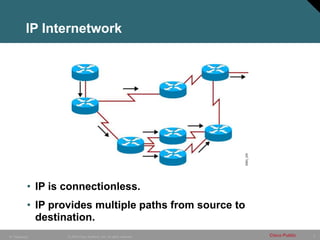
IP Internetwork
• IP is connectionless.
• IP provides multiple paths from source to
destination.
4
© 2005 Cisco Systems, Inc. All rights reserved. Cisco Public
IP Telephony
Packet Loss, Delay, and Jitter
• Packet loss
Loss of packets severely degrades the voice application.
• Delay
VoIP typically tolerates delays up to 150 ms before the
quality of the call degrades.
• Jitter
Instantaneous buffer use causes delay variation in the
same voice stream.
5
© 2005 Cisco Systems, Inc. All rights reserved. Cisco Public
IP Telephony
Consistent Throughput
• Throughput is the amount of data transmitted
between two nodes in a given period.
• Throughput is a function of bandwidth, error
performance, congestion, and other factors.
• Tools for enhanced voice throughput include:
Queuing
Congestion avoidance
Header compression
RSVP
Fragmentation
6
© 2005 Cisco Systems, Inc. All rights reserved. Cisco Public
IP Telephony
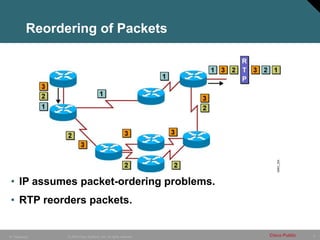
Reordering of Packets
• IP assumes packet-ordering problems.
• RTP reorders packets.
7
© 2005 Cisco Systems, Inc. All rights reserved. Cisco Public
IP Telephony
Reliability and Availability
• Traditional telephony networks claim 99.999%
uptime.
• Data networks must consider reliability and
availability requirements when incorporating voice.
• Methods to improve reliability and availability
include:
Redundant hardware
Redundant links
UPS
Proactive network management
8
© 2005 Cisco Systems, Inc. All rights reserved. Cisco Public
IP Telephony
Gateways and Their Roles
9
© 2005 Cisco Systems, Inc. All rights reserved. Cisco Public
IP Telephony
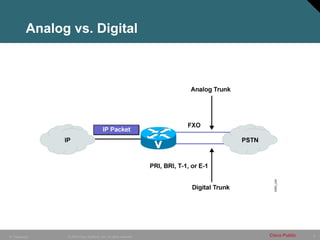
Analog vs. Digital
10
© 2005 Cisco Systems, Inc. All rights reserved. Cisco Public
IP Telephony
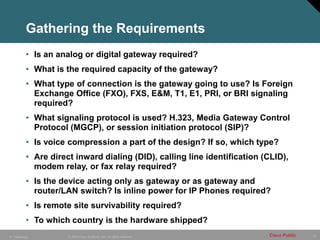
Gathering the Requirements
• Is an analog or digital gateway required?
• What is the required capacity of the gateway?
• What type of connection is the gateway going to use? Is Foreign
Exchange Office (FXO), FXS, E&M, T1, E1, PRI, or BRI signaling
required?
• What signaling protocol is used? H.323, Media Gateway Control
Protocol (MGCP), or session initiation protocol (SIP)?
• Is voice compression a part of the design? If so, which type?
• Are direct inward dialing (DID), calling line identification (CLID),
modem relay, or fax relay required?
• Is the device acting only as gateway or as gateway and
router/LAN switch? Is inline power for IP Phones required?
• Is remote site survivability required?
• To which country is the hardware shipped?
11
© 2005 Cisco Systems, Inc. All rights reserved. Cisco Public
IP Telephony
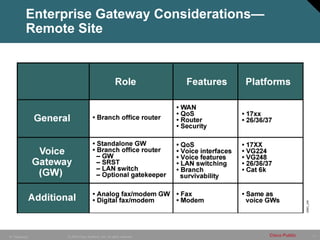
Enterprise Gateway Considerations—
Remote Site
12
© 2005 Cisco Systems, Inc. All rights reserved. Cisco Public
IP Telephony
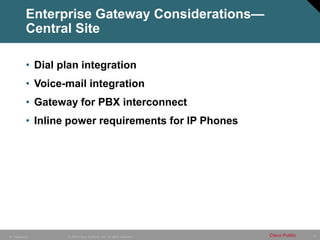
Enterprise Gateway Considerations—
Central Site
• Dial plan integration
• Voice-mail integration
• Gateway for PBX interconnect
• Inline power requirements for IP Phones
13
© 2005 Cisco Systems, Inc. All rights reserved. Cisco Public
IP Telephony
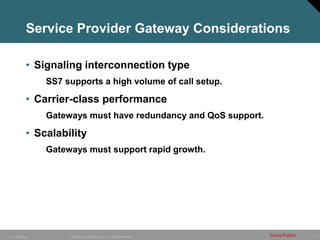
Service Provider Gateway Considerations
• Signaling interconnection type
SS7 supports a high volume of call setup.
• Carrier-class performance
Gateways must have redundancy and QoS support.
• Scalability
Gateways must support rapid growth.
14
© 2005 Cisco Systems, Inc. All rights reserved. Cisco Public
IP Telephony
Encapsulating Voice in IP Packets
15
© 2005 Cisco Systems, Inc. All rights reserved. Cisco Public
IP Telephony
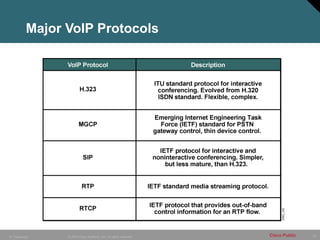
Major VoIP Protocols
16
© 2005 Cisco Systems, Inc. All rights reserved. Cisco Public
IP Telephony
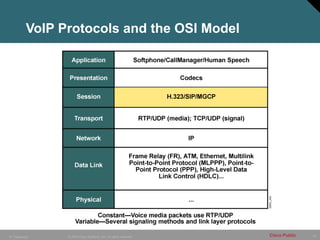
VoIP Protocols and the OSI Model
17
© 2005 Cisco Systems, Inc. All rights reserved. Cisco Public
IP Telephony
Real-Time Transport Protocol
• Provides end-to-end network functions and delivery
services for delay-sensitive, real-time data, such as
voice and video
• Works with queuing to prioritize voice traffic over
other traffic
• Services include:
Payload-type identification
Sequence numbering
Time stamping
Delivery monitoring
18
© 2005 Cisco Systems, Inc. All rights reserved. Cisco Public
IP Telephony
Real-Time Transport Control Protocol
• Monitors the quality of the data distribution and
provides control information
• Provides feedback on current network conditions
• Allows hosts involved in an RTP session to
exchange information about monitoring and
controlling the session
• Provides a separate flow from RTP for UDP
transport use
19
© 2005 Cisco Systems, Inc. All rights reserved. Cisco Public
IP Telephony
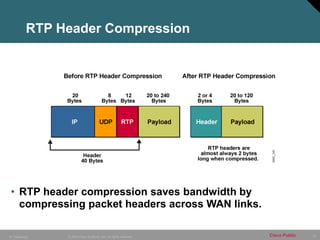
RTP Header Compression
• RTP header compression saves bandwidth by
compressing packet headers across WAN links.
20
© 2005 Cisco Systems, Inc. All rights reserved. Cisco Public
IP Telephony
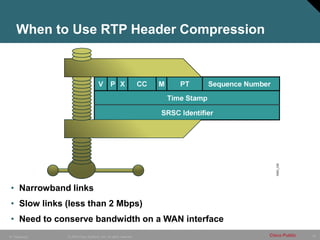
When to Use RTP Header Compression
• Narrowband links
• Slow links (less than 2 Mbps)
• Need to conserve bandwidth on a WAN interface
21
© 2005 Cisco Systems, Inc. All rights reserved. Cisco Public
IP Telephony
Calculating Bandwidth Requirements
22
© 2005 Cisco Systems, Inc. All rights reserved. Cisco Public
IP Telephony
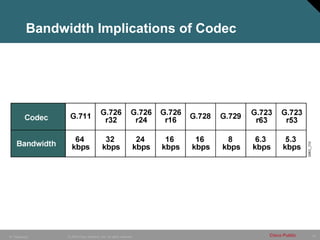
Bandwidth Implications of Codec
23
© 2005 Cisco Systems, Inc. All rights reserved. Cisco Public
IP Telephony
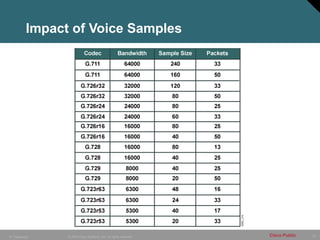
Impact of Voice Samples
24
© 2005 Cisco Systems, Inc. All rights reserved. Cisco Public
IP Telephony
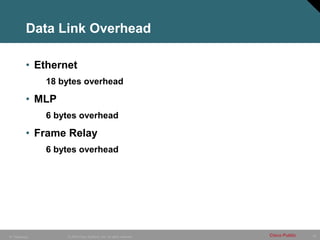
Data Link Overhead
• Ethernet
18 bytes overhead
• MLP
6 bytes overhead
• Frame Relay
6 bytes overhead
25
© 2005 Cisco Systems, Inc. All rights reserved. Cisco Public
IP Telephony
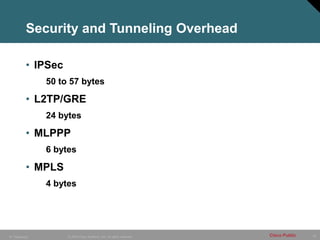
Security and Tunneling Overhead
• IPSec
50 to 57 bytes
• L2TP/GRE
24 bytes
• MLPPP
6 bytes
• MPLS
4 bytes
26
© 2005 Cisco Systems, Inc. All rights reserved. Cisco Public
IP Telephony
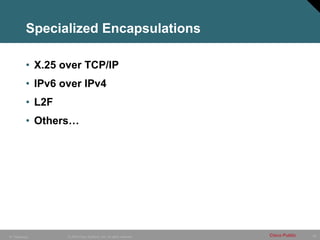
Specialized Encapsulations
• X.25 over TCP/IP
• IPv6 over IPv4
• L2F
• Others…
27
© 2005 Cisco Systems, Inc. All rights reserved. Cisco Public
IP Telephony
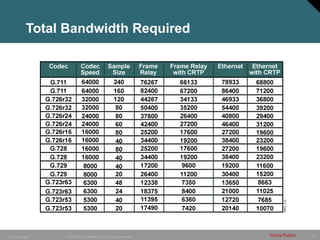
Total Bandwidth Required
28
© 2005 Cisco Systems, Inc. All rights reserved. Cisco Public
IP Telephony
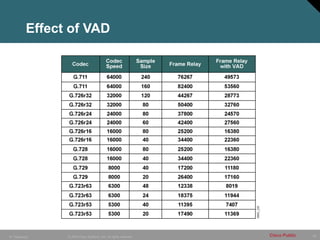
Effect of VAD
29
© 2005 Cisco Systems, Inc. All rights reserved. Cisco Public
IP Telephony

1. VoIP.ppt

  • 1.
    1 © 2005 CiscoSystems, Inc. All rights reserved. Cisco Public IP Telephony Introduction to VoIP Cisco Networking Academy Program
  • 2.
    2 © 2005 CiscoSystems, Inc. All rights reserved. Cisco Public IP Telephony Requirements of Voice in an IP Internetwork
  • 3.
    3 © 2005 CiscoSystems, Inc. All rights reserved. Cisco Public IP Telephony IP Internetwork • IP is connectionless. • IP provides multiple paths from source to destination.
  • 4.
    4 © 2005 CiscoSystems, Inc. All rights reserved. Cisco Public IP Telephony Packet Loss, Delay, and Jitter • Packet loss Loss of packets severely degrades the voice application. • Delay VoIP typically tolerates delays up to 150 ms before the quality of the call degrades. • Jitter Instantaneous buffer use causes delay variation in the same voice stream.
  • 5.
    5 © 2005 CiscoSystems, Inc. All rights reserved. Cisco Public IP Telephony Consistent Throughput • Throughput is the amount of data transmitted between two nodes in a given period. • Throughput is a function of bandwidth, error performance, congestion, and other factors. • Tools for enhanced voice throughput include: Queuing Congestion avoidance Header compression RSVP Fragmentation
  • 6.
    6 © 2005 CiscoSystems, Inc. All rights reserved. Cisco Public IP Telephony Reordering of Packets • IP assumes packet-ordering problems. • RTP reorders packets.
  • 7.
    7 © 2005 CiscoSystems, Inc. All rights reserved. Cisco Public IP Telephony Reliability and Availability • Traditional telephony networks claim 99.999% uptime. • Data networks must consider reliability and availability requirements when incorporating voice. • Methods to improve reliability and availability include: Redundant hardware Redundant links UPS Proactive network management
  • 8.
    8 © 2005 CiscoSystems, Inc. All rights reserved. Cisco Public IP Telephony Gateways and Their Roles
  • 9.
    9 © 2005 CiscoSystems, Inc. All rights reserved. Cisco Public IP Telephony Analog vs. Digital
  • 10.
    10 © 2005 CiscoSystems, Inc. All rights reserved. Cisco Public IP Telephony Gathering the Requirements • Is an analog or digital gateway required? • What is the required capacity of the gateway? • What type of connection is the gateway going to use? Is Foreign Exchange Office (FXO), FXS, E&M, T1, E1, PRI, or BRI signaling required? • What signaling protocol is used? H.323, Media Gateway Control Protocol (MGCP), or session initiation protocol (SIP)? • Is voice compression a part of the design? If so, which type? • Are direct inward dialing (DID), calling line identification (CLID), modem relay, or fax relay required? • Is the device acting only as gateway or as gateway and router/LAN switch? Is inline power for IP Phones required? • Is remote site survivability required? • To which country is the hardware shipped?
  • 11.
    11 © 2005 CiscoSystems, Inc. All rights reserved. Cisco Public IP Telephony Enterprise Gateway Considerations— Remote Site
  • 12.
    12 © 2005 CiscoSystems, Inc. All rights reserved. Cisco Public IP Telephony Enterprise Gateway Considerations— Central Site • Dial plan integration • Voice-mail integration • Gateway for PBX interconnect • Inline power requirements for IP Phones
  • 13.
    13 © 2005 CiscoSystems, Inc. All rights reserved. Cisco Public IP Telephony Service Provider Gateway Considerations • Signaling interconnection type SS7 supports a high volume of call setup. • Carrier-class performance Gateways must have redundancy and QoS support. • Scalability Gateways must support rapid growth.
  • 14.
    14 © 2005 CiscoSystems, Inc. All rights reserved. Cisco Public IP Telephony Encapsulating Voice in IP Packets
  • 15.
    15 © 2005 CiscoSystems, Inc. All rights reserved. Cisco Public IP Telephony Major VoIP Protocols
  • 16.
    16 © 2005 CiscoSystems, Inc. All rights reserved. Cisco Public IP Telephony VoIP Protocols and the OSI Model
  • 17.
    17 © 2005 CiscoSystems, Inc. All rights reserved. Cisco Public IP Telephony Real-Time Transport Protocol • Provides end-to-end network functions and delivery services for delay-sensitive, real-time data, such as voice and video • Works with queuing to prioritize voice traffic over other traffic • Services include: Payload-type identification Sequence numbering Time stamping Delivery monitoring
  • 18.
    18 © 2005 CiscoSystems, Inc. All rights reserved. Cisco Public IP Telephony Real-Time Transport Control Protocol • Monitors the quality of the data distribution and provides control information • Provides feedback on current network conditions • Allows hosts involved in an RTP session to exchange information about monitoring and controlling the session • Provides a separate flow from RTP for UDP transport use
  • 19.
    19 © 2005 CiscoSystems, Inc. All rights reserved. Cisco Public IP Telephony RTP Header Compression • RTP header compression saves bandwidth by compressing packet headers across WAN links.
  • 20.
    20 © 2005 CiscoSystems, Inc. All rights reserved. Cisco Public IP Telephony When to Use RTP Header Compression • Narrowband links • Slow links (less than 2 Mbps) • Need to conserve bandwidth on a WAN interface
  • 21.
    21 © 2005 CiscoSystems, Inc. All rights reserved. Cisco Public IP Telephony Calculating Bandwidth Requirements
  • 22.
    22 © 2005 CiscoSystems, Inc. All rights reserved. Cisco Public IP Telephony Bandwidth Implications of Codec
  • 23.
    23 © 2005 CiscoSystems, Inc. All rights reserved. Cisco Public IP Telephony Impact of Voice Samples
  • 24.
    24 © 2005 CiscoSystems, Inc. All rights reserved. Cisco Public IP Telephony Data Link Overhead • Ethernet 18 bytes overhead • MLP 6 bytes overhead • Frame Relay 6 bytes overhead
  • 25.
    25 © 2005 CiscoSystems, Inc. All rights reserved. Cisco Public IP Telephony Security and Tunneling Overhead • IPSec 50 to 57 bytes • L2TP/GRE 24 bytes • MLPPP 6 bytes • MPLS 4 bytes
  • 26.
    26 © 2005 CiscoSystems, Inc. All rights reserved. Cisco Public IP Telephony Specialized Encapsulations • X.25 over TCP/IP • IPv6 over IPv4 • L2F • Others…
  • 27.
    27 © 2005 CiscoSystems, Inc. All rights reserved. Cisco Public IP Telephony Total Bandwidth Required
  • 28.
    28 © 2005 CiscoSystems, Inc. All rights reserved. Cisco Public IP Telephony Effect of VAD
  • 29.
    29 © 2005 CiscoSystems, Inc. All rights reserved. Cisco Public IP Telephony