Slight Edge By – Jeff Olson
Summary and Key Learnings…
Summary
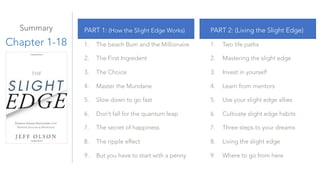
Chapter 1-18
PART 1: (How the Slight Edge Works)
1. The beach Bum and the Millionaire
2. The First Ingredent
3. The Choice
4. Master the Mundane
5. Slow down to go fast
6. Don’t fall for the quantum leap
7. The secret of happiness
8. The ripple effect
9. But you have to start with a penny
PART 2: (Living the Slight Edge)
1. Two life paths
2. Mastering the slight edge
3. Invest in yourself
4. Learn from mentors
5. Use your slight edge allies
6. Cultivate slight edge habits
7. Three steps to your dreams
8. Living the slight edge
9. Where to go from here
Summary
Part 1:
PART 1:
How the Slight Edge Works?
Summary
Chapter One
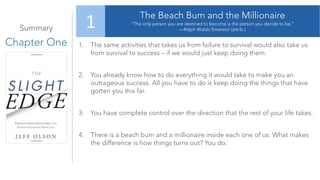
The Beach Bum and the Millionaire
“The only person you are destined to become is the person you decide to be.”
—Ralph Waldo Emerson (attrib.)
1
1. The same activities that takes us from failure to survival would also take us
from survival to success – if we would just keep doing them.
2. You already know how to do everything it would take to make you an
outrageous success. All you have to do is keep doing the things that have
gotten you this far.
3. You have complete control over the direction that the rest of your life takes.
4. There is a beach bum and a millionaire inside each one of us. What makes
the difference is how things turns out? You do.
Summary
Chapter Two
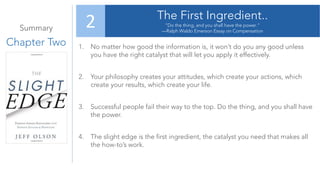
The First Ingredient..
“Do the thing, and you shall have the power.”
—Ralph Waldo Emerson Essay on Compensation
2
1. No matter how good the information is, it won’t do you any good unless
you have the right catalyst that will let you apply it effectively.
2. Your philosophy creates your attitudes, which create your actions, which
create your results, which create your life.
3. Successful people fail their way to the top. Do the thing, and you shall have
the power.
4. The slight edge is the first ingredient, the catalyst you need that makes all
the how-to’s work.
Summary
Chapter Three
The Choice….
“I guess it comes down to a simple choice, really. You get busy living, or get busy dying.”
—Andy Dufresne in The Shawshank Redemption
3
1. Simple daily disciplines—little productive actions, repeated consistently
over time—add up to the difference between failure and success.
2. The slight edge is relentless and cuts both ways: simple daily disciplines or
simple errors in judgment, repeated consistently over time, make you or
break you.
3. Without the slight edge, you can start with a million and lose it all. With the
slight edge, you can start with a penny and accomplish anything you want.
Summary
Chapter Four
Master the Mundane….
“An apple a day keeps the doctor away.”
—Benjamin Franklin (attrib.) in Poor Richard’s Almanack
4
1. Only 5 percent—1 in 20—achieve the level of success and fulfillment they
hope for. The other 95 percent either fail or fall short. The only difference is
the slight edge.
2. The secret to the 5 percent’s success is always in mundane, easy things that
anyone could do.
3. People don’t consistently do those simple things for three reasons: 1) while
they’re easy to do, they are also easy not to do; 2) you don’t see any results
at first; 3) they seem insignificant, like they don’t matter. But they do.
Summary
Chapter Five
Slow Down to Go Fast….
“Rome ne s’est pas faite en un jour. (Rome wasn’t built in a day.)”
—ancient French proverb
5
1. Time is the force that magnifies those simple daily disciplines into massive
success.
2. There is a natural progression to success: plant, cultivate, harvest—and the
central step, cultivate, can only happen over the course of time.
3. No genuine success in life is instant. Life is not a clickable link.
4. To grasp how the slight edge works, you have to view your actions through
the eyes of time.
5. Difficult takes a little time; impossible takes just a little longer.
Summary
Chapter Six
Don’t Fall for the Quantum Leap….
“I am a great believer in luck. The harder I work, the more of it I seem to have.”
—Coleman Cox
6
1. Quantum leaps do happen, but only as the end result of a lengthy, gradual
buildup of consistently applied effort.
2. No success is immediate, no collapse is sudden. They are both the result of
the slight edge accruing momentum over time.
3. Hoping for “the big break”—the breakthrough, the magic bullet—is not
only futile, it’s dangerous, because it keeps you from taking the actions you
need to create the results you want.
Summary
Chapter Seven
The Secret of Happiness….
“Success is not the key to happiness. Happiness is the key to success.”
—Albert Schweitzer
7
1. Happiness is created by doing some simple, easy things, and doing them
every day.
2. Success does not lead to happiness, it’s the other way around: more
happiness creates more success.
3. Elevated levels of happiness create elevated levels of health, performance,
social involvement, marital fulfillment, financial and career success, and
longevity.
4. Greater happiness is key to making the slight edge work in your life.
5. Shawn Achor’s five happy habits:
1. Every morning write down three new things you’re grateful for.
2. Journal for two minutes a day about a positive experience from the past 24 hours.
3. Meditate daily for a few minutes.
4. At the start of every day, write an email to someone praising or thanking them.
5. Get fifteen minutes of simple cardio exercise a day.
Summary
Chapter Eight
The Ripple Effect….
“Strange, isn’t it? Each man’s life touches so many other lives.”
—Clarence the Angel, in It’s a Wonderful Life
8
1. Everyone wants to know that they make a difference in the world—that their lives matter.
2. Greater success also creates a greater responsibility to share that success with others.
3. A single thoughtful, committed person can change the world.
4. We are all having a ripple effect on others; the question is, what kind of ripple effect, negative
or positive, do we want to have?
Summary
Chapter Nine
But You have to Start with a Penny….
“The journey of a thousand miles starts with a single step.”
—Chinese proverb
9
1. Great success often starts from a tiny beginning—but there has to be
beginning. You have to start somewhere. You have to do something.
2. If you add just 1 percent of anything—skill, knowledge, effort—per day, in a
year it will have more than tripled. But you have to start with the 1 percent.
3. Greatness is not something predetermined, predestined, or carved into
your fate by forces beyond your control. Greatness is always in the moment
of the decision.
Summary
Part 2:
PART 2:
Living the Slight Edge…..
Summary
Chapter Ten
Two Life Paths….
“I took the one less traveled by And that has made all the difference.”
—Robert Frost, The Road Not Taken
10
1. Everything is always in motion. Every day, every moment, your life path is
either curving upward, or curving downward.
2. Growing up we heard five times as many nos as yeses. Life has a downward
pull.
3. People on the success curve live in responsibility. People on the failure
curve live in blame.
4. People on the success curve are pulled by the future. People on the failure
curve are pulled by the past.
5. No matter where you are, at any moment you can choose to step onto the
success curve.
Summary
Chapter Eleven
Mastering The Slight Edge….
“There is one quality which one must possess to win, and that is the definiteness of purpose, the
knowledge of what one wants, and a burning desire to possess it.”
—Napoleon Hill, Think and Grow Rich
11
1. Mastery begins the moment you step onto the path. Failure begins the
moment you step off the path.
2. Wanting is uncomfortable, yet wanting is essential to winning.
3. There are two ways to close the gap between where you are and where you
want to be: 1) you can let go of where you are and be drawn to your goal,
or 2) you can let go of your goal, hit the snooze button, and stay where you
are.
4. Chances are good that when you step out onto the path of mastery, you will
step out alone.
Summary
Chapter Twelve
Invest in Yourself….
“Give me six hours to chop down a tree, and I will spend the first four hours sharpening the axe.”
—Abraham Lincoln (attrib.)
12
1. The wisest investment you can make is to invest in your own continuous
learning and development.
2. Learning by studying and learning by doing—book smarts and street
smarts—are the two essential pistons of the engine of learning.
3. On the path to a goal you will be off-course most of the time. Which means
the only way to reach a goal is through constant and continuous course
correction.
4. Most of your life—99.99 percent—is made up of things you do an
automatic pilot. Which means it’s essential that you take charge of your
automatic pilot’s training.
Summary
Chapter Thirteen
Learn From Mentors….
“You must hold your head high and keep those fists down. No matter what anyone else says to you,
don’t let ’em get your goat. Try fightin’ with your head for a change.”
—Atticus Finch, in To Kill a Mockingbird by Harper Lee
13
1. If you want to learn how to do something well, find someone who has
mastered that skill and apprentice yourself.
2. Choose your heroes carefully: are they genuine role models you want to
emulate?
3. Choose your associates: everything about your life will closely reflect the
lives of your five closest friends.
4. Sometimes you need to let go and disassociate.
5. Form and use a mastermind: two minds are better than one, and five are
even better.
Summary
Chapter Fourteen
Use your Slight Edge Allies….
“Be not afraid of going slowly; be afraid only of standing still.”
—Chinese proverb
14
On the path of mastery you have four powerful allies:
1. The power of momentum: steady wins the race.
2. The power of completion: clear out your undones and incompletes.
3. The power of reflection: facing the man or woman in the mirror.
4. The power of celebration: catch yourself doing something right.
Summary
Chapter Fifteen
Cultivate Slight Edge Habits….
“Sow an act, reap a habit. Sow a habit, reap a character. Sow a character, reap a destiny.”
—Charles Reade (attrib.)
15
1. There are two kinds of habits: those that serve you, and those that don’t.
2. You have choice over your habits through your choice of everyday actions.
3. The way to erase a bad habit is to replace it with a positive habit.
4. Here are seven powerful, positive slight edge habits:
• Show up: be the frog who jumps off the lily pad.
• 2. Show up consistently: keep showing up when others fade out.
• 3. Cultivate a positive outlook: see the glass as overflowing.
• 4. Be committed for the long haul: remember the 10,000-hour rule.
• 5. Cultivate a burning desire backed by faith: not hoping or wishingknowing.
• 6. Be willing to pay the price: sometimes you have to quit the softball team.
• 7. Practice slight edge integrity: do the things you’ve committed to doing, even
when no one else is watching.
Summary
Chapter Sixteen
Three Steps to Your Dreams….
“First comes the thought; then organization of that thought into ideas and plans; then transformation o
those plans into reality. The beginning, as you will observe, is in your imagination.”
—Napoleon Hill, The Law of Success
16
There are three simple, essential steps to achieving a goal:
1. Write it down: give it a what (clear description) and a when (timeline).
2. Look at it every day: keep it in your face; soak your subconscious in it.
3. Start with a plan: make the plan simple. The point of the plan is not that it
will get you there, but that it will get you started.
Summary
Chapter Seventeen
Living The Slight Edge….
“Gentlemen, this is a football.”
—Vince Lombardi
17
Write out your goals and dreams, a simple starting plan, and a single daily
discipline:
For your health
For your happiness
For your relationships
For your personal development
For your finances
For your career
For your impact on the world
Summary
Chapter Eighteen
Where to Go From Here?
“Keep your eyes on the prize.”
—Alice Wine, civil rights activist
18
Do one simple, daily discipline in each of these seven key areas of your life—
your health, your happiness, your relationships, your personal development,
your finances, your career, and your impact—that forwards your success in each
of those areas; and
Make a habit of doing some sort of daily review of these slight edge activities,
either through keeping a journal, a list, working with a slight edge buddy, a
coach, or some other regular, consistent means; and
Spend high-quality time with men and women who have achieved goals and
dreams similar to yours; in other words, model successful mentors, teachers,
and allies, and do it daily, weekly and monthly…

1 slight edge_summary

  • 1.
    Slight Edge By– Jeff Olson Summary and Key Learnings…
  • 2.
    Summary Chapter 1-18 PART 1:(How the Slight Edge Works) 1. The beach Bum and the Millionaire 2. The First Ingredent 3. The Choice 4. Master the Mundane 5. Slow down to go fast 6. Don’t fall for the quantum leap 7. The secret of happiness 8. The ripple effect 9. But you have to start with a penny PART 2: (Living the Slight Edge) 1. Two life paths 2. Mastering the slight edge 3. Invest in yourself 4. Learn from mentors 5. Use your slight edge allies 6. Cultivate slight edge habits 7. Three steps to your dreams 8. Living the slight edge 9. Where to go from here
  • 3.
    Summary Part 1: PART 1: Howthe Slight Edge Works?
  • 4.
    Summary Chapter One The BeachBum and the Millionaire “The only person you are destined to become is the person you decide to be.” —Ralph Waldo Emerson (attrib.) 1 1. The same activities that takes us from failure to survival would also take us from survival to success – if we would just keep doing them. 2. You already know how to do everything it would take to make you an outrageous success. All you have to do is keep doing the things that have gotten you this far. 3. You have complete control over the direction that the rest of your life takes. 4. There is a beach bum and a millionaire inside each one of us. What makes the difference is how things turns out? You do.
  • 5.
    Summary Chapter Two The FirstIngredient.. “Do the thing, and you shall have the power.” —Ralph Waldo Emerson Essay on Compensation 2 1. No matter how good the information is, it won’t do you any good unless you have the right catalyst that will let you apply it effectively. 2. Your philosophy creates your attitudes, which create your actions, which create your results, which create your life. 3. Successful people fail their way to the top. Do the thing, and you shall have the power. 4. The slight edge is the first ingredient, the catalyst you need that makes all the how-to’s work.
  • 6.
    Summary Chapter Three The Choice…. “Iguess it comes down to a simple choice, really. You get busy living, or get busy dying.” —Andy Dufresne in The Shawshank Redemption 3 1. Simple daily disciplines—little productive actions, repeated consistently over time—add up to the difference between failure and success. 2. The slight edge is relentless and cuts both ways: simple daily disciplines or simple errors in judgment, repeated consistently over time, make you or break you. 3. Without the slight edge, you can start with a million and lose it all. With the slight edge, you can start with a penny and accomplish anything you want.
  • 7.
    Summary Chapter Four Master theMundane…. “An apple a day keeps the doctor away.” —Benjamin Franklin (attrib.) in Poor Richard’s Almanack 4 1. Only 5 percent—1 in 20—achieve the level of success and fulfillment they hope for. The other 95 percent either fail or fall short. The only difference is the slight edge. 2. The secret to the 5 percent’s success is always in mundane, easy things that anyone could do. 3. People don’t consistently do those simple things for three reasons: 1) while they’re easy to do, they are also easy not to do; 2) you don’t see any results at first; 3) they seem insignificant, like they don’t matter. But they do.
  • 8.
    Summary Chapter Five Slow Downto Go Fast…. “Rome ne s’est pas faite en un jour. (Rome wasn’t built in a day.)” —ancient French proverb 5 1. Time is the force that magnifies those simple daily disciplines into massive success. 2. There is a natural progression to success: plant, cultivate, harvest—and the central step, cultivate, can only happen over the course of time. 3. No genuine success in life is instant. Life is not a clickable link. 4. To grasp how the slight edge works, you have to view your actions through the eyes of time. 5. Difficult takes a little time; impossible takes just a little longer.
  • 9.
    Summary Chapter Six Don’t Fallfor the Quantum Leap…. “I am a great believer in luck. The harder I work, the more of it I seem to have.” —Coleman Cox 6 1. Quantum leaps do happen, but only as the end result of a lengthy, gradual buildup of consistently applied effort. 2. No success is immediate, no collapse is sudden. They are both the result of the slight edge accruing momentum over time. 3. Hoping for “the big break”—the breakthrough, the magic bullet—is not only futile, it’s dangerous, because it keeps you from taking the actions you need to create the results you want.
  • 10.
    Summary Chapter Seven The Secretof Happiness…. “Success is not the key to happiness. Happiness is the key to success.” —Albert Schweitzer 7 1. Happiness is created by doing some simple, easy things, and doing them every day. 2. Success does not lead to happiness, it’s the other way around: more happiness creates more success. 3. Elevated levels of happiness create elevated levels of health, performance, social involvement, marital fulfillment, financial and career success, and longevity. 4. Greater happiness is key to making the slight edge work in your life. 5. Shawn Achor’s five happy habits: 1. Every morning write down three new things you’re grateful for. 2. Journal for two minutes a day about a positive experience from the past 24 hours. 3. Meditate daily for a few minutes. 4. At the start of every day, write an email to someone praising or thanking them. 5. Get fifteen minutes of simple cardio exercise a day.
  • 11.
    Summary Chapter Eight The RippleEffect…. “Strange, isn’t it? Each man’s life touches so many other lives.” —Clarence the Angel, in It’s a Wonderful Life 8 1. Everyone wants to know that they make a difference in the world—that their lives matter. 2. Greater success also creates a greater responsibility to share that success with others. 3. A single thoughtful, committed person can change the world. 4. We are all having a ripple effect on others; the question is, what kind of ripple effect, negative or positive, do we want to have?
  • 12.
    Summary Chapter Nine But Youhave to Start with a Penny…. “The journey of a thousand miles starts with a single step.” —Chinese proverb 9 1. Great success often starts from a tiny beginning—but there has to be beginning. You have to start somewhere. You have to do something. 2. If you add just 1 percent of anything—skill, knowledge, effort—per day, in a year it will have more than tripled. But you have to start with the 1 percent. 3. Greatness is not something predetermined, predestined, or carved into your fate by forces beyond your control. Greatness is always in the moment of the decision.
  • 13.
    Summary Part 2: PART 2: Livingthe Slight Edge…..
  • 14.
    Summary Chapter Ten Two LifePaths…. “I took the one less traveled by And that has made all the difference.” —Robert Frost, The Road Not Taken 10 1. Everything is always in motion. Every day, every moment, your life path is either curving upward, or curving downward. 2. Growing up we heard five times as many nos as yeses. Life has a downward pull. 3. People on the success curve live in responsibility. People on the failure curve live in blame. 4. People on the success curve are pulled by the future. People on the failure curve are pulled by the past. 5. No matter where you are, at any moment you can choose to step onto the success curve.
  • 15.
    Summary Chapter Eleven Mastering TheSlight Edge…. “There is one quality which one must possess to win, and that is the definiteness of purpose, the knowledge of what one wants, and a burning desire to possess it.” —Napoleon Hill, Think and Grow Rich 11 1. Mastery begins the moment you step onto the path. Failure begins the moment you step off the path. 2. Wanting is uncomfortable, yet wanting is essential to winning. 3. There are two ways to close the gap between where you are and where you want to be: 1) you can let go of where you are and be drawn to your goal, or 2) you can let go of your goal, hit the snooze button, and stay where you are. 4. Chances are good that when you step out onto the path of mastery, you will step out alone.
  • 16.
    Summary Chapter Twelve Invest inYourself…. “Give me six hours to chop down a tree, and I will spend the first four hours sharpening the axe.” —Abraham Lincoln (attrib.) 12 1. The wisest investment you can make is to invest in your own continuous learning and development. 2. Learning by studying and learning by doing—book smarts and street smarts—are the two essential pistons of the engine of learning. 3. On the path to a goal you will be off-course most of the time. Which means the only way to reach a goal is through constant and continuous course correction. 4. Most of your life—99.99 percent—is made up of things you do an automatic pilot. Which means it’s essential that you take charge of your automatic pilot’s training.
  • 17.
    Summary Chapter Thirteen Learn FromMentors…. “You must hold your head high and keep those fists down. No matter what anyone else says to you, don’t let ’em get your goat. Try fightin’ with your head for a change.” —Atticus Finch, in To Kill a Mockingbird by Harper Lee 13 1. If you want to learn how to do something well, find someone who has mastered that skill and apprentice yourself. 2. Choose your heroes carefully: are they genuine role models you want to emulate? 3. Choose your associates: everything about your life will closely reflect the lives of your five closest friends. 4. Sometimes you need to let go and disassociate. 5. Form and use a mastermind: two minds are better than one, and five are even better.
  • 18.
    Summary Chapter Fourteen Use yourSlight Edge Allies…. “Be not afraid of going slowly; be afraid only of standing still.” —Chinese proverb 14 On the path of mastery you have four powerful allies: 1. The power of momentum: steady wins the race. 2. The power of completion: clear out your undones and incompletes. 3. The power of reflection: facing the man or woman in the mirror. 4. The power of celebration: catch yourself doing something right.
  • 19.
    Summary Chapter Fifteen Cultivate SlightEdge Habits…. “Sow an act, reap a habit. Sow a habit, reap a character. Sow a character, reap a destiny.” —Charles Reade (attrib.) 15 1. There are two kinds of habits: those that serve you, and those that don’t. 2. You have choice over your habits through your choice of everyday actions. 3. The way to erase a bad habit is to replace it with a positive habit. 4. Here are seven powerful, positive slight edge habits: • Show up: be the frog who jumps off the lily pad. • 2. Show up consistently: keep showing up when others fade out. • 3. Cultivate a positive outlook: see the glass as overflowing. • 4. Be committed for the long haul: remember the 10,000-hour rule. • 5. Cultivate a burning desire backed by faith: not hoping or wishingknowing. • 6. Be willing to pay the price: sometimes you have to quit the softball team. • 7. Practice slight edge integrity: do the things you’ve committed to doing, even when no one else is watching.
  • 20.
    Summary Chapter Sixteen Three Stepsto Your Dreams…. “First comes the thought; then organization of that thought into ideas and plans; then transformation o those plans into reality. The beginning, as you will observe, is in your imagination.” —Napoleon Hill, The Law of Success 16 There are three simple, essential steps to achieving a goal: 1. Write it down: give it a what (clear description) and a when (timeline). 2. Look at it every day: keep it in your face; soak your subconscious in it. 3. Start with a plan: make the plan simple. The point of the plan is not that it will get you there, but that it will get you started.
  • 21.
    Summary Chapter Seventeen Living TheSlight Edge…. “Gentlemen, this is a football.” —Vince Lombardi 17 Write out your goals and dreams, a simple starting plan, and a single daily discipline: For your health For your happiness For your relationships For your personal development For your finances For your career For your impact on the world
  • 22.
    Summary Chapter Eighteen Where toGo From Here? “Keep your eyes on the prize.” —Alice Wine, civil rights activist 18 Do one simple, daily discipline in each of these seven key areas of your life— your health, your happiness, your relationships, your personal development, your finances, your career, and your impact—that forwards your success in each of those areas; and Make a habit of doing some sort of daily review of these slight edge activities, either through keeping a journal, a list, working with a slight edge buddy, a coach, or some other regular, consistent means; and Spend high-quality time with men and women who have achieved goals and dreams similar to yours; in other words, model successful mentors, teachers, and allies, and do it daily, weekly and monthly…