PROBABILITY
LET’S RECALL SOME TERMS!
Identify the term being described in
each of the following:
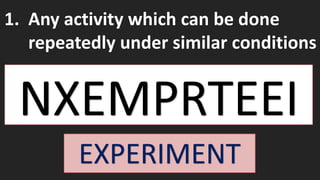
1. Any activity which can be done
repeatedly under similar conditions
EXPERIMENT
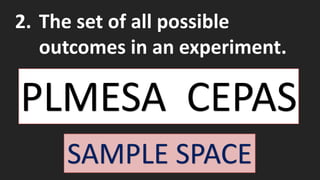
2. The set of all possible
outcomes in an experiment.
PLMESA CEPAS
SAMPLE SPACE
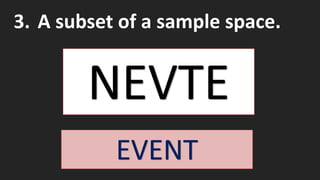
3. A subset of a sample space.
EVENT
4. The elements in a sample space.
OUTCOME
5. The ratio of the number of
favorable outcomes to the number
of possible outcomes.
PROBABILITY
Answer the following questions.
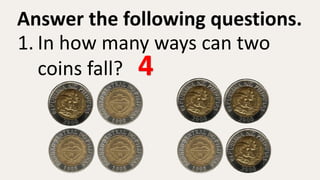
1. In how many ways can two
coins fall? 4
Answer the following questions.
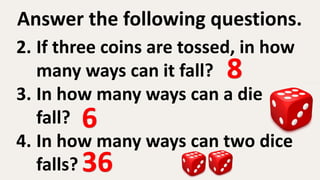
2. If three coins are tossed, in how
many ways can it fall?
3. In how many ways can a die
fall?
4. In how many ways can two dice
falls?
8
6
36
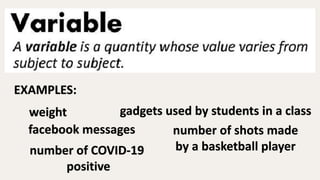
EXAMPLES:
weight
facebook messages
number of COVID-19
positive
gadgets used by students in a class
number of shots made
by a basketball player
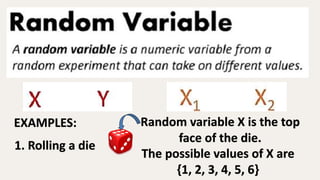
EXAMPLES:
1. Rolling a die
Random variable X is the top
face of the die.
The possible values of X are
{1, 2, 3, 4, 5, 6}
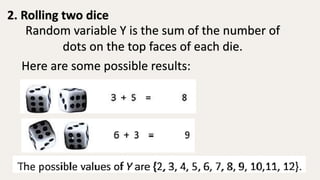
2. Rolling two dice
Random variable Y is the sum of the number of
dots on the top faces of each die.
Here are some possible results:
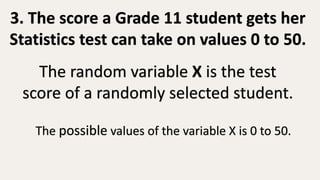
3. The score a Grade 11 student gets her
Statistics test can take on values 0 to 50.
The random variable X is the test
score of a randomly selected student.
The possible values of the variable X is 0 to 50.
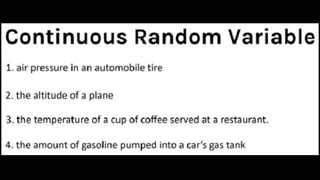
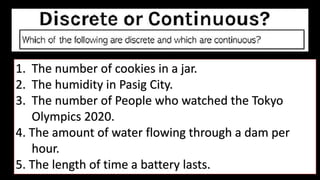
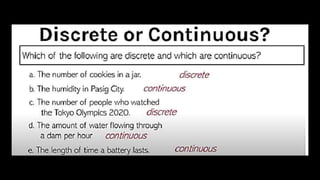
1. The number of cookies in a jar.
2. The humidity in Pasig City.
3. The number of People who watched the Tokyo
Olympics 2020.
4. The amount of water flowing through a dam per
hour.
5. The length of time a battery lasts.
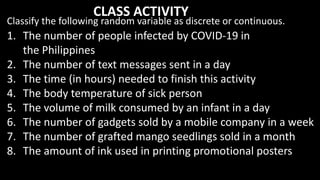
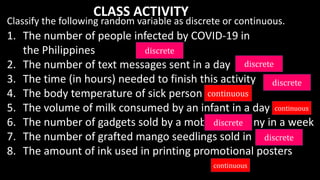
1. The number of people infected by COVID-19 in
the Philippines
2. The number of text messages sent in a day
3. The time (in hours) needed to finish this activity
4. The body temperature of sick person
5. The volume of milk consumed by an infant in a day
6. The number of gadgets sold by a mobile company in a week
7. The number of grafted mango seedlings sold in a month
8. The amount of ink used in printing promotional posters
Classify the following random variable as discrete or continuous.
CLASS ACTIVITY
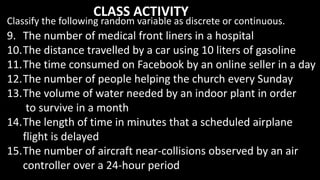
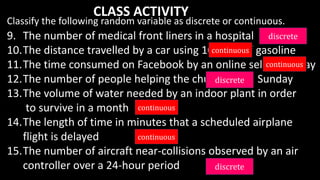
9. The number of medical front liners in a hospital
10.The distance travelled by a car using 10 liters of gasoline
11.The time consumed on Facebook by an online seller in a day
12.The number of people helping the church every Sunday
13.The volume of water needed by an indoor plant in order
to survive in a month
14.The length of time in minutes that a scheduled airplane
flight is delayed
15.The number of aircraft near-collisions observed by an air
controller over a 24-hour period
Classify the following random variable as discrete or continuous.
CLASS ACTIVITY
1. The number of people infected by COVID-19 in
the Philippines
2. The number of text messages sent in a day
3. The time (in hours) needed to finish this activity
4. The body temperature of sick person
5. The volume of milk consumed by an infant in a day
6. The number of gadgets sold by a mobile company in a week
7. The number of grafted mango seedlings sold in a month
8. The amount of ink used in printing promotional posters
Classify the following random variable as discrete or continuous.

CLASS ACTIVITY
9. The number of medical front liners in a hospital
10.The distance travelled by a car using 10 liters of gasoline
11.The time consumed on Facebook by an online seller in a day
12.The number of people helping the church every Sunday
13.The volume of water needed by an indoor plant in order
to survive in a month
14.The length of time in minutes that a scheduled airplane
flight is delayed
15.The number of aircraft near-collisions observed by an air
controller over a 24-hour period
Classify the following random variable as discrete or continuous.
CLASS ACTIVITY
THANK YOU
FOR
LISTENING!

1 RANDOM VARIABLES.pptx

  • 9.
  • 10.
    LET’S RECALL SOMETERMS! Identify the term being described in each of the following:
  • 11.
    1. Any activitywhich can be done repeatedly under similar conditions EXPERIMENT
  • 12.
    2. The setof all possible outcomes in an experiment. PLMESA CEPAS SAMPLE SPACE
  • 13.
    3. A subsetof a sample space. EVENT
  • 14.
    4. The elementsin a sample space. OUTCOME
  • 15.
    5. The ratioof the number of favorable outcomes to the number of possible outcomes. PROBABILITY
  • 16.
    Answer the followingquestions. 1. In how many ways can two coins fall? 4
  • 17.
    Answer the followingquestions. 2. If three coins are tossed, in how many ways can it fall? 3. In how many ways can a die fall? 4. In how many ways can two dice falls? 8 6 36
  • 20.
    EXAMPLES: weight facebook messages number ofCOVID-19 positive gadgets used by students in a class number of shots made by a basketball player
  • 21.
    EXAMPLES: 1. Rolling adie Random variable X is the top face of the die. The possible values of X are {1, 2, 3, 4, 5, 6}
  • 22.
    2. Rolling twodice Random variable Y is the sum of the number of dots on the top faces of each die. Here are some possible results:
  • 23.
    3. The scorea Grade 11 student gets her Statistics test can take on values 0 to 50. The random variable X is the test score of a randomly selected student. The possible values of the variable X is 0 to 50.
  • 31.
    1. The numberof cookies in a jar. 2. The humidity in Pasig City. 3. The number of People who watched the Tokyo Olympics 2020. 4. The amount of water flowing through a dam per hour. 5. The length of time a battery lasts.
  • 33.
    1. The numberof people infected by COVID-19 in the Philippines 2. The number of text messages sent in a day 3. The time (in hours) needed to finish this activity 4. The body temperature of sick person 5. The volume of milk consumed by an infant in a day 6. The number of gadgets sold by a mobile company in a week 7. The number of grafted mango seedlings sold in a month 8. The amount of ink used in printing promotional posters Classify the following random variable as discrete or continuous. CLASS ACTIVITY
  • 34.
    9. The numberof medical front liners in a hospital 10.The distance travelled by a car using 10 liters of gasoline 11.The time consumed on Facebook by an online seller in a day 12.The number of people helping the church every Sunday 13.The volume of water needed by an indoor plant in order to survive in a month 14.The length of time in minutes that a scheduled airplane flight is delayed 15.The number of aircraft near-collisions observed by an air controller over a 24-hour period Classify the following random variable as discrete or continuous. CLASS ACTIVITY
  • 35.
    1. The numberof people infected by COVID-19 in the Philippines 2. The number of text messages sent in a day 3. The time (in hours) needed to finish this activity 4. The body temperature of sick person 5. The volume of milk consumed by an infant in a day 6. The number of gadgets sold by a mobile company in a week 7. The number of grafted mango seedlings sold in a month 8. The amount of ink used in printing promotional posters Classify the following random variable as discrete or continuous. CLASS ACTIVITY

  • 36.
    9. The numberof medical front liners in a hospital 10.The distance travelled by a car using 10 liters of gasoline 11.The time consumed on Facebook by an online seller in a day 12.The number of people helping the church every Sunday 13.The volume of water needed by an indoor plant in order to survive in a month 14.The length of time in minutes that a scheduled airplane flight is delayed 15.The number of aircraft near-collisions observed by an air controller over a 24-hour period Classify the following random variable as discrete or continuous. CLASS ACTIVITY
  • 37.

Editor's Notes

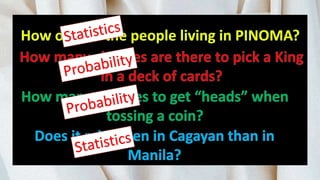
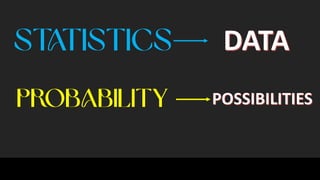
  • #7 Notice – if the questions more about chances or possibilities it can be answered using probabilities But if it requires data we use STATISTICS
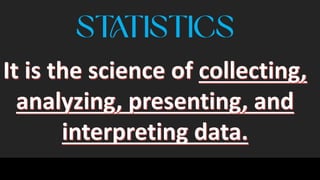
  • #9 STATISTICS is used as a tool in decision making and in solving problems. Collection – we gather data Analyze – understanding the data Present – presenting the data Interpret – we draw conclusion on the data (solutions) Combinations mathematics, economics, research and practicality of life.

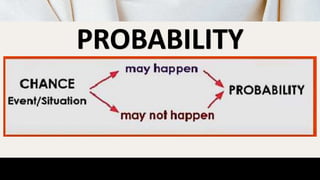
  • #10 Probability – we deal with chances. ARCADE – Sunday bonding with families.