1.
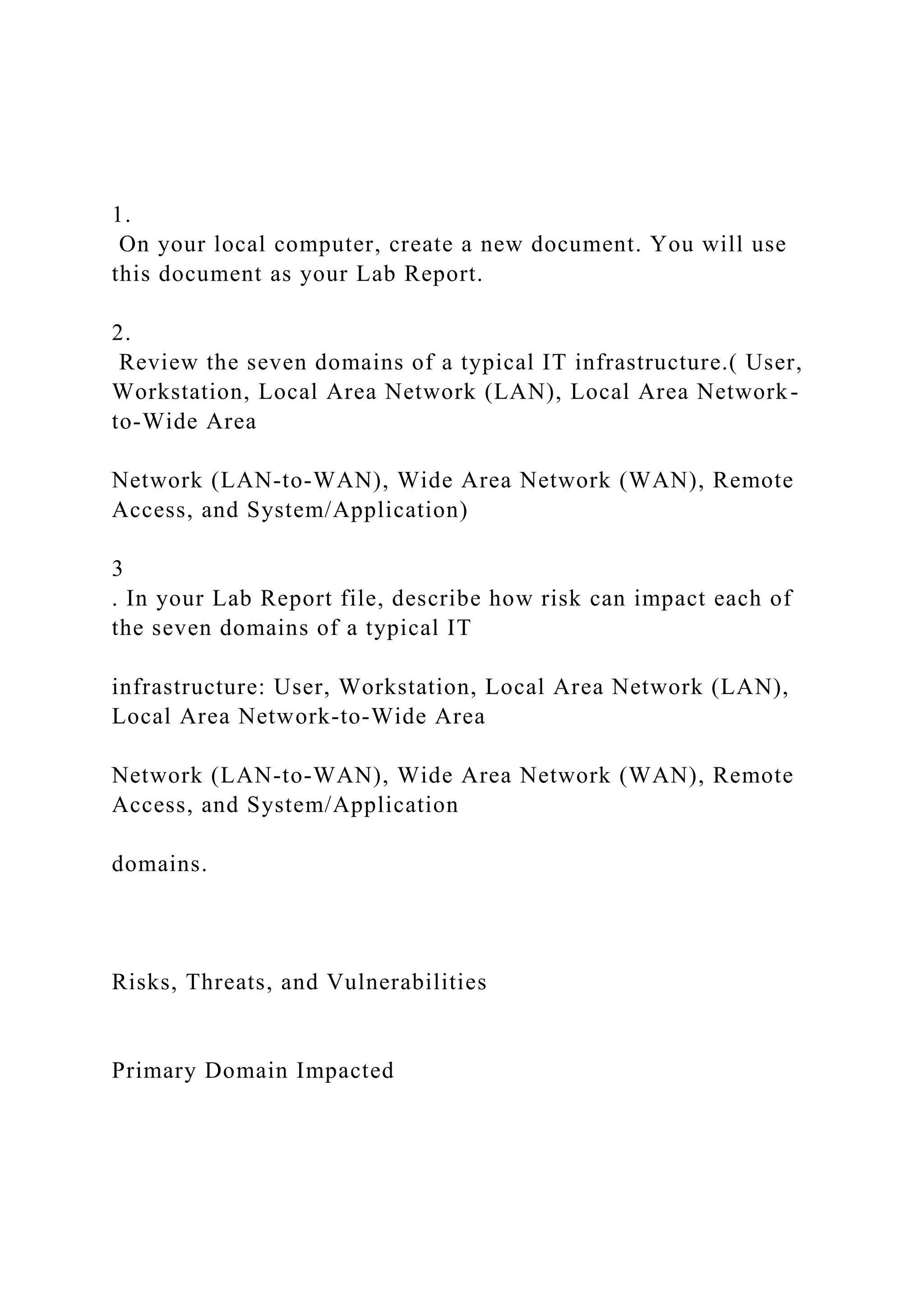
On your local computer, create a new document. You will use
this document as your Lab Report.
2.
Review the seven domains of a typical IT infrastructure.( User,
Workstation, Local Area Network (LAN), Local Area Network-
to-Wide Area
Network (LAN-to-WAN), Wide Area Network (WAN), Remote
Access, and System/Application)
3
. In your Lab Report file, describe how risk can impact each of
the seven domains of a typical IT
infrastructure: User, Workstation, Local Area Network (LAN),
Local Area Network-to-Wide Area
Network (LAN-to-WAN), Wide Area Network (WAN), Remote
Access, and System/Application
domains.
Risks, Threats, and Vulnerabilities
Primary Domain Impacted
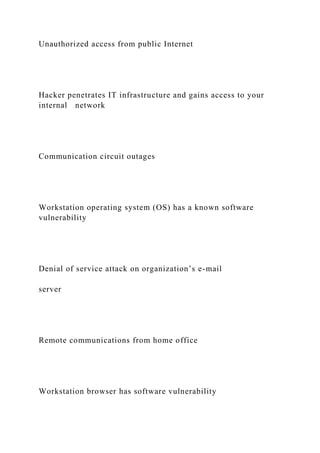
Unauthorized access from public Internet
Hacker penetrates IT infrastructure and gains access to your
internal network
Communication circuit outages
Workstation operating system (OS) has a known software
vulnerability
Denial of service attack on organization’s e-mail
server
Remote communications from home office
Workstation browser has software vulnerability
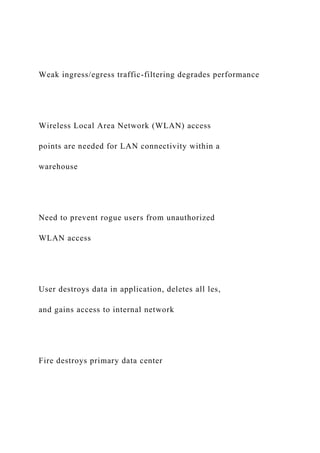
Weak ingress/egress traffic-filtering degrades performance
Wireless Local Area Network (WLAN) access
points are needed for LAN connectivity within a
warehouse
Need to prevent rogue users from unauthorized
WLAN access
User destroys data in application, deletes all les,
and gains access to internal network
Fire destroys primary data center
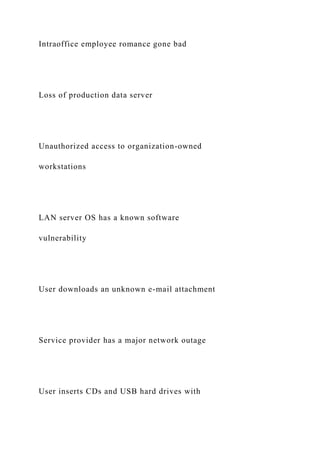
Intraoffice employee romance gone bad
Loss of production data server
Unauthorized access to organization-owned
workstations
LAN server OS has a known software
vulnerability
User downloads an unknown e-mail attachment
Service provider has a major network outage
User inserts CDs and USB hard drives with
personal photos, music, and videos on
organization-owned computers
Virtual Private Network (VPN) tunneling between
the remote computer and ingress/egress router
4
. Review the left-hand column of the following table of risks,
threats, and vulnerabilities that were found in a health care IT
infrastructure servicing patients with life-threatening
conditions:
Note: Some risks will affect multiple IT domains. In fact, in
real-world environments, risks and their direct consequences
will most likely span across several domains. This is a big
reason to implement controls in more than one domain to
mitigate those risks. However, for the exercise in step 6 that
follows, consider and select only the domain that would be most
affected. Subsequent next steps in the real world include
selecting, implementing, and testing controls to minimize or
eliminate those risks. Remember that a risk can be responded to
in one of four ways: accept it, treat it (minimize it), avoid it, or
transfer it (for example, outsource or insurance).
5.
In your Lab Report le, complete the table from the previous
step by identifying which of the
seven domains of a typical IT infrastructure will be most
impacted by each item in the table’s
left-hand column and explain why.

1. On your local computer, create a new document. You will use.docx

  • 1.
    1. On your localcomputer, create a new document. You will use this document as your Lab Report. 2. Review the seven domains of a typical IT infrastructure.( User, Workstation, Local Area Network (LAN), Local Area Network- to-Wide Area Network (LAN-to-WAN), Wide Area Network (WAN), Remote Access, and System/Application) 3 . In your Lab Report file, describe how risk can impact each of the seven domains of a typical IT infrastructure: User, Workstation, Local Area Network (LAN), Local Area Network-to-Wide Area Network (LAN-to-WAN), Wide Area Network (WAN), Remote Access, and System/Application domains. Risks, Threats, and Vulnerabilities Primary Domain Impacted
  • 2.
    Unauthorized access frompublic Internet Hacker penetrates IT infrastructure and gains access to your internal network Communication circuit outages Workstation operating system (OS) has a known software vulnerability Denial of service attack on organization’s e-mail server Remote communications from home office Workstation browser has software vulnerability
  • 3.
    Weak ingress/egress traffic-filteringdegrades performance Wireless Local Area Network (WLAN) access points are needed for LAN connectivity within a warehouse Need to prevent rogue users from unauthorized WLAN access User destroys data in application, deletes all les, and gains access to internal network Fire destroys primary data center
  • 4.
    Intraoffice employee romancegone bad Loss of production data server Unauthorized access to organization-owned workstations LAN server OS has a known software vulnerability User downloads an unknown e-mail attachment Service provider has a major network outage User inserts CDs and USB hard drives with
  • 5.
    personal photos, music,and videos on organization-owned computers Virtual Private Network (VPN) tunneling between the remote computer and ingress/egress router 4 . Review the left-hand column of the following table of risks, threats, and vulnerabilities that were found in a health care IT infrastructure servicing patients with life-threatening conditions: Note: Some risks will affect multiple IT domains. In fact, in real-world environments, risks and their direct consequences will most likely span across several domains. This is a big reason to implement controls in more than one domain to mitigate those risks. However, for the exercise in step 6 that follows, consider and select only the domain that would be most affected. Subsequent next steps in the real world include selecting, implementing, and testing controls to minimize or eliminate those risks. Remember that a risk can be responded to in one of four ways: accept it, treat it (minimize it), avoid it, or transfer it (for example, outsource or insurance).
  • 6.
    5. In your LabReport le, complete the table from the previous step by identifying which of the seven domains of a typical IT infrastructure will be most impacted by each item in the table’s left-hand column and explain why.