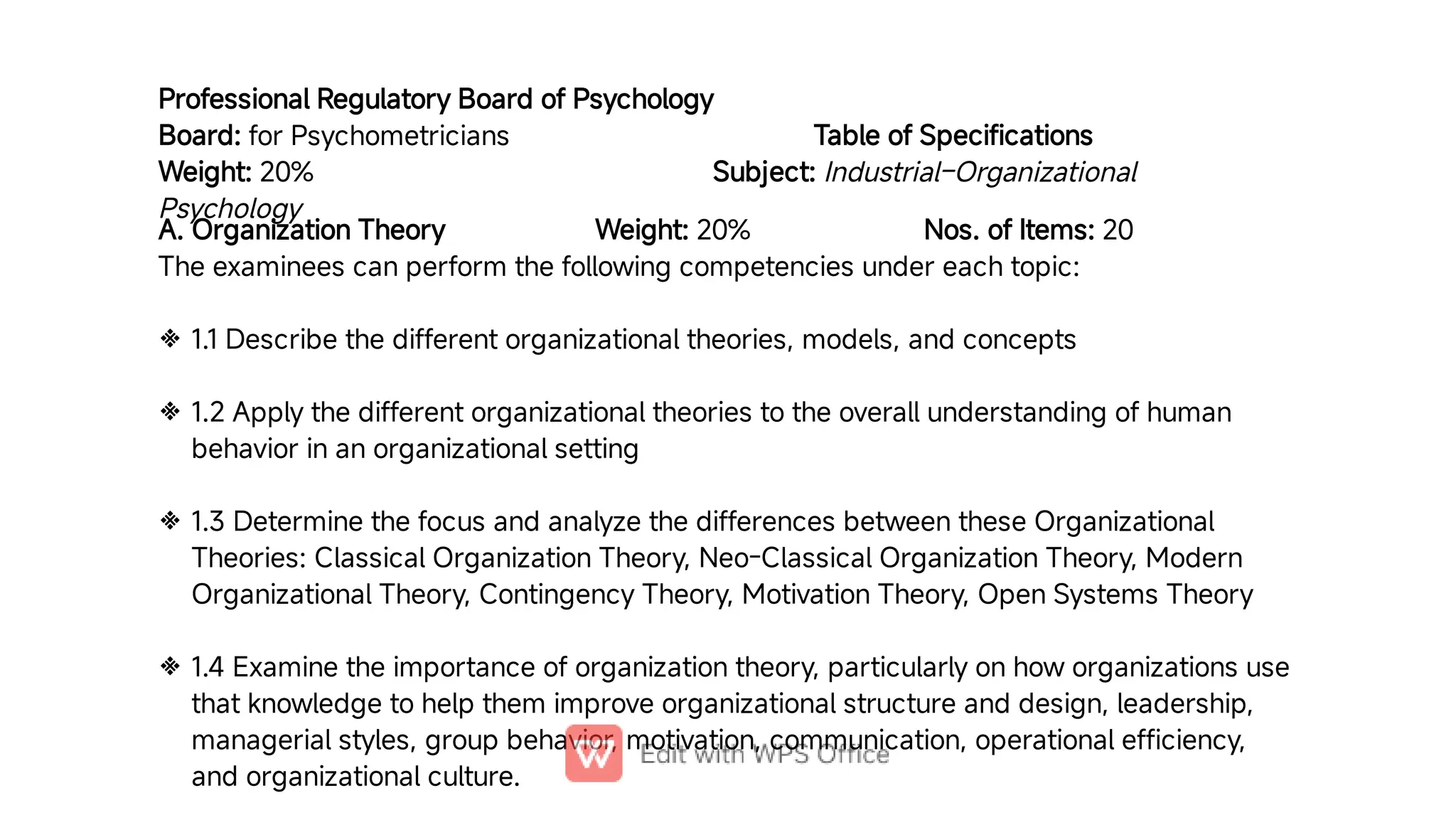
Professional Regulatory Boardof Psychology
Board: for Psychometricians Table of Specifications
Weight: 20% Subject: Industrial–Organizational
Psychology
A. Organization Theory Weight: 20% Nos. of Items: 20
The examinees can perform the following competencies under each topic:
1.1 Describe the different organizational theories, models, and concepts
1.2 Apply the different organizational theories to the overall understanding of human
behavior in an organizational setting
1.3 Determine the focus and analyze the differences between these Organizational
Theories: Classical Organization Theory, Neo-Classical Organization Theory, Modern
Organizational Theory, Contingency Theory, Motivation Theory, Open Systems Theory
1.4 Examine the importance of organization theory, particularly on how organizations use
that knowledge to help them improve organizational structure and design, leadership,
managerial styles, group behavior, motivation, communication, operational efficiency,
and organizational culture.
3.
B. Organizational Structures& Systems
Weight: 20% Nos. of Items: 20
2.1 Evaluate the value and importance of knowing and understanding the various
organizational models and systems.
2.2 Recognize the pros and cons of the different types of organizational structures:
Functional, divisional, flat, matrix, team, network, and hierarchical structures.
2.3 Determine the most appropriate organizational structure and their distinct
relationships: job design, departmentalization, span of control and chain of command
2.4 Apply your understanding of organizational design to appreciate organizational
roles and performance accountability
2.5 Explain the importance of aligning the organizational structure with the business
strategy
2.6 Apply your understanding of the 4 business elements that must be aligned to
ensure profitable performance and business success
4.
C. Human ResourceDevelopment & Management
Weight: 25% Nos. of Items: 25
3.1 Differentiate:
(a) Human Resource Development (HRD) and Human Resource Management (HRM)
(b) Human Resource Development (HRD) and Organizational Development (OD)
(c) HRD and Employee Training
3.2 Identify the activities involved in Human Resource Development
3.3 Examine the scope, coverage, and processes across the different areas of Human
Resource Development
(Training, learning, career development, talent management, performance appraisal,
employee engagement, and empowerment)
3.4 Analyze the organizational activities involved in Human Resource Management
(Manpower planning, staffing, developing, monitoring, maintaining, managing
relationships, and evaluating)
3.5 Compare the role of the Human Resource Manager and the Human Resource
Development Manager in an organization
5.
D. Team Dynamics
Weight:15% Nos. of Items: 15
4.1 Explain the importance and impact of team dynamics in an organization
4.2 Identify the stages of team development
4.3 Examine group processes that affect team effectiveness
4.4 Identify the common team problems that occur in teams
4.5 Apply your knowledge of team dynamics to address team problems and improve
team performance
6.
E. Organizational Change& Development
Weight 20% | 20 items
5.1 Distinguish the difference between:
(a) Organizational Change & Organizational Dev’t.
(b) Organizational Dev’t & Organizational Transformation
5.2 Analyze the different factors driving organizational change
5.3 Identify the different types of large-scale organizational changes
5.4 Evaluate the different types of Organizational Interventions used to enhance
organization effectiveness, employee well-being and productivity
5.5 Examine the different strategies and techniques organizations use to manage
change, and/or cope with change to achieve organizational efficiency
•
•
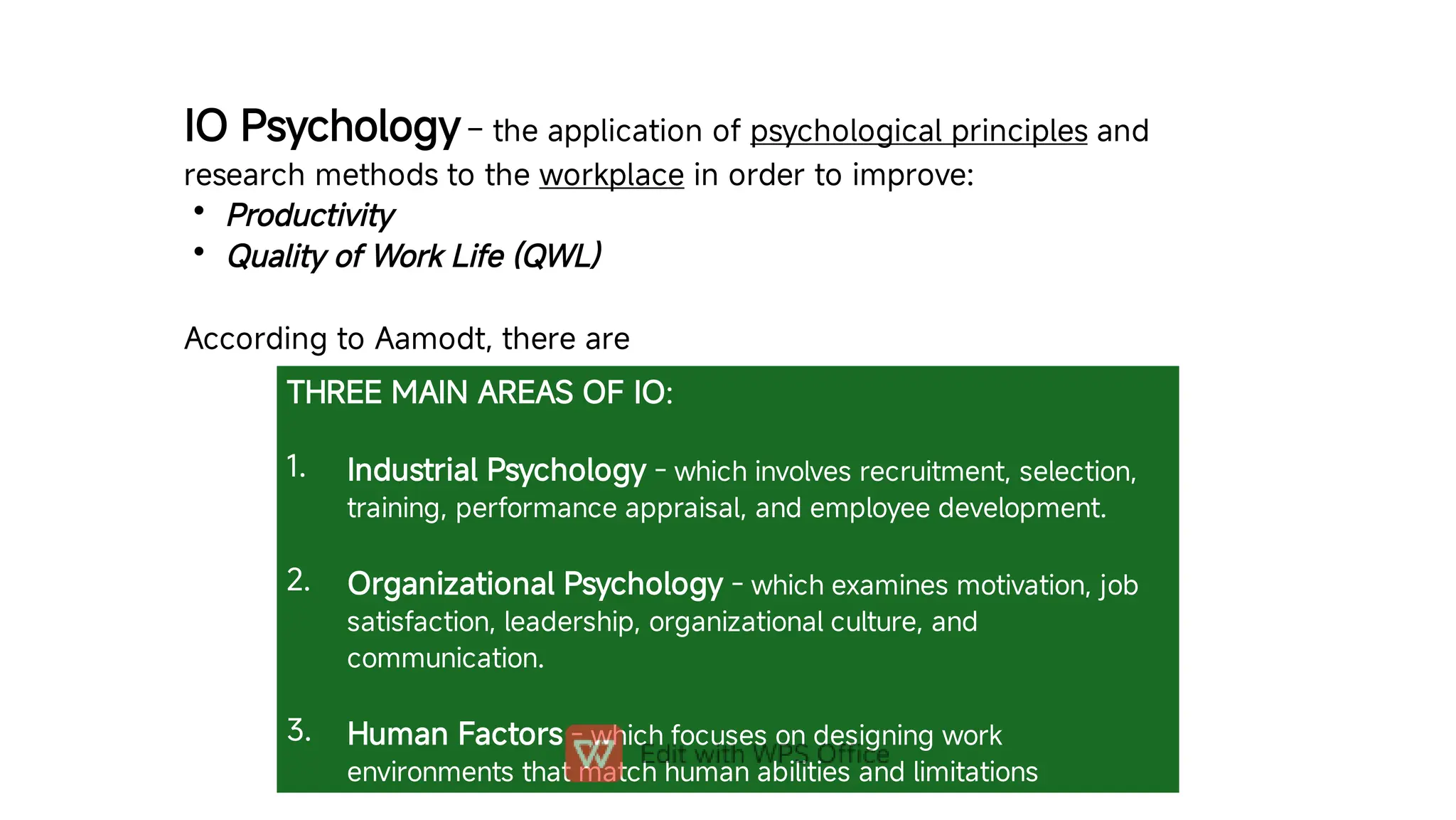
IO Psychology– theapplication of psychological principles and
research methods to the workplace in order to improve:
Productivity
Quality of Work Life (QWL)
According to Aamodt, there are
1.
2.
3.
THREE MAIN AREAS OF IO:
Industrial Psychology - which involves recruitment, selection,
training, performance appraisal, and employee development.
Organizational Psychology - which examines motivation, job
satisfaction, leadership, organizational culture, and
communication.
Human Factors - which focuses on designing work
environments that match human abilities and limitations
Human Factors
or Ergonomics
-which focuses
on designing
work
environments
that match
human abilities
and limitations.
12.
Timeline of I-OPsychology
Early 1900s – Birth of I/O Psychology
1903: Walter Dill Scott publishes The Theory of
Advertising, the first application of psychology to
business.
1910–1913: Hugo Münsterberg publishes Psychology
and Industrial Efficiency, applying psychology to
industrial settings.
1911: Scott publishes Increasing Human Efficiency in
Business.
Early pioneers: James Cattell, Walter Bingham, John
Watson, Marion Bills, Lillian Gilbreth.
Terminology: Before WWI, terms like “economic
psychology,” “business psychology,” and “employment
psychology” were used; “industrial psychology” was
rare.
13.
Timeline of I-OPsychology
World War I – First Major Impact
I/O psychologists tested and placed
soldiers using Army Alpha (literate)
and Beta (illiterate) tests.
John Watson developed perceptual
and motor tests for pilots.
Henry Gantt increased efficiency in
shipbuilding, repair, and loading.
Thomas Edison (not an I/O
psychologist) created a 150-item
knowledge test for employee
selection in 1920.
14.
Timeline of I-OPsychology
1920s–1930s – Scientific Management and
Motion Studies
Frank and Lillian Gilbreth pioneered
motion study to improve productivity and
reduce fatigue.
Frank optimized bricklaying motions.
Lillian continued consulting and
became Purdue University’s first female
professor of management and
engineering (1935).
Global expansion: Psychologists applied
industrial psychology in Switzerland,
Australia, Germany, France, Canada, and
15.
Timeline of I-OPsychology
1930s – Hawthorne Studies and Human
Relations
Conducted at Western Electric,
Chicago.
Found that employee productivity
was influenced more by attention
and social factors than physical
conditions (the Hawthorne effect).
Led to a focus on work environment
quality and employee attitudes.
16.
Timeline of I-OPsychology
1960s – Civil Rights and Training Innovations
Major civil rights legislation influenced fair
employee selection.
Use of sensitivity training and T-groups
(laboratory training groups) for managers
became common.
1970s – Motivation and Behavior Modification
Research focused on employee satisfaction,
motivation, and organizational behavior.
Behavior-modification techniques were
increasingly applied in organizations (e.g.,
Skinner, 1971).
17.
Timeline of I-OPsychology
1980s–1990s – Statistical Methods, Cognition, and
Organizational Issues
Advanced statistics: Path analysis, meta-analysis,
MANOVA, causal modeling.
Cognitive psychology applications: Understanding
managers’ thought processes in performance
appraisal.
Work-family concerns: Stress, workplace violence,
and the effects of work on family life.
Employee selection: Wider use of cognitive ability
tests, personality tests, biodata, structured
interviews.
Other trends: downsizing, diversity, aging workforce,
stress, organizational development (TQM,
18.
Timeline of I-OPsychology
2000s–Present – Technology, Diversity, and
Globalization
Technology: Online testing, e-learning, virtual
meetings, and distance education.
Workforce demographics: Women in managerial
roles, Hispanics/Latinos as largest minority, Asian
Americans fastest-growing group, English as a
second language.
Global economy: Service jobs requiring human
relations skills; expatriates and cross-cultural
training.
Workplace trends: Flexible schedules, family-
friendly policies, flatter structures, urban-to-
suburban shifts, healthcare costs, potential
19.
•
•
Importance and Relevanceof I-O
Psychology
Industrial-Organizational (I-O)
Psychology is vital because it
applies science to improve how
people are hired, trained,
motivated, and managed at work.
It helps organizations become
more productive while enhancing
employee well-being.
1.
Classical Organizational Theories
ScientificManagement Theory (Frederick
Taylor)
Bureaucratic Theory (Max Weber)
Administrative Management Theory (Henri
Fayol)
3. Modern Organizational Theories
SYSTEMS THEORIES:
General Systems Theory (GST) –
Ludwig von Bertalanffy
Open Systems Theory – Katz &
Kahn
CONTINGENCIES THEORIES:
Contingency Theory of
Organizational Structure – Joan
Woodward
Fiedler’s Contingency Theory of
Leadership – Fred Edward Fiedler
Lawrence & Lorsch’s Contingency
Theory of Organization – Paul
Lawrence & Jay Lorsch
SOCIOTECHNICAL SYSTEMS THEORY
(Eric Lansdown Trist)
2.
Neo-Classical Organizational
Theories
Human Relations (Elton Mayo)
MOTIVATION THEORIES:
Hierarchy of Needs (Abraham
Maslow)
Theory X and Theory Y (Douglas
McGregor)
Two-Factor Theory (Frederick
Herzberg)
Three Needs Theory (David
McClelland)
ERG Theory (Clayton Alderfer)
22.
•
•
Classical Organizational
Theories
developed duringthe late
19th and early 20th centuries,
at a time when
industrialization was
transforming economies in
Europe and North America.
Factories were expanding
rapidly, and managing large
numbers of unskilled workers
posed new challenges.
23.
FREDERICK
WINSLOW TAYLOR
(1856–1915)
is knownas the "Father
of Scientific
Management."
SCIENTIFIC MANAGEMENT
Scientific = using observation, experiments, and
measurement
Management = guiding and organizing people at
work
“Managing people and work using science — not just
guessing or old habits.”
•
•
•
•
1.
2.
Taylor’s Core Ideas:
There’s One Best Way to Do
Any Job
Use Science, Not Guesswork
Train Workers the Right Way
Managers Plan, Workers Do
Goals:
Make companies more
productive (more output, more
money)
Make workers more efficient
(less wasted energy, better pay)
24.
Advantages
Increased Productivity
Standardization ofWork
Time and Motion Studies
Improved Efficiency
Better Planning and Control
Higher Wages for
Productive Workers
Criticisms
Dehumanization of Workers
Job Dissatisfaction
Ignored Social Needs
Too Mechanistic
Conflict Between Workers
and Management
Limited Flexibility
25.
MAX WEBER
(1864–1920)
is oneof the founding
figures of sociology,
along with Karl Marx and
Émile Durkheim.
BUREAUCRACY
“Bureau” = French word for office or desk
“-cracy” = means rule or power
Bureaucracy means:
"A system where organizations are run by rules,
roles, and records — not by personal feelings
or power."
•
•
•
•
•
•
1.
2.
3.
Weber’s Core Ideas:
Clear Division of Labor
Hierarchy of Authority
Formal Rules and Procedures
Impersonality
Merit-Based Hiring and
Promotion
Formal Written Records
Goals:
Fair (rules apply to everyone)
Efficient (clear roles and no
overlap)
Stable (not dependent on any
one person)
26.
Advantages
Clear Structure and
Hierarchy
Consistencyand
Predictability
Efficiency in Large
Organizations
Merit-Based Hiring and
Promotion
Accountability
Impersonal and Objective
Criticisms
Too Rigid and Inflexible
Red Tape and Slow
Processes
Impersonality
Over-Specialization
Lack of Motivation or
Initiative
Bureaucratic Alienation
27.
HENRI FAYOL
(1841–1925)
is knownas the Father of
Modern Management.
ADMINISTRATIVE
MANAGEMENT THEORY
•
•
•
Taylor focused on how workers should
work
Weber focused on structure and rules
Fayol focused on how managers should
manage.
Managing is a skill.
Core Ideas:
5 Functions of
Management
(POCCC)
14 Principles of
Management
29.
Fayol’s 14 Principlesof Management
No. Principle Explanation
1 Division of Work Specialize tasks for efficiency
2 Authority Managers must have the right to give orders
3 Discipline Rules must be followed
4 Unity of Command One boss per worker — no confusion
5 Unity of Direction Everyone should work toward the same goal
6
Subordination of Individual
Interest
The team’s goal is more important than personal wishes
7 Remuneration Fair pay for fair work
8 Centralization The right balance between boss control and employee freedom
9 Scalar Chain Clear line of authority — like a ladder
10 Order Everything in the right place at the right time
11 Equity Be kind and fair to workers
12 Stability of Tenure Keep good workers — don’t change too often
13 Initiative Let employees show ideas and take action
30.
Advantages
Clear Management
Guidelines
Focus onEfficiency
Applicable Across Industries
Promotes Discipline and
Order
Encourages Professionalism
Foundation for Modern
Management
Criticisms
Too General and Idealistic
Top-Down Approach
Ignores Human and Social
Aspects
Rigid Structure
Assumes All Organizations
Are the Same
31.
•
•
•
•
•
•
The classical modelsaw workers as rational,
economic beings motivated mainly by WAGES.
The logic was simple:
improve machinery,
refine processes,
and control workers tightly,
…and productivity would soar.
But in practice:
Workers became BORED with repetitive tasks.
Resistance, absenteeism, and turnover were
common.
Productivity sometimes fell despite ideal
technical conditions.
32.
Neo-Classical
Organizational Theories
Everything beganto change in the
1920s with a series of experiments
at the Hawthorne Works of the
Western Electric Company in
Cicero, Illinois. Initially, researchers
set out to study how lighting levels
affected productivity.
33.
•
•
•
•
•
They discovered thatthe workers were not
responding to lighting at all—they were
responding to the fact that someone was
paying attention to them.
Workers are motivated when they feel
valued and involved.
Social interactions, informal groups, and
morale directly affect performance.
The “Hawthorne Effect” — people
temporarily improve performance simply
because they know they are being observed.
The factory was no longer just a mechanical
system—it was a social organism.
Managers were urged to build
relationships with workers.
The workplace was seen as a
network of informal groups
with their own norms and
influence.
Job satisfaction became
recognized as a driver of
productivity.
34.
The Hawthorne Studieswere a landmark
series of experiments conducted at the
Western Electric Hawthorne Works in
Cicero, Illinois.
Initially, the goal was to see how physical
work conditions affected productivity, but
the research UNEXPECTEDLY revealed
the powerful role of social and
psychological factors in the workplace.
Human Relations
(1924–1932) by Elton Mayo
35.
Year(s) Experiment MainLesson
1924–1927 Illumination Experiments
Productivity not directly tied to
lighting; observation mattered.
1927–1932 Relay Assembly Test Room
Special attention, supportive
environment, and teamwork
increase productivity.
1928–1930 Interview Program
Workers value being heard;
emotions and attitudes matter.
1931–1932 Bank Wiring Observation Room
Informal group norms control
work pace more than
management orders.
Timeline of the Hawthorne Studies
36.
In the 1940s,Maslow introduced the Hierarchy
of Needs (A Theory of Human Motivation),
explaining that people have different levels of
needs—and that higher needs become important
once lower ones are satisfied.
This supported the Neo-classical belief that
workers are motivated by more than just money
and that managers must understand human
motivation in order to boost productivity.
Hierarchy of Needs
(1943) by Abraham Maslow
Abraham Maslow
38.
He’s best knownfor his Theory X and Theory Y
(1960, The Human Side of Enterprise), which
explained how managers’ assumptions about
workers influence their management style — and,
in turn, workplace motivation and performance.
McGregor’s Contribution: He framed two
contrasting sets of managerial assumptions,
showing that the way leaders think about
employees directly shapes outcomes.
Theory X and Theory Y
(1960) by Douglas McGregor
Douglas McGregor
39.
1.
2.
3.
Theory X
Represents atraditional, authoritarian view of workers.
Managers holding Theory X assumptions believe:
People inherently dislike work and will avoid it if
possible.
Most employees must be coerced, controlled, or
threatened with punishment to perform.
Workers prefer to be directed, avoid responsibility,
and seek security above all.
Managerial style: Tight supervision, strict rules,
centralized decision-making.
Link to Classical Theory: Mirrors Taylor’s Scientific
Management and Weber’s Bureaucracy.
40.
Aspect Theory XTheory Y
View of People Lazy, avoid work Self-motivated
Motivation
External control,
punishment/rewards
Internal drive,
achievement
Leadership Style Autocratic
Democratic/participativ
e
Organizational
Structure
Centralized Decentralized, flexible
Outcomes
Compliance, low
creativity
Engagement, innovation
Theory X and Theory Y at Work
41.
In the 1950s–60s,Chris Argyris looked at a
deeper issue:
“Why do organizations so often treat adults
like children—and what does that do to
productivity and morale?”
He argued that the traditional, bureaucratic
organization structure often frustrates
people’s natural psychological growth.
The Immaturity–Maturity
Theory
(1957) by Chris Argyris
Chris Argyris
42.
Immature End MatureEnd
Passive Active
Dependent Independent
Few behaviors Many behaviors
Shallow interests Deep, varied interests
Short-term perspective Long-term perspective
Subordinate position
Equal or superior
relationships
Little self-awareness
High self-awareness &
control
In his 1957 book Personality and Organization, Argyris described a
continuum of human development in the workplace:
•
•
Healthy adults naturally want to
move toward the “mature” end
of this spectrum.
Rigid, hierarchical organizations
often trap employees in
immature roles—limiting
responsibility, discouraging
initiative, and enforcing
dependence on authority.
43.
•
•
Herzberg found thatthe things that
make people satisfied at work are not
the same as the things that make them
dissatisfied.
Improving “dissatisfaction factors”
doesn’t automatically create
satisfaction.
Satisfaction and dissatisfaction are
two separate dimensions, not
opposites.
Two-Factor Theory
(1959) by Frederick Herzberg
Frederick Herzberg
44.
The Two Factors
A.
•
•
•
•
•
•
MOTIVATORS(Satisfiers)
– Intrinsic to the Job
When present, they create job
satisfaction and motivation:
Achievement
Recognition
The work itself
Responsibility
Advancement
Personal growth
If absent: Neutral feeling (no
satisfaction), but not necessarily
dissatisfaction.
•
•
•
•
•
•
B. Hygiene Factors (Dissatisfiers)
– Extrinsic to the Job
When absent, they cause job
dissatisfaction, but when present, they
don’t necessarily motivate — they just
prevent dissatisfaction:
Company policies
Supervision quality
Salary
Job security
Working conditions
Interpersonal relationships
If improved: People complain less, but
45.
To motivate employeeslong-term:
Focus on motivators (make jobs
meaningful, give recognition, provide
growth opportunities).
To prevent dissatisfaction: Maintain
hygiene factors (fair pay, safe working
conditions, clear policies).
True motivation comes from job
enrichment — redesigning work to
increase autonomy, skill variety, and
responsibility.
1.
2.
Herzberg taught us that:
If you want people to
stop complaining, fix the
hygiene factors.
If you want them to start
caring, give them
motivators.
46.
McClelland’s Learned NeedsTheory —
also called the Three Needs Theory —
was developed by David McClelland in
the 1960s.
It focuses on how people’s motivation
is shaped over time by life experiences
rather than by inborn instincts.
Three Needs Theory
(1961) by David McClelland
David McClelland
47.
•
•
•
1. Need forAchievement
(nAch)
- desire to excel, meet
standards, and accomplish
challenging goals.
High nAch employees:
Prefer moderately
difficult tasks (not too
easy, not impossible).
Want clear feedback
on performance.
Often thrive in roles
where individual
results matter (sales,
entrepreneurship).
•
•
•
2. Need for Affiliation (nAff)
- desire for friendly, close
relationships and to be liked.
High nAff employees:
Enjoy working in
teams and
cooperative
environments.
Avoid conflict and
dislike tasks with
high risk of
interpersonal
rejection.
Often excel in
customer service,
HR, or team-based
work
•
•
•
•
•
3. Need for Power (nPow)
- desire to influence, control, and
have impact on others.
Two types of power:
Personalized Power – for self-
gain; can be manipulative or
controlling.
Socialized Power – used to
benefit the group or
organization; linked to good
leadership.
High nPow Individuals:
Seek authority positions.
Enjoy influencing outcomes.
Can inspire and mobilize
teams when focused on
socialized power.
48.
Alderfer’s ERG Theoryis basically a
streamlined version of Maslow’s
Hierarchy of Needs — proposed by
Clayton Alderfer in 1969
— but with more flexibility and
realism for workplace motivation.
ERG Theory (1969) by Clayton
Alderfer
1.
•
•
2.
•
•
3.
•
•
The Three ERG Categories
Instead of five rigid levels like Maslow, Alderfer
condensed human needs into three groups:
Existence (E)
Material and physiological well-being.
In the workplace: salary, safe conditions, benefits,
job security.
Relatedness (R)
Meaningful relationships with others.
In the workplace: good supervisor relations,
teamwork, recognition from peers.
Growth (G)
Personal development and self-fulfillment.
In the workplace: challenging work, skill
development, creative opportunities, promotions.
49.
•
Frustration–Regression Principle
This isAlderfer’s big contribution.
If employees can’t satisfy a higher-level need
(like Growth), they might regress to focusing
more on lower needs (like Relatedness or
Existence).
Example: An ambitious employee denied a
promotion might start focusing more on building
friendships at work or asking for a raise instead.
50.
Victor H. Vroom
(1932–2023)
PublishedWork and Motivation,
introducing Expectancy Theory.
EXPECTANCY THEORY
1.
2.
3.
Core Idea
People are motivated to act when they believe:
Their effort will lead to good performance.
Good performance will be rewarded.
The reward is something they personally value.
It’s not just about wanting a reward — it’s about
believing the whole chain from effort →
performance → reward makes sense.
51.
•
•
•
•
Expectancy
- the beliefthat effort will lead to the
desired level of performance.
“If I put in more effort, I can do the job
well.”
Influenced by:
Self-confidence (self-efficacy)
Availability of resources and training
Past experience
Example: A worker believe he can finish the
extra work if he stays late.
(Effort → Performance)
52.
-
•
•
•
Instrumentality
the belief thatgood performance will
lead to rewards.
“If I do the job well, I’ll get the reward.”
Influenced by:
Trust in supervisors
Transparency of reward systems
Past fulfillment of promises
Example: An employee believes meeting
a sales quota will guarantee a bonus.
(Performance → Outcome)
53.
•
•
•
Valence
- the personalvalue placed on the
reward.
“The reward matters to me.”
Influenced by:
Individual needs and values
Personal circumstances
Culture
Example: Overtime pay may have high
valence for someone saving for a car,
but low valence for someone prioritizing
family time.
(Value of Outcome)
54.
The Formula
•
•
•
Multiplicative model:if any one
component is zero, motivation drops to
zero.
Example:
You believe you can do the job
(Expectancy = 1),
You believe the reward will come
(Instrumentality = 1),
But you don’t care about the reward
(Valence = 0),→ Motivation = 0.
Practical Implications
Employers must ensure employees
believe in their abilities (training,
resources).
They must ensure there’s a clear link
between performance and rewards.
Rewards should be meaningful to the
individual.
55.
J. Stacy Adams
(1925–1984)
Hepublished the Journal of Applied
Psychology, articles on social
comparison and workplace justice.
EQUITY THEORY
•
•
Key Idea:
People compare what they put into a job
(their inputs) and what they get out of it
(their outputs) to what others get.
If they feel treated fairly (equity), they
stay motivated.
If they feel unfairly treated (inequity),
they feel dissatisfied and may change
their behavior to restore fairness.
56.
What is it?
EquityTheory explains how people
feel motivated or demotivated
based on their perception of
fairness in social exchanges,
especially at work.
57.
•
•
•
•
•
INPUTS
(What the employee
contributes)
Examples:
Effortand time
Skills and qualifications
Experience
Loyalty and commitment
Work quality and quantity
•
•
•
•
•
•
OUTPUTS
(What the employee receives)
Examples:
Salary/wages
Benefits
Recognition and praise
Promotion opportunities
Job security
Work-life balance perks
Key Components
58.
•
•
•
•
Comparison
People compare themselvesto:
Co-workers in the same
organization
Friends in similar jobs elsewhere
Their own past situations
Industry standards
1.
2.
3.
How it works:
Equity: Ratios are equal → Motivation maintained.
Inequity (Under-rewarded): Your ratio < Other’s ratio → Feel anger,
resentment.
Inequity (Over-rewarded): Your ratio > Other’s ratio → Feel guilt,
discomfort (less common but still possible).
59.
Edwin A. Locke
(1938-)
Americanpsychologist
and a pioneer in goal-
setting theory.
GOAL-SETTING
THEORY
What is Locke’s Goal-Setting
Theory?
Locke’s Goal-Setting Theory,
developed by Edwin A. Locke in
1968, explains that goals are the
primary drivers of human
motivation and performance.
Principle: People perform better
when they set specific, clear,
and challenging goals than
when goals are vague or easy.
“You can’t hit a target you
can’t see.”
60.
•
•
•
Why is thistheory important?
Unlike early motivation theories (like Maslow’s
hierarchy or Herzberg’s hygiene factors), Locke
emphasized that motivation does not depend only
on needs or rewards but on conscious goals that
guide behavior.
This theory has practical application in workplaces,
schools, and personal life, making it highly relevant
for fields like Industrial-Organizational Psychology,
Human Resource Management, and Performance
Psychology.
It explains how managers, leaders, and educators
can increase motivation and performance by setting
the right goals and providing feedback.
Key Components
1. Specificity and Clarity of
Goals
2. Goal Difficulty
(Challenge)
3. Goal Commitment
4. Feedback
5. Task Complexity
61.
•
•
Example:
Imagine a salesemployee with two types of goals:
Vague goal: “Try to sell more this month.”
The employee may be unsure how much more to sell or how to
plan.
Specific, challenging goal: “Increase sales by 15% this month.”
The employee knows exactly what is expected, will focus efforts
on finding more customers, and track progress daily.
If feedback says sales are 10% up at mid-month, the employee
can adjust strategies to meet the 15% target.
The second scenario typically leads to better performance,
according to Locke’s Goal-Setting Theory.
Modern Organizational
Theories
By the1960s onward,
researchers began seeing
organizations as living systems —
adaptive, interacting with their
surroundings, and shaped by
context.
This gave rise to Modern
Organizational Theories.
1.
2.
3.
MODERN ORGANIZATIONAL THEORIES
can be categorized into three:
SYSTEMS THEORIES
CONTINGENCIES THEORIES
SOCIOTECHNICAL SYSTEMS THEORIES
64.
GENERAL SYSTEMS THEORY
Ludwigvon Bertalanffy
Austrian biologist
(1901–1972)
He is widely known as the
father of general system
theory (GST).
•
•
•
He wanted a unifying theory
that could apply to all kinds of systems,
whether:
Biological (cells, organs, ecosystems)
Mechanical (machines, engines, computer
systems)
Social (families, communities, organizations)
"The whole is greater than the sum of its parts,
and understanding the connections between
parts is key to understanding the system."
65.
1.
2.
3.
4.
5.
Key Principles ofGST:
Interrelated Parts – Every system is
made of components that work
together. Changing one part affects the
whole.
Hierarchy of Systems – Systems exist
within larger systems (subsystems,
systems, suprasystems).
Feedback Loops – Systems receive
feedback from their environment and
adjust accordingly.
Equifinality – Different starting points
or paths can lead to the same outcome.
Holism – You can’t fully understand a
system by studying its parts in isolation.
•
•
•
•
Example in Organizations:
Think of a university:
Subsystems: academic
departments, admin offices,
student services.
Larger System: the national
education system.
Interdependence: if funding is
cut in one area, it affects staff
hiring, student support, and
research output.
Feedback Loop: student
satisfaction surveys influence
policy changes.
66.
OPEN SYSTEMS THEORY
Bothare American social psychologists
and professors at the University of
Michigan’s Institute for Social Research.
Daniel Katz
(1903-1998)
Robert Louis Kahn
(1918-2019)
The key is that
organizations depend on
and influence their
environment — they can’t
be understood in
isolation.
67.
By the 1960s,organizational
theorists Daniel Katz and Robert L.
Kahn applied Bertalanffy’s General
Systems Theory specifically to
organizations.
While GST was broad (covering
biological, mechanical, and social
systems), Katz & Kahn zoomed in
on social organizations as “open
systems.”
68.
•
•
What “Open System”Means:
An open system is not closed off
from its surroundings. Instead, it
continuously exchanges:
Inputs from the environment
(resources, raw materials, people,
information, money)
Outputs back to the
environment (products, services,
knowledge, waste)
69.
Why They Developedthe Theory?
They saw that earlier
organizational models (like classical
management) treated
organizations like self-contained
machines, ignoring the fact that
organizations survive only by
interacting with their surroundings.
Katz & Kahn wanted to capture the
dynamic, adaptive nature of
organizations.
70.
Features of OpenSystems Theory:
Input–Throughput–Output Model
Input: Resources or information from
the environment (e.g., hiring skilled
workers, purchasing raw materials).
Throughput: Transformation process
inside the organization (manufacturing,
teaching, research).
Output: What the organization sends
back to the environment (goods,
services, graduates, policies).
71.
Feedback Loops
Organizations monitortheir
outputs and the environment’s
response, then adjust operations.
Example: Customer complaints →
process improvement.
Equifinality
Same result can be achieved in different
ways (e.g., increased sales through
marketing OR product improvement)
Dynamic Equilibrium
Organizations must balance stability
with the need to adapt to changes.
Interdependence with the Environment
Organizations rely on suppliers,
customers, government regulations,
technology, and social trends.
72.
•
•
•
•
•
Example in Organizations:
Imaginea hospital as an open system:
Inputs: Doctors, nurses, medical
equipment, patient information,
funding.
Throughput: Diagnosing, treating,
patient care processes.
Outputs: Healthy patients, medical
reports, community health programs.
Feedback: Patient surveys, health
outcome statistics.
Environmental Influence: Changes in
medical technology, government
health policies, pandemics.
73.
CONTINGENCIES
THEORIES
Contingency Theory of
OrganizationalStructure
– Joan Woodward
Fiedler’s Contingency Theory of
Leadership
– Fred Edward Fiedler
Lawrence & Lorsch’s Contingency
Theory of Organization
– Paul Lawrence & Jay Lorsch
Contingency theories are a group of
ideas in organizational and leadership
studies that argue there is no single
universal way to organize, manage, or
lead effectively — the “best” approach
depends on the specific situation (the
contingencies) an organization or leader
faces.
Instead of fixed “best practices,”
contingency theories say:
What works well in one situation
might fail in another.
74.
CONTINGENCY THEORY OF
ORGANIZATIONAL
STRUCTURE
JoanWoodward
British sociologist
(1916 – 1971)
A pioneer of the
contingency approach to
organizational structure
1.
2.
3.
Three Types of Technology:
Unit or Small Batch
Production
Mass Production
Process Production
Core Principle:
There is no single best organizational structure — it
must fit the type of production technology to be
effective.
Challenged the earlier “one best way” thinking
from classical management theory.
75.
Main Idea (1950s–1960s):
Theeffectiveness of an organization’s
structure depends on the type of
production technology it uses — a key
example of structural contingency
theory.
Research Context:
Studied 100+ manufacturing firms in
South Essex, England.
Key Finding:
Successful organizations had
structures that matched their core
technology.
76.
•
•
•
1. UNIT ORSMALL-BATCH
PRODUCTION
Technology: Custom, one-off, or small-
batch work.
Examples:
Tailoring shop.
Custom furniture workshop.
Prototype aerospace parts
manufacturer.
Structure: Flexible, less formal, highly
skilled workers, decision-making closer
to the work floor.
77.
•
•
•
2. MASS PRODUCTION
Technology:High-volume, standardized
goods.
Examples:
Automobile assembly plants (e.g.,
Toyota Corolla line).
Consumer electronics factories (e.g.,
TV or smartphone assembly).
Fast-food chain kitchens producing
identical meals.
Structure: Mechanistic, hierarchical,
formal rules, clear lines of authority.
78.
•
•
•
3. PROCESS PRODUCTION
Technology:Continuous, highly
automated production.
Examples:
Oil refineries.
Chemical plants.
Beverage bottling facilities (large-
scale soda production).
Structure: Highly technical, specialist
staff, focus on system monitoring and
maintenance, less emphasis on
traditional hierarchy.
79.
FIEDLER’S
CONTINGENCY THEORY
OF LEADERSHIP
Oneof the leading researchers in
industrial and organizational
psychology; a founder of contingency
theory in leadership.
1.
2.
3.
Core Assumptions
Leaders have a dominant
leadership style that is relatively
fixed (they don’t easily change how
they lead).
Effectiveness comes from matching
the right leader to the right
situation, not from asking leaders
to change styles.
Situational factors determine
whether a leader’s style will
succeed or fail.
Fred Edward
Fiedler
British sociologist
(1922 – 2017)
Fiedler developed theLeast Preferred Co-worker (LPC) Scale:
Leaders rate the person they least enjoyed working with on traits (pleasant–
unpleasant, friendly–unfriendly, etc.).
•
•
•
High LPC (relationship-oriented
leader):
Sees their least preferred co-
worker in a more positive light.
Values relationships, harmony,
trust, and team cohesion.
Effective in moderately favorable
situations (not too easy, not too
hard).
•
•
•
Low LPC (task-oriented leader):
Sees least preferred co-worker
very negatively.
Focused on tasks, structure, and
performance.
Effective in very favorable
(everything going smoothly) or
very unfavorable (crisis, poor
relations, lack of structure)
situations.
The score reflects the leader’s orientation:
82.
•
•
•
•
•
Situational Favorableness (ThreeKey Factors)
Fiedler argued that a leader’s control and
influence depend on three aspects of the
situation:
Leader–Member Relations
Degree of trust, respect, and
confidence between leader and
followers.
Good vs. poor relations.
Task Structure
How clearly defined and structured the
work is.
High structure (clear goals, procedures)
vs. low structure (ambiguous, creative
tasks).
Position Power
The leader’s formal authority (ability to
reward, punish, make decisions).
•
•
Matching Leadership Style and
Situation
Task-oriented leaders (Low LPC):
Best in situations that are very
favorable (clear structure, good
relations, strong power) or very
unfavorable (poor relations, unclear
tasks, weak power).
Relationship-oriented leaders (High
LPC): Best in moderately favorable
situations (where human relations
and motivation matter most).
83.
•
•
•
Strengths of theTheory
First leadership theory to
consider situational context
systematically.
Supported by some
empirical research.
Highlights the importance of
matching leader to situation,
not assuming one universal
style works.
•
•
•
•
Criticisms
LPC Scale validity issues –
Critics say it doesn’t
consistently measure
leadership style.
Suggests leadership style is
fixed, but many modern
theories argue leaders can
adapt.
Simplifies complex leadership
dynamics into only two styles.
Research support is mixed.
84.
LAWRENCE & LORSCH’S
CONTINGENCYTHEORY
OF ORGANIZATION
Pioneers of the Contingency
Approach to Organizational
Design.
Paul R. Lawrence
(1930–2011)
Jay W. Lorsch
(1932-2025)
•
•
•
Core Ideas
No single organizational structure
works best for all companies.
The “best” structure depends on
environmental uncertainty and
complexity.
Two key concepts: Differentiation
and Integration.
85.
•
•
•
Differentiation
Different departments inan organization
develop unique goals, orientations, and time
perspectives based on their environment.
Example:
Production → short-term, efficiency,
stability.
R&D → long-term, innovation,
tolerance for ambiguity.
Sales/Marketing → customer focus,
fast-paced, adaptable.
Differentiation means departments won’t
naturally align because their environments and
needs differ.
86.
•
•
•
•
Integration
Organizations must createcoordination
mechanisms to unify these differentiated
departments.
Integration involves communication,
collaboration, and conflict resolution across
units.
Tools for integration:
Cross-functional teams
Integrator roles/managers
Liaison officers
Formal processes and meetings
87.
•
•
Environmental Impact
In stableenvironments,
organizations need less
differentiation and simpler
integration.
In uncertain or rapidly changing
environments, organizations need:
Higher differentiation
(specialized departments
adapting to their
environment).
Stronger integration
mechanisms (to keep the
whole system working
together).
•
•
•
•
Practical Example
Automobile manufacturer:
Production = efficiency, routine.
R&D = innovation, experimentation.
Marketing = quick responses to consumer
needs.
The company must balance these different
time horizons and goals through integration.
88.
SOCIOTECHNICAL
SYSTEMS THEORY
Eric Lansdown
Trist
(1909-1993)
Hewas a British psychologist and social
scientist.
Eric Trist is best known as a pioneer of
organizational theory and the founding
father of sociotechnical systems thinking.
is an approach in organizational and work
system design that emphasizes the
interdependence between social and
technical subsystems.
The central idea is that organizational
effectiveness stems from jointly optimizing
both:
Technical subsystem: Tools, technologies,
processes, machines, structures, and
methods.
Social subsystem: People, teams, culture,
relationships, values, roles, and
89.
The theory assertsthat neither
dimension should dominate;
instead, they must be aligned and
mutually supportive to achieve
high performance and satisfactory
work conditions.
Efforts to improve one without
considering the other can lead to
inefficiencies, dissatisfaction, or
system failure.
90.
Origins
1950s–1960s: Developed atthe
Tavistock Institute of Human
Relations in London.
Researchers such as Eric Trist, Ken
Bamforth, Fred Emery, and their
colleagues studied coal mines and
found that mechanizing work
disrupted teamwork and morale,
highlighting the need to treat social
and technical elements as a joint
system.
Core Elements ofSTS Design:
Emphasizes interrelatedness of social and technical
subsystems.
Views work units holistically rather than as isolated tasks.
Favors teams over individual work.
Encourages internal regulation (self-managing groups)
rather than external control.
Regards individuals as complements to machines, not
extensions of them.