This document proposes a novel architecture that combines local storage with cloud storage in a RAID-like configuration to improve storage capacity, access speed, reliability, and availability for Internet of Things (IoT) devices. It discusses how different levels of RAID, including RAID 0, 1, 4 and 5, could utilize both local drives and cloud storage. Specifically, it proposes a new "RAID 4.5" level that uses multiple cloud parity drives along with local storage. The document analyzes the reliability, performance, feasibility and security of various hybrid local+cloud RAID configurations.
![The Case for RAID 4: Cloud-RAID Integration
with Local Storage
Christopher Hansen
Electrical and Computer Engineering
Brigham Young University
Provo, UT, USA
Email: cghansen@protonmail.com
James Archibald
Electrical and Computer Engineering
Brigham Young University
Provo, UT, USA
Email: james archibald@byu.edu
Abstract—The proliferation of the Internet of Things (IoT)
requires innovative solutions for all aspects of computing,
including storage. The small footprint of IoT devices limits
their capacity for local reliable storage. A solution is presented
which combines local and cloud storage in a RAID-like (Redun-
dant Array of Independent Disks) configuration, increasing the
amount of storage, access speed, and/or data reliability and avail-
ability for systems which implement the discussed configurations.
Previously, cloud-RAID, where data is distributed across multiple
cloud storage providers, has been proposed and implemented.
However, the current architectures place an emphasis on RAID
0, and other levels of RAID with their application to cloud storage
have not been thoroughly explored. A novel architecture for
local+cloud-RAID storage is presented, and benefits provided
by the architecture in the areas of availability, reliability, and
security are discussed. An effort to quantify the reliability
of various configurations of RAID, cloud-RAID, and hybrid
local+cloud-RAID levels will be made. While RAID 4 has been
widely regarded as obsolete and supplanted by RAID 5, we argue
that RAID 4 can be useful in a local+cloud-RAID configuration.
A new RAID level based on RAID 4, with the addition of a second
dedicated parity drive, is proposed, and is deemed RAID 4.5. We
conclude that cloud storage, from the perspectives of availability,
reliability, security, and performance, is beneficial to include in
various RAID configurations which include local drives.
Keywords—RAID, cloud, reliability, availability, security
I. INTRODUCTION AND RELATED WORK
Through the decades, the storage landscape has changed
significantly. The importance of secure and reliable storage
has increased, and simultaneously, bandwidth demands have
followed suit. Architects seek to optimize system efficiency,
security, reliability, and performance. Reliability is achieved
through redundancy, at the cost of space efficiency, using tech-
niques such as RAID, parity, ECC, or mirroring. Three metrics
govern the selection of a storage architecture: performance,
reliability, and feasibility. Feasibility includes space efficiency,
cost, and hardware requirements.
The need for online storage has steadily increased as devices
supplement local storage with cloud storage. While many
new systems rely on the cloud, such reliance can bring
disadvantages. Cloud access can be slow, negatively impacting
performance. Reliance on a single cloud provider can subject a
system to unavailability or compromise of critical information.
[1], [2], [3], [4], [5], [6], [7], [8], [9], [10].
Cloud storage increases the importance of data integrity,
privacy, and reliability. RAID has found use in cloud drives.
[1], [3], [4], [5], [6], [11], [12], [13], [14], [15]. Schnjakin et al.
describe a method of creating a RAID 0 array which includes
only cloud storage. [16]. Other approaches also increase data
reliability and availability in the cloud. [1], [7], [8], [9], [10],
[17]. Schemes which implement dynamic selection of cloud-
based providers have also been discussed. [5], [18].
In this paper, we extend the analysis of local and cloud
storage, and contribute the following:
1) We show how inclusion of cloud drives in a local RAID
array improves reliability and security.
2) We analyze RAID levels to identify appropriate
local+cloud configurations.
3) We show how RAID 4 has promising application in
local+cloud-RAID configurations.
4) We propose a new RAID level, 4.5, which utilizes
multiple cloud parity drives combined with local storage.
II. OVERVIEW OF BASIC RAID LEVELS
RAID 0: This configuration enhances read/write perfor-
mance at the cost of reliability, as any single drive failure
causes array failure. [19].
RAID 1: This configuration enhances reliability at the cost
of efficiency. One or more drives can fail as long a single
healthy drive remains. [19].
RAID 2-3: These configurations introduce striping and
parity, RAID 2 at the bit level, and RAID 3 at the byte level.
RAID 3 introduces a dedicated parity drive, while RAID 2 uses
distributed parity. Reliability is increased at the expense of
performance. These RAID levels tolerate a single drive failure.
[19].
RAID 4: This configuration also uses a dedicated parity
drive, but stripes on block-level data, which improves perfor-
mance over RAID 2 and 3. However, the dedicated parity drive
can bottleneck bandwidth. RAID 4 also tolerates a single drive
failure. [19].
RAID 5: This configuration distributes parity among all
array drives, and is much more commonly implemented than
RAID levels 2-4 due to performance improvements. [19].
RAID 6: This configuration improves upon RAID 5 by
adding an orthogonal layer of distributed parity, enabling
2016 11th International Conference on Availability, Reliability and Security
978-1-5090-0990-9/16 $31.00 © 2016 IEEE
DOI 10.1109/ARES.2016.100
235](https://image.slidesharecdn.com/c7e0807d-325f-4da3-a19c-933a33bd38eb-170120232030/85/07784576-1-320.jpg)
![The Case for RAID 4: Cloud-RAID Integration
with Local Storage
Christopher Hansen
Electrical and Computer Engineering
Brigham Young University
Provo, UT, USA
Email: cghansen@protonmail.com
James Archibald
Electrical and Computer Engineering
Brigham Young University
Provo, UT, USA
Email: james archibald@byu.edu
Abstract—The proliferation of the Internet of Things (IoT)
requires innovative solutions for all aspects of computing,
including storage. The small footprint of IoT devices limits
their capacity for local reliable storage. A solution is presented
which combines local and cloud storage in a RAID-like (Redun-
dant Array of Independent Disks) configuration, increasing the
amount of storage, access speed, and/or data reliability and avail-
ability for systems which implement the discussed configurations.
Previously, cloud-RAID, where data is distributed across multiple
cloud storage providers, has been proposed and implemented.
However, the current architectures place an emphasis on RAID
0, and other levels of RAID with their application to cloud storage
have not been thoroughly explored. A novel architecture for
local+cloud-RAID storage is presented, and benefits provided
by the architecture in the areas of availability, reliability, and
security are discussed. An effort to quantify the reliability
of various configurations of RAID, cloud-RAID, and hybrid
local+cloud-RAID levels will be made. While RAID 4 has been
widely regarded as obsolete and supplanted by RAID 5, we argue
that RAID 4 can be useful in a local+cloud-RAID configuration.
A new RAID level based on RAID 4, with the addition of a second
dedicated parity drive, is proposed, and is deemed RAID 4.5. We
conclude that cloud storage, from the perspectives of availability,
reliability, security, and performance, is beneficial to include in
various RAID configurations which include local drives.
Keywords—RAID, cloud, reliability, availability, security
I. INTRODUCTION AND RELATED WORK
Through the decades, the storage landscape has changed
significantly. The importance of secure and reliable storage
has increased, and simultaneously, bandwidth demands have
followed suit. Architects seek to optimize system efficiency,
security, reliability, and performance. Reliability is achieved
through redundancy, at the cost of space efficiency, using tech-
niques such as RAID, parity, ECC, or mirroring. Three metrics
govern the selection of a storage architecture: performance,
reliability, and feasibility. Feasibility includes space efficiency,
cost, and hardware requirements.
The need for online storage has steadily increased as devices
supplement local storage with cloud storage. While many
new systems rely on the cloud, such reliance can bring
disadvantages. Cloud access can be slow, negatively impacting
performance. Reliance on a single cloud provider can subject a
system to unavailability or compromise of critical information.
[1], [2], [3], [4], [5], [6], [7], [8], [9], [10].
Cloud storage increases the importance of data integrity,
privacy, and reliability. RAID has found use in cloud drives.
[1], [3], [4], [5], [6], [11], [12], [13], [14], [15]. Schnjakin et al.
describe a method of creating a RAID 0 array which includes
only cloud storage. [16]. Other approaches also increase data
reliability and availability in the cloud. [1], [7], [8], [9], [10],
[17]. Schemes which implement dynamic selection of cloud-
based providers have also been discussed. [5], [18].
In this paper, we extend the analysis of local and cloud
storage, and contribute the following:
1) We show how inclusion of cloud drives in a local RAID
array improves reliability and security.
2) We analyze RAID levels to identify appropriate
local+cloud configurations.
3) We show how RAID 4 has promising application in
local+cloud-RAID configurations.
4) We propose a new RAID level, 4.5, which utilizes
multiple cloud parity drives combined with local storage.
II. OVERVIEW OF BASIC RAID LEVELS
RAID 0: This configuration enhances read/write perfor-
mance at the cost of reliability, as any single drive failure
causes array failure. [19].
RAID 1: This configuration enhances reliability at the cost
of efficiency. One or more drives can fail as long a single
healthy drive remains. [19].
RAID 2-3: These configurations introduce striping and
parity, RAID 2 at the bit level, and RAID 3 at the byte level.
RAID 3 introduces a dedicated parity drive, while RAID 2 uses
distributed parity. Reliability is increased at the expense of
performance. These RAID levels tolerate a single drive failure.
[19].
RAID 4: This configuration also uses a dedicated parity
drive, but stripes on block-level data, which improves perfor-
mance over RAID 2 and 3. However, the dedicated parity drive
can bottleneck bandwidth. RAID 4 also tolerates a single drive
failure. [19].
RAID 5: This configuration distributes parity among all
array drives, and is much more commonly implemented than
RAID levels 2-4 due to performance improvements. [19].
RAID 6: This configuration improves upon RAID 5 by
adding an orthogonal layer of distributed parity, enabling
2016 11th International Conference on Availability, Reliability and Security
978-1-5090-0990-9/16 $31.00 © 2016 IEEE
DOI 10.1109/ARES.2016.100
235](https://image.slidesharecdn.com/c7e0807d-325f-4da3-a19c-933a33bd38eb-170120232030/75/07784576-1-2048.jpg)
![1 2 N...
Fig. 1. A serial reliability model for RAID 0 with N elements
Start Fail
NλΔt
Fig. 2. A Markov failure model of RAID 0 with N striped drives and constant
failure rate λ
tolerance of two drive failures. [20].
RAID 10: This configuration consists of two mirrored arrays
which are then striped. [21].
RAID 01: This configuration consists of two striped arrays
which are then mirrored, and is less reliable than RAID 10.
[21].
Higher level RAID configurations exist, but their discussion
exceeds our scope.
III. RAID CONFIGURATION ANALYSIS
For the RAID levels discussed in Section II, an analysis of
the reliability, and applicable commentary on the performance,
feasibility, and security of each level follows for the following
scenarios:
1) RAID excluding cloud drives
2) RAID including both local and cloud drives
3) RAID including only cloud drives
Cloud storage providers publish availability data for their
services. An area of open research is determining the probabil-
ity of permanent data loss for cloud providers, rather than the
currently provided availability figures. Our models assume that
the probability of permanent cloud storage failure becomes
vanishingly small against the probability of local drive failure.
A. RAID Level 0
Figure 1 depicts a serial reliability model for RAID 0 for N
disks. Any state other than state 1 represents failure. A serial
model implies that no redundancy exists within the system;
parallel models include redundancy. All implementations of
RAID 0 can be modeled serially.
RAID 0 excluding cloud drives: This is the traditional
configuration for RAID 0. Figure 2 is a Markov model of the
reliability for RAID 0. In Figure 2, N is the number of distinct
drives in the RAID 0 array, and λ is the constant failure rate.
We assume equivalent and constant failure rates for all drives.
Thus, the overall failure rate for the array is Nλ. The reliability
of this configuration is proportional to the number of drives
over which RAID is configured.
Serial reliability behavior is described in the reliability
equation presented by Shooman[21]:
R(t) = P(x1)P(x2)...P(xN ) =
N
i=1
P(xi) (1)
Start Fail
2λΔt
2λΔt λΔt
λΔt
Fig. 3. A parallel reliability model for RAID 1 with two local drives
For components with identical constant failure rates, the
reliability equation is:
R(t) =
N
i=1
e−λit
= exp(−
N
i=1
−λit) = e−Nλt
(2)
RAID 0 including both local and cloud drives: This config-
uration is infeasible. Read speeds and writes speeds would be
bottlenecked by the cloud drive within the array, as the read
and write performance differential between local and cloud
storage is large.
RAID 0 including only cloud drives: Cloud-RAID 0 has
been analyzed previously as discussed in Section I. [7], [8],
[9], [10], [16], [17].
To calculate the availability of this system, multiply the
availabilities of the cloud storage media which are utilized:
A(t) =
N
i=1
Ai(t) (3)
B. RAID Level 1
RAID 1 excluding cloud drives: This configuration requires
a parallel reliability model, which is depicted in Figure 3. This
figure depicts a Markov model of a RAID 1 system with two
drives, one mirroring the other.
The reliability for this system follows the equation outlined
by Shooman[21]:
R(t) = P(x1 + x2 + ... + xN ) = 1 − P( ¯x1 ¯x2... ¯xN ) (4)
For constant failure rate components, the reliability equation
becomes:
R(t) = 1 −
N
i=1
(1 − e−λit
) (5)
RAID 1 including both local and cloud drives: This RAID
configuration is essentially a cloud-based backup of a local
drive. Examples include Google Drive, Dropbox, et cetera.
RAID 1 including only cloud drives: This configuration
consists of a cloud-based backup of another cloud drive, e.g.
using Google Drive to back up a Dropbox account. A model
236](https://image.slidesharecdn.com/c7e0807d-325f-4da3-a19c-933a33bd38eb-170120232030/85/07784576-2-320.jpg)
![Fig. 4. Local+cloud-RAID 4 with dedicated cloud parity
Start S1 Fail
λ”Δt
μ’Δt
λ’Δt
Fig. 5. Markov reliability models of traditional RAID 5 and local+cloud-
RAID 4. S1 represents degraded operation. This model assumes constant
failure rates.
for this is the same as a model for a RAID 1 array that
contains only local drives, with availability numbers used in
calculations rather than individual drive failure rates.
C. RAID Levels 2-3
Cloud storage has no meaningful impact on the feasibility
of these RAID levels due to the resolution at which Hamming
parity codes must be generated. No analysis will be performed.
D. RAID Level 4
RAID 4 is perhaps the most intriguing of all RAID levels
when it comes to the addition of cloud drives as part of the
array. RAID 4 is rarely used in practice, with RAID 5 and 6
preferred for local drives. We observe potential for RAID 4
as outlined below.
RAID 4 excluding cloud drives: Local-only RAID 4 config-
urations remain uninteresting, having been replaced by RAID
5 and 6.
RAID 4 including both local and cloud drives: This RAID
configuration shows great promise. Suppose a RAID 4 array
is created with two local drives and one cloud drive. This
configuration is depicted in Figure 4. The cloud drive is
selected to serve as the dedicated parity drive for the array.
Thus, the cloud drive absorbs all of the overhead incurred by
parity generation. Complete and quick reads can be performed
exclusively with the local drives, as the parity drive is read
only when the array runs in degraded mode or for data
verification. RAID 0 read performance can be achieved in this
configuration. Parity is dedicated to the cloud storage, so local
space is conserved. Components such as flash have limited
write cycles, and utilize error correcting codes and wear
distribution algorithms to ensure writes are evenly distributed
throughout the device fabric [22]. Traditional RAID levels 5
and 6, with interspersed parity, incur many extra write cycles
as data is updated. Our proposed configuration mitigates this
problem because all extra parity writes are performed to the
cloud. The writes do not cause wear to local physical drives,
nor do they degrade read performance of the system.
An additional benefit of this system is data privacy. With
only parity information stored on a cloud drive, attackers with
access to a cloud drive cannot access or compromise data.
One potential challenge in this system is the difficulty in
keeping up with writes to the array. Because parity information
is generated on the fly in real-time, this extra information
would need to be written at an equal pace to the cloud as
data is written to local drives. We do not want to outstrip the
ability of the system to keep up with repeated writes.
We propose an asynchronous parity scheme which generates
and stores parity data as a background task, relaxing the
requirements of standard RAID. Parity information could be
calculated and buffered in real-time, and uploaded as band-
width permits.
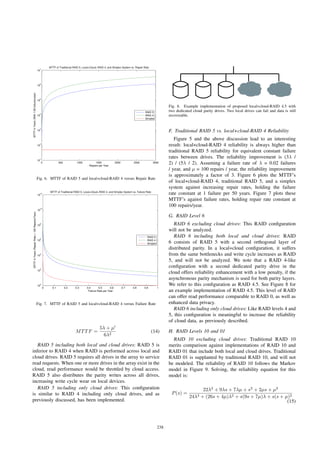
Reliability for this system can be calculated with the aid of
a Markov model. See Figure 5. For local+cloud-RAID 4, λ’
= 2λ and λ” = λ. The repair rate of the system is μ . This
model was solved by Shooman [21]. The probability, in the
Laplace domain, of being in each state is:
PStart(s) =
s + λ + μ
[s2 + (3λ + μ )s + 2λ2]
(6)
PS1
(s) =
2λ
[s2 + (3λ + μ )s + 2λ2]
(7)
PF ail(s) =
2λ2
s[s2 + (3λ + μ )s + 2λ2]
(8)
The MTTF of this system is the limit of the sum of P(Start)
and P(S1) as s approaches 0, which results in:
MTTF = lim
s→0
(PStart(s) + PS1
(s)) = (9)
lim
s→0
s + 3λ + μ
[s2 + (3λ + μ )s + 2λ2]
=
3λ + μ
2λ2
(10)
RAID 4 including only cloud drives: This configuration
provides a meaningful way to increase the reliability of cloud
storage and is similar to erasure-coding techniques for data in
the cloud, though existing systems utilize distributed parity,
which is akin to RAID 5 or RAID 6 [1], [7], [8], [9].
E. RAID Level 5
RAID 5 excluding cloud drives: This configuration can be
modeled the same way as local+cloud-RAID 4, with modified
failure rates. See Figure 5. With RAID 5, λ’ in this figure
becomes 3λ, and λ” becomes 2λ.
PStart(s) =
s + 2λ + μ
[s2 + (5λ + μ )s + 6λ2]
(11)
PS1
(s) =
3λ
[s2 + (5λ + μ )s + 6λ2]
(12)
PF ail(s) =
6λ2
s[s2 + (5λ + μ )s + 6λ2]
(13)
Likewise, the MTTF of this system is the limit of the sum
of P(Start) and P(S1) as s approaches 0, which results in:
237](https://image.slidesharecdn.com/c7e0807d-325f-4da3-a19c-933a33bd38eb-170120232030/85/07784576-3-320.jpg)
![are viable, reducing connected hardware requirements, mini-
mizing the impact of parity-induced stress and overhead on
local drives, and increasing performance. RAID 4 is more
viable than RAID levels 5 and 6 when utilized in a combined
local+cloud configuration. RAID 4 can be used to increase the
MTTF of RAID 5 when a cloud drive is used as a dedicated
parity drive. We also propose RAID 4.5, which surpasses
RAID 6 in combined local+cloud configurations. RAID 0 read
performance is achieved with local+cloud-RAID levels 4, 4.5,
10, and 01, and substantial reliability gains are realized over
RAID 0 with the implementation of these levels. The cloud
can and ought to be extensively used as a resource to increase
the reliability of local storage, including within large arrays,
and also as a resource to increase the performance and security
of systems which include only cloud-based media.
V. FUTURE WORK
A Cost-Aware Risk Management Framework for Users of
Cloud Storage: Simplifying the decision-making process for
storage architecture selection would enable system archi-
tects to better compromise between cost, reliability, security,
and performance. New levels and configurations of RAID
can complicate system design by presenting options that
are currently unknown to architects. Quantifying the risk
of maintaining data in the cloud could enable architects to
better mitigate risk through proper storage architecture and
leveraging the reliability of the cloud.
Improving the Write Performance of local+cloud-RAID 4
and 4.5: Schemes to improve upon the write performance of
newly proposed RAID configurations will fully enable RAID
4 and RAID 4.5 to be adopted in storage systems which incur
a large number of writes.
Implementation and analysis of new RAID configurations:
Arguments have been made in favor of new RAID configura-
tions. However, performance of these systems in the field has
yet to be measured. Implementation of these configurations
will fuel further research.
VI. ACKNOWLEDGMENT
We thank Dr. Michael Wirthlin of BYU for providing
guidance on the techniques used to analyze RAID reliability.
REFERENCES
[1] C. Wang, Q. Wang, K. Ren, and W. Lou, “Ensuring data storage
security in cloud computing,” in Quality of Service, 2009. IWQoS. 17th
International Workshop on, July 2009, pp. 1–9.
[2] H. Abu-Libdeh, L. Princehouse, and H. Weatherspoon, “RACS:
A case for cloud storage diversity,” in Proceedings of the 1st
ACM Symposium on Cloud Computing, ser. SoCC ’10. New
York, NY, USA: ACM, 2010, pp. 229–240. [Online]. Available:
http://doi.acm.org/10.1145/1807128.1807165
[3] M. Schnjakin, D. Korsch, M. Schoenberg, and C. Meinel, “Implemen-
tation of a secure and reliable storage above the untrusted clouds,” in
Computer Science Education (ICCSE), 2013 8th International Confer-
ence on, April 2013, pp. 347–353.
[4] H. Graupner, K. Torkura, P. Berger, C. Meinel, and M. Schnjakin,
“Secure access control for multi-cloud resources,” in Local Computer
Networks Conference Workshops (LCN Workshops), 2015 IEEE 40th,
Oct 2015, pp. 722–729.
[5] Y. Chi, W. Cai, Z. Hong, H. C. B. Chan, and V. C. M. Leung, “A privacy
and price-aware inter-cloud system,” in 2015 IEEE 7th International
Conference on Cloud Computing Technology and Science (CloudCom),
Nov 2015, pp. 298–305.
[6] C. W. Ling and A. Datta, “InterCloud RAIDer: A do-it-yourself
multi-cloud private data backup system,” in Proceedings of the 15th
International Conference on Distributed Computing and Networking
- Volume 8314, ser. ICDCN 2014. New York, NY, USA: Springer-
Verlag New York, Inc., 2014, pp. 453–468. [Online]. Available:
http://dx.doi.org/10.1007/978-3-642-45249-9 30
[7] K. D. Bowers, A. Juels, and A. Oprea, “HAIL: A high-availability
and integrity layer for cloud storage,” in Proceedings of the 16th ACM
Conference on Computer and Communications Security, ser. CCS ’09.
New York, NY, USA: ACM, 2009, pp. 187–198. [Online]. Available:
http://doi.acm.org/10.1145/1653662.1653686
[8] G. Chockler, R. Guerraoui, I. Keidar, and M. Vukolic, “Reliable
distributed storage,” Computer, vol. 42, no. 4, pp. 60–67, April 2009.
[9] B. Mao, S. Wu, and H. Jiang, “Improving storage availability in cloud-
of-clouds with hybrid redundant data distribution,” in Parallel and
Distributed Processing Symposium (IPDPS), 2015 IEEE International,
May 2015, pp. 633–642.
[10] Q. Zhang, S. Li, Z. Li, Y. Xing, Z. Yang, and Y. Dai, “CHARM: A
cost-efficient multi-cloud data hosting scheme with high availability,”
IEEE Transactions on Cloud Computing, vol. 3, no. 3, pp. 372–386,
July 2015.
[11] A. Bessani, M. Correia, B. Quaresma, F. Andr´e, and P. Sousa, “DepSky:
Dependable and secure storage in a cloud-of-clouds,” in Proceedings
of the Sixth Conference on Computer Systems, ser. EuroSys ’11.
New York, NY, USA: ACM, 2011, pp. 31–46. [Online]. Available:
http://doi.acm.org/10.1145/1966445.1966449
[12] M. A. Alzain, B. Soh, and E. Pardede, “MCDB: Using multi-clouds
to ensure security in cloud computing,” in Dependable, Autonomic and
Secure Computing (DASC), 2011 IEEE Ninth International Conference
on, Dec 2011, pp. 784–791.
[13] M. Schnjakin, T. Metzke, and C. Meinel, “Applying erasure codes
for fault tolerance in cloud-RAID,” in Computational Science and
Engineering (CSE), 2013 IEEE 16th International Conference on, Dec
2013, pp. 66–75.
[14] M. Vrable, S. Savage, and G. M. Voelker, “BlueSky: A cloud-backed
file system for the enterprise,” in Proceedings of the 10th USENIX
Conference on File and Storage Technologies, ser. FAST’12. Berkeley,
CA, USA: USENIX Association, 2012, pp. 19–19. [Online]. Available:
http://dl.acm.org/citation.cfm?id=2208461.2208480
[15] C. Selvakumar, G. J. Rathanam, and M. R. Sumalatha, “PDDS - improv-
ing cloud data storage security using data partitioning technique,” in
Advance Computing Conference (IACC), 2013 IEEE 3rd International,
Feb 2013, pp. 7–11.
[16] M. Schnjakin and C. Meinel, “Evaluation of cloud-RAID: A secure and
reliable storage above the clouds,” in Computer Communications and
Networks (ICCCN), 2013 22nd International Conference on, July 2013,
pp. 1–9.
[17] B. Mao, S. Wu, and H. Jiang, “Exploiting workload characteristics and
service diversity to improve the availability of cloud storage systems,”
IEEE Transactions on Parallel and Distributed Systems, vol. PP, no. 99,
pp. 1–1, 2015.
[18] C. W. Chang, P. Liu, and J. J. Wu, “Probability-based cloud storage
providers selection algorithms with maximum availability,” in Parallel
Processing (ICPP), 2012 41st International Conference on, Sept 2012,
pp. 199–208.
[19] D. A. Patterson, G. Gibson, and R. H. Katz, A case for redundant arrays
of inexpensive disks (RAID). ACM, 1988, vol. 17, no. 3.
[20] P. M. Chen, E. K. Lee, G. A. Gibson, R. H. Katz, and D. A. Patterson,
“Raid: High-performance, reliable secondary storage,” ACM Computing
Surveys (CSUR), vol. 26, no. 2, pp. 145–185, 1994.
[21] M. L. Shooman, Reliability of Computer Systems and Networks: Fault
Tolerance, Analysis and Design. New York, USA: Wiley-Interscience,
2002, pp. 112–114,438–441.
[22] S. Gregori, A. Cabrini, O. Khouri, and G. Torelli, “On-chip error
correcting techniques for new-generation flash memories,” Proceedings
of the IEEE, vol. 91, no. 4, pp. 602–616, April 2003.
240](https://image.slidesharecdn.com/c7e0807d-325f-4da3-a19c-933a33bd38eb-170120232030/85/07784576-6-320.jpg)


![Raid_structure_os[1].pdfhdgretrhfgfhfhyt](https://cdn.slidesharecdn.com/ss_thumbnails/raidstructureos1-250213084106-a1567d8d-thumbnail.jpg?width=640&height=640&fit=bounds)


